Author Contributions
Conceptualization, S.S. and G.A.; methodology, S.S., G.A. and P.F.; software, S.S.; validation, G.T., A.A. and P.F.; formal analysis, S.S.; investigation, S.S. and F.K.K.; data curation, S.S.; funding acquisition, F.K.K., G.T. and A.A.; project administration, F.K.K.; writing—original draft preparation, S.S. and G.A.; writing—review and editing, S.S., G.T., A.A. and P.F.; visualization, S.S. and F.K.K.; supervision, P.F. All authors have read and agreed to the published version of the manuscript.
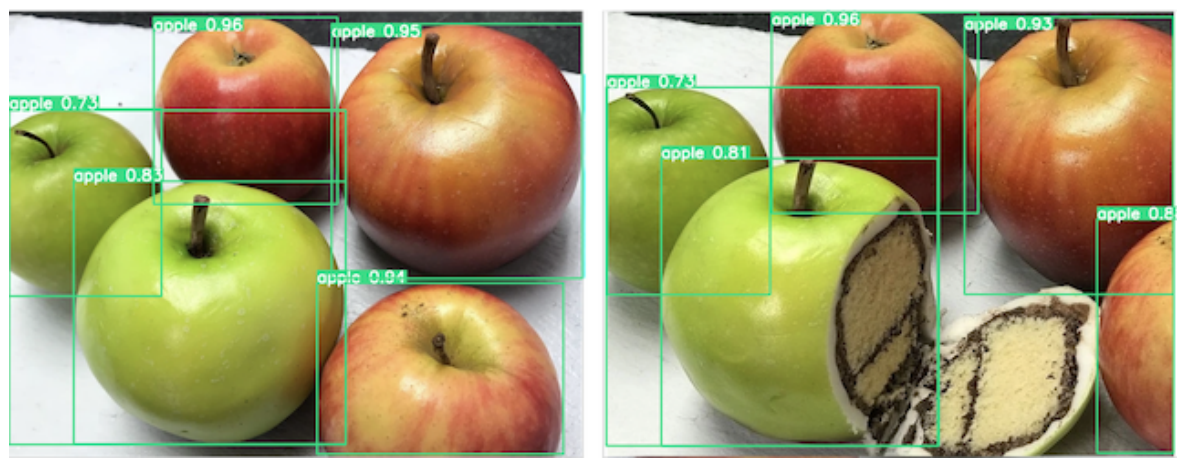
Figure 1.
Example of RGB-based object misclassifications. This image depicts pastry cakes that reassemble apples, leading the RGB-based model to mistakenly classify the instances as apples.
Figure 1.
Example of RGB-based object misclassifications. This image depicts pastry cakes that reassemble apples, leading the RGB-based model to mistakenly classify the instances as apples.
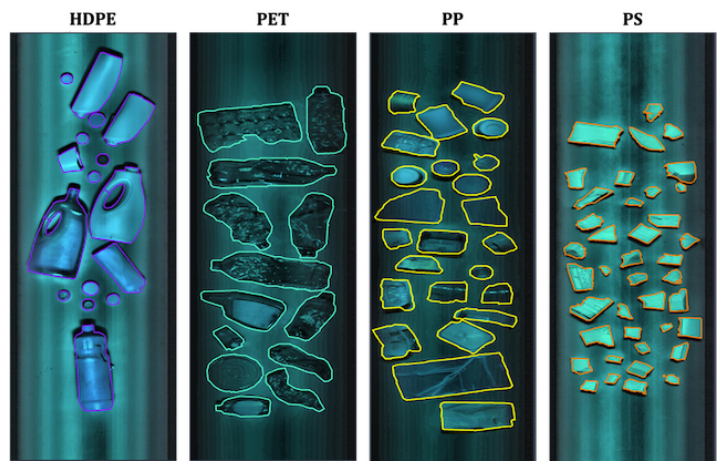
Figure 2.
The false-colour contrast stretched HS images used for the generation.
Figure 2.
The false-colour contrast stretched HS images used for the generation.
Figure 3.
The Raman spectra for the 4 material classes. For the HDPE spectrum, the peaks at 1058 cm−1, 1123 cm−1, 1291 cm−1, 1437 cm−1, and the range from 2843–2876 cm−1 are characteristic of high-density polyethylene (HDPE). These peaks correspond to the vibrations of the molecular structure of HDPE, specifically indicating the various stretching and bending vibrations of the C-H bonds. Accordingly, for the rest of the spectra, it is pointed out that two characteristic peaks at 1607 cm−1 and 1721 cm−1 were detected in the top-right plot and correspond to the vibrations of the phenyl group in the polyester. Additionally, the peaks in the range of 1100–1200 cm−1 indicate the stretching vibrations of the C-O group. The peaks observed at 970 cm−1, 1034 cm−1, 1360 cm−1, 1453 cm−1, and 2946 cm−1 in the bottom-left plot are associated with the vibrations of the methyl group (CH3) in polypropylene, while the intense peak observed at 1010 cm−1, in the bottom-right plot, along with the peak at 1598 cm−1, suggest the presence of polystyrene.
Figure 3.
The Raman spectra for the 4 material classes. For the HDPE spectrum, the peaks at 1058 cm−1, 1123 cm−1, 1291 cm−1, 1437 cm−1, and the range from 2843–2876 cm−1 are characteristic of high-density polyethylene (HDPE). These peaks correspond to the vibrations of the molecular structure of HDPE, specifically indicating the various stretching and bending vibrations of the C-H bonds. Accordingly, for the rest of the spectra, it is pointed out that two characteristic peaks at 1607 cm−1 and 1721 cm−1 were detected in the top-right plot and correspond to the vibrations of the phenyl group in the polyester. Additionally, the peaks in the range of 1100–1200 cm−1 indicate the stretching vibrations of the C-O group. The peaks observed at 970 cm−1, 1034 cm−1, 1360 cm−1, 1453 cm−1, and 2946 cm−1 in the bottom-left plot are associated with the vibrations of the methyl group (CH3) in polypropylene, while the intense peak observed at 1010 cm−1, in the bottom-right plot, along with the peak at 1598 cm−1, suggest the presence of polystyrene.

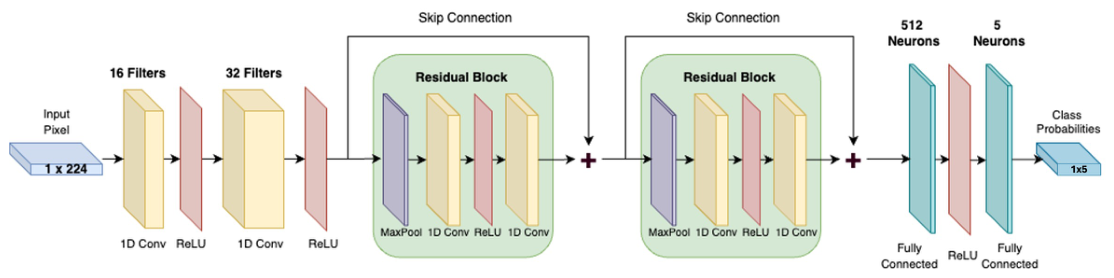
Figure 4.
The high-level architecture of the proposed Pixel-wise 1D Convolutional Hyperspectral (P1CH) classifier.
Figure 4.
The high-level architecture of the proposed Pixel-wise 1D Convolutional Hyperspectral (P1CH) classifier.
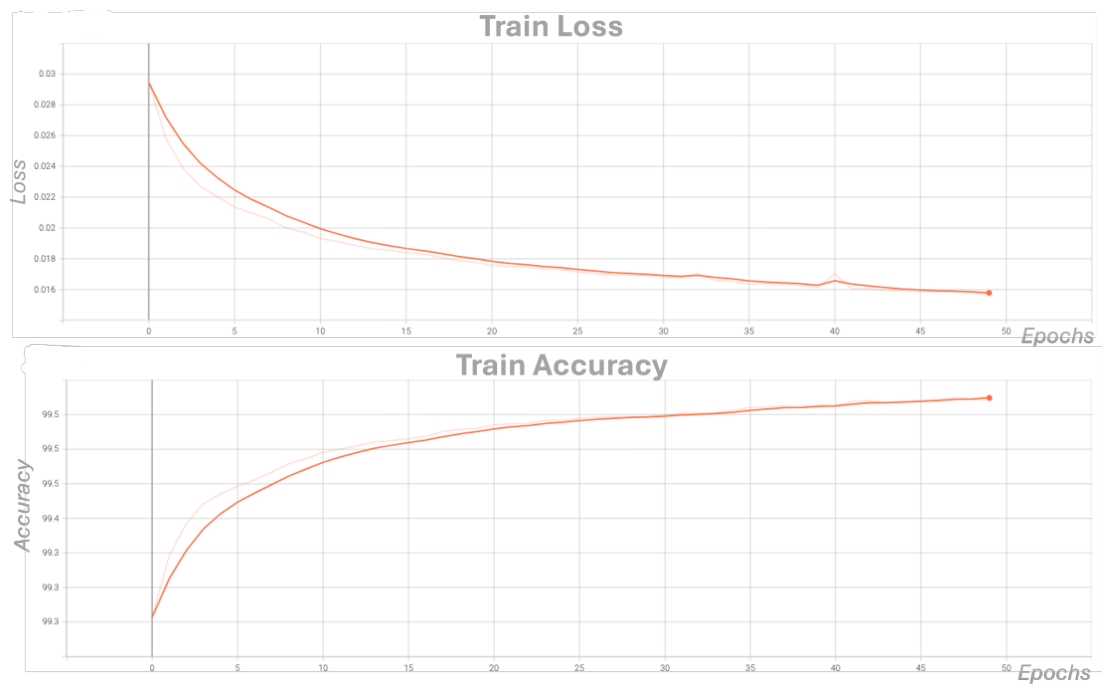
Figure 5.
P1CH loss (top), and accuracy score (bottom) training curves.
Figure 5.
P1CH loss (top), and accuracy score (bottom) training curves.
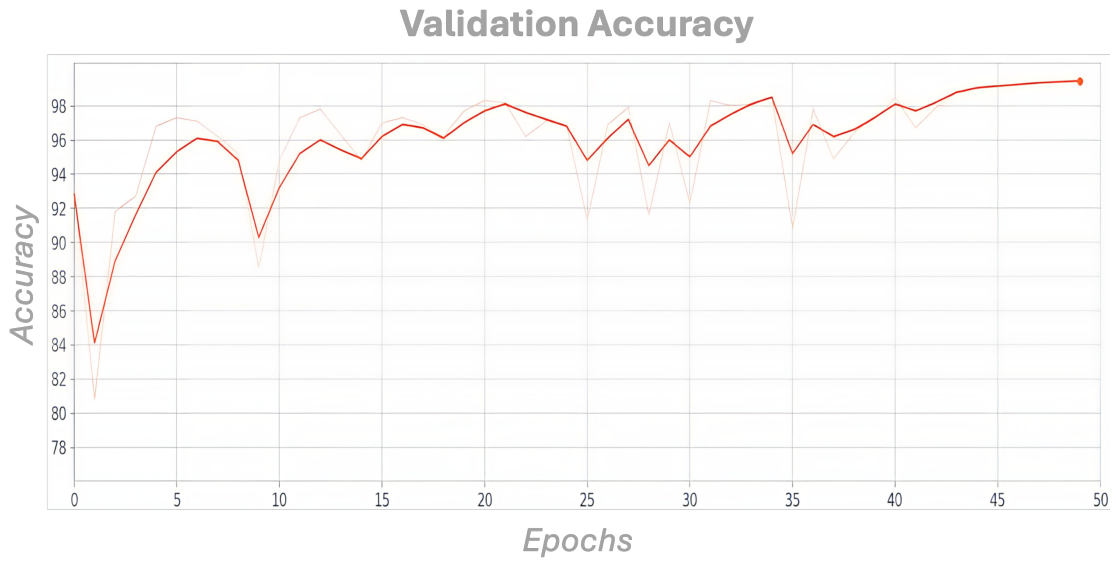
Figure 6.
The model’s performance in the validation set, during training, with the best accuracy score achieved in epoch 35.
Figure 6.
The model’s performance in the validation set, during training, with the best accuracy score achieved in epoch 35.
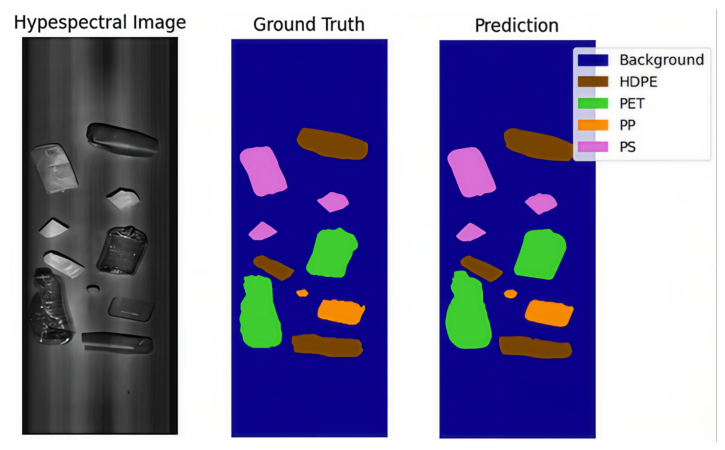
Figure 7.
The false-colour version of the HS images, the ground truth mask, as well as the generated classification map from the proposed model.
Figure 7.
The false-colour version of the HS images, the ground truth mask, as well as the generated classification map from the proposed model.
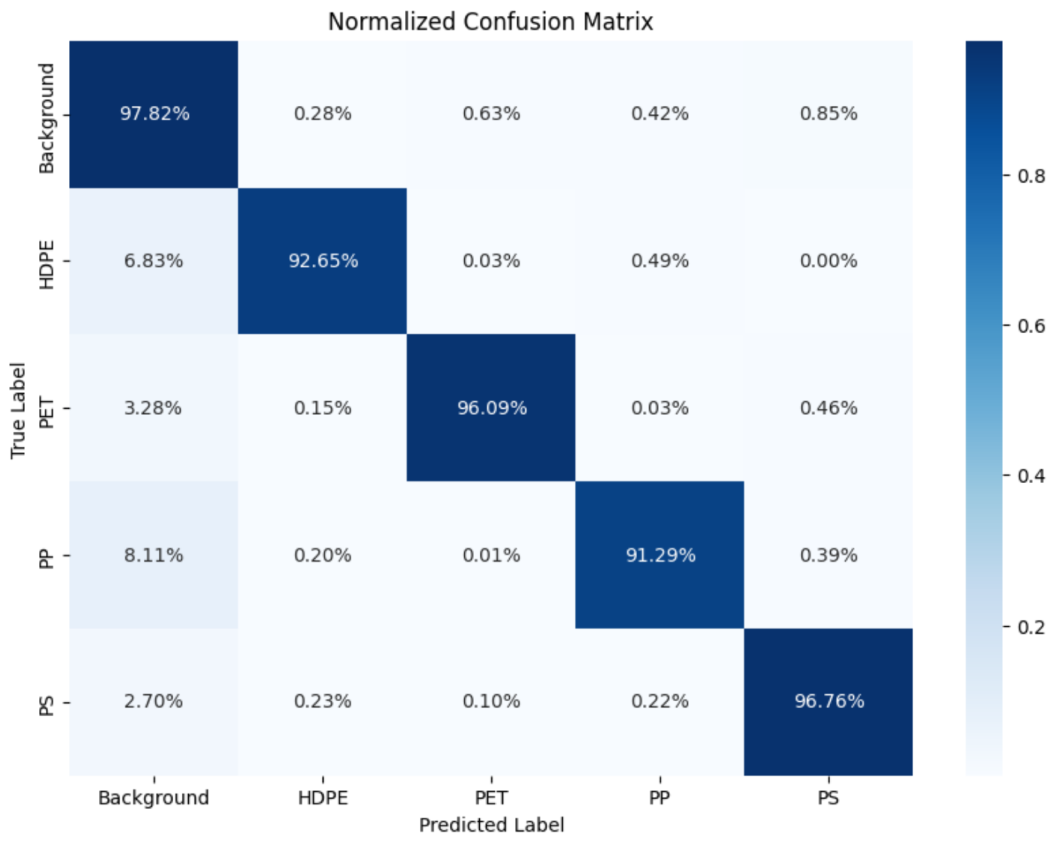
Figure 8.
Confusion Matrix describing models performance in classifying materials on pixel-level.
Figure 8.
Confusion Matrix describing models performance in classifying materials on pixel-level.
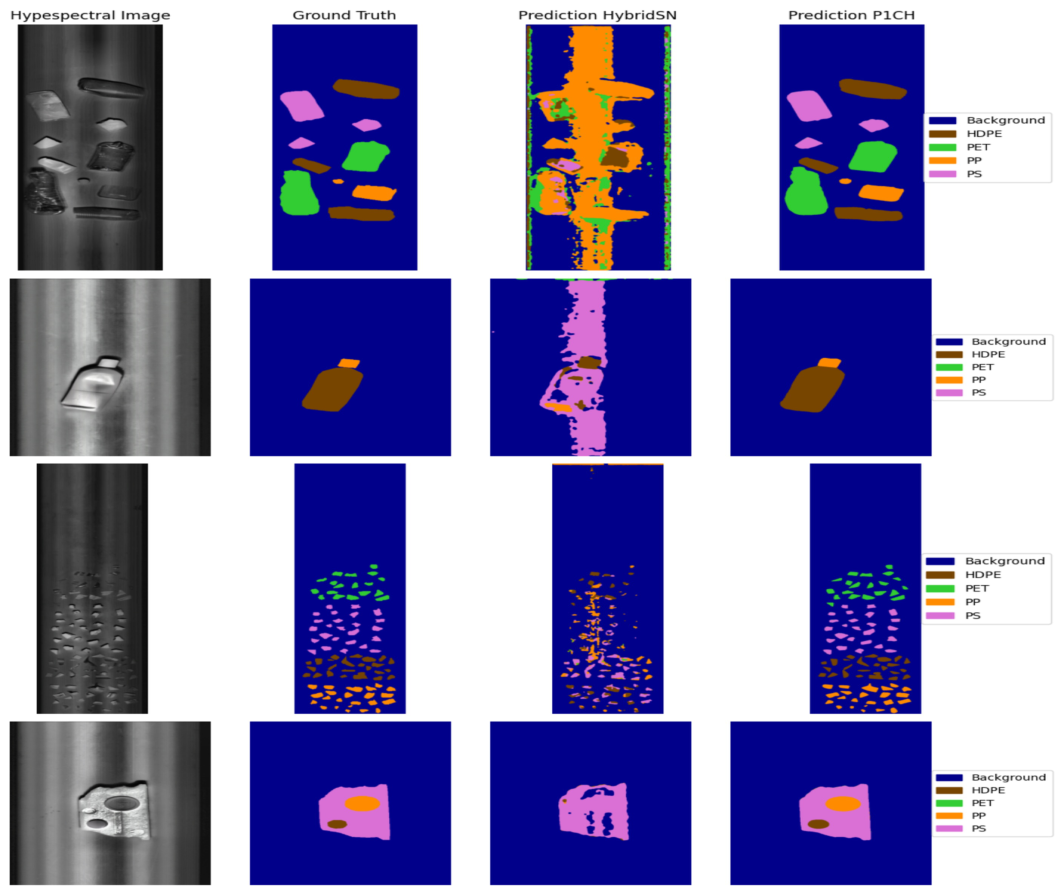
Figure 9.
From left to right: The false-colour HS image, the Ground Truth mask, the classification maps generated by HybridSN model, as well as the generated classification map, by the P1CH classifier, in the aforementioned scenarios.
Figure 9.
From left to right: The false-colour HS image, the Ground Truth mask, the classification maps generated by HybridSN model, as well as the generated classification map, by the P1CH classifier, in the aforementioned scenarios.
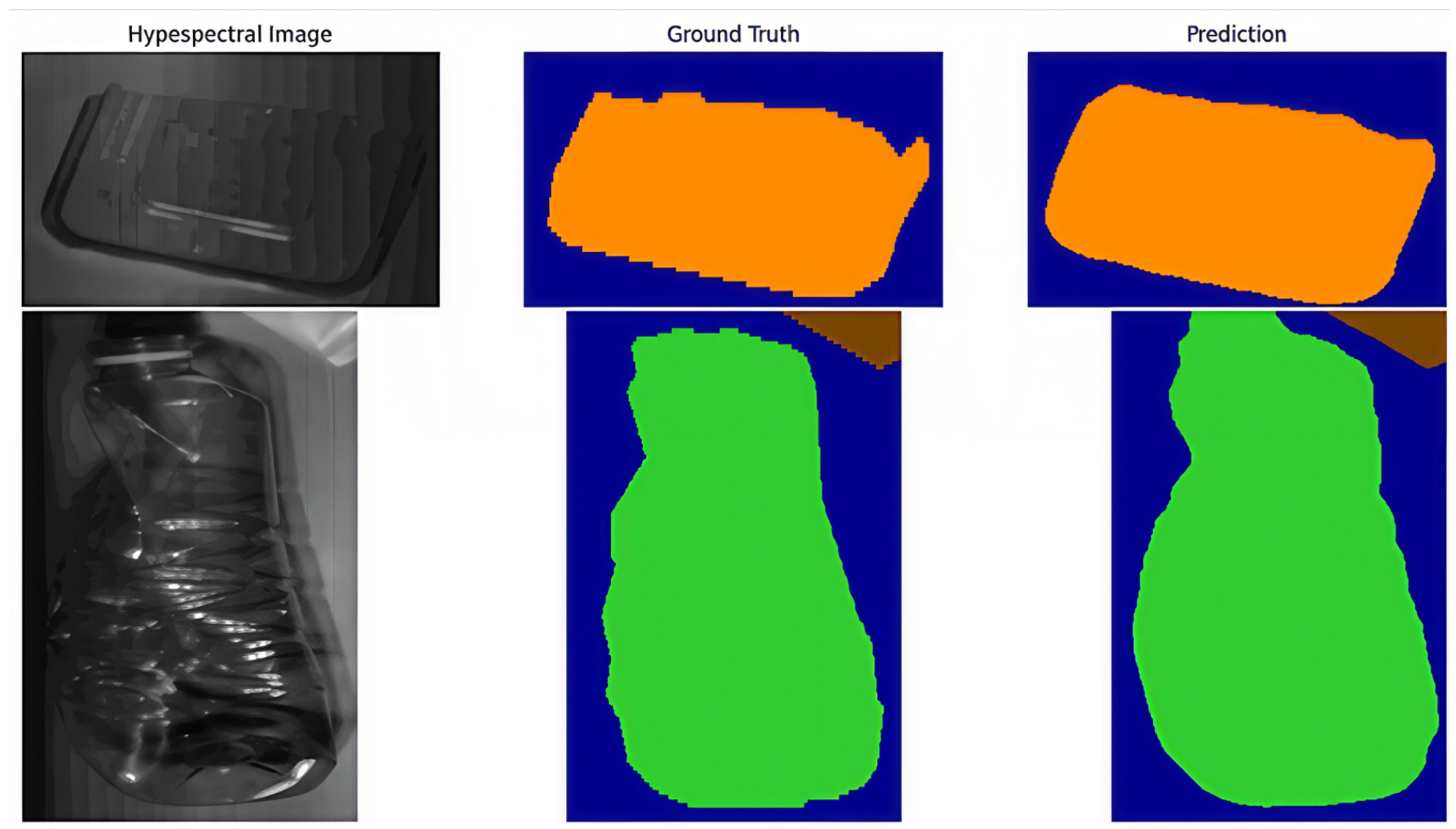
Figure 10.
Zoomed-in crops. In the first row the bottom-right PP object of
Figure 7 is depicted with the GT and Predicted masks. In the second row the lower-left PET object is presented.
Figure 10.
Zoomed-in crops. In the first row the bottom-right PP object of
Figure 7 is depicted with the GT and Predicted masks. In the second row the lower-left PET object is presented.
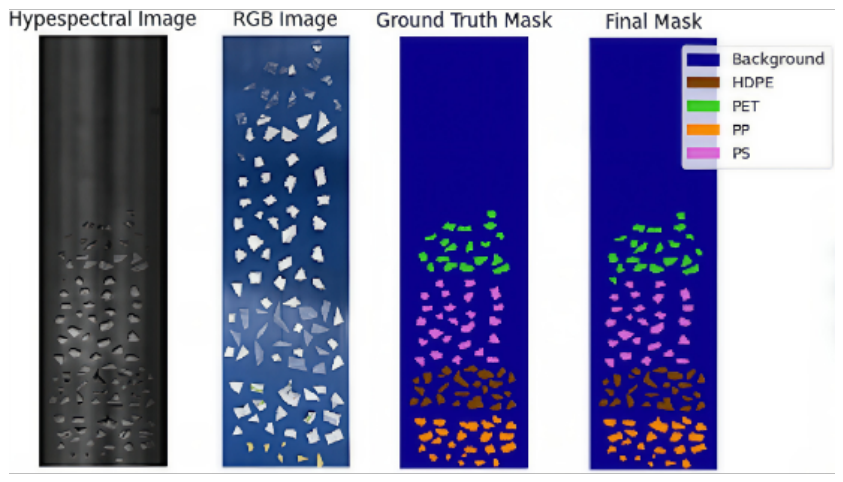
Figure 11.
From left to right: The false-colour HS image, the RGB equivalent image, the Ground Truth mask, as well as the classification map generated by the P1CH classifier, in a challenging, cluttered scene, where the objects are small with irregular shapes and similar textures.
Figure 11.
From left to right: The false-colour HS image, the RGB equivalent image, the Ground Truth mask, as well as the classification map generated by the P1CH classifier, in a challenging, cluttered scene, where the objects are small with irregular shapes and similar textures.
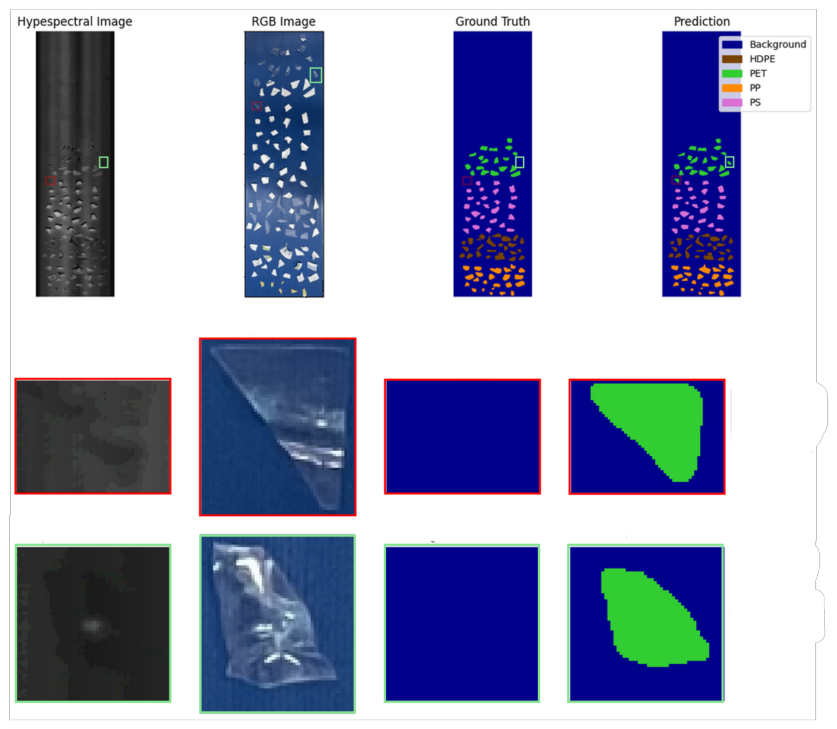
Figure 12.
Zoomed-in crops of
Figure 11, highlighting two small PET shards that were mistakenly omitted from the labelling process (denoted with red and green boxes), and yet were detected by the model.
Figure 12.
Zoomed-in crops of
Figure 11, highlighting two small PET shards that were mistakenly omitted from the labelling process (denoted with red and green boxes), and yet were detected by the model.
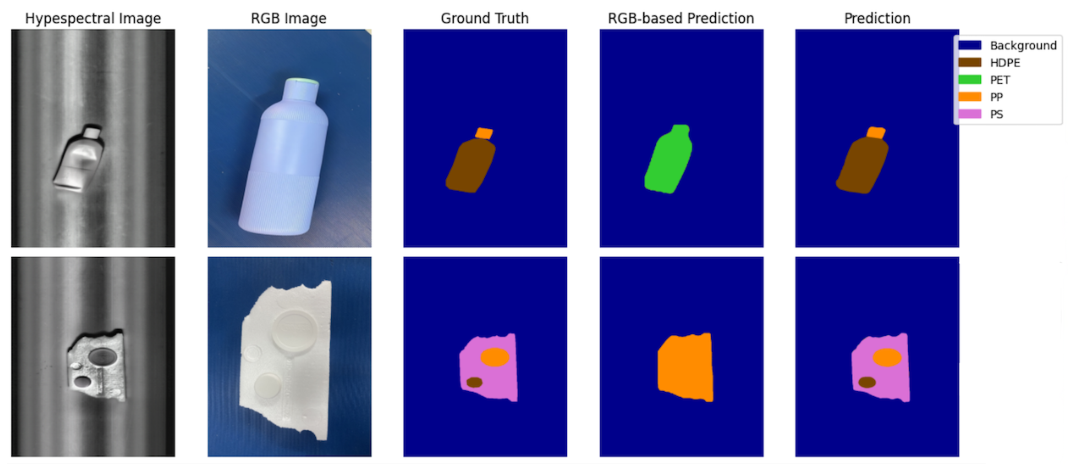
Figure 13.
From left to right: The false-colour HS image, the RGB equivalent image, the Ground Truth mask, the classification maps generated by an RGB-based model using the RGB equivalent images, as well as the generated classification map, by the P1CH classifier, in the scenario of mixed or overlapping materials.
Figure 13.
From left to right: The false-colour HS image, the RGB equivalent image, the Ground Truth mask, the classification maps generated by an RGB-based model using the RGB equivalent images, as well as the generated classification map, by the P1CH classifier, in the scenario of mixed or overlapping materials.
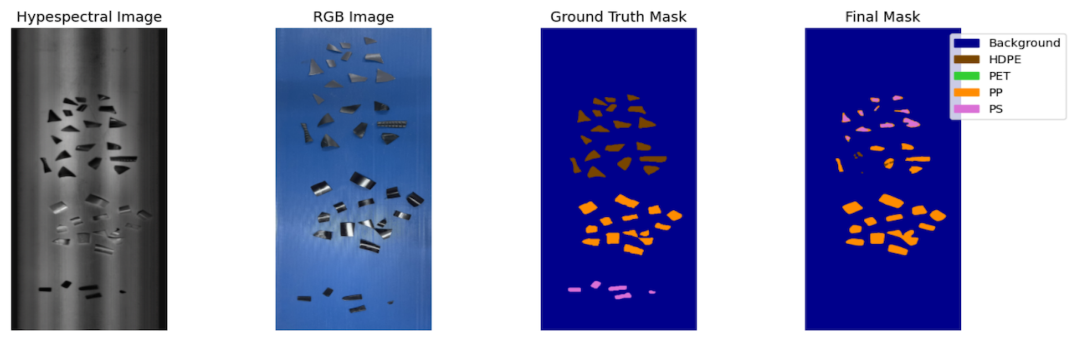
Figure 14.
From left to right: The false-colour HS image, the RGB equivalent image, the Ground Truth mask, as well as the classification map generated by the P1CH classifier in the case of black plastics.
Figure 14.
From left to right: The false-colour HS image, the RGB equivalent image, the Ground Truth mask, as well as the classification map generated by the P1CH classifier in the case of black plastics.
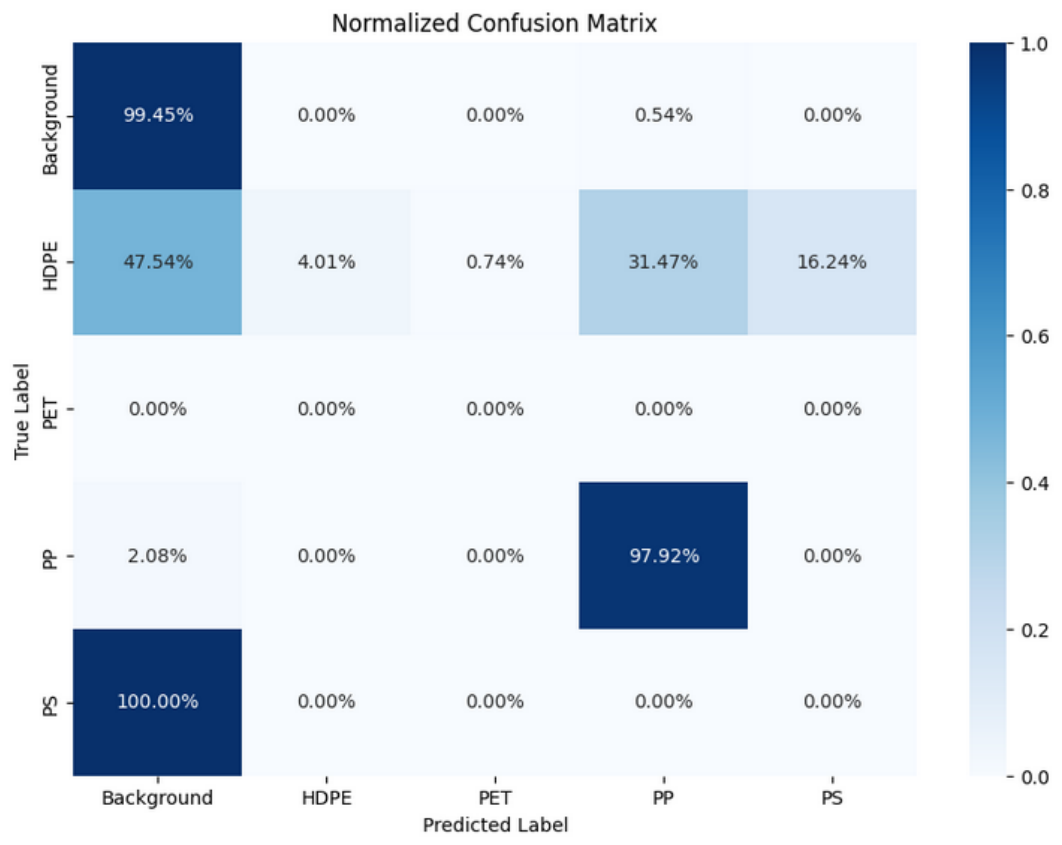
Figure 15.
Normalized Confusion Matrix for the predictions of the model in the case of black and dark-coloured objects.
Figure 15.
Normalized Confusion Matrix for the predictions of the model in the case of black and dark-coloured objects.
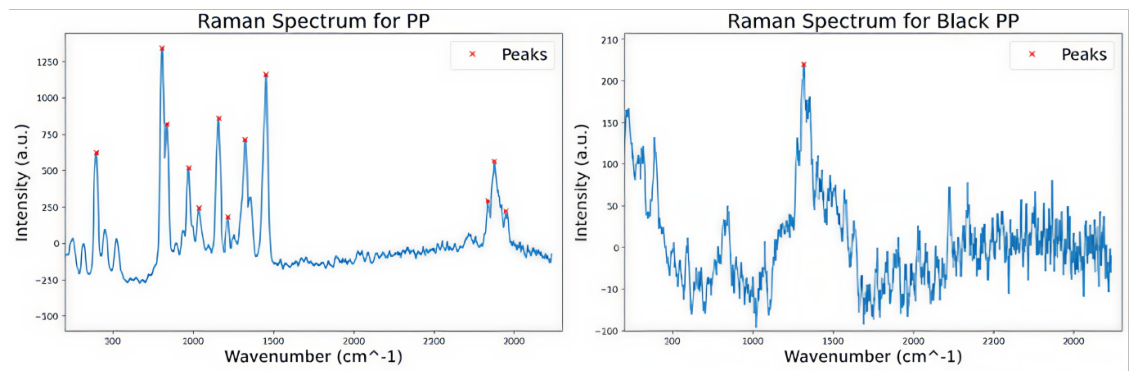
Figure 16.
A comparison between the spectra acquired from a black (left) and a white (right) PS object. A significant drop in the signal’s amplitude can be observed in the case of black PS. Also one can notice that most of the indicative peaks for PS are non-existent in the case of black PS.
Figure 16.
A comparison between the spectra acquired from a black (left) and a white (right) PS object. A significant drop in the signal’s amplitude can be observed in the case of black PS. Also one can notice that most of the indicative peaks for PS are non-existent in the case of black PS.
Table 1.
Summary of Images, Objects, and Pixels per Category of the Training set.
Table 1.
Summary of Images, Objects, and Pixels per Category of the Training set.
| Material | Images | Objects | Pixels |
|---|
| HDPE | 2 | 40 | 794,142 |
| PET | 2 | 24 | 810,483 |
| PP | 2 | 45 | 831,340 |
| PS | 2 | 60 | 801,936 |
Table 2.
Examples of object diversity included in the HS dataset.
Table 2.
Examples of object diversity included in the HS dataset.
| Material | Representative Object Types | Colour/Opacity | Shape/Texture |
|---|
| HDPE | Detergent/shampoo bottles, bottle bodies, caps, rigid containers | White, light grey, dark-blue, yellow, green, light-blue, red, glossy and matte | Curved bottle bodies, flat fragments, lids, shredded pieces |
| PET | Transparent beverage bottles, trays, thin packaging pieces | Transparent, glossy and matte | Thin curved surfaces, bottle necks, flat pieces, small shards |
| PP | Bottle caps, food-container lids, yogurt/packaging components | White, red, blue, grey, green, opaque, semi-gloss | Rigid lids, curved caps, flat surfaces, irregular fragments |
| PS | Cups, plates, trays, foam-like and rigid PS pieces | White, glossy and matte | Flat trays, thin plates, brittle fragments, shredded pieces |
Table 3.
Black object test subset.
Table 3.
Black object test subset.
| Material | Objects | Pixels |
|---|
| HDPE | 19 | 31,649 |
| PET | 0 | 0 |
| PP | 14 | 25,280 |
| PS | 5 | 5035 |
Table 4.
Test set without black objects.
Table 4.
Test set without black objects.
| Material | Objects | Pixels |
|---|
| HDPE | 29 | 124,109 |
| PET | 20 | 100,445 |
| PP | 2 | 59,682 |
| PS | 29 | 116,704 |
Table 5.
Class-wise test-set performance of P1CH on the object-disjoint test set.
Table 5.
Class-wise test-set performance of P1CH on the object-disjoint test set.
| Class | Precision (%) | Recall (%) | F1-Score (%) | Support (Pixels) |
|---|
| Background | 99.35 | 97.82 | 98.58 | 3,096,015 |
| HDPE | 92.59 | 92.65 | 92.62 | 124,109 |
| PET | 83.07 | 96.09 | 89.11 | 100,445 |
| PP | 79.68 | 91.29 | 85.09 | 59,682 |
| PS | 80.70 | 96.76 | 88.00 | 116,704 |
| Overall/macro | 87.08 | 94.92 | 90.68 | 3,496,955 |
Table 6.
Performance Metrics Comparison between P1CH and HybridSN Models.
Table 6.
Performance Metrics Comparison between P1CH and HybridSN Models.
| Metric | P1CH | HybridSN |
|---|
| Mean Accuracy (%) | 97.44 | 21.81 |
| Mean Recall (%) | 94.92 | 7.86 |
| Mean Kappa Score | 0.9295 | −0.0795 |
| Mean Inference Time (s) | 5.06 | 34.29 |
Table 7.
Effect of normalization strategy on object-disjoint test performance.
Table 7.
Effect of normalization strategy on object-disjoint test performance.
| Preprocessing Strategy | Overall Accuracy (%) | Macro F1 (%) | Comment |
|---|
| Black/white reference normalization | 97.95 | 91.56 | Manufacturer-recommended reference procedure |
| Black reference + training maximum M | 97.44 | 90.96 | Proposed low-cost approximation used in this work |
| Black reference only | 88.71 | 79.84 | More sensitive to intensity scale variations |
Table 8.
Ablation study of P1CH components and post-processing.
Table 8.
Ablation study of P1CH components and post-processing.
| Configuration | Accuracy (%) | Macro F1 (%) | Observation |
|---|
| P1CH without residual blocks | 95.76 | 88.73 | Lower spectral feature stability |
| P1CH raw prediction, no post-processing | 96.86 | 89.95 | Most errors are isolated pixels and borders |
| P1CH + median filter | 97.27 | 90.42 | Reduces isolated salt-and-pepper labels |
| P1CH + median + morphology | 97.44 | 90.68 | Final configuration used in this paper |
Table 9.
Robustness of P1CH to synthetic illumination and noise perturbations applied to the object-disjoint test spectra.
Table 9.
Robustness of P1CH to synthetic illumination and noise perturbations applied to the object-disjoint test spectra.
| Perturbation | Accuracy (%) | Macro F1 (%) |
|---|
| No perturbation | 97.44 | 90.68 |
| Intensity scaling | 96.91 | 89.94 |
| Intensity scaling | 97.08 | 90.11 |
| Intensity scaling | 94.62 | 86.52 |
| Additive Gaussian noise, SNR 30 dB | 96.84 | 89.86 |
| Additive Gaussian noise, SNR 20 dB | 93.58 | 84.77 |




 ,
,