Author Contributions
Conceptualization, C.W. and X.S.; methodology, C.W. and X.S.; software, C.W. and X.S.; validation, C.W. and X.S.; formal analysis, C.W. and X.S.; investigation, C.W. and X.S.; resources, Z.C. and Y.H.; data curation, C.W. and X.S.; writing—original draft preparation, C.W. and X.S.; writing—review and editing, Z.C. and Y.H.; visualization, C.W. and X.S.; supervision, Z.C. and Y.H.; project administration, Z.C. and Y.H.; funding acquisition, Z.C. and Y.H. All authors have read and agreed to the published version of the manuscript.
Figure 1.
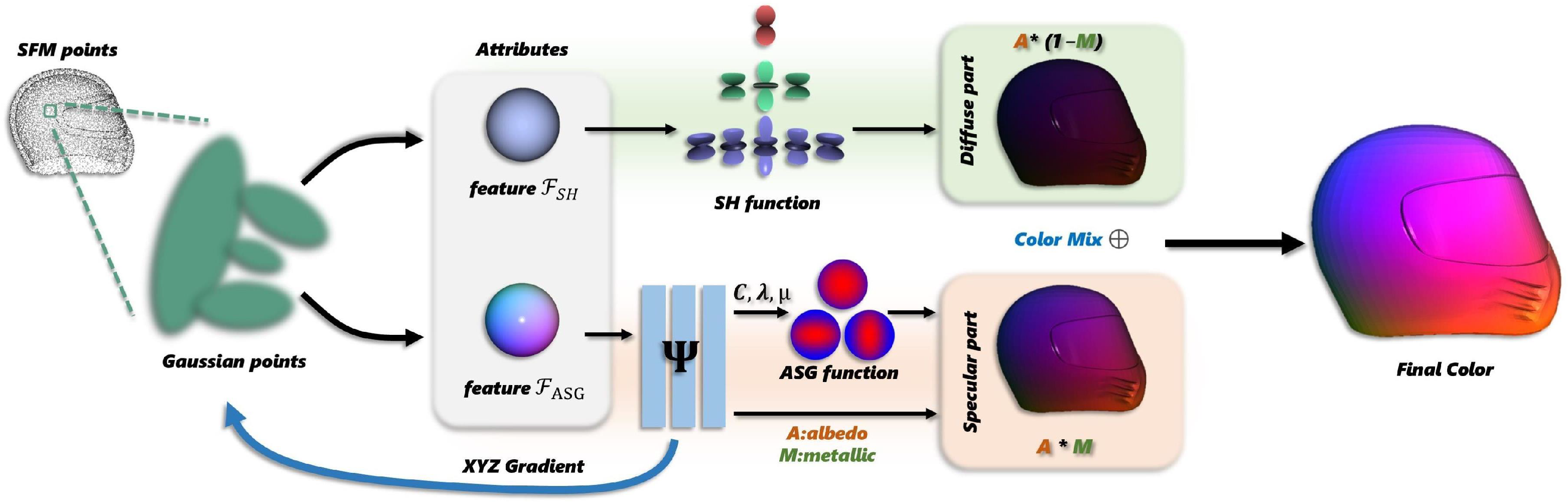
Overview of our proposed ARS-GS framework. The pipeline initializes Gaussian primitives with SH features for diffuse appearance and ASG features for reflective characteristics. A skip connection links the ASG network to Gaussian positions, optimizing reconstruction via adaptive Gaussian rasterization. In the diagram, black arrows represent the forward inference process, while blue arrows indicate the backward gradient flow. The asterisk (*) denotes matrix multiplication. The dashed line from SFM points to Gaussian points represents the Gaussian initialization process detailed in
Section 3.1. Each square block represents an intermediate variable obtained at the respective stage.
Figure 1.
Overview of our proposed ARS-GS framework. The pipeline initializes Gaussian primitives with SH features for diffuse appearance and ASG features for reflective characteristics. A skip connection links the ASG network to Gaussian positions, optimizing reconstruction via adaptive Gaussian rasterization. In the diagram, black arrows represent the forward inference process, while blue arrows indicate the backward gradient flow. The asterisk (*) denotes matrix multiplication. The dashed line from SFM points to Gaussian points represents the Gaussian initialization process detailed in
Section 3.1. Each square block represents an intermediate variable obtained at the respective stage.
Figure 2.
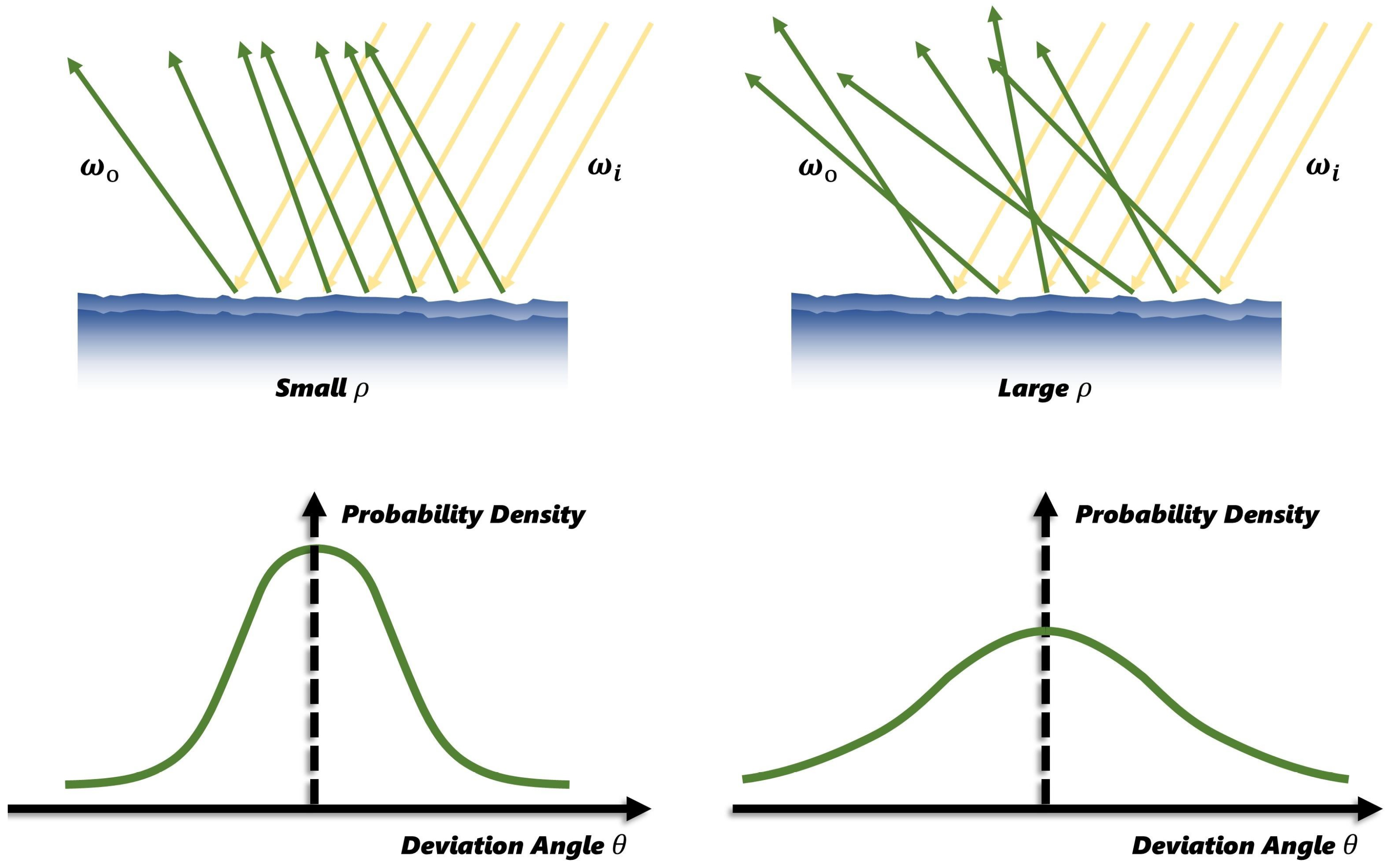
Visualization of GGX microfacet distribution function. The plots illustrate the variation in the distribution term D with different roughness parameters . In the figure, the yellow arrows represent the incident light direction , and the green arrows represent the outgoing light direction .
Figure 2.
Visualization of GGX microfacet distribution function. The plots illustrate the variation in the distribution term D with different roughness parameters . In the figure, the yellow arrows represent the incident light direction , and the green arrows represent the outgoing light direction .
Figure 3.
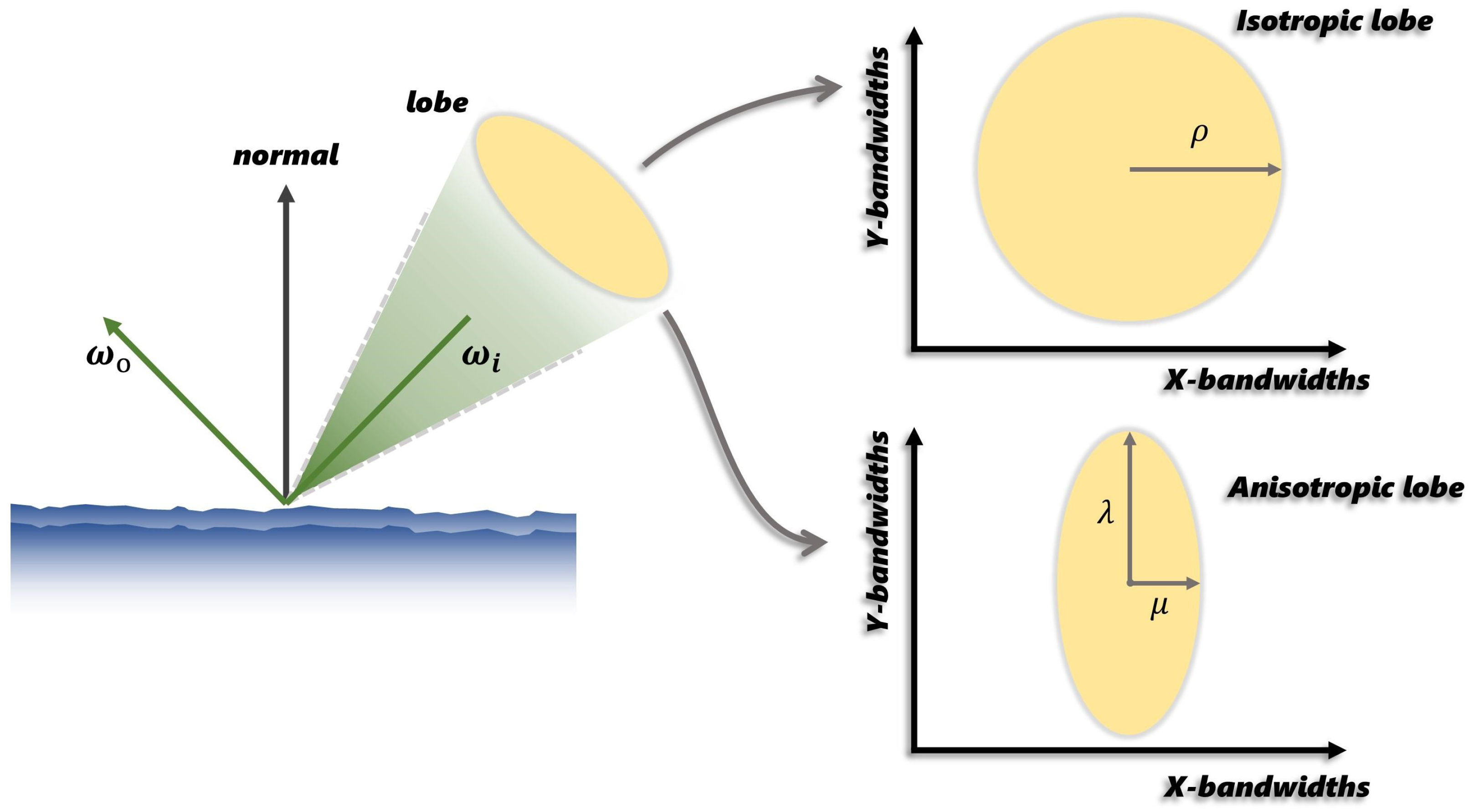
Comparison between isotropic and anisotropic distribution lobes. Left: Light interaction with a rough surface. Right: Isotropic distribution (top, controlled by ) versus anisotropic distribution (bottom, controlled by and ).
Figure 3.
Comparison between isotropic and anisotropic distribution lobes. Left: Light interaction with a rough surface. Right: Isotropic distribution (top, controlled by ) versus anisotropic distribution (bottom, controlled by and ).
Figure 4.
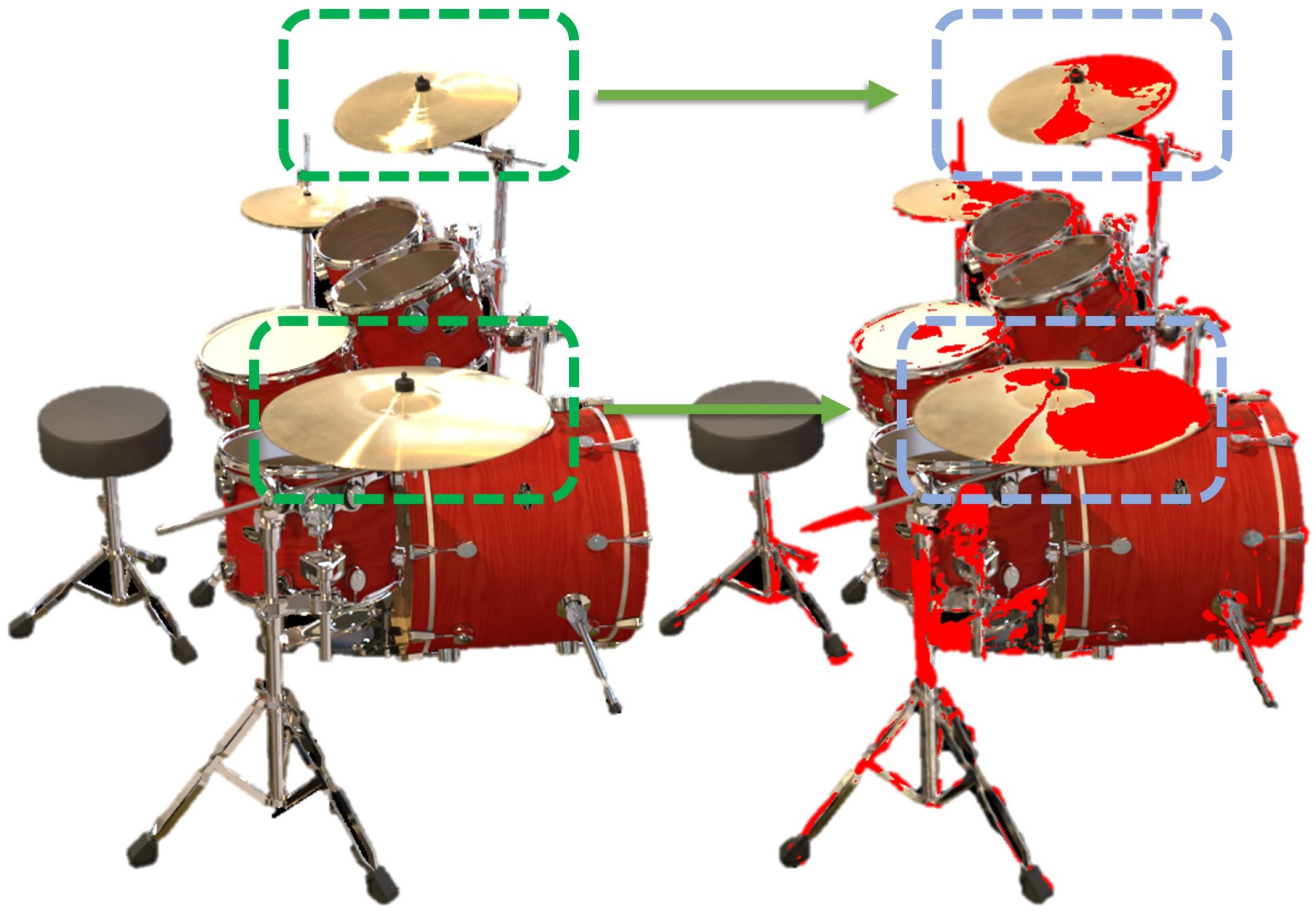
Analysis of Specular Reflection Modeling. Specular regions (marked in red) highlight where our physically grounded approach precisely models light-surface interactions, accurately capturing view-dependent effects across diverse geometries. In addition, the green dashed boxes indicate the specular highlights in the ground truth (original) images, while the blue dashed boxes represent the specular highlights calculated by our proposed algorithm. As shown, our method can accurately fit the specular highlights in real images.
Figure 4.
Analysis of Specular Reflection Modeling. Specular regions (marked in red) highlight where our physically grounded approach precisely models light-surface interactions, accurately capturing view-dependent effects across diverse geometries. In addition, the green dashed boxes indicate the specular highlights in the ground truth (original) images, while the blue dashed boxes represent the specular highlights calculated by our proposed algorithm. As shown, our method can accurately fit the specular highlights in real images.
Figure 5.
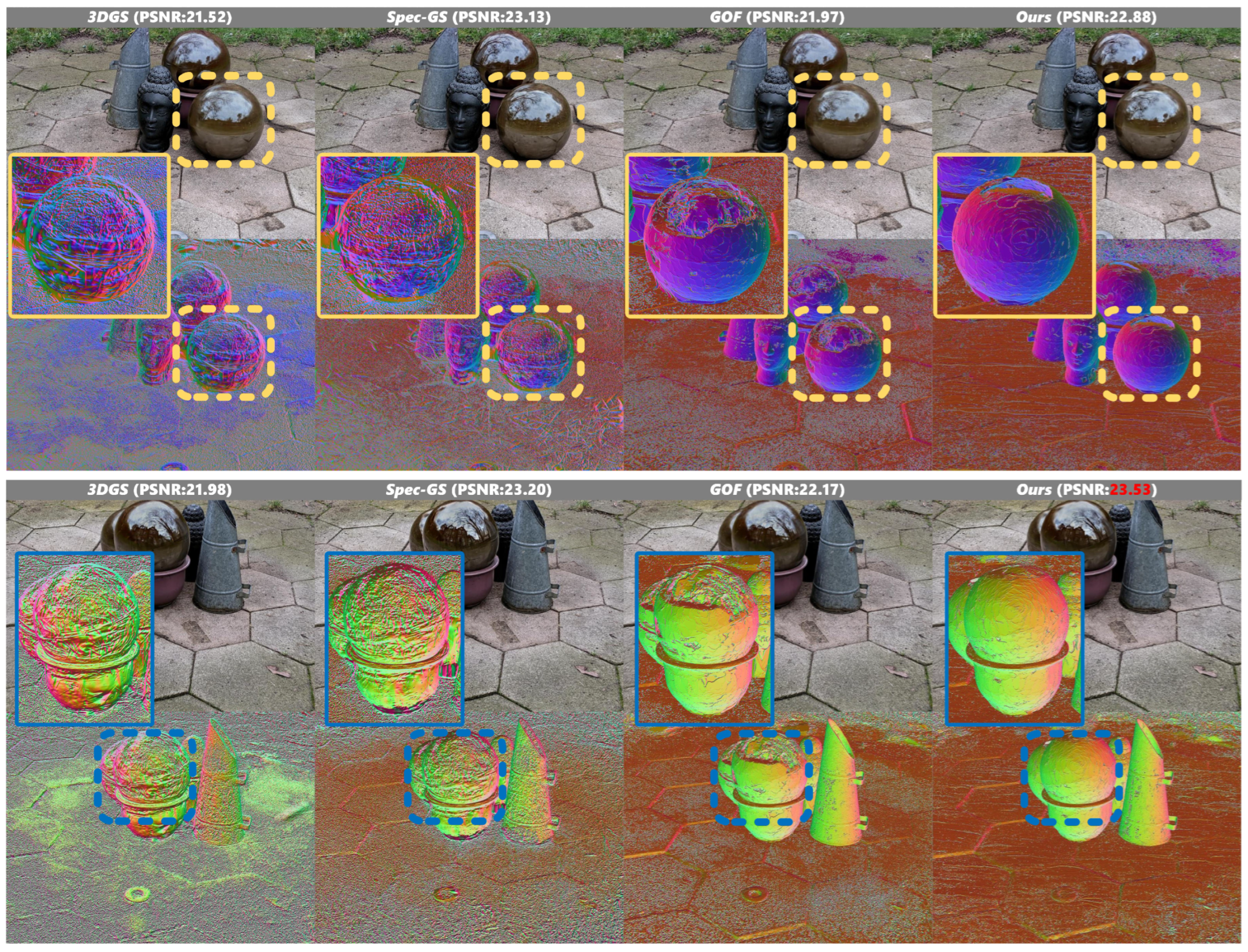
Qualitative results on Ref-NeRF dataset scene 1. In the figure, the dashed boxes indicate specific regions of interest in the original images, while the corresponding solid boxes of the same color (yellow and blue) display the magnified local views of these regions for detailed comparison.
Figure 5.
Qualitative results on Ref-NeRF dataset scene 1. In the figure, the dashed boxes indicate specific regions of interest in the original images, while the corresponding solid boxes of the same color (yellow and blue) display the magnified local views of these regions for detailed comparison.
Figure 6.
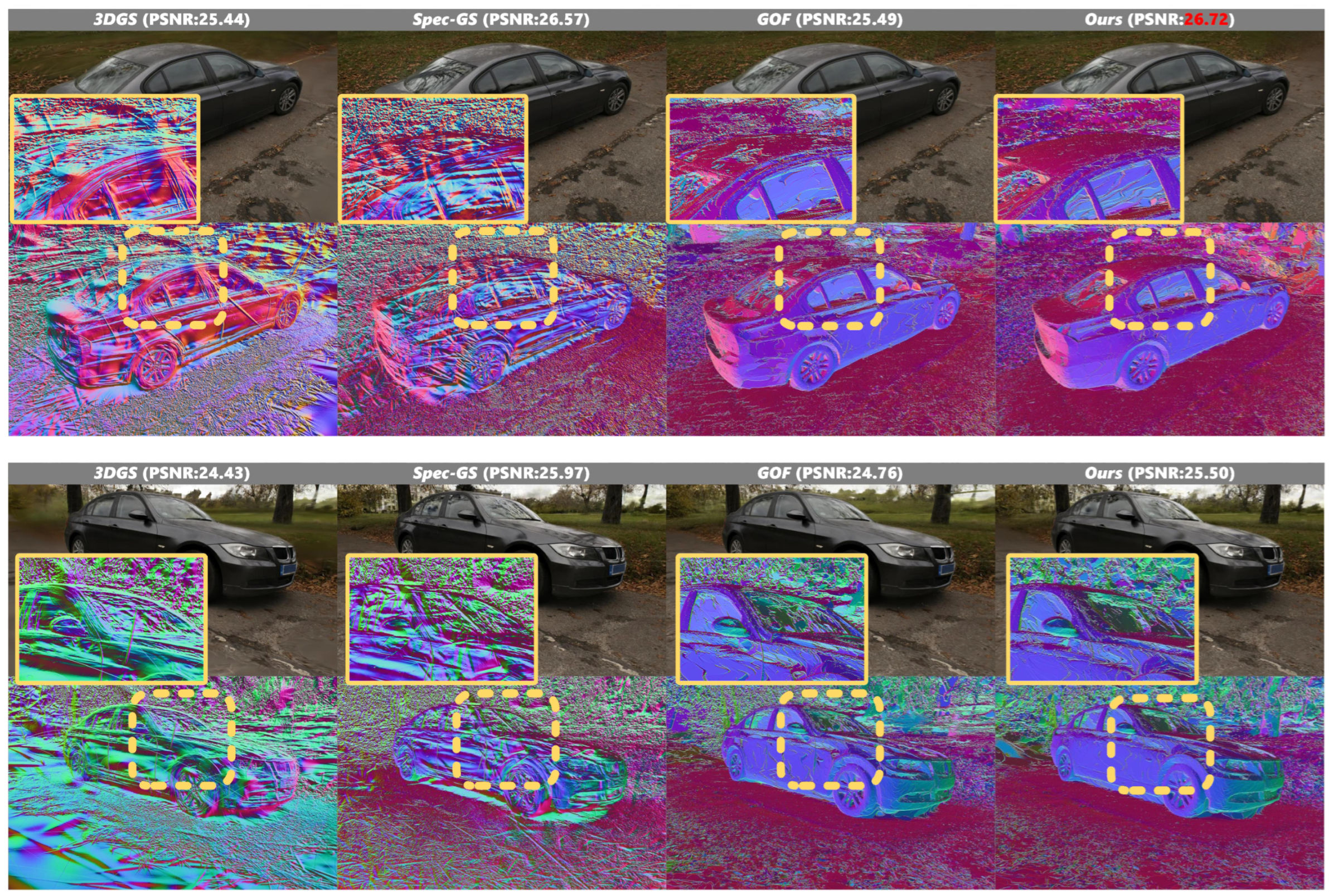
Qualitative results on Ref-NeRF dataset scene 2. In the figure, the dashed boxes indicate specific regions of interest in the original images, while the corresponding solid boxes of the same color (yellow and blue) display the magnified local views of these regions for detailed comparison.
Figure 6.
Qualitative results on Ref-NeRF dataset scene 2. In the figure, the dashed boxes indicate specific regions of interest in the original images, while the corresponding solid boxes of the same color (yellow and blue) display the magnified local views of these regions for detailed comparison.
Figure 7.
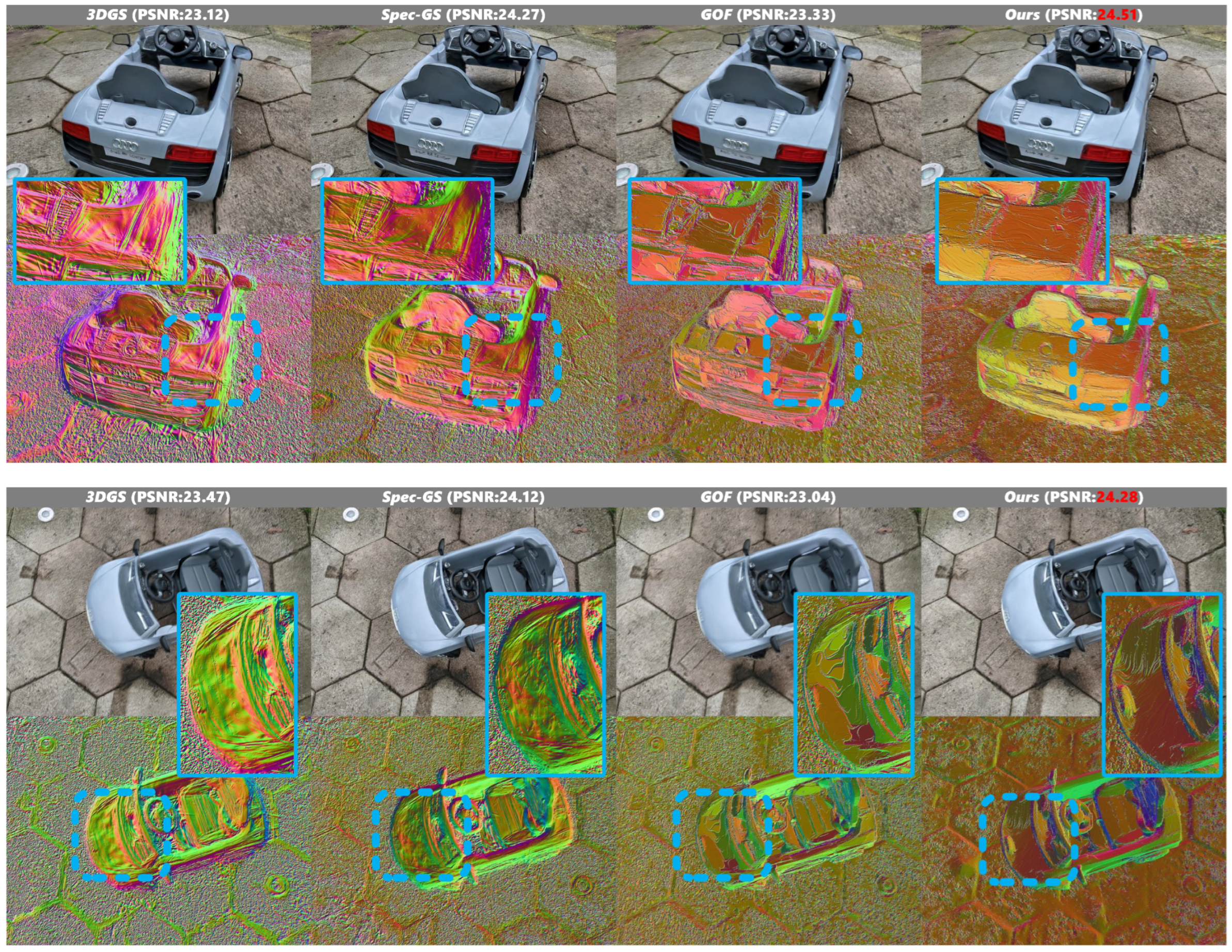
Qualitative results on Ref-NeRF dataset scene 3. In the figure, the dashed boxes indicate specific regions of interest in the original images, while the corresponding solid boxes of the same color (yellow and blue) display the magnified local views of these regions for detailed comparison.
Figure 7.
Qualitative results on Ref-NeRF dataset scene 3. In the figure, the dashed boxes indicate specific regions of interest in the original images, while the corresponding solid boxes of the same color (yellow and blue) display the magnified local views of these regions for detailed comparison.
Figure 8.
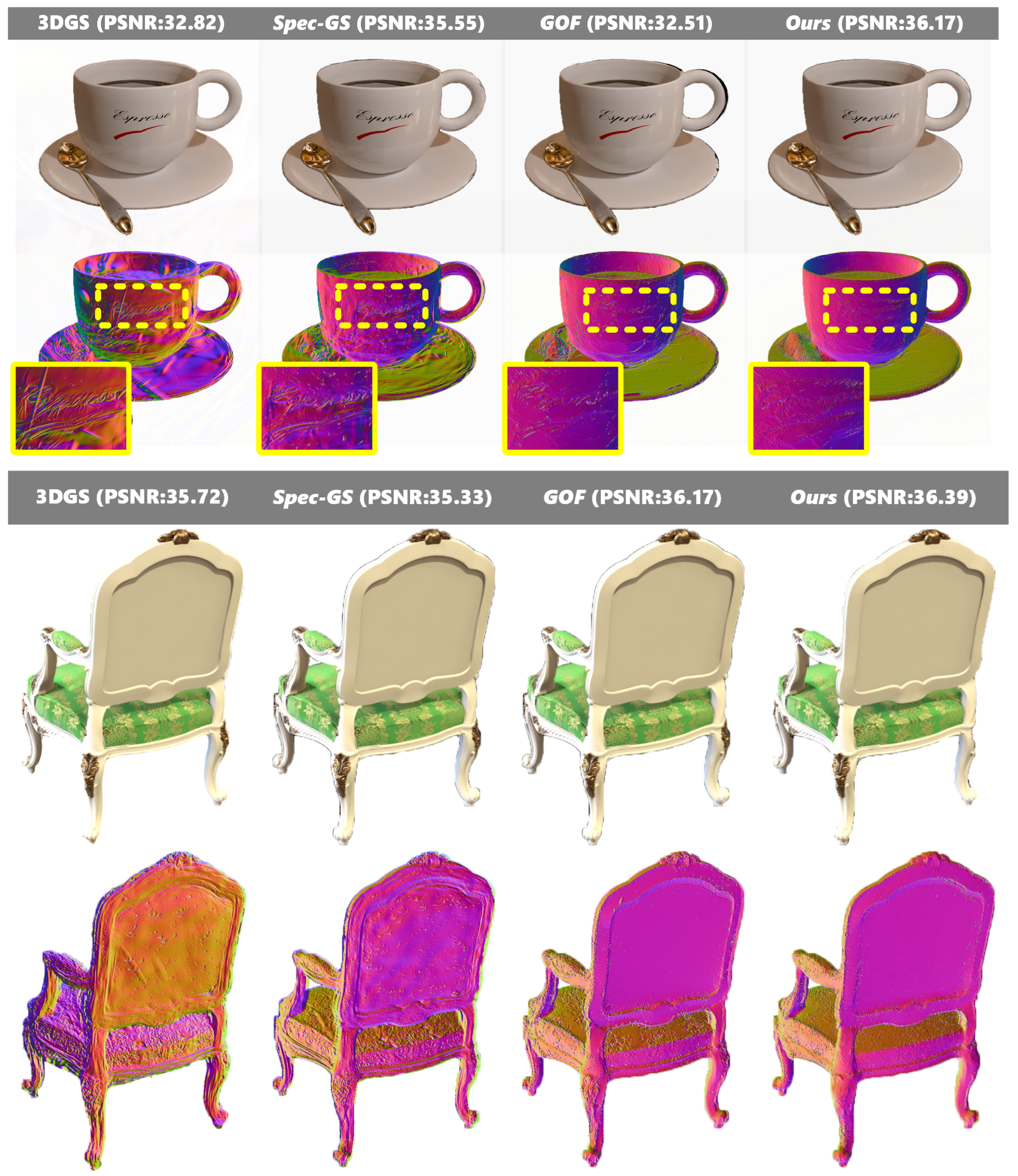
Qualitative results on NeRF-Synthetic dataset and Gloss-Blender dataset.In the figure, the dashed boxes indicate specific regions of interest in the original images, while the corresponding solid boxes of the same color (yellow and blue) display the magnified local views of these regions for detailed comparison.
Figure 8.
Qualitative results on NeRF-Synthetic dataset and Gloss-Blender dataset.In the figure, the dashed boxes indicate specific regions of interest in the original images, while the corresponding solid boxes of the same color (yellow and blue) display the magnified local views of these regions for detailed comparison.
Figure 9.
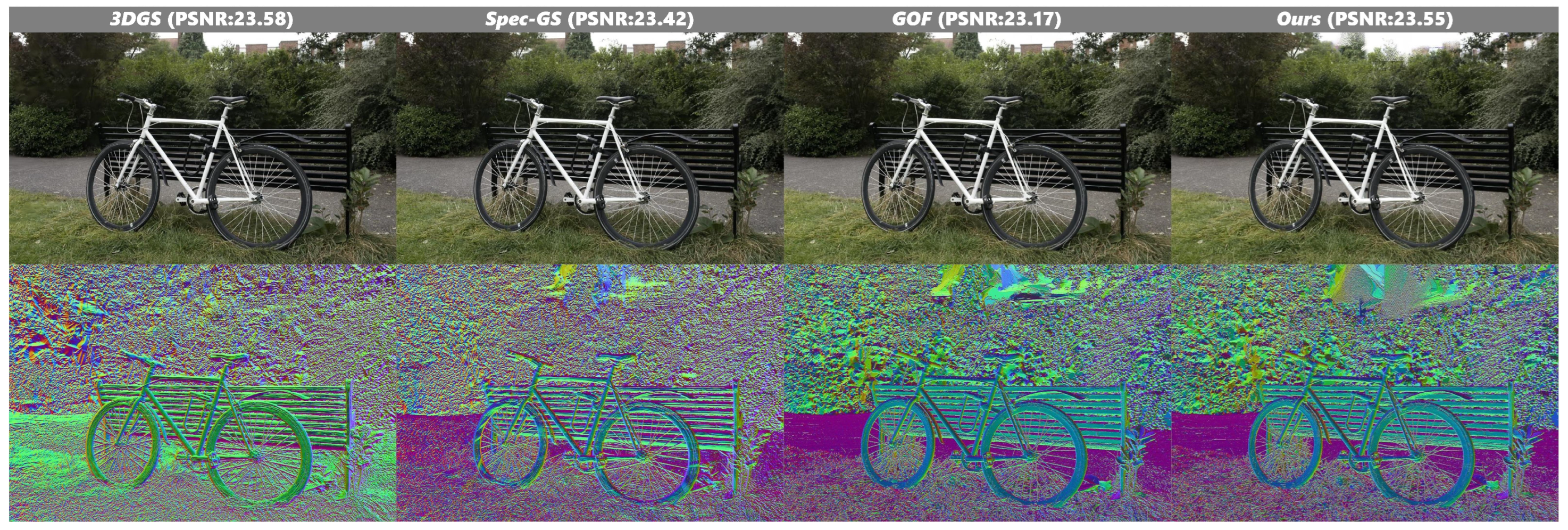
Qualitative results on Mip-NeRF dataset bicycle. In the figure, the dashed boxes indicate specific regions of interest in the original images, while the corresponding solid boxes of the same color (yellow and blue) display the magnified local views of these regions for detailed comparison.
Figure 9.
Qualitative results on Mip-NeRF dataset bicycle. In the figure, the dashed boxes indicate specific regions of interest in the original images, while the corresponding solid boxes of the same color (yellow and blue) display the magnified local views of these regions for detailed comparison.
Figure 10.
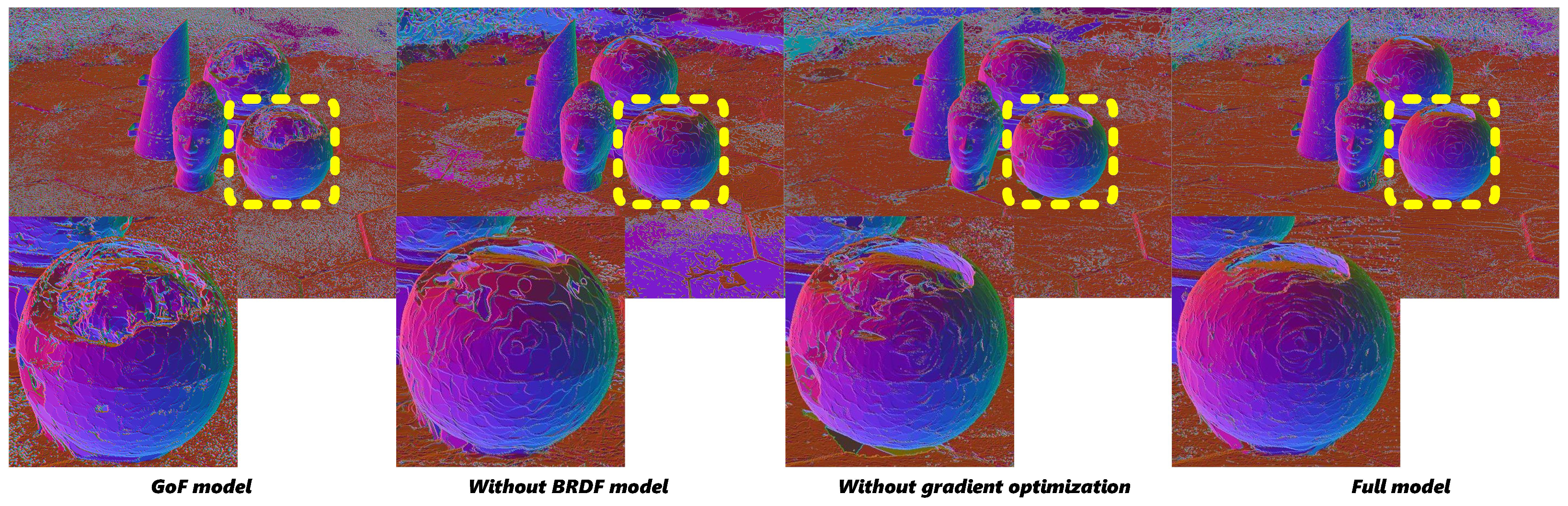
Ablation on PBR model and gradient optimization. Our proposed optimization strategy effectively addresses the surface quality degradation and inconsistent specular reflections caused by directly employing the PBR model without gradient optimization. In the figure, the dashed boxes indicate specific regions of interest in the original images, while the corresponding solid boxes of the same color (yellow and blue) display the magnified local views of these regions for detailed comparison.
Figure 10.
Ablation on PBR model and gradient optimization. Our proposed optimization strategy effectively addresses the surface quality degradation and inconsistent specular reflections caused by directly employing the PBR model without gradient optimization. In the figure, the dashed boxes indicate specific regions of interest in the original images, while the corresponding solid boxes of the same color (yellow and blue) display the magnified local views of these regions for detailed comparison.
Table 1.
Quantitative evaluation on the Ref-NeRF dataset. The best and second best results are highlighted.
Table 1.
Quantitative evaluation on the Ref-NeRF dataset. The best and second best results are highlighted.
| | PSNR | SSIM | LPIPS |
|---|
| Method | Gardensphere | Sedan | Toy-Car | Gardensphere | Sedan | Toy-Car | Gardensphere | Sedan | Toy-Car |
|---|
| Ref NeRF | 22.01 | 25.21 | 23.65 | 0.584 | 0.720 | 0.633 | 0.251 | 0.234 | 0.231 |
| 3DGS | 21.75 | 26.03 | 23.78 | 0.571 | 0.711 | 0.637 | 0.248 | 0.206 | 0.237 |
| GOF | 21.56 | 25.99 | 23.69 | 0.562 | 0.701 | 0.642 | 0.252 | 0.203 | 0.249 |
| ASG | 21.90 | 26.10 | 23.82 | 0.572 | 0.708 | 0.650 | 0.258 | 0.208 | 0.241 |
| Ours | 21.93 | 26.26 | 23.88 | 0.589 | 0.713 | 0.648 | 0.246 | 0.204 | 0.233 |
Table 2.
Quantitative results on NeRF-Synthetic dataset. The best and second best results are highlighted.
Table 2.
Quantitative results on NeRF-Synthetic dataset. The best and second best results are highlighted.
| Metric | Method | Chair | Drums | Ficus | Hotdog | Lego | Materials | Mic | Ship |
|---|
| PSNR | Mip-NeRF | 32.89 | 25.58 | 31.80 | 35.40 | 32.24 | 29.46 | 33.26 | 29.88 |
| 3DGS | 35.36 | 26.15 | 34.87 | 37.72 | 35.78 | 30.00 | 30.82 | 30.80 |
| GOF | 32.37 | 26.44 | 34.29 | 35.06 | 34.88 | 29.88 | 31.34 | 30.95 |
| Spec-GS | 35.68 | 26.92 | 36.14 | 38.28 | 36.07 | 30.85 | 37.12 | 31.89 |
| Ours | 35.53 | 26.94 | 36.18 | 38.30 | 35.73 | 30.88 | 37.21 | 31.85 |
| SSIM | Mip-NeRF | 0.974 | 0.939 | 0.981 | 0.982 | 0.973 | 0.969 | 0.987 | 0.915 |
| 3DGS | 0.915 | 0.851 | 0.921 | 0.930 | 0.882 | 0.882 | 0.909 | 0.827 |
| GOF | 0.922 | 0.873 | 0.911 | 0.955 | 0.884 | 0.897 | 0.899 | 0.840 |
| Spec-GS | 0.987 | 0.958 | 0.988 | 0.985 | 0.982 | 0.963 | 0.993 | 0.909 |
| Ours | 0.979 | 0.965 | 0.981 | 0.990 | 0.988 | 0.965 | 0.997 | 0.920 |
| LPIPS | Mip-NeRF | 0.033 | 0.062 | 0.022 | 0.025 | 0.030 | 0.041 | 0.023 | 0.138 |
| 3DGS | 0.047 | 0.087 | 0.055 | 0.034 | 0.064 | 0.055 | 0.046 | 0.113 |
| GOF | 0.012 | 0.040 | 0.013 | 0.027 | 0.057 | 0.050 | 0.037 | 0.094 |
| Spec-GS | 0.011 | 0.032 | 0.011 | 0.019 | 0.014 | 0.032 | 0.006 | 0.104 |
| Ours | 0.011 | 0.028 | 0.012 | 0.017 | 0.012 | 0.030 | 0.008 | 0.100 |
Table 3.
Quantitative results on Gloss-Blender dataset. The best and second best results are highlighted.
Table 3.
Quantitative results on Gloss-Blender dataset. The best and second best results are highlighted.
| Metric | Method | Ball | Car | Coffee | Helmet | Teapot | Toaster |
|---|
| PSNR | Ref-NeRF | 33.16 | 30.44 | 33.99 | 29.94 | 45.12 | 26.12 |
| 3DGS | 27.65 | 27.26 | 32.30 | 28.22 | 45.71 | 20.99 |
| GOF | 28.46 | 27.58 | 31.89 | 28.31 | 44.98 | 21.56 |
| Spec-GS | 34.13 | 32.11 | 35.16 | 30.85 | 46.09 | 26.04 |
| Ours | 34.50 | 31.98 | 35.20 | 30.98 | 46.31 | 25.89 |
| SSIM | Ref-NeRF | 0.956 | 0.949 | 0.972 | 0.955 | 0.995 | 0.910 |
| 3DGS | 0.937 | 0.930 | 0.971 | 0.951 | 0.996 | 0.895 |
| GOF | 0.925 | 0.933 | 0.965 | 0.954 | 0.992 | 0.887 |
| Spec-GS | 0.964 | 0.953 | 0.977 | 0.960 | 0.996 | 0.912 |
| Ours | 0.958 | 0.955 | 0.982 | 0.963 | 0.995 | 0.910 |
| LPIPS | Ref-NeRF | 0.307 | 0.051 | 0.082 | 0.087 | 0.013 | 0.118 |
| 3DGS | 0.161 | 0.047 | 0.078 | 0.079 | 0.007 | 0.126 |
| GOF | 0.177 | 0.052 | 0.088 | 0.080 | 0.015 | 0.125 |
| Spec-GS | 0.155 | 0.043 | 0.074 | 0.073 | 0.007 | 0.122 |
| Ours | 0.152 | 0.042 | 0.077 | 0.070 | 0.008 | 0.121 |
Table 4.
Quantitative results on Mip-NeRF dataset. The best and second best results are highlighted.
Table 4.
Quantitative results on Mip-NeRF dataset. The best and second best results are highlighted.
| | PSNR | SSIM | LPIPS |
|---|
| Method | Garden | Bicycle | Kitchen | Garden | Bicycle | Kitchen | Garden | Bicycle | Kitchen |
|---|
| Mip-NeRF | 23.16 | 21.69 | 26.47 | 0.543 | 0.454 | 0.745 | 0.422 | 0.541 | 0.336 |
| 3DGS | 27.41 | 25.25 | 31.44 | 0.868 | 0.771 | 0.922 | 0.103 | 0.205 | 0.129 |
| GOF | 26.18 | 24.35 | 28.11 | 0.860 | 0.650 | 0.740 | 0.157 | 0.205 | 0.147 |
| ASG | 27.50 | 25.12 | 32.10 | 0.880 | 0.775 | 0.919 | 0.114 | 0.197 | 0.128 |
| Ours | 27.41 | 25.22 | 32.20 | 0.892 | 0.780 | 0.919 | 0.108 | 0.195 | 0.119 |
Table 5.
Comparison of computational complexity, training time, and inference speed (averaged across the NeRF-Synthetic dataset). The arrows ↓ and ↑ indicate that lower and higher values are better, respectively. The best results and our proposed method are highlighted in bold.
Table 5.
Comparison of computational complexity, training time, and inference speed (averaged across the NeRF-Synthetic dataset). The arrows ↓ and ↑ indicate that lower and higher values are better, respectively. The best results and our proposed method are highlighted in bold.
| Method | Training Time (min) ↓ | Inference Speed (FPS) ↑ | VRAM (GB) ↓ |
|---|
| Mip-NeRF | ∼600 | <0.1 | 14.5 |
| 3DGS | 35 | 120 | 4.5 |
| GOF | 42 | 95 | 5.1 |
| Spec-GS | 48 | 75 | 6.8 |
| Ours (ARS-GS) | 45 | 85 | 6.7 |
Table 6.
Quantitative ablation study results (average over Ref-NeRF scenes). We evaluate the impact of the PBR model and the gradient optimization strategy. The arrows ↑ and ↓ indicate that higher and lower values are better, respectively. The best results and our full model are highlighted in bold.
Table 6.
Quantitative ablation study results (average over Ref-NeRF scenes). We evaluate the impact of the PBR model and the gradient optimization strategy. The arrows ↑ and ↓ indicate that higher and lower values are better, respectively. The best results and our full model are highlighted in bold.
| Model Variations | PSNR ↑ | SSIM ↑ | LPIPS ↓ |
|---|
| w/o PBR | 22.45 | 0.612 | 0.285 |
| w/o Grad. Opt. | 23.80 | 0.635 | 0.258 |
| Full Model (Ours) | 24.02 | 0.650 | 0.227 |