
Accelerating Point Cloud Computation via Memory in Embedded Structured Light Cameras
Abstract
1. Introduction
2. Fundamentals of Structured Light 3D Reconstruction
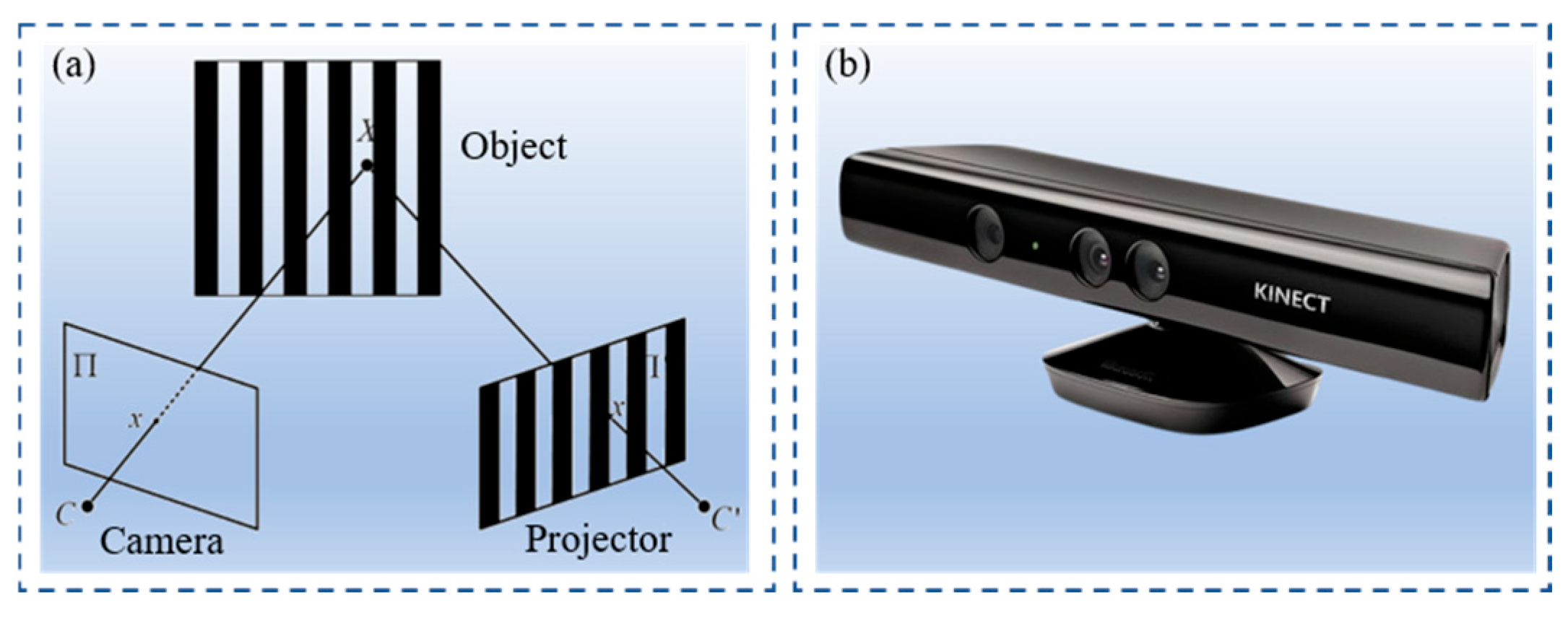
2.1. Principles of Structured Light 3D Reconstruction
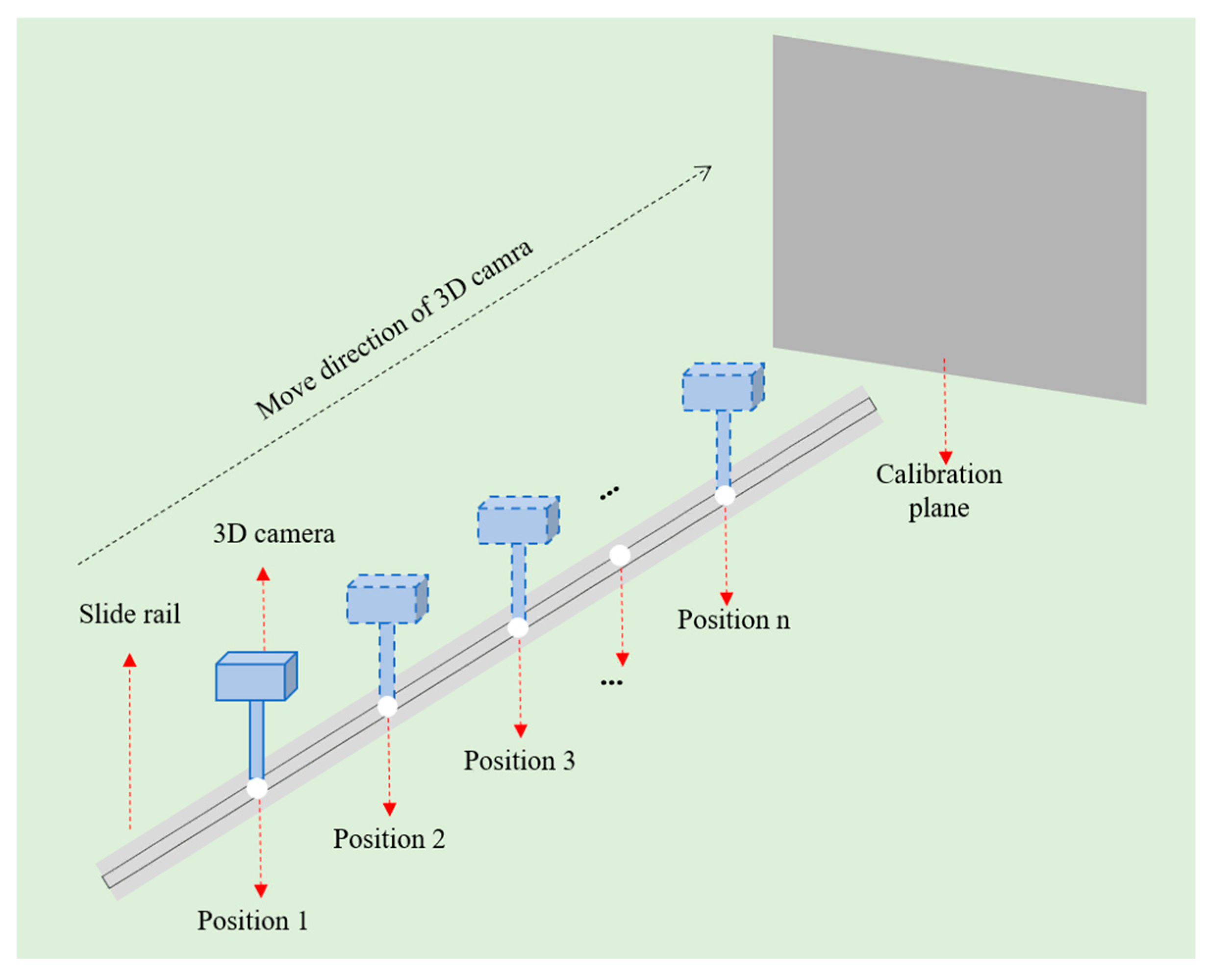
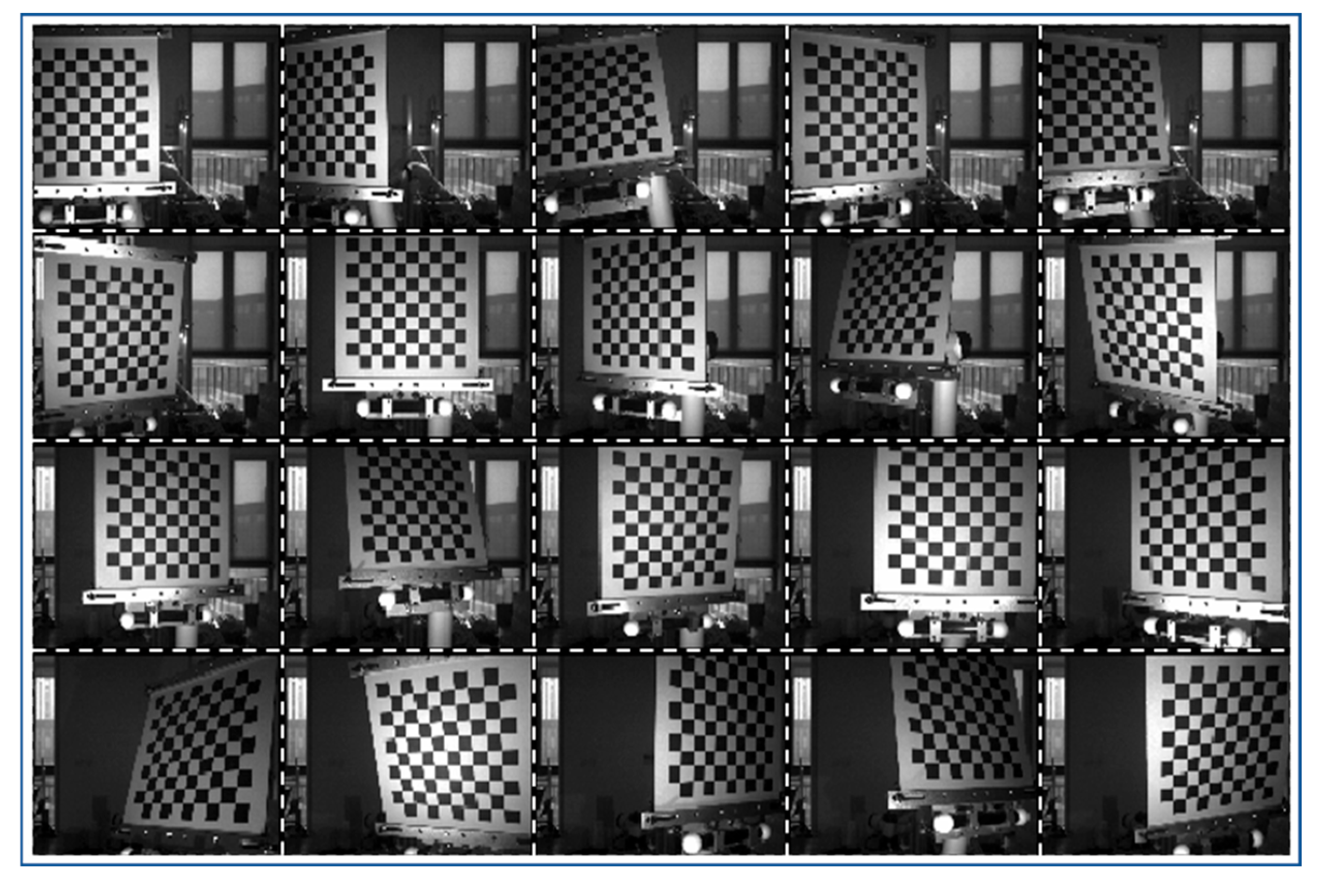
2.2. System Intrinsic Parameter Calibration
3. Memory-Based Acceleration Framework of Point Cloud Computation
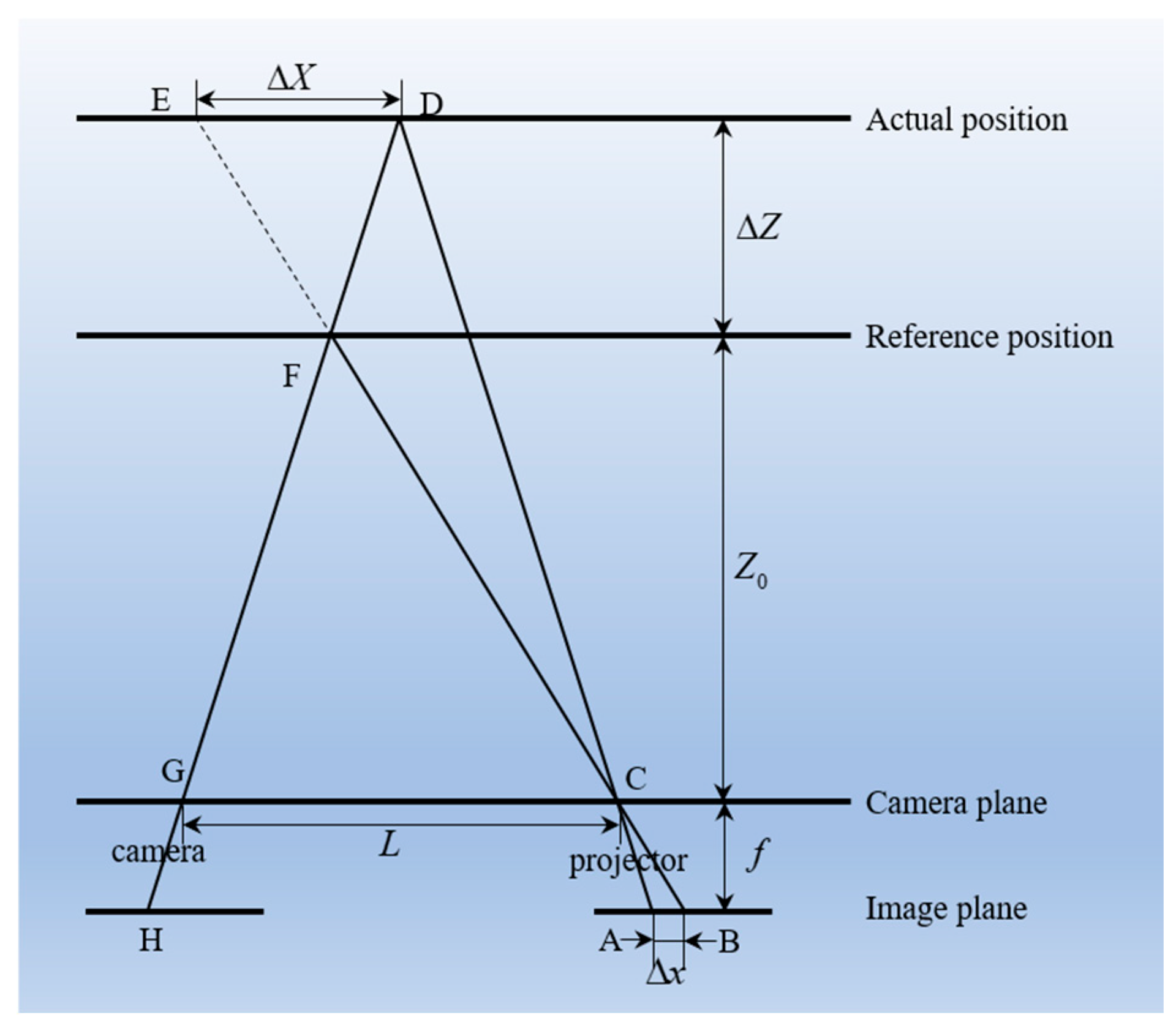
3.1. Two-Parameter Phase–Distance Model
3.2. Low-Memory Point Cloud Computation Method
3.3. High-Memory Point Cloud Computation Method
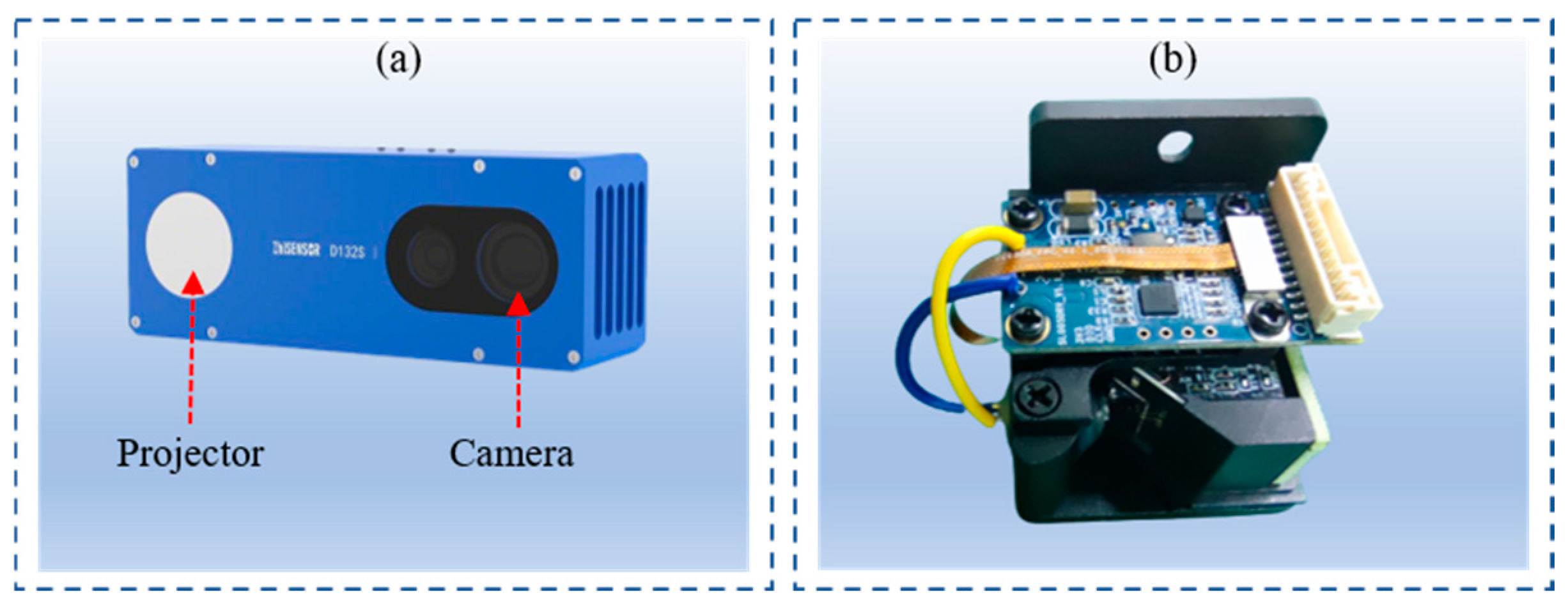
4. Experiment
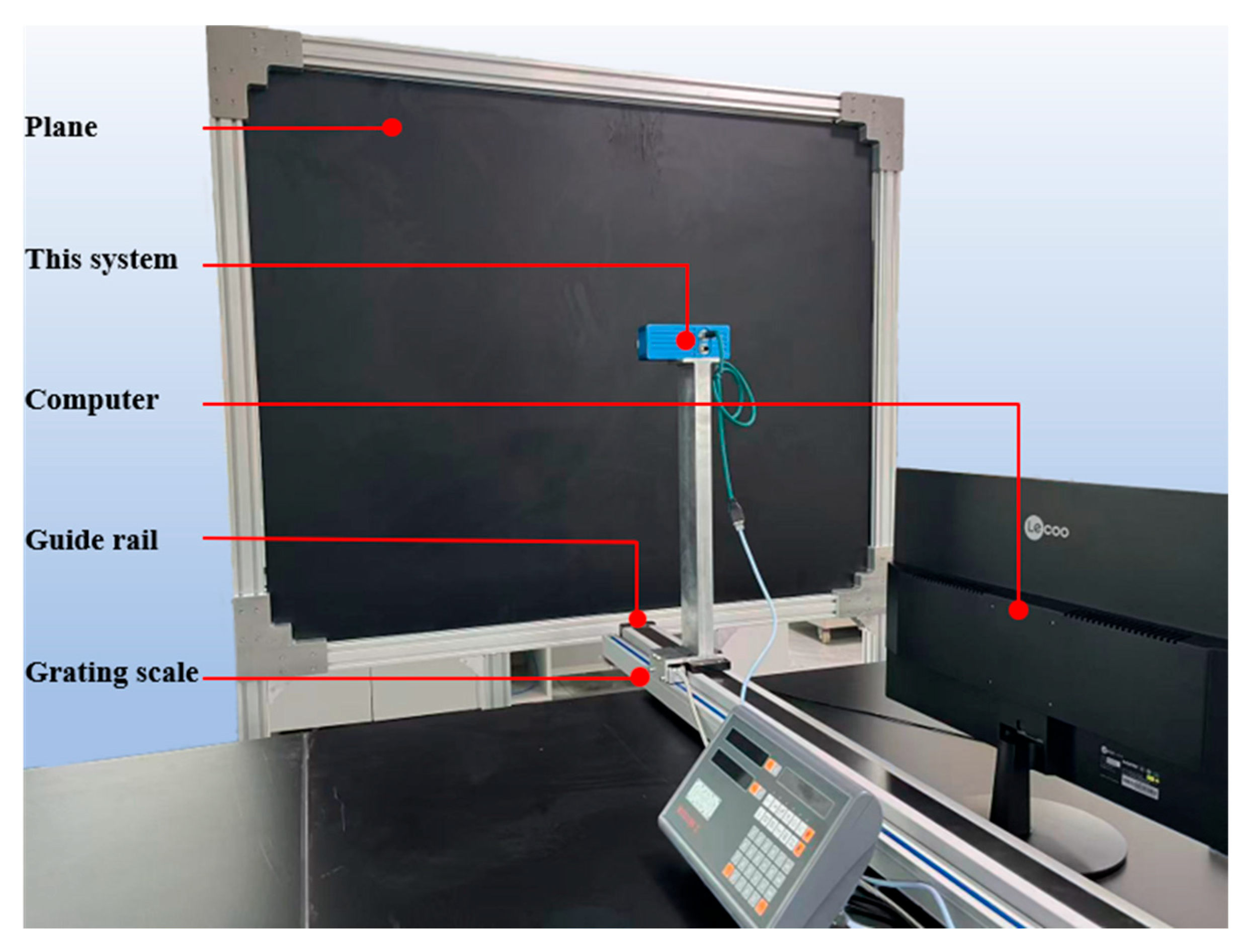
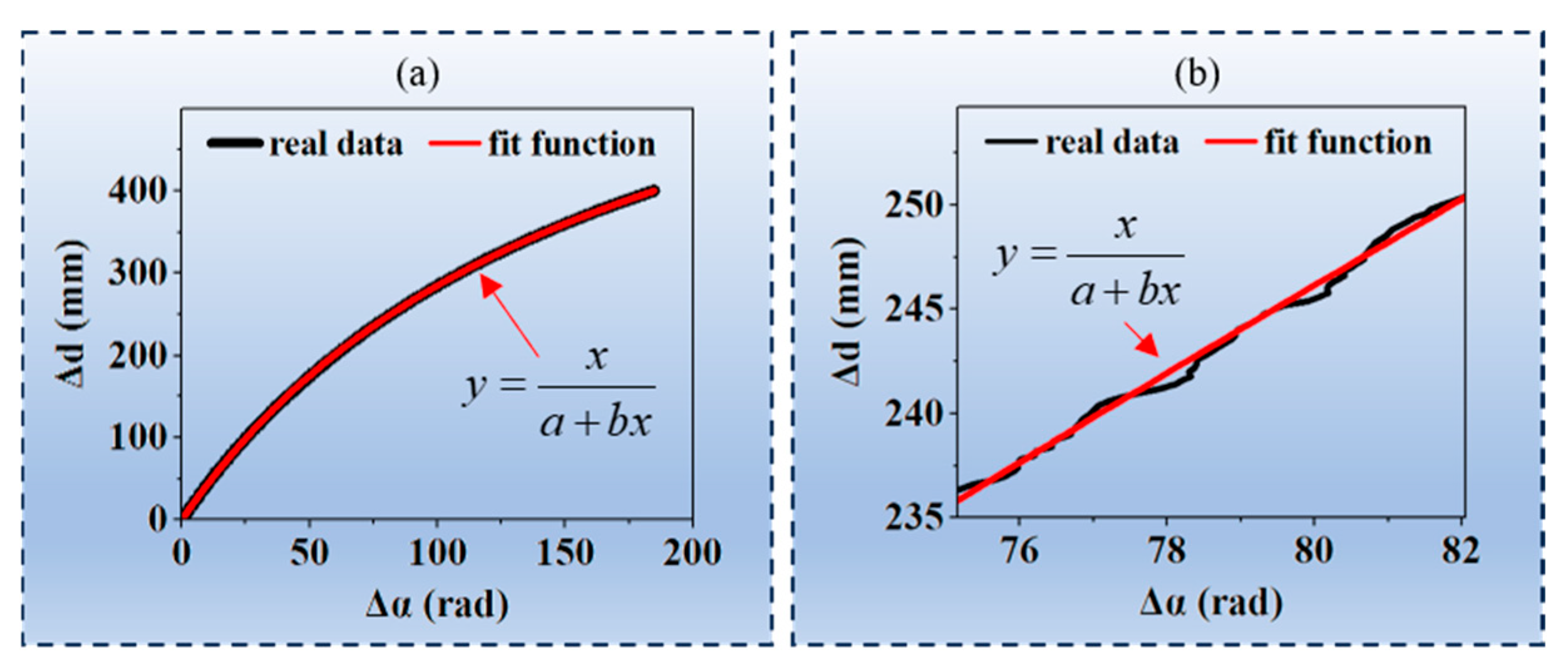
4.1. Experiments on the Low-Memory Method
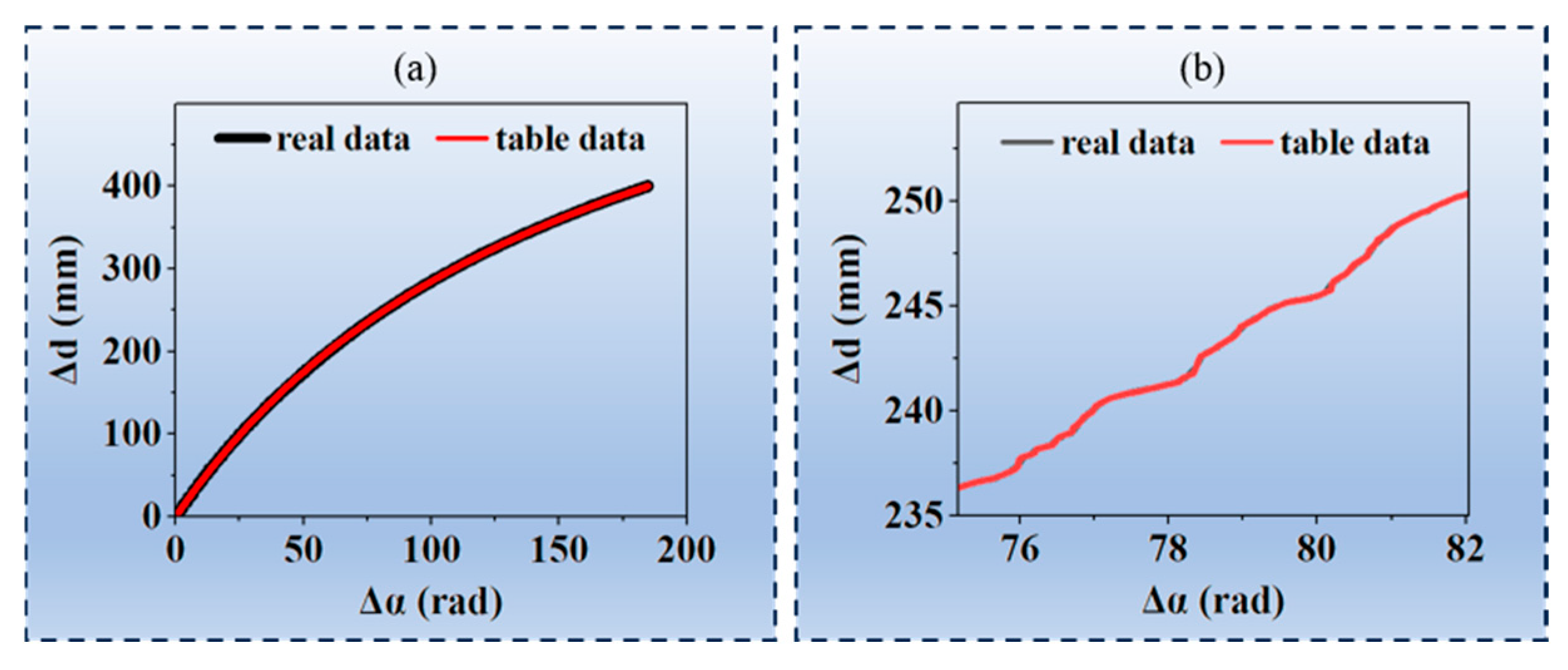
4.2. Experiments on the High-Memory Method
4.3. Comparison Experiment
4.3.1. Comparison of Computation Time
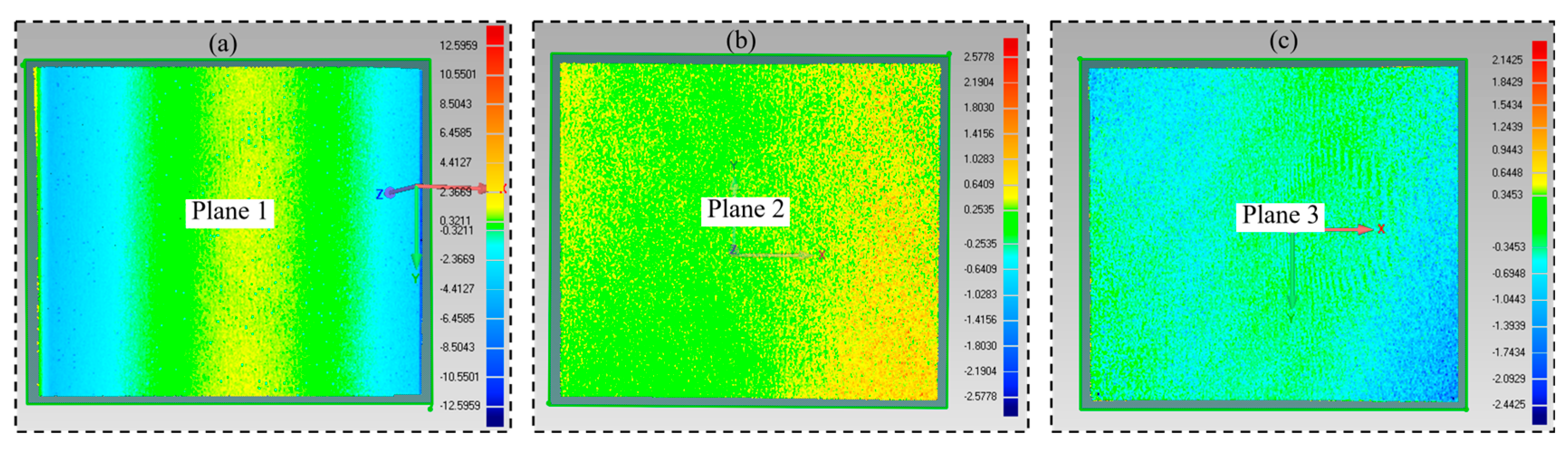
4.3.2. Comparison of Planar RMS Accuracy
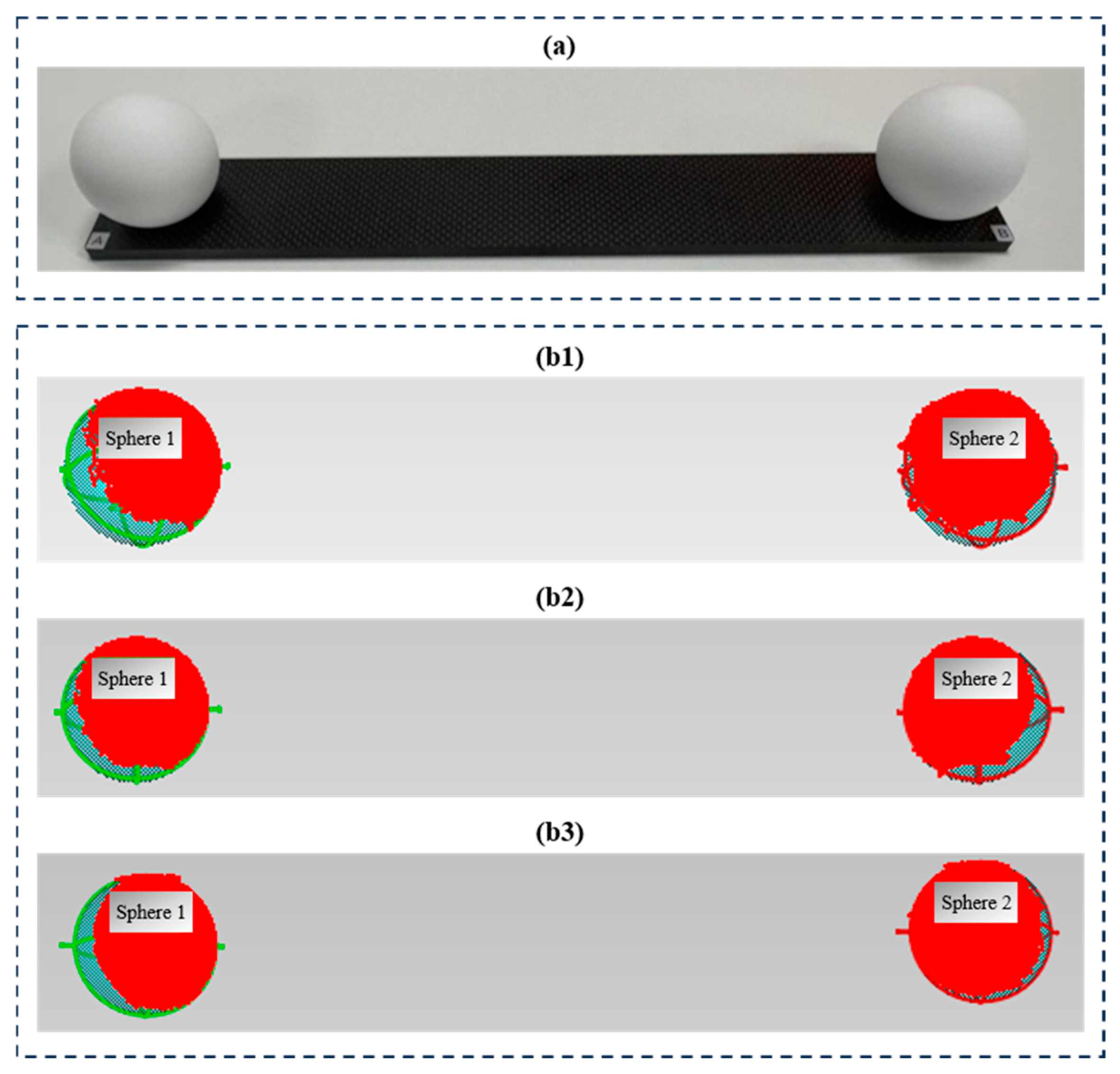
4.3.3. Comparison of Standard Sphere Accuracy
5. Discussion
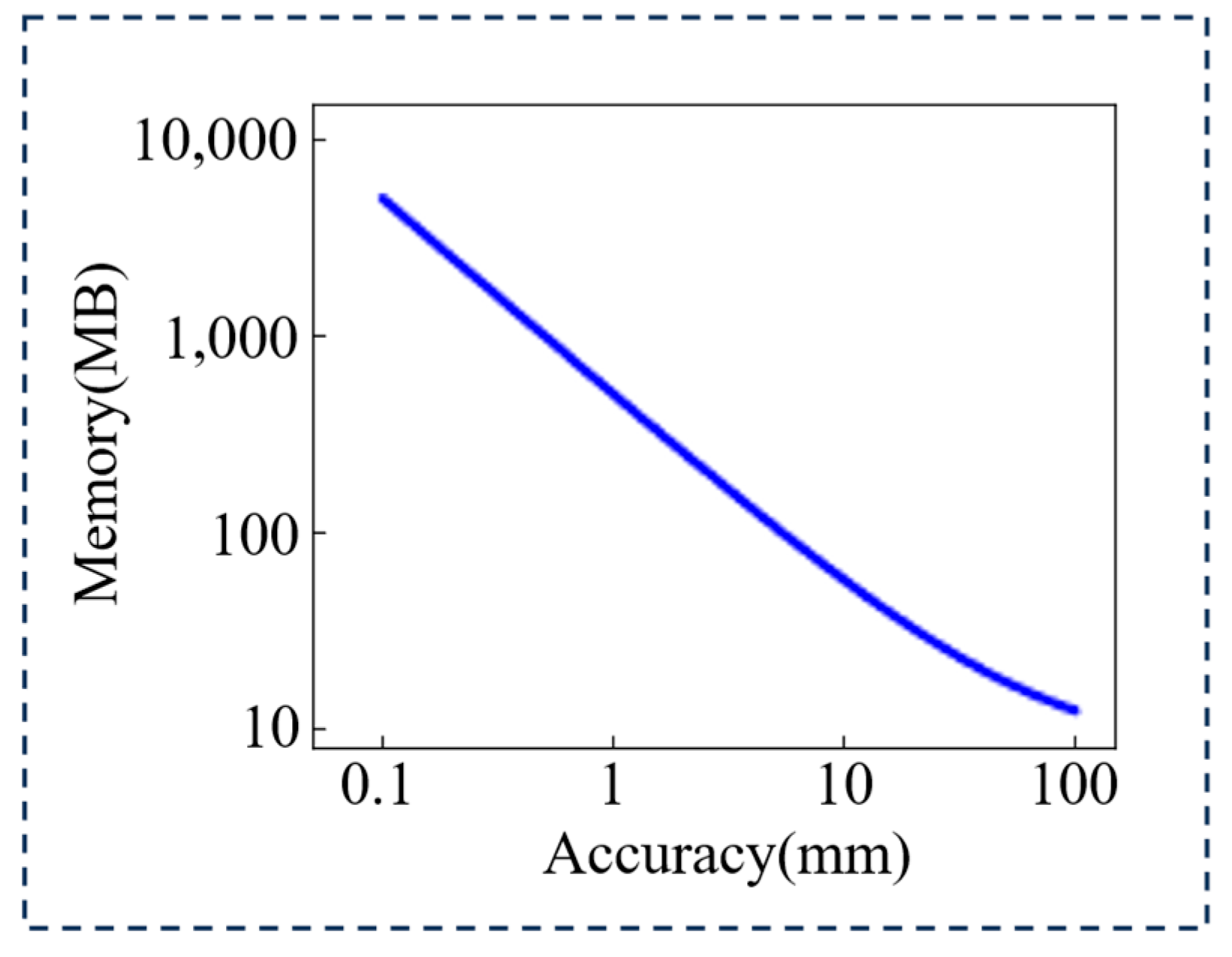
5.1. Trade-Off Between Accuracy and Memory in High-Memory Methods
5.2. Comparison with Existing Acceleration Methodologies
- (1)
- Identify Memorizable Tasks: Systematically pinpoint computational operations that can be transformed into memory lookups or caching mechanisms;
- (2)
- Define Memory Budgeting: Guide the process of establishing and managing memory resources effectively;
- (3)
- Formulate Memory-Computation Strategies: Develop flexible acceleration strategies (e.g., low-memory and high-memory) based on the available memory budget, real-time constraints, and desired reconstruction quality.
5.3. Main Contributions of This Work
- (1)
- Memory method to accelerate point cloud computation: The point cloud computation process is precomputed as much as possible and stored in memory in the form of parameters, thereby significantly reducing the computational load during actual point cloud computation. The framework does not rely on any particular approach to computing the absolute phase, enabling potential transfer to other structured light modalities (e.g., binary defocus projection and LED array projection) in 3D reconstruction systems.
- (2)
- Low-memory point cloud computation method: The principle of the two-parameter point cloud reconstruction method, as well as the mathematical relationship between parameter and parameter , has been geometrically derived; the calibration process for the two parameters in this method under constraint conditions has been proposed; by pre-calibrating the lens and storing the calibration results in memory in the form of parameters, the computational load of point clouds is significantly reduced.
- (3)
- High-memory point cloud computation method: The calibration process and point cloud computation process for the high-memory point cloud computation method are proposed, which maintain the nonlinear relationship between the system’s absolute phase and moving distance to the greatest extent possible.
- (4)
- Memory-saving method via data type conversion: By converting the data type from float to unsigned short, the storage space for calibration parameters and the bandwidth for point cloud transmission are significantly reduced.
6. Conclusions
Author Contributions
Funding
Institutional Review Board Statement
Informed Consent Statement
Data Availability Statement
Conflicts of Interest
References
- Li, T.; Wang, H.; Li, X.; Liao, W.; He, T.; Peng, P. Generative planning with 3d-vision language pre-training for end-to-end autonomous driving. Proc. AAAI Conf. Artif. Intell. 2025, 39, 4950–4958. [Google Scholar] [CrossRef] [Scilit]
- Lian, H.; Liu, K.; Cao, R.; Fei, Z.; Wen, X.; Chen, L. Integration of 3D Gaussian Splatting and Neural Radiance Fields in Virtual Reality Fire Fighting. Remote Sens. 2024, 16, 2448. [Google Scholar] [CrossRef] [Scilit]
- Wang, X.; Jiang, L.; Wang, F.; You, H.; Xiang, Y. Disparity refinement for stereo matching of high-resolution remote sensing images based on gis data. Remote Sens. 2024, 16, 487. [Google Scholar] [CrossRef] [Scilit]
- Chi, P.; Wang, Z.; Liao, H.; Li, T.; Wu, X.; Zhang, Q. Towards new-generation of intelligent welding manufacturing: A systematic review on 3D vision measurement and path planning of humanoid welding robots. Measurement 2025, 242, 116065. [Google Scholar] [CrossRef] [Scilit]
- Zhao, Y.; Qin, H.; Xu, L.; Yu, H.; Chen, Y. A review of deep learning-based stereo vision techniques for phenotype feature and behavioral analysis of fish in aquaculture. Artif. Intell. Rev. 2024, 58, 7. [Google Scholar] [CrossRef] [Scilit]
- Li, D.; Li, P.; Hu, J.; Wang, X.; Ma, R.; Zhu, Z. A SPAD-Based Hybrid Time-of-Flight Image Sensor With PWM and Non-Linear Spatiotemporal Coincidence. IEEE Trans. Circuits Syst. I: Regul. Pap. 2025, 72, 5610–5619. [Google Scholar] [CrossRef] [Scilit]
- Wu, L.; Ran, Y.; Yan, L.; Liu, Y.; Song, Y.; Han, D. A dataset for surface defect detection on complex structured parts based on photometric stereo. Sci. Data 2025, 12, 276. [Google Scholar] [CrossRef] [Scilit]
- Ren, M.; Cui, J.; Cai, S.-A.; Tian, W.; Feng, G. Speckle suppression in dynamic structured light via single-element interference. Opt. Express 2025, 33, 11452–11461. [Google Scholar] [CrossRef] [Scilit]
- Liao, Z.; Li, H.; Cai, W.; Zhong, Y.; Zhang, X. Phase sensitivity based fringe angle optimization in telecentric fringe projection profilometry. IEEE Trans. Instrum. Meas. 2024, 74, 1001610. [Google Scholar] [CrossRef] [Scilit]
- Li, B.; Xu, Z.; Gao, F.; Cao, Y.; Dong, Q. 3D reconstruction of high reflective welding surface based on binocular structured light stereo vision. Machines 2022, 10, 159. [Google Scholar] [CrossRef] [Scilit]
- Hu, E.; Zhu, Y.; Shao, Y. Defect information detection of a spare part by using a dual-frequency line-scan method. Optik 2014, 125, 1255–1258. [Google Scholar] [CrossRef] [Scilit]
- Rao, G.; Yang, X.; Yu, H.; Chen, K.; Xu, J. Fringe-projection-based normal direction measurement and adjustment for robotic drilling. IEEE Trans. Ind. Electron. 2019, 67, 9560–9570. [Google Scholar] [CrossRef] [Scilit]
- Wu, Y.; Dantanarayana, H.G.; Yue, H.; Huntley, J.M. Accurate characterisation of hole size and location by projected fringe profilometry. Meas. Sci. Technol. 2018, 29, 065010. [Google Scholar] [CrossRef] [Scilit]
- Zhao, Y.; Zhu, R.; Zhang, K.; Yu, H.; Bai, L.; Zheng, D.; Han, J. Accurate dynamic 3-D shape measurement based on the fringe pattern super-reconstruction technique. Measurement 2022, 200, 111575. [Google Scholar] [CrossRef] [Scilit]
- Yang, S.; Huang, H.; Wu, G.; Wu, Y.; Yang, T.; Liu, F. High-speed three-dimensional shape measurement with inner shifting-phase fringe projection profilometry. Chin. Opt. Lett. 2022, 20, 112601. [Google Scholar] [CrossRef] [Scilit]
- Lorenz, A.L.; Zhang, S. Human Respiration Rate Measurement with High-Speed Digital Fringe Projection Technique. Sensors 2023, 23, 9000. [Google Scholar] [CrossRef] [Scilit]
- Xu, Y.; Ekstrand, L.; Dai, J.; Zhang, S. Phase error compensation for three-dimensional shape measurement with projector defocusing. Appl. Opt. 2011, 50, 2572–2581. [Google Scholar] [CrossRef] [Scilit]
- Xu, J.; Li, Z.; Liu, H.; Chen, R.; Wu, D.; Zhang, J.; Wang, G. Defocus-driven variable-shape fringe for accuracy improvement in fringe projection profilometry. IEEE Trans. Instrum. Meas. 2024, 73, 5023712. [Google Scholar] [CrossRef] [Scilit]
- Chen, W.; Yang, S.; Yu, Y.; Jia, Y.; Liu, M.; Chen, S. Automatic projector defocus measurement method with large depth of field for fringe projection system. Meas. Sci. Technol. 2025, 36, 065018. [Google Scholar] [CrossRef] [Scilit]
- Lyu, C.; Wang, X.; Liu, Y.; Liu, H.; Ge, C.; Jin, J. Low-frequency vibration measurement based on the concentric-circle grating projection system. IEEE Trans. Instrum. Meas. 2021, 70, 5011810. [Google Scholar] [CrossRef] [Scilit]
- Hyun, J.S.; Chiu, G.T.C.; Zhang, S. High-speed and high-accuracy 3D surface measurement using a mechanical projector. Opt. Express 2018, 26, 1474–1487. [Google Scholar] [CrossRef] [Scilit]
- Windecker, R.; Fleischer, M.; Tiziani, H.J. Three-dimensional topometry with stereo microscopes. Opt. Eng. 1997, 36, 3372–3377. [Google Scholar] [CrossRef] [Scilit]
- Huang, H.X.; Jing, X.T.; Tan, J.; Zhang, H.K.; Deng, W.J.; Sun, M.J. An Ultra-High-Speed LED Array Driver Circuit for Structured Illumination. IEEE Trans. Power Electron. 2025, 40, 13177–13186. [Google Scholar] [CrossRef] [Scilit]
- Xing, H.; She, S.; Wang, J.; Guo, J.H.; Liu, Q.; Wei, C.; Yang, L.; Peng, R.; Yue, H.; Liu, Y. High-frame rate, large-depth-range structured light projector based on the step-designed LED chips array. Opt. Express 2024, 32, 24117–24127. [Google Scholar] [CrossRef] [Scilit] [PubMed]
- Hinz, L.; Kästner, M.; Reithmeier, E. Improved defect segmentation by combining fiber optic fringe projection profilometry with directional variable brightfield illumination. Emerg. Digit. Micromirror Device Based Syst. Appl. XIII SPIE 2021, 11698, 140–150. [Google Scholar]
- Qu, J.; Gao, H.; Zhang, R.; Cao, Y.; Zhou, W.; Xie, H. High-flexibility and high-accuracy phase delay calibration method for MEMS-based fringe projection systems. Opt. Express 2023, 31, 1049–1066. [Google Scholar] [CrossRef] [Scilit]
- Chen, W.; Feng, S.; Yin, W.; Li, Y.; Qian, J.; Chen, Q.; Zuo, C. Deep-learning-enabled temporally super-resolved multiplexed fringe projection profilometry: High-speed kHz 3D imaging with low-speed camera. PhotoniX 2024, 5, 25. [Google Scholar] [CrossRef] [Scilit]
- Feng, S.; Zuo, C.; Yin, W.; Gu, G.; Chen, Q. Micro deep learning profilometry for high-speed 3D surface imaging. Opt. Lasers Eng. 2019, 121, 416–427. [Google Scholar] [CrossRef] [Scilit]
- Wang, B.; Chen, W.; Qian, J.; Feng, S.; Chen, Q.; Zuo, C. Single-shot super-resolved fringe projection profilometry (SSSR-FPP): 100,000 frames-per-second 3D imaging with deep learning. Light Sci. Appl. 2025, 14, 70. [Google Scholar] [CrossRef] [Scilit]
- Xiang, S.; Yang, Y.; Deng, H.; Wu, J.; Yu, L. Multi-anchor spatial phase unwrapping for fringe projection profilometry. Opt. Express 2019, 27, 33488–33503. [Google Scholar] [CrossRef] [Scilit]
- Liu, Y.; Li, X.; Jin, Z.; Chen, W.; Lam, E.Y.; Feng, S.; Chen, Q.; Zuo, C. Multimodal adaptive temporal phase unwrapping using deep learning and physical priors. APL Photonics 2025, 10, 046104. [Google Scholar] [CrossRef] [Scilit]
- Jiang, H.; Xing, Y.; Shi, W.; Han, M.; Wang, X.; Li, X. FPGA-based fringe projection with double light intensity via bidirectional scanning. Semicond. Lasers Appl. XIV SPIE 2024, 13233, 13–19. [Google Scholar]
- Chen, Z.; Hu, T.; Hao, Y.; Zhang, X. High-speed phase structured light integrated architecture on FPGA. IEEE Trans. Ind. Electron. 2023, 71, 1017–1027. [Google Scholar] [CrossRef] [Scilit]
- Zhou, W.; Jia, Y.; Fan, L.; Fan, G.; Lu, F. A MEMS-based real-time structured light 3-D measuring architecture on FPGA. J. Real-Time Image Process. 2024, 21, 98. [Google Scholar] [CrossRef] [Scilit]
- Yin, W.; Cao, L.; Zhao, H.; Hu, Y.; Feng, S.; Zhang, X.; Shen, D.; Wang, H.; Chen, Q.; Zuo, C. Real-time and accurate monocular 3D sensor using the reference plane calibration and an optimized SGM based on opencl acceleration. Opt. Lasers Eng. 2023, 165, 107536. [Google Scholar] [CrossRef] [Scilit]
- Su, X.; Zhang, Q. Dynamic 3-D shape measurement method: A review. Opt. Lasers Eng. 2010, 48, 191–204. [Google Scholar] [CrossRef] [Scilit]
- Ji, P.; Hu, P.; Zhao, H.; Yao, Q.; Ma, W.; Zhang, G.; Zhang, Z.; Yang, S. Motion-induced phase-shifting profilometry for dynamic objects via Fourier fringe analysis and speckle correlation-assisted phase unwrapping. Opt. Express 2025, 33, 18251–18263. [Google Scholar] [CrossRef] [Scilit]
- Zuo, C.; Feng, S.; Huang, L.; Tao, T.; Yin, W.; Chen, Q. Phase shifting algorithms for fringe projection profilometry: A review. Opt. Lasers Eng. 2018, 109, 23–59. [Google Scholar] [CrossRef] [Scilit]
- Kemao, Q. Windowed Fourier transform for fringe pattern analysis. Appl. Opt. 2004, 43, 2695–2702. [Google Scholar] [CrossRef] [Scilit]
- Han, M.; Chen, W.; Zhang, Q.; Bai, X.; Pan, B. Dual-strategy-guided 2D wavelet transform for single-exposure high dynamic range 3D shape measurement. Opt. Express 2025, 33, 13145–13160. [Google Scholar] [CrossRef] [Scilit]
- Gao, R.; Zhao, X.; Lau, D.L.; Zhang, B.; Xu, B.; Liu, K. One-shot structured light illumination based on shearlet transform. Opt. Express 2024, 32, 30182–30198. [Google Scholar] [CrossRef] [Scilit] [PubMed]
- Zendejas-Hernández, E.; Trujillo-Schiaffino, G.; Anguiano-Morales, M.; Salas-Peimbert, D.P.; Corral-Martínez, L.F.; Tornero-Martínez, N. Spatial and temporal methods for fringe pattern analysis: A review. J. Opt. 2023, 52, 888–899. [Google Scholar] [CrossRef] [Scilit]
- Wang, J.; Yang, Y.; Xu, P.; Liu, J. Noise-induced phase error comparison in multi-frequency phase-shifting profilometry based on few fringes. Opt. Laser Technol. 2023, 159, 109034. [Google Scholar] [CrossRef] [Scilit]
- Zhao, S.; Wu, J.; Zhang, H. A binocular structured light reconstruction method based on disparity fusion. Opt. Lasers Eng. 2025, 194, 109208. [Google Scholar] [CrossRef] [Scilit]
- Yu, L.; Pietila, J.; Singh, H.J.; Caglayan, H. Phase-Shifting Structured Illumination with a Polarization-Encoded Metasurface. Nano Lett. 2025, 25, 11696–11702. [Google Scholar] [CrossRef] [Scilit]
- Zhang, S. Absolute phase retrieval methods for digital fringe projection profilometry: A review. Opt. Lasers Eng. 2018, 107, 28–37. [Google Scholar] [CrossRef] [Scilit]
- Wang, J.; Yang, Y. Phase extraction accuracy comparison based on multi-frequency phase-shifting method in fringe projection profilometry. Measurement 2022, 199, 111525. [Google Scholar] [CrossRef] [Scilit]
- Li, J.L.; Su, H.J.; Su, X.Y. Two-frequency grating used in phase-measuring profilometry. Appl. Opt. 1997, 36, 277–280. [Google Scholar] [CrossRef] [Scilit]
- Liu, K.; Wang, Y.; Lau, D.L.; Hao, Q.; Hassebrook, L.G. Dual-frequency pattern scheme for high-speed 3-D shape measurement. Opt. Express 2010, 18, 5229–5244. [Google Scholar] [CrossRef] [Scilit]
- Zuo, C.; Chen, Q.; Gu, G.; Feng, S.; Feng, F.; Li, R.; Shen, G. High-speed three-dimensional shape measurement for dynamic scenes using bi-frequency tripolar pulse-width-modulation fringe projection. Opt. Lasers Eng. 2013, 51, 953–960. [Google Scholar] [CrossRef] [Scilit]
- Cai, B.; Zi, A.; Tong, C.; Wu, Q.; Zhao, B.; Chen, X. Spatial coding strategy for dual-frequency phase-shifting profilometry. Measurement 2025, 239, 115437. [Google Scholar] [CrossRef] [Scilit]
- Zhang, J.; Guo, W.; Wu, Z.; Zhang, Q. Three-dimensional shape measurement based on speckle-embedded fringe patterns and wrapped phase-to-height lookup table. Opt. Rev. 2021, 28, 227–238. [Google Scholar] [CrossRef] [Scilit]
- Takeda, M.; Mutoh, K. Fourier transform profilometry for the automatic measurement of 3-D object shapes. Appl. Opt. 1983, 22, 3977–3982. [Google Scholar] [CrossRef] [Scilit]
- Zhang, S.; Huang, P.S. High-resolution, real-time three-dimensional shape measurement. Opt. Eng. 2006, 45, 123601. [Google Scholar]
- Zhou, W.S.; Su, X.Y. A direct mapping algorithm for phase-measuring profilometry. J. Mod. Opt. 1994, 41, 89–94. [Google Scholar] [CrossRef] [Scilit]
- Feng, S.; Chen, Q.; Zuo, C. Graphics processing unit–assisted real-time three-dimensional measurement using speckle-embedded fringe. Appl. Opt. 2015, 54, 6865–6873. [Google Scholar] [CrossRef] [Scilit]
- Scharstein, D.; Szeliski, R. A taxonomy and evaluation of dense two-frame stereo correspondence algorithms. Int. J. Comput. Vis. 2002, 47, 7–42. [Google Scholar] [CrossRef] [Scilit]
- Feng, S.; Zuo, C.; Zhang, L.; Tao, T.; Hu, Y.; Yin, W.; Qian, J.; Chen, Q. Calibration of fringe projection profilometry: A comparative review. Opt. Lasers Eng. 2021, 143, 106622. [Google Scholar] [CrossRef] [Scilit]
- Zhang, Z. Flexible camera calibration by viewing a plane from unknown orientations. In Proceedings of the Seventh IEEE International Conference on Computer Vision, Kerkyra, Greece, 20–27 September 1999; IEEE: Washington, DC, USA, 1999; pp. 666–673. [Google Scholar]



| Low-Memory | High-Memory | Light-Plane | |
|---|---|---|---|
| Hardware | Computing Platform: RK3399 Camera Resolution:1280 × 1024 Projector: P1130 MEMS projector Memory: 4 GB | ||
| Software | Operating System: Ubuntu22.04 Programming Language: C/OpenCL | ||
| Calibration Parameters | |||
| , , | , , | ||
| Memory Footprint | 0.86 GB | 3.42 GB | 0.82 GB |
| Method | Platform | Computation Time | Data Transmission Time | Total Time |
|---|---|---|---|---|
| Low-Memory | CPU | 43.15 | - | 43.15 |
| GPU | 4.26 | 10.32 | 14.58 | |
| High-Memory | CPU | 54.84 | - | 54.84 |
| GPU | 4.15 | 6.48 | 10.63 | |
| Light-Plane | CPU | 763.24 | - | 763.24 |
| GPU | 64.72 | 10.27 | 74.99 |
| Method | Low-Memory | High-Memory | Light-Plane |
|---|---|---|---|
| Planar RMS error | 1.14 | 0.27 | 0.19 |
| Sphere 1 | Sphere 2 | |||||
|---|---|---|---|---|---|---|
| Diameter | Error | Diameter | Error | Distance | Error | |
| True Value | 50.8019 | - | 50.8017 | - | 299.8513 | - |
| Low-Memory | 50.9349 | 0.1330 | 50.7446 | 0.0571 | 299.9740 | 0.1227 |
| High-Memory | 50.7091 | 0.0928 | 50.8398 | 0.0381 | 299.7463 | 0.1050 |
| Light-Plane | 50.9466 | 0.1447 | 50.8933 | 0.0916 | 299.9755 | 0.1242 |
Disclaimer/Publisher’s Note: The statements, opinions and data contained in all publications are solely those of the individual author(s) and contributor(s) and not of MDPI and/or the editor(s). MDPI and/or the editor(s) disclaim responsibility for any injury to people or property resulting from any ideas, methods, instructions or products referred to in the content. |
© 2026 by the authors. Licensee MDPI, Basel, Switzerland. This article is an open access article distributed under the terms and conditions of the Creative Commons Attribution (CC BY) license.
Share and Cite
Zhang, Y.; Meng, S.; Wang, S.; Ren, Y. Accelerating Point Cloud Computation via Memory in Embedded Structured Light Cameras. J. Imaging 2026, 12, 91. https://doi.org/10.3390/jimaging12020091
Zhang Y, Meng S, Wang S, Ren Y. Accelerating Point Cloud Computation via Memory in Embedded Structured Light Cameras. Journal of Imaging. 2026; 12(2):91. https://doi.org/10.3390/jimaging12020091
Chicago/Turabian StyleZhang, Yanan, Shikang Meng, Shijie Wang, and Yaheng Ren. 2026. "Accelerating Point Cloud Computation via Memory in Embedded Structured Light Cameras" Journal of Imaging 12, no. 2: 91. https://doi.org/10.3390/jimaging12020091
APA StyleZhang, Y., Meng, S., Wang, S., & Ren, Y. (2026). Accelerating Point Cloud Computation via Memory in Embedded Structured Light Cameras. Journal of Imaging, 12(2), 91. https://doi.org/10.3390/jimaging12020091