Article

State of the Art of Remote Sensing Data: Gradient Pattern in Pseudocolor Composite Images

1
Institute of Information and Computing Technology, Almaty 050010, Kazakhstan
2
Institute of Automation and Information Technologies, Satbayev University (KazNRTU), Almaty 050013, Kazakhstan
3
V.V. Dokuchaev Soil Science Institute, Moscow 119017, Russia
*
Author to whom correspondence should be addressed.
J. Imaging 2026, 12(1), 23; https://doi.org/10.3390/jimaging12010023
Submission received: 24 September 2025 / Revised: 24 December 2025 / Accepted: 29 December 2025 / Published: 4 January 2026
(This article belongs to the Section Image and Video Processing)

Abstract

The thematic processing of pseudocolor composite images, especially those created from remote sensing data, is of considerable interest. The set of spectral classes comprising such images is typically described by a nominal scale, meaning the absence of any predetermined relationships between the classes. However, in many cases, images of this type may contain elements of a regular spatial order, one variant of which is a gradient structure. Gradient structures are characterized by a certain regular spatial ordering of spectral classes. Recognizing gradient patterns in the structure of pseudocolor composite images opens up new possibilities for deeper thematic images processing. This article describes an algorithm for analyzing the spatial structure of a pseudocolor composite image to identify gradient patterns. In this process, the initial nominal scale of spectral classes is transformed into a rank scale of the gradient legend. The algorithm is based on the analysis of Moore neighborhoods for each image pixel. This creates an array of the prevalence of all types of local binary patterns (the pixel’s nearest neighbors). All possible variants of the spectral class rank scale composition are then considered. The rank scale variant that describes the largest proportion of image pixels within its gradient order is used as a final result. The user can independently define the criteria for the significance of the gradient order in the analyzed image, focusing either on the overall statistics of the proportion of pixels consistent with the spatial structure of the selected gradient or on the statistics of a selected key image region. The proposed algorithm is illustrated using analysis of test examples.

1. Introduction

Some of the most information-rich images are the results of processing of satellite data obtained by scanning the Earth’s underlying surface. In this case, the color formula for each pixel embodies the result of a complex transformation of remote sensing spectral data. The standard approach to processing such information includes various procedures. These include primary geometric and radiometric correction procedures necessary to ensure data comparability [1]. For example, the calculation of physical reflectivity of the underlying surface in selected spectral bands [2], as well as the transformation procedures themselves, of calibrated spectral data, carried out within various types of thematic processing.
The long-term operation of natural resource satellite systems for monitoring the Earth’s surface has allowed the accumulation of large series of remote sensing data. Currently, information describing periods of several decades is available, for example, the EOS MODIS archives (since 1999) [3] or LANDSAT (since 1987) [4]. Thus, it has become possible to obtain robust, long-term estimates of the spectral characteristics of the Earth’s surface and parameters associated with them, including characteristics of long-term change trends [5]. The availability of long-term estimates, which can be components of the analyzed images, has complicated thematic processing due to the ability to solve more complex problems, thereby increasing the need for the development of new image processing algorithms.
The list of mathematical methods for analyzing the spectral characteristics of the underlying surface, applied within the framework of thematic analysis, is quite extensive. It is possible to only note certain areas of this diversity. For example, the calculation of spectral indices, which are understood as the arithmetic of individual spectral bands, which allows us to identify and quantitatively describe many types of characteristic objects on the underlying surface. For example: vegetation indices [6]; water indices [7], soil indices [8]; mineralogical indices [9]. More complex mathematical approaches are used to assess changes in the underlying surface, which may be associated with the presence of long-term trends [10] or seasonal cycles [11]. In all these cases, additional clustering procedures for spectral data sets can be applied for deeper analysis [12]. The development of computing power in recent years has facilitated significant progress in intelligent analysis methods, such as machine learning [13] and AI [14].
The goal of thematic processing of spectral remote sensing data is always to reduce the dimensionality of the analyzed phase space by identifying internal patterns. Ideally, the dimensionality of such a phase space should be reduced to one as a result of processing, which best quantitatively describes the target thematic feature. The resulting image represents a final map of the spatial distribution of the thematic feature.
In practically important cases, the nature of the thematic feature is complex and multifaceted and often cannot be simply described. These may include, for example, the degree of desertification [15] or the stages of land degradation [16], land cover forecasts [17], including agricultural land status [18], and many others. In this case, multivariate models based on wide sets of external parameters can be used to determine the mathematical relationships between the original spectral characteristics and the thematic feature. For example, the WOFOST model, used to describe the growth and development of agricultural crops [19]. Such models typically have many input parameters, only some of which represent information associated with remote sensing data. When considered at a regional scale, information on many parameters becomes less accessible and is replaced by expert assessments, which makes the modeling results partly subjective and reduces their accuracy. The new algorithm proposed in this study, which aims to identify gradient patterns within analyzed images, enables empirically expanded thematic interpretation capabilities, which is particularly significant for pseudocolor composite images generated from remote sensing spectral data and their processed products. This new strategy, based on detecting the actual presence of gradient structures in analyzed images and describing them within a rank scale, allows for the identification of additional relationships existing in the phase feature space, thereby enhancing the effectiveness of remote sensing data thematic interpretation.
In fact, the new approach to thematic processing enables the construction of empirical equations for the relationship between the initial spectral parameters used to construct the analyzed image and the recorded textural features of the image, representing gradient structures. It also allows for varying the spectral parameters during image generation to obtain more pronounced gradient structures. This methodology is somewhat similar to spectral indices. However, unlike the fixed ratio of spectral bands, which typically describe physically clear properties of the underlying surface, spectral indices use arbitrary sets of spectral information that can describe complex characteristics of spatially distributed structures.
Similar approaches can be used not only for the analysis of remote sensing data, but also for solving other problems related to automated image analysis, for example, problems of analyzing data obtained using meteorological radars [20,21,22] or problems of image analysis in medicine [23].

2. Materials and Methods

2.1. Principles of Recalculation of the Results of Clustering of Remote Sensing Data into Ranking Scales

Remote sensing data, including satellite images, require preliminary processing before its practical use, for which there is a set of methods and techniques [24]. The depth of remote sensing data processing is associated with the type of scales used to describe the results obtained. The simplest is the nominal scale, which is a simple list of the present independent spectral classes, in which the order of the relative positions of the classes in the scale does not matter. A more complex case arises when there are significant relationships between spectral classes. The description of such situations can be based on rank scales. The presence of a rank order allows sorting and assigning ranks (1st, 2nd, 3rd, etc.) to the available spectral classes and thus obtaining deeper estimates of the structure of the results of thematic processing. The possibility of quantitatively accounting for the differences between spectral classes of different ranks leads to the use of interval scales or coefficient scales. The last two cases are variants of the most widely used types of quantitative scales of spectral classes used in the quantitative processing of remote sensing data [25].
The result of a standard unsupervised classification/clustering procedure for remote sensing data is described by a nominal scale, i.e., a set of individual independent spectral classes. However, in reality, certain types of relationships may still be present in the final results. For example, if the analyzed spectral image of the underlying surface was closely related to territorial properties that can be described within the concept of gradient, the texture of the images obtained through clustering may contain information that allows for further ordering of the spectral classes within the rank order of gradient structures. Identifying the presence of such capabilities represents a new and important task, the solution of which could significantly improve the information content of thematic image analysis based on remote sensing data obtained after unsupervised clustering.
The presence of a gradient order in the clustering results implies the existence of an ordinal scale (K1, K2, K3, …, Kn) for spectral classes applicable to the entire analyzed image, which imposes certain restrictions on the spatial mutual arrangement of pixels of different spectral classes. Any spectral class within the ordinal scale (Km), with the exception of marginal ones (the first and last), should ideally be adjacent to only two classes adjacent to it on the scale, i.e., km-1 and Km+1. This state corresponds to the presence of a gradient structure described by a series consisting of classes K1, K2, K3, …, Kn. For example, in a thermal image of a monotonic gradient temperature field in the temperature range from 0 to +30 °C, with a change step of 1 °C, pixels characterizing +20 °C will border only each other or with pixels displaying a temperature of +19 °C or +21 °C. Gradient textures of any kind present in the analyzed graphic scene will also be organized similarly. However, of course, certain adjacency rules may not be strict, but rather expressed only as statistically expressed preferences.
If the spatial scale of class gradients within an ordinal scale is comparable to the spatial resolution of remote sensing data, or neighborhood rules are not strict, then strict adherence to such a rank order in the immediate neighborhood becomes impossible, and the ranking order may be distorted. In fact, the process of unsupervised clustering of remote sensing data can lead to extremely diverse results, organized in various ways: from truly independent classes forming a texture of random mosaic contrast to ensuring a strictly observed gradient structure.
Therefore, a specialized texture analysis of the results of unsupervised clustering of satellite data, which involves considering the immediate neighborhoods of each pixel, can provide the necessary information for assessing the feasibility of ordering a nominal set of spectral classes within a rank scale. The algorithm developed in this study is designed to evaluate all possible rank ordering options existing in an image of spectral classes and select the best rule that ensures the greatest degree of gradient consistency in pixel arrangement.

2.2. Algorithm for Texture Analysis of Spectral Classes on a Regular Lattice

The idea of nearest neighbor analysis for each pixel of the analyzed image is well known and is often used in various image processing methods [26,27,28].
This is also the direction of Cellular Automata, in which dynamic structures are formed by a set of rules for the analysis and transformation of the immediate environment of each cell on regular grids, at each step of discrete time [29]. Also, the literature describes many methods for searching and evaluating various patterns in analyzed images [27,30,31,32]. At the same time, based on the use of similar principles, the solution to a number of specific problems of thematic decoding of remote sensing data is described, for example [33,34,35,36], including the broad field of computer vision [37], or more complex rules for analyzing image texture [38,39,40].
In this study, we describe a new version of an image texture analysis algorithm based on nearest-neighbor statistics for the detection of gradient patterns. Although only the immediate neighborhood of each pixel is analyzed, the results are statistically expressed, describing the presence of preferences for certain types of nearest-neighbor relationships between spectral classes. We also analyze the extent to which these textural features can be described within a rank scale, i.e., consistent with the gradient structure. The gradient structure implies not only the presence of statistically identified types of preferential neighborhoods between spectral classes, but also their consistency and the possibility of ordering them within a rank scale: first, second, third, and so on.
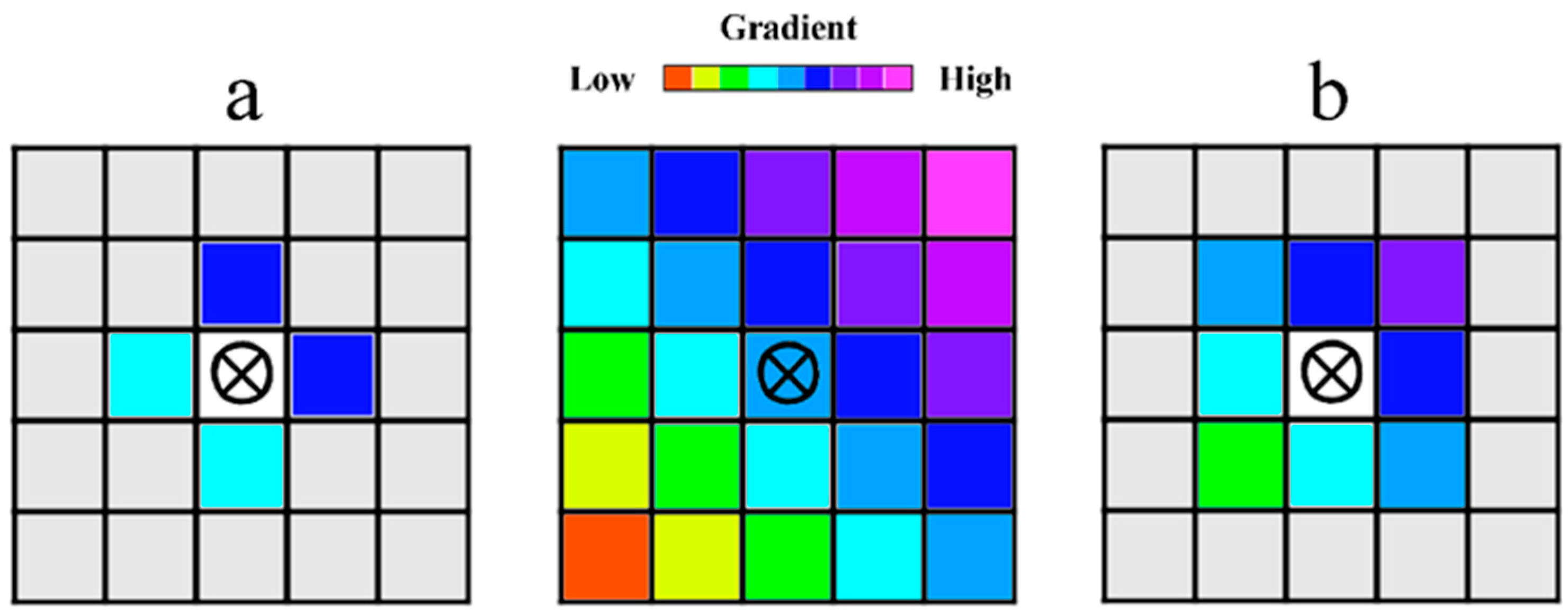
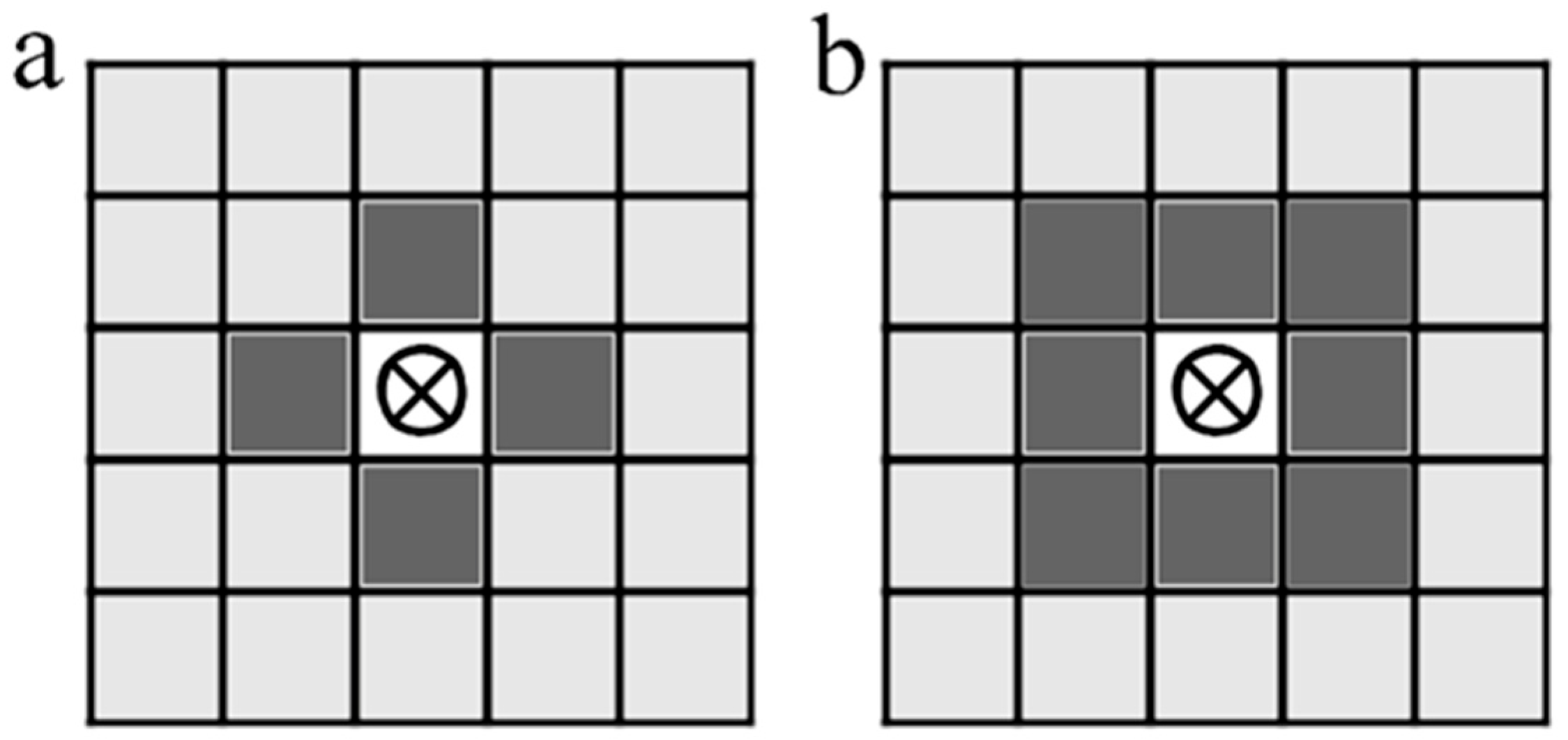
The analysis of the relative positions of pixels of different spectral classes in an image is based on the statistics of the immediate neighborhoods of each pixel. There are two possibilities. First, the Von Neumann neighborhood, which is four adjacent cells on a square grid (Figure 1a). Thus, for a cell [i, j] on a two-dimensional square grid, these are the cells with coordinates: [i + 1, j]; [i − 1, j]; [i, j + 1]; [i, j − 1]. Another option is the Moore neighborhood, consisting of 8 cells, which are the von Neumann neighborhood with the addition of four more diagonal cells: [i + 1, j]; [i − 1, j]; [i, j + 1]; [i, j − 1]; [i + 1, j + 1]; [i − 1, j − 1]; [i − 1, j + 1]; [i + 1, j − 1] (Figure 1b) [41]. The Moore neighborhood provides a somewhat larger statistical sample, which makes it preferable, especially in the case of relatively small matrices (Figure 2), but there are no fundamental differences between these options.
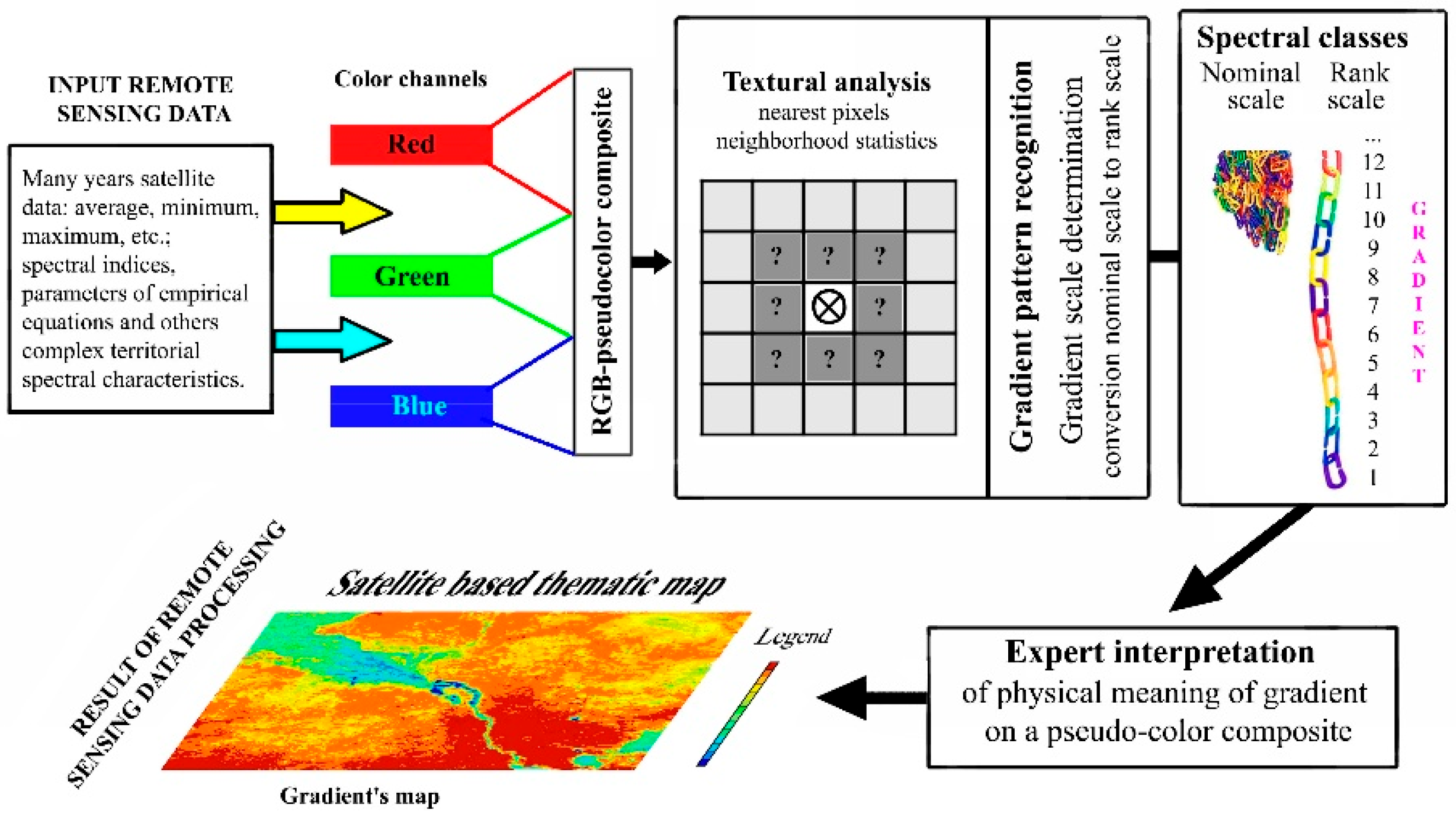
The final result of the statistical neighborhood analysis can be represented as a neighborhood matrix. This matrix contains complete information on the number and types of spectral classes present in the vicinity of Moore, for all spectral classes formed by clustering the satellite data. The proposed algorithm uses an exhaustive search for all possible rank scale variants to find the best one based on the criterion of the largest proportion of image pixels whose spatial arrangement is consistent with the gradient concept. The flowchart of the proposed algorithm is shown in Figure 3.

3. Results

3.1. Examples of Conversion of Nominal Scale to Ordinal Scale

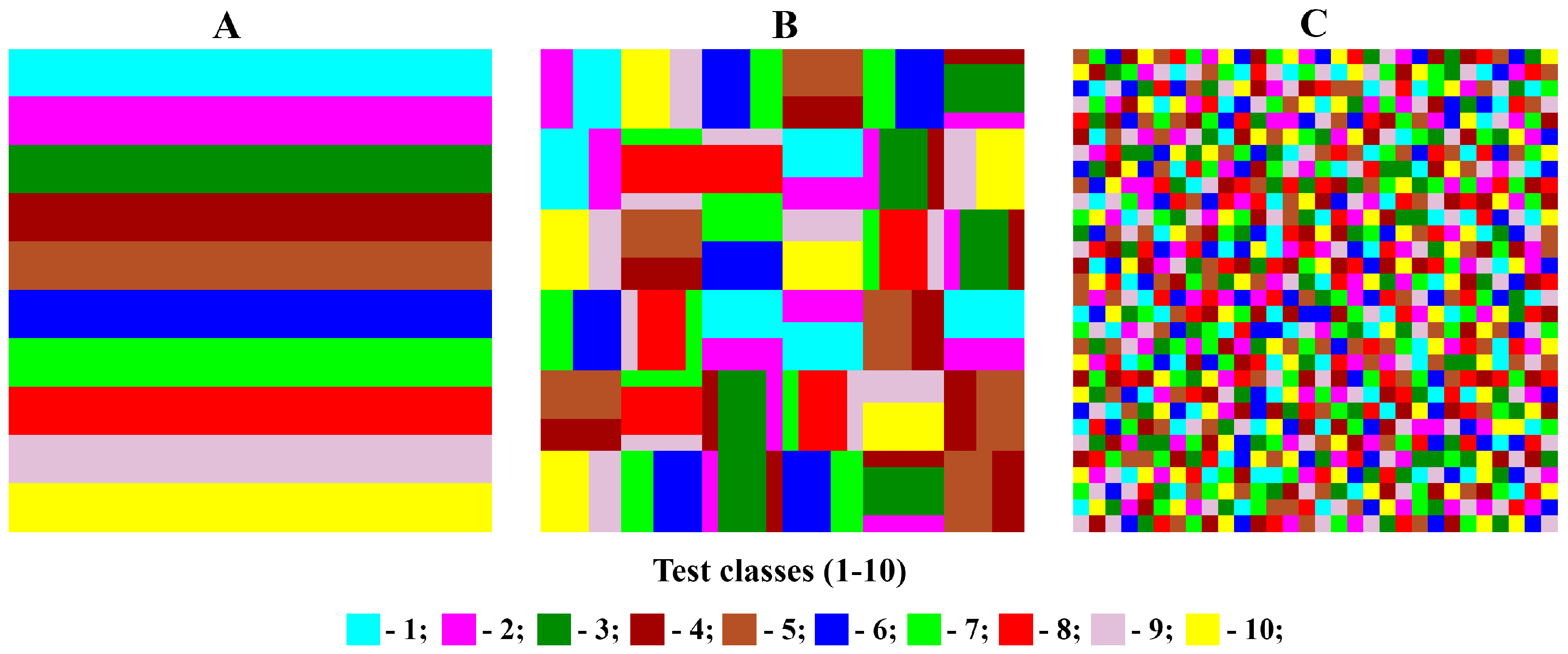
To demonstrate the operating principles of the proposed new texture analysis algorithm for assessing the presence of a gradient pattern in the morphological structure of an analyzed image, a model case was considered. A regular rectangular two-dimensional lattice of 30 × 30 cells, represented by the corresponding image, was defined. Ten different spectral classes were identified on it. The spatial structure of the image was organized as a simple, uniform, linear gradient along one side, with equal section widths for each class. In this case, the coverage size of each spectral class was 30 × 3 pixels (Figure 4A). Thus, configuration “A” was generated, representing a model image of a simple and strictly linear gradient that can be unambiguously described using an ordinal scale.
To generate configuration “B,” the original 30 × 30 image in configuration “A” was divided into 5 × 5 pixel blocks, for a total of 36 blocks. The new positions of these blocks were determined randomly. Each 5 × 5 pixel block has four possible orientations at its position. Of the four possible positions, one was randomly selected and used to generate configuration matrix “B” (Figure 4B). The new image generated according to these rules retained some short-range order from configuration state “A,” but the long-range order in the gradient structure was completely destroyed.
Configuration “C” had a completely random pixel arrangement. For this purpose, the position of each pixel with a particular class (1–10) in the original matrix “A” was determined randomly. In this case, only the original number of pixels for each of the ten available spectral classes was retained—90 in each (Figure 4C).
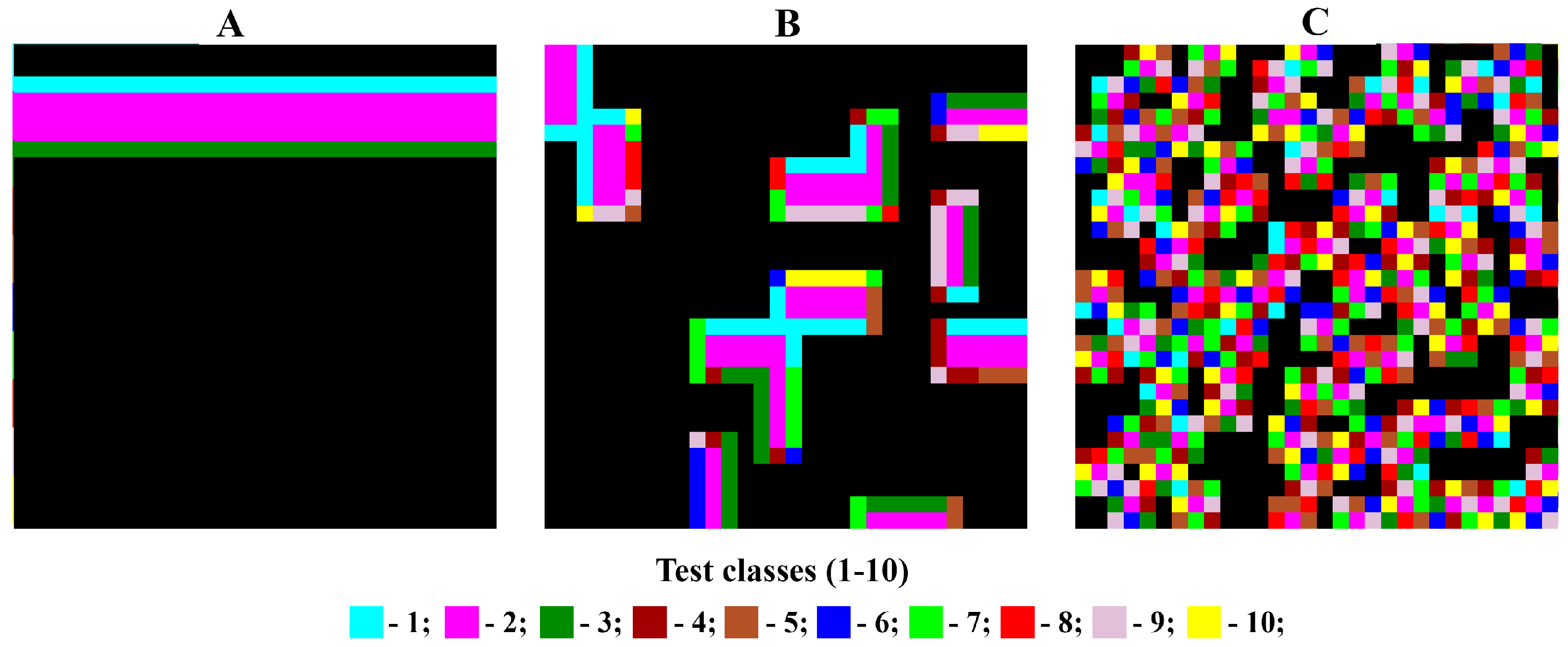
As an example of selecting and analyzing the composition of the immediate neighborhood, Figure 5 shows cells located in the Moore neighborhood, belonging to spectral class 2 (crimson). The nearest-neighbor matrices for states “A,” “B,” and “C” of the model matrix under consideration are presented in Table 1, Table 2 and Table 3.
The information in the neighborhood matrix reflects the patterns of spatial organization of the analyzed image. Table 1 indicates strict adherence to the gradient structure; most cells have a value of 0, indicating the presence of strict rules prohibiting certain types of neighborhoods. Table 3, in contrast, is characterized by generally high variability and random cell values within a certain spectral range, indicating the absence of any dominant neighborhood types. Table 2 is an intermediate form. While there are no strict rules, there are nevertheless statistically distinguishable preferences for certain types of binary patterns, which can be interpreted as the presence of a noisy gradient.

3.2. Satellite Scene Analysis Example

A practical example illustrating the developed algorithm for processing clustering results was considered. The physical nature of the temperature field of the Earth’s surface ensures the automatic formation of gradient structures. Remote sensing data in the thermal channel make it possible to reconstruct temperature fields of the underlying Earth’s surface, which are available in the form of various standard products [42]. Such a temperature field can be considered as a formal source of a graphical scene for its texture analysis in order to identify gradient patterns that should be present a priori. One of the common strategies for thematic processing of a satellite scene involves its clustering using any standard algorithm without training, such as K-means classification [43]. The K-means algorithm determines the membership of spectral classes present in the image to a predetermined number of clusters. The assignment algorithm is based on minimizing the squared sum of the distances between the present spectral classes and the centers of the clusters in the phase space of spectral features. Minimization of the squared sum of the distances is achieved by searching for the optimal positions of a given number of clusters in the feature space through iterative calculations. The clustering results can be analyzed using the proposed algorithm, using nearest neighbor analysis. This will determine the rank order of the spectral classes in the clustering, and based on this, the gradient pattern of the analyzed image can be reconstructed. The degree of identity between the reconstructed gradient field and the actual gradient field present in the original satellite image can serve as a diagnostic indicator of the effectiveness of the proposed approach.
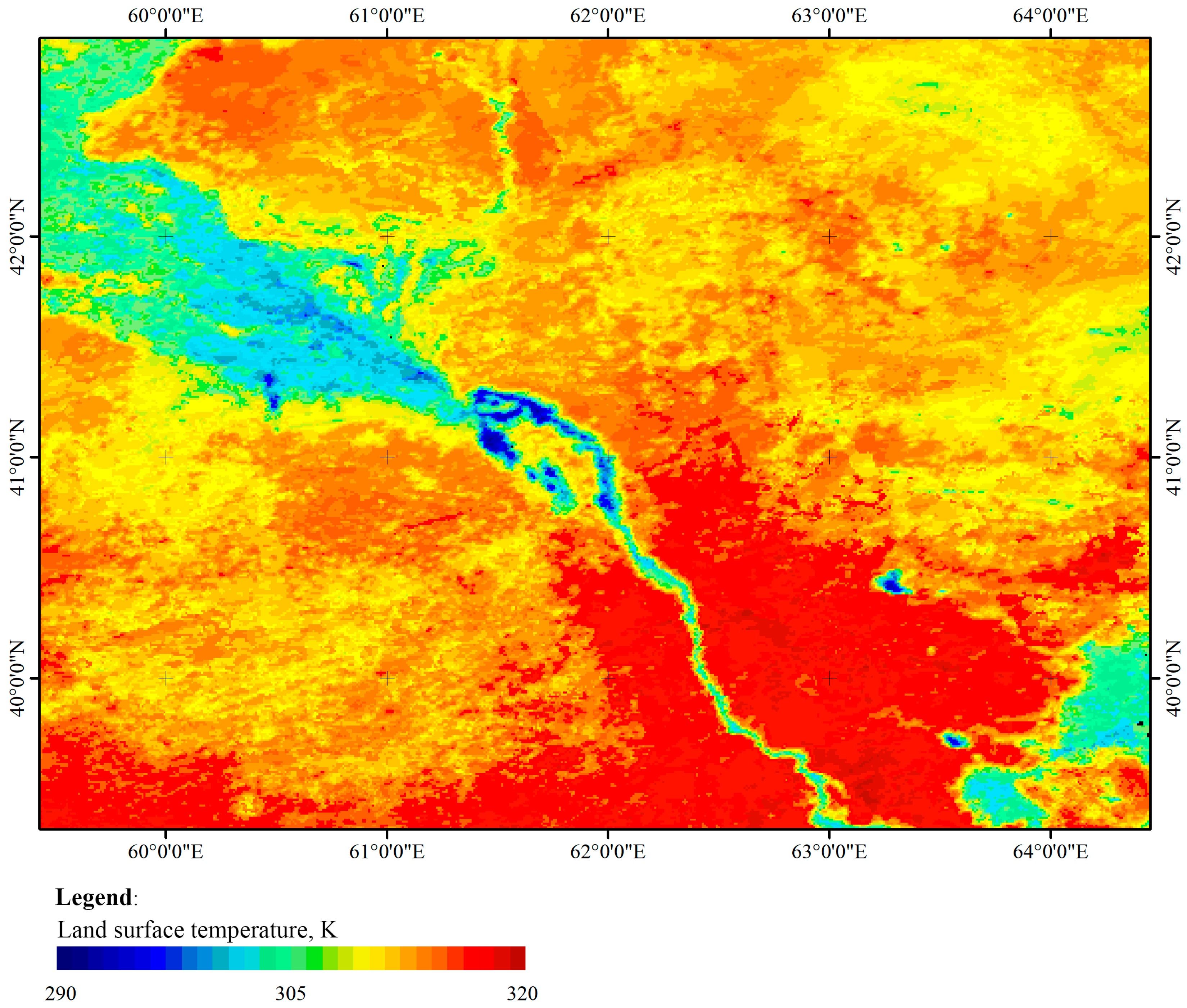
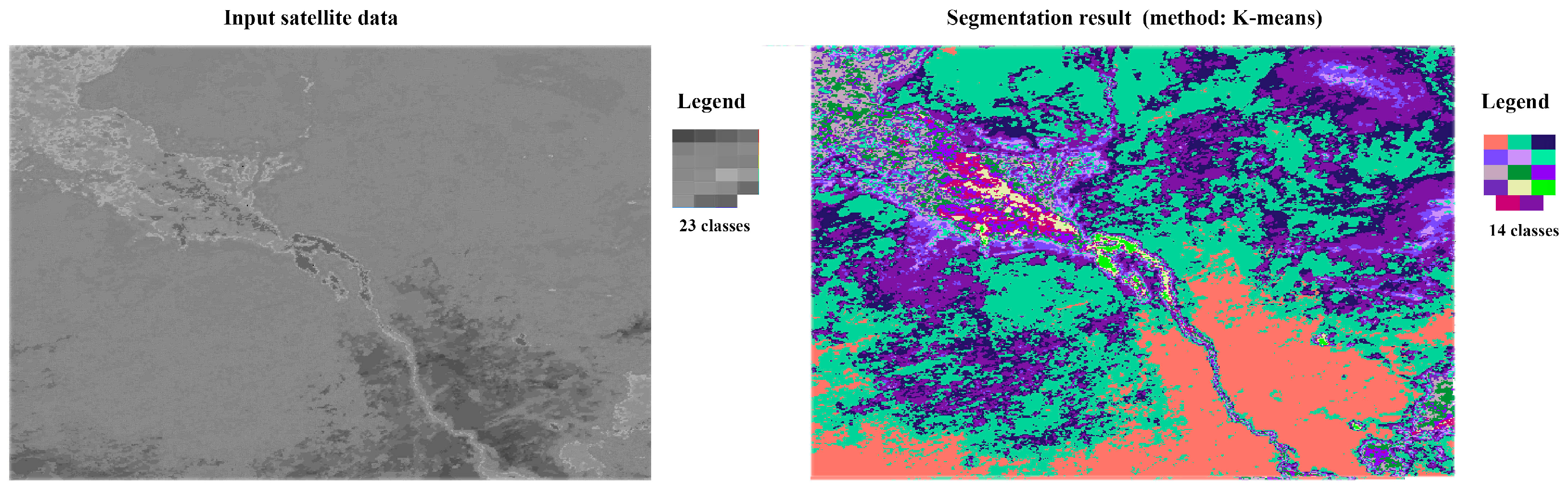
The MYD11A2 product scene (version 6.1) for 24 September 2024, was used as a practical example (Figure 6). This is a MODIS/Aqua model for determining land surface temperature/emissivity over 8 days on a global L3 grid with an error of 1 km (V061). The satellite imagery was obtained from the Google Earth Engine (GEE) platform [44].
Using the Sentinel Application Platform (SNAP) service, the selected temperature map was clustered using the K-means method, generating 14 nominal spectral classes (Figure 7). The number 14 had no deep meaning. It could have been a different number. The goal of clustering was to obtain a pseudocolor composite image with a nominal spectral class scale, but the image actually had a morphological structure closely related to the gradient pattern. The clustering results were subjected to texture analysis with the calculation of a neighborhood matrix (Table 4). The number of pixels of a given spectral class located in the immediate neighborhood of pixels of another class is not in itself indicative. The functional parameter is the proportion of neighboring pixels of a particular selected class relative to all available neighboring pixels of the analyzed spectral class. This recalculation is presented in Table 5. Table 6 presents the ratio of pixels of all spectral classes located in the Moore neighborhood for each class (according to the ordinal numbers of the spectral classes in the most significant rank ordering variant, in terms of the gradient pattern).
Converting from a nominal spectral class scale to a rank scale allows us to divide the pixels of the analyzed matrix into two groups, selecting those that can be assigned to a gradient structure. The gradient structure will include pixels that satisfy the following rule: any pixel of a given spectral class in the gradient structure must be adjacent to only two other classes, either related to adjacent spectral classes within the rank scale or to an identical pixel. The exceptions are the pixels of the first and last spectral classes in the rank scale, which are adjacent to only one class: the first only to the second, and the last only to the penultimate. If the gradient order is strictly observed, all pixels of the analyzed matrix will be associated with the gradient structure. However, in practice, this proportion may be significantly less than 100%.
The total number of ways to transform the nominal spectral class scale into a rank scale is quite large and equals the factorial of the number of spectral classes. For the case under consideration, with 14 spectral classes, this represents just over 87 billion different rank ordering options. The proportion of pixels in the analyzed matrix that can be assigned to the gradient structure with the selected ranking order can serve as a conditional criterion for the significance of this ranking ordering. Thus, by evaluating all possible options, we can determine which ranking option is the most significant—that is, the one in which the proportion of pixels in the analyzed matrix that satisfy the selected gradient structure is highest.
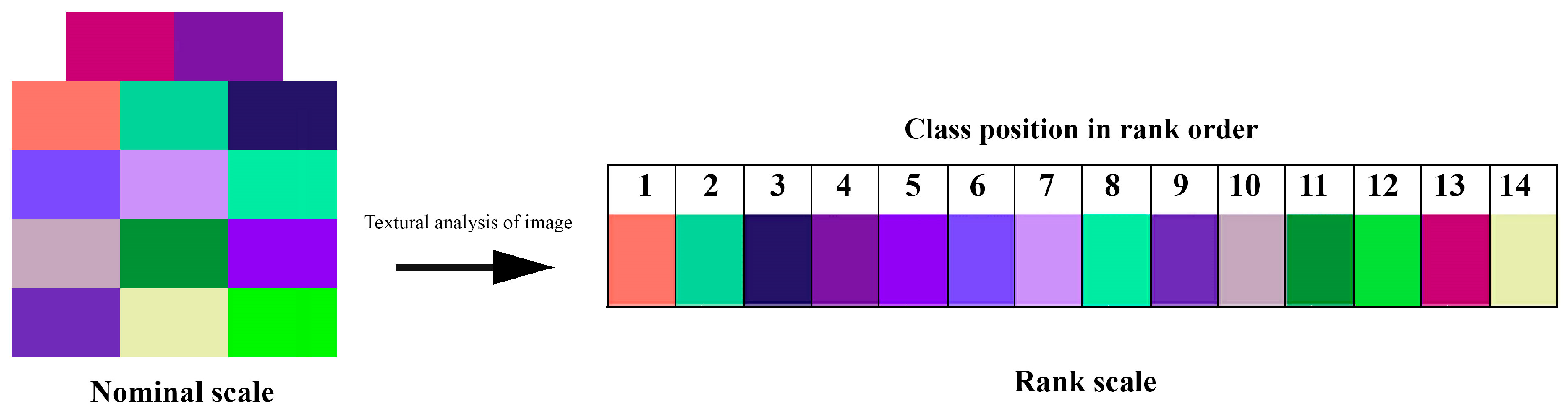
Analysis of the adjacency matrix of the clustering results for the thermal field test example allowed us to determine the most appropriate rank scale structure (Figure 8).
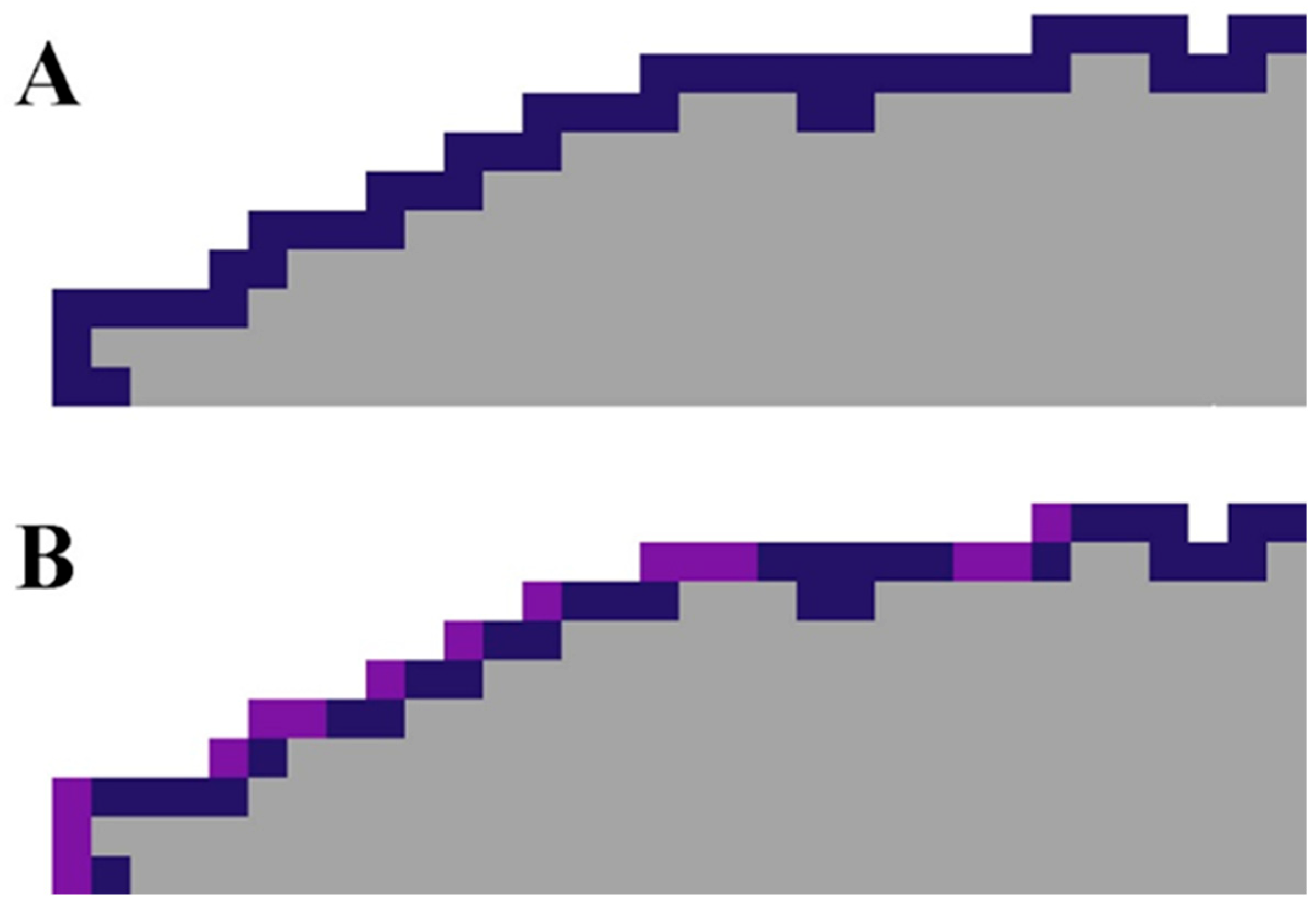
The proportion of test matrix pixels satisfying the gradient structure within this ranking option was the maximum possible for the analyzed satellite scene, amounting to 69.504%. The criteria for classifying pixels as belonging to the gradient structure can be expanded by allowing for the possibility of neighboring not two, but four other classes related to the nearest neighbors on the rank scale. This situation corresponds to situations where the gradient field in the satellite scene is too contrasty, and the period of a conventional matrix cannot describe this using a consistent set of spectral classes in accordance with the rank scale. Some classes fall outside the regular order of neighboring classes within the gradient, and configurations of binary patterns appear, adjacent to each other by one position on the rank scale (Figure 9). In this case, the maximum proportion of pixels in the test satellite scene belonging to the gradient structure increased and amounted to 88.358%, that is, the overwhelming majority.
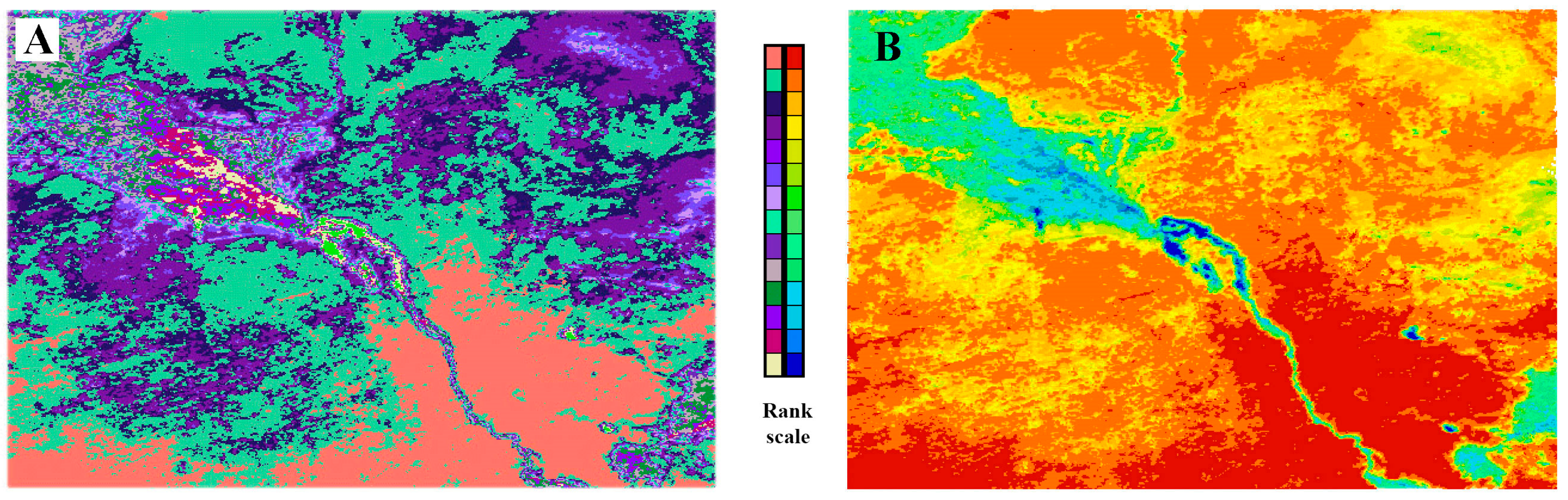
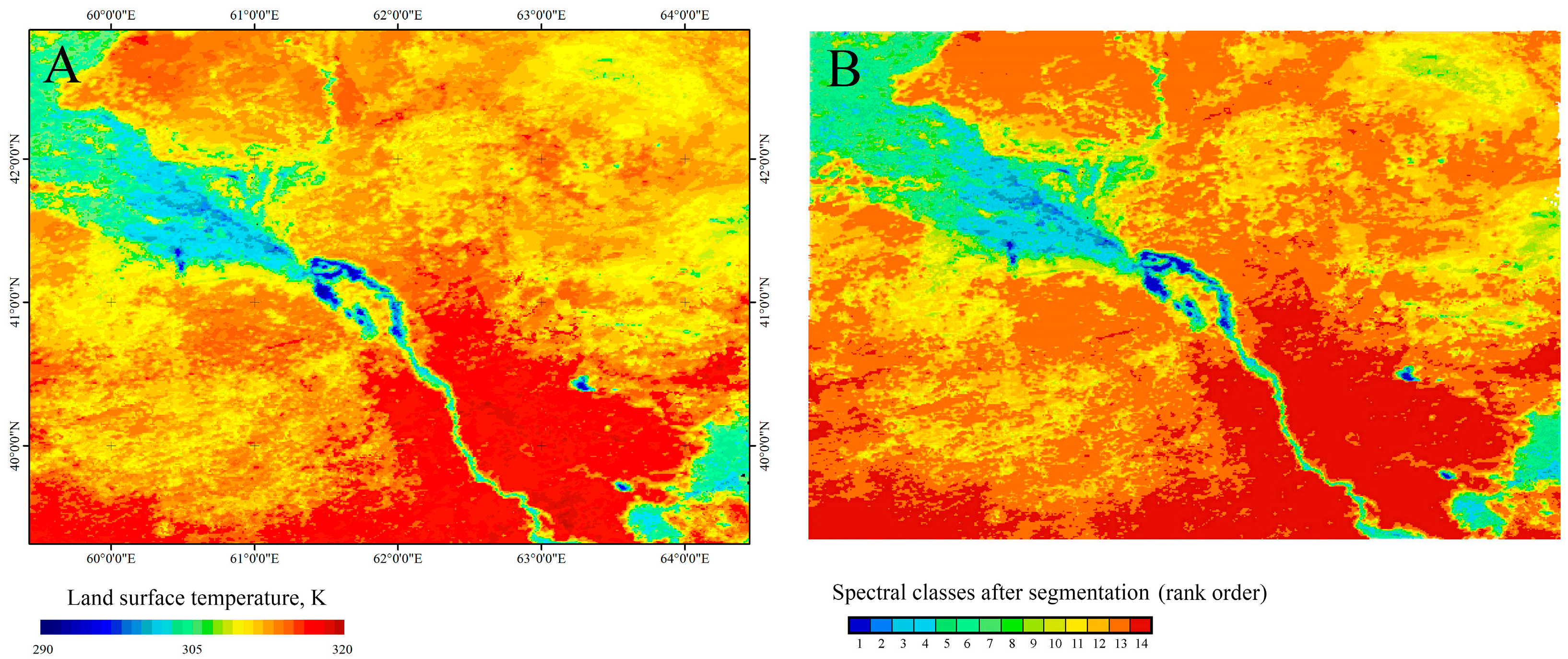
The spectral class rank order obtained through texture analysis to reconstruct the gradient pattern allows for the color representation of the clustering results to be modified using a color scale typical of quantitative scales, i.e., with a regular and smooth change in the palette’s color parameters, for example, from blue to red. Consequently, it becomes possible to visually compare the graphical structure of the original satellite image of the underlying surface temperature and its image obtained after coarse-grained clustering with the loss of the original spectral class rank order (Figure 10) and its subsequent restoration (Figure 11).
As can be seen in Figure 11, gradient pattern detection using spectral class rank ordering fairly well reconstructed the original morphological gradient structure of the test image. The correlation coefficient between the original image and the result of processing using the proposed algorithm was 0.98.

4. Discussion

The above-described algorithm for texture image processing for gradient pattern detection expands the capabilities of spectral information processing by incorporating certain morphological features of the analyzed image. Analysis of the spectral characteristics of pixels in their immediate vicinity provides information on the presence of certain types of preferential neighborhoods (binary patterns), which serves as the basis for diagnosing the presence of gradient patterns and the significance of these morphological features for the entire graphic scene or its individual key areas. The methodology proposed in this study is adapted for the analysis of remote sensing data, including satellite imagery and products based on them, but is not limited to this range of tasks.
Recording and describing gradient patterns in the analyzed graphic scene, such as a pseudocolor composite image, using an appropriate scale can significantly enhance the thematic processing of satellite data. This requires solving two problems. First, recognizing the presence and composition of a gradient. Which spectral classes present in the image, and in what order, form a property gradient. Second, expert determination of the physical meaning of the gradient. The gradient of underlying surface properties is recorded through the identified rank order of spectral classes. This significantly simplifies subsequent thematic interpretation of the obtained clustering results. Expert interpretation of each spectral class becomes unnecessary, only their ensemble within the rank scale describing the gradient structure. It is also desirable to understand the physical meaning of the detected gradient, initially constructing qualitative and, subsequently, possibly quantitative rank estimates.
Geographically distributed objects, including various natural and anthropogenic ones, such as soil or vegetation cover, agricultural land, etc., can be described by various thematic maps using parameters that allow for dependencies expressed as gradients. A new strategy for processing remote sensing data is emerging for such objects. This strategy is based on feedback and optimization. A specific set of initial remote sensing data can provide some description of the gradient structure of the Earth’s underlying surface, serving as the basis for thematic analysis. Consequently, the researcher has the opportunity to vary the initial data to obtain more meaningful gradient patterns. This allows for an empirical search for the most informative remote sensing sources. This innovation is particularly valuable for describing complex processes, including long-term territorial changes, for which the principles of description are unclear and the parameters used can be complex. For example, the degree of desertification, degradation of the underlying surface, or long-term trends in agricultural land characteristics. The morphological features of images containing gradient patterns are quite distinctive. In the case of a linear trend, a key region of the image will have a certain isopotential direction along which spectral classes are quasi-stable. A perpendicular direction will also be present, with a wide variety of spectral class types. The proposed texture processing algorithm provides a metric for the significance of gradient patterns and the composition of the ranking scale for the best description, eliminating the need for purely expert assessments.
To illustrate the practical significance of the above-described idea of using gradient patterns in processing spectral remote sensing data, we can consider the problem of estimating the average long-term secondary salinity of irrigated arable land in southern Kazakhstan. Secondary salinity of irrigated arable land is a dynamic process with varying time scales [45]. There are both intra-seasonal and inter-seasonal dynamics. At the beginning of the growing season, the level of secondary salinity is lower. By the end of the season, it increases. Inter-seasonal dynamics are also significant and are related to weather conditions, particularly the availability of water for irrigation. Dry and wet years differ significantly in the water availability of arid areas in southern Kazakhstan. Taken together, all this creates a complex dynamic picture, making it significantly difficult to describe average long-term conditions. However, it is the average long-term conditions that have the highest practical significance, since they serve as the basis for making management decisions in the field of territorial hydrology and the administration of irrigated agriculture.
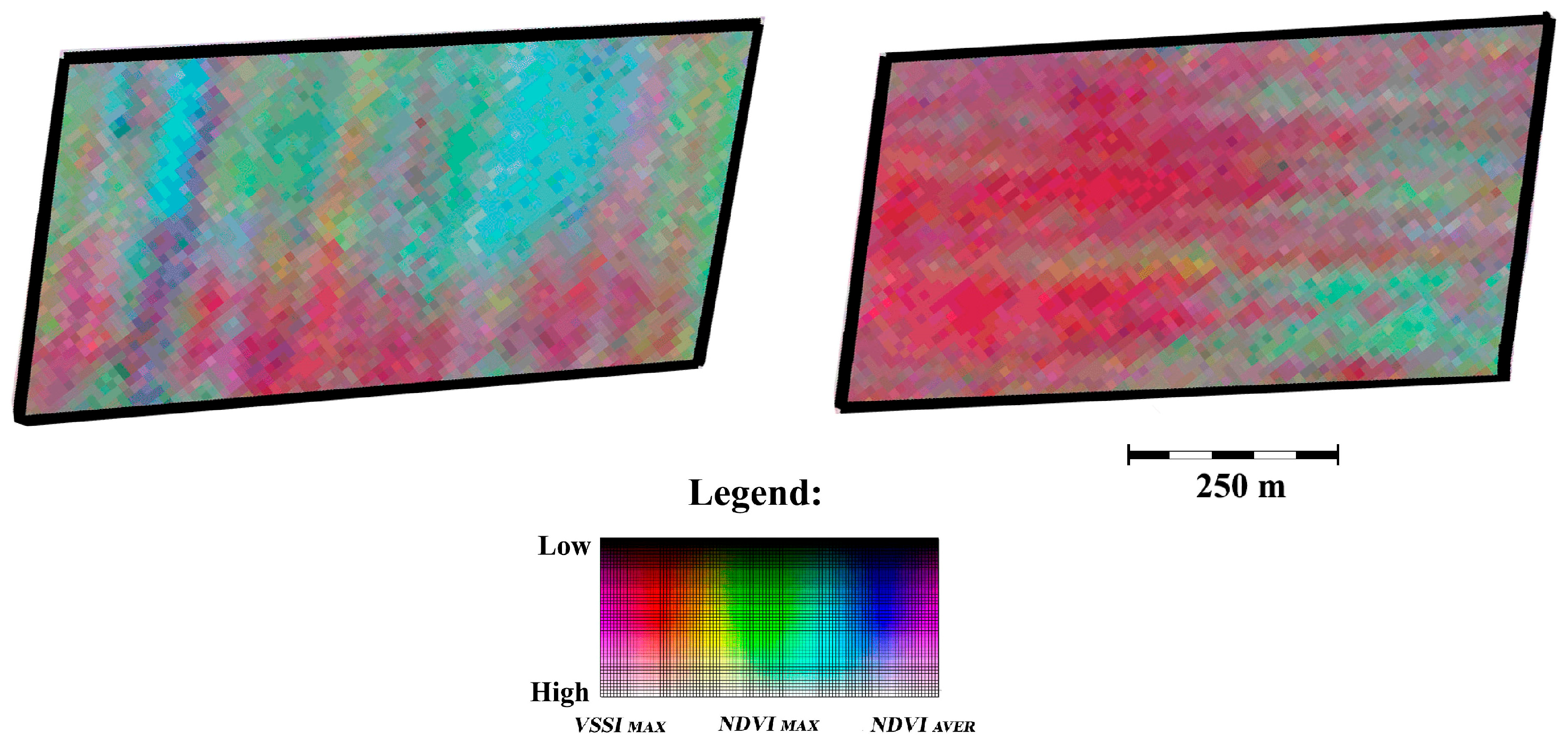
Pseudocolor RGB composite images of the southern Kazakhstan region were constructed using Sentinel-2 satellite data, displaying perennial characteristics of vegetation, including irrigated fields. The spectral channels of the RGB composite were formed by analyzing the Sentinel-2 satellite data archive for the period 2018–2022. The Vegetation Soil Salinity Index (VSSI) was used as the RED channel long-term maximum [46].
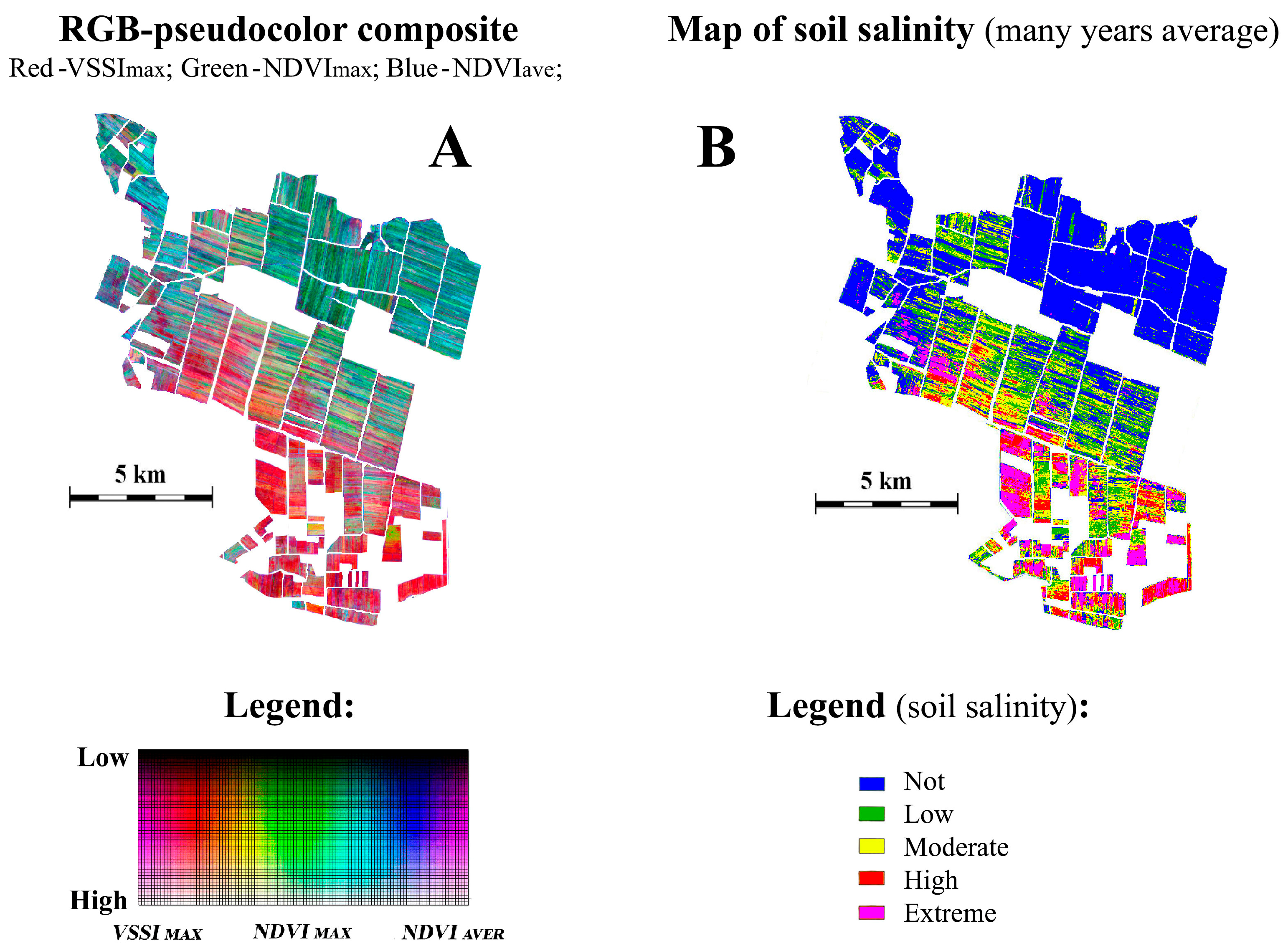
The GREEN channel represented the NDVI vegetation index, in the form of its long-term maximum, and the BLUE channel represented the long-term average NDVI value. In this work, an expert analysis of the RGB composite of the field area with a known gradient structure of the secondary salinity level was carried out, Figure 12. As a result, the expert interpretation restored the rank order of the spectral classes within the framework of their relationship with the level of secondary salinity of arable land, and based on the resulting legend, the original RGB composite was recalculated into a map of the average long-term secondary salinity level [47].
The identification and expert analysis of gradient properties in soil salinity (Figure 12) enabled the conversion of the nominal scale of the RGB pseudocolor composite to a scale of average long-term soil salinity (Figure 13). Figure 13 illustrates the importance of morphological analysis based on expert recognition of gradient structures for a more in-depth thematic analysis of the spectral structure of the analyzed graphic scene, for example, in the task of estimating average long-term soil salinity.
Thus, the algorithm described in this paper for converting from a nominal scale of spectral classes to a rank scale expands the capabilities of thematic processing of graphic scenes, including those constructed based on remote sensing or other similar data [48,49], replacing complex and subjective expert analysis. This procedure may be of interest as a new, additional feature in the toolbox of thematic processing of satellite information within the framework of relevant specialized software.
The limitations of using the developed image texture analysis procedure are minimal. Analysis of spectral class types in the immediate vicinity of each pixel in an image can, in principle, be performed for any image. However, the presence of a large number of different spectral classes in the analyzed graphic scene makes the mathematical process of finding the most appropriate gradient scale quite cumbersome. The total number of possible gradient scale combinations, including all spectral classes present in the image, is a factorial of the number of spectral classes. This means that the volume of necessary calculations rapidly increases with the number of classes. Another potential problem is the presence of multiple independent gradients in the image, each described by only a subset of the spectral classes present. In this case, a more advanced analysis algorithm than the one described above will be required, which could become the next step in the development of this field.

5. Conclusions

In summary, a new image texture analysis algorithm has been developed based on the statistical analysis of spectral class types in the immediate vicinity of a pixel. The purpose of the analysis was to identify and evaluate the significance of specific morphological image features expressed as gradient patterns. The original spectral classes, initially organized within a nominal scale, are sorted into a rank scale in the gradient legend.
The developed image processing algorithm may be of greatest practical use for thematic analysis of pseudocolor composite images constructed from remote sensing data, including satellite imagery. This opens up new and interesting possibilities for empirically selecting initial remote sensing data that provides better descriptions of territories using gradient patterns.
In the future, this texture analysis algorithm may be further modified to adapt it to specific sets of original data and thematic problems being solved. For example, pseudonearest neighbor analysis is an interesting option. It is also likely that complexly structured pseudocolor images may contain multiple spectrally independent gradient patterns, the analysis of which will enable deeper thematic data processing.
The developed image processing algorithm could form the basis for a separate, additional function in satellite data processing tools within specialized software.


Author Contributions

Conceptualization, A.T.; software, validation, A.T. and R.I.M.; writing—original draft preparation, A.T.; writing—review and editing, I.S.; visualization, A.T. All authors have read and agreed to the published version of the manuscript.

Funding

This research was funded by the Science Committee of the Ministry of Science and Higher Education of the Republic of Kazakhstan Grant No. BR24992908 ‘Support system for agrotechnical measures in crop production based on a set of monitoring tools and artificial intelligence methods (Agroscope)’ and AP26104709–Development of remote sensing methods for estimating water consumption of irrigated arable land in Central Asia. The APC was funded by AP26104709.

Institutional Review Board Statement

Not applicable.

Informed Consent Statement

Not applicable.

Data Availability Statement

No new data were created or analyzed in this study. Data sharing is not applicable to this article.

Conflicts of Interest

The authors declare no conflicts of interest.

Abbreviations

The following abbreviations are used in this manuscript:
SNAPSentinel Application Platform

References

  1. Toutin, T. State-of-the-art of geometric correction of remote sensing data: A data fusion perspective. Int. J. Image Data Fusion 2011, 2, 3–35. [Google Scholar] [CrossRef]
  2. Mobley, C.B. Estimation of the remote-sensing reflectance from above-surface measurements. Appl. Opt. 1999, 38, 7442–7455. [Google Scholar] [CrossRef]
  3. First Full Day of Winter on James Bay-December 25, 2025. Available online: https://modis.gsfc.nasa.gov/ (accessed on 20 September 2025).
  4. Available online: https://science.nasa.gov/mission/landsat/data-overview/ (accessed on 20 September 2025).
  5. Darabi, H.; Torabi Haghighi, A.; Klöve, B.; Luoto, M. Remote sensing of vegetation trends: A review of methodological choices and sources of uncertainty. Remote Sens. Appl. Soc. Environ. 2025, 37, 101500. [Google Scholar] [CrossRef]
  6. Bannari, A.; Morin, D.; Bonn, F.; Huete, A.R. A review of vegetation indices. Remote Sens. Rev. 1995, 13, 95–120. [Google Scholar] [CrossRef]
  7. Liu, H.; Hu, H.; Liu, X.; Jiang, H.; Liu, W.; Yin, X. A Comparison of Different Water Indices and Band Downscaling Methods for Water Bodies Mapping from Sentinel-2 Imagery at 10-M Resolution. Water 2022, 14, 2696. [Google Scholar] [CrossRef]
  8. Chen, Q.; Vaudour, E.; Richer-de-Forges, A.C.; Arrouays, D. Spectral indices in remote sensing of soil: Definition, popularity, and issues. A critical overview. Remote Sens. Environ. 2025, 329, 114918. [Google Scholar] [CrossRef]
  9. Rajesh, H.M. Application of remote sensing and GIS in mineral resource mapping—An overview. J. Mineral. Petrol. Sci. 2004, 99, 83–103. [Google Scholar] [CrossRef]
  10. Gutiérrez-Hernández, O.; García, L.V. Robust Trend Analysis in Environmental Remote Sensing: A Case Study of Cork Oak Forest Decline. Remote Sens. 2024, 16, 3886. [Google Scholar] [CrossRef]
  11. Jönsson, P.; Cai, Z.; Melaas, E.; Friedl, M.A.; Eklundh, L. A Method for Robust Estimation of Vegetation Seasonality from Landsat and Sentinel-2 Time Series Data. Remote Sens. 2018, 10, 635. [Google Scholar] [CrossRef]
  12. Saifuzzaman, M.; Adamchuk, V.; Buelvas, R.; Biswas, A.; Prasher, S.; Rabe, N.; Aspinall, D.; Ji, W. Clustering Tools for Integration of Satellite Remote Sensing Imagery and Proximal Soil Sensing Data. Remote Sens. 2019, 11, 1036. [Google Scholar] [CrossRef]
  13. Feng, L.; Ma, D.; Xie, M.; Xi, M. Review on the Application of Remote Sensing Data and Machine Learning to the Estimation of Anthropogenic Heat Emissions. Remote Sens. 2025, 17, 200. [Google Scholar] [CrossRef]
  14. Kazanskiy, N.; Khabibullin, R.; Nikonorov, A.; Khonina, S. A Comprehensive Review of Remote Sensing and Artificial Intelligence Integration: Advances, Applications, and Challenges. Sensors 2025, 25, 5965. [Google Scholar] [CrossRef]
  15. Rivera-Marin, D.; Dash, J.; Ogutu, B. The use of remote sensing for desertification studies: A review. J. Arid Environ. 2022, 206, 104829. [Google Scholar] [CrossRef]
  16. Wang, J.; Zhen, J.; Hu, W.; Chen, S.; Lizaga, I.; Zeraatpisheh, M.; Yang, X. Remote sensing of soil degradation: Progress and perspective. Int. Soil Water Conserv. Res. 2023, 11, 429–454. [Google Scholar] [CrossRef]
  17. Sur, K.; Verma, V.K.; Panwar, P.; Shukla, G.; Chakravarty, S.; Nath, A.J. Monitoring vegetation degradation using remote sensing and machine learning over India—A multi-sensor, multi-temporal and multi-scale approach. Front. For. Glob. Change 2024, 7, 1382557. [Google Scholar] [CrossRef]
  18. Dong, Y.; Huang, W.; Li, H.; Han, L. Editorial: Advancements in agricultural monitoring with AI enhanced remote sensing techniques. Front. Remote Sens. 2025, 6, 1664060. [Google Scholar] [CrossRef]
  19. Wit Ade Boogaard, H.; Fumagalli, D.; Janssen, S.; Knapen, R.; van Kraalingen, D.; Supit, I.; van der Wijngaart, R.; van Diepen, K. 25 Years of the WOFOST Cropping Systems Model. Agric. Syst. 2019, 168, 154–167. [Google Scholar] [CrossRef]
  20. Stalker, J.R.; Knupp, K.R. A method to identify convective cells within multicell thunderstorms from multiple Doppler radar data. Mon. Weather Rev. 2002, 130, 188–195. [Google Scholar] [CrossRef]
  21. Jung, S.H.; Lee, G. Radar-based cell tracking with fuzzy logic approach. Meteorol. Appl. 2015, 22, 716–730. [Google Scholar] [CrossRef]
  22. Figueiredo, B.; Frazão, Á.; Rouco, A.; Soares, B.; Albuquerque, D.; Pinho, P. A Review: Radar Remote-Based Gait Identification Methods and Techniques. Remote Sens. 2025, 17, 1282. [Google Scholar] [CrossRef]
  23. Sistaninejhad, B.; Rasi, H.; Nayeri, P. A Review Paper about Deep Learning for Medical Image Analysis. Comput. Math. Methods Med. 2023, 2023, 7091301. [Google Scholar] [CrossRef]
  24. Abburu, S.; Golla, S.B. Satellite image classification methods and techniques: A review. Int. J. Comput. Appl. 2015, 119, 20–25. [Google Scholar] [CrossRef]
  25. Xue, J.; Su, B. Significant Remote Sensing Vegetation Indices: A Review of Developments and Applications. J. Sens. 2017, 2017, 1353691. [Google Scholar] [CrossRef]
  26. Cover, T.; Hart, P. Nearest neighbor pattern classification. IEEE Trans. Inf. Theory 1967, 13, 21–27. [Google Scholar] [CrossRef]
  27. Liao, S.; Law, M.W.K.; Chung, A.C.S. Dominant Local Binary Patterns for Texture Classification. IEEE Trans. Image Process. 2009, 18, 1107–1118. [Google Scholar] [CrossRef] [PubMed]
  28. Khellah, F.M. Texture Classification Using Dominant Neighborhood Structure. IEEE Trans. Image Process. 2011, 20, 3270–3279. [Google Scholar] [CrossRef] [PubMed]
  29. Rosin, P.; Adamatzky, A.; Sun, X. (Eds.) Cellular Automata in Image Processing and Geometry; Springer International Publishing: Berlin/Heidelberg, Germany, 2014. [Google Scholar] [CrossRef]
  30. Luo, D. Pattern Recognition and Image Processing; Elsevier: Amsterdam, The Netherlands, 1998. [Google Scholar]
  31. Mehta, R.; Egiazarian, K. Dominant Rotated Local Binary Patterns (DRLBP) for texture classification. Pattern Recognit. Lett. 2016, 71, 16–22. [Google Scholar] [CrossRef]
  32. Wu, Y.; Ianakiev, K.; Govindaraju, V. Improved k-nearest neighbor classification. Pattern Recognit. 2002, 35, 2311–2318. [Google Scholar] [CrossRef]
  33. Sowmya, A.; Trinder, J. Modelling and representation issues in automated feature extraction from aerial and satellite images. ISPRS J. Photogramm. Remote Sens. 2000, 55, 34–47. [Google Scholar] [CrossRef]
  34. Wang, J.; Howarth, P.J. Structural Measures for Linear Feature Pattern Recognition from Satellite Imagery. Can. J. Remote Sens. 1991, 17, 294–303. [Google Scholar] [CrossRef]
  35. Pesaresi, M. Texture Analysis for Urban Pattern Recognition Using Fine-resolution Panchromatic Satellite Imagery. Geogr. Environ. Model. 2000, 4, 43–63. [Google Scholar] [CrossRef]
  36. Chorowicz, J.; Parrot, J.F.; Taud, H.; Hakdaoui, M.; Rudant, J.P.; Rouis, T. Automated pattern-recognition of geomorphic features from DEMs and satellite images. Z. Geomorphol. Suppl. 1995, 101, 69–84. [Google Scholar]
  37. Young, T.Y. (Ed.) Handbook of Pattern Recognition and Image Processing (Vol. 2) Computer Vision; Academic Press, Inc.: Cambridge, MA, USA, 1994; 584p, Available online: https://dl.acm.org/doi/10.1007/s10044-002-0168-4 (accessed on 20 September 2025).
  38. Geva, S.; Sitte, J. Adaptive nearest neighbor pattern classification. IEEE Trans. Neural Netw. 1991, 2, 318–322. [Google Scholar] [CrossRef] [PubMed]
  39. Chen, C.H.; Ho, P.G.P. Statistical pattern recognition in remote sensing. Pattern Recognit. 2008, 41, 2731–2741. [Google Scholar] [CrossRef]
  40. Zeng, Y.; Yang, Y.; Zhao, L. Pseudo nearest neighbor rule for pattern classification. Expert Syst. Appl. 2009, 36, 3587–3595. [Google Scholar] [CrossRef]
  41. Wilson, J.N.; Ritter, G.X. Handbook of Computer Vision Algorithms in Image Algebra, 2nd ed.; CRC Press: Boca Raton, FL, USA, 2000; p. 177. [Google Scholar]
  42. Li, Z.-L.; Wu, H.; Duan, S.-B.; Zhao, W.; Ren, H.; Liu, X. Satellite remote sensing of global land surface temperature: Definition, methods, products, and applications. Rev. Geophys. 2023, 61, e2022RG000777. [Google Scholar] [CrossRef]
  43. Ali, I.; Rehman, A.U.; Khan, D.M.; Khan, Z.; Shafiq, M.; Choi, J.-G. Model Selection Using K-Means Clustering Algorithm for the Symmetrical Segmentation of Remote Sensing Datasets. Symmetry 2022, 14, 1149. [Google Scholar] [CrossRef]
  44. MYD11A2.061 Aqua Land Surface Temperature and Emissivity 8-Day Global 1km. Available online: https://developers.google.com/earth-engine/datasets/catalog/MODIS_061_MYD11A2 (accessed on 20 September 2025).
  45. Savin, I.Y.; Otarov, A.; Zhogolev, A.V.; Ibraeva, M.A.; Duseikov, S. Long-term changes in the area of saline soils recognized by LANDSAT images in Shauldersk irrigated massive. Dokuchaev Soil Bull. 2014, 74, 49–65. [Google Scholar] [CrossRef]
  46. Dehni, A.; Lounis, M. Remote sensing techniques for salt affected soil mapping: Application to the Oran region of Algeria. Procedia Eng. 2012, 33, 188–198. [Google Scholar] [CrossRef]
  47. Terekhov, A.G.; Sagatdinova, G.N.; Mukhamediev, R.I.; Savin, I.Y.; Amirgaliev, E.N.; Sairov, S.B. Prospects for Using Pseudocolor Image Processing in the Analysis of Multiyear Time Series of Satellite Data in the Task of Assessing the State of Vegetation Cover. Cosm. Res. 2024, 62, 130–140. [Google Scholar] [CrossRef]
  48. Müller, R.; Haussler, S.; Jerg, M.; Heizenreder, D. A novel approach for the detection of developing thunderstorm cells. Remote Sens. 2019, 11, 443. [Google Scholar] [CrossRef]
  49. He, L.; Ouyang, D.; Wang, M.; Bai, H.; Yang, Q.; Liu, Y.; Jiang, Y. A Method of Identifying Thunderstorm Clouds in Satellite Cloud Image Based on Clustering. Comput. Mater. Contin. 2018, 57, 549. [Google Scholar] [CrossRef]
Figure 1. Schemes of accounting for the nearest environment on a square lattice ((a) Von Neumann neighborhood; (b) Moore neighborhood).
Jimaging 12 00023 g001
Figure 2. Schemes for identifying cell types in the immediate neighborhood in the case of a simple linear gradient ((a) Von Neumann neighborhoods; (b) Moore neighborhoods).
Jimaging 12 00023 g002
Figure 3. The flowchart of the analysis.
Jimaging 12 00023 g003
Figure 4. Test matrixes configurations: (A) with strictly linear gradient; (B) with short-range order; (C) with a completely random pixel arrangement.
Jimaging 12 00023 g004
Figure 5. Moore neighborhoods for class 2 (magenta) for different configurations of the test matrix ((A) with strictly linear gradient; (B) with short-range order; (C) with a completely random pixel arrangement).
Jimaging 12 00023 g005
Figure 6. Map of the land surface temperature of southern Kazakhstan, MYD11A2 (V6.1), 24 September 2024.
Jimaging 12 00023 g006
Figure 7. Clustering results of the test satellite scene, MYD11A2, v6.1; 24 September 2024.
Jimaging 12 00023 g007
Figure 8. Illustration of the transition from the nominal to the rank scale of spectral classes of the clustering results of the test satellite scene as a result of the analysis of the adjacency matrix (nominal scale—left; rank scale—right).
Jimaging 12 00023 g008
Figure 9. Different variants of the composition of boundary pixels in the Moore neighborhood to the selected spectral class (gray color). (A) uniform composition of boundary pixels, in the case of a smooth gradient field on a regular matrix; (B) non-uniform composition of boundary pixels (from two different types of spectral classes) in the case of a sharper gradient field on a regular matrix.
Jimaging 12 00023 g009
Figure 10. Various graphical representations of the clustering results for 14 spectral classes of the test satellite scene using K-means ((A) using the standard graphical palette within the clustering procedure; (B) using the temperature field palette for the spectral classes of clustering, ordered within the most significant rank order).
Jimaging 12 00023 g010
Figure 11. Comparison of the original test satellite scene MYD11A2 (V6.1), 24.09. 2024 and its image, reconstructed after the K-means clustering procedure. ((A) original satellite scene LST (30 spectral classes); (B) result of K-means clustering (14 spectral classes) after the procedure of ordering the nominal scale of spectral classes into the most significant rank scale).
Jimaging 12 00023 g011
Figure 12. Examples of irrigated fields with a gradient state of soil salinity. Results of processing of Sentinel-2 satellite data. RGB-pseudocolor composite: Red—many years maximum of salinity index (VSSI); Green—many years maximum of vegetation index (NDVI); Blue—many years average of vegetation index (NDVI).
Jimaging 12 00023 g012
Figure 13. Irrigated arable land of Kyzylkumsky rural district in South Kazakhstan. Results of processing of Sentinel-2 satellite data. (A) the result of standard processing procedure; (B) the result, taking into account the gradient structure.
Jimaging 12 00023 g013
Table 1. Neighborhood matrix for the test matrix in configuration “A”.
Classes
Classes 12345678910
1-3000000000
230-300000000
3030-30000000
40030-3000000
500030-300000
6000030-30000
70000030-3000
800000030-300
9000000030-30
100000000030-
Table 2. Neighborhood matrix for the test matrix in configuration “B”.
Classes
Classes 12345678910
1-40311488659
242-3412991861910
3534-30588333
4111232-351413112012
548333-5156152
6586116-343225
78176111635-362111
8883156332-300
961932310192332-32
109113142512034-
Table 3. Neighborhood matrix for the test matrix in configuration “C”.
Classes
Classes 12345678910
1-305866745970706967
230-5364706472606962
35447-58656862635964
4586357-376268675759
565695937-4554555455
66161625847-45505258
7647059635047-546058
863606565535454-5955
96366615558536160-49
10636161565459555749-
Table 4. Neighborhood matrix of clustering results for the test satellite scene. Clustering formed 14 spectral classes. The table shows the number of pixels in the Moore neighborhood for each class (random order of assigning spectral class ordinal numbers).
Class ID
1234567891011121314
Class ID1-19,651026501730,14314546507586613
219,415-7216880139933273218304015095105
3068-21424093637104764201281127560237
42842307235-835102122473181129636033522
500263783-9295196460424351718637
6191563508494921-1011976283368198269176
723,448817016157412-8710,63703839823
812891148025061871225103-179293413276642
94081581153611,07416-1732221
100035148260910-11073425
1162369127212484063684442656510-593138115
12101176871123121372045381319310576-139
1319639391837281368310113513-1190
142326518541158336136510891190-
Table 5. Neighborhood matrix of clustering results for the test satellite scene. The table shows the proportions of pixels of all spectral classes located in the Moore neighborhood for each class (random order of assignment of spectral class ordinal numbers).
Class ID
1234567891011121314
Class ID1-0.380600.005100.00030.58380.00280.009000.00150.016800
20.5237-0.00190.045500.00370.25170.01970.004900.01080.13740.00030.0001
300.0075-0.02370.26640.26640.00110.05260.00040.00220.14170.01400.06190.0262
40.02560.20820.0212-0.00750.04600.01910.22320.001600.11700.32520.00320.0020
5000.39190.0123-0.13810.00070.02910.00060.00890.06300.00520.25540.0947
60.00180.01510.33890.04770.0890-0.00100.11560.00060.00270.32540.01910.02600.0170
70.54570.19010.00040.003700.0003-0.00200.247500.00090.009300
80.01130.09170.04830.25220.01880.12330.0104-0.00170.00090.29530.13360.00660.0042
90.03480.01350.00010.00130.00030.00050.94440.0014-0.00150.00030.00190.00020.0001
10000.05490.00160.07520.040800.01410.0157-0.017200.11440.6661
110.00580.03480.12000.11770.03830.34750.00420.25050.00050.0009-0.05590.01300.0108
120.06900.52440.00760.21290.00250.01390.03670.09000.002100.0393-0.00090.0006
130.00020.00210.14800.00900.42530.06510.00070.01570.00070.02340.03130.0030-0.2755
140.00070.00110.09820.00670.20040.05850.00110.01330.00040.13520.04000.00330.4409-
Table 6. Neighborhood matrix of the clustering results of the test satellite scene within the selected rank scale of spectral classes. The table shows the proportions of pixels of all spectral classes located in the Moore neighborhood for each class (assignment of ordinal numbers of spectral classes within the most significant rank order).
Class ID
1234567891011121314
Class ID1 0.94440.03480.01350.00190.00130.00140.00030.00050.00010.00030.00020.00010.0015
20.2475-0.54570.19010.00930.00370.00200.00090.00030.00040.000100.00010
30.00900.5838-0.38060.01680.00510.00280.00150.00030000.00010
40.00490.25170.5237-0.13740.04550.01970.01080.00370.001900.00030.00010
50.00210.03670.06900.5244-0.21290.09000.03930.01390.00760.00250.00090.00060
60.00160.01910.02560.20820.3252-0.22320.11700.04600.02120.00750.00320.00200.0001
70.00170.01030.01290.09150.13330.2517-0.29470.12310.04820.01890.00660.00420.0009
80.00050.00420.00580.03480.05590.11770.2505-0.34750.12000.03830.01300.01080.0009
90.00060.00100.00180.01510.01910.04770.11570.3254-0.33890.08900.02600.01700.0027
100.00040.001100.00750.01400.02370.05260.14170.4022-0.26640.06190.02620.0022
110.00060.0007000.00520.01230.02910.06300.13810.3919-0.25540.09470.0089
120.00070.00070.00020.00210.00300.00900.01570.03130.06510.14800.4253-0.27550.0234
130.00040.00110.00070.00110.00330.00670.01330.04000.05850.09820.20040.4409-0.1352
140.015700000.00160.01410.01720.04080.05490.07520.11440.6661-
Disclaimer/Publisher’s Note: The statements, opinions and data contained in all publications are solely those of the individual author(s) and contributor(s) and not of MDPI and/or the editor(s). MDPI and/or the editor(s) disclaim responsibility for any injury to people or property resulting from any ideas, methods, instructions or products referred to in the content.