

Correction: Dou et al. Performance Calibration of the Wavefront Sensor’s EMCCD Detector for the Cool Planets Imaging Coronagraph Aboard CSST. J. Imaging 2025, 11, 203


 , ,
, , - (1)
- In the Abstract and Section 1 Introduction, Paragraph 2, the full form of CSST has been updated to “Chinese Space Station Survey Telescope (CSST)”.
- (2)
- In the Section 1 Introduction, Paragraph 2, the corrected elements should read as follows:“CPI-C addresses this issue by utilizing a multi-channel electron-multiplying charge-coupled device (EMCCD) in its wavefront sensor.”
- (3)
- In the Section 2.1, the corrected elements should read as follows:“The detector consists of three core components: (a) an imaging assembly integrating the multi-channel EMCCD chip for optical signal acquisition,”
- (4)
- In Figure 1 and Sections 2.2 and 4, the authors have replaced all model-specific references to the detector chip with the generic term “EMCCD”.
- (1)
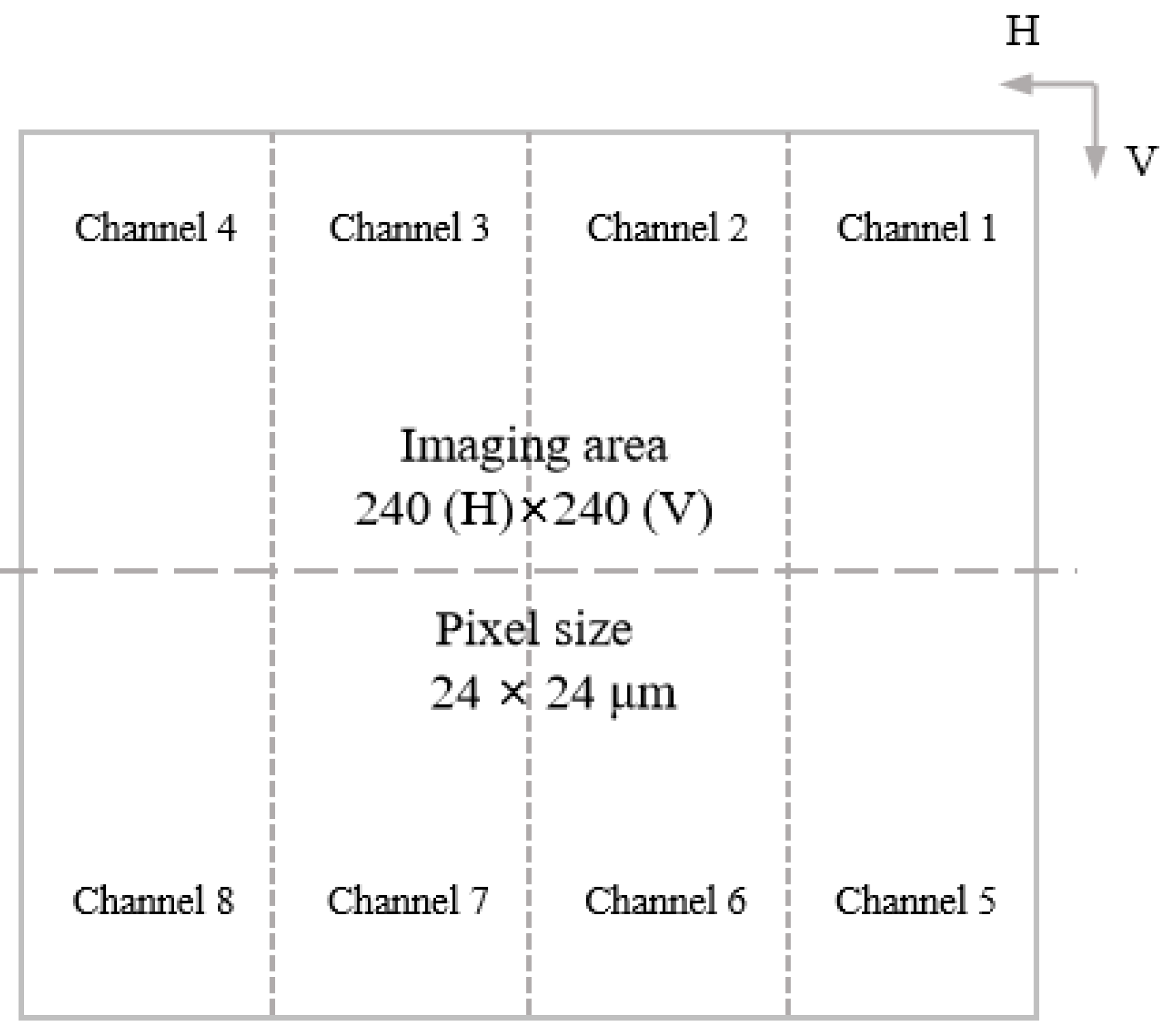
- Figure 2A revised version of Figure 2 is provided with an updated caption. The reference [28] previously cited in conjunction with Figure 2 has been removed accordingly. The updated figure and caption are as follows:Figure 2. EMCCD focal plane schematic: Storage section with 8 parallel readout channels, each channel: 60 (H) × 120 (V) pixels, and output amplifiers shared pairwise (channels 1–2, 3–4, 5–6, 7–8).Figure 2. EMCCD focal plane schematic: Storage section with 8 parallel readout channels, each channel: 60 (H) × 120 (V) pixels, and output amplifiers shared pairwise (channels 1–2, 3–4, 5–6, 7–8).

- (2)
- In Table 1, the authors wish to revise the CCD entry to “8-channel EMCCD”. Simultaneously, the information concerning camera weight in the last row of Table 1 should also be deleted, as this parameter is not substantially pertinent to the core theme of the article. The corrected elements should read as follows:

| Specifications | Value |
|---|---|
| CCD type | 8-channel EMCCD |
| Image readout quantization number | 14 bit |
| Exposure time | 3 ms~5 s, adjustment interval 1 ms |
| EM Gain | Max value ≥ 100× |
- Funding: This research was supported by the National Natural Science Foundation of China (grants nos. 11827804 and U2031210) and the China Manned Space Project (grants nos. CMS-CSST-2025-A18, CMS-CSST-2021-A11, CMS-CSST-2021-B04, and CMS-CSST-201906). Furthermore, this study is part of a project funded by the Natural Science Foundation of Jiangsu Province (grant no. BK20241708) and received support from the China Postdoctoral Science Foundation under grant number 2024M763371.
Reference
- Dou, J.; Niu, B.; Zhao, G.; Zhang, X.; Wang, G.; Yuan, B.; Wang, D.; Qian, X. Performance Calibration of the Wavefront Sensor’s EMCCD Detector for the Cool Planets Imaging Coronagraph Aboard CSST. J. Imaging 2025, 11, 203. [Google Scholar] [CrossRef] [PubMed]
Disclaimer/Publisher’s Note: The statements, opinions and data contained in all publications are solely those of the individual author(s) and contributor(s) and not of MDPI and/or the editor(s). MDPI and/or the editor(s) disclaim responsibility for any injury to people or property resulting from any ideas, methods, instructions or products referred to in the content. |
© 2025 by the authors. Licensee MDPI, Basel, Switzerland. This article is an open access article distributed under the terms and conditions of the Creative Commons Attribution (CC BY) license (https://creativecommons.org/licenses/by/4.0/).
Share and Cite
Dou, J.; Niu, B.; Zhao, G.; Zhang, X.; Wang, G.; Yuan, B.; Wang, D.; Qian, X. Correction: Dou et al. Performance Calibration of the Wavefront Sensor’s EMCCD Detector for the Cool Planets Imaging Coronagraph Aboard CSST. J. Imaging 2025, 11, 203. J. Imaging 2025, 11, 303. https://doi.org/10.3390/jimaging11090303
Dou J, Niu B, Zhao G, Zhang X, Wang G, Yuan B, Wang D, Qian X. Correction: Dou et al. Performance Calibration of the Wavefront Sensor’s EMCCD Detector for the Cool Planets Imaging Coronagraph Aboard CSST. J. Imaging 2025, 11, 203. Journal of Imaging. 2025; 11(9):303. https://doi.org/10.3390/jimaging11090303
Chicago/Turabian StyleDou, Jiangpei, Bingli Niu, Gang Zhao, Xi Zhang, Gang Wang, Baoning Yuan, Di Wang, and Xingguang Qian. 2025. "Correction: Dou et al. Performance Calibration of the Wavefront Sensor’s EMCCD Detector for the Cool Planets Imaging Coronagraph Aboard CSST. J. Imaging 2025, 11, 203" Journal of Imaging 11, no. 9: 303. https://doi.org/10.3390/jimaging11090303
APA StyleDou, J., Niu, B., Zhao, G., Zhang, X., Wang, G., Yuan, B., Wang, D., & Qian, X. (2025). Correction: Dou et al. Performance Calibration of the Wavefront Sensor’s EMCCD Detector for the Cool Planets Imaging Coronagraph Aboard CSST. J. Imaging 2025, 11, 203. Journal of Imaging, 11(9), 303. https://doi.org/10.3390/jimaging11090303

