
Article

Utilizing Industrial Waste to Enhance Mechanical Strength and Cost-Effectiveness of Dredged Soil

1
Tianjin Academy of Environmental Science and Technology Development Co., Ltd., Tianjin 300456, China
2
Tianjin Research Institute for Water Transport Engineering, Ministry of Transport, Tianjin 300456, China
3
School of Environmental Science & Engineering, Tianjin University, Tianjin 300350, China
4
Tianjin Water Group Co., Ltd., Tianjin 300042, China
*
Author to whom correspondence should be addressed.
Recycling 2026, 11(3), 55; https://doi.org/10.3390/recycling11030055
Submission received: 17 January 2026 / Revised: 8 February 2026 / Accepted: 2 March 2026 / Published: 5 March 2026

Abstract

The large-scale dredging activities in port areas generate substantial quantities of dredged soil, leading to land occupation and disposal challenges, while industrial wastes such as fly ash and desulfurization gypsum remain underutilized. In this study, industrial wastes were employed as a curing agent to stabilize dredged soil, aiming to achieve both mechanical performance improvement and cost-effective recycling. In total, 100 g of curing agent was added to 1 kg of sludge. The optimal strength-maximizing formulation comprised 4.5% activator 1 #, 4.5% fly ash, 4.5% mineral powder, and 0.5% desulfurization gypsum. It achieved an unconfined compressive strength of 0.794 MPa. For enhanced cost-effectiveness, a modified binder blend (1.88% activator 1 #, 4.5% fly ash, 4.5% mineral powder, and 0.5% desulfurization gypsum) delivered 0.63 MPa at 28 days, satisfying mechanical construction specifications. Results demonstrate that unconfined compressive strength increases with solid wastes; however, with the extension of solidification time, the unconfined compressive strength of dredged soil gradually slows down.

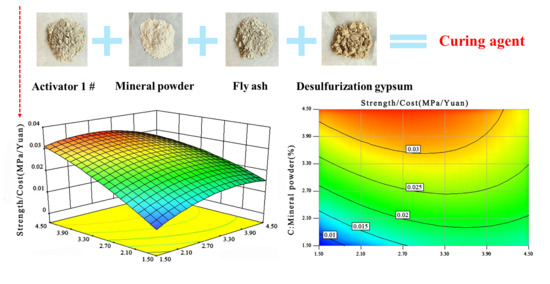
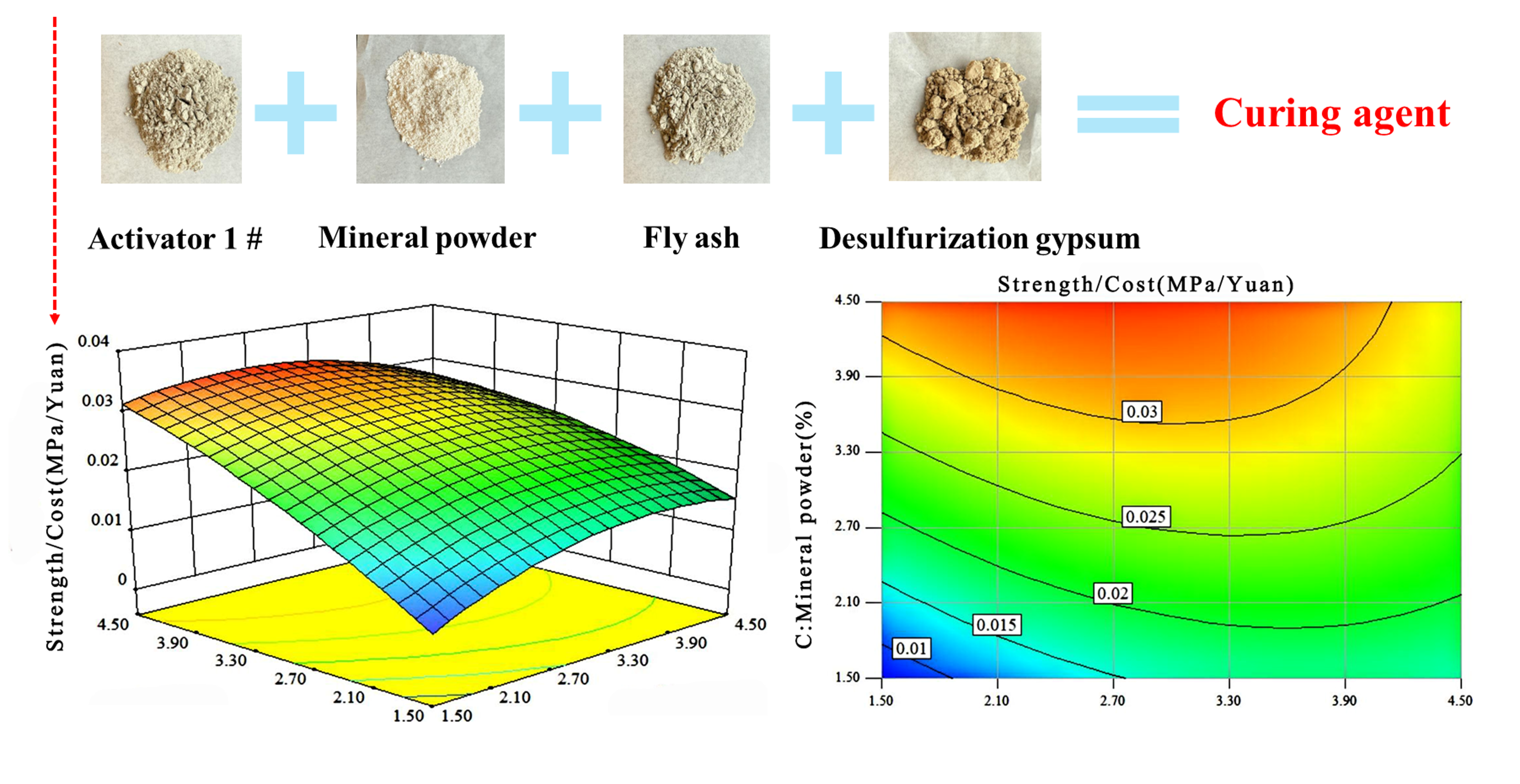
Graphical Abstract

1. Introduction

Escalating freight volumes and the shift toward large-scale vessel operations have driven port and waterway infrastructure expansion into deeper waters [1]. The annual production of up to 0.4~1.0 billion cubic meters of dredged soil requires further treatment and disposal. Minimizing dredged soil production and reducing its land footprint represent critical challenges for sustainable port operations [2,3,4]. At present, the dredged soil of the waterway is mainly transported to the shore by hydraulic filling, and the excavated sediment is transported to the sediment storage area through a mud pump to form sedimentary soil [5]. Although this technology is technologically mature and has widespread adoption, this approach exhibits notable limitations. Specifically, the consolidated material typically requires 2–3 years to achieve strength adequate for mechanical construction, thereby extending project timelines and prolonging land occupation [6]. Because the mud used for hydraulic filling mainly relies on physical methods such as compaction and squeezing, it cannot fully react with the soil and may rebound over time [7]. Dredged soil has characteristics such as high moisture content, high compressibility, low strength, and low permeability, which are difficult to directly utilize in engineering. Therefore, solidification treatment is needed to improve its resource utilization efficiency [8,9,10,11]. In engineering, chemical curing agents are generally used to treat dredged soil. Through a series of chemical reactions, cementitious substances are produced on the surface of the dredged soil, enhancing water stability and strength stability, making it with good engineering properties [12,13,14]. Increased solidified dredged soil has been widely used as partial replacements for ordinary Portland cement.
Bulk solid wastes such as fly ash, Portland-limestone cement, and steel slag have been proven to be effective solidification agents [15]. While improving the utilization rate of solid waste, they can also be reused for high-strength solidification of dredging soil, which has great economic value and development prospects [16,17,18]. Sawa et al. achieved good results by using fly ash to harden the slurry [19]. Cai et al. selected three common waste materials, including rice husk ash (RHA), steel slag (SS), and iron tailing (IT) powder, and synergistically utilized them with cement to prepare stabilized soil [20]. Hou et al. present an innovative soil stabilization technique combining recycled aggregate (RA) and magnesium oxide (MgO) with a dual focus on enhancing soil properties, which achieved superior mechanical stability (1.28–3.02 MPa) [21]. Ma et al. evaluate fluidized solidified soil (FSS) formulations based on dredged sediment, cement partially replaced by silica fume (i.e., 0%, 4%, 8%, and 12%), and quicklime activation under three water–solid ratios (WSRs, i.e., 0.525, 0.55, and 0.575), and WSR = 0.525 and 8% SF substitution identified as the optimal mix [22]. Yu et al. used phosphogypsum-based cementitious materials (PGCMs) and stable marine mud; after 180 days of seawater erosion, the UCS of PGCM-S reached 537 kPa, 16% higher than that of ordinary Portland cement (OPC)-solidified marine mud (OPC-S) [23]. Lav et al. mixed fly ash from thermal power plants with cement and lime for soil solidification, and analyzed the microstructure, chemistry, mineralogy, and other properties of the solidified soil [24]. Horpibulsuk et al. used carbide slag and fly ash to solidify the silty clay in northeastern Thailand, achieving the required soil solidification index for engineering construction [25]. Lasheen et al. found that volcanic ash materials not only solidify sludge and enhance its strength, but also significantly hinder the precipitation of heavy metals, resulting in a better overall solidification effect [26]. Cerbo et al. used fly ash, cement, and some additives (such as sodium sulfate, sodium carbonate, and ethylenediaminetetraacetic acid) to solidify sludge with high moisture content and heavy metal pollution. It was found that the introduction of solidifying agents significantly reduced the plasticity index of the sludge and increased its resistance to flow [27]. Sahu et al. studied the solidification effect of sludge under the mixing of multiple solidifiers such as fly ash, lime, and gypsum, obtained the optimal mix ratio, and made the experimental sludge meet the standards of flexible pavement base materials [28]. Wang et al. used mineral powder instead of some metakaolin and measured the compressive and flexural strength of various geopolymer cementitious materials. The addition of mineral powder significantly affects the mechanical properties, microstructure, and reaction heat of geopolymers [29]. Yoobanpot et al. found that dredged soil solidified with cement can be used as a roadbed material to support pavement structures that meet engineering characteristics, and can be applied in the field of road construction [30]. Do et al. developed a new type of cementless solidifying agent using fly ash, lime, gypsum, and red mud as raw materials to solidify marine dredging soil. This study shows that the solidifying agent significantly improves the strength, stiffness, and hydraulic resistance of dredged soil [31]. Wan et al. investigated the effects of recycled coarse aggregate, recycled fine aggregate, and recycled powder on the fracture performance of modified recycled concrete with nano-silica and basalt fibers [32]. Zhang et al. found that granulated blast furnace slag–carbide slag–titanium gypsum (GCT)-solidified sludge (GSDS) exhibits significantly superior compressive strength, deformation resistance, and pore-filling capacity [33]. He et al. used soda ash, carbide slag, and slag powder to solidify dredged soil with high moisture content. Through unconfined compressive strength tests, it was found that the optimal dosages of soda ash and carbide slag were 35% and 6%, respectively [34]. Develioglu et al. used a mixture of lime, fly ash, and volcanic slag to solidify dredged soil with different organic matter contents, and found that the addition of lime and fly ash had a positive effect on the compression index of the solidified soil [35]. Wang et al. used cement and fly ash as chemical curing agents to investigate their curing effects on dredged soil. The addition of cement and fly ash can significantly improve the dry density of dredged sludge after curing, reduce its moisture content, and enhance its unconfined compressive strength [36]. Fly ash stabilization can reduce plasticity and improve the engineering properties of the dredged material. High fly ash content increased the maximum dry unit weight and reduced the optimum water content for compaction [37]. Although there have been some studies on curing agents currently available, further research is needed on the proportion of each component when using solid waste from power plants as a solidifying agent.
This study utilized solid waste from power plants to prepare solidified materials for high-moisture-content dredged soil. The effects of different components on the solidification strength of dredged soil were investigated, and the cost-effectiveness of the formula was analyzed and demonstrated. A quaternary synergistic solidification system based on “Activator 1 #-fly ash-mineral powder-desulfurization gypsum” was constructed and optimized. The aim was to improve the solidification speed of dredged soil slurry so that the mixture of dredged soil and solidifying agent could meet the engineering strength requirements.

2. Results and Discussion

2.1. Analysis of the Influencing Factors Based on the Response Value of Unconfined Compressive Strength for 28 Days

According to the corresponding experimental design conditions, mix and cure the dredged soil and solidifying agent for 28 days, and measure the solidification strength. The specific variable values for the 29 experiments are shown in Table 1. The actual measurement value (N) of E3 is 0, which may be due to uneven mixing or abnormal maintenance. During the fitting of the RSM model, this outlier has been identified by the software and may have affected the accuracy of local fitting, but the overall model is still significant.
The analysis of variance for unconfined compressive strength (R1) following a 28 d curing period is tabulated in Table 2. The curing agents are A (activator 1 #), B (fly ash), C (mineral powder), and D (desulfurization gypsum), respectively. From the data analysis, it can be seen that the p and F-values indicate a good fit of the model, which is suitable and can be used to analyze and predict the curing strength and optimal curing conditions.
According to the software analysis of the optimal mixing design results, the curing strength (R1) of the curing agent formula at 28 days was obtained. The regression model established is
R1 = 0.38 + 0.11 × A + 0.053 × B + 0.084 × C + 0.014 × D + 7.385 × 10⁻³ × A × B − 7.830 × 10⁻³ × A × C + 2.228 × 10⁻³ × A × D + 0.097 × B × C − 0.030 × B × D − 0.21 × C × D − 0.053 × A2 − 0.025 × B2 − 0.034 × C2 − 0.029 × D2
The order of the influence of each curing agent on curing strength is as follows: activator 1 # > mineral powder > fly ash > desulfurization gypsum. Among them, activator 1 # (p = 0.0011) and mineral powder (p = 0.0061) have a more significant effect on curing strength, while desulfurization gypsum and fly ash have no significant effect on curing strength. Among all significant influencing factors, the activator 1 # with the highest F-value has the greatest impact on sludge solidification.
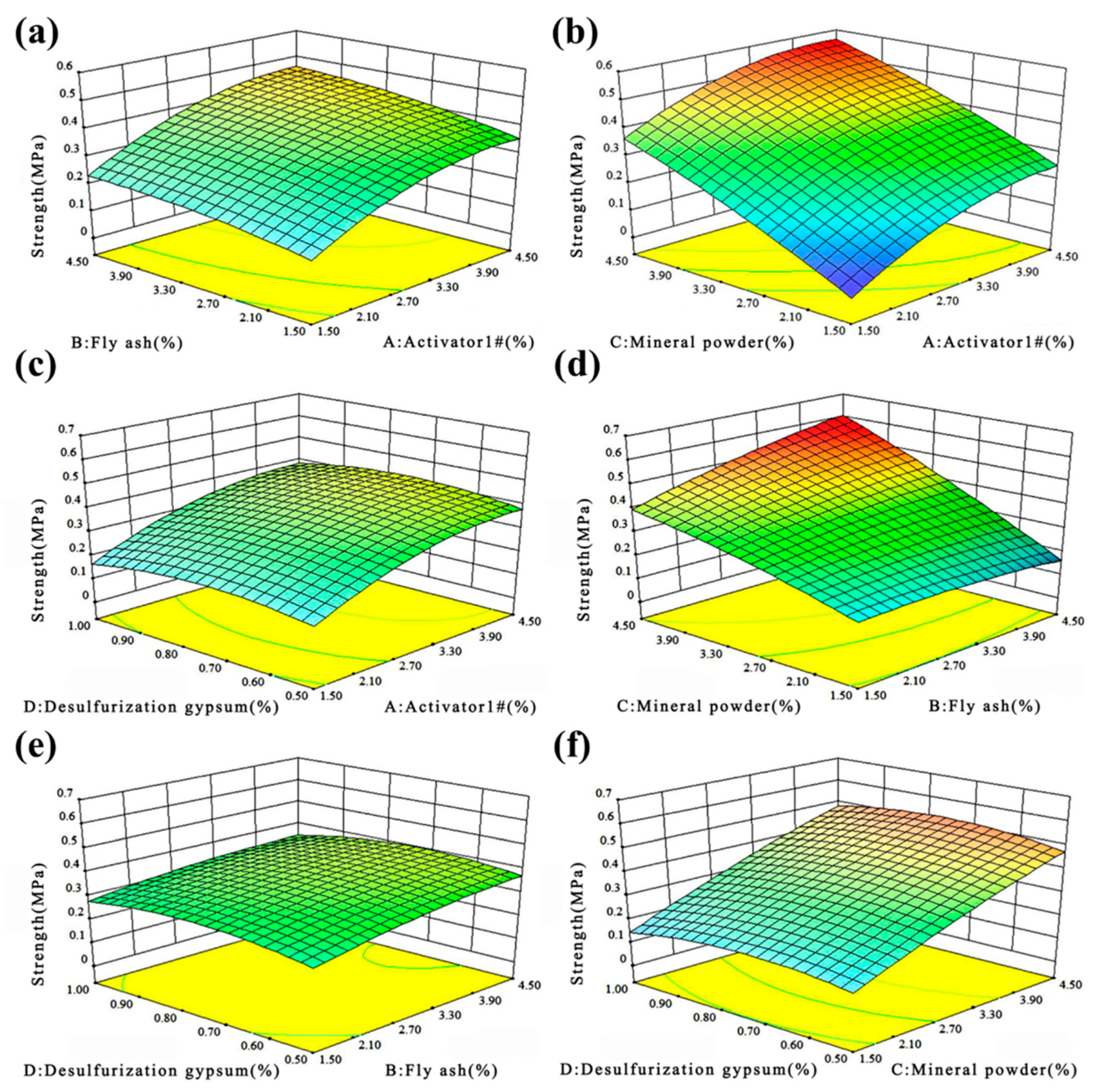
As shown in Figure 1, the unconfined compressive strength following 28 days of natural curing increases with curing agent dosage for sludge at 150% moisture content. The results indicate that the unconfined compressive strength of the sludge solidified by hydraulic filling increases with the increase in activator 1 #, fly ash, mineral powder, and desulfurization gypsum content, and all show a linear relationship. And among them, the impact of activator 1 # and mineral powder on compressive strength is the most significant, which can be seen in the 3D response surface of activator 1 # and mineral powder. Although fly ash and desulfurization gypsum also show a positive increasing relationship, their impact on compressive strength is far less than that of activator 1 # and mineral powder. This can be seen from the 3D response surface plots of fly ash and desulfurization gypsum, which are almost flat surfaces.
In this study, the Design-Expert software was used to determine the factor level and optimal value for solving the optimal point in the model by ridge analysis [38].

2.2. Analysis of Factors Influencing Dredged Soil Solidification Based on 28 Days Unconfined Compressive Strength/Cost Response Value

As shown in Table 3, it can be found that the model fits well (p = 0.0314), indicating that the model is suitable and can be used to analyze and predict curing strength/cost and optimal curing conditions.
Based on the software analysis of the optimal mixing design results, the strength/cost (R2) of the curing agent formula and the relationship between activator 1 # (A), fly ash (B), mineral powder (C), and desulfurization gypsum (D) were obtained. The regression model established is
R2 = 0.022 + 1.250 × 10⁻³ × A + 2.495 × 10⁻³ × B + 3.374 × 10⁻³ × C + 1.843 × 10⁻³ × D + 5.408 × 10⁻⁴ × A × B − 3.134 × 10⁻³ × A × C − 9.524 × 10⁻⁴ × A × D + 5.942 × 10⁻³ × B × C − 2.072 × 10⁻³ × B × D − 0.015 × C × D
According to the data analysis in Table 3, the order of the impact of each curing agent on curing strength/cost is as follows: mineral powder > fly ash > desulfurization gypsum > activator 1 #. The interaction between mineral powder and desulfurization gypsum (p = 0.0005) has a more significant impact on curing strength/cost.
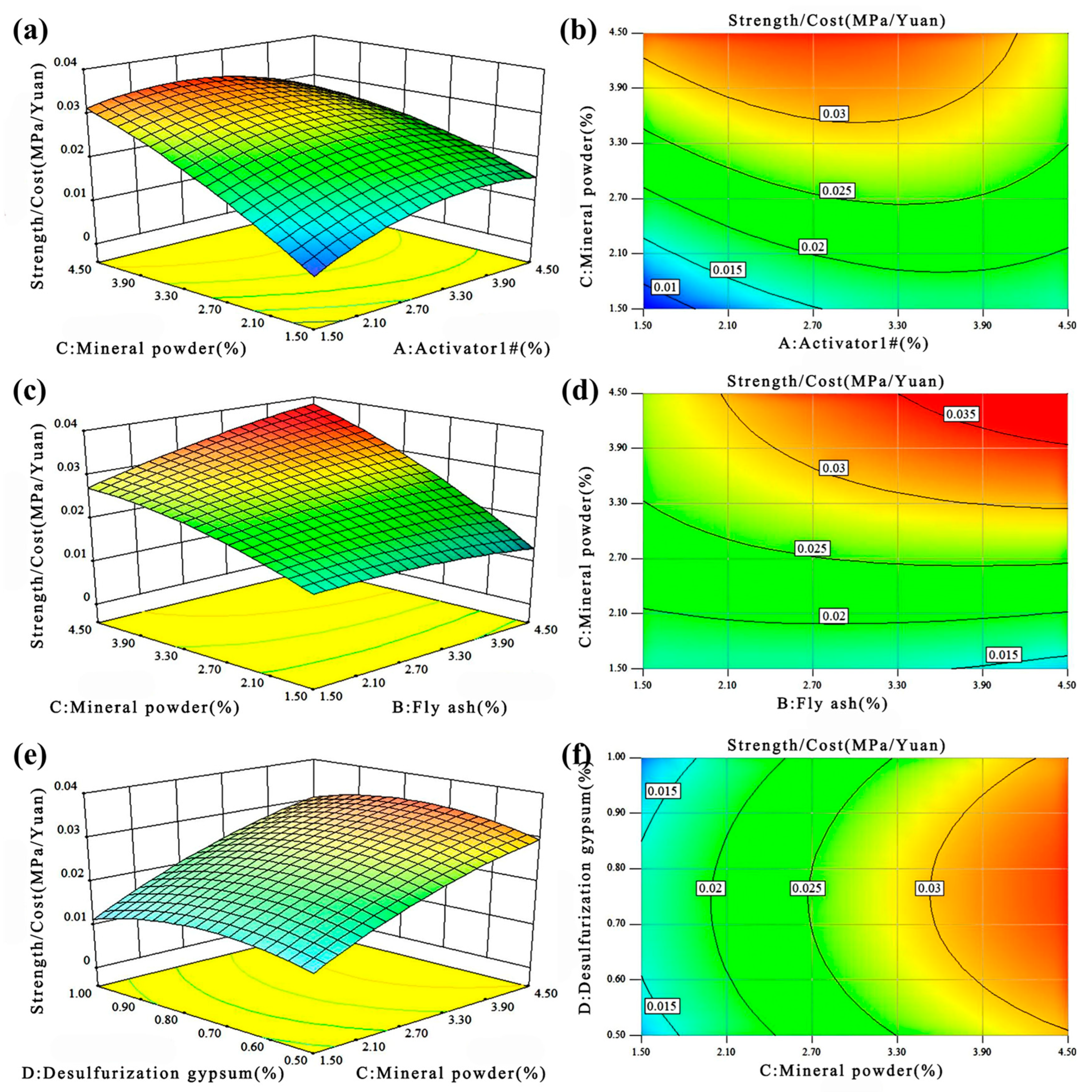
As shown in Figure 2, the growth of solidification strength/cost with the dosage of the solidification agent, after 28 days of natural curing, occurs when the moisture content of sludge is 150%. When activator 1 #, fly ash, mineral powder, and desulfurization gypsum are fixed at a certain value, the strength/cost will show a trend of first increasing and then decreasing with the increase in the content of the other two curing agents.
As shown in Table 4, RSM modeling shows that when the cost-effectiveness is the highest, the amount of solidifying agent added per ton of dredged soil is 11.38%, including activator 1 # 1.88%, fly ash 4.5%, mineral powder 4.5%, and desulfurization gypsum 0.5%. The 28th day solidification strength can reach 0.63 MPa > 0.5 MPa, and the relative cost of solidifying agent required per ton of dredged soil is about 13.1 yuan. When the solidification strength is at its maximum, the optimal amount of solidifying agent added per ton of dredged soil is 13.84%, including the following: activator 1 # 4.34%, fly ash 4.5%, mineral powder 4.5%, and desulfurization gypsum 0.5%. The 28th day solidification strength is the highest, reaching 0.79 MPa. The cost of the solidifying agent required per ton of dredged soil is about 20.5 yuan. When the 28th day curing strength is 0.5 MPa, the optimal amount of curing agent added per ton of dredged soil is 10.08%, including 1.5% activator 1 #, 3.59% fly ash, 4.49% mineral powder, and 0.5% desulfurization gypsum. The cost of the curing agent required per ton of dredged soil is about 11.6 yuan.

2.3. Analysis of Unconfined Compressive Strength of Solidified Dredged Soil During Maintenance Age

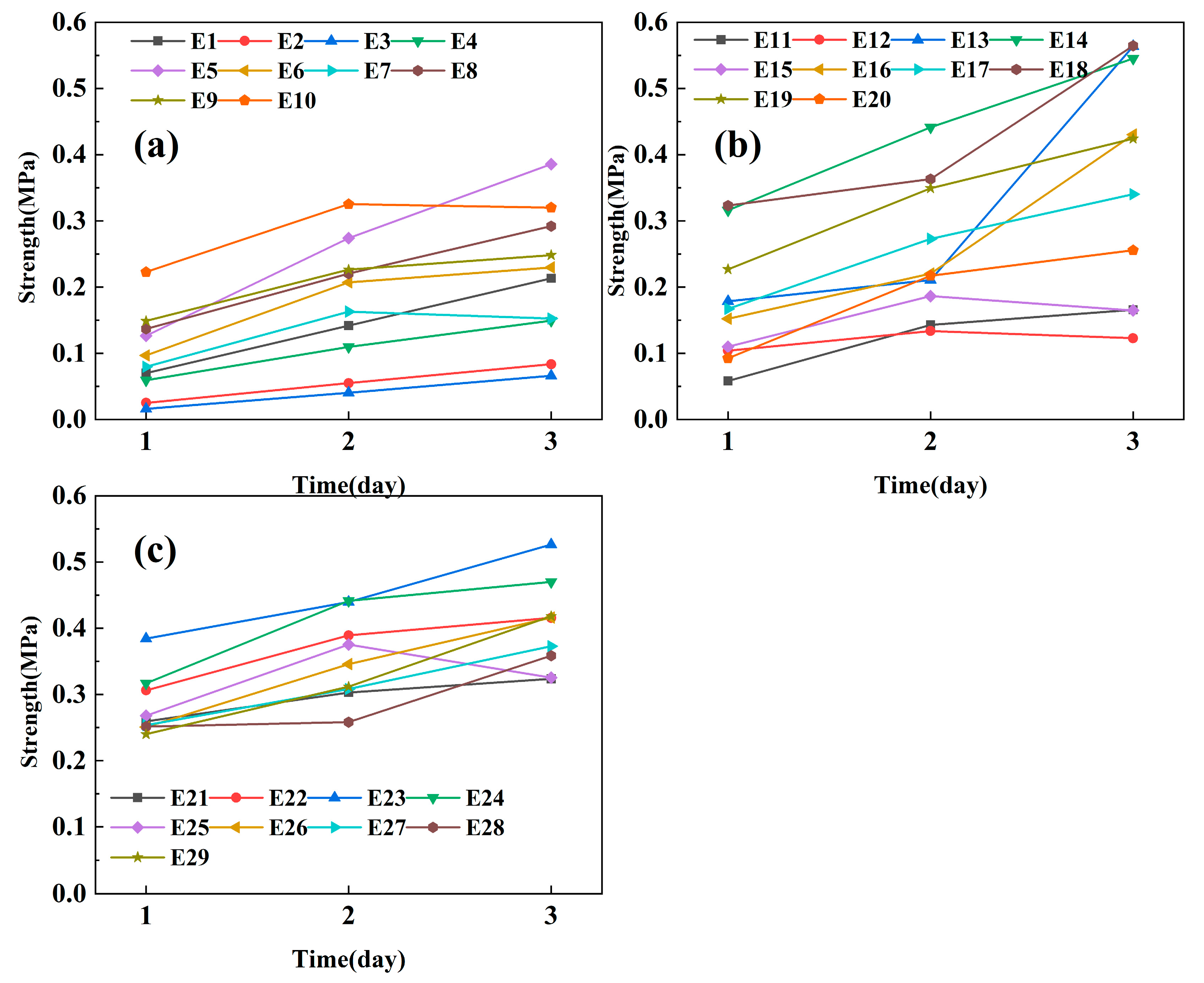
According to the experimental design plan, there were a total of 29 groups of experiments, and the strength response at different curing ages is shown in Figure 3. The unconfined compressive strength of the hydraulic-filled solidified sludge, based on the 10% addition amount of curing agent (100 g/kg), increased with the increase in curing time. At curing times of 7 days, 14 days, and 28 days, the unconfined compressive strength of the hydraulic-filled solidified sludge gradually increased, with strengths of 0.18 MPa, 0.21 MPa, and 0.56 MPa, respectively, an increase of 210%. Through classification observation, it was found that the unconfined compressive strength of the solidified dredged soil by hydraulic filling began to increase and slow down from 14 to 28 days of solidification time, with a small number showing a decrease. Only a very few experiments showed an increase in the rate of increase, and these very few were also the parts with excellent strength performance.
Overall, with the increase in solidification time, the unconfined compressive strength of the solidified silt by hydraulic filling gradually increases. After 14 days, with the extension of solidification time, the unconfined compressive strength of the solidified sludge began to increase slowly. This may be the rapid reaction between the soil particles and the solidifying agent immediately after mixing the solidifying agent and the sludge, resulting in a rapid increase in strength. As the reaction progresses, the soil particles are basically completely reacted, leading to a slowdown in the growth rate of strength [39]. The current research has widely recognized the utilization value of solid waste such as fly ash and mineral powder. However, this study closely combines the two major issues of dredging soil and power plant solid waste disposal, and constructs a quaternary synergistic solidification system composed of locally available activator 1 #–fly ash–mineral powder–desulfurization gypsum.

3. Materials and Methods

3.1. Experimental Materials

This experimental study aims to solve the problem of dredged soil stacking in a certain port area in Tianjin, China. The dredged soil used is the dredged soil from the port area, with a moisture content of about 150%. The main materials for the curing agent are collected from power plants near the port area, and the added curing agents are selected from the location of the port area, including activator 1 #, mineral powder, fly ash, and desulfurization gypsum. The main component of activator 1 # is Na2SO4, which serves as an alkaline activator to provide Na+ and SO42−; The main components of mineral powder are CaO, SiO2, and Al2O3; The main components of fly ash are SiO2 and Al2O3; The main component of desulfurization gypsum is calcium sulfate dihydrate (CaSO4·2H2O).

3.2. Experimental Indicators and Analysis Methods

3.2.1. Unconfined Compressive Strength

According to JTG 3441-2024 “Test Methods of Materials Stabilized with Inorganic Binders for Highway Engineering”, after curing to the specified age, the unconfined compressive strength of the solidified soil sample is tested using a pavement material strength testing machine [40]. The calculation formula is as follows [41]:
R c   =   F c   ×   1000 A
where Rc is the compressive strength, MPa; Fc is the reading of the press, KN; and A is the compressed area, mm2.

3.2.2. Response Surface Methodology (RSM)

This study establishes a statistical framework for resolving complex multivariate problems, employing systematic experimental design to generate critical modeling data. Using multiple quadratic regression equations, the method models the functional relationships between variables and response values. Subsequently, through rigorous analysis of these regression equations, the procedure facilitates the minimization of residual errors and optimization of process parameters [42].
In response to the high moisture content and high porosity of dredged soil, solidification materials are mainly selected from aspects such as increasing soil pH value, increasing expansion components, and improving early strength [43]. The main curing agent used in this experiment is mainly industrial solid waste, and a strength activator is developed on this basis. At the same time, in order to improve the strength of solidified silt, the following four additives were preliminarily selected: activator 1 #, fly ash, mineral powder, and desulfurization gypsum, to analyze their effects on the strength of solidified dredged soil.

3.2.3. Model Fitting Analysis

Use the homogeneity of variance test (F-test) of statistical analysis of variance to study the effects of univariate and interaction on response values, and test the fit of this model (equation) [44]. According to the variance analysis of the quadratic model of the influence of various solidification agents on the solidification strength of sludge, the significance of this model is determined by comparing the F-value and p-value. The larger the F-value, the smaller the p-value, indicating that most of the variables in this response surface can be explained by the regression equation. A p-value below 0.05 indicates that the model is statistically significant, while a p-value above 0.1 indicates that the model is unimportant [45].

3.3. Experimental Method

The Box–Behnken method was chosen for experimental design in this experiment [46]. Set up four independent variables, namely activator 1 #, fly ash, mineral powder, and desulfurization gypsum, to determine their effects and degrees on solidification, as well as their interactions, and then determine the optimal conditions for solidification to optimize the solidification effect and reduce solidification costs. A total of 29 experiments (E1–E29) were designed using Design Expert 8 statistical software. When the variables are low, medium, and high, the design and numerical range of the variables in the Box–Behnken statistical experiment are shown in Table 5 (based on a 10% addition amount (100 g/kg sludge)). The 29 experiment design and weighing parameters can be found in Table 6. The E1–E24 are conducted in parallel with 2 samples per group, following 3 cycles (7 days, 14 days, 28 days). E25–E29 are conducted with 1 sample per group, following 3 cycles (7 days, 14 days, 28 days).
According to the experimental plan design, the experimental steps are as follows:
(i)
Mix the dredged soil, desulfurization gypsum, mineral powder, and activator evenly; add an appropriate amount of dredged soil, and stir evenly to form a mixture.
(ii)
Take an appropriate amount of mixture into a mold with a diameter of 50 mm and a height of 100 mm. Use a vibration machine to shake the sample for about 10 min to remove any bubbles from the sample.
(iii)
After the sample preparation is completed, standard curing is carried out (standard curing method: place the prepared sample in a constant temperature and humidity box with a temperature of 20 ± 2 °C and a relative humidity of 95%).
(iv)
Conduct unconfined compressive strength tests on solidified soil.
(v)
The experimental results were analyzed using Design-Expert software for data fitting analysis.

4. Conclusions

This study reveals that the 28-day curing efficacy for dredged soil solidification follows this sequence: activator 1 # > mineral powder > fly ash > desulfurization gypsum. Notably, activator 1 # emerged as the most influential factor in enhancing mechanical properties. While activator 1 # yields the highest strength gains, economic analysis indicates that mineral powder provides superior cost-effectiveness. The unconfined compressive strength exhibits a positive correlation with the dosage of all curing agents, though the rate of strength development characteristically attenuates over extended curing periods.
Response Surface Methodology (RSM) optimization identifies two critical operational thresholds for engineering applications. To maximize cost-effectiveness, an optimal additive dosage of 11.38% per ton of dredged soil (150% moisture content) achieves an unconfined compressive strength of 0.63 MPa, surpassing 0.5 MPa. Alternatively, a peak strength of 0.79 MPa is attainable at a 13.84% dosage. These findings provide a scientific framework for balancing mechanical performance and economic feasibility in large-scale hydraulic fill reclamation projects.

Author Contributions

Conceptualization, J.L. and C.X.; Methodology, X.Z.; Validation, X.Z., J.L. and C.X.; Investigation, X.Z.; Data curation, X.Z. and J.L.; Writing—original draft preparation, J.L. and C.X.; Writing—review and editing, J.L. and C.X.; Visualization, J.L.; supervision, C.X.; Project administration, J.L.; Funding acquisition, C.X. All authors have read and agreed to the published version of the manuscript.

Funding

This research was funded by the Tianjin Research Innovation Project for Postgraduate Students, grant number 2022BKY076.

Data Availability Statement

The original contributions presented in this study are included in the article. Further inquiries can be directed to the corresponding author.

Conflicts of Interest

Jinzhao Li was employed by Tianjin Academy of Environmental Science and Technology Development Co., Ltd; Changchun Xin was employed byTianjin Water Group Co., Ltd. The remaining authors declare that the research was conducted in the absence of any commercial or financial relationships that could be construed as a potential conflict of interest.

References

  1. Feng, X.; Zhun, C.; Shen, Y.; Zheng, D.; Wang, Y.; Wu, T.; Ma, F. Influence of moisture content on the performance of dredged soil solidified by cement-slag composites. Port Waterw. Eng. 2021, 584, 1–6. [Google Scholar]
  2. Zhao, J.; Li, J.; Xia, X.; Zou, Y.; Jiang, C. Experimental study on mechanical properties of mineral powder-flyash-metakaolin composite based low carbon geopolymer dredged silt solidified material. China Harb. Eng. 2023, 43, 55–60. [Google Scholar]
  3. Flora, A.; Gargano, S.; Lirer, S.; Mele, L. Experimental Evidences of the Strengthening of Dredged Sediments by Electroosmotic Consolidation. Geotech. Geol. Eng. 2017, 35, 2879–2890. [Google Scholar] [CrossRef]
  4. Huang, H.; Burns, S.E.; Benkeser, D.; Kurtis, K.E. Life cycle assessment of dredged river sediments: Beneficial use as non-structural fill and supplementary cementitious materials. Indian Geotech. J. 2025, 8, 3581–3593. [Google Scholar] [CrossRef]
  5. Wu, Y.; Jin, Z.; Wei, K. Experimental study of solidification of soft dredger fill in Tianjin Binhai New Area. Rock Soil Mech. 2013, 34, 2442–2448. [Google Scholar] [CrossRef]
  6. Robert, R. Concentrated liquid stabilizers for railroad applications. In Proceedings of the Roadbed Stabilization and Ballast Symposium, St. Louis, MO, USA, 8–9 November 2000. [Google Scholar]
  7. Saboundjian, S. Subbase Treatment Using EMC2 Soil Stabilizer; Backcalculation; Alaska Department of Transportation and Public Facilities: Fairbanks, AK, USA, 2002.
  8. Parihar, N.S.; Gupta, A.K. Stabilization of expansive soils using non-conventional waste stabilizers: A review. Indian Geotech. J. 2024, 54, 971–997. [Google Scholar] [CrossRef]
  9. Munda, J.; Mohanty, S. State-of-the-Art review on strength performance of soil treated with silica nanoparticles. Indian Geotech. J. 2024, 54, 857–875. [Google Scholar] [CrossRef]
  10. Huang, W.; Liu, Y.; Xiang, P.; Huang, X.; Cao, D.; Li, W.; Dang, J.L. Cyclic shear behavior of dredged soil under constant normal stress conditions. Env. Earth Sci. 2024, 83, 251. [Google Scholar] [CrossRef]
  11. Junakova, N.; Junak, J.; Balintova, M. Reservoir sediment as a secondary raw material in concrete production. Clean Technol. Environ. Policy 2015, 17, 1161–1169. [Google Scholar] [CrossRef]
  12. Zhang, B.; Zhu, H.; Dong, Z.; Yang, Z. Mechanical properties and durability of FRP-reinforced coral aggregate concrete structures: A critical review. Mater. Today Commun. 2023, 35, 105656. [Google Scholar] [CrossRef]
  13. Saquib, K.M.N.; Mir, W.B.A. Stabilization of Weak Dredged Soils by Employing Waste Boulder Crusher Dust: A Laboratory Study. Geotech. Geol. Eng. 2020, 38, 6827–6842. [Google Scholar] [CrossRef]
  14. Kim Yun, T.; Ahn, J.; Han, W.J.; Gabr, M.A. Experimental Evaluation of Strength Characteristics of Stabilized Dredged Soil. J. Mater. Civ. Eng. 2010, 22, 539–544. [Google Scholar] [CrossRef]
  15. Akintayo, B.D.; Babatunde, O.M.; Akintayo, D.C.; Olanrewaju, O.A. Transforming Industrial Waste into Low-Carbon Cement: A Multi-Criteria Assessment of Supplementary Cementitious Materials for Sustainable Concrete Design. Recycling 2025, 10, 211. [Google Scholar] [CrossRef]
  16. Kirkelund, G.M.; Skevi, L.; Ottosen, L.M. Electrodialytically treated MSWI fly ash use in clay bricks. Constr. Build. Mater. 2020, 254, 119286. [Google Scholar] [CrossRef]
  17. Sun, X.; Tong, Q.; Liu, W.; Yao, J.; Li, Z. Study of microstructure and mechanical properties of dredged silt solidified using fly ash and slag stimulated by alkali. J. Dalian Univ. Technol. 2017, 57, 622–628. [Google Scholar]
  18. Rahman, S.K.; Al-Ameri, R. Experimental and Artificial Neural Network-Based Study on the Sorptivity Characteristics of Geopolymer Concrete with Recycled Cementitious Materials and Basalt Fibres. Recycling 2022, 7, 55. [Google Scholar] [CrossRef]
  19. Sawa, K.; Tomohisa, S.; Inazumi, S.; Tachibana, M. Hardening Treatment of Muddy Soil with Coal Fly Ashes. J. Soc. Mater. Sci. Jpn. 2000, 49, 348–351. [Google Scholar] [CrossRef]
  20. Cai, D.; Ouyang, M.; Bao, X.; Zhang, Q.; Bi, Z.; Yan, H.; Li, S.; Shi, Y. Performance Evaluation of Stabilized Soils with Selected Common Waste Materials of Rice Husk Ash, Steel Slag and Iron Tailing Powder. Materials 2025, 18, 346. [Google Scholar] [CrossRef]
  21. Hou, Y.; Onyekwena, C.C.; Li, Q. Experimental investigation of marine soil stabilization with recycled aggregates and MgO: Implications for CO2 sequestration. Can. Geotech. J. 2025, 62, 1–17. [Google Scholar] [CrossRef]
  22. Ma, Q.; Wang, K.; Li, Q.; Zhang, Y. Alkali-Activated Dredged-Sediment-Based Fluidized Solidified Soil: Early-Age Engineering Performance and Microstructural Mechanisms. Materials 2025, 18, 3408. [Google Scholar] [CrossRef]
  23. Xiao, Y.; Sun, W.; Sun, D.a.; Tan, Y.; Zhang, M. Mechanical behaviour of marine mud solidified by phosphogypsum-based cementitious materials under seawater wetting-drying cycles. Constr. Build. Mater. 2025, 476, 141278. [Google Scholar] [CrossRef]
  24. Lav, A.H.; Lav, M.A. Microstructural development of stabilized Fly Ash as pavement base material. J. Mater. Civ. Eng. 2001, 12, 157–163. [Google Scholar] [CrossRef]
  25. Horpibulsuk, S.; Phetchuay, C.; Chinkulkijniwat, A. Soil Stabilization by Calcium Carbide Residue and Fly Ash. J. Mater. Civ. Eng. 2012, 24, 184–193. [Google Scholar] [CrossRef]
  26. Lasheen, M.R.; Ashmawy, A.M.; Ibrahim, H.S.; Moniem, S.M.A. Pozzolanic-based materials for stabilization/solidification of contaminated sludge with hazardous heavy metal: Case study. Desalination Water Treat. 2013, 51, 2644–2655. [Google Scholar] [CrossRef]
  27. Cerbo, A.A.; Ballesteros, F., Jr.; Chen, T.; Lu, M. Solidification/stabilization of fly ash from city refuse incinerator facility and heavy metal sludge with cement additives. Environ. Sci. Pollut. Res. 2017, 24, 1748–1756. [Google Scholar] [CrossRef] [PubMed]
  28. Sahu, V.; Srivastava, A.; Misra, A.K.; Sharma, A.K. Stabilization of fly ash and lime sludge composites: Assessment of its performance as base course material. Arch. Civ. Mech. Eng. 2017, 17, 475–485. [Google Scholar] [CrossRef]
  29. Wang, X.; Zhang, C.; Zhu, H.; Wu, Q. Reaction kinetics and mechanical properties of a mineral-micropowder/metakaolin-based geopolymer. Ceram. Int. 2022, 48, 14173–14181. [Google Scholar] [CrossRef]
  30. Yoobanpot, N.; Jamsawang, P.; Simarat, P.; Jongpradist, P.; Likitlersuang, S. Sustainable reuse of dredged sediments as pavement materials by cement and fly ash stabilization. J. Soil Sediments 2020, 20, 3807–3823. [Google Scholar] [CrossRef]
  31. Do, T.M.; Kang, G.; Vu, N.; Kim, Y.S. Development of a new cementless binder for marine dredged soil stabilization: Strength behavior, hydraulic resistance capacity, microstructural analysis, and environmental impact. Constr. Build. Mater. 2018, 186, 263–275. [Google Scholar] [CrossRef]
  32. Wan, C.; Hou, P.; Zhou, L.; Golewski, G.L.; Zheng, Y.; Zhang, T.J.E.F.M. The fracture performance of modified recycled concrete: Influence of recycled aggregate and recycled powder. Eng. Fract. Mech. 2026, 1, 111709. [Google Scholar] [CrossRef]
  33. Zang, Y.; Zhang, C.; Wang, L. Micropore Structure Evolution and Macro-Micro Quantitative Analysis of Dredged Sludge Solidified with Ground Granulated Blast Furnace Slag, Carbide Slag, and Titanium Gypsum. Buildings 2026, 16, 261. [Google Scholar] [CrossRef]
  34. He, J.; Shi, X.K.; Li, Z.X.; Zhang, L.; Zhou, L.R. Strength properties of dredged soil at high water content treated with soda residue, carbide slag, and ground granulated blast furnace slag. Constr. Build. Mater. 2020, 242, 118126. [Google Scholar] [CrossRef]
  35. Develioglu, I.; Pulat, H.F. Compressibility behaviour of natural and stabilized dredged soils in different organic matter contents. Constr. Build. Mater. 2019, 228, 116787. [Google Scholar] [CrossRef]
  36. Wang, H.S.; Tang, C.S.; Gu, K.; Shi, B.; Inyang, H.I. Mechanical behavior of fiber-reinforced, chemically stabilized dredged sludge. Bull. Eng. Geol. Environ. 2019, 79, 629–643. [Google Scholar] [CrossRef]
  37. Yu, H.; Yin, J.; Soleimanbeigi, A.; Likos, W. Effects of Curing Time and Fly Ash Content on Properties of Stabilized Dredged Material. J. Mater. Civ. Eng. 2017, 29, 04017199. [Google Scholar] [CrossRef]
  38. Zhao, H.; Zhang, L.; Wang, Y. Analysis on engineering properties of lime solidified inshore saline soil based on microstructure index response surface methodology. Build. Sci. 2017, 33, 62–66. [Google Scholar]
  39. Li, S.; Yu, F.; Chen, X.; Yu, J. Preparation of Cement- Slag Based Early Strength Curing Agent and Macro and Micro Properties of Solidified Soil. Bull. Chin. Ceram. Soc. 2023, 42, 3964–3977. [Google Scholar]
  40. JTG 3441-2024; Test Methods of Materials Stabilized with Inorganic Binders for Highway Engineering. China Communications Press: Beijing, China, 2024.
  41. Zhuang, X.; Wang, G.; Zhu, R.; Tian, B. Experimental study on unconfined compressive strength of clays stabilized with fly ash and slag. Chin. J. Geotech. Eng. 2005, 27, 965–969. [Google Scholar]
  42. Zhou, J.; Zeng, X.; Zhou, J.; Yang, Z.; Liu, J.; Chen, F. Combined effects of sludge rapid solidification using response surface methodology. Chin. J. Environ. Eng. 2014, 8, 408–414. [Google Scholar]
  43. Ji, F.; Lv, Q.; Ma, D. Study on the Utilization Techniques of Dredged Mud as Resource in Coastal Areas. J. Anhui Agri. Sci. 2007, 35, 4593–4595. [Google Scholar] [CrossRef]
  44. Lin, J.; Wei, B. Testing for homogeneity of variance and autocorrelation coefficients in nonlinear models of longitudinal data with AR(1) errors. Acta Math. Appl. Sin. 2004, 27, 466–480. [Google Scholar]
  45. Zhao, H.; Zhang, Y.; Wang, Y. Response surface methodology-based optimization of design of mixing ratio of inshore saline soil with lime-fly ash. Water Resour. Hydropower Eng. 2017, 48, 136–145. (In Chinese) [Google Scholar]
  46. Huang, H.; Shen, X. Influences of chemical additive components on strength of cement mortar by Box-Behnken design. J. Nanjing Univ. Technol. 2011, 33, 6–11. [Google Scholar]
Figure 1. Response surface graph after 28 days of natural curing: (a) AB; (b) AC; (c) AD; (d) BC; (e) BD; (f) CD.
Recycling 11 00055 g001
Figure 2. Response surface and contour map after 28 days of natural curing.(a) response surface CA; (b) contour map CA; (c) Response surface CB; (d) contour map CB; (e) response surface DC; (f) contour map DC.
Recycling 11 00055 g002
Figure 3. Unconfined compressive strength of solidified mud under different curing agent formulations: (a) E1–E10; (b) E11–E20; and (c) E21–E29.
Recycling 11 00055 g003
Table 1. Mud strength after 28 days of natural curing.
Activator 1 # (%)Fly Ash (%)Mineral Powder (%)Desulfurization Gypsum (%)Actual Measurement Value (N)Strength (MPa)Strength/Cost (MPa/Yuan)
E11.51.53.00.753744640.210.024
E21.53.01.50.751411870.080.008
E31.53.03.00.501300.070.003
E41.53.03.01.02723150.150.012
E51.53.04.50.757048100.390.029
E61.54.53.00.754534490.230.016
E73.01.51.50.752733260.150.010
E83.01.53.00.55456020.290.018
E93.01.53.01.05274480.250.014
E103.01.54.50.756296280.320.017
E113.03.01.50.53902610.170.008
E123.03.01.51.02382440.120.006
E133.03.04.50.5111910950.560.027
E143.03.04.51.012189240.550.024
E153.04.51.50.752723750.160.007
E163.04.53.00.57789120.430.018
E173.04.53.01.06007360.340.013
E183.04.54.50.75106311540.560.021
E194.51.53.00.757049620.420.015
E204.53.01.50.755234810.260.009
E214.53.03.00.56446260.320.011
E224.53.03.01.08318010.420.013
E234.53.04.50.75106710000.530.017
E244.54.53.00.758579890.470.014
E253.03.03.00.75639 0.330.009
E263.03.03.00.75817 0.420.012
E273.03.03.00.75732 0.370.010
E283.03.03.00.75704 0.360.009
E293.03.03.00.75821 0.420.011
Table 2. Analysis of variance of silt strength (R1) after 28 days of natural curing.
Sum of
Sources
SquaresMean
df
F Squarep-ValueProb > F
Model0.53140.0388.330.0002significant
A0.1410.1430.64<0.0001
B0.02510.0255.570.0333
C0.3210.3271.06<0.0001
D3.288 × 10−513.288 × 10−57.292 × 10−30.9332
AB2.181 × 10−412.181 × 10−40.0480.8291
AC2.453 × 10−412.453 × 10−40.0540.8190
AD1.986 × 10−511.986 × 10−54.405 × 10−30.9480
BC0.01310.0132.990.1057
BD5.370 × 10−415.370 × 10−40.120.7351
CD1.525 × 10−411.525 × 10−40.0340.8567
A20.02110.0214.640.0492
B22.194 × 10−312.194 × 10−30.490.4969
C22.179 × 10−312.179 × 10−30.480.4983
D20.01110.0112.510.1356
Residual0.063144.509 × 10−3
Lack of Fit0.057105.689 × 10−33.650.1117Not significant
Pure Error6.230 × 10−341.557 × 10⁻³
Cor Total0.5928
Table 3. Analysis of variance of strength/cost (R2) after 28 days of natural curing.
SourceSum of
Squares
dfMean
Square
F
Value
p-Value
Prob > F
Model1.39 × 10−3101.39 × 10−42.710.0314significant
A—Activator 1 #1.87 × 10−511.87 × 10−50.370.5528
B—Fly ash7.47 × 10−517.47 × 10−51.460.2428
C—Mineral powder1.37 × 10−411.37 × 10−42.670.1198
D—Desulfurization gypsum4.08 × 10−514.08 × 10−50.80.3842
AB1.17 × 10−611.17 × 10−60.0230.8815
AC3.93 × 10−513.93 × 10−50.770.3927
AD3.63 × 10−613.63 × 10−60.0710.7931
BC1.41 × 10−411.41 × 10−42.760.1141
BD1.72 × 10−511.72 × 10−50.340.5696
CD9.16 × 10−419.16 × 10−417.890.0005
Residual9.22 × 10−4185.12 × 10−5
Lack of Fit8.90 × 10−4146.36 × 10−57.950.0293significant
Pure Error3.20 × 10−547.99 × 10⁻⁶
Cor Total2.31 × 10−328
Table 4. The optimal ratio for 28 days.
Activator 1 # (%)Fly Ash (%)Mineral Powder (%)Desulfurization Gypsum (%)Strength (MPa)Strength/Cost (MPa/Yuan)Relative Cost (Yuan/t Dredged Soil)
Maximum curing strength4.344.54.50.50.7940.04920.5
Maximum intensity/cost1.884.54.50.50.6350.05013.1
The curing strength is 1 MPa1.53.594.490.50.50.04411.6
Table 5. Design and numerical range of variables.
VariableLow ValueMedianHigh Value
Activator 1 # (%)1.53.04.5
Fly ash (%)1.53.04.5
Mineral powder (%)1.53.04.5
Desulfurization gypsum (%)0.50.751.0
Table 6. Response surface experimental design and weighing parameter table.
STDActivator 1 # (%)Fly Ash (%)Mineral Powder (%)Desulfurization Gypsum (%)Mixing Mud (kg)Activator 1 # (g)Fly Ash (g)Mineral Powder (g)Desulfurization Gypsum (g)Total Weight of Medication (g)
E11.51.53.00.752.436.036.072.018.0162.0
E21.53.01.50.752.436.072.036.018.0162.0
E31.53.03.00.52.436.072.072.012.0192.0
E41.53.03.01.02.436.072.072.024.0204.0
E51.53.04.50.752.436.072.0108.018.0234.0
E61.54.53.00.752.436.0108.072.018.0234.0
E73.01.51.50.752.472.036.036.018.0162.0
E83.01.53.00.52.472.036.072.012.0192.0
E93.01.53.01.02.472.036.072.024.0204.0
E103.01.54.50.752.472.036.0108.018.0234.0
E113.03.01.50.52.472.072.036.012.0192.0
E123.03.01.51.02.472.072.036.024.0204.0
E133.03.04.50.52.472.072.0108.012.0264.0
E143.03.04.51.02.472.072.0108.024.0276.0
E153.04.51.50.752.472.0108.036.018.0234.0
E163.04.53.00.52.472.0108.072.012.0264.0
E173.04.53.01.02.472.0108.072.024.0276.0
E183.04.54.50.752.472.0108.0108.018.0306.0
E194.51.53.00.752.4108.036.072.018.0234.0
E204.53.01.50.752.4108.072.036.018.0234.0
E214.53.03.00.52.4108.072.072.012.0264.0
E224.53.03.01.02.4108.072.072.024.0276.0
E234.53.04.50.752.4108.072.0108.018.0306.0
E244.54.53.00.752.4108.0108.072.018.0306.0
E253.03.03.00.755.6168.0168.0168.042.0546.0
E263.03.03.00.75
E273.03.03.00.75
E283.03.03.00.75
E293.03.03.00.75
Disclaimer/Publisher’s Note: The statements, opinions and data contained in all publications are solely those of the individual author(s) and contributor(s) and not of MDPI and/or the editor(s). MDPI and/or the editor(s) disclaim responsibility for any injury to people or property resulting from any ideas, methods, instructions or products referred to in the content.