1. Introduction
Driven by growing environmental concerns both domestically and internationally, new energy vehicles are steadily displacing fuel-powered vehicles [
1]. As the power supply component of new energy vehicles, the energy storage battery’s remaining capacity cannot be obtained through direct measurement. Consequently, the industry commonly adopts the State of Charge (SOC) to serve as the metric to describe its residual capacity [
2,
3]. The working performance of a battery is closely related to the accuracy of SOC estimation. Therefore, a battery management unit with high-precision SOC estimation capability constitutes the core link in ensuring battery operational reliability. Conducting research on high-precision estimation of onboard battery SOC is thus of great practical significance [
4,
5].
Accurate SOC estimation typically requires the construction of a battery model. Currently, four types of modeling approaches for lithium-ion batteries are widely recognized: the electrochemical model, the equivalent circuit representation, the neural network architecture, and the thermally coupled framework [
6]. The equivalent circuit representation is well-suited for online time-critical systems, electrochemical and coupled models are commonly employed in the study of battery mechanisms, and the neural network model is applied in scenarios involving large datasets and strong nonlinearity. In specific applications, multiple models are often used in a hybrid manner according to different conditions, so as to minimize error and maximize response speed [
7]. Therefore, this equivalent circuit approach is frequently applied to battery SOC estimation.
Currently, the techniques used to estimate lithium-ion battery SOC fall into three categories: experimental measurement-based methods, data-driven algorithms, as well as model-based approaches. Experimental measurement-based methods consist of the ampere-hour counting procedure, the open-circuit voltage (OCV) technique, and inner resistance estimation method, among others. The Coulomb counting approach estimates the cell’s used capacity relying on the relationship between current and capacity during the experimental process. This method features strong real-time performance, a simple calculation process, low hardware cost, and suitability for various operating conditions. However, it remains susceptible to deviations caused by inaccurate starting SOC values while it demands high accuracy from the current sensor, as otherwise significant cumulative errors can occur [
8,
9]. The OCV evaluation technique obtains the current SOC by measuring the battery’s open-circuit voltage and then directly consulting the standard OCV-SOC data table [
10]. However, due to the influence of the battery’s polarization characteristics during active charging and discharging phases, the obtained OCV is often inaccurate. This method necessitates that the cell rests for an adequate duration, a requirement that is hard to achieve under actual operating conditions [
11]. The internal resistance estimation method obtains the battery’s electrochemical impedance spectrum through experimentation, then analyzes it to acquire impedance data, thereby establishing a correspondence between impedance and battery SOC. This method imposes strict hardware requirements and proves to be financially unviable [
12,
13].
Data-driven methods leverage massive amounts of battery operational information to train models through machine learning, thereby establishing a nonlinear mapping relationship between input and output [
14]. The principal methods employed include support vector machine (SVM), Gaussian process regression (GPR), extreme learning machine (ELM), as well as neural architectures, among others [
15]. Zheng proposed a method that first uses SVM for evaluating the battery’s State of Health (SOH), deduces the current actual capacity of the battery based on the estimated SOH, and then exploits the benefits provided by Convolutional Neural Networks (CNN) for extracting features alongside Long Short-Term Memory (LSTM) neural networks when handling long-term sequential data, adopting a CNN-LSTM model for SOC estimation. This model substantially reduces SOC estimation errors caused by battery aging. However, the reference did not take the battery’s operating ambient temperature into consideration [
16]. Ji proposed a model founded upon Particle Swarm Optimization–Gaussian Process Regression (PSO-GPR) to predict battery SOC. Deviating from the single-feature approach of traditional neural network models, this model extracts multiple features from both the original ultrasonic guided wave signals and the scattered signals in the time domain and the frequency domain, respectively. It then selects several features with the greatest contribution for weighted fusion, and employs an improved piecewise aggregate approximation method to extract new feature sequences at multiple scales in a piecewise manner. The model demonstrates significant advantages across various battery charge–discharge rates [
17].
Model-driven methods describe internal battery dynamics across active charging and discharging phases through the formulation of an electrical equivalent network or an electrochemical framework. The principal model-driven methods currently in use include the Kalman Filter (KF), the Extended Kalman Filter (EKF), the Unscented Kalman Filter (UKF), and the Cubature Kalman Filter (CKF). The KF method was proposed to address problems in linear systems and cannot solve problems in nonlinear systems. The EKF performs local linearization on nonlinear systems, while the UKF propagates the mean and covariance through sigma points without requiring the derivation of the nonlinear function [
18,
19,
20]. The CKF samples based on the spherical-radial cubature rule, eliminates the need for Jacobian matrix computation, offers high numerical stability, and achieves exact third-order moment integration [
21,
22]. In current research, to overcome the difficulty of accurately determining equivalent circuit model parameters due to the complex internal variations of lithium batteries in model-driven methods, various optimization algorithms have been employed for parameter identification of lithium battery equivalent circuit models. Representative single optimization algorithms include the African vulture optimization algorithm, the marine predators algorithm, the zebra optimization algorithm, and the grey wolf optimizer. Compared with traditional methods such as the least squares method and the Hybrid Pulse Power Characterization (HPPC) method for lithium battery parameter identification, these optimization algorithms have fewer limitations, as they do not require specific battery charge/discharge profile data, and they offer significantly improved accuracy. However, single optimization algorithms generally suffer from inherent drawbacks. When identifying the multi-dimensional and nonlinear parameters of a second-order RC equivalent circuit model, these algorithms are prone to becoming trapped in local optima. Moreover, the vast majority of single algorithms struggle to dynamically balance global exploration and local exploitation capabilities. Under complex charge/discharge conditions and extreme temperatures, the parameter estimation accuracy of these algorithms can degrade considerably, which in turn substantially affects the subsequent battery SOC estimation results [
23,
24,
25,
26]. To address the inherent limitations of single optimization algorithms, researchers have proposed strategies that hybridize multiple optimization algorithms for identifying equivalent circuit model parameters. Typical combinations include grey wolf optimized particle filter (GWO-PF) and dual optimization particle swarm sparrow. However, most existing hybrid optimization methods simply connect two algorithms in a straightforward series or parallel manner, without a clear functional division during the optimization process. They lack dedicated modules responsible for global exploration and local exploitation, respectively. As a result, when identifying equivalent circuit parameters under complex operating conditions and extreme temperatures, these methods still suffer from inaccurate parameter identification [
27,
28,
29,
30].
Single optimization algorithms are prone to local optima and cannot balance global exploration and local exploitation, while existing hybrid algorithms lack targeted functional division. To overcome these limitations this paper proposes a hybrid optimization algorithm, this paper proposes a hybrid optimization algorithm, the Elephant Herding & Golden Eagle Hybrid Optimization (HEGO), which integrates the elephant herding optimization (EHO) algorithm with the golden eagle optimization (GEO) algorithm. This model integrates SOC estimation and parameter optimization into a closed-loop algorithm, eliminating the need for separate parameter identification. The HEGO first employs EHO to progressively narrow down the search range within the preset parameter boundaries, outputting a small range that contains the optimal solution. This step reduces the errors that would otherwise arise from GEO’s weak search capability over a large range. GEO then receives the narrowed range from EHO and accurately estimates the parameters within this small range online, based on the current and terminal voltage, thereby ensuring fine-grained parameter optimization. The main research contributions of this paper are the following three aspects:
This paper constructs an EKF-based SOC estimation framework utilizing the HEGO algorithm. This framework integrates the global exploration capability of EHO with the local fine search capability of the GEO, achieving two-level optimization of both the equivalent circuit model parameters and the EKF noise covariances. As a result, the stability and accuracy of SOC estimation are significantly improved under various operating conditions and temperature conditions.
Through the HEGO method adaptively fuses the measured data of battery terminal voltage and current with the model-predicted values. It effectively mitigates the estimation bias caused by model parameter mismatch or improper noise covariance settings, as well as the cumulative error arising from delayed correction in conventional EKF method. Furthermore, it overcomes the local optimum deficiency inherent in single optimization algorithms for SOC estimation.
The application of the hybrid population-based optimization strategy enhances the accuracy of parameter optimization through a stepwise approach. EHO is first employed to rapidly identify the probable range of the optimal parameters, after which GEO searches within the narrowed space to ultimately yield the optimal parameter combination adapted to the battery’s current state.
By employing this algorithm to online search for the optimal solutions of the EKF method noise matrices and equivalent circuit parameters, the accuracy of SOC estimation under complex operating conditions and multiple temperatures is ensured.
2. Equivalent Circuit Model
In a Battery Management System, dynamically evaluating parameters like the SOC, temperature, and voltage is critically important. However, the intricate chemical interaction processes within the battery render some information unable to be rapidly acquired. Therefore, the battery equivalent circuit model is utilized to transform these complex battery internal processes into an intuitive and easily monitorable circuit model. Frequently utilized equivalent circuit models include the Rint model, the Thevenin model, the Partnership for a New Generation of Vehicles (PNGV) model, and the RC model, among others [
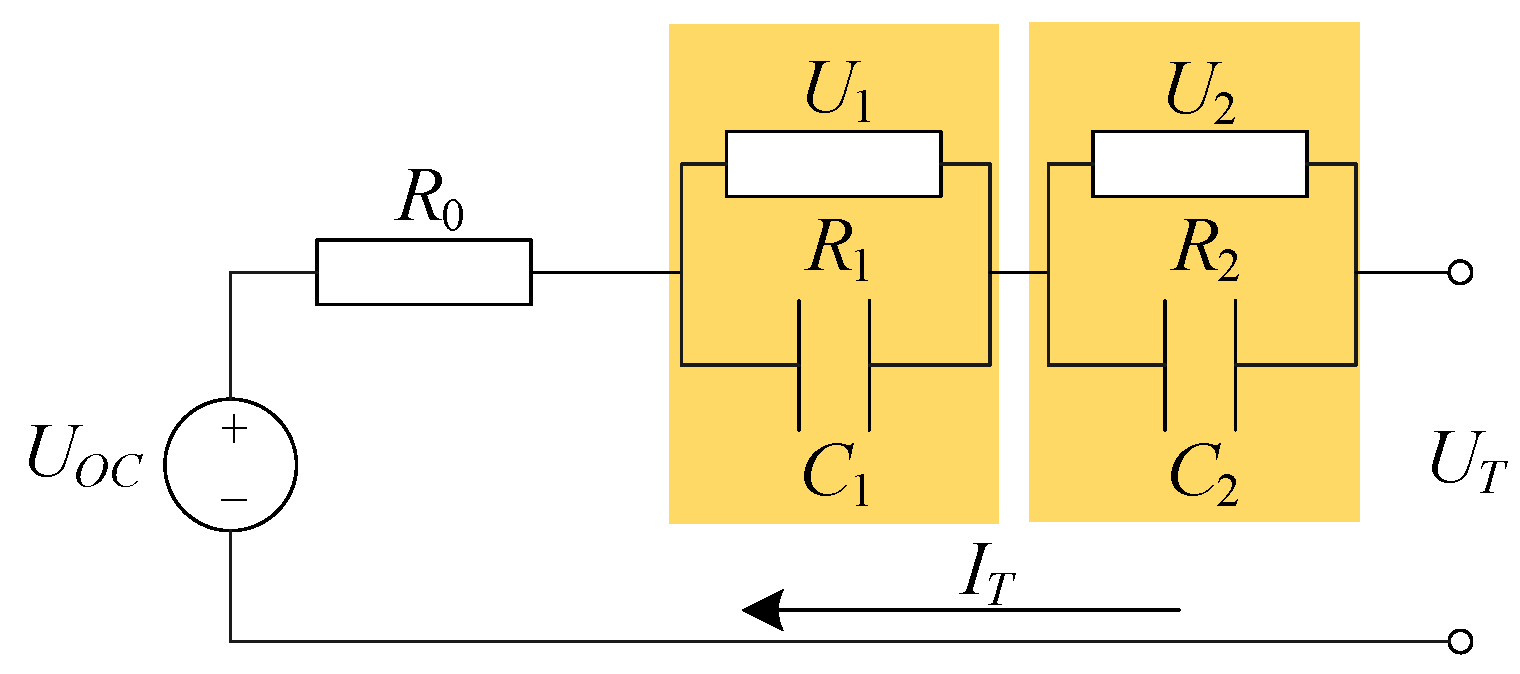
24]. To accurately capture both the fast electrochemical polarization and the slow concentration polarization dynamics without introducing the excessive computational burden of higher-order models, the dual-capacitor second-order RC equivalent circuit model is utilized in this study. Its schematic is depicted in
Figure 1.
As depicted in
Figure 1,
Uoc represents OCV from the battery;
R0 denotes the Ohmic resistance, which accounts for the instantaneous voltage drop caused by the electrolyte, electrode materials, and internal connections; parameters
R1 and
C1 are the polarization resistance and polarization capacitance;
R2 and
C2 are the concentration polarization resistance and concentration polarization capacitance, these two parallel resistor-capacitor pairs serve to represent those polarizing effects within this battery;
UT and
IT denote the terminal voltage and operating current of the battery under different temperatures. In this study, the charge current is defined as positive and the discharge current as negative. Furthermore, the initial polarization voltages across the capacitors are assumed to be zero, namely
U1 (0) = 0 and
U2 (0) = 0.
According to Kirchhoff’s laws, the dynamic equations of this dual-capacitor RC equivalent circuit can be formulated as presented by Equations (1) and (2):
The calculation formula for battery
SOC(
t) is given in Equation (3):
where
SOC(0) is the initial SOC,
I(t) represent the current flowing through the battery during the time interval from
t0 to
t1,
Qn denotes the current available capacity, and
η is the Coulombic efficiency.
To establish the state-space equations of the battery equivalent circuit model, Equation (3) is differentiated and solved, yielding Equation (4):
According to Equations (1), (2) and (4), by taking
SOC(
t),
U1(
t), and
U2(
t) as the state variables, the current
IT as the input, and the terminal voltage
UT as the output, the state-space equations of the equivalent circuit model can be obtained, as shown in Equations (5) and (6):
In Equation (6) and the subsequent state-space matrices, the term represents the rate of change in the open-circuit voltage with respect to the state of charge. Due to the inherent nonlinearity of the OCV-SOC relationship, this partial derivative is practically implemented in this study by differentiating a high-order polynomial function fitted to the experimental OCV-SOC curve.
By discretizing Equations (5) and (6), the state-space expression is obtained as Equations (7) and (8):
where
xk is the state variable,
yk is the observation variable;
IT,k and
UOC(SOC) are the measured current value and the battery open-circuit voltage value;
wk and
vk represent the system process noise and observation noise; Δ
T denotes the sampling time. where
A,
B,
C, and
D xk are expressed as follows:
3. The Proposed HEGO Method
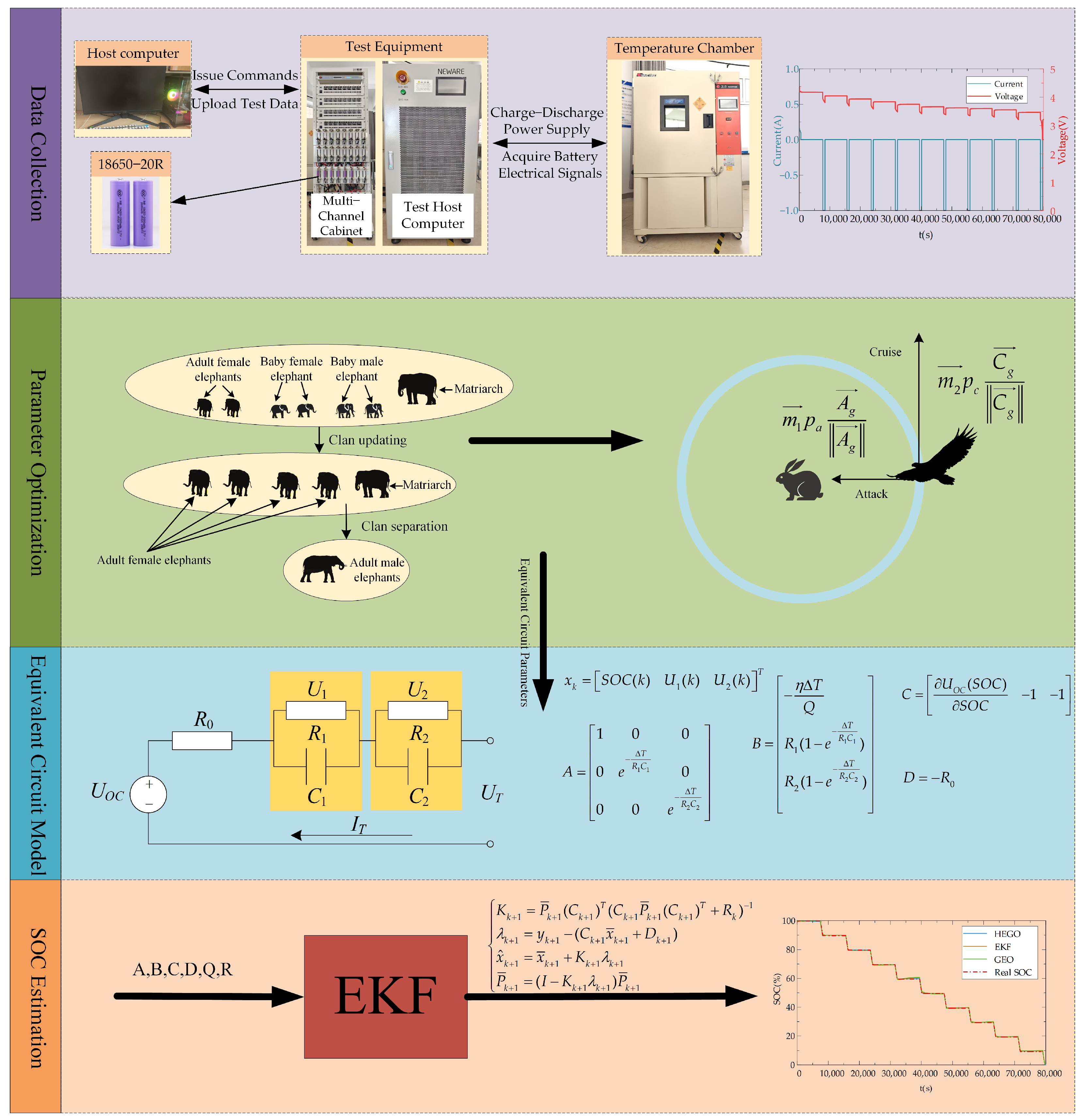
The accuracy of SOC estimation using the conventional EKF method depends on the accuracy with which the parameters of the dual-RC equivalent circuit model are identified. Variations in temperature and battery capacity can lead to significant SOC errors. Furthermore, the process and measurement covariance matrices Q and R in that conventional EKF method are fixed values that cannot adapt to changes in SOC and temperature. HEGO method is utilized to perform online prediction of the equivalent circuit parameters and noise matrix, thereby reducing errors caused by variations in SOC, temperature, capacity, and other factors. The specific algorithm has been depicted inside
Figure 2.
The proposed method inevitably suffers from high computational complexity. Two measures were therefore adopted to mitigate the computational burden:
Narrowing the initial parameter search ranges. All experimental data in this study were collected from 18650 lithium-ion batteries. Accordingly, the search ranges for the equivalent circuit model parameters were initially set based on the standard battery specifications provided by the manufacturer. However, due to production variations and battery aging, the actual parameters can deviate significantly from these nominal values. The search ranges were thus adjusted around the standard values to accommodate these deviations. The ranges for the process noise covariance Q and the measurement noise covariance R were determined by combining empirical experience with iterative tuning to match the established parameter ranges of the equivalent circuit model. This approach effectively reduces the computational load of the first optimization stage, namely EHO, by allowing for a smaller population size and fewer iterations.
Setting an appropriate sampling time. For battery charge/discharge processes, the sampling time directly affects the accuracy of the entire model. A shorter sampling time reduces the truncation error introduced by discretization, making the discretized approximations of the state equation and the polarization voltage differential equation more closely match the battery’s true continuous-time electrochemical behavior. This significantly lowers the SOC and polarization voltage estimation biases in the EKF’s prior prediction step. However, an excessively short sampling interval dramatically increases the number of iterations per unit time, which multiplies the controller’s computational load and intensifies real-time processing demands. Conversely, an overly long sampling time can cause the loss of dynamic details in current and voltage, leading to a sharp increase in the discretization linearization error and a larger overall estimation error. Therefore, a sampling time of 1s was chosen for the HEGO method. Over a 1 s interval during the charge/discharge process, the battery’s voltage, current, and SOC do not change drastically. Compared with a 0.1 s sampling time, the 1 s interval reduces the computation time by a factor of ten, yet results in almost no degradation in estimation accuracy. Further increasing the sampling time, however, would cause the estimation error to rise.
In HEGO method, a hybrid population-based algorithm is employed for parameter optimization to enhance the accuracy of EKF-based SOC estimation. A single optimization algorithm often exhibits certain limitations: EHO possesses strong global search capability but suffers from slow local convergence and is prone to falling into local optima; GEO demonstrates outstanding local fine search capability but is sensitive to the initial population, making it susceptible to deviation from the global optimum due to the influence of initial parameters. Therefore, HEGO employs a hybrid population-based algorithm. It first utilizes EHO to perform global contraction within the preset parameter boundaries, aiming to rapidly narrow down the range containing the optimal parameters. Subsequently, this narrowed parameter range serves as the initial search interval for GEO, which then leverages its adept local fine search capability to efficiently locate the global optimum within the region identified by EHO.
This algorithm fully integrates the global exploration advantage of EHO with the local exploitation advantage of GEO, thereby avoiding the inefficiency of GEO searching directly over a large range while overcoming the insufficient convergence accuracy of EHO in its later stages.
3.1. Elephant Herding Optimization
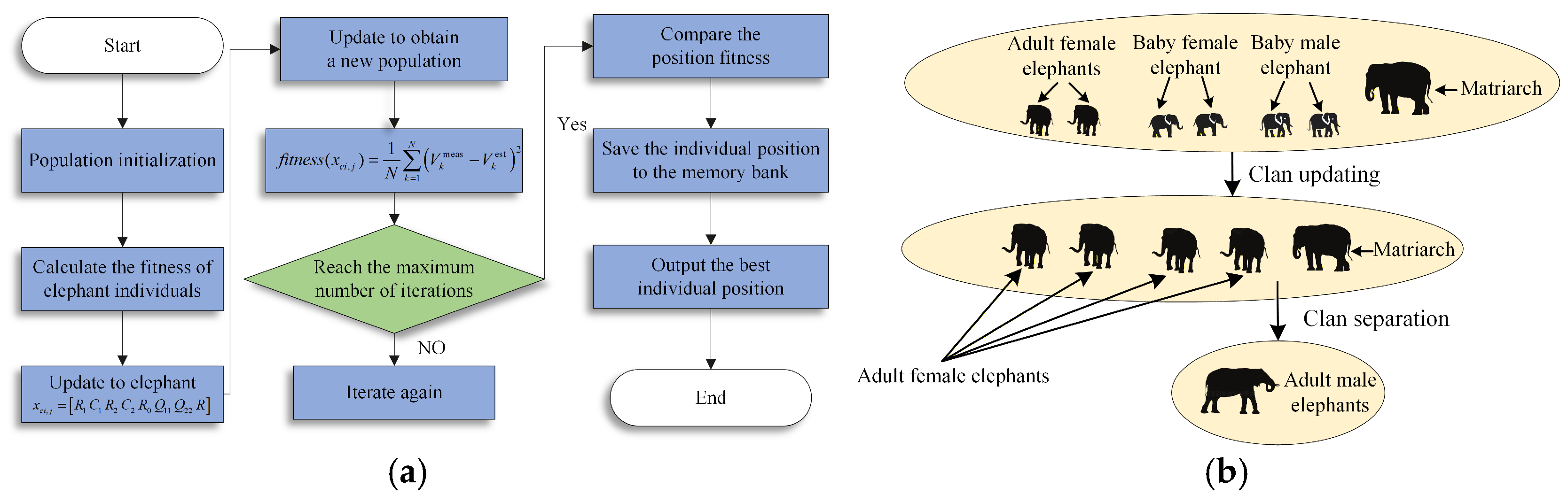
The EHO algorithm functions as a meta-heuristic framework that simulates natural evolution of elephant clans. It features a simple structure, few parameters, and ease of integration with other methods. An architectural layout for this EHO algorithm has been presented inside
Figure 3.
Elephants live in clans, each led by a matriarch. As elephants operate within a matriarchal society, male elephants must leave the clan upon reaching adulthood.
In the hybrid population-based optimization algorithm proposed in this paper, each individual position represents an 8-dimensional vector to be optimized.
x = [
R0,
R1,
C1,
R2,
C2,
Q11,
Q22,
R], where elements
R0,
R1,
C1,
R2, and
C2 are this electrical equivalent circuit model parameters, and
Q11,
Q22, and
R denote the process noise and observation noise of the EKF. After the position update, the new parameters are used to enable the EKF to perform SOC estimation, and the fitness, fitness(
x), is calculated as shown in Equation (14):
where
N denotes the total quantity of sampled data;
represents the obtained voltage at the
k-th moment; and
acts as EKF-estimated voltage under the current parameters.
This behavior of elephants is modeled as two processes: clan updating and clan separation [
31].
Clan updating: Within elephant group
ci, the subsequent placement for each member
j gets influenced via the matriarch leader, as shown in Equation (15):
where
xnew,ci,j signifies the updated position;
xbest,ci denotes the location belonging to the individual with the highest fitness;
α is the impact coefficient from the matriarch upon this member;
r is a random number ensuring group diversity.
The position of the clan leader is updated based on the clan center, and the calculation of the clan center is shown in Equation (16):
where
xcenter,ci,d denotes the clan center coordinate associated with the
ci-th clan in the
d-th dimension;
nci stands for the overall quantity of individuals within the
ci-th clan;
xci,j,d represents the position value belonging to this
j-th individual in the
ci-th clan along the
d-th dimension.
Clan separation: To prevent population stagnation and trapping in local optima, the individual with the worst fitness within the clan is randomly reinitialized in the search space, as shown in Equation (17):
where
xmin and
xmax represent the minimum and maximum bounds of the search space, respectively;
rand serves as a stochastic variable spreading evenly across a range of [0, 1).
3.2. Golden Eagle Optimization
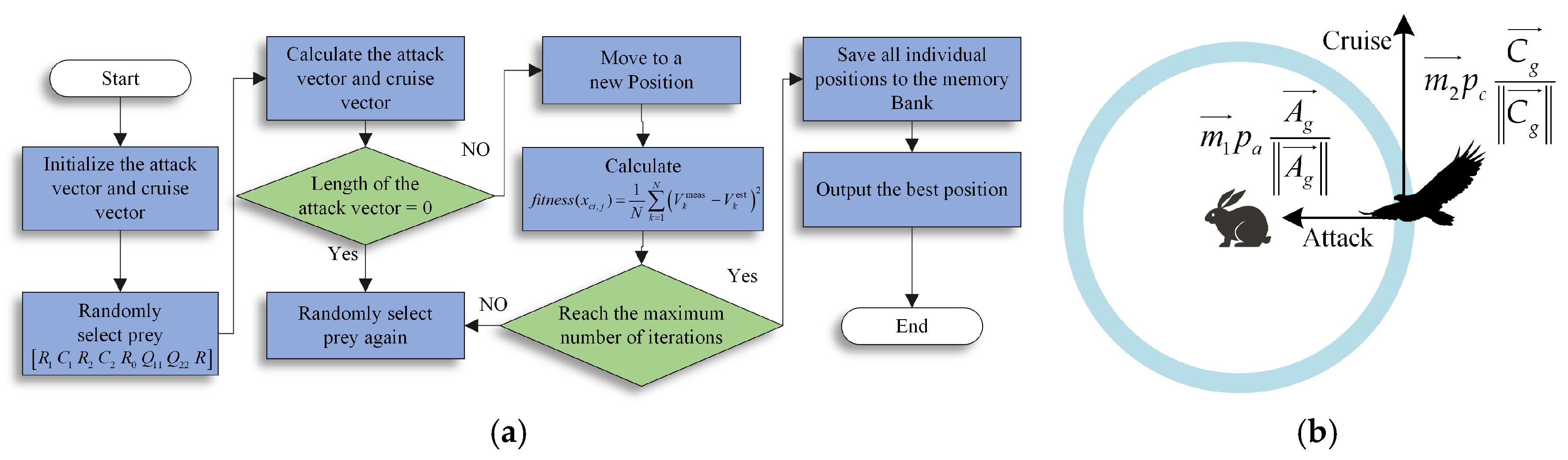
The GEO is an algorithm proposed founded upon the predatory actions of these eagles in nature. The current methodology simulates their flight behavior and hunting strategy of golden eagles in order to resolve optimization issues. The schematic illustrating the GEO algorithm is presented in
Figure 4.
The definition of the position parameter
x and the fitness calculation method of this algorithm are completely consistent with those defined in
Section 3.1. In each iteration, after each golden eagle selects a prey target, its position is updated through the combined effect of the attack vector and the cruise vector to gradually approach the optimal solution [
32]. Detailed procedural stages for this GEO are as follows:
3.3. Extended Kalman Filter Algorithm
Under strict linear system and Gaussian noise assumptions, KF is a globally optimal state estimator. However, when applied to nonlinear systems, the Gaussian characteristics of a signal become distorted after passing through a nonlinear transfer function, causing the constant matrix assumption and the covariance propagation mechanism of the standard KF to break down.
For the battery equivalent circuit model in this study, although the SOC state transition process is approximately linear, the open-circuit voltage versus SOC mapping relationship in the observation equation exhibits strong nonlinearity. If the standard KF were applied directly, it would fail to accurately handle the nonlinear error mapping and could lead to filter divergence. To address this, this paper introduces the EKF as the state observer. Based on a first-order Taylor series expansion, the EKF computes the Jacobian matrix in real time at the current SOC estimate in each sampling period, thereby achieving local linearization of the nonlinear observation equation. Although discarding higher-order terms introduces a theoretical truncation error, under high-frequency sampling the first-order approximation is sufficient to ensure high fidelity in the dynamic propagation of covariance. This mechanism effectively overcomes the estimation difficulties caused by the strong nonlinearity of the OCV-SOC relationship, significantly improving the convergence accuracy and robustness of SOC estimation under complex operating conditions while maintaining real-time computational performance.
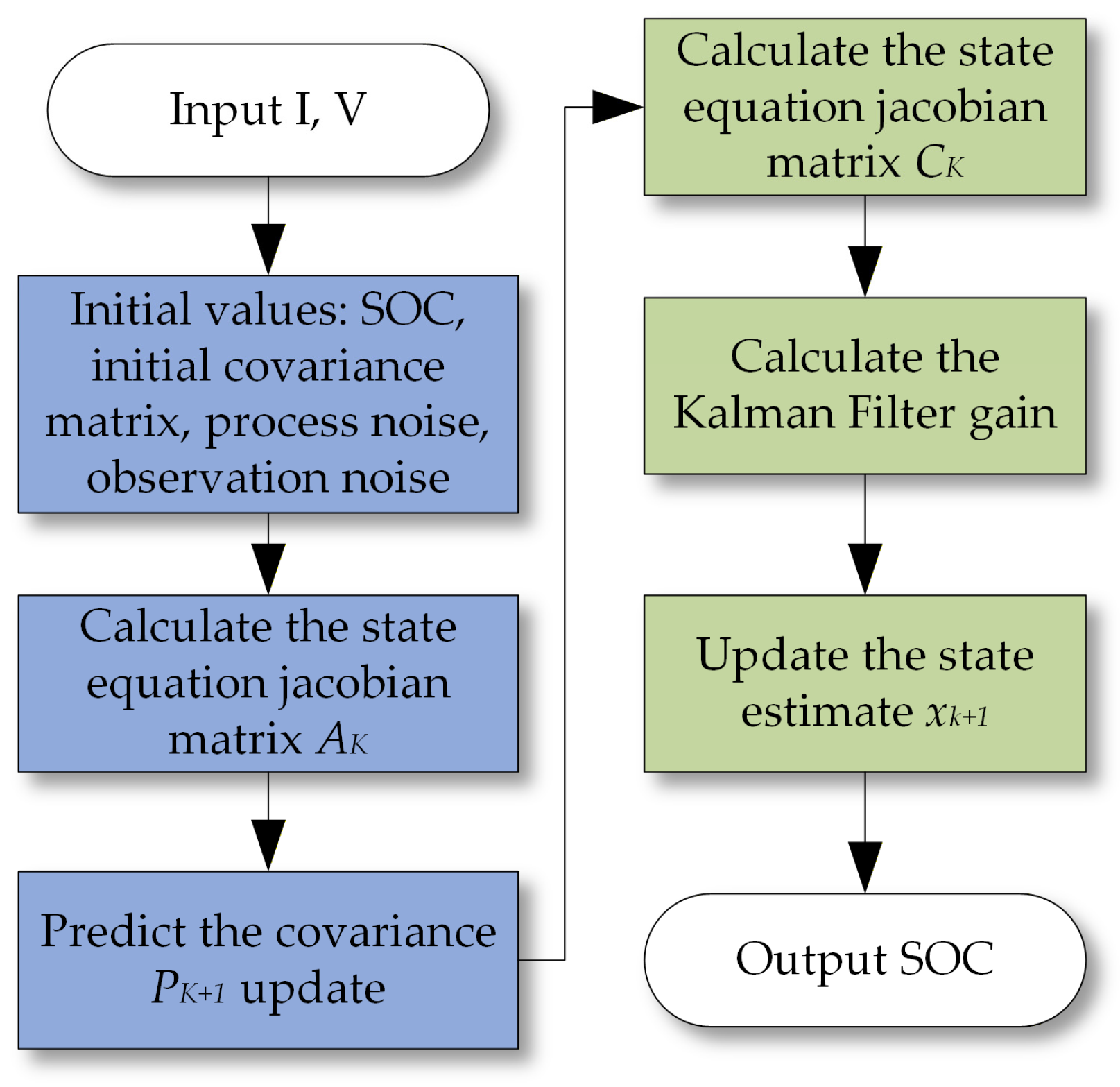
When using the EKF to estimate cell’s SOC, one must formulate this discretized state-space expression for this battery’s representation, where the variances from the framework’s process noise and observation noise are
QK and
RK-, respectively. The calculation flowchart has been depicted inside
Figure 5.
The specific steps associated with SOC estimation are as follows [
33]:
Initialization: Define this starting status vector and the initial uncertainty matrix P0 of the EKF.
State prior estimation: Using the posterior state estimate and covariance matrix from the previous time step, combined with the system state transition equation, the prior status prediction and uncertainty matrix during this present moment are obtained.
- 3.
Observation Prediction and Jacobian Calculation: Unlike the Kalman filter, the EKF employs a nonlinear observation function h (x, I) to compute the predicted terminal voltage . Concurrently, the Jacobian of this nonlinear observation function is evaluated at the current a priori state estimate to dynamically update the observation matrix :
- 4.
Posterior estimation: By calculating the Kalman filter gain Kk+1 and then using the updated innovation λk+1 to correct the prior estimate, the posterior state estimate at the current time step is obtained, and the uncertainty matrix Pk+1 is updated.
- 5.
Time update: Save the posterior state estimate and covariance matrix at the current time step as the initial values for the next EKF iteration.
5. Experimental Results and Analysis
5.1. SOC Estimation Under Different Temperatures
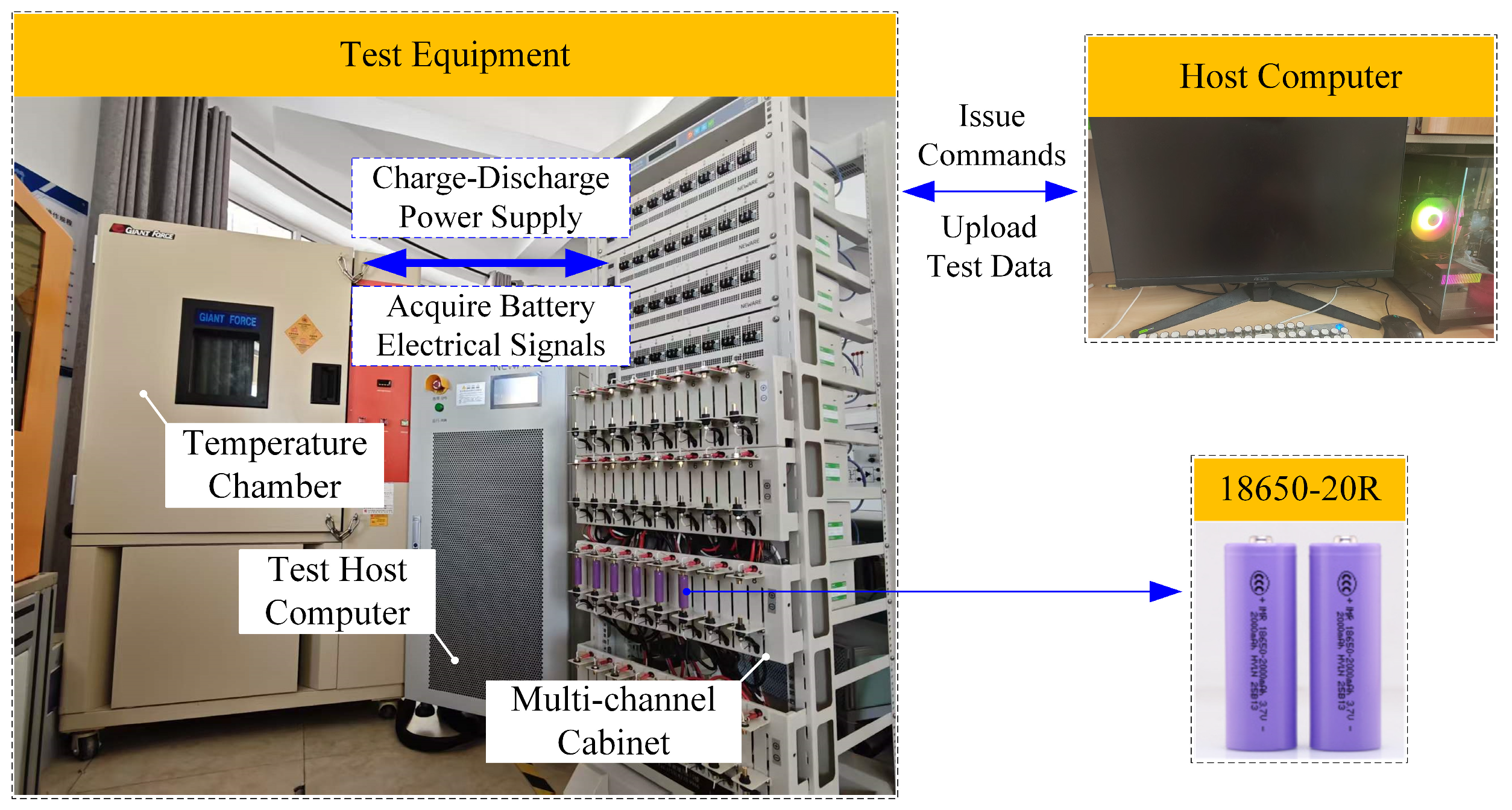
In order to thoroughly evaluate the estimation accuracy and disturbance rejection ability of the HEGO method presented in this paper, three representative temperature levels 0 °C, 25 °C, and 45 °C were adopted as test conditions. Measurements were collected from a lithium-ion battery under two dynamic operating conditions, Dynamic Stress Test (DST) and Federal Urban Driving Schedule (FUDS), utilizing that established experimental test rig. The collected terminal voltage and current data were then used as inputs to test the algorithm’s performance in MATLAB/Simulink 2023b. To intuitively demonstrate the SOC estimation performance of the HEGO method, comparative experiments were conducted using the GEO method and the conventional EKF method under the same conditions.
In this study, all reference SOC values were acquired through Coulomb counting, performed concurrently with the charge/discharge experiments under controlled laboratory conditions. The current and voltage signals collected were stable, and a pre-experiment procedure was carried out to guarantee the accuracy of the initial SOC. The SOC obtained under this protocol can therefore be used as a valid benchmark.
5.1.1. SOC Estimation Under Different Operating Conditions at 0 °C
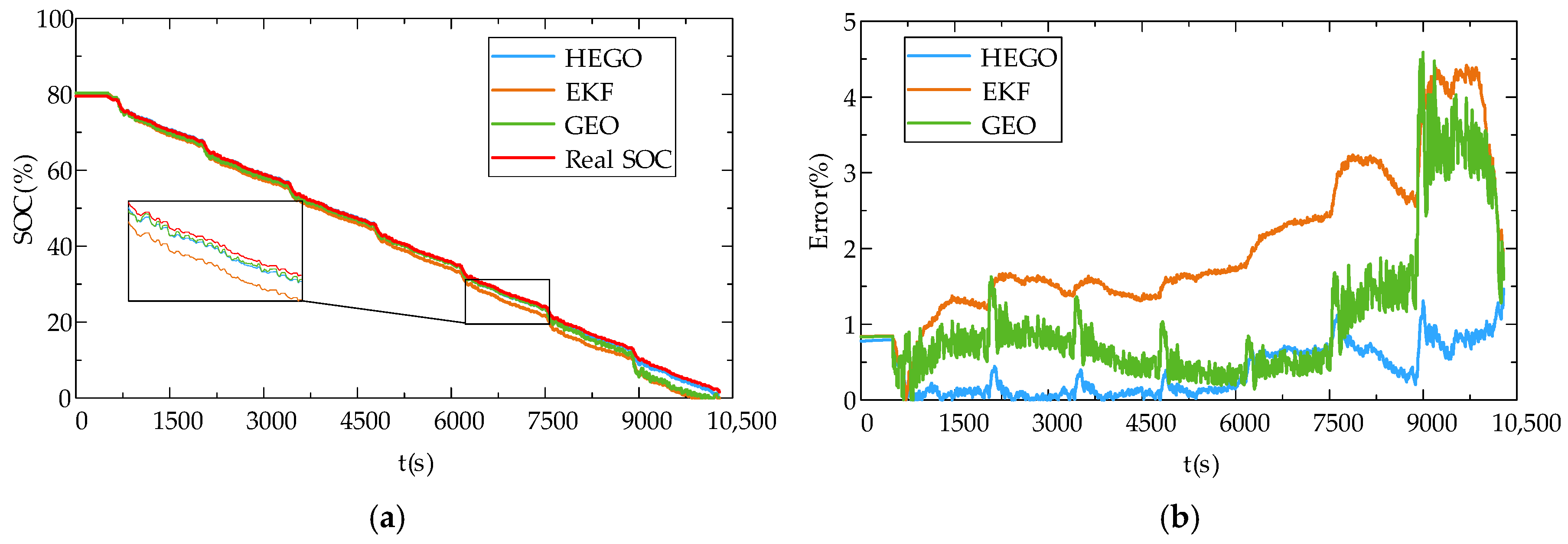
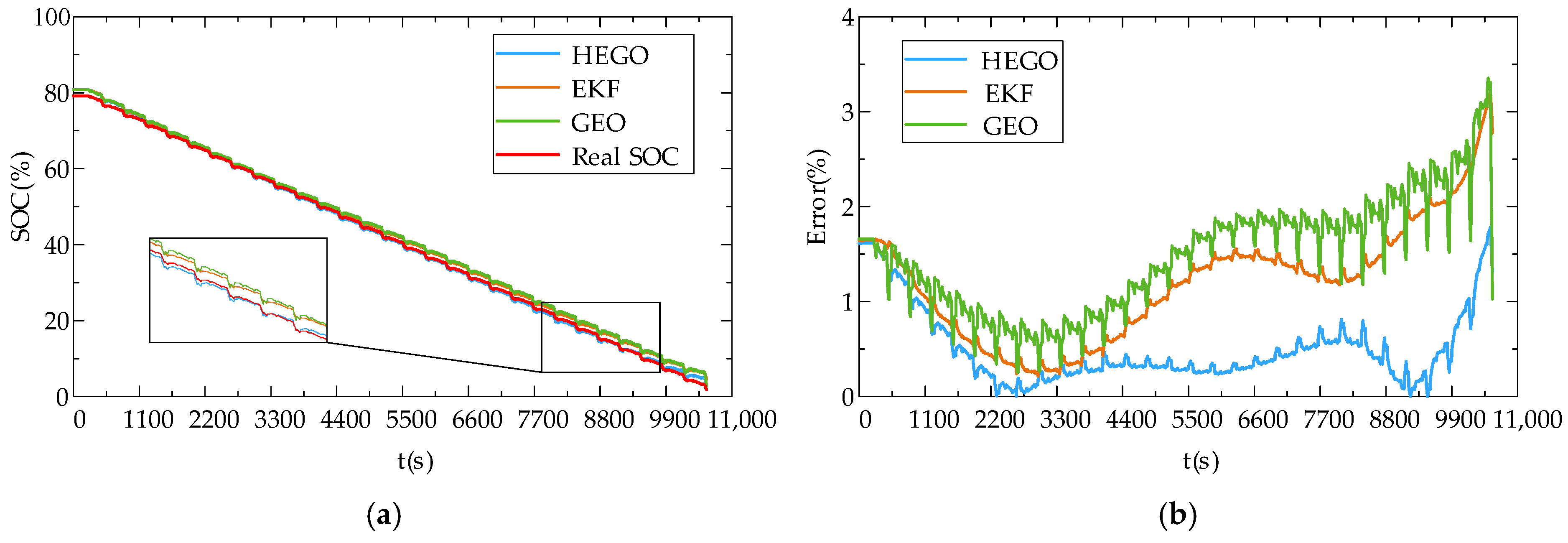
The SOC estimation curves and errors of different algorithms under two operating conditions at 0 °C are presented in
Figure 7 and
Figure 8. As shown in
Figure 7a and
Figure 8a, the conventional EKF method, although capable of following the overall SOC trend in a low-temperature environment, exhibits a significant overall deviation due to its inability to cope with the nonlinear polarization reactions inside the battery. The GEO method yields a smaller overall error than the conventional EKF method; however, when the operating cycle current drops to 0 A and the battery terminal voltage undergoes a sudden change due to polarization effects, GEO method fails to rapidly identify the optimal parameters within a large parameter range, resulting in substantial errors. In contrast, HEGO method not only tracks the true SOC more closely overall but also avoids the significant deviation observed in GEO method at the moment the current returns to zero.
Furthermore, as can be seen from
Figure 7b and
Figure 8b, at 0 °C, several major observations can be made regarding the estimation stability. First, the error curve of the conventional EKF method is overall smoother but shows a clear upward drift in the later stages of discharge, reaching peak absolute errors of approximately 5% and 4.5% under DST and FUDS conditions, respectively. This accumulating error occurs because its equivalent circuit model parameters do not vary with changes in SOC. Second, while the GEO method can optimize parameters online, its error curve is characterized by substantial, high-frequency sawtooth spikes—reaching up to 6% under DST conditions. This visually pronounced phenomenon indicates that GEO fails to promptly and accurately locate the precise optimal parameters within the large search range, leading to substantial sawtooth errors—a phenomenon that becomes more pronounced when the battery SOC is low. Finally, The HEGO method proposed in this paper outperforms the other two methods by maintaining the lowest overall error profile, remaining predominantly under 1.5%. Although sawtooth errors still persist, the initial narrowing of the large search range by EHO enables the subsequent optimization to lock onto the optimal parameters more accurately, thereby better accommodating the rapidly changing battery dynamics.
5.1.2. SOC Estimation Under Different Operating Conditions at 25 °C
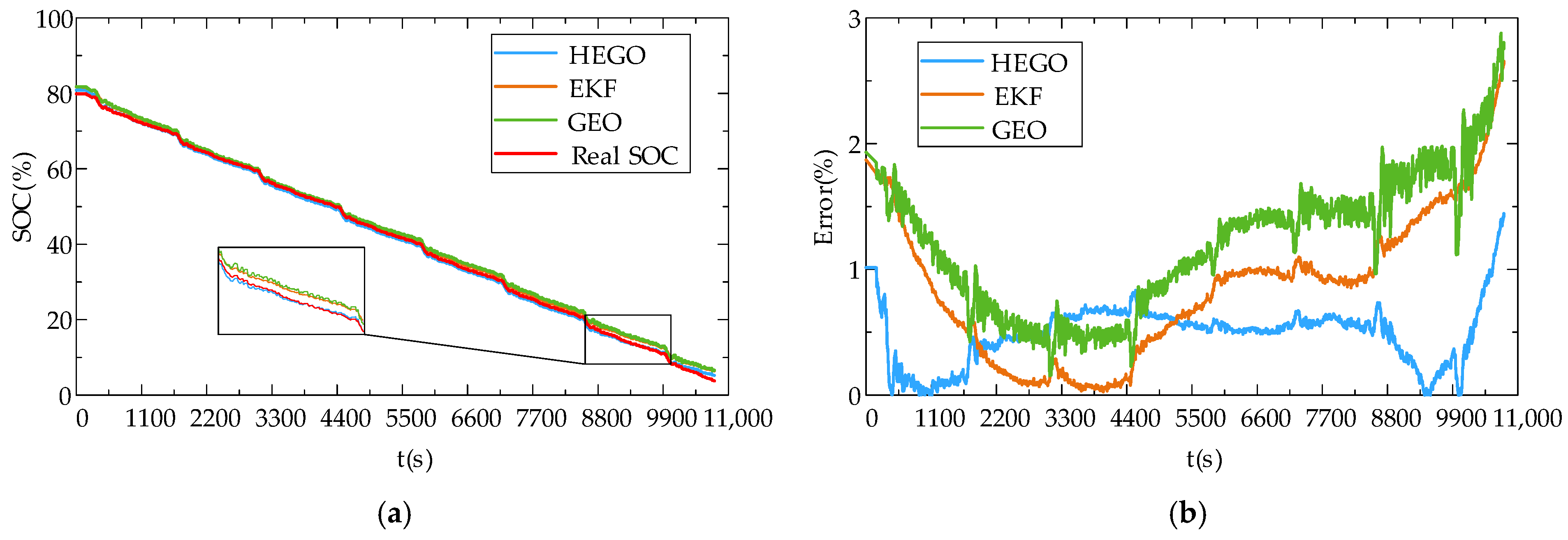
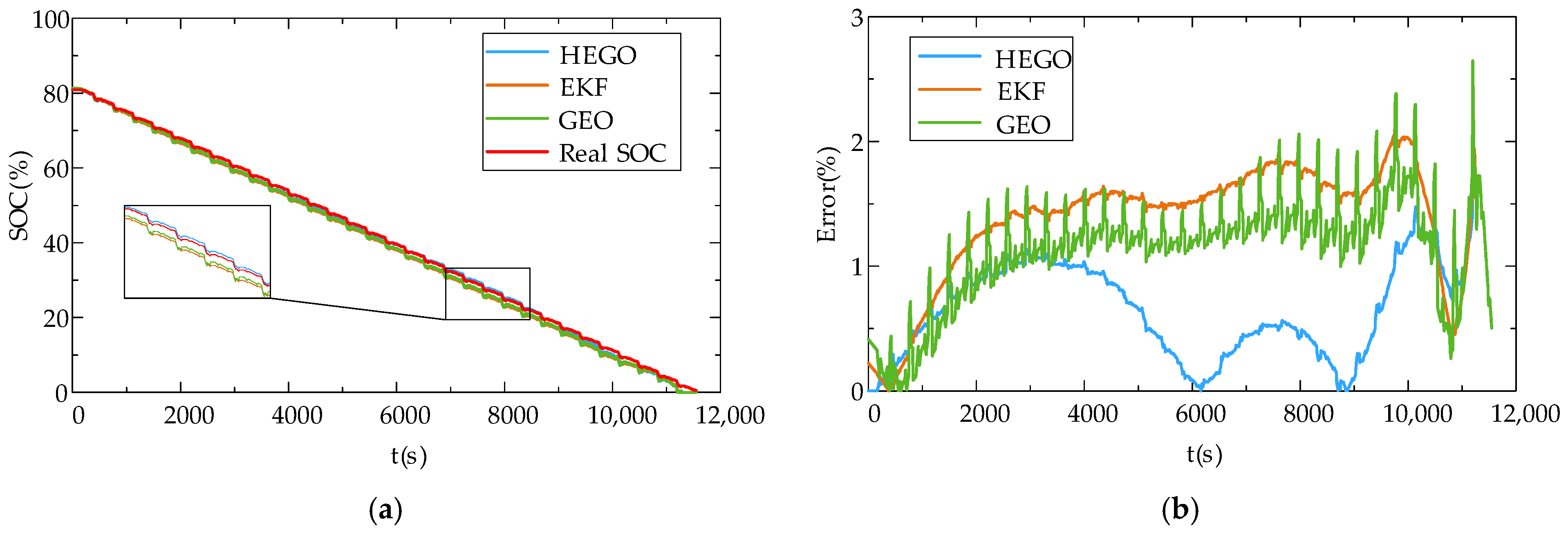
In a normal temperature environment of 25 °C, the electrochemical reactions inside the battery are more active than those at 0 °C, and the battery polarization phenomenon is relatively weaker. Consequently, the errors of all three methods are reduced overall. As can be seen from
Figure 9a and
Figure 10a, the estimation curves of all three methods can follow the true SOC curve reasonably well. However, since the model parameters of the conventional EKF method cannot vary with changes in SOC, the complex processes during battery operation cannot be adequately reflected, resulting in a sharp increase in error during the middle and later stages of battery discharge. Although the GEO method can optimize the model parameters online along with the battery charge–discharge process, its weak search capability over a wide range leads to an overall estimation curve that deviates more than that of the conventional EKF method. In contrast, the HEGO method demonstrates exceptionally high estimation accuracy, with its curve closely tracking the true SOC throughout the battery operating cycles under different conditions.
From the error curves in
Figure 9b and
Figure 10b, it can be observed that the error trends of the conventional EKF method and GEO method are similar: both exhibit an initial decrease in error, followed by a gradual increase during the middle and later stages. The error curve of the conventional EKF method is the smoothest; however, due to error accumulation, it exceeds 3% in the later stages of discharge. The GEO method’s curve is heavily populated with dense sawtooth spikes, reaching peak errors near 3.5%, which visually demonstrates the severe oscillations caused by blind jumps when estimating parameters across a large search range. In contrast, benefiting from the hybrid cooperation mechanism between the EHO and GEO components, the HEGO method effectively overcomes the blind jumps of the single GEO in complex high-dimensional spaces. It not only firmly suppresses the absolute error to an extremely low level of under 1% for most of the discharge time but also demonstrates excellent parameter-locking and anti-disturbance capabilities at the end of discharge.
5.1.3. SOC Estimation Under Different Operating Conditions at 45 °C
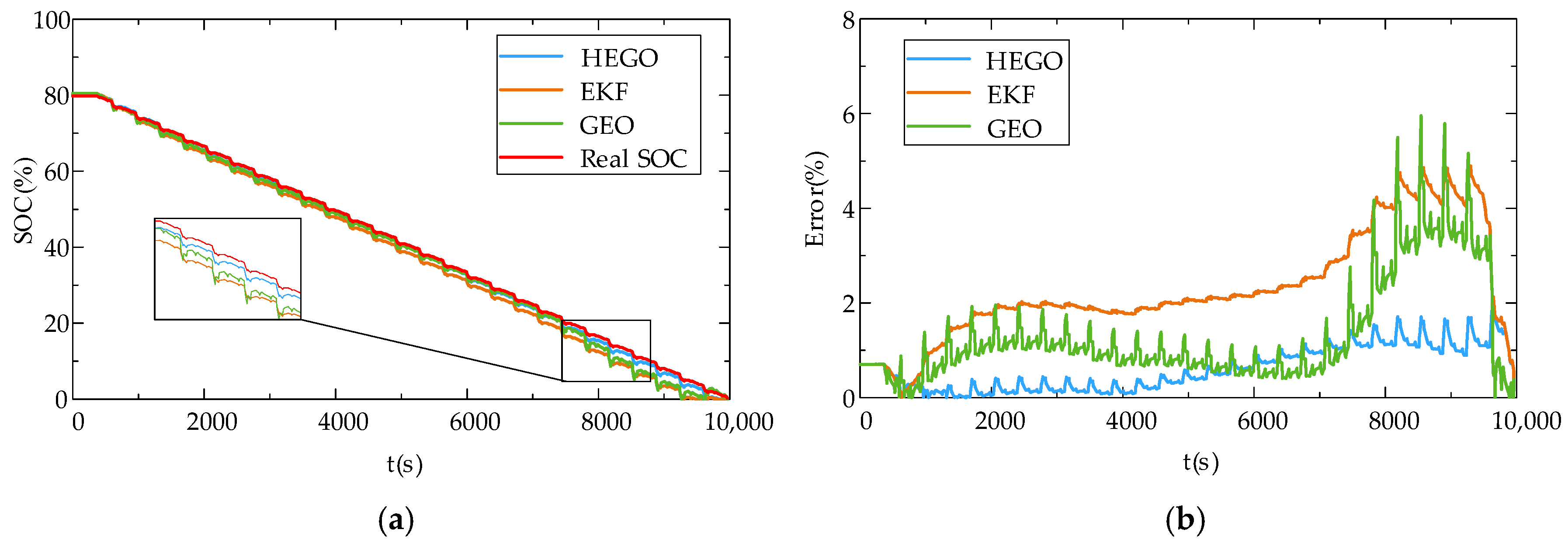
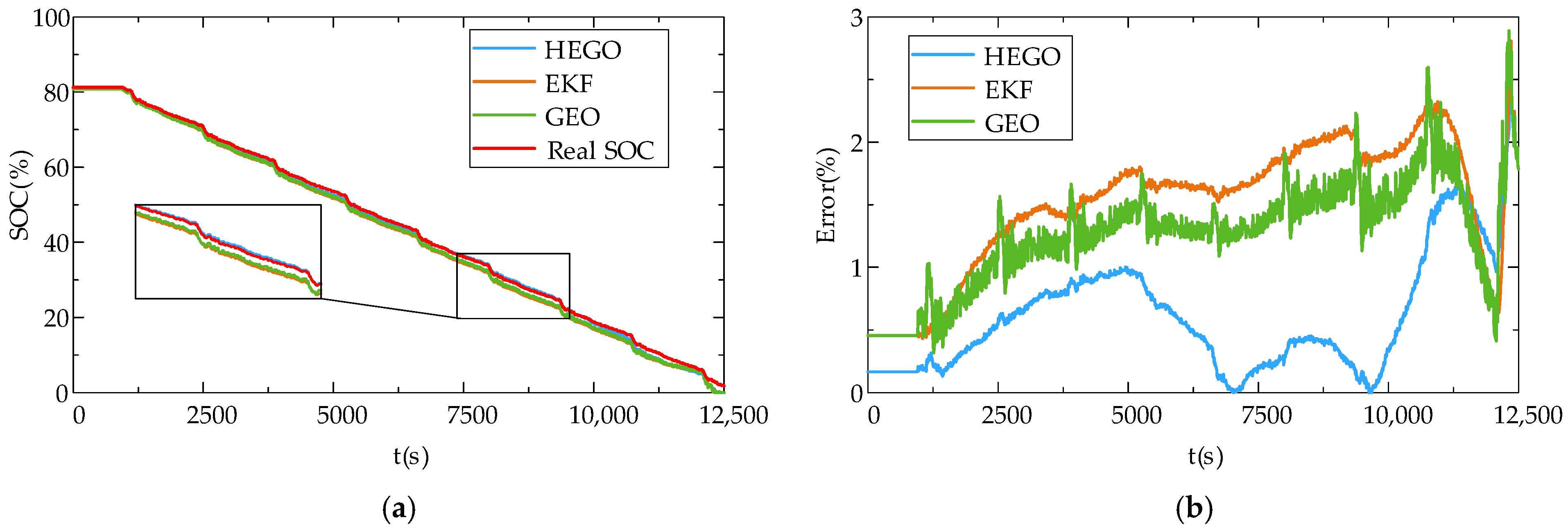
The SOC estimation tracking profile and errors of each method under the high-temperature environment of 45 °C are illustrated within
Figure 11 and
Figure 12. As observed in
Figure 11a and
Figure 12a, under this high-temperature environment, those internal chemical reactions of the battery are vigorous, causing significant fluctuations in battery parameters. The conventional EKF method can roughly follow the true SOC on the whole; however, because its fixed model parameters cannot adapt in real time to the changes in dynamic discharge characteristics at high temperatures, the estimation curve inevitably exhibits a persistent overall deviation during the middle and later stages. The GEO method tracks the true SOC more closely than the conventional EKF method overall, yet it still shows considerable deviation locally in response to complex changes in the operating current. The HEGO method demonstrates exceptionally high trajectory tracking performance, the tracking also remains the smoothest throughout the entire discharge cycle.
Further observation of
Figure 11b and
Figure 12b reveals that the conventional EKF method exhibits a gradually increasing error trend, drifting upwards of 2.8%, highlighting a relatively weak correction capability. Although the GEO method does not employ fixed parameters, its error curve is dominated by continuous, jagged fluctuations, indicating that large-range parameter optimization struggles to track local battery voltage variations under high-temperature conditions. In contrast, the HEGO method proposed in this paper demonstrates significant advantages in error control: it not only tightly suppresses the absolute error to an extremely low level for the vast majority of the time, mostly under 1.5%, but more crucially, by relying on the EHO to first narrow and converge the large search range, the subsequent optimization steps become more stable and accurate. This substantially suppresses the spike oscillations that tend to erupt in the single GEO at high temperatures.
5.1.4. Accuracy Analysis of SOC Estimation by Different Methods
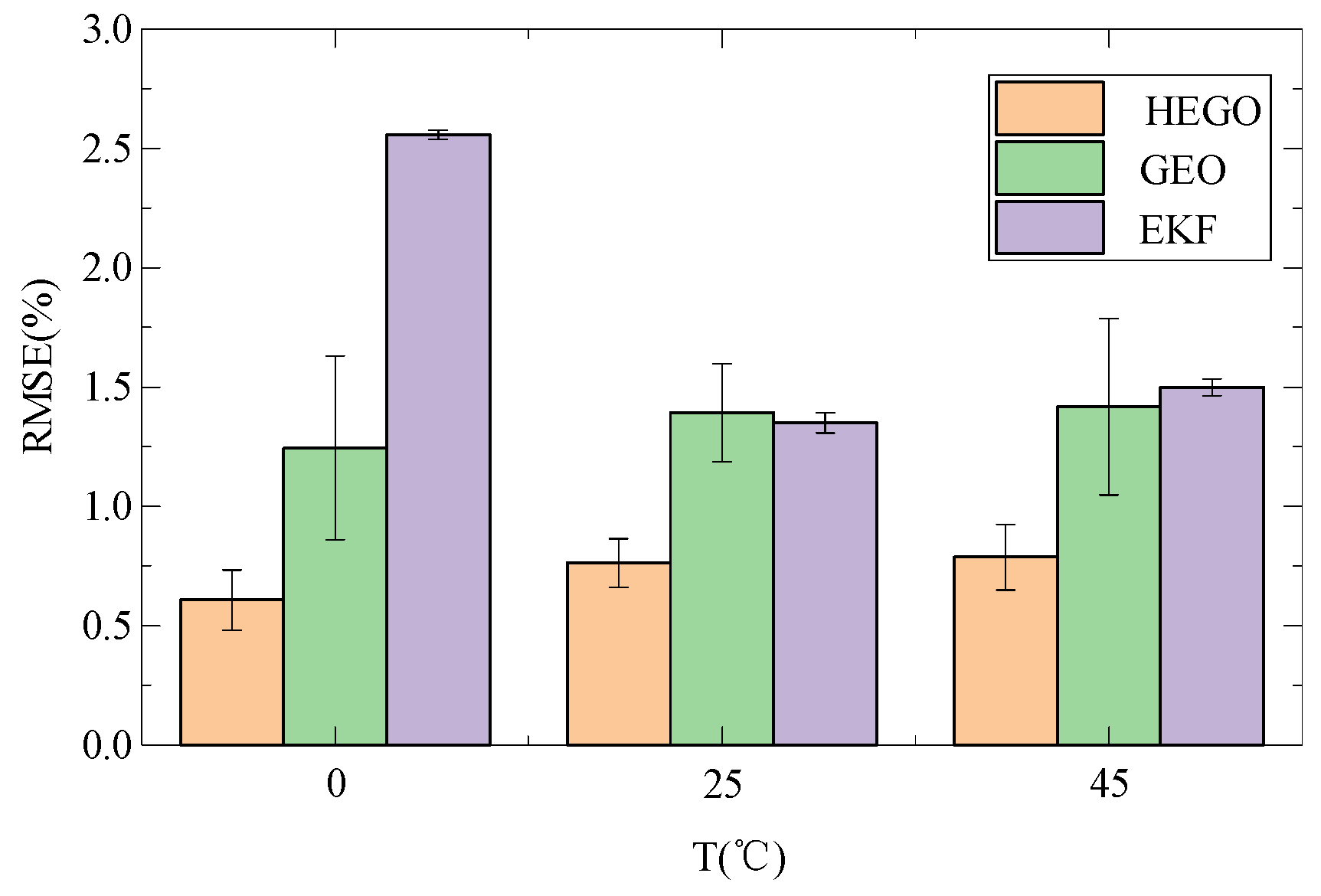
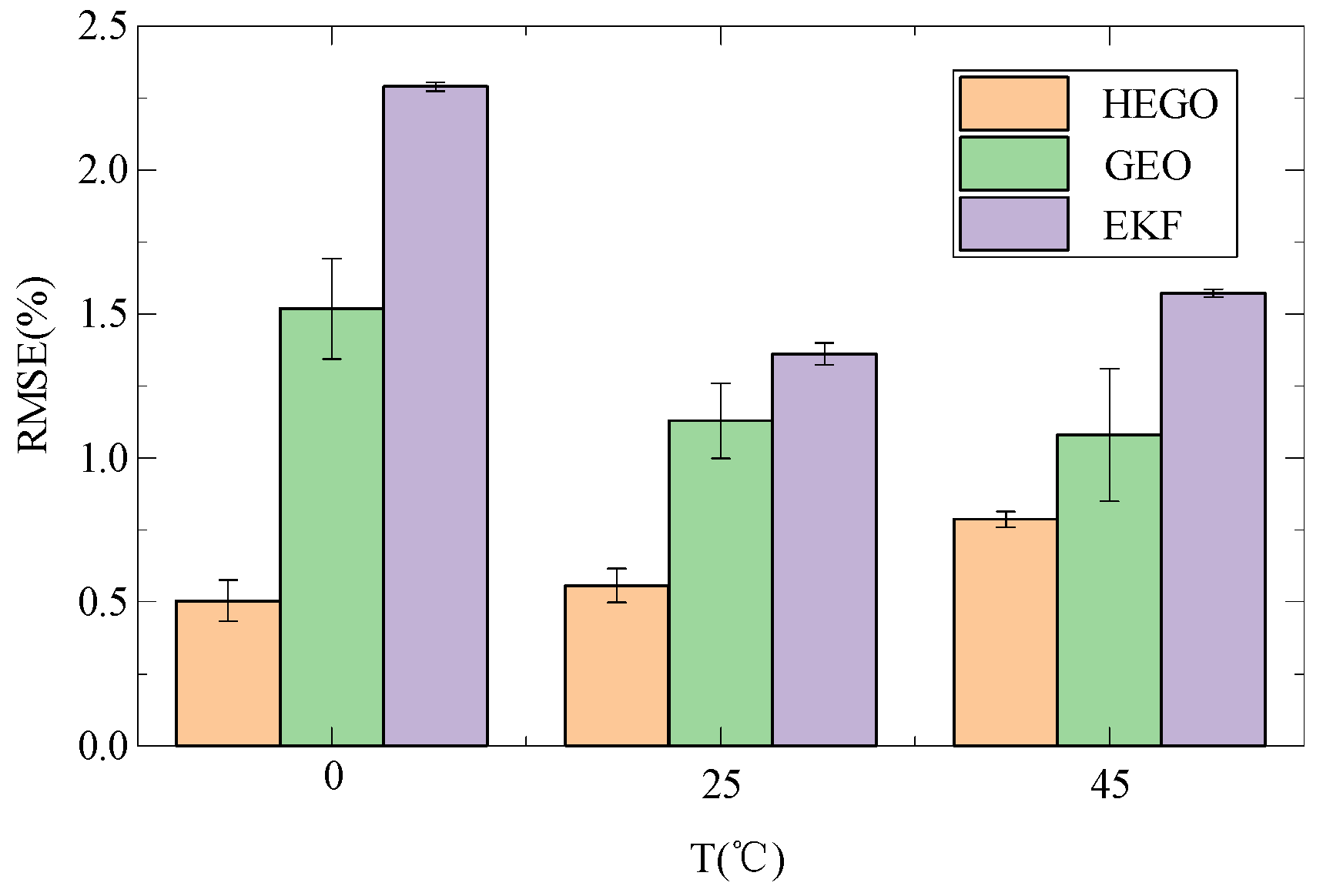
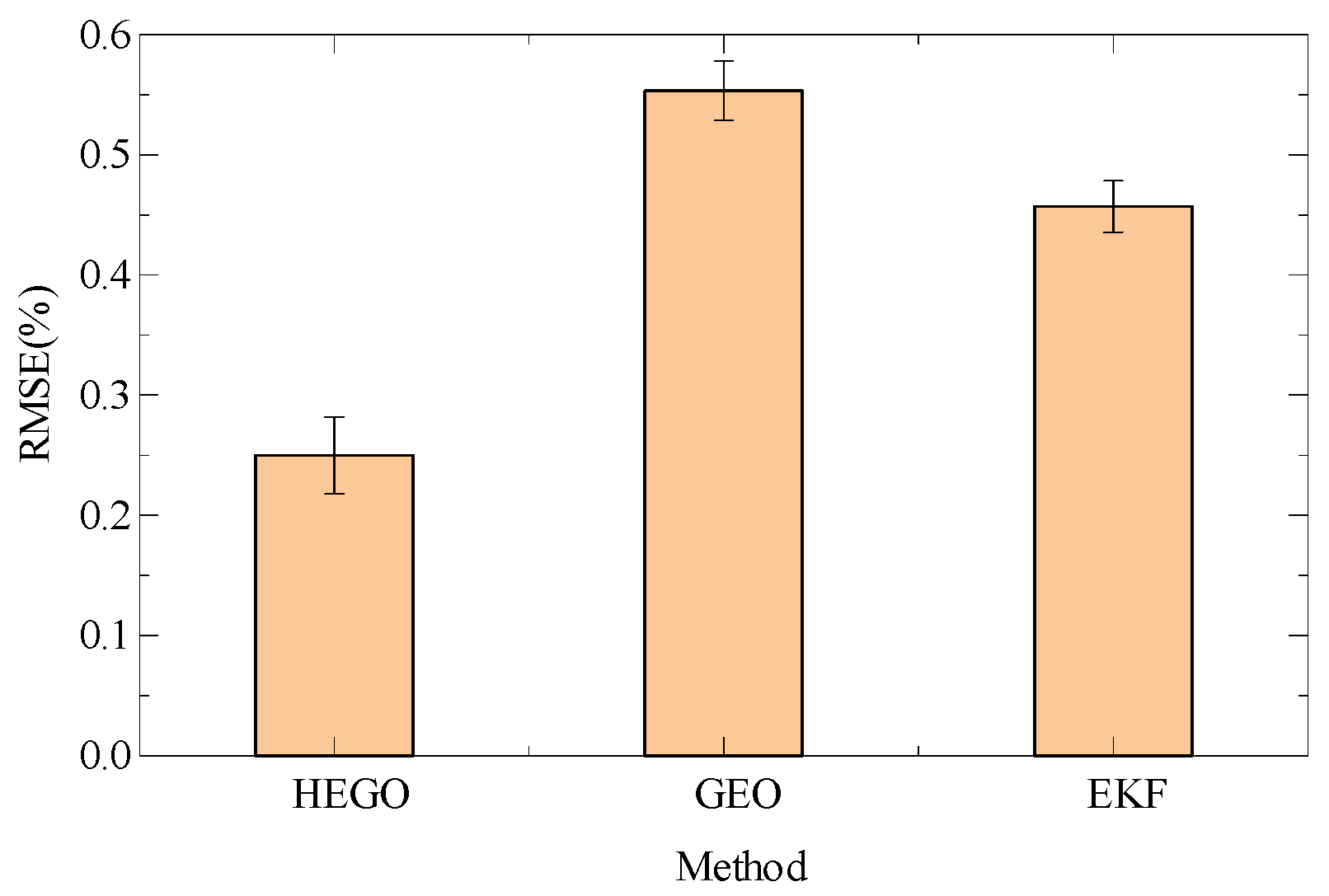
To more accurately analyze the SOC estimation performance of each algorithm at different temperatures, this paper adopts the Root Mean Squared Error (RMSE) as the evaluation metric. RMSE is sensitive to large errors and can intuitively reflect the estimation accuracy of the algorithms under extreme operating conditions. Furthermore, to eliminate the possibility of chance results, every experiment was repeated 30 times, and the mean RMSE together with the standard deviation are presented in
Figure 13 and
Figure 14.
A comparative analysis reveals that changes in ambient temperature directly affect the internal electrochemical characteristics of the battery, which in turn cause significant fluctuations in the SOC estimation performance of various algorithms. In the low-temperature environment of 0 °C, the battery polarization effect intensifies and the degree of model instability reaches its maximum. The RMSE of the conventional EKF under the DST and FUDS driving cycles reach 2.55% and 2.28%, respectively. The GEO algorithm partially corrects the model mismatch through online parameter identification, reducing the RMSEs to 1.24% and 1.51%. In contrast, HEGO, relying on a hybrid optimization mechanism that combines GEO and the EHO, achieves precise tuning of the EKF parameters, lowering the RMSE to 0.60% under DST and to 0.51% under FUDS. Compared with the conventional EKF, the RMSE is reduced by 76.47% and 77.63% under the two driving cycles, respectively, demonstrating the algorithm’s strong error suppression capability in harsh low-temperature environments.
Under the normal temperature of 25 °C and the high temperature of 45 °C, the battery characteristics tend to stabilize, and the estimation errors of all methods decrease to varying degrees. However, the HEGO method consistently maintains the optimal accuracy across all operating conditions. At 25 °C, its RMSE values under the DST and FUDS conditions are 0.76% and 0.55%, respectively, both lower than those of the comparison methods. In the high-temperature environment of 45 °C, affected by the enhanced battery self-discharge effect, the errors of all algorithms rebound slightly, yet they still follow the pattern in which the HEGO method performs the best, followed by the GEO method, with the conventional EKF method being the worst. Even under the FUDS condition characterized by frequent current transients, the RMSE of the HEGO method is merely 0.78%, far superior to the 1.07% of the GEO method and the 1.57% of the conventional EKF method.
As shown in
Figure 13 and
Figure 14, the error bars at the top of the bar charts intuitively reflect the standard deviation of each algorithm over multiple independent runs, providing a statistical insight into the state estimation robustness of the models. It can be observed that the conventional EKF method exhibits very small error bars at all temperatures. However, combined with its high mean RMSE, especially in the harsh environment of 0 °C, this indicates that although the algorithm does not suffer from drastic fluctuations, it lacks the capability for online identification of polarization parameters, resulting in severe systematic mismatch. In essence, it extremely stably produces estimates with large biases. In contrast, while the single GEO algorithm effectively reduces the mean RMSE at most temperature points, its error bars are the largest among the three in all operating conditions. This substantial standard deviation fully exposes its inherent deficiency: the global search process is highly susceptible to high-frequency white noise and prone to becoming trapped in local optima, causing the estimation accuracy to fluctuate dramatically across different runs. In sharp contrast, the proposed HEGO algorithm not only achieves the lowest mean RMSE in all tested scenarios, but also greatly compresses its error bars. Whether under the DST condition with relatively mild current variations or the transiently aggressive FUDS condition, HEGO maintains an extremely small standard deviation, convincingly demonstrating the qualitative improvement in the algorithm’s anti-disturbance capability resulting from the introduced hybrid mechanism.
The data from different operating conditions further demonstrate the superiority of the HEGO method across various temperatures. Whether under the DST condition with moderate current variations or the FUDS condition with drastic current transients, the HEGO method consistently ensures stable and excellent estimation accuracy. The above experimental results indicate that the HEGO method not only overcomes the limitation of the conventional EKF method, whose fixed parameters are prone to error and divergence, but also resolves the deficiency of the single GEO, which tends to fall into local optima. To verify whether the performance differences between the HEGO algorithm and the benchmark algorithms are statistically significant, this paper conducts an independent two-sample t-test using the prediction errors obtained from multiple independent repeated experiments under the same operating conditions. The null hypothesis assumes that no true difference exists in the estimation performance of the two algorithms. Before performing the test, we first examined the normality of the sample distributions to satisfy the fundamental assumptions of the t-test. The independent two-sample t-test yielded a p-value below 0.01. The p-value is defined as the probability of obtaining a test statistic as extreme as, or more extreme than, the observed value under the null hypothesis. This indicates that, assuming no true performance difference exists between algorithms, the probability of observing an advantage as pronounced as, or even larger than, the one detected here is less than 1%, confirming that the dual advantage of HEGO in accuracy and robustness is statistically significant and unlikely to arise merely from random noise.
For the HEGO-based SOC estimation across multiple temperatures,
Table 2 lists the parameter outputs of the hybrid optimization algorithm at SOC = 30%. It can be observed that as the temperature decreases from 45 °C to 0 °C, the ohmic resistance
R0 and the polarization resistances
R1 and
R2 all increase significantly. This phenomenon arises from the decline in ionic conductivity and the intensification of electrochemical polarization at low temperatures. Regarding the EKF noise parameters,
Q22 increases with temperature, indicating that the random perturbation experienced by the polarization voltage is stronger under high-temperature dynamic conditions. At all tested temperatures, it is normal that the measurement noise covariance
R remains fixed at 1 × 10
−6, because the random measurement noise of the voltage acquisition circuit is not affected by temperature.
5.2. HPPC Condition Test
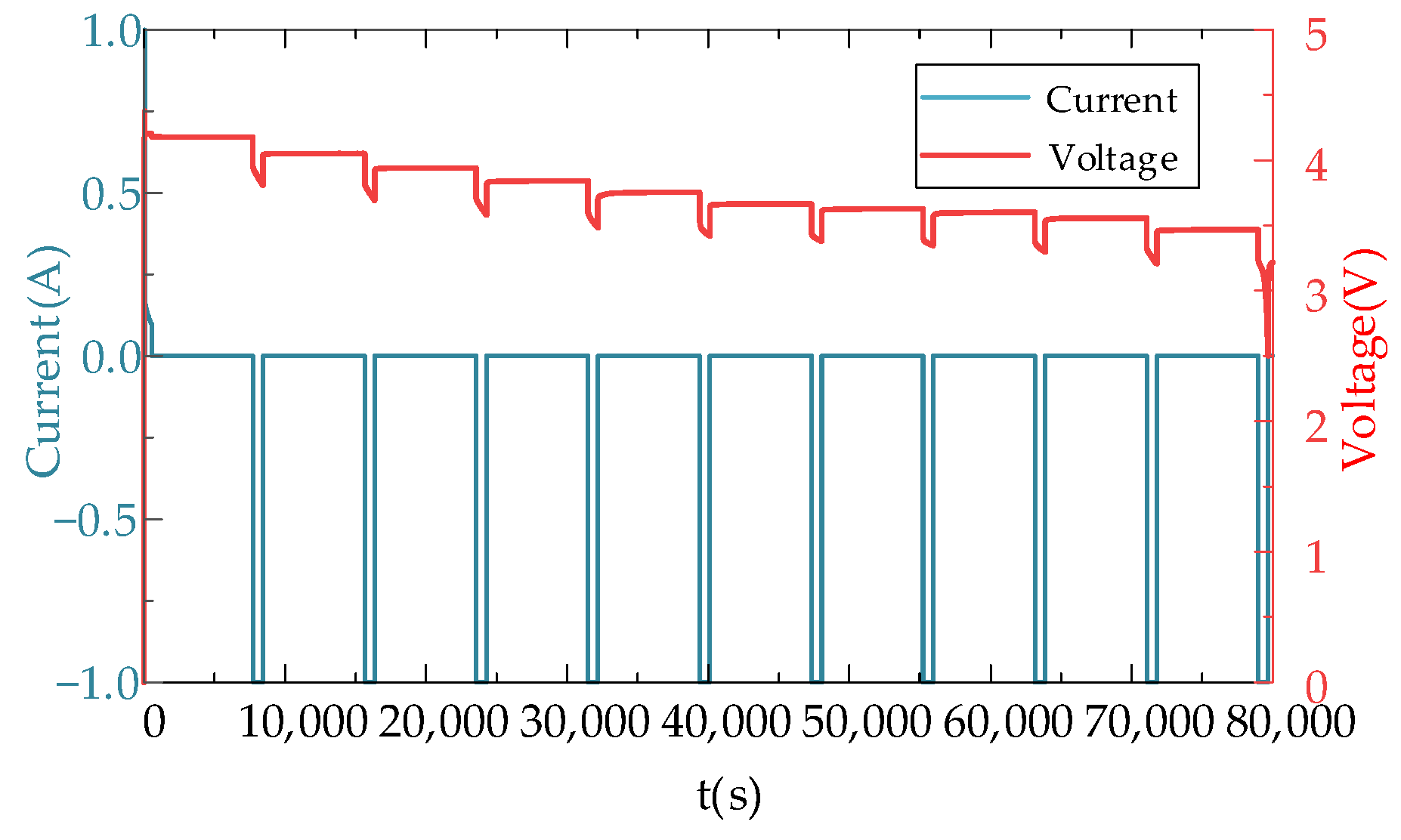
To test the generalizability of the algorithm proposed in this paper, experiments were conducted using the Hybrid Pulse Power Characterization (HPPC) condition at 25 °C. The experimental platform and experimental subjects remain those proposed in
Section 4. The experimental current and voltage are shown in
Figure 15. A negative pulse current of 1 A was applied for intermittent discharge, releasing 10% of the battery SOC each time.
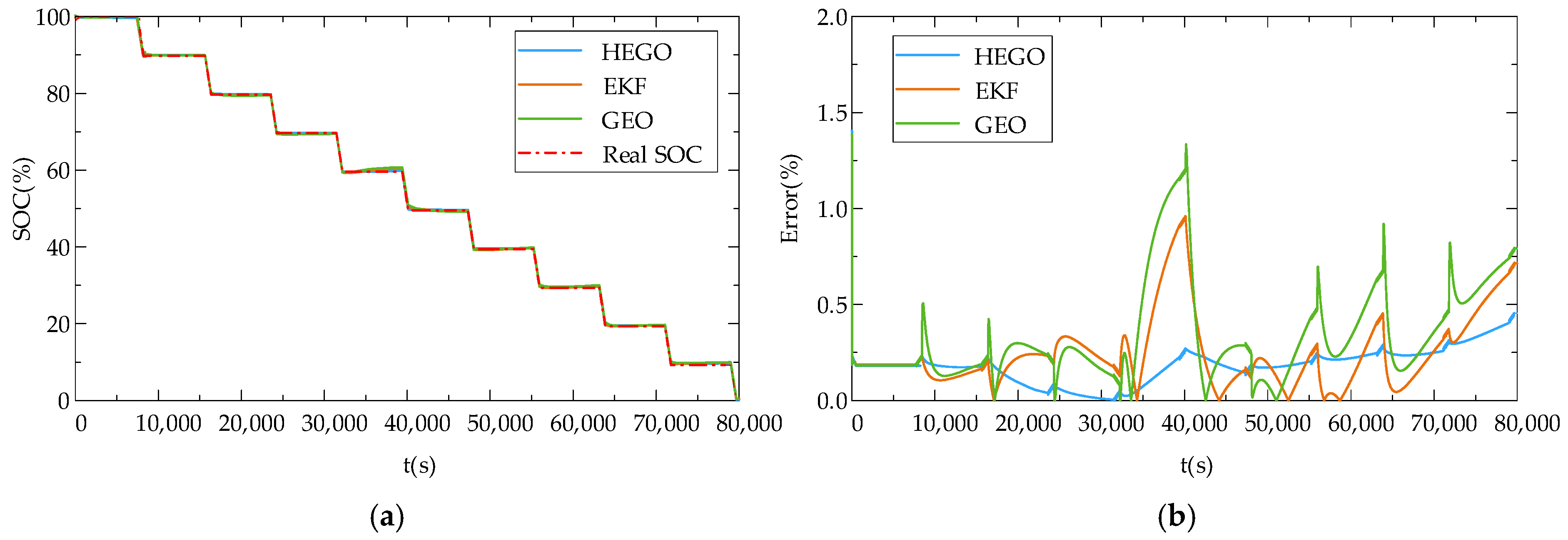
The experimental results and errors of SOC estimation using the three methods are shown in
Figure 16. As can be seen from
Figure 16a, all three algorithms can accurately track the true battery SOC, yet the HEGO method exhibits smaller fluctuations than the other two methods. From the error plot in
Figure 16b, it can be observed that when the current abruptly changes from 0 to –1 A, the conventional EKF method and the GEO method cannot accurately estimate SOC in response to the battery polarization effect caused by the sudden current change, and their errors fluctuate considerably. This visual fluctuation indicates that these methods cannot accurately or rapidly adjust to the battery polarization effects caused by sudden current steps. In contrast, the HEGO method maintains stable errors throughout the entire process, error remaining below 0.5%. To enable a more quantitative comparison,
Figure 17 presents the mean RMSE and the corresponding standard deviation of all algorithms over 30 repeated experiments. It is evident that, among the three algorithms, the HEGO method achieves the smallest RMSE and short error bars, indicating excellent performance in SOC estimation.
The HEGO algorithm proposed in this paper integrates the EHO and the GEO. Its computational load is primarily determined by the population size and the maximum number of iterations, as each iteration requires fitness evaluation for all individuals in the population. In contrast, the conventional EKF relies mainly on continuous matrix operations, and its computational burden is closely related to the dimension of the state vector.
To quantify the computational complexity of the proposed algorithm, this paper evaluates the execution time of each core module. Based on multiple simulation runs, the average single-step execution time of the proposed HEGO is approximately 2.05 ms, whereas the GEO method and the conventional EKF method are on the order of 49.0 μs and 1.67 μs, respectively. Although the hybrid optimization strategy introduces extra computational overhead to escape local optima and enhance parameter identification accuracy, its overall execution time remains at the millisecond level, demonstrating favorable real-time performance and feasibility for practical battery management system applications.
6. Conclusions
This paper proposes HEGO, an optimization algorithm that integrates EHO and GEO, to estimate the optimal values of the noise matrix and equivalent circuit parameters online during the operation of the EKF. This approach overcomes the limitation of conventional EKF method, where fixed parameters fail to reflect the true state of the battery, thereby improving the accuracy of EKF-based SOC estimation.
To verify the superiority of the proposed algorithm, comparative experiments were conducted with the conventional EKF method and the GEO method. The experimental results demonstrate that, under both FUDS and DST operating conditions and across three different temperature environments of 0 °C, 25 °C, and 45 °C, the proposed algorithm consistently achieves the highest SOC estimation accuracy, with the RMSE ranging from a minimum of 0.54% to a maximum of 0.78%. Under the HPPC condition at 25 °C, it further exhibits ideal SOC estimation accuracy, with an RMSE of 0.31%. Through comparative analysis of the experiments, it is found that the single GEO method improves SOC estimation over the conventional EKF method across the entire temperature range. However, due to the inherent inability of the GEO method to precisely optimize within a large search range, significant errors occur at moments affected by polarization phenomena, and the cumulative error throughout the entire discharge process cannot be corrected in a timely manner. The hybrid population-based optimization algorithm employed in the proposed HEGO method effectively resolves these issues by using EHO to narrow the search range, thereby compensating for the deficiency of GEO, while simultaneously leveraging GEO to overcome the weakness of EHO in fine search.
The research results indicate that the HEGO method achieves a significant improvement in SOC estimation accuracy and exhibits superior generalizability, thereby providing a reliable technical approach for SOC estimation of energy storage batteries.
The proposed HEGO-based SOC estimation method supports two deployment modes: an online mode in which the algorithm is integrated into the charger for real-time estimation, and an offline mode that relies on pre-identified fixed parameters stored in the controller. Since fixed parameters cannot adapt to abrupt changes caused by battery polarization effects, real-time estimation is the more suitable option. For practical deployment, an offline parameter library is first established at the three tested temperatures (0 °C, 25 °C, and 45 °C). When the system starts at a non-preset temperature, model parameters are initialized by interpolating within this library, providing well-matched initial values for the EKF and eliminating the need for expensive online identification at every cold start. Critically, the parameters are not permanently fixed after initialization. During continuous operation, the EKF predicts the terminal voltage and compares it with the measured value; if the residual persistently exceeds a preset threshold, significant model mismatch caused by temperature drift or battery aging is detected, and a new round of online identification is triggered immediately. Additionally, abrupt or excessively large temperature deviations directly force re-identification as a safety measure. This combined strategy avoids heavy computational overhead under normal conditions while ensuring estimation accuracy and enhancing system safety.