
Article

A Novel Method for Determining the Specific Heat Capacity of Cylindrical Li-Ion Batteries
Faculty of Physics and Technology, Plovdiv University “Paisii Hilendarski”, 4000 Plovdiv, Bulgaria
*
Author to whom correspondence should be addressed.
Batteries 2026, 12(7), 226; https://doi.org/10.3390/batteries12070226 (registering DOI)
Submission received: 29 May 2026 / Revised: 17 June 2026 / Accepted: 20 June 2026 / Published: 25 June 2026

Abstract

This study presents a novel and accessible method for determining the specific heat capacity of cylindrical lithium-ion batteries without the need for specialized equipment for cell disassembly, climatic chambers, or expensive calorimeters. The proposed approach does not require disassembly of the cell. Since specific heat capacity is a key parameter in thermal modeling and is often unavailable in manufacturer datasheets, the method addresses an important practical gap. The measurement principle is based on recording the change in surface temperature caused by a short 30 s discharge pulse of 9 A. A thermographic camera captures infrared images at fixed time intervals, while an electromechanical module rotates the battery around its longitudinal axis, providing an accurate estimation of the average surface temperature during and after the pulse. The resulting temperature–time profiles are used to evaluate heat losses and compute the specific heat capacity. To validate the methodology, experiments were conducted on an aluminum cylinder of identical dimensions to an 18650 cell, made of Al 6082-T6 (Cp ≈ 896 J·kg−1·K−1). The results show a maximum deviation of 2.68% from the reference value, confirming the reliability of the proposed method for determining the specific heat capacity of cylindrical Li-ion batteries.

1. Introduction

Lithium-ion batteries (LIBs) are a leading energy technology in the modern world and are widely used in portable electronics, electric vehicles, autonomous systems, and large-scale energy networks [1,2]. They are characterized by high energy and power density, long service life, and a low self-discharge rate, which makes them the dominant choice over alternative electrochemical energy storage systems. The growing demand—with projected capacities of tens of GWh within individual countries alone [3]—further emphasizes the importance of LIBs for sustainable energy transition and transport electrification. Recent research has intensively focused on synthesizing next-generation high-voltage cathode materials, such as modified olivine-phosphates, to enhance electrochemical performance [4].
Temperature is one of the most important parameters influencing the behavior and degradation of lithium-ion cells. It affects capacity, internal resistance, charging and discharging efficiency, as well as battery lifetime [5]. Uncontrolled temperature increase may lead to overheating, thermal runaway and, in extreme cases, ignition [6,7,8]. Therefore, every modern battery management system (BMS) includes a specialized thermal management module (TMM), which monitors and regulates the thermal state of the battery [8,9,10,11].
The development of reliable and accurate temperature models is essential for predicting the thermal behavior of cells under real operating conditions [12,13,14,15,16,17,18,19]. These models are based on fundamental energy relationships. In order for such models to be valid and applicable, correct information regarding the thermal properties of the battery is required—most importantly, its specific heat capacity.
Specific heat capacity is a critical thermodynamic parameter that determines how the temperature of the cell changes for a given amount of generated heat. It enables prediction of the rate of temperature increase and assessment of overheating risks during operation. Despite its important role, this characteristic is rarely provided by manufacturers, and its values vary significantly depending on cell construction, the materials used, and electrode configuration [10].
Studies show that specific heat capacity generally increases with increasing cell temperature and is relatively independent of the state of charge (SoC) [20,21,22], which highlights the need for experimental determination of this parameter for each specific battery. Without accurate data, simulations of thermal behavior, optimization of BMS strategies, and assessment of safety and degradation remain incomplete or inaccurate.
Therefore, measuring the specific heat capacity of lithium-ion batteries is an essential step for developing reliable thermal models, advanced management systems, safer operation, and longer battery lifetime. This directly supports global efforts aimed at waste reduction, production optimization, and improving the sustainability of energy systems [23,24,25].
Thermal modeling of lithium-ion cells requires reliable specific heat capacity data, since it is a key parameter in all thermal models—from the early energy-balance model of Bernardi et al. [26] to modern electrochemical-thermal [27,28,29], electrothermal [14,30], and runaway propagation models [31,32]. Regardless of their complexity, these models require either the heat capacity value of the cell or the specific heat capacities of the individual materials from which the cell is constructed, which are rarely available.
Numerous experimental approaches for determining specific heat capacity have been proposed in the literature.
Despite its theoretical accuracy, this approach has serious practical limitations, since it requires physical disassembly of the cell and analysis of its constituent materials. It is an extremely time-consuming process requiring specialized equipment and detailed information about battery composition as well as chemical analysis. For these reasons, the method is difficult to implement under standard laboratory conditions and remains of limited practical applicability.
Semi-theoretical methods are based on calculating the weighted sum of the heat capacities of the individual cell components, where the specific heat capacity of each material is first determined and subsequently combined into an overall battery value [33,34,35].
Therefore, alternative techniques for measuring specific heat capacity have been developed, such as installing a thermocouple inside the battery [36]. Here, the main difficulties are associated with the sensor installation process, which requires operation in a specialized argon chamber and carries a high risk of mechanical or structural damage to the cell.
Thermal impedance spectroscopy (TIS) [37] and electrothermal impedance spectroscopy (ETIS) [38,39] are methods that have been successfully used for determining specific heat capacity, but they are relatively time-consuming, and uncertainties may arise in the measurements due to heat exchange with the surrounding environment.
Other conceptually simpler methods have also been developed, which do not require expensive laboratory equipment and provide good accuracy [40,41,42]. For example, the method described in [43] is based on conducting two separate experiments (with and without a fan) to measure the specific heat capacity of the cell, where the battery is internally heated following discharge at a current greater than 1C. In this case, additional heat losses may occur in the electrical contact regions, which can lead to uncertainties in determining thermal characteristics.
The calorimetric method is the most widely used approach for determining the specific heat capacity of lithium-ion cells [44,45] and has been broadly applied to different battery types [33,37,46,47]. The use of an accelerating rate calorimeter or a hot-flow isothermal calorimeter [21,47] enables highly accurate results to be obtained.
Despite its advantages, this method has significant limitations associated with the high cost of calorimeters. Furthermore, due to the limited volume of the measurement chamber, it is not always possible to measure the entire battery. In many cases, this necessitates disassembly of the battery in order to analyze the individual materials comprising the cell. Considering the specific requirements imposed by the complex battery structure, this process requires specialized disassembly equipment and also increases the risk of errors associated with electrolyte loss [48].
In essence, calorimeters measure the heat absorbed by the cell during heating by accounting for or compensating for heat losses. This means that if these losses can be determined by another method, the need for a calorimeter would be eliminated.
The available methods for determining specific heat capacity differ in terms of complexity, equipment requirements, cost, accuracy, and safety. The lack of universally accessible and reliable specific heat capacity data is among the major challenges in the thermal modeling of lithium-ion batteries, motivating the search for precise, inexpensive, and rapid experimental approaches.
Table 1 presents a comparative analysis of the accuracy, experimental duration, equipment costs, and complexity of some existing methods.
The aim of this article is to demonstrate a novel method for measuring the specific heat capacity of cylindrical lithium-ion batteries. The method is based on determining the change in cell surface temperature using a thermographic camera. The operation of the thermographic camera is synchronized with an electromechanical device that provides rotational movement of the battery, thereby enabling determination of the average surface temperature. During the experiment, a short discharge pulse is applied through the battery, whose duration does not significantly alter the battery state of charge and causes only a small temperature variation.
Furthermore, the short duration of the experiment does not lead to an increase in laboratory temperature, which eliminates the need to conduct the experiments in a climatic chamber. Numerical methods are applied to determine the resulting heat losses, allowing the specific heat capacity to be determined without the use of a calorimeter and using only standard equipment.
The developed method requires only a single experiment for determining the thermal parameters of the battery. In this way, both the cost and time required for the thermal characterization of lithium-ion cells are reduced without compromising parameter determination accuracy. The resulting specific heat capacity will be useful in the development of thermal models and in the design of cooling systems for LIBs.

2. Materials and Methods

2.1. Determination of Specific Heat Capacity

Specific heat capacity characterizes the ability of the battery to accumulate thermal energy and indicates the amount of heat required to increase its temperature by one degree.
The specific heat capacity of a lithium-ion battery is determined by the following equation:
C p = Q m · T   ,
where Cp—specific heat capacity of the battery; Q—amount of released heat; m—battery mass; T —temperature change of the battery.
To determine the thermal behavior of lithium-ion batteries, the energy balance equation is used. It allows the heat generation during battery operation to be determined [25].
Q · = I 2 R Ω + I η pol + I T d V o c v d T   ,
where Vocv—open-circuit voltage; I—discharge current magnitude; η —polarization overpotential; R Ω o h m i c   r e s i s t a n c e .
The first term of the equation represents the Joule heating component. This is the heat generated by the pure electrical resistance of the battery, which includes electrolyte resistance, current collector resistance, the ohmic resistance of electrode materials, and contact resistances.
The second term describes the polarization heat generated by overpotentials occurring during current flow [50,51,52].
The total overpotential η pol can be expressed by the following equation:
η pol = V o c v V t I R Ω ,
where Vt—instantaneous voltage value between the battery terminals during the discharge pulse.
The third term on the right-hand side of Equation (2) represents heat generation due to entropy change and is referred to as reversible entropic heat.
Substituting Equation (3) into Equation (2) yields Equation (4):
Q = I ( V o c v V t ) I T d V o c v d T
In Equation (4), the first term on the right-hand side represents heat generation due to Joule heating and electrode overpotentials. This component is referred to as irreversible heat. The second term on the right-hand side is referred to as reversible entropic heat [53].
In our study, entropic heat is neglected because its contribution is very small, especially in the mid-range of SoC. When operating at high discharge currents, reversible heat is a negligible fraction of the total heat generated in the battery [54,55].
It may therefore be assumed that the main heat generation Q in the battery is dominated by irreversible heat, arising from ohmic losses (Joule heating) and electrochemical polarization due to electrode overpotentials [54].
Q = I ( V o c v V t ) ,
In order to correctly measure the open-circuit voltage, before the experiment begins the battery is charged to a specified state of charge (SoC), after which it is allowed to rest for a period sufficient to reach electrochemical equilibrium; during this period, all transient overpotentials and concentration gradients generated during charging are sufficiently relaxed.
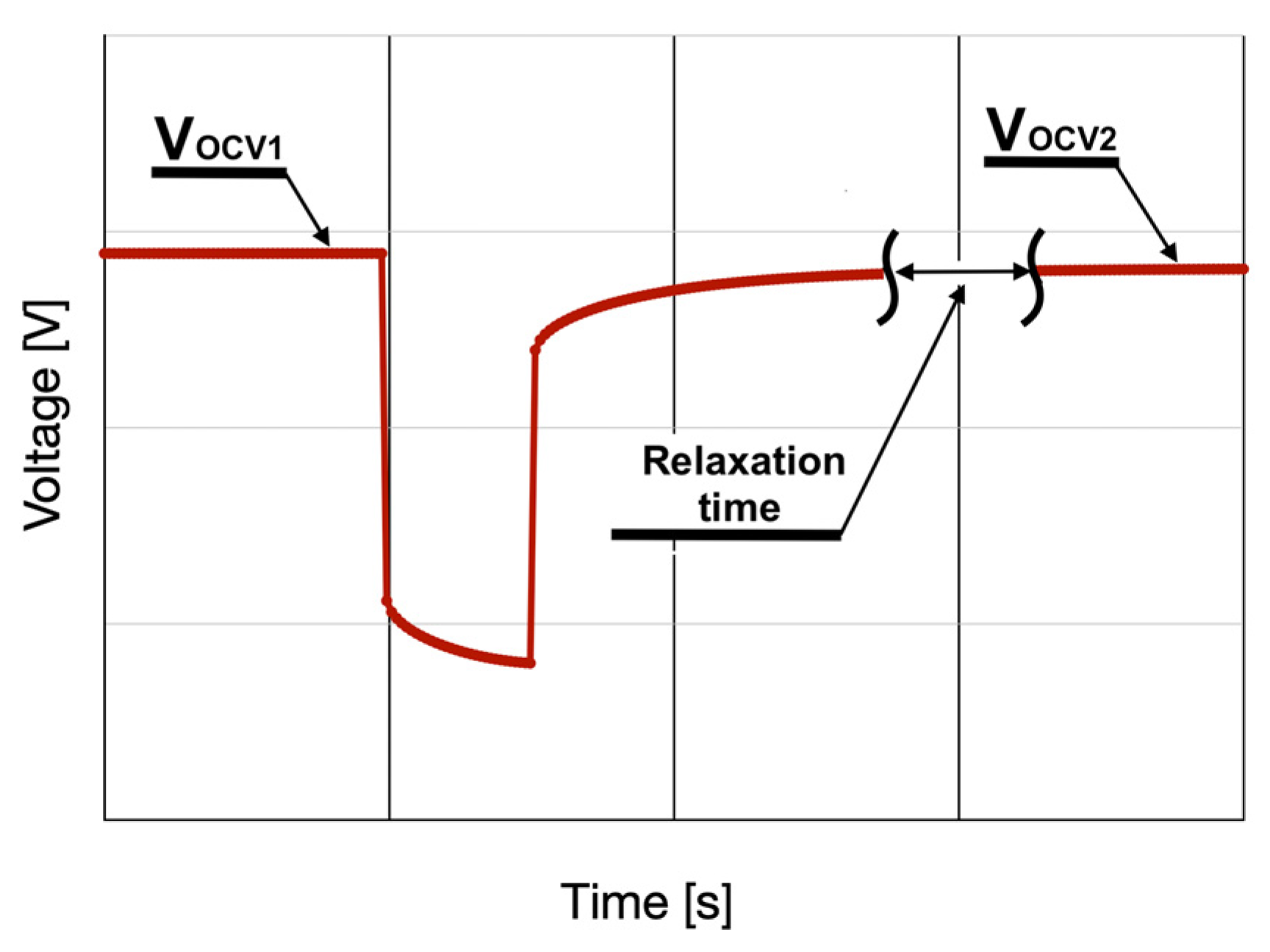
The open-circuit voltage is measured, after which the battery is discharged for a short time interval. After discharge termination, relaxation processes begin again within the battery, and its voltage starts to increase gradually. Following the relaxation period of 2 h, the open-circuit voltage is measured again, as shown in Figure 1.
The discharge duration is selected so that the change in battery SoC remains small. In this case, the OCV–SoC characteristic is nearly linear, and the open-circuit voltage during discharge may be approximated by the arithmetic mean of the relaxed voltages before and after the pulse (Equation (6)).
V o c v m i d l e = V o c v 1 + V o c v 2 2   ,
where Vocv1—open-circuit voltage before discharge; Vocv2—open-circuit voltage after relaxation.
Taking Equation (4) into account, the thermal energy due to irreversible losses, which causes an increase in battery temperature during the discharge pulse, can be calculated using the following equation:
Q irr = I k = 1 n ( V o c v m i d l e V t ) Δ t ,
where VOCVmidle—the open-circuit voltage approximated by the arithmetic mean of the relaxed voltages before and after the pulse; Vt—instantaneous voltage between the battery terminals during the discharge pulse; I—discharge current magnitude; Δt—time interval between measurements; к = 1…n—number of measurements during the discharge pulse.

2.2. Temperature Loss Correction

During experiments for determining the specific heat capacity, the temperature change of the battery generally does not depend solely on the amount of heat generated during discharge current flow. Part of this heat is dissipated through heat exchange with the surrounding environment due to convection, radiation, and thermal conduction toward the elements by which the battery is attached to the supporting structure. Therefore, in order to determine the adiabatic temperature rise, heat losses to the environment must be corrected. This correction may be obtained analytically from experimental temperature–time curves. Numerous methods for correcting heat losses to the surroundings are known and are successfully applied in calorimetric experiments [56,57,58,59,60,61].
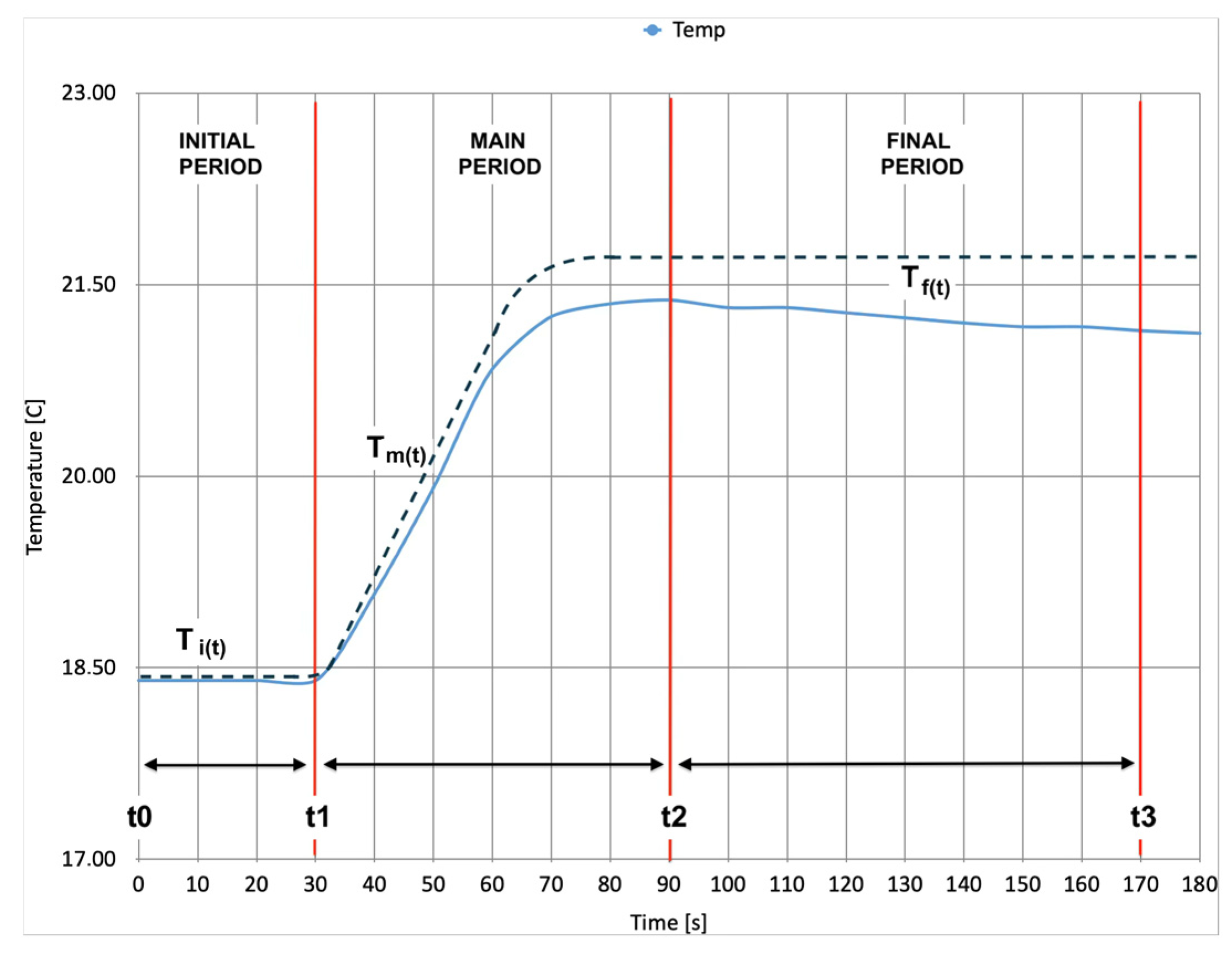
Figure 2 presents the shape of a temperature–time curve obtained by measuring the battery surface temperature using a thermographic camera. It consists of three periods: an initial stabilization period Ti(t), during which the battery is thermally stabilized and its temperature equalizes with ambient temperature; a main period, during which battery discharge occurs, accompanied by heat generation Tm(t); and a final period Tf(t), during which the battery temperature begins to decrease.
The temperatures T(t1) and T(t2) are respectively the temperatures at the beginning (time t1) and at the end (time t2) of the main period. Time t3 represents the end of temperature recording.
Time t1 is easily determined as the beginning of the main period, i.e., the onset of the discharge current pulse. Time t2 corresponds to the moment when the battery surface temperature reaches its maximum value.
In the ideal case of adiabatic temperature rise, when no heat exchange occurs between the battery and the surroundings (temperature curve shown by the black dashed curve), the initial period Ti(t) and the final period Tf(t) represent horizontal baselines, and the temperature increase of the battery is calculated as ΔTad = T(t2) − T(t1) [56]. In the real case of dynamic temperature measurements (blue curve in Figure 2), maintaining adiabatic conditions is impossible because heat transfer always occurs between the battery surface and the environment.
In this case, proper determination of ΔTad requires correction of the temperature rise.
The present article uses a method described by Challoner et al. [60], in which this correction is obtained analytically from the experimentally measured temperature–time curve.
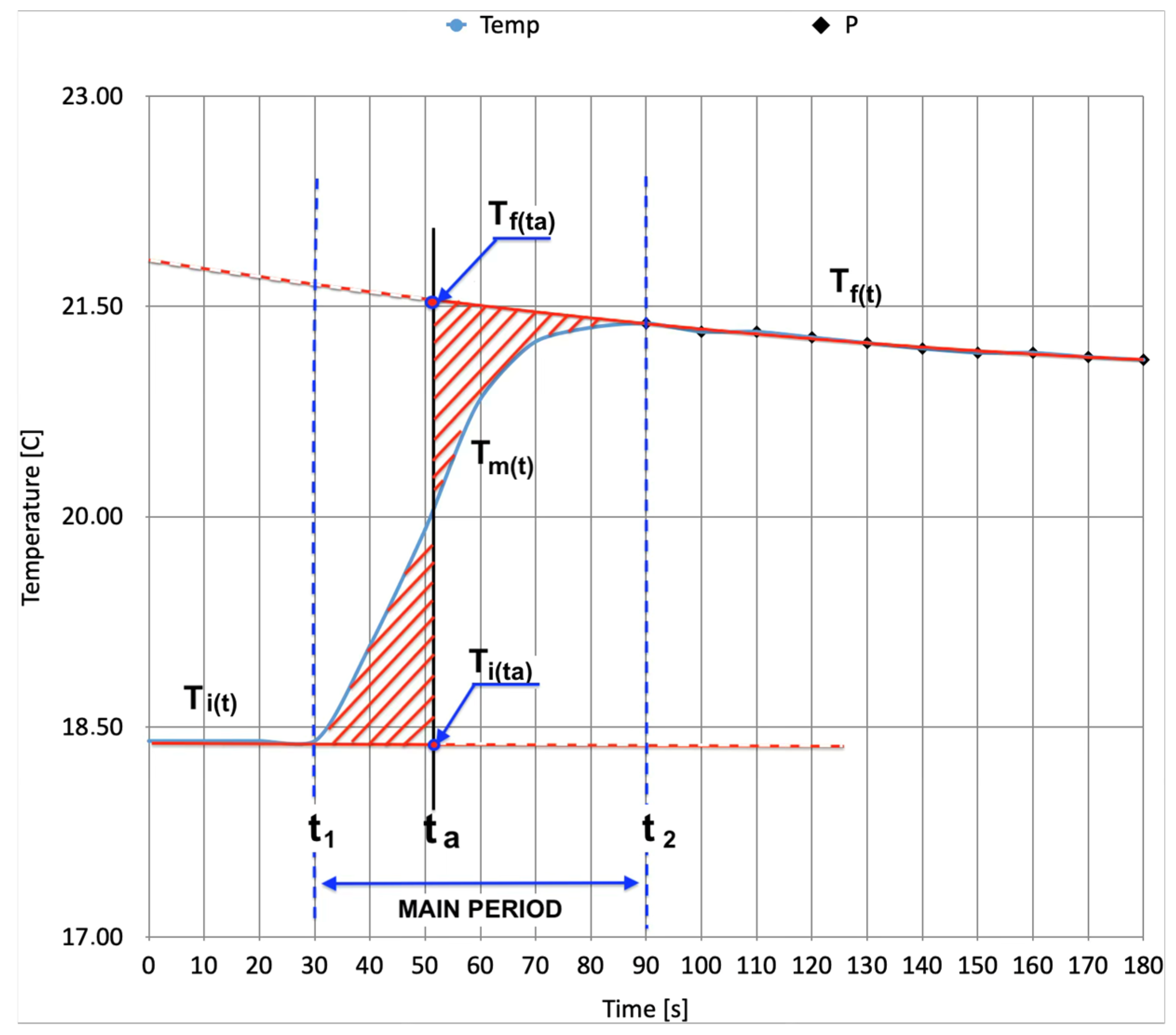
The method is based on applying polynomial approximation (regression) to the temperature data in the initial and final periods, Ti and Tf. Subsequently, extrapolation of the two functions Ti(t) and Tf(t) is performed to time ta.
Figure 3 schematically illustrates the method, where the temperature–time curves (Ti(t),Tf(t)) are extrapolated to a common point in time (ta). Time ta is selected in a manner ensuring that the two shaded areas in the graph are equal [57,58,59,60], which can be expressed by the following equation [56] (Equation (8)):
t 1 t a T m ( t ) T i ( t ) d t = t a t 2 T f ( t ) T m ( t ) d t ,
where Tm—instantaneous temperature value; Ti—initial temperature value; Tf—final temperature value.
The corrected temperature rise, ΔTad, is calculated from the final and initial temperatures at time ta (Equation (9)).
Δ T a d = T f ( t a ) T i ( t a )

3. Experimental Procedure

For the purposes of the present study, a system for rapid determination of the specific heat capacity of cylindrical lithium-ion batteries was developed. The experiments were conducted in an equipped thermographic laboratory without windows, where constant humidity and temperature were maintained. The minimum distance between the measurement system and the laboratory walls was 1.5 m. In addition, the laboratory room was completely darkened to eliminate the influence of other infrared radiation sources on the measurements.
Four cylindrical lithium-ion batteries, INR18650 22E, were investigated during the experiment. The cells are TerraE INR18650-22E (NMC/graphite chemistry), featuring a nominal capacity of 2200 mAh and a maximum continuous discharge current of 15 A. Five experiments were conducted for each battery. The surface of the tested battery is painted with thermographic paint for standard applications, HERP-LT-MWIR-BK-11, which has a known emissivity of ε = 0.94 for the angle range from 0° to 45° (according to the data sheet of the paint).
Before each experiment, the battery was charged using a laboratory power supply, Teledyne T3PS13206, operating in Constant Voltage mode at 4.2 V. The charging process was terminated when the charging current decreased to 0.03C, which for the investigated battery corresponds to a current of 66 mA.
After full charging, the battery was left at rest for 2 h in order to stabilize electrochemical processes and establish the open-circuit voltage.
To establish a 50% state of charge, controlled discharge with a constant current Idis = 1100 mA was performed using the electronic load TELEDYNE T3EL150303P. After completion of discharge, the battery was thermally stabilized for 2 h in the laboratory environment.
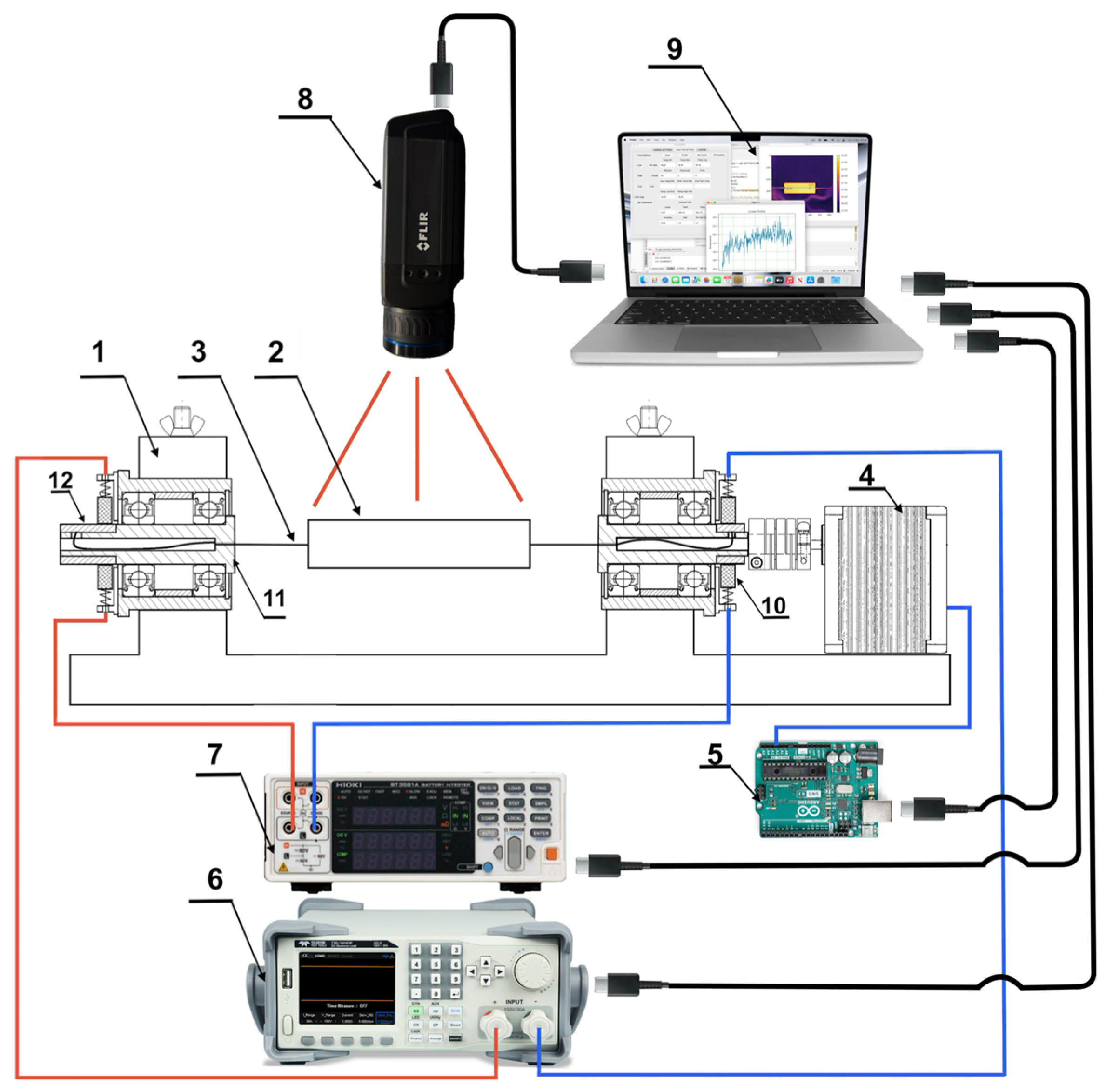
The proposed method for determining the specific heat capacity of Li-ion batteries is based on applying a short discharge current pulse to the battery and measuring the change in its surface temperature using a thermographic camera. Since the specific heat capacity depends weakly on the battery state of charge [21,48,49], precise determination of SoC is not required. The experimental setup is shown in Figure 4.
To provide rotational motion of the battery during discharge, a modified electromechanical module (1) is used, whose design is described in detail in [62].
Metal cylindrical electrodes (3) are soldered to both poles of the investigated battery (2). These electrodes are mounted in polymer shafts (11) and drilled along their longitudinal axis, with their ends soldered to slip rings (12) mounted on the shafts. Electrical contact between the electrodes (3) and the measuring instrumentation required for the experiment during battery rotation is established through graphite brushes (10) contacting the slip rings.
Control of the stepper motor (4), which provides rotational motion of the battery, is implemented using an Arduino Uno microcontroller board (5), connected to a personal computer through a USB interface.
A constant discharge current of 9 A for a duration of 30 s is applied to the battery using the electronic load TELEDYNE T3EL150303P (6).
The voltage between the battery terminals, both before and during discharge, is measured at 1 s intervals using the HIOKI BT3561A battery tester (7). For this purpose, two separate pairs of conductors are used. One pair provides the electrical circuit between the electronic load and the battery, while the second pair measures the voltage between its electrodes. Separation of the current and voltage electrodes eliminates errors arising from contact resistances during measurement.
The battery surface temperature is measured using a FLIR A615 thermographic camera (8).
The investigated battery is positioned relative to the thermographic camera so as to ensure observation of its entire length within the field of view.
Synchronization between the measuring instruments required for the experiment, the electromechanical module providing battery rotation, and thermographic image acquisition is achieved using specially developed software written in the Python 3.12 programming language and installed on a personal computer (9).
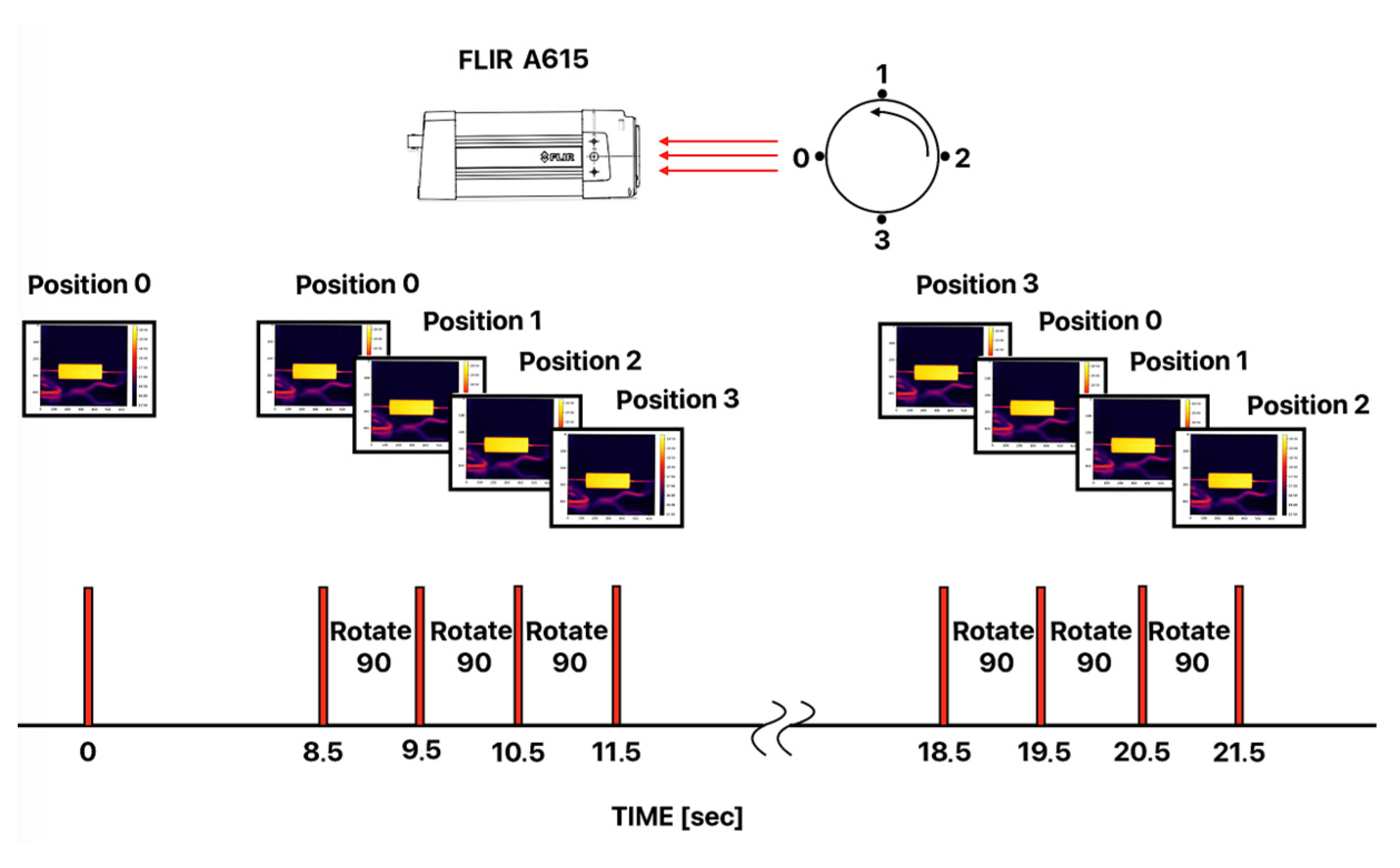
The camera is synchronized with the stepper motor, which provides discrete angular positioning of the battery around its longitudinal axis at an angle of 90°. In this way, thermographic imaging of the entire cylindrical surface becomes possible. Initially, before application of the discharge pulse, the first thermogram of the battery surface is recorded, from which information about ambient temperature can be extracted. Subsequently, the electronic load is activated, and the thermal camera begins capturing images at specified time intervals. The first thermographic image recorded after the start of the experiment corresponds to the initial angular position of the battery (φ = 0°). The battery is then rotated through three discrete positions with Δφ = 90°. After stabilization at each position, the battery is imaged. Thus, four thermograms are obtained for angular positions φ = 0°, 90°, 180° and 270°. Between successive image acquisitions, the battery remains stationary, ensuring that all thermographic images are obtained under quasi-stationary angular conditions. Figure 5 illustrates the experimental procedure.
Rotation is provided by a stepper motor with a step angle of 1.8°. The total time required to achieve the three positions is Δt_rot = 3 s. The angular velocity during rotation is 90°/s.
From the thermograms corresponding to the four angular positions, information regarding the average surface temperature of the battery is first extracted for each thermogram. These four values are subsequently averaged, yielding the mean surface temperature of the cylindrical battery for a given measurement cycle.
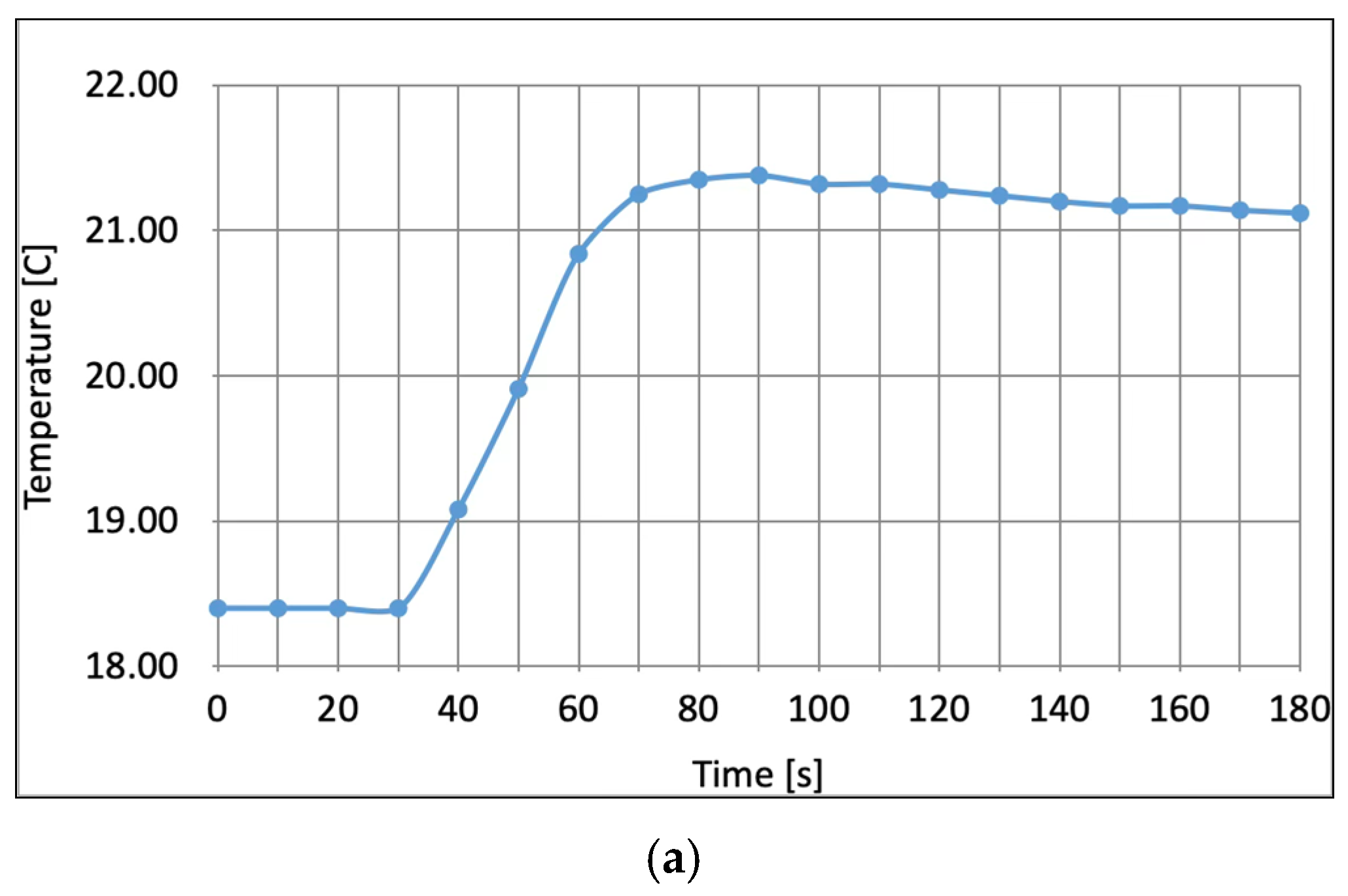
Figure 6a presents the change in battery surface temperature caused by discharge current flow, which leads to heat generation within the battery. Temperature is measured using the thermographic method described above.
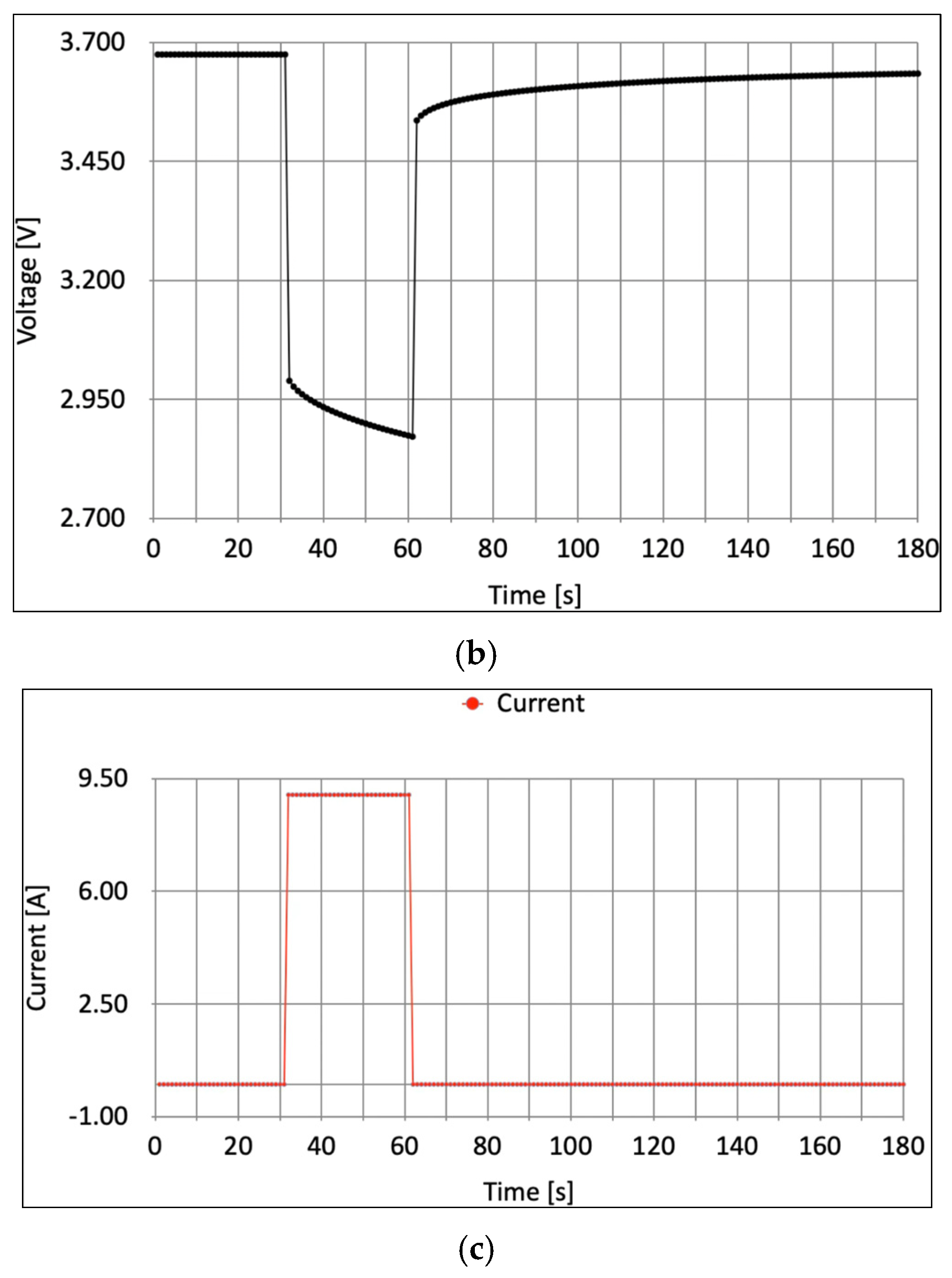
Initially, the battery is thermally stabilized, and its surface temperature is equal to that of the ambient laboratory air where the measurements are conducted. Immediately after the start of the discharge pulse, which has a constant current magnitude of 9 A (Figure 6c), the voltage between the battery terminals sharply decreases (Figure 6b), while the temperature begins to increase.
The observed increase in surface temperature after termination of discharge is due to the thermal energy accumulated inside the battery, which continues to be transferred toward its surface as a consequence of the finite thermal conductivity of the materials composing the battery structure.
Figure 6a clearly shows that after 90 s, the battery temperature begins to decrease. This process is caused by heat losses resulting from the transfer of thermal energy accumulated in the battery to the surrounding environment and to the connected structural elements due to the resulting temperature difference.

4. Results and Discussion

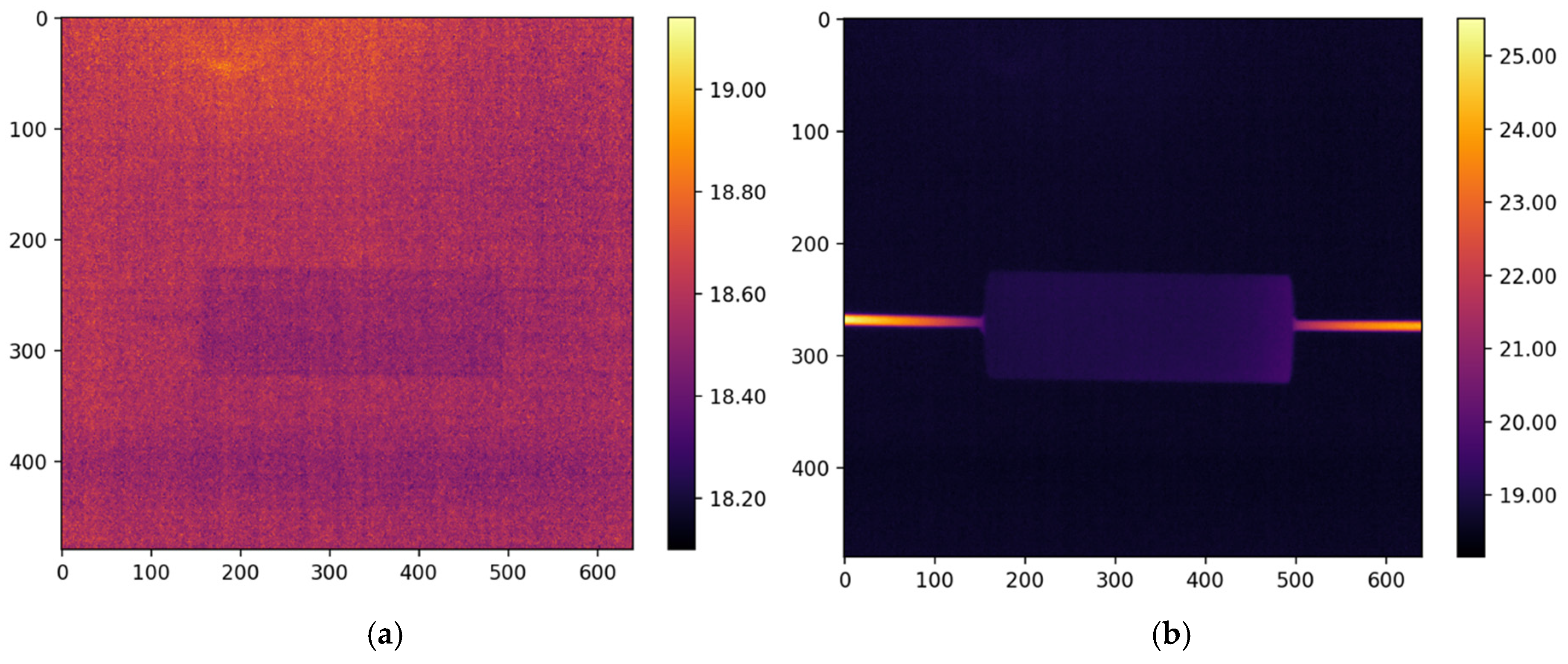
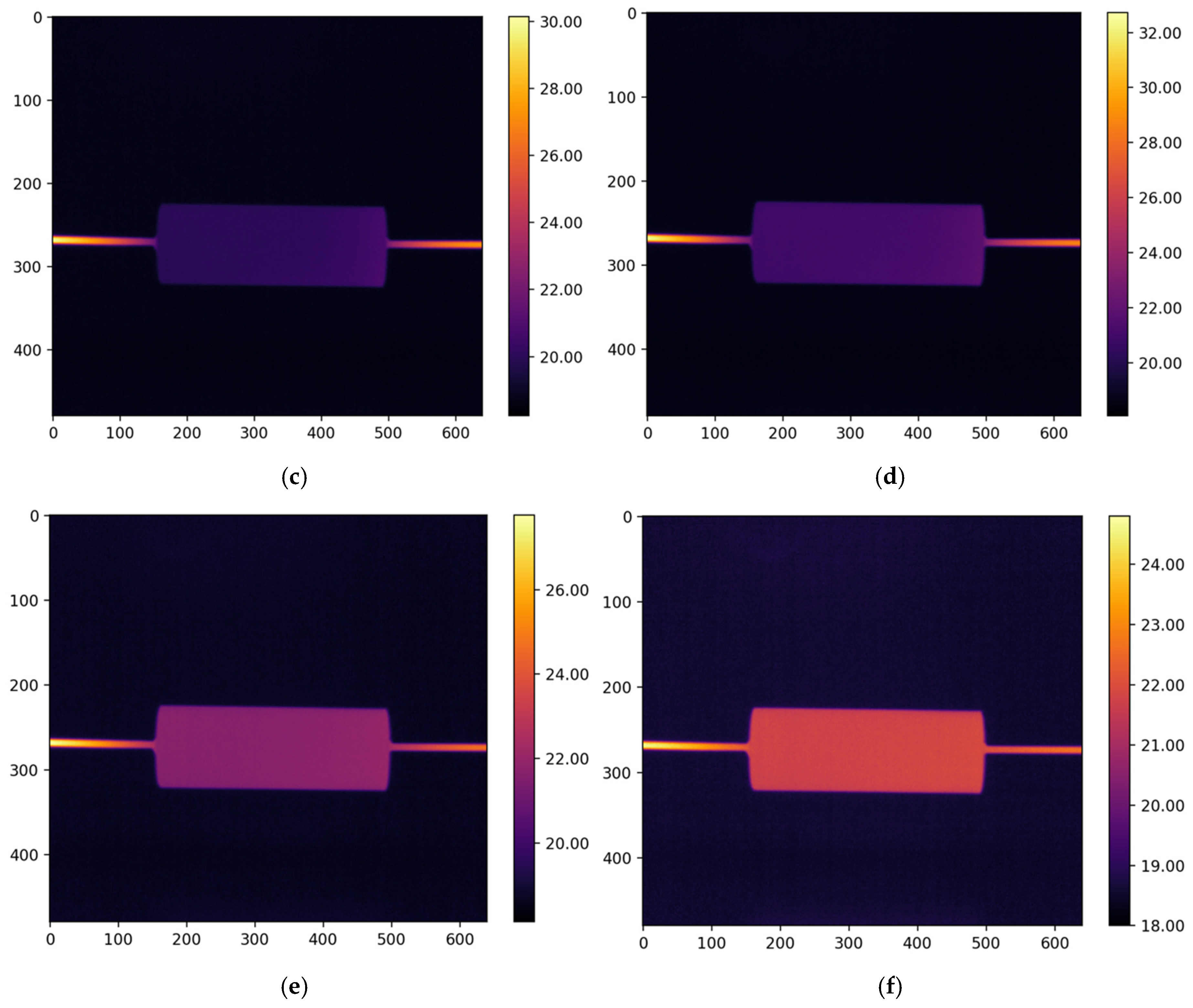
Figure 7 presents thermograms of one of the investigated cylindrical lithium-ion batteries, INR18650E 22, recorded at different time instants during one of the experiments.
As a result of the flowing discharge current, the electrodes soldered to the battery also become heated. The thermal contribution of the electrodes to battery heating is small and can be determined through the thermal gradient arising along the longitudinal axis of the electrode during discharge using Fourier’s law: Q ˙ e = λ A d T d x ; where A = 7.07 × 10⁻⁶ м2— electrode cross-sectional area; λ = 110 W/mK—thermal conductivity coefficient of the electrode; dT/dx = 82 K/m—temperature gradient; Q ˙ e —quantity of heat transferred through the material per unit time. Therefore, the quantity of heat transferred from the electrodes to the battery is Q = 0.064 W.
The energy generated as a result of discharge current flow in the battery is calculated using Equation (7). During measurement of the voltage between the battery terminals, the voltage drops across the cylindrical electrodes (position 3 in Figure 4) were taken into account and subtracted from the voltage values measured by the battery tester.
The current flowing through the battery during discharge had a value of 9 A and was imposed by the electronic load. The discharge pulse duration was 30 s. The total energy supplied to each battery as a result of electrical discharge and heat transfer from the two electrodes was 150 J, which was derived by the folowing equation:
Q tot = I k = 1 n ( V o c v m i d l e V t ) Δ t + Q ˙ e 1 + Q ˙ e 2
where Q tot   is the total energy supplied to the battery; Q ˙ e 1   a n d   Q ˙ e 2 are the quantity of heat energy transferred through the electrodes.
From the recorded thermograms, the average surface temperature of the batteries was determined at 10 s intervals, as described in Section 2.2. For each temperature profile, temperature correction was performed using the the method described in Section 2.2.
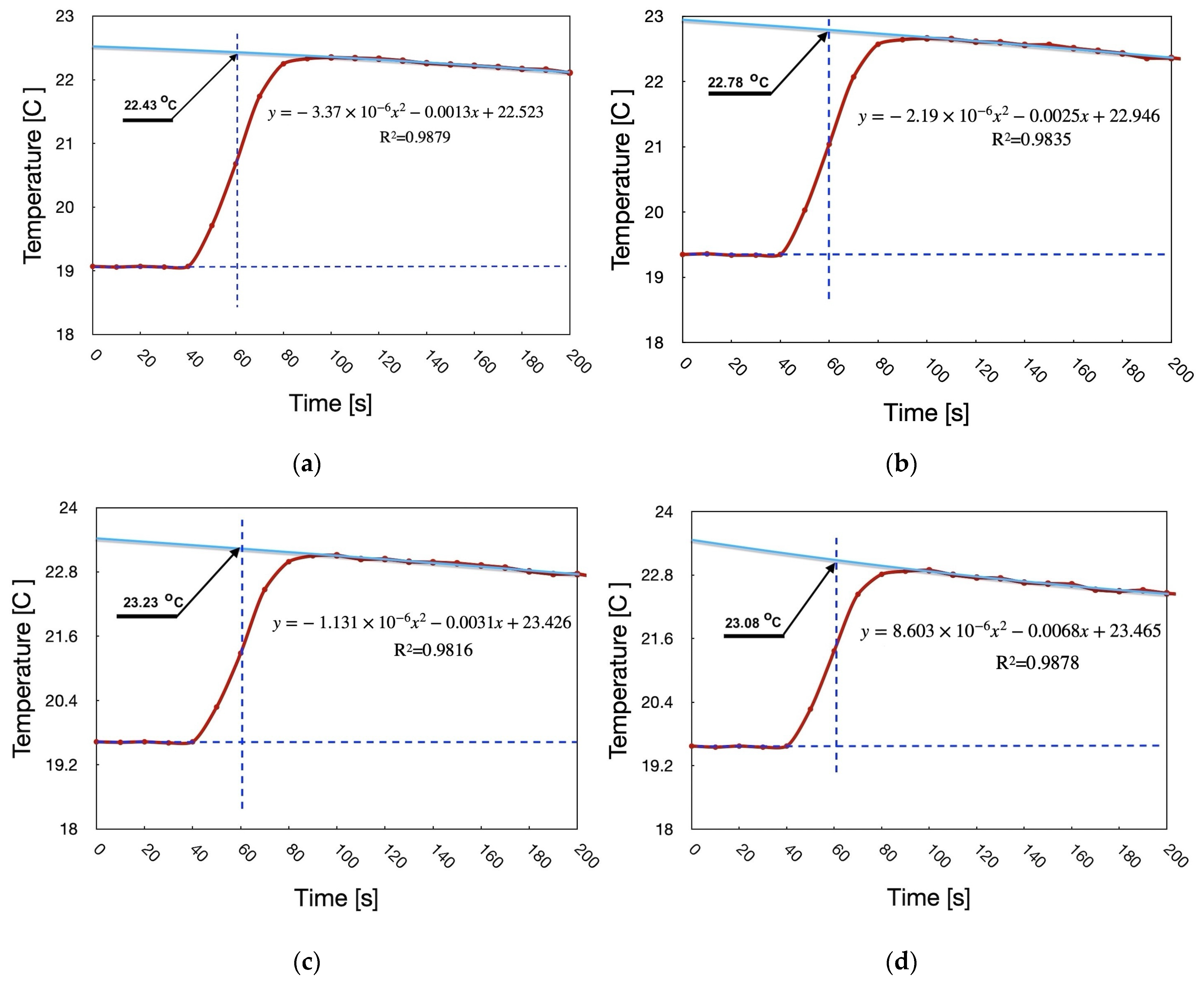
Figure 8 presents the temperature curves of each battery during one of the experiments, as well as the results obtained using the applied temperature correction method.
In Figure 8, the blue curve represents the trend line of the polynomial used for temperature extrapolation at time ta. Time ta is selected so that the condition of Equation (8) is satisfied.
The results for specific heat capacity obtained from five experiments conducted on four batteries are presented in Table 2.
A second-degree polynomial is used to approximate the experimental temperature-curve data in the final period of Figure 8. The obtained coefficient of determination R 2 0.98 indicates very good agreement between the approximation model and the measured temperature values.
Temporal discretization of the measurements (10 s) exerts a significant influence. For relatively smooth temperature variations, this interval is sufficient for correct process tracking and for achieving good approximation accuracy.
Due to the slow cooling process of the battery, reducing the time interval between measurements would not lead to a substantial increase in accuracy, since the temperature variation over short time intervals may become comparable to or smaller than the NETD (Noise Equivalent Temperature Difference) of the thermographic camera used. In this case, an additional increase in the sampling frequency would not provide further useful information.
Table 3 provides information on the equipment used in constructing the laboratory system and conducting the research.
The uncertainty budget was evaluated according to the Guide to the Expression of Uncertainty in Measurement (GUM) and included both Type A and Type B contributions (Table 4). The dominant uncertainty sources were the approximation of the open-circuit voltage (1.61%), measurement repeatability (1.00%), thermal camera noise (0.80%), and the heat-loss correction obtained by polynomial extrapolation of the cooling curve (0.78%).
The combined standard uncertainty was evaluated according to the law of propagation of uncertainty by combining all identified Type A and Type B uncertainty contributions in quadrature. This approach assumes that the individual uncertainty components are uncorrelated.
Combined standard uncertainty can be calculated by
u r C p = 1.00 2 + 0.25 2 + 0.056 2 + 1.61 2 + 0.010 2 + 0.013 2 + 0.80 2 + 0.78 2 = 2.18 %
The expanded uncertainty is calculated as
U r C p = k · U r C p = 4.36 %
using a coverage factor of k = 2, corresponding to an approximate confidence level of 95%. The resulting expanded uncertainty provides an interval expected to contain the true value of the specific heat capacity with a probability of approximately 95%.
For the proposed measurement method, the combined relative standard uncertainty was estimated as 2.18%, resulting in an expanded relative uncertainty of 4.36%.
In addition to the uncertainty analysis, the effect of neglecting reversible (entropic) heat generation was evaluated. Considering that the experiments were conducted at temperatures of approximately 19 degrees, the increase in cell temperature during the experiment is of the order of 3–4 degrees. The short discharge pulse with a duration of 30 s does not significantly change the battery charge level, which is approximately 50%. If we assume the value of d V o c v d T = + 0.15   m V · K 1 [63], the reversible heat contribution during the 30 s discharge pulse is estimated as approximately Q r e v = I · T · d V o c v d T = 0.3996   W ;   0.3996   W · 30   s = 12   J , corresponding to about 8% of the irreversible heat generation. Consequently, neglecting the entropic heat term may introduce a systematic underestimation of the specific heat capacity of approximately 7.4%. Since this effect represents a model assumption rather than a random measurement uncertainty, it is reported separately from the uncertainty budget. The parameters associated with reversible heat generation are shown in Table 5.
To distinguish measurement repeatability from cell-to-cell variability, a one-way analysis of variance (ANOVA) was performed using the five repeated measurements obtained for each of the four tested cells. The mean specific heat capacity values, standard deviations, and 95% confidence intervals are presented in Table 2.
The ANOVA analysis yielded an F-value of 7.11 and a corresponding p-value of approximately 0.003. Since the p-value is lower than the significance level of 0.05, the null hypothesis of equal population means was rejected. Therefore, statistically significant differences were observed among the measured cell populations.
The measured mean specific heat capacities ranged from 939.6 J kg−1 K−1 to 996.8 J kg−1 K−1, corresponding to a variation of approximately 6% between the investigated cells. This variation exceeds the expanded uncertainty of the proposed measurement method (4.36%, k = 2), suggesting the presence of cell-to-cell variability. However, because the observed differences are only moderately larger than the measurement uncertainty, and the number of tested cells was limited, further measurements on a larger population of cells would be required to quantify manufacturing-related variability with higher confidence.
These results indicate that, although the tested cells belong to the same battery model, measurable differences in their thermophysical properties may exist.
The validity of using the measured surface temperature as an approximation of the average cell temperature was assessed through the Biot number criterion. For a 18650 cell, using a characteristic length of 3.4 mm, a natural-convection heat transfer coefficient of 5–10 W m−2 K−1 and a reported effective radial thermal conductivity of 0.5–1.0 W m−1 K−1 [64,65], the resulting Biot number is 0.017–0.068, which is below the commonly accepted limit of Bi = 0.1 for lumped-capacitance analysis. Therefore, the temperature distribution inside the cell can be considered approximately uniform.
The obtained mean values of specific heat capacity for the four batteries are consistent with values reported in the literature for cylindrical 18650-type Li-ion cells with NMC chemistry [66].

5. Validation

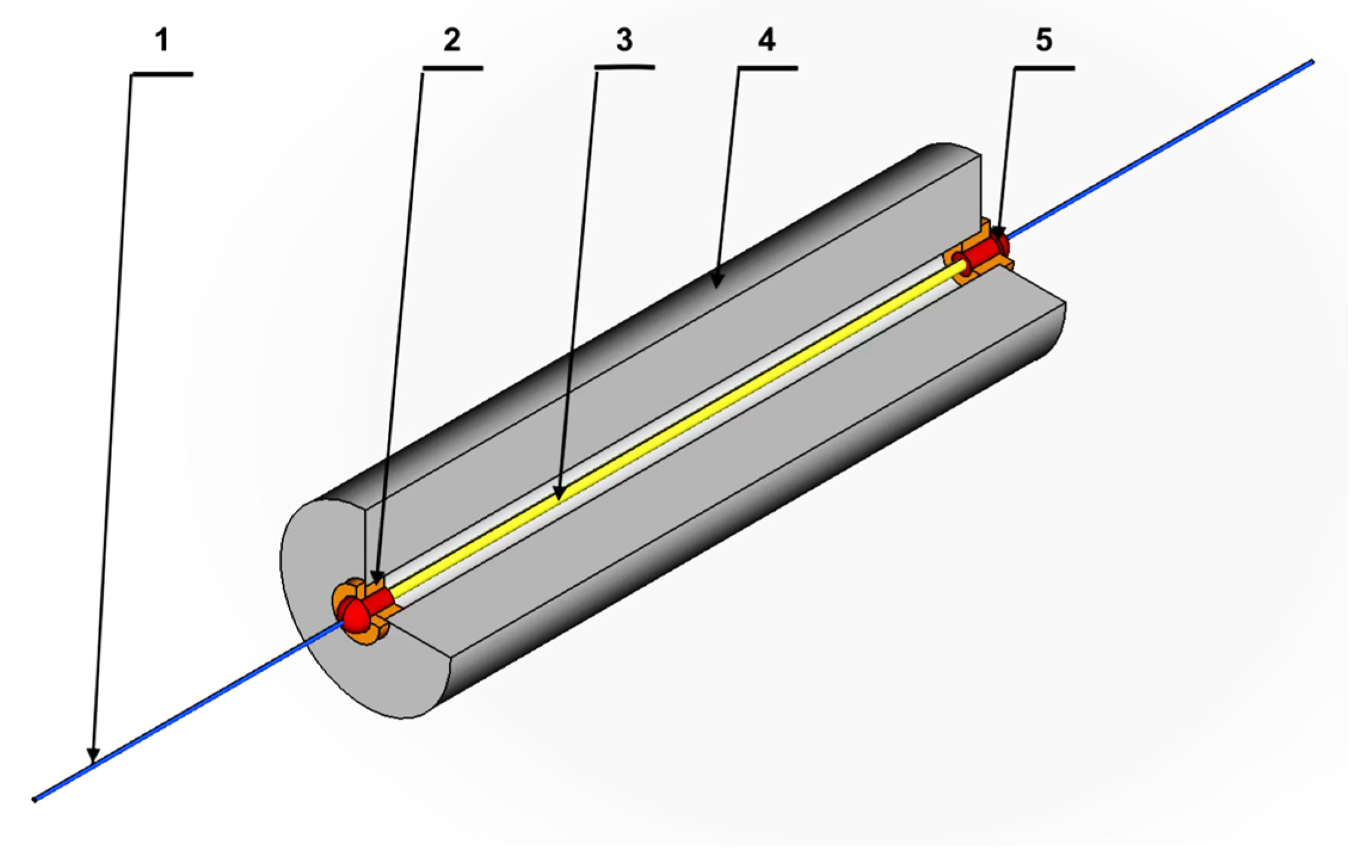
For validation of the method, an aluminum cylinder (Al 6082-T6) with a diameter of 18.5 mm and a length of 65 mm is manufactured. These dimensions are identical to those of a 18650 Li-ion battery. The schematic diagram of the validation device is presented in Figure 9.
A hole with a diameter of 3 mm is drilled in the center of the cylinder (4). A Kanthal heater (3) with a diameter of 0.1 mm is positioned longitudinally at the center of the hole. The heater is electrically insulated from the aluminum cylinder by polymer bushings (2) made of Teflon, with an outer diameter of 3 mm and an inner diameter of 1.5 mm. Both ends of the heater are soldered to copper contacts (5).
The resulting device is positioned in place of the battery.
The experiments were conducted according to the procedure described in Section 2, with the laboratory power supply Teledyne T3PS13206 connected instead of the electronic load in order to supply electrical power to the heater inside the aluminum cylinder.
To reduce conductive heat losses between the aluminum cylinder (4) and the rotating structural components, the mechanical connection between them was realized through two tubes (1), having an outer diameter of 0.85 mm, an inner diameter of 0.65 mm, and a length of 45 mm. The tubes were made of SS316 material with a thermal conductivity coefficient of λ = 16 W/mK. One end of each metal tube was soldered to the corresponding copper contact, thereby establishing the electrical connection between the heater and the power supply source.
The surface of the cylinder was coated with thermographic paint HERP-LT-MWIR-BK-11, which has an emissivity coefficient of 0.94 within an angular range.
For validation purposes, two experiments were conducted using different electrical power levels supplied to the heater in the aluminum cylinder.
In the first experiment, a constant current with a fixed value of 2 A was supplied to the heater. In this case, the voltage drop across the heating element was 5.63 V. The energy supplied to the heater was 337.8 J.
The second validation experiment was conducted under the following conditions: heater current 1.35 A and voltage drop across the heating element 3.78 V. The energy supplied to the heater was 158 J.
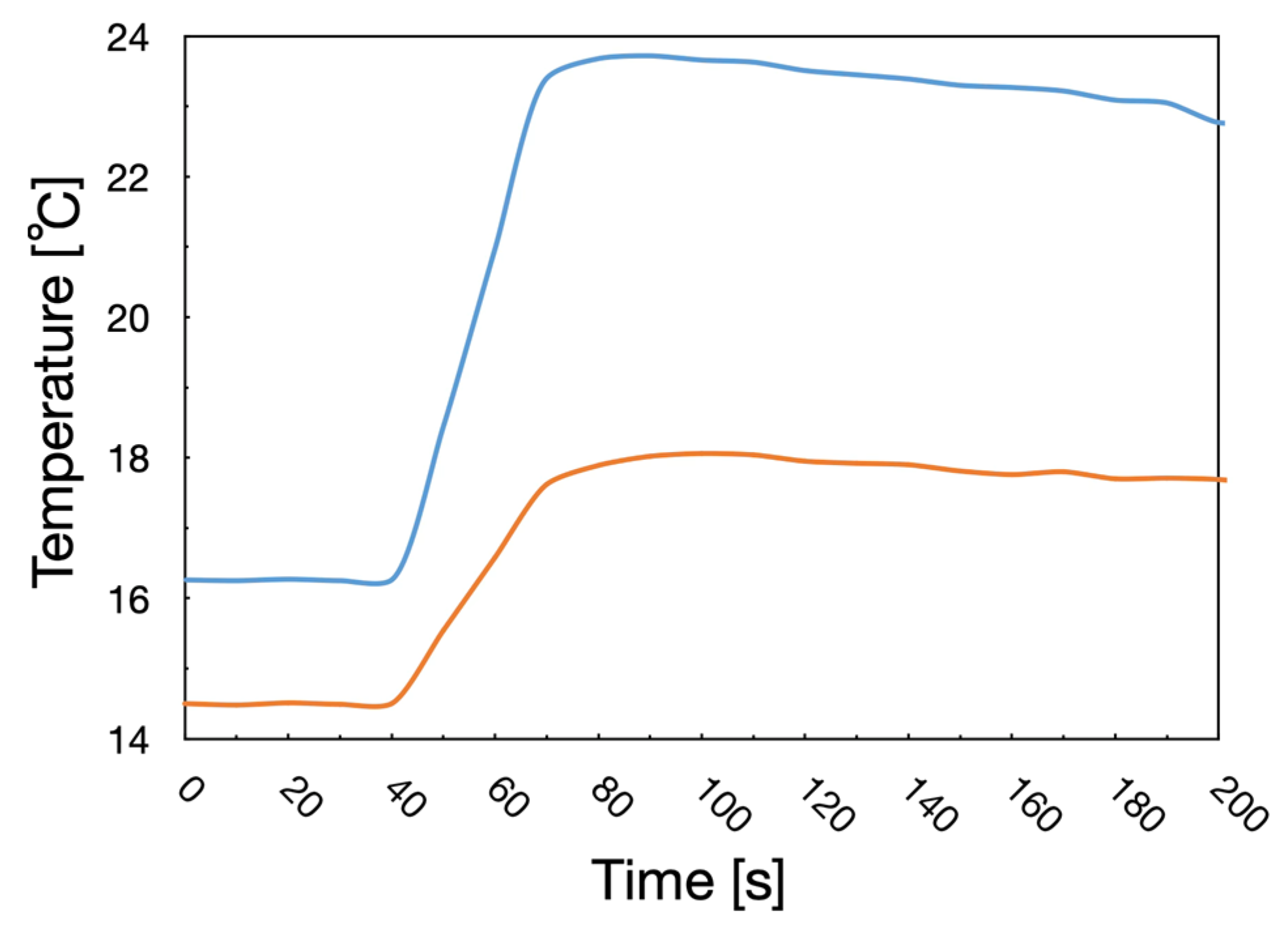
Figure 10 presents the graphical relationship between the change in surface temperature of the aluminum cylinder and time for the two conducted experiments.
Temperature correction was performed using the method described in Section 2.2. The obtained measurement results are presented in Table 6.

6. Conclusions

This article proposes a novel method for determining the specific heat capacity of cylindrical lithium-ion batteries. The method does not require specialized equipment for cyclic battery charging and discharging, a climatic chamber, or an expensive calorimeter. The experiments may be conducted in any laboratory without requiring battery disassembly and do not exert a significant influence on the battery SoH or SoC.
Specific heat capacity is one of the main parameters used in thermal modeling. Information regarding this parameter is difficult to obtain and is generally not provided by manufacturers in battery documentation.
The determination of specific heat capacity described in the present article is achieved by measuring the change in battery surface temperature resulting from application of a short discharge pulse with a duration of 30 s and a current magnitude of 9 A. To determine the average temperature of the entire battery casing, a thermographic camera is used to capture thermographic images at equal time intervals.
The battery is mounted in an electromechanical module that provides rotational movement around its longitudinal axis, synchronized with the operation of the thermographic camera. In this way, information regarding the average battery surface temperature is obtained at specific moments during discharge as well as after termination of the discharge pulse. Using the obtained results, temperature–time relationships are constructed and heat losses are calculated. The uncertainty budget was evaluated according to the Guide to the Expression of Uncertainty in Measurement (GUM). For the proposed measurement method, the combined relative standard uncertainty was estimated as 2.18%, resulting in an expanded relative uncertainty of 4.36%.
For validation of the method, an aluminum cylinder with the same dimensions as a 18650 Li-ion battery was used. The cylinder was manufactured from Al 6082-T6 material, which has a specific heat capacity of Cp ≈ 896 J/(kg·K).
The results obtained from the conducted experiments show a maximum error in determining the specific heat capacity of 2.68% compared to the reference value (896 J/(kg·K)), which confirms that this methodology can be reliably used to determine the specific heat capacity of cylindrical LIBs.

Author Contributions

Conceptualization, S.S. and N.K.; Investigation, S.S. and N.K.; Methodology, S.S. and N.K.; Project administration, N.K.; Writing—original draft, N.K. and S.S.; Writing—review and editing, S.S. and N.K. All authors have read and agreed to the published version of the manuscript.

Funding

This research was funded by the research project No. KП-06-H57/2 15.11.2021, “Hybrid and Fusion Prediction of The Functionality of Energy Converting Elements,” financed by the Bulgarian Research Fund, and project No. ДП22-ΦTΦ-001, financed by the Department for Scientific Research of Plovdiv University.

Data Availability Statement

The data presented in this study are available on request from the corresponding author. The data are not publicly available due to privacy and ethical restrictions.

Conflicts of Interest

The authors declare that they have no conflicts of interest.

References

  1. Schmidt, A.; Smith, A.; Ehrenberg, H. Power capability and cyclic aging of commercial high-power lithium-ion battery cells with respect to different cell designs. J. Power Sources 2019, 425, 27–38. [Google Scholar] [CrossRef]
  2. Kraytsberg, A.; Ein-Eli, Y. Higher, stronger, better… A review of 5 volt cathode materials for advanced lithium-ion batteries. Adv. Energy Mater. 2012, 2, 922–939. [Google Scholar] [CrossRef]
  3. Hecht, C.; Spreuer, K.G.; Figgener, J.; Sauer, D.U. Market review and technical properties of electric vehicles in Germany. Vehicles 2022, 4, 903–916. [Google Scholar] [CrossRef]
  4. Manfo, T.A.; Laaksonen, H. A comparative study of the modified high voltage olivine-phosphate LiMPO4 (M= Fe, Mn, Co, Ni) as promising cathode materials for next-generation rechargeable batteries. J. Energy Storage 2026, 160, 121797. [Google Scholar] [CrossRef]
  5. Waldmann, T.; Wilka, M.; Kasper, M.; Fleischhammer, M.; Wohlfahrt-Mehrens, M. Temperature dependent ageing mechanisms in lithium-ion batteries—A post-mortem study. J. Power Sources 2014, 262, 129–135. [Google Scholar] [CrossRef]
  6. Lin, J.; Liu, X.; Li, S.; Zhang, C.; Yang, S. A review on recent progress, challenges and perspective of battery thermal management system. Int. J. Heat Mass Transf. 2021, 167, 120834. [Google Scholar] [CrossRef]
  7. Sun, P.; Bisschop, R.; Niu, H.; Huang, X. A review of battery fires in electric vehicles. Fire Technol. 2020, 56, 1361–1410. [Google Scholar] [CrossRef]
  8. Liang, J.; Gan, Y.; Li, Y. Investigation on the thermal performance of a battery thermal management system using heat pipe under different ambient temperatures. Energy Convers. Manag. 2018, 155, 1–9. [Google Scholar] [CrossRef]
  9. Cheng, K.W.; Divakar, B.P.; Wu, H.; Ding, K.; Ho, H.F. Battery-management system (BMS) and SOC development for electrical vehicles. IEEE Trans. Veh. Technol. 2011, 60, 76–88. [Google Scholar] [CrossRef]
  10. Lu, L.; Han, X.; Li, J.; Hua, J.; Ouyang, M. A review on the key issues for lithium-ion battery management in electric vehicles. J. Power Sources 2013, 226, 272–288. [Google Scholar] [CrossRef]
  11. Rahimi-Eichi, H.; Ojha, U.; Baronti, F.; Chow, M. Battery management system: An overview of its application in the smart grid and electric vehicles. IEEE Ind. Electron. Mag. 2013, 7, 4–16. [Google Scholar] [CrossRef]
  12. Yang, W.; Zhou, F.; Zhou, H.; Wang, Q.; Kong, J. Thermal performance of cylindrical lithium-ion battery thermal management system integrated with mini-channel liquid cooling and air cooling. Appl. Therm. Eng. 2020, 175, 115331. [Google Scholar] [CrossRef]
  13. Chen, J.; E, J.; Kang, S.; Zhao, X.; Zhu, H.; Deng, Y.; Peng, Q.; Zhang, Z. Modeling and characterization of the mass transfer and thermal mechanics of the power lithium manganate battery under charging process. Energy 2019, 187, 115924. [Google Scholar] [CrossRef]
  14. Pan, Y.; Hua, Y.; Zhou, S.; He, R.; Zhang, Y.; Yang, S.; Liu, X.; Lian, Y.; Yan, X.; Wu, B. A computational multi-node electro-thermal model for large prismatic lithium-ion batteries. J. Power Sources 2020, 459, 228070. [Google Scholar] [CrossRef]
  15. Jaguemont, J.; Omar, N.; Abdel-Monem, M.; Van den Bossche, P.; Van Mierlo, J. Fast-charging investigation on high-power and high-energy density pouch cells with 3D-thermal model development. Appl. Therm. Eng. 2018, 128, 1282–1296. [Google Scholar] [CrossRef]
  16. Youssef, R.; He, J.; Akbarzadeh, M.; Jaguemont, J.; De Sutter, L.; Berecibar, M.; Van Mierlo, J. Investigation of thermal behavior of large lithium-ion prismatic cell in natural air convection. In Proceedings of the 2020 9th International Conference on Renewable Energy Research and Application (ICRERA), Glasgow, UK, 27–30 September 2020; pp. 43–47. [Google Scholar] [CrossRef]
  17. Karimi, D.; Behi, H.; Hosen, M.S.; Jaguemont, J.; Berecibar, M.; Van Mierlo, J. A compact and optimized liquid-cooled thermal management system for high-power lithium-ion capacitors. Appl. Therm. Eng. 2021, 185, 116449. [Google Scholar] [CrossRef]
  18. Behi, H.; Karimi, D.; Jaguemont, J.; Gandoman, F.H.; Khaleghi, S.; Van Mierlo, J.; Berecibar, M. Aluminum heat sink assisted air-cooling thermal management system for high-current applications in electric vehicles. In Proceedings of the 2020 AEIT International Conference of Electrical and Electronic Technologies for Automotive, Virtual Conference, 18–20 November 2020; pp. 1–6. [Google Scholar] [CrossRef]
  19. Akbarzadeh, M.; Jaguemont, J.; Kalogiannis, T.; Karimi, D.; He, J.; Jin, L.; Xie, P.; Van Mierlo, J.; Berecibar, M. A novel liquid cooling plate concept for thermal management of lithium-ion batteries in electric vehicles. Energy Convers. Manag. 2021, 231, 113862. [Google Scholar] [CrossRef]
  20. Lin, C.; Wen, H.; Liu, L.; Liu, S.; Ma, T.; Fan, B.; Wang, F. Heat generation quantification of high-specific-energy 21700 battery cell using average and variable specific heat capacities. Appl. Therm. Eng. 2021, 184, 116215. [Google Scholar] [CrossRef]
  21. Bazinski, S.J.; Wang, X. Experimental study on the influence of temperature and state-of-charge on the thermophysical properties of an LFP pouch cell. J. Power Sources 2015, 293, 283–291. [Google Scholar] [CrossRef]
  22. Murashko, K.A.; Mityakov, A.V.; Pyrhonen, J.; Mityakov, V.Y.; Sapozhnikov, S.S. Thermal parameters determination of battery cells by local heat flux measurements. J. Power Sources 2014, 271, 48–54. [Google Scholar] [CrossRef]
  23. Liu, Y.; Zhang, R.; Wang, J.; Wang, Y. Current and future lithium-ion battery manufacturing. iScience 2021, 24, 102332. [Google Scholar] [CrossRef] [PubMed]
  24. Börner, M.F.; Frieges, M.H.; Späth, B.; Spütz, K.; Heimes, H.H.; Sauer, D.U.; Li, W. Challenges of second-life concepts for retired electric vehicle batteries. Cell Rep. Phys. Sci. 2022, 3, 101095. [Google Scholar] [CrossRef]
  25. Zhao, Y.; Pohl, O.; Bhatt, A.I.; Collis, G.E.; Mahon, P.J.; Rüther, T.; Hollenkamp, A.F. A review on battery market trends, second-life reuse, and recycling. Sustain. Chem. 2021, 2, 167–205. [Google Scholar] [CrossRef]
  26. Bernardi, D.; Pawlikowski, E.; Newman, J. A general energy balance for battery systems. J. Electrochem. Soc. 1985, 132, 5–12. [Google Scholar] [CrossRef]
  27. Song, L.; Evans, J.W. Electrochemical-thermal model of lithium polymer batteries. J. Electrochem. Soc. 2000, 147, 2086–2095. [Google Scholar] [CrossRef]
  28. Feng, F.; Teng, S.; Liu, K.; Xie, J.; Xie, Y.; Liu, B.; Li, K. Co-estimation of lithium-ion battery state of charge and state of temperature based on a hybrid electrochemical-thermal-neural-network model. J. Power Sources 2020, 455, 227935. [Google Scholar] [CrossRef]
  29. Gambhire, P.; Ganesan, N.; Basu, S.; Hariharan, K.S.; Kolake, S.M.; Song, T.; Oh, D.; Yeo, T.; Doo, S. A reduced order electrochemical thermal model for lithium-ion cells. J. Power Sources 2015, 290, 87–101. [Google Scholar] [CrossRef]
  30. Ruan, H.; Jiang, J.; Sun, B.; Gao, W.; Wang, L.; Zhang, W. Online estimation of thermal parameters based on a reduced wide-temperature-range electro-thermal coupled model for lithium-ion batteries. J. Power Sources 2018, 396, 715–724. [Google Scholar] [CrossRef]
  31. Ren, D.; Feng, X.; Lu, L.; Ouyang, M.; Zheng, S.; Li, J.; He, X. An electrochemical-thermal coupled overcharge-to-thermal-runaway model for lithium-ion battery. J. Power Sources 2017, 364, 328–340. [Google Scholar] [CrossRef]
  32. Feng, X.; Lu, L.; Ouyang, M.; Li, J.; He, X. A 3D thermal runaway propagation model for a large-format lithium-ion battery module. Energy 2016, 115, 194–208. [Google Scholar] [CrossRef]
  33. Spinner, N.S.; Mazurick, R.; Brandon, A.; Rose-Pehrsson, S.L.; Tuttle, S.G. Analytical, numerical and experimental determination of thermophysical properties of commercial 18650 LiCoO2 lithium-ion battery. J. Electrochem. Soc. 2015, 162, A2789–A2795. [Google Scholar]
  34. Benger, R.; Wenzl, H.; Beck, H.-P.; Jiang, M.; Ohms, D.; Schaedlich, G. Electrochemical and thermal modeling of lithium-ion cells for use in HEV or EV application. World Electr. Veh. J. 2009, 3, 342–351. [Google Scholar] [CrossRef]
  35. Maleki, H.; Al Hallaj, S.; Selman, J.R.; Dinwiddie, R.B.; Wang, H. Thermal properties of lithium-ion battery and components. J. Electrochem. Soc. 1999, 146, 947–954. [Google Scholar] [CrossRef]
  36. Forgez, C.; Do, D.V.; Friedrich, G.; Morcrette, M.; Delacourt, C. Thermal modelling of a cylindrical LiFePO4/graphite lithium-ion battery. J. Power Sources 2010, 195, 2961–2968. [Google Scholar] [CrossRef]
  37. Fleckenstein, M.; Fischer, S.; Bohlen, O.; Bäker, B. Thermal impedance spectroscopy—A method for the thermal characterization of high-power battery cells. J. Power Sources 2013, 223, 259–267. [Google Scholar] [CrossRef]
  38. Schmidt, J.P.; Manka, D.; Klotz, D.; Ivers-Tiffée, E. Investigation of the thermal properties of a Li-ion pouch-cell by electrothermal impedance spectroscopy. J. Power Sources 2011, 196, 8140–8146. [Google Scholar] [CrossRef]
  39. Swierczynski, M.; Stroe, D.I.; Stanciu, T.; Kær, S.K. Electrothermal impedance spectroscopy as a cost efficient method for determining thermal parameters of lithium-ion batteries: Prospects, measurement methods and the state of knowledge. J. Clean. Prod. 2017, 155, 63–71. [Google Scholar] [CrossRef]
  40. Balkur, S.; Roy Chowdhury, N.; Groot, J.; Thiringer, T. A cost and time effective novel methodology to determine specific heat capacity of lithium-ion cells. J. Power Sources 2021, 500, 229981. [Google Scholar] [CrossRef]
  41. Zhang, X.; Klein, R.; Subbaraman, A.; Chumakov, S.; Li, X.; Christensen, J.; Linder, C.; Kim, S.U. Evaluation of convective heat transfer coefficient and specific heat capacity of a lithium-ion battery using infrared camera and lumped capacitance method. J. Power Sources 2019, 412, 552–558. [Google Scholar] [CrossRef]
  42. He, J.; Youssef, R.; Hosen, M.S.; Akbarzadeh, M.; Van Mierlo, J.; Berecibar, M. A novel methodology to determine the specific heat capacity of lithium-ion batteries. J. Power Sources 2022, 520, 230869. [Google Scholar] [CrossRef]
  43. Bryden, T.S.; Dimitrov, B.; Hilton, G.; de León, C.P.; Bugryniec, P.; Brown, S.; Cumming, D.; Cruden, A. Methodology to determine the heat capacity of lithium-ion cells. J. Power Sources 2018, 395, 369–378. [Google Scholar] [CrossRef]
  44. Saito, Y.; Kanari, K.; Takano, K.; Masuda, T. A calorimetric study on a cylindrical type lithium secondary battery by using a twin-type heat conduction calorimeter. Thermochim. Acta 1997, 296, 75–85. [Google Scholar] [CrossRef]
  45. Sheng, L.; Su, L.; Zhang, H.; Fang, Y.; Xu, H.; Ye, W. An improved calorimetric method for characterizations of the specific heat and the heat generation rate in a prismatic lithium-ion battery cell. Energy Convers. Manag. 2019, 180, 724–732. [Google Scholar] [CrossRef]
  46. Pesaran, A.; Keyser, M. Thermal characteristics of selected EV and HEV batteries. In Proceedings of the Sixteenth Annual Battery Conference on Applications and Advances, Long Beach, CA, USA, 9–12 January 2001; pp. 219–225. [Google Scholar]
  47. Nieto, N.; Diaz, L.; Gastelurrutia, J.; Alava, I.; Blanco, F.; Ramos, J.C.; Rivas, A. Thermal modelling of large-format lithium-ion cells. J. Electrochem. Soc. 2013, 160, A212–A217. [Google Scholar]
  48. Steinhardt, M.; Gillich, E.I.; Rheinfeld, A.; Kraft, L.; Spielbauer, M.; Bohlen, O.; Jossen, A. Low-effort determination of heat capacity and thermal conductivity for cylindrical 18650 and 21700 lithium-ion cells. J. Energy Storage 2021, 42, 103065. [Google Scholar] [CrossRef]
  49. Faber, M.; Buitkamp, O.; Ritz, S.; Börner, M.; Berger, J.; Friedrich, J.; Arzberger, A.; Sauer, D.U. A method to determine the specific heat capacity of lithium-ion battery cells using thermal insulation. J. Power Sources 2023, 583, 233499. [Google Scholar] [CrossRef]
  50. Xia, B.; Ye, B.; Cao, J. Polarization voltage characterization of lithium-ion batteries based on a lumped diffusion model and joint parameter estimation algorithm. Energies 2022, 15, 1150. [Google Scholar] [CrossRef]
  51. Maher, K.; Boumaiza, A.; Amin, R. Understanding the heat generation mechanisms and the interplay between Joule heat and entropy effects as a function of state of charge in lithium-ion batteries. J. Power Sources 2024, 623, 235696. [Google Scholar] [CrossRef]
  52. Ovejas, V.J.; Cuadras, A. State of charge dependency of the overvoltage generated in commercial Li-ion cells. J. Power Sources 2019, 418, 176–185. [Google Scholar] [CrossRef]
  53. Jindal, P.; Katiyar, R.; Bhattacharya, J. Evaluation of accuracy for Bernardi equation in estimating heat generation rate for continuous and pulse-discharge protocols in LFP and NMC based Li-ion batteries. Appl. Therm. Eng. 2022, 201, 117716. [Google Scholar] [CrossRef]
  54. Lin, X.; Perez, H.E.; Siegel, J.B.; Stefanopoulou, A.G.; Li, Y.; Anderson, R.D.; Ding, Y.; Castanier, M.P. Online parameterization of lumped thermal dynamics in cylindrical lithium-ion batteries for core temperature estimation and health monitoring. IEEE Trans. Control Syst. Technol. 2013, 21, 1745–1755. [Google Scholar] [CrossRef]
  55. Perez, H.E.; Siegel, J.B.; Lin, X.; Stefanopoulou, A.G.; Ding, Y.; Castanier, M. Parameterization and validation of an integrated electro-thermal cylindrical LFP battery model. In Proceedings of the ASME 2012 5th Annual Dynamic Systems and Control Conference, Fort Lauderdale, FL, USA, 17–19 October 2012; pp. 41–50. [Google Scholar]
  56. Haloua, F.; Hay, B.; Foulon, E. Uncertainty analysis of theoretical methods for adiabatic temperature rise determination in calorimetry. J. Therm. Anal. Calorim. 2012, 111, 985–994. [Google Scholar] [CrossRef]
  57. Santos, L.M.N.B.F.; Silva, M.T.; Schröder, B.; Gomes, L. Labtermo: Methodologies for the calculation of the corrected temperature rise in isoperibol calorimetry. J. Therm. Anal. Calorim. 2007, 89, 175–180. [Google Scholar] [CrossRef]
  58. King, A.L.; Grover, H.J. Temperature correction methods in calorimetry. J. Appl. Phys. 1941, 12, 557–568. [Google Scholar] [CrossRef]
  59. Gunn, S.R. On the calculation of the corrected temperature rise in isoperibol calorimetry: Modifications of the Dickinson extrapolation method and treatment of thermistor-thermometer resistance values. J. Chem. Thermodyn. 1971, 3, 19–34. [Google Scholar] [CrossRef]
  60. Challoner, A.R.; Gundry, H.A.; Meetham, A.R. Philosophical Transactions. Series A, Mathematical and Physical Sciences; The Royal Society: London, UK, 1955; Volume 247, pp. 553–589. [Google Scholar]
  61. Noakes, G.R. A Text-Book of Heat; Macmillan & Co. Ltd.: London, UK, 1953. [Google Scholar]
  62. Kafadarova, N.; Sotirov, S.; Herbst, F.; Stoynova, A.; Rizanov, S. A System for Determining the Surface Temperature of Cylindrical Lithium-Ion Batteries Using a Thermal Imaging Camera. Batteries 2023, 9, 519. [Google Scholar] [CrossRef]
  63. Heß, A.; Wetzel, T.; Seegert, P. Determination of the Entropic Heat Coefficient of Lithium-Ion Batteries Based on a Continuous Measurement Method. Batter. Supercaps 2026, 9, e202500468. [Google Scholar] [CrossRef]
  64. Koller, M.; Widenhorn, M.; Steiner, F.; Bandhauer, T.M.; Birke, K.P. Radial Thermal Conductivity Measurements of Cylindrical Lithium-Ion Batteries—An Uncertainty Study of the Pipe Method. Batteries 2022, 8, 16. [Google Scholar] [CrossRef]
  65. Bhundiya, H.; Hunt, M.; Drolen, B. Measurement of the Effective Radial Thermal Conductivities of 18650 and 26650 Lithium-Ion Battery Cells. In Proceedings of the Thermal and Fluids Analysis Workshop (TFAWS 2018), Galveston, TX, USA, 21–25 August 2018. [Google Scholar]
  66. Steinhardt, M.; Barreras, J.V.; Ruan, H.; Wu, B.; Offer, G.J.; Jossen, A. Meta-analysis of experimental results for heat capacity and thermal conductivity in lithium-ion batteries: A critical review. J. Power Sources 2022, 522, 230829. [Google Scholar] [CrossRef]
Figure 1. Plot of cell voltage before, during and after the current pulse.
Batteries 12 00226 g001
Figure 2. Temperature–time curve of an ideal case of adiabatic temperature increase (black dashed curve) and a non-adiabatic state (blue curve).
Batteries 12 00226 g002
Figure 3. Cooling correction graph.
Batteries 12 00226 g003
Figure 4. System for determining the specific heat capacity of cylindrical lithium-ion batteries.
Batteries 12 00226 g004
Figure 5. Sequence of thermogram acquisition for determining the overall surface temperature of the battery.
Batteries 12 00226 g005
Figure 6. (a) Temperature–time curve; (b) cell voltage; (c) discharge current pulse.
Batteries 12 00226 g006aBatteries 12 00226 g006b
Figure 7. Thermograms of one of the investigated cylindrical lithium-ion batteries, 18650, (a) before application of the discharge pulse; (b) 10 s after the start of the discharge pulse; (c) 20 s after the start of the discharge pulse; (d) 30 s after the start of the discharge pulse; (e) 50 s after the start of the discharge pulse; (f) 70 s after the start of the discharge pulse.
Batteries 12 00226 g007aBatteries 12 00226 g007b
Figure 8. Temperature curves of each battery during one of the experiments. (a) Battery 1; (b) Battery 2; (c) Battery 3; (d) Battery 4.
Batteries 12 00226 g008
Figure 9. Schematic diagram of the validation device.
Batteries 12 00226 g009
Figure 10. Graphical relationship between the change in surface temperature of the aluminum cylinder and time for the two conducted experiments.
Batteries 12 00226 g010
Table 1. A comparison of the accuracy, experimental duration, equipment costs, and complexity of some existing methods.
MethodologyCore Principle/EquipmentAccuracy/UncertaintyExperimental DurationEquipment CostProcedural Complexity
Balkur et al. (2021) [40]External flexible heating element and Styrofoam insulationHigh (≈±2.0–3.0% under strict control)Moderate to High (requires thermal equilibrium setup)Low (uses inexpensive heaters and insulation)Moderate (requires meticulous surface wrapping and contact-resistance calibration)
Zhang et al. (2019) [41]Lumped capacitance method/Laboratory oven and IR CameraModerate (≈±6.0%)High (requires separate heating and cooling phases)Low to Moderate (standard oven and IR camera)High (destructive; requires cell disassembly and jellyroll removal)
He et al. (2022) [42]External heating pads and Forced convection via axial fans (pp. 2, 5)High ± 3.3 % High (requires extended heating phases to reach steady state) (p. 5)Low to Moderate (uses conventional laboratory power supplies) (pp. 1, 5)High (mandates multi-stage steady-state balance and stable airflow) (p. 5)
Faber et al. (2023) [49]Thermal transients through insulation/Dual environmental chambersHigh ± 1.0 3.0 % Very High (thermal soaking required)High (requires precise and energy-intensive climate chambers)Moderate (demands stringent calibration of the insulation layers)
Table 2. Results for specific heat capacity.
BatteryCp(E1),
J/Kg·°C
Cp(E2),
J/Kg·°C
Cp(E3),
J/Kg·°C
Cp(E4),
J/Kg·°C
Cp(E5), J/Kg·°CMean ValueStandard Deviation95% CI
Battery 1996.44963.36978.76995.19953.55977.4619.01953.9–1001.0
Battery 2987.70956.32995.641035.071009.19996.7828.9960.9–1032.7
Battery 3934.31983.1917.73909.46953.28939.5729.55902.9–976.3
Battery 4965.50956.9957.41962.20965.51961.54.19956.3–966.7
Table 3. Equipment information.
Measuring DeviceMeasurement RangeResolutionBasic AccuracyResponse Time
FLIR A615–40 °C to +150 °CIR resolution 640 × 480 pixels NETD < 0.05 °C±2% of reading
HIOKI BT3561Voltage
0–6 V
Resistance
0–310.00 mΩ
10 μV

10 μΩ
±0.01% rdg ± 3 dgt

±0.5% rdg ± 5 dgt
10 ms

10 ms
Teledyne
T3EL1500303P
Constant Current Mode 0~30 A
Time 200 ms ~999 s

1 mA
5 ms
± (0.1% + 0.1%FS) 100 ppm/°C
Teledyne T3PS43203Constant Current
Operation 0~3 A
Line Regulation
Load Regulation


≤0.2% + 3 mA
≤0.2% + 3 mA
Table 4. Uncertainty budget for specific heat capacity determination.
Input QuantityTypeStandard UncertaintyRelative Uncertainty (%)
Repeatability of Cp measurementsA9.66 J kg−1 K−11
Discharge current, IB0.0225 A0.25
Voltage measurement, VtB0.00039 V0.056
OCV approximation, VOCV,middleB0.0113 V1.61
Pulse duration, tB0.002890.01
Battery mass, mB5.77 × 10−6 kg0.013
Thermal camera noise (NETD)B0.0289 °C0.8
Heat-loss correction (polynomial extrapolation)B0.0284 °C0.78
Table 5. Parameters associated with reversible heat generation.
ParameterValue
Discharge current9 A
Pulse duration30 s
Temperature296 K
dU/dT+0.15 mV K−1
Reversible heat Qrev12.0 J
Irreversible heat Qirr150 J
Relative contribution Qrev/Qirr0.08
Estimated bias in Cp0.074
Table 6. Measurement results.
ExperimentEnergy Supplied to the Heater, JMaximum Temperature After Correction, °CTemperature Correction, °CCp, J/Kg·°C
1337.824.040.325916.19
215818.350.296910.53
Disclaimer/Publisher’s Note: The statements, opinions and data contained in all publications are solely those of the individual author(s) and contributor(s) and not of MDPI and/or the editor(s). MDPI and/or the editor(s) disclaim responsibility for any injury to people or property resulting from any ideas, methods, instructions or products referred to in the content.