Article

Structural Parameter Optimization and Performance Evaluation of Hybrid Cooling Systems for Electric Vertical Takeoff and Landing Aircraft Battery Modules

1
School of Electrical Engineering, Hebei University of Technology, Tianjin 300401, China
2
School of Automation, Nanjing University of Science and Technology, Nanjing 210094, China
3
Department of Engineering, Durham University, Durham DH1 3LE, UK
4
School of Vehicle and Mobility, Tsinghua University, Beijing 100084, China
5
School of Mechanical Engineering, University of Science and Technology Beijing, Beijing 100083, China
*
Authors to whom correspondence should be addressed.
Batteries 2026, 12(5), 170; https://doi.org/10.3390/batteries12050170
Submission received: 13 April 2026 / Revised: 7 May 2026 / Accepted: 11 May 2026 / Published: 14 May 2026

Abstract

Efficient and reliable cooling is essential for ensuring the safety and performance of battery packs in electric vertical takeoff and landing (eVTOL) aircraft. To address the limitations of existing cooling methods in cooling capability and structural integration, this study proposes a hybrid cooling system combining air cooling, high-thermal-conductivity plates (HCPs), and phase-change material (PCM). The power demand in different eVTOL flight phases is first analyzed. A single-cell simulation model is then developed and validated through experiments. The effects of three key structural parameters on system performance are investigated, and their relative importance is quantified using sensitivity analysis. A multi-objective evaluation framework is further established to compare the proposed system with no cooling, passive cooling, and liquid cooling strategies. The adaptability of the hybrid cooling system under different operating conditions is also evaluated. Finally, an air-cooling intervention strategy is proposed based on the PCM liquid fraction. The results show that the optimized hybrid cooling system limits the maximum battery temperature and maximum temperature difference to 37.9 °C and 3.1 °C, respectively. Compared with passive cooling, the proposed system improves temperature stability by 44.6%. Compared with the liquid cooling system, space occupancy is reduced by 19.5%, and the grouping efficiency is increased by 22.4%. The adaptability analysis indicates that the optimized system is suitable for ambient temperatures not exceeding 30 °C. In addition, the proposed air-cooling intervention strategy reduces the air-cooling energy consumption by 43.3% compared with continuous air cooling, while maintaining temperature uniformity. These findings provide a numerical reference for the preliminary design of eVTOL battery cooling systems.

1. Introduction

Electric vertical takeoff and landing (eVTOL) aircraft is a disruptive transportation technology that is expected to transform future transportation systems [1]. The significant potential of eVTOL aircraft in enhancing commuting efficiency and alleviating ground congestion [2], along with its time advantages for short and medium-range travel and its value for sustainable development in complex traffic areas [3], has garnered widespread attention. Currently, most mainstream eVTOLs rely on lithium-ion batteries as the power source [4], which need to maintain an optimal operating temperature range of 20 °C to 40 °C [5], with the temperature difference between individual cells strictly controlled to within 5 °C [6].
Compared to traditional electric vehicles, the design of eVTOL battery cooling systems faces two unique challenges: first, the need for efficient thermal regulation to handle the intense heat generation during high-discharge-rate phases of flight; second, the need to strictly control system weight and power consumption to prevent excess weight from reducing the specific energy of the battery pack, weakening propulsion efficiency, and avoiding excessive power consumption that could diminish the available energy for flight [7].
Currently, mainstream cooling strategies for lithium-ion batteries primarily include four categories: air cooling [8,9], liquid cooling [10,11], phase-change material (PCM) cooling [12,13], and heat pipe cooling [14]. Extensive research has been conducted to investigate the fundamental thermal characteristics and design adaptability of cooling systems under the unique operating conditions of eVTOLs. To address the unclear operational characteristics of power batteries during eVTOL missions, Luo et al. [15] established a theoretical eVTOL model and showed that vertical climb and acceleration are the peak-power phases, with a discharge rate of 6.4 C. Park et al. [16] proposed a refined eVTOL battery sizing method considering thermal effects. Their Thevenin equivalent circuit simulations confirmed the important influence of temperature on battery performance. Park et al. [17] proposed a sizing method for an eVTOL liquid cooling battery system. The battery, cooling channels, coolant, and cooling loop were considered within a unified design framework. The results indicated that eVTOL liquid cooling design should consider not only temperature control, but also system mass, power consumption, and spatial integration. For eVTOL battery thermal management, Zhaotian Wang et al. [18] developed a liquid cooling battery structure with embedded surface channels. The spiral channel showed the best overall performance, with a maximum battery temperature of 31.1 °C and a temperature difference of 4.8 °C. Zhiwei Wu et al. [19] proposed a flat heat pipe–ram air passive cooling system. The effects of ambient temperature, inlet mass flow rate, and fin spacing were investigated. The system maintained the battery temperature below 38.46 °C, with a maximum temperature difference of 3.85 °C. Zhao et al. [20] evaluated a channel-based liquid cooling strategy for tilt wing and lift cruise aircraft. The results showed that liquid cooling could maintain safe battery temperatures while keeping the cooling system mass below 20% of the total battery mass. Zhao et al. [21] further analyzed the effects of flight parameters and battery capacity on the mass of liquid-cooled BTMS and battery life. Their results provided guidance for mission adaptive design. Chai et al. [22] proposed a PCM–immersion hybrid cooling strategy. The system kept the battery pack temperature below 48 °C from an initial temperature of 25 °C, with a maximum cell to cell temperature difference of 4.74 °C. PCM accounted for only 5.32% of the battery pack mass, showing potential for repeated eVTOL operation. Zhao et al. [23] integrated a thermoelectric heat exchanger into a liquid cooling system. The system improved high-temperature adaptability up to 45 °C but introduced trade-offs between system weight and flight cycles. Wang et al. [24] proposed a propeller slipstream-driven air–liquid hybrid cooling system. Experimental results showed effective heat dissipation over the full flight envelope, while maintaining structural simplicity.
PCM-based hybrid cooling systems have become an important research focus because of their comprehensive thermal performance. Sun et al. [25] used longitudinal fins and annular structures to enhance heat conduction within PCM. Their results showed that metal fins can form a conductive network in PCM and improve battery thermal management performance. Lee et al. [26] proposed a hybrid cooling system integrating a liquid-cooled baseplate, aluminum fins, and PCM. The validated model showed that the system limited the maximum battery temperature to 38.4 °C and the temperature difference to 3.9 °C. Ling et al. [27] developed a PCM air cooling system. Their results showed that weak natural convection caused heat accumulation in the PCM, whereas forced airflow helped restore its thermal storage capacity. Ma et al. [28] proposed a PCM–water-cooling plate structure. They analyzed the effects of cell spacing and coolant flow direction. The results indicated a trade-off in thermal distribution, as larger spacing reduced the maximum temperature but increased the minimum temperature. Zhonghao Rao et al. [29] designed a variable contact liquid cooling system for cylindrical lithium-ion battery modules. Aluminum blocks were used to transfer heat from the batteries to the coolant, thereby improving temperature uniformity within the module.
Existing studies have proposed various solutions for eVTOL battery thermal management and have improved temperature control and mission adaptability. However, several limitations remain. Liquid cooling provides strong heat dissipation but increases system complexity because of coolants, pumps, pipelines, and sealing components. Heat pipes, ram air cooling, and passive cooling structures are lightweight, but their performance depends strongly on external heat transfer conditions and flight states. Stable thermal control over the full mission therefore remains difficult.
PCM-based hybrid cooling can reduce the limitations of single cooling methods. However, most existing designs are developed for electric vehicles or cylindrical battery packs. These designs usually rely on PCM encapsulation to improve temperature uniformity and heat storage. For compactly stacked large-format pouch cells in eVTOLs, the low thermal conductivity of PCM limits heat removal from the module core. Therefore, thermal management for eVTOL pouch cells requires both transient heat buffering during high-discharge phases and a low resistance internal heat conduction path. Continuous heat release after PCM heat absorption is also necessary.
To address the heat dissipation demand and structural compactness constraint of eVTOL power batteries under high-rate discharge conditions, this study proposes a hybrid cooling system combining air cooling, high-thermal-conductivity plates, and PCM. The power demand in different flight phases is first analyzed using a typical eVTOL mission profile. A single-cell thermal model is then developed and experimentally validated to provide heat source input for subsequent module-level simulations. Three key structural parameters are investigated, including cell spacing, thermally conductive material, and inlet airflow velocity. Sensitivity analysis is used to quantify their relative effects on cooling performance. A multi-objective evaluation framework is established to compare the proposed system with no cooling, passive cooling, and liquid cooling strategies. System adaptability is further examined under different ambient temperatures, cruise durations, and hover durations. Finally, an air-cooling intervention strategy based on the PCM liquid fraction is proposed to reduce the energy consumption caused by continuous air cooling.

2. Analysis of Power Requirements for eVTOL Flight Conditions

Based on the typical eVTOL aircraft parameters and mission profile, this section develops a propulsion power model for each flight phase. By integrating the basic parameters of the battery system, the model calculates the discharge rate and current curves for each phase, enabling precise quantification of power demands throughout the entire flight mission. These calculation results provide key benchmark data for subsequent simulations of the cooling system and the development of the thermal source model.

2.1. eVTOL Flight Condition Analysis

This study focuses on a short-range commuter electric vertical takeoff and landing (eVTOL) aircraft, with the aircraft parameters primarily referenced from [3]. To meet the power and energy demands of short-range eVTOL operations, a lithium-ion battery with a capacity of 45 Ah has been selected. The complete aircraft configuration and detailed battery specifications are provided in Table 1. Under nominal operating conditions, the aircraft maintains a cruising altitude of 305 m (1000 feet) above ground. The flight condition adopted in this study is not based on measured flight data. Instead, it is assumed and constructed based on the typical eVTOL mission parameters reported in Ref. [7]. As shown in Table 2, the flight condition includes five phases: takeoff hover, climb, cruise, descent, and landing hover. The duration of these phases is set to 30 s, 120 s, 1200 s, 120 s, and 30 s, respectively.
Each flight phase exhibits distinct duration, velocity, and discharge rate characteristics. To estimate the power requirements for each eVTOL flight phase, we developed phase-specific power calculation models, enabling evaluation of battery thermal load characteristics under different flight conditions. The specific formulations are presented below:
P ta = 1 ω b a t g η h m b a t η i σ 2 ρ a i r
P cl = 1 ω b a t g η m b a t η i R O C + S c l L / D c l
P cr = 1 ω b a t g η m b a t η i S c r L / D c r
P de = 1 ω b a t g η m b a t η i R O D + S d e L / D d e
In Equations (1)–(4), Pta (W), Pcl (W), Pcr (W), and Pde (W) denote the cell-level power demand during takeoff or landing hover, climb, cruise, and descent, respectively. ω b a t is the battery mass fraction, defined as the ratio of the total battery pack mass to the gross takeoff mass of the aircraft. mbat (kg) is the mass of a single cell. GTOM (kg) is the gross takeoff mass of the aircraft. g (m·s−2) is the gravitational acceleration, and g = 9.81 m·s−2. σ (N·m−2) is the disk loading. ρair (kg·m−3) is the air density, and ρair = 1.225 kg·m−3. ηh, ηi and η are the hover efficiency, battery pack integration efficiency, and propulsion-system efficiency, respectively [30]. ROC (m·s−1) and ROD (m·s−1) denote the rate of climb and the rate of descent, respectively. Scl (m·s−1), Scr (m·s−1), and Sde (m·s−1) are the horizontal flight speeds during climb, cruise, and descent, respectively. (L/D)cl, (L/D)cr, and (L/D)de are the lift-to-drag ratios in the climb, cruise, and descent phases, respectively [7].

2.2. Analysis of Flight Condition Load Parameters

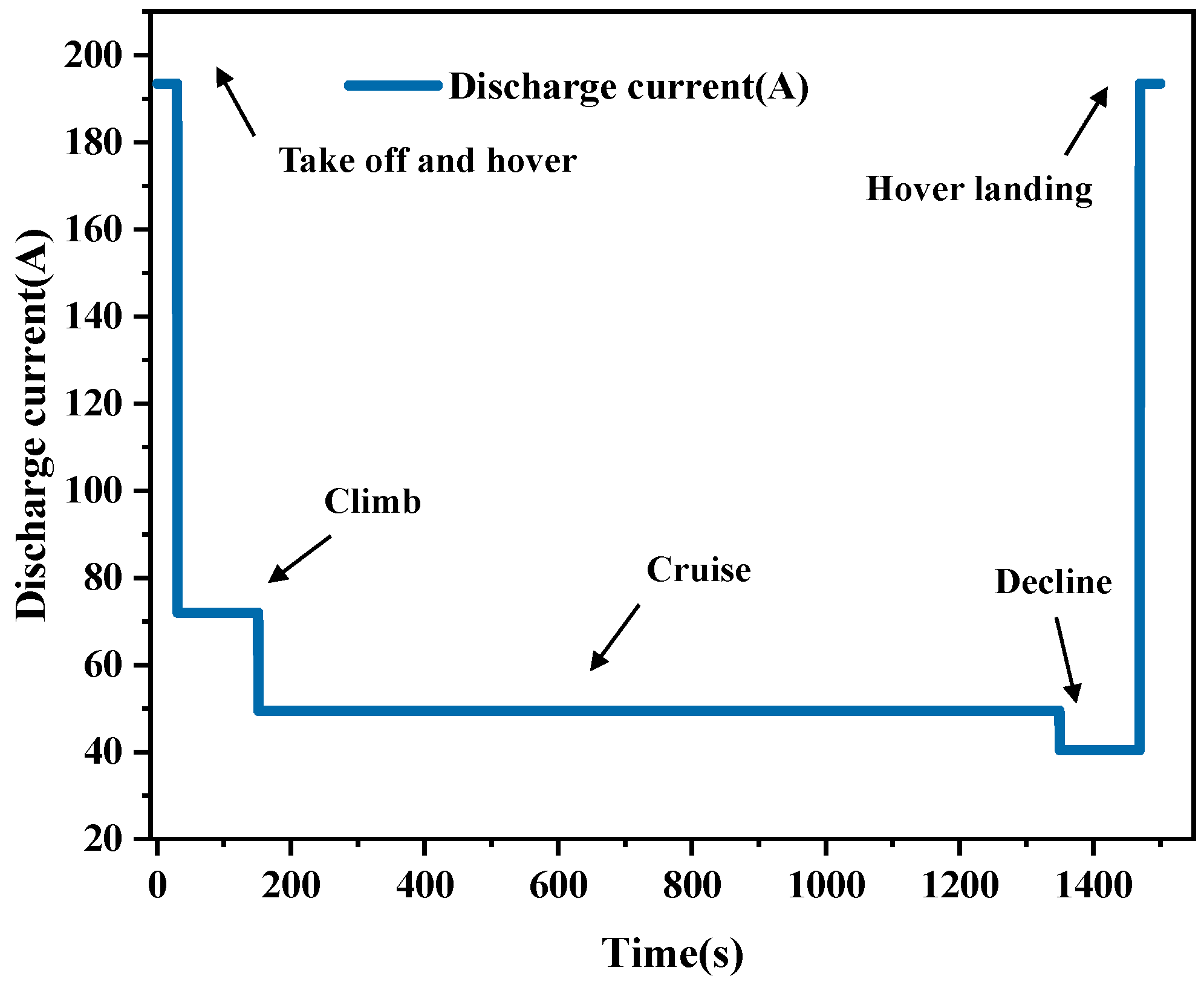
Based on the flight condition parameters defined in Section 2.1 and the corresponding thrust power expressions for each flight phase, the dynamic variations in the thermal load throughout the entire eVTOL mission profile can be systematically characterized. This section derives the power requirements for the different flight phases of the aircraft, and by dividing the required propulsion power by the battery output voltage, the battery discharge rate can be calculated. The results are summarized in Table 3. Multiplying the discharge rate of each flight phase by the rated capacity of the battery provides the corresponding discharge current. The trend of discharge current variation for each flight phase is shown in Figure 1: during takeoff and landing phases, the propulsion system demands peak power, leading to significant spikes in the battery discharge current, while during cruise and descent, system loads stabilize, resulting in lower discharge currents. For example, in this study, a single battery cell (with dimensions of 320 mm × 115 mm × 10 mm) has an effective heat dissipation surface area of approximately 368 cm2. During the landing phase, with a high discharge rate of 4.3 C, the instantaneous discharge current of the cell reaches 193.5 A, corresponding to a current density of 0.526 A/cm2, which is significantly higher than the typical current density of 0.12 A/cm2 under 1 C discharge conditions in conventional electric vehicles. Due to the compact structure of the cell, the heat generation rate per unit surface area caused by Ohmic heating increases substantially under such conditions, with the instantaneous thermal flux density being more than 300% higher than that of traditional electric vehicle batteries. This imposes more stringent requirements on the heat diffusion path inside the cell and the response time of the external cooling system. Therefore, accurately characterizing the battery discharge behavior under real flight conditions is crucial for designing and developing an efficient cooling system suitable for eVTOL applications.
In summary, by dividing the flight mission into stages and calculating the power requirements for each stage, the real-time discharge parameters of the battery at different flight stages can be determined, which in turn allows for the construction of a time-varying discharge curve. These results provide key input data for the subsequent development of the Bernardi thermal model for the battery.
To further characterize the SOC evolution, the ampere-hour integration method was used to calculate the SOC:
S O C t = S O C 0 1 3600 Q c e l l 0 t I τ d τ
In Equation (5), SOC(t) is the state of charge at time t, SOC0 is the initial state of charge, Qcell (Ah) is the rated capacity of a single cell, I(t) (A) is the time-varying discharge current during flight, and t (s) is the mission time.

3. Hybrid Cooling System Structural Design and Modeling

3.1. Hybrid Cooling System Structural Design

As described in Section 2.1, the target battery pack energy for the eVTOL platform is 66 kWh. The selected lithium-ion pouch cell has a nominal capacity of 45 Ah and a nominal voltage of 3.2 V, corresponding to 144 Wh per cell. The main power battery system consists of 13 standardized modules. Each module adopts an 18S2P configuration and contains 36 pouch cells. The rated energy of each module is 5.18 kWh. Therefore, the total installed energy reaches 67.4 kWh, which satisfies the system-level energy requirement of 66 kWh.
To assess structural integration on the eVTOL platform, a complete battery system with 13 modules was assembled. The whole system contains 468 cells. After assembly, the total mass is about 459 kg, the total volume is about 221 L, and the installed energy is about 67.4 kWh. In comparison, battery systems in leading eVTOL prototypes, such as Joby S4 and City Airbus, can reach about 900 kg. Therefore, the proposed battery system remains within a reasonable range for integration and packaging [31].
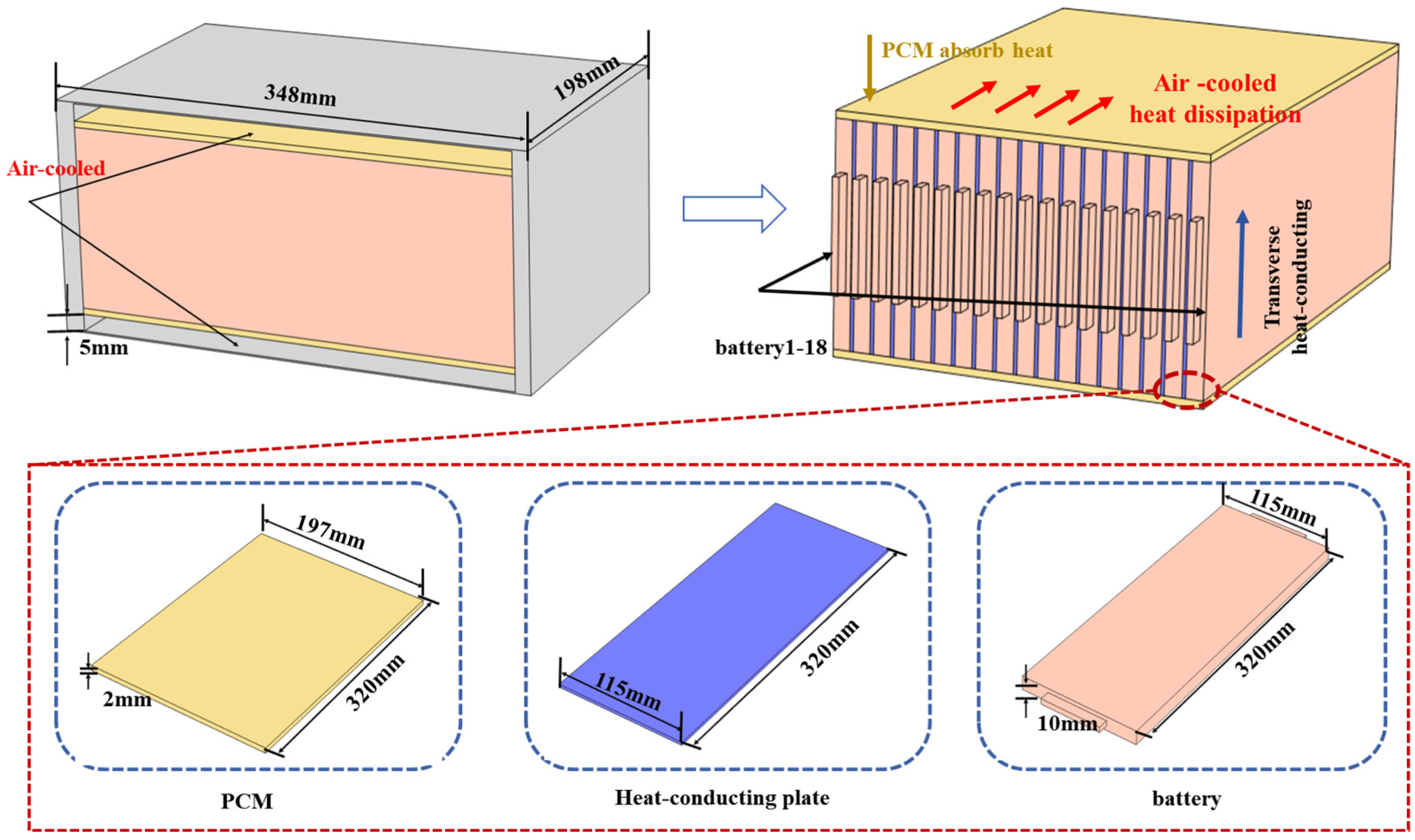
Figure 2 shows a schematic diagram of the hybrid cooling system structure; the proposed hybrid cooling system integrates battery cells, PCM layers, high-thermal-conductivity plates, and air-cooling channels into a unified structure. High-thermal-conductivity plates are inserted between adjacent cells. Cell spacing directly determines the plate thickness [32]. These plates provide lateral heat spreading and reduce local heat accumulation inside the module. PCM layers made of polyethylene-based encapsulating material [26] are arranged on both sides of each cell. PCM absorbs excess heat during high-rate discharge and suppresses rapid temperature rise. However, PCM heat storage is transient. Continuous heat rejection is required to remove stored heat and recover latent heat capacity. Air-cooling channels are placed on the outer surface of the PCM layers. During flight, airflow produces forced convection and removes heat released from the PCM.
The three components form a clear heat transfer path. Heat generated by the cells first spreads laterally through the high-thermal-conductivity plates. The PCM then buffers the peak thermal load through phase change. Finally, air cooling removes heat from the PCM surface.

3.2. Simulation Model Boundary and Parameter Setting

To ensure comparability among different cooling structures and parameters, the same thermal boundary conditions and interface treatments were used in the baseline simulations. The battery, high-thermal-conductivity plate, and PCM were modeled as solid heat conduction domains, while the air domain was treated as an incompressible Newtonian fluid. Initially, the battery module, high-thermal-conductivity plate, PCM, and inlet air were in thermal equilibrium with the environment at 25 °C. Ideal thermal contact was assumed at the battery–high-thermal-conductivity plate, battery–PCM, and PCM–high-thermal-conductivity plate interfaces, with continuous temperature and heat flux.
A uniform velocity inlet was applied to the air-cooling channel, with inlet airflow velocities of 1, 2, 3, 4, and 5 m/s. The velocity was imposed directly on the inlet section. The outlet was set as a pressure outlet at 0 Pa, and no slip conditions were applied to the air domain walls. The pressure drop was obtained from CFD post processing and defined as the area-averaged static pressure difference between the inlet and outlet sections. It only represents the internal flow resistance of the modeled air-cooling channel, without additional losses from external pipes or components. Forced convection acted only on the PCM outer surface within the air-cooling channel. Natural convection was applied to the remaining external module surfaces, with a heat transfer coefficient of 10 W·m−2·K−1 [33].
The boundary conditions at the interface between the battery and the PCM depend on the energy conservation Equation (6):
k b a t T n = k P C M T n
In Equation (6), kbat (W·m−1·K−1) is the battery thermal conductivity, and kPCM (W·m−1·K−1) is the thermal conductivity of the PCM. T / n is the temperature gradient.
The contact surface between the PCM and the high-thermal-conductivity plate has a similar energy conservation, as shown in Equation (7),
k P C M T n = k H C P T n
In Equation (7), kHCP (W·m−1·K−1) is the thermal conductivity of the heat-conducting plate.
The boundary conditions for PCM exposed to air cooling are shown in Equation (8),
k P C M T n = h T P C M T a i r
In Equation (8), h (W·m−2·K−1) and Tpcm (K) denote the PCM thermal conductivity, convective heat transfer coefficient and the temperature of the PCM in contact with the air cooling, respectively.
The flow regime in the air-cooling channel was evaluated using the Reynolds number, defined as
Re = ρ a i r u i n D h μ a i r
In Equation (9), Re is the Reynolds number, ρair (kg·m−3) is the air density, uin (m·s−1) is the inlet airflow velocity, Dh (m) is the hydraulic diameter of the air-cooling channel, and μair (Pa·s) is the dynamic viscosity of air. Based on the inlet airflow velocities of 1, 2, 3, 4, and 5 m/s, the corresponding Reynolds numbers were calculated as 630, 1261, 1891, 2522, and 3152, respectively. Therefore, the cases with inlet airflow velocities of 1–3 m/s were treated as laminar flow. The cases with inlet airflow velocities of 4–5 m/s fall within the transitional regime of internal flow; however, considering the possible local flow instability and pronounced near-wall effects in the narrow channel, the SST k-ω model was adopted for these cases.
The airflow domain satisfies the continuity equation:
u = 0
The momentum conservation equation can be written as
ρ a i r u t + u u = p + μ a i r + μ t u + u T
In Equations (10) and (11), u (m·s−1) is the air velocity vector, p (Pa) is pressure, ρair (kg·m−3) is the air density, μair (Pa·s) is the dynamic viscosity of air, and μt (Pa·s) is the turbulent eddy viscosity. For the laminar cases, μt = 0. For the 4 and 5 m·s−1 cases, μt is obtained from the SST k-ω turbulence model.
The transport equations of the SST k-ω model are given by
ρ k t + ρ k u = μ + σ k μ t k + P k β * ρ k ω
ρ ω t + ρ ω u = μ + σ ω μ t ω + α ω k P k β ρ ω 2 + D ω
where k is the turbulent kinetic energy, ω is the specific dissipation rate, P k is the production term of turbulent kinetic energy, and D ω is the cross-diffusion term. The SST k - ω model combines the near-wall prediction capability of the standard k - ω model with the robustness of the k - ε model in the free-stream region and is therefore suitable for narrow-channel flows with strong near-wall gradients and possible local flow instability, as encountered in the present hybrid cooling configuration.
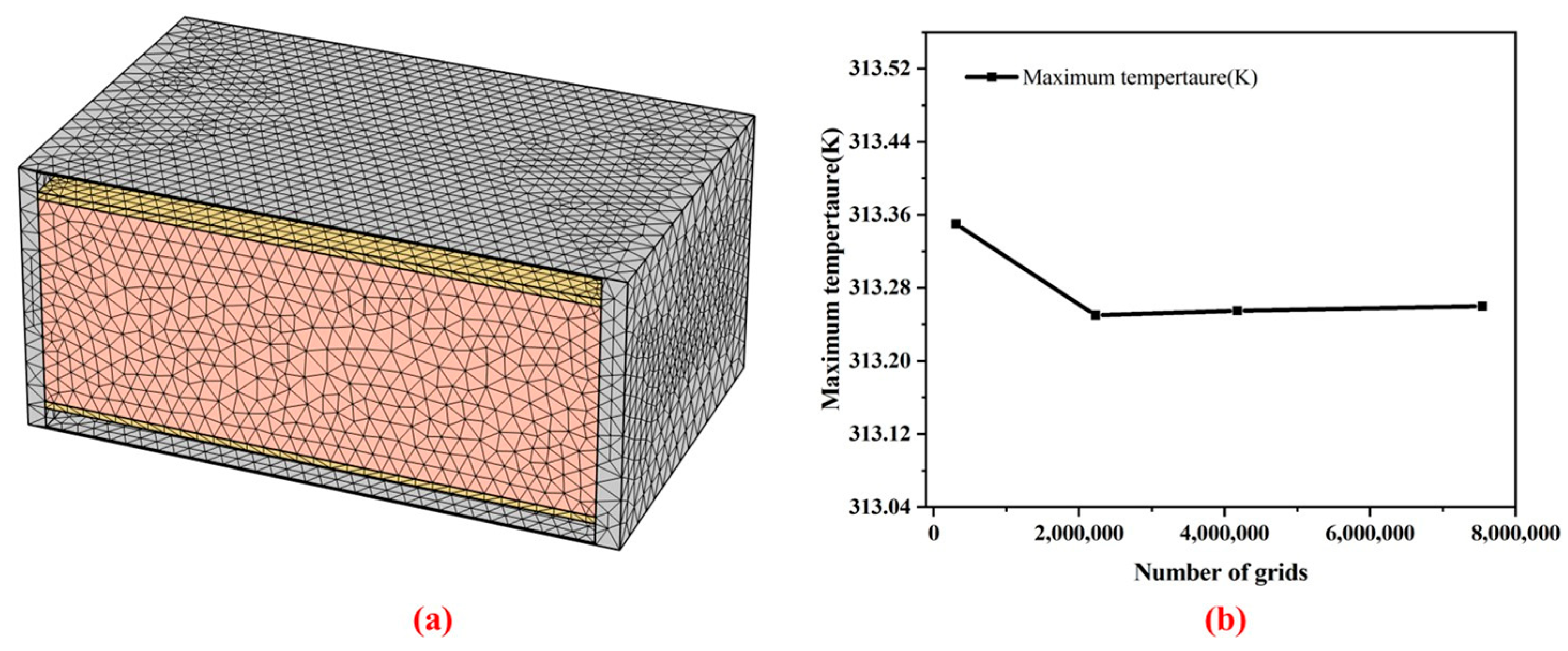
To ensure the accuracy of the simulation results, a grid independence test was conducted for the model used in this study. The test was performed under a 1 C discharge mode for the battery module, with the model divided using a free tetrahedral mesh, as shown in Figure 3a. The highest module temperature was used as the evaluation criterion, and the results are shown in Figure 3b. When the number of mesh elements increased to 2,226,318, further mesh refinement had no significant effect on the maximum temperature. Compared to the case with 4,176,062 mesh elements, the maximum temperature error for the case with 2,226,318 mesh elements did not exceed 1%. Considering both computational cost and accuracy, 2,226,318 mesh elements were selected for subsequent simulations. This mesh division effectively reduces computational resource consumption while ensuring computational accuracy, providing reliable numerical results for subsequent parameter optimization and engineering design.
Additionally, to ensure that the mesh quality meets the high-precision simulation requirements, a comprehensive evaluation of the mesh quality was conducted, with a focus on two key parameters: skewness and orthogonality. Skewness measures the degree to which a mesh element deviates from its ideal shape, and lower skewness values contribute to improved numerical solution stability. Orthogonality, on the other hand, reflects the angular relationship between the edges of a mesh element and those of its neighboring elements. High orthogonality enhances computational accuracy and convergence. In this study, skewness was maintained below 0.3, and the orthogonality of most mesh cells exceeded 95%, effectively ensuring mesh quality and the reliability and stability of the simulation results.
In addition, the thermal conductivity and thermophysical properties of the PCM are critical to the cooling performance. The properties of the PCM and thermally conductive materials are listed in Table 4. In this study, MPCM32D [34] and thermal-conducting plates were selected to enhance heat transfer from the cell surface to the PCM, thereby improving the temperature uniformity of the battery module. The thermophysical properties of the battery, PCM, and thermal-conducting plates were obtained from experimental measurements, material handbooks, and published literature, and were treated as constants. The properties of air and liquid water were defined using the built-in temperature-dependent functions in the COMSOL Multiphysics 6.2 simulation software.
Considering engineering feasibility and cost effectiveness, 1060 aluminum alloy, 6063 aluminum alloy, and AlN ceramic were used as thermally conductive materials. These materials have good thermal conductivity, machinability, weldability, and relatively low cost [35,36]. MPCM32D also provides high latent heat and good thermal cycling stability. Therefore, the selected materials can meet the thermal management requirements and show good potential for large-scale manufacturing and cost control [37].

3.3. Battery Thermal Model

3.3.1. Battery Heat Generation Equation

Heat generation in lithium-ion batteries primarily occurs during the charging and discharging processes. Complex chemical reactions take place inside the battery, accompanied by the consumption and generation of materials. Additionally, the internal resistance of the battery during charging and discharging causes some electrical energy to be converted into heat, resulting in a temperature rise. In simulation studies, the Bernardi equation [38] is commonly used to model the heat generation process of the battery.
Q g e n ( t ) = I ( U ocv U t e ) + I T b a t d U ocv d T
In Equation (14), Q g e n ( t ) (W) is the battery heat generation rate, I t (A) is the discharge current, U o c v (V) is the open-circuit voltage, U t (V) is the terminal voltage, T b a t (K) is the battery temperature, and d U o c v / d T (V·K−1) is the entropy coefficient.
During actual charging and discharging processes, the open-circuit voltage of the battery cannot be measured in real time. For convenience in calculation, the Joule heating component is often approximated by the heat generated by the internal resistance of the battery. Therefore, Equation (14) can be further equivalent to Equation (15).
Q g e n ( t ) = I 2 R + I T b a t d U ocv d T
In Equation (15), R(Ω) is the internal resistance of the battery. The first term, I 2 R , represents irreversible Joule heat caused by internal resistance. The second term, I T b a t d U o c v / d T , represents reversible heat associated with the entropy change of the electrochemical reaction.
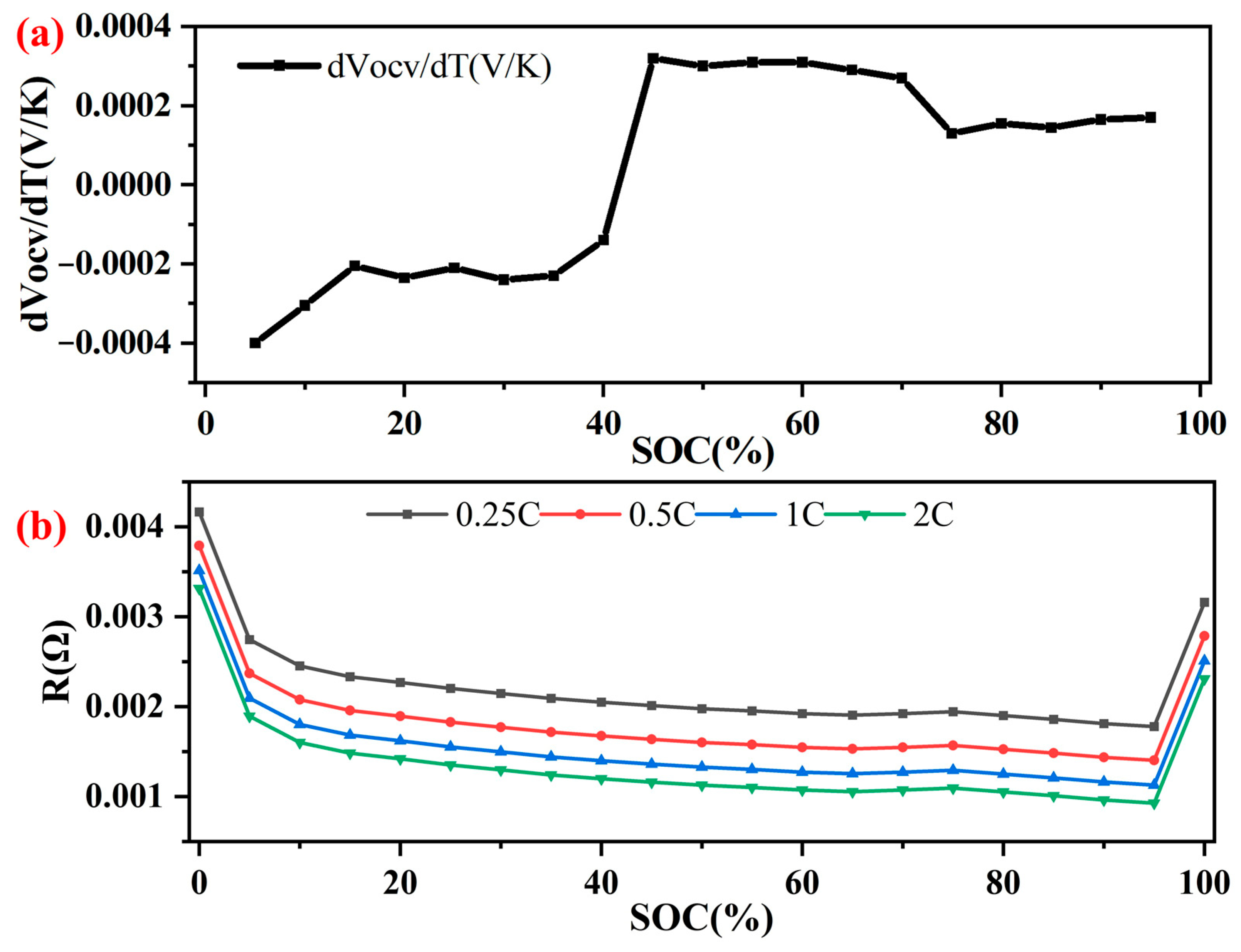
After testing, the entropy coefficient is shown in Figure 4a, the total internal resistance of the battery during discharge at 0.5 C, 1 C, and 2 C rates are shown in Figure 4b.
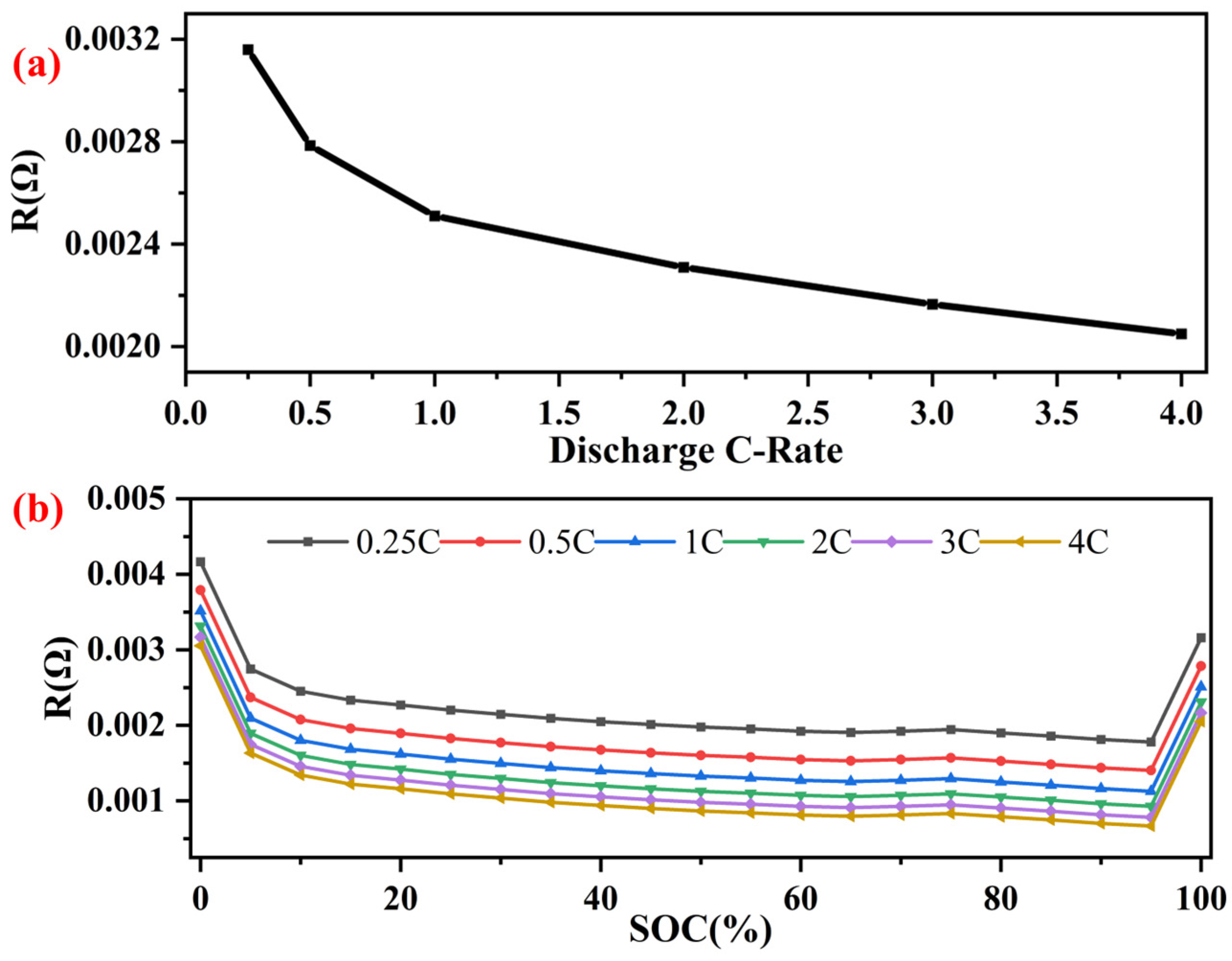
Due to the potential hazards associated with high-rate charge–discharge experiments, this study will predict the internal resistance of high-rate discharge batteries under flight conditions based on existing experimental data using a fitting function. According to the research in Reference [39], there is a significant nonlinear relationship between battery internal resistance and discharge rate. The nonlinear fitting results of internal resistance relative to discharge rate at 100% SOC are shown in Figure 5a. Similarly, the total internal resistance of the battery at different discharge rates is shown in Figure 5b. All subsequent simulations are based on the current fitting results, and when the difference in discharge rates is not significant, the internal resistance is approximated as the nearest integer multiple of the internal resistance.

3.3.2. Battery Heat Transfer Equation

In the operating temperature range of the battery, the electrolyte is mostly static and the temperature distribution inside the battery follows the basic equations of solid-state heat transfer [40]:
ρ b a t C bat d T t d t = x k x , b a t T x + y k y , b a t T y + z k z , b a t T z + Q g e n t
In Equation (16), ρbat (kg·m−3) is the battery density, Cbat (kg−1·K−1) is the battery specific heat capacity, T(t) (K) is the transient battery temperature, and Qgen(t) (W·m−3) is the volumetric heat generation rate of the battery. k x , b a t , k y , b a t , and k z , b a t (W·m−1·K−1) are the battery thermal conductivities in the x, y, and z directions, respectively.

3.4. Phase-Change Material Model

In this study, the enthalpy method is used to simulate the heat transfer process of PCM [41]. A transition temperature difference is introduced within the solid–liquid phase change temperature range in the simulation to avoid the issue of non-convergence caused by directly using a 0 K temperature difference. The energy equation is as follows:
ρ p c m H t = k p c m 2 T
H = h p + Δ H
h = T 0 T C p c m d T
Δ H = β λ
β = 0 , T T s T T s T l T s , T s < T < T l 1 , T T l
In Equations (17)–(21), ρ p c m ( k g · m 3 ) is the PCM density, k p c m ( W · m 1 · K 1 ) is the PCM thermal conductivity, T (K) is temperature, and H ( J · k g 1 ) is the total enthalpy of the PCM. h p ( J · k g 1 ) is the sensible enthalpy, and Δ H ( J · k g 1 ) is the latent enthalpy. C p c m ( J · k g 1 · K 1 ) is the PCM specific heat capacity, T (K) is the reference temperature, and λ ( J · k g 1 ) is the latent heat of phase change. β is the PCM liquid fraction, T s (K) is the solidus temperature, and T l (K) is the liquidus temperature. For MPCM32D, T s = 30 °C and T l = 32 °C. β = 0 denotes a fully solid state, β = 1 denotes a fully liquid state, and 0 < β < 1 denotes the mushy region.

3.5. Cooling System Performance Evaluation Index System

The battery cooling system is an essential aspect of eVTOL design, requiring an effective evaluation method. This method, based on [42], constructs multidimensional performance indicators for the cooling system, providing comprehensive and intuitive standards for the design of eVTOL cooling systems.
The concept of temperature control margin, which is the difference between the maximum allowable temperature of the battery and the actual average temperature, is used to evaluate the capability of the cooling system to control battery temperature. Temperature control margin can be expressed as:
T C M = T lim i t T tr d t t r u n n i n g
The equation TCM is the temperature control margin, T l i m i t a is the upper limit of the permissible temperature of the battery, T t r is the transient temperature, t r u n n i n g is the running time.
Temperature stability is the standard deviation of the maximum temperature, reflecting temperature fluctuations and evaluating the ability of the cooling system to control the battery temperature. Temperature control stability can be expressed as:
S T = t 0 t 1 T t r T t r d t t d t t e n d t s t r a t
The equation ST is the temperature stability, where T t r is the transient temperature of the element. The start time t s t r a t and end time t e n d correspond to the operating state of the element.
The time-averaged maximum temperature difference is the average value of the difference between the highest and lowest temperatures in the battery module, which is used as an index to evaluate the temperature uniformity of the battery module. The time-averaged maximum temperature difference is defined as follows:
D T = T max T min d t t
The equation DT is time-averaged maximum temperature difference, T m a x is the maximum temperature of the battery module, and T m i n is the minimum temperature of the battery module.
Group efficiency is an indicator used to assess the weight of the battery cooling system. It is defined as the energy density of a single battery divided by the energy density of the entire battery system, reflecting the lightweight level of the cooling system. The definition of group efficiency is as follows:
G E = E D b a t E D s y s t e m
The equation GE is the grouping efficiency, E D b a t is the energy density of battery, and E D s y s t e m is the energy density of the battery system.
Space occupancy is defined as the percentage of space occupied by the battery cooling system in relation to the total available space in the eVTOL, as an indicator for evaluating the volume of the battery cooling system. The space occupancy is expressed as follows:
S O = V O T M S V O t o t a l
The equation SO is the space occupancy of the cooling system, V O T M S denotes the volume occupied by the cooling system, both the actual volume and the volume that cannot be occupied by other equipment or components due to the arrangement of the cooling system, and V O t o t a l denotes the total available space in the eVTOL.
For a better overall comparison, the above evaluation metrics need to be normalized. T C M m a x , S T m a x and D T m a x are based on the operating limits of the battery.

T C M = T C M / T C M max
S T = 1 S T / S T max
D T = 1 D T / D T max
G E = G E
S O = 1 S O

4. Results and Discussion

4.1. Model Validation

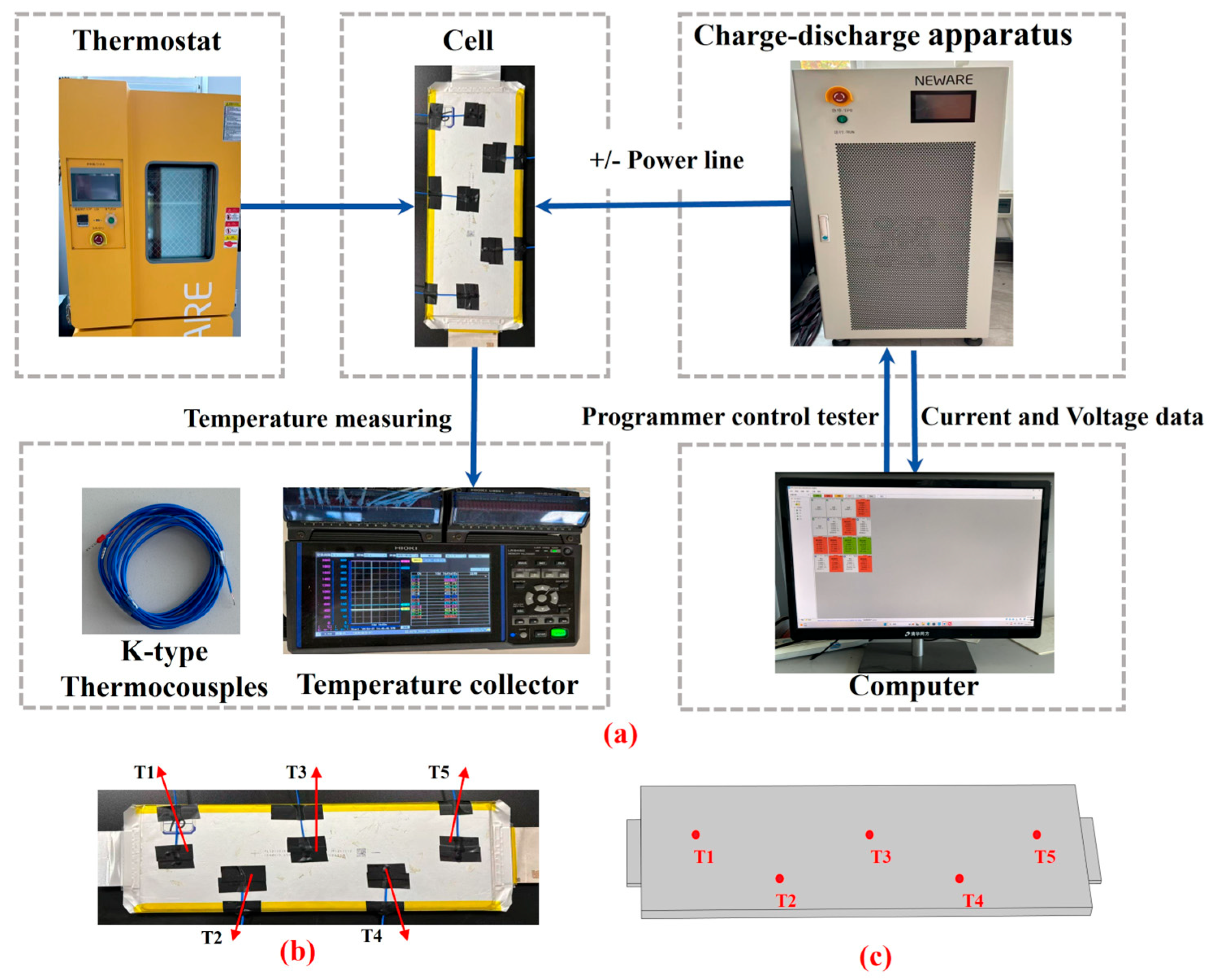
To ensure reliable heat source input for subsequent module-level simulations, the battery thermal response model was validated by comparing experimental and simulated temperature data. As shown in Figure 6a, the experimental platform consisted of a battery tester for charge and discharge cycles and data acquisition, a temperature chamber for maintaining constant environmental conditions, and a temperature acquisition and control system.
Two batteries from the same batch were used in the experiment. The capacity difference between the two batteries was less than 0.1 Ah, which ensured good consistency and representativeness of the samples. As shown in Figure 6b,c, five thermocouples were attached to the surface of a single battery to monitor the temperature distribution. Multiple charge and discharge cycles were conducted, and the corresponding data were recorded to verify the repeatability of the results.
During the experiment, the ambient temperature was maintained at 25 °C. The temperature chamber effectively reduced environmental temperature fluctuations and minimized their influence on battery performance.
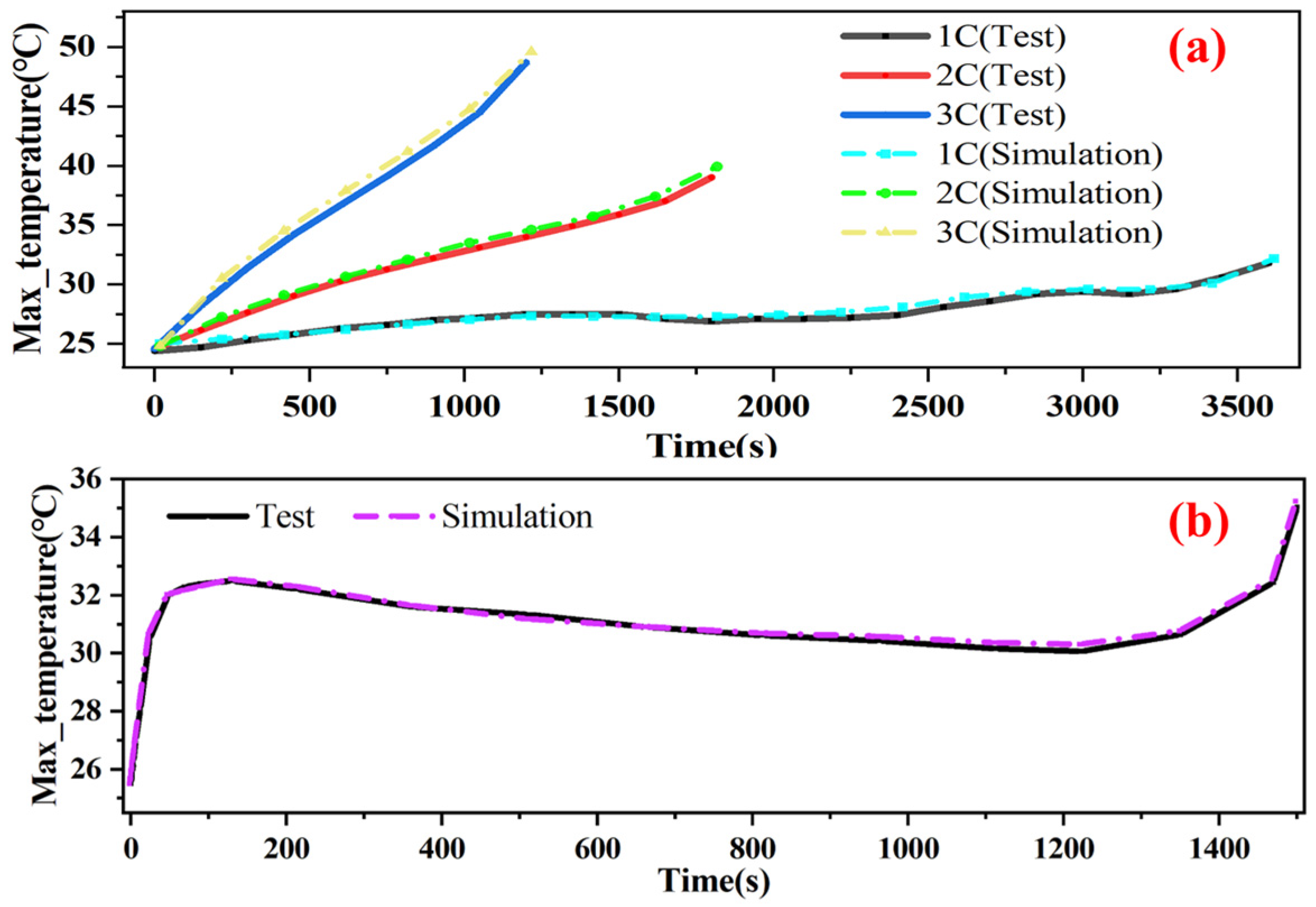
As shown in Figure 7a, the battery thermal model was validated under 1C, 2C, and 3C discharge conditions by comparing the simulated temperature with the average measured temperature. To further assess the applicability of the model under dynamic loading, additional validation was performed under the eVTOL flight profile, as shown in Figure 7b. Under both conditions, the simulated results agree well with the experimental data, with deviations within 2%. These results support the use of the single-cell heat generation model and heat source input in subsequent module-level simulations. The performance of the hybrid cooling system is mainly evaluated through numerical simulation.

4.2. Optimization Analysis of Hybrid Cooling System Parameters

This section employs a multi-physics coupling model to study the hybrid cooling system, with a focus on three key structural parameters: cell spacing, thermally conductive material and inlet airflow velocity. The goal is to determine the optimal parameter configuration for the synergistic enhancement of performance.

4.2.1. Effect of Cell Spacing

Cell spacing is a key structural parameter for reducing heat accumulation within the module. The coupling between cell spacing and HCP thickness directly affects thermal performance and structural compactness. Therefore, four cell spacings of 0.5, 1, 1.5, and 2 mm were evaluated. The ambient temperature, inlet airflow velocity, and HCP material were set to 25 °C, 1 m/s, and 1060 aluminum alloy, respectively.
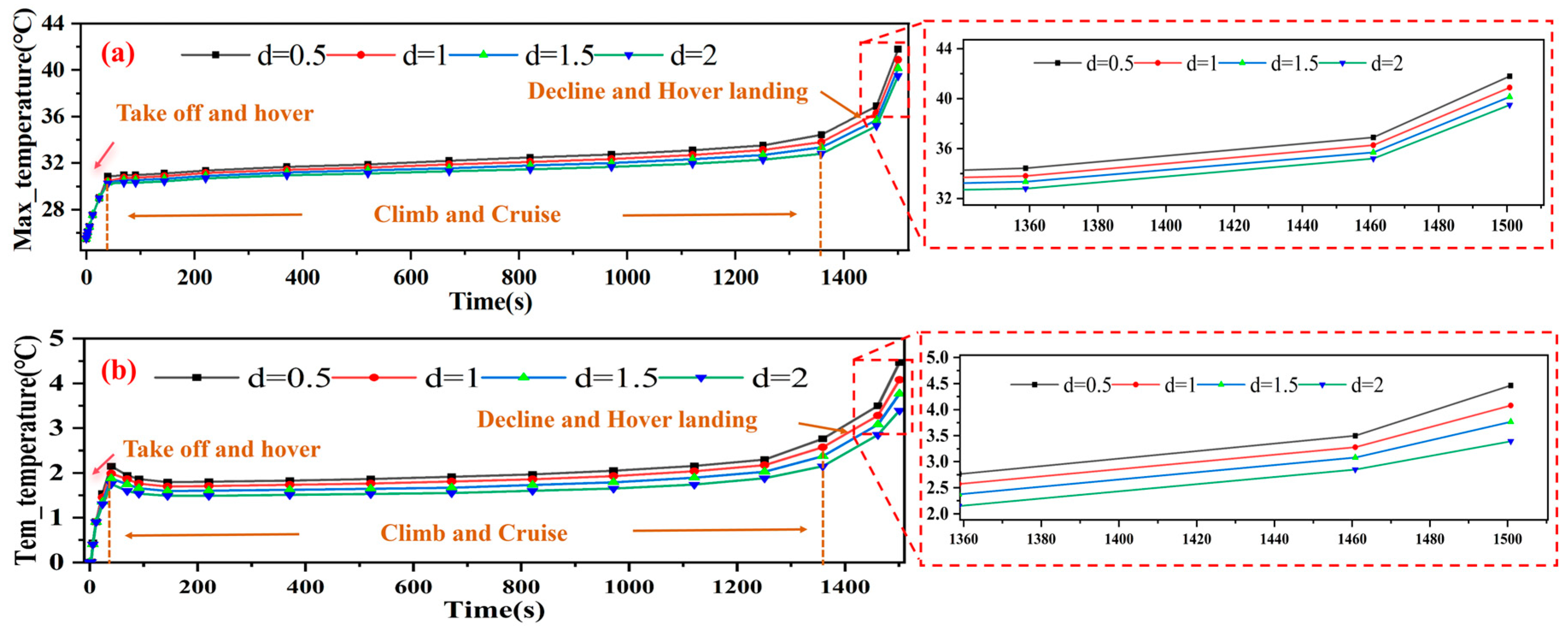
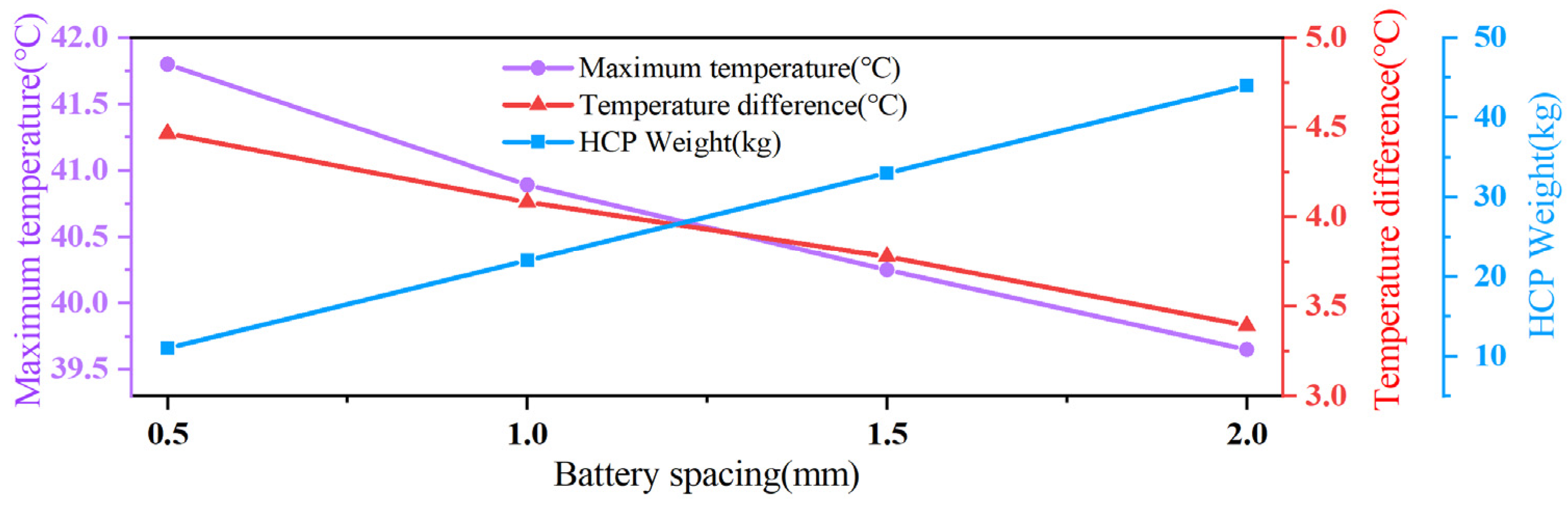
Larger cell spacing allows thicker HCPs to be placed between adjacent cells. This enhances lateral heat conduction and improves temperature uniformity. As shown in Figure 8a,b, increasing the spacing from 0.5 mm to 2 mm reduces the maximum battery temperature from 41.8 °C to 39.5 °C, corresponding to a 5.5% improvement. The maximum temperature difference decreases from 4.46 °C to 3.39 °C, corresponding to a 23.9% improvement. These results indicate that better matching between cell spacing and HCP thickness can promote heat diffusion within the module.
However, larger spacing also increases system mass. As shown in Figure 9, the total HCP mass increases from 11 kg to 44 kg as spacing increases from 0.5 mm to 2 mm. Such a mass increase is unsuitable for weight-constrained eVTOL applications.
Considering thermal safety and lightweight design requirements, a cell spacing of 1 mm was selected. This spacing provides a reasonable balance between cooling performance and structural compactness and serves as the basis for the integrated design of the hybrid cooling system.

4.2.2. Influence of Thermally Conductive Materials

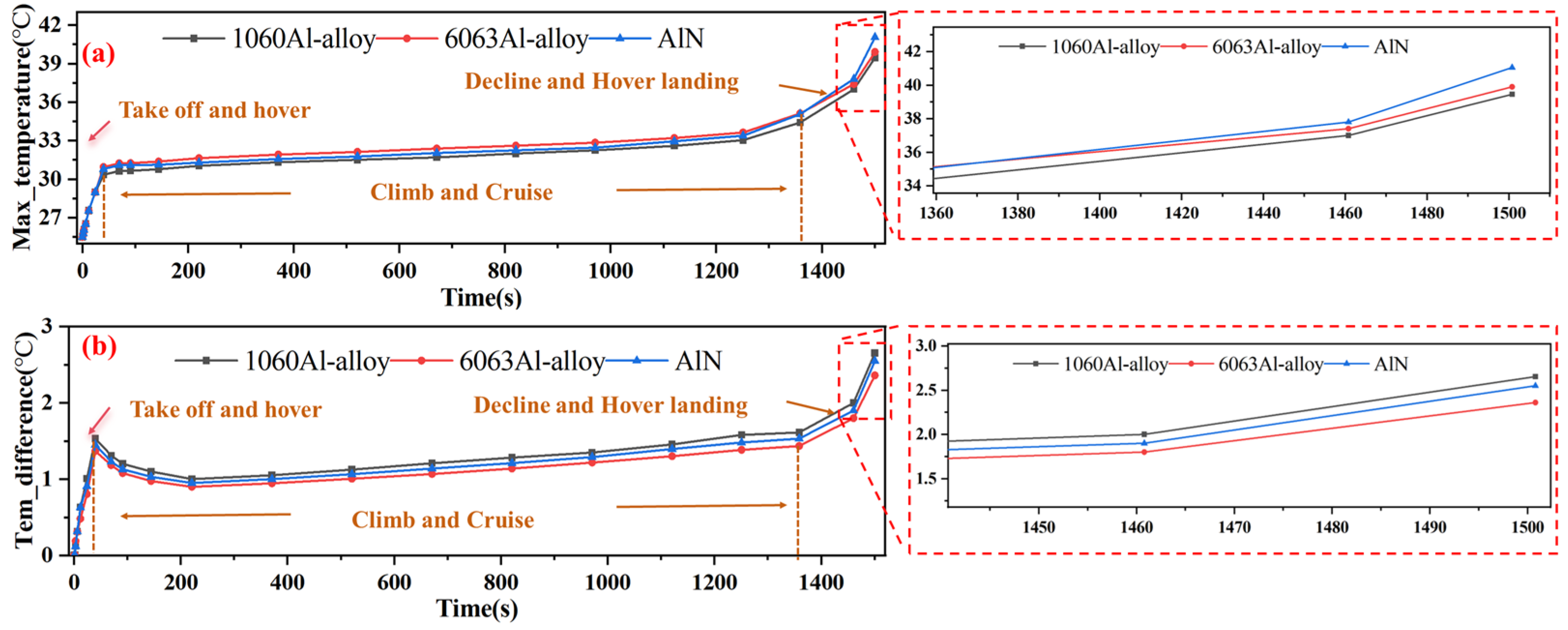
Considering cost effectiveness and scalability, three thermally conductive materials were evaluated: 1060 aluminum alloy, 6063 aluminum alloy, and aluminum nitride (AlN) ceramic. The simulations were performed under the same conditions, with an ambient temperature of 25 °C, an inlet airflow velocity of 1 m/s, and a cell spacing of 1 mm. The evaluation focused on the maximum temperature, temperature uniformity, and system mass.
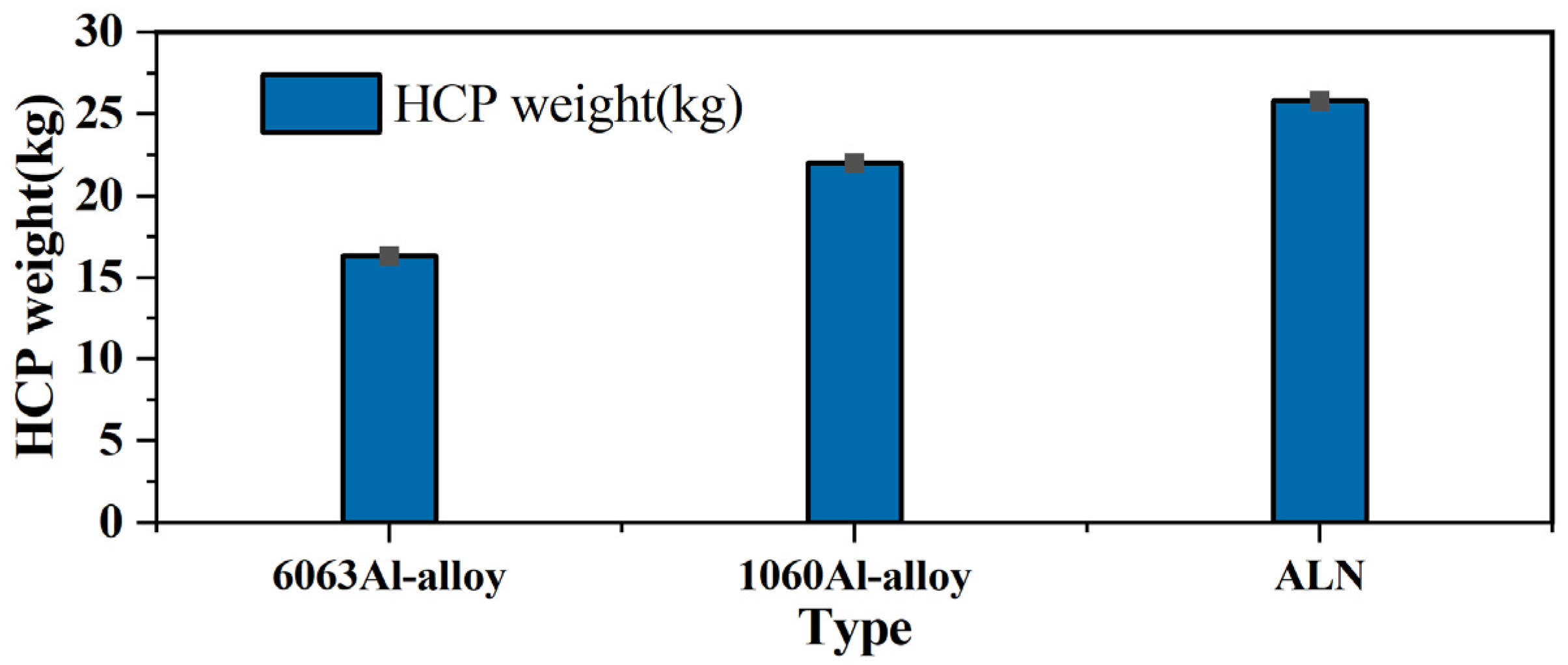
As shown in Figure 10 and Figure 11, 1060 aluminum alloy provides good overall thermal performance. The maximum temperature is 40.20 °C, and the maximum temperature difference is 2.651 °C. However, the corresponding HCP mass reaches 22 kg. The 6063-aluminum alloy shows the best temperature uniformity, with the lowest maximum temperature difference of 2.31 °C. The maximum temperature is 39.90 °C. More importantly, its HCP mass is only 16.3 kg, which gives a clear advantage for lightweight design. AlN ceramic shows moderate thermal performance, with a maximum temperature of 41.05 °C and a temperature difference of 2.55 °C. However, its HCP mass reaches 25.8 kg, which limits its suitability for weight-sensitive eVTOL applications.
Overall, 6063 aluminum alloy offers the best balance between thermal performance and lightweight design, and the system mass is 19.4 kg. Therefore, 6063 aluminum alloy was selected as the thermally conductive material for the proposed hybrid cooling system.

4.2.3. Effect of Inlet Airflow Velocity

This section evaluates the effect of inlet airflow velocity on PCM latent heat recovery and thermal regulation performance. The simulations were conducted at an ambient temperature of 25 °C, using 6063 aluminum alloy as the thermally conductive material and a cell spacing of 1 mm. Five inlet airflow velocities were considered: 1, 2, 3, 4, and 5 m/s.
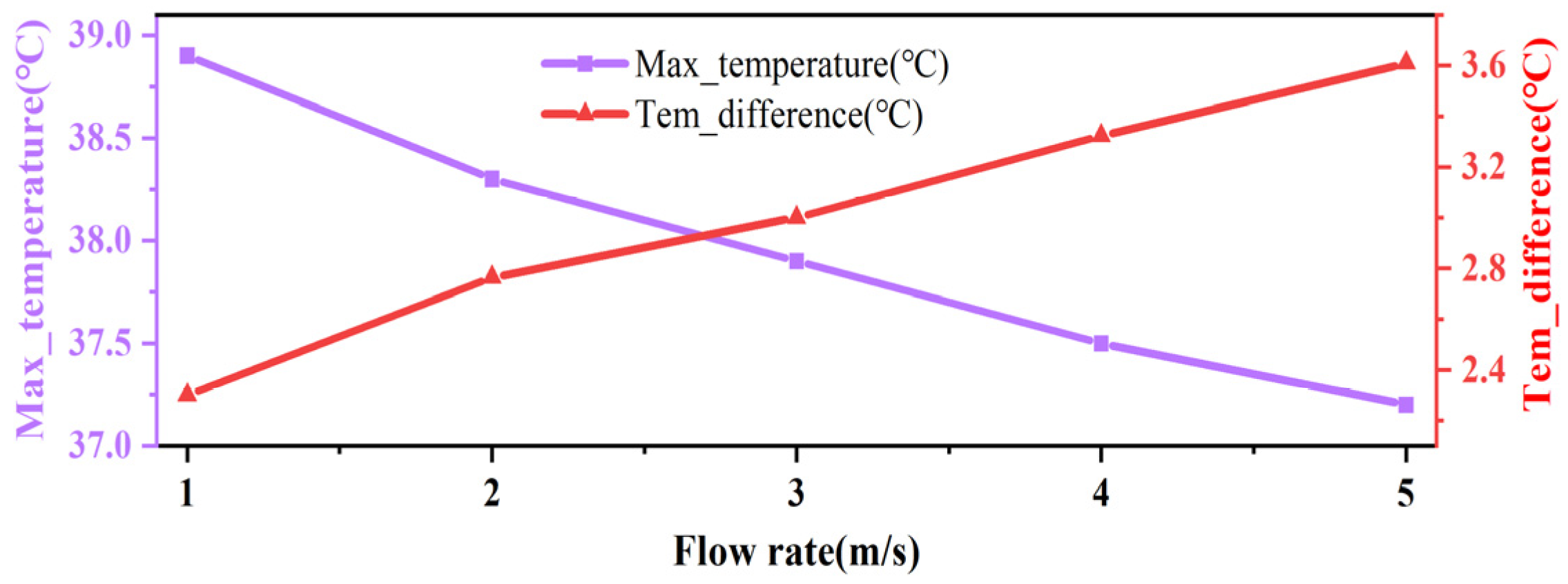
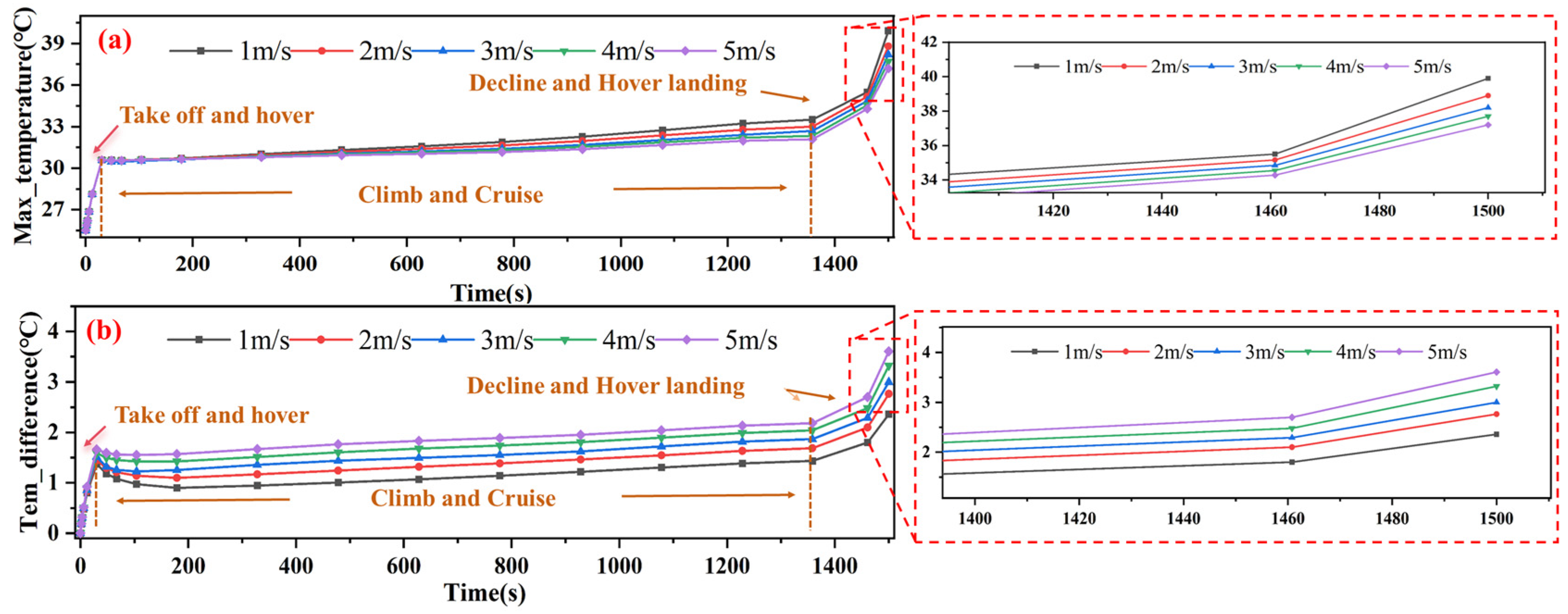
As shown in Figure 12a,b, inlet airflow velocity has a coupled effect on the battery temperature field. Increasing the velocity from 1 m/s to 5 m/s enhances convective heat transfer and reduces the maximum module temperature from 39.9 °C to 37.2 °C. However, excessive airflow deteriorates temperature uniformity. The maximum temperature difference increases from 2.3 °C to 3.7 °C.
As shown in Figure 13, module temperature continues to rise when the PCM heat absorption rate is lower than the battery heat generation rate. Among the tested cases, an inlet velocity of 3 m/s provides the best balance between heat removal and temperature uniformity. The corresponding maximum temperature and maximum temperature difference are 37.9 °C and 3.1 °C, respectively.
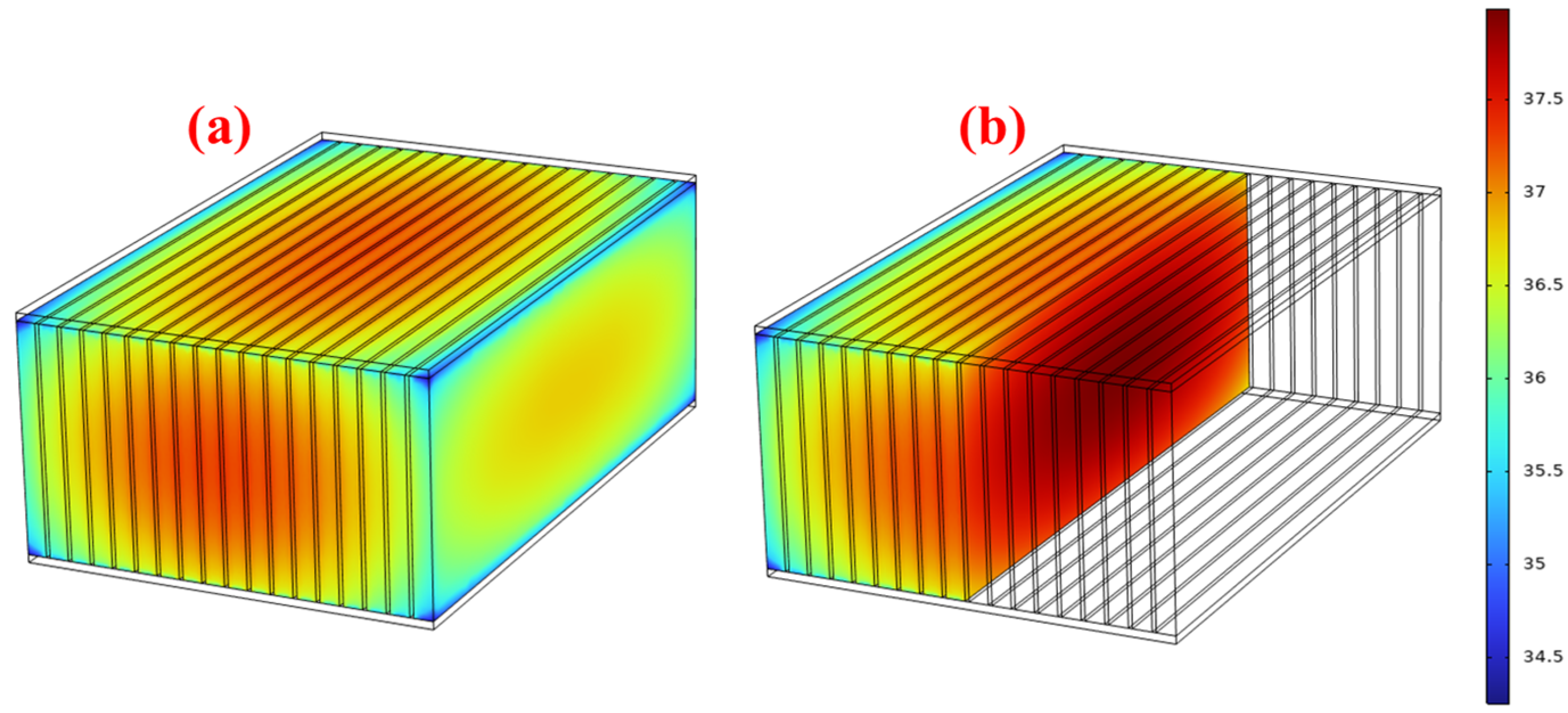
Figure 14a,b further illustrates the thermal conduction pathways and temperature field distribution from a spatial perspective. The heat conduction plate establishes an efficient thermal bridge between the high-temperature region at the center of the battery and the surrounding PCM, enabling effective upward heat transfer into the PCM layer. This mechanism facilitates improved thermal diffusion and contributes to a more uniform temperature distribution across the module.
Simultaneously, the air-cooling subsystem effectively removes the heat absorbed by the PCM in a timely manner, preventing thermal accumulation and significantly lowering the overall temperature of the system. These results demonstrate that the hybrid cooling system exhibits excellent performance in both temperature uniformity and heat dissipation, successfully addressing the challenge of non-uniform thermal distribution within the battery module.
The parametric analyses of cell spacing, thermally conductive material, and inlet airflow velocity identified the optimal configuration of the hybrid cooling system. The cell spacing was set to 1 mm, 6063 aluminum alloy was selected as the thermally conductive material, and the inlet airflow velocity was set to 3 m/s. Under this configuration, the system achieves a good balance between temperature regulation and structural compactness. Therefore, this parameter combination is used as the reference configuration for subsequent comparisons with other cooling strategies.

4.2.4. Structural Parameter Sensitivity Analysis

This section introduces local sensitivity coefficients to quantitatively evaluate the effects of three key parameters, namely cell spacing, the thermal conductivity of the high-thermal-conductivity plate material, and inlet airflow velocity, on the thermal performance and structural compactness of the hybrid cooling system [43]. The results help clarify the relative importance of these structural parameters and provide a theoretical basis for parameter control and design prioritization in engineering applications.
S x = T max x i x i T max
In Equation (32), Sx is the local sensitivity coefficient, xi is the actual value of the structural parameter, and T m a x (°C) is the corresponding maximum module temperature. A positive Sx indicates that T m a x increases as the parameter increases, whereas a negative Sx indicates that T m a x decreases as the parameter increases. The same definition is applied to the sensitivity analysis of ΔT (°C) and system mass m (kg). Based on the simulation data from Section 4.2.1, Section 4.2.2 and Section 4.2.3, small disturbances of ±10% are applied to each parameter, and the corresponding changes in the evaluation metrics are obtained, from which the sensitivity coefficients are calculated. The specific settings are as follows.
Cell spacing: using the optimal value of 1 mm as reference, with the thermal material set as 6063 aluminum alloy and the inlet airflow velocity at 3 m/s, the variations in a, b, and system weight m are recorded.
Thermal conductivity: using the thermal conductivity of 6063 aluminum alloy as the reference, with the cell spacing fixed at 1 mm and the inlet airflow velocity at 3 m/s, the variations in a, b, and system weight m are recorded.
Inlet airflow velocity: using the optimal value of 3 m/s as the reference, with the cell spacing at 1 mm and the thermal material set as 6063 aluminum alloy, the variations in a, b, and system weight m are recorded.
The sensitivity coefficients of each parameter for different evaluation metrics are shown in Table 5.
Based on the absolute values of the coefficients and their correlation, the following conclusions can be drawn.
Priority of impact on system weight: cell spacing > thermal conductivity > inlet airflow velocity. A 10% increase in cell spacing results in a 21.5% increase in system weight, making it the key parameter affecting structural lightweight design. This also confirms the conclusion in Section 4.2.1 that “a 1 mm cell spacing is the balance point between thermal performance and lightweight design”, indicating that the cell spacing should not be excessively increased to lower the temperature.
Priority of impact on maximum temperature: cell spacing > inlet airflow velocity > thermal conductivity. A 10% increase in cell spacing can reduce the maximum temperature by 5.2%, while a 10% increase in thermal conductivity only reduces the maximum temperature by 0.8%. This suggests that when selecting materials, there is no need to excessively pursue high thermal conductivity, as the thermal performance of 6063 aluminum alloy is sufficient to meet the requirements.
Priority of impact on temperature uniformity: inlet airflow velocity > cell spacing > thermal conductivity. A 10% increase in inlet airflow velocity raises the temperature difference by 2.3%, which is consistent with the conclusion in Section 4.2.3 that “excessively high flow velocity worsens temperature uniformity”. Therefore, the flow velocity should be controlled around 3 m/s to balance cooling efficiency with temperature uniformity.

4.3. Comparative Performance Evaluation of Different Cooling Strategies

The optimized configuration was selected as the representative case of the proposed hybrid cooling system. Its performance was compared with three reference strategies: no cooling, passive cooling, and liquid cooling. To ensure objective and consistent comparison, all strategies were evaluated under the same flight mission profile, battery discharge rate curve, and initial temperature of 25 °C. The same thermal model parameters and boundary conditions were also used in all simulations. Therefore, differences in thermal performance were attributed only to the cooling strategy. This comparison verifies the relative advantages of the proposed hybrid cooling system for practical engineering applications.

4.3.1. No Cooling Performance Analysis

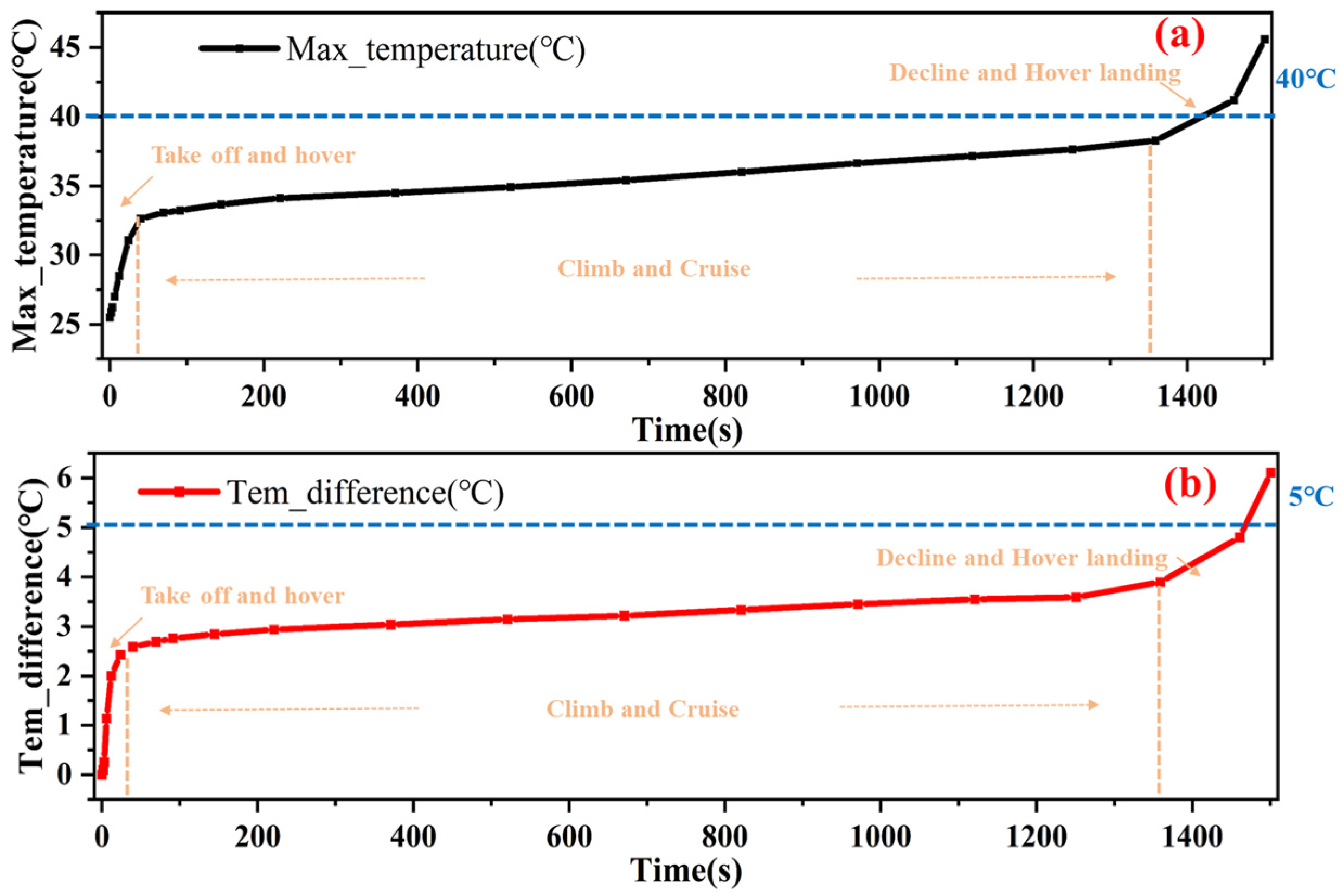
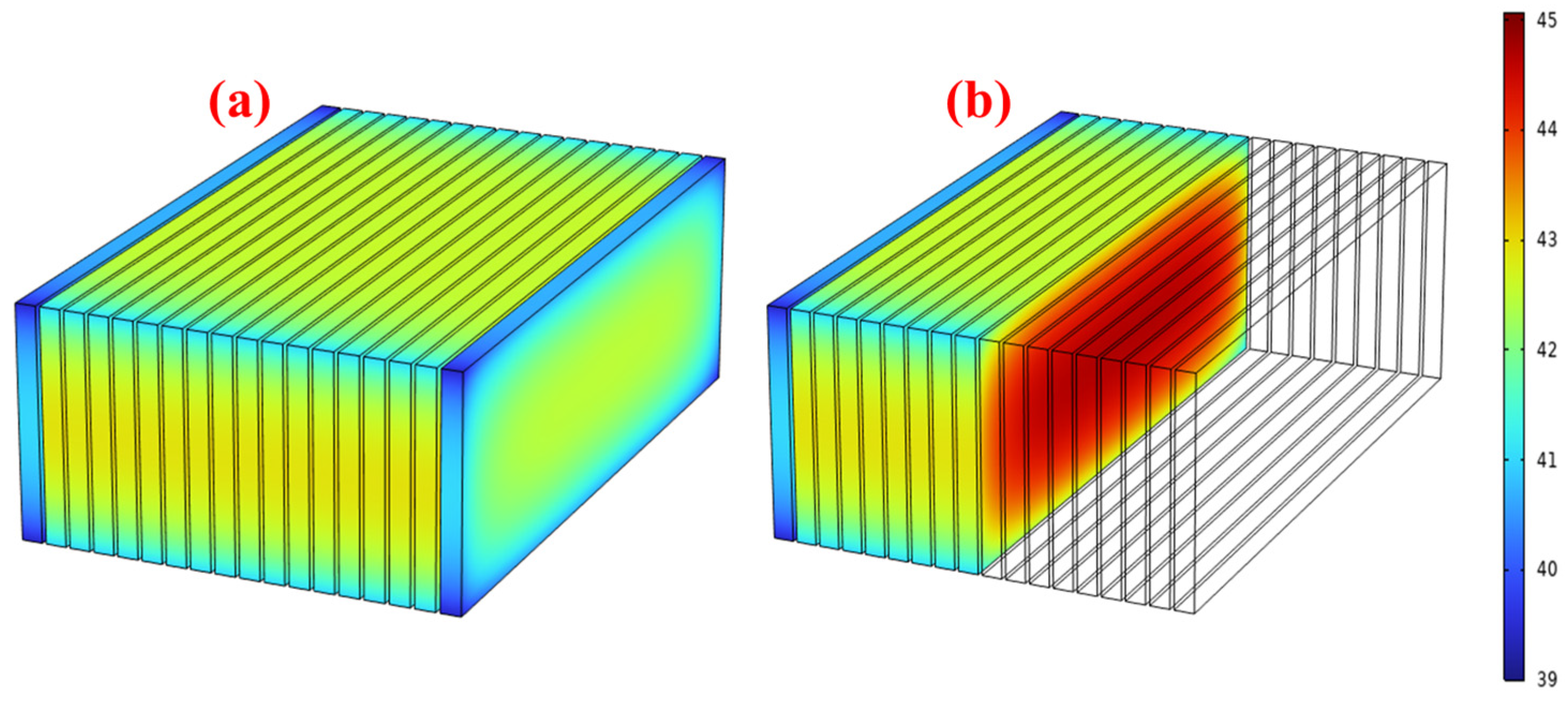
A thermal field simulation model of the battery module without any cooling structure was established to reveal the extreme thermal response over the full eVTOL mission profile. As shown in Figure 15a,b, the maximum temperature reaches 45.6 °C, and the maximum temperature difference reaches 6.08 °C. These values exceed both the ideal operating temperature range of lithium-ion batteries, 20 to 40 °C, and the 5 °C safety threshold for inter-cell temperature difference. This result indicates severe heat accumulation and non-uniform temperature distribution under no cooling conditions, which cannot satisfy the thermal safety requirements of eVTOL battery systems. The spatial temperature distributions in Figure 16a,b further show that high-temperature regions are concentrated near the cell center. Clear temperature gradients appear in the surrounding regions. This phenomenon reflects insufficient heat dissipation paths and delayed thermal diffusion within the module.
Under the high thermal load of eVTOL operation, the absence of a cooling system causes module overheating and strong thermal non-uniformity. Such conditions reduce cell cycle life and increase thermal runaway risk. In the no-cooling case, the peak temperature of 45.6 °C and temperature difference of 6.08 °C generate significant thermal stress. This stress leads to short-term overheating risk and long-term aging acceleration. Thermal inconsistency also aggravates cell-to-cell performance divergence.
Previous studies have shown that prolonged exposure to high temperature accelerates capacity fading and internal resistance growth in lithium-ion batteries [44]. The main mechanisms include continuous solid electrolyte interphase growth, structural degradation of active materials, and electrolyte decomposition. Large temperature gradients also cause non-uniform aging among cells, which intensifies pack-level performance imbalance and shortens service life. Therefore, an efficient thermal management system is essential for long-term battery health, operational stability, and thermal safety.

4.3.2. Passive Cooling Performance Analysis

The passive cooling system was derived from the proposed hybrid cooling system by retaining the high-thermal-conductivity plates and PCM, while removing active air cooling. The thermal conducting material was 6063 aluminum alloy, and the cell spacing was 1 mm. This configuration represents the passive heat dissipation limit under natural convection.
As shown in Figure 17a,b, the passive cooling system improves the temperature uniformity of the battery module. The maximum temperature difference is controlled within 2.2 °C. Figure 18a,b further show the spatial temperature distribution. Heat is effectively transferred from the high-temperature region of the cells to the PCM through the thermal conduction structure, leading to a more uniform temperature field.
However, without an active heat rejection path, heat removal mainly depends on PCM heat absorption. Under high-rate discharge, heat accumulation exceeds the phase change buffering capacity of the PCM. As a result, the maximum temperature still reaches 43.1 °C, which is difficult to satisfy the temperature control requirement of eVTOL battery modules.

4.3.3. Liquid Cooling Performance Analysis

To ensure a consistent comparison, the baseline liquid cooling system was developed from the core structure of the hybrid cooling system. The PCM layer and air-cooling channels were removed. The 6063-aluminum alloy high-thermal-conductivity plate and 1 mm cell gap were retained. Symmetric liquid cooling plates were added to both sides of the battery module. This configuration combines lateral heat spreading through the high-thermal-conductivity plate with forced convection from liquid cooling.
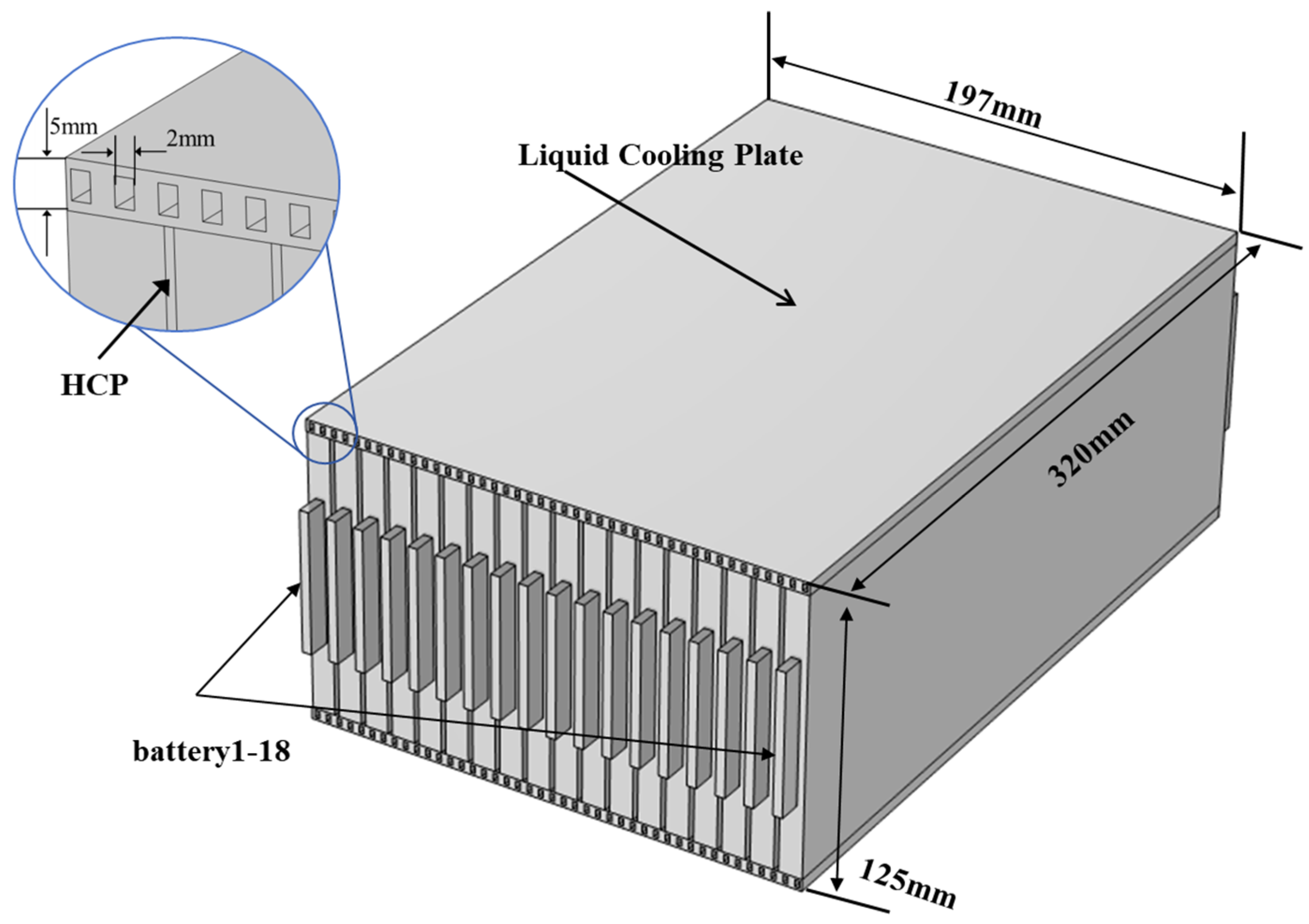
The battery dimensions and performance parameters were kept consistent with those used in this study. The selected liquid cooling system serves only as a baseline configuration. Its channel geometry, coolant flow rate, pressure drop, mass, and volume were not fully optimized. The baseline liquid cooling system is shown in Figure 19. The dimensions of the cooling plates are 197 × 320 × 5 mm. Each aluminum cooling plate has 44 square cooling channels, with the dimensions of each channel being 2 × 320 × 3 mm. The coolant used is a 50% ethylene glycol solution, with a density of 1071.11 kg/m3, specific heat of 3281 J/kg·K, thermal conductivity of 0.384 W/m·K, and dynamic viscosity of 0.00339 Pas. The cooling system operates at 25 °C, with the inlet velocity of the coolant set to 0.9 m/s [18].
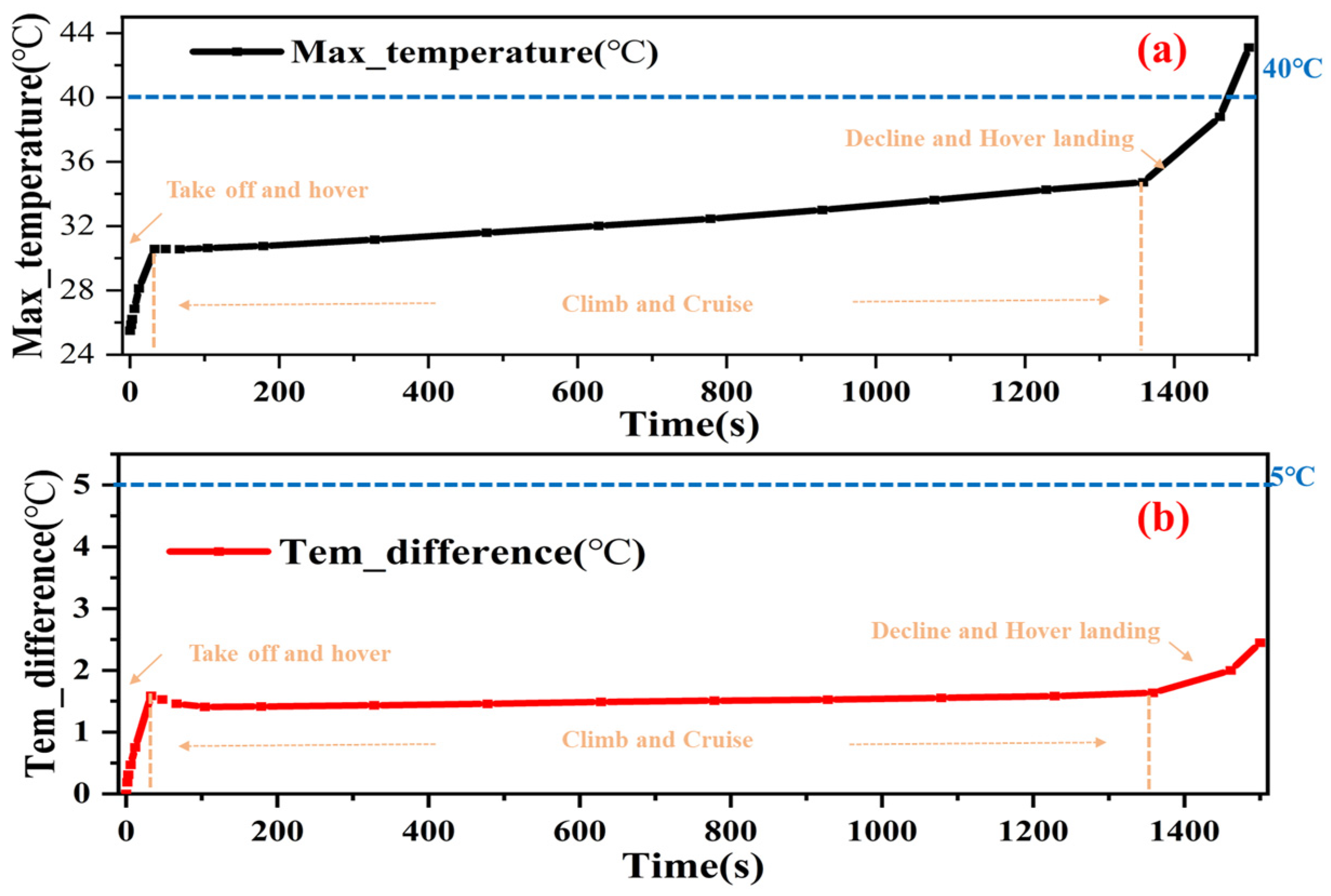
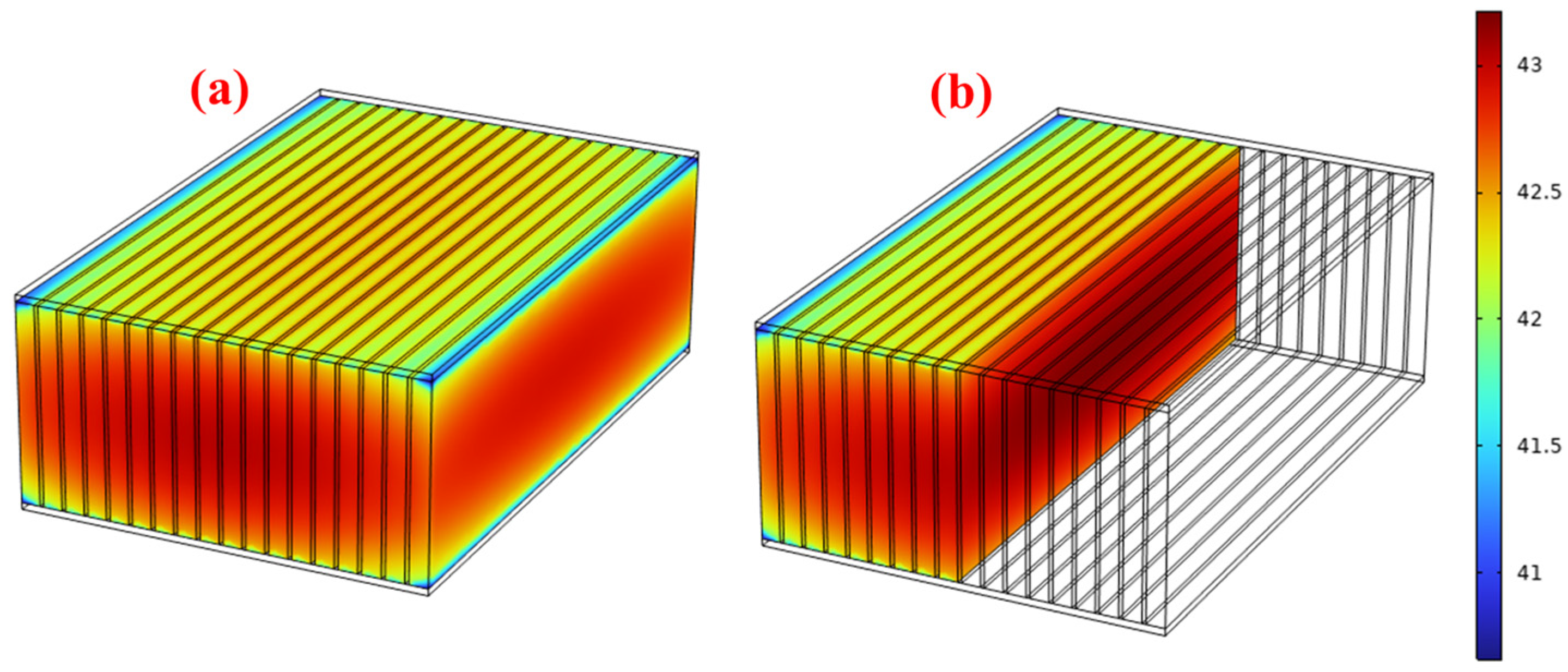
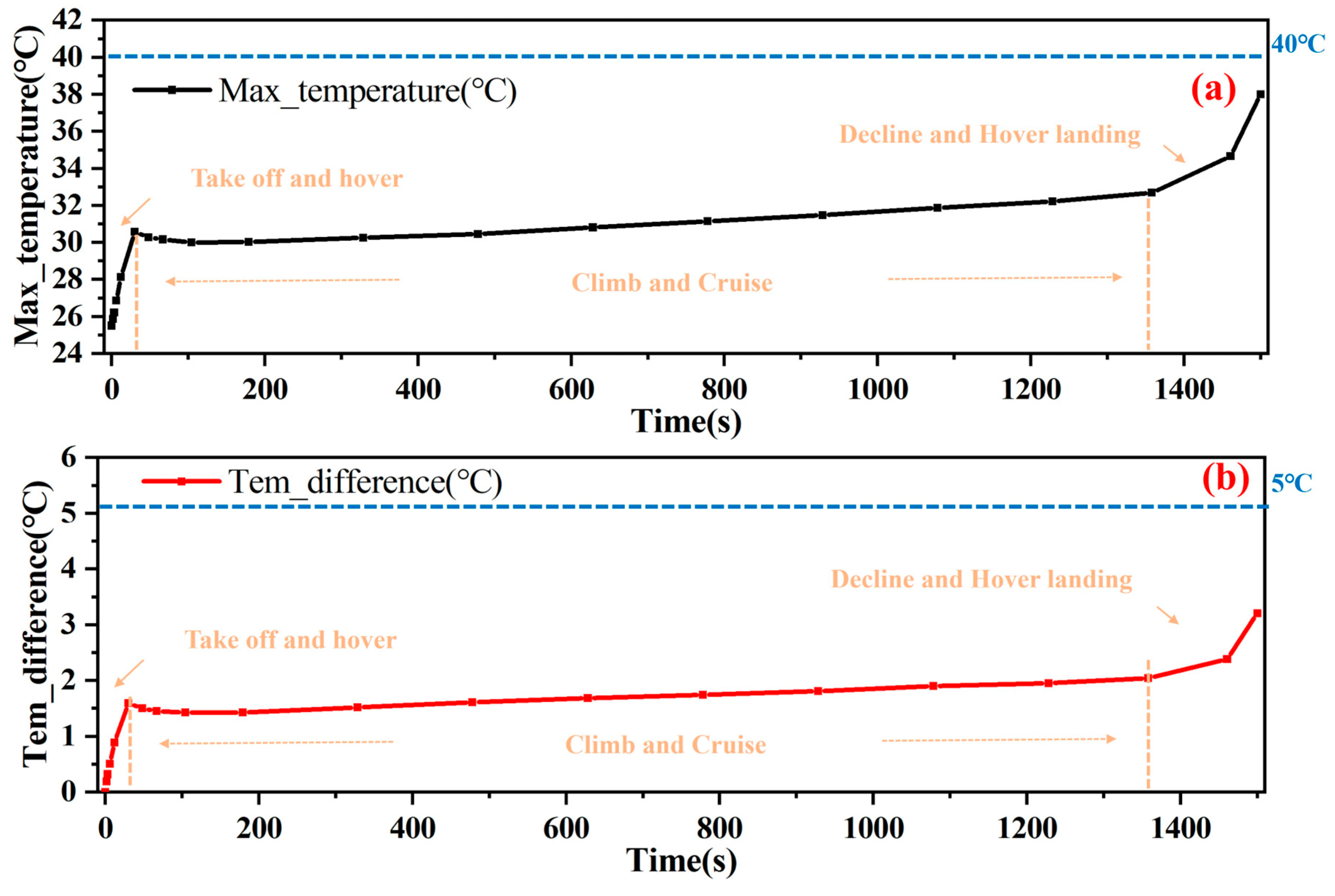
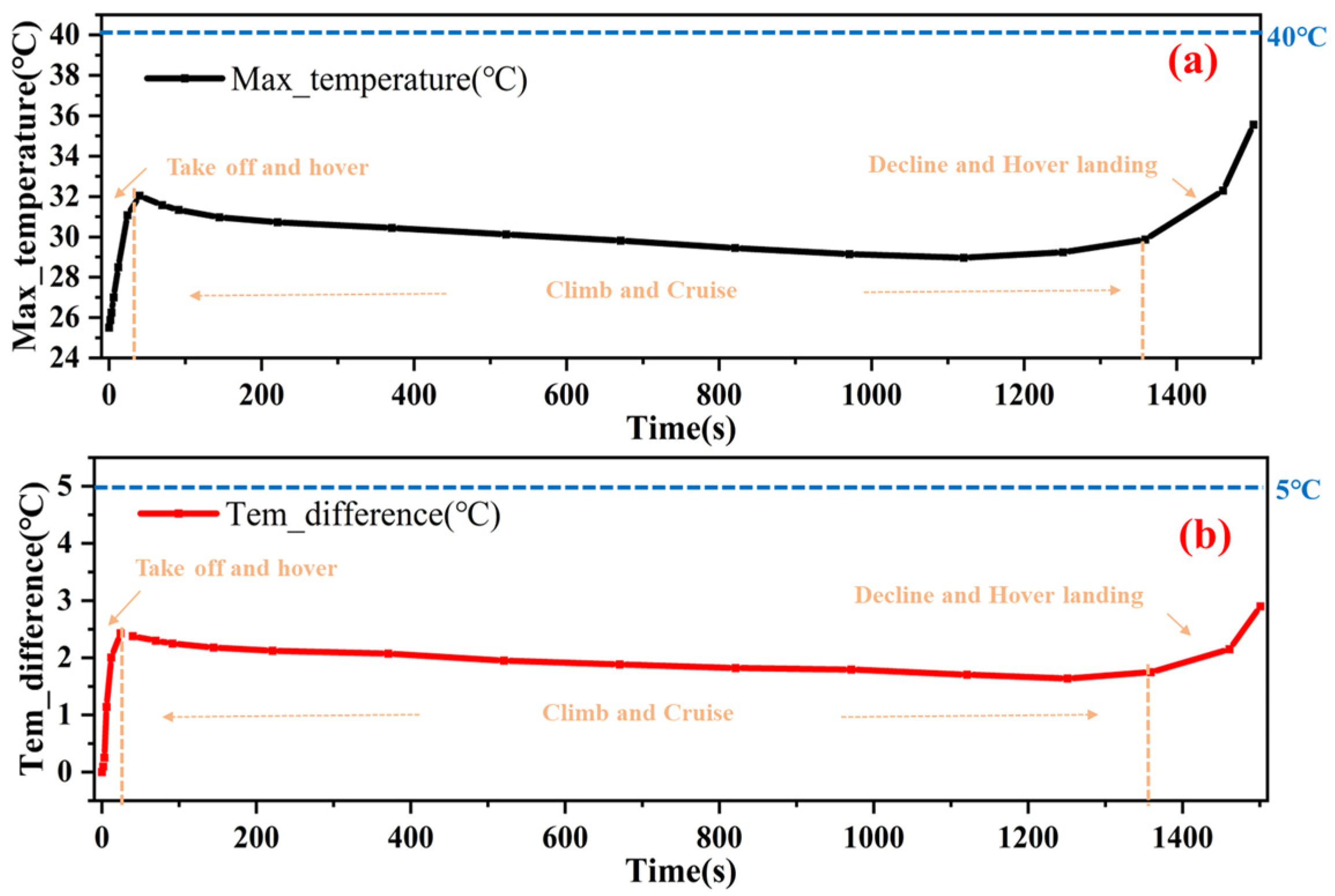
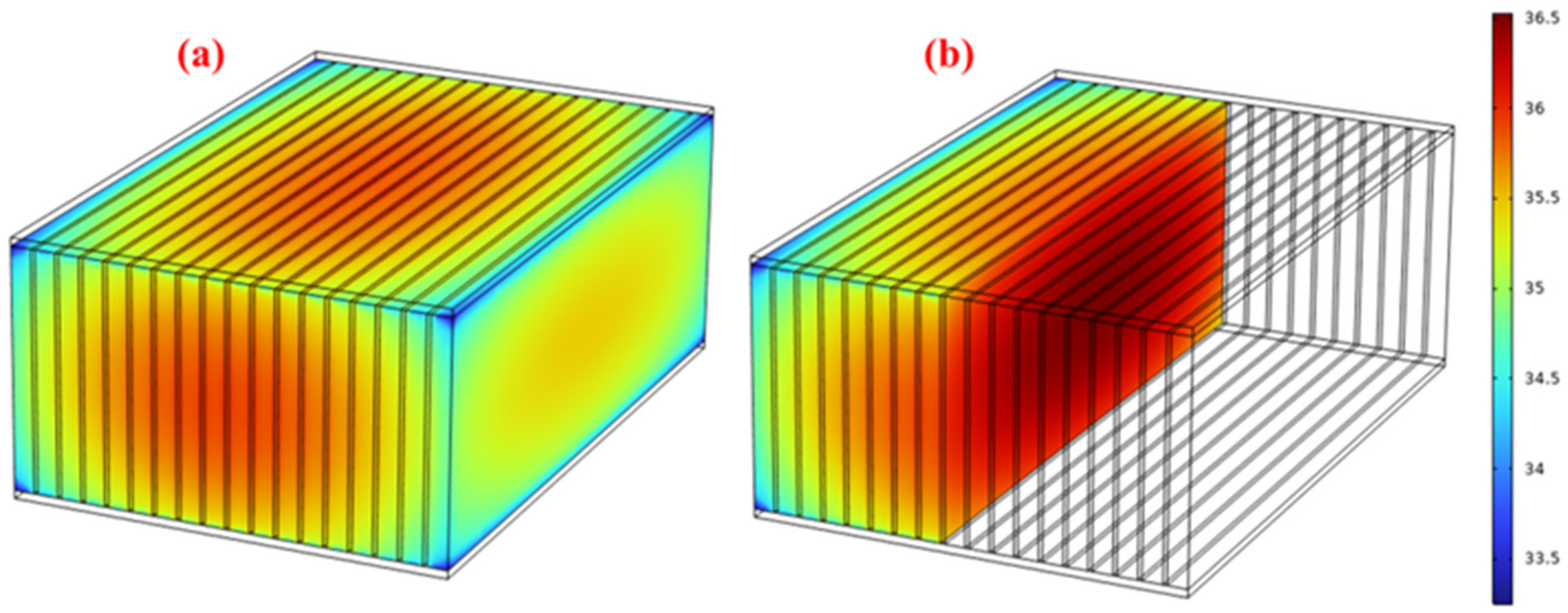
The simulation results indicate that, as shown in Figure 20a,b, the temperature variations in the active liquid cooling system closely follow the flight conditions and discharge rates, exhibiting a two-peak, two-plateau profile. Throughout the entire process, the maximum temperature is only 35.9 °C, and the temperature never exceeds the upper limit of 40 °C within the optimal operating range. The maximum temperature difference is 2.9 °C, while the minimum temperature difference during the cruise phase is only 2.1 °C, all remaining below the safety threshold of 5 °C. As shown in Figure 21a,b, the spatial temperature distribution exhibits a mild gradient, with lower temperatures at both sides and slightly higher temperatures in the middle. The highest temperature is located at the center of the module, with no significant thermal accumulation, demonstrating excellent temperature stability and uniformity. In comparison, the hybrid cooling system proposed in this study achieves a peak temperature of 37.9 °C and a maximum temperature difference of 3.1 °C, indicating that the two systems exhibit closely comparable thermal performance.
To improve the rationality of the comparison between the proposed hybrid cooling system and the baseline liquid cooling system, a structural parameter sensitivity analysis was further conducted for the baseline liquid cooling configuration. The coolant inlet velocity was kept at 0.9 m/s. The liquid cooling channel height and liquid cooling plate thickness were varied to evaluate their effects on temperature control performance and system mass. A new liquid cooling comparison scheme was then determined. This scheme was used for subsequent comparison of structural mass among different cooling configurations under similar temperature control levels.
The system mass considered in this analysis includes the cooling plates, liquid cooling channels, coolant, and local cooling structures inside the module. External pumps, pipelines, connectors, and heat exchangers were not included.
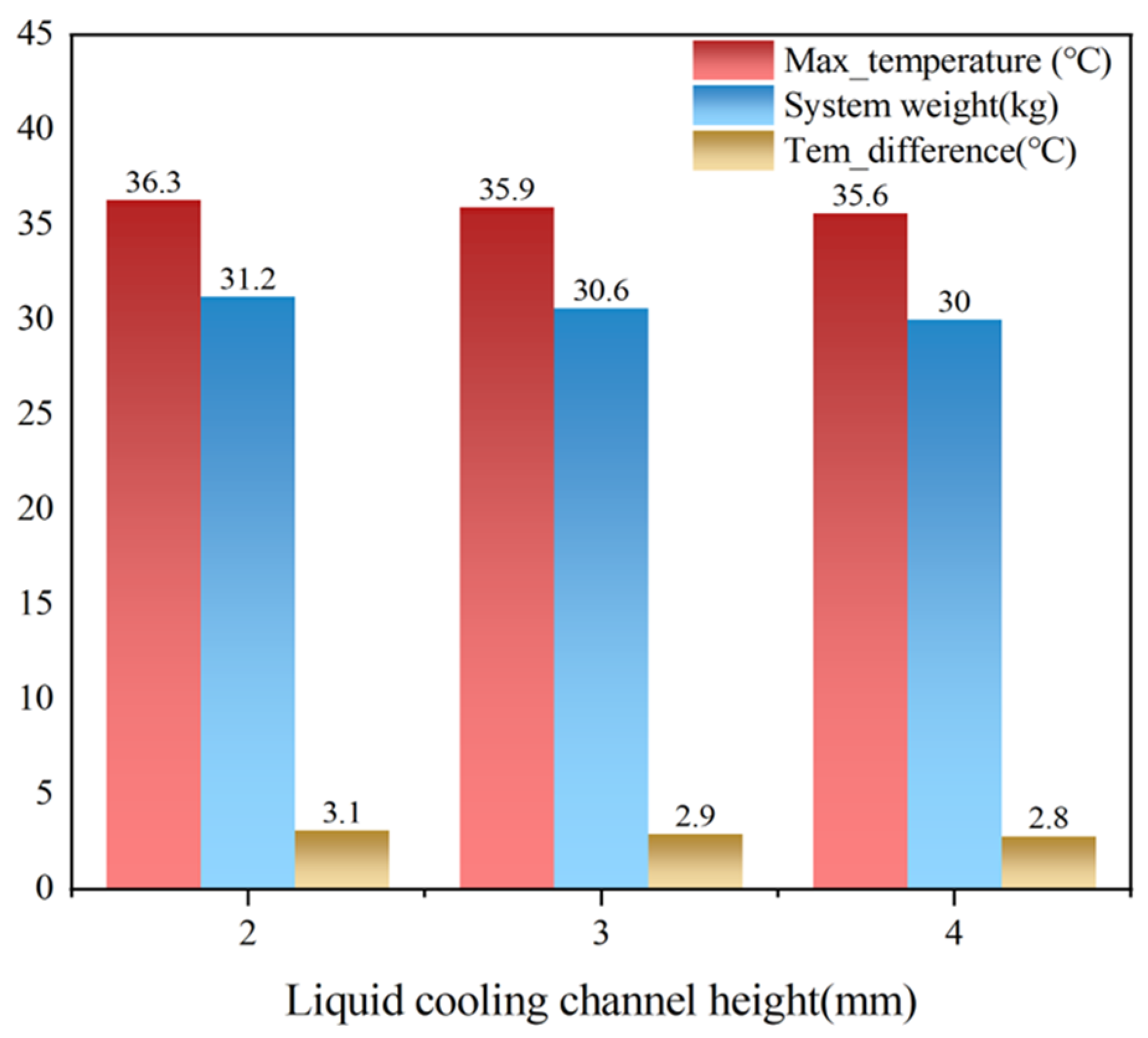
When the liquid cooling plate thickness was fixed at 5 mm, increasing the channel height from 2 mm to 4 mm reduced the maximum temperature from 36.3 °C to 35.6 °C, the maximum temperature difference from 3.1 °C to 2.8 °C, and the liquid cooling structure mass from 31.2 kg to 30.0 kg, as shown in Figure 22. A larger channel height increases the coolant flow area and enhances channel heat transfer. Meanwhile, the solid metal volume of the cooling plate decreases.
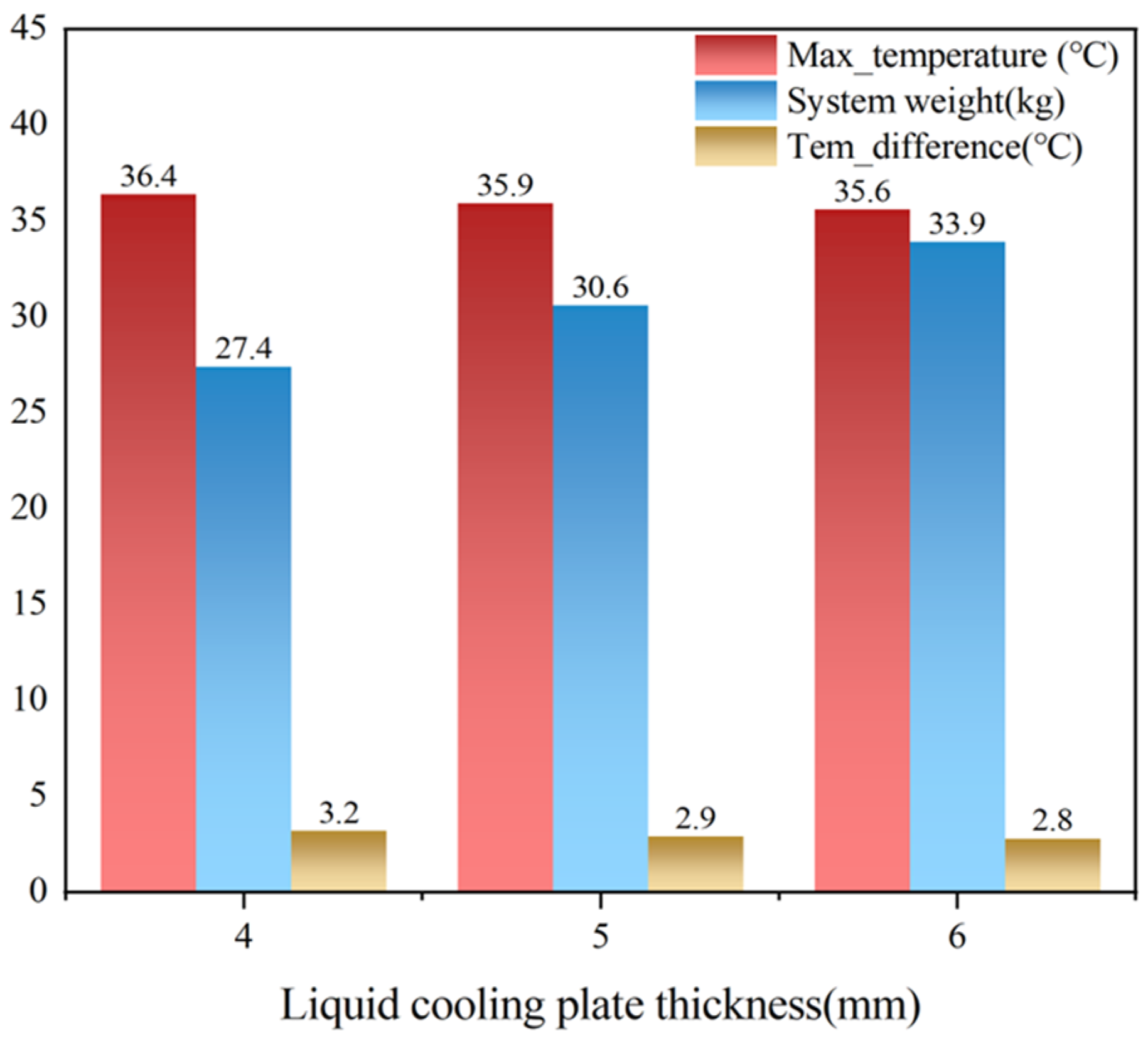
When the channel height was fixed at 3 mm, the liquid cooling plate thickness increased from 4 mm to 6 mm reduced the maximum temperature from 36.4 °C to 35.6 °C and the maximum temperature difference from 3.2 °C to 2.8 °C, as shown in Figure 23. However, the liquid cooling structure mass increased from 27.4 kg to 33.9 kg. A thicker cooling plate improves lateral heat conduction and temperature uniformity but also increases structural mass. A thinner plate reduces mass but weakens heat spreading.
These results show that the liquid cooling channel height mainly affects the coolant flow area and channel heat transfer capacity. Increasing the channel height can reduce both thermal indicators and cooling plate mass within the investigated range. In contrast, the liquid cooling plate thickness mainly affects lateral heat conduction and structural mass. Increasing plate thickness improves temperature control but increases system mass.
According to the sensitivity analysis, a new liquid cooling scheme was further constructed to compare the structural characteristics of the liquid cooling system and the hybrid cooling system under similar thermal control levels. In this scheme, the liquid cooling plate thickness was reduced from 5 mm to 3 mm, the channel height was reduced from 3 mm to 2.0 mm, and the coolant inlet velocity was kept at 0.9 m/s. As shown in Figure 24, the maximum temperature and maximum temperature difference are 38.1 °C and 3.1 °C, respectively, which are close to those of the hybrid cooling system, 37.9 °C and 3.1 °C. The mass of the liquid cooling system is 24.8 kg.

4.3.4. Comprehensive Performance Evaluation

Based on the comprehensive performance evaluation metric system established in Section 3.5, this section conducts a systematic comparative analysis of the no cooling system, hybrid cooling system, liquid cooling system, and passive cooling system under the same flight conditions. To ensure comparability of the metrics and the objectivity of the normalization process, the grouping efficiency and space occupancy of the no cooling system, which are used to measure structural compactness, are set as the reference benchmark, with a normalized value of 1. These values serve as the relative performance reference for other cooling systems.
Based on the comprehensive performance evaluation results in Table 6. In terms of thermal performance: compared with the no cooling approach, the hybrid cooling system reduces the maximum temperature and maximum temperature difference by 16.8% and 49%, respectively. Relative to the passive cooling system, the temperature control margin (TCM) is improved by 13.4%, and the fluctuation amplitude of temperature stability (ST) is improved by 44.6%. However, its performance in controlling the maximum temperature difference (DT) is 33.3% lower than that of the passive cooling system. The overall temperature control capability of the hybrid cooling system is comparable to that of the liquid cooling system.
In terms of structural performance: The spatial occupancy (SO) of the hybrid cooling system is 19.5% lower than that of the liquid cooling system, while showing a marginal increase compared to the passive cooling system. The grouping efficiency (GE) is 22.4% higher than that of the liquid cooling system and remains essentially comparable to that of the passive cooling system.
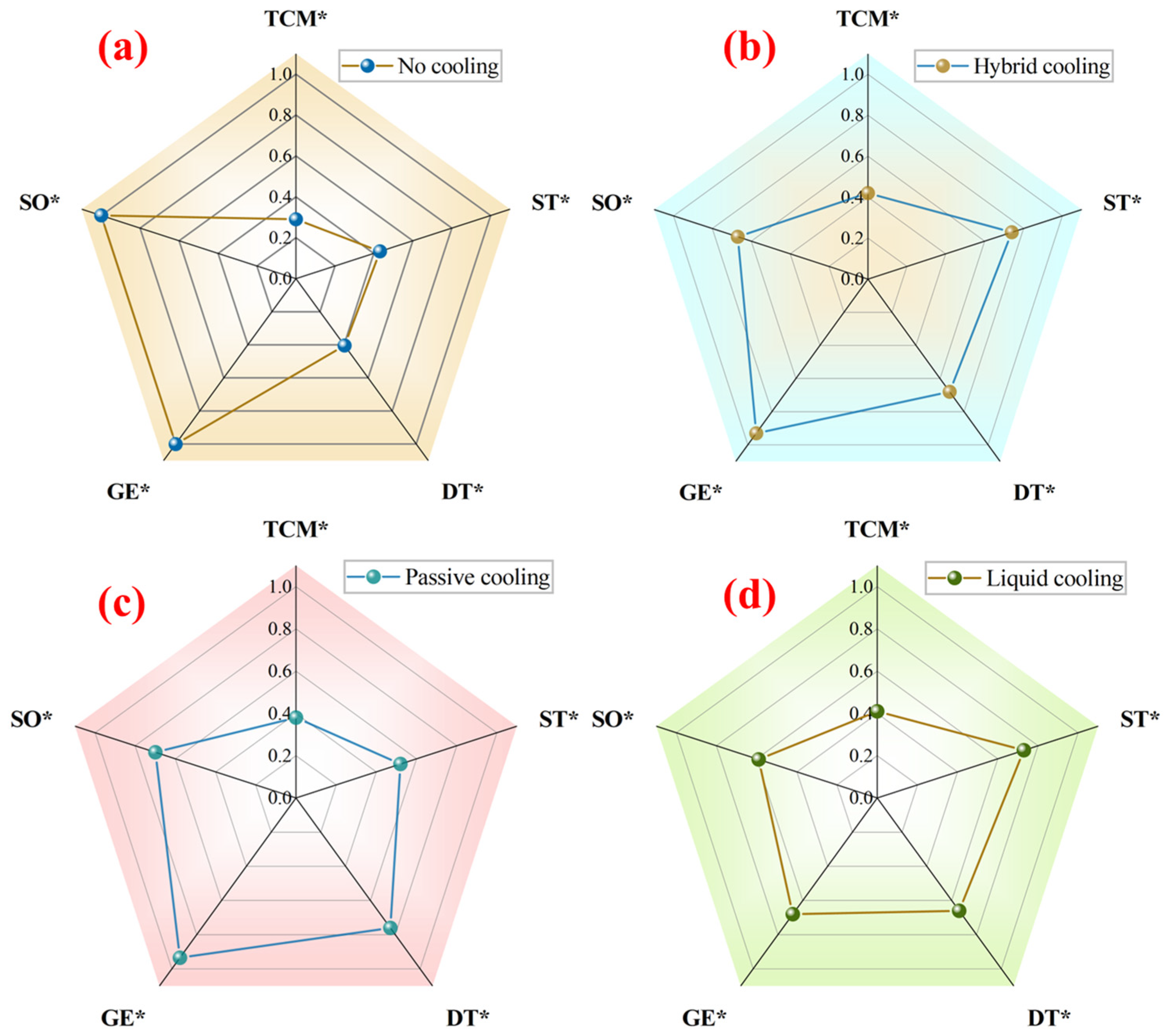
To further compare the comprehensive performance of different cooling strategies, a visual comparative analysis of key performance indicators across all cooling strategies was conducted, with results presented in the radar chart in Figure 25:
In Figure 25a, the no cooling system exhibits certain advantages in structural compactness and spatial utilization; however, its temperature control capability and stability are extremely poor, accompanied by severe heat accumulation issues that compromise battery thermal safety.
Figure 25b shows that the hybrid cooling system achieves balanced performance across the five-evaluation metrics. The system shows relatively good performance in controlling the maximum temperature and temperature difference. Good temperature stability and structural adaptability are also maintained.
Figure 25c displays the performance of the passive cooling system: this system performs well in temperature stability and structural compactness; however, due to the absence of an active cooling mechanism, its peak temperature control capability is limited, resulting in overall performance that does not reach the level of the hybrid cooling system.
Figure 25d presents the performance characteristics of the liquid cooling system: its temperature control effectiveness slightly surpasses that of the hybrid cooling system, but constrained by its complex structural design, it shows relatively low module efficiency and spatial utilization.
This system effectively mitigates the thermal safety risks associated with the no cooling approach, the structural redundancy of liquid cooling, and the peak temperature control limitations of passive cooling. Specifically, the hybrid configuration achieves an integrated balance between efficient thermal management and structural compactness, numerically predicting maximum temperature and maximum temperature difference of 37.9 °C and 3.1 °C, respectively, while establishing a uniform and moderate thermal environment. Existing studies confirm [45] that sustaining lithium-ion battery operation within the ideal 20–40 °C range while minimizing internal temperature gradients is critical for decelerating aging rates and preserving cell-to-cell performance consistency. Consequently, the hybrid cooling system not only ensures thermal safety during individual eVTOL flights but also fundamentally supports long-term healthy operation of the power battery, thereby enhancing lifecycle economic viability and operational reliability.
Additionally, a performance comparison is conducted with other systems reported in the literature. Table 7 summarizes recent comparable studies, indicating that the present design effectively meets the performance requirements for electric aircraft and offers a robust solution for maintaining component reliability under variable operating conditions.

4.4. Adaptability Analysis of the Hybrid Cooling System

Based on the multi-condition settings and SOC calculation method defined in Section 2.2, this section analyzes the effects of ambient temperature, cruise duration, and hover duration on the thermal performance of the proposed hybrid cooling system.

4.4.1. Effect of Ambient Temperature

Ambient temperature is an important boundary condition affecting the performance of the hybrid cooling system. It influences the heat transfer temperature difference between the battery module and the external air. It also affects the initial phase state of the PCM, the utilization of latent heat, and the ability of the air-cooling channel to remove heat from the outer surface of the PCM. To further evaluate the adaptability of the proposed hybrid cooling system under different climatic conditions, five ambient temperature cases were considered in this study: 15 °C, 20 °C, 25 °C, 30 °C, and 35 °C. The baseline flight profile, structural parameters, and inlet airflow velocity were kept unchanged.
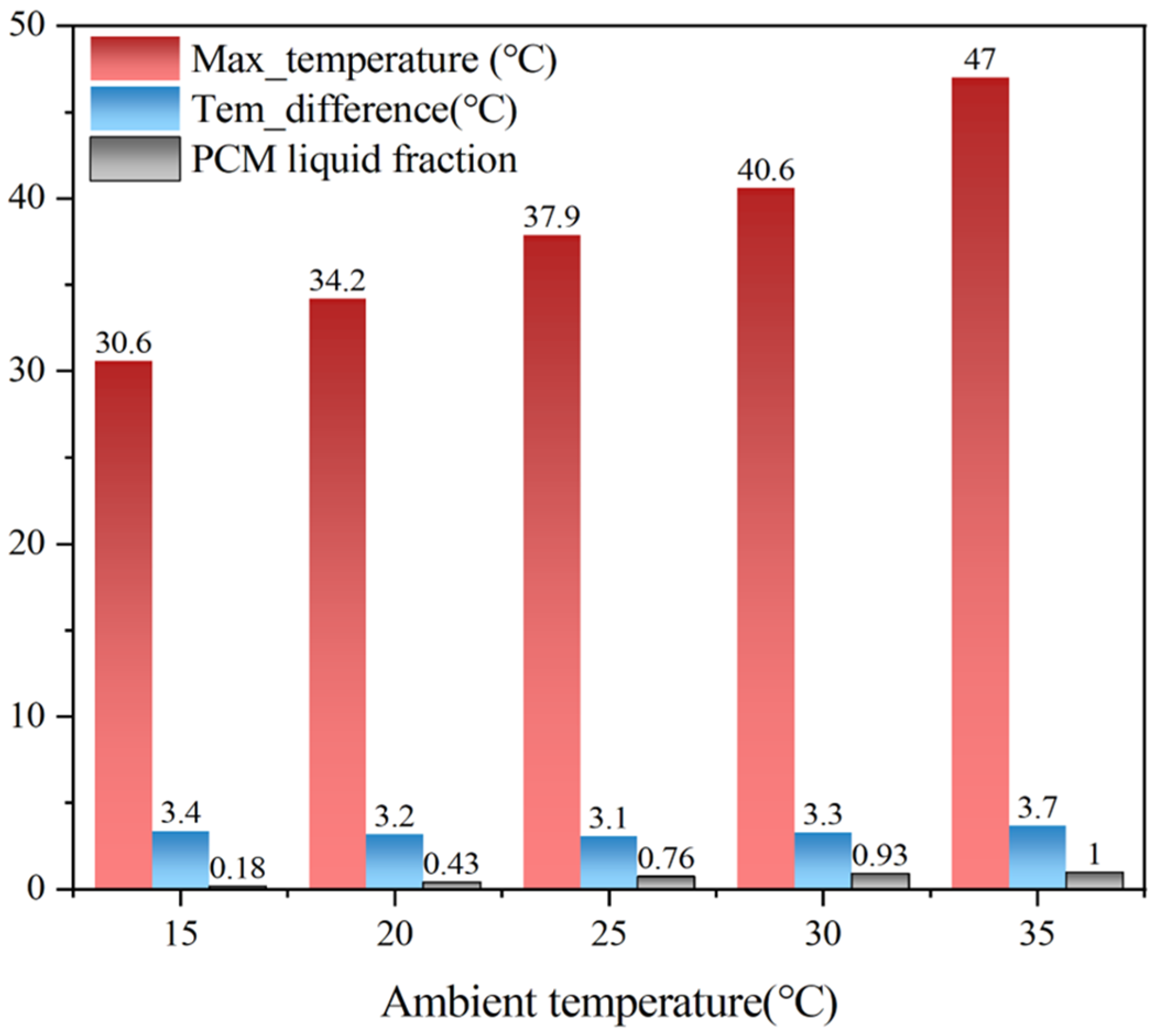
As shown in Figure 26, ambient temperature strongly affects the thermal performance of the hybrid cooling system. At 15 °C and 20 °C, the initial temperature is below the phase-change range of MPCM32D. The large temperature difference between the inlet air and the PCM surface enhances heat removal by the air-cooling channel. Therefore, the maximum battery temperature is lower than that under the 25 °C baseline condition.
At 15 °C, heat regulation mainly depends on lateral heat spreading through the high-thermal-conductivity plate and sensible heat absorption by solid PCM. Only limited phase change occurs in the later stage. The maximum temperature is 30.6 °C, and the final PCM liquid fraction is 0.18. At 20 °C, the PCM enters the phase-change range during takeoff hover and the middle-to-late cruise stage. The liquid fraction increases to 0.43, and the maximum temperature reaches 34.2 °C. The maximum temperature differences are 3.4 °C and 3.2 °C at 15 °C and 20 °C, respectively. Under the 25 °C baseline condition, the maximum temperature and maximum temperature difference are 37.9 °C and 3.1 °C, respectively. The final PCM liquid fraction is 0.76. This indicates good thermal matching between the PCM and the cooling system. At 30 °C, the initial temperature is close to the phase-change range of MPCM32D. PCM is activated earlier, and its latent heat reserve is consumed more rapidly. The maximum temperature increases to 40.6 °C, with a maximum temperature difference of 3.3 °C and a final liquid fraction of 0.93. At 35 °C, the initial temperature exceeds the phase-change temperature of MPCM32D. The PCM is already liquid at the beginning of the mission. Its latent heat buffering effect is therefore weakened, and heat regulation mainly relies on sensible heat absorption and surface heat removal. As a result, the maximum temperature rises to 47.0 °C, and the maximum temperature difference increases to 3.7 °C.
Overall, the proposed hybrid cooling system shows good adaptability at 30 °C. At this temperature, the PCM latent heat can be effectively activated, although it is nearly depleted near the end of the mission.

4.4.2. Effect of Cruise Duration

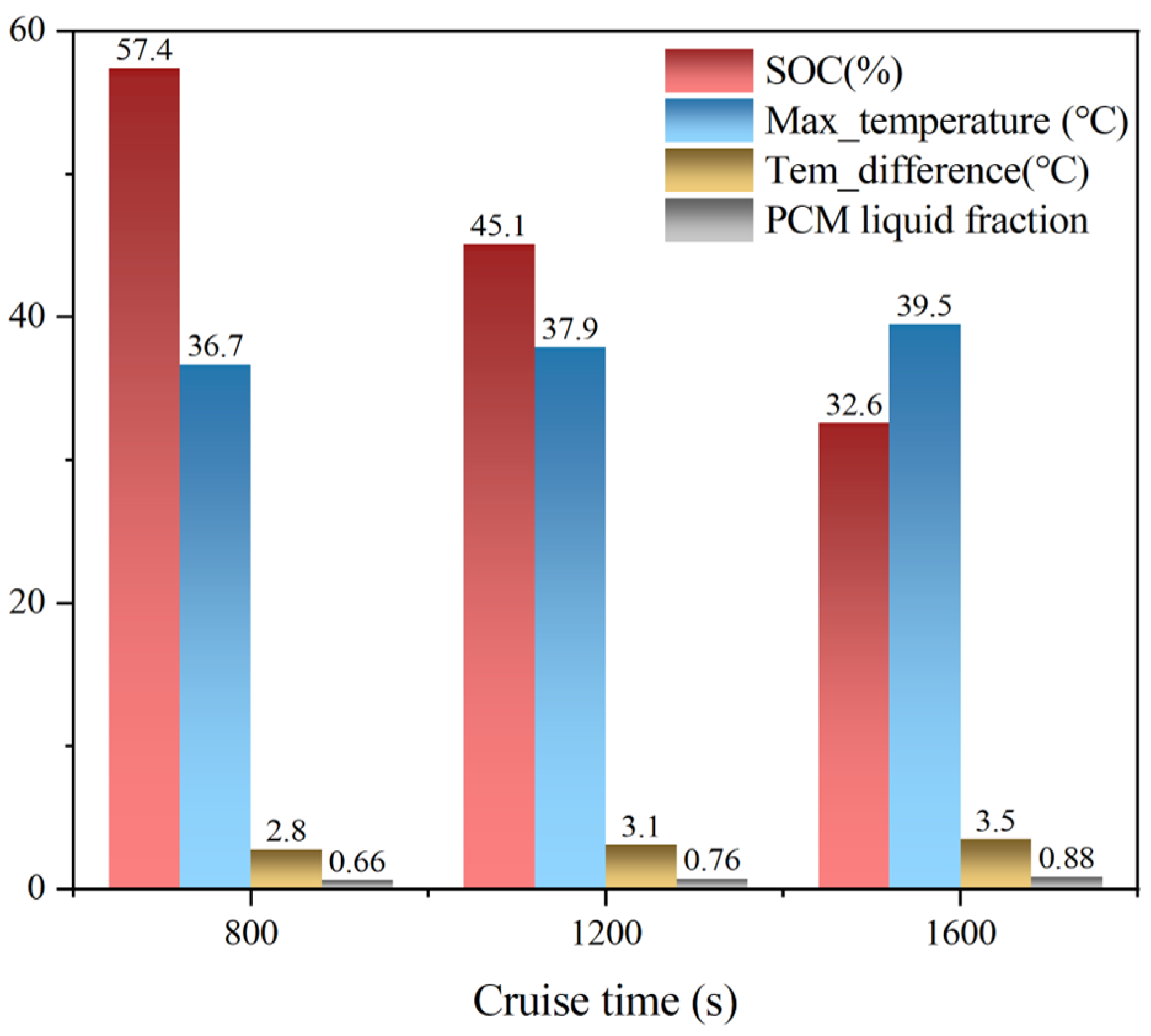
Although the discharge rate during cruise is lower than that during takeoff and landing hover, the cruise phase has the longest duration. Therefore, it strongly affects the PCM latent heat consumption and SOC variation during the mission. In this study, the takeoff hover, climb, descent, and landing hover phases were kept unchanged. Only the cruise duration was varied. Three cases were considered: 800 s, 1200 s, and 1600 s. The 1200 s case was used as the baseline. According to the SOC calculation, the final SOC values for the three cruise durations were 57.4%, 45.1%, and 32.6%, respectively.
As shown in Figure 27, the maximum temperature, maximum temperature difference, and PCM liquid fraction all increase as the cruise duration increases from 800 s to 1600 s.
When the cruise duration is 800 s, the total mission time is short, and the final SOC remains high. The total heat generation of the battery module is relatively low. Thus, the PCM latent heat is only partially consumed. The final PCM liquid fraction is 0.66. The maximum temperature and maximum temperature difference are 36.7 °C and 2.8 °C, respectively. This indicates that the hybrid cooling system has sufficient thermal buffering capacity.
When the cruise duration increases to 1200 s, the system operates under the baseline condition. Continuous heat generation during cruise increases the PCM liquid fraction. In the middle and later stages of flight, the heat storage capacity of PCM begins to decline. The final PCM liquid fraction is about 0.76. However, air cooling continuously removes heat from the PCM and partially restores its heat storage capacity. Therefore, the maximum temperature and maximum temperature difference are limited to 37.9 °C and 3.1 °C, respectively.
When the cruise duration further increases to 1600 s, the total mission time reaches 1900 s. The final SOC decreases to 32.6%. The total heat generation increases, and the PCM remains at a high liquid fraction. As a result, the maximum temperature rises to 39.5 °C, and the maximum temperature difference increases to 3.5 °C. The final PCM liquid fraction reaches 0.88. Although the maximum temperature remains below 40 °C and the temperature difference remains below 5 °C, the remaining latent heat capacity of the PCM is significantly reduced. This suggests that long-range missions weaken the thermal buffering capacity of the system during the final high-discharge phase.
Overall, the hybrid cooling system can still maintain good temperature control as the cruise duration increases. However, the increasing PCM liquid fraction indicates a gradual reduction in latent heat buffering margin.

4.4.3. Effect of Hover Duration

The takeoff and landing hover phases have the highest power demand in an eVTOL mission. Although these phases are short, their instantaneous heat generation rate is much higher than that during cruise. To evaluate the effect of high-discharge duration on the hybrid cooling system, the takeoff and landing hover durations were simultaneously set to 30 s, 40 s, and 50 s. All other flight conditions were kept unchanged.
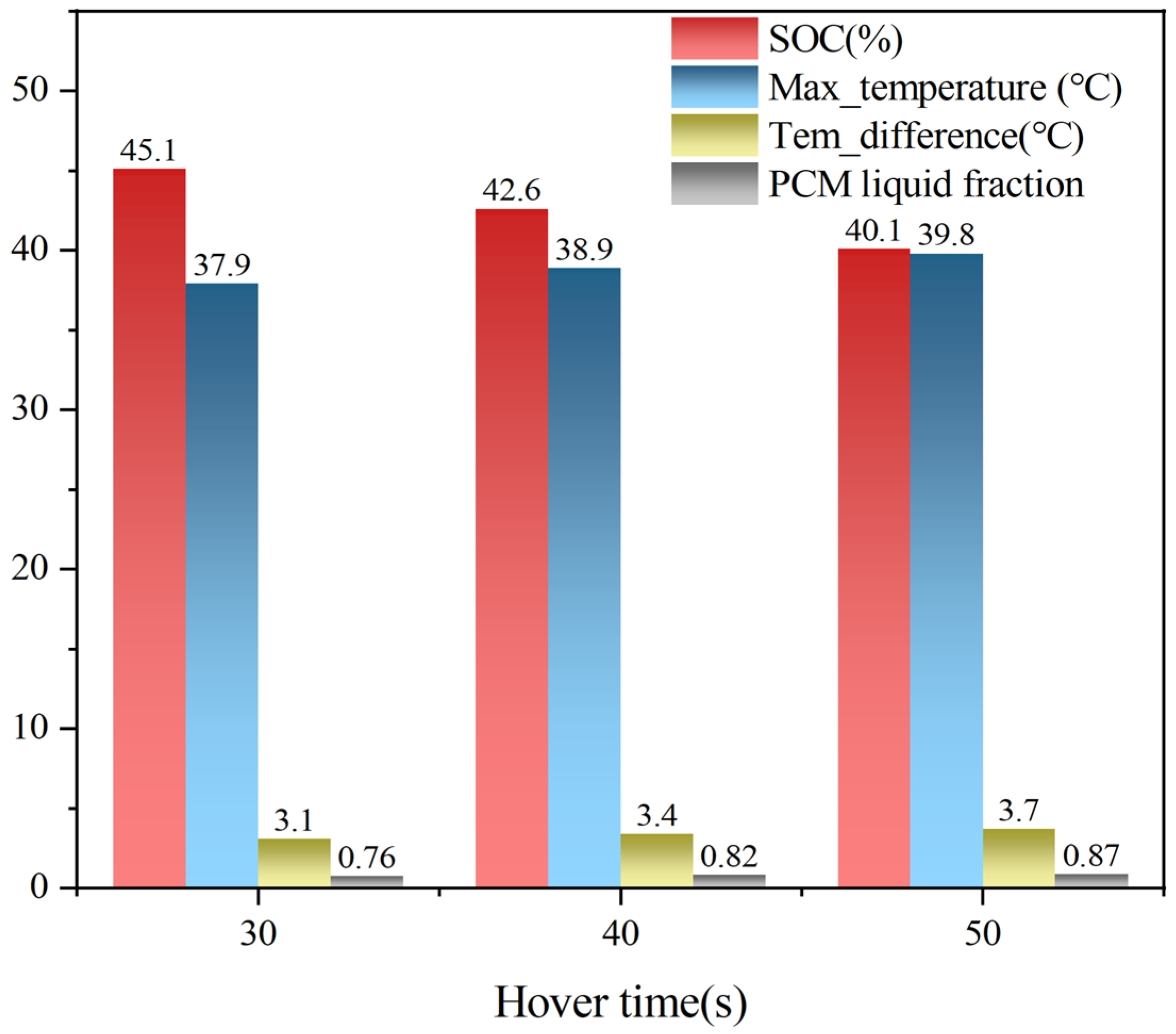
As shown in Figure 28, increasing the single hover duration from 30 s to 50 s increases the thermal load of the battery module. The maximum temperature rises from 37.9 °C to 39.8 °C. The maximum temperature difference increases from 3.1 °C to 3.7 °C. The PCM liquid fraction also increases from 0.76 to 0.87. This indicates that a longer high-discharge period directly increases transient heat input and accelerates PCM latent heat consumption.
The thermal response differs between takeoff hover and landing hover. Takeoff hover occurs at the beginning of the mission. At this stage, the battery, PCM, and high-thermal-conductivity plate are still at relatively low temperatures. The PCM also has sufficient latent heat capacity. Therefore, the thermal shock during takeoff can be effectively buffered by heat spreading through the high-thermal-conductivity plate and heat absorption by the PCM. In contrast, landing hover occurs near the end of the mission. After climbing and long cruises, the battery SOC decreases and the PCM liquid fraction increases. Thus, under the same discharge rate and duration, landing hover is more likely to cause the maximum temperature of the entire mission.
When the single hover duration increases to 40 s, the PCM still retains part of its latent heat capacity. Air cooling can also help recover its heat storage ability. The maximum temperature increases to 38.9 °C. When the hover duration further increases to 50 s, the final PCM liquid fraction reaches 0.87. This means that most of the latent heat reserve has been consumed. The maximum temperature reaches 39.8 °C, while the maximum temperature difference remains within 3.7 °C.
These results show that the proposed hybrid cooling system has a certain adaptability to short-term extension of hover duration.

4.5. Air-Cooling Intervention Strategy and Energy Efficiency Trade-Off Analysis

In the hybrid cooling system for eVTOL power batteries, air cooling effectively suppresses battery temperature rise by enhancing convective heat transfer and is therefore essential for thermal safety under high-rate discharge conditions. However, continuous operation of the air-cooling subsystem throughout the entire flight mission leads to additional energy consumption, which may undermine the requirements of eVTOL systems for high energy efficiency and extended endurance.
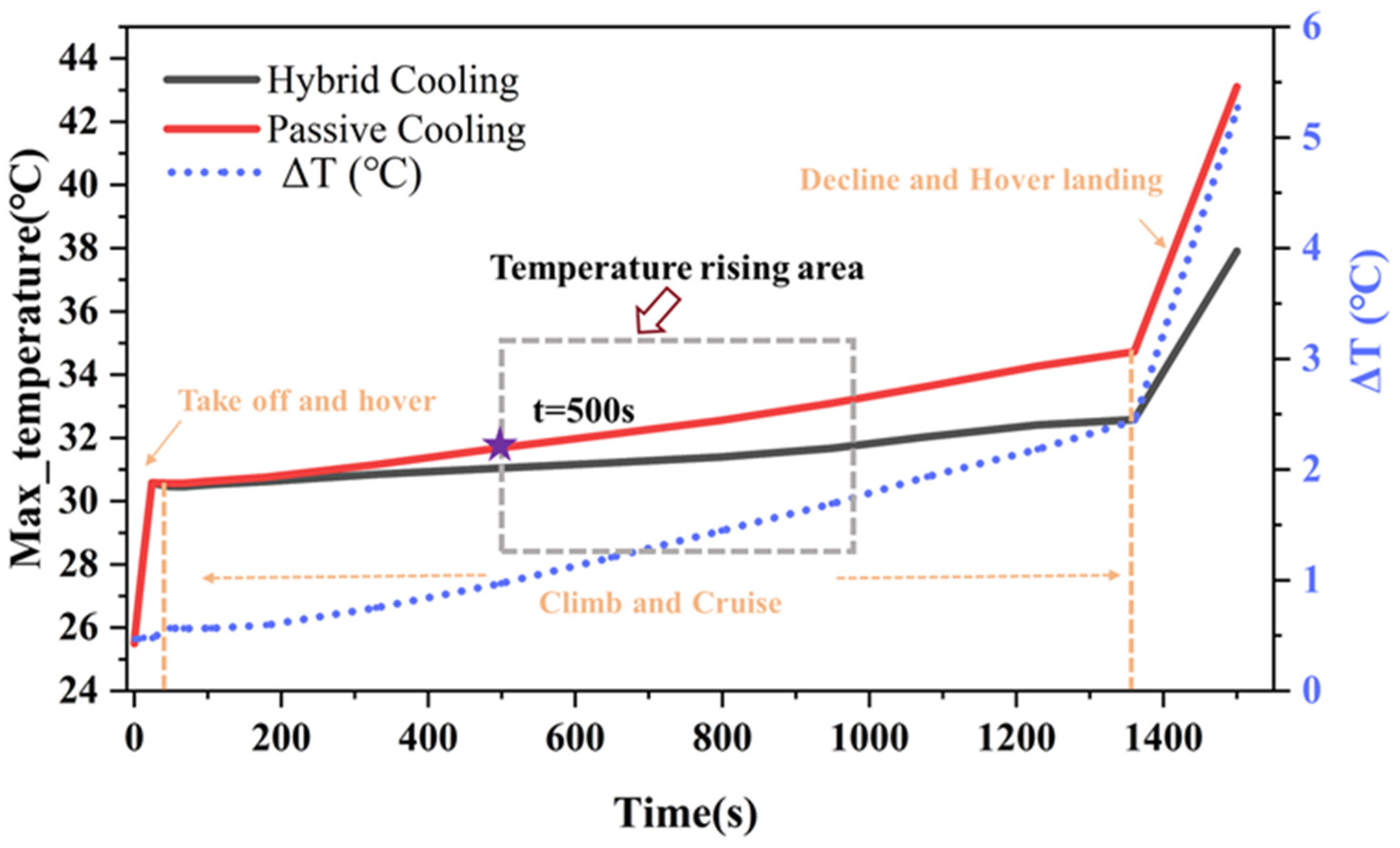
As shown in Figure 29, compared with the pure PCM cooling system, the hybrid cooling system more effectively suppresses the continuous temperature rise of the battery module during the later stage of flight. In particular. After t = 500 s, the temperature difference (ΔT) between the two systems increases rapidly from 0.8 °C to 5.2 °C, indicating that air cooling gradually becomes the dominant temperature regulation mechanism. When sufficient latent heat remains in the PCM, the peak temperature rise is relatively insensitive to the inlet airflow velocity, suggesting that the system mainly relies on PCM-based latent heat storage for passive thermal regulation in the early stage of flight. As the PCM latent heat is progressively depleted, its independent thermal buffering capability weakens, and the air-cooling subsystem increasingly assumes the primary heat dissipation role through forced convection and accelerated heat release from the PCM. Overall, the hybrid cooling system exhibits a clear stage-dependent functional division: PCM dominates early-stage thermal buffering, whereas air cooling governs sustained heat dissipation in the middle and later stages.
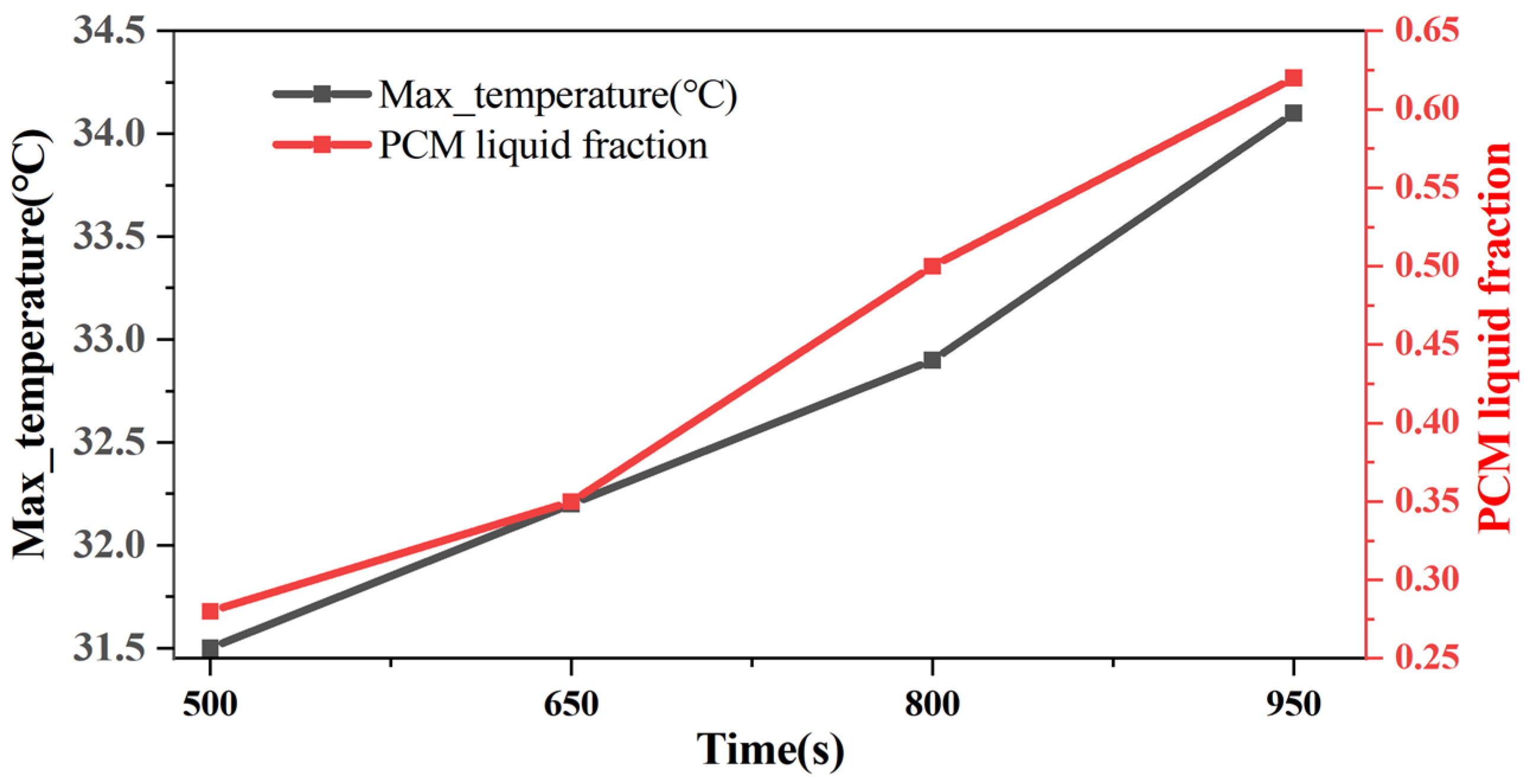
Furthermore, the PCM liquid fraction was adopted as a quantitative measure of latent heat consumption, providing a physically interpretable basis for determining the air-cooling intervention timing. This parameter directly reflects the phase-change progression of the PCM and is negatively correlated with the remaining latent heat capacity. It therefore serves as a key physical metric for characterizing the degradation of thermal storage capability.
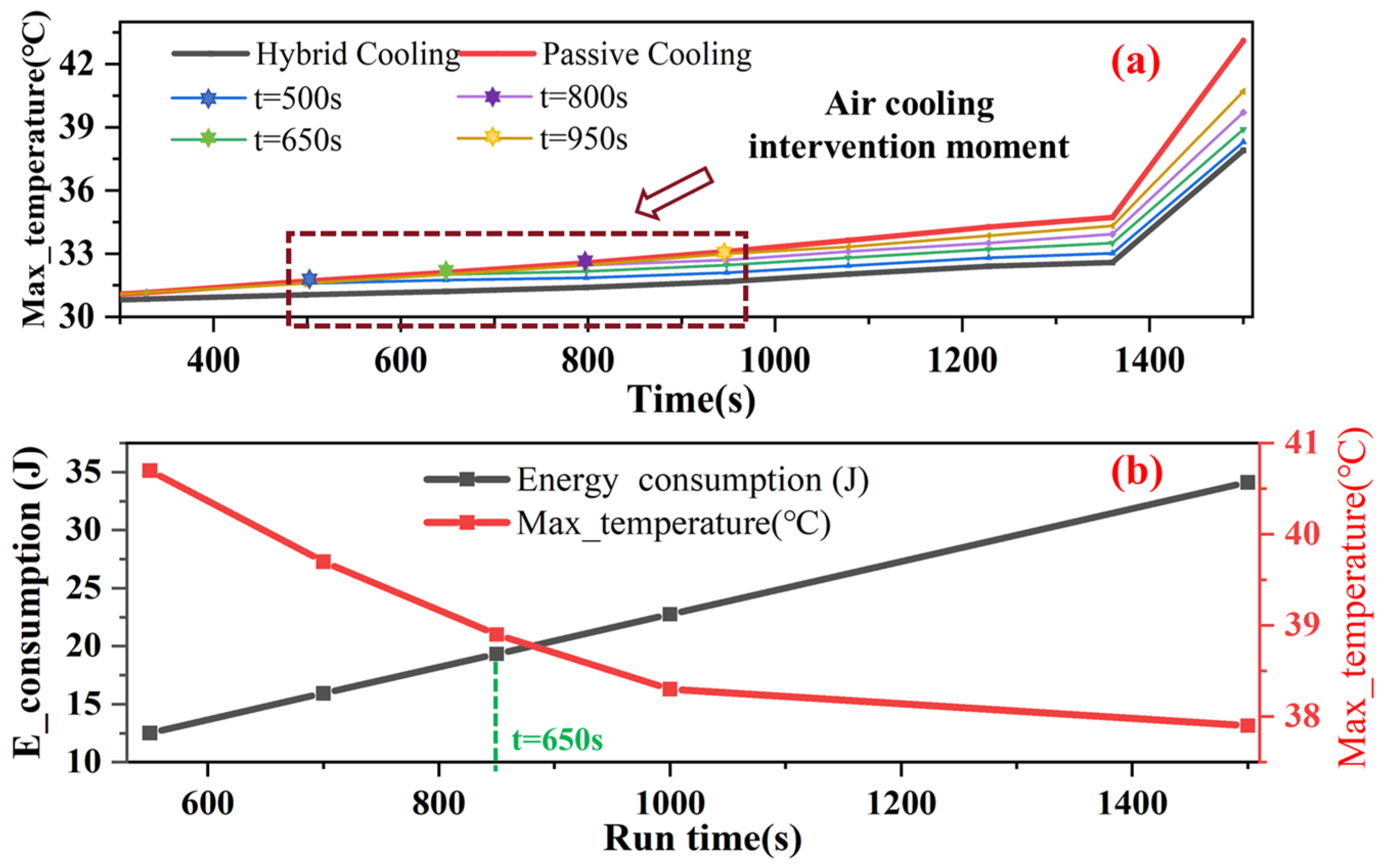
As indicated by the evolution curve of the PCM liquid fraction in Figure 30, when t = 800 s, more than 50% of the PCM latent heat has been consumed, corresponding to a liquid fraction of 0.5. This moment can therefore be regarded as a critical transition point at which the PCM shifts from a latent-heat-sufficient stage to a thermal storage degradation stage. Beyond this point, the heat removal capacity at the convective boundary gradually becomes the dominant factor in suppressing temperature rise, whereas the ability of PCM phase change to mitigate the peak temperature and temperature difference begins to weaken. The multiparameter coupled evolution shown in Figure 30 further clarifies the physical states corresponding to different intervention times. At t = 500 s, the maximum battery module temperature T m a x is 31.5 °C and the PCM liquid fraction is 0.28, indicating that the PCM is still in a latent-heat-sufficient stage dominated by passive thermal regulation. At t = 650 s, T m a x rises to 32.2 °C and the liquid fraction increases to 0.36, suggesting that latent heat consumption is gradually increasing but has not yet entered the degradation stage. At t = 800 s, T m a x reaches 32.9 °C and the liquid fraction exceeds 0.5, indicating that more than 50% of the latent heat has been consumed and that the PCM has formally entered the thermal storage degradation stage. At t = 950 s, T m a x further increases to 34.1 °C and the liquid fraction approaches 0.62, implying that the latent heat reserve is close to depletion and the thermal storage regulation capability has been significantly weakened.
Based on the thermal evolution pattern and intrinsic functional mechanisms, an air-cooling intervention strategy is proposed and verified through simulations. Specifically, when the PCM system temperature reaches 31.5°C at t = 500 s, it is determined as the critical response threshold to activate the air cooling. To evaluate the impact of different intervention timings on thermal behavior and air-cooling energy consumption, four representative intervention time points are selected around this response threshold: t = 500 s, 650 s, 800 s, and 950 s, with a 150 s interval between each to balance the strategy coverage and experimental resolution.
The energy consumption corresponding to each time sequenced air-cooling strategy is quantitatively assessed using the following method:
E = m air Δ p a i r ρ a i r η f a n Δ t
In Equation (33), Δ p a i r denotes the static pressure difference of the modeled air-cooling channel obtained from CFD postprocessing. At the baseline inlet velocity of 3 m/s, the inlet area is 1.63 × 10 3   m 2 , giving an air volume flow rate of 4.89 × 10 3   m 3 / s . The air density and fan efficiency are set to 1.184   k g / m 3 and 0.60, respectively. The pressure difference is defined as the area-averaged static pressure difference between the inlet and outlet sections of the modeled air-cooling channel. This power model represents the ideal air transport power required to overcome the channel pressure drop.

Based on the analysis in Section 4.2.3, the inlet airflow velocity is set to 3 m/s. As shown in Figure 31a,b, the temperature evolution of the battery module under different intervention strategies is presented with a focus on the period from t = 300 s to the end of the mission, to highlight the regulatory effect of air cooling on the thermal behavior during the mid-to-late stages. Simulation results indicate that delaying the air-cooling intervention leads to a gradual decline in the temperature control capability of the system. In addition, a joint visualization of cooling duration, maximum temperature, and energy consumption reveals the trade-off between thermal performance and energy cost for each strategy. While the t = 0 s (continuous air cooling) strategy achieves the lowest peak temperature of 37.9 °C, it incurs the highest energy consumption at 34.13 J. Conversely, the t = 950 s strategy yields the lowest energy use (12.51 J) but allows the maximum temperature to rise to 40.7 °C, indicating insufficient thermal regulation. Comprehensive analysis shows that the t = 650 s intervention strategy achieves the optimal balance between thermal control and energy efficiency. Within a total air-cooling duration of 850 s, it limits the maximum temperature to 38.9 °C while consuming only 19.34 J of energy, outperforming both earlier and later intervention schemes in terms of synergistic regulation.
Compared to continuous air cooling, the intervention strategy at t = 650s reduces energy consumption by approximately 43.3%, while the peak temperature increases by only about 2.6%. In conclusion, the air-cooling intervention strategy, based on the peak temperature response window of the battery module, effectively activates cooling potential in the later stages of the flight mission. This significantly reduces energy consumption while ensuring thermal safety, providing a feasible path and parameter reference for intelligent thermal management under multi-stage operating conditions in eVTOLs.

5. Conclusions

To address the challenges of heat dissipation and structural compactness in eVTOL power batteries under high-rate discharge conditions, this study proposes a hybrid battery cooling system integrating forced air convection, high-thermal-conductivity plates, and PCM. The power demand in different eVTOL flight phases is first analyzed. A single-cell simulation model is then developed and validated through experiments. Three key structural parameters are investigated, including cell spacing, high-thermal-conductivity plate material, and inlet airflow velocity. Sensitivity analysis is used to rank their effects on thermal performance and structural compactness. A multidimensional evaluation framework is established to compare the proposed system with no cooling, passive cooling, and liquid cooling strategies. The adaptability of the hybrid cooling system under different operating conditions is further analyzed. In addition, an air-cooling intervention strategy is proposed to reduce the high energy consumption caused by continuous airflow:
(1) A hybrid battery cooling system combining air cooling, high-thermal-conductivity plates, and PCM is developed. Under the optimized configuration, with a cell spacing of 1 mm, a 6063-aluminum alloy high-thermal-conductivity plate, and an inlet airflow velocity of 3 m/s, the maximum battery temperature and maximum temperature difference are limited to 37.9 °C and 3.1 °C, respectively. Sensitivity analysis shows that cell spacing has the greatest effect on system mass and peak temperature, while inlet airflow velocity mainly affects temperature uniformity.
(2) A multidimensional evaluation framework is established, including temperature control margin and space occupancy ratio. Compared with passive cooling, the hybrid cooling system improves the temperature control margin and thermal stability by 13.4% and 44.6%, respectively. Compared with the liquid cooling system, the space occupancy ratio is reduced by 19.5%, and the grouping efficiency is increased by 22.4%. The adaptability analysis shows that the optimized hybrid cooling system is suitable for ambient temperatures below 30 °C.
(3) An air-cooling intervention strategy based on the PCM liquid fraction is proposed. The results show that air cooling should be activated at t = 650 s, when the maximum temperature reaches 32.2 °C and the liquid fraction reaches 0.36. Under this strategy, the maximum battery module temperature is limited to 38.9 °C, while good temperature uniformity is maintained. Compared with continuous air cooling, the air-cooling energy consumption during a single flight mission is reduced by 43.3%.
Although this study systematically investigates the structural design, parameter optimization, performance evaluation, and air-cooling intervention strategy of the hybrid cooling system, some limitations remain. The present analysis is limited to a single mission simulation. Future work will further consider repeated mission cycles, low temperature starts up, high-temperature operation, and experimental validation under wide temperature conditions.

Author Contributions

Conceptualization, X.W.; methodology, S.Y.; software, Y.C.; validation, X.W. and M.L.; formal analysis, J.S.; investigation, Y.C.; data curation, S.Y.; writing—original draft preparation, S.Y.; writing—review and editing, J.S., Y.W. and J.D.; visualization, Y.W. and M.L.; supervision, J.D.; project administration, X.W.; funding acquisition, X.W. All authors have read and agreed to the published version of the manuscript.

Funding

This research was funded by the Natural Science Foundation of Hebei Province, grant number E2024202014.

Data Availability Statement

The raw data supporting the conclusions of this article will be made available by the authors upon request.

Conflicts of Interest

The authors declare no conflicts of interest.

Abbreviations

The following abbreviations are used in this manuscript:
eVTOLElectric vertical takeoff and landing
PCMPhase-change material
HCPHigh-thermal-conductivity plates
GTOMTotal takeoff weight
ROCClimb rate
LLift
DDrag
RODDescent rate
TCMTemperature control margin
STTemperature stability
DTTime-averaged maximum temperature difference
GEGrouping efficiency
SOSpace occupancy ratio
EDEnergy density
VOVolume occupies
BTMSBattery thermal management system

References

  1. Yang, X.G.; Liu, T.; Ge, S.; Rountree, E.; Wang, C.-Y. Challenges and key requirements of batteries for electric vertical takeoff and landing aircraft. Joule 2021, 5, 1644–1659. [Google Scholar] [CrossRef]
  2. Cohen, A.P.; Shaheen, S.A.; Farrar , E.M. Urban air mobility: History, ecosystem, market potential, and challenges. IEEE Trans. Intell. Transp. Syst. 2021, 22, 6074–6087. [Google Scholar] [CrossRef]
  3. Fredericks, W.L.; Sripad, S.; Bower, G.C.; Viswanathan, V. Performance Metrics Required of Next-Generation Batteries to Electrify Vertical Takeoff and Landing (VTOL) Aircraft. ACS Energy Lett. 2018, 3, 2989–2994. [Google Scholar] [CrossRef]
  4. Jinghui, D. Technical status and development of electric vertical take-off and landing aircraft. Acta Aeronaut. Astronaut. Sin. 2024, 45, 529937. [Google Scholar]
  5. Huang, Y.; Mei, P.; Lu, Y.; Huang, R.; Yu, X.; Chen, Z.; Roskilly, A.P. A novel approach for Lithium-ion battery thermal management with streamline shape mini channel cooling plates. Appl. Therm. Eng. 2019, 157, 113623. [Google Scholar] [CrossRef]
  6. Yan, J.; Wang, Q.; Li, K.; Sun, J. Numerical study on the thermal performance of a composite board in battery thermal management system. Appl. Therm. Eng. 2016, 106, 131–140. [Google Scholar] [CrossRef]
  7. Kasliwal, A.; Furbush, N.J.; Gawron, J.H.; McBride, J.R.; Wallington, T.J.; De Kleine, R.D.; Kim, H.C.; Keoleian, G.A. Role of Flying Cars in Sustainable Mobility. Nat. Commun. 2019, 10, 1555. [Google Scholar] [CrossRef]
  8. Yang, C.; Xi, H.; Wang, M. Structure optimization of air cooling battery thermal management system based on lithium-ion battery. J. Energy Storage 2023, 59, 106538. [Google Scholar] [CrossRef]
  9. Fan, Y.; Bao, Y.; Ling, C.; Chu, Y.; Tan, X.; Yang, S. Experimental study on the thermal management performance of air cooling for high energy density cylindrical lithium-ion batteries. Appl. Therm. Eng. 2019, 155, 96–109. [Google Scholar] [CrossRef]
  10. Li, X.; Zhao, J.; Duan, J.; Panchal, S.; Yuan, J.; Fraser, R.; Fowler, M.; Chen, M. Simulation of cooling plate effect on a battery module with different channel arrangement. J. Energy Storage 2022, 49, 104113. [Google Scholar] [CrossRef]
  11. Qian, Z.; Li, Y.; Rao, Z. Thermal performance of lithium-ion battery thermal management system by using mini-channel cooling. Energy Convers. Manag. 2016, 126, 622–631. [Google Scholar] [CrossRef]
  12. Heyhat, M.M.; Mousavi, S.; Siavashi, M. Battery thermal management with thermal energy storage composites of PCM, metal foam, fin and nanoparticle. J. Energy Storage 2020, 28, 101235. [Google Scholar] [CrossRef]
  13. Cai, S.; Zhang, X.; Ji, J. Recent advances in phase change material-based battery thermal management systems for electric vehicles. J. Energy Storage 2023, 72, 108750. [Google Scholar] [CrossRef]
  14. Liang, J.; Gan, Y.; Li, Y. Investigation on the thermal performance of a battery thermal management system using heat pipe under different ambient temperatures. Energy Convers. Manag. 2018, 155, 1–9. [Google Scholar] [CrossRef]
  15. Luo, Y.; Qian, Y.; Zeng, Z.; Zhang, Y. Simulation and analysis of operating characteristics of power battery for flying car utilization. eTransportation 2021, 8, 100111. [Google Scholar] [CrossRef]
  16. Park, J.; Jeong, T.; Yee, K. Refined air-cooled battery sizing process for conceptual design of eVTOL aircraft. Appl. Energy 2025, 377, 124567. [Google Scholar] [CrossRef]
  17. Park, J.; Yee, K. Development of Liquid-Cooled Battery System Sizing Method for eVTOL Aircraft. In Proceedings of the AIAA SciTech 2025 Forum, Orlando, FL, USA, 6–10 January 2025; p. 0222. [Google Scholar]
  18. Wang, Z.; Guan, Q.; Zhang, H.; Wu, X.; Yu, D. Optimized design of liquid-cooled plate structure for flying car power battery system. J. Energy Storage 2024, 97, 112720. [Google Scholar] [CrossRef]
  19. Wu, Z.; Lian, W.; Chen, B.; Zheng, C. Research on battery heat generation characteristics and thermal management system applied to a typical eVTOL. Appl. Therm. Eng. 2024, 257, 124187. [Google Scholar] [CrossRef]
  20. Zhao, C.; Clarke, M.; Kellermann, H.; Verstraete, D. Liquid cooling systems for batteries of electric vertical takeoff and landing aircraft. J. Aircr. 2024, 61, 667–683. [Google Scholar] [CrossRef]
  21. Zhao, C.; Mazo, J.R.; Verstraete, D. Optimizations of a liquid cooling system for eVTOL aircraft: Impact of sizing mission and battery size. Appl. Therm. Eng. 2024, 246, 122988. [Google Scholar] [CrossRef]
  22. Chai, X.; Xu, X.; Liang, X. Strategy of battery thermal management for eVTOL by combination of PCM and immersion cooling. Therm. Sci. Eng. Prog. 2025, 64, 103824. [Google Scholar] [CrossRef]
  23. Zhao, C.; Gunti, S.R.; Kellermann, H.; Gong, A.; Coburn, S.; Moore, A.; Verstraete, D. Thermoelectric cooling systems for eVTOL batteries operating on hot days. Appl. Therm. Eng. 2025, 269, 125999. [Google Scholar] [CrossRef]
  24. Wang, S.; Wang, H.; Feng, Y.; Li, H.; Li, J. Propeller slipstream driven air–liquid hybrid cooling system for electric aircraft power cabin thermal management. Appl. Therm. Eng. 2025, 280, 128457. [Google Scholar] [CrossRef]
  25. Sun, Z.; Fan, R.; Yan, F.; Zhou, T.; Zheng, N. Thermal management of the lithium-ion battery by the composite PCM-Fin structures. Int. J. Heat Mass Transf. 2019, 145, 118739. [Google Scholar] [CrossRef]
  26. Lee, S.; Han, U.; Lee, H. Development of a hybrid battery thermal management system coupled with phase change material under fast charging conditions. Energy Convers. Manag. 2022, 268, 116015. [Google Scholar] [CrossRef]
  27. Ling, Z.; Wang, F.; Fang, X.; Gao, X.; Zhang, Z. A hybrid thermal management system for lithium ion batteries combining phase change material with forced-air cooling. Appl. Energy 2015, 148, 403–409. [Google Scholar] [CrossRef]
  28. Ma, Y.; Chiang, S.W.; Chu, X.; Li, J.; Gan, L.; Xu, C.; Yao, Y.; He, Y.; Li, B.; Kang, F.; et al. Thermal design and optimization of lithium ion batteries for unmanned aerial vehicles. Energy Storage 2019, 1, e48. [Google Scholar] [CrossRef]
  29. Rao, Z.; Qian, Z.; Kuang, Y.; Li, Y. Thermal performance of liquid cooling based thermal management system for cylindrical lithium-ion battery module with variable contact surface. Appl. Therm. Eng. 2017, 123, 1514–1522. [Google Scholar] [CrossRef]
  30. Liu, T.; Yang, X.G.; Ge, S.; Leng, Y.; Wang, C.-Y. Ultrafast charging of energy-dense lithium-ion batteries for urban air mobility. eTransportation 2021, 7, 100103. [Google Scholar] [CrossRef]
  31. Moller, P.S. Review of Selected Advanced Air Mobility Aircraft; Moller International and Freedom Motors, Inc.: Dixon, CA, USA, 2022. [Google Scholar]
  32. Zhao, J.; Rao, Z.; Huo, Y.; Liu, X.; Li, Y. Thermal management of cylindrical power battery module for extending the life of new energy electric vehicles. Appl. Therm. Eng. 2015, 85, 33–43. [Google Scholar] [CrossRef]
  33. Shah, K.; Jain, A. Prediction of thermal runaway and thermal management requirements in cylindrical Li-ion batteries in realistic scenarios. Int. J. Energy Res. 2019, 43, 1827–1838. [Google Scholar] [CrossRef]
  34. Skurkyte-Papieviene, V.; Abraitiene, A.; Sankauskaite, A.; Rubeziene, V.; Baltusnikaite-Guzaitiene, J. Enhancement of the thermal performance of the paraffin-based microcapsules intended for textile applications. Polymers 2021, 13, 1120. [Google Scholar] [CrossRef]
  35. Peng, Y.; Zhang, Q.; Wen, L.; Xie, Z.; Huang, B.; Hu, S.; Tang, H.; Wei, C. An investigation into microstructures and mechanical properties of 1060 pure aluminum during submerged friction stir processing at a high rotating speed. Metals 2022, 12, 201. [Google Scholar] [CrossRef]
  36. Cheng, Z.; Koh, Y.R.; Mamun, A.; Shi, J.; Bai, T.; Huynh, K.; Yates, L.; Liu, Z.; Li, R.; Lee, E.; et al. Experimental observation of high intrinsic thermal conductivity of AlN. Phys. Rev. Mater. 2020, 4, 044602. [Google Scholar] [CrossRef]
  37. Peng, G.; Dou, G.; Hu, Y.; Sun, Y.; Chen, Z. Phase change material (PCM) microcapsules for thermal energy storage. Adv. Polym. Technol. 2020, 2020, 9490873. [Google Scholar] [CrossRef]
  38. Bernardi, D.; Pawlikowski, E.; Newman, J. A general energy balance for battery systems. J. Electrochem. Soc. 1985, 132, 5. [Google Scholar] [CrossRef]
  39. Lempert, J.; Kollmeyer, P.J.; He, M.; Haußmann, M.; Cotton, J.S.; Emadi, A. Battery selection and thermal management system design for a 5C-rate ultrafast charging battery module. J. Power Sources 2022, 550, 232121. [Google Scholar] [CrossRef]
  40. Chen, S.C.; Wan, C.C.; Wang, Y.Y. Thermal analysis of lithium-ion batteries. J. Power Sources 2005, 140, 111–124. [Google Scholar] [CrossRef]
  41. Türkakar, G. Thermal analysis and parametric investigation of phase change material-air cooled lithium ion battery pack. J. Heat Transf. 2021, 143, 122901. [Google Scholar] [CrossRef]
  42. Yin, H.N.; Xuan, Y.M.; Lian, W.L.; Wang, T. A comprehensive set of criteria for evaluating thermal management systems of aerial vehicles. Sci. China Technol. Sci. 2023, 66, 2093–2107. [Google Scholar] [CrossRef]
  43. Beven, K. A sensitivity analysis of the Penman-Monteith actual evapotranspiration estimates. J. Hydrol. 1979, 44, 169–190. [Google Scholar] [CrossRef]
  44. Park, S.J.; Song, Y.W.; Kang, B.; Kang, M.-J.; Kim, M.-Y.; Choi, Y.-J.; Lim, J.; Kim, H.-S.; Hong, Y. Effect of High-temperature thermal management on degradation of li-ion battery for fast charging. IEEE Trans. Transp. Electrif. 2023, 10, 2912–2922. [Google Scholar] [CrossRef]
  45. Zhang, X.; Li, Z.; Luo, L.; Fan, Y.; Du, Z. A review on thermal management of lithium-ion batteries for electric vehicles. Energy 2022, 238, 121652. [Google Scholar] [CrossRef]
Figure 1. Battery discharge current during different flight phases.
Batteries 12 00170 g001
Figure 2. Schematic diagram of the hybrid cooling system structure.
Batteries 12 00170 g002
Figure 3. Grid model and validation results: (a) grid distribution and (b) grid independence validation results.
Batteries 12 00170 g003
Figure 4. (a) Entropy coefficient of the battery; (b) battery internal resistance at different discharge rates.
Batteries 12 00170 g004
Figure 5. (a) Internal resistance at different discharge rates under 100% SOC; (b) battery internal resistance at varying discharge rates.
Batteries 12 00170 g005
Figure 6. Experiment and simulation platform: (a) structure of the experimental setup; (b) physical drawing of the thermocouple; (c) simulation model thermocouple arrangement.
Batteries 12 00170 g006
Figure 7. Comparison of simulated and experimental temperature rise: (a) 1 C, 2 C, and 3 C discharge rates; (b) eVTOL flight conditions.
Batteries 12 00170 g007
Figure 8. Impact of cell spacing on thermal performance: (a) variation of maximum temperature with spacing; (b) variation of temperature difference with spacing.
Batteries 12 00170 g008
Figure 9. Temperature and HCP weight versus cell spacing.
Batteries 12 00170 g009
Figure 10. Effect of thermal conductivity materials on thermal performance: (a) maximum temperature variation with material; (b) temperature difference variation with material.
Batteries 12 00170 g010
Figure 11. HCP weight variation with thermal conductivity material.
Batteries 12 00170 g011
Figure 12. Effect of inlet airflow velocity on thermal performance: (a) variation of maximum temperature with flow velocity; (b) variation of temperature difference with airflow velocity.
Batteries 12 00170 g012
Figure 13. Combined characteristics of temperature parameters and flow rate.
Batteries 12 00170 g013
Figure 14. Characteristics of battery module temperature distribution for hybrid cooling system: (a) module temperature field distribution; (b) localized module temperature field distribution.
Batteries 12 00170 g014
Figure 15. Thermal performance of the battery module without cooling: (a) variation in maximum temperature with time; (b) variation in temperature difference with time.
Batteries 12 00170 g015
Figure 16. Temperature field distribution of the battery module without cooling: (a) overall temperature field; (b) local temperature field.
Batteries 12 00170 g016
Figure 17. Thermal performance of the battery module with passive cooling: (a) variation in maximum temperature with time; (b) variation in temperature difference with time.
Batteries 12 00170 g017
Figure 18. Temperature field distribution of the battery module with passive cooling: (a) overall temperature field; (b) local temperature field.
Batteries 12 00170 g018
Figure 19. Schematic of the baseline liquid cooling system.
Batteries 12 00170 g019
Figure 20. Thermal performance of the battery module with liquid cooling: (a) variation in maximum temperature with time; (b) variation in temperature difference with time.
Batteries 12 00170 g020
Figure 21. Temperature field distribution of the battery module with liquid cooling: (a) overall temperature field; (b) local temperature field.
Batteries 12 00170 g021
Figure 22. Effect of liquid cooling channel height on the performance of the cooling system.
Batteries 12 00170 g022
Figure 23. Effect of liquid cooling plate thickness on the performance of the liquid cooling system.
Batteries 12 00170 g023
Figure 24. Thermal performance of the liquid cooling system. (a) Variation in maximum temperature with time; (b) variation in temperature difference with time.
Batteries 12 00170 g024
Figure 25. Comparison diagram of integrated radar: (a) no cooling radar plot; (b) hybrid cooling radar plot; (c) passive cooling radar plot; (d) liquid cooling radar plot.
Batteries 12 00170 g025
Figure 26. Performance results under different ambient temperatures.
Batteries 12 00170 g026
Figure 27. Performance results under different cruise durations.
Batteries 12 00170 g027
Figure 28. Performance results under different hover durations.
Batteries 12 00170 g028
Figure 29. Time evolution curves of maximum temperature and temperature difference for the passive cooling system and hybrid cooling system. The asterisk indicates the characteristic time point at t = 500 s.
Batteries 12 00170 g029
Figure 30. Temperature and liquid fraction at the cooling activation time.
Batteries 12 00170 g030
Figure 31. Simulation results: (a) temperature evolution of the battery module under different air-cooling intervention times; (b) correlation between maximum system temperature and energy consumption under different air-cooling durations.
Batteries 12 00170 g031
Table 1. Parameters and specifications of flying cars and lithium iron phosphate batteries.
Batteries 12 00170 i001Batteries 12 00170 i002
Vehicle ParametersValueBattery ParametersValue
Total takeoff weight, GTOM (kg)1500Capacity, (Ah)45
Unladen weight, me (kg)700Mass, mbat (g)820
Battery pack capacity, Ebat (kWh)66Nominal voltage, Vbat (V)3.2
hover efficiency, ηh0.64Working voltage range, (V)2.7–3.65
Pulp tray load, σ (N/m2)450Thermal conductivity, (W/m·K)3.1 × 23.56 × 23.56
System efficiency, η0.85Specific energy, ebat (Wh/kg)175.6
Cruise lift-to-drag ratio, (L/D)cr14
Battery pack integration efficiency, ηi0.8
Climb/descent lift-to-drag ratio, (L/D)cl12
Cruising speed, Scr (km/h)241
Table 2. eVTOL flight conditions.
Flight PhaseOperating Status
Takeoff and HoverHover for 30 s after takeoff
ClimbClimb for 120 s at horizontal speed Sh and vertical speed Sv, where S h = 1 / 3 3 S c r , Sv ≈ 9 (km/h)
CruiseCruise at 241 km/h for tcr = 1200 s
DescentDescend for 120 s at horizontal speed Sh and vertical speed Sv
Hover landingHover for 30 s during landing
Table 3. Power requirements and battery discharge rates for different flight phases of eVTOLs.
Flight PhaseDuration (s)Power Requirement (W)Discharge Rate (C)
Takeoff and Hover30623.24.3
Climb120233.41.6
Cruise1200165.41.1
Descent120138.50.9
Hover landing30623.24.3
Table 4. Properties of phase change and thermally conductive materials.
Material ParametersMPCM32D1060 AL Alloy6063 AL AlloyAlN Ceramic
Specific heat capacity, (J/kg·K)2500---
Thermal conductivity, (W/m·K)0.6231200204
Density, (kg·m3)1000270020003280
Latent heat, (kJ/kg)106---
Phase transition temperature, (°C)30–32---
Table 5. Sensitivity coefficients of structural parameters.
Structural ParameterStructural ParameterStructural Parameter
Cell SpacingTmax−0.52
ΔT−0.47
System Weight2.15
Thermal ConductivityTmax−0.08
ΔT−0.06
System Weight0.12
Inlet airflow velocityTmax−0.12
ΔT0.23
System Weight0.05
Table 6. Comprehensive performance assessment results.
Performance IndicatorsNo CoolingHybrid CoolingLiquid CoolingPassive Cooling
TCM (K)14.8121.5321.718.98
ST (K)2.841.331.352.40
DT (K)2.981.601.561.20
GE10.930.760.94
SO10.330.410.30
Table 7. Comparison of similar studies.
StudyApplication ScenarioCooling MethodMaximum TemperatureMaximum Temperature DifferenceEnergy Saving RatioKey Feature
The proposed workeVTOL pouch-cell battery moduleHCP-PCM air cooling37.9°C3.1°C43.3% reduction compared with continuous air coolingBalances thermal control, compactness, and air cooling energy use.
Z. Wang et al. [18]Flying-car/eVTOL battery systemOptimized liquid-cooled plate31.1°C4.8°C-Strong heat dissipation, higher structural complexity.
Wu et al. [19]Typical eVTOL battery systemFlat heat pipe–ram air passive cooling<38.46°C3.85°C-Uses ram air, suitable for lightweight passive cooling.
Zhao et al. [20]Tilt-wing and lift-cruise eVTOLChannel-based liquid coolingWithin safe range-Cooling system mass <20% of battery massReduces battery degradation compared with air cooling.
Chai et al. [22]eVTOL battery packPCM–immersion cooling<48°C4.74°CPCM mass 5.32% of battery pack massCombines PCM buffering and immersion cooling.
Lee et al. [26]Fast-charging battery moduleLiquid-cooled baseplate–fins–PCM38.4°C3.9°C-Compact hybrid cooling system under fast charging.
Disclaimer/Publisher’s Note: The statements, opinions and data contained in all publications are solely those of the individual author(s) and contributor(s) and not of MDPI and/or the editor(s). MDPI and/or the editor(s) disclaim responsibility for any injury to people or property resulting from any ideas, methods, instructions or products referred to in the content.