
Article

Effect of Air Cooling on the Performance of Ternary Lithium Batteries Under Airborne Low-Pressure Conditions

1
College of Civil Aviation Safety Engineering, Civil Aviation Flight University of China, Guanghan 618307, China
2
Civil Aircraft Fire Science and Safety Engineering Key Laboratory of Sichuan Province, Guanghan 618307, China
3
Sichuan Key Technology Engineering Research Center for All-electric Navigable Aircraft, Guanghan 618307, China
*
Author to whom correspondence should be addressed.
Batteries 2026, 12(5), 168; https://doi.org/10.3390/batteries12050168
Submission received: 7 April 2026 / Revised: 3 May 2026 / Accepted: 8 May 2026 / Published: 13 May 2026

Abstract

The low-pressure environment at aircraft cruising altitudes severely degrades lithium battery performance, yet the effectiveness and mechanisms of air-cooling thermal management under such conditions remain poorly understood. This study systematically investigates the coupled thermal, electrical, and material responses of NCM523/graphite ternary batteries under forced air-cooling at three pressures (96 kPa, 77 kPa, 58 kPa) and varying wind speeds (0–10 m/s) during 4C charge/6C discharge cycling. Air cooling reduces the maximum surface temperature by up to 14.2 °C and maintains the temperature difference below 5 °C, even at 58 kPa. An optimal wind speed of 6 m/s extends cycle life by 71% at 58 kPa (from 45 to 77 cycles), suppresses resistance growth, and preserves discharge capacity. Further increasing the wind speed paradoxically accelerates degradation. Post-mortem analyses reveal that appropriate air cooling mitigates cathode particle fragmentation, restores cation mixing (I003/I104 from 1.07 to 1.63 for 58 kPa), reduces transition metal dissolution, and suppresses solid electrolyte interface (SEI) thickening. This work establishes an optimum air velocity for low-pressure battery cooling and provides mechanistic insights into preserving electrode structural integrity, offering design guidelines for safe battery thermal management in electric aircraft.

1. Introduction

The electrification of the aviation industry has become a critical pathway toward global carbon neutrality, with “more-electric aircraft” and “all-electric aircraft” concepts placing urgent demands on high-energy-density power batteries [1,2]. Lithium-ion batteries (LIBs) have emerged as the most promising energy storage solution for electric aviation due to their high energy density, long cycle life, and low self-discharge rate [3,4]. However, the unique operational environment of aircraft—particularly the significantly reduced ambient pressure during cruise phases (20–60 kPa at commercial aircraft cruising altitudes)—poses severe challenges to battery performance and safety [5].
Effective thermal management is essential for safe battery operation in electric aircraft. Studies have established that the optimal operating temperature range for LIBs is 25–40 °C, with cell temperature differences controlled within 5 °C to avoid accelerated degradation and performance deterioration [6,7]. System-level thermal modeling for electric aircraft has demonstrated that battery heat generation during high-power maneuvers significantly impacts overall aircraft performance and safety margins [8]. However, these modeling studies predominantly rely on idealized thermal boundary conditions and often overlook the coupled effects of low-pressure environments on convective heat transfer coefficients, thereby potentially overestimating cooling efficiency under actual flight conditions. In particular, under high-rate charge–discharge conditions during aircraft takeoff and climb, internal heat generation increases dramatically due to irreversible and reversible heat generation mechanisms [9,10]. Inadequate heat dissipation causes battery temperature to exceed safe limits, triggering electrolyte decomposition, SEI layer thickening, and cathode material degradation [11]. While these degradation mechanisms are well-documented under standard atmospheric conditions, their acceleration kinetics under reduced pressure remain poorly quantified, as most existing thermal–electrochemical models do not incorporate pressure-dependent transport phenomena. The comprehensive understanding of heat generation mechanisms and thermal dynamics is fundamental to designing an effective battery thermal management system (BTMS).
Among various thermal management technologies, air-cooled systems offer unique advantages for aviation applications due to their simple structure, light weight, ease of maintenance, and absence of coolant leakage risks [10]. Kuijpers et al. [12] developed a comprehensive electrochemical–thermal modeling framework specifically for electric aircraft battery systems, revealing that water cooling exhibits superior performance over air cooling but introduces significant weight penalties (16.5% mass increase), highlighting the trade-offs inherent in aviation thermal management design. Crucially, their quantitative comparison under a demanding 8000 s flight profile shows that air cooling failed to enable completion of the mission because it could not keep the battery within safe temperature limits, whereas water cooling succeeded despite the added weight. This demonstrates that the weight penalty of liquid cooling is justified precisely when the thermal load exceeds the dissipation capacity of air cooling—i.e., in high-power, sustained-load aviation applications. Conversely, for lower-power missions or where some temperature margin exists, air cooling remains a viable and lighter alternative. System-level studies further highlight the importance of parasitic energy consumption. For instance, Miao et al. [13] showed that optimizing heat exchanger integration in a vehicular thermal management system improved the COP by 47.7% and driving range by up to 10.6 km while reducing exergy destruction by 44.9%. Recent investigations on electric vertical takeoff and landing (eVTOL) aircraft thermal management have confirmed that air cooling remains an effective solution when coupled with phase-change materials and topology-optimized fin structures, achieving temperature control below 313.15 K under high-rate discharge conditions [14]. Despite these advances, the integration of phase-change materials introduces additional mass and volume penalties, and the long-term cycling stability of such hybrid systems under low-pressure conditions has not been experimentally validated. Air cooling remains the most traditional and widely used approach for battery thermal management, primarily because of its low cost, simple design, and prolonged service life. Forced air systems employing fans or blowers can effectively maintain battery temperature within safe operating limits by evacuating accumulated heat [15]. Park et al. [16] emphasized that refined air-cooled battery-sizing processes are essential for conceptual eVTOL design because standard electric vehicle-cooling solutions are inadequate for aviation-specific power profiles. However, most air-cooling studies have been conducted under ground-level normal-pressure conditions, leaving the heat dissipation characteristics under low-pressure environments insufficiently understood. Electrochemical–thermal coupled modeling has revealed that heat generation in battery components exhibits complex dynamics across varied temperatures, with entropy changes contributing significantly to reversible heat effects that must be considered in aviation thermal management design [17,18].
Low pressure fundamentally alters convective heat transfer by reducing the air density and specific heat capacity, thereby diminishing the cooling effectiveness [19]. Li et al. [20] numerically investigated air-cooled BTMS considering altitude effects and found that, as altitude increased from sea level to 4000 m, the maximum battery temperature rose significantly beyond permissible limits. To maintain the battery temperature within the allowable range at high altitudes, an increased inlet velocity or reduced inlet temperature becomes necessary. While these numerical predictions provide valuable design guidelines, the study employs simplified battery heat generation models that do not account for pressure-induced changes in electrochemical kinetics; therefore, the predicted temperature rise may underestimate the actual thermal stress experienced by cells under combined electrical and mechanical degradation. Yan et al. [19] studied air-cooled heat dissipation for battery packs in plateau environments and reported that inlet and outlet dimensions significantly influence thermal performance. Low-pressure environments also profoundly influence battery electrochemical behavior and aging mechanisms. Chen et al. [21] investigated NCM523/graphite pouch cells cycled at 50 kPa and found that low atmospheric pressure caused a sharp decrease in battery capacity to 46.6% after 200 cycles, with the charge transfer impedance increasing by 70%, and the contribution rate of active lithium loss reaching 74%. Low atmospheric pressure led to irreversible deformation of the battery, resulting in the expansion of the gap between electrodes, poor electrolyte infiltration, and a reduction in the effective lithium insertion area, which in turn induced multiple synergistic accelerated decay mechanisms. Xie et al. [22] systematically studied the influence of atmospheric pressure on the aging mechanism of LiCoO2/graphite cells, demonstrating that, as pressure decreased from 96 kPa to 30 kPa, the capacity loss rate increased from 0.5% to 17.4%. Electrochemical impedance spectroscopy showed significant increases in ohmic resistance and charge transfer resistance under low pressure, indicating the degradation of electrochemical kinetics and long-term cycling ability. For cells aged under combined low-temperature and low-pressure conditions, capacity loss rates can reach 53% after only 30 cycles at 60 kPa and 0 °C, with lithium plating, electrode material damage, and gas generation identified as the main factors leading to accelerated aging [23]. Nevertheless, these tests were performed without forced convection, leaving the potential mitigating effect of air cooling unexplored.
The microstructural evolution of electrode materials is key to understanding performance degradation under aviation-relevant conditions [24,25]. For nickel-rich ternary cathode materials, several degradation mechanisms have been identified, including cation mixing (lithium–nickel exchange), anisotropic lattice strain and mechanical degradation, the microcracking of secondary particles, and surface residual lithium compounds [26]. These phenomena lead to capacity fading, impedance growth, and thermal stability deterioration [27]. Despite the extensive characterization of these degradation modes under standard conditions, systematic studies correlating microstructural changes with thermal boundary conditions are conspicuously absent in the literature, particularly under optimized forced convection at reduced pressure. Post-mortem analyses using scanning electron microscopy and energy-dispersive spectroscopy have confirmed void formation in cathode active material and elevated levels of phosphorus and fluorine from electrolyte decomposition and SEI layer formation [28]. The loss of active material and loss of lithium inventory have been identified as dominant aging modes in NCM/graphite batteries under various stress conditions [29]. These microstructural changes directly correlate with capacity fade and increased internal resistance [30].
Despite progress, a critical research gap remains in understanding the coupled thermal, electrical, and material behavior of ternary batteries under airborne conditions with active air cooling. Prior studies have largely relied on the isolation of thermal, electrical, and material analyses, lacking systematic correlation to uncover underlying mechanisms [31,32,33]. Moreover, low-pressure investigations have primarily focused on thermal runaway rather than cyclic aging under representative operating conditions. The optimal wind speed for battery cooling at reduced pressure, its effect on resistance evolution, and its potential to mitigate low-pressure-accelerated degradation remain undefined. Based on these critical gaps, two primary research hypotheses were formulated to be tested in this study. First, it is hypothesized that, although forced air cooling effectively mitigates heat accumulation and delays degradation under low-pressure conditions, its efficacy exhibits diminishing returns, such that further increases in wind speed yield no significant additional temperature reduction. Second, a critical wind speed threshold exists, beyond which excessive cooling or intensified thermal stress disrupts the intrinsic electrochemical equilibrium, paradoxically accelerating battery degradation. To address this, an adjustable wind-speed air-cooled experimental platform was developed to investigate the effects of three pressure levels (96 kPa, 77 kPa, 58 kPa) and four wind speeds (0, 2, 6, 10 m/s) on the thermal, electrical, and material characteristics of ternary power batteries. Accelerated aging tests employing 4 C charge and 6 C discharge were conducted to emulate high-power aviation operating conditions. The primary focus of this work is on the qualitative and semi-quantitative degradation trends—specifically the thermal, electrical, and material responses. It aims to elucidate the internal mechanisms governing ternary battery performance under low-pressure air cooling and to provide empirical data and theoretical guidance for the design of power battery systems in all-electric and more-electric aircraft.

2. Experimental Apparatus and Procedures

2.1. Experimental Apparatus

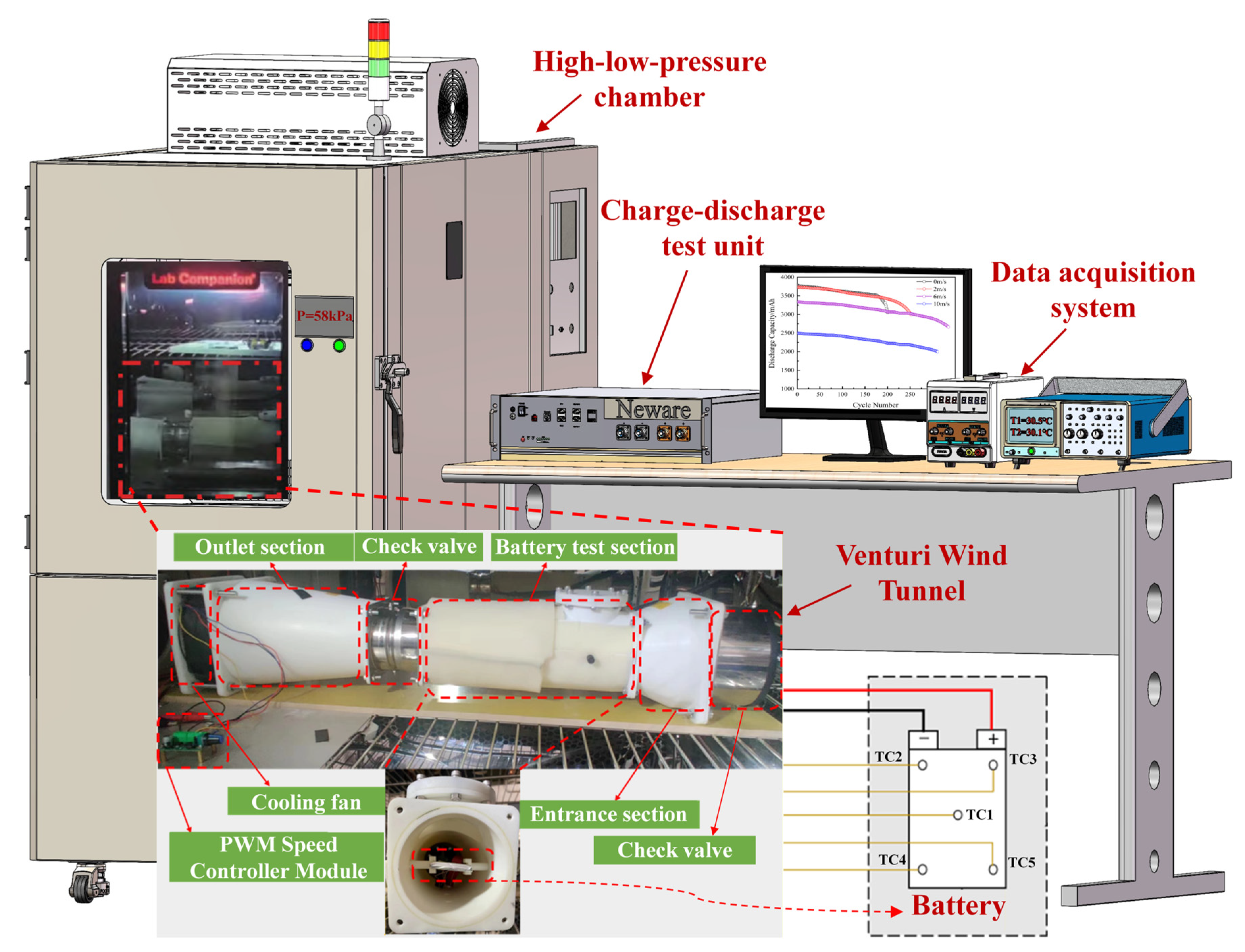
In this study, the small-capacity multiplier-type lithium batteries were nickel–cobalt–manganese ternary (NCM523)/graphite cells with a nominal capacity of 4020 mAh, nominal voltage of 3.7 V, charge cut-off voltage of 4.2 V, discharge cut-off voltage of 2.75 V, and dimensions of 81 mm × 43 mm × 8.3 mm (mass: 78–81 g). Figure 1 presents a schematic diagram of the air-cooled thermal management test platform for lithium batteries, including a high–low-pressure test chamber, an adjustable-wind-speed Venturi wind tunnel, a charge–discharge test unit, and a data acquisition system. The experiments were conducted in a high–low-pressure chamber with an adjustable pressure range of 0 to 101 kPa and a maximum charge/discharge capacity of 50 A. Five T-type thermocouples were symmetrically mounted on the front surface of the battery: TC1 in the geometric center; TC2 and TC3 in the upper-left and upper-right corners; TC4 and TC5 in the lower-left and lower-right corners, respectively. K-type thermocouples possess a diameter of 0.8 mm, an accuracy of ±0.5 °C, and a temperature range of −200 to 1300 °C. The data was collected using a multi-channel temperature logger. The cooling air was supplied by a fan (maximum voltage of 24 V, maximum current of 0.5 A), which was powered by a DC power supply. The adjustable-speed Venturi wind tunnel was designed and fabricated via 3D printing. The tunnel comprised an entrance section (a converging section with 22.5°), a battery test section (a throat part with a diameter of 100 mm and length of 300 mm), an outlet section (a diverging section with 15°), a cooling fan, a pulse width modulation (PWM) speed-control module, and two check valves. The PWM-controlled fan and Venturi tunnel provided an airflow velocity with an accuracy of ±0.2 m/s, as calibrated using a hot-wire anemometer. The platform exhibits the advantages of stable and uniform wind speed, with a strong correlation between wind speed and current size. This enables the precise control of wind speed through the adjustment of the current size.

2.2. Experimental Procedures

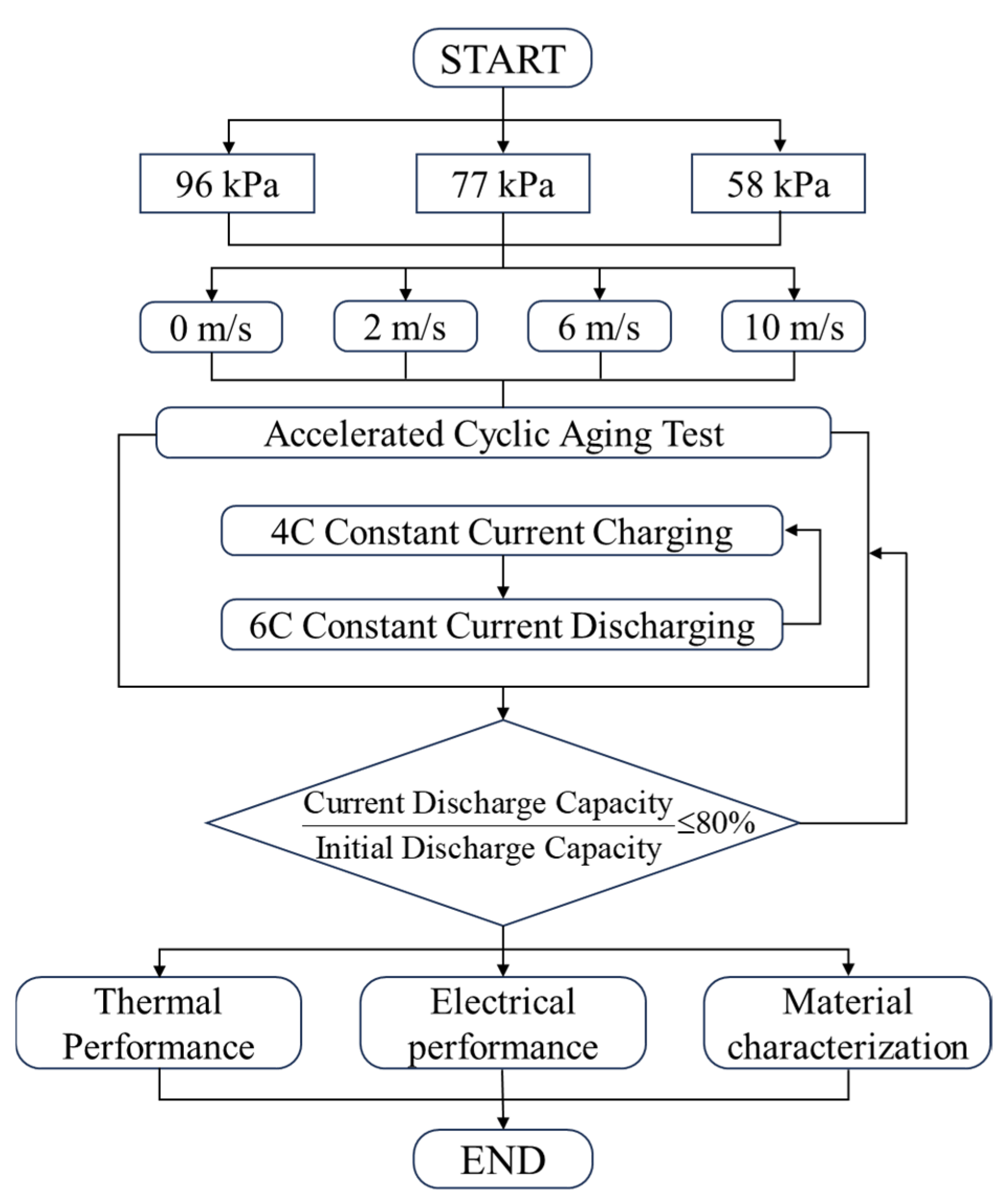
The objective of this study was to establish an experimental procedure for air-cooled thermal management in an airborne environment. The experimental procedure is illustrated in Figure 2. Three atmospheric pressure levels were selected: 96 kPa (local ambient pressure), 77 kPa, and 58 kPa. Three wind speeds were applied: 2 m/s, 6 m/s, and 10 m/s. Accelerated cyclic aging tests were conducted under these conditions, with batteries continuously charged at 4C and discharged at 6C until the end of cycle life. Studies show that takeoff and vertical climb demand 7–15C instantaneous discharge rates, with a continuous discharge range of 2–6C [34,35,36]. For charging, eVTOL batteries are designed for fast turnaround with 4–6C charging capability [37]. Therefore, our 4C/6C protocol realistically represents the high-power demands and fast-charging requirements of eVTOL operations, rather than being chosen solely for accelerated degradation. Thus, the protocol serves both to accurately simulate the most demanding phases of eVTOL flight and to enable the observation of degradation mechanisms within a feasible experimental timeframe. Subsequently, the aged batteries were subjected to a series of thermal, electrical, and material characterizations to elucidate the internal mechanisms by which air cooling affects ternary battery performance in an airborne environment.
(1) Thermal performance test
To determine the maximum surface temperature and temperature difference during cycling, accelerated aging tests were performed under different operating conditions. Five K-type thermocouples were attached to one side of the battery: one near the positive lug, one near the negative lug, one at the center, and the remaining two at positions approximately half the battery diameter away from the positive and negative lugs, respectively. Temperature data were recorded at one-minute intervals using a data logger.
(2) Electrical performance test
a. Cycle life test: Batteries were continuously cycled under the preset conditions using a constant-current charge/discharge protocol with a cut-off voltage window of 2.75–4.2 V, charging at 4 C and discharging at 6 C, until the end of cycle life.
b. Electrochemical impedance spectroscopy (EIS): After cyclic aging, the battery was charged to 4.2 V at a 0.5 C constant current, followed by constant-voltage charging until the current dropped below 0.05 C, indicating full charge. EIS was then performed using an electrochemical workstation with a frequency range of 106 Hz to 0.01 Hz and a signal amplitude of 5 mV.
c. Capacity test: After selected numbers of cycles, capacity and voltage data were extracted using Origin 2025b software. The capacity–voltage curves were plotted with capacity on the abscissa and voltage on the ordinate to compare the performance of different batteries under the same cycle number.
(3) Material characterization test
Batteries were discharged in an argon-filled glove box at a 0.5 C constant current to 2.75 V, followed by constant-voltage discharge until the current fell below 0.05 C to ensure full discharge. The batteries were then disassembled in an oxygen-free environment. The positive and negative electrodes were rinsed with dimethyl carbonate solution to remove residual electrolyte. The crystal structure of the positive electrode was characterized by X-ray diffraction (XRD) over a scanning range of 5–85° at a step rate of 2°/min. The surface morphology and composition were examined by scanning electron microscopy (SEM) and energy-dispersive X-ray spectroscopy (EDS), respectively.

3. Results and Discussion

3.1. Thermal Performance

3.1.1. Maximum Temperature

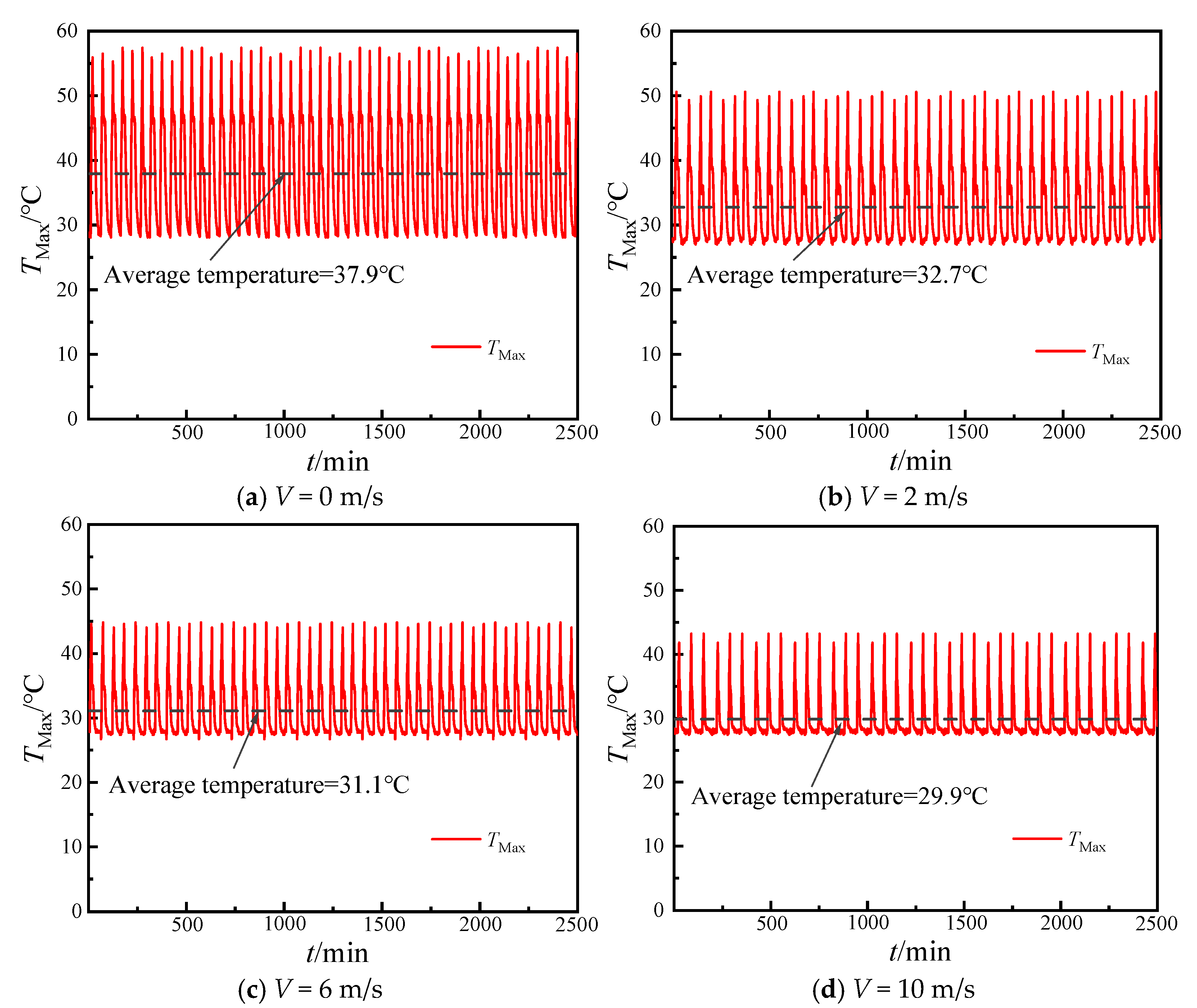
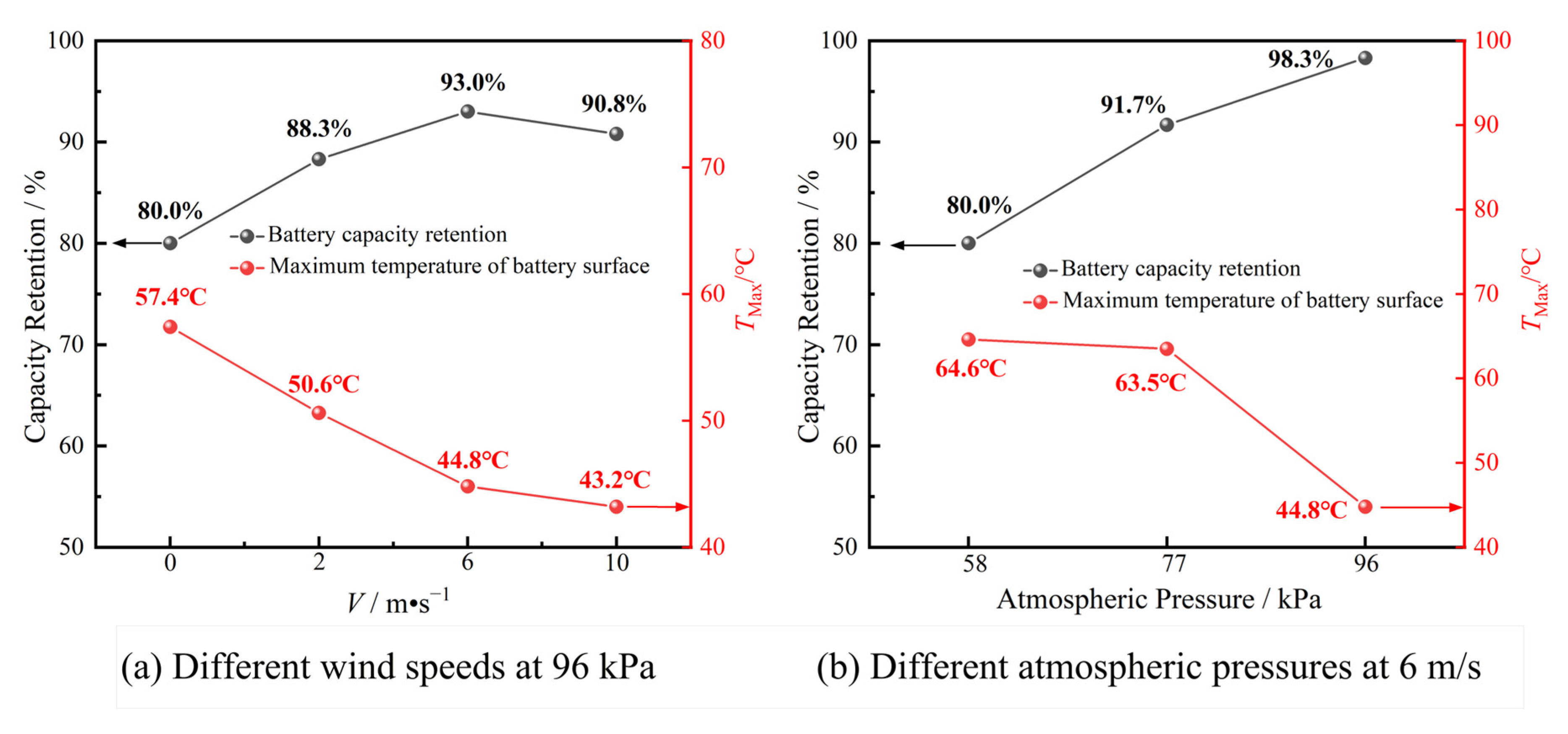
Figure 3 presents the maximum surface temperatures of battery cells under 96 kPa at the wind speeds of 0 m/s, 2 m/s, 6 m/s, and 10 m/s. Without forced cooling, the peak temperature reached 57.4 °C. Increasing wind speeds progressively reduced the temperatures to 50.6 °C, 44.8 °C, and 43.2 °C, representing reductions of 6.8 °C, 12.6 °C, and 14.2 °C, respectively. Notably, the marginal decrease from 6 to 10 m/s (1.6 °C) was substantially smaller than that from 2 to 6 m/s (5.8 °C). This indicates that higher wind speeds contribute to lower maximum surface temperatures, although the reduction from 6 m/s to 10 m/s is not substantial, implying an optimal threshold for enhancing heat dissipation. Beyond this threshold, further increases in wind speed do not significantly lower the surface temperature and may even escalate energy consumption. Concurrently, the maximum temperature differential decreased monotonically from 30.9 °C (uncooled) to 23.3 °C, 18.1 °C, and 15.8 °C with increasing wind speeds. Given that larger temperature fluctuations intensify internal temperature stress within the battery, sustained cycling under such conditions can compromise material structure and accelerate performance degradation. Therefore, forced air cooling not only reduces the peak temperature but also effectively mitigates temperature fluctuation amplitude, thereby enhancing thermal uniformity, improving safety, and prolonging battery cycle life.
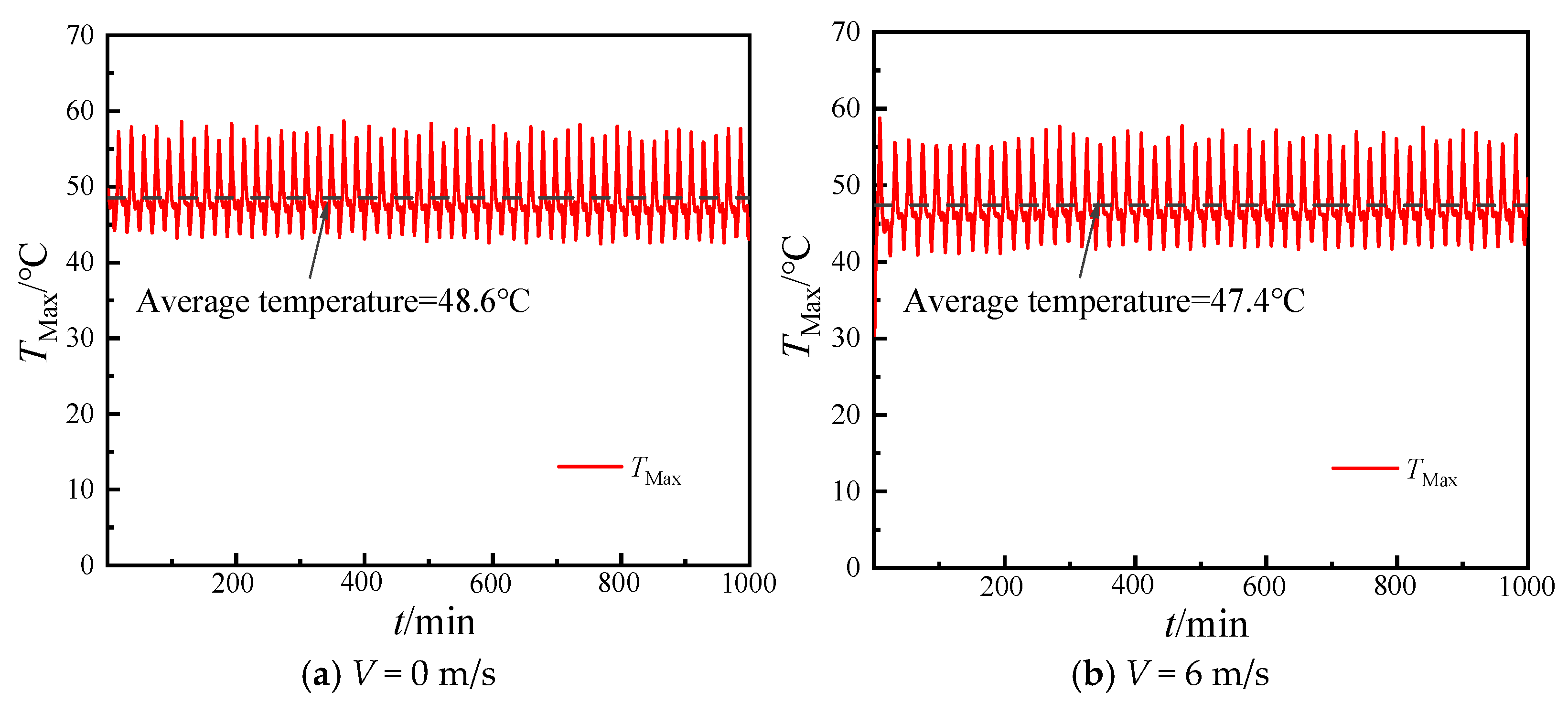
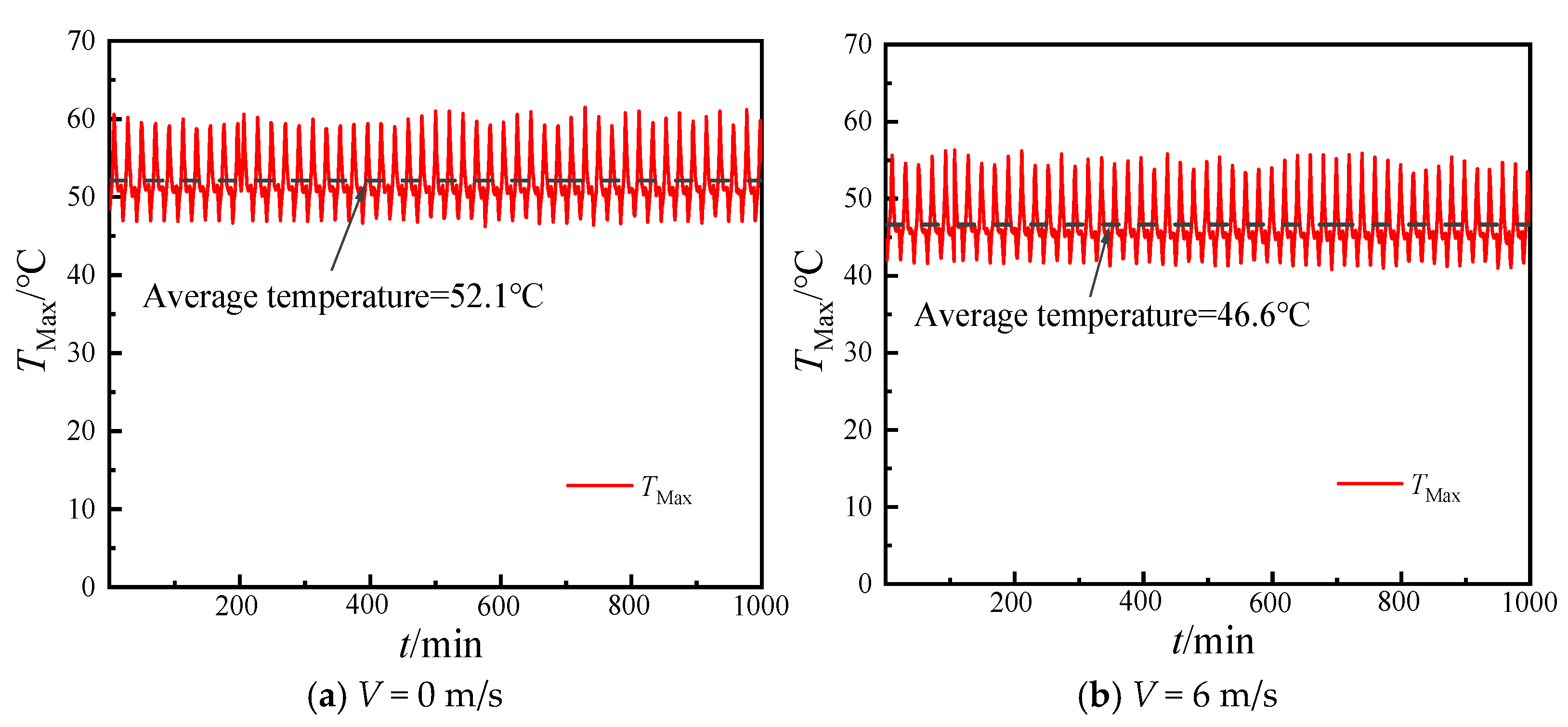
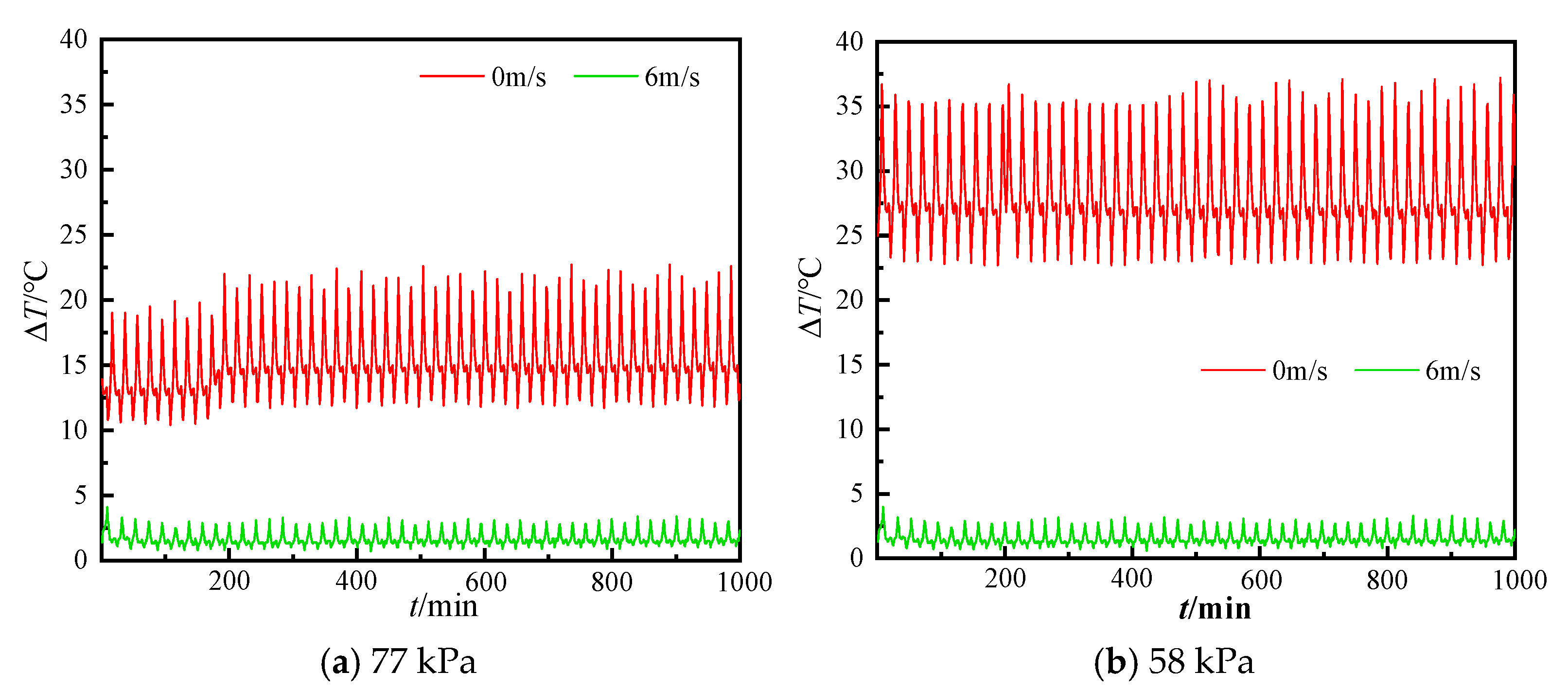
Figure 4 and Figure 5 present the maximum temperatures of the battery at 77 kPa and 58 kPa under conditions without forced air cooling and with a wind speed of 6 m/s. Compared with the results at 96 kPa shown in Figure 3a, the maximum cell temperature increases substantially as the atmospheric pressure decreases. Specifically, during the entire accelerated cycle aging period, without forced air cooling, the maximum temperature reaches 69.2 °C at 77 kPa and 75.6 °C at 58 kPa, corresponding to increases of 21% and 32%, respectively, relative to the value at 96 kPa. When forced air cooling at 6 m/s is applied, the maximum temperature decreases by 11.4 °C at 77 kPa and by 10.1 °C at 58 kPa compared with the uncooled conditions at the same pressure, as shown in Figure 4b and Figure 5b. In contrast, at 96 kPa, the application of 6 m/s air cooling results in a reduction of 12.6 °C relative to the uncooled condition. These findings indicate that, under reduced pressures, the cooling effectiveness diminishes, and the cell temperature cannot be maintained below 45 °C under the tested conditions.

3.1.2. Thermal Uniformity

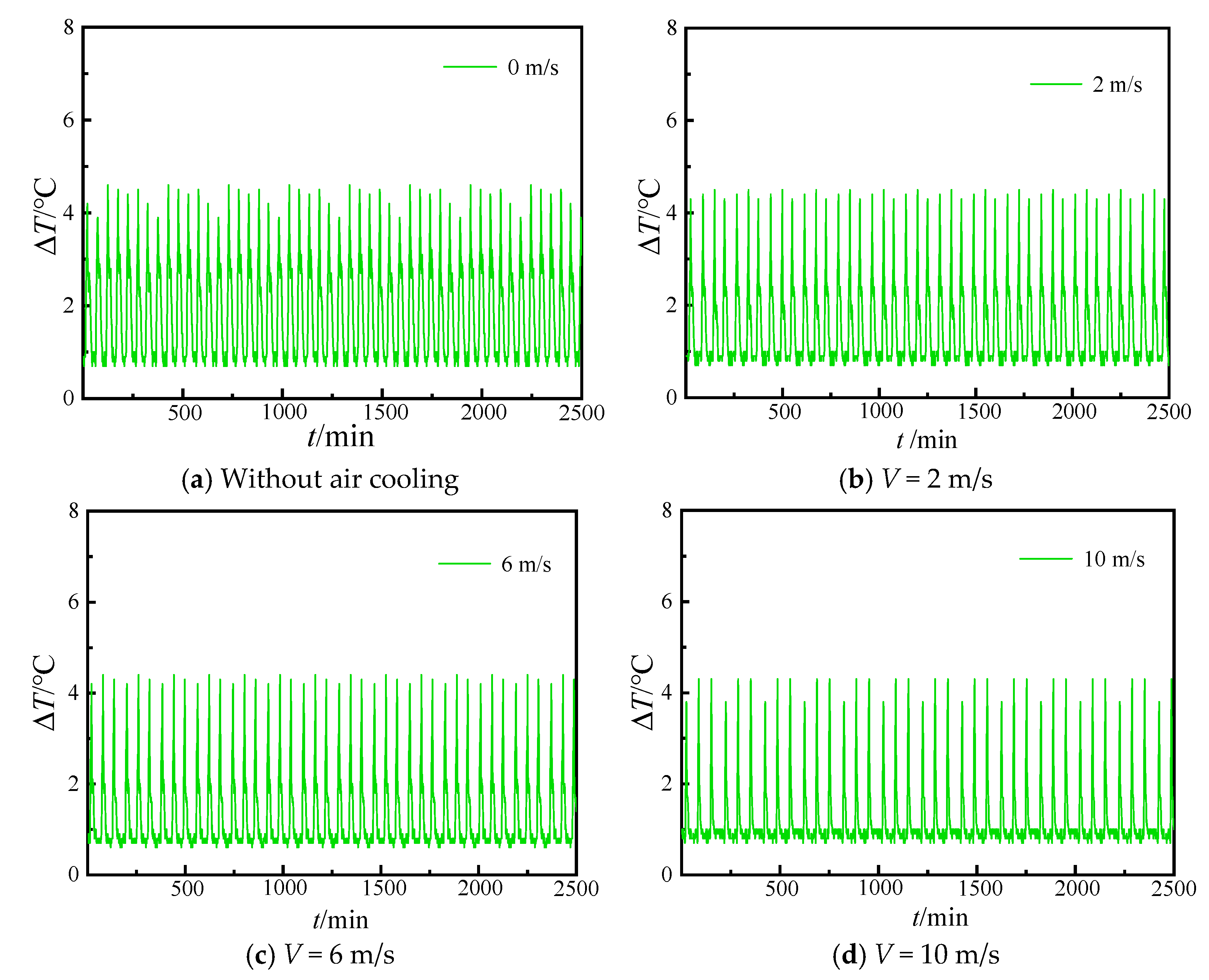
As shown in Figure 6, the maximum temperature differences across the battery cell under 96 kPa remain below 5 °C across all the tested wind speeds (0, 2, 6, and 10 m/s). The high uniformity of the surface temperature implies a significant reduction in the phenomenon of uneven cell capacity resulting from temperature distribution disparities. The batteries employed in this study are laminated soft-pack batteries, which exhibit a high degree of consistency in individual cell capacities. This consistency has a positive impact on the overall battery capacity degradation rate, resulting in enhanced electrochemical performance.
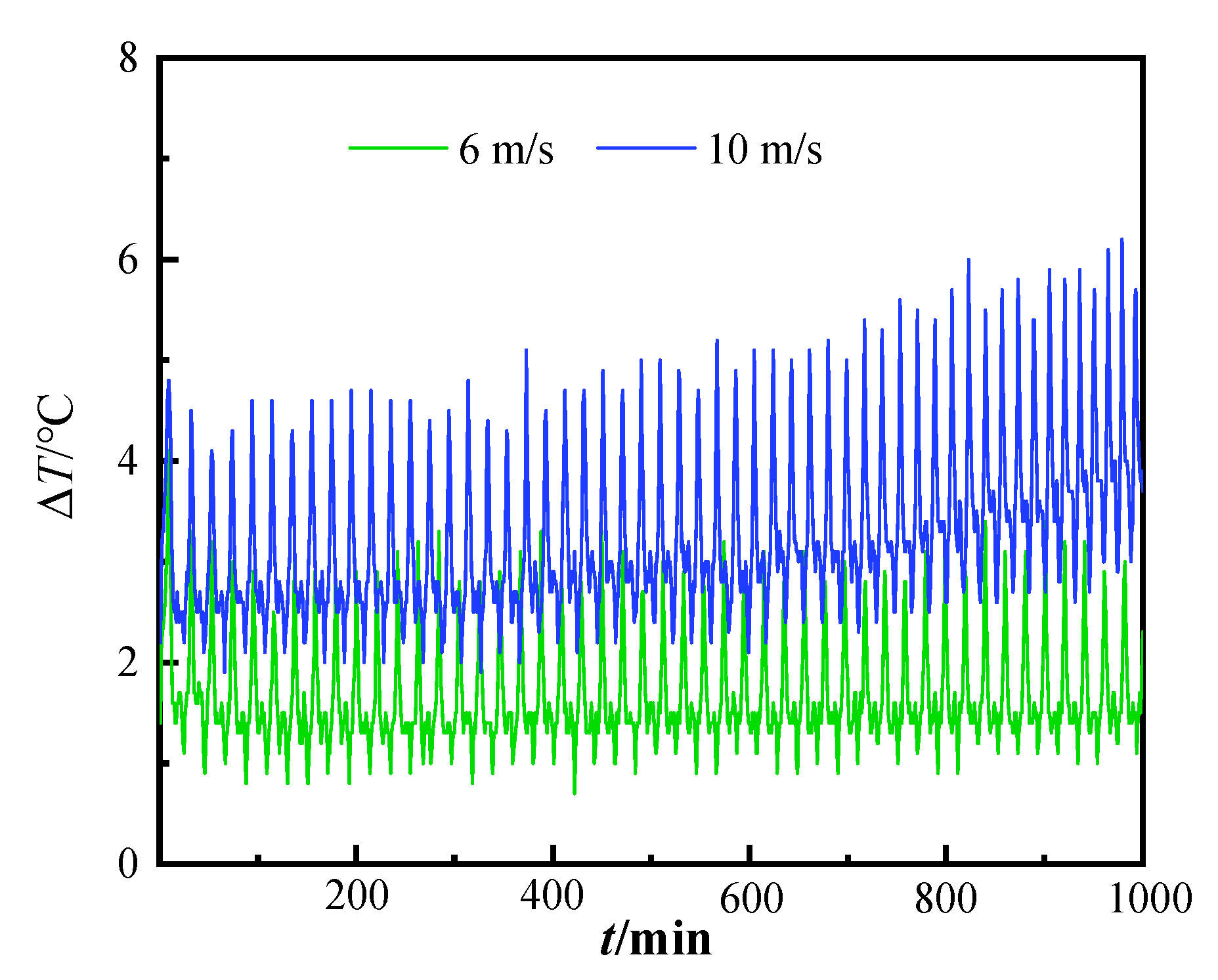
Comparative analysis of Figure 7 shows that decreasing atmospheric pressure markedly aggravates thermal non-uniformity. While the temperature difference remains below 5 °C at 96 kPa (namely 4.7 °C), it increases sharply to 23.1 °C and 38.1 °C at 77 kPa and 58 kPa, respectively. At a 6C discharge rate, significant heat generation induces pronounced internal gradients. The laminated architecture leads to cooler outer layers with lower resistance and higher current, whereas hotter inner layers exhibit increased resistance and reduced current. This imbalance causes the outer layers to reach the cut-off voltage earlier, accelerating degradation. Forced air cooling effectively restores thermal uniformity under low-pressure conditions. At 6 m/s, the maximum temperature difference is reduced to 5 °C at both 77 kPa and 58 kPa, achieving reductions of up to 87% and meeting the criterion of less than 5 °C. Figure 8 presents the maximum surface temperature differences in the battery at 58 kPa under airflow velocities of 6 m/s and 10 m/s. Throughout the entire cycling process, the temperature difference at 10 m/s consistently exceeds that at 6 m/s by approximately 1–3 °C. This observation clearly indicates that increasing the wind speed beyond the optimal threshold (6 m/s) to an excessive level (10 m/s) degrades thermal uniformity across the battery surface. The larger temperature difference directly intensifies mechanical stress due to differential expansion, promotes non-uniform current distribution, and ultimately accelerates battery degradation. Accordingly, for the present cell configuration, 6 m/s can be adopted as an initial engineering design value to maintain the cell-level temperature difference within 5 °C. To further compensate for severe non-uniformity under low pressure, several design strategies may be considered: improving internal heat spreading via high-thermal-conductivity current collectors, optimizing airflow channel geometry for uniform velocity distribution under reduced air density, adopting hybrid cooling with phase-change materials to buffer local hot spots, and implementing gradient-based active fan control that prioritizes thermal uniformity over absolute peak temperature reduction. The optimal choice will depend on the specific weight, complexity, and energy constraints of the aircraft application.

3.2. Electrical Performance

3.2.1. Cycle Life

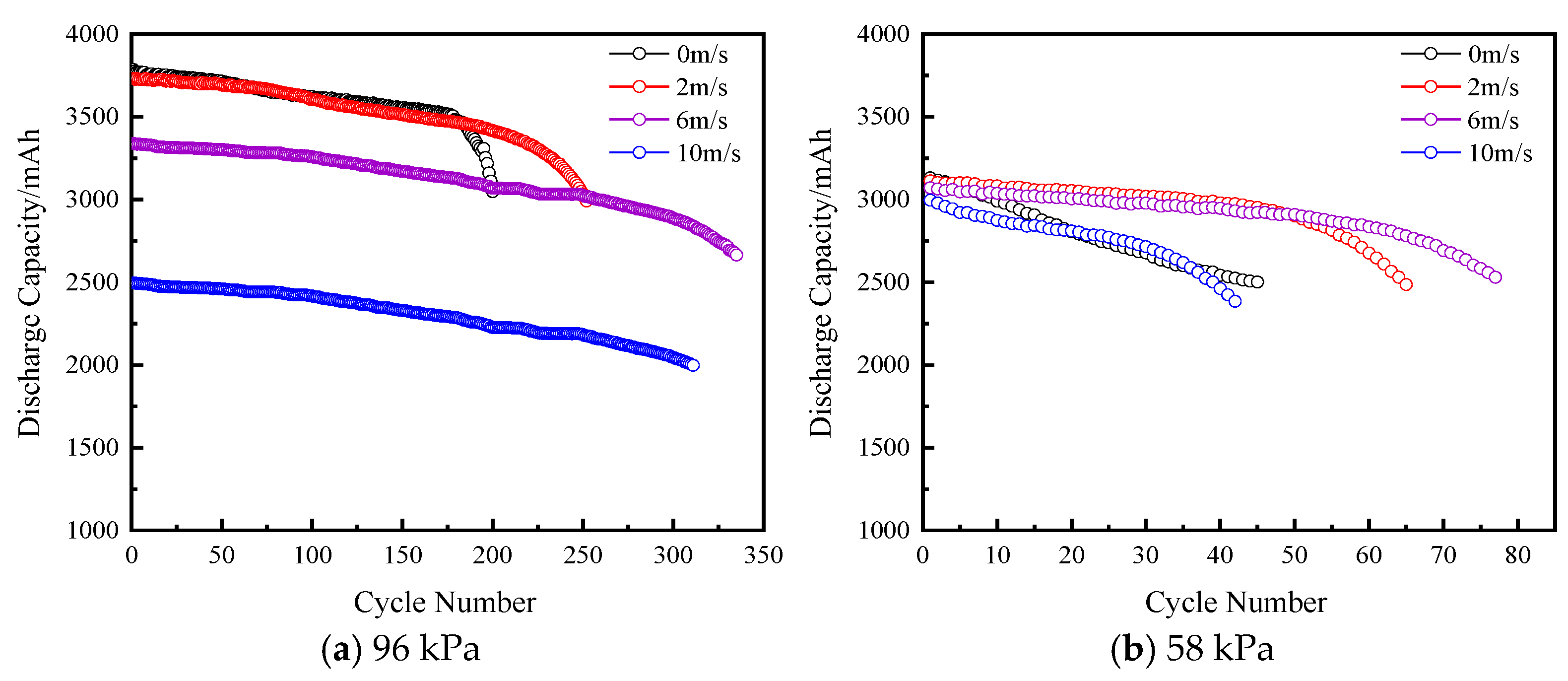
Figure 9 shows the cycle life variation of the battery at 96 kPa and 58 kPa under different wind speeds. As shown in Figure 9a, the cycle life reaches a maximum of 335 cycles at a wind speed of 6 m/s, representing a 68% increase compared to 200 cycles under the condition of no forced air cooling (V = 0 m/s). However, at V = 10 m/s, the cycle life declines to 318 cycles, a reduction of 17 cycles compared to V = 6 m/s. This trend is consistent with the thermal performance analysis, indicating that exceeding the optimal wind speed threshold adversely affects the battery, leading to reduced cycle life. As shown in Figure 9b, the overall trend at 58 kPa mirrors that at 96 kPa, with cycle life increasing with wind speed within a certain range. At V = 6 m/s, the cycle life reaches a maximum of 77 cycles, a 71% increase compared with 45 cycles at 0 m/s. However, at V = 10 m/s, the cycle life drops to 42 cycles, even lower than that under the condition of no forced air cooling.
A comparison of the results at 96 kPa and 58 kPa reveals that, within an appropriate range, increasing wind speed prolongs battery cycle life. However, once the wind speed exceeds the optimal threshold, further increases shorten the cycle life and degrade overall battery performance. Low atmospheric pressure significantly impairs battery performance, resulting in a marked reduction in cycle life. While forced air cooling partially mitigates the adverse effects of low pressure, exceeding the optimal wind speed under such conditions leads to a sharp performance deterioration. For example, at 58 kPa and a wind speed of 10 m/s, the cycle life is even lower than that without cooling. Therefore, in the design of power batteries for airborne vehicles, it is essential to consider the combined effects of low atmospheric pressure and excessive wind speed to avoid potential safety hazards associated with sudden performance degradation during flight.

3.2.2. Resistance Evolution

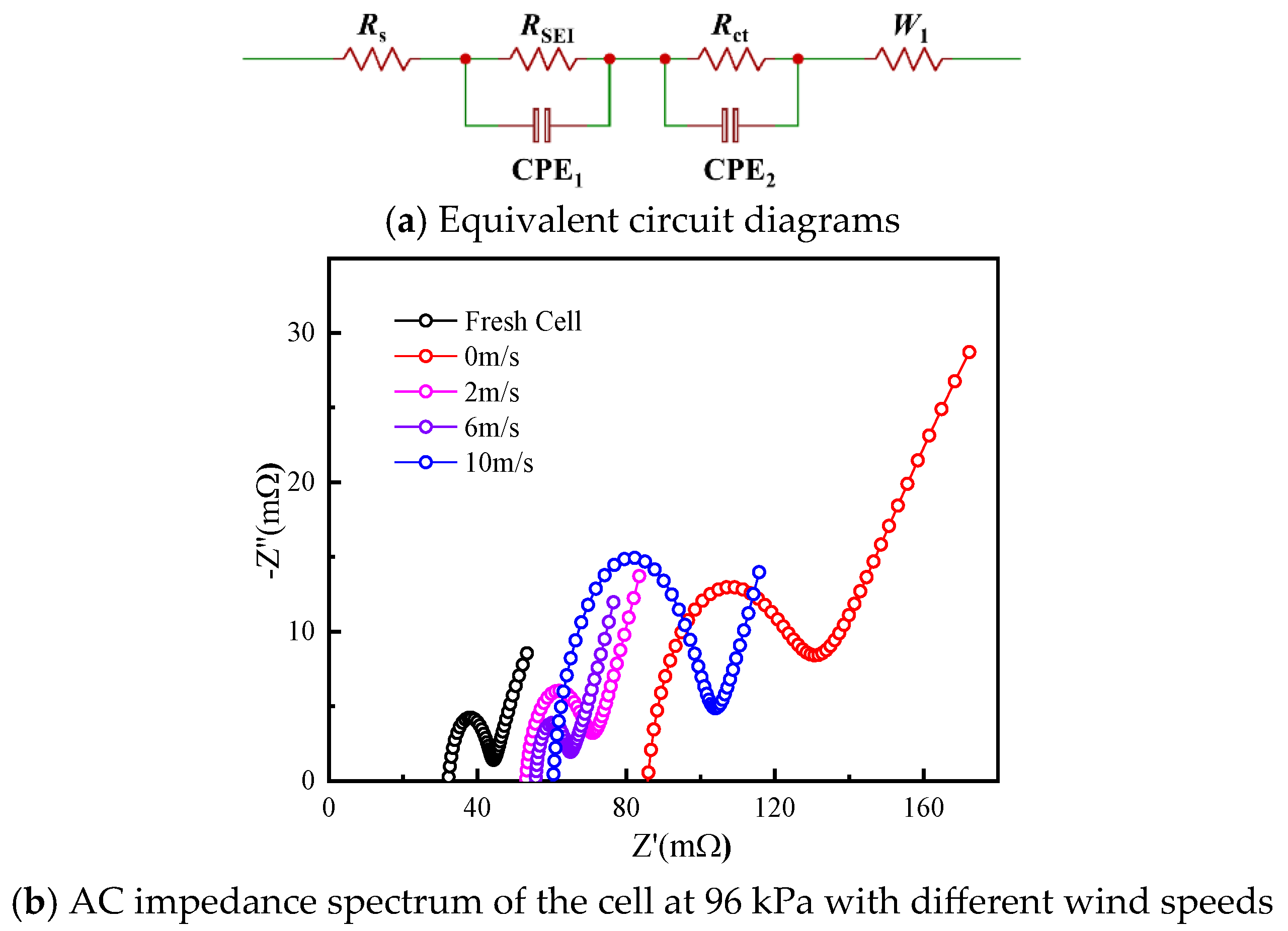
Figure 10a presents the equivalent circuit model of the battery, where Rs represents the ohmic resistance, RSEI represents the resistance of the SEI membrane, Rct represents the charge transfer resistance, W1 represents the Warburg impedance, and CPE1 and CPE2 represent the capacitances. The impedance spectra shown in Figure 10b were fitted using ZSimpWin V31 software, commonly denoted by impedance Z. Z′ represents the real part of the impedance, indicating resistance, while -Z″ signifies the imaginary part of the impedance, indicating reactance. The specific numerical values for Rs, RSEI, and Rct are summarized in Table 1.
As shown in Table 1, compared with the fresh cell, Rs at standard pressure (96 kPa) without forced air cooling increases markedly, whereas air cooling reduces Rs and suppresses its further increase at higher wind speeds, indicating that air cooling mitigates current collector corrosion caused by electrolyte decomposition in the later stages of aging. Under low pressure (58 kPa), the increase in Rs is even more pronounced, suggesting more severe electrolyte decomposition and by-product accumulation, which contributes to a sharp reduction in cycle life. Regarding RSEI, without forced air cooling at 96 kPa, the value is substantially higher (326.6 mΩ). This unusually high RSEI can be explained by three interconnected mechanisms. First, under uncooled, high-rate cycling, the battery reaches high temperatures (up to 75.6 °C), drastically accelerating SEI thickening and repeated fracture/reformation, leading to very high RSEI. Second, under optimal cooling (6 m/s), thermal management keeps the SEI thin and well-passivated, yielding low RSEI (1–5 mΩ). Third, under low pressure (58 kPa), the SEI formation kinetics are intrinsically retarded (as reported by Xie et al. [22]), so even aged cells show low RSEI (e.g., 1.78 mΩ at 6 m/s). Air cooling markedly inhibits RSEI growth, with aged batteries under cooling even exhibiting lower RSEI than fresh cells. Under low pressure, RSEI is lower than at standard pressure (96 kPa), which can be further suppressed by supplying air cooling. Overall resistance exhibits a trend of first decreasing and then increasing with wind speed, with the lowest values observed at 6 m/s, where fragmentation of positive electrode active materials and pore blockage in the separator are effectively inhibited. At 10 m/s, Rct shows an anomalous increase, which is consistent with the corresponding decline in cycle life. This suggests that excessively high wind speeds directly elevate the charge transfer resistance. While the higher wind speed reduces the average surface temperature, the resulting thermal gradients likely disrupt the intrinsic electrochemical equilibrium, leading to higher overall battery resistance. A similar trend is observed under low pressure, where Rct is minimized at 6 m/s, confirming that an appropriate wind speed plays a beneficial role in suppressing Rct growth. While formal statistical replicates were not performed due to the practical constraints discussed above, the large magnitude and systematic consistency of resistance changes across all experimental conditions, along with their direct correlation with cycle life and material degradation, support the robustness of the observed trends.
Conceptually, the existence of an optimal wind speed reflects a trade-off between two competing effects. On one hand, increasing airflow enhances convective heat removal, reducing the average cell temperature and suppressing thermally activated degradation (e.g., SEI growth, electrolyte decomposition). On the other hand, excessive cooling intensifies the through-plane thermal gradient, which induces mechanical stress from differential expansion, promotes non-uniform current distribution, and accelerates localized lithium plating and cathode particle fragmentation. The performance is optimized when the marginal benefit of further temperature reduction no longer outweighs the marginal damage from increased thermal gradient. This trade-off is expected to depend on cell geometry, material properties, and operating conditions, and the present empirical optimum of 6 m/s applies specifically to the tested 4020 mAh pouch cell under 4C/6C cycling in the 58–96 kPa pressure range. However, these findings can still serve as a reference for the design and optimization of air-cooled battery thermal management systems in electric aircraft, as well as for the selection of appropriate airflow velocities under varying pressure altitudes.

3.2.3. Capacity Characteristics

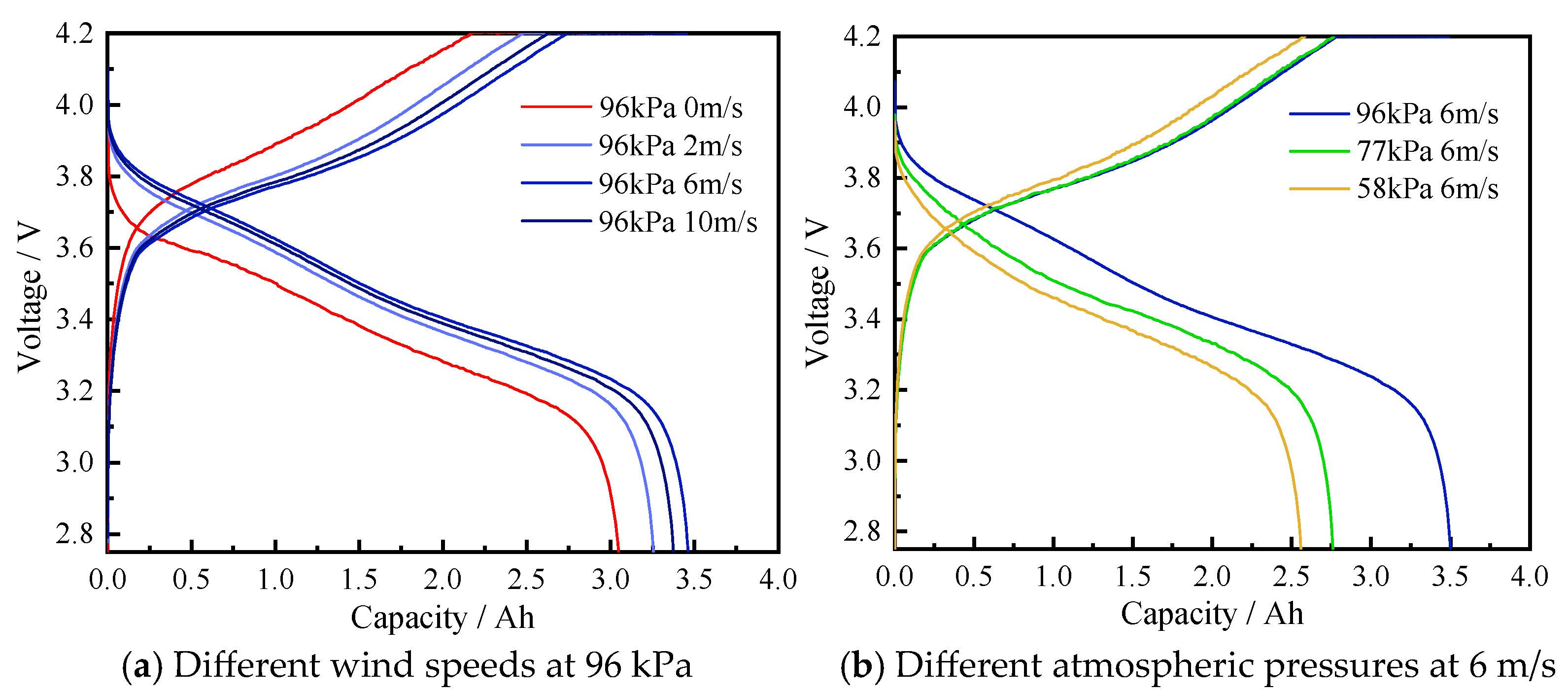
Figure 11 presents the capacity–voltage curves of the battery under varying wind speeds and atmospheric pressures. As shown in Figure 11a, without forced air cooling, the voltage drops rapidly, indicating a shortened time to reach the discharge cut-off voltage and a corresponding reduction in discharge capacity within the same voltage window. With forced air cooling, the rate of voltage decline is significantly reduced, leading to a prolonged discharge duration and increased capacity. When the wind speed is at or below 6 m/s, increasing the wind speed gradually slows the voltage decline and enhances discharge capacity. However, at 10 m/s, the voltage drop and capacity loss are exacerbated, a trend consistent with the cycling performance under standard atmospheric pressure, further confirming the existence of an optimal wind speed threshold for battery cooling. Figure 11b shows the capacity–voltage curves at different atmospheric pressures after 77 cycles under a constant wind speed of 6 m/s. As the pressure decreases, the voltage plateau gradually declines, causing the discharge cut-off voltage to be reached earlier and reducing the available capacity at a 6 C discharge rate. These results indicate that low atmospheric pressure deteriorates the cycling performance of the battery.
Figure 12 illustrates the relationship between the maximum surface temperature and capacity retention under varying wind speeds and atmospheric pressures. At a constant pressure of 96 kPa, as shown in Figure 12a, a negative correlation is observed between wind speed and surface maximum temperature, indicating that higher wind speeds reduce the surface temperature. Capacity retention initially increases with wind speed but declines after exceeding an optimal range, consistent with the thermal performance analysis in Section 3.1. At a fixed wind speed of 6 m/s, as shown in Figure 12b, decreasing atmospheric pressure leads to an increase in surface maximum temperature. Although forced air cooling reduces the temperature compared with uncooled conditions, it remains substantially higher under low pressure than at 96 kPa, accompanied by a decline in capacity retention. These results highlight the detrimental effects of low atmospheric pressure on both thermal and cycling performance.
The findings underscore the critical roles of atmospheric pressure and forced air cooling in regulating battery thermal and cycling behavior. Given that atmospheric pressure exerts a significant yet non-uniform influence on battery performance, subsequent analysis focuses on two representative pressures (96 kPa and 58 kPa) to facilitate a direct comparison of wind-cooling effects under typical airborne conditions.

3.3. Material Characterization

3.3.1. Morphology Analysis

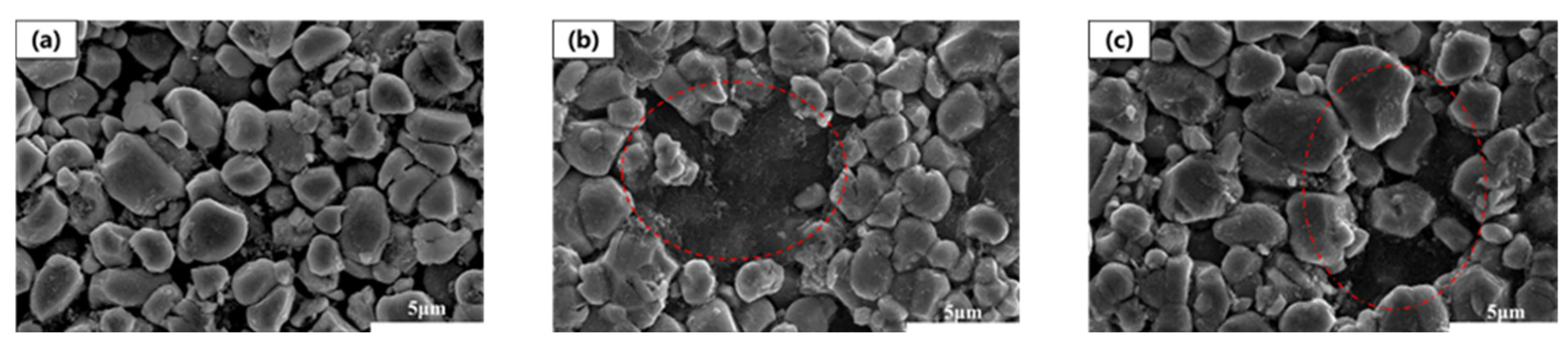
Appropriate forced air-cooling thermal management improves both the thermal and electrical performance of the battery, which in turn affects its material characteristics. Figure 13 illustrates the influence of air cooling on the morphology of the battery cathode under standard atmospheric pressure (96 kPa). As shown in Figure 13a, the fresh battery exhibits a uniform distribution of cathode particles with an intact structure and good morphology. After 200 cycles without air cooling, the cathode reaches the end of its service life, and significant particle fragmentation is observed (Figure 13b, red circles). Such fragmentation reduces the active material in the cathode and decreases the number of lithium ions available for migration between electrodes, leading to a decline in discharge capacity and premature service life termination, along with reduced safety and an increased risk of thermal runaway. In contrast, with air cooling applied at a wind speed of 6 m/s (Figure 13c), particle fragmentation is significantly delayed, and the cathode structure remains more intact. These results indicate that appropriate air-cooling thermal management protects cathode particles from damage and thereby extends battery service life.
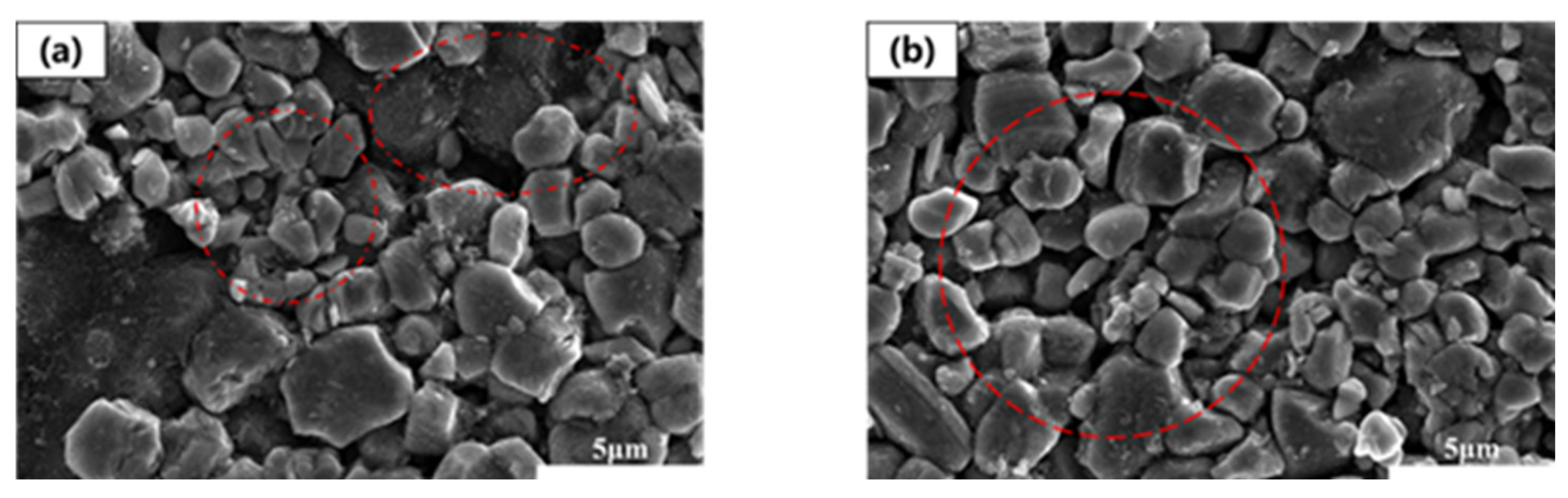
Figure 14 illustrates the impact of forced air-cooling thermal management on the morphology of the battery cathode under low atmospheric pressure (58 kPa). As shown in Figure 14a, without air cooling, extensive cathode particle fragmentation is observed at 58 kPa. Compared with the counterpart at 96 kPa (Figure 13b), the cathode under low pressure exhibits more severe particle cracking, indicating greater structural degradation, which is consistent with the previously discussed electrical and cycling performance. When air cooling at 6 m/s is applied (Figure 14b), particle fragmentation is effectively suppressed, and most cathode particles retain a relatively intact structure. However, a comparison between Figure 13c (96 kPa, 6 m/s) and Figure 14b (58 kPa, 6 m/s) reveals contrasting morphological characteristics. Under low pressure, the cathode particles show poorer size uniformity, with fewer large particles and a predominance of smaller ones, whereas under standard pressure, the particle size distribution is more balanced. These observations indicate that, despite the protective effect of air cooling, low atmospheric pressure still induces irreversible damage to the cathode, promoting the cracking of large particles into smaller ones and thereby compromising the structural stability of the cathode, which in turn increases the risk of thermal runaway and reduces battery safety. To understand the origin of this damage, it is necessary to consider the additional mechanical stress introduced by forced convection. Under forced convection, an additional mechanical stress component is superimposed by the imposed thermal gradient; this thermo-mechanical contribution grows with wind speed. Accordingly, the observed morphological damage reflects the combined action of intrinsic chemomechanical stress and externally induced thermomechanical stress.

3.3.2. Structural Evolution

XRD was performed on the battery cathode under different atmospheric pressures (96 kPa and 58 kPa) and wind speeds (0–10 m/s). The corresponding material parameters are summarized in Table 2. The c/a ratios for all the tested conditions are larger than the ideal value of 4.899 (the c/a ratio is 4.899 for the perfectly mixed, spinel-type structure), indicating a well-maintained layered structure. At 96 kPa, air cooling further enhances this stability, with the highest c/a value observed at 6 m/s and a decline at 10 m/s, correlating with the trend in cycle life. The peak intensity ratio I003/I104, used to assess cation mixing, remains above 1.2 under standard pressure across all wind speeds, indicating negligible mixing. At 58 kPa, however, this ratio drops to 1.07, signifying severe cation mixing, which reduces cycle life and safety. Although air cooling partially mitigates this mixing, the values remain lower than those at standard pressure, implying shorter battery cycle life under low-pressure conditions.
The parameter R, which indicates the ordering of the layered structure, shows that, under standard pressure, aging without cooling increases R (i.e., reduced ordering), whereas air cooling decreases R (enhanced ordering), with the lowest R at 6 m/s. A similar trend is observed under low pressure, where battery ordering is generally better than under standard pressure. The degradation in ordering is primarily attributed to the transition of Ni ions from ordered to disordered states during lithium extraction, accompanied by valence changes from Ni2+ to Ni3+ and then to Ni4+. In later stages of cycling, secondary NCM523 particles with unstable Ni4+ form on their surfaces; upon contact with the penetrating electrolyte, these surfaces degrade rapidly, increasing the impedance of the surface layer.

3.3.3. Compositional Analysis

After dismantling the aged batteries, the negative electrode sheets were cleaned and analyzed by inductively coupled plasma (ICP) spectroscopy to determine the mass fractions of Li, Mn, Co, and Ni under different atmospheric pressures and wind speeds; the results are summarized in Table 3. At 96 kPa without forced air cooling (0 m/s), the mass fractions of Mn, Co, and Ni in the negative electrode increase by 462%, 250%, and 755%, respectively, compared with the fresh cell, indicating severe loss of active material (LAM). This is attributed to the dissolution of transition metal ions from the positive electrode, which migrate through the separator and deposit onto the negative electrode surface, accelerating SEI growth. As wind speed increases, these mass fractions decrease significantly, reaching their lowest values at 6 m/s, where the increases relative to the fresh cell are only 47%, 38%, and 203%, respectively. The Li mass fraction at 0 m/s rises by a factor of 43.7, indicating substantial loss of lithium inventory (LLI) and consequent capacity decline. Forced air cooling suppresses LLI; at 6 m/s, the Li mass fraction decreases by 64% compared with 0 m/s. However, at 10 m/s, the Li mass fraction unexpectedly increases to a level approaching that at 0 m/s, suggesting that excessively high wind speeds exacerbate active lithium loss and reduce cycle life.
Under low atmospheric pressure (58 kPa) without forced air cooling, severe LAM is also observed. The application of air cooling significantly mitigates LAM, with the optimal effect at 6 m/s, where the mass fractions of Mn, Co, and Ni decrease by 24.7%, 22.1%, and 33.8%, respectively, compared with the uncooled condition at the same pressure. At 10 m/s, however, the mass fractions of Mn, Co, and Ni unexpectedly increase, even exceeding those under the uncooled condition. These results demonstrate that, while appropriate air cooling effectively suppresses LAM and LLI under low pressure, excessive wind speeds exacerbate material degradation, leading to accelerated capacity decline and premature termination of the cycle life.
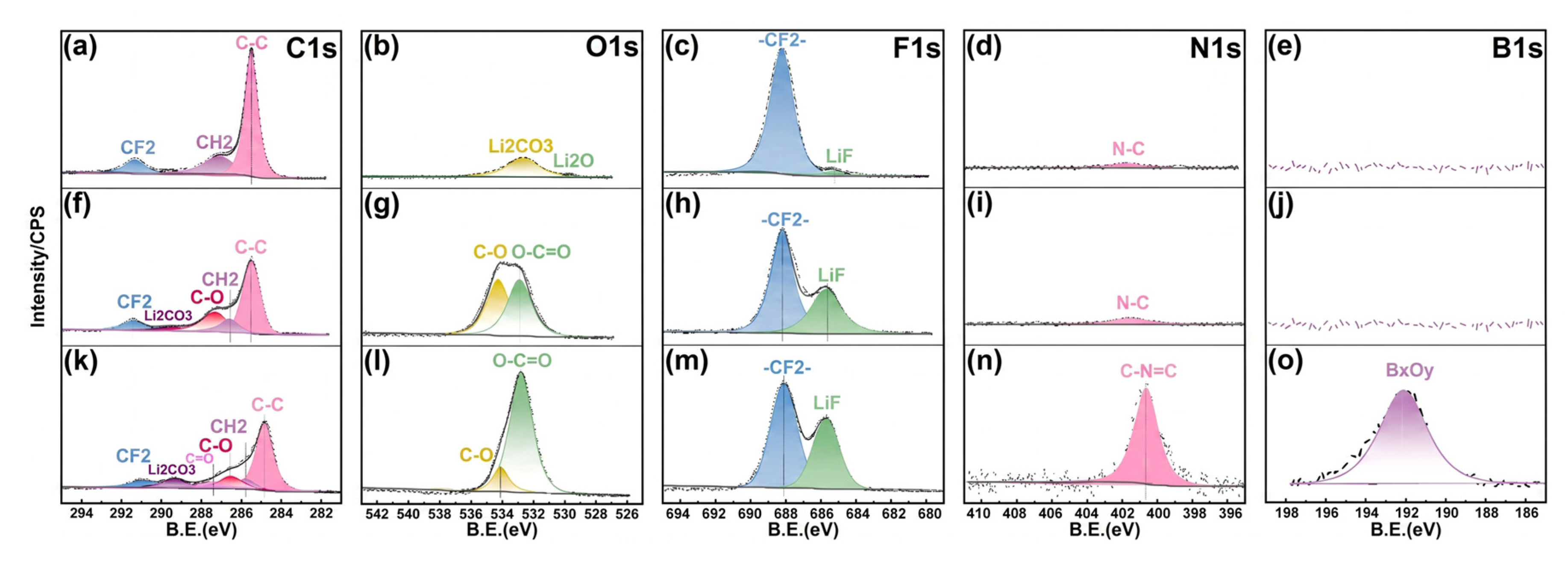
Figure 15 shows the X-ray photoelectron spectroscopy (XPS) of the positive electrode under dif-ferent atmospheric pressures at an air velocity of 6 m/s. Subplots Figure 15a–e correspond to 96 kPa, Figure 15f–j to 77 kPa, and Figure 15k–o to 58 kPa. In the C1s spectrum (Figure 15a), peaks at 284.80 eV, 286.60 eV, 288.80 eV, and 290.00 eV correspond to C–C, C–O, C=O, and CO32− bonds, respectively, indicating the presence of RCOOLi and Li2CO3 within the Cathode–Electrolyte Interface (CEI) layer. The O1s spectrum (Figure 13b) shows peaks at 531.98 eV and 533.58 eV, further confirming C=O and C–O bonds in RCOOLi and Li2CO3. As shown in Figure 15a–k, as atmospheric pressure decreases from 96 kPa to 77 kPa and 58 kPa, the atomic content of the C=O (CMC) peak at 288.80 eV increases from 1.75 At% to 1.93 At% and 2.57 At%, respectively, and the CO32− content at 290.00 eV increases by 60.12% at 58 kPa. In the F1s spectrum, the peak intensity at 685.20 eV (LiF) increases with decreasing pressure. These results demonstrate that low atmospheric pressure accelerates the oxidative decomposition of the electrolyte on the cathode surface, leading to the growth and thickening of the CEI film, which increases the surface impedance. At 10 m/s, the intensified thermal cycling stress disrupts the structural integrity of the cathode active material, exposing fresh surfaces to electrolyte attack and accelerating transition metal dissolution (Mn, Co, Ni). Simultaneously, the localized lithium plating caused by current maldistribution consumes cyclable lithium, while the fractured CEI consumes additional lithium during reformation. The combination of enhanced LAM and LLI at 10 m/s explains why the cycle life at this excessive wind speed falls below even the uncooled condition.

4. Conclusions

This study systematically investigates the effects of air-cooling thermal management on the thermal, electrical, and material performance of ternary lithium batteries under simulated airborne low-pressure environments. An experimental platform with adjustable wind speed was employed to conduct accelerated aging tests under three pressure levels (96, 77, and 58 kPa) and four wind speeds (0, 2, 6, and 10 m/s) under 4 C charge and 6 C discharge conditions. The results demonstrate that forced air cooling effectively mitigates the adverse effects of low pressure on battery performance, although an optimal wind speed threshold exists beyond which further cooling degrades battery life. The key findings are summarized as follows:
(1) Air cooling significantly reduces the maximum surface temperature and improves thermal uniformity. At 96 kPa, increasing the wind speed from 0 to 10 m/s reduces the peak temperature from 57.4 °C to 43.2 °C (a reduction of 14.2 °C) and the temperature difference from 30.9 °C to 15.8 C. Under reduced pressures, the cooling effectiveness diminishes: at 58 kPa and 6 m/s, the maximum surface temperature remains at 65.5 °C (a reduction of 10.1 °C compared with uncooled conditions), which is still above the ideal operating range of 25–40 °C. However, forced air cooling restores thermal uniformity to within 5 °C at both 77 kPa and 58 kPa, meeting the recommended criterion for aviation battery thermal management.
(2) Air cooling markedly enhances the electrochemical performance and cycle life of ternary batteries under low pressure. At 58 kPa, the cycle life increases from 45 cycles (without cooling) to 77 cycles at a wind speed of 6 m/s, representing a 71% improvement. Impedance spectroscopy reveals that air cooling effectively suppresses the growth of RSEI and Rct, with the lowest values observed at 6 m/s. However, at 10 m/s, the cycle life drops to 42 cycles (even lower than the uncooled value of 45 cycles), accompanied by an anomalous increase in Rct. Capacity–voltage curves further confirm that low pressure lowers the voltage plateau and reduces discharge capacity, effects that are partially counteracted by appropriate air cooling.
(3) Post-mortem material characterization shows that air cooling preserves the structural integrity of the cathode active material. SEM imaging reveals that, at 58 kPa, without cooling, extensive particle fragmentation occurs, whereas air cooling at 6 m/s maintains a more intact particle morphology, albeit with a less uniform size distribution compared with standard pressure. XRD analysis indicates that air cooling enhances the layered structure ordering (higher c/a ratio and I003/I104), mitigating low-pressure-induced cation mixing (the I003/I104 ratio increases from 1.07 at 0 m/s to 1.63 at 6 m/s). ICP spectroscopy demonstrates that air cooling substantially reduces the dissolution of transition metals (Mn, Co, Ni) and lithium loss (LLI) at both 96 kPa and 58 kPa, with the optimal suppression at 6 m/s. XPS analysis confirms that low pressure accelerates CEI layer thickening, as evidenced by increased C=O, CO32−, and LiF signals, but air cooling effectively mitigates this degradation.
The primary scientific contribution of this work lies in revealing the existence and mechanistic origin of the non-monotonic trend, which has not been previously reported for low-pressure airborne conditions. The optimal wind speed of 6 m/s is not presented as a statistically universal constant. In addition, each condition was tested with a single cell due to practical constraints (long cycle life and numerous conditions), and the observed degradation trends are robustly supported by multiple orthogonal measurements (thermal, EIS, SEM, XRD, ICP, XPS). Future studies incorporating replicate testing are encouraged to establish statistical bounds for predictive lifetime models and enable full statistical validation. Collectively, these findings provide critical experimental data and theoretical guidance for the design of safe and durable air-cooled battery thermal management systems for all-electric and more-electric aircraft operating in low-pressure airborne environments.

Author Contributions

Conceptualization, J.H. and Y.H.; methodology, J.H.; software, H.Z. and Y.D.; validation, H.Z., Y.D., and C.O.; formal analysis, H.Z.; investigation, J.H.; resources, Y.H.; data curation, H.Z. and Y.D.; writing—original draft preparation, J.H.; writing—review and editing, C.O. and Y.H.; visualization, J.H.; supervision, C.O.; project administration, Y.H.; funding acquisition, J.H. All authors have read and agreed to the published version of the manuscript.

Funding

This research was funded by the Natural Science Foundation of Sichuan Province (Grant No. 2026NSFSC1211) and Scientific Research Foundation of Civil Aviation Flight University of China (Grant No. 24CAFUC03076).

Data Availability Statement

The original contributions presented in the study are included in the article, and further inquiries can be directed to the corresponding author.

Conflicts of Interest

The authors declare no conflicts of interest.

Abbreviations

The following abbreviations are used in this manuscript:
LIBsLithium-ion batteries
BTMSBattery thermal management system
SEISolid electrolyte interface
eVTOLElectric vertical takeoff and landing
PWMPulse width modulation
XRDX-ray diffraction
SEMScanning electron microscopy
EDSEnergy-dispersive X-ray spectroscopy
ICPInductively coupled plasma
LAMLoss of active material
LLILoss of lithium Inventory
XPSX-ray photoelectron spectroscopy
CEICathode–Electrolyte Interface

References

  1. Papas, P. Meeting the challenge of mitigating Li-ion battery fires for aviation. Appl. Energy Combust. Sci. 2024, 20, 100286. [Google Scholar] [CrossRef]
  2. Gnadt, A.R.; Speth, R.L.; Sabnis, J.S.; Barrett, S.R. Technical and environmental assessment of all-electric 180-passenger commercial aircraft. Prog. Aerosp. Sci. 2019, 105, 1–30. [Google Scholar] [CrossRef]
  3. Barzkar, A.; Ghassemi, M. Components of electrical power systems in more and all-electric aircraft: A review. IEEE Trans. Transp. Electrif. 2022, 8, 4037–4053. [Google Scholar] [CrossRef]
  4. Bills, A.; Sripad, S.; Fredericks, W.L.; Singh, M.; Viswanathan, V. Performance metrics required of next-generation batteries to electrify commercial aircraft. ACS Energy Lett. 2020, 5, 663–668. [Google Scholar] [CrossRef]
  5. Jiang, W.; Li, C.; Li, X.; Wu, Y.; Luo, Y.; Zhou, D.; Lin, Z.; Xiong, K.; Liu, J. Enhancing safety of electric aircraft Batteries: Degradation and thermal runaway behavior at extreme altitudes. Etransportation 2025, 25, 100448. [Google Scholar] [CrossRef]
  6. Dhuchakallaya, I.; Saechan, P. Enhancing the cooling efficiency of the air cooling system for electric vehicle battery modules through liquid spray integration. J. Energy Storage 2023, 72, 108751. [Google Scholar] [CrossRef]
  7. Saw, L.H.; Poon, H.M.; San Thiam, H.; Cai, Z.W.; Chong, T.; Pambudi, N.A.; King, Y.J. Novel thermal management system using mist cooling for lithium-ion battery packs. Appl. Energy 2018, 223, 146–158. [Google Scholar] [CrossRef]
  8. Clarke, M.; Alonso, J.J. Lithium–ion battery modeling for aerospace applications. J. Aircr. 2021, 58, 1323–1335. [Google Scholar] [CrossRef]
  9. Rahman, M.M.; Bisht, A.; Amin, R.; Abouimrane, A.; Kweon, C.B.M.; Belharouak, I. Thermal Dynamics and Lithium Plating Detection in High-Power Li-Ion Batteries for eVTOL Applications. Adv. Energy Mater. 2025, 15, e03292. [Google Scholar] [CrossRef]
  10. Wu, Z.; Lian, W.; Chen, B.; Zheng, C. Research on battery heat generation characteristics and thermal management system applied to a typical eVTOL. Appl. Therm. Eng. 2024, 257, 124187. [Google Scholar] [CrossRef]
  11. Feng, X.; Ren, D.; He, X.; Ouyang, M. Mitigating thermal runaway of lithium-ion batteries. Joule 2020, 4, 743–770. [Google Scholar] [CrossRef]
  12. Kuijpers, T.; Van Kampen, J.; Hofman, T. System-level thermal and electrical modeling of battery systems for electric aircraft design. In Proceedings of the 2024 IEEE Vehicle Power and Propulsion Conference (VPPC), Washington, DC, USA, 7–10 October 2024; pp. 1–6. [Google Scholar] [CrossRef]
  13. Miao, Y.; Li, M.; Li, X.; Wang, J.; Qin, Z.; Tang, X. A reconfigurable dual-core R290 vehicular thermal management system featuring a variable area thermal unit: Experimental evaluation and thermodynamic analysis. Energy Convers. Manag. 2026, 357, 121452. [Google Scholar] [CrossRef]
  14. Dong, W.; Shen, J.; Xu, Y.; Wu, Z.; Xu, X.; Long, Y.; Wang, X.; Zhou, F. Performance analysis of hybrid thermal management system integrating air-cooling topology fin and phase change material for eVTOL aircraft battery. Appl. Therm. Eng. 2025, 280, 128455. [Google Scholar] [CrossRef]
  15. Choudhari, V.G.; Dhoble, D.A.S.; Satpute, T. A review on effect of heat generation and various thermal management systems for lithium ion battery used for electric vehicle. J. Energy Storage 2020, 32, 101729. [Google Scholar] [CrossRef]
  16. Park, J.; Jeong, T.; Yee, K. Refined air-cooled battery sizing process for conceptual design of eVTOL aircraft. Appl. Energy 2025, 377, 124567. [Google Scholar] [CrossRef]
  17. Yang, J.; Zhang, H.; Xu, Y.; Li, P. Analysis of heat generation in lithium-ion battery components and voltage rebound based on electrochemical and thermal coupled model. J. Energy Storage 2023, 72, 108554. [Google Scholar] [CrossRef]
  18. Ferreira, P.; Tang, S.X. Investigating thermal dynamics in cylindrical Li-ion batteries across varied temperatures based on electrochemical principles. Sci. Rep. 2025, 15, 30830. [Google Scholar] [CrossRef]
  19. Yan, Y.; Wu, Y.; Wang, R.; He, Z.; Wu, J.; You, J.; Xue, Z. Influence of air-cooled heat dissipation on the thermal characteristics and thermal management of battery packs for electromechanical equipment under plateau environment. J. Therm. Anal. Calorim. 2024, 149, 7537–7549. [Google Scholar] [CrossRef]
  20. Li, Y.; Kong, B.; Qiu, C.; Li, Y.; Jiang, Y. Numerical study on air-cooled battery thermal management system considering the sheer altitude effect. Appl. Therm. Eng. 2025, 258, 124707. [Google Scholar] [CrossRef]
  21. Chen, X.; Wang, Z.; Wang, J.; Lin, Y.; Li, J. Impact of Low-Pressure in High-Altitude Area on the Aging Characteristics of NCM523/Graphite Pouch Cells. Batteries 2025, 11, 261. [Google Scholar] [CrossRef]
  22. Xie, S.; Ping, X.; Yang, X.; Lv, P.; Li, G.; He, Y. Influence of atmospheric pressure on the aging mechanism of LiCoO2/graphite cells. Electrochim. Acta 2024, 474, 143541. [Google Scholar] [CrossRef]
  23. Wang, Z.; Yang, X.; Xie, S. Study on the thermal safety evolution characteristics and early warning strategies of lithium-ion batteries aged at high-altitude environments. Appl. Therm. Eng. 2025, 264, 125501. [Google Scholar] [CrossRef]
  24. Zhang, Y.; Wang, C.Y.; Tang, X. Cycling degradation of an automotive LiFePO4 lithium-ion battery. J. Power Sources 2011, 196, 1513–1520. [Google Scholar] [CrossRef]
  25. Li, J.; Hwang, S.; Guo, F.; Li, S.; Chen, Z.; Kou, R.; Sun, K.; Sun, C.J.; Gan, H.; Yu, A.; et al. Phase evolution of conversion-type electrode for lithium ion batteries. Nat. Commun. 2019, 10, 2224. [Google Scholar] [CrossRef]
  26. Zhang, Y.; Wang, H.; Liu, Z.; Zhang, D.; Wang, J.; Li, J.; Gao, X.; Luo, W. Research progress of nickel-rich ternary cathode material NCM for lithium-ion batteries. Energy Storage Sci. Technol. 2022, 11, 1693–1705. [Google Scholar] [CrossRef]
  27. Myung, S.T.; Maglia, F.; Park, K.J.; Yoon, C.S.; Lamp, P.; Kim, S.J.; Sun, Y.K. Nickel-rich layered cathode materials for automotive lithium-ion batteries: Achievements and perspectives. ACS Energy Lett. 2017, 2, 196–223. [Google Scholar] [CrossRef]
  28. Blažek, P.; Klvač, O.; Šedina, M.; Čech, O.; Tkadlecová, M.; Stravová, Z.; Kazda, T.; Zikmund, T.; Schmitt, R.H.; Kaiser, J. Comprehensive analysis of degradation mechanisms in 18650 Li-Ion cells under prolonged cycling conditions. J. Energy Storage 2025, 130, 117436. [Google Scholar] [CrossRef]
  29. Chen, H.; Zhang, T.; Gao, Q.; Huang, H. Thermo-electric behavior analysis and coupled model characterization of 21,700 cylindrical ternary lithium batteries affected by cyclic aging. J. Energy Storage 2024, 71, 104013. [Google Scholar] [CrossRef]
  30. Gasper, P.; Sunderlin, N.; Dunlap, N.; Walker, P.; Finegan, D.P.; Smith, K.; Thakkar, F. Lithium loss, resistance growth, electrode expansion, gas evolution, and Li plating: Analyzing performance and failure of commercial large-format NMC-Gr lithium-ion pouch cells. J. Power Sources 2024, 604, 234494. [Google Scholar] [CrossRef]
  31. Yang, S.C.; Hua, Y.; Qiao, D.; Lian, Y.B.; Pan, Y.W.; He, Y.L. A coupled electrochemical-thermal-mechanical degradation modelling approach for lifetime assessment of lithium-ion batteries. Electrochim. Acta 2019, 326, 134928. [Google Scholar] [CrossRef]
  32. Chen, S.; Zhang, Q.; Wang, F.; Wang, D.; He, Z. An electrochemical-thermal-aging effects coupled model for lithium-ion batteries performance simulation and state of health estimation. Appl. Therm. Eng. 2024, 239, 122128. [Google Scholar] [CrossRef]
  33. Jordan, S.M.; Schreiber, C.O.; Parhizi, M.; Shah, K. A new multiphysics modeling framework to simulate coupled electrochemical-thermal-electrical phenomena in Li-ion battery packs. Appl. Energy 2024, 360, 122746. [Google Scholar] [CrossRef]
  34. Luo, Y.; Qian, Y.; Zeng, Z.; Zhang, Y. Simulation and analysis of operating characteristics of power battery for flying car utilization. Etransportation 2021, 8, 100111. [Google Scholar] [CrossRef]
  35. Bisht, A.; Dixit, M.; Amin, R.; Essehli, R.; Abouimrane, A.; Kweon, C.B.M.; Belharouak, I. Enabling fast discharge of Li-ion batteries via electrolyte formulations for urban air mobility applications. J. Power Sources 2024, 623, 235464. [Google Scholar] [CrossRef]
  36. Dixit, M.; Bisht, A.; Essehli, R.; Amin, R.; Kweon, C.B.M.; Belharouak, I. Lithium-ion battery power performance assessment for the climb step of an electric vertical takeoff and landing (eVTOL) application. ACS Energy Lett. 2024, 9, 934–940. [Google Scholar] [CrossRef]
  37. Yang, X.G.; Liu, T.; Ge, S.; Rountree, E.; Wang, C.Y. Challenges and key requirements of batteries for electric vertical takeoff and landing aircraft. Joule 2021, 5, 1644–1659. [Google Scholar] [CrossRef]
Figure 1. Schematic diagram of experimental apparatus.
Batteries 12 00168 g001
Figure 2. Experimental procedure.
Batteries 12 00168 g002
Figure 3. Maximum temperature of pool body with different wind speeds at 96 kPa.
Batteries 12 00168 g003
Figure 4. Maximum temperature with different wind speeds at 77 kPa.
Batteries 12 00168 g004
Figure 5. Maximum temperature with different wind speeds at 58 kPa.
Batteries 12 00168 g005
Figure 6. Maximum temperature differences with different wind speeds at 96 kPa.
Batteries 12 00168 g006
Figure 7. Maximum temperature differences with different wind speeds at 77 kPa and 58 kPa.
Batteries 12 00168 g007
Figure 8. Maximum temperature differences at 58 kPa with wind speeds of 6 m/s and 10 m/s.
Batteries 12 00168 g008
Figure 9. Effect of different wind speeds on the cycle life of battery at 96 kPa and 58 kPa.
Batteries 12 00168 g009
Figure 10. Battery EIS test results.
Batteries 12 00168 g010
Figure 11. Capacity–voltage curves of batteries under different working conditions.
Batteries 12 00168 g011
Figure 12. Relationship between maximum battery surface temperature and capacity retention under different conditions.
Batteries 12 00168 g012
Figure 13. Effect of air-cooling thermal management on battery cathode morphology at 96 kPa ((a) new battery; (b) V = 0 m/s; (c) V = 6 m/s).
Batteries 12 00168 g013
Figure 14. Effect of air-cooled thermal management on battery cathode morphology at 58 kPa ((a) V = 0 m/s; (b) V = 6 m/s).
Batteries 12 00168 g014
Figure 15. XPS test plot of the positive electrode of the battery at different atmospheric pressures for V = 6 m/s. ((ae): 96 kPa; (fj): 77 kPa; (ko): 58 kPa).
Batteries 12 00168 g015
Table 1. Battery resistance under different operating conditions.
ConditionsRs/mΩRSEI/mΩRct/mΩ
96 kPa58 kPa96 kPa58 kPa96 kPa58 kPa
Fresh Cell 29.9164.4513.17
0 m/s81.433876326.628246.2487.78
2 m/s51.4428861.421.6942.8232.60
6 m/s55.2531115.651.7818.400.05
10 m/s59.2234498.681.96219.9082.6
Table 2. Comparison of battery cathode material parameters under different atmospheric pressures and wind speeds.
Conditions c / a I 003 / I 104 R = ( I 006 + I 012 ) I 101
96 kPa58 kPa96 kPa58 kPa96 kPa58 kPa
Fresh Cell5.082.070.50
0 m/s4.975.021.861.070.650.55
2 m/s5.025.072.221.590.510.50
6 m/s5.085.082.351.630.520.51
10 m/s4.985.061.881.430.650.45
Table 3. ICP of battery negative electrode with air cooling under different atmospheric pressures.
ConditionsLi Mass
Fraction
/10−6
Mn Mass
Fraction
/10−6
Co Mass
Fraction
/10−6
Ni Mass
Fraction
/10−6
96 kPa58 kPa96 kPa58 kPa96 kPa58 kPa96 kPa58 kPa
Fresh Cell420.9313.7713.0322.74
0 m/s18,800.3820,481.3177.44135.3745.63111.16194.52238.18
2 m/s10,084.3417,006.9225.54113.6720.09102.2580.31196.46
6 m/s6686.0712,471.2220.02101.9318.0486.6368.90157.70
10 m/s13,666.5022,700.6277.13147.5768.92123.35103.83241.73
Disclaimer/Publisher’s Note: The statements, opinions and data contained in all publications are solely those of the individual author(s) and contributor(s) and not of MDPI and/or the editor(s). MDPI and/or the editor(s) disclaim responsibility for any injury to people or property resulting from any ideas, methods, instructions or products referred to in the content.