A Multi-Step RUL Prediction Method for Lithium-Ion Batteries Based on Multi-Scale Temporal Features and Frequency-Domain Spectral Interaction


Abstract
1. Introduction
- A lightweight time–frequency RUL prediction framework. We develop TF-RULNet, a unified pipeline of multi-scale time-domain convolution (MSTC), spectral interaction (MHSI), and cross-gated fusion (CGF) to characterize multi-scale and non-stationary battery degradation.
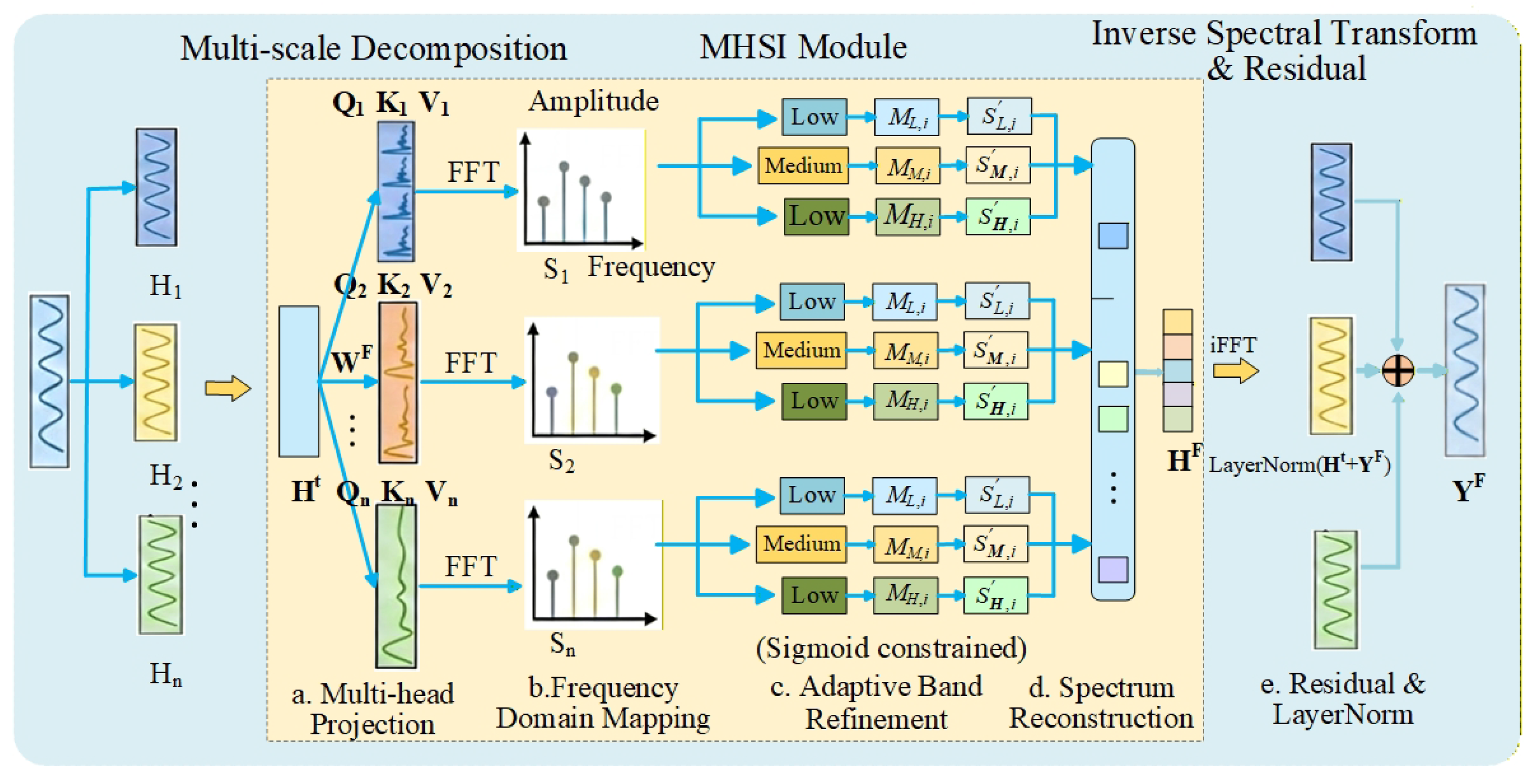
- Efficient multi-head spectral interaction with band-wise refinement. Without incurring the cost of self-attention, MHSI leverages temporal 1D FFT to capture global spectral structures and employs learnable band masks to refine low-/mid-/high-frequency components in a hierarchical manner, achieving a favorable trade-off between efficiency and representation power.
- Cross-domain, stage-adaptive time–frequency fusion. CGF enables dynamic reweighting and modulation between time- and frequency-domain representations across degradation stages, improving robustness and cross-condition generalization beyond static concatenation or fixed-weight fusion.
2. Materials and Methods
2.1. RUL Definition and Dataset Description
2.1.1. Definition of Remaining Useful Life (RUL)
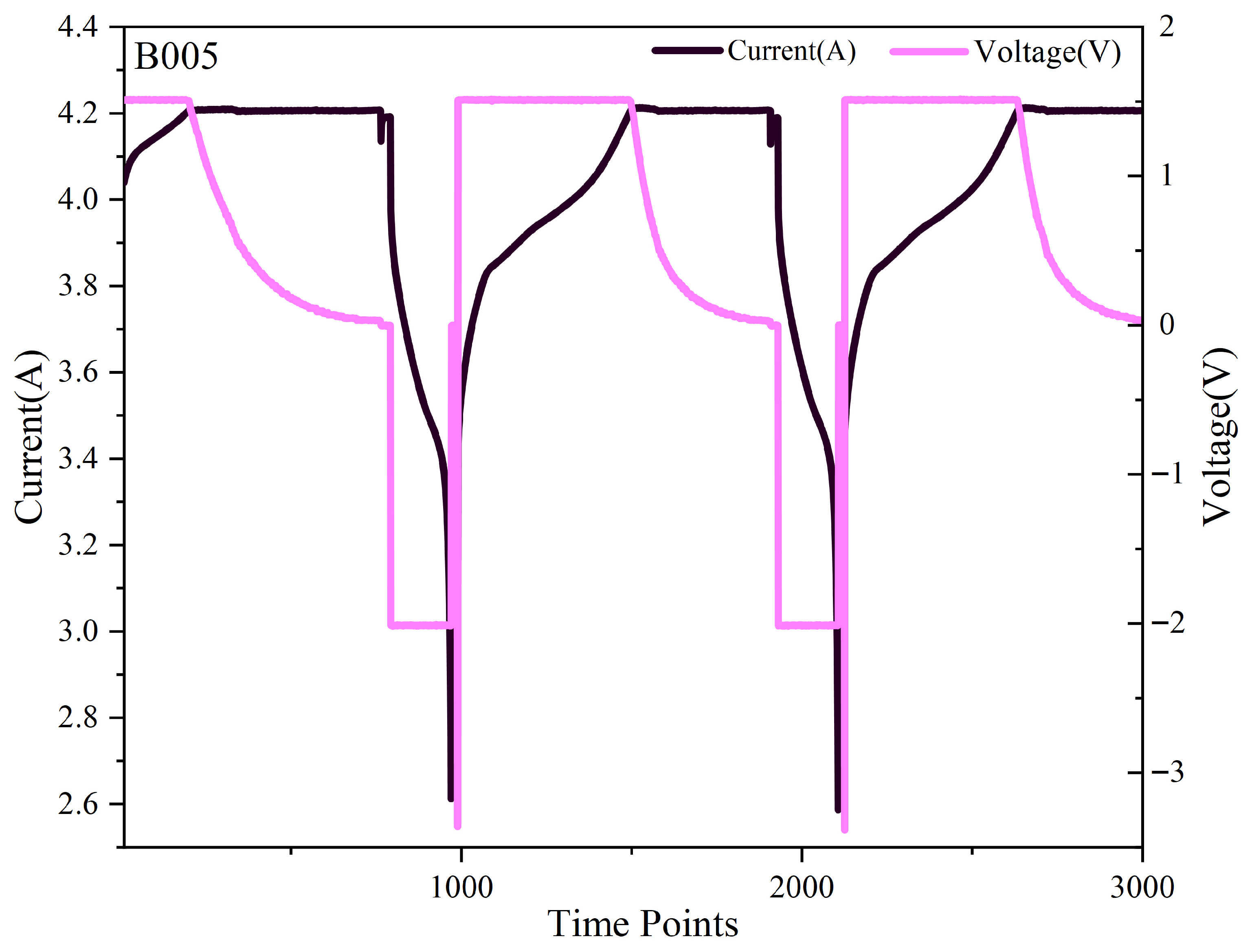
2.1.2. Dataset Description
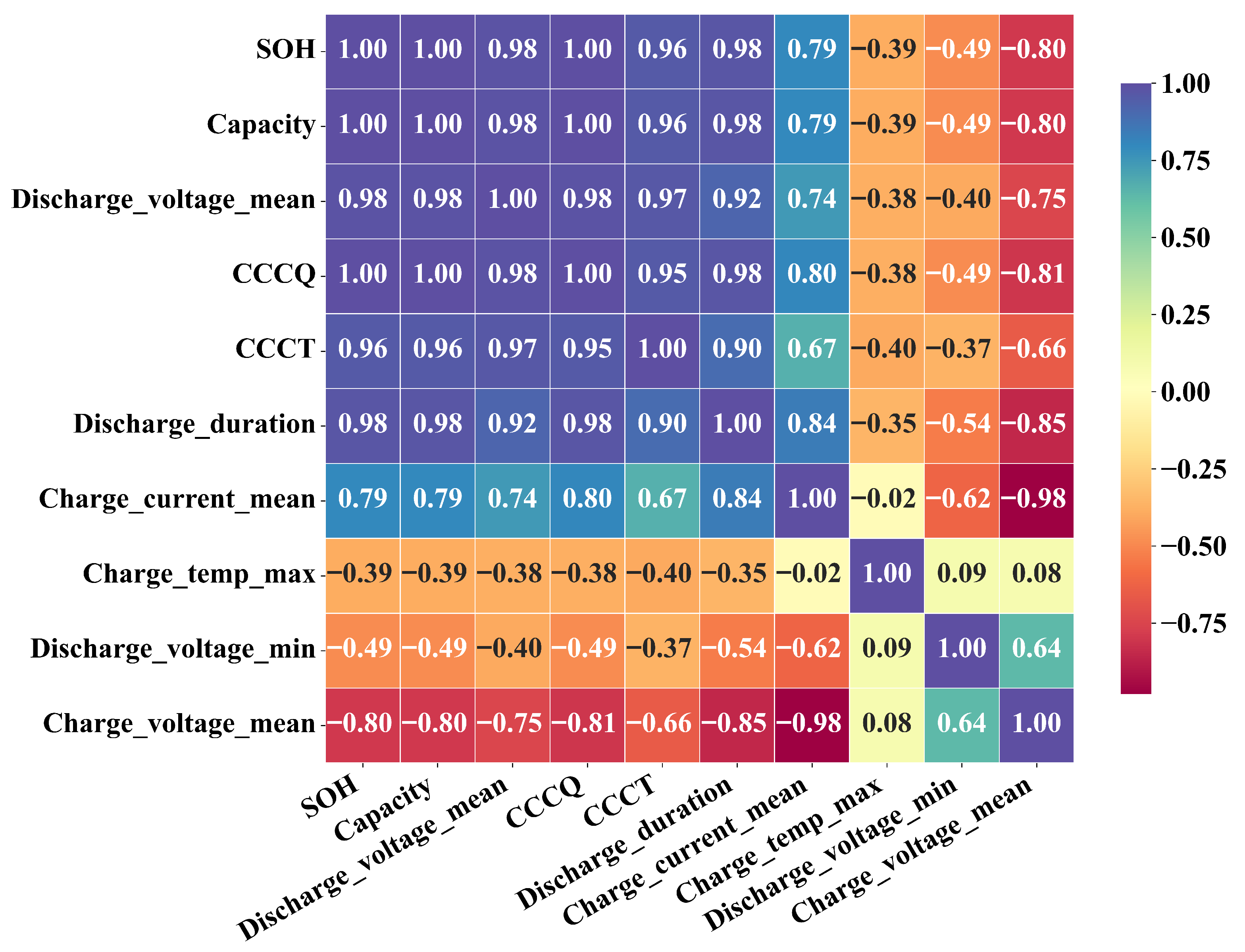
2.1.3. Construction and Selection of Health Indicators
2.2. Methodology
2.2.1. Task Definition and Notation
Alignment Principle
Single-Step vs. Multi-Horizon Prediction
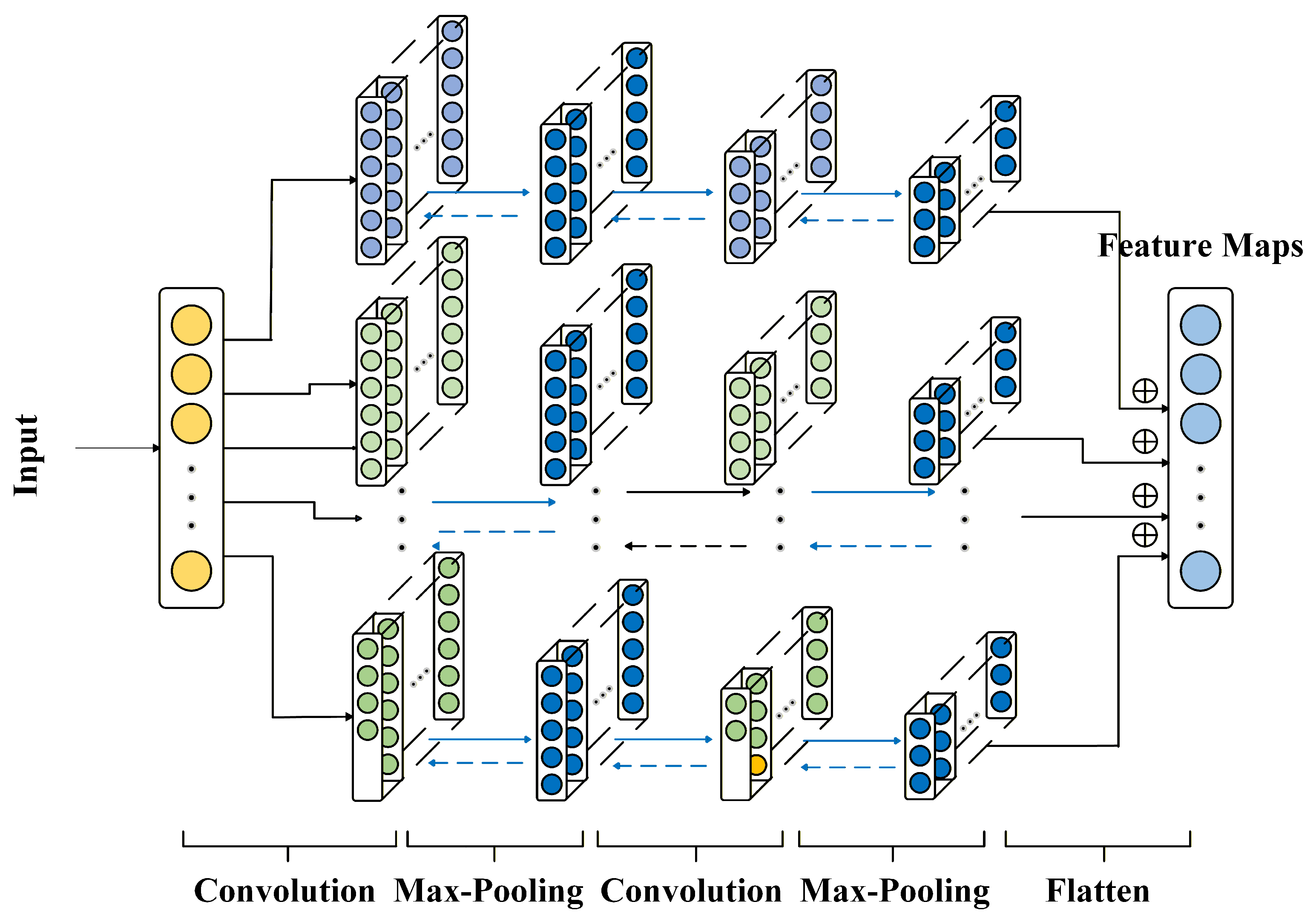
2.2.2. Multi-Scale Time-Domain Degradation Modeling (MSTC)
2.2.3. Multi-Head Spectral Interaction and Band-Wise Refinement (MHSI)
2.2.4. Cross-Gated Time–Frequency Fusion and RUL Regression (CGF)
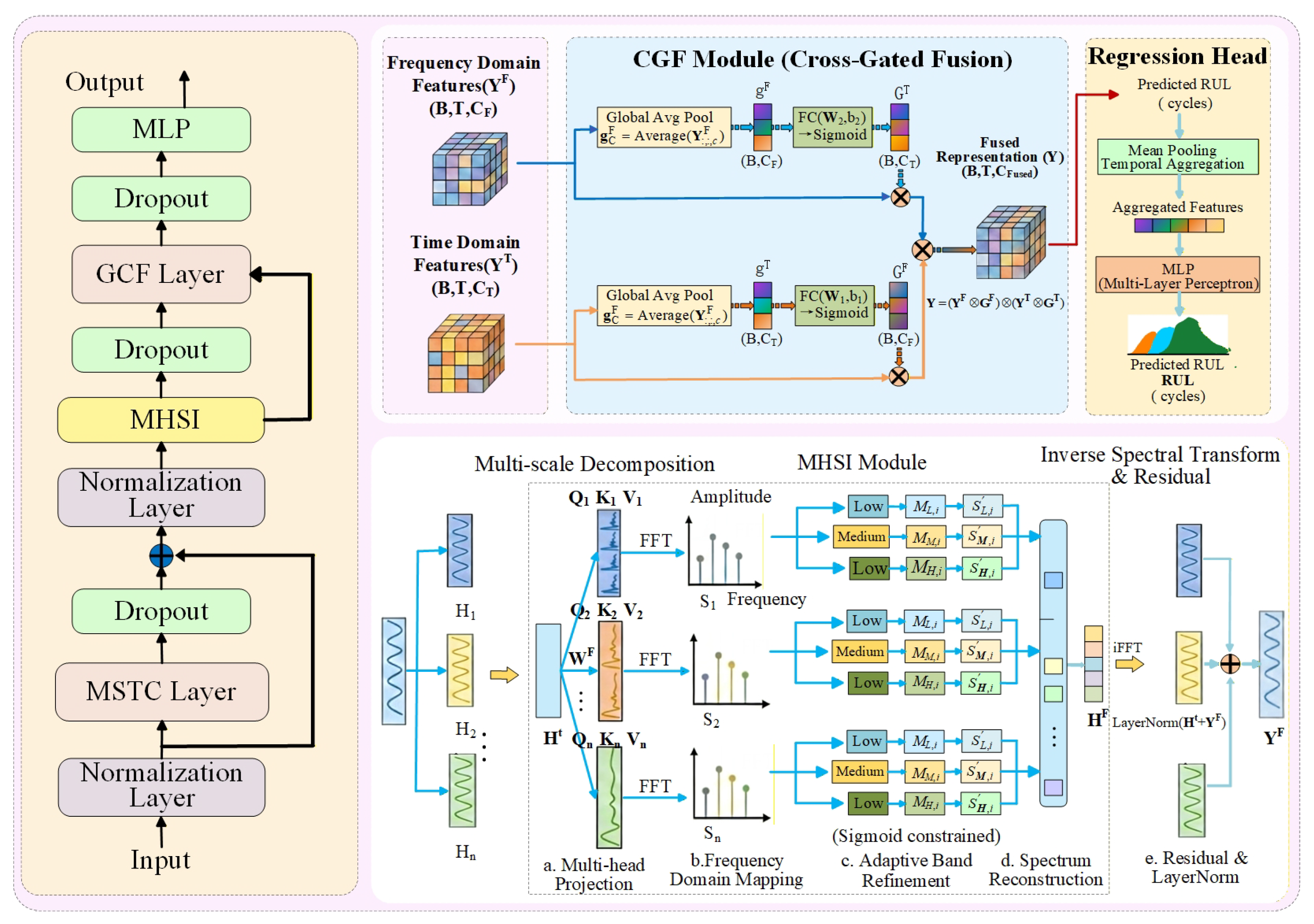
2.3. TF-RULNet (Time-Frequency RUL Network) Architecture
- Temporal encoding (MSTC): Given the input tensor , a multi-scale temporal convolutional encoder is employed to extract degradation cues at different time scales, producing the temporal representation .
- Spectral enhancement (MHSI): The temporal features are mapped into the frequency domain, where multi-head spectral interaction and adaptive band-wise refinement are performed to obtain the frequency-enhanced representation .
- Dynamic fusion (CGF): A cross-gated fusion module adaptively re-weights the contributions of temporal and spectral branches, yielding the fused feature representation .
- Multi-step regression (Forecast Head): The fused representation is aggregated and fed into a forecasting head to output the multi-step RUL prediction , where B denotes the batch size and P is the prediction horizon.
3. Experimental Settings and Model Training Procedure
3.1. Hardware Configuration
3.2. Model Hyperparameter Settings
3.3. Model Training
3.4. Evaluation Metrics
4. Experimental Analysis
4.1. Experiment I: Comparison Under the Small-Sample Setting
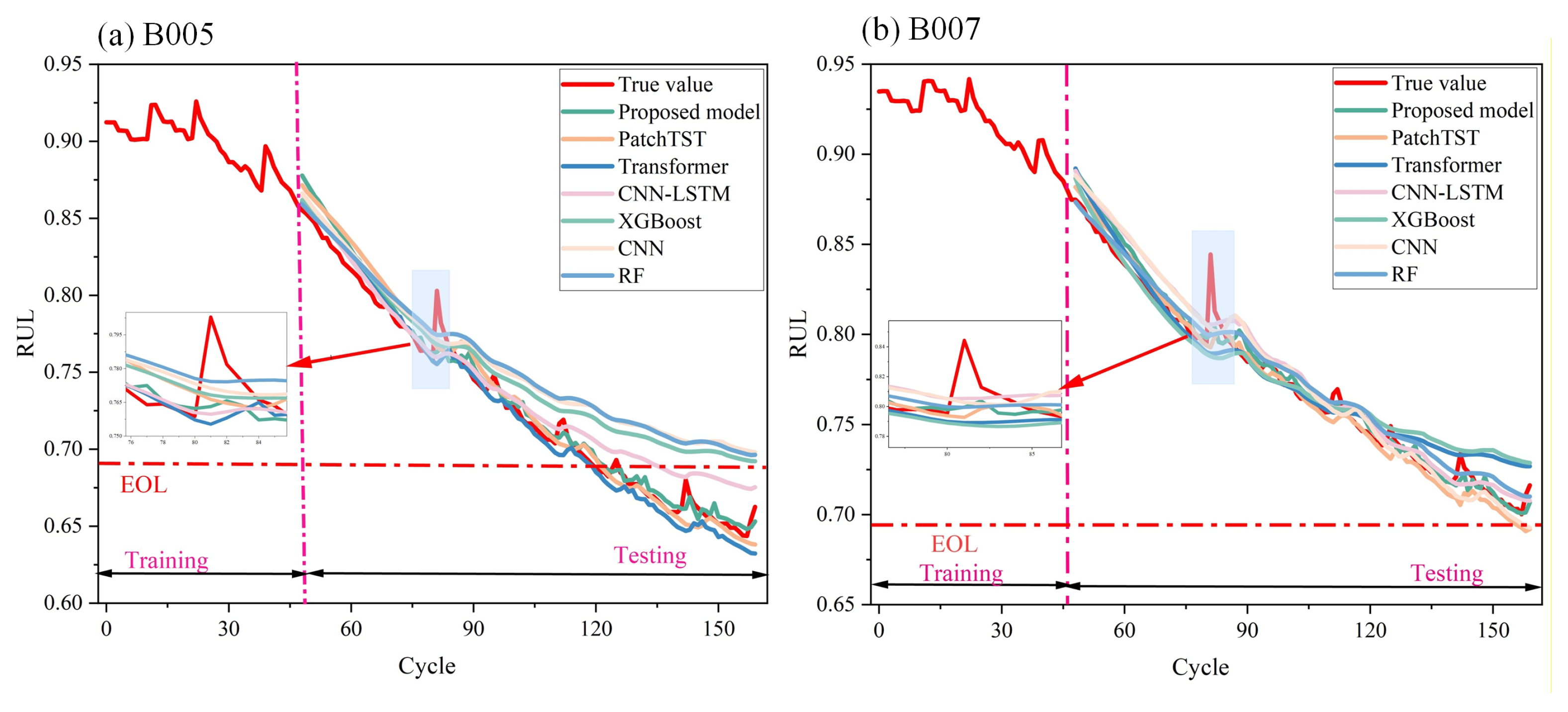
4.1.1. Experiment Comparison on B005 and B007
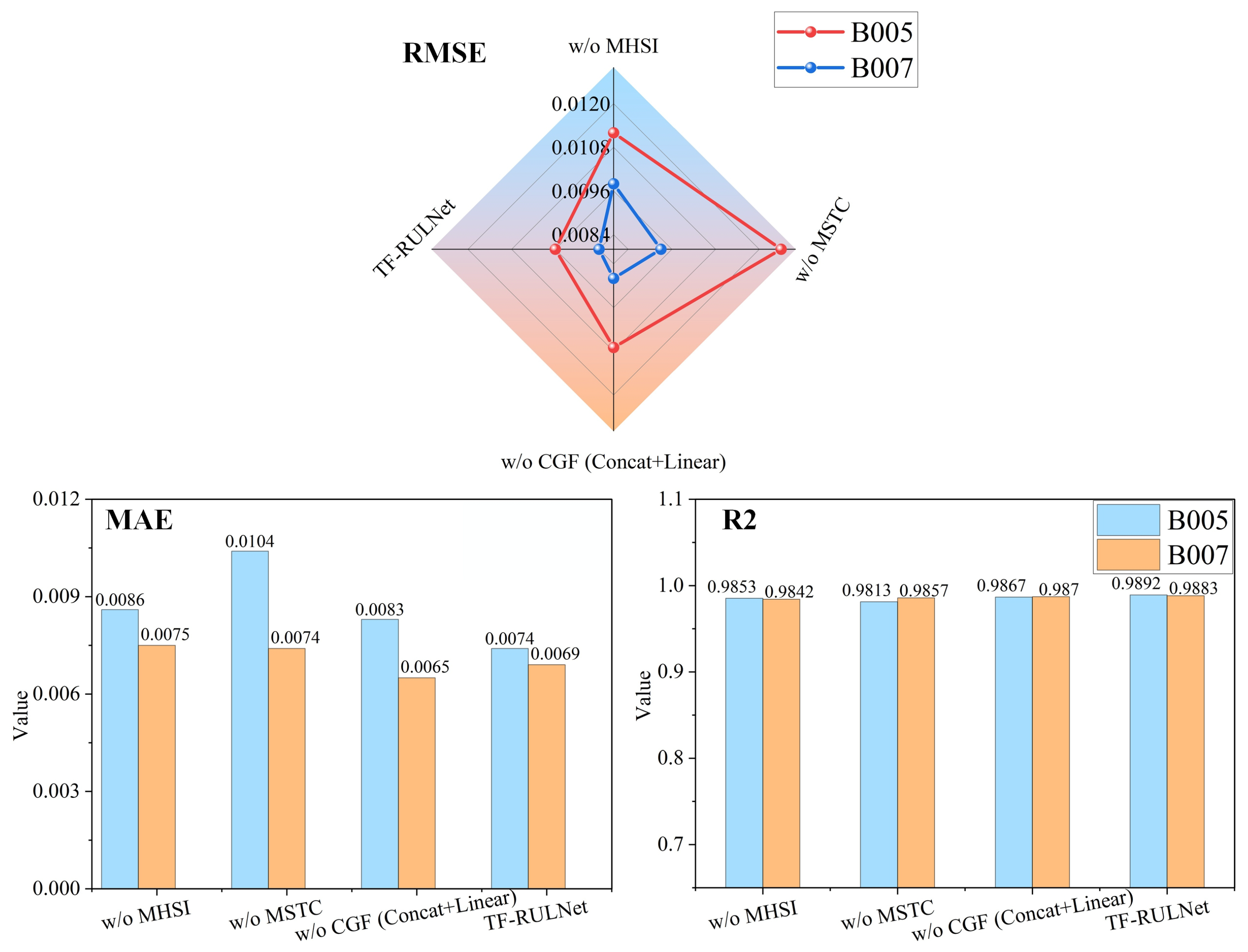
4.1.2. Ablation Experiment Under the Small-Sample Setting
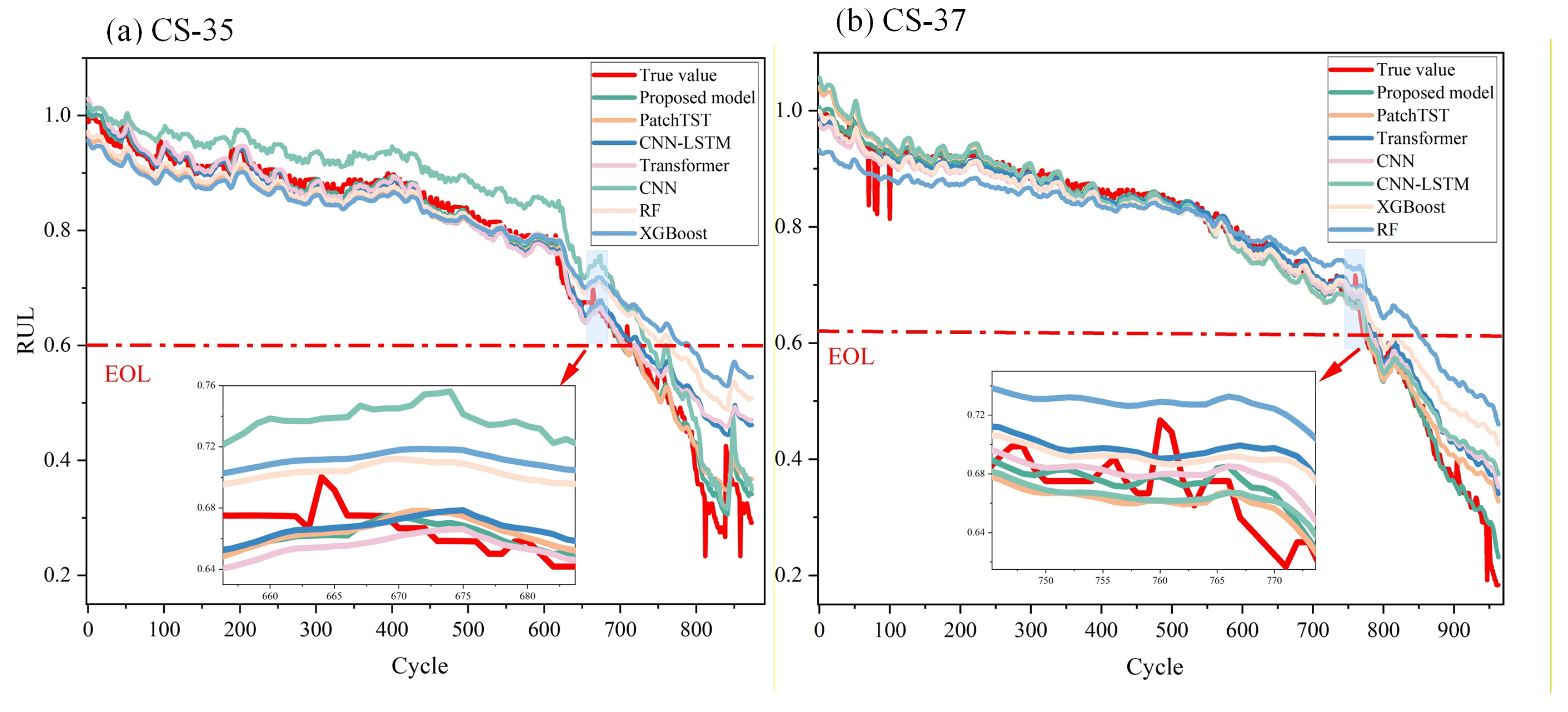
4.2. Experiment II: Cross-Dataset Generalization Experiment (NASA → Maryland)
4.3. Experiment III: Comparison with Representative Existing Models
5. Conclusions and Future Work
5.1. Conclusions
5.2. Future Work
- Uncertainty quantification for risk-aware decision making. In practical BMS applications, reliable predictions are often more valuable than a single-point optimum. Future work will extend TF-RULNet to probabilistic forecasting, providing confidence intervals and risk indicators for multi-step RUL, which can facilitate safety margin assessment and maintenance planning.
- More systematic cross-domain adaptation and online updating. While cross-dataset experiments validate the transferability of TF-RULNet, real-world operating conditions (e.g., protocols, temperatures, loads) may drift continuously. Future research will investigate parameter-efficient adaptation and online fine-tuning strategies to enable rapid updates with limited new data while mitigating catastrophic forgetting.
- From macro cycle-level features to fine-grained segment-level mechanistic feature fusion. The current study mainly uses macro cycle-level statistical features. Future extensions will incorporate finer-grained information, such as charging/discharging curve segments and IC/DV peak characteristics, into a unified representation framework, aiming to better capture stage-wise behaviors (e.g., capacity regeneration) and non-linear degradation acceleration near the end of life.
Author Contributions
Funding
Data Availability Statement
Conflicts of Interest
References
- Khine, M.H.H.; Kim, C.G.; Aunsri, N. A Review of Bayesian-Filtering-Based Techniques in RUL Prediction for Lithium-Ion Batteries. J. Energy Storage 2025, 111, 115371. [Google Scholar] [CrossRef]
- Paccha-Herrera, E.; Jaramillo-Montoya, F.; Calderón-Muñoz, W.R.; Tapia-Peralta, D.; Solorzano-Castillo, B.; Gomez-Pena, J.; Paccha-Herrera, J. A Particle Filter-Based Approach for Real-Time Temperature Estimation in a Lithium-Ion Battery Module during the Cooling-down Process. J. Energy Storage 2024, 94, 112413. [Google Scholar] [CrossRef]
- Liu, K.; Shang, Y.; Ouyang, Q.; Widanage, W.D. A data-driven approach with uncertainty quantification for predicting future capacities and remaining useful life of lithium-ion battery. IEEE Trans. Ind. Electron. 2020, 68, 3170–3180. [Google Scholar] [CrossRef]
- Zhang, S.; Liu, Z.; Su, H. A Bayesian mixture neural network for remaining useful life prediction of lithium-ion batteries. IEEE Trans. Transp. Electrif. 2022, 8, 4708–4721. [Google Scholar]
- Li, X.; Jin, Z.; Li, S.; Yu, D.; Zhang, J.; Zhang, W. Li-Ion Battery State of Health Prediction through Metaheuristic Algorithms and Genetic Programming. Energy Rep. 2024, 12, 368–380. [Google Scholar] [CrossRef]
- Li, Y.; Qin, X.; Chai, M.; Wu, H.; Zhang, F.; Jiang, F.; Wen, C. SOH Evaluation and RUL Estimation of Lithium-Ion Batteries Based on MC-CNN-TimesNet Model. Reliab. Eng. Syst. Saf. 2025, 261, 111125. [Google Scholar] [CrossRef]
- Shi, J.; Rivera, A.; Wu, D. Battery Health Management Using Physics-Informed Machine Learning: Online Degradation Modeling and Remaining Useful Life Prediction. Mech. Syst. Signal Process. 2022, 179, 109347. [Google Scholar] [CrossRef]
- Wang, Y.; Hei, C.; Liu, H.; Zhang, S.; Wang, J. Prognostics of Remaining Useful Life for Lithium-Ion Batteries Based on Hybrid Approach of Linear Pattern Extraction and Nonlinear Relationship Mining. IEEE Trans. Power Electron. 2022, 38, 1054–1063. [Google Scholar] [CrossRef]
- Demirci, O.; Taskin, S.; Schaltz, E.; Demirci, B.A. Review of Battery State Estimation Methods for Electric Vehicles-Part II: SOH Estimation. J. Energy Storage 2024, 96, 112703. [Google Scholar] [CrossRef]
- Pournazari, J.; El-Dalahmeh, M.; Al-Dubai, A.; Liu, X.; Park, D.H.; Marco, J.; Dinh, T.; Ahn, J.H.; Faraji Niri, M. LiRUL: A Hybrid and Lightweight Learning Framework for RUL Prediction on Edge Devices. SSRN Electron. J. 2025. [Google Scholar] [CrossRef]
- Peng, S.; Zhang, D.; Dai, G.; Wang, L.; Jiang, Y.; Zhou, F. State of charge estimation for LiFePO4 batteries joint by PID observer and improved EKF in various OCV ranges. Appl. Energy 2025, 377, 124435. [Google Scholar] [CrossRef]
- Zhang, Y.; Wang, S.; Zhang, C.; Dui, H.; Chen, R. Application of physics-informed machine learning in performance degradation and RUL prediction of hydraulic piston pumps. Reliab. Eng. Syst. Saf. 2025, 261, 111108. [Google Scholar] [CrossRef]
- Zhou, J.; Wang, P.; Wu, X.; Liu, T. Centralized strategy learning with multi-feature scale health factors for lithium-ion battery RUL prediction. J. Energy Storage 2025, 132, 117875. [Google Scholar] [CrossRef]
- Chen, J.; Manivanan, M.; Duque, J.; Kollmeyer, P.; Panchal, S.; Gross, O.; Emadi, A. A convolutional neural network for estimation of lithium-ion battery state-of-health during constant current operation. In Proceedings of the 2023 IEEE Transportation Electrification Conference & Expo (ITEC); IEEE: Piscataway, NJ, USA, 2023; pp. 1–6. [Google Scholar]
- Jin, Z.; Li, X.; Qiu, Z.; Li, F.; Kong, E.; Li, B. A data-driven framework for lithium-ion battery RUL using LSTM and XGBoost with feature selection via Binary Firefly Algorithm. Energy 2025, 314, 134229. [Google Scholar] [CrossRef]
- Liu, L.; Yu, Y.; Guan, X.; Jing, W.; Wu, X. A novel interpretable deep autoencoder for health indicators construction and similarity-based RUL prediction. Measurement 2026, 268, 120571. [Google Scholar] [CrossRef]
- Pournazari, J.; El-Dalahmeh, M.; Park, D.H.; Marco, J.; Dinh, T.Q.; Ahn, J.H.; Niri, M.F. DFL-RUL: Decentralised Federated Learning for Battery Remaining Useful Life Estimation on Heterogeneous Edge-to-cloud. Energy AI 2026, 24, 100689. [Google Scholar] [CrossRef]
- Guo, W.; Tan, A.H.; Ong, D.S. Optimized Prediction of Remaining Useful Life of Lithium-Ion Batteries: A Voltage-Current Behavior Analysis for Enhanced Health Monitoring. J. Energy Storage 2025, 134, 118138. [Google Scholar] [CrossRef]
- Pan, W.; Luo, X.; Zhu, M.; Ye, J.; Gong, L.; Qu, H. A Health Indicator Extraction and Optimization for Capacity Estimation of Li-Ion Battery Using Incremental Capacity Curves. J. Energy Storage 2021, 42, 103072. [Google Scholar] [CrossRef]
- Wang, Z.; Liu, N.; Chen, C.; Guo, Y. Adaptive self-attention LSTM for RUL prediction of lithium-ion batteries. Inf. Sci. 2023, 635, 398–413. [Google Scholar] [CrossRef]
- Rengarajan, V.; Anuradha, T. A hybrid neural architecture for enhanced lithium-ion battery SOH estimation and RUL prediction. J. Energy Storage 2025, 140, 119019. [Google Scholar]
- Aizpurua, J.I.; Stewart, B.G.; McArthur, S.D.; Penalba, M.; Barrenetxea, M.; Muxika, E.; Ringwood, J.V. Probabilistic Forecasting Informed Failure Prognostics Framework for Improved RUL Prediction under Uncertainty: A Transformer Case Study. Reliab. Eng. Syst. Saf. 2022, 226, 108676. [Google Scholar] [CrossRef]
- Yu, B.; Ding, W.; Yang, Z.; Xiang, G.; Yu, Y. MDM: A Mamba-Conditioned Diffusion Model for Spacecraft Lithium-Ion Battery RUL Prediction. IFAC-PapersOnLine 2025, 59, 781–786. [Google Scholar] [CrossRef]
- Liu, L.; Huang, J.; Zhao, H.; Li, T.; Li, B. PatchFormer: A novel patch-based transformer for accurate remaining useful life prediction of lithium-ion batteries. J. Power Sources 2025, 631, 236187. [Google Scholar] [CrossRef]
- Zhao, J.; Chu, F.; Xie, L.; Che, Y.; Wu, Y.; Burke, A.F. A Survey of Transformer Networks for Time Series Forecasting. Comput. Sci. Rev. 2025, 60, 100883. [Google Scholar] [CrossRef]
- Zhao, T.; Fang, L.; Ma, X.; Li, X.; Zhang, C. TFformer: A Time–Frequency Domain Bidirectional Sequence-Level Attention Based Transformer for Interpretable Long-Term Sequence Forecasting. Pattern Recognit. 2025, 158, 110994. [Google Scholar] [CrossRef]
- Shao, X.; Huang, R.; Qin, Y. EnergyFormer: Dual-supervised adaptive multi-scale transformer for multistep energy forecasting. Expert Syst. Appl. 2025, 130750. [Google Scholar] [CrossRef]
- Li, J.; Yin, M.; Huang, J.; Luo, T. A dual-branch multi-scale encoding and fusion model for multivariate time series forecasting. Eng. Appl. Artif. Intell. 2026, 166, 113610. [Google Scholar] [CrossRef]
- Guo, Y.; Wang, J.; Peng, H.; Wang, T.; Hu, H.; Ramírez-de Arellano, A. A multi-scale spatiotemporal spiking neural model for power load forecasting considering extreme weather impact. Int. J. Electr. Power Energy Syst. 2026, 175, 111604. [Google Scholar] [CrossRef]
- Li, H.; Fan, H.; Hao, L.; Wang, J. Data-driven heterogeneous ensemble forecasting framework incorporating multi-scale criteria. Expert Syst. Appl. 2026, 302, 130537. [Google Scholar] [CrossRef]
- Qian, Z.; Chen, Z.; Pan, E. A transfer condition-focused model for battery capacity forecast. Reliab. Eng. Syst. Saf. 2026, 267, 111928. [Google Scholar] [CrossRef]
- Duan, Y.; Lin, L.; Liu, J.; Zhang, Q.; Fan, X. Cross-Domain Time-Frequency Mamba: A More Effective Model for Long-Term Time Series Forecasting. Knowl.-Based Syst. 2026, 337, 115341. [Google Scholar] [CrossRef]
- Hao, F.; Zhang, X.; Liu, Y.; Sun, Y.; Wang, H.; Yang, L.; Wang, R. FTdasc: A Frequency-Time Domain Approach with Stationarity Correction for Multivariate Time Series Forecasting. Expert Syst. Appl. 2026, 308, 131164. [Google Scholar] [CrossRef]
- Fan, H.; Liu, W.; Zhang, Z.; Run, W.; Duan, Y.; Liu, D. EPformer: Unlocking day-ahead electricity price forecasting accuracy using the time-frequency domain feature learning strategy considering renewable energy. Renew. Energy 2026, 261, 125296. [Google Scholar] [CrossRef]
- Wu, P.; Liu, J.; Han, J. Long-term time series forecasting by combining local periodic change features in frequency domain and global features in time domain. J. Frankl. Inst. 2025, 363, 108304. [Google Scholar] [CrossRef]
- Aljohani, A.; Aljohani, S. A Hybrid GRU-MHA model for accurate battery RUL forecasting with feature selection. Energy Rep. 2025, 14, 294–309. [Google Scholar] [CrossRef]
- Zhang, M.; Sun, L.; Yang, J.; Zou, Y.; Long, W. A dynamic association multi-attribute fusion graph network for multivariate time series forecasting. Inf. Process. Manag. 2026, 63, 104588. [Google Scholar] [CrossRef]
- Li, Z.; Wang, H.; Zhang, F. DDformer: Transformer with dynamic variable fusion and dynamic difference attention for multivariate time series long-term forecasting. Neurocomputing 2026, 672, 132716. [Google Scholar] [CrossRef]
- Jiang, Z.; Tan, Q.; Che, J.; Xu, Y.; Dong, Y. Spatio-temporal convolutional attention dynamic fusion network for regional collaborative wind power forecasting. Expert Syst. Appl. 2025, 299, 130291. [Google Scholar] [CrossRef]
- Yao, X.; Xu, H. A HybridGCN-GRU Approach for High-Accuracy Wind Speed Forecasting via Multi-Graph Feature Fusion and Dynamic Modeling. Inf. Sci. 2026, 728, 122805. [Google Scholar] [CrossRef]
- Obisakin, I.; Ekeanyanwu, C.V. State of health estimation of lithium-ion batteries using support vector regression and long short-term memory. Open J. Appl. Sci. 2022, 12, 1366–1382. [Google Scholar] [CrossRef]
- He, W.; Williard, N.; Osterman, M.; Pecht, M. Prognostics of lithium-ion batteries based on Dempster–Shafer theory and the Bayesian Monte Carlo method. J. Power Sources 2011, 196, 10314–10321. [Google Scholar] [CrossRef]
- Huang, W.C.; Cooper, E.; Yamagishi, J.; Toda, T. LDNet: Unified listener dependent modeling in MOS prediction for synthetic speech. In Proceedings of the ICASSP 2022-2022 IEEE International Conference on Acoustics, Speech and Signal Processing (ICASSP); IEEE: Piscataway, NJ, USA, 2022; pp. 896–900. [Google Scholar]




| Dataset | Selected Batteries | Cell Type | Rated Capacity | Chemistry |
|---|---|---|---|---|
| NASA | B0005, B0006, B0007, B0018 | Cylindrical | 2 Ah | NCA/Graphite |
| CALCE | CS2-35, CS2-36, CS2-37, CS2-38 | Prismatic | 1.1 Ah | LCO/Graphite |
| Hyperparameter | Search Range (Grid) | Selected |
|---|---|---|
| Model dimension () | {32, 64, 128} | 64 |
| Number of heads () | {1, 8} | 4 |
| Feed-forward dimension () | {1, 128} | 32 |
| Dropout rate | {0.0, 0.5} | 0.1 |
| Initial learning rate () | {1 × 10⁻⁴, 1 × 10⁻³, 1 × 10⁻²} | 1 × 10⁻³ |
| Model | B005 | B007 | ||||
|---|---|---|---|---|---|---|
| RMSE | MAE | RMSE | MAE | |||
| CNN | 0.0273 | 0.0226 | 0.9129 | 0.0124 | 0.0092 | 0.9746 |
| CNN-LSTM | 0.0145 | 0.0115 | 0.9753 | 0.0115 | 0.0088 | 0.9781 |
| Transformer | 0.0131 | 0.0096 | 0.9798 | 0.0120 | 0.0101 | 0.9759 |
| XGBoost | 0.0249 | 0.0212 | 0.9273 | 0.0131 | 0.0107 | 0.9713 |
| RF | 0.0284 | 0.0245 | 0.9052 | 0.0173 | 0.0128 | 0.9504 |
| PatchTST | 0.0128 | 0.0102 | 0.9808 | 0.0111 | 0.0079 | 0.9794 |
| TF-RULNet | 0.0096 | 0.0074 | 0.9892 | 0.0084 | 0.0069 | 0.9883 |
| Model | B005 | B007 | ||||
|---|---|---|---|---|---|---|
| RMSE | MAE | RMSE | MAE | |||
| w/o MHSI | 0.0112 | 0.0086 | 0.9853 | 0.0098 | 0.0075 | 0.9842 |
| w/o MSTC | 0.0126 | 0.0104 | 0.9813 | 0.0093 | 0.0074 | 0.9857 |
| w/o CGF (Concat+Linear) | 0.0107 | 0.0083 | 0.9867 | 0.0088 | 0.0065 | 0.9870 |
| TF-RULNet | 0.0096 | 0.0074 | 0.9892 | 0.0084 | 0.0069 | 0.9883 |
| Model | CS-35 | CS-37 | ||||
|---|---|---|---|---|---|---|
| RMSE | MAE | RMSE | MAE | |||
| CNN | 0.0541 | 0.0511 | 0.9179 | 0.0360 | 0.0238 | 0.9635 |
| CNN-LSTM | 0.0485 | 0.0283 | 0.9339 | 0.0399 | 0.0253 | 0.9552 |
| Transformer | 0.0492 | 0.0275 | 0.9321 | 0.0339 | 0.0199 | 0.9676 |
| XGBoost | 0.0814 | 0.0543 | 0.8139 | 0.0535 | 0.0310 | 0.9194 |
| RF | 0.0667 | 0.0416 | 0.8751 | 0.0775 | 0.0543 | 0.8309 |
| PatchTST | 0.0293 | 0.0248 | 0.9758 | 0.0301 | 0.0196 | 0.9744 |
| TF-RULNet | 0.0181 | 0.0121 | 0.9908 | 0.0165 | 0.0097 | 0.9923 |
| Model | B005 | B007 | ||||
|---|---|---|---|---|---|---|
| RMSE | MAE | RMSE | MAE | |||
| LDNet [43] | 0.0121 | 0.0103 | 0.9828 | 0.0111 | 0.0085 | 0.9797 |
| MDM [23] | 0.0126 | 0.0104 | 0.9813 | 0.0111 | 0.0079 | 0.9794 |
| DFL-RUL [17] | 0.0128 | 0.0102 | 0.9808 | 0.0120 | 0.0101 | 0.9759 |
| PatchFormer [24] | 0.0117 | 0.0100 | 0.9839 | 0.0088 | 0.0065 | 0.9870 |
| TFformer [26] | 0.0104 | 0.0080 | 0.9874 | 0.0095 | 0.0072 | 0.9849 |
| TF-RULNet | 0.0096 | 0.0074 | 0.9892 | 0.0084 | 0.0069 | 0.9883 |
Disclaimer/Publisher’s Note: The statements, opinions and data contained in all publications are solely those of the individual author(s) and contributor(s) and not of MDPI and/or the editor(s). MDPI and/or the editor(s) disclaim responsibility for any injury to people or property resulting from any ideas, methods, instructions or products referred to in the content. |
© 2026 by the authors. Licensee MDPI, Basel, Switzerland. This article is an open access article distributed under the terms and conditions of the Creative Commons Attribution (CC BY) license.
Share and Cite
Tu, Y.; Xu, S.; Wang, J.; Jin, M. A Multi-Step RUL Prediction Method for Lithium-Ion Batteries Based on Multi-Scale Temporal Features and Frequency-Domain Spectral Interaction. Batteries 2026, 12, 137. https://doi.org/10.3390/batteries12040137
Tu Y, Xu S, Wang J, Jin M. A Multi-Step RUL Prediction Method for Lithium-Ion Batteries Based on Multi-Scale Temporal Features and Frequency-Domain Spectral Interaction. Batteries. 2026; 12(4):137. https://doi.org/10.3390/batteries12040137
Chicago/Turabian StyleTu, Ye, Shixiong Xu, Jie Wang, and Mengting Jin. 2026. "A Multi-Step RUL Prediction Method for Lithium-Ion Batteries Based on Multi-Scale Temporal Features and Frequency-Domain Spectral Interaction" Batteries 12, no. 4: 137. https://doi.org/10.3390/batteries12040137
APA StyleTu, Y., Xu, S., Wang, J., & Jin, M. (2026). A Multi-Step RUL Prediction Method for Lithium-Ion Batteries Based on Multi-Scale Temporal Features and Frequency-Domain Spectral Interaction. Batteries, 12(4), 137. https://doi.org/10.3390/batteries12040137