
Article

Capacity Enhancement and Structural Study of Fluorine-Doped Co-Free Li- and Mn-Rich Li1.2[Mn0.5Ni0.2Fe0.1]O2(1−x)F2x Layered Oxide Cathodes


1
Department of Physics & CSRRI, Illinois Institute of Technology, Chicago, IL 60616, USA
2
Department of Mechanical, Materials & Aerospace Engineering, Illinois Institute of Technology, Chicago, IL 60616, USA
3
Department of Chemical and Biological Engineering, Illinois Institute of Technology, Chicago, IL 60616, USA
4
Department of Chemistry, Illinois Institute of Technology, Chicago, IL 60616, USA
*
Authors to whom correspondence should be addressed.
Batteries 2026, 12(4), 126; https://doi.org/10.3390/batteries12040126
Submission received: 19 February 2026 / Revised: 31 March 2026 / Accepted: 2 April 2026 / Published: 6 April 2026

Abstract

Both Co-free and lithium- and manganese-rich layered oxide Li(Li0.2MnxNiyFez)O2 (MNF) cathodes have recently attracted attention in lithium-ion battery (LIB) research due to their high capacities of over 250 mAhg−1, as well as being more eco-friendly and inexpensive than commercial NMC and LiCoO2. However, they still suffer from lower experimental capacity as well as capacity decay, voltage fade, poor rate capability, and thermal instability. In this paper, fluorine (F)-doped Li1.2(Mn0.5Ni0.2Fe0.1)O2(1−x)F2x (MNF502010, x = 0, 0.025, 0.05, 0.075, 0.1) cathode materials have been synthesized in the nanoscale via sol–gel and subsequent solid-phase calcination to address some of these problems. The resulting 5% F-doped MNF502010 cathode demonstrates the advantage of fluorine doping, which makes a significant contribution to the formation of a well-ordered layer structure with a minimal LiM2O4 spinel phase as an impurity. This composition achieves an initial discharge capacity of 252 mAhg−1 (1C = 250 mAhg−1) and a 156 mAhg−1 discharge capacity at 0.3 C on the 100th discharge, with an average voltage fade of 0.24 V. The optimization of fluorine composition results in an enhancement in the activation of the Li2MnO3-type monoclinic phase, as well as an increase in the electronic conductivity compared to the fluorine-free cathode. To understand the structural origin of this improved performance, X-ray absorption spectroscopy (XAS) measurements were carried out on pristine and cycled MNF electrodes.

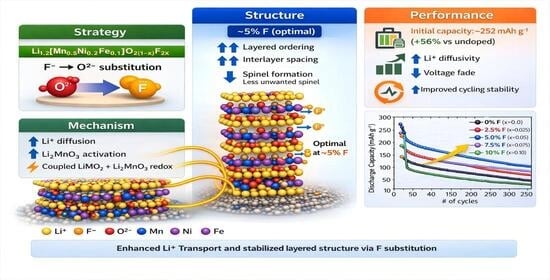
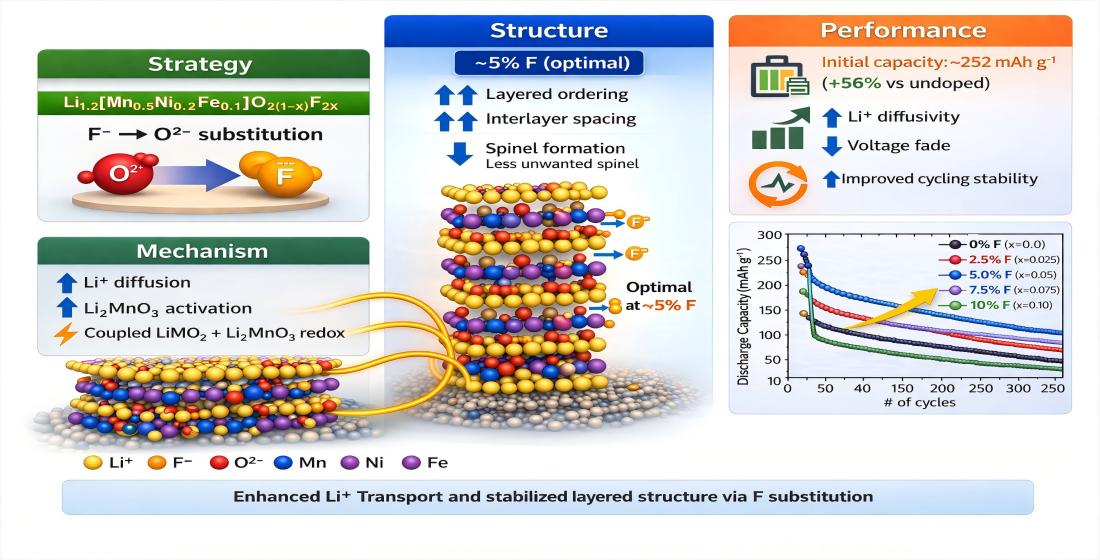
Graphical Abstract

1. Introduction

Rechargeable lithium-ion batteries (LIBs) have been one of the first choices as a power source for both 3C (computer, communication, and consumer electronics) products and electric vehicles (EVs), as well as energy storage systems (ESSs) for renewable energy and smart grid applications [1,2]. Nevertheless, the specific energy density of present commercial batteries still cannot meet all the requirements needed for applications in the battery industry. Achieving a significant breakthrough in this field will depend upon the development of novel electrode materials having higher specific capacity and inherently higher energy density. For instance, LiCoO2, well known as one of the dominant cathode materials, is insufficient to deal with the competing demand for factory-scale applications of the high-energy LIB packs used in the electric vehicle industry because of its low capacity, high cost, and toxicity [3,4]. Experimental studies show that the LiCoO2 cathode can only reach about 140 mAhg−1 capacity, which is less than half of its theoretical limit (~270 mAhg−1), mainly due to its crystal phase transformation to a spinel phase during cycling [1]. As another example, lithium-rich NMC has also been considered to be one of the best cathode candidates to reach higher experimental capacity (>250 mAhg−1) and higher operating voltage (>3.5 V vs. Li/Li+ anode) for advanced LIB applications in EVs and ESSs [5,6]. However, its capacity suffers dramatic reductions during cycling, with capacity lost in the first cycle that has been experimentally reported to be more than 20% at room temperature, adversely affecting its energy density [6]. Moreover, although the Li-rich Ni-Mn-Co-based NMC-type cathodes have been intensively studied to enhance their reversible capacity, the presence of Ni and Co makes them expensive and toxic [7,8]. Because about 40% of a LIB cell’s cost derives from the raw materials, the use of toxic and expensive elements in high-energy cathode materials should ideally be avoided due to both environmental and commercial perspectives, and many studies have focused on the development of alternative cathodes [9,10].
Given these considerations, Co-free and Li- and Mn-rich (LMRO) layered oxide cathode materials xLi2MnO3·LiMO2 (M = Mn, Ni, and Fe) have drawn significant attention due to high initial discharge capacities (over 250 mAhg−1) and as cost-effective and eco-friendly candidates (Figure S1) [11,12]. This type of cathode consists of a structurally integrated composite of Li2MnO3-like monoclinic and LiMO2-like rhombohedral components. These two crystalline components are structurally similar, as shown in Figure S2. Although the theoretical capacity of the rhombohedral LiMO2 component is ~270 mAhg−1, it is not easy to synthesize stoichiometrically, and its structure converts into a spinel-like phase upon cycling [1,11,12]. On the other hand, the monoclinic Li2MnO3-like component has an even higher theoretical capacity of ~455 mAhg−1 if both Li+ ions could be reversibly extracted during electrochemical cycling [6,11]. However, Co-free LMRO cathodes also suffer from dramatic capacity loss and voltage fade problems, like other cathode materials such as Li-rich NMC and Ni-rich layered oxides [13,14]. Li-ion extraction from the Li2MnO3 monoclinic component causes structural changes, which lead to both a huge irreversible capacity, especially in the first cycle, and inherent capacity loss upon further cycles [5]. Furthermore, Li-rich cathode materials have typically shown a gradual decline in their average voltage when they are charged at a higher potential (>4.5 V) due to the layered structure to spinel transformation, which decreases the energy density significantly [14,15]. To overcome these problems, intensive studies have been conducted using different techniques, such as surface modification, particle size and morphology change, partial doping/substitution, and optimization of the fractions of TM ions [11,16]. For instance, the partial cationic substitution at transition metal (TM) sites with Ti [17,18], Cr [19,20], Al [12], and Ru [21], etc., has been employed by many groups, and these doped cathode samples exhibited better electrochemical performance than undoped samples in terms of rate capability, capacity retention, and higher experimental discharge capacity [22].
Anionic substitution in the oxygen site has become a popular way to enhance the electrochemical performance of a cathode material. This strategy was first applied by Sun et al. in the early 2000s with sulfur as a dopant on the LiM2O4 spinel cathode to minimize the Jahn–Teller distortion [23]. Recently, fluorine doping into oxygen has been widely employed to improve the electrochemical performance of both the LiM2O4 (spinel) and lithium-rich NMC cathodes [24]. Fluorine substitution for oxygen in the spinel cathode was investigated by Guo et al. [12], who suggested that fluorine substitution for oxygen brings about an increase in the amount of Mn3+, which results in better electronic conductivity and higher experimental discharge capacity [25,26]. Another significant result reported by Dong et al. is that fluorine doping into the oxygen site weakens the Li-O bond, potentially reducing the energy barrier of the Li+ ions to diffusion [27]. In addition to these, since the dissolution of metal elements results from the corrosion of hydrofluoric acid (HF-effect) arising from the reaction of the residual moisture with the electrolyte (LiPF6) [2]. F-substitution for O may provide protection for the electrode against HF attacks [28]. Although the fluorine (F) doping into the oxygen site of layered oxide cathodes is a powerful strategy to stabilize the structure and improve performance, this approach carries several potential structural disadvantages and performance trade-offs that can affect their electrochemical behaviors. Key structural drawbacks of fluorine doping include the following: (i) since the fluorine has low solubility in the well-ordered layered crystal structure, its high levels doping can result in an undesired phase formations, such as LiF, rather than homogeneous substitution into the oxygen site; (ii) the replacement of O2− ions with F ions with in the oxygen sublattice can lead to local lattice distortions, which can disrupt the long-range ordering [29]; (iii) in some cases, the F-doping can worsen, rather than mitigate, irreversible capacity loss in the first cycle, particularly if the doping is not uniformly distributed; (iv) the formation of LiF-like domains (especially on the surface) can decrease electronic conductivity [30]; and (v) although the aim is to stabilize the material structure, improper F-doping can promote unwanted phase transitions from a layered structure to a spinel-like phase, resulting in capacity and voltage fade [31].
In this study, fluorine was doped into Li1.2Mn0.5Ni0.2Fe0.1O2(1−x)F2x (MNF502010, or MNF for short) in the amounts of x = 0.00, 0.025, 0.05, 0.075, and 0.1 (i.e., 0.0%, 2.5%, 5.0%, 7.5%, and 10% fluorine substitution for oxygen) for the first time in order to study the effects of F-doping on the structural, morphological, and electrochemical properties of the MNF cathodes. All samples were investigated by means of powder X-ray diffraction (XRD), field emission scanning electron microscopy (FE-SEM) with energy-dispersive X-ray (EDS) analysis, BET specific surface area (SSA), X-ray photoelectron spectroscopy (XPS), cyclic voltammetry (CV), and electrochemical impedance spectroscopy (EIS), in addition to galvanostatic charge–discharge cycling to examine the reasons for improved electrochemical performance and understand degradation or failure mechanism. Specifically, ex situ X-ray absorption spectroscopy (ex situ XAS) was also performed at the Mn, Ni, and Fe K-edges and used to detect the changes both in the oxidation state of the transition metal (TM) ions and in their local environments. Moreover, EXAFS data were modeled to understand the local structural influence of fluorine addition on the electrochemical performance of both pristine and cycled electrodes. To the best of our knowledge, this is the first study investigating the effects of fluorine-doping on Co-free Li-rich MNF cathode materials to discuss the structural origin of the improved performance.

2. Materials and Methods

2.1. Synthesis of MNF Powders

Li1.2Mn0.5Ni0.2Fe0.1O2(1−x)F2x (x = 0.00, 0.025, 0.05, 0.075, and 0.10) nanoparticles were prepared by a citric acid-assisted sol–gel method. The nitrates of transition metals and lithium (Mn(NO3)2·4H2O, Ni(NO3)2·6H2O, Fe(NO3)3·9H2O, LiNO3, and LiF (as F source), all reagent grade, Sigma Aldrich, Saint Louis, MO, USA) were used as precursors. Stoichiometric ratios of metal nitrates and LiF were dissolved in about 15mL of deionized water. Citric acid was used as a chelating agent in a 1:2 molar ratio with all-metal salts. After the citric acid was added to the above solution, the mixture was held at 70 °C on a hot plate with continuous stirring until a transparent yellowish gel was formed (in ~12 h). The gel was then dried in a box furnace at 80 °C in the air for ~12 h, resulting in the formation of a dry yellowish foam product. The product was manually ground and initially decomposed at 400 °C in static air for 5 h. The resulting dark brown products were collected, manually ground again to a fine powder, and calcined at 700 °C in a static air atmosphere for 15 h to obtain the final product.

2.2. Structural (XRD), Morphological (SEM/EDS), and Surface Area (BET) Analysis

The powder X-ray diffraction (PXRD) patterns of the synthesized powders were collected on a Bruker D2 Phaser Diffractometer (Billerica, MA, USA) with a LynxEye detector and Cu-Kα source between 10° and 80° 2θ degrees with steps of 0.01 degree every 1.5 s. To obtain information on crystallite sizes and phase composition of the MNF powders, XRD patterns were refined by the Rietveld method [32] using GSAS-I [33,34] with EXPGUI [35] software packages with profile function 2 and background fitted using a six-term shifted Chebyshev polynomial function [36,37]. XRD patterns of cycled electrodes were obtained by decrimping the cycled coin cells inside an Ar-filled glove box, followed by flushing with dimethyl carbonate (DMC) solvent and sealing between two pieces of Kapton tape. Carefully pulling apart the Kapton layers served to remove the casted electrode from the aluminum foil current collector and the carbon additives used as a conductive agent in the slurry preparation, thereby minimizing their significant background contributions to the XRD patterns.
Sample morphology and elemental composition were measured by scanning electron microscopy (SEM) [38] imaging and energy-dispersive X-ray (EDS) analysis using a field-emission scanning electron microscope (FESEM, S-4700, Hitachi Limited Corporation, Schaumburg, IL, USA) with an acceleration voltage of 10kV at the Center of Nano-scale Materials (CNM) at Argonne National Lab (ANL). The MNF cathode powders were deposited on a silicon wafer for SEM/EDS measurement after they were dispersed in pure ethyl alcohol and sonicated for 1 h.
Nitrogen adsorption experiment was performed using a two-channel Nova Quantachrome 2200e surface area and pore size analyzer (The Quantachrome Instruments, Boynton Beach, FL, USA). The specific surface area (SSA) for undoped, 5%, and 10% F-doped MNF samples was measured from nitrogen adsorption/desorption isotherms by the Brunauer–Emmet–Teller (BET) method at 77K after degassing the sample at 150 °C for 24 h, while both pore volume and pore size distribution were obtained by Barrett−Joyner−Halenda (BJH) analysis.

2.3. XPS Measurement

X-ray photoelectron spectroscopy (XPS) experiments were conducted using a Thermo-Scientific (Waltham, MA, USA) ESCALAB 250Xi spectrometer with a monochromatized Al Kα source (1486.8 eV) equipped with an electron flood gun and a scanning ion gun to analyze the surface chemical composition of the synthesized MNF powders. The XPS instrument was calibrated prior to the experiments with binding energies referenced to Au 4f7/2 at 83.96 eV and Ag 3d5/2 at 368.27 eV. XPS spectra for all samples were obtained under ultra-high vacuum (10−9 mbar) for accurate measurement. The XPS survey scan was acquired at a pass energy of 150 eV, a step size of 0.5 eV, and a dwell time of 50 ms. High-resolution XPS scans were acquired at a pass energy of 20 eV, step size of 0.05 eV, and a dwell time of 200 mS using a charge neutralization system. The data processing was performed using Avantage software, (Version 6.x) by which all spectra were calibrated with respect to the binding energy of adventitious carbon at 284.8 eV in the C 1s spectrum. For the curve fitting, a Shirley background was used to compensate for inelastic scattering. Peak intensities were normalized by Avantage software, which uses a relative sensitivity factor within the Scofield database to consider the effect of the inelastic mean free path, atomic absorption cross-section, and degeneracy of particular core levels involved.

2.4. Coin Cell Fabrication

To produce MNF electrodes with ~1 mg/cm2 of active material for coin cell fabrication, slurries were prepared by mixing the active cathode material, acetylene carbon black (50% compressed, Strem Chemicals, Newburyport, MA, USA), and polyvinylidene fluoride (PVDF) binder (Sigma Aldrich) in an 80:10:10 weight ratio in NMP solvent. The slurries were shaken in a vortex mixer for ~12 h before and after adding the active material, and then deposited onto the aluminum current collector (18 μm thick, McMaster, Elmhurst, IL, USA) with a doctor blade to obtain uniform thickness. Subsequently, the foils were dried overnight at ~70 °C in a box furnace and then calendered and punched into circular disks suitable for the 2032-type Li-ion coin cell case. The half-cell was assembled using Celgard 2325 polypropylene porous membrane as the separator and Li chips (MTI Corporation, Richmond, CA, USA) as the anode with 1.2 M LiPF6 in 3:7 ethylene carbonate and ethyl methyl carbonate (Tomiyama Chemicals, Tokyo, Japan) as an electrolyte. Finally, all coin cells were fabricated by using an automatic crimper (MSK-160D1, MTI Corporation) inside an Ar-filled glove box (O2 level < 1 ppm).

2.5. Electrochemistry Tests

The cyclic voltammograms (CVs) of the MNF coin cells were obtained using an EzStat Pro potentiostat/galvanostat (Nuvant Systems, Inc., Phoenixville, PA, USA) to investigate the monoclinic phase activation of the MNF cathodes, as well as the redox reactions of transition metals during charge/discharge cycles. The electrochemical impedance spectroscopy (EIS) measurements were conducted on pristine coin cells (after resting for 24 h, without cycling) with the aid of a frequency response analyzer (Parstat 4000, Princeton Applied Research, Oak Ridge, TN, USA). All measurements were carried out at open-circuit voltage (OCV). A sinusoidal signal with an amplitude of 10 mV was applied to the coin cells and scanned in the frequency range of 100 kHz to 0.1 Hz. Six coin cells were prepared from each cathode having different fluorine content and were tested in a battery cycler (BST8-MA, MTI Corporation) for the electrochemical charge/discharge cycling performance. Initially, all coin cells were charged with a constant current from open-circuit voltage (OCV) value to 4.8 V, and then discharged in galvanostatic mode until the voltage dropped to 1.5 V. The first 3 cycles were performed at a nominal C/10 rate (0.25 mAg−1), followed by long-term cycling (up to 100 cycles) at a C/3 current rate (0.83 mAg−1). The discharge capacities of all cathodes are reported as the average obtained from the six coin cells. The average discharge voltage is calculated by dividing the area under the discharge curve by the specific discharge capacity. After cycling, cells were uncrimped inside an Ar-filled glove box; the cycled cathodes were then washed with dimethyl carbonate (DMC) solvent, dried, and sealed in Kapton tape for ex situ XRD and XAS measurements.

2.6. Ex Situ XAS Measurement

Ex situ XAS data were collected in fluorescence mode using an ion chamber (The EXAFS Co., Ltd., Danville, CA, USA), for Mn (6539 eV), Ni (8333 eV), and Fe (7112 eV) K-edges at the Materials Research Collaborative Access Team (MRCAT) Sector 10-BM [39] facility of the Advanced Photon Source (APS) at Argonne National Laboratory (ANL). A 50% detuned water-cooled Si (111) double crystal monochromator was used to continuously scan the incident X-ray energy from 200 eV below to 800 eV above the absorption edge energy. A 20 cm gas-filled ion chamber was used to measure the incident X-ray flux (I0), and two similar ion chambers were used to obtain a simultaneous reference spectrum whenever possible. The batteries-12-00126_03262026.docxgas mixture of the I0 chamber was adjusted to absorb ~5% of the incident flux using a mixture of N2 and He gas, while the fluorescence ion chamber was filled with 100% Ar. Ex situ XAS data were analyzed and modeled using the Athena and Artemis software (Version 0.9.26) of the IFEFFIT suite, respectively [40,41,42,43]. The EXAFS spectra were Fourier-transformed using k-ranges of 2 to 9 Å−1 with dk = 4 for Fe and 2 to 10 Å−1 for Mn and Ni with dk = 2 and fitted in R-space over a range of 1 to 3.4 Å and dR = 0.2 Å with multiple k-weightings of 1, 2, and 3. The sigma-square (ss) or Debye–Waller factor for the Mn-1stO and Mn-Me paths was held constant at 0.002 Å2 and 0.003 Å2, respectively, during the fitting.

3. Results and Discussion

3.1. Material Characterization

3.1.1. SEM/EDS Morphology Analysis

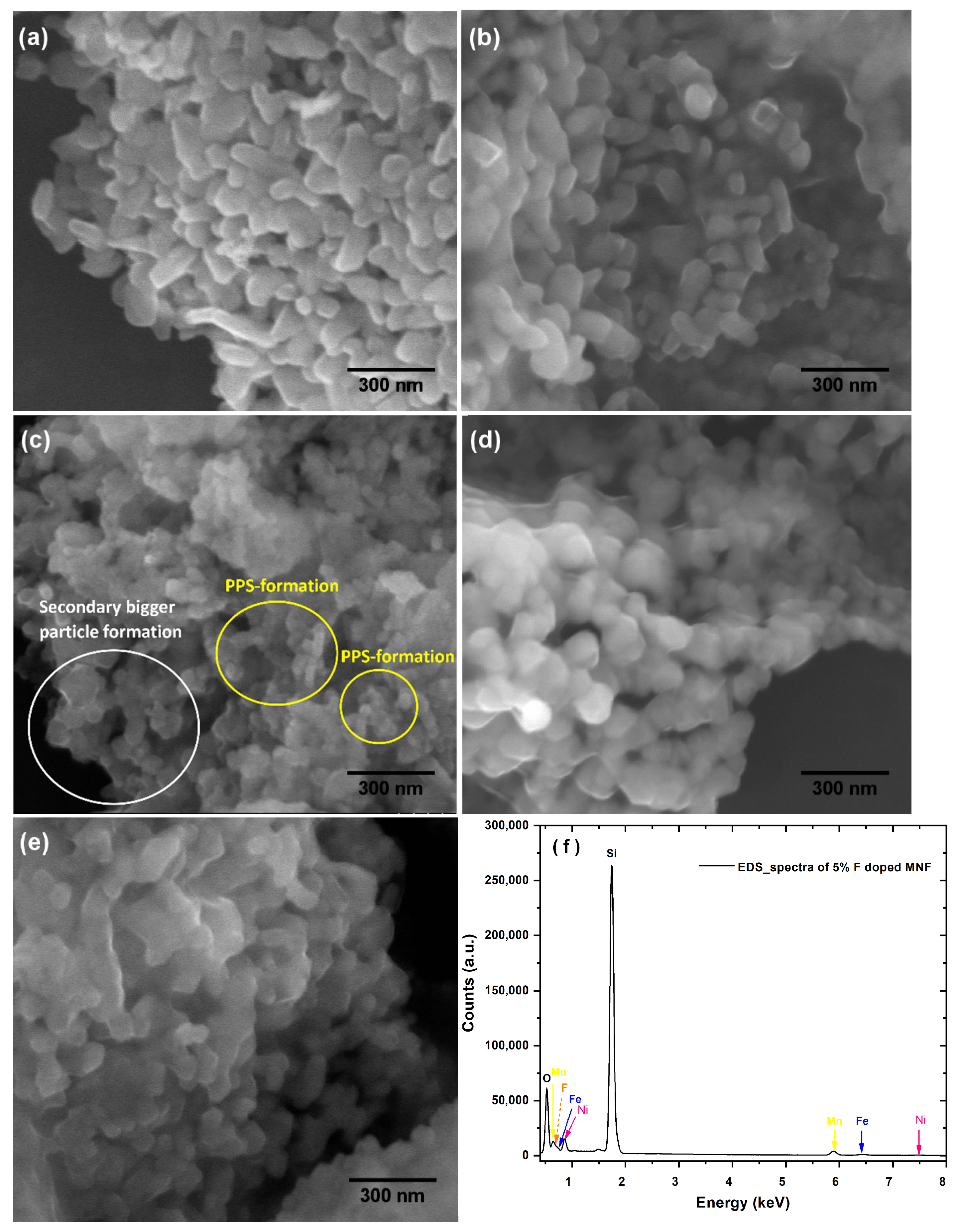
The morphology and particle size of the synthesized MNF nano-powders were evaluated by SEM, as shown in Figure 1. All MNF powders seem polydisperse with some shape irregularity. The primary particle size (PPS) formation, approximately 50–75 nm, is only observed in the 5% F-doped MNF nano-powder, as shown in Figure 1c. These small particles (50–75 nm) agglomerate to form larger secondary particles, which are in the range of ~100–150 nm, making an interconnected network that might help to sustain capacity during cycling [44]. All the other MNF powders exhibit only larger particle sizes ranging from 100 nm to 200 nm without any PPS formation. According to Li et al. [45], fluorine doping enhances the particle size of Li(Ni0.8Co0.15Al0.05)O2 powders synthesized at the micro-scale via a solid-state reaction and annealed with a two-step firing process. In our work, it seems that the average particle size of all MNF nanoparticles is only slightly changed with doping (Table 1). EDS measurement (Figure 1f) of all MNF powders was carried out in the elemental mapping mode, and the results (see Table S1) show that all involved elements are distributed uniformly; fluorine is detected on the particle surface of the doped samples. The fluorine content in MNF compounds systematically increases with increasing dopant ratio, while the oxygen content decreases as expected by the ratio of starting materials. These two observations provide evidence that F atoms are successfully incorporated into the MNF compound. The molar ratio of all transition metals (Mn, Ni, and Fe) approaches the intended stoichiometric ratio of 5:2:1.

3.1.2. XRD Crystal Structure Analysis:

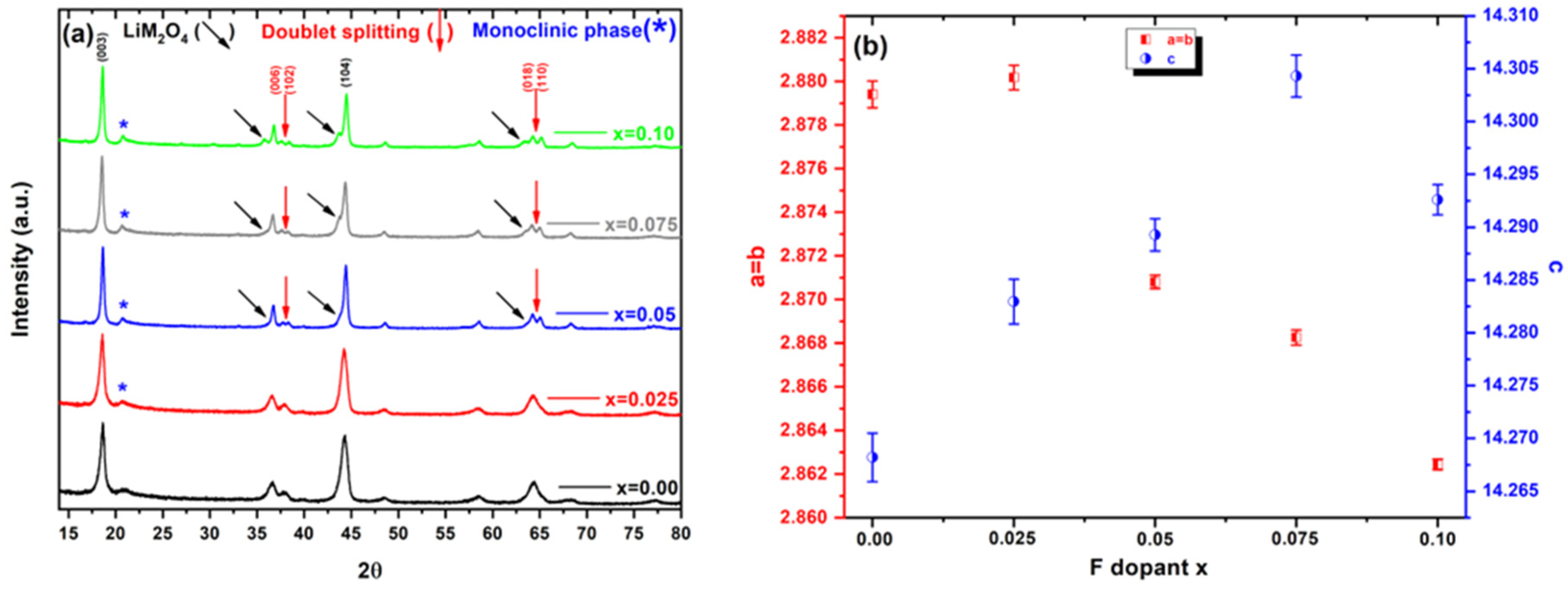
Figure 2a shows the XRD patterns of Li1.2Mn0.5Ni0.2Fe0.1O2(1−x)F2x, x = 0, 0.025, 0.05, 0.075, and 0.1 materials. Their diffractograms are indexed based on both a rhombohedral LiMO2 (M = Mn, Ni, and Fe, PDF#04-020-2222: space group R-3m) [46] and monoclinic Li2MnO3 (PDF#04-011-3411: space group C2/m) [47], which are very similar, having their main characteristic peaks at 2θ ~19 and ~44 degrees. The small hump located next to the first main peak (at ~21 degrees) is a well-known peak that is only present in the monoclinic Li2MnO3 phase and is usually used to distinguish these two phases, whereas the remaining peaks are matched to both the rhombohedral and monoclinic structures, or belong to impurity phases. This matching feature makes the quantification of the phase fractions in MNF powders and the fitting/refinement of their XRD patterns challenging (Figure S3a) [11]. Rietveld refinements [32] of the MNF cathode material XRD patterns were performed based only on the rhombohedral phase with R3-m space group in the 30 < 2θ < 80-degree range using GSAS [33,34] to obtain the weight fraction (wt.fract.) of LiM2O4 impurity phase and the lattice parameters (Figure 2b). The choice of a limited angular range is to avoid the unique Li2MnO3 monoclinic phase peak around ~21 degrees and any additional impurity peaks located mainly in the 20 < 2θ < 80-degree range (<~2 wt.fract., Figure 2a,b) such as LiOH, Li2O, and mainly Li2CO3. The lattice constants, c/a, unit cell volume, weight fraction of the LiM2O4 impurity phase, the crystallite size (CS), and goodness-of-fit parameters obtained from the refinements are shown in Table 1.
Fluorine doping in place of oxygen results in two main structural changes. One is the splitting of the 006/102 and 108/110 doublets, shown in Figure 2a, indicating the formation of a well-ordered layered structure that increases with F-doping and has been suggested to result in better electrochemical performance [48]. Second, new unwanted impurity peaks belonging to a LiM2O4 cubic spinel-like structure [49,50] were observed to grow with increasing fluorine doping (5%, 7.5%, and 10%). The weight fraction of the LiM2O4 impurity was determined to be ~8%, ~17%, and ~24% for 5%, 7.5%, and 10% F-doped MNF samples, respectively, based on the fitting results (Table 1), whereas both undoped and 2.5% F-doped MNF samples are devoid of this spinel phase. The presence of the LiM2O4 phase could adversely affect the lithium insertion/extraction reactions in the layered structure of MNF cathodes by contributing to the transformation of layered structure to spinel phase occurring after extended cycling [6] and could also lead to a rapid degradation by making a significant contribution to the dissolution of metal elements, especially manganese, into the electrolyte during the electrochemical cycle [20,25,51,52]. Previous studies have also suggested that corrosion by hydrofluoric acid (HF-effect) arising from the reaction of the residual moisture with the electrolyte (LiPF6) leads to the dissolution of metal elements [2].
The variation in lattice parameters of the layered R-3m structure, a = b, and c, with the amount of fluorine, is shown in Figure 2b. The incorporation of fluorine into the oxygen sublattice brings about an increase in the lattice constant c and a decrease in the lattice constant a compared with those of the undoped MNF powder. It is well known from the literature that the lattice constant a determines the distance between neighboring transition metal ions in the metal layer [22]. Some of the transition metal ions in the metal layer tend to be partially reduced because of the charge balance resulting from the substitution of F with O2−. Since the ionic radii of the transition metals in lower oxidation states (Mn3+ (0.645 Å), Ni2+ (0.690 Å), and Fe3+ (0.645 Å)) are typically larger than those in higher oxidation states (Mn4+ (0.530 Å), Ni3+ (0.560 Å), and Fe4+ (0.585 Å)), an increment in fluorine content should result in the increase in the metal–metal distance and an enlargement in the lattice constant a [53]. This was only observed in the 2.5% F-doped LiM2O4-free MNF samples, where the lattice constant a is slightly increased from 2.8794 to 2.8801 (Å), as shown in Table 1. On the other hand, at higher doping levels, such as x = 0.05, x = 0.075, and especially x = 0.1, the a lattice constant tends to decrease gradually (in response to increasing F content), from 2.8801 (Å) for x = 0.025 to 2.8624 (Å) for x = 0.1) due to the presence of LiM2O4 spinel phase which may intrinsically contribute to an increase in the total number of either Mn4+ (0.530) or Ni4+ (0.480) ions. The c lattice constant gradually increases from x = 0 and peaks at x = 0.075 (7.5% F-doped MNF) as shown in both Figure 2b and Table 1. The increase in c is usually attributed to an increase in the ionic radii of Mn3+ (0.645), Ni2+ (0.690), and Fe3+ (0.645) metals due to the F substitution resulting in a reduction of Mn4+ (0.530), Ni3+ (0.560), and Fe4+ (0.585), which compensates for the contribution from the slight difference between the ionic radii of F (1.33 Å) and O2− (1.40 Å).
The interslab spacing associated with the O-Li-O configuration, generally considered an indicator of the size of the Li+ diffusion channel, is calculated from the lattice constant c = chex in the R3-m structure using the equation reported by Rougier et al., in 1996, with the assumption that zox = 0.2411 [54,55]. The variation in the interslab spacing (ILiO2) resulting from fluorine doping (Figure S3b) is in good agreement with the variation observed in the lattice constant c [19]. Previous studies show that the activation energy of Li+ diffusion strongly depends on ILiO2, and any increase in ILiO2 brings down the barrier energy, leading to faster Li+ transfer in the lattice [22,56]. The lattice c/a ratio (Table 1) rises with an increase in the amount of F, and all samples have c/a ratios greater than 4.95, an indication, according to the literature, that the MNF nano-powders have good crystallinity [54,57,58]. The crystallite size of the coherently diffracting domains (Table 1), calculated using the Sherrer formula [37,59,60], indicates that the average crystallite size of MNF nano-powders increases slightly with higher fluorine doping. Based on the XRD analysis of the as-synthesized MNF powders, the combination of optimum interslab spacing (ILiO2), well-crystallized layered structure (splitting in the 006/102 and 108/110 doublets), and minimal amount of LiM2O4 cubic spinel-like phase occurs at a F dopant level of ~5%.
Since understanding the structural changes upon cycling is a key to improving the cathode performance, ex situ XRD measurements were also performed to investigate changes in the electrodes after the 100th discharge. The XRD patterns of freshly cast uncycled (pristine) electrodes and the same electrodes at the end of the 100th discharge are compared in Figure S4a,c. The peak intensity in the XRD patterns of all MNF cathode powders decreases significantly, especially in the 2.5% F-doped sample, and interestingly, all characteristic layered structure peaks were almost fully absent after cycling in the undoped and 10% F-doped MNF samples. The peak positions are also shifted slightly to lower 2θ angles corresponding to lattice expansion, especially in the samples with x = 0 and x = 0.1. The previously reported splitting of the first main XRD peak located at 19 degrees in Li-rich layered oxide cathodes and attributed to the conversion of the layered phase to spinel [1,7,14,61] was detected in the XRD patterns of the cycled electrodes in this study (Figure S4c). This splitting, along with the formation of a new reflection at lower 2θ ~15°, serves as evidence of partial conversion to spinel after long-term cycling [61]. The intensity of the monoclinic trace peak at 2θ ~ 21° is significantly decreased after cycling, an indicator of irreversible monoclinic phase activation.

3.1.3. XPS Analysis

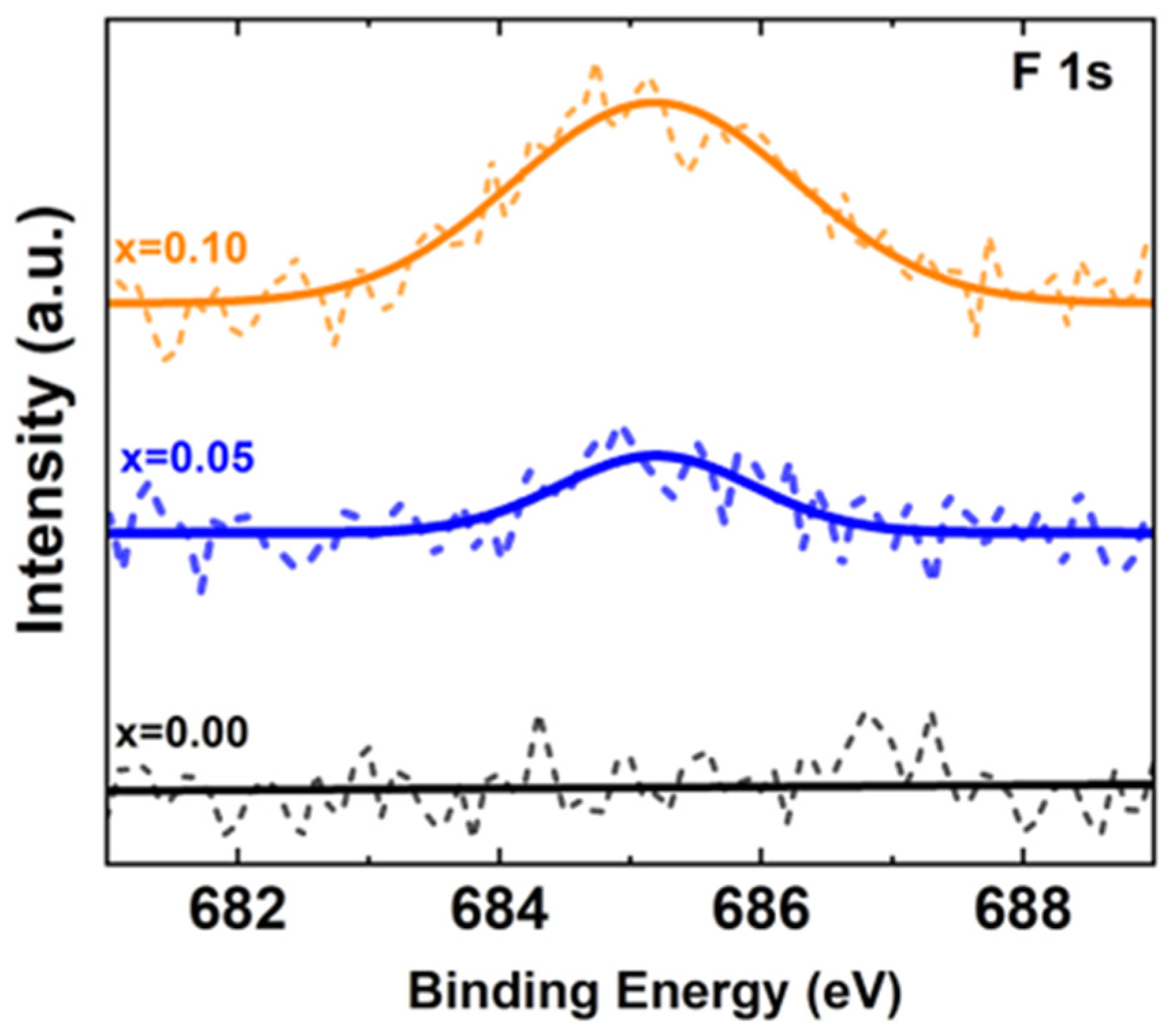
XPS measurements were carried out to further confirm the existence of fluorine in the F-doped MNF nano-powders, as well as to investigate the oxidation state of Mn that is closely associated with the electronic conductivity of the powders. Figure 3 presents the F 1s XPS spectra obtained from the undoped, 5% F, and 10% F-doped MNF powders. The measured binding energy for F 1s is ~685.4 eV, which is the same as that of the metal fluoride compound: MnF2 (685.4 eV) reported previously [22,45,62,63]. Both the intensity and the area of the F 1s peak increase with dopant level, x. This observation, along with the systematic changes in the lattice constants discussed above, provides evidence of the increasing incorporation of F in the MNF lattice with doping level [22,45]. The Mn 2p core-level XPS spectrum of undoped, 5%, and 10% F-doped MNF samples, given in Figure S5, shows an increase in the amount of Mn3+ ions with increased F-doping. This increase is often correlated to an improvement in the electrochemical performance of the layered oxide cathode samples synthesized as a single phase due to enhancement of the electronic conductivity and the role of Mn3+ as an activated center [27]. However, given the presence of impurity phases such as LiMnO2, LiMn2O4, and Li2MnO3, it is hard to draw similar conclusions for our samples.

3.1.4. BET Analysis (Evaluation of N2 Adsorption Data)

Nitrogen adsorption/desorption isotherm curves of undoped, 5%, and 10% F-doped MNF nanoparticles are displayed in Figure S6. All curves exhibited the typical type II isotherm with type III hysteresis, which is characteristic of macro/nonporous materials. The BET surface area decreased from 10.2 m2/g for the undoped sample to 9.5 and 5.6 m2/g for the 5% and 10% F-doped MNF specimens, respectively (Table S2). In contrast, the pore size of samples calculated by the BJH method showed a rising trend from a pore size of 3.215 nm for undoped NMF, to 3.219 and 3.230 nm pore diameter for 5% and 10% F-doping. The pore volume decreased from 0.051 cm3/g for x = 0.05 to 0.026 cm3/g for x = 0.1. This may be due to the pore strain during heat treatment. Their average or equivalent particle diameters were also calculated based on the SSA data, by using the density obtained from the XRD fitting, 4.139 g/cm3 for undoped, 4.158 g/cm3 for 5%, and 4.181 g/cm3 for 10% F-doped MNF, as shown in Table S2. The most significant observation from the BET results is that the surface area decreases with an increasing amount of fluorine content in the powders, consistent with the increase in the crystallite sizes measured by XRD. The lowest specific surface area, about 6.91 m2/g, was observed in the 10% F-doped MNF powder, which also contains the highest amount of cubic spinel-like impurity phase.

3.2. Electrochemistry Results

3.2.1. CV Measurement

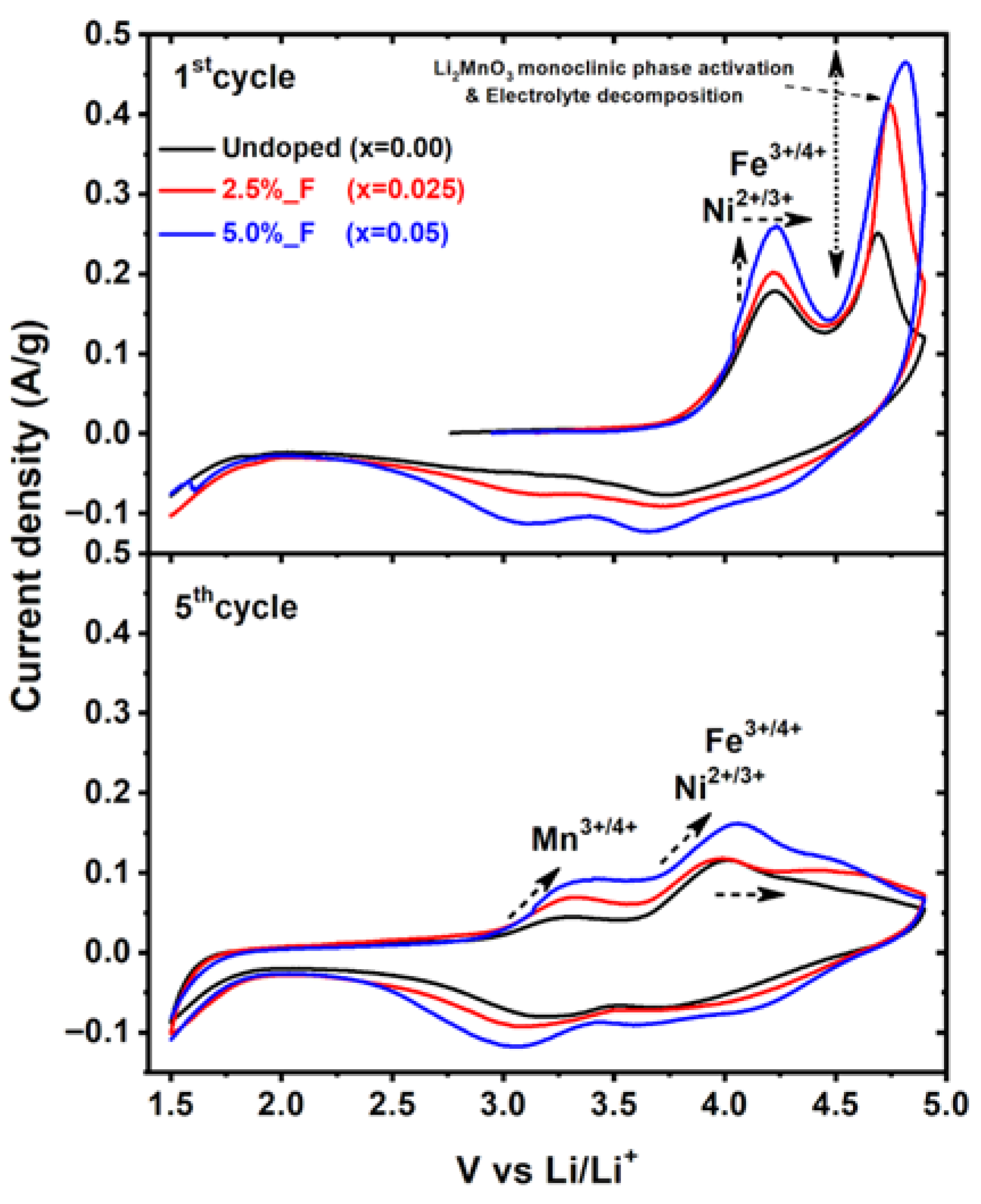
Figure 4 depicts the CV curves of undoped, 2.5%, and 5% F-doped electrodes between 1.5 and 4.9 V vs. Li metal. The expected redox reactions in the composite MNF cathodes are given in Equations (1)–(3) [11]. As shown in the CV diagram of Figure 4, two separate oxidation peaks are seen below and above 4.5 V during charging in the first cycle. The oxidation peaks above 4.5 V are usually ascribed to both an oxidation of oxygen negative ions (O2−) and Li2O2 extraction from Li2MnO3 (the so-called monoclinic phase activation given by Equation (1)), while the peak below 4.5 V corresponds to Li extraction from the LiMO2 component resulting from the overlapping Ni2+/Ni3+ and Fe3+/Fe4+ conversion reactions given by Equation (3) [48]. Some other studies propose that the sharp peak located above 4.5 V is also associated with the decomposition of electrolyte; however, in our MNF cathodes, this is unlikely as it is irreversible and only present t in the first cycle [1,11].
2Li2MnO3 → Li2O2 + 2MnO2 + 2Li+ + 2e activation while charging to ≥4.6 V
LiMnO2 ⇄ Li+ + MnO2 + e Mn redox activity after activation
LiMO2 ⇄ Li1−xMO2 + xe + xLi+ M = Ni, Fe redox activity
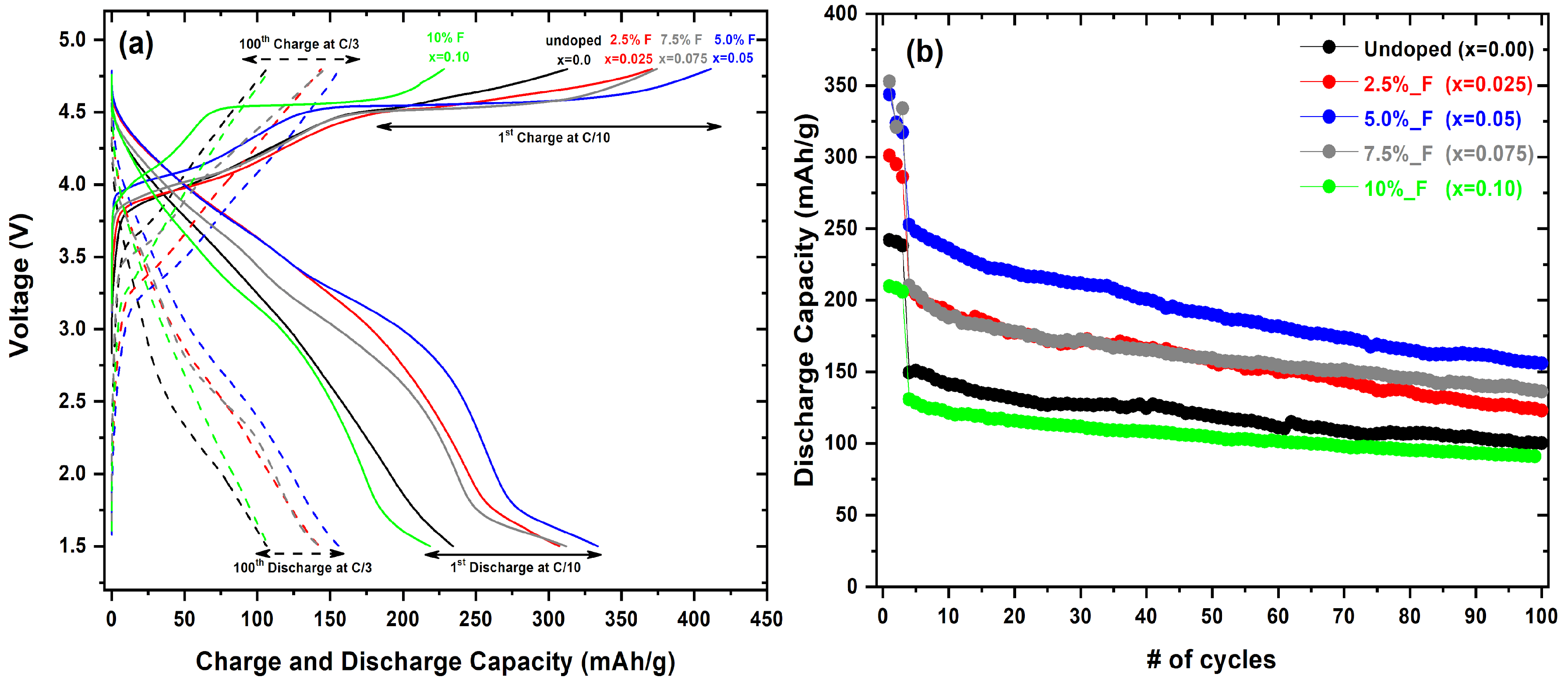
The 2.5% and especially 5% F-doped MNF cathodes show greater Ni2+/Ni3+ and Fe3+/Fe4+ redox activity and more monoclinic phase activation than the undoped cathode in the first cycle. In the first charge, the peak related to the oxidation of Ni2+ and Fe3+ shifts to higher potentials with increasing x. The same trend is seen with the Mn3+/Mn4+ peak appearing at lower potentials after the first cycle. In the first discharge, two broad reduction peaks are observed in all three cathodes; the first, located at ~3.1 V, is clearly reversible and corresponds to the reduction of Mn4+, and the second, located at ~3.7 V, corresponds to the reduction of the combination of Ni3+ and Fe4+. During the reduction portion of the first cycle, Fe and Ni atoms are reduced first, followed by Mn, as expected. In the first discharge, the Fe (~4.2 V), Ni (~3.7 V), and Mn (~3.1 V) reduction peaks become larger as the F-doping increases. The broad reduction peaks suggest that structural rearrangements containing metal migration take place in x = 0.05 and 0.025 compositions at higher degrees of Li extraction. This phenomenon was clearly explained by Ates et al. [44], and they suggested that more Li2MnO3 phase activation promotes the involvement of both LiMO2 and Li2MnO3 phases, which jointly make a contribution to the redox activities of the composite cathodes, whereas a lower amount of monoclinic phase activation leads to electrochemical activity only of the LiMO2 component. For instance, the oxidation peak associated with Mn+4 from MnO2 is absent in the first cycle, but then it starts to arise at ~3.1 V and becomes more apparent in the fifth cycle (Figure 4). This behavior results from the irreversible monoclinic phase activation occurring in the first charge above 4.5 V and is well known from the literature [5,11,12,44]. After the Li2MnO3 phase is activated, it typically produces MnO2, and the MnO2 behaves as a host structure for Li and converts into a LiMnO2 layered phase by cycling (Equation (2)). Although Ni and Fe cannot be distinguished in the CV plot, previous reports [44,64] with XAS results [44,61] have suggested that part of Co oxidation (similar to Fe in our case) occurs at higher voltage values (>4.4 V), and they have assumed that the oxidation peak between 3.75 V–4.25 V most probably belongs to the oxidation of Ni2+. In all MNF cathodes, these Ni and Fe oxidation peaks, and their contributions to the capacity of the cell, tend to decrease and shift to higher voltage values on cycling. Although the undoped MNF cathode, showing lower electrochemical performance, suffers from the lack of redox activities of transition metals during cycling, the oxidation peaks of Mn3+ and Ni2+ in 2.5% and especially 5% F-doped MNF cathodes remain stable after the first cycle. During further discharge cycles (e.g., the fifth cycle), a spinel-like behavior has been monitored as evidence of a voltage shift toward below 3 V due to the reduction of Mn4+ [1,6,12,44] as a characteristic feature of the LiM2O4. This shift to lower potentials is also observed in all MNF cathodes cycled galvanostatically in the form of capacity fade and voltage contraction (Figure 5a). From Figure 5a, the slopes of the 1st and the 100th discharge curves are evidence of the voltage contraction.

3.2.2. Electrochemical Cycling Performance

The characteristic charge–discharge profiles of all MNF cathodes with varying fractions of fluorine are plotted in Figure 5a for the 1st and 100th cycles. All coin cells were cycled in galvanostatic mode in a potential window of 1.5–4.8 V vs. Li/Li+ until the 100th discharge. A C/10 rate with a current density of ~0.25 mAg−1 (assuming 1C = 250 mAhg−1) was applied for the first 3 cycles to activate more of the Li2MnO3 monoclinic phase, followed by a C/3 rate with a current density of ~0.83 mAg−1 for the remaining 97 cycles. Figure 5a shows that all samples exhibit a long charge plateau in the first charge process at around 4.5V due to the irreversible oxygen loss in the Mn environment related to the Li+ extraction during activation of the Li2MnO3 monoclinic phase (Equation (1)) [11,22]. Figure 5a also indicates that the length of the 4.5 V charging plateau and the discharge capacity in the first charge change substantially with the amount of fluorine, peaking at x = 0.05 and then reducing to undoped levels by x = 0.1. The sloped plateau region from 4.6 to 4.8 V can be attributed to the oxidation of the electrolyte and forms the cathode electrolyte interphase layer [44]. The first, third, and 100th cycle discharge capacities are listed in Table 2 for all MNF samples. The 5% F-doped sample exhibits an initial capacity of more than 300 mAhg−1 at C/10 as compared to the undoped sample, which delivered only 242 mAhg−1 and the samples with other values of x, which fall in between. The sloping first discharge voltage of the MNF cathode materials with x = 0 (undoped) and x = 0.1 (over-doped) has the highest voltage hysteresis and lower discharge capacity, compared to other F-doped x = 0.025, 0.05, and 0.075 materials. The previous studies have reported that the monoclinic Li2MnO3 component shows excessively low cycling performance and rate capability by itself, compared to the rhombohedral LiMO2 component [11]. Also, creating enough MnO2 (the oxidation of Mn3+ to Mn4+) as a reserve for Li+ ions, which cannot be accepted by LiMO2 after de-intercalation, is important to reaching higher discharge capacity [44]. Therefore, here we show that the materials having fluorine at x = 0.025, 0.075, and especially x = 0.05, are hosting more than 1 Li+ ion per metal redox reaction, resulting in much higher discharge capacity than both undoped and over-doped (x = 0.1) cathodes. If we look at the 1st and 100th charge and discharge profiles for each MNF material portrayed in Figure 5a, their non-identical charge profiles, specifically the monoclinic activations segment after 4.5 V, suggest that they have different amounts of Li2MnO3, which affects the amount of Mn in the LiMO2 phase and intrinsically experimental discharge capacity [44].
It is well known that the capacity of a cathode material or its performance is in good agreement with its voltage hysteresis. The voltage shift toward lower potentials that can be seen from CV diagrams of MNF cathodes as given in Figure 4, is associated with the reduction of Mn, and it seems that the shift, in the samples with x = 0.025, 0.075, and especially x = 0.05, is higher than that of undoped and x = 0.1 samples due to having a greater amount of Mn in LiMO2 component of the MNF composite structure. The relationship between the voltage fade and Mn content in the LiMO2 segment was reported early on by M.N. Ates et al., and they suggested this relationship is considered a primary reason for the transformation of layered structure to the spinel structure [61]. The galvanostatic cycling data plotted in Figure 5a also show a greater discharge hysteresis for the F-doped samples, except for the samples with x = 0 and x = 0.1, as another indication of their better performance.
Quantitative analysis of the voltage fade (between the 3rd and 100th cycles at C/3) was performed for each cathode using the methodology suggested by M. Bettge et al. for Li-rich NMC and NCA cathodes, and the results are tabulated in the last two columns of Table 2 [65]. In their methodology, the average discharge voltage is obtained by dividing the integrated area under the discharge curve by the discharge capacity [11,65]. The cathodes with x = 0.025 and 0.05 both had voltage fade greater than that of the undoped sample, but beyond x = 0.05, the voltage fade fell with the initial capacity. The slope of the voltage fade (Figure S7) shows a distinct change from the samples with x ≤ 0.5 to those with x > 0.5, perhaps due to the presence of significant LiM2O4 in the uncycled material. As the F-doping level is further increased, samples show a rapid increase in the amount of LiM2O4 spinel-like impurity phase, which is likely to be the primary reason for the decrease in the initial discharge voltage and discharge capacity. The highest discharge capacity at 100 cycles (Figure 5b) is observed in 5% F-doped MNF cathodes, whereas the fluorine- and LiM2O4-free, undoped sample and the 10% F-doped sample, having the highest LiM2O4 impurity, exhibit the lowest discharge capacity in the first and all consecutive cycles. However, the undoped and 10% F-doped cathodes showed the highest capacity retention from the 3rd to the 100th cycle, 67% and 69%, respectively. The other F-doped MNF cathodes with x = 0.025, 0.05, and 0.075 showed somewhat more decay in their capacity from the 3rd to the 100th cycle (59, 62, and 64% respectively). All cathodes show Coulombic efficiencies between 80% and 99% in the first cycle, but nearly ~99% in the 100th cycle. The difference in the first cycle can be explained by the irreversible capacity due to Li2MnO3 monoclinic phase activation. The electrochemical results indicate that with fluorine doping, there is a clear trade-off between high capacity and capacity retention/voltage fade. From these electrochemical results, the 5% F-doped cathode is close to the optimal doping as it enhances the layered structure, increases the Mn3+ content, has a minimal amount of LiM2O4 spinel phases, produces the highest initial discharge voltage while maximizing the initial discharge capacity, and the capacity at 100 cycles with only modest increases in voltage fading and capacity retention.

3.2.3. EIS Analysis

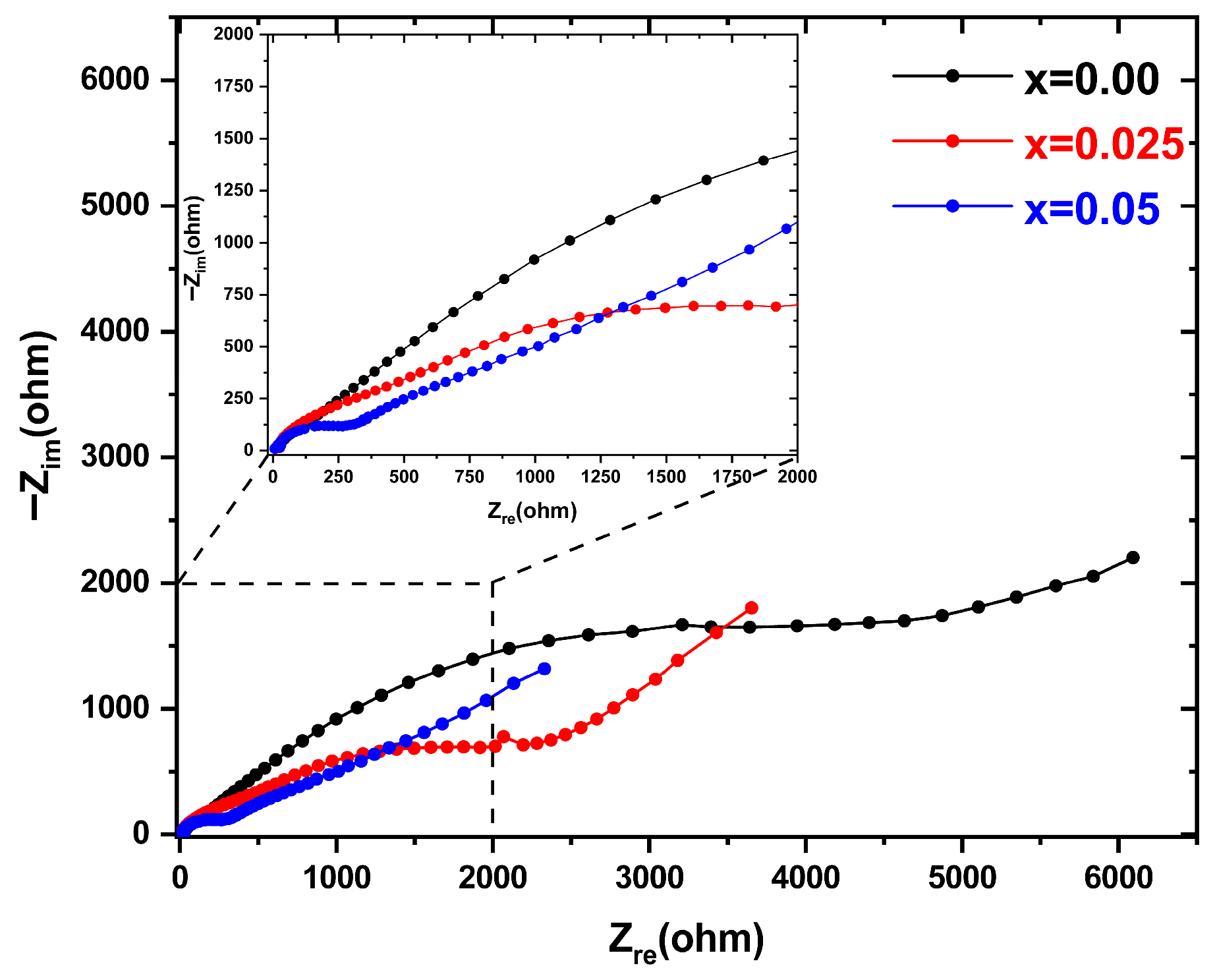
EIS spectra of undoped, 2.5%, and 5% F-doped half-cells are plotted in Figure 6. All EIS profiles are collected from fresh coin cells after a 24 h rest. The intercept of the EIS curve with the x-axis at high frequencies represents the ohmic resistance (Rs) of the cell, while the semicircle in the middle frequency region is related to charge-transfer resistance (Rct). The slope of the line in the low-frequency section of the EIS spectrum is related to the diffusion of Li+ ions in the electrode bulk (Warburg impedance, Zw) [66]. The above-mentioned parameters are derived after fitting the impedance spectra with an equivalent circuit (Table S9). The value of Rct decreases with an increase in the amount of F dopant to 5%. This improvement in the dynamics of Li+ ions diffusion is due to the increase in the Li interslab spacing resulting from F-doping to O sites. Thus, the electronic conductivity of F-doped specimens is higher than that of undoped NMF [66]. Based on the EIS results, which are in good agreement with the XPS, BET, and electrochemical results, it can be said that the electronic and ionic conductivity of the MNF cathodes can be easily improved by the optimum amount of fluorine doping into the oxygen site.

3.3. XAS Analysis

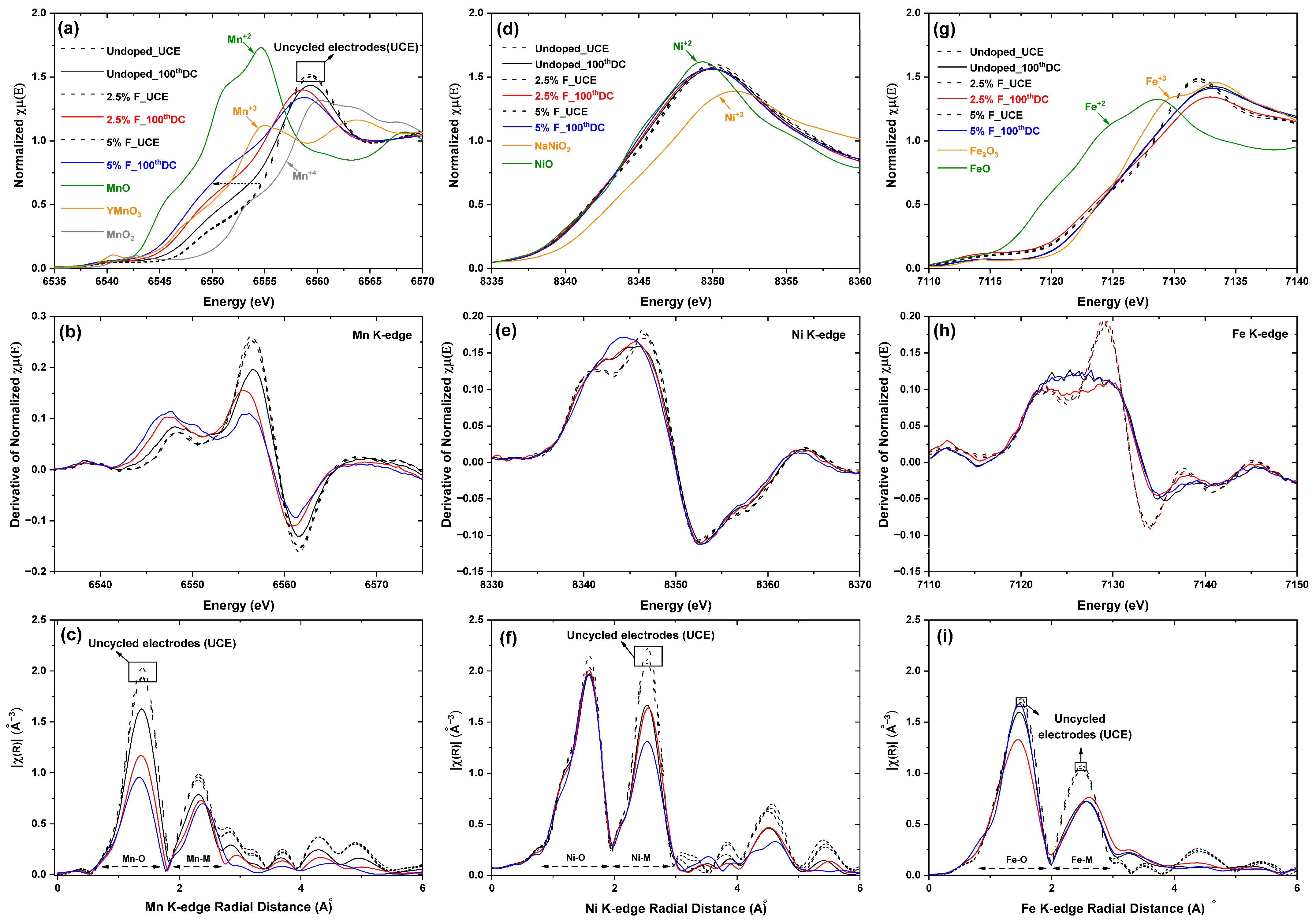
X-ray absorption spectroscopy (XAS) measurements can provide insight into the local structural changes that accompany fluorine doping and electrode degradation during cycling. XAS spectra typically consists of two main regions: X-ray absorption near edge structure (XANES), which is sensitive to electronic structure (i.e., oxidation or valence state), and extended-X-ray fine structure (EXAFS), which is sensitive to local structure (i.e., atomic distance and identity, as well as coordination number). XAS spectra at the Mn (6539 eV), Fe (7112 eV), and Ni (8333 eV) K-edges were measured on both uncycled electrodes (UCE) and cycled electrodes extracted from coin cells that are in the fully discharged state after completion of 100 cycles.
The XANES spectra for the Mn K-edge are shown in Figure 7a for samples with x = 0, 0.025, and 0.05 for UCE and 100th discharge state, along with Mn2+, Mn3+, and Mn4+ references. The UCE XANES spectra are nearly identical for all compositions. Their edge positions as seen from the derivative XANES spectra (Figure 7b) fall between the Mn3+ and Mn4+ reference spectra but closer to Mn4+. The XANES spectra of all three cycled electrodes (after 100th discharge) are significantly shifted to lower energies (Figure 7a,b), indicating the reduction of Mn ions after cycling. An increase in the fluorine content leads to a larger shift in the edge position, with the 5% F-doped cathode lying between the Mn+2 and Mn+3 reference spectra. The lower Mn-ion valence state after discharge correlates well with the XRD and electrochemical data showing a more well-developed layered structure, increased monoclinic phase activation, and overall improved electrochemical performance, and is characteristic of other Li-rich layered oxide cathodes [11,67,68,69].
The Fourier transform of the EXAFS spectra for the Mn K-edge shows two main peaks centered at ~1.5 and 2.5 Å, which can be attributed to Mn-O (or Mn-F) paths and Mn-M (M = Mn, Ni, or Fe) paths, respectively. Both the Mn-O and Mn-M peaks of cycled electrodes show a significant reduction in amplitude compared to those of UCE samples, and the Mn-M peak has a visible shift to higher values with cycling. The Mn EXAFS data were fitted using three paths, a short Mn-O path (~1.9 Å), an Mn-Mn path (~2.9 Å), and a long Mn-O path (~3.6 Å) as in reference [5] and indicates a huge decline in the Mn-1stO peak intensity (oxygen is assumed to be the nearest neighbor, not fluorine) in cycled electrodes, in comparison to uncycled electrodes. The intensity of this peak obtained from cycled electrodes is strongly correlated with the F content and their discharge capacities. Fluorine substitution for oxygen leads to more monoclinic phase activation, a higher discharge capacity, and consequently a more pronounced loss of oxygen from the local environment of Mn atoms during the extraction of Li and oxygen, based on Equation 1. Unsurprisingly, this degradation is significantly larger in 5% F-doped MNF cathode than that in other cathodes since it is consistent with the activation of the Li2MnO3 phase and naturally with the higher discharge capacity (Figure 5a). Based on the F dopant level, the Mn-1stO peak position in both undoped and doped MNF cathodes tends to shift slightly to lower R values during electrochemical cycling, whereas the Mn-M peak position shifts significantly to higher R values. Nevertheless, both peak positions in the uncycled electrodes (UCE, black lines plotted in Figure 7c) are unchanged with F-doping content.
The XANES spectra of the same electrodes measured at the Ni (Figure 7d) and Fe (Figure 7g) K-edges do not show similar reduction behavior after electrochemical cycling, consistent with both ions being in the rhombohedral LiMO2 component, where reversible redox is possible. While there are no significant shifts/changes in the XANES spectra of Ni and Fe metals in the UCEs, it seems that the Ni3+/2+ reduction is slightly larger than the reduction of Fe4+/3+ after the 100th discharge. This observation indicates that either the reversible redox reaction of Ni and Fe is taking place only within the rhombohedral LiMO2 component mostly or their initial valences are closer to their reduced states at the 100th discharge [11,70]. Therefore, it is necessary that the electrodes be investigated after the 100th charge, not discharge, in order to see redox shifts in their XANES spectra. While the Ni XANES shows very little change over the 100 cycles, the Fe XANES has a significant change in the height and position of the white line corresponding to the 1s → 4p transition. Although no significant decrease was observed in the intensity of the Ni-1stO peak (Figure 7f), a dramatic intensity decrease was seen in the Ni-M peak, which is related to the changes in the number of metal ions around Ni. The number of metal neighbors around Ni atoms in the 5% F-doped MNF cathode is significantly lower than that of other cathodes. This result can suggest either more Li loss from the Ni environment or structural rearrangement of metal ions after cycling [11,67]. On the other hand, there are some decreases in the intensity of the Fe-1stO and Fe-M peaks, especially in the Fe-M peak (2nd shell), as shown in the Fourier transform of the Fe-K-edge (Figure 7i). Although there is no change in the Fe-1stO peak in both uncycled and cycled electrodes, the Fe-M peak tends to shift slightly to higher R values after 100 cycles. This observation can be explained by the structural rearrangement and the expansion in the crystal lattice after cycling, as reported in previous studies [11,67,70].
The experimental EXAFS spectra collected at Mn, Ni, and Fe K-edges, for both uncycled and cycled electrodes, were fitted by using the rhombohedral crystal structure and a cluster size of 8 Å (EXAFS fitting results are tabulated in Supplementary Materials, as Tables S3–S8). This structural input is needed to create both single and multiple scattering paths around the central absorbing atom [67]. Tables S4 and S5 present metal–metal (M-M) and Metal-2ndOxygen (M-2ndO) radial scattering path distances versus fluorine content in both cycled and uncycled MNF electrodes for all three K-edges. (See Figure S8a for M-1stO distances and Figure S8b for the number of metal neighbors in M-M pairs before and after 100 cycles). The bond distances between 1st oxygen and Ni ions show a small increase, whereas the changes in Mn and Fe K-edges tend to decrease slightly upon cycling. Specifically, the 5% F-doped MNF sample with x = 0.05, with the highest discharge capacity, shows the shortest Mn-1stO bond length and the longest Ni-1stO bond length after 100 cycles. The variation in Fe-1stO bond length stays constant within the estimated standard deviations of the fits. Overall, the bond lengths between transition metals and the 1st oxygen for all three K-edges remain roughly constant before and after the long-term cycling.
The metal-to-metal (M-M) bond lengths show a noticeable increase in both uncycled and cycled electrodes for all three absorption edges before and after long-term cycling, as shown in Table S4. This increment in metal-to-metal bond lengths of the MNF electrodes with x = 0, 0.025, and 0.05 can be attributed to either long-term Li insertion/extraction or the material amorphization observed in the ex situ XRD data (especially in the undoped and 10% F-doped cathodes; see Figure S4b). This result has already been suggested in our previous studies based on ex situ synchrotron XRD results of MNF cathodes that the increase in metal-to-metal bond distances occurred in the cycled electrodes results from the expansion of the crystal lattice, an increment in disorder, or/and even material amorphization upon long-term electrochemical cycling [11]. Figure 7c,f shows the variations in the radial distance of Mn-2ndO and Ni-2ndO bonds, respectively, before/after 100 cycles. The Mn-2ndO bond distance tends to decrease in all cycled electrodes; on the contrary, the Ni-2ndO bond distance tends to increase upon cycling. The 5% F-doped MNF sample shows the maximum decrement in the Mn-2ndO bond distance and the maximum increment in the Ni-2ndO bond distance, as compared to other cathodes. These results also correlate well with the improvement in electrochemical properties for x = 0.05.
These observations obtained from ex situ XAS and XRD results of cycled electrodes can be considered as one of the main reasons for capacity decay in this study. The maximum increment in the Ni-M bond distance (from 2.902 ± 0.005 (Å) to 2.956 ± 0.010 (Å)) and Fe-M (from 2.911 ± 0.018 (Å) to 2.968 ± 0.032 (Å)) bond distance was obtained with the F-doped MNF cathode with x = 0.05, the cathode showing the highest discharge capacity and average capacity retention (~62%). Although the undoped MNF electrode with x = 0 shows lower discharge capacity, it shows the smallest changes in Mn-M and Ni-M bond lengths, which make it structurally more stable with a better capacity retention and less voltage fading (see Table 2), in comparison with the fluorine-doped MNF cathodes. According to the results given in Table 2, the formation of the Li2MO4 spinel phase in fluorine-doped samples results in mitigating the voltage fade from 0.25 V to 0.11 V and enhances the capacity retention from 59% to 69%, albeit with a reduction in the initial discharge capacity.
The first shell EXAFS fitting results that also provide information about the coordination numbers (N) of Mn, Ni, and Fe as absorbing elements are shown in Table S6. In theory, all transition metal ions located both in the Li2MnO3-like monoclinic phase and in the LiMO2-like rhombohedral phase are six-fold coordinated with oxygen atoms. The number of oxygens around Mn atoms would be steady at six if the Li2MnO3-like phase could be converted into a highly ordered LiMnO2 structure during the first charge. However, the number of oxygen atoms around Mn ions tends to decrease significantly after 100 cycles because of the extraction of Li and O from the Li2MnO3-like phase, causing oxygen vacancies, while the same number for Ni and Fe ions stays within the margin of error. The reason for the lack of oxygen has been previously noted by others as a characteristic behavior of the Li2MnO3, which transforms into a highly disordered LixMnO2-y structure in an integrated composite cathode after the 1st cycle [11,68].
The maximum decrease in the number of Mn-1stO neighbors, from 6.1 ± 0.4 (before cycling) to 3.1 ± 0.2 (after cycling), was observed in the 5% F-doped MNF cathode. This observation is not surprising because it showed the maximum monoclinic phase activation in the first charge, as a result of fluorine doping, leading to better layer structure, as we already discussed above. Similarly, this correlation between a decrease in the number of oxygen and monoclinic phase activation is also valid for the 2.5% F-doped MNF cathode, which has the second-highest discharge capacity. According to the second shell EXAFS fitting results (Figure S8b), there is no systematic variation in the number of Ni-M and Fe-M neighbors, and the changes are within the estimated standard deviations. It is only worth mentioning that the number of Mn-M neighbors tends to decrease slightly during electrochemical cycling. The maximum decline in the number of Mn-M neighbors was obtained again for the 5% F-doped MNF cathode. The observed structural change from layered to spinel phase in the MNF cathodes during cycling (given in Figure S4c and Table 2), driven by oxygen loss and transition metal migration, is reported as one of the primary causes of voltage fade in lithium-rich layered oxides [12]. This transition, observed during long term cycling, also contributes to a reduction in the number of both oxygen and metal neighbors around the metal absorbers and reduces the average discharge voltage by creating lithium-poor spinel domains that increase ionic diffusion barriers, resulting in a gradual capacity loss and voltage decay over long-term cycling [71]. Another significant effect of this phenomenon is an irreversible structural transformation resulting from oxygen loss, causing TM ions (especially Mn and Fe) to migrate from the transition metal layer to the Li layer by forming a more thermodynamically stable but lower-voltage spinel-like phase. The transformation from the high-voltage layered structure to a low-voltage disordered spinel phase reduces the operating voltage (voltage fade) and causes capacity fading because of increased impedance [72,73,74]. In other words, it causes significant voltage fading due to lower average redox potential and increased resistance, while the spinel phase forms to stabilize the structure against further oxygen loss.

4. Conclusions

In this study, the effects of doping fluorine into the cobalt-free and lithium- and manganese-rich layered metal oxide Li1.2Mn0.5Ni0.2Fe0.1O2(1−x)F2x (LMRO-MNF) cathode samples on electrochemical performance and structural evolution were investigated. In contrast to the literature, XRD analysis indicates that substituting fluorine with oxygen in an amount greater than x = 0.025 resulted in three main structural changes in MNF: (1) more distinct splitting of the 006/102 and 108/110 doublets attributed to the formation of a well-developed layered structure; (2) an increase in the lattice parameter c resulting in a larger interslab spacing (ILiO2); and (3) growth of the LiM2O4 cubic spinel-like impurity phase, especially at higher F dopant levels (x > 0.05). Electrochemically, optimal F-doping enhances the discharge capacity of MNF cathodes, postulated to occur as a result of enhanced Li diffusivity achieved by an increase in ILiO2, creating a well-ordered layered structure (doublet splitting), and having a minimal amount of unwanted cubic spinel phase. The electrochemical cycling results show F substitution increases the discharge capacity density (up to 56% higher than that of the undoped sample). The voltage fade is also slightly suppressed by fluorine doping even in the presence of the spinel phase. Depending upon the F-doping level, the capacity fade is found to decrease with (1) increasing spinel-like phase formation, (2) decreasing oxidation state of Ni and Fe due to an increase in the Mn oxidation state, and (3) increasing electronegativity of Ni and Fe because of the increased metal-oxygen covalence and electronic conductivity of the MNF cathode. As the fluorine content increases, peak-broadening observed in the CV suggests that structural rearrangements containing metal migration take place in x = 0.05 and 0.025 compositions at higher degrees of Li extraction. That is, more Li2MnO3 phase activation promotes the involvement of both LiMO2 and Li2MnO3 phases, which jointly contribute to the redox activities of the composite cathodes, whereas a lower amount of monoclinic phase activation leads to electrochemical activity only of the LiMO2 component. Overall, the study shows how fluorine doping influences the electrochemical performance of LMRO-MNF cathodes, which could become beneficial in choosing the appropriate dopant amount to maximize their electrochemical performance and minimize voltage fade.

Supplementary Materials

The following supporting information can be downloaded at: https://www.mdpi.com/article/10.3390/batteries12040126/s1. Figure S1. Comparison of energy densities, specific capacities, the cost, and battery safety of Co-free Mn-rich and Li-rich cathode materials with the main commercial cathodes; Figure S2. Structural visualization of monoclinic and rhombohedral phases; Figure S3. (a) The full profile of refinement for the 5% F-doped MNF sample as an example, and (b) the interslab spacing and integrated intensity of I003/I104 peaks as a function of F dopant; Figure S4. (a) Ex situ XRD data on the uncycled (pristine), (b) The XRD pattern with enlarged Bragg angle ranges of 34–38° and 40–47° are shown to highlight the presence of the spinel phase peaks in uncycled electrodes, and (c) cycled electrodes, which were opened after the 100th discharge; Figure S5. The Mn 2p core-level XPS spectrum of undoped References [61,75,76], 5%, and 10% F-doped MNF samples; Figure S6. Nitrogen adsorption–desorption isotherms of undoped, 5%, and 10% F-doped MNF cathodes; Figure S7. Average voltage showing the amount of voltage fading of all MNF cathodes; Figure S8. EXAFS fitting results: (a) Metal-1st oxygen bond and (b) number of metal neighbors in metal–metal pairs; Figure S9. Elemental mapping of F, Mn, Ni, Fe, and O atoms in 5% F-doped MNF cathode material. Table S1. The atomic concentration of undoped and F-doped MNF samples obtained from EDS mapping results; Table S2. Specific surface area and equivalent particle diameter of undoped and F-doped powders; The EXAFS fitting results are given with following Tables S3–S8), Table S3. Metal-1st oxygen (M-1stO) bond distance; Table S4. metal–metal (M-M) bond distance; Table S5. Metal-2nd oxygen (M-2ndO) bond distance; Table S6. Number of 1st oxygen around the absorbing atom; Table S7. Number of metals around the absorbing atom; Table S8: Debye–Waller factor (sigma-square) calculations. Table S9. Impedance parameters derived using R(Q(RW) equivalent circuit. References [25,27,62] are cited in the supplementary materials.

Author Contributions

Conceptualization, C.U.S. and K.K.; methodology, C.U.S. and K.K.; validation, E.V.T.; investigation, K.K. and S.A.; resources, C.U.S.; data curation, C.U.S. and K.K.; writing—original draft preparation, K.K.; writing—review and editing, E.V.T. and C.U.S.; visualization, K.K.; supervision, C.U.S.; project administration, C.U.S. and K.K.; funding acquisition, C.U.S.; conceived the idea, K.K., E.V.T., and C.U.S.; synthesized performed all structural (XRD) and morphological (SEM/EDS) characterizations, K.K.; performed electrochemical experiments, K.K. and S.A.; conducted EIS and BET measurements and analysis, M.A.; conducted the XPS measurements and analysis, A.K. and M.E.; performed the ex situ XAS experiment, K.K., S.A., and N.S. All authors have read and agreed to the published version of the manuscript.

Funding

This work was supported by the Illinois Institute of Technology Duchossois Leadership Professors Program. MRCAT operations are supported by the Department of Energy and the MRCAT member institutions. This research used resources of the Advanced Photon Source, a U.S. Department of Energy (DOE) Office of Science User Facility operated for the DOE Office of Science by Argonne National Laboratory under Contract No. DE-AC02-06CH11357.

Data Availability Statement

The original contributions presented in the study are included in the article, further inquiries can be directed to the corresponding author.

Acknowledgments

The authors wish to thank the high school student teams from Maine South High School, under the Exemplary Student Research Program, and Stevenson High School, under the STEM Professionals As Resource Knowledge program, who assisted in sample preparation.

Conflicts of Interest

The authors declare no conflicts of interest. The funders had no role in the design of the study; in the collection, analyses, or interpretation of data; in the writing of the manuscript; or in the decision to publish the results.

References

  1. Gu, M.; Belharouak, I.; Zheng, J.; Wu, H.; Xiao, J.; Genc, A.; Wang, C.; Amine, K.; Thevuthasan, S.; Baer, D.R.; et al. Formation of the spinel phase in the layered composite cathode used in Li-ion batteries. ACS Nano 2013, 7, 760–767. [Google Scholar] [CrossRef]
  2. Zhang, S.; Gu, H.; Pan, H.; Yang, S.; Du, W.; Li, X.; Pan, F.; Gao, M.; Liu, Y.; Zhu, M.; et al. A novel strategy to suppress capacity and voltage fading of Li-and Mn-rich layered oxide cathode material for lithium-ion batteries. Adv. Energy Mater. 2017, 7, 1601066. [Google Scholar] [CrossRef]
  3. Nagaura, T. Lithium ion rechargeable battery. Prog. Batter. Sol. Cells 1990, 9, 209. [Google Scholar]
  4. Au, G.; Sulkes, M. Performance of the Sony Lithium-Ion Rechargeable Battery; Technical Report; Army Research Lab Fort Monmouth NJ Electronics and Power Sources Directorate: Fort Monmouth, NJ, USA, 1993; ARLTR71. [Google Scholar]
  5. Song, J.H.; Kapylou, A.; Choi, H.S.; Yu, B.Y.; Matulevich, E.; Kang, S.H. Suppression of irreversible capacity loss in Li-rich layered oxide by fluorine doping. J. Power Sources 2016, 313, 65–72. [Google Scholar] [CrossRef]
  6. Yu, H.; Zhou, H. High-energy cathode materials (Li2MnO3–LiMO2) for lithium-ion batteries. J. Phys. Chem. Lett. 2013, 4, 1268–1280. [Google Scholar] [CrossRef]
  7. Xu, B.; Qian, D.; Wang, Z.; Meng, Y.S. Recent progress in cathode materials research for advanced lithium ion batteries. Mater. Sci. Eng. R Rep. 2012, 73, 51–65. [Google Scholar] [CrossRef]
  8. Molenda, M.; Świętosławski, M.; Dziembaj, R. C/Li2MnSiO4 Nanocomposite Cathode Material for Li-Ion Batteries. In Composites and Their Properties; IntechOpen: Rijeka, Croatia, 2012. [Google Scholar]
  9. Deng, D. Li-ion batteries: Basics, progress, and challenges. Energy Sci. Eng. 2015, 3, 385–418. [Google Scholar] [CrossRef]
  10. Daniel, C. Materials and processing for lithium-ion batteries. JOM 2008, 60, 43–48. [Google Scholar] [CrossRef]
  11. Aryal, S.; Timofeeva, E.V.; Segre, C.U. Structural studies of capacity activation and reduced voltage fading in Li-rich, Mn-Ni-Fe composite oxide cathode. J. Electrochem. Soc. 2018, 165, A71–A78. [Google Scholar] [CrossRef]
  12. Guo, B.; Zhao, J.; Fan, X.; Zhang, W.; Li, S.; Yang, Z.; Chen, Z.; Zhang, W. Aluminum and fluorine co-doping for promotion of stability and safety of lithium-rich layered cathode material. Electrochim. Acta 2017, 236, 171–179. [Google Scholar] [CrossRef]
  13. Woo, S.U.; Park, B.C.; Yoon, C.S.; Myung, S.T.; Prakash, J.; Sun, Y.K. Improvement of electrochemical performances of Li[Ni0.8Co0.1Mn0.1]O2 cathode materials by fluorine substitution. J. Electrochem. Soc. 2007, 154, A649–A655. [Google Scholar] [CrossRef]
  14. Myeong, S.; Cho, W.; Jin, W.; Hwang, J.; Yoon, M.; Yoo, Y.; Cho, J.; Nam, G.; Jang, H.; Han, J.-G.; et al. Understanding voltage decay in lithium-excess layered cathode materials through oxygen-centred structural arrangement. Nat. Commun. 2018, 9, 3285. [Google Scholar] [CrossRef] [PubMed]
  15. Xu, Y.; Hu, E.; Yang, F.; Corbett, J.; Sun, Z.; Lyu, Y.; Yu, X.; Liu, Y.; Yang, X.-Q.; Li, H. Structural integrity—Searching the key factor to suppress the voltage fade of Li-rich layered cathode materials through 3D X-ray imaging and spectroscopy techniques. Nano Energy 2016, 28, 164–171. [Google Scholar] [CrossRef]
  16. Lim, S.N.; Seo, J.Y.; Jung, D.S.; Park, S.B.; Yeon, S.H. The crystal structure and electrochemical performance of Li1.167Mn0.548Ni0.18Co0.105O2 composite cathodes doped and co-doped with Mg and F. J. Electroanal. Chem. 2015, 740, 88–94. [Google Scholar] [CrossRef]
  17. Deng, Z.Q.; Manthiram, A. Influence of cationic substitutions on the oxygen loss and reversible capacity of lithium-rich layered oxide cathodes. J. Phys. Chem. C 2011, 115, 7097–7103. [Google Scholar] [CrossRef]
  18. Vu, N.H.; Im, J.C.; Unithrattil, S.; Im, W.B. Synergic coating and doping effects of Ti-modified integrated layered–spinel Li1.2Mn0.75Ni0.25O2+δ as a high capacity and long lifetime cathode material for Li-ion batteries. J. Mater. Chem. A 2018, 6, 2200–2211. [Google Scholar] [CrossRef]
  19. Pang, W.K.; Lin, H.F.; Peterson, V.K.; Lu, C.Z.; Liu, C.E.; Liao, S.C.; Chen, J.M. Effects of fluorine and chromium doping on the performance of lithium-rich Li1+x MO2 (M = Ni, Mn, Co) positive electrodes. Chem. Mater. 2017, 29, 10299–10311. [Google Scholar] [CrossRef]
  20. Zhao, T.; Li, L.; Chen, S.; Chen, R.; Zhang, X.; Lu, J.; Wu, F.; Amine, K. The effect of chromium substitution on improving electrochemical performance of low-cost Fe–Mn based Li-rich layered oxide as cathode material for lithium-ion batteries. J. Power Sources 2014, 245, 898–907. [Google Scholar] [CrossRef]
  21. Yu, H.; Zhou, H. Initial coulombic efficiency improvement of the Li1.2Mn0.567Ni0.166Co0.067O2 lithium-rich material by ruthenium substitution for manganese. J. Mater. Chem. 2012, 22, 15507–15510. [Google Scholar] [CrossRef]
  22. Li, L.; Song, B.H.; Chang, Y.L.; Xia, H.; Yang, J.R.; Lee, K.S.; Lu, L. Retarded phase transition by fluorine doping in Li-rich layered Li1.2Mn0.54Ni0.13Co0.13O2 cathode material. J. Power Sources 2015, 283, 162–170. [Google Scholar] [CrossRef]
  23. Sun, Y.K.; Jeon, Y.S.; Leeb, H.J. Overcoming Jahn-Teller Distortion for Spinel Mn Phase. Electrochem. Solid-State Lett. 2000, 3, 7–9. [Google Scholar] [CrossRef]
  24. Jiang, B.; Luo, B.; Li, J.; Peng, P.; Chen, J.; Chu, L.; Li, Y.; Li, M. Electrochemical effect of graphite fluoride modification on Li-rich cathode material in lithium ion battery. Ceram. Int. 2019, 45, 160–167. [Google Scholar] [CrossRef]
  25. Im, J.C.; Vu, N.H.; Tran Huu, H.; Lee, D.S.; Im, W.B. Effects of Fluorine Doping on Electrochemical Performance of Spinel-Layered Li3Mn3O7.5-xFx as Cathode Materials for Li-Ion Batteries. J. Electrochem. Soc. 2019, 166, A1568–A1573. [Google Scholar] [CrossRef]
  26. Wu, J.; Xu, M.; Tang, C.; Li, G.; He, H.; Li, C.M. F-Doping effects on carbon-coated Li3V2(PO4)3 as a cathode for high performance lithium rechargeable batteries: Combined experimental and DFT studies. Phys. Chem. Chem. Phys. 2018, 20, 15192–15202. [Google Scholar] [CrossRef]
  27. Dong, X.; Xu, Y.; Yan, S.; Mao, S.; Xiong, L.; Sun, X. Towards low-cost, high energy density Li2MnO3 cathode materials. J. Mater. Chem. A 2015, 3, 670–679. [Google Scholar] [CrossRef]
  28. Gao, C.; Zhou, J.; Liu, G.; Wang, L. Synthesis of F-doped LiFePO4/C cathode materials for high performance lithium-ion batteries using co-precipitation method with hydrofluoric acid source. J. Alloys Compd. 2017, 727, 501–513. [Google Scholar] [CrossRef]
  29. Li, W.; Dong, J.; Zhao, Y.; Zhao, J.; Wang, H.; Li, N.; Chen, L.; Lu, Y.; Hao, J.; Wu, Y.; et al. Comparative impact of surface and bulk fluoride anion doping on the electrochemical performance of co-free Li-rich Mn-based layered cathodes. J. Colloid Interface Sci. 2024, 675, 251–262. [Google Scholar] [CrossRef] [PubMed]
  30. Lee, G.H.; Lim, J.; Shin, J.; Hardwick, L.J.; Yang, W. Towards commercialization of fluorinated cation-disordered rock-salt Li-ion cathodes. Front. Chem. 2023, 11, 1098460. [Google Scholar] [CrossRef] [PubMed]
  31. Wang, F.; Zuo, P.; Xue, Z.; Liu, Y.; Wang, C.; Chen, G. Fluorination effect on lithium-and manganese-rich layered oxide cathodes. ACS Energy Lett. 2024, 9, 1249–1260. [Google Scholar] [CrossRef]
  32. Rietveld, H.M. A profile refinement method for nuclear and magnetic structures. Appl. Crystallogr. 1969, 2, 65–71. [Google Scholar] [CrossRef]
  33. Larson, A.C.; Von Dreele, R.B. Gsas: General Structure Analysis System; Report LAUR 86-748; Los Alamos National Laboratory: Los Alamos, NM, USA, 1986. [Google Scholar]
  34. Larson, A.C.; Von Dreele, R.B. GSAS, General Structure Analysis System; LANSCE, MS-H805, Rep. Laur; Los Alamos National Laboratory: Los Alamos, NM, USA, 1994; pp. 86–748. [Google Scholar]
  35. Toby, B.H. EXPGUI, a graphical user interface for GSAS. Appl. Crystallogr. 2001, 34, 210–213. [Google Scholar] [CrossRef]
  36. Toby, B.H.; Von Dreele, R.B. GSAS-II: The genesis of a modern open-source all purpose crystallography software package. Appl. Crystallogr. 2013, 46, 544–549. [Google Scholar] [CrossRef]
  37. Ganegoda, H.; Kaduk, J.A.; Segre, C.U. X-ray powder diffraction refinement of PbTi(1−x)FexO(3−δ) solid solution series. Powder Diffr. 2013, 28, 254–261. [Google Scholar] [CrossRef]
  38. McMullan, D. Appendix II a history of the scanning electron microscope, 1928–1965. In Advances in Imaging and Electron Physics; Elsevier: Amsterdam, The Netherlands, 2004; Volume 133, pp. 523–545. [Google Scholar]
  39. Kropf, A.J.; Katsoudas, J.; Chattopadhyay, S.; Shibata, T.; Lang, E.A.; Zyryanov, V.N.; Segre, C.U.; Ravel, B.; McIvor, K.; Kemner, K.M.; et al. The new MRCAT (Sector 10) bending magnet beamline at the advanced photon source. In AIP Conference Proceedings; American Institute of Physics: Melville, NY, USA, 2010; Volume 1234, pp. 299–302. [Google Scholar]
  40. Newville, M. IFEFFIT: Interactive XAFS analysis and FEFF fitting. Synchrotron Radiat. 2001, 8, 322–324. [Google Scholar] [CrossRef] [PubMed]
  41. Newville, M. EXAFS analysis using FEFF and FEFFIT. Synchrotron Radiat. 2001, 8, 96–100. [Google Scholar] [CrossRef] [PubMed]
  42. Ravel, B.; Newville, M. ATHENA, ARTEMIS, HEPHAESTUS: Data analysis for X-ray absorption spectroscopy using IFEFFIT. Synchrotron Radiat. 2005, 12, 537–541. [Google Scholar] [CrossRef] [PubMed]
  43. Ravel, B.; Newville, M. ATHENA and ARTEMIS: Interactive graphical data analysis using IFEFFIT. Phys. Scr. 2005, 2005, 1007–1010. [Google Scholar] [CrossRef]
  44. Ates, M.; Mukerjee, S.; Abraham, K.M. A Search for the Optimum Lithium Rich Layered Metal Oxide Cathode Material for Li-Ion Batteries. J. Electrochem. Soc. 2015, 162, A1236–A1245. [Google Scholar] [CrossRef]
  45. Li, X.; Xie, Z.; Liu, W.; Ge, W.; Wang, H.; Qu, M. Effects of fluorine doping on structure, surface chemistry, and electrochemical performance of LiNi0.8Co0.15Al0.05O2. Electrochim. Acta 2015, 174, 1122–1130. [Google Scholar] [CrossRef]
  46. Gummow, R.J.; Sharma, N.; Feng, R.; Han, G.; He, Y. High performance composite lithium-rich nickel manganese oxide cathodes for lithium-ion batteries. J. Electrochem. Soc. 2013, 160, A1856–A1862. [Google Scholar] [CrossRef]
  47. Pang, W.K.; Kalluri, S.; Peterson, V.K.; Dou, S.X.; Guo, Z. Electrochemistry and structure of the cobalt-free Li1+xMO2 (M= Li, Ni, Mn, Fe) composite cathode. Phys. Chem. Chem. Phys. 2014, 16, 25377–25385. [Google Scholar] [CrossRef]
  48. Li, J.; Chen, J.; Li, J.; Wang, L.; Wang, L.; He, X. Synthesis and Characterization of Li(Li0.2Mn0.4Fe0.2M0.2)O2 (M= Co, Ni, Cr, Al) Cathode Materials for Li-ion Batteries. Int. J. Electrochem. Sci. 2015, 10, 838–847. [Google Scholar] [CrossRef]
  49. Stiaszny, B.; Ziegler, J.C.; Krauß, E.E.; Schmidt, J.P.; Ivers-Tiffée, E. Electrochemical characterization and post-mortem analysis of aged LiMn2O4–Li(Ni0.5Mn0.3Co0.2)O2/graphite lithium ion batteries. Part I: Cycle aging. J. Power Sources 2014, 251, 439–450. [Google Scholar] [CrossRef]
  50. Stiaszny, B.; Ziegler, J.C.; Krauß, E.E.; Zhang, M.; Schmidt, J.P.; Ivers-Tiffée, E. Electrochemical characterization and post-mortem analysis of aged LiMn2O4–NMC/graphite lithium ion batteries part II: Calendar aging. J. Power Sources 2014, 258, 61–75. [Google Scholar] [CrossRef]
  51. Belt, J.; Utgikar, V.; Bloom, I. Calendar and PHEV cycle life aging of high-energy, lithium-ion cells containing blended spinel and layered-oxide cathodes. J. Power Sources 2011, 196, 10213–10221. [Google Scholar] [CrossRef]
  52. Winter, M.; Besenhard, J.O.; Spahr, M.E.; Novak, P. Insertion electrode materials for rechargeable lithium batteries. Adv. Mater. 1998, 10, 725–763. [Google Scholar] [CrossRef]
  53. Dean, J.A. Lange’s Handbook of Chemistry; McGraw-Hill Education: Berkshire, UK, 1999. [Google Scholar]
  54. Rougier, A.; Gravereau, P.; Delmas, C. Optimization of the composition of the Li1−zNi1+zO2 electrode materials: Structural, magnetic, and electrochemical studies. J. Electrochem. Soc. 1996, 143, 1168–1175. [Google Scholar] [CrossRef]
  55. Yin, S.C.; Rho, Y.H.; Swainson, I.; Nazar, L.F. X-ray/neutron diffraction and electrochemical studies of lithium de/re-intercalation in Li1-x Co1/3Ni1/3Mn1/3O2 (x= 0→ 1). Chem. Mater. 2006, 18, 1901–1910. [Google Scholar] [CrossRef]
  56. Ceder, G. Opportunities and challenges for first-principles materials design and applications to Li battery materials. MRS Bull. 2010, 35, 693–701. [Google Scholar] [CrossRef]
  57. Hai-Lang, Z.; Yun, D. Synthesis and improvement on the electrochemical properties of Li[Li0.2Mn0.54Ni0.13Co0.13]O2 by fluorine doping. Int. J. Electrochem. Sci. 2015, 10, 10713–10717. [Google Scholar] [CrossRef]
  58. Gong, Z.L.; Liu, H.S.; Guo, X.J.; Zhang, Z.R.; Yang, Y. Effects of preparation methods of LiNi0.8Co0.2O2 cathode materials on their morphology and electrochemical performance. J. Power Sources 2004, 136, 139–144. [Google Scholar] [CrossRef]
  59. Patterson, A.L. The Scherrer formula for X-ray particle size determination. Phys. Rev. 1939, 56, 978. [Google Scholar] [CrossRef]
  60. Asalzadeh, S.; Yasserian, K. The effect of various annealing cooling rates on electrical and morphological properties of TiO2 thin films. Semiconductors 2019, 53, 1603–1607. [Google Scholar] [CrossRef]
  61. Ates, M.N.; Mukerjee, S.; Abraham, K.M. A Li-rich layered cathode material with enhanced structural stability and rate capability for Li-on batteries. J. Electrochem. Soc. 2014, 161, A355–A363. [Google Scholar] [CrossRef]
  62. Tian, Y.; Chen, D.; Jiao, X.; Duan, Y. Facile preparation and electrochemical properties of cubic-phase Li4Mn5O12 nanowires. Chem. Commun. 2007, 20, 2072–2074. [Google Scholar] [CrossRef]
  63. Wagner, C.D.; Davis, L.E.; Zeller, M.V.; Taylor, J.A.; Raymond, R.H.; Gale, L.H. Empirical atomic sensitivity factors for quantitative analysis by electron spectroscopy for chemical analysis. Surf. Interface Anal. 1981, 3, 211–225. [Google Scholar] [CrossRef]
  64. Yu, X.; Lyu, Y.; Gu, L.; Wu, H.; Bak, S.M.; Zhou, Y.; Yang, X.Q.; Amine, K.; Ehrlich, S.N.; Li, H.; et al. Understanding the rate capability of high-energy-density Li-rich layered Li1.2Ni0.15Co0.1Mn0.55O2 cathode materials. Adv. Energy Mater. 2014, 4, 1300950. [Google Scholar] [CrossRef]
  65. Bettge, M.; Li, Y.; Gallagher, K.; Zhu, Y.; Wu, Q.; Lu, W.; Bloom, I.; Abraham, D.P. Voltage fade of layered oxides: Its measurement and impact on energy density. J. Electrochem. Soc. 2013, 160, A2046–A2055. [Google Scholar] [CrossRef]
  66. Chen, D.; Zheng, F.; Li, L.; Chen, M.; Zhong, X.; Li, W.; Lu, L. Effect of Li3PO4 coating of layered lithium-rich oxide on electrochemical performance. J. Power Sources 2017, 341, 147–155. [Google Scholar] [CrossRef]
  67. Lin, F.; Liu, Y.; Yu, X.; Cheng, L.; Singer, A.; Shpyrko, O.G.; Doeff, M.M.; Xin, H.L.; Tamura, N.; Tian, C.; et al. Synchrotron X-ray analytical techniques for studying materials electrochemistry in rechargeable batteries. Chem. Rev. 2017, 117, 13123–13186. [Google Scholar] [CrossRef] [PubMed]
  68. Yabuuchi, N.; Yoshii, K.; Myung, S.T.; Nakai, I.; Komaba, S. Detailed studies of a high-capacity electrode material for rechargeable batteries, Li2MnO3−LiCo1/3Ni1/3Mn1/3O2. J. Am. Chem. Soc. 2011, 133, 4404–4419. [Google Scholar] [CrossRef] [PubMed]
  69. Shi, Z.; Wang, Z.; Shaw, L.L.; Ashuri, M. On the Electrochemical Properties of Carbon-Coated NaCrO2 for Na-Ion Batteries. Batteries 2023, 9, 433. [Google Scholar] [CrossRef]
  70. Marques, O.J.B.J.; Walter, M.D.; Timofeeva, E.V.; Segre, C.U. Effect of Initial Structure on Performance of High-Entropy Oxide Anodes for Li-Ion Batteries. Batteries 2023, 9, 115. [Google Scholar] [CrossRef]
  71. Armstrong, A.R.; Holzapfel, M.; Novák, P.; Johnson, C.S.; Kang, S.H.; Thackeray, M.M.; Bruce, P.G. Demonstrating oxygen loss and associated structural reorganization in the lithium battery cathode Li [Ni0.2Li0.2Mn0.6]O2. J. Am. Chem. Soc. 2006, 128, 8694–8698. [Google Scholar] [CrossRef]
  72. Zhang, H.; Mao, C.; Li, J.; Chen, R. Advances in electrode materials for Li-based rechargeable batteries. RSC Adv. 2017, 7, 33789–33811. [Google Scholar] [CrossRef]
  73. Adamo, J.B.; Manthiram, A. Understanding the effects of Al and Mn doping on the H2–H3 phase transition in high-nickel layered oxide cathodes. Chem. Mater. 2024, 36, 6226–6236. [Google Scholar] [CrossRef]
  74. Luo, M.; Rodrigues, M.T.F.; Shaw, L.L.; Abraham, D.P. Examining effects of negative to positive capacity ratio in three-electrode lithium-ion cells with layered oxide cathode and Si anode. ACS Appl. Energy Mater. 2022, 5, 5513–5518. [Google Scholar] [CrossRef]
  75. Amalraj, F.; Talianker, M.; Markovsky, B.; Sharon, D.; Burlaka, L.; Shafir, G.; Zinigrad, E.; Haik, O.; Aurbach, D.; Lampert, J.; et al. Study of the Lithium-Rich Integrated Compound xLi2MnO3·(1−x)LiMO2 (x around 0.5; M = Mn, Ni, Co; 2:2:1) and Its Electrochemical Activity as Positive Electrode in Lithium Cells. J. Electrochem. Soc. 2013, 160, A324. [Google Scholar] [CrossRef]
  76. Xiao, L.; Zhao, Y.; Yang, Y.; Cao, Y.; Ai, X.; Yang, H. Enhanced electrochemical stability of Al-doped LiMn2O4 synthesized by a polymer-pyrolysis method. Electrochim. Acta 2008, 54, 545–550. [Google Scholar] [CrossRef]
Figure 1. SEM images of as-synthesized Li1.2Mn0.5Ni0.2Fe0.1O2(1−x)F2x nano-powders: (a) x = 0, (b) x = 0.025, (c) x = 0.05, (d) x = 0.075, (e) x = 0.1 F-doped, and (f) EDS spectra of x = 0.05 F-doped MNF sample.
Batteries 12 00126 g001
Figure 2. (a) XRD patterns of undoped and F-doped MNF nano-powders and (b) changes in the lattice constants.
Batteries 12 00126 g002
Figure 3. F 1s XPS spectra of undoped (x = 0), 5% (x = 0.05), and 10% F (x = 0.1)-doped MNF502010 samples.
Batteries 12 00126 g003
Figure 4. Cyclic voltammetry diagrams of undoped and F-doped MNF nano-powders for the first and fifth electrochemical cycles.
Batteries 12 00126 g004
Figure 5. (a) Charge–discharge profiles of undoped and F-doped MNF nano-powders, and (b) average discharge capacity of six coin cells at the first three cycles at C/10 and further at C/3 rate.
Batteries 12 00126 g005
Figure 6. Electrochemical impedance spectra of uncycled MNF coin cells (x = 0, 0.025, and 0.05).
Batteries 12 00126 g006
Figure 7. The XANES plot of both cycled and pristine electrodes at Mn K-edge (a), at Ni K-edge (d), and at Fe K-edge (g); the derivation of normalized absorbance at Mn K-edge (b), at Ni K-edge (e), and at Fe K-edge (h); and R-space plots of both cycled and pristine electrodes at Mn K-edge (c), at Ni K-edge (f), and at Fe K-edge (i).
Batteries 12 00126 g007
Table 1. Crystallographic parameters from XRD refinements and BET surface area for Li1.2Mn0.5Ni0.2Fe0.1O2(1−x) F2x.
xa (Å)c (Å)c/aVolume
(Å3)
LiM2O4
wt.fract. (%)
χ 2 Crystallite
Size (nm)
Surface Area
(m2/g)
0.02.8794 (6)14.268 (2)4.9552118.29-2.2012.010.2
0.0252.8802 (6)14.282 (2)4.9590118.48-2.3913.6-
0.052.8708 (3)14.289 (1)4.9774117.7682.5922.59.5
0.0752.8682 (4)14.304 (2)4.9871117.68172.6823.5-
0.102.8624 (2)14.292 (1)4.9931117.10243.7631.65.6
Table 2. The electrochemical performance and voltage fade of Li1.2Mn0.5Ni0.2Fe0.1O2(1−x)F2x.
x1st Discharge Capacity
@C/10
(mAh/g)
3rd Discharge Capacity
@C/3
(mAh/g)
100th Discharge Capacity
@C/3
(mAh/g)
Capacity
Retention
(%)
V @ Cycle 3rd (V)ΔV @ Cycle 100th (V)
0242 (4)149 (1)100 (1)672.630.20
0.025301 (5)207 (2)123 (1)592.870.25
0.05343 (3)252 (3)156 (2)622.950.24
0.075352 (2)210 (2)136 (2)642.760.15
0.10209 (4)130 (1)90 (1)692.770.11
Disclaimer/Publisher’s Note: The statements, opinions and data contained in all publications are solely those of the individual author(s) and contributor(s) and not of MDPI and/or the editor(s). MDPI and/or the editor(s) disclaim responsibility for any injury to people or property resulting from any ideas, methods, instructions or products referred to in the content.