
Experimental Investigation of Liquid Nitrogen Fire Suppression in Lithium-Ion Battery Fires: Effects of Nozzle Diameter and Injection Strategy

Abstract
1. Introduction
2. Experimental Design
2.1. Test Materials
2.2. Test Platform
2.3. Test Protocol
3. Results
3.1. Thermal Runaway Characteristics of Lithium Iron Phosphate Battery Packs
3.2. Analysis of the Influence of Nozzle Diameter on Liquid Nitrogen Fire Extinguishing Efficiency
3.3. Analysis of the Influence of Injection Strategy on Liquid Nitrogen Fire-Extinguishing Efficiency
4. Discussion
4.1. Analysis of Heat Generation and Release During Thermal Runaway of Lithium Iron Phosphate Batteries
4.2. Analysis of the Influence of Nozzle Diameter on Liquid Nitrogen Cooling Efficiency
4.3. Analysis of the Influence of Injection Strategy on Liquid Nitrogen Cooling Efficiency
5. Conclusions
- (a)
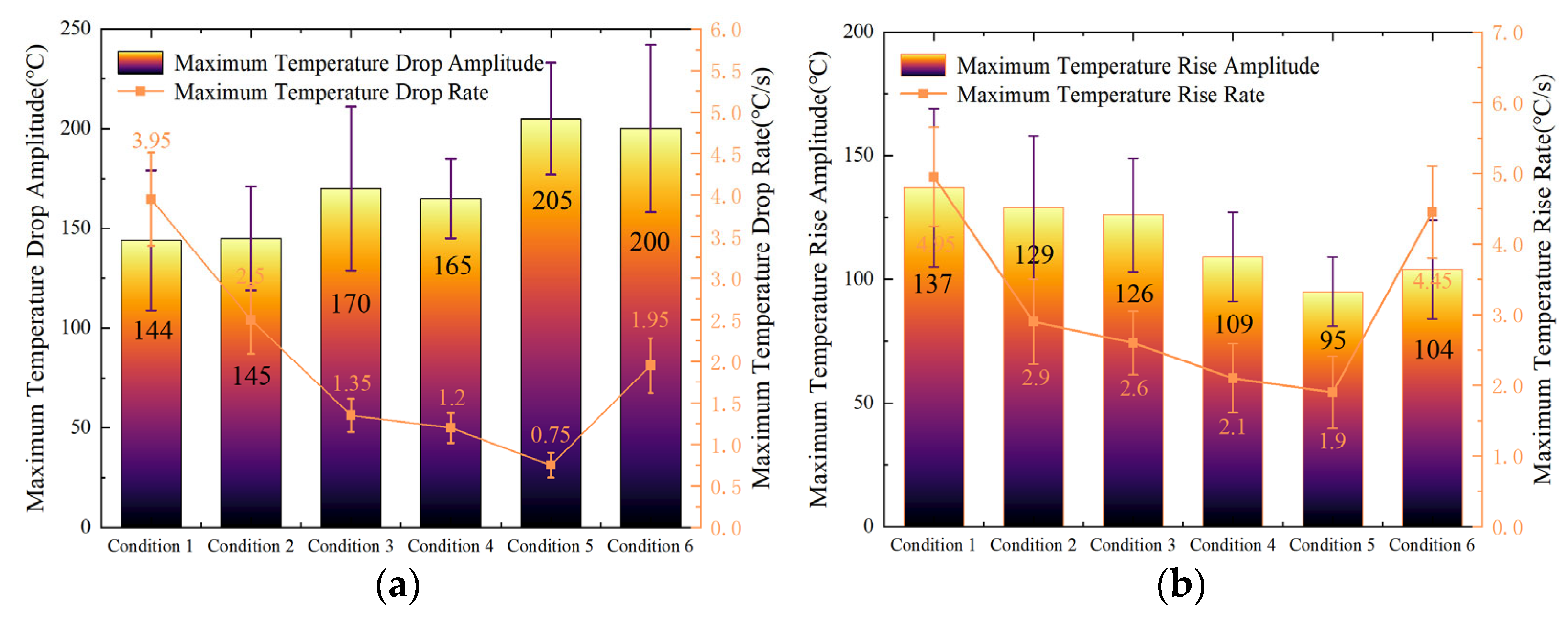
- The cooling and fire-suppression efficiency of LN2 exhibited a nonlinear relationship with nozzle diameter. Under constant injection pressure, enlarging the nozzle improved cooling efficiency up to a critical point, after which, further increases reduced performance due to the decline in jet velocity and local impingement intensity. The overall suppression efficiency followed an increase-then-decrease trend, confirming the existence of an optimal nozzle size. Under the tested conditions, the 14 mm nozzle achieved the highest cooling efficiency of 40%, approximately 27% higher than the minimum value. Although the cooling efficiency of the 12 mm nozzle is slightly higher than that of the 14 mm nozzle, the maximum temperature drop aptitude of the 14 mm nozzle is approximately 24% higher than that of the 12 mm nozzle. Considering all factors, 14 mm is considered the optimal configuration for liquid nitrogen injection.
- (b)
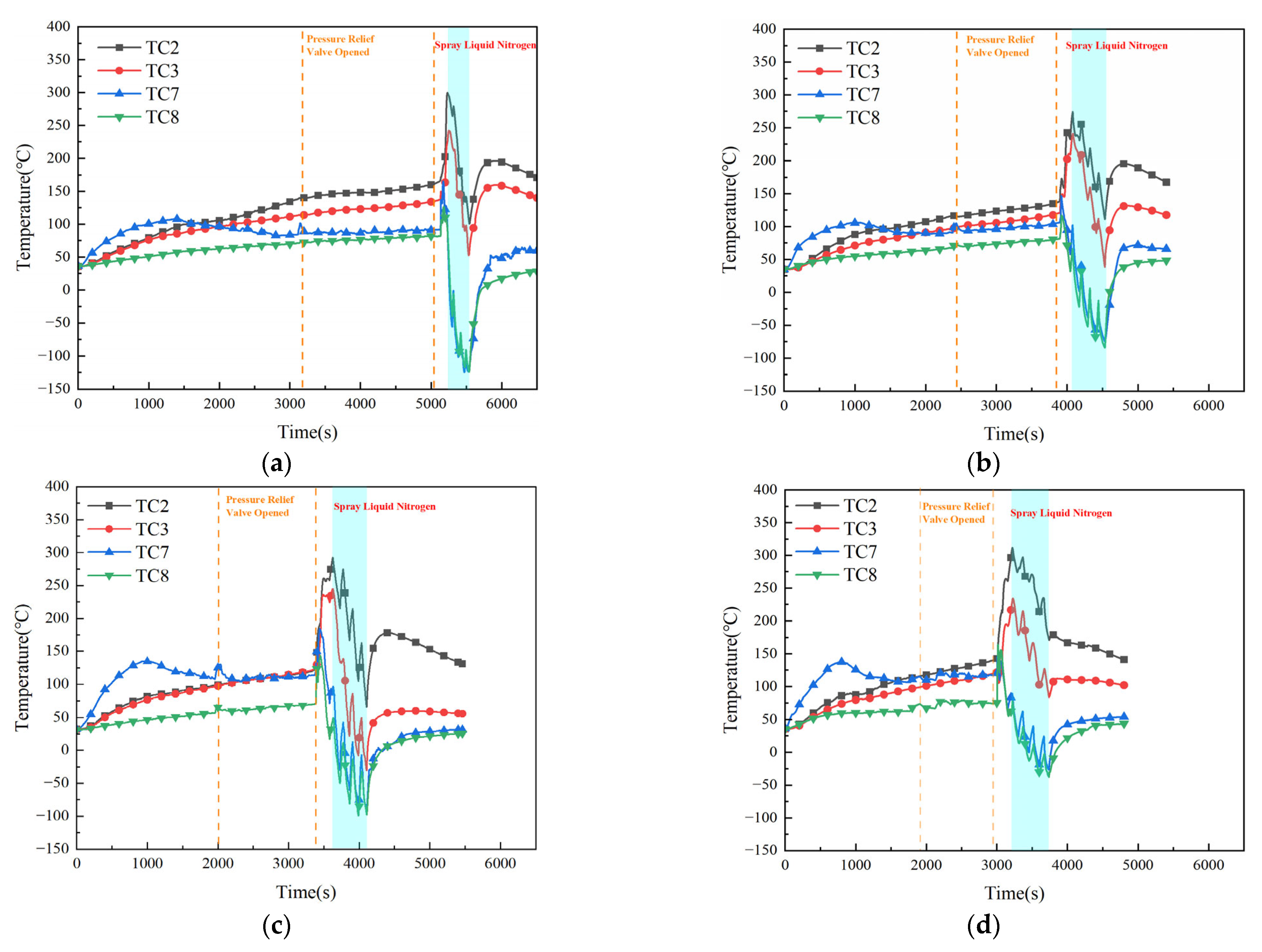
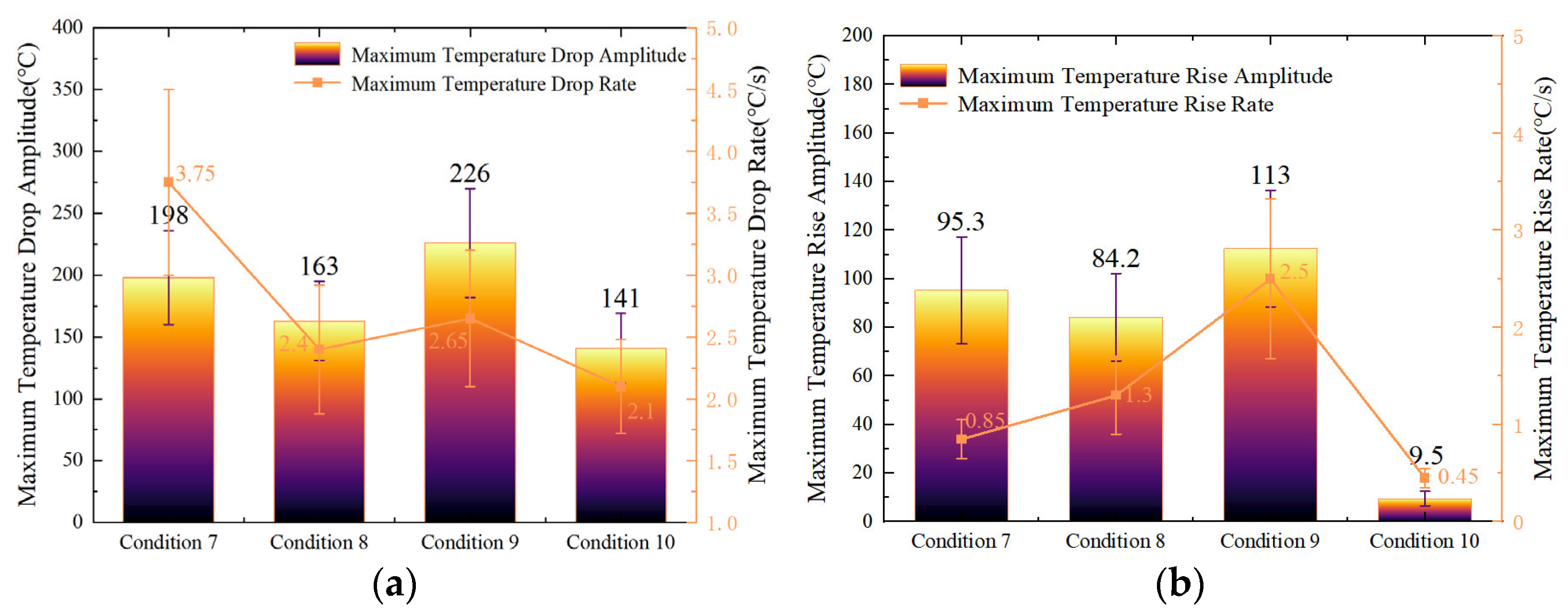
- Intermittent LN2 injection significantly enhanced cooling performance compared with continuous injection at equal total mass. The cooling efficiencies under four intermittent conditions exceeded that of continuous injection by 15–23%, with the most effective case—Condition 9 (4.05 kg–45 s–4.05 kg)—achieving a 63% cooling efficiency. This improvement results from extended effective cooling duration, enhanced heat exchange, and reduced inter-cell heat transfer, which collectively suppress thermal propagation more effectively. An optimal intermittent duration of approximately 45 s was identified within the tested range.
- (c)
- The results highlight that both geometric optimization (nozzle diameter) and temporal control (injection strategy) are key parameters governing LN2 fire-suppression efficiency in battery energy storage systems. Implementing optimized LN2 delivery—combining an appropriately sized nozzle with an intermittent injection strategy—can markedly improve thermal control and prevent cascade failure in large-scale lithium-ion battery installations. These findings provide a quantitative foundation for the design of next-generation cryogenic fire-suppression systems in practical engineering applications.
Author Contributions
Funding
Data Availability Statement
Conflicts of Interest
References
- Bernardi, D.; Pawlikowski, E.; Newman, J. A General Energy Balance for Battery Systems. J. Electrochem. Soc. 1985, 132, 5–12. [Google Scholar] [CrossRef]
- Zhao, Y.; Kong, J.; Cao, Y.; Liu, H.; You, W. Mapping the Evolution of New Energy Vehicle Fire Risk Research: A Comprehensive Bibliometric Analysis. Fire 2025, 8, 395. [Google Scholar] [CrossRef]
- Spotnitz, R.; Franklin, J. Abuse Behavior of High-Power Li-Ion Cells. J. Power Sources 2003, 113, 81–100. [Google Scholar] [CrossRef]
- Doughty, D.H.; Roth, E.P. A General Discussion of Li-Ion Safety. Electrochem. Soc. Interface 2012, 21, 37–44. [Google Scholar] [CrossRef]
- Golubkov, A.W.; Fuchs, D.; Wagner, J.; Wiltsche, H.; Stangl, C.; Fauler, G.; Voitic, G.; Thaler, A.; Hacker, V. Thermal Runaway Experiments on Li-Ion Cells. RSC Adv. 2014, 4, 3633–3642. [Google Scholar] [CrossRef]
- Wang, Q.; Mao, B.; Stoliarov, S.I.; Sun, J. Thermal Runaway of Li-Ion Batteries: Causes, Prevention, and Mitigation. Prog. Energy Combust. Sci. 2019, 73, 95–131. [Google Scholar] [CrossRef]
- Larsson, F.; Andersson, P.; Blomqvist, P.; Mellander, B.E. Toxic Fluoride Gas Emissions from Li-Ion Battery Fires. Sci. Rep. 2017, 7, 10018. [Google Scholar] [CrossRef] [PubMed]
- Feng, X.; Ouyang, M.; Liu, X.; Lu, L.; Xia, Y.; He, X. Thermal Runaway Mechanism of Li-Ion Batteries for EVs. Energy Storage Mater. 2018, 10, 246–267. [Google Scholar] [CrossRef]
- Di Liberto, E.; Borchiellini, R.; Fruhwirt, D.; Papurello, D. A Review of Safety Measures in Battery Electric Buses. Fire 2025, 8, 159. [Google Scholar] [CrossRef]
- Cao, Y.; Wang, K.; Wang, Z.; Wang, J.; Yang, Y.; Xu, X. Liquid Nitrogen as Efficient Inhibitor for Thermal Runaway. Renew. Energy 2023, 206, 1097–1105. [Google Scholar] [CrossRef]
- Sun, Y.; Zhang, G.; Jia, B. Experimental study on the effect of liquid nitrogen on fire and explosion suppression of high temperature lithium-ion batteries. In Proceedings of the 2020 Annual Conference on Science and Technology of China Fire Protection Association, Zhengzhou, China, 28–29 September 2020; pp. 945–951. [Google Scholar]
- Zhang, X.; Zhang, K.; Wang, H.; Cai, W.; Du, T.; Zhang, A.; Wang, W.; Yu, G. Technical research on fire protection system for lithium battery based on liquid nitrogen fire extinguishing. Electr. Supply Use 2021, 38, 32–39. [Google Scholar] [CrossRef]
- Jia, Z.; Wang, S.; Qin, P.; Li, C.; Song, L.; Cheng, Z.; Jin, K.; Sun, J.; Wang, Q. Comparative Investigation of the Thermal Runaway and Gas Venting Behaviors of Large-Format LiFePO4 Batteries Caused by Overcharging and Overheating. J. Energy Storage 2023, 61, 106791. [Google Scholar] [CrossRef]
- Han, L.; Wang, Z.; He, X.; He, C.; Shi, X.; Yao, B. The effect of water mist strategies on thermal runaway fire suppression of large-capacity NCM lithium-ion battery. Energy Storage Sci. Technol. 2023, 12, 1664–1674. [Google Scholar] [CrossRef]
- Ping, P.; Gao, X.; Kong, D.; Gao, W.; Feng, K.; Yang, C. Experimental study on the synergistic strategy of liquid nitrogen and water mist for fire extinguishing and cooling of lithium-ion batteries. Process Saf. Environ. Prot. 2024, 188, 713–725. [Google Scholar] [CrossRef]
- Zhang, L.; Duan, Q.L.; Meng, X.D.; Jin, K.Q.; Xu, J.J.; Sun, J.H.; Wang, Q.S. Experimental Investigation on Intermittent Spray Cooling and Toxic Hazards of Lithium-Ion Battery Thermal Runaway. Energy Convers. Manag. 2022, 252, 115091. [Google Scholar] [CrossRef]
- Liu, J.L.; Huang, Z.H.; Sun, J.H.; Wang, Q.S. Heat Generation and Thermal Runaway of Lithium-Ion Battery Induced by Slight Overcharging Cycling. J. Power Sources 2022, 526, 231136. [Google Scholar] [CrossRef]
- Shelke, A.V.; Buston, J.E.H.; Gill, J.; Howard, D.; Williams, R.C.E.; Read, E.; Abaza, A.; Cooper, B.; Richards, P.; Wen, J.X. Combined Numerical and Experimental Studies of 21700 Lithium-Ion Battery Thermal Runaway Induced by Different Thermal Abuse. Int. J. Heat Mass Transf. 2021, 179, 121695. [Google Scholar] [CrossRef]
- Xiao, X.; Chen, B.; Jin, X.; Zeng, Q.; Tian, Y.; Li, Q. Experimental Study on the Effect of Synergistic Extinguishing Method Based on Liquid Nitrogen on Lithium-Ion Battery Fire After Thermal Runaway. Fire 2024, 7, 479. [Google Scholar] [CrossRef]
- UL 9540A; Test Method for Evaluating Thermal Runaway Fire Propagation in ESS. UL Standards: Northbrook, IL, USA, 2023.
- Kim, S.-J.; Yu, Y.-S.; Jeong, C.-S.; Lee, S.-B.; Na, Y.-U. Thermal Runaway Propagation in Pouch-Type Lithium-Ion Battery Modules: Effects of State of Charge and Initiation Location. Batteries 2025, 11, 398. [Google Scholar] [CrossRef]



| Condition Number | Test Type | Nitrogen Injection Strategy | Nozzle Diameter |
|---|---|---|---|
| 0 | Control | —— | —— |
| 1 | LN2 extinguishing | Continuous | 6 mm |
| 2 | LN2 extinguishing | Continuous | 8 mm |
| 3 | LN2 extinguishing | Continuous | 10 mm |
| 4 | LN2 extinguishing | Continuous | 12 mm |
| 5 | LN2 extinguishing | Continuous | 14 mm |
| 6 | LN2 extinguishing | Continuous | 16 mm |
| 7 | LN2 extinguishing | Intermittent (pause duration: 15 s) | 14 mm |
| 8 | LN2 extinguishing | Intermittent (pause duration: 30 s) | 14 mm |
| 9 | LN2 extinguishing | Intermittent (pause duration: 45 s) | 14 mm |
| 10 | LN2 extinguishing | Intermittent (pause duration: 60 s) | 14 mm |
| Cell Number | Mass Before Thermal Runaway | Mass After Thermal Runaway | Mass Loss |
|---|---|---|---|
| 1 | 1317.4 ± 5 g | 1068.3 ± 13 g | 249.1 ± 9 g |
| 2 | 1324.6 ± 5 g | 1079.8 ± 11 g | 245.3 ± 8 g |
| Condition | (kJ) | (kJ) | (kJ) | (kJ) | (kJ) | η (%) |
|---|---|---|---|---|---|---|
| 1 | 208.613 ± 42.352 | 26.786 ± 5.327 | 115.133 ± 22.838 | 36.884 ± 7.233 | 29.810 ± 6.322 | 13 ± 4% |
| 2 | 210.062 ± 41.565 | 65.489 ± 12.414 | 96.215 ± 19.713 | 36.379 ± 7.911 | 11.979 ± 1.985 | 31 ± 6% |
| 3 | 244.970 ± 41.372 | 94.657 ± 17.952 | 85.696 ± 14.965 | 43.253 ± 8.123 | 21.364 ± 3.454 | 39 ± 3% |
| 4 | 238.673 ± 40.212 | 99.856 ± 19.152 | 84.118 ± 15.423 | 41.560 ± 8.534 | 13.140 ± 2.543 | 42 ± 3% |
| 5 | 297.209 ± 37.022 | 118.987 ± 22.354 | 107.240 ± 20.311 | 53.112 ± 9.113 | 18.870 ± 3.109 | 40 ± 4% |
| 6 | 289.520 ± 38.216 | 109.072 ± 21.193 | 113.941 ± 20.852 | 51.006 ± 8.902 | 15.501 ± 4.710 | 38 ± 7% |
| Condition | (kJ) | QFire-fighting (kJ) | (kJ) | (kJ) | η (%) | |
|---|---|---|---|---|---|---|
| 7 | 287.060 ± 36.515 | 158.365 ± 24.482 | 58.871 ± 12.141 | 49.404 ± 8.412 | 20.420 ± 4.212 | 55 ± 4% |
| 8 | 295.420 ± 37.012 | 178.438 ± 26.129 | 49.801 ± 10.042 | 40.925 ± 8.101 | 26.257 ± 4.773 | 60 ± 2% |
| 9 | 328.855 ± 35.972 | 208.385 ± 27.992 | 44.141 ± 9.622 | 58.495 ± 10.211 | 17.870 ± 3.552 | 63 ± 2% |
| 10 | 303.646 ± 36.712 | 157.677 ± 25.102 | 67.077 ± 14.370 | 36.182 ± 6.982 | 42.708 ± 12.310 | 52 ± 3% |
Disclaimer/Publisher’s Note: The statements, opinions and data contained in all publications are solely those of the individual author(s) and contributor(s) and not of MDPI and/or the editor(s). MDPI and/or the editor(s) disclaim responsibility for any injury to people or property resulting from any ideas, methods, instructions or products referred to in the content. |
© 2026 by the authors. Licensee MDPI, Basel, Switzerland. This article is an open access article distributed under the terms and conditions of the Creative Commons Attribution (CC BY) license.
Share and Cite
Jia, B.; Cai, Z.; Zhang, P.; Li, B.; Wang, H. Experimental Investigation of Liquid Nitrogen Fire Suppression in Lithium-Ion Battery Fires: Effects of Nozzle Diameter and Injection Strategy. Batteries 2026, 12, 24. https://doi.org/10.3390/batteries12010024
Jia B, Cai Z, Zhang P, Li B, Wang H. Experimental Investigation of Liquid Nitrogen Fire Suppression in Lithium-Ion Battery Fires: Effects of Nozzle Diameter and Injection Strategy. Batteries. 2026; 12(1):24. https://doi.org/10.3390/batteries12010024
Chicago/Turabian StyleJia, Boyan, Ziwen Cai, Peng Zhang, Bingyu Li, and Hongyu Wang. 2026. "Experimental Investigation of Liquid Nitrogen Fire Suppression in Lithium-Ion Battery Fires: Effects of Nozzle Diameter and Injection Strategy" Batteries 12, no. 1: 24. https://doi.org/10.3390/batteries12010024
APA StyleJia, B., Cai, Z., Zhang, P., Li, B., & Wang, H. (2026). Experimental Investigation of Liquid Nitrogen Fire Suppression in Lithium-Ion Battery Fires: Effects of Nozzle Diameter and Injection Strategy. Batteries, 12(1), 24. https://doi.org/10.3390/batteries12010024