Article

In Situ Estimation of Li-Ion Battery State of Health Using On-Board Electrical Measurements for Electromobility Applications


by
Jorge E. García Bustos
1,*,
Benjamín Brito Schiele
1,
Leonardo Baldo
2,
Bruno Masserano
1,
Francisco Jaramillo-Montoya
1,
Diego Troncoso-Kurtovic
3,
Marcos E. Orchard
1,
Aramis Perez
4 and
Jorge F. Silva
1
1
Department of Electrical Engineering, Faculty of Physical and Mathematical Sciences, University of Chile, Av. Tupper 2007, Santiago 8370451, Chile
2
Department of Mechanical and Aerospace Engineering, Politecnico di Torino, Corso Duca degli Abruzzi 24, 10129 Torino, Italy
3
Center for Sustainable Acceleration of Electromobility (CASE), Faculty of Physical and Mathematical Sciences, University of Chile, Santiago 8370451, Chile
4
The School of Electrical Engineering, University of Costa Rica, San José 11501-2060, Costa Rica
*
Author to whom correspondence should be addressed.
Batteries 2025, 11(12), 451; https://doi.org/10.3390/batteries11120451

Submission received: 30 September 2025 / Revised: 11 November 2025 / Accepted: 17 November 2025 / Published: 9 December 2025

Abstract

The well-balanced combination of high energy density and competitive cycle performance has established lithium-ion batteries as the technology of choice for Electric Vehicles (EVs) energy storage. Nevertheless, battery degradation continues to pose challenges to EV range, safety, and long-term reliability, making accurate estimation of their State of Health (SoH) crucial for efficient battery management, safety, and improved longevity. This paper addresses a compelling research question surrounding the possibility of developing a real-time, non-invasive, and efficient methodology for estimating lithium-ion battery SoH without battery removal, relying solely on voltage and current data. Our approach integrates the fitting abilities of Maximum Likelihood Estimation (MLE) with the dynamic uncertainty propagation of Bayesian Filtering to provide accurate and robust online SoH estimation. By reconstructing the open-circuit voltage curve from real-time data, the MLE estimates battery capacity during discharge cycles, while Bayesian Filtering refines these estimates, accounting for uncertainties and variations. The methodology is validated using an available dataset from Stanford University, demonstrating its effectiveness in tracking battery degradation under driving profiles. The results indicate that the approach can reliably estimate battery SoH with mean absolute errors below 1%, confirming its suitability for scalable EV applications.

1. Introduction and Motivation

Driven by the urgent need to decarbonize transportation and minimize its environmental impact, Electric Vehicles (EVs) are slowly but steadily reshaping the mobility paradigm, offering an accessible and sustainable alternative to conventional internal combustion systems. One of the key enablers of the shift towards electromobility is the substantial progress in battery technology, whose improved autonomy has significantly contributed to EVs competitiveness. In this sense, Lithium-Ion Batteries (LIBs) have established themselves as the primary energy source for EVs due to their high energy density and relatively long cycle life compared to other battery technologies [1,2]. Yet, despite these advantages, LIB degradation remains a critical concern, especially when accelerated by challenging operating conditions such as extremely high discharge/charge rates, extreme temperatures, and deep depth of discharge (DoD) [3]. In EVs, this performance degradation directly impacts vehicle autonomy, intensifies range anxiety, and increases the probability of thermal runaway events [4,5]. Thus, it is clear that real-time monitoring of battery health under operational conditions is of paramount importance to both the individual user and the Original Equipment Manufacturer, which can benefit from improved situational awareness and performance management [6].
In the literature, battery condition is commonly associated with the notion of State of Health (SoH), a metric that relates the current battery capacity to its initial nominal capacity [7]. Although intuitively straightforward, SoH cannot be measured directly and requires estimation techniques, which are often impractical, time-intensive, or incompatible with EV battery systems, as they would require the removal of the battery pack from the vehicle [8]. Alternatively, a conventional solution to obtain SoH with the battery still loaded in the vehicle involves performing a full discharge from a fully charged battery, followed by a rest period and a subsequent full recharge [9]. Based on the Coulomb counting strategy, this methodology offers precise SoH measurements; however, it requires the vehicle to be stationary during the long testing process. Alternative strategies, such as Electrochemical Impedance Spectroscopy (EIS), have been proposed to mitigate the time-consuming limitations of Coulomb counting [10,11]; however, they often involve battery disassembly or off-board testing, restricting their practicality in operational settings [12]. At the same time, tests that require access to cell-level data are unfeasible as such data are rarely available through EV’s Battery Management Systems (BMSs) [13]. In this sense the main category of SoH estimation methods based on on-board electrical measurements is represented by Differential Analysis Methods. These techniques, often divided into direct and indirect measurements, require laboratory setups and specialized equipment and, as a result, are not feasible for online applications [14], which is why they were excluded from the present review. In summary, the constant assessment of battery SoH via the aforementioned strategies conflicts with intrinsic conditions of the battery installed on EVs, as the existing estimation methodologies require disconnecting the battery or time-consuming procedures to accurately assess its health status, impeding estimations “on the go”.
Over the years, some methodologies have been proposed for online SoH estimation in real-world applications based on phenomenological principles, expert knowledge, and/or operational data of the cell/battery when available [15,16]. Similarly, the literature includes proposals addressing operational uncertainty and computational efficiency. These are particularly relevant to review given the wide range of variations that may arise in electromobility applications and the need to consider on-board implementations for SoH estimation.
In the case of data-driven approaches that leverage operational data, illustrative examples are provided by Li et al. [17] and Ghosh et al. [18]. On the one hand, [17] uses empirical mode decomposition and Pearson Correlation coefficients to extract Health Indicators (HIs) from measurements obtained during the charging process, subsequently processed through long short-term memory (LSTM) and BiLSTM networks. On the other hand, Ref. [18] employ an LSTM network for voltage curve reconstruction, then feeds these voltage predictions alongside measured current in a quantum-fuzzy neural network (eQFNN) framework. Both studies achieve high accuracy but encounter some limitations: Ref. [17] requires future information not commonly available in real-world applications, while the approach of [18] may suffer from excessive computational complexity that challenges onboard implementation. Other interesting examples are found in Feng et al. [19], which developed a Support Vector Machine (SVM) method, which utilizes partial constant-current charging segments to compare measured voltage profiles with a pre-learned SVM library. Moreover, Etxandi-Santolaya et al. [20] estimates SoH and battery functionality using Support Vector Regression and neural networks trained on HIs extracted from partial charging segments. Despite the scalability and performance under realistic conditions, in both cases, the methods are defined at a cell level and do not consider the variability, filtering, cell balancing, or constraints introduced by BMS hardware or firmware in the data acquisition process.
For hybrid approaches that combine data-driven and physics-based methods, Zhang et al. [21] provide a representative example. Their work seeks to integrate the flexibility of data-driven models with physical constraints through a two-stage framework. First, a Gated Recurrent Unit (GRU) is used to give an initial value of SoH from historical data. Subsequently, a Particle Filter (PF) adjusts the SoH and provides State of Charge (SoC) estimations. This method can adapt the SoH in real-time, but it depends only on the GRU for the initial estimation: errors in initialization propagate through the system, requiring considerable time to be fixed by the PF.
While previous methodologies have been deterministic, probabilistic approaches have also been proposed to explicitly account for uncertainty. Despite their diversity, these approaches tend to converge toward comparable underlying theoretical frameworks. For instance, the study of Dong et al. [22] proposes a Hybrid Kernel Relevance Vector Machine (H-RVM) for SoH and Remaining Useful Life (RUL) estimation. This approach can achieve good results at a practical level, but it depends on keeping consistent charging protocols, which limits the applicability, given the different charging strategies in different charging stations. In turn, Xiang et al. [23] incorporate Gaussian Process Regression (GPR) to quantify uncertainty, focusing on discharge segments with pseudo-labeling in a semi-supervised bidirectional GRU framework, while Wang et al. [24] employ GPR directly for nonlinear process modeling of the relationship between measurable battery features, proposing an improved Firefly Algorithm (IFA) into the training process to improve global search capability. The methodology presented in [23] can be applied in an online setting; however, it may introduce considerable errors, as the GRU loses access to future data points and potential mislabeling can propagate inaccuracies in subsequent estimations. On the other hand, in [24], the method can encounter high computational costs and a strong reliance on offline training data. In conclusion, probabilistic methods excel in uncertainty quantification and nonlinear modeling but require high-quality data and consistent requirements, which can be challenging in practice.
Another dimension to be reviewed is related to the data flow efficiency question for SoH estimation. One effort is presented in He et al. [25], where the SoH estimation is based on the variation coefficient extracted from partial charging curves and a GPR. The resulting framework keeps predictions coherent across different training sizes and enables online parameter updates that shorten commissioning time. A complementary path is explored in the study by Buchanan and Crawford [26], where a convolutional encoder learns directly from raw charge traces and a sparse GPR head outputs probabilistic SoH trajectories with explicit credibility bands. In Dong et al. [27], the concept of probabilistic co-estimation is further advanced. The authors calibrate the parameters of a fractional-order equivalent circuit model using Bayesian optimization and subsequently integrate a Gaussian-sum particle filter with recursive total least squares to jointly update the SoH and SoC. This approach eliminates the need for laboratory impedance tests and aligns with firmware-level identification routines. In this regard, it is worth noting that, consistent with broader trends in Prognostics and Health Management (PHM), hybrid methodologies that combine data-driven and model-based approaches are emerging as a promising direction for SoH estimation, as emphasized by Zhang et al. [21] and Deng et al. [28]. Lastly, the paper by Zhu et al. [29] brings Bayesian calibration into the second life scenario using a physics-informed neural network that is pre-trained on porous electrode simulations and refined with Monte Carlo dropout, achieving robust estimates across heterogeneous aging paths and pointing to lighter uncertainty-aware estimators suitable for embedded controllers.
Inspired by these findings, we propose a hybrid estimation method that integrates model-based approaches, parametric estimation, and Bayesian inference to estimate the current SoH during EV operation, using non-invasive data from onboard systems such as voltage and current trends from the Controller Area Network (CAN) bus. The proposed solution uses maximum likelihood estimation (MLE) to extract capacity estimates from readily available online operational data, utilizing these measurements without requiring invasive diagnostic techniques. To further strengthen the robustness and resilience of the estimation process, a Bayesian Filter (BF) loop is added to the framework. In particular, the PF is employed as an implementation of the BF problem. In fact, MLE alone can be sensitive to noise, short discharge segments, and sensor inaccuracies. To address these challenges, estimation is further enhanced by the application of a PF, which smooths estimates, compensates for uncertainties, and mitigates errors caused by sensor anomalies or missing data. The comprehensive combined MLE-PF approach provides a robust and adaptive estimator that improves accuracy by integrating real-time measurements with a degradation model, ensuring reliable SoH estimation even in the presence of quantized or noisy operational data. In this work, we assume that the EV is continuously monitored by an onboard computer or by the BMS. The only data requirement is access to operational signals, such as voltage and current trends available on the CAN bus, enabling seamless online estimation of both SoH and SoC.
The main contributions of this article are:
  • A novel MLE-PF battery capacity estimation procedure is developed to obtain SoH estimates from an arbitrary current and voltage discharge profile.
  • A PF algorithm is implemented to overcome model and estimation uncertainties and potential outliers during the degradation process.
  • The addition of the PF enables the simultaneous online estimation of SoH and SoC without the need for time-intensive tests, which require battery disconnection.
  • The proposed method is designed for use on a generic EV since current and voltage measurements are easy to obtain from a BMS or an OBD2 device.
  • The proposed approach can be scaled to different types, modules, and lithium ion batteries since the parameters of the battery model can be adjusted with few operational data.
The remainder of this paper is organized as follows. Section 2 provides a comprehensive theoretical background, discussing key concepts such as SoC, SoH, and the open-circuit voltage (OCV) model. Section 3 details the proposed methodology, including a description of the MLE and its integration with the PF algorithm. Section 4 introduces a case study to demonstrate the applicability of the proposed approach, utilizing real-world data from LIB cells. Section 5 presents and analyzes the results, highlighting the performance of the MLE-PF strategy in accurately estimating battery health under various operating conditions. Finally, Section 6 summarizes the findings, discusses implications for future research, and concludes the paper by highlighting the potential of the proposed method for real-time applications in EVs.

2. Theoretical Background

In this section, we present the fundamental concepts and methodologies that form the basis for the proposed approach in this paper. First, we provide essential definitions and concepts related to battery condition monitoring, including the SoC, SoH, and the OCV model. Then, we introduce key statistical techniques such as the MLE, BF/PF, which are instrumental in refining the accuracy of SoH and SoC estimates.

2.1. Definitions and Equivalent Circuit Battery Model

The SoC and SoH are crucial indicators for evaluating battery operation, and they describe the state of the battery from two fundamentally different points of view. The SoC describes an intercharge performance, while the SoH represents an intracharge performance. That is, the SoC describes the charge available with respect to the maximum charge available at that specific moment, while the SoH represents the trend of the maximum capacity of the battery with respect to the initial capacity of the new battery. As such, these concepts also refer to two completely different timescales, identified with the indices t and k. t is the time step index used in the SoC calculation, while k is the work cycle index used in the SoH calculation to indicate operational charge-discharge cycles, defined as a process during which the battery delivers an amount of energy equivalent to 100% of its current capacity, given its SoH [7].
  • The SoC represents the current capacity of the battery relative to its total current capacity, typically expressed as a percentage [30]. It indicates how much charge remains in the battery and its evolution in time can be mathematically formulated as:
    S o C t = S o C t 1 I t 1 · Δ t t C k + w t ,
    where S o C t 1 and I t 1 are the SoC and the current at the previous time step, respectively, Δ t t is the sampling time interval, C k is the battery capacity at cycle k (i.e., the maximum charge the cell can store at that cycle), and w t represents the process noise accounting for uncertainties such as current sensor inaccuracies, unmodeled dynamics, and environmental variations. By incorporating noise, the model becomes more robust and can better capture the real-world behavior of batteries, enhancing the credibility and reliability of the SoC estimate. The SoC trend can vary over time depending on the discharge rate, which in practice is associated with different usage profiles [31].
    To connect the SoC concept with practical battery applications, it is essential to consider an equivalent circuit model that simulates the battery behavior under various operational scenarios. In this work, we use a Thévenin-equivalent model, which includes a controlled voltage source that represents the open-circuit voltage V o c , integrated with a resistance to simulate real-world conditions [32].
    The open-circuit voltage V o c is a nonlinear function of the SoC and is can be represented through a three-stage structure that reflects the dominant electrochemical mechanisms across different SoC ranges. Studies such as [33] have shown that, at high SoC values, a combination of partial redox reactions and increased charge accumulation near electrode saturation produces a pronounced curvature in the OCV–SoC relationship, effectively described by a shifted exponential function. In the mid-SoC region, the main intercalation and phase-transition reactions of the active materials proceed smoothly, yielding a nearly affine voltage response that can be captured by a linear term. Conversely, at low SoC values, redox activity is minimal and the voltage exhibits a sharp decline driven by surface charge-accumulation effects, which is well modeled by logarithmic or exponential behavior.
    Beyond these chemical considerations, it is also essential to account for the aging-induced voltage drift observed in the OCV curve as the battery degrades. As reported in [34], periodic OCV measurements exhibit a progressive leftward shift over the cell’s lifetime, reflecting both capacity loss and changes in the electrode equilibrium potentials. This systematic displacement indicates that a fixed OCV curve cannot accurately represent the evolving equilibrium voltage associated with different SoH levels, thereby motivating the use of a parametric formulation whose coefficients can be adapted to aging.
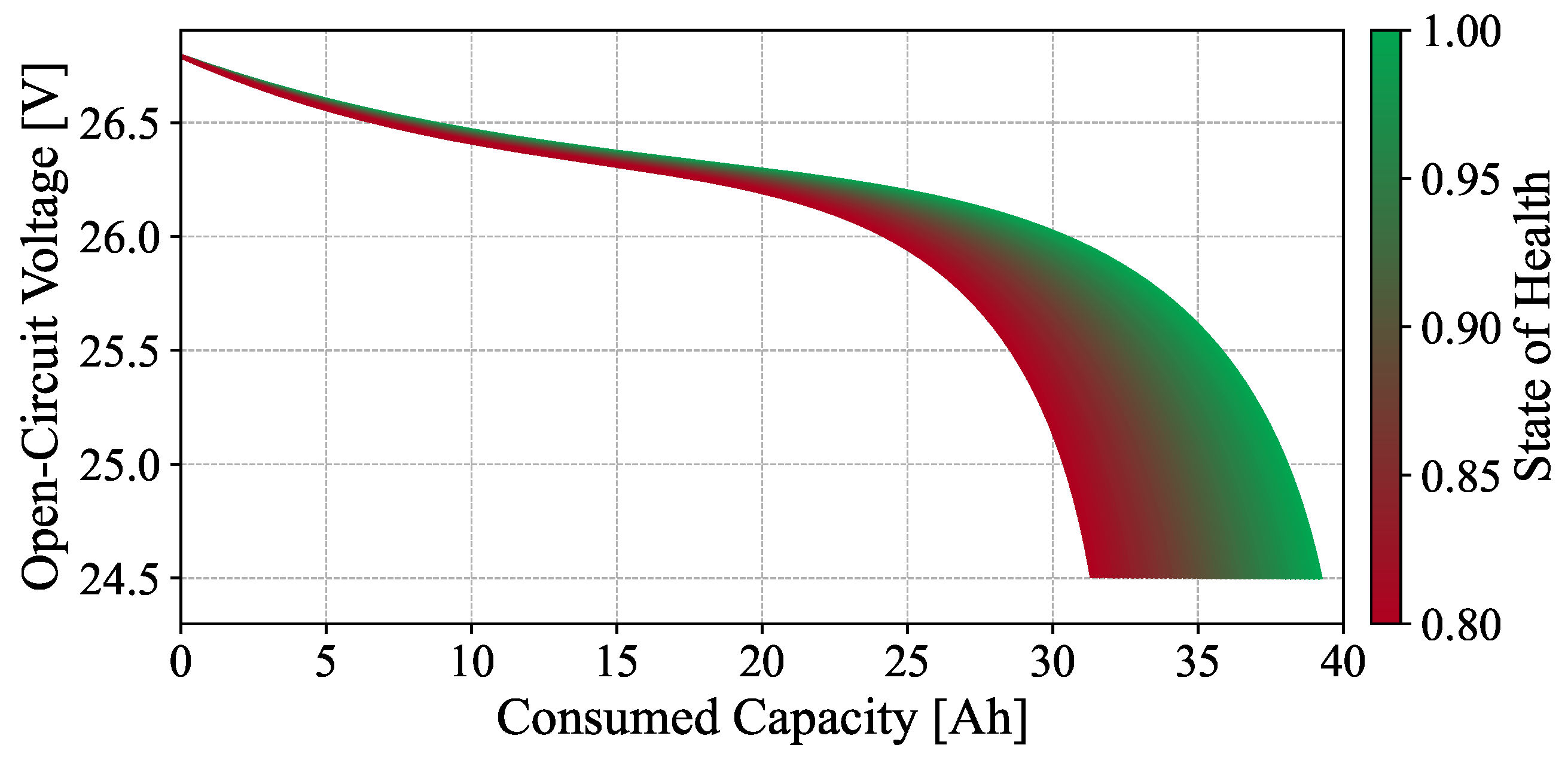
    Building on this structure and considering the proposed Thévenin-equivalent circuit, the five-parameter OCV model introduced in [35] is adopted in this work and expressed in Equation (2) where each term in corresponds to a distinct operational zone of the OCV curve. The offline procedure proposed in [36] allows the identification of model parameters using a single controlled-discharge experiment, whereas [37] extends this approach to data collected from an EV operating under real driving conditions. These formulations enable the OCV curve to adapt to different SoH levels, as illustrated in Figure 1.
    v o c ( S o C t ) = v L + ( v 0 v L ) · e γ ( S o C t 1 ) + α · v L ( S o C t 1 ) + ( 1 α ) v L ( e β e b S o C t ) .
  • On the other hand, the SoH refers to the battery’s ability to deliver its total current capacity compared to its original (or nominal) capacity when new [30]. In the battery literature, SoH can be characterized through several degradation indicators (e.g., capacity loss, increase in internal impedance, power fade, or self-discharge rate) which contribute to describing the battery health state [3]. Nevertheless, many studies point out that the most widely adopted formulation in both research and practice remains the capacity-based definition [38,39]. That is why, in the context of this study, we adopt the most common and widely accepted formulation, and we define SoH solely on a capacity basis, as reported in Equation (3).
    S o H k = C k C 0 ,
    where S o H k is the State of Health at cycle k, C k is the battery capacity at cycle k, and C 0 is the nominal (initial) capacity when the battery is new. The capacity C k decreases with each cycle due to degradation, affecting the duration and energy delivered in subsequent cycles. A common way to represent degradation over the battery operational cycles is by describing the maximum energy storage capability that the battery can deliver over time. One way to model this degradation is through the equation:
    C k = C k 1 · η k 1 + v k ,
    where C k is the capacity at the current cycle, C k 1 and η k 1 are the capacity and the efficiency factor in the previous cycle, respectively. and v k represents the process noise capturing uncertainties such as degradation rate variability, measurement errors, and unmodeled aging effects. Similarly to w t , the term v k is introduced to model the inherent uncertainties and stochastic nature of battery operation to make SoH estimation more robust.
    The efficiency factor η serves as an aggregate representation of the Loss of Lithium Inventory (LLI) induced by each duty cycle experienced by the battery [40]. As highlighted in [41], LLI is one of the dominant degradation modes in LIBs, arising primarily from SEI growth, lithium plating, and crack-assisted side reactions, all of which irreversibly trap cyclable lithium and reduce the amount of charge that can be reversibly stored. These mechanisms occur even under moderate operating conditions and accumulate over time, leading to measurable reductions in accessible capacity. By expressing the degradation of a given cycle as a multiplicative efficiency applied to the previous available capacity, the model effectively captures the fraction of lithium lost to these irreversible pathways, allowing the model to track the progressive depletion of cyclable lithium as the battery ages.
    Since the SoC is intrinsically linked to the SoH via the current maximum capacity, the SoH also influences the behavior of the V o c curve [42] as an external parameter. Figure 1 illustrates this dependency by showing how the OCV curve shifts with different SoH values.
    In fact, a reduced battery capacity implies that the SoC will drop more quickly for the same amount of extracted charge, causing V o c to decrease significantly faster. Starting from Equation (2), this relationship is expressed mathematically in Equation (5), where it is clear that V o c is a function of the SoC. More specifically, C k represents the battery capacity at a given cycle k and Q ext the extracted charge. Note that a lower C k increases the impact of Q ext on V o c .
    V o c = v o c ( S o C ) = v o c C k Q ext C k = v o c 1 Q ext C k

2.2. Estimation

In this section, we provide an overview of the key estimation techniques used in this paper. Estimation plays a crucial role in determining the state of a dynamic system, such as the SoC and SoH of a battery. The methods discussed here, namely MLE and BF, with a focus on PF, serve as powerful tools for accurately inferring these states based on available data. By combining these techniques, we aim to develop a more robust and precise estimation framework, adaptable to different scenarios and model structures.

2.2.1. Maximum Likelihood Estimation

MLE is a technique widely used in statistics and engineering applications to estimate the parameters of a model that maximizes the probability of occurrence of a given event [43,44,45]. The basic principle of MLE is to define a likelihood function, L ( θ ; x ) , which represents the probability of observing the event x given a set of parameters θ . The goal of MLE is to find the values of θ that maximize the likelihood function [46], mathematically expressed as:
θ ^ = argmax θ L ( θ ; x ) .
It is customary to work with the log-likelihood function due to its level of mathematical convenience, since converting the product of probabilities into a sum simplifies the calculations. This can be represented by:
log L ( θ ; x ) = i = 1 n log f ( x i ; θ ) ,
where f ( x i ; θ ) corresponds to the probability density function of the data x i given the parameters θ .

2.2.2. Bayesian Filtering

BF is a statistical technique employed to estimate and predict the state of a dynamic system based on a given model and noisy measurements. It relies on Bayes’ theorem to update the probability distribution of the system state as new data becomes available [47]. In particular, an iterative algorithm predicts the next state using the system model, the current state, an exogenous variable, and process noise (Predictive step). This can be expressed in general terms as follows:
x k = f k ( x k 1 , u k 1 , ω k 1 ) ,
where f ( · ) is a function that depends on the state vector x, the input u R n u , and the i.i.d process noise vector ω R n ω . In the second step (Update), this prediction is used to compute what should be expected according to the measurement equation:
z k = h k ( x k , v k ) ,
where h ( · ) is a function, z R n z is the measurement vector, and ν R n ν is the noise vector [47].
Finally, the likelihood of the observed measurement is computed and used to update the state and calculate the uncertainty, assuming the availability of the initial condition p x 0 z 0 = p x 0 . This process is iterated until an end criterion is met.
Particle Filter
PF are algorithms that offer a solution to the BF problem by using particles, which are defined as a set of N p random samples with their respective weights (see Equation (10)), and Monte Carlo simulations, which are employed to approximate the posterior distribution of the desired state, since the true distribution is often intractable [48].
x k ( i ) , w k ( i ) i = 1 N p , i = 1 N p w k ( i ) = 1
PF samples the N p particles at every step from an alternative PDF q ( · ) named importance density [49]. Therefore, the posterior distribution can be approximated by [50,51]:
p ( x k | z 1 : k ) i = 1 N p w k ( i ) δ ( x k x k ( i ) ) ,
where the weights of each particle are updated as follows:
w k ( i ) = w k 1 ( i ) p ( z k | x k ( i ) ) p ( x k ( i ) | x k 1 ( i ) ) q ( x k ( i ) | x 0 : k 1 ( i ) , z 1 : k )
It is crucial to highlight that Equation (11) converges to an equality as N p . Furthermore, the design and performance of the PFs are significantly influenced by the choice of the importance density q ( · ) [52]. In this study, the Sequential Importance Sampling (SIS) PF was implemented, which assumes the following equality:
q ( x k ( i ) | x k 1 ( i ) , z k ) = p ( x k | x k 1 ) ,
indicating that the q ( · ) probability density function (PDF) is equal to the prior PDF. For further details on SIS, the interested reader can find an in-depth description of the methodology in [53,54,55].
The SIS approach was adopted for its conceptual simplicity and computational efficiency. By setting the prior transition model as the importance density, SIS avoids the need to approximate complex proposal distributions, which are often intractable in nonlinear or high-dimensional systems. This assumption reduces computational cost while providing a consistent approximation of the posterior distribution, although it may suffer from weight degeneracy over long sequences [50,52]. To mitigate the degeneracy issue, a resampling step is introduced when the Effective Sample Size falls below a threshold [50,56]. This step removes particles with negligible weights and replicates those with high importance, thereby improving numerical stability and filter robustness, albeit with a slight increase in sampling variance [57].

3. MLE-PF Framework: A Simple and Reliable Estimation Method for Battery Capacity Using Operational Data

3.1. Theoretical Rationale for Battery Capacity Estimation

As shown in Equation (3), the SoH is directly determined by the battery capacity. Therefore, knowing the initial capacity C 0 and the capacity at a given cycle C k , the SoH at cycle k can easily be derived.
Considering the relationship between V o c and the battery capacity presented in Equation (5), an estimator can collect a set of V o c and extract charge measurements to infer the capacity value that best fits the observations, thus providing the needed value to calculate the SoH. The optimization problem can be formalized in Equation (14), which represents the core of the framework proposed in this paper.
C ^ = arg min C i = 1 N V oc ( i ) v oc 1 Q ext ( i ) C 2 ,
where V o c ( i ) and Q e x t ( i ) represent the i-th V o c and extracted charge measurements, whereas v o c refers to the parametric Equation (2).
The direct application of this inference strategy poses several challenges, primarily due to the fundamental operating principles of a battery when connected within an electrical circuit. These challenges must be addressed to ensure reliable implementation. The primary problem lies in the need for accurate open-circuit voltage V o c measurements. In fact, to acquire accurate readings that are not affected by internal impedance, extended rest periods without current flow are required. Furthermore, accurately quantifying the extracted charge Q e x t requires the discharge process to start from a fully charged state. However, in real-world scenarios, this condition is rarely met, as drivers do not always start their trips with a fully charged battery.
Overcoming these challenges requires an integrated framework capable of reconstructing voltage values that closely approximate the true open-circuit voltage V o c using real-world measurements of battery voltage and current during EV operation.

3.2. Framework Overview

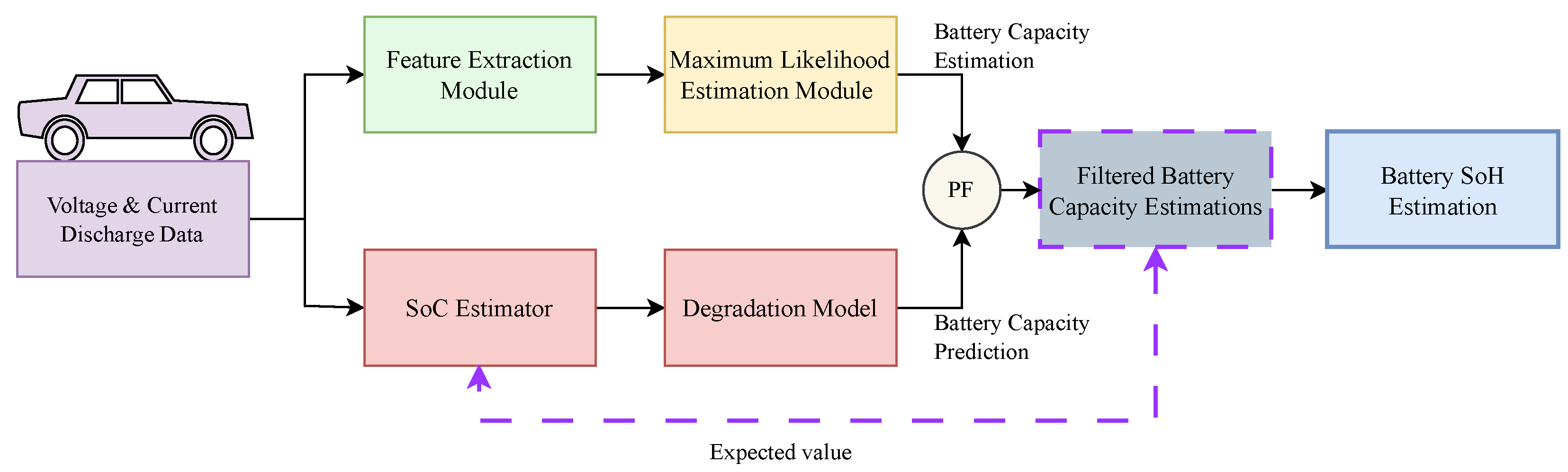
Based on the information obtained in the previous section, a Maximum Likelihood Estimation-PF (MLE-PF) approach has been implemented to estimate the battery capacity using Equation (14), as illustrated in Figure 2. In particular, vehicle data are initially passed through a Feature Extraction Module (FEM) to generate a set of observations, which the MLE module then uses to estimate the battery capacity. On the other hand, a parallel model-based branch (highlighted in red) is integrated starting from vehicle data. The two branches converge into the PF, which fuses observations and model predictions to output a filtered battery capacity estimate, from which the SoH is subsequently computed. The inclusion of the PF aims to obtain a more reliable and robust SoH estimator since it helps to overcome off-trend estimates, which may be the result of having to deal with low-quality or noisy operational data.
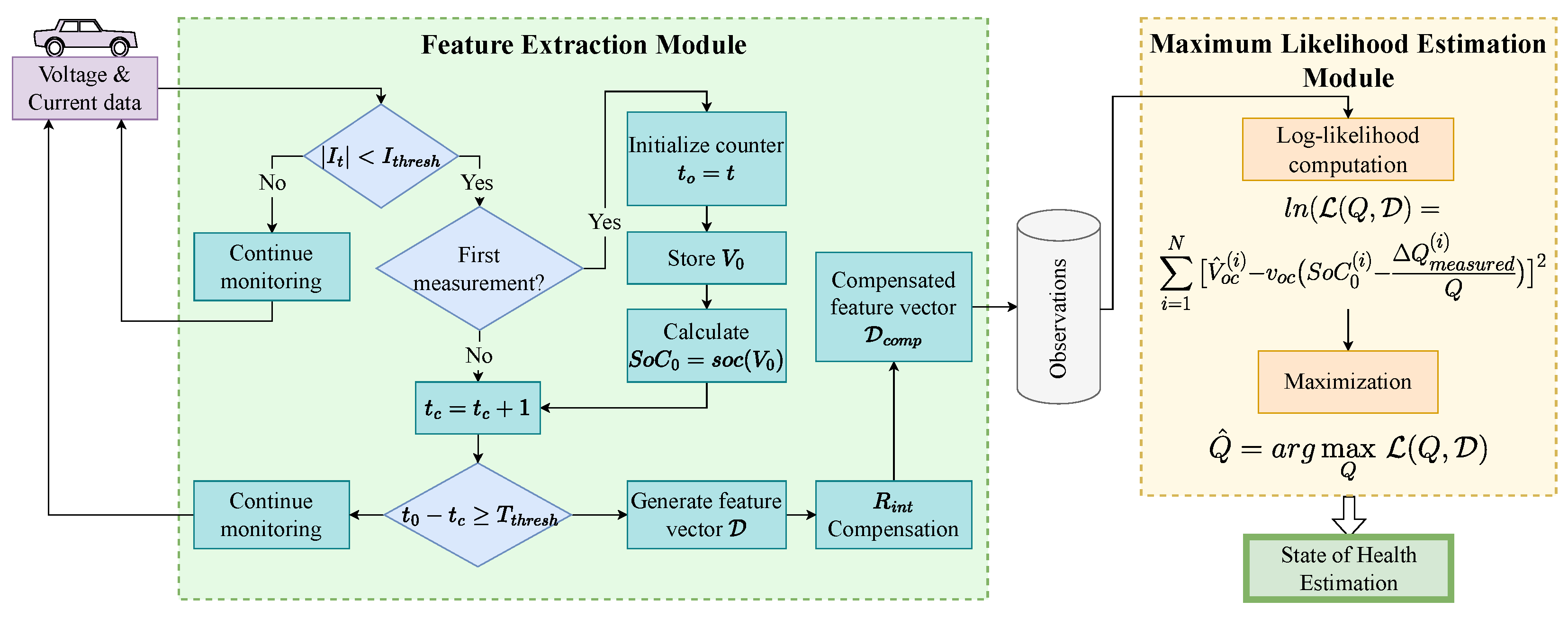
Figure 3 shows a detailed view of the MLE-PF framework, focusing on the FEM and MLE module. The FEM logs voltage and charge measurements from the natural discharge process during standard EV operation. Measurements that meet a set of predefined criteria are retained and processed for further analysis. Once a meaningful set of observations is harvested, the acquired dataset is passed to the MLE module, which, by solving an estimation process, estimates the actual current battery capacity and therefore the SoH. This process can be run online while driving.

3.2.1. Feature Extraction Module

The FEM operates by identifying and collecting informative voltage and charge measurements during battery discharge cycles that occur under typical electric vehicle operating conditions. The primary objective of the FEM is to identify voltage readings that closely approximate the open-circuit voltage V o c . These selected measurements form the basis for estimating the battery current capacity. In fact, the direct correlation between open-circuit voltage and battery capacity demonstrated in Equation (14) gives a clear strategy to calculate the current capacity, starting from the V o c .
However, since the battery is always connected to the circuit and under load, a perfect reconstruction of the true V o c is inherently unachievable; therefore, the resulting voltage can only approximate the true open-circuit condition. For this reason, the reconstructed value is referred to as a pseudo-open-circuit voltage or V o c P . While in operation, the measured voltage can be described by the relationship:
V o c P = V t + I t · R i n t t ,
where I t , V t , and S o C t correspond to the current, voltage, and SoC at the t-th discharge instant, respectively. Finally, R i n t t represents the internal resistance of the battery. To obtain voltage measurements that closely resemble true open-circuit conditions, the FEM must reduce the influence of the voltage drop caused by the I t · R i n t t term. When this objective is achieved, the pseudo-open-circuit voltage approximates the actual open-circuit voltage:
V o c P V o c = v o c ( S o C t )
It is important to note that Equation (16) maintains validity only for a carefully selected subset of measurement samples. This selection is achieved by a combination of three actions.
  • First, the FEM identifies moments during the discharge process when the current values are low. This condition minimizes voltage drops caused by the internal impedance, ensuring a more accurate representation of the open-circuit voltage. This requirement is imposed by the threshold condition in (17):
    | I t | I t h r e s h ,
    where I t is the current measurement and I t h r e s h is the current low pass threshold.
  • In addition, since the battery’s internal impedance might present transients, a second condition must be considered in series to the first one. The FEM checks if the low current measurements are consistent for a given amount of time to minimize the effect of voltage transients due to impedance. The expression in Equation (18) represents the logical operator that indicates that a voltage measurement is close to its corresponding V o c and can be formulated as:
    T c o n s i s t e n t T t h r e s h ,
    where T c o n s i s t e n t is a counter that indicates how much time with low current has passed, and T t h r e s h represents the second control parameters that regulate how permissive the selector is. The combined condition can be formulated as:
    | I t | I t h r e s h T t h r e s h T c o n s i s t e n t V t v o c ( S o C t ) ,
    By applying this logical condition to the voltage and current signals, the FEM generates a set of observations D .
  • Despite the low stable currents, they might still alter the approximation of V o c when multiplied by the internal resistance. For this reason, an internal impedance compensation module is added to the flow as explained in Section 3.2.2. The application of this additional module adjusts the observation D to D c o m p .
In addition, the FEM logs the first qualifying voltage measurement that serves as a reference point for the battery capacity estimation process, called the reference voltage. The reference voltage is the initial V o approximation that meets both conditions. V o is then converted to an initial State of Charge S o C 0 using the inverse function of Equation (20). This transformation is possible as the function v o c ( · ) , presented in Equation (2), is bijective. Although the inverse function of v o c ( · ) exists, it does not have an analytical form, necessitating an approximation. The proposed approximation, which maps v o c measurements to their equivalent SoC, is given by the following:
S o C ( V o c ) = x 2 1 + e x 1 ( V o c x 0 ) + ( a · V o c + b ) 3 + c , 0 S o C ( V o c ) 1 ,
where x 0 , x 1 , x 2 , a, b, and c are adjustable parameters that must be tuned to minimize the error between the actual inverse function.
Finally, the FEM also computes the extracted charge between voltage detections. These values are computed by integrating the current over time. This process can be expressed as:
Q ext ( k ) = 0 k I t d t i = 0 k I ( i ) · Δ t i ,
where I t corresponds to the current signal and Δ t i the sampling period between measurements.
When the FEM is applied to the monitored battery current and voltage signals, the algorithm generates a feature set formalized as:
D = D ( i ) = ( S o C 0 ( i ) , Δ Q e x t ( i ) , V o c ( i ) ) | i { 1 , 2 , 3 , , N }
where S o C 0 ( i ) corresponds to the initial SoC associated with the i-th selected measurement (computed with Equation (20)), Δ Q e x t ( i ) is the extracted charge between the initial and the i-th selected observation, and V o c ( i ) is the i-th selected voltage measurement.
As previously stated, despite the selection of a low stable current, the impact of the voltage drop due to the internal resistance could still be relevant. It is hence important to further compensate the observation D with the Resistance Effect Compensation Module.

3.2.2. Resistance Effect Compensation

In this work, the battery ohmic losses are modeled through a internal resistance R i n t , which plays the role of the Equivalent Series Resistance (ESR) in the Thévenin model. This resistance can be characterized based on the data provided in [58], it is possible to fit a third degree polynomial to describe internal resistance as a function of SoC, where the polynomial coefficients are P 0 = 0.1317 , P 1 = 0.05083 , P 2 = 0.2579 , and P 3 = 0.3084 . The relationship can be expressed by:
R int ( SoC ; I = 5 A ) = P 0 + P 1 · SOC + P 2 · SOC 2 + P 3 · SOC 3
This polynomial function represents a case in which the battery operates at a constant discharge current. However, actual operational conditions might present varied discharge current profiles. Therefore, we propose adjusting the polynomial using historical operational voltage and current data. The adjustment of Equation (23) involves an affine transformation, as illustrated in Equation (24), where θ represents adjustable parameters.
R int ( SOC , I ) θ = ( P 0 + P 1 · SOC + P 2 · SOC 2 + P 3 · SOC 3 ) · θ 1 + θ 2
Then, Equation (25) describes how to refine the detected V o c measurements by considering the ohmic effects of impedance at low currents. Note that R i n t k ( S o C , I k ) θ in Equation (25) corresponds to the proposed parameterization of the internal resistance.
v o c ( S o C k ) = V k + I k · R i n t k ( S o C k , I k ) θ ,
This compensation scheme is applied to the voltage detections of the feature set presented in Equation (22), to diminish the effect of internal resistance further. The application of this procedure generates the compensated feature dataset given by:
D c o m p = D ( i ) = S o C 0 ( i ) , Δ Q ext ( i ) , V o c ( i ) + I ( i ) · R i n t k ( S o C ( V o c ( i ) ) , I ( i ) ) θ | i { 1 , 2 , , N }
= D ( i ) = S o C 0 ( i ) , Δ Q ext ( i ) , V ^ o c ( i ) | i { 1 , 2 , , N } .          
where I ( i ) represents the current associated with the i-th detection, and V ^ o c ( i ) represents the i-th compensated voltage detection of the compensated feature dataset D c o m p . After compensating for resistive effects, no further processing is necessary.
It is noteworthy to mention that the proposed polynomial model for the internal impedance corresponds to a simplified empirical approximation. Indeed, internal impedance depends on several factors, including temperature, hysteresis, and manufacturing defects. Since these factors are not being taken as inputs to the model, errors in the characterization of internal impedance are expected.
However, these errors do not compromise the validity of the proposed methodology. First, the polynomial model is calibrated for the specific cell type under study using historical data from similar cells. Second, as shown in Equation (25), errors in the term R i n t k ( S o C k , I k ) θ are multiplied by I k , whose magnitude is inherently small during the operating conditions considered by this methodology. Consequently, any approximation error in the internal resistance remains bounded. Finally, residual errors introduced by this simplification are accounted for in the observation equation of the upstream particle filter (PF) as observation noise. Therefore, the influence of inaccuracies in R i n t k ( S o C k , I k ) θ on the overall performance of the proposed methodology can be considered negligible.

3.2.3. Maximum Likelihood Estimation Module

Once the features are extracted, the battery capacity parameter can be estimated by maximum likelihood. To construct the likelihood function of the battery capacity, the following assumptions are considered:
  • During the feature extraction, capacity degradation is neglected.
  • The extracted features are conditionally identically independent and identically distributed.
  • The extracted open voltage features are affected by Gaussian additive noise with some variance σ v 2 .
In particular, the latter assumption is grounded in established practices. Modeling voltage-related features as the true cell voltage corrupted by additive, zero-mean Gaussian noise is in line with established practices in Li-ion battery state estimation, where terminal-voltage measurements acquired through the sensing chain are typically affected by small, approximately white noise perturbations. Under this setting, the Gaussian model provides a convenient and well-posed likelihood for machine learning or Bayesian estimators as proposed by [36,59,60,61]. In applications where the sensor noise is manifestly non-Gaussian, the same estimation framework can be reformulated with a more general noise model, at the price of increased complexity. With the compensated set of extracted features presented in Equation (27) and a previously adjusted battery model, the V o c can be approximated for every observation, following Equation (28). Note that this voltage prediction depends on the battery capacity C. This allows the creation of an error metric assumed to be normally distributed. Equation (29) shows the final error metric associated with the collected feature vector i.
V ^ o c ( i ) C , S o C 0 ( i ) , Δ Q ext ( i ) = v o c S o C 0 ( i ) Δ Q ext ( i ) C
ϵ C , D ( i ) = V ^ o c ( i ) v o c ( i ) ( C , V 0 ( i ) ) = V ^ o c ( i ) v o c S o C 0 ( i ) Δ Q ext ( i ) C
When combining the above-mentioned assumptions, the likelihood function of a set of observations follows:
L ( C ; D ) = i = 1 N L ( C ; D ( i ) )      
= i = 1 N 1 σ v 2 π e 1 2 ( ϵ ( C , D ( i ) ) σ v ) 2
e i = 1 N 1 2 ( ϵ ( C , D ( i ) ) σ v ) 2
Since we are interested in the most probable estimation of the battery capacity, the estimated value C ^ is the one that maximizes the constructed likelihood. To ease the computations, we use the log-likelihood instead of the likelihood function. Additionally, the multiplicative factors can be ignored during the maximization process. The optimization problem is described by Equation (36).
C ^ = arg max C l o g ( L ( C ; D ) )
= arg max C l o g ( e i = 1 N 1 2 ( ϵ ( Q , D ( i ) ) σ v ) 2 )
= arg min C i = 1 N ϵ ( C , D ( i ) ) 2
= arg min C i = 1 N V ^ o c ( i ) v o c S o C 0 ( i ) Δ Q e x t ( i ) C 2
The MLE employs a gradient descent algorithm to generate capacity estimates from operational data. When the optimization problem is solved, the MLE Module outputs an estimation of the battery capacity. Although this estimator can be used as a virtual capacity sensor, the accuracy of the estimates is based solidly on the collected data, which means that short discharges might produce biased estimates. In addition, noisy sensors may produce unreliable data points and result in outliers. The MLE-PF framework merges the MLE with a PF loop to overcome this issue. As a result, the MLE acts as a virtual sensor of battery capacity, whose outputs are integrated as observations by the PF in a higher-level loop. These MLE observations are used to update the particle weights in order to compute the posterior PDF. In this way, inaccurate or incomplete estimates can be corrected using prior information from the degradation model. In particular, the PF algorithm uses a Gaussian likelihood function, which gives an estimate of the battery capacity in a Bayesian fashion. The modular nature of the framework allows for the integration of any degradation model within the Particle Filter. In this work, we employ the SoC estimator proposed in [37], along with the degradation model formulated in [40]. Note that once a posterior distribution of battery capacity is generated, its expected value is used to update the SoC estimator, which uses the battery capacity as a normalizing constant to calculate the SoC. This feedback loop allows for a simultaneous assessment of health and charge, allowing complete battery characterization during operation.
PF and estimator parameters should be adjusted using an initial set of training cycles. The procedure presented in [37] allows the parameter adjustment of the battery model using the operational data of the EV. The variance of the uncertainty of the model process can be inferred using a small batch of degradation tests. However, other outer feedback correction loops can be used to dynamically adjust this parameter during operation [62]. Finally, the likelihood variance depends only on the voltage sensor noise variance; hence, it can be consulted with the vehicle manufacturer or inferred from operational data. In the case study, this calibration step is performed only on cell W9, which plays the role of a training cell. The resulting inverse-OCV/ESR parameters and PF noise variances are then kept fixed when evaluating cells W4, W8, and W10, thus avoiding any leakage of test information into the tuning stage.
The proposed method uses a PF algorithm since the sequential estimation problem is characterized by non-linear degradation dynamics. Although both methods are computationally expensive, this characteristic is not limiting for an on-board application, since capacity estimates and PF updates are triggered once an equivalent discharge cycle is completed. This dynamics implies that the execution time of the algorithm is much shorter than the battery degradation rates.

4. Case Study

Dataset Description

To validate the MLE-PF framework proposed in this work, we used the publicly available lithium-ion battery aging dataset provided by the Stanford University and released by the MIT–Toyota Research Center [34]. This dataset documents the degradation of ten commercial INR21700-M50T lithium-ion cells (NMC–graphite/silicon chemistry, nominal capacity of 4850 mAh) cycled over a 23-month period under realistic use scenarios. It encompasses multiple experimental variables and reproduces realistic EV profiles at a controlled temperature of 25 °C, with power demands scaled to the cell’s operational range.
Each cycle consists of full charge–discharge sequence between 100% and 20% of the SoC. Charging is performed through a two-phase Constant-Current Constant-Voltage (CCCV) protocol using C-rates between C / 4 and 3 C for different cells until 100% of the SoC is reached and the charging current falls below 50 mA . This is followed by a constant-current discharge at C / 4 down to approximately 80% SoC and subsequently by the realistic conduction profile Urban Dynamometer Driving Schedule (UDDS) discharge to reach 20% SoC.
Diagnostic testing is performed periodically, including capacity testing using Hybrid Pulse Power Characterization (HPPC) and EIS. By the end of the campaign, cells reached between 80% and 91% of their initial capacity. Detailed information on the voltage, current, charge, and discharge capacities, time, and step-index measurements for each cell cycle are recorded. The following variables have been added or modified by the authors in a pre-processing phase:
  • SoC: calculated for each experiment by integrating the current over time. This value is normalized with the SoC variation limits (20% and 100%).
  • SoH: It is important to note that this dataset does not directly provide the SoH values; instead, SoH has been derived from capacity measurements. Additionally, the current capacity data is not provided for each cycle but is available only at specific assessment intervals. To establish a continuous SoH trend with values at each cycle, linear interpolation has been employed to estimate capacity (and consequently SoH) between the reported data points. This interpolated data will serve as the reference for the cell SoH. This interpolated data will serve as the reference for the cell SoH. However, in Section 5 the MLE–PF estimates are also compared against the non-interpolated ground-truth capacity values at diagnostic cycles, and these errors are reported as the primary performance metrics.
Among the ten cells, four have been selected for this study due to their higher degree of degradation, allowing a thorough evaluation of the performance of the proposed model. As a result, the pre-processing step was applied to cells W4, W8, W9, and W10. Experimental data from cell W9 were used exclusively to tune the parameters and hyperparameters of the proposed methodology; consequently, cell W9 is not used to validate it. In contrast, the remaining three cells have been thoroughly analyzed, and the results are provided in Section 5.
The specific charging conditions of each cell, ambient temperature, and diagnostics performed, including the number of charge-discharge cycles each cell had completed at the time of each diagnostic assessment, are detailed in Table 1. It is crucial to note that the frequency of diagnostic tests that evaluate the SoH of cells is not uniform; that is, they are not performed after a constant predetermined number of cycles. In some cases, these tests are performed every 25 cycles; in others, they may be conducted every 48 cycles. As a result, the initial capacity value is defined as the one reported in the first cycle immediately after a diagnostic test, and the final value corresponds to the capacity measured in the last cycle before the next diagnostic test. The capacity test is carried out by first bringing the cell to 100% SOC and then discharging it with a current equal to one-twentieth of its nominal capacity. Using such a very low current keeps over-potential losses practically zero, so the voltage profile follows the open-circuit curve, and the charge removed can be taken as an accurate measure of the cell’s actual capacity.

5. Results

In this section, the results regarding cells W4, W8, and W10, selected due to their higher degree of degradation, are reported. In particular, we present the MLE-PF SoH estimates along with the ground truth values reported in the Stanford dataset. To quantify how well the model follows the actual degradation dynamics, we computed the Mean Absolute Error (MAE) for each cell in a box plot visualization. In addition, we performed a sensitivity analysis of the FEM with respect to the low-current threshold I th and the minimum low-current duration T th , by evaluating how the number of detected pseudo-open-circuit voltage points N OCV varies across different parameter combinations. Furthermore, we analyze how the SoH estimation error (in terms of MAE) changes as a function of different ( I th , T th ) combinations to assess the robustness of the proposed MLE-PF framework.

5.1. Sensitivity Analysis of Low-Current Detection Parameters

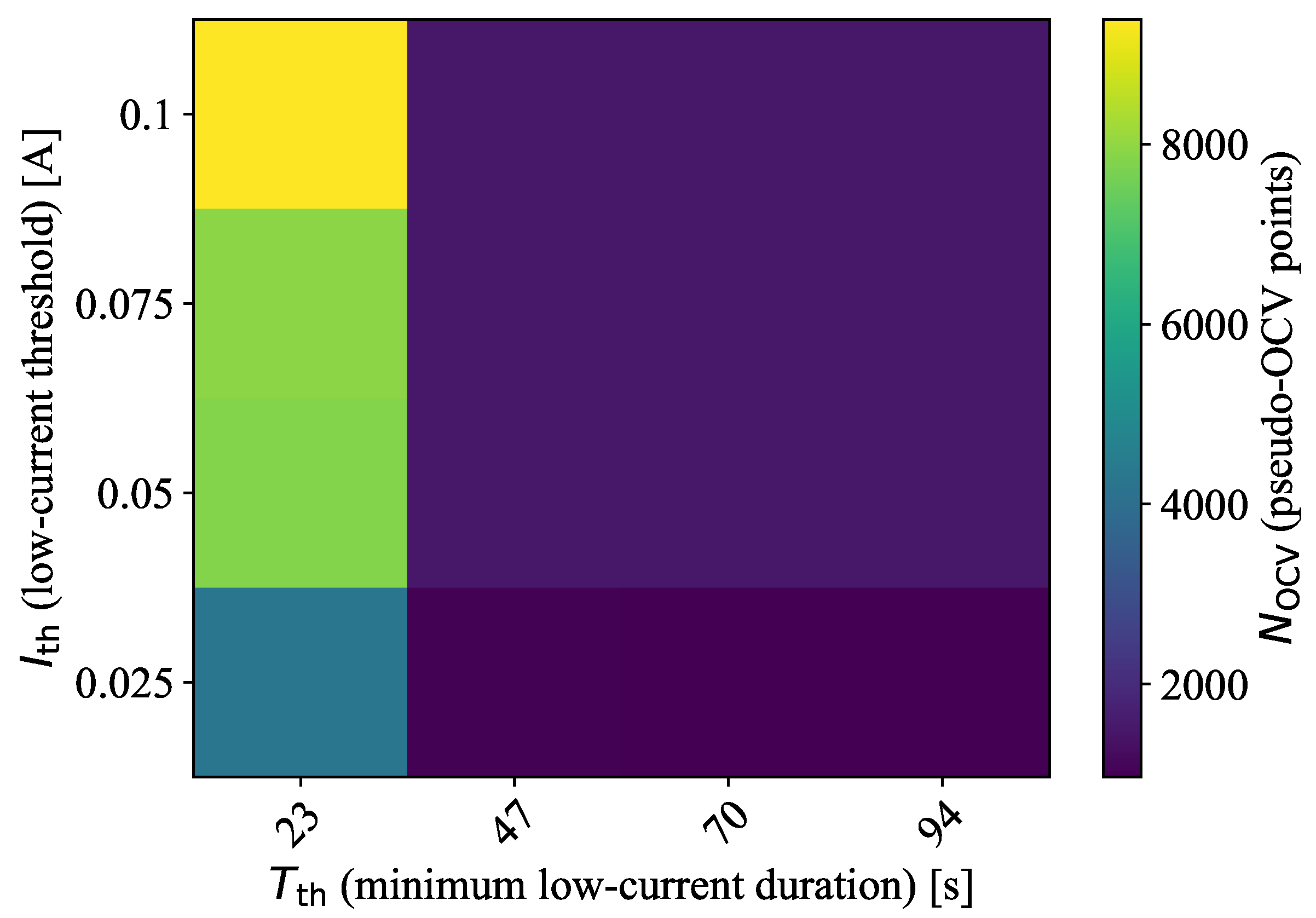
The FEM relies on two hyperparameters that determine when a voltage sample can be treated as a pseudo-open-circuit voltage V o c P : the low-current threshold I th and the minimum low-current duration T th , which correspond to the conditions in (19). To assess the robustness of the proposed methodology with respect to these parameters, we performed a sensitivity study on cell W4 of the Stanford dataset. For a grid of ( I th , T th ) combinations, we counted the total number of pseudo-OCV points, denoted by N OCV , detected across all available work cycles using the same driving profile and data preprocessing described in Section 4.
Figure 4 indicates that different ( I th , T th ) combinations yield a comparable number of detected pseudo-OCV points N OCV . For this reason, we restricted the detailed error analysis to the representative settings reported in Table 2, instead of exhaustively evaluating every pair in the grid.
Table 2 reports, for each ( I th , T th ) combination, three metrics: the Interpolated MAE, computed over all work cycles; the MAE at diagnostic tests, evaluated only at the diagnostic cycles where reference capacity measurements are available; and the total number of detected pseudo-OCV points N OCV . In both cases, the SoH estimation error is obtained by comparing the SoH estimated by the proposed MLE–PF framework against the reference SoH derived from the ground-truth capacity measurements in the Stanford dataset. From Table 2, the lowest MAE is obtained for I th = 0.025 A and T th = 47 s, both for the interpolated and non-interpolated errors. This combination corresponds to the smallest current threshold and the longest low-current duration among the tested cases, which is consistent with the physical intuition behind the Feature Extraction Module: as the current decreases and the low-current window becomes longer, the measured terminal voltage has more time to relax and becomes closer to the true OCV curve.
It is also worth noting that this best-performing configuration is associated with the smallest number of detected pseudo-OCV points within the tested set. This suggests that, at least for cell W4, the quality of the selected points—i.e., how close they are to the underlying OCV response—is more important for the MLE performance than simply maximizing N OCV . Based on this trade-off, the pair I th = 0.025 A and T th = 47 s was adopted in the following experiments.

5.2. SoH Estimation Results

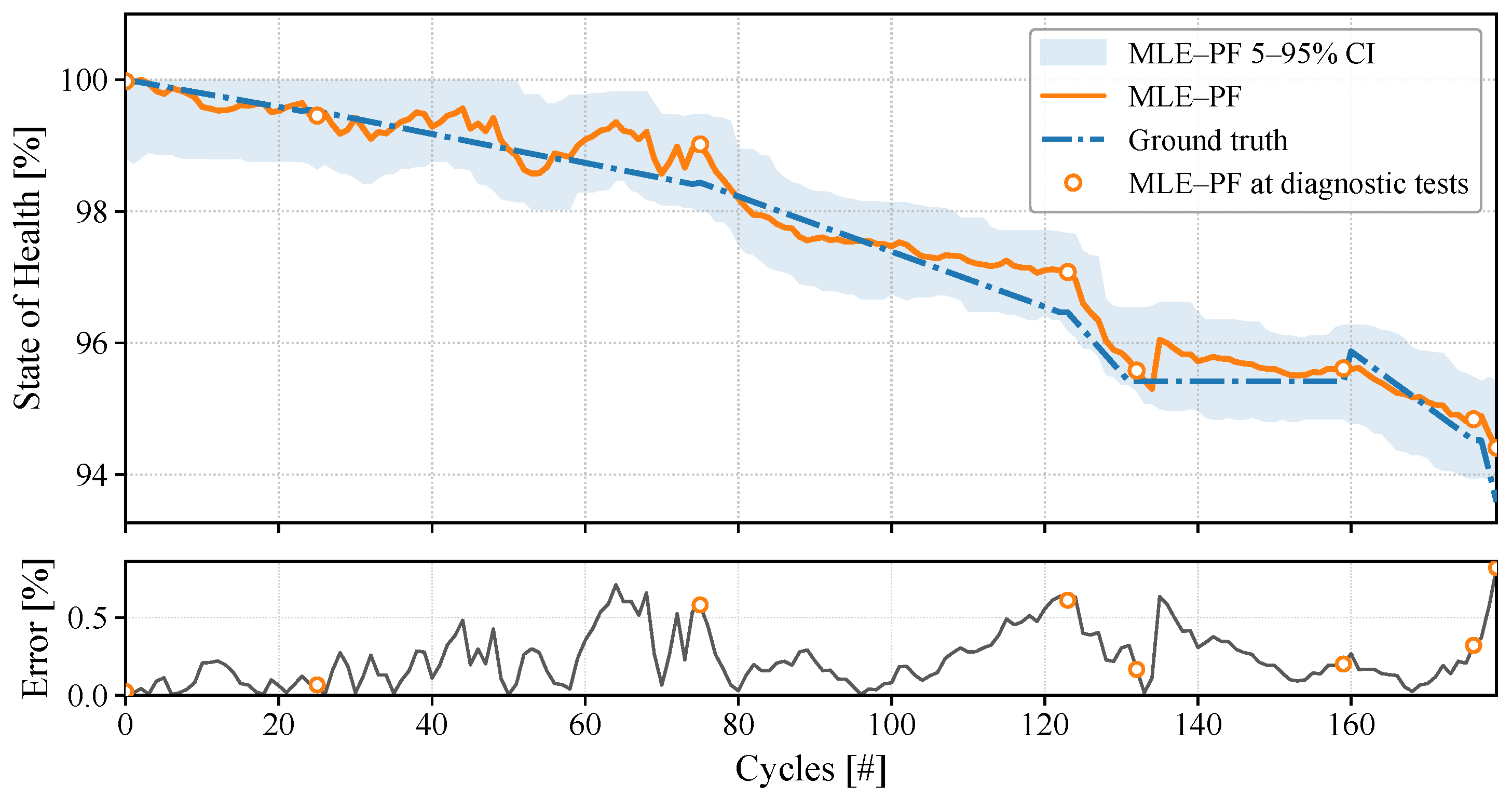
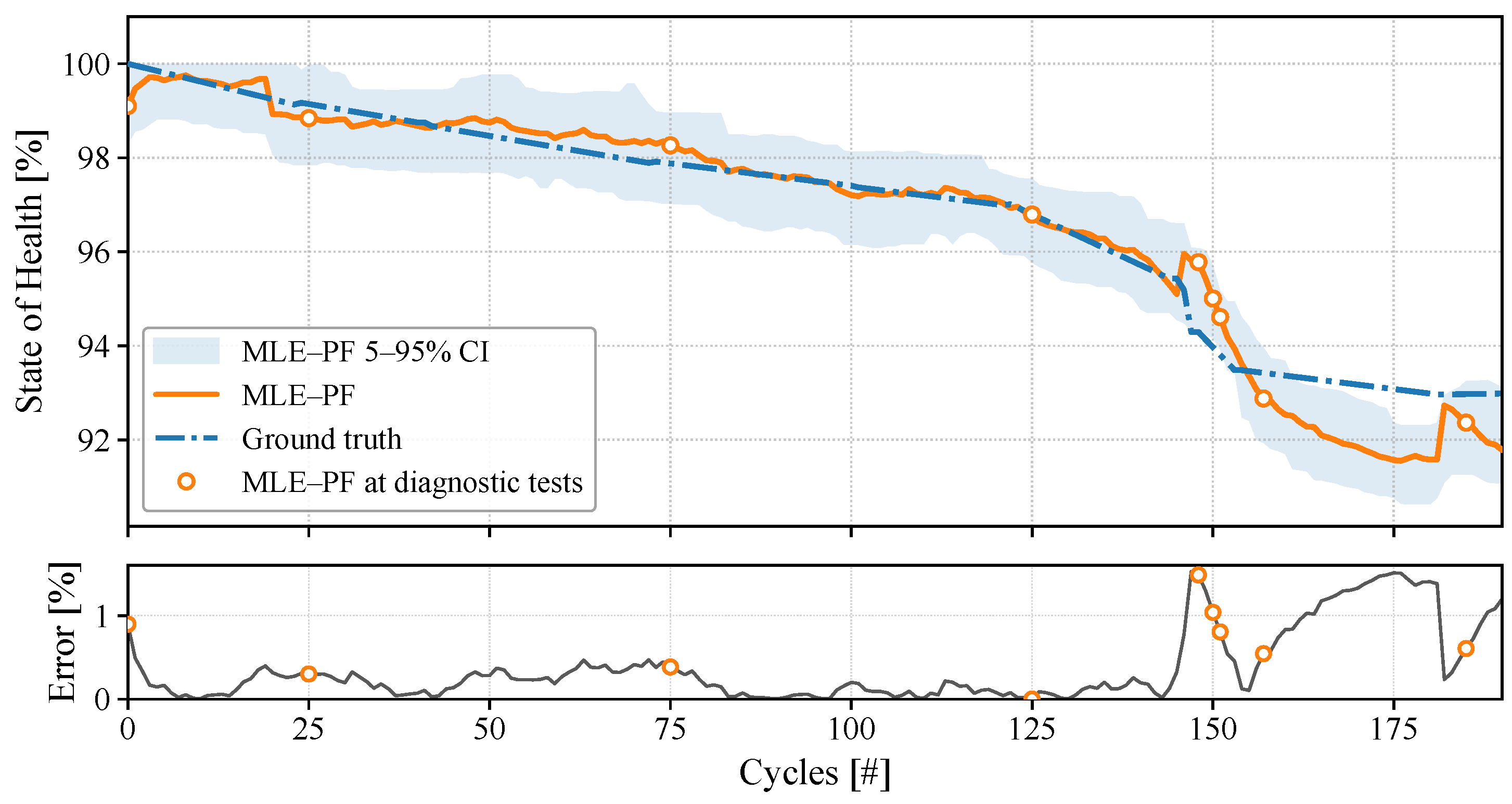
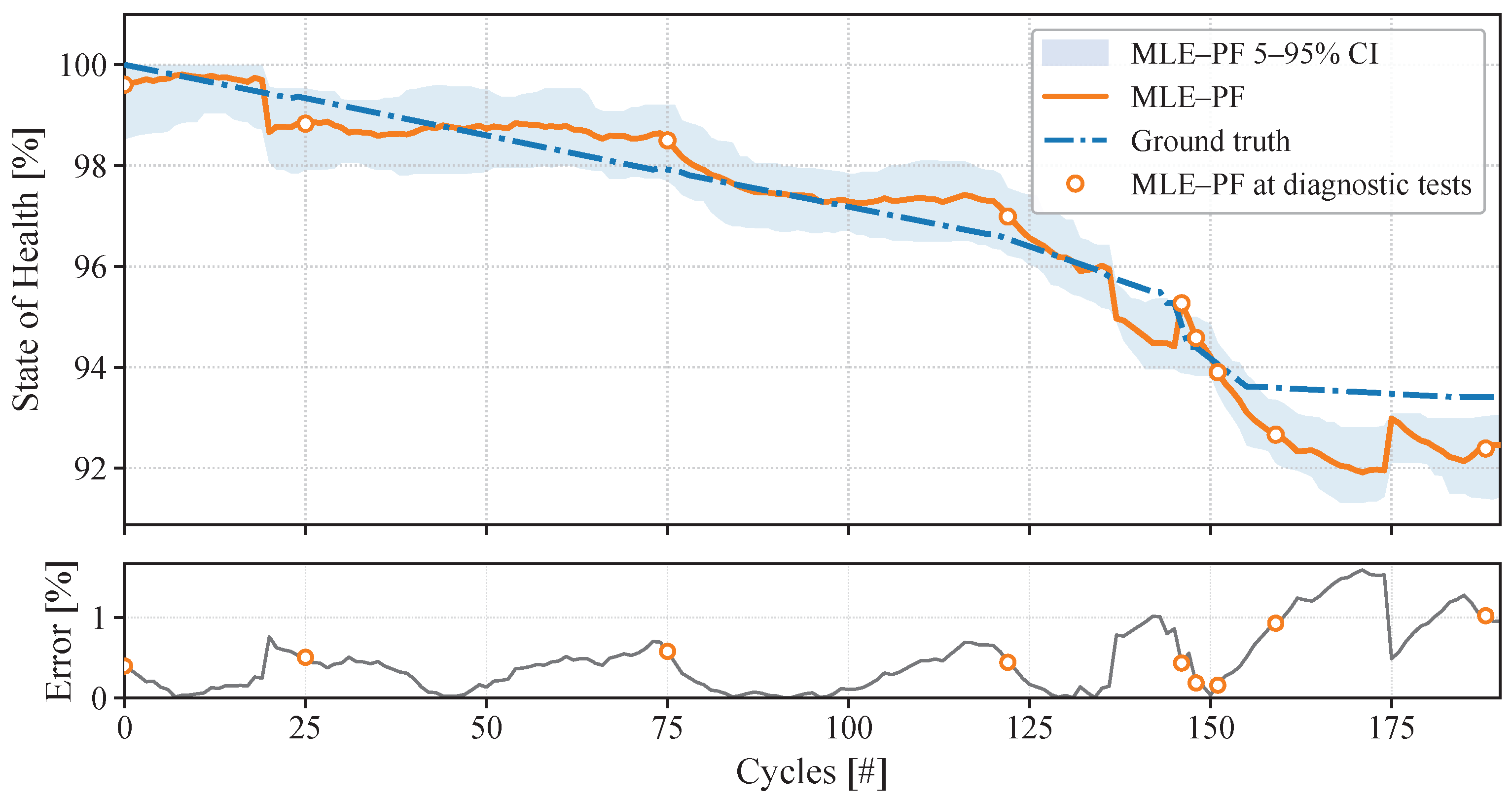
Figure 5, Figure 6, Figure 7 and Figure 8 show the SoH estimation results obtained with the proposed MLE–PF algorithm for cells W4, W8, and W10. Each figure includes the MLE–PF output, the ground-truth reference, and the 5–95% confidence interval estimated from the particle distribution. Orange markers indicate the estimated SoH values at diagnostic cycles, while the lower panel in each figure presents the corresponding absolute error evolution over all cycles.
Figure 5 shows the results obtained for cell W4, where the Stanford dataset indicates an overall approximately 6% degradation in SoH across the full cycling range. The plot demonstrates that the proposed MLE-PF model effectively tracks the cell’s degradation throughout its operational life. Notably, the point-wise error remains comfortably below 0.5%, and the overall MAE is 0.235% when computed over all work cycles and 0.349% at diagnostic test points (see Table 3), indicating consistent accuracy and stable convergence of the estimator. The 5–95% confidence interval remains narrow over most of the test, confirming that the particle distribution captures the expected variability while preserving a low estimation uncertainty.
For cell W8, the results shown in Figure 6 depict a similar scenario, with an interpolated MAE of 0.369% and a MAE at diagnostic tests of 0.686% (Table 3), closely following the actual degradation trend, although the error increases near the final cycles after the drop around 145–155.
Finally, the results for cell W10, presented in Figure 8, exhibit comparable performance in capturing degradation dynamics, with a resulting interpolated MAE of 0.465% and a MAE at diagnostic tests of 0.517% (Table 3); the late-cycle deviations remain bounded by the credibility band.
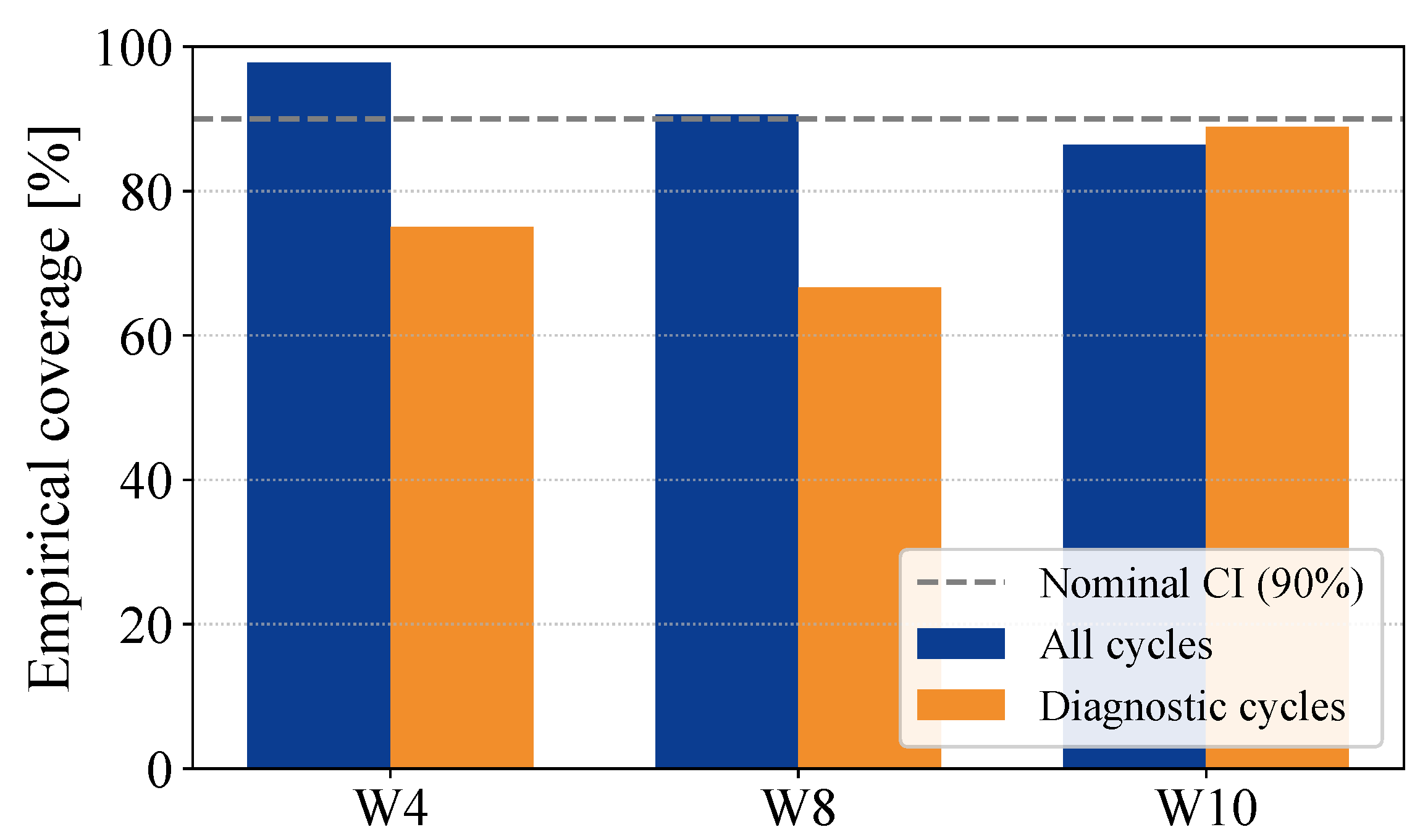
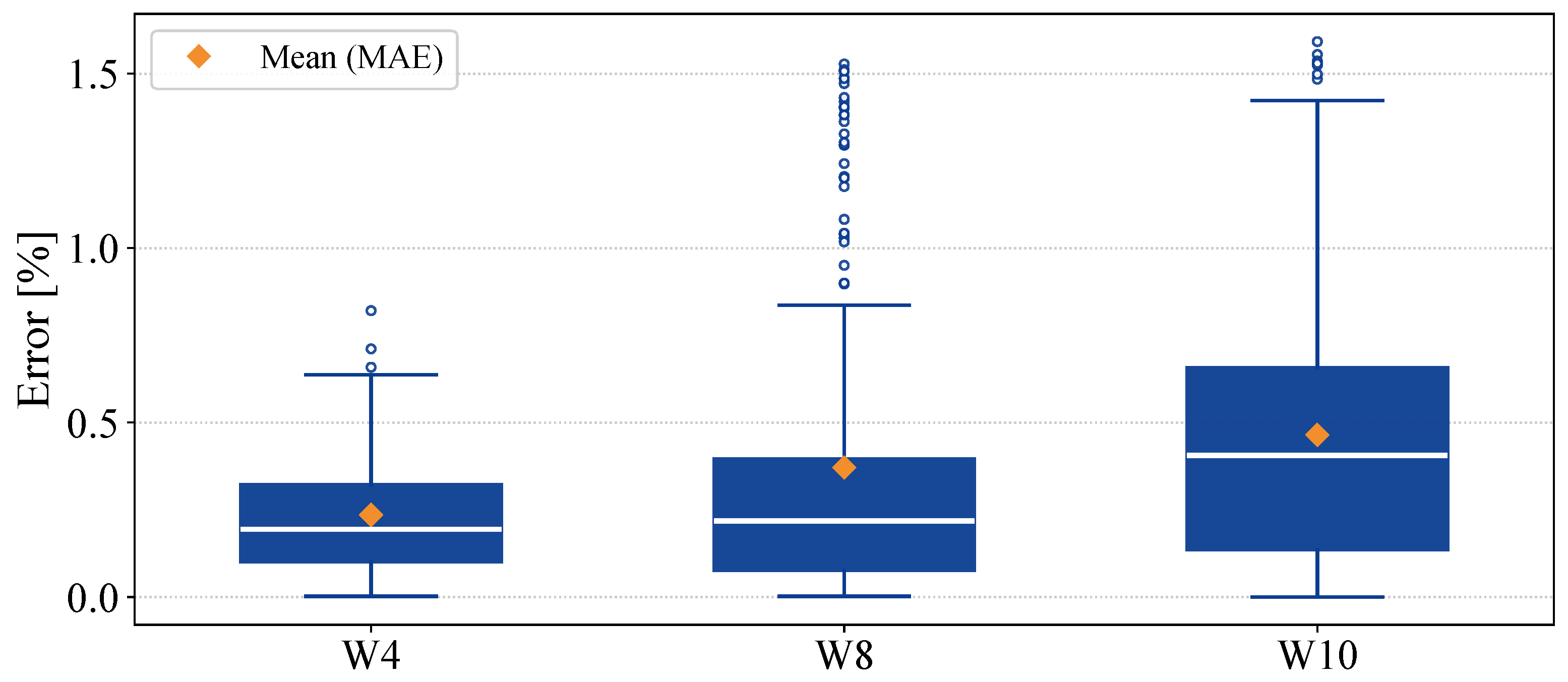
Overall, the results indicate stable precision and support the effectiveness of the MLE–PF in predicting the SoH trend across cells. As summarized in Table 3, with W4 achieving the lowest overall error, W8 showing a slight increase during the final degradation stage, and W10 maintaining a consistent tracking of the reference trend. Figure 9 illustrates these results by representing the estimation error distributions of cells W4, W8, and W10 with box plots, reflecting the same relative behavior reported in Table 3. Figure 7 shows that the empirical coverage of the 5–95% credibility band is close to the nominal 90% level when all cycles are considered. At diagnostic cycles the coverage is lower for W4 and W8, while W10 is closer to the nominal value. Since all three cells have only a small number of diagnostic measurements, these percentages are sensitive to a few mismatches; in a realistic deployment with more diagnostic data available, the empirical coverage at those points would be expected to fluctuate less and to concentrate around the nominal level.

6. Discussion

The results obtained from the performed experiments confirm the accuracy of the proposed methodology for online lithium-ion cell SoH estimation. The methodology considers a feature selection module that saves the most significant measurements during operation to create a feature set that is later employed to generate MLE capacity estimates. These estimates are later filtered to suppress possible artifacts when the data presents anomalies. In a practical implementation, a device should capture current and voltage measurements from the CAN bus and then process them to generate capacity estimates and filter updates once equivalent cycles are completed. Note that this latter processing can be performed with cloud computing if the computational capacity of the onboard device is limited. These findings are consistent across all cells and align with the error summary presented in Table 3.
Beyond these baseline results, the sensitivity analysis reported in Section 5.1 (Figure 4 and Table 2) indicates that the MLE-PF framework is robust to different combinations of the low-current threshold I th and the minimum low-current duration T th , with similar MAE values for most of the tested settings. At the same time, the smallest errors are obtained when pseudo-OCV points are extracted under the most restrictive conditions, that is, using the lowest current threshold and the longest dwell time, which is consistent with the idea that lower currents and longer relaxation intervals produce voltage samples closer to the true OCV. These two hyperparameters were selected for the sensitivity study because they can be directly tuned in a practical implementation, whereas the uncertainties associated with the ESR compensation are absorbed into the process and measurement noise of the MLE-PF framework and are identified offline under the nearly constant-temperature conditions of the Stanford dataset. A systematic assessment of the sensitivity of ESR model parameters to temperature variations remains an open topic for future investigation.
From an application point of view, the outcome of this online SoH estimation procedure can serve many purposes during the lifetime of the vehicle. For instance, since autonomy directly depends on the battery capacity, having SoH estimates can drastically enhance precision in autonomy prognosis algorithms, especially at the end of the battery life cycle.
The high versatility and scalability of the framework lie in its modularity, which enables the application of the framework on different types of batteries with different chemistries, after an offline parameter tuning phase. In particular, in this case, the implementation of Thévenin-equivalent battery models can reproduce the electrical behavior of batteries, packs, and cells from different chemistries and configurations.
In addition to these benefits, our approach differs from existing methods in at least two other significant aspects. First, it adapts to the usage of a real electric vehicle without a specific discharge profile. Several model-based methods handle degradation under different C-rates but still assume stationary or fixed operating profiles throughout each discharge cycle [64]. These assumptions are impractical in an EV, where driving patterns vary daily. In contrast, we only require samples in the operational data where the current is sufficiently low to treat the measured voltage as an approximation of the open-circuit voltage. This requirement is easy to meet during regular driving, as vehicles often remain near zero current while coasting or at low power demand. Thus, we estimate capacity by collecting these naturally occurring measurements over one or more trips, which makes the method suitable for everyday EV operation.
Second, the proposed algorithm needs a small set of parameters that can be extracted from a few conventional tests or short operational campaigns. The Thévenin-equivalent model [65] demands limited information, unlike machine learning models based on large labeled data sets and long training times [17].
In our method, parameter tuning involves recording voltage and current data from ordinary vehicle usage, fitting the open-circuit voltage curve with a few parameters, and characterizing internal resistance with a straightforward polynomial. This procedure alleviates the computational demands associated with training complex neural networks or gathering extensive aging data, while also improving explainability, an pivotal aspect in safety-critical scenarios. Because the model structure is simple and the number of parameters is small, the estimator can be executed with limited processing capability and does not require laboratory-grade calibration. This simplicity is particularly advantageous in situations where the initial state of the battery is uncertain or only roughly defined, which is unfortunately often encountered in practical EV applications. Under those conditions, highly complex models tend to be sensitive to initialization or to gaps in the training data, whereas a low-dimensional parametric description can still produce reasonable intermediate estimates as soon as real measurements become available. Here the PF plays a key role: by propagating a set of hypotheses and weighting them with actual observations, the PF progressively corrects the initial uncertainty and steers the estimate toward the behavior observed in the vehicle. This is particularly relevant in EV operation, where charge and discharge cycles are rarely complete and the information content of the data is lower than in laboratory cycling: even with these fragmented, opportunistic profiles, the PF can converge towards the true SoH trajectory after a few updates. Consequently, the proposed estimator remains easy to implement on low-cost hardware, adapts quickly to practical EV usage conditions, and converges robustly to accurate SoH estimates in real deployments.

7. Conclusions

This work presents a practical and scalable approach for real-time SoH estimation of lithium-ion batteries in electric vehicles. It operates using standard operational data, eliminating the need for predefined discharge profiles or controlled degradation tests. This makes it well-suited for seamless integration into routine EV operations. Moreover, the approach is inherently scalable across different lithium-ion cells, and even for modules and battery configurations, as it does not depend on degradation datasets for parameter tuning. By leveraging a Thévenin-equivalent circuit model, the parameter estimation process remains computationally efficient and adaptable, avoiding the complexity typically associated with machine learning-based methods. Across the case study, the proposed method tracks SoH with mean absolute errors below 1%, using only on-board voltage and current signals.
A critical aspect of this method is its reliance on the OCV model, which provides a detailed understanding of battery behavior under various operational conditions. Coupling this OCV model with the MLE framework enables accurate capacity estimation, even when starting from an arbitrary SoC. This capability is crucial in real-time applications, where battery conditions often vary significantly and unpredictably. In addition, the inclusion of PF adds a layer of robustness by accounting for uncertainties in the measurement process and the inherent variability of battery performance. The synergy between MLE’s statistical basis and PF’s adaptive framework corrects deviations in SoH estimates while ensuring that the predicted capacity remains closely aligned with the degradation dynamics observed in the dataset.
The sensitivity analysis of the low-current detection parameters further indicates that accurate SoH tracking can be achieved with a relatively small number of high-quality pseudo-OCV points, provided that the current and time thresholds are chosen to favor measurements close to true open-circuit conditions.
Taken together with the experimental results on cells W4, W8, and W10, these findings confirm the efficacy of the proposed method for estimating the SoH of lithium-ion batteries with standard operational profiles. By leveraging operational data, this method provides a noninvasive, efficient, and accurate tool to monitor battery degradation in real-time.
Overall, the method developed in this work offers a practical and scalable solution for real-time SoH monitoring of lithium-ion batteries in electric vehicles. Its application can significantly enhance the efficiency of battery management systems, contributing to a broader adoption of EVs by ensuring reliability and safety. Future work will focus on further refining the model parameters and exploring the integration of additional data sources, such as temperature and external load variations, to improve the accuracy and applicability of the SoH estimation process.

Author Contributions

Conceptualization, J.E.G.B., B.B.S., F.J.-M., D.T.-K., M.E.O., A.P. and J.F.S.; Methodology, J.E.G.B., B.B.S. and F.J.-M.; Software, J.E.G.B., B.B.S. and F.J.-M.; Validation, J.E.G.B., B.B.S. and D.T.-K.; Formal analysis, J.E.G.B., B.B.S. and L.B.; Investigation, J.E.G.B., B.B.S., L.B. and B.M.; Resources, J.E.G.B., L.B., D.T.-K. and A.P.; Data curation, J.E.G.B., B.B.S. and B.M.; Writing—original draft, J.E.G.B., B.B.S., L.B., B.M., F.J.-M., M.E.O. and A.P.; Writing—review & editing, J.E.G.B., L.B., B.M., F.J.-M., D.T.-K., M.E.O., A.P. and J.F.S.; Visualization, J.E.G.B., B.B.S. and B.M.; Supervision, F.J.-M., M.E.O., A.P. and J.F.S.; Project administration, L.B., M.E.O., A.P. and J.F.S.; Funding acquisition, M.E.O., A.P. and J.F.S. All authors have read and agreed to the published version of the manuscript.

Funding

This work was supported in part by ANID FONDECYT 1250036, ANID FONDECYT 11231148, Advanced Center for Electrical and Electronic Engineering, ANID Basal Project CIA250006. The work of Jorge E. García Bustos has been supported by ANID-PFCHA/Doctorado Nacional/2022-21221213. Leonardo Baldo: This publication is part of the project PNRR-NGEU, which has received funding from the MUR–DM 352/2022. The work of Aramis Perez was supported by the University of Costa Rica under research projects 322-C1-467.

Data Availability Statement

The data used in this study were derived from a publicly available dataset [https://doi.org/10.1016/j.dib.2022.107995], but the processed results generated during the analysis are not publicly available. These derived data can be provided by the authors upon reasonable request.

Conflicts of Interest

The authors declare no conflicts of interest.

Nomenclature

The following abbreviations are used in this manuscript:
AbbreviationDefinition
EVElectric Vehicle
LIBLithium-Ion Batteries
DoDDepth of Discharge
SoHState of Health
EISElectrochemical Impedance Spectroscopy
BMSBattery Management System
PFParticle Filter
SoCState of Charge
RULRemaining Useful Life
SoHState of Health
PHMPrognostic and Health Management
CANController Area Network
MLEMaximum Likelihood Estimation
MLE-PFMaximum Likelihood Estimation-Particle Filter
BFBayesian Filter
OCVOpen-Circuit Voltage
SISSequential Importance Sampling
PDFProbability Density Function
FEMFeature Extraction Module
CCCVConstant-Current Constant-Voltage
UDDSUrban Dynamometer Driving Schedule
HPPCHybrid Pulse Power Characterization
ttime step index
kWork cycle index
ICurrent
Δ t Sampling time
wSoC process noise
V o c Open-circuit voltage
V o c P Pseudo-open-circuit voltage
CBattery capacity parameter (used in the MLE module)
C k Battery capacity at work cycle k
C 0 Initial (nominal) battery capacity
η Efficiency factor
vCapacity process noise
LLikelihood function
θ MLE parameters
f ( x i ; θ ) Probability density function of the data x i given the parameters θ
TLow current counter
D Set of observations
R i n t Battery internal resistance
Q e x t Extracted charge
I th Low-current threshold used in the FEM
T th Minimum low-current duration used in the FEM
N OCV Total number of detected pseudo-OCV points
E S R Equivalent Series Resistance (internal resistance of the cell)

References

  1. Velev, B.; Djudzhev, B.; Dimitrov, V.; Hinov, N. Comparative Analysis of Lithium-Ion Batteries for Urban Electric/Hybrid Electric Vehicles. Batteries 2024, 10, 186. [Google Scholar] [CrossRef]
  2. Chebiam, R.; Kannan, A.; Prado, F.; Manthiram, A. Comparison of the chemical stability of the high energy density cathodes of lithium-ion batteries. Electrochem. Commun. 2001, 3, 624–627. [Google Scholar] [CrossRef]
  3. Edge, J.S.; O’Kane, S.; Prosser, R.; Kirkaldy, N.D.; Patel, A.N.; Hales, A.; Ghosh, A.; Ai, W.; Chen, J.; Yang, J.; et al. Lithium ion battery degradation: What you need to know. Phys. Chem. Chem. Phys. 2021, 23, 8200–8221. [Google Scholar] [CrossRef]
  4. Wang, Q.; Ping, P.; Zhao, X.; Chu, G.; Sun, J.; Chen, C. Thermal runaway caused fire and explosion of lithium ion battery. J. Power Sources 2012, 208, 210–224. [Google Scholar] [CrossRef]
  5. Saw, L.H.; Ye, Y.; Tay, A.A. Integration issues of lithium-ion battery into electric vehicles battery pack. J. Clean. Prod. 2016, 113, 1032–1045. [Google Scholar] [CrossRef]
  6. Soyoye, B.D.; Bhattacharya, I.; Anthony Dhason, M.V.; Banik, T. State of Charge and State of Health Estimation in Electric Vehicles: Challenges, Approaches and Future Directions. Batteries 2025, 11, 32. [Google Scholar] [CrossRef]
  7. Zhou, Y.; Huang, M.; Chen, Y.; Tao, Y. A novel health indicator for on-line lithium-ion batteries remaining useful life prediction. J. Power Sources 2016, 321, 1–10. [Google Scholar] [CrossRef]
  8. Lu, J.; Xiong, R.; Tian, J.; Wang, C.; Sun, F. Deep learning to estimate lithium-ion battery state of health without additional degradation experiments. Nat. Commun. 2023, 14, 2760. [Google Scholar] [CrossRef]
  9. Lipu, M.H.; Hannan, M.; Hussain, A.; Hoque, M.; Ker, P.J.; Saad, M.; Ayob, A. A review of state of health and remaining useful life estimation methods for lithium-ion battery in electric vehicles: Challenges and recommendations. J. Clean. Prod. 2018, 205, 115–133. [Google Scholar] [CrossRef]
  10. Sohaib, M.; Akram, A.S.; Choi, W. Analysis of Aging and Degradation in Lithium Batteries Using Distribution of Relaxation Time. Batteries 2025, 11, 34. [Google Scholar] [CrossRef]
  11. Yan, Z.; Wang, X.; Wei, X.; Dai, H.; Liu, L. State-of-Health Estimation of LiFePO4 Batteries via High-Frequency EIS and Feature-Optimized Random Forests. Batteries 2025, 11, 321. [Google Scholar] [CrossRef]
  12. Jiang, B.; Zhu, J.; Wang, X.; Wei, X.; Shang, W.; Dai, H. A comparative study of different features extracted from electrochemical impedance spectroscopy in state of health estimation for lithium-ion batteries. Appl. Energy 2022, 322, 119502. [Google Scholar] [CrossRef]
  13. Noura, N.; Boulon, L.; Jemeï, S. A review of battery state of health estimation methods: Hybrid electric vehicle challenges. World Electr. Veh. J. 2020, 11, 66. [Google Scholar] [CrossRef]
  14. Nuroldayeva, G.; Serik, Y.; Adair, D.; Uzakbaiuly, B.; Bakenov, Z. State of Health Estimation Methods for Lithium-Ion Batteries. Int. J. Energy Res. 2023, 2023, 4297545. [Google Scholar] [CrossRef]
  15. Hu, X.; Yuan, H.; Zou, C.; Li, Z.; Zhang, L. Co-Estimation of State of Charge and State of Health for Lithium-Ion Batteries Based on Fractional-Order Calculus. IEEE Trans. Veh. Technol. 2018, 67, 10319–10329. [Google Scholar] [CrossRef]
  16. Shen, P.; Ouyang, M.; Lu, L.; Li, J.; Feng, X. The Co-estimation of State of Charge, State of Health, and State of Function for Lithium-Ion Batteries in Electric Vehicles. IEEE Trans. Veh. Technol. 2018, 67, 92–103. [Google Scholar] [CrossRef]
  17. Li, K.; Wang, Y.; Chen, Z. A comparative study of battery state-of-health estimation based on empirical mode decomposition and neural network. J. Energy Storage 2022, 54, 105333. [Google Scholar] [CrossRef]
  18. Ghosh, N.; Garg, A.; Panigrahi, B.; Kim, J. An Evolving Quantum Fuzzy Neural Network for online State-of-Health estimation of Li-ion cell. Appl. Soft Comput. 2023, 143, 110263. [Google Scholar] [CrossRef]
  19. Feng, X.; Weng, C.; He, X.; Han, X.; Lu, L.; Ren, D.; Ouyang, M. Online State-of-Health Estimation for Li-Ion Battery Using Partial Charging Segment Based on Support Vector Machine. IEEE Trans. Veh. Technol. 2019, 68, 8583–8592. [Google Scholar] [CrossRef]
  20. Etxandi-Santolaya, M.; Montes, T.; Casals, L.C.; Corchero, C.; Eichman, J. Data-Driven State of Health and Functionality Estimation for Electric Vehicle Batteries Based on Partial Charge Health Indicators. IEEE Trans. Veh. Technol. 2025, 74, 5321–5334. [Google Scholar] [CrossRef]
  21. Zhang, Y.; Gu, P.; Duan, B.; Zhang, C. A hybrid data-driven method optimized by physical rules for online state collaborative estimation of lithium-ion batteries. Energy 2024, 301, 131710. [Google Scholar] [CrossRef]
  22. Dong, H.; Mao, L.; Qu, K.; Zhao, J.; Li, F.; Jiang, L. State of Health Estimation and Remaining Useful Life Estimation for Li-ion Batteries Based on a Hybrid Kernel Function Relevance Vector Machine. Int. J. Electrochem. Sci. 2022, 17, 221135. [Google Scholar] [CrossRef]
  23. Xiang, Y.; Fan, W.; Zhu, J.; Wei, X.; Dai, H. Semi-supervised deep learning for lithium-ion battery state-of-health estimation using dynamic discharge profiles. Cell Rep. Phys. Sci. 2024, 5, 101763. [Google Scholar] [CrossRef]
  24. Wang, C.; Su, Y.; Ye, J.; Xu, P.; Xu, E.; Ouyang, T. Enhanced state-of-charge and state-of-health estimation of lithium-ion battery incorporating machine learning and swarm intelligence algorithm. J. Energy Storage 2024, 83, 110755. [Google Scholar] [CrossRef]
  25. He, Y.; Bai, W.; Wang, L.; Wu, H.; Ding, M. SOH estimation for lithium-ion batteries: An improved GPR optimization method based on the developed feature extraction. J. Energy Storage 2024, 83, 110678. [Google Scholar] [CrossRef]
  26. Buchanan, S.; Crawford, C. Probabilistic lithium-ion battery state-of-health prediction using convolutional neural networks and Gaussian process regression. J. Energy Storage 2024, 76, 109799. [Google Scholar] [CrossRef]
  27. Dong, G.; Shen, F.; Sun, L.; Zhang, M.; Wei, J. A Bayesian Inferred Health Prognosis and State of Charge Estimation for Power Batteries. IEEE Trans. Instrum. Meas. 2025, 74, 1000312. [Google Scholar] [CrossRef]
  28. Deng, Y.; Du, C.; Ren, Z. A Novel Method for Estimating the State of Health of Lithium-Ion Batteries Based on Physics-Informed Neural Network. Batteries 2025, 11, 49. [Google Scholar] [CrossRef]
  29. Zhu, R.; Hu, J.; Peng, W. Bayesian calibrated physics-informed neural networks for second-life battery SOH estimation. Reliab. Eng. Syst. Saf. 2025, 264, 111432. [Google Scholar] [CrossRef]
  30. Wang, N.; Xia, X.; Zeng, X. State of charge and state of health estimation strategies for lithium-ion batteries. Int. J. Low-Carbon Technol. 2023, 18, 443–448. [Google Scholar] [CrossRef]
  31. Mulpuri, S.K.; Sah, B.; Kumar, P. Unraveling capacity fading in lithium-ion batteries using advanced cyclic tests: A real-world approach. iScience 2023, 26, 107770. [Google Scholar] [CrossRef]
  32. Díaz, C.; Quintero, V.; Pérez, A.; Jaramillo, F.; Burgos-Mellado, C.; Rozas, H.; Orchard, M.E.; Sáez, D.; Cárdenas, R. Particle-Filtering-Based Prognostics for the State of Maximum Power Available in Lithium-Ion Batteries at Electromobility Applications. IEEE Trans. Veh. Technol. 2020, 69, 7187–7200. [Google Scholar] [CrossRef]
  33. Zhang, C.; Jiang, J.; Zhang, L.; Liu, S.; Wang, L.; Loh, P.C. A Generalized SOC-OCV Model for Lithium-Ion Batteries and the SOC Estimation for LNMCO Battery. Energies 2016, 9, 900. [Google Scholar] [CrossRef]
  34. Pozzato, G.; Allam, A.; Onori, S. Lithium-ion battery aging dataset based on electric vehicle real-driving profiles. Data Brief 2022, 41, 107995. [Google Scholar] [CrossRef]
  35. Bustos, J.E.G.; Baeza, C.; Schiele, B.B.; Rivera, V.; Masserano, B.; Orchard, M.E.; Burgos-Mellado, C.; Perez, A. A novel data-driven framework for driving range prognostics in electric vehicles. Eng. Appl. Artif. Intell. 2025, 142, 109925. [Google Scholar] [CrossRef]
  36. Pola, D.A.; Navarrete, H.F.; Orchard, M.E.; Rabié, R.S.; Cerda, M.A.; Olivares, B.E.; Silva, J.F.; Espinoza, P.A.; Pérez, A. Particle-Filtering-Based Discharge Time Prognosis for Lithium-Ion Batteries With a Statistical Characterization of Use Profiles. IEEE Trans. Reliab. 2015, 64, 710–720. [Google Scholar] [CrossRef]
  37. Perez, A.; Jaramillo, F.; Baeza, C.; Valderrama, M.; Quintero, V.; Orchard, M. A Particle-Swarm-Optimization-Based Approach for the State-of-Charge Estimation of an Electric Vehicle When Driven Under Real Conditions. In Proceedings of the Annual Conference of the Prognostics and Health Management Society, Virtual, 29 November–2 December 2021; Volume 13. [Google Scholar] [CrossRef]
  38. Patrizi, G.; Canzanella, F.; Ciani, L.; Catelani, M. Towards a State of Health Definition of Lithium Batteries through Electrochemical Impedance Spectroscopy. Electronics 2024, 13, 1438. [Google Scholar] [CrossRef]
  39. Yao, L.; Xu, S.; Lin, X.; Li, X.; Zhang, Y. A Review of Lithium-Ion Battery State of Health Estimation and Prediction Methods. World Electr. Veh. J. 2021, 12, 113. [Google Scholar] [CrossRef]
  40. Saha, B.; Goebel, K. Modeling Li-ion battery capacity depletion in a particle filtering framework. In Proceedings of the Annual Conference of the PHM Society, San Diego, CA, USA, 27 September–1 October 2009; Volume 1, pp. 11–20. [Google Scholar]
  41. O’Kane, S.E.; Ai, W.; Madabattula, G.; Alonso-Alvarez, D.; Timms, R.; Sulzer, V.; Edge, J.S.; Wu, B.; Offer, G.J.; Marinescu, M. Lithium-ion battery degradation: How to model it. Phys. Chem. Chem. Phys. 2022, 24, 7909–7922. [Google Scholar] [CrossRef] [PubMed]
  42. Zheng, Y.; Cui, Y.; Han, X.; Dai, H.; Ouyang, M. Lithium-ion battery capacity estimation based on open circuit voltage identification using the iteratively reweighted least squares at different aging levels. J. Energy Storage 2021, 44, 103487. [Google Scholar] [CrossRef]
  43. Hu, X.L.; Ho, P.H.; Peng, L. Performance Analysis of Maximum Likelihood Estimation for Transmit Power Based on Signal Strength Model. J. Sens. Actuator Netw. 2018, 7, 38. [Google Scholar] [CrossRef]
  44. Zhang, C.; Jin, M.; Dong, G.; Wei, S. Performance Analysis of the Maximum Likelihood Estimation of Signal Period Length and Its Application in Heart Rate Estimation with Reduced Respiratory Influence. Appl. Sci. 2023, 13, 10402. [Google Scholar] [CrossRef]
  45. Rossi, R.J. Mathematical Statistics: An Introduction to Likelihood Based Inference; John Wiley & Sons: New York, NY, USA, 2018; p. 227. [Google Scholar] [CrossRef]
  46. Yao, L.; Boughton, K.A. A Multidimensional Item Response Modeling Approach for Improving Subscale Proficiency Estimation and Classification. Appl. Psychol. Meas. 2007, 31, 83–105. [Google Scholar] [CrossRef]
  47. Dore, A.; Pinasco, M.; Regazzoni, C.S. CHAPTER 9—Multi-Modal Data Fusion Techniques and Applications. In Multi-Camera Networks; Aghajan, H., Cavallaro, A., Eds.; Academic Press: Oxford, UK, 2009; pp. 213–237. [Google Scholar] [CrossRef]
  48. Hastings, W.K. Monte Carlo Sampling Methods Using Markov Chains and Their Applications. Biometrika 1970, 57, 97–109. [Google Scholar] [CrossRef]
  49. Zając, M. Online fault detection of a mobile robot with a parallelized particle filter. Neurocomputing 2014, 126, 151–165. [Google Scholar] [CrossRef]
  50. Arulampalam, M.; Maskell, S.; Gordon, N.; Clapp, T. A tutorial on particle filters for online nonlinear/non-Gaussian Bayesian tracking. IEEE Trans. Signal Process. 2002, 50, 174–188. [Google Scholar] [CrossRef]
  51. Paccha-Herrera, E.; Jaramillo-Montoya, F.; Calderón-Muñoz, W.R.; Tapia-Peralta, D.; Solórzano-Castillo, B.; Gómez-Peña, J.; Paccha-Herrera, J. A particle filter-based approach for real-time temperature estimation in a lithium-ion battery module during the cooling-down process. J. Energy Storage 2024, 94, 112413. [Google Scholar] [CrossRef]
  52. Doucet, A.; Godsill, S.; Andrieu, C. On sequential Monte Carlo sampling methods for Bayesian filtering. Stat. Comput. 2000, 10, 197–208. [Google Scholar] [CrossRef]
  53. Vella, A.; Alonso, M.A. Chapter Seven—Maximum likelihood estimation in the context of an optical measurement. In A Tribute to Emil Wolf; Visser, T.D., Ed.; Progress in Optics; Elsevier: Amsterdam, The Netherlands, 2020; Volume 65, pp. 231–311. [Google Scholar] [CrossRef]
  54. Jiang, G.; Li, M.; Liu, Z.; Sun, L.; Wang, Q. A Maximum Likelihood Estimation Method for Underwater Radiated Noise Power. Appl. Sci. 2025, 15, 6692. [Google Scholar] [CrossRef]
  55. Myung, I.J. Tutorial on maximum likelihood estimation. J. Math. Psychol. 2003, 47, 90–100. [Google Scholar] [CrossRef]
  56. Doucet, A.; Freitas, N.; Gordon, N. Sequential Monte Carlo Methods in Practice, 1st ed.; Springer: New York, NY, USA, 2001. [Google Scholar] [CrossRef]
  57. Cappé, O.; Godsill, S.; Moulines, E. An overview of existing methods and recent advances in sequential Monte Carlo. Proc. IEEE 2007, 95, 899–924. [Google Scholar] [CrossRef]
  58. Burgos-Mellado, C.; Orchard, M.E.; Kazerani, M.; Cárdenas, R.; Sáez, D. Particle-filtering-based estimation of maximum available power state in Lithium-Ion batteries. Appl. Energy 2016, 161, 349–363. [Google Scholar] [CrossRef]
  59. Zeng, Z.; Tian, J.; Li, D.; Tian, Y. An Online State of Charge Estimation Algorithm for Lithium-Ion Batteries Using an Improved Adaptive Cubature Kalman Filter. Energies 2018, 11, 59. [Google Scholar] [CrossRef]
  60. Lee, S.; Kim, J.; Lee, J.; Cho, B. State-of-charge and capacity estimation of lithium-ion battery using a new open-circuit voltage versus state-of-charge relationship. J. Power Sources 2008, 185, 1367–1373. [Google Scholar] [CrossRef]
  61. Olivares, B.E.; Cerda, M.A.; Orchard, M.E.; Silva, J.F. Particle-Filtering-Based Prognosis Framework for Energy Storage Devices with a Statistical Characterization of State-of-Health Regeneration Phenomena. IEEE Trans. Instrum. Meas. 2013, 62, 364–376. [Google Scholar] [CrossRef]
  62. Tampier, C.; Pérez, A.; Jaramillo, F.; Quintero, V.; Orchard, M.E.; Silva, J.F. Lithium-Ion Battery End-of-Discharge Time Estimation and Prognosis based on Bayesian Algorithms and Outer Feedback Correction Loops: A Comparative Analysis. In Proceedings of the Annual Conference of the Prognostics and Health Management Society 2015, Austin, TX, USA, 18–24 October 2015; Volume 7. [Google Scholar] [CrossRef]
  63. Brito Schiele, B. Health Inference and Diagnostic Architecture Based on Bayesian Filtering and Maximum Likelihood Estimation for Electromobility and Structural Engineering. Master’s Thesis, Universidad de Chile, Santiago, Chile, 2024. Available online: https://repositorio.uchile.cl/handle/2250/203347 (accessed on 16 November 2025).
  64. Baek, S.; Choi, W. Performance Comparison of Machine Learning-Based Static Capacity Estimation Technique with Various C-rate Partial Discharges. In Proceedings of the 2024 IEEE Transportation Electrification Conference and Expo, Asia-Pacific (ITEC Asia-Pacific), Xi’an, China, 10–13 October 2024; pp. 228–233. [Google Scholar] [CrossRef]
  65. Ding, X.; Zhang, D.; Cheng, J.; Wang, B.; Luk, P.C.K. An improved Thevenin model of lithium-ion battery with high accuracy for electric vehicles. Appl. Energy 2019, 254, 113615. [Google Scholar] [CrossRef]
Figure 1. OCV as a function of consumed capacity for different SoH levels. The transition from green (higher SoH) to red (lower SoH) illustrates how decreasing SoH alters the OCV curve and reduces the usable capacity.
Batteries 11 00451 g001
Figure 2. Vehicle data are processed by the FEM to generate relevant observations, which are then supplied to the MLE Module for battery capacity estimation. A parallel model-based branch (in red) supplies a degradation model to the PF, which fuses observations and predictions to produce a filtered capacity estimate used to determine the SoH.
Batteries 11 00451 g002
Figure 3. Flowchart illustrating the Feature Extraction and Maximum Likelihood Estimation modules employed to estimate battery capacity and State-of-Health.
Batteries 11 00451 g003
Figure 4. Sensitivity of the detected pseudo-OCV points to the low-current detection parameters. The heat map shows the total number of pseudo-OCV points N OCV as a function of the current threshold I th and the minimum low-current duration T th for cell W4.
Batteries 11 00451 g004
Figure 5. SoH estimation results for cell W4 showing the MLE–PF output, the ground-truth reference, and the posterior 5–95% credible interval (nominal 90% level), together with the error evolution across cycles (# denotes the cycle index).
Batteries 11 00451 g005
Figure 6. SoH estimation results for cell W8 showing the MLE–PF output, the ground-truth reference, and the posterior 5–95% credible interval (nominal 90% level), along with the error evolution across cycles. (# denotes the cycle index).
Batteries 11 00451 g006
Figure 7. Empirical coverage of the 5–95% credibility interval for cells W4, W8, and W10. The dashed line indicates the nominal 90% level.
Batteries 11 00451 g007
Figure 8. SoH estimation results for cell W10, showing the MLE–PF output, the ground-truth reference, and the posterior 5–95% credible interval (nominal 90% level), along with the error evolution across cycles (# denotes the cycle index).
Batteries 11 00451 g008
Figure 9. Distribution of SoH estimation errors for cells W4, W8, and W10.
Batteries 11 00451 g009
Table 1. Operating conditions of the studied cells. For each diagnostic assessment (D1–D9), the table reports how many charge-discharge cycles each cell had completed at the time of the corresponding diagnostic test. Adapted from [63].
CellT [°C]Charge C-RateD1D2D3D4D5D6D7D8D9
W423C/402575123132159176179N/A
W823C/202575125148150151157185
W9231C02575122144145146150179
W10233C02575122146148151159188
Table 2. Summary of sensitivity analysis results for cell W4 under different combinations of current and time thresholds.
I th [A] T th [s]Interpolated MAE [%]MAE at Diagnostic Tests [%] N OCV
0.025470.2350.3491026
0.050470.4800.4201512
0.025230.5730.4874270
0.050230.5070.5037835
0.075230.9371.0407927
0.100230.8501.0209387
Bold italics indicate the best-performing parameter combination in the sensitivity analysis.
Table 3. SoH estimation MAE. The interpolated MAE is computed over all work cycles using the linearly interpolated ground-truth values, while the diagnostic MAE is calculated only at diagnostic test cycles.
CellInterpolated MAE [%]MAE at Diagnostic Tests [%]Diagnostic Points Used
W40.2350.3498
W80.3690.6869
W100.4650.5179
Disclaimer/Publisher’s Note: The statements, opinions and data contained in all publications are solely those of the individual author(s) and contributor(s) and not of MDPI and/or the editor(s). MDPI and/or the editor(s) disclaim responsibility for any injury to people or property resulting from any ideas, methods, instructions or products referred to in the content.