Review

Control Algorithms for Ultracapacitors Integrated in Hybrid Energy Storage Systems of Electric Vehicles’ Powertrains: A Mini Review


Automotive Engineering and Transports Department, Technical University of Cluj-Napoca, Bdul, Muncii 103-105, RO-400641 Cluj-Napoca, Romania
Batteries 2025, 11(11), 395; https://doi.org/10.3390/batteries11110395
Submission received: 18 September 2025 / Revised: 20 October 2025 / Accepted: 24 October 2025 / Published: 26 October 2025

Abstract

The integration of ultracapacitors into the propulsion systems and implicitly into the hybrid energy storage systems (HESSs) of electric vehicles offers significant prospects for increasing performance, improving efficiency and extending the lifetime of battery systems. However, the realization of these benefits critically depends on the implementation of sophisticated control algorithms. From fundamental rule-based systems to advanced predictive and intelligent control strategies, the evolution and integration of these algorithms are driven by the need to efficiently manage the power flow, optimize energy utilization and ensure the long-term reliability of hybrid energy storage systems. This study briefly presents (in the form of a mini review) the research in this field and the development directions and application of state-of-the-art control algorithms, also highlighting the needs, challenges and future development directions. Based on the analysis made, it is found that from the point of view of performance vs. ease of implementation and computational resource requirements, fuzzy algorithms are the most suitable for HESS control in the case of common applications. However, when the performance requirements of HESSs relate to special and high-tech applications, HESS control will be achieved by using convolutional neural networks. As electric vehicles continue to evolve, the development of more intelligent, adaptive and robust control algorithms will be essential for achieving the full potential of integrating ultracapacitors into electric mobility.

1. Introduction

The contemporary need to reduce the amount of pollutant emissions caused by transport is essential for several important reasons, related to public health, environmental protection and combating climate change. Transport, especially road transport, generates emissions of fine particles (PM 2.5), nitrogen oxides (NOx) and other toxic substances that increase the incidence of respiratory and cardiovascular diseases, the risk of cancer and other chronic conditions caused directly and/or indirectly by them [1,2]. The transport sector is also responsible for a significant part of greenhouse gas emissions (CO2, methane, etc.), which contributes to the global warming process with immediate effects in increasing the frequency of extreme weather phenomena (periods of prolonged drought, floods, extreme heat waves, etc.), and moreover, it should not be forgotten that pollutant emissions due to transport affect air and water quality, biodiversity and disrupt urban and rural ecosystems. The difference is substantial if we consider the Global Warming Potential parameter values (g CO2-eq/km) as a reference point, with electric vehicles having an average value of 182.9 while internal combustion engine vehicles have a value of 258.5 [3].
By their widespread introduction in transport, electric vehicles (EVs) play an essential role in reducing polluting emissions from transport, significantly contributing to the transition to a more sustainable mobility system, they directly contribute to the elimination of direct emissions, reduce air pollution in urban environments (where traffic is intense), reduce noise pollution and in the long term have a lower carbon footprint than vehicles with internal combustion engines (even if the industrial processes of battery production involve increased polluting emissions, but also taking into account second-life applications [4]). Mainly all these advantages presented above are due to the superior energy efficiency (40–70%) because the electric motors used for propulsion are much more efficient than those with internal combustion (11–27%) and less energy is lost in the form of heat dissipated in the environment [5].
Thus, it can be said that electric vehicles are at the forefront of progress towards sustainable transport, but under current conditions of technological development, their performance is intrinsically linked to the energy capacities of their battery energy storage systems (BESS), storage systems based mainly on Li Ion technology, a technology that has demonstrated its reliability in operation (Table 1) [6,7,8]. One of the barriers identified in the massive penetration of EVs on the automotive market is the fact that consumers want a vehicle autonomy almost equal to that of vehicles with thermal engines, and in this context an important parameter is the energy storage capacity in batteries.
Specifically, Li-ion battery-based energy storage systems face major challenges in terms of power density [9,10]. This particular characteristic becomes a problem in demanding driving situations, such as aggressive acceleration or rapid energy absorption during regenerative braking. Cold weather further aggravates this problem, as a low ambient temperature: slows down the chemical reactions inside the battery, decreases the conductivity of the electrolyte, and increases the internal resistance of the battery [11]. Also, when the battery is subjected to high or sudden energy demands (e.g., rapid acceleration, starting at low temperatures) or EV operation is carried out under extreme conditions (cold weather, rapid charging or deep discharging, charging/discharging frequency), rapid voltage fluctuations/variations occur, which can put significant stress on the battery, accelerating its degradation, shortening its overall lifespan and limiting the maximum performance and efficiency of the electric vehicle (Table 2) [12,13,14,15].
Based on the performances presented above, it can be stated that supplementary/complementary energy sources (such as ultracapacitors) are becoming an important choice and application for increasing the performance and improving the long-term viability of electric vehicle technology. Ultracapacitors (UC), also known as supercapacitors or electrochemical capacitors, represent such an ideal complementary energy storage solution due to their unique technical characteristics. Their high-power density allows them to deliver and absorb extremely high currents almost instantaneously. This capacity is measured in kW/kg, with typical values ranging from 1 to 10 kW/kg, significantly higher than the 0.2 to 0.4 kW/kg of a standard lithium-ion battery. This makes UC perfect for handling peak power demands during aggressive acceleration and for capturing rapid energy pulses from regenerative braking [16,17,18,19,20].
The superior power density of ultracapacitors comes from their energy storage mechanism. Unlike batteries, which rely on slow electrochemical reactions, UCs store energy electrostatically by separating charge at the interface between an electrode and an electrolyte. This physical process is incredibly fast and reversible, allowing for rapid charge and discharge cycles. The energy stored (E) is given by the formula E = CV2/2, where C is the capacitance and V is the voltage. In addition, UCs possess a very low equivalent series resistance (ESR), typically in the milliohm range. This low internal resistance (R) translates into high efficiency, often exceeding 95%, as less energy power (Ploss) is lost as heat (Ploss = I2R) during power transfer (depending on current intensity I).
The non-destructive nature of their physical charge storage mechanism gives UCs exceptional cycle life and makes them a robust and long-lasting component within a hybrid energy storage system. They can withstand millions of charge/discharge cycles with negligible degradation, a stark contrast to lithium-ion batteries, which are limited to a few thousand cycles before significant capacity loss occurs. UCs also have a much wider operating temperature range than batteries. They can operate effectively at temperatures from approximately −40 °C to +65 °C, while lithium-ion batteries suffer significant performance degradation and risk of damage at extreme temperatures, particularly below zero degrees. This temperature resistance ensures consistent performance in a variety of climates without the need for extensive thermal management systems.
The integration of ultracapacitors into electric vehicle powertrains, typically in a hybrid energy storage system (HESS) configuration alongside batteries, aims to capitalize on these advantages. The primary goal is to discharge the battery due to peak power demands, thereby extending battery life, improving overall system efficiency, enhancing vehicle performance (e.g., faster acceleration, more efficient regenerative braking), and potentially reducing the size and cost of the battery pack (compared to the entire lifetime) [21,22]. Using a HESS for the powertrain of a mining haul truck, it was found that in addition to the advantages related to traction power, under the specific conditions of the research, the lifecycle cost of HESSs can be reduced by as much as 23.94% (compared to the battery-only solution) [23].
Also, the implementation of a HESS (consisting of 7100 LiFePO4 electrochemical cells and 72 UCs) in a plug-in electric vehicle demonstrated, under operating conditions based on the UDDS cycle, a reduction in operating costs by 11.9%, in parallel with an extension of the battery life cycle by 21.7% (also compared to the battery-only solution) [24].
It should be noted that these results directly depend on the way the HESS is composed (the ratio between the number of battery cells and the number of ultracapacitors), which directly influences the total cost and life cost of the HESS.

2. Architectures of Hybrid Energy Storage Systems in Electric Vehicles Propulsion Systems

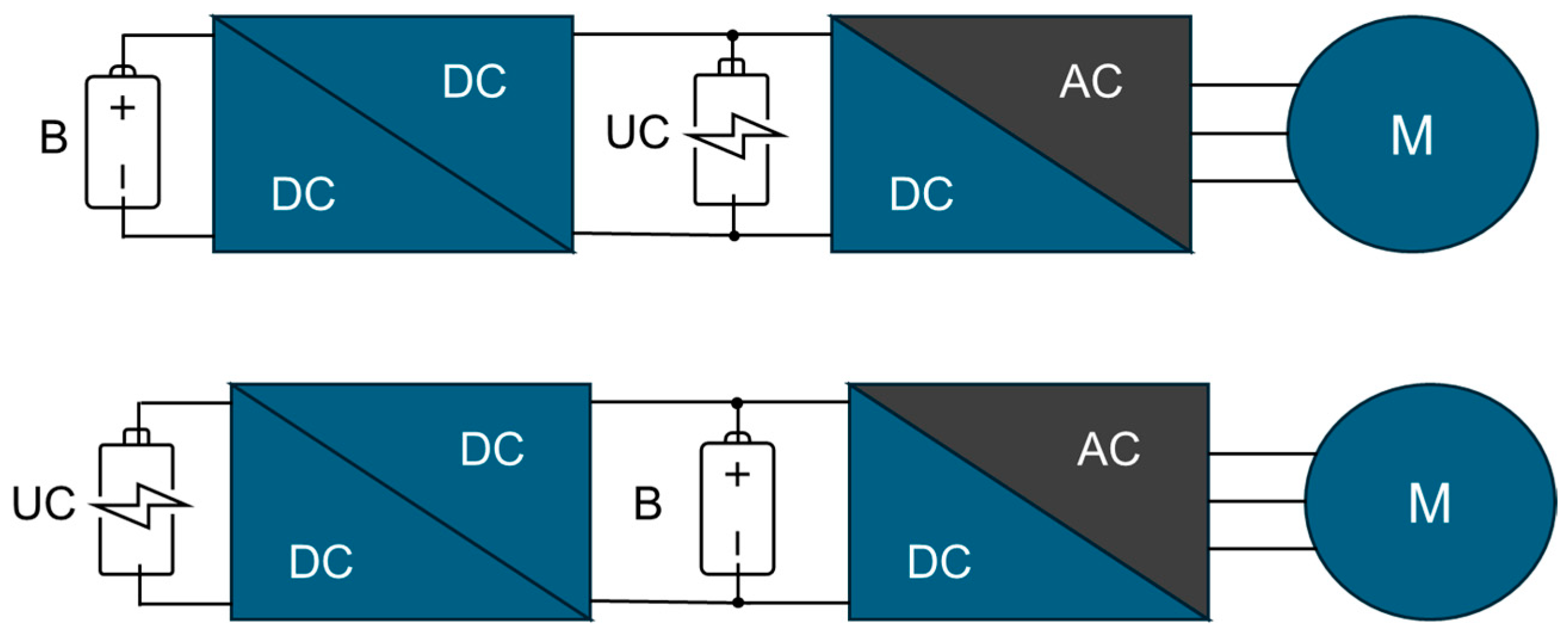
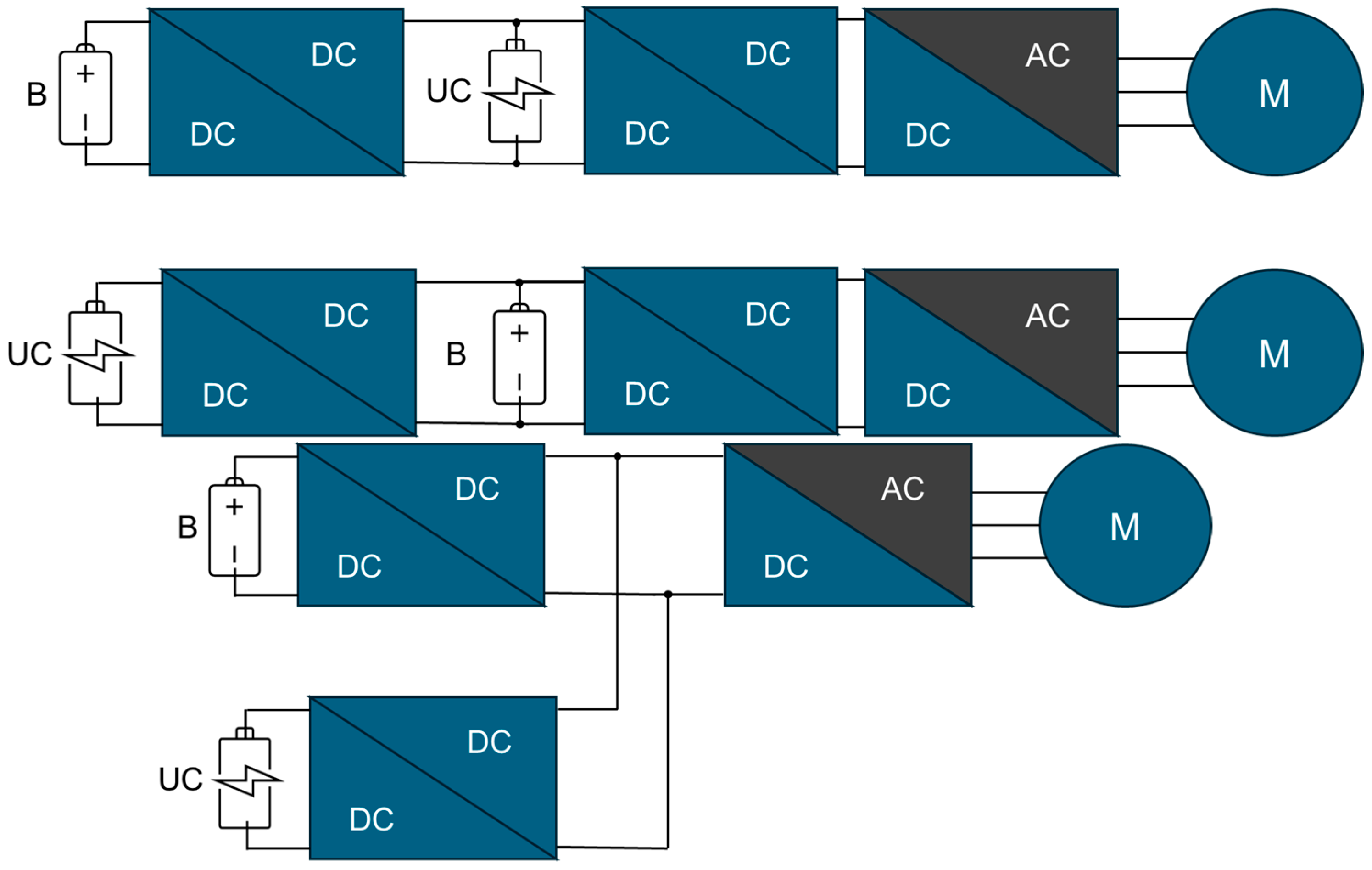
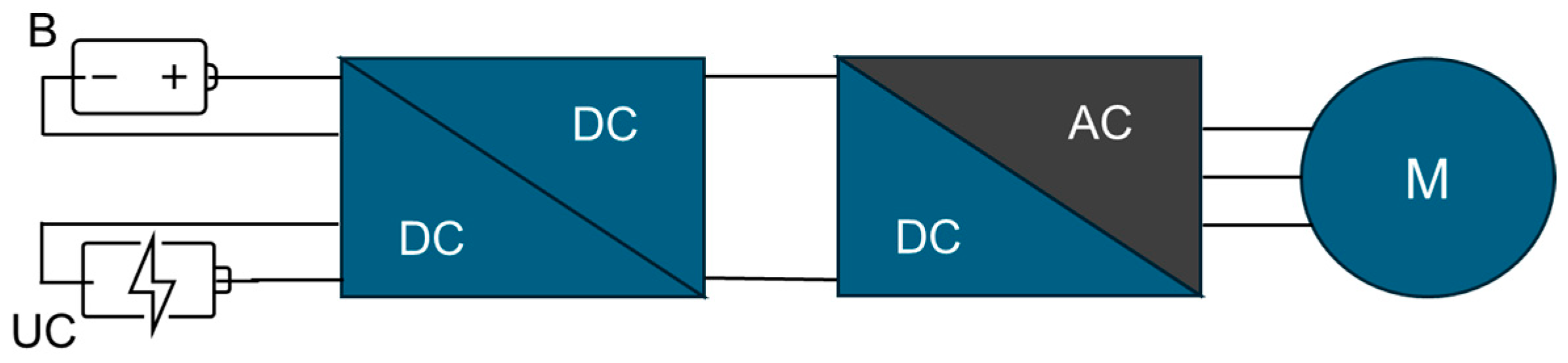
The effectiveness of utilizing the superior energy performance of the UC in the powertrain of an electric vehicle depends largely on how the UC is physically integrated with the battery and the rest of the powertrain. In general, common HESS architectures have a constructive topology divided into 4 classes (passive, semiactive, active and full active), shown in Figure 1, Figure 2, Figure 3 and Figure 4.
When selecting various HESS topologies to outfit electric vehicle powertrains, technical and financial performance criteria may be taken into consideration. In this regard, Table 3 is presented which summarizes the comparative CAPEX/OPEX expenses, weight and dimensions, efficiency and suitability for applications for above presented HESS topologies using batteries and UC: passive, semi-active, active and fully active. Additionally, it takes into account the range of requirements for EV powertrain applications where passive topologies are still feasible and active topologies are superior.
Constructive and interconnection topology is essential to be active type for the future development of HESSs, given the tremendous advancements in artificial intelligence applications, automation and production technologies [21]. However, it must be taken into consideration that active topology currently faces challenges in large-scale applicability and in different electric powertrain configurations (multiple classes and EV models) due to its high costs, complexity, and space requirements.

3. Control Algorithms for Ultracapacitors Integrated in Electric Vehicles’ Powertrains

3.1. Challenges and Objectives of Ultracapacitors Integration

The direct integration of ultracapacitors into the electric vehicle powertrain, despite the immediate energy benefits, presents a number of challenges that require complex control systems to optimize the low energy density, voltage variation, thermal management and, last but not least, cost optimization.
Because integrated ultracapacitors store much less energy per unit mass or volume than batteries, they are not capable of sustaining an electric vehicle alone for long periods of time (if energy densities of present lithium-ion batteries are 150–250 Wh/kg, ultracapacitors are typically limited to 5–15 Wh/kg). On the other hand, because UC serves as a high-power buffer for the main battery, absorbing the demands of high-power transient energy events, their incorporation into a hybrid energy storage system is necessary to protect the battery and increase its lifetime.
The voltage of an ultracapacitor decreases linearly with the amount of energy discharged, unlike batteries, whose voltage remains relatively constant during discharge (until near exhaustion) (an ultracapacitor at half its maximum voltage has only 25% of its stored energy left). This significant voltage fluctuation is problematic for the electric vehicle’s traction motor inverter, which requires sophisticated control and DC/DC converters to maintain a constant powertrain voltage. Complex control algorithms can be used to command and regulate the DC/DC converters to manage the optimal SOC (State of Charge) of the UC and dynamically change the voltage from the UC to the level required by the DC bus [29,30,31].
Although they are less susceptible to operating at extremely high or low temperatures than batteries, they can still produce excessive heat when operating at high currents, as might occur during high-speed driving. This heat can then spread or dissipate to other parts of the energy storage system, requiring the inclusion of a specific thermal management system in the storage system design. To prevent component degradation and maintain system reliability, a specialized thermal management system must be considered in the overall design of energy storage systems, even though UCs are robust devices to temperature fluctuations [32,33]. The need to monitor system/component temperatures and, if necessary, limit current to prevent overheating requires the use of a control system and sophisticated command and control algorithms.
The cost-effectiveness of integrating a UC package is not measured in terms of energy capacity, but rather in the value it adds by extending battery life, creating efficiency, and providing adequate dynamic performance. This is because, despite continued cost reductions, UCs can still be relatively expensive to implement in propulsion systems compared to the energy capacity they provide [17]. To optimize these benefits, support the higher initial investment, and increase the economic viability of the HESS or solution, the control algorithms must be sufficiently complex.
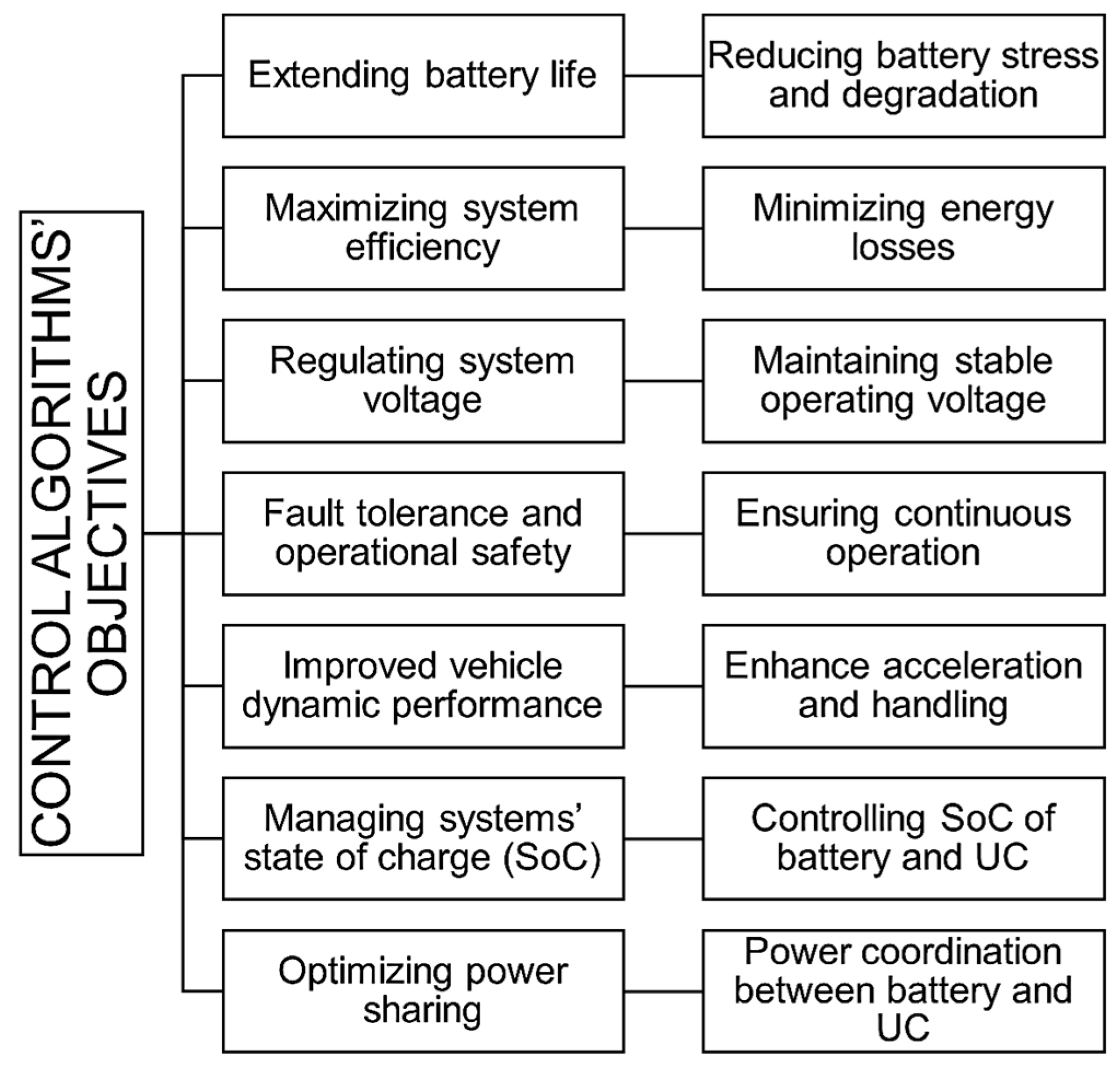
The challenges presented above related to the inclusion of UC in energy storage systems, emphasizing the critical role of advanced control algorithms in efficiently managing the power flow and optimizing the performance of electric vehicle propulsion systems integrated in UC. Control algorithms for ultracapacitors in electric vehicle propulsion systems are designed to achieve several interconnected objectives considering basic HESS KPIs: optimizing power sharing, extending battery life, maximizing system efficiency, regulating system voltage, managing battery state of charge (SOC) and UC, improved vehicle dynamic performance, fault tolerance and operational safety (Table 4, Figure 5).
The control objectives presented above are not the only possible ones, they are mainly (or be must) correlated with the architecture of the energy storage system and the operational and performance requirements of the electric vehicle.

3.2. Control Algorithms

Control algorithms for integrating ultracapacitors into electric propulsion systems can be classified according to how they approach energy management and the optimization of the overall system performance. They range from classical methods (such as threshold-based control or PID) to heuristic approaches (which use empirical rules for energy distribution). In recent years, there has been a trend towards intelligent algorithms, which use neural networks, fuzzy logic or model-based predictive control (MPC) to anticipate power requirements and adapt the control strategy in real time. The choice of methods depends on the complexity of the system, the performance requirements and the available processing capacity [34,35]. The integration of these algorithms significantly contributes to increasing energy efficiency, protecting the battery and improving the durability of the propulsion system.

3.2.1. Rule-Based Control (RBC)/Heuristic Control

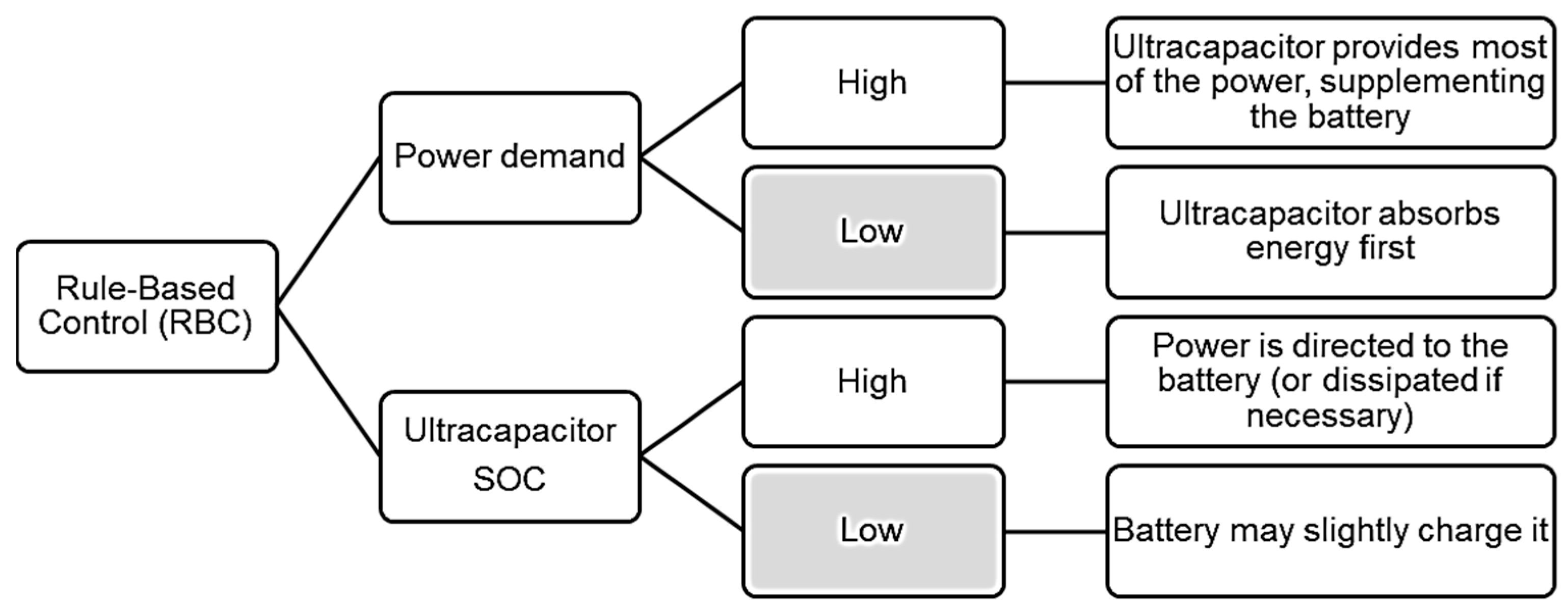
RBC is the simplest approach because it relies on predefined rules and thresholds (specific to design and operating parameters) to manage the power flow based on the following general principle: power splitting decisions are based on the power demand from the driver, the battery and ultracapacitor SOC, as well as other operational parameters (Figure 6). These rules are usually derived from extensive empirical data, simulations or expert knowledge. The main advantages are simple implementation, low computational burden, easy to understand, but there are also some disadvantages, such as suboptimal performance under variable operating conditions, inadaptability to system degradation or external disturbances, difficulty in defining process of exactly optimal thresholds.
A multi-layer control approach is used to identify the best energy management strategy for HESSs in electric vehicles [36]. The efficiency of a standard rule-based algorithm, an adaptive rule-based algorithm, and an advanced adaptive rule-based algorithm were considered in the analysis taking into account the following functional properties:
  • The standard rule-based algorithm uses fixed parameters that do not take into account the topographic features of the route
  • The adaptive rule-based algorithm adjusts the parameters based on the energy flow produced by regenerative braking
  • The advanced adaptive rule-based algorithm continuously updates the parameters considering the operating cycle.
Regardless of the driving (operating) cycle considered, the standard rule-based algorithm efficiently distributes the vehicle load current between the battery and the UC, while maintaining the battery current at a predetermined target value (usually the highest). The HESS manages the energy flow by considering the direction of the energy flow, the total requested load current, and the state of charge of the UC. The operational parameters of the algorithm are established using Equation (1).
If (It > 0) and (It < IBmax) then ICO = 0
If (It > 0) and (It > IBmax) and (SOCUC > SOCUCmin) then ICO = (It − IBmax)
If (It < 0) and (SOCUC < SOCUCmax) then Ico = It
where It is total load current of the vehicle, ICO is output current of DC-DC converter, IB is battery current, VCO is output voltage of DC-DC converter and SOCUC is ultracapacitor state of charge.
When the electric vehicle’s total load current is less than the maximum battery current, the HESS can supply current from the battery to the vehicle using a standard rule-based algorithm. Additionally, it limits the battery current to its maximum value during high load driving cycles and uses the UC to capture all regenerative energy during the driving cycle’s deceleration.
The adaptive rule-based algorithm dynamically modifies the algorithm coefficients to improve system performance. Both the regenerative current and the total current demand required for a given driving cycle are calculated taking into account variables such as the electric vehicle model parameters, vehicle speed, and road gradient. The energy distribution between the battery and UC is also independently optimized. By estimating the potential regenerative energy and establishing an energy sharing ratio between the battery and the UC, which is modified according to the driving cycle, the energy management system (EMS) ensures that the HESS operates efficiently and that the UC utilizes all the regenerative energy during the driving cycle.
By estimating the regenerative energy from the current driving cycle, the advanced adaptive rule-based algorithm calculates the energy sharing ratio between the battery and the UC. This method guarantees that the supercapacitor manages peak loads and cooperates with the battery to meet the EVs’ transient load requirements by adjusting the energy sharing ratio and the maximum permitted battery current in accordance with the amount of regenerative energy available (this method maximizes the reuse of the regenerative energy produced, ensuring sufficient capacity to deliver the powertrain the energy needed during vehicle acceleration).
Simulations were conducted in [36] using three standard driving cycles (UDDS, NYCC, and Japan1015) and varying initial states of charge of the UCs (in the first case 92%, in the second case 51% and in the third case 20%) to evaluate the effectiveness of these control strategies. In the first case, the standard adaptive rule-based algorithm allowed the HESS to complete 29 driving cycles for UDDS conditions, 234 for NYCC conditions and 89 for Japan1015 conditions. In contrast, the advanced rule-based algorithm significantly improved these results, allowing 30 driving cycles for UDDS conditions, 357 for NYCC conditions, and 100 for Japan1015 conditions. Thus, it was proven that the HESS control by advanced adaptive algorithm proved effective for all three considered driving cycles, as it efficiently manages the energy sharing between the battery and the ultracapacitor in the HESS.
The results of the aforementioned study demonstrated that both the adaptive rule-based algorithm and the standard rule-based algorithm successfully mitigate current peaks and reduce battery power consumption (as well as the total power consumption of electric vehicles). Comparing the performance of these two algorithms with the efficiency of the advanced adaptive algorithm, it is observed that in addition to the benefits presented above, an increase in the maximum number of driving cycles that can occur is also achieved.
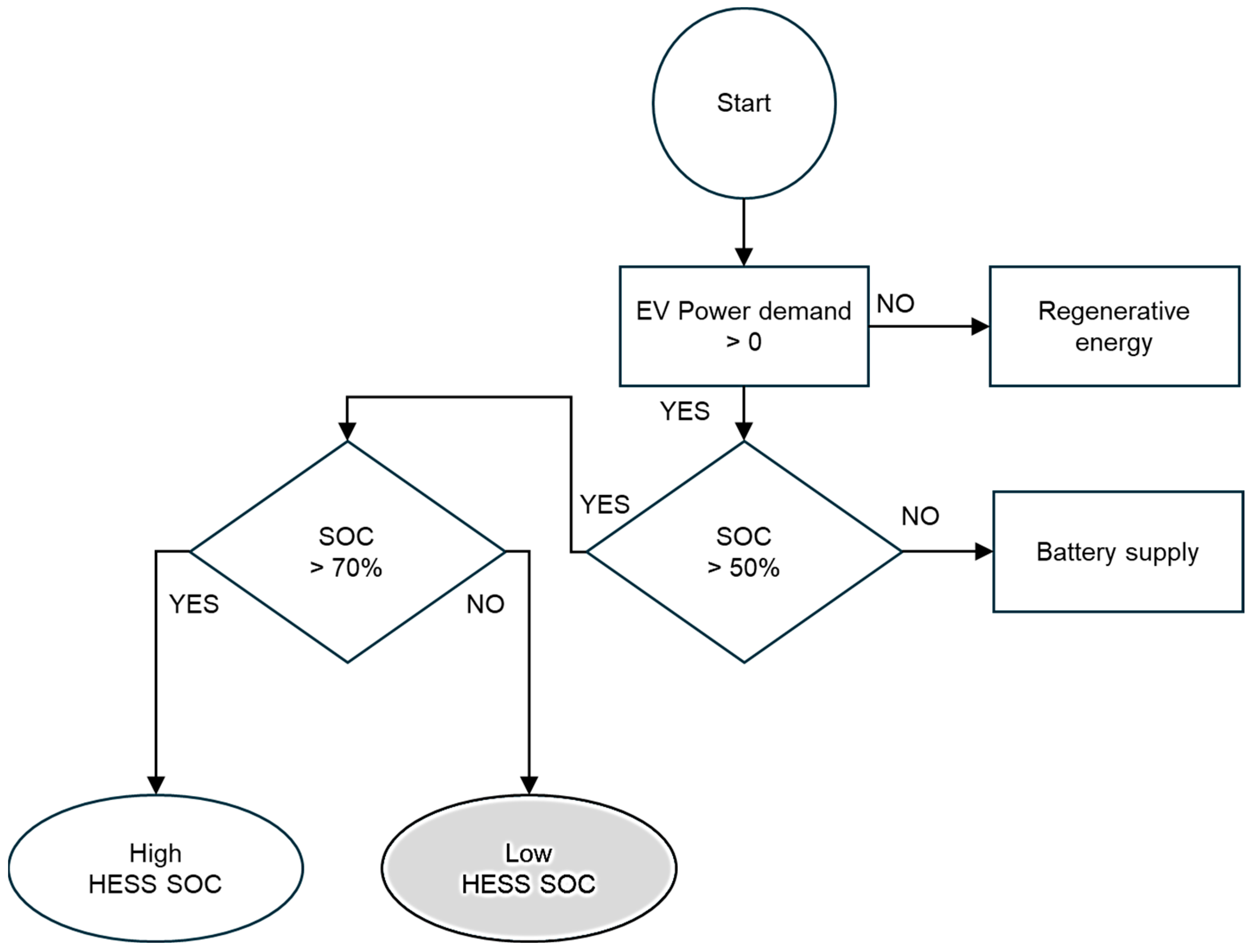
The rule-based HESS active power system (battery controller and ultracapacitor controller) for a low-power electric vehicle is approached differently in [37]. Since the proposed HESS active power scheme reduces the battery load, it improves the controllability of the system and provides efficient and superior control while an electric vehicle is in operation (Figure 7). Simulation results for different control modes demonstrate that the battery and ultracapacitor can effectively share active power based on the state of charge of the energy storage device, the peak load requirement, the instantaneous fluctuations of the electric vehicle load, and the load voltage adjustments.
Real-time parameters and suboptimal power splitting, which has nonlinear data and linguistic knowledge, are used in fuzzy rule-based control to determine the best result. With real-time parameters, the primary benefits are adaptability (easy to adjust) and robustness (tolerance to imprecise measurements). Conventional fuzzy strategy, adaptive fuzzy strategy, and predictive fuzzy strategy are its subcategories.
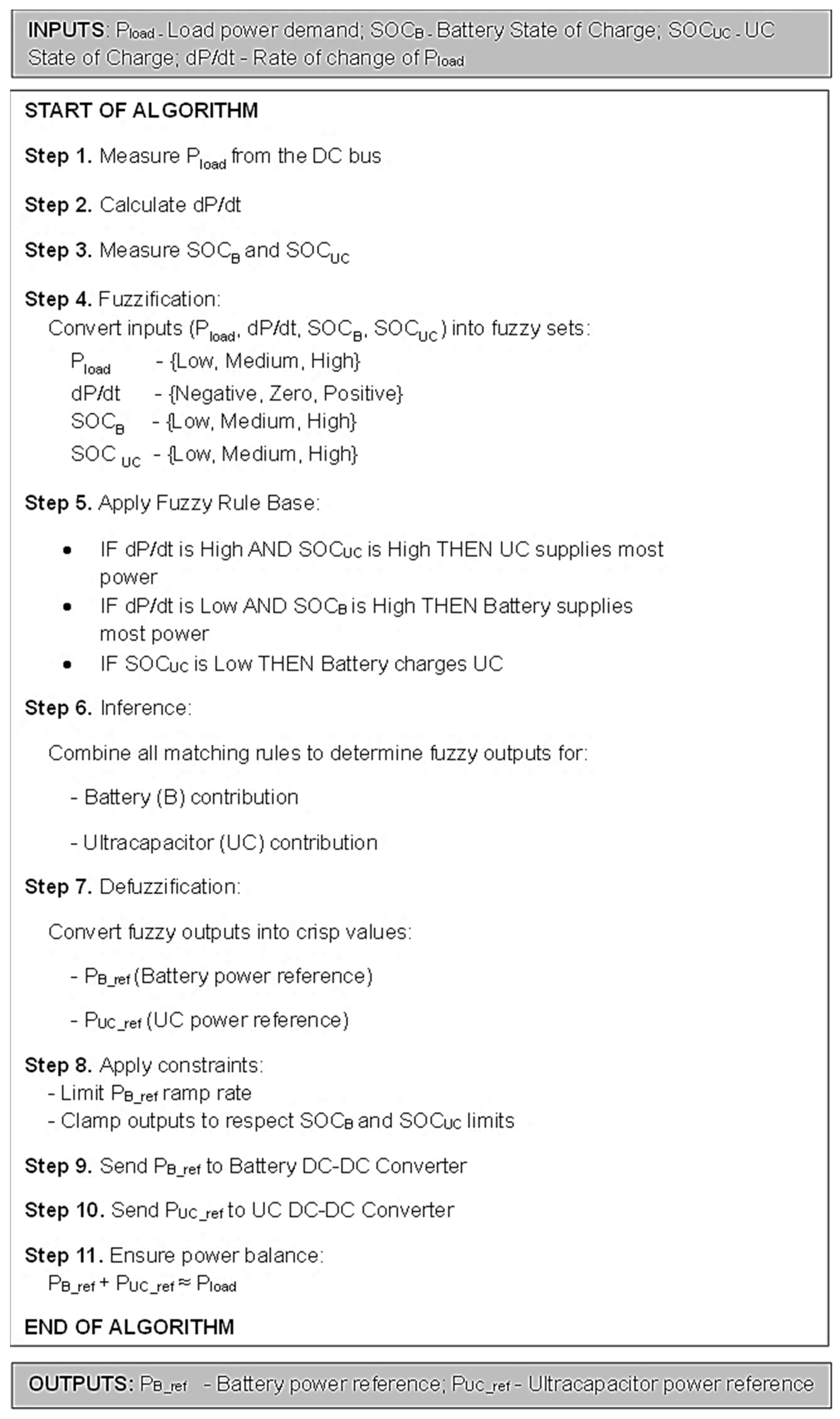
Figure 8 represents a general fuzzy logic-based control algorithm for a HESS consisting of a battery and an ultracapacitor, with a detailed explanation of the algorithm steps. The fuzzy control algorithm for HESS allocates power between a battery and an ultracapacitor based on load demand and SOC levels. Inputs include the load power (Pload), its rate of change (dP/dt), and the SOC of both the battery and UC. The controller fuzzifies these inputs, applies a rule base to decide the power sharing, and defuzzifies the outputs to produce two references: PB_ref and PUC_ref. Fast power transients are handled by the UC, the battery provides constant power and charges the UC as needed, and a ramp limiter is used to filter out peaks to prevent battery degradation. The final outputs control the DC-DC converters to maintain DC bus stability and ensure SOC constraints.
One of the first and early attempts in this regard was carried out through simulation activities, which were used to verify the energy management strategy within the Urban Dynamometer Driving Schedule (UDDS) dynamic driving cycle by controlling the HESS (battery + UC) with fuzzy algorithms [38]. The results show that the proposed energy management strategy based on fuzzy logic can ensure the operation of the battery pack in a high efficiency range and can present better performances than the traditional control strategy based on logical thresholds. The electricity economy of the HESS was improved by 4.1%, and the negative influences of high-current discharge and charge on the battery pack were avoided.
The real-time implementation of a fuzzy logic energy management strategy was applied to a hybrid battery-ultracapacitor energy storage system and associated with a permanent magnet synchronous motor (PMSM) emulating the traction part of an electric vehicle [39]. Based on the results, it was determined that the fuzzy logic supervisor divides the frequency efficiently and acts intelligently to smoothly permute between the various operating modes. The suggested fuzzy logic supervisor was able to guarantee the proper operation of each energy source (based on the dynamics of the energy requirement) and deliver quick and high performance at various EV speed levels, in addition to the seamless operation of the entire HESS. An ideal power flow to the powertrain was maintained (while maintaining the UC operation within a safe voltage range) as a result of the discrete and fluid regulation of both the DC bus voltages and the UC voltages (regardless of the variations in the vehicle speed profile, according to the operating conditions).
In order to identify the optimal solution for the HESS control strategy of an electric vehicle, the efficiency of fuzzy, GA-Fuzzy and PSO-Fuzzy control algorithms was analyzed under the same optimization conditions (electric vehicle operation in three driving cycles: UDDS, NEDC and China City) [40]. Based on the simulation results, it was observed that, with fuzzy control, the fluctuation of the battery output current is more stable. Under the selected UDDS, NEDC and China City cycles, the peak current of GA-Fuzzy control is lower than PSO-Fuzzy control by 35.6001 A, 19.9046 A, and 46.5270 A, respectively. Also, the total power consumption of GA-Fuzzy control decreased by 2.4489%, 9.0604%, and 2.5332%, respectively, and the system power consumption of PSO-Fuzzy control decreased by 1.0859%, 0.9659%, and 0.2650%, respectively, compared with fuzzy control. Combined with the comparative results of battery operating current, the optimization effect by using GA-Fuzzy control algorithm is the best in terms of battery protection and stability of battery life.
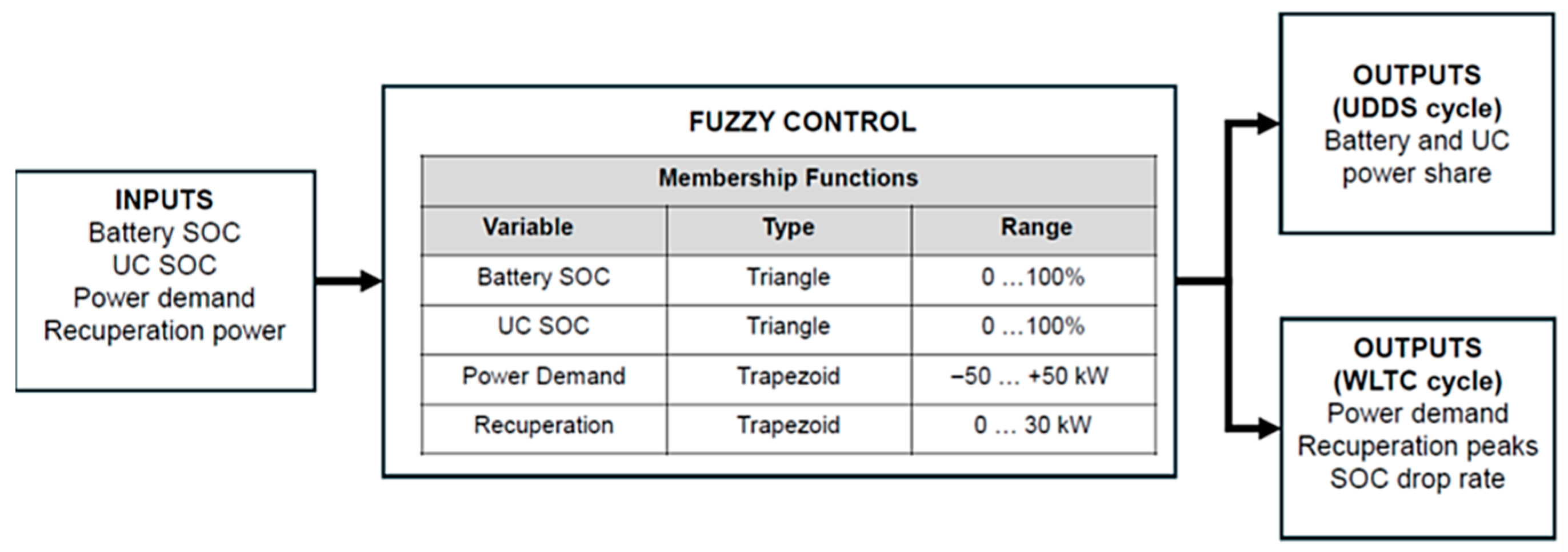
In the examples presented above, it is observed that several driving cycles have been used. It should be noted that there are major differences between them, and normally all research should be related to the WLTC cycle (it has the combination of urban and extra-urban traffic). Based on the profile, it can be said that, for example, WLTC is more dynamic and aggressive than UDDS, with higher acceleration and more frequent transitions. In the case of WLTC fuzzy control, the membership functions will be affected in terms of power demand (wider range, higher granularity), recovery power (more frequent and higher power peaks) and SOC thresholds (faster depletion-the SOC decrease rate is about 1% for UDDS and 2.5% for WLTC). An example of how the outputs in the case of HESS control are affected for different driving cycles is shown in Figure 9.
This method exploits the distinct frequency characteristics of the power demand to distribute power between the battery and the ultracapacitor. The operating principle is based on a low-pass filter (LPF) applied to the total power demand. The low-frequency components (constant, long-term power) are assigned to the battery, while the high-frequency components (transient, peak power) are handled by the ultracapacitor.
The main advantage of the method is that it effectively separates the steady-state power from the transient power, but there is also the important disadvantage that the choice of the filter cutoff frequency is critical and can have a significant impact on performance (a fixed/preset cutoff frequency may not be optimal for all driving/discharging cycles or battery SOC ranges).
One of the energy management strategies for EVs equipped with HESSs is the use of low-pass filter (LPF), a strategy researched and developed in [41]. An iterative approach based on the Ragone graph (called LPF-Iterative) was used to solve the primary problem of LPF (Low Power Factor) based power management, which is figuring out the ideal decoupling frequency. Comparative analyses of this initial method’s performance were primarily conducted in relation to the use of an iterative process that was optimized using the Particle Swarm Optimization (LPF-PSO) algorithm. The results obtained showed that LPF-Iterative performed better than LPF-PSO, offering a notable 83.51% increase in computational speed. It was also determined that the control method utilizing the LPF-Iterative algorithm provides a workable solution for enhancing power distribution and battery life in EVs whose power sources are outfitted with HESSs.
In [42], a hybrid HESS (battery + UC) power management approach based on adaptive digital filters (ADFBEMS) was put forth for electric vehicles. The digital filter tracks the instantaneous load spectrum using the sliding discrete fast Fourier transform (SDFFT), and it achieves frequency-based load distribution by using a low-pass filter with an adaptive cutoff frequency. The battery supplies the remaining load component, while UCs handle the high-frequency portion of the load. By contrasting it with the conventional power management approach based on the fixed cutoff frequency filter, hardware-based experiments conducted under the WLTC driving cycle have demonstrated the control’s optimization.
The battery module lifetime benefited from the reduction in the high-frequency ratio by 27.46% and the power load stress by 11.06%, respectively.
The moving average filter (MAF) method determines the sampling frequency in HESSs, while the upper limit of the battery charging and discharging power fluctuation frequency is regarded as the cutoff frequency. Additionally, the wavelet transform (WT) is a powerful analysis tool in signal processing that is used in the development of frequency-decoupled algorithms.
In this regard, various power management strategies through MAF and WT control algorithms have been applied in [43], to achieve/analyze the optimal distribution of load power between the battery and the supercapacitor. Through a parameter called “power allocation effect”, it was concluded that the WT method has a better power allocation effect than the MAF method (the average values calculated for different driving cycles are 0.9479 and 0.8123, respectively).
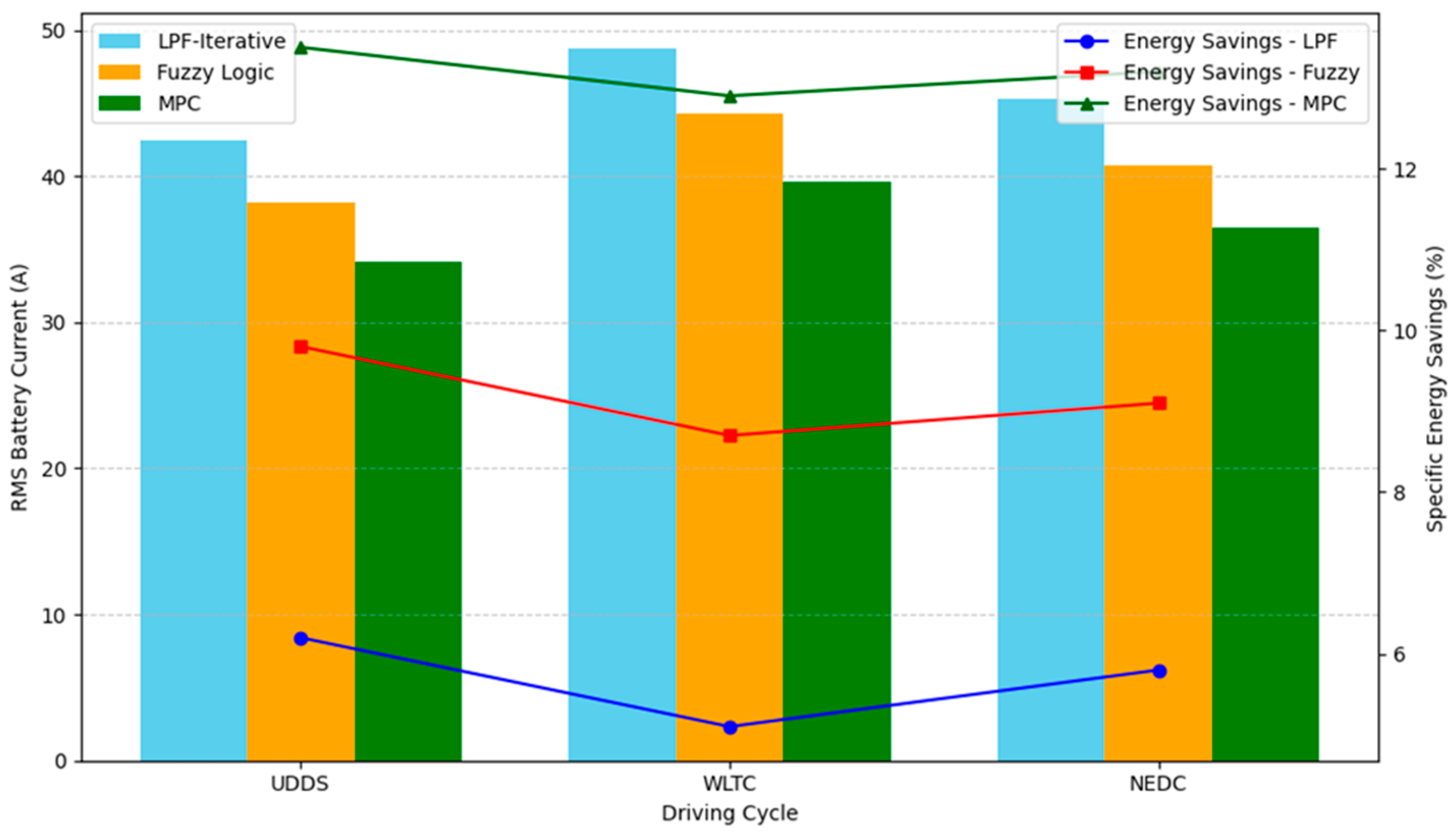
In a brief recap of the control methods of HESS hybrid systems presented so far, in Figure 9 the performance of the different control methods in terms of RMS battery current and specific energy savings is compared, depending on 3 standard driving cycles (the differences and influences due to the different dynamics of the driving cycles can be observed). The data presented in Figure 10 were compiled from references [44,45,46,47].

3.2.2. Optimization-Based Control

The control approach has the ability to handle complex constraints, adapt to changing circumstances, and incorporate data on future driving habits (or operating conditions, if considered and incorporated into the model). The goal of the algorithms is to minimize an objective function to determine the best power distribution, often taking into account a number of constraints (such as current limits or SOC). However, implementing this approach is difficult because it requires a precise system model, which is very sensitive to the accuracy of the prediction, and requires a significant amount of computing power.
Several control strategies, including the following, can be used to instantly optimize the flow and demand of energy:
  • Equivalent Consumption Minimization Strategy (ECMS)
  • Dynamic Programming (DP)
  • Model Predictive Control (MPC)
Equivalent Consumption Minimization Strategy, or ECMS, is a popular method for hybrid electric vehicles that can be modified for HESS. It attempts to minimize the total equivalent consumption at each moment by converting the energy consumption of the ultracapacitor into an equivalent fuel/energy consumption of the battery. An important component that can be modified online is the “equivalence factor”. The possibility of using/implementing the ECMS aging control algorithm in HESS control was investigated in [48]. The Ah flow method was used as the aging term in the ECMS cost function (regardless of the driving cycles considered) and a fixed equivalence factor was taken into account. The energy capacity of the vehicle battery was correlated with the aging coefficient. Based on the results, it was determined that the optimal ECMS aging controller was developed. It aims to preserve the battery life by minimizing the state of charge ripples and optimizes the HESS operation without requiring predictions or knowledge of future driving actions. By integrating operating conditions determined by environmental perception with ECMS, this research [49] proposes an environmental perception-based HESS control architecture to maximize the parallel power system management for hybrid vehicles. The overall control process is divided into two parts: online testing and offline optimization. The offline process involves optimizing the equivalence factors based on varying degrees of environment and training the environmental perception using GCN and attention mechanisms [50]. The lookup of the equivalence factor table in online testing is done based on the environmental level determined by the environmental perception. Consequently, the optimized equivalence factor is used to complete the energy management control, and the simulation results indicated a 7.25% improvement in performance (compared to the traditional ECMS model).
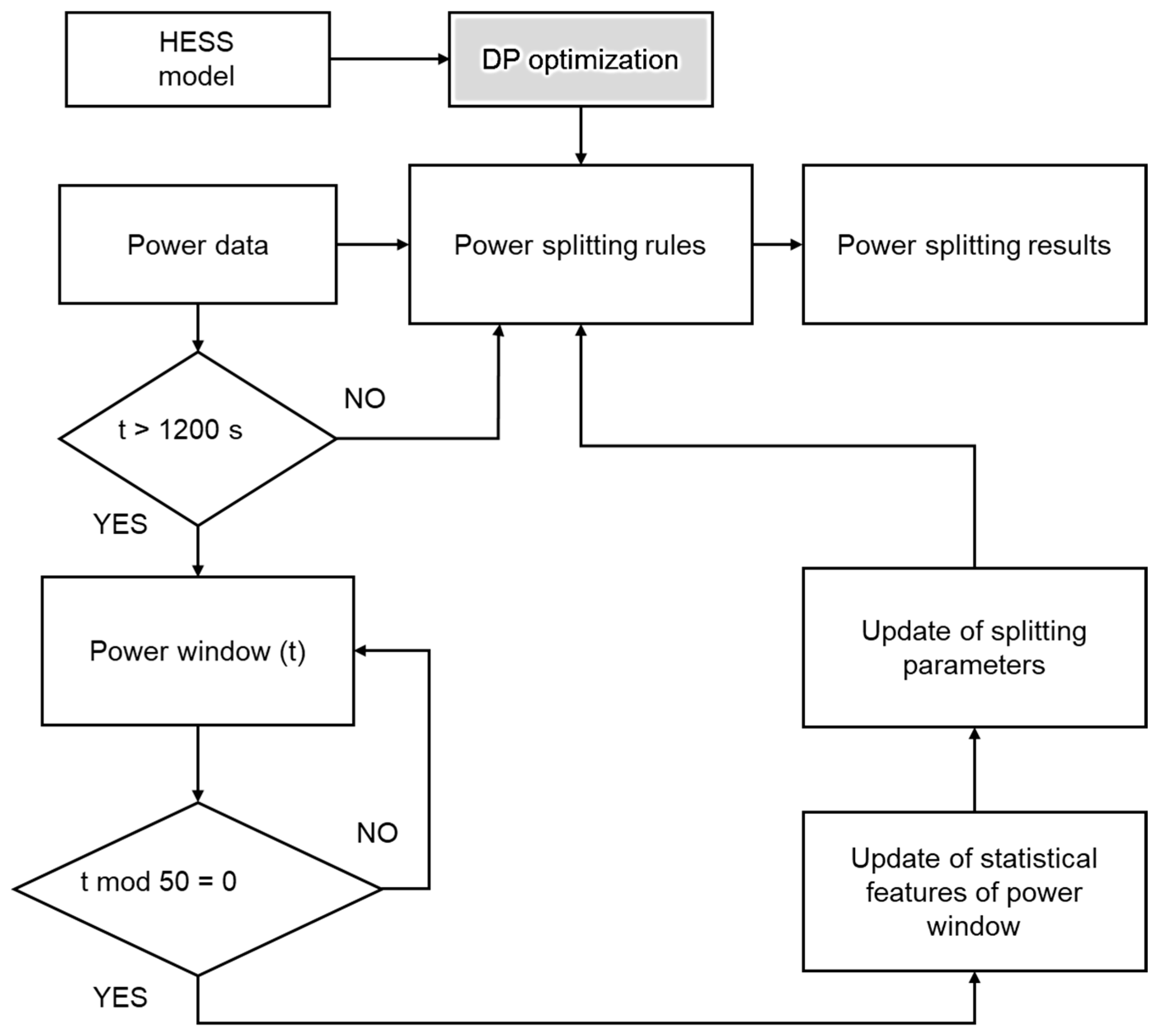
Dynamic Programming (DP) is an offline optimization technique that determines the best global energy management plan for a given driving cycle but cannot be implemented in real time due to its computational complexity. It is extremely useful when creating rules for real-time controllers and for benchmarking. The early research, presented in [51], use dynamic programming (DP) analysis to identify the optimal control mode in terms of both energy saving and battery life extension (Figure 11).
A functional relationship between the power-sharing parameters and charging statistics is established (using a rule-based control strategy adaptive to load variation) by extracting three-segment control rules from the DP results for four distinct types of charging cycles. The results demonstrate that the suggested strategy is more capable of protecting the battery and conserving energy under unknown charging conditions than the rule-based control strategy (the battery discharge in Ah and the total energy loss are reduced by 3.4% to 15.7% and 3.0% to 15.1%, respectively). It is determined that the suggested strategy (DP) can achieve near-optimal real-time energy management with low computational costs, despite the fact that the obtained results are fairly close. However, the authors conclude that more research is required in this area.
There are methods that use DP algorithms to solve the problem of optimizing energy management in HESSs, because the rule-based strategy is empirical and cannot guarantee to obtain the best efficiency optimization solution. According to [52], the HESSs managed by the DP algorithm strategy can reduce energy consumption by 4.8% (for NEDC driving cycle conditions) compared to the rule-based strategy. In addition, the HESS managed by the power sharing strategy derived from the DP approach can reduce consumption by 17.6% compared to a battery-only electric vehicle. The final conclusion of the study demonstrates that the optimized DP strategy provides lower energy consumption and higher efficiency of the energy storage system compared to the rule-based strategy.
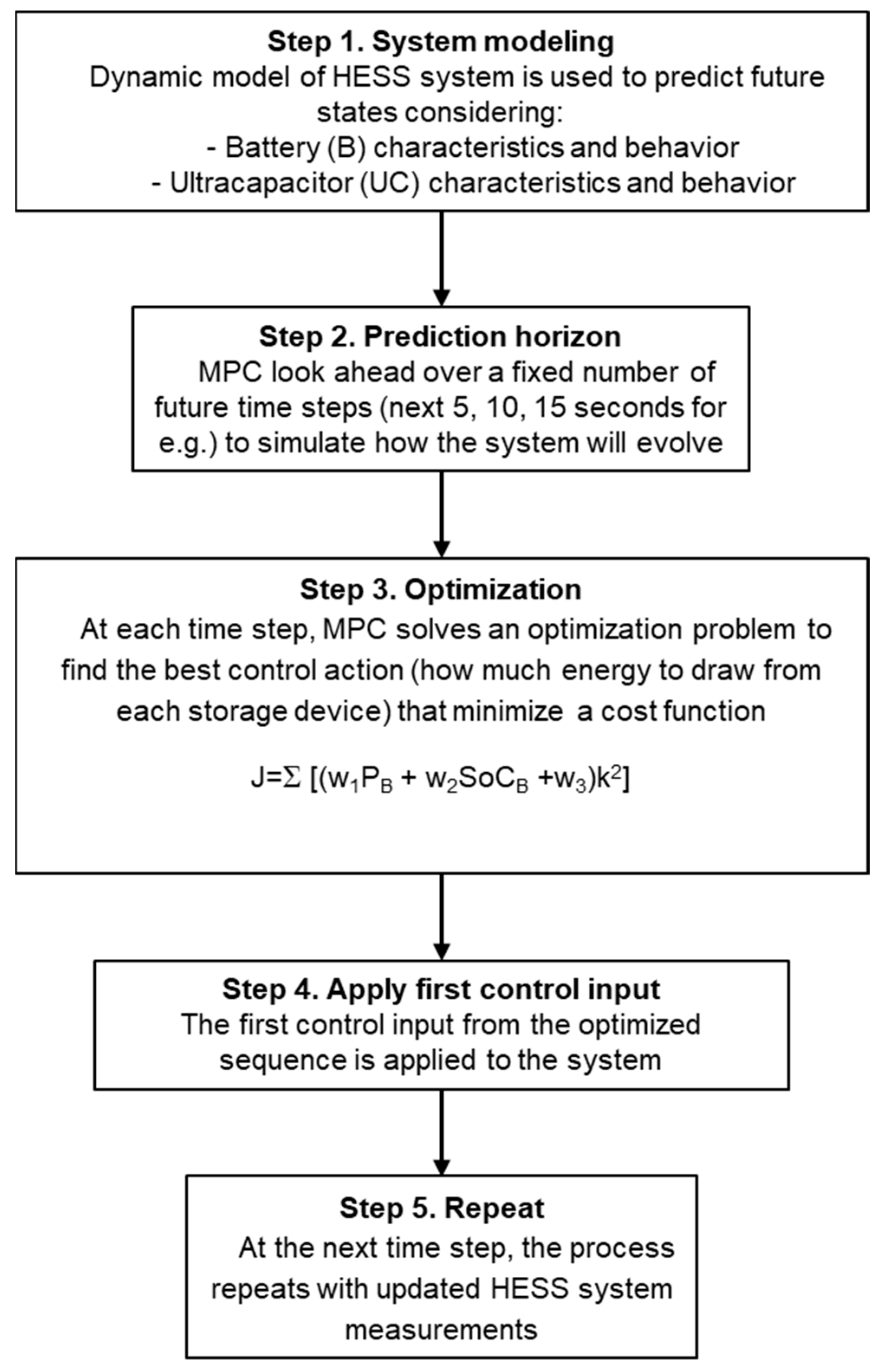
The idea behind using Model Predictive Control (MPC) as optimization-based control technique is to predict how a system will behave in the future, over a limited period of time, using a dynamic model of the system (battery, ultracapacitor, and vehicle dynamics). At each time step, it then solves an optimization problem to identify the best course of action to control a cost function (such as energy consumption or battery degradation) while respecting constraints (Figure 12). The procedure is repeated after the first control action is applied.
With current parametric modeling techniques, model predictive control (MPC)-based power management in electric vehicles with hybrid energy storage systems is susceptible to model accuracy effects and parameter sensitivity. To overcome these shortcomings, a new data-driven hierarchical predictive control-based power management system is proposed in [53], in which the upper layer uses an optimized long-short-term memory (LSTM) network for driving prediction (allowing cost-effective acquisition of load power demands). To maximize power distribution between the UC and the battery (while minimizing battery capacity losses), a data-driven predictive control for HESS is proposed in the lower layer. In contrast to traditional MPC, data-driven predictive control is based on a non-parametric model that is constructed solely from HESS input-output data. This model enables flexible handling of a range of nonlinearities and uncertainties in different tasks and operating environments. When compared to predictive control based on nonlinear models, data-driven predictive control can lower overall operating costs by up to about 23%.

3.2.3. Intelligent Control (AI/ML-Based)

The application of convolutional neural networks, hybrid models combining regression techniques, ensemble learning, reinforcement learning, genetic algorithms, short-term memory algorithms, and graph neural networks for a variety of tasks (classification, regression, optimization, or system management) in the energy sector has grown exponentially in the last several years [54]. In addition to providing a number of opportunities to enhance energy, economic, and environmental performance and thereby support sustainability goals, artificial intelligence is poised to become a crucial component of research in energy conversion systems and the energy sector as a whole [55]. It will also significantly improve benchmark performance for a variety of energy conversion and storage tasks when compared to traditional or non-AI methods. By using machine learning and artificial intelligence techniques, these methods for optimizing energy management in HESSs for electric vehicles can learn the best control strategies from data or adapt to changing conditions, which define how an electric vehicle operates in real-world scenarios. The most common approaches, along with the general operating principle, advantages and disadvantages of intelligent control algorithms are presented in Table 5.
Strong machine learning models called neural networks (NNs) can capture intricate, nonlinear relationships between input and output properties. By learning directly from data, NNs are able to model intricate dependencies that are frequently challenging to articulate analytically or through traditional control strategies. Using both historical and real-time data, neural networks provide a scalable and flexible method to enhance the performance, efficiency, and reliability of complex energy systems. There are several ways in which NNs can be used to control electric vehicle HESSs (Table 6) [56]:
  • Predicting optimal energy sharing.
  • Estimation of system states: NNs can be trained to estimate internal system states, such as battery and UC status, energy consumption trends, or thermal conditions, which are expensive or difficult to measure directly. Predictive maintenance, fault detection, and system monitoring can be improved through these estimates.
In the case of optimal energy sharing prediction, neural networks (NNs) can learn to predict the most efficient distribution of energy between energy sources by evaluating real-time input data, including driver driving style, battery and UC charge status, vehicle speed, and environmental conditions. This makes it possible to implement dynamic, data-driven energy management plans that adapt to changing operational circumstances.
For more accurate system state estimation, neural networks (NNs) can be trained to estimate specific internal system states (such as battery and UC status), energy consumption trends, or thermal conditions, which are expensive and/or difficult to measure directly. Also, collaterally, other estimates regarding predictive maintenance, fault detection, and system monitoring can be used to increase the efficiency of energy storage systems.
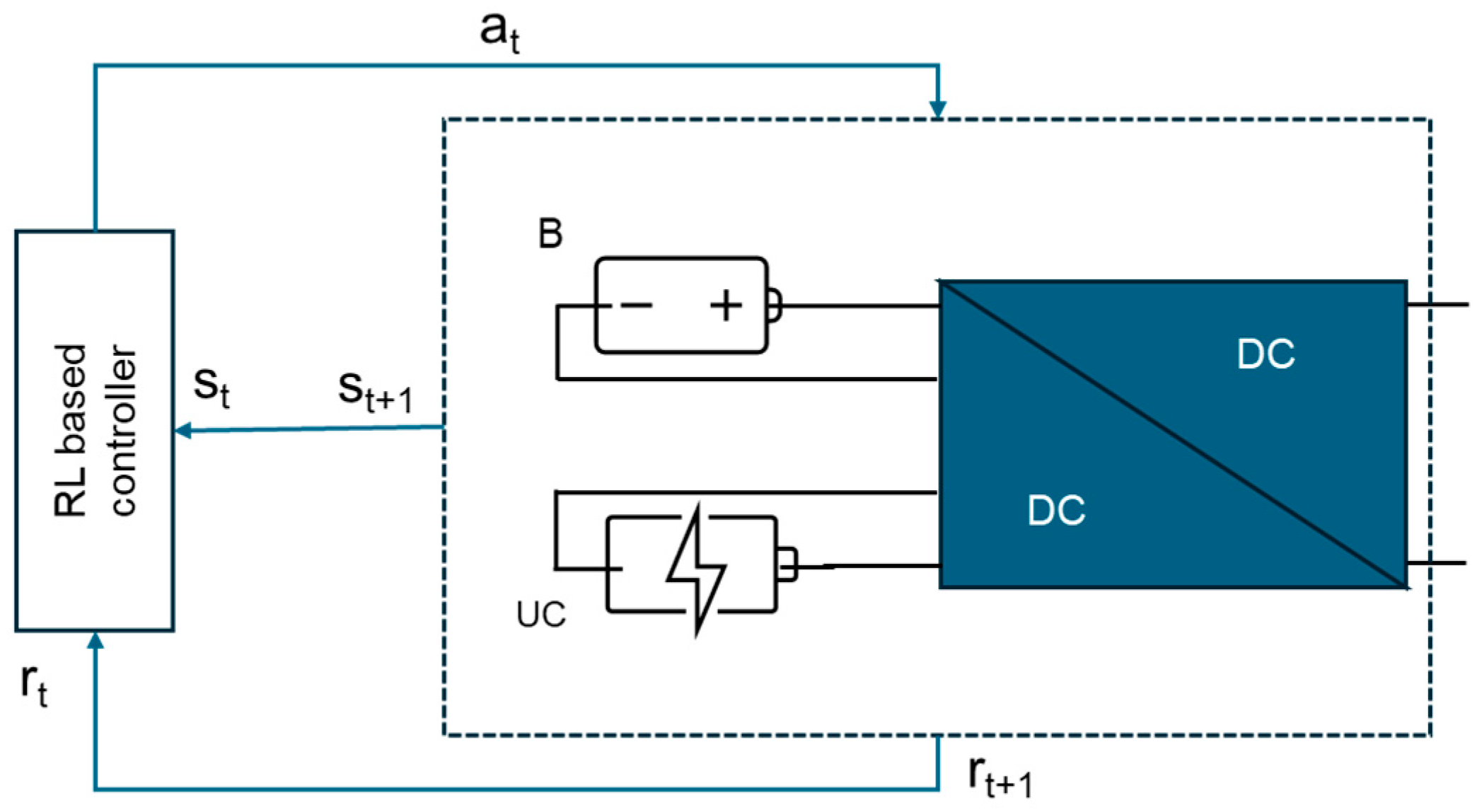
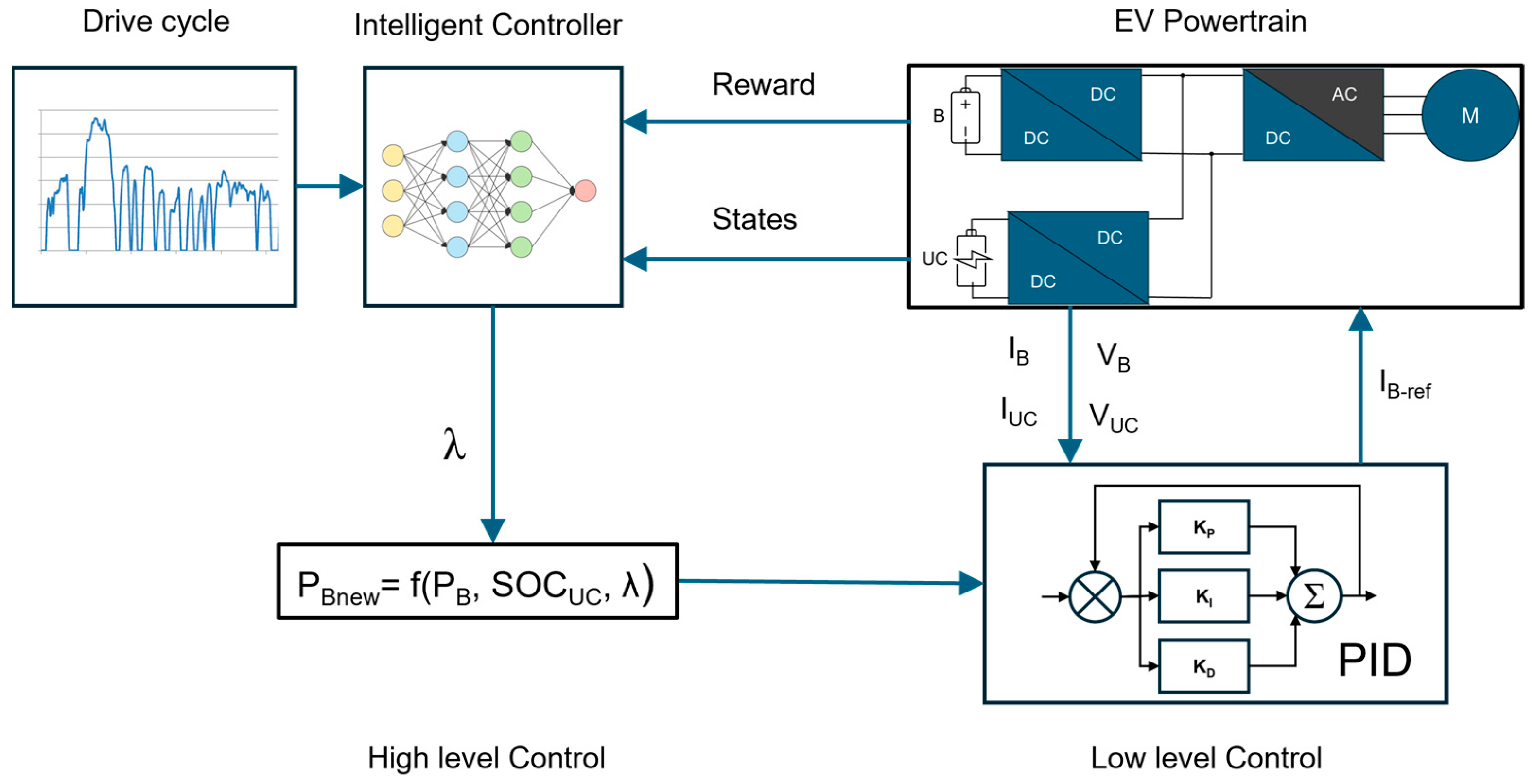
A reinforcement learning (RL)-based power management (control) strategy for minimizing real-time energy losses is proposed to achieve the optimal energy distribution between the battery and the ultracapacitor (Figure 13), which is a critical issue for the hybrid energy storage system [57]. The Kullback–Leibler divergence rate is used to determine when the power management strategy update is initiated, and the power transition probability matrices are updated according to the new application duty cycle to further minimize the energy losses. The suggested control method has been verified under various circumstances, taking into account influencing factors such as duty cycles, operating states, temperatures, and SOC values (battery and UC). According to a comparison between rule-based energy management and RL-based online energy management, the latter approach can increase the efficiency of energy management (the relative reduction in total power losses can reach 16.8%).
Because of its instantaneous optimization and computational simplicity, the indirect optimal control method of EV energy management (EMS) based on the Pontryagin minimum principle (PMP) draws attention in this direction. In order to reduce battery degradation in a hybrid HESS EV (Figure 14), the online hybrid EMS solution is examined in [58] by integrating PMP and deep reinforcement learning (RL). By keeping the UC state of charge within the desired range and minimizing the battery current for various driving profiles, the experimental results demonstrate the efficacy of deep reinforcement learning for optimal cost estimation to satisfy the UC load sustainability. Comparing this EMS control method to the standard EMS performance, a notable improvement of 900 charging cycles is obtained.
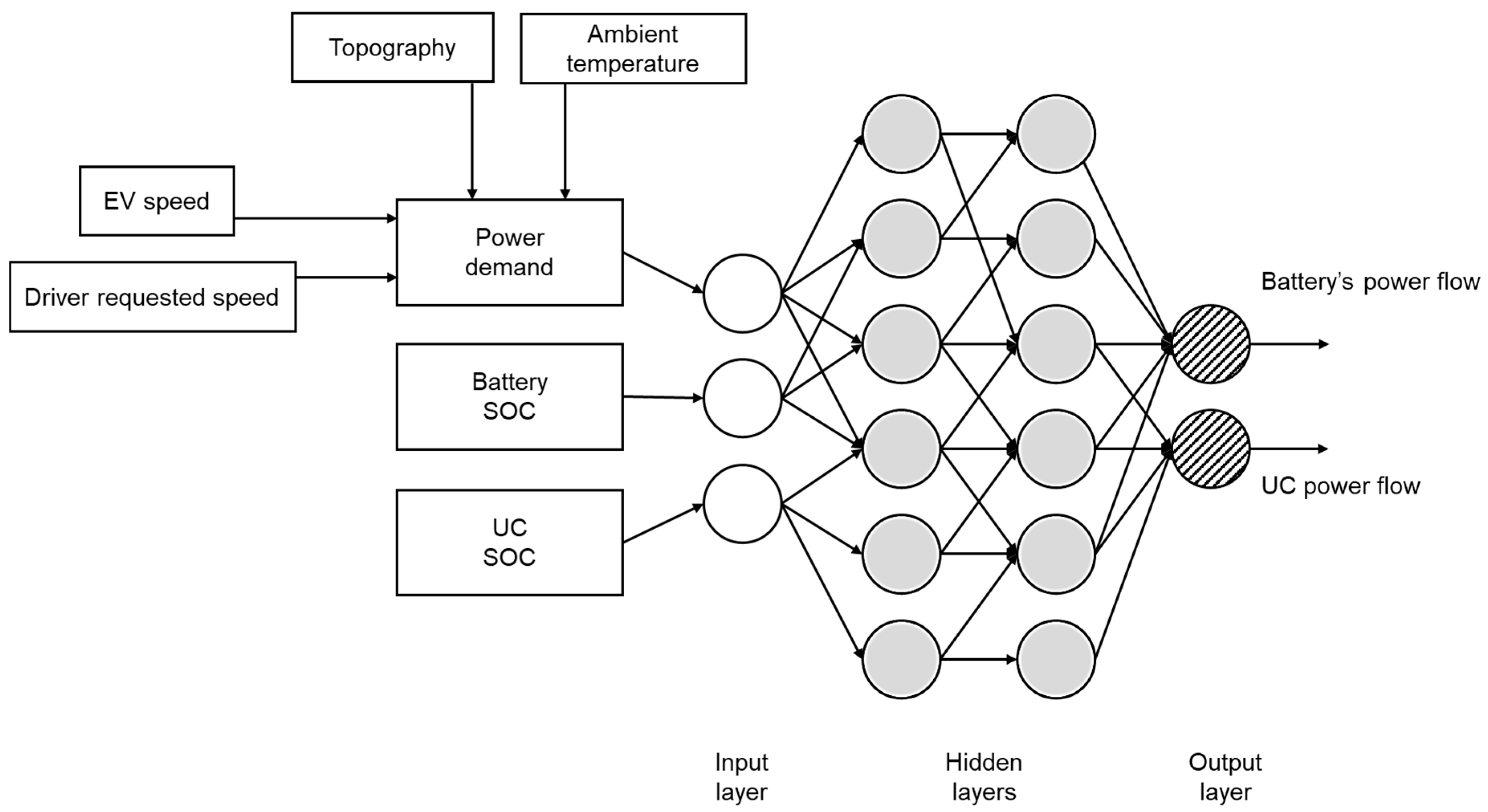
The application of DL in HESS management can be applied to manage the hybrid energy system of electric vehicles (battery, ultracapacitor, motor) by controlling the energy flow between the energy storage and different consumption modules [59]. The vehicle speed, the desired speed, the electric motor power, SOC of the battery and the ultracapacitor, the terrain topology and the outdoor temperature are the inputs used by the proposed Artificial Neural Network (ANN). The neural network construction contains two hidden layers (each layer having fifty nodes), having the hyperbolic tangent as the activation function and the identity function at the output connections (Figure 15). The input/output power flow of the battery and UC are the outputs of the neural network. The neural network was validated using 20 distinct datasets (16 for training and 4 for testing). According to the results of the neural network training, the system can achieve a 2.68% increase in the travel efficiency for the UDDS driving cycle, which is represented by the autonomy of the electric vehicle (due to the optimization of energy consumption).
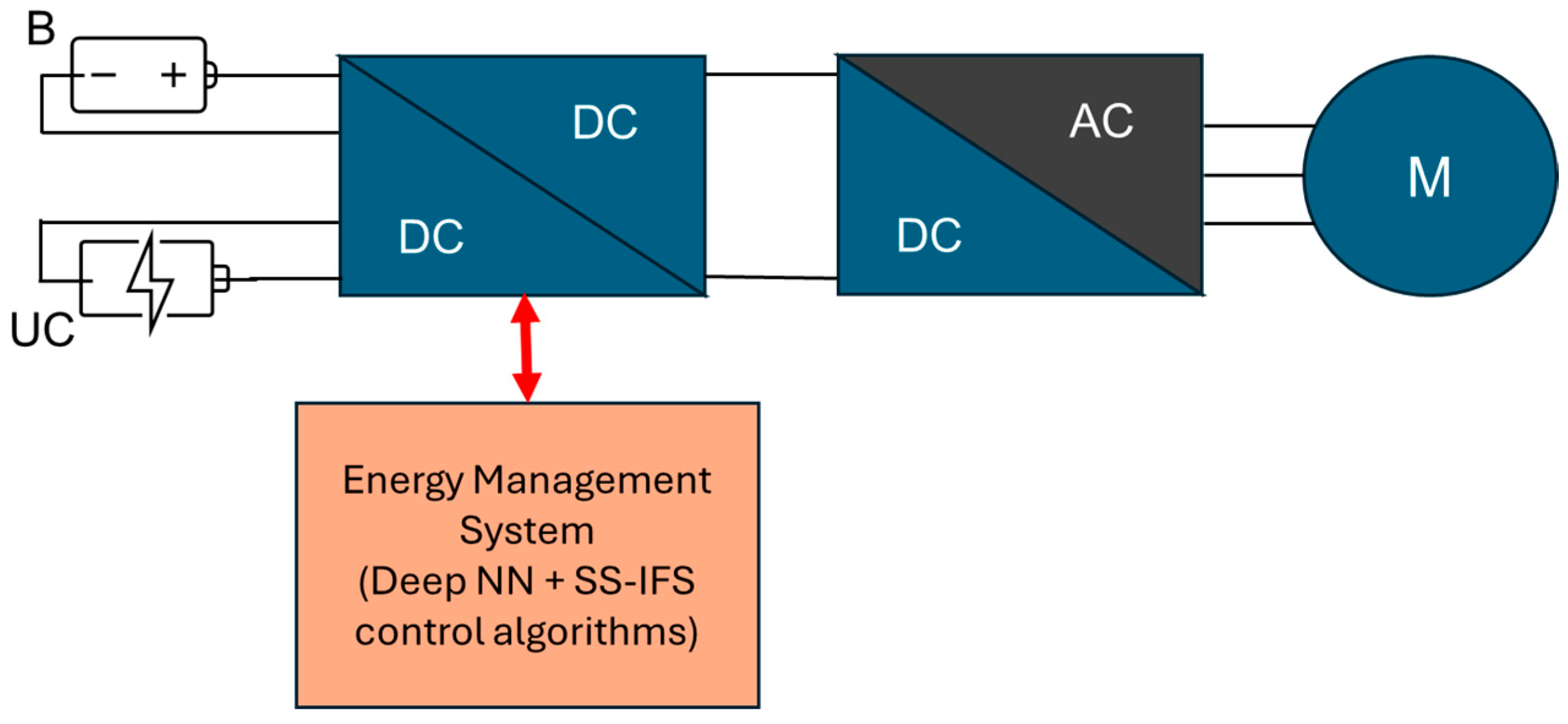
As an advanced energy management strategy between the battery and the energy storage system of an electric vehicle HESS, the DNN control method combined with the SS-IFS technique is used to maximize the benefits of both the battery and the UC storage components while also ensuring the safety and stability of the battery packs (Figure 16) [59]. By recovering energy during deceleration stages and extending battery life through advanced HESS control—a control that guarantees the HESS operates at high efficiency by solving a multi-objective optimization problem—this superior energy management aims to increase vehicle autonomy. A Deep Neural Network (DNN) is constructed using the results of the initial PID controller. The meta-heuristic algorithm SS-IFS is further utilized to generate the best control signals for the HESS. In comparison to the conventional control schemes that use the WOA, PSO, SOA, and SSA algorithms, the adopted SS-IFS model is 74.96%, 79.9%, 40.39%, and 70% better in the rise time analysis. The research also yielded stabilization times that were 74.71%, 79.61%, 39.61%, and 69.72% faster than the current WOA, PSO, SOA, and SSA methods. Furthermore, the suggested DNN + SS-IFS model’s computation time is 7390.3 s, compared to 5262.6 s for the conventional WOA, 6259 s for the PSO, 4381 s for the SOA, and 7390.3 s for the SSA.

3.3. Application of Algorithms Depending on the Architectures of Hybrid Energy Storage Systems

The choice of the type/topology of the HESS architecture (passive, semi-active, active or fully active-see Figure 1, Figure 2, Figure 3 and Figure 4) directly influences the complexity, response speed and flexibility of the control strategies that can be used. Active and fully active architecture, which allows bidirectional energy flow and independent control of each energy storage component (e.g., batteries and UC), offers the greatest flexibility for implementing advanced control algorithms. These architectures allow for dynamic energy management, real-time optimization and predictive control, which are essential for applications that require high performance, efficiency and adaptability (Table 6).
It should be emphasized that the effectiveness of the control algorithms depends largely on how the ultracapacitor is physically integrated with the battery and the rest of the powertrain and on the choice of specific control strategies for the HESS. Specific command and control strategies for optimizing the energy efficiency of storage systems are often combined to form a comprehensive control system.
In the case of ultracapacitor SOC management, multiple approaches include:
  • Fenestration: aimed at maintaining UC’s SOC within a defined operational window (e.g., 50–90%) to ensure availability for both charging (regenerative braking) and discharging (acceleration).
  • Charge/discharge prioritization: during regenerative braking, UC charging is prioritized, and during acceleration, UC discharging is prioritized.
  • UC recharging: if the UC’s SOC drops too low, the battery can provide a small charge to bring the UC back within the defined operational window.
In the case of managing the current/power limitation delivered to the propulsion system, multiple approaches aim to ensure that the current consumption from or supplied to the battery and ultracapacitor remains within their safe operating limits (to prevent possible fires, component damage, and to extend the lifetime of both the components and the storage system as a whole). Furthermore, to this end, control algorithms can incorporate thermal models to predict and mitigate thermal stress on both the batteries and the ultracapacitor, possibly by adjusting power sharing strategies depending on temperature.
In addition to the HESS topologies that can equip the transmission of an electric vehicle, the specific operating conditions of the electric vehicle must also be taken into account in the research carried out. There are few works that show comparatively the results of applying various driving cycles knowing that there are dynamic differences that can directly influence the way the power (charge) is distributed between the HESS elements (battery and UC). Table 7 presents the HESS adaptations according to dynamic characteristics of two different driving cycles (UDDS and WLTC).
The main conclusion from Table 6 is that HESS adaptation for UDDS cycle prioritizes battery longevity and UC buffering during frequent stops and starts, while HESS adaptation for WLTC cycle supports higher power demands and faster UC response, suitable for dynamic driving conditions.
Considering the cost of a HESS, the issue of the overall lifetime of the HESS must also be addressed. This can be achieved through an intelligent degradation control system. Advanced control algorithms (AI-based) can incorporate battery and UCs degradation models to make decisions that not only optimize efficiency but also extend the overall lifetime of the HESS (e.g., by dynamically adjusting power division based on estimated degradation rates).

4. Future Trends and Research Directions

The integration of ultracapacitors into electric vehicle powertrains represents an innovative solution for improving energy performance and component durability. Due to their high-power density and exceptionally fast response to changing energy demands, ultracapacitors are perfect for controlling peak loads and for efficient energy recovery during regenerative braking. Therefore, it is necessary to continue research and development of control algorithms for electric vehicle powertrains with UC, especially in promising areas connected to predictive control algorithms, adaptive hybrid control, artificial intelligence-based methods, and integrated thermal and energy management (considering operational conditions of electric vehicles and related KPIs—Table 8).
First of all, robust and adaptive MPC algorithms that are less susceptible to computational burden and model errors need to be developed. These algorithms should also be able to incorporate real-time parameter estimation. The development of reinforcement learning algorithms for real-time control of energy management systems helps to overcome current limitations related to training stability and computational intensity/load. In addition, this approach can include transfer learning and combining RL models with classical control. Command and control algorithms can also be integrated into prognostic and health management (PHM) systems. Predicting the remaining useful life of batteries and single control units (UC) is a benefit of integrating PHM capabilities into the control system. In addition, control strategies can be chosen or modified based on this information to increase the overall system lifetime.
In the context of contemporary technological development directions, it is also necessary to use cloud computing and big data analytics to collect vast amounts of data about the vehicle and its operating mode (driving style), optimize offline control strategies, and then implement updated/modified algorithms. An immediate illustration of this is the proactive optimization of energy management by using predictive data from navigation and ADAS (such as impending hills, traffic, weather, etc.).
With the development and widespread application of V2X (Vehicle to Everything) technologies, challenges arise related to control strategies, strategies that will need to incorporate the bidirectional power flow capabilities of the UC and batteries for network services, requiring more sophisticated energy management.
Last but not least, one of the challenges and/or trends will be the increasing efforts to standardize communication protocols and control interfaces for HESS components.

5. Conclusions

The main challenges to achieve increased efficiency, reliability, flexibility and profitability of HESS are given by: the compatibility of different types of HESS with the desired application and the compatibility of the components, the optimization of the storage capacity configuration, efficient control strategies, compatible integration into the network architecture, the development of materials with high energy storage performance, the differentiated assessment of the aging mechanisms of the components, the environmental impact and recycling methods [57].
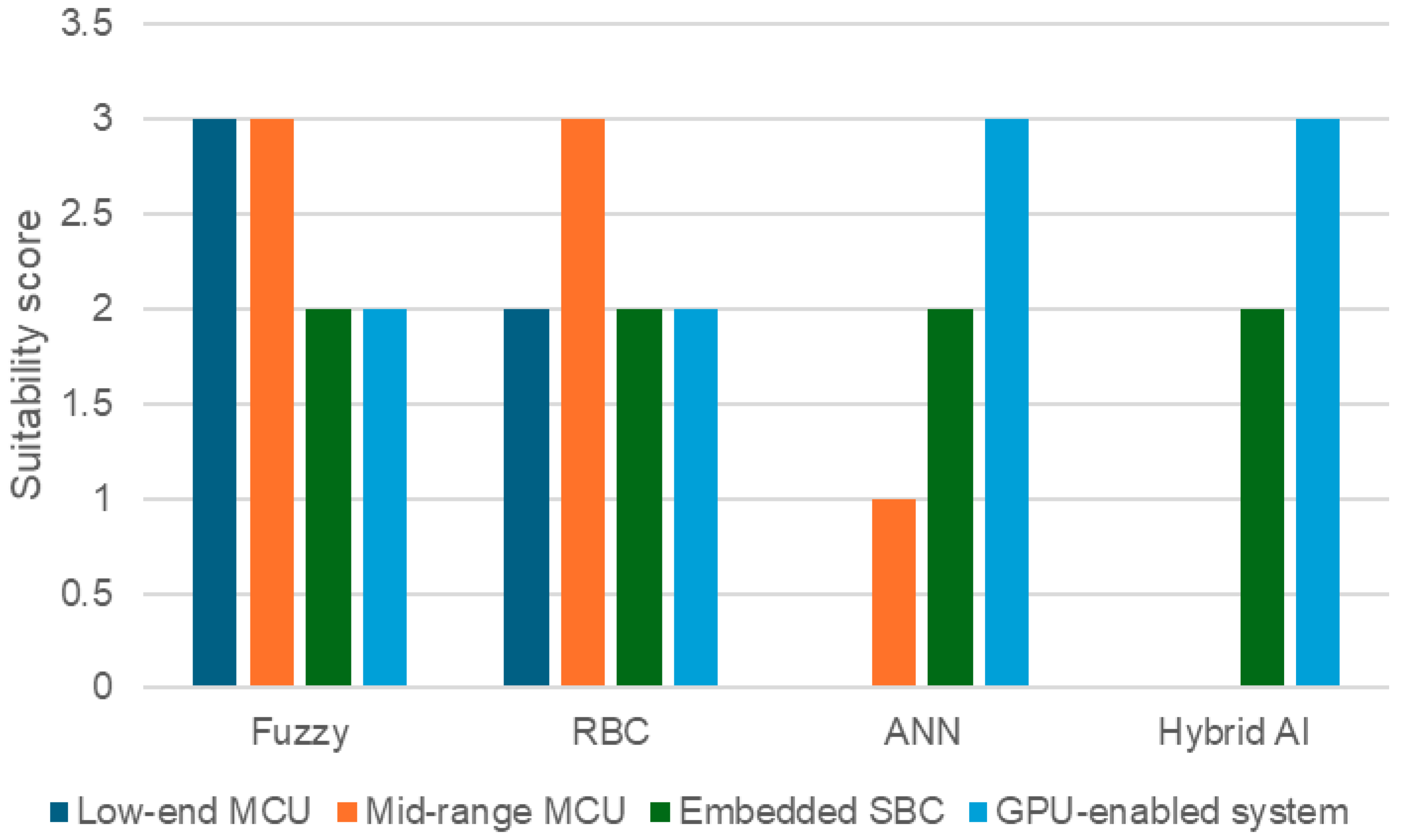
To ensure stable and effective operation, advanced control strategies are necessary for managing the charge–discharge cycles of the various storage components in a hybrid system, forecasting energy demands, and balancing loads. The accuracy and applicability of current control methods are limited by a variety of factors, including model simplifications and parameter tuning, implementation challenges brought on by intricate algorithms and multi-agent coordination, limitations in real-time optimization and dynamic response, and computational cost. A hybrid HESS’s control method selection must be in line with all of the aforementioned specifications, weighing the method’s efficacy against both implementation and operating expenses (Figure 17).
The integration of ultracapacitors into electric vehicle powertrains offers significant promise for improving performance, improving efficiency, and extending the lifespan of battery systems. However, realizing these benefits critically depends on the implementation of sophisticated control algorithms. From fundamental rule-based systems to advanced predictive and intelligent control strategies, the evolution of these algorithms is driven by the need to efficiently manage energy flow, optimize energy utilization, and ensure the long-term reliability of hybrid energy storage systems. As electric vehicles continue to evolve, the development of more intelligent, adaptive, and robust control algorithms will be essential to unlock the full potential of ultracapacitor technology in electric mobility.
It should be noted that the analysis of research conducted on the algorithmic control of HESSs shows that misinterpretations of the results may occur, due to the characteristics of the driving cycles used by the researchers (UDDS, NEDC, WLTC, Japan 1015, NYCC, etc.). The reproducibility of the results for different operating conditions is distorted/influenced by the fact that these driving cycles have different acceleration dynamics and the number of start-stops (for example) with direct influence on the dynamics of power sharing between the battery and the UC. For this reason, in future, it is necessary that any research conducted on the subject of this article be validated experimentally, in real traffic conditions and real operating and environmental parameters.

Funding

This paper is supported by the European Union’s Horizon 2020 research and innovation program under grant agreement no. 101121530, project ZERO-MOVE Zero Emission Mobility (HORIZON-RIA-SGA-NZC).

Data Availability Statement

No new data was created.

Conflicts of Interest

The author declares no conflicts of interest.

Abbreviations

The following abbreviations are used in this manuscript:
ACAlternative Current
ADASAdvanced Driver Assistance Systems
ADFBEMSAdaptive Digital Filter
AIArtificial Intelligence
ANNArtificial Neural Network
BBattery
CAPEXCapital Expenditure
China City Chinese Urban Driving Cycle
CNNConvolutional Neural Network
DBNDeep Belief Network
DCDirect Current
DPDynamic Programming
DNNDeep Neural Network
ECMSEquivalent Consumption Minimization Strategy
EMSEnergy Management System
ESREquivalent Series Resistance
EVElectric Vehicle
GAGenetic Algorithm
GCNGraph Convolutional Network
GPUGraphics Processing Unit
HESSHybrid Energy Storage System
Japan1015Japanese Driving Cycle
LPFLow-Pass Filter
LSTMLong-Short-Term Memory
MAFMoving Average Filter
MCUMicrocontroller Unit
MPCModel Predictive Control
NEDC New European Driving Cycle
NNNeural Network
NYCCNew York City Cycle
OPEXOperational Expenditure
PIDProportional–Integral–Derivative
PHMPrognostic and Health Management System
PMPPontryagin Minimum Principle
PMSMPermanent Magnet Synchronous Motor
PSOParticle Swarm Optimization
RBCRule-Based Control
RLReinforcement Learning
SBCSingle Board Computer
SDFFTSliding Discrete Fast Fourier Transformation
SOASeagull Optimization Algorithm
SOCState of Charge
SSASquirrel Search Algorithm
SS-IFS Squirrel Search with Improved Food Storage Algorithm
UCUltracapacitor
UDDSUrban Dynamometer Driving Schedule
V2XVehicle to Everything
WLTCWorldwide Harmonized Light Vehicle Test Cycle
WOAWhale Optimization Algorithm
WTWavelet Transformation

References

  1. Liu, J.; Brandt, J.; Christensen, J.H.; Ye, Z.; Chen, T.; Dong, S.; Geels, C.; Yuan, Y.; Nenes, A.; Im, U. The recent and future PM2.5-related health burden in China apportioned by emission source. NPJ Clean Air 2025, 1, 7. [Google Scholar] [CrossRef]
  2. Li, C.; Managi, S. Contribution of on-road transportation to PM2.5. Sci. Rep. 2021, 11, 21320. [Google Scholar] [CrossRef] [PubMed]
  3. da Costa, V.B.F.; Bitencourt, L.; Dias, B.H.; Soares, T.; de Andrade, J.V.B.; Bonatto, B.D. Life cycle assessment comparison of electric and internal combustion vehicles: A review on the main challenges and opportunities. Renew. Sustain. Energy Rev. 2025, 208, 114988. [Google Scholar] [CrossRef]
  4. Kotak, Y.; Marchante Fernández, C.; Canals Casals, L.; Kotak, B.S.; Koch, D.; Geisbauer, C.; Trilla, L.; Gómez-Núñez, A.; Schweiger, H.-G. End of Electric Vehicle Batteries: Reuse vs. Recycle. Energies 2021, 14, 2217. [Google Scholar] [CrossRef]
  5. Albatayneh, A.; Assaf, M.N.; Alterman, D.; Jaradat, M. Comparison of the Overall Energy Efficiency for Internal Combustion Engine Vehicles and Electric Vehicles. Environ. Clim. Technol. 2020, 24, 669–680. [Google Scholar] [CrossRef]
  6. Ding, Y.; Cano, Z.P.; Yu, A.; Lu, J.; Chen, Z. Automotive Li-Ion Batteries: Current Status and Future Perspectives. Electrochem. Energ. Rev. 2019, 2, 1–28. [Google Scholar] [CrossRef]
  7. Liu, Y.; Zhang, R.; Wang, J.; Wang, Y. Current and future lithium-ion battery manufacturing. iScience 2021, 24, 102332. [Google Scholar] [CrossRef]
  8. Nasajpour-Esfahani, N.; Garmestani, H.; Bagheritabar, M.; Jasim, D.J.; Toghraie, D.; Dadkhah, S.; Firoozeh, H. Comprehensive review of lithium-ion battery materials and development challenges. Renew. Sustain. Energy Rev. 2024, 203, 114783. [Google Scholar] [CrossRef]
  9. Heo, J.; Gu, H.; Lee, C.; Sung, J.; Kim, D.-H.; Han, J.; Oh, Y.-S.; Ahn, S.; Jeon, I.; Par, J.-W. Recent Advances in Achieving High Energy/Power Density of Lithium–Sulfur Batteries for Current and Near-Future Applications. Battery Energy 2025, 4, e20240051. [Google Scholar] [CrossRef]
  10. Fang, H. Challenges with the Ultimate Energy Density with Li-ion Batteries. IOP Conf. Ser. Earth Environ. Sci. 2021, 781, 042023. [Google Scholar] [CrossRef]
  11. Cao, W.; Zhang, J.; Li, H. Batteries with high theoretical energy densities. Energy Storage Mater. 2020, 26, 46–55. [Google Scholar] [CrossRef]
  12. Wu, X.; Xia, Y.; Guan, S.; Sun, J.; Du, J. Research on influencing mechanism of time gap for fast charging on battery capacity degradation in electric vehicles. J. Energy Storage 2024, 103, 114425. [Google Scholar] [CrossRef]
  13. Madani, S.S.; Shabeer, Y.; Allard, F.; Fowler, M.; Ziebert, C.; Wang, Z.; Panchal, S.; Chaoui, H.; Mekhilef, S.; Dou, S.X.; et al. A Comprehensive Review on Lithium-Ion Battery Lifetime Prediction and Aging Mechanism Analysis. Batteries 2025, 11, 127. [Google Scholar] [CrossRef]
  14. Tian, Y.; Wang, L.; Liao, C.; Yan, G. Comprehensive Investigation of the Durability of Lithium-Ion Batteries Under Frequency Regulation Conditions. Batteries 2025, 11, 75. [Google Scholar] [CrossRef]
  15. Njema, G.G.; Ouma, R.B.O.; Kibet, J.K. A Review on the Recent Advances in Battery Development and Energy Storage Technologies. J. Renew. Energy 2024, 2024, 2329261. [Google Scholar] [CrossRef]
  16. Olabi, A.G.; Abbas, Q.; Al Makky, A.; Abdelkareem, M.A. Supercapacitors as next generation energy storage devices: Properties and applications. Energy 2022, 248, 123617. [Google Scholar] [CrossRef]
  17. Dissanayake, K.; Kularatna-Abeywardana, D. A review of supercapacitors: Materials, technology, challenges, and renewable energy applications. J. Energy Storage 2024, 96, 112563. [Google Scholar] [CrossRef]
  18. Mone, P.; Deore, S.; Balgude, S.; Pandit, V. Fabrication, design and performance evaluation of supercapacitors review. Mater. Today Proc. 2022, 53, 130–133. [Google Scholar] [CrossRef]
  19. Volfkovich, Y.M. High power supercapacitors. Review. J. Electroanal. Chem. 2024, 963, 118290. [Google Scholar] [CrossRef]
  20. Jamadar, N.M.; Jadhav, H.T. Effectiveness of supercapacitor during braking operation of electric vehicle. Mater. Today Proc. 2022, 56, 314–319. [Google Scholar] [CrossRef]
  21. Urooj, A.; Nasir, A. Review of Hybrid Energy Storage Systems for Hybrid Electric Vehicles. World Electr. Veh. J. 2024, 15, 342. [Google Scholar] [CrossRef]
  22. Mariasiu, F.; Kelemen, E.A. Analysis of the Energy Efficiency of a Hybrid Energy Storage System for an Electric Vehicle. Batteries 2023, 9, 419. [Google Scholar] [CrossRef]
  23. Liu, Q.; Tong, Y.; Liu, B.; Yang, J.; Feng, Y. Life Cycle Cost-Oriented Optimization of Hybrid Energy Storage System for Mining Haul Truck. In Proceedings of the 19th Annual Conference of China Electrotechnical Society, Xi’an, China, 20–22 September 2024; Lecture Notes in Electrical Engineering. Yang, Q., Bie, Z., Yang, X., Eds.; Springer: Singapore, 2024; Volume 1406. [Google Scholar] [CrossRef]
  24. Lu, X.; Wang, H. Optimal sizing and energy management for cost-effective PEV hybrid energy storage systems. IEEE Trans. Ind. Inform. 2020, 16, 3407–3415. [Google Scholar] [CrossRef]
  25. Pipicelli, M.; Sessa, B.; De Nola, F.; Gimelli, A.; Di Blasio, G. Assessment of Battery–Supercapacitor Topologies of an Electric Vehicle under Real Driving Conditions. Vehicles 2023, 5, 424–445. [Google Scholar] [CrossRef]
  26. Dong, Z.; Zhang, Z.; Li, Z.; Li, X.; Qin, J.; Liang, C.; Han, M.; Yin, Y.; Bai, J.; Wang, C.; et al. A Survey of Battery–Supercapacitor Hybrid Energy Storage Systems: Concept, Topology, Control and Application. Symmetry 2022, 14, 1085. [Google Scholar] [CrossRef]
  27. Kotana, R. Cost & Efficiency analysis of Battery & SC based Hybrid Energy Storage system for Solar OFF Grid applications. J. Eng. Res. Sci. 2025, 4, 1–7. [Google Scholar] [CrossRef]
  28. Banerjee, A.; Mosier, T.M.; Shafiul Alam, S.M. Impact of Hybrid Energy Storage System (HESS) Topologies on Perfor-mance: Exploration for Hydropower Hybrids. In Proceedings of the 54th Hawaii International Conference on System Sciences, Kauai, HI, USA, 5 January 2021; pp. 3102–3110. [Google Scholar]
  29. Korompili, A.; Monti, A. Review of Modern Control Technologies for Voltage Regulation in DC/DC Converters of DC Microgrids. Energies 2023, 16, 4563. [Google Scholar] [CrossRef]
  30. Karamanakos, P.; Liegmann, E.; Geyer, T.; Kennel, R. Model predictive control of power electronic systems: Methods, results, and challenges. IEEE Open J. Ind. Appl. 2020, 1, 95–114. [Google Scholar] [CrossRef]
  31. Karami, Z.; Shafiee, Q.; Sahoo, S.; Yaribeygi, M.; Bevrani, H.; Dragicevic, T. Hybrid model predictive control of DC-DC boost converters with constant power load. IEEE Trans. Energy Convers. 2021, 36, 1347–1356. [Google Scholar] [CrossRef]
  32. Dhumal, A.R.; Kulkarni, A.P.; Ambhore, N.H. A comprehensive review on thermal management of electronic devices. J. Eng. Appl. Sci. 2023, 70, 140. [Google Scholar] [CrossRef]
  33. Benisi Ghadim, H.; Godin, A.; Veillere, A.; Duquesne, M.; Haillot, D. Review of thermal management of electronics and phase change materials. Renew. Sustain. Energy Rev. 2025, 208, 115039. [Google Scholar] [CrossRef]
  34. Folea, R.; Slusanschi, E.-I. A new metric for evaluating the performance and complexity of computer programs: A new approach to the traditional ways of measuring the complexity of algorithms and estimating running times. In Proceedings of the 23rd International Conference on Control Systems and Computer Science (CSCS), Bucharest, Romania, 26–28 May 2021; pp. 157–164. [Google Scholar] [CrossRef]
  35. Yang, X.-S.; He, X.-S.; Fan, Q.-W. Chapter 7—Mathematical framework for algorithm analysis. In Nature-Inspired Computation and Swarm Intelligence (Algorithms, Theory and Applications); Academic Press: Cambridge, MA, USA, 2020; pp. 89–108. ISBN 978-0-12-819714-1. [Google Scholar] [CrossRef]
  36. Wai, C.K.; Sadeq, T.; Hau, L.C. Advanced adaptive rule-based management for hybrid energy storage systems (HESS) to improve electric vehicle range. Vehicles 2025, 7, 6. [Google Scholar] [CrossRef]
  37. Kachhwaha, A.; Rashed, G.I.; Garg, A.R.; Mahela, O.P.; Khan, B.; Shafik, M.B.; Hussien, M.G. Design and Performance Analysis of Hybrid Battery and Ultracapacitor Energy Storage System for Electrical Vehicle Active Power Management. Sustainability 2022, 14, 776. [Google Scholar] [CrossRef]
  38. He, H.; Xiong, R.; Zhao, K.; Liu, Z. Energy management strategy research on a hybrid power system by hardware-in-loop experiments. Appl. Energy 2013, 112, 1311–1317. [Google Scholar] [CrossRef]
  39. Sellali, M.; Abdeddaim, S.; Betka, A.; Djerdir, A.; Drid, S.; Tiar, M. Fuzzy-Super twisting control implementation of battery/super capacitor for electric vehicles. ISA Trans. 2019, 95, 243–253. [Google Scholar] [CrossRef]
  40. Ye, K.; Li, P.; Li, H. Optimization of Hybrid Energy Storage System Control Strategy for Pure Electric Vehicle Based on Typical Driving Cycle. Math. Probl. Eng. 2020, 2020, 1365195. [Google Scholar] [CrossRef]
  41. Maghfiroh, H.; Wahyunggoro, O.; Cahyadi, A.I. Novel iterative Ragone plot-based optimization of low pass filter for hybrid power sources electric vehicles. e-Prime-Adv. Electr. Eng. Electron. Energy 2024, 7, 100389. [Google Scholar] [CrossRef]
  42. Lee, Y.-L.; Lin, C.-H.; Chang, C.-H.; Liu, H.-D.; Chen, C.-C. A Novel Hybrid Energy Storage System with an Adaptive Digital Filter-Based Energy Management Strategy for Electric Vehicles. IEEE Trans. Transp. Electrif. 2024, 10, 5131–5142. [Google Scholar] [CrossRef]
  43. Chen, F.; Ge, C.; Tang, D.; Ding, S.; Gong, X. Energy management and nonlinear control strategy of hybrid energy storage system for electric vehicle. Energy Rep. 2021, 8, 11161–11173. [Google Scholar] [CrossRef]
  44. Maghfiroh, H.; Wahyunggoro, O.; Cahyadi, A.I. Optimizing Low Pass Filter Cut-off Frequency for Energy Management in Electric Vehicles with Hybrid Energy Storage Systems. Math. Model. Eng. Probl. 2023, 10, 1857–1865. [Google Scholar] [CrossRef]
  45. Gunjal, M.; Mathew, L.; Shimi, S.L. Optimizing Battery Efficiency: Design and Implementation of a Fuzzy Logic Based Controller for Hybrid Energy Storage System in Electric Vehicles. In Data Science and Applications; ICDSA 2024; Lecture Notes in Networks and Systems; Nanda, S.J., Yadav, R.P., Gandomi, A.H., Saraswat, M., Eds.; Springer: Singapore, 2025; Volume 1237. [Google Scholar] [CrossRef]
  46. Yu, H.; Castelli-Dezza, F.; Cheli, F. Multi-objective Optimal Sizing and Energy Management of Hybrid Energy Storage System for Electric Vehicles. arXiv 2018, arXiv:1801.07183. [Google Scholar]
  47. Yu, H.; Cao, D. Multi-objective Optimal Sizing and Real-time Control of Hybrid Energy Storage Systems for Electric Vehicles. In Proceedings of the 2018 IEEE Intelligent Vehicles Symposium, Changshu, China, 26–30 June 2018; pp. 191–196. [Google Scholar] [CrossRef]
  48. Zhou, B.; Burl, J.B.; Rezaei, A. Equivalent Consumption Minimization Strategy With Consideration of Battery Aging for Parallel Hybrid Electric Vehicles. IEEE Access 2020, 8, 204770–204781. [Google Scholar] [CrossRef]
  49. Pu, S.; Chu, L.; Hu, J.; Li, S.; Hou, Z. An Equivalent Consumption Minimization Strategy for a Parallel Plug-In Hybrid Electric Vehicle Based on an Environmental Perceiver. Sensors 2022, 22, 9621. [Google Scholar] [CrossRef] [PubMed]
  50. Chen, M.; Wei, Z.; Huang, Z.; Ding, B.; Li, Y. Simple and Deep Graph Convolutional Networks. arXiv 2020, arXiv:2007.02133. [Google Scholar] [CrossRef]
  51. Liu, C.; Wang, Y.; Wang, L.; Chen, Z. Load-adaptive real-time energy management strategy for battery/ultracapacitor hybrid energy storage system using dynamic programming optimization. J. Power Sources 2019, 438, 227024. [Google Scholar] [CrossRef]
  52. Pan, C.; Liang, Y.; Chen, L.; Chen, L. Optimal Control for Hybrid Energy Storage Electric Vehicle to Achieve Energy Saving Using Dynamic Programming Approach. Energies 2019, 12, 588. [Google Scholar] [CrossRef]
  53. Chen, B.; He, G.; Hu, L.; Li, H.; Wang, M.; Zhang, R.; Gao, K. Energy management of electric vehicles based on improved long short term memory network and data-enabled predictive control. Appl. Energy 2025, 384, 125456. [Google Scholar] [CrossRef]
  54. Chander, B.; Gopalakrishnan, K. Chapter 1—Integration of Artificial Intelligence Techniques for Energy Management. In Sustainable Management of Electronic Waste; Abhishek, K., Pramod, S.R., Ashutosh, K.D., Arun, L.S.T., Ananth, K., Vishal, D., Eds.; Scrivener Publishing LLC: Beverly, MA, USA, 2024; pp. 1–46. [Google Scholar] [CrossRef]
  55. Mira, K.; Bugiotti, F.; Morosuk, T. Artificial Intelligence and Machine Learning in Energy Conversion and Management. Energies 2023, 16, 7773. [Google Scholar] [CrossRef]
  56. Fang, Z.; Shek, J.K.H.; Sun, W. A review of grid-connected hybrid energy storage systems: Sizing configurations, control strategies, and future directions. J. Energy Storage 2025, 118, 116226. [Google Scholar] [CrossRef]
  57. Xiong, R.; Cao, J.; Yu, Q. Reinforcement learning-based real-time power management for hybrid energy storage system in the plug-in hybrid electric vehicle. Appl. Energy 2018, 211, 538–548. [Google Scholar] [CrossRef]
  58. Nambisan, P.; Khanra, M. Optimal power-split of hybrid energy storage system using Pontryagin’s minimum principle and deep reinforcement learning approach for electric vehicle application. Eng. Appl. Artif. Intell. 2024, 135, 108769. [Google Scholar] [CrossRef]
  59. Alaoui, C. Hybrid Vehicle Energy Management Using Deep Learning. In Proceedings of the International Conference on Intelligent Systems and Advanced Computing Sciences (ISACS), Taza, Morocco, 26–27 December 2019; pp. 1–5. [Google Scholar] [CrossRef]
Figure 1. Passive HESS architecture.
Batteries 11 00395 g001
Figure 2. Semiactive HESS architecture.
Batteries 11 00395 g002
Figure 3. Active HESS architecture.
Batteries 11 00395 g003
Figure 4. Full active HESS architecture.
Batteries 11 00395 g004
Figure 5. Interconnected main objectives of control algorithms for UC in electric vehicles propulsion systems.
Batteries 11 00395 g005
Figure 6. Examples of Rule-Based Control (RBC) considering exploitation conditions.
Batteries 11 00395 g006
Figure 7. Flowchart of the rule-based algorithm for a HESS (adapted from [37]).
Batteries 11 00395 g007
Figure 8. General steps of a fuzzy based control algorithm for a HESS.
Batteries 11 00395 g008
Figure 9. Effects of different driving cycle characteristics on outputs for fuzzy control of HESS.
Batteries 11 00395 g009
Figure 10. Comparison of LPF-Iterative, Fuzzy Logic, and MPC strategies in a HESS across UDDS, WLTC, and NEDC driving cycles.
Batteries 11 00395 g010
Figure 11. Flowchart of the DP load-adaptive rule-based control (adapted from [47]).
Batteries 11 00395 g011
Figure 12. Algorithm’s general structure of Model Predictive Control (MPC) (w1, w2, w3 are weights for different objectives, k is deviation from demand and J is the prediction horizon).
Batteries 11 00395 g012
Figure 13. Structure of RL-based power management (control) strategy (a-action variable, r-reward function, s-state variables, t–time, B–battery, UC-ultracapacitor) (adapted from [57]).
Batteries 11 00395 g013
Figure 14. Energy source management framework for hybrid HESS EV based on the Pontryagin minimum principle (PMP) (adapted from [58]).
Batteries 11 00395 g014
Figure 15. Structure of NN for HESS control (adapted from [59]).
Batteries 11 00395 g015
Figure 16. Structure of DNN + SS-IFS control strategy for HESS EV (adapted from [59]).
Batteries 11 00395 g016
Figure 17. Suitability score for using different control techniques for HESS depending on computational resource (0-not suitable, 1-limited, 2-good, 3-optimal).
Batteries 11 00395 g017
Table 1. Comparison between energy density and power density for the main types of batteries used in electric vehicle applications and energy storage systems [6,7,8].
Energy Storage SystemEnergy Density
(Wh/kg)
Power DensityLife CycleSafetyRelative Cost
LPF battery90–120High2.000Very goodLow
NMC battery150–220Average1.500GoodAverage
LTO battery50–80Very high10.000ExcellentHigh
NiMH battery60–120Average500GoodLow
Ultracapacitors5–10Extremely high100.000ExcellentHigh
Table 2. Operating temperature ranges of the main types of batteries used in electric vehicle applications and energy storage systems [12,13,14,15].
Energy Storage
System
Optimal Operating
Temperature
Minimum
Temperature
Maximum
Temperature
Comments
LPF battery20–45 °C−20 °C60 °CExcellent thermal stability making it ideal for various environments
NMC battery15–40 °C0 °C60 °CHigh energy density, but less thermally stable than LFP
LTO battery−30–55 °C−40 °C60 °CWorks well in extreme temperatures, making it ideal for industrial applications
NiMH battery0–45 °C−20 °C60 °CAverage performance given sensitivity to extreme temperatures
Ultracapacitors−40–65 °C−40 °C85 °CIdeal for applications with high power requirements as they are extremely thermally resistant
Table 3. Comparative analysis of criteria for using a specific HESS topology for EV powertrain [25,26,27,28].
CriteriaHESS Topology
PassiveSemi-ActiveActiveFull-Active
CAPEX**********
OPEX********
Weight********
Dimensions**********
Efficiency***********
Control**********
Peak Power Range<10 kW10–50 kW50–200 kW>200 kW
Peak Frequency Range<1 Hz1–10 Hz10–100 Hz>100 Hz
SOC Window±5 … 10%±10 … 20%±20 … 40%±40 … 60%
Best for EV classSmallMainstreamLuxuryHigh Performance and Race
* Low; ** Moderate; *** High; **** Very high.
Table 4. HESS main KPIs.
KPI NameUnitDescriptionMethod or Source
RMSI_BARoot Mean Square of battery current over a drive cycleSimulation or measurement
Ipeak_BAPeak current drawn from the batterySimulation or measurement
ΔSOCB%Change in battery State of Charge during operationSOC model or BMS data
ΔSOCUC%Change in ultracapacitor State of ChargeUC voltage-based SOC estimation
Recuperation Share%Share of braking energy recovered and storedEnergy flow analysis
System Efficiency%Overall energy efficiency of the HESS η = E o u t E i n × 100
Thermal Load °C/WTemperature rise per unit thermal resistanceThermal model or sensor data
Degradation/CycleAh/cycleBattery degradation per cycleAging model or empirical data
Computational
Complexity
-Algorithmic complexity Theoretical analysis of control algorithm
Step TimemsTime per simulation/control stepProfiling during simulation
Memory
Requirements
MBMemory capacity (and speed) needed for simulation or real-time controlSystem profiling or estimation
Table 5. General operating principle, advantages and disadvantages of intelligent control algorithms.
Control SystemPrincipleAdvantagesDisadvantages
Fuzzy Logic Control
(FLC):
FLC uses linguistic rules and fuzzy sets to map input variables (e.g., power demand, battery and UC SOC) to output control actions (e.g., power split ratio).Robust to uncertainties.
Does not require a precise mathematical model.
Intuitive for rule definition.
Requires expert knowledge to define rules and membership functions.
Tuning can be challenging.
Neural Networks
(NNs)
NNs can learn complex nonlinear relationships between inputs and outputs from training data.
Can be used to predict optimal power split or estimate system states.
Can learn highly complex relationships.
Adaptive.
Requires large datasets for training.
“Black box” nature can make interpretation difficult.
High computational cost.
Reinforcement Learning
(RL)
An RL agent learns an optimal policy by interacting with the environment (e.g., vehicle powertrain simulation) and receiving rewards or penalties for its actions.
The goal is to maximize cumulative rewards over time.
Can learn optimal strategies without prior knowledge of system dynamics.
Adaptable to changing environments.
Requires extensive training.
High computational intensity.
Ensuring stability and safety during real-world deployment is challenging.
Table 6. Common types of general NN architecture with potential in controlling HESS of electric vehicles.
ArchitectureTaskStrengthsLimitationsUse Cases for
HESS Control
Feedforward
Neural Network (FNN)
Static estimation Simple and fast; good for static input-output mappings
  • Limited in handling sequential or time-dependent data
  • Battery and UC state estimation
  • Fault detection
Recurrent
Neural Network
(RNN)
Complex control policiesCaptures temporal dependencies in sequential data
  • Prone to vanishing gradients
  • Less effective for long sequences
  • Driving cycle analysis
  • Power split prediction
Long Short-Term Memory
(LSTM)
Time-series
prediction
Handles long-term dependencies; robust to vanishing gradients
  • More complex and computationally intensive
  • Predictive energy management
  • Vehicle behavior modeling (energy consumption)
Convolutional
Neural Network (CNN)
Spatial-temporal dataGood at extracting local patterns; efficient with structured input
  • Less suited for purely sequential data unless adapted
  • Sensor array analysis
Deep Belief
Network
(DBN)
Complex control policies (useful in scenarios where labeled data is sparse)Effective for unsupervised features learning and pre-training
  • Training can be complex
  • Less commonly used in real-time applications
  • System health monitoring
  • Anomaly detection
Table 7. Comparative insights of HESS adaptation for different driven cycles [38,41,42,44,45,46,47,52].
ParameterHESS Adaptation
UDDS CycleWLTC Cycle
IBmaxLower peak current
(favors battery protection)
Higher peak current (allows more battery load)
SOCUC
Range/Window
30% to 90%
(favors UC usage)
10% to 70%
(enables early UC dispatch)
UC Dispatch
Behavior
More conservative, full dispatch only at high SOCMore aggressive, dispatch starts at low SOC
Drive Cycle
Characteristics
Urban traffic conditions, stop-and-go, moderate accelerationMixed urban/highway traffic conditions, dynamic acceleration
Battery StressLowerModerate to High
UC Buffering
Effectiveness
HighModerate
SOC StabilityHighModerate
Thermal LoadLowHigh
Table 8. Application of control algorithms depending on the HESS’s architecture.
HESS
Architecture
CharacteristicsOperational
Conditions
Control
Algorithms
KPIs
Passive ParallelBattery and ultracapacitor are directly connected in parallel.
No power electronics; energy flow is dictated by natural voltage/current characteristics.
Very limited direct control over power split. Power is shared based on internal resistances and voltage differences. Simplest, but least effective.
  • Rule-based control-simple logic based on thresholds (if battery voltage (SOC) < X (%), reduce load).
  • No active control-system relies on passive balancing and limited algorithmic intervention.
  • Low cost
  • Low efficiency
  • Limited control
Active Parallel
(Semi-Active)
The ultracapacitor is connected to the DC bus via a bi-directional DC/DC converter, while the battery is directly connected.
One storage device (usually an ultracapacitor) is actively controlled and the other storage device is passive.
The DC/DC converter regulates the power flow to/from the ultracapacitor.
Common and effective architecture, offering good control over UC contribution.
  • State-of-Charge (SOC) management-controls supercapacitor charging/discharging based on battery SOC.
  • Fuzzy logic control-handles uncertainty in load demand and energy flow between devices.
  • Moderate battery life
  • Good transient handling
  • Moderate control
Full ActiveBoth the battery and ultracapacitor are connected to the DC bus via separate bi-directional DC/DC converters.
Both storage devices are actively controlled via power converters.
Offers the highest degree of control over both energy sources, allowing independent optimization.
Most complex and costly but provides maximum flexibility and efficiency.
  • Model Predictive Control (MPC)-predicts future states and optimizes control actions over a time horizon.
  • Dynamic Programming (DP)-optimizes energy flow based on cost functions (e.g., minimizing battery degradation).
  • Neural Network-based control (NN)-learns optimal energy management strategies from data.
  • High efficiency
  • Extended battery life
  • Advanced control
Multi-Input
Converter
A single converter integrates multiple energy sources.
Independent bidirectional control of each device; full flexibility.
Requires complex control of the multi-input converter to manage power flow from both sources simultaneously.
  • Real-time optimization-continuously adjusts energy flow based on system state and external conditions.
  • Reinforcement Learning (RL)-learns optimal policies through interaction with the environment.
  • Multi-objective control-balances trade-offs between efficiency, lifespan, and performance (e.g., Pareto optimization).
  • Predictive control
  • Long battery life
  • Maximum performance
Disclaimer/Publisher’s Note: The statements, opinions and data contained in all publications are solely those of the individual author(s) and contributor(s) and not of MDPI and/or the editor(s). MDPI and/or the editor(s) disclaim responsibility for any injury to people or property resulting from any ideas, methods, instructions or products referred to in the content.