Article

Tailoring Microstructure Orientation and Magnetic Properties in AlNiCo Permanent Magnets by Controlled Withdrawal Rate in High-Rate Solidification


1
Zhejiang Key Laboratory of Energy Conversion Materials for Advanced Motor, College of Materials and Environmental Engineering, Hangzhou Dianzi University, Hangzhou 310012, China
2
Key Laboratory for Anisotropy and Texture of Materials (MOE), School of Materials Science and Engineering, Northeastern University, Shenyang 110819, China
3
Hangzhou Permanent Magnet Group Co., Ltd., Hangzhou 310012, China
4
School of Materials Science and Engineering, South China University of Technology, Guangzhou 510640, China
*
Authors to whom correspondence should be addressed.
These authors contributed equally to this work.
Magnetochemistry 2026, 12(4), 43; https://doi.org/10.3390/magnetochemistry12040043
Submission received: 5 March 2026 / Revised: 28 March 2026 / Accepted: 30 March 2026 / Published: 2 April 2026
(This article belongs to the Section Magnetic Materials)

Abstract

Enhancing grain orientation along the <001> crystal axis in AlNiCo alloys is crucial for developing high-performance permanent magnets. Traditional directional solidification, known as the “cold plate-hot mold” method, is constrained by a low thermal gradient, leading to inadequate microstructural uniformity and crystallographic alignment, which impedes the optimization of magnetic properties. In this study, we employed a high-speed solidification process with an enhanced cooling gradient to fabricate AlNiCo magnets at various withdrawal rates. The variation in drawing rate influenced grain orientation within the alloy, thereby altering the degree of alignment of the ferromagnetic α1 phase following subsequent heat treatment, which ultimately affected the magnetic properties. The optimal magnetic performance was attained at a withdrawal rate of 50 μm/s, where the sample exhibited the most favorable oriented microstructure, with a remanence (Br) of 10.62 kGs, intrinsic coercivity (Hcj) of 1.794 kOe, and a maximum energy product (BH)max of 10.93 MGOe. Moreover, magnets at different positions exhibit excellent consistency in magnetic properties, enhancing the material utilization efficiency. This research provides valuable process parameters and a foundational basis for developing high-performance AlNiCo alloys.

1. Introduction

Permanent magnets are indispensable components in a wide spectrum of daily-use electronic and mechanical devices, spanning from consumer electronics like speakers to household appliances (e.g., air-conditioning motors and washing machine drives), and extending to cutting-edge transportation systems such as hybrid vehicles [1]. Among these, rare-earth magnets like NdFeB and SmCo are commonly used due to their superior magnetic properties. However, the high cost, import challenges, and limited availability of rare-earth elements pose significant issues [2]. From a compositional perspective, although AlNiCo alloys contain Co, it is the only critical element and its content typically does not exceed 40 wt.%. In contrast, Sm-Co magnets contain more than 50 wt.% Co, while Nd-Fe-B magnets incorporate over 25 wt.% of expensive rare-earth elements. From a processing standpoint, AlNiCo magnets require vacuum conditions only during sintering and tempering. By comparison, due to the high chemical reactivity of rare-earth elements, the entire manufacturing process of rare-earth magnets, including crushing, blending, compaction, and sintering, must be conducted under protective atmospheres such as nitrogen, argon, or vacuum. In addition, AlNiCo exhibits excellent intrinsic corrosion resistance and does not require surface protection, whereas Nd-Fe-B magnets typically demand anti-corrosion coatings. In this context, AlNiCo magnets present a notable cost advantage, particularly when compared with rare-earth permanent magnets. Consequently, the scarcity of these resources has heightened interest in developing rare-earth-free permanent magnets. AlNiCo magnets have received extensive attention due to their lack of rare earth elements and abundant raw material sources [3,4,5].
AlNiCo is an alloy composed of Al, Ni, Co, Fe, and trace metallic elements. Its defining characteristic lies in spinodal decomposition occurring within a specific temperature range, which drives the formation of two distinct phases: an Fe-Co-rich α1 phase and an Al-Ni-rich α2 phase. The permanent magnetic properties of AlNiCo are primarily attributed to the shape anisotropy inherent in the α1 phase [6,7,8,9]. The magnetic properties are closely tied to the morphology and distribution of this phase. A larger aspect ratio enhances coercivity (Hcj), while a high volume fraction and orientation degree of the α1 phase boost remanence (Br). Recent research indicates that aligning grains along the <001> axis and applying a magnetic field during spinodal decomposition can significantly improve the orientation degree of the α1 phase. This enhancement leads to increased remanence, improved squareness of the demagnetization curve, and optimization of the maximum magnetic energy product (BH)max [10,11,12]. The <001> crystallographic axis is the preferred direction for AlNiCo alloys, and directional solidification is typically used to produce castings with oriented grains. However, the traditional high-temperature casting method, the so-called “cold plate and hot mold” method, involves placing a preheated mold on a water-cooled plate, and then pouring high-temperature molten metal. Since the <001> direction of the AlNiCo alloy is the easy-growth direction, columnar crystal growth along the <001> direction is achieved. However, this method typically has a low cooling gradient and poor gradient controllability, which may lead to insufficient grain orientation and the appearance of transverse grain boundaries. Meanwhile, the growth height of columnar crystals is limited, which restricts the further development of high-performance magnets. Other issues include casting defects such as low material utilization and severe composition segregations [13,14,15]. AlNiCo alloys prepared by conventional processing routes, such as casting, powder metallurgy, and additive manufacturing, generally exhibit randomly oriented grains. This lack of crystallographic texture results in poor alignment of the α1 phase, thereby leading to inferior magnetic properties and limiting their applicability in high-performance permanent magnets.
The high-speed solidification (HRS) technique presents a novel strategy for directional solidification. In this method, molten metal is drawn from a high-temperature furnace at a controlled rate, with its lower end coupled to a cooling medium. Precise adjustment of the withdrawal rate enables optimization of the temperature gradient, thereby facilitating the growth of ideal columnar grains [16,17,18]. This technology can achieve relatively high temperature gradients and cooling rates. The prepared columnar crystals are long, with a fine and uniform structure, which improves the material utilization efficiency, reduces casting defects such as composition segregation and shrinkage cavities, and has been successfully applied in the manufacturing of nickel-based and cobalt-based superalloys [18,19,20]. During the HRS directional solidification process, the withdrawal rate is one of the important process parameters. This is because the isotherms of the temperature field, the shape of the mushy zone, and the curvature of the liquidus line depend on the withdrawal rate and the distance from the water-cooled plate. As the withdrawal rate increases, the width of the mushy zone gradually increases. Therefore, the microstructure is often regulated by changing the withdrawal rate.
In this paper, AlNiCo columnar crystal test bars were prepared by the HRS method, and the influence of the withdrawal rate (from 25 μm/s to 125 μm/s) on their microstructure and magnetic properties of AlNiCo alloys are investigated. The excellent magnetic properties of (BH)max = 10.93 MGOe, Hcj = 1.794 kOe, and Br = 10.62 kGs are achieved at a rate of 50 μm/s. The effects of withdrawal rate on alloy orientation were assessed using X-ray diffraction (XRD), electron backscatter diffraction (EBSD), and transmission electron microscopy (TEM). This study offers valuable insights for developing high-performance AlNiCo alloys.

2. Materials and Methods

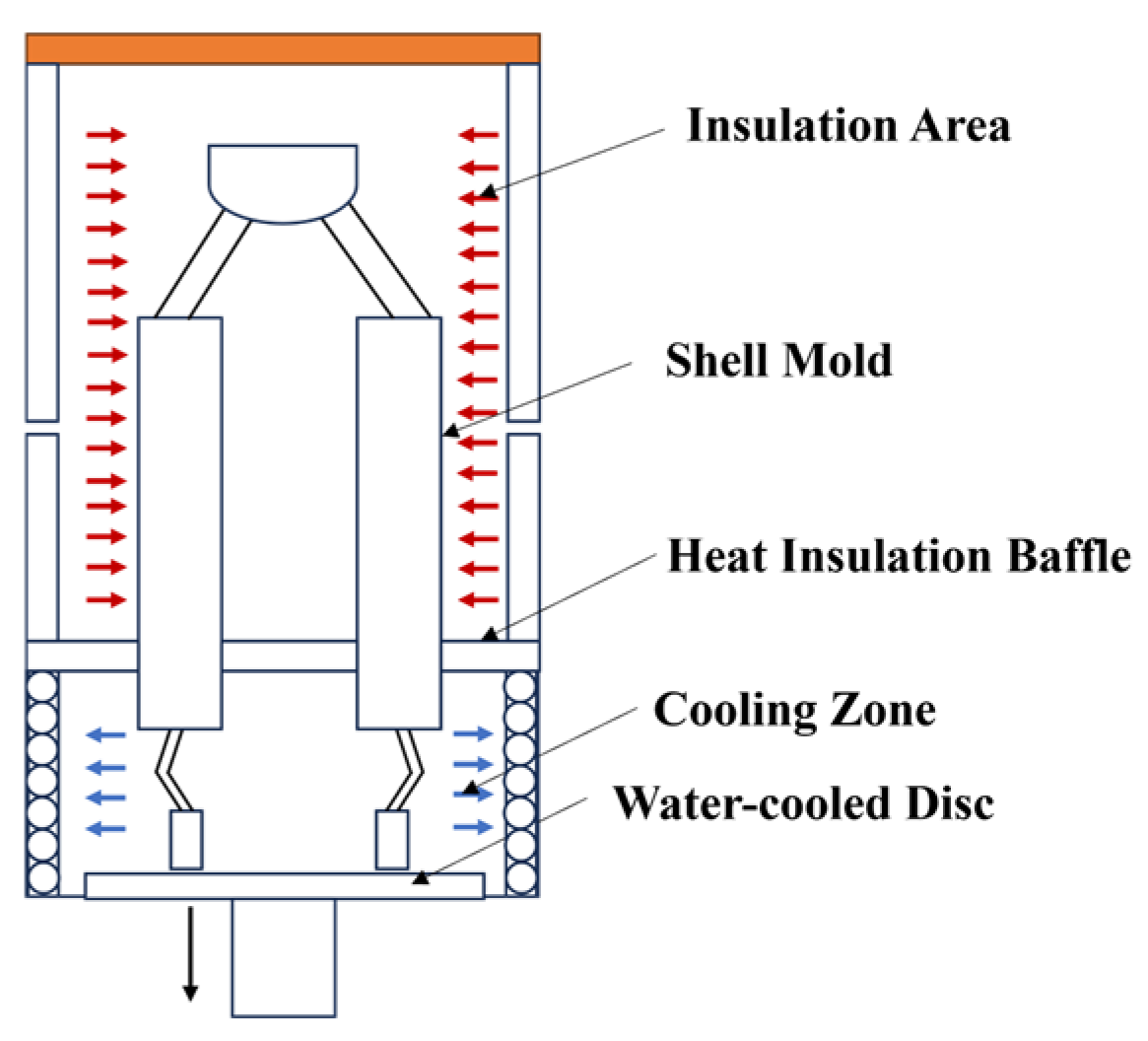
AlNiCo alloys with the composition of 7.41Al-6.0Ti-33.27Fe-36.52Co-13.52Ni-2.38Cu-0.90Nb (wt%) were synthesized by induction melting techniques. The resulting ingots were precisely cut into cylindrical shapes, each measuring 10 mm in diameter and 10 mm in length, by electrical discharge machining. Directionally solidified AlNiCo alloys were fabricated via the HRS method using a rapid directional solidification furnace for metallic functional alloys (GHDF-5, Ginstruments Co., Ltd., Suzhou, China). The schematic diagram of HRS was shown in Figure 1.The arrows in different colors indicate the direction of heat flow, where the red arrows represent the heating direction and the blue arrows represent the heat dissipation direction. In each experiment, the alloy was loaded into a mold shell, which was then positioned inside the furnace chamber with its bottom in contact with a water-cooled copper plate. The chamber was evacuated to high vacuum and back-filled with argon to prevent oxidation of the molten alloy. The temperature was subsequently raised to fully melt the alloy, followed by directional solidification achieved by withdrawing the sample from the furnace at a controlled rate. The drawing rates employed in this study were 25 μm/s, 50 μm/s, 75 μm/s, 100 μm/s, and 125 μm/s. The resulting AlNiCo alloys were subjected to a homogenization treatment at 1250 °C for 7 min, air-cooled to 900 °C and then isothermally annealed at 810 °C for 15 min along the cylinder axis in a magnetic field of 0.4 T. Finally, the alloys were tempered sequentially at 650 °C for 4 h, 600 °C for 8 h, and 560 °C for 16 h. All samples used for magnetic property measurements and microstructural characterizations were in the fully heat-treated state after tempering.
The diffraction peaks of the magnets were characterized using an X-ray diffractometer (XRD, SmartLab 9 kW, Rigaku, Japan) equipped with Cu-Kα radiation and operated over a 2θ range of 20–80°. To evaluate the crystallographic orientation of the samples, electron backscatter diffraction (EBSD) was performed on a field emission scanning electron microscope (SEM5000, CIQTEK Co., Ltd., Suzhou, China). Grain size and α1 phase diameter were statistically analyzed using Fiji (ImageJ v1.54s13) software. The sample orientation was further investigated by Lorentz transmission electron microscopy (L-TEM, Talos F200S, Thermo Fisher Scientific, Waltham, USA). Transmission electron microscopy specimens were prepared via ion beam thinning (Gatan PIPS II 695, Gatan, Inc., Pleasanton, CA, USA). Magnetic properties were measured using a permanent magnet property tester (NIM-6500C, National Institute of Metrology, Beijing, China).

3. Results and Discussion

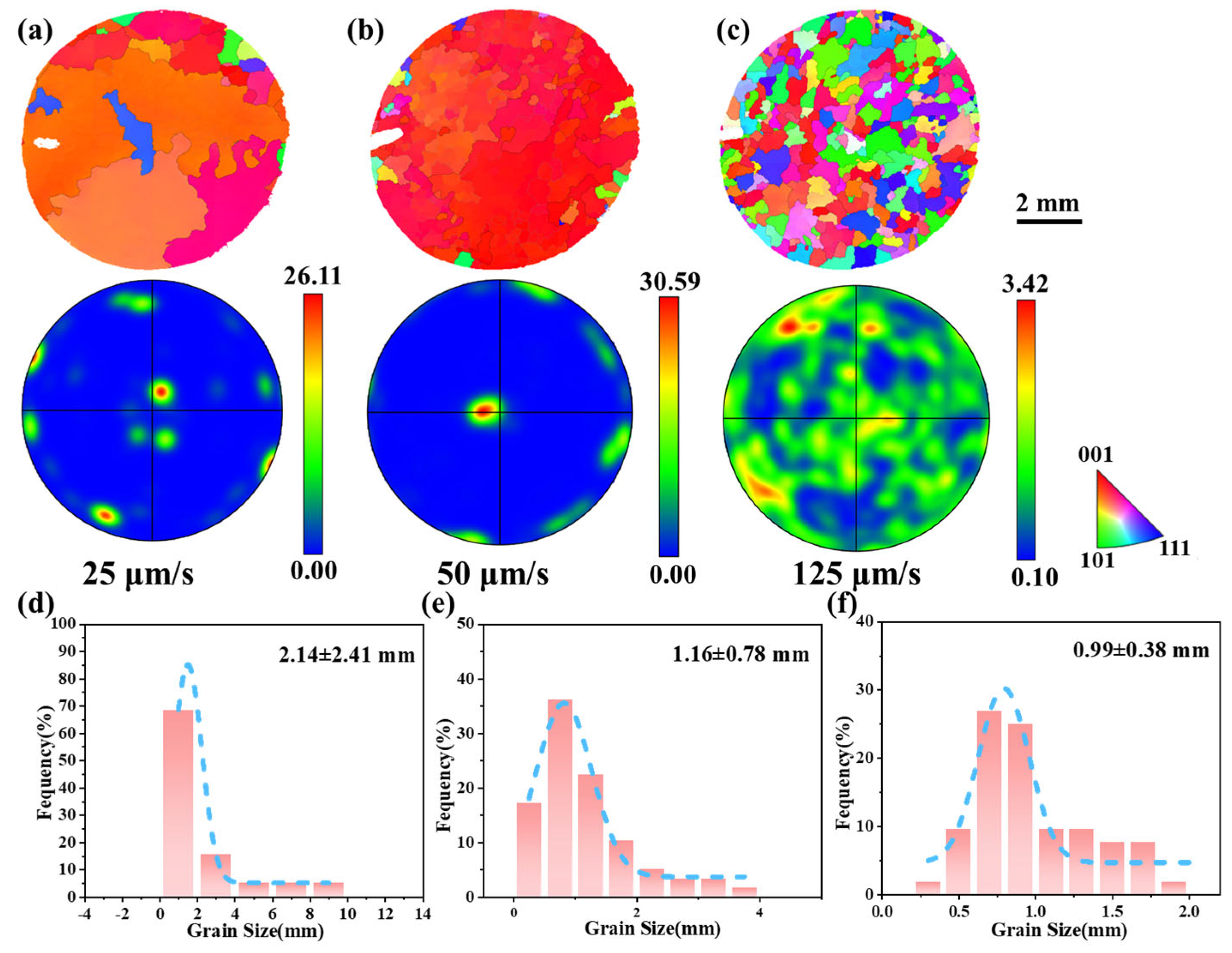
Figure 2a–c presents the electron backscatter diffraction (EBSD) inverse pole Figures and pole Figures of the magnets at 25, 50, and 125 μm/s drawing rates, respectively. As shown in Figure 2b, the consistent coloration in the magnet of 50 μm/s withdrawal rate indicates superior grain orientation quality [21]. The orientation of AlNiCo magnets at varying withdrawal rates is also evident through the intensity of the polar pattern density [6,22]. The pole Figure densities are 26.11, 30.59, and 3.42, respectively, highlighting that the magnet at a 50 μm/s withdrawal rate achieves optimal grain orientation. Additionally, grain size diminishes as the withdrawal rate increases. These findings indicate that selecting an appropriate withdrawal rate is crucial for balancing grain size variations and enhancing the overall orientation of the AlNiCo alloy.
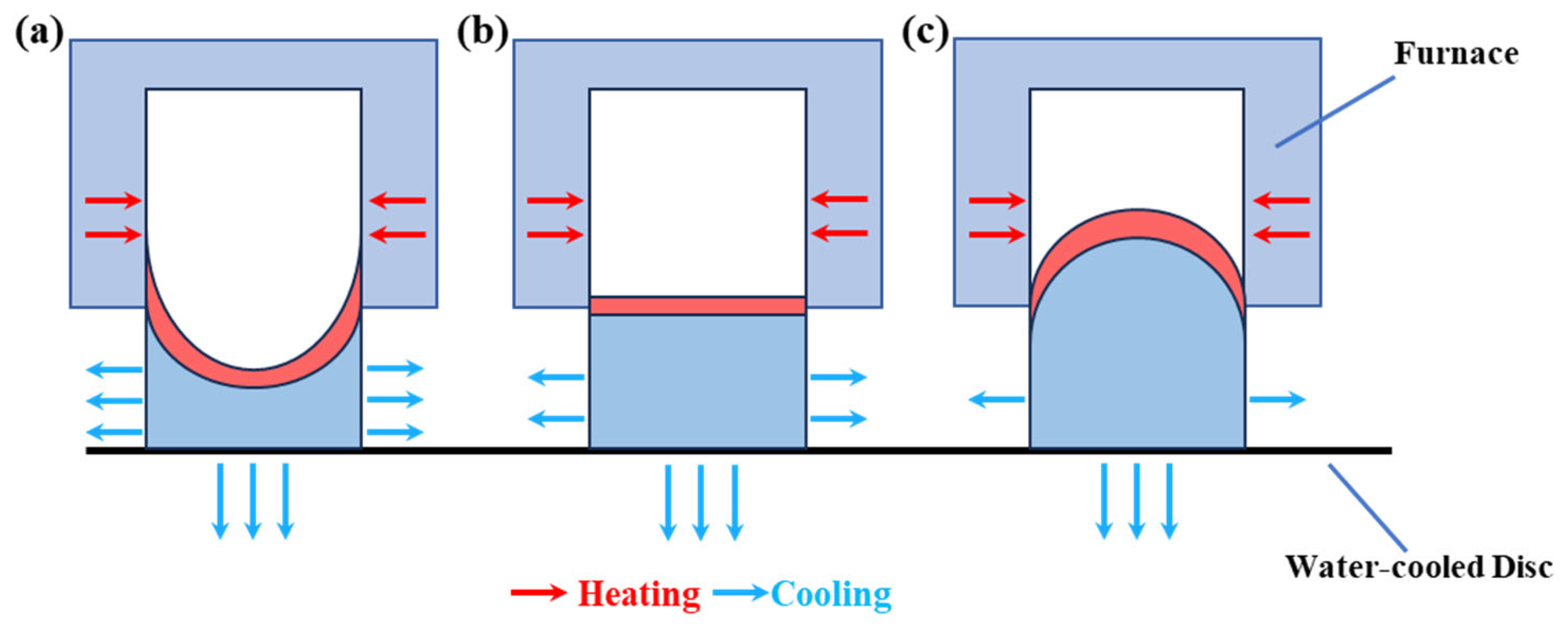
The influence on grain orientation is closely linked to changes in the temperature gradient and the mushy zone’s morphology under varying processing conditions [23]. During the HRS process, heat dissipates axially through the cooling medium and transversely via thermal radiation from the casting surface [24]. At higher withdrawal rates, the solidification rate of alloy lags behind the withdrawal rate and increased radiative heat loss intensifies the lateral temperature gradient at the solid–liquid interface, causing the interface to extend beyond the furnace boundary. This results in a concave mushy zone (Figure 3a), promoting inclined growth of columnar grains. Excessively high withdrawal rates may even induce the formation of lateral columnar or equiaxed grains, thereby degrading overall grain orientation. Within the optimal withdrawal rate, the solidification rate aligns with the withdrawal rate, resulting in a planar mushy zone that is stably maintained near the furnace exit (Figure 3b). Under these conditions, significant lateral temperature gradients are minimized, enabling stable columnar grain growth and preserving high crystallographic texture. In contrast, at low withdrawal rates, the solidification rate exceeds the withdrawal rate, and excessive thermal input from the furnace leads to partial remelting of the casting’s outer regions, forming a convex mushy zone (Figure 3c), which promotes divergent grain growth and compromises columnar grain alignment [25]. The influence of withdrawal rate on grain size is closely associated with nucleation kinetics. Higher withdrawal rates increase thermal undercooling, while insufficient melt solidification velocity causes elemental segregation, leading to compositional undercooling [26]. These conditions enhance the nucleation rate and intensify competitive growth among grains during solidification, thereby suppressing grain coarsening. Conversely, at lower withdrawal rates, reduced undercooling results in a lower nucleation rate and fewer nuclei, allowing sufficient time and space for grain growth, which facilitates grain coarsening.
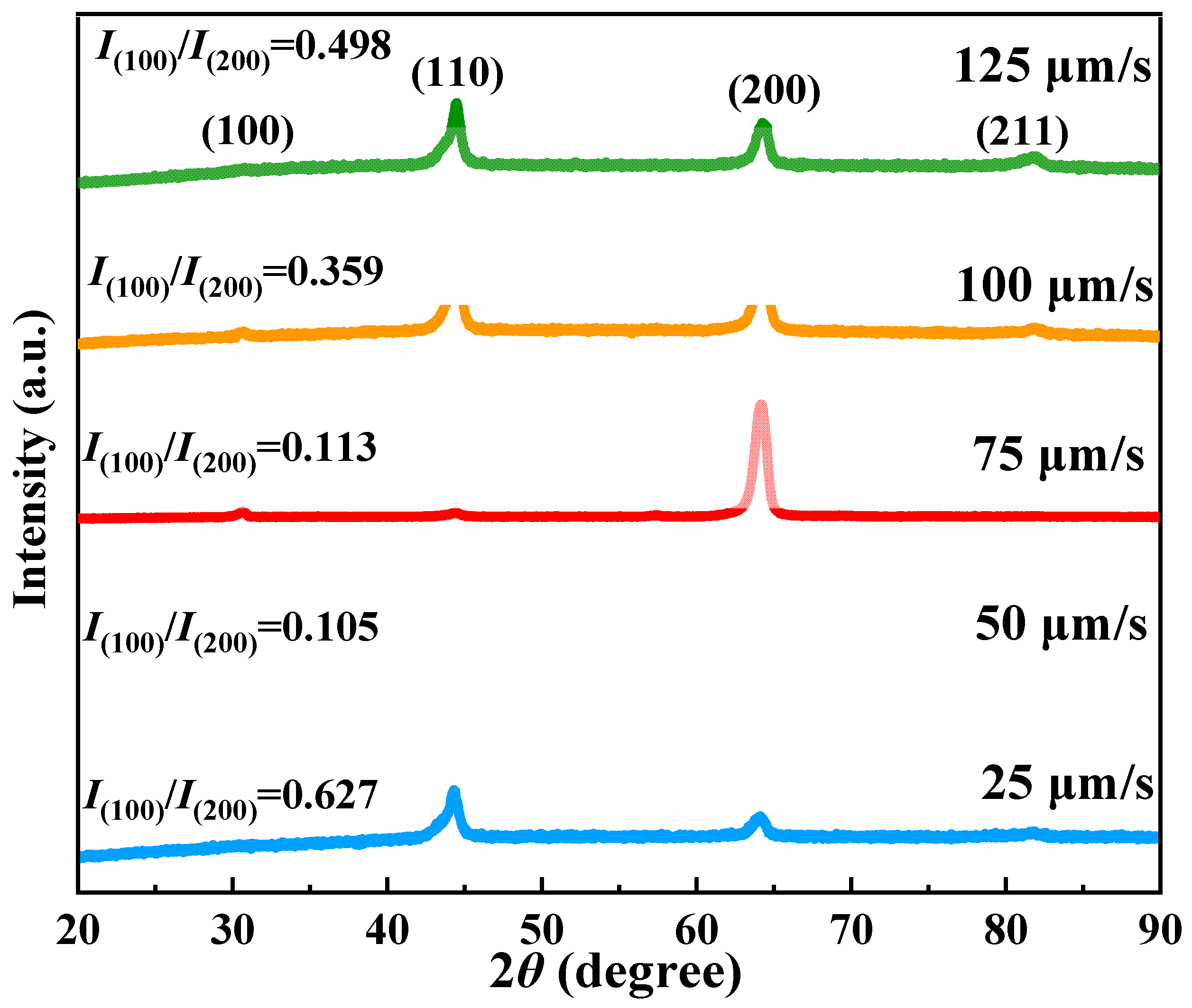
Figure 4 illustrates the XRD patterns of magnets fabricated at varying withdrawal rates, revealing that all alloys possess a body-centered cubic (BCC) structure, the peaks observed in the patterns are compared with PDF card no. 06–0696 [27]. Differences in the intensity of the (200) diffraction peak among samples suggest variations in the orientation degree of the α1 phase. The orientational characteristics of the spinodal decomposition microstructure can be quantitatively assessed by examining the intensity ratio of the (100) to (200) diffraction peaks [28]. The sample produced at a withdrawal rate of 50 μm/s shows the highest (200) peak intensity and the lowest I(100)/I(200) ratio, approximately 0.105, indicating superior α1 phase alignment. This variation in α1 phase orientation primarily results from differences in grain texture. The preferred elongation direction of the α1 phase is determined by the projection of the applied magnetic field along the <001> crystallographic axes during spinodal decomposition. In the sample processed at 50 μm/s, grains exhibit the highest degree of alignment along the [001] direction. An external magnetic field applied parallel to this direction results in a significantly stronger field component along [001] compared to [100] and [010]. This strong directional bias promotes unidirectional elongation of the α1 phase. Conversely, when grain orientation is poor, the <001> axes of certain grains deviate from the applied field direction, leading to comparable magnetic field components along two or more crystallographic directions. Under these conditions, the α1 phase may elongate along multiple orientations, with its long axis misaligned relative to the magnetic field, thereby reducing the overall orientational coherence of the α1 phase within the alloy.
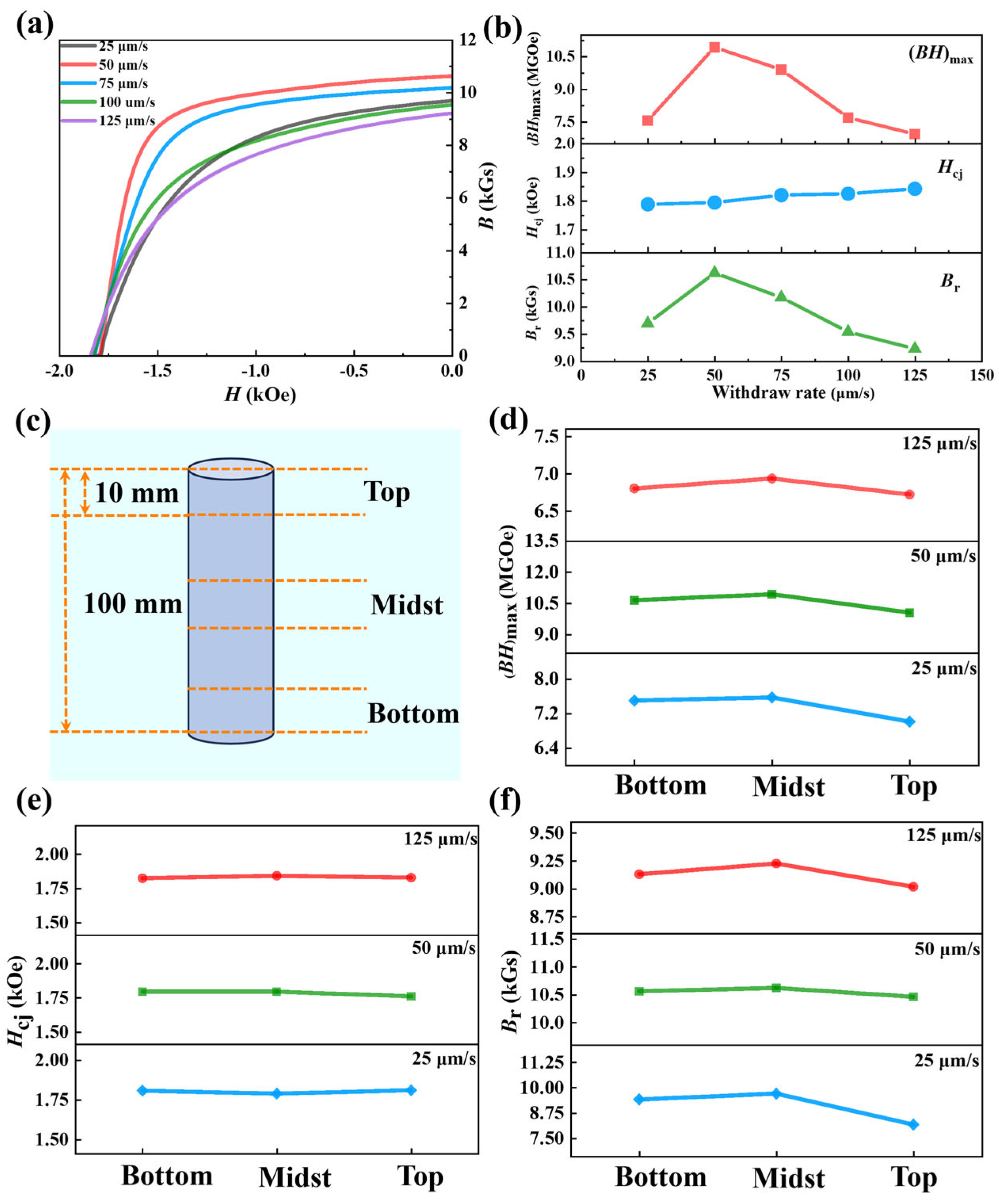
Figure 5a illustrates the demagnetization curves of AlNiCo magnets, and Figure 5b depicts the relationship between withdrawal rates and key magnetic properties, specifically the maximum magnetic energy product, coercivity, and remanence. As the drawing speed increases, the maximum magnetic energy product and remanence exhibit an initial increase followed by a subsequent decrease. In contrast, coercivity shows a continuous increase with rising drawing speed. The optimal magnetic properties occurred at a pulling rate of 50 μm/s, with values of (BH)max = 10.93 MGOe, Hcj = 1.794 kOe, and Br = 10.62 kGs. The variations in (BH)max and Br of alloys processed at different withdrawal rates are closely linked to the degree of α1 phase crystallographic orientation. The magnet produced at a 50 μm/s withdrawal rate exhibits the highest α1 phase alignment. This alignment helps maintain a uniform magnetic moment orientation after the external field is removed, resulting in higher Br. Additionally, its superior microstructural homogeneity enhances the squareness of the demagnetization curve, thereby optimizing the (BH)max. Conversely, magnets with lower α1 phase orientation are more prone to transverse magnetic moment components, which diminish the axial component of magnetization along the sample direction, leading to reduced remanence. Furthermore, decreased microstructural uniformity negatively affects the squareness of the demagnetization behavior, ultimately degrading the overall (BH)max.
The consistency of magnet performance at various withdrawal rates was assessed, with sampling positions indicated in Figure 5c. Small cylindrical samples were taken from the rod’s top, middle, and bottom for magnetic characterization, as shown in Figure 5(d–f). The results show that a minimal variation of coercivity is observed among different parts of rods, while Br and (BH)max differed significantly. Notably, the magnet fabricated at a 50 μm/s withdrawal rate exhibited the highest performance uniformity. This uniformity is closely linked to the evolution of grain orientation under different withdrawal conditions. Initially, solidification is primarily influenced by heat extraction through the rod’s bottom cold end [29,30]. During this stage, temperature gradients and grain morphologies are similar across samples, regardless of withdrawal rate. However, as solidification progresses to intermediate and late stages, distinct thermal behaviors emerge. At higher withdrawal rates, lateral radiative heat loss becomes significant, creating a concave solid–liquid interface or mushy zone. Conversely, slower rates lead to a convex mushy zone due to heat accumulation within the furnace. Both conditions cause inclined grain growth along the interface’s tangential direction, altering local microstructural features and reducing magnetic performance uniformity [31]. At an optimal withdrawal rate, the solid–liquid interface remains planar over a greater axial extent, allowing for sustained unidirectional columnar grain growth throughout the rod [32]. As a result, the microstructure becomes less sensitive to the distance from the cold end, enhancing the homogeneity of magnetic properties along the entire sample length.
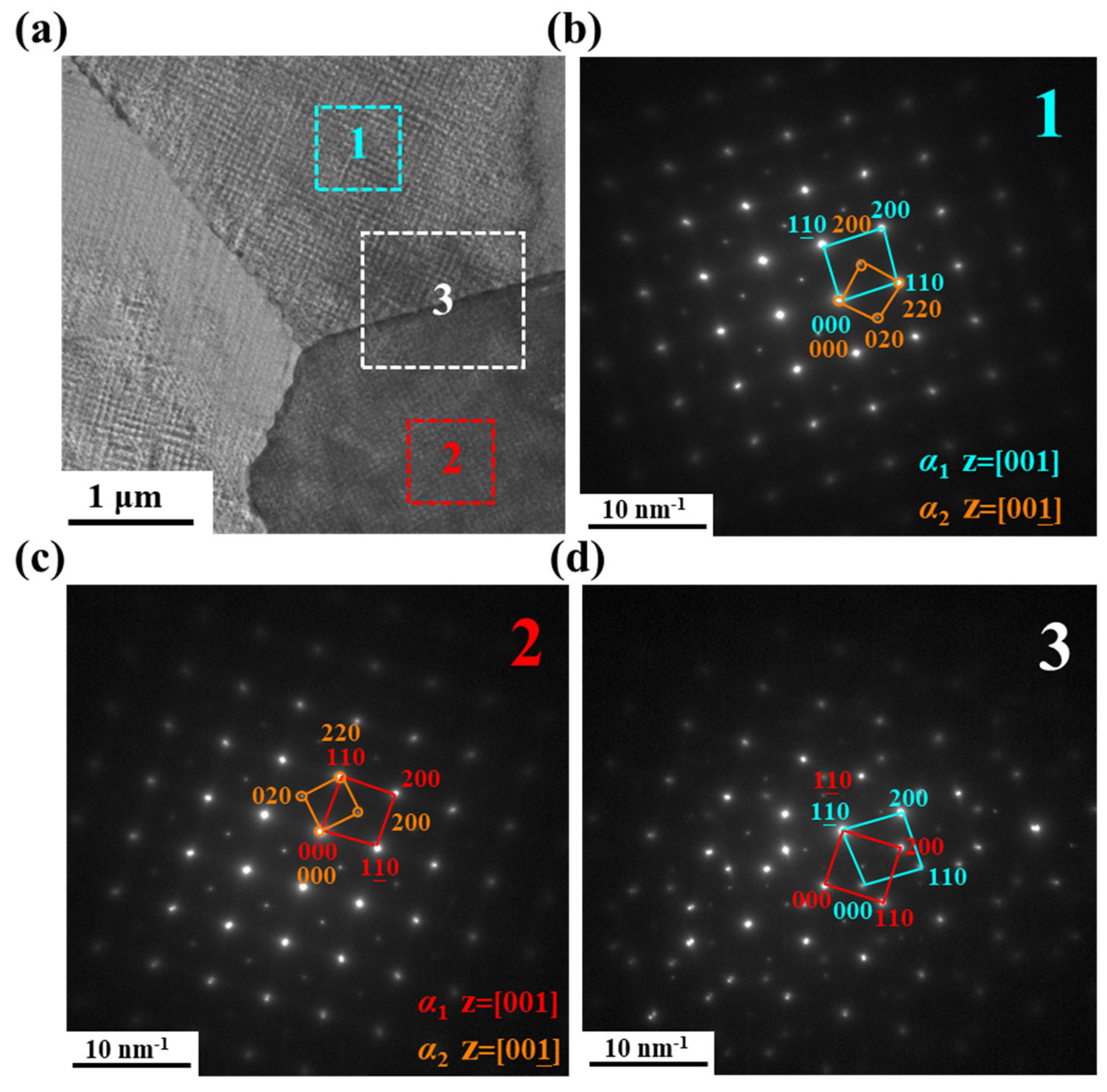
Figure 6 shows the diffraction patterns of the magnet’s grain boundaries, with Figure 6a a TEM image highlighting three distinct grains. To elucidate the magnets orientation, we compared the diffraction patterns of grains on either side of the grain boundary [33]. Figure 6b,c show the diffraction spots on both sides of the boundary, representing the AlNiCo magnet’s diffraction patterns along the [100] zone axis. The distinct diffraction spots confirm that the Al−Ni−rich α2 phase is an ordered phase [34,35]. Additionally, Figure 6d shows the diffraction pattern of the selected area 3 across the grain boundary, where the absence of split diffraction spots indicates a highly consistent crystal alignment between the two adjacent grain regions [33]. These findings demonstrate that the AlNiCo magnet produced at a 50 μm/s pulling speed exhibits excellent overall orientation.
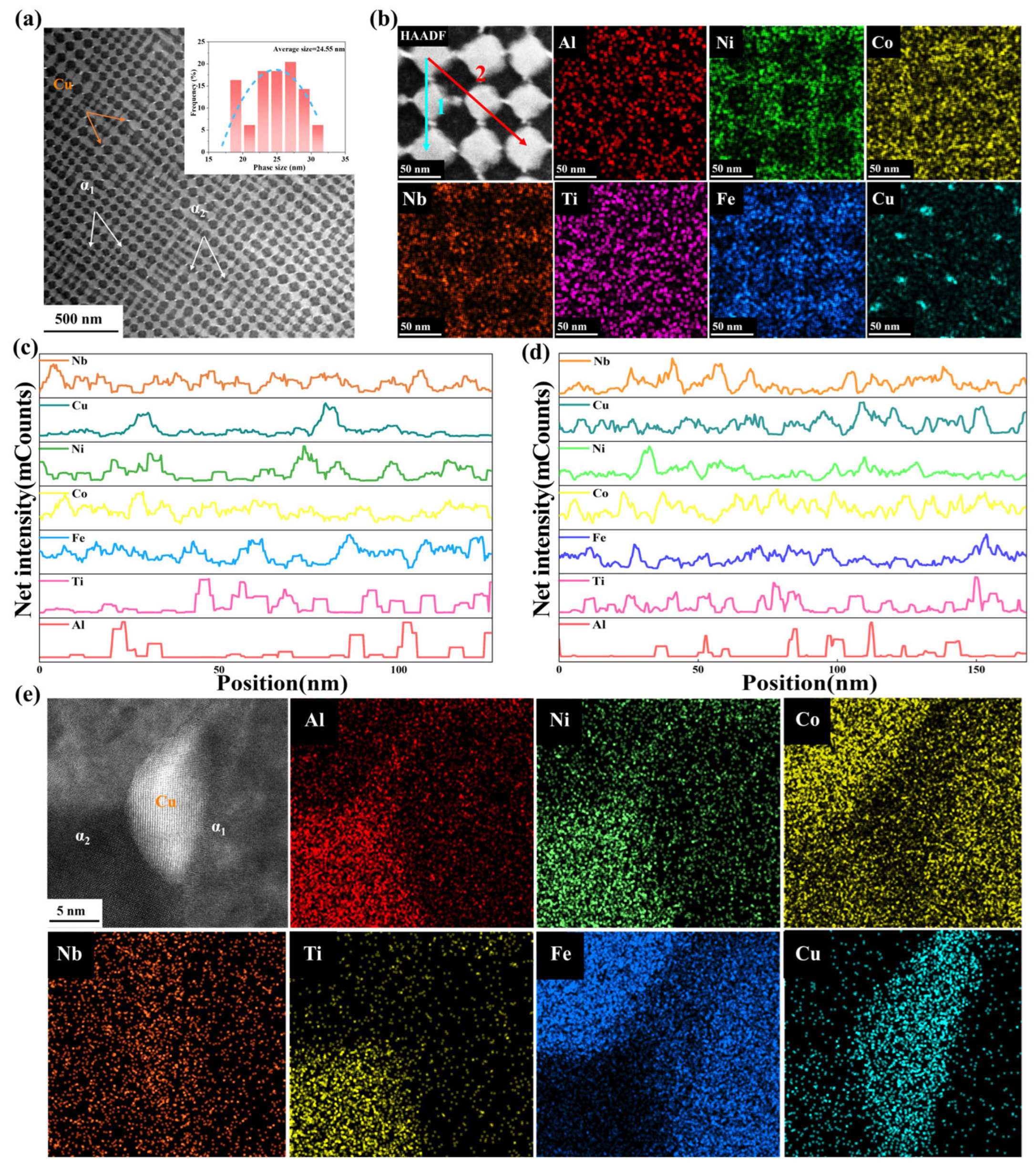
When viewed transversely along the direction of the applied magnetic field, as depicted in Figure 7a, AlNiCo displays a “brick-and-mortar” structure. The brighter α2 phase has a higher average atomic number than the darker α2 phase, which appears as the black “mortar” in the middle. Cross-sectional analysis reveals copper-rich particles situated between the α1 particles, suggesting that copper influences element distribution and phase separation during tempering [4,33,36]. Additionally, due to the small size of the copper clusters, their positions are visible in the high-angle annular dark-field scanning transmission electron microscopy (HAADF STEM) image, where the bright copper-rich phase is clearly discernible. Enhancing the Hcj of these alloys is possible by forming a more continuous copper-rich phase, as these phases effectively decouple the ferromagnetic phase [11,37,38,39]. In Figure 7a, the AlNiCo sample pulled at a speed of 50 μm/s shows the α1 particle phase size ranging from 20 to 30 nm, with an average size of 24.55 nm.
The HAADF image and EDS analysis of the 50 μm/s sample, viewed along the [001] zone axis, reveal three distinct regions (Figure 7b). The first region is the α1 phase, appearing as a bright area rich in Fe and Co. The second region is the α2 phase, a dark matrix mainly composed of Ni, Al, and Nb. The third is a small, bright, contiguous Cu-rich phase adjacent to the α1 phase. The STEM elemental mapping results reveal that Cu forms a Cu-rich phase and a Cu-Ni-rich phase at two different regions of the α1 phase, while some Cu is also dispersed in the α2 phase [40]. As shown in Figure 7c,d, although the line profile in the HAADF diagram does not allow for a direct comparison of different elements’ compositions through the intensity curve, it does reveal variations in the composition of specific elements across different regions. Similarly to the pattern of the EDS mapping diagram, Fe and Co are more prevalent in the α1 phase, while Al, Ti, and Ni are more concentrated in the α2 phase. Notably, Al and Ti lines overlap extensively, suggesting a strong affinity between these elements at the nanoscale. From a functional perspective, the α2 phase acts as a non-ferromagnetic or weakly magnetic matrix surrounding the Fe-Co-rich α1 phase, thereby maintaining both chemical and magnetic isolation between neighboring α1 particles. In addition, the Cu-rich intergranular/interphase regions further suppress direct exchange coupling between adjacent α1 particles, promoting magnetic decoupling and consequently enhancing coercivity. Furthermore, when grains are better aligned along the <001> direction, the α1 phase formed during thermomagnetic treatment can elongate more coherently along this preferred orientation. This enhances the axial magnetization component and improves hysteresis loop squareness, ultimately leading to increased Br and (BH)max.
This is further illustrated by the high-resolution energy spectrum in Figure 7e, Cu predominates in these Cu-rich areas, acting as the primary channel for elemental diffusion, while being sparsely distributed in the α1 and α2 phases. The α1 phase primarily consists of Fe and Co, with Co uniformly distributed across all phases, albeit at lower concentrations in the Cu-rich phase. Conversely, the α2 phase exhibits a concentrated distribution of Al, Ni, and Ti. The findings suggest that an AlNiCo magnet prepared at a pulling speed of 50 μm/s can achieve an improved α1 phase, which in turn enhances the performance of the AlNiCo magnet. Although Al and Ti are known to form Al-Ti-rich phases at the microscale, optimal melting and casting conditions suppress their formation at this level [16].
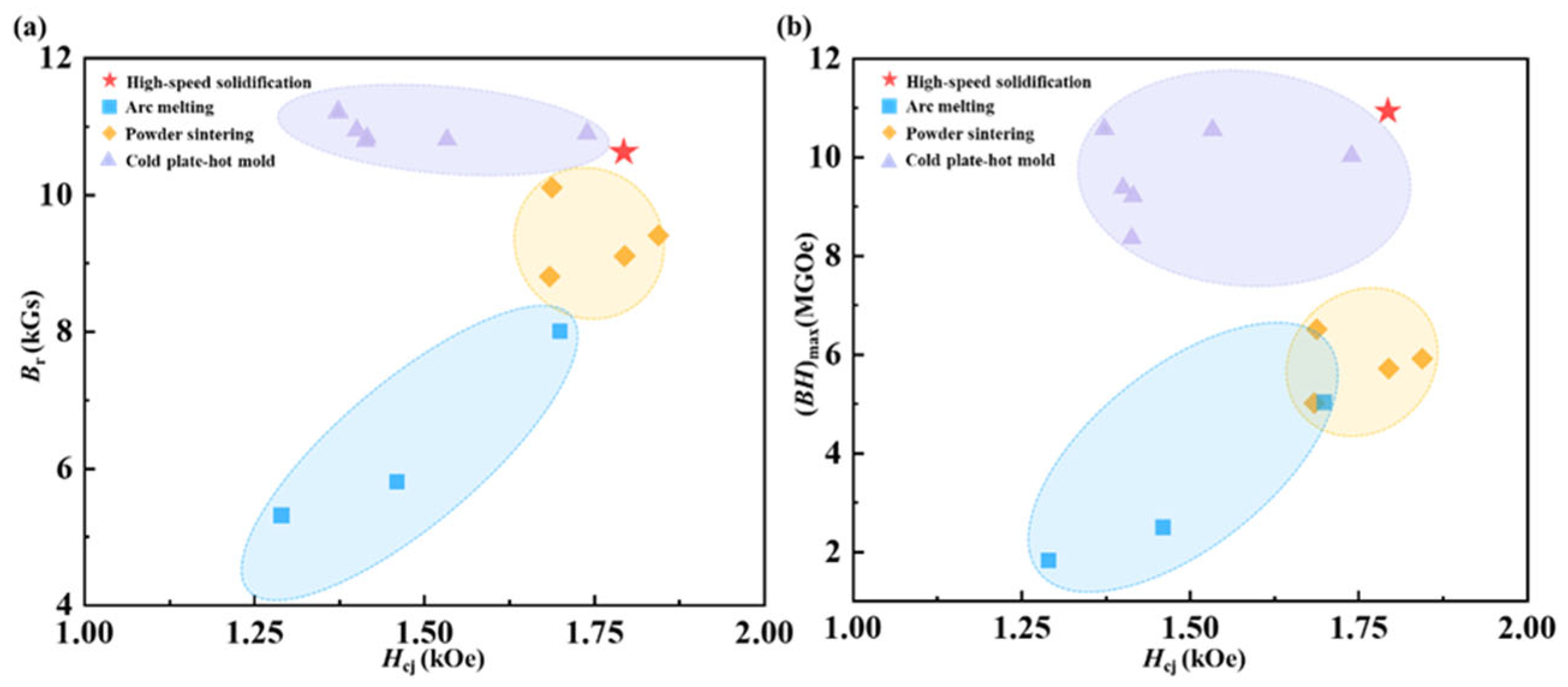
Figure 8 presents a comparison of the magnetic properties between the magnets fabricated in this study and recently reported AlNiCo magnets with similar compositions but prepared using different processing methods. The colors represent different fabrication routes: blue denotes arc melting [27], yellow denotes powder sintering [41], and purple denotes the cold plate–hot mold method []. The red star represents the optimal magnetic performance achieved in this study. The results indicate that both the Br and (BH)max obtained in this study are significantly improved compared with those of AlNiCo alloys prepared by powder sintering and arc melting. This enhancement stems from the equiaxed grain structure formed by vacuum melting and powder sintering, which results in poor crystallographic orientation of the α1 phase, thereby leading to lower Br and reduced squareness of the demagnetization curves. Compared with the AlNiCo alloy fabricated by the conventional “cold plate–hot mold” method, the alloy prepared by the HRS process exhibits lower Br but higher Hcj and (BH)max, resulting in superior overall magnetic performance. This behavior is attributed to the fact that, at an appropriate withdrawal rate, the HRS process effectively suppresses the formation of high-angle grain boundaries and transverse grain boundaries, thereby promoting axial elongation of the microstructure, which is beneficial for enhancing Hcj [42]. In addition, the magnets produced by the HRS method exhibit improved microstructural uniformity, which contributes to the enhanced material utilization efficiency. Overall, the results demonstrate that the HRS method is a promising approach for the development of high-performance AlNiCo alloys.

4. Conclusions

This paper explores the use of the HRS method to prepare AlNiCo alloys with a high degree of orientation and superior properties. By adjusting the withdrawal rate, both the orientation degree and the resulting properties can be optimized. This optimization occurs because the growth direction of AlNiCo columnar crystals aligns with the crystal orientation, which in turn aligns with the magnetization direction. Experiments indicate that when the AlNiCo magnet is prepared at a withdrawal rate of 50 μm/s, the growth of columnar crystals and grain orientation is optimal. Under these conditions, the magnetic properties achieve values of (BH)max = 10.93 MGOe, Hcj = 1.794 kOe, and Br = 10.62 kGs. This study suggests that by controlling the withdrawal rate during solidification, it is possible to achieve a highly oriented columnar structure and further enhance the magnetic properties of AlNiCo alloys.

Author Contributions

Conceptualization, L.Z. and Y.L.; methodology, Q.W. and Z.S.; validation, Q.W., H.Q. and A.P.; formal analysis, Q.W.; investigation, Q.W. and Z.S.; resources, J.F. (Jinkui Fan)and J.F.(Jiantao Feng); data curation, Q.W. and Z.S.; writing—original draft preparation, Q.W. and Z.S.; writing—review and editing, L.Z. and Y.L. visualization, Q.W.; supervision, L.Z. and Y.L.; project administration, L.Z.; funding acquisition, Z.L. and X.Z. All authors have read and agreed to the published version of the manuscript.

Funding

This research was funded by the Key Research and Development Program of Zhejiang Province (No. 2024C01051), National Natural Science Foundation of China (No. 52422106 and 52225312), Key Research and Development Program of China (No. 2023YFB3507502, and 2021YFB3503103), Natural Science Foundation of Zhejiang Province of China (No. ZCLQN26E0102, and LQN26E010023).

Data Availability Statement

The original contributions presented in this study are included in the article. Further inquiries can be directed to the corresponding authors.

Conflicts of Interest

Author Jinkui Fan and Jiantao Feng are employed by Hangzhou Permanent Magnet Group Co., Ltd. The remaining authors declare that the research was conducted in the absence of any commercial or financial relationships that could be construed as a potential conflict of interest

References

  1. Mccallum, R.W.; Lewis, L.; Skomski, R.; Kramer, M.J.; Anderson, I.E. Practical Aspects of Modern and Future Permanent Magnets. Annu. Rev. Mater. Res. 2014, 44, 451–477. [Google Scholar] [CrossRef]
  2. Kulkarni, R.; Nagini, M.; Pradeep, K.G.; Murty, B.S.; Srinivas, V. Observation of itinerant ferromagnetic behaviour in equiatomic medium entropy AlNiCo alloy. Mater. Sci. Eng. B 2024, 299, 116927. [Google Scholar] [CrossRef]
  3. Ur, R.S.; Jiang, Q.; Tan, Q.; Liu, K.; Anwar, U.H.; Zhong, Z. Evolution of Microstructure, Magnetic Properties, and Thermal Stabilities of Isotropic Alnico Ribbons. IEEE Trans. Magn. 2020, 56, 2100305. [Google Scholar] [CrossRef]
  4. Zhou, L.; Guo, W.; Poplawsky, J.D.; Kramer, M. On spinodal decomposition in alnico—A transmission electron microscopy and atom probe tomography study. Acta Mater. 2018, 153, 15–22. [Google Scholar]
  5. Zhu, S.; Zhao, J.; Xia, W.; Sun, Y.; Pend, Y.; Fu, J. Magnetic structure and coercivity mechanism of AlNiCo magnets studied by electron holography. J. Alloys Compd. 2017, 720, 401–407. [Google Scholar]
  6. Zhou, L.; White, E.; Liqin, K.; Cullen, D.A.; Lu, P.; Constantinides, S.; Mccallum, R.W.; Anderson, I.E.; Kramer, M.J. Microstructure and coercivity in alnico 9. J. Magn. Magn. Mater. 2019, 471, 142–147. [Google Scholar] [CrossRef]
  7. Ur, R.S.; Jiang, Z.; Lei, W.; Liu, K.; Zheng, L.; Mahpara, G.; Tahir, A.; Liu, R.; Ma, S.; Zhong, Z. Microstructures and magnetic properties of cast alnico 8 permanent magnets under various heat treatment conditions. Phys. B 2019, 552, 136–141. [Google Scholar]
  8. Zhao, J.; Sun, Y.; Lei, L.; Don, L.; Zhuang, L.; Feng, X.C.; Aru, Y. Correlations of phase structure and thermal stability for Alnico 8 alloys. J. Magn. Magn. Mater. 2017, 442, 208–211. [Google Scholar] [CrossRef]
  9. Zhao, J.; Sun, Y.; Lydiaway, L.; Zhe, L. The study on abnormal temperature characteristics of coercivity in Alnico 8 alloys. J. Magn. Magn. Mater. 2020, 508, 166865. [Google Scholar] [CrossRef]
  10. Cui, J.; Kramer, M.; Zhou, L.; Liu, F.; Sellmyer, D. Current progress and future challenges in rare-earth-free permanent magnets. Acta Mater. 2018, 158, 118–137. [Google Scholar] [CrossRef]
  11. Fan, M.; Liu, Y.; Jha, R.; Dulikravich, G.S.; Schwartz, J.; Koch, C.C. On the Formation and Evolution of Cu-Ni-Rich Bridges of Alnico Alloys with Thermomagnetic Treatment. IEEE Trans. Magn. 2016, 52, 2101710. [Google Scholar] [CrossRef]
  12. Liu, Y.; Zhao, J.; Zhao, Z.; Hu, T.; Pan, H.; Liu, L.; Ding, Y.; Sun, Y.; Yan, A. Influence Mechanism of Rare Earth Addition on Phase Formation and Microstructure in AlNiCo Magnetic Alloys. J. Mater. Res. Technol. 2025, 1008, 1722–1731. [Google Scholar] [CrossRef]
  13. Zhang, W.; Shah, V.; Li, X.; Yue, L.; Ralph, S.; Iver, A.; Matthew, K.; Wei, T.; Jeff, S.; Sellmyer, D.J. Texture development and coercivity enhancement in cast alnico 9 magnets. AIP Adv. 2018, 8, 056215. [Google Scholar] [CrossRef]
  14. Rehman, S.U.; Jiang, Q.; Lunke, H.; Lei, W.; Houdong, X.; Zhong, Z. Microstructure and magnetic properties of alnico permanent magnetic alloys with Zr-B additives. J. Magn. Magn. Mater. 2018, 451, 243–247. [Google Scholar] [CrossRef]
  15. Konrad, L.; Michael, D.; Leopoldo, M.-L. Microstructure and magnetic properties of melt-spun Alnico-5 alloys. J. Magn. Magn. Mater. 2016, 407, 230–234. [Google Scholar] [CrossRef]
  16. Rehman, S.U.; Liu, Z.; Deng, Y.; Liu, R.; Yu, X.; Yang, M. Service performance of directionally solidified Alnico 8 alloy. J. Mater. Res. Technol. 2025, 36, 7476–7484. [Google Scholar] [CrossRef]
  17. Chen, H.; Gou, J.; Song, X.; Ma, T. Origin of hard magnetism in Fe-Co-Ni-Al-Ti-Cu high-entropy alloy: Chemical shape anisotropy. Acta Mater. 2023, 246, 118702. [Google Scholar] [CrossRef]
  18. Rehman, S.U.; Chen, W.; Huang, Q.; Jiang, Q. Tailoring the microstructure, magnetic properties and interaction mechanisms of Alnico-Ta alloys by magnetic field treatment. J. Alloys Compd. 2021, 858, 157586. [Google Scholar] [CrossRef]
  19. Rehman, S.U.; Wei, C.; Zhang, R.; Liu, H.; Li, S.; Zhong, M.; Yang, M.; Jiang, Q.; Wang, J.; Zhong, Z. Tailoring the magnetic properties and microstructure of Alnico 8 magnets by various Ti contents and processing conditions. Intermetallics 2022, 143, 107486. [Google Scholar] [CrossRef]
  20. Min, Z.; Francis, J.; Zhang, W.; Zhao, Q.; Rutkowski, S.F.; Zhou, L.; Kramer, M.J. Processing of alnico permanent magnets by advanced directional solidification methods. J. Magn. Magn. Mater. 2016, 420, 152–157. [Google Scholar] [CrossRef]
  21. Na, S.M.; Lambert, P.K.; Jones, N.J. Hard magnetic properties of FeCoNiAlCuxTix based high entropy alloys. AIP Adv. 2021, 11, 095310. [Google Scholar] [CrossRef]
  22. Palasyuk, A.; Blomberg, E.; Prozorov, R.; Yue, L.; Kramer, M.J.; Mccallum, R.W.; Anderson, I.E.; Constantinides, S. Advances in Characterization of Non-Rare-Earth Permanent Magnets: Exploring Commercial Alnico Grades 5-7 and 9. JOM 2013, 65, 862–869. [Google Scholar] [CrossRef]
  23. Zheng, H.; Chen, R.; Qin, G.; Li, X.; Su, Y. Microstructure evolution, Cu segregation and tensile properties of CoCrFeNiCu high entropy alloy during directional solidification. J. Mater. Sci. Technol. 2020, 38, 19–27. [Google Scholar] [CrossRef]
  24. Jing, Y.; Qingyan, X.; Kai, C.; Baicheng, L.; Atsushi, H. Numerical simulation of solidification process on single crystal Ni-based superalloy investment castings. J. Mater. Sci. Technol. 2007, 23, 47–54. [Google Scholar]
  25. Zhang, Y.; Jia, Y.; Zhou, J.; Yin, Y.; Ji, X.; Shen, X.; Li, W. Effect of withdrawal rate on freckle formation of large-size directional solidified nickel-based superalloy blades. J. Mater. Res. Technol. 2024, 30, 1518–1530. [Google Scholar] [CrossRef]
  26. Liu, X.; Ma, P.; Jia, Y.D.; Wei, Z.J.; Suo, C.J.; Ji, P.C.; Shi, X.R.; Yu, Z.S.; Prashanth, K.G. Solidification of Al-xCu alloy under high pressures. J. Mater. Res. Technol. 2020, 9, 2983–2991. [Google Scholar] [CrossRef]
  27. Rehman, S.U.; Jiang, Q.; Lei, W.; Liu, K.; Zhong, Z.C. Microstructures and magnetic properties of cast alnico 8 permanent magnets under various heat treatment conditions. Phys. B Condens. Matter 2018, 1, 136–141. [Google Scholar] [CrossRef]
  28. Sun, Y.L.; Zhao, J.T.; Liu, Z.; Xia, W.X.; Zhu, S.M.; Lee, D.; Yan, A.R. The phase and microstructure analysis of Alnico magnets with high coercivity. J. Magn. Magn. Mater. 2015, 379, 58–62. [Google Scholar] [CrossRef]
  29. D’Souza, N.; Ardakani, M.G.; Wagner, A.; Shollock, B.A.; Mclean, M. Morphological aspects of competitive grain growth during directional solidification of a nickel-base superalloy, CMSX4. J. Mater. Sci. 2002, 37, 481–487. [Google Scholar] [CrossRef]
  30. Szeliga, D.; Kubiak, K.; Motyka, M.; Sieniawski, J. Directional solidification of Ni-based superalloy castings: Thermal analysis. Vacuum 2016, 131, 327–342. [Google Scholar] [CrossRef]
  31. Wen, Y.; Cui, C.; Tian, L.; Yang, M.; Xuan, T. Research Progress and Application of the Directional Solidification Technology. Mater. Rev. 2016, 30, 116–120. [Google Scholar]
  32. Yu, H.; Li, J.; Lin, X.; Wang, L.; Huang, W. Anomalous overgrowth of converging dendrites during directional solidification. J. Cryst. Growth. 2014, 402, 210–214. [Google Scholar] [CrossRef]
  33. Xu, X.; Yuan, Y.; Hou, H.; Zhao, Y. Study on structure refinement mechanism in rapid solidification of a deeply undercooled Cu60Ni38Co2 alloy. J. Mater. Res. Technol. 2024, 28, 3892–3902. [Google Scholar] [CrossRef]
  34. Zhao, X.; Shi, J.; Yin, Q.; Dong, Z.; Kang, L.; Yu, Q.; Chen, C.; Liu, X.; Zhang, K. Controllable synthesis of high-quality two-dimensional tellurium by a facile chemical vapor transport strategy. iScience 2021, 25, 103594. [Google Scholar] [CrossRef]
  35. Sun, W.; Wang, S.; Min, H.; Xian, J.; Chen, Y. Effect of deposited layer thickness on the microstructure and mechanical properties of IC10 single-crystal Ni3Al-based alloy electron beam-welded joint. J. Mater. Res. Technol. 2021, 11, 1206–1219. [Google Scholar] [CrossRef]
  36. Ma, L.; Kong, X.; Liang, J.; Li, J.; Sun, C.; Jin, Z.; Jiao, Z. Thermal and Mechanical Variation Analysis on Multi-Layer Thin Wall during Continuous Laser Deposition, Continuous Pulsed Laser Deposition, and Interval Pulsed Laser Deposition. Materials 2022, 15, 5157. [Google Scholar] [CrossRef]
  37. Rehman, S.U.; Li, X.; Huang, Q.; Jiang, Q. An exploration of nanocomposite Nd-Fe-B/Alnico alloys with enhanced intergrain interactions and improved magnetic properties. J. Alloys Compd. 2021, 858, 158238. [Google Scholar] [CrossRef]
  38. Wang, X.; Du, P.; Liu, W.; Huang, S.; Li, J. Organic-free direct crystallization of t-LaVO4:Eu nanocrystals with favorable luminescence for LED lighting and optical thermometry. J. Mater. Res. Technol. 2020, 9, 13264–13273. [Google Scholar] [CrossRef]
  39. Han, X.; Sun, S.; Wang, H.; Dong, Z.; Cui, X. Excellent magnetic properties determined by spinodal decomposition structure of Alnico alloy doped SmCo5-based ribbons. J. Alloys Compd. 2019, 806, 1188–1199. [Google Scholar] [CrossRef]
  40. Zubair, A.; Zhongwu, L.; Asad, U.H. Synthesis, magnetic and microstructural properties of Alnico magnets with additives. J. Magn. Magn. Mater. 2017, 428, 125–131. [Google Scholar] [CrossRef]
  41. Tang, W.; Zhou, L.; Kassen, A.G.; Palasyuk, A.; White, E.M.; Dennis, K.W.; Kramer, M.J.; Mccallum, R.W.; Anderson, I.E. New alnico magnets fabricated from pre-alloyed gas atomization powder through diverse consolidation techniques. IEEE Trans. Magn. 2015, 51, 2101903. [Google Scholar] [CrossRef]
  42. Luan, H.; Zhao, Z.; Liu, Y.; Huang, M.; Liu, L.; Ding, Y.; Yan, A.; Sun, Y.; Zhao, J. Grain growth mechanism of AlNiCo magnetic alloy under different withdrawal rates. J. Alloys Compd. 2025, 1029, 180853. [Google Scholar] [CrossRef]
Figure 1. Schematic diagram of HRS.
Magnetochemistry 12 00043 g001
Figure 2. (ac) Inverse pole Figureures and pole Figureures of the magnets at different drawing rates; (df) Grain size distributions of the magnets at 25, 50, and 125 μm/s, respectively.The blue dashed lines in (d-f) represent the Gaussian fitting curves of the grain size frequency distribution, which are used to calculate the average grain size and standard deviation presented in each subplot.
Magnetochemistry 12 00043 g002
Figure 3. Schematic illustrations of the mushy zone with different withdrawal rates. (a) High rate; (b) medium rate; and (c) low rate.
Magnetochemistry 12 00043 g003
Figure 4. X-ray diffraction (XRD) in the vertical direction of AlNiCo alloy with different drawing speeds.
Magnetochemistry 12 00043 g004
Figure 5. Magnetic properties of the magnet with withdrawal rates. (a) Demagnetization curves of the whole magnet; (b) corresponding magnetic parameters of the whole magnet; (c) schematic illustration of the sampling positions; and local magnetic properties at different positions, including (d) (BH)max, (e) Hcj, and (f) Br.
Magnetochemistry 12 00043 g005
Figure 6. (a) High-angle annular dark-field scanning transmission electron microscopy images. (bd) correspond to the diffraction spots of regions 1, 2, and 3 in (a), respectively.
Magnetochemistry 12 00043 g006
Figure 7. Element distribution in the transvers direction of AlNiCo magnets. (a) High-angle annular dark-field scanning transmission electron microscope image, α1 size and high-resolution energy spectrum analysis,The blue dashed line represents the Gaussian fitting curve of the phase size distribution, (b) The STEM line profile and energy spectrum diagram; Line scan analysis of (c) blue line 1 and (d) red line 2, (e) High-resolution energy spectrum diagram.
Magnetochemistry 12 00043 g007
Figure 8. The properties of different AlNiCo alloys, where (a) represents the HcjBr relationship and (b) represents the Hcj − (BH)max relationship. The different colors in the Figure represent the performance of AlNiCo magnets prepared by different methods, where the red star represents the best performance obtained in this experiment.
Magnetochemistry 12 00043 g008
Disclaimer/Publisher’s Note: The statements, opinions and data contained in all publications are solely those of the individual author(s) and contributor(s) and not of MDPI and/or the editor(s). MDPI and/or the editor(s) disclaim responsibility for any injury to people or property resulting from any ideas, methods, instructions or products referred to in the content.