Physiological Responses Consistent with Near-Isohydric and Anisohydric Behaviour in Grapevine Cultivars Șarba and Fetească Neagră (Vitis vinifera L.) Under Semi-Arid Conditions
 , , and
Highlights
- •
- We identified a near-isohydric, water-conserving strategy in Șarba, characterised by early stomatal closure at véraison and significantly higher water use efficiency compared to Fetească neagră.
- •
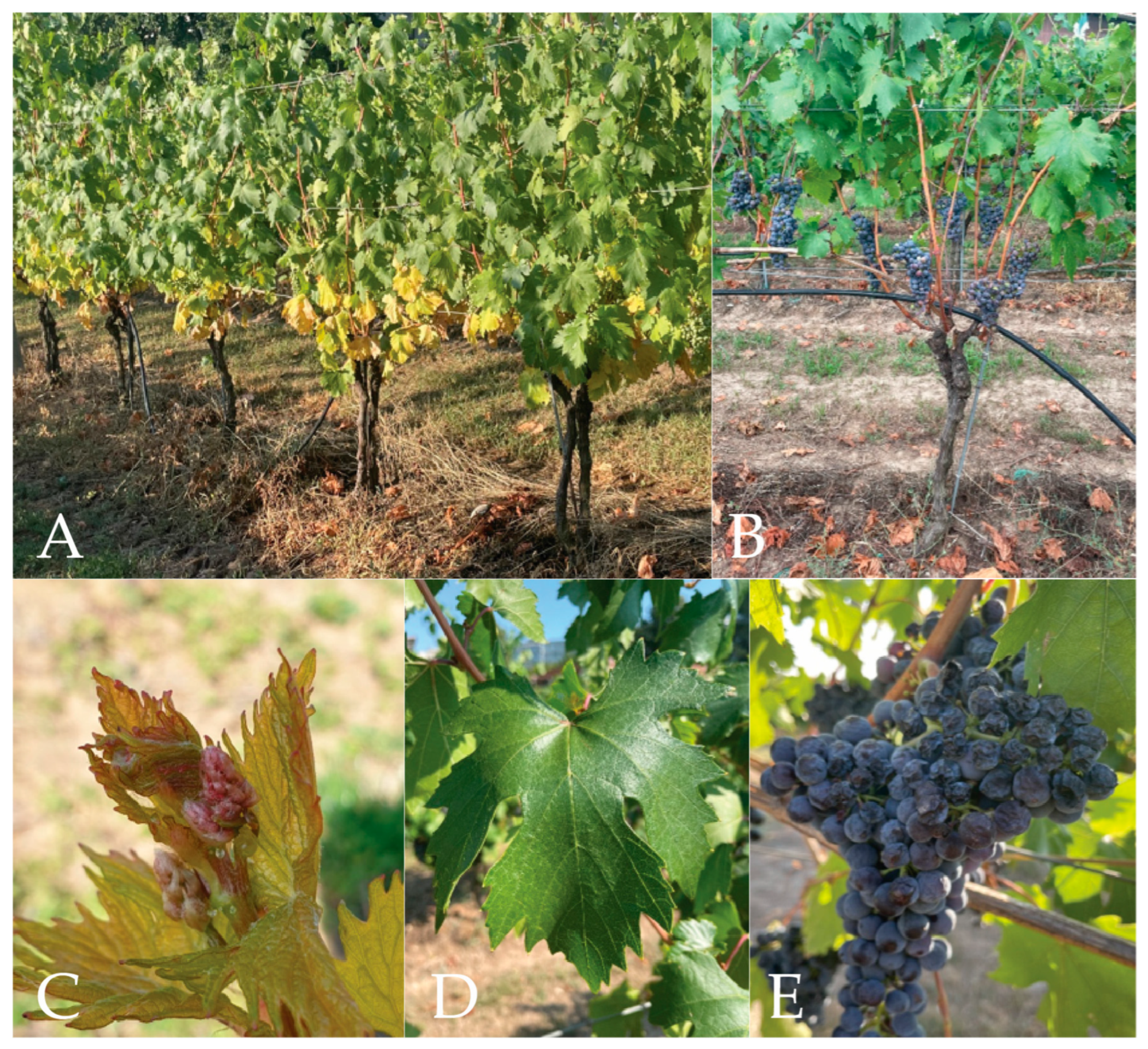
- We identified an anisohydric, gas exchange sustaining strategy in Fetească neagră, which maintained higher net photosynthesis throughout the season but was associated with premature basal leaf senescence—to the best of our knowledge, the first formal field documentation of this phenomenon for the cultivar.
- •
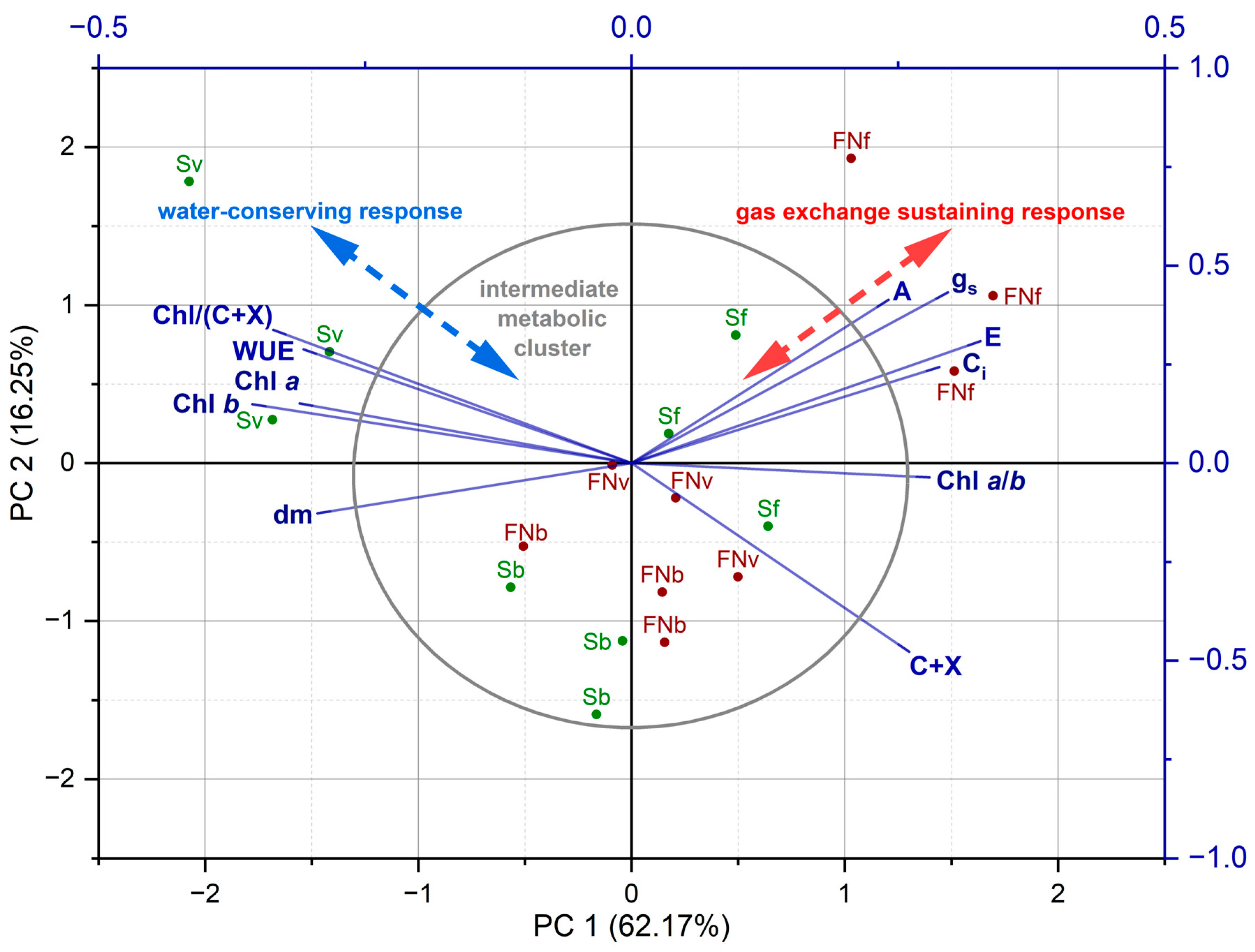
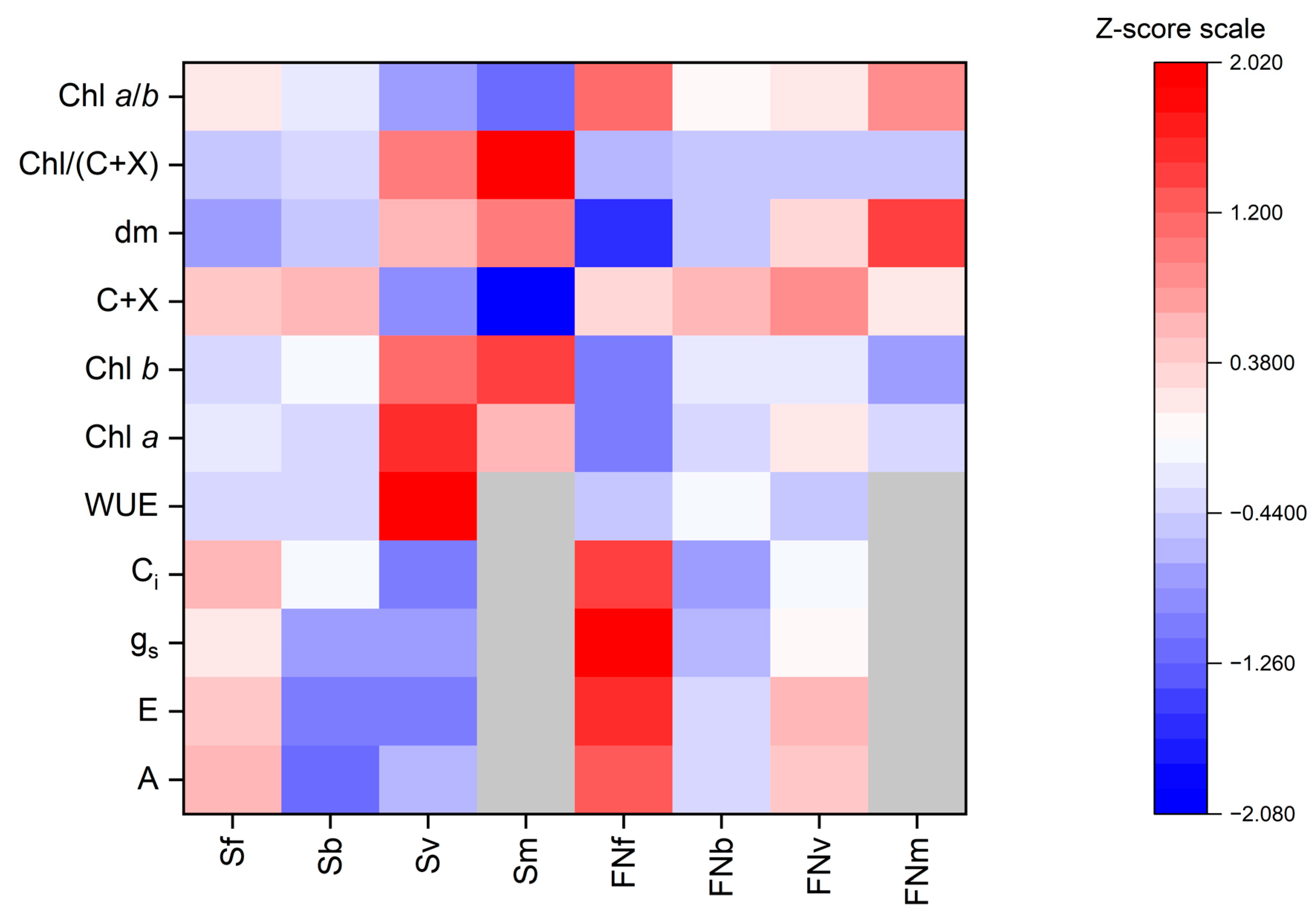
- We resolved the two cultivars into two distinct physiological groups, consistent with water-conserving/near-isohydric and gas exchange sustaining/anisohydric behaviour, using PCA, Heatmap Analysis, and linear mixed-effects modelling, with divergence most pronounced at véraison.
- •
- These findings support cultivar-specific irrigation management: regulated deficit irrigation for Șarba to sustain carbon assimilation, and combined elicitor-based treatments with supplemental irrigation for Fetească neagră.
- •
- They provide a physiological framework for evidence-based varietal selection and drought adaptation strategies under the increasingly semi-arid conditions projected for Romanian and broader European viticultural regions.
Abstract
1. Introduction
- (i)
- Identify the water use strategy of Șarba and of Fetească neagră, and its dependence on phenophase;
- (ii)
- Characterise the leaf structural correlates (stomatal density and leaf dry matter content) and physiological components of drought tolerance in each variety;
- (iii)
- Discuss the implications of the observed results for berry water balance, shrivel risk, and vineyard management of these varieties under increasing summer drought.
2. Materials and Methods
2.1. The Experimental Site and Biological Material
2.2. Climate Data Measurements
2.3. Parameters Determined
2.3.1. Phenological Data
2.3.2. In Situ Leaf Gas Exchange Parameters
2.3.3. Photosynthetic Pigments and Leaf Dry Matter
2.3.4. Stomatal Analysis Method
2.3.5. Harvest Quality Parameters
2.3.6. Changes in Berry Weight and Sugar Content During Ripening
2.4. Experimental Design and Statistical Analysis
3. Results
3.1. Climatic Characterisation of the 2024 Growing Season
3.2. Phenophases in 2024

| Grape Cultivar | Budburst (BBCH 008) | Flowering (BBCH 605) | Véraison (BBCH 801) | Harvest Maturity (BBCH 809) | ||||
|---|---|---|---|---|---|---|---|---|
| Date (DOY) | UHB * (°C) | Date (DOY) | UHB * (°C) | Date (DOY) | UHB * (°C) | Date (DOY) | UHB * (°C) | |
| Șarba | 96 (5 April) | 18.5 | 146 (25 May) | 239.5 | 220 (7 August) | 1086.5 | 239 (26 August) | 308.0 |
| Fetească neagră | 96 (5 April) | 18.5 | 146 (25 May) | 239.5 | 204 (22 July) | 866.0 | 235 (22 August) | 461.5 |
3.3. Effects of Cultivar, Phenophase,, and Their Interaction on Physiological Parameters
3.4. Multivariate Analysis: Divergent Physiological Behaviour
3.5. Grape Quantitative and Qualitative Parameters at Harvest Maturity
4. Discussion
4.1. Semi-Arid Conditions and Phenological Advancement
4.2. Divergent Stomatal Regulation Strategies
4.3. Photoprotective Pigment Response
4.4. Cultivar-Specific Management Implications
4.4.1. Șarba
4.4.2. Fetească Neagră
4.5. Limitations
5. Conclusions
Supplementary Materials
Author Contributions
Funding
Data Availability Statement
Acknowledgments
Conflicts of Interest
Abbreviations
| A | Net Photosynthesis (net CO2 assimilation) |
| ABA | Abscisic Acid |
| AR1 | First-Order Autoregressive (covariance structure) |
| AU | Absorbance Units |
| BBCH | BBCH scale (standardised phenological growth-stage scale) |
| BTH | Benzothiadiazole |
| C+X | Carotenoids and Xanthophylls |
| Chl a | Chlorophyll a |
| Chl a/b | Chlorophyll a/Chlorophyll b ratio |
| Chl b | Chlorophyll b |
| Chl/(C+X) | Ratio of Total Chlorophylls to Carotenoids and Xanthophylls |
| Ci | Intercellular CO2 Concentration |
| CNI | Cool Night Index |
| dm | Leaf Dry Matter Content |
| DMI | De Martonne Aridity Index |
| DOY | Day of Year |
| E | Transpiration Rate |
| EMM | Estimated Marginal Means |
| FW | Fresh Weight |
| GPP | Geranyl Pyrophosphate |
| gs | Stomatal Conductance |
| HC | Hydrothermal Coefficient |
| HCA | Hierarchical Cluster Analysis |
| HI | Huglin Heliothermal Index |
| LHCII | Light-Harvesting Complex II |
| LMM | Linear Mixed-Effects Model |
| MEP | Methylerythritol 4-Phosphate (pathway) |
| MYB | MYB Transcription Factor Family |
| OIV | International Organisation of Vine and Wine |
| PC1, PC2 | Principal Components 1 and 2 |
| PCA | Principal Component Analysis |
| PSII | Photosystem II |
| RDI | Regulated Deficit Irrigation |
| REML | Restricted Maximum Likelihood |
| ROS | Reactive Oxygen Species |
| UHB | Useful Heat Balance |
| VIVC | Vitis International Variety Catalogue |
| WI | Winkler Index |
| WUE | Water Use Efficiency |
References
- van Leeuwen, C.; Seguin, G. The concept of terroir in viticulture. J. Wine Res. 2006, 17, 1–10. [Google Scholar] [CrossRef] [Scilit]
- van Leeuwen, C.; Friant, P.; Choné, X.; Tregoat, O.; Koundouras, S.; Dubourdieu, D. Influence of climate, soil, and cultivar on terroir. Am. J. Enol. Vitic. 2004, 55, 207–217. [Google Scholar] [CrossRef] [Scilit]
- IPCC. Summary for Policymakers. In Climate Change 2023: Synthesis Report; Lee, H., Romero, J., Eds.; IPCC: Geneva, Switzerland, 2023; pp. 1–34. [Google Scholar] [CrossRef] [Scilit]
- Droulia, F.; Charalampopoulos, I. A review on the observed climate change in Europe and its impacts on viticulture. Atmosphere 2022, 13, 837. [Google Scholar] [CrossRef] [Scilit]
- Ollat, N.; de Miguel, M.; Clément Saint Cast, C.; Marguerit, E.; Vivin, P.; Lauvergeat, V.; van Leeuwen, C.; Cookson, S.; Gallusci, P.; Gambetta, G. From soil to canopy: The diversity of adaptation strategies to drought in grapevine. OENO One 2025, 59, 1–15. [Google Scholar] [CrossRef] [Scilit]
- Bondada, B.; Keller, M. Morphoanatomical symptomatology and osmotic behavior of grape berry shrivel. J. Am. Soc. Hortic. Sci. 2012, 137, 20–30. [Google Scholar] [CrossRef] [Scilit]
- Gambetta, G.A.; Herrera, J.C.; Dayer, S.; Feng, Q.; Hochberg, U.; Castellarin, S.D. The physiology of drought stress in grapevine: Towards an integrative definition of drought tolerance. J. Exp. Bot. 2020, 71, 4658–4676. [Google Scholar] [CrossRef] [Scilit] [PubMed]
- Palliotti, A.; Poni, S.; Silvestroni, O. La Nuova Viticoltura. Innovazioni Tecniche per Modelli Produttivi Efficienti e Sostenibili; Edagricole: Bologna, Italy, 2015. [Google Scholar]
- Movahed, N.; Pastore, C.; Cellini, A.; Allegro, G.; Valentini, G.; Zenoni, S.; Cavallini, E.; D’Incà, E.; Tornielli, G.B.; Filippetti, I. The grapevine VviPrx31 peroxidase as a candidate gene involved in anthocyanin degradation in ripening berries under high temperature. J. Plant Res. 2016, 129, 513–526. [Google Scholar] [CrossRef] [Scilit] [PubMed]
- van Leeuwen, C.; Destrac-Irvine, A.; Dubernet, M.; Duchêne, E.; Gowdy, M.; Marguerit, E.; Pieri, P.; Parker, A.; de Rességuier, L.; Ollat, N. An update on the impact of climate change in viticulture and potential adaptations. Agronomy 2019, 9, 514. [Google Scholar] [CrossRef] [Scilit]
- Reynolds, A.G. (Ed.) Managing Wine Quality: Volume 1: Viticulture and Wine Quality, 2nd ed.; Woodhead Publishing: Cambridge, UK, 2021. [Google Scholar]
- Dominguez, D.L.E.; Cirrincione, M.A.; Deis, L.; Martínez, L.E. Impacts of climate change-induced temperature rise on phe-nology, physiology, and yield in three red grape cultivars: Malbec, Bonarda, and Syrah. Plants 2024, 13, 3219. [Google Scholar] [CrossRef] [Scilit] [PubMed]
- Bernardo, S.; Dinis, L.T.; Machado, N.; Moutinho-Pereira, J. Grapevine abiotic stress assessment and search for sustainable ad-aptation strategies in Mediterranean-like climates: A review. Agron. Sustain. Dev. 2018, 38, 66. [Google Scholar] [CrossRef] [Scilit]
- Santos, J.A.; Yang, C.; Fraga, H.; Malheiro, A.C.; Moutinho-Pereira, J.; Dinis, L.T.; Correia, C.; Moriondo, M.; Bindi, M.; Leolini, L.; et al. Long-term adaptation of European viticulture to climate change: An overview from the H2020 Clim4Vitis Action. IVES Tech. Rev. 2021, 4644, 1–2. [Google Scholar] [CrossRef] [Scilit]
- Parker, A.K.; García de Cortázar-Atauri, I.; Trought, M.C.T.; Destrac, A.; Agnew, R.; Sturman, A.; van Leeuwen, C. Adaptation to climate change by determining grapevine cultivar differences using temperature-based phenology models. OENO One 2020, 54, 955–974. [Google Scholar] [CrossRef] [Scilit]
- Morales-Castilla, I.; García de Cortázar-Atauri, I.; Cook, B.I.; Lacombe, T.; Parker, A.; van Leeuwen, C.; Nicholas, K.A.; Wol-kovich, E.M. Diversity buffers winegrowing regions from climate change losses. Proc. Natl. Acad. Sci. USA 2020, 117, 2864–2869. [Google Scholar] [CrossRef] [Scilit] [PubMed]
- Antolín, M.C.; Salinas, E.; Fernández, A.; Gogorcena, Y.; Pascual, I.; Irigoyen, J.J.; Goicoechea, N. Prospecting the resilience of several Spanish ancient varieties of red grape under climate change scenarios. Plants 2022, 11, 2929. [Google Scholar] [CrossRef] [Scilit] [PubMed]
- Burgess, A.J. Wine without water: Improving grapevine tolerance to drought. Plant Physiol. 2022, 190, 1550–1551. [Google Scholar] [CrossRef] [Scilit] [PubMed]
- Baltazar, M.; Castro, I.; Gonçalves, B. Adaptation to climate change in viticulture: The role of varietal selection—A review. Plants 2025, 14, 104. [Google Scholar] [CrossRef] [Scilit] [PubMed]
- Bucur, G.M.; Dejeu, L. Research on adaptation measures of viticulture to climate change: Overview. Sci. Pap. Ser. B Hortic. 2022, LXVI, 177–190. [Google Scholar]
- Bucur, G.M.; Dejeu, L. Phenological and some eno-carpological traits of thirteen new Romanian grapevine varieties for white wine (Vitis vinifera L.) in the context of climate change. Sci. Pap. Ser. B Hortic. 2024, LXVIII, 254–263. [Google Scholar]
- Iqbal, S.; Elata, E.; Tariq, K.; Ali, S.; Hakeem, A.; Shaonan, L.; Badar, R.; Emmie, A.; Mauligen, Q.; Fang, J. Drought stress in viticulture: An updated review of the effects, mechanisms, tolerance strategies, and mitigation approaches. J. Soil Sci. Plant Nutr. 2025, 25, 9049–9091. [Google Scholar] [CrossRef] [Scilit]
- Chaves, M.M.; Zarrouk, O.; Francisco, R.; Costa, J.M.; Santos, T.; Regalado, A.P.; Rodrigues, M.L.; Lopes, C.M. Grapevine under deficit irrigation: Hints from physiological and molecular data. Ann. Bot. 2010, 105, 661–676. [Google Scholar] [CrossRef] [Scilit] [PubMed]
- Schultz, H.R. Differences in hydraulic architecture account for near-isohydric and anisohydric behaviour of two field-grown Vitis vinifera L. cultivars during drought. Plant Cell Environ. 2003, 26, 1393–1405. [Google Scholar] [CrossRef] [Scilit]
- Soar, C.J.; Speirs, J.; Maffei, S.M.; Penrose, A.B.; McCarthy, M.G.; Loveys, B.R. Grapevine varieties Shiraz and Grenache differ in their stomatal response to VPD: Apparent links with ABA physiology and gene expression in leaf tissue. Aust. J. Grape Wine Res. 2006, 12, 2–12. [Google Scholar] [CrossRef] [Scilit]
- Bota, J.; Tomás, M.; Flexas, J.; Medrano, H.; Escalona, J.M. Differences among grapevine cultivars in their stomatal behavior and water use efficiency under progressive water stress. Agric. Water Manag. 2016, 164, 91–99. [Google Scholar] [CrossRef] [Scilit]
- Serrano, A.S.; Martínez-Gascüena, J.; Chacón-Vozmediano, J.L. Variability in water use behavior during drought of different grapevine varieties: Assessment of their regulation of water status and stomatal control. Agric. Water Manag. 2024, 291, 108642. [Google Scholar] [CrossRef] [Scilit]
- Levin, A.D.; Williams, L.E.; Matthews, M.A. A continuum of stomatal responses to water deficits among 17 wine grape cultivars (Vitis vinifera). Funct. Plant Biol. 2019, 47, 11–25. [Google Scholar] [CrossRef] [Scilit] [PubMed]
- Hugalde, I.P.; Vila, H.F. Isohydric or anisohydric behaviour in grapevine…, a never-ending controversy? RIA Rev. Investig. Agropecu. 2014, 40, 75–82. [Google Scholar]
- Gerzon, E.; Biton, I.; Yaniv, Y.; Zemach, H.; Netzer, Y.; Schwartz, A.; Fait, A.; Ben-Ari, G. Grapevine anatomy as a possible determinant of isohydric or anisohydric behavior. Am. J. Enol. Vitic. 2015, 66, 340–347. [Google Scholar] [CrossRef] [Scilit]
- Dal Santo, S.; Palliotti, A.; Zenoni, S.; Tornielli, G.B.; Fasoli, M.; Paci, P.; Tombesi, S.; Frioni, T.; Silvestroni, O.; Bellincontro, A.; et al. Distinct transcriptome responses to water limitation in isohydric and anisohydric grapevine cultivars. BMC Genom. 2016, 17, 815. [Google Scholar] [CrossRef] [Scilit] [PubMed]
- Konecny, T.; Asatryan, A.; Nikoghosyan, M.; Binder, H. Unveiling iso- and aniso-hydric disparities in grapevine—A reanalysis by transcriptome portrayal machine learning. Plants 2024, 13, 2501. [Google Scholar] [CrossRef] [Scilit] [PubMed]
- Flexas, J.; Bota, J.; Cifre, J.; Escalona, J.M.; Galmés, J.; Guliàs, J.; Lefi, E.K.; Martínez-Cañellas, S.F.; Moreno, M.T.; Ribas-Carbó, M.; et al. Understanding down-regulation of photosynthesis under water stress: Future prospects and searching for physiological tools for irrigation management. Ann. Appl. Biol. 2004, 144, 273–283. [Google Scholar] [CrossRef] [Scilit]
- Medrano, H.; Escalona, J.M.; Cifre, J.; Bota, J.; Flexas, J. A ten-year study on the physiology of two Spanish grapevine cultivars under field conditions: Effects of water availability from leaf photosynthesis to grape yield and quality. Funct. Plant Biol. 2003, 30, 607–619. [Google Scholar] [CrossRef] [Scilit] [PubMed]
- Villalobos-González, L.; Alarcón, N.; Bastías, R.; Pérez, C.; Sanz, R.; Peña-Neira, A.; Pastenes, C. Photoprotection is achieved by photorespiration and modification of the leaf incident light, and their extent is modulated by the stomatal sensitivity to water deficit in grapevines. Plants 2022, 11, 1050. [Google Scholar] [CrossRef] [Scilit] [PubMed]
- Flexas, J.; Escalona, J.M.; Evain, S.; Gulías, J.; Moya, I.; Osmond, C.B.; Medrano, H. Steady-state chlorophyll fluorescence (Fs) measurements as a tool to follow variations of net CO2 assimilation and stomatal conductance during water-stress in C3 plants. Physiol. Plant. 2002, 114, 231–240. [Google Scholar] [CrossRef] [Scilit] [PubMed]
- Choat, B.; Gambetta, G.A.; Shackel, K.A.; Matthews, M.A. Vascular function in grape berries across development and its rel-evance to apparent hydraulic isolation. Plant Physiol. 2009, 151, 1677–1687. [Google Scholar] [CrossRef] [Scilit] [PubMed]
- Keller, M.; Zhang, Y.; Shrestha, P.M.; Biondi, M.; Bondada, B.R. Sugar demand of ripening grape berries leads to recycling of surplus phloem water via the xylem. Plant Cell Environ. 2015, 38, 1048–1059. [Google Scholar] [CrossRef] [Scilit] [PubMed]
- Keller, M.; Smith, J.P.; Bondada, B.R. Ripening grape berries remain hydraulically connected to the shoot. J. Exp. Bot. 2006, 57, 2577–2587. [Google Scholar] [CrossRef] [Scilit] [PubMed]
- Zhang, Y.; Keller, M. Discharge of surplus phloem water may be required for normal grape ripening. J. Exp. Bot. 2017, 68, 585–595. [Google Scholar] [CrossRef] [Scilit] [PubMed][Green Version]
- Zhang, X.Y.; Wang, X.L.; Wang, X.F.; Xia, G.H.; Pan, Q.H.; Fan, R.C.; Wu, F.Q.; Yu, X.C.; Zhang, D.P. A shift of phloem un-loading from symplasmic to apoplasmic pathway is involved in developmental onset of ripening in grape berry. Plant Physiol. 2006, 142, 220–232. [Google Scholar] [CrossRef] [Scilit] [PubMed]
- Wenter, A.; Andreotti, C.; Zanotelli, D.; Keller, M. Alleviating Water Stress at Veraison May Trigger Berry Shrivel Disorder in Susceptible Grapevines. Am. J. Enol. Vitic. 2025, 76, 0760010. [Google Scholar] [CrossRef] [Scilit]
- Griesser, M.; Savoi, S.; Bondada, B.; Forneck, A.; Keller, M. Berry shrivel in grapevine: A review considering multiple approaches. J. Exp. Bot. 2024, 75, 2196–2213. [Google Scholar] [CrossRef] [Scilit] [PubMed]
- Tilbrook, J.; Tyerman, S.D. Hydraulic connection of grape berries to the vine: Varietal differences in water conductance into and out of berries, and potential for backflow. Funct. Plant Biol. 2009, 36, 541–550. [Google Scholar] [CrossRef] [Scilit] [PubMed]
- Keller, M.; Romero, P.; Gohil, H.; Smithyman, R.P.; Riley, W.R.; Casassa, L.F.; Harbertson, J.F. Deficit Irrigation Alters Grapevine Growth, Physiology, and Fruit Microclimate. Am. J. Enol. Vitic. 2016, 67, 426–435. [Google Scholar] [CrossRef] [Scilit]
- Gambetta, G.A.; Delmas, C.E.L.; Marguerit, E.; Ollat, N.; Saint Cast, C.; van Leeuwen, C.; Delzon, S. Drought tolerance in grapevine involves multiple interacting physiological mechanisms. IVES Tech. Rev. 2024, 8354, 1–2. [Google Scholar] [CrossRef] [Scilit]
- Dejeu, L.; Mereanu, D.; Matei, P.; Agavriloaei, C. Effects of climate change on dry matter accumulation and partitioning at grapevine. Lucr. Științifice USAMV București Ser. B Hortic. 2009, LIII, 547–549. [Google Scholar]
- Ranca, A.; Artem, V.; Boloș, P.; Olteanu, I.; Cichi, D.D.; Costea, D. The influence of climatic factors on the main physiological processes in vines. Lucr. Științifice Ser. Hortic. UȘAMV Iași 2010, 53, 713–718. [Google Scholar]
- Băducă Câmpeanu, C.; Beleniuc, G.; Simionescu, V.; Panaitescu, L.; Grigorică, L.G. Climate change effects on ripening process and wine composition in Oltenia’s vineyards from Romania. Acta Hortic. 2012, 931, 47–54. [Google Scholar] [CrossRef] [Scilit]
- Irimia, L.M.; Patriche, C.V.; Bucur, G.M.; Quénol, H.; Cotea, V.V. Spatial distribution of grapes sugar content and its cor-rela-tions with climate characteristics and climate suitability in the Huşi (Romania) wine growing region. Not. Bot. Horti Agro-Bot. Cluj-Napoca 2015, 43, 250–258. [Google Scholar] [CrossRef] [Scilit]
- Bucur, G.M.; Dejeu, L. Influence of climate variability on growth, yield and quality of grapes in the south part of Romania. Sci. Pap. Ser. B Hortic. 2014, LVIII, 133–138. [Google Scholar]
- Bucur, G.M.; Dejeu, L. Researches on situation and trends in climate change in south part of Romania and their effects on grapevine. Sci. Pap. Ser. B Hortic. 2017, LXI, 243–247. [Google Scholar]
- Bucur, G.M.; Babeș, A.C. Research on trends in extreme weather conditions and their effects on grapevine in Romanian vi-ti-culture. Bull. Univ. Agric. Sci. Vet. Med. Cluj-Napoca Hortic. 2016, 73, 126–134. [Google Scholar] [CrossRef] [Scilit] [PubMed][Green Version]
- Bucur, G.M.; Cojocaru, G.A.; Antoce, A.O. The climate change influences and trends on the grapevine growing in Southern Romania: A long-term study. BIO Web Conf. 2019, 15, 01008. [Google Scholar] [CrossRef] [Scilit]
- Ion, M.; Pîrcălabu, L.; Burlacu, C. Technological solutions to reduce the disturbing effect of climate changes in viticulture. Sci. Pap. Ser. B Hortic. 2025, LXIX, 260–265. [Google Scholar]
- Irimia, L.M.; Patriche, C.V. Potențialul Viticol al Podgoriilor și Evoluția Acestuia în Contextul Schimbării Climatice; Ion Ionescu de la Brad Publishing House: Iași, Romania, 2019. (In Romanian) [Google Scholar]
- Colibaba, L.C.; Bosoi, I.; Puşcălau, M.; Luchian, C.E.; Rotaru, L.; Cotea, V.V. Grape technology vs. climate change: A success story or a nightmare? In Global Warming and the Wine Industry—Challenges, Innovations and Future Prospects; IntechOpen: London, UK, 2023. [Google Scholar] [CrossRef] [Scilit]
- van Leeuwen, C.; Darriet, P. The impact of climate change on viticulture and wine quality. J. Wine Econ. 2016, 11, 150–167. [Google Scholar] [CrossRef] [Scilit]
- Bernetti, I.; Menghini, S.; Marinelli, N.; Sacchelli, S.; Alampi Sottini, V. Assessment of climate change impact on viticulture: Economic evaluations and adaptation strategies analysis for the Tuscan wine sector. Wine Econ. Policy 2012, 1, 73–86. [Google Scholar] [CrossRef] [Scilit][Green Version]
- Chaves, M.M.; Flexas, J.; Pinheiro, C. Photosynthesis under drought and salt stress: Regulation mechanisms from whole plant to cell. Ann. Bot. 2009, 103, 551–560. [Google Scholar] [CrossRef] [Scilit] [PubMed]
- Brito, C.; Dinis, L.T.; Bernardo, S.; Correia, C.; Moutinho-Pereira, J. A comparative physiological study of three red varieties in the Demarcated Douro Region. Sci. Hortic. 2024, 327, 112873. [Google Scholar] [CrossRef] [Scilit]
- Glăman, G.; Dejeu, L.; Brîndușe, E.; Șerdinescu, A.; Ion, M. Ampelografia României: Soiuri noi de Viță-de-Vie și Portaltoi Creați în România, Vol. IX; Ceres Publishing House: Bucharest, Romania, 2018. [Google Scholar]
- Lacombe, T.; Boursiquot, J.M.; Laucou, V.; Di Vecchi-Staraz, M.; Péros, J.P.; This, P. Large-scale parentage analysis in an extended set of grapevine cultivars (Vitis vinifera L.). Theor. Appl. Genet. 2013, 126, 401–414. [Google Scholar] [CrossRef] [Scilit] [PubMed]
- Antoce, A.O.; Stroe, M.V.; Cojocaru, G.A. Tentative application of an electronic nose to the study of the parentage of Romanian grape varieties Sarba and Alb Aromat. Agric. Agric. Sci. Procedia 2015, 6, 110–117. [Google Scholar] [CrossRef] [Scilit][Green Version]
- Rotaru, L. Soiuri de Viță-de-Vie Pentru Struguri de Vin; Ion Ionescu de la Brad Publishing House: Iași, Romania, 2009. (In Romanian) [Google Scholar]
- Stroe, M.V. Genetic diversity of the viticultural germplasm fund of Romania—New accessions. Sci. Pap. Ser. B Hortic. 2021, LXV, 342–351. [Google Scholar]
- Selyaninov, G.T. About climate agricultural estimation. Proc. Agric. Meteorol. 1928, 20, 165–177. [Google Scholar]
- Huglin, P. Nouveau mode d’évaluation des possibilités héliothermiques d’un milieu viticole. Comptes Rendus Acad. Agric. Fr. 1978, 64, 1117–1126. [Google Scholar]
- Winkler, A.J.; Cook, J.A.; Kliewer, W.M.; Lider, L.A. General Viticulture, 2nd ed.; University of California Press: Berkeley, CA, USA, 1974. [Google Scholar]
- De Martonne, E. Une nouvelle function climatologique: L’indice d’aridité. Meteorologie 1926, 2, 449–458. (In French) [Google Scholar]
- Tonietto, J.; Carbonneau, A. A multicriteria climatic classification system for grape-growing regions worldwide. Agric. For. Meteorol. 2004, 124, 81–97. [Google Scholar] [CrossRef] [Scilit]
- OIV. Descriptor List for Grape Varieties and Vitis Species, 2nd ed.; OIV: Paris, France, 2009; Available online: https://www.oiv.int/node/2830 (accessed on 20 December 2025).
- Lichtenthaler, H.K. Chlorophylls and carotenoids: Pigments of photosynthetic biomembranes. Methods Enzymol. 1987, 148, 350–382. [Google Scholar] [CrossRef] [Scilit]
- Meidner, H.; Mansfield, T.A. Physiology of Stomata; McGraw Hill: London, UK, 1968. [Google Scholar]
- Cayla, L.; Cottereau, P.; Renard, R. Estimation de la maturité phénolique des raisins rouges par la méthode I.T.V. standard. Rev. Oenol. 2002, 104, 17–20. [Google Scholar]
- Keller, M.; Shrestha, P.M.; Hall, G.E.; Bondada, B.R.; Davenport, J.R. Arrested Sugar Accumulation and Altered Organic Acid Metabolism in Grape Berries Affected by Berry Shrivel Syndrome. Am. J. Enol. Vitic. 2016, 67, 398–406. [Google Scholar] [CrossRef] [Scilit]
- International Organisation of Vine and Wine (OIV). Resolution OIV-OENO 662F-2023: Soluble Solids in Grape Juice, Reconstituted Grape Juice, Concentrated Grape Juice, and Grape Nectar; OIV: Dijon, France, 2023; Available online: https://www.oiv.int/node/3037 (accessed on 17 July 2026).
- Casciato, W.K.; Keller, M. Active and Passive Changes in Sugar Concentration during Grape Ripening. Am. J. Enol. Vitic. 2025, 76, 0760019. [Google Scholar] [CrossRef] [Scilit]
- Faralli, M.; Bontempo, L.; Bianchedi, P.L.; Moser, C.; Bertamini, M.; Lawson, T.; Camin, F.; Stefanini, M.; Varotto, C. Natural variation in stomatal dynamics drives divergence in heat stress tolerance and contributes to seasonal intrinsic water-use efficiency in Vitis vinifera (subsp. sativa and sylvestris). J. Exp. Bot. 2022, 73, 3238–3250. [Google Scholar] [CrossRef] [Scilit] [PubMed]
- Gisbert, C.; Soler, J.X.; Fos, M.; Intrigliolo, D.S.; Yuste, A.; Picó, B.; Torrent, D.; Peiró, R. Characterization of local Mediterranean grapevine varieties for their resilience to semi-arid conditions under a rain-fed regime. Agronomy 2022, 12, 2234. [Google Scholar] [CrossRef] [Scilit]
- Yue, X.; Ren, R.; Ma, X.; Fang, Y.; Zhang, Z.; Ju, Y. Dynamic changes in monoterpene accumulation and biosynthesis during grape ripening in three Vitis vinifera L. cultivars. Food Res. Int. 2020, 137, 109736. [Google Scholar] [CrossRef] [Scilit] [PubMed]
- Savoi, S.; Wong, D.C.J.; Arapitsas, P.; Miculan, M.; Bucchetti, B.; Peterlunger, E.; Fait, A.; Mattivi, F.; Castellarin, S.D. Transcriptome and metabolite profiling reveals that prolonged drought modulates the phenylpropanoid and terpenoid pathway in white grapes (Vitis vinifera L.). BMC Plant Biol. 2016, 16, 67. [Google Scholar] [CrossRef] [Scilit] [PubMed]
- Pou, A.; Medrano, H.; Tomàs, M.; Martorell, S.; Ribas-Carbó, M.; Flexas, J. Anisohydric behaviour in grapevines results in better performance under moderate water stress and recovery than isohydric behaviour. Plant Soil 2012, 359, 335–349. [Google Scholar] [CrossRef] [Scilit]
- McDowell, N.; Pockman, W.T.; Allen, C.D.; Breshears, D.D.; Cobb, N.; Kolb, T.; Plaut, J.; Sperry, J.; West, A.; Williams, D.G.; et al. Mechanisms of plant survival and mortality during drought: Why do some plants survive while others succumb to drought? New Phytol. 2008, 178, 719–739. [Google Scholar] [CrossRef] [Scilit] [PubMed]
- Álvarez-Maldini, C.; Acevedo, M.; Estay, D.; Aros, F.; Dumroese, R.K.; Sandoval, S.; Pinto, M. Examining physiological, water relations, and hydraulic vulnerability traits to determine anisohydric and isohydric behavior in almond (Prunus dulcis) cultivars: Implications for selecting agronomic cultivars under changing climate. Front. Plant Sci. 2022, 13, 974050. [Google Scholar] [CrossRef] [Scilit] [PubMed]
- Coupel-Ledru, A.; Lebon, E.; Christophe, A.; Doligez, A.; Cabrera-Bosquet, L.; Péchier, P.; Hamard, P.; This, P.; Simonneau, T. Genetic variation in a grapevine progeny (Vitis vinifera L. cvs Grenache × Syrah) reveals inconsistencies between maintenance of daytime leaf water potential and response of transpiration rate under drought. J. Exp. Bot. 2014, 65, 6205–6218. [Google Scholar] [CrossRef] [Scilit] [PubMed]
- Martinez, J.; Keller, M. Isohydric and anisohydric behavior of 18 wine grape varieties grown in an arid climate. In Proceedings of the IVES Conference Series: 21st GiESCO International Meeting, Thessaloniki, Greece, 23–28 June 2019; Available online: https://ives-openscience.eu/37968/ (accessed on 20 December 2025).
- Spayd, S.; Tarara, J.; Mee, D.; Ferguson, J. Separation of sunlight and temperature effects on the composition of Vitis vinifera cv. Merlot berries. Am. J. Enol. Vitic. 2002, 53, 171–182. [Google Scholar] [CrossRef] [Scilit]
- Sadras, V.O.; Moran, M.A. Elevated temperature decouples anthocyanins and sugars in berries of Shiraz and Cabernet Franc. Aust. J. Grape Wine Res. 2012, 18, 115–122. [Google Scholar] [CrossRef] [Scilit]
- Gayretli, Y.; Abdulhadi, S.A.A.; Demirkeser, O.K.; Turkoglu, I.; Aslan, B.; Sabir, A. Physiological responses of different grapevine genotypes (Vitis spp.) to variable temperatures artificially established as climate change scenery. AgroLife Sci. J. 2024, 13, 98–105. [Google Scholar] [CrossRef] [Scilit]
- Sato, R.; Ito, H.; Tanaka, A. Chlorophyll b degradation by chlorophyll b reductase under high-light conditions. Photosynth. Res. 2015, 126, 249–259. [Google Scholar] [CrossRef] [Scilit] [PubMed]
- Hnilička, F.; Sotolář, R.; Sotolářová, O.; Rygl, T.; Kodet, J.K.; Zika, L. Cultivar-Specific Physiological Responses of Grapevine (Vitis vinifera L.) to Water Deficit. Horticulturae 2026, 12, 128. [Google Scholar] [CrossRef] [Scilit]
- Kovalenko, Y.; Tindjau, R.; Madilao, L.L.; Castellarin, S.D. Regulated deficit irrigation strategies affect the terpene accumulation in Gewürztraminer (Vitis vinifera L.) grapes grown in the Okanagan Valley. Food Chem. 2021, 341, 128172. [Google Scholar] [CrossRef] [Scilit] [PubMed]
- He, F.; Mu, L.; Yan, G.L.; Liang, N.N.; Pan, Q.H.; Wang, J.; Reeves, M.J.; Duan, C.Q. Biosynthesis of anthocyanins and their regulation in colored grapes. Molecules 2010, 15, 9057–9091. [Google Scholar] [CrossRef] [Scilit] [PubMed] [PubMed Central]
- Hochberg, U.; Rockwell, F.E.; Holbrook, N.M.; Cochard, H. Iso/Anisohydry: A plant–environment interaction rather than a simple hydraulic trait. Trends Plant Sci. 2018, 23, 112–120. [Google Scholar] [CrossRef] [Scilit] [PubMed]
- Chaves, M.M.; Costa, J.M.; Zarrouk, O.; Pinheiro, C.; Lopes, C.M.; Pereira, J.S. Controlling stomatal aperture in semi-arid regions—The dilemma of saving water or being cool? Plant Sci. 2016, 251, 54–64. [Google Scholar] [CrossRef] [Scilit] [PubMed]
- Marusig, D.; Tombesi, S. Abscisic acid mediates drought and salt stress responses in Vitis vinifera—A review. Int. J. Mol. Sci. 2020, 21, 8648. [Google Scholar] [CrossRef] [Scilit] [PubMed]
- Iqbal, S.; Elatafi, E.; Shaonan, L.; Ali, S.; Hakeem, A.; Badar Aziz, R.; Mauligen, E.; Tariq, K.; Elhendawy, B.; Shangguan, L. Drought stress and the modulation of physiochemical parameters and antioxidant enzymes in grapevine rootstocks: Insights into the protective role of methyl jasmonate. Horticulturae 2025, 11, 164. [Google Scholar] [CrossRef] [Scilit]
- Paladines-Quezada, D.; Gil-Muñoz, R. Metabolic Response Induced by Methyl Jasmonate and Benzothiadiazole in Vitis vinifera cv. Monastrell Seedlings. Horticulturae 2025, 11, 277. [Google Scholar] [CrossRef] [Scilit]
- Ait Kaci, N.; Quinquiry, B.; Diot, A.; Yobregat, O.; Pellegrino, A.; Maury, P.; Chervin, C. Potential of ethanol to reduce grapevine transpiration. OENO One 2025, 59, 8445. [Google Scholar] [CrossRef] [Scilit]
- Utsumi, Y.; Utsumi, C.; Tanaka, M.; Van, H.C.; Takahashi, S.; Matsui, A.; Matsunaga, T.M.; Matsunaga, S.; Kanno, Y.; Seo, M.; et al. Acetic acid treatment enhances drought avoidance in cassava (Manihot esculenta Crantz). Front. Plant Sci. 2019, 10, 521. [Google Scholar] [CrossRef] [Scilit] [PubMed]


| Climatic Indicator | Multiannual Average (1991–2020) | 2024 | Difference (±) |
|---|---|---|---|
| Average annual temperature, °C | 10.98 | 14.70 | +3.72 |
| Average temperature in the period IV–VIII, °C | 18.93 | 22.21 | +3.28 |
| Average temperature in the growing season, °C (IV–X) | 17.46 | 20.62 | +3.16 |
| Average temperature in summer, °C (VI–VIII) | 22.15 | 26.30 | +4.15 |
| Average annual minimum temperature, °C | 5.24 | 7.70 | +2.46 |
| Average annual maximum temperature, °C | 17.6 | 21.10 | +3.50 |
| Number of hot days (30 °C < Tmax ≤ 35 °C) | 46 | 52 | +6 |
| Number of very hot days (Tmax > 35 °C) | 10 | 38 | +28 |
| Annual total precipitation, mm | 633 | 583 | −50 |
| Total precipitation in the period IV–VIII, mm | 315.3 | 257.5 | −57.8 |
| Total precipitation in the growing season (IV–X), mm | 430 | 339 | −91 |
| Total precipitation in summer (VI–VIII), mm | 193 | 180 | −13 |
| Hydrothermal coefficient (HC) [67] | 1.1 | 0.75 | −0.35 |
| Huglin index (HI) [68] | 3163 | 4138 | +975 |
| Winkler index (WI) [69] | 1762 | 2273 | +511 |
| De Martonne Aridity Index (DMI) [70] | 30.3 | 23.6 | −6.70 |
| Cool night index IX (CNI) [71] | 10.64 | 13.5 | +2.86 |
| * Cool night index VIII (CNI) [71] | 15.13 | 17.13 | +2.00 |
| Physiological Indicators | Grape Cultivar (C) | Phenophase (P) | Interaction C × P | |||
|---|---|---|---|---|---|---|
| F-Statistic | p-Value | F-Statistic | p-Value | F-Statistic | p-Value | |
| A—Net photosynthesis (μmol CO2 m−2 s−1) | 7.70 (df1 = 1, df2 = 5.73) | 0.034 | 28.47 (df1 = 2, df2 = 9.00) | 0.000 | 0.42 (df1 = 2, df2 = 9.00) | 0.671 |
| E—Transpiration rate (mmol H2O m−2 s−1) | 99.73 (df1 = 1, df2 = 6.57) | 0.000 | 78.01 (df1 = 2, df2 = 9.46) | 0.000 | 7.39 (df1 = 2, df2 = 9.46) | 0.012 |
| gs—Stomatal conductance (mol H2O m−2 s−1) | 36.48 (df1 = 1, df2 = 7.22) | 0.000 | 47.34 (df1 = 2, df2 = 9.89) | 0.000 | 7.53 (df1 = 2, df2 = 9.89) | 0.010 |
| Ci—Intercellular CO2 (µmol CO2 mol −1) | 1.31 (df1 = 1, df2 = 5.60) | 0.299 | 9.10 (df1 = 2, df2 = 8.66) | 0.007 | 2.46 (df1 = 2, df2 = 8.66) | 0.143 |
| WUE—Water use efficiency (A/E) | 5.95 (df1 = 1, df2 = 4.10) | 0.070 | 19.72 (df1 = 2, df2 = 7.64) | 0.001 | 18.36 (df1 = 2, df2 = 7.64) | 0.001 |
| Chl a—Chlorophyll a (mg 100 g−1 FW) | 5.20 (df1 = 1, df2 = 6.25) | 0.061 | 4.22 (df1 = 3, df2 = 11.85) | 0.030 | 1.03 (df1 = 3, df2 = 11.85) | 0.416 |
| Chl b—Chlorophyll b (mg 100 g−1 FW) | 18.37 (df1 = 1, df2 = 8.42) | 0.002 | 3.48 (df1 = 3, df2 = 12.46) | 0.049 | 2.55 (df1 = 3, df2 = 12.46) | 0.103 |
| C+X—Carotenoids (mg 100 g−1 FW) | 23.61 (df1 = 1, df2 = 5.02) | 0.005 | 30.05 (df1 = 3, df2 = 11.11) | 0.000 | 19.02 (df1 = 3, df2 = 11.11) | 0.000 |
| dm—Dry matter (% w/w) | 4.15 (df1 = 1, df2 = 7.95) | 0.076 | 81.27 (df1 = 3, df2 = 10.93) | 0.000 | 2.55 (df1 = 3, df2 = 10.93) | 0.109 |
| Chl/(C+X)—ratio total chlorophyll/total carotenoids | 35.92 (df1 = 1, df2 = 6.78) | 0.001 | 12.98 (df1 = 3, df2 = 11.62) | 0.001 | 10.72 (df1 = 3, df2 = 11.62) | 0.001 |
| Chl a/b—ratio Chlorophyll a/Chlorophyll b | 11.70 (df1 = 1, df2 = 8.31) | 0.009 | 1.84 (df1 = 3, df2 = 12.44) | 0.193 | 1.38 (df1 = 3, df2 = 12.44) | 0.294 |
| Physiological Indicators | Grape Cultivar (C) | Phenophase (P) | |||
|---|---|---|---|---|---|
| Flowering | Berry Growth | Véraison | Maturity | ||
| A—Net photosynthesis (μmol CO2 m−2 s−1) | S | 6.8 ± 0.87 aA | 1.81 ± 0.87 bA | 3.29 ± 0.87 bB | - |
| FN | 8.81 ± 0.87 aA | 4.2 ± 0.87 bA | 6.53 ± 0.87 abA | - | |
| E—Transpiration rate (mmol H2O m−2 s−1) | S | 4.93 ± 0.36 aB | 1.25 ± 0.36 bB | 1.04 ± 0.36 bB | - |
| FN | 7.75 ± 0.36 aA | 2.76 ± 0.36 cA | 5.28 ± 0.36 bA | - | |
| gs—Stomatal conductance (mol H2O m−2 s−1) | S | 0.13 ± 0.02 aB | 0.02 ± 0.02 bA | 0.03 ± 0.02 bB | - |
| FN | 0.32 ± 0.02 aA | 0.05 ± 0.02 bA | 0.12 ± 0.02 bA | - | |
| Ci—Intercellular CO2 (µmol CO2 mol−1) | S | 311.93 ± 17.82 aA | 276.6 ± 17.82 aA | 236.4 ± 17.82 aA | - |
| FN | 347.13 ± 17.82 aA | 246.33 ± 17.82 bA | 278.07 ± 17.82 abA | - | |
| WUE—Water use efficiency (A/E) | S | 1.36 ± 0.26 bA | 1.59 ± 0.26 bA | 3.26 ± 0.26 aA | - |
| FN | 1.18 ± 0.26 aA | 1.57 ± 0.26 aA | 1.25 ± 0.26 aB | - | |
| Chl a—Chlorophyll a (mg 100 g−1 FW) | S | 101.48 ± 4.44 abA | 99.92 ± 4.44 bA | 119.14 ± 4.44 aA | 109.86 ± 4.44 abA |
| FN | 92.21 ± 4.44 aA | 100.02 ± 4.44 aA | 104.46 ± 4.44 aB | 99.08 ± 4.44 aA | |
| Chl b—Chlorophyll b (mg 100 g−1 FW) | S | 58.12 ± 6.91 aA | 63.09 ± 6.91 aA | 83.44 ± 6.91 aA | 89.57 ± 6.91 aA |
| FN | 46.09 ± 6.91 aA | 59.13 ± 6.91 aA | 60.4 ± 6.91 aB | 49.87 ± 6.91 aB | |
| C+X—Carotenoids (mg 100 g−1 FW) | S | 26.11 ± 0.82 aA | 26.24 ± 0.82 aA | 20.61 ± 0.82 bB | 16.08 ± 0.82 cB |
| FN | 25.34 ± 0.82 abA | 26.38 ± 0.82 abA | 27.7 ± 0.82 aA | 24.62 ± 0.82 bA | |
| dm—Dry matter (% w/w) | S | 29.43 ± 0.82 bA | 31.05 ± 0.82 bA | 36.17 ± 0.82 aA | 38.18 ± 0.82 aA |
| FN | 25.95 ± 0.82 dB | 30.64 ± 0.82 cA | 34.59 ± 0.82 bA | 39.85 ± 0.82 aA | |
| Chl/(C+X)—ratio total chlorophyll/total carotenoids | S | 6.12 ± 0.62 bA | 6.26 ± 0.62 bA | 9.89 ± 0.62 aA | 12.36 ± 0.62 aA |
| FN | 5.51 ± 0.62 aA | 6.05 ± 0.62 aA | 5.96 ± 0.62 aB | 6.05 ± 0.62 aB | |
| Chl a/b—ratio Chlorophyll a/Chlorophyll b | S | 1.77 ± 0.16 aA | 1.6 ± 0.16 aA | 1.43 ± 0.16 aA | 1.27 ± 0.16 aB |
| FN | 2.09 ± 0.16 aA | 1.71 ± 0.16 aA | 1.74 ± 0.16 aA | 2.01 ± 0.16 aA | |
| Variety | Cluster Weight (g) | Weight of 100 Berries (g) | Sugar Content (°Brix) | Titratable Acidity (g L−1 Tartaric Acid) | pH | The Polyphenolic Potential of Grapes | Anthocyanins (mg L−1) | Total Anthocyanin Potential (mg Kg−1) | |
|---|---|---|---|---|---|---|---|---|---|
| OD 280 nm | Polyphenolic Index | ||||||||
| Șarba | 266 | 154 | 22.0 | 3.64 | 3.7 | 0.106 | 31.8 | - | - |
| Fetească neagră | 205 | 94 | 27.6 | 4.13 | 3.6 | 0.243 | 72.9 | 270.9 | 811.3 |
Disclaimer/Publisher’s Note: The statements, opinions and data contained in all publications are solely those of the individual author(s) and contributor(s) and not of MDPI and/or the editor(s). MDPI and/or the editor(s) disclaim responsibility for any injury to people or property resulting from any ideas, methods, instructions or products referred to in the content. |
© 2026 by the authors. Licensee MDPI, Basel, Switzerland. This article is an open access article distributed under the terms and conditions of the Creative Commons Attribution (CC BY) license.
Share and Cite
Bucur, G.M.; Delian, E.; Filimon, R.M.; Cojocaru, G.A. Physiological Responses Consistent with Near-Isohydric and Anisohydric Behaviour in Grapevine Cultivars Șarba and Fetească Neagră (Vitis vinifera L.) Under Semi-Arid Conditions. Horticulturae 2026, 12, 1118. https://doi.org/10.3390/horticulturae12091118
Bucur GM, Delian E, Filimon RM, Cojocaru GA. Physiological Responses Consistent with Near-Isohydric and Anisohydric Behaviour in Grapevine Cultivars Șarba and Fetească Neagră (Vitis vinifera L.) Under Semi-Arid Conditions. Horticulturae. 2026; 12(9):1118. https://doi.org/10.3390/horticulturae12091118
Chicago/Turabian StyleBucur, Georgeta Mihaela, Elena Delian, Roxana Mihaela Filimon, and George Adrian Cojocaru. 2026. "Physiological Responses Consistent with Near-Isohydric and Anisohydric Behaviour in Grapevine Cultivars Șarba and Fetească Neagră (Vitis vinifera L.) Under Semi-Arid Conditions" Horticulturae 12, no. 9: 1118. https://doi.org/10.3390/horticulturae12091118
APA StyleBucur, G. M., Delian, E., Filimon, R. M., & Cojocaru, G. A. (2026). Physiological Responses Consistent with Near-Isohydric and Anisohydric Behaviour in Grapevine Cultivars Șarba and Fetească Neagră (Vitis vinifera L.) Under Semi-Arid Conditions. Horticulturae, 12(9), 1118. https://doi.org/10.3390/horticulturae12091118