Article

Polysaccharides from Hovenia dulcis: An Integrated Approach to Extraction, Characterization, and In Vivo Application

by
Gilson Gustavo Lucinda Machado
1,
Adriana Guerreiro
2,
Custódia Gago
3,
Mariana Guita
2,3,
Maria Dulce Carlos Antunes
3,*,
Elisângela Elena Nunes Carvalho
1 and
Eduardo Valério de Barros Vilas Boas
1,*
1
Food Science Department—DCA, Federal University of Lavras—UFLA, Lavras 37200-900, MG, Brazil
2
CEOT—Centre for Electronics, Optoelectronics and Telecommunications, Faculty of Sciences and Technology, University of Algarve, Gambelas Campus, 8005-139 Faro, Portugal
3
Mediterranean Institute for Agriculture, Environment and Development & CHANGE—Institute for Global Change and Sustainability, FCT, University of Algarve, Gambelas Campus, 8005-139 Faro, Portugal
*
Authors to whom correspondence should be addressed.
Horticulturae 2026, 12(9), 1110; https://doi.org/10.3390/horticulturae12091110
Submission received: 30 June 2026 / Revised: 4 August 2026 / Accepted: 14 August 2026 / Published: 4 September 2026
(This article belongs to the Section Postharvest Biology, Quality, Safety, and Technology)

Highlights

What are the main findings?
Polysaccharides from Brazilian Hovenia dulcis (HDPs-BR) are suitable for edible coatings.
Those coatings applied alone or in combination with sodium alginate (SA) and eugenol (Eug) improved strawberry storage.
What are the implications of the main findings?
Treatments with edible coatings based on HDPs-BR promoted better quality retention through 15 days of storage.
Those coatings can be tested on other fruits to increase their shelf life.

Abstract

Bioactive polysaccharide-based edible coatings are promising strategies for maintaining postharvest fruit quality. This study aimed to extract and characterize crude polysaccharides from Brazilian Hovenia dulcis (HDPs-BR) and evaluate their potential as edible coatings, alone or combined with sodium alginate (SA) and eugenol (Eug), for strawberry preservation. HDPs-BR showed an extraction yield of 5.31 ± 0.19%, with 62.68 ± 1.90% total sugars, 24.95 ± 0.39% uronic acids, and 5.33 ± 0.23% proteins. They also contained phenolic compounds and exhibited antioxidant activity. Coating performance depended on formulation and storage period. After 15 days, HDPs-BR 0.5% provided the highest firmness, whereas HDPs-BR 1% favored phenolic and anthocyanin retention and red color. SA-containing formulations showed attribute-dependent benefits: HDPs-BR 0.5% + SA 0.5% promoted high phenolic content, while its combination with Eug 0.1% improved luminosity and antioxidant activity at specific storage periods. HDPs-BR 1% + Eug 0.1% maintained a red color and showed high anthocyanin content and antioxidant activity. Overall, HDPs-BR demonstrated potential as a bioactive edible coating matrix, with formulations containing SA and Eug providing additional benefits depending on the quality attribute evaluated.

1. Introduction

Hovenia dulcis Thunb., commonly known as the Japanese raisin tree, is a perennial fruit-bearing species of the Rhamnaceae family, native to East Asia [1,2,3,4], and widely used in traditional medicine in countries such as Japan, China, and Korea [5]. All parts of this tree, including pseudofruits, seeds, leaves, roots, and bark, have been reported to possess medicinal properties [6,7]. Among them, the pseudofruit is the most commonly consumed part due to its sweet taste [8,9] and pear-like aroma, which makes it appealing for human consumption [10].
The pseudofruit, formed through modification of the peduncle, exhibits a twisted shape, coiled appearance, and reddish-brown color when ripe. It can be consumed fresh or in processed forms, such as wines, juice, fermented alcoholic beverages, preserves, jams, and raisins, and as an antioxidant in meat products [2,11,12,13]. However, its use remains relatively unknown in Western countries, such as Brazil [14], representing a promising source for further studies, particularly due to its high sucrose content and functional compounds.
In recent years, plant polysaccharides have gained attention due to their antioxidant, bacteriostatic, antitumor, antiviral, immunomodulatory, anti-inflammatory, anti-radiation, probiotic, and antidiabetic properties, as well as their technological applications as gelling and emulsifying agents, foaming agents, and thickeners [3]. Polysaccharides from Hovenia dulcis have attracted significant scientific interest because of their potential hepatoprotective effects and ability to alleviate hangover symptoms, in addition to being promising candidates for the development of functional foods, pharmaceuticals, and edible packaging [7].
Among the most promising applications of plant polysaccharides is their use in edible packaging systems. Edible films and coatings produced from natural biopolymers such as polysaccharides, proteins, and lipids have gained considerable attention as environmentally friendly alternatives for food preservation. These materials act as semipermeable barriers to moisture and gas exchange, reducing physiological deterioration while helping maintain the sensory, nutritional, and microbiological quality of fresh products, thereby extending their shelf life [15,16]. Nevertheless, the effectiveness of edible coatings depends on several factors, including the physicochemical properties of the biopolymer, the characteristics of the coated commodity, and the coating application method [17].
Among fresh horticultural products, strawberry (Fragaria × ananassa) represents an excellent model for evaluating innovative edible coating technologies because of its high commercial value, worldwide consumption, and extreme perishability. Although strawberries are classified as non-climacteric fruits, they exhibit a very short postharvest life due to their high respiration rate, elevated moisture content, mechanical fragility, and susceptibility to fungal decay, resulting in substantial quantitative and qualitative losses during storage and commercialization [18,19,20]. Refrigerated storage is commonly employed to delay deterioration; however, refrigeration alone is often insufficient to preserve fruit quality throughout the distribution chain [21]. Consequently, edible coatings have become an effective complementary strategy for reducing water loss, delaying microbial and physiological deterioration, and preserving the physicochemical and sensory attributes of strawberries [22,23]. Furthermore, the incorporation of natural bioactive compounds into polysaccharide-based coatings has opened new opportunities for developing multifunctional preservation systems with enhanced antioxidant and antimicrobial properties.
In light of these considerations, the present study aimed to extract polysaccharides from the pseudofruits of Hovenia dulcis, develop edible coatings based on these biopolymers, and evaluate their effectiveness in preserving the postharvest quality of strawberries (Fragaria × ananassa). To the best of our knowledge, this is the first study to investigate the use of polysaccharides extracted from Hovenia dulcis pseudofruits as a matrix for edible coatings applied to strawberries, providing insights into their potential as sustainable biomaterials for postharvest preservation and expanding the technological applications of this underutilized species.

2. Materials and Methods

2.1. Extraction and Characterization of Polysaccharides

2.1.1. Plant Material

Approximately 10 kg of edible pseudofruits of Hovenia dulcis were harvested in the city of Santana do Garambéu, located in the Campos das Vertentes region, Minas Gerais, Brazil (Latitude: 21°34′30″ S, Longitude: 44°4′49″ W, 1044.52 m above sea level), at the mature stage (pseudofruits exhibiting a reddish-brown coloration and a pleasant, sweet aroma, often compared to that of a pear). The samples were placed in low-density polyethylene bags and transported to the Postharvest Fruit and Vegetable Laboratory at the Federal University of Lavras. Upon arrival, the pseudofruits were washed under running water; pseudofruits showing signs of pathogen infection, pest damage, defects, or seeds were removed; and the remaining material was sanitized in 100 ppm sodium hypochlorite for 30 min and subsequently dried in air-circulation ovens. Pseudofruits showing signs of pathogen infection, pest damage, defects, or the presence of seeds were discarded. The remaining material was sanitized in a 100 ppm sodium hypochlorite solution for 30 min and subsequently dried in a forced-air circulation oven at 45 °C until constant weight was achieved, which required approximately 7 days. During this period, the material was turned daily and periodically ground using an industrial blender as moisture loss permitted in order to reduce particle size and improve the uniformity and efficiency of the drying process.

2.1.2. Extraction, Deproteinization, and Purification of Polysaccharides

The polysaccharides were extracted using hot water, following the method previously described by Liu et al. (2020) [24]. Subsequent deproteinization was carried out using the Savage method, according to Huang, Yang, and Wang (2010) [25], while purification followed the protocol of Huang et al. (2020) [26]. After purification, the dried polysaccharides were transferred to high-density polyethylene containers, to which 100 mL of distilled water was added. The solution was homogenized on a shaker table for 1 h and then refrigerated for 48 h to ensure the complete dissolution of the polysaccharide residues. Subsequently, the samples were transferred to an ultrafreezer, where they remained until the lyophilization step, performed as described by Meira et al. (2023) [27]. Additional details regarding the extraction, deproteinization, and purification procedures are provided in Supplementary Materials S1. The obtained polysaccharides were designated as Hovenia dulcis polysaccharides from Brazil (HDPs-BR) and stored in vacuum-sealed low-density polyethylene bags until analysis. The extraction yield (%) was calculated according to Equation (1).
Extraction   yield   ( % ,   W W ) = D r y   H D P s B R   m a s s ( g ) M a s s   o f   p r e t r e a t e d   H . D u l c i s p o w d e r   ( g ) × 100

2.2. Characterization of Polysaccharides

2.2.1. Color

Color was measured using a colorimeter (CR-400, Konica Minolta, Osaka, Japan) in the CIE L*, a*, b*, C*, and h° color spaces using CIE standard illuminant D65, the 2° standard observer, and a d/0 (diffuse illumination/0° viewing) geometry.

2.2.2. Chemical Composition

The total carbohydrate content was determined using the sulfuric acid–phenol colorimetric method, with glucose as the standard [28]. The total uronic acid content was determined following the method of McCready and McComb (1952) [29] and quantified as described by Bitter and Muir (1962) [30], using galacturonic acid as the standard. Protein content was estimated using the Bradford assay with BSA as the standard [31]. Results were expressed as grams per 100 g of dry weight (g 100 g−1 DW).

2.2.3. Sugar Profile

Soluble sugars were quantified by high-performance liquid chromatography (HPLC). The supernatant was diluted with ultrapure water and filtered through a 0.22 μm Merck Millipore Express™ nylon membrane before injection into the chromatographic system. Analyses were performed using a Shimadzu Prominence HPLC system equipped with a Shim-pack SCR-102HG analytical column protected by an SCR-102HG guard column. The column was maintained at 50 °C, and 5 mM perchloric acid was used as the mobile phase at a flow rate of 0.600 mL min−1. Sugars were detected using a refractive index detector (RID-20A). Sucrose, glucose, and fructose were identified by comparing their retention times with those of authentic analytical standards and quantified using external calibration curves. Results were expressed as g 100 g−1 dry weight (DW).

2.2.4. Phenolic Compounds and Antioxidant Activity

Extract Preparation
This procedure was performed according to the method described by Waterhouse (2002) [32], using 50% methanol and 70% acetone as extraction solvents for phenolic compounds. The resulting extracts were subsequently used for the determination of total phenolic content and antioxidant activity.
Determination of Total Phenolic Compounds and Antioxidant Capacity
The total phenolic content was determined using the Fast Blue method as described by Medina (2011) [33], and results were expressed as milligrams of gallic acid equivalents (GAE) g−1 of dry sample. Total flavonoid content was determined following Arvouet-Grand et al. (1994) [34], using 2% aluminum chloride (AlCl3) in methanol, and results were expressed in mg of quercetin per g of dry sample.
Antioxidant activity was evaluated using different methods: the Phosphomolybdenum assay, based on the reduction of Mo6+ to Mo5+ [35], with results expressed as mg ascorbic acid g−1 of dry sample; the ABTS assay, based on scavenging of the ABTS+ radical by an antioxidant, with results expressed as µMol TROLOX equivalents (6-hydroxy-2,5,7,8-tetramethylchroman-2-carboxylic acid) per gram of dry sample [36]; and the FRAP assay, which evaluates antioxidant capacity based on the reduction of the ferric complex (Fe3+-TPTZ) to the ferrous form (Fe2+-TPTZ) in the presence of antioxidants, as described by Pulido, Bravo, and Saura-Calixto (2000) [37], with results expressed as µM ferrous sulfate per g of dry mass (μM FeSO4 g−1 DW).

2.2.5. Fourier Transform Infrared Spectroscopy (FTIR) Analysis

Vibrational spectroscopy analyses in the infrared region were performed using a Shimadzu FTIR spectrometer model 8201A with Fourier transform infrared (FTIR) over a spectral range of 400–4000 cm−1, with a resolution of 4 cm−1 and 64 scans, using KBr pellets [8].

2.2.6. Thermogravimetric Analysis (TGA)

Thermogravimetric analysis was conducted by weighing approximately 10 mg of the material into an alumina crucible and heating from 25 to 800 °C at 10 °C/min under a nitrogen atmosphere [8]. The equipment consists of a balance, furnace, sample holder, temperature sensor, and furnace temperature programmer (DTG-60A/60AH), a recording system (TA-60WSO), and a furnace flow and atmosphere controller (FC-60A).

2.2.7. Scanning Electron Microscopy (SEM)

Observations were performed using an ultra-high-resolution field emission gun scanning electron microscope (FEG-SEM) (Tescan-Clara, Brno, Czech Republic) operating at an acceleration voltage of 20 kV. HDPs-BR samples were mounted on holders using double-sided adhesive tape and subsequently coated with gold via evaporation (Baltec, SCD 050, Balzers, Liechtenstein) [38].

2.3. In Vivo Application of Polysaccharides

2.3.1. Plant Material

Strawberries of the cultivar Karina (Fragaria × ananassa) were harvested in the Algarve region (Faro) in February 2025 and immediately transported to the postharvest laboratory at the University of Algarve. Upon arrival, the fruits (at the 100% red ripening stage) were selected based on the absence of pathogens and disease symptoms, washed under running water, and randomly assigned to the different treatments.

2.3.2. Chemicals

Food-grade sodium alginate (SA) and glycerol (GLY) (Fisher Scientific, Schwerte, Germany) were purchased from Sigma-Aldrich Chemie (Steinheim, Germany). Ultrapure water was obtained using a Milli-Q filtration system. Calcium chloride and pure eugenol (4-allyl-2-methoxyphenol), the major bioactive compound of clove essential oil, were also purchased from Sigma-Aldrich Chemie (Steinheim, Germany).

2.3.3. Preparation of Emulsions

The formulation and concentrations used in the present study were selected based on preliminary assays performed with Hovenia dulcis polysaccharides (HDPs-BR). These preliminary evaluations assessed the performance of different polysaccharide and eugenol concentrations, and the formulations showing the most promising physicochemical characteristics and coating performance were selected for the subsequent in vivo experiments.
Hovenia dulcis polysaccharides exhibit non-Newtonian behavior and low viscosity, which may limit their application in coating systems [7]. Therefore, they were combined with sodium alginate, a polysaccharide widely used in the food industry, recognized for its high viscosity and ability to form stable gels [39]. This combination aimed to evaluate possible interactions between the biopolymers while improving the rheological properties of the coating by increasing the viscosity of the resulting system.
Sodium alginate (SA) at 1% (w/w) was dissolved in Milli-Q water at 70 °C under continuous stirring until completely dissolved. The solution was then cooled to 25 °C and used as the base for preparing alginate-containing coating solutions. The eugenol (Eug) concentration of 0.1% (w/w) was selected based on previous studies reporting its minimum inhibitory concentration [40], as well as on the preliminary assays conducted in the present study. All coating solutions were supplemented with 1% glycerol (GLY) as a plasticizer.
Emulsions containing 1% (w/w) SA were prepared as described by Rojas-Graü et al. (2005) [41] by dissolving SA and 1% GLY in Milli-Q water under stirring until the solution became homogeneous and translucent. The coating-forming solutions were then homogenized using an Ultra Turrax T25 (IKA, Staufen, Germany).
Emulsions containing 1% (w/w) HDPs-BR were prepared by dissolving HDPs-BR and 1% GLY in Milli-Q water at 70 °C under continuous stirring until completely dissolved. The solution was subsequently cooled to 25 °C, after which Eug was incorporated into the respective treatments using a T-18 Ultra Turrax (IKA, Staufen, Germany). Solutions containing 0.5% SA + 0.5% HDPs-BR were obtained by mixing equal volumes of the corresponding 1% emulsions, as presented in Table 1.

2.3.4. Dipping Application

Treatments containing HDPs-BR without SA, with or without Eug, were applied in a single step. The fruits were immersed in the respective coating solution for 2 min, after which the excess solution adhering to the fruit surface was removed by manual centrifugation for 1 min using a salad spinner.
All treatments containing SA, with or without Eug, were applied using a two-step procedure. First, the fruits were immersed in the respective coating solution for 1 min, followed by manual centrifugation for 1 min to remove excess solution. Subsequently, the fruits were immersed in a 1% (w/v) calcium chloride (CaCl2) solution for 1 min to promote ionic crosslinking of sodium alginate. The excess CaCl2 solution was then removed by manual centrifugation for 1 min. Thus, the HDPs-BR 0.5% + SA 0.5% + Eug 0.1% treatment followed the same two-step application procedure used for the HDPs-BR 0.5% + SA 0.5% treatment, including the CaCl2 crosslinking step.
After coating application, the fruits were weighed, identified, and placed in perforated polyethylene trays (14 × 9 × 5 cm). The trays were stored in a cold chamber at 1 °C and 90–95% relative humidity for 15 days. Evaluations were performed after 5, 10, and 15 days of storage, following an additional 24 h period at room temperature. Four replicates were used for each treatment and storage period.

2.3.5. Fruit Quality Analyses

Color, Texture, Weight Loss, Decay Rate, and Soluble Solids
Fruit color was determined using the CIE (Commission Internationale de l’Éclairage) system. Measurements were performed using a PCE-CSM1 colorimeter in the CIELab color space (L*, a*, and b*). For each fruit, two measurements were taken at distinct and opposite points in the equatorial region, and the mean value was used for statistical analysis. Color was evaluated on day 0, prior to the application of the treatments to the strawberries, and subsequently at 5-day intervals throughout the 15-day storage period. Strawberry firmness was measured at the equatorial region using a 4 mm diameter probe, with a compression speed of 1 mm s−1 and a penetration depth of 7 mm, using a Chatillon TCD200 texture analyzer coupled to a DFIS 50 digital force gauge (John Chatillon & Sons, Ametek Inc., Largo, FL, USA). Results were expressed in Newtons (N).
Fruit weight was measured at the beginning of storage (day 0) and after 5, 10, and 15 days of refrigerated storage, following an additional 24 h period at room temperature. Mass loss was calculated as the percentage of weight reduction relative to the initial fruit weight using the following Equation (2):
Weight   loss   ( % )   = ( I n i t i a l   w e i g h t F i n a l   w e i g h t ) I n i t i a l   w e i g h t × 100
The decay rate was determined as the percentage of fruits showing visible signs of decay, with four independent replicates per treatment, each consisting of eight fruits. Inspections were conducted every 5 days over a total of 15 days of storage. Fruits were classified as infected if they exhibited visible lesions, characterized by brown spots, softening in damaged areas, visible mold, or wilting. The percentage of fruit decay was calculated as the number of decayed fruits divided by the initial number of fruits, multiplied by 100. Results were expressed as the percentage of infected fruits.
Next, 10 g of fruits per replicate were weighed and homogenized using a T-18 Ultra Turrax (IKA, Staufen, Germany), followed by centrifugation (Universal 320-Hettich Zentrifugen) at 3000 g for 5 min. The supernatant (juice) was used to measure total soluble solids (°Brix, expressed as %) using a digital refractometer (Atago Co. Ltd., Tokyo, Japan).
Total Phenolic Compounds, Anthocyanins, and Antioxidant Activity
Total phenolic compounds were determined using the Folin–Ciocalteu reagent, with gallic acid as the standard, as described by Singleton and Rossi (1965) [42], with some modifications. Briefly, 20 µL of the samples, 100 µL of 10% (v/v) Folin–Ciocalteu reagent, and 80 µL of sodium carbonate solution (75 g/L) were added to 96-well microplates. The reaction was maintained for 30 min at room temperature, and absorbance readings were performed at 765 nm using a spectrophotometer. Results were expressed as milligrams of gallic acid equivalents per milliliter (mg GAE/mL).
Total anthocyanin content was quantified using the differential pH method, as described by Sun et al. (2009) [43] and Saldaña et al. (2021) [44]. For the acidic buffer solution (pH 1.0), 0.186 g of KCl was dissolved in 100 mL of distilled water, and the pH was adjusted to 1.0 ± 0.05 using hydrochloric acid (HCl). The pH 4.5 buffer solution was prepared by dissolving 5.443 g of sodium acetate trihydrate in 100 mL of distilled water, with the pH similarly adjusted using HCl.
Strawberry liquid extracts were diluted at a 1:50 ratio and then mixed with the buffer solutions at a 1:1 (v/v) ratio. Absorbance readings of the diluted samples were recorded using a spectrophotometer at wavelengths of 520 and 700 nm for both solutions (pH 1.0 and pH 4.5). Anthocyanin content was calculated based on Equation (3) as proposed by the referenced authors.
Anthocyanin   content   ( m g L ) = A × M W × D F × 10 3 Ɛ × 1
where A = (A520–A700 nm) at pH 1.0—(A520–A700 nm) at pH 4.5; molecular weight (MW) = 449.2 g/mol of cyanidin-3-glucoside equivalent (Cy3GE); dilution factor (DF) = 50; ε = 26,900 (molar extinction coefficient in L/mol.cm for Cy3GE); 1 represents the path length (in cm); and 103 is the conversion factor from grams to milligrams. Anthocyanin content was expressed as milligrams of Cy3GE per liter of extract.
Antioxidant activity was assessed using the ferric reducing antioxidant power (FRAP) assay, as described by Benzie and Strain (1996) [45], with adaptations to reagent and sample volumes for 96-well microplates. The FRAP reagent was prepared daily by mixing 300 mM acetate buffer (pH 3.6), a 10 mM solution of 2,4,6-tripyridyl-s-triazine (TPTZ) in 40 mM HCl, and a 20 mM solution of ferric chloride (FeCl3.6H2O) in a 10:1:1 (v/v/v) ratio. The reagent was protected from light and heated to 37 °C prior to use. For the assay, 180 µL of the FRAP reagent was added to 20 µL of the sample or standard solution in 96-well microplates. The mixture was incubated at 37 °C for 30 min, and absorbance was measured at 593 nm (Synergy HTX, BioTek, USA). Results were calculated based on a ferrous sulfate (FeSO4) standard curve and expressed as micromoles of Fe2+ equivalents per milliliter (µmol Fe2+/mL).
Antioxidant activity assessed through the DPPH radical (2,2-diphenyl-1-picrylhydrazyl) scavenging assay was performed as described by Brand-Williams et al. (1995) [46], with some modifications. A 0.1 mM DPPH stock solution was prepared in methanol and kept in the dark at room temperature. The working solution was obtained by diluting the stock solution with methanol until an absorbance of approximately 0.9 ± 0.02 at 517 nm was reached. For the assay, 195 µL of the DPPH working solution was added to 25 µL of the strawberry juice extract or standard solution in 96-well microplates. The mixture was incubated in the dark at room temperature for 30 min to allow the reaction to proceed. Absorbance was measured at 517 nm (Synergy HTX, BioTek, Santa Clara, CA, USA) to determine the residual DPPH concentration. Results were expressed as antioxidant activity equivalent to Trolox per milliliter. Blanks were prepared using methanol in place of the sample, and a control containing only the DPPH solution was used to measure the maximum absorbance.
Microbial Count
Procedures for the enumeration of mesophilic aerobic bacteria, psychrophilic bacteria, molds, and yeasts were performed according to Guerreiro et al. (2015) [40]. Ten grams of each sample were added to 90 mL of peptone water (Oxoid) and homogenized using a Classic/Panoramic homogenizer (IUL Instruments, Barcelona, Spain), followed by serial decimal dilutions. For the enumeration of molds and yeasts, Dichloran Rose Bengal Chloramphenicol (DRBC) agar (Biokar, Paris, France) was used, whereas Plate Count Agar (Biokar, Paris, France) was used for the enumeration of psychrotrophic and mesophilic aerobic bacteria. Culture plates were incubated at 25 ± 1 °C for 72 h for molds and yeasts, at 30 ± 1 °C for 24 h for mesophilic aerobic bacteria, and at 6.5 ± 1 °C for 7–10 days for psychrotrophic bacteria. Results were expressed as Log10 colony-forming units (CFU) per gram of fresh weight [47].

2.4. Experimental Design and Statistical Analysis

Polysaccharide analyses were performed in triplicate, and the results are expressed as mean ± standard deviation.
The in vivo experiment was conducted using a completely randomized design (CRD) in a 7 × 4 factorial arrangement, consisting of seven coating treatments and four storage periods (0, 5, 10, and 15 days). Each treatment × storage period combination included four replicates, with each replicate consisting of four fruits (16 fruits per treatment at each storage period).
Data obtained from the in vivo experiment were analyzed using IBM SPSS Statistics 27.0 (IBM Corp., Armonk, NY, USA). A two-way analysis of variance (ANOVA) was performed considering coating treatment and storage period as fixed factors. Whenever a significant treatment × storage period interaction was detected (p < 0.05), simple effects were evaluated using Duncan’s multiple range test (p < 0.05) by comparing treatments within each storage period and storage periods within each treatment.
Results from the strawberry quality analyses were autoscaled prior to principal component analysis (PCA), which was performed using OriginPro 2018 (version 9.5, OriginLab Corporation, Northampton, MA, USA). Graphical representations were generated using GraphPad Prism 8.0.1 (GraphPad Software, San Diego, CA, USA).

3. Extraction and Characterization of Polysaccharides

3.1. Color, Chemical Composition, and Sugar Profile

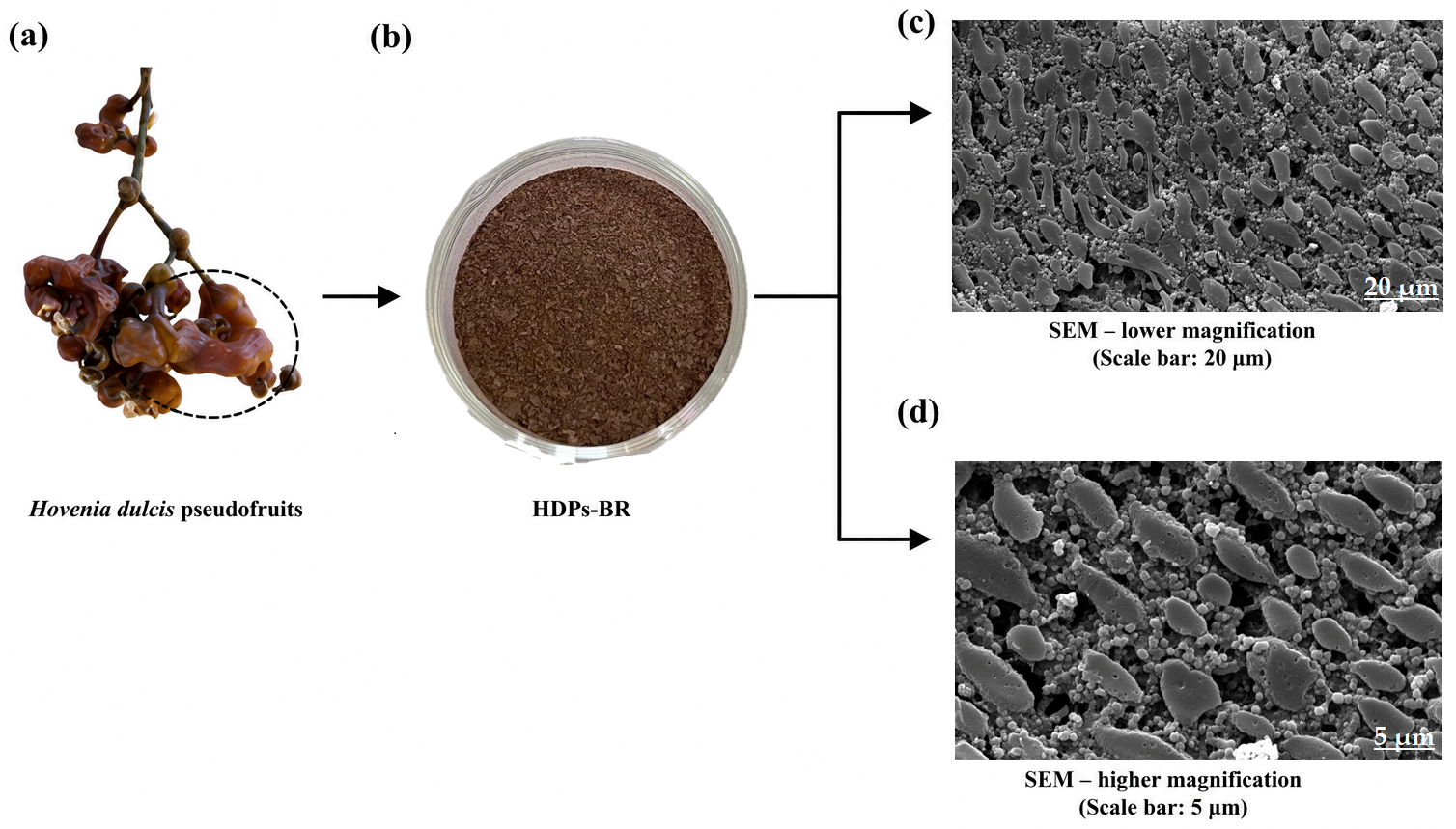
Following hot water extraction followed by freeze-drying, the crude polysaccharides from Brazilian Hovenia dulcis (HDPs-BR) showed an average extraction yield of 5.31 ± 0.19 along with a reddish-yellow coloration (Figure 1, Table 2).
Results were expressed as means ± standard deviation, with all values presented on a dry weight (DW) basis.
Scanning electron microscopy (SEM) analysis (Figure 1b,c) revealed that HDPs-BR exhibit a predominantly ellipsoidal morphology, covered by uniformly distributed spheres, presenting a rough surface and the presence of pores. The protein, uronic acid, and total sugar contents were 5.33 ± 0.23, 24.95 ± 0.39, and 62.68 ± 1.90 g 100−1, respectively (Table 2).
Sugar profile analysis by HPLC allowed the identification of one disaccharide and two monosaccharides: sucrose, glucose, and fructose, with concentrations of 8.01 ± 0.29, 1.69 ± 0.05, and 4.12 ± 0.075 g 100−1, respectively (Table 2), totaling a sum of individual sugar concentrations of 13.82 g 100−1.

3.2. Total Phenolic Compounds and Antioxidant Activity of the Polysaccharides

Total phenolic analysis by the Fast Blue method, as well as that of flavonoids, evidenced the presence of phenolic compounds in the polysaccharides, with concentrations of 241.73 ± 0.76 and 11.53 ± 0.36 mg g−1, respectively (Table 3).
Results were expressed as means ± standard deviation, with all values presented on a dry weight (DW) basis.
In addition to the presence of total phenolic compounds, the polysaccharides exhibited significant antioxidant activity (Table 3), with values of 93.69 ± 0.67 mg g−1 by the phosphomolybdenum method, 723.39 ± 4.05 µM Trolox g−1 by the ABTS method, and 18,459.19 ± 436.89 µM FeSO4 g−1 by the FRAP method.

3.3. FTIR and TGA of HDPs-BR

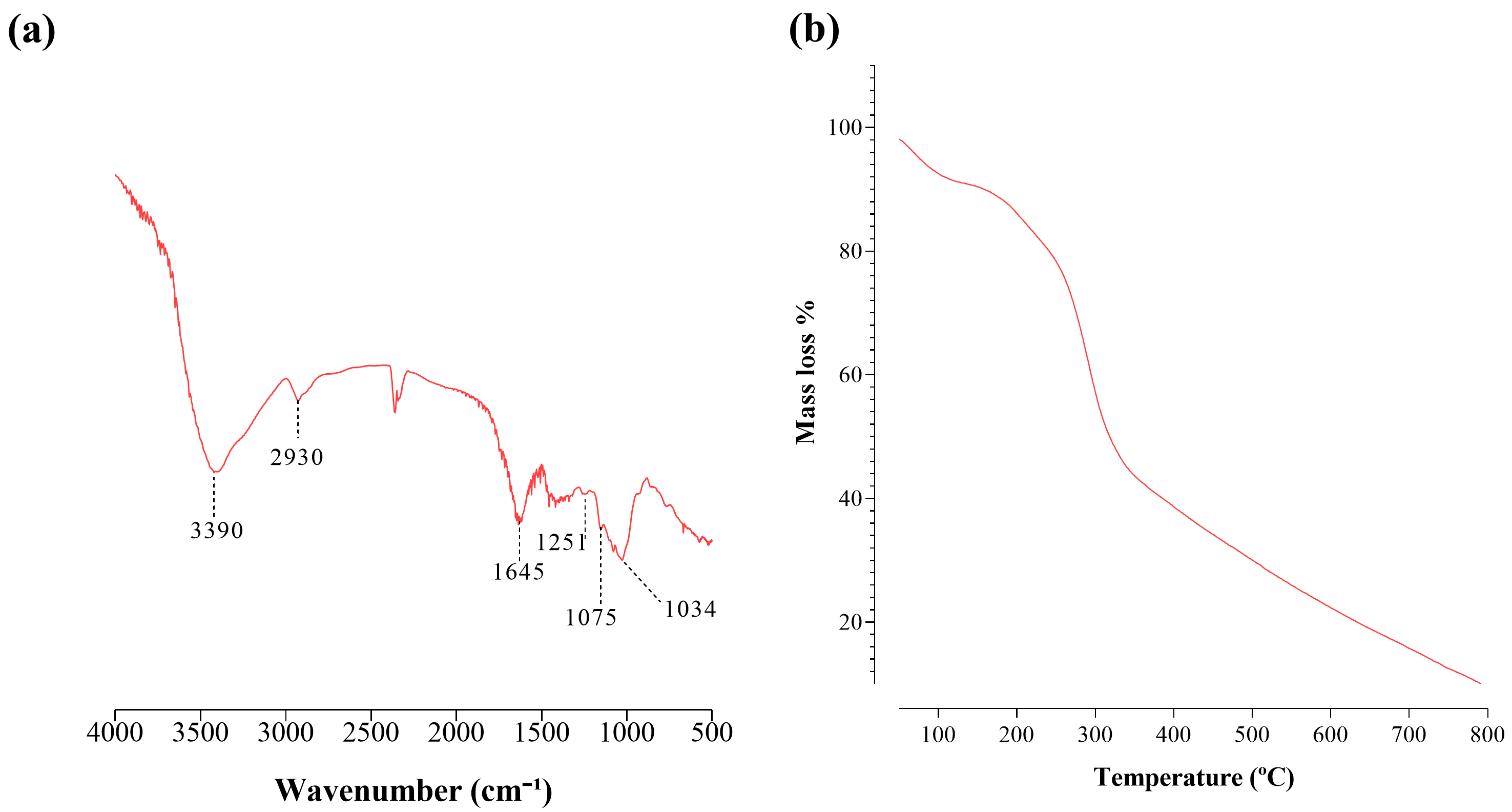
In the FTIR analysis, six main spectral bands were identified. Initially, a broad band was observed in the region around 3390 cm−1, followed by a band near 2930 cm−1. Following the spectrum, a strong absorption was detected at 1645 cm−1 and a subsequent peak at 1251 cm−1. Additionally, the profile revealed a peak at 1075 cm−1 and a complementary band at 1034 cm−1 (located within the range of 1000–1200 cm−1) (Figure 2a).
Concurrently, the TGA analysis (Figure 2b) revealed that the first mass loss of the Hovenia dulcis polysaccharide occurred in the range between 27 °C and 150 °C. Above this temperature, a new stage of mass loss began, with thermal decomposition concentrated mostly between 150 °C and 350 °C. Upon reaching the 350 °C plateau, it was found that the residual mass of the polysaccharide stabilized at approximately 43%, decreasing gradually from this point up to the limit of 800 °C.

4. Fruit Quality Analyses

4.1. Color, Texture, Soluble Solids, Weight Loss, and Decay Rate

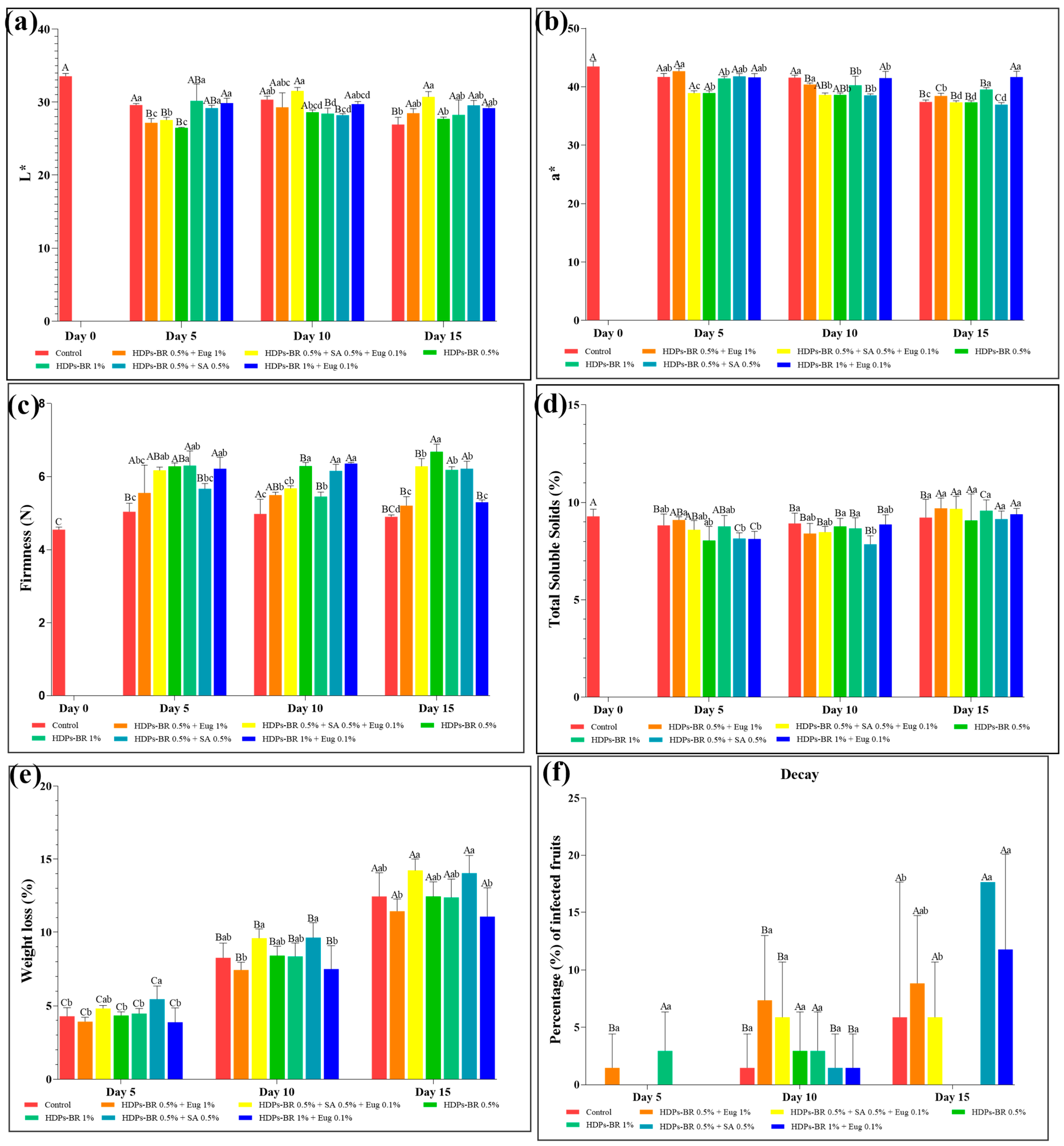
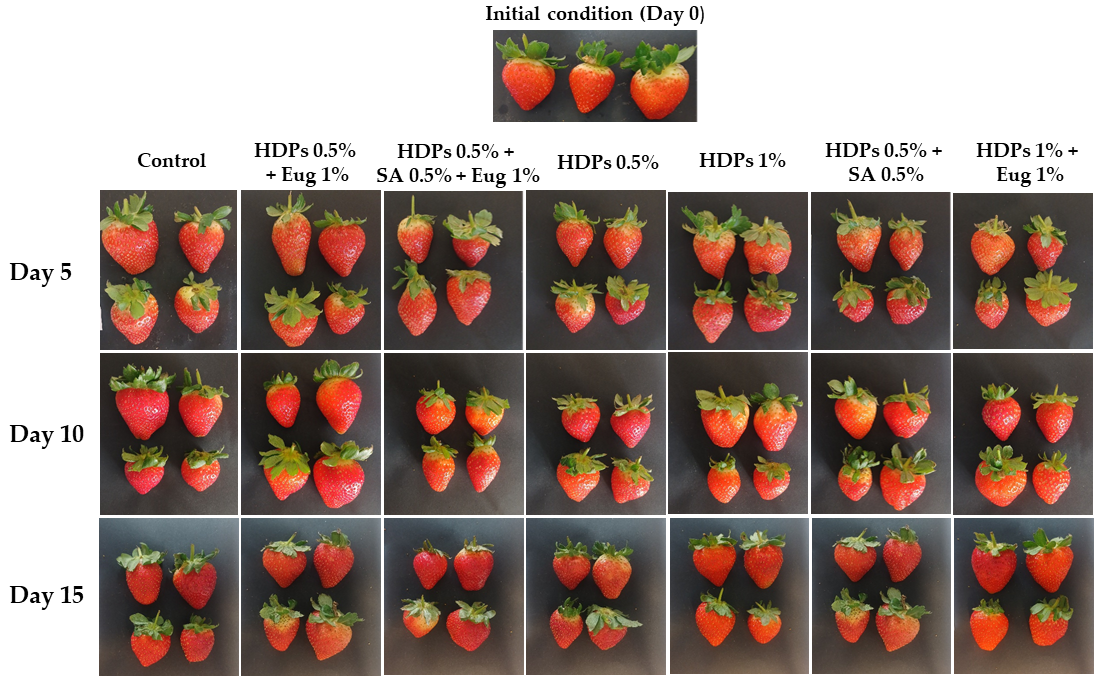
Fruit color was evaluated on day 0, before the application of the treatments to the strawberries, and subsequently every 5 days during 15 days of storage. The results of the color analysis (Figure 3a,b) showed a significant interaction between treatment and storage period (p < 0.05) on strawberry color over time (Figure 4).
On the 15th day of storage, fruits treated with HDPs-BR 0.5% + SA 0.5% + Eug 0.1% showed the highest L* values, differing significantly from the control and the treatment containing only HDPs-BR 0.5%, while the remaining treatments showed intermediate values and did not differ significantly from either the highest- or lowest-value groups (Figure 3a).
Regarding red color intensity (a*), the highest values were observed in fruits treated with HDPs-BR 1% and HDPs-BR 1% + Eug 0.1% on the 15th day of storage (Figure 3b). The HDPs-BR 1% + Eug 0.1% treatment showed no significant variation in a* values throughout the storage period.
For firmness, significant differences among treatments were observed on the 15th day of storage (p < 0.05). Fruits coated with HDPs-BR 0.5% showed the highest firmness values, differing significantly from the control and the other treatments (Figure 3c). Furthermore, HDPs-BR 0.5% resulted in higher firmness than HDPs-BR 1%.
Soluble solids content was only slightly affected by the different edible coatings during storage (Figure 3d), although small differences among treatments were observed at some storage periods. In contrast, storage period had a significant effect (p < 0.05), with soluble solids increasing in several treatments by the end of the experimental period.
The coatings did not significantly reduce weight loss compared with the control. However, weight loss increased significantly throughout storage in all treatments, including the control (Figure 3e).
Regarding the decay index (Figure 3f), fruits coated with HDPs-BR 0.5% and HDPs-BR 1% showed the lowest values after 15 days of storage, with no decayed fruits observed in these treatments. Although these values were numerically lower than those of the control, they did not differ significantly from the control (p > 0.05). In contrast, the highest decay indices were observed for HDPs-BR 0.5% + SA 0.5% and HDPs-BR 1% + Eug 0.1%, which differed significantly from the treatments showing the lowest decay values.

4.2. Total Phenolics, Anthocyanins, and Antioxidant Activity

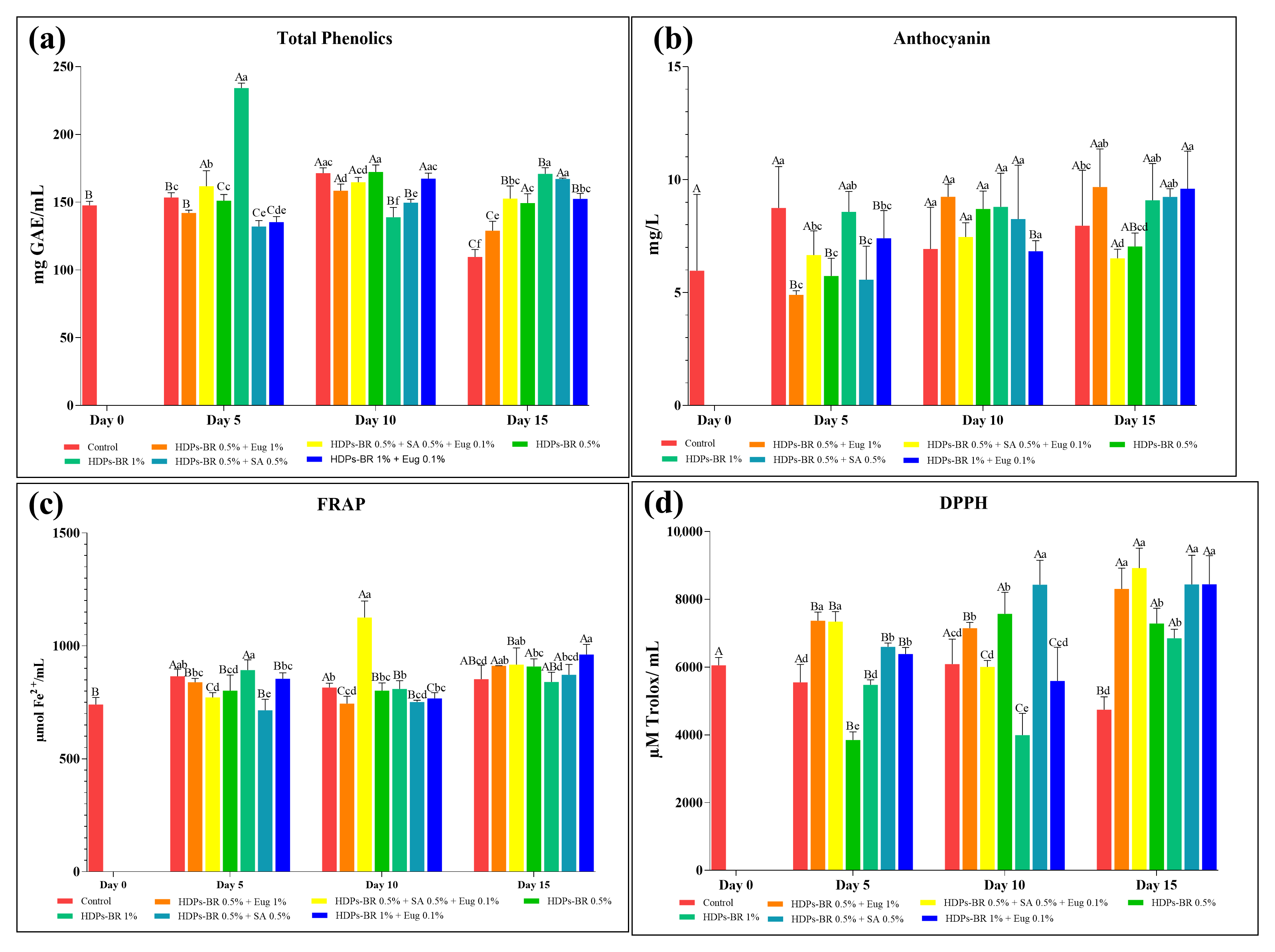
Total phenolic content showed different patterns among treatments throughout storage (Figure 5a). On day 5, significant differences were observed among treatments, with fruits treated with HDPs-BR 1% showing the highest total phenolic content. At the end of storage, on day 15, the control showed the lowest total phenolic content, whereas all coated fruits exhibited higher values, particularly those treated with HDPs-BR 1% and HDPs-BR 0.5% + SA 0.5% (p < 0.05). In addition, variations in total phenolic content were observed throughout storage, with patterns differing according to treatment.
Anthocyanin content also showed different patterns among treatments throughout storage (Figure 5b). On day 5, significant differences were observed among some treatments, with the control showing a higher anthocyanin content than certain coated fruits. However, on day 10, no significant differences were observed among treatments (p > 0.05). At the end of storage, on day 15, the HDPs-BR 0.5% + Eug 0.1%, HDPs-BR 1%, HDPs-BR 0.5% + SA 0.5%, and HDPs-BR 1% + Eug 0.1% treatments showed the highest anthocyanin contents and did not differ significantly from one another. Changes in anthocyanin content throughout storage varied according to treatment. In particular, the HDPs-BR 1% + Eug 0.1% treatment showed a higher anthocyanin content on day 15 than on day 10.
The antioxidant activity of strawberries was evaluated using the FRAP and DPPH assays, with the results presented in Figure 5c,d. Antioxidant activity determined by the FRAP assay showed a treatment- and storage period-dependent pattern (Figure 5c). On day 5, differences were observed among the coatings, although some treatments did not differ significantly from the control. On day 10, the HDPs-BR 0.5% + SA 0.5% + Eug 0.1% treatment showed the highest antioxidant activity, which was significantly higher than that of the control (p < 0.05). At the end of storage, HDPs-BR 1% + Eug 0.1% showed the highest numerical FRAP value, although it did not differ significantly from some of the other coating treatments.
For antioxidant activity determined by the DPPH assay (Figure 5d), on day 5 of storage, the HDPs-BR 0.5% + Eug 0.1% and HDPs-BR 0.5% + SA 0.5% + Eug 0.1% treatments showed higher antioxidant activity than the control. On day 10, HDPs-BR 0.5% + SA 0.5% showed the highest antioxidant activity, while other coatings, including HDPs-BR 0.5% and HDPs-BR 0.5% + Eug 0.1%, also showed higher values than the control. At the end of storage, all coated fruits exhibited significantly higher antioxidant activity than the control (p < 0.05), indicating that the differences between coated fruits and the control became more pronounced as storage progressed.

4.3. Microbial Count

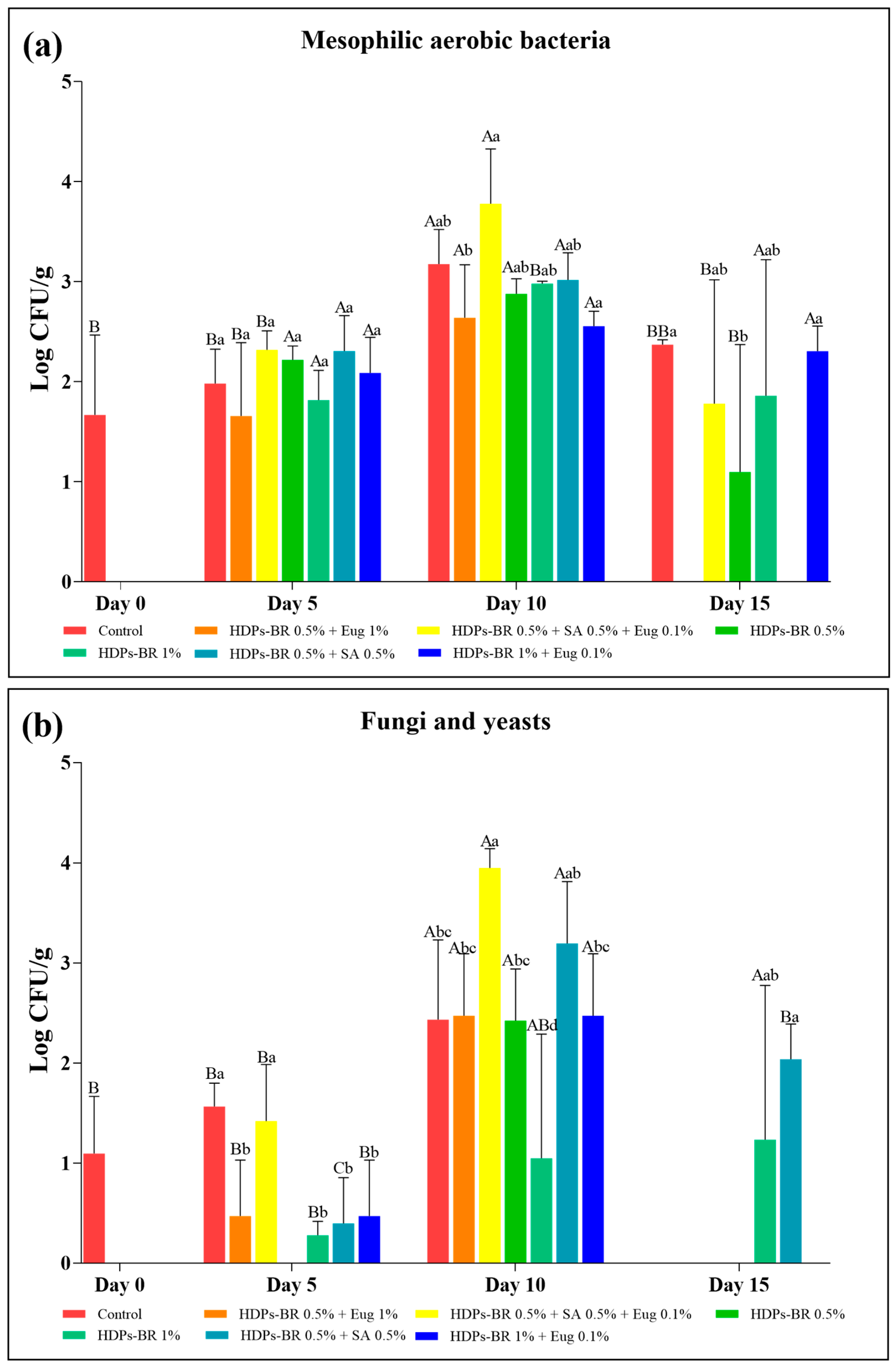
The count of aerobic mesophilic microorganisms increased during storage up to day 10 in both the control and the HDPs-BR treatments (Figure 6a). However, on day 15, microbial counts decreased compared with day 10, with no microbial growth detected in some treatments.
Fungal and yeast counts generally increased during storage, reaching the highest values on day 10 for most treatments (Figure 6b). However, on day 15, a marked reduction in fungal load was observed, with no mold or yeast growth detected in most treatments, including the control. The exceptions were the HDPs-BR 1% and HDPs-BR 0.5% + SA 0.5% treatments, which still showed fungal growth at this time point. Most coating treatments showed lower fungal counts than the control on day 5 of storage, whereas on day 10, only the HDPs-BR 0.5% + SA 0.5% + Eug 0.1% treatment showed a reduction compared with the control.
No psychrotrophic bacterial growth was observed during the fruit storage period.

4.4. Principal Component Analysis (PCA)

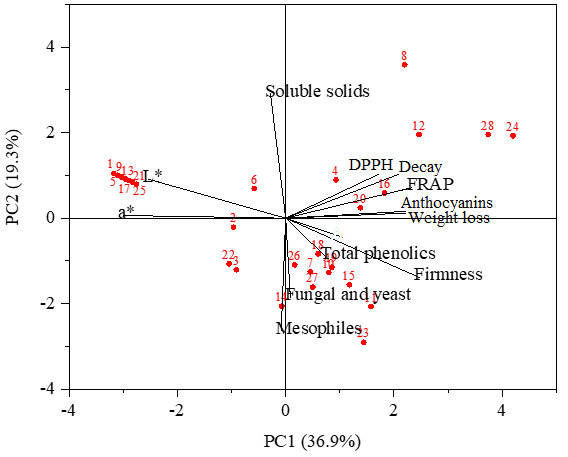
The quality attributes of fruits subjected to the different HDPs-BR-based edible coatings were further evaluated using principal component analysis (PCA). The first two principal components (PC1 and PC2) explained 56.2% of the total variance in the data, accounting for 36.9% and 19.3%, respectively (Figure 7).
Considering absolute loading values ≥ 0.25 (Table 4), PC1 showed positive associations with weight loss (0.439), decay (0.349), firmness (0.332), FRAP (0.322), anthocyanins (0.312), and DPPH (0.257), whereas a* (−0.41654) and L* (−0.353) were negatively associated with this component. A positive association with soluble solids (0.567) and negative associations with aerobic mesophilic microorganisms (−0.525), fungi and yeasts (−0.370), and firmness (−0.271) mainly characterized PC2. Thus, PC1 primarily described variation related to color attributes, physical quality, antioxidant activity-related variables, weight loss, and decay, whereas PC2 was more strongly associated with soluble solids and microbial counts.
The score distribution further indicated that, on day 15, the HDPs-BR 1%, HDPs-BR 0.5%, HDPs-BR 0.5% + SA 0.5%, HDPs-BR 0.5% + SA 0.5% + Eug 0.1%, HDPs-BR 1% + Eug 0.1%, and HDPs-BR 0.5% + Eug 0.1% treatments were predominantly positioned on the positive side of PC1. Accordingly, their distribution was associated with the combined contribution of firmness, anthocyanins, FRAP, DPPH, weight loss, and decay, which showed positive loadings on this component, in contrast to L* and a*, which were negatively associated with PC1.

5. Discussion

5.1. Extraction and Characterization of Polysaccharides

5.1.1. Color, Chemical Composition, and Sugar Profile

The extraction yield obtained for HDPs-BR (5.31 ± 0.19%) was lower than the value of 6.89 ± 0.21% reported by Yang et al. (2019, 2022) [8,48]. This difference may be related to variations in the characteristics of the raw material and extraction conditions. Factors associated with the geographical origin of the plant material, environmental conditions, developmental stage, and intrinsic chemical composition may influence the relative abundance, solubility, and extractability of different polysaccharide fractions. In addition, extraction conditions can affect mass transfer and the selective solubilization of polysaccharide fractions, resulting in differences in both extraction yield and composition. Hot-water extraction, although one of the most common and accessible methods for obtaining polysaccharides, requires a substantially longer extraction time, being approximately nine times slower than solvent-based methods [8]. Therefore, differences between the HDPs-BR obtained in the present study and polysaccharides previously characterized from Hovenia dulcis may reflect both the characteristics of the raw material and the conditions employed during extraction.
The heterogeneous and porous structure observed by SEM suggests the presence of an irregular matrix with regions potentially accessible to interactions with water and other compounds. Such morphology may be relevant to the technological behavior of HDPs-BR, since the organization and surface characteristics of a polysaccharide matrix can influence hydration and interactions with other constituents of coating formulations. In this context, the presence of hydroxyl groups from carbohydrate chains and carboxyl groups associated with uronic acids may favor intermolecular interactions, including hydrogen bonding, potentially affecting the organization of the polymeric matrix. These characteristics could be relevant to the application of HDPs-BR in edible coating systems. However, SEM morphology alone is insufficient to demonstrate water-holding capacity or barrier properties, and specific analyses would be required to confirm these functional characteristics.
The protein and uronic acid contents were similar to those previously reported for Hovenia dulcis polysaccharides, which ranged from 2.48 to 5.28 g 100 g−1 for proteins and from 14.58 to 21.19 g 100 g−1 for uronic acids. In contrast, the total sugar content determined in the present study was higher than the range of 40.77–50.81 g 100 g−1 reported by Yang et al. (2020, 2022) [3,48]. Rather than representing only a quantitative difference, this variation may indicate differences in the relative composition of the polysaccharide fractions recovered. Extraction conditions can favor the solubilization of particular carbohydrate fractions and consequently modify the relative proportions of sugars, uronic acids, proteins, and other compounds associated with the extracted material. Furthermore, to the best of our knowledge, this is the first study to characterize polysaccharides from Hovenia dulcis collected in southeastern Brazil (Minas Gerais). Thus, differences associated with geographical origin and the characteristics of the plant material may also have contributed to the observed chemical composition.
These compositional characteristics may be relevant to the technological and functional behavior of HDPs-BR. The relatively high carbohydrate content, together with the presence of uronic acids, may influence hydration and intermolecular interactions within the polymeric matrix. Moreover, differences in chemical composition may affect the rheological behavior and organization of HDPs-BR when used in coating-forming systems. Therefore, the compositional differences observed between HDPs-BR and previously characterized Hovenia dulcis polysaccharides [8,42,43] may also contribute to differences in their physicochemical and functional behavior.
Previous studies have indicated that Hovenia dulcis polysaccharides predominantly contain galactose, glucose, and arabinose [3,8,18,24,48]. In the present study, however, galactose and arabinose could not be quantified due to the unavailability of the corresponding reference standards. Because chromatographic identification and quantification rely on comparison with reference standards, the sum of the individually identified sugars (13.82 g 100 g−1) should not be interpreted as the actual total sugar content of HDPs-BR. Instead, the difference between this value and the total sugar content reflects, at least in part, the incomplete characterization of the monosaccharide profile. Considering that galactose and arabinose have previously been reported as major constituents of Hovenia dulcis polysaccharides [3,8,18,24,48], their absence from the quantified profile likely contributed to the underestimation of the sum of individually identified monosaccharides. Therefore, the total sugar assay and the HPLC monosaccharide profile should be regarded as complementary measurements rather than directly equivalent determinations.

5.1.2. Total Phenolic Compounds and Antioxidant Activity of the Polysaccharides

Phenolic compounds are characterized by structures containing one or more aromatic rings and hydroxyl groups, which are directly related to their ability to donate electrons or hydrogen atoms and, consequently, to their antioxidant activity. Flavonoids constitute an important class of phenolic compounds characterized by a C6-C3-C6 backbone.
The Fast Blue method used for total phenolic determination is based on the coupling of phenolic compounds with a diazonium salt, resulting in the formation of an azo complex. The Fast Blue salt contains a diazonium group (-N=N+-), which reacts preferentially with activated positions of the phenolic structure. Coupling generally occurs at positions activated by hydroxyl groups, and when these positions are occupied, substitution may occur at the ortho position relative to the activating group [33]. This reaction mechanism allows the method to detect phenolic compounds associated with the polysaccharide matrix.
Although no specific studies using the Fast Blue method to quantify total phenolics in this exact matrix were found, the high phenolic content observed in HDPs-BR may be related to the presence of phenolic fractions associated with the polysaccharide structure. Previous studies have identified approximately 13 phenolic compounds in Hovenia dulcis polysaccharides, including protocatechuic acid, gallocatechin, p-hydroxybenzoic acid, ampelopsin, quercetin-7,4′-diglucoside, dihydroquercetin, rutin, myricitrin, quercetin, kaempferol, 5-methylmyricitrin, and naringenin [24]. Therefore, the phenolic content detected in the present study is consistent with the occurrence of naturally associated phenolic constituents in Hovenia dulcis polysaccharide fractions.
The association of phenolic compounds with polysaccharides may occur through non-covalent interactions, including hydrogen bonding, hydrophobic interactions, and ionic interactions, as well as through associations involving proteins present in the matrix [49]. These interactions can be influenced by heating and processing conditions, potentially favoring the retention of phenolic compounds within the extracted polysaccharide fraction. Thus, the phenolic content of HDPs-BR may not represent only free phenolic molecules but also phenolic compounds associated with macromolecular components of the extract. This association may be functionally relevant because it can influence both the physicochemical behavior and the antioxidant properties of the polysaccharide matrix.
Previous studies have also reported pronounced antioxidant activity for Hovenia dulcis polysaccharides, particularly regarding hydroxyl radical scavenging capacity [3,8,50]. Although the analytical methods and units used in those studies differ from those employed in the present work, these reports support the bioactive potential of Hovenia dulcis polysaccharide fractions. In general, the antioxidant activity of polysaccharides depends on several structural and compositional characteristics, including chemical composition, molecular weight, and monosaccharide profile [8]. In the present study, the antioxidant activity of HDPs-BR may therefore reflect the combined contribution of the polysaccharide backbone and associated phenolic compounds rather than the action of a single constituent.
The presence of residual phenolic compounds may be particularly relevant to the antioxidant response of HDPs-BR because hydroxyl groups present in phenolic structures can participate in electron- or hydrogen-donation reactions, contributing to radical scavenging and reducing capacity. At the same time, the polysaccharide structure itself may influence the accessibility and reactivity of these associated compounds. Consequently, differences in extraction conditions, molecular organization, monosaccharide composition, and degree of association with phenolic compounds may help explain variations in antioxidant activity among Hovenia dulcis polysaccharides reported in different studies [3,8,48,50].
However, the present study did not isolate the contribution of the polysaccharide fraction from that of the associated phenolic compounds. Therefore, the antioxidant activity observed for HDPs-BR should be interpreted as a property of the crude polysaccharide extract as a whole, resulting from the combined contribution of its carbohydrate matrix and associated bioactive constituents. Further purification and structural characterization would be necessary to determine the relative contribution of each fraction to the antioxidant activity.

5.1.3. FTIR and TGA of HDPs-BR

The extracted polysaccharides exhibited spectral profiles similar to those reported in previous studies with the same polysaccharide obtained from other countries and by different extraction methods. This similarity suggests that, despite differences in geographical origin and extraction conditions, the main chemical functionalities of the HDPs-BR matrix were preserved, indicating a broadly comparable structural organization to that previously described for Hovenia dulcis polysaccharides.
The band around 3390 cm−1 is indicative of O–H stretching, whose main contribution comes from the hydroxyl groups of the polysaccharide [51]. The abundance of hydroxyl groups is relevant not only for structural identification but also for the physicochemical behavior of the material, since these groups can participate in hydrogen bonding and influence hydration, intermolecular interactions, and the organization of the polymeric matrix [52]. The band around 2930 cm−1 is characteristic of polysaccharides, originating from the C–H stretching of alkyl groups, a typical feature of polysaccharidic substances [8,48,50]. The strong absorption at 1645 cm−1 was attributed to the asymmetric and symmetric stretching vibrations of C=O, indicating that the polysaccharide is acidic [8,48,51]. This interpretation is consistent with the uronic acid content determined in the chemical characterization and suggests the presence of carboxyl-containing fractions that may contribute to the hydrophilic and ionic characteristics of the matrix.
The absorption peak at 1251 cm−1 indicates the presence of sulfate radical moieties in the Hovenia dulcis polysaccharides (S=O stretching vibration) [8]. The presence of sulfate groups can confer an anionic character to the polysaccharide matrix, increasing its negative charge density and favoring electrostatic interactions with positively charged species [53]. In addition, sulfate groups can interact with water molecules, thereby influencing hydration and intermolecular interactions within the polymeric matrix [54]. The peak at 1075 cm−1 is related to the stretching vibration of the C–O–C glycosidic bond [46], while the band at 1034 cm−1 indicates the presence of C–O–C and C–O–H bonds [51]. Together, these absorptions are consistent with a carbohydrate-rich polymeric backbone in which glycosidic linkages and hydroxyl-bearing groups predominate.
In summary, the different observed bands strongly suggest that the extracted polysaccharide consists of acidic polysaccharides with hydroxyl (O–H), alkyl (C–H), carboxyl (C=O), and sulfate residue (S=O) groups, characterizing a matrix similar to those previously reported for Hovenia dulcis. From a functional perspective, this combination of hydroxyl, carboxyl, and sulfate-containing groups may favor intermolecular associations and interactions with water and other constituents of coating formulations. Such chemical features may help explain the ability of HDPs-BR to participate in polymeric networks and may influence properties relevant to coating formation, such as hydration, adhesion, and compatibility with other biopolymers [54]. However, FTIR data alone do not allow these functional properties to be quantified, and specific rheological, barrier, and interaction analyses are required to confirm these mechanisms.
Regarding TGA, the first mass loss (27 °C to 150 °C) occurs mainly due to the vaporization of adsorbed and structural water [3,8]. This initial event indicates that part of the water is physically associated with the polysaccharide matrix, which is consistent with the abundance of hydrophilic functional groups identified by FTIR. Above 150 °C, devolatilization of the polysaccharide leads to subsequent degradation. This stage is likely associated with the progressive breakdown of the carbohydrate structure, including cleavage and decomposition of glycosidic linkages and other thermally labile components of the matrix. The analyses of degradation behavior and thermal stability indicate that the polysaccharides are composed of a variety of complex polymers with different structures. The broad and progressive nature of the mass loss is therefore consistent with the heterogeneous chemical composition of the crude polysaccharide fraction, in which carbohydrates, uronic acids, proteins, and associated compounds may exhibit different thermal degradation behaviors.
This thermal robustness, characterized by the initial stability up to 150 °C and the high residual mass (43% at 350 °C), suggests that the Hovenia dulcis polysaccharide or films based on it are suitable for applications where structural integrity at moderate temperatures is essential. Importantly, the thermal range in which the material remains comparatively stable is well above the temperatures used during refrigerated storage and typical postharvest handling, indicating that thermal degradation is unlikely to limit its performance under these conditions. Thus, the material shows promise for the development of edible coatings and bioactive packaging for food preservation, offering greater thermal resistance during processing and storage under ambient or refrigerated conditions. Nevertheless, the TGA results demonstrate thermal stability of the extracted material itself and should not be interpreted as direct evidence of the thermal or mechanical stability of a finished film, since these properties may change after the addition of plasticizers, sodium alginate, eugenol, or other formulation components.

5.2. Fruit Quality Analyses

5.2.1. Color, Texture, Soluble Solids, Weight Loss, and Decay Rate

The higher lightness (L*) observed on day 15 in fruits treated with HDPs-BR 0.5% + SA 0.5% + Eug 0.1% suggests better preservation of this attribute during storage. This behavior may be related to the formation of a physical barrier by the coating, which may reduce oxygen diffusion and, consequently, limit oxidative browning reactions associated with the activity of enzymes such as polyphenol oxidase and peroxidase [55]. However, the superior performance of this formulation should not be attributed to any of its components individually. The association between HDPs-BR and SA may have modified the physical properties of the coating matrix, while the presence of eugenol may have contributed to limiting oxidative processes. Thus, the observed response likely results from the properties of the formulation as a whole and the physicochemical interactions established among its constituents.
Similarly, the maintenance of a* values throughout storage in the HDPs-BR 1% + Eug 0.1% treatment indicates greater stability of the red color of the fruits. This behavior may be associated with the protection of the natural pigments of strawberries, particularly anthocyanins, which are susceptible to oxidative degradation and light exposure. A similar result was reported by Lee et al. (2022) [56], who observed less browning and opacity in strawberries coated with cellulose and chitosan nanomaterials supplemented with essential oil compared with the control. In this context, the higher HDPs-BR concentration may have produced a matrix with physical characteristics different from those obtained at 0.5%, thereby modifying the interface between the fruit and the surrounding environment. Its association with eugenol may also have contributed to reducing oxidative reactions capable of affecting pigment stability. However, because eugenol was not evaluated individually, its specific contribution to color preservation cannot be quantified in the present study.
In addition to the possible protective effect of the coatings against oxidative processes, variations in fruit color may be related to the intrinsic coloration of the polysaccharides used in the formulations (Table 2), which exhibited a reddish-yellow hue (Figure 1). This characteristic may have influenced the visual appearance of the coated fruits. Therefore, differences in color parameters likely reflect both physiological changes in the fruits during storage and the optical and physicochemical properties of the coatings themselves. This aspect is particularly important when interpreting L* and a*, since the surface layer formed by the coating may modify the interaction of light with the fruit surface in addition to exerting possible effects on the stability of endogenous pigments. Thus, some of the formulations evaluated, particularly HDPs-BR 1% + Eug 0.1%, showed better preservation of red color compared with the control, a behavior similar to that described for other edible coatings applied to strawberries.
Firmness is one of the main quality parameters of fresh fruits and generally decreases in strawberries during storage as a result of changes in the cell wall and loss of tissue turgor [57]. In the present study, however, the firmness response varied according to treatment and storage period. The control showed no significant change in firmness throughout storage, whereas some coated treatments showed a significant increase in this parameter at specific storage periods. At the end of storage, fruits treated with HDPs-BR 0.5% showed greater firmness than both the control and HDPs-BR 1%, indicating that increasing the polysaccharide concentration did not necessarily result in greater mechanical resistance of the fruits. This result demonstrates that coating performance does not necessarily follow a linear relationship with HDPs-BR concentration. Changes in polymer concentration can modify properties such as viscosity, coating distribution over the fruit surface, and characteristics of the resulting matrix; therefore, a higher concentration does not necessarily result in better texture preservation [58].
Although higher firmness values are frequently associated with better texture preservation, instrumentally determined firmness represents the overall mechanical resistance of the tissue and does not depend exclusively on cell wall integrity. In strawberries, this mechanical response results from the combined contributions of the cell wall, cell-to-cell adhesion, turgor status, and characteristics of epidermal and subepidermal tissues. Thus, different structural changes may produce distinct responses in instrumental firmness measurements. During storage, processes that promote softening, such as degradation of cell wall components and loss of turgor, may occur simultaneously with other structural changes in the tissues. Therefore, the increase or maintenance of firmness observed in some treatments should not be interpreted exclusively as evidence of reduced cell wall degradation, but rather as the result of a combination of structural and water-related changes affecting the mechanical response of the fruit during storage [59].
Higher firmness in strawberries subjected to edible coatings has also been reported by Lee et al. (2022) [56], using cellulose nanomaterials; Kwak et al. (2021) [60], using chitosan-based coatings combined with essential oil and cellulose nanofibers; and Wang et al. (2020) [61], using chitosan-based coatings. Edible coatings can modify water and gas exchange between the fruit and the environment and, consequently, influence the mechanical properties of tissues during storage [55,61,62]. However, in the present study, because the coatings did not significantly reduce weight loss compared with the control, the greater firmness observed in certain treatments cannot be directly attributed to reduced water loss. Furthermore, because specific analyses of the cell wall or its associated enzymes were not performed, it is not possible to establish whether the higher firmness values resulted from reduced cell wall degradation. Therefore, the effect observed for HDPs-BR 0.5% should be interpreted as greater mechanical resistance of the fruits under the evaluated conditions, rather than as direct evidence of reduced senescence or greater cell wall integrity.
The small changes observed in soluble solids may be related to the ripening stage of the strawberries at the time the coatings were applied. Similar behavior was reported by Guerreiro et al. (2015) [57]. In contrast, Al-Hilifi et al. [63] observed greater variation in soluble solids content in strawberries coated with polysaccharide- and protein-based formulations containing hyaluronic acid, with higher values in the control at the end of storage. Lee et al. (2022) [56] also observed a continuous increase in soluble solids during storage, although the rate of increase was higher in uncoated fruits. Kwak et al. (2021) [60], using cellulose nanofibers, reported lower soluble solids contents in coated fruits.
Because the strawberries used in the present study were already ripe when the coatings were applied, physiological processes related to changes in sugar and other soluble solid contents may have already been at an advanced stage, reducing the influence of the coatings on this parameter. In addition, changes in soluble solids during storage may result from competing processes, such as sugar consumption through respiration and solute concentration resulting from water loss. Therefore, small variations in this parameter cannot be attributed exclusively to the effects of the coatings. Factors such as cultivar and interactions between coating type and the physiological characteristics of the fruits may also contribute to differences among studies.
The high susceptibility of strawberries to postharvest water loss is associated with their thin waxy cuticle and the vapor pressure gradient between fruit tissues and the surrounding atmosphere, contributing to softening, shriveling, and loss of surface gloss [56,64]. Although edible coatings can act as semipermeable barriers and reduce transpiration, this effect was not sufficient to produce significant differences in weight loss compared with the control under the conditions evaluated. This result differs from those reported by Al-Hilifi et al. (2024) [63] and Lee et al. (2022) [56], who observed lower weight loss in strawberries coated with different polysaccharide- and nanomaterial-based formulations. This divergence may be related to the specific properties of each film-forming matrix, since its efficiency as a barrier to water vapor transfer depends on the composition, concentration, continuity, and structural organization of the coating. In the present study, the absence of a significant difference suggests that the HDPs-BR-containing formulations did not form a barrier to water loss sufficiently different from the natural resistance provided by the fruit surface under the storage conditions used.
This result also helps explain why different HDPs-BR concentrations did not show uniform performance across the evaluated parameters. A higher polymer concentration can simultaneously alter viscosity, surface coverage, matrix structure, and mass transfer, but these changes do not necessarily improve all coating properties. Thus, the optimal concentration for maintaining firmness, for example, may not be the same as that required to reduce mass loss or preserve color, demonstrating that postharvest performance depends on the balance among different physicochemical properties of the formulation.
Finally, due to their non-climacteric nature, strawberries are harvested at the eating ripe stage and are highly susceptible to postharvest deterioration because of characteristics such as high moisture content and soft texture [65]. Although HDPs-BR 0.5% and HDPs-BR 1% showed no decayed fruits at the end of storage, the absence of a significant difference compared to the control indicates that this result should be interpreted as a trend rather than as statistical evidence of reduced decay.
This result differs from that reported by Yuan et al. (2020) [66], who observed a significant reduction in the decay of strawberries treated with polysaccharides from Pythium arrhenomanes compared with the control. Differences in the nature of the polysaccharides, extraction methods, purification processes, and coating characteristics may contribute to this divergence. These differences are mechanistically relevant because changes in the chemical composition and organization of the polysaccharide matrix can modify properties such as hydration, interaction with the fruit surface, and barrier behavior. Consequently, polysaccharides obtained from different sources or subjected to different extraction processes do not necessarily exhibit the same technological performance when applied as coatings. Nevertheless, the absence of decay observed in fruits coated only with HDPs-BR 0.5% and HDPs-BR 1% suggests the potential of these polysaccharides for postharvest applications and warrants further investigation.
A possible protective effect of HDPs-BR could be associated with the formation of a physical barrier capable of modifying gas exchange and limiting contact between fruit tissues and spoilage microorganisms [65]. However, because weight loss was not significantly reduced, the data do not support attributing this possible protective effect primarily to reduced water loss. Other mechanisms, such as changes in conditions at the fruit–atmosphere interface and in the surface properties of the fruits, may be involved.
In addition, some formulations containing eugenol and/or sodium alginate showed higher decay indices, although this behavior was not consistent across formulations. This result demonstrates that the mere presence of a component with previously recognized properties does not guarantee better performance of the final formulation. Incorporating different components into the coating matrix can alter its structural organization and physicochemical properties, since interactions among constituents can modify viscosity, network formation and density, mechanical resistance, hydrophobicity, and film barrier properties, consequently influencing its performance when applied to the fruit surface [67]. Thus, the observed performance depends on the complete formulation and the proportions of its constituents rather than solely on the individual properties of each ingredient.
Eugenol, in particular, has previously described antimicrobial and antioxidant properties and may therefore contribute to limiting microbiological and oxidative processes in certain formulations [68,69]. However, the effectiveness of eugenol when incorporated into polymeric coatings depends not only on its concentration but also on its distribution within the matrix and its diffusion and release behavior, factors that determine its availability and, consequently, its activity at the surface of the coated product [70]. Thus, the presence of eugenol may contribute to the response of some formulations without necessarily producing the same effect in all of them.
Considering the absence of treatments containing SA and Eug individually, it is not possible to attribute these results to the individual effects of these components or to establish possible interactions between them and HDPs-BR. Consequently, terms such as synergism or specific causal attributions to individual components should be avoided. Combined treatments should be interpreted as complete formulations whose responses result from the collective properties of their constituents. Further studies including individual controls are required to clarify the contribution of each component to the postharvest preservation of strawberries.

5.2.2. Total Phenolics, Anthocyanins, and Antioxidant Activity

Fruits are among the main natural sources of antioxidants, including carotenoids, phenolic compounds, and vitamins. These compounds act as free radical scavengers and are capable of decomposing peroxides, quenching singlet and triplet oxygen, and inhibiting the activity of oxidative enzymes [71]. During postharvest storage, however, the content and activity of these compounds may change as a result of oxidative processes, senescence, and changes in fruit metabolism. In this context, edible coatings may contribute to their preservation by acting as semipermeable barriers between the fruit and the environment, modifying O2 and CO2 exchange and respiration rate [72] and, consequently, influencing metabolic and oxidative processes associated with senescence and the degradation of bioactive compounds.
The higher total phenolic contents observed in coated fruits at the end of storage suggest that the coatings may have contributed to the maintenance and/or accumulation of these compounds during storage. These results are consistent with those of Al-Hilifi et al. (2024) [63], who applied hyaluronic acid-based polysaccharide–protein coatings to strawberries and observed a smaller reduction in total phenolic content in coated fruits at the end of storage. Similarly, Farida et al. (2023) [23] found that strawberries coated with different types of edible coatings exhibited higher total phenolic contents than uncoated fruits.
Considering the higher total phenolic contents observed in coated fruits at the end of storage, two hypotheses can be proposed: (i) the coatings may have influenced fruit secondary metabolism, favoring the synthesis and/or maintenance of phenolic compounds, an effect previously described in studies with strawberries [73]; or (ii) the observed values may be related, at least in part, to the composition of HDPs-BR, which exhibited a high phenolic content as well as significant antioxidant activity, as demonstrated by the phosphomolybdenum, ABTS, and FRAP assays (Table 3). These two mechanisms are not mutually exclusive.
Differences in the responses among formulations may also be related to how HDPs-BR concentration and the presence of SA and eugenol modify the properties of the coating matrix. Changes in polymer concentration can modify hydration, viscosity, surface distribution, and matrix organization, thereby influencing the interaction between the coating and fruit tissues [74]. Therefore, a higher concentration of HDPs-BR does not necessarily result in greater preservation of phenolic compounds, since coating performance depends on the balance among composition, matrix structure, and storage conditions.
Anthocyanins are the main compounds responsible for the characteristic red color of strawberries. The higher contents observed in certain coated fruits at the end of storage are consistent with the results of Yuan et al. (2020) [66], who applied edible coatings based on polysaccharides from Pythium arrhenomanes to strawberries and observed greater anthocyanin retention in coated fruits.
Strawberries exhibit the respiratory behavior characteristic of non-climacteric fruits. Although degradation reactions typical of senescence occur during the postharvest period of non-climacteric fruits, changes in anthocyanin metabolism may continue after harvest, even in already ripe fruits, whereas the loss of cellular integrity as senescence progresses may favor pigment degradation. In the present study, because the strawberries were already ripe when the coatings were applied, the higher anthocyanin contents observed at the end of storage should be interpreted primarily in terms of maintenance, reduced degradation, and/or changes in pigment metabolism, rather than necessarily as an exclusive consequence of postharvest synthesis.
In this context, the high anthocyanin contents observed in certain treatments at the end of storage may be associated with the maintenance and/or accumulation of these pigments. Edible coatings may have acted as protective barriers, contributing to a reduction in oxidative processes associated with anthocyanin degradation [75].
Another hypothesis is that coating application may have modulated secondary metabolic pathways in the fruits, favoring the biosynthesis and/or reducing the degradation of these pigments [76]. The relationship between anthocyanin content and a* values also supports the plausibility of an effect on the preservation of red color in certain treatments, although color parameters may be simultaneously influenced by the natural pigmentation of the fruit and the optical characteristics of the coating layer. Because this behavior was observed across different formulations, it cannot be attributed exclusively to a specific combination of HDPs-BR, SA, or eugenol.
The fact that some formulations showed greater anthocyanin retention than others may reflect differences in the physical and chemical properties of the resulting matrix. HDPs-BR concentration, the presence of SA, and the incorporation of eugenol may modify coating organization and its interaction with the fruit surface, producing different levels of protection against oxidative processes. Thus, the performance of each treatment likely results from the formulation as a whole rather than from a linear relationship between polysaccharide concentration and pigment retention.
The FRAP assay is based on the reduction of the ferric complex (Fe3+-TPTZ) to its ferrous form (Fe2+-TPTZ) in the presence of antioxidants [37], whereas the DPPH method is based on the transfer of electrons or hydrogen atoms from an antioxidant to the DPPH• radical (2,2-diphenyl-1-picrylhydrazyl), resulting in radical neutralization and a consequent change in solution color [77]. Thus, the two methods provide complementary information on the antioxidant capacity of the samples. Consequently, differences between the patterns observed with FRAP and DPPH are expected, since each method responds differently to the chemical nature, concentration, and reactivity of the antioxidants present in the matrix.
The higher antioxidant activity observed in certain coated fruits may be related to different mechanisms. HDPs-BR themselves contain residual phenolic compounds and exhibit antioxidant activity, while eugenol is a phenolic compound containing a free hydroxyl group [69], which may contribute to the reducing capacity of the formulations. Indeed, studies using polymer-based edible films enriched with eugenol have reported significant increases in antioxidant activity [40,78,79].
Mechanistically, the phenolic hydroxyl group of eugenol can participate in electron- or hydrogen-donation processes, contributing to the neutralization of reactive species and increasing the reducing capacity of the system [79]. However, the contribution of eugenol within the coating depends not only on its presence but also on its incorporation and availability within the polymeric matrix [70]. Different formulations may alter the retention, distribution, and accessibility of this compound at the fruit surface, which may help explain why treatments containing eugenol did not necessarily exhibit identical antioxidant responses.
However, considering the absence of treatments containing eugenol and SA individually, the individual contributions of these components and their possible interactions with HDPs-BR cannot be determined in the present study. Therefore, the results should be interpreted in terms of the performance of the complete formulations evaluated. For this reason, it cannot be stated that the higher antioxidant activity values resulted from synergism between HDPs-BR and eugenol; the data only allow the conclusion that certain formulations containing these components exhibited greater antioxidant capacity under specific storage conditions.
Although the expression of DPPH results used in the present study differs from that employed by Yuan et al. (2020) [66], the findings are consistent, since these authors reported greater antioxidant properties in strawberries coated with polysaccharides from Pythium arrhenomanes compared with control samples. Similarly, Al-Hilifi et al. (2024) [63] found that the application of a hyaluronic acid-based edible coating maintained the antioxidant activity of strawberries, whereas uncoated fruits showed a significant reduction in this activity.
The higher antioxidant activity of coated fruits, particularly at the end of storage, may be related to the ability of the coatings to modify conditions at the fruit surface, thereby contributing to limiting oxidative processes associated with the degradation of bioactive compounds, an effect similar to that observed in chitosan-coated strawberries [75]. This mechanism may simultaneously contribute to the maintenance of phenolic compounds and anthocyanins, increasing the availability of compounds capable of participating in the reactions measured by the FRAP and DPPH assays. Thus, the antioxidant response should not be interpreted as an isolated property but rather as the integrated result of the amount, stability, and reactivity of the different bioactive compounds present in the tissues.
In addition, the components of HDPs-BR themselves may have contributed to the observed antioxidant activity, considering their previously demonstrated activity (Table 3). Because the HDPs-BR fraction contains associated phenolic compounds, its application may add a matrix with intrinsic antioxidant potential to the fruit surface. However, without separately determining the antioxidant activity of the fruit tissue and the coating after application, it is not possible to distinguish how much of the observed response derives from endogenous strawberry antioxidants and how much may be related to coating constituents.
Another possibility is that coating application influenced fruit secondary metabolism, favoring the synthesis and/or maintenance of metabolites with antioxidant properties. The higher antioxidant activity observed in certain treatments may also be associated with the maintenance and/or accumulation of bioactive compounds, including phenolic compounds and anthocyanins (Figure 5a,b). The correspondence between higher levels of these compounds and greater antioxidant activity in some treatments provides a biologically plausible interpretation since phenolics and anthocyanins can participate in electron- and hydrogen-transfer reactions. However, this association does not establish direct causality, because other antioxidants present in strawberries may also contribute to FRAP and DPPH responses.
The differences observed among formulations reinforce that coating effectiveness does not simply result from the presence of HDPs-BR, SA, or eugenol but rather from how these components jointly modify matrix properties and the physiological response of the fruits. One formulation may favor greater pigment retention, whereas another may exhibit greater antioxidant capacity at a particular storage period, indicating that there is not necessarily a single optimal formulation for all evaluated attributes. This behavior also helps explain why increasing HDPs-BR concentration or adding eugenol did not produce uniform effects across all variables.
However, these mechanisms should be considered hypotheses, since the present study does not allow differentiation of whether the higher antioxidant activity resulted from preservation of endogenous fruit antioxidants, changes in secondary metabolism, contributions from compounds present in the coatings, or a combination of these factors. Likewise, because specific markers of oxidative stress, antioxidant enzyme activity, or expression of genes related to the biosynthesis and degradation of phenolics and anthocyanins were not evaluated, the proposed mechanisms cannot be directly confirmed. Future studies integrating these analyses may clarify whether HDPs-BR act predominantly as a physical barrier, an additional source of antioxidant compounds, a modulator of secondary metabolism, or through a combination of these mechanisms.

5.2.3. Microbial Count

The reduction in aerobic mesophilic microorganism counts observed in certain treatments at the end of storage is supported by previous studies involving edible coatings applied to strawberries. Temiz and Özdemir (2021) [80] observed a significant reduction in mesophilic counts during strawberry storage using Lactobacillus rhamnosus and gelatin films enriched with inulin. Similarly, Pinzon et al. (2020) [19] demonstrated that edible coatings based on banana starch–chitosan and Aloe vera gel reduced mesophilic microorganism counts compared with the control.
The effects observed in the present study may be related to the characteristics of the formulations used. Eugenol has well-recognized bactericidal activity [81] and may have contributed to limiting microbial growth in formulations containing this compound. In addition, coatings containing HDPs-BR and SA may have modified conditions at the fruit surface through the formation of a physical barrier, potentially creating an environment less favorable to the proliferation of aerobic microorganisms. However, because this behavior was not consistent across formulations containing eugenol, HDPs-BR, or SA, and considering the absence of treatments containing eugenol and SA individually, the observed effects cannot be attributed to specific components, nor can potential synergistic interactions be established. Therefore, the results should be interpreted as responses to the complete formulations evaluated.
Regarding fungi and yeasts, significant reductions in fungal load in coated strawberries have also been reported by Popescu et al. (2022) [82] and Li et al. (2024) [83], who evaluated edible formulations based on chitosan combined with essential oils and alginate combined with lactic acid bacteria, respectively. These findings reinforce the potential of edible coatings to modulate the development of spoilage microbiota during storage.
However, the reduction in fungal load observed on day 15 in the present study should be interpreted with caution, since it also occurred in the control. This behavior may be associated with the storage conditions themselves and microbial population dynamics, including nutrient availability, microbiota composition, and the possible accumulation of inhibitory metabolites over time. Therefore, the absence of detectable fungal growth at the end of storage cannot be attributed exclusively to the antifungal activity of eugenol.
Nevertheless, eugenol may have contributed to the inhibition of fungal growth in some formulations, considering its ability to disrupt microbial cell membrane integrity and inhibit microbial proliferation [69]. Antifungal effects associated with the use of eugenol in edible coatings applied to strawberries have also been reported by Guerreiro et al. (2015) [57].

5.3. Principal Component Analysis (PCA)

PCA provided an integrated overview of changes in strawberry quality and showed that the effects of the coatings depended on both formulation and storage period. The distribution of most coated samples evaluated on day 15 on the positive side of PC1 indicates that their overall profiles at the end of storage were characterized by the combined contribution of firmness, anthocyanins, FRAP, DPPH, weight loss, and decay, which showed positive loadings on this component, in contrast to L* and a*, which were negatively associated with PC1. However, this distribution should not be interpreted simply as an improvement in overall fruit quality, since PC1 simultaneously integrates desirable attributes, such as firmness and antioxidant activity-related variables, and attributes associated with storage progression, such as weight loss and decay. Instead, the clustering of samples on day 15 suggests that storage period was an important source of multivariate differentiation and that the coatings modulated the magnitude of these changes according to their composition.
From a mechanistic perspective, differences among HDPs-BR-containing formulations may result from changes in the physicochemical characteristics of the coating layer. Polymer concentration can influence solution viscosity, spreading, adhesion, thickness, and gas and water vapor transfer, thereby modifying the microenvironment established at the fruit surface [74]. Consequently, increasing the HDPs-BR concentration from 0.5 to 1% would not necessarily result in a proportional improvement in preservation. Higher polymer concentrations may markedly increase solution viscosity and favor the formation of thicker layers, a characteristic that is not always desirable in edible coatings. Thus, intermediate concentrations may provide a more appropriate balance between viscosity and matrix formation, allowing the development of a functional layer without excessive thickness [58]. This interpretation is consistent with previous studies demonstrating that coating polymer concentration strongly influences surface and barrier properties and, consequently, postharvest performance [75].
The positive contributions of anthocyanins, FRAP and DPPH to PC1 further suggest that changes related to antioxidant activity were important in differentiating the samples during storage. Polysaccharide-based coatings may contribute to the preservation of these compounds through more than one mechanism. By forming a semipermeable layer, the coating may modify O2 and CO2 exchange and reduce respiration and oxidative stress, potentially limiting the oxidation of endogenous phenolic compounds [72,75]. In strawberries, polysaccharide-based coatings have also been associated with the maintenance of phenolic compounds and antioxidant capacity, as well as with the modulation of antioxidant enzymes involved in protection against oxidative damage [75]. Therefore, the association of HDPs-BR-coated fruits with anthocyanins and antioxidant activity may reflect both the protective effect of the polymeric barrier and the contribution of phenolic compounds associated with the crude HDPs-BR fraction. However, because the present study did not determine the migration of phenolic compounds from the coating or the activity of enzymes involved in phenolic metabolism, these mechanisms should be regarded as plausible explanations rather than direct evidence.
The presence of eugenol may have provided an additional active component to the coating system. In alginate- and pectin-based coatings applied to strawberries, formulations containing 0.1% eugenol were among those associated with better preservation of firmness, antioxidant activity, and microbiological quality during refrigerated storage [3]. However, the effect of eugenol cannot be considered independently of the polymeric matrix, since its retention, distribution, release, and accessibility are influenced by interactions with coating components [70]. Thus, differences between HDPs-BR + eugenol and HDPs-BR + SA + eugenol formulations may reflect not only the biological activity of eugenol itself but also differences in the structure and barrier properties of the matrices into which it was incorporated.
The addition of sodium alginate may also modify the organization and functionality of the HDPs-BR matrix rather than simply providing an additive preservative effect. Combining different polysaccharides can modify the thickness and internal organization of the matrix, while the mechanical and water vapor barrier properties of composite films depend on both their composition and the compatibility between their components [84]. These changes may explain why the combined formulations did not necessarily exhibit responses identical to or consistently superior to those obtained with HDPs-BR alone. The preservation efficiency of a coating depends on establishing an appropriate balance between barrier properties and the gas exchange required for fruit physiology; therefore, a formulation that produces a denser or more viscous matrix is not necessarily the most effective for all quality attributes [84].
PC2 represented a distinct source of variation and was characterized mainly by soluble solids on the positive side and by aerobic mesophilic microorganisms, fungi and yeasts, and firmness on the negative side. Thus, this component appears to represent a contrast between soluble solids content and characteristics related to microbial development and tissue firmness, rather than a direct inverse relationship between microbial growth and antioxidant activity. The negative loadings of mesophilic microorganisms and fungi and yeasts indicate that samples positioned on the negative side of PC2 were more strongly characterized by microbial counts, whereas those positioned on the positive side were comparatively more influenced by soluble solids. Because FRAP, DPPH, anthocyanins, total phenolics, weight loss, and decay showed relatively low absolute loadings on PC2, their relationships with this component should be interpreted with caution.
Overall, PCA indicates that the postharvest response of coated strawberries resulted from the combined effects of coating composition, storage period, and multiple physiological, biochemical, and microbiological processes. Rather than indicating a single mechanism responsible for preservation, the multivariate pattern suggests that HDPs-BR concentration and its combination with sodium alginate and/or eugenol modulated different quality attributes through possible changes in barrier properties, oxidative metabolism, structural preservation of tissues, and antimicrobial activity. The fact that combined treatments did not show uniform responses further reinforces that coating functionality depends on interactions among matrix composition, active compounds, and fruit physiology, rather than solely on the concentration of an individual component.

6. Conclusions

Crude polysaccharides extracted from Brazilian Hovenia dulcis (HDPs-BR) exhibited relevant chemical and structural characteristics associated to the presence of phenolic compounds and antioxidant activity, supporting their potential as a bioactive matrix for edible coatings. Their application to strawberries influenced physical, biochemical, and microbiological attributes during refrigerated storage, although the responses varied according to formulation and storage period. Overall, HDPs-BR 0.5% and HDPs-BR 1% showed promising performance, particularly in maintaining firmness, phenolic compounds, and anthocyanins and in limiting fruit decay, whereas HDPs-BR 1% + Eug 0.1% stood out for preserving red color and antioxidant activity-related attributes. Therefore, these formulations represent promising candidates for further optimization and validation as edible coatings for the postharvest preservation of strawberries.

Supplementary Materials

The following supporting information can be downloaded at: https://www.mdpi.com/article/10.3390/horticulturae12091110/s1. Polysaccharide Extraction (Supplementary Materials S1).

Author Contributions

Conceptualization, G.G.L.M. and E.V.d.B.V.B.; methodology, G.G.L.M., A.G., C.G., M.D.C.A. and E.E.N.C.; software, G.G.L.M.; validation, A.G., C.G., M.D.C.A. and E.V.d.B.V.B.; investigation, G.G.L.M., A.G., C.G., M.G., M.D.C.A. and E.E.N.C.; data curation, G.G.L.M.; writing—original draft preparation, G.G.L.M., A.G., C.G., M.D.C.A. and E.V.d.B.V.B.; visualization, A.G., C.G., M.D.C.A. and E.V.d.B.V.B.; supervision, A.G., C.G., M.D.C.A. and E.V.d.B.V.B.; project administration, E.V.d.B.V.B.; funding acquisition, E.V.d.B.V.B. and M.D.C.A. All authors have read and agreed to the published version of the manuscript.

Funding

This research was funded by the National Council of Technological and Scientific Development (CNPq: 304413/2016-0; 302699/2019-8; 404716/2021-0; 307157/2022-9); the Minas Gerais Research Support Foundation (FAPEMIG: PPM-00458-15; PPM-00355-17); the Higher Education Personnel Improvement Coordination (CAPES: 88881.068456/2014-01); the Fundação para a Ciência e Tecnologia (FCT), Portugal, through the Project UIDB/05183/2020 (MED base project); and the Stimulus for Scientific Employment (CEECINST/00146/2018/CP1493/CT0003 and CEECIND/01009/2017).

Data Availability Statement

The original contributions presented in this study are included in the article/Supplementary Materials. Further inquiries can be directed to the corresponding authors.

Acknowledgments

The Coordination for the Improvement of Higher Education Personnel (CAPES) is gratefully acknowledged for the financial support through the sandwich PhD scholarship. We also thank the National Council for Scientific and Technological Development (CNPq) and the Minas Gerais Research Support Foundation (FAPEMIG) for supporting this research and for granting the master’s and PhD scholarships. The authors further acknowledge the R&D MED—Mediterranean Institute for Agriculture, Environment and Development (https://doi.org/10.54499/UID/05183/2025) and the Associate Laboratory CHANGE—Global Change and Sustainability Institute (https://doi.org/10.54499/LA/P/0121/2020).

Conflicts of Interest

The authors declare that they have no known competing financial interests or personal relationships that could have appeared to influence the work reported in this paper.

References

  1. Peng, H.; Deng, Z.; Chen, X.; Sun, Y.; Zhang, B.; Li, H. Major chemical constituents and antioxidant activities of different extracts from the peduncles of Hovenia acerba Lindl. Int. J. Food Prop. 2018, 21, 2135–2155. [Google Scholar] [CrossRef] [Scilit]
  2. Xu, F.; Gao, M.; Li, H.; Han, X.; Zhang, X.; Li, Y.; Guo, D.; Liu, B. Three new bisflavonols from the seeds of Hovenia dulcis Thunb. and their anti-RSV activities. Fitoterapia 2020, 143, 104587. [Google Scholar] [CrossRef] [Scilit] [PubMed]
  3. Yang, B.; Luo, Y.; Wu, Q.; Yang, Q.; Kan, J. Hovenia dulcis polysaccharides: Influence of multi-frequency ultrasonic extraction on structure, functional properties, and biological activities. Int. J. Biol. Macromol. 2020, 148, 1010–1020. [Google Scholar] [CrossRef] [Scilit] [PubMed]
  4. Ngo, Q.M.T.; Ha, M.T.; Vu, N.K.; Kim, J.A.; Woo, M.H.; Min, B.S. Constituents from the pseudofruits of Hovenia dulcis and their chemotaxonomic significance. Biochem. Syst. Ecol. 2021, 94, 104221. [Google Scholar] [CrossRef] [Scilit]
  5. Morales, P.; Maieves, H.A.; Dias, M.I.; Calhella, R.C.; Sánchez-Mata, M.C.; Santos-Buelga, C.; Barros, L.; Ferreira, I.C.F.R. Hovenia dulcis Thunb. pseudofruits as functional foods: Phytochemicals and bioactive properties in different maturity stages. J. Funct. Foods 2017, 29, 37–45. [Google Scholar] [CrossRef] [Scilit]
  6. Song, G.; Kim, H.L.; Jung, Y.; Park, J.; Lee, J.H.; Ahn, K.S.; Kwak, H.J.; Um, J.-Y. Fruit of Hovenia dulcis Thunb. induces nonshivering thermogenesis through mitochondrial biogenesis and activation by SIRT1 in high-fat diet-fed obese mice and primary cultured brown adipocytes. J. Agric. Food Chem. 2020, 68, 6715–6725. [Google Scholar] [CrossRef] [Scilit] [PubMed]
  7. Zhang, Z.; Yu, A.; Hu, W.; Wu, L.; Yang, D.; Fu, L.; Wang, Z.; Kuang, H.; Wang, M. A review on extraction, purifcation, structural characteristics, biological activities, applications of polysaccharides from Hovenia dulcis Thunb. (Guai Zao). Int. J. Biol. Macromol. 2024, 265, 131097. [Google Scholar] [CrossRef] [Scilit] [PubMed]
  8. Yang, B.; Wu, Q.; Luo, Y.; Yang, Q.; Chen, G.; Wei, X.; Kan, J. Japanese grape (Hovenia dulcis) polysaccharides: New insight into extraction, characterization, rheological properties, and bioactivities. Int. J. Biol. Macromol. 2019, 134, 631–644. [Google Scholar] [CrossRef] [Scilit] [PubMed]
  9. Biaggi, M.D.; Donno, D.; Mellano, M.G.; Gamba, G.; Riondato, I.; Rakotoniaina, E.N.; Beccaro, G.L. Emerging species with nutraceutical properties: Bioactive compounds from Hovenia dulcis pseudofruits. Food Chem. 2020, 310, 125816. [Google Scholar] [CrossRef] [Scilit] [PubMed]
  10. Maieves, H.A.; Ribani, R.H.; Morales, P.; Sánchez-Mata, M.D.C. Evolution of the nutritional composition of Hovenia dulcis Thunb. pseudofruit during the maturation process. Fruits 2015, 70, 181–187. [Google Scholar] [CrossRef] [Scilit]
  11. Pinto, J.T.; Alvarenga, L.F.; Oliveira, D.P.D.; Oliveira, T.T.D.; Schwan, R.F.; Dias, D.R.; Queiroz, J.H.D. Elaboration and characterization of Japanese Raisin Tree (Hovenia dulcis Thumb.) pseudofruits fermented alcoholic beverage. Food Sci. Technol. 2017, 37, 101–108. [Google Scholar] [CrossRef] [Scilit]
  12. Machado, G.G.L.; Gonçalves, G.A.S. Hovenia dulcis—Development and evaluation of jelly and dehydrated fruit. Carpathian J. Food Sci. Technol. 2021, 13, 90–100. [Google Scholar] [CrossRef] [Scilit]
  13. Schaefer, S.V.; Do Amaral, A.M.P.; Cherobin, A.K.; Monteiro, L.K.; Morandin, G.C.; Fischer, C.; Cavalheiro, D.; Sehn, G.A.R. Japanese grape (Hovenia dulcis) powder as an antioxidant agent in Bologna sausages. J. Sci. Food Agric. 2022, 102, 6255–6262. [Google Scholar] [CrossRef] [Scilit] [PubMed]
  14. Sferrazza, G.; Brusotti, G.; Zonfrillo, M.; Temporini, C.; Tengattini, S.; Bononi, M.; Tateo, F.; Calleri, E.; Pierimarchi, P. Hovenia dulcis Thumberg: Phytochemistry, pharmacology, toxicology and regulatory framework for its use in the European Union. Molecules 2021, 26, 903. [Google Scholar] [CrossRef] [Scilit] [PubMed]
  15. Petkoska, A.T.; Daniloski, D.; D’Cunha, N.M.; Naumovski, N.; Broach, A.T. Edible packaging: Sustainable solutions and novel trends in food packaging. Food Res. Int. 2021, 140, 109981. [Google Scholar] [CrossRef] [Scilit] [PubMed]
  16. Kumar, N.; Pratibha; Prasad, J.; Yadav, A.; Upadhyay, A.; Neeraj; Shukla, S.; Petkoska, A.T.; Heena; Suri, S.; et al. Recent trends in edible packaging for food applications—Perspective for the future. Food Eng. Rev. 2023, 15, 718–747. [Google Scholar] [CrossRef] [Scilit]
  17. Iversen, L.J.L.; Rovina, K.; Vonnie, J.M.; Matanjun, P.; Erna, K.H.; Nur’Aqilah, N.M.; Felicia, W.X.L.; Funk, A.A. The emergence of edible and food-application coatings for food packaging: A review. Molecules 2022, 27, 5604. [Google Scholar] [CrossRef] [Scilit] [PubMed]
  18. Almenar, E.; Del-Valle, V.; Hernández-Muñoz, P.; Lagarón, J.M.; Catalá, R.; Gavara, R. Equilibrium modified atmosphere packaging of wild strawberries. J. Sci. Food Agric. 2007, 87, 1931–1939. [Google Scholar] [CrossRef] [Scilit]
  19. Pinzon, M.I.; Sanchez, L.T.; Garcia, O.R.; Gutierrez, R.; Luna, J.C.; Villa, C.C. Increasing shelf life of strawberries (Fragaria spp.) by using a banana starch-chitosan-Aloe vera gel composite edible coating. Int. J. Food Sci. Technol. 2020, 55, 92–98. [Google Scholar] [CrossRef] [Scilit]
  20. De Bruno, A.; Gattuso, A.; Ritorto, D.; Piscopo, A.; Poiana, M. Effect of edible coating enriched with natural antioxidant extract and bergamot essential oil on the shelf life of strawberries. Foods 2023, 12, 488. [Google Scholar] [CrossRef] [Scilit] [PubMed]
  21. Saleem, M.S.; Anjum, M.A.; Naz, S.; Ali, S.; Hussain, S.; Azam, M.; Sardar, H.; Khaliq, G.; Canan, İ.; Ejaz, S. Incorporation of ascorbic acid in chitosan-based edible coating improves postharvest quality and storability of strawberry fruits. Int. J. Biol. Macromol. 2021, 189, 160–169. [Google Scholar] [CrossRef] [Scilit] [PubMed]
  22. Yousuf, B.; Qadri, O.S.; Srivastava, A.K. Recent developments in shelf-life extension of fresh-cut fruits and vegetables by application of different edible coatings: A review. LWT 2018, 89, 198–209. [Google Scholar] [CrossRef] [Scilit]
  23. Farida, F.; Hamdani, J.S.; Mubarok, S.; Akutsu, M.; Noviyanti, K.; Rahmat, B.P.N. Variability of strawberry fruit quality and shelf life with different edible coatings. Horticulturae 2023, 9, 741. [Google Scholar] [CrossRef] [Scilit]
  24. Liu, W.; Li, F.; Wang, P.; Liu, X.; He, J.J.; Xian, M.L.; Zhao, L.; Qin, W.; Gan, R.Y.; Wu, D.T. Effects of drying methods on the physicochemical characteristics and bioactivities of polyphenolic-protein-polysaccharide conjugates from Hovenia dulcis. Int. J. Biol. Macromol. 2020, 148, 1211–1221. [Google Scholar] [CrossRef] [Scilit] [PubMed]
  25. Huang, G.L.; Yang, Q.; Wang, Z.B. Extraction and deproteinization of mannan oligosaccharides. Z. Naturforsch. C 2010, 65, 387–390. [Google Scholar] [CrossRef] [Scilit] [PubMed]
  26. Huang, L.; Li, C.; Sun, N.; Wang, Y.; Yang, H.; Li, Y.; Ban, L. Optimization of liquid culture condition of a novel fungus Hygrophoropsis sp. and antioxidant activity of extracts. Biochem. Res. Int. 2020, 2020, 7403257. [Google Scholar] [CrossRef] [Scilit] [PubMed]
  27. Meira, A.C.F.D.O.; De Morais, L.C.; Figueiredo, J.D.A.; Veríssimo, L.A.A.; Botrel, D.A.; De Resende, J.V. Microencapsulation of β-carotene using barley residue proteins from beer waste as coating material. J. Microencapsul. 2023, 40, 171–185. [Google Scholar] [CrossRef] [Scilit] [PubMed]
  28. Dubois, M.; Gilles, K.A.; Hamilton, J.K.; Rebers, P.A.; Smith, F. Colorimetric method for determination of sugar and related substances. Anal. Chem. 1956, 28, 350–356. [Google Scholar] [CrossRef] [Scilit]
  29. McCready, R.M.; McComb, E.A. Extraction and determination of total pectic materials in fruits. Anal. Chem. 1952, 24, 1986–1988. [Google Scholar] [CrossRef] [Scilit]
  30. Bitter, T.; Muir, H.M. A modified uronic acid carbazole reaction. Anal. Biochem. 1962, 4, 330–334. [Google Scholar] [CrossRef] [Scilit] [PubMed]
  31. Bradford, M.M. A rapid and sensitive method for the quantitation of microgram quantities of protein utilizing the principle of protein-dye binding. Anal. Biochem. 1976, 72, 248–254. [Google Scholar] [CrossRef] [PubMed]
  32. Waterhouse, A.L. Polyphenolics: Determination of total phenolics. In Current Protocols in Food Analytical Chemistry; Wrolstad, R.E., Ed.; John Wiley & Sons: New York, NY, USA, 2002; pp. I1.1.1–I1.1.8. [Google Scholar]
  33. Medina, M.B. Determination of the total phenolics in juices and superfruits by a novel chemical method. J. Funct. Foods 2011, 3, 79–87. [Google Scholar] [CrossRef] [Scilit]
  34. Arvouet-Grand, A.; Vennat, B.; Pourrat, A.; Legret, P. Standardisation d’un extrait de propolis et identification des principaux constituants. J. Pharm. Belg. 1994, 49, 462–468. [Google Scholar] [PubMed]
  35. Prieto, P.; Pineda, M.; Aguilar, M. Spectrophotometric quantitation of antioxidant capacity through the formation of a phosphomolybdenum complex: Specific application to the determination of vitamin E. Anal. Biochem. 1999, 269, 337–341. [Google Scholar] [CrossRef] [Scilit] [PubMed]
  36. Auzanneau, N.; Weber, P.; Kosińska-Cagnazzo, A.; Andlauer, W. Bioactive compounds and antioxidant capacity of Lonicera caerulea berries: Comparison of seven cultivars over three harvesting years. J. Food Compos. Anal. 2018, 66, 81–89. [Google Scholar] [CrossRef] [Scilit]
  37. Pulido, R.; Bravo, L.; Saura-Calixto, F. Antioxidant activity of dietary polyphenols as determined by a modified ferric reducing/antioxidant power assay. J. Agric. Food Chem. 2000, 48, 3396–3402. [Google Scholar] [CrossRef] [Scilit] [PubMed]
  38. Santos, I.A.; Do Lago, R.C.; Pereira, E.P.; Dos Santos, W.B.; De Moraes, L.C.; Meira, A.C.F.O.; Sampaio, I.C.F.; Bonomo, R.C.F.; De Resende, J.V.; Tonoli, G.H.D.; et al. Enhanced physicochemical and antifungal properties of starch bionanocomposites reinforced with nanocellulose and functionalized with AgNPs derived from cocoa bean shell. Int. J. Biol. Macromol. 2025, 294, 139262. [Google Scholar] [CrossRef] [Scilit] [PubMed]
  39. Ma, J.; Lin, Y.; Chen, X.; Zhao, B.; Zhang, J. Flow behavior, thixotropy and dynamical viscoelasticity of sodium alginate aqueous solutions. Food Hydrocoll. 2014, 38, 119–128. [Google Scholar] [CrossRef] [Scilit]
  40. Guerreiro, A.C.; Gago, C.M.L.; Faleiro, M.L.; Miguel, M.G.C.; Antunes, M.D.C. The effect of alginate-based edible coatings enriched with essential oils constituents on Arbutus unedo L. fresh fruit storage. Postharvest Biol. Technol. 2015, 100, 226–233. [Google Scholar] [CrossRef] [Scilit]
  41. Rojas-Graü, M.A.; Raybaudi-Massilia, R.M.; Soliva-Fortuny, R.C.; Avena-Bustillos, R.J.; McHugh, T.H.; Martín-Belloso, O. Apple puree-alginate edible coating as carrier of antimicrobial agents to prolong shelf-life of fresh-cut apples. Postharvest Biol. Technol. 2007, 45, 254–264. [Google Scholar] [CrossRef] [Scilit]
  42. Singleton, V.L.; Rossi, J.A. Colorimetry of total phenolics with phosphomolybdic-phosphotungstic acid reagent. Am. J. Enol. Vitic. 1965, 16, 144–158. [Google Scholar] [CrossRef] [Scilit]
  43. Sun, J.; Yao, J.; Huang, S.; Long, X.; Wang, J.; García-García, E. Antioxidant activity of polyphenol and anthocyanin extracts from fruits of Kadsura coccinea (Lem.) A.C. Smith. Food Chem. 2009, 117, 276–281. [Google Scholar] [CrossRef] [Scilit]
  44. Saldaña, M.D.A.; Martinez, E.R.; Sekhon, J.K.; Vo, H. The effect of different pressurized fluids on the extraction of anthocyanins and total phenolics from cranberry pomace. J. Supercrit. Fluids 2021, 175, 105279. [Google Scholar] [CrossRef] [Scilit]
  45. Benzie, I.F.F.; Strain, J.J. The ferric reducing ability of plasma (FRAP) as a measure of “antioxidant power”: The FRAP assay. Anal. Biochem. 1996, 239, 70–76. [Google Scholar] [CrossRef] [Scilit] [PubMed]
  46. Brand-Williams, W.; Cuvelier, M.E.; Berset, C. Use of a free radical method to evaluate antioxidant activity. LWT 1995, 28, 25–30. [Google Scholar] [CrossRef] [Scilit]
  47. Antunes, M.D.; Gago, C.; Guerreiro, A.; Sousa, A.R.; Julião, M.; Miguel, M.G.; Faleiro, M.L.; Panagopoulos, T. Nutritional characterization and storage ability of Salicornia ramosissima and Sarcocornia perennis for fresh vegetable salads. Horticulturae 2021, 7, 6. [Google Scholar] [CrossRef] [Scilit]
  48. Yang, B.; Luo, Y.; Sang, Y.; Kan, J. Isolation, purification, structural characterization, and hypoglycemic activity assessment of polysaccharides from Hovenia dulcis (Guai Zao). Int. J. Biol. Macromol. 2022, 208, 1106–1115. [Google Scholar] [CrossRef] [Scilit] [PubMed]
  49. Renard, C.M.G.C.; Watrelot, A.A.; Le Bourvellec, C. Interactions between polyphenols and polysaccharides: Mechanisms and consequences in food processing and digestion. Trends Food Sci. Technol. 2017, 60, 43–51. [Google Scholar] [CrossRef] [Scilit]
  50. Liu, Y.; Qiang, M.; Sun, Z.; Du, Y. Optimization of ultrasonic extraction of polysaccharides from Hovenia dulcis peduncles and their antioxidant potential. Int. J. Biol. Macromol. 2015, 80, 350–357. [Google Scholar] [CrossRef] [Scilit] [PubMed]
  51. Chen, G.; Chen, K.; Zhang, R.; Chen, X.; Hu, P.; Kan, J. Polysaccharides from bamboo shoots processing by-products: New insight into extraction and characterization. Food Chem. 2018, 245, 1113–1123. [Google Scholar] [CrossRef] [Scilit] [PubMed]
  52. Guo, M.Q.; Hu, X.; Wang, C.; Ai, L. Polysaccharides: Structure and solubility. In Solubility of Polysaccharides; Xu, Z., Ed.; IntechOpen: London, UK, 2017; pp. 1–17. [Google Scholar]
  53. Xu, L.; He, D.; Zhang, C.; Bai, Y.; Zhang, C. The regulate function of polysaccharides and oligosaccharides that with sulfate group on immune-related disease. J. Funct. Foods 2022, 88, 104870. [Google Scholar] [CrossRef] [Scilit]
  54. Alfinaikh, R.S.; Alamry, K.A.; Hussein, M.A. Sustainable and biocompatible hybrid materials-based sulfated polysaccharides for biomedical applications: A review. RSC Adv. 2025, 15, 4708–4767. [Google Scholar] [CrossRef] [Scilit] [PubMed]
  55. Cruz-Monterrosa, R.G.; Rayas-Amor, A.A.; González-Reza, R.M.; Zambrano-Zaragoza, M.L.; Aguilar-Toalá, J.E.; Liceaga, A.M. Application of polysaccharide-based edible coatings on fruits and vegetables: Improvement of food quality and bioactivities. Polysaccharides 2023, 4, 99–115. [Google Scholar] [CrossRef] [Scilit]
  56. Lee, D.; Shayan, M.; Gwon, J.; Picha, D.H.; Wu, Q. Effectiveness of chitosan nanomaterial coating with essential oil on postharvest strawberry quality. Carbohydr. Polym. 2022, 298, 120101. [Google Scholar] [CrossRef] [Scilit] [PubMed]
  57. Guerreiro, A.C.; Gago, C.M.L.; Faleiro, M.L.; Miguel, M.G.C.; Antunes, M.D.C. The use of polysaccharide-based edible coating enriched with essential oils to improve shelf life of strawberries. Postharvest Biol. Technol. 2015, 110, 51–60. [Google Scholar] [CrossRef] [Scilit]
  58. Senturk Parreidt, T.; Schott, M.; Schmid, M.; Müller, K. Effect of presence and concentration of plasticizers, vegetable oils, and surfactants on the properties of sodium-alginate-based edible coatings. Int. J. Mol. Sci. 2018, 19, 742. [Google Scholar] [CrossRef] [Scilit] [PubMed]
  59. Duarte-Molina, F.; Gómez, P.L.; Castro, M.A.; Alzamora, S.M. Storage quality of strawberry fruit treated by pulsed light: Fungal decay, water loss and mechanical properties. Innov. Food Sci. Emerg. Technol. 2016, 34, 267–274. [Google Scholar] [CrossRef] [Scilit]
  60. Kwak, H.; Shin, S.; Kim, J.; Kim, J.; Lee, D.; Lee, H.; Lee, E.J.; Hyun, J. Protective coating of strawberries with cellulose nanofibers. Carbohydr. Polym. 2021, 258, 117688. [Google Scholar] [CrossRef] [Scilit] [PubMed]
  61. Wang, K.; Li, T.; Chen, S.; Li, Y.; Rashid, A. The biochemical and molecular mechanisms of softening inhibition by chitosan coating in strawberry fruit (Fragaria × ananassa) during cold storage. Sci. Hortic. 2020, 271, 109483. [Google Scholar] [CrossRef] [Scilit]
  62. Pillai, A.R.S.; Eapen, A.S.; Zhang, W.; Roy, S. Polysaccharide-based edible biopolymer-based coatings for fruit preservation: A review. Foods 2024, 13, 1529. [Google Scholar] [CrossRef] [Scilit] [PubMed]
  63. Al-Hilifi, S.A.; Al-Ali, R.M.; Dinh, L.N.M.; Yao, Y.; Agarwal, V. Development of hyaluronic acid-based polysaccharide-protein composite edible coatings for preservation of strawberry fruit. Int. J. Biol. Macromol. 2024, 259, 128932. [Google Scholar] [CrossRef] [Scilit] [PubMed]
  64. Duan, J.; Wu, R.; Strik, B.C.; Zhao, Y. Effect of edible coatings on the quality of fresh blueberries (Duke and Elliott) under commercial storage conditions. Postharvest Biol. Technol. 2011, 59, 71–79. [Google Scholar] [CrossRef] [Scilit]
  65. Moghadas, H.C.; Smith, J.S.; Tahergorabi, R. Recent advances in the application of edible coatings for shelf-life extension of strawberries: A review. Food Bioprocess Technol. 2025, 18, 1079–1103. [Google Scholar] [CrossRef] [Scilit]
  66. Yuan, Z.; Shi, Y.; Cai, F.; Zhao, J.; Xiong, Q.; Wang, Y.; Wang, X.; Zheng, Y. Isolation and identification of polysaccharides from Pythium arrhenomanes and application to strawberry fruit (Fragaria ananassa Duch.) preservation. Food Chem. 2020, 309, 125604. [Google Scholar] [CrossRef] [Scilit] [PubMed]
  67. Deng, P.; Zhang, Y.; Deng, Q.; Sun, Y.; Li, Y.; Wang, Z.; Jiang, F. Multifunctional sodium alginate-based self-healing edible cross-linked coating for banana preservation. Food Hydrocoll. 2024, 151, 109753. [Google Scholar] [CrossRef] [Scilit]
  68. Burt, S. Essential oils: Their antibacterial properties and potential applications in foods—A review. Int. J. Food Microbiol. 2004, 94, 223–253. [Google Scholar] [CrossRef] [Scilit] [PubMed]
  69. Ulanowska, M.; Olas, B. Biological properties and prospects for the application of eugenol—A review. Int. J. Mol. Sci. 2021, 22, 3671. [Google Scholar] [CrossRef] [Scilit] [PubMed]
  70. Valencia-Sullca, C.; Ben Messaoud, G.; Sánchez-González, L.; Arab Tehrany, E.; Vargas, M.; Atarés, L.; Chiralt, A. Chitosan films containing encapsulated eugenol in alginate microspheres. Food Hydrocoll. 2024, 151, 109791. [Google Scholar] [CrossRef] [Scilit]
  71. Larson, R.A. The antioxidants of higher plants. Phytochemistry 1988, 27, 969–978. [Google Scholar] [CrossRef] [Scilit]
  72. Tzoumaki, M.V.; Biliaderis, C.G.; Vasilakakis, M. Impact of edible coatings and packaging on quality of white asparagus (Asparagus officinalis L.) during cold storage. Food Chem. 2009, 117, 55–63. [Google Scholar] [CrossRef] [Scilit]
  73. Dhital, R.; Becerra-Mora, N.; Watson, D.; Kohli, P.; Choudhary, R. Efficacy of limonene nano coatings on post-harvest shelf life of strawberries. LWT 2018, 97, 124–134. [Google Scholar] [CrossRef] [Scilit]
  74. Casariego, A.; Souza, B.W.S.; Vicente, A.A.; Teixeira, J.A.; Cruz, L.; Díaz, R. Chitosan coating surface properties as affected by plasticizer, surfactant and polymer concentrations in relation to the surface properties of tomato and carrot. Food Hydrocoll. 2008, 22, 1452–1459. [Google Scholar] [CrossRef] [Scilit]
  75. Wang, S.Y.; Gao, H. Effect of chitosan-based edible coating on antioxidants, antioxidant enzyme system, and postharvest fruit quality of strawberries (Fragaria × ananassa Duch.). LWT 2013, 52, 71–79. [Google Scholar] [CrossRef] [Scilit]
  76. Panahirad, S.; Naghshiband-Hassani, R.; Mahna, N. Pectin-based edible coating preserves antioxidative capacity of plum fruit during shelf life. Food Sci. Technol. Int. 2020, 26, 569–578. [Google Scholar] [CrossRef] [Scilit] [PubMed]
  77. Kedare, S.B.; Singh, R.P. Genesis and development of DPPH method of antioxidant assay. J. Food Sci. Technol. 2011, 48, 412–422. [Google Scholar] [CrossRef] [Scilit] [PubMed]
  78. Ekonomou, S.I.; Leech, D.J.; Lightfoot, S.; Huson, D.; Stratakos, A.C. Development of novel antimicrobial coatings incorporating linalool and eugenol to improve the microbiological quality and safety of raw chicken. LWT 2023, 182, 114839. [Google Scholar] [CrossRef] [Scilit]
  79. Kowalewska, A.; Majewska-Smolarek, K. Eugenol-based polymeric materials—Antibacterial activity and applications. Antibiotics 2023, 12, 1570. [Google Scholar] [CrossRef] [Scilit] [PubMed]
  80. Temiz, N.N.; Özdemir, K.S. Microbiological and physicochemical quality of strawberries (Fragaria × ananassa) coated with Lactobacillus rhamnosus and inulin enriched gelatin films. Postharvest Biol. Technol. 2021, 173, 111433. [Google Scholar] [CrossRef] [Scilit]
  81. Hyldgaard, M.; Mygind, T.; Meyer, R.L. Essential oils in food preservation: Mode of action, synergies, and interactions with food matrix components. Front. Microbiol. 2012, 3, 12. [Google Scholar] [CrossRef] [Scilit] [PubMed]
  82. Popescu, P.A.; Palade, L.M.; Nicolae, I.C.; Popa, E.E.; Mitelut, A.C.; Matei, F.; Popa, M.E. Chitosan-based edible coatings containing essential oils to preserve the shelf life and postharvest quality parameters of organic strawberries and apples during cold storage. Foods 2022, 11, 3317. [Google Scholar] [CrossRef] [Scilit] [PubMed]
  83. Li, N.; Cheng, Y.; Li, Z.; Yue, T.; Yuan, Y. Na alginate-based edible coating containing lactic acid bacteria extends the shelf life of strawberry (Fragaria × ananassa Duch.). Int. J. Biol. Macromol. 2024, 274, 133273. [Google Scholar] [CrossRef] [Scilit] [PubMed]
  84. Galus, S.; Lenart, A. Development and characterization of composite edible films based on sodium alginate and pectin. J. Food Eng. 2013, 115, 459–465. [Google Scholar] [CrossRef] [Scilit]
Figure 1. Raw material and microstructure of polysaccharides extracted from Brazilian Hovenia dulcis (HDPs-BR). (a) Hovenia dulcis pseudofruits; (b) HDPs-BR; (c) scanning electron microscopy (SEM) image at lower magnification; and (d) SEM image at higher magnification. HDPs-BR: polysaccharides extracted from Brazilian Hovenia dulcis.
Horticulturae 12 01110 g001
Figure 2. Structural and thermal characterization of polysaccharides extracted from Brazilian Hovenia dulcis (HDPs-BR): (a) Fourier-transform infrared (FTIR) spectrum and (b) thermogravimetric analysis (TGA) curve.
Horticulturae 12 01110 g002
Figure 3. Changes in the physicochemical quality and decay of strawberries subjected to different coating treatments during storage: (a) L* value; (b) a* value; (c) firmness; (d) soluble solids; (e) weight loss; and (f) decay. Values are expressed as mean ± standard deviation (n = 4). Different lowercase letters indicate significant differences among treatments within the same storage period, whereas different uppercase letters indicate significant differences among storage periods within the same treatment, according to Duncan’s multiple range test (p < 0.05). HDPs-BR: polysaccharides extracted from Brazilian Hovenia dulcis; Eug: eugenol; SA: sodium alginate.
Horticulturae 12 01110 g003
Figure 4. Visual appearance of strawberries subjected to different coating treatments during 15 days of refrigerated storage. Photographs show representative fruits at 0, 5, 10, and 15 days of storage. HDPs—BR: Polysaccharides extracted from Brazilian Hovenia dulcis; Eug: eugenol; SA: sodium alginate.
Horticulturae 12 01110 g004
Figure 5. Bioactive compounds and antioxidant activity of strawberries subjected to different coating treatments during storage: (a) total phenolic content; (b) total anthocyanin content; (c) ferric reducing antioxidant power (FRAP); and (d) DPPH radical scavenging activity. Values are expressed as mean ± standard deviation (n = 4). Different lowercase letters indicate significant differences among treatments within the same storage period, whereas different uppercase letters indicate significant differences among storage periods within the same treatment, according to Duncan’s multiple range test (p < 0.05). HDPs-BR: polysaccharides extracted from Brazilian Hovenia dulcis; Eug: eugenol; SA: sodium alginate.
Horticulturae 12 01110 g005
Figure 6. Microbial counts in strawberries subjected to different coating treatments during storage: (a) mesophilic aerobic bacteria and (b) fungi and yeasts. Values are expressed as mean ± standard deviation (n = 4). Different lowercase letters indicate significant differences among treatments within the same storage period, whereas different uppercase letters indicate significant differences among storage periods within the same treatment, according to Duncan’s multiple range test (p < 0.05). HDPs-BR: polysaccharides extracted from Brazilian Hovenia dulcis; Eug: eugenol; SA: sodium alginate.
Horticulturae 12 01110 g006
Figure 7. Individual Principal Component Analysis. Caption: 1—Control (Day 0); 2—Control (Day 5); 3—Control (Day 10); 4—Control (Day 15); 5—HDPs-BR 0.5% + Eug 0.1% (Day 0); 6—HDPs-BR 0.5% + Eug 0.1% (Day 5); 7—HDPs-BR 0.5% + Eug 0.1% (Day 10); 8—HDPs-BR 0.5% + Eug 0.1% (Day 15); 9—HDPs-BR 0.5% + SA 0.5% + Eug 0.1% (Day 0); 10—HDPs-BR 0.5% + SA 0.5% + Eug 0.1% (Day 5); 11—HDPs-BR 0.5% + SA 0.5% + Eug 0.1% (Day 10); 12—HDPs-BR 0.5% + SA 0.5% + Eug 0.1% (Day 15); 13—HDPs-BR 0.5% (Day 0); 14—HDPs-BR 0.5% (Day 5); 15—HDPs-BR 0.5% (Day 10); 16—HDPs-BR 0.5% (Day 15); 17—HDPs-BR 1% (Day 0); 18—HDPs-BR 1% (Day 5); 19—HDPs-BR 1% (Day 10); 20—HDPs-BR 1% (Day 15); 21—HDPs-BR 0.5% + SA 0.5% (Day 0); 22—HDPs-BR 0.5% + SA 0.5% (Day 5); 23—HDPs-BR 0.5% + SA 0.5% (Day 10); 24—HDPs-BR 0.5% + SA 0.5% (Day 15); 25—HDPs-BR 1% + Eug 0.1% (Day 0); 26—HDPs-BR 1% + Eug 0.1% (Day 5); 27—HDPs-BR 1% + Eug 0.1% (Day 10); 28—HDPs-BR 1% + Eug 0.1% (Day 15).
Horticulturae 12 01110 g007
Table 1. List of resulting combinations.
List of Combinations
N.DescriptionCode
1Untreated fruitControl
2Hovenia dulcis polysaccharides from Brazil 0.5%HDPs-BR 0.5%
3Hovenia dulcis polysaccharides from Brazil 0.5% + Eugenol 0.1%HDPs-BR 0.5% + Eug 0.1%
4Hovenia dulcis polysaccharides from Brazil 1%HDPs-BR 1%
5Hovenia dulcis polysaccharides from Brazil 1% + Eugenol 0.1%HDPs-BR 1% + Eug 0.1%
6Hovenia dulcis polysaccharides from Brazil 0.5% + Sodium alginate 0.5%HDPs-BR 0.5 + SA 0.5%
7Hovenia dulcis polysaccharides from Brazil 0.5% + Sodium alginate 0.5% + Eugenol 0.1%HDPs-BR 0.5% + SA 0.5% + Eug 0.1%
Table 2. Physical and chemical characterization of the extracted polysaccharides.
VariablesValues
Color
L*48.56 ± 0.42
65.45 ± 0.055
C*27.24 ± 0.11
Proteins (g 100 g−1)5.33 ± 0.23
Galacturonic acid (g 100 g−1)24.95 ± 0.39
Total sugars (g 100 g−1)62.68 ± 1.90
Sucrose (g 100 g−1)8.01 ± 0.29
Glucose (g 100 g−1)1.69 ± 0.05
Fructose (g 100 g−1)4.12 ± 0.075
Table 3. Total phenolics and antioxidant activity of HDPs-BR.
Analyses
Fast Blue (mg g−1 of gallic acid)241.73 ± 0.76
Flavonoids (mg g−1)11.53 ± 0.36
Phosphomolybdenum (mg of ascorbic acid g−1)93.69 ± 0.67
ABTS (μM of trolox g−1)723.40 ± 4.05
FRAP (μM FeSO4 g−1)18,459.19 ± 436.89
Table 4. Loading matrix of principal component analysis.
PCA LoadingPC1 (36.9%)PC2 (19.3%)
L*−0.352770.19326
a*−0.416540.02807
Firmness0.33159−0.27146
Soluble solids−0.030330.56749
Weight loss0.439180.01926
Fungal and yeast0.01109−0.3698
Mesophiles−0.01233−0.52478
Decay0.348630.23642
Total phenolics0.09601−0.17149
Anthocyanins0.312240.0329
FRAP0.322310.13321
DPPH0.256690.22244
Disclaimer/Publisher’s Note: The statements, opinions and data contained in all publications are solely those of the individual author(s) and contributor(s) and not of MDPI and/or the editor(s). MDPI and/or the editor(s) disclaim responsibility for any injury to people or property resulting from any ideas, methods, instructions or products referred to in the content.