Article

Rhizosphere Microbiome Characteristics of Grafted Watermelon and Own-Rooted Watermelon Under Continuous Cropping Soil Conditions

1
School of Tropical Agriculture and Forestry, Hainan University, Danzhou 571737, China
2
Tropical Crops Genetic Resources Institute, Chinese Academy of Tropical Agricultural Sciences, Danzhou 571737, China
3
Sanya Research Institute, Nanjing Agricultural University, Sanya 572000, China
*
Author to whom correspondence should be addressed.
Horticulturae 2026, 12(9), 1095; https://doi.org/10.3390/horticulturae12091095
Submission received: 29 July 2026 / Revised: 27 August 2026 / Accepted: 31 August 2026 / Published: 2 September 2026

Highlights

What are the main findings?
Grafting the mini-watermelon cultivar ‘Meiyue’ onto Cucurbita ficifolia rootstock completely eliminates Fusarium wilt in continuous monocropping soil and markedly improves plant vegetative growth, single-fruit weight, and central soluble solids content.
Grafting imposes distinct regulatory effects on the rhizosphere microbiome: bacterial community structure and diversity remain largely stable with enrichment of beneficial taxa like Devosia_A, while fungal richness and diversity decline, with Phialemonium becoming dominant and pathogenic Fusarium and Penicillium being suppressed.
What are the implications of the main findings?
These findings offer a practical, ecologically sustainable solution to mitigate continuous cropping barriers for winter greenhouse watermelon production in Hainan, China.
This work advances the understanding of rootstock-driven rhizosphere microbiome remodeling and supports the development of microbe-based soil health management strategies for cucurbit production systems.

Abstract

Continuous cropping in tropical protected cultivation can impair soil health and increase the risk of soil-borne disease. We conducted a single-season field comparison in Hainan (October 2025–February 2026) to characterize the performance and rhizosphere microbial profiles of the mini-watermelon cultivar ‘Meiyue’ grown either on its own roots or grafted onto Cucurbita ficifolia. Plant growth, leaf gas exchange, fruit quality, and the field incidence of Fusarium wilt-like symptoms were recorded, and bacterial 16S V3-V4 and fungal ITS2 amplicons from the rhizosphere were sequenced. Grafted plants were taller and had thicker stems and longer internodes. Leaf chlorophyll content, stomatal conductance, and intercellular CO2 concentration were higher in grafted plants, whereas net photosynthetic rate did not differ between treatments. Wilt-like symptoms occurred in 55.41% of own-rooted plants, while no grafted plants developed symptoms during the trial. Mean single-fruit weight was 2.8-fold higher in the grafted treatment; grafted fruits were also larger and had a higher central soluble solids content. Bacterial and fungal beta diversity did not differ significantly between treatments (PERMANOVA, p = 0.100), although several taxa differed in relative abundance and LEfSe identified treatment-associated biomarkers. An exploratory functional-profile sensitivity analysis, performed after excluding one high-leverage own-rooted replicate, indicated modest differences in predicted nitrogen-transformation functions and fungal trophic modes; these predictions were not subjected to inferential testing. Correlations between microbial relative abundance and fruit traits were interpreted as associations rather than evidence of function. Within the constraints of a single-season, two-treatment study, watermelon grafted onto C. ficifolia showed better field performance and treatment-associated shifts in selected rhizosphere taxa under continuous-cropping conditions.

1. Introduction

Watermelon [Citrullus lanatus (Thunb.) Matsum. & Nakai] ranks among the most extensively planted and economically significant horticultural crops in China [1]. In tropical regions such as Hainan Province, greenhouses allow year-round production but also encourage continuous monocropping on the same beds, which progressively degrades soil health, intensifies soil-borne disease, and ultimately reduces yield and fruit quality [2,3]. Understanding and mitigating these continuous cropping obstacles is therefore central to the sustainability of the winter watermelon industry in tropical China [1,2].
Several interlocking mechanisms account for the particular vulnerability of watermelon to continuous cropping decline. Repeated monoculture enriches host-specific soil-borne pathogens, above all Fusarium oxysporum f. sp. niveum, the causal agent of Fusarium wilt, which can persist in soil for years and cause severe stand losses [4]. In parallel, autotoxic compounds released through root exudates and residues accumulate in the rhizosphere, while specific metabolites drive the deterministic assembly of a diseased rhizosphere microbiome by weakening microbial degradation of autotoxins [5]. The resulting shift in soil biochemical properties and microbial community structure further impairs plant growth under continuous cropping [3]. Among the available countermeasures, grafting susceptible scions onto resistant pumpkin-type rootstocks has proved the most effective agronomic tool for maintaining productivity in infested soils [4,6].
Cucurbita ficifolia Bouché (figleaf gourd), a cucurbit native to the highlands of Central and South America, is now widely cultivated in East Asia [7]. Compared with other cucurbit rootstocks, it develops a vigorous, deep root system, tolerates low soil temperatures, and is resistant to Fusarium oxysporum and several other soil-borne pathogens [8,9]. Its graft compatibility with watermelon, melon, and cucumber has made C. ficifolia a common commercial rootstock in protected cucurbit production in China, Japan, and Korea [7]. We selected it because it is widely used by local growers and combines Fusarium resistance with low-temperature tolerance, traits relevant to continuously cropped soils and cool winter nights in Hainan [9]. Pumpkin-type rootstocks can improve scion vigor, nutrient uptake, photosynthetic performance, yield, and fruit size, and may also alter primary metabolism and quality-related gene expression in the fruit [10,11,12,13].
A grafted plant is a composite organism: its root system, and thus the surface in direct contact with rhizosphere microorganisms, belongs to the rootstock rather than the scion [14]. The microbiome of grafted watermelon may therefore be recruited largely through rootstock-specific root architecture, physiology, and exudation patterns [14,15,16]. Previous studies show that rootstock genotype influences root-associated bacterial communities, that grafting alters rhizobacterial co-occurrence patterns, and that plant-derived soil microbial legacies can become more favorable in grafting systems [16,17]. Rootstocks can even rescue watermelon from Fusarium wilt by shaping protective root-associated microbiomes and metabolites, and synthetic communities derived from grafted watermelon rhizospheres protect non-grafted plants against F. oxysporum [18]. At the same time, the scion can modulate the rootstock rhizosphere indirectly through altered photosynthate allocation and long-distance rootstock–scion signaling [14,19]. We therefore hypothesized that replacing the watermelon root system with that of C. ficifolia would shift the rhizosphere microbiome toward a rootstock-shaped, pathogen-suppressive state, and that this shift would be associated with improved plant performance under continuous monocropping.
Most previous work has been conducted in temperate production regions of northern China, whereas protected tropical soils such as those in Hainan remain less studied [2,20]. We approach-grafted the regionally dominant mini-watermelon cultivar ‘Meiyue’ onto C. ficifolia rootstock and compared grafted and own-rooted plants grown side by side in a continuously cropped commercial greenhouse, monitoring vegetative growth, photosynthetic traits, Fusarium wilt incidence, and fruit quality, and profiling rhizosphere bacterial (16S rRNA gene) and fungal (ITS2) communities by high-throughput amplicon sequencing. Our objectives were threefold: (i) to determine whether grafting onto C. ficifolia alters the tropical rhizosphere microbiome; (ii) to identify microbial taxa associated with fruit quality; and (iii) to provide local growers with a scientifically grounded strategy for sustaining winter greenhouse production. In line with these objectives, the present study demonstrates that grafting completely eliminated Fusarium wilt in the continuous monocropping soil and markedly improved vegetative growth, single-fruit weight, and central soluble solids content; that grafting exerted distinct regulatory effects on the rhizosphere microbiome—bacterial community structure and diversity remained largely stable with enrichment of potentially beneficial taxa such as Devosia_A, whereas fungal richness and diversity declined, with Phialemonium becoming dominant and the potentially pathogenic genera Fusarium and Penicillium being suppressed; and that these findings offer a practical, ecologically sustainable option for mitigating continuous cropping obstacles in tropical winter watermelon production, while advancing the understanding of rootstock-associated changes in rhizosphere microbial communities in support of microbe-based soil health management in cucurbit production systems.

2. Materials and Methods

2.1. Materials

The mini-watermelon cultivar ‘Meiyue’, a widely cultivated commercial variety adapted to the growing conditions in Hainan production, was used as the scion material for both non-grafted watermelon and grafted watermelon seedlings. C. ficifolia served as the rootstock for grafted seedlings. All seeds of the watermelon cultivar and rootstock were provided by the Watermelon Breeding Group, Tropical Crops Genetic Resources Institute, Chinese Academy of Tropical Agricultural Sciences.

2.2. Experimental Design

The field experiment was conducted in a demonstration greenhouse at Heluo Farm, Nada Town, Danzhou City, Hainan Province, from October 2025 to February 2026. The greenhouse had continuously undergone annual winter watermelon cultivation from 2020 to 2025. The soil at the experimental site was classified as clay loam. Its measured physicochemical properties were 124.44 mg/kg available P, 31.75 mg/kg available K, 43.75 mg/kg alkali-hydrolyzable N, 16.01 g/kg organic matter, pH 7.13, and electrical conductivity of 41.25 μS/cm.
Two cultivation treatments were established: non-grafted watermelon (NG, control) and C. ficifolia-grafted watermelon (GS). The experiment was arranged in a randomized complete block design with three biological replicates for each treatment, and each experimental plot covered an area of 50 m2 (2.5 m × 20 m). Watermelon seedlings were planted in double rows per ridge with plastic film mulching and under-film drip irrigation. Each ridge was 2.5 m in width and 20 m in length, with a 0.5 m wide furrow between adjacent ridges. The planting spacing was 0.35 m within rows and 0.3 m between rows, resulting in 110 seedlings per plot. Grafted seedlings were raised using the approach grafting method. Uniform seedlings were transplanted at the three-true-leaf stage in mid-November 2025. Prior to transplanting, base fertilizers were uniformly applied during soil preparation, including 1000 kg of peat, 500 kg of organic fertilizer, and 50 kg of calcium-magnesium phosphate per 667 m2. Following transplanting, drip irrigation was applied at 15–30 m3/ha per event at 2–3 day intervals, adjusted according to soil moisture conditions. A balanced compound fertilizer (N–P2O5–K2O, 15-15-15) was topdressed through the drip irrigation system at 22.5 kg/ha every 15 days, with rates adjusted according to plant growth status. From the fruit enlargement stage to fruit maturity, the single topdressing rate of the balanced compound fertilizer was increased to 45 kg/ha. Meanwhile, high-potassium water-soluble fertilizer was additionally applied three times at a rate of 52.5 kg/ha per application. A single-vine pruning system was adopted. Hand-assisted pollination was performed at the flowering stage, and each pollinated flower was tagged to record the exact pollination date. Only one fruit was retained per plant. All fruits were uniformly harvested at 30 days after pollination.

2.3. Measurement Indices and Methods

2.3.1. Plant Phenotypic Trait Measurement

At the flowering and fruiting stage, five plants with uniform growth were randomly selected from each plot, and three fully expanded functional leaves from the middle–lower canopy of each plant were measured for net photosynthetic rate (Pn), stomatal conductance (Gs), intercellular CO2 concentration (Ci), and transpiration rate (Tr) using an LI-6400 portable photosynthesis system (LI-COR, Lincoln, NE, USA). Measurements were taken between 9:00 and 11:30 a.m. on clear days, with the photosynthetic photon flux density set to 1200 μmol·m−2·s−1. The relative chlorophyll content (SPAD value) of the leaves was determined with a TYS-B chlorophyll meter (Zhejiang Top Instrument Co., Ltd., Hangzhou, China); three readings were taken per leaf and averaged. At fruit maturity, plant growth indices, including plant height (defined as the distance from the stem base to the apical bud of the main vine), stem diameter, and internode number, were recorded. For each plot, three mature fruits were randomly harvested, and their longitudinal/transverse diameter and pericarp thickness were measured using a vernier caliper. The soluble solids content (SSC) in both central and marginal fruit tissues was measured with a handheld digital refractometer (Atago, Tokyo, Japan).
Fusarium wilt incidence was surveyed at weekly intervals from two weeks after transplanting until final harvest, following established field diagnostic criteria for Fusarium wilt of watermelon [4,18]. A plant was recorded as diseased only when the following criteria were jointly met: (i) initial chlorosis and wilting of the lower (older) leaves, progressing upward along the main vine; (ii) partial or unilateral wilting of the canopy that did not recover overnight; and (iii) brown discoloration of the vascular tissue at the stem base, verified by longitudinally cutting the lower stem of every symptomatic plant. Plants showing wilting without vascular browning, or with bacterial ooze extruding from cut stem tissue (characteristic of bacterial wilt), were not scored as Fusarium wilt. Flagged plants were re-examined at each subsequent survey to confirm progressive symptom development until plant collapse. Disease incidence (%) was calculated as (number of diseased plants/total number of surveyed plants) × 100, with all 110 plants in each plot surveyed. The experimental greenhouse had a documented five-year history of continuous watermelon cropping with recurrent Fusarium wilt outbreaks, and the scion cultivar ‘Meiyue’ is susceptible to F. oxysporum f. sp. niveum.
Destructive root sampling was performed at full fruit maturity. From each plot, three representative plants with uniform growth and no visible disease or pest damage were randomly selected, and their entire root systems were carefully excavated. Loose bulk soil was first removed from the roots by gentle shaking; rhizosphere soil tightly adhering to the root surface was then collected into sterile centrifuge tubes using a sterile soft-bristled brush. The rhizosphere soil collected from the three plants within each plot was pooled to generate one composite rhizosphere sample. All collected samples were immediately snap-frozen in liquid nitrogen and stored at −80 °C prior to downstream microbial community analysis.

2.3.2. Soil Genomic DNA Extraction and Amplicon Sequencing

Total genomic DNA samples were extracted using the OMEGA Soil DNA Kit (M5635-02) (Omega Bio-Tek, Norcross, GA, USA), following the manufacturer’s instructions, and stored at −20 °C prior to further analysis. The quantity and quality of extracted DNAs were measured using a NanoDrop NC2000 spectrophotometer (Thermo Fisher Scientific, Waltham, MA, USA), while DNA integrity was verified via agarose gel electrophoresis.
The V3–V4 hypervariable region of the bacterial 16S rRNA gene was amplified with the primer pair 338F (5′-ACTCCTACGGGAGGCAGCA-3′) and 806R (5′-GGACTACHVGGGTWTCTAAT-3′) [21]. PCR amplifications were carried out in a 25 μL total reaction system, consisting of 5 μL of 5× reaction buffer, 0.25 μL FastPfu DNA polymerase (5 U/μL), 2 μL dNTP mixture (2.5 mmol/L for each dNTP), 1 μL of each forward and reverse primer (10 μmol/L), and 1 μL template DNA. Sterile ddH2O was supplemented to reach the final volume of 25 μL. The thermal cycling conditions were as follows: initial denaturation at 98 °C for 5 min; 25 cycles of denaturation at 98 °C for 30 s, annealing at 53 °C for 30 s, and extension at 72 °C for 45 s; and a final extension at 72 °C for 5 min. For the fungal community, the ITS2 region was amplified using the fungal-specific forward primer gITS7 (5′-GTGARTCATCGARTCTTTG-3′) and the universal eukaryotic reverse primer ITS4 (5′-TCCTCCGCTTATTGATATGC-3′) [22]; with the same reaction mixture and cycling program as described above. All PCR amplifications were conducted in triplicate for each sample, and the amplification products from the same sample were pooled and thoroughly mixed before purification.

2.3.3. Bioinformatics and Statistical Analysis

Bioinformatic analysis of the microbial communities was performed on the QIIME2 platform (version 2019.4, https://qiime2.org) following the official tutorials, with the detailed procedures described below. Sequencing data preprocessing and ASV construction: Raw reads were demultiplexed using the demux plugin (zero barcode mismatch; ≤2 primer mismatches allowed), and primers were trimmed with the cutadapt plugin (maximum error rate 0.2, minimum match coverage 0.9; reads lacking primer matches discarded). Subsequent quality filtering, denoising, paired-end merging, and chimera removal were performed with the DADA2 plugin (denoise-paired). Specifically, no further 5′-trimming was applied (trim-left = 0) as primers had been removed; reads were truncated at trunc-q = 2 with maximum expected errors of 2 (forward) and 4 (reverse), and to fixed lengths of 222/230 bp (forward/reverse) for the bacterial 16S rRNA V3–V4 region and 224/228 bp for the fungal ITS2 region. Read pairs were merged requiring ≥8 bp overlap with ≤4 mismatches, and chimeras were removed using the consensus method. The resulting ASV feature table and representative sequences—approximately 460 bp for bacteria and 300–500 bp (length-variable) for fungi—were used for taxonomic annotation, which was performed with the sklearn-based naïve Bayes classifier against the SILVA 132 (bacteria) and UNITE 8.0 (fungi) databases following MAFFT alignment. Bacterial ASVs annotated as chloroplasts or mitochondria were removed, and the ASV tables were rarefied to 32,169 (bacteria) and 40,266 (fungi) sequences per sample to normalize sequencing depth; all downstream diversity analyses were based on the rarefied tables.
Diversity analysis: based on the ASV-level feature table, alpha-diversity indices were calculated for each sample, including the Chao1 richness estimator, observed species, Shannon diversity index, Simpson index, Pielou’s evenness index, and Good’s coverage. Beta-diversity analysis was conducted on the unweighted UniFrac distance matrix, and principal coordinate analysis (PCoA) was used to visualize differences in microbial community structure among samples. Permutational multivariate analysis of variance (PERMANOVA) was performed with the Qiime diversity adonis module (999 permutations) to quantify the proportion of community variation explained by the grouping factor (R2) and to test its statistical significance.
Taxonomic composition analysis: after removing singleton ASVs (i.e., features represented by a single sequence) from the feature table, stacked bar charts of community composition at the phylum and genus levels were generated based on the taxonomic annotation results to visualize the distribution of microbial communities in each sample.
Differentially represented taxa were identified using the linear discriminant analysis effect size (LEfSe) workflow, with a Kruskal-Wallis test threshold of p < 0.05 and an LDA score > 2.0. For visualization, the 15 genus-level taxa with the largest LDA scores in each kingdom were displayed, and bar direction was assigned according to the treatment in which each taxon was enriched. Bacterial ecological functions were predicted from the rarefied sample-level ASV table using FAPROTAX v1.2.12, and fungal trophic modes and guilds were annotated from the rarefied fungal ASV table via FUNGuild (https://github.com/UMNFuN/FUNGuild, accessed on 30 August 2026). Functional abundance was calculated per biological replicate as a percentage of total bacterial/fungal reads in each sample. Only FUNGuild annotations ranked ‘Probable’ or ‘Highly Probable’ were retained; for ASVs assigned to multiple guilds, abundance was split equally across guilds to preserve total abundance. Results are presented as mean ± standard deviation.

2.4. Statistical Analysis

Experimental data were collated using Excel 2021, and all statistical analyses were performed in R 4.4.3 (https://www.r-project.org). Prior to group comparisons, the normality of ANOVA residuals was assessed using the Shapiro–Wilk test (shapiro.test, stats package), and homogeneity of variances was examined with Levene’s test (leveneTest, car package). As several traits exhibited heterogeneous variances, all between-group comparisons were conducted using Welch’s ANOVA (oneway.test, var.equal = FALSE, stats package), which does not assume homogeneity of variance. Differences were considered statistically significant at p < 0.05. Correlations between fruit quality traits and the relative abundances of dominant microbial genera were analyzed. Fruit quality traits were entered as raw measured values and microbial data as within-sample relative abundances; as Spearman’s rank correlation is based on data ranks and thus insensitive to scale differences between the two datasets, no additional standardization was applied. Spearman’s correlation coefficients (r) and p-values were computed using the rcorr function of the Hmisc package, and significance was denoted as * (p < 0.05), ** (p < 0.01), and *** (p < 0.001). Results were visualized as bubble plots with the ggplot2 package, with bubble color and size indicating the sign and magnitude of r, respectively; data import and reshaping were handled with the openxlsx and tidyverse packages.

3. Results

3.1. Comparison of Vegetative Growth Between Grafted and Non-Grafted Plants

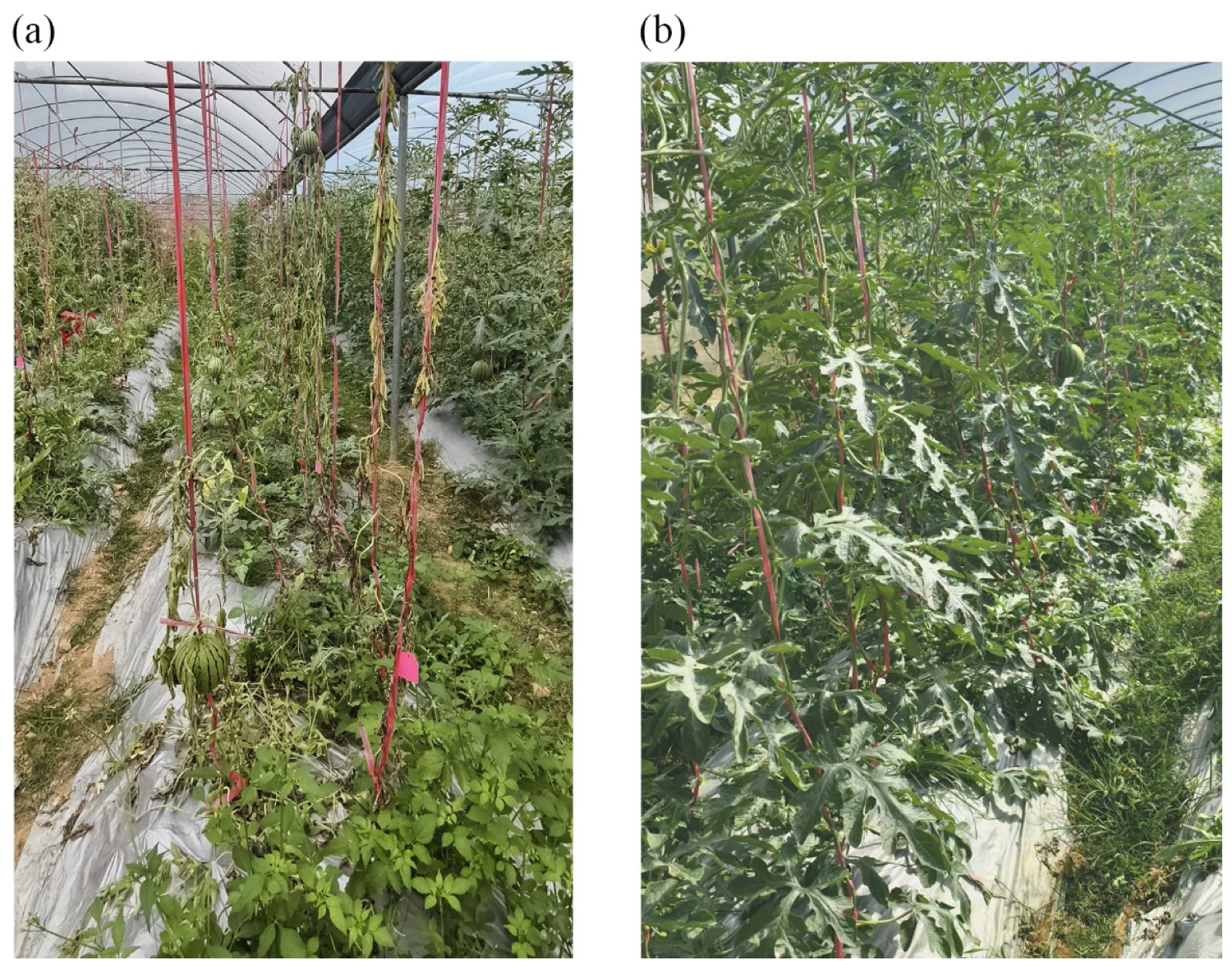
According to Table 1, grafted plants had higher plant height, stem diameter, and average internode length than non-grafted plants. Node number showed no significant difference between treatments. Wilt incidence was 55.41% in non-grafted plants and 0.00% in grafted plants (Figure 1).
Leaf chlorophyll content (SPAD value) was significantly higher in grafted than in non-grafted plants (Table 2). Stomatal conductance (Gs) and intercellular CO2 concentration (Ci) were also higher in grafted plants, whereas net photosynthetic rate (Pn) and transpiration rate (Tr) did not differ significantly between treatments.

3.2. Fruit Quality of Grafted and Non-Grafted Plants

According to Table 3, the weight of individual grafted watermelons was 2.8 times more than that of non-grafted specimens. Grafted fruit showed substantially enhanced longitudinal and transverse diameters, while the fruit form index remained unchanged across treatments. Central flesh SSC was notably elevated in grafted plants, with no notable variation in marginal flesh SSC across treatments. Pericarp thickness was considerably reduced in grafted plants compared to non-grafted plants.

3.3. Rhizosphere Microbial Community Analysis

3.3.1. α-Diversity

In rhizosphere bacterial communities, the Chao1 richness and observed species were greater in the grafted group compared to the non-grafted group, although these differences lacked statistical significance. The evenness indexes of Simpson, Shannon, and Pielou exhibited no variation between treatments.
For rhizosphere fungal communities, Chao1, Simpson, Shannon, and Pielou’s evenness indices were significantly higher in the non-grafted group than in the grafted group, whereas observed species did not differ between treatments (Table 4).

3.3.2. β-Diversity

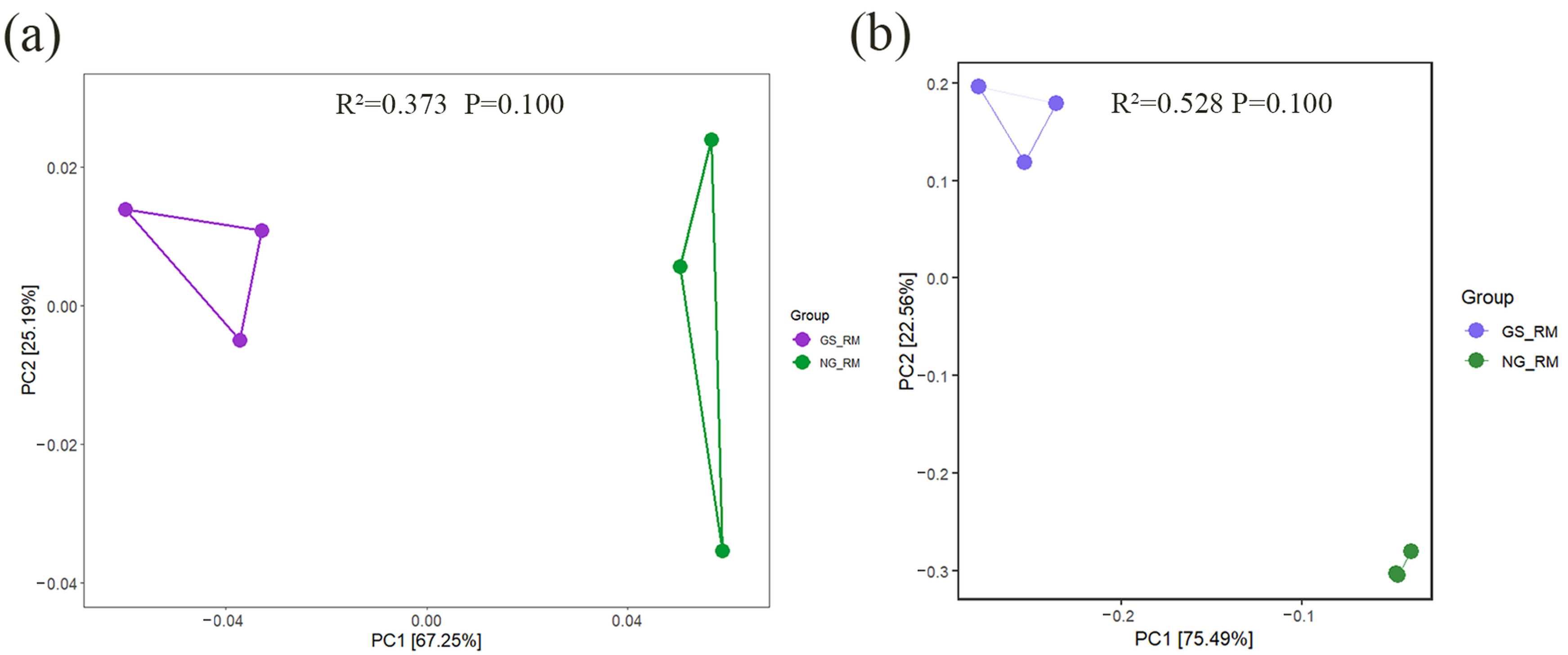
Principal coordinate analysis (PCoA) based on unweighted UniFrac distances was performed to compare the β-diversity of rhizosphere microbial communities. In relation to bacterial communities (Figure 2a), PC1 and PC2 accounted for 67.25% and 25.19% of the overall variance in community composition, respectively. Samples from the two treatments exhibited a distinct separation trend along the axis; however, Adonis permutational multivariate analysis of variance (PERMANOVA) indicated no significant difference in bacterial community structure between the groups (R2 = 0.373, p = 0.100).
For fungal communities (Figure 2b), PC1 and PC2 accounted for 75.49% and 22.56% of the variation in the community, respectively; both grafted and non-grafted samples exhibited distinct clustering, but the difference lacked statistical significance (R2 = 0.528, p = 0.100).

3.3.3. Community Composition at Phylum Level

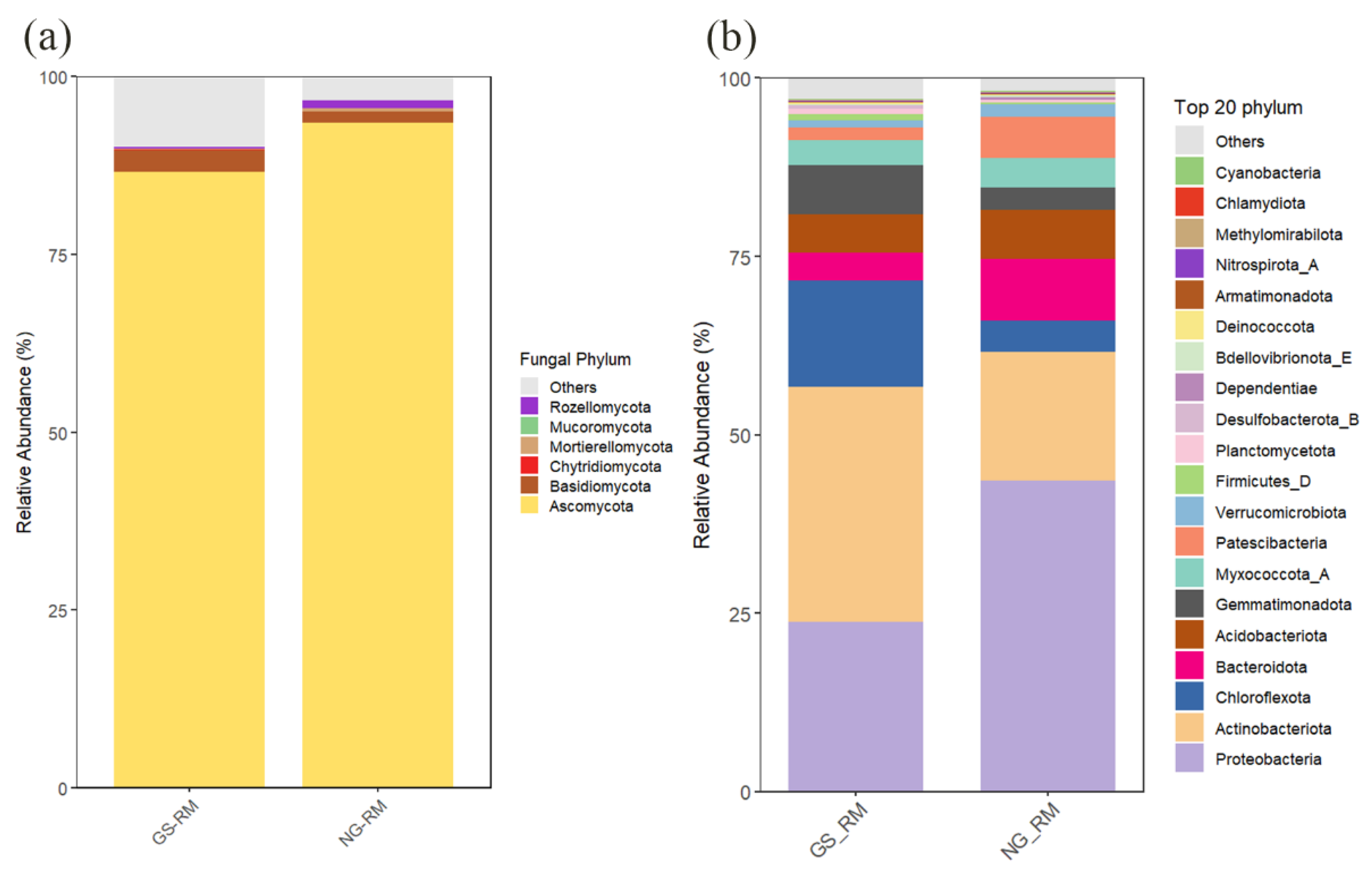
At the fungal phylum level (Figure 3a), the dominant taxa were similar between treatments. Two phyla had relative abundances ≥ 1%: Ascomycota (86.56–93.56%) and Basidiomycota (1.53–3.13%). Phyla including Mortierellomycota, Rozellomycota, Chytridiomycota, and Mucoromycota all had relative abundance < 1%. Compared with the non-grafted plants, grafting increased Basidiomycota relative abundance from 1.53% to 3.13% and reduced Ascomycota abundance from 93.56% to 86.56%; Mortierellomycota and Rozellomycota were slightly more abundant in non-grafted plants but remained at low levels in both treatments.
At the bacterial phylum level (Figure 3b), six dominant phyla (relative abundance ≥ 1%) were detected across treatments: Proteobacteria (23.81–43.61%), Actinobacteriota (17.99–32.87%), Chloroflexota (4.45–14.95%), Bacteroidota (3.90–8.64%), Acidobacteriota (5.30–6.84%), and Gemmatimonadota (3.15–6.95%); all other phyla had relative abundance < 3%. Compared with the non-grafted control, grafting increased Proteobacteria abundance from 23.81% to 43.61% and reduced Actinobacteriota abundance from 32.87% to 17.99%. Other dominant phyla showed minor fluctuations: Chloroflexota and Acidobacteriota were slightly enriched in non-grafted samples, while Bacteroidota and Gemmatimonadota were slightly enriched in grafted samples; Patescibacteria was obviously enriched only in grafted rhizospheres, with very low abundance in non-grafted samples.

3.3.4. Community Composition at Genus Level

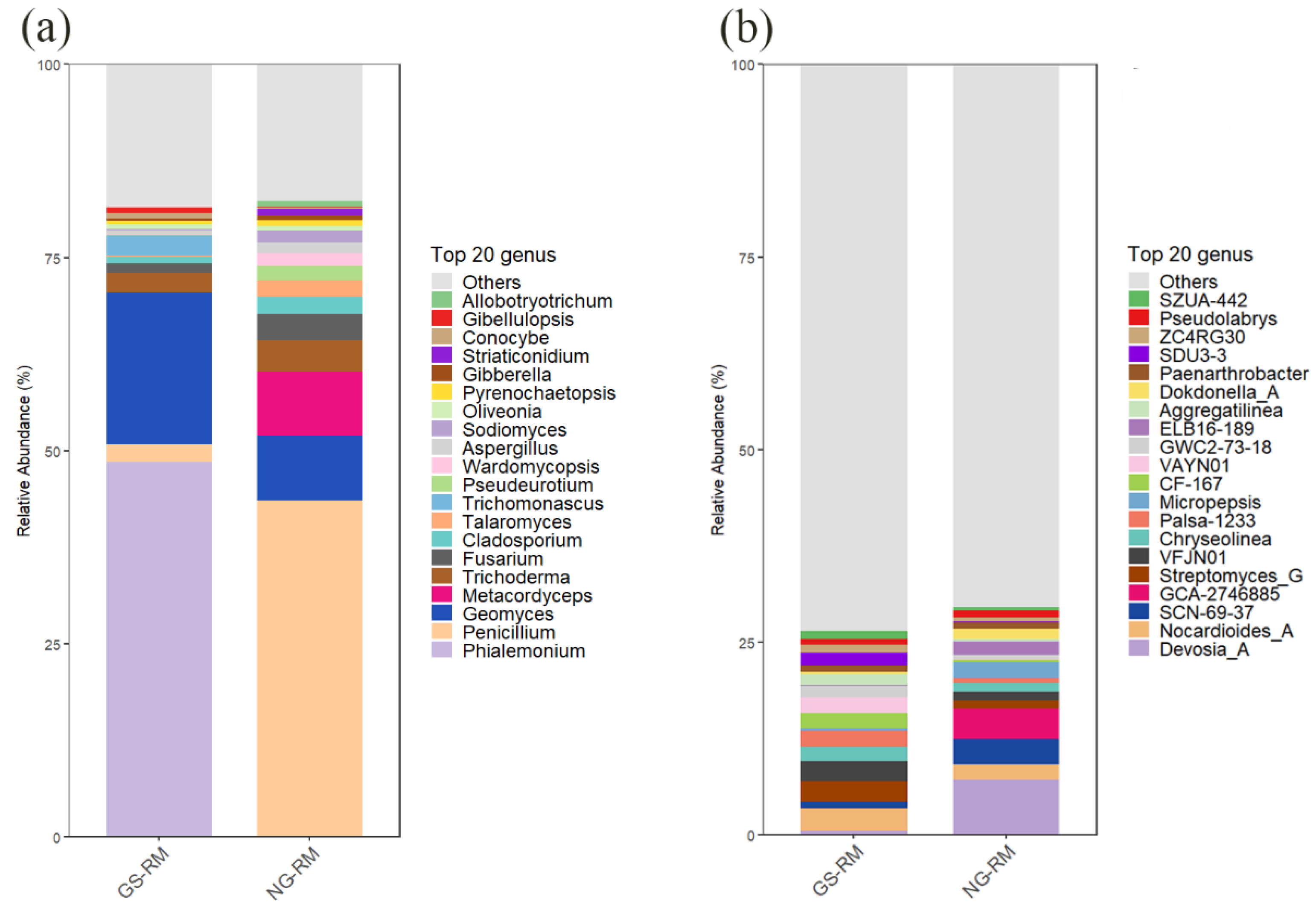
At the fungal genus level (top 20 most abundant, Figure 4a), dominant taxa included Phialemonium, Penicillium, Geotrichum, Metacordyceps, Trichoderma, Cladosporium, Talaromyces, Pseudeurotium, Wardomycopsis, and Sodiomyces. Phialemonium and Penicillium were the dominant genera shared by both treatments, but their abundance differed drastically between groups. Compared with non-grafted plants, grafting increased Phialemonium relative abundance from 0.13% to 48.53%, increased Geotrichum abundance from 8.41% to 19.65%, and reduced Penicillium abundance from 43.40% to 2.30% and Fusarium abundance from 3.36% to 1.31%. Genera including Metacordyceps, Trichoderma, Cladosporium, Talaromyces, and Pseudeurotium all decreased to varying degrees in grafted rhizospheres. Most low-abundance fungal genera were more widely distributed in non-grafted samples, while grafted rhizosphere was characterized by the absolute dominance of Phialemonium.
For bacterial genus level (top 20 most abundant, Figure 4b), dominant taxa included Devosia_A, Nocardioides_A, SCN-69-37, GCA-2746885, Streptomyces, Chryseolinea, Palsa-1233, Micropepsis, VFJN01, and CF-167. Compared with non-grafted plants, grafting increased Devosia_A abundance from 0.55% to 7.18% and increased SCN-69-37 and GCA-2746885 by 3.28% and 3.90%, respectively, while the abundance of Nocardioides_A decreased slightly from 2.84% to 1.98%. Other genera including Streptomyces and Chryseolinea showed only minor fluctuations between treatments. Low-abundance bacterial taxa were more evenly distributed in the rhizosphere of grafted plants compared with non-grafted controls.

3.4. Differential Taxa Identified by LefSe

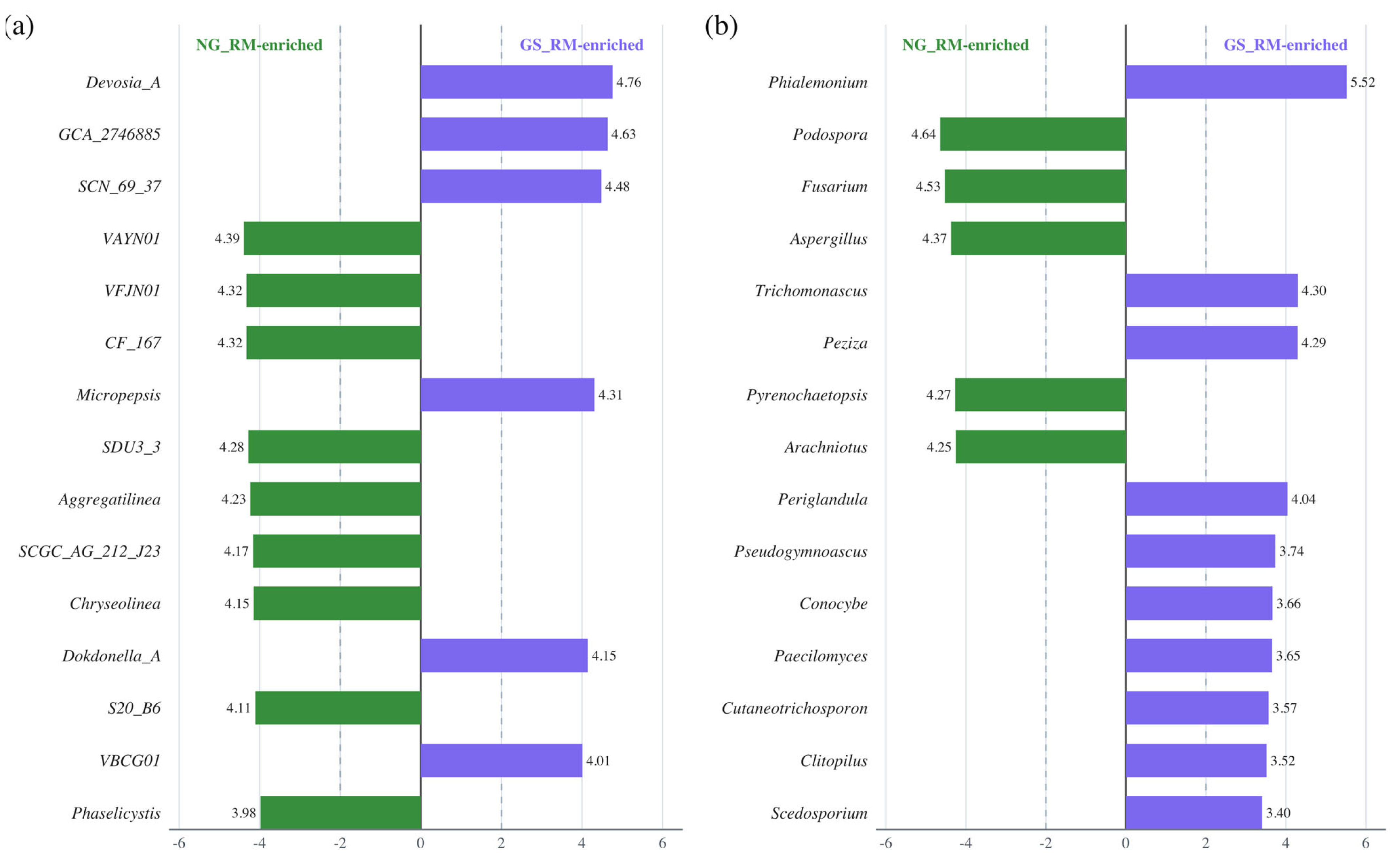
LEfSe identified distinct genus-level biomarkers between treatments (Figure 5). Among the 15 bacterial genera with the largest LDA scores, six were associated with grafted: Devosia_A (LDA = 4.76), GCA_2746885 (4.63), SCN_69_37 (4.48), Micropepsis (4.31), Dokdonella_A (4.15), and VBCG01 (4.01). Nine were associated with non-grafted, led by VAYN01 (4.39), VFJN01 (4.32), CF_167 (4.32), SDU3_3 (4.28), Aggregatilinea (4.23), SCGC_AG_212_J23 (4.17), Chryseolinea (4.15), S20_B6 (4.11), and Phaselicystis (3.98). For fungi, ten genera were associated with grafted, with Phialemonium showing the largest LDA score (5.52), followed by Trichomonascus (4.30), Peziza (4.29), and Periglandula (4.04). Five fungal genera were associated with non-grafted: Podospora (4.64), Fusarium (4.53), Aspergillus (4.37), Pyrenochaetopsis (4.27), and Arachniotus (4.25).

3.5. Predicted Microbial Functional Potential

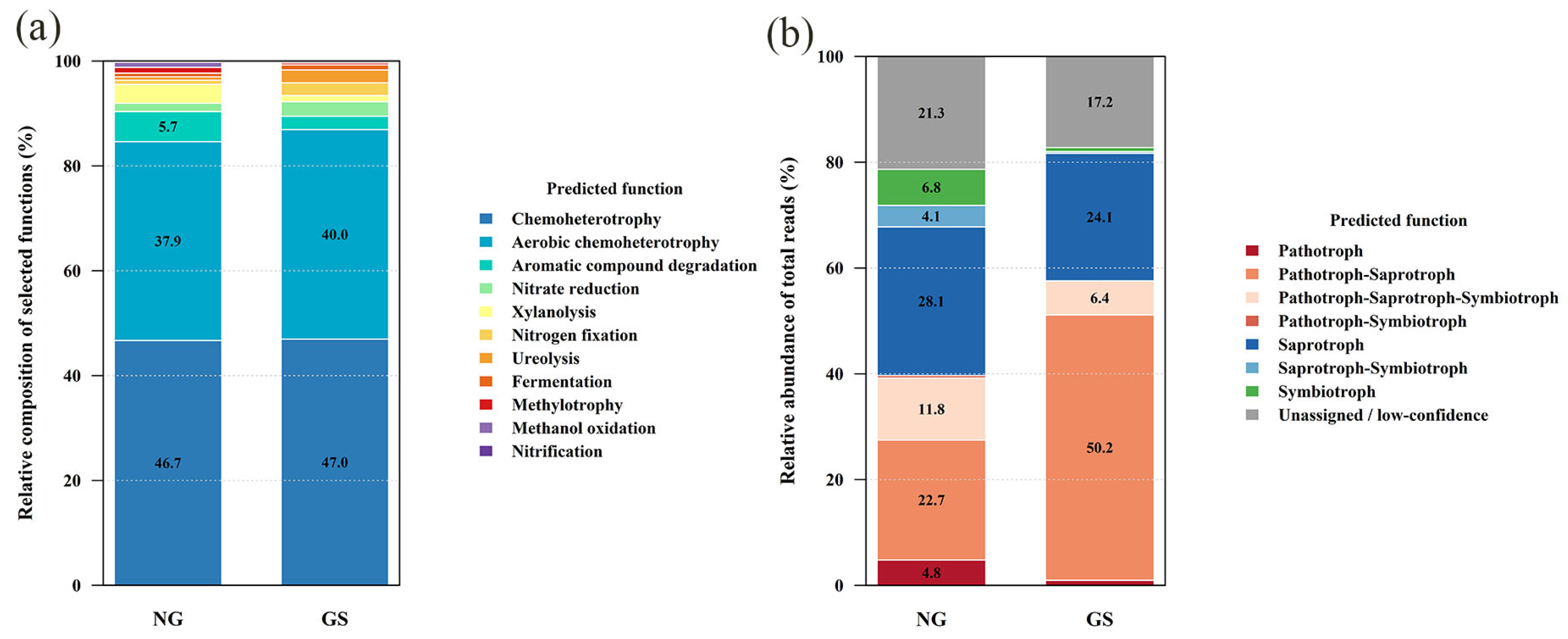
The FAPROTAX functional profiles of both treatments were dominated by chemoheterotrophy and aerobic chemoheterotrophy (Figure 6a), which accounted for 46.69% and 37.94% in the non-grafted group and 46.95% and 39.97% in the grafted group, respectively. The grafted group also showed higher relative abundances of nitrate reduction, nitrogen fixation, ureolysis, fermentation, and nitrification, whereas the non-grafted group was enriched in aromatic compound degradation, xylanolysis, methylotrophy, and methanol oxidation. FUNGuild annotation (Figure 6b) showed contrasting trophic-mode structures between treatments. Trophic modes in the non-grafted group were relatively evenly distributed, with saprotroph, pathotroph–saprotroph, pathotroph–saprotroph–symbiotroph, symbiotroph, and pathotroph accounting for 28.09%, 22.66%, 11.75%, 6.82%, and 4.80% of annotated reads, respectively. In contrast, the grafted group was dominated by a single pathotroph–saprotroph guild, consistent with the overwhelming dominance of Phialemonium (48.53%) observed at the genus level (Figure 4a); the shares of symbiotroph and pathotroph were markedly lower in the grafted group than in the non-grafted group.

3.6. Correlation Between Microbial Taxa and Fruit Quality

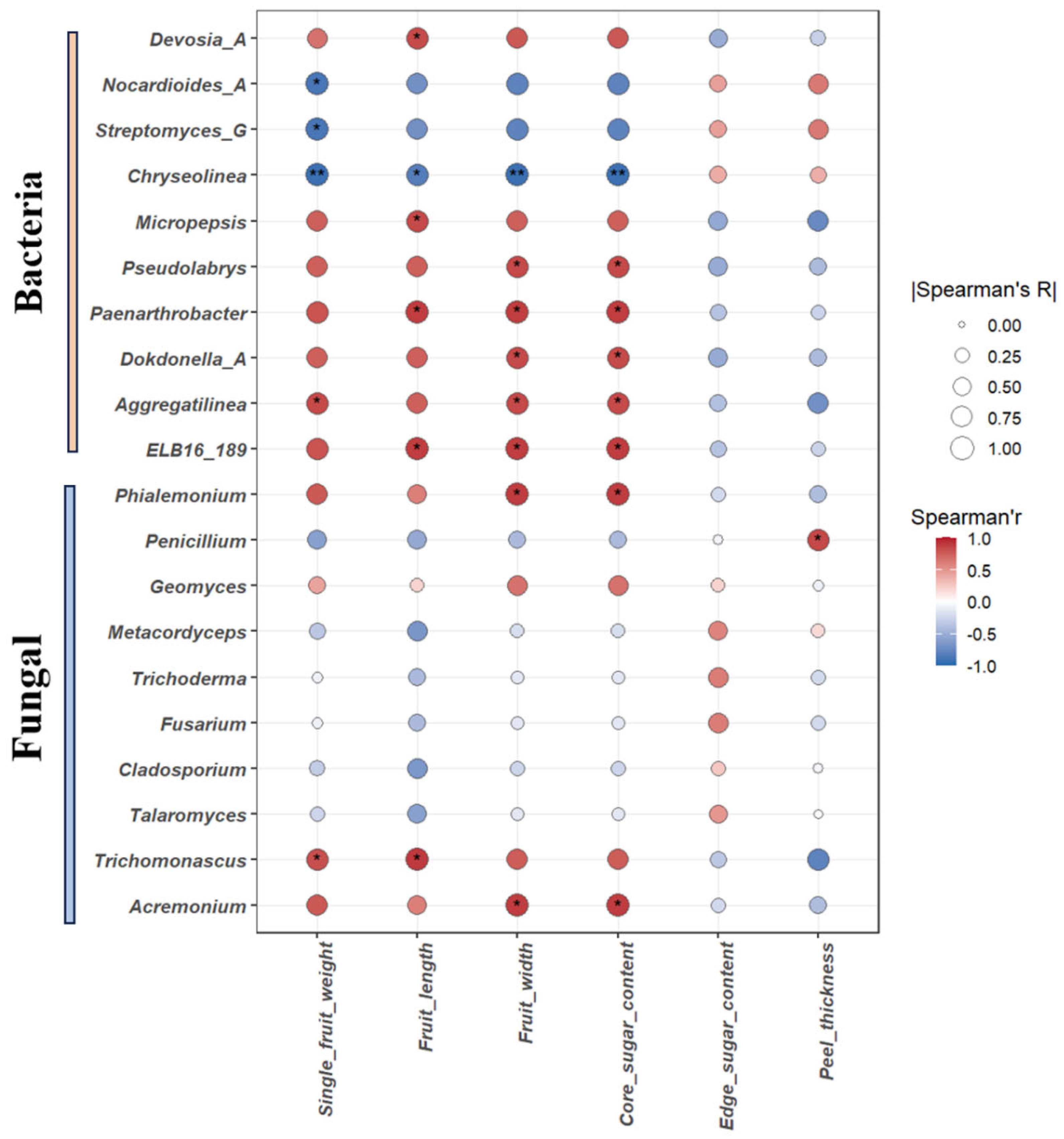
The top ten most abundant bacterial and fungal genera were selected, and Spearman correlation analysis was performed to examine the relationships between watermelon fruit quality traits and rhizosphere microbial genera. As shown in Figure 7, among the bacterial genera, Devosia_A, Micropepsis, Pseudolabrys, Paenarthrobacter, Dokdonella_A, Aggregatilinea, and ELB16_189 were significantly and positively correlated with fruit size and central SSC, but negatively correlated with marginal SSC and pericarp thickness, whereas Nocardioides_A, Streptomyces_G, and Chryseolinea exhibited the opposite pattern. Among the fungal genera, Phialemonium, Trichomonascus, and Acremonium were significantly and positively correlated with fruit size and central SSC; Penicillium showed a significant positive correlation with marginal SSC and pericarp thickness; Trichoderma, Fusarium, Cladosporium, and Talaromyces were positively correlated only with marginal SSC; and Geotrichum showed no significant correlation with any of the measured traits.

4. Discussion

4.1. Effects of Grafting on Watermelon Growth and Fruit Quality

We selected ‘Meiyue’ and C. ficifolia because the cultivar is widely grown in Hainan and the rootstock is graft-compatible, Fusarium-resistant, and tolerant of the cool winter nights that coincide with off-season production. In our field trial, grafted plants were taller, had thicker stems, and accumulated more chlorophyll [23]; plant height more than doubled, and single-fruit weight increased 2.8-fold. Fusarium wilt remains the main soil-borne disease constraining continuous watermelon production, and grafting onto resistant rootstocks is a proven countermeasure [15]. In line with this, grafted plants were completely free of wilt, whereas non-grafted plots lost more than half of their stand (0% vs. 55.41% incidence). This level of protection agrees with reports that resistant rootstocks suppress Fusarium wilt through both physiological defense and rhizosphere-microbiome-mediated pathways [8,18]; our microbiome data (Section 4.2) provide field-scale evidence for the microbial component of this protection under tropical continuous cropping. The increases in fruit size and central SSC also fit the yield and quality gains widely reported for pumpkin-grafted watermelon, in which grafting remodels primary metabolism, including amino acid and sugar levels [10,12,24]. These results indicate that the performance of C. ficifolia-grafted combinations documented in temperate regions extends to winter production in tropical Hainan.
The net photosynthetic rate, stomatal conductance, transpiration rate, and intercellular CO2 concentration are fundamental metrics of a plant’s photosynthetic ability [11]. Previous research has shown that grafting enhances photosynthetic efficiency in watermelon seedlings, and pumpkin rootstocks increase both the net photosynthetic rate and stomatal conductance in cucumber [12,25]. We observed only part of that picture: stomatal conductance, intercellular CO2, and chlorophyll content all increased, yet the net photosynthetic rate remained unchanged. One plausible explanation is that the vigorous vegetative growth of grafted plants raised respiratory demand; stomata opened wider to meet it, but carbon fixation capacity—Rubisco activity and regeneration—did not keep pace, so more CO2 passed through the leaf without any gain in carbon fixation. Fruit quality traits responded differently: central SSC increased and pericarp thickness decreased, whereas marginal SSC did not differ between treatments, consistent with previous findings [19]. Fruit sugar concentration depends jointly on assimilate supply and fruit sink strength. Grafting enhanced carbohydrate production through improved root nutrient and water uptake and leaf physiological performance, but it also substantially enlarged the fruit sink, i.e., greater single-fruit weight and volume [13,24,26]. The additional sugar delivered to the fruit was thus diluted by the larger fruit volume, keeping marginal SSC per unit flesh weight stable and statistically unchanged between treatments.

4.2. Effects of Grafting on Rhizosphere Microbial Communities

Soil microbial populations serve as crucial markers of soil vitality. Our high-throughput sequencing results showed distinct regulatory effects of C. ficifolia grafting on rhizosphere bacteria and fungi. For the bacterial community, Chao1 and observed species indices were only slightly higher in grafted samples, with no significant differences in Shannon, Simpson, or Pielou’s evenness between treatments. This indicates pumpkin rootstock grafting only slightly increases bacterial species richness but does not alter overall bacterial diversity or evenness. Ruan et al. reached a similar conclusion, reporting that cucurbit grafting acts mainly through root exudates to selectively enrich functional bacterial taxa without disturbing the inherent homeostasis of the rhizosphere bacterial community, which remains highly resilient to environmental perturbation [16]. It is likely that the robust root system of rootstocks marginally enhances the rhizosphere microclimate through improved water and nutrient absorption, resulting in small increases in bacterial populations, but the overall community structure stays unchanged.
In contrast, the fungal communities responded differently to grafting. Here, Chao1, Shannon, Simpson, and Pielou’s evenness indices were all significantly higher in non-grafted samples, indicating grafting significantly reduced rhizosphere fungal richness, diversity, and evenness, leading to the enrichment of a small number of dominant fungal taxa. Beneficial fungi enriched after grafting can exclude other taxa via niche competition and secretion of antimicrobial compounds, ultimately reducing fungal community diversity; this may represent one mechanism by which grafting alleviates watermelon continuous cropping obstacles [18]. There were no statistically significant differences in β-diversity between experimental treatments. Soil type, soil physicochemical parameters, and the legacy effect resulting from recurrent watermelon monocropping are the primary drivers dictating the construction of microbial communities, with grafting serving as a rather weak selection filter [16]. Furthermore, the regulatory effects of grafting have a long causal pathway, including altered root physiological characteristics, shifted root exudate compositions, and buffered rhizosphere microenvironments, with random disturbances occurring at each intermediate step [27]. It should also be noted that the limited sample size in the present study may have reduced the statistical power to detect subtle treatment effects; therefore, the absence of significant differences does not necessarily rule out a genuine influence of grafting on rhizosphere microbial community structure, and future studies with larger sample sizes are warranted to confirm these findings.
Fungal community analysis showed Ascomycota was the dominant phylum in both treatments, consistent with previous findings in grafted watermelon rhizosphere [20]. The relative prevalence of Ascomycota serves as a significant microbial marker for disease stress in soil used for continuous watermelon cultivation; the diminished Ascomycota levels post-grafting, along with the genus-level reduction of Fusarium, indicates a decrease in pathogen pressure in such soil [18,20]. By contrast, the relative abundance of Basidiomycota increased to 3.13% after grafting. The majority of species in this phylum are saprotrophic fungi that can decompose resistant soil organic matter and facilitate carbon and nitrogen cycling, suggesting that grafting improved the nutrient transformation ability of the rhizosphere [28]. Rozellomycota and Mortierellomycota, meanwhile, are oligotrophic taxa associated with continuous cropping stress, highly sensitive to rhizosphere changes, and their abundance declines rapidly when soil conditions improve [29]. We found that grafting shifted the fungal community toward dominance by Phialemonium, a widespread soil- and plant-associated fungal genus. Although this genus also encompasses phytopathogenic species, beneficial strains have been documented: Phialemonium isolates can produce antimicrobial secondary metabolites antagonistic to plant pathogens [30,31]; meanwhile, P. dimorphosphorum was reported to promote plant growth and root development [32]. The classification of the Phialemonium strains enriched here as either friends or opportunists is yet to be determined at the isolate level. Penicillium, on the other hand, is recognized as a problematic organism in soils where watermelons have been transplanted. Numerous strains emit phytotoxins that exacerbate autotoxicity [2,33]. Grafting substantially reduced its abundance, potentially lowering a biotic stressor in the rhizosphere.
At the community level, the act of grafting onto pumpkin rootstock did not modify the general structural composition of bacterial communities within the watermelon rhizosphere. Proteobacteria and Actinobacteriota remained the dominant phyla in both grafted and non-grafted groups. Following grafting, the relative abundance of Proteobacteria rose from 23.81% to 43.61%, while that of Actinobacteriota dropped from 32.87% to 17.99%. Proteobacteria is the most prominent phylum of plant growth-promoting rhizobacteria (PGPR) in soil, harboring a wide array of nitrogen-fixing, phosphate-solubilizing, and potassium-solubilizing taxa. Its elevated abundance reflects strengthened nutrient transformation capacity in the rhizosphere after grafting [34]. Actinobacteriota, by contrast, is a stress-adapted microbial group that secretes diverse antibiotics and extracellular enzymes to gain a competitive advantage under stressful soil conditions [35]. Consequently, its reduction in the grafted rhizosphere can justifiably be attributed to the enhanced microenvironment and the mitigation of persistent cropping stress.
At the genus level, grafting drove selective enrichment of beneficial functional bacteria, with Devosia_A as the core enriched taxon. This pattern aligns with results reported by Ruan et al. and Qiao et al. [16,36]. Devosia_A is a well-recognized PGPR genus with combined functions of nitrogen fixation, phosphate solubilization, and autotoxin degradation [37,38]; species within this genus have also been linked to phosphate solubilization and the mineralization of organic phosphorus in rhizosphere soils [39]. Its enrichment suggests that grafting may enhance nutrient turnover and disease-suppressive potential of rhizosphere soil by recruiting beneficial functional microbes. Rhizosphere microbial composition plays a critical role in plant growth and fruit quality formation. Studies by Lv et al. and Feng et al. demonstrated that the relative abundances of Devosia_A, Pseudolabrys, Paenarthrobacter, and Micropepsis were significantly positively correlated with single fruit weight, fruit length, fruit width, and central soluble solids content in watermelon, while Nocardioides_A, Streptomyces, and Chryseolinea showed significant negative correlations with these traits [2,38]. Our results are, by and large, in agreement with these reports. Specifically, Devosia_A has been reported to fix nitrogen, solubilize phosphate, and degrade autotoxins—functions that could potentially support fruit expansion and sugar accumulation, although this remains to be validated [37,38]. Pseudolabrys has been reported to secrete plant growth regulators and exhibit phosphate- and potassium-solubilizing activity, promoting rhizosphere acidification to enhance phosphorus uptake [40]; similarly, Paenarthrobacter has been reported to produce phytohormones and possess phosphate- and potassium-solubilizing capabilities [41].
The LEfSe results identified the taxa underlying this treatment contrast. Among bacteria, Devosia_A showed the highest LDA score (4.76) in the grafted group, followed by GCA2746885 and SCN6937, with Micropepsis, Dokdonella_A, and VBCG01 as additional markers, consistent with the selective enrichment of beneficial bacteria in the grafted rhizosphere described above [37,38]. Such rootstock-driven enrichment of beneficial microbes is increasingly recognized as a microbial strategy underpinning plant stress resilience [42], and successful rhizosphere establishment itself depends on colonization traits such as biofilm formation [43]. In the non-grafted group, the leading markers (VAYN01, VFJN01, CF167, SDU33, Aggregatilinea, and Chryseolinea) spanned multiple lineages, indicating that no single dominant bacterial genus characterized this treatment. The fungal biomarkers showed a sharper ecological contrast: Phialemonium was the genus most strongly enriched in grafted plants (LDA = 5.52), whereas Podospora, Fusarium, Aspergillus, Pyrenochaetopsis, and Arachniotus were enriched in non-grafted plants. The opposing enrichment of Phialemonium and Fusarium mirrors the genus-level shifts in Figure 4 and agrees with reports that rootstocks reshape protective rhizosphere microbiomes in grafted watermelon [18,36]. Notably, the enrichment of Fusarium in the non-grafted rhizosphere is consistent with the high wilt incidence observed in this treatment [4,18]. It should be noted, however, that LEfSe identifies discriminative taxa rather than causal functions [44]; given the limited replication and genus-level resolution, these biomarkers should be regarded as candidates for further validation.
Functional predictions provided a complementary view of grafting-associated shifts in predicted rhizosphere microbial functions. Both treatments were dominated by chemoheterotrophy and aerobic chemoheterotrophy, as expected for exudate-fed rhizosphere communities [45]. Beyond this shared background, the grafted rhizosphere was consistently enriched in nitrogen-cycling functions (nitrate reduction, nitrogen fixation, ureolysis, and nitrification), which agrees with the strong enrichment of the nitrogen-fixing, phosphate-solubilizing genus Devosia_A and with the well-documented capacity of nitrogen-fixing rhizobacteria to improve soil fertility and crop performance [13,36,37,46]. A plausible mechanism is that the vigorous C. ficifolia root system releases more exudates, sustaining a larger nitrogen-transforming community and thereby improving rhizosphere nitrogen supply, which may partly explain the greater vigor and fruit quality of grafted plants. In contrast, the non-grafted rhizosphere was enriched in aromatic compound degradation, xylanolysis, methylotrophy, and methanol oxidation. This pattern likely reflects a stressed, diseased rhizosphere rather than a functional advantage. Continuous monocropping accumulates phenolic autotoxins [5]. Meanwhile, the high wilt incidence (55.41%) implies greater inputs of damaged root residues, which favors microbes that degrade aromatics and plant cell-wall derivatives. FUNGuild analysis showed that grafting concentrated the fungal community into a dominant pathotroph–saprotroph guild. In contrast, non-grafted plants exhibited a more even distribution across different fungal trophic modes [47]. Because this composite guild is defined mainly by the saprotrophic or opportunistic genera Phialemonium and Penicillium, its dominance should not be read as increased pathogenicity; it more likely mirrors the reduced fungal diversity in grafted samples. Conversely, the higher pathotroph and symbiotroph shares in non-grafted plants fit the disease context, reflecting Fusarium infection pressure and a stronger reliance of weakened own-rooted plants on mutualistic fungi. It should be emphasized that FAPROTAX and FUNGuild assignments are taxonomy-based inferences rather than measured process rates [47,48]. More broadly, multi-omics integration is increasingly advocated to move beyond taxonomic profiling toward functional validation in plant–microbe interaction studies [49].
Correlation analysis connected the alterations in community composition due to grafting to enhancements in fruit quality. The seven bacterial genera positively correlated with fruit size and central SSC were all taxa enriched in the grafted rhizosphere, and several have documented growth-promoting traits (Section 4.2) [36,37,38,39,40,41]. Such functions could potentially increase the assimilate and mineral supply required for fruit expansion and sugar accumulation [24,38]; however, these correlations do not establish causation. Conversely, Nocardioides_A, Streptomyces_G, and Chryseolinea, as stress-adapted taxa associated with continuous cropping, showed the opposite correlations, marking rather than driving the stressed soil background [2,35]. Among fungi, Phialemonium and Acremonium were positively correlated with fruit size and central SSC, consistent with their reported production of antimicrobial metabolites, phytohormones, and growth-promoting factors [31,32,45,50,51]. By contrast, Penicillium and Fusarium exhibited correlations solely with little SSC or pericarp thickness, a trend we interpret as indicative of disease-promoting continuous cropping soil rather than an influence on sugar distribution [2,35]. These associations are still preliminary and necessitate confirmation by strain-specific isolation and inoculation studies.
Viewed against published work on grafted watermelon, our community-level results show both agreement and divergence. Ling et al. reported that grafting watermelon onto bottle gourd rootstock markedly reshaped the root-associated bacterial community [15], whereas in our study—as in the network analysis of Ruan et al. discussed above—bacterial community structure remained stable, and grafting acted mainly through selective enrichment of taxa such as Devosia_A [16]. For fungi, the reduced richness and suppressed Fusarium observed here parallel the protective root-associated microbiomes described for pumpkin-rootstock rhizospheres and the progressive restructuring of soil fungal communities during prolonged grafted watermelon cultivation [18,20]. The enrichment of Devosia_A further gains functional plausibility from the synthetic community study of Qiao et al., in which bacterial consortia derived from grafted watermelon rhizospheres protected non-grafted plants against F. oxysporum [36]. Such discrepancies in the magnitude of grafting effects among studies likely arise from differences in rootstock genotype, soil type, and cropping history, indicating that the rootstock effect is context-dependent [16,27].

4.3. Limitations and Future Perspectives

Several limitations of this study warrant consideration. First, it included grafted and non-grafted watermelon but no non-grafted C. ficifolia treatment, so rootstock-genotype effects cannot be separated fully from effects of grafting or rootstock–scion interaction. Second, 16S rRNA and ITS2 amplicon sequencing generally provided genus-level resolution and did not measure microbial function. Shotgun metagenomics, metatranscriptomics, metabolomics, and strain-level assays would allow direct testing of candidates such as Devosia_A and Phialemonium. Third, relative-abundance data are compositional; the high relative abundance of Phialemonium, for example, may alter the apparent proportions of other taxa. Absolute quantification by qPCR or spike-in controls would strengthen future analyses. The trial covered only one season, and the small number of biological replicates (n = 3 per treatment) limited statistical power, particularly for beta-diversity tests. The observed links between microbial taxa and fruit quality remain associative, and causal relationships will require validation through strain isolation and re-inoculation assays; the successful establishment of inoculated strains within the rhizosphere niche will itself depend on bacterial colonization traits, such as fimbria-mediated adhesion and biofilm formation [52]. Finally, Fusarium wilt was diagnosed from characteristic field symptoms and vascular browning without pathogen isolation or molecular confirmation. Although site history and enrichment of Fusarium in non-grafted rhizospheres support the diagnosis, future studies should confirm the causal agent.

5. Conclusions

Under continuous monocropping, grafting ‘Meiyue’ watermelon onto C. ficifolia rootstock improved plant vigor and fruit quality—single-fruit weight rose 2.8-fold and central SSC increased—while completely suppressing Fusarium wilt (0% vs. 55.41%). Grafting left bacterial diversity and structure largely intact but enriched Devosia_A, reduced fungal diversity, shifted the fungal community toward Phialemonium dominance, and enhanced predicted nitrogen-cycling functions; several enriched taxa correlated positively with fruit quality. Grafting onto C. ficifolia thus improves watermelon performance in continuously cropped tropical soils through improved plant vigor and associated shifts in selected rhizosphere microbial taxa. As our evidence is correlation-based, future work with a rootstock-only control and strain-level functional validation is needed to confirm causality.

Author Contributions

C.Z.: Writing—Original Draft Preparation, Writing—Review and Editing, Methodology, Data Curation. X.W.: Writing—Review and Editing, Supervision, Project administration. Y.Z.: Resources, Methodology. C.J.: Writing—Review and Editing. C.K.: Formal Analysis, Data Curation. S.S.: Funding Acquisition, Writing—Review and Editing. All authors have read and agreed to the published version of the manuscript.

Funding

This research was supported by the earmarked fund for HNARS-05-G05.

Data Availability Statement

The original contributions presented in this study are included in the article. Further inquiries can be directed to the corresponding author.

Conflicts of Interest

The authors declare no competing interests.

References

  1. Musajan, A.; Lin, Q.; Wei, D.; Mao, S. Unveiling the Mechanisms of Digital Technology in Driving Farmers’ Green Production Transformation: Evidence from China’s Watermelon and Muskmelon Sector. Foods 2024, 13, 3926. [Google Scholar] [CrossRef] [Scilit]
  2. Lv, H.; Sang, R.; Huang, L.; Long, Y.; Xu, D.; Wang, M.; Zhang, Q.; Jia, L.; Ding, Q.; Yan, C.; et al. Continuous watermelon cropping impairs plant growth by modifying soil biochemistry and rhizosphere microbial communities. Front. Microbiol. 2025, 16, 1648481. [Google Scholar] [CrossRef] [Scilit]
  3. Zhang, H.; Zheng, X.; Wang, X.; Xiang, W.; Xiao, M.; Wei, L.; Zhang, Y.; Song, K.; Zhao, Z.; Lv, W.; et al. Effect of fertilization regimes on continuous cropping growth constraints in watermelon is associated with abundance of key ecological clusters in the rhizosphere. Agric. Ecosyst. Environ. 2022, 339, 108135. [Google Scholar] [CrossRef] [Scilit]
  4. Michel, S.; Schultheis, J.; Keinath, A.; Quesada-Ocampo, L. Response of Triploid Watermelon Cultivars and ‘Carolina Strongback’ Rootstock Grown in Fields Infested with Fusarium oxysporum f. sp. niveum in North Carolina and South Carolina. Hortscience 2026, 61, 856–861. [Google Scholar] [CrossRef] [Scilit]
  5. Wen, T.; Xie, P.; Penton, C.R.; Hale, L.; Thomashow, L.S.; Yang, S.; Ding, Z.; Su, Y.; Yuan, J.; Shen, Q. Specific metabolites drive the deterministic assembly of diseased rhizosphere microbiome through weakening microbial degradation of autotoxin. Microbiome 2022, 10, 177. [Google Scholar] [CrossRef] [Scilit]
  6. Ulas, F.; Ulas, A.; Razzaghi, S.; Yücel, Y.C. A Comprehensive Review on Vegetable Grafting: A Sustainable Approach to Boost Crop Growth, Development, and Yield Performance at High and Low N Status. J. Crop Health 2026, 78, 57. [Google Scholar] [CrossRef] [Scilit]
  7. Zhang, T.; Xie, J.; Zhang, J.; Yang, Z.; Li, X.; He, S. Analysis of Cucurbita ficifolia (Cucurbitaceae) chloroplast genome and its phylogenetic implications. Mitochondrial DNA Part B-Resour. 2021, 6, 3033–3035. [Google Scholar] [CrossRef] [Scilit]
  8. Xie, J.; Ding, Y.; Gao, T.; He, S.; Zhao, K.; Yang, X.; Zhang, J.; Yang, Z. Transcriptomic and proteomic analyses of Cucurbita ficifolia Bouché (Cucurbitaceae) response to Fusarium oxysporum f. sp. cucumerium. BMC Genom. 2022, 23, 436. [Google Scholar] [CrossRef] [Scilit]
  9. Zhou, Y.; Huang, L.; Zhang, Y.; Shi, K.; Yu, J.; Nogués, S. Chill-Induced Decrease in Capacity of RuBP Carboxylation and Associated H2O2 Accumulation in Cucumber Leaves are Alleviated by Grafting onto Figleaf Gourd. Ann. Bot. 2007, 100, 839–848. [Google Scholar] [CrossRef] [Scilit]
  10. Aslam, A.; Zhao, S.; Azam, M.; Lu, X.; He, N.; Li, B.; Dou, J.; Zhu, H.; Liu, W. Comparative analysis of primary metabolites and transcriptome changes between ungrafted and pumpkin-grafted watermelon during fruit development. PeerJ 2020, 8, e8259. [Google Scholar] [CrossRef] [Scilit]
  11. Bikdeloo, M.; Colla, G.; Rouphael, Y.; Hassandokht, M.R.; Soltani, F.; Salehi, R.; Kumar, P.; Cardarelli, M. Morphological and Physio-Biochemical Responses of Watermelon Grafted onto Rootstocks of Wild Watermelon [Citrullus colocynthis (L.) Schrad] and Commercial Interspecific Cucurbita Hybrid to Drought Stress. Horticulturae 2021, 7, 359. [Google Scholar] [CrossRef] [Scilit]
  12. Sun, N.; Ma, Y.; Wang, X.; Ying, Q.; Huang, Y.; Zhang, L.; Zhu, Z.; Wang, Y.; He, Y. Grafting onto pumpkin alters the evolution of fruit sugar profile and increases fruit weight through invertase and sugar transporters in watermelon. Sci. Hortic. 2023, 314, 111936. [Google Scholar] [CrossRef] [Scilit]
  13. Nawaz, M.A.; Wang, L.; Jiao, Y.; Chen, C.; Zhao, L.; Mei, M.; Yu, Y.; Bie, Z.; Huang, Y. Pumpkin rootstock improves nitrogen use efficiency of watermelon scion by enhancing nutrient uptake, cytokinin content, and expression of nitrate reductase genes. Plant Growth Regul. 2017, 82, 233–246. [Google Scholar] [CrossRef] [Scilit]
  14. Martínez-Ballesta, M.; Alcaraz-López, C.; Muries, B.; Mota-Cadenas, C.; Carvajal, M. Physiological aspects of rootstock–scion interactions. Sci. Hortic. 2010, 127, 112–118. [Google Scholar] [CrossRef] [Scilit]
  15. Ling, N.; Song, Y.; Raza, W.; Huang, Q.; Guo, S.; Shen, Q. The response of root-associated bacterial community to the grafting of watermelon. Plant Soil 2015, 391, 253–264. [Google Scholar] [CrossRef] [Scilit]
  16. Ruan, Y.; Wang, T.; Guo, S.; Ling, N.; Shen, Q. Plant Grafting Shapes Complexity and Co-occurrence of Rhizobacterial Assemblages. Microb. Ecol. 2020, 80, 643–655. [Google Scholar] [CrossRef] [Scilit]
  17. Wang, T.; Ruan, Y.; Xu, Q.; Shen, Q.; Ling, N.; Vandenkoornhuyse, P. Effect of plant-derived microbial soil legacy in a grafting system—A turn for the better. Microbiome 2024, 12, 234. [Google Scholar] [CrossRef] [Scilit]
  18. Ge, A.; Liang, Z.; Han, L.; Xiao, J.; Zhang, Y.; Zeng, Q.; Xiang, J.; Xiong, C.; Zhang, L. Rootstock rescues watermelon from Fusarium wilt disease by shaping protective root-associated microbiomes and metabolites in continuous cropping soils. Plant Soil 2022, 479, 423–442. [Google Scholar] [CrossRef] [Scilit]
  19. Ning, K.; Zhou, W.; Cai, X.; Yan, L.; Ma, Y.; Xie, A.; Wang, Y.; Xu, P. Rootstock–Scion Exchanging mRNAs Participate in Watermelon Fruit Quality Improvement. Int. J. Mol. Sci. 2025, 26, 5121. [Google Scholar] [CrossRef] [Scilit]
  20. Zhou, X.; Guo, B.; Zhang, R.; Zhou, L.; Huang, X.; Liu, L. Investigating Changes in the Soil Fungal Community Structure, Functions, and Network Stability with Prolonged Grafted Watermelon Cultivation. Horticulturae 2024, 10, 971. [Google Scholar] [CrossRef] [Scilit]
  21. Mori, H.; Maruyama, F.; Kato, H.; Toyoda, A.; Dozono, A.; Ohtsubo, Y.; Nagata, Y.; Fujiyama, A.; Tsuda, M.; Kurokawa, K. Design and Experimental Application of a Novel Non-Degenerate Universal Primer Set that Amplifies Prokaryotic 16S rRNA Genes with a Low Possibility to Amplify Eukaryotic rRNA Genes. DNA Res. 2014, 21, 217–227. [Google Scholar] [CrossRef] [Scilit]
  22. Ihrmark, K.; Bödeker, I.T.M.; Cruz-Martinez, K.; Friberg, H.; Kubartova, A.; Schenck, J.; Strid, Y.; Stenlid, J.; Brandström-Durling, M.; Clemmensen, K.E.; et al. New primers to amplify the fungal ITS2 region—Evaluation by 454-sequencing of artificial and natural communities. FEMS Microbiol. Ecol. 2012, 82, 666–677. [Google Scholar] [CrossRef] [Scilit]
  23. Du, G.; Zhu, D.; He, H.; Li, X.; Yang, Y.; Qi, Z. The Impact of Grafting with Different Rootstocks on Eggplant (Solanum melongena L.) Growth and Its Rhizosphere Soil Microecology. Agronomy 2024, 14, 2616. [Google Scholar] [CrossRef] [Scilit]
  24. Huang, Y.; Zhao, L.; Kong, Q.; Cheng, F.; Niu, M.; Xie, J.; Nawaz, M.A.; Bie, Z. Comprehensive Mineral Nutrition Analysis of Watermelon Grafted onto Two Different Rootstocks. Hortic. Plant J. 2016, 2, 105–113. [Google Scholar] [CrossRef] [Scilit]
  25. Zhang, P.; Ding, J.; Kong, D.; Yin, H. Rhizospheric traits and plant functioning belowground. Plant Commun. 2025, 7, 101579. [Google Scholar] [CrossRef] [Scilit]
  26. Bahadur, A.; Singh, A.K.; Yadav, S.; Kumar, R.; Krishna, H.; Behera, T.K. Inter-specific cucurbitaceous rootstock enhances plant growth, photosynthetic, root architecture and yield traits in grafted cucumber (Cucumis sativus L.). Hortic. Sci. 2025, 52, 237–249. [Google Scholar] [CrossRef] [Scilit]
  27. Ramirez-Villacis, D.X.; Erazo-Garcia, P.; Quijia-Pillajo, J.; Llerena-Llerena, S.; Barriga-Medina, N.; Jones, C.D.; Leon-Reyes, A. Influence of Grafting on Rootstock Rhizosphere Microbiome Assembly in Rosa sp. ‘Natal Brier’. Biology 2023, 12, 663. [Google Scholar] [CrossRef] [Scilit]
  28. van der Wal, A.; Geydan, T.D.; Kuyper, T.W.; De Boer, W. A thready affair: Linking fungal diversity and community dynamics to terrestrial decomposition processes. FEMS Microbiol. Rev. 2013, 37, 477–494. [Google Scholar] [CrossRef] [Scilit]
  29. Muturi, E.J.; Dunlap, C.A.; Ramirez, J.L.; Perry, W.L.; Heller, N.; Rhykerd, R.L. Fungal Community Composition and Diversity Across Soil Depths Under Different Cover Crop Treatments. J. Fungi 2026, 12, 100. [Google Scholar] [CrossRef] [Scilit]
  30. Zamani, A.I.; Barig, S.; Ibrahim, S.; Yusof, H.M.; Ibrahim, J.; Low, J.Y.S.; Kua, S.F.; Baharum, S.N.; Stahmann, K.; Ng, C.L. Comparative metabolomics of Phialemonium curvatum as an omnipotent fungus cultivated on crude palm oil versus glucose. Microb. Cell Fact. 2020, 19, 179. [Google Scholar] [CrossRef] [Scilit]
  31. Pazooki, S.; Shekariesfahlan, A.; Maleki, M.; Naeimi, S. Isolation and identification of endophytic and grapevine trunk diseases associated fungi with antagonistic potential against Cytospora chrysosperma. J. Plant Pathol. 2026, 108, 99–110. [Google Scholar] [CrossRef] [Scilit]
  32. Soumare, A.; Diédhiou, A.G.; Arora, N.K.; Tawfeeq Al-Ani, L.K.; Ngom, M.; Fall, S.; Hafidi, M.; Ouhdouch, Y.; Kouisni, L.; Sy, M.O. Potential Role and Utilization of Plant Growth Promoting Microbes in Plant Tissue Culture. Front. Microbiol. 2021, 12, 649878. [Google Scholar] [CrossRef] [Scilit]
  33. Zakaria, L. An Overview of Major Penicillium Species Associated with Plant Diseases. J. Fungi 2026, 12, 286. [Google Scholar] [CrossRef] [Scilit]
  34. Basu, A.; Prasad, P.; Das, S.N.; Kalam, S.; Sayyed, R.Z.; Reddy, M.S.; Enshasy, H.E. Plant Growth Promoting Rhizobacteria (PGPR) as Green Bioinoculants: Recent Developments, Constraints, and Prospects. Sustainability 2021, 13, 1140. [Google Scholar] [CrossRef] [Scilit]
  35. Silva, G.D.C.; Kitano, I.T.; de Figueiredo Ribeiro, I.A.; Lacava, P.T. The Potential Use of Actinomycetes as Microbial Inoculants and Biopesticides in Agriculture. Front. Soil Sci. 2022, 2, 833181. [Google Scholar] [CrossRef] [Scilit]
  36. Qiao, Y.; Wang, Z.; Sun, H.; Guo, H.; Song, Y.; Zhang, H.; Ruan, Y.; Xu, Q.; Huang, Q.; Shen, Q.; et al. Synthetic community derived from grafted watermelon rhizosphere provides protection for ungrafted watermelon against Fusarium oxysporum via microbial synergistic effects. Microbiome 2024, 12, 101. [Google Scholar] [CrossRef] [Scilit]
  37. Rivas, R.; Willems, A.; Subba-Rao, N.S.; Mateos, P.F.; Dazzo, F.B.; Kroppenstedt, R.M.; Martínez-Molina, E.; Gillis, M.; Velázquez, E. Description of Devosia neptuniae sp. nov. that Nodulates and Fixes Nitrogen in Symbiosis with Neptunia natans, an Aquatic Legume from India. Syst. Appl. Microbiol. 2003, 26, 47–53. [Google Scholar] [CrossRef] [Scilit]
  38. Feng, Z.; Liang, Q.; Yao, Q.; Bai, Y.; Zhu, H. The role of the rhizobiome recruited by root exudates in plant disease resistance: Current status and future directions. Environ. Microbiome 2024, 19, 91. [Google Scholar] [CrossRef] [Scilit]
  39. Yang, Z.; Zhou, W.; Chen, P.; Dai, Z.; Feng, G.; Limpens, E.; Zhang, L. Phosphorus fertilizer forms orchestrate contrasting plant–microbe recruitment strategies in the rhizosphere of field grown wheat. New Phytol. 2026, 251, 1490–1509. [Google Scholar] [CrossRef] [Scilit]
  40. Zhou, X.; Liao, L.; Chen, K.; Yin, Y.; Qiu, L.; Li, X.; Li, Q.; Yang, S. Diversity and composition of soil microbial communities in the rhizospheres of late blight-resistant tomatoes after Phytophthora infestans inoculation. Front. Plant Sci. 2025, 16, 1556928. [Google Scholar] [CrossRef] [Scilit]
  41. Salimi, F.; Khorshidi, M.; Amirahmadi, F.; Amirahmadi, A. Effectiveness of Phosphate and Zinc Solubilizing Paenarthrobacter nitroguajacolicus P1 as Halotolerant Rhizobacterium with Growth-Promoting Activity on Pistacia vera L. Curr. Microbiol. 2023, 80, 336. [Google Scholar] [CrossRef] [Scilit]
  42. Gahlot, K.D. Microbial strategies for drought stress mitigation- a sustainable frontier in plant resilience. Front. Plant Sci. 2026, 16, 1740879. [Google Scholar] [CrossRef] [Scilit]
  43. Gahlot, D.K.; Wai, S.N.; Erickson, D.L.; Francis, M.S. Cpx-signalling facilitates Hms-dependent biofilm formation by Yersinia pseudotuberculosis. npj Biofilms Microbomes 2022, 8, 13. [Google Scholar] [CrossRef] [Scilit]
  44. Segata, N.; Izard, J.; Waldron, L.; Gevers, D.; Miropolsky, L.; Garrett, W.S.; Huttenhower, C. Metagenomic biomarker discovery and explanation. Genome Biol. 2011, 12, R60. [Google Scholar] [CrossRef] [Scilit]
  45. Grabka, R.; D’Entremont, T.; Adams, S.; Walker, A.; Tanney, J.; Abbasi, P.; Ali, S. Fungal Endophytes and Their Role in Agricultural Plant Protection Against Pests and Pathogens. Plants 2022, 11, 384. [Google Scholar] [CrossRef] [Scilit]
  46. Shah, I.; Sarim, K.M.; Sikka, V.K.; Dudeja, S.S.; Gahlot, D.K. Developed Rhizobium Strains Enhance Soil Fertility and Yield of Legume Crops in Haryana, India. J. Basic Microbiol. 2024, 64, e2400327. [Google Scholar] [CrossRef] [Scilit]
  47. Nguyen, N.H.; Song, Z.; Bates, S.T.; Branco, S.; Tedersoo, L.; Menke, J.; Schilling, J.S.; Kennedy, P.G. FUNGuild: An open annotation tool for parsing fungal community datasets by ecological guild. Fungal Ecol. 2016, 20, 241–248. [Google Scholar] [CrossRef] [Scilit]
  48. Louca, S.; Parfrey, L.W.; Doebeli, M. Decoupling function and taxonomy in the global ocean microbiome. Science 2016, 353, 1272–1277. [Google Scholar] [CrossRef] [Scilit]
  49. Kumar, U.; Raj, S.; Sreenikethanam, A.; Maddheshiya, R.; Kumari, S.; Han, S.; Kapoor, K.K.; Bhaskar, R.; Bajhaiya, A.K.; Gahlot, D.K. Multi-Omics Approaches in Plant–Microbe Interactions Hold Enormous Promise for Sustainable Agriculture. Agronomy 2023, 13, 1804. [Google Scholar] [CrossRef] [Scilit]
  50. Kaur, A.; Rogers, K.D.; Swenson, D.E.; Dowd, P.F.; Wicklow, D.T.; Gloer, J.B. Bioactive natural products from fungicolous Hawaiian isolates: Secondary metabolites from a Phialemoniopsis sp. Mycology 2014, 5, 120–129. [Google Scholar] [CrossRef] [Scilit][Green Version]
  51. Kandar, M.; Suhandono, S.; Aryantha, I.N.P. Growth Promotion of Rice Plant by Endophytic Fungi. J. Pure Appl. Microbiol. 2018, 12, 1569–1577. [Google Scholar] [CrossRef] [Scilit]
  52. Gahlot, D.K.; Taheri, N.; Macintyre, S. Diversity in Genetic Regulation of Bacterial Fimbriae Assembled by the Chaperone Usher Pathway. Int. J. Mol. Sci. 2023, 24, 161. [Google Scholar] [CrossRef] [Scilit]
Figure 1. Field growth performance of non-grafted watermelon (a) and grafted watermelon (b).
Horticulturae 12 01095 g001
Figure 2. Principal coordinate analysis (PCoA) of rhizosphere bacterial (a) and fungal (b) communities based on unweighted UniFrac distances. Each point represents one biological replicate (n = 3 per treatment); NG, non-grafted watermelon; GS, C. ficifolia-grafted watermelon. The percentages on the axes indicate the proportion of total variance explained by each principal coordinate, and the PERMANOVA (Adonis, 999 permutations) R2 and p values are shown on the plots.
Horticulturae 12 01095 g002
Figure 3. Composition of rhizosphere soil fungal (a) and bacterial (b) communities at the phylum level. Bars represent the mean relative abundance (%) of dominant phyla (relative abundance ≥ 1% in at least one treatment) in non-grafted (NG) and grafted (GS) treatments (n = 3 biological replicates).
Horticulturae 12 01095 g003
Figure 4. Composition of rhizosphere soil fungal (a) and bacterial (b) communities at the genus level. Bars represent the mean relative abundance (%) of the 20 most abundant genera in non-grafted (NG) and grafted (GS) treatments (n = 3 biological replicates).
Horticulturae 12 01095 g004
Figure 5. LEfSe analysis of genus-level bacterial (a) and fungal (b) biomarkers in rhizosphere soil. The 15 genera with the largest LDA scores are shown for each kingdom. Bars extending to the left indicate enrichment in non-grafted watermelon (NG-RM), and bars extending to the right indicate enrichment in C. ficifolia-grafted watermelon (GS-RM); bar length represents the absolute LDA score. Taxa were retained at p < 0.05 and LDA score > 2.0 (n = 3 biological replicates per treatment).
Horticulturae 12 01095 g005
Figure 6. Predicted rhizosphere microbial functional composition (a) Relative composition of selected bacterial functions inferred with FAPROTAX 1.2.12; (b) FUNGuild trophic-mode composition as a percentage of total fungal reads; unassigned or low-confidence reads are shown in gray. Bars represent treatment means (n = 3).
Horticulturae 12 01095 g006
Figure 7. Spearman correlation analysis between watermelon fruit quality traits and the ten most abundant rhizosphere bacterial and fungal genera (n = 3 plots per treatment). Bubble color indicates the direction of the Spearman correlation (red, positive; blue, negative), and bubble size indicates the correlation strength (|Spearman’s r|). Asterisks indicate the significance level of the correlation: * p < 0.05, ** p < 0.01.
Horticulturae 12 01095 g007
Table 1. Comparison of plant growth traits between non-grafted and grafted watermelon plants.
TreatmentPlant Height/cmStem Diameter/mmNode NumberAverage Internode LengthWilt Incidence/%
NG175.90 ± 18.36 b7.11 ± 1.38 b29.00 ± 1.73 a6.10 ± 0.95 b55.41
GS426.33 ± 87.23 a13.68 ± 0.77 a27.67 ± 4.04 a15.32 ± 0.95 a0.00
Note: Values are means ± SD of three biological replicates (n = 3 plots per treatment). Different lowercase letters within the same index indicate significant differences between treatments (p < 0.05, Welch’s ANOVA), while the same letter indicates no significant difference (p > 0.05).
Table 2. Comparison of photosynthetic parameters between grafted and non-grafted watermelon plants.
TreatmentChl/SPADPn/μmol·m−2·s−1Gs/mol·m−2·s−1Ci/μmol·mol−1Tr/mmol·m−2·s−1
NG46.22 ± 2.23 b10.54 ± 0.52 a0.36 ± 0.07 b222.03 ± 11.89 b5.50 ± 0.34 a
GS59.06 ± 2.30 a10.61 ± 0.28 a0.49 ± 0.06 a243.63 ± 6.36 a5.76 ± 0.19 a
Note: Note: Values are means ± SD of three biological replicates (n = 3 plots per treatment). Different lowercase letters within the same index indicate significant differences between treatments (p < 0.05, Welch’s ANOVA), while the same letter indicates no significant difference (p > 0.05).
Table 3. Comparison of fruit quality traits between non-grafted watermelon and grafted watermelon.
TreatmentSingle Fruit
Weight/kg
Fruit Length
/cm
Fruit Width
/cm
Fruit Shape
Index
Central SSC/°BrixMarginal SSC/°BrixPericarp Thickness/cm
NG0.84 ± 0.19 b12.73 ± 1.97 b11.23 ± 0.64 b1.14 ± 0.21 a10.07 ± 0.25 b8.90 ± 0.69 a0.97 ± 0.25 a
GS2.37 ± 0.37 a20.40 ± 1.13 a15.27 ± 0.90 a1.34 ± 0.08 a12.13 ± 0.49 a7.53 ± 1.21 a0.73 ± 0.15 b
Note: Values are means ± SD of three biological replicates (n = 3 plots per treatment). Different lowercase letters within the same index indicate significant differences between treatments (p < 0.05, Welch’s ANOVA), while the same letter indicates no significant difference (p > 0.05).
Table 4. α-diversity indices of rhizosphere bacterial and fungal communities.
TreatmentChao1SimpsonShannonPielou_eObserved_SpeciesGoods_Coverage
BacteriaNG2528.02 ± 112.510 a0.998 ± 0.000 a9.907 ± 0.076 a0.878 ± 0.003 a2485.667 ± 100.820 a0.994
GS2977.11 ± 424.830 a0.996 ± 0.001 a10.046 ± 0.267 a0.873 ± 0.012 a2928.567 ± 388.177 a0.993
Fungi NG320.804 ± 19.856 a0.971 ± 0.006 a6.467 ± 0.006 a0.773 ± 0.002 a318.533 ± 19.308 a0.999
GS204.434 ± 16.260 b0.760 ± 0.038 b3.844 ± 0.439 b0.486 ± 0.040 b246.233 ± 73.684 a0.999
Note: Values are means ± SD of three biological replicates (n = 3 plots per treatment). Different lowercase letters within the same index indicate significant differences between treatments (p < 0.05, Welch’s ANOVA), while the same letter indicates no significant difference (p > 0.05).
Disclaimer/Publisher’s Note: The statements, opinions and data contained in all publications are solely those of the individual author(s) and contributor(s) and not of MDPI and/or the editor(s). MDPI and/or the editor(s) disclaim responsibility for any injury to people or property resulting from any ideas, methods, instructions or products referred to in the content.