Article

Alginate-Based Edible Coatings Enriched with Essential Oils for Enhancing Postharvest Quality and Bioactive Stability of Cherry Tomatoes (Solanum lycopersicum var. cerasiforme)


by
Custódia Gago
1,2,*,
Elizabete Mendonça
2,
Ilona Sapryha
2,
Boulanouar Bakchiche
3,4,
Alexandra Machado
5,
Ana Cristina Figueiredo
5,
Dulce Antunes
1,2 and
Maria Graça Miguel
1,2,*
1
MED—Mediterranean Institute for Agriculture, Environment and Development, CHANGE—Global Change and Sustainability Institute, Universidade do Algarve, Campus de Gambelas, Edifício 8, 8005-139 Faro, Portugal
2
Faculdade de Ciência e Tecnologias, Universidade do Algarve, Campus de Gambelas, Edifícios 2 and 8, 8005-139 Faro, Portugal
3
Laboratory of Biological and Agronomic Sciences (LBAS), Amar Telidji University, Laghouat 03000, Algeria
4
Research Unit on Medicinal Plants (URPM), Laghouat 03000, Algeria
5
Centre for Ecology, Evolution and Environmental Changes (CE3C) & Global Change and Sustainability Institute (CHANGE), Faculdade de Ciências, Universidade de Lisboa, Biotecnologia Vegetal, DBio, Campo Grande, 1749-016 Lisboa, Portugal
*
Authors to whom correspondence should be addressed.
Horticulturae 2026, 12(9), 1060; https://doi.org/10.3390/horticulturae12091060
Submission received: 1 July 2026 / Revised: 13 August 2026 / Accepted: 18 August 2026 / Published: 25 August 2026
(This article belongs to the Section Postharvest Biology, Quality, Safety, and Technology)

Abstract

This study evaluated the effectiveness of sodium alginate-based edible coatings enriched with essential oils and their major bioactive compounds in preserving the postharvest quality of cherry tomatoes (Solanum lycopersicum var. cerasiforme). Fruits were coated with sodium alginate formulations containing lemongrass (Cymbopogon citratus) essential oil, citral, bay laurel (Laurus nobilis) essential oil, or 1,8-cineole, and stored at 5 °C for up to 21 days followed by 3 days at room temperature. Physicochemical attributes, including color, firmness, total soluble solids (SSC), and weight loss, together with lycopene, β-carotene, total phenolic content, antioxidant capacity, and microbial quality were evaluated. Storage time significantly affected most quality parameters. Among the coating treatments, significant effects were observed for color, SSC, firmness, and mesophilic bacterial counts, whereas no significant treatment effects were detected for weight loss, lycopene, β-carotene, total phenolic content, antioxidant capacity, or yeasts and molds. Citral-enriched alginate coatings maintained higher firmness than uncoated control throughout storage, while alginate coatings containing lemongrass essential oil showed higher mesophilic bacterial counts than the control. Overall, the alginate-based coatings produced only modest effects under the conditions evaluated. The limited treatment response may be related to the storage conditions, the characteristics of the selected essential oils, and the good inherent postharvest performance of the ‘Dolcetini’ cultivar. These findings contribute to defining the conditions under which alginate-based edible coatings may or may not provide additional benefits for postharvest preservation of cherry tomatoes.

1. Introduction

Cherry tomatoes (Solanum lycopersicum var. cerasiforme) are highly appreciated by consumers due to their attractive color, juicy texture, pleasant flavor, and high nutritional value, particularly their content of bioactive compounds such as lycopene, an important carotenoid with antioxidant properties. However, like other climacteric fruits, cherry tomatoes are highly perishable and undergo rapid ripening after harvest, leading to water loss, softening, color changes, and microbial spoilage that reduce shelf life and marketability. Consequently, the development of safe, environmentally friendly postharvest preservation technologies has become increasingly important to reduce quality losses and food waste [1,2,3,4].

Among these technologies, edible coatings based on biopolymers have attracted considerable attention. Sodium alginate, a polysaccharide extracted from brown seaweed and classified as Generally Recognized as Safe (GRAS), forms semi-permeable films that reduce moisture loss, gas exchange, and respiration rate, thereby helping to preserve fruit quality during storage [5]. In addition, alginate coatings can be easily applied by dipping or spraying, making them compatible with commercial postharvest handling systems and suitable for large-scale industrial application [6]. Their effectiveness can be further enhanced by incorporating natural bioactive compounds, particularly essential oils (EOs), which provide antimicrobial and antioxidant properties while meeting the increasing consumer demand for clean-label preservation technologies [7,8,9]. Nevertheless, the volatility and intense aroma of EOs require careful formulation to ensure both effectiveness and sensory acceptability.
Several studies have demonstrated the potential of alginate-based coatings and essential oils to preserve tomato quality during storage. These coatings may delay ripening by modifying the internal gaseous atmosphere of the fruit, contributing to the maintenance of firmness and color, while their antioxidant activity may influence carotenoid metabolism and oxidative stability [10,11,12,13]. Essential oils rich in citral, such as lemongrass (Cymbopogon citratus) EO, and those containing 1,8-cineole, such as bay laurel (Laurus nobilis) EO, have shown antimicrobial and antioxidant activities that make them attractive alternatives to synthetic preservatives [14,15,16]. However, despite the growing number of studies on edible coatings containing essential oils, little information is available comparing the performance of whole essential oils with that of their major bioactive constituents incorporated into the same coating matrix. Such comparisons are important to determine whether the biological activity of the whole essential oil results primarily from its major compound or from synergistic interactions among its different constituents.
Therefore, the aim of the present study was to evaluate the effects of sodium alginate-based edible coatings containing lemongrass essential oil, bay laurel essential oil, citral, or 1,8-cineole on the postharvest quality of cherry tomatoes stored at 5 °C followed by 3 days at room temperature. Physicochemical quality attributes, bioactive compounds, antioxidant activity, and microbial quality were evaluated. Particular emphasis was placed on comparing the effects of the whole essential oils with those of their corresponding major compounds. Such comparisons are important to determine whether the biological activity of the complete essential oil differs from that of its principal constituent and whether the presence of minor constituents provides additional benefits.

2. Materials and Methods

2.1. Essential Oils and Volatile Components

The aerial parts of cultivated Cymbopogon citratus (DC.) Stapf and naturally growing Laurus nobilis L. plants were collected between March and April 2024 in El-Ghicha, Laghouat Province, Algeria (Latitude: 33°55′59.99″ N; Longitude: 2°08′60.00″ E). Plant specimens were identified by Prof. M. Kouidri (Department of Agronomy, University of Laghouat, Algeria). Voucher specimens were deposited in the Herbarium of the Laboratory of Biological and Agronomic Sciences, University of Amar Telidji, Laghouat, Algeria, under the accession codes LBAS Cc/03/24 for C. citratus and LBAS Ln/04/24 for L. nobilis.
Lemongrass (Cymbopogon citratus) and bay laurel (Laurus nobilis) essential oils (EOs) were obtained from air-dried plant material (100 g each) by hydrodistillation for 3 h using a Clevenger-type apparatus. The resulting EOs were then dried over anhydrous sodium sulfate and stored at 4 °C in the dark until analysis.
Citral and 1,8-cineole were obtained from Sigma-Aldrich (St. Louis, MI, USA).
The EOs were analyzed for chemical profile through both, gas chromatography–flame ionization detection (GC–FID) and gas chromatography–mass spectrometry (GC–MS) as previously reported in Póvoa et al. [17].

2.2. Fruits and Treatments

Cherry tomato fruits (Solanum lycopersicum L. var. cerasiforme) of the commercial cultivar ‘Dolcetini’ (HM.Clause) were harvested at the red-ripe stage from a commercial greenhouse located in Bela-Salema, Faro, Portugal (37°07′ N, 7°95′ W). Fruits were selected for uniformity in size, color, and absence of visible defects before being used in the experiment. They were washed in running water to remove dirt and surface impurities.
Treatments applied were based on the following emulsion formulations: 2% sodium alginate + 0.12% Cymbopogon citratus essential oil (AlgLG); 2% sodium alginate + 0.12% citral (AlgCit); 2% sodium alginate + 0.125% Laurus nobilis essential oil (AlgLN); 2% sodium alginate + 0.125% 1,8-cineole (AlgCin) and fruit washed only, no active compound (Control (CT)).
All emulsion formulations were prepared according to Guerreiro et al. [18] using 1% (w/v) glycerol as plasticizer. A 2% (w/v) sodium alginate solution was prepared by gradually adding sodium alginate powder to distilled water heated to 70 °C under continuous stirring until complete dissolution. After the solution had cooled to below 40 °C, glycerol and the appropriate amount of essential oil or its major compound were added. The emulsions were then homogenized using an Ultra-Turrax homogenizer (IKA-Werke GmbH & Co. KG, Staufen, Germany) at 11,000 rpm for 2 min. The essential oil concentrations were selected based on previously determined minimum inhibitory concentrations (MIC) for Botrytis cinerea [19,20]. However, its possible effects on sensory attributes and consumer acceptance were not evaluated and should be considered in future studies. For coating, fruits were submerged in their respective alginate emulsions for 2 min and drained for 30 s (by slow rotation in a basket). The alginate coating was subsequently crosslinked by immersion in a 1% (w/v) calcium chloride (CaCl2) solution, forming a stable gel network on the fruit surface. The basket was rotated gently for a few seconds to remove excess coating solution. Visual inspection after treatment revealed no signs of mechanical damage, such as bruising, cracking, or skin abrasion.
Perforated polyethylene trays (14 × 9 × 5 cm) were labeled and filled with six fruits each (one replicate, each treatment has 4 replicates per sampling date). The perforations allowed air exchange and prevented the establishment of a modified atmosphere around the fruits. The trays were stored in a cold chamber at 5 °C and 90–95% relative humidity.
Samples were evaluated at harvest (day 0) and after 3 days at room temperature without prior cold storage (0 + 3). Additional samples were stored at 5 °C for 7, 14, or 21 days and subsequently transferred to room temperature (21–22 °C) for a 3-day shelf life period, resulting in the sampling points 7 + 3, 14 + 3, and 21 + 3. The temperature was maintained within that range using an air-conditioning system to provide controlled ambient conditions representative of retail shelf life. At each sampling date, four independent replicates per treatment were evaluated, with each replicate consisting of six fruits (24 fruits per treatment and sampling date). Because the analyses were destructive, separate fruit lots were used for each sampling date. All physicochemical, phytochemical, antioxidant, and microbiological analyses were performed at the same sampling points (0, 0 + 3, 7 + 3, 14 + 3, and 21 + 3), unless otherwise stated.

2.3. Physicochemical and Quality Measurements

2.3.1. Color Measurements

Color was measured using a PCE-CSM1 colorimeter (PCE instruments, Southampton, UK) based on the CIELAB system (parameters L*, a*, b*).

2.3.2. Firmness

Firmness was measured using a Chatillon TCD 200 penetrometer with a DFIS 50 digital force gauge (Chatillon, AMETEK, Largo, FL, USA). A 6 mm diameter probe (conical tip on last 3 mm) penetrated to depth of 7 mm at equatorial region. Six fruits per replicate; mean of each replicate recorded at each time point.

2.3.3. Soluble Solid Content

Fruits were longitudinally cut into quarters for juice preparation. One quarter from each of six fruits per replication was squeezed to obtain juice samples, resulting in four independent juice samples for each treatment and sampling date. The extracted juice was centrifuged at 5000 rpm for 5 min (Universal 320 centrifuge, Andreas Hettich GmbH, Tuttlingen, Germany). Soluble solids content (SSC) was determined in the supernatant using a digital refractometer (Model HI 96801, Hanna Instruments, Nusfalău, Romania). The remaining supernatant was stored at −25 °C until subsequent chemical analysis (DPPH and phenols).

2.3.4. Weight Loss

Fruits of each replicate were weighed at day 0 (initiation of storage), then at 7, 14, and 21 days of cold storage. After each cold storage period (except day 0), fruits were weighed again after 3 days at ambient temperature. Loss of weight was calculated as percentage (%), loss weight in storage and loss weight in shelf life:
Weight loss = Initial weight − Weight at sampling date × 100/Initial weight

2.4. Antioxidant and Phytochemical Analyses

2.4.1. 2,2-Diphenyl-1-picrylhydrazyl (DPPH) Radical-Scavenging Activity

Antioxidant activity was determined using tomato juice samples prepared as described in Section 2.3.3. Samples were diluted, when necessary, prior to analysis. A DPPH radical solution was prepared by dissolving 0.005 g DPPH in 100 mL of 96% ethanol and stored at 4 °C and protected from light, until use. The assay mixture consisted of 5 µL of sample, 20 µL of distilled water, and 275 µL of DPPH solution in each well of a microplate (final volume 300 µL). Absorbance was measured at 517 nm in a microplate reader (Synergy HTX, Bio Tek Instruments, Inc., Winooski, VT, USA). Antioxidant activity was expressed as the percentage inhibition of DPPH relative to a blank (DPPH solution and distilled water) and quantified as µM Trolox equivalents (TE) using a Trolox calibration curve.

2.4.2. Total Phenolics

Total phenolics was determined using tomato juice samples prepared as described in Section 2.3.3. This assay was measured using the Folin–Ciocalteu reagent. Folin–Ciocalteu solution (diluted; reagent A) and sodium carbonate solution (reagent B) were prepared. For each sample: 100 µL reagent A + 20 µL extract + 80 µL reagent B in microplate wells. After incubation in dark for 30 min, absorbance measured at 765 nm in a microplate reader (Synergy HTX, Bio Tek Instruments, Inc., Winooski, VT, USA). Gallic acid standard curve used to express results as mg gallic acid equivalents (GAE).

2.4.3. Carotenoids (Lycopene and β-Carotene) Extraction and Quantification

Approximately 1 g of finely chopped tomato (at 0 + 3, 7 + 3, 14 + 3, 21 + 3 days) was extracted with acetone–hexane (4:6 v/v). Homogenization was performed using an ultra-turrax for approximately 1 min, followed by 15 min rest. Absorbance of the supernatant were measured at 663, 645, 505, and 453 nm. Following the methodology of Nagata and Yamashita [21], lycopene and β-carotene concentrations were first determined using the Genesys 10S UV-Vis spectrophotometer (Thermo Electron Scientific Instruments LLC., Madison, WI, USA) and expressed in mg/mL of extractant using the corresponding equations. These values were then converted and expressed as mg per 100 g of tomato fruit.
A   L y c o p e n e mg / mL = 0.0458 × A b s 663 + 0.204 × A b s 645 + 0.372 × A b s 505 0.0806 × A b s 453
B   β c a r o t e n e   ( mg / mL )   =   0.216   ×   Abs 663     1.22   ×   Abs 645     0.304   ×   Abs 505     0.452   ×   Abs 453

2.5. Microbiological Analyses

From each treatment replicate, 5 g of fruit tissue was homogenized with 45 mL of peptone water (Oxoid, Thermo Fisher Scientific, Basingstoke, Hampshire, UK). Decimal dilutions were prepared using Ringer’s solution.
Aerobic mesophilic bacteria: plated on Plate Count Agar (PCA; Biokar, Paris, France), according to Portuguese standard NP-4405:2002 [22]; incubation at 37 ± 1 °C for 24–72 h. This standard method is routinely implemented and validated in the microbiology laboratory where the analyses were conducted.
Molds and yeasts: plated on Dichloran Rose-Bengal Chloramphenicol Agar (DRBC; Biokar), following ISO 21527-2:2008 [23]; incubation at 20 ± 1 °C for 72–96 h.
Counts were expressed as log10 colony-forming units per gram (CFU/g) of fresh weight.

2.6. Statistical Analysis

All experiments followed a completely randomized design with four replicates per treatment at each sampling date. Data were analyzed by two-way ANOVA, considering treatment, storage time, and their interaction (Treatment × Time) as fixed factors. When no significant Treatment × Storage Time interaction was detected, the main effects of treatment and storage time were evaluated separately and mean comparisons were performed using Duncan’s multiple range test at p < 0.05. When a significant Treatment × Storage Time interaction was detected (Table S13), or when a significant main effect of treatment or storage time was observed (Table S14), mean comparisons were performed among all treatment × storage time combinations using Duncan’s multiple range test at p < 0.05.

3. Results and Discussion

3.1. Chemical Composition of Essential Oils

The percentages of the compounds that constitute the EOs of lemongrass and bay laurel are depicted in Table 1. 1,8-Cineole is the main component in the bay laurel EO (38.0%). This percentage is within the range found in the same species collected in different countries (ranging from 29.2% in Georgia to 58.6% in Turkey) [24]. The percentage of 38 in the present work in which the plants were collected in Algeria is slightly higher than those EOs extracted from the same species in different places of the same country (25.62 and 29.97%) [25,26]. Methyl eugenol percentage in the EO obtained in the present work was lower (3.6%) than that previously reported (11.07 and 12.49%) for Algerian samples [25,26].
Neral (cis-citral, β-citral) (33.1%) and geranial (trans-citral, α-citral) (49.3%) (citral, sum of neral and geranial 82.4%) were the main components found in the lemongrass EO, being within the range of these components in other EOs of lemongrass, regardless the origin or extraction type [27,28].

3.2. Fruit Characterization at Harvest

The physicochemical properties of cherry tomatoes were those depicted in Table 2. At harvest, the fruit showed color characteristics typical of a red-ripe stage, with L*, a*, b*, C*, and hue angle values of 23.26 ± 0.70, 18.62 ± 1.88, 34.61 ± 0.74, 39.52 ± 1.20, and 62.09 ± 2.41, respectively. Fruit firmness was 7.38 ± 1.58 N, while soluble solids content (SSC) reached 5.58 ± 0.66%. The total phenolic content was 0.35 ± 0.11 mM gallic acid equivalents per mL of juice, and antioxidant activity, determined by the DPPH assay, was 0.40 ± 0.20 mM Trolox equivalents per mL of juice. Regarding carotenoid composition, β-carotene and lycopene contents were 2.01 ± 0.25 and 5.62 ± 1.08 mg/100 g fresh fruit, respectively. The initial microbial load was low, with mesophilic bacteria quantified at 3.69 ± 0.18 log10 CFU/g fruit, whereas yeasts and molds were not detected. These values fall within the range reported for cherry tomatoes in the literature for color, soluble solids, firmness, and antioxidant-related traits, while differences in carotenoid content likely reflect variation in genotype, maturity stage, and pre- and postharvest handling [12,29,30].

3.3. Quality Parameters

Before discussing the individual quality parameters, it should be noted that, unless otherwise indicated, no significant Treatment × Storage Time interaction was detected (Tables S1–S12). Therefore, for these variables the main effects of treatment and storage time were interpreted independently. Only parameters showing a significant interaction are discussed in terms of treatment responses at each sampling date.
The present study did not include an alginate-only treatment, preventing the individual effects of the coating matrix from being distinguished from those of the incorporated essential oils or their major compounds. Nevertheless, sodium alginate is well known for its film-forming ability and gas barrier properties, and alginate-only coatings have previously improved postharvest quality in other fruit species [31]. Consequently, the present work focused on assessing whether incorporation of essential oils or their major constituents could provide additional benefits. Future studies should include an alginate-only treatment to clarify the relative contribution of each component.
Although the stability and release kinetics of citral and the other volatile compounds were not evaluated in the present study, the persistence of treatment effects on some quality parameters throughout storage suggests that at least part of the volatile fraction remained available during the experimental period. Alginate matrices have been reported to partially retain volatile compounds within their polymer network, allowing their gradual release over time [32]. In addition, the low storage temperature (5 °C) may have reduced volatilization rates, thereby contributing to the persistence of these compounds during storage. Nevertheless, these mechanisms were not directly investigated in the present study and require further experimental confirmation.
Although storage temperatures below 10 °C are generally associated with the development of chilling injury in tomatoes, a temperature of 5 °C was selected to simulate commercial retail conditions, where cherry tomatoes may be stored under refrigeration for extended periods, particularly when included in fresh-cut vegetable products [33]. No visible symptoms of chilling injury were observed during the 21-day storage period or after the subsequent shelf-life simulation. However, storage at 5 °C likely reduced metabolic activity, including respiration and ripening processes, thereby limiting the potential for the coatings to produce additional preservation effects. This may partly explain why more pronounced coating effects have frequently been reported in studies conducted at ambient temperature or at the recommended storage temperature for tomatoes (10–13 °C) [34,35,36].
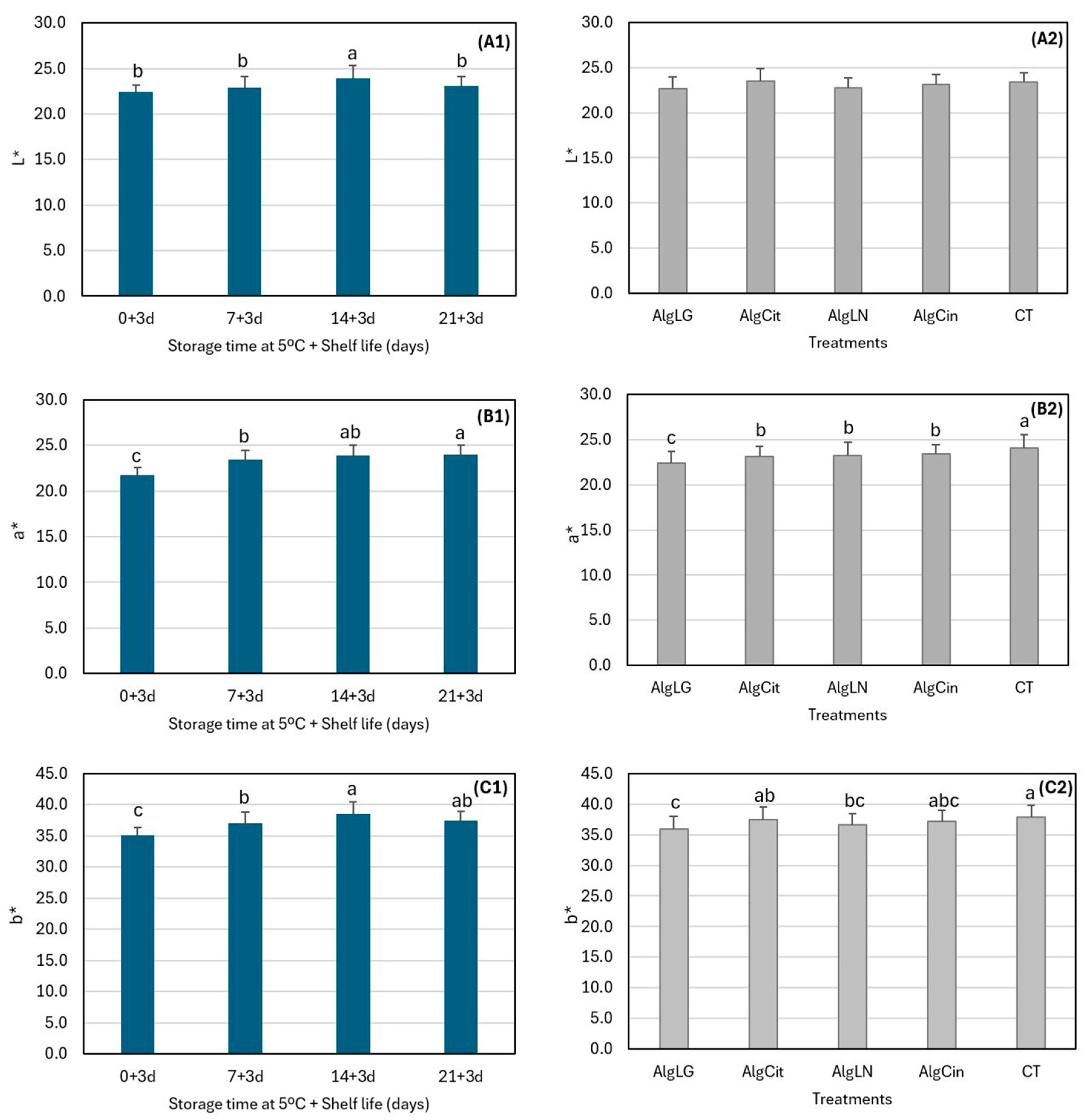
Figure 1 shows the L* (A), a* (B), and b* (C) values of samples that were exposed to various edible coatings. For all color parameters, no significant interaction between treatment and storage time was observed, indicating that the effects of these two factors could be interpreted independently (Tables S1–S3, in the Supplementary Material).
Fruit lightness (L*) was significantly affected by storage time but not by coating treatment (Figure 1A2; Table S1). In contrast to the findings reported for cherry tomatoes coated with a trans-cinnamaldehyde-loaded cyclodextrin nanosponge impregnated chitosan composite coating [29] and alginate coatings containing Helichrysum italicum essential oil described by Nkede et al. [12], the present alginate formulations did not modify fruit lightness. This suggests that the coatings had little influence on the overall brightness of the tomato surface during storage.
As expected, a* values increased throughout storage, reflecting the normal progression of ripening and lycopene accumulation (Figure 1B1). Treatment also affected this parameter, with uncoated fruit exhibiting the highest redness, whereas AlgLG showed significantly lower a* values. The remaining formulations displayed intermediate responses. Similar reductions in a* have been reported for alginate coatings containing Helichrysum italicum essential oil [12], suggesting that edible coatings may slightly delay color development by slowing ripening. The increase in a* during storage is consistent with the continued accumulation of carotenoid pigments, particularly lycopene, during ripening.
Similar behavior was observed for b* (Figure 1C1). Storage time increased b* values, whereas AlgLG and AlgLN produced slightly lower values than the control, indicating a modest delay in yellow color development. AlgCit and AlgCin did not differ significantly from CT. Comparable effects have been reported for edible coatings containing essential oils, although color responses depend on both the type and concentration of the incorporated oil [30,31,32,33,34,35,36,37,38,39].
Because the color of the coating formulations themselves was not measured, a possible contribution of the coating matrix and incorporated essential oils to the recorded color coordinates cannot be excluded.
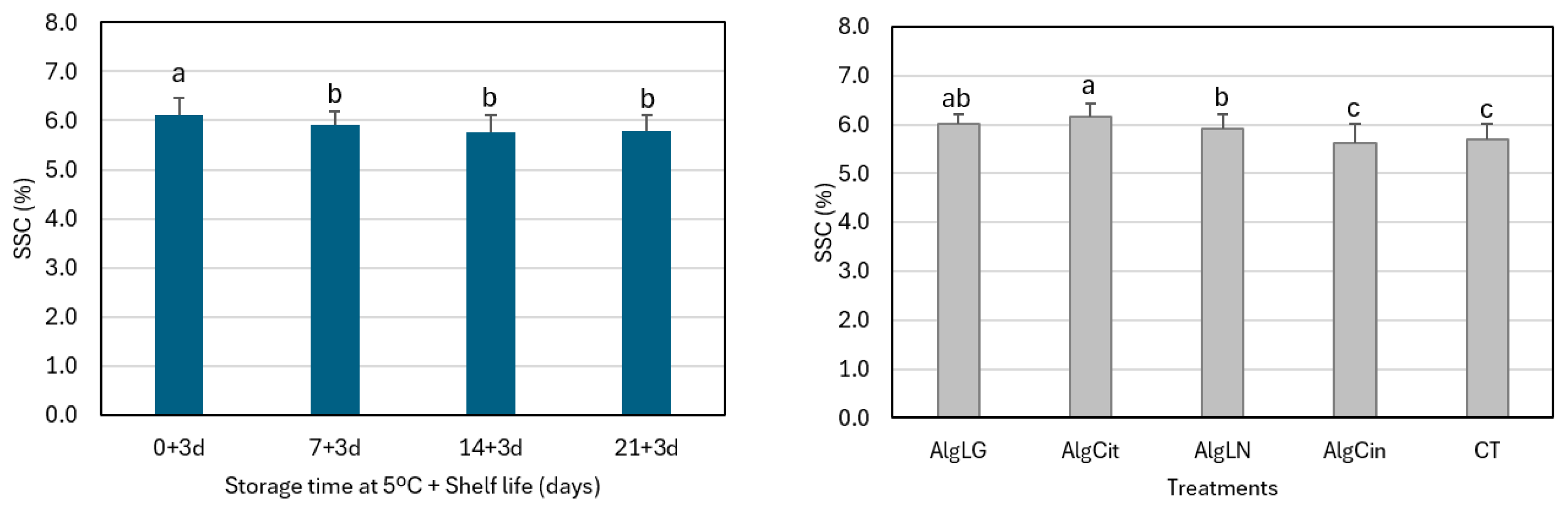
No significant treatment × storage time interaction was observed for SSC (Table S4, Supplementary Material). Storage time significantly affected SSC, with values decreasing slightly after the initial evaluation (Figure 2), which is consistent with the consumption of soluble sugars through respiration during storage. Because the cherry tomatoes were harvested at the red stage, SSC values were already close to their maximum at harvest, reflecting the accumulation of soluble sugars during ripening [40]. Regarding treatment, AlgCit-coated fruit showed the highest SSC values, although these were statistically similar to those of AlgLG-coated fruit (Figure 2, Table S14—Supplementary Material). While SSC was significantly affected by the coating treatment, the magnitude of the differences among treatments was small (approximately 0.4 °Brix), indicating that, although statistically significant, the treatment effect was of limited practical relevance under the conditions evaluated.
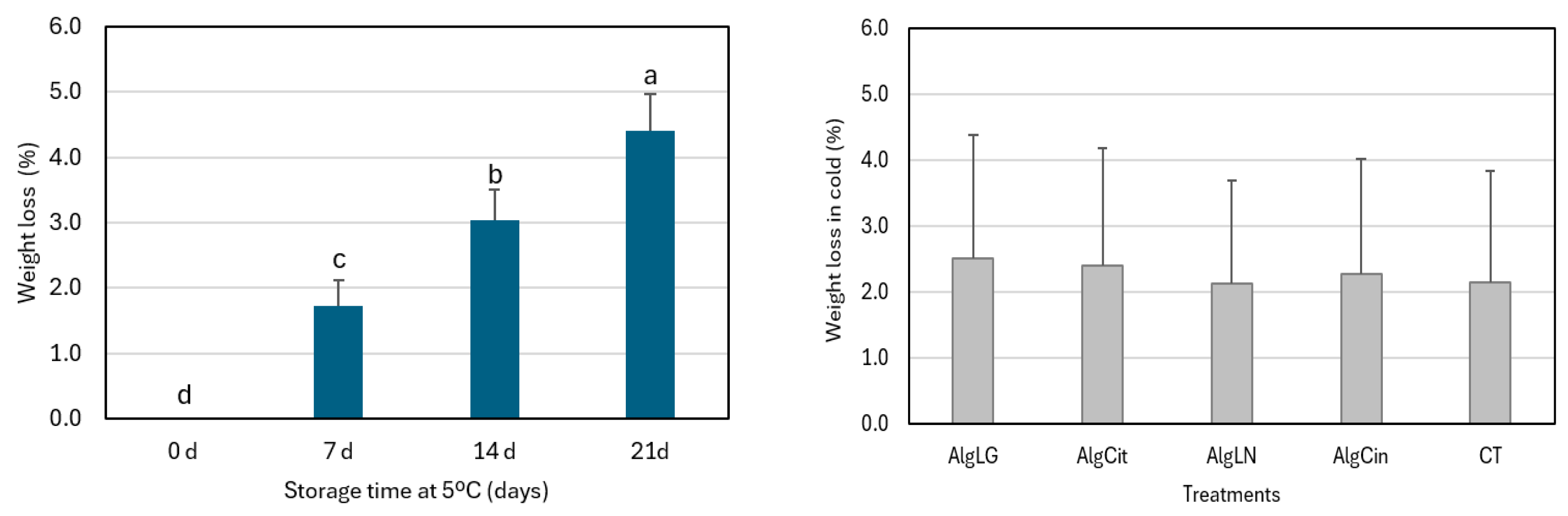
For weight loss, no significant Treatment × Time interaction was observed, indicating that the main effects of both factors could be interpreted independently (Table S5, Supplementary Material). Tomato fruit weight loss is mainly attributed to transpiration, while respiration contributes only a small fraction [41]. Due to their higher surface-area-to-volume ratio, cherry tomatoes are particularly susceptible to water loss during postharvest storage [42]. Edible coatings have been proposed as a strategy to reduce transpiration and respiration rates, thereby limiting weight loss and extending shelf life [40]. In the present study, weight loss increased progressively during storage in all treatments, with the greatest increase observed after 7 days at 5 °C followed by 3 days at room temperature (Figure 3). Although numerical differences among treatments were observed, coating application did not significantly reduce weight loss compared with the uncoated control (Table S5). These results are consistent with previous studies showing that the effectiveness of edible coatings in limiting water loss depends on several factors, including coating composition, coating barrier properties, fruit characteristics, and storage conditions [43].
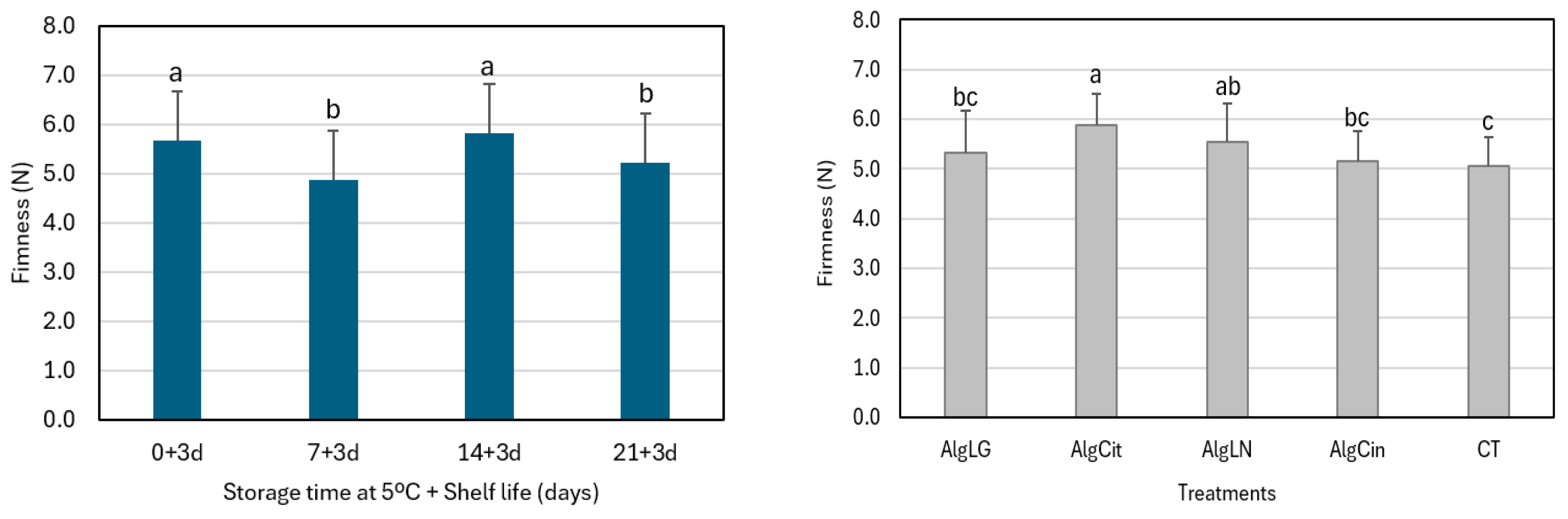
Firmness is one of the most important quality attributes of cherry tomatoes, and excessive softening is a major factor reducing fruit quality for fresh consumption. As shown in Figure 4, firmness varied throughout storage in both coated and uncoated fruit, with storage time and coating treatment significantly affecting this parameter (Table S6, Supplementary Material). The observed fluctuations probably reflect the combined effects of refrigerated storage, water loss and ripening-related changes in cell wall structure. Nevertheless, these temporal variations should be interpreted cautiously because cherry tomatoes exhibit considerable biological variability in firmness, and the sample size used for firmness determinations may also have contributed to the observed oscillations during storage.
Nkede et al. [12] also reported fluctuations in firmness during the storage of cherry tomatoes coated with alginate containing Helichrysum italicum essential oil. In the present study, coated fruit generally maintained higher firmness than uncoated control, with AlgCit showing the highest overall firmness (Figure 4). Fruit softening is generally attributed to the degradation of cell wall components, particularly pectin, through the activity of polygalacturonase and other cell wall-modifying enzymes [44]. The higher firmness observed in AlgCit-coated fruit may be associated with the barrier properties of the coating, which could have contributed to reducing respiration and delaying tissue softening. However, the mechanisms underlying this response were not investigated in the present study and therefore require further investigation.
An additional aspect that should be considered is the possible contribution of calcium chloride to firmness retention. Although CaCl2 was applied to crosslink the alginate matrix rather than as a postharvest calcium treatment, calcium ions may partially penetrate the fruit surface and reinforce cell wall structure, thereby delaying tissue softening [45,46]. Recent studies have highlighted this dual role of calcium in edible coatings, acting both as a crosslinking agent and as a factor contributing to postharvest quality. Consequently, the firmness differences observed in the present study cannot be attributed exclusively to the alginate matrix or to the incorporated essential oils. Moreover, comparison between the whole essential oils and their corresponding major constituents revealed broadly comparable responses. Although isolated differences were observed for some quality parameters, these were not systematic, indicating that the complete essential oils did not consistently outperform their principal constituents under the experimental conditions evaluated.

3.4. Bioactive Compounds

3.4.1. Lycopene

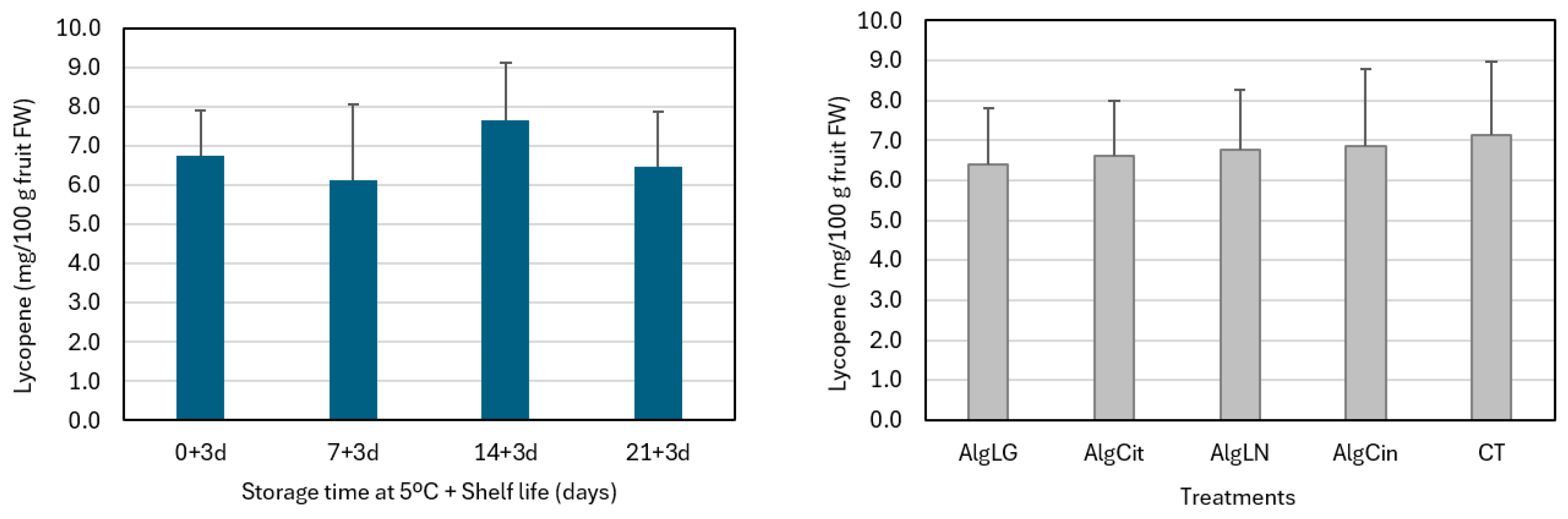
Changes in lycopene content during storage are presented in Figure 5, whereas the corresponding treatment × storage time means are reported in Table S13 (Supplementary Material). Although no significant overall treatment effect was detected (Table S7), a significant Treatment × Time interaction was observed, indicating that treatment responses varied according to storage time.
Inspection of the treatment × time means (Table S13) showed that some significant differences among treatment–time combinations occurred. However, these differences were not consistent throughout storage and did not indicate a reproducible effect of any coating on lycopene accumulation. For example, the highest lycopene contents at 14 + 3 d were observed in AlgCin-coated fruit and the uncoated control, whereas at 21 + 3 d AlgLN showed numerically higher values than the remaining treatments. Overall, these results indicate that the significant interaction reflects temporal variability rather than a consistent effect of the coatings on lycopene accumulation.
Edible coatings may influence carotenoid biosynthesis indirectly by modifying the internal O2 and CO2 atmosphere surrounding the fruit, thereby affecting respiration, ethylene metabolism, and the expression of ripening-related genes [47,48]. However, the relatively small and inconsistent differences observed among treatments suggest that these effects were limited under the storage conditions evaluated.
Considering the effect of storage time, lycopene values varied during storage, with the highest mean values observed at 14 + 3 d. However, according to Duncan’s multiple range test, these values were not significantly different from those recorded at the initial evaluation (0 + 3 d) (Figure 5). Lower mean values were observed at the end of storage, which may be associated with the progression of senescence and carotenoid degradation [29]. Overall, the lycopene concentrations obtained in the present study were within the range previously reported for cherry tomatoes [29,40].
The apparent lack of correspondence between lycopene content (Figure 5) and a* values (Figure 1B1,B2) may be explained by the different tissues used for these measurements. Lycopene was quantified in the mesocarp, whereas a* value was measured directly on the fruit surface and therefore reflects the combined optical properties of the epidermis, underlying tissues and, when present, the coating layer. As reported by Carrillo-López and Yahia [49], lycopene accumulation during ripening may differ between tomato tissues, which may explain the different trends observed for these two parameters.
Comparison between the whole essential oils and their corresponding major constituents likewise failed to reveal any consistent differences in lycopene accumulation throughout storage.

3.4.2. β-Carotene

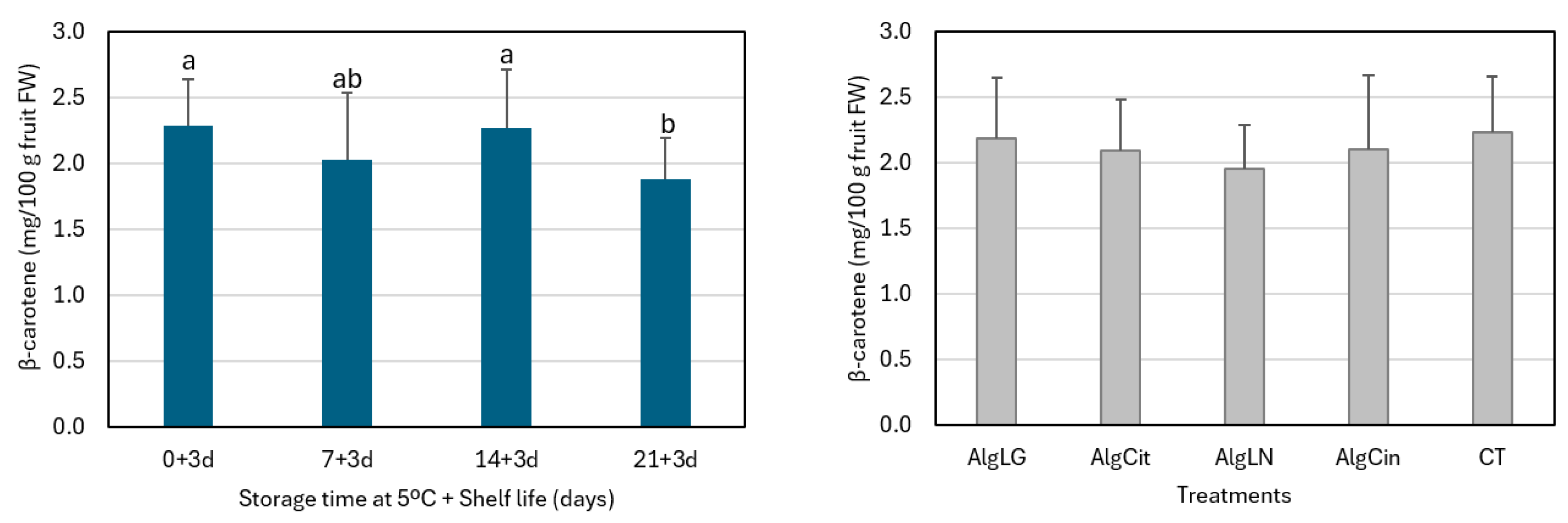
The levels of β-carotene in the cherry tomato mesocarp are presented in Figure 6. For β-carotene, no significant Treatment × Time interaction was observed, indicating that the effects of treatment and storage time could be interpreted independently (Table S8, Supplementary Material). The β-carotene trend was similar to that observed for lycopene, as both pigments are important carotenoids in tomato fruit. According to Carrillo-López and Yahia [49], both lycopene and β-carotene increase in the tomato mesocarp during ripening, although lycopene biosynthesis is much more pronounced. No significant treatment effect on β-carotene content was detected (Table S8, Supplementary Material; p = 0.406), indicating that the alginate-based coatings did not significantly influence β-carotene levels under the conditions evaluated (Figure 6). This finding is consistent with the results obtained for lycopene (Figure 5), for which no overall treatment effect was also observed.

3.4.3. Total Content of Phenols

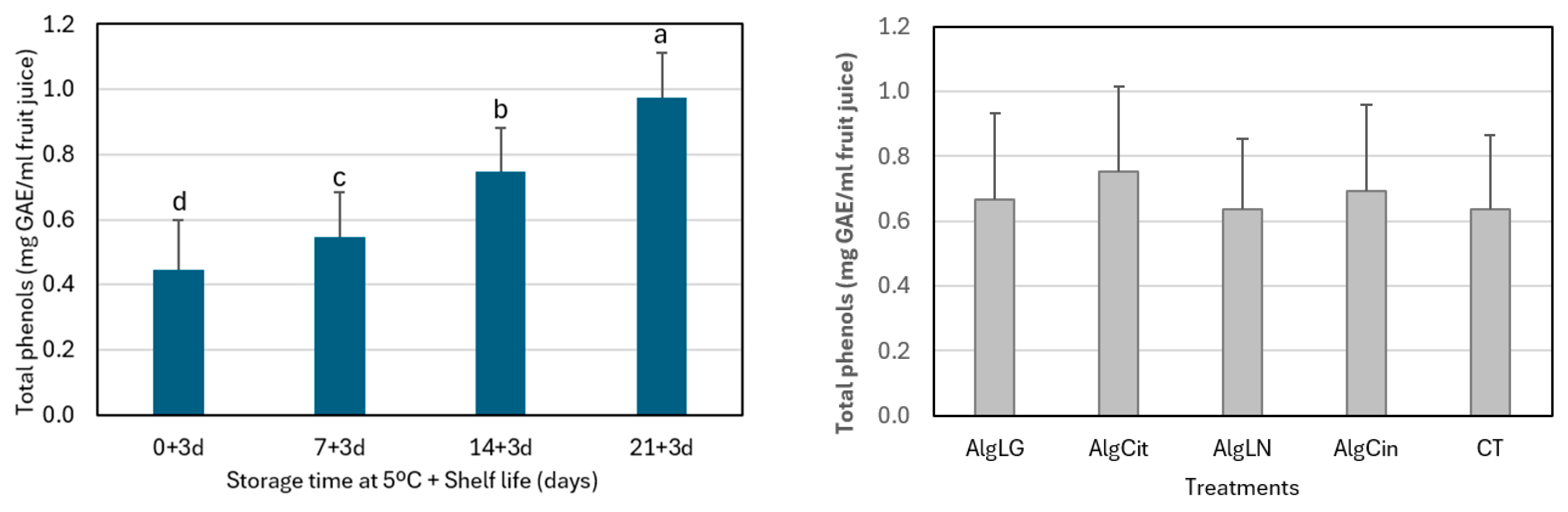
Total phenolic content increased during storage regardless of treatment (Figure 7). Although numerical differences among treatments were observed at some sampling points, the treatment effect was not statistically significant (Table S9). Therefore, no effect of the alginate-based coatings on phenolic retention can be concluded under the conditions evaluated.
The increase in total phenolic content during storage observed in the present study is consistent with the findings of Giacondino et al. [50], who also reported an increase in phenolic compounds in cherry tomatoes coated with a lemon pomace extract during storage. Those authors observed a greater increase in coated fruits than in the uncoated control, suggesting that the coating may have created conditions favorable for the biosynthesis and accumulation of phenolic compounds. However, in the present study, although numerical differences among treatments were observed at some sampling points, the treatment effect was not statistically significant. Therefore, no effect of the alginate-based coatings on total phenolic content can be concluded under the conditions evaluated. In contrast, other authors have reported a decrease in total phenolic content during the storage of cherry tomatoes [40], indicating that changes in phenolic compounds during storage may depend on several factors, including cultivar, storage conditions, coating formulation, and fruit physiological status. Furthermore, the identification of individual phenolic compounds has shown that different phenolics may follow distinct metabolic patterns during storage. For example, 2,5-dihydroxybenzoic acid decreased over time, whereas salicylic, syringic, and caffeic acids increased under different storage temperatures, regardless of the coating treatment [51].
Comparison of whole essential oils and their corresponding major constituents did not reveal consistent differences in total phenolic content. The occasional differences observed at individual sampling dates reflected the significant treatment × time interaction rather than a reproducible advantage of the complete essential oils.

3.5. Antioxidant Activity

The capacity to scavenge DPPH free radicals is presented in Figure 8, and the results are expressed as mM Trolox equivalents. A significant Treatment × Time interaction was observed for antioxidant capacity (Table S10, Supplementary Material), indicating that treatment responses varied during storage. However, no significant overall treatment effect was detected (Table S10, Supplementary Material; p = 0.698), indicating that the alginate-based coatings did not significantly influence antioxidant capacity under the conditions evaluated. Therefore, the detailed treatment × storage time means are presented in Table S13 of the Supplementary Material.
Overall, antioxidant capacity increased during storage regardless of treatment. Although significant differences were observed among some treatment × time combinations (Table S13), these differences were not consistent throughout storage and do not indicate a reproducible effect of any coating treatment on antioxidant capacity.
The highest antioxidant capacity values were generally observed at the end of storage, coinciding with the increase in total phenolic content (Figure 7). This temporal association suggests that phenolic compounds may have contributed to the antioxidant activity measured in the present study. However, antioxidant activity in tomato fruit results from the combined action of several bioactive compounds, including phenolic compounds, lycopene and other carotenoids, whose combined action contributes to the overall antioxidant capacity of tomato fruit [40,52]. Therefore, the antioxidant capacity of tomato fruit should be considered the result of the combined contribution of multiple constituents rather than of a single compound.
Figure 8. Antioxidant activity in cherry tomatoes subjected to the application of different edible coatings (sodium alginate 2% + lemongrass 0.12% (AlgLG), sodium alginate 2% + Citral 0.12% (AlgCit), sodium alginate 2% + Laurel 0.125% (AlgLN), sodium alginate 2% + Cineole 0.125% (AlgCin)) and without coating (control (CT)), over 21 days of storage at 5 °C plus 3 days on the shelf life at room temperature (21–22 °C).
Horticulturae 12 01060 g008
Similarly, comparison between the whole essential oils and their corresponding major constituents did not reveal a consistent advantage for antioxidant capacity. Although some treatment × storage time combinations differed significantly, these responses were not maintained throughout storage and therefore do not indicate that the complete essential oils systematically outperformed citral or 1,8-cineole.

3.6. Microbiological Results

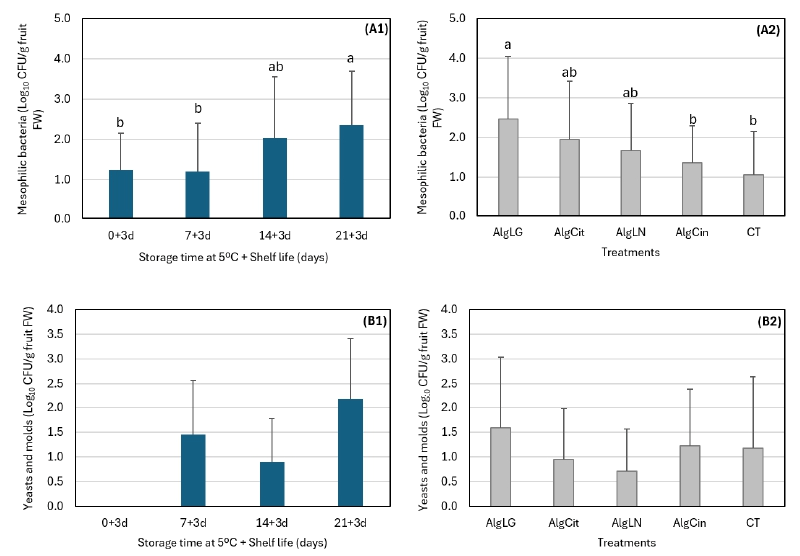
Mesophilic bacterial counts were significantly affected by treatment but not by the Treatment × Storage Time interaction (Table S11, Supplementary Material). In contrast, yeast and mold counts showed a significant interaction (Table S12), and the corresponding treatment × storage time means are therefore presented in Table S13.
Significant differences were observed among treatments for mesophilic bacterial counts (Figure 9A2). Contrary to the expected antimicrobial effect, AlgLG-coated fruit exhibited significantly higher counts than the uncoated control, indicating that this formulation did not suppress mesophilic bacterial growth. The limited antimicrobial performance may be associated with the relatively low essential oil concentration, release kinetics of the active compounds from the alginate matrix, or the chemical composition of the selected essential oils.
The relatively low essential oil concentration (0.12–0.125%, v/v) may have contributed to the limited antimicrobial activity observed, as antimicrobial efficacy is highly dependent on both essential oil type and concentration. Previous studies reporting positive antimicrobial effects generally employed concentrations between 0.2 and 0.7% (v/v) [53,54]. In addition, differences in essential oil composition may also explain the variability among studies.
These findings indicate that the antimicrobial efficacy of alginate coatings depends not only on the presence of essential oils but also on their concentration, chemical composition, release from the coating matrix, and interactions with the native microbiota of the fruit. Further studies are needed to optimize these factors and to evaluate essential oils with broader antimicrobial activity under comparable experimental conditions.
Figure 9B1 presents the evolution of yeast and mold counts in tomato fruits during storage at 5 °C followed by shelf life, expressed as Log10 UFC/g fresh weight.
Yeast and mold counts were significantly affected by storage time, increasing throughout storage. Counts were very low at 0 + 3 d, increased after 7 + 3 d, remained similar at 14 + 3 d, and reached their highest values at 21 + 3 d. No significant differences were observed between 7 + 3 and 14 + 3 days, while the highest fungal load was recorded at the end of storage plus shelf life.
Although some numerical differences were observed among treatments (Figure 9B2), these were not statistically significant. AlgLG showed the highest mean value (approximately 1.6 log10 CFU/g FW), whereas AlgLN presented the lowest (approximately 0.7 log10 CFU/g FW). The uncoated control showed an intermediate value (approximately 1.2 log10 CFU/g FW).
The relatively large error bars, particularly for AlgLG, AlgCin, and CT, indicate high variability among replicates, which may result from the absence of significant differences between treatments.
Overall, considering all quality parameters evaluated, the results indicate that the effects of the alginate-based coatings enriched with essential oils were limited and depended on the specific quality attribute assessed. Several factors may underlie this outcome. In addition to the relatively low essential oil concentration and the characteristics of the selected essential oils, the low storage temperature (5 °C) may have reduced metabolic activity and microbial growth. Furthermore, the inherent postharvest performance of the ‘Dolcetini’ cultivar may also have reduced the scope for further improvements through edible coatings. According to the seed supplier (HM.Clause), this cultivar is characterized by excellent shelf life [55]. Consistent with this description, Díaz-Pérez et al. [56] reported that ‘Dolcetini’ exhibited greater postharvest marketability than other commercial cherry tomato cultivars under storage conditions.
One of the objectives of this study was to compare the performance of whole essential oils with that of their corresponding major constituents. Across the physicochemical, bioactive, antioxidant and microbiological parameters evaluated, the complete essential oils did not consistently outperform citral or 1,8-cineole. Although isolated differences were detected for individual variables or sampling dates, these responses were not systematic and therefore do not support the conclusion that the essential oils provided additional benefits beyond those attributable to their main constituents.

4. Conclusions

Sodium alginate-based edible coatings enriched with essential oils showed statistically significant effects on selected quality attributes of cherry tomatoes during storage at 5 °C followed by 3 days at room temperature. The coatings influenced color development, soluble solids content, firmness, and mesophilic bacterial counts, indicating a moderate effect on some ripening-related changes. However, no consistent treatment effects were observed for weight loss, lycopene, β-carotene, total phenolic content, antioxidant capacity, or yeasts and molds. Overall, considering all quality parameters evaluated, the results indicate that the effects of the alginate-based coatings enriched with essential oils were limited and depended on the specific attribute assessed.
Firmness showed the most consistent positive response, particularly in AlgCit-treated fruit. However, because calcium chloride was used to crosslink the alginate matrix, its possible contribution to firmness retention cannot be excluded. Therefore, this effect should be interpreted as the combined outcome of the coating system rather than being attributed exclusively to the alginate matrix, the essential oils, or their major constituents. The relatively modest response may be associated with several factors acting simultaneously, including the relatively low essential oil concentration, the characteristics of the selected essential oils, the inherently good postharvest performance of the ‘Dolcetini’ cultivar, and the storage conditions evaluated. Further research should focus on optimizing coating formulations and essential oil selection, evaluating longer storage periods and fruit with different initial quality levels, assessing sensory acceptance, and validating coating performance under commercial storage conditions.
Comparison between the whole essential oils and their corresponding major components did not reveal a consistent advantage for either treatment, indicating broadly comparable performance under the experimental conditions evaluated.
Further studies should include an appropriate CaCl2-only control to clarify the contribution of the crosslinking step, as well as evaluate optimized formulations, longer storage periods, fruits with different initial quality levels, sensory acceptance, and performance under commercial storage conditions.

Supplementary Materials

The following supporting information can be downloaded at: https://www.mdpi.com/article/10.3390/horticulturae12091060/s1, Table S1: Analysis of variance (ANOVA) for the color parameter L* of cherry tomatoes subjected to different coating treatments during storage. The effects of treatment, storage time, and their interaction were evaluated. Significant effects are indicated according to the corresponding p-values; Table S2: Analysis of variance (ANOVA) for the color parameter a* of cherry tomatoes subjected to different coating treatments during storage. The effects of treatment, storage time, and their interaction were evaluated. Significant effects are indicated according to the corresponding p-values; Table S3: Analysis of variance (ANOVA) for the color parameter b* of cherry tomatoes subjected to different coating treatments during storage. The effects of treatment, storage time, and their interaction were evaluated. Significant effects are indicated according to the corresponding p-values; Table S4: Analysis of variance (ANOVA) for SSC of cherry tomatoes subjected to different coating treatments during storage. The effects of treatment, storage time, and their interaction were evaluated. Significant effects are indicated according to the corresponding p-values; Table S5: Analysis of variance (ANOVA) for weight loss of cherry tomatoes in cold room subjected to different coating treatments during storage. The effects of treatment, storage time, and their interaction were evaluated. Significant effects are indicated according to the corresponding p-values; Table S6: Analysis of variance (ANOVA) for firmness of cherry tomatoes subjected to different coating treatments during storage. The effects of treatment, storage time, and their interaction were evaluated. Significant effects are indicated according to the corresponding p-values; Table S7: Analysis of variance (ANOVA) for lycopene values of cherry tomatoes subjected to different coating treatments during storage. The effects of treatment, storage time, and their interaction were evaluated. Significant effects are indicated according to the corresponding p-values; Table S8: Analysis of variance (ANOVA) for β-carotene of cherry tomatoes subjected to different coating treatments during storage. The effects of treatment, storage time, and their interaction were evaluated. Significant effects are indicated according to the corresponding p-values; Table S9: Analysis of variance (ANOVA) for total phenols in cherry tomatoes subjected to different coating treatments during storage. The effects of treatment, storage time, and their interaction were evaluated. Significant effects are indicated according to the corresponding p-values; Table S10: Analysis of variance (ANOVA) for antioxidant capacity of cherry tomatoes subjected to different coating treatments during storage. The effects of treatment, storage time, and their interaction were evaluated. Significant effects are indicated according to the corresponding p-values; Table S11: Analysis of variance (ANOVA) for mesophilic bacteria of cherry tomatoes subjected to different coating treatments during storage. The effects of treatment, storage time, and their interaction were evaluated. Significant effects are indicated according to the corresponding p-values; Table S12: Analysis of variance (ANOVA) for yeast and molds of cherry tomatoes subjected to different coating treatments during storage. The effects of treatment, storage time, and their interaction were evaluated. Significant effects are indicated according to the corresponding p-values; Table S13: Effect of all edible coating treatments × storage time combinations on lycopene content, antioxidant capacity, and yeasts and molds counts of cherry tomatoes during storage at 5 °C followed by 3 days of shelf life at room temperature. Data are presented as mean ± standard deviation. For each parameter, different lowercase letters indicate significant differences among all treatments × storage time combinations, according to Duncan’s multiple range test (p < 0.05); Table S14: Effect of all edible coating treatments × storage time combinations on color parameters (a* and b*), soluble solids content (SSC), firmness and mesophilic bacterias counts in cherry tomatoes during storage at 5 °C followed by 3 days of shelf life at room temperature. For each parameter, different lowercase letters indicate significant differences among all treatments × storage time combinations, according to Duncan’s multiple range test (p < 0.05).

Author Contributions

Conceptualization, C.G. and D.A.; methodology, C.G., E.M., I.S., B.B., A.C.F. and A.M.; formal analysis, C.G.; investigation, C.G., M.G.M., A.C.F., A.M. and B.B.; writing—original draft preparation, C.G. and M.G.M.; writing—review and editing, C.G., D.A., A.C.F. and M.G.M. All authors have read and agreed to the published version of the manuscript.

Funding

This research was financially supported by the R&D units: Mediterranean Institute for Agriculture, Environment and Development (MED) (https://doi.org/10.54499/UID/05183/2025), Centre for Ecology, Evolution and Environmental Changes (CE3C) (https://doi.org/10.54499/UID/00329/2025) and the Associate Laboratory Global Change and Sustainability Institute (CHANGE) (https://doi.org/10.54499/LA/P/0121/2020). Custódia Gago received funding from Foundation for Science and Technology (FCT) and Universidade do Algarve through “Concurso Estímulo a Emprego Científico na Modalidade de Apoio Institucional” (https://doi.org/10.54499/CEECINST/00146/2018/CP1493/CT0003).

Data Availability Statement

The original contributions presented in this study are included in the article/Supplementary Materials. Further inquiries can be directed to the corresponding authors.

Acknowledgments

 The financial support mentioned in the Funding section is gratefully acknowledged.The authors used ChatGPT (OpenAI, GPT-5.6 Luna) solely to assist with English language editing and improve the clarity of the manuscript. All experimental work, data analysis, interpretation of the results, and the final manuscript content were performed, reviewed, and validated by the authors, who take full responsibility for the accuracy and integrity of the work.

Conflicts of Interest

The authors declare no conflicts of interest.

References

  1. Rapa, M.; Ciano, S.; Ruggieri, R.; Vinci, G. Bioactive compounds in cherry tomatoes (Solanum lycopersicum var. cerasiforme): Cultivation techniques classification by multivariate analysis. Food Chem. 2021, 355, 129630. [Google Scholar] [CrossRef] [Scilit] [PubMed]
  2. Shafe, M.O.; Gumede, N.M.; Nyakudya, T.T.; Chivandi, E. Lycopene: A potent antioxidant with multiple health benefits. J. Nutr. Metab. 2024, 2024, 6252426. [Google Scholar] [CrossRef] [Scilit] [PubMed]
  3. Oladipo, E.K.; Oladipo, B.; Ojumu, T.V.; Caleb, O.J. Postharvest losses of tomato: Causes, spoilage mechanisms, and advances in conventional and emerging technologies for preservation. Food Res. Int. 2025, 227, 118247. [Google Scholar] [CrossRef] [Scilit] [PubMed]
  4. Razali, Z.; Somasundram, C.; Nurulain, S.Z.; Kunasekaran, W.; Alias, M.R. Postharvest quality of cherry tomatoes coated with mucilage from dragon fruit and irradiated with UV-C. Polymers 2021, 13, 2919. [Google Scholar] [CrossRef] [Scilit] [PubMed]
  5. Wang, A.; Liu, X.; Ahmad, I.; Wu, L.; Siddique, B. Sodium alginate edible coating augmented with essential oils maintains fruits postharvest physiology during preservation: A review. Int. J. Multidiscip. Res. Dev. 2020, 7, 135–140. [Google Scholar]
  6. Walait, M.; Mir, H.R.; Anees, K. Edible biofilms and coatings; its characterization and advanced industrial applications. Nat. Res. Hum. Health 2022, 3, 28–37. [Google Scholar] [CrossRef] [Scilit]
  7. Faheem, F.; Liu, Z.W.; Rabail, R.; Haq, I.U.; Gul, M.; Bryła, M.; Roszko, M.; Kieliszek, M.; Din, A.; Aadil, R.M. Uncovering the industrial potentials of lemongrass essential oil as a food preservative: A review. Antioxidants 2022, 11, 720. [Google Scholar] [CrossRef] [Scilit] [PubMed]
  8. Al-Maqtari, Q.A.; Rehman, A.; Mahdi, A.A.; Al-Ansi, W.; Wei, M.; Yanyu, Z.; Phyo, H.M.; Galeboe, O.; Yao, W. Application of essential oils as preservatives in food systems: Challenges and future prospectives—A review. Phytochem. Rev. 2022, 21, 1209–1246. [Google Scholar] [CrossRef] [Scilit]
  9. Duguma, H.T. Potential applications and limitations of edible coatings for maintaining tomato quality and shelf life. Int. J. Food Sci. Technol. 2022, 57, 1353–1366. [Google Scholar] [CrossRef] [Scilit]
  10. Bal, E. Storage life extension of cherry tomato by alginate-based edible coating in combination with UV-C treatment. J. Hortic. Postharvest Res. 2021, 4, 453–466. [Google Scholar]
  11. Piña-Barrera, A.M.; Pérez, M.S.R.; Román, R.Á.; González, J.G.B.; Guerra, C.A.A.; Rodríguez, S.A.G. Edible alginate-based coating in combination with nanoencapsulated eugenol and its preservative effect on the shelf life of tomato (Solanum lycopersicum). Charact. Appl. Nanomat. 2022, 5, 47–57. [Google Scholar] [CrossRef] [Scilit]
  12. Nkede, F.N.; Wardak, M.H.; Fanze, M.; Kondo, N.; Wardana, A.A.; Jothi, J.S.; Tanaka, F.; Tanaka, F. The potential of Helichrysum italicum essential oil-infused alginate coatings and film for prolonging the shelf life of cherry tomatoes. Food Packag. Shelf Life 2024, 46, 101381. [Google Scholar] [CrossRef] [Scilit]
  13. Mrvová, M.; Medo, J.; Lakatošová, J.; Barboráková, Z.; Golian, M.; Mašková, Z.; Tančinová, D. Vapor-phase essential oils as antifungal agents against Penicillium olsonii causing postharvest cherry tomato rot. Foods 2024, 13, 3202. [Google Scholar] [CrossRef] [Scilit] [PubMed]
  14. Celina, A.; Rahmawati, D.; Permana, T. Application of lemongrass essential oil as a natural preservative agent for pineapple juice. Iconiet Proc. 2019, 2, 69–78. [Google Scholar] [CrossRef] [Scilit]
  15. Ordoudi, S.A.; Papapostolou, M.; Nenadis, N.; Mantzouridou, F.T.; Tsimidou, M.Z. Bay laurel (Laurus nobilis L.) essential oil as a food preservative source: Chemistry, quality control, activity assessment, and applications to olive industry products. Foods 2022, 11, 752. [Google Scholar] [CrossRef] [Scilit] [PubMed]
  16. El, S.N.; Karagozlu, N.; Karakaya, S.; Sahın, S.; El, S.N.; Karagozlu, N.; Karakaya, S.; Sahın, S. Antioxidant and antimicrobial activities of essential oils extracted from Laurus nobilis L. leaves by using solvent-free microwave and hydrodistillation. Food Nutr. Sci. 2014, 5, 97–106. [Google Scholar] [CrossRef]
  17. Póvoa, O.; Farinha, N.; Lopes, V.; Machado, A.M.; Figueiredo, A.C. Coriander (Coriandrum sativum L.) from Alentejo (South Portugal): Ethnobotany and potential industrial use. Foods 2024, 13, 929. [Google Scholar] [CrossRef] [Scilit] [PubMed]
  18. Guerreiro, A.C.; Gago, C.M.L.; Faleiro, M.L.; Miguel, M.G.C.; Antunes, M.D.C. The effect of alginate-based edible coatings enriched with essential oils constituents on Arbutus unedo L. fresh fruit storage. Postharvest Biol. Technol. 2015, 100, 226–233. [Google Scholar] [CrossRef] [Scilit]
  19. Aminifard, M.H.; Mohammadi, S. Essential oils to control Botrytis cinerea in vitro and in vivo on plum fruits. J. Sci. Food Agric. 2012, 93, 348–353. [Google Scholar] [CrossRef] [Scilit] [PubMed]
  20. Kgang, I.E.; Mathabe, P.M.K.; Klein, A.; Kalombo, L.; Belay, Z.A.; Caleb, O.J. Effects of lemon (Citrus limon L.), lemongrass (Cymbopogon citratus) and peppermint (Mentha piperita L.) essential oils against of Botrytis cinerea and Penicillium expansum. JSFA Rep. 2022, 2, 405–414. [Google Scholar] [CrossRef] [Scilit]
  21. Nagata, M.; Yamashita, I. Simple method for simultaneous determination of chlorophyll and carotenoids in tomato fruit. J. Jpn. Soc. Food. Sci. Technol. 1992, 39, 925–928. [Google Scholar] [CrossRef] [Scilit]
  22. NP-4405; Food Microbiology—General Rules for Microorganism Counts. Colonies Count at 30 °C. Instituto Português da Qualidade: Lisboa, Portugal, 2002. (In Portuguese)
  23. ISO 21527-2; Microbiology of Food and Animal Feeding Stuffs—Horizontal Method for the Enumeration of Yeasts and Moulds—Part 2: Colony Count Technique in Products with Water Activity Less Than or Equal to 0.95. International Standards Organization: Geneva, Switzerland, 2008.
  24. Awada, F.; Hamade, K.; Kassir, M.; Hammoud, Z.; Mesnard, F.; Rammal, H.; Fliniaux, O. Laurus nobilis leaves and fruits: A review of metabolite composition and interest in human health. Appl. Sci. 2023, 13, 4606. [Google Scholar] [CrossRef] [Scilit]
  25. Bouzidi, O.; Tine-Djebbar, F.; Tine, S.; Soltani, N. Larvicidal activity, biochemical effect, histopathological alteration, and biomarker responses induced by Laurus nobilis essential oil in Culex pipiens (Diptera: Culicidae). Physiol. Entomol. 2026, 51, 163–177. [Google Scholar] [CrossRef] [Scilit]
  26. Boukhennoufa, A.; Fergane, I.; Fergane, N.E.H.; Meddah, B.; Touil, A.M.T.; Youcef, F.A.B. Use of Laurus nobilis (Noble Bay) essential oil as a preservative for a meat product, mortadella. Int. J. Environ. Qual. 2026, 70, 114–119. [Google Scholar] [CrossRef] [Scilit] [PubMed]
  27. Boudechicha, A.; Aouf, A.; Farouk, A.; Ali, H.S.; Elkhadragy, M.F.; Yehia, H.M.; Badr, A.N. Microfluidizing technique application for Algerian Cymbopogon citratus (DC.) Stapf effects enahnced volatile content, antimicrobial, and anti-mycotoxigenic properties. Molecules 2023, 28, 5367. [Google Scholar] [CrossRef] [Scilit] [PubMed]
  28. Wan, S.; Xing, B. Research progress on chemical composition, biological activity and application of lemongrass and its essential oils. J. Funct. Foods. 2025, 135, 107083. [Google Scholar] [CrossRef] [Scilit]
  29. Pant, K.; Bhattacharya, B. trans-Cinnamaldehyde-loaded cyclodextrin nanosponge impregnated chitosan composite coating for cherry tomato preservation. ACS Food Sci. Technol. 2025, 5, 4418–4435. [Google Scholar] [CrossRef] [Scilit]
  30. Tian, X.; Huo, X.; Li, X.; Wang, D.; Lu, J.; Ren, X.; Kong, Q. Characterization of the sodium alginate/essential oil emulsion film and its efficacy in controlling postharvest Penicillium expansum disease in cherry tomatoes. Int. J. Biol. Macromol. 2025, 318, 144853. [Google Scholar] [CrossRef] [Scilit] [PubMed]
  31. Guerreiro, A.C.; Gago, C.M.L.; Faleiro, M.L.; Miguel, M.G.C.; Antunes, M.D.C. The use of polysaccharide-based edible coatings enriched with essential oils to improve shelf life of strawberries. Postharvest Biol. Technol. 2015, 110, 51–60. [Google Scholar] [CrossRef] [Scilit]
  32. Lopes, A.I.; Melo, A.; Afonso, T.B.; Silva, S.; Barros, L.; Tavaria, F.K.; Pintado, M. Alginate edible films containing essential oils: Characterization and bioactive potential. Polymers 2025, 17, 1188. [Google Scholar] [CrossRef] [Scilit] [PubMed]
  33. Cantwell, M.; Nie, X.; Hong, G. Impact of storage conditions on grape tomato quality. In Proceedings of the 6th ISHS Postharvest Symposium, Antalya, Turkey, 8–12 April 2009. [Google Scholar]
  34. Li, X.; Huang, H.; Zhang, L.; Zhao, L. Effect of Postharvest Storage Temperature and Duration on Tomato Fruit Quality. Foods 2025, 14, 1002. [Google Scholar] [CrossRef] [Scilit] [PubMed]
  35. Miranda, M.; De Mori M. Ribeiro, M.; Spricigo, P.; Pilon, L.; Mitsuyuki, M.C.; Corrêa, D.; Ferreira, M.D. Carnauba wax nanoemulsion applied as an edible coating on fresh tomato for postharvest quality evaluation. Heliyon 2022, 8, e09803. [Google Scholar] [CrossRef] [Scilit] [PubMed]
  36. Mohammed, O.; Azzazy, M.; Badawe, S.E.A. Effect of some edible coating materials on quality and postharvest rots of cherry tomato fruits during cold storage. J. Agric. Res. 2021, 48, 37–54. [Google Scholar] [CrossRef] [Scilit]
  37. Nkede, F.N.; Wardana, A.A.; Phuong, N.T.H.; Takahashi, M.; Koga, A.; Wardak, M.H.; Fanze, M.; Tanaka, F.; Tanaka, F. Preparation and characterization of chitosan/lemongrass oil/cellulose nanofiber pickering emulsions active packaging and its application on tomato preservation. J. Polym. Environ. 2023, 31, 4930–4945. [Google Scholar] [CrossRef] [Scilit]
  38. Siracusa, V.; Romani, S.; Gigli, M.; Mannozzi, C.; Cecchini, J.P.; Tylewicz, U.; Lotti, N. Characterization of active edible films based on citral essential oil, alginate and pectin. Materials 2018, 11, 1980. [Google Scholar] [CrossRef] [Scilit] [PubMed]
  39. Simsek, M.; Eke, B.; Demir, H. Characterization of carboxymethyl cellulose-based antimicrobial films incorporated with plant essential oils. Int. J. Biol. Macrolmol. 2020, 163, 2172–2179. [Google Scholar] [CrossRef] [Scilit] [PubMed]
  40. Jahani, R.; Behnamian, M.; Dezhsetan, S.; Karimirad, R.; Chamani, E. Chitosan nano-biopolymer/Citrus paradisi peel oil delivery system enhanced shelf life and postharvest quality of cherry tomato. Int. J. Biol. Macromol. 2023, 225, 1212–1223. [Google Scholar] [CrossRef] [Scilit] [PubMed]
  41. Shirazi, A.; Cameron, A.C. Measuring transpiration rates of tomato and other detached fruit. HortScience 1993, 28, 1035–1038. [Google Scholar] [CrossRef] [Scilit]
  42. Bouzo, C.A.; Gariglio, N. Relationship between different physical properties of tomato fruits and water loss during postharvest. Acta Sci. Pol. Hortorum Cultus 2016, 15, 13–25. [Google Scholar]
  43. Fagundes, C.; Palou, L.; Monteiro, A.R.; Pérez-Gago, M.B. Hydroxypropyl methylcellulose-beeswax edible coatings formulated with antifungal food additives to reduce alternaria black spot and maintain postharvest quality of cold-stored cherry tomatoes. Sci. Hortic. 2015, 193, 249–257. [Google Scholar] [CrossRef] [Scilit]
  44. Nawab, A.; Alam, F.; Hasnain, A. Mango kernel starch as a novel edible coating for enhancing shelf life of tomato (Solanum lycopersicum) fruit. Int. J. Biol. Macromol. 2017, 103, 581–586. [Google Scholar] [CrossRef] [Scilit] [PubMed]
  45. Gutiérrez-Jara, C.; Bilbao-Sainz, C.; McHugh, T.; Chiou, B.-S.; Williams, T.; Villalobos-Carvajal, R. Effect of Cross-Linked Alginate/Oil Nanoemulsion Coating on Cracking and Quality Parameters of Sweet Cherries. Foods 2021, 10, 449. [Google Scholar] [CrossRef] [Scilit] [PubMed]
  46. Zhang, Y.; Kong, Q.; Niu, B.; Liu, R.; Chen, H.; Xiao, S.; Wu, W.; Zhang, W.; Gao, H. The dual function of calcium ion in fruit edible coating: Regulating polymer internal crosslinking state and improving fruit postharvest quality. Food Chem. 2024, 447, 138952. [Google Scholar] [CrossRef] [Scilit] [PubMed]
  47. Flores-López, M.L.; Vieira, J.M.; Rocha, C.M.R.; Lagarón, J.M.; Cerqueira, M.A.; Rodríguez, D.J.; Vicente, A.A. Postharvest quality improvement of tomato (Solanum lycopersicum L.) fruit using a nanomultilayer coating containing Aloe vera. Foods 2024, 13, 83. [Google Scholar] [CrossRef] [Scilit] [PubMed]
  48. Fraser, P.D.; Truesdale, M.R.; Bird, C.R.; Schuch, W.; Bramley, P.M. Carotenoid biosynthesis during tomato fruit development. Plant Physiol. 1994, 105, 405–413. [Google Scholar] [CrossRef] [Scilit] [PubMed]
  49. Carrillo-López, A.; Yahia, E.M. Changes in color-related compounds in tomato fruit exocarp and mesocarp during ripening using HPLC-APcl+-mass spectrometry. J. Food Sci. Technol. 2014, 51, 2720–2726. [Google Scholar] [CrossRef] [Scilit] [PubMed]
  50. Giacondino, C.; de Bruno, A.; Puntorieri, D.; Pizzimenti, M.; Piscopo, A. Impact of antioxidant-enriched edible gel coatings and bio-based packaging on cherry tomato preservation. Gels 2024, 10, 549. [Google Scholar] [CrossRef] [Scilit] [PubMed]
  51. Barreto, T.A.; Andrade, S.C.A.; Maciel, J.F.; Arcanjo, N.M.O.; Madruga, M.S.; Meireles, B.; Cordeiro, A.M.T.; Souza, E.L.; Magnani, M. A chitosan coating containing essential oil from Origanum vulgare L. to control postharvest mold infections and keep the quality of cherry tomato fruit. Front. Microbiol. 2016, 7, 1724. [Google Scholar] [CrossRef] [Scilit] [PubMed]
  52. Su, A.; Liu, C.; Yang, Y.; Wang, X.; Wu, C.; Li, D.; Zhang, H.; Liu, D.; Xu, X.; Zhao, T. Metabolic profiling and functional metabolite distribution in colored tomatoes. Foods 2025, 14, 4044. [Google Scholar] [CrossRef] [Scilit] [PubMed]
  53. Raybaudi-Massilia, R.M.; Rojas-Graü, M.A.; Mosqueda-Melgar, J.; Martín-Belloso, O. Comparative study on essential oils incorporated into na alginate-based edible coating to assure the safety and quality of fresh-cut Fuji apples. J. Food Prot. 2008, 71, 1150–1161. [Google Scholar] [CrossRef] [Scilit] [PubMed]
  54. Raeisi, M.; Hashemi, M.; Aminzare, M.; Bidkorpeh, F.G.; Ebrahimi, M.; Jannat, B.; Tepe, B.; Noori, S.M.A. Effects of sodium alginate and chitosan coating combined with three different essential oils on microbial and chemical attributes of rainbow trout fillets. J. Aquat. Food Prod. Technol. 2020, 29, 253–263. [Google Scholar] [CrossRef] [Scilit]
  55. HM.Clause. Dolcetini F1. HM.Clause España. Available online: https://hmclause.es/especies/tomate-indeterminado (accessed on 27 July 2026).
  56. Díaz-Pérez, M.; Carreño-Ortega, Á.; Gómez-Galán, M.; Callejón-Ferre, Á.J. Marketability probability study of cherry tomato cultivars based on logistic regression models. Agronomy 2018, 8, 176. [Google Scholar] [CrossRef] [Scilit]
Figure 1. Color parameters of cherry tomatoes, L* (A1,A2), a* (B1,B2) and b* (C1,C2), subjected to the application of different edible coatings (sodium alginate 2% + lemongrass 0.12% (AlgLG), sodium alginate 2% + Citral 0.12% (AlgCit), sodium alginate 2% + Laurel 0.125% (AlgLN), sodium alginate 2% + Cineole 0.125% (AlgCin)) and without coating (control (CT)), over 21 days of storage at 5 °C plus 3 days of shelf life at room temperature (21–22 °C). For each color parameter, the left panel (A1,B1,C1) represents the main effect of storage time, with mean values for each sampling date averaged across all treatments. The right panel (A2,B2,C2) represents the main effect of treatment, with mean values for each coating treatment averaged across all sampling dates. Mean values correspond to those obtained from the statistical analysis. In each figure, bars with the same letter are not significantly different by Duncan’s Multiple Range Test, at p < 0.05.
Horticulturae 12 01060 g001
Figure 2. Soluble solids content (%) of cherry tomatoes subjected to the application of different edible coatings (sodium alginate 2% + lemongrass 0.12% (AlgLG), sodium alginate 2% + Citral 0.12% (AlgCit), sodium alginate 2% + Laurel 0.125% (AlgLN), sodium alginate 2% + Cineole 0.125% (AlgCin) and without coating (control (CT), over 21 days of storage at 5 °C plus 3 days of shelf life at room temperature (21–22 °C). For SSC, the (left panel) represents the main effect of storage time, with mean values for each sampling date averaged across all treatments. The (right panel) represents the main effect of treatment, with mean values for each coating treatment averaged across all sampling dates. Mean values correspond to those obtained from the statistical analysis. In each figure, bars with the same letter are not significantly different by Duncan’s Multiple Range Test, at p < 0.05.
Horticulturae 12 01060 g002
Figure 3. Weight loss in cherry tomatoes subjected to the application of different edible coatings (sodium alginate 2% + lemongrass 0.12% (AlgLG), sodium alginate 2% + Citral 0.12% (AlgCit), sodium alginate 2% + Laurel 0.125% (AlgLN), sodium alginate 2% + Cineole 0.125% (AlgCin)) and without coating (control (CT)), over 21 days of storage at 5 °C plus 3 days on the shelf life at room temperature (21–22 °C). For weight loss, the (left panel) represents the main effect of storage time, with mean values for each sampling date averaged across all treatments. The (right panel) represents the main effect of treatment, with mean values for each coating treatment averaged across all sampling dates. Mean values correspond to those obtained from the statistical analysis. In each figure, bars with the same letter are not significantly different by Duncan’s Multiple Range Test, at p < 0.05.
Horticulturae 12 01060 g003
Figure 4. Firmness of cherry tomatoes subjected to the application of different edible coatings (sodium alginate 2% + lemongrass 0.12% (AlgLG), sodium alginate 2% + Citral 0.12% (AlgCit), sodium alginate 2% + Laurel 0.125% (AlgLN), sodium alginate 2% + Cineole 0.125% (AlgCin)) and without coating (control (CT)), over 21 days of storage at 5 °C plus 3 days on the shelf life at room temperature (21–22 °C). For firmness, the (left panel) represents the main effect of storage time, with mean values for each sampling date averaged across all treatments. The (right panel) represents the main effect of treatment, with mean values for each coating treatment averaged across all sampling dates. Mean values correspond to those obtained from the statistical analysis. In each figure, bars with the same letter are not significantly different by Duncan’s Multiple Range Test, at p < 0.05.
Horticulturae 12 01060 g004
Figure 5. Lycopene in cherry tomatoes subjected to the application of different edible coatings (sodium alginate 2% + lemongrass 0.12% (AlgLG), sodium alginate 2% + Citral 0.12% (AlgCit), sodium alginate 2% + Laurel 0.125% (AlgLN), sodium alginate 2% + Cineole 0.125% (AlgCin)) and without coating (control (CT)), over 21 days of storage at 5 °C plus 3 days on the shelf life at room temperature (21–22 °C). For Lycopene, the (left panel) represents the main effect of storage time, with mean values for each sampling date averaged across all treatments. The (right panel) represents the main effect of treatment, with mean values for each coating treatment averaged across all sampling dates.
Horticulturae 12 01060 g005
Figure 6. β-Carotene content in cherry tomatoes subjected to the application of different edible coatings (sodium alginate 2% + lemongrass 0.12% (AlgLG), sodium alginate 2% + Citral 0.12% (AlgCit), sodium alginate 2% + Laurel 0.125% (AlgLN), sodium alginate 2% + Cineole 0.125% (AlgCin)) and without coating (control (CT)), over 21 days of storage at 5 °C plus 3 days on the shelf life at room temperature (21–22 °C). For β-carotene, the (left panel) represents the main effect of storage time, with mean values for each sampling date averaged across all treatments. The (right panel) represents the main effect of treatment, with mean values for each coating treatment averaged across all sampling dates. Mean values correspond to those obtained from the statistical analysis. In each figure, bars with the same letter are not significantly different by Duncan’s Multiple Range Test, at p < 0.05.
Horticulturae 12 01060 g006
Figure 7. Total phenols in cherry tomatoes subjected to the application of different edible coatings (sodium alginate 2% + lemongrass 0.12% (AlgLG), sodium alginate 2% + Citral 0.12% (AlgCit), sodium alginate 2% + Laurel 0.125% (AlgLN), sodium alginate 2% + Cineole 0.125% (AlgCin)) and without coating (control (CT)), over 21 days of storage at 5 °C plus 3 days on the shelf life at room temperature (21–22 °C). For total phenols, the (left panel) represents the main effect of storage time, with mean values for each sampling date averaged across all treatments. The (right panel) represents the main effect of treatment, with mean values for each coating treatment averaged across all sampling dates. Mean values correspond to those obtained from the statistical analysis. In each figure, bars with the same letter are not significantly different by Duncan’s Multiple Range Test, at p < 0.05.
Horticulturae 12 01060 g007
Figure 9. Mesophylic bacteria (A1,A2) and yeasts and molds (B1,B2) in cherry tomatoes subjected to the application of different edible coatings (sodium alginate 2% + lemongrass 0.12% (AlgLG), sodium alginate 2% + Citral 0.12% (AlgCit), sodium alginate 2% + Laurel 0.125% (AlgLN), sodium alginate 2% + Cineole 0.125% (AlgCin)) and without coating (control (CT)), over 21 days of storage at 5 °C plus 3 days on the shelf life at room temperature (21–22 °C). For mesophylic bacteria and yeasts and molds, the left panel (A1,B1) represents the main effect of storage time, with mean values for each sampling date averaged across all treatments. The right panel (A2,B2) represents the main effect of treatment, with mean values for each coating treatment averaged across all sampling dates. Mean values correspond to those obtained from the statistical analysis. In each figure, bars with the same letter are not significantly different by Duncan’s Multiple Range Test, at p < 0.05.
Horticulturae 12 01060 g009
Table 1. Chemical composition of lemongrass (OE_1) and bay laurel (OE_2) essential oils.
ComponentsRIOE_1 (%)OE_2 (%)
Tricyclene 921tt
α-Thujene924 0.3
α-Pinene930t1.9
Camphene938t0.2
Sabinene958 5.5
6-Methyl-5-hepten-2-one9600.7
β-Pinene963t2.2
Dehydro-1,8-cineole973 t
β-Myrcene9755.20.5
α-Phellandrene995 0.1
α-Terpinene1002 0.4
p-Cymene1003t0.4
1,8-Cineole 10050.138.0
β-Phellandrene1005t
Limonene10090.11.4
cis-β-Ocimene10270.1t
trans-β-Ocimene10270.1t
γ-Terpinene1035 0.5
trans-Sabinene hydrate1037 0.5
cis-Linalool oxide (furanoid)1045 t
2-Nonanone1058 t
trans-Linalool oxide (furanoid)1059 t
Terpinolene1064 0.3
6,7-Epoxymyrcene 10640.2
cis-Sabinene hydrate1066 0.4
Linalool10740.69.8
trans-p-2-Menthen-1-ol1099 0.1
trans-Pinocarveol1106 t
cis-p-2-Menthen-1-ol1114 0.1
trans-Verbenol1114 0.1
trans-Limonene oxide1120t
Citronellal11210.2
Isoneral *11230.8
δ-Terpineol1134 0.6
cis-Chrysanthenol *11401.2
Terpinen-4-ol1148 2.1
α-Terpineol1159 2.3
Nerol1206 0.4
Citronellol1207t
Neral (=cis-citral, β-citral)121033.1
Piperitone1211t
trans-Cinnamaldehyde1224 0.1
Geraniol12362.20.1
Geranial (=trans-citral, α-citral)124049.3
Linalyl acetate1245 0.3
Citronellyl formate1251t
Bornyl acetate1265 0.4
Thymol1275 0.2
2-Undecanone 12750.20.1
Carvacrol1286t0.9
δ-Terpineol acetate *1306 0.6
Eugenol1327 0.8
α-Terpenyl acetate1334 12.9
Geranic acid *13430.7
Geranyl acetate1370tt
Methyl eugenol1377 3.6
β-Cubebene1385 0.1
β-Elemene1388 0.3
β-Caryophyllene1414t0.7
cis-Methyl isoeugenol1428 t
α-Guaiene1428 t
trans-α-Bergamotene1434t
α-Humulene1447 0.1
allo-Aromadendrene1456 t
trans-Methyl isoeugenol1469 0.7
Germacrene D1474 0.2
2-Tridecanone *1479t
Bicyclogermacrene1487 0.2
γ-Cadinene1500t0.4
δ-Cadinene1505t0.3
Elemicin1525 0.4
Elemol1530t0.1
Spathulenol1551 1.6
β-Caryophyllene oxide1561 1.2
Globulol1566t
Viridiflorol1569 0.2
Humulene oxide1580 0.3
trans-Isoelemicin1583 0.2
T-Cadinol16160.10.1
β-Eudesmol1622 0.3
α-Cadinol16300.10.7
α-Eudesmol16340.5
% of identification 95.596.2
Grouped components
Monoterpene hydrocarbons 5.513.7
Oxygen-containing monoterpenes 88.469.9
Sesquiterpene hydrocarbons t2.3
Oxygen-containing sesquiterpenes 0.74.5
Phenylpropanoids 5.7
Others 0.90.1
RI: Retention index calculated relative to C9–C17 n-alkanes on the DB-1 column. * Identification based on mass spectra only. t: trace (<0.05%).
Table 2. Physicochemical properties of cherry tomatoes, at harvest (time 0), without treatments.
Fruit Characteristics at Harvest (Time 0)
L*23.26 ± 0.70
a*18.62 ± 1.88
b*34.61 ± 0.74
C*39.52 ± 1.20
hue 62.09 ± 2.41
Firmness (N)7.38 ± 1.58
SSC (%)5.58 ± 0.66
Phenols (mM gallic acid equivalent, GAE/mL juice)0.35 ± 0.11
2,2-Diphenyl-1-picrylhydrazyl (DPPH) (mM eq. Trolox/mL juice)0.40 ± 0.20
β-Carotene (mg/100 g fresh fruit)2.01 ± 0.25
Lycopene (mg/100 g fresh fruit)5.62 ± 1.08
Mesophilic Bacteria (Log10 CFU, Colony Forming Unit/g of fruit)3.69 ± 0.18
Yeasts and molds (Log10 CFU/g of fruit)ND
Disclaimer/Publisher’s Note: The statements, opinions and data contained in all publications are solely those of the individual author(s) and contributor(s) and not of MDPI and/or the editor(s). MDPI and/or the editor(s) disclaim responsibility for any injury to people or property resulting from any ideas, methods, instructions or products referred to in the content.