Article

Genome-Wide Identification of the V-Type Proton Pump Gene Family in Melon and Analysis of Its Expression Under Salt Stress
1
Beijing Key Laboratory of New Technology in Agricultural Application, National Demonstration Center for Experimental Plant Production Education, College of Plant Science and Technology, Beijing University of Agriculture, Beijing 102206, China
2
Xinjiang Uygur Autonomous Region Academy of Agricultural Sciences, Sanya Breeding Station, Sanya 572000, China
*
Authors to whom correspondence should be addressed.
These authors contributed equally to this work.
Horticulturae 2026, 12(8), 920; https://doi.org/10.3390/horticulturae12080920 (registering DOI)

Submission received: 28 May 2026 / Revised: 17 July 2026 / Accepted: 23 July 2026 / Published: 25 July 2026
(This article belongs to the Special Issue New Insights into Horticultural Crops Resistance to Abiotic Stresses)

Abstract

Plant vacuolar H+-ATPases (V-type H+-ATPases, VHA) and vacuolar H+-pyrophosphatases (V-PPase, VHP) are key proton pumps. VHA and VHP regulate cellular pH homeostasis and ion transport via the proton motive force across the vacuolar membrane, functioning in plant responses to environmental stress. However, they remain poorly characterized in melon, a high-value horticultural crop limited by environmental stresses. Here, a total of 24 V-type proton pump genes were identified from the whole melon genome. Collinearity analysis indicates that the proton pump genes are highly conserved in melons, although species-specific expansions and gene duplication events have been observed in the a and c subunits. Predictions of cis-acting elements in the promoters indicate that these genes are rich in regulatory elements associated with responding to plant hormones and abiotic stress. It was found that most genes were stimulated in response to salt treatment and exhibited consistent expression trends in both Elizabeth and Baishami. However, in Elizabeth, the responses of CmVHA-c1 and CmVHA-a3 were slower, while the induction of CmVHP2;1 was almost undetectable in response to salt stress. This study provides a foundation for further functional analysis of proton pump genes and new insights into melon stress responses.

1. Introduction

Proton pumps constitute a class of primary active transport proteins located on biological membranes that utilize energy derived from adenosine triphosphate (ATP) hydrolysis or the electron transport chain to pump H+ out of the cytoplasm [1]. This establishes a transmembrane proton electrochemical gradient (ΔμH+) [1]. In plant cells, the transmembrane transport of secondary ions and metabolites is driven directly by the proton gradient [2]. Moreover, it is also essential for maintaining intracellular pH homeostasis and the membrane potential [3]. Based on structural characteristics and functional differences, the identified proton pump systems in plant cells can be classified into three major categories: vacuolar-type (V-type), phosphorylated intermediate-type (P-type), and F1Fo ATP synthase (F-type) [4]. V-type proton pumps can be further classified into two subfamilies: vacuolar-type adenosine triphosphatase (VHA) and vacuolar H+-translocating inorganic pyrophosphatase (VHP). VHA comprises two parts: the vacuolar-type ATPase peripheral V1 domain (comprising subunits A-H), which is responsible for ATP hydrolysis, and the membrane-embedded V0 domain (comprising subunits a, c, c″, d, and e), which is responsible for proton transport [5]. In contrast, VHP is a monomeric protein. Due to differences in structural and functional characteristics, VHP can be classified into two types: the K+-dependent Type I (located on the vacuolar membrane) and the K+-independent but highly Ca2+-sensitive Type II (mainly distributed in endomembrane systems such as the Golgi apparatus) [3,6,7]. P-type proton pumps are a class of autophosphorylating pumps that hydrolyze ATP to specifically transport small cations and phospholipids, and function as both cations and proton pumps [8]. F-type proton pumps are a class of highly conserved enzymes that localize to bacterial plasma membranes, mitochondrial inner membranes, and chloroplast thylakoid membranes, where they couple H+ translocation across the membrane with ATP synthesis [9].
VHA and VHP are core tonoplast proton pumps widely present in plants, and they play key roles in horticultural crops in regulating secondary metabolite transport, vacuolar acidification, ion homeostasis, and stress responses [10,11]. Although both VHA and VHP drive vacuolar acidification by establishing a transmembrane proton gradient, the expression levels also exhibit marked species specificity and vary dynamically during plant development [11,12]. During cell elongation, stomatal movement, pollen tube growth, and fruit quality formation, VHA and VHP coordinately maintain vacuolar acidity and are involved in diverse physiological processes [13]. In Arabidopsis, the weak mutant de-etiolated 3 (det3), which carries a mutation in the VHA-C subunit, impairs hypocotyl and root growth [14]. Salt stress enhances the expression and activity of VHA and VHP, leading to improved vacuolar Na+ compartmentalization [15,16,17]. Drought and cold stresses also modulate the expression of vacuolar proton pump genes [18,19]. In cucumber, three VHA-c homologs (CsVHA-c1, -c2, -c3) and two type I VHP genes (CsVHP1;1, CsVHP1;2) have been identified [20]. These genes exhibit tissue-specific and development-specific expression patterns and distinct transcriptional responses to heavy metals (Cu, Ni, Zn, and Cd) [20]. Notably, CsVHA-c1, CsVHA-c2, and CsVHP1;1 were synergistically upregulated under copper stress, which correlated with increased V-ATPase and V-PPase activities, suggesting their specific role in adaptation to metal toxicity [20]. However, in melon, systematic identification, evolutionary features, and regulation of expression of the vacuolar proton pump gene family remain unclear. Given that VHA and VHP play crucial roles in fruit quality formation, including sugar accumulation and organic acid homeostasis, as well as in salt and heavy metal stress tolerance in other horticultural crops, elucidating their functions in melon would not only fill this knowledge gap but also provide potential targets for breeding stress-tolerant melon cultivars [20,21,22].
Melon (Cucumis melo L.) is a high-value horticultural crop widely cultivated under protected cultivation in China, but its production is often limited by environmental stresses. Protected cultivation frequently induces secondary soil salinization, which impairs plant growth and development, reduces fruit quality, and leads to substantial yield losses [23]. Salt stress impairs seed germination, seedling growth, and photosynthetic performance primarily through osmotic stress, ion toxicity (particularly the excessive accumulation of Na+ and Cl), and oxidative damage, thereby posing a major constraint on the sustainable production of greenhouse-grown melons [24]. Previous studies have documented substantial genotypic variation in salt tolerance among melon cultivars. For instance, the cultivars “New Oriental Honey” and “Golden Jade Green Star”, belonging to Cucumis melo L. subsp. melo, maintained germination rates exceeding 90%, whereas “Golden Sweet Crisp” and “Flower Twilight Honey”, belonging to Cucumis melo L. subsp. agrestis, exhibited marked susceptibility to salt stress [24,25]. To further explore the genetic basis of this ecotype-dependent variation, the cultivar “Baishami” (subsp. agrestis) and the cultivar “Elizabeth” (subsp. melo) were selected as representative materials in the present study. These inter-varietal differences in salt tolerance are largely attributable to variations in ion homeostasis (including Na+ compartmentalization and the maintenance of K+/Na+ balance), the capacity of antioxidant defense systems, and the differential expression of key transcription factors [26]. However, the molecular regulatory network in response to salt stress across different ecotypes of melon remains poorly defined. Functional characterization of the associated genes, such as CmNHX1, CmHKT1;1, and CmRAV1, is still at a rudimentary stage, and the regulatory mechanisms operating across distinct genetic backgrounds have yet to be systematically elucidated [23]. Thus, elucidating the molecular mechanisms governing the salt stress response in melon and characterizing the key salt-tolerance genes hold substantial theoretical and practical significance. Such advances are critical for accelerating the breeding of salt-tolerant cultivars and promoting the sustainable utilization of saline-alkali lands.
Based on whole-genome data, we identified 24 V-type proton pump genes in melon, encompassing the VHA and VHP subfamilies. We systematically characterized their physicochemical properties, phylogenetic relationships, gene structures, conserved motifs, transmembrane domains, syntenic relationships, and promoter-associated cis-acting regulatory elements. Differential expression patterns were also examined under salt stress between the salt-tolerant Cucumis melo L. subsp. agrestis “Baishami” and the relatively sensitive Cucumis melo L. subsp. melo “Elizabeth”. Given the known function of vacuolar proton pumps in ion homeostasis, combined with the enrichment of stress-related cis-elements and divergent transmembrane architectures observed in their promoters, we hypothesize that salt-responsive candidates may be preferentially enriched in the VHA subfamily—especially the species-specific expanded families VHA-a and VHA-c—and that “Baishami” may exhibit a more rapid and sustained upregulation of these genes than “Elizabeth”, supporting their functional involvement in salt adaptation. This study therefore seeks to pinpoint candidate genes potentially critical for salt tolerance and to offer a theoretical reference for mechanistic dissection and molecular breeding in melon.

2. Materials and Methods

2.1. Plant Materials and Salt Stress Treatment

The cultivar varieties (cultivars), “Baishami” (Cucumis melo L. subsp. agrestis) and the cultivar “Elizabeth” (Cucumis melo L. subsp. melo) were used as experimental materials. The plants were cultivated in a computer-controlled greenhouse at Beijing Agricultural College, with a photoperiod of 16 h of light and 8 h of darkness, and day and night temperatures maintained at 25 °C and 15 °C, respectively. Melon seedlings at the stage with 2–3 true leaves were used as the experimental material. The experiment was conducted using a randomized complete block design with three replicates, each replicate unit (plug tray) containing 60 seedlings. Salt stress treatment was applied continuously using 150 mM NaCl solution in hydroponics.

2.2. Identification and Analysis of Physicochemical Properties

Genome-wide identification of melon proton pump genes was performed using homology-based alignment. A total of 31 Arabidopsis gene (28 V-ATPase subunits and 3 V-PPase genes) proton pump family protein sequences, sourced from TAIR (https://www.arabidopsis.org/), were used as BLAST (v 2.13.0) queries against the melon genome (CuGenDBv2; http://cucurbitgenomics.org/v2/, accessed on 6 May 2026) to identify candidate homologs [27]. Their molecular weights (MWs) and theoretical isoelectric points (pIs) were determined using the ExPASy Compute pI/Mw tool (https://web.expasy.org/compute_pi/, accessed on 7 May 2026).

2.3. Phylogenetic Analysis

To examine the evolutionary relationships between proton pump genes in melon and the V-type and P-type proton pump members previously identified in Arabidopsis [5,27,28], multiple sequence alignments of VHA and PHA protein sequences from both species were generated using TBtools [29] (v 2.1.1) with the MAFFT algorithm under default gap penalty and substitution matrix parameters. For phylogenetic reconstruction, the aligned sequences were subjected to maximum likelihood (ML) analysis using the ML tree-building module implemented in TBtools. To identify the optimal amino acid substitution model, the built-in ModelFinder function in TBtools was employed, which evaluates candidate models based on the Bayesian Information Criterion (BIC). The best-fitting model (as determined by the lowest BIC score) was then applied for tree inference. The ML tree was constructed with 1000 bootstrap replicates, using the subtree pruning and regrafting (SPR) branch swapping algorithm and default settings for initial tree generation (BioNJ) and topology search. Finally, the resulting tree topology was visualized and annotated using the Interactive Tree of Life (iTOL; https://itol.embl.de/, accessed on 8 May 2026).

2.4. Analysis of Gene Structure and Identification of Conserved Domains and Motifs

Gene structure analysis was performed using the TBtools [29] software. Protein sequences for proton pump genes were retrieved from the Cucurbitaceae Genome Database [27] (http://cucurbitgenomics.org/v2/, accessed on 10 May 2026) and submitted to the NCBI Conserved Domain Database (CDD, https://www.ncbi.nlm.nih.gov/Structure/cdd/wrpsb.cgi, accessed 10 May 2026) and the MEME online tool (https://meme-suite.org/meme/tools/meme, accessed 10 May 2026) to predict conserved domains and motifs [30,31]. After integration, the results were visualized with TBtools.

2.5. Multicollinearity Analysis

Download genome sequences and annotation files for melon (Cucumis melo L.), Arabidopsis, watermelon, cucumber, and pumpkin from public databases. Use the TBtools [29] software to perform intraspecific collinearity analysis of the proton pump genes in melon and further analyze the interspecific homology relationships between melon and the above four species, with Arabidopsis explicitly used as the primary reference outgroup to assess the conservation of melon proton pump genes compared to their orthologs in this distant eudicot model.

2.6. Analysis of Cis-Acting Elements

Promoter sequences, defined as the 2000 bp genomic region immediately upstream of the transcription start site, were retrieved for each proton pump gene from the reference genomes available in the Cucurbitaceae Genome Database using TBtools software [29]. The extracted sequences were subsequently submitted to the PlantCARE database (https://bioinformatics.psb.ugent.be/webtools/plantcare/html/, accessed 11 May 2026) to identify putative cis-regulatory elements [32]. The predicted elements were visualized, classified, and functionally annotated, and heat maps illustrating their genomic distribution were generated using TBtools [29].

2.7. Analysis of Tissue-Specific Expression and Expression Under Abiotic Stress

Based on the Melonet DB [33] and the Melon Information Resource [34], we analyzed the tissue-specific expression patterns of proton pump genes using transcriptomic data. Furthermore, using the Cucurbitaceae database [27], we analyzed the expression patterns of vacuolar membrane proton pump genes under abiotic stress conditions, including the melon varieties “X207”, “Harukei-3”, and “BXC”, and examined their expression responses to cold stress, various environmental conditions, and 150 mM NaCl treatment, respectively.

2.8. Determination of Proline Content

Proline content was quantified following a previously described method with minor modifications [16]. Briefly, 0.3 g of fresh leaf tissue was homogenized in 3% (w/v) sulfosalicylic acid. The homogenate was extracted in a boiling water bath for 10 min and centrifuged at 5000 rpm for 12 min. The supernatant was reacted with acidic ninhydrin and glacial acetic acid at 100 °C for 30 to 60 min. The reaction mixture was extracted with toluene, and the absorbance of the chromophore was measured at 520 nm. Proline concentration was calculated from a standard curve. Values are expressed as µg g−1 FW (fresh weight).

2.9. Determination of Malondialdehyde Content

The MDA content was determined according to a previous method with minor modifications [35]. Briefly, 0.3 g of fresh leaf tissue was homogenized in 2 mL of 10% (w/v) TCA and centrifuged at 12,000 rpm for 12 min at 4 °C. Then, 1 mL of supernatant was mixed with 1 mL of 0.67% (w/v) TBA, incubated at 95 °C for 30 min, and cooled in an ice bath. After a second centrifugation (12,000 rpm for 10 min), absorbance was recorded at 450, 532, and 600 nm. Values are expressed as µg g−1 FW (fresh weight).

2.10. RNA Extraction and qRT-PCR Analysis

Based on a preliminary physiological time-course experiment indicating that significant cultivar-specific osmotic adjustments only emerged from day 3 onwards while transcriptional changes within the first 24 h were relatively modest and not cultivar-divergent, leaves were collected on days 0, 3, 6, 9, and 12 after treatment. Total RNA was isolated from the samples using a rapid RNA extraction kit (Huayueyang, Beijing, China). First-strand cDNA was subsequently synthesized from the extracted RNA with a reverse transcription kit (Novoprotein, Shanghai, China). Quantitative real-time PCR (qRT-PCR) was carried out using a TaKaRa Bio qRT-PCR kit (TaKaRa, Shiga, Japan). To ensure reliable quantification, the amplification efficiency of each primer pair was determined by constructing standard curves from a 5-point 10-fold serial dilution of pooled cDNA; all primer pairs exhibited efficiencies between 90% and 110% with correlation coefficients (R2) > 0.98. For internal reference gene selection, Actin was chosen based on previous studies demonstrating that it is the most widely used reference gene in melon and has been successfully applied under salt stress conditions [36]. The relative expression levels of target genes were then calculated using the 2−ΔΔCt method, with normalization to the Actin reference gene. Three independent biological replicates and three technical replicates were analyzed. Primer sequences employed in this study are provided in Supplementary Table S1.

2.11. Data Analysis

Experimental data were recorded, organized, and subjected to preliminary graphing using WPS software (v 12.1.0.25860). All experiments were performed in three independent replicates. Prior to parametric analysis, the normality of the data distribution was examined using the Shapiro–Wilk test, and the homogeneity of variances was checked using Levene’s test. The results showed no significant deviation from normality or violation of variance homogeneity (p > 0.05), thus justifying the use of one-way ANOVA. One-way analysis of variance (ANOVA) was conducted using SPSS 26.0, and the significance of differences among treatment groups was evaluated by Tukey’s honestly significant difference (HSD) test, with the significance threshold set at p < 0.05. In the figures, different letters above the bars indicate significant differences between means (Tukey’s test, p < 0.05), and error bars represent the standard deviation (SD). Final graphs were prepared using GraphPad Prism (v 9.5.1) and Adobe Illustrator software (v 20.0).

3. Results

3.1. Identification and Chromosomal Distribution of Proton Pump Genes in Melon

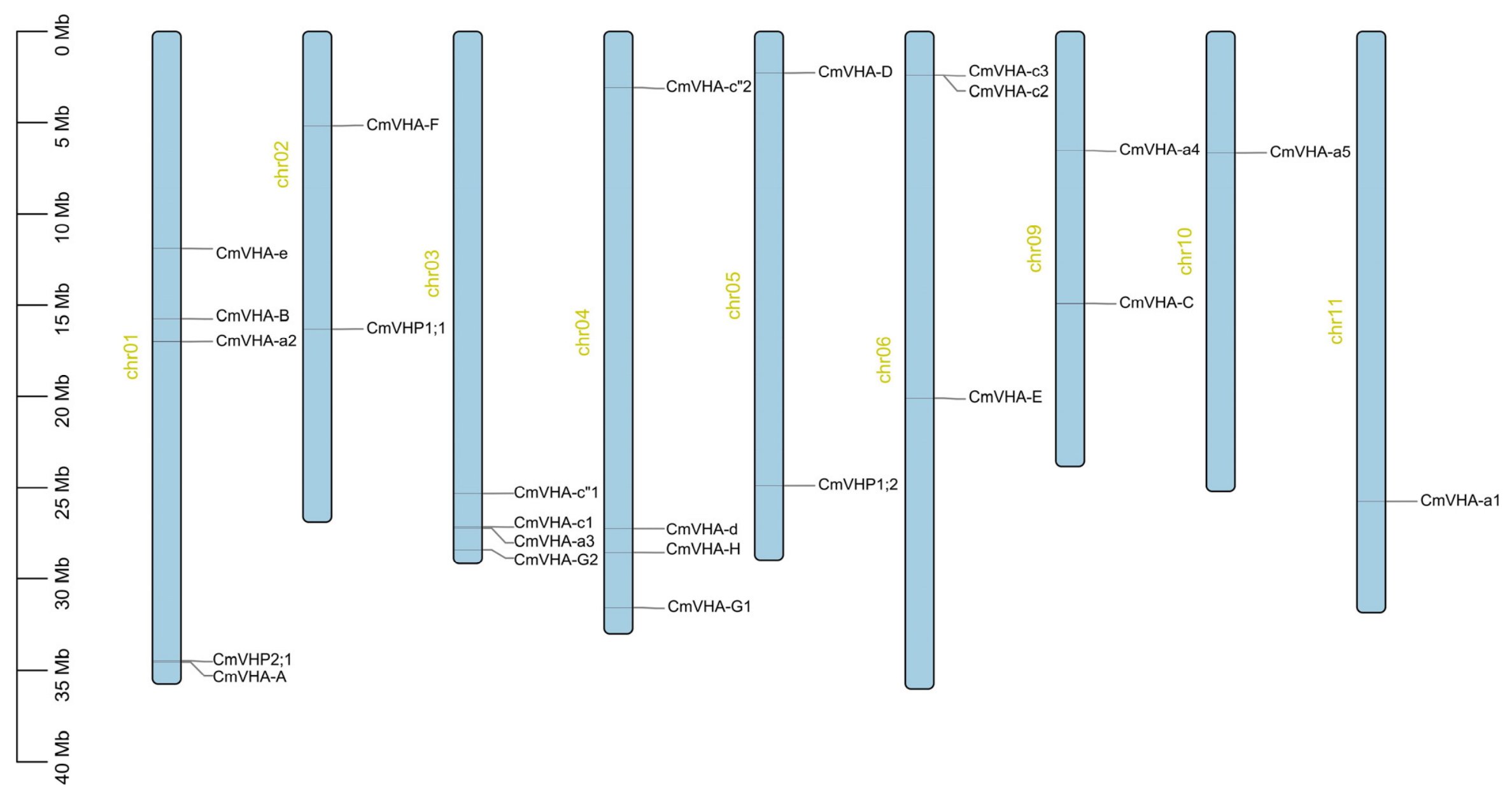
A total of 24 V-type proton pump genes (including the VHA and VHP) and 9 P-type proton pump genes were identified in the melon genome (Table 1 and Table S2). Based on sequence conservation and domain characteristics, they were named CmVHA-A to CmVHA-e, CmVHP1;1, CmVHP1;2, CmVHP2;1, and CmAHA1 to CmAHA9, respectively [5,28]. CmVHA-e, CmVHA-B, CmVHA-a2, CmVHA-A, and CmVHP2;1 are located on chromosome 1; CmVHA-F and CmVHP1;1 are located on chromosome 2; CmVHA-c″1, CmVHA-c1, CmVHA-G2, CmVHA-a3 are located on chromosome 3; CmVHA-c″2, CmVHA-d, CmVHA-H, and CmVHA-G1 are located on chromosome 4; CmVHA-D and CmVHP1;2 are located on chromosome 5; CmVHA-c2, CmVHA-c3, and CmVHA-E are located on chromosome 6; CmVHA-a4 and CmVHA-C are located on chromosome 9; CmVHA-a5 is located on chromosome 10; and CmVHA-a1 is located on chromosome 11 (Figure 1).
The coding sequences (CDSs) analyzed range in length from 213 bp to 2676 bp (Table 1). CmVHA-A possesses the longest CDS (2676 bp), encoding a protein of 891 amino acids with a predicted molecular weight of approximately 101.93 kDa. Conversely, CmVHA-e contains the shortest CDS (213 bp), encoding a 70-amino acid peptide with a corresponding molecular weight of approximately 7.73 kDa (Table 1). The predicted isoelectric points (pI) of the encoded proteins range from 4.90 to 9.65, with CmVHA-d and CmVHA-D exhibiting the lowest and highest values, respectively (Table 1). This broad pI distribution reflects marked divergence in the net surface charge and potential electrostatic properties among the family members.

3.2. Evolutionary Relationship and Synteny Analysis of Proton Pump Genes

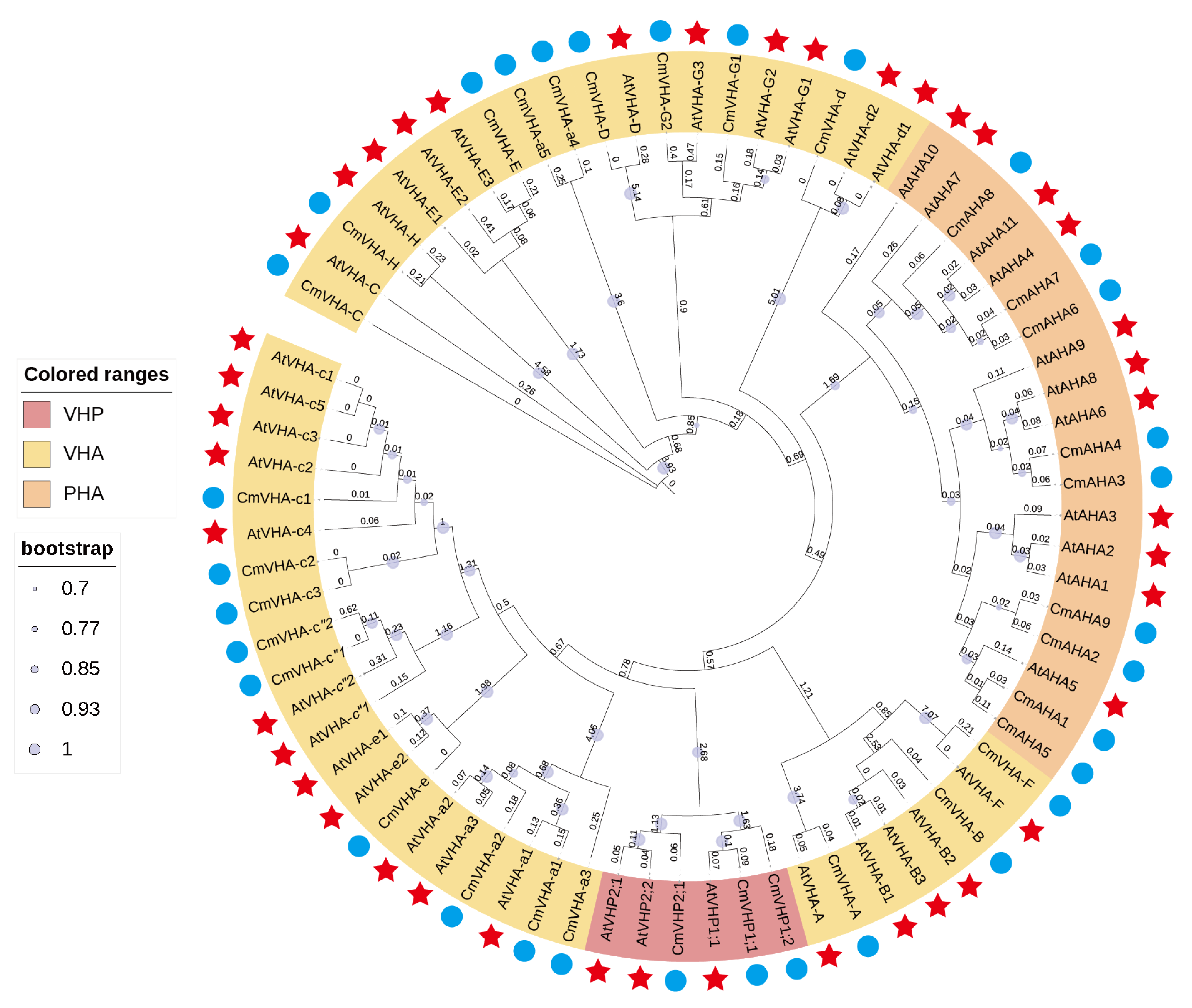
To investigate cross-species relationships among proton pump family proteins, we constructed a phylogenetic tree of proton pump proteins from melon and Arabidopsis (Figure 2). Based on known clustering results of Arabidopsis and melon orthologous genes, the melon proton pump proteins were classified into three clades: VHA, VHP, and PHA (Figure 2). The VHP clade only contained three proton pump proteins; the PHA clade comprised nine proton pump proteins, and the VHA clade contained 21 proton pump proteins (Figure 2).
As shown in Figure 2, within the VHP clade, CmVHP1;1, CmVHP1;2 and CmVHP2;1 are the orthologs of AtVHP1;1, AtVHP2;1, and AtVHP2;2. The VHA clade includes genes encoding the peripheral V1 domain (subunits A-H), responsible for ATP hydrolysis, and the membrane-embedded V0 domain (subunits a, c, c″, d, e), responsible for proton translocation (Figure 2). CmVHA-A and AtVHA-A as well as CmVHA-D and AtVHA-D group together. CmVHA-B clusters with three AtVHA-B isoforms; CmVHA-C forms a sister group with AtVHA-C (Figure 2). The VHA-a subclade contains six members (three AtVHA-a1/a2/a3 and three CmVHA-a1/a2/a3), whereas CmVHA-a4/a5 occupy a basal position, representing melon-specific paralogs generated by tandem duplication (Figure 2). CmVHA-e clusters with AtVHA-e1/e2; CmVHA-c″1 clusters with AtVHA-c″1/c″2. The VHP clade contains three genes each in Arabidopsis and melon, respectively (Figure 2).
Collinearity analysis provides crucial insights into gene evolution and phylogenetic relationships.
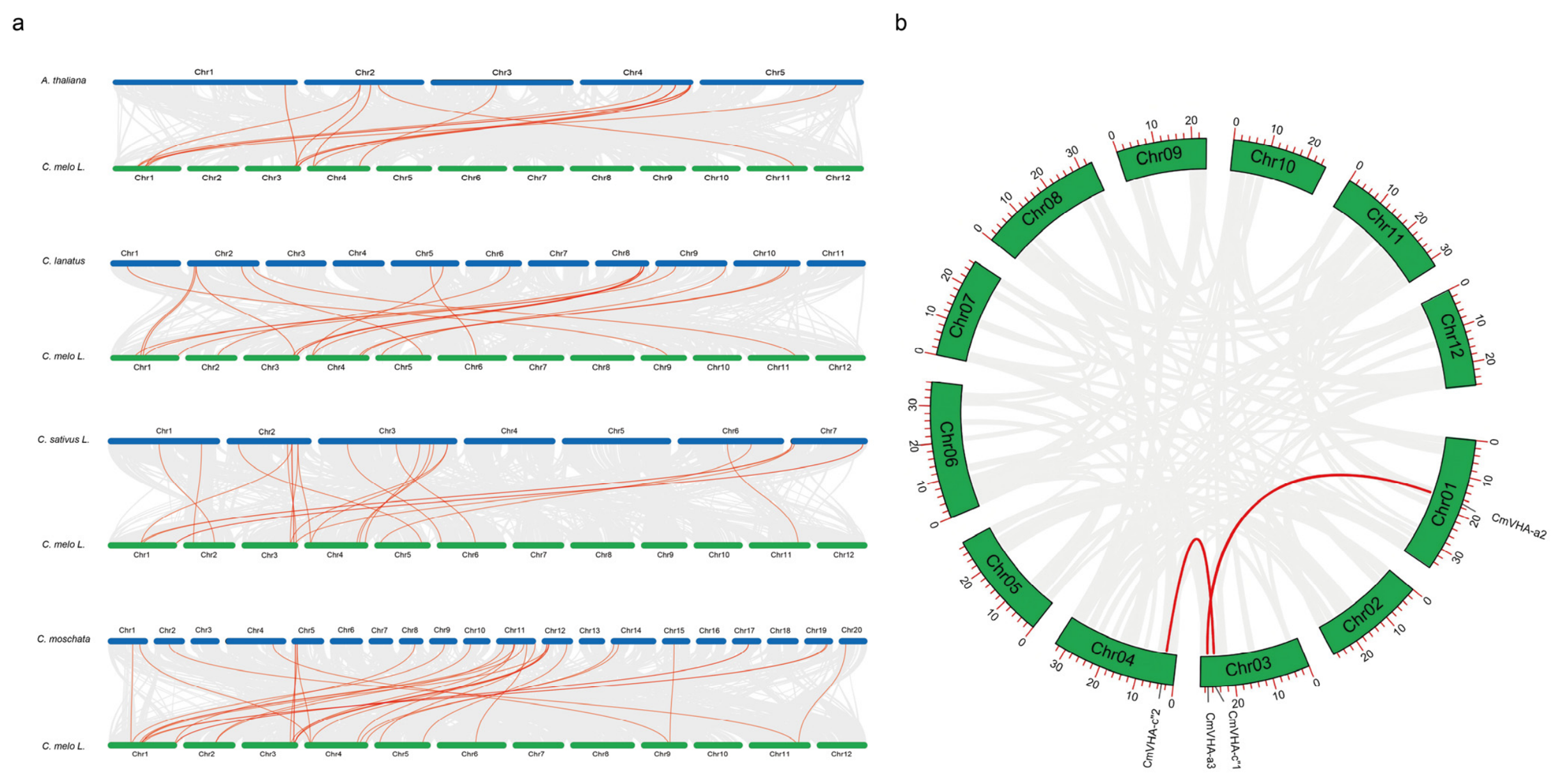
To elucidate the amplification patterns of vacuolar membrane proton pump genes in melon, TBtools [29] was employed to perform collinearity analysis across melon, Arabidopsis thaliana and four additional Cucurbitaceae species (Figure 3). The number of collinear gene pairs between melon and Arabidopsis, watermelon, pumpkin and cucumber was 14, 19, 32, and 23, respectively (Figure 3a, Tables S3–S6). Notably, melon proton pump genes exhibited pronounced collinearity with the corresponding loci in the four comparator species, with several genes, including CmVHA-a2, CmVHA-a3, CmVHA-c″2, and CmVHA-c″1 (Tables S3–S6). In addition, evidence of intragenomic gene duplication was observed within the melon genome, specifically exemplified by reciprocal duplication events between CmVHA-a2 and CmVHA-a3, CmVHA-c″2 and CmVHA-c″1 (Figure 3a). To further evaluate the evolutionary forces acting on these duplicated gene pairs, we calculated the non-synonymous (Ka) and synonymous (Ks) substitution rates for CmVHA-a2/CmVHA-a3 and CmVHA-c″2/CmVHA-c″1 using TBtools. The Ka/Ks ratios for these duplicated pairs were found to be less than 0.1, indicating that these duplicated genes have predominantly undergone purifying selection after divergence (Table S7). These duplication events likely contributed to the expansion of the proton pump gene family in melon.

3.3. Gene Structure and Conserved Domain Analysis of Proton Pump Genes

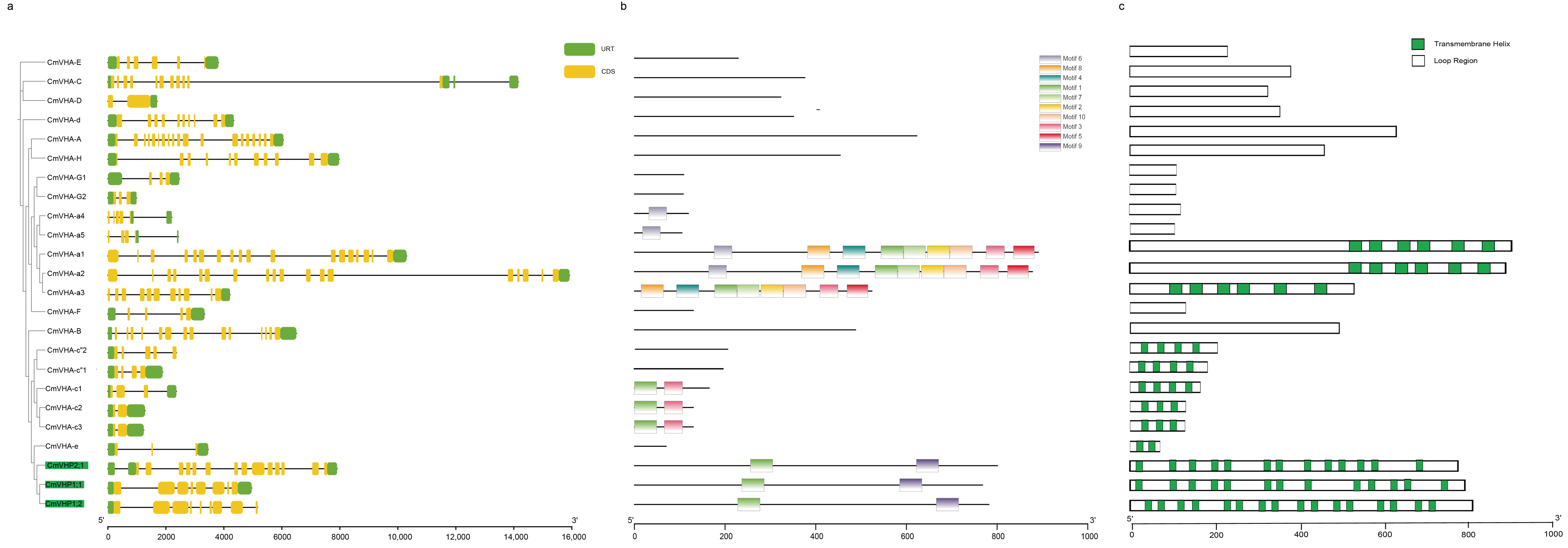
A comprehensive investigation of melon proton pump genes encompassed systematic examination of gene architecture and sequence characteristics. Phylogenetic reconstruction using MEGA 7 software generated an unrooted evolutionary tree that effectively distinguished subfamily classifications. Gene structure analysis revealed marked structural divergence among members of this family, with exon numbers ranging from 2 to 19 (Figure 4a). CmVHA-A possesses the highest number of exons (19), whereas CmVHA-D, CmVHA-c2, and CmVHA-c3 contain only two exons. Regarding untranslated regions (UTRs), most members possess complete UTR structures, yet the number of UTRs differs substantially—CmVHA-C has the most, with four UTRs, while multiple members, including CmVHA-a1, CmVHA-a2, CmVHA-a3, CmVHA-D, CmVHA-c″2, and CmVHP1;2, contain only a single UTR, indicating a unique structural configuration (Figure 4a).
Protein sequence conservation patterns were elucidated by MEME analysis, which revealed that members of the VHP family contain multiple conserved modules. Among these, Motif 9 displays family specificity. CmVHA-c1/c2/c3 share two conserved motifs: Motif 1 and Motif 3. CmVHA-a1/a2/a3 possess several conserved motifs, whereas CmVHA-a4/a5 (also a-subunit members) contain only a single motif, Motif 6 (Figure 4b).
Transmembrane helix (TMH) predictions of proton pump protein sequences were analyzed using TMHMM. The results indicated that none of the A–H subunits of the V1 peripheral complex contained transmembrane domains (TMDs) (Figure 4c). For the V0 domain, except for CmVHA-d, CmVHA-a4, and CmVHA-a5, the other subunits were predicted to possess at least two TMDs (Figure 4c). All three members of the vacuolar H+-pyrophosphatase (VHP) family, CmVHP1;1, CmVHP1;2 and CmVHP2;1, were predicted to contain multiple TMDs (Figure 4c).

3.4. Cis-Acting Element Analysis of Proton Pump Gene Promoter Regions

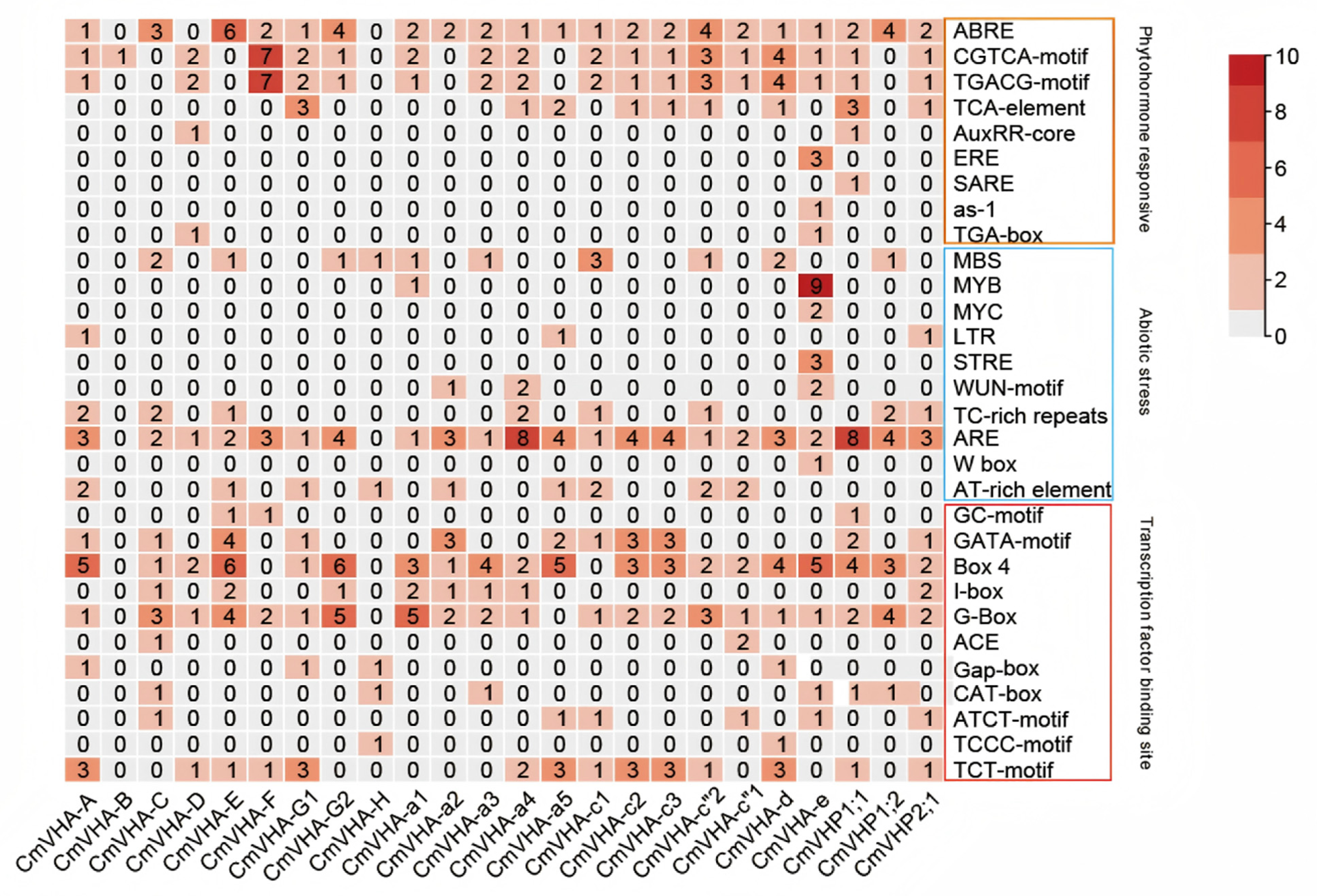
To investigate the transcriptional regulatory mechanisms of the V-type proton pump gene in melon, we predicted cis-acting elements in its 2000 bp promoter sequence upstream of the ATG start codon. A total of 30 distinct cis-acting elements were identified and classified into three major functional categories: plant hormone responsive elements, abiotic stress responsive elements, and transcription factor binding sites (Figure 5).
Among the hormone-responsive cis-regulatory modules, the abscisic acid (ABA)-responsive element (ABRE) and the jasmonic acid (JA)-responsive CGTCA-motif and TGACG-motif were highly enriched in the promoters of specific members, such as CmVHA-F and CmVHA-d, suggesting that ABA and JA may act as potential hormonal signals regulating the expression of this gene family (Figure 5). The abiotic stress-responsive module was characterized by the predominance of antioxidant response elements (AREs) and TC-rich repeats, which are primarily associated with oxidative and hypoxic stress responses (Figure 5). The transcription factor-binding module featured GATA-motif, Box 4, and GC-motif elements that are known to mediate light responsiveness and antioxidant regulation, suggesting a potential synergistic interplay between light signaling and oxidative stress in modulating gene expression (Figure 5). Collectively, the promoters of VHA and VHP genes harbor a diverse array of hormone-, stress-, and development-associated regulatory elements, with a notably higher occurrence of anaerobic induction-, MeJA-, ABA-, and drought-related motifs. Taken together, these in silico findings suggest that the VHA and VHP gene families may play putative roles in the transcriptional regulation of melon responses to abiotic stress and phytohormone signaling.

3.5. Expression Pattern of Proton Pump Genes in Melon

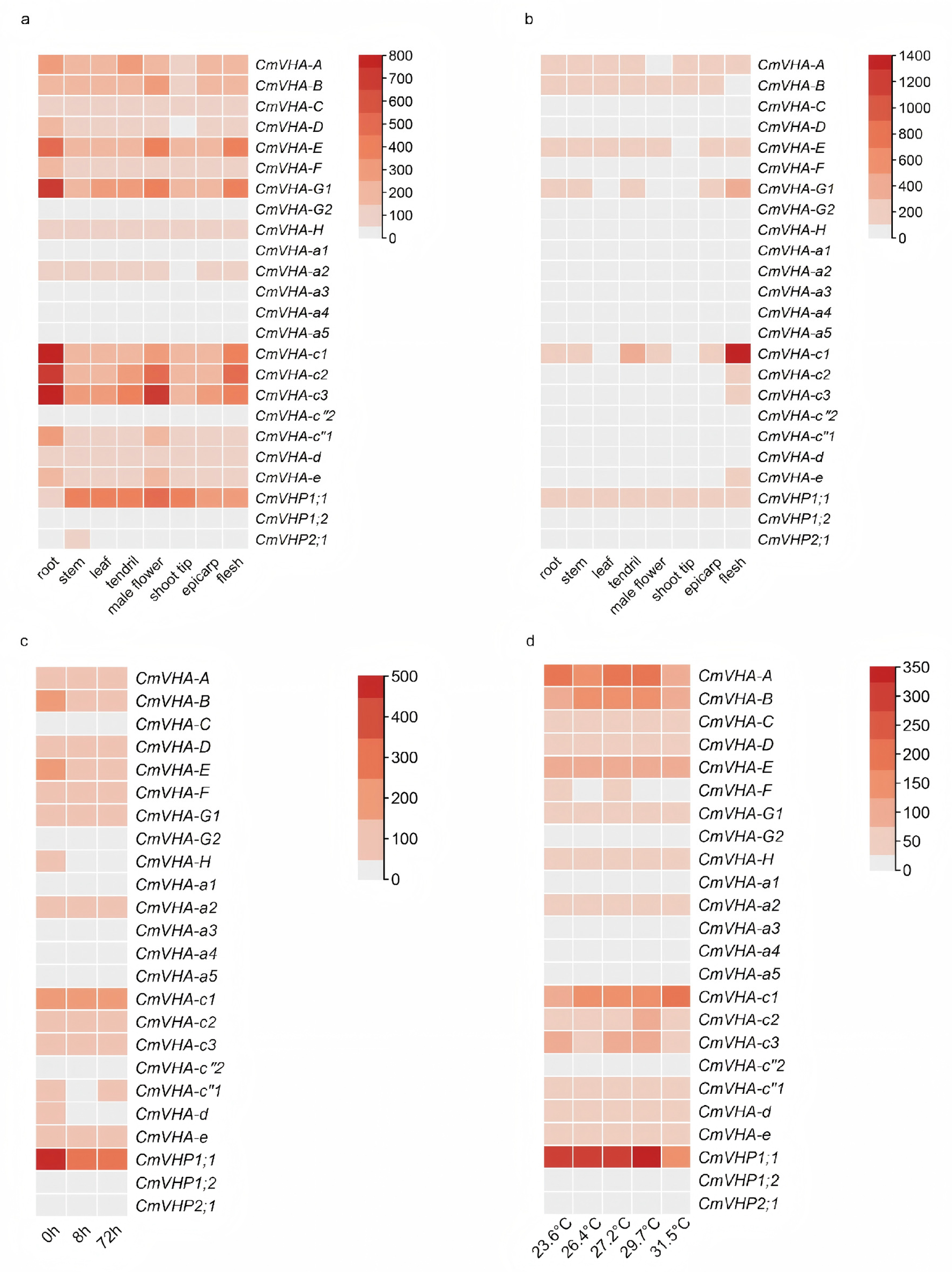
As a hypothesis-generating tool for prioritizing candidate genes rather than functional validation, we leveraged advances in high-throughput sequencing technology to analyze publicly accessible transcriptomic datasets from diverse melon organs. Using these resources, the expression profiles of 24 members of a gene family across multiple tissues were analyzed. In Cucumis melo L. subsp. agrestis, most genes exhibited apparent tissue-specific patterns: CmVHA-C, CmVHA-D, CmVHA-E, CmVHA-G1, CmVHA-c1, CmVHA-c2, CmVHA-c3, and CmVHA-c″1 showed preferentially higher expression in roots, which may suggest their potential involvement in root stress signaling (Figure 6a). In Cucumis melo L. subsp. melo, CmVHA-c1 showed notably elevated expression in fruit flesh, suggesting a potential role in fruit ripening (Figure 6b).
Based on transcriptomic data from the Cucurbitaceae database, we analyzed the expression dynamics of melon vacuolar proton pump genes under cold stress and in response to different temperatures [27]. Under cold stress treatment (0, 8, and 72 h), CmVHA-B, CmVHA-E, CmVHA-H, CmVHA-c″1, CmVHA-d, and CmVHP1;1 showed rapid changes in expression; they were significantly downregulated at 8 h, and most had stabilized by 72 h (Figure 6c). Across different temperature conditions, the majority of the tested genes displayed relatively limited responsiveness to temperature variation. However, CmVHA-A, CmVHA-H, CmVHA-a2, CmVHA-c2, CmVHA-c3, CmVHA-d, and CmVHP1;1 were significantly downregulated under 31.5 °C, suggesting that these genes may represent potential candidates involved in the response to high-temperature stress (Figure 6d).

3.6. Proton Pump Genes Expression Analysis Response to Salt Stress in Two Melon Varieties

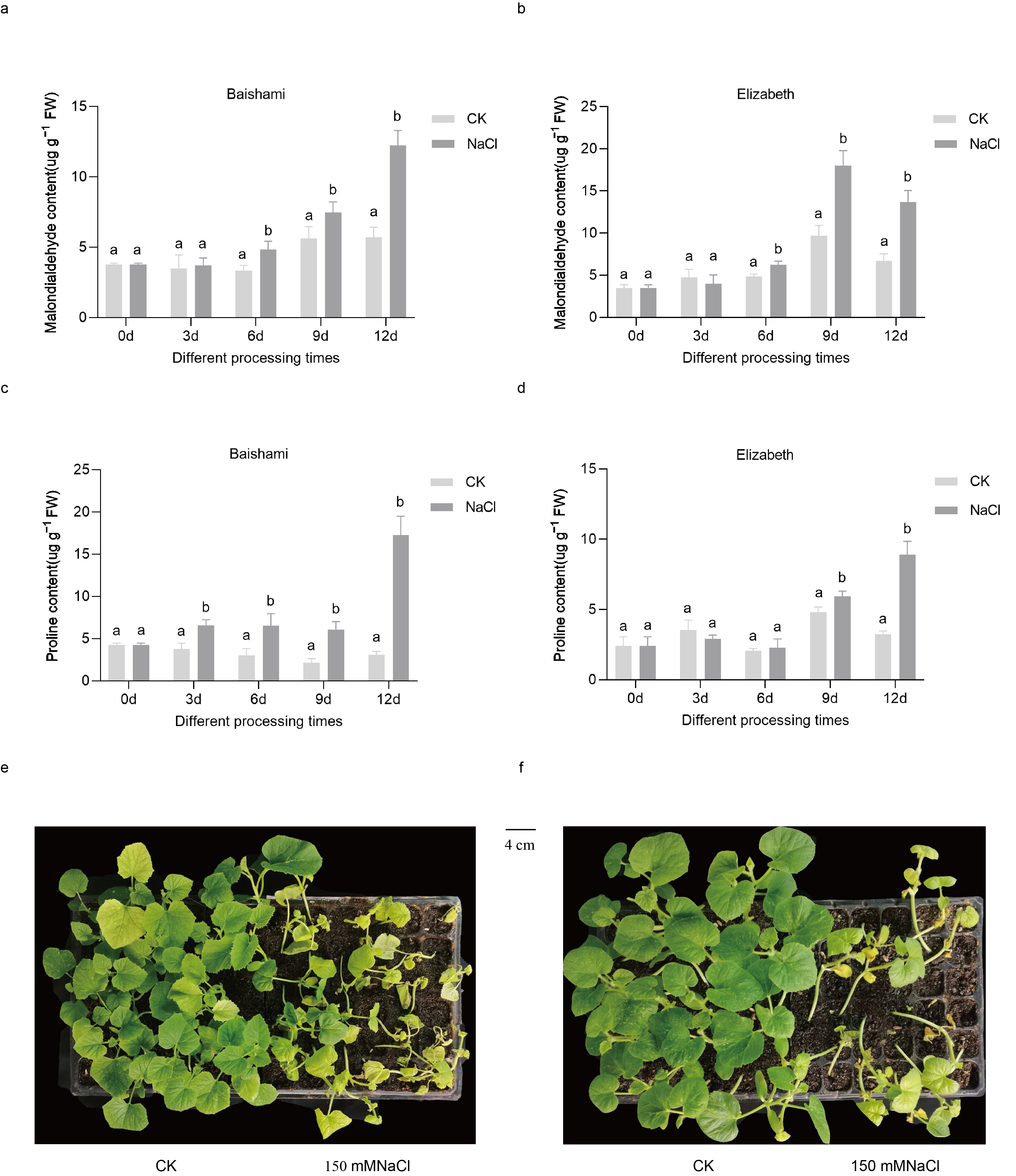
To explore how different ecotypes of melon respond to salt stress, the “Baishami” (Cucumis melo L. subsp. agrestis) and “Elizabeth” (Cucumis melo L. subsp. melo) cultivars were used for further analysis. Proline is a key osmotic regulator in plant responses to abiotic stress. In Elizabeth, proline content did not differ significantly between the control and salt-stressed groups from days 0 to 6. However, it was significantly higher in the salt-treated groups compared with the control on days 9 to 12 (Figure 7d). In Baishami, proline levels were significantly elevated relative to the control from days 3 to 12, with a pronounced surge on day 12 (Figure 7c). These findings indicate that proline accumulation occurs during the later stages of salt stress. Notably, compared with Elizabeth, Baishami exhibited earlier and more sustained proline accumulation, suggesting a more effective osmotic adjustment capability in this ecotype under salt stress. Malondialdehyde (MDA), a product of membrane lipid peroxidation, is an indicator of the extent of cell membrane damage. In both Baishami and Elizabeth, MDA levels in the salt-stressed group were significantly higher than those in the control from day 6 onward (Figure 7a,b). By day 12, both cultivars exhibited marked phenotypic differences relative to the control (Figure 7e,f).
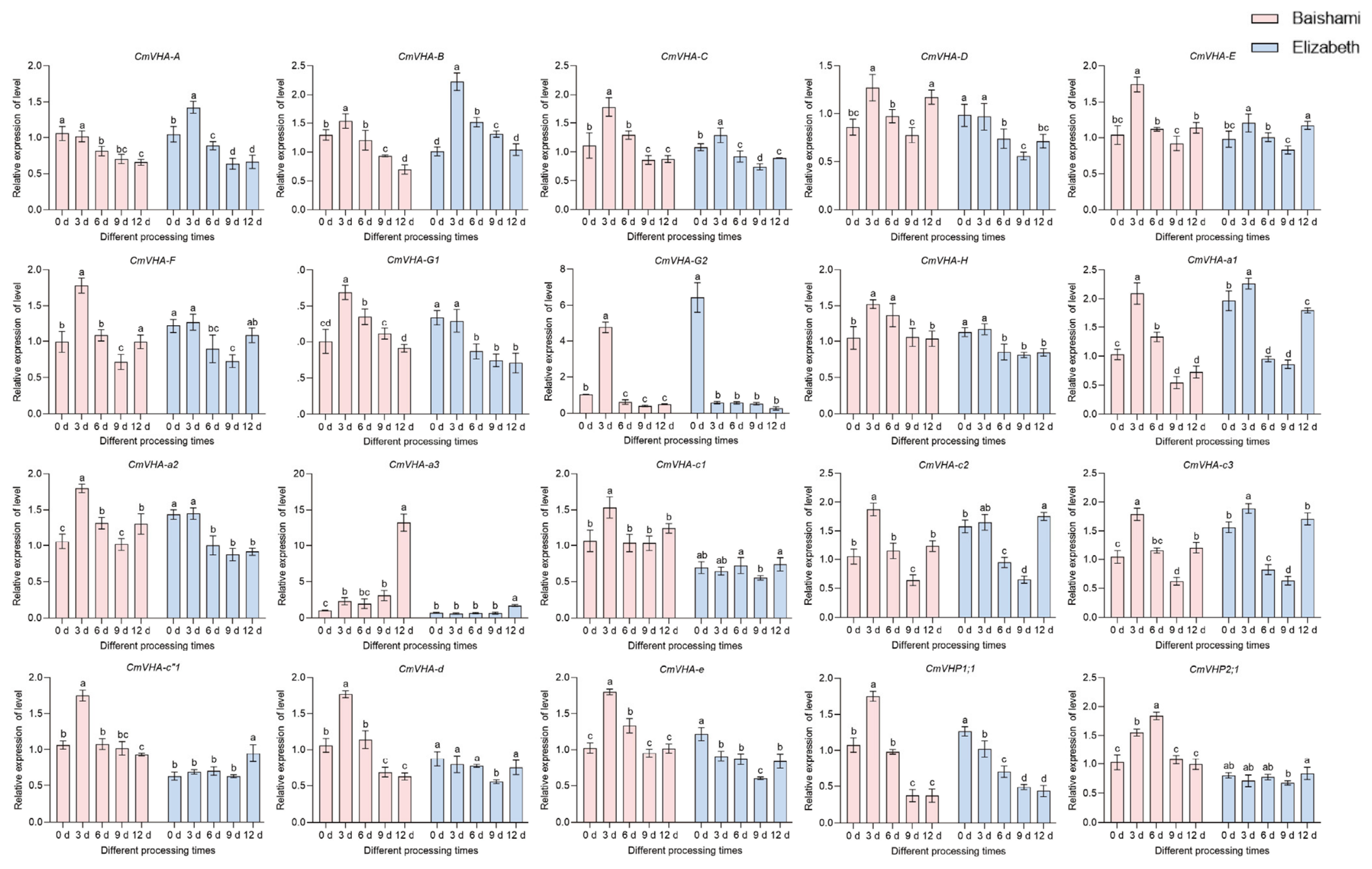
To investigate the expression patterns of V-type proton pump genes under salt stress, The leaves from two varieties were collected at day 0, 3, 6, 9, and 12 after NaCl treatment for qRT-PCR analysis. qRT-PCR analysis was performed for all 24 V-type proton pump genes identified in this study. However, four genes (CmVHA-a4, CmVHA-a5, CmVHP1;2, and CmVHA-c″2) showed undetectable expression under the experimental conditions, which was consistent with their extremely low transcript abundance in the corresponding RNA-seq datasets (Figure 6). These four genes were therefore excluded from the final analysis, and the remaining 20 genes were included in the expression profiling (Figure 8). The results revealed that on day 3 of treatment, nearly all V-type proton pump genes examined were significantly upregulated in Baishami, whereas in Elizabeth, only some genes were significantly upregulated, while the others were significantly downregulated (Figure 8). Among them, CmVHA-B, CmVHA-E, and CmVHA-c3 exhibited consistent expression dynamics in both varieties, characterized by a significant upregulation on day 3, followed by a sharp decline thereafter (Figure 8). The remaining genes showed differential expression patterns between the two varieties. Notably, the expression differences of CmVHA-F, CmVHA-G2, CmVHA-a3, CmVHA-c2, CmVHA-d, and CmVHP1;1 were mainly observed on days 3 and 12. Crucially, the robust and broad upregulation of these V-type genes in Baishami at day 3 temporally coincided with its earlier proline accumulation and may contribute to its superior osmotic adjustment. Furthermore, given that these genes were induced earlier and more strongly in Baishami than in Elizabeth, this differential transcriptional activation could be associated with the cultivar’s better cellular homeostasis, potentially reflecting a more proactive protective strategy against oxidative damage. These differences in expression patterns may reflect distinct regulatory strategies in stress response between the two varieties (Figure 8).

3.7. Analysis of the Interaction Network Between the CmVHA-F, CmVHA-G2, CmVHA-a3, CmVHA-c2, CmVHA-d, and CmVHP1;1 Proteins

Among these differentially expressed genes, CmVHA-F, CmVHA-G2, CmVHA-a3, CmVHA-c2, CmVHA-d, and CmVHP1;1 were selected for focused discussion because they exhibited the most prominent expression divergence between the two cultivars at key time points (days 3 and 12), while other family members showed either weaker or less consistent differences.
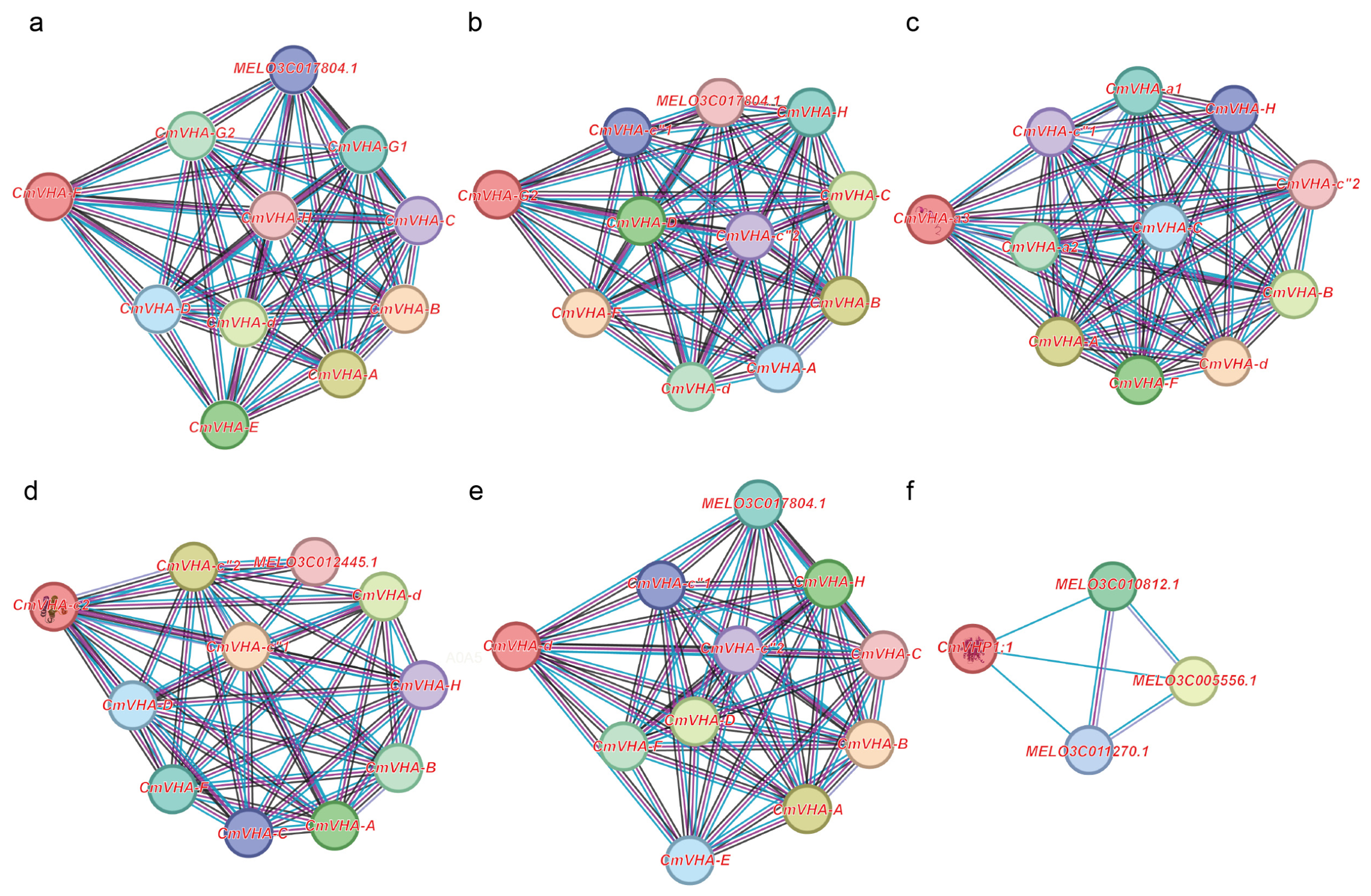
To systematically dissect the protein–protein interaction networks of CmVHA-F, CmVHA-G2, CmVHA-a3, CmVHA-c2, CmVHA-d, and CmVHP1;1 in melon, we used the STRING database. For the V-ATPase subunits CmVHA-F, CmVHA-G2, CmVHA-a3, CmVHA-c2, and CmVHA-d, an interaction confidence threshold of >0.8 was applied, and ten high-confidence putative interactors were retrieved for each. Because interaction data were limited for CmVHP1;1, the threshold was lowered to >0.4, identifying three putative interactors. Based on these results, the corresponding protein–protein interaction networks were constructed (Figure 9). The predicted networks revealed that the proteins predicted to interact with CmVHA-F, CmVHA-G2, CmVHA-a3, CmVHA-c2, and CmVHA-d predominantly consisted of various subunits of the V0 and V1 domains of vacuolar H+-ATPase (V-ATPase), suggesting that the coordinated action among V-ATPase subunits might play a key role in the salt stress response of melon. Additionally, an F-type proton pump, MELO3C012445.1, was predicted as a candidate interactor in the interaction network of CmVHA-c2, while the protein MELO3C017804.1, encoding Treslin, was predicted in the networks of CmVHA-F, CmVHA-G2, and CmVHA-d, and this protein might participate in salt stress response through indirect mechanisms (Table S8). For CmVHP1;1, the three identified potential interacting proteins (MELO3C010812.1, MELO3C011270.1, and MELO3C005556.1) all encode adenine phosphoribosyltransferases (APRTs), although the combined scores of these interactions were all relatively low (all 4.28) (Table S8). The complex associations between CmVHP1;1 and multiple APRT isoforms imply that they may collaboratively exert biological functions during plant development.

4. Discussion

Through genome-wide identification, a total of 24 V-type proton pump genes were identified in melon, including 21 VHA and three VHP (Table 1). Phylogenetic and synteny analysis revealed orthologous relationships between the melon VHA core subunits (A to H) and their Arabidopsis counterparts (Figure 2 and Figure 3a). These findings indicate that these core components responsible for ATP hydrolysis and proton translocation have remained highly conserved since the divergence of Brassicaceae from Cucurbitaceae [5]. This conservation is consistent with the central role of V-ATPase in maintaining cellular ion homeostasis and acidification of the endomembrane system [10,11]. Collinearity analysis further revealed a segmental duplication event between CmVHA-a2 and CmVHA-a3, suggesting that both tandem and segmental duplications have contributed to the expansion of this subfamily in melon [5,37,38]. As a key component of the V0 sector, VHA-a participates in the formation of the proton channel [39]. The expansion of VHA-a copy number may provide the material basis for functional diversification in response to various environmental stresses in melon [40,41]. However, CmVHA-a4 and CmVHA-a5 display unusually simplified motif compositions and deviating transmembrane patterns compared to canonical VHA-a proteins. This structural divergence suggests possible functional degeneration or neofunctionalization, though experimental validation is required to clarify their precise roles. Similarly, the VHP family differentiated into type I (CmVHP1;1, CmVHP1;2) and type II (CmVHP2;1), fully consistent with the classification framework in Arabidopsis, indicating that the divergence of K+-dependent and Ca2+-sensitive vacuolar proton-pyrophosphatases was already fixed in eudicots [7,42]. These results provide a robust evolutionary framework for subsequent functional studies.
The promoter regions of these genes contain many cis-acting elements associated with abscisic acid (ABA), methyl jasmonate (MeJA), anaerobic induction, drought response, and defense/stress responses. This suggests that their expression patterns may be regulated by a complex regulatory network integrating hormonal and environmental signals (Figure 5). Notably, the ABA-responsive element (ABRE) and JA-responsive elements (CGTCA-motif and TGACG-motif) are highly enriched in the promoters of CmVHA-F, CmVHA-d, and several other members [32,43]. ABA and JA are well-established as central hormones in osmotic stress signaling, including salt and drought stresses. They synergistically activate downstream genes, such as ion transporters or osmolyte biosynthetic enzymes [15,44]. Accordingly, the upregulation of VHA and VHP genes in response to salt stress might be mediated by an ABA-dependent pathway [15,41]. Notably, the presence of elements required for anaerobic induction and enhancer in the promoters implies that these proton pumps may also participate in the response to hypoxic stress. This is also consistent with the waterlogging and hypoxia in the rhizosphere that frequently accompany salt stress [6,40]. However, it should be emphasized that the presence of these cis-elements only suggests the possibility of regulation; these predictions are solely bioinformatic and do not constitute functional evidence. Experimental approaches such as electrophoretic mobility shift assays (EMSAs), yeast one-hybrid assays, or promoter-driven reporter assays are required in future studies to validate the actual regulatory interactions.
Several VHA subunit genes (CmVHA-c1, CmVHA-c2, CmVHA-c3, CmVHA-c″1, CmVHA-E, and CmVHA-G1) were highly expressed in roots (Figure 6), suggesting their potential involvement in the perception of salt stress and Na+ uptake [15]. As the first organ to perceive salt stress, the root exhibits active expression of V-ATPase and V-PPase, which may provide additional proton motive force for the tonoplast Na+/H+ antiporter, thereby enhancing Na+ retention in the root and reducing its transport to the shoot [45,46]. This root-predominant expression pattern is in good agreement with that reported for AtVHA-c1 in Arabidopsis, which is also preferentially expressed in root tissues and contributes to salt tolerance by maintaining vacuolar acidification [47]. Similarly, in cucumber, CsVHA-G and CsVHA-E orthologs exhibited root-specific expression under salt conditions, further supporting the conserved role of these subunits in root ion homeostasis across cucurbits [20]. Nevertheless, it is important to note that tissue-specific expression abundance alone does not directly confirm biological functions such as salt sensing or ion uptake; functional assays such as subcellular localization and transport activity measurements are needed to substantiate these roles. Additionally, some genes were preferentially expressed in flowers and fruits (Figure 6). This finding was consistent with the established roles of V-ATPase in pollen tube growth, fruit organic acid accumulation, and sugar storage [16,17]. These observations suggest that members of the melon proton pump gene family have undergone pronounced tissue-specific functional diversification.
Further salt stress treatments were applied to melons from different ecotypes, “Baishami” (subsp. agrestis) and “Elizabeth” (subsp. melo), revealing distinct temporal dynamics in proton pump gene expression (Figure 7 and Figure 8). “Baishami” exhibited early and broad upregulation at day 3, whereas ‘Elizabeth’ displayed delayed and attenuated responses. These differential transcriptional patterns were highly consistent with their respective physiological adjustments: significant proline accumulation began from day 3 in “Baishami”, but was delayed until day 9 in “Elizabeth” (Figure 7a–d). This early transcriptional activation in ‘Baishami’ is biologically meaningful because it likely primes the establishment of a tonoplast proton gradient. This gradient provides the driving force for vacuolar Na+/H+ antiporters, thereby facilitating Na+ compartmentalization and creating the energy basis for osmolyte (e.g., proline) accumulation. Thus, the earlier proton pump activation enables “Baishami” to initiate a more proactive osmotic adjustment strategy. Notably, both cultivars exhibited comparable MDA levels, indicating that oxidative damage, as measured by lipid peroxidation, did not directly distinguish them under our experimental conditions; instead, the temporal kinetics of proton pump activation was the primary discriminator. This observed “early activation–rapid adaptation” pattern is well supported by findings in other plant species. In rice, salt-tolerant accessions similarly exhibit earlier and stronger upregulation of vacuolar H+-pump genes compared to sensitive ones, correlating with better Na+ exclusion [48]. In Arabidopsis, natural accessions with contrasting salt tolerance also differ in the timing and magnitude of VHA gene induction, suggesting that the kinetics of proton pump activation is a determinant of stress resilience across species [47]. Previous studies have further established that Cucumis melo subsp. agrestis seeds can germinate under up to 200 mM NaCl stress [49], providing an evolutionary context for the rapid physiological and transcriptional responses observed in ‘Baishami’ in this study. This pronounced early response, which drives vacuolar Na+ sequestration and osmolyte accumulation, reflects a fundamental salt adaptation strategy characteristic of the agrestis genetic background [50,51,52]. In contrast, the delayed and attenuated response in ‘Elizabeth’ suggests that this ecotype may rely more on salt avoidance or alternative tolerance mechanisms other than rapid osmotic adjustment.
Previous research demonstrated that both the ATP- and PPi-dependent proton pump systems are mobilized at the tonoplast [53]. In Baishami, the simultaneous upregulation of CmVHA-a3 and CmVHP1;1 during the early stage in response to salt stress indicates a more efficient generation of the transmembrane proton electrochemical gradient. This finding provides a probable explanation for the enhanced osmotic adjustment and the earlier accumulation of proline observed in this variety. In Elizabeth, the constant downregulation of CmVHP1;1 might restrict the proton motive force under salt stress, possibly resulting in a relatively weaker capacity for ion compartmentalization and more severe and delayed membrane damage. The differential expression of CmVHA-a3 and CmVHP1;1 may represent a critical molecular clue underlying the difference in salt tolerance between two melon ecotypes, and these genes may also serve as candidate targets in future molecular breeding for salt tolerance. However, these conclusions are based on transcriptional data alone, and further functional validation—such as gene overexpression, knockout, or silencing—is necessary to confirm their proposed roles in salt stress responses.
The STRING-based interaction network analysis presented in this study was used to predict potential protein–protein interactions among melon VHA and VHP members. However, it should be noted that this network is based primarily on orthologous interactions inferred from model species such as Arabidopsis, and experimental validation in melon is currently lacking. Therefore, these interaction maps should be interpreted as predicted protein networks that provide useful hypotheses for future experimental testing, rather than as experimentally confirmed interactions in melon.
Several limitations of this study should be acknowledged. First, our analyses were based predominantly on transcriptional responses, while protein abundance, enzymatic activity of V-ATPase and V-PPase, and actual transporter function were not investigated. Second, the promoter analysis and protein interaction network are predictive in nature and require experimental validation. Third, the functional roles proposed for candidate genes are inferred from expression patterns and phylogenetic relationships, but direct evidence from genetic or biochemical assays is not yet available. Future work using gene overexpression, CRISPR/Cas9-mediated knockout, or RNA interference, combined with measurements of proton pump activity and ion flux, will be necessary to definitively establish the biological functions of these candidate genes in salt stress tolerance. Despite these limitations, this genome-wide characterization provides a valuable foundation and a set of testable hypotheses for future functional studies of proton pump genes in melon and other cucurbit crops.

5. Conclusions

In this study, 24 V-type proton pump genes were identified in the melon genome. The gene structures, including exon numbers, UTRs, and CDS lengths, exhibited considerable diversity, suggesting a potential a structural basis for functional differentiation. Collinearity analysis suggested segmental duplication events and strong purifying selection that may have shaped the evolutionary trajectory of these genes. Promoter analysis revealed an enrichment of cis-elements known to be involved in hormone (ABA and JA) and stress (hypoxia, drought, and salt) responses. Tissue expression analysis indicated that several members were predominantly expressed in roots, flowers, and fruit flesh, suggesting tissue-biased expression patterns. Under salt stress, Baishami exhibited an earlier physiological response, with most V-type proton pump genes significantly upregulated at day 3. However, in Elizabeth, the CmVHA-c″1 and CmVHA-a3 response was found to be slower, while the CmVHP2;1 induction was almost undetected in response to salt stress. These findings provide a foundation for future functional studies on the roles of V-type proton pump genes in cucurbit development and stress adaptation.

Supplementary Materials

The following supporting information can be downloaded at https://www.mdpi.com/article/10.3390/horticulturae12080920/s1: Table S1. Primers of cucumber proton pump genes used in qRT-PCR. Table S2. Identification of genes encoding P-type proton pump in the Cucumis melo genome. Table S3. Genes shared between melons and Arabidopsis. Table S4. Genes shared between melons and cucumbers. Table S5. Genes shared between melon and watermelon. Table S6. Genes shared between melon and pumpkin. Table S7. Ka/Ks ratios of duplicated VHA gene pairs in melon based on valid synonymous substitution calculations. Table S8. Predicted interacting proteins of melon VHA and VHP genes and their InterPro domain annotations.

Author Contributions

Y.Z., X.Z. and J.H. designed experiments. F.Y., X.H., H.M. and A.L. performed the experiments and analyzed the data. F.Y., Y.Z. and J.H. wrote and edited the manuscript. X.Z. assisted with English writing and editing. All authors have read and agreed to the published version of the manuscript.

Funding

This research was funded by Beijing Rural Revitalization Agricultural Science and Technology Project (Grant No. NY2401130126), the National Key Research and Development Program of China (2024YFD2300700) and Beijing University of Agriculture Young Teacher Capacity Enhancement Project (QJKC-2025016).

Data Availability Statement

The original contributions presented in this study are included in the article/Supplementary Material. Further inquiries can be directed to the corresponding authors.

Conflicts of Interest

The authors declare that they have no conflicts of interest.

References

  1. Siletsky, S.A. Proton Pumps: Molecular Mechanisms, Inhibitors and Activators of Proton Pumping. Int. J. Mol. Sci. 2023, 24, 9070. [Google Scholar] [CrossRef] [PubMed]
  2. Andersen, C.G.; Bavnhoj, L.; Pedersen, B.P. May the proton motive force be with you: A plant transporter review. Curr. Opin. Struct. Biol. 2023, 79, 102535. [Google Scholar] [CrossRef] [PubMed]
  3. Gaxiola, R.A.; Palmgren, M.G.; Schumacher, K. Plant proton pumps. FEBS Lett. 2007, 581, 2204–2214. [Google Scholar] [CrossRef] [PubMed]
  4. Martinoia, E.; Maeshima, M.; Neuhaus, H.E. Vacuolar transporters and their essential role in plant metabolism. J. Exp. Bot. 2007, 58, 83–102. [Google Scholar] [PubMed]
  5. Sze, H.; Schumacher, K.; Muller, M.L.; Padmanaban, S.; Taiz, L. A simple nomenclature for a complex proton pump: VHA genes encode the vacuolar H+-ATPase. Trends Plant Sci. 2002, 7, 157–161. [Google Scholar] [CrossRef] [PubMed]
  6. Drozdowicz, Y.M.; Rea, P.A. Vacuolar H+ pyrophosphatases: From the evolutionary backwaters into the mainstream. Trends Plant Sci. 2001, 6, 206–211. [Google Scholar] [CrossRef] [PubMed]
  7. Segami, S.; Nakanishi, Y.; Sato, M.H.; Maeshima, M. Quantification, organ-specific accumulation and intracellular localization of type II H+-pyrophosphatase in Arabidopsis thaliana. Plant Cell Physiol. 2010, 51, 1350–1360. [Google Scholar] [CrossRef] [PubMed]
  8. Li, J.; Guo, Y.; Yang, Y. The molecular mechanism of plasma membrane H+-ATPases in plant responses to abiotic stress. J. Genet. Genom. 2022, 49, 715–725. [Google Scholar] [CrossRef]
  9. Schmidt, C.; Zhou, M.; Marriott, H.; Morgner, N.; Politis, A.; Robinson, C.V. Comparative cross-linking and mass spectrometry of an intact F-type ATPase suggest a role for phosphorylation. Nat. Commun. 2013, 4, 1985. [Google Scholar] [CrossRef] [PubMed]
  10. Cosse, M.; Seidel, T. Plant Proton Pumps and Cytosolic pH-Homeostasis. Front. Plant Sci. 2021, 12, 672873. [Google Scholar] [CrossRef] [PubMed]
  11. Wang, C.; Xiang, Y.; Qian, D. Current progress in plant V-ATPase: From biochemical properties to physiological functions. J. Plant Physiol. 2021, 266, 153525. [Google Scholar] [CrossRef] [PubMed]
  12. Mohammed, S.A.; Nishio, S.; Takahashi, H.; Shiratake, K.; Ikeda, H.; Kanahama, K.; Kanayama, Y. Role of Vacuolar H+-inorganic pyrophosphatase in tomato fruit development. J. Exp. Bot. 2012, 63, 5613–5621. [Google Scholar] [CrossRef] [PubMed]
  13. Li, Y.; Zeng, H.; Xu, F.; Yan, F.; Xu, W. H+-ATPases in Plant Growth and Stress Responses. Annu. Rev. Plant Biol. 2022, 73, 495–521. [Google Scholar] [CrossRef] [PubMed]
  14. Schumacher, K.; Vafeados, D.; McCarthy, M.; Sze, H.; Wilkins, T.; Chory, J. The Arabidopsis det3 mutant reveals a central role for the vacuolar H+-ATPase in plant growth and development. Genes Dev. 1999, 13, 3259–3270. [Google Scholar] [CrossRef] [PubMed]
  15. Batelli, G.; Verslues, P.E.; Agius, F.; Qiu, Q.; Fujii, H.; Pan, S.; Schumaker, K.S.; Grillo, S.; Zhu, J.K. SOS2 promotes salt tolerance in part by interacting with the vacuolar H+-ATPase and upregulating its transport activity. Mol. Cell. Biol. 2007, 27, 7781–7790. [Google Scholar] [CrossRef] [PubMed]
  16. Golldack, D.; Dietz, K.J. Salt-induced expression of the vacuolar H+-ATPase in the common ice plant is developmentally controlled and tissue specific. Plant Physiol. 2001, 125, 1643–1654. [Google Scholar] [CrossRef] [PubMed]
  17. Krebs, M.; Beyhl, D.; Gorlich, E.; Al-Rasheid, K.A.; Marten, I.; Stierhof, Y.D.; Hedrich, R.; Schumacher, K. Arabidopsis V-ATPase activity at the tonoplast is required for efficient nutrient storage but not for sodium accumulation. Proc. Natl. Acad. Sci. USA 2010, 107, 3251–3256. [Google Scholar] [CrossRef] [PubMed]
  18. Schulze, W.X.; Schneider, T.; Starck, S.; Martinoia, E.; Trentmann, O. Cold acclimation induces changes in Arabidopsis tonoplast protein abundance and activity and alters phosphorylation of tonoplast monosaccharide transporters. Plant J. 2012, 69, 529–541. [Google Scholar] [CrossRef] [PubMed]
  19. Xu, W.; Jia, L.; Shi, W.; Liang, J.; Zhou, F.; Li, Q.; Zhang, J. Abscisic acid accumulation modulates auxin transport in the root tip to enhance proton secretion for maintaining root growth under moderate water stress. New Phytol. 2013, 197, 139–150. [Google Scholar] [PubMed]
  20. Kabala, K.; Janicka-Russak, M.; Reda, M.; Migocka, M. Transcriptional regulation of the V-ATPase subunit c and V-PPase isoforms in Cucumis sativus under heavy metal stress. Physiol. Plant 2014, 150, 32–45. [Google Scholar] [PubMed]
  21. Seidel, T.; Siek, M.; Marg, B.; Dietz, K.-J. Energization of Vacuolar Transport in Plant Cells and Its Significance Under Stress. Int. Rev. Cell Mol. Biol. 2013, 304, 57–131. [Google Scholar] [CrossRef] [PubMed]
  22. Liu, Z.; Mao, Z.; Li, M.; Cai, C.; Wang, Y.; Liu, J.H.; Li, C. Vacuole: A repository to control fruit flavor quality. Fruit. Res. 2023, 3, 12. [Google Scholar] [CrossRef]
  23. Jing, Y.; Yang, J.; Xu, D.; Chen, Q.; Xin, K.; Chen, X.; Tang, J.; Chen, J.; Ma, Z. Recent Insights into the Molecular Mechanisms of Salt Tolerance in Melon (Cucumis melo L.). Plants 2025, 14, 3598. [Google Scholar] [CrossRef] [PubMed]
  24. Liu, P.; Gao, C.; Gao, Y.; Wang, C.; Jiao, Z.; Xu, A.; Dong, Y.; Sun, J. Investigating Salt Tolerance in Melon During Germination and Early Seedling Stages. Horticulturae 2025, 11, 397. [Google Scholar] [CrossRef]
  25. Chen, C.; Yu, W.; Xu, X.; Wang, Y.; Wang, B.; Xu, S.; Lan, Q.; Wang, Y. Research Advancements in Salt Tolerance of Cucurbitaceae: From Salt Response to Molecular Mechanisms. Int. J. Mol. Sci. 2024, 25, 9051. [Google Scholar] [CrossRef] [PubMed]
  26. Chevilly, S.; Dolz-Edo, L.; Martinez-Sanchez, G.; Morcillo, L.; Vilagrosa, A.; Lopez-Nicolas, J.M.; Blanca, J.; Yenush, L.; Mulet, J.M. Distinctive Traits for Drought and Salt Stress Tolerance in Melon (Cucumis melo L.). Front. Plant Sci. 2021, 12, 777060. [Google Scholar] [CrossRef] [PubMed]
  27. Castanera, R.; Ruggieri, V.; Pujol, M.; Garcia-Mas, J.; Casacuberta, J.M. An Improved Melon Reference Genome with Single-Molecule Sequencing Uncovers a Recent Burst of Transposable Elements with Potential Impact on Genes. Front. Plant Sci. 2019, 10, 1815. [Google Scholar] [PubMed]
  28. Baxter, I.; Tchieu, J.; Sussman, M.R.; Boutry, M.; Palmgren, M.G.; Gribskov, M.; Harper, J.F.; Axelsen, K.B. Genomic comparison of P-type ATPase ion pumps in Arabidopsis and rice. Plant Physiol. 2003, 132, 618–628. [Google Scholar] [CrossRef] [PubMed]
  29. Chen, C.; Chen, H.; Zhang, Y.; Thomas, H.R.; Frank, M.H.; He, Y.; Xia, R. TBtools: An Integrative Toolkit Developed for Interactive Analyses of Big Biological Data. Mol. Plant 2020, 13, 1194–1202. [Google Scholar] [CrossRef] [PubMed]
  30. Bailey, T.L.; Johnson, J.; Grant, C.E.; Noble, W.S. The MEME Suite. Nucleic Acids Res. 2015, 43, W39–W49. [Google Scholar] [CrossRef] [PubMed]
  31. Lu, S.; Wang, J.; Chitsaz, F.; Derbyshire, M.K.; Geer, R.C.; Gonzales, N.R.; Gwadz, M.; Hurwitz, D.I.; Marchler, G.H.; Song, J.S.; et al. CDD/SPARCLE: The conserved domain database in 2020. Nucleic Acids Res. 2020, 48, D265–D268. [Google Scholar] [PubMed]
  32. Lescot, M.; Déhais, P.; Thijs, G.; Marchal, K.; Moreau, Y.; Van de Peer, Y.; Rouzé1, P.; Rombauts, S. PlantCARE, a database of plant cis-acting regulatory elements and a portal to tools for in silico analysis of promoter sequences. Nucleic Acids Res. 2002, 30, 325–327. [Google Scholar] [CrossRef] [PubMed]
  33. Yano, R.; Ariizumi, T.; Nonaka, S.; Kawazu, Y.; Zhong, S.; Mueller, L.; Giovannoni, J.J.; Rose, J.K.C.; Ezura, H. Comparative genomics of muskmelon reveals a potential role for retrotransposons in the modification of gene expression. Commun. Biol. 2020, 3, 432. [Google Scholar] [CrossRef] [PubMed]
  34. Xu, Y.; Liu, B.; Li, Y.; Chen, X.; Yan, C.; Liu, Y.; Wang, H.; Wang, J.; Dong, W.; Deng, S.; et al. A comprehensive omics resource and genetic tools for genetic research and precision breeding of Cucumis melo ssp. agrestis. Plant Cell 2025, 37, koaf272. [Google Scholar] [CrossRef] [PubMed]
  35. Landi, M. Commentary to: “Improving the thiobarbituric acid-reactive-substances assay for estimating lipid peroxidation in plant tissues containing anthocyanin and other interfering compounds” by Hodges et al., Planta (1999) 207:604-611. Planta 2017, 245, 1067. [Google Scholar]
  36. Sun, M.-X.; Kong, Q.; Yuan, J.; Niu, P.; Xie, J.; Jiang, W.; Huang, Y.; Bie, Z. Screening Suitable Reference Genes for Normalization in Reverse Transcription Quantitative Real-Time PCR Analysis in Melon. PLoS ONE 2014, 9, e87197. [Google Scholar] [CrossRef] [PubMed]
  37. Hanitzsch, M.; Schnitzer, D.; Seidel, T.; Golldack, D.; Dietz, K.J. Transcript level regulation of the vacuolar H+-ATPase subunit isoforms VHA-a, VHA-E and VHA-G in Arabidopsis thaliana. Mol. Membr. Biol. 2007, 24, 507–518. [Google Scholar] [CrossRef] [PubMed]
  38. Guo, J.; Xu, W.; Hu, Y.; Huang, J.; Zhao, Y.; Zhang, L.; Huang, C.H.; Ma, H. Phylotranscriptomics in Cucurbitaceae Reveal Multiple Whole-Genome Duplications and Key Morphological and Molecular Innovations. Mol. Plant 2020, 13, 1117–1133. [Google Scholar] [CrossRef] [PubMed]
  39. Dettmer, J.; Hong-Hermesdorf, A.; Stierhof, Y.D.; Schumacher, K. Vacuolar H+-ATPase activity is required for endocytic and secretory trafficking in Arabidopsis. Plant Cell 2006, 18, 715–730. [Google Scholar] [CrossRef] [PubMed]
  40. Kluge, C.; Lamkemeyer, P.; Tavakoli, N.; Golldack, D.; Kandlbinder, A.; Dietz, K.J. CDNA cloning of 12 subunits of the V-type ATPase from Mesembryanthemum crystallinum and their expression under stress. Mol. Membr. Biol. 2003, 20, 171–183. [Google Scholar] [CrossRef] [PubMed]
  41. Dietz, K.J.; Tavakoli, N.; Kluge, C.; Mimura, T.; Sharma, S.S.; Harris, G.C.; Chardonnens, A.N.; Golldack, D. Significance of the V-type ATPase for the adaptation to stressful growth conditions and its regulation on the molecular and biochemical level. J. Exp. Bot. 2001, 52, 1969–1980. [Google Scholar] [CrossRef] [PubMed]
  42. Drozdowicz, Y.M.; Kissinger, J.C.; Rea, P.A. AVP2, a sequence-divergent, K+-insensitive H+-translocating inorganic pyrophosphatase from Arabidopsis. Plant Physiol. 2000, 123, 353–362. [Google Scholar] [CrossRef] [PubMed]
  43. Narusaka, Y.; Nakashima, K.; Shinwari, Z.K.; Sakuma, Y.; Furihata, T.; Abe, H.; Narusaka, M.; Shinozaki, K.; Yamaguchi-Shinozaki, K. Interaction between two cis-acting elements, ABRE and DRE, in ABA-dependent expression of Arabidopsis rd29A gene in response to dehydration and high-salinity stresses. Plant J. 2003, 34, 137–148. [Google Scholar] [CrossRef] [PubMed]
  44. Golldack, D.; Li, C.; Mohan, H.; Probst, N. Tolerance to drought and salt stress in plants: Unraveling the signaling networks. Front. Plant Sci. 2014, 5, 151. [Google Scholar] [CrossRef] [PubMed]
  45. Graus, D.; Konrad, K.R.; Bemm, F.; Patir Nebioglu, M.G.; Lorey, C.; Duscha, K.; Guthoff, T.; Herrmann, J.; Ferjani, A.; Cuin, T.A.; et al. High V-PPase activity is beneficial under high salt loads, but detrimental without salinity. New Phytol. 2018, 219, 1421–1432. [Google Scholar] [CrossRef] [PubMed]
  46. Fu, L.; Wu, D.; Zhang, X.; Xu, Y.; Kuang, L.; Cai, S.; Zhang, G.; Shen, Q. Vacuolar H+-pyrophosphatase HVP10 enhances salt tolerance via promoting Na+ translocation into root vacuoles. Plant Physiol. 2022, 188, 1248–1263. [Google Scholar] [PubMed]
  47. Padmanaban, S.; Lin, X.; Perera, I.; Kawamura, Y.; Sze, H. Differential Expression of Vacuolar H+-ATPase Subunit c Genes in Tissues Active in Membrane Trafficking and Their Roles in Plant Growth as Revealed by RNAi. Plant Physiol. 2004, 134, 1514–1526. [Google Scholar] [CrossRef] [PubMed]
  48. Baisakh, N.; RamanaRao, M.V.; Rajasekaran, K.; Subudhi, P.; Janda, J.; Galbraith, D.; Vanier, C.; Pereira, A. Enhanced salt stress tolerance of rice plants expressing a vacuolar H+-ATPase subunit c1 (SaVHAc1) gene from the halophyte grass Spartina alterniflora Löisel. Plant Biotechnol. J. 2012, 10, 453–464. [Google Scholar] [CrossRef] [PubMed]
  49. Shrestha, A.; Xu, H.; Su, W.; Zhang, D.; Sun, L.; Wang, H.; Xue, F.; Zhai, S.; Zou, Z.; Wu, R. Influence of environmental factors on Cucumis melo L. var. agrestis Naud. seed germination and seedling emergence. PLoS ONE 2017, 12, e0178638. [Google Scholar] [CrossRef] [PubMed]
  50. Hare, P.D.; Cress, W.A.; Van Staden, J. Dissecting the roles of osmolyte accumulation during stress. Plant Cell Environ. 1998, 21, 535–553. [Google Scholar] [CrossRef]
  51. Xiao, F.; Zhou, H. Plant salt response: Perception, signaling, and tolerance. Front. Plant Sci. 2022, 13, 1786. [Google Scholar] [CrossRef] [PubMed]
  52. Gamez-Arjona, F.M.; Pardo, J.M.; Quintero, F.J. How sodium gets sequestered in the vacuoles of salinized plants? Mol. Plant 2025, 18, 2045–2047. [Google Scholar] [CrossRef] [PubMed]
  53. Queiros, F.; Fontes, N.; Silva, P.; Almeida, D.; Maeshima, M.; Geros, H.; Fidalgo, F. Activity of tonoplast proton pumps and Na+/H+ exchange in potato cell cultures is modulated by salt. J. Exp. Bot. 2009, 60, 1363–1374. [Google Scholar] [CrossRef] [PubMed]
Figure 1. The distribution of 24 V-type proton pump genes on melon (Cucumis melon L.) chromosomes. For each chromosome (chr), the number in yellow is on the left, and the gene’s name in black is on the right.
Horticulturae 12 00920 g001
Figure 2. Phylogenetic analysis of protein sequences of the proton pump genes from melon and arabidopsis. The phylogenetic tree was constructed based on the amino acid sequences of proton pump proteins. Different colors indicate distinct proton pump families: yellow for V-type ATPase (VHA, vacuolar H+-ATPase), pink for vacuolar H+-pyrophosphatase (VHP, vacuolar H+-PPase), and orange for P-type proton pump (PHA, plasma membrane H+-ATPase). Red stars indicate genes derived from melon, whereas blue circles indicate genes derived from Arabidopsis. Bootstrap support values (based on 1000 replicates) are shown at each node.
Horticulturae 12 00920 g002
Figure 3. Analysis of proton pump gene collinearity. (a) Interspecific collinearity between melon (green) and Arabidopsis, cucumber, watermelon, and pumpkin (blue). Gray lines represent whole-genome syntenic blocks, and red lines indicate collinear V-type proton pump gene pairs. (b) Intraspecific collinearity analysis of V-type proton pump genes in melon. Red lines indicate gene pairs with collinearity.
Horticulturae 12 00920 g003
Figure 4. Gene structure and motif distribution of proton pump gene family. (a) Exon–intron structures of the proton pump genes. Green and yellow rectangles represent untranslated regions (UTRs) and coding sequences (CDSs/exons), respectively, while black horizontal lines indicate introns. The horizontal axis indicates the nucleotide length of the genes (bp). The genes highlighted with a green background on the left correspond to the VHP subfamily members, while the remaining genes belong to the VHA subfamily. (b) Distribution of conserved motifs in proton pump proteins predicted by the MEME server. Different colored boxes (Motif 1–Motif 10) represent 10 distinct conserved amino acid motifs. (c) Predicted transmembrane domains (TMDs) of the proton pump proteins. Green solid boxes represent the transmembrane helices, and the black lines denote non-transmembrane regions. The horizontal axis indicates the amino acid length of the proteins.
Horticulturae 12 00920 g004
Figure 5. Heatmap of cis-acting element abundance in the promoters of 24 melon proton pump genes. Columns represent genes; rows indicate elements grouped into phytohormone, abiotic stress, and transcription factor-binding categories. Values inside the grid denote copy numbers, with the color gradient (0–10) reflecting abundance.
Horticulturae 12 00920 g005
Figure 6. Tissue-specific expression patterns of the V-type proton pump gene family in melon and expression responses under abiotic stress. (a,b) Expression analysis in Cucumis melo L. subsp. agrestis “Wild Melon Subspecies” (a) and Cucumis melo L. subsp. melo “Harukei-3” (b). (c,d) Expression pattern analysis of V-type proton pump genes in response to cold stress (c) and high temperature (d). A grey-to-red color gradient indicates relative expression levels from low (grey) to high (red).
Horticulturae 12 00920 g006
Figure 7. Phenotype analysis of ‘Elizabeth’ and ‘Baishami’ in response to salt stress. (a,b) Malondialdehyde content analysis of “Elizabeth” and “Baishami” treated with 150 mM NaCl. Values are expressed as µg g−1 FW (fresh weight). (c,d) Proline content analysis in “Elizabeth” and “Baishami” treated with 150 mM NaCl. Values are expressed as µg g−1 FW (fresh weight). (e,f) Phenotype diagram under 150 mM treatment, with e representing “Baishami” and f representing “Elizabeth”. All experimental data were collected in triplicate, and statistical significance was analyzed using SPSS. Different letters within columns indicate significant differences (p < 0.05). Error bars represent standard deviation (SD).
Horticulturae 12 00920 g007
Figure 8. Expression analysis of melon proton pump gene expression at different treatment times in response to salt. All experimental data were collected in triplicate, and statistical significance was analyzed using SPSS (v 27.0). Different letters within columns indicate significant differences (p < 0.05). Error bars represent standard deviation (SD). Pink represents the relative expression levels of the “Baishami” V-type proton pump gene at different times. Blue represents the relative expression levels of the “Elizabeth” V-type proton pump gene at different treatment times.
Horticulturae 12 00920 g008
Figure 9. Predicted protein–protein interaction network of CmVHA-F, CmVHA-G2, CmVHA-a3, CmVHA-c2, CmVHA-d, and CmVHP1;1 in melon. Blue lines indicate interactions derived from curated databases, purple lines indicate experimentally determined interactions, black lines indicate co-expression relationships, and node labels in the figure show predicted gene names or identifiers. (a) Analysis of CmVHA-F interacting proteins. (b) Analysis of CmVHA-G2 interacting proteins. (c) Analysis of CmVHA-a3 interacting proteins. (d) Analysis of CmVHA-c2 interacting proteins. (e) Analysis of CmVHA-d interacting proteins. (f) Analysis of CmVHP1;1 interacting proteins.
Horticulturae 12 00920 g009
Table 1. Identification of genes encoding V-ATPase subunits and H+ -PPase isoforms in Cucumis melo L.
Gene NameGene IDGene PositionCDS (bp)AAMwPI
StartEnd (+/−)
CmVHA-AMELO3C024284.13454268434548735 (+)187262368,744.555.37
CmVHA-BMELO3C013334.11574654515753046 (−)146748854,296.694.96
CmVHA-CMELO3C025061.11490373414917889 (+)113137642,699.265.47
CmVHA-DMELO3C014458.122796702281367 (−)97232335,892.589.65
CmVHA-EMELO3C014920.12009649720100308 (−)69022926,024.937.16
CmVHA-FMELO3C015218.151789935182327 (+)39313014,436.586.08
CmVHA-G1MELO3C009336.13158534331587805 (+)33010912,129.666.84
CmVHA-G2MELO3C010790.12840533628406322 (+)32710812,290.786.74
CmVHA-HMELO3C009742.12854740828555384 (+)136545451,613.686.53
CmVHA-a1MELO3C025730.12575022825760529 (−)2676891101,929.686.01
CmVHA-a2MELO3C013437.11699193017007849 (+)263787898,976.085.67
CmVHA-a3MELO3C010983.12721675427220964 (+)157552459,751.406.09
CmVHA-a4MELO3C033789.165260356528236 (+)36011913,890.399.10
CmVHA-a5MELO3C034261.166560796658511 (−)31810512,176.348.91
CmVHA-c1MELO3C010992.12714002027142382 (+)49816516,644.718.62
CmVHA-c2MELO3C000065.124105312411812 (+)39313013,060.397.75
CmVHA-c3MELO3C030112.124105312411768 (+)39313013,060.397.75
CmVHA-c″1MELO3C011225.12532147325323359 (−)54918218,572.999.24
CmVHA-c″2MELO3C003677.130916023093967 (+)61520421,070.608.77
CmVHA-dMELO3C009887.12724147827245818 (−)105635140,622.424.90
CmVHA-eMELO3C013122.11189075511894215 (+)213707727.496.48
CmVHP1;1MELO3C010286.11629697916301937 (−)230776880,643.705.32
CmVHP1;2MELO3C004193.12487567724880838 (+)234678283,629.277.44
CmVHP2;1MELO3C024272.13446692834474831 (+)240680185,337.655.73
CDS: coding sequence, AA: the number of amino acids, MW: molecular weight, PI: theoretical isoelectric point.
Disclaimer/Publisher’s Note: The statements, opinions and data contained in all publications are solely those of the individual author(s) and contributor(s) and not of MDPI and/or the editor(s). MDPI and/or the editor(s) disclaim responsibility for any injury to people or property resulting from any ideas, methods, instructions or products referred to in the content.