Review

Piriformospora indica in Improving Stress Resistance in Horticultural Plants: Function and Mechanism

1
Department of Cultural Industry, Jinzhong University, 199 Wenhua Street, Yuci District, Jinzhong 030619, China
2
Department of Biological Science and Technology, Jinzhong University, 199 Wenhua Street, Yuci District, Jinzhong 030619, China
3
College of Horticulture, Shanxi Agricultural University, 81 Longcheng Street, Xiaodian District, Taiyuan 030031, China
4
College of Life Sciences and Technology, Ningxia Vocational and Technical University, 393 Dalian West Road, Xixia District, Yinchuan 750021, China
*
Authors to whom correspondence should be addressed.
Horticulturae 2026, 12(7), 860; https://doi.org/10.3390/horticulturae12070860
Submission received: 2 June 2026 / Revised: 13 July 2026 / Accepted: 14 July 2026 / Published: 15 July 2026

Abstract

Horticultural plants are exposed to multiple environmental stresses that compromise both vegetative growth development and final crop production. Piriformospora indica, a mycorrhizal-like fungus that can be cultivated axenically, promotes plant growth and stress tolerance. There is currently compelling experimental evidence that P. indica is involved in the plant stress response. This narrative review mainly focuses on the ability of P. indica to induce defense responses by enhancing antioxidant enzyme activities, regulating membrane peroxidation, promoting photosynthesis, and reducing the accumulation of ROS, thereby ultimately improving plant stress tolerance. Future research may focus on deciphering the intricate mechanisms by which P. indica, gasotransmitters, and transcription factors coregulate plant growth during stress.

1. Introduction

Horticultural plants are subjected to dynamic environmental conditions throughout their lifespan [1]. These factors are frequently unfavourable or stressful for growth and development. These fluctuating conditions can primarily disrupt the cellular metabolic balance, hinder morphological development, and reduce reproductive fitness, thereby threatening plant productivity and food security [2]. Among these adverse environmental changes, abiotic stresses include salinity, heavy metal exposure, oxidative stress, extreme temperatures, and drought [3]. In addition, the simultaneous occurrence of multiple abiotic stresses may exert either synergistic or additive influences on plant growth. Salinity disturbs osmotic and ionic homeostasis; heavy metals cause cytotoxicity and oxidative injury; and oxidative stress involves the excessive buildup of reactive oxygen species (ROS) [4,5]. Extreme temperatures impair protein stability and enzymatic activity, and drought leads to cellular water deficit and stomatal dysfunction [6,7]. These abiotic stresses pose a major threat to global horticultural plant productivity and food security, particularly under conditions of increasing climate variability [8]. To survive, plants have evolved a plethora of effective morphological, physiological and molecular mechanisms that coordinate to perceive stress signals, trigger defensive responses, and maintain cellular homeostasis to protect themselves from diverse stresses. Research on arbuscular mycorrhizal fungi (AMF), a foundational plant symbiont with an ancient evolutionary origin, has evolved from classical eco-physiological studies to contemporary investigations into molecular mechanisms, evolutionary genomics, and functional community ecology [9]. While AMF colonization can significantly improve plant resilience to abiotic or biotic challenges via competitive exclusion, rhizosphere modulation, and defense activation, it is important to note that the outcome is context-dependent [10]. The degree of protection afforded, however, is not absolute, but rather contingent on a complex interplay of fungal, host, and environmental factors.
Piriformospora indica Verma et al. (named Serendipita indica) was isolated by Ajit Verma in the shrub soil of the Thar Desert in northwest India from Glomus mosseae spores [11]. When it grows on solid culture medium, the colony is flattened; the hyphae are white and transparent, shallowly buried in the culture medium matrix, without aerial hyphae, and occasionally exhibit hyphal ring structures during the cultivation process [11]. The mycelial cell wall is relatively thin, with a diameter of about 0.7–3.5 μm, which is significantly smaller than most basidiomycetes. The apical differentiation of hyphae produces thin-walled vesicles, which can produce single or tandem mature thick-walled spores, which are nearly spherical or overall pear shaped, with one slightly narrow end [12]. The fungal spores are approximately 16–25 µm long and 10–17 µm wide. The young spores are transparent and have thin walls, while the mature spores have a 1.5 µm thick double-layered wall [11]. They are smooth and pale yellow, and only form thick flat spores without sexual structures or locked associations [12]. The key difference between P. indica and AMF is that P. indica can not only grow on various synthetic culture media but can also successfully colonize the roots of various plants.
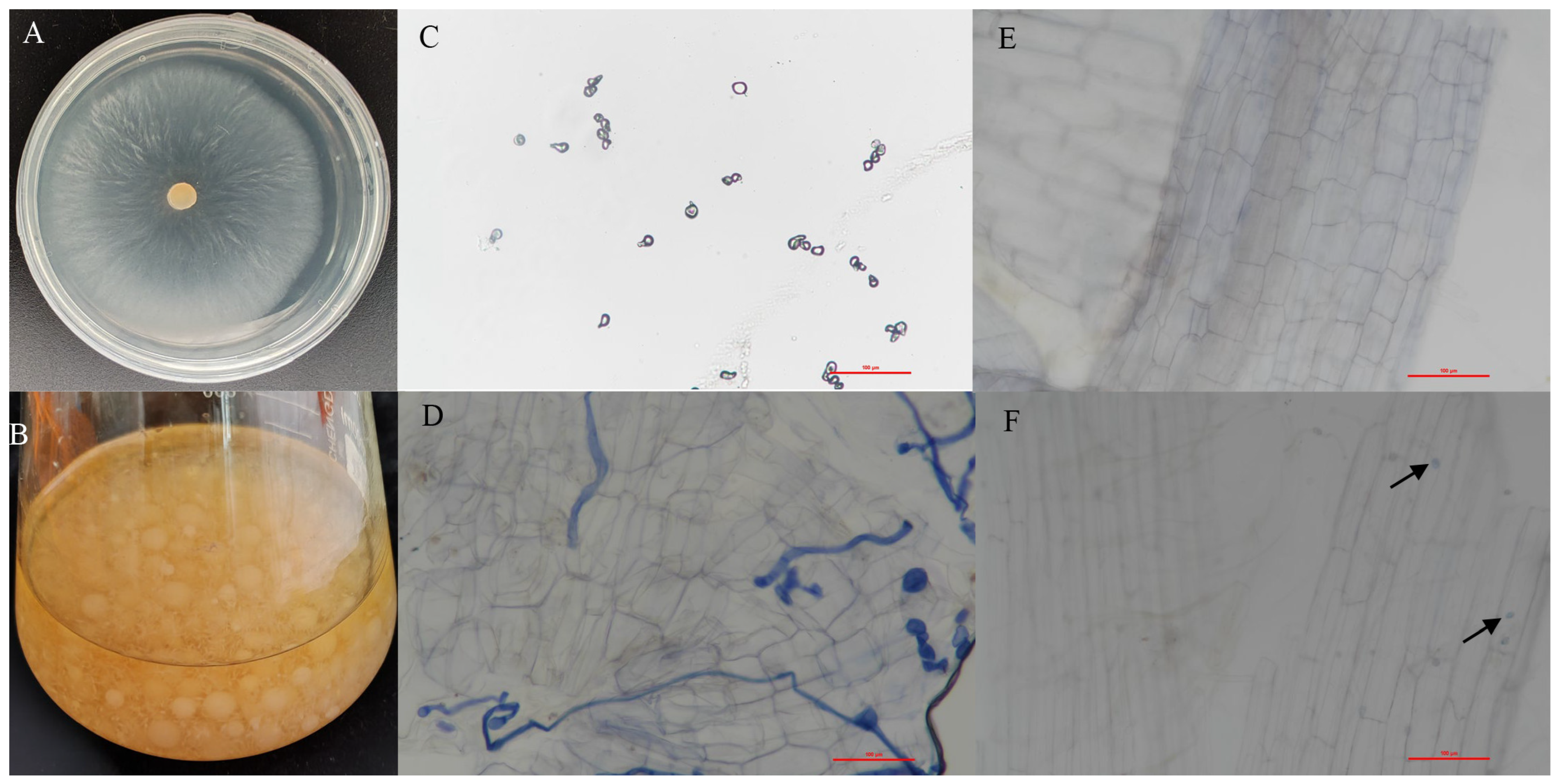
An endophytic fungus called P. indica establishes mutualistic associations with a broad range of host plants and significantly enhances their resilience against pathogenic threats [13]. Research shows that the root endophyte P. indica shares functional parallels with AMF in promoting plant growth and stress tolerance [14]. In contrast to the obligate biotrophy of AMF, P. indica is capable of axenic growth on defined media, deriving nutrients saprotrophically [15]. Following inoculation with P. indica, successful root colonization in plants was assessed by microscopic examination of trypan blue-stained root samples (Figure 1). Colonization with the endophytic fungus P. indica confers multiple physiological benefits for host plants, resulting in accelerated development, enhanced nutrient assimilation, and augmented tolerance to abiotic and biotic stressors [10].
The beneficial fungus P. indica is widely recognized for its growth-promoting effects in a diverse range of host plants. Many studies confirm that P. indica establishes compatible symbioses with diverse plant hosts exhibiting varying colonization efficiency. This symbiotic relationship not only improves the stress resistance of plants but also promotes plant growth and development, increases crop yield and quality, and reduces the need for chemical fertilizers and pesticides, which is in line with the concepts of green and sustainable agriculture [16]. Zhang et al. reported that P. indica can promote the root development and plant growth of blueberry and cutting seedlings by mediating phytohormone metabolism and altering the expression of phytohormone metabolism, signaling- and root development-related genes [17]. Colonization with the endophytic fungus P. indica can promote asparagus seedling growth and development by enhancing root development and regulating phytohormone balance, with some variety-specific and temporal differences [18]. However, despite the significant progress made in the research on P. indica-mediated plant stress resistance, there are still many unresolved questions regarding the deep mechanism and practical application, which limits the further popularization and use of P. indica in agricultural production.
Beyond enhancing development, a key and agriculturally relevant aspect of this symbiosis is the fungus’s ability to prime plant resistance against multiple environmental challenges [19]. This review integrates existing findings on how S. indica regulates plant physiology to improve resistance to biotic (pathogen infection) and abiotic stresses (drought, salinity, heavy metal toxicity). We emphasize fungal regulatory networks and their crosstalk with salicylic acid (SA), jasmonic acid (JA), and abscisic acid (ABA) signaling pathways governing induced systemic resilience. By integrating these insights, we highlight the potential of P. indica not merely as a growth booster but as a multifaceted bio-agent that strengthens plant adaptive capacity, offering a sustainable strategy for crop improvement under stress conditions. To systematically interpret the progress of existing research, this review follows a clear structural framework: First, the root colonization patterns and basic symbiotic interactions between P. indica and horticultural plants are illustrated. Next, how the fungus activates plant defenses against biotic pathogens is explained, followed by a review of the physiological and molecular mechanisms through which it alleviates drought, salinity and heavy metal stress. We then analyze prominent experimental heterogeneity, common methodological flaws in published trials, and the cost–benefit balance of field inoculation (Table S1). This review closes by highlighting unresolved research limitations and suggesting standardized experimental protocols and future agricultural research prospects for P. indica.

2. Function of P. indica in Plant Biotic Stress Response

As a widely distributed endophytic fungus, P. indica engages in mutualistic symbiosis with a diverse array of host plants, exerting profound positive effects on host resistance to various pathogenic agents. This symbiont mediates immune defense priming to induce systemic resistance prior to pathogen challenge. P. indica significantly suppresses wheat diseases induced by Fusarium graminearum Schwabe and Rhizoctonia cerealis van der Hoeven, mainly by enhancing systemic resistance through the elevation of hydrogen peroxide (H2O2) levels, antioxidant enzyme activity, relative water content, and membrane stability [20]. P. indica colonization significantly suppresses wheat disease progression, reduces Fusarium pseudograminearum O’Donnell & T. Aoki colonization capacity, and lowers deoxynivalenol content in wheat roots. Meanwhile, RNA-seq and metabolome analyses have demonstrated that P. indica partially functions through the phenylpropanoid biosynthesis pathway in F. pseudograminearum infection [21]. Colonization of rice roots by P. indica significantly suppresses rice blast and bakanae disease by upregulating the expression of pathogen resistance genes (PR2, PR1a, PBZ1, PAL, LOX, POX) in rice [22]. Several reports have confirmed the use of P. indica as a biocontrol agent in controlling the infestation of both pathogens and insects. In onion, colonization of P. indica promotes resistance against Spodoptera exigua (Hübner) by activating phenylalanine ammonia-lyase and polyphenol oxidase activity and reducing H2O2 content [23]. Similarly, Atia et al. reported that P. indica improved the tolerance of cucumber plants to root-knot nematode infection by regulating photosynthesis and innate immune response genes [24]. The colonization of P. indica in rice plants has been found to improve resistance against Cnaphalocrocis medinalis (Guenée) through the activation of antioxidant- and JA-mediated defense responses [25]. In sweet potato plants, the colonization of P. indica simultaneously enhanced resistance against insect herbivory by increasing JA levels and inducing the expression of defense-responsive genes [26]. Transcriptomic data indicate that P. indica participates in the flavonoid biosynthetic pathway and activates the expression of defense-associated genes (AhNPR1, AhNPR10, AhPAL1 and AhCAPX), which consequently strengthens the resistance of peanut plants against Phoma arachidicola Marasas et al. [27].

3. The Role of P. indica Under Adverse Conditions

As a versatile mutualistic root endophyte, P. indica plays a pivotal role in enhancing the resilience of host plants to diverse abiotic stressors. When exposed to abiotic stresses such as drought, salinity, and heavy metal toxicity, P. indica enhances host plant performance by improving nutrient acquisition efficiency, modulating phytohormone signaling and homeostasis, and reinforcing antioxidant defense networks to scavenge excess ROS. Figure 1 illustrates the typical root colonization patterns of P. indica, which reflect the fungus’s capacity to form widespread symbiotic interfaces with host root cells.

3.1. Salt Stress

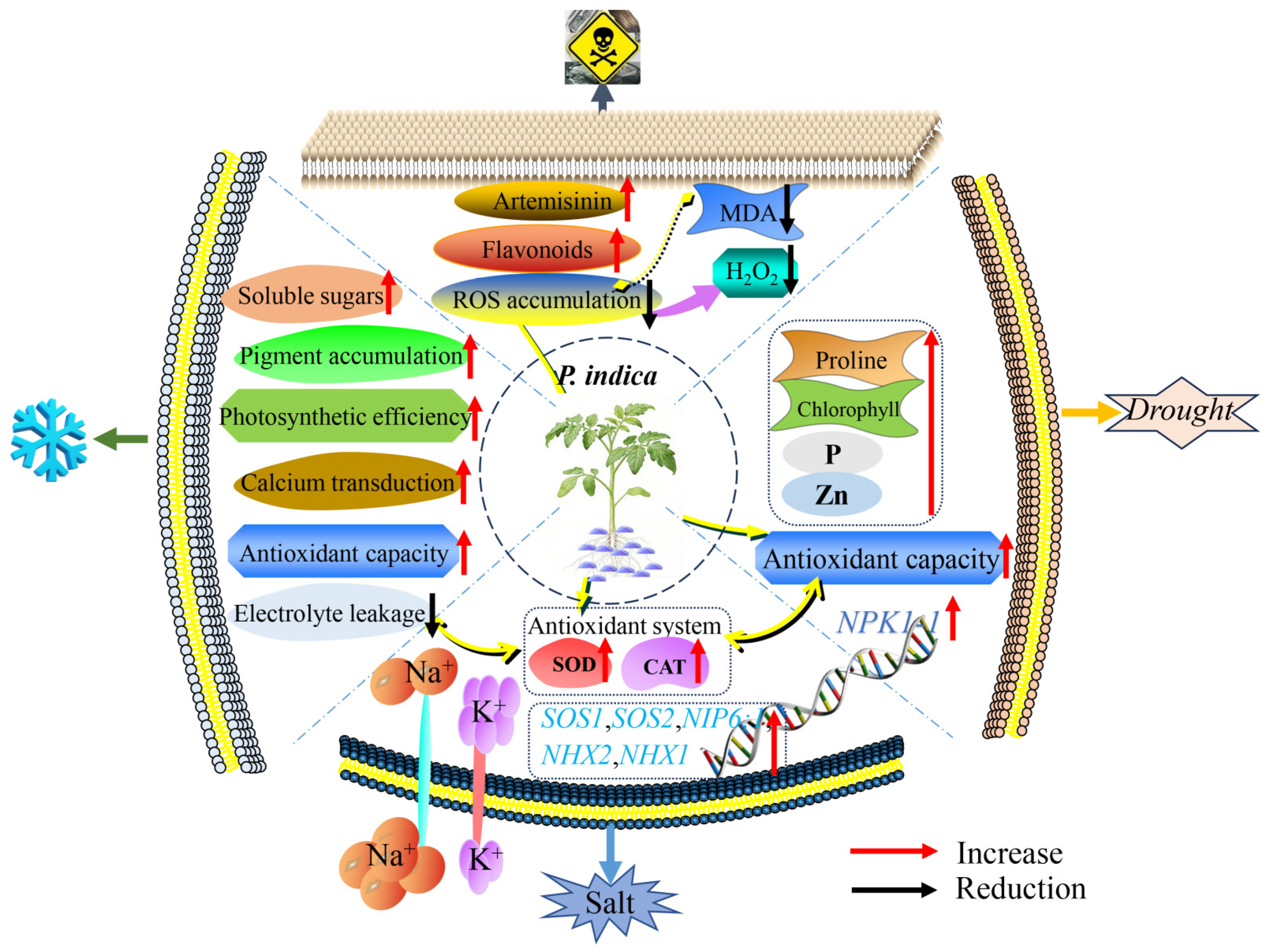
As a critical abiotic stressor, soil salinity jeopardizes plant viability and crop yields. The initial osmotic effect of high external salt levels hinders water absorption, causing physiological drought (Figure 2). Concurrently, the accumulation of cytotoxic ions, particularly Na+, within plant tissues disturbs critical mineral balances and interferes with fundamental cellular metabolism. This cascade of dysfunction results in the marked suppression of plant growth observed under saline conditions. Colonization by the beneficial fungus P. indica has been demonstrated to enhance plant salinity tolerance across diverse species (Table 1). In a range of studies, several universal protective mechanisms have emerged: (i) maintenance of ion homeostasis, primarily through reduced Na+ uptake, improved Na+/K+ ratios, and upregulated vacuolar Na+/H+ antiporters (e.g., LeNHX1, NHX2) and plasma-membrane SOS pathway genes (SOS1, SOS2); (iii) improved photosynthetic efficiency and biomass accumulation. For instance, inoculation of Glycyrrhiza uralensis Fisch. with P. indica significantly improves growth performance, stress resistance, and medicinal compound accumulation under salt stress [28]. Similarly, in tomato, P. indica upregulates LeNHX1 and enhances the Na+/K+ ratio [29]; in soybean and Gerbera jamesonii Bolus, it activates PM-H+-ATPase, SOS1, and SOS2 [30,31]; and in maize, it reduces root and shoot Na+ while maintaining root transmembrane water transport [32]. These findings point to a core regulatory network, centered on ion transport, antioxidant defense, and osmotic adjustment, which appears to be broadly conserved across host plants. (ii) enhanced antioxidant defense is another conserved strategy across species. Under saline–alkali stress, soybean relies on osmolyte homeostasis and ROS detoxification to relieve salt damage [33]; paulownia inoculated with P. indica activates antioxidant enzymes to eliminate salt-induced oxidative injury and accumulates leaf soluble sugars for osmotic buffering [34]. For rice exposed to combined salt and drought stress, symbiosis significantly elevates catalase (CAT) activity alongside soluble carbohydrate accumulation to mitigate dual stress damage [35]. Beyond direct host physiological regulation, P. indica can remodel rhizosphere microbial communities to further amplify ion homeostasis and antioxidant capacity, conferring stronger systemic salt tolerance in soybean under combined saline–alkali conditions [36]. (iii) enhanced biomass accumulation is a universal phenotypic output of fungal symbiosis under salt stress. P. indica reduces salt-caused mortality and boosts plant height and biomass in paulownia [34]; rice under concurrent salt and drought stress also achieves higher biomass and stable productivity after colonization [35]. Collectively, these cross-species results confirm a broadly conserved core regulatory network centered on ion transport, antioxidant defense, and osmotic adjustment. In fenugreek, symbiosis with P. indica establishes synergistic signal crosstalk with methyl jasmonate to facilitate the uptake of potassium, calcium and magnesium, while proline homeostasis remains stable [37]. Under alkaline salt stress, colonization by P. indica remodels strawberry’s adaptive responses via transcriptional regulation of carbon and nitrogen metabolic genes (argG, asnB, GLT1) [38]. This unique regulatory pathway has not yet been reported in other tested plant hosts. These interspecific discrepancies may be attributed to intrinsic physiological disparities among plant taxa, together with heterogeneous experimental variables including stress duration and severity, cultivation practices and fungal inoculation regimens.
Most studies report enhanced antioxidant enzyme activity under P. indica inoculation; however, the magnitude and timing of induction differ between studies, and in a few cases (e.g., proline accumulation), the direction of change varies—decreasing in tomato but often increasing or remaining unchanged in other species—depending on the severity of stress and the plant’s intrinsic osmotic adjustment strategy. Similarly, while ion homeostasis is universally improved, the relative contributions of vacuolar sequestration versus root-to-shoot exclusion differ among species, as inferred from the differential expression of NHX and SOS homologues. Collectively, these studies underscore the multiple coordinated strategies of P. indica in plant salinity tolerance.

3.2. Drought Stress

Drought stress adversely affects plants at multiple levels, leading to reduced growth and productivity [39,40]. Colonization by the endophytic fungus P. indica has been shown to mitigate these detrimental effects through diverse mechanisms (Figure 2). Colonization by P. indica mitigates osmotic stress in rice by simultaneously boosting seedling biomass, phosphorus and zinc (Zn) acquisition, and chlorophyll fluorescence while elevating leaf proline concentration, total antioxidant capacity, and pyrroline-5-carboxylate synthase activity [41]. Physiologically, it enhances water and nutrient acquisition (e.g., increased phosphorus and Zn uptake in rice) and promotes root morphological modifications (increased volume, length, and depth) [42]. At the molecular level, specific regulatory cascades have been implicated. Rice exhibits increased phosphorus uptake likely mediated by phosphate transporters; however, direct modulation of these transporter genes by P. indica is yet unconfirmed. In banana, drought-induced upregulation of MaNPK1-1 suggests a role for the ANP kinase family in the P. indica-mediated stress response [43]. In blueberry, the fungus improves drought tolerance by strengthening antioxidant capacity and modulating the expression of genes involved in the stress response, carbohydrate metabolism, secondary metabolism, and cell wall remodeling [17]. Under combined drought and nickel stress, P. indica not only elevates the essential oil content in basil but also alters its compositional profile, highlighting its ability to influence secondary metabolite synthesis under abiotic constraints [16] (Table 1). Critically, current molecular evidence remains largely correlative. While transcriptional changes in P5CS, MaNPK1-1, and various antioxidant-encoding genes have been documented, functional validation via genetic manipulation (e.g., knockout, overexpression, or complementation) is lacking, making it difficult to distinguish direct P. indica-triggered effects from passive plant acclimation. Taken together, the results demonstrate that P. indica mitigates drought stress primarily by improving water and nutrient acquisition, promoting chlorophyll biosynthesis, accumulating osmolytes including proline, and boosting the antioxidant defense system to limit oxidative damage. This review reveals that nutrient acquisition and antioxidant regulation play a dominant role in the existing research evidence on drought stress. Therefore, future research is likely to focus primarily on these two aspects.
Table 1. Summary of studies reporting the role of Piriformospora indica in improving tolerance to various abiotic stresses in horticultural and crop plants.
SpeciesAbiotic StressObserved Physiological EffectReference
TomatoSaltImproved tomato growth performance and yield[29]
Date palmSaltMaintained Na+ and K+ ion homeostasis[44]
G. jamesoniiSaltUpregulated the expression of ion homeostasis-related genes[31]
G. UralensisSaltIncreased the biomass[28]
FenugreekSaltPromoted photosynthetic activity [37]
MaizeSaltMaintained the root water transport [32]
RiceSalt and droughtPromoted plant growth, nutrient uptake[35]
SoybeanSaline–alkalineIncreased antioxidant enzyme activities and reduced MDA content[33]
StrawberrySaline–alkalineMaintained the balance of carbon and nitrogen allocation[38]
SoybeanSaltRegulated the transcription level of PM H+-ATPase, SOS1, and SOS2[30]
PaulowniaSaltMitigated oxidative damage from ROS[34]
MaizeSaltEnhanced antioxidant enzyme activities[45]
RiceDroughtIncreased seedling biomass[41]
BananaDroughtUpregulated the expression of MaNPK1-1[43]
BlueberryDroughtEnhanced antioxidant ability[17]
BasilDrought and nickelEnhanced essential oil content[16]
RiceCdLowered oxidative stress[46]
A. annuaAsPromoted phenolic acid and phenolic compounds[47]
B. junceaCdAttenuated ROS levels[48]
TomatoNickel nitrateIncreased anthocyanin and proline[49]
BananaColdStimulated antioxidant capacity[50]
TobaccoColdMitigated oxidative damage[51]
M. oleiferaColdImproved the yield and quality[52]
GrapevineColdReduced lipid peroxidation and h H2O2 contents[53]
M. laosensisColdDecreased the H2O2 and MDA contents[54]
RiceMoisturePromoted root development[42]
BananaPhosphorus and PotassiumRegulated the accumulation of carbohydrates, secondary metabolites, osmoprotectants[18]

3.3. Heavy Metal Stress

Endophytic fungi are known as one of the most important classes of soil microorganisms that induce physiological and ecological alterations in their host plant. Specifically, root endophytes are well documented for promoting plant growth under heavy metal stress (Figure 2). Research indicates that P. indica confers tolerance through diverse mechanisms, including reducing oxidative damage, modulation of metal uptake and translocation, and enhancing antioxidant and detoxification systems. However, the molecular and physiological strategies diverge significantly depending on both the metal type and the host plant species. For example, under cadmium (Cd) stress, the predominant strategy involves restricting root uptake and shoot translocation, coupled with synergistic action with exogenous hormones (e.g., 28-homobrassinolide) to suppress excessive osmolyte accumulation (proline, glycine betaine) [48], as observed in Brassica juncea (L.) Czern. et Coss., while simultaneously reducing root cell death in rice [46]. By contrast, arsenic (As) toxicity, due to its metabolic mobility, invokes more specialized enzymatic detoxification. P. indica upregulates the glyoxalase system to detoxify methylglyoxal and rebalances the ascorbate-glutathione cycle [55], while also activating distinct secondary metabolic branches—such as artemisinin and flavonoid biosynthesis in Artemisia annua L. [47]. Inoculation with P. indica also restores seed germination and plant growth under As stress via root hyper-colonization, which alleviates oxidative stress by regulating antioxidative enzymes and glutathione and proline levels, while restricting As translocation from roots to shoots [56]. Regarding other heavy metals, P. indica treatment has been found to significantly improve the growth performance of tomato by enhancing photosynthetic factors and decreasing malondialdehyde (MDA) and H2O2 content, thereby increasing the tolerance of tomato plants under Ni stress [49]. Under aluminium (Al) stress, colonization by P. indica was associated with the increased expression of genes related to nutrient acquisition, especially those mediating phosphate and iron transport, indicating a potential enhancement of nutrient uptake capacity in barley [57] (Table 1). Thus, while Cd and As responses emphasize ion exclusion and enzymatic detoxification, Al tolerance leans towards nutrient-balance restoration, and Ni tolerance remains largely confined to oxidative defense. Taken together, antioxidant regulation is the most widely involved pathway across various heavy metal stresses, followed by ion homeostasis.

3.4. Temperature Stress

The application of fungal endophytes to increase the horticultural plant yield and plant stress tolerance could be an ecofriendly alternative for this purpose. Under heat stress, P. indica colonization mitigates adverse effects on jujube (Zizyphus jujuba Mill.), promoting early fruit expansion, accelerating pigment accumulation and tissue softening at maturity, and elevating key fruit quality indices [58]. Upon exposure to low non-freezing or freezing temperatures, plants typically undergo membrane lipid peroxidation, disruption of cellular membrane fluidity and integrity, and excessive accumulation of ROS, leading to oxidative damage, electrolyte leakage, and impaired photosynthetic efficiency. Similar adaptive benefits are observed in other species. For example, in banana, P. indica improves cold tolerance by boosting leaf antioxidant defenses, accumulating soluble sugars, and activating cold-related gene expression [50]. Single or combined inoculation of AMF and P. indica could significantly increase the biomass of Mytilaria laosensis Lecomte and improve cold resistance by promoting plant growth and regulating the biomass allocation strategy [54]. Synergistic effects have also been reported: the combined application of P. indica and Zn in vines enhanced cold resilience by coordinating osmoregulation, antioxidant activity, and growth regulation [53]. Additionally, co-inoculation of P. indica with AMF improved yield, quality, and low-temperature stress resistance in Moringa oleifera Lam. [52] (Figure 2).

3.5. Other Stress

Phosphorus and potassium are two essential macronutrients that participate in diverse physiological and biochemical processes critical for plant growth, development, and stress tolerance. Deficiencies in phosphorus or potassium severely restrict plant performance by impairing energy metabolism, signal transduction, nutrient transport, and photosynthetic carbon fixation. P. indica can promote the growth of banana plants under different concentrations of P and K treatments by mediating starch and sucrose accumulation in roots and leaves, and by modulating the accumulation of stress markers (such as MDA, anthocyanins, etc.) [18].

4. Involvement of P. indica in Phytohormone Signaling Under Stress

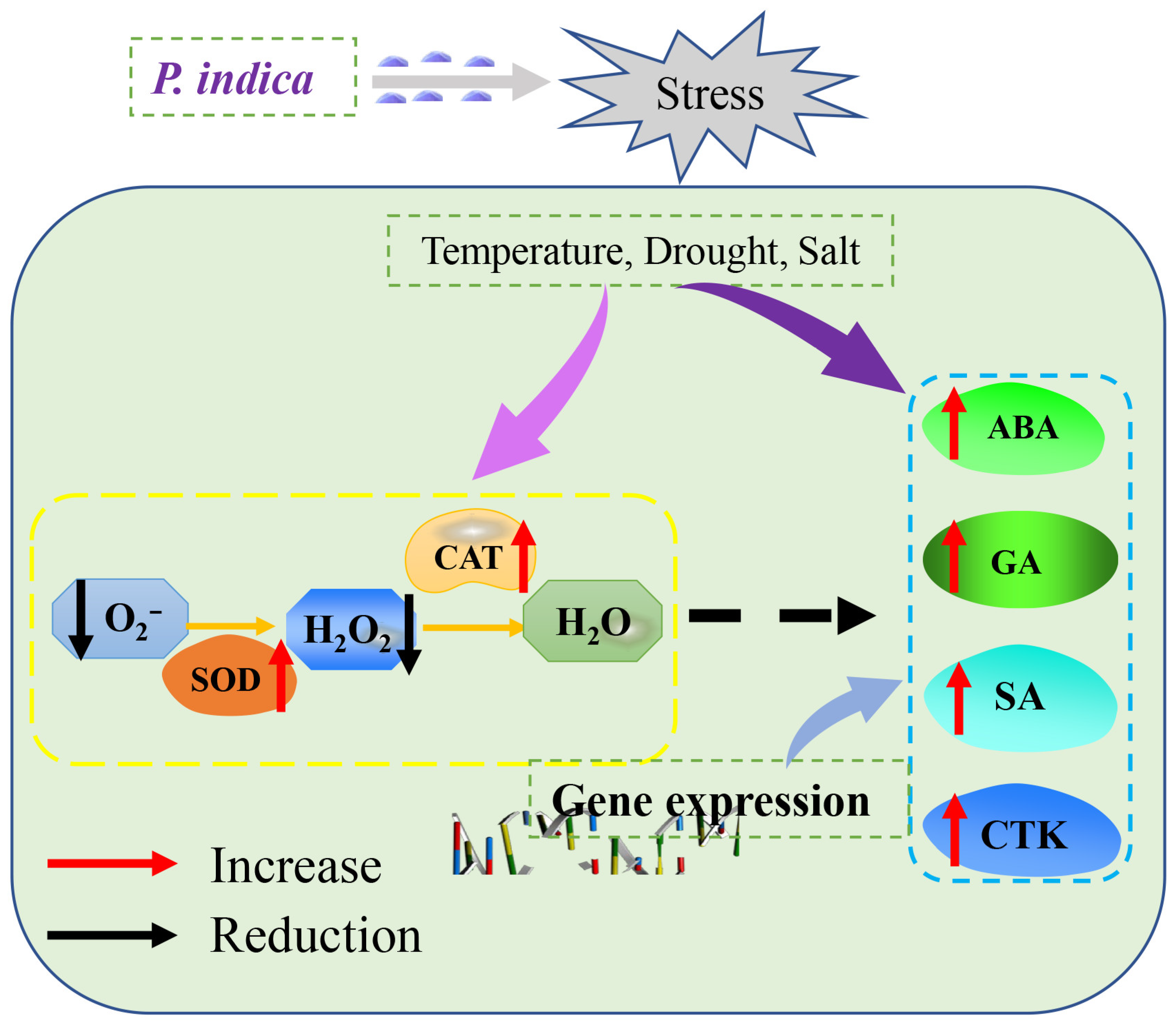
Phytohormones serve as core signaling regulators that integrate external stress stimuli and internal plant defense responses. P. indica regulates plant stress responses through the modulation of hormone signaling and associated metabolic pathways. Among these regulatory modules, ABA, SA, gibberellic acid (GA), and cytokinins (CTK) function synergistically or antagonistically to shape plant stress resilience (Figure 3). Under cold stress in grapevine, combined application of P. indica and Zn coordinated an increase in ABA, polyamines, soluble carbohydrates, proline, soluble proteins, and total phenolic content, contributing to enhanced stress acclimation [53]. In response to drought, P. indica colonization in corn seedlings altered the expression of genes within the CTK and ABA signaling pathways, suggesting its involvement in hormonal regulation to improve drought tolerance [59]. Under saline conditions, co-cultivation with P. indica significantly increased the biomass of pakchoi and elevated the activity of antioxidant enzymes, including superoxide dismutase (SOD) and CAT. This was accompanied by increased levels of plant hormones such as SA and GA, collectively mitigating salinity stress [60]. The balanced regulation of stress and growth hormones (ABA, SA, JA, GA, auxin, CTK) constitutes a critical signaling crosstalk network, allowing horticultural plants to resist adverse conditions without sacrificing growth performance. Collectively, these studies demonstrate that P. indica-triggered hormonal reprogramming is a core and universal mechanism underlying enhanced broad-spectrum stress resilience in plants.

5. Conclusions and Future Perspectives

Stresses are major constraints to plant growth, survival, and yield, which also result in oxidative stress and ROS overproduction by disrupting cellular redox homeostasis. P. indica is a versatile endophytic fungus that effectively alleviates diverse biotic and abiotic stresses in horticultural plants via morphological adaptation, physiological modulation, and hormonal and molecular regulation. This narrative review describes the progress of research on P. indica’s role in improving plant tolerance to various abiotic and biotic stresses, including drought, salinity, heavy metal toxicity, extreme temperatures, and pathogens. P. indica can induce the expression of plant stress-responsive genes and activate stress resistance-related signal transduction pathways, thereby enhancing the plant’s inherent ability to defend itself against adverse environments. Genomic collation revealed that P. indica, a growth- and stress-promoting cultivable symbiont, produces PiEF-hand (an EF-hand Ca2+-binding protein vital to plant development), and interaction network analysis shows PiEF-hand engages in key cellular processes [61]. However, further exploration is still needed regarding the functions of key candidate genes involved in the stress response following successful P. indica colonization, the regulatory pathways of various hormones, and the crosstalk among these pathways. Current research suffers from insufficient field trials, vague molecular signaling mechanisms, unstable colonization efficiency, inconsistent experimental designs and inadequate multi-omics integration. Moreover, AMF exhibits symbiosis with most plants, enhancing uptake and immunity, but is axenically unculturable and fails to colonize Brassicaceae, limiting its production. Meanwhile, plant growth-promoting rhizobacteria colonize the rhizosphere and enhance stress resistance via P-solubilization, phytohormones, and antibiotics, but their ability to colonize falters under salinity/drought, and their effects are root-localized with weak systemic induction. Unlike most root symbionts, the axenically cultivable P. indica associates with diverse plants including AMF non-hosts, boosting growth and multi-stress tolerance via SA/ABA cascades, yet its compatibility and colonization efficiency vary by species and environment. However, its formulation and field application are lagging behind that of commercial plant growth-promoting rhizobacteria, and thus require targeted optimization.
Compared with host-specific endophytes, P. indica offers superior cost-effectiveness due to its facultative endophytic nature, enabling mass production via axenic culture independent of plant hosts, thus reducing cultivation and industrial costs. It colonizes a broad range of plants, promoting growth, stress resistance, and nutrient uptake, which decreases the requirement for fertilizers and pesticides while improving yield and quality, delivering notable economic and ecological benefits. However, its performance is constrained by soil conditions, temperature, and microbial competition, leading to inconsistent colonization. The lack of mature commercial formulations further limits its shelf life and large-scale adoption, indirectly raising application costs. Future research should prioritize low-cost fermentation, stable inoculant development, and site-specific application strategies to enhance its overall cost–benefit ratio. Although current studies have clarified its core stress-alleviating mechanisms, several critical gaps remain in our understanding of its molecular regulatory network and practical application. Accordingly, this review proposes three targeted future research directions, as follows:

5.1. P. indica Enhances Stress Resistance Through the Involvement of Gas Molecules in Horticultural Plants

To date, research on the mechanism through which P. indica improves plant stress resistance has mostly focused on the physiological and biochemical scales, and the molecular regulatory network is not yet clear. One testable research hypothesis for future work concerns the potential crosstalk between P. indica symbiosis and plant gas signaling molecules. Gasotransmitters (such as nitric oxide (NO), hydrogen sulfide, and carbon monoxide) are important signal messengers in plants that play a key role in regulating plant growth, development, and stress response. Studies have indicated that P. indica can induce NO production, which influences plant root architecture and nitrogen uptake, ultimately promoting overall plant growth. However, whether P. indica can regulate the synthesis and metabolism of other gas signaling molecules and also participate in the regulation of plant stress resistance has not been reported yet. Based on this, we speculate that P. indica may regulate the synthesis and metabolism of plant gas signaling molecules, thereby influencing plant stress resistance.

5.2. P. indica Regulates Transcription Factors or Key Genes, Which Can Be Elucidated Using Genomics and Transcriptomics

With the rapid development of high-throughput sequencing technologies (such as genomics, transcriptomics, proteomics, and metabolomics), it has become possible to systematically elucidate the key genes and regulatory factors involved in P. indica-mediated plant stress resistance. Functional verification of these key regulators will help construct a comprehensive molecular regulatory network and clarify the precise genetic basis of P. indica-primed stress resistance.

5.3. Optimization of P. indica Application Technology and Expansion of Application Scenarios

Although P. indica has broad application prospects in improving plant stress resistance, its practical application is still limited by factors such as the difficulty of large-scale culture, unstable symbiotic effects, and the poor stress resistance of the fungus itself. Future research should focus on optimizing P. indica cultivation systems and microbial agent formulations. In addition, it is necessary to expand in saline–alkali soil restoration and protected horticulture, which will further promote the practical and industrial utilization of P. indica.
Whether environmental factors can cause differences in colonization efficiency, contradictions in experimental results, and bottlenecks encountered in field applications still requires further exploration. Future work on P. indica will need to focus on developing standardized inoculum protocols, exploring host genotype–fungus interactions, and performing multi-omics profiling under combined stresses.

Supplementary Materials

The following supporting information can be downloaded at: https://www.mdpi.com/article/10.3390/horticulturae12070860/s1, Table S1: Experimental design of P. indica in plants under stress conditions.

Author Contributions

Writing—original draft preparation, writing-review and editing, Y.Y. (Yan Yang), conceptualization, C.C., validation, writing—original draft preparation, Y.Y. (Yandong Yao), formal analysis, P.Y., writing—review and editing, H.Z. All authors have read and agreed to the published version of the manuscript.

Funding

This research was funded by the Shanxi Agricultural University Doctoral Research Startup Project, grant number 2026BQ70.

Data Availability Statement

No new data were created or analyzed in this study. Data sharing is not applicable to this article.

Conflicts of Interest

The authors declare no conflicts of interest.

Abbreviations

AMFArbuscular Mycorrhizal Fungi
SASalicylic Acid
JAJasmonic Acid
ABAAbscisic Acid
H2O2Hydrogen Peroxide
ROSReactive Oxygen Species
CATCatalase
SODSuperoxide Dismutase
MDAMalondialdehyde
PPhosphorus
ZnZinc
CdCadmium
AsArsenic
GAGibberellic Acid
AlAluminium
NONitric Oxide
GWASGenome-Wide Association Study
CTKCytokinins

References

  1. Zhang, H.; Zhu, J.; Gong, Z.; Zhu, J.K. Abiotic stress responses in plants. Nat. Rev. Genet. 2022, 23, 104–119. [Google Scholar] [CrossRef] [Scilit] [PubMed]
  2. Naing, A.H.; Kim, C.K. Abiotic stress-induced anthocyanins in plants: Their role in tolerance to abiotic stresses. Physiol. Plant. 2021, 172, 1711–1723. [Google Scholar] [CrossRef] [Scilit] [PubMed]
  3. Rankenberg, T.; Geldhof, B.; van Veen, H.; Holsteens, K.; Van de Poel, B.; Sasidharan, R. Age-Dependent Abiotic Stress Resilience in Plants. Trends Plant Sci. 2021, 26, 692–705. [Google Scholar] [CrossRef] [Scilit] [PubMed]
  4. Daraz, U.; Ahmad, I.; Li, Q.S.; Zhu, B.; Saeed, M.F.; Li, Y.; Ma, J.; Wang, X.B. Plant growth promoting rhizobacteria induced metal and salt stress tolerance in Brassica juncea through ion homeostasis. Ecotoxicol. Environ. Saf. 2023, 267, 115657. [Google Scholar] [CrossRef] [Scilit] [PubMed]
  5. Chen, C.; Wang, X.; Jin, Y.; Yao, Y.; Li, S.; Liao, Z.; Zhang, X.; Yan, X. Simultaneous exposure to microplastics and heavy metal lead induces oxidative stress, histopathological damage, and immune dysfunction in marine mussel Mytilus coruscus. Ecotoxicol. Environ. Saf. 2025, 289, 117493. [Google Scholar] [CrossRef] [Scilit] [PubMed]
  6. Zhuang, Y.; Zhang, X.; Zhang, S.; Sun, Y.; Wang, H.; Chen, Y.; Zhang, H.; Zou, P.; Feng, Y.; Lu, X.; et al. Chaperone-mediated autophagy manipulates PGC1α stability and governs energy metabolism under thermal stress. Nat. Commun. 2025, 16, 4455. [Google Scholar] [CrossRef] [Scilit] [PubMed]
  7. Berauer, B.J.; Steppuhn, A.; Schweiger, A.H. The multidimensionality of plant drought stress: The relative importance of edaphic and atmospheric drought. Plant Cell Environ. 2024, 47, 3528–3540. [Google Scholar] [CrossRef] [Scilit] [PubMed]
  8. Cao, M.; Narayanan, M.; Shi, X.; Chen, X.; Li, Z.; Ma, Y. Optimistic contributions of plant growth-promoting bacteria for sustainable agriculture and climate stress alleviation. Environ. Res. 2023, 217, 114924. [Google Scholar] [CrossRef] [Scilit] [PubMed]
  9. Orozco-Mosqueda, M.d.C.; Glick, B.R.; Santoyo, G. Cross-talk within plant niches: Endophytic and arbuscular mycorrhizal fungi for sustainable crop production. FEMS Microbiol. Rev. 2026, 50, fuaf063. [Google Scholar] [CrossRef] [Scilit] [PubMed]
  10. Zhang, X.; Jin, X.; Li, J.; Dini-Andreote, F.; Li, H.; Khashi, U.R.M.; Du, M.; Wu, F.; Wei, Z.; Zhou, X.; et al. Common mycorrhizal networks facilitate plant disease resistance by altering rhizosphere microbiome assembly. Cell Host Microbe 2025, 33, 1765–1778.e7. [Google Scholar] [CrossRef] [Scilit] [PubMed]
  11. Verma, S.; Varma, A.; Rexer, K.-H.; Hassel, A.; Kost, G.; Sarbhoy, A.; Bisen, P.; Bütehorn, B.; Franken, P. Piriformospora indica, gen. et sp. nov., a New Root-Colonizing Fungus. Mycologia 1998, 90, 896–903. [Google Scholar] [CrossRef] [Scilit]
  12. Franken, P. The plant strengthening root endophyte Piriformospora indica: Potential application and the biology behind. Appl. Microbiol. Biotechnol. 2012, 96, 1455–1464. [Google Scholar] [CrossRef] [Scilit] [PubMed]
  13. Kundu, A.; Mishra, S.; Kundu, P.; Jogawat, A.; Vadassery, J. Piriformospora indica recruits host-derived putrescine for growth promotion in plants. Plant Physiol. 2022, 188, 2289–2307. [Google Scholar] [CrossRef] [Scilit] [PubMed]
  14. Li, Q.S.; Xie, Y.C.; Rahman, M.M.; Hashem, A.; Abd Allah, E.F.; Wu, Q.S. Arbuscular Mycorrhizal Fungi and Endophytic Fungi Activate Leaf Antioxidant Defense System of Lane Late Navel Orange. J. Fungi 2022, 8, 282. [Google Scholar] [CrossRef] [Scilit] [PubMed]
  15. Singh, M.; Sharma, J.G.; Giri, B. Augmentative Role of Arbuscular Mycorrhizal Fungi, Piriformospora indica, and Plant Growth-Promoting Bacteria in Mitigating Salinity Stress in Maize (Zea mays L.). J. Plant Growth Regul. 2024, 43, 1195–1215. [Google Scholar] [CrossRef] [Scilit]
  16. Rasouli, F.; Ajoudani, A.; Shokati, M.; Vaseghi, N.; Haghaninia, M.; Hassanpouraghdam, M.B.; Ghadimi, S.A.; Bahrevar, F. Mitigation of drought and nickel-induced stress in Basil using root endophyte Piriformospora indica: Implications for sustainable agriculture. Ind. Crops Prod. 2025, 237, 122176. [Google Scholar] [CrossRef] [Scilit]
  17. Zhang, Y.; Qu, P.; Zhang, J.; Li, R.; Liu, R.; Cheng, C. Insights into the Underlying Mechanism of the Piriformospora indica-Enhanced Drought Tolerance in Blueberry. Horticulturae 2025, 11, 605. [Google Scholar] [CrossRef] [Scilit]
  18. Zhao, B.; Li, R.; Tian, N.; Li, Q.; Cheng, C.; Wang, M. The Growth-Promoting Effects of Piriformospora indica on Banana Under Different Concentrations of Phosphorus and Potassium Treatments. Plants 2025, 14, 1878. [Google Scholar] [CrossRef] [Scilit] [PubMed]
  19. Subhash, A.P.; Veena, S.S.; Makeshkumar, T.; Anith, K.N. Piriformospora indica and Arbuscular Mycorrhizal Fungus suppress fungal root rot and mosaic diseases of cassava. Symbiosis 2025, 95, 241–254. [Google Scholar] [CrossRef] [Scilit]
  20. Li, L.; Guo, N.; Feng, Y.; Duan, M.; Li, C. Effect of Piriformospora indica-Induced Systemic Resistance and Basal Immunity Against Rhizoctonia cerealis and Fusarium graminearum in Wheat. Front. Plant Sci. 2022, 13, 836940. [Google Scholar] [CrossRef] [Scilit] [PubMed]
  21. Li, L.; Hao, R.; Yang, X.; Feng, Y.; Bi, Z. Piriformospora indica Increases Resistance to Fusarium pseudograminearum in Wheat by Inducing Phenylpropanoid Pathway. Int. J. Mol. Sci. 2023, 24, 8797. [Google Scholar] [CrossRef] [Scilit] [PubMed]
  22. Li, X.; Wajjiha, B.; Zhang, P.; Dang, Y.; Prasad, R.; Wei, Y.; Zhang, S.H. Serendipita indica chitinase protects rice from the blast and bakanae diseases. J. Basic Microbiol. 2023, 63, 734–745. [Google Scholar] [CrossRef] [Scilit] [PubMed]
  23. Roylawar, P.; Khandagale, K.; Nanda, S.; Soumia, P.S.; Jadhav, S.; Mahajan, V.; Gawande, S. Colonization of Serendipita indica promotes resistance against Spodoptera exigua in onion (Allium cepa L.). Front. Microbiol. 2023, 14, 1190942. [Google Scholar] [CrossRef] [Scilit] [PubMed]
  24. Atia, M.A.M.; Abdeldaym, E.A.; Abdelsattar, M.; Ibrahim, D.S.S.; Saleh, I.; Elwahab, M.A.; Osman, G.H.; Arif, I.A.; Abdelaziz, M.E. Piriformospora indica promotes cucumber tolerance against Root-knot nematode by modulating photosynthesis and innate responsive genes. Saudi J. Biol. Sci. 2020, 27, 279–287. [Google Scholar] [CrossRef] [Scilit] [PubMed]
  25. Chen, C.-Y.; Huang, P.-H.; Yeh, K.-W.; Wang, S.-J. Colonization of Piriformospora indica enhances insect herbivore resistance of rice plants through jasmonic acid- and antioxidant-mediated defense mechanisms. J. Plant Interact. 2022, 17, 9–18. [Google Scholar] [CrossRef] [Scilit]
  26. Li, Q.; Kuo, Y.W.; Lin, K.H.; Huang, W.; Deng, C.; Yeh, K.W.; Chen, S.P. Piriformospora indica colonization increases the growth, development, and herbivory resistance of sweet potato (Ipomoea batatas L.). Plant Cell Rep. 2021, 40, 339–350. [Google Scholar] [CrossRef] [Scilit] [PubMed]
  27. Wang, C.; Ahsan, T.; Ding, A.; Han, D.; Gao, J.; Liang, C.-H.; Du, S.-T.; Wei, Y.; Huang, Y.-Q.; Zhang, S.-H. Colonization of Serendipita indica enhances resistance against Phoma arachidicola in Arachis hypogaea L. World J. Microbiol. Biotechnol. 2025, 41, 28. [Google Scholar] [CrossRef] [Scilit] [PubMed]
  28. Tang, S.-y.; Liu, P.-f.; Fu, C.; Tang, S.-y.; Zhou, X.-f.; Lou, B.-g. Physiological mechanisms of Piriformospora indica- Glycyrrhiza Uralensis Fisch symbiosis in regulating growth and medicinal compound biosynthesis under salt stress. Front. Plant Sci. 2026, 17, 1802147. [Google Scholar] [CrossRef] [Scilit] [PubMed]
  29. Abdelaziz, M.E.; Abdelsattar, M.; Abdeldaym, E.A.; Atia, M.A.M.; Mahmoud, A.W.M.; Saad, M.M.; Hirt, H. Piriformospora indica alters Na+/K+ homeostasis, antioxidant enzymes and LeNHX1 expression of greenhouse tomato grown under salt stress. Sci. Hortic. 2019, 256, 108532. [Google Scholar] [CrossRef] [Scilit]
  30. Zhang, D.; Wang, X.; Zhang, Z.; Li, C.; Xing, Y.; Luo, Y.; Li, D.; Ma, Z.; Cai, H. Symbiotic System Establishment between Piriformospora indica and Glycine max and Its Effects on the Antioxidant Activity and Ion-Transporter-Related Gene Expression in Soybean under Salt Stress. Int. J. Mol. Sci. 2022, 23, 14961. [Google Scholar] [CrossRef] [Scilit] [PubMed]
  31. Chen, W.; Lin, F.; Lin, K.-H.; Chen, C.; Xia, C.; Liao, Q.; Chen, S.-P.; Kuo, Y.-W. Growth Promotion and Salt-Tolerance Improvement of Gerbera jamesonii by Root Colonization of Piriformospora indica. J. Plant Growth Regul. 2022, 41, 1219–1228. [Google Scholar] [CrossRef] [Scilit]
  32. Lee, S.H.; Wang, Y.; Zwiazek, J.J. Beneficial root endophyte Piriformospora indica reduces plant sodium uptake and enhances cell hydraulic conductivity and salt tolerance of maize seedlings. Plant Soil 2026, 523, 425–440. [Google Scholar] [CrossRef] [Scilit]
  33. Zhu, S.; Shi, F.; Li, H.; Ding, Y.; Chang, W.; Ping, Y.; Song, F. Piriformospora indica alleviates soda saline-alkaline stress in Glycine max by modulating plant metabolism. Front. Plant Sci. 2024, 15, 1406542. [Google Scholar] [CrossRef] [Scilit] [PubMed]
  34. Mu, D.; Zhang, M.; Liang, Y.; Ding, C.; Chen, Q.; Fan, X.; Meng, X.; Zhang, X.; Gao, S.; Zhai, D.; et al. Piriformospora indica enhances growth and salt tolerance in a short rotation woody crop, Paulownia elongata, under NaCl stress. Front. Plant Sci. 2025, 16, 1566470. [Google Scholar] [CrossRef] [Scilit] [PubMed]
  35. Raeisi Vanani, A.; Sheikhi Shahrivar, F.; Nouri, A.; Sepehri, M. Exploring rice tolerance to salinity and drought stresses through Piriformospora indica inoculation: Understanding physiological and metabolic adaptations. Front. Plant Sci. 2024, 15, 1428631. [Google Scholar] [CrossRef] [Scilit] [PubMed]
  36. Zhang, D.; Wang, Y.; Li, Y.; Zhang, Z.; Lin, S.; Wang, X.; Meng, J.; Chen, Z.; Li, J.; Cai, H. Piriformospora indica enhances salt and alkali tolerance in Glycine max by modulating plant physiology, soil properties, and rhizosphere microbial communities. Plant Stress 2025, 18, 101079. [Google Scholar] [CrossRef] [Scilit]
  37. Mehra, N.; Singh, M.; Kapoor, R.; Kumar, P.; Kumar, P.V.; Giri, B. Methyl-Jasmonate and Serendipita indica interaction improves salt stress resilience in fenugreek by modulating biochemical, physiological and morphological traits. Plant Physiol. Rep. 2026, 31, 71–82. [Google Scholar] [CrossRef] [Scilit]
  38. Liu, W.; Gao, X.; Guo, L.; Gao, F.; Chen, S.; Song, X.; Chen, H.; Wang, G.; Guo, H.; Wang, Q.; et al. Transcriptomic and metabolomic analysis reveals the role of Piriformospora indica in enhancing strawberry alkaline tolerance. BMC Plant Biol. 2026, 26, 963. [Google Scholar] [CrossRef] [Scilit] [PubMed]
  39. Fang, Y.; Xiong, L. General mechanisms of drought response and their application in drought resistance improvement in plants. Cell Mol. Life Sci. 2015, 72, 673–689. [Google Scholar] [CrossRef] [Scilit] [PubMed]
  40. Gohari, A.; Eslamian, S.; Abedi-Koupaei, J.; Massah Bavani, A.; Wang, D.; Madani, K. Climate change impacts on crop production in Iran’s Zayandeh-Rud River Basin. Sci. Total Environ. 2013, 442, 405–419. [Google Scholar] [CrossRef] [Scilit] [PubMed]
  41. Saddique, M.A.B.; Ali, Z.; Khan, A.S.; Rana, I.A.; Shamsi, I.H. Inoculation with the endophyte Piriformospora indica significantly affects mechanisms involved in osmotic stress in rice. Rice 2018, 11, 34. [Google Scholar] [CrossRef] [Scilit] [PubMed]
  42. Mani, K.M.; Ameena, M.; Johnson, J.M.; Anith, K.N.; Pillai, P.S.; John, J.; Beena, R. Endophytic fungus Piriformospora indica mitigates moisture stress in rice by modifying root growth. Rhizosphere 2023, 28, 100799. [Google Scholar] [CrossRef] [Scilit]
  43. Lin, T.; Wu, W.; Feng, X.; Xie, J.; Lai, Z.; Miao, L.; Huang, Y. Genome-Wide Identification of the ANP Gene Family in Banana (Musa spp.) and Analysis of MaNPK1 Response to Drought Stress Induced by Piriformospora indica. Agronomy 2025, 15, 2410. [Google Scholar] [CrossRef] [Scilit]
  44. Sabeem, M.; Abdul Aziz, M.; Mullath, S.K.; Brini, F.; Rouached, H.; Masmoudi, K. Enhancing growth and salinity stress tolerance of date palm using Piriformospora indica. Front. Plant Sci. 2022, 13, 1037273. [Google Scholar] [CrossRef] [Scilit] [PubMed]
  45. Singh, S.K.; Pandey, R.; Panwar, C.; Kumar, P.; Sharma, S.; Batra, S.; Kumar, P.; Sharma, J.G.; Singh, M.; Giri, B. Synergy between Piriformospora Indica and Salicylic Acid Modulates Maize Stress Physiology, Ultrastructure, and Gene Expression. J. Plant Growth Regul. 2026, 45, 1117–1144. [Google Scholar] [CrossRef] [Scilit]
  46. Dabral, S.; Yashaswee; Varma, A.; Choudhary, D.K.; Bahuguna, R.N.; Nath, M. Biopriming with Piriformospora indica ameliorates cadmium stress in rice by lowering oxidative stress and cell death in root cells. Ecotoxicol. Environ. Saf. 2019, 186, 109741. [Google Scholar] [CrossRef] [Scilit] [PubMed]
  47. Rahman, S.-u.; Khalid, M.; Kayani, S.-I.; Tang, K. The ameliorative effects of exogenous inoculation of Piriformospora indica on molecular, biochemical and physiological parameters of Artemisia annua L. under arsenic stress condition. Ecotoxicol. Environ. Saf. 2020, 206, 111202. [Google Scholar] [CrossRef] [Scilit] [PubMed]
  48. Kaur, G.; Singh, P.; Madaan, I.; Kaushik, S.; Singh, R.K.; Sirhindi, G. Biopriming With 28-Homobrassinolide and Piriformospora indica Mitigates Cadmium Toxicity in Brassica juncea. Physiol. Plant. 2026, 178, e70862. [Google Scholar] [CrossRef] [Scilit] [PubMed]
  49. Mahmoodi, N.; Movahedi, Z.; Ghabooli, M. Impact of Piriformospora indica on various characteristics of tomatoes during nickel nitrate stress under aeroponic and greenhouse conditions. Front. Microbiol. 2022, 13, 1091036. [Google Scholar] [CrossRef] [Scilit] [PubMed]
  50. Li, D.; Bodjrenou, D.M.; Zhang, S.; Wang, B.; Pan, H.; Yeh, K.W.; Lai, Z.; Cheng, C. The Endophytic Fungus Piriformospora indica Reprograms Banana to Cold Resistance. Int. J. Mol. Sci. 2021, 22, 4973. [Google Scholar] [CrossRef] [Scilit] [PubMed]
  51. Li, H.; Wang, Z.; Yu, Y.; Gao, W.; Zhu, J.; Zhang, H.; Li, X.; Liu, Y. Enhancing cold tolerance in tobacco through endophytic symbiosis with Piriformospora indica. Front. Plant Sci. 2024, 15, 1459882. [Google Scholar] [CrossRef] [Scilit] [PubMed]
  52. Zhou, G.; Wu, S.; Qiu, M.; Long, Y.; He, Q.; Zhang, J. Effects of Piriformospora indica and arbuscular mycorrhizal fungus on growth and physiology of Moringa oleifera under low-temperature stress. Open Life Sci. 2025, 20, 20251111. [Google Scholar] [CrossRef] [Scilit] [PubMed]
  53. Karimi, R.; Amini, H.; Ghabooli, M. Root endophytic fungus Piriformospora indica and zinc attenuate cold stress in grapevine by influencing leaf phytochemicals and minerals content. Sci. Hortic. 2022, 293, 110665. [Google Scholar] [CrossRef] [Scilit]
  54. Yang, H.; Zhou, G.; Zheng, M.; Li, J.; Pian, R.; Zhang, J. Combined Application of Arbuscular Mycorrhizal Fungi and Endophytic Fungi Improves Plant Growth and Alleviates Cold Stress in Mytilaria Laosensis Lec Seedlings. J. Plant Growth Regul. 2026, 45, 3437–3447. [Google Scholar] [CrossRef] [Scilit]
  55. Ghorbani, A.; Tafteh, M.; Roudbari, N.; Pishkar, L.; Zhang, W.; Wu, C. Piriformospora indica augments arsenic tolerance in rice (Oryza sativa) by immobilizing arsenic in roots and improving iron translocation to shoots. Ecotoxicol. Environ. Saf. 2021, 209, 111793. [Google Scholar] [CrossRef] [Scilit] [PubMed]
  56. Shukla, J.; Mohd, S.; Kushwaha, A.S.; Narayan, S.; Saxena, P.N.; Bahadur, L.; Mishra, A.; Shirke, P.A.; Kumar, M. Endophytic fungus Serendipita indica reduces arsenic mobilization from root to fruit in colonized tomato plant. Environ. Pollut. 2022, 298, 118830. [Google Scholar] [CrossRef] [Scilit] [PubMed]
  57. Feng, Q.; Sehar, S.; Zhou, F.; Wei, D.; Askri, S.M.H.; Ma, Z.; Adil, M.F.; Shamsi, I.H. Physiological and TMT-based quantitative proteomic responses of barley to aluminium stress under phosphorus-Piriformospora indica interaction. Plant Physiol. Biochem. 2023, 196, 634–646. [Google Scholar] [CrossRef] [Scilit] [PubMed]
  58. Shao, A.; Yang, J.; Li, H.; Li, R.; Hu, Y.; Cheng, C. Piriformospora indica culture filtrate application adds brilliance to the promoting effects of facility warming on winter jujube fruit ripening. Food Chem. X 2024, 24, 101986. [Google Scholar] [CrossRef] [Scilit] [PubMed]
  59. Zhang, W.; Wang, J.; Xu, L.; Wang, A.; Huang, L.; Du, H.; Qiu, L.; Oelmüller, R. Drought stress responses in maize are diminished by Piriformospora indica. Plant Signal. Behav. 2018, 13, e1414121. [Google Scholar] [CrossRef] [Scilit] [PubMed]
  60. Khalid, M.; Hassani, D.; Liao, J.; Xiong, X.; Bilal, M.; Huang, D. An endosymbiont Piriformospora indica reduces adverse effects of salinity by regulating cation transporter genes, phytohormones, and antioxidants in Brassica campestris ssp. chinensis. Environ. Exp. Bot. 2018, 153, 89–99. [Google Scholar] [CrossRef] [Scilit]
  61. Kundu, P.; Nehra, A.; Gill, R.; Tuteja, N.; Gill, S.S. Genomic collation revealed the significance of Piriformospora indica (Serendipita indica) PiEF-hand protein in vesicle trafficking and fungal hyphal growth. S. Afr. J. Bot. 2022, 150, 548–564. [Google Scholar] [CrossRef] [Scilit]
Figure 1. Piriformospora indica colonization detection results. (A) P. indica grows on solid culture media; (B) P. indica reproduces on liquid culture medium; (C) P. indica was identified in the bacterial culture; (D) the mycelium of P. indica was identified in plants; (E) P. indica noncolonized roots of tomato; (F) P. indica-colonized roots of tomato. The arrow indicates the P. indica that is colonized in the plant root system. Bar = 100 µm.
Horticulturae 12 00860 g001
Figure 2. Multifaceted mechanisms of mutualistic symbiosis between P. indica and plants under abiotic stress. Abbreviations: MDA, malondialdehyde; H2O2, hydrogen peroxide; SOD, superoxide dismutase; CAT, catalase; P, phosphorus; Zn, zinc. The red arrow indicates an increase; The black arrow indicates a decrease.
Horticulturae 12 00860 g002
Figure 3. Summary of P. indica in phytohormone signaling. The red arrow indicates an increase; The black arrow indicates a reduction.
Horticulturae 12 00860 g003
Disclaimer/Publisher’s Note: The statements, opinions and data contained in all publications are solely those of the individual author(s) and contributor(s) and not of MDPI and/or the editor(s). MDPI and/or the editor(s) disclaim responsibility for any injury to people or property resulting from any ideas, methods, instructions or products referred to in the content.