Article

Multi-Year Phenological, Production, and Fruit Quality Attributes of Nectarine Cultivars with Different Harvest and Storage Intervals

1
Parma Research and Extension Center, Plant Science Department, College of Agricultural and Life Sciences, University of Idaho, 29603 U of I Lane, Parma, ID 83607, USA
2
Department of Horticultural Science, College of Agriculture, University of Birjand, Birjand 9717434765, Iran
*
Author to whom correspondence should be addressed.
Horticulturae 2026, 12(7), 778; https://doi.org/10.3390/horticulturae12070778 (registering DOI)
Submission received: 19 May 2026 / Revised: 16 June 2026 / Accepted: 23 June 2026 / Published: 25 June 2026
(This article belongs to the Special Issue Physiology and Fruit Quality of Temperate Fruit Crops)

Abstract

Rapid demographic change across countries, with people from diverse ethnic backgrounds and preferences, mandates new nectarine (Prunus persica var. nucipersica) cultivars with varying skin and flesh colors and times of availability. After a 4-year initial screening with 21 cultivars, long-term phenological characteristics, yield, and fruit quality attributes of several cultivars of yellow- and white-fleshed nectarine, harvested at two intervals (Harvest 1 and Harvest 2) and stored for two storage durations (Period 1 and Period 2), were studied over four years. ‘Royal Bright’ consistently exhibited the latest bloom (higher Julian day) and, together with ‘Giant Pearl’, required greater cumulative growing degree days (GDD) than other cultivars to reach both Harvest 1 and Harvest 2 each year. Fruit GDD differences at Harvest 2 as compared to Harvest 1 in ‘Candy Pearl’ were the longest, and those of ‘Giant Pearl’, ‘BN7’, and ‘Royal Bright’ were shorter among all cultivars. ‘Burnectseven’ (‘BN7’), ‘Flame’, and ‘Royal Bright’ always had higher yield, while all “Pearl” series (‘Giant Pearl’, ‘Majestic Pearl’, ‘Candy Pearl’) were in the low-yielding cultivars. ‘Candy Pearl’, ‘Majestic Pearl’, and ‘BN7’ nectarines often had larger fruit than other cultivars. Fruit picked at the second harvest had lower firmness than that picked at the first harvest in all cultivars every year. Fruit of ‘Candy Pearl’ often had higher firmness, but those of ‘BN7’ and ‘Royal Bright’ had lower firmness, at the times of both Harvest 1 and Harvest 2. Fruits of ‘BN7’ and ‘Candy Pearl’ often had higher soluble solids concentrations at Harvest 1 and Harvest 2, and after keeping the fruit in storage for Period 1 and Period 2. According to this study, ‘Candy Pearl’ is recommended as a good choice for the early market, as the fruit in this cultivar was mild with high flavor and attractive red skin and white flesh. Also, ‘Majestic Pearl’, ‘BN7’, and ‘Flame’ can be grown for the mid-to-late August market. ‘Majestic Pearl’ and ‘Flame’ had large fruit with a moderate level of russet and a split pit in some years, and thus, any cultural practices that may contribute to fruit russet and split pit should be avoided. Details on recommendations for suitable cultivars, harvest stages, and storage durations are provided in this study.

1. Introduction

Demographic shifts around the world have created increasingly diverse communities, bringing together people with a wide range of ethnic backgrounds and taste preferences. This diversity has increased demand for peaches and nectarines with varied skin and flesh colors and flavor profiles. Commercial nurseries now offer more peach and nectarine cultivars than any other deciduous fruit species, largely because these crops exhibit extensive genetic variability, strong consumer interest, and active breeding programs that continually introduce new selections. Nectarines and peaches can be grown in a wide variety of climates, elevations, chilling requirements, and growing degree days from 1 January through bloom and harvest. Several new peach and nectarine varieties have been introduced to the market through relatively well-established traditional and new molecular breeding technologies [1,2,3,4].
Knowledge of chilling requirements and careful selection of orchard site, elevation, cultivar, rootstock, irrigation system, and proper nutrition are paramount in establishing a peach and nectarine orchard [2,5,6,7,8]. According to Marini et al. [9], peaches that require fewer than 800 h of chilling often bloom early and are susceptible to early-spring frosts. They also reported that peaches grown at lower elevations may ripen 3 to 20 days earlier than those grown at about 670 m above sea level. Braxton et al. [10] recommended planting ‘Scarletprince’, ‘Red Globe’, ‘Loring’, ‘White River’, ‘Contender’, ‘Julyprince’, ‘Whiterock’, ‘Crest Haven’, ‘White Diamond’, ‘Flameprince’, and ‘Carolina Gold’, which have chilling requirements ranging between 750 and nearly 1000 h in Arkansas. They also recommended planting cultivars in central and northern Arkansas that require more than 1000 chilling hours. Furthermore, they recommend avoiding planting varieties with less than 750 chilling hours in Arkansas due to the high chance of frost injury during bloom. The effect of temperature on peach floral bud cold hardiness and the relationships between chilling hours and the likelihood of freeze damage are described for peach- and nectarine-growing regions in Colorado [11] and Illinois [12,13].
Rouse and Sherman [14] reported that several low-chill peach cultivars in the Lower Rio Grande Valley of Texas had higher skin blushes than in Gainesville, FL, and attributed the increased blush coverage to the warmer prevailing temperatures in Texas. In a similar study across different regions of Florida, Wert et al. [15], using four cultivars (’Flordaprince’, ‘Flordaglo’, ‘UFGold’, and ‘TropicBeauty’), observed that peaches grown in the warmer region of the southwest had higher fruit color and soluble solids concentrations (SSC) but a lower fruit development period (FDP) than the north central location, due to higher temperature during early stages of cell development and enlargement in the southwest location. Furthermore, other researchers reported that temperatures during the early stages of peach fruit development affected the FDP [16]. Topp and Sherman [17] reported that a 1 °C reduction in mean temperature over the entire FDP can result in a 5-day increase in FDP. In another study, Boonprakob et al. [18] indicated that using the average daily temperature 30 to 45 days after full bloom was a good predictor of FDP length and found a 2- to 6-day reduction in FDP for every 1 °C increase in mean temperature, depending on the cultivar. Contrary to these reports, Topp and Sherman [19] did not observe any association between temperature and red blush of peaches across 13 production regions in Australia.
The fruit of the peach and nectarine is climacteric, soft-fleshed, and highly perishable. Therefore, it is crucial to harvest these fruits at optimal maturity to ensure they are of the highest quality, so they can be stored and shipped over long distances with minimal or no bruising. Harvesting peaches and nectarines either too early or too late creates obstacles for transportation, storage, and customer preferences. In early harvests, peaches do not complete the climacteric evolution during storage, resulting in poor organoleptic quality and consumer complaints [20]. Also, immature fruits are more susceptible to dehydration and internal damage [21]. On the other hand, in late harvests, fruits are less firm and more susceptible to mealiness [22,23,24]. Velardo-Micharet et al. [25] studied the impact of two harvest stages and several storage conditions in three peach cultivars, and recommended harvesting ‘Summer Lady’ peaches later than their traditional commercial harvest, as this delay improved sensory quality without losing storability. In their study, ‘Summer Lady’ was ranked as the best, and ‘Merryl O’Henry’ was rated the worst, due to its lack of ripening and high incidence of chilling injury. Some pre- and post-harvest factors may impact storage life and fruit quality in peaches and nectarines. For example, cultivars, storage time, fruit size, and crop load [26,27], as well as variations in storage temperatures within the range of 2.2 to 7.6 °C, favor the development of physiological disorders known as chilling injuries [28].
Sufficient pilot research in adaptability, phenology, and the quality performance of various peach cultivars should be conducted in each region before planting peaches on a large commercial scale [29,30,31,32,33]. Societies’ demographics are diversifying rapidly, with people from diverse ethnic backgrounds and preferences. The introduction of these new cultivars offers a range of peach and nectarine options with different fruit skin and flesh colors and flavors [34]. With the introduction of white-fleshed peaches and nectarines, several researchers have focused on comparing fruit production and quality attributes of white-fleshed fruits with each other and with those of yellow-fleshed fruit. Frecon et al. [35] compared the peach and nectarines developed in New Jersey with some white-fleshed cultivars from other locations, and found that ‘Carolina Belle’, ‘Klondike’, ‘Blushing Star’, ‘Sugar Giant’, ‘Snow Giant’, and ‘Arctic Jay’ showed promise for planting in New Jersey. Crisosto et al. [36] reported high variability in titratable acidity (TA), SSC, bruising, flesh browning susceptibility, and market life among several white-fleshed peach and nectarine cultivars in the San Joaquin Valley of California. Following harvest, SSC did not increase, nor did TA decrease; thus, the SSC/TA remained the same in these stone fruits [36]. Iglesias and Echeverria [24], studying the impact of harvest time in six nectarine cultivars, reported that sub-acid cultivars consistently exhibited a more intense red skin color than acid cultivars and developed red coloration earlier in the growing season. In that study, acid cultivars showed a significantly faster decrease in fruit firmness, especially evident in the case of early-season cultivars such as ‘Alice’. The consumer acceptance was always greater for non-acid than for acid cultivars, even at early or advanced stages of fruit maturity. Fallahi et al. [29], in an extensive study with 34 yellow and white-fleshed peaches, categorized ‘Snow Giant’, ‘Jupiter’, ‘Yukan King’, ‘Burpeach Six’, ‘Fairtime’, ‘Coral Star’, ‘July Sun’, and ‘Zee Lady’ as early-bloom peaches and ‘Sierra Gem’, ‘Fancy Lady’, and ‘Red Star’ as late-bloom peaches. In another experiment, Fallahi et al. [30] assessed several yellow-and white-fleshed nectarines and found ‘Arctic Jay’, ‘Fantasia’, ‘Honey Kist’, and ‘Arctic Pride’ bloomed earlier, while ‘Arctic Mist’, A28.082, and ‘Summer Fire’ bloomed later than other cultivars. Fallahi et al. [31] compared 11 yellow-fleshed nectarines under the high desert conditions of southwest Idaho in the Intermountain West regions of the United States and revealed that ‘Diamond June’ and ‘Honey Kist’ were the earliest cultivars to harvest and needed 110 and 114 days between full bloom and harvest, respectively. On average, ‘Sparkling Red’ and ‘A28.082’ were harvested after the second half of September.
Peaches and nectarines have been grown commercially in Southwest Idaho since 1870 [37]. The best orchard sites are taken for development and urbanization in Idaho. Nevertheless, peaches accounted for 18% of Idaho’s total tree fruit production in 2022, and that year, there were 166 peach and nectarine orchards in Idaho, an 11% increase from 2017 [38]. This increase in production is due to our introduction of several new cultivars for the region [29,30,31] and to warm, dry days and cool nights during the growing season and at fruit maturity, which create conditions suitable for growing high-quality nectarines and peaches in this region.
In light of the increasing commercial importance and demographic changes, demand for both yellow and white nectarines [29,30,36], and a reduction in production in California, our goal was to study growing degree-days, bloom and harvest dates, yield, and fruit quality attributes (including split pit and fruit-finish attributes such as russet intensity) of several cultivars of yellow- and white-fleshed nectarines, harvested at two stages (Harvest 1 and Harvest 2) and stored for two storage periods (Period 1 and Period 2), to recommend suitable strategies under conditions of southwest Idaho over 4 years.

2. Materials and Methods

2.1. Experimental Orchard, Cultural Practices, and Phenology

The experimental orchard was located at the University of Idaho Pomology and Viticulture Program at the Parma Research and Extension Center in Parma, ID. This orchard was a representative area of fruit-producing orchards in the United States Intermountain West region, with a latitude of 43°48′00″ N, longitude 116°56′00″ W, at an elevation of 703 m, with an average annual precipitation of 274 mm, an average minimum daily temperature of about −5 to −8 °C in January, and an average maximum daily temperature of about 33 to 34.3 °C in July during the period of 1981 and 2020.
Uniform nectarine trees on ‘Nemaguard’ rootstock, averaging 1.27 cm in trunk diameter measured 30 cm above the bud union, were used in this study. An initial screening was conducted on phenological, yield, and quality attributes in 21 nectarine cultivars between 2011 and 2015. Based on these initial assessments, six cultivars were selected for further detailed evaluations during 2016–2019. Trees in this study were obtained from two nurseries as follows: ‘Giant Pearl’, ‘Majestic Pearl’, ‘Candy Pearl’, and ‘Royal Bright’ from Bradford Farm Nursery, California, and ‘Burnectseven’ (‘BN-7’ or ‘C7.053’) and ‘Flame’ from The Burchell Nursery, Inc., California.
Trees were planted at 2.44 × 4.88 m spacing on 4 April 2007. Trees were trained into a four-leader vase-shaped system. Trees were also pruned during the summer to facilitate light penetration through the canopy. The soil was sandy loam and at the depth of 0 to 61 cm, and the soil characteristics were as follows: pH 7.1 to 7.3, nitrate nitrogen (NO3-N) 2.74 to 3.14 μg·g−1, ammonium nitrogen (NH4-N) 1.45 to 1.09 μg·g−1, phosphorous (P) 8.0 to 12.4 μg·g−1, potassium (K) 306 to 319 μg·g−1, cation exchange capacity (CEC) 0.166 to 0.183 meq·g−1, and organic matter 0.48% to 1.03%.
One mm drip line (Rain Bird Corporation, Azusa, CA, USA) was installed in a 10-cm trench (subsurface) 40.6 cm away from and parallel to the tree row on both east and west sides of the tree row. The irrigation system was connected to a pressure regulator to maintain a constant water pressure of 3.52 kg·cm−2. Pressure-compensating emitters were spaced at 45.7 cm on each line, and each emitter delivered 3.48 L/h of water. Trees in this system were irrigated twice per week at 100% of the daily crop evapotranspiration (ETc) for peaches and nectarines, as described for different crops by Allen et al. [39] and for apples (Malus domestica Borkh.) by Fallahi et al. [40]. We used data from the Agrimet Weather Station at the University of Idaho in Parma, ID, to calculate ETc.
Urea nitrogen [CO(NH2)2] mixed with potassium chloride (KCl) and P was applied annually in May via fertigation to provide N, P, and K at rates of 123, 56, and 67 kg·ha−1, respectively. Micronutrients, particularly iron (Fe) and zinc (Zn), were sprayed twice each year in spring and once in early summer. Crested wheatgrass [Agropyron cristatum (L.) Gaertn.], a drought-tolerant grass, was planted as the orchard floor cover in all treatments. General cultural practices in this experiment were similar to those used in commercial orchards in the region [41].
Dates of full bloom (about 80% of blossoms open) and commercial harvest (when most of the fruit were ready to be harvested) for each tree were recorded every year from 2016 to 2019.
Total chilling hours, defined as the number of hours during winter when temperatures ranged between 0 and 7 °C, were calculated using data from the Agrimet Weather Station in Parma, Idaho. Estimated chilling hours were approximately 1200–1500 h in winter 2015–2016, 1200–1400 h in winter 2016–2017, 1000–1200 h in winter 2017–2018, and 1300–1450 h in winter 2018–2019.
For phenological analyses, both the calendar dates and the corresponding Julian Day Numbers (JDNs) for full bloom, Harvest 1, and Harvest 2 were calculated, with JDNs assigned sequentially beginning on 1 January of each year. Daily growing degree-days (DGDD) from 1 January to full bloom and to the harvest time dates were calculated as follows: [(daily maximum plus minimum temperatures °C)/2 − (10 °C)]. Cumulative growing degree-days (GDD) were calculated as the sum of daily GDD from 1 January to full bloom and to each harvest date for each cultivar in each year, using data from the Agrimet Weather Station in Parma, Idaho. The percentage increase in GDD at Harvest 2 relative to Harvest 1 (H2H1Dif) was computed as the 4-year average of annual values, where each year’s percentage was calculated as follows: [(GDD at Harvest 2 − GDD at Harvest 1)/GDD at Harvest 1] × 100.
Fruit thinning was performed manually each year when the fruit diameter reached approximately 2–2.5 cm. At this stage, crop load was adjusted by removing excess fruit to maintain an approximate spacing of 20 cm between adjacent fruits along each fruiting branch.

2.2. Harvest and Storage Intervals and Fruit Collection

Fruit was harvested at two harvest times, referred to as Harvest 1 and Harvest 2, throughout this report. The time for Harvest 1 was decided when the following signs could be observed in each cultivar:
  • The size and color of the fruits were visually developed, and the last trace of the green background was blended into a creamy yellow or bright red color.
  • The flesh was quite firm when squeezed. To ensure consistency in the stage of firmness at harvest, 2–3 fruits per tree were sampled and used as a “side test” to evaluate firmness. When fruit firmness reached approximately 30–50 N, depending on the cultivar and our prior experience with its ripening behavior, and when external color criteria were also met, fruit were picked for Harvest 1. At that stage, the fruit was edible but not as pleasant as a juicy, ready-to-eat fruit.
Harvest 2 for each cultivar occurred a few days after Harvest 1, when “side-test” firmness had declined to approximately 25–45 N, fruit color was fully developed, and the flesh remained sufficiently firm for harvesting and handling but could be compressed with firm thumb pressure.
At each harvest (Harvest 1 and Harvest 2), 24 fruits per tree (replication) were randomly picked and placed into three perforated plastic trays for fresh nectarines, each with an 8-fruit capacity, and then packed into 11.3-kg cardboard boxes. Fruit was transported to the University of Idaho Pomology and Viticulture Program laboratory and placed for immediate precooling. Fruits from Harvest 1 and Harvest 2 were evaluated for quality attributes at harvest and after holding at 0 °C, in a regular atmosphere for 2 weeks (Period 1) and 4 weeks (Period 2). Eight fruits per box were used for quality assessments at each harvest time and after storage periods 1 and 2.

2.3. Fruit Quality Assessment

Total yield per tree was measured by adding the weight of subsamples at Harvest 1 and Harvest 2 to the weight of the remaining fruit on the tree each year. Fruit weight was measured at each harvest time and after each storage period. The percentage of weight loss (water loss) was calculated by weighing the fruit before and after storage. The percentage increase in fruit weight at Harvest 2 relative to Harvest 1 (IWH12%) was calculated as the 4-year average of annual percentage increases, where each year’s value was computed as follows: [(Fruit weight at Harvest 2 − Fruit weight at Harvest 1)/Fruit weight at Harvest 1] × 100.
Fruit firmness was measured on two peeled sides of each fruit with a fruit texture analyzer (Guss; Strand, Western Cape, South Africa) that measured the force needed to puncture a 5-millimeter-deep hole on each of the two peeled sides of the fruit using an 8 mm tip. The percentage reduction in fruit firmness at Harvest 2 relative to Harvest 1 (PFRH1H2) was calculated as the 4-year average of annual percentage reductions, where each year’s value was computed as follows: [(Fruit firmness at Harvest 1 − Fruit firmness at Harvest 2)/Fruit firmness at Harvest 1] × 100.
Fruit soluble solids concentration (SSC) was measured using a hand-held temperature-compensated refractometer (N1; Atago, Tokyo, Japan). Fruit skin and flesh color were inspected visually and described. Fruit from each cultivar was evaluated by several people, and the flavor was objectively described. Fruit maturity at each evaluation was also assessed using the DA-Meter (Sinteleia, S.r.L., Bologna, Italy), which operates on the absorbance of chlorophyll (index of absorbance difference (IAD) in 2019.
Sensory attributes were evaluated for each cultivar by a four-member panel (two males and two females). Flavor, texture, sweetness, and aroma were rated objectively on a 1–10 scale, where 1 = extremely disliked and 10 = most liked.

2.4. Experimental Design

The experimental design was a completely randomized design factorial arrangement with six nectarine cultivars, two harvest stages, two storage periods, and six single-tree replications. Data were analyzed using general linear model (GLM) procedures. Fisher’s protected Least Significant Difference (LSD) at α = 0.05 was used to separate treatment means. Statistical analyses were carried out using SAS (version 9.2; SAS Institute, Cary, NC, USA).


3. Results and Discussion

3.1. Interactions Among Parameters

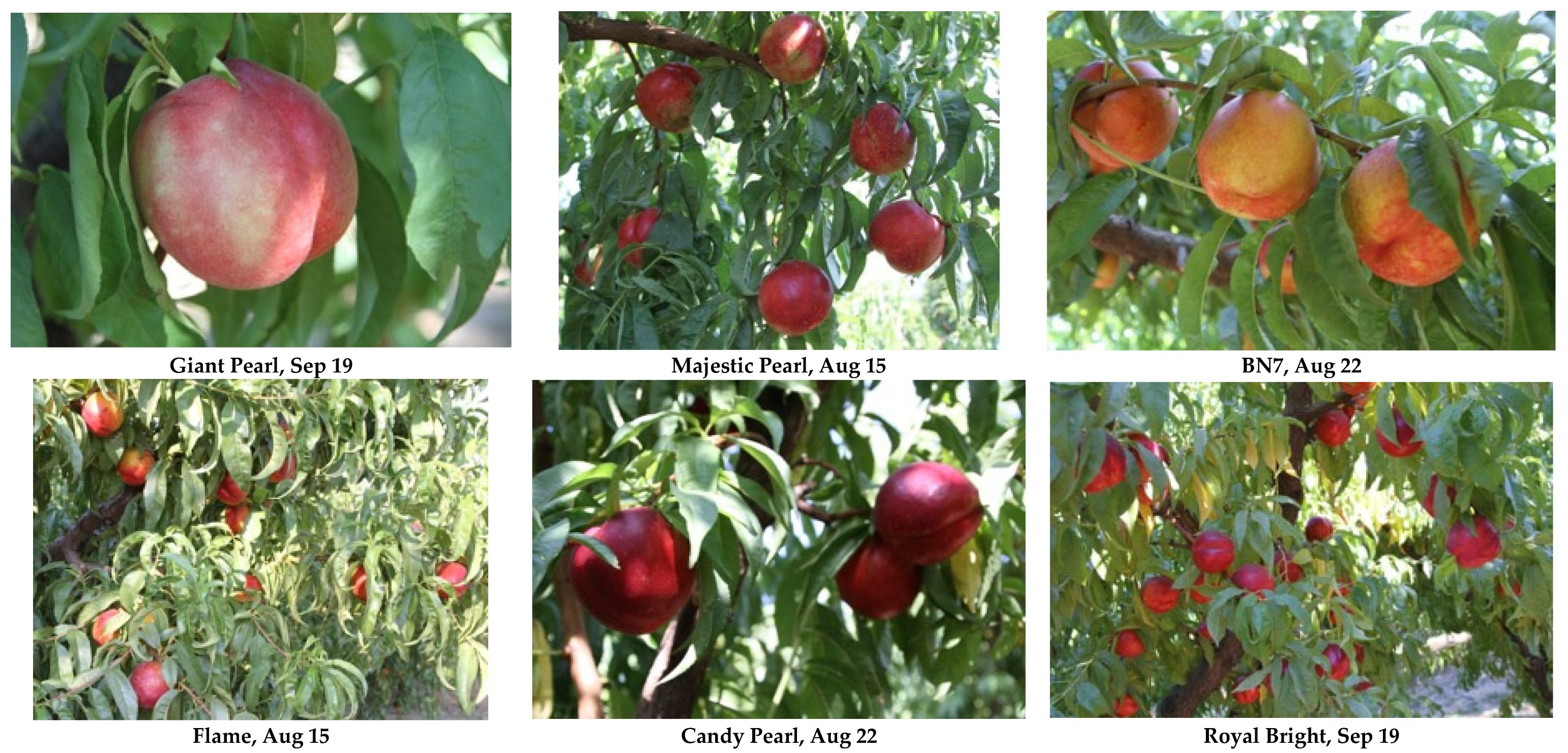
In our study, no significant interaction was observed among nectarine cultivars, harvest times (Harvest 1 and Harvest 2), and storage periods (Period 1 and Period 2) for any of the phenological data, yield, or quality attributes, within each year or across years. Thus, values for each year and across 4-year values are reported in Table 1, Table 2, Table 3, Table 4, Table 5, Table 6, Table 7, Table 8, Table 9, Table 10, Table 11, Table 12 and Table 13. Also, pictures of all experimental peach cultivars in this study are presented in Figure 1 to provide a clearer visual understanding of certain quality attributes, particularly fruit color and each cultivar’s appearance.

3.2. Phenological, Julian Dates, and Growing Degree Days

All cultivars met their chilling requirements, as chilling hours across all seasons exceeded 1000 h, as described in the materials and methods. Nectarine cultivars reached full bloom and were harvested at different times each year. However, the ranges of harvest dates among cultivars at Harvest 1 and Harvest 2 were much wider than the differences in their bloom dates in each year and across all years (Table 1 and Table 2). For example, the range of full-bloom dates in 2016 and 2018 was between 3 April and 8 April (JDN 94–98), and in 2017 and 2019 it was between 14 April and 19 April (JDN 104–109) (Table 1 and Table 2). However, the range of Harvest 1 dates was between 27 July and 1 September (JDN 209–245) in 2016, and between 3 August and 13 September (JDN 215–256) in 2018 (Table 1 and Table 2). The relatively narrow variation in full bloom dates, contrasted with the widespread variation in harvest times among cultivars, is consistent with earlier reports across diverse stone fruit groups [29,30,31].
Averaging values over the years revealed that the JDN difference between the earliest blooming cultivars (‘Giant Pearl’ and ‘Majestic Pearl’) and the latest blooming one (‘Royal Bright’) was only three days (Table 1), while there were much wider ranges in JDNs of Harvest 1 and Harvest 2 among cultivars (Table 2). Although planting later-blooming nectarines can reduce the risk of frost damage, it would not have made a major difference for these cultivars, as bloom dates across all cultivars fell within the general frost season.
‘Royal Bright’ always had a significantly later bloom (greater JDN and GDD) than other cultivars every year (Table 1 and Table 3). This cultivar also had the highest GDDs to Harvest 1 and Harvest 2 than all other cultivars, other than ‘Giant Pearl’ (Table 1 and Table 3). Although GDDs to full bloom in ‘Giant Pearl’ were similar to several other cultivars, GDDs to Harvest 1 and Harvest 2 in this cultivar were greater than those in all other cultivars.
Averaging fruit GDD differences at Harvest 2 as compared to Harvest 1 (H2H1Dif) showed that the fruit of ‘Candy Pearl’, with a difference of 143 GDDs, had the longest time, and those of ‘Giant Pearl’ with a difference of 72 GDDs, ‘BN7’ with a difference of 75 GDDs, and ‘Royal Bright’ with a difference of 84 GDDs had the shortest time between Harvest 2 and Harvest 1 among all cultivars (Table 3). The lower H2H1Dif in ‘Giant Pearl’, ‘BN7’, and ‘Royal Bright’ is because the times of both Harvest 1 and Harvest 2 for these cultivars were between late August and late September (Table 2), and the mean daily temperatures during those days were lower than the mean daily temperatures of other cultivars that were harvested earlier.

3.3. Yield

Trees of all cultivars had full crops in 2016 and 2019 because no major freezing events occurred during the winter months prior to bloom or during the opening periods of bloom in these years (Table 4). Yield in most commercial peach and nectarine cultivars can be reduced when winter temperatures reach around −12 °C [11,13]. Yields in 2017 and 2018 were impacted by freezing incidents at different stages of bud development. In 2017, temperatures plunged to −24.2 °C on 5 January, −28.6 °C on 6 January, and −29.4 °C on 7 January. Although buds were in endodormancy from 5 to 7 January in 2017, the severity of low temperatures damaged the buds, leading to a yield reduction in 2017 (Table 4). Yields in 2018 across all cultivars were lower than in other years (Table 4) due to a freezing temperature of −6.1 °C that occurred on April 3, when trees were blooming (Table 2).
‘BN7’, ‘Flame’, and ‘Royal Bright’ always had higher yield per tree, while all “Pearl” series (‘Giant Pearl’, ‘Majestic Pearl’, ‘Candy Pearl’) were in the low-yielding cultivars (Table 4). The lower yield in the “Pearl” series cannot be related to the freezing effect, as these trees also had lower yield in years with minor or no freezing events. Freeze conditions in 2018 had the most severe impacts on ’Giant Pearl’ and ‘Candy Pearl’ yields (Table 4). Bloom dates in the “low-yielding” cultivars were often similar to those of high-yielding cultivars (Table 4). Thus, the lower yield in these cultivars may be related to their genetic characteristics rather than to freeze damage, and this area warrants further study.

3.4. Fruit Weight at Harvest and Weight Loss After Storage

‘Candy Pearl’, ‘Majestic Pearl’, and ‘BN7’ nectarines often had larger fruit than other cultivars during all years, although their weight rankings varied slightly from year to year. (Table 5). Averaging fruit values for Harvest 1 and Harvest 2 across all years showed that ‘Giant Pearl’ had the largest fruit, but those of ‘Candy Pearl’ and ‘Royal Pearl’ had the smallest fruit among all other cultivars (Table 5). In general, fruit weight at the second harvest was higher than that at the first harvest in all cultivars, other than ‘Giant Pearl’ and ‘Candy Pearl’ (Table 5). The increase in the fruit size in the second harvest (IWH21) in ‘Flame’ was significantly higher than in all other cultivars. The fruit weight of ‘Giant Pearl’ and ‘Candy Pearl’ remained relatively unchanged between Harvest 1 and Harvest 2 (Table 5), whereas maturity, reflected in lower firmness and higher soluble solids concentration, as discussed later, was more advanced at Harvest 2. This indicates that increases in fruit maturity are not necessarily accompanied by measurable increases in fruit mass (Table 5).
Averaged across all years, fruit weight at both Harvest 1 and Harvest 2 showed a strong positive association with accumulated growing degree days (GDD), except for ‘Royal Bright’ (Table 1 and Table 5). Thus, cultivars requiring higher GDD, typically the later-maturing cultivars, consistently produced larger fruit. This relationship between seasonal heat accumulation and fruit size aligns with the results of our earlier multi-state NC-140 research [42].
Fruit picked at Harvest 1 or Harvest 2 always had higher water loss after 4 weeks of storage (Period 2) than after 2 weeks (Period 1) across all cultivars (Table 6 and Table 7). Fruit picked at Harvest 1 had a higher percentage of weight loss than those picked at Harvest 2 when they were stored for either 2 or 4 weeks (Period 1 or Period 2) (Table 6 and Table 7). This result agrees with Santana [21], who reported that less mature ‘Douradao’ peaches exhibited greater dehydration than mature ones during storage.
Fruit of ‘Majestic Pearl’ and ‘Flame’, picked at Harvest 1 and Harvest 2, had a higher percentage weight loss, whereas those of ‘BN7’ had a lower percentage weight loss after both Period 1 and Period 2 in storage in most years (Table 6 and Table 7).

3.5. Firmness

Fruit picked at the second harvest had lower firmness than those picked at the first harvest in all cultivars every year (Table 8). The rankings of fruit firmness in different cultivars at the first and second harvest times varied from year to year. However, the fruit of ‘Candy Pearl’ often had higher firmness, but those of ‘BN7’ and ‘Royal Bright’ had lower firmness, at the times of both Harvest 1 and Harvest 2 in most years, and the differences became more pronounced when values were averaged over four years (Table 8).
The average percentages of firmness reduction at harvest time between Harvest 1 and Harvest 2 (PFRH1H2) in yellow-fleshed acid ‘Flame’ were greater than those of all white-flesh cultivars except ‘Giant Pearl’. This finding is consistent with the results of Iglesias and Echeverria [24], who investigated the effect of harvest stages on six nectarine cultivars and found that yellow-fleshed acid cultivars exhibited a significantly more rapid decline in fruit firmness than white-fleshed sub-acid cultivars when harvested at a later stage. Nevertheless, contrary to the report by Iglesias and Echeverria [24], both ‘Giant Pearl’, a white-fleshed and sub-acid nectarine, and ‘BN7’, a yellow-fleshed and highly acidic nectarine, had low PFRH1H2 (Table 8).
Differences in the fruit firmness between Period 1 and Period 2 within Harvest 1 or Harvest 2 were not as extreme as the firmness differences between the time of harvests in most cultivars (Table 9 and Table 10). In fruits that were picked at Harvest 1 and Harvest 2, ‘Majestic Pearl’ and ‘Candy Pearl’ maintained high firmness after storage durations of Period 1 and Period 2. In fruit picked at Harvest 1, ‘Giant Pearl’ also maintained high firmness after Period 1 and Period 2. Fruits of ‘BN7’, ‘Flame’, and ‘Royal Bright’ nectarines, picked at Harvest 1 and Harvest 2, were in the low-firmness group after storage Period 1 and Period 2 (Table 9 and Table 10).
Giannopoulos et al. [43] recommend that peach fruit with a flesh firmness of 71.1 to 53.37 N can be picked and transported to the regional warehouse; those with 53.37 to 35.58 N can be transported to retail stores, and those with 53.37 to 26.68 N can be transferred to retail stores and put out on display. In that guidance, fruit with flesh firmness of 13.34 to 8.90 N can be purchased by the end consumer, and this category of fruit is considered ready-to-eat, while fruit harvested at a firmness below 53.37 to 26.68 N on the cheek has high consumer acceptance [44]. According to those guidelines, the fruits of ‘Giant Pearl’, ‘Majestic Pearl’, and ‘Candy Pearl’ can be picked at Harvest 1 and transported, immediately at harvest or after 2 weeks or 4 weeks of storage (Period 1 and Period 2), over a rather long distance to the regional warehouse, since they had a firmness of near or greater than 53 N in our study (Table 8 and Table 9). Fruit of ‘BN7’ and ‘Royal Bright’ had 4-year averages of 38 N and 41 N at Harvest 1, respectively (Table 8). These cultivars also had a lower percent firmness difference between Harvest 1 and Harvest 2 (PFRH1H28) (Table 8) and thus can be picked at Harvest 1 (or shortly after Harvest 1 but before Harvest 2) and transported to medium-distance retail stores. However, none of the cultivars in this study should be harvested after Harvest 2, as they lose texture and shelf life.
According to the results of this study, fruit from most cultivars can be transported over short to medium distances and consumed if harvested at Harvest 2 or after being stored for Period 1. Fruits harvested at Harvest 2 and stored for 4 weeks (Period 2) will lose their firmness and transportability rather quickly (Table 8, Table 9 and Table 10) and must be sold at the farmers’ market or local stores.
There was a significant positive correlation coefficient (r) between fruit firmness and the IDA meter across all evaluations, consistent with Cai and Farcuh [45].

3.6. Fruit Soluble Solids and Fruit Color

Fruit picked at Harvest 2 had a higher soluble solids concentration than that picked at Harvest 1 in all cultivars (Table 11). This suggests that more starch was converted into soluble simple sugars between Harvests 1 and 2 [25,36].
The soluble solids concentration in fruit picked at Harvest 1 or Harvest 2 and stored for Period 2 (4 weeks) was slightly higher or similar to that of those stored for 2 weeks (Table 12 and Table 13). There was no relation between JDN or GDD and fruit SSC in different cultivars.
Fruits of ‘BN7’ and ‘Candy Pearl’ had higher SSC at Harvest 1 and Harvest 2 (Table 11) and after keeping the fruit in storage for Period 1 and Period 2 (Table 12 and Table 13) in most years, leading to higher 4-year averages in these cultivars (Table 11, Table 12 and Table 13). Fruit SSC showed a strong negative correlation with the IDA index, consistent with Cai and Farcuh [45].
Nectarine cultivars in this study exhibited substantial variation in both skin and flesh coloration, as well as in the distribution and intensity of pigmentation. Background skin color ranged from yellow to orange to creamy (Table 4; Figure 1). These background hues were often overlaid with varying degrees of bright-to-dark red pigmentation, producing visually distinctive and cultivar-specific color patterns. Skin color intensity increased with fruit maturation, transitioning from bright, glossy red or pink during early development to deeper red or maroon at commercial harvest.
In several cultivars, red pigmentation extends from the skin into the flesh or radiates outward from the pit, referred to as “bleeding”. This bleeding trait is considered visually appealing by some consumers but may be viewed as undesirable by certain commercial markets. ‘Giant Pearl’, ‘Majestic Pearl’, and ‘Candy Pearl’ displayed dark red to pink skin combined with white flesh, whereas ‘BN7’ exhibited dark red skin over an orange background.

3.7. Overall Conclusions and Recommendations

Considering bloom and harvest JDNs, GDDs, yield, and the fruit quality attributes studied here, different cultivars may be chosen depending on the objectives of each grower, primarily market timing. ‘Candy Pearl’ had lower JDNs and GDDs, and thus matured earlier and could be harvested earlier, and ‘Giant Pearl’ and ‘Royal Bright’ matured later and required greater GDDs than other cultivars every year (Table 1, Table 2 and Table 3). Yu et al. [46] reported that larger fruits with earlier maturity tend to show split pits. However, the relationship between fruit size and split pit in early-maturing cultivars was not applicable for the late-maturing cultivars such as ‘Giant Pearl’ and ‘Majestic Pearl’, which did not have any split pit despite their large size (Table 2 and Table 5).
Fruit quality changed with harvest time, which agrees with a previous report on several nectarine cultivars [24,25]. The percentage decline in fruit firmness between Harvest 1 and Harvest 2 (PFRH1H2) was significantly greater in ‘Giant Pearl’ and ‘Flame’ than in the other cultivars (Table 8). The high PFRH1H2 values in these two cultivars indicate that fruit harvested at Harvest 2 would experience substantial softening, making Harvest 1 the more suitable harvest stage, particularly when fruit must withstand handling and transport to distant markets.
‘Candy Pearl’ performed well as an early-season cultivar, producing fruit with mild, pleasant flavor, attractive red skin, and white flesh. The fruit was clingstone, sub-acid, and could be consumed at a firm stage, although yields were lower than those of several other cultivars, and slight skin freckling was occasionally observed. Based on the results of this study, ‘Majestic Pearl’, ‘BN7’, and ‘Flame’ are suitable options for the mid- to late-August market window. As with all cultivars, each exhibited some less desirable traits. ‘Majestic Pearl’ produced large clingstone fruit with red skin, white flesh, and excellent flavor (sensory panel), but the fruit displayed moderate russeting (Figure 1) and a 5–10% incidence of split pit. ‘Flame’ produced fruit with attractive red skin (Figure 1) and yellow flesh; however, a 5–10% split-pit incidence was observed in some years, and the underlying cause warrants further investigation.
Labor management is a major challenge for nectarine growers in the Pacific Northwest and Intermountain West, where nectarines are commonly grown alongside apples. The harvest timing information generated in this long-term study provides valuable guidance for aligning labor needs across multiple fruit crops. ‘Giant Pearl’ and ‘Royal Bright’ are strong candidates for early- to mid-September markets (Table 2). These cultivars are particularly advantageous for growers who wish to produce late-season nectarines while also managing late-season apple cultivars such as ‘Fuji’, ‘Braeburn’, and ‘Pink Lady’ (senior author’s experience).
Russet incidence was low in ‘Giant Pearl’ and ‘BN7’, whereas ‘Candy Pearl’, ‘Royal Bright’, ‘Flame’, and ‘Majestic Pearl’ exhibited moderate but commercially acceptable levels of russeting in 2019; symptoms were considerably less pronounced in other years.
Continued long-term evaluation of newly released nectarine cultivars is warranted to assess their performance prior to widespread commercial adoption.

Author Contributions

Conceptualization, E.F. and B.F.; methodology, E.F., B.F. and R.K.; software, E.F.; validation, E.F., B.F., M.J.K., R.K. and M.K.; formal analysis, E.F. and R.K.; investigation, E.F., B.F., R.K. and M.J.K.; resources, E.F.; data curation, E.F., B.F., R.K. and M.J.K.; writing—original draft preparation, E.F.; writing—review and editing, E.F., M.K., R.K. and B.F.; visualization, E.F.; supervision, E.F. and B.F.; project administration, E.F.; funding acquisition, E.F. All authors have read and agreed to the published version of the manuscript.

Funding

The research, titled ‘Evaluation of Adaptability, Bloom and Harvest Dates, Yield, Fruit Quality, Mineral Nutrition, and Introduction of Modern Cultivars to Increase Global Competitiveness of Idaho Stone Fruit’, was funded through the Agreement providing financial support under the Specialty Crop Block Grant Program (2010 SCBGP-FB). Additional support was provided by the Idaho Stone Fruit Committee.

Data Availability Statement

The original contributions presented in this study are included in the article. Further inquiries can be directed to the corresponding authors.

Acknowledgments

We acknowledge and express our gratitude to the Idaho State Department of Agriculture for supporting this project through the Specialty Crop Block Grant and the Idaho Stone Fruit Committee for their financial support of this long-term project. We also appreciate numerous research helpers who assisted us with this project though years.

Conflicts of Interest

The authors declare no conflicts of interest.

References

  1. Abbott, A.G.; Arus, P.; Scorza, R. Genetic engineering and genomics. In The Peach, Botany, Production, and Uses; Layne, R., Bassi, D., Eds.; CABI: Wallingford, UK, 2008; pp. 85–105. Available online: https://www.cabidigitallibrary.org/doi/10.1079/9781845933869.0085 (accessed on 22 June 2026).
  2. Monet, R.; Bassi, D. Classical genetics and breeding. In The Peach, Botany, Production, and Uses; Layne, R., Bassi, D., Eds.; CABI: Wallingford, UK, 2008; pp. 61–84. Available online: https://www.cabidigitallibrary.org/doi/abs/10.1079/9781845933869.0061 (accessed on 22 June 2026).
  3. Okie, W.R.; Bacon, T.; Bassi, D. Fresh market cultivar development. In The Peach, Botany, Production and Uses; Layne, R., Bassi, D., Eds.; CABI: Wallingford, UK, 2008; pp. 139–174. Available online: https://www.cabidigitallibrary.org/doi/10.1079/9781845933869.0139 (accessed on 22 June 2026).
  4. Shane, W.; Iezzoni, A. Peach breeding program. In Annual Report for 2007. Tree Fruits; Michigan State University, Southwest Michigan Research and Extension: East Lansing, MI, USA, 2007. [Google Scholar]
  5. Bassi, D.; Monet, R. Botany and taxonomy. In The Peach, Botany, Production, and Uses; Layne, R., Bassi, D., Eds.; CABI: Wallingford, UK, 2008; pp. 1–36. Available online: https://www.cabidigitallibrary.org/doi/10.1079/9781845933869.0001 (accessed on 22 June 2026).
  6. Johson, R.S. Nutrient and water requirements of peach trees. In The Peach, Botany, Production, and Uses; Layne, R., Bassi, D., Eds.; CABI: Wallingford, UK, 2008; pp. 301–331. Available online: https://www.cabidigitallibrary.org/doi/10.1079/9781845933869.0303 (accessed on 22 June 2026).
  7. Magar, S.T.; Vellidis, G.; Porter, W.; Liakos, V.; Andreis, J.H.; Chavez, D. Development and evaluation of a SmartIrrigation Peach App in a young peach orchard. Acta Hortic. 2022, 1352, 575–582. [Google Scholar] [CrossRef]
  8. Reighard, G.R.; Loreti, F. Rootstock development. In The Peach, Botany, Production and Uses; Layne, R., Bassi, D., Eds.; CABI: Wallingford, UK, 2008; pp. 193–220. Available online: https://www.cabidigitallibrary.org/doi/abs/10.1079/9781845933869.0000 (accessed on 22 June 2026).
  9. Marini, R.P. Growing Peaches and Nectarines in Virginia. VCE Publications. 422-019 (SPES-232P). 2025. Available online: https://www.pubs.ext.vt.edu/422/422-019/422-019.html (accessed on 22 June 2026).
  10. Braxton, D.; McWhirt, A.; Worthington, M.; Rom, C. Tree Fruit Cultivar Recommendations for Arkansas. FSA6129. 2026. Available online: https://www.uaex.uada.edu/publications/pdf/FSA-6129.pdf (accessed on 22 June 2026).
  11. Sterle, D.G.; Caspari, H.W.; Minas, I.S. Optimized differential thermal analysis sheds light on the effect of temperature on peach floral bud cold hardiness and transition from endo- to Eco dormancy. Plant Sci. 2023, 235, 111791. [Google Scholar] [CrossRef] [PubMed]
  12. Hentschel, R. Degree Days and Chilling Hrs. 2016. Available online: https://extension.illinois.edu/blogs/over-garden-fence/2016-02-29-degree-days-and-chilling-hours (accessed on 22 June 2026).
  13. Hentschel, R. Cold Weather Flowing Buds. 2019. Available online: https://extension.illinois.edu/blogs/over-garden-fence/2019-02-20-cold-weather-challenges-flowering-buds (accessed on 22 June 2026).
  14. Rouse, R.E.; Sherman, W.B. Low-chill peaches in South Texas and potential in Central Florida. Proc. Fla. State Hort. Soc. 1989, 102, 193–195. [Google Scholar]
  15. Wert, T.W.; Williamson, G.J.; Chaparro, J.X.; Miller, E.P.; Rouse, R.E. The Influence of Climate on Fruit Development and Quality of Four Low-Chill Peach Cultivars. HortScience 2009, 44, 666–670. [Google Scholar] [CrossRef]
  16. Batjer, L.P.; Martin, G.C. The influence of night temperature on growth and development of early Redhaven peaches. Proc. Amer. Soc. Hort. Sci. 1965, 87, 1399–1404. [Google Scholar]
  17. Topp, B.L.; Sherman, W.B. The relationship between temperature and bloom-to ripening period in low-chill peach. Fruit. Var. J. 1989, 43, 155–158. [Google Scholar] [CrossRef]
  18. Boonprakob, U.; Byrene, D.H.; Rouse, R.E. Response of fruit development period to temperature during specific periods after full bloom in peach. Fruit. Var. J. 1992, 46, 137–140. [Google Scholar] [CrossRef]
  19. Topp, B.L.; Sherman, W.B. Location influences on fruit traits of low-chill peaches in Australia. Proc. Fla. State Hort. Soc. 1989, 102, 195–199. [Google Scholar]
  20. Bianchi, T.; Weesepoel, Y.; Koot, A.; Iglesias, I.; Eduardo, I.; Gratacós-Cubarsí, M.; Guerrero, L.; Hortós, M.; van Ruth, S. Investigation of the aroma of commercial peach (Prunus persica L. Batsch) types by Proton Transfer Reaction-Mass Spectrometry (PTR-MS) and sensory analysis. Food Res. Int. 2017, 99, 133–146. [Google Scholar] [CrossRef] [PubMed]
  21. Santana, L.R.; Benedetti, B.; Sigrist, J.M. Sensory characteristics of ‘Douradao’ peaches submitted to modified atmosphere packaging. Rev. Bras. Frutic. 2010, 32, 700–708. [Google Scholar] [CrossRef]
  22. Crisosto, C.H.; Labavitch, J.M. Developing a quantitative method to evaluate peach (Prunus persica) flesh mealiness. Postharvest Biol. Technol. 2002, 25, 151–158. [Google Scholar] [CrossRef]
  23. Velardo-Micharet, B.; Pintado, C.M.; Dupille, E.; Ayuso-Yuste, M.C.; Lozano, M.; Bernalte-Garcia, M.J. Effect of ripening stage,1-MCP treatment, and different temperature regimes on long-term storage of ‘Songold’ Japanese plum. Sci. Hortic. 2017, 214, 233–241. [Google Scholar] [CrossRef]
  24. Iglesias, I.; Echeverria, G. Differential effect of cultivar and harvest date on nectarine color, quality, and consumer acceptance. Sci. Hortic. 2009, 120, 41–50. [Google Scholar] [CrossRef]
  25. Velardo-Micharet, B.; Duarte-Maya, M.; Agulheiro-Santos, A.C.; Ayuso-Yuste, M.C.; Bernalte-García, M.J. Effect of harvest date on fruit quality and post-harvest storability of three different peach cultivars. Foods 2026, 15, 421. [Google Scholar] [CrossRef] [PubMed]
  26. Campos-Vargas, R.; Becerra, O.; Baeza-Yates, R.; Cambiazo, V.; González, M.; Meisel, L.; Orellana, A.; Retamales, J.; Silva, H.; Defilippi, B.G. Seasonal variation in the development of chilling injury in ‘O’Henry’ peaches. Sci. Hortic. 2006, 110, 79–83. [Google Scholar] [CrossRef]
  27. Lurie, S.; Crisosto, C.H. Chilling injury in peach and nectarine. Postharvest Biol. Technol. 2005, 37, 195–208. [Google Scholar] [CrossRef]
  28. Farcuh, M.; Hopfer, H. Aroma volatiles as predictors of chilling injury development during peach (Prunus persica (L) Batsch) cold storage and subsequent shelf-life. Postharvest Biol. Technol. 2023, 195, 112137. [Google Scholar] [CrossRef]
  29. Fallahi, E.; Fallahi, B.; Shafii, B.; Amiri, M.E. Bloom and harvest dates, fruit quality attributes, and yield of modern peach cultivars in the Intermountain West of the United States. HortTechnology 2009, 19, 823–830. [Google Scholar] [CrossRef]
  30. Fallahi, E.; Fallahi, B.; Shafii, B.; Amiri, M.E.; Mirjalili, M. Growing degree days, bloom and harvest dates, fruit quality, and yield of new yellow and white nectarines. J. Amer. Pom. Soc. 2009, 63, 150. [Google Scholar] [CrossRef]
  31. Fallahi, E.; Fallahi, B.; Vahdati, K.; Kiester, M.J. Phenological characteristics, yield, and fruit quality of yellow-fleshed nectarines under high desert conditions of the northwestern United States over five years. Int. J. Hortic. Sci. Tech. 2014, 1, 21–29. [Google Scholar] [CrossRef]
  32. Ikinci, A.; Bolat, I. Yield and quality performance of some peach varieties grown under Sanliurfa ecological conditions. Afr. J. Agric. Res. 2018, 13, 47–53. [Google Scholar] [CrossRef][Green Version]
  33. Souza, F.; Alves, E.; Pio, R.; Castro, E.; Reighard, G.; Freire, A.I.; Pimentel, R. Influence of temperature on the development of peach fruit in a subtropical climate region. Agronomy 2019, 9, 20. [Google Scholar] [CrossRef]
  34. Bruhn, C.M.; Feldman, N.; Garlitz, C.; Hardwood, J.; Ivan, E.; Marshall, M.; Riley, A.; Thurber, D.; Williamson, E. Consumer perceptions of quality: Apricots, cantaloupes, peaches, pears, strawberries, and tomatoes. J. Food Qual. 1991, 14, 187–195. [Google Scholar] [CrossRef]
  35. Frecon, J.L.; Belding, R.; Lokaji, G. Evaluation of white-fleshed peach and nectarine cultivars in New Jersey. Acta Hort. 2002, 592, 467–477. [Google Scholar] [CrossRef]
  36. Crisosto, C.H.; Day, K.R.; Crisosto, G.M.; Garner, D. Quality attributes of white flesh peaches and nectarines grown under California conditions. J. Amer. Pomol. Soc. 2001, 55, 45–51. [Google Scholar] [CrossRef]
  37. Yost, G.; d’Easum, D. Idaho, the Fruitful Land; Syms-York Company: Boise, Idaho, 1980; Available online: https://payettecounty.info/books/fruitfulcontents.html (accessed on 22 June 2026).
  38. United States Department of Agriculture (USDA) National Agricultural Statistics (NASS). 2022 Census of Agriculture; Idaho State and County Data; Geographic Area Series; Part 12, AC-22-A-12; 2024; Volume 1, p. 403. Available online: https://www.nass.usda.gov/Publications/AgCensus/2022/Full_Report/Volume_1,_Chapter_1_State_Level/idaho/idv1.pdf (accessed on 22 June 2026).
  39. Allen, R.G.; Pereira, L.S.; Raes, D.; Smith, M. Crop evapotranspiration and drainage. In Paper 56; FAO: Rome, Italy, 1998; Available online: https://appgeodb.nancy.inra.fr/biljou/pdf/Allen_FAO1998.pdf (accessed on 22 June 2026).
  40. Fallahi, E.; Arzani, K.; Fallahi, B. Long-term leaf mineral nutrition in ‘Pacific Gala’ apple (Malus domestica Borth.) as affected by rootstock type and irrigation system during six stages of tree development. J. Hortic. Sci. Biotechnol. 2013, 88, 685–692. [Google Scholar] [CrossRef]
  41. Washington State University. Washington State University Tree Fruit Research & Extension Center. 2026. Available online: https://tfrec.cahnrs.wsu.edu/ (accessed on 22 June 2026).
  42. Marini, R.; Fallahi, E.; Francescatto, P.; Lordan, J.; Newell, M.J.; Ouellette, D.; Reighard, G.; Robinson, T.R.; Wolf, D. The NC-140 multi-location peach physiology trial: Relationships between peach fruit weight, crop density, and early season temperature. J. Amer. Pom. Soc. 2018, 72, 231–241. [Google Scholar] [CrossRef]
  43. Giannopoulos, O.; Chavez, D.; Deltsidis, A. Peaches: Appropriate harvest and postharvest handling. Bulletin 1555. 2024. Available online: https://fieldreport.caes.uga.edu/wp-content/uploads/generated-pub-pdfs/B-1555.pdf.
  44. Mitcham, E. Nectarine & Peach: Recommendations for Maintaining Postharvest Quality [Produce Fact Sheet]; UC Davis Postharvest Research and Extension Center: Davis, California, USA, 2023; Available online: https://postharvest.ucdavis.edu/produce-facts-sheets/peach (accessed on 22 June 2026).
  45. Cai, Y.; Farcuh, M. Determining Peach Maturity. 2021. Available online: https://extension.umd.edu/resource/determining-peach-fruit-maturity (accessed on 22 June 2026).
  46. Yu, Z.; Huang, H.; Cao, S.; Wang, Q. Analysis of the causes of split pit in peaches. Int. J. Mol. Sci. 2025, 26, 5460. [Google Scholar] [CrossRef] [PubMed]
Figure 1. Nectarine cultivars’ skin color during the growing season.
Horticulturae 12 00778 g001
Table 1. Julian Day Numbers of various nectarine at full bloom and at two harvest times during 2016–2019.
Cultivar z2016201720182019Average 2016–2019
Bloom zHar.1 zHar.2 zBloomHar.1Har.2BloomHar.1Har.2BloomHar.1Har.2BloomHar.1Har.2H2H1Dif z
G. Pearl95 b y245 a253 a107 b262 a270 a96 b256 a264 a105 c259 a267 a101 bc256 a264 a72 d
M. Pearl94 c228 d237 c106 c233 e 240 d95 c241 b253 c104 d241 b254 b100 c236 c246 c115 b
BN796 b231 c236 d108 b240 d244 c97 ab232 c242 d106 b238 c246 c100 c235 d242 d75 d
Flame95 b224 e230 e107 b241 c244 c96 b226 d241 e105 c234 d246 c102 ab231 e240 e102 bc
C. Pearl96 b209 f224 f108 b216 f226 e96 b215 e225 f106 b220 e228 d102 ab215 f226 f143 a
R. Bright97 a242 b252 f109 a249 b258 b98 a253 a260 b107 a254 a267 a103 a250 b259 b84 c
z Abbreviations: Bloom = at full bloom; Har.1 = at Harvest 1; Har.2 = at Harvest 2; G. Pearl = Giant Pearl; M. Pearl = Majestic Pearl; BN7 = Burnectseven; C. Pearl = Cany Pearl; R. Bright = Royal Bright; H2H1Dif = %Julian day difference between Harvest 2 and Harvest 1. H2H1Dif = 4-year average percent fruit GDD increase in °C at Harvest 2 as compared to Harvest 1, each year calculated as follow: [(GDD in °C at Harvest 2 − GDD in °C at Harvest 1)/GDD at Harvest 1] × 100. y Mean separations within columns by Fisher’s protected Least Significant Difference (LSD) test at 5% level. Cultivars followed by different letters within each column are significantly different.
Table 2. Calendar days of various nectarine cultivars at full bloom and at two harvest times during 2016–2019.
Cultivar z2016201720182019Average 2016–2019
Bloom zHar.1 zHar.2 zBloomHar.1Har.2BloomHar.1Har.2BloomHar.1Har.2BloomHar.1Har.2
G. Pearl 4 April1 Sep9 Sep17 April19 Sep27 SepApr 613 Sep21 Sep15 April16 Sep24 Sep11 Apr13 Sep21 Sep
M. Pearl3 April15 Aug24 Aug16 April21 Aug28 AugApr 529 Aug10 Sep14 April29 Aug11 Sep10 April24 Aug3 Sep
BN75 April18 Aug23 Aug18 April28 Aug1 SepApr 720 Aug30 Aug16 April26 Aug3 Sep10 April23 Aug30 Aug
Flame4 April11 Aug17 Aug17 April29 Aug1 SepApr 614 Aug20 Aug15 April22 Aug3 Sep12 April19 Aug28 Aug
C. Pearl5 April27 Jul11 Aug18 April4 Aug14 AugApr 63 Aug13 Aug16 April8 Aug16 Aug12 April3 Aug14 Aug
R. Bright6 April29 Aug8 Sep19 April6 Sep15 SepApr 810 Sep17 Sep17 April11 Sep24 Sep13 April7 Sep16 Sep
z Abbreviations: Bloom = at full bloom; Har.1 = at Harvest 1; Har.2 = at Harvest 2; G. Pearl = Giant Pearl; M. Pearl = Majestic Pearl; BN7 = Burnectseven; C. Pearl = Cany Pearl; R. Bright = Royal Bright.
Table 3. Cumulative degree days (o C) from 1 January through full bloom and two harvest stages (Harvest 1 and Harvest 2) in different nectarine cultivars during 2016–2019.
Cultivar z2016 201720182019Average 2016–2019
Bloom zHar.1 zHar.2 zBloomHar.1Har.2BloomHar.1Har.2BloomHar.1Har.2BloomHar.1Har.2
G. Pearl118 b y1506 a1567 a113 b1561 a1680 a82 b1617 a1679 a86 c1552 a1600 a100 bc1559 a1631 a
M. Pearl114 c1310 d1417 c109 c1327 e1418 d78 c1469 b1597 c84 d1367 b1506 b96 c1368 c1483 c
BN7 121 b1349 c1406 d117 b1411 d1461 c86 ab1383 c1480 d89 b1334 c1428 c103 ab1369 d1444 d
Flame118 b1263 e1336 e113 b1423 c1461 c82 b1309 d1469 e86 c1292 d1428 c100 bc1322 e1424 e
C. Pearl121 b1093 f1263 f117 b1119 f1311 e82 b1175 e1297 f89 b1132 e1220 d102 b1130 f1273 f
R. Bright127 a1471 b1559 b122 a1518 b1621 b88 a1597 a1649 b93 a1506 a1600 a108 a1523 b1607 b
z Abbreviations: Bloom = at full bloom; Har.1 = at Harvest 1; Har.2 = at Harvest 2; G. Pearl = Giant Pearl; M. Pearl = Majestic Pearl; BN7 = Burnectseven; C. Pearl = Candy Pearl; R. Bright = Royal Bright. y Mean separations within columns by Fisher’s protected Least Significant Difference (LSD) test at 5% level. Cultivars followed by different letters within each column are significantly different.
Table 4. Yield per tree (kg), fruit type, skin color, and flesh color of various nectarine cultivars during 2016–2019.
Cultivar z2016201720182019Avg.
2016–19
Fruit TypeAcid StatusSkin ColorFlesh Color
G. Pearl51.6 bc y19.1 b4.2 b32.9 b27.0 bClingstoneSub-acidDark red–pinkWhite
M. Pearl41.3 c18.2 b11.0 b27.3 b24.5 bClingstoneSub-acidDark redWhite
BN762.3 ab37.7 a21.2 a47.5 a42.2 aClingstoneHigh AcidDark redYellow
Flame60.0 ab47.3 a20.0 a51.2 a44.6 aClingstoneAcidOrange/redYellow
C. Pearl38.7 c16.9 b8.9 b25.3 b22.5 bClingstoneSub-acidDark redWhite
R. Bright70.9 a49.3 a29.8 a57.6 a51.9 aClingstoneAcidDeep redYellow
z Abbreviations: G. Pearl = Giant Pearl; M. Pearl = Majestic Pearl; BN7 = Burnectseven; C. Pearl = Candy Pearl; R. Bright = Royal Bright. y Mean separations within columns by Fisher’s protected Least Significant Difference (LSD) test at 5% level. Cultivars followed by different letters within each column are significantly different.
Table 5. Effects of nectarine cultivars, picked at two different stages (Harvest 1 and Harvest 2) on fruit weight (g/fruit) at the time of harvest during 2016–2019.
Cultivar zHarvest 1Harvest 2Average at harvests 1 and 2 in each yearIWH12
(%) z
2016201720182019Avg.
2016–19
2016201720182019Avg.
2016–19
2016201720182019Avg.
2016–19
G. Pearl278 a y265 a273 a271 a272 a291 ab277 a305 a273 a287 a285 a271 a289 a272 a279 a6.0 b
M. Pearl296 a229 b287 a245 a267 a296 a280 a270 ab240 ab269a296 a255 a279 a243 a268 a0.7 b
BN7274 a259 a208 bc235 a244 b270 bc270. a236 b249 ab256 b272 a265 a222 b242 b250 b5.0 b
Flame189 b210 b190 c195 b196 c246 c235 b257 b223 bc240 b218 b223 b224 b209 cd219 c22 a
C. Pearl195 b171 c185 c 193 b186 c191 e194 c180 c184 d187 c193 c183 c183 c189 de187 d0.5 b
R. Bright191 b168 c222 b185 b191 c204 d206 bc224 bc169 d201 c198 c187 c223 b177 e196 d5.0 b
z Abbreviation: G. Pearl = Giant Pearl; M. Pearl = Majestic Pearl; BN7 = Burnectseven; C. Pearl = Candy Pearl; R. Bright = Royal Bright; IWH12 (%) = average of 4 years percentage increase in fruit weight at Harvest 2, compared to Harvest 1, calculated as follows: [(Fruit weight at Harvest 2 − fruit weight at Harvest 1)/fruit weight at Harvest 1] × 100. y Mean separations within columns by Fisher’s protected Least Significant Difference (LSD) test at 5% level. Cultivars followed by different letters within each column are significantly different.
Table 6. Effects of nectarine cultivars, harvested at the first date (Harvest 1) on the percentage of fruit weight loss after being kept in a regular atmosphere storage for 2 weeks (Period 1) and 4 weeks (Period 2) over four years z.
Cultivar y2016201720182019Avg. over 4 Years
Period 1Period 2Period 1Period 2Period 1Period 2Period 1Period 2Period 1Period 2
G. Pearl0.48 a x1.31 b0.26 a2.44 a1.52 c2.33 b1.40 c1.53 c0.92 c1.90 b
M. Pearl0.73 a2.03 ab0.20 a3.95a3.76 a3.80 b2.41 b2.44 bc1.78 a3.03 a
BN70.49 a1.49 b0.08 a3.21 a2.75 ab3.53 b1.11 b1.44 c1.11 b2.42 b
Flame0.66 a2.27 ab0.23 a2.62 a3.48 a4.49 b2.22 b2.78 b1.65 ab3.04 a
C. Pearl0.40 a1.33 b0.19 a3.58 a1.32 c7.60 a3.62 a5.46 a1.38 b4.50 a
R. Bright0.41 a2.59 a0.08 a3.10 a2.09 bc3.58 b2.66 b2.71 b1.30 b3.00 b
z Percentage of water loss value for each period of storage = [(weight of fruit before storage − weight of fruit after storage)/fruit after storge)/weight of at before storage] × 100; y Abbreviations: G. Pearl = Giant Pearl; M. Pearl = Majestic Pearl; BN7 = Burnectseven; C. Pearl = Candy Pearl; R. Bright = Royal Bright; Period 1 = after 2 weeks of storage; Period 2 = after 4 weeks of storage. x Mean separations within columns by Fisher’s protected Least Significant Difference (LSD) test at 5% level. Cultivars followed by different letters within each column are significantly different.
Table 7. Effects of nectarine cultivars, harvested at the second date (Harvest 2), on the percentage of fruit weight loss after being kept in a regular atmosphere storage for 2 weeks (Period 1) and 4 weeks (Period 2) over four years z.
Cultivar y2016201720182019Avg. over 4 Years
Period 1Period 2Period 1Period 2Period 1Period 2Period 1Period 2Period 1Period 2
G. Pearl0.41 a x1.65 a1.03 b1.97 a2.54 b3.51 b2.01 b2.94 a1.50 ab2.52 a
M. Pearl0.35 a1.26 a1.15 b2.13 a2.66 b3.40 b2.94 a4.08 a1.78 a2.72 a
BN70.26 a1.34 a0.61 bc2.60 a2.46 b4.26 b2.10 b2.23 b1.36 b2.61 b
Flame0.31 a1.48 a0.64 bc2.69 a3.36 ab9.22 a1.92 b3.64 a1.56 ab4.26 a
C. Pearl0.20 a1.36 a1.90 a2.67 a3.80 a6.82 ab2.40 ab4.00 a2.08 a3.71 a
R. Bright0.04 a1.63 a0.28 c1.71 a2.60 b5.33 ab2.62 ab3.13 a1.39 b2.95 a
z Percentage of water loss value for each period of storage = [(weight of fruit before storage − weight of fruit after storage)/fruit after storge)/weight of at before storage] × 100. y Abbreviations: G. Pearl = Giant Pearl; M. Pearl = Majestic Pearl; BN7 = Burnectseven; C. Pearl = Candy Pearl; R. Bright = Royal Bright; Period 1 = after 2 weeks of storage; Period 2 = after 4 weeks of storage. x Mean separations within columns by Least Significant Difference (LSD) test at 5% level. Cultivars followed by different letters within each column are significantly different.
Table 8. Effects of nectarine cultivars, picked at two different stages (Harvest 1 and Harvest 2), on fruit firmness (Newton) at the time of harvest during 2016–2019.
Cultivar z2016201720182019Average over 4 Years
Harvest 1Harvest 2Harvest 1Harvest 2Harvest 1Harvest 2Harvest 1Harvest 2Harvest 1Harvest 2PFRH1H2 z
G. Pearl53 a y38 ab53 b16 c63 a29 bc54 ab39 ab56 a32 bc42.9 a
M. Pearl51 a43 a65 a45 a47 b18 c51 b38 abc54 b36 ab27.4 b
BN723 c21 c43 c30 b50 b34 b40 d29 cd38 c29 c24.0 b
Flame48 ab23 c48 bc34 b59 a21 bc54 ab27 d52 b26 c49.7 a
C. Pearl50 ab30 bc65 a43 a59 a50 a57 a46 a58 a43 a29.0 b
R. Bright44 b29 bc42 c35 b35 c30 bc45 c33 bcd41 c33 bc20.7 b
z Abbreviations: G. Pearl = Giant Pearl; M. Pearl = Majestic Pearl; BN7 = Burnectseven; C. Pearl = Candy Pearl; R. Bright = Royal Bright; PFRH1H2 = 4-year average percentage fruit firmness reduction at Harvest 2, compared to Harvest 1, each year calculated as follows: [(fruit firmness at Harvest 1 − fruit firmness at Harvest 2)/fruit firmness at Harvest 1] × 100. y Mean separations within columns by Fisher’s protected Least Significant Difference (LSD) test at 5% level. Cultivars followed by different letters within each column are significantly different.
Table 9. The impact of nectarine cultivars, harvested at the first date (Harvest 1) and stored in a regular atmosphere storage for 2 weeks (Period 1) and 4 weeks (Period 2) on fruit firmness (Newton) over four years z.
Cultivar z2016201720182019Average All Years
Period 1Period 2Period 1Period 2Period 1Period 2Period 1Period 2Period 1Period 2
G. Pearl55 a y55 a51 b45 b64 a61 a56 a52 a57 a53 a
M. Pearl53a49 a63 a61 a48 b44 b56 a49 a49 ab51 a
BN730 c32 c42 c41 bc52 b53 ab44 c42 b39 c42 c
Flame39 b42 b46 bc37 c64 a59 a50 b46 ab45 b46 bc
C. Pearl44 b33 c65 a65 a65 a60 a50 b41 b51 a50 ab
R. Bright41 b37 bc43 c40 bc33 c27 c42 c44 ab38 c37 d
z Abbreviations: G. Pearl = Giant Pearl; M. Pearl = Majestic Pearl; BN7 = Burnectseven; C. Pearl = Candy Pearl; R. Bright = Royal Bright; Period 1 = after 2 weeks of storage; Period 2 = after 4 weeks of storage. y Mean separations within columns by Fisher’s protected Least Significant Difference (LSD) test at 5% level. Cultivars followed by different letters within each column are significantly different.
Table 10. The impact of nectarine cultivars, harvested at the second date (Harvest 2) and stored in a regular atmosphere storage for 2 weeks (Period 1) and 4 weeks (Period 2) on fruit firmness (Newton) over four years z.
Cultivar z2016201720182019Average All 4 Years
Period 1Period 2Period 1Period 2Period 1Period 2Period 1Period 2Period 1Period 2
G. Pearl38 ab y38 ab14 c11 d21 b13 d33 bc35 bc28 b25 d
M. Pearl44 a41 a51 a50 a34 ab21 bc37 b42 b42 a39 b
BN724 c24 c37 b36 b32 ab28 b32 bc32 c31 b30 c
Flame27 bc23 c36 b29 c25 b18 cd29 bc12 d29 b19 e
C. Pearl24 c28 c49 a49 a44 a51 a50 a51 a42 a45 a
R. Bright28 bc30 bc38 b36 b28 b25 bc27 c29 c31 b29 c
z Abbreviations G. Pearl = Giant Pearl; M. Pearl = Majestic Pearl; BN7 = Burnectseven; C. Pearl = Candy Pearl; R. Bright = Royal Bright; Period 1 = after 2 weeks of storage; Period 2 = after 4 weeks of storage. y Mean separations within columns by Fisher’s protected Least Significant Difference (LSD) test at 5% level. Cultivars followed by different letters within each column are significantly different.
Table 11. Effects of nectarine cultivars, harvested at two different stages (Harvest 1 and Harvest 2) on fruit soluble solids concentration (o Brix) at the time of harvest during 2016–2019.
Cultivar z2016201720182019Average over 4 Years
Harvest 1Harvest 2Harvest 1Harvest 2Harvest 1Harvest 2Harvest 1Harvest 2Harvest 1Harvest 2
G. Pearl12.4 ab y14.8 a11.6 cd12.8 bc12.5 a16.6 a11.5 ab11.8 a12.0 b14.0 ab
M. Pearl11.1 b13.6 ab13.6 ab14.9 ab14.1 a14.6 abc10.8 b9.6 b12.4 b13.2 b
BN714.4 a13.8 ab14.7 a15.2 a13.6 a13.7 bc13.2 a13.1 a14.0 a13.9 ab
Flame11.2 b14.9 a12.6 bc14.0 abc12.6 a16.1 a10.9 b12.7 a11.8 b14.4 a
C. Pearl14.4 a12.4 bc13.1 abc14.0 abc14.5 a15.0 ab12.9 a12.7 a13.7 a13.5 ab
R. Bright10.8 b11.7 c10.1 d12.0 c12.9 a13.0 c9.8 b10.0 b11.0 b11.7 c
z Abbreviations: G. Pearl = Giant Pearl; M. Pearl = Majestic Pearl; BN7 = Burnectseven; C. Pearl = Candy Pearl; R. Bright = Royal Bright. y Mean separations within columns by Fisher’s protected Least Significant Difference (LSD) test at 5% level. Cultivars followed by different letters within each column are significantly different.
Table 12. The impact of nectarine cultivars, picked at the first stage (Harvest 1) and stored in a regular atmosphere storage for 2 weeks (Period 1) and 4 weeks (Period 2) on fruit soluble solids concentration over four years.
Cultivar z2016201720182019Average All Years
Period 1Period 2Period 1Period 2Period 1Period 2Period 1Period 2Period 1Period 2
G. Pearl11.0 bc y11.1 b11.6 bc10.8 c14.0 a14.0 a11.8 b 12.5 b12.1 bc12.1 c
M. Pearl11.8 ab12.1 a12.1 abc12.6 abc15.3 a14.5 a11.1 b11.1 c12.2 ab12.6 bc
BN712.2 a13.1 a12.5 ab12.7 abc13.3 a13.5 a12.2 a12.3 b12.6 ab12.9 ab
Flame11.8 ab11.0 b12.4 ab13.6 a13.5 a13.8 a10.2 b10.6 c12.0 bc12.3 bc
C. Pearl11.7 abc12.8 a13.2 a13.1 ab14.4 a13.3 a12.7 a13.7 a13.0 a13.3 a
R. Bright10.7 c10.2 b10.9 c11.3 bc13.2 a14.3 a10.5 b10.6 c11.3 c11.6 d
z Abbreviations: G. Pearl = Giant Pearl; M. Pearl = Majestic Pearl; BN7 = Burnectseven; C. Pearl = Candy Pearl; R. Bright = Royal Bright; Period 1 = after 2 weeks of storage; Period 2 = after 4 weeks of storage. y Mean separations within columns by Fisher’s protected Least Significant Difference (LSD) test at 5% level. Cultivars followed by different letters within each column are significantly different.
Table 13. The impact of nectarine cultivars, picked at the second stage (Harvest 2) and stored in a regular atmosphere storage for 2 weeks (Period 1) and 4 weeks (Period 2) on fruit soluble solids concentration over four years.
Cultivar z2016201720182019Average All Years
Period 1Period 2Period 1Period 2Period 1Period 2Period 1Period 2Period 1Period 2
G. Pearl13.3 a y12.5 ab13.2 ab12.9 ab16.3 a16.0 a11.2 ab11.8 a13.7 a13.3 a
M. Pearl11.5 b11.5 b14.0 a13.0 ab13.6 b15.3 a8.8 c8.6 c11.8 b11.9 b
BN713.3 a13.6 a13.3 ab14.7 a14.5 ab15.7 a11.5 ab11.7 a13.2 a13.9 a
Flame13.7 a13.5 a12.6 ab13.9 a14.2 ab14.9 a11.3 ab9.5 c13.0 a13.1 a
C. Pearl12.7 ab13.2 a12.7 ab14.3 a14.9 ab15.1 a12.2 a11.2 ab13.1 a13.4 a
R. Bright12.8 ab11.8 b11.3 b11.0 b12.7 b14.3 a10.0 bc9.7 bc11.8 b12.0 b
z Abbreviations: G. Pearl = Giant Pearl; M. Pearl = Majestic Pearl; BN7 = Burnectseven; C. Pearl = Candy Pearl; R. Bright = Royal Bright; Period 1 = after 2 weeks of storage; Period 2 = after 4 weeks of storage. y Mean separations within columns by Fisher’s protected Least Significant Difference (LSD) test at 5% level. Cultivars followed by different letters within each column are significantly different.
Disclaimer/Publisher’s Note: The statements, opinions and data contained in all publications are solely those of the individual author(s) and contributor(s) and not of MDPI and/or the editor(s). MDPI and/or the editor(s) disclaim responsibility for any injury to people or property resulting from any ideas, methods, instructions or products referred to in the content.