Article

The Effect of Different Light Spectra on the Morphological Characteristics and Biochemical and Elemental Composition of Mentha longifolia L. and Melissa officinalis L. Grown in Closed Agroecosystems

by
Inna V. Knyazeva
1,*,
Olga Panfilova
2,*,
Oksana Vershinina
1,
Ibrahim Kahramanoğlu
3,
Alexander A. Smirnov
1 and
Andrey Titenkov
1
1
Federal State Budgetary Scientific Institution “Federal Scientific Agroengineering Center VIM” (FSAC VIM), Moscow 109428, Russia
2
Russian Research Institute of Fruit Crop Breeding (VNIISPK), Zhilina 302530, Russia
3
Department of Horticulture, Faculty of Agricultural Sciences and Technologies, European University of Lefke, Gemikonagi, Northern Cyprus, Mersin 99780, Turkey
*
Authors to whom correspondence should be addressed.
Horticulturae 2026, 12(6), 700; https://doi.org/10.3390/horticulturae12060700
Submission received: 25 April 2026 / Revised: 29 May 2026 / Accepted: 4 June 2026 / Published: 6 June 2026

Abstract

A comprehensive assessment of the effect of different light spectra on the growth, development, and nutritional composition of Mentha longifolia L. cv. “Vesenniy Aromat” (mint) and Melissa officinalis L. cv. “Limonnyy Aromat” (lemon balm) grown in hydroponic conditions in closed artificial agroecosystems was conducted. The growing period was 75 days for mint and 87 days for lemon balm. The photon flux density (PFD) in the range of 400–800 nm was ~140 µmol·m−2·s−1, and the light period was 16 h. Five lighting options and four spectral color ratios were used in the treatments—blue (B), green (G), red (R), and far red (FR), and 3:66:27:4 (HPL (control)); 16:42:39:3 (White LED); 96:3:1:0 (Blue LED); 1:1:98:0 (Red LED) and 25:3:72:0 (Red + Blue LEDs)—in a growth chamber for cultivation with controlled environmental conditions. Under White LED, M. longifolia L. plants were compact, with a large number of leaves and high plant biomass. The effect of Red + Blue LEDs had a general trend for M. longifolia L. and M. officinalis L. in terms of improving plant morphology (leaf area, number of leaves, and plant biomass), elemental composition (contents of potassium, magnesium, calcium, and phosphorus) and reducing the accumulation of nitrates in the plants. Blue spectrum lighting significantly affected the content of leaf pigments, quercetin, rosmarinic acid, and essential oils of mint and lemon balm. Red spectrum lighting significantly reduced the accumulation of nitrates in the vegetative mass of plants. Precise regulation of metabolic processes, taking into account the spectral quality of light, can contribute to improving the economic efficiency of the growth, development, and productive potential of mint and lemon balm grown under controlled conditions.

1. Introduction

Aromatic plants have a wide range of applications, such as medical, technical, cosmetic, culinary, and environmental. Their special value lies in the content of essential oils with different component compositions [1,2,3]. The total number of aromatic plants in the world’s flora is 2500–3000 species. About 200 species of aromatic plants are of industrial importance, as they contain the maximum amount of essential oils of a certain quality [4,5]. Long-leaved mint (Mentha longifolia L.) and lemon balm (Melissa officinalis L.) are well-known aromatic and medicinal plants. They are used not only in medicine, but also in the confectionery and canning industries. Mint is characterized by a high content of essential oils such as menthol, menthone, menthyl acetate, menthofuran, and 1,8-cineol [6,7,8]. The main biological value of Melissa officinalis is associated with its content of phenolic compounds such as rosmarinic, caffeic, and chlorogenic acids [9]. Lemon balm essential oil contains a large number of monoterpenes, such as citral (represented by the geranial and neral isomers) and citronellal [10,11]. The growing demand for these crops and the need to supply them regularly to global markets are related to their cultivation technology [12,13]. A promising method for growing essential oil crops is low-volume hydroponics in a light-culture environment [14,15,16]. The advantages of this method include the following: growing plants without soil using artificial substrates of various origins; the absence of pathogenic soil microflora and pests; the use of small areas; the possibility of using multispectral LED artificial lighting sources; the ability to control plant growth processes during the growing season and to monitor the quality of the finished products [17,18]. LED systems are a highly efficient and versatile solution for lighting in closed artificial agroecosystems [19,20,21,22]. Currently, research is being conducted to optimize the lighting and nutrition regime of essential oil crops in order to improve their morphological development and biochemical composition, as well as to develop effective agricultural practices to reduce the accumulation of nitrates and heavy metals in the products. The combination of red and blue LEDs reduces nitrate levels in plants by regulating nitrogen metabolism, influencing the activity of key enzymes, and optimizing the carbon–nitrogen balance. LEDs can increase the production of secondary metabolites in plants by regulating the light spectrum, so it is important to select the optimal combinations of red and blue spectra to maximize crop productivity [19,23]. Red and blue LED lighting spectra in a 70%:30% ratio increase the amount of essential oil in Mentha × Piperita L. and Melissa officinalis L., as well as increase the intensity of photosynthesis and the amount of vegetative mass [24,25,26,27,28,29,30]. A lighting regime with an increased proportion of green light stimulates the growth of Mentha × Piperita L. shoots [25]. The high part of the blue spectrum increased the content of phenolic compounds, rosmarinic acid, and antioxidant enzymes in Melissa officinalis L. and Mentha longifolia L. [29,31,32]. Nevertheless, despite certain successes in this area of research, the issues of selecting the optimal spectral composition, including the white and far-red spectra as important spectra in the regulation of photosynthesis, growth processes, flowering and adaptation of plants to environmental conditions, have not been sufficiently studied. Specifically, the influence of white and far-red spectra on nutrient and elemental composition improved the total essential oil content and the balance between biomass and stress tolerance in oilseed crops.
The aim of the study was to provide a comprehensive assessment of the effect of LED lighting with different spectral compositions on the morphometric indicators of plants (i), the content of pigment complex (ii), macro- and microelements (iii), essential oils, and phenolic acids (iv) of Mentha longifolia L. and Melissa officinalis L. grown in hydroponic conditions in closed artificial agroecosystems, as well as to select the spectral composition of LED lighting that reduces the accumulation of nitrates in the vegetative mass (v).

2. Materials and Methods

2.1. Plant Material and Growing Conditions

The studies were conducted during 2024–2025. The research plant materials were long-leaved mint (Mentha longifolia L.), cv. “Vesenniy Aromat” and lemon balm (Melissa officinalis L.), cv. “Limonnyy Aromat”. The plant material was obtained from the bioresource collections of the Federal Scientific Center for Vegetable Growing. The genotypes of these crops have a compact plant morphology, a short development cycle, the possibility of vegetative reproduction, and are also characterized by a high rate of response to spectral lighting. These characteristics make the selected plants suitable for closed artificial agroecosystems. The results obtained from these varieties can be applied to lemon balm and mint, which have similar genetic origins to these varieties.
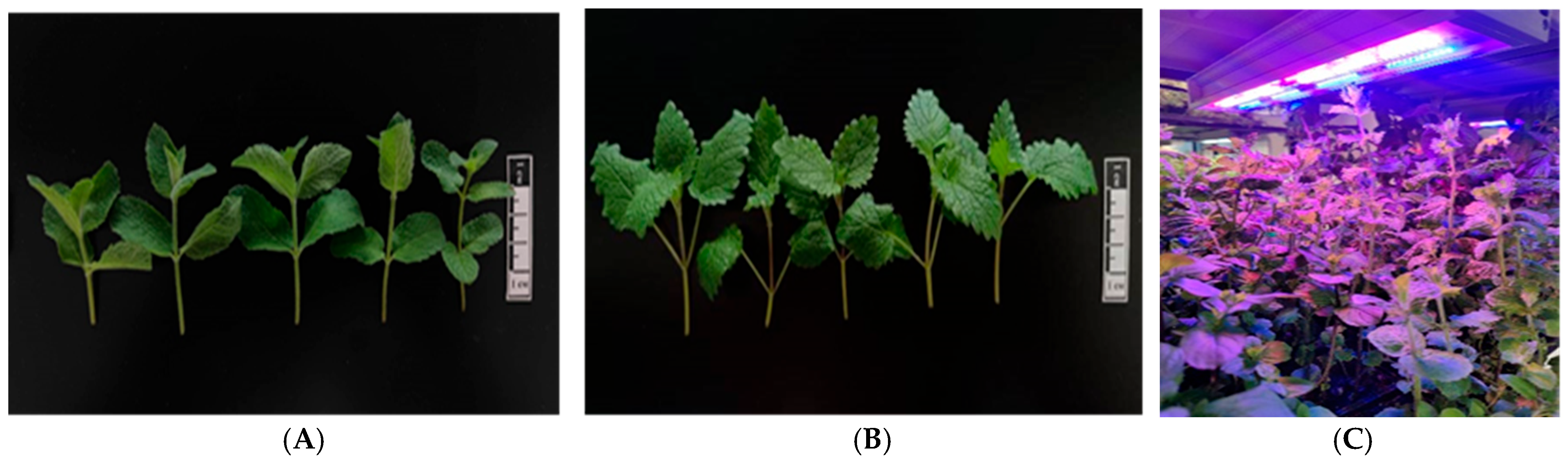
Cuttings of mint measuring 5.9 cm and lemon balm measuring 6.3 cm (Figure 1A,B) were placed in mineral cotton cubes. The plants were grown using a hydroponic method with a low-volume technology and the flooding method in a growth chamber. The area of the growth chamber was 16.5 m2, located at the Federal Scientific Agroengineering Center VIM (Moscow, Russia). The planting density was 20 plants per 1 m2 (Figure 1C).
The growing period for mint was 75 days, and it was 87 days for lemon balm. The growth chamber had an automatic microclimate control system. The daytime temperature was 23.0 ± 2.0 °C, the nighttime temperature was 18.0 ± 2.0 °C, and the relative humidity in the chamber was 60 ± 5%. The plants were irrigated daily for 180 s. Three-component GHE Flora fertilizers from General Hydroponics Europe (France) were used to prepare the nutrient solutions, with a pH level of 5.8–6.2 and an EC conductivity of 1.6–1.8 mS·cm−1 [33].

2.2. Irradiation Parameters

The growth chamber used high-pressure sodium lamps (HPLs) and light-emitting diodes (LEDs) of different spectral compositions. The experiment consisted of five lighting options:
  • Control: HPL Osram Plantastar 600 W lamps (Osram, Staré Mesto, Slovakia). This type of lamp is often used in plant cultivation and provides a high percentage of plant morphogenesis and productivity (Figure S1A)
  • White LED with a color temperature of 4000 K (Figure S1B).
  • Blue spectrum of LEDs with a peak wavelength of 450 nm (Figure S1C).
  • Red spectrum of LEDs with a peak wavelength of 660 nm (Figure S1D).
  • Combined use of red and blue spectra (Figure S1E).
White LEDs (4000 K) allowed us to assess the effect of the full spectrum of radiation that entered the leaf mesophyll. The wavelengths used in the experiments, 450 and 660 nm, were determined by the absorption range of photosynthetic pigments.
The photon flux density in the range of 400–800 nm in all variants was ~140 µmol·m−2·s−1, and the light period was 16 h. The LEDs were manufactured by Shenzhen Refond Optoelectronics Co., Ltd. (Shenzhen, China). Measurements of photon flux density and spectral composition of irradiation were carried out using the PG200N Compact spectrometer (UPRTek Corp. Miaoli County, Taiwan). The percentage composition of spectral illumination and the density of photon flux density (PFD) in the range of 400–800 nm are presented in Table 1.

2.3. Study Parameters

Measurements were taken from M. longifolia L. on the 75th day and from M. officinalis L. on the 87th day of vegetation at the flowering stage of the plants.

2.3.1. Biometric Indicators

The plant morphology was evaluated by plant height, leaf area, number of leaves, and fresh shoot mass. The plant height was measured from the base to the top of the shoot using a technical ruler (accuracy 0.01 mm). The area and number of leaves were determined using an LI-3100 Area Meter (LI-COR, NC, Lincoln, NE, USA). The determination of raw matter was carried out using an Ohaus EX224/AD analytical balance (OHAUS, NJ, Parsippany, USA). Measurements were taken in four biological replicates for each experimental variant and for each cultivar.

2.3.2. The Pigment Complex of Plants

Leaf pigments were determined in 100 mg of plant material in 100% acetone. The optical density of the acetone extract was determined using a UV-2200 spectrophotometer with a UV/VIS dual-beam (Jiuxin Group, Shanghai, China). Chlorophyll a (Chl a) was determined at λ = 662 nm, chlorophyll b (Chl b) at λ = 644 nm, and carotenoids (C car) at λ = 440.5 nm [34]. The concentration of pigments was calculated using the following Formulas (1)–(4) [35]:
C h l   a = 9.784 · D 662 0.990 · D 644 ;
C h l   b = 21.426 · D 644 4.650 · D 662 ;
C h l   a + b = 5.134 · D 662 + 20.436 · D 644 ;
C   c a r = 4.695 · D 440.5 0.268 · C h l   a + C h l   b .
The number of pigments in the raw sample was determined using Formula (5):
X = C · V 1000 · A ,
where X is the amount of raw mass pigments, mg·g−1;
C—concentration of pigments, mg·L−1;
V—volume of the extract, mL (25 mL);
A—weight of the sample, g.
The analysis was carried out in six repetitions for each experimental variant and for each cultivar.

2.3.3. Macronutrients and Nitrates

The content of basic macronutrients (K, Mg, Ca, S, and P) and nitrates (NO-3) was determined by capillary electrophoresis using an analytical system based on the Drops-205 capillary electrophoresis system (Lumex Company, St. Petersburg, Russia) [36,37]. The content of macronutrients and nitrates was determined in triplicate for each experimental variant and cultivar.

2.3.4. Essential Oils

The mass fraction of essential oils was determined in freshly cut raw materials by the Ginzberg hydrodistillation method. For mint, a 50 g sample was used, and for lemon balm, a 150 g sample was used, and the distillation time was 1 h [38]. The content of amino acids, macronutrients, and nitrates was determined in four replicates for each experimental variant and cultivar.

2.3.5. Quercetin and Rosmarinic Acid

Quantitative analysis of quercetin and rosmarinic acid was based on the reversed-phase high-performance liquid chromatography method [39] with photometric detection using an LC-20A liquid chromatograph with a UV/VIS detector (Shimadzu, Kyoto, Japan). Quercetin analysis was carried out in isocratic mode after acid hydrolysis of the sample. Separation was carried out on a C18 Luna 250 × 4.6 mm column with a particle size of 5 μm (Phenomenex, Torrace, CA, USA). Detection was carried out at λ = 365 nm, and the column temperature was 38 °C. The mobile phase of the solution consisted of a mixture of acetonitrile and 0.1% orthophosphoric acid at a 30:70% ratio. Rosemary acid was determined using gradient elution. The separation was performed on an ODS Hypersil 250 × 4.6 mm column (Thermo Scientific, Waltham, MA, USA). Detection was carried out at λ = 330 nm. The mobile phase of the solution consisted of a mixture of acetonitrile and orthophosphoric acid with a pH of 2.5, where the composition varied depending on the gradient program. The content of quercetin and rosmarinic acid was determined in triplicate for each experimental variant and cultivar.

2.4. Statistical Analysis

The initial data on biometric and biochemical indicators were analyzed using the analysis of variance (ANOVA) method, and SPSS version 22.0 and Microsoft Excel 2016 programs. Mean separation was performed by Tukey’s multiple range test at a 5% significance level of p ≤ 0.05. To evaluate the relationships between morphological characteristics, pigments, nutrient contents, and essential oils, Pearson correlation coefficients were calculated by using the R software environment, and the resulting correlation matrices were visualized as heatmaps using the corrplot package. Principal Component Analysis (PCA) was subsequently conducted using the prcomp function in R to identify the main factors contributing to the variance in the dataset. Prior to PCA, all variables were standardized using z-score scaling (mean = 0, standard deviation = 1) via the scale = TRUE argument, ensuring equal weighting of all variables regardless of their original units or magnitude. To isolate the effect of light spectra within each species and avoid confounding by between-species variation, PCA was performed separately for each species (M. longifolia L. and M. officinalis L.). A third pooled PCA including both species was additionally performed to visualize and confirm the overall between-species separation across the multivariate trait space. Components were retained based on two complementary criteria: the Kaiser criterion (eigenvalue > 1) and a minimum variance explained threshold of 5% per component. Accordingly, three principal components were retained, with eigenvalues of 10.52, 3.83, and 2.38 for PC1, PC2, and PC3, respectively. These three components collectively accounted for 86.57% of the total variance in the dataset (PC1: 54.42%, PC2: 19.84%, PC3: 12.30%), indicating a robust and informative dimensionality reduction. While three components were retained, the 2D biplots display PC1 and PC2, which together explain 74.26% of the total variance, capturing the dominant patterns of variation across the dataset. For interpretability, the PCA was assessed by examining the consistency of variables across components. Additionally, 95% confidence ellipses were constructed around group centroids using the factoextra and ggfortify packages to visually represent groups based on light spectra and plant species. Visualization was achieved through biplots in which variable contributions were represented as vectors to illustrate their influence on the principal dimensions.

3. Results

3.1. Mentha longifolia L. cv. “Vesenniy Aromat”

3.1.1. Morphological Parameters

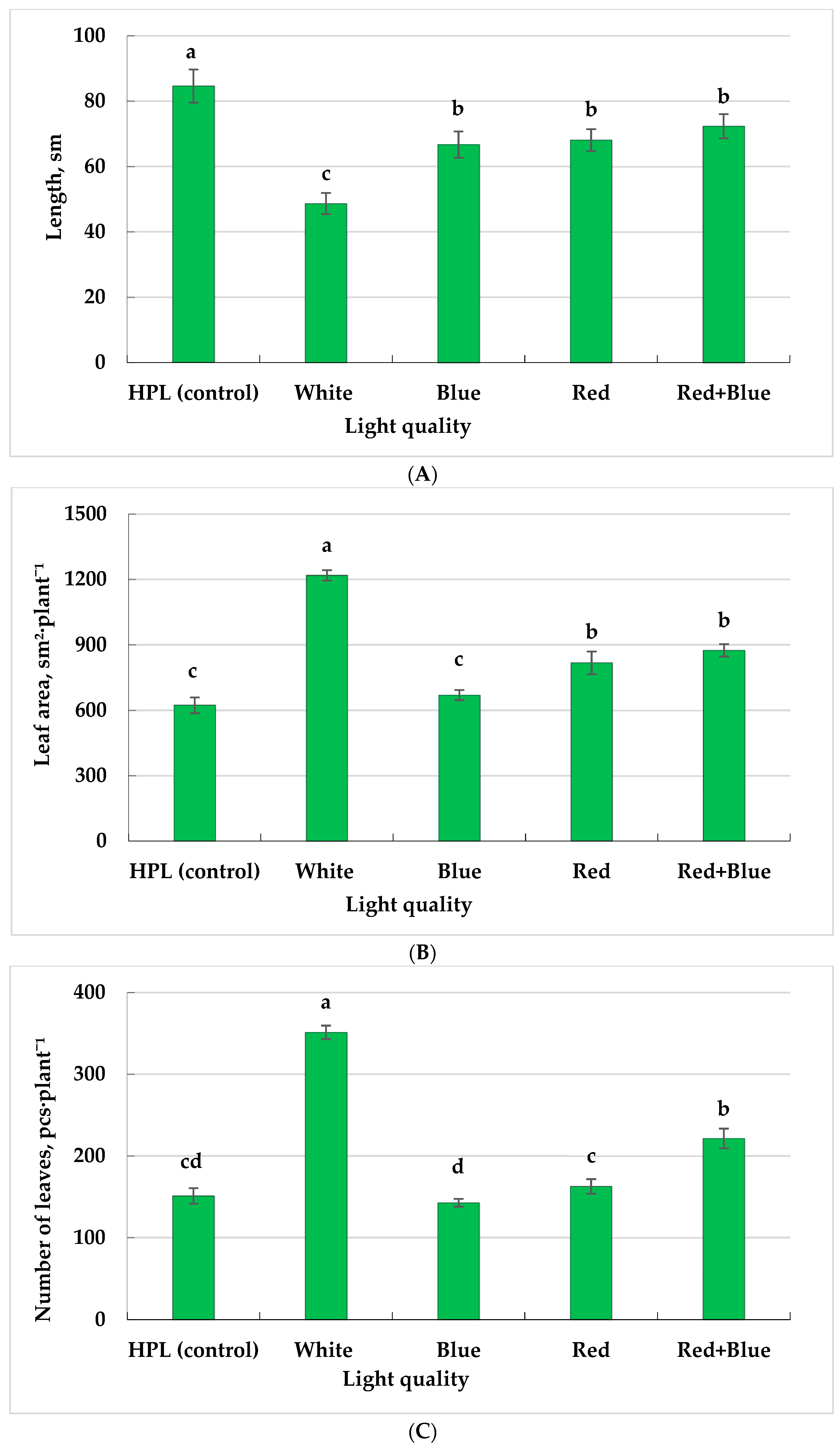
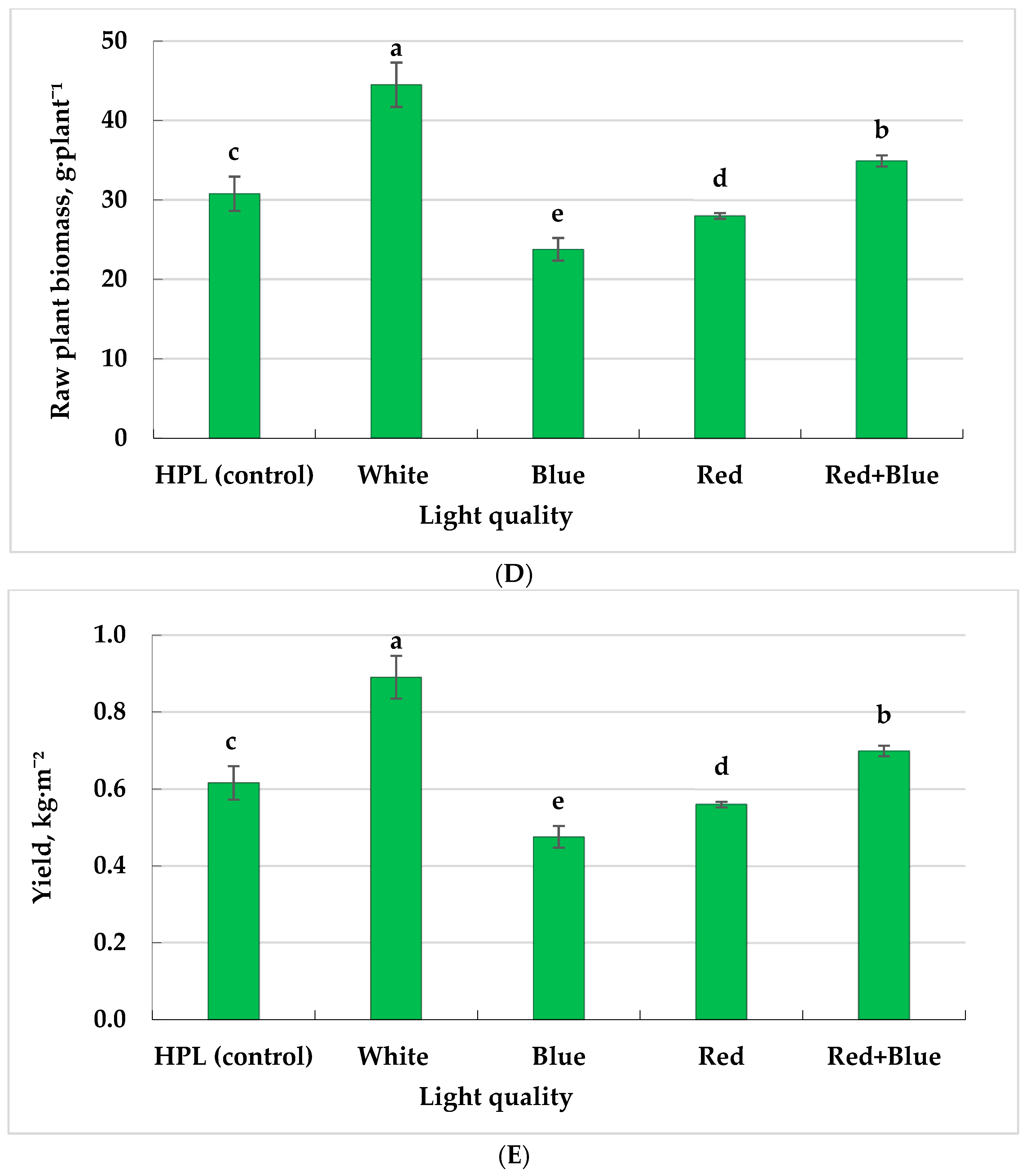
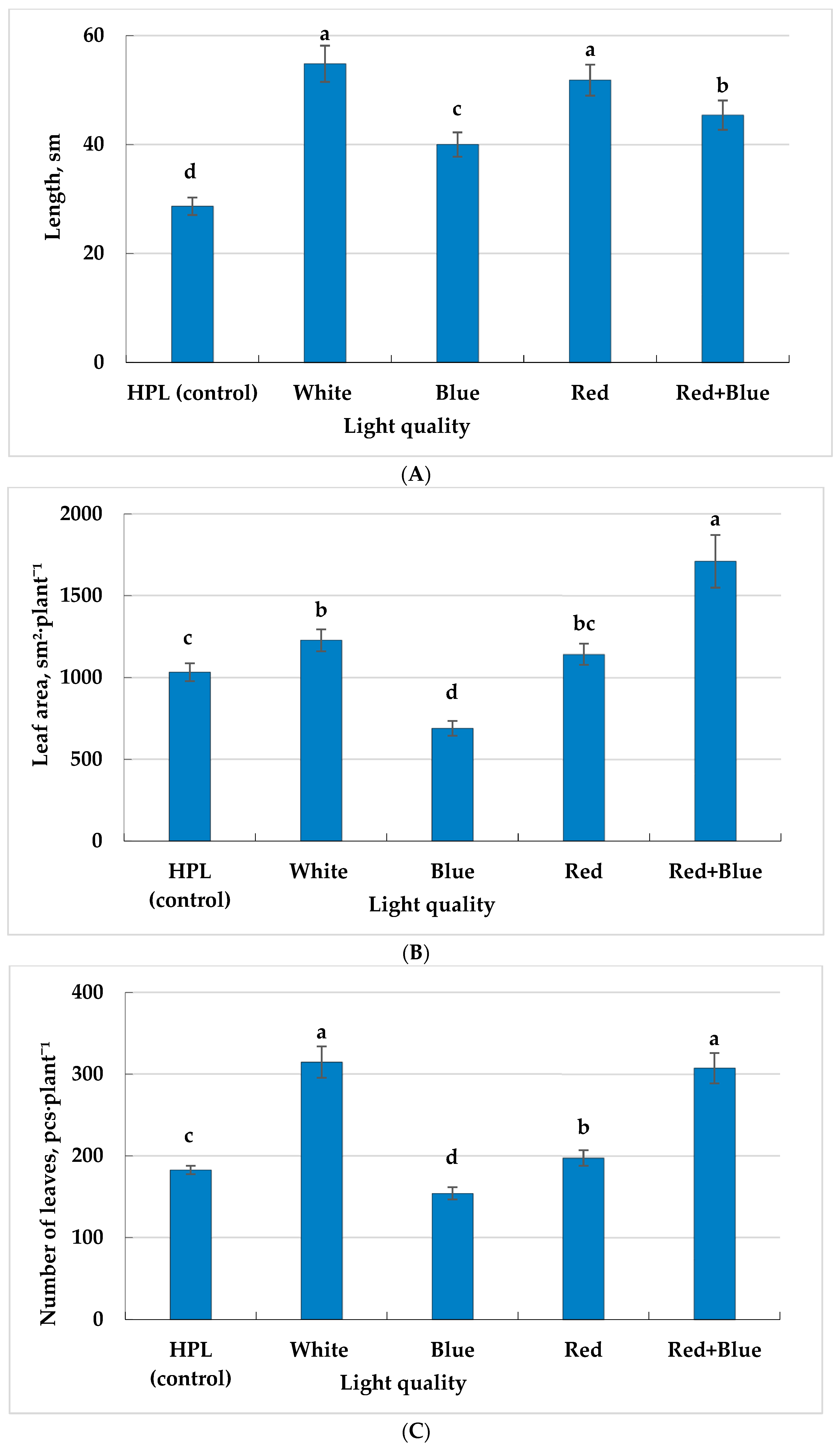
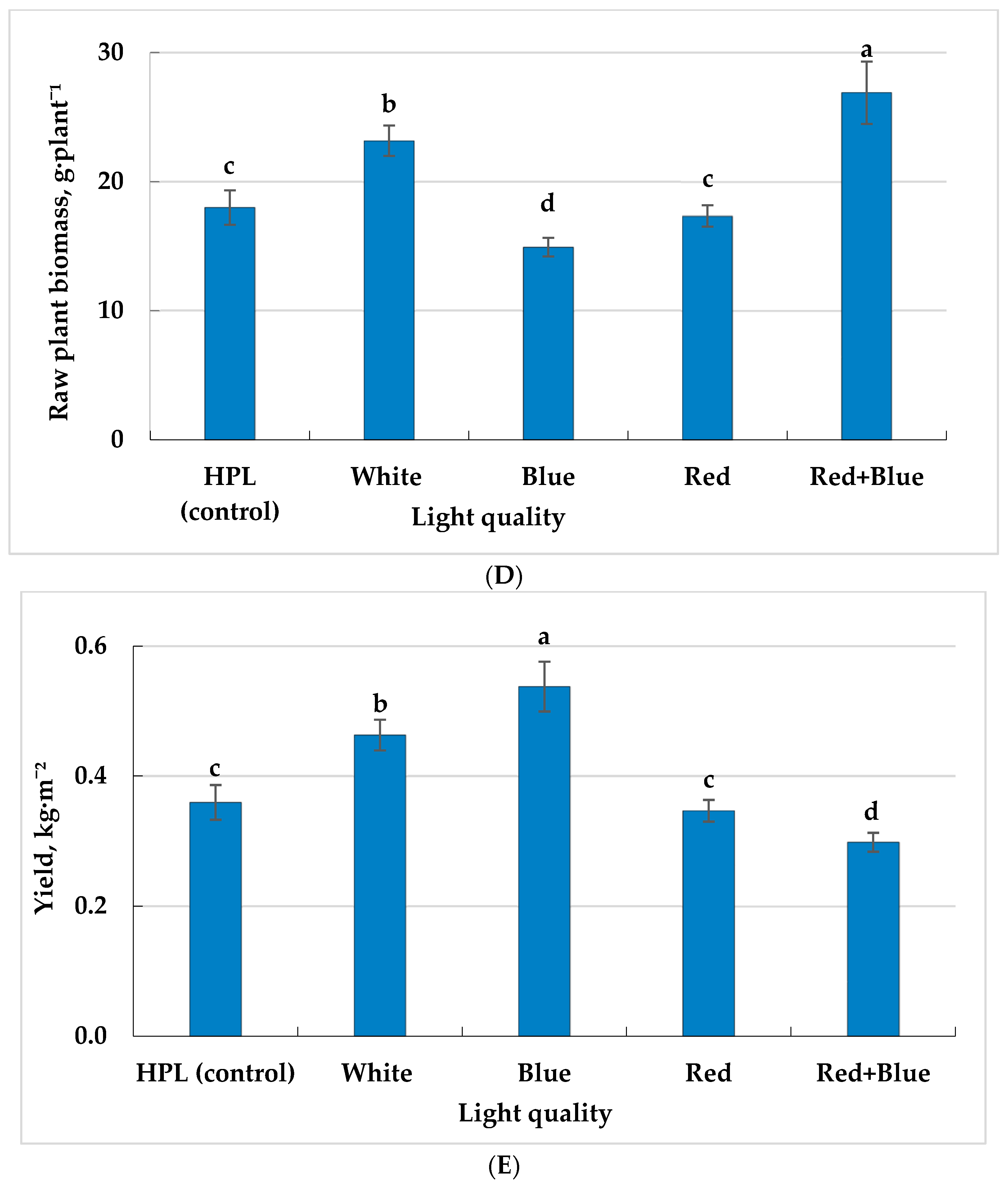
Compact mint plants with well-developed leaf blades and a large number of leaves were obtained under white spectrum lighting (Figure S2B). The height of the plants in this variant of the experiment was 42.5% lower than with HPLs (control), and 23.9% lower than the plants obtained with red, blue, and red + blue LEDs (p ≤ 0.05) (Figure 1A). The leaf area and number under white light exceeded the control plants by 95.4% and 132.7%, respectively (Figure 2B,C). The large leaf area and number of leaves obtained under white light spectrum provided high values of biomass (44.51 g) and yield of vegetative mass of plants (0.9 kg·m−2) compared to other experimental options (Figure 2D,E). The Red + Blue LEDs increased leaf area by 28.75%, the number of leaves by 31.78%, and plant biomass by 11.82%; yield was also increased by 11.82% compared to the control, but the height of the plants with Red+ Blue LEDs was 14.53% lower than those with HPLs. The studied parameters of plants under Red + Blue LEDs were higher than in the plants under white light, but lower than in the plants of the control group (Figure S2E). Red LED plant lighting only increased leaf area to 818.00 cm2 per plant (Figure S2D), which was 31.2% higher than in the control. Blue LEDs had a lesser effect on plant morphology. The number and area of leaves, as well as the biomass of plants grown under Blue LEDs, were significantly lower than in the plants grown under other lighting conditions (Figure 2A–E and Figure S2C).

3.1.2. The Content of Photosynthetic Pigments

Blue spectrum lighting increased the content of photosynthetic pigments in the leaves compared to other experimental options (Table 2). The content of Chl a, Chl b, and Chl a+b under Blue LED lighting was higher than in the control by 50.6%, 46.6%, and 49.5%, respectively. In addition, the increased content of C car under Blue LED lighting promoted better adaptation of the mint cv. “Vesenniy Aromat” in hydroponic conditions in closed artificial agroecosystems.

3.1.3. Macronutrient Content

The Red + Blue LEDs significantly increased the potassium content (by 33.7%), magnesium content (by 39.4%), calcium content (by 25.0%) and phosphorus (by 16.6%) compared to the control (Table 3). Blue LED and Red LED lighting also significantly increased the content of these elements, while white light was less effective.

3.1.4. Content of Quercetin, Rosmarinic Acid, and Essential Oil

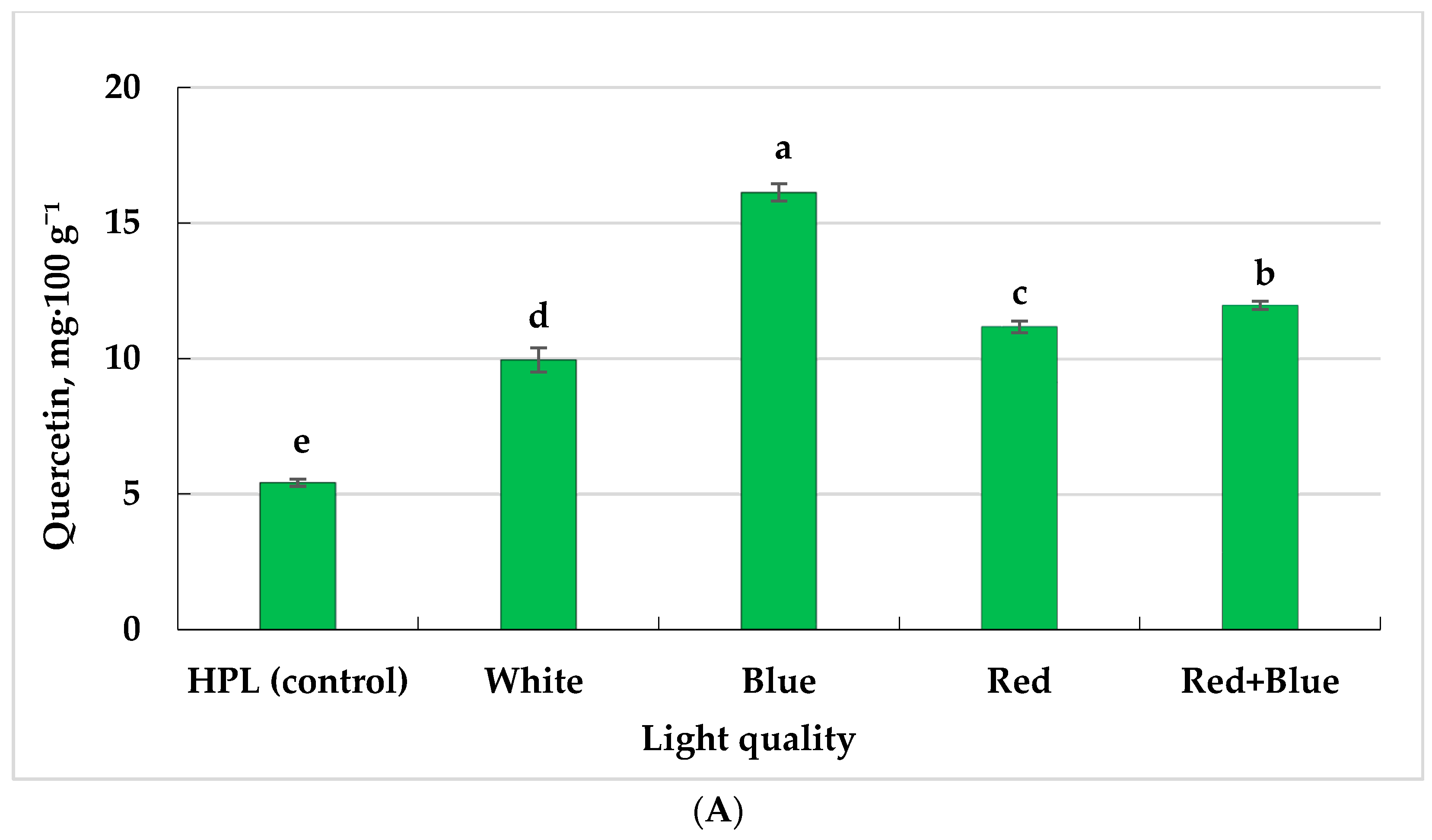
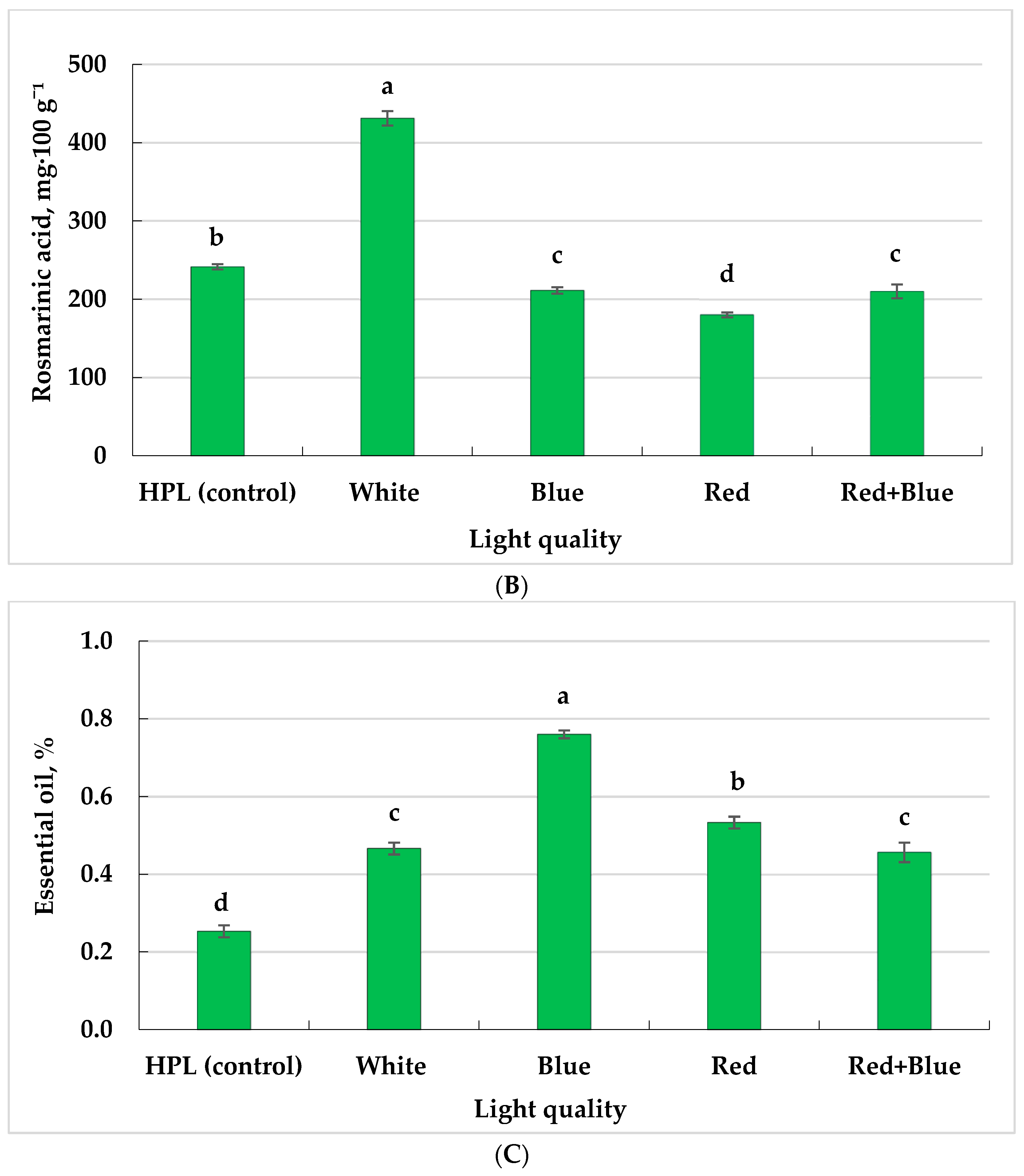
The high efficiency of Blue LED lighting was shown in the accumulation of essential oil and quercetin, which significantly exceeded the control by 66.77% and 66.38%, respectively (Figure 3A,C). However, the content of rosmarinic acid decreased to 211.35 mg·100 g−1 under the influence of Blue LED lighting, which was 12.5% lower than in the control (Figure 2B). The high efficiency of White LED lighting was shown in the accumulation of rosmarinic acid and essential oil, which significantly exceeded the values of these indicators in the control (Figure 3B,C). Red + Blue LEDs were inferior to monochromatic lighting options (Blue LED, Red LED) in terms of quercetin, rosmarinic acid, and essential oil content. In addition, Red LED lighting also reduced the accumulation of rosmarinic acid to 179.98 mg·100 g−1, which was 25.5% lower than the control.

3.1.5. Nitrate Content

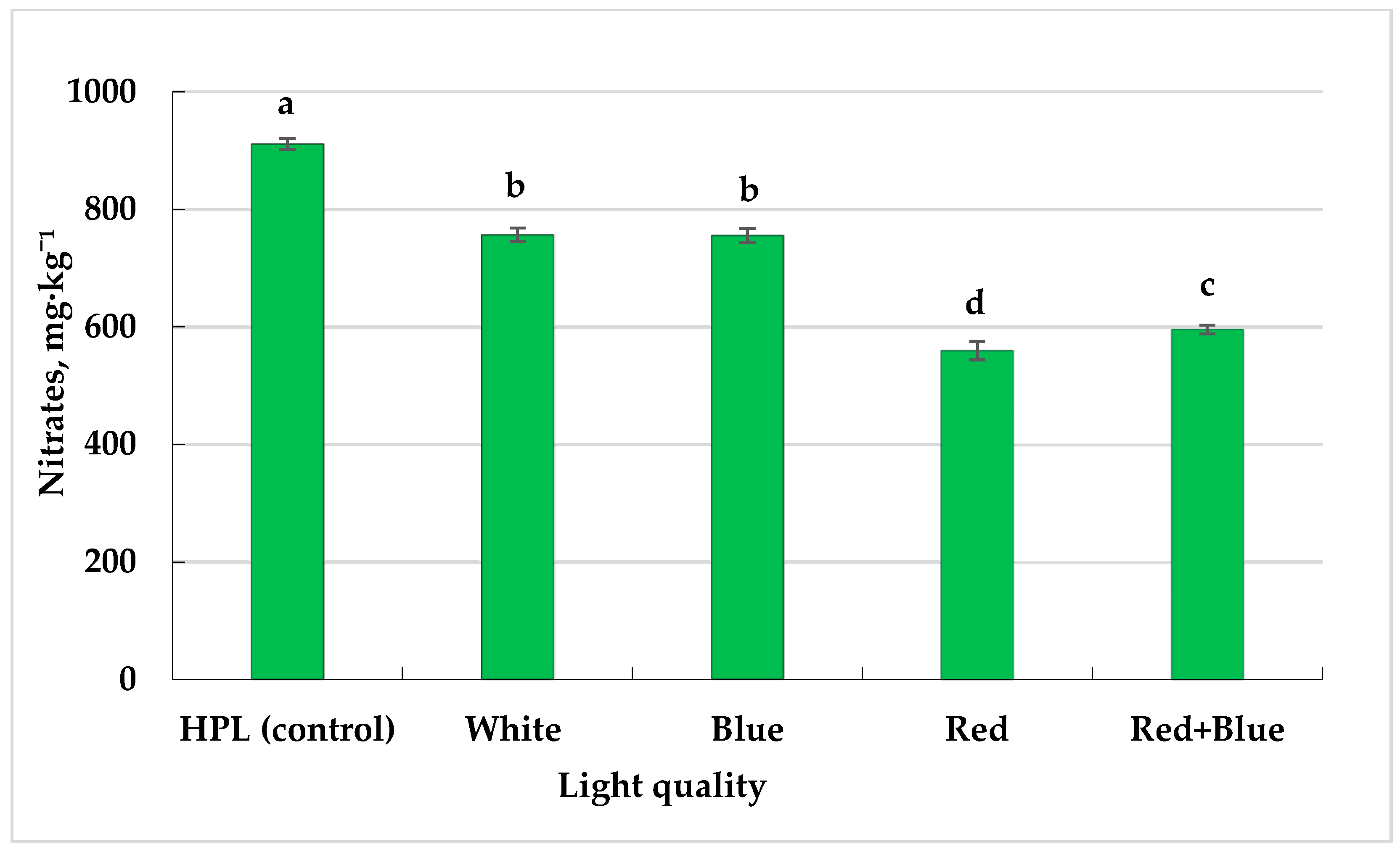
The results of this study showed a certain decrease in the nitrate content in the vegetative mass under White LED, Blue LED, Red LED, and Red + Blue LEDs compared to the control (911.71 mg·kg−1). The lowest nitrate content was found in the plants grown under Red LED (559.82 mg·kg−1) and Red + Blue LEDs (595.83 mg·kg−1). White LED and Blue LED lighting also reduced the nitrate content to 757.24 mg·kg−1 and 755.91 mg·kg−1, respectively, but this reduction was minimal compared to the control (Figure 4).

3.2. Melissa officinalis L. cv. “Limonnyy Aromat”

3.2.1. Morphological Parameters

The best effect on the combination of morphological features of lemon balm, such as shoot length, leaf area and number, and plant biomass, was obtained using Red + Blue LEDs. The shoot length of the plants under this lighting option reached 45.40 cm, the leaf area was 1709.33 cm2 per plant, the number of leaves reached up to 307.33, and the biomass was 26.89 g per plant, which exceeded the plants grown in the control option by 58.3%, 65.5%, 68.2%, and 49.5%, respectively. However, the plant yield under Red + Blue LEDs was 17.05% lower than that of the control variant (Figure 5A–D). White LED and Red LED lighting also increased shoot growth to 54.83 cm and 51.83 cm, respectively, compared to the control (32.15 cm). In addition, White LED lighting increased plant biomass to 23.16 g per plant. The biomass of plants grown under Red LED lighting (17.34 g) was comparable to that of the control plants (Figure 5D). With the use of a high proportion of Blue LED lighting, the plant height and yield exceeded the control by 33.3% and 39.4%, respectively, but the leaf area of lemon balm under Blue LED lighting was 33.3% lower than in the control, at 689.00 cm2 per plant−1. Moreover, the number of leaves was not large (154.0) and also 15.7% lower than in the control plants, and the biomass decreased to 14.92 g per plant, which was 17.99% lower than in the control (Figure 5A–E).

3.2.2. The Content of Photosynthetic Pigments

The use of LED lighting with different spectral compositions significantly increased the content of photosynthetic pigments in lemon balm compared to the control (Table 4). The use of Red + Blue LEDs was the most effective. The content of Chl a, Chl b, and Chl a+b was 65.3%, 93.8%, and 73.1% higher than when using the control lighting. The C car content was 113.6% of the control and ensured better adaptation of lemon balm to growing conditions. White LED, Blue LED, and Red LED lighting also showed high results in terms of leaf pigment content, but were less effective compared to Red + Blue LEDs. At the same time, the blue spectrum increased Chl a+b by 32% compared to the control, but decreased plant biomass.

3.2.3. Macronutrient Content

The dependence of the accumulation of macronutrients in lemon balm leaves on spectral lighting is shown Table 5. Blue LED and Red + Blue LED lighting showed similar effects on the accumulation of potassium, calcium, and phosphorus. The plants grown with Blue LED and Red + Blue LEDs had a high content of potassium, calcium, and phosphorus, exceeding the control by 20.5–21.3%, 24.2–29.0%, and 27.2–38.8%, respectively. Blue LED lighting promoted the maximum accumulation of calcium and phosphorus, while Red + Blue LEDs promoted the accumulation of magnesium. White LED lighting occupied an intermediate position: it effectively accumulated magnesium and sodium, but did not affect the content of calcium and phosphorus, and slightly increased the content of potassium.

3.2.4. Content of Quercetin, Rosmarinic Acid, and Essential Oil

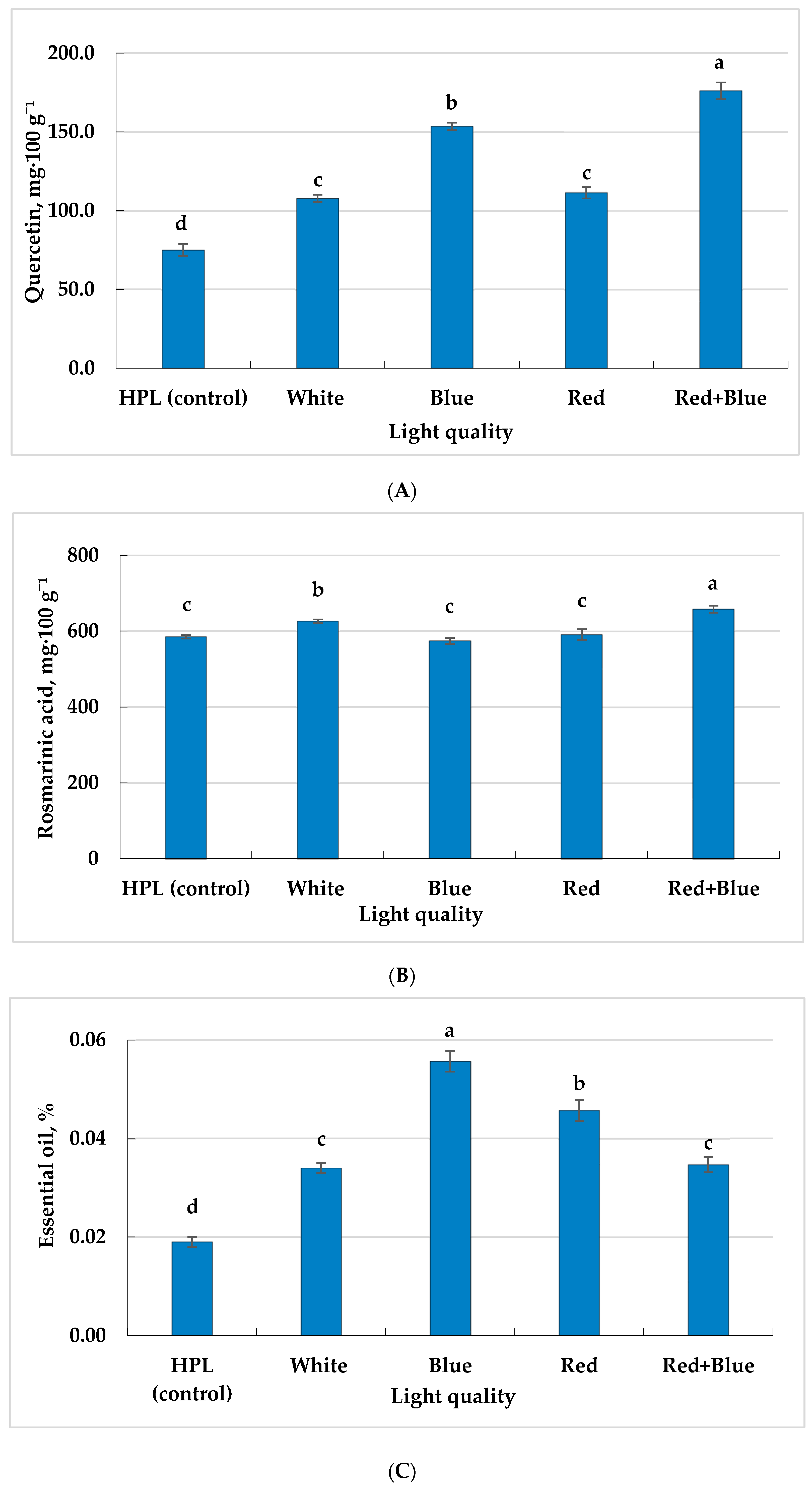
Spectral lighting with White LEDs, Blue LEDs, Red LEDs, and Red + Blue LEDs significantly increased the accumulation of essential oil and quercetin in the vegetative mass compared to the control, up to 194.7% and 134.9%, respectively (Figure 6A,C). At the same time, Blue LED lighting provided the maximum synthesis of essential oil (0.056%). The content of essential oil in plants under Blue LED lighting was 194.7% higher than in the control. Red + Blue LEDs stimulated the maximum accumulation of quercetin—up to 176.07 mg·100 g−1. The quercetin content in plants under Red + Blue LEDs was 134.9% higher than in the control. In addition, Red + Blue LEDs provided a high accumulation of rosmarinic acid (657.84 mg·100 g−1), which was 12.4% higher than in the control. Blue LED and Red LED lighting did not have a significant effect on the rosmarinic acid content (Figure 6B).

3.2.5. Nitrate Content

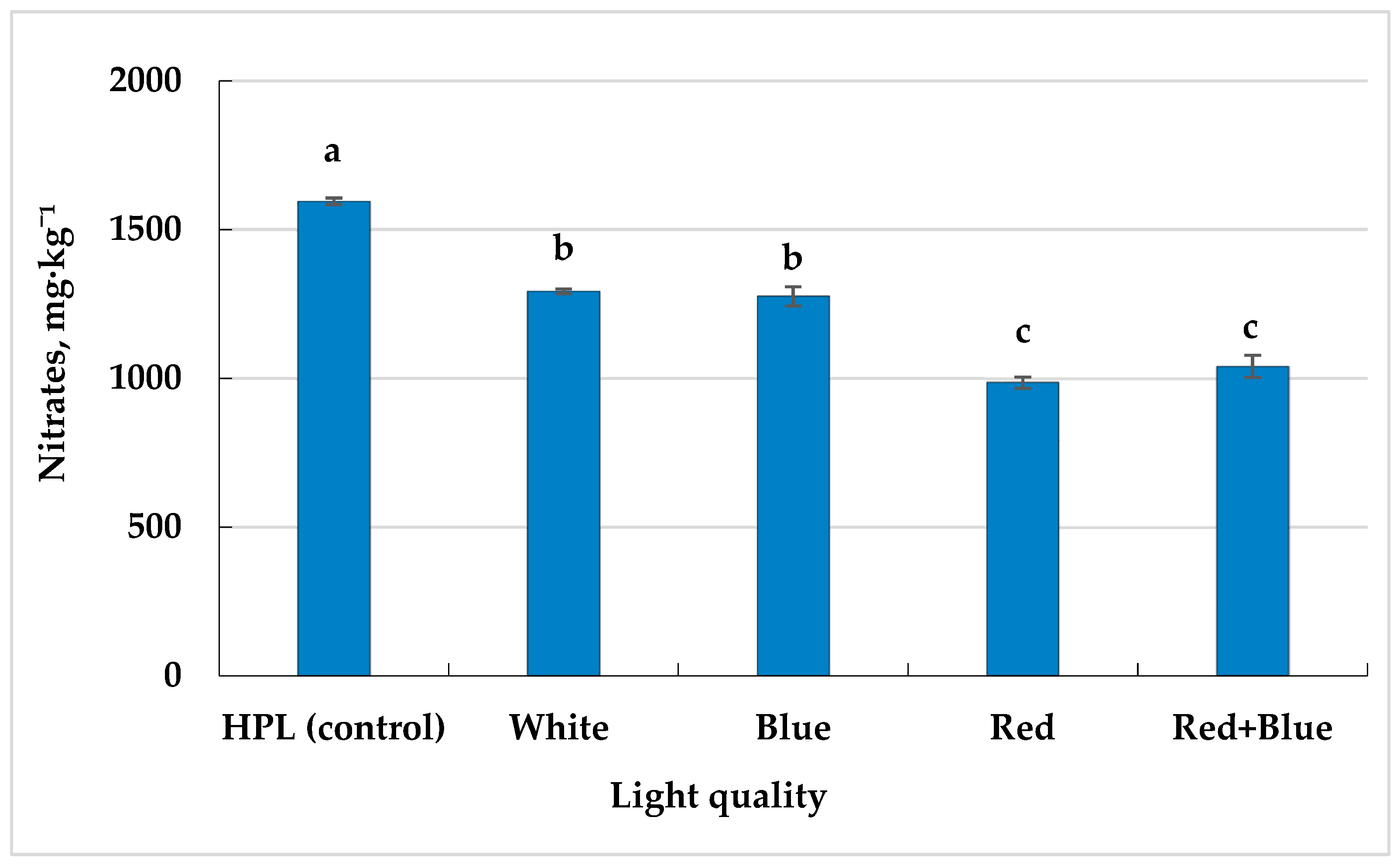
All the studied light spectra provided a significant reduction in the nitrate content in lemon balm plants compared to the control (1595.14 mg·kg−1) (Figure 7). Red LED lighting and Red + Blue LEDs contributed to the minimal accumulation of nitrates in the vegetative mass of lemon balm, with an average reduction of 36.5% compared to the control. White LED and Blue LED lighting reduced the nitrate content by approximately 18.9% and 20.0%, respectively, compared to the control.

3.3. Impact of Light Spectra on the Morpho-Physiological Characteristics, Mineral Content, and Secondary Metabolites of M. longifolia L.and M. officinalis L.

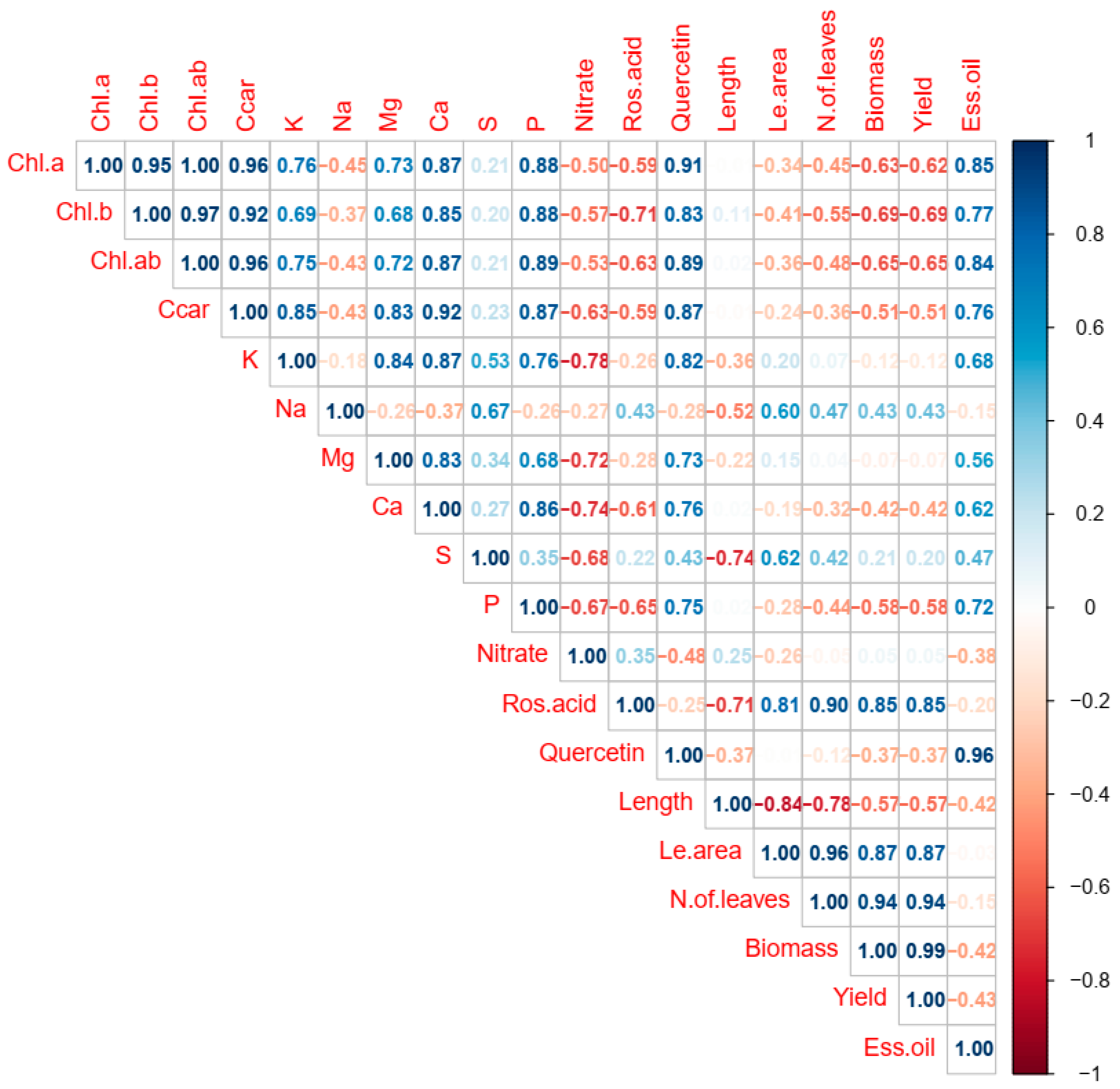
The correlation matrix for M. longifolia L. showed strong synergistic and antagonistic relationships between growth parameters and chemical composition (Figure 8). Chlorophyll components (Chl a, Chl b, and Chl a+b) and carotenoids (C car) show near-perfect positive correlations with one another (r ≥ 0.95). Notably, these pigments are strongly positively correlated with quercetin (r = 0.83 to 0.91) and essential oil content (r = 0.77 to 0.85), possibly suggesting that light treatments favoring pigment accumulation also enhance these bioactive compounds. Mineral nutrients such as potassium (K), magnesium (Mg), calcium (Ca), and phosphorus (P) demonstrate strong positive correlations with pigment levels (r = 0.68 to 0.92). Specifically, quercetin levels are highly associated with K (r = 0.82) and P (r = 0.75) concentrations. A clear distinction is observed between biomass production and secondary metabolism. While yield and biomass are perfectly correlated (r = 0.99), they show negative correlations with essential oil content and pigments (r = −0.43 and −0.42, respectively). Conversely, rosmarinic acid is strongly associated with growth parameters like leaf area (r = 0.81), leaf number (r = 0.90), and biomass (r = 0.85). Nitrate content shows significant negative correlations with essential mineral nutrients, most notably K (r = −0.78) and Ca (r = −0.74), as well as with pigment accumulation (r = −0.50 to −0.57).
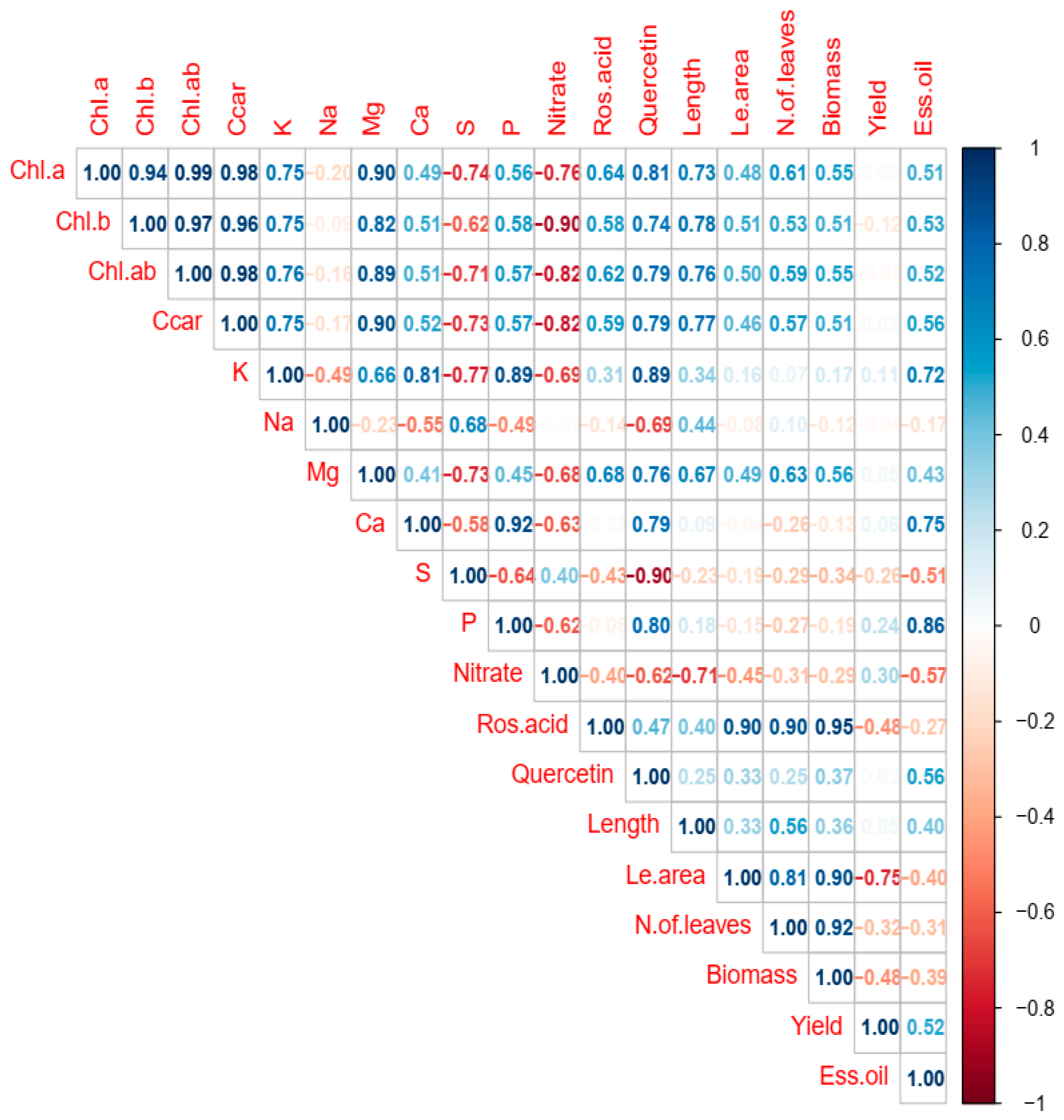
The correlation profile for M. officinalis L. indicates different physiological priorities compared to mentha (Figure 9). Similar to mentha, pigments in melissa are highly inter-correlated. However, in this species, pigments show a stronger relationship with plant length (r = 0.73 to 0.78) and magnesium (r = 0.82 to 0.90), the latter being a central component of the chlorophyll molecule. Rosmarinic acid in melissa is extremely strongly coupled with vegetative growth, showing high positive correlations with biomass (r = 0.95), leaf area (r = 0.90), and number of leaves (r = 0.90). Essential oil content, meanwhile, is primarily associated with the accumulation of P (r = 0.86), Ca (r = 0.75), and K (r = 0.72). Nitrate exhibits a much stronger inhibitory relationship with pigments in melissa than in mentha, with negative correlations reaching −0.90 for Chl.b and −0.82 for carotenoids. It is also negatively associated with essential oil accumulation (r = −0.57). Unlike mentha, quercetin in melissa shows a strong positive correlation with plant length (r = 0.89), but a relatively weak relationship with final biomass (r = 0.37) and yield (r = 0.02).
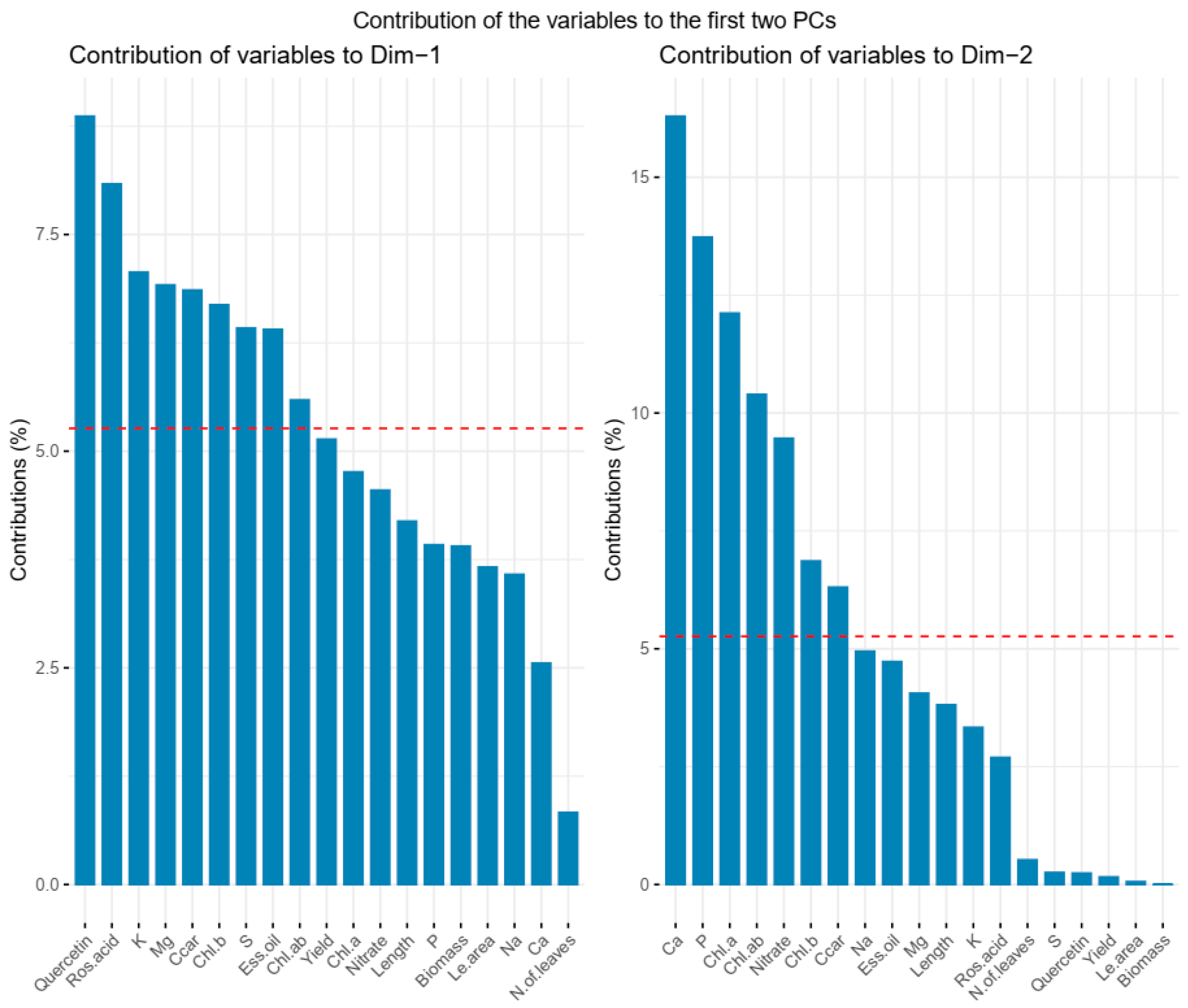
PCA reveals that the first two dimensions provide a substantial contribution to the total variance (Figure 10). The variables most responsible for the horizontal separation (Dim-1) include quercetin, rosmarinic acid, potassium (K), magnesium (Mg), carotenoids (C car), and chlorophyll b (Chl b). The vertical variance (Dim-2 contributions) is influenced by mineral content, specifically calcium (Ca) and phosphorus (P), as well as chlorophyll a and nitrate levels.
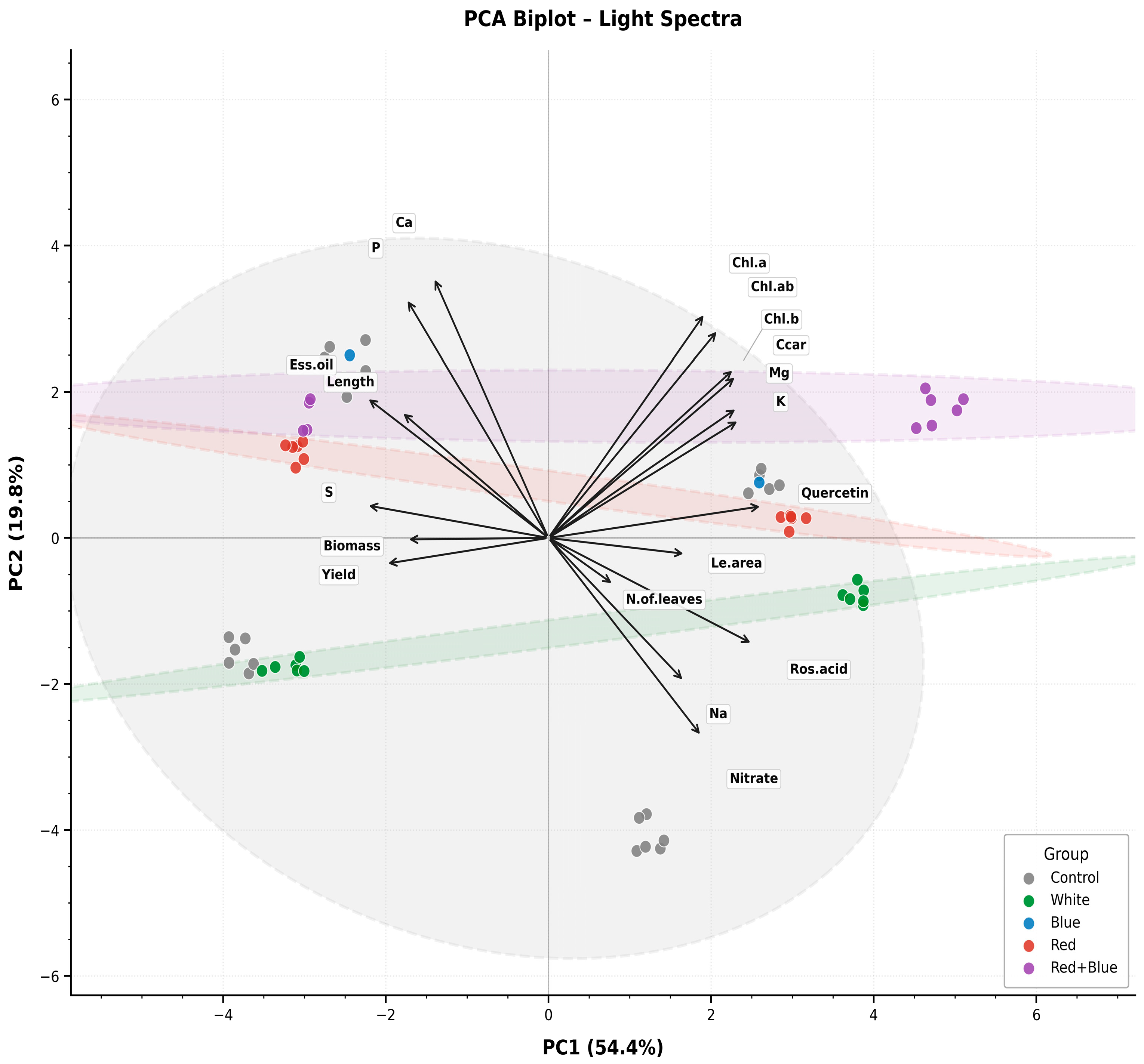
PCA explains a combined 74.2% of the total variance, with Dim-1 (54.4%) primarily separating samples based between growth/minerals and pigment/secondary metabolites (Figure 11). The Red light treatment is strongly concentrated in the left hemisphere of the plot, aligning directly with the longest vectors for biomass, yield, length, and essential oil. This placement suggests that red spectra are possibly the primary drivers for physical productivity in these species. However, this conclusion needs to be further verified due to sample size limitations. These samples also show a close proximity to sulfur (S) and phosphorus (P) vectors, indicating that red light may facilitate the uptake or concentration of these specific minerals alongside biomass accumulation.
The Red + Blue cluster, positioned in the upper-right quadrant, represents the most “nutrient-dense” and pigment-rich” spectral profile. This group is aligned with the vectors for chlorophyll a, b, and total a+b (Chl a+b) and carotenoids (C car). The proximity to magnesium (Mg) and potassium (K) vectors is notable. Since Mg is the central atom of the chlorophyll molecule, this cluster visually confirms the synergy between mineral uptake and pigment synthesis under combined red and blue light. The White LED lighting samples cluster in the lower-right quadrant, showing a metabolic fingerprint compared to the pure color LEDs. The Blue LED samples are situated between the Red + Blue and White clusters. Their primary alignment is with the quercetin vector. This suggests that blue light specifically may contribute to the flavonoid biosynthetic pathway, even if it does not stimulate the full suite of pigments as effectively as the Red + Blue combination. The Control (HPL) group shows the widest vertical spread along Dim-2 (high variability). One subgroup aligns with high mineral content (Ca, P) and essential oils in the upper left, while number of leaves (N. of leaves) pulls another subgroup toward the bottom. These may be indicators that the control spectrum provides a “balanced” but less specialized stimulus compared to the targeted LED treatments. The horizontal axis (Dim-21) represents the shift from vegetative growth/essential oils (left) to pigments/antioxidants (right). On the other hand, the vertical axis (Dim 2) represents the shift from primary minerals/pigments (top) to organic acids/bioactive phenolic (bottom).
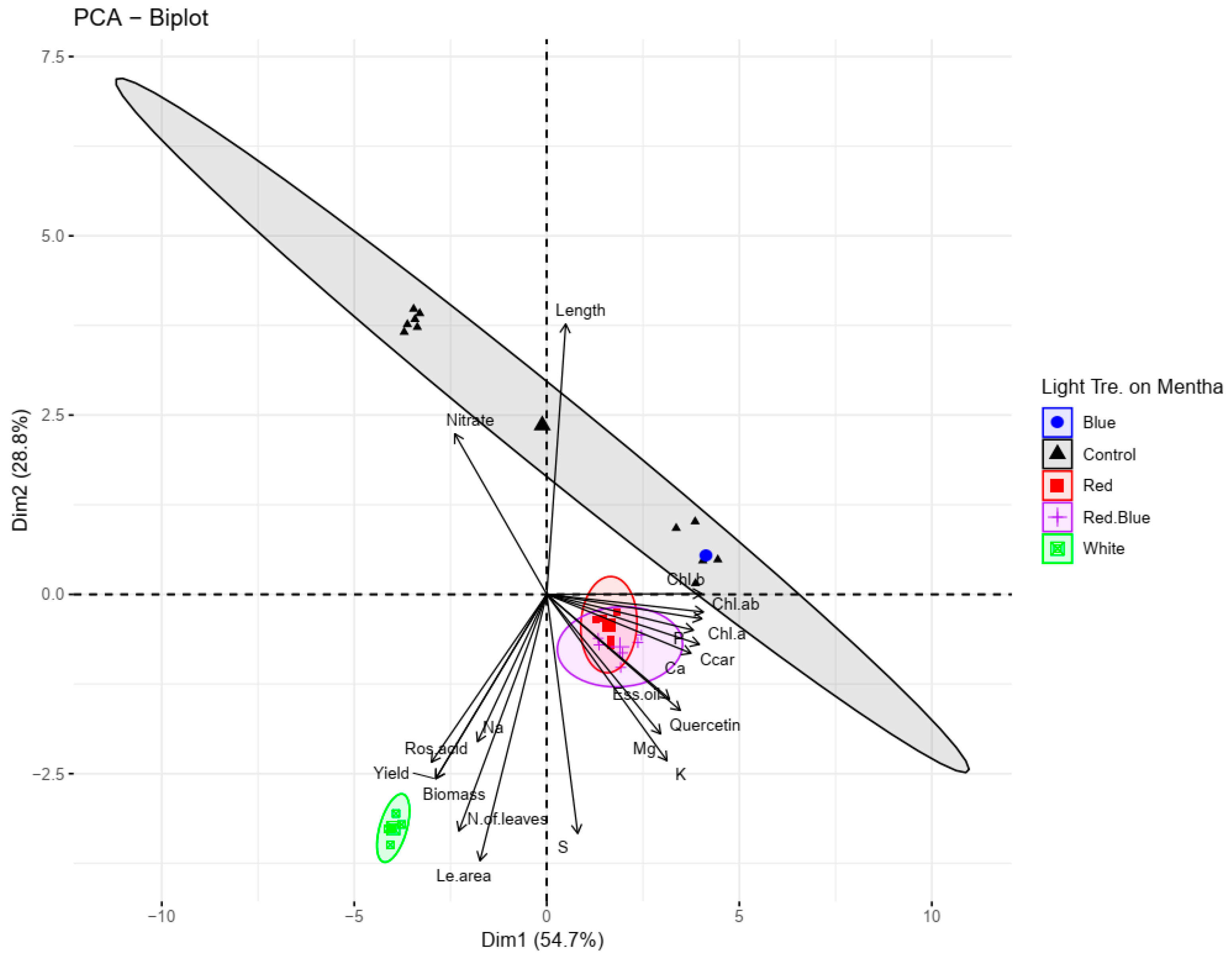
The species-specific PCA for M. longifolia L. explains 54.7% (PC1) and 28.8% (PC2) of total variance, cumulatively accounting for 83.4% across the first two dimensions (eigenvalues: PC1 = 10.74, PC2 = 5.65). This high cumulative variance confirms that the biplot captures the dominant structure of the data effectively. The light treatments produce clear, well-separated groupings. The Blue LED, Red LED, and Red + Blue LED treatments cluster distinctly in the positive PC1 region, closely aligned with pigment vectors (Chl a, Chl b, Chl a+b, C car) and secondary metabolite vectors (quercetin, essentialoil), confirming that these spectra specifically drive photosynthetic pigment accumulation and secondary metabolism in M. longifolia L. The Control (HPL) and White LED groups occupy the intermediate space, reflecting their broader, less specialized spectral stimulus (Figure 12).
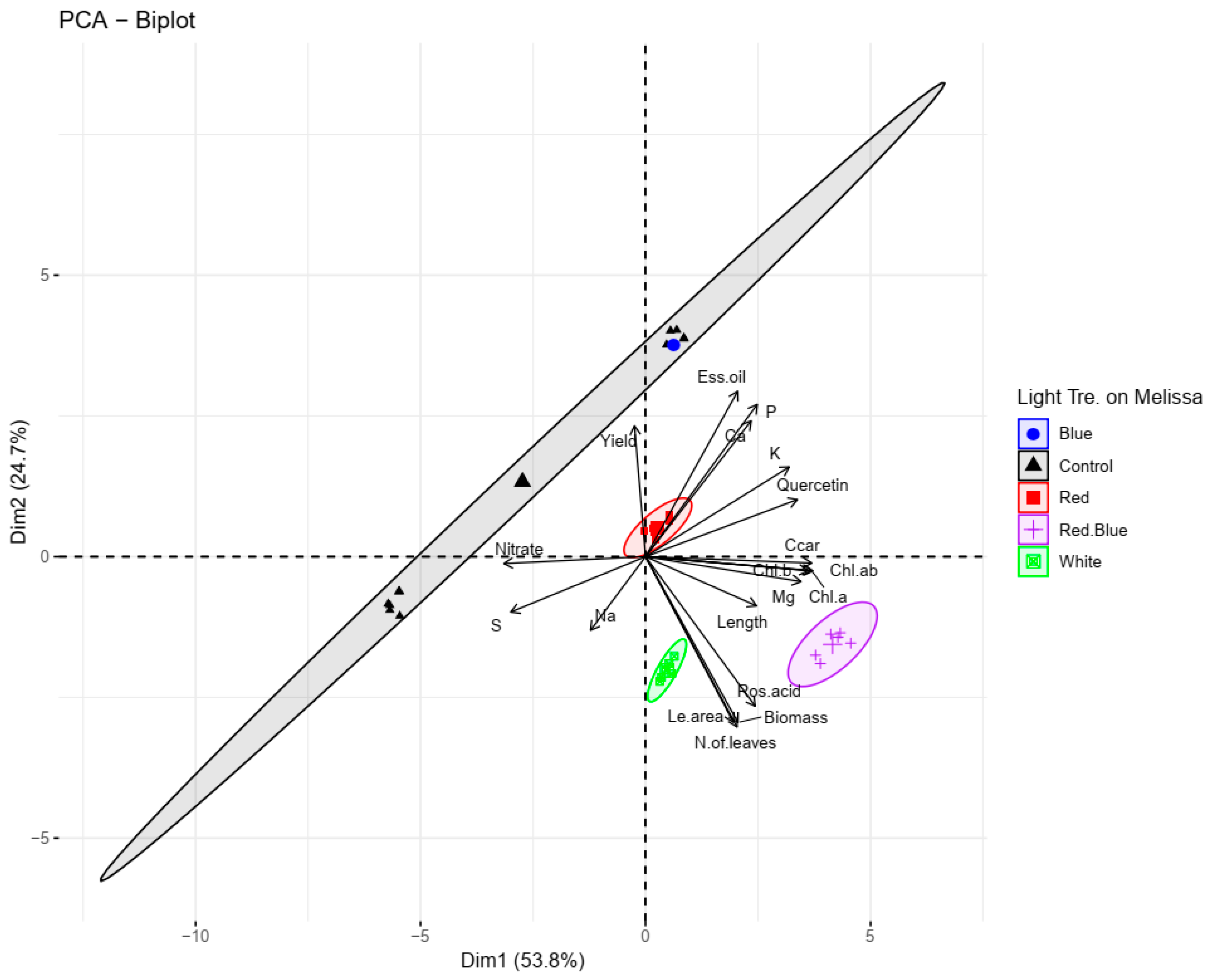
The species-specific PCA for M. officinalis L. explains 53.8% (PC1) and 24.7% (PC2) of total variance, cumulatively accounting for 78.5% (eigenvalues: PC1 = 10.57, PC2 = 4.86). As in M. longifolia, the Red + Blue LED treatment clusters in the high-pigment region of PC1, with strong alignment to chlorophyll and carotenoid vectors. However, a notable difference is observed in the positioning of rosmarinic acid and quercetin vectors, which show a stronger relationship with the White LED and Red LED clusters in M. officinalis L. relative to M. longifolia L. This is consistent with the species-level correlation analysis (Figure 9), which identified a stronger coupling between growth traits and phenolic compound accumulation in M. officinalis L. The Blue LED cluster in M. officinalis L. shows a distinct separation along PC2, primarily driven by essential oil content and mineral composition (Ca, P) (Figure 13).
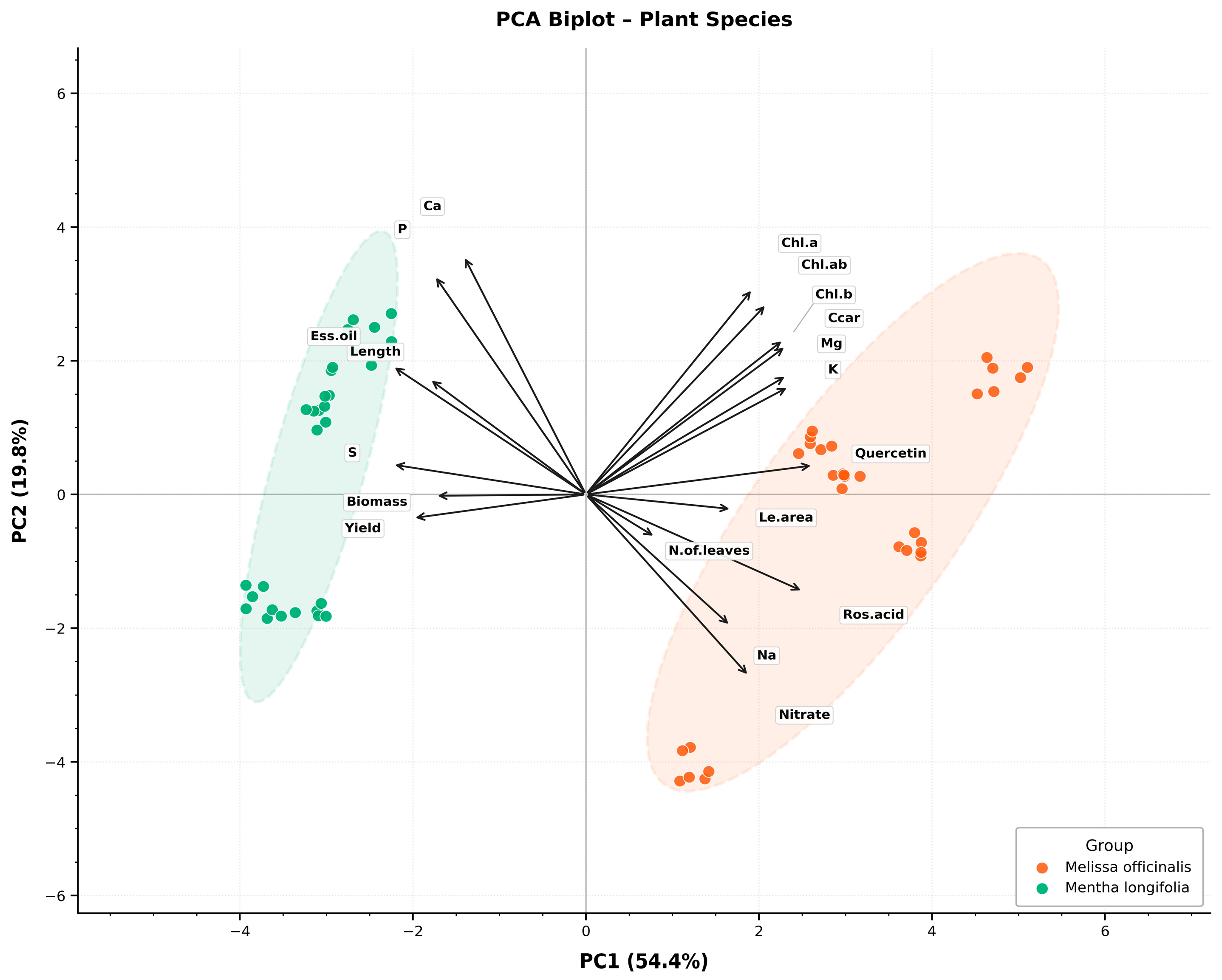
The pooled PCA including both species is presented to explicitly demonstrate the magnitude of between-species differentiation across the full multivariate trait space (Figure 14). Species identity is shown for a substantial portion of total variance in the pooled analysis (PC1 = 54.4%, PC2 = 19.8%). The clear separation of M. longifolia L. and M. officinalis L. along PC1 is itself a meaningful biological result, showing that the two species respond to identical lighting conditions with fundamentally different physiological and biochemical strategies. This pooled analysis is presented as a complementary visualization rather than the primary basis for interpreting treatment effects, which are addressed through the species-specific analyses above.

4. Discussion

Light technology is an optimal way to regulate plant growth and development. It makes possible the regulation of physiological processes and increases the production of secondary metabolites in plants [40,41]. This study shows the response of Melissa officinalis L. and Mentha longifolia L. to different spectral lighting. White spectrum and Red + Blue LED lighting provided good morphological development of M. longifolia L. and M. officinalis L. plants. At the same time, white spectrum lighting encouraged compactness and a large number of leaves in M. longifolia L., which assured high accumulation of plant biomass (Figure 2D). According to the reports of Massa et al. [42], Mohamed [28], Ryu [43], and Shin [44], White light also improves growth parameters, i.e., leaf number, leaf area, and leaf mass per unit area. It is possible that these results are due to the fact that broadband white light has a complex effect upon the studied plants related to phytochromes, cryptochromes, and phototropic proteins, thereby promoting balanced photomorphogenesis, in contrast to the responses to monochromatic light, under which only one trait, such as shoot elongation, is affected [45].
Focusing light in the red and blue regions of the spectrum (Red + Blue LEDs) also stimulated growth processes in M. longifolia L. and M. officinalis L. This result is explained by the optimal percentage ratio of the red and blue spectra in this experiment (25R:72B). Rihan et al. [46] and Aldarkazal et al. [47] showed that the combined use of blue and red spectra increased the height of basil plants to 40 cm, as well as enhanced photosynthetic rate Amax, Fv/Fm, and stomatal conductance Gs. The use of a 400–500 nm wavelength Blue LED reduced the biomass of mint and lemongrass by 7.00 g·plant−1 and 3.07 g·plant−1, respectively (Figure 2D and Figure 5D). The obtained research result is consistent with the data of Rihan et al. [46] with regard to basil, but at the same time, it contradicts the results obtained by Massa et al. [42] and Rihan et al. [46], according to which the wavelength of 450 nm (blue region of the spectrum) had a positive effect on the growth and development of basil. The different results may be due to the genetic and physiological characteristics of different plant species. In this case, it is necessary to study in detail the effect of the blue spectrum on different plant species, taking into account the cultivar [48].
It is difficult to achieve a compromise between quantitative and qualitative characteristics. For example, the blue spectrum had a negative effect on the growth and biomass of mint, but at the same time it stimulated the accumulation of pigments in mint leaves, as well as the content of quercetin, rosmarinic acid, essential oil, and individual macroelements (potassium, phosphorus, calcium, and magnesium) (Table 3; Figure 3). At the same time, in this experiment, the blue spectrum increased the growth and yield of lemon balm cv. “Limonnyy Aromat” (Figure 5A,E). A high proportion of the blue spectrum (60%) also mainly affected the height of basil cultivars [49]. A high proportion of blue light caused the stems of certain plant species to elongate due to the low activity of phytochrome [50,51].
There was a general positive trend in the effect of Red + Blue LEDs on M. longifolia L. and M. officinalis L. The accumulation of chlorophyll, carotenoids, quercetin, rosmarinic acid, essential oil, and macronutrients in the vegetative mass was confirmed by the results of Aghakarim et al. [52], Mohamed [28], and Crestani et al. [53]: combined red and blue lighting contributed to maximum growth, vegetative productivity, and the accumulation of essential oil in lemon balm and phenolic compounds in lemon balm and mint.
The red spectrum had a positive effect on certain plant characteristics. At the same time, the essential oil content of mint and lemon balm plants grown under a red spectrum was 19.42% higher on average than that of plants grown under a “red + blue” spectrum. The red spectrum increased the height of lemon balm plants, while the height of mint plants under the red spectrum and the “red + blue” spectrum was comparable (68.07 cm and 72.33 cm, respectively). The main result of the red spectrum’s influence was a significant decrease in the accumulation of nitrates in the vegetative mass, and this decrease was independent of the plant species. The nitrate content was 559.82 mg·kg−1 for M. longifolia L. and 985.86 mg·kg−1 for M. officinalis L., which was 1227.16 mg·kg−1 less than the maximum permissible amount of nitrates for food products (2000 mg·kg−1 in leaf vegetables) [54]. In this experiment, the nitrate content in mint and lemon balm under red spectrum lighting was, on average, 38.39% lower than in the control. The average decrease in nitrates was 14.22% in Ocimum basilicum L., Trigonella foenum-graecum L., Anethum graveolens L., and Anthriscus cerefolium L. plants under red spectrum in comparison to one linear spectrum lamp [55,56]. In Brassica campestris L. and lettuce grown under red spectrum conditions, the activity of nitrate reductase (NR) and nitrite reductase (NiR) increased significantly, and their transcriptional expression showed a significant decrease in nitrate concentration, which may be partially due to increased NR activity [57,58].
This comprehensive study shows the effect of the spectral composition of light in closed agroecosystems as an effective element of the technology for growing essential oil crops. The use of White and Red + Blue LEDs as lighting sources ensures optimal morphometric indicators and nutrient composition of M. longifolia L. and M. officinalis L., and will enable the country’s agricultural markets to be supplied with environmentally friendly products. However, more detailed research is needed to understand the effects of light, its duration, and spectral combinations on the processes involved in managing the quantity and quality of essential oil crops, based on the genotype.

5. Conclusions

The spectral composition of light, including White light, Red + Blue LEDs, Blue LEDs, and Red LEDs with different wavelengths, showed different effects on the growth and development of M. longifolia L. and M. officinalis L. plants. The best results in terms of the effect of light spectrum on the growth and biomass of mint and lemon balm plants were obtained when using white light (16B:42G:39R:3FR). This is important in greenhouse complexes, as white light is commercially available and easy to use. Red-dominant and control spectra proved superior for maximizing plant length, biomass, total yield, and essential oil accumulation, particularly in M. longifolia L., which showed a higher overall disposition for physical development and oil production. The combined use of Red + Blue LEDs (25B:3G:72R:0FR) ensured optimal expression of a set of economically significant traits, such as plant growth, leaf number and area, pigment accumulation, essential oil content, quercetin, rosmarinic acid, and macronutrients. In addition, the blue spectrum source had a significant impact on physiological and biochemical processes, such as the photosynthetic activity and nutrient composition of the vegetative mass of mint and lemon balm plants. Exposure to Red LED lighting for 16 h effectively reduced nitrate accumulation in leaves, independent of the plant species. Furthermore, while M. longifolia L. excelled in growth parameters, M. officinalis L. was more responsive to spectral stimuli for producing bioactive antioxidants and pigments. Overall, Blue-enriched or mixed Red + Blue spectra are more effective for enhancing the antioxidant and nutritional value of these medicinal plants.
This research opens up new opportunities for quality management and commercial production of essential oils under artificial lighting. However, this study did not take into account total essential oil yield per area and essential oil composition. This will be the focus of future research.

Supplementary Materials

The following supporting information can be downloaded at: https://www.mdpi.com/article/10.3390/horticulturae12060700/s1, Figure S1: Lighting options. (A) Control. Lamp HPL Osram Plantastar; (B) White LED; (C) Blue LED; (D) Red LED; (E) Red + Blue LEDs; Figure S2: Mentha longifolia L. cv. “Vesenniy Aromat”. (A) HPL (control); (B) White LED; (C) Blue LED; (D) Red LED; (E) Red + Blue LEDs; Figure S3: Melissa officinalis L. cv. “Limonnyy Aromat”. (A) HPL (control); (B) White LED; (C) Blue LED; (D) Red LED; (E) Red + Blue LEDs.

Author Contributions

Conceptualization, I.V.K., O.P. and O.V.; methodology, I.V.K., O.V. and A.A.S.; software, I.K. and O.P.; validation, I.V.K., O.V., A.A.S. and A.T.; formal analysis, I.V.K., O.P., I.K. and O.V.; investigation, I.V.K., O.P., O.V., A.A.S., I.K. and A.T.; resources, I.V.K., O.V., I.K., A.A.S. and A.T.; data curation, I.V.K. and O.P.; writing—original draft preparation, I.V.K., O.P., O.V., I.K., A.A.S. and A.T.; writing—review and editing, I.V.K., O.P., O.V., I.K., A.A.S. and A.T.; visualization, O.P., O.V. and I.K.; supervision, I.V.K. and O.P.; project administration, I.V.K. and O.P.; funding acquisition, I.V.K. All authors have read and agreed to the published version of the manuscript.

Funding

The research was carried out at the expense of a grant from the Ministry of Science and Higher Education of the Russian Federation for large scientific projects in priority areas of science and technology development (subsidy ID 075-15-2024-540).

Data Availability Statement

The original contributions presented in this study are included in the article/Supplementary Material. Further inquiries can be directed to the corresponding authors.

Conflicts of Interest

The authors declare no conflicts of interest.

References

  1. Weiss, E.A. Essential Oil Crops; CAB International: Wallingford, UK, 1997; p. 600. [Google Scholar]
  2. Carrubba, A.; Catalano, C. Essential Oil Crops for Sustainable Agriculture—A Review. In Climate Change, Intercropping, Pest Control and Beneficial Microorganisms; Lichtfouse, E., Ed.; Springer: Dordrecht, The Netherlands, 2009; pp. 137–187. [Google Scholar]
  3. Rudoy, D.; Olshevskaya, A.; Odabashyan, M.; Pavlov, P.; Ananova, O.; Onoiko, T. Essential Oil Crops and Their Properties. In Proceedings of the XV International Scientific Conference “INTERAGROMASH 2022”; Beskopylny, A., Shamtsyan, M., Artiukh, V., Eds.; Lecture Notes in Networks and Systems; Springer: Cham, Switzerland, 2023; Volume 575. [Google Scholar] [CrossRef]
  4. Cherkashina, E.V. Pressing Problems of the Development of Essential Oils Production in Russia. Sci. Rev. 2012, 6, 562–565. [Google Scholar]
  5. Pandey, A.K.; Kumar, P.; Saxena, M.J.; Maurya, P. Distribution of Aromatic Plants in the World and Their Properties. In Feed Additives; Academic Press: Cambridge, MA, USA, 2020; pp. 89–114. [Google Scholar]
  6. Haikal, A.; El-Neketi, M.; Awadin, W.F.; Hassan, M.A.; Gohar, A.A. Essential Oils from Wild Mentha longifolia Subspecies typhoides and Subspecies schimperi: Burn Wound Healing and Antimicrobial Candidates. J. King Saud. Univ.-Sci. 2022, 34, 102356. [Google Scholar] [CrossRef]
  7. Kazemi, A.; Iraji, A.; Esmaealzadeh, N.; Salehi, M.; Hashempur, M.H. Peppermint and Menthol: A Review on Their Biochemistry, Pharmacological Activities, Clinical Applications, and Safety Considerations. Crit. Rev. Food Sci. Nutr. 2025, 65, 1553–1578. [Google Scholar] [CrossRef] [PubMed]
  8. Uktamovna, K.S.; Visola, U. The Role of Mint in Medicine. Shokh Artic. Libr. 2026, 1, 717–718. [Google Scholar]
  9. Adomako-Bonsu, A.G.; Chan, S.L.; Pratten, M.; Fry, J.R. Antioxidant Activity of Rosmarinic Acid and Its Principal Metabolites in Chemical and Cellular Systems: Importance of Physico-Chemical Characteristics. Toxicol. In Vitro 2017, 40, 248–255. [Google Scholar] [CrossRef] [PubMed]
  10. Cases, J.; Ibarra, A.; Feuillère, N.; Roller, M.; Sukkar, S.G. Pilot Trial of Melissa officinalis L. Leaf Extract in the Treatment of Volunteers Suffering from Mild-to-Moderate Anxiety Disorders and Sleep Disturbances. Mediterr. J. Nutr. Metab. 2011, 4, 211–218. [Google Scholar] [CrossRef]
  11. Petrisor, G.; Motelica, L.; Craciun, L.N.; Oprea, O.C.; Ficai, D.; Ficai, A. Melissa officinalis: Composition, Pharmacological Effects and Derived Release Systems—A Review. Int. J. Mol. Sci. 2022, 23, 3591. [Google Scholar] [CrossRef]
  12. Rao, M.R.; Palada, M.C.; Becker, B.N. Medicinal and Aromatic Plants in Agroforestry Systems. Agrofor. Syst. 2004, 61, 107–122. [Google Scholar] [CrossRef]
  13. Aftab, T.; Hakeem, K.R. (Eds.) Medicinal and Aromatic Plants; Springer International Publishing: Cham, Switzerland, 2021. [Google Scholar]
  14. Honary, H.; Vasundhara, M.; Nuthan, D. Hydroponics and Aeroponics as Alternative Production Systems for High-Value Medicinal and Aromatic Crops: Present Scenario and Future Prospects. J. Med. Aromat. Plants 2011, 33, 397–403. [Google Scholar]
  15. Makarov, P.N.; Makarova, T.A.; Samoylenko, Z.A.; Gulakova, N.M. A Technology of Essential Oil Crops Growth in Closed Systems. Bull. Nizhnevartovsk State Univ. 2020, 2, 53–59. [Google Scholar] [CrossRef]
  16. Bafort, F.; Jijakli, M.H. Vertical Farming of Medicinal Plants. In Digital Agriculture: A Solution for Sustainable Food and Nutritional Security; Springer: Cham, Switzerland, 2024; pp. 129–177. [Google Scholar]
  17. Alpamyssova, G.; Zhapparbergenova, E.; Yermekbayeva, A.; Anuarova, L.; Saparbayeva, N.; Alpamyssova, A.; Narimanov, A.A. Growing Arum korolkowii Regel in laboratory conditions. Casp. J. Environ. Sci. 2024, 22, 329–337. [Google Scholar] [CrossRef]
  18. Litvin, A.G.; Currey, C.J.; Wilson, L.A. Effects of Supplemental Light Source on Basil, Dill, and Parsley Growth, Morphology, Aroma, and Flavor. J. Am. Soc. Hortic. Sci. 2020, 145, 18–29. [Google Scholar] [CrossRef]
  19. Lee, J.H.; Kim, E.A.; Sunwoo, Y.; Cha, E.B.; Joo, S.; Lee, S.; Lee, J.G.; Nam, S.Y. Light spectrum strategies to optimize yield and physiological performance of Korean thistle (Cirsium setidens (Dunn) Nakai) in a closed-type plant production system. J. People Plants Environ. 2025, 28, 799–823. [Google Scholar] [CrossRef]
  20. Knyazeva, I.V. The Effect of Bacillus subtilis Bacteria on the Growth and Development of Long-Leaved Mint (Mentha longifolia L.) and Medicinal Lemon Balm (Melissa officinalis L.) in Hydroponic Cultivation. Bull. KrasGAU 2025, 7, 86–94. [Google Scholar] [CrossRef]
  21. Knyazeva, I.V.; Panfilova, O.; Vershinina, O.; Kahramanoglu, I.; Smirnov, A.A.; Titenkov, A. The Effect of Additional Night and Pre-Harvest Blue and Red LEDs and White Lighting During the Day on the Morphophysiological and Biochemical Traits of Basil Varieties (Ocimum basilicum L.) Under Hydroponic Conditions. Horticulturae 2025, 11, 784. [Google Scholar] [CrossRef]
  22. Panfilova, O.; Ryago, N.; Ondrasek, G.; Knyazeva, I.V.; Kahramanoğlu, I.; Vershinina, O.; Tsoy, M.; Izmailov, A.Y.; Dorokhov, A.S. Optimizing Microclonal Propagation of Red Currant Cultivars: The Role of Nutrient Media, Sterilizers, and LED Lighting in Plant Adaptation. Horticulturae 2025, 11, 149. [Google Scholar] [CrossRef]
  23. Palcev, L.A.; Suslov, E.A.; Kharlap, S.Y.; Tsybin, V.A. Selection of Optimal Conditions for Growing Arugula in Hydroponic Culture. Contemp. Hortic. 2025, 3, 133–142. [Google Scholar]
  24. Ahmadi, T.; Shabani, L.; Sabzalian, M.R. LED Light Sources Improved the Essential Oil Components and Antioxidant Activity of Two Genotypes of Lemon Balm (Melissa officinalis L.). Bot. Stud. 2021, 62, 9. [Google Scholar] [CrossRef]
  25. Tabbert, J.M.; Schulz, H.; Krähmer, A. Investigation of LED Light Qualities for Peppermint (Mentha × piperita L.) Cultivation Focusing on Plant Quality and Consumer Safety Aspects. Front. Food Sci. Technol. 2022, 2, 852155. [Google Scholar] [CrossRef]
  26. Tabbert, J.M. Effects of Broad-Bandwidth LED Light Spectra on the Development and Quality of Medicinal and Aromatic Plants Including Thyme (Thymus vulgaris L.), Peppermint (Mentha × piperita L.) and Basil (Ocimum basilicum L.). Ph.D. Thesis, Freie Universität Berlin, Berlin, Germany, 2023. [Google Scholar]
  27. Beatrice, P.; Saviano, G.; Reguzzoni, M.; Divino, F.; Fantasma, F.; Chiatante, D.; Montagnoli, A. Light Spectra of Biophilic LED-Sourced System Modify Essential Oils Composition and Plant Morphology of Mentha piperita L. and Ocimum basilicum L. Front. Plant Sci. 2023, 14, 1093883. [Google Scholar] [CrossRef]
  28. Mohamed, S.J. The Physiology, Growth and Essential Oil Content of Lemon Balm (Melissa officinalis L.) in Response to Different LED Treatments. Agric. Sci. Dig. 2024, 44, 14–20. [Google Scholar] [CrossRef]
  29. Tsiaparas, S.; Kuchem, P.; Krämer, J.; Hubert-Schöler, C.; Luhmer, K.; Moll, M.D.; Passon, M. Influence of Red- and Blue-Dominant Light Spectra on the Biosynthesis of Mono- and Sesquiterpenes in Mint (Mentha × piperita) Essential Oil. Food Chem. 2025, 463, 140531. [Google Scholar] [CrossRef]
  30. Rocha, J.P.M.; de Assis, R.M.A.; Santos, G.C.; Leite, J.J.F.; da Silva, A.C.B.; Tostes, W.N.; Pinto, J.E.B.P. Light Intensity, Wavelength and Ventilation System Enhance Secondary Metabolic Compounds Growth and Production in Mentha pulegium L. Cultivation In Vitro. Plant Cell Tissue Organ Cult. 2026, 164, 22. [Google Scholar] [CrossRef]
  31. Chai, W.Y.; Goh, J.K.; Kalavally, V.; Rahman, S.; Lim, Y.Y.; Choo, W.S. Enhancing Rosmarinic Acid Production and Regulating Enzyme Activity in Melissa officinalis L. Using Spectrally Tunable Light-Emitting Diodes. Ind. Crops Prod. 2023, 204, 117332. [Google Scholar] [CrossRef]
  32. Mostafavizadeh Ardestani, S.M.; Karimmojeni, H.; Ghafori, A.; Sabzalian, M.R.; Baldwin, T.C.; Razmjoo, J. The Effect of LED Light on Plant Growth and Phenolic Compounds Present in Three Species of Mentha. J. Plant Growth Regul. 2025, 1–11. [Google Scholar] [CrossRef]
  33. Hosseini, H.; Mozafari, V.; Roosta, H.R.; Shirani, H.; van de Vlasakker, P.C.; Farhangi, M. Nutrient Use in Vertical Farming: Optimal Electrical Conductivity of Nutrient Solution for Growth of Lettuce and Basil in Hydroponic Cultivation. Horticulturae 2021, 7, 283. [Google Scholar] [CrossRef]
  34. Musiienko, M.; Parshykova, T.; Slavnyj, P. Spectrographic Methods in Practical Physiology, Biochemistry and Ecology of Plants; Fitosociocentr: Kyiv, Ukraine, 2001; p. 200. [Google Scholar]
  35. Lichtenthaler, H.K. Chlorophylls and Carotenoids: Pigments of Photosynthetic Biomembranes. Methods Enzymol. 1987, 148, 350–382. [Google Scholar] [CrossRef]
  36. Malavolta, E.; Vitti, G.C.; Oliveira, S.A. Avaliação do Estado Nutricional das Plantas: Princípios e Aplicações, 2nd ed.; POTAFOS: Piracicaba, Brazil, 1997; p. 319. [Google Scholar]
  37. De Carvalho, L.M.; Raabe, A.; Martini, M.; Santanna, C.S.; Da Silveira, G.D.; Do Nascimento, P.C.; Bohrer, D. Contactless Conductivity Detection of 14 Inorganic Cations in Mineral and Phytotherapeutic Formulations after Capillary Electrophoretic Separation. Electroanalysis 2011, 23, 2574–2581. [Google Scholar] [CrossRef]
  38. Ministry of Health of the Russian Federation. The State Pharmacopoeia of the Russian Federation, 14th ed.; Pharmacopoeia Monographs, GPM 2.5.0029.15; Medicinal Products of Plant Origin: Moscow, Russia, 2018; Volume 4, p. 6284.
  39. Shiga, T.; Shoji, K.; Shimada, H.; Hashida, S.N.; Goto, F.; Yoshihara, T. Effect of Light Quality on Rosmarinic Acid Content and Antioxidant Activity of Sweet Basil, Ocimum basilicum L. Plant Biotechnol. 2009, 26, 255–259. [Google Scholar] [CrossRef]
  40. Smith, H.L.; McAusland, L.; Murchie, E.H. Don’t Ignore the Green Light: Exploring Diverse Roles in Plant Processes. J. Exp. Bot. 2017, 68, 2099–2110. [Google Scholar] [CrossRef]
  41. Rahman, M.M.; Vasiliev, M.; Alameh, K. LED Illumination Spectrum Manipulation for Increasing the Yield of Sweet Basil (Ocimum basilicum L.). Plants 2021, 10, 344. [Google Scholar] [CrossRef]
  42. Massa, G.D.; Kim, H.-H.; Wheeler, R.M.; Mitchell, C.A. Plant Productivity in Response to LED Lighting. HortScience 2008, 43, 1951–1956. [Google Scholar] [CrossRef]
  43. Ryu, K.O.; Shin, E.J.; Lee, S.; Lee, J.G.; Cha, E.B.; Sunwoo, Y.; Hong, J.; Yoon, J.E.; Lee, J.H.; Nam, S.Y. Spectral Modulation of Morphophysiological Responses and Plant Quality in Korean White Dandelion (Taraxacum coreanum Nakai) Under Controlled Environmental Conditions. Agriculture 2026, 16, 830. [Google Scholar] [CrossRef]
  44. Shin, E.J.; Lee, J.H.; Nam, S.Y. Evaluation of growth, vegetation indices, and photosynthesis of Cichorium intybus L. seedlings as affected by LED light qualities in a closed nursery facility. Hortic. Sci. Technol. 2024, 42, 350–364. [Google Scholar] [CrossRef]
  45. Paradiso, R.; Proietti, S. Light-quality manipulation to control plant growth and photomorphogenesis in greenhouse horticulture: The state of the art and the opportunities of modern LED systems. J. Plant Growth Regul. 2022, 41, 742–780. [Google Scholar] [CrossRef]
  46. Rihan, H.Z.; Aljafer, N.; Jbara, M.; McCallum, L.; Lengger, S.; Fuller, M.P. The Impact of LED Lighting Spectra in a Plant Factory on the Growth, Physiological Traits and Essential Oil Content of Lemon Balm (Melissa officinalis). Plants 2022, 11, 342. [Google Scholar] [CrossRef]
  47. Aldarkazali, M.; Rihan, H.Z.; Carne, D.; Fuller, M.P. The Growth and Development of Sweet Basil (Ocimum basilicum) and Bush Basil (Ocimum minimum) Grown under Three Light Regimes in a Controlled Environment. Agronomy 2019, 9, 743. [Google Scholar] [CrossRef]
  48. Chu, H.T.T.; Vu, T.N.; Dinh, T.T.T.; Do, P.T.; Tien, T.Q.; Tong, Q.C.; Setzer, W.N. Optimization of Supplemental LED Spectral Quality and Light Dose for Enhancing Biomass and Essential Oil Yield of Ocimum gratissimum L. Under Net House Condition. Molecules 2025, 30, 3753. [Google Scholar] [CrossRef]
  49. Larsen, D.H.; Woltering, E.J.; Nicole, C.C.S.; Marcelis, L.F.M. Response of Basil Growth and Morphology to Light Intensity and Spectrum in a Vertical Farm. Front. Plant Sci. 2020, 11, 597906. [Google Scholar] [CrossRef]
  50. Kong, Y.; Stasiak, M.; Dixon, M.A.; Zheng, Y. Blue Light Associated with Low Phytochrome Activity Can Promote Elongation Growth as Shade-Avoidance Response: A Comparison with Red Light in Four Bedding Plant Species. Environ. Exp. Bot. 2018, 155, 345–359. [Google Scholar] [CrossRef]
  51. Johnson, R.E.; Kong, Y.; Zheng, Y. Elongation Growth Mediated by Blue Light Varies with Light Intensities and Plant Species: A Comparison with Red Light in Arugula and Mustard Seedlings. Environ. Exp. Bot. 2020, 169, 103898. [Google Scholar] [CrossRef]
  52. Aghakarim, F.; Sarikhani, H.; Azizi, A. Effects of Supplemental Light Quality at the End of Day on Herb Production and Some Phytochemical Properties of Lemon Balm (Melissa officinalis L.). Int. J. Hortic. Sci. Technol. 2023, 10, 66–88. [Google Scholar] [CrossRef]
  53. Crestani, G.; Večeřová, K.; Cunningham, N.; Badmus, U.O.; Urban, O.; Jansen, M.A. Comprehensive Modulation of Secondary Metabolites in Terpenoid-Accumulating Mentha spicata L. via UV Radiation. Plants 2024, 13, 1746. [Google Scholar] [CrossRef]
  54. Technical Regulation of the Customs Union. On Food Safety (TR CU 021/2011). Available online: https://eacgroupcompany.com/en/regulations/trcu021-2011 (accessed on 15 April 2026).
  55. El Haddaji, H.; Akodad, M.; Skalli, A.; Moumen, A.; Bellahcen, S.; Elhani, S.; Urrestarazu, M.; Kolar, M.; Imperl, J.; Petrova, P.; et al. Effects of Light-Emitting Diodes (LEDs) on Growth, Nitrates and Osmoprotectant Content in Microgreens of Aromatic and Medicinal Plants. Horticulturae 2023, 9, 494. [Google Scholar] [CrossRef]
  56. Soufi, H.R.; Roosta, H.R.; Fatehi, F.; Ghorbanpour, M. Spectral Composition of LED Light Differentially Affects Biomass, Photosynthesis, Nutrient Profile, and Foliar Nitrate Accumulation of Lettuce Grown under Various Replacement Methods of Nutrient Solution. Food Sci. Nutr. 2023, 11, 8143–8162. [Google Scholar] [CrossRef]
  57. Fan, X.X.; Xue, F.; Song, B.; Chen, L.Z.; Xu, G.; Xu, H. Effects of blue and red light on growth and nitrate metabolism in pakchoi. Open Chem. 2019, 17, 456–464. [Google Scholar] [CrossRef]
  58. Trivellini, A.; Toscano, S.; Romano, D.; Ferrante, A. The Role of Blue and Red Light in the Orchestration of Secondary Metabolites, Nutrient Transport and Plant Quality. Plants 2023, 12, 2026. [Google Scholar] [CrossRef] [PubMed]
Figure 1. Plant cuttings: (A) M. longifolia L. cv. “Vesenniy Aromat”; (B) M. officinalis L. cv. “Limonnyy Aromat”. (C) The location of plants in the growth chamber (M. officinalis L., RB LED).
Horticulturae 12 00700 g001
Figure 2. The effect of illumination on the length of shoots (A), leaf area (B), number of leaves (C), biomass (D), and vegetative productivity (E) of mint cv. “Vesenniy Aromat”. The data are the average values of four repetitions (n = 4). The data are the average values of four groups, different letters indicate statistically significant differences between the groups according to Tukey’s test (p ≤ 0.05).
Horticulturae 12 00700 g002aHorticulturae 12 00700 g002b
Figure 3. The effect of illumination on the accumulation of quercetin (A), rosmarinic acid (B), and essential oil (C) in the vegetative mass of mint cv. “Vesenniy Aromat”. The data are the average values of three repetitions (n = 3). Different letters indicate statistically significant differences between groups according to Tukey’s test (p ≤ 0.05).
Horticulturae 12 00700 g003aHorticulturae 12 00700 g003b
Figure 4. The effect of illumination on the accumulation of nitrates in the vegetative mass of mint cv. “Vesenniy Aromat” (2024–2025). The data are the average values of three repetitions (n = 3). Different letters indicate statistically significant differences between groups according to Tukey’s test (p ≤ 0.05).
Horticulturae 12 00700 g004
Figure 5. The effect of illumination on the length of shoots (A), leaf area (B), number of leaves (C), biomass (D), and vegetative productivity (E) of melissa cv. “Limonnyy Aromat”. The data are the average values of four repetitions (n = 4). The data are the average values of four groups, different letters indicate statistically significant differences between the groups according to Tukey’s test (p ≤ 0.05).
Horticulturae 12 00700 g005aHorticulturae 12 00700 g005b
Figure 6. The effect of illumination on the accumulation of quercetin (A), rosmarinic acid (B), and essential oil (C) in the vegetative mass of melissa cv. “Limonnyy Aromat”. The data are the average values of three repetitions (n = 3). Different letters indicate statistically significant differences between groups according to Tukey’s test (p ≤ 0.05).
Horticulturae 12 00700 g006
Figure 7. The effect of illumination on the accumulation of nitrates in the vegetative mass of melissa cv. “Limonnyy Aromat”. The data are the average values of three repetitions (n = 3). Different letters indicate statistically significant differences between groups according to Tukey’s test (p ≤ 0.05).
Horticulturae 12 00700 g007
Figure 8. Heatmap of Pearson correlation coefficients among morphological characteristics, pigments, nutrient contents, and essential oils of Mentha longifolia L. cv. “Vesenniy Aromat”.
Horticulturae 12 00700 g008
Figure 9. Heatmap of Pearson correlation coefficients among morphological characteristics, pigments, nutrient contents, and essential oils of Melissa officinalis L. cv. “Limonnyy Aromat”.
Horticulturae 12 00700 g009
Figure 10. Contribution of individual variables to the first two principal components (Dim-1 and Dim-2). The red dashed line on the graph above indicates the expected average contribution
Horticulturae 12 00700 g010
Figure 11. PCA biplot—Light illustrating the distribution of samples under different light spectra (Control, Blue, Red, White and Red + Blue) based on morpho-physiological and chemical traits. Note: Ess.oil—essential oils; Ros. acid—rosmarinic acid; N.of.leaves—number of leaves; Le.area—leaf area
Horticulturae 12 00700 g011
Figure 12. PCA biplot—Light illustrating the distribution of samples under different light spectra (Control, Blue, Red, White and Red + Blue) based on morpho-physiological and chemical traits for M. longifolia L. cv. “Vesenniy Aromat”.
Horticulturae 12 00700 g012
Figure 13. PCA biplot—Light illustrating the distribution of samples under different light spectra (Control, Blue, Red, White and Red + Blue) based on morpho-physiological and chemical traits for M. officinalis L. cv. “Limonnyy Aromat”.
Horticulturae 12 00700 g013
Figure 14. PCA biplot —Plant Species showing the distinct grouping and characterization of M. longifolia L. cv. “Vesenniy Aromat” and M. officinalis L. cv. “Limonnyy Aromat across the measured variables.
Horticulturae 12 00700 g014
Table 1. Average values of photon flux density from LEDs in various lighting options: Blue (400–500 nm), Green (500–600 nm), Red (600–700 nm) and Far Red (700–800 nm).
Variant of
Irradiation
Photon Flux Density, µmol Photons·m−2·s−1 Percentage Composition of Light (B:G:R:FR)
PFD
(400–800 nm)
Blue
(B)
Green
(G)
Red
(R)
Far Red
(FR)
HPL (control)143.0 ± 3.24.3 ± 0.393.7 ± 4.238.5 ± 3.16.5 ± 2.13:66:27:4
White LED140.3 ± 3.322.8 ± 1.358.7 ± 3.254.1 ± 2.04.7 ± 1.616:42:39:3
Blue LED140.1 ± 2.3134.1 ± 2.13.7 ± 2.22.2 ± 1.00.04 ± 0.0196:3:1:0
Red LED139.6 ± 2.31.1 ± 1.31.6 ± 1.2136.9 ± 2.50.04 ± 0.011:1:98:0
Red + Blue LED142.9 ± 2.335.2 ± 2.34.6 ± 1.5103.1 ± 3.50.04 ± 0.0125:3:72:0
Note: The average PFD values obtained from five measurement sessions are presented.
Table 2. The effect of lighting on the content of photosynthetic pigments in mint leaves. Different letters indicate statistically significant differences between the experimental options (p < 0.05).
Experiment
Variant
Content, mg·g−1 Raw Weight of Plants
Chl aChl bChl a+bC car
HPL (control)1.60 ± 0.04 c0.58 ± 0.02 b2.18 ± 0.06 c0.43 ± 0.01 d
White LED1.67 ± 0.06 c0.56 ± 0.02 ab2.23 ± 0.07 c0.45 ± 0.01 c
Blue LED2.41 ± 0.07 a0.85 ± 0.04 a3.26 ± 0.08 a0.60 ± 0.02 a
Red LED2.06 ± 0.06 b0.78 ± 0.03 c2.84 ± 0.09 b0.54 ± 0.01 b
Red + Blue LEDs2.13 ± 0.06 b0.76 ± 0.03 c2.89 ± 0.07 b0.58 ± 0.02 a
Table 3. The effect of lighting on the content of macronutrients in mint plants. Different letters indicate statistically significant differences between the experimental options (p < 0.05).
Experiment
Variant
Content, mg·100 g−1 Raw Weight of Plants
KNaMgCaSP
HPL
(control)
333.17 ± 16.43 d8.84 ± 0.21 b37.32 ± 1.76 c85.83 ± 3.87 c25.19 ± 1.64 c60.57 ± 2.50 b
White LED 391.89 ± 7.57 c12.24 ± 0.20 a43.56 ± 2.94 b88.16 ± 2.67 c40.41 ± 1.98 a61.32 ± 2.45 b
Blue LED425.88 ± 9.06 ab7.43 ± 0.31 c47.92 ± 2.31 ab 103.72 ± 3.45 ab34.56 ± 2.05 b70.92 ± 2.40 a
Red LED410.81 ± 9.70 b12.56 ± 0.52 a45.92 ± 2.08 b101.33 ± 1.95 b42.35 ± 2.72 a69.82 ± 1.26 a
Red + Blue LEDs445.42 ± 13.17 a7.77 ± 0.28 c52.04 ± 3.10 a107.27 ± 1.86 a33.49 ± 2.02 b68.95 ± 2.52 a
Table 4. The effect of light on the content of photosynthetic pigments in lemon balm leaves. Different letters indicate statistically significant differences between the experimental options (p < 0.05).
Experiment
Variant
Content, mg·g−1 Raw Weight of Plants
Chl aChl bChl a+bC car
HPL (control)1.70 ± 0.05 d0.64 ± 0.03 c2.34 ± 0.04 d0.44 ± 0.01 c
White LED2.58 ± 0.07 c1.07 ± 0.04 b3.65 ± 0.08 bc0.84 ± 0.03 b
Blue LED2.44 ± 0.08 bc1.00 ± 0.03 b3.44 ± 0.08 c0.79 ± 0.02 b
Red LED2.38 ± 0.09 b1.13 ± 0.05 a3.51 ± 0.13 b0.79 ± 0.03 b
Red + Blue LEDs2.81 ± 0.09 a1.24 ± 0.06 a4.05 ± 0.13 a0.94 ± 0.03 a
Table 5. The effect of lighting on the content of macronutrients in lemon balm plants. Different letters indicate statistically significant differences between the experimental variants (p < 0.05).
Experiment
Variant
Content, mg·100 g−1 Raw Weight of Plants
KNaMgCaSP
HPL
(control)
440.03 ± 10.71 c14.39 ± 0.64 b46.97 ± 2.25 c72.18 ± 3.99 b24.87 ± 1.14 a44.80 ± 1.47 c
White LED 477.16 ± 11.95 b17.01 ± 0.81 a60.43 ± 1.80 ab71.77 ± 1.85 b21.02 ± 1.07 b47.42 ± 2.16 c
Blue LED530.14 ± 17.11 a11.52 ± 0.62 c57.65 ± 1.55 b93.11 ± 2.74 a17.99 ± 0.47 c62.18 ± 2.19 a
Red LED503.48 ± 15.54 ab17.29 ± 1.03 a55.43 ± 2.22 b86.37 ± 4.79 a23.54 ± 1.56 a56.15 ± 1.05 b
Red + Blue LEDs533.80 ± 25.09 a11.09 ± 0.35 c63.18 ± 3.08 a89.65 ± 2.27 a17.56 ± 0.51 c56.97 ± 1.65 b
Disclaimer/Publisher’s Note: The statements, opinions and data contained in all publications are solely those of the individual author(s) and contributor(s) and not of MDPI and/or the editor(s). MDPI and/or the editor(s) disclaim responsibility for any injury to people or property resulting from any ideas, methods, instructions or products referred to in the content.