
This is an early access version, the complete PDF, HTML, and XML versions will be available soon.
Article

Valorization of Propolis Waste for Sustainable Agriculture: The Aqueous Extract Has a Unique Phytotoxic Profile

1
CBMA—Centre of Molecular and Environmental Biology, Department of Biology, University of Minho, 4710-057 Braga, Portugal
2
Mel Montesino, Brigantia-EcoPark, Av. Cidade de León 506, 5301-358 Bragança, Portugal
*
Authors to whom correspondence should be addressed.
Horticulturae 2026, 12(6), 693; https://doi.org/10.3390/horticulturae12060693

Submission received: 23 April 2026 / Revised: 24 May 2026 / Accepted: 2 June 2026 / Published: 4 June 2026
(This article belongs to the Section Processed Horticultural Products)

Abstract

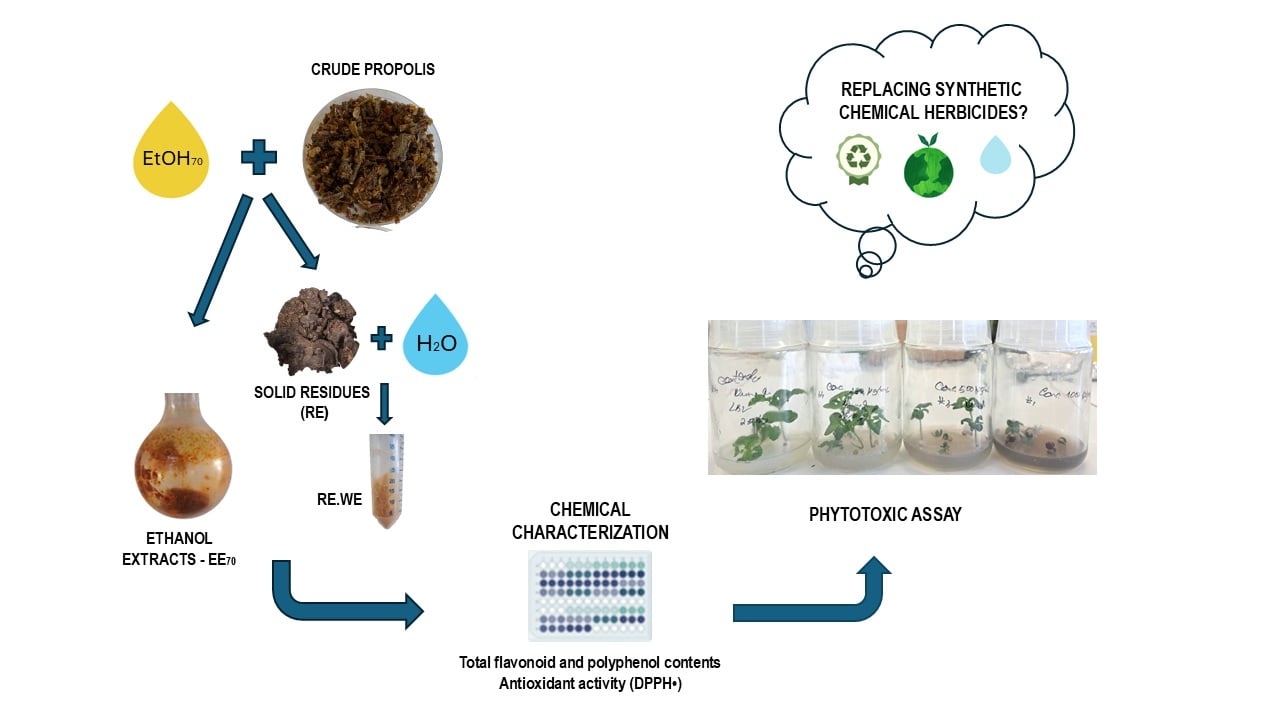
Propolis is a resinous bee product rich in bioactive compounds and widely recognized for its antimicrobial and antioxidant properties, but its effects on plants remain poorly explored, which could prove particularly relevant for applications in sustainable agriculture, namely in weed control. This in vitro study evaluated the phytotoxicity of propolis extracts obtained from materials considered waste, aiming for their valorization as natural bioherbicides. Two hydroalcoholic extracts produced from raw propolis—mPN.EE70 (from mixed leftover samples) and Cr18.EE70 (from a sample rejected by the pharmaceutical industry)—and one aqueous extract (RE23.WE) obtained from the residues of a previous ethanolic extraction were analyzed. All extracts exhibited antioxidant activity (DPPH assay), with mPN.EE70 showing the lowest EC50 and RE23.WE the highest. Significant differences were observed in total phenolic and flavonoid contents, with Cr18.EE70 presenting the highest values and RE23.WE the lowest. In vitro germination and early growth assays revealed pronounced species-, extract- and dose-dependent effects. White mustard (Sinapis alba) and lettuce (Lactuca sativa) were particularly sensitive to RE23.WE, which severely inhibited root growth. Interestingly, the spontaneous weeds Plantago lanceolata and Dactylis glomerata were sensitive to all the extracts, P. lanceolata being the most sensitive of all species. This species was particularly affected in root growth by mPN.EE70, and in epicotyl development by Cr18.EE70. Dactylis glomerata was specifically root-responsive, where RE23.WE, like in P. lanceolata, was the only extract causing significant inhibitions in both root and leaf growth at all concentrations. Although experiments at larger scales are needed for validation before agricultural applications, overall these findings demonstrate the potential of unused propolis samples and extraction residues as a source of bioherbicides for a more sustainable and circular agriculture. In particular, the remarkable effectiveness of the aqueous extract RE23.WE against all tested species promises an effective, environmentally safer, less costly, and therefore more economically viable approach for a weed control strategy.
Keywords: aqueous extract; circular bioeconomy; phytotoxicity; propolis waste; sustainable agricultural systems aqueous extract; circular bioeconomy; phytotoxicity; propolis waste; sustainable agricultural systems
Graphical Abstract