Correction

Correction: Li et al. Development of SNP Markers and Core Collection Construction of Berberis L. Based on SLAF-Seq in Xinjiang, China. Horticulturae 2025, 11, 434


1
College of Horticulture, Xinjiang Agricultural University, Urumqi 830052, China
2
Xinjiang Branch of the National Forest and Grass Germplasm Resources Facility Preservation Bank, Xinjiang Uygur Autonomous Region Forest and Grass Germplasm Resources Center, Urumqi 830000, China
*
Author to whom correspondence should be addressed.
Horticulturae 2026, 12(6), 687; https://doi.org/10.3390/horticulturae12060687
Submission received: 21 April 2026 / Accepted: 22 April 2026 / Published: 2 June 2026
Figure Correction and Addition of a Table
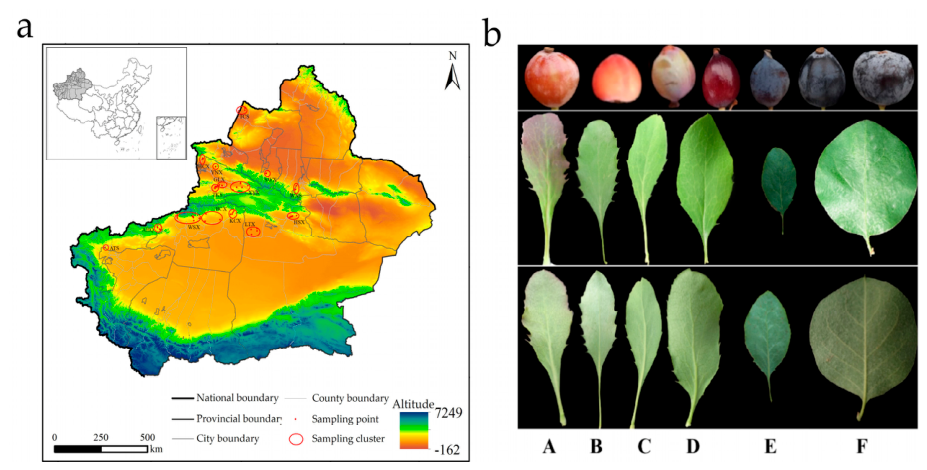
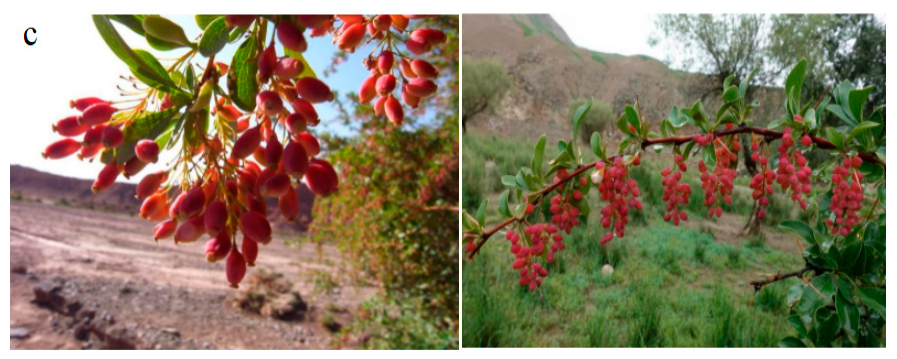
In the original publication [1], the legend descriptions for Figures 1 and 3 were not sufficiently clear. Species classification labels for the illustrated materials of different Berberis species have been added to the legend of Figure 1. The subfigure c has been added in Figure 1, and the caption and citation were modified accordingly. The corrected Figure 1 appears below. An explanation for the bar plots with mixed colors has been added to the legend of Figure 3: Individuals with admixed ancestry are represented by bars comprising multiple colors. The corrected legend of Figure 3 appears below. Figure 4 has been changed in the color distinction. The corrected Figure 4 appears below. Table 1 has been added to clarify the classification basis of Berberis, in response to a request from the editorial office for clarification regarding the 150 Berberis species mentioned in the manuscript. The corrected Table 1 appears below. Modifications have been made to Tables S1, S2 and S4. Following these revisions, Tables S1–S4 provide a comprehensive listing of all 150 wild Berberis germplasm accessions used in this study, with detailed information on the collection area, species identification, sample code, geographic coordinates, and altitude. The addition serves to clarify the species composition of the studied populations.
  • Figure 3. Population structure and PCoA of 150 accessions of Berberis L. in Xinjiang. (a) Cross-validation error rate of each k = 5 value of admixture. Blue, purple, red, green, yellow indicate group I, group II, group III, group IV, and group V of Berberis L., respectively. Individuals with admixed ancestry are represented by bars comprising multiple colors; (b) cross-validation error rate of each k (k = 1–10) value of admixture; (c) PCoA. Blue, green, red, yellow, and purple indicate group I, group II, group III, group IV, and group V of Berberis L., respectively.
Text Correction
There were two errors in the original publication. The initial descriptions were all unclear.
A correction has been made to Materials and Methods, 2.1 Plant Materials and Population Sampling, the second paragraph: The classification of Berberis species in this paper is primarily based on the classification presented in Flora Xinjiangensis (Table 1). According to the description in this flora, B. kaschgarica is a distinct species and a regional species distributed in the mountainous areas of Xinjiang and Central Asia; this paper concurs with this taxonomic view.
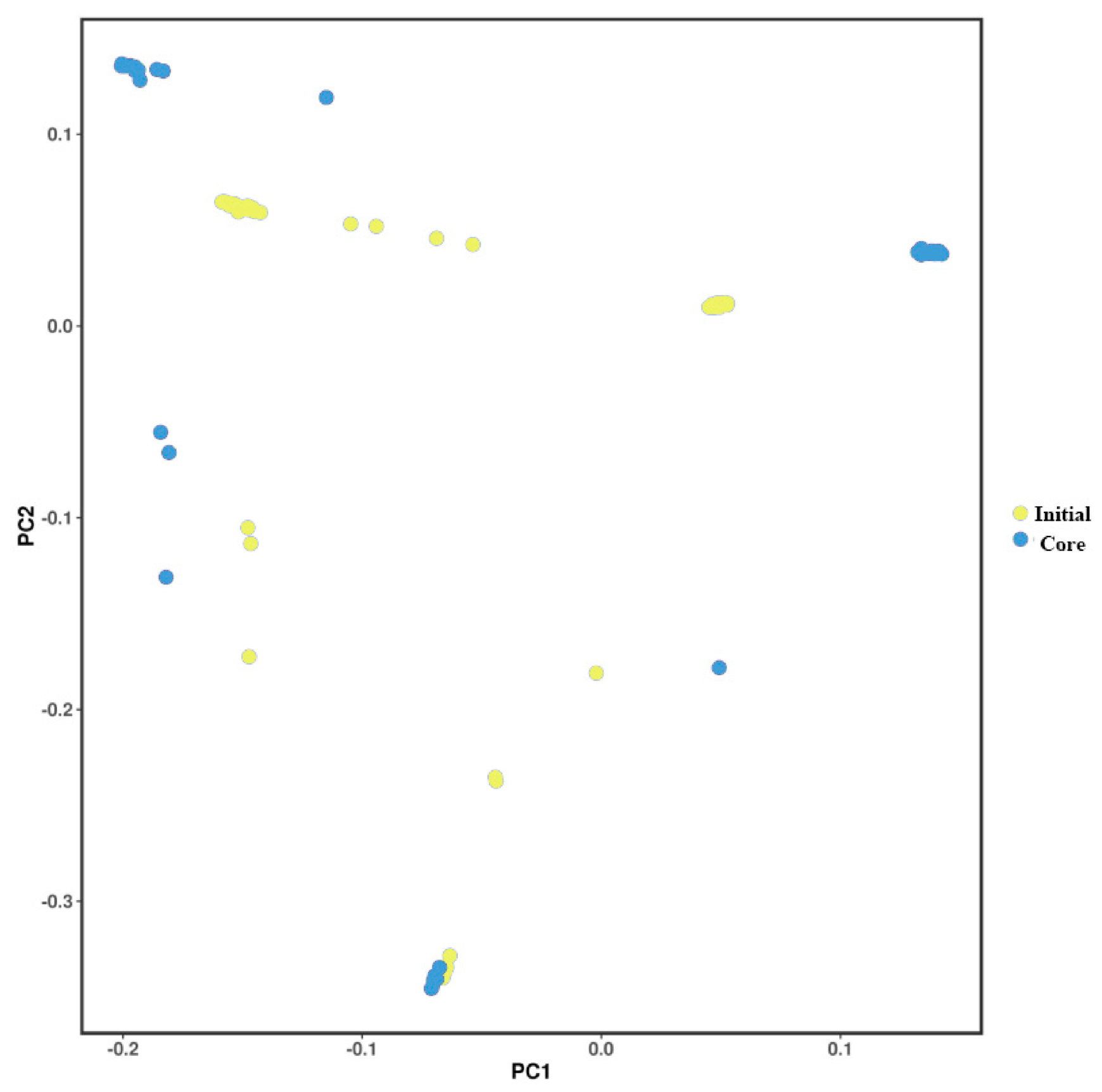
A correction has been made to Results, 3.5. Construction and Evaluation of Core Collection, the second paragraph: PCoA was used to compare the geometric distribution of the genetic structure of the constructed core collection and the initial collection (Figure 4). The results showed that the core collection was evenly distributed among the initial collection in the principal coordinates, and could comprehensively represent the wild Berberis L. in Xinjiang, China.
There were some errors in one taxonomic name (Berberis heteropoda Schrenk). The name has been changed from hetropoda to heteropoda in Sections 2.1, 3.3, 3.4 and 4.2.
The authors state that the scientific conclusions are unaffected. This correction was approved by the Academic Editor. The original publication has also been updated.

Reference

  1. Li, R.; Song, Y.; Wang, Z.; Zhou, L.; Yang, X.; Aheihati, M. Development of SNP Markers and Core Collection Construction of Berberis L. Based on SLAF-Seq in Xinjiang, China. Horticulturae 2025, 11, 434. [Google Scholar] [CrossRef]
Figure 1. The distribution of sampling sites and main species of Berberis L. in Xinjiang. (a) Distribution of sampling sites and populations of Berberis L. in Xinjiang; (b) Morphological characteristics of leaves and fruits of the three major Berberis L. in Xinjiang. The fruit and leaves of A of (b) are B. kaschgarica Rupr.; The fruit of (b) and leaves of B–D of (b) are B. nummularia Bunge; The fruit of C–F and leaves of E–F of (b) are B. heteropoda Schrenk; (c) Fruits of B. nummularia Bunge.
Horticulturae 12 00687 g001aHorticulturae 12 00687 g001b
Figure 4. The principal coordinate analysis of the initial collection and core collection of Berberis L. in Xinjiang.
Horticulturae 12 00687 g004
Table 1. Species of Berberis L. and their classification methods.
Species NameClassifier
Berberis heteropoda SchrenkFlora of Xinjiangensis
Berberis nummularia BungeFlora of Xinjiangensis
Berberis kaschgarica Rupr.Flora of Xinjiangensis
Note: Species classification is primarily based on Flora of Xinjiangensis. All samples were genotyped using SLAF-seq technology, and subsequent analyses were conducted based on the obtained high-quality SNP markers.
Disclaimer/Publisher’s Note: The statements, opinions and data contained in all publications are solely those of the individual author(s) and contributor(s) and not of MDPI and/or the editor(s). MDPI and/or the editor(s) disclaim responsibility for any injury to people or property resulting from any ideas, methods, instructions or products referred to in the content.