Article

Sensitivity of Pinus kesiya var. langbianensis Seeds to Desiccation Treatment for Storage and Elucidation of the Physiological Mechanisms


1
State Key Laboratory of Tree Genetics and Breeding, Institute of Highland Forest Science, Chinese Academy of Forestry, Kunming 650233, China
2
College of Landscape Architecture, Nanjing Forestry University, Nanjing 210037, China
*
Author to whom correspondence should be addressed.
Horticulturae 2026, 12(5), 622; https://doi.org/10.3390/horticulturae12050622 (registering DOI)
Submission received: 18 April 2026 / Revised: 11 May 2026 / Accepted: 13 May 2026 / Published: 18 May 2026
(This article belongs to the Section Propagation and Seeds)

Abstract

Temperature and humidity are the key environmental factors affecting the storage life of seeds. To explore the feasibility and factors influencing ultra-dry storage of Pinus kesiya var. langbianensis seeds, the seeds were dehydrated to six different moisture contents (0.92–6.12%) and stored for one year. The effects of moisture content, packaging method, storage temperature, and pre-humidification method on the viability of ultra-dry seeds were systematically investigated using an orthogonal experimental design. The germination energy, relative electrical conductivity (REC), malondialdehyde (MDA), proline (Pro), total soluble sugar content, and fatty acid composition were determined. The results showed that moisture content and pre-humidification had significant effects on seed germination energy and vigor (p < 0.01). The germination energy of ultra-dried seeds was significantly negatively correlated with REC and MDA contents (p < 0.01) and significantly positively correlated with Pro content (p < 0.01). Based on the comprehensive indices, the optimal combination for seed germination energy was: 4.24% moisture content, self-sealing bag packaging, room temperature (25 °C) storage, and 20% polyethylene glycol (PEG) pre-humidification. Under the optimal moisture content (4.24%), the total sugar content of seeds was the lowest, while the fatty acid unsaturation index and oleic acid content were higher than those in the other treatments. Therefore, appropriate ultra-dry treatment can effectively maintain the seed vigor of P. kesiya var. langbianensis, and its protective effect is closely related to reducing membrane lipid peroxidation, accumulating proline, and regulating fatty acid unsaturation. This has important implications for forest seed conservation and germplasm management, particularly for long-term ex situ preservation of tree seeds in gene banks, supporting reforestation and biodiversity restoration efforts.

1. Introduction

Seeds, as the reproductive organs of plants, are living organisms that are capable of independently completing the plant life cycle [1,2,3] and serve as key units for conserving plant genetic diversity [4]. Long-term storage often reduces seed vigor and seed quality [5]. During storage, seeds are vulnerable to biotic and abiotic stresses, causing deterioration, vigor loss, and poor seedling establishment [6]. Furthermore, research on seed storability and the vigor of stored seeds is of great significance for the conservation of germplasm resources and forestry production [7,8].
Low temperature (−18 °C) combined with low moisture content (approximately 5% ± 1%) is widely recognized as optimal for long-term germplasm conservation as it maintains seed viability [9,10,11]. However, seed aging during storage highlights the need to define species-specific critical thresholds of moisture content and temperature for optimal preservation [12]. Ultra-dry storage further enhances low-temperature conservation by reducing seed moisture below 5%, thereby enabling energy-efficient room-temperature storage, which breaks through the 1976 minimum moisture content standard by lowering seed moisture content below 5%. This induces cytoplasm vitrification, a glass-like solid formed by soluble sugars and proteins upon water removal [13,14,15,16]. The resulting high viscosity restricts molecular movement [17,18], nearly halting enzyme activity and degradation reactions, thereby protecting cell structure and enabling long-term survival at room temperature [19]. In legumes, the accumulation ratio of raffinose family oligosaccharides is positively correlated with the glass transition temperature, and earlier induction of glass formation by these high-molecular-weight oligosaccharides enhances seed storability [20]. A novel small peptide, microRPG1, regulates seed dehydration tolerance through the ethylene signaling pathway, revealing the molecular mechanism of maize (Zea mays L.) kernel dehydration [21]. However, the ‘critical moisture content’ theory indicates that excessive drying below a species-specific threshold leads to viability loss [22,23,24]. Therefore, determining the moisture content threshold for each seed species is of great significance for seed storage [25].
Ultra-dry storage technology has been verified in a variety of crops and forest seeds, although its effectiveness is highly species-dependent. Veser et al. [26] used dynamic mechanical analysis to compare vitrification behavior in cabbage (Brassica oleracea), lettuce (Lactuca sativa), and carrot (Daucus carota) seeds, finding that lettuce exhibited a higher glass transition temperature, likely related to its higher oil content. This result supports the precise drying strategy of determining species-specific storage parameters based on the water content of hydrophilic dry matter. Desiccation tolerance also differs between two species of Amomyrtus: A. luma is desiccation-tolerant, whereas A. meli is desiccation-sensitive. Such differential tolerance within a single genus is relatively rare [27]. In contrast, recalcitrant seeds such as Quercus robur show much higher glass transition moisture thresholds (30–40%) compared to orthodox seeds (<5%), and dehydration below critical levels accelerates deterioration [28]. These studies collectively show that the efficacy of ultra-dry storage is determined by species-specific biochemical characteristics (such as oil and oligosaccharide composition) as well as physical properties, particularly glass transition behavior. Among Pinaceae plants, studies have shown that storing the seeds of species such as Picea asperata, Larix gmelinii var. principis-rupprechtii (Mayr) Pilger, and Pinus thunbergii pine in an extremely dry state is beneficial for preserving the vitality of the seeds, and facilitating the storage and preservation of the seeds [29,30,31].
P. kesiya var. langbianensis is an evergreen conifer of the family Pinaceae, native to the warm–subtropical region of southwestern China and an important fast-growing timber and oil-producing species in Yunnan [32,33]. Its seeds exhibit a preference for relatively high moisture conditions and are sensitive to drought stress, with an optimal germination rate (up to 100%) observed under −0.6 to 0 MPa moisture potential and temperature between 15–30 °C. Moisture conditions are the key factor influencing its geographical distribution [34]. It is known that seeds of Pinus species generally possess a hard seed coat, high oil content, and complex dormancy characteristics [35]; consequently, their response to ultra-dry storage may differ from that of low-oil crop seeds. Yu et al. showed that seeds with lower lipid content more readily form a vitrified cytoplasm, which is associated with higher oligosaccharide-to-sucrose (O/D) ratios [35]. In addition, soluble sugars replace water by forming hydrogen bonds with membrane phospholipids, preserving membrane integrity during dehydration and contributing to glass formation [36]. Ballesteros et al. proposed a biophysical framework classifying desiccation-tolerant germplasm into three categories, in which high-lipid seeds may experience accelerated aging during storage at sub-zero temperatures due to lipid crystallization destabilizing the glassy matrix [37]. Seeds of Pinaceae species generally have a hard seed coat, high oil content, and complex dormancy characteristics; therefore, their response to ultra-dry storage may differ from that of low-oil crop seeds. We therefore tested the hypothesis that specific combinations of moisture content, packaging method, storage temperature, and rehydration can maintain seed vigor of Pinus kesiya var. langbianensis under ultra-dry storage, and that an optimal combination exists among these factors. In this study, seeds of P. kesiya var. langbianensis were employed to systematically investigate how moisture content, packaging method, storage temperature, and rehydration influence seed vigor using an L18(61 × 36) orthogonal experimental design. By integrating physiological and biochemical assessments, a technical framework for ultra-dry storage was developed, offering a theoretical basis and technical support for the conservation of this species.

2. Materials and Methods

2.1. Materials

Seeds from trees of the same clone of P. kesiya var. langbianensis were collected from a clonal seed orchard located in Ning’er Hani and Yi Autonomous County, Yunnan Province (23°02′53″ N, 101°02′46″ E). The seeds were harvested from 15 ramets (individual trees) of the same clone, which are genetically identical. After collection, the seeds were dried using silica gel (Sinopharm Chemical Reagent Co., Ltd., Shanghai, China) at room temperature (approximately 25 °C) for approximately 72 h. They were then sealed in aluminum foil bags and stored at 4 °C. The initial moisture content of the seeds (before drying) was determined to be 7.59%, and the initial germination energy was 96%.

2.2. Preparation of Seed Moisture Content Gradient

P. kesiya var. langbianensis seeds were randomly selected using the quartering method [38]. The bulk seed lot was divided into eight subsamples (approximately 350–400 seeds each), and they were assigned to six drying treatments and two controls. They were placed in a dryer containing discolored silica gel (Sichuan Shubo Group Co., Ltd., Chengdu, China), with a mass ratio of silica gel to seeds of 6:1 [39]. Moisture content was determined using the oven-drying method with three replicates. The calculation formula (wet weight basis) is: moisture content (%) = (fresh weight − dry weight)/fresh weight × 100% [40,41]. Every 12 h, the seeds were weighed and the silica gel was replaced. By controlling dehydration time and combining with oven drying, six different moisture content gradients were obtained: 0.92%, 2.09%, 3.44%, 4.24%, 5.13%, and 6.12%. Low moisture content (0.92–3.44%) involved drying using silica gel in a 50°C oven [42,43]; higher moisture content (4.24–6.12%) included dehydration using silica gel at 25°C [14,44]. Seeds stored at room temperature with their natural moisture content (without dehydration) served as control 1 (CK1), and seeds stored in a refrigerator at 4 °C served as control 2 (CK2). Both control groups were packaged using self-sealing bags.

2.3. Ultra-Dry Preservation

Seeds with different moisture content gradients were subjected to two packaging methods: (i) vacuum-sealed double-layer aluminum foil bags [45] (standard vacuum-grade aluminum foil laminate, 20 cm × 14 cm) and vacuum-sealed using an impulse sealer (400 W, 5 mm sealing width); (ii) kraft paper bags (brown kraft paper, 80 g/m2) with two layers of self-sealing bags (polyethylene, 0.08 mm thick, 24 cm × 34 cm). Packaged seeds were then stored at either 25 °C or 4 °C, which were kept for one year.

2.4. Pre-Humidification Treatment

After ultra-dry storage, seeds were subjected to three pre-germination treatments: (i) rehydration at room temperature for 48 h followed by 48 h in a growth chamber (Shanghai Yiheng Scientific Instruments Co., Ltd., Shanghai, China) at 25 °C and 100% relative humidity [46]; (ii) rehydration in 20% polyethylene glycol (PEG 6000 solution, osmotic potential −0.53 to −0.79 MPa) for 12 h [47,48,49]; (iii) no rehydration.

2.5. Germination Test

The treated seeds were subjected to a germination test using the two-layer filter paper method [44]. Each treatment had three replicates of 50 seeds each. The germination temperature was 25 °C, and light was provided by a climatic chamber (Shanghai Yiheng Scientific Instruments Co., Ltd., China) equipped with cool white fluorescent lamps. The light intensity was set to the maximum level (all lamps switched on) for 12 h per day. Germination was defined as the emergence of the radicle to a length of half the seed length. The number of germinated seeds was recorded daily, and germination energy (10-day germination percentage) was calculated at 10 days [50].

2.6. Measurement of Physiological and Biochemical Parameters

A total of 50 seeds were soaked in 300 mL of deionized water at 25 °C for 12 h. The electrical conductivity of the resulting soaking solution was determined using a conductivity meter (DDS-307, Shanghai Precision Instrument Co., Ltd., Shanghai, China) and expressed as mS cm−1 [40,51].
MDA content was determined according to Cakmak and Horst [52]. Fresh seeds (0.1 g) were homogenized in 10% (w/v) trichloroacetic acid (TCA), and the supernatant was collected. The absorbance of the supernatant was measured at 532 nm (corrected at 600 nm), and MDA concentration was calculated using an extinction coefficient of 155 mM−1 cm−1 and expressed as nmol per gram fresh weight [53,54].
Proline content was determined using the ninhydrin colorimetric method [55,56]. Fresh seeds (0.1 g) were extracted with 3% sulfosalicylic acid. The supernatant was mixed with acid ninhydrin and glacial acetic acid, heated at 100 °C in water for 1 h, and then immediately cooled on ice. The chromophore was extracted with toluene. The absorbance was read at 520 nm, and proline concentration was determined from a standard curve (L-proline) and expressed as μg/g fresh weight.
Total sugar content was measured by the 3,5-dinitrosalicylic acid (DNS) method according to Miller [57] and following GB/T 5009.7-2003 [58]. Reducing sugars reacted with DNS reagent under alkaline conditions, and the absorbance was measured at 540 nm. The total sugar concentration was calculated from a glucose standard and expressed as mg/g dry weight or percentage. The fatty acid composition was analyzed by gas chromatography (GC–FID). Total lipids were extracted according to GB/T 5009.6-2003 [59], and fatty acid methyl esters (FAMEs) were prepared following GB/T 17376-2008 [60]. Individual fatty acids were identified by comparing their retention times with authentic standards, and relative content was expressed as a percentage of the total identified fatty acids.

2.7. Experimental Design

The L18 (61 × 36) orthogonal experimental design [61] was used to study the effects of moisture content, packaging method, storage temperature, and rehydration on the ultra-dry preservation of P. kesiya var. langbianensis seeds. Table 1 lists the four factors and their corresponding levels. Table 2 presents the L18 orthogonal array, showing the combination of factor levels for each of the 18 experimental runs. The measured responses (germination energy, REC, MDA, Pro, total soluble sugar, and fatty acid composition) were subsequently analyzed by range analysis and ANOVA.

2.8. Data Analysis

Data were analyzed by analysis of variance (ANOVA) for orthogonal design using SPSS 26.0 software, with the significance level set at α = 0.05. The significance of each factor was determined by the F test. For those factors that showed significant main effects (e.g., moisture content and rehydration), Duncan’s multiple range test was performed as a post hoc comparison to identify which specific levels of the same factor differed significantly. The results are presented in figures, with different lowercase letters (a, b, c, d) indicating significant differences between levels. This analysis was not used to compare across different factors or treatment combinations. All treatments were replicated three times, and data were expressed as mean ± SE. In addition, Pearson’s correlation analysis was performed using the same software to evaluate the relationships among germination energy, REC, MDA, and proline content. The correlation coefficients and two-tailed significance levels were calculated.

3. Results

3.1. Optimal Ultra-Dry Preservation Scheme for P. kesiya var. langbianensis Seeds

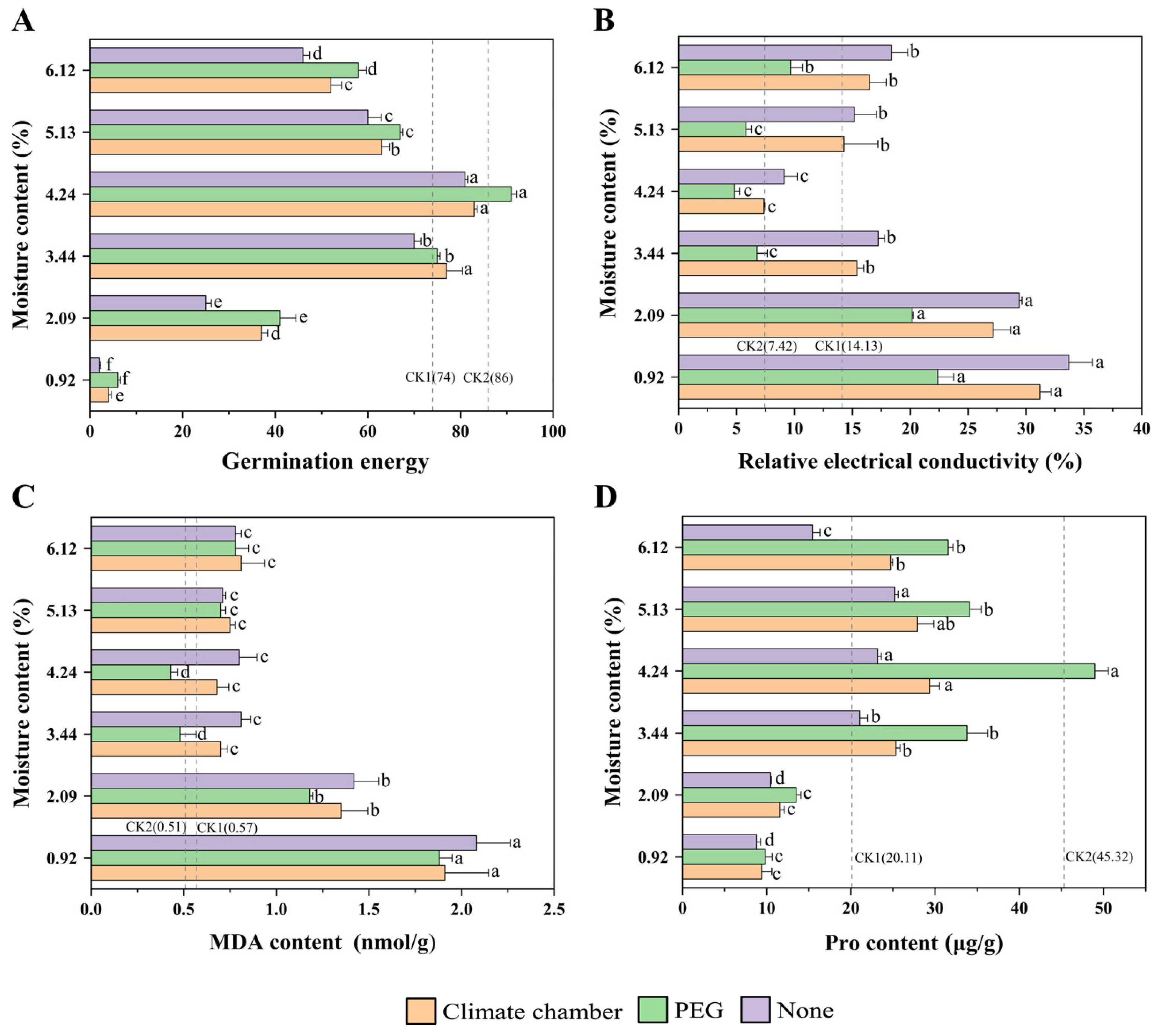
The germination energy of CK1 (25 °C storage) was 74%, and that of CK2 (4 °C storage) was 86%. The range analysis (Supplementary Tables S1 and S2) showed that the range (R) values of factor A (moisture content) and factor D (rehydration) ranked as the top two among all the factors affecting germination energy, and their significance levels reached p < 0.001, indicating that these two factors are the key determinants of seed germination. Other factors (including interactions) had little effect. Based on the mean values of each level for each factor, the optimal combination for seed germination was determined as A4B2C1D2, i.e., 4.24% moisture content + self-sealing bag packaging + room temperature storage + 20% PEG rehydration. The germination rates at the third and fourth moisture content levels (3.44% and 4.24%) were higher than that of CK1 and close to that of CK2. Further multiple comparisons showed that the fourth moisture content level (4.24%) was the most effective among the moisture content levels, and the second level of rehydration (20% PEG rehydration) was significantly better than the other levels. Packaging and temperature showed no significant differences among their levels. A bar chart of germination rate (x-axis) versus moisture content levels (y-axis) was constructed for factor A and factor D (Figure 1A). As shown in the figure, the germination energy under the combination of 4.24% moisture content and 20% PEG rehydration was the highest and significantly exceeded both controls. Moreover, all the treatments with 4.24% moisture content yielded germination energy above CK1, confirming 4.24% as the optimal moisture level.

3.2. Effects of Moisture Content and Rehydration on Physiological Indices of Seeds

The range analysis (Supplementary Table S3) identified moisture content and rehydration as the main factors affecting relative conductivity. At 4.24% moisture content, the relative conductivity was 7.10%, whereas, at 0.92% moisture content, it was 29.08%, indicating that an appropriate moisture content caused less damage to the seed cell membrane. In contrast, the relative conductivity differed little among the levels of packaging method and storage temperature. The ANOVA (Supplementary Table S4) was highly significant for moisture content and rehydration (p < 0.01). As shown in the figure, the relative conductivity of seeds under the combination of 4.24% moisture content and 20% PEG rehydration reached the lowest value (Figure 1B).
The range analysis of seed MDA content (Supplementary Table S5) identified moisture content as the most influential factor, followed by rehydration. At 4.24% moisture content, MDA content reached its lowest value, approximately 0.62 nmol/g, whereas, at 0.92% moisture content, it reached the highest value of 1.96 nmol/g (Figure 1C). The ANOVA (Supplementary Table S6) found that moisture content and rehydration effects on MDA content were highly significant (p < 0.01) and significant (p < 0.05). The range analysis of seed Pro content (Supplementary Table S7) showed that factors A, D and C had significant effects. The ANOVA further indicated that moisture content (A) had the greatest influence (F = 38.82, p < 0.01), and factor B (packaging method) also reached a significant level (p < 0.05). Pro content varied considerably among the different moisture content levels. Proline content was highest at 4.24% and 5.13% moisture (approximately 33.84 μg/g and 29.59 μg/g) and lowest at 0.92% moisture content (9.02 μg/g) (Figure 1D). Collectively, the combination A4B2C2D2 was conducive to increasing seed Pro content, which may alleviate osmotic stress from ultra-dry treatment, thereby protecting seed vigor and improving germination ability.

3.3. Responses of Total Sugar and Fatty Acid Composition to Moisture Content

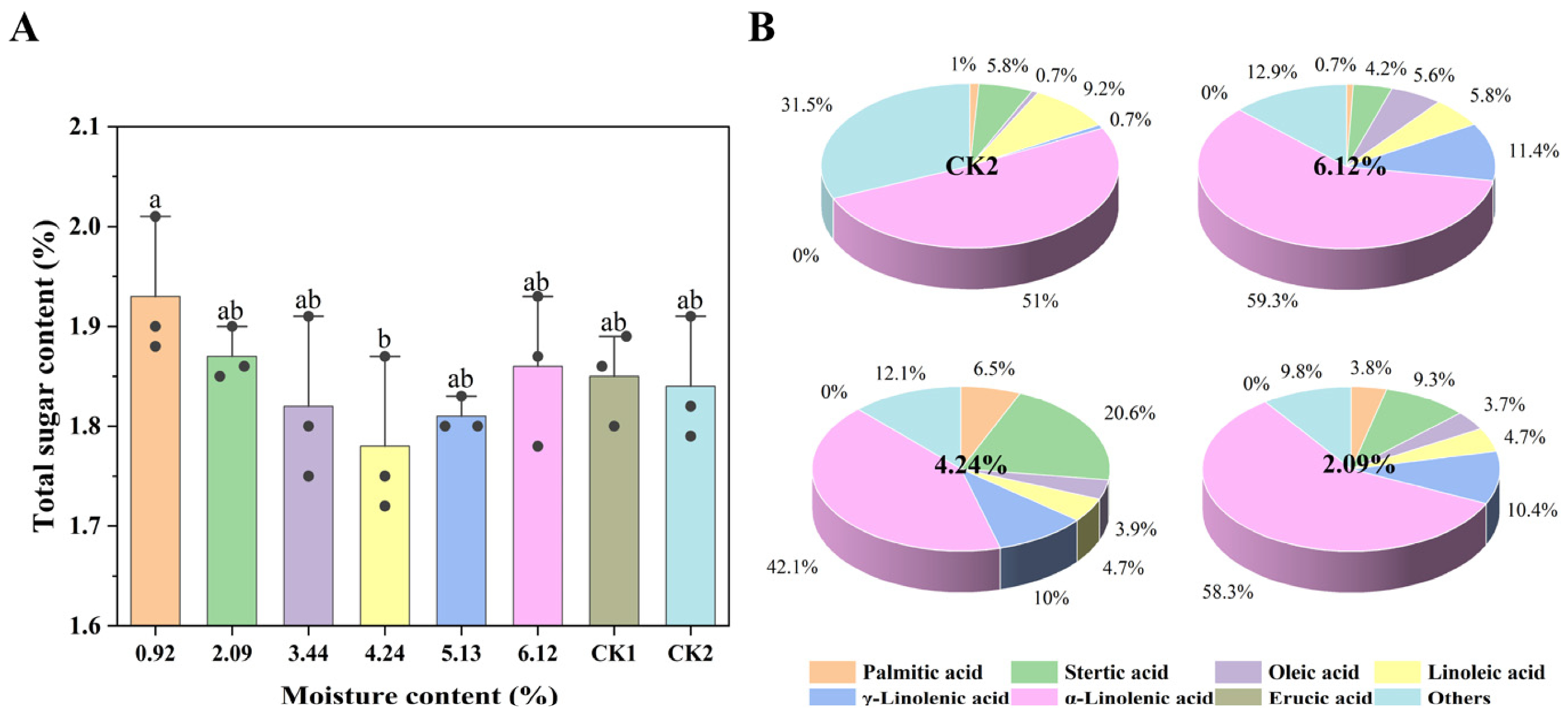
The total sugar content of seeds with 3.44%, 4.24% and 5.13% moisture content was lower than that of other seeds, which was consistent with the germination energy. The germination energy of seeds with 4.24% moisture content was 85.33%, which was the highest among all the moisture content seeds, and the total sugar content was the lowest (1.78%); the germination energy of seeds with 0.92% moisture content was only 4%, and the total sugar content was 1.93%, which was higher than that of other seeds (Figure 2A). Because the types of fatty acids in the measured seeds were relatively stable and the erucic acid content was zero, data processing was carried out using CK2 as a reference, and a stacked bar chart of the relative content of different fatty acids in each treatment was drawn (Figure 2B). Seeds with 2.09% moisture content showed higher palmitic acid and stearic acid contents compared to the other treatments. The oleic acid content and the fatty acid unsaturated index of seeds with 4.24% moisture content were significantly higher than those of the 3.44% and 5.13% treatments. The linolenic acid content of seeds with 6.12% moisture content was higher than that of the other treatments.

3.4. Correlation Analysis of Physiological Indices

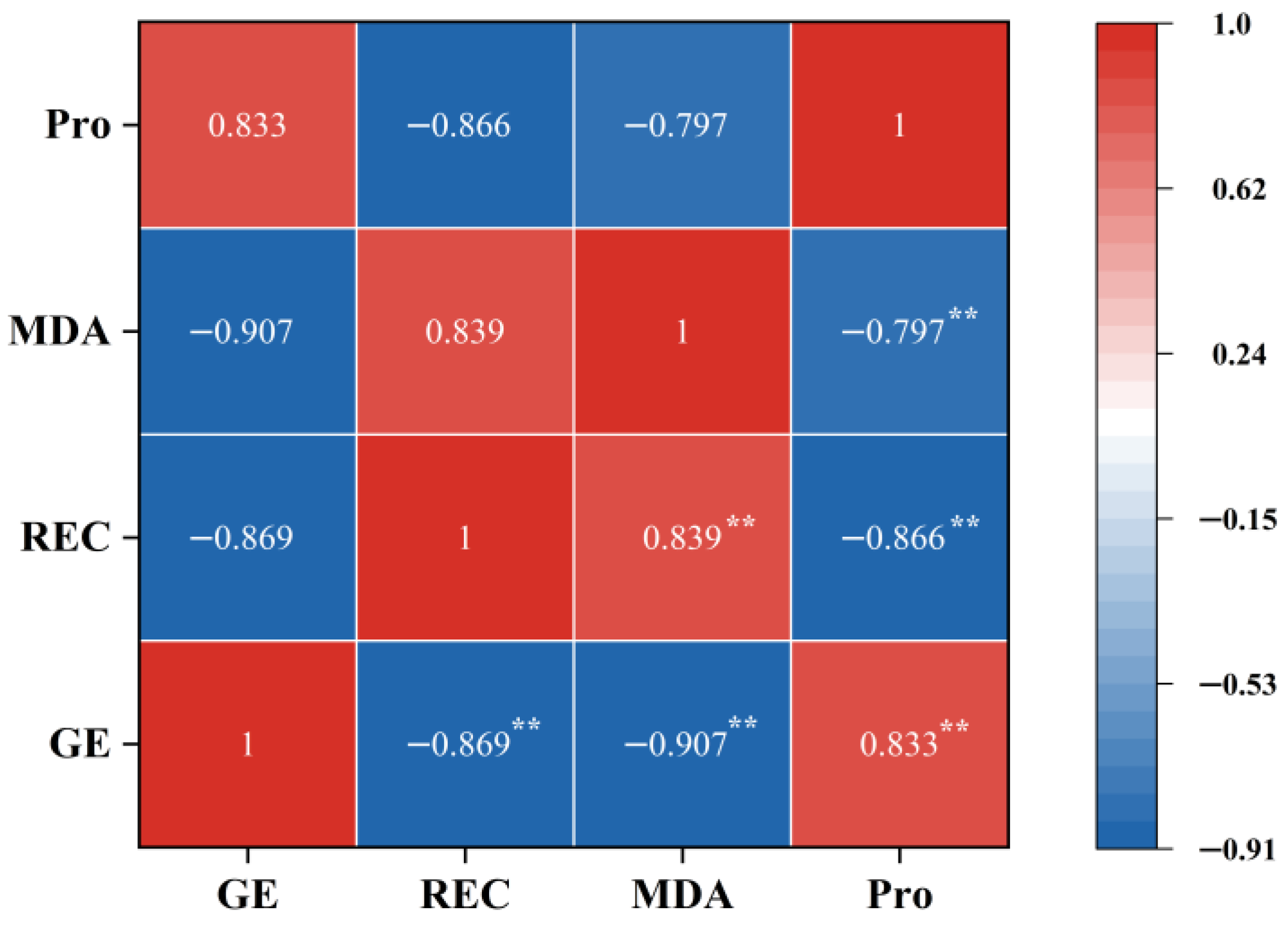
A Pearson correlation analysis was performed among germination energy, REC, MDA, and Pro (Figure 3). GR was significantly negatively correlated with REC (r = −0.869, p < 0.01) and MDA (r = −0.907, p < 0.01) and positively correlated with Pro (r = 0.833, p < 0.01). REC and MDA showed a strong positive correlation (r = 0.839, p < 0.01), and both were negatively correlated with Pro (r = −0.866 and −0.797, respectively, p < 0.01). These results indicate that reduced germination under ultra-dried conditions is associated with increased membrane permeability and lipid peroxidation, while proline accumulation correlates with better seed viability.

4. Discussion

The key to ultra-dry storage is to find the moisture content threshold of the seed itself, which is of great significance for seed storage and the agroforestry industry. In this study, among the six moisture content gradients tested, the highest germination energy was observed at 4.24%, which was significantly higher than that of the traditional safe moisture content (5.13%) and the conventional moisture content (6.12%). When moisture content decreased to 2.09% and 0.92%, germination energy dropped sharply, suggesting that excessive drying caused irreversible damage. The optimal moisture content identified here is lower than that reported for most gramineous crops, possibly due to the high oil content of P. kesiya var. langbianensis seeds. It is plausible that, at 4.24% moisture content, the cytoplasm enters a vitrified state because vitrification is characterized by a sharp increase in cytoplasmic viscosity and restricted molecular movement, which in turn inhibits metabolic reactions and free radical damage [62]. Because this species is a high-oil tree species, its optimal moisture content (4.24%) may represent a balance between vitrification protection and the risk of lipid phase transition. Ultra-dry seeds are prone to imbibitional damage during germination. Excessively dried seeds often suffer from membrane mechanical damage and metabolic disorder when water influx is too rapid [63]. Studies have shown that seeds with a moisture content below 10% are particularly sensitive [64]. Rehydration can effectively reduce imbibitional damage by allowing slower water uptake, giving the cell membrane sufficient time for phase transition and reorganization and to restore selective permeability [65]. The 20% PEG 6000 treatment for 12 h resulted in the highest germination energy, outperforming the other two methods. This finding is consistent with the view that a moderate osmotic potential provides a controlled rehydration process, thereby avoiding or alleviating imbibitional damage [48,66]. Notably, the packaging method and storage temperature had no significant effect on seed viability under the tested conditions.
The integrity of cell membrane structure and function is essential for seed vigor [67]. With the extension of storage time, excessive ROS are spontaneously generated inside the seeds, which cause membrane lipid peroxidation by continuously attacking unsaturated fatty acids in membrane lipids [68]. The degree of membrane lipid peroxidation is usually measured by MDA content. In this study, as the moisture content of P. kesiya var. langbianensis seeds decreased from 6.12% to 4.24%, the relative conductivity gradually declined after storage. When the moisture content decreased to 2.09% and 0.92%, the relative conductivity increased significantly, and the same trend was observed for MDA content. These results suggest that moderate dehydration may protect membrane systems, whereas severe over-drying exacerbates membrane damage. This pattern is in line with previous studies on seed aging mechanisms [69,70]. It is worth noting that Mira et al. [71] found that lipid peroxidation was not a key factor in seed aging and deterioration in four wild cruciferous species. In this study, the synchronous changes in REC and MDA imply that both membrane damage and lipid peroxidation contribute to seed deterioration under ultra-dry conditions.
The polymer system composed of protein and sugar is the key material basis for supporting seed vitrification and maintaining its long-term stability in the dry state. This glassy matrix enhances desiccation tolerance and slows aging by reducing molecular mobility [18,72]. Lakhssassi et al. [73] identified two key genes, GmCG-1 and GmSBP-1, that regulate protein rebalancing in soybean seeds and confirmed that they act as general regulators of protein content, amino acid composition, and seed vigor. The LEA6 family emerged with the origin of seed plants. Due to its important role in protecting membranes and proteins, it also possesses unique functions in maintaining seed vigor [74]. Using Arabidopsis thaliana LEA6 as a model, the role of AtLEA6-2.1 in maintaining the intracellular glassy state and prolonging seed longevity under dry conditions was demonstrated. AtLEA6-2.1 mutant seeds exhibited higher brittleness of the glassy state, reduced intracellular viscosity, and significantly shortened seed longevity [61]. These findings provide a plausible molecular framework for understanding the vitrification-based protection that may also operate in P. kesiya var. langbianensis seeds.
In this study, total sugar content was not positively correlated with germination energy: the germination energy of seeds with 4.24% moisture content was the highest, but the total sugar content was the lowest; the germination energy of seeds under extreme drying was only 4%, and the total sugar content was the highest, indicating that total sugar accumulation is not the sole determinant of vitrification protection [19]. This may be related to the proportion of specific oligosaccharides (particularly raffinose). Future studies should include detailed profiling of individual sugars (e.g., raffinose, stachyose, and sucrose) to further elucidate the molecular mechanisms underlying cytoplasmic vitrification and ultra-dry storage tolerance in this species. At the same time, the Pro content in seeds at these two moisture content levels was relatively increased, indicating enhanced osmotic adjustment. The increased metabolic activity under this treatment likely consumed soluble sugars to prepare for germination, which explains why the total sugar content was the lowest at 4.24% moisture content. Thus, the changes in total sugar and proline in ultra-dried P. kesiya var. langbianensis seeds may be related to the formation and maintenance of the vitrified state, but this remains a hypothesis requiring further testing. Although fatty acids are not direct components of the sugar–protein glassy matrix, their composition and degree of unsaturation also have an important effect on the stability of seeds during ultra-dry storage. A higher degree of fatty acid unsaturation helps to lower the phase transition temperature of the cell membrane, maintain appropriate membrane fluidity in the dry state, and enhance desiccation tolerance [75]. Appropriate ultra-dry treatment can inhibit membrane lipid peroxidation and delay seed deterioration by increasing unsaturated fatty acid content and enhancing antioxidant enzyme activity [66]. In agreement with this, the contents of oleic acid and linoleic acid in seeds with 4.24% moisture content were significantly higher, and the ranking of the fatty acid unsaturation index across treatments was generally consistent with the trend in germination energy, while this treatment avoided the risk of peroxidation of highly unsaturated fatty acids. These factors collectively contributed to the highest germination energy observed at 4.24% moisture content. This indicates that maintaining a high degree of fatty acid unsaturation is beneficial for the stability of the cell membrane system in ultra-dry seeds, thereby assisting the protective mechanism of vitrification and collectively ensuring seed vigor.

5. Conclusions

This study systematically investigated the effects of one-year ultra-dry storage on the physiological and biochemical characteristics of P. kesiya var. langbianensis seeds. The results showed that seed germination vigor was effectively maintained for 12 months of storage by reducing seed moisture content to approximately 4.24%, combined with packaging in self-sealing bags, storage at room temperature, and pre-wetting treatment with 20% PEG. Germination energy of ultra-dried seeds was significantly negatively correlated with relative conductivity and MDA content, and significantly positively correlated with proline content, suggesting that ultra-dry storage protects seed vigor by reducing membrane lipid peroxidation damage and promoting proline accumulation. Under optimal moisture content conditions, total sugar content was minimized, while the unsaturation index of fatty acids and oleic acid content increased significantly, indicating that ultra-dry storage may enhance seed storability by modulating fatty acid composition. In summary, under the conditions tested (one-year storage, room temperature, 4.24% moisture content, self-sealing bags, and 20% PEG rehydration), appropriate ultra-dry treatment shows promise as a method for maintaining the vigor of P. kesiya var. langbianensis seeds. The protective mechanisms involve membrane stability maintenance, osmotic adjustment substance accumulation, and optimization of fatty acid unsaturation. However, further studies with longer storage durations and additional seed lots are needed to confirm its applicability for long-term germplasm conservation.

Supplementary Materials

The following supporting information can be downloaded at: https://www.mdpi.com/article/10.3390/horticulturae12050622/s1, Table S1. Visual analysis of seed germination percentage in P. kesiya var. langbianensis. Table S2. Analysis of variance for seed germination percentage in P. kesiya var. langbianensis. Table S3. Visual analysis of relative electrical conductivity in P. kesiya var. langbianensis. Table S4. Analysis of variance for relative electrical conductivity in P. kesiya var. langbianensis. Table S5. Visual analysis of MDA content in P. kesiya var. langbianensis. Table S6. Analysis of variance for MDA content in P. kesiya var. langbianensis. Table S7. Visual analysis of Pro content in P. kesiya var. langbianensis. Table S8. Analysis of variance for Pro content in P. kesiya var. langbianensis.

Author Contributions

X.S. performed data processing and manuscript writing; T.Z. and S.Z. performed data analysis and manuscript revision; J.L. provided supervision, guidance, manuscript revision, project management, and funding acquisition. All authors have read and agreed to the published version of the manuscript.

Funding

This research was funded by the Major Project of Agricultural Biological Breeding (grant nos. 2023ZD040680307 and 2023ZD0405902), Yunnan Fundamental Research Projects (grant no. 202301AV070002), Essential Scientific Research of Chinese National Nonprofit Institute (grant nos. CAFYBB2021ZW003 and CAFYBB2023QB006), National Natural Science Foundation of China (grant no. 32022058).

Data Availability Statement

The original contributions presented in this study are included in the article/Supplementary Material. Further inquiries can be directed to the corresponding author.

Conflicts of Interest

The authors declare that they have no conflicts of interest.

References

  1. Yang, S.; Jia, Z.; Yi, K.; Zhang, S.; Zeng, H.; Qiao, Y.; Mao, P.; Li, M. Rapid prediction and visualization of safe moisture content in alfalfa seeds based on multispectral imaging technology. Ind. Crops Prod. 2024, 222, 119448. [Google Scholar] [CrossRef]
  2. Qiu, Y.; Taylor, A.B.; McManus, H.A. Evolution of the life cycle in land plants. J. Syst. Evol. 2012, 50, 171–194. [Google Scholar] [CrossRef]
  3. Linkies, A.; Graeber, K.; Knight, C.; Leubner-Metzger, G. The evolution of seeds. New Phytol. 2010, 186, 817–831. [Google Scholar] [CrossRef]
  4. Trusiak, M.; Plitta-Michalak, B.P.; Michalak, M. Choosing the right path for the successful storage of seeds. Plants 2022, 12, 72. [Google Scholar] [CrossRef]
  5. Demir, I.; Kuzucu, C.O.; Ermis, S.; Memis, N.; Kadioglu, N. Estimation of seed longevity in Onion seed lots by a vigor test of radicle emergence test in artificial ageing conditions. Horticulturae 2022, 8, 1063. [Google Scholar] [CrossRef]
  6. Gao, J.; Fu, H.; Zhou, X.; Chen, Z.; Luo, Y.; Cui, B.; Chen, G.; Liu, J. Comparative proteomic analysis of seed embryo proteins associated with seed storability in rice (Oryza sativa L) during natural aging. Plant Physiol. Biochem. 2016, 103, 31–44. [Google Scholar] [CrossRef]
  7. Chapman, T.; Miles, S.; Trivedi, C. Capturing, protecting and restoring plant diversity in the UK: RBG Kew and the Millennium Seed Bank. Plant Divers. 2019, 41, 124–131. [Google Scholar] [CrossRef]
  8. Hay, F.R.; Valdez, R.; Lee, J.-S.; Cruz, P.C.S. Seed longevity phenotyping: Recommendations on research methodology. J. Exp. Bot. 2019, 70, 425–434. [Google Scholar] [CrossRef] [PubMed]
  9. Ballesteros, D.; Walters, C. Detailed characterization of mechanical properties and molecular mobility within dry seed glasses: Relevance to the physiology of dry biological systems. Plant J. 2011, 68, 607–619. [Google Scholar] [CrossRef]
  10. Lu, R.; Zhang, Z.; Hu, S.; Xia, H.; Han, H. A micropeptide regulates seed desiccation. Front. Plant Sci. 2025, 16, 1550190. [Google Scholar] [CrossRef]
  11. Powell, A.A. Invited Review: Seed vigour in the 21st century. Seed Sci. Technol. 2022, 50, 45–73. [Google Scholar] [CrossRef]
  12. Groot, S.P.C.; van Litsenburg, M.J.; Kodde, J.; Hall, R.D.; de Vos, R.C.H.; Mumm, R. Analyses of metabolic activity in peanuts under hermetic storage at different relative humidity levels. Food Chem. 2022, 373, 131020. [Google Scholar] [CrossRef]
  13. Gerna, D.; Ballesteros, D.; Arc, E.; Stöggl, W.; Seal, C.E.; Marami-Zonouz, N.; Na, C.S.; Kranner, I.; Roach, T. Does oxygen affect ageing mechanisms of Pinus densiflora seeds? A matter of cytoplasmic physical state. J. Exp. Bot. 2022, 73, 2631–2649. [Google Scholar] [CrossRef]
  14. Ellis, R.; Hong, T.; Roberts, E. A low-moisture-content limit to logarithmic relations between seed moisture content and longevity. Ann. Bot. 1988, 63, 601–611. [Google Scholar] [CrossRef]
  15. Wang, Y.; Wang, J.; Li, Y.; Ding, T.; Song, F.; Jin, G.; Li, X.; Song, C.; Song, W. Experimental study, performance analysis, and optimization of hot Air–Membrane coupled dehumidification for ultra-drying of pumpkin seeds. J. Stored Prod. Res. 2026, 116, 102930. [Google Scholar] [CrossRef]
  16. Candotto Carniel, F.; Fernandez-Marín, B.; Arc, E.; Craighero, T.; Laza, J.M.; Incerti, G.; Tretiach, M.; Kranner, I. How dry is dry? Molecular mobility in relation to thallus water content in a lichen. J. Exp. Bot. 2021, 72, 1576–1588. [Google Scholar] [CrossRef]
  17. Buitink, J.; Leprince, O. Glass formation in plant anhydrobiotes: Survival in the dry state. Cryobiology 2004, 48, 215–228. [Google Scholar] [CrossRef]
  18. Walters, C.; Ballesteros, D.; Vertucci, V.A. Structural mechanics of seed deterioration: Standing the test of time. Plant Sci. 2010, 179, 565–573. [Google Scholar] [CrossRef]
  19. Buitink, J.; Leprince, O. Intracellular glasses and seed survival in the dry state. Comptes Rendus Biol. 2008, 331, 788–795. [Google Scholar] [CrossRef] [PubMed]
  20. Leprince, O.; Pellizzaro, A.; Berriri, S.; Buitink, J. Late seed maturation: Drying without dying. J. Exp. Bot. 2017, 68, 827–841. [Google Scholar] [CrossRef]
  21. Yu, Y.; Li, W.; Liu, Y.; Liu, Y.; Zhang, Q.; Ouyang, Y.; Ding, W.; Xue, Y.; Zou, Y.; Yan, J.; et al. A Zea genus-specific micropeptide controls kernel dehydration in maize. Cell 2025, 188, 44–59.e21. [Google Scholar] [CrossRef]
  22. Buitink, J.; Claessens, M.M.; Hemminga, M.A.; Hoekstra, F.A. Influence of water content and temperature on molecular mobility and intracellular glasses in seeds and pollen. Plant Physiol. 1998, 118, 531–541. [Google Scholar] [CrossRef]
  23. Walters, C. Understanding the mechanisms and kinetics of seed aging. Seed Sci. Res. 1998, 8, 223–244. [Google Scholar] [CrossRef]
  24. Walters, C.; Walters, C.; Wheeler, L.M.; Grotenhuis, J.M. Longevity of seeds stored in a genebank: Species characteristics. Seed Sci. Res. 2005, 15, 1–20. [Google Scholar] [CrossRef]
  25. Ge, N.; Jia, J.; Wang, Q.; Li, C.; Huang, M.; Luo, T.; Zhang, J.; Chen, J. Methionine explains the dehydration sensitivity and tolerance in the seeds of two sister Panax species. Ind. Crops Prod. 2026, 242, 122883. [Google Scholar] [CrossRef]
  26. Veser, J.; Kodde, J.; Groot, S.P.C.; Fix, R.; van der Sman, R.; Schutyser, M.A.I. Universal or species-specific influence of moisture on the glass transition in various horticultural seeds? Sci. Hortic. 2024, 338, 113705. [Google Scholar] [CrossRef]
  27. Wyse, S.V.; Dickie, J.B. Taxonomic affinity, habitat and seed mass strongly predict seed desiccation response: A boosted regression trees analysis based on 17 539 species. Ann. Bot. 2017, 1, 71–83. [Google Scholar] [CrossRef] [PubMed]
  28. Chmielarz, P.; Suszka, J.; Wawrzyniak, M.K. Desiccation does not increase frost resistance of pedunculate oak (Quercus robur L.) seeds. Ann. For. Sci. 2022, 79, 3. [Google Scholar] [CrossRef]
  29. Li, Q.; Chen, H.; Ma, F.; Liu, Y.; Zhang, J. Effects of ultra-dry treatment on physiological and biochemical characteristics of Picea asperata seeds. Sci. Silvae Sin. 2009, 45, 50–54. [Google Scholar] [CrossRef]
  30. Li, Q.; Liu, Y.; Chen, H.; Ma, F.; Hou, L. Vigor and physiological properties of ultra-drying seeds of Larix principis-rupprechtii Mayr. and L. kaempferi (Lamb.) Carr. J. Beijing For. Univ. 2011, 33, 25–30. [Google Scholar] [CrossRef]
  31. Zheng, Y.; Wang, S.; Chen, L. Studies on ultradry treatment and storage of Casuarina equisetifolia, Pinus thunbergii and Acacia confusa seeds. Acta Agric. Univ. Jiangxiensis 2000, 22, 554–558. [Google Scholar] [CrossRef]
  32. Liu, C.; Luo, D.; Wu, Y.; Zhang, X.; Chen, G.; Luo, H.; Lu, C.; Zhu, G.; Ou, G. Model residuals elucidate spatial effects on biomass of individual trees and their components in Pinus kesiya var. langbianensis forests from different origins. Ecol. Indic. 2010, 179, 114196. [Google Scholar] [CrossRef]
  33. Shen, J.; Fan, Z.; Zhang, H.; Peng, X.; Li, J.; Yu, X.; Yang, W.; Li, Y.; Li, X.; Liu, Y.; et al. Response Heterogeneity of radial growth of the three pine species to climate factors in Yunnan province. Sci. Silvae Sin. 2024, 60, 48–62. [Google Scholar] [CrossRef]
  34. Fan, Y.; Zhang, S.; Lan, Z.; Lan, Q. Possible causes for the differentiation of Pinus yunnanensis and P. Kesiya var. langbianensis in Yunnan, China: Evidence from seed germination. For. Ecol. Manag. 2021, 494, 119321. [Google Scholar] [CrossRef]
  35. Yu, F.; Shao, L.; Chen, S. A comparison on cytoplas mic vitrification and freezing point of Chinese fir and Masson pine Seeds. J. Nanjing For. Univ. (Nat. Sci. Ed.) 2006, 30, 1–4. [Google Scholar] [CrossRef]
  36. Sun, W.; Irving, T.; Leopold, A. The role of sugar, vitrification and membrane phase transition in seed desiccation tolerance. Physiol. Plant. 1994, 90, 621–628. [Google Scholar] [CrossRef]
  37. Ballesteros, D.; Pritchard, H.; Walters, C. Dry architecture: Towards the understanding of the variation of longevity in desiccation-tolerant germplasm. Seed Sci. Res. 2020, 30, 142–155. [Google Scholar] [CrossRef]
  38. Campos-M, M.; Campos-C, R. Applications of quartering method in soils and foods. Int. J. Eng. Res. Appl. 2017, 7, 35–39. [Google Scholar] [CrossRef]
  39. Zou, D.; Zhang, Y.; Jiang, C.; Liu, G.; Tian, W. A Method for Ultra-Dry Preservation of Stylosanthes Seeds. China Patent CN103229636A, 18 April 2013. [Google Scholar]
  40. Song, S.; Cheng, H.; Long, C.; Jiang, X. A Guide to Seed Biology Research; Science Press: Beijing, China, 2005; pp. 57–59. [Google Scholar]
  41. Hu, X.; Tao, M.; Lu, X.; Xin, P. Studies on the sugar metabolism in stored Chinese onion seed with different moisture content. J. Plant Genet. Resour. 2006, 7, 85–88. [Google Scholar] [CrossRef]
  42. Wang, S.; Zheng, Y.; Chen, L. Effects of ultradry treatment on viability and physiological characteristic of Chinese fir and Pine seeds. Acta Agric. Univ. Jiangxiensis 2000, 22, 581–584. [Google Scholar] [CrossRef]
  43. Meng, S.; Zhang, H.; Liu, P.; He, W. Effects of ultra-drying treatment on large a mounts of four kinds of crop seeds. Agric. Sci. Technol. 2009, 2, 88–91+95. [Google Scholar] [CrossRef]
  44. International Seed Testing Association (ISTA). Chapter 7: Seed Health Testing. In International Rules for Seed Testing; ISTA: Bassersdorf, Switzerland, 2026; Volume 1, p. I-7-6. [Google Scholar]
  45. Walters, C.; Engels, J. The effects of storing seeds under extremely dry conditions. Seed Sci. Res. 1998, 8, 3–8. [Google Scholar] [CrossRef]
  46. Butler, L.H.; Hay, F.R.; Ellis, R.H.; Smith, R.D.; Murray, T.B. Priming and re-drying improve the survival of mature seeds of Digitalis purpurea during storage. Ann. Bot. 2009, 103, 1261–1270. [Google Scholar] [CrossRef]
  47. Michel, B.; Kaufmann, M. The osmotic potential of polyethylene glycol 6000. Plant Physiol. 1973, 51, 914–916. [Google Scholar] [CrossRef]
  48. Huang, H.; Song, S. Change in desiccation tolerance of maize embryos during development and germination at different water potential PEG-6000 in relation to oxidative process. Plant Physiol. Biochem. 2013, 68, 61–70. [Google Scholar] [CrossRef]
  49. Li, X.; Wang, Q. Advances in ultra-dry seed storage research. Chin. Agric. Sci. Bull. 2005, 21, 73–76. [Google Scholar]
  50. Cai, N.; Zhao, L.; Tang, H. Effects of polyethylene glycol (PEG) simulated water stress on seed germination of Pinus kesiya var. langbianensis. J. West China For. Sci. 2014, 43, 76–79. [Google Scholar] [CrossRef]
  51. Li, Y.; Feng, H.; Chen, T.; Yang, X.; An, L. Physiological responses of Limonium aureum seeds to ultra-drying. J. Integr. Plant Biol. 2007, 49, 569–575. [Google Scholar] [CrossRef]
  52. Cakmak, I.; Horst, W.J. Effect of aluminium on lipid peroxidation, superoxide dismutase, catalase, and peroxidase activities in root tips of soybean (Glycine max). Physiol. Plant. 1991, 83, 463–468. [Google Scholar] [CrossRef]
  53. Feng, J.; Shen, Y.; Shi, F.; Li, C. Changes in seed germination ability, lipid peroxidation and antioxidant enzyme activities of Ginkgo biloba seed during desiccation. Forests 2017, 8, 286. [Google Scholar] [CrossRef]
  54. Lin, Y.; Xu, H.; Yin, G.; Zhou, Y.; Lu, X.; Xin, X. Dynamic changes in membrane lipid metabolism and antioxidant defense during soybean (Glycine max L. Merr.) seed aging. Front. Plant Sci. 2022, 13, 908949. [Google Scholar] [CrossRef]
  55. Bates, L.S.; Waldren, R.P.; Teare, I.D. Rapid determination of free proline for water-stress studies. Plant Soil 1973, 39, 205–207. [Google Scholar] [CrossRef]
  56. Troll, W.; Lindsley, J. A photometric method for the determination of proline. J. Biol. Chem. 1955, 215, 655–660. [Google Scholar] [CrossRef]
  57. Miller, G.L. Use of Dinitrosalicylic Acid Reagent for determination of reducing sugar. Anal. Chem. 1959, 31, 426–428. [Google Scholar] [CrossRef]
  58. GB/T 5009.7-2003; Determination of Reducing Sugar in Foods. China Standard Press: Beijing, China, 2003.
  59. GB/T 5009.6-2003; Determination of Fat in Foods. China Standard Press: Beijing, China, 2003.
  60. GB/T 17376-2008; Animal and Vegetable Fats and Oils—Preparation of Methyl Esters of Fatty Acids. China Standard Press: Beijing, China, 2008.
  61. Arroyo-Mosso, I.A.; Diaz-Ardila, H.N.; Garciarrubio, A.; Kumara, U.G.V.S.S.; Rendón-Luna, D.F.; Nava-Ramírez, T.B.; Boothby, T.C.; Reyes, J.L.; Covarrubias, A.A. A group 6 LEA protein plays key roles in tolerance to water deficit, and in maintaining the glassy state and longevity of seeds. Plant Cell Environ. 2025, 48, 6874–6896. [Google Scholar] [CrossRef]
  62. Hoekstra, F.A.; Golovina, E.A.; Buitink, J. Mechanisms of plant desiccation tolerance. Trends Plant Sci. 2001, 6, 431–438. [Google Scholar] [CrossRef]
  63. Powell, A.A.; Matthews, S. The damaging effect of water on dry pea embryos during imbibition. J. Exp. Bot. 1978, 29, 1215–1229. [Google Scholar] [CrossRef]
  64. Sato, K.; Jitsuyama, Y.; Yamada, T.; Liu, B.; Abe, J. Structural features of the aleurone layer of the seed coat associated with imbibition injury in soybean. Breed. Sci. 2019, 69, 364–370. [Google Scholar] [CrossRef]
  65. Tilden, R.L.; West, S.H. Reversal of the effects of aging in soybean seeds. Plant Physiol. 1985, 77, 584–586. [Google Scholar] [CrossRef]
  66. Cui, K.; Wang, H.; Li, K.; Liao, S.; Li, L.; Zhang, C. Physiological and biochemical effects of ultra-dry storage on Barbados nut seeds. Crop Sci. 2014, 54, 1748–1755. [Google Scholar] [CrossRef]
  67. Kurek, K.; Plitta-Michalak, B.; Ratajczak, E. Reactive oxygen species as potential drivers of the seed aging process. Plants 2019, 8, 174. [Google Scholar] [CrossRef]
  68. Sano, N.; Rajjou, L.; North, H.M.; Debeaujon, I.; Marion-Poll, A.; Seo, M. Staying alive: Molecular aspects of seed longevity. Plant Cell Physiol. 2016, 57, 660–674. [Google Scholar] [CrossRef]
  69. Mylsamy, P.; Tamilmani, E.; Venugopal, R.; Murugaiyan, S.; Ranganathan, U. Cotton seed management: Traditional and emerging treatment approaches for enhanced productivity. J. Cotton Res. 2025, 8, 7. [Google Scholar] [CrossRef]
  70. Naguib, D.M. Metabolic profiling during germination of hydro primed cotton seeds. Biocatal. Agric. Biotechnol. 2019, 17, 422–426. [Google Scholar] [CrossRef]
  71. Mira, S.; Estrelles, E.; González-Benito, M.E.; Corbineau, F. Biochemical changes induced in seeds of Brassicaceae wild species during ageing. Acta Physiol. Plant 2011, 33, 1803–1809. [Google Scholar] [CrossRef]
  72. Leopold, A.C.; Sun, W.Q.; Bernal-Lugo, I. The glassy state in seeds: Analysis and function. Seed Sci. Res. 1994, 4, 267–274. [Google Scholar] [CrossRef]
  73. Lakhssassi, N.; El Baze, A.; Knizia, D.; Salhi, Y.; Embaby, M.G.; Anil, E.; Mallory, C.; Lakhssassi, A.; Meksem, J.; Shi, H.; et al. A sucrose-binding protein and β-conglycinins regulate soybean seed protein content and control multiple seed traits. Plant Physiol. 2024, 196, 1298–1321. [Google Scholar] [CrossRef]
  74. Liang, Y.; Kang, K.; Gan, L.; Ning, S.; Xiong, J.; Song, S.; Xi, L.; Lai, S.; Yin, Y.; Gu, J.; et al. Drought-responsive genes, late embryogenesis abundant group3 (LEA3) and vicinal oxygen chelate, function in lipid accumulation in Brassica napus and Arabidopsis mainly via enhancing photosynthetic efficiency and reducing ROS. Plant Biotechnol. J. 2019, 17, 2123–2142. [Google Scholar] [CrossRef]
  75. Senaratna, T.; McKersie, B.D.; Stinson, R.H. Association between membrane phase properties and dehydration injury in Soybean Axes 1. Plant Physiol. 1984, 76, 759–762. [Google Scholar] [CrossRef]
Figure 1. Changes in physiological indices of seeds with different moisture content and rehydration: (A) germination energy; (B) relative electrical conductivity; (C) MDA content; (D) proline content. Data are presented as mean ± SE (n = 3). Different lowercase letters above bars indicate significant differences at p < 0.05 (Duncan’s test). Comparisons were performed within each rehydration (same bar color) across different moisture content levels. Bars sharing the same letter under the same rehydration are not significantly different.
Horticulturae 12 00622 g001
Figure 2. Changes in total sugar content and fatty acid composition in seeds under different moisture content levels and rehydration: (A) total sugar content. Data are presented as mean ± SE of three replicates (n = 3). The dots represent individual replicate values. Different lowercase letters (a and b) above the bars indicate significant differences at p < 0.05 according to Duncan’s multiple range test; (B) the pie charts display the relative changes in seed fatty acid composition compared to CK1 (room temperature storage). Each sector represents the absolute value of the percentage change for a specific fatty acid relative to CK1. The percentages are calculated based on the original data. Due to rounding, the sum of the displayed values may not equal 100%, but the actual proportion sum is 100%. The legend indicates the color corresponding to each fatty acid type and applies to all pie charts. CK2 represents the control group stored at 4 °C; other treatments represent different moisture content levels.
Horticulturae 12 00622 g002
Figure 3. Pearson correlation heatmap of seed physiological indices. The heatmap displays the pairwise Pearson correlation coefficients (r) among the four seed physiological indicators. Red indicates positive correlation; blue indicates negative correlation (see color scale). Asterisks (**) indicate that the correlation coefficients shown are significant at the 0.01 level (two-tailed). GE, germination energy; REC, relative electrical conductivity; MDA, malondialdehyde; Pro, proline.
Horticulturae 12 00622 g003
Table 1. Factors and levels.
FactorsLevels
A (Moisture content)0.92%2.09%3.44%4.24%5.13%6.12%
B (Packing method)Aluminum foil bagKraft + self-sealing bag
C (Storage temperature)25 °C4 °C
D (Humidification method)Climate chamber20% PEGNo rehydration
Table 2. Orthogonality analysis of L18(61 × 36).
Factor NumberFactors and Levels
ABA × BCA × CB × CD
11132212
21211121
31323333
42121231
52233113
62312322
73113132
83222311
93331223
104111313
114223222
124332131
135133321
145212233
155321112
166122123
176231332
186313211
Disclaimer/Publisher’s Note: The statements, opinions and data contained in all publications are solely those of the individual author(s) and contributor(s) and not of MDPI and/or the editor(s). MDPI and/or the editor(s) disclaim responsibility for any injury to people or property resulting from any ideas, methods, instructions or products referred to in the content.