Article

Carbon-Ion Irradiation Modulates Early Development of Lettuce Seedlings: A Morphotype-Specific Response


1
Department of Agricultural Sciences, University of Naples Federico II, 80055 Portici, Italy
2
Biophysics Department, GSI Helmholtzzentrum fur Schwerionenforschung, GmbH, 64291 Darmstadt, Germany
3
Department of Physics “E. Pancini”, University of Naples Federico II, 80126 Naples, Italy
*
Author to whom correspondence should be addressed.
Horticulturae 2026, 12(5), 614; https://doi.org/10.3390/horticulturae12050614 (registering DOI)
Submission received: 26 March 2026 / Revised: 8 May 2026 / Accepted: 12 May 2026 / Published: 15 May 2026
(This article belongs to the Section Vegetable Production Systems)

Abstract

Understanding how plants respond to high-energy ionizing radiation is essential for developing resilient crops for controlled-environment agriculture and future space exploration. This study investigates whether carbon-ion (12C) irradiation of dry seeds can modulate early development in lettuce (Lactuca sativa L.) and induce dose-dependent responses relevant to controlled-environment agriculture and space farming. Dry seeds of red- and green-leaf morphotypes were exposed to increasing radiation doses (0.3, 1, 10, 20, and 25 Gy) and evaluated for germination, early growth, anatomical traits, and polyphenol content. While germination remained unaffected, seedling growth showed a hormetic response: low doses (0.3–1 Gy) promoted elongation of roots and hypocotyls, whereas higher doses (10–25 Gy) progressively inhibited growth. Anatomical changes in vascular traits and increased polyphenol levels at low doses indicated structural and metabolic adaptations enhancing early stress resistance. Notably, the two morphotypes responded differently: red-leaf lettuce exhibited stronger early vigor, higher biomass accumulation, and relatively greater anatomical stability, particularly at low to moderate doses, while the green-leaf type showed earlier and more pronounced growth inhibition, likely associated with differences in phenolic metabolism and resource allocation. These findings suggest that carbon-ion irradiation induces a hormetic response capable of boosting early vigor and triggering acclimatory processes in lettuce, with morphotype-specific differences underscoring its potential for optimizing crop performance in controlled environments and future extraterrestrial agriculture.

1. Introduction

Future long-term space exploration requires sustainable approaches to ensure crew autonomy through in situ resource regeneration. Within this framework, Bioregenerative Life Support Systems (BLSSs) integrate plants as biological components for recycling air, water, and nutrients, while providing fresh food and psychological benefits to astronauts [1]. However, plants cultivated in extraterrestrial environments face multiple abiotic constraints, including altered gravity, limited gas exchange, and especially exposure to ionizing radiation, one of the most critical stressors beyond low Earth orbit [2,3,4,5]. Galactic cosmic rays (GCRs) are characterized by extremely high-energy particles and are difficult to shield, whereas solar energetic particles (SEPs) generally consist of particles with much lower energies, more easily shielded. The composition of space radiation consists of different types of particles, from protons up to iron. Although protons dominate space radiation, high-Z ions (e.g., carbon, iron) are responsible for a significant amount of biological damage due to their linear energy transfer (LET). Understanding how plants respond to these radiation types is essential to developing resilient crops for controlled-environment agriculture and future space farming applications.
In this context, seed priming emerges as a promising strategy to enhance stress tolerance and promote germination under adverse conditions. Priming refers to controlled pre-sowing treatments that physiologically activate seeds without triggering radicle protrusion, improving vigor, synchronization, and metabolic readiness [6,7]. Among various methods, including hydro-, halo-, osmo-, hormone-, and biopriming, physical seed priming has gained attention for its ability to stimulate defense mechanisms while maintaining seed storability [8,9]. Exposure of dry seeds to physical agents such as UV, microwave, ultrasonic, or ionizing radiation has been shown to modulate germination performance and early growth [10,11].
Low doses of ionizing radiation have been reported to act as priming stimuli, reducing microbial load and triggering acclimation responses that enhance seed metabolism, root elongation, and antioxidant activity, effects associated with radiation hormesis [9,11,12,13]. Such responses resemble preconditioning phenomena, where mild stress promotes physiological readiness against subsequent challenges.
Seed germination and early seedling establishment represent critical stages in the plant life cycle and are highly sensitive to environmental perturbations. These phases involve complex metabolic reactivations leading to radicle protrusion, embryonic axis elongation, and tissue differentiation [14]. The structural organization of embryonic meristems and root tissues determines subsequent developmental potential and stress resilience. Ionizing radiation can interfere with these processes by affecting mitotic activity, cell wall remodeling, and reactive oxygen species (ROS) homeostasis [11]. Despite increasing research on radiobiological effects, most studies have mainly focused on germination percentage or biochemical traits, and the anatomical dimension of early development has often received less attention [15,16].
At higher doses and/or LET (Linear Energy Transfer), radiation may impair DNA integrity, cell division, and tissue differentiation, resulting in growth inhibition and abnormal anatomy [17].
For instance, Lactuca sativa L. seeds exposed to γ-radiation between 2 and 70 Gy exhibited enhanced germination and seedling elongation up to 30 Gy, while higher doses (50–70 Gy) caused growth inhibition and oxidative stress [18]. Comparable dose-dependent effects have been observed in other species following heavy-ion (12C or 56Fe) irradiation, which can modify seed metabolism and tissue organization without necessarily reducing germination [19,20,21].
Within space agriculture research, lettuce (Lactuca sativa L.) is among the most studied crops due to its short growth cycle, compact habitus, and good nutritional value. Lettuce has been successfully cultivated aboard the International Space Station in the Veggie and Advanced Plant Habitat (APH) facilities [22]. Moreover, the ‘Salanova’ red- and green-leaf cultivars provide an ideal comparative model, as they differ in pigment composition and antioxidant capacity, traits linked to stress protection [23,24].
Despite progress in plant radiobiology, no studies have simultaneously assessed the germination dynamics, anatomical development in seeds and seedlings, and biochemical responses of lettuce exposed at the stage of dry seeds to high-LET irradiation. Exploring early anatomical modifications induced by carbon-ion beams can elucidate primary mechanisms of radiation hormesis and identify morpho-anatomical markers of tolerance relevant for both space farming and terrestrial controlled-environment agriculture.
Taking this concept in mind, the present work evaluates the effects of carbon-ion (12C) irradiation on germination, early morphology, anatomy, and biochemical traits in green- and red-leaf morphotypes of ‘Salanova’ lettuce, with the goal of elucidating how high-LET ionizing radiation affects early plant development and whether it can trigger early responses consistent with hormetic effects.

2. Materials and Methods

2.1. Plant Material and Irradiation Procedures

Seeds of Lactuca sativa L. var. capitata cv. ‘Salanova’ (green- and red-leaf morphotypes) were purchased from Rijk Zwaan (Rijk Zwaan, Der Lier, The Netherlands), stored at 4 °C until irradiation. Dry seeds were irradiated at the GSI Helmholtzzentrum für Schwerionenforschung GmbH (Darmstadt, Germany) with 12C ions (290 MeV u−1; LET = 15 keV μm−1) at 0.3, 1, 10, 20 and 25 Gy. Dosimetry procedures are detailed in [25]. For each dose, 2 g of seeds were exposed; all treatments were performed on seeds belonging to the same lot and handled under identical storage and transport conditions to minimize lot-related variability. Control seeds were handled and transported under the same conditions as irradiated samples but were not exposed to the ion beam. Dry seeds were used because this condition is commonly adopted in plant radiobiology experiments and allows irradiation effects to be assessed before the onset of imbibition-driven metabolism. Following irradiation treatment, all samples were transferred to the Plant and Wood Traits Laboratory of the University of Naples Federico II for germination and analyses.

2.2. Germination and Growth Measurements

For each cultivar and irradiation dose, 30 seeds were placed in Petri dishes (three Petri dishes used as biological replicates, each containing 10 seeds, 360 seeds in total) containing three layers of filter paper moistened with distilled water. These dishes were incubated at 24 ± 1 °C and 55 ± 6% RH, in darkness. Germination percentage was assessed after 3 days, which was considered the final germination time, as germination was essentially complete and was confirmed at later observations, with no further increase detected. Seeds were considered germinated when the radicle protruded from the seed coat. Germination % was calculated as follows:
Germination (%) = number of germinated seeds/total number of seeds ×100.
Seedling growth was quantified by measuring root and hypocotyl length and the total projected area of the whole seedling via ImageJ software (version 1.54f, U.S. National Institutes of Health, Bethesda, MD, USA)) on digital images of 10-day-old seedlings. Fresh mass was obtained immediately after sampling, whereas dry mass was measured after oven-drying at 70 °C till constant weight. The number of seeds per replicate was lower than that recommended for standardized seed testing because of the limited availability of irradiated material and the constraints associated with heavy-ion beam experiments. To mitigate this limitation, all treatments were handled under identical conditions and evaluated across multiple independent biological replicates and response variables.

2.3. Anatomical Analyses of Seeds

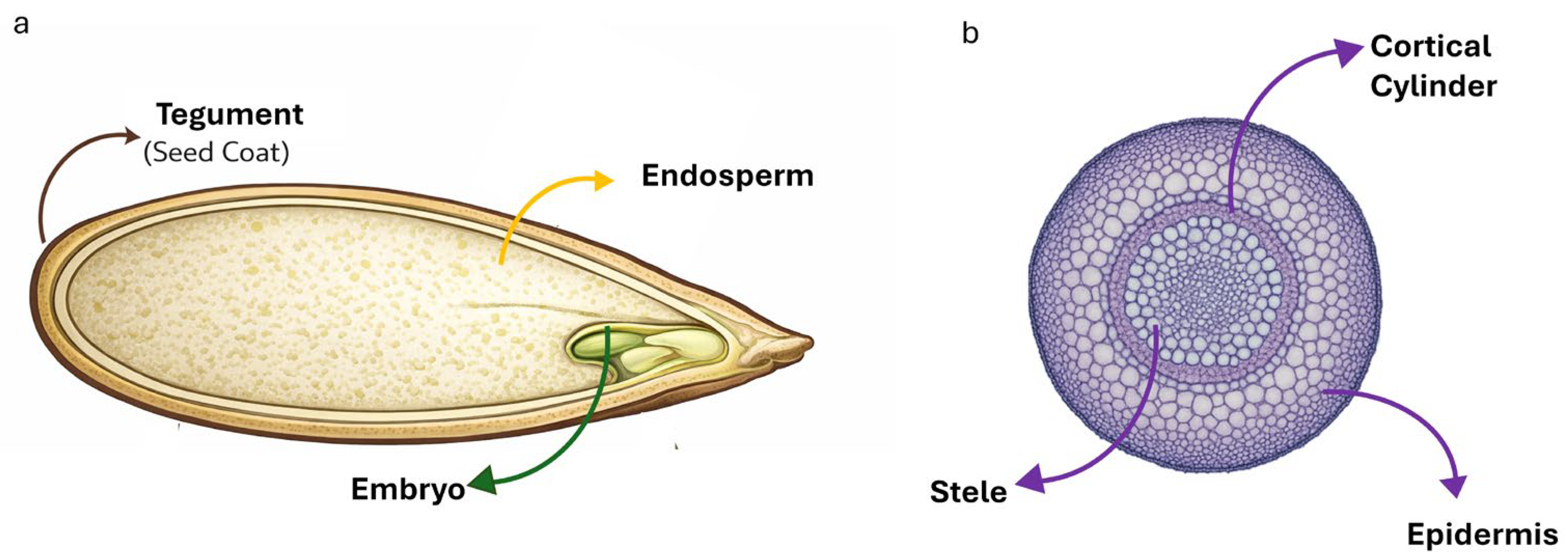
Five seeds (biological replicates) per selected dose (CTRL, 1 Gy, 20 Gy) and morphotype were embedded in OCT medium and longitudinally sectioned at 15 µm using a cryostat (Leica CM1850, Leica Microsystems GmbH, Wetzlar, Germany) with liquid nitrogen–isopentane cooling. Sections were mounted on slides with mineral oil for fluorescence microscopy and examined using an epifluorescence microscope (Olympus BX53, Hamburg, Germany) equipped with mercury lamp and a filter set to detect autofluorescent compounds including phenolic compounds (excitation 450–490 nm; dichroic mirror > 495 nm; emission 500–530 nm). Digital images were acquired with a camera (Olympus EP50) and were analyzed with Olympus CellSens v2.3 to quantify fluorescence intensity in the whole picture for seed teguments (seed coat) and endosperm tissue as a proxy for auto-fluorescent compound accumulation (Figure 1). Selected doses were chosen to represent the control condition, a low-dose stimulatory range, and a high-dose inhibitory range based on the biometric responses observed across treatments.

2.4. Anatomical Analyses of Hypocotyls

Five seedlings (biological replicates) per dose and morphotype were fixed in F.A.A. solution (formaldehyde; acetic acid; ethanol 50%; 5:5:90 mL) to preserve tissue structure. Sub-samples (1 cm long) from the hypocotyl region were dissected and dehydrated through an ascending ethanol series (70%, 96%, 100%), and then embedded in JB4® resin (Polysciences, Germany) following standard infiltration and polymerization procedures. Transverse sections (5 µm thick) were obtained using a rotary microtome, stained with 0.5% toluidine blue, mounted on slides with water, and observed under a transmitted-light microscope (Olympus BX53). Digital micrographs were analyzed with CellSens v2.3 to quantify the maximum and minimum stele diameters (µm), the stele:total diameter ratio, and the number of epidermal cells per linear transect (n mm−1), as reported in Figure 1.

2.5. Polyphenols Quantification

For biochemical analyses, 5 seedling samples (biological replicates) were freeze-dried and ground to a fine powder. Polyphenols were extracted by incubating 0.01 g of dried tissue in 1 mL of methanol for 24 h at room temperature under agitation. Extracts were then centrifuged at 4000 rpm for 10 min using a benchtop centrifuge (D2012PLUS, DLAB Scientific Co., Beijing, China), and 50 μL of the supernatant was used for the assay. For the Folin–Ciocalteu reaction, 50 μL of extract was mixed with 250 μL of 10% (v/v) Folin–Ciocalteu reagent. After 5 min of incubation, 200 μL of 7.5% (w/v) Na2CO3 was added. The reaction mixture was incubated for 30 min at room temperature in the dark. Absorbance was recorded at 760 nm using a spectrophotometer (UV-21 Onda, Carpi, Italy). Total polyphenol content was expressed as mg gallic acid equivalents (GAE) per mg dry weight, based on a gallic acid calibration curve.

2.6. Statistical Analyses

Statistical analyses were performed in R software (version 4.4.3). For each response variable, we fitted a two-way ANOVA model including Dose and Cultivar as fixed factors. Significant Dose × Cultivar interactions (p < 0.05) indicated cultivar-specific radiation responses. When a significant Dose × Cultivar interaction was detected, one-way ANOVAs followed by Tukey’s post hoc tests were performed separately within each morphotype. The main effects of Dose and Cultivar are reported in Supplementary Materials. Data are expressed as mean ± SE, and significance thresholds were set at p < 0.05.

3. Results

3.1. Germination Patterns Across Radiation Treatments

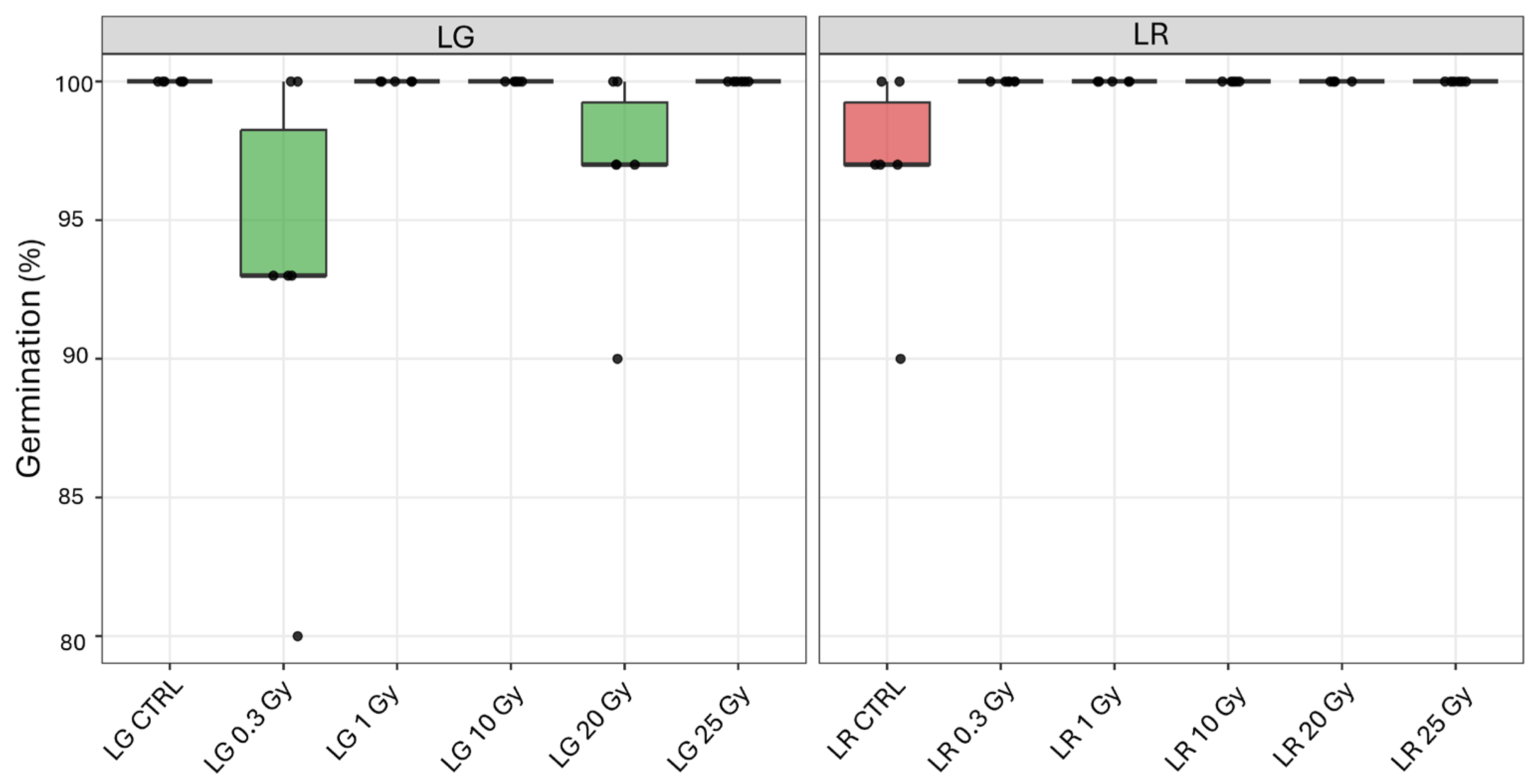
Germination was high across all treatments in both L. sativa green (LG) and red (LR) morphotypes, with most values approaching 100%. No significant effects of Dose, Cultivar, or Dose × Cultivar interaction were detected (p > 0.05) (Table S1). Although some fluctuations were observed, particularly a lower range in LG at 0.3 Gy and 20 Gy, these variations were not statistically significant (Figure 2). LR showed a more uniform distribution across treatments, with germination consistently close to 100% and minimal dispersion among replicates (Figure 2). Overall, irradiation did not produce significant changes in germination in either morphotype, indicating that seed viability was largely unaffected within the dose range tested.

3.2. Biometric Traits as Primary Indicators of Radiation Effects

Seedling growth parameters were significantly affected by radiation exposure, with strong and cultivar-specific responses (Table S2). Two-way ANOVA revealed significant effects of Dose, Cultivar, and their interaction for most traits (p < 0.05), indicating differential sensitivity of LG and LR morphotypes to irradiation. Overall, LR consistently exhibited greater root and seedling growth than LG across treatments, particularly at low to moderate doses, whereas higher doses (20–25 Gy) generally induced growth inhibition, especially in LG. Table 1 reports the Dose × Cultivar interaction effects for the analyzed seedling growth traits. Root length exhibited a progressive reduction at higher doses (20 and 25 Gy). A stimulatory effect at low dose (0.3 Gy) was clearly observed in the red morphotype (LR), whereas in LG the increase was not statistically significant compared to the control. In LR, although root length decreased at the highest doses, it consistently remained greater than that of LG across all treatments.
Seedling length and total seedling length were likewise significantly influenced by irradiation (p < 0.001). LG showed no clear directional trend, while LR exhibited enhanced growth at moderate doses, with the longest seedlings observed at 1 Gy (3.18 cm). Total length followed these same patterns: LR maintained the highest values, peaking at LR 1 Gy (7.37 cm), whereas LG experienced significant reductions at increasing doses, being reduced from 5.46 cm at CTRL to 4.56 cm at 25 Gy.
Seedling area was also significantly influenced (p < 0.01). LG displayed a consistent increase at low doses (0.3–1 Gy), while LR maintained substantially larger leaf areas under all treatments. Notably, LR showed increased seedling area at 10 Gy (0.68 cm2).
Fresh weight (FW) exhibited a similar trend and was highly influenced by dose (p < 0.001). LG seedlings showed declining FW with increasing dose, while LR displayed a pronounced increase up to 20 Gy (0.77 g). Concerning dry weight (DW), although ANOVA detected significant effects for DW (Table S2), post hoc comparisons (Tukey’s test) did not reveal significant pairwise differences among treatments.
Overall, LR demonstrated a clear tolerance to irradiation, with low-dose stimulation of several growth parameters, whereas LG proved more sensitive, exhibiting progressive reductions in most biometric traits at moderate and high doses.

3.3. Anatomical Traits: Seeds Internal Tissue Response to Radiation

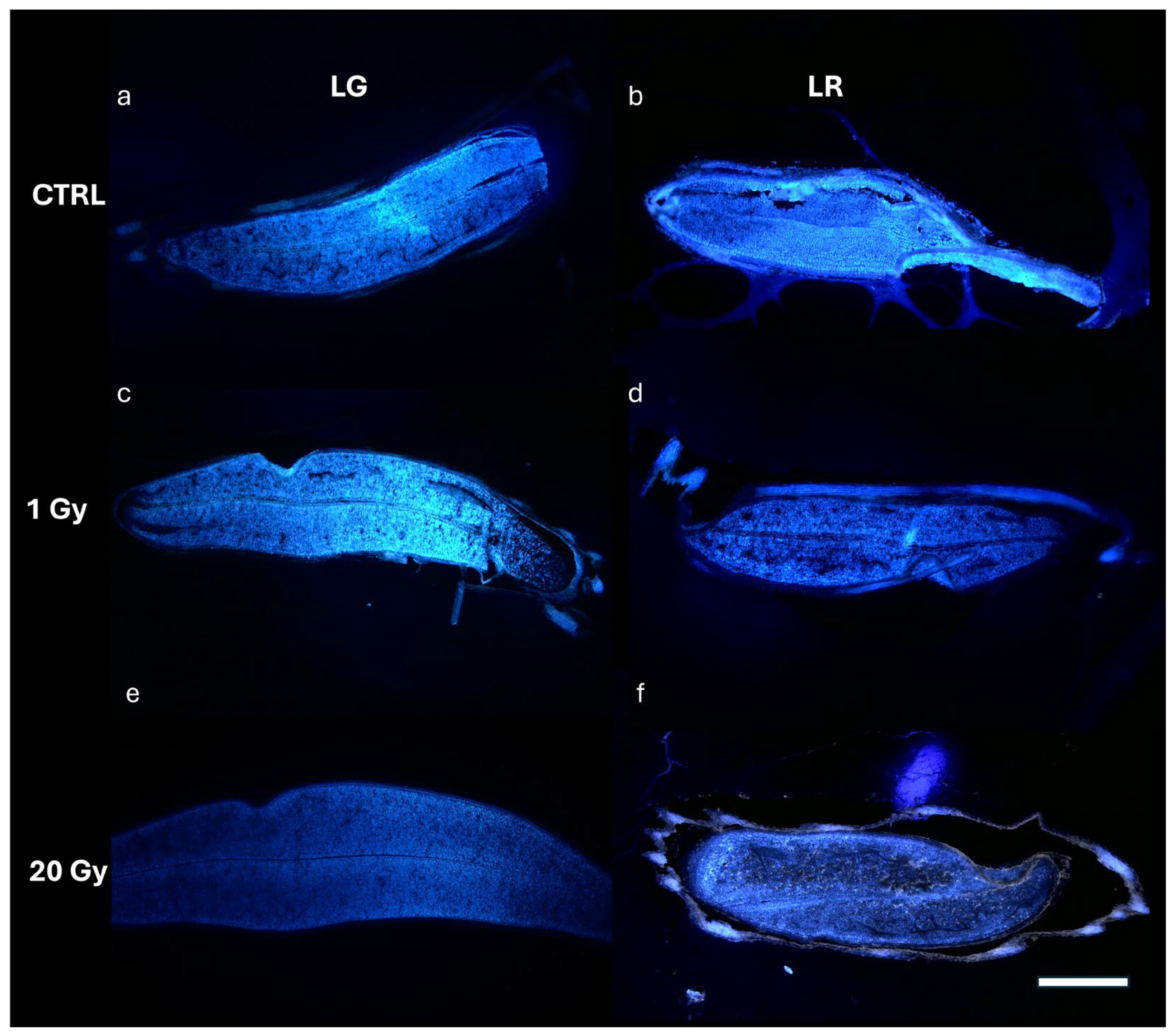
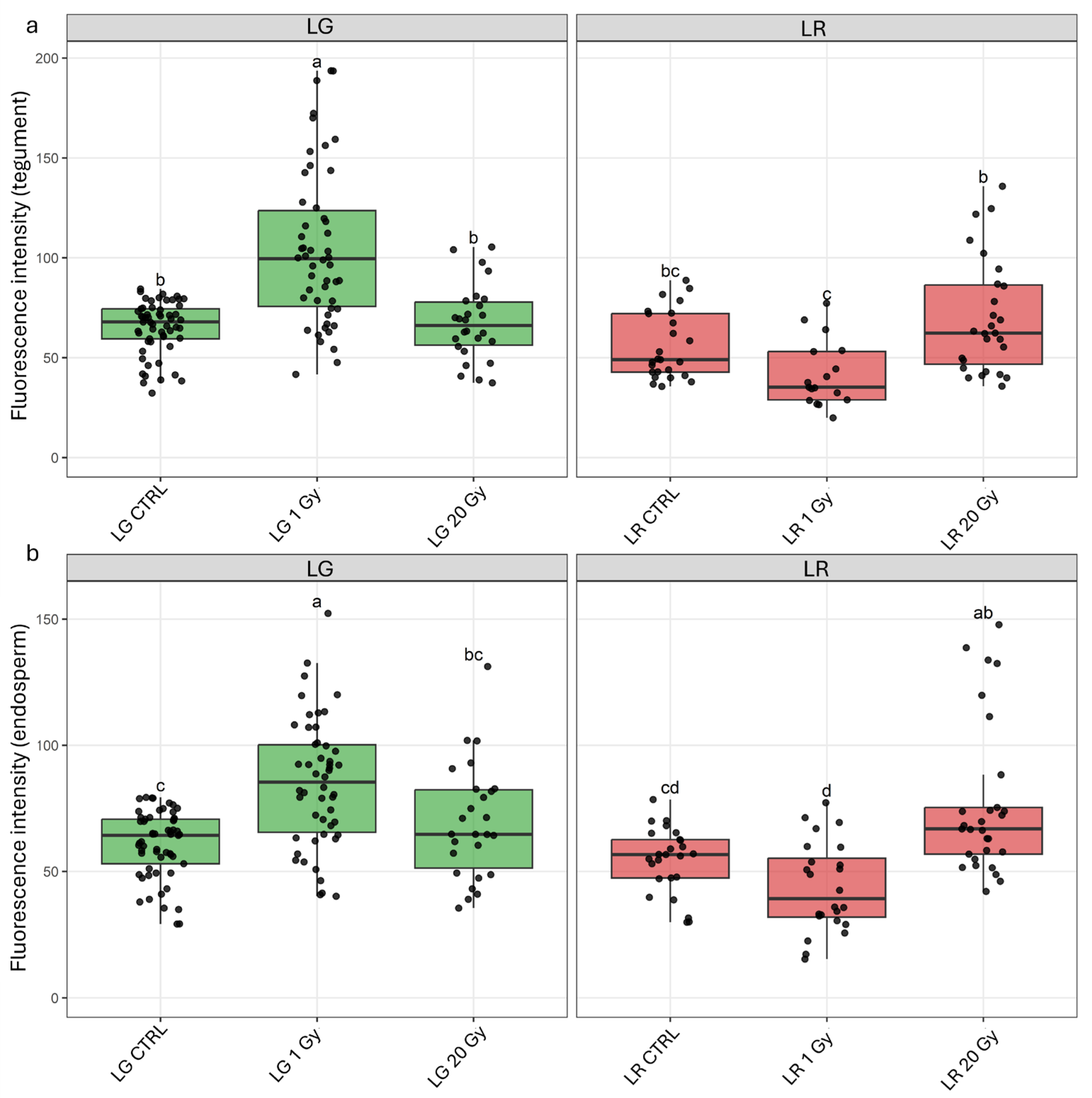
Microscopic observation of longitudinal seed sections revealed a typical lettuce seed organization, with an external tegument enclosing a persistent endosperm in which the embryo, including the cotyledons, is embedded (Figure 3a–f). Fluorescence intensity in both tegument and endosperm was significantly affected by Dose, Cultivar and their interaction (p < 0.001; Table S3), with clear and contrasting patterns between the two morphotypes (Figure 3 and Figure 4). In LG, tegument fluorescence increased markedly at 1 Gy, showing substantially higher values than both the control and 20 Gy treatments (Figure 4a). In contrast, LR displayed the opposite trend: fluorescence intensity in the tegument decreased at 1 Gy compared with the control and increased again at 20 Gy (Figure 4a).
A similar pattern was observed in the endosperm tissue. In LG, irradiation at 1 Gy resulted in the highest fluorescence, exceeding both the control and 20 Gy treatments (Figure 4b). In LR, endosperm fluorescence was similar to control at 1 Gy and increased at 20 Gy, which showed the highest fluorescence levels for this morphotype (Figure 4b).

3.4. Anatomical Traits: Hypocotyl Internal Tissue Response to Radiation

Radiation exposure also produced significant anatomical modifications in both morphotypes, with significant Dose, Cultivar, and Dose × Cultivar effects detected for most parameters (Table S4), although the magnitude and direction of the responses differed between LG and LR (Table 2). Major stele diameter varied significantly among treatments (p < 0.01). In LG, the values fluctuated without a clear dose-dependent trend, ranging from 168.9 μm at 25 Gy to 234.7 μm at 10 Gy. In contrast, LR displayed consistently larger stele diameters than LG across nearly all treatments. The greatest enlargement occurred at 10 Gy (310.4 μm), while even the lowest values in LR remained higher than the corresponding LG treatments, except for LR at 1 Gy.
Minor stele diameter was also significantly affected (p < 0.05), showing a pattern similar to that observed for the major stele. LG exhibited modest variations across doses, whereas LR responded more distinctly to irradiation. The highest values were recorded at 0.3 Gy in LR (186 μm).
The stele-to-total diameter ratio was also significantly affected by irradiation (p < 0.01), revealing distinct responses between the two morphotypes (Table 2). In LG, the ratio showed limited variation among treatments, with values remaining close to the control and no clear dose-dependent trend. In contrast, LR exhibited a marked increase in the stele proportion under irradiation, with the highest ratios recorded at 0.3 and 10 Gy. The number of epidermal cells was strongly influenced by radiation (p < 0.001). LG exhibited variable and generally lower values compared with LR, with counts ranging from 26.51 to 31.31, suggesting differences in epidermal cell density across treatments, although cell size was not directly quantified. LR showed a marked increase in epidermal cell number at higher doses, reaching its maximum at 10 and 25 Gy (37.3 and 36.2, respectively), potentially consistent with smaller epidermal cells, although cell size was not measured directly.

3.5. Irradiation-Driven Shifts in Pigment and Antioxidant Metabolism

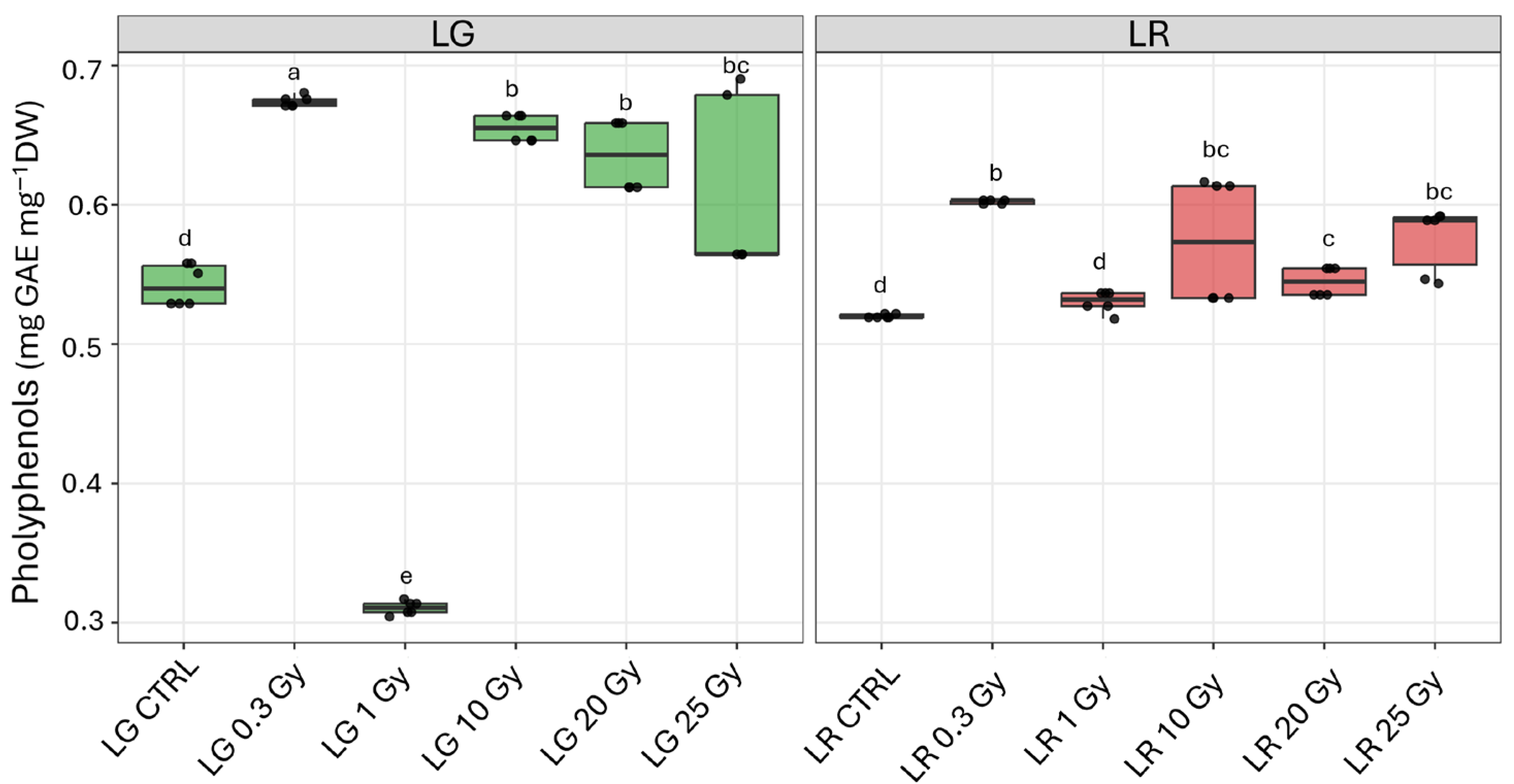
Polyphenol content was significantly influenced by Dose and Dose × Cultivar interaction, but not by Cultivar alone (Table S5). In the green morphotype (LG), irradiation induced a pronounced non-linear trend. Seeds exposed to 0.3 Gy exhibited the highest polyphenol levels, whereas 1 Gy caused a marked reduction, representing the lowest values observed across all treatments. Intermediate and high doses (10–25 Gy) led to a substantial recovery of polyphenol accumulation (Figure 5).
The red morphotype (LR) showed a more stable response among irradiation doses. Polyphenol content increased at 0.3 Gy and again at 10 and 25 Gy, while a clear decrease was observed at 20 Gy. Control seeds and those exposed to 1 Gy displayed the lowest concentrations.
Overall, both morphotypes exhibited a similar pattern, with stimulatory effects at low and high doses of carbon-ion irradiation and a consistent depression at 1 Gy, indicating a morphotype-dependent modulation of phenolic metabolism.

3.6. Multivariate Integration

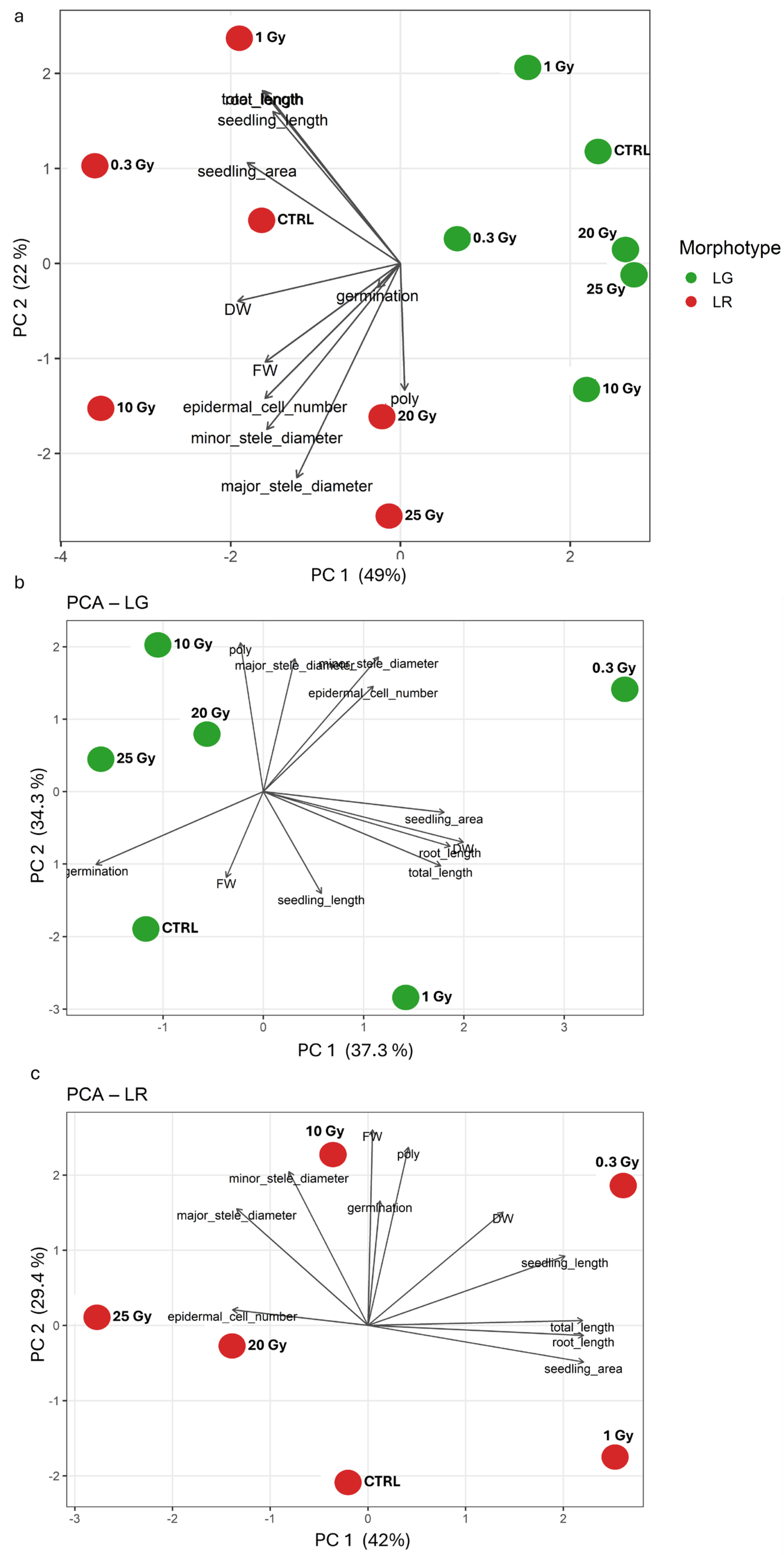
The multivariate analysis in Figure 6 reveals clear differences between morphotypes and dose-dependent responses to irradiation. In the combined PCA (Figure 6a), PC1 accounts for 49% variability and PC2 for 22%. LG and LR are well separated along PC1, indicating broad morphological, anatomical, and biochemical divergence between morphotypes. Notably, most trait vectors point toward the LR cluster, indicating that the overall multivariate variation in the dataset is more strongly associated with LR, reflecting its wider range of anatomical and biometric responses to irradiation.
When PCA was performed separately for each morphotype (Figure 6b,c), distinct internal structures became evident. In LG (Figure 6b), PC1 and PC2 explain 37.3% and 34.3% of the total variability; here variation among treatments is driven primarily by biometric traits (root length, seedling length, total length) and seedling area, which strongly contribute to PC1. Anatomical variables (major and minor stele diameter, epidermal cell number) and polyphenols exhibit greater loadings on PC2. Treatments at 1 Gy and 0.3 Gy are clearly separated from the control and from higher doses (10, 20, 25 Gy), indicating marked morphological and biochemical adjustments under irradiation.
In LR, PC1 and PC2 explain 42% and 29.4% of the total variability, but the multivariate structure differed substantially. Here, separation among treatments is more strongly influenced by anatomical parameters (major and minor stele diameter, epidermal cell number) and biochemical traits (polyphenols), while biometric traits contribute less to the principal gradients of variation. In this morphotype, 1 Gy and 25 Gy treatments are the most distant from the control, suggesting heightened sensitivity to both low and high irradiation doses. Similar to LG, treatments at 1 Gy and 0.3 Gy are clearly separated from the control and from higher doses (10, 20, 25 Gy).

4. Discussion

Carbon-ion irradiation induced clear dose-dependent changes in lettuce during early developmental stages, with morphotype-specific patterns emerging across germination, seedling morphology, anatomy, and biochemical traits. Although germination percentage remained unaffected in both cultivars—indicating high tolerance of dry lettuce seeds to 12C-ion exposure—subsequent developmental stages revealed divergent strategies in green (LG) and red (LR) morphotypes, reflecting different underlying physiological and anatomical acclimation strategies.
A key finding of this work is the stimulation of growth and metabolism at low doses, which is consistent with hormetic responses. Hormesis has been widely documented in plants exposed to ionizing radiation, where mild stress induces antioxidant activation, metabolic reprogramming, and enhanced growth performance [19,20,26]. Indeed, low-dose radiation can trigger signaling pathways that improve ROS scavenging efficiency and promote cell division or elongation, whereas higher doses exceed the plant’s repair capacity and lead to oxidative damage, impaired development, and metabolic imbalance [27,28]. The stimulatory effects observed at the lower doses (0.3–1 Gy), particularly in the red morphotype, are consistent with the idea that plants can exploit mild stress to activate protective mechanisms. LR consistently showed enhanced root elongation, hypocotyl length, and total seedling size at low irradiation levels, with particularly strong stimulation at 0.3–10 Gy. These results align with classical models of low-dose radiation hormesis, in which sub-lethal stress enhances cellular division rates, auxin signaling, and ROS-mediated growth pathways [26]. The fact that LR maintained relatively high seedling area and fresh biomass up to 20 Gy, compared to LG, further supports its greater stress tolerance. By contrast, LG showed a gradual reduction in growth traits with increasing dose, particularly at 10–25 Gy, pointing to a lower threshold for radiation-induced inhibition. Similar cultivar-dependent differences in radiation tolerance have been reported in other species. For example, Arabidopsis thaliana ecotypes showed contrasting growth responses under low-dose γ-irradiation, with some accessions maintaining biomass and root elongation at doses that suppressed others [29]. Likewise, in Lactuca sativa and Valerianella locusta [9], observed that certain cultivars preserved or even increased seedling vigor at 5–20 Gy, whereas more sensitive varieties exhibited a rapid decline in shoot growth and biomass. These comparisons reinforce the idea that radiation tolerance is strongly genotype-dependent and linked to the efficiency of antioxidant and repair pathways.
Anatomical analyses help to interpret these divergent responses. LR displayed consistently wider steles and higher epidermal cell numbers across irradiation levels, which may represent a structural hallmark of tolerance, as these features could have implications for water and nutrient transport. Moreover, the stele-to-total diameter ratio was higher in these plants; larger stele is potentially associated with more space for vascular development. In turn, enlarged vascular tissues may be associated with improved transport-related functions, contributing to the superior seedling vigor observed in LR. Similar associations between structural and physiological adjustments and enhanced early growth have been reported in other species; in line with this, mung bean sprouts exposed to conditions that stimulate anatomical and physiological responses have shown improved vigor [30]. However, functional traits such as xylem vessel characteristics and transport capacity were not directly measured in this study; therefore, these relationships remain speculative. In our study, LG hypocotyls, however, exhibited no consistent increase in stele diameter or epidermal cell proliferation, suggesting a more conservative or constrained anatomical response. These findings highlight the importance of internal seedling structure as a determinant of resilience, a dimension rarely explored in radiobiology studies.
The fluorescence analyses of seed tissues revealed additional morphotype-specific adjustments. LG responded to irradiation with a clear peak in tegument and endosperm fluorescence at 1 Gy, which may reflect a transient accumulation of autofluorescent compounds, including phenolic-related components. In contrast, LR showed a marked decline at 1 Gy but recovered strongly at 20 Gy. Such shifts may indicate differential activation of antioxidant pathways and phenylpropanoid metabolism, which may underpin the structural and growth-related differences between morphotypes. Seed reserve content is a major determinant of early seedling performance, as carbohydrates, lipids, antioxidants, and storage proteins fuel embryo expansion, hypocotyl elongation, and the establishment of functional root systems before the onset of effective autotrophy. Species and genotypes with larger or more efficiently mobilized reserves often exhibit faster seedling emergence, greater elongation growth, and enhanced stress tolerance during early development [31,32]. Thus, differences in initial seed reserve quantity or mobilization efficiency between morphotypes may partly explain the contrasting seedling growth patterns observed in this study.
Polyphenol quantification in seedlings further highlighted divergent phenolic-related responses between morphotypes. LG exhibited pronounced oscillations in polyphenol content, with suppression at 1 Gy and enhancement at 0.3 Gy, indicative of an active and highly dose-sensitive regulation of phenolic biosynthesis. In contrast, LR maintained lower and comparatively less variable polyphenol levels across irradiation treatments.
This pattern may reflect differences in the balance between phenolic synthesis and utilization rather than differences in antioxidant capacity per se, not directly assessed in this study. Our hypothesis is that LR may differ in the balance between phenolic accumulation and utilization, resulting in lower steady-state concentrations, whereas LG may show stronger accumulation in response to stress [33,34,35]. However, since only total polyphenols were measured, no direct conclusions on antioxidant capacity can be drawn. Therefore, any link between polyphenol levels and antioxidant performance should be considered as suggestive rather than demonstrated.
Accordingly, the superior stress performance of LR likely arises from the coordinated contribution of biometric and anatomical traits, rather than polyphenol content alone. Differently, phenolic accumulation in LG may represent a compensatory response to stress rather than a direct indicator of enhanced tolerance. Together, these findings may indicate distinct acclimation strategies, with LR relying on integrated structural and biochemical efficiency and LG exhibiting a more reactive, dose-dependent metabolic adjustment.
The multivariate analysis integrates these findings and reveals the structure of radiation responses. In the combined PCA, LG and LR were strongly separated along PC1, confirming fundamental morphological and physiological divergence. Importantly, most trait vectors were oriented toward the LR cluster, indicating that LR carries the strongest multivariate signature across biometric, anatomical, and biochemical traits. Separate PCA analyses for each morphotype highlight that LG responds mainly through growth-related modifications, whereas LR exhibits coordinated shifts driven by anatomical and biochemical traits. These patterns support the greater plasticity of LR, and further support that its performance is associated with coordinated multi-trait responses rather than a single biochemical parameter.
Overall, the combined evidence suggests that carbon-ion irradiation can induce early responses consistent with hormesis and may act as an acclimatory physical stimulus. It should be noted that the hormetic interpretation is based solely on early developmental responses and does not imply improved long-term performance or stress tolerance. Dry seeds are naturally resistant to radiation due to low water content and quiescent metabolism, which limit oxidative injury [36]. In addition, seed coats and endosperm rich in phenolics and structural polymers provide intrinsic protection. The present results suggest that 12C irradiation can further modulate early morphogenesis and metabolism in a controlled, dose-dependent manner, offering potential applications for controlled-environment agriculture and extraterrestrial BLSS contexts.
Future work should investigate whether these early anatomical and metabolic changes persist during later growth stages and whether they interact with other space-relevant stresses such as altered gravity or atmospheric composition. Integrating omics approaches with physiological assays would help elucidate the molecular mechanisms underpinning radiation-induced acclimation responses and morphotype-specific resilience.

5. Conclusions

This study shows that carbon-ion irradiation of dry lettuce seeds modulates early seedling development in a dose-dependent and morphotype-specific manner. While germination at the early observation stage was not affected, low irradiation doses were associated with stimulatory responses in growth, anatomy, and phenolic-related traits, particularly in the red morphotype. These results indicate that carbon-ion exposure can trigger early acclimatory and hormetic-like responses in lettuce seedlings. However, further studies are needed to determine whether these early responses translate into improved tolerance under subsequent stress conditions. The present findings therefore support the relevance of carbon-ion irradiation as a useful experimental tool, and potentially as an inducer of early acclimatory responses, in controlled-environment and space-oriented plant research. However, the lack of independent experimental replication due to the inherent constraints associated with heavy-ion irradiation experiments may limit the extent to which the observed dose–response patterns can be generalized.

Supplementary Materials

The following supporting information can be downloaded at: https://www.mdpi.com/article/10.3390/horticulturae12050614/s1.

Author Contributions

Conceptualization, C.A. and V.D.M.; methodology, C.A. and V.D.M.; software, C.A.; validation, V.D.M. and C.A.; formal analysis, C.A.; investigation, C.A.; resources, V.D.M.; data curation, C.A. and V.D.M.; writing—original draft preparation, C.A.; writing—review and editing, C.A., W.T., S.D.F., S.D.P., M.D., and V.D.M.; supervision, V.D.M.; project administration, V.D.M. and S.D.P.; funding acquisition, V.D.M. and S.D.P. All authors have read and agreed to the published version of the manuscript.

Funding

Part of the results presented here is based on the experiment Bio_08_DeMicco, which was performed at the SIS18 at the GSI Helmholtzzentrum fuer Schwerionenforschung GmbH, Darmstadt (Germany) in the frame of FAIR Phase-0. This research was also conducted within the Space It Up project funded by the Italian Space Agency, ASI, and the Ministry of University and Research, MUR, under contract n. 2024-5-E.0-CUP n. I53D24000060005.

Data Availability Statement

The original contributions presented in this study are included in the article/Supplementary Materials. Further inquiries can be directed to the corresponding author.

Acknowledgments

The authors would like to thank Barone for providing access to the cryostat and Dario Maurantonio for his valuable assistance in the laboratory.

Conflicts of Interest

Authors Walter Tinganelli and Marco Durante were employed by the company GSI Helmholtzzentrum fur Schwerionenforschung, GmbH. The remaining authors declare that the research was conducted in the absence of any commercial or financial relationships that could be construed as a potential conflict of interest.

References

  1. Liu, H.; Yao, Z.; Fu, Y.; Feng, J. Review of research into bioregenerative life support system(s) which can support humans living in space. Life Sci. Space Res. 2021, 31, 113–120. [Google Scholar] [CrossRef] [PubMed]
  2. Fountain, L.L.; Gillingham, M.; Amitrano, C.; Arouna, N.; Barker, R.J.; Bohmer, M.; Braun, M.; Brereton, N.J.; Brocato, R.L.; Bunchek, J.M.; et al. Expanding frontiers: Harnessing plant biology for space exploration and planetary sustainability. New Phytol. 2025, 249, 656–669. [Google Scholar] [CrossRef] [PubMed]
  3. De Micco, V.; Arena, C.; Di Fino, L.; Narici, L. Radiation environment in exploration-class space missions and plants’ responses relevant for cultivation in bioregenerative life support systems. Front. Plant Sci. 2022, 13, 1001158. [Google Scholar] [CrossRef]
  4. De Micco, V.; Amitrano, C.; Mastroleo, F.; Aronne, G.; Battistelli, A.; Carnero-Diaz, E.; De Pascale, S.; Detrell, G.; Dussap, C.G.; Ganigué, R.; et al. Plant and microbial science and technology as cornerstones to bioregenerative life support systems in space. npj Microgravity 2023, 9, 69. [Google Scholar] [CrossRef]
  5. Wheeler, R.M. Agriculture for space: People and places paving the way. Open Agric. 2017, 2, 14–32. [Google Scholar] [CrossRef]
  6. Pawar, V.; Laware, S. Seed priming: A critical review. Int. J. Sci. Res. Biol. Sci. 2018, 5, 94–101. [Google Scholar] [CrossRef]
  7. Sharma, K.K.; Singh, U.S.; Sharma, P.; Kumar, A.; Sharma, L. Seed treatments for sustainable agriculture: A review. J. Appl. Nat. Sci. 2015, 7, 521. [Google Scholar] [CrossRef]
  8. Bera, K.; Dutta, P.; Sadhukhan, S. Seed priming with non-ionizing physical agents: Plant responses and underlying physiological mechanisms. Plant Cell Rep. 2022, 41, 53–73. [Google Scholar] [CrossRef]
  9. Sorrentino, M.C.; Granata, A.; Cantalupo, M.; Manti, L.; Pugliese, M.; Giordano, S.; Capozzi, F.; Spagnuolo, V. Seed priming by low-dose radiation improves growth of Lactuca sativa and Valerianella locusta. Plants 2024, 13, 165. [Google Scholar] [CrossRef]
  10. Harwalker, M.R.; Donger, T.K.; Padwal-Desai, S.R. Radiation disinfestation of spice and spice products. I. Radiation sensitivity of developmental stages of Lasioderma serricorne and Stegobium panicium. J. Food Sci. Technol. 1995, 32, 249–251. [Google Scholar]
  11. Gupta, P.R.K.; Chaturvedi, G.S. Effect of pre-germination exposure of ultraviolet radiation on forage seeds. Seed Res. 1987, 15, 143–148. [Google Scholar]
  12. Esnault, M.A.; Legue, F.; Chenal, C. Ionizing radiation: Advances in plant response. Environ. Exp. Bot. 2010, 68, 231–237. [Google Scholar] [CrossRef]
  13. Arena, C.; De Micco, V.; De Maio, A. Growth alteration and leaf biochemical responses in Phaseolus vulgaris exposed to different doses of ionising radiation. Plant Biol. 2014, 16, 194–202. [Google Scholar] [CrossRef] [PubMed]
  14. Bewley, J.D.; Black, M. Seeds: Physiology of Development and Germination; Springer: Dordrecht, The Netherlands, 2013. [Google Scholar]
  15. Schumacher, U. Structure without function is a corpse, function without structure is a ghost. Sprache Stimme Gehör 2007, 31, 3. [Google Scholar] [CrossRef]
  16. Amitrano, C.; De Micco, V. No leaf is an island: The potential of integrating quantitative wood and leaf anatomy. IAWA J. 2025, 46, 635–651. [Google Scholar] [CrossRef]
  17. Kumar, K.; Kumar, S.; Datta, K.; Fornace, A.J., Jr.; Suman, S. High-LET-radiation-induced persistent DNA damage response signaling and gastrointestinal cancer development. Curr. Oncol. 2023, 30, 5497–5514. [Google Scholar] [CrossRef]
  18. Marcu, D.; Cristea, V.; Daraban, L. Dose-dependent effects of gamma radiation on lettuce (Lactuca sativa var. capitata) seedlings. Int. J. Radiat. Biol. 2013, 89, 219–223. [Google Scholar] [CrossRef]
  19. Amitrano, C.; De Francesco, S.; Durante, M.; Tinganelli, W.; Arena, C.; De Micco, V. Morphological and photosynthetic pigment screening of four microgreens species exposed to heavy ions. Plants 2024, 13, 3541. [Google Scholar] [CrossRef]
  20. De Francesco, S.; Amitrano, C.; Vitale, E.; Costanzo, G.; Tinganelli, W.; Pugliese, M.; Arrichiello, C.; Muto, P.; Durante, M.; De Pascale, S.; et al. Radiation quality matters: Morphological and biochemical responses of Brassica rapa microgreens to X-rays, C-ions, and Fe-ions. Planta 2025, 262, 118. [Google Scholar] [CrossRef]
  21. Hirano, T.; Kazama, Y.; Kunitake, H.; Abe, T. Mutagenic effects of heavy-ion beam irradiation to plant genome. Cytologia 2022, 87, 3–6. [Google Scholar] [CrossRef]
  22. Zabel, P.; Bamsey, M.; Schubert, D.; Tajmar, M. Review and analysis of plant growth chambers and greenhouse modules for space. Prog. Aerosp. Sci. 2014, 66, 1–17. [Google Scholar]
  23. El-Nakhel, C.; Giordano, M.; Pannico, A.; Carillo, P.; Fusco, G.M.; De Pascale, S.; Rouphael, Y. Cultivar-specific performance and qualitative descriptors for butterhead Salanova lettuce produced in closed soilless cultivation as a candidate salad crop for human life support in space. Life 2019, 9, 61. [Google Scholar] [CrossRef]
  24. Amitrano, C.; Rouphael, Y.; De Pascale, S.; De Micco, V. Vapour pressure deficit drives the balance of hydraulic-related anatomical traits in lettuce leaves. Plants 2022, 11, 2369. [Google Scholar] [CrossRef]
  25. Luoni, F.; Weber, U.; Boscolo, D.; Durante, M.; Reidel, C.A.; Schuy, C.; Zink, K.; Horst, F. Beam monitor calibration for radiobiological experiments with scanned high energy heavy ion beams at FAIR. Front. Phys. 2020, 8, 568145. [Google Scholar] [CrossRef]
  26. Caplin, N.; Willey, N. Ionizing radiation, higher plants, and radioprotection: From acute high doses to chronic low doses. Front. Plant Sci. 2018, 9, 847. [Google Scholar] [CrossRef]
  27. Sharma, P.; Jha, A.B.; Dubey, R.S.; Pessarakli, M. Reactive oxygen species, oxidative damage, and antioxidative defense mechanism in plants under stressful conditions. J. Bot. 2012, 2012, 217037. [Google Scholar] [CrossRef]
  28. Chakraborty, S.; Tiwari, R.K. Adaptation of photoautotrophs in extraterrestrial environments: Responses and mechanisms of survival. In Stress Biology in Photosynthetic Organisms; Springer Nature: Singapore, 2024; pp. 267–291. [Google Scholar] [CrossRef]
  29. Volkova, P.Y.; Bondarenko, E.V.; Kazakova, E.A. Radiation hormesis in plants. Curr. Opin. Toxicol. 2022, 30, 100334. [Google Scholar] [CrossRef]
  30. Amitrano, C.; Arena, C.; De Pascale, S.; De Micco, V. Light and low relative humidity increase antioxidants content in mung bean (Vigna radiata L.) sprouts. Plants 2020, 9, 1093. [Google Scholar] [CrossRef] [PubMed]
  31. Bewley, J.D.; Bradford, K.J.; Hilhorst, H.W.M. Seeds: Physiology of Development, Germination and Dormancy; Springer: New York, NY, USA, 2012. [Google Scholar]
  32. Nonogaki, H.; Bassel, G.W.; Bewley, J.D. Germination—Still a mystery. Plant Sci. 2010, 179, 574–581. [Google Scholar] [CrossRef]
  33. Mittler, R. Oxidative stress, antioxidants and stress tolerance. Trends Plant Sci. 2002, 7, 405–410. [Google Scholar] [CrossRef] [PubMed]
  34. Agati, G.; Azzarello, E.; Pollastri, S.; Tattini, M. Flavonoids as antioxidants in plants: Location and functional significance. Plant Sci. 2012, 196, 67–76. [Google Scholar] [CrossRef] [PubMed]
  35. Selmar, D.; Kleinwächter, M. Influencing the product quality by deliberately applying drought stress during the cultivation of medicinal plants. Ind. Crops Prod. 2013, 42, 558–566. [Google Scholar] [CrossRef]
  36. Waterworth, W.M.; Bray, C.M.; West, C.E. Seeds and the art of genome maintenance. Front. Plant Sci. 2019, 10, 706. [Google Scholar] [CrossRef] [PubMed]
Figure 1. Representative schematic illustrations of seed and hypocotyl anatomy. (a) Longitudinal section of the seed highlighting the seed coat (tegument), endosperm, and embryo. (b) Cross-section of the hypocotyl showing the epidermis, cortical cylinder (cortex), and central stele.
Horticulturae 12 00614 g001
Figure 2. Germination percentage of L. sativa green (LG) and red (LR) morphotypes exposed to different doses of 12C-ions (0.3, 1, 10, 20, 25 Gy) and a non-irradiated control (CTRL). Boxplots represent the distribution of raw germination values for each treatment. No significant effects of irradiation were observed in either morphotype. Each treatment consisted of three biological replicates of 10 seeds each.
Horticulturae 12 00614 g002
Figure 3. Epi-fluorescence micrographs of longitudinal sections of dry L. sativa seeds from the green-leaf (LG) and red-leaf (LR) morphotypes subjected to carbon-ion irradiation. Panels show an example of seed anatomical organization in control (CTRL, (a,b)), 1 Gy (c,d), and 20 Gy (e,f) treatments. Images are at the same magnification; scale bar: 100 μm.
Horticulturae 12 00614 g003
Figure 4. Fluorescence intensity of tegument (a) and endosperm (b) tissues in L. sativa green (LG) and red (LR) morphotypes exposed to different doses of 12C-ions (0.3, 1, 10, 20, 25 Gy) and a non-irradiated control (CTRL). Boxplots show the distribution of raw fluorescence values. Statistically significant differences were detected among treatments within each morphotype (Tukey’s test, p < 0.05). Each treatment consisted of five biological replicates. Different letters indicate significant differences among treatments within each parameter.
Horticulturae 12 00614 g004
Figure 5. Polyphenol content (mg GAE mg−1 DW) in seedlings of L. sativa green (LG) and red (LR) morphotypes exposed to different doses of 12C-ion (0.3, 1, 10, 20, 25 Gy) and a non-irradiated control (CTRL). Boxplots represent the distribution of raw measurements. Significant differences among treatments within each morphotype were detected (Tukey’s post hoc test, p < 0.05). Each treatment consisted of five biological replicates. Different letters indicate significant differences among treatments within each parameter.
Horticulturae 12 00614 g005
Figure 6. Principal Component Analysis (PCA) integrating biometric, anatomical, and biochemical traits in seedlings of green (LG) and red (LR) L. sativa morphotypes exposed to different doses of 12C-ions (0.3, 1, 10, 20, 25 Gy) and a non-irradiated control (CTRL). (a) Combined PCA including both morphotypes (LG and LR), showing a clear multivariate separation between LG and LR and a distinct distribution of treatments along the first two principal components. (b) PCA conducted separately for the LG morphotype and (c) for the LR morphotype. Each plot displays sample scores and variable loading vectors, whose length and orientation indicate the contribution and direction of each trait to the multivariate structure. Treatments separate differently within morphotypes. The loading values and percentage contributions of variables are reported in Table S6.
Horticulturae 12 00614 g006
Table 1. Root length, seedling length, total length, seedling area, fresh weight (FW), and dry weight (DW) of L. sativa green (LG) and red (LR) morphotypes, control (CTRL) and from seeds exposed to different doses of 12C–ions (0.3, 1, 10, 20, 25 Gy). Values are reported as mean ± standard error. Different letters indicate significant differences among treatments within each parameter. Significance levels: *** p ≤ 0.001; ** p ≤ 0.01; NS = not significant. Biometric measurements were performed on all seedlings within each replicate (n = 10), except for dry weight (DW), which was determined on a subsample of 5 seedlings per replicate.
Root Length
(cm)
Seedling Length
(cm)
Total Length
(cm)
Seedling Area
(cm2)
FW
(mg)
DW
(mg)
LG CTRL2.56 ± 0.07ef2.89 ± 0.04abc5.46 ± 0.09efg0.36 ± 0.01e298.2 ± 46.82cde14.85 ± 0.58b
LG 0.3 Gy3.05 ± 0.08cde2.78 ± 0.05bcd5.83 ± 0.10cde0.48 ± 0.02cd234.2 ± 30.18de16.69 ± 0.62b
LG 1 Gy2.88 ± 0.09de2.74 ± 0.06bcd5.63 ± 0.14def0.48 ± 0.02cd297.3 ± 26.28cde16.82 ± 0.661b
LG 10 Gy2.29 ± 0.07fg2.48 ± 0.04d4.78 ± 0.09gh0.40 ± 0.02de288.0 ± 30.79cde14.73 ± 0.49b
LG 20 Gy2.11 ± 0.06fg2.73 ± 0.04cd4.84 ± 0.08gh0.41 ± 0.01de192.6 ± 29.59cde15.41 ± 0.54b
LG 25 Gy1.87 ± 0.07g2.68 ± 0.06cd4.56 ± 0.12h0.42 ± 0.02de252.6 ± 19.98e14.87 ± 0.61b
LR CTRL3.58 ± 0.16bc2.89 ± 0.08abc6.51 ± 0.22bc0.57 ± 0.03bc257.6 ± 25.76cde21.66 ± 0.68a
LR 0.3 Gy4.18 ± 0.18a2.89 ± 0.08abc6.51 ± 0.22bc0.57 ± 0.03bc556.6 ± 28.75cde24.29 ± 0.86a
LR 1 Gy3.99 ± 0.19ab3.18 ± 0.09a7.37 ± 0.26a0.64 ± 0.03ab342.5 ± 67.08cde24.16 ± 0.80a
LR 10 Gy3.17 ± 0.13cd2.98 ± 0.09abc6.97 ± 0.26ab0.68 ± 0.04a772.1 ± 43.38b24.00 ± 0.76a
LR 20 Gy2.18 ± 0.07fg3.05 ± 0.08ab6.22 ± 0.19bcd0.54 ± 0.02bc452.2 ± 80.42cde23.66 ± 0.61a
LR 25 Gy1.98 ± 0.09g2.70 ± 0.07cd4.88 ± 0.13fgh0.47 ± 0.02cd406.3 ± 46.04a22.31 ± 0.64a
p**************NS
Table 2. Hypocotyls’ anatomical parameters in terms of major and minor stele diameter, and number of epidermal cells in L. sativa green (LG) and red (LR) morphotypes, control (CTRL) and from seeds exposed to different doses of 12C-ions (0.3, 1, 10, 20, 25 Gy). Values are reported as mean ± standard error. Each treatment consisted of five biological replicates. Different letters indicate significant differences among treatments within each parameter. Significance levels: *** p ≤ 0.001; ** p ≤ 0.01; * p ≤ 0.05.
Major Stele Diameter
(µm)
Minor Stele Diameter
(µm)
Stele:Diameter RatioEpidermal Cells
(n mm−1)
LG CTRL172.6 ± 12.8d105.5 ± 7.4d0.25 ± 0.01c26.6 ± 0.9d
LG 0.3 Gy209.3 ± 14.6bcd149.3 ± 10.3abcd0.29 ± 0.01b31.3 ± 0.8abc
LG 1 Gy159.9 ± 2.3d101.5 ± 1.6d0.25 ± 0.02c28.8 ± 0.6cd
LG 10 Gy234.7 ± 10.7bc134.9 ± 3.7bcd0.24 ± 0.02c30 ± 0.7cd
LG 20 Gy179.9 ± 5.2cd120.5 ± 3.3cd0.27 ± 0.01b28.3 ± 0.6cd
LG 25 Gy168.9 ± 5.2d108.8 ± 4.8d0.26 ± 0.02bc30.1 ± 0.4cd
LR CTRL261.1 ± 22.5ab163.1 ± 14.8abc0.25 ± 0.01c34.6 ± 0.4ab
LR 0.3 Gy236.2 ± 5.5bc186 ± 4.7a0.32 ± 0.01a31.9 ± 1bc
LR 1 Gy154.2 ± 16.6d139.4 ± 13.8d0.31 ± 0.02a26.5 ± 0.9ab
LR 10 Gy310.4 ± 29.8a180.8 ± 2.6ab0.24 ± 0.02c37.3 ± 0.6a
LR 20 Gy238.6 ± 2.8bc161.1 ± 5.2abc0.27 ± 0.01b34.1 ± 0.6ab
LR 25 Gy263.8 ± 9.76ab176.2 ± 8.8ab0.27 ± 0.01b36.2 ± 0.6a
p********
Disclaimer/Publisher’s Note: The statements, opinions and data contained in all publications are solely those of the individual author(s) and contributor(s) and not of MDPI and/or the editor(s). MDPI and/or the editor(s) disclaim responsibility for any injury to people or property resulting from any ideas, methods, instructions or products referred to in the content.