Article

Evaluation of Culture Media for In Vitro Propagation of Hydrangea arborescens Based on Quantitative and Qualitative Assessment

1
Department of Horticulture Science, Chonnam National University, Gwangju 61186, Republic of Korea
2
Interdisciplinary Program in IT-Bio Convergence Systems, Chonnam National University, Gwangju 61186, Republic of Korea
*
Author to whom correspondence should be addressed.
Horticulturae 2026, 12(5), 599; https://doi.org/10.3390/horticulturae12050599
Submission received: 31 March 2026 / Revised: 6 May 2026 / Accepted: 12 May 2026 / Published: 13 May 2026
(This article belongs to the Collection Application of Tissue Culture to Horticulture)

Abstract

Efficient propagation of Hydrangea arborescens is essential for the stable production of high-quality plantlets. However, propagation via stem cuttings is often limited by environmental conditions and inconsistent rooting. This study aimed to identify an effective in vitro culture medium by integrating quantitative growth traits with image-based quality analysis. Seven culture media (M1–M7), consisting of Murashige and Skoog (MS), McCown Woody Plant (McCown), and Gamborg B5 basal media supplemented with different plant growth regulator combinations, were evaluated based on shoot number, root number, plant height, and fresh weights, and plantlet quality was assessed using Green area, ExG (excess green index), and a composite z-score. Significant differences were observed among treatments. M5 and M7 produced the highest shoot numbers, and M7 showed the greatest fresh weight. Image-based analysis indicated that M2 and M7 exhibited the highest overall quality, whereas M3 showed the lowest performance. Basal media types did not significantly affect plantlet quality, whereas hormone treatments enhanced both shoot multiplication and callus formation. A positive association was observed between callus formation rate and shoot number (Spearman’s ρ = 0.74, p < 0.001). Overall, M7 (Gamborg B5 medium supplemented with 30 g∙L−1 sucrose, 1.5 mg∙L−1 BA, and 0.25 g∙L−1 gelrite) provided a balanced combination of high propagation efficiency and plantlet quality, and these findings contribute to the efficient production of high-quality planting materials.

1. Introduction

The genus Hydrangea comprises approximately 20–70 species widely distributed across Asia and the Americas and is recognized as an important ornamental crop in the global floriculture industry [1,2]. Among these, Hydrangea arborescens has attracted increasing attention due to its strong environmental adaptability, cold tolerance, and stable flowering characteristics, making it suitable for landscape use and breeding programs [3]. Despite its horticultural value, the commercial propagation of H. arborescens remains constrained by environmental conditions, particularly under hot and humid summer conditions, where propagation via stem cuttings often results in low rooting success and reduced survival rates. In addition, conventional cutting-based propagation has limitations in large-scale multiplication and may lead to variability in plant quality, thereby reducing commercial value [4].
Plant tissue culture enables rapid propagation and the production of uniform and high-quality plantlets under controlled conditions, making it a promising alternative for stable propagation [5]. In Hydrangea spp., several studies have reported successful in vitro propagation systems using various basal media and plant growth regulator combinations [6,7,8,9,10]. However, these studies have mainly focused on other species, such as H. macrophylla and H. bretschneideri, and there is a lack of established protocols specifically for H. arborescens. Consequently, it remains unclear whether previously reported culture media are directly applicable to this species.
Therefore, this study aimed to develop an effective in vitro propagation system for H. arborescens by systematically evaluating culture media derived from previous studies on Hydrangea spp. Seven culture media were formulated based on reported basal media and plant growth regulator combinations and were evaluated using both quantitative growth traits and image-based quality indices. In addition, the independent effect of basal media was examined under hormone-free conditions to clarify their role in plantlet development, while the influence of plant growth regulators on shoot multiplication and their relationship with callus formation were also evaluated. Through this approach, this study provides a practical and reliable basis for the production of high-quality H. arborescens plantlets.

2. Materials and Methods

2.1. Plant Materials

The plant material used in this study was Hydrangea arborescens ‘Pangpang’, a cultivar developed by the Chonnam National University (Republic of Korea) and officially registered under the Korean Plant Variety Protection (PVP) system (Registration No. 10478). Stock cultures were established in vitro in 2024 and maintained under subculture conditions for approximately one year prior to ensure culture stabilization. Apical shoot segments excised from established plantlets were used as explants to ensure uniformity.

2.2. Culture Media and Conditions

Seven culture media were prepared based on basal media and plant growth regulator combinations reported in previous Hydrangea micropropagation studies [6,8,9,10]. The compositions of the media (M1–M7) are presented in Table 1. All media were prepared by dissolving basal salts and sucrose (30 g·L−1) in distilled water, followed by the additions of plant growth regulators according to each treatment. The pH was adjusted to 5.7–5.8 prior to sterilization. Media were solidified with gelrite (0.25 g·L−1) and sterilized by autoclaving at 121 °C for 20 min. For each treatment, 10 plantlets were placed in a single Petri dish, which was considered one replicate. Four independent replicates were prepared per treatment, resulting in a total of 40 plantlets per medium. Cultures were maintained under controlled conditions with a 16 h photoperiod, a light intensity of approximately 60–70 μmol m−2 s−1, and a temperature of 25 ± 2 °C for 5 weeks.

2.3. Growth Traits and Quantitative Analysis

Growth measurements were recorded after 5 weeks of culture. The number of shoots and roots per plantlet was counted. Shoot length was measured in millimeters using a digital caliper (Mitutoyo Corp., Kawasaki, Japan), and when multiple shoots were present, the mean shoot length was calculated. Fresh weight was measured using an electronic balance (OHAUS Corporation, Parsippany, NJ, USA). Because 10 plantlets were cultured within one Petri dish, individual plant measurements were treated as subsamples, and the mean value per dish was used as the experimental unit for statistical analysis.

2.4. Image Acquisition and Image-Based Quality Analysis

Image-based quality evaluation was conducted using three independent replicates, with one Petri dish considered one replicate. Thus, a total of 30 plantlets were analyzed. All images were captured using a Canon digital camera (Canon Inc., Tokyo, Japan) under identical positions and lighting conditions to ensure consistency. Prior to analysis, all images were preprocessed to remove background interference. Non-plant background elements, including grid patterns and dark regions, were removed and replaced with a uniform white background. This step was applied consistently to minimize noise in color-based segmentation and to improve analysis accuracy [11,12]. Green tissues were extracted using HSV-based color segmentation to detect green to yellow-green regions. The excess Green index (ExG) was calculated as ExG = 2G − R − B [13,14]. Green area was calculated from the segmented mask and converted into physical units using a calibration factor (1 cm = 116 pixels). When multiple fragments belonging to a single plantlet were detected within 35 pixels (≈0.3 cm), they were merged and treated as one plant. Filled contour masks were used for quantitative area calculation, whereas dot-based visualization was used only for segmentation confirmation. If a plantlet was not detected, its green area was recorded as 0 and ExG was treated as missing. Green area and ExG values were standardized (z-scores), and the composite z-score was calculated as the arithmetic mean of the two standardized values.

2.5. Statistical Analysis

Statistical analyses were performed using SPSS Statistics 23 (IBM Corp., Armonk, NY, USA). The experiment was arranged in a randomized design. Growth data were analyzed using one-way analysis of variance (ANOVA) based on four replicates, followed by Tukey’s honestly significant difference (HSD) test at p < 0.05. Image-based data were analyzed using three replicates and subjected to the same statistical procedure. Differences among basal media were evaluated using hormone-free treatments only by one-way analysis of variance (ANOVA). The effects of plant growth regulators on shoot multiplication and callus formation were also analyzed using one-way ANOVA across treatments. Relationships among response variables were examined using correlation analysis, with the association between callus formation and shoot number assessed using Spearman’s rank correlation. All data are presented as mean ± standard error (SE). Image processing and quantitative analyses were conducted using Python 3.11 (Python Software Foundation, Wilmington, DE, USA) with the OpenCV, NumPy, Pandas, and Matplotlib libraries. Generative AI (ChatGPT, OpenAI, GPT-4o) was used as an auxiliary tool for developing image analysis code. All data processing, statistical analyses, and interpretation of results were performed by the authors.

3. Results

3.1. Effects of Culture Media on Growth Characteristics

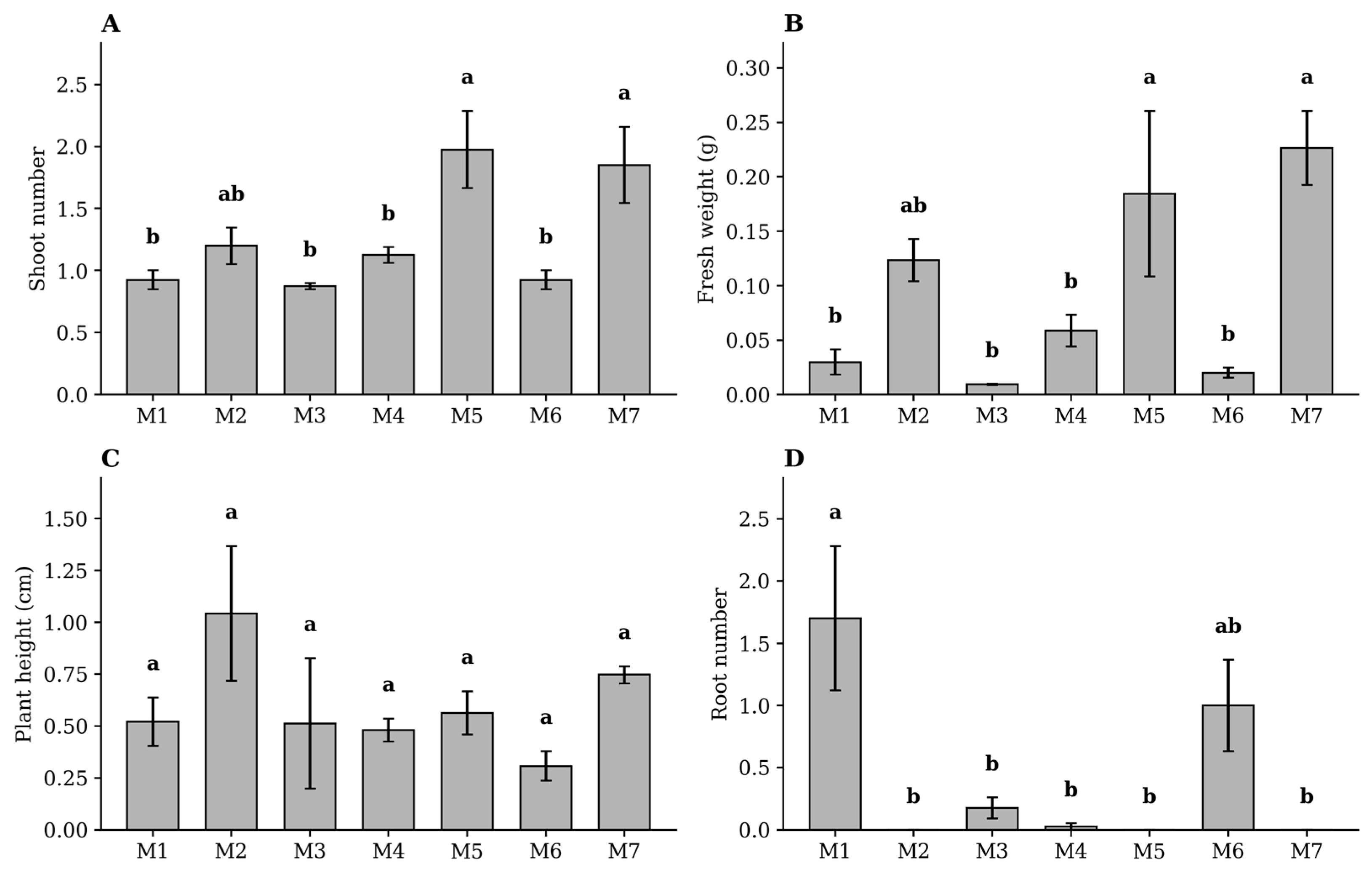
Significant differences in growth characteristics were observed among the seven culture media (Figure 1). Shoot number ranged from 0.88 to 1.98 per plantlet. The highest shoot number was obtained in M5 (1.98 ± 0.22), followed by M7 (1.85 ± 0.21), whereas M1, M3, and M6 each produced 0.93 shoots per plantlet, and M4 and M2 produced 1.13 and 1.20 shoots per plantlet, respectively. According to Tukey’s test, M5 and M7 belonged to the highest statistical group, whereas M1, M3, M4, and M6 were classified in the lower group. M2 showed an intermediate response (Figure 1A). These results indicate that shoot multiplication was influenced by medium composition.
Fresh weight differed among treatments (Figure 1B). M7 produced the highest fresh weight (0.2265 ± 0.0236 g), followed by M5 (0.1845 ± 0.0527 g) and M2 (0.1235 ± 0.0134 g). M3 showed the lowest value (0.0093 ± 0.0003 g), while M1, M4, and M6 produced 0.0298 ± 0.0079, 0.0588 ± 0.0101, and 0.0200 ± 0.0033 g, respectively. According to Tukey’s multiple range test, M7 and M5 were grouped in the highest statistical category, whereas M1, M3, M4, and M6 were classified into lower groups. M2 showed an intermediate response. These results indicate that M7 and M5 were among the treatments with the highest fresh weight, while M2 showed a moderate response relative to the other treatments.
Plant height varied numerically among treatments (Figure 1C). M2 showed the greatest height (1.0425 ± 0.2247 cm), followed by M7 (0.7475 ± 0.0286 cm), whereas M6 showed the lowest value (0.3075 ± 0.0493 cm). However, Tukey’s multiple range test indicated no significant differences among treatments. These results suggest that M2 and M7 tended to promote shoot elongation, although this response was not statistically significant.
Root number showed a different pattern (Figure 1D). The highest value was observed in M1 (1.70 ± 0.40), followed by M6 (1.00 ± 0.25). All other treatments showed minimal or no rooting, with values ranging from 0.00 to 0.18 roots per plantlet. Tukey’s test showed that M1 belonged to the highest group, while the remaining treatments were classified into lower or intermediate groups. Theses results show that rooting responses differed from shoot multiplication patterns among the tested media.
Overall, M5 and M7 showed relatively higher shoot numbers, and both treatments were grouped among those with the highest fresh weight among the tested media.

3.2. Representative Plantlet Appearance and Image-Based Quality Assessment

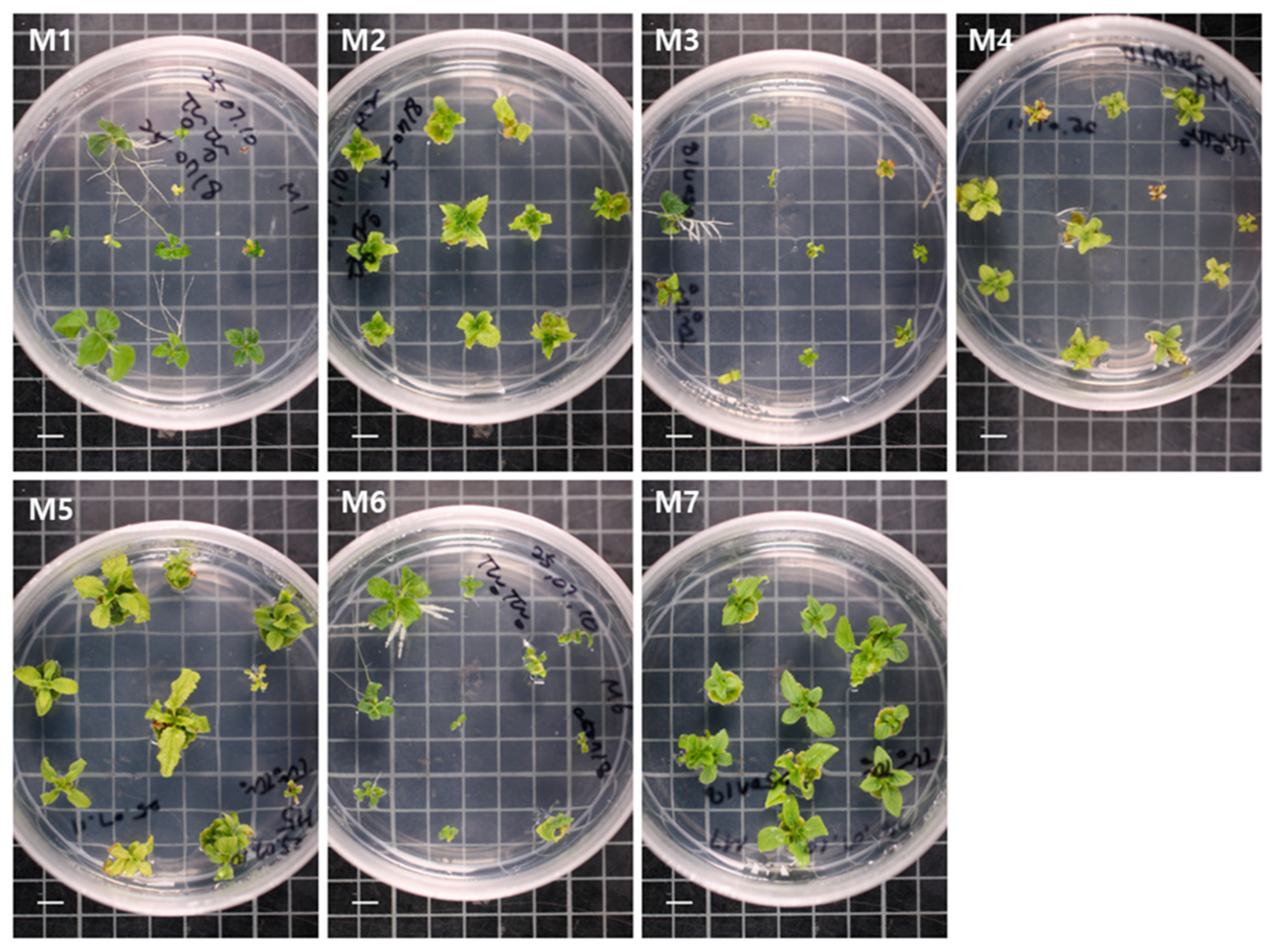
Representative plantlets cultured on the seven media are shown in Figure 2. Clear visual differences among treatments were observed after 5 weeks of culture. Plantlets grown on M2, M5, and M7 appeared more vigorous and greener, whereas those cultured on M3 showed reduced growth and lower visual quality.
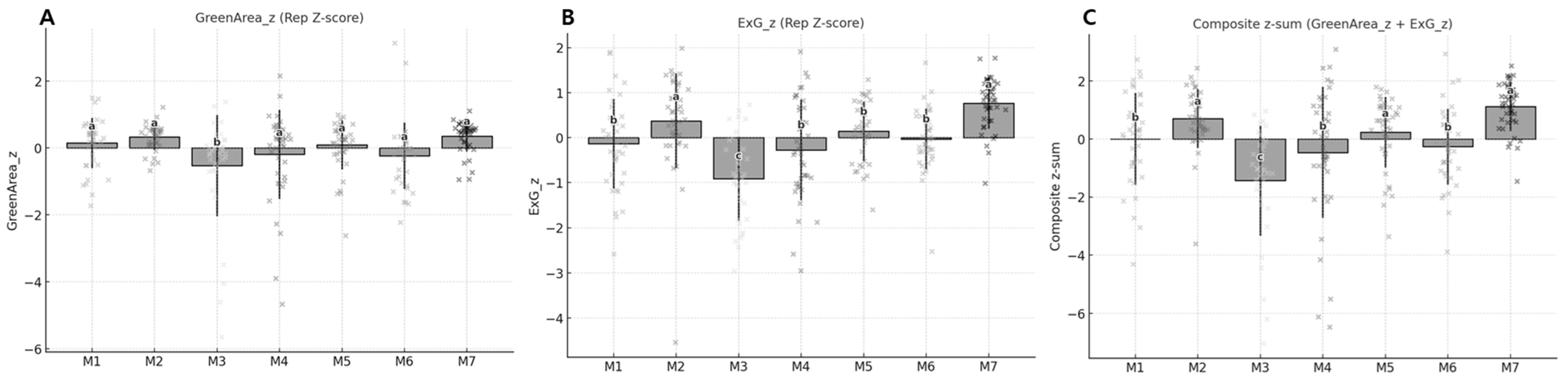
These visual differences were quantified using image-based analysis (Figure 3). Plantlet quality was evaluated using Green area, ExG, and a composite z-score integrating both indices. Green area represents the projected green tissue area, whereas ExG reflects relative greenness.
Green area differed significantly among treatments (ANOVA, p = 3.52 × 10⁻⁵, Figure 3A). The highest values were observed in M2 (73.62) and M7 (73.59), followed by M1 (71.63) and M5 (70.95). The lowest value was recorded in M3 (64.23). Pairwise comparisons showed that M3 was significantly lower than M1 (p = 0.0096), M2 (p = 0.0002), M5 (p = 0.0203), and M7 (p = 0.0002). ExG also differed significantly among treatments (ANOVA, p = 1.89 × 10⁻¹², Figure 3B). M2 (25.81) and M7 (25.59) showed the highest values, followed by M5 (21.99) and M4 (21.63), whereas M3 showed the lowest value (14.28). Tukey’s test indicated that M3 was significantly lower than M2 (p = 0.0010), M4 (p = 0.0485), M5 (p = 0.0249), and M7 (p = 0.0014). The composite z-score provided an integrated evaluation of plantlet quality (Figure 3C). M2 (0.81) and M7 (0.79) showed the highest values, followed by M5 (0.16) and M1 (0.03), whereas M3 showed the lowest value (−1.30). The overall ranking based on composite performance was M2 > M7 > M5 > M1 > M4 > M6 > M3. Overall, image-based analysis showed that M2 and M7 had higher values for both size and greenness indices.

3.3. Effect of Basal Media Under Hormone-Free Conditions

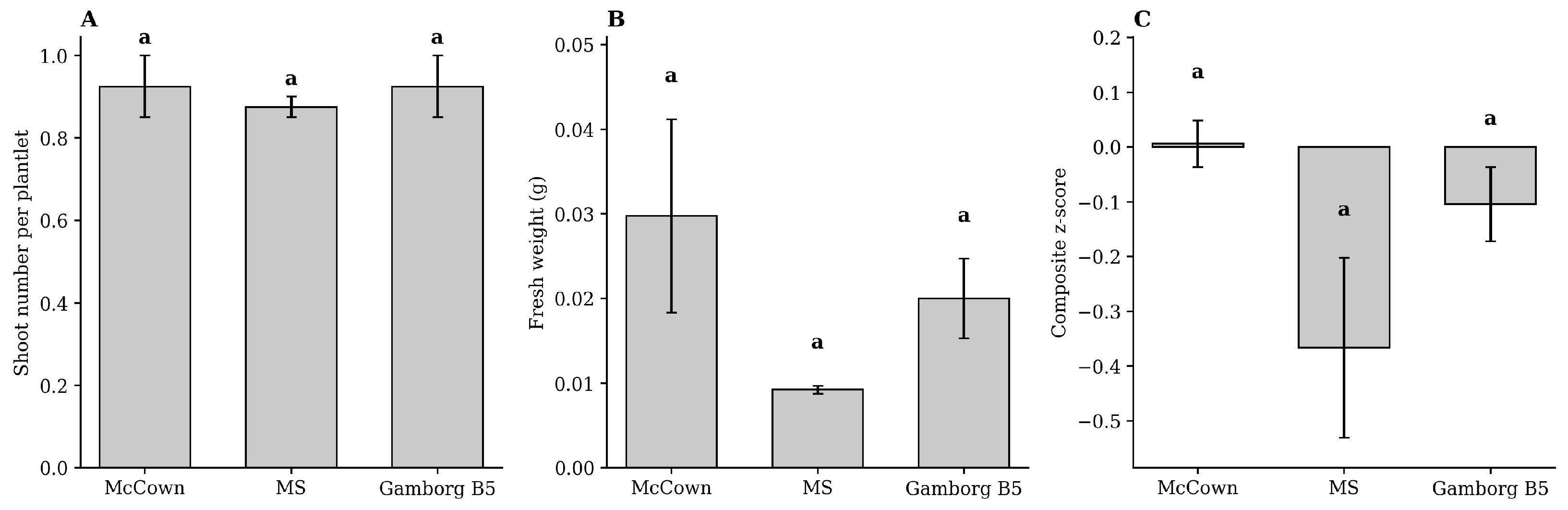
Correlation analyses were conducted to examine relationships among response variables and were not intended to evaluate independent experimental factors. To evaluate basal medium effects independent of plant growth regulators, hormone-free treatments (M1, M3, and M6) were analyzed separately (Figure 4).
No significant differences were observed among the three basal media in shoot number (ANOVA, p = 0.91, Figure 4A). The mean shoot numbers were 0.93 ± 0.08, 0.88 ± 0.03, and 0.93 ± 0.08 for McCown, MS, and Gamborg B5, respectively, and all treatments were assigned to the same Tukey group. Fresh weight also did not differ significantly among basal media (ANOVA, p = 0.18, Figure 4B). McCown tended to produce higher fresh weight (0.0298 ± 0.0114 g) than Gamborg B5 (0.0200 ± 0.0047 g) and MS (0.0093 ± 0.0005 g), although these differences were not statistically significant. Similarly, the composite z-score showed no significant difference among basal media (ANOVA, p = 0.084, Figure 4C). McCown showed the highest value (0.006 ± 0.042), followed by Gamborg B5 (−0.104 ± 0.068), whereas MS showed the lowest value (−0.366 ± 0.164). The difference between McCown and MS approached significance (p = 0.079). Overall, no significant differences were detected among basal media under hormone-free conditions.

3.4. Effects of Plant Growth Regulators on Shoot Multiplication and Callus Formation

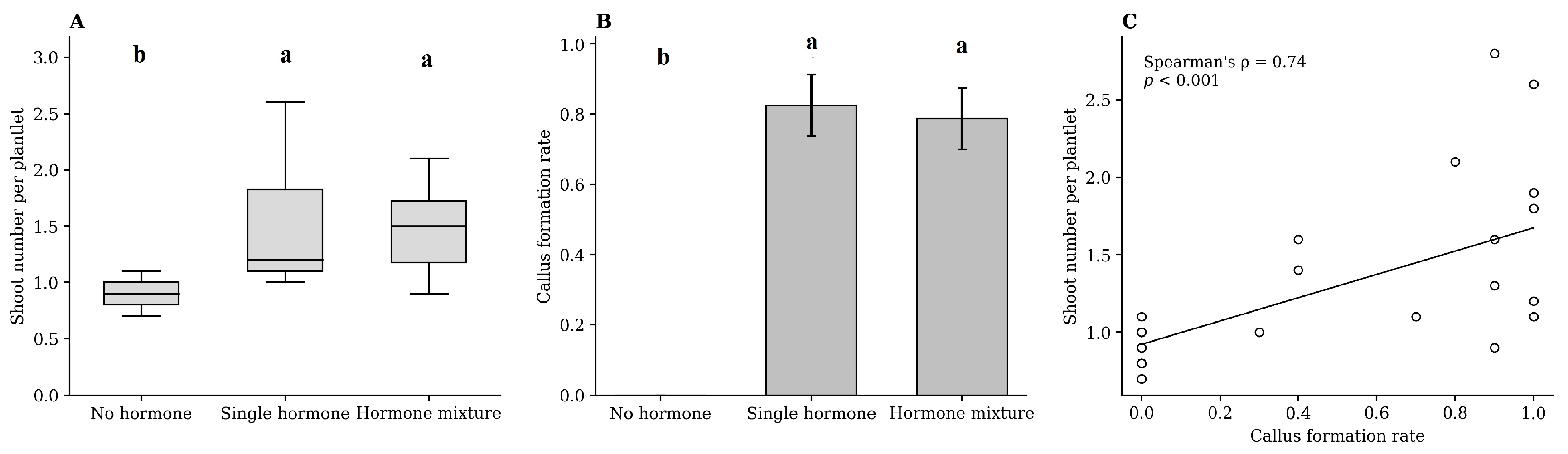
Treatments containing plant growth regulators were further examined to assess their overall influence on shoot multiplication and callus formation. Correlation analyses were conducted to examine relationships among response variables, particularly between shoot multiplication and callus formation. Hormone treatments significantly affected shoot multiplication (ANOVA, p = 0.0042, Figure 5A). The no-hormone group produced 0.91 ± 0.03 shoots per plantlet, whereas the single-hormone and hormone-mixture groups produced 1.49 ± 0.20 and 1.59 ± 0.22 shoots per plantlet, respectively. Tukey’s test showed that both hormone-treated groups had significantly higher shoot numbers (p < 0.05), whereas no significant difference was observed between the single-hormone and hormone-mixture groups.
Callus formation rate also differed significantly among treatments (ANOVA, p < 0.001, Figure 5B). The no-hormone group showed no callus formation, whereas both hormone-treated groups showed high callus formation rates of 0.83 ± 0.09 and 0.79 ± 0.09, respectively. Both hormone-treated groups differed significantly from the no-hormone group, but not from each other. A significant positive correlation was observed between callus formation rate and shoot number (Spearman’s ρ = 0.74, p < 0.001, Figure 5C). A positive correlation was observed between callus formation rate and shoot number.

4. Discussion

The present study showed that the in vitro performance of Hydrangea arborescens was influenced more by medium composition than by basal medium alone [4]. These results are consistent with previous reports indicating that successful micropropagation in woody species depends on the interaction between basal media and plant growth regulators. Among the tested treatments, M7 showed a balanced response, with relatively high shoot multiplication, the highest fresh weight, and high-quality values. Shoot proliferation in Hydrangeas has been reported to vary widely depending on species, explant type, cytokinin composition, and culture conditions. Previous studies, primarily conducted in H. macrophylla, have reported shoot multiplication rates ranging from approximately 2 to more than 5 shoots per explant under optimized conditions [6,8,9,10]. In this context, the shoot multiplication observed in the present study falls within the lower range of reported values; however, direct comparison should be made with caution, as species-specific responses and experimental conditions differ substantially. In particular, studies on H. arborescens remain limited, and the in vitro response characteristics of H. arborescens are not yet well established. Therefore, the observed shoot multiplication likely reflects both species-specific responses and the non-optimized nature of the tested media, and further studies are required to establish species-specific optimized media based on the present screening results.
Shoot number is an important factor in micropropagation because it directly determines multiplication efficiency. In the present study, M5 and M7 produced the highest shoot numbers, whereas hormone-free media showed lower values. Similar responses have been reported in Hydrangea L. and other woody ornamental species, where cytokinin-containing media, particularly those supplemented with BA, promote shoot induction and proliferation [6,7,9,15]. Fresh weight showed a similar pattern, with M7 producing the greatest biomass, indicating that this medium supported both shoot production and overall plantlet growth. Rooting responses differed markedly among treatments, with higher rooting observed in hormone-free basal media (M1, M3, and M6) compared to media containing plant growth regulators. This pattern suggests that the presence of cytokinins, particularly at relatively high concentrations (e.g., BA 2.0 mg·L−1), may have suppressed root formation, as cytokinins are known to promote shoot proliferation while inhibiting rooting under in vitro conditions. In contrast, rooting observed in basal media may be attributed to endogenous auxin levels within the explants, which can support root initiation in the absence of exogenous growth regulators. Similar observations have been reported in other woody species, where basal media without cytokinin supplementation favored root formation due to reduced hormonal imbalance [15]. Therefore, the observed rooting responses likely reflect the balance between endogenous auxin activity and exogenous cytokinin application rather than the direct effect of externally supplied auxin.
Image-based analysis further clarified treatment effects by evaluating plant size and greenness. This approach is consistent with previous studies showing that digital image analysis can be used to quantify growth and color traits of in vitro cultured plants under standardized imaging conditions [11]. In the present study, Green area and ExG provided complementary information on plant size and relative greenness, and their integration into a composite z-score enabled a more comprehensive evaluation of the plantlet than growth traits alone. This distinction is important because high shoot proliferation does not necessarily indicate desirable plant quality. In woody plant tissue culture, cytokinin-rich media often induce a high number of shoots, but these shoots may exhibit physiological disorders such as hyperhydricity, reduced chlorophyll content, or abnormal morphology, resulting in poor plantlet quality and limited acclimatization success [16,17]. In the present study, although M2 and M7 showed similarly high image-based quality, M7 combined this quality with higher shoot number and fresh weight. Therefore, evaluating both growth traits and image-based quality indices is useful for avoiding the selection of media that promote excessive but poor-quality shoot proliferation.
Basal media are often selected in a crop-specific manner in plant tissue culture, yet no clear consensus exists for Hydrangea, where MS- and B5-based media have both been used [6,8,9]. In the present study, hormone-free basal media did not differ significantly in shoot number, fresh weight, or composite quality, suggesting that all three basal media can be used for H. arborescens. However, MS consistently showed lower values than McCown and Gamborg B5, with the difference approaching statistical significance (McCown vs. MS, p = 0.079). Despite similar quantitative responses, plantlet development was not always optimal under hormone-free conditions, indicating that basal media alone may be insufficient for stable growth [15,16]. Therefore, MS may be less suitable when used alone, whereas its use with plant growth regulators, as observed in M2, appears more appropriate for H. arborescens.
Hormone treatments significantly increased both shoot number and callus formation, and callus formation was positively correlated with shoot number. In woody plant tissue culture systems, cytokinins are known not only to stimulate shoot proliferation but also, at higher activity levels, to induce callus formation or abnormal growth [18]. This dual response reflects the strong influence of plant growth regulators on cell division and differentiation pathways in in vitro cultures. Therefore, the observed relationship between callus formation and shoot number in the present study is consistent with general responses reported in woody species. A positive correlation between callus formation and shoot number suggests that hormone-containing media are favorable for shoot multiplication during in vitro culture. The present study focused on screening culture media for in vitro multiplication under controlled conditions. Further studies are required to optimize cytokinin regimes during multiplication, auxin treatments during rooting, and subsequent acclimatization and field performance to establish a comprehensive and practically applicable propagation system for H. arborescens.

5. Conclusions

This study demonstrated that medium composition significantly affected the in vitro growth and quality of H. arborescens. Among the seven media tested, M7 provided the most balanced response, combining high shoot multiplication, the greatest fresh weight, and high image-based quality. MS consistently showed lower values than McCown and Gamborg B5, suggesting that McCown and Gamborg B5 may be used more favorably for H. arborescens micropropagation, whereas the use of MS should be considered with caution. Basal medium alone had limited effects under hormone-free conditions, whereas plant growth regulators were strongly associated with shoot multiplication and callus formation. These findings provide a practical basis for the efficient production of high-quality plantlets.

Author Contributions

Conceptualization, S.B.; methodology, S.B.; investigation, S.B.; data curation, S.B.; formal analysis, S.B.; visualization, S.B.; writing—original draft preparation, S.B.; validation, T.-H.H.; writing—review and editing, T.-H.H.; supervision, T.-H.H. All authors have read and agreed to the published version of the manuscript.

Funding

This research was funded by the Ministry of Agriculture, Food and Rural Affairs (MAFRA), through the Institute of Planning and Evaluation for Technology in Food, Agriculture and Forestry (IPET), under the Public Technology Commercialization Promotion Program, grant number RS-2025-02218399.

Data Availability Statement

The original contributions presented in this study are included in the article. Further inquiries can be directed to the corresponding author.

Acknowledgments

The authors thank the Ornamental Plant Science Laboratory at Chonnam National University for providing plant materials and for their assistance during the course of this study. During the preparation of this manuscript, the authors used ChatGPT (OpenAI, GPT-4o) to assist with image analysis code development and figure preparation. The authors critically reviewed and edited all outputs and take full responsibility for the content of this publication.

Conflicts of Interest

The authors declare no conflicts of interest.

References

  1. McClintock, E.M. A Monograph of the Genus Hydrangea. Ph.D. Thesis, University of Michigan, Ann Arbor, MI, USA, 1956. [Google Scholar]
  2. Bak, S.; Han, T.H. Evaluation of genetic diversity using simple sequence repeat markers and analysis of cross compatibility in hydrangeas. Hortic. Environ. Biotechnol. 2024, 65, 1043–1052. [Google Scholar] [CrossRef]
  3. Bak, S.; Han, T.H. Development of an interspecific hybrid between Hydrangea arborescens ‘magical pinkerbell’ and H. quercifolia JNHQ01. Hortic. Sci. Technol. 2022, 40, 338–347. [Google Scholar] [CrossRef]
  4. Arafa, A.M.S.; Nower, A.A.; Helme, S.S.; Abd-Elaty, H.A. Large-Scale In Vitro Propagation of Hydrangea macrophylla Using Tissue Culture Technique. Int. J. Curr. Microbiol. App. Sci. 2017, 6, 776–778. [Google Scholar] [CrossRef]
  5. Mehbub, H.; Akter, A.; Akter, M.A.; Mandal, M.S.H.; Hoque, M.A.; Tuleja, M.; Mehraj, H. Tissue culture in ornamentals: Cultivation factors, propagation techniques, and its application. Plants 2022, 11, 3208. [Google Scholar] [CrossRef] [PubMed]
  6. Dahab, T.A.M.A. In vitro propagation of Hydrangea macrophylla Thunb. Arab. J. Biotechnol. 2007, 10, 161–178. [Google Scholar]
  7. Doil, A.; Zhang, R.; Schum, A.; Serek, M.; Winkelmann, T. In vitro regeneration and propagation of Hydrangea macrophylla Thunb. ‘Nachtigall’. Propag. Ornam. Plants 2008, 8, 151–153. [Google Scholar]
  8. Šiško, M. In vitro tissue culture initiation from potted and garden Hydrangea macrophylla explants. Agricultura 2016, 13, 65–69. [Google Scholar] [CrossRef][Green Version]
  9. Wang, S.R.; Yan, J.; Ha, B.E.; Bai, Y. An efficient plant regeneration system of Hydrangea bretschneideri Dipp via stem segments as explants. Phyton-Int. J. Exp. Bot. 2021, 90, 595–604. [Google Scholar] [CrossRef]
  10. Khaing, M.T.; Jung, H.J.; Han, T.H. Effect of plant growth regulators on regeneration and proliferation of Hydrangea macrophylla cultivars. Flower Res. J. 2018, 26, 84–89. [Google Scholar] [CrossRef]
  11. Faragó, D.; Sass, L.; Valkai, I.; Andrási, N.; Szabados, L. PlantSize offers an affordable, non-destructive method to measure plant size and color in vitro. Front. Plant Sci. 2018, 9, 219. [Google Scholar] [CrossRef] [PubMed]
  12. Depetris, M.B.; Dimech, A.M.; Guthridge, K.M. Digitally quantifying growth and verdancy of Lolium plants in vitro. Plants 2025, 14, 1499. [Google Scholar] [CrossRef] [PubMed]
  13. Woebbecke, D.M.; Meyer, G.E.; Von Bargen, K.; Mortensen, D.A. Color indices for weed identification under various soil, residue, and lighting conditions. Trans. ASAE 1995, 38, 259–269. [Google Scholar] [CrossRef]
  14. Meyer, G.E.; Neto, J.C. Verification of color vegetation indices for automated crop imaging applications. Comput. Electron. Agric. 2008, 63, 282–293. [Google Scholar] [CrossRef]
  15. Rathore, J.S.; Rathore, V.; Shekhawat, N.S.; Singh, R.P.; Liler, G.; Phulwaria, M.; Dagla, H.; Kasera, P.K. Micropropagation of woody plants. In Plant Biotechnology and Molecular Markers; Srivastava, P.S., Narula, A., Srivastava, S., Eds.; Springer: Dordrecht, The Netherlands, 2004; pp. 195–226. [Google Scholar] [CrossRef]
  16. Debergh, P.C.; Aitken-Christie, J.; Cohen, D.; Grout, B.; von Arnold, S.; Zimmerman, R.; Ziv, M. Reconsideration of the term ‘vitrification’ as used in micropropagation. Plant Cell Tissue Organ. Cult. 1992, 30, 135–140. [Google Scholar] [CrossRef]
  17. Hazarika, B.N. Morpho-physiological disorders in in vitro culture of plants. Sci. Hortic. 2006, 108, 105–120. [Google Scholar] [CrossRef]
  18. Huetteman, C.A.; Preece, J.E. Thidiazuron: A potent cytokinin for woody plant tissue culture. Plant Cell Tissue Organ. Cult. 1993, 33, 105–119. [Google Scholar] [CrossRef]
Figure 1. Growth characteristics of Hydrangea arborescens plantlets cultured on seven media. (A) Shoot number per plantlet; (B) fresh weight; (C) plant height; and (D) root number after 5 weeks of culture. Data are presented as mean ± SE of four replicates. Different letters above bars indicate significant differences among treatments according to Tukey’s HSD test at p < 0.05.
Horticulturae 12 00599 g001
Figure 2. Morphological responses of H. arborescens ‘PangpPang’ cultured on seven media. Plantlets were photographed after 5 weeks of culture under identical imaging conditions. Labels indicate the corresponding media treatments (M1–M7). Scale bar = 1 cm.
Horticulturae 12 00599 g002
Figure 3. Image-based quality assessment of H. arborescens ‘PangPang’ plantlets cultured on seven media. (A) Adjusted Green area; (B) adjusted ExG (Excess green index); and (C) composite z-score integrating size- and greenness-related traits. Data are mean ± SE. Boxes represent the interquartile range, with the median indicated by a horizontal line. Whiskers extend to 1.5× the interquartile range. Letters indicate differences among treatments according to Tukey’s HSD test at p < 0.05.
Horticulturae 12 00599 g003
Figure 4. Effects of hormone-free basal media on growth and quality of H. arborescens ‘Pangpang’ plantlets. (A) Shoot number; (B) fresh weight; (C) composite z-score. McCown (M1), MS (M3), and Gamborg B5 (M6) basal media without plant growth regulators. Data are mean ± SE. Letters indicate differences among treatments according to Tukey’s HSD test at p < 0.05.
Horticulturae 12 00599 g004
Figure 5. Effects of hormone treatments on shoot multiplication and callus formation in H. arborescens ‘Pangpang’. (A) Shoot number; (B) callus formation rate; and (C) correlation between callus formation rate and shoot number. Data are mean ± SE. Letters indicate differences among treatments according to Tukey’s HSD test at p < 0.05. The line represents the fitted regression.
Horticulturae 12 00599 g005
Table 1. Composition of the seven culture media used in this study.
Medium CodeMedium Composition 1Reference
M1McCown
M2McCown + BA 2.0 mg∙L−1 + NAA 0.005 mg∙L−1 + Myo-inositol 100 mg∙L−1 + Nicotinic acid 1.0 mg∙L−1 + Tiamine 2.0 mg∙L−1 + Pyridoxine hydrochloride 8.0 mg∙L−1[8]
modified 2
M3MS
M4MS + BA 2.0 mg∙L−1[6]
M5MS + BA 2.0 mg∙L−1 + IBA 0.2 mg∙L−1 + GA3 1.0 mg∙L−1[9]
M6Gamborg B5
M7Gamborg B5 + BA 1.5 mg∙L−1[10]
1 Abbreviations: McCown, McCown Woody Plant; MS, Murashige and Skoog medium; B5, Gamborg B5 medium; BA, 6-benzyladenine (6-benzylaminopurine); NAA, α-naphthaleneacetic acid; IBA, indole-3-butyric acid; GA3, gibberellic acid. 2 Media compositions were modified from the referenced studies, including the use of 30 g·L−1 sucrose and gelrite as the gelling agent.
Disclaimer/Publisher’s Note: The statements, opinions and data contained in all publications are solely those of the individual author(s) and contributor(s) and not of MDPI and/or the editor(s). MDPI and/or the editor(s) disclaim responsibility for any injury to people or property resulting from any ideas, methods, instructions or products referred to in the content.