Article

Suitability of Spanish Local White Grape Cultivars for Warm Climates

by
Juan Manuel Pérez-González
1,
Pau Sancho-Galán
2,*,
Antonio Amores-Arrocha
1 and
Ana Jiménez-Cantizano
1
1
Department of Chemical Engineering and Food Technology, Vegetal Production Area, IVAGRO, University of Cadiz, Agrifood Campus of International Excellence (ceiA3), P.O. Box 40, 11510 Puerto Real, Spain
2
Department of Chemical Engineering and Food Technology, Food Technology Area, IVAGRO, University of Cadiz, Agrifood Campus of International Excellence (ceiA3), P.O. Box 40, 11510 Puerto Real, Spain
*
Author to whom correspondence should be addressed.
Horticulturae 2026, 12(5), 570; https://doi.org/10.3390/horticulturae12050570
Submission received: 9 March 2026 / Revised: 29 April 2026 / Accepted: 5 May 2026 / Published: 7 May 2026

Abstract

Plant genetic resources are increasingly viewed as a key tool to address the multiple challenges faced by modern viticulture. In this context, local grape cultivars are proposed as a strategy to enhance resilience to climate change and to diversify wine styles. However, while genetic identification has been widely reported, field-based phenotyping information for local cultivars under current climate conditions remains limited. In this context, phenotyping results are presented for six local Andalusian cultivars (Castellano, Beba, Cañocazo, Mantúo de Pilas, Perruno and Vigiriega). All cultivars were grown in a vineyard plot in the Marco de Jerez and evaluated over three consecutive seasons (2023–2025). Morphology was assessed using 46 descriptors, allowing cultivars to be grouped into two main clusters. Phenological monitoring showed a measurable year effect while preserving a consistent relative ranking among cultivars, most clearly during veraison and ripening, with Castellano reaching these stages earlier and Mantúo de Pilas later. Grape must composition highlighted contrasting ripening dynamics, with Palomino Fino and Castellano generally reaching higher sugar levels, whereas Vigiriega and Mantúo de Pilas showed the most acidic profiles. These results provide growers with performance-based comparative information to support cultivar selection for new plantings and to explore the potential of local cultivars for developing new wine styles under warm climate conditions.

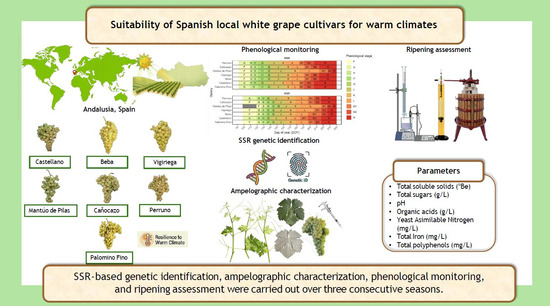
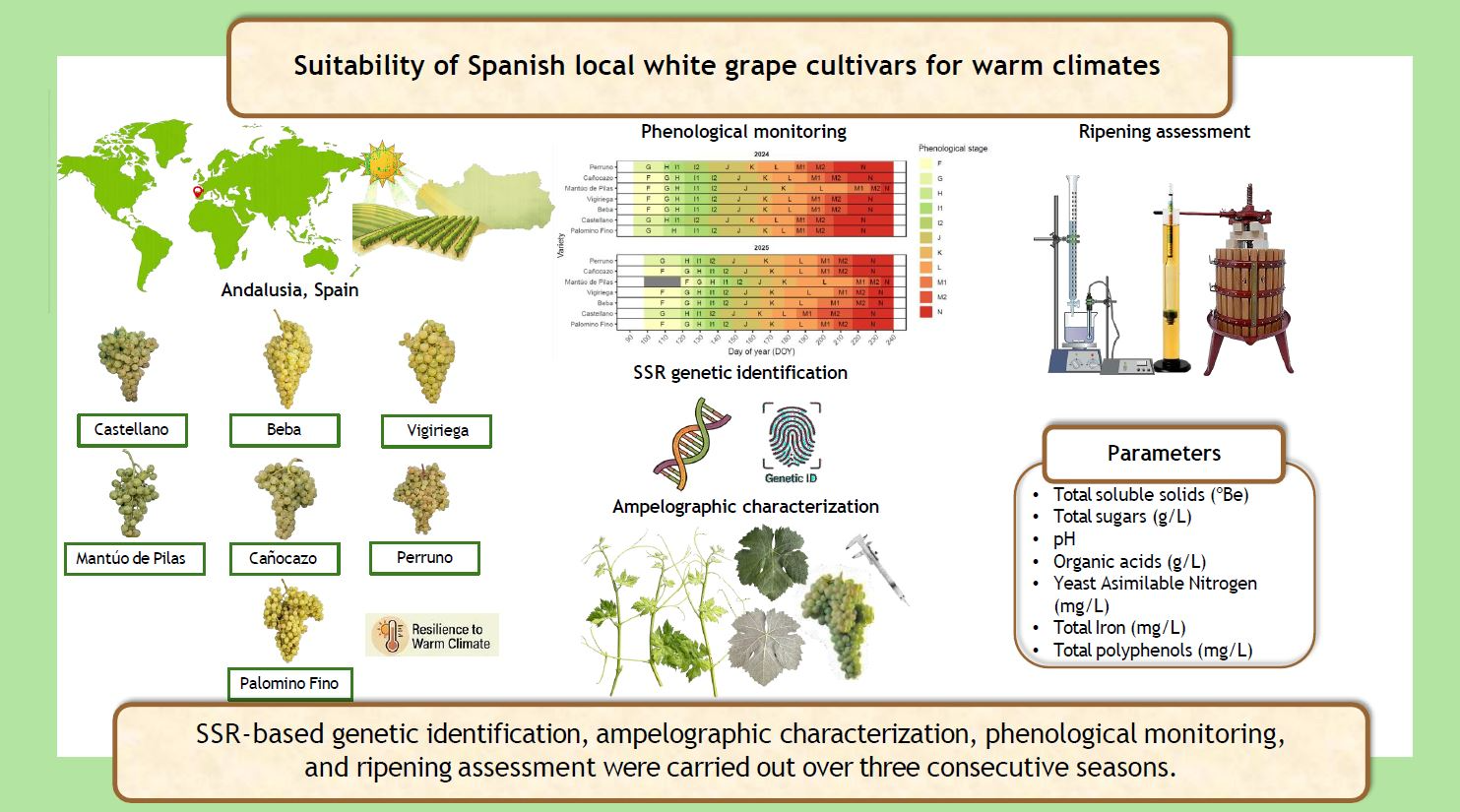
Graphical Abstract

1. Introduction

Interest in the conservation and enhancement of autochthonous or local grapevine cultivars (Vitis vinifera L.) has intensified in recent decades due to several factors affecting the wine industry [1,2]. First, the progressive concentration of commercial vineyards on a limited number of cultivars has reduced the varietal diversity currently represented in viticulture [3,4,5]. Second, the global warming scenario and increased climatic variability have renewed interest in recovering local cultivars [6] that may be better suited to thermal and water stress while also supporting the diversification of wine styles [7], particularly in warm climate regions [8].
In Europe, viticulture plays a major role both economically and socially [9] and is characterized by a wide diversity of grapevine cultivars adapted to different environments [10]. Nevertheless, the introduction of phylloxera (Daktulosphaira vitifoliae) from America at the end of the 19th century triggered extensive vineyard replanting and resulted in substantial loss of autochthonous plant material [5,11,12]. This situation prompted the exploration, collection, and conservation of varietal resources in grapevine germplasm collections, which were established to safeguard plant genetic resources and prevent the loss of local cultivars. In this context, each region has preserved cultivars adapted to its specific microclimatic conditions and viticulture traditions [4,6,13].
The management of these collections, together with practical needs such as plant material certification, traceability, and the control of cultivar identity, has consolidated the use of molecular characterization tools for cultivar identification and characterization [14]. Among these, microsatellite markers (SSRs, Simple Sequence Repeats) remain widely used in grapevine because they allow genotype discrimination and the detection of synonymies and homonymies [15,16,17]. Numerous studies have used SSR markers to identify grapevine cultivars in different European regions [1,2,6,14,18,19,20,21]. SSR markers have also been widely applied to authenticate local cultivars recovered after periods of abandonment or near disappearance from cultivation [2,18,22,23]. Accordingly, genotype matching is typically supported by international databases such as the Vitis International Variety Catalogue (VIVC), which hosts microsatellite profiles and synonymy information for grapevine cultivars [24].
Spain currently maintains 18 grapevine germplasm banks [25]. Among them, the IFAPA “Rancho de la Merced” collection in Jerez de la Frontera (Andalusia, Spain) is considered one of the oldest and most diverse grapevine collections in Europe [26]. Although the literature has addressed genetic identification and, to a lesser extent, morphological characterization of local cultivars, fewer studies have integrated these data with phenotypic performance under the same cultivation conditions in a climate change context. Therefore, it is essential to combine genotypic identity with phenotypic data under current growing conditions in order to provide an updated and more complete profile of cultivars.
This need is particularly relevant in historic regions such as the Marco de Jerez (Andalusia, Spain), one of the most significant wine-producing regions in southern Spain and among the southernmost viticultural areas in continental Europe [27]. Historical sources prior to the phylloxera outbreak describe the Marco de Jerez as a region with high varietal diversity, with numerous cultivars forming part of the traditional vineyard [28,29]. However, following vineyard replanting and the subsequent development of regulatory frameworks, varietal selection became progressively more restricted [30]. Traditionally, wine production under the Denominations of Origin (DOs) “Jerez-Xérès-Sherry” and “Manzanilla–Sanlúcar de Barrameda” has relied primarily on Palomino Fino, Pedro Ximénez and Muscat of Alexandria. More recently, a revision of the DO specification expanded the list of authorized cultivars for wine production to include Beba, Vigiriega, and Perruno [31].
In this context, the aim of this study is a characterization of six local cultivars from Andalusia: Castellano, Beba, Cañocazo, Mantúo de Pilas, Perruno, and Vigiriega. SSR-based genetic identification, ampelographic characterization, phenological monitoring, and ripening assessment were carried out over three consecutive seasons (2023–2025) to provide comparative information relevant to growers and to support the future assessment of local cultivars for warm climate viticulture.

2. Materials and Methods

2.1. Plant Material and Experimental Design

Six local grapevine cultivars were evaluated: Beba (BB), Castellano (CS), Vigiriega (VG), Mantúo de Pilas (MP), Cañocazo (CÑ), and Perruno (PR). Palomino Fino (PF) was used as the reference cultivar, as it currently accounts for approximately 95% of the cultivated area in the Marco de Jerez region [32,33].
All cultivars were grown in a commercial vineyard located in Trebujena (Cádiz, Spain) (36°53′12″ N, 6°10′14″ W) at 45 m above sea level. The vineyard was planted in 2016, and the vines were 7 years old at the beginning of the experiment. The experimental planting included 20 vines per cultivar in total. Vines were arranged in two randomized blocks, each containing 10 vines per cultivar. Vines were grafted onto 161-49 Couderc rootstock and planted on calcareous (limestone) soil. This rootstock is well suited to calcareous soils because of its tolerance to active lime and its adaptation to non-compacted soils, which are typical of the Marco de Jerez region [34,35]. The vineyard was vertically trellised with a planting density of 1.8 × 1.2 m (row × vine spacing) and trained according to the traditional “Vara y Pulgar” (stick and thumb) system. No irrigation or fertilization was applied during the studied period. The vineyard was managed under organic practices, and pest and disease control were restricted to products authorized under Regulation (EU) 2018/848 on organic production and labeling of organic products [36].
For each cultivar, five vines were selected from each of the two blocks, giving a total of ten representative vines for phenotyping and grape must physicochemical characterization, following the criteria proposed by Santesteban et al. [37] in order to minimize sampling-related intrinsic variability. Trunk cross-sectional area (TCSA) was determined at 30 cm above ground using a digital caliper (Vernier Caliper Maurer 93110, Padova, Italy).

2.2. Climatic Conditions

Climatic data were compiled for the study period each month, including average temperature (Tavg, °C), average relative humidity (RHavg, %), and precipitation (mm). Data were obtained from the Agroclimatic Information Network of Andalusia (RIA, https://www.juntadeandalucia.es/agriculturaypesca/ifapa/riaweb/web/, accessed on 8 March 2026), Lebrija I station (Seville, Spain), located approximately 5 km from the experimental vineyard.

2.3. Microsatellite Analysis

A total of 22 nuclear microsatellite loci were employed to perform the cultivar identification, consisting of the six recommended by the Organisation Internationale de la Vigne et du Vin (OIV) and agreed upon as a result of the GENRES 081 project (VVMD5, VVMD7, VVMD27, VVS2, VrZAG62, and VrZAG79). This has been extended to 22 with those proposed by the European GrapeGen06 project. SSR amplification and genotyping were performed following the protocol described by Jiménez-Cantizano et al. [38].

2.4. Morphological Characterization

Morphological characterization was performed following the criteria described by Benito et al. [39]. During the three growing seasons, a total of 10 organs per cultivar (young shoots, young and mature leaves, inflorescences/flowers, bunches and berries) were evaluated using 46 descriptors from the OIV Descriptor List for grapevine cultivars [40]. Fourteen priority descriptors, as indicated by the OIV “EU GENRES CT96 No81” project (OIV 001, OIV 004, OIV 016, OIV 051, OIV 067, OIV 068, OIV 070, OIV 076, OIV 079, OIV 081-2, OIV 084, OIV 087, OIV 223, OIV 225), were used for the primary description, together with 32 additional descriptors. Each cultivar was described by five different ampelographers. For each descriptor, the reported value corresponded to the modal value obtained from the observations recorded across the three growing seasons.

2.5. Phenological Stages

Phenological development was monitored weekly from April to August in both 2024 and 2025, as field observations in 2023 could not be initiated early enough to ensure reliable recording of the full phenological sequence. Phenological stages were visually assessed using the Baggiolini scale [41]. Assessments were conducted on the ten selected vines per cultivar, considering the fruiting cane (“vara”). The monitored stages ranged from F (inflorescences clearly visible) to N (ripening). For each vine, observations were made on the organs corresponding to each developmental stage, including buds during the early stages and later leaves, inflorescences, and clusters as development progressed. The phenological stage assigned to each vine corresponded to the stage observed in more than 50% of the evaluated organs. At the cultivar level, a given phenological stage was considered reached when at least 50% of the monitored vines had reached that stage.

2.6. Grape Must Physicochemical Characterization

For grape must characterization, 5 kg of berries per cultivar were collected manually and randomly from the 10 vines (500 g per vine) previously selected for field monitoring. The harvest date was determined following the grower’s criteria and in accordance with the specifications of the “Jerez-Xérès-Sherry” and “Manzanilla-Sanlúcar de Barrameda” DOs, which establish that grape musts intended for wines under these appellations must reach at least 10.5 °Be [31]. Since all cultivars were grown in the same vineyard, samples were harvested simultaneously, using the harvest date of Palomino Fino as the common reference point. The samples were preserved in plastic bags and transported for analysis. Subsequently, grape samples were destemmed and manually crushed to obtain the grape must. After crushing, samples were centrifuged for 5 min at 6000 rpm to remove suspended solids (Z 216 M, Hermle Labortechnik, Wehingen, Germany).
Grape must composition was determined using the following oenological parameters: total soluble solids content (°Be), total sugars (TS, g/L), total acidity (TA, g/L TH2), pH, organic acids (L-tartaric, D-gluconic, L-citric, and L-malic) (g/L), total iron (TI, mg/L), total polyphenols (TP, mg/L) and Yeast Assimilable Nitrogen (YAN). °Be was determined using a calibrated Dujardin–Salleron hydrometer (Laboratories Dujardin–Salleron, Arcueil Cedex, France). TA was determined by titration with 0.1 M NaOH (NaOH; Merck, Darmstadt, Germany) using bromothymol blue (PanReac AppliChem, Barcelona, Spain) as an indicator. TS, TI, TP and organic acids were quantified using a Micro Miura™ chemical analyzer (TDI, Barcelona, Spain). pH was measured using a portable pH meter (pH7+DHS, XS instruments, Barcelona, Spain). YAN was calculated as the sum of ammonium nitrogen (NH4+) and primary amino nitrogen (α-NH2), determined by enzymatic and colorimetric analysis using the Micro Miura™ chemical analyzer (TDI, Barcelona, Spain). All analyses were performed according to the official OIV methods for grape must analysis [42]. All measurements were performed in triplicate (n = 3), and replicate values were used for statistical comparisons.

2.7. Statistical Analysis

Physicochemical results are presented as mean values ± standard deviation, and significant differences were evaluated by a one-way ANOVA. For each cultivar and season, the three replicate measurements corresponded to analytical replicates obtained from a single composite grape must sample and did not represent independent biological replicates. When the ANOVA was significant (p < 0.05), mean separation was performed using Tukey’s HSD test, and homogeneous groups were indicated using letter-based grouping (Sigma Plot statistical software version 14.0, Systat Software, Inc., San Jose, CA, USA).
A hierarchical cluster analysis was performed to assess morphological relationships among the analyzed grapevine cultivars based on ampelographic data. A total of 46 OIV descriptors were used for the analysis. Euclidean distance was calculated to generate the distance matrix, and hierarchical clustering was carried out using Ward’s minimum variance method (Ward.D2). Principal component analysis (PCA) was performed using the “prcomp” function (centered and scaled variables). The analysis was carried out on mean values for each cultivar × year combination. Hierarchical cluster analysis and PCA were performed using R software (version 2026.01.0+392).

3. Results

3.1. Climatic Conditions Across Seasons

Climatic conditions differed among seasons mainly in rainfall amount and distribution, whereas average temperature followed a broadly similar seasonal pattern across years. In all three seasons, average temperature decreased during winter and increased progressively towards summer, with average values ranging from 9–13 °C in winter to 24–27 °C in summer. The detailed climatic data for each season are presented in Supplementary Material Figure S1.
The main interannual differences were observed in rainfall. In 2022–2023, precipitation was concentrated mainly in late autumn and early winter, with a marked peak in December (118.40 mm), while spring and summer remained relatively dry. In 2023–2024, rainfall was distributed from autumn to early spring, with a noticeable maximum in March (150.20 mm), followed again by dry conditions during late spring and summer. In 2024–2025, rainfall variability was even more pronounced, with two intense rainfall events during the season, in October (224.80 mm) and March 2025 (236.60 mm).

3.2. SSR Genotyping Results

SSR genotyping based on 22 loci allowed the assignment of the six local cultivars and the reference control to known cultivar profiles (Table 1). SSR profiles were first compared with those reported in the Vitis International Variety Catalogue (VIVC) [24] and the European Vitis Database [43], allowing the assignment of each profile to a corresponding known cultivar. In addition, the genotypes were compared with published profiles from the Rancho de la Merced Germplasm Bank [13,18,44], El Encín Germplasm Bank [45,46], and other published SSR studies [21] to confirm cultivar identity. Overall, the concordance with published references and database records was sufficient to confirm the identity of the cultivars analyzed in this work.

3.3. Ampelographic Characterization

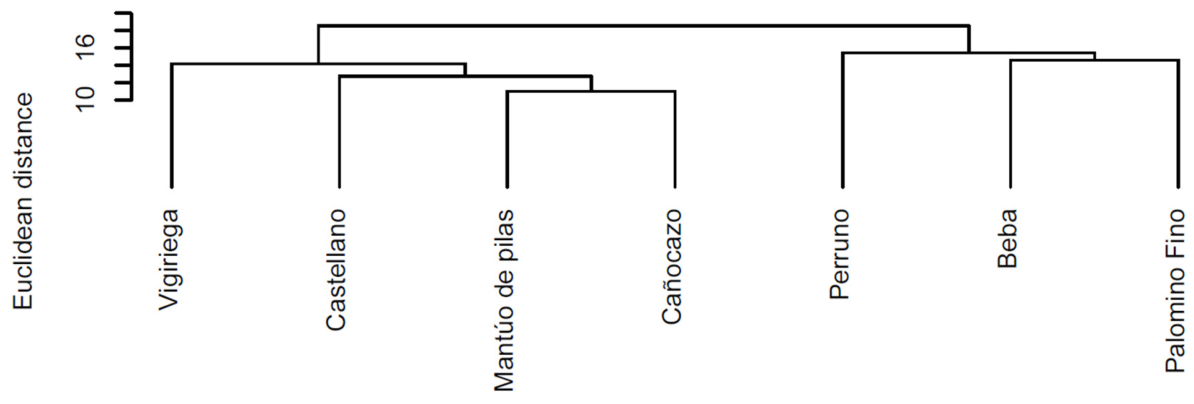
Morphological characterization (Table 2) showed that each cultivar exhibited a distinct phenotypic profile. Hierarchical clustering of the 46 OIV ampelographic descriptors further resolved consistent patterns of morphological similarity among cultivars (Figure 1).
The dendrogram revealed a major bifurcation separating two well-defined groups at high Euclidean distances, indicating pronounced morphological differentiation between both sets. The first group comprised Vigiriega, Castellano, Mantúo de Pilas, and Cañocazo. Within this group, Mantúo de Pilas and Cañocazo showed the closest association, evidencing a high degree of phenotypic affinity; Castellano subsequently joined this subgroup, whereas Vigiriega clustered at a higher distance level, representing the relatively most divergent member within the cluster. The second group included Perruno, Beba, and Palomino Fino. Beba and Palomino Fino clustered together at a low Euclidean distance, whereas Perruno joined this pair at a higher distance, indicating overall similarity with additional distinguishing traits.
The separation between both groups was supported by a subset of descriptors showing marked contrasts, particularly traits related to the young shoot (OIV 003 and 004), mature leaf (OIV 081-1, 083-2, and 075), bunch (OIV 202, 203, 204, 208, and 207), and berry (OIV 238 and 223), which contributed substantially to the observed morphological differentiation. Overall, comparison with the available literature showed a high level of agreement with previously reported descriptions, although minor discrepancies were detected for specific OIV descriptors.

3.4. Phenological Dynamics During Two Consecutive Growing Seasons

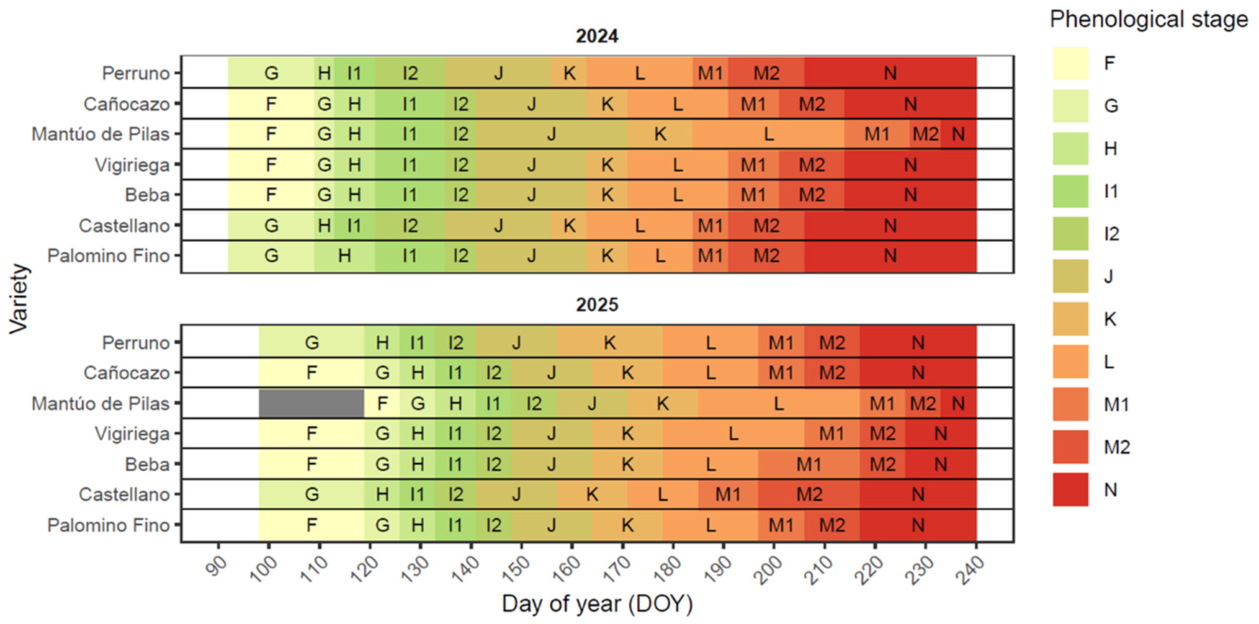
The seven cultivars followed the expected sequential progression of Baggiolini phenological stages (Figure 2) from F (inflorescences clearly visible) to N (ripening) across the two consecutive growing seasons (2024 and 2025), expressed as day of year (DOY). In both years, stage transitions followed the expected sequential pattern from early reproductive development (F/G-H-I1-I2) through berry growth (J-K-L) and ripening (M1-M2-N).
In 2024, differences among cultivars were modest at the earliest stages, with some overlap across cultivars, but became clearer from fruit set (J) onwards and were most evident during the late season progression (L-M1-M2-N). Castellano showed the earliest phenological development, reaching subsequent stages ahead of the other cultivars. It was followed by Perruno and Palomino Fino, which advanced earlier than the remaining cultivars but after Castellano. A second intermediate group, composed of Vigiriega, Beba, and Cañocazo, displayed similar timing across most of the cycle. Mantúo de Pilas was the latest cultivar, with the transition into ripening (M1-M2-N) occurring later in the year (higher DOY) than the other cultivars.
A comparable pattern was observed in 2025, with the relative ordering largely conserved. Castellano again showed the earliest phenological progression, followed by Perruno, and then Palomino Fino. Beba and Cañocazo exhibited a closely aligned trajectory throughout most stages, whereas Vigiriega tended to occur slightly later, especially approaching ripening. Mantúo de Pilas remained the most delayed cultivar in the late-season stages, reaching N at the latest DOY. In addition, the 2025 timelines show a general shift toward later dates (higher DOY) compared with 2024, indicating a slight phenological delay that is already apparent at early stages, including flowering (I1-I2), and becomes more pronounced during the transitions into and through ripening (L-M1-M2-N). The observed delay was approximately two weeks relative to the 2024 season.
Across both seasons, Castellano consistently reached ripening (N) approximately two weeks earlier than Mantúo de Pilas, with an even larger gap during veraison (M1-M2), where Castellano advanced roughly 2–3 weeks ahead of Mantúo de Pilas. In addition, Perruno was also slightly earlier than Palomino Fino in late-season stages (M1-N; ~3–7 days), while Vigiriega generally lagged behind Beba and Cañocazo by about one week. Beba and Cañocazo showed closely aligned timing throughout ripening.

3.5. Grape Must Physicochemical Composition

Across the three consecutive years evaluated (2023, 2024, and 2025), grape must physicochemical composition showed clear differences among cultivars, together with a measurable year effect for several parameters (Table 3). The largest compositional contrasts among cultivars were observed in technological ripeness indicators, particularly sugars (°Be and total sugars) and organic acid traits (total acidity, tartaric acid, and malic acid) (ANOVA, p < 0.05). The analytical comparison also indicated differences for variables related to nitrogen content (YAN) and total polyphenols (ANOVA, p < 0.05). In contrast, gluconic acid, citric acid, and total iron showed limited variation and no consistent cultivar pattern, indicating a lower discriminatory value under the conditions evaluated.
With respect to °Be, a stable pattern was observed across seasons: Palomino Fino exhibited the highest values, reaching the overall maximum in 2025 (12.50 °Be; Table 3), whereas Mantúo de Pilas consistently showed the lowest °Be (minimum in 2023: 7.60 °Be), in line with its lower sugar content. At the oenological level, these two cultivars also showed the clearest separation from the remaining samples (ANOVA, p < 0.05). Year on year, 2024 generally showed lower °Be values than 2023 and 2025 for several cultivars, whereas 2025 displayed a broadly increased °Be.
Clear differences among cultivars were also evident in acidity parameters. Grape must pH remained comparatively high overall, with Castellano repeatedly showing among the highest values (maximum in 2024: 4.10). In contrast, Vigiriega had lower pH values (3.83 in 2023 and 3.71 in 2025), and Palomino Fino reached a marked minimum in 2024 (3.60). Regarding total acidity, Vigiriega and Mantúo de Pilas showed the most acidic profiles (maximum of 4.58 g/L in 2023 and 4.08 g/L in 2025, respectively). By contrast, Perruno and Castellano had the lowest values (minimum of 2.28 g/L in 2025 and 2.16 g/L in 2024, respectively) with significant differences relative to the other cultivars (ANOVA, p < 0.05). Malic acid also showed pronounced variation among cultivars, with Palomino Fino consistently displaying the lowest concentrations in all three years (ANOVA, p < 0.05).
Among the additional parameters showing noticeable differences, YAN was high in Vigiriega in 2023 and 2024 and reached a maximum in Castellano in 2025, whereas total polyphenols were consistently high in Palomino Fino and Castellano, compared with lower values in Mantúo de Pilas, particularly in 2024. By contrast, gluconic acid and citric acid remained at very low levels across all cultivars and years. Finally, total iron concentrations were low for all cultivars, typically within the 0.00–0.20 mg/L range.

3.6. Principal Component Analysis of the Grape Must Composition

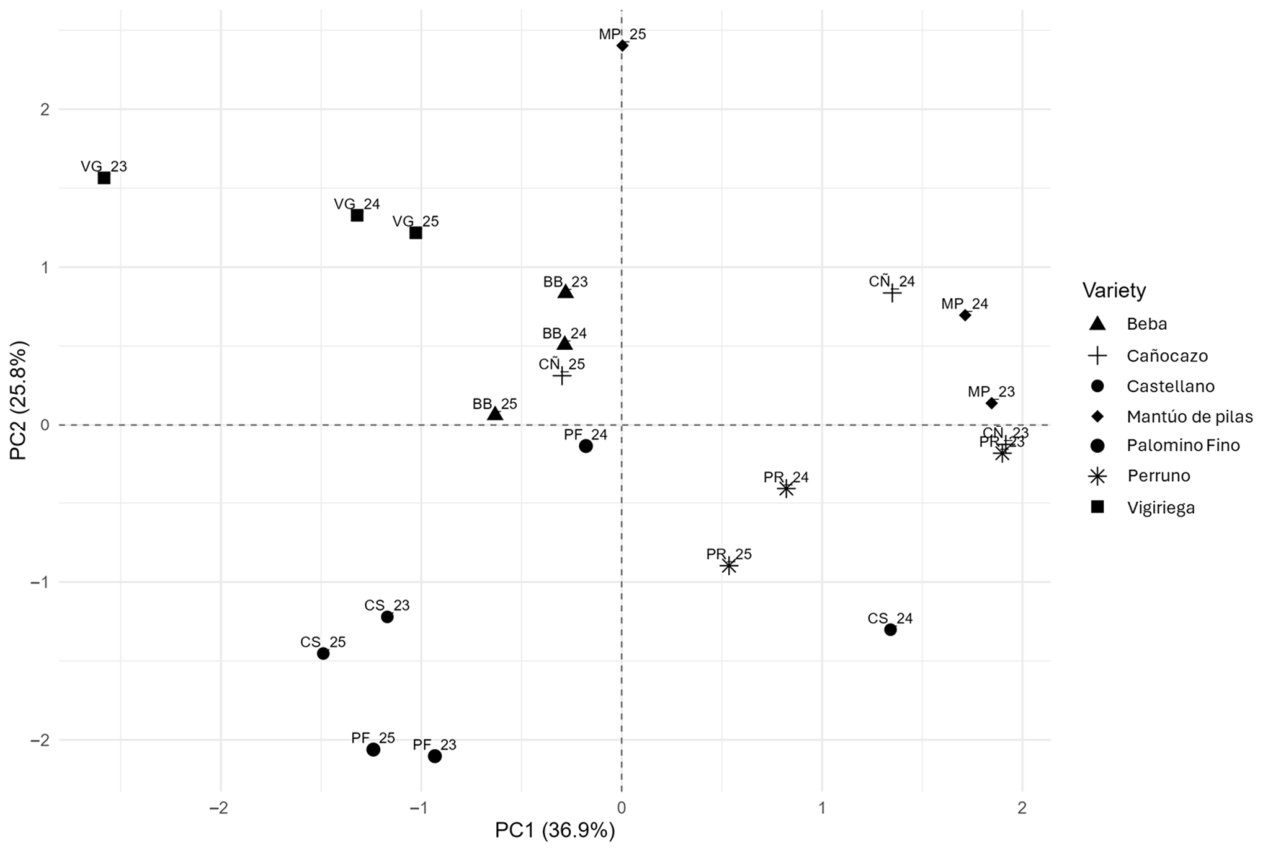
The principal component analysis (PCA) and the corresponding loadings are shown (Figure 3 and Table 4, respectively). The analysis was performed using the oenological parameters results obtained from the grape must characterization of the different cultivars across three seasons. The first two components accounted for 62.7% of the total variance.
The first principal component (PC1) explained 36.9% of the variance and was mainly defined by YAN (−0.54), °Be (−0.51) and total polyphenols (−0.50). Accordingly, samples with negative PC1 scores are associated with higher °Be, higher YAN and higher polyphenols, whereas samples with positive PC1 scores reflect the opposite pattern. The second component (PC2) explained 25.8% of the variance and was mainly associated with total acidity (+0.38) and the organic acids malic (+0.50) and citric (+0.48), while pH loaded negatively (−0.40).
The PC1-PC2 score plot enabled an effective discrimination of samples and revealed a structured separation driven by both cultivar and season. Across the three years, Vigiriega clustered at positive PC2 values, in agreement with its more acidic profile. In contrast, Palomino Fino and Castellano are grouped in the lower left quadrant, indicating association with higher sugar, YAN and polyphenol content. A clear year effect was observed for Castellano, with CS_24 shifting to the positive side of PC1 relative to its 2023 and 2025 positions. Perruno occupied the lower right quadrant, separating it from the high °Be, YAN, and polyphenol region and aligning it with higher pH and lower acid content. Mantúo de Pilas showed the largest dispersion, with MP_23 and MP_24 located at positive PC1 values and MP_25 shifting markedly toward positive PC2 in 2025. Beba and Cañocazo showed intermediate placements overall.

4. Discussion

Microsatellite (SSR) markers remain a standard tool for cultivar identification in grapevines [16,30]. In practical terms, SSR profiles provide a genetic fingerprint that is sufficiently discriminant for the detection of synonymies and the verification of plant material conserved in collections. In this study, SSR genotyping was used to confirm the cultivar identity of the studied accessions by comparison with published profiles and databases, as the plant material originated from a commercial vineyard and the cultivars had been grafted in the field rather than sourced as nursery stock.
The SSR profiles obtained in this study support the identity of the accessions and are consistent with previously reported synonymies [13,30,47]. The genotype identified for Castellano matched the profile reported for “Manteudo”, while Mantúo de Pilas showed the same genotype described for “De Rey” and “Uva Rey”. In both cases, the profiles were concordant with those reported by Sancho-Galán et al. [30]. Perruno matched the genotype associated with “Zalema” and “Mantúo Perruno”, whereas Vigiriega was consistent with published profiles for “Vijariego Blanco”. Among the cultivars analyzed, Beba is particularly notable, as it is associated with 198 registered synonymies in the VIVC and is conserved in multiple germplasm collections worldwide [24]. In Spain, these cultivars are currently conserved at Rancho de la Merced and Finca El Encín (Holding Institution Codes ESP074 and ESP080, respectively). Notably, the VIVC currently lists Castellano as held only at El Encín. However, our findings confirm that it is also conserved at IFAPA Rancho de la Merced [26,44], highlighting the need to update the corresponding database entry.
Ampelographic assessment of the seven cultivars revealed both shared and distinct phenotypic features. For Perruno, descriptions were largely consistent with Puertas-García [48] and later García de Luján et al. [49], with differences limited to OIV 051, 053, 070, 072, 079, 203, 208, 233 and 238. Likewise, Cañocazo, Castellano and Mantúo de Pilas broadly matched the descriptions reported by Sancho-Galán et al. [30,47], while differing in Cañocazo for OIV 053, 067, 076 and 202; in Castellano for OIV 003, 051, 067, 079, 084, 085 and 223; and in Mantúo de Pilas for OIV 070, 074, 075, 085 and 223. Vigiriega generally agreed with Rodríguez-Torres [50], except for OIV 004, 008, 202 and 203, whereas Beba showed a high overall concordance with González et al. [51], with discrepancies in OIV 003, 051, 067, 084, 087 and 203. Across cultivars, the most pronounced differences were observed primarily in mature leaf traits and, to a lesser extent, in cluster/berry characteristics. These descriptors are particularly sensitive to methodological factors (sampling and the developmental stage of the organ assessed) and the environmental conditions, which likely contributes to the differences observed among studies [30].
The trichomes’ density may be relevant under warm climate conditions because it can contribute to thermoregulation by modifying the leaf boundary layer and can reduce the leaf transpiration rate, saving water for the plant [52,53]. Palomino Fino was characterized by higher prostrate hair development, whereas Perruno showed more marked erect hair development; in contrast, Vigiriega displayed low vine hair. The observed differences could influence cultivar performance under high radiation and temperature [53]. In this context, the contrasting trichome patterns observed among cultivars may represent traits of interest for adaptation to climate change, particularly in viticultural areas increasingly exposed to high temperatures and water stress.
Grapevine phenology is influenced by the environmental conditions where it is cultivated, among other factors [54,55]. In this context, the phenological monitoring over two consecutive seasons highlighted a clear year effect. Although average temperatures were similar between years (Supplementary Material Figure S1), all cultivars in 2025 showed an overall shift in phenological stages toward later dates (higher DOY), which was particularly evident during flowering (I1 and I2, Figure 2). Periods of soil water saturation can temporarily reduce vine growth and physiological activity [56], which may slow phenological development even in the absence of marked differences in ambient temperature. In this sense, this shift may be partly related to the episode of intense and persistent rainfall recorded in March 2025 (≈236.6 mm; Figure S2B). In addition, these events also caused soil erosion and required soil restoration practices, which could have contributed to the observed delay. Despite this seasonal effect, the relative ranking among cultivars remained consistent across both years. This result may be relevant under the current agroclimatic conditions of warm viticultural regions because cultivars with later phenological progression may deserve further attention, as they could favor a better balance between sugar accumulation and acidity retention. By contrast, earlier cultivars may be more exposed to accelerated ripening under high summer temperatures [57].
Grape must physicochemical characterization (Table 3) showed differentiated ripening dynamics among cultivars. The harvest date was set using the reference cultivar Palomino Fino, following the grower’s criteria and in accordance with the specifications of the “Jerez-Xérès-Sherry” and “Manzanilla-Sanlúcar de Barrameda” DOs, which establish that grape musts intended for wines under the DO must reach at least 10.5 °Be [31]. Since all cultivars were harvested simultaneously, the differences observed in grape must composition should be interpreted in relation to a common harvest point rather than to the optimal ripening stage of each cultivar. Further studies would therefore be useful to evaluate grape must composition when each cultivar reaches its own optimal ripening stage. In this context, Palomino Fino consistently showed the highest °Be values across the three seasons (maximum in 2025), followed by Castellano, and both cultivars met the required threshold at harvest. These results are also consistent with their status as one of the earliest cultivars in their phenological cycle (Figure 2). In contrast, Mantúo de Pilas displayed the lowest °Be and total sugar values and, therefore, the greatest deviation relative to the reference cultivar. Beba exceeded the threshold only in 2025, whereas Cañocazo and Perruno did not reach it in any season, even though Perruno showed a relatively early phenology (Figure 2). This finding points to differences among cultivars in sugar accumulation capacity under the experimental conditions in this study. Vigiriega, despite exhibiting later phenological development, showed comparatively high sugar levels at harvest. The results suggest that cultivars that tend to remain below the established °Be threshold may be of interest for alternative technological approaches. First, over-ripening and postharvest sun dehydration (asoleo) could be considered to concentrate sugars through berry water loss [58]. Second, these cultivars could alternatively be used as blending components in non-monovarietal wines to modulate must composition and reduce the potential alcoholic strength of riper musts from other cultivars [59].
During 2024, a general decrease in sugars (°Be and total sugars) was observed compared with 2023 and 2025 in several cultivars, particularly Castellano and Palomino Fino. This pattern could have been influenced, at least in part, by biotic factors such as the green leafhopper (Jacobiasca lybica) outbreak recorded during ripening [60]. This pest causes foliar damage that reduces gas exchange and photosynthetic performance, and it has been reported to cause ripening delay, with a consequent reduction in berries’ sugar accumulation [61,62,63].
With regard to technological ripening, the results reflect the typical imbalance observed under warm climate conditions, whereby an increase in sugar content is generally accompanied by lower titratable acidity and higher pH [30,47]. In grape must, tartaric and malic acids together account for approximately 69% to more than 90% of total organic acids [64,65]. The relationship between these two acids is of considerable oenological interest, as it reflects the interaction between grapevine genotype and environmental conditions. In this context, the decay in total acidity may be closely linked to the evolution of malic acid concentration, which can be consumed during ripening through respiratory combustion in the grain cell and other metabolic processes. Its degradation accelerates at higher temperatures [66,67]. The later cultivars Vigiriega and Mantúo de Pilas exhibited relatively more acidic profiles, whereas Perruno and Castellano generally showed the lowest total acidity values, consistent with their shorter phenological cycle. Unlike malic acid, tartaric acid is more stable during ripening [66]. Consequently, although Palomino Fino, the predominant cultivar in the region, exhibited the lowest malic acid concentrations over three years, its higher tartaric acid levels helped maintain total acidity levels similar to those of the more acidic cultivars, partially counteracting the sugar-acid imbalance. This suggests that the relative contribution of malic and tartaric acid may be useful when comparing cultivar behavior under warm conditions. Since malic acid is more sensitive to temperature, tartaric acid is generally more stable and plays a different role in pH regulation, both of which may influence compositional balance during ripening.
Regarding total polyphenols, Palomino Fino and Castellano tended to show higher values, which could be associated with a higher potential for oxidative reactions and implications for sensory stability. However, as the present results only reflect compositional differences at the grape must level, they cannot be taken as direct evidence of sensory or oxidative behavior in the final wine. Finally, YAN showed both cultivars and seasonal variability. According to several authors, at least 140 mg N/L YAN is required for complete and successful alcoholic fermentation [68,69]. All cultivars were above this threshold across the three seasons, indicating an overall nitrogen status compatible with alcoholic fermentation under standard winemaking conditions.
The PCA is consistent with the cultivar patterns described in Table 3 and provides a coherent multivariate summary of grape must composition across seasons. The separation along the first two principal components (PC1 and PC2) discriminated cultivars mainly according to two different dimensions: a ripeness component (PC1), driven by °Be, YAN and total polyphenols, and an acidity component (PC2), driven by titratable acidity and organic acids in opposition to pH. Across seasons, samples formed coherent groupings that reflect their physicochemical composition. Cultivars associated with higher °Be and, in several cases, higher YAN and polyphenols tended to cluster toward the negative side of PC1, as observed for Palomino Fino, Castellano and Vigiriega. PC2 added an additional layer of separation by organizing cultivars according to their acidity status: cultivars characterized by higher malic acid and lower pH tended to group on the positive side of PC2, as seen for Mantúo de Pilas and Vigiriega and, to a lesser extent, Beba. Despite the year-to-year variability, most cultivars retained a recognizable multivariate tendency across seasons, indicating that cultivar differences in must composition were robust under the experimental conditions.

5. Conclusions

This study provides an integrated overview of cultivar identity, ampelography, phenology and grape must traits for six local white grape cultivars grown under warm climate conditions, using Palomino Fino as a regional reference. Based on the results obtained, the following conclusions can be stated: (1) SSR genotyping confirmed the identity of the studied accessions and supported previously reported synonymies, providing a solid basis for working with correctly identified plant material. (2) Ampelographic assessment revealed clear phenotypic differentiation among cultivars. Beba showed the closest morphological similarity to Palomino Fino, followed by Perruno. (3) Phenological monitoring showed a consistent ranking among cultivars across seasons, most clearly during veraison and ripening. Castellano reached these stages earlier, whereas Mantúo de Pilas showed the latest progression. Perruno and Palomino Fino followed early/intermediate trajectories, whereas Beba and Cañocazo showed closely aligned timing. Vigiriega generally progressed later, close to Mantúo de Pilas. (4) Grape must composition differed among cultivars, indicating distinct ripening dynamics. Palomino Fino and Castellano generally reached higher °Be, whereas Vigiriega and Mantúo de Pilas tended to show comparatively more acidic profiles. Palomino Fino combined higher sugar content with lower malic acid. Castellano and Perruno were characterized by comparatively low total acidity. (5) These compositional differences highlight contrasting ripening profiles under the studied conditions and may provide a useful basis for future winemaking research, depending on the desired balance between sugar accumulation and acidity retention.
Overall, these results provide updated, field-based phenotyping evidence for local grape cultivars grown in a warm climate region under current conditions influenced by climate change. This information supports cultivar selection for new plantings and helps explore the potential of local cultivars for developing new wine styles. However, the results should be interpreted taking into account that productivity-related traits were not evaluated in the present study and that grape must composition was assessed at a common harvest point based on the reference cultivar, rather than at the optimal ripening stage of each cultivar. These aspects limit a full agronomic and adaptive assessment of the cultivars under the studied conditions. Future research should integrate yield and other agronomic variables with phenology and grape composition, together with cultivar-specific ripening assessment and broader field evaluation, in order to better define the potential of these local cultivars under warm climate conditions.

Supplementary Materials

The following supporting information can be downloaded at: https://www.mdpi.com/article/10.3390/horticulturae12050570/s1, Figure S1: Monthly climatic conditions in 2022–2023: (A) rainfall, (B) average temperature, and (C) average relative humidity; Figure S2: Monthly climatic conditions in 2023–2024: (A) rainfall, (B) average temperature, and (C) average relative humidity title; Figure S3: Monthly climatic conditions in 2024–2025: (A) rainfall, (B) average temperature, and (C) average relative humidity.

Author Contributions

Investigation, methodology, data curation, formal analysis, and writing—original draft, J.M.P.-G.; conceptualization, methodology, resources, supervision and validation, A.J.-C.; conceptualization, data curation, methodology, supervision and writing—review and editing, P.S.-G.; software and writing—review and editing, A.A.-A. All authors have read and agreed to the published version of the manuscript.

Funding

UCAINNOVA25-Vitilab Project, funded by the Planning, Coordination and Strategic Development Department of the Provincial Council of Cádiz.

Data Availability Statement

The original contributions presented in the study are included in the article, further inquiries can be directed to the corresponding author.

Conflicts of Interest

The authors declare no conflicts of interest.

Abbreviations

The following abbreviations are used in this manuscript:
BBBeba
CSCastellano
Cañocazo
DODenomination of Origin
MPMantúo de Pilas
OIVOrganisation Internationale de la Vigne et du Vin
PCAPrincipal component analysis
PFPalomino Fino
PRPerruno
SSRSimple Sequence Repeats
TATotal acidity
TSTotal sugars
TITotal iron
TPTotal polyphenols
VGVigiriega
VIVCVitis International Variety Catalogue
YANYeast Assimilable Nitrogen

References

  1. Amores-Arrocha, A.; Jiménez-Cantizano, A. Genetic Resources for Viticulture. Horticulturae 2025, 11, 362. [Google Scholar] [CrossRef]
  2. Zombardo, A.; Puccioni, S.; Crespan, M.; Storchi, P.; Perria, R.; Tosi, V.; Lorieri, P.; Migliaro, D. Protection of viticultural biodiversity: Genetic and phenotypic characterisation of grapevine varieties from the northwest coastal area of Tuscany (Italy). OENO One 2024, 58, 3. [Google Scholar] [CrossRef]
  3. Anderson, K.; Nelgen, S. Diversity and Internationalization of Winegrape Varieties: Evidence from a Revised Global Database; Wine Economics Research Centre, School of Economics, University of Adelaide: Adelaide, Australia, 2020. [Google Scholar]
  4. Shecori, S.; Kher, M.M.; Tyagi, K.; Lerno, L.; Netzer, Y.; Lichter, A.; Ebeler, S.E.; Drori, E. A Field Collection of Indigenous Grapevines as a Valuable Repository for Applied Research. Plants 2022, 11, 2563. [Google Scholar] [CrossRef]
  5. Santiago, J.L.; Boso, S.; Gago, P.; Alonso-Villaverde, V.; Martínez, M.C. A contribution to the maintenance of grapevine diversity: The rescue of Tinta Castañal (Vitis vinifera L.), a variety on the edge of extinction. Sci. Hortic. 2008, 116, 199–204. [Google Scholar] [CrossRef]
  6. Balda, P.; Ibáñez, J.; Sancha, J.C.; Martínez de Toda, F. Characterization and Identification of Minority Red Grape Varieties Recovered in Rioja, Spain. Am. J. Enol. Vitic. 2014, 65, 148–152. [Google Scholar] [CrossRef]
  7. Avramidou, E.V.; Masaoutis, I.; Pitsoli, T.D.; Kapazoglou, A.; Pikraki, M.; Trantas, E.A.; Nikolantonakis, M.; Doulis, A.G. Analysis of Wine-Producing Vitis vinifera L. Biotypes, Autochthonous to Crete (Greece), Employing Ampelographic and Microsatellite Markers. Life 2023, 13, 220. [Google Scholar] [CrossRef] [PubMed]
  8. van Leeuwen, C.; Darriet, P. The Impact of Climate Change on Viticulture and Wine Quality. J. Wine Econ. 2016, 11, 150–167. [Google Scholar] [CrossRef]
  9. Alston, J.M.; Sambucci, O. Grapes in the World Economy. In The Grape Genome; Cantu, D., Walker, M.A., Eds.; Springer International Publishing: Berlin/Heidelberg, Germany, 2019; pp. 1–24. [Google Scholar] [CrossRef]
  10. Magon, G.; De Rosa, V.; Martina, M.; Falchi, R.; Acquadro, A.; Barcaccia, G.; Portis, E.; Vannozzi, A.; De Paoli, E. Boosting grapevine breeding for climate-smart viticulture: From genetic resources to predictive genomics. Front. Plant Sci. 2023, 14, 1293186. [Google Scholar] [CrossRef] [PubMed]
  11. Granett, J.; Walker, M.A.; Kocsis, L.; Omer, A.D. Biology and management of grape phylloxera. Annu. Rev. Entomol. 2001, 46, 387–412. [Google Scholar] [CrossRef]
  12. This, P.; Lacombe, T.; Thomas, M. Historical origins and genetic diversity of wine grapes. Trends Genet. 2006, 22, 511–519. [Google Scholar] [CrossRef]
  13. Cretazzo, E.; Moreno Sanz, P.; Lorenzi, S.; Benítez, M.L.; Velasco, L.; Emanuelli, F. Genetic Characterization by SSR Markers of a Comprehensive Wine Grape Collection Conserved at Rancho de la Merced (Andalusia, Spain). Plants 2022, 11, 1088. [Google Scholar] [CrossRef] [PubMed]
  14. Jiménez-Cantizano, A.; Puig-Pujol, A.; Arroyo-García, R. Identification of Vitis vinifera L. Local Cultivars Recovered in Andalusia (Spain) by Using Microsatellite Markers. Horticulturae 2023, 9, 316. [Google Scholar] [CrossRef]
  15. Sefc, K.M.; Lefort, F.; Grando, M.S.; Scott, K.D.; Steinkellner, H.; Thomas, M.R. Microsatellite Markers for Grapevine: A State of the Art. In Molecular Biology & Biotechnology of the Grapevine; Roubelakis-Angelakis, K.A., Ed.; Springer: Dordrecht, The Netherlands, 2001; pp. 433–463. [Google Scholar] [CrossRef]
  16. This, P.; Jung, A.; Boccacci, P.; Borrego, J.; Botta, R.; Costantini, L.; Crespan, M.; Dangl, G.S.; Eisenheld, C.; Ferreira-Monteiro, F.; et al. Development of a standard set of microsatellite reference alleles for identification of grape cultivars. Theor. Appl. Genet. 2004, 109, 1448–1458. [Google Scholar] [CrossRef]
  17. Dangl, G.S.; Mendum, M.L.; Prins, B.H.; Walker, M.A.; Meredith, C.P.; Simon, C.J. Simple sequence repeat analysis of a clonally propagated species: A tool for managing a grape germplasm collection. Genome 2001, 44, 432–438. [Google Scholar] [CrossRef]
  18. Rodríguez-Torres, I.; Martín Carrillo, A.; Ramírez, M.d.P.; Gómez Gálvez, F.J.; Velasco Arjona, L.; Padilla, C.; Cretazzo, E. Genotypic and Sanitary Characterization of Minority Grapevine Varieties Prospected in Andalusia, Spain. Horticulturae 2023, 9, 759. [Google Scholar] [CrossRef]
  19. De Mattia, F.; Imazio, S.; Grassi, F.; Lovicu, G.; Tardáguila, J.; Failla, O.; Maitt, C.; Scienza, A.; Labra, M. Genetic characterization of Sardinia grapevine cultivars by SSR markers analysis. OENO One 2007, 41, 175. [Google Scholar] [CrossRef]
  20. Marsal, G.; Méndez, J.J.; Mateo, J.M.; Ferrer, S.; Canals, J.M.; Zamora, F.; Fort, F. Molecular characterization of Vitis vinifera L. local cultivars from volcanic areas (Canary Islands and Madeira) using SSR markers. OENO One 2019, 53, 4. [Google Scholar] [CrossRef]
  21. Lacombe, T.; Boursiquot, J.M.; Laucou, V.; Di Vecchi-Staraz, M.; Péros, J.P.; This, P. Large-scale parentage analysis in an extended set of grapevine cultivars (Vitis vinifera L.). Theor. Appl. Genet. 2013, 126, 401–414. [Google Scholar] [CrossRef]
  22. Lefort, F.; Roubelakis-Angelakis, K.K.A. Genetic Comparison of Greek Cultivars of Vitis vinifera L. by Nuclear Microsatellite Profiling. Am. J. Enol. Vitic. 2001, 52, 101–108. [Google Scholar] [CrossRef]
  23. Lopes, M.S.; dos Santos, M.R.; Dias, J.E.E.; Mendonça, D.; da Câmara Machado, A. Discrimination of Portuguese grapevines based on microsatellite markers. J. Biotechnol. 2006, 127, 34–44. [Google Scholar] [CrossRef]
  24. Vitis International Variety Catalogue (VIVC). Available online: https://www.vivc.de/ (accessed on 21 January 2026).
  25. Ghrissi, H.; De Andrés, M.T.; Andreu, L.J.; Gogorcena, Y. Genetic Diversity and Structure in a Spanish Grape Germplasm Collection Assessed by SSR Markers. Aust. J. Grape Wine Res. 2022, 2022, 8028224. [Google Scholar] [CrossRef]
  26. García de Luján, A.; Lara, M. La Colección de Vides del Rancho de la Merced, 1st ed.; Consejería de Agricultura y Pesca, Junta de Andalucía: Seville, Spain, 1997; pp. 7–13. [Google Scholar]
  27. Estudillo, A.L. La vid y los viticultores de Jerez, la crisis comercial y el impacto de la filoxera: Un campo abierto a la investigación. Rev. Hist. Jerez 1992, 1, 43–71. [Google Scholar]
  28. Roxas Clemente, S. Ensayo Sobre las Variedades de Vid que Vegetan en Andalucía, 1st ed.; Imprenta de Villapando: Madrid, Spain, 1807; pp. 111–113. [Google Scholar]
  29. Fernández de Bobadilla, G. Viníferas Jerezanas y de Andalucía Occidental (Vineyards of Jerez and Western Andalusia); Instituto Nacional de Investigaciones Agronómicas: Madrid, Spain, 1956. [Google Scholar]
  30. Sancho-Galán, P.; Amores-Arrocha, A.; Palacios, V.; Jiménez-Cantizano, A. Identification and Characterization of White Grape Varieties Autochthonous of a Warm Climate Region (Andalusia, Spain). Agronomy 2020, 10, 205. [Google Scholar] [CrossRef]
  31. Ministry of Agriculture, Fisheries, Water and Rural Development; Directorate General for Industries, Innovation and the Agri-food Chain. Pliego de Condiciones de la Denominación de Origen Protegida «Jerez-Xérès-Sherry»; Boletín Oficial de la Junta de Andalucía (BOJA): Dos Hermanas, Spain, 2022; pp. 1–11. Available online: https://www.sherry.wine/documents/274/Pliego_Jerez_normal_consolidado.pdf (accessed on 10 January 2026).
  32. Fernández-Marín, M.I.; Lara-Benítez, M.; Cantos-Villar, E.; Puertas, B. Potencialidad enológica de las variedades de vid cultivadas en Andalucía: Beba y Mantúo de Pilas. In Consejería de Agricultura, Ganadería, Pesca y Desarrollo Sostenible; Instituto de Investigación y Formación Agraria y Pesquera (IFAPA): Jerez de la Frontera, Spain, 2021; pp. 1–30. Available online: https://www.juntadeandalucia.es/agriculturaypesca/ifapa/servifapa/registro-servifapa/d82ab46c-0b6e-4cd4-9cbc-8e8fe8c92f5f/download (accessed on 12 January 2026).
  33. Jiménez-Cantizano, A.; Puertas, B.; Serrano, M.J. Adaptation and selection of cultivars of grapevine for quality wines in warm climate. Acta Hortic. 2011, 910, 89–101. [Google Scholar] [CrossRef]
  34. Plantgrape. 161-49 Couderc. Available online: https://www.plantgrape.fr/en/varieties/rootstock-varieties/5 (accessed on 10 April 2026).
  35. Pérez Moreno, S.; Bernal Hurtado, I.C.; Ávila Cano, M.E.; Del Moral Casarrubios, C.; Vela Delgado, M.D. Análisis y Situación del Viñedo Joven en la Provincia de Cádiz; Instituto Andaluz de Investigación y Formación Agraria, Pesquera, Alimentaria y de Producción Ecológica (IFAPA), Consejería de Agricultura, Pesca, Agua y Desarrollo Rural, Junta de Andalucía: Jerez de la Frontera, Spain, 2022; pp. 1–14. Available online: https://www.juntadeandalucia.es/agriculturaypesca/ifapa/servifapa/registro-servifapa/69c6984f-e609-42f0-ab45-e6bd6ea6dfa4/download (accessed on 10 April 2026).
  36. European Parliament. Council of the European Union. Regulation (EU) 2018/848 of the European Parliament and of the Council of 30 May 2018 on Organic Production and Labelling of Organic Products and Repealing Council Regulation (EC) No 834/2007. Off. J. Eur. Union 2018, 150, 1–92. [Google Scholar]
  37. Santesteban, L.G.; Miranda, C.; Royo, J.B. Vegetative Growth, Reproductive Development and Vineyard Balance. In Methodologies and Results in Grapevine Research; Springer: Dordrecht, The Netherlands, 2010; pp. 45–56. [Google Scholar] [CrossRef]
  38. Sancho-Galán, P.; Amores-Arrocha, A.; Palacios, V.; Jiménez-Cantizano, A. Preliminary Study of Somatic Variants of Palomino Fino (Vitis vinifera L.) Grown in a Warm Climate Region (Andalusia, Spain). Agronomy 2020, 10, 654. [Google Scholar] [CrossRef]
  39. Benito, A.; Muñoz-Organero, G.; de Andrés, M.T.; Ocete, R.; García-Muñoz, S.; López, M.Á.; Arroyo-García, R.; Cabello, F. Ex situ ampelographical characterisation of wild Vitis vinifera from fifty-one Spanish populations. Aust. J. Grape Wine Res. 2017, 23, 143–152. [Google Scholar] [CrossRef]
  40. Organisation Internationale de la Vigne et du Vin (OIV). OIV Descriptor List for Grape Varieties and Vitis Species, 2nd ed.; OIV: Paris, France, 2009. [Google Scholar]
  41. Baggiolini, M. Les stades repères dans le développement annuel de la vigne et leur utilisation pratique. Rev. Rom. d’Agriculture d’Arboriculture 1952, 8, 4–6. [Google Scholar]
  42. OIV Office International de la Vigne et du Vin. Recuéil des Méthodes Internationales D’analyse des Vins et des Moûts; OIV Office International de la Vigne et du Vin: Paris, France, 2014. [Google Scholar]
  43. The European Vitis Database. Available online: http://www.eu-vitis.de/index.php (accessed on 22 January 2026).
  44. Jiménez-Cantizano, A. Caracterización Molecular del Banco de Germoplasma de vid del Rancho de la Merced. Ph.D. Thesis, Universidad de Cádiz, Cádiz, Spain, 2014. Available online: https://rodin.uca.es/handle/10498/17919 (accessed on 22 January 2026).
  45. Ibáñez, J.; Vargas, A.M.; Palancar, M.; Borrego, J.; de Andrés, M.T. Genetic Relationships among Table-Grape Varieties. Am. J. Enol. Vitic. 2009, 60, 35–42. [Google Scholar] [CrossRef]
  46. de Andrés, M.T.; Benito, A.; Pérez-Rivera, G.; Ocete, R.; Lopez, M.A.; Gaforio, L.; Muñoz, G.; Cabello, F.; Martínez Zapater, J.M.; Arroyo-García, R. Genetic diversity of wild grapevine populations in Spain and their genetic relationships with cultivated grapevines. Mol. Ecol. 2012, 21, 800–816. [Google Scholar] [CrossRef]
  47. Sancho-Galán, P.; Amores-Arrocha, A.; Palacios, V.; Jiménez-Cantizano, A. Genetical, Morphological and Physicochemical Characterization of the Autochthonous Cultivar ‘Uva Rey’ (Vitis vinifera L.). Agronomy 2019, 9, 563. [Google Scholar] [CrossRef]
  48. Puertas, B. Estudio Sobre el Potencial Vitícola y Enológico de Quince Variedades Blancas de vid en la Zona del Jerez. Ph.D. Thesis, Universidad de Cádiz, Cádiz, Spain, 1989. [Google Scholar]
  49. García de Luján, A.; González Moreno, J.M.; Bustillo Barroso, J.M.; Lara Benítez, M. Catálogo de Clones de Variedades de vid de Andalucía; IFAPA: Jerez de la Frontera, Spain, 2004; Available online: https://juntadeandalucia.es/export/drupaljda/1337165054Catxlogo_de_Clones_de_Variedades_de_Vid_de_Andalucxa__BAJA.pdf (accessed on 27 January 2026).
  50. Rodríguez-Torres, I. Descriptores Para la Caracterización de vid. In Variedades Cultivadas en Canarias; Instituto Canario de Investigaciones Agrarias (ICIA): Tenerife, Spain, 2015. [Google Scholar]
  51. González, R.; Vargas, A.M.; Garnatje, T.; Vallès, J.; de Andrés, M.T. Exploring Diversity among Grapevines Varieties (Vitis vinifera L.) in Ibiza and Formentera (Balearic Islands, Spain) Using Microsatellite Markers, Ampelographic Methods and an Ethnobotanical Approach. Horticulturae 2023, 9, 1307. [Google Scholar] [CrossRef]
  52. Ripley, B.S.; Pammenter, N.W.; Smith, V.R. Function of Leaf Hairs Revisited: The Hair Layer on Leaves Arctotheca populifolia Reduces Photoinhibition, but Leads to Higher Leaf Temperatures Caused by Lower Transpiration Rates. J. Plant Physiol. 1999, 155, 78–85. [Google Scholar] [CrossRef]
  53. Domanda, C.; Nuzzo, V.; Montanaro, G.; Failla, O.; Rustioni, L. Trichomes affect grapevine leaf optical properties and thermoregulation. Theor. Exp. Plant Physiol. 2023, 35, 299–308. [Google Scholar] [CrossRef]
  54. Martínez-Lüscher, J.; Kizildeniz, T.; Vučetić, V.; Dai, Z.; Luedeling, E.; van Leeuwen, C.; Gomès, E.; Pascual, I.; Irigoyen, J.J.; Morales, F.; et al. Sensitivity of Grapevine Phenology to Water Availability, Temperature and CO2 Concentration. Front. Environ. Sci. 2016, 4, 48. [Google Scholar] [CrossRef]
  55. Merrill, N.K.; García de Cortázar-Atauri, I.; Parker, A.K.; Walker, M.A.; Wolkovich, E.M. Exploring Grapevine Phenology and High Temperatures Response Under Controlled Conditions. Front. Environ. Sci. 2020, 8, 516527. [Google Scholar] [CrossRef]
  56. Ruperti, B.; Botton, A.; Populin, F.; Eccher, G.; Brilli, M.; Quaggiotti, S.; Trevisan, S.; Cainelli, N.; Guarracino, P.; Schievano, E.; et al. Flooding Responses on Grapevine: A Physiological, Transcriptional, and Metabolic Perspective. Front. Plant Sci. 2019, 10, 339. [Google Scholar] [CrossRef] [PubMed]
  57. Parker, A.K.; García de Cortázar-Atauri, I.; Trought, M.C.T.; Destrac, A.; Agnew, R.; Sturman, A.; van Leeuwen, C. Adaptation to Climate Change by Determining Grapevine Cultivar Differences Using Temperature-Based Phenology Models. OENO One 2020, 54, 955–974. [Google Scholar] [CrossRef]
  58. Pérez-González, J.M.; Gutiérrez-Gordillo, S.; Amores-Arrocha, A.; Sancho-Galán, P.; Jiménez-Cantizano, A. Assessment of Grape Over-Ripening Dynamics as a Post-Harvest Technique in the Vineyard. Food Bioprocess Technol. 2026, 19, 78. [Google Scholar] [CrossRef]
  59. Varela, C.; Dry, P.R.; Kutyna, D.R.; Francis, I.L.; Henschke, P.A.; Curtin, C.D.; Chambers, P.J. Strategies for reducing alcohol concentration in wine. Aust. J. Grape Wine Res. 2015, 21, 670–679. [Google Scholar] [CrossRef]
  60. Red de Información Agroclimática de Andalucía (RIA). Available online: https://www.juntadeandalucia.es/agriculturaypesca/ifapa/riaweb/web/ (accessed on 2 February 2026).
  61. Fornasiero, D.; Pavan, F.; Pozzebon, A.; Picotti, P.; Duso, C. Relative Infestation Level and Sensitivity of Grapevine Cultivars to the Leafhopper Empoasca vitis (Hemiptera: Cicadellidae). J. Econ. Entomol. 2016, 109, 416–425. [Google Scholar] [CrossRef]
  62. Lucas, A. Mosquito Verde, una plaga ligada al cambio climático. Phytoma España 2024, 363, 68–71. [Google Scholar]
  63. Mainé, M.D.; Aveledo, C.; Montero, E.; Pérez, S.; Durán Alvaro, J.M.; Jiménez-Cantizano, A. Detección, identificación y seguimiento de la especie de mosquito verde dominante en un viñedo del Marco de Jerez. Phytoma España 2024, 363, 174. [Google Scholar]
  64. Bigard, A.; Romieu, C.; Sire, Y.; Torregrosa, L. Vitis vinifera L. Diversity for Cations and Acidity Is Suitable for Breeding Fruits Coping with Climate Warming. Front. Plant Sci. 2020, 11, 1175. [Google Scholar] [CrossRef] [PubMed]
  65. Lakso, A.N.; Kliewer, W.M. The Influence of Temperature on Malic Acid Metabolism in Grape Berries. Plant Physiol. 1975, 56, 370–372. [Google Scholar] [CrossRef] [PubMed]
  66. Plantevin, M.; Merpault, Y.; Lecourt, J.; Destrac-Irvine, A.; Dijsktra, L.; van Leeuwen, C. Characterization of varietal effects on the acidity and pH of grape berries for selection of varieties better adapted to climate change. Front. Plant Sci. 2024, 15, 1439114. [Google Scholar] [CrossRef]
  67. Sweetman, C.; Sadras, V.O.; Hancock, R.D.; Soole, K.L.; Ford, C.M. Metabolic effects of elevated temperature on organic acid degradation in ripening Vitis vinifera fruit. J. Exp. Bot. 2014, 65, 5975–5988. [Google Scholar] [CrossRef]
  68. Bell, S.J.; Henschke, P.A. Implications of nitrogen nutrition for grapes, fermentation and wine. Aust. J. Grape Wine Res. 2005, 11, 242–295. [Google Scholar] [CrossRef]
  69. Garde-Cerdán, T.; Ancín-Azpilicueta, C. Effect of the addition of different quantities of amino acids to nitrogen-deficient must on the formation of esters, alcohols, and acids during wine alcoholic fermentation. LWT 2008, 41, 501–510. [Google Scholar] [CrossRef]
Figure 1. Dendrogram from hierarchical clustering of seven grapevine cultivars based on 46 OIV descriptors.
Horticulturae 12 00570 g001
Figure 2. Baggiolini phenological stages recorded during two consecutive growing seasons. Baggiolini phenological stages: F, inflorescences clearly visible; G, inflorescences separated; H, flowers separated; I1, onset of flowering; I2, full bloom; J, fruit set; K, pea-size berries; L, bunch closure; M1, onset of veraison; M2, full veraison; N, ripening. The length of each colored segment represents the duration of the corresponding phenological stage. The color gray indicates phenological stages preceding F.
Horticulturae 12 00570 g002
Figure 3. Principal components analysis. Graphical representation in the PC1-PC2 plane. BB: Beba; CS: Castellano; VG: Vigiriega; MP: Mantúo de Pilas; CÑ: Cañocazo; PR: Perruno; PF: Palomino Fino. 2023 Season: 23; 2024 Season: 24; 2025 Season: 25.
Horticulturae 12 00570 g003
Table 1. Genetic profiles of the locals and reference cultivars at 22 microsatellite loci. Allele sizes are given in base pairs.
Cultivar CodeBBCSVGMPPRPF
Microsatellite Locus
VVIB01290294290306290290306306290306290306290306
VMC1b11185188185185173188185188188188188188185188
VMC4F31184186166174166186182188186205172186174204
VVMD5233237219222236240222228231233233237224237
VVMD7241247237247239249245247241247237237237247
VVMD21248255242265248248242248248255248255242248
VVMD24208210208210208210208208208208208210208208
VVMD25253253253253241255237253239253239239239239
VVMD27178186178178182186180182182191178178182191
VVMD28243257243243258258243245233247233247235247
VVMD32254270270270256272270270254270254270254256
VVIH54165167167169167169167169167167167167167167
VVIN16150152150150148152150152152152152152150150
VVIN73256264264264264264264264264264264264264264
VVIP31190192176176184190176190188190176188188190
VVIP60317321321321321321317325317325317325317321
VVIQ528284848884888488848484848484
VVS2133141141141137145131141141143131143131143
VVIV37161163163167153163161161163177163177163167
VVIV67363371364375357371371375357371363371363365
VrZAG62187203187193188204188196187203187196187193
VrZAG79240244234256247251240246234244244254248254
BB: Beba; CS: Castellano; VG: Vigiriega; MP: Mantúo de Pilas; CÑ: Cañocazo; PR: Perruno; PF: Palomino Fino.
Table 2. Modal values of the OIV ampelographic descriptors for the seven analyzed grapevine cultivars, assessed across three consecutive years.
CodeDescriptorBBCSVGMPPRPF
OIV 001Young shoot: opening of the shoot tip; 1 closed, 3 half open, 5 fully open.5555555
OIV 003Young shoot: intensity of anthocyanin coloration on prostrate hairs of the shoot tip; 1 none or very low, 3 low, 5 medium, 7 high, 9 very high.5511155
OIV 004Young shoot: density of prostrate hairs on the shoot tip; 1 none or very low, 3 low, 5 medium, 7 high, 9 very high.5557535
OIV 016Shoot: number of consecutive tendrils; 1 two or less, 2 three or more.1111111
OIV 051Young leaf: color of upper side of blade (4th leaf); 1 green, 2 yellow, 3 bronze, 4 copper-reddish.3133133
OIV 053Young leaf: density of prostrate hairs between main veins on lower side of blade (4th leaf); 1 none or very low, 3 low, 5, medium, 7 high, 9 very high.7719317
OIV 067Mature leaf: shape of blade; 1 cordate, 2 wedge-shaped, 3 pentagonal, 4 circular, 5 kidney-shaped.4433444
OIV 068Mature leaf: number of lobes; 1 one, 2 three, 3 five, 4 seven, 5 more than seven.4333333
OIV 070Mature leaf: area of anthocyanin coloration of main veins on upper side of blade; 1 absent, 2 only at the petiolar point, 3 up to the 1st bifurcation, 4 up to the 2nd bifurcation, 5 beyond the 2nd bifurcation.1112124
OIV 072Mature leaf: goffering of blade. 1 absent or very weak, 3 weak, 5 medium, 7 strong, 9 very strong.3311535
OIV 074Mature leaf: profile of blade in cross section; 1 flat, 2 V-shaped, 3 involute, 4 revolute, 5 twisted.5555555
OIV 075Mature leaf: blistering of upper side of blade; 1 absent or very weak, 3 weak, 5 medium, 7 strong, 9 very strong.9317559
OIV 076Mature leaf: shape of teeth; 1 both sides concave, 2 both sides straight, 3 both sides convex, 4 one side concave on side convex, 5 mixture between both sides straight and both sides convex.3322535
OIV 079Mature leaf: degree of opening/overlapping of petiole sinus; 1 very wide open, 3 open, 5 closed, 7 overlapped, 9 strongly overlapped.7315733
OIV 080Mature leaf: shape of base petiole sinus; 1 U-shaped, 2 brace-shaped, 3 V-shaped.3333333
OIV 081-1Mature leaf: teeth in the petiole sinus; 1 none, 9 present. 9911191
OIV 081-2Mature leaf: petiole sinus base limited by vein; 1 not limited, 3 on one side, 3 on both sides.1111111
OIV 083-2Mature leaf: teeth in the upper lateral sinuses; 1 none, 9 present.9111111
OIV 084Mature leaf: density of prostrate hairs between main veins on lower side of blade; 1 none or very low, 3 low, 5 medium, 7 high, 9 very high.3515517
OIV 085Mature leaf: density of erect hairs between main veins on lower side of blade; 1 none or very low, 3 low, 5 medium, 7 high, 9 very high.3313553
OIV 087Mature leaf: density of erect hairs on main veins on lower side of blade; 1 none or very low, 3 low, 5 medium, 7 high, 9 very high.1313571
OIV 202Bunch: length (peduncle excluded); 1 very short, 3 short, 5 medium, 7 long, 9 very long.9537579
OIV 203Bunch: width; 1 very narrow, 3 narrow, 5 medium, 7 wide, 9 very wide.7535577
OIV 204Bunch: density; 1 very loose, 3 loose, 5 medium, 7 dense, 9 very dense.5535375
OIV 207Bunch: lignification of peduncle; 1 at the base only, 5 up to about the middle, 7 more than the middle.5111157
OIV 208Bunch: shape; 1 cylindrical, 2 conical, 3 funnel-shaped.2222244
OIV 209Bunch: number of wings of the primary bunch; 1 absent, 2 1–2 wings, 3 3–4 wings, 4 5–6 wings, 5 more than 6 wings.2223222
OIV 220Berry: length; 1 very short, 3 short, 5 medium, 7 long, 9 very long.5555553
OIV 221Berry: width; 1 very narrow, 3 narrow, 5 medium, 7 wide, 9 very wide.5535553
OIV 222Berry: uniformity of size; 1 not uniform, 2 uniform.2222222
OIV 223Berry: shape; 1 obloid, 2 globose, 3 broad ellipsoid, 4 narrow ellipsoid, 5 cylindric, 6 obtuse ovoid, 7 ovoid, 8 obovoid, 9 horn-shaped, 10 finger-shaped.3635122
OIV 225Berry: color of skin; 1 green yellow, 2 rose, 3 red, 4 gray, 5 dark red violet, 6 blue-black.1111111
OIV 226Berry: uniformity of skin color; 1 not uniform, 2 uniform.2122221
OIV 227Berry: bloom; 1 none or very low, 3 low, 5 medium, 7 high, 9 very high.5757555
OIV 228Berry: thickness of skin; 1 very thin, 3 thin, 5 medium, 7 thick, 9 very thick.9799999
OIV 229Berry: hilum; 1 little visible, 2 visible.2222222
OIV 231Berry: intensity of flesh anthocyanin coloration; 1 none or very weak, 2 weak, 5 medium, 7 strong, 9 very strong.1111111
OIV 232Berry: juiciness of flesh; 1 slightly juicy, 2 medium juicy, 3 very juicy.2121222
OIV 233Berry: must yield; 3 little (up to about 65%), 5 medium (about 65–75%), 7 high (about 75% and more).3333333
OIV 235Berry: firmness of flesh; 1 soft, 2 slightly firm, 3 very firm.2212221
OIV 236Berry: particular flavor; 1 none, 2 muscat, 3 foxy, 4 herbaceous, 5 other flavor than muscat, foxy or herbaceous.1111111
OIV 238Berry: length of pedicel; 1 very short (up to about 4 mm), 3 short (about 7 mm), 5 medium (about 10 mm), 7 long (about 13 mm), 9 very long (about 16 mm and more).1131375
OIV 240Berry: ease of detachment from pedicel; 1 very easy, 2 easy, 3 difficult.3333333
OIV 241Berry: formation of seeds, 1 none, 2 rudimentary, 3 complete.3333333
OIV 242Berry: length of seeds, 1 very short, 3 short, 5 medium, 7 long, 9 very long.3333333
OIV 244Berry: transversal ridges on dorsal side of seeds; 1 absent, 9 present.1111111
BB: Beba; CS: Castellano; VG: Vigiriega; MP: Mantúo de Pilas; CÑ: Cañocazo; PR: Perruno; PF: Palomino Fino.
Table 3. Physicochemical profile of grape musts from the seven cultivars over three consecutive growing seasons.
Grape Must Physicochemical Characterization
Cultivars°BeTotal SugarspHTotal Acidity Tartaric Acid Malic Acid Gluconic AcidCitric Acidα-NH2NH4YANTotal IronTotal Polyphenols
2023
BB10.00 ± 0.00 d176.71 ± 3.84 c3.89 ± 0.01 b3.22 ± 0.04 b6.14 ± 0.09 c1.28 ± 0.00 b0.05 ± 0.00 c0.20 ± 0.02 a144 ± 1 d60 ± 3 b205 ± 4 c0.15 ± 0.02 b442 ± 4 d
CS10.90 ± 0.00 c193.79 ± 0.56 b4.06 ± 0.03 a3.18 ± 0.00 b6.40 ± 0.06 b1.06 ± 0.00 c0.67 ± 0.00 a0.17 ± 0.01 a189 ± 1 b40 ± 1 c230 ± 4 b0.10 ± 0.02 b557 ± 1 b
VG11.10 ± 0.00 b199.82 ± 3.89 b3.83 ± 0.02 c4.58 ± 0.10 a7.11 ± 0.09 a1.69 ± 0.02 a0.06 ± 0.00 c0.19 ± 0.00 a210 ± 4 a79 ± 4 a288 ± 7 a0.00 ± 0.00 c514 ± 3 c
MP7.60 ± 0.10 g127.53 ± 3.38 e3.81 ± 0.00 d3.00 ± 0.05 c5.52 ± 0.05 d0.63 ± 0.00 e0.05 ± 0.01 c0.11 ± 0.01 b117 ± 1 f25 ± 0 d142 ± 0 e0.00 ± 0.00 c374 ± 10 e
8.60 ± 0.00 e159.92 ± 5.5 d4.05 ± 0.00 a2.40 ± 0.00 d5.40 ± 0.00 d0.82 ± 0.10 d0.18 ± 0.01 b0.18 ± 0.01 a123 ± 3 f19 ± 1 d142 ± 4 e0.45 ± 0.00 a331 ± 9 f
PR8.40 ± 0.00 f153.52 ± 4.38 d4.05 ± 0.02 a2.44 ± 0.05 d3.71 ± 0.05 e0.82 ± 0.04 d0.16 ± 0.00 b0.16 ± 0.01 a132 ± 0 e24 ± 1 d156 ± 1 d0.40 ± 0.00 a319 ± 4 f
PF11.90 ± 0.10 a218.82 ± 2.08 a3.92 ± 0.00 b3.14 ± 0.06 b,c6.96 ± 0.06 a0.38 ± 0.00 f0.05 ± 0.01 c0.07 ± 0.00 b175 ± 2 c45 ± 1 c219 ± 3 c0.00 ± 0.00 c573 ± 6 a
2024
BB10.10 ± 0.00 b183.17 ± 0.06 b3.82 ± 0.02 d3.07 ± 0.00 d6.19 ± 0.04 d1.15 ± 0.00 b0.01 ± 0.00 a0.16 ± 0.00 a145 ± 5 c,d77 ± 1 a222 ± 4 b0.10 ± 0.00 b429 ± 8 b
CS8.90 ± 0.00 d161.83 ± 1.39 c4.10 ± 0.00 a2.16 ± 0.05 f6.31 ± 0.01 c0.82 ± 0.01 d0.01 ± 0.00 a0.08 ± 0.01 c156 ± 3 b34 ± 1 e189 ± 11 d0.20 ± 0.05 a400 ± 1 a,b
VG10.60 ± 0.10 a192.13 ± 1.76 a3.74 ± 0.01 f3.67 ± 0.09 a,b6.57 ± 0.06 b1.68 ± 0.04 a0.01 ± 0.00 a0.15 ± 0.01 a178 ± 6 a67 ± 1 b244 ± 6 a0.10 ± 0.01 b458 ± 6 a
MP8.25 ± 0.00 e152.08 ± 0.30 e3.95 ± 0.00 b3.47 ± 0.11 b5.58 ± 0.04 f0.89 ± 0.01 c,d0.02 ± 0.01 a0.13 ± 0.00 a,b117 ± 1 f32 ± 2 e148 ± 3 f0.00 ± 0.00 c283 ± 4 a,b
8.20 ± 0.00 e152.98 ± 2.23 d,e3.78 ± 0.01 e3.07 ± 0.00 d6.09 ± 0.00 e0.93 ± 0.01 c0.02 ± 0.01 a0.13 ± 0.02 b133 ± 10 c47 ± 1 c179 ± 9 e0.25 ± 0.03 a313 ± 2 a,b
PR9.20 ± 0.00 c157.88 ± 0.21 c,d3.88 ± 0.00 c2.49 ± 0.00 c4.96 ± 0.02 g1.08 ± 0.01 b0.02 ± 0.00 a0.08 ± 0.01 c147 ± 0 d44 ± 2 d191 ± 1 d0.10 ± 0.00 b408 ± 1 a
PF10.00 ± 0.07 b183.14 ± 2.20 a,b3.60 ± 0.00 g3.88 ± 0.00 a8.79 ± 0.18 a0.34 ± 0.01 e0.01 ± 0.00 a0.08 ± 0.01 c142 ± 1 b69 ± 2 b216 ± 8 c0.00 ± 0.00 c442 ± 1 a
2025
BB10.90 ± 0.00 c194.99 ± 1.11 c3.99 ± 0.01 d3.01 ± 0.04 d5.08 ± 0.08 a,b1.10 ± 0.02 b0.01 ± 0.00 b0.20 ± 0.01 a,b142 ± 1 e81 ± 1 a223 ± 1 c0.10 ± 0.04 b471 ± 1 c
CS11.50 ± 0.00 b207.78 ± 0.51 b4.06 ± 0.01 c2.89 ± 0.04 d5.33 ± 0.08 a,b0.94 ± 0.03 c0.01 ± 0.00 b0.11 ± 0.01 c216 ± 3 a68 ± 1 b284 ± 4 a0.05 ± 0.00 c548 ± 1 b
VG10.25 ± 0.07 d181.14 ± 1.15 d3.71 ± 0.01 g3.93 ± 0.04 b5.99 ± 0.03 a1.24 ± 0.05 a0.02 ± 0.01 a,b0.16 ± 0.00 b,c157 ± 1 d82 ± 3 a239 ± 2 b0.00 ± 0.00 c442 ± 1 d
MP8.80 ± 0.00 f152.96 ± 1.05 e3.89 ± 0.01 f4.08 ± 0.10 a6.37 ± 0.06 a,b1.49 ± 0.02 a0.01 ± 0.00 b0.25 ± 0.01 a151 ± 1 d,e40 ± 1 d191 ± 1 d0.10 ± 0.05 b369 ± 1 g
10.45 ± 0.00 c,d186.31 ± 0.40 c3.95 ± 0.02 e3.00 ± 0.02 d4.61 ± 0.13 a,b1.04 ± 0.03 b,c0.01 ± 0.00 b0.20 ± 0.02 a,b184 ± 4 b41 ± 0 d225 ± 4 c0.15 ± 0.03 a,b424 ± 0 d
PR10.05 ± 0.07 e178.04 ± 0.72 d4.10 ± 0.01 a2.28 ± 0.05 e3.89 ± 0.02 b0.99 ± 0.02 b,c0.07 ± 0.02 a0.13 ± 0.01 c170 ± 0 c49 ± 1 c219 ± 1 c0.20 ± 0.05 a389 ± 1 g
PF12.50 ± 0.10 a225.49 ± 1.96 a4.09 ± 0.01 b3.51 ± 0.04 c5.84 ± 0.05 a0.50 ± 0.07 d0.01 ± 0.00 b0.09 ± 0.02 c189 ± 1 b33 ± 1 e222 ± 1 c0.05 ± 0.00 c569 ± 2 a
BB: Beba; CS: Castellano; VG: Vigiriega; MP: Mantúo de Pilas; CÑ: Cañocazo; PR: Perruno; PF: Palomino Fino. Different superscript letters mean a significant difference between the cultivars (ANOVA, p < 0.05) determined by a one-way ANOVA and applying Tukey’s HSD test.
Table 4. Principal component loadings.
ParametersComponents
12
Be−0.511−0.283
Total acidity−0.3600.382
pH0.094−0.404
Malic acid−0.2200.499
Citric acid−0.0890.475
Gluconic acid−0.031−0.170
YAN−0.544−0.030
Total polyphenols−0.497−0.324
Disclaimer/Publisher’s Note: The statements, opinions and data contained in all publications are solely those of the individual author(s) and contributor(s) and not of MDPI and/or the editor(s). MDPI and/or the editor(s) disclaim responsibility for any injury to people or property resulting from any ideas, methods, instructions or products referred to in the content.