Article

In Vitro Response of Seedlings of Two Avocado Botanical Varieties to Salt Stress
by
Luis María Suárez-Rodríguez
1,
Fernando Sánchez-Albarrán
1,
Essoh Aimé Césaire Elékou
1,
Mariela Gómez-Romero
2,
Andrés Belver
3 and
Rodolfo López-Gómez
1,*
1
Instituto de Investigaciones Químico-Biológicas, Universidad Michoacana de San Nicolás de Hidalgo, Morelia 58030, Michoacán, Mexico
2
Secretaría de Ciencia, Humanidades, Tecnología e Innovación (SECIHTI)-Facultad de Biología, Universidad Michoacana de San Nicolas de Hidalgo, Morelia 58030, Michoacán, Mexico
3
Deptartamento de Estrés, Desarrollo y Señalización en Plantas, Estación Experimental del Zaidin, Consejo Superior de Investigaciones Científicas (C.S.I.C.), E-18008 Granada, Spain
*
Author to whom correspondence should be addressed.
Horticulturae 2026, 12(5), 562; https://doi.org/10.3390/horticulturae12050562
Submission received: 17 March 2026 / Revised: 24 April 2026 / Accepted: 28 April 2026 / Published: 5 May 2026

Abstract

Soil salinity is a major environmental constraint affecting avocado (Persea americana Mill.) productivity. In this study, we evaluate the physio-morphological and molecular responses of two avocado varieties, drymifolia (sensitive) and americana (tolerant), subjected to increasing NaCl concentrations for 60 days. Our results reveal distinct adaptive strategies. While salinity reduced total biomass in both genotypes, var. americana exhibited superior resilience, characterized by preferential biomass allocation to the root system. Ion analysis demonstrated that tolerance was not mediated by K+ homeostasis, but rather by the differential management of toxic ions. var. americana effectively sequestered chloride Cl in the roots, whereas var. drymifolia exhibited a breakdown of the exclusion mechanism at 60 mM NaCl, with shoot Cl concentrations exceeding those of the root, leading to severe toxicity. At the molecular level, qPCR analysis of the Na+ transporters PaHKT1 and PaSOS1 showed no expression pattern correlated with salt stress. Bioinformatic assessment revealed significant structural divergences and a lack of conserved functional domains in these proteins. These findings challenge the applicability of the classical sodium-exclusion model (typical of Liliopsida and Magnoliopsida) to avocado. We conclude that salt tolerance in this Lauraceae species is primarily driven by root-mediated Cl exclusion rather than canonical Na+ transport pathways.

1. Introduction

Salinity stress is a major limiting factor for plant growth and agricultural crop productivity. While salts originate from primary minerals that form rocks, soluble salts in the soil mostly come from irrigation water, which causes soil salinization when it reaches an electrical conductivity of 4 dS m−1 or more, a pH of 7.3 to 8.5, and less than 15% exchangeable sodium. Salinity slows plant growth by influencing several plant processes such as photosynthesis, stomatal conductance, osmotic adjustment, nucleic acid synthesis, protein synthesis, enzymatic and hormonal activity, and the ion transport process, causing ionic toxicity and nutritional imbalance [1,2]. Salt stress is caused by high concentrations of Na+ and Cl in the soil solution, which explains why all plants accumulate Na+ ions to some extent when grown in a saline environment, due to the strong electrochemical driving force for Na+ uptake [3,4]. The high hygroscopic nature of Na+ leads to the sequestration of water molecules, limiting water availability and nutrient uptake. High salt concentrations increase the osmotic pressure in the soil solution, leading to a reduction in osmotic potential and, consequently, in the overall water potential relative to that of root cells. This imbalance results in osmotic stress, often accompanied by dehydration. Consequently, some growth variables such as dry mass, plant height, and leaf area are severely affected by the presence of salt [1,2].
Various authors address the relationship between high salt concentrations and the reduction in length and/or loss of biomass among other parameters, as this concentration increases [3,5,6,7]. The perception or result of salt stress in plants has been described extensively in terms of physiological, molecular, cellular, and systemic responses [8]. Na+ has a negative impact on K+ entry into the intracellular medium by inhibiting its acquisition, despite K+ being an essential nutrient for cellular function and salinity tolerance [9,10]. Therefore, maintaining a low Na+/K+ ratio in various cellular compartments and plant tissues is critical for plant survival. This balance is regulated by specific transporter proteins [11] regulating the absorption and distribution of K+ [4,12,13] as well as Na+ homeostasis [4]. In model plants such as Arabidopsis thaliana, rice, or tomato, extensive research has identified key ion transporters involved in salinity tolerance through the regulation of Na+ and K+ homeostasis. The coordinated action of transporters such as SOS1, HKT1-like proteins, NHX antiporters, and HAK family members plays a central role in limiting Na+ accumulation and maintaining favorable K+/Na+ ratios in plant tissues [14]. For instance, SOS1, a plasma membrane Na+/H+ antiporter, contributes to both Na+ efflux at the root surface and xylem loading for long-distance Na+ transport [15,16]. HKT transporters, particularly those from class I, mediate Na+ unloading from the xylem, thereby protecting photosynthetic tissues from toxic Na+ levels [17,18]. Meanwhile, NHX-type antiporters are involved not only in vacuolar Na+ sequestration but also in the regulation of K+ and pH homeostasis under both normal and saline conditions [12,19]. HAK transporters, although less studied in this context, contribute to K+ uptake and distribution and may indirectly influence Na+ homeostasis [20]. All these transporters, in coordination with other components, have been reported to play key roles in mitigating the detrimental effects of Na+ on plant development [4].
In avocado (Persea americana Mill.), a crop highly sensitive to salinity, the molecular mechanisms underlying ion homeostasis, and specifically the roles of HKT and SOS1 transporters, remain largely unexplored, with the sole exception of evidence suggesting that PaHAK2 may be involved in the avocado’s salt stress response during seed germination [21]. Among the three ecological botanical avocado varieties reported, americana (West Indian), drymifolia (Mexican native), and guatemalensis (Guatemalan), var. americana is known to be tolerant to salinity, while var. drymifolia (native Mexican) is the most sensitive such that even low NaCl concentrations affect its development [6,22,23,24]. Given the existence of botanical varieties with contrasting salinity tolerance, avocado represents an excellent model to investigate how much these transporters contribute to salt stress responses. We hypothesized that the superior salinity tolerance of the americana variety is mediated by the more efficient transcriptional regulation of the PaHKT1 and PaSOS1 genes, which facilitates the exclusion of Na+ from the photosynthetic tissues and the maintenance of a favorable K+/Na+ ratio. By contrast, we expect that the sensitivity of the drymifolia variety is associated with a breakdown or less effective coordination of these transport mechanisms under high saline concentrations.
To test this hypothesis, we analyze the morphological, ionic, and gene expression responses of PaHKT1 and PaSOS1 in two botanical varieties of avocado, P. americana var. americana (West Indian breed, salt-tolerant) and P. americana var. drymifolia (native Mexican, salt-sensitive), grown in vitro under salt stress conditions. The aim is to elucidate the potential roles of these transporters in the salinity response and to identify varietal differences that could guide the selection or development of more tolerant rootstocks.

2. Materials and Methods

2.1. Plant Material

Avocado seeds of the drymifolia and americana varieties were germinated in vitro [25] under NaCl concentrations (0, 15, 30 and 60 mM) and with a completely randomized design. There were 3 repetitions of 20 seeds per treatment (4 treatments) and a total of 240 seeds per variety. Plants were grown under axenic conditions in Murashige and Skoog [26] half-strength culture media with an 8/16 hr photoperiod at 28 °C [27] and in a climatic chamber under different salt concentrations. After 60 days of growth, plants were sampled for physiological measurements including growth parameters and ion content. Plants from each treatment were removed from their respective jars and separated into shoot and root parts. Stem lengths (SLs) and root lengths (RLs) were measured using a vernier caliper, and root length was measured from the root neck, with the RL/SL relationship being obtained from these values. Additionally, stem diameters (SDs) and root diameters (RDs) were determined at the midpoint of the length of each organ separately.

2.2. Ion Content Analysis

Tissues of the root and shoot parts of 60-day-old plants growing under salinity conditions were oven-dried at 65 °C for 72 h, pulverized with a Thomas Wiley Mill, and sieved with a 1 mm mesh. The resulting powder was used to determine Na+, K+, and Cl. A 0.1 g sample was weighed, 3 drops of 5% H2SO4 in ethanol were added, and the sample was calcined in a muffle furnace at 550 °C for 3 h. Subsequently, an aliquot of 8 mL of 5 mM HCl was added to the powder obtained; after heating to 90 °C, the aliquot was vortexed and filtered through a 0.22 µm filter [28]. The ionic content was determined using an AGILENT model 5100 inductively coupled plasma–optical emission spectrometer (ICP-OES) following previous digestion of the plant material.

2.3. Sequence Analysis and Phylogeny

A preliminary screening of the Persea americana genome identified candidate HKT and SOS genes. These sequences were designated as PaHKT1 and PaSOS1 and used as query sequences for BLAST (v2.16.0) searches using the online Basic Local Alignment Search Tool (http://blast.ncbi.nlm.nih.gov/Blast.cgi accessed on 15 July 2025) against the Clustered Non-Redundant (CNR) protein database. The 100 best hits were retrieved for each query, and sequences annotated as “hypothetical proteins” were excluded from further analyses. In addition, sequences retrieved from BLAST on AvoBase (www.avocado.uma.es/easy_gdb/index.php accessed on 28 July 2025 ) for PaHKT1 and PaSOS1 queries were used. Finally, sequences from HKT groups III, IV, and V obtained from Bafeel [29] were used to complete the data sets. ClustalW software (v2.1) [30] was used to perform multiple sequence alignment (gap open penalty = 10, gap extension penalty = 0.2, and Gonnet series as protein weight matrix), and NCBI’s conserved domain search tool (https://www.ncbi.nlm.nih.gov/Structure/bwrpsb/bwrpsb.cgi accessed on 20 August 2025) was used to determine conserved domains and their position and extension. Phylogenetic trees were constructed using ClustalW with the Neighbor-Joining algorithm and 1000 bootstrap replicates and were visualized and annotated using iTOL (https://itol.embl.de/ accessed on 22 August 2025) In addition, SWISS-MODEL (https://swissmodel.expasy.org/interactive/ accessed on 28 August 2025) was used to generate preliminary homology models of PaHKT1 and PaSOS1, which were compared with their respective template structures to gain insights into conserved motifs and structural divergences.

2.4. Gene Expression Analysis

PaSOS1- and PaHKT1-specific oligonucleotide primers were designed using the Primer3 webtool v.4.1.0. (https://primer3.ut.ee; accessed on 24 April 2026), generating primer pairs specific for each target gene, PaSOS1-Fw 5′-ATGCATGCTCTTAAGTTCCTCG-3′, PaSOS1-Rv 5′-CTAGAGAATATGGAAAACAGT-3′, PaHKT-Fw 5′-CCTGGTGTTCACTGCCTTTT-3′, and PaHKT-Rv 5′-CACCGATTGAAACAATGCAC-3′. In addition, a pair of primers were designed for PaSUMO (NCBI:PP851827) and were used as the housekeeping gene, PaSUMO-Fw 5′-GATAAGAAGCCCACGGATCA-3′ and PaSUMO-Rv 5′-GACGGCCATCGAATAAGAAC-3′. RNA extraction was carried out using three biological samples of shoot and root tissue from 60-day-old plants grown under saline conditions following the modified method described by Barbier [31]. We utilized 1 μg of total RNA for cDNA synthesis using a RevertAid H minus First Strand cDNA Synthesis kit (Thermo Scientific, MA, USA, Cat. No. EP0451) following the manufacturer’s instructions. Relative expression data were calculated from the difference in the threshold cycle (ΔCt) between the target genes and the PaSUMO housekeeping gene. The relative expression level was determined using Equation 2−[ΔΔCt] [32], with non-salt-treated tissue from each respective variety serving as the calibrator sample. For each treatment, mean values and standard deviations (SD) were calculated from independent biological replicates in linear space. Due to the wide dynamic range of expression levels, data were visualized using a logarithmic (base 10) scale to improve interpretability across orders of magnitude. Each amplification reaction consisted of 10 μL (200 ng/rxn) of cDNA at 1:5 dilutions; 1 μM of each oligo; 7 μL of Máxima SYBR green/ROX qPCR kit MasterMix (Thermoscientific, MA, USA, Cat. No. K0222); and qPCR using Applied Biosystems StepOne equipment, with the following amplification program: 94 °C for 10 min; 40 cycles of 94 °C for 15 s, 60 °C for 30 s, and 72 °C for 30 s. Each biological sample had three technical replicates.

2.5. Statistic Analysis

The variables of saline treatments were compared by means of analysis of variance (ANOVA) accompanied by Tukey’s two-way analysis test (p = 0.05). Statistical analyses were carried out using the Statistica v.10.0 program for Windows [33].

3. Results

3.1. Morphological Responses of Avocado Plants to Salt Stress

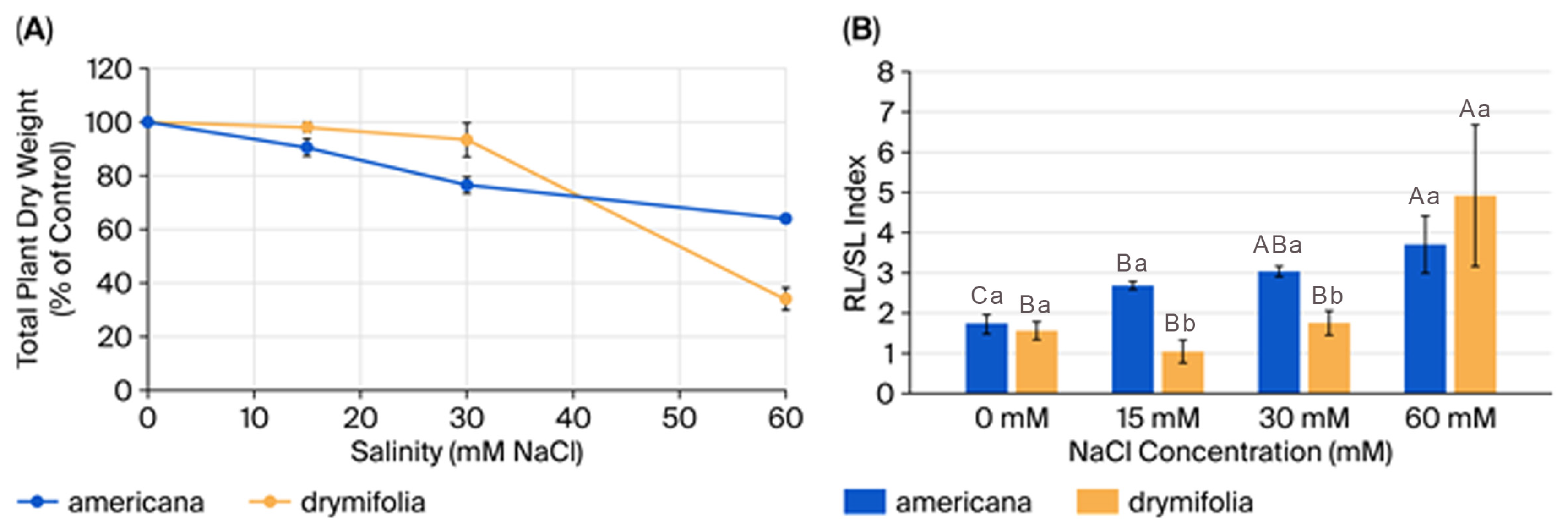
The reduction in growth of avocado seedlings under saline treatments, expressed as a percentage of the total plant dry weight relative to the control, showed that the americana variety was less affected by salinity than drymifolia was. At moderate NaCl concentrations (15–30 mM), total biomass was reduced by 3–7% in drymifolia and by 10–24% in americana. However, after 60 days of exposure to 60 mM NaCl, drymifolia seedlings exhibited a substantial biomass loss of approximately 66%, compared to a 36% reduction in that of americana (Figure 1A; Tables S1 and S2). Morphological data such as root length (RL), stem length (SL), total plant length (TPL), stem diameter (SD), root diameter (RD), and RL/SL index were determined in 60-day-old plants (Figure 1B; Tables S1 and S2). For var. americana, there were statistically significant differences in TPL, SD, and RL/SL index between NaCl concentrations, but there were no salinity treatment differences for RL and RD. For var. drymifolia, RL, TPL, and RL/SL showed differences at 60 mM NaCl with respect to the control. The SD and RD were reduced as NaCl concentration increased, with the reduction being more evident in the drymifolia variety. An increase in root length and a decrease in length of the shoot were observed in response to NaCl concentrations in both varieties (Tables S1 and S2). Figure 1B compares the root to shoot length (RL/SL) ratio in both avocado varieties under salinity. In the americana variety, this ratio increased progressively with NaCl concentration, showing a significant difference at 60 mM NaCl compared to the control. By contrast, drymifolia initially exhibited a decrease in this ratio, followed by an increase, with a significant rise only at 60 mM NaCl. This result suggests that drymifolia is more sensitive to salinity, and that the early reduction in its RL/SL ratio may reflect a faster onset of stress-related growth inhibition.

3.2. Ionic Homeostasis in Avocado Plants Under Saline Stress

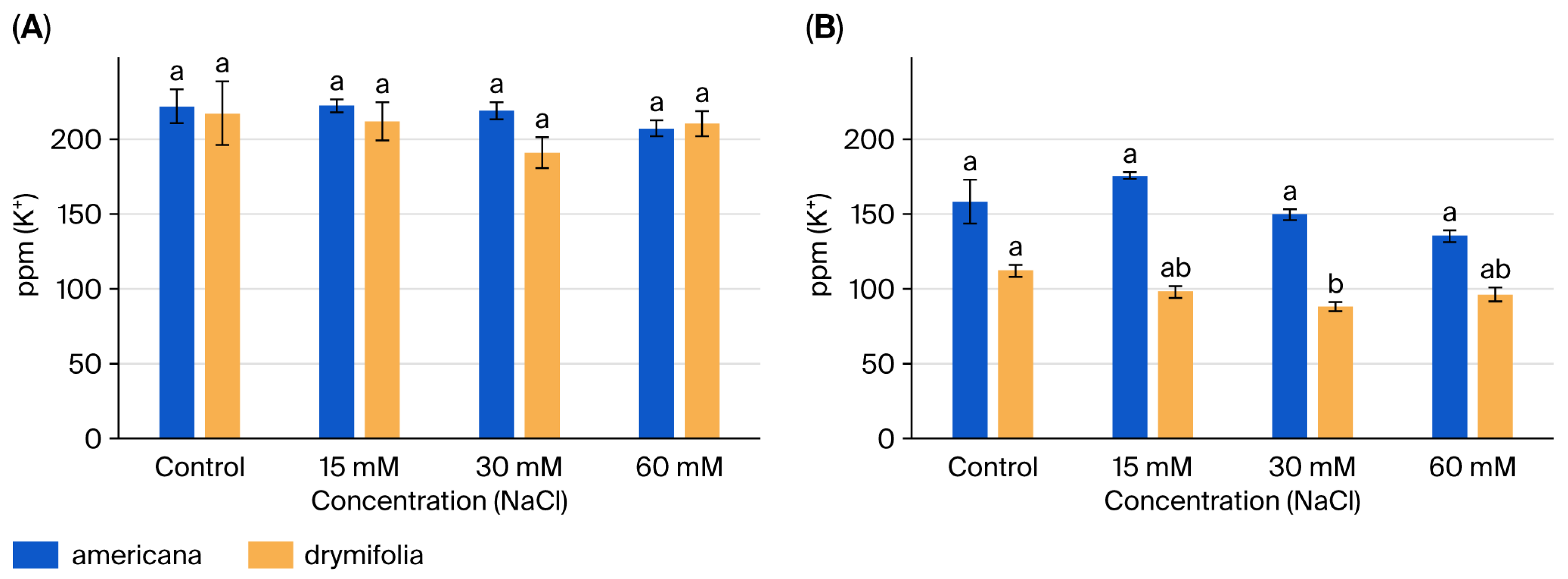
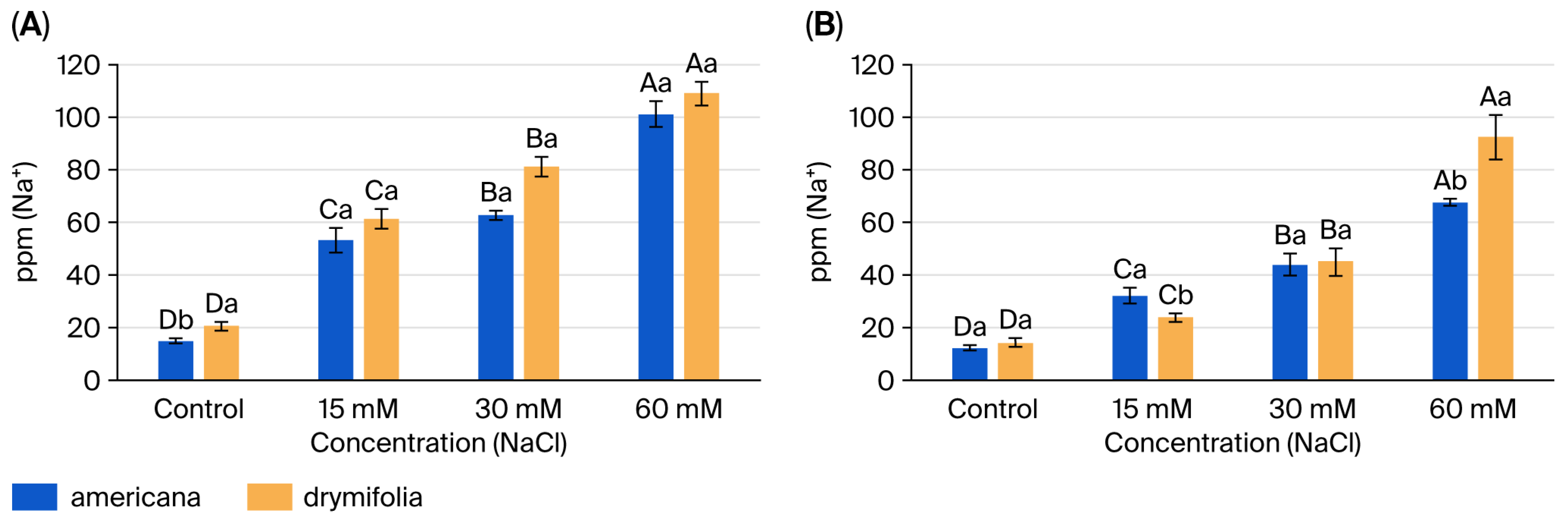
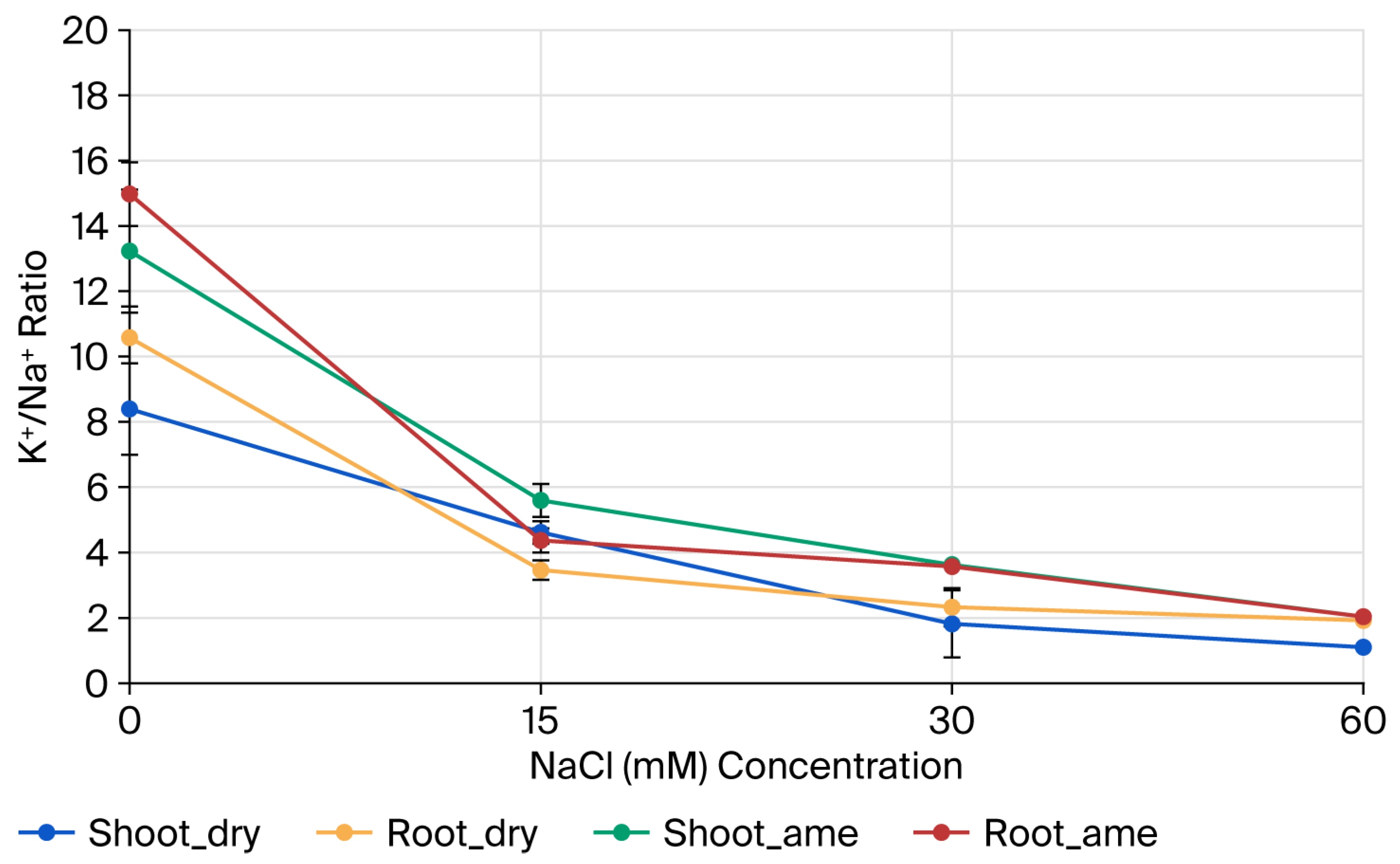
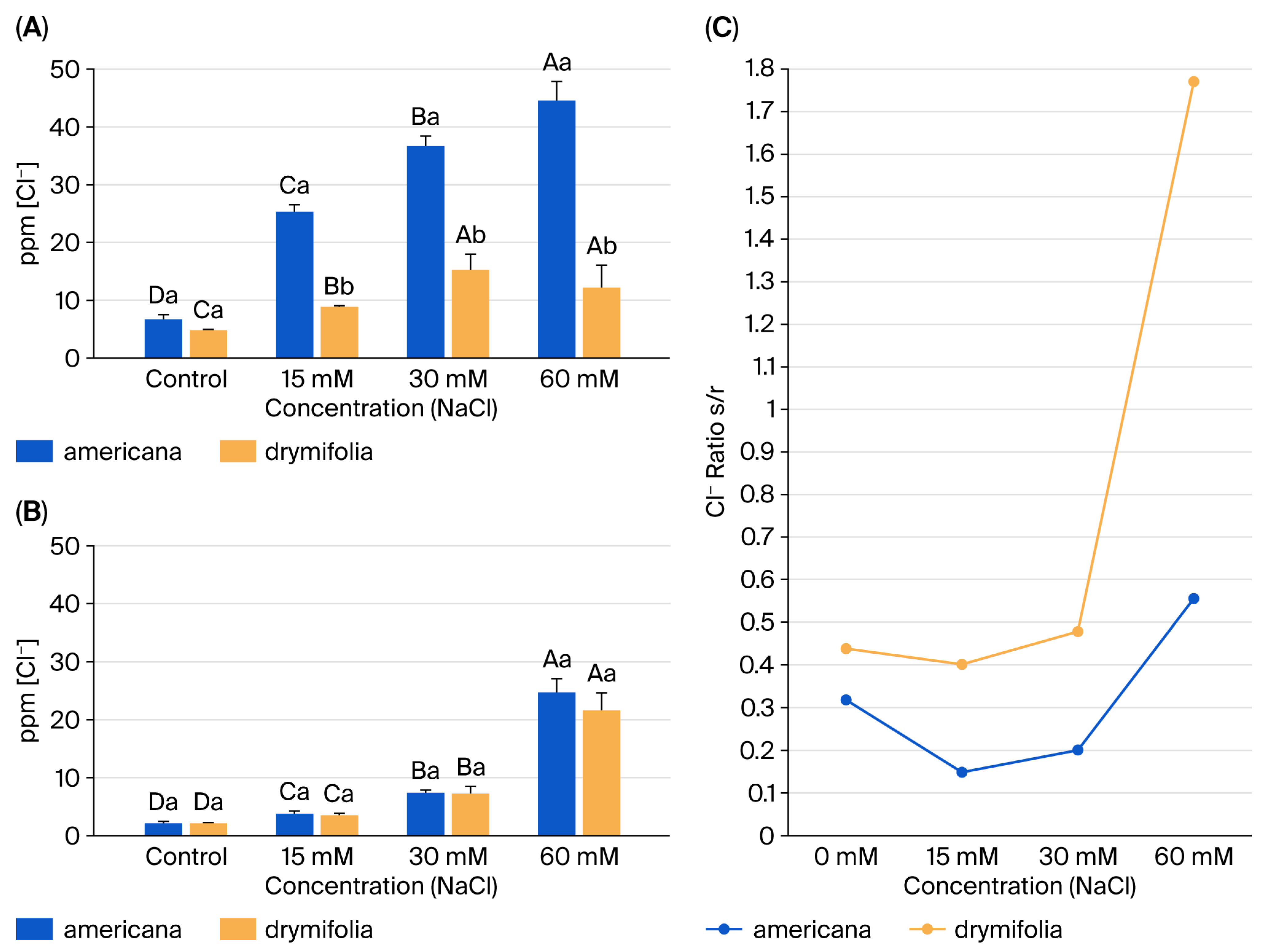
Maintaining K+ uptake at high external Na+ concentrations in the soil is essential for Na+/K+ homeostasis and salt tolerance. Ionic data on K+ and Na+ concentrations were quantified in the roots (R) and shoots (S) of 60-day-old plants of var. americana (Table S3) and var. drymifolia (Table S4). The distribution patterns of both ions are illustrated in Figure 2A,B for K+ and Figure 3A,B for Na+. Root K+ levels showed no significant differences between varieties as NaCl concentrations increased (Figure 2A). However, in the shoot, the americana variety maintained a significantly higher concentration of K+ compared to the drymifolia variety (Figure 2B). A different pattern was observed for Na+: its concentration increased progressively in both root and shoot tissues in response to rising NaCl levels. The highest concentration occurred in the root for both varieties (Figure 3A,B). At 60 mM NaCl, the drymifolia variety exhibited a pronounced increase in shoot Na+ concentration, suggesting a reduced ability to restrict Na+ translocation from root to shoot (Figure 3B). Both varieties showed a statistically significant difference compared to their respective controls (Table S3). The higher Na+ accumulation in the roots than shoots suggests the presence of similar mechanisms to retain Na+ in the roots to avoid damage to the aerial part in both varieties (Tables S3 and S4; Figure 3A,B). However, the americana variety consistently showed lower Na+ levels in the shoots, supporting its greater tolerance. In both varieties, NaCl exposure resulted in increased Na+ accumulation, leading to a pronounced decline in the K+/Na+ ratio in both roots and shoots as salinity increased (Figure 4). The concentration of Cl ions was higher in the roots than shoots for both varieties at different concentrations of NaCl treatments (Figure 5A,B). The roots of the americana variety accumulated significantly more Cl compared to drymifolia (Table S3; Figure 5A). In both varieties, we can observe that Cl accumulation is greater in the root than in the shoot, suggesting a similar mechanism to avoid damage to the photosynthetic tissue. However, at 60 mM NaCl, Cl accumulation was higher in the drymifolia shoot than in the root, indicating a breakdown of the exclusion mechanism that could cause significant toxicity in this variety (Figure 5C).

3.3. Phylogenetic Analysis of PaHKT1 and PaSOS1

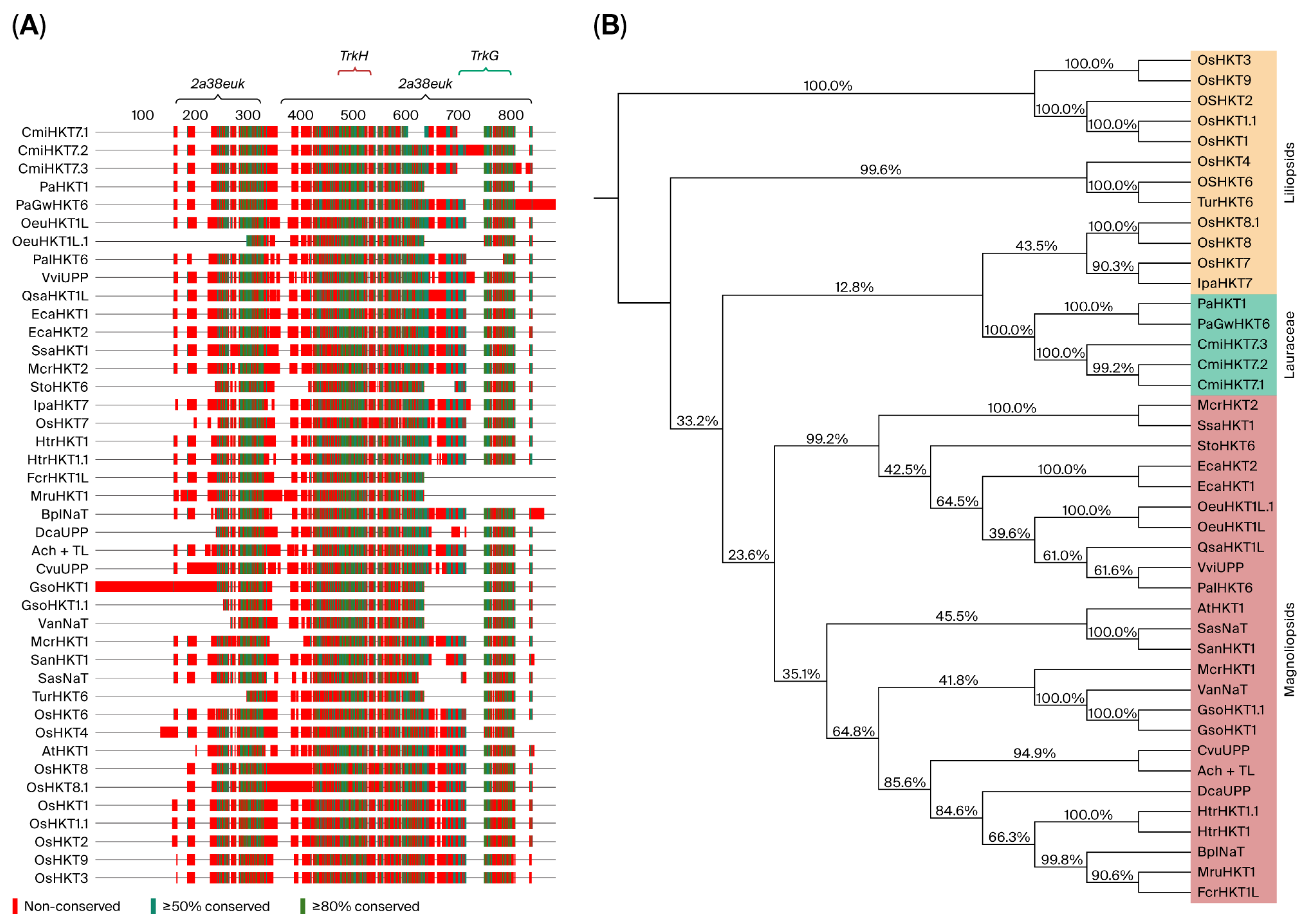
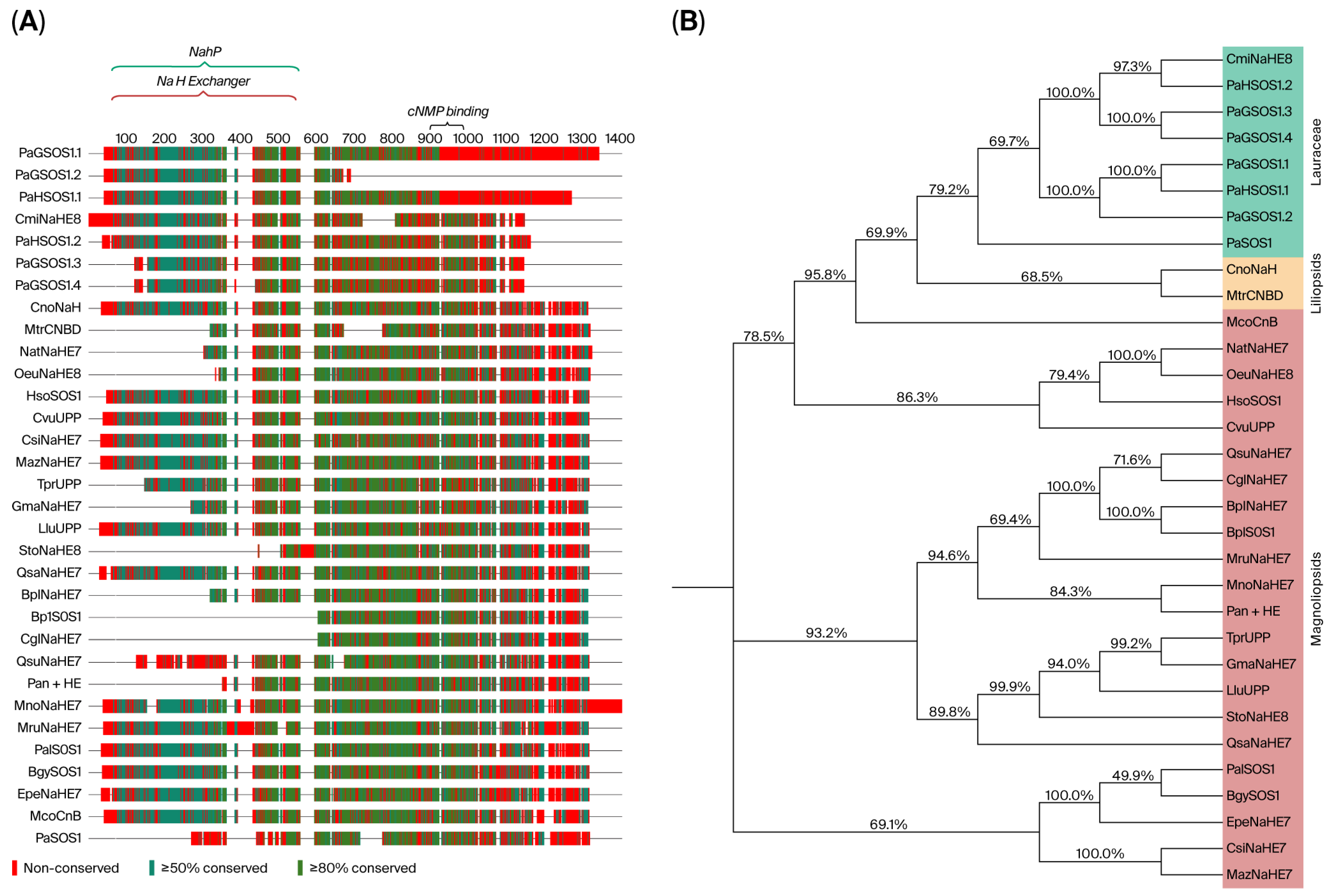
Most domains for HKT and SOS are incomplete. The conserved domain search (CD-s) for the sequences from HKT proteins returned mostly “non-specific” and “superfamily” hits. Most of the HKT proteins had incomplete segments from 2a38euk (cl30043), TrkH (cl17365), and TrkG (cl47277) domains (Figure 6A), all of which are involved in potassium (K+) metabolism and are thus expected to be found in HKT proteins. SOS protein conserved domains showed a wider variety of more specific hits, the most representative of which were Na+ H+ Exchanger (cl01133), NahP (cl42993), and cNMP_binding (cl47483) (Figure 7A). The first two are related to sodium (Na+) and hydrogen (H+) metabolism, while the latter is involved with cyclic monophosphate nucleotide interaction. For both protein sequence alignments, the disruption (gaps) of the conserved domains was observed, along with a high number of non-conserved residues (red).

3.3.1. Lauraceae Family Separates from HKT and SOS Groups

When cladograms were drawn from phylogeny trees, the Lauraceae (Persea and Cinnamomum) grouped separately from the other sequences in both cases. The HKT groups proposed by Bafeel [33] were present, but we focus on the Lauraceae, Liliopsida (monocot), and Magnoliopsida (eudicot) groups (Figure 6B) for Lauraceae HKT sequences. The cladogram shows a stronger relationship with Liliopsida sequences and a grade of ancestry with Magnoliopsida sequences. On the other hand, with the SOS grouping, Lauraceae proteins also formed a group separately and diverged close to but before the Liliopsida diverged (Figure 7B).

3.3.2. Lauraceae HKT and SOS Are Structurally Divergent

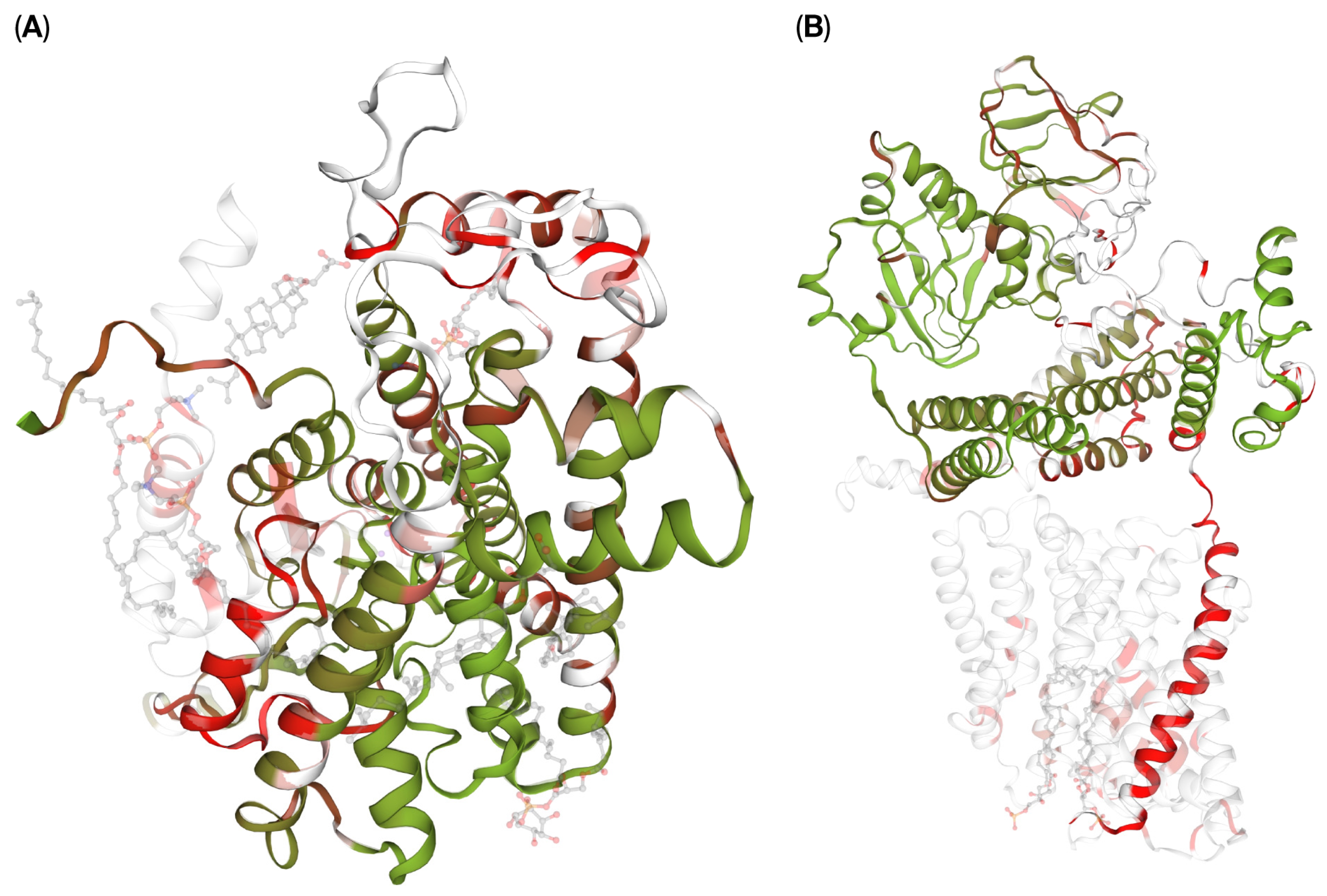
The most closely related protein models on the Swiss-Model databases for PaHTKT1 and PaSOS1 are 8k66.1 (Oriza sativa HKT2;1 from Cryo-Electron Microscopy) and 8Jd9.1 (Arabidopsis thaliana Na+/H+ antiporter SOS1 from Cryo-Electron Microscopy), respectively, both well described as salt tolerance proteins. Both are homo-dimer proteins with transmembrane motifs. For PaHKT1, the template used had interactive motifs for cholesterol hemisuccinate (Y01), phosphatidylinositol (T7X), phosphatidylethanolamine (PTY), cholesterol (CLR), 1,2-diacyl-sn-glycero-3-phosphocholyne (PC1), and sodium ions (NA), all of which are “not conserved” in the query model. In a 3D alignment comparison (Figure 8A), the template structure is shown as translucent, and the conserved (green), non-conserved (red), and gaps (white) show important conformational differences. For PaSOS1, the template used had interactive motifs just for PC1, which are also “not conserved” in the model. The differences were the most obvious in this case; the query model was not predicted to have a transmembrane domain, despite the template having it; and the structure comparison (Figure 8B) shows that most of the transmembrane motif was lost, leaving just an α -helix that can work as a membrane attachment but not enough for an ion channel.

3.4. Expression Analysis of PaHKT1 and PaSOS1 Under Salt Stress

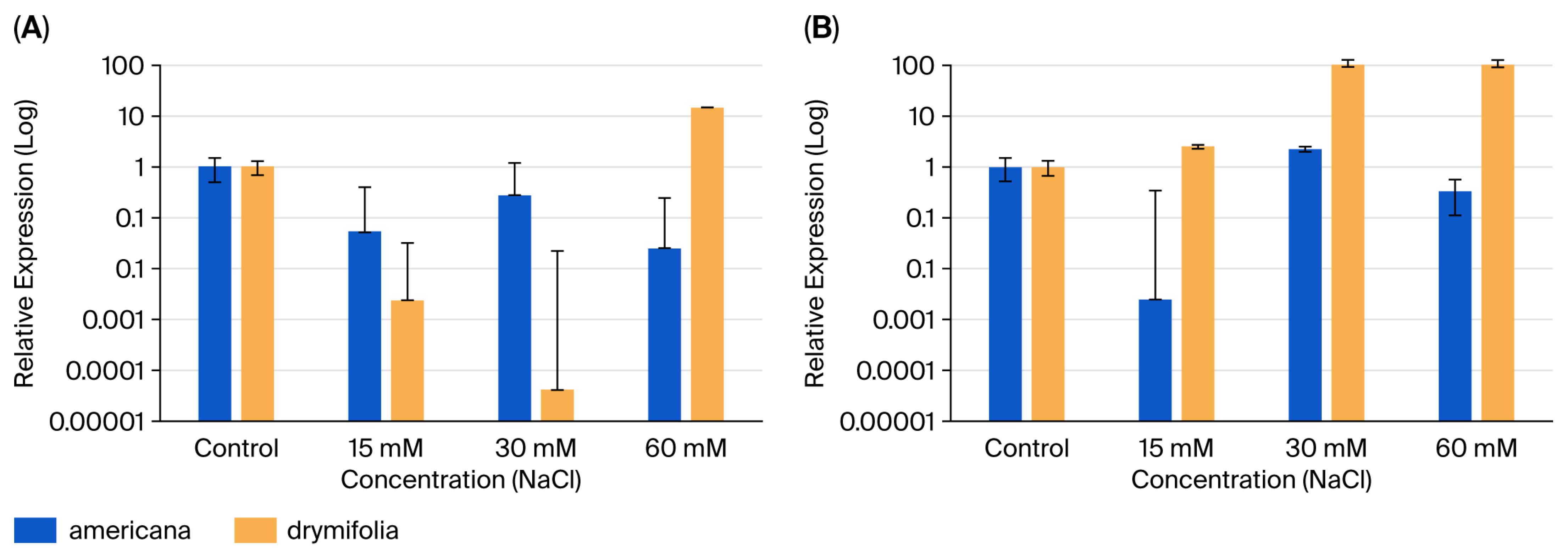
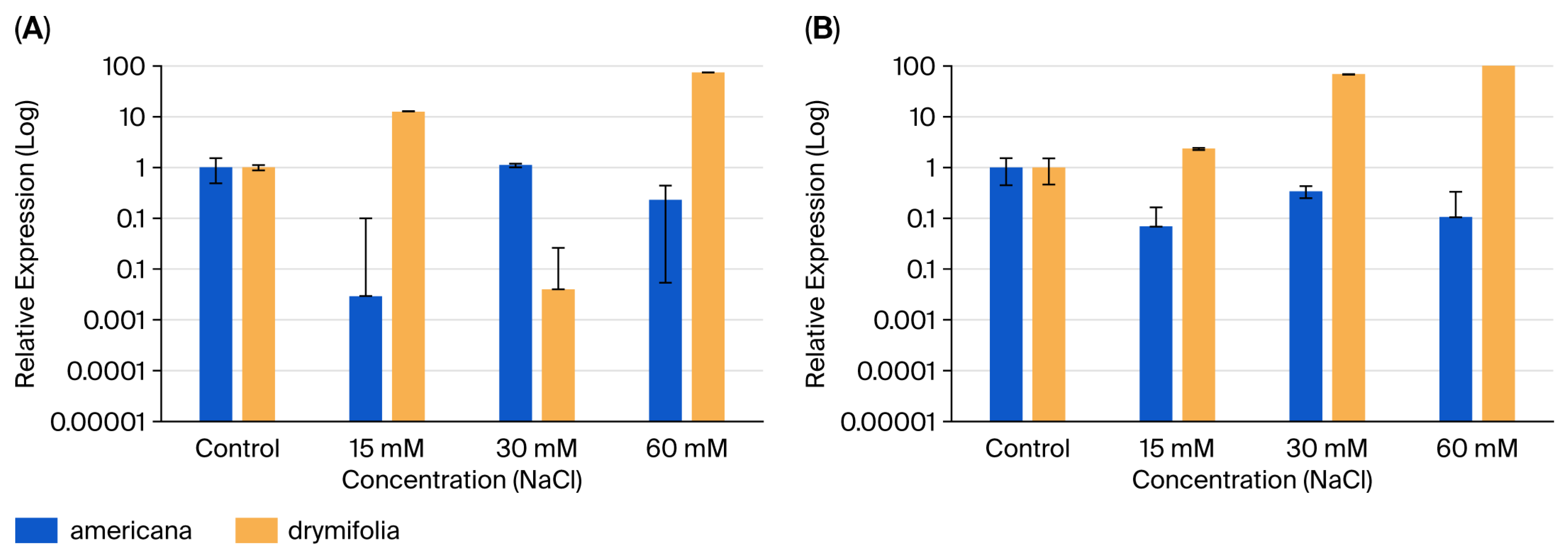
The gene expression patterns for PaHKT1 and PaSOS1 were analyzed in the roots and shoot of in vitro plants from var. americana and var. drymifolia grown for 60 days at different NaCl concentrations. For PaHKT1, no significant changes in gene expression were observed in either the roots or shoots of the americana variety across the NaCl treatments. By contrast, the drymifolia variety showed a differential pattern: PaHKT1 expression in the roots progressively decreased with increasing salinity, whereas in the shoots, transcript levels increased in response to higher NaCl concentrations, with the highest expression observed at 60 mM (Figure 9A,B).
The expression of the avocado PaSOS1 gene in the americana variety decreased progressively with increasing NaCl concentrations in both the roots and shoots. By contrast, the drymifolia variety exhibited an upregulation of PaSOS1 in the roots, but only at 30 and 60 mM NaCl. In the shoot tissue, PaSOS1 expression increased gradually with rising NaCl concentrations, with the most pronounced upregulation observed at 60 mM (Figure 10A,B).

4. Discussion

Soil salinity, primarily driven by high concentrations of Na+ and Cl, imposes severe constraints on plant growth. In this study, the two avocado varieties exhibited distinct physio-morphological responses to saline stress. The more pronounced reduction in total dry weight in var. drymifolia compared to var. americana, particularly at 60 mM NaCl (Figure 1A), suggests a higher sensitivity to salt stress in the former. Conversely, root growth in var. americana was less inhibited than shoot growth, leading to a consistent increase in the root-to-shoot length (RL/SL) ratio as NaCl concentrations rose. This shift likely represents an adaptive strategy to prioritize water uptake under saline stress. While var. drymifolia exhibited a similar trend, it maintained consistently lower index values compared to americana (Figure 1B; Table S1). Similar results in RL/SL index have been observed in citrus rootstock seedlings [34], Phaseolus [35], Populus [36], and Prosopis alba [37]. Since roots act as the primary interface for detecting soil salinity [2], osmotic stress typically inhibits root cell expansion, leading to reduced growth [2]. Consistent with this, both varieties exhibited a reduction in Lateral Root Number (LRN) and Leaf Number (LN) proportional to increasing NaCl concentrations (Table S1). However, distinct varietal responses were evident; the var. americana maintained superior root development (RL and RD) compared to drymifolia. This robust root architecture likely facilitates enhanced water and nutrient uptake while favoring the retention of toxic ions within the root tissue, thereby restricting translocation to aerial parts. Such exclusion is a classic mechanism of salt resistance [38]. While the general decline in morphological traits aligns with findings in avocado and other crops [3,39], the consistently lower RL/SL values in drymifolia confirm its greater susceptibility to saline stress. Potassium (K+), as the most abundant inorganic ion in plant cells, plays a crucial role in metabolic, physiological, and developmental processes [40,41]. High external Na+ concentrations competitively inhibit K+ uptake systems and stimulate K+ efflux, leading to insufficient cellular K+ concentrations for enzymatic reactions and osmotic adjustment [42,43]. K+ levels did not increase in the roots and shoots relative to the control at different sodium treatments in both varieties (Figure 2A,B; Tables S3 and S4). Conversely, Na+ content increased progressively with rising NaCl concentrations (Figure 3; Tables S3 and S4). In both varieties, the concentrations of K+ and Na+ were higher in the roots than in the shoots, which suggests a more significant osmotic adjustment in the roots. Analysis of the K+/Na+ ratio reveals the preferential uptake of Na+ over K+, indicating that K+ is not involved in osmotic adjustment in avocado plants at this developmental stage (Figure 4; Tables S3 and S4). In woody perennials like avocado, Cl- accumulation in leaves, rather than Na+, is the primary driver of toxicity, correlating directly with reduced photosynthesis and yield loss [23,24]. In this study, the two varieties exhibited differential Cl accumulation patterns. At 60 mM NaCl, Cl concentration in the drymifolia shoot exceeded that of the root. This inversion suggests that the root’s retention capacity was saturated, leading to unrestricted transport of toxic ions to the aerial tissues, a phenomenon indicative of the breakdown of the exclusion mechanism that could cause significant toxicity in this variety [23,24]. By contrast, var. americana maintained significantly higher Cl levels in the roots compared to drymifolia (Figure 5), suggesting a superior capacity for ion sequestration within the root tissue to protect the aerial parts. This physiological trait supports the rationale behind using americana rootstocks for cultivation in saline conditions [44,45] and aligns with strategies that select rootstocks capable of limiting xylem loading [40]. In this context, while key transporter families such as SLAH, NPF, ALMT, or CLC are now recognized as central players in maintaining Cl homeostasis and preventing toxicity under saline stress in plants [41], the key transporters involved in this process in avocado remain virtually unknown. The Na+ transporters HKT1 and SOS1 are typically critical for exclusion and tolerance in model plants [16,17,18,46]. Our qPCR analysis revealed that the sensitive drymifolia variety exhibited a clear upregulation of PaHKT1 and PaSOS1 in shoots at 30 and 60 mM NaCl, which was positively correlated with a small but significant increase in Na+ concentrations in this tissue (Figure 9 and Figure 10). In contrast, the tolerant americana variety showed no clear expression pattern for PaHKT1 and PaSOS1 in response to increasing Na+ levels, maintaining stable transcript levels across all treatments. The fact that Na+ continues to accumulate in drymifolia shoots despite this increased expression may indicate that these transporters are functionally ineffective in avocado. This is further supported by our in silico analysis (Figure 6, Figure 7 and Figure 8), which identifies significant structural deviations and the absence of conserved functional domains in PaHKT1 and PaSOS1 compared to their homologs in model species. Therefore, in avocado, high transcript levels do not translate into effective Na+ exclusion, suggesting that the species relies on alternative strategies, likely focused on Cl management. Although Cl- is the primary toxic agent in avocado, this upregulation of PaHKT1 and PaSOS1 (Na+ exclusion genes) in the sensitive variety may represent a reactive stress response rather than a proactive defense mechanism suggesting that the variety’s collapse is not due to chloride alone, but a systemic failure in managing both ions. This lack of transcriptional response, combined with the significant structural deviations and absence of conserved functional domains compared to homologs (Figure 6, Figure 7 and Figure 8), strongly suggests that PaHKT1 and PaSOS1 play negligible role in avocado salt tolerance. Unlike the Na+-centric tolerance mechanisms proven for Liliopsida and Magnoliopsida model species (e.g., O. sativa, A. thaliana, G. max) [19,47], P. americana var. americana appears to rely on alternative strategies focused on managing Cl toxicity [1,48]. This functional distinction may stem from the evolutionary divergence of the Lauraceae family. Furthermore, the ancient domestication of avocado [49] may have led to relaxed selective pressure on these specific ancestral resistance genes, resulting in their functional divergence or silencing. Consequently, future research must prioritize the identification of lineage-specific mechanisms, particularly those involving Cl regulation, to fully understand salt sensitivity in “avocado”.

5. Conclusions

In this study, we demonstrate a marked differential response to salinity between avocado varieties. While var. drymifolia exhibited severe growth inhibition and morphological damage, var. americana displayed superior resilience. Physiologically, this tolerance was not mediated by K+ homeostasis—as concentrations remained unaltered. Our results lead to the refutation of the initial hypothesis, which proposed that avocado salinity tolerance is primarily mediated by the transcriptional regulation of canonical Na+ exclusion genes, a finding consistent with the significant structural divergences and lack of conserved functional domains identified in these proteins. Instead, this study demonstrates that the superior resilience of var. americana is driven by its effective capacity to sequester Cl in roots, thereby restricting its translocation to aerial tissues, while the sensitive var. drymifolia suffers from a total breakdown of these exclusion barriers. Consequently, unlike model Liliopsida and Magnoliopsida species (e.g., O. sativa, A. thaliana), in which tolerance is primarily driven by Na+ exclusion, P. americana var. americana appears to rely on alternative mechanisms focused on managing Cl toxicity. These findings suggest that the salinity tolerance machinery in avocado diverges from established models, highlighting the necessity to redirect future research toward lineage-specific mechanisms within the Lauraceae family.

Supplementary Materials

The following supporting information can be downloaded at: https://www.mdpi.com/article/10.3390/horticulturae12050562/s1, Table S1. Morphological data of americana variety plants after 60 days under saline stress. Table S2. Morphological data of drymifolia variety plants after 60 days under saline stress. Table S3. Concentration of K+, Na+ and Cl (mg kg−1) in root and shoot of americana variety plants after 60 days under saline stress. Table S4. Concentration of K+, Na+ and Cl (mg kg−1) in root and shoot of drymifolia variety plants after 60 days under saline stress.

Author Contributions

Conceptualization, R.L.-G. and L.M.S.-R.; methodology, L.M.S.-R. and E.A.C.E.; software, F.S.-A. and M.G.-R.; validation, L.M.S.-R., F.S.-A. and M.G.-R.; formal analysis, R.L.-G., L.M.S.-R., A.B. and E.A.C.E.; investigation, E.A.C.E.; writing—original draft preparation, R.L.-G., L.M.S.-R., E.A.C.E. and M.G.-R.; writing—review and editing, R.L.-G., A.B., L.M.S.-R. and F.S.-A. All authors have read and agreed to the published version of the manuscript.

Funding

This research received no external funding.

Data Availability Statement

The original contributions presented in this study are included in the article/Supplementary Materials. Further inquiries can be directed to the corresponding author.

Acknowledgments

We would like to thank the Instituto de Ciencia, Tecnología e Innovación (ICTI) del Estado de Michoacán and Consejo de la Investigación Científica (CIC) Universidad Michoacana de San Nicolás de Hidalgo (UMSNH) for financial support. We also express our appreciation to the Consejo Nacional de Humanidades, Ciencias y Tecnologías (CONAHCYT), for Essoh Aimé Cesaire Elekou’s PhD scholarship. Dra Ruth Esther Villanueva Estrada, Instituto de Geofísica UNAM for technical support.

Conflicts of Interest

The authors declare no conflicts of interest.

References

  1. Van Zelm, E.; Zhang, Y.; Testerink, C. Salt tolerance mechanisms of plants. Ann. Rev. Plant Biol. 2020, 71, 403–433. [Google Scholar] [CrossRef]
  2. Atta, K.; Mondal, S.; Gorai, S.; Singh, A.P.; Kumari, A.; Ghosh, T.; Roy, A.; Hembram, S.; Gaikwad, D.J.; Mondal, S.; et al. Impacts of salinity stress on crop plants: Improving salt tolerance through genetic and molecular dissection. Front. Plant Sci. 2023, 14, 1241736. [Google Scholar] [CrossRef]
  3. Balasubramaniam, T.; Shen, G.; Esmaeili, N.; Zhang, H. Plants’ Response Mechanisms to Salinity Stress. Plants 2023, 12, 2253. [Google Scholar] [CrossRef] [PubMed]
  4. Zhang, H.; Yu, C.; Zhang, Q.; Qiu, Z.; Zhang, X.; Hou, Y.; Zang, J. Salinity survival: Molecular mechanisms and adaptive strategies in plants. Front. Plant Sci. 2025, 16, 1527952. [Google Scholar] [CrossRef] [PubMed]
  5. Cardona, W.A.; Gutiérrez, D.J.S.; Monsalve, C.O.I.; Bonilla, C.C.R. Efecto de la salinidad sobre el crecimiento vegetativo de plantas de mora de Castilla (Rubus glaucus Benth.) micorrizadas y sin micorrizar. Rev. Colomb. de Cienc. Hortícolas 2017, 11, 253–266. [Google Scholar] [CrossRef]
  6. Álvarez-Acosta, C.; Marrero-Dominguez, A.; Gallo-Llobet, L.; Gonzalez-Rodriguez, A.M. Physiological response of selected avocados (Persea americana) subjected to NaCl and NaHCO3 stress. Sci. Hortic. 2018, 237, 81–88. [Google Scholar] [CrossRef]
  7. Bonomelli, C.; Celis, V.; Lombardi, G.; Mártiz, J. Salt Stress Effects on Avocado (Persea americana Mill.) Plants with and without Seaweed Extract (Ascophyllum nodosum) Application. Agronomy 2018, 8, 64. [Google Scholar] [CrossRef]
  8. Rodríguez, L.N.D.; Torres, S.C.N.; Chaman, M.M.E. Efecto del estrés salino en el crecimiento y contenido relativo del agua en las variedades IR-43 y amazonas de Oryza sativa “arroz” (Poaceae). Arnaldoa 2019, 26, 931–942. [Google Scholar] [CrossRef]
  9. Wegner, L.H.; Pottosin, I.; Dreyer, I.; Shabala, S. Potassium homeostasis and signalling: From the whole plant to the subcellular level. Quant. Plant Biol. 2025, 6, e13. [Google Scholar] [CrossRef]
  10. Shen, Y.; Shen, L.; Shen, Z.; Jing, W.; Ge, H.; Zhao, J.; Zhang, W. The potassium transporter OsHAK21 functions in the maintenance of ion homeostasis and tolerance to salt stress in rice. Plant Cell Environ. 2015, 38, 2766–2779. [Google Scholar] [CrossRef] [PubMed]
  11. Mäser, P.; Eckelman, B.; Vaidyanathan, R.; Horie, T.; Fairbairn, D.J.; Kubo, M.; Yamagami, M.; Yamaguchi, K.; Nishimura, M.; Uozumi, N.; et al. Altered shoot/root Na+ distribution and bifurcating salt sensitivity in Arabidopsis by genetic disruption of the Na+ transporter AtHKT1. FEBS Lett. 2002, 531, 157–161. [Google Scholar] [CrossRef] [PubMed]
  12. Abdelrady, W.A.; Mostafa, K.; Saeed, M.; Elshawy, E.E.; Kavas, M.; Mladenov, V.; Zeng, F. NHX transporters: Molecular mechanisms and applications for enhancing crop resilience to soil salinity in changing environments. Plant Physiol. Biochem. 2025, 229, 110603. [Google Scholar] [CrossRef] [PubMed]
  13. Uchiyama, T.; Saito, S.; Yamanashi, T.; Kato, M.; Takebayashi, K.; Hamamoto, S.; Tsujii, M.; Takagi, T.; Nagata, N.; Ikeda, H.; et al. The HKT1 Na+ transporter protects plant fertility by decreasing Na+ content in stamen filaments. Sci. Adv. 2023, 9, eadg5495. [Google Scholar] [CrossRef]
  14. Pardo, J.M.; Rubio, F. Na+ and K+ transporters in plant signaling. In Transporters and Pumps in Plant Signaling; Signaling and Communication in Plants; Geisler, M., Venema, K., Eds.; Springer: Berlin/Heidelberg, Germany, 2011; Volume 7, pp. 65–98. [Google Scholar] [CrossRef]
  15. Shi, H.; Quintero, F.J.; Pardo, J.M.; Zhu, J.K. The putative plasma membrane Na+/H+ antiporter SOS1 controls long-distance Na+ transport in plants. Plant Cell 2002, 14, 465–477. [Google Scholar] [CrossRef]
  16. Olías, R.; Eljakaoui, Z.; Li, J.; De Morales, P.A.; Marín-Manzano, M.C.; Pardo, J.M.; Belver, A. The plasma membrane Na+/H+ antiporter SOS1 is essential for salt tolerance in tomato and affects the partitioning of Na+ between plant organs. Plant Cell Environ. 2009, 32, 904–916. [Google Scholar] [CrossRef] [PubMed]
  17. Hauser, F.; Horie, T. A conserved primary salt tolerance mechanism mediated by HKT transporters: A mechanism for so-dium exclusion and maintenance of high K+/Na+ ratio in leaves during salinity stress. Plant Cell Environ. 2010, 33, 552–565. [Google Scholar] [CrossRef]
  18. Jaime-Pérez, N.; Pineda, B.; García-Sogo, B.; Atares, A.; Athman, A.; Byrt, C.S.; Olías, R.; Asins, M.J.; Gilliham, M.; Moreno, V.; et al. The sodium transporter encoded by the HKT1;2 gene modulates sodium/potassium homeostasis in tomato shoots under salinity. Plant Cell Environ. 2017, 40, 658–671. [Google Scholar] [CrossRef]
  19. Barragán, V.; Leidi, E.O.; Andrés, Z.; Rubio, L.; De Luca, A.; Fernández, J.A.; Cubero, B.; Pardo, J.M. Ion Exchangers NHX1 and NHX2 Mediate Active Potassium Uptake into Vacuoles to Regulate Cell Turgor and Stomatal Function in Arabidopsis. Plant Cell 2012, 24, 1127–1142. [Google Scholar] [CrossRef]
  20. Amo, J.; Lara, A.; Martínez-Martínez, A.; Martínez, V.; Rubio, F.; Nieves-Cordones, M. The protein kinase SlCIPK23 boosts K+ and Na+ uptake in tomato plants. Plant Cell Environ. 2021, 44, 3819–3835. [Google Scholar] [CrossRef]
  21. Elekou, E.A.C.; Suárez-Rodríguez, L.M.; Gómez-Romero, M.; Bayuelo-Jiménez, J.S.; Belver, A.; Díaz-Pérez, J.C.; López-Gómez, R. Characterization of the PaHAK Gene and Its Expression During the In Vitro Seed Germination of Two Botanical Avocado Varieties Under Saline Stress. Life 2024, 14, 1680. [Google Scholar] [CrossRef]
  22. Pliego-Alfaro, F.; Palomo-Ríos, E.; Mercado, J.A.; Pliego, C.; Barceló-Muñoz, A.; López-Gómez, R.; Hormaza, J.I.; Litz, R.E. Persea americana Avocado. In Biotechnology of Fruit and Nut Crops, 2nd ed.; Litz, R.E., Pliego-Alfaro, F., Hornaza, J.I., Eds.; CABI: Boston, MA, USA, 2020; pp. 258–281. [Google Scholar]
  23. Kandemir, S.; İncesu, M. Determination of Salt Tolerance Levels of Some Avocado Species. Int. J. Agric. Environ. Food Sci. 2025, 9, 906–912. [Google Scholar] [CrossRef]
  24. Mickelbart, M.V.; Melser, S.; Arpaia, M.L. Salinity-induced changes in ion concentrations of ‘Hass’ avocado trees on three rootstocks. J. Plant Nutr. 2007, 30, 105–122. [Google Scholar] [CrossRef]
  25. Elekou, E.A.C.; Perea-Arango, I.; Suárez-Rodríguez, L.M.; López-Gómez, R. In Vitro seed germination and seedling development of two avocado varieties. In Seed Biology Updates, 1st ed.; Jimenez-Lopez, J.C., Ed.; IntechOpen: London, UK, 2022; pp. 93–105. [Google Scholar] [CrossRef]
  26. Murashige, T.; Skoog, F.A. A Revised Medium for Rapid Growth and Bioassays with Tobacco Tissue Cultures. Physiol. Plant. 1962, 15, 473–497. [Google Scholar] [CrossRef]
  27. Schroeder, C.A. Avocado tissue in vitro. Calif. Avocado Soc. Yearb. 1980, 64, 139–141. [Google Scholar]
  28. Basta, N.T.; Tabatabai, M.A. Determination of Exchangeable Bases in Soils by Ion Chromatography. Soil Sci. Soc. Am. J. 1985, 49, 84–89. [Google Scholar] [CrossRef]
  29. Bafeel, S.O. Phylogeny of the Plant Salinity Tolerance Related HKT Genes. Int. J. Biol. 2013, 5, 64–68. [Google Scholar] [CrossRef]
  30. Larkin, M.A.; Blackshields, G.; Brown, N.P.; Chenna, R.; McGettigan, P.A.; McWilliam, H.; Valentin, F.; Wallace, I.M.; Wilm, A.; Lopez, R.; et al. Clustal W and Clustal X version 2.0. Bioinformatics 2007, 23, 2947–2948. [Google Scholar] [CrossRef]
  31. Barbier, F.F.; Chabikwa, T.G.; Ahsan, M.U.; Cook, S.E.; Powell, R.; Tanurdzic, M.; Beveridge, C.A. A phenol/chloroform-free method to extract nucleic acids from recalcitrant, woody tropical species for gene expression and sequencing. Plant Methods 2019, 15, 62. [Google Scholar] [CrossRef]
  32. Livak, K.J.; Schmittgen, T.D. Analysis of relative gene expression data using real-time quantitative PCR and the 2(-Delta Delta C(T)) method. Methods 2001, 25, 402–408. [Google Scholar] [CrossRef]
  33. StatSoft Inc. Statistica System Reference 2011; StatSoft, Inc.: Tulsa, OK, USA, 2011. [Google Scholar]
  34. García-Sánchez, F.; Botia, P.; Fernández-Ballester, G.; Cerdá, A.; Martínez Lopez, V. Uptake, Transport, and Concentration of Chloride and Sodium in Three Citrus Rootstock Seedlings. J. Plant Nutr. 2005, 28, 1933–1945. [Google Scholar] [CrossRef]
  35. Bayuelo-Jiménez, J.S.; Debouck, D.G.; Lynch, J.P. Growth, gas exchange, water relations, and ion composition of Phaseolus species grown under saline conditions. Field Crops Res. 2003, 80, 207–222. [Google Scholar] [CrossRef]
  36. Liu, Y.; Su, M.; Han, Z. Effects of NaCl stress on the growth, physiological characteristics and anatomical structures of Populus talassica × Populus euphratica seedlings. Plants 2022, 11, 3025. [Google Scholar] [CrossRef]
  37. Meloni, D.A.; Silva, D.M.; Ledesma, R.; Bolzón, G.I. Mineral nutrition and photosynthesis of Prosopis alba (Fabaceae) seedlings under saline stress. UNED Res. J. 2017, 9, 297–304. [Google Scholar] [CrossRef][Green Version]
  38. Acosta-Motos, J.R.; Ortuño, M.F.; Bernal-Vicente, A.; Diaz-Vivancos, P.; Sanchez-Blanco, M.J.; Hernández, J.A. Plant Responses to Salt Stress: Adaptive Mechanisms. Agronomy 2017, 7, 18. [Google Scholar] [CrossRef]
  39. Kourgialas, N.N.; Karatzas, G.P. Water management and salinity adaptation approaches of avocado trees: A review for hot-summer Mediterranean climate. Agric. Water Manag. 2021, 252, 106923. [Google Scholar] [CrossRef]
  40. Li, B.; Tester, M.; Gilliham, M. Chloride on the Move. Trends Plant Sci. 2017, 22, 236–248. [Google Scholar] [CrossRef]
  41. Silva-Herrera, H.; Wege, S.; Franzisky, B.L.; Ahmad, N.; Roelfsema, M.R.G.; Geilfus, C.M. Chloride transport and homeostasis in plants. Quant Plant Biol. 2025, 6, e20. [Google Scholar] [CrossRef]
  42. Dreyer, I. Potassium (K+) in plants. J. Plant Physiol. 2014, 171, 655. [Google Scholar] [CrossRef] [PubMed]
  43. Monder, H.; Maillard, M.; Chérel, I.; Zimmermann, S.D.; Paris, N.; Cuéllar, T.; Gaillard, I. Adjustment of K+ fluxes and grapevine defense in the face of climate change. Int. J. Mol. Sci. 2021, 22, 10398. [Google Scholar] [CrossRef]
  44. Lahav, E.; Steinhardt, R.; Kalmar, D. Effect of salinity on the nutritional level of the avocado. In Optimization of Plant Nutrition. Developments in Plant and Soil Sciences; Fragoso, M.A.C., Van Beusichem, M.L., Houwers, A., Eds.; Springer: Dordrecht, The Netherlands, 1993; Volume 53, pp. 593–596. [Google Scholar] [CrossRef]
  45. Acosta-Rangel, A.M.; Li, R.; Celis, N.; Suarez, D.L.; Santiago, L.S.; Arpaia, M.L.; Mauk, P.A. The physiological response of ‘Hass’ avocado to salinity is influenced by rootstock. Sci. Hortic. 2019, 256, 108629. [Google Scholar] [CrossRef]
  46. Wang, Z.; Hong, Y.; Zhu, G.; Li, Y.; Niu, Q.; Yao, J.; Hua, K.; Bai, J.; Zhu, Y.; Shi, H.; et al. Loss of salt tolerance during tomato domestication conferred by variation in a Na+ /K+ transporter. EMBO J. 2020, 39, e103256. [Google Scholar] [CrossRef]
  47. Hameed, A.; Khan, M.A.; Tahir, M.H.N.; Lodhi, M.S.; Muzammil, S.; Shafiq, M.; Gechev, T.; Faisal, M. In Silico identification and characterization of SOS gene family in soybean: Potential of calcium in salinity stress mitigation. PLoS ONE 2025, 20, e0317612. [Google Scholar] [CrossRef]
  48. Shelke, D.; Nikalje, G.; Nikam, T.; Maheshwari, P.; Punita, D.; Rao, K.; Kavi Kishor, P.; Suprasanna, P. Chloride (Cl) Uptake, Transport, and Regulation in Plant Salt Tolerance. In Molecular Plant Abiotic Stress; Roychoudhury, A., Tripathi, D., Eds.; Wiley: Hoboken, NJ, USA, 2019; pp. 241–268. [Google Scholar] [CrossRef]
  49. Galindo-Tovar, M.E.; Arzate-Fernández, A.M.; Ogata-Aguilar, N.; Landero-Torres, I. The Avocado (Persea Americana, Lauraceae) Crop in Mesoamerica: 10,000 Years of History. Harv. Pap. Bot. 2007, 12, 325–334. [Google Scholar] [CrossRef]
Figure 1. Relative growth expressed as % of total dry weight under saline conditions relative to the control (A), and the RL/SL index (B) of Persea americana var. drymifolia and var. americana after 60 days of salinity exposure. Different letters above the bars indicate significant differences (Tukey’s test, α = 0.05); uppercase = within-variety differences, lowercase = between-variety differences in NaCl.
Horticulturae 12 00562 g001
Figure 2. Comparison of K+ concentrations in root (A) and shoot (B) between Persea americana var. americana and var. drymifolia after 60 days of exposure to salinity. Different letters above the bars indicate statistically significant differences according to Tukey’s test (α = 0.05) at the same NaCl concentration.
Horticulturae 12 00562 g002
Figure 3. Comparison of Na+ concentrations in root (A) and shoot (B) within and between Persea americana var. americana and var. drymifolia after 60 days of exposure to salinity. Different letters above the bars indicate statistically significant differences according to Tukey’s test, (α = 0.05); uppercase letters denote within-variety differences in comparisons across NaCl treatments, while lowercase letters denote between-variety differences in comparisons at the same NaCl concentration.
Horticulturae 12 00562 g003
Figure 4. K+/Na+ ratio of avocado seedlings of americana and drymifolia varieties in response to NaCl concentration. The ratio values decreased with increasing NaCl concentration, both in the root and in the aerial part of both varieties.
Horticulturae 12 00562 g004
Figure 5. Comparison of Cl concentrations in root (A) and shoot (B) within and between Persea americana var. americana and var. drymifolia after 60 days of exposure to salinity. Cl ratio S/R (C). Different letters above the bars indicate statistically significant differences according to Tukey’s test, (α = 0.05); uppercase letters denote within-variety differences in comparisons across NaCl treatments, while lowercase letters denote between-variety differences in comparisons at the same NaCl concentration.
Horticulturae 12 00562 g005
Figure 6. (A) Alignment from HKT plant sequences that shows gaps and non-conserved (red) residues among all the sequences. (B) Cladogram that shows the correlation between Liliopsidas (monocot), Magnoliopsida (eudicot), and Lauraceae HKT plant sequences.
Horticulturae 12 00562 g006
Figure 7. (A) Alignment from SOS1 plant sequences that shows gaps and non-conserved (red) residues among all the sequences. (B) Cladogram that shows the correlation between Liliopsida (monocot), Magnoliopsida (eudicot), and Lauraceae SOS plant sequences.
Horticulturae 12 00562 g007
Figure 8. Three-dimensional structure of comparison of avocado Na+/K+ transporters. (A) PaHKT1 and (B) PaSOS1. Parts in green show conserved regions, those in red show non-conserved regions; and those in white are gap regions among functional salt-tolerant proteins used as template (translucent) and modeled proteins from PaHKT1 and PaSOS1 sequences.
Horticulturae 12 00562 g008
Figure 9. Avocado PaHKT1 transcript levels in the root (A) and shoot (B) of seedlings of two avocado varieties P. americana var. americana and var. drymifolia grown with different NaCl concentrations for 60 days. Three replicates were measured per saline treatment of each variety.
Horticulturae 12 00562 g009
Figure 10. Avocado PaSOS1 transcript levels in the root (A) and shoot (B) of seedlings of two avocado varieties P. americana var. americana and var. drymifolia grown with different NaCl concentrations for 60 days. Three replicates were measured per saline treatment of each variety.
Horticulturae 12 00562 g010
Disclaimer/Publisher’s Note: The statements, opinions and data contained in all publications are solely those of the individual author(s) and contributor(s) and not of MDPI and/or the editor(s). MDPI and/or the editor(s) disclaim responsibility for any injury to people or property resulting from any ideas, methods, instructions or products referred to in the content.