Aromatic Fingerprint of Emerging White Grape Genotypes: Free and Bound Volatiles Under Warm Climate Conditions

 ,
,  ,
,  ,
, 

Abstract
1. Introduction
2. Materials and Methods
2.1. Experimental Conditions
2.2. Physicochemical Grape Parameters
2.3. Grape Sample Preparation
2.4. Gas Chromatographic Analysis
2.5. Statistical Analysis
3. Results and Discussion
3.1. Physicochemical Characteristics
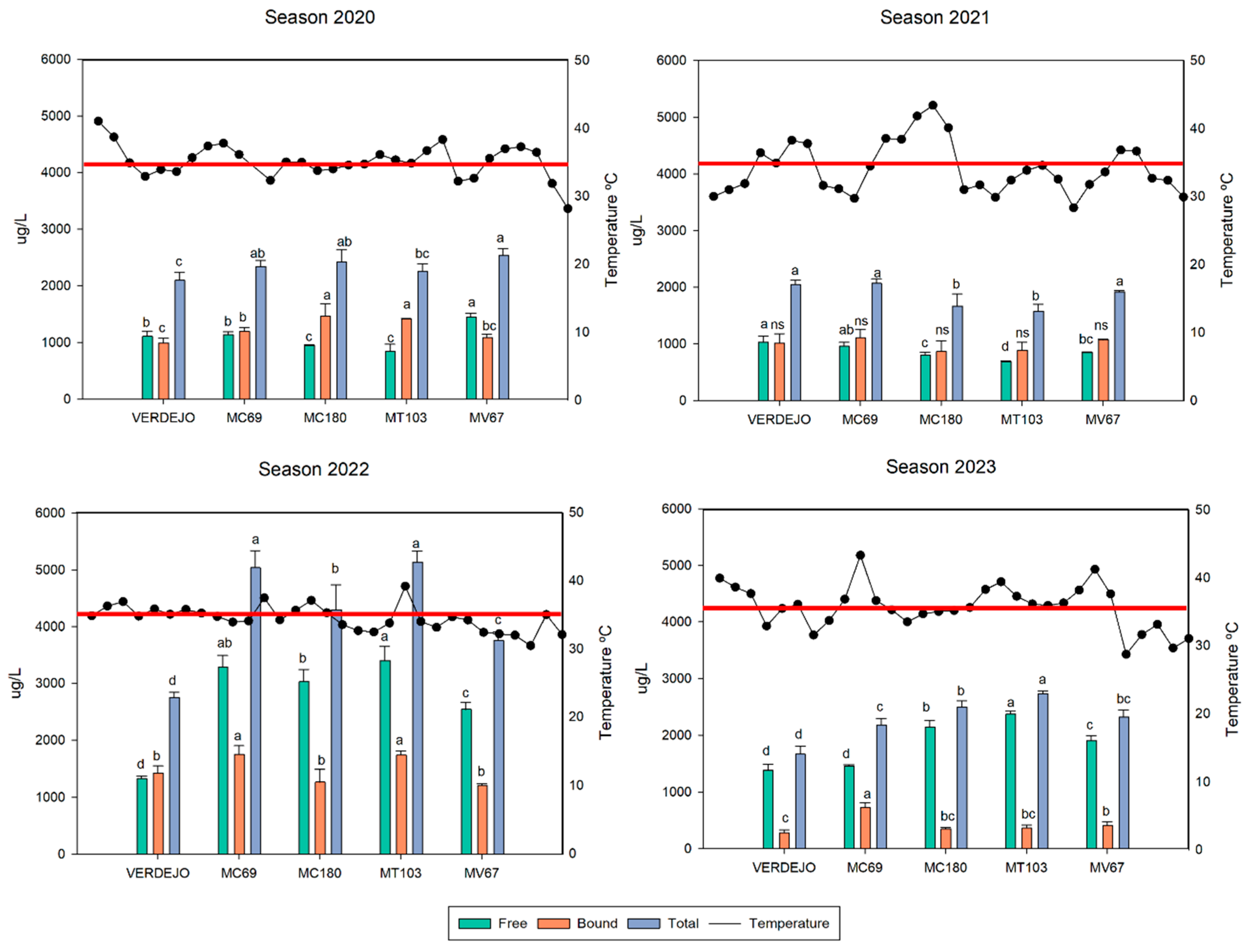
3.2. Free and Glycosylate Fractions
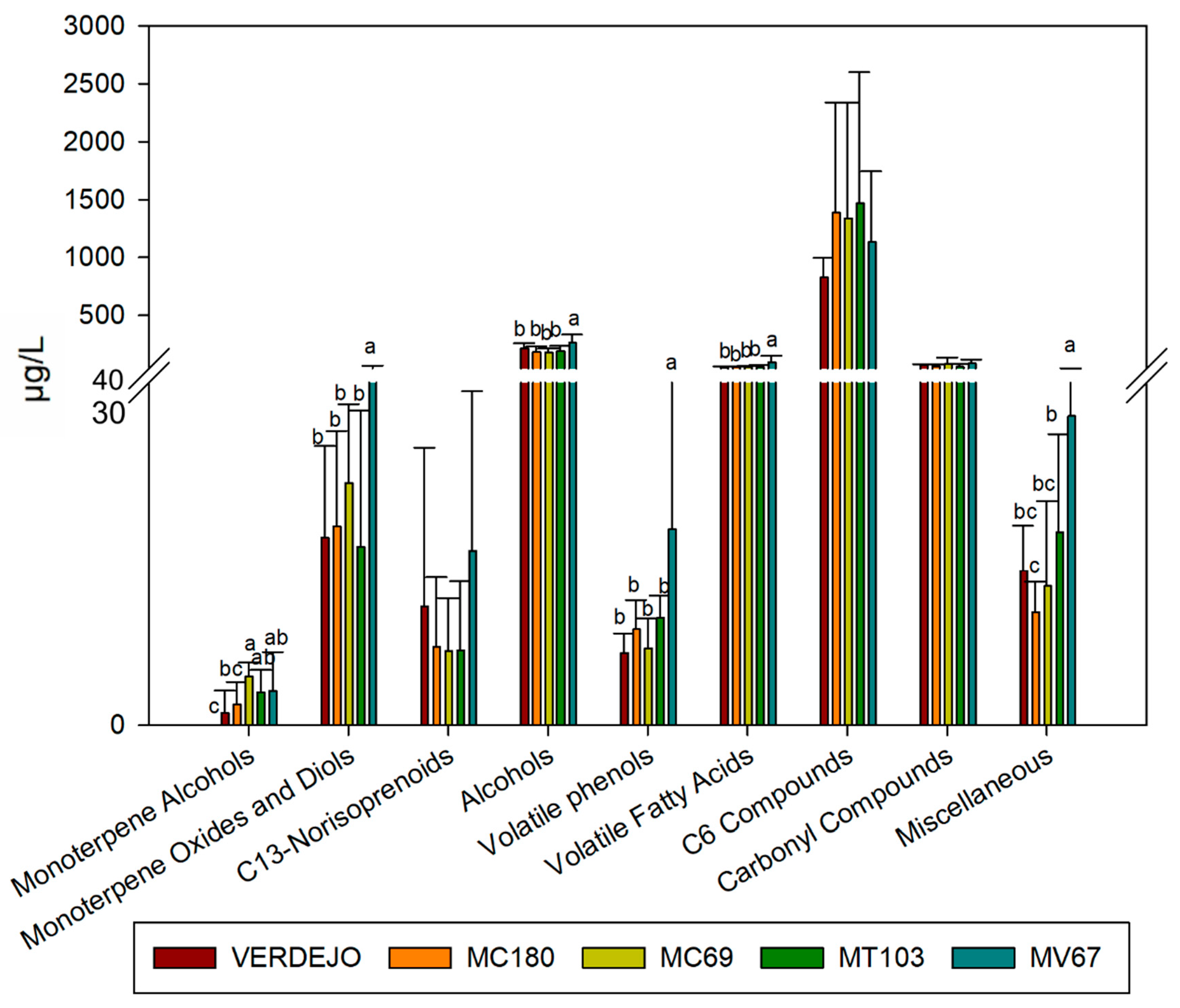
3.3. Aromatic Compound Profiles in Grape Genotypes: Analysis of Free Volatile Families
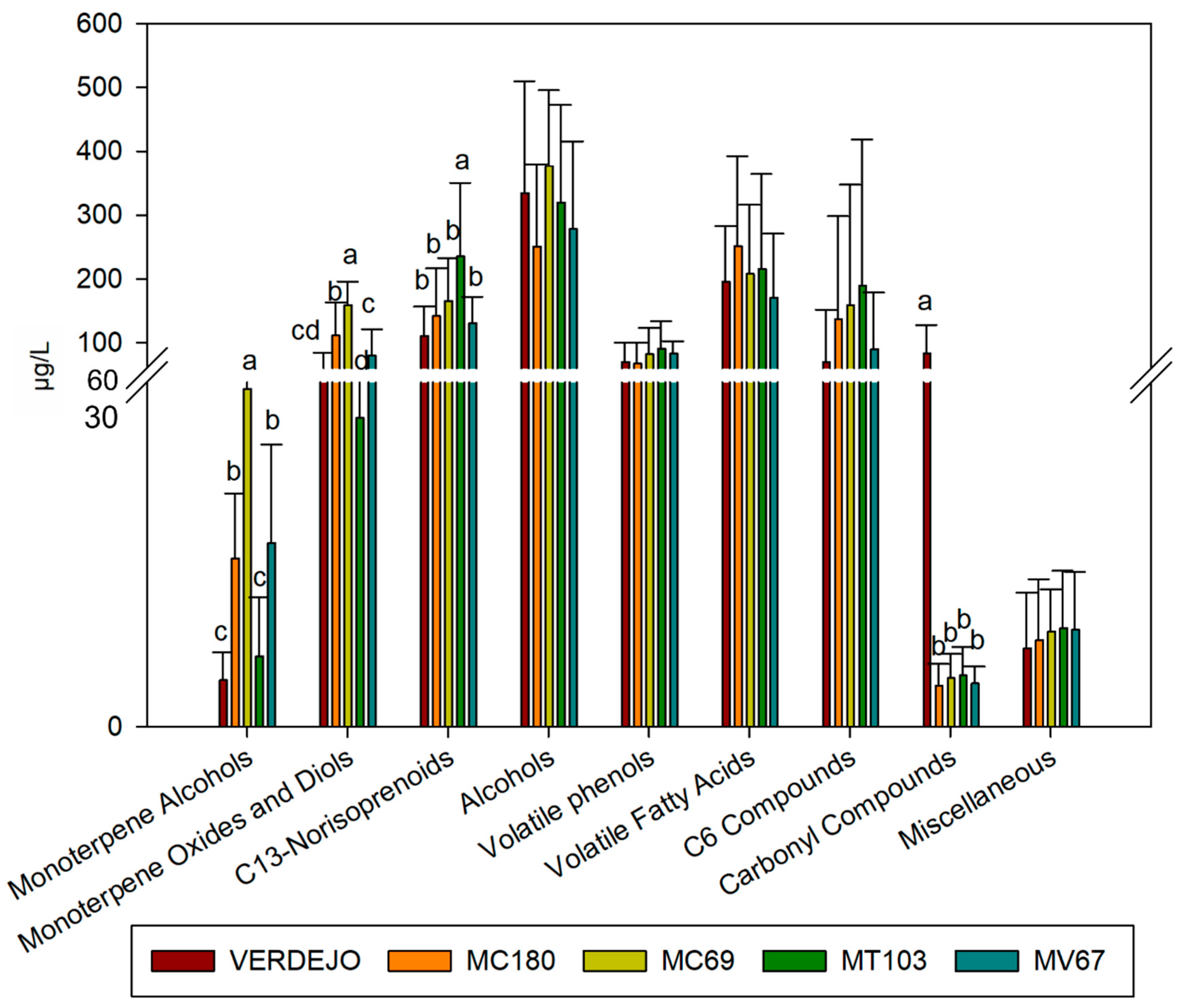
3.4. Aromatic Compound Profiles in Grape Genotypes: Analysis of Bound Volatile Families
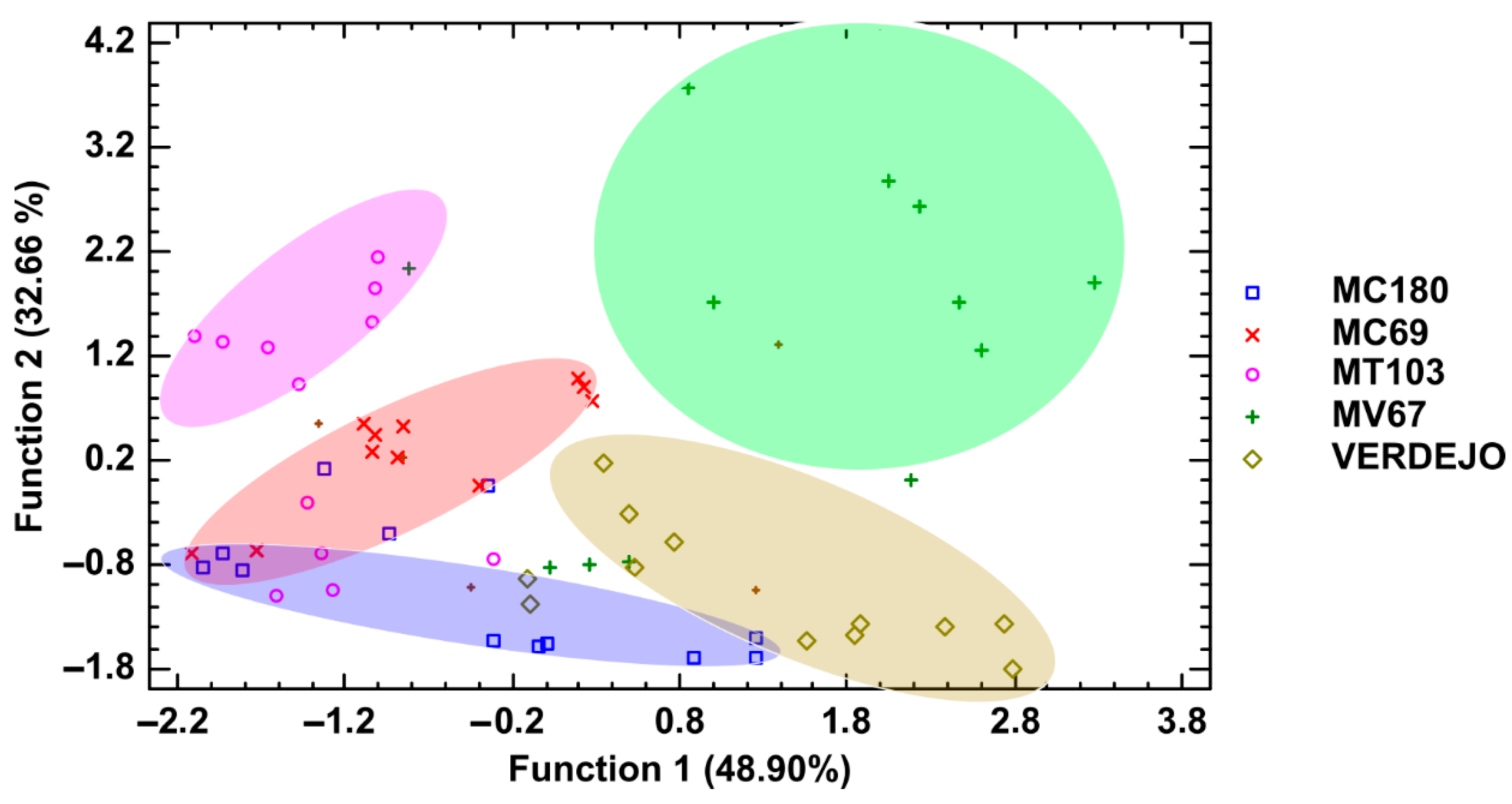
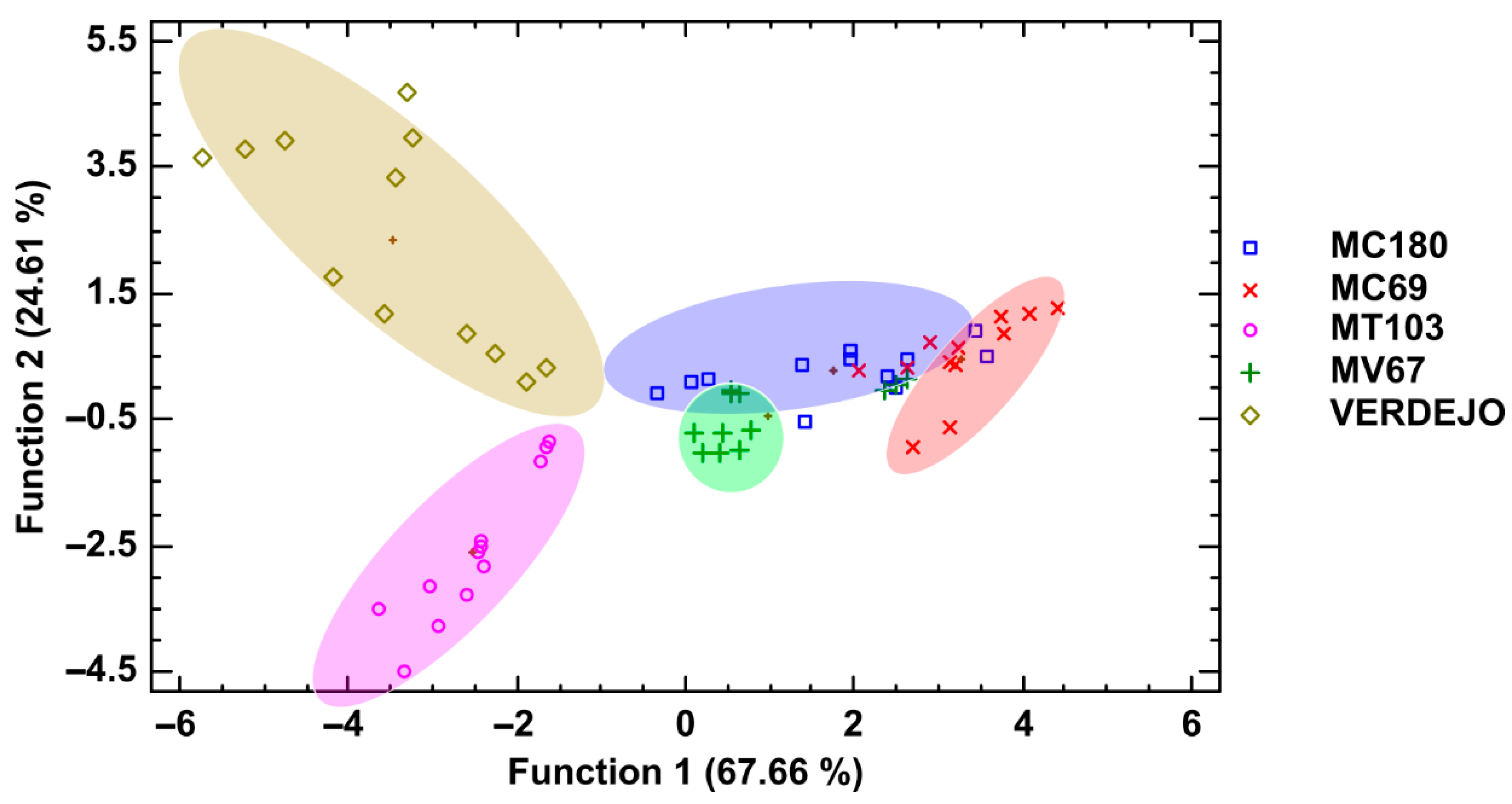
3.5. Discriminant Analysis of Grape Free Volatile Aromas
3.6. Discriminant Analysis of Grape Bound Volatile Aromas
4. Conclusions
Supplementary Materials
Author Contributions
Funding
Data Availability Statement
Acknowledgments
Conflicts of Interest
References
- Baltazar, M.; Castro, I.; Gonçalves, B. Adaptation to climate change in viticulture: The role of varietal selection—A review. Plants 2025, 14, 104. [Google Scholar] [CrossRef]
- Arévalo-Villena, M.; Díez-Pérez, J.; Úbeda, J.F.; Navascués, E.; Briones, A.I. A rapid method for quantifying aroma precursors: Application to grape extract, musts and wines made from several varieties. Food Chem. 2006, 99, 183–190. [Google Scholar] [CrossRef]
- Hjelmeland, A.K.; Ebeler, S.E. Glycosidically bound volatile aroma compounds in grapes and wine: A review. Am. J. Enol. Vitic. 2015, 66, 1–11. [Google Scholar] [CrossRef]
- Gil-Muñoz, R.; Moreno-Olivares, J.D.; Paladines-Quezada, D.F.; Cebrián-Pérez, A.; Fernández-Fernández, J.I. High anthocyanin level of grape hybrids from Monastrell and their wines. Int. J. Hortic. Agric. 2018, 3, 1–8. [Google Scholar] [CrossRef]
- Moreno-Olivares, J.D.; Paladines-Quezada, D.F.; Giménez-Bañón, M.J.; Cebrián-Pérez, A.; Fernández-Fernández, J.I.; Gómez-Martínez, J.C.; Bleda-Sánchez, J.A.; Gil-Muñoz, R. Cell wall characterization of new Monastrell hybrid descendants and their phenolic wine composition. Eur. Food Res. Technol. 2022, 248, 1253–1265. [Google Scholar] [CrossRef]
- Fernández-Fernández, J.I.; Gil-Muñoz, R.; Bleda-Sánchez, J.A.; Corredor-Cano, J.; Moreno-Olivares, J.D.; Cebrián-Pérez, A.; Martínez-Balsas, D.; Gómez-Martínez, J.C.; Palencia-Sigüenza, M.S.; Carcelén-Cutillas, J.C.; et al. Nuevas variedades procedentes de Monastrell adaptadas a clima cálido. Rev. Enólogos 2020, 126, 68–78. [Google Scholar]
- Moreno-Olivares, J.D.; Paladines-Quezada, D.F.; Giménez-Bañón, M.J.; Bleda-Sánchez, J.A.; Cebrián-Pérez, A.; Gómez-Martínez, J.C.; Gil-Muñoz, R. Proanthocyanidins composition in new varieties descended from Monastrell. J. Sci. Food Agric. 2023, 103, 5039–5049. [Google Scholar] [CrossRef] [PubMed]
- Moreno-Olivares, J.D. Selección de cruzamientos dirigidos de Monastrell para una adaptación al cambio climático. Ph.D. Thesis, Universidad de Murcia, Murcia, Spain, 2022. [Google Scholar]
- Moreno-Olivares, J.D.; Paladines-Quezada, D.; Fernández-Fernández, J.I.; Bleda-Sánchez, J.A.; Martínez-Moreno, A.; Gil-Muñoz, R. Study of aromatic profile of different crosses of Monastrell white wines. J. Sci. Food Agric. 2019, 100, 38–49. [Google Scholar] [CrossRef]
- Moreno-Olivares, J.D.; Giménez-Bañón, M.J.; Paladines-Quezada, D.F.; Gómez-Martínez, J.C.; Cebrián-Pérez, A.; Fernández-Fernández, J.I.; Bleda-Sánchez, J.A.; Gil-Muñoz, R. Aromatic characterization of new white wine varieties made from Monastrell grapes grown in south-eastern Spain. Molecules 2020, 25, 3917. [Google Scholar] [CrossRef]
- Chiapparino, F. Bordeaux Wine Economy; Università Politécnica delle Marche: Ancona, Italy, 2021. [Google Scholar]
- Pasquier, G.; Feilhes, C.; Dufourcq, T.; Geffroy, O. Potential contribution of climate change to the protein haze of white wines from the French southwest region. Foods 2021, 10, 1355. [Google Scholar] [CrossRef]
- Bavaresco, L.; Squeri, C. Outlook on disease resistant grapevine varieties. BIO Web Conf. 2022, 44, 06001. [Google Scholar] [CrossRef]
- Töpfer, R.; Trapp, O. A cool climate perspective on grapevine breeding: Climate change and sustainability are driving forces for changing varieties in a traditional market. Theor. Appl. Genet. 2022, 135, 3947–3960. [Google Scholar] [CrossRef]
- Reynolds, A. Grapevine Breeding Programs for the Wine Industry; Woodhead Publishing: Cambridge, UK, 2015. [Google Scholar]
- OIV. Compendium of International Methods of Analysis of Wines and Musts; OIV: Paris, France, 2022. [Google Scholar]
- Oliveira, J.M.; Oliveira, P.; Baumes, R.L.; Maia, M.O. Volatile and glycosidically bound composition of Loureiro and Alvarinho wines. Food Sci. Technol. Int. 2008, 14, 341–353. [Google Scholar] [CrossRef]
- Vilanova, M.; Fandiño, M.; Frutos-Puerto, S.; Cancela, J.J. Assessment of fertigation effects on chemical composition of Vitis vinifera L. cv. Albariño. Food Chem. 2019, 278, 636–643. [Google Scholar] [CrossRef] [PubMed]
- Ferrero-del-Teso, S.; Arias, I.; Escudero, A.; Ferreira, V.; Fernández-Zurbano, P.; Sáenz-Navajas, M.P. Effect of grape maturity on wine sensory and chemical features: The case of Moristel wines. LWT 2020, 118, 108848. [Google Scholar] [CrossRef]
- Asproudi, A.; Bonello, F.; Ragkousi, V.; Gianotti, S.; Petrozziello, M. Aroma precursors of Grignolino grapes (Vitis vinifera L.) and their modulation by vintage in a climate change scenario. Front. Plant Sci. 2023, 14, 1179111. [Google Scholar] [CrossRef] [PubMed]
- Salifu, R.; Zhang, Z.; Sam, F.E.; Li, J.; Ma, T.Z.; Wang, J.; Han, S.Y.; Jiang, Y.M. Application of different fertilizers to Cabernet Sauvignon vines: Effects on grape aroma accumulation. J. Berry Res. 2022, 12, 209–225. [Google Scholar] [CrossRef]
- Volschenk, H.; van Vuuren, H.J.J.; Viljoen-Bloom, M. Malic acid in wine: Origin, function and metabolism during vinification. S. Afr. J. Enol. Vitic. 2006, 27, 123–136. [Google Scholar] [CrossRef]
- Keller, M. Managing grapevines to optimise fruit development in a challenging environment: A climate change primer for viticulturists. Aust. J. Grape Wine Res. 2010, 16, 56–69. [Google Scholar] [CrossRef]
- Bindon, K.A.; Dry, P.R.; Loveys, B.R. Influence of plant water status on the production of C13-norisoprenoid precursors in Vitis vinifera L. cv. Cabernet Sauvignon grape berries. J. Agric. Food Chem. 2007, 55, 4493–4500. [Google Scholar] [CrossRef]
- Palai, G.; Caruso, G.; Gucci, R.; D’Onofrio, C. Water deficit before veraison is crucial in regulating berry VOC concentration in Sangiovese grapevines. Front. Plant Sci. 2023, 14, 1117572. [Google Scholar] [CrossRef]
- Griesser, M.; Weingart, G.; Schoedl-Hummel, K.; Neumann, N.; Becker, M.; Varmuza, K.; Liebner, F.; Schuhmacher, R.; Forneck, A. Severe drought stress is affecting selected primary metabolites, polyphenols, and volatile metabolites in grapevine leaves (Vitis vinifera cv. Pinot Noir). Plant Physiol. Biochem. 2015, 88, 17–26. [Google Scholar] [CrossRef] [PubMed]
- Intrigliolo, D.S.; Castel, J.R. Response of grapevine cv. Tempranillo to timing and amount of irrigation: Water relations, vine growth, yield and berry and wine composition. Irrig. Sci. 2010, 28, 113–125. [Google Scholar] [CrossRef]
- van Leeuwen, C.; Friant, P.; Choné, X.; Tregoat, O.; Koundouras, S.; Dubourdieu, D. Influence of climate, soil, and cultivar on terroir. Am. J. Enol. Vitic. 2004, 55, 207–217. [Google Scholar] [CrossRef]
- Mateo, J.J.; Jiménez, M. Monoterpenes in grape juice and wines. J. Chromatogr. A 2000, 881, 557–567. [Google Scholar] [CrossRef]
- Chigo-Hernandez, M.M.; Tomasino, E. Aroma perception of limonene, linalool and α-terpineol combinations in Pinot Gris wine. Foods 2023, 12, 2389. [Google Scholar] [CrossRef]
- Culleré, L.; Escudero, A.; Cacho, J.; Ferreira, V. Gas chromatography-olfactometry and chemical quantitative study of the aroma of six premium quality Spanish aged red wines. J. Agric. Food Chem. 2004, 52, 1653–1660. [Google Scholar] [CrossRef]
- Romano, P.; Braschi, G.; Siesto, G.; Patrignani, F.; Lanciotti, R. Role of yeasts on the sensory component of wines. Foods 2022, 11, 1921. [Google Scholar] [CrossRef] [PubMed]
- Canuti, V.; Conversano, M.; Calzi, M.L.; Heymann, H.; Matthews, M.A.; Ebeler, S.E. Headspace solid-phase microextraction-gas chromatography-mass spectrometry for profiling free volatile compounds in Cabernet Sauvignon grapes and wines. J. Chromatogr. A 2009, 1216, 3012–3022. [Google Scholar] [CrossRef]
- Yang, W.; Zhang, Z.; Ying, S.; Robinson, A.G.; Duan, C.; Lan, Y. Volatile phenols in wine: Overview of origin, formation, analysis, and sensory expression. Crit. Rev. Food Sci. Nutr. 2025, 65, 3001–3026. [Google Scholar] [CrossRef]
- Kotseridis, Y.; Razungles, A.; Bertrand, A.; Baumes, R. Differentiation of the aromas of Merlot and Cabernet Sauvignon wines using sensory and instrumental analysis. J. Agric. Food Chem. 2000, 48, 5383–5388. [Google Scholar] [CrossRef]
- Kalua, C.M.; Boss, P.K. Evolution of volatile compounds during the development of Cabernet Sauvignon grapes (Vitis vinifera L.). J. Agric. Food Chem. 2009, 57, 3818–3830. [Google Scholar] [CrossRef]
- Wu, G.; Xin, Y.; Ren, R.; Chen, H.; Yang, B.; Ge, M.; Xie, S. Comprehensive aroma profiles and the underlying molecular mechanisms in six grape varieties with different flavors. Front. Plant Sci. 2025, 16, 1544593. [Google Scholar] [CrossRef]
- Zhang, D.; Wei, Z.; Han, Y.; Duan, Y.; Shi, B.; Ma, W. A review on wine flavour profiles altered by bottle aging. Molecules 2023, 28, 6522. [Google Scholar] [CrossRef] [PubMed]
- Pichler, A.; Ivić, I.; Mesić, J.; Drenjančević, M.; Kujundžić, T.; Marković, T.; Kopjar, M. Aroma profile of Merlot red wine stored in stainless-steel tanks and wooden barrels with different toasting methods. Foods 2024, 13, 45. [Google Scholar] [CrossRef]
- Kabbashi, A.S.; Sattar, M.A.; Aamer, M.; Siddiqui, N.N.; Kamran, M.; Fayaz, A.; Jahan, H.; Khan, F.A.; Wang, Y. Clerodane furanoditerpenoids from Tinospora bakis (A.Rich.) Miers (Menispermaceae). Molecules 2024, 29, 154. [Google Scholar] [CrossRef]
- Robinson, A.L.; Boss, P.K.; Solomon, P.S.; Trengove, R.D.; Heymann, H.; Ebeler, S.E. Origins of grape and wine aroma. Part 1. Chemical components and viticultural impacts. Am. J. Enol. Vitic. 2014, 65, 1–24. [Google Scholar] [CrossRef]
- González-Barreiro, C.; Rial-Otero, R.; Cancho-Grande, B.; Simal-Gándara, J. Wine aroma compounds in grapes: A critical review. Crit. Rev. Food Sci. Nutr. 2015, 55, 202–218. [Google Scholar] [CrossRef]
- Fariña, L.; Boido, E.; Carrau, F.; Versini, G.; Dellacassa, E. Terpene compounds as possible precursors of 1,8-cineole in red grapes and wines. J. Agric. Food Chem. 2005, 53, 1633–1636. [Google Scholar] [CrossRef] [PubMed]
- Ferreira, V.; López, R.; Cacho, J.F. Quantitative determination of the odorants of young red wines from different grape varieties. J. Sci. Food Agric. 2000, 80, 1659–1667. [Google Scholar] [CrossRef]
- Escudero, A.; Campo, E.; Fariña, L.; Cacho, J.; Ferreira, V. Analytical characterization of the aroma of five premium red wines. Insights into the role of odor families and the concept of fruitiness of wines. J. Agric. Food Chem. 2007, 55, 4501–4510. [Google Scholar] [CrossRef]
- Suter, B.; Destrac Irvine, A.; Gowdy, M.; Dai, Z.; van Leeuwen, C. Adapting wine grape ripening to global change requires a multi-trait approach. Front. Plant Sci. 2021, 12, 624867. [Google Scholar] [CrossRef]



| Verdejo | MC69 | MT103 | MV67 | MC180 | p-Value | ||
|---|---|---|---|---|---|---|---|
| °Brix | 2020 | 19.85 d ± 0.07 | 21.05 b ± 0.07 | 21.50 a ± 0.00 | 20.25 c ± 0.07 | 20.20 c ± 0.00 | 2 *** |
| Total Acidity (g/L) 1 | 5.30 c ± 0.01 | 5.83 a ± 0.01 | 5.61 b ± 0.02 | 5.16 d ± 0.03 | 4.92 e ± 0.03 | *** | |
| pH | 3.52 a ± 0.01 | 3.37 d ± 0.01 | 3.30 e ± 0.00 | 3.45 c ± 0.01 | 3.47 b ± 0.00 | *** | |
| Tartaric acid (g/L) | 5.65 c ± 0.04 | 4.11e ± 0.03 | 5.76 b ± 0.02 | 5.84 a ± 0.02 | 4.95 d ± 0.00 | *** | |
| Malic acid (g/L) | 2.59 b ± 0.02 | 3.40 a ± 0.00 | 2.17 c ± 0.02 | 2.09 d ± 0.03 | 2.56 b ± 0.04 | *** | |
| °Brix | 2021 | 20.95 a ± 0.07 | 19.05 c ± 0.07 | 19.15 c ± 0.07 | 19.15 c ± 0.08 | 19.85 b ± 0.07 | *** |
| Total Acidity (g/L) | 4.78 b ± 0.29 | 5.54 a ± 0.13 | 5.26 a ± 0.03 | 4.46 b ± 0.08 | 4.74 b ± 0.00 | ** | |
| pH | 3.58 a ± 0.01 | 3.39 c ± 0.00 | 3.29 d ± 0.00 | 3.53 b ± 0.00 | 3.52 b ± 0.01 | *** | |
| Tartaric acid (g/L) | 5.10 c ± 0.09 | 4.69 d ± 0.20 | 6.37 a ± 0.00 | 5.78 b ± 0.04 | 5.10 c ± 0.05 | *** | |
| Malic acid (g/L) | 2.57 c ± 0.01 | 3.08 a ± 0.04 | 1.38 e ± 0.07 | 1.97 d ± 0.03 | 2.96 b ± 0.02 | *** | |
| °Brix | 2022 | 18.95 b ± 0.07 | 19.05 b ± 0.07 | 19.90 a ± 0.00 | 20.00 a ± 0.00 | 18.55 c ± 0.08 | *** |
| Total Acidity (g/L) | 9.22 a ± 0.07 | 9.11 a ± 0.15 | 6.39 c ± 0.23 | 8.73 b ± 0.00 | 6.14 c ± 0.06 | *** | |
| pH | 3.26 b ± 0.00 | 3.15 c ± 0.00 | 3.16 c ± 0.00 | 3.24 b ± 0.00 | 3.36 a ± 0.03 | *** | |
| Tartaric acid (g/L) | 5.12 c ± 0.01 | 4.23 d ± 0.02 | 5.78 a ± 0.04 | 5.78 a ± 0.04 | 5.30 b ± 0.03 | *** | |
| Malic acid (g/L) | 5.40 ab ± 0.37 | 5.88 a ± 0.06 | 2.59 d ± 0.35 | 4.98 b ± 0.31 | 3.32 c ± 0.01 | *** | |
| °Brix | 2023 | 21.25 d ± 0.07 | 21.95 a ± 0.07 | 21.75 b ± 0.00 | 21.50 c ± 0.08 | 21.85 ab ± 0.07 | *** |
| Total Acidity (g/L) | 4.41 c ± 0.03 | 5.15 a ± 0.01 | 4.28 d ± 0.01 | 5.02 b ± 0.00 | 4.42 c ± 0.01 | *** | |
| pH | 3.62 c ± 0.01 | 3.64 b ± 0.00 | 3.49 d ± 0.01 | 3.67 a ± 0.01 | 3.68 a ± 0.01 | *** | |
| Tartaric acid (g/L) | 5.27 b ± 0.18 | 3.66 d ± 0.01 | 4.45 c ± 0.04 | 5.66 a ± 0.22 | 4.23 c ± 0.05 | *** | |
| Malic acid (g/L) | 2.64 d ± 0.11 | 4.77 a ± 0.03 | 2.50 e ± 0.03 | 3.55 c ± 0.01 | 3.74 b ± 0.01 | *** |
| Multifactor Analysis | |||
|---|---|---|---|
| Genotype % | Season % | G × S % | |
| Monoterpene Alcohols | 21.13 *** | 45.81 *** | 30.83 *** |
| Monoterpene Oxides and Diols | 25.08 *** | 46.65 *** | 24.29 *** |
| C13-Norisoprenoids | 11.56 *** | 68.29 *** | 16.17 *** |
| Alcohols | 31.20 *** | 30.14 *** | 31.95 *** |
| Volatile Phenols | 26.75 *** | 23.03 *** | 44.46 *** |
| Volatile Fatty Acids | 27.97 *** | 20.76 *** | 47.37 *** |
| C6 Compounds | 7.40 *** | 73.39 *** | 18.32 *** |
| Carbonyl Compounds | 13.03 *** | 46.82 *** | 36.57 *** |
| Miscellaneous | 39.92 *** | 24.48 *** | 31.84 *** |
| Multifactor Analysis | |||
|---|---|---|---|
| Genotype % | Season % | G × S % | |
| Monoterpene Alcohols | 70.92 *** | 4.54 *** | 20.30 *** |
| Monoterpene Oxides and Diols | 61.74 *** | 18.44 *** | 15.86 *** |
| C13-Norisoprenoids | 27.28 *** | 49.80 *** | 18.27 *** |
| Alcohols | 9.26 *** | 66.49 *** | 19.32 *** |
| Volatile Phenols | 6.23 *** | 16.56 *** | 69.30 *** |
| Volatile Fatty Acids | 5.08 *** | 67.61 *** | 19.24 *** |
| C6 Compounds | 7.62 *** | 73.21 *** | 11.55 *** |
| Carbonyl Compounds | 73.75 *** | 6.35 *** | 18.41 *** |
| Miscellaneous | 2.01 ** | 81.53 *** | 10.94 *** |
Disclaimer/Publisher’s Note: The statements, opinions and data contained in all publications are solely those of the individual author(s) and contributor(s) and not of MDPI and/or the editor(s). MDPI and/or the editor(s) disclaim responsibility for any injury to people or property resulting from any ideas, methods, instructions or products referred to in the content. |
© 2026 by the authors. Licensee MDPI, Basel, Switzerland. This article is an open access article distributed under the terms and conditions of the Creative Commons Attribution (CC BY) license.
Share and Cite
Moreno-Olivares, J.D.; Vilanova, M.; Giménez-Bañón, M.J.; Gómez-Martínez, J.C.; Gil-Muñoz, R. Aromatic Fingerprint of Emerging White Grape Genotypes: Free and Bound Volatiles Under Warm Climate Conditions. Horticulturae 2026, 12, 528. https://doi.org/10.3390/horticulturae12050528
Moreno-Olivares JD, Vilanova M, Giménez-Bañón MJ, Gómez-Martínez JC, Gil-Muñoz R. Aromatic Fingerprint of Emerging White Grape Genotypes: Free and Bound Volatiles Under Warm Climate Conditions. Horticulturae. 2026; 12(5):528. https://doi.org/10.3390/horticulturae12050528
Chicago/Turabian StyleMoreno-Olivares, Juan Daniel, Mar Vilanova, María José Giménez-Bañón, José Cayetano Gómez-Martínez, and Rocío Gil-Muñoz. 2026. "Aromatic Fingerprint of Emerging White Grape Genotypes: Free and Bound Volatiles Under Warm Climate Conditions" Horticulturae 12, no. 5: 528. https://doi.org/10.3390/horticulturae12050528
APA StyleMoreno-Olivares, J. D., Vilanova, M., Giménez-Bañón, M. J., Gómez-Martínez, J. C., & Gil-Muñoz, R. (2026). Aromatic Fingerprint of Emerging White Grape Genotypes: Free and Bound Volatiles Under Warm Climate Conditions. Horticulturae, 12(5), 528. https://doi.org/10.3390/horticulturae12050528