Article

Productivity of Kapia Pepper and Successive Leafy Greens in an Organic Cropping System Under Different Nutrient Management Strategies with Chlorella vulgaris Foliar Application


by
Orsolya Papp
1,*,
Nuri Nurlaila Setiawan
1,
Katalin Allacherné Szépkuthy
1,
Flóra Pászti-Milibák
1,
Attila Ombódi
2,
Ilona Kaponyás
3,
Ferenc Tóth
1 and
Dóra Drexler
1
1
Hungarian Research Institute of Organic Agriculture (ÖMKi), 1038 Budapest, Hungary
2
Department of Vegetable and Mushroom Growing, Institute of Horticultural Sciences, Hungarian University of Agriculture and Life Sciences (MATE), 2100 Gödöllő, Hungary
3
Independent Researcher, Csongrádi sgt. 52. I./1., 6724 Szeged, Hungary
*
Author to whom correspondence should be addressed.
Horticulturae 2026, 12(5), 527; https://doi.org/10.3390/horticulturae12050527
Submission received: 13 March 2026 / Revised: 21 April 2026 / Accepted: 22 April 2026 / Published: 24 April 2026
(This article belongs to the Section Vegetable Production Systems)

Highlights

What are the main findings?
  • Increasing nutrient supply intensity did not significantly improve kapia pepper yield under on-farm organic polytunnel conditions.
  • Residual effects of nutrient supply on the subsequent leafy green crop were negligible, indicating limited carry-over benefits.
  • The efficacy of Chlorella vulgaris living cell foliar application was strongly context-dependent, and positive effects were mainly associated with high-intensity nutrient supply.
What are the implications of the main findings?
  • These results suggest that intensified nutrient supply, without clear yield benefits, may contribute to the conventionalization of organic nutrient management in protected cropping systems.
  • The context-dependent response to Chlorella vulgaris highlights the need to evaluate microalga-based products in relation to nutrient availability, product formulation, and their potential role in reducing pest damage.

Abstract
Optimizing nutrient management in organic polytunnel production remains challenging due to the limited availability of field-based knowledge on the mineralization dynamics of organic fertilizers. At the same time, microalgae-based products such as Chlorella vulgaris have gained increasing attention in recent research, yet their interactions with nutrient supply intensity are not well understood. This study aimed to evaluate the effects of increasing nutrient supply intensities (34, 116, and 189 kg ha−1 N from different organic sources), in combination with C. vulgaris foliar application, on the crop performance of kapia pepper and a subsequent leafy green crop under on-farm organic polytunnel conditions on soil with moderate organic matter content. Increasing production intensity did not result in significant improvements in pepper yield or vegetative biomass (p > 0.05), and no significant residual effects of nutrient supply were detected in the yield of the subsequent leafy green crop (p: 0.08–0.94). C. vulgaris treatment showed predominantly non-significant but positive trends in several parameters, but only in combination with high-intensity technology, while reducing the total pest damage of the thrips and stinkbug index up to 15.7% in most technology variations. These results indicate that the effects of C. vulgaris may be strongly context-dependent and confirm that increasing the intensity of nutrient supply may carry the risks of conventionalization of organic farming practices.

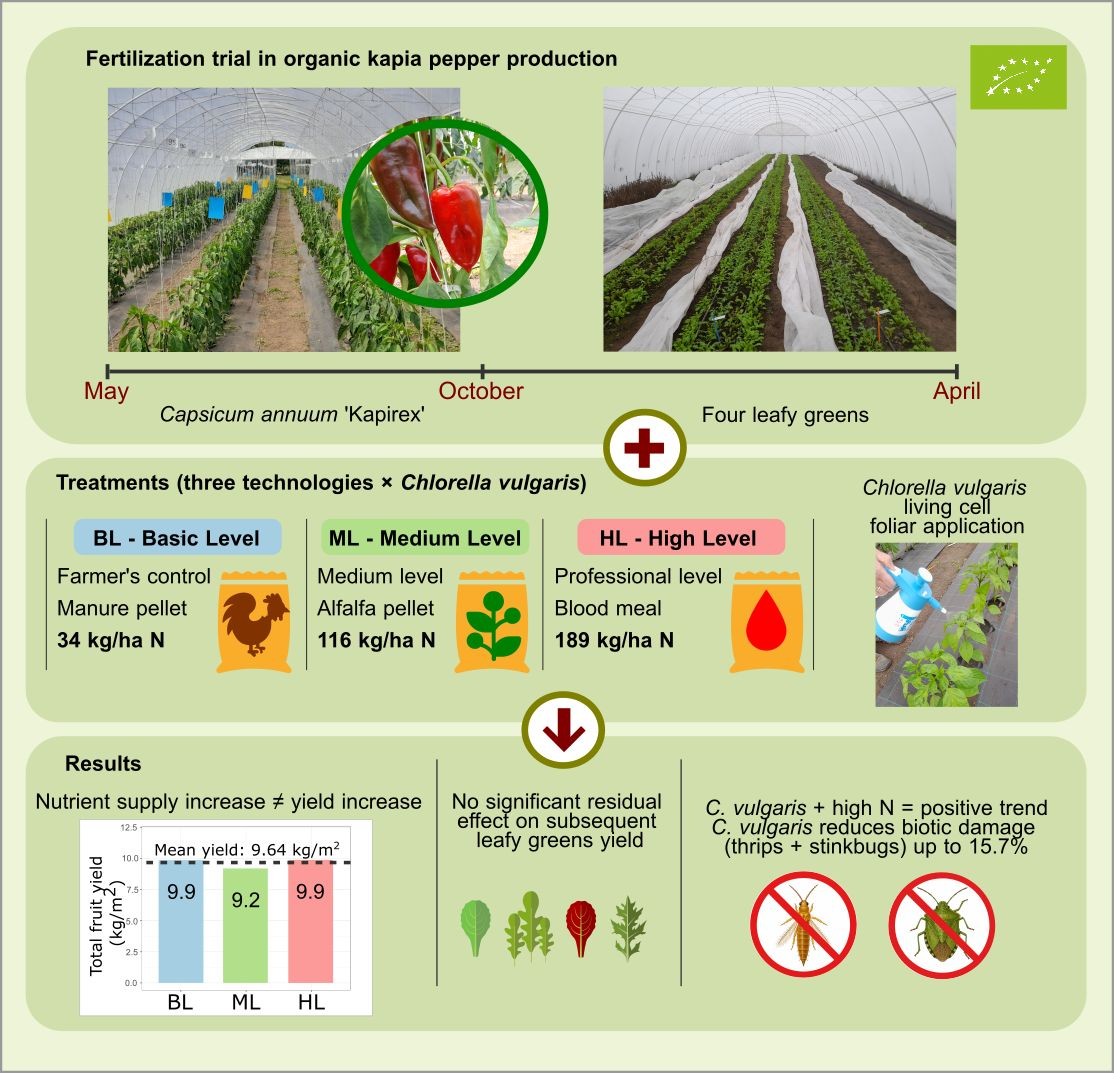
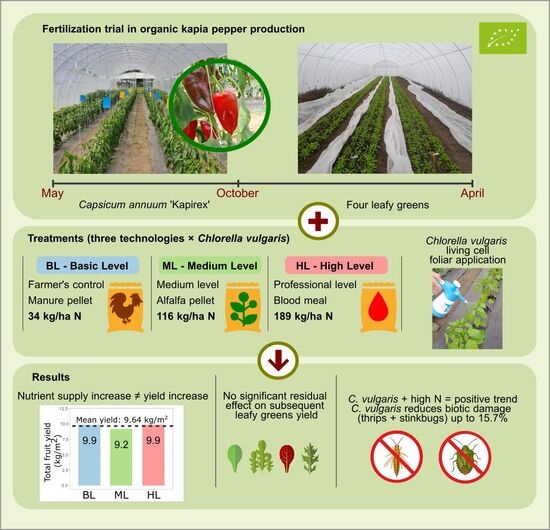
Graphical Abstract

1. Introduction

Organic horticultural production is increasingly important in Europe due to its environmental benefits and its contribution to sustainable food systems. In 2024, organic farmland in Europe covered 19,580,080 ha, of which 5.73% was used for vegetable production [1]. According to organic farming standards, plants must be nourished through the soil ecosystem [2]; therefore, nutrient availability depends on various factors of the living environment rather than directly controllable inputs. Knowledge about nutrient supply from different organic sources is limited, highlighting the need for experiments to test the productivity of various organic greenhouse cropping strategies [3,4].
In protected horticulture, the cultivation of Solanaceous crops followed by winter leafy vegetables is a common practice in continental climates [5]. These systems require efficient nutrient management strategies, as nutrient demand is high during the main crop [3] and residual nutrient availability may influence subsequent crops. The nitrogen release from certain organic sources may be slow and unpredictable [6], and an inadequate strategy may cause nitrogen loss and nitrogen leaching [2,7]. The dynamics of nutrient release and carry-over effects from organic fertilizers remain insufficiently understood.
Although numerous studies have investigated nutrient management in pepper crops [8,9,10,11,12,13,14,15,16,17], their applicability to organic systems is limited due to fundamental differences between organic and conventional production. There are a few works that focus on fertilization strategies of organic pepper [18,19,20,21], while others examine and compare the effects of fertilizers in organic and conventional systems [22,23,24,25,26,27], and even fewer studies focus on the Kapia variety group, related to organic cultivation [28,29,30,31,32,33,34,35]. No study was found about the interaction between nitrogen supply intensity, organic fertilizer types, and microbial product application in organic kapia pepper production in a polytunnel.
Understanding the impact of pre-crop nutrient management on the yield of winter leafy vegetables in organic farming is important from the viewpoint of a long-term sustainable nutrient balance. Tian [36] refers to the possible legacy nutrients from previous crops, indicating the need for long-term soil fertility programs for organic pepper production in tunnels.
In recent years, the microalga Chlorella vulgaris has gained increasing attention as a biostimulant and biofertilizer [37,38]. This microalga has been tested in various application forms, including living cells applied as foliar biofertilizer, algal biomass as slow-release biofertilizer, water-soluble and dried cell extract, cell culture for foliar or soil application, and seed soaking, as well as co-cultivation with plants in hydroponic systems [37,38,39,40]. Nevertheless, their effects are highly variable and depend on species, formulation, and application conditions [40,41,42], and substantial knowledge gaps remain regarding optimal application strategies [40,41,42]. While positive effects of C. vulgaris have been reported in several vegetable crops [43,44,45,46,47,48,49], no studies have been identified for organic pepper production.
The present study addresses these gaps by evaluating the effects of increasing nitrogen supply (from different organic fertilizer sources) and C. vulgaris foliar application on crop performance in organic pepper production and subsequent leafy green crops, under practice-oriented production conditions, in two consecutive years. This research is aligned with previously identified research needs in organic nutrient management and microalgal applications [5,38,40,50,51].
We hypothesized that (1) increasing amounts of supplied nitrogen result in stronger plant growth, higher yield, and higher quality fruits, with increasing risks of biotic damages; (2) residual nutrients from previous treatments influence the yield of winter leafy vegetables; and (3) C. vulgaris treatment increases values of vegetative and generative crop parameters.

2. Materials and Methods

2.1. The Study Site, the Tunnels, and Cultivation Technology

The research was carried out at an organic farm located in Zsámbok (N 47°32′ E 19°36′), Hungary, in 2022–2023. The whole farm was managed in accordance with the EU legislation on organic production (Regulation (EU) 2018/848 of the European Parliament and of the Council). The soil at the experimental site developed on loess-like parent material; the soil texture is sandy loam; the organic matter content is moderate; and it has a slightly alkaline pH with free calcium carbonates (Table 1).
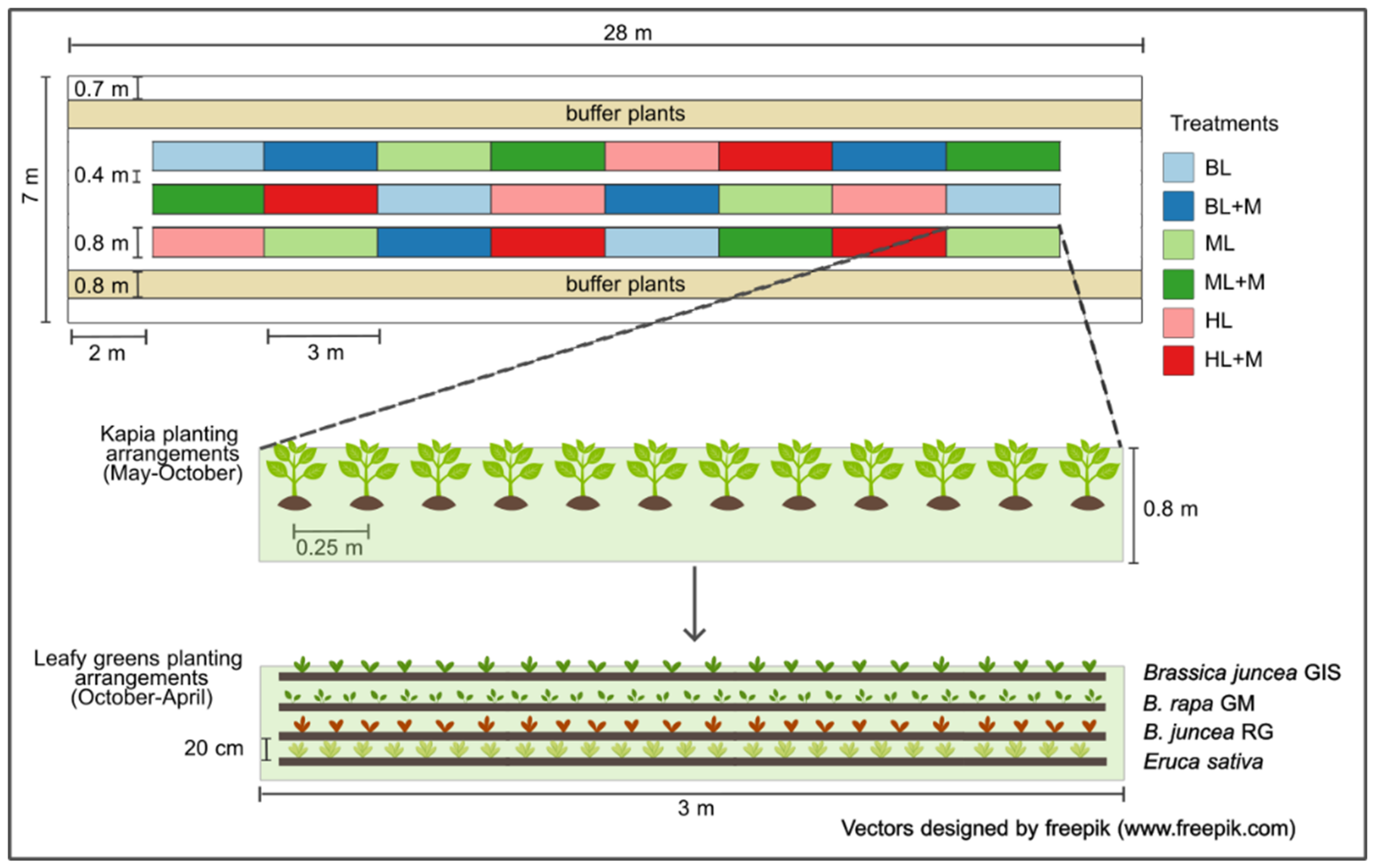
The experiment was set up in two adjacent unheated polytunnels due to mandatory crop rotation and to avoid nutrient residues from former trial plots. The tunnels were 28 m long, 7 m wide, and 3.3 m high. Both tunnels were built just before the start of the experiment (in year 1 and in year 2); the pre-crop was green fallow (50% Avena strigosa, 30% Vicia sativa, 15% Trifolium alexandrinum, 5% Phacelia tanacetifolia) in 2020–2021. The area of the second tunnel was covered with black silage tarp to prevent weeding in 2022.
After the initial soil preparation, five beds were established in the tunnels, each 0.8 m wide, separated by 0.4 m walkways (Figure 1). The two outer beds along the tunnel’s edge were used as buffer beds with sweet pepper crops, while the three middle beds contained experimental plots. In both years, kapia pepper (Capsicum annuum var. Kapirex) seedlings were planted in May and were terminated in October. After autumn soil preparation, four types of leafy greens were sown in the same beds in October and were terminated in April of the following year. Details of the crops are shown in Table 2. Weeds were mechanically controlled on walk paths, and no plant protection was applied to any of the crops.

2.2. Experimental Design and the Method of Nutrient Supply

Plots of the trial were arranged in a randomized block design with two factors (nutrient technology and microalga application) in four repetitions. This setup included a total of 24 plots, where each plot was 2.4 m2 (3 × 0.8 m). In the case of kapia pepper, one plot consisted of 12 plants in a single row with 0.25 m intra-row spacing. Each plant was an observational unit, and the plot was an experimental unit. Leafy greens were sown after removing kapia pepper plants, in the same plots consisting of four rows with 0.05 m intra-row spacing. To avoid border effects, all three experimental rows were started and ended (at both ends of the tunnel) with a 2 m-long buffer zone of the respective experimental crops. During crop change (termination of kapia pepper and sowing of leafy greens), there was no change in the plot setup, and no additional nutrients were supplied.
To investigate how increasing intensity of nutrient management affects the parameters of vegetables, three levels of nutrient supply intensity were applied (Basic Level <BL>, Mid-Level <ML>, and High-Level <HL>), hereafter referred to as technology (representing a combination of nutrient source and its application practice). All three technologies had a plot pair with microbial product treatment containing microalga (Basic Level plus Microalga <BL+M>, Mid-Level plus Microalga <ML+M>, and High-Level plus Microalga <HL+M>), resulting all together in six different treatments (hereafter called treatments). The basic level technology is considered a usual practice of Hungarian organic farms, while Mid-Level and High-Level technologies were advised as more intensive organic production technologies and recommended alternatives to the usual practice.
The detailed description of treatments is listed in Table 3. Nutrients were applied only to the kapia crop. The microbial treatment was tested on both crops (kapia and leafy greens) and applied on the foliage.

2.3. Experimental Materials

The selection of applied materials and the determination of applied quantities were carried out in consultation with an expert agricultural advisor.
The nutrient composition of the applied organic fertilizers was determined based on dry matter (DM) content, according to the product label: poultry manure pellets contained at least 85% dry matter, with an NPK composition of 4.0–2.5–2.3%. The alfalfa pellets had an NPK composition of 3–0.4–1.25%, and blood meal contained 90% dry matter and had an NPK composition of 13–0.5–0.5%, according to the product labels.
The commercially available microbial product contained C. vulgaris microalga in water suspension with a minimum of 2 × 10⁵ cell/mL. The culture medium of the commercial product contained at least 0.15 w/w% N, 0.29 w/w% P2O5, and 0.25 w/w% K2O. A 3% dilution of the product was used in the experiment. At the beginning of the season, a dose of 5 litres per 100 m2 was applied, which was then gradually increased in line with the development of the pepper crop, reaching 10 litres per 100 m2 by the 5th to 9th applications. The leafy greens received a constant dose of 5 litres per 100 m2 throughout the season.

2.4. Measurements Performed on Kapia Pepper Crop

All plants were assessed individually. Plant height (distance of the youngest fully expanded leaf from the ground) and stem diameter (5 cm above ground) were measured each month, starting from planting. During the season, the weight of pruning waste and plant parts removed due to Fusarium infection was recorded. At termination, the weight of whole plants and the weight of the root system (after shaking off soil residue) were measured.
During the season, ripe red pepper fruits were harvested once a week, starting from the middle of July until termination of crops (14 harvests/year in 2022 and 13 harvests/year in 2023). At termination, unripe green fruits were also collected and assessed similarly to red fruits. Weight, width, and length of individual fruits were measured, and based on these parameters, fruits were sorted into four quality classes (extra: width > 6 cm, length > 10 cm; first class: width 5–6 cm, length 8–10 cm; second class: width 4–5 cm, length 7–8 cm; cull: width < 4 cm, length < 7 cm). Presence and severity of damage caused by biotic (thrips, stinkbugs) and abiotic (sunburn, blossom-end rot, cracking) factors were recorded. A damage index at the plot level was calculated for each damage type using the following index (Equation (1)):
D a m a g e   i n d e x   % = f r e q u e n c y   o f   e a c h   s e v e r i t y   s c o r e   × s e v e r i t y   s c o r e t o t a l   n u m b e r   o f   p l a n t s   × m a x i m u m   s e v e r i t y   s c o r e
Three times during a season, three faultless extra-class fruits were collected from each plot to measure quality indicators, i.e., total dry matter, total dissolved solids, and vitamin C. Fruits were cut crosswise, perpendicular to their longitudinal axis, and the pericarp thickness was measured with a digital caliper to the nearest tenth of a millimeter in two places halfway between the placentas separating the locules. After this measurement, the pericarp was separated from other fruit parts. Half of the resulting pericarp sample was weighed on a precision digital laboratory scale with an accuracy of 0.01 g. Then, it was dried in a drying oven at 65 °C until a constant weight was reached. The weight of the dry samples was also measured, and the dry matter content of the pericarp was calculated as the ratio of dry to fresh weight. Juice was extracted from the other half of the pericarp samples using a small-scale press. °Brix of this juice was determined to the nearest tenth using a Krüss Optronic™ DR201-95 digital refractometer (Krüss Optronic, Hamburg, Germany). The vitamin C content of the juice was determined after ten-fold dilution using a Merck RQflex device (Merck, Darmstadt, Germany) and the corresponding Reflectoquant® (Merck, Darmstadt, Germany) test strips, with an accuracy of 1 mg L−1.

2.5. Measurements Performed on the Leafy Greens Crop

Marketable leaves were cut near the base of plants, depending on their growth rate (therefore, the timing was different depending on species). Harvests were carried out depending on the market day, with a total of three harvests (B. rapa GM both years, B. juncea GIS both years, and E. sativa 2023) and four harvests (B. rapa RG both years and E. sativa 2022). Leaf yield was measured at the plot level.

2.6. Data Analysis

To simplify the data interpretation, parameters measured in this study were organized into kapia plant (growth and biomass), kapia fruit (yield, quality class, damage, and quality characteristics), and leafy green (yield). Each parameter was pooled into fruit, plant, or plot level. Four explanatory variables, i.e., technology (BL, ML, and HL), all treatments (BL, BL+M, ML, ML+M, HL, and HL+M), microalga (with or without), and sampling time (when applicable), were tested against each parameter. All parameters were analyzed using R version 4.5.2 [52]. Graphs were made with package ggplot2 v4.0.3 [53], and the color palette was obtained from the package paletteer v1.6.0 [54]. Data manipulation was done using the packages plyr v1.8.9 and dplyr v1.1.4 [55].
First, exploratory graphs were made, and all parameters were subjected to the Shapiro–Wilk normality test. Data of fruit damage was log-transformed since it did not meet the assumptions of normality. Next, analysis of variance was done for all parameters against three main tested factors, i.e., all treatments, technology, and microalga application. ANOVA residuals were inspected using visual inspections, the Shapiro–Wilk normality test, and Levene’s test of homogeneity of variance to ensure the assumptions were met. An additional post-hoc Tukey HSD test using the package agricolae v1.3.7 [56] was done to see the grouping of the data. Pearson’s correlation was calculated between selected parameters with an alpha value of 0.05. The weight and damage index data were divided into classes and were subjected to chi-square analysis, also with a 0.05 alpha value. The structure of the contingency tables was weight/damage as rows and treatments as columns. In total, there were 10 weight classes used with 20 g intervals, and 7 biotic damage classes with 5 damage index intervals. The chi-square post-Cramer’s V was also reported to explain the strength of the association.

3. Results

3.1. Overview of Measured Parameters and Treatment Effects

Table 4 provides an overview of the measured parameters, their ranges, and the factors showing statistically significant effects based on analysis of variance. Note that the experiment was conducted in two different polytunnels across the two study years, as crop rotation is mandated in the organic agriculture practice. As a result, potential tunnel-specific effects, e.g., microclimatic or soil differences, are confounded with year effects and therefore cannot be separated. Consequently, observed differences between years should be interpreted with caution.

3.2. Vegetative Characteristics of Kapia Pepper

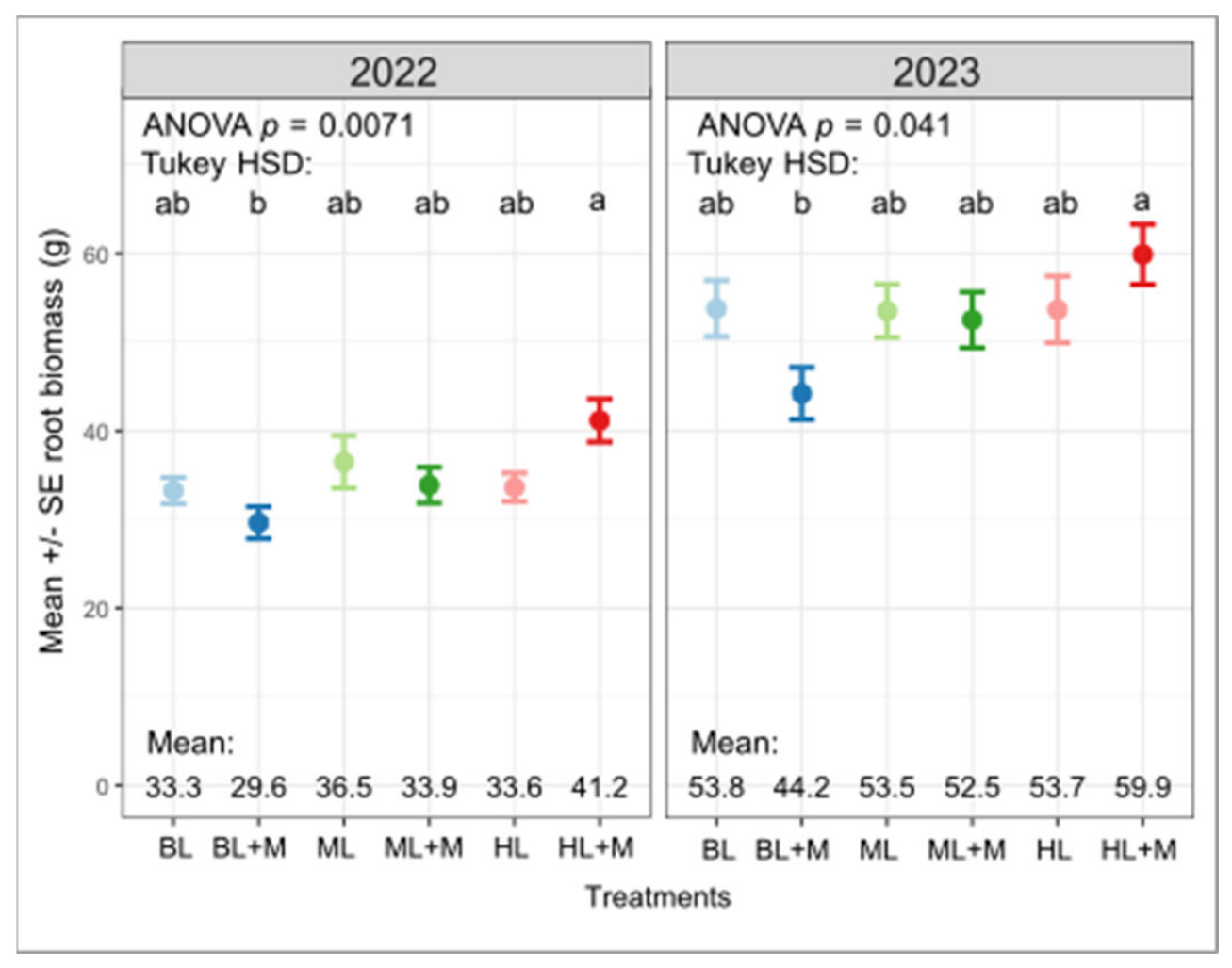
Treatments had a significant effect on root biomass in both years (Table 4). Plants of BL+M had significantly lower root biomass than HL+M in both years (Figure 2). The application of different technologies did not result in different root biomass values. Although root biomass was positively correlated to green biomass (Pearson correlation 2022: 0.4, p < 0.001, n: 263; Pearson correlation 2023: 0.6, p < 0.001, n: 285), the values of green biomass and total biomass did not differ significantly among treatments and technologies (Table 4, Figure S1). However, the use of microalga resulted in higher green biomass across all treatments in 2022 (p-value: 0.011, Figure S1a).
In terms of growth, only stem diameter increment was affected by treatment in 2023 (Table 4, Figure S2b). In both years, height growth did not differ significantly among treatments, technologies, or measurement times (Table 4, Figure S2a).

3.3. Yield of Kapia and Leafy Greens

The total kapia fruit yield was higher in 2023 (614.7 kg; 10.67 kg/m2) than in 2022 (474.0 kg; 8.23 kg/m2), but there were slightly more fruits produced in 2022 (7450 fruits; 129 fruits/m2) than in 2023 (7039 fruits; 122 fruits/m2), including red (ripe) and green (unripe) fruits. (Table 5).
In contrast to kapia, all leafy green taxa and treatments (Table 5) showed a higher yield in 2022 (total: 148.9 kg) than in 2023 (total: 103.4 kg).
No significant differences in total kapia fruit yield (kg/m2) were detected among treatments (Table 4 and Table 5, Figure S3). BL, HL, and HL+M treatments showed a trend of slightly higher yield, and BL+M, ML, and ML+M remained the lowest in both years. BL had the highest mean yield in 2023. Technology in 2022 affected the number of fruits with HL and showed the highest value (Table 4, Figure S4).
The annual plot yield of B. rapa GM was significantly affected by technology in 2022, where HL showed the highest yield, followed by BL and ML (Table 4, Figure S5). The other three leafy greens, i.e., B. juncea ‘Green in Snow’, B. juncea ‘Red Giant’, and E. sativa, did not produce significantly different yields in any of the two years.

3.4. Characteristics of Kapia Pepper Fruits and Harvesting

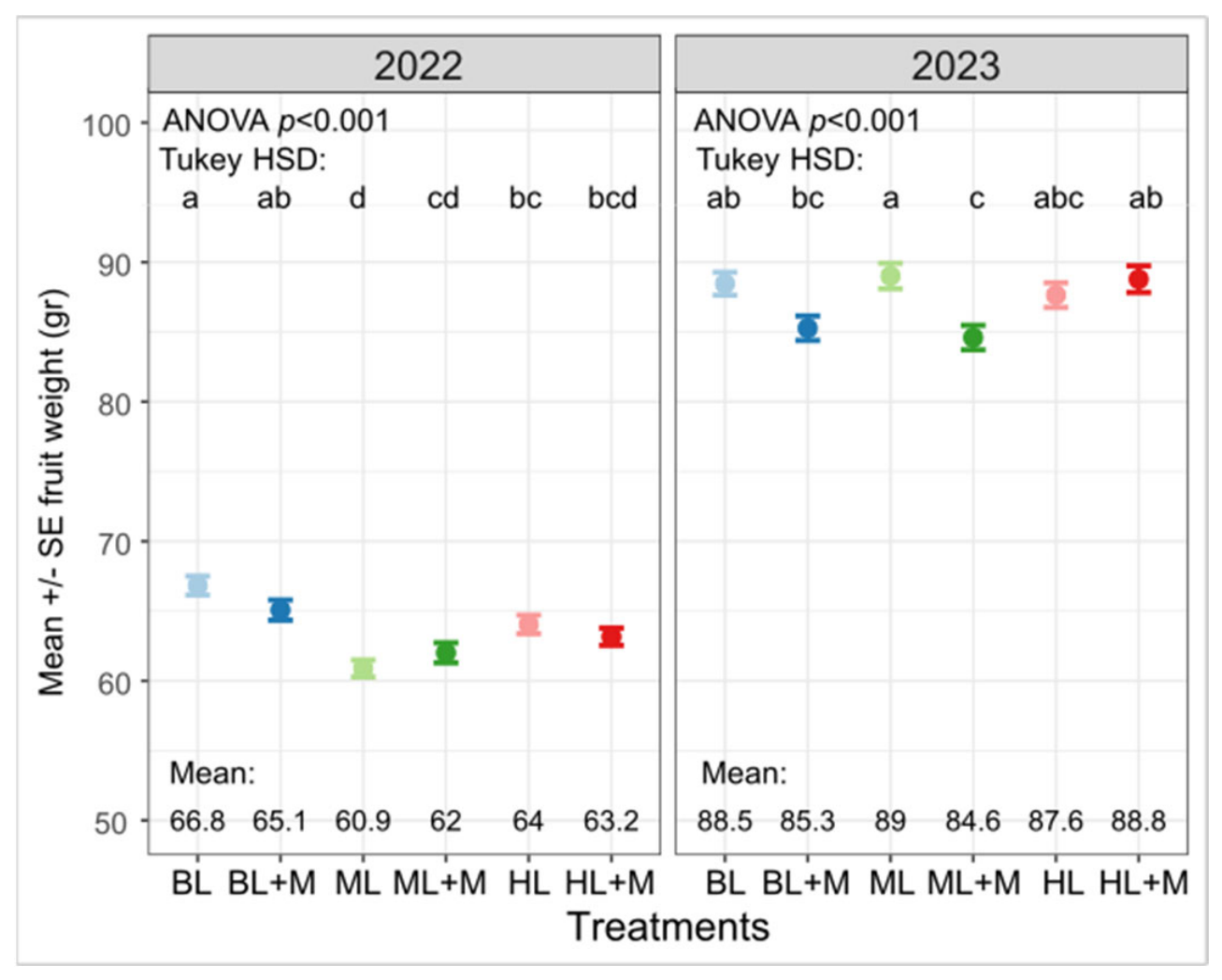
Treatment significantly affected fruit weight in both years: fruit weight was higher in BL and lower in ML than average in 2022 and was significantly lower at two treatments with microalga (BL+M, ML+M) in 2023 (Figure 3). Treatment and technology significantly affected fruit length and width in both years (Table 4). The highest length was shown by BL in 2022 and ML in 2023, while the highest width was shown by HL in 2022 and BL in 2023 (Figure S6). Regarding fruit length, significantly lower values were recorded in all treatments in 2022 when microalga were applied (p-value < 0.001); however, this pattern was only found in ML in 2023 (p-value < 0.001, Figure S6). Addition of microalga also decreased fruit width in BL and ML in 2023 (p-value < 0.001, Figure S6). Though results from each year differ, note that year and treatment interactions were not tested.
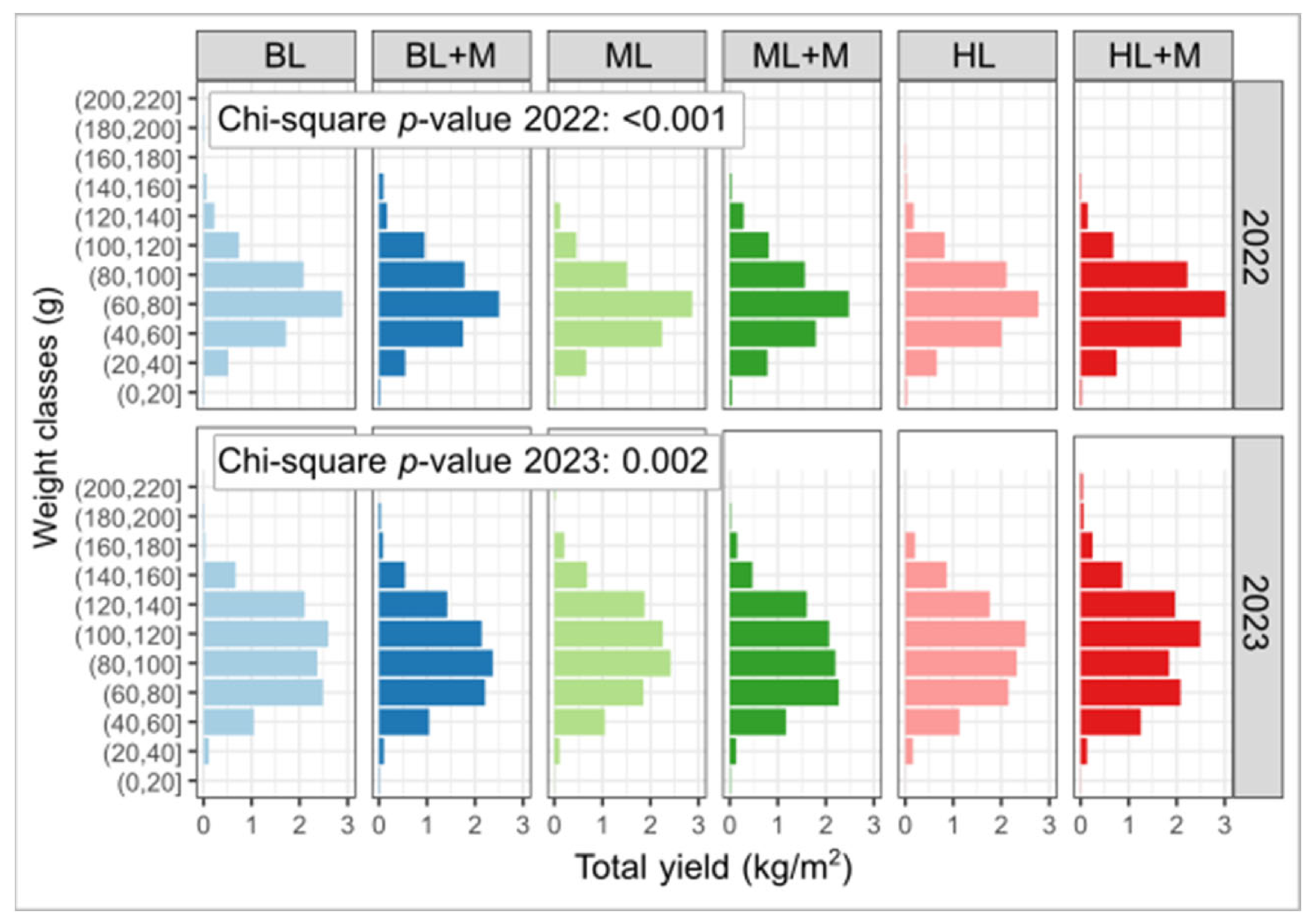
The distribution of weight classes of harvested kapia followed the same trend each year (Figure 4). The chi-square analysis between weight classes and treatments showed significant results in both years (2022 p-value: <0.001, Cramer’s V: 0.05; 2023 p-value: 0.002, Cramer’s V: 0.04), suggesting that weight class and treatments were significantly associated, yet not strongly related.
The yield proportion of the extra quality class was higher in all treatments in 2023 than in 2022, meaning that the fruits produced in 2023 were bigger and of better quality (Figure S7). In 2022, ML and ML+M produced the lowest, and HL and HL+M were the highest quality class fruits. For the coming year, ML showed improvement, and BL had an increasingly high proportion of extra class fruits. ANOVA in each market class showed a significant effect of treatment in the extra class in 2023 (Table 4). On the other hand, technology significantly affected extra class in 2022 (ANOVA p: 0.03), with the highest yield shown by HL, followed by BL and ML. The use of microalga significantly affected the second-class yield in 2023 (Table 4), with a decreased yield recorded in BL (Figure S7).
Regarding fruit quality characteristics, some parameters showed significant effects of technology and/or microalga, but only in one year (Table 4). Application of microalga occasionally resulted in lower TDM and TDS values, especially in 2022, when this decreasing effect was statistically significant for both characteristics (Table 6). Though not significant, the application of microalga tended to decrease vitamin C concentration in 2022 (Table 6).
Kapia yield at the plot level varied across harvesting periods, with peak yield occurring at the beginning (first to third harvests) of each year. In terms of trends, on the first three harvest days BL/BL+M had the lowest, ML/ML+M had the middle, and HL/HL+M treatment had the highest yield (Figure S8).

3.5. Biotic and Abiotic Damages on Kapia Pepper Fruits

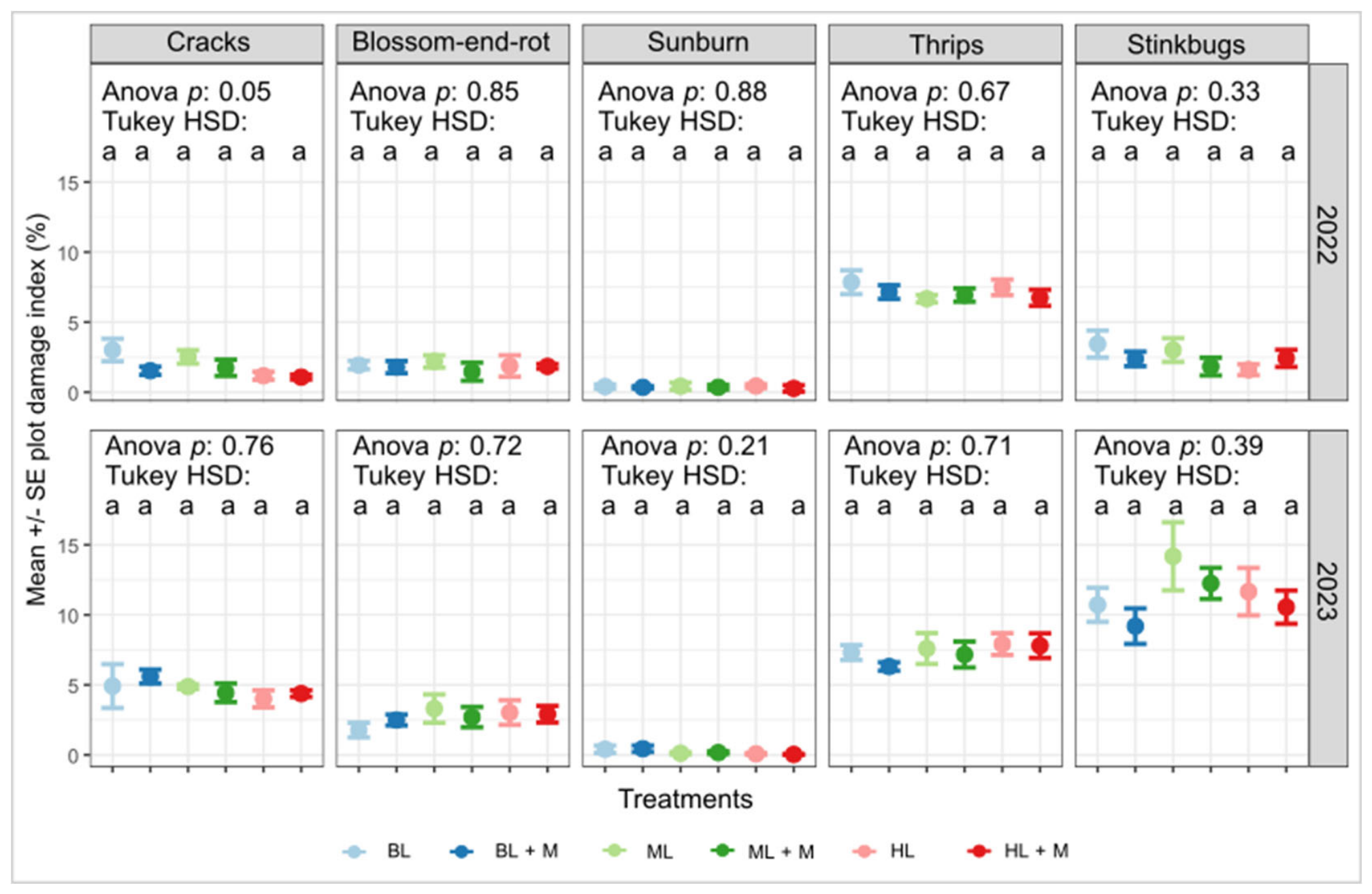
During the growing season, several biotic (stinkbug, thrips) and abiotic (blossom-end rot, cracking, sunburn) stresses damaged the fruits; the indexes of damages are shown in Figure 5.
Treatment significantly affected the cracking damage index in 2022, with BL treatment showing a higher value than BL+M, HL, and HL+M. In terms of trends, increasing the nutrient supply level resulted in a lower damage index of fruit cracking. There was no significant difference or remarkable trend in the case of blossom-end rot and sunburn damage.
The infestation of thrips was similar in both years, while in 2023 the damage of stinkbugs was more pronounced. Although no significant difference was detected in damage index among treatments in 2022 and 2023, the damage of stinkbugs in ML was the highest among all in 2023 (Figure 5).
Fewer fruits were damaged by abiotic stresses than by biotic stresses, with 2023 showing more cases (Figure S9). In 2023, there were more abiotically damaged fruits as weight classes increased, while the severity of damage appeared to be higher in smaller fruits. A significant association between damage classes and weight classes was found in 2022 (chi-square p-value: <0.001, Cramer’s V: 0.05) and in 2023 (p-value: 0.02, Cramer’s V: 0.04).
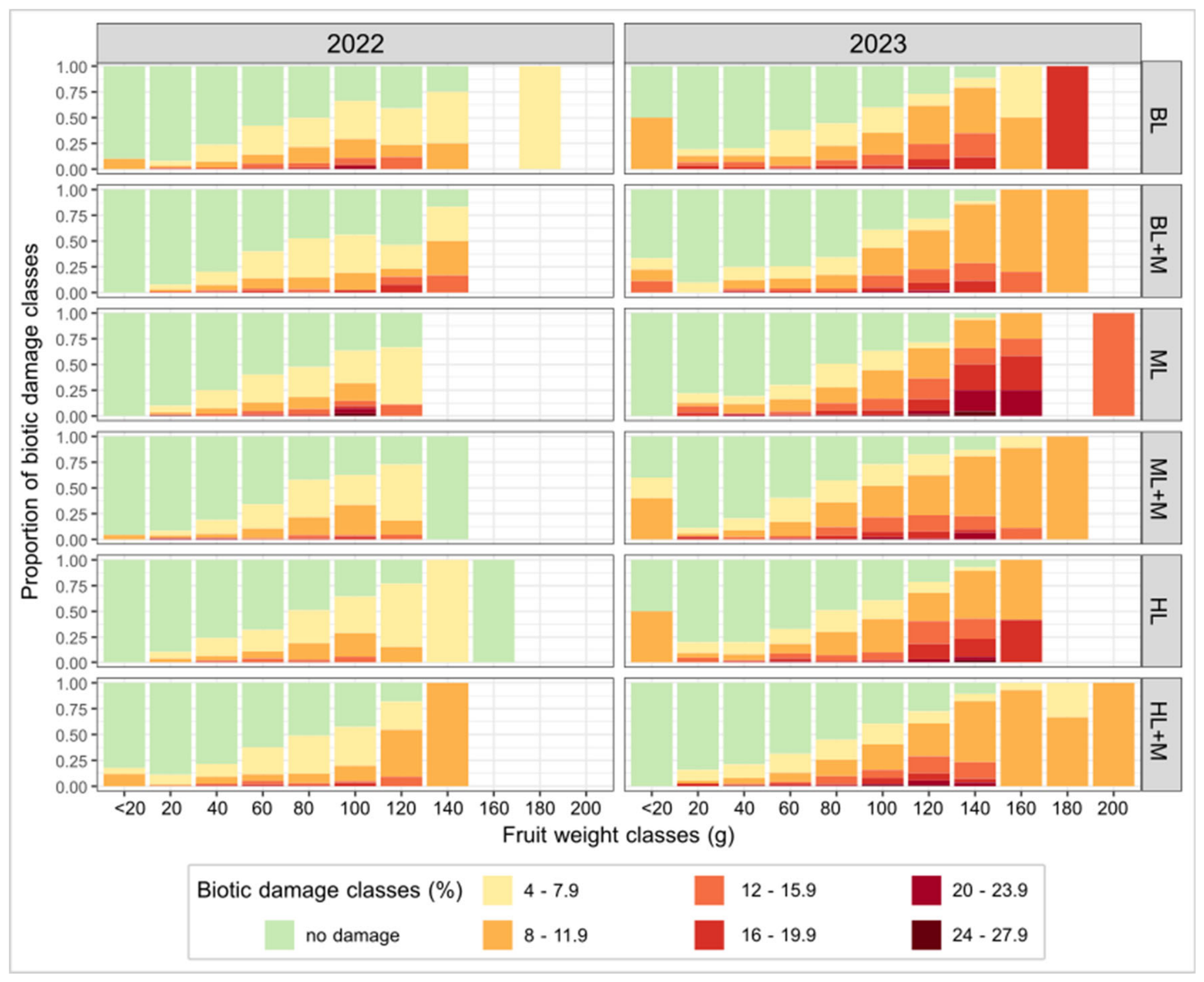
In the case of biotic damage (i.e., thrips and stinkbugs), an increase in the proportion of damaged fruits was observed in bigger fruit classes in both years (Figure 6). The chi-square test showed significant results of weight classes against damage classes in both years (2022 p-value: 0.007, Cramer’s V: 0.26; 2023 p-value: <0.001, Cramer’s V: 0.11), suggesting a relationship between the two parameters, yet a rather weak one. A high proportion of damaged fruits from bigger weight classes was observed in the treatment of HL and HL+M in 2022. In 2023, more than 75% of fruits with a weight of over 140 g were affected by biotic damage. The damage was more severe in treatments without the microalga, especially for ML (Figure 6). The foliar application of microalga reduced the biotic damage index in all technologies except HL in 2023 by 6.2–15.7%.

4. Discussion

The main effects and trends observed are summarized in Table 7. The results are discussed in relation to the three hypotheses, with emphasis on nutrient release dynamics, fertilizer form, and the effect of C. application.
Our first hypothesis assumed that increasing supply intensity would enhance plant growth, yield, and fruit quality while increasing the risk of biotic damage. However, no significant dose-dependent response was observed in any of the measured parameters (Table 7, column A), and overall yield and biomass did not increase with higher intensity.
Although the treatment containing alfalfa pellets was considered the middle-level nitrogen technology in this study (ML), it exerted a slight negative effect on plants compared to BL and HL technologies. ML had lower or the lowest values in the case of several parameters, including significantly lower fruit weight, fruit width, and proportion of extra-quality fruits in 2022 (Table 7, column D). This may be explained by the slower mineralization of plant-based fertilizers, leading to reduced nitrogen availability during critical early growth stages. Indeed, alfalfa meal is characterized by slow nitrogen release, with only 4% of its N content becoming available within the first weeks of application [4,57], while animal-based fertilizers such as blood meal and poultry manure are more rapid [4,6]. The superiority of animal-based organic fertilizer over plant-based organic fertilizer was demonstrated earlier in a field experiment with sweet pepper [58]. However, values of mineralization originate from controlled experiments, and mineralization dynamics may differ under on-farm polytunnel conditions.
In addition, the negative effects observed for alfalfa pellets were likely related to physical properties. The pellets were highly compressed, limiting water infiltration and microbial colonization, thereby delaying disintegration and mineralization. Based on field observation at the end of the growing season, partially intact pellets were still visible, in some cases covered by saprophytic fungi, indicating incomplete decomposition. The use of less compacted formulations, or alfalfa meal, may enhance decomposition dynamics and improve nutrient availability. In contrast to our findings, previous studies have reported positive effects of alfalfa-based amendments on yield and nutrient uptake [59,60,61], which may be attributed to the use of finely ground meal formulations, which enables faster microbial decomposition and nutrient release.
Apart from the negative effect of alfalfa pellets, no significant differences were observed between the basic and high-intensity levels (Table 7, columns A, B, and C). This suggests that nitrogen availability in BL was already sufficient to support plant growth. The nitrogen released via soil organic matter (SOM) mineralization could provide a background contribution that partially buffered differences among treatments. This rate is difficult to estimate because multiple factors regulate it, e.g., soil temperature, soil moisture, tillage practices, and soil microbial activity [6]. Under conditions of lower SOM, stronger responses to nutrient supply intensity may be expected. This highlights the importance of site-specific conditions in determining the effectiveness of nutrient management strategies in organic systems.
The limited benefits of HL technology suggest that additional input did not result in significantly better values for the crop parameters examined. Overall, the largely missing benefits of the HL technology draw attention to the unnecessary use of “conventionalized” nutrient supply logic in organic farming [2,62]. It is recommended to avoid the excess of nitrogen in a system where mineralization speed and nutrient supply capacity from organic sources can be hard to estimate [59,63].
Technology levels did not significantly affect TDM, TDS, and vitamin C content either. This is broadly in line with previous results, as certain levels of increased nitrogen have been reported to positively affect fruit dry weight, although in general terms, higher N doses did not have any effect on this parameter [64]. Another study also reported no effect of additional nitrogen supply on TDS or antioxidant capacity [65].
There was no significant difference or remarkable trend in the case of blossom-end rot and sunburn damage. Treatment significantly affected the cracking damage index in 2022, with BL treatment showing a higher value than BL+M, HL, and HL+M. In terms of trends, increasing nutrient supply levels resulted in a lower damage index of fruit cracking.
No significant differences were detected in pest damage index among treatments in either year. It is known that growth and defense of plants are limited by nitrogen availability [66], so plants need to prioritize their allocation depending on internal and external factors [67]. A higher nitrogen supply is often associated with increased susceptibility to herbivores due to changes in plant tissue composition [68,69]. There is ample evidence of the sensitivity of insect populations to their host plants’ nitrogen supply [70,71,72,73,74,75,76]. However, our findings in 2023 showed that the increasing nitrogen supply did not always result in higher biotic damage, which is not consistently in line with these statements.
The overall biotic damage severity in kapia fruits was higher in the case of larger fruits. The thrips’ and stinkbugs’ preference for larger fruits may be explained by larger fruits being more visually apparent, but they may also provide stronger olfactory cues, as volatile release from fruits is influenced by fruit surface area and diffusion across the peel [77]. This suggests that under organic polytunnel conditions, multiple interacting factors (e.g., temperature, mineralization, presence/infestation level of pests) influence biotic damage.
Overall, the results do not support the first hypothesis and highlight that increasing nutrient supply intensity does not necessarily improve productivity in organic polytunnel systems. Instead, they underline the importance of nutrient release dynamics, fertilizer form, and site-specific soil conditions in determining nutrient supply plans.
The second hypothesis (that residual nutrients from previous treatments influence the yield of winter leafy vegetables) was not confirmed by our result. Although yields tended to increase with higher nitrogen supply intensity, these differences were not significant (Table 7), except in one case: B. rapa ‘Green Mizuna’ annual plot yield, was significantly affected by technology in 2022, where HL showed the highest yield followed by BL and ML. Among the four leafy vegetables, Brassica species responded most to residual nutrients, particularly B. juncea ‘Green in Snow’, while E. sativa showed the lowest response. No negative effect of alfalfa pellets was detected on the yield of any tested leafy vegetable varieties.
Leafy greens were sown in mid-October, with first harvests occurring in December or January, providing a relatively long period for potential residual nitrogen effects. Relative to the leafy greens’ harvest periods, the last fertilizer dose (during pepper cropping) was applied approximately 3–4 months earlier for blood meal, 5–6 months earlier for alfalfa pellet, and 7–8 months earlier for poultry manure pellet. Fertilizer with the highest C/N ratio (poultry pellet) was applied for the longest time before harvest, while those with the lowest C/N ratio (blood meal) were applied closest to the leafy green cropping period. A study by Lazicki [78] showed that plant-available nitrogen after 84 days of incubation was correlated with the C/N ratio of organic fertilizer.
Long-lag responses are theoretically plausible, as nitrogen release from organic amendments often follows multi-phase dynamics, reflecting fractions with different turnover rates. Incubation studies [79,80] have demonstrated that mineralization may continue over 140 days, including initial increases and later plateaus and delayed net mineralization following early immobilization in materials with high C/N ratios. In addition, the absence of direct rainfall in unheated polytunnels may reduce leaching losses compared to open-field conditions, allowing mineral N to remain available for subsequent crops. However, under the conditions of this study, these differences did not translate into significant yield effects in leafy greens. Our results suggest that a long-term residual effect may be limited under similar conditions, which should be taken into account when planning long-term soil fertility management for organic greenhouse crops.
The third hypothesis (that C. vulgaris treatment increases values of vegetative and generative crop parameters) was only partially supported. Significant effects were observed only for fruit length across the two experimental years (Table 4), but no consistent improvement was detected in yield or most fruit parameters, nor in the yield of leafy green crops.
Previous studies on C. vulgaris application show substantial methodological differences, particularly regarding the form of the algal material used, which likely contributes to inconsistent results. Many positive results derive from studies using nonliving biomass [43,45,51,81]. In contrast, studies testing living cells are less consistent. Moon et al. [82] applied centrifuged viable cells separated from the culture medium and found no beneficial effects, attributing this to the removal of growth-promoting metabolites during centrifugation and to possible mineral imbalances within the remaining biomass. Additionally, Rápalo-Cruz et al. [83] demonstrated that harvest phase and application rate substantially influence efficacy, while Ronga et al. [38] emphasized crop-specific and phenological sensitivity to microalgal biostimulants.
Collectively, the literature suggests that the agronomic effect of C. vulgaris depends not merely on the presence of algal cells but critically on whether dry biomass, extracts, centrifuged living cells, or whole cultures are applied. By applying living cells together with their culture medium, the present study contributes to clarifying the effects of intact microalgal systems, addressing a methodological gap in the literature.
In this study, the effects of C. vulgaris treatment were strongly dependent on nutrient supply intensity. Positive trends were observed primarily under high-input technology (HL), while under lower input levels (BL and ML), effects were neutral or slightly negative (Table 7, column E). This suggests that plants with a more balanced nutrient supply may utilize microalga foliar treatment more effectively. One possible explanation is that algal treatment increases chlorophyll content and metabolic activity, thereby increasing nitrogen demand [51]. In other words, if the nitrogen supply is limited, the treatment may have a negative impact on plant productivity.
Contrary to several previous studies reporting improvements in TDM, TDS, and vitamin C, our results did not confirm these effects. In 2022, a significant decrease in these parameters was observed following C. vulgaris application, while no such effect was detected in 2023.
The most consistent effect of C. vulgaris treatment was the reduction in biotic damage. Although no significant difference was detected in damage index in 2022 and 2023, the reduction in total pest damage of thrips and stinkbugs index was up to 15.7% in most technology variations. The observed reduction may be related to induced plant defense responses. Microalgae-based treatments have been reported to enhance plant resistance through the activation of defense-related pathways, including the production of jasmonic acid, salicylic acid, and ethylene signaling [84,85]. The decrease in biotic damage observed in fruits treated with C. vulgaris in our study may be due to this mechanism induced by it.
No significant effect of C. vulgaris treatment was detected on the yield of leafy greens. This is consistent with previous findings indicating that responses to C. vulgaris treatment can be strongly affected by season, nutrient availability, environmental conditions, and crop type, since different cultivars can show different sensitivity thresholds to the same microalgal treatment [38].

5. Conclusions

Increased nutrient supply intensity (34–189 kg ha−1 N) did not result in significant improvements in pepper yield or vegetative biomass (p > 0.05). Despite the lack of yield response, certain fruit morphological parameters (e.g., fruit weight, length, and width) and the related quality classes showed significant responses to nutrient supply intensity (p < 0.001). No residual effects of the nutrient supply technologies were detected in the yield of the subsequent leafy green crops in all cases except one (p: 0.08–094), but trends were observed. These findings indicate that higher input intensity does not necessarily enhance productivity under the studied conditions.
Chlorella vulgaris living cell foliar application did not significantly improve most pepper parameters; the effects were strongly context-dependent. It showed positive trends only in combination with the high-intensity nutrient supply, while its effects were neutral or slightly negative under lower input levels. C. vulgaris applications tend to reduce total pest damage of thrips, and stinkbugs index up to 15.7% in most technology variations.
Overall, the results demonstrate that crop responses to nutrient supply intensity in organic polytunnel systems are governed more by site-specific soil, nutrient dynamics, and system interactions than by input intensity alone. The absence of a yield response to intensified nutrient supply highlights that higher input intensity does not necessarily enhance productivity under the studied conditions. These findings emphasize that intensive nutrient supply strategies should be applied with caution in organic polytunnel production, as they may contribute to the conventionalization of organic farming by shifting nutrient management toward input-substitution approaches rather than system-based thinking.

Supplementary Materials

The following supporting information can be downloaded at: https://www.mdpi.com/article/10.3390/horticulturae12050527/s1, Figure S1. Mean of green (a) and total (b) biomass in all treatments and statistical differences of all treatments applied in kapia pepper crop in 2022–2023. The treatments were a combination of three different technologies (BL—Basic Level, ML—Mid-Level, and HL—High-Level) and application of microbial product (M—Microalga). The treatment effect was calculated as ANOVA p-values followed by post-hoc Tukey HSD. Figure S2. Mean of height growth (a) and stem diameter increment (b) of kapia plant in six treatments and statistical differences of all treatments applied in kapia pepper crop in 2022–2023. The treatments were a combination of three different technologies (BL—Basic Level, ML—Mid-Level, and HL—High-Level) and application of microbial product (M—Microalga). The treatment effect was calculated as ANOVA p-values followed by post-hoc Tukey HSD. Figure S3. Mean of kapia pepper fruit yield (kg/m2) at (a) plot level and (b) plant level and statistical differences in all treatments applied in 2022–2023. The treatments were a combination of three different technologies (BL—Basic Level, ML—Mid-Level, and HL—High-Level) and application of microbial product (M—Microalga). The treatment effect was calculated as ANOVA p-values followed by post-hoc Tukey HSD. Figure S4. Mean of number of fruits produced per plant in all treatments and statistical differences among treatments in kapia pepper crop in 2022–2023. The treatments were a combination of three different technologies (BL—Basic Level, ML—Mid-Level, and HL—High-Level) and application of microbial product (M—Microalga). Figure S5. Mean of plot yield (kg/m2) of four leafy greens and statistical differences in all treatments applied in 2022–2023. The treatments were a combination of three different technologies (BL—Basic Level, ML—Mid-Level, and HL—High-Level) and application of microbial product (M—Microalga). The treatment effect was calculated as ANOVA p-values followed by post-hoc Tukey HSD. Figure S6. Mean of fruit length and width in all treatments and statistical differences among treatments in kapia pepper crop in 2022–2023. The treatments were a combination of three different technologies (BL—Basic Level, ML—Mid-Level, and HL—High-Level) and application of microbial product (M—Microalga). Figure S7. Kapia fruit market classes share in terms of plant yield in all treatments and statistical differences of treatments applied in 2022–2023. The classification of fruits to market classes was based on the width and length of fruits, i.e., extra: width >6 cm, length >10 cm, first class: width 5–6 cm, length 8–10 cm, second class: width 4–5 cm, length 7–8 cm, cull: width <4 cm, length <7 cm. The treatments were a combination of three different technologies (BL—Basic Level, ML—Mid-Level, and HL—High-Level) and application of microbial product (M—Microalga). The treatment effect was calculated as ANOVA p-values. Figure S8. Kapia yield per plot at the first four harvest days of all treatments applied in 2022–2023. The treatments were a combination of three different technologies (BL—Basic Level, ML—Mid-Level, and HL—High-Level) and application of microbial product (M—Microalga). Figure S9. Distribution of abiotic damage classes for different kapia pepper fruit size categories in each treatments applied in 2022–2023. The treatments were a combination of three different technologies (BL—Basic Level, ML—Mid-Level, and HL—High-Level) and application of microbial product (M—Microalga).

Author Contributions

Conceptualization, K.A.S., O.P. and I.K.; methodology, K.A.S., O.P., A.O. and I.K.; software, N.N.S.; validation, F.T.; formal analysis, N.N.S.; investigation, A.O., O.P. and F.P.-M.; resources, D.D.; data curation, N.N.S.; writing—original draft preparation, O.P. and A.O.; writing—review and editing, F.T., A.O., K.A.S., I.K., N.N.S. and D.D.; visualization, N.N.S.; supervision, K.A.S. and F.T.; project administration, O.P.; funding acquisition, D.D. All authors have read and agreed to the published version of the manuscript.

Funding

This research was co-funded by the Government of Hungary and the European Union, grant number VfKF/497-1/2025.

Data Availability Statement

The original contributions presented in this study are included in the article. Further inquiries can be directed to the corresponding authors.

Acknowledgments

The authors would like to express their sincere gratitude to those university students, who provided assistance in establishing and maintain the cropping, and in measuring of kapia fruit parameters: Martin Gál, Zsolt Dongó, Oxana Ponomarenko and Blanka Komjáti. We would also like to say thank Anna Divéky-Ertsey for her generous professional support, and Judit Berényi Üveges for her help in describing the soil parameters.

Conflicts of Interest

The authors declare no conflicts of interest.

Abbreviations

The following abbreviations are used in this manuscript:
C/NCarbon/Nitrogen
BLBasic Level nutrient supply (as technology)
MLMid-Level nutrient supply (as technology)
HLHigh-Level nutrient supply (as technology)
+Madded Microalga treatment
SOMSoil Organic Matter
TDMTotal Dry Matter
TDSTotal Dissolve Solids
BERBlossom-end rot
NNitrogen
C. vulgarisChlorella vulgaris

References

  1. Research Institute of Organic Agriculture (FiBL). Area Data on Organic Agriculture in Europe 2004–2024; The Statistics.FiBL.org Website Maintained by the Research Institute of Organic Agriculture (FiBL): Frick, Switzerland, 2026; Available online: https://statistics.fibl.org/europe.html (accessed on 9 April 2026).
  2. Tittarelli, F. Organic Greenhouse Production: Towards an Agroecological Approach in the Framework of the New European Regulation—A Review. Agronomy 2020, 10, 72. [Google Scholar] [CrossRef]
  3. Bergstrand, K.J. Organic Fertilizers in Greenhouse Production Systems—A Review. Sci. Hortic. 2022, 295, 110855. [Google Scholar] [CrossRef]
  4. Dion, P.P.; Jeanne, T.; Thériault, M.; Hogue, R.; Pepin, S.; Dorais, M. Nitrogen Release from Five Organic Fertilizers Commonly Used in Greenhouse Organic Horticulture with Contrasting Effects on Bacterial Communities. Can. J. Soil Sci. 2020, 100, 120–135. [Google Scholar] [CrossRef]
  5. Tittarelli, F.; Båth, B.; Ceglie, F.G.; Garcia, C.; Möller, K.; Reents, H.J.; Védie, H.; Voogt, W. Soil Fertility Management in Organic Greenhouses in Europe; Wageningen Academic Publishers: Wageningen, The Netherlands, 2016; ISBN 9789462575363. [Google Scholar]
  6. Gaskell, M.; Smith, R. Nitrogen Sources for Organic Vegetable Crops. Horttechnology 2007, 17, 431–441. [Google Scholar] [CrossRef]
  7. White, K.E.; Brennan, E.B.; Cavigelli, M.A.; Smith, R.F. Winter Cover Crops Increased Nitrogen Availability and Efficient Use during Eight Years of Intensive Organic Vegetable Production. PLoS ONE 2022, 17, e0267757. [Google Scholar] [CrossRef]
  8. Alhrout, H.H. Response of Growth and Yield Components of Sweet Pepper to Tow Different Kinds of Fertilizers under Green House Conditions in Jordan. J. Agric. Sci. 2017, 9, 265–272. [Google Scholar] [CrossRef][Green Version]
  9. Ashour, M.; Hassan, S.M.; Elshobary, M.E.; Ammar, G.A.G.; Gaber, A.; Alsanie, W.F.; Mansour, A.T.; El-Shenody, R. Impact of Commercial Seaweed Liquid Extract (TAM®) Biostimulant and Its Bioactive Molecules on Growth and Antioxidant Activities of Hot Pepper (Capsicum annuum). Plants 2021, 10, 1045. [Google Scholar] [CrossRef] [PubMed]
  10. Deng, T.; Yan, Y.; Liu, X.; Guan, Z.; Yang, F.; Ge, L.; Pan, X.; Gao, M.; Yan, Q.; Gao, A. Effects of Exogenous Self-Made Active Humic Acid Manure on Physical and Chemical Properties and Soil Bacteria of Continuous Cropping Obstacle Soil in Capsicum annuum L.; Research Square: Durham, NC, USA, 2023. [Google Scholar] [CrossRef]
  11. Khandaker, M.M.; Rohani, F.; Dalorima, T.; Mat, N. Effects of Different Organic Fertilizers on Growth, Yield and Quality of Capsicum annuum L. Var. Kulai (Red Chilli Kulai). Biosci. Biotechnol. Res. Asia 2017, 14, 185–192. [Google Scholar] [CrossRef]
  12. Lee, S.E.; Park, J.M.; Park, Y.E.; Lim, T.J. Effect of Chemical Fertilizer and Compost on Soil Physicochemical Properties, Leaf Mineral Content, Yield and Fruit Quality of Red Pepper (Capsicum annuum L.) in Open Field. Korean J. Soil Sci. Fertil. 2015, 48, 683–688. [Google Scholar] [CrossRef]
  13. Magalhães, D.d.S.; Viegas, I.d.J.M.; Barata, H.d.S.; Costa, M.G.; Silva, B.C.d.; Mera, W.Y.W.d.L. Deficiencies of Nitrogen, Calcium, and Micronutrients Are the Most Limiting Factors for Growth and Yield of Smell Pepper Plants. Rev. Ceres 2023, 70, 125–135. [Google Scholar] [CrossRef]
  14. Zayed, M.S.; Hassanein, M.K.K.; Esa, N.H.; Abdallah, M.M.F. Productivity of Pepper Crop (Capsicum annuum L.) as Affected by Organic Fertilizer, Soil Solarization, and Endomycorrhizae. Ann. Agric. Sci. 2013, 58, 131–137. [Google Scholar] [CrossRef][Green Version]
  15. Yıldıztekın, M.; Tuna, A.L.; Kaya, C. Physiological Effects of the Brown Seaweed (Ascophyllum nodosum) and Humic Substances on Plant Growth, Enzyme Activities of Certain Pepper Plants Grown under Salt Stress. Acta Biol. Hung. 2018, 69, 325–335. [Google Scholar] [CrossRef]
  16. Rocha, P.A.; Santos, M.R.; Donato, S.L.R.; Brito, C.F.B.; Ávila, J.S. Bell Pepper Cultivation under Different Irrigation Strategies in Soil with and without Mulching. Hortic. Bras. 2018, 36, 453–460. [Google Scholar] [CrossRef]
  17. Rodríguez, A.; Peña-Fleitas, M.T.; Gallardo, M.; de Souza, R.; Padilla, F.M.; Thompson, R.B. Sweet Pepper and Nitrogen Supply in Greenhouse Production: Critical Nitrogen Curve, Agronomic Responses and Risk of Nitrogen Loss. Eur. J. Agron. 2020, 117, 126046. [Google Scholar] [CrossRef]
  18. Berova, M.; Karanatsidis, G. Physiological Response and Yield of Pepper Plants (Capsicum annum L.) to Organic Fertilization. J. Cent. Eur. Agric. 2008, 9, 715–722. [Google Scholar]
  19. Castellanos, J.Z.; Cano-Ríos, P.; García-Carrillo, E.M.; Olalde-Portugal, V.; Preciado-Rangel, P.; Ríos-Plaza, J.L.; García-Hernández, J.L. Hot Pepper (Capsicum annuum L.) Growth, Fruit Yield, and Quality Using Organic Sources of Nutrients. Compost Sci. Util. 2017, 25, S70–S77. [Google Scholar] [CrossRef]
  20. Cuijpers, W.J.M.; Voogt, W.; Koopmans, C.J. Balancing Fertilization Strategy with Crop Requirements in Organic Greenhouse Cultivation of Sweet Pepper. In Proceedings of the Researching Sustainable Systems; Köpke, U., Niggli, U., Neuhoff, D., Cornish, P., Lockeretz, W., Willer, H., Eds.; International Society of Organic Agriculture Research: Adelaide, Australia, 2005; pp. 513–516. [Google Scholar]
  21. Shahein, M.M.; Sayed, S.F.E.; Hassan, H.A. Producing Sweet Pepper Organically Using Different Sources of Organic Fertilizers under Plastic House Conditions. In Proceedings of the International Conference on Advances in Agricultural, Biological & Environmental Sciences (AABES-2015), London, UK, 22–23 July 2015. [Google Scholar] [CrossRef]
  22. del Amor, F.M. Yield and Fruit Quality Response of Sweet Pepper to Organic and Mineral Fertilization. Renew. Agric. Food Syst. 2007, 22, 233–238. [Google Scholar] [CrossRef]
  23. Appireddy, G.K.; Saha, S.; Mina, B.L.; Kundu, S.; Selvakumar, G.; Gupta, H.S. Effect of Organic Manures and Integrated Nutrient Management on Yield Potential of Bell Pepper (Capsicum annuum) Varieties and on Soil Properties. Arch. Agron. Soil Sci. 2008, 54, 127–137. [Google Scholar] [CrossRef]
  24. Delate, K.; Cambardella, C.; McKern, A. Effects of Organic Fertilization and Cover Crops on an Organic Pepper System. Horttechnology 2008, 18, 215–226. [Google Scholar] [CrossRef]
  25. Garrigues, M.M.; Garrigues, R.B. Sweet Pepper (Capsicum annuum L) Under Organic Nutrient Management: A Comparative Study of Agronomic and Economic Outcomes. Int. J. Res. Innov. Appl. Sci. 2025, 10, 1348–1363. [Google Scholar] [CrossRef]
  26. Jamir, T.; Rajwade, V.B.; Prasad, V.M.; Lyngdoh, C. Effect of Organic Manures and Chemical Fertilizers on Growth and Yield of Sweet Pepper (Capsicum annuum L.) Hybrid Indam Bharath in Shade Net Condition. Int. J. Curr. Microbiol. Appl. Sci. 2017, 6, 1010–1019. [Google Scholar] [CrossRef]
  27. Szafirowska, A.; Elkner, K. Yielding and Fruit Quality of Three Sweet Pepper Cultivars from Organic and Conventional Cultivation. Veg. Crop. Res. Bull. 2008, 69, 135–143. [Google Scholar] [CrossRef]
  28. Todorova, V.; Yankova, V.; Masheva, S. Manifestations of Bulgarian Pepper Varieties Grown in Conditions of Organic Production. Bulg. J. Crop Sci. 2013, 50, 34–37. [Google Scholar]
  29. Duman, İ.; Aksoy, U.; Altındişli, A.; Elmacı, Ö.L. A Long-Term Trial to Determine Variations in the Yield and Quality of a Processing Type Pepper (Capsicum annuum L. Cv. Yalova Yağlık-28) in Organic and Conventional Farming Systems. Org. Agric. 2018, 8, 69–77. [Google Scholar] [CrossRef]
  30. Boteva, H. Optimizing of Systems for Nutrition in Biological Pepper Production. Turk. J. Agric. Nat. Sci. Spec. 2014, 1, 1665. [Google Scholar]
  31. Vlahova, V.; Popov, V. Influence of the Biofertiliser Seasol on Yield of Pepper (Capsicum annuum L.) Cultivated under Organic Agriculture Conditions. J. Org. Syst. 2013, 8, 6–17. [Google Scholar]
  32. Vlahova, V.; Popov, V. Improvement of Productivity and Quality of Pepper (Capsicum annuum L.) Resulting from Biofertilizer Applications under Organic Farming. Int. J. Agron. Agric. Res. 2014, 5, 148–160. [Google Scholar]
  33. Vlahova, V.N.; Popov, V.H.; Kouzmova, K.K. Impact of Biofertilisers and Agrometeorological Conditions on Phenological Growth of Pepper (Capsicum annuum L.) in Organic Agriculture. J. Cent. Eur. Agric. 2015, 16, 181–198. [Google Scholar] [CrossRef]
  34. Filyova, P.; Todorova, V.; Tringovska, I. Assessment of Productivity in Pepper Varieties and Breeding Lines (Capsicum annuum L.) in Different Systems of Organic Production. J. Mt. Agric. Balk. 2022, 25, 301–315. [Google Scholar]
  35. Duman, I.; Elmacı, Ö.L. The Effects of Combined Pre-Crops-Paste Pepper (Capsicum annum L. Cv. Capya) Production on Yield Fruit and Soil Properties under Long-Term Organic Conditions. Ege Üniversitesi Ziraat Fakültesi Derg. 2014, 51, 289–296. [Google Scholar]
  36. Tian, S.; Brecht, J.K.; Rathinasabapathi, B.; Zhao, X. Influence of Soil and Nutrient Management Practices on Crop Productivity and Quality in High Tunnel Organic Leafy Green Production. HortScience 2023, 58, 1610–1621. [Google Scholar] [CrossRef]
  37. Omokaro, G.; Nafula, Z.S. Microalgae: Harnessing Environmental and Nature Benefits-A Comprehensive Review. Am. J. Agric. Sci. Eng. Technol. 2023, 7, 10–54536. [Google Scholar] [CrossRef]
  38. Ronga, D.; Biazzi, E.; Parati, K.; Carminati, D.; Carminati, E.; Tava, A. Microalgal Biostimulants and Biofertilisers in Crop Productions. Agronomy 2019, 9, 192. [Google Scholar] [CrossRef]
  39. Lee, S.M.; Ryu, C.M. Algae as New Kids in the Beneficial Plant Microbiome. Front. Plant Sci. 2021, 12, 599742. [Google Scholar] [CrossRef]
  40. Arenas Colarte, C.; Balic, I.; Díaz, Ó.; Cortes, I.; Moreno, A.A.; Amenabar, M.J.; Retamal, M.C.; Fuentes, N.C. Microalgae-Based Biostimulants: Effects on Growth and Stress Resistance in Agricultural Crops. Plants 2025, 14, 3488. [Google Scholar] [CrossRef] [PubMed]
  41. Kapoore, R.V.; Wood, E.E.; Llewellyn, C.A. Algae Biostimulants: A Critical Look at Microalgal Biostimulants for Sustainable Agricultural Practices. Biotechnol. Adv. 2021, 49, 107754. [Google Scholar] [CrossRef]
  42. Prisa, D.; Spagnuolo, D. Plant Production with Microalgal Biostimulants. Horticulturae 2023, 9, 829. [Google Scholar] [CrossRef]
  43. Suchithra, M.R.; Muniswami, D.M.; Sri, M.S.; Usha, R.; Rasheeq, A.A.; Preethi, B.A.; Dinesh Kumar, R. Effectiveness of Green Microalgae as Biostimulants and Biofertilizer through Foliar Spray and Soil Drench Method for Tomato Cultivation. S. Afr. J. Bot. 2022, 146, 740–750. [Google Scholar] [CrossRef]
  44. Bumandalai, O.; Tserennadmid, R. Effect of Chlorella Vulgaris as a Biofertilizer on Germination of Tomato and Cucumber Seeds. Int. J. Aquat. Biol. 2019, 7, 95–99. [Google Scholar]
  45. Refaay, D.A.; El-Marzoki, E.M.; Abdel-Hamid, M.I.; Haroun, S.A. Effect of Foliar Application with Chlorella Vulgaris, Tetradesmus Dimorphus, and Arthrospira Platensis as Biostimulants for Common Bean. J. Appl. Phycol. 2021, 33, 3807–3815. [Google Scholar] [CrossRef]
  46. Hajnal-Jafari, T.; Seman, V.; Stamenov, D.; Đurić, S. Effect of Chlorella Vulgaris on Growth and Photosynthetic Pigment Content in Swiss Chard (Beta vulgaris L. Subsp. Cicla). Pol. J. Microbiol. 2020, 69, 235. [Google Scholar] [CrossRef]
  47. Go, Y.; Lee, B.S.; Kim, E.J.; Ju, S.H.; Park, J.S.; Na, H. Chlorella Foliar Application Promote Growth and Post-Harvest Storage Characteristics in Melon. Hortic. Sci. Technol. 2023, 41, 549–559. [Google Scholar] [CrossRef]
  48. La Bella, E.; Baglieri, A.; Rovetto, E.I.; Stevanato, P.; Puglisi, I. Foliar Spray Application of Chlorella Vulgaris Extract: Effect on the Growth of Lettuce Seedlings. Agronomy 2021, 11, 308. [Google Scholar] [CrossRef]
  49. Faheed, F.A. Effect of Chlorella Vulgaris as Bio-Fertilizer on Growth Parameters and Metabolic Aspects of Lettuce Plant. J. Agric. Soc. Sci. 2008, 4, 1813–2235. [Google Scholar]
  50. Chiaiese, P.; Corrado, G.; Colla, G.; Kyriacou, M.C.; Rouphael, Y. Renewable Sources of Plant Biostimulation: Microalgae as a Sustainable Means to Improve Crop Performance. Front. Plant Sci. 2018, 9, 1782. [Google Scholar] [CrossRef]
  51. Gitau, M.M.; Farkas, A.; Ördög, V.; Maróti, G. Evaluation of the Biostimulant Effects of Two Chlorophyta Microalgae on Tomato (Solanum lycopersicum). J. Clean. Prod. 2022, 364, 132689. [Google Scholar] [CrossRef]
  52. R Core Team. R: A Language and Environment for Statistical Computing; R Foundation for Statistical Computing: Vienna, Austria, 2025. [Google Scholar]
  53. Wickham, H. Ggplot2: Elegant Graphics for Data Analysis; Springer: New York, NY, USA, 2009; ISBN 978-0-387-98140-6. [Google Scholar]
  54. Hvitfeldt, E. Paletteer: Comprehensive Collection of Color Palettes; R Foundation for Statistical Computing: Vienna, Austria, 2024. [Google Scholar]
  55. Wickham, H.; François, R.; Henry, L.; Müller, K.; Vaughan, D. Dplyr: A Grammar of Data Manipulation; R Foundation for Statistical Computing: Vienna, Austria, 2023. [Google Scholar]
  56. Mendiburu, F.d.; Yaseen, M. Agricolae: Statistical Procedures for Agricultural Research; R Foundation for Statistical Computing: Vienna, Austria, 2020. [Google Scholar]
  57. Sullivan, D.M.; Andrews, N.A.; Luna, J.M.; McQueen, J.P.G.; Gilkes, R. Estimating N Contribution from Organic Fertilizers and Cover Crop Residues Using Online Calculators. In Proceedings of the 19th World Congress of Soil Science, Brisbane, QLD, Australia, 1–6 August 2010. [Google Scholar]
  58. Audu, I.; Bello, Z.; Abakura, J.B. The Effects of Compost and Farmyard Manures on the Growth, Yield and Yield Parameters of Sweet Pepper (Capsicum annum L.) in Yola, Adamawa State, Nigeria. Asian Plant Res. J. 2018, 1, 1–10. [Google Scholar] [CrossRef]
  59. Gatsios, A.; Ntatsi, G.; Celi, L.; Said-Pullicino, D.; Tampakaki, A.; Savvas, D. Legume-Based Mobile Green Manure Can Increase Soil Nitrogen Availability and Yield of Organic Greenhouse Tomatoes. Plants 2021, 10, 2419. [Google Scholar] [CrossRef] [PubMed]
  60. Qian, P.; Schoenau, J.J.; King, T.; Fatteicher, C. Effect of Soil Amendment with Alfalfa Powders and Distillers Grains on Nutrition and Growth of Canola. J. Plant Nutr. 2011, 34, 1403–1417. [Google Scholar] [CrossRef]
  61. Malhi, S.S.; Leach, D. Relative Effectiveness of Various Amendments in Improving Yield and Nutrient Uptake under Certified Organic Crop Production. Open J. Soil Sci. 2012, 2, 57. [Google Scholar] [CrossRef]
  62. Darnhofer, I.; Lindenthal, T.; Bartel-Kratochvil, R.; Zollitsch, W. Conventionalisation of Organic Farming Practices: From Structural Criteria towards an Assessment Based on Organic Principles. A Review. Agron. Sustain. Dev. 2010, 30, 67–81. [Google Scholar] [CrossRef]
  63. Voogt, W.; De Visser, P.H.E.; Van Winkel, A.; Cuijpers, W.J.M.; Van de Burgt, G. Nutrient Management in Organic Greenhouse Production: Navigation between Constraints. In Proceedings of the I International Conference on Organic Greenhouse Horticulture; ISHS: Leuven, Belgium, 2010; Volume 915, pp. 75–82. [Google Scholar]
  64. Wang, C.; Zhang, S.; Wu, H.; Yang, X.; Tang, R.; Li, Y.; Jiang, X.; Lei, K.; Huang, R.; Huang, Q.; et al. Dry Matter Accumulation and Nitrogen Absorption Characteristics of Processed Pepper under Different Nitrogen Levels. Mol. Plant Breed. 2021, 12, 1–6. [Google Scholar] [CrossRef]
  65. Yasuor, H.; Ben-Gal, A.; Yermiyahu, U.; Beit-Yannai, E.; Cohen, S. Nitrogen Management of Greenhouse Pepper Production: Agronomic, Nutritional, and Environmental Implications. HortScience 2013, 48, 1241–1249. [Google Scholar] [CrossRef]
  66. Hurtado, A.C.; de Mello Prado, R.; Campos, M.L. Challenging the “Resource Allocation” Paradigm: A Meta-Analysis on How Nitrogen Fertilization Balances Plant Growth and Defense against Insects. Theor. Exp. Plant Physiol. 2025, 37, 35. [Google Scholar] [CrossRef]
  67. Huot, B.; Yao, J.; Montgomery, B.L.; He, S.Y. Growth-Defense Tradeoffs in Plants: A Balancing Act to Optimize Fitness. Mol. Plant 2014, 7, 1267–1287. [Google Scholar] [CrossRef] [PubMed]
  68. Sadras, V.; Vázquez, C.; Garzo, E.; Moreno, A.; Medina, S.; Taylor, J.; Fereres, A. The Role of Plant Labile Carbohydrates and Nitrogen on Wheat-Aphid Relations. Sci. Rep. 2021, 11, 12529. [Google Scholar] [CrossRef]
  69. Sun, Y.; Wang, M.; Mur, L.A.J.; Shen, Q.; Guo, S. Unravelling the Roles of Nitrogen Nutrition in Plant Disease Defences. Int. J. Mol. Sci. 2020, 21, 572. [Google Scholar] [CrossRef]
  70. Firdaus, F.; Ngatimin, S.N.; Nasruddin, A. Populations of Aphis Gossypii on Different Pepper Cultivars, Fertilized with Different Rates of NPK. In Proceedings of the IOP Conference Series: Earth and Environmental Science; IOP Publishing: Bristol, UK, 2020; Volume 486, p. 12148. [Google Scholar]
  71. Diaz, D.C.; Seal, D.; Mannion, C.; Waddill, C.; Liburd, O. The Effect of Nitrogen on Population Dynamics of the Chilli Thrips, Scirtothrips Dorsalis (Thysanoptera: Thripidae), on Hydroponically Grown Jalapeño Pepper (Capsicum annuum). Proc. Fla. State Hortic. Soc. 2013, 126, 136–141. [Google Scholar]
  72. Moerkens, R.; Chan, K.H.; Bellinkx, S.; Swinnen, K.; Vanormelingen, P.; Beliën, T.; Wäckers, F. Impact of Nutrient Limitation on Nezara Viridula Development: Validation of a Stage-Structured Degree-Day Model in Outdoor and Greenhouse Environments Using Citizen Science Data. J. Appl. Entomol. 2025, 149, 1392–1406. [Google Scholar] [CrossRef]
  73. Estiarte, M.; Filella, I.; Serra, J.; Peñuelas, J. Effects of Nutrient and Water Stress on Leaf Phenolic Content of Peppers and Susceptibility to Generalist Herbivore Helicoverpa Armigera (Hubner). Oecologia 1994, 99, 387–391. [Google Scholar] [CrossRef]
  74. Awmack, C.S.; Leather, S.R. Host Plant Quality and Fecundity in Herbivorous Insects. Annu. Rev. Entomol. 2002, 47, 817–844. [Google Scholar] [CrossRef] [PubMed]
  75. Brodbeck, B.V.; Stavisky, J.; Funderburk, J.E.; Andersen, P.C.; Olson, S.M. Flower Nitrogen Status and Populations of Frankliniella Occidentalis Feeding on Lycopersicon Esculentum. Entomol. Exp. Appl. 2001, 99, 165–172. [Google Scholar] [CrossRef]
  76. Mensah-Bonsu, M.; Dingha, B.N.; Jackai, L.E.N.; Adjei-Fremah, S.; Worku, M. Evaluation of Preference of Brown Marmorated Stink Bug, Halyomorpha Halys (Stål) for Different Colour Bell Peppers and the Role of Plant Protein. Arthropod. Plant Interact. 2020, 14, 363–372. [Google Scholar] [CrossRef]
  77. Paul, V.; Pandey, R. Role of Internal Atmosphere on Fruit Ripening and Storability—A Review. J. Food Sci. Technol. 2014, 51, 1223–1250. [Google Scholar] [CrossRef] [PubMed]
  78. Lazicki, P.; Geisseler, D.; Lloyd, M. Nitrogen Mineralization from Organic Amendments Is Variable but Predictable. J. Environ. Qual. 2020, 49, 483–495. [Google Scholar] [CrossRef]
  79. Kaleem Abbasi, M.; Khaliq, A. Nitrogen Mineralization of a Loam Soil Supplemented with Organic-Inorganic Amendments under Laboratory Incubation. Front. Plant Sci. 2016, 7, 1038. [Google Scholar] [CrossRef]
  80. Lohr, D.; Gruda, N.S.; Meinken, E. Estimating Nitrogen Release from Organic Fertilizers for Soilless Production by Analysis of C and N Pools. Horticulturae 2023, 9, 767. [Google Scholar] [CrossRef]
  81. Özdemir, S.; Sukatar, A.; Öztekin, G.B. Chlorella Vulgaris Üretimi ve Sera Organik Domates Yetiştiriciliğinde Biyogübre Olarak Kullanımının Etkileri. J. Agric. Sci. 2016, 22, 596–605. [Google Scholar]
  82. Moon, J.; Park, Y.J.; Choi, Y.B.; Truong, T.Q.; Huynh, P.K.; Kim, Y.B.; Kim, S.M. Physiological Effects and Mechanisms of Chlorella Vulgaris as a Biostimulant on the Growth and Drought Tolerance of Arabidopsis Thaliana. Plants 2024, 13, 3012. [Google Scholar] [CrossRef]
  83. Rápalo-Cruz, A.; Gomez-Serrano, C.; Gonzalez-Lopez, C.V.; Bagher Hassanpouraghdam, M.; Ebrahimzadeh, A.; Jimenez-Becker, S. Effects of Chlorella Vulgaris at Different Growth Stages and Concentrations on the Growth of Pelargonium × Hortorum. Agriculture 2025, 15, 419. [Google Scholar] [CrossRef]
  84. Gitau, M.M.; Shetty, P.; Maróti, G. Transcriptional Analysis Reveals Induction of Systemic Resistance in Tomato Treated with Chlorella Microalgae. Algal Res. 2023, 72, 103106. [Google Scholar] [CrossRef]
  85. Elsharkawy, M.M.; El-Okkiah, S.; Elsadany, A.Y.; Bedier, M.Y.; Omara, R.I.; Behiry, S.I.; Hassan, S.; Abdelkhalek, A. Systemic Resistance Induction of Tomato Plants against Tomato Mosaic Virus by Microalgae. Egypt. J. Biol. Pest Control 2022, 32, 37. [Google Scholar] [CrossRef]
Figure 1. The plot design and plant arrangements of kapia and four leafy green taxa. The treatments were combinations of three technologies (Tc: Basic level <BL>, Mid-level <ML>, High-level <HL>) and Microalga (BL+M, ML+M, HL+M).
Horticulturae 12 00527 g001
Figure 2. Mean of root biomass in all treatments and their statistical differences in kapia pepper in 2022–2023. The six treatments represented by different colors were a combination of three technologies (BL–Basic Level, ML–Mid-Level, and HL–High-Level) and the application of microbial product (M–Microalga). The treatment effect was calculated using ANOVA p-values followed by post-hoc Tukey HSD.
Horticulturae 12 00527 g002
Figure 3. Average fruit weight of kapia pepper and statistical differences in all treatments applied in 2022–2023. The six treatments, represented by different colors, were a combination of three technologies (BL–Basic Level, ML–Mid-Level, and HL–High-Level) and application of microbial product (M–Microalga). The treatment effect was calculated using ANOVA p-values followed by post-hoc Tukey HSD.
Horticulturae 12 00527 g003
Figure 4. Total kapia fruit yield of different weight classes in all treatments applied in 2022–2023. The six treatments represented by different colors were combination of three technologies (BL–Basic Level, ML–Mid-Level, and HL–High-Level) and application of microbial product (M–Microalga). The relationship between treatment and weight class was calculated as Chi-square p-value.
Horticulturae 12 00527 g004
Figure 5. Index of abiotic (cracks, blossom-end rot, sunburn) and biotic (thrips, stinkbugs) damages and their statistical differences in all treatments applied to the kapia pepper crop in 2022–2023. The six treatments represented by different colors were a combination of three different nutrient supply levels (BL–Basic Level, ML–Mid-Level, and HL–High-Level) and application of a microbial product (M–Microalga). The treatment effect was calculated using ANOVA p-values followed by post-hoc Tukey HSD.
Horticulturae 12 00527 g005
Figure 6. Distribution of biotic damage classes for different kapia pepper fruit size categories in each treatment applied in 2022–2023. The treatments were a combination of three different nutrient supply levels (BL–Basic Level, ML–Mid-Level, and HL–High-Level) and the application of a microbial product (M–Microalga).
Horticulturae 12 00527 g006
Table 1. Average values of pH, CaCO3, SOM%, NO3, NH4, P2O5, K2O, salts% soil parameters at the experimental site just before the planting of pepper plants in 2022 May and 2023 May (Zsámbok, Hungary).
YearpH (KCl)CaCO3%Soil Organic Matter %NO3 (KCl) (mg kg−1)NH4 (KCl) (mg kg−1)Al-P2O5 (mg kg−1)Al-K2O (mg kg−1)Salts %
20227.41.22.716.27.11222.3346.70.1
20237.31.43.19.48.21317.3507.60.04
Table 2. Variety, length of growing season and harvest season, spacing, and cultivation technology in case of kapia pepper and leafy green crops in 2022–2023.
CropKapia PepperLeafy Greens
Species/VarietyCapsicum annuum ‘Kapirex’Brassica rapa var. japonica ‘Green Mizuna’
Eruca sativa (no cultivar)
Brassica juncea ‘Red Giant’
Brassica juncea ‘Green in Snow’
Growing season4 May 2022–18 October 202219 October 2022–19 April 2023
5 May 2023–16 October 202318 October 2023–5 April 2024
Harvest season19 July 2022–18 October 202214 December 2022–19 April 2023
24 July 2023–16 October 202312 December 2023–5 April 2024
Harvested once a weekHarvested at market maturity stage by species
Spacing1 row/bed4 rows/bed
Intra-row spacing: 25 cmIntra-row spacing: 5 cm
Cultivation technologyRegular pruning, two-stem cultivation systemDrip irrigation
Drip irrigationNo ground cover
Landscape fabric ground coverFleece protection on frosty nights
Table 3. Description of treatments: timing, application frequency, method of application, applied dilution, and the amount of different nutrients in the six treatments applied to the kapia pepper and leafy green crops in 2022–2023.
Timing, Application Frequency, and Method of Application
in Kapia Pepper Crop
Regarding Technologies
Basic Level (BL)
(34 kg/ha N)
Amount of Nutrients
Mid-Level (ML)
(116 kg/ha N)
Amount of Nutrients
High-Level (HL)
(189 kg/ha N)
Amount of Nutrients
At planting:
On one occasion
(Broadcasted in solid form on soil surface)
Poultry manure pellet 100 g/m2
Lime powder 50 g/m2
Poultry manure pellet 100 g/m2
Lime powder 50 g/m2
Alfalfa pellet 150 g/m2
Poultry manure pellet 100 g/m2
Lime powder 50 g/m2
Blood meal 50 g/m2
During season:
Every second week
(Applied to the base of plants in a dissolved form on the soil surface)
(none)(none)Magnesium sulphate 5 g/m2
Lime powder 10 g/m2
Blood meal 10 g/m2
Brexil Combi 0.5 g/m2 (in sulphate-form 8% Fe, 2.6% Mn, 1.1% Zn, 0.9% B, 0.3% Cu, as Na-molybdenite: 0.2% Mo)
Kondisol (humic acid extract) 5 mL/m2
At coloring of fruits:
On one occasion
(Broadcasted in solid form on soil surface)
(none)Alfalfa pellet 150 g/m2
Lime powder 50 g/m2
Magnesium sulphate 10 g/m2
Patentkali 50 g/m2
Poultry manure pellet 100 g/m2
Lime powder 50 g/m2
2 weeks before termination:
On one occasion
(Poured in dissolved form on soil surface, at the base of plants)
(none)Patentkali 20 g/m2Patentkali 20 g/m2
Application frequency, time, and method of application in kapia pepper and leafy green crops regarding microalga treatmentBasic level+
Microalga
(BL+M)
Applied dilution
Mid-level+
Microalga
(ML+M)
Applied dilution
High-level+
Microalga
(HL+M)
Applied dilution
During season:
9 times to kapia pepper crop (first in May, last in Sept.) and 3 times to leafy greens (one treatment in Nov., Dec., and Feb.)
(Foliar application)
3% microalga solution,
in addition to the above nutrients
3% microalga solution,
in addition to the above nutrients
3% microalga solution,
in addition to the above nutrients
Table 4. Parameters measured on kapia and leafy greens and the effects of three technologies (Tc: Basic level <BL>, Mid-level <ML>, High-level <HL>), six treatments (Tm: in addition to BL, ML, and HL, combinations with Microalga: BL+M, ML+M, HL+M); microalga (M); and sampling time (t) tested with analysis of variance. Significant effect (●) was based on an alpha level of 0.05. The units of analysis differ, with individual fruits or plants analyzed as a unit or pooled together at the plot level. The number of data analyzed (n) and the range value are presented for each parameter. Data collected from multiple measurements were also analyzed for the time effect. In the case of data measured once, time was not included in the analysis (nt—not tested).
Parameters MeasuredUnits of Analysis, DescriptionnRange ValueEffects in 2022Effects in 2023
Tc Tm M t Tc Tm M t
Kapia plant biomass
Root biomass (g)Plant, fresh weight of harvested root 54910.0–142.0 nt nt
Green biomass (g)Plant, fresh weight of plants, pruned leaves, plants removed due to Fusarium infection569100.7–1836.2 nt nt
Total (root + green + fruit) biomass (g)All under- and aboveground parts of plants569423.7–5071.1 nt nt
Kapia plant growth
Height growth (mm)Plant, total height growth52639.3–144.5 nt nt
Diameter increment (mm)Plant, total diameter growth5265.9–20.1 nt nt
Kapia fruit characteristics
Total plant yield (kg)Plant, total weight of harvested fruit5690.2–4.2 nt nt
Total plot yield (kg/m2)Plot, total weight of harvested fruit486.1–13.9 nt nt
Number of fruitsPlant, total number of harvested fruits5695–52 nt nt
Fruit weight (g)Fruit, weight of harvested fruit14,4895.0–272.0
Fruit length (mm)Fruit, fruit length14,4893.0–218.0
Fruit width (mm)Fruit, fruit width14,48916.0–85.0
Kapia fruit quality classes
“Extra” fruit yield (kg/m2)Plant, total harvested fruit weight21280.33–13.41 nt nt
“First class” fruit yield (kg/m2)Plant, total harvested fruit weight21280.26–8.97 nt nt
“Second class” fruit yield (kg/m2)Plant, total harvested fruit weight21280.15–6.55 nt nt
“Cull” fruit yield (kg/m2)Plant, total harvested fruit weight21280.03–3.54 nt nt
Kapia fruit quality characteristics
Total dry matter (%) (TDM)Fruit, ratio of dry to fresh pericarp weight1447.4–11.6
Total dissolve solids (TDS) (°Brix)Fruit, measured from pericarp juice1445.7–9.2
Vitamin C (mg L−1)Fruit, measured vitamin C content from pericarp juice1441117–2808
Kapia fruit damage
Blossom-end rot (BER) damage index (%)Plot, calculated index480.4–6.1 nt nt
Crack damage index (%)Plot, calculated index480.6–8.5 nt nt
Sunburn damage index (%)Plot, calculated index480–1.2 nt nt
Thrips damage index (%)Plot, calculated index485.4–10.9 nt nt
Stinkbugs damage index (%)Plot, calculated index480.6–20.4 nt nt
Leafy green yield
B. rapa ‘Green Mizuna’ yield (g)Plot, total harvest48196–1306 nt nt
E. sativa yield (g)Plot, total harvest481130–3054 nt nt
B. juncea ‘Red Giant’ yield (g)Plot, total harvest48242–1590 nt nt
B. juncea ‘Green in Snow’ yield (g)Plot, total harvest48662–3892 nt nt
Table 5. The average kapia yield, the red fruits yield, their percentage from total yield at plot level, and yield of leafy greens in kg/m2 during two years of experiment in all treatments applied. The treatments were a combination of three different technologies (BL–Basic Level, ML–Mid-Level, and HL–High-Level) and application of microbial product (M–Microalga). The treatment effect was calculated as ANOVA p-value with alpha value of 0.05. Significant treatment effects appear in bold p-values (p ≤ 0.05), and post-hoc Tukey HSD was expressed as superscript letters.
ParametersTreatmentsTreatment Effect (ANOVA p-Value)
BLBL+MMLML+MHLHL+M
Year 2022
Kapia plot yield (kg/m2)8.3 a7.8 a7.9 a7.8 a8.6 a9.0 a0.77
Yield of red kapia fruits per plot (kg/m2); percentage from total yield6.6 a (80.3%)6.2 a (79.5%)6.5 a (82.2%)6.2 a (79.2%)6.9 a (79.8%)7.3 a (81.4%)0.58
B. rapa ‘Green Mizuna’ yield (kg/m2)0.26 a0.23 a0.33 a0.31 a0.38 a0.36 a0.05
E. sativa yield (kg/m2)0.65 a0.77 a0.79 a0.78 a0.57 a0.60 a0.52
B. juncea ‘Red Giant’ yield (kg/m2)0.41 a0.43 a0.40 a0.33 a0.43 a0.39 a0.71
B. juncea ‘Green in Snow’ yield (kg/m2)1.13 a1.03 a1.14 a1.04 a1.39 a1.33 a0.13
Year 2023
Kapia total plot yield (kg/m2)11.4 a9.9 a10.5 a10.1 a11.1 a11.0 a0.55
Yield of red kapia fruits per plot (kg/m2); percentage from total yield9.4 a (82.3%)8.2 a (82.1%)8.6 a (82.1%)8.4 a (83.1%)9.2 a (83.3%)9.4 a (85.6%)0.29
B. rapa ‘Green Mizuna’ yield (kg/m2)0.18 a0.26 a0.22 a0.18 a0.30 a0.36 a0.13
E. sativa yield (kg/m2)0.64 a0.68 a0.65 a0.72 a0.59 a0.65 a0.78
B. juncea ‘Red Giant’ yield (kg/m2)0.16 a0.31 a0.24 a0.27 a0.32 a0.28 a0.46
B. juncea ‘Green in Snow’ yield (kg/m2)0.49 a0.64 a0.66 a0.60 a0.70 a0.66 a0.85
Table 6. Total dry matter (TDM), total dissolved solids (TDS), vitamin C content of kapia fruit, and the effect of treatment during two years of experiment in all treatments applied. The treatments were a combination of three different nutrient supply levels (BL–Basic Level, ML–Mid-Level, and HL–High-Level) and application of microbial product (M–Microalga). The treatment effect was calculated as ANOVA p-value with an alpha level of 0.05. Significant treatment effects appear in bold p-values, and post-hoc Tukey HSD was expressed as superscript letters.
ParametersTreatmentsTreatment Effect (ANOVA p-Value)
BLBL+MMLML+MHLHL+M
Year 2022
Total dry matter (TDM) (% pericarp)9.7 a9.7 a10.0 a9.7 a10.1 a9.6 a0.18
Total dissolved solids (TDS) (°Brix pericarp juice)7.5 a7.4 a7.9 a7.4 a8.1 a7.4 a0.02
Vitamin C
(mg L−1 pericarp juice)
1919 a 1876 a 1987 a 1874 a 2029 a 1889 a 0.43
Year 2023
Total dry matter (TDM) (% pericarp)8.7 a8.8 a8.6 a8.6 a8.8 a8.6 a0.82
Total dissolved solids (TDS) (°Brix pericarp juice)6.9 a7.1 a7.0 a6.7 a7.0 a6.7 a0.33
Vitamin C
(mg L−1 pericarp juice)
1641 a1632 a1752 a1711 a1621 a1704 a0.20
Table 7. Summary of results, showcasing the significant differences (*) and the observable trends (TD—refers to a situation where the phenomenon is observable in the form of lower or higher values but not to a significant degree) in kapia pepper and leafy green crop parameters in two experimental years, in relation to the different nutrient supply levels and microbial product treatment. The arrows show the direction of the effects: column A and B: ↓ values lower than BL values, ↑ values higher than BL values, and ↑↑ values higher than ML values; columns E and F: ↓ values decreased if microalga treatment is applied and ↑ values increased if microalga treatment is applied.
Parameters TestedA.
Perfect Graduality (BL—ML ↑-HL ↑↑)
B.
Imperfect Graduality (BL—ML ↓-HL ↑)
C.
BL&HL Equal, or HL Worse
D.
ML Had Lower/Worst Values
E.
Microalga Treatment Pattern (BL ↓ ML ↓, HL ↑)
F.
Microalga Treatment Effect (with Consistent Direction)
202220232022202320222023202220232022202320222023
Root biomass TDTD TDTD
Green biomass TDTDTD TD↑ TD↓
Total biomass TD TD TDTD TD
Total plant/plot yield TD TD TDTDTDTD
Number of fruitsTD TD TDTD
Fruit weight TD* *
Fruit length ** * TD ↓
Fruit width TD* TD TD ↓
Extra-class fruit yield TD TD*TD TD
First-class fruit yield TD TD TDTD
Total dry matter (TDM) TD TD TD ↓
Total dissolve solids (TDS)TD TD TD ↓
Vitamin C contentTD TD TDTD ↓
BER damage index TDTD
Crack damage indexTD TD TD ↓
Sunburn damage index TDTD
Thrips damage index TD TD TD TD ↓
Stinkbugs damage indexTD TD TD TD ↓
B. rapa ‘Green Mizuna’ leaf yieldTDTD TD ↓
E. sativa leaf yield TDTD TD ↑
B. juncea ‘Red Giant’ leaf yield TD TD
B. juncea ‘Green in Snow’ leaf yield TDTD TD ↓
Disclaimer/Publisher’s Note: The statements, opinions and data contained in all publications are solely those of the individual author(s) and contributor(s) and not of MDPI and/or the editor(s). MDPI and/or the editor(s) disclaim responsibility for any injury to people or property resulting from any ideas, methods, instructions or products referred to in the content.