Article

Integrated Assessment of Growth Performance, Biomass Accumulation, and Physiological Responses in Kale (Brassica oleracea L.) During Early Growth Under Different LED Spectral Conditions in a PFAL


1
Department of Environmental Horticulture, Graduate School, Sahmyook University, Seoul 01795, Republic of Korea
2
Natural Science Research Institute, Sahmyook University, Seoul 01795, Republic of Korea
*
Author to whom correspondence should be addressed.
Horticulturae 2026, 12(4), 498; https://doi.org/10.3390/horticulturae12040498
Submission received: 7 March 2026 / Revised: 11 April 2026 / Accepted: 13 April 2026 / Published: 20 April 2026
(This article belongs to the Section Protected Culture)

Abstract

This study evaluated the effects of different light-emitting diode (LED) spectral qualities on the early growth of kale at the baby-leaf harvest stage in a plant factory with artificial lighting (PFAL) by integrating morphological traits, biomass accumulation, plant quality indices, vegetation indices, and chlorophyll a fluorescence. Two kale (Brassica oleracea L.) cultivars, ‘Jellujon’ and ‘Manchoo Collard’, were grown for four weeks under monochromatic red, green, and blue LEDs, a purple composite LED with far-red wavelengths, and three white LEDs with different correlated color temperatures (3000, 4100, and 6500 K). Blue LED increased shoot height by approximately 14–28%, depending on cultivar and comparison among the white LED treatments, but this elongation did not translate into superior biomass production. In contrast, white LEDs, particularly at 3000–4100 K, increased leaf area to 24.2–24.9 cm2 and SPAD units to 47.3–50.2, whereas blue or green LEDs generally resulted in smaller leaves and lower SPAD units. Shoot dry weight under 3000–4100 K white LEDs reached 0.25–0.26 g in ‘Jellujon’ and 0.26–0.29 g in ‘Manchoo Collard’, approximately twofold higher than under blue or green LEDs. Compactness, Dickson quality index, root investment ratio, and leaf efficiency index were also more favorable under white LEDs, indicating improved plant sturdiness and structural stability. Green LED light was associated with lower maximum photochemical efficiency (ΦPo) and greater energy dissipation (ΦDo and DIo/RC), whereas photochemical reflectance index and PIABS tended to be more favorable under selected white LED treatments, although these responses were partly cultivar- and treatment-dependent. Taken together, among the LED spectral quality treatments tested, 3000–4100 K white LEDs provided the most consistently favorable conditions for producing structurally robust, high-quality kale at the early growth stage in PFAL systems. The purple LED showed partial advantages in leaf development and selected physiological responses, but these effects were less consistent across cultivars and indices.

1. Introduction

A member of the Brassicaceae family, kale (Brassica oleracea L.) is a widely consumed leafy vegetable valued for its high levels of health-promoting compounds and versatility in fresh consumption and processing [1,2]. Because kale includes diverse cultivated germplasm with distinct genetic backgrounds, cultivar-dependent differences in growth, morphology, and quality-related traits may influence responses to environmental conditions [3]. There is sustained interest in achieving stable year-round production while maintaining uniform product quality [4]. In leafy greens, factors such as leaf expansion rate, early biomass accumulation, and plant-to-plant uniformity during the early growth stage (i.e., baby-leaf stage) can strongly influence harvest timing, productivity, and marketability, highlighting the importance of early-stage crop management [5,6]. Therefore, environmental control during early development should be viewed both as a means to accelerate growth and as a key management lever to determine the predictability of productivity and quality standardization in kale production.
Plant factories with artificial lighting (PFALs) provide a cultivation platform that minimizes exposure to external weather variability and pest/pathogen intrusion while enabling precise control of light, temperature, relative humidity, and CO2. PFALs are well-suited for the scheduled and uniform production of leafy vegetables [7,8]. However, to translate these advantages into consistent gains in productivity, a precise setpoint design is required across the entire cultivation period from the early growth stage onward [9,10]. Because early growth variability is frequently not fully corrected later, early-stage PFAL management should be regarded as an operational strategy for the efficient use of time and energy to achieve high biomass accumulation and uniform plant populations, thereby improving the predictability of subsequent production performance [6,11].
The early growth stage does not refer to the cotyledon-based, short-harvest window typical of microgreens. Rather, it corresponds to the baby-leaf harvest stage [12] and is an early to mid-developmental phase characterized by continued cultivation under PFAL light-emitting diode (LED) conditions. During this period, rapid leaf development and initial canopy formation occur, and visible differences in plant-to-plant uniformity begin to emerge. As these early divergences can influence subsequent growth trajectories and the stability of production operations, the early growth stage warrants consideration as a distinct management phase [13,14].
Among the environmental factors, light is amenable to manipulation, and LEDs are central to light control in PFAL systems [15,16]. LEDs offer high energy efficiency and long operating lifetimes, making them suitable artificial light sources [17]. LED-based systems allow flexible control over spectral composition, light intensity, and photoperiod, facilitating the development of crop- and stage-specific light recipes [7,18]. Recent studies in controlled-environment horticulture have further expanded this perspective by examining dynamic light recipes, comparing white and monochromatic LEDs, and optimizing spectral quality for leafy greens in PFAL and related indoor production systems [9,16,17]. This flexibility makes spectral selection directly relevant to PFAL system design, where crop performance must be balanced with operational suitability. Nevertheless, even under identical light intensities, differences in spectral composition can alter photomorphogenesis, pigment accumulation, and photosystem II (PSII) energy partitioning, leading to distinct patterns of growth rate and biomass accumulation [19,20]. These spectral effects are mediated in part by wavelength-sensitive photoreceptors.
Red and far-red light regulate developmental responses primarily through phytochrome signaling, whereas blue light influences plant architecture and stomatal or photomorphogenic responses through cryptochromes and phototropins [21]. In addition, green light can penetrate deeper into leaf tissues and dense canopies than red or blue light, thereby affecting within-canopy light distribution and whole-plant response patterns [22]. Early vegetative growth in kale is characterized by rapid leaf expansion and canopy development, along with the active adjustment of light-capture architecture and photosynthetic function [23]. Therefore, characterizing kale responses to light spectral quality during this stage provides an essential basis for predicting performance and designing production strategies in later cultivation phases.
Nevertheless, previous studies on LED-based kale cultivation have focused primarily on the quality attributes and phytochemical composition at the final harvest stage. There remains a need for research that treats the early growth stage as an independent window for management and diagnosis, and interprets morphological responses together with functional physiological responses. From a PFAL operational perspective, even modest physiological differences during early development can influence the efficiency of downstream production processes. However, integrative multi-dimensional approaches that link growth traits, external quality, and physiological responses in kale remain relatively limited. This has constrained the identification of lighting strategies that are growth-promoting and diagnostically informative for early-stage crop management.
Because market value is determined by both quantitative and qualitative dimensions of plant quality [24,25], non-destructive or non-invasive indicators—such as chlorophyll a fluorescence and vegetation indices—may provide complementary tools for interpreting plant responses during early growth [4,25,26]. Chlorophyll fluorescence parameters reflect PSII photochemistry and energy dissipation, enabling the sensitive detection of functional differences among treatments even before clear biomass differences emerge [15,27]. Vegetation indices derived from spectral reflectance can rapidly estimate the pigment composition and structural changes in leaves, making them highly practical monitoring indicators in PFAL systems where repeated measurements are feasible [4,28].
Treatment effects during early growth may first emerge as physiological adjustments and only later become visible as morphological or biomass differences. Therefore, reliance on a single trait category may lead to incomplete interpretation. When used together, chlorophyll fluorescence and vegetation indices can strengthen the evaluation of early-stage LED prescriptions and support timely diagnosis and corrective management in PFAL systems [4,17,24]. Accordingly, an integrated assessment combining growth traits, biomass-related parameters, chlorophyll fluorescence responses, and vegetation indices is needed to characterize treatment performance more accurately. Because cultivar background can influence growth, biomass accumulation, and physiological responses under PFAL conditions, two commercially relevant kale cultivars were evaluated to improve the practical relevance of the lighting recommendations.
Here, we aimed to evaluate how different LED spectral quality treatments influence early-stage kale performance in a PFAL by integrating morphological traits, biomass accumulation, chlorophyll fluorescence-based photochemical responses, and vegetation indices. We hypothesized that white LEDs would provide more favorable conditions for early growth and quality formation than monochromatic LEDs, while eliciting distinct morphological and physiological responses depending on their correlated color temperature.

2. Materials and Methods

2.1. Plant Materials and Cultivation Preparation

Two kale (B. oleracea L.) cultivars, ‘Jellujon’ (JL) and ‘Manchoo Collard’ (MC), were used in this study. These cultivars were selected because they are commercially available and commonly cultivated kale types in the Republic of Korea, making them suitable materials for evaluating cultivar-dependent responses under PFAL conditions. Seeds were obtained from Asia Seed (Seoul, Republic of Korea). Under the establishment conditions used in this study, the germination percentage was approximately 87% in JL and 91% in MC.
A fertilized horticultural substrate (Hanareumsangto, Shinsung Mineral, Goesan-gun, Republic of Korea) was used as the growth medium. Seeds were sown in pots measuring 6.5 × 6.5 × 6.5 cm (width × length × height) filled with the substrate. Germination was induced under a 4100 K white LED (Zhong Shan Jinsung Electronic, Zhongshan, China), and spectral treatments were initiated when the first true leaf began to emerge.

2.2. Growth Conditions and Light-Emitting Diode (LED) Spectral Treatments

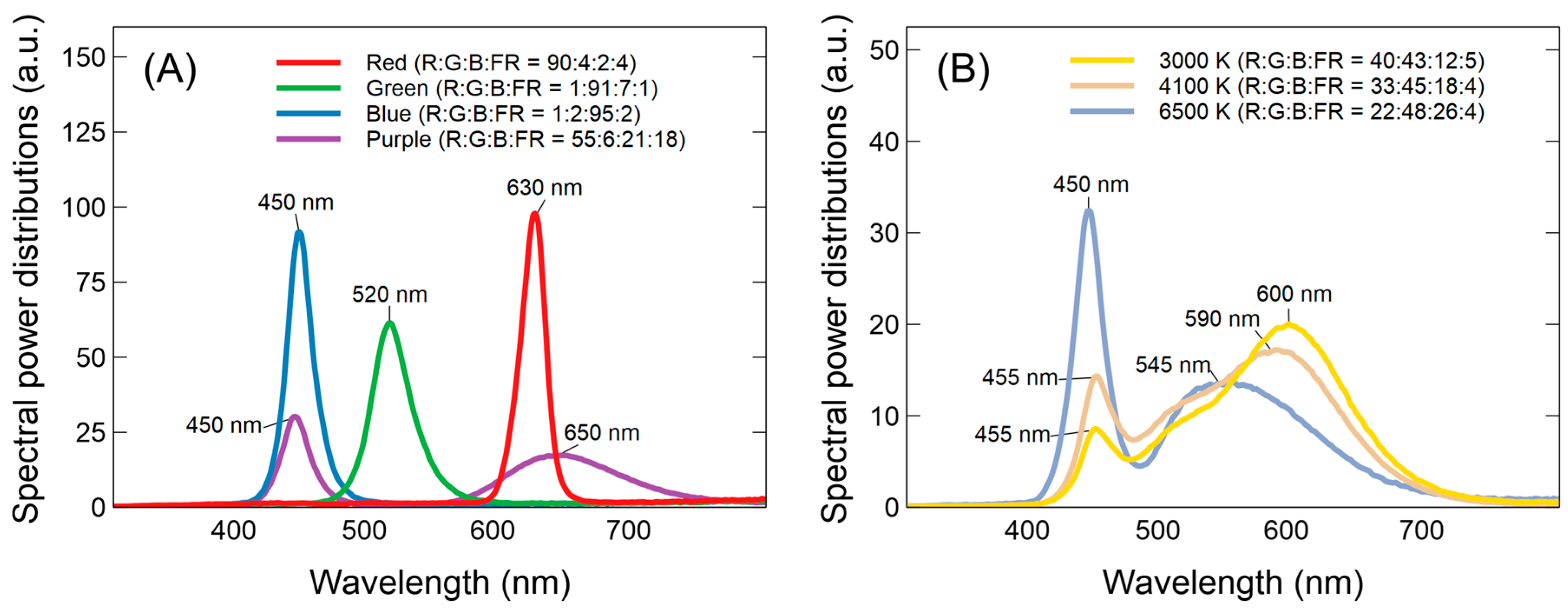
The experiment was conducted in a closed-type plant factory located in an experimental greenhouse at Sahmyook University, Nowon-gu, Seoul, Republic of Korea. T5 LEDs (Zhong Shan Jinsung Electronic, Zhongshan, China) were used as artificial light sources. Seven LED spectral treatments were applied: red (630 nm), green (520 nm), blue (450 nm), purple (peaks at 450 and 650 nm), and white LEDs with correlated color temperatures of 3000, 4100, and 6500 K (Figure 1). The purple LED included far-red wavelengths accounting for approximately 18% of its spectral power distribution [15]. The light intensity of each treatment was maintained at 100 µmol·m−2·s−1 at the top of the canopy. The selected photon flux density was determined with reference to previous PFAL-based studies and was considered appropriate for evaluating cultivar-dependent responses to LED spectral quality during the early growth stage [9,15,16,17]. The photoperiod was set at 14 h light/10 h dark. The spectral power distributions of the light treatments were measured over the 350–800 nm range using a spectroradiometer (SpectraPen Mini; Photon Systems Instruments, Drásov, Czech Republic). Environmental conditions in the plant factory were maintained at an air temperature of 20 ± 1 °C, whereas relative humidity was passively recorded rather than actively controlled, with a mean value of 59.8 ± 14.6% during the experimental period. The relatively large variation in relative humidity mainly reflected fluctuations associated with irrigation events and the operation of the automated ventilation system. Irrigation was performed weekly using purified water supplied via sub-irrigation. According to the method of Shin et al. [16], to promote growth, liquid fertilizer (N–P–K: 7–10–6, High-Grade S, Hyponex, Osaka, Japan) was diluted to 1000 ppm in purified water and applied by sub-irrigation at the beginning of the third week of treatment, that is, 14 d before the experiment ended.

2.3. Quantitative Parameters and Plant Quality Indices

2.3.1. Morphological Traits

From the start of the treatment (week 0), shoot height and width were measured weekly for a total of five time points (weeks 0, 1, 2, 3, and 4) to quantify the growth trajectories. Shoot height was defined as the distance from the ground surface, that is, the substrate surface, to the top of the canopy. Shoot width was defined as the maximum width of the plant when viewed laterally (i.e., canopy width). Root length was defined as the length of the longest root of each plant.
All measurements were conducted at the same time of day for all plants. After four weeks of treatment at harvest, the growth and morphology were evaluated. Stem diameter, root length, leaf number, leaf length, and leaf width were measured. Because the plants exhibited a rosette growth habit with an approximately circular canopy outline and relatively elliptic leaves, ground cover and leaf area were estimated as described below:
GC = (π/4) · (SW · SW)
LA = (π/4) · (LL · LW)
(GC: ground cover; SW: shoot width; LA: leaf area; LL: leaf length; and LW: leaf width).

2.3.2. Biomass Components (Fresh and Dry Weights) and Relative Moisture Content

At harvest, the shoots and roots were separated and their fresh weights were measured. The plants were then dried at 90 °C for 24 h to determine their dry weights. Biomass components were summarized as shoot and root fresh and dry weights, respectively. Relative moisture content was calculated according to Lee and Nam [29] using the following equation:
RMC = [(FWDW)/FW] · 100
(RMC: relative moisture content; FW: fresh weight; and DW: dry weight).

2.3.3. Plant Quality Indices

Plant quality indices were calculated based on the measured morphological traits and biomass component data. The indices included shoot-to-root ratio (S/R), top-heavy index (THI), structural stability index (SSI), compactness, Dickson quality index (DQI), root investment ratio (RIR), and leaf efficiency index (LEI). Their equations were based on Lee et al. [25]. The equations for each index are as follows:
S/R = SDW/RDW
THI = (SDW/RDW) · (SH/RL)
SSI = (SW/SD)/SH
Compactness = SDW/SH
DQI = TDW/(SH/SD + SDW/RDW)
RIR = (RDW/TDW) · (RL/SH)
LEI = SDW/(LN · LL · LW)
(SDW: shoot dry weight; RDW: root dry weight; SH: shoot height; RL: root length; SW: shoot width; SD: stem diameter; TDW: total dry weight; LN: leaf number; LL: leaf length; and LW: leaf width).

2.4. Analysis of Chlorophyll Content (SPAD Units) and Leaf Color

For each plant, SPAD units were measured on two randomly selected, fully expanded, non-senescent leaves using a portable chlorophyll meter (SPAD-502Plus; Konica Minolta, Tokyo, Japan), and the mean value was used for analysis. Leaf color was evaluated by measuring the Commission Internationale de l’éclairage Lab (CIELAB) color space values L*, a*, and b* using a spectrophotometer (CM-2600d; Konica Minolta, Tokyo, Japan). The instrument was operated in D65/10° mode with the specular component included (SCI), following the method described by Lee [30]. For both SPAD and CIELAB measurements, the midrib was avoided to prevent interference with the readings.

2.5. Analysis of Remote Sensing Vegetation Indices and Chlorophyll a Fluorescence Responses

Vegetation indices, including the normalized difference vegetation index (NDVI), photochemical reflectance index (PRI), modified chlorophyll absorption ratio index (MCARI), structure-insensitive pigment index (SIPI), anthocyanin reflectance index 2 (ARI2), and carotenoid reflectance index 2 (CRI2), were calculated based on spectral reflectance measurements [31]. Measurements were performed using a spectroradiometer (PolyPen RP410; UVIS version; Photon Systems Instruments, Drásov, Czech Republic; spectral response range: 380–790 nm). Chlorophyll fluorescence responses were measured using a portable fluorometer (FluorPen FP 110/D; Photon Systems Instruments, Drásov, Czech Republic). The main parameters included PSII quantum yields (ΦPo, Ψo, ΦEo, and ΦDo), energy fluxes per reaction center (ABS/RC, TRo/RC, ETo/RC, and DIo/RC), and PIABS [17,32]. Before measuring chlorophyll fluorescence parameters, the plants were kept in the dark for approximately 15 min according to the manufacturer’s instructions [32]. Following the method of Shin et al. [16], the fluorometer was set to an excitation wavelength of 455 nm. Leaves were exposed to a light intensity of 1500 µmol·m−2·s−1, corresponding to 50% of the super pulse (saturating flash), to induce the maximum fluorescence level (Fm) required for the JIP test. For both the chlorophyll fluorescence and vegetation index measurements, the midrib was avoided to prevent interference with the readings. The relevant equations are as follows:
NDVI = (ρNIRρRed)/(ρNIR + ρRed)
PRI = (ρ531ρ570)/(ρ531 + ρ570)
MCARI = [(ρ700ρ670) − 0.2 · (ρ700ρ550)] · (ρ700/ρ670)
SIPI = (ρ790ρ450)/(ρ790 + ρ650)
ARI2 = ρ790 · [(1/ρ550) − (1/ρ700)]
CRI2 = (1/ρ510) − (1/ρ700)
ΦPo = 1 − (Fo/Fm)
Ψo = 1 − Vj
ΦEo = [1 − (Fo/Fm)] · Ψo
ΦDo = 1 − ΦPo = Fo/Fm
ABS/RC = Mo · (1/Vj) · (1/ΦPo)
TRo/RC = Mo · (1/Vj)
ETo/RC = Mo · (1/Vj) · Ψo
DIo/RC = (ABS/RC) − (TRo/RC)
PIABS = (RC/ABS) · [ΦPo/(1 − ΦPo)] · [Ψo /(1 − Ψo)]

2.6. Statistical and Multivariate Analyses

The experiment was conducted using a completely randomized design (CRD) with two cultivars and seven LED spectral treatments as the experimental factors. Each cultivar × LED treatment combination consisted of ten replicates, with each replicate consisting of one plant grown in a single pot (n = 10). Pots within each LED treatment were randomly arranged and repositioned regularly to minimize positional effects. All the data were analyzed using SAS 9.4 (SAS Institute, Cary, NC, USA). The effects of cultivar (C), treatment (T), and their interactions (C × T) were tested using a two-way analysis of variance (two-way ANOVA), and an additional one-way ANOVA was performed for each cultivar. When the F-test within each cultivar was significant (p < 0.05), treatment means were compared using Duncan’s multiple range test (DMRT) at a significance level of α = 0.05.
To visualize the direction and relative magnitude of treatment-associated shifts across variables, each LED treatment was coded as a binary indicator (0/1), and point-biserial correlations with Z-score standardized traits were calculated for exploratory descriptive visualization. Because point-biserial correlation is mathematically equivalent to Pearson correlation when one variable is binary, these coefficients and their associated p-values were used only as exploratory screening statistics to summarize treatment-associated shifts across standardized traits, rather than as confirmatory inferential tests. Inter-variable associations were assessed using Pearson’s correlation coefficients. Similarities among variable responses were evaluated by Euclidean distance-based hierarchical clustering using Z-score standardized data. A correlation heatmap was constructed based on the Pearson correlation matrix. The arrangement of rows and columns followed the variable order determined by the hierarchical clustering results. PCA was performed based on the correlation structure of the Z-score standardized variables, and PC1–PC2 score and loading plots were jointly interpreted. Additional information on PC3 is presented separately in tabular form for clarity.

3. Results

3.1. Analysis of Growth Characteristics

3.1.1. Growth Changes in Weeks After Treatment

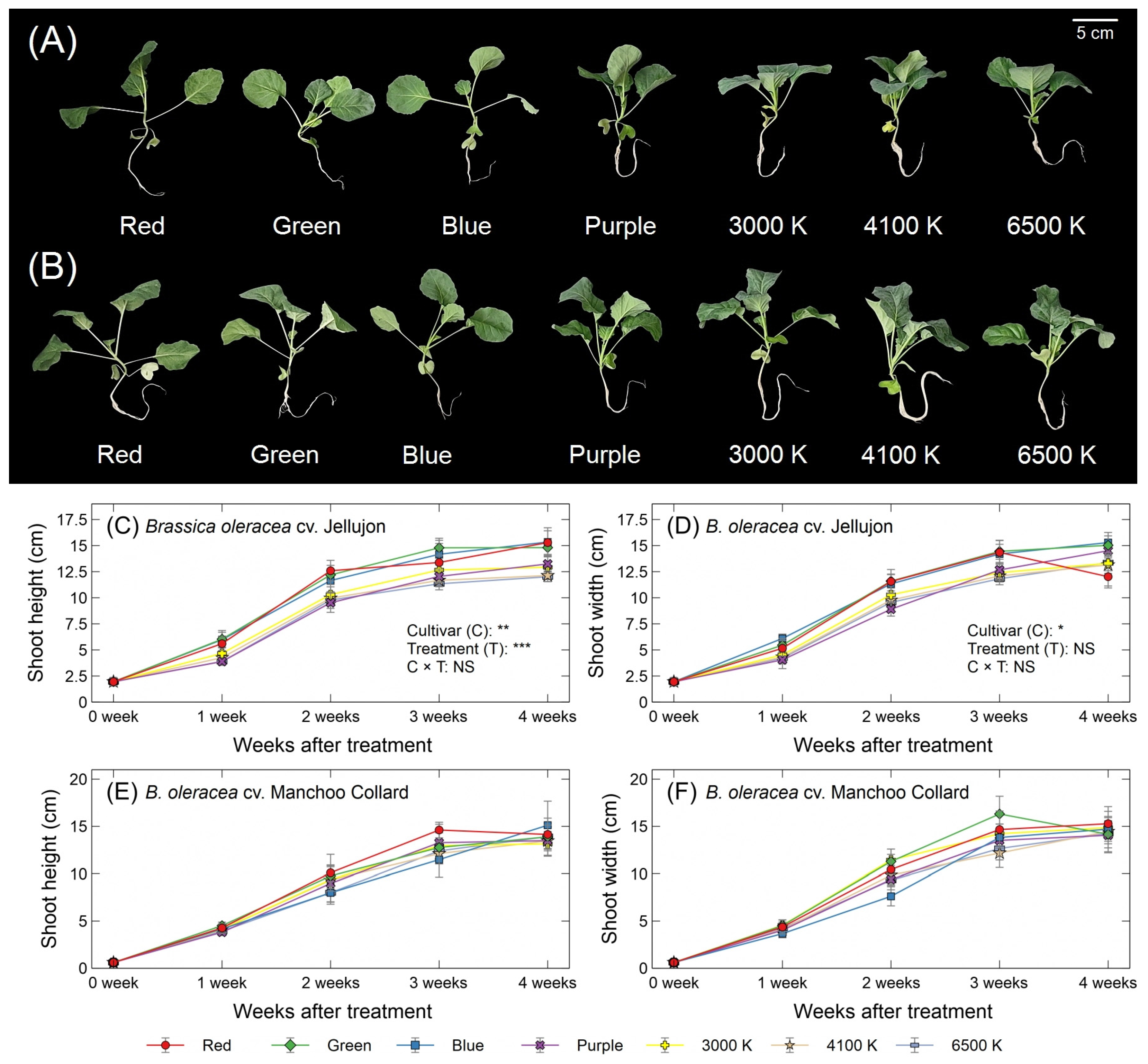
In the present study, the effects of seven different LED spectral quality treatments on morphological traits and biomass accumulation were evaluated under PFAL conditions. Representative photographs of kale plants after four weeks of treatment are shown in Figure 2.
After four weeks of treatment, shoot height was significantly affected by LED spectral quality, whereas shoot width was not significantly affected. In both cultivars, the greatest shoot height was observed under blue LED, reaching 15.34 cm in JL and 15.29 cm in MC. Relative to the white LED treatments, these values were approximately 14–28% higher, indicating a consistent elongation response under blue light. By contrast, shoot width did not differ significantly among treatments, suggesting that the blue-light effect was expressed mainly as vertical elongation rather than lateral canopy expansion.

3.1.2. Morphological Traits and Chlorophyll Content (SPAD Units)

Except for ground cover, all morphological traits and chlorophyll content showed highly significant main effects of LED spectral quality treatment (p < 0.001). Root length showed a significant cultivar × treatment interaction (p < 0.05) (Table 1).
Across both cultivars, white LEDs, particularly 3000–4100 K, and to a lesser extent purple LED, generally promoted more favorable vegetative development than blue or green LEDs. Stem diameter increased to 0.24–0.30 cm in JL and 0.25–0.28 cm in MC under the white LEDs, compared with 0.20–0.22 cm under the monochromatic and purple LEDs. Leaf number and width were generally greater under purple and white LEDs. Leaf area reached 24.2–24.5 cm2 in JL under purple and 3000–4100 K LEDs, which was approximately 36–38% greater than under blue LED (17.8 cm2). In MC, leaf area under purple and 3000–6500 K LEDs reached 22.4–24.9 cm2, approximately 40–60% greater than under blue LED (15.6 cm2). SPAD units were also highest under the white LEDs, reaching 47.3–47.7 in JL and 49.8–50.2 in MC. Root length responded differently between cultivars, with JL showing similarly long roots under red and white LEDs and MC showing the greatest value under 3000 K (18.3 cm), with 4100 K (16.5 cm) showing a similar tendency.

3.2. Analysis of Biomass Accumulation and Plant Quality Indices

3.2.1. Biomass Components

Biomass analysis showed that the effects of the LED spectral quality treatment on fresh weight and dry weight were highly significant (p < 0.001). A similar pattern was observed for relative moisture content (Table 2).
In both JL and MC, biomass accumulation was generally more favorable under the white LED treatments, particularly at 3000–4100 K. Shoot dry weight reached 0.25–0.26 g in JL and 0.26–0.29 g in MC under these white LEDs, which was generally about twofold higher than under the blue or green LED treatments. Root dry weight showed a similar tendency, with the highest or relatively high values observed under the 3000–4100 K white LEDs in both cultivars. Although shoot and root fresh weights were also generally higher under the white LED treatments, relative moisture content tended to be higher under blue or green LEDs, indicating that higher tissue water content did not correspond to greater accumulation of dry matter.

3.2.2. Evaluation of Plant Quality Indices

According to the analysis of plant quality indices, S/R, which reflects biomass allocation between the shoot and root; THI, which indicates the degree of shoot development; and SSI, which represents the structural stability of the shoot, all showed highly significant effects of LED spectral quality treatment (p < 0.001) (Table 2). Significant cultivar × treatment interactions were observed between the S/R and THI (p < 0.01–0.001).
For both JL and MC, S/R and THI were generally higher under blue or green LEDs than under the white LED treatments. In JL, S/R and THI under green and blue LEDs were approximately 2.0–2.3-fold and 3.8–5.4-fold higher, respectively, than under the 3000–4100 K white LEDs. In MC, the blue LED increased S/R to 34.4, approximately 2.5-fold higher than under the 3000 K white LED (13.7), and THI to 73.5, approximately 2.8–5.6-fold higher than under the 6500 and 4100 K white LEDs. By contrast, SSI in JL increased from 0.18–0.19 under red, green, and blue LEDs to 0.32–0.33 under the 4100–6500 K white LEDs, while MC also showed higher SSI under the white LED treatments (0.28–0.30).
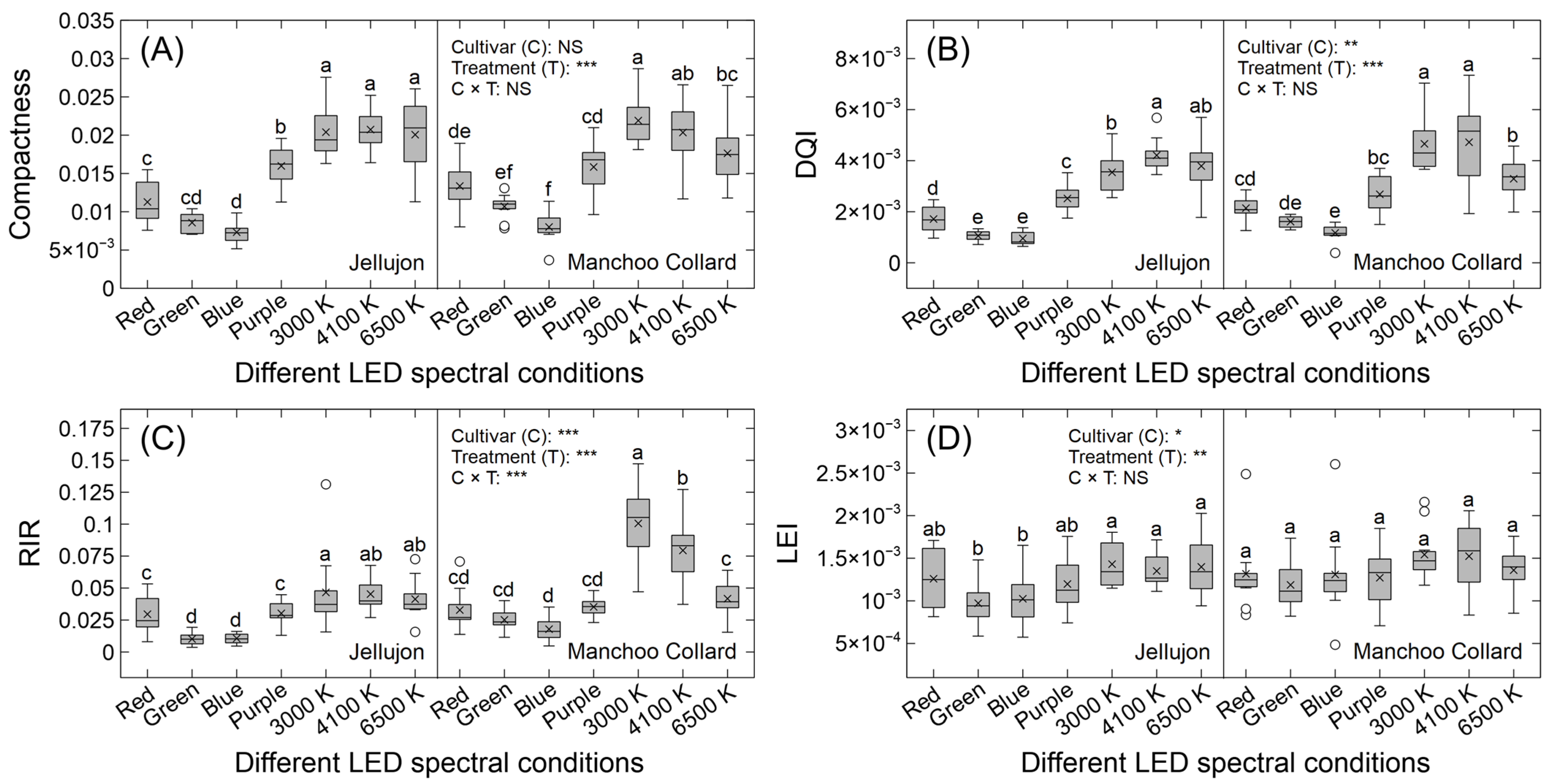
Compactness, which reflects shoot sturdiness; DQI, which represents plant quality; RIR, which indicates root robustness; and LEI, which reflects the degree of leaf development, all showed highly significant main effects of the LED spectral quality treatment (p < 0.01–0.001). RIR showed a highly significant cultivar × treatment interaction (p < 0.001) (Figure 3).
Overall, these indices consistently favored the white LED treatments, particularly 3000–4100 K, over the blue or green LEDs. In JL, compactness under the white LEDs reached 0.020, compared with 0.007 under the blue LED, and DQI reached 0.0042 under 4100 K, compared with 0.0009–0.0017 under green and blue LEDs. RIR in JL was highest under 3000 K (0.046), markedly exceeding the values under green and blue LEDs (0.010), while LEI under the white LEDs reached 0.0013–0.0014, compared with 0.0009–0.0010 under green and blue LEDs. In MC, similar trends were observed, with the most favorable compactness, DQI, and RIR values generally occurring under the white LED treatments, especially at 3000–4100 K. Together, these results indicate that white LEDs promoted more balanced biomass allocation and structurally robust plant quality than the blue or green monochromatic LEDs.

3.3. Analysis of Leaf Color and Remote Sensing-Based Vegetation Indices

3.3.1. Leaf Color Reading Values

According to the CIELAB analysis, all the color space coordinates, namely L*, a*, and b*, showed highly significant main effects of the LED spectral quality treatment (p < 0.001) (Table 3).
Overall, the white LED treatments tended to produce darker leaves with less negative a* values than the monochromatic LEDs, whereas blue or green LEDs generally resulted in higher L* and b* values. This tendency was most evident in MC, where L* under blue LED reached 41.9, compared with 34.8–36.3 under the white LEDs, and b* reached 18.3 under blue LED, compared with 8.7–10.9 under the white LEDs. In JL, a* was less negative under the white LEDs (−6.7 to −7.3) than under the monochromatic LEDs, indicating a comparable directional shift in leaf color response.

3.3.2. Remote Sensing Vegetation Indices

All six remote sensing-based vegetation indices showed highly significant main effects of LED spectral quality treatment (p < 0.01–0.001). Highly significant cultivar × treatment interactions were observed for SIPI, ARI2, and CRI2 (p < 0.01–0.001) (Table 3).
NDVI was generally higher under the white LED treatments than under the blue or green LEDs. In JL, NDVI under the white LEDs reached 0.718–0.735, representing increases of approximately 4.4–7.1% over green and blue LEDs (0.686–0.688), whereas in MC, 3000 K white LED increased NDVI to 0.756, approximately 14.2% higher than under blue LED (0.662). PRI also tended to be more favorable under selected white or purple treatments: in JL, PRI under purple and 6500 K LEDs (0.032–0.033) was approximately 18.5–22.2% higher than under green LED (0.027), while in MC, PRI under 6500 K white LED (0.036) was approximately 38.5% higher than under blue LED (0.026). In contrast, MCARI was highest under green LED in both cultivars, reaching 0.38 in JL and 0.36 in MC. SIPI, ARI2, and CRI2 showed cultivar-dependent responses. In JL, SIPI was relatively higher under the 4100–6500 K white LEDs, whereas ARI2 was higher under the green and purple LEDs than under the other treatments. In MC, ARI2 was highest under the purple LED, whereas CRI2 reached its highest value under the red LED.
Overall, these results indicate that the vegetation indices reflected not only optical differences among treatments but also treatment-dependent variation in pigment status and light-use-related physiological responses.

3.4. Analysis of Photosystem II (PSII) Energy Partitioning

3.4.1. Quantum Yield of PSII

According to the results for PSII quantum yield-related chlorophyll fluorescence parameters, all four associated parameters showed highly significant main effects of LED spectral quality treatment (p < 0.001). Meanwhile, ΦPo and ΦDo showed significant cultivar × treatment interactions (p < 0.05) (Table 4).
Among the treatments, green LED consistently produced the least favorable photochemical responses in both cultivars. In JL, green LED reduced ΦPo, Ψo, and ΦEo to 0.647, 0.511, and 0.332, respectively, while increasing ΦDo to 0.352. A similar pattern was observed in MC, in which the corresponding values under green LED were 0.632, 0.512, 0.325, and 0.367, respectively. Overall, these results indicate that green light reduced PSII photochemical efficiency and electron transport probability while increasing energy dissipation.

3.4.2. Specific Energy Fluxes per Reaction Center (RC)

According to the results for specific energy fluxes per reaction center (RC), all four parameters showed highly significant main effects of LED spectral quality treatment (p < 0.001). Although the level of significance varied among parameters (p < 0.05–0.001), all cultivar × treatment interactions were also significant (Table 4).
ABS/RC and TRo/RC were generally highest under green LED in JL and under red or green LEDs in MC. In JL, green LED increased ABS/RC and TRo/RC to 3.14 and 2.00, respectively, compared with 1.62 and 1.33 under blue LED. In MC, relatively high ABS/RC and TRo/RC values were also observed under red and green LEDs. ETo/RC was relatively high under red and green LEDs, reaching 0.98–1.02 in JL and 1.32 under red LED in MC. By contrast, DIo/RC was highest under green LED in both cultivars, reaching 1.14 in JL and 1.20 in MC. Overall, these results indicate that green LED was associated with increased absorption, trapping, and especially energy dissipation per remaining active reaction center, consistent with a less favorable pattern of PSII energy partitioning.

3.4.3. Performance Index on an Absorption Basis

PIABS, the performance index on an absorption basis, showed a highly significant main effect of LED spectral quality treatment, and a highly significant cultivar × treatment interaction (p < 0.001) (Table 4).
According to the PIABS results, JL showed relatively high values under the purple, 4100 K, and 6500 K LED treatments, reaching 7.1, 6.9, and 7.4, respectively. In MC, PIABS was relatively higher under the 3000 and 4100 K white LED treatments, ranging from 6.2 to 6.3. In contrast, both cultivars had the lowest PIABS values under green LED, reaching 0.7 in JL and 0.6 in MC.

3.5. Multivariate Analysis and Principal Component Analysis (PCA)

3.5.1. Correlation Analysis Between Treatments and Variables

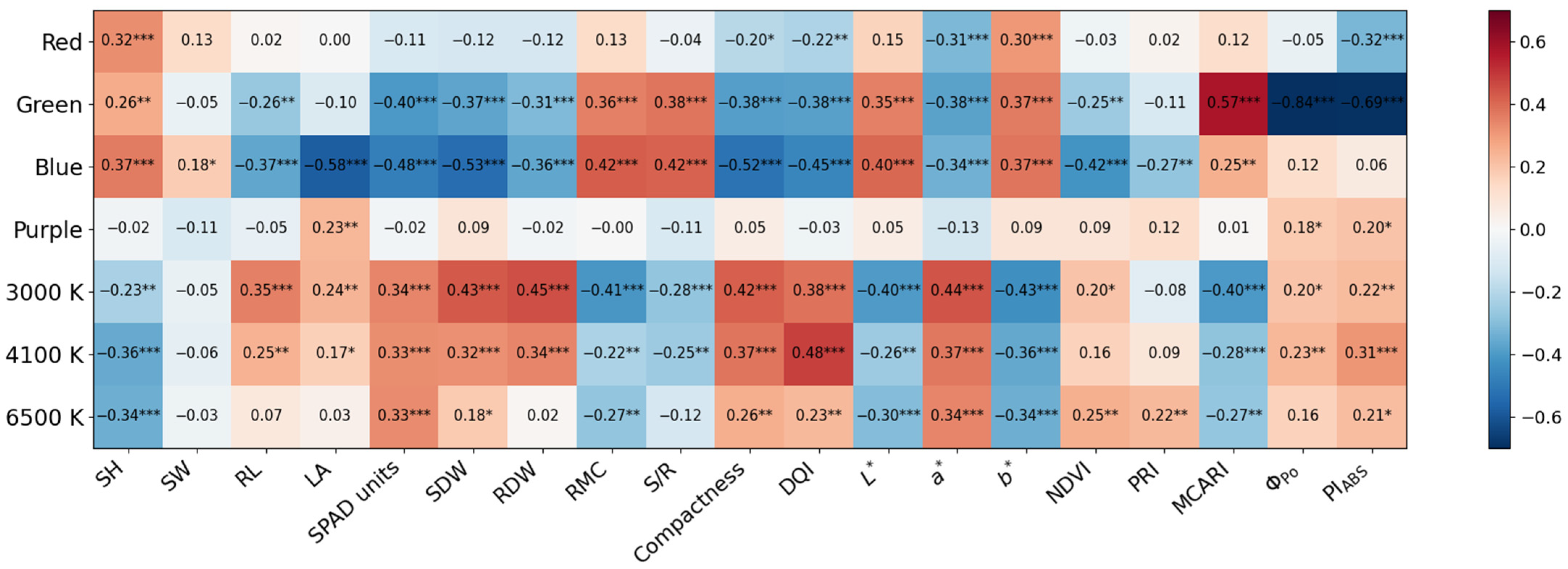
An exploratory indicator-correlation heatmap was used to summarize the direction and relative magnitude of treatment-related shifts across variables (Figure 4). These coefficients should be interpreted as descriptive contrasts for exploratory comparison, rather than as independent confirmatory tests of association.
Overall, green and blue LEDs tended to show negative standardized contrasts with major growth- and quality-related variables, whereas the white LED treatments, particularly 3000 and 4100 K, tended to show positive standardized contrasts with dry matter accumulation and plant quality indicators. Specifically, green LED showed strong negative descriptive correlations with ΦPo and PIABS (r = −0.84 and −0.69, respectively) and a positive correlation with MCARI (r = 0.57), while blue LED was negatively correlated with leaf area, SPAD units, shoot dry weight, root dry weight, compactness, and DQI, but positively correlated with relative moisture content and S/R. In contrast, the 3000 and 4100 K white LEDs were positively associated with shoot and root dry weights, compactness, DQI, and a*. By comparison, the 6500 K white LED was more closely associated with optical variables such as NDVI and PRI, whereas the 3000–4100 K white LEDs were more strongly associated with biomass accumulation and structural quality indices.
Collectively, these exploratory contrasts were broadly consistent with a closer alignment of the 3000–4100 K white LEDs with balanced growth and structural quality, whereas blue and green LEDs tended to be associated with less favorable growth–quality patterns under the present conditions.

3.5.2. Inter-Variable Correlation Analysis and Hierarchical Cluster Analysis

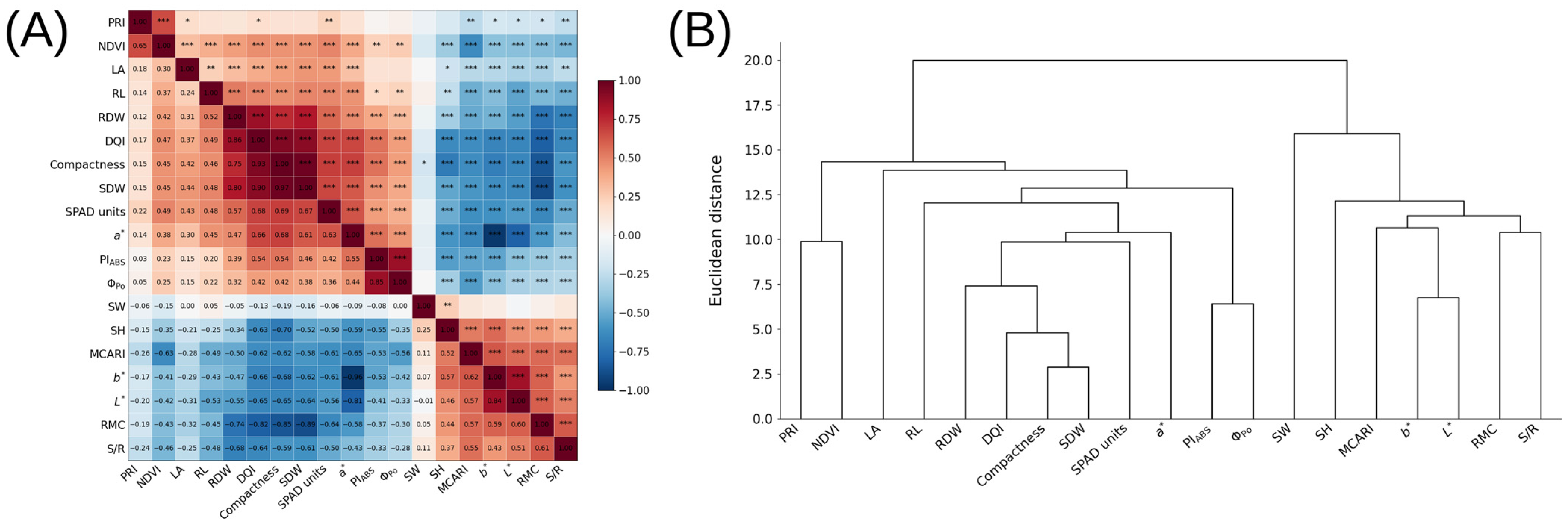
Pearson correlation matrix and Euclidean distance-based hierarchical clustering analysis showed that the variables were broadly separated into two major clusters (Figure 5).
The first cluster included PRI, NDVI, leaf area, root length, root dry weight, DQI, compactness, shoot dry weight, SPAD units, a*, PIABS, and ΦPo, which were generally positively correlated with one another. Within this cluster, compactness was strongly correlated with shoot dry weight (r = 0.97); DQI was strongly correlated with compactness, shoot dry weight, and root dry weight (r = 0.86–0.93); and PIABS was positively correlated with ΦPo (r = 0.85). SPAD units were also positively associated with DQI, compactness, shoot dry weight, and a* (r = 0.63–0.69), while NDVI and PRI showed a clear positive correlation (r = 0.65).
In contrast, the second cluster was centered on shoot height, MCARI, b*, L*, relative moisture content, and S/R, which were generally negatively associated with the growth- and quality-related cluster. Relative moisture content showed strong negative correlations with shoot dry weight, compactness, DQI, and root dry weight (r = −0.74 to −0.89), and both L* and b* were negatively correlated with DQI, compactness, and shoot dry weight.
Overall, these results indicate that dry matter accumulation, structural stability, chlorophyll-related traits, and PSII photochemical performance were closely coordinated during early growth, whereas shoot elongation, higher tissue water content, and certain optical traits were associated with a contrasting and generally less favorable response pattern.

3.5.3. Principal Component Analysis (PCA) of Morphological and Physiological Variables

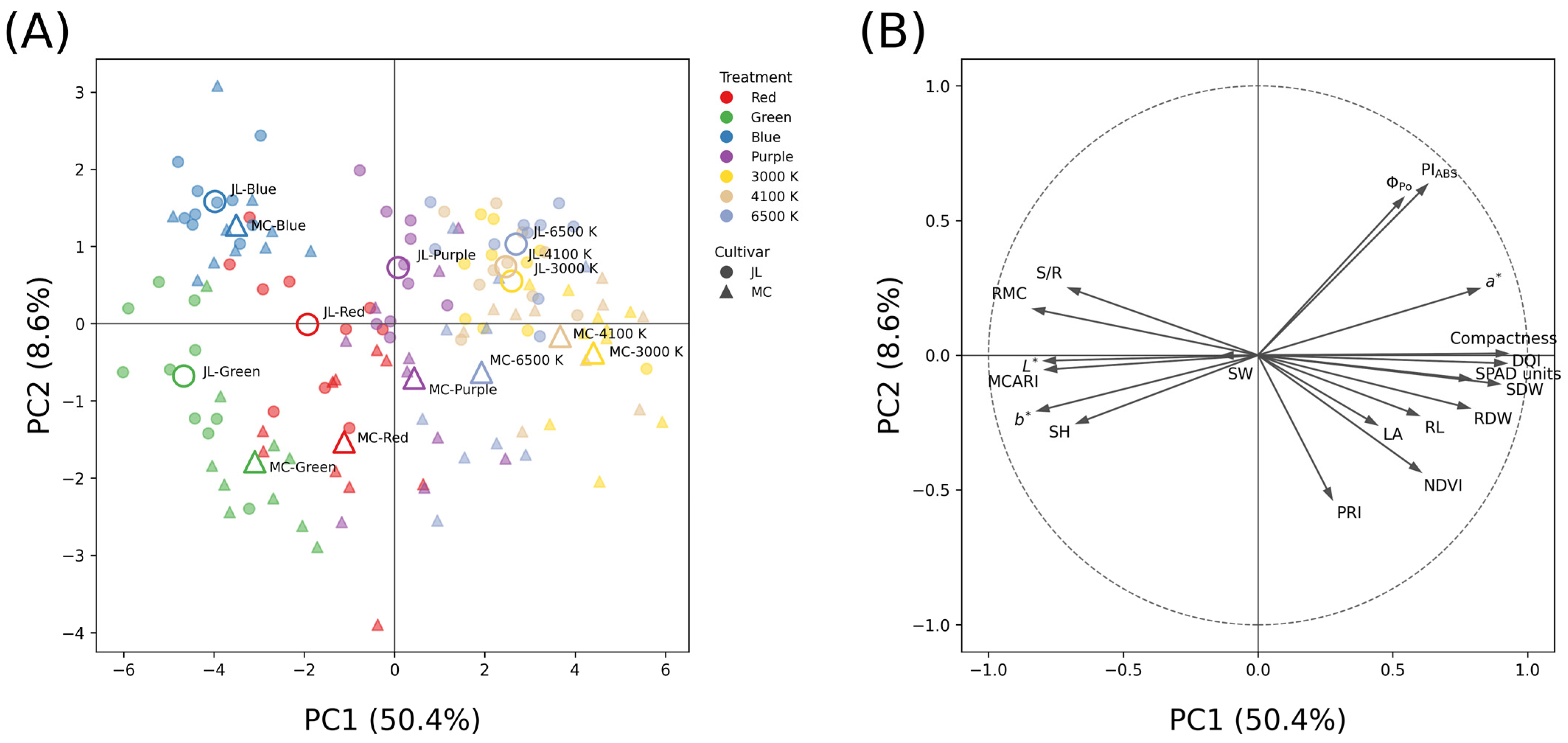
The PCA results showed that PC1, PC2, and PC3 explained 50.4, 8.6, and 7.3% of the total variance, respectively, with a cumulative explanatory power of 66.3% for the three axes (Figure 6 and Table 5).
The PC1–PC2 score plot showed similar overall treatment-dependent distributions in JL and MC, with the white LED treatments positioned mainly on the positive side of PC1 and the blue and green LED treatments on the negative side, while red and purple LEDs occupied intermediate positions. This pattern indicates that LED spectral quality was the major driver of multivariate separation, whereas cultivar effects appeared as secondary differences in treatment dispersion, particularly along PC2.
In the loading plot, compactness, DQI, SPAD units, shoot dry weight, root dry weight, a*, root length, NDVI, PIABS, and PRI were loaded positively on PC1, whereas relative moisture content, L*, b*, MCARI, S/R, and shoot height were loaded negatively. Thus, PC1 was interpreted as an axis separating dry matter accumulation, structural stability, and plant quality from the opposite response pattern characterized by greater moisture content, shoot-oriented growth, and higher leaf lightness/yellowness. On PC2, PIABS and ΦPo were positively loaded, whereas PRI, NDVI, leaf area, and root length were negatively loaded, indicating a contrast between PSII-related photochemical responses and optical vegetation indices rather than plant size. PC3 further distinguished optical and photochemical responsiveness, represented by PRI, NDVI, ΦPo, and PIABS, from dry matter accumulation, represented by shoot dry weight, root dry weight, and MCARI.
Overall, the PCA indicates that treatment effects on early kale growth were organized along separate but related axes of structural plant quality and optical/photochemical response, supporting the need for a multivariate interpretation of LED spectral effects.

4. Discussion

4.1. Morphological Responses to LED Spectral Quality During Early Kale Growth

Different LED spectral quality treatments induced distinct responses in leaf development, dry matter accumulation, structural stability, and photochemical efficiency during the early growth stage of kale in a PFAL. These findings indicate that early spectral quality effects should be interpreted through integrated morphological and physiological responses rather than from a single trait such as shoot height [33,34,35].
Blue light generally suppresses elongation through cryptochrome-mediated photomorphogenesis [36,37]. Nevertheless, previous narrowband LED studies have shown that elongation responses under monochromatic blue light are highly dependent on the comparison treatment. In petunia, blue light increased shoot elongation relative to red and white light [38], whereas in arugula and mustard seedlings, pure blue light promoted hypocotyl or petiole elongation relative to pure red light, with the response varying according to species and photosynthetic photon flux density [39]. In the present study, blue LED likewise increased shoot height in both kale cultivars. However, this elongation did not translate into superior overall growth performance, because stem diameter, leaf number, leaf width, and leaf area were generally more favorable under the white and purple LED treatments. These results indicate that blue-light-induced elongation was not accompanied by corresponding improvements in leaf development. These responses suggested that increased shoot elongation does not necessarily lead to the formation of an efficient light-intercepting structure. Because an increased proportion of blue light may be accompanied by reduced leaf area and decreased whole-plant light absorption [40], morphological elongation does not necessarily translate into improved biomass productivity. Under the present monochromatic blue-light condition, shoot elongation may therefore reflect a spectral morphogenic response without a corresponding improvement in canopy-level light interception or dry matter production.
In contrast, white LEDs promoted stable stem and leaf development in both kale cultivars without excessively increasing shoot height. Considering that the SPAD units were maintained at relatively high levels, white LEDs were also regarded as more favorable for chlorophyll accumulation and leaf development. Differences in spectral power distribution within white light directly influence plant structural responses and leaf expansion [41]. In previous work on two chicory cultivars, a 3000 K white LED, which contained a relatively higher proportion of red wavelengths, was generally associated with greater plant size and biomass, whereas 4100–6500 K white LEDs were linked to comparatively more compact shoot development or to physiological advantages, depending on the cultivar and trait measured [16]. In leafy vegetables and crops grown in PFAL systems, white LEDs generally provide more favorable conditions than monochromatic LEDs for growth, biomass accumulation, and maintenance of SPAD units [9,16]. A partly comparable pattern was also reported in Korean white dandelion (Taraxacum coreanum) [35], where white LED treatments were generally associated with higher SPAD units, NDVI, and photochemical efficiency. The high SPAD units and favorable leaf development observed here are consistent not only with these earlier findings, but also with the broader direction of LED horticulture research emphasizing balanced spectral environments for controlled-environment crop production. Thus, the biomass advantage under the 3000–4100 K white LEDs was likely associated with a more balanced spectral environment that supported leaf expansion, chlorophyll maintenance, and structurally stable growth simultaneously, rather than promoting elongation alone.
Responses related to root elongation were generally favorable under the 3000–4100 K white LED treatments, particularly in the MC cultivar, although JL also showed comparably long roots under red LED. These results suggest that broad-spectrum white light, especially at 3000–4100 K, tended to support root development more consistently than the less favorable monochromatic blue and green treatments. One possible explanation is that, compared with monochromatic light, white light provides more balanced photoreceptor signaling, thereby supporting shoot photomorphogenesis and carbon assimilation and promoting root development through shoot-to-root communication [42,43]. Root growth is regulated by the direct effects of light quality and by mobile signals such as sugars, HY5, and auxin. Studies in Arabidopsis and tomato seedlings have shown that monochromatic red and blue light can inhibit primary root growth relative to white light [44]. In cucumber seedlings, a broad-spectrum white-light environment is associated with the formation of a well-developed root system [45]. Because ground cover did not reflect differences among the LED spectral quality treatments in the MC cultivar, it appeared to have limitations as an indicator of the early growth status of some cultivars.

4.2. Biomass Accumulation and Structural Plant Quality

Biomass-related parameters also showed significant differences among the treatments. Shoot and root fresh weights were generally higher under white LED treatments. Dry weight, however, was highest, mainly under the 3000 and 4100 K white LEDs. In contrast, under some monochromatic treatments, particularly blue and green LEDs, relative moisture content was high, but dry matter accumulation remained comparatively low. This suggests that tissue hydration status and the actual accumulation of carbon assimilates do not necessarily increase in parallel [46]. An increase in relative moisture content may indirectly reflect improved tissue turgor or water retention. Light quality may influence plant–water relations and biomass formation in different ways. Under monochromatic light conditions, dry matter production may remain limited even when physiological water status is maintained [33,46]. More specifically, Chen et al. [47] showed in lettuce that mixed-spectrum light treatments promoted growth and quality more effectively than monochromatic light, supporting the general advantage of broader spectra over narrow single-wavelength lighting in leafy vegetables. This broader tendency was further supported by the meta-analysis of Ma et al. [48], who concluded that LED spectral quality significantly influences plant growth and trait expression across controlled-environment crops, with mixed or spectrally balanced lighting often being more favorable for biomass production than narrowband monochromatic lighting. In kale, Ashenafi et al. [49] reported that LEDs differing in blue peak emission wavelength altered biomass, morphology, and nutrient content in a cultivar-dependent manner, suggesting that light quality can involve a trade-off between biomass accumulation and other functional responses.
Plant quality indices are useful tools for evaluating plant quality by integrating morphological or morphophysiological parameters expressed in different units [25]. In the present study, the variation in plant quality indices also effectively supported the response patterns to LED spectral quality treatments. The S/R and THI were generally higher under green and blue LEDs, reflecting a relatively greater shoot proportion and top-heavy growth tendency. This is unlikely to be desirable from the standpoint of structural stability during the early growth stage. An excessively high S/R indicates disproportionately greater shoot biomass relative to the root system [25,50]. This may lead to imbalanced water distribution and lower plant quality. Plants with a high shoot-to-root ratio are more likely to be disadvantaged in terms of early growth stability and tolerance to water stress because the water-absorbing area is relatively insufficient compared to the transpiring area [51]. By contrast, SSI, compactness, DQI, RIR, and LEI were generally higher under white LEDs. Because relative humidity was passively recorded rather than actively controlled, and its variation was associated with irrigation events and the operation of the automated ventilation system, some variability in transpiration, tissue water status, and the magnitude of morphology- or fluorescence-related responses may have occurred during the experiment. However, because all treatments were exposed to the same PFAL environment, this factor is more likely to have influenced the magnitude of response than the overall direction of treatment differences.
This indicates that white light was favorable for increasing plant size and for producing more robust and balanced plants. Increases in DQI and RIR suggest that resource allocation between shoots and roots is relatively stable under white light [25]. Therefore, the advantage of white light in early kale production appears to lie in increasing plant size and improving plant quality. The DQI is strongly associated with root dry matter and is considered a more informative quality index when interpreted together with stem diameter and dry matter allocation than when based on shoot height alone [25,52]. Taken together with the morphological and biomass results, these findings indicate that white LEDs are more suitable than monochromatic LEDs for maintaining balanced shoot-to-root biomass allocation during the early growth stages of kale cultivars.
From an applied PFAL perspective, these results also have implications for lighting optimization and spectral-use efficiency. Because all treatments were imposed at the same incident photon flux density, the greater shoot dry weight and more favorable plant quality indices observed under the 3000–4100 K white LEDs indicate that these spectra supported more effective early biomass and quality formation per unit photon input than the blue or green monochromatic LEDs under the present conditions. In practical terms, this suggests that white LEDs in this correlated color temperature range may reduce the cumulative lighting requirement needed to achieve a target early growth standard or transplant quality, even if their electrical energy-use efficiency was not directly quantified in this study. By contrast, blue and green LEDs induced elongation- or moisture-related responses, but these responses were not accompanied by comparable dry matter accumulation or structural quality. Therefore, when selecting spectra for PFAL production, lighting strategies should consider not only morphological responses but also how efficiently a given spectrum converts the supplied light environment into usable biomass and stable plant quality. Direct comparisons of fixture power consumption, photon efficacy, and time-to-target biomass will be needed in future studies to verify the actual energy-use efficiency of these spectral treatments.

4.3. Physiological and Optical Responses Under Contrasting LED Spectral Quality

Changes in leaf color and vegetation indices were partly consistent with preceding growth and physiological interpretations. However, several indices showed cultivar- or treatment-specific responses. The higher SPAD units and NDVI observed under white LED treatments suggest favorable chlorophyll accumulation per unit leaf area and generally better plant vigor. This is consistent with previous findings showing that white light treatments tend to produce relatively higher SPAD units and NDVI in leafy vegetable plants grown under controlled environmental conditions [16]. In contrast, the increase in L* and decrease in SPAD units and NDVI under blue and green LEDs indicate that these light treatments increased leaf lightness while inhibiting chlorophyll accumulation. However, some vegetation indices exhibited different response patterns. MCARI was the highest under the green LED treatment. This suggests that under the conditions of the present study, this index was generally inversely related to the growth status of kale cultivars and was sensitive to changes in optical structure or chlorophyll content. The MCARI showed an almost inverse relationship with the SPAD units, which is consistent with observations from previous studies [16,17]. In the case of ARI2, both kale cultivars showed the lowest values under blue LED. This suggests that monochromatic blue light irradiation suppresses anthocyanin-related optical signals. Meanwhile, CRI2 responses were cultivar-dependent. In JL, CRI2 tended to be lower under the 3000 K white LED treatment; meanwhile, in MC, the lowest CRI2 was observed under the blue LED. These contrasting responses indicate that carotenoid-related optical signals did not respond uniformly across cultivars and should, therefore, be interpreted cautiously rather than generalized to a single spectral effect. These findings indicate that vegetation indices for the diagnosis of early kale growth should not be interpreted as standalone indicators, but rather should be considered together with SPAD units, biomass, and photochemical efficiency.
Based on the OJIP chlorophyll fluorescence responses, the limitations of the green LED treatment were most evident. Under the monochromatic green LED treatment, the lower values of ΦPo, Ψo, and ΦEo, together with the higher value of ΦDo, indicate that absorbed light energy was not used efficiently for electron transport and that a greater proportion of the energy was dissipated. Similar results were reported by Kim et al. [9], who found that in danshen (Salvia miltiorrhiza), green light also caused an overall reduction in PSII quantum-yield-related parameters (e.g., ΦPo, Ψo, and ΦEo), while increasing ΦDo. Green light penetrates deeper into leaf tissues than red or blue light, and under mixed-light conditions, this property may contribute to light use in lower mesophyll cell layers [53]. However, under monochromatic green-light conditions, such as those used in the present study, the light-use efficiency on an incident light basis may have been reduced, resulting in a less favorable pattern of PSII energy partitioning [54].
Increases in ABS/RC, TRo/RC, and DIo/RC suggest that as the number of active PSII reaction centers decreases, the absorbed, trapped, and dissipated energy fluxes per remaining active reaction center increase [35,55]. Although RC/CS was not measured here, if a reduction in RC/CS occurred simultaneously, this would more strongly support the interpretation that some PSII reaction centers had been inactivated and excess excitation energy dissipation through heat and fluorescence had increased [56]. The partial inactivation of the reaction centers may have imposed a greater antenna burden and dissipation burden on the remaining active centers, shifting the energy allocation in the green LED treatment more toward dissipation than electron transport. Considering that chlorophyll absorbs green wavelengths less efficiently than red or blue wavelengths, and that lower dry matter accumulation and less favorable plant quality indices were also observed under green LED light in the earlier results, the growth reduction under this treatment appears to have been associated with differences in morphological response and less favorable photochemical energy use [16,17].
In contrast, PIABS remained relatively high under the purple LED treatment, particularly in the JL cultivar, and under some white LED treatments, especially at 4100 K. Because PIABS is an integrative parameter that reflects reaction center density, energy trapping efficiency, and electron transport efficiency [57], these responses indicate that PSII-based photochemical performance was better maintained under these conditions. However, this physiological advantage should not be interpreted as uniformly equivalent to the growth superiority, because biomass accumulation and plant quality indices were more consistently favorable under the 3000 and 4100 K white LEDs than under the purple LED treatment.
Given that the spectral distribution of the purple LED used in this study included approximately 18% far-red wavelengths [15], further investigation is needed to determine how supplemental far-red light affects plant morphophysiological responses. In kale, far-red wavelengths alter light-capture architecture and growth responses [23]. Therefore, future studies should examine the contribution of different far-red proportions within composite LED spectra in greater detail to improve the efficiency of early-stage kale management.

4.4. Correlation Structure and Hierarchical Clustering Analysis

The treatment–trait correlation analysis showed that the green and blue LED treatments were generally negatively associated with major growth and quality indicators. Meanwhile, the 3000 and 4100 K white LED treatments were positively associated with dry matter accumulation, compactness, and DQI. This pattern indicates that depending on the spectral quality, plant morphological development, biomass accumulation, and structural plant quality may diverge in different directions. This also suggests that the 3000 and 4100 K white LED treatments may be associated with more balanced growth responses and quality formation than the monochromatic light treatments. This is consistent with previous reports that white- or mixed-spectrum environments support more stable growth in leafy crops [19]; in the present study, this tendency was expressed particularly as greater shoot dry weight, compactness, and DQI under the 3000–4100 K white LEDs than under the blue or green monochromatic treatments.
The fact that both ΦPo and PIABS were associated in a negative direction under the green LED treatment suggests that, under the monochromatic green-light condition used in this experiment, responses related to photochemical efficiency were relatively unfavorable. Under the blue LED treatment, leaf area, shoot dry weight, root dry weight, compactness, and DQI were negatively correlated. This indicates that under the present experimental conditions, their relationship with biomass production and quality formation was limited. In contrast, the positive association between relative moisture content and S/R suggests that blue light may alter tissue water status or biomass allocation patterns rather than promote absolute growth. However, these responses should not be generalized as inherent characteristics of blue or green light per se, but rather interpreted as limited responses observed under the monochromatic-light conditions used in the present study [17,58].
In contrast, the 3000 and 4100 K white LED treatments showed consistent positive correlations with shoot dry weight, root dry weight, compactness, and DQI, suggesting that they are associated with relatively desirable quality during the early growth stage. The 4100 K white LED treatment showed the strongest association with DQI, indicating that it may have been more closely related to the balanced growth and structural quality formation. The 6500 K white LED treatment showed positive associations with SPAD units, NDVI, PRI, and PIABS, indicating a relationship with physiological traits. However, its association with plant quality indices was relatively weak. This suggests that although 6500 K white LED may be related to the maintenance of certain physiological traits, such responses do not necessarily translate directly into dry matter accumulation or improved structural quality [16,41].
Red LED treatment showed a positive correlation with shoot height, whereas DQI, compactness, and PIABS were oriented in the opposite direction. This suggests that increased shoot height does not necessarily result in superior plant quality.
The inter-variable correlation matrix and Euclidean distance-based hierarchical cluster analysis showed that the traits measured in this study did not respond independently but rather varied together as several functional response groups. The overall positive correlations among shoot dry weight, root dry weight, compactness, DQI, SPAD units, a*, PIABS, and ΦPo within the same cluster indicate that dry matter accumulation, structural stability, chlorophyll-related traits, and photochemical efficiency were closely coordinated during the early growth stage. The strong positive correlations among shoot dry weight, compactness, and DQI suggest that early plant quality may be better explained by dry matter production and morphological balance than by simple size increase alone. The fact that PIABS and ΦPo were positioned in the same cluster as growth- and quality-related variables further supports the possibility that maintenance of PSII photochemical efficiency is linked to actual plant quality formation.
In contrast, shoot height, relative moisture content, S/R, L*, b*, and MCARI formed a separate cluster and generally showed correlations in the opposite direction to quality-related variables. This indicates that shoot elongation, higher tissue water status, and increases in certain colorimetric or reflectance-based indices did not necessarily lead to superior plant quality. The negative correlations between relative moisture content and shoot dry weight, compactness, and DQI indicated that water retention, dry matter accumulation, and structural compactness did not always vary in the same direction during the early growth stages. These relationships indicate that dry matter accumulation, structural stability, chlorophyll-related traits, and PSII photochemical performance were coordinated during early growth, whereas elongation and higher tissue water status were associated with a contrasting and generally less favorable response pattern.

4.5. Interpretation of Principal Component Analysis (PCA) Score and Loading Patterns

PCA showed that LED spectral effects were expressed through coordinated combinations of morphological and physiological traits rather than through any single variable, underscoring the need for multivariate interpretation [59]. The PCA score plot indicates that white LED treatments promoted a shared multivariate response domain associated with structural robustness and dry matter accumulation in both cultivars, whereas blue and green LEDs were associated with contrasting elongation- or moisture-related response patterns. The partial dispersion along PC2 further suggests that cultivar background influenced how optical, photochemical, and growth-related traits were integrated under each spectral condition.
The loading plot provided further insight into the structure underlying the score distribution. In PC1, which explained more than half of the total variance, the strong loadings of compactness, DQI, shoot dry weight, and root dry weight in the same direction suggested that this axis represented not only the growth level, but also plant quality and structural stability. In contrast, the negative positioning of relative moisture content, shoot height, S/R, L*, and b* indicates that, during the early growth stage, higher moisture content or greater shoot-oriented growth does not necessarily correspond to higher overall plant quality.
The placement of ΦPo and PIABS in the positive direction and PRI and NDVI in the negative direction on PC2 indicates that higher values of vegetation indices do not necessarily coincide with increases in PSII photochemical efficiency. This is because PRI and NDVI are influenced by pigment composition, light absorption characteristics, and optical reflectance properties, whereas ΦPo and PIABS more directly reflect the functional status of PSII reaction centers [60,61]. Therefore, when evaluating the effects of spectral quality, vegetation indices and chlorophyll fluorescence parameters should be interpreted in a complementary manner, with NDVI and PRI serving as indirect optical indicators of treatment-related physiological adjustment.
Although PC3 accounted for a relatively small proportion of the variance, it was characterized by an additional separation between optical responses centered on PRI and NDVI and dry matter accumulation responses centered on shoot dry weight, root dry weight, and MCARI. This suggests that treatment-induced changes in optical signals do not necessarily occur in parallel with biomass production and should therefore be interpreted together with morphological and photochemical indicators.
The PCA results indicated that treatment effects during the early growth stage of kale plants were broadly separated into two major response domains in the combined dataset: PC1 represented an axis of plant quality and robustness, characterized by compactness, DQI, shoot dry weight, and root dry weight; PC2 and PC3 represented axes of optical and photochemical responses, characterized by NDVI, PRI, ΦPo, and PIABS. Particularly in plants at the early growth stage, increases in growth and photochemical stability do not necessarily occur in the same direction across the spectral quality treatments. Therefore, multivariate results should be interpreted together with the responses of individual variables [16,19,62].
Nevertheless, because the multivariate analyses conducted in this study included both primary variables and plant quality indices derived from them, it cannot be excluded that some of the correlation structures and PCA axis formations reflected biological covariation and structural redundancy arising from the calculation formulas themselves. Therefore, caution is needed when interpreting the results related to plant quality indices, morphological parameters, and biomass components.
Overall, 3000 and 4100 K white LEDs most consistently promoted leaf development, dry matter accumulation, structural stability, and plant quality during early kale growth in PFAL. Purple LED showed partial advantages, particularly in leaf-development responses and in PIABS in the JL cultivar. However, these benefits were not as consistent across cultivars or plant quality indices as those observed under the 3000 and 4100 K white LEDs. In contrast, blue LED was associated mainly with elongation without corresponding gains in biomass, whereas green LED was associated more strongly with unfavorable photochemical energy partitioning and higher energy dissipation; both treatments were generally less favorable for dry matter accumulation and structural quality, supporting the need for multivariate interpretation of spectral effects.

5. Conclusions

During the early growth of kale at the baby-leaf harvest stage in a PFAL, LED spectral quality treatment significantly influenced growth performance, biomass accumulation, plant quality indices, and physiological responses, indicating that treatment effects could not be adequately interpreted from morphology alone. White LEDs, particularly at 3000–4100 K, were associated with the most favorable overall response patterns, including greater leaf area (24.2–24.9 cm2), higher SPAD values (47.3–50.2), and higher shoot dry weight, which reached 0.25–0.26 g in JL and 0.26–0.29 g in MC, approximately twofold higher than under the blue or green LED treatments. These white LED treatments were also generally associated with more favorable compactness, DQI, RIR, and LEI, suggesting improved plant sturdiness and structural stability during early growth. In contrast, blue LED increased shoot height by approximately 14–28%, depending on cultivar and comparison among the white LED treatments, but this elongation did not translate into superior biomass production. Green LED was associated with less favorable photochemical performance and greater energy dissipation, whereas PRI and PIABS tended to be more favorable under selected white LED treatments, although these responses were partly cultivar- and treatment-dependent. Overall, these findings largely supported our hypothesis that white LEDs would provide more favorable early growth conditions than monochromatic LEDs, while also showing that their effects varied according to correlated color temperature. Therefore, within the conditions tested in this study, 3000–4100 K white LEDs provided the most consistently favorable conditions for producing structurally robust, high-quality kale during the four-week early growth stage of the two kale cultivars evaluated in PFAL systems. However, because this study was limited to two kale cultivars and a four-week early growth period under PFAL conditions, caution is required in generalizing these findings to later developmental stages or final yields. Future studies should include a wider range of genotypes and cultivation periods to verify whether early light prescriptions continue to affect subsequent growth, yield, quality, and production uniformity.

Author Contributions

Conceptualization, J.H.L. and S.Y.N.; methodology, J.H.L.; software, J.H.L.; validation, J.H.L.; formal analysis, J.H.L., Y.S., E.J.S. and S.Y.N.; investigation, Y.S. and E.J.S.; resources, S.Y.N.; data curation, J.H.L., Y.S. and S.Y.N.; writing—original draft preparation, J.H.L., Y.S. and E.J.S.; writing—review and editing, J.H.L. and S.Y.N.; visualization, J.H.L.; supervision, S.Y.N.; project administration, S.Y.N.; funding acquisition, S.Y.N. All authors have read and agreed to the published version of the manuscript.

Funding

This paper was supported by the Sahmyook University Research Fund in 2024.

Data Availability Statement

The original contributions presented in this study are included in the article. Further inquiries can be directed to the corresponding author.

Conflicts of Interest

The authors declare no conflicts of interest.

Abbreviations

The following abbreviations are used in this manuscript:
ABSAbsorption flux
ANOVAAnalysis of variance
ARI2Anthocyanin reflectance index 2
CIELABCommission Internationale de l’Éclairage Lab
CRDCompletely randomized design
CRI2Carotenoid reflectance index 2
DMRTDuncan’s multiple range test
DQIDickson quality index
JLJellujon (kale cultivar)
LALeaf area
LEDLight-emitting diode
LEILeaf efficiency index
LLLeaf length
LNLeaf number
LWLeaf width
NSNon-significant
MCManchoo Collard (kale cultivar)
MCARIModified chlorophyll absorption ratio index
NDVINormalized difference vegetation index
PCAPrincipal component analysis
PFALPlant factory with artificial lighting
PIABSPerformance index on an absorption basis
PRIPhotochemical reflectance index
PSIIPhotosystem II
RCReaction center
RDWRoot dry weight
RIRRoot investment ratio
RLRoot length
RMCRelative moisture content
SDStem diameter
SDWShoot dry weight
SHShoot height
SIPIStructure-insensitive pigment index
SPADSoil plant analysis development
SSIStructural stability index
SWShoot width
S/RShoot-to-root ratio
TDWTotal dry weight
THITop-heavy index

References

  1. Šamec, D.; Urlić, B.; Salopek-Sondi, B. Kale (Brassica oleracea var. acephala) as a superfood: Review of the scientific evidence behind the statement. Crit. Rev. Food Sci. Nutr. 2019, 59, 2411–2422. [Google Scholar] [CrossRef]
  2. Łukaszyk, A.; Kwiecień, I.; Kanik, A.; Blicharska, E.; Tatarczak-Michalewska, M.; Białowąs, W.; Czarnek, K.; Szopa, A. Nutritional, therapeutic, and functional food perspectives of kale (Brassica oleracea var. acephala): An integrative review. Molecules 2025, 30, 4214. [Google Scholar] [CrossRef]
  3. Christensen, S.; Von Bothmer, R.; Poulsen, G.; Maggioni, L.; Phillip, M.; Andersen, B.A.; Jørgensen, R.B. AFLP analysis of genetic diversity in leafy kale (Brassica oleracea L. convar. acephala (DC.) Alef.) landraces, cultivars and wild populations in Europe. Genet. Resour. Crop Evol. 2011, 58, 657–666. [Google Scholar] [CrossRef]
  4. Sonjaroon, W.; Tepkaew, T.; Kupia, M.; Tongkok, P.; Boonkorkaew, P.; Thussagunpanit, J. Pre-harvest UV-A supplementation in plant factory with artificial lighting improves growth, photosynthesis, and phytonutrients in kale. Horticulturae 2024, 10, 701. [Google Scholar] [CrossRef]
  5. Johkan, M.; Shoji, K.; Goto, F.; Hashida, S.N.; Yoshihara, T. Blue light-emitting diode light irradiation of seedlings improves seedling quality and growth after transplanting in red leaf lettuce. HortScience 2010, 45, 1809–1814. [Google Scholar] [CrossRef]
  6. Yan, Z.; He, D.; Niu, G.; Zhai, H. Evaluation of growth and quality of hydroponic lettuce at harvest as affected by the light intensity, photoperiod and light quality at seedling stage. Sci. Hortic. 2019, 248, 138–144. [Google Scholar] [CrossRef]
  7. Zhang, L.; Yang, X.; Li, T.; Gan, R.; Wang, Z.; Peng, J.; Hu, J.; Guo, J.; Zhang, Y.; Li, Q.; et al. Plant factory technology lights up urban horticulture in the post-coronavirus world. Hortic. Res. 2022, 9, uhac018. [Google Scholar] [CrossRef] [PubMed]
  8. Bantis, F.; Chatzigeorgiou, I.; Sismanis, M.; Ntinas, G.K.; Koukounaras, A. Vegetable production in PFALs: Control of micro-environmental factors, principal components and automated systems. Agriculture 2024, 14, 642. [Google Scholar] [CrossRef]
  9. Kim, E.A.; Lee, J.H.; Nam, S.Y. Differences in growth characteristics and photochemical responses of Salvia miltiorrhiza Bunge under different LED light qualities in a closed plant factory system. Korean J. Med. Crop Sci. 2024, 32, 189–201. [Google Scholar] [CrossRef]
  10. Yang, R.; Yang, H.; Ji, F.; He, D. Enhancing the photon yield of hydroponic lettuce through stage-wise optimization of the daily light integral in an LED plant factory. Agronomy 2024, 14, 2949. [Google Scholar] [CrossRef]
  11. Jeong, J.; Ha, Y.; Kwack, Y. The selection of lettuce seedlings for transplanting in a plant factory by a non-destructive estimation of leaf area and fresh weight. Horticulturae 2024, 10, 919. [Google Scholar] [CrossRef]
  12. Martínez-Ispizua, E.; Calatayud, Á.; Marsal, J.I.; Cannata, C.; Basile, F.; Abdelkhalik, A.; Soler, S.; Valcárcel, J.V.; Martínez-Cuenca, M.R. The nutritional quality potential of microgreens, baby leaves, and adult lettuce: An underexploited nutraceutical source. Foods 2022, 11, 423. [Google Scholar] [CrossRef]
  13. Cho, B.H.; Kang, T.H.; Han, C.S.; Lee, J.H.; Lee, D.I.; Noh, H.K. Estimation of lettuce growth characteristics under different LED light intensities in a closed-type plant factory. Hortic. Sci. Technol. 2018, 36, 350–361. [Google Scholar] [CrossRef]
  14. Jayalath, T.C.; van Iersel, M.W. Canopy size and light use efficiency explain growth differences between lettuce and mizuna in vertical farms. Plants 2021, 10, 704. [Google Scholar] [CrossRef] [PubMed]
  15. Jang, I.T.; Lee, J.H.; Shin, E.J.; Nam, S.Y. Evaluation of growth, flowering, and chlorophyll fluorescence responses of Viola cornuta cv. Penny Red Wing according to spectral power distributions. J. People Plants Environ. 2023, 26, 335–349. [Google Scholar] [CrossRef]
  16. Shin, E.J.; Lee, J.H.; Nam, S.Y. Evaluation of growth, vegetation indices, and photosynthesis of Cichorium intybus L. seedlings as affected by LED light qualities in a closed nursery facility. Hortic. Sci. Technol. 2024, 42, 350–364. [Google Scholar] [CrossRef]
  17. Lee, J.H.; Kim, E.A.; Sunwoo, Y.; Cha, E.B.; Joo, S.; Lee, S.; Lee, J.G.; Nam, S.Y. Light spectrum strategies to optimize yield and physiological performance of Korean thistle (Cirsium setidens (Dunn) Nakai) in a closed-type plant production system. J. People Plants Environ. 2025, 28, 799–823. [Google Scholar] [CrossRef]
  18. Paradiso, R.; Proietti, S. Light-quality manipulation to control plant growth and photomorphogenesis in greenhouse horticulture: The state of the art and the opportunities of modern LED systems. J. Plant Growth Regul. 2022, 41, 742–780. [Google Scholar] [CrossRef]
  19. Metallo, R.M.; Kopsell, D.A.; Sams, C.E.; Bumgarner, N.R. Influence of blue/red vs. white LED light treatments on biomass, shoot morphology, and quality parameters of hydroponically grown kale. Sci. Hortic. 2018, 235, 189–197. [Google Scholar] [CrossRef]
  20. He, J.; Qin, L.; Chow, W.S. Impacts of LED spectral quality on leafy vegetables: Productivity closely linked to photosynthetic performance or associated with leaf traits? Int. J. Agric. Biol. Eng. 2019, 12, 16–25. [Google Scholar] [CrossRef]
  21. Davis, P.A.; Burns, C. Photobiology in protected horticulture. Food Energy Secur. 2016, 5, 223–238. [Google Scholar] [CrossRef]
  22. Smith, H.L.; McAusland, L.; Murchie, E.H. Don’t ignore the green light: Exploring diverse roles in plant processes. J. Exp. Bot. 2017, 68, 2099–2110. [Google Scholar] [CrossRef] [PubMed]
  23. Kang, J.H.; Yoon, H.I.; Kim, J.; Ahn, T.I.; Son, J.E. Ray-tracing analysis on the far-red induced light-capturing ability of kale. Sci. Hortic. 2023, 311, 111806. [Google Scholar] [CrossRef]
  24. Park, B.G.; Lee, J.H.; Shin, E.J.; Kim, E.A.; Nam, S.Y. Light quality influence on growth performance and physiological activity of Coleus cultivars. Int. J. Plant Biol. 2024, 15, 807–826. [Google Scholar] [CrossRef]
  25. Lee, J.H.; Lee, S.; Cha, E.B.; Joo, S.; Lee, J.G.; Nam, S.Y. Plant quality indices: Review, development, and conceptual framework. Hortic. Sci. Technol. 2026, 44, 1–31. [Google Scholar] [CrossRef]
  26. Simko, I.; Hayes, R.J.; Furbank, R.T. Non-destructive phenotyping of lettuce plants in early stages of development with optical sensors. Front. Plant Sci. 2016, 7, 1985. [Google Scholar] [CrossRef]
  27. Murchie, E.H.; Lawson, T. Chlorophyll fluorescence analysis: A guide to good practice and understanding some new applications. J. Exp. Bot. 2013, 64, 3983–3998. [Google Scholar] [CrossRef]
  28. Chowdhury, M.; Ngo, V.D.; Islam, M.N.; Ali, M.; Islam, S.; Rasool, K.; Park, S.U.; Chung, S.O. Estimation of glucosinolates and anthocyanins in kale leaves grown in a plant factory using spectral reflectance. Horticulturae 2021, 7, 56. [Google Scholar] [CrossRef]
  29. Lee, J.H.; Nam, S.Y. Growth and photosynthetic responses of Taraxacum coreanum Nakai seedlings according to the shading levels. Hortic. Sci. Technol. 2024, 42, 214–224. [Google Scholar] [CrossRef]
  30. Lee, J.H. Effects of Light Quality, Temperature, Photoperiod, and GA3 Concentration on Growth of Six Phedimus Species. Ph.D. Thesis, Sahmyook University, Seoul, Republic of Korea, December 2023. [Google Scholar]
  31. Photon Systems Instruments (PSI). Instruction Guide. PolyPen RP 410, Photon Systems Instruments Website. Available online: https://handheld.psi.cz/documents/PolyPen_RP410_manual_2023_04.pdf (accessed on 1 April 2026).
  32. Photon Systems Instruments (PSI). FluorPen FP 110. PAR-FluorPen FP 110. Monitoring Pen MP 100. Manual and User Guide, Photon Systems Instruments Website. Available online: https://handheld.psi.cz/documents/FluorPen_Monitoring_Manual_02_2021.pdf (accessed on 7 March 2026).
  33. Yavari, N.; Tripathi, R.; Wu, B.S.; MacPherson, S.; Singh, J.; Lefsrud, M. The effect of light quality on plant physiology, photosynthetic, and stress response in Arabidopsis thaliana leaves. PLoS ONE 2021, 16, e0247380. [Google Scholar] [CrossRef]
  34. Rihan, H.Z.; Aljafer, N.; Jbara, M.; McCallum, L.; Lengger, S.; Fuller, M.P. The impact of LED lighting spectra in a plant factory on the growth, physiological traits and essential oil content of lemon balm (Melissa officinalis). Plants 2022, 11, 342. [Google Scholar] [CrossRef]
  35. Ryu, K.O.; Shin, E.J.; Lee, S.; Lee, J.G.; Cha, E.B.; Sunwoo, Y.; Hong, J.; Yoon, J.E.; Lee, J.H.; Nam, S.Y. Spectral modulation of morphophysiological responses and plant quality in Korean white dandelion (Taraxacum coreanum Nakai) under controlled environmental conditions. Agriculture 2026, 16, 830. [Google Scholar] [CrossRef]
  36. Zhao, X.; Yu, X.; Foo, E.; Symons, G.M.; Lopez, J.; Bendehakkalu, K.T.; Xiang, J.; Weller, J.L.; Liu, X.; Reid, J.B.; et al. A study of gibberellin homeostasis and cryptochrome-mediated blue light inhibition of hypocotyl elongation. Plant Physiol. 2007, 145, 106–118. [Google Scholar] [CrossRef]
  37. Ma, D.; Li, X.; Guo, Y.; Chu, J.; Fang, S.; Yan, C.; Noel, J.P.; Liu, H. Cryptochrome 1 interacts with PIF4 to regulate high temperature-mediated hypocotyl elongation in response to blue light. Proc. Natl. Acad. Sci. USA 2016, 113, 224–229. [Google Scholar] [CrossRef]
  38. Fukuda, N.; Ajima, C.; Yukawa, T.; Olsen, J.E. Antagonistic action of blue and red light on shoot elongation in petunia depends on gibberellin, but the effects on flowering are not generally linked to gibberellin. Environ. Exp. Bot. 2016, 121, 102–111. [Google Scholar] [CrossRef]
  39. Johnson, R.E.; Kong, Y.; Zheng, Y. Elongation growth mediated by blue light varies with light intensities and plant species: A comparison with red light in arugula and mustard seedlings. Environ. Exp. Bot. 2020, 169, 103898. [Google Scholar] [CrossRef]
  40. Kalaitzoglou, P.; Taylor, C.; Calders, K.; Hogervorst, M.; van Ieperen, W.; Harbinson, J.; de Visser, P.; Nicole, C.C.S.; Marcelis, L.F.M. Unraveling the effects of blue light in an artificial solar background light on growth of tomato plants. Environ. Exp. Bot. 2021, 184, 104377. [Google Scholar] [CrossRef]
  41. Cope, K.R.; Bugbee, B. Spectral effects of three types of white light-emitting diodes on plant growth and development: Absolute versus relative amounts of blue light. HortScience 2013, 48, 504–509. [Google Scholar] [CrossRef]
  42. van Gelderen, K.; Kang, C.; Pierik, R. Light signaling, root development, and plasticity. Plant Physiol. 2018, 176, 1049–1060. [Google Scholar] [CrossRef]
  43. Yang, Y.; Liu, H. Coordinated shoot and root responses to light signaling in Arabidopsis. Plant Commun. 2020, 1, 100026. [Google Scholar] [CrossRef]
  44. Spaninks, K.; Van Lieshout, J.; Van Ieperen, W.; Offringa, R. Regulation of early plant development by red and blue light: A comparative analysis between Arabidopsis thaliana and Solanum lycopersicum. Front. Plant Sci. 2020, 11, 599982. [Google Scholar] [CrossRef] [PubMed]
  45. Yan, Z.; Wang, L.; Cheng, J.; Lin, D.; Yang, Y. Morphology, growth, and physiological traits of greenhouse cucumber seedlings as affected by supplementary white and blue LEDs. Int. J. Agric. Biol. Eng. 2022, 15, 60–66. [Google Scholar] [CrossRef]
  46. Ievinsh, G. Water content of plant tissues: So simple that almost forgotten? Plants 2023, 12, 1238. [Google Scholar] [CrossRef]
  47. Chen, X.L.; Guo, W.Z.; Xue, X.Z.; Wang, L.C.; Qiao, X.J. Growth and quality responses of ‘Green Oak Leaf’ lettuce as affected by monochromic or mixed radiation provided by fluorescent lamp (FL) and light-emitting diode (LED). Sci. Hortic. 2014, 172, 168–175. [Google Scholar] [CrossRef]
  48. Ma, Y.; Xu, A.; Cheng, Z.M.M. Effects of light emitting diode lights on plant growth, development and traits a meta-analysis. Hortic. Plant J. 2021, 7, 552–564. [Google Scholar] [CrossRef]
  49. Ashenafi, E.L.; Nyman, M.C.; Holley, J.M.; Mattson, N.S. The influence of LEDs with different blue peak emission wavelengths on the biomass, morphology, and nutrient content of kale cultivars. Sci. Hortic. 2023, 317, 111992. [Google Scholar] [CrossRef]
  50. Lin, K.H.; Wu, C.W.; Chang, Y.S. Applying Dickson quality index, chlorophyll fluorescence, and leaf area index for assessing plant quality of Pentas lanceolata. Not. Bot. Horti Agrobot. Cluj Napoca 2018, 47, 169–176. [Google Scholar] [CrossRef]
  51. Bernier, P.Y.; Lamhamedi, M.S.; Simpson, D.G. Shoot: root ratio is of limited use in evaluating the quality of container conifer stock. Tree Plant. Notes 1995, 46, 102–106. [Google Scholar]
  52. Gallegos-Cedillo, V.M.; Diánez, F.; Nájera, C.; Santos, M. Plant agronomic features can predict quality and field performance: A bibliometric analysis. Agronomy 2021, 11, 2305. [Google Scholar] [CrossRef]
  53. Terashima, I.; Fujita, T.; Inoue, T.; Chow, W.S.; Oguchi, R. Green light drives leaf photosynthesis more efficiently than red light in strong white light: Revisiting the enigmatic question of why leaves are green. Plant Cell Physiol. 2009, 50, 684–697. [Google Scholar] [CrossRef] [PubMed]
  54. Liu, J.; Van Iersel, M.W. Photosynthetic physiology of blue, green, and red light: Light intensity effects and underlying mechanisms. Front. Plant Sci. 2021, 12, 619987. [Google Scholar] [CrossRef] [PubMed]
  55. Rusaczonek, A.; Czarnocka, W.; Kacprzak, S.; Witoń, D.; Ślesak, I.; Szechyńska-Hebda, M.; Gawroński, P.; Karpiński, S. Role of phytochromes A and B in the regulation of cell death and acclimatory responses to UV stress in Arabidopsis thaliana. J. Exp. Bot. 2015, 66, 6679–6695. [Google Scholar] [CrossRef] [PubMed]
  56. Wang, C.; Gu, Q.; Zhao, L.; Li, C.; Ren, J.; Zhang, J. Photochemical efficiency of photosystem II in inverted leaves of soybean [Glycine max (L.) Merr.] affected by elevated temperature and high light. Front. Plant Sci. 2022, 12, 772644. [Google Scholar] [CrossRef]
  57. Zuo, G.; Mei, W.; Feng, N.; Zheng, D. Photosynthetic performance index (PIabs) and malondialdehyde (MDA) content determine rice biomass under combined salt stress and prohexadione-calcium treatment. BMC Plant Biol. 2025, 25, 823. [Google Scholar] [CrossRef] [PubMed]
  58. Izzo, L.G.; Mele, B.H.; Vitale, L.; Vitale, E.; Arena, C. The role of monochromatic red and blue light in tomato early photomorphogenesis and photosynthetic traits. Environ. Exp. Bot. 2020, 179, 104195. [Google Scholar] [CrossRef]
  59. Chiang, C.; Bånkestad, D.; Hoch, G. Reaching natural growth: Light quality effects on plant performance in indoor growth facilities. Plants 2020, 9, 1273. [Google Scholar] [CrossRef]
  60. Cordon, G.; Lagorio, M.G.; Paruelo, J.M. Chlorophyll fluorescence, photochemical reflective index and normalized difference vegetative index during plant senescence. J. Plant Physiol. 2016, 199, 100–110. [Google Scholar] [CrossRef]
  61. Hikosaka, K.; Tsujimoto, K. Linking remote sensing parameters to CO2 assimilation rates at a leaf scale. J. Plant Res. 2021, 134, 695–711. [Google Scholar] [CrossRef]
  62. Si, C.; Lin, Y.; Luo, S.; Yu, Y.; Liu, R.; Naz, M.; Dai, Z. Effects of LED light quality combinations on growth and leaf colour of tissue culture-generated plantlets in Sedum rubrotinctum. Hortic. Sci. Technol. 2024, 42, 53–67. [Google Scholar] [CrossRef]
Figure 1. Spectral power distributions of the seven different light-emitting diode (LED) light treatments used in this study: (A) red, green, and blue monochromatic LEDs; composite light of purple LED; and (B) 3000, 4100, and 6500 K white LEDs. R: red; G: green; B: blue; and FR: far-red wavelengths.
Horticulturae 12 00498 g001
Figure 2. Representative phenotypes and weekly changes in shoot height and width of two kale (Brassica oleracea L.) cultivars grown for four weeks under seven LED spectral quality treatments in a plant factory with artificial lighting (PFAL). Representative phenotypes of (A) ‘Jellujon’ and (B) ‘Manchoo Collard’. Scale bar = 5 cm. Weekly changes in shoot height and width are presented for ‘Jellujon’ in (C) and (D), respectively, and for ‘Manchoo Collard’ in (E) and (F), respectively (n = 10). The 3000, 4100, and 6500 K treatments represent white LEDs with different correlated color temperatures. Data are presented as mean ± standard deviation. Non-significant (NS), *, **, and *** indicate treatment differences at week 4, corresponding to p ≥ 0.05, p < 0.05, p < 0.01, and p < 0.001, respectively.
Horticulturae 12 00498 g002
Figure 3. Plant quality indices of two kale (B. oleracea L.) cultivars after four weeks under seven LED spectral quality treatments in a PFAL (n = 10): (A) compactness; (B) Dickson quality index (DQI); (C) root investment ratio (RIR); and (D) leaf efficiency index (LEI). In each panel, the left and right plots represent the kale cultivars ‘Jellujon’ and ‘Manchoo Collard’, respectively. Different letters indicate significant differences among treatment means within each cultivar according to Duncan’s multiple range test (p < 0.05). Boxplots show the median, mean (×), and outliers (◦), with whiskers extending to the most extreme values within 1.5 × IQR. NS, *, **, and *** indicate the significance of cultivar, treatment, and interaction effects at p ≥ 0.05, p < 0.05, p < 0.01, and p < 0.001, respectively.
Horticulturae 12 00498 g003
Figure 4. Exploratory Pearson correlation matrix between LED spectral quality treatment indicator variables and Z-score standardized growth traits, biomass components, leaf color reading values, vegetation indices, and chlorophyll a fluorescence parameters in two kale (B. oleracea L.) cultivars after four weeks in a PFAL. Indicator correlations are presented for exploratory visualization and correspond to point-biserial correlations (standardized mean-difference summaries). SH: shoot height; SW: shoot width; RL: root length; LA: leaf area; SDW: shoot dry weight; RDW: root dry weight; RMC: relative moisture content; S/R: shoot-to-root ratio; DQI: Dickson quality index; NDVI: normalized difference vegetation index; PRI: photochemical reflectance index; and MCARI: modified chlorophyll absorption ratio index. *, **, and *** indicate nominally significant correlations at p < 0.05, p < 0.01, and p < 0.001, respectively, for exploratory screening purposes.
Horticulturae 12 00498 g004
Figure 5. Inter-variable Pearson correlation heatmap and Euclidean distance-based hierarchical clustering (average linkage) of measured parameters in two kale (B. oleracea L.) cultivars after four weeks under seven LED spectral quality treatments in a PFAL. (A) Pearson correlation heatmap; and (B) hierarchical clustering dendrogram based on Euclidean distance. PRI: photochemical reflectance index; NDVI: normalized difference vegetation index; LA: leaf area; RL: root length; RDW: root dry weight; DQI: Dickson quality index; SDW: shoot dry weight; SW: shoot width; SH: shoot height; MCARI: modified chlorophyll absorption ratio index; RMC: relative moisture content; and S/R: shoot-to-root ratio. *, **, and *** indicate significant correlations at p < 0.05, p < 0.01, and p < 0.001, respectively.
Horticulturae 12 00498 g005
Figure 6. Principal component analysis (PCA) of morphological, physiological, and optical variables in two kale (B. oleracea L.) cultivars after four weeks under seven LED spectral quality treatments in a PFAL. (A) PC1–PC2 score plot showing the distribution of individual observations and the centroids of each cultivar × treatment combination. (B) PC1–PC2 loading plot showing the contributions of the measured or calculated variables. PC1 and PC2 explained 50.4% and 8.6% of the total variance, respectively (59.0% cumulatively). JL: ‘Jellujon’; MC: ‘Manchoo Collard’. DQI: Dickson quality index; SDW: shoot dry weight; RDW: root dry weight; RL: root length; LA: leaf area; NDVI: normalized difference vegetation index; PRI: photochemical reflectance index; SW: shoot width; SH: shoot height; MCARI: modified chlorophyll absorption ratio index; RMC: relative moisture content; and S/R: shoot-to-root ratio.
Horticulturae 12 00498 g006
Table 1. Growth, morphology, and leaf chlorophyll content (SPAD units) of two kale (Brassica oleracea L.) cultivars after four weeks under seven different light-emitting diode (LED) spectral quality treatments in a plant factory with artificial lighting (PFAL).
Cultivar zTreatmentPlant Size (cm)Ground
Cover
(cm2)
Leaf
Number
Leaf Size (cm)Leaf
Area
(cm2)
Chlorophyll
Content
(SPAD Units)
Stem
Diameter
Root
Length
Leaf
Length
Leaf
Width
JLRed0.20 ± 0.00 c y12.5 ± 4.7 a159 ± 42 ab5.0 ± 0.0 b5.7 ± 0.4 a4.8 ± 0.5 bc21.8 ± 3.4 ab39.3 ± 5.1 b
Green0.20 ± 0.00 c7.0 ± 2.8 b152 ± 26 ab5.1 ± 0.3 b5.3 ± 0.5 ab4.9 ± 0.5 b20.9 ± 4.3 b34.2 ± 4.3 c
Blue0.20 ± 0.00 c7.0 ± 1.8 b184 ± 56 a5.0 ± 0.0 b5.0 ± 0.5 b4.4 ± 0.5 c17.8 ± 3.7 c30.7 ± 4.3 c
Purple0.21 ± 0.03 c9.9 ± 2.7 ab144 ± 32 b5.8 ± 0.4 a5.7 ± 0.2 a5.4 ± 0.4 a24.5 ± 2.6 a40.0 ± 3.2 b
3000 K0.24 ± 0.05 b12.6 ± 4.4 a137 ± 26 b6.0 ± 0.0 a5.7 ± 0.1 a5.3 ± 0.4 a24.2 ± 2.0 a47.7 ± 6.9 a
4100 K0.30 ± 0.00 a12.1 ± 1.6 a143 ± 30 b6.0 ± 0.0 a5.7 ± 0.2 a5.3 ± 0.1 a24.4 ± 1.2 a47.3 ± 3.3 a
6500 K0.28 ± 0.06 a11.3 ± 2.7 a152 ± 20 ab6.0 ± 0.4 a5.5 ± 0.4 a5.1 ± 0.3 ab22.8 ± 3.0 ab47.7 ± 6.6 a
MCRed0.20 ± 0.00 c11.1 ± 4.7 cd184 ± 32 a5.4 ± 0.5 b6.0 ± 0.5 a4.8 ± 0.3 a22.8 ± 3.5 a40.1 ± 4.4 b
Green0.20 ± 0.00 c10.5 ± 3.1 cd158 ± 31 a5.0 ± 0.0 c5.9 ± 0.4 a4.6 ± 0.4 a21.8 ± 3.5 a33.0 ± 7.2 c
Blue0.20 ± 0.00 c8.3 ± 2.6 d173 ± 54 a5.0 ± 0.0 c4.9 ± 0.6 b3.9 ± 0.4 b15.6 ± 3.4 b33.3 ± 3.9 c
Purple0.22 ± 0.04 bc12.2 ± 1.9 c157 ± 40 a5.9 ± 0.3 a6.2 ± 0.2 a4.9 ± 0.3 a24.5 ± 2.6 a43.0 ± 5.9 b
3000 K0.25 ± 0.05 ab18.3 ± 3.0 a174 ± 26 a6.0 ± 0.0 a6.2 ± 0.1 a5.0 ± 0.2 a24.9 ± 1.9 a50.2 ± 4.4 a
4100 K0.28 ± 0.04 a16.5 ± 4.2 ab164 ± 24 a6.0 ± 0.0 a6.1 ± 0.6 a4.8 ± 0.3 a23.4 ± 3.5 a49.9 ± 4.1 a
6500 K0.27 ± 0.04 a13.5 ± 4.1 bc159 ± 24 a6.0 ± 0.0 a6.0 ± 0.4 a4.6 ± 0.4 a22.4 ± 3.3 a49.8 ± 6.6 a
Significance xCultivar (C)NS****NS******NS*
Treatment (T)******NS***************
C × TNS*NSNSNSNSNSNS
Mean ± standard deviation. z Cultivar names, Jellujon: JL; Manchoo Collard: MC. y Means within each cultivar in a column followed by different letters are significantly different according to Duncan’s multiple range test (DMRT) at p < 0.05 (n = 10). x NS, *, and *** indicate non-significant or significant effects at p ≥ 0.05, p < 0.05, and p < 0.001, respectively.
Table 2. Shoot and root biomass components, namely, fresh and dry weights, and plant quality indices of two (B. oleracea L.) kale cultivars after four weeks under seven LED spectral quality treatments in a PFAL, including relative moisture content (RMC), shoot-to-root ratio (S/R), top-heavy index (THI), and structural stability index (SSI).
Cultivar zTreatmentFresh Weight (g)Dry Weight (g)RMC (%)S/RTHISSI
ShootRootShootRoot
JLRed2.3 ± 0.2 b y0.026 ± 0.01 b–d0.17 ± 0.03 c0.006 ± 0.002 c92.6 ± 1.0 bc29.7 ± 10.0 b43.7 ± 30.2 b0.18 ± 0.03 c
Green1.8 ± 0.1 c0.013 ± 0.00 cd0.12 ± 0.02 d0.002 ± 0.000 d93.0 ± 0.6 ab50.2 ± 13.5 a124.2 ± 72.4 a0.18 ± 0.01 c
Blue1.7 ± 0.2 c0.011 ± 0.00 d0.11 ± 0.01 d0.002 ± 0.001 d93.5 ± 0.5 a46.8 ± 17.0 a107.8 ± 49.1 a0.19 ± 0.02 c
Purple2.6 ± 0.2 a0.041 ± 0.01 bc0.21 ± 0.03 b0.008 ± 0.001 bc92.0 ± 0.6 c24.4 ± 4.2 b35.8 ± 15.5 b0.21 ± 0.05 bc
3000 K2.8 ± 0.2 a0.081 ± 0.06 a0.26 ± 0.04 a0.012 ± 0.006 a90.5 ± 0.7 d23.0 ± 5.4 b28.2 ± 15.8 b0.24 ± 0.06 b
4100 K2.8 ± 0.1 a0.086 ± 0.02 a0.25 ± 0.03 a0.012 ± 0.004 ab91.1 ± 0.9 d22.3 ± 5.4 b22.8 ± 6.7 b0.33 ± 0.03 a
6500 K2.6 ± 0.3 a0.048 ± 0.02 b0.24 ± 0.05 ab0.010 ± 0.003 ab90.7 ± 0.9 d23.3 ± 5.4 b27.0 ± 13.1 b0.32 ± 0.08 a
MCRed2.3 ± 0.3 cd0.026 ± 0.00 bc0.20 ± 0.04 c0.008 ± 0.001 bc91.2 ± 0.8 b22.4 ± 3.0 bc35.3 ± 15.8 b0.20 ± 0.01 b
Green2.1 ± 0.2 d0.019 ± 0.00 c0.16 ± 0.02 d0.006 ± 0.001 bc92.2 ± 0.4 a28.5 ± 11.0 ab42.7 ± 16.9 b0.18 ± 0.02 b
Blue1.5 ± 0.3 e0.011 ± 0.00 c0.12 ± 0.02 e0.004 ± 0.001 c92.2 ± 0.5 a34.4 ± 15.1 a73.5 ± 51.9 a0.19 ± 0.02 b
Purple2.6 ± 0.4 bc0.050 ± 0.01 b0.23 ± 0.05 bc0.010 ± 0.003 b91.0 ± 0.8 b23.3 ± 3.4 bc28.3 ± 6.4 bc0.21 ± 0.05 b
3000 K3.0 ± 0.3 a0.104 ± 0.04 a0.29 ± 0.04 a0.023 ± 0.008 a90.0 ± 0.5 c13.7 ± 4.5 d10.3 ± 4.3 c0.28 ± 0.06 a
4100 K2.9 ± 0.3 ab0.097 ± 0.05 a0.26 ± 0.06 ab0.019 ± 0.011 a90.6 ± 1.1 bc16.1 ± 5.7 cd13.1 ± 5.2 c0.30 ± 0.05 a
6500 K2.5 ± 0.3 c0.053 ± 0.01 b0.23 ± 0.03 bc0.009 ± 0.000 b90.6 ± 1.0 bc23.9 ± 3.1 b26.5 ± 13.3 bc0.29 ± 0.07 a
Significance xCultivar (C)NSNS*************NS
Treatment (T)************************
C × TNSNSNS**NS*****NS
Mean ± standard deviation. z Cultivar names, Jellujon: JL; Manchoo Collard: MC. y Means within each cultivar in a column followed by different letters are significantly different according to DMRT at p < 0.05 (n = 10). x NS, *, **, and *** indicate non-significant or significant effects at p ≥ 0.05, p < 0.05, p < 0.01, and p < 0.001, respectively.
Table 3. Leaf color reading values (CIELAB L*, a*, and b*) and remote sensing vegetation indices of two kale (B. oleracea L.) cultivars after four weeks under seven different LED spectral quality treatments in a PFAL, including normalized difference vegetation index (NDVI), photochemical reflectance index (PRI), modified chlorophyll absorption ratio index (MCARI), structure-insensitive pigment index (SIPI), anthocyanin reflectance index 2 (ARI2), and carotenoid reflectance index 2 (CRI2).
Cultivar zTreatmentCIELAB Color Space ValueRemote Sensing Vegetation Index
L*a*b*NDVIPRIMCARISIPIARI2CRI2
JLRed40.9 ± 2.0 ab y−9.3 ± 0.5 c17.9 ± 3.2 a0.709 ± 0.04 ab0.029 ± 0.004 ab0.24 ± 0.06 c0.742 ± 0.02 ab0.107 ± 0.09 b5.63 ± 0.9 a
Green42.3 ± 2.6 a−9.8 ± 0.5 c19.0 ± 2.8 a0.686 ± 0.04 b0.027 ± 0.004 b0.38 ± 0.09 a0.736 ± 0.02 ab0.192 ± 0.02 a5.64 ± 0.9 a
Blue41.5 ± 1.0 a−9.6 ± 0.3 c18.0 ± 1.7 a0.688 ± 0.01 b0.029 ± 0.004 ab0.31 ± 0.03 b0.736 ± 0.00 ab0.029 ± 0.03 c5.48 ± 0.4 a
Purple39.5 ± 1.9 bc−8.7 ± 0.6 b14.9 ± 2.1 b0.712 ± 0.02 ab0.033 ± 0.004 a0.24 ± 0.05 c0.740 ± 0.01 ab0.178 ± 0.06 a5.74 ± 0.7 a
3000 K36.9 ± 1.6 d−6.9 ± 0.7 a8.9 ± 1.9 c0.718 ± 0.02 a0.030 ± 0.002 ab0.12 ± 0.03 d0.722 ± 0.02 b0.084 ± 0.06 bc4.39 ± 0.9 b
4100 K38.3 ± 2.1 cd−7.3 ± 0.8 a10.1 ± 2.8 c0.727 ± 0.02 a0.031 ± 0.004 ab0.17 ± 0.05 d0.743 ± 0.01 a0.086 ± 0.08 bc5.21 ± 0.7 a
6500 K36.8 ± 1.4 d−6.7 ± 0.9 a8.7 ± 2.7 c0.735 ± 0.01 a0.032 ± 0.002 a0.15 ± 0.05 d0.746 ± 0.01 a0.148 ± 0.08 ab5.34 ± 0.9 a
MCRed39.0 ± 2.2 b−9.4 ± 0.6 c16.7 ± 2.5 ab0.719 ± 0.05 bc0.034 ± 0.007 ab0.26 ± 0.10 b0.757 ± 0.02 a0.249 ± 0.06 bc7.08 ± 1.1 a
Green40.5 ± 2.0 ab−9.4 ± 0.6 c17.1 ± 3.2 ab0.697 ± 0.03 c0.032 ± 0.003 ab0.36 ± 0.13 a0.744 ± 0.01 a0.205 ± 0.03 cd6.00 ± 0.6 b
Blue41.9 ± 1.0 a−9.3 ± 0.4 c18.3 ± 2.5 a0.662 ± 0.05 d0.026 ± 0.004 c0.26 ± 0.08 b0.708 ± 0.05 b0.029 ± 0.02 e5.01 ± 0.5 c
Purple38.8 ± 2.0 b−8.8 ± 0.8 c14.8 ± 2.8 b0.742 ± 0.01 ab0.033 ± 0.006 ab0.20 ± 0.03 bc0.759 ± 0.01 a0.350 ± 0.07 a6.69 ± 0.6 ab
3000 K34.8 ± 2.0 c−6.7 ± 1.2 a8.7 ± 3.3 c0.756 ± 0.01 a0.030 ± 0.005 bc0.10 ± 0.02 d0.759 ± 0.01 a0.223 ± 0.06 b–d6.07 ± 1.1 b
4100 K35.5 ± 1.7 c−6.9 ± 0.8 a9.1 ± 2.2 c0.741 ± 0.01 ab0.033 ± 0.005 ab0.12 ± 0.02 d0.749 ± 0.01 a0.168 ± 0.05 d5.97 ± 0.9 b
6500 K36.3 ± 2.5 c−7.6 ± 0.9 b10.9 ± 2.8 c0.750 ± 0.03 ab0.036 ± 0.005 a0.14 ± 0.03 cd0.755 ± 0.03 a0.283 ± 0.11 b6.17 ± 0.8 b
Significance xCultivar (C)***NSNS**********
Treatment (T)*************************
C × TNSNSNSNSNSNS*******
Mean ± standard deviation. z Cultivar names, Jellujon: JL; Manchoo Collard: MC. y Means within each cultivar in a column followed by different letters are significantly different according to DMRT at p < 0.05 (n = 10). x NS, *, **, and *** indicate non-significant or significant effects at p ≥ 0.05, p < 0.05, p < 0.01, and p < 0.001, respectively.
Table 4. Chlorophyll a fluorescence (OJIP) parameters: photosystem II (PSII) quantum yields, specific energy fluxes per reaction center (RC), and performance index on an absorption basis (PIABS) of two kale (B. oleracea L.) cultivars after four weeks under seven different LED spectral quality treatments in a PFAL.
Cultivar zTreatmentQuantum Yields of PSIISpecific Energy Fluxes per RCPIABS
ΦPoΨoΦEoΦDoABS/RCTRo/RCETo/RCDIo/RC
JLRed0.810 ± 0.009 a y0.619 ± 0.019 c0.502 ± 0.020 b0.189 ± 0.009 b1.95 ± 0.12 b1.58 ± 0.08 b0.98 ± 0.04 a0.37 ± 0.04 b3.6 ± 0.6 c
Green0.647 ± 0.072 b0.511 ± 0.033 d0.332 ± 0.052 c0.352 ± 0.072 a3.14 ± 0.56 a2.00 ± 0.16 a1.02 ± 0.07 a1.14 ± 0.43 a0.7 ± 0.3 d
Blue0.818 ± 0.009 a0.676 ± 0.016 a0.553 ± 0.015 a0.181 ± 0.009 b1.62 ± 0.18 c1.33 ± 0.15 c0.89 ± 0.11 b0.29 ± 0.03 b5.8 ± 0.7 b
Purple0.836 ± 0.002 a0.653 ± 0.018 b0.547 ± 0.016 a0.163 ± 0.002 b1.36 ± 0.10 d1.14 ± 0.08 e0.74 ± 0.05 d0.22 ± 0.01 b7.1 ± 0.8 a
3000 K0.819 ± 0.005 a0.664 ± 0.022 ab0.544 ± 0.019 a0.180 ± 0.005 b1.57 ± 0.10 cd1.29 ± 0.08 cd0.85 ± 0.08 bc0.28 ± 0.01 b5.7 ± 0.4 b
4100 K0.828 ± 0.006 a0.672 ± 0.018 ab0.556 ± 0.015 a0.171 ± 0.006 b1.44 ± 0.13 cd1.19 ± 0.11 de0.80 ± 0.08 cd0.24 ± 0.02 b6.9 ± 0.7 a
6500 K0.828 ± 0.002 a0.673 ± 0.019 ab0.557 ± 0.017 a0.171 ± 0.002 b1.34 ± 0.07 d1.11 ± 0.06 e0.75 ± 0.03 d0.23 ± 0.01 b7.4 ± 0.9 a
MCRed0.741 ± 0.063 b0.630 ± 0.041 c0.466 ± 0.038 d0.258 ± 0.063 b2.87 ± 0.95 a2.08 ± 0.49 a1.32 ± 0.38 a0.79 ± 0.46 b2.1 ± 1.0 c
Green0.632 ± 0.046 c0.512 ± 0.042 d0.325 ± 0.048 e0.367 ± 0.046 a3.23 ± 0.39 a2.03 ± 0.15 a1.03 ± 0.09 b1.20 ± 0.28 a0.6 ± 0.2 d
Blue0.793 ± 0.013 a0.667 ± 0.017 ab0.528 ± 0.015 a–c0.206 ± 0.013 c1.81 ± 0.22 b1.43 ± 0.16 b0.95 ± 0.12 b0.37 ± 0.06 c4.3 ± 0.7 b
Purple0.796 ± 0.041 a0.641 ± 0.039 bc0.511 ± 0.049 c0.203 ± 0.041 c1.74 ± 0.47 b1.37 ± 0.28 b0.87 ± 0.18 b0.37 ± 0.18 c4.7 ± 2.1 b
3000 K0.819 ± 0.007 a0.685 ± 0.016 a0.561 ± 0.017 a0.180 ± 0.007 c1.58 ± 0.19 b1.29 ± 0.15 b0.89 ± 0.10 b0.28 ± 0.04 c6.3 ± 1.0 a
4100 K0.821 ± 0.008 a0.674 ± 0.018 a0.554 ± 0.019 ab0.178 ± 0.008 c1.57 ± 0.24 b1.29 ± 0.19 b0.87 ± 0.12 b0.28 ± 0.05 c6.2 ± 1.2 a
6500 K0.796 ± 0.033 a0.659 ± 0.030 a–c0.526 ± 0.044 bc0.203 ± 0.033 c1.89 ± 0.32 b1.50 ± 0.20 b0.98 ± 0.09 b0.39 ± 0.12 c4.5 ± 1.9 b
Significance xCultivar (C)***NS********************
Treatment (T)***************************
C × T*NSNS************
Mean ± standard deviation. z Cultivar names, Jellujon: JL; Manchoo Collard: MC. y Means within each cultivar in a column followed by different letters are significantly different according to DMRT at p < 0.05 (n = 10). x NS, *, **, and *** indicate non-significant or significant effects at p ≥ 0.05, p < 0.05, p < 0.01, and p < 0.001, respectively.
Table 5. Variable loadings on PC1–PC3 from PCA of two kale (B. oleracea L.) cultivars grown under seven LED spectral quality treatments in a PFAL.
Variable zPC1 (50.4%)PC2 (8.6%)PC3 y (7.3%)
Shoot height−0.672−0.253−0.167
Shoot width−0.133−0.001−0.199
Root length0.595−0.223−0.127
Leaf area0.440−0.258−0.043
Chlorophyll content (SPAD Units)0.788−0.0890.007
Shoot dry weight0.895−0.107−0.284
Root dry weight0.783−0.196−0.340
RMC−0.8320.1720.278
S/R−0.7020.2490.085
Compactness0.9240.006−0.200
DQI0.919−0.030−0.210
L*−0.792−0.0210.018
a*0.8200.2470.088
b*−0.817−0.207−0.090
NDVI0.603−0.4320.540
PRI0.274−0.5330.669
MCARI−0.788−0.054−0.291
ΦPo0.5390.5840.265
PIABS0.6270.6320.202
z Abbreviation, RMC: relative moisture content; DQI: Dickson quality index; NDVI: normalized difference vegetation index; PRI: photochemical reflectance index; and MCARI: modified chlorophyll absorption ratio index. y PC3 accounted for 7.3% of the variance; together, PC1–PC3 explained 66.3% of the total variance.
Disclaimer/Publisher’s Note: The statements, opinions and data contained in all publications are solely those of the individual author(s) and contributor(s) and not of MDPI and/or the editor(s). MDPI and/or the editor(s) disclaim responsibility for any injury to people or property resulting from any ideas, methods, instructions or products referred to in the content.