1. Introduction
The intensification of the global vegetable industry has led to the generation of massive amounts of vegetable residues [
1]. Surveys indicate that the total amount of vegetable waste in China exceeds 250 million tons annually. Due to the significant seasonality and regionality of vegetable production, coupled with underdeveloped residue collection and processing systems, large quantities of waste are often haphazardly discarded in fields or burned on-site, posing severe environmental pollution risks to production areas [
2,
3]. In Europe, although relevant regulations encourage the conversion of agricultural waste into by-products [
4], vegetable residues are frequently mixed with abiotic inputs such as agricultural films and trellises, and the high operating costs of processing centers cause them to remain ineffectively utilized in some European agricultural systems [
5,
6]. Overall, vegetable residues are characterized by abundant organic matter (accounting for approximately 70% of dry weight) and mineral nutrients (containing approximately 3.45% nitrogen, 0.84% phosphorus, and 2.46% potassium on a dry weight basis) [
3], high water content, and a high susceptibility to carrying pathogens [
7]. Therefore, developing safe, efficient, and highly operable resource utilization strategies for vegetable waste has become a focal issue urgently requiring resolution in the fields of ecological agriculture and environmental science.
As a simple biomass utilization method that eliminates the costs of off-site transportation and processing, in situ residue retention has been widely applied in circular agriculture practices for field crops such as corn and wheat. Studies have confirmed that it can significantly improve soil physicochemical properties and enhance microbial community diversity [
8,
9,
10]. In some highly mechanized vegetable-producing regions, the in situ retention of post-harvest residues has also seen preliminary application and has been proven to help increase soil organic carbon content [
11,
12]. However, compared to field crops, vegetable residues are highly susceptible to becoming nutritional substrates for the survival and proliferation of soil-borne pathogens (such as
Fusarium). Concurrently, certain foliar pathogens (such as
Corynespora cassiicola, which causes cucumber target leaf spot) can also enter the soil along with the residues and survive for extended periods [
13]. This subjects the direct retention of vegetable residues to an extremely high risk of disease infection. To overcome this challenge, recent studies have proposed a strategy combining soil solarization with residue retention during the summer fallow period. For example, Wei et al. [
14] explored a model combining summer high-temperature retention with winter-spring ambient temperature retention in solar greenhouses, finding that continuous residue retention over multiple rotation cycles significantly increased crop yield while ensuring conventional disease control efficacy. Castillo-Díaz et al. [
15] confirmed that the sole application of tomato residues during summer solarization could replace chemical fertilizers and maintain the target yield. However, existing studies have predominantly focused on soil nutrients, the soil quality index (SQI), and the evolution of microbial community abundance [
16,
17]. There remains a lack of systematic analysis regarding the humification progression, the release of characteristic decomposition products during the vegetable residue retention process, and their subsequent impacts on the rhizosphere microecology and metabolic profiles of succeeding crops.
Following plant residue retention, soluble organic carbon and low-molecular-weight organic acids are released through primary microbial degradation [
18]. These organic acids participate in regulating the formation process of soil humic substances via multiple pathways, such as chelating minerals, adjusting soil pH, or serving as humification precursors [
19]. Concurrently, microbial populations, predominantly lignocellulose-degrading microbes, deconstruct recalcitrant plant residues, and during this process, they recondense carbon skeletons to transform them into macromolecular aromatic compounds (such as fulvic acid and humic acid) [
20]. The humification process significantly enhances the structural stability of soil water-stable macroaggregates, and the resulting humic substances are one of the core components of soil health and fertility [
21]. On a macroscopic level, residue retention alters the interactions among organic matter fractions, soil pH, and nutrient availability; on a microscopic level, it affects the composition and functional activity of soil microbial communities [
22], thereby comprehensively promoting crop nutrient absorption efficiency and enhancing yield and stress resistance. Compared to field crop straw, vegetable residues have a low carbon-to-nitrogen ratio and are rich in secondary metabolites [
23]. For instance, tomato residues are rich in secondary metabolites such as tomatine, tomatidine, and polyphenols, which exhibit broad-spectrum inhibitory effects against bacteria and fungi [
24,
25,
26]. Therefore, the retention and decomposition of vegetable residues may exert more complex effects on the soil environment; in particular, the synergistic effects of complex soil factors, such as humic substance composition, organic acid dynamics, and the rhizosphere microenvironmental metabolic profile, remain to be systematically elucidated.
Tomato (Solanum lycopersicum) is a widely cultivated greenhouse vegetable crop globally, and its massive post-harvest residues represent a biomass resource with tremendous potential. Although traditional residue removal practices can reduce disease risks in the short term, they completely block the natural return of carbon to the soil, which in the long run may exacerbate the degradation of greenhouse soils. Based on this, this study for the first time systematically compared the effects of two in situ residue retention strategies—ambient temperature residue retention and solar high-temperature residue retention—on soil mineral nutrients, humic substance fractions, and organic acid profiles, and further analyzed their regulatory effects on the rhizosphere microbial community structure and metabolite composition of different subsequent crops (continuous tomato and rotational cucumber). In the study design, the continuous tomato model aims to ascertain whether residue retention exacerbates the “continuous cropping obstacle,” which is characterized by the accumulation of autotoxic allelochemicals and the enrichment of specific pathogens; meanwhile, the introduction of the tomato-cucumber rotation model aims to evaluate the broad-spectrum applicability of residue retention to the rhizosphere environment of a different subsequent crop species. Based on the above theoretical framework, this study proposes the following core hypotheses: (1) the ambient temperature retention and high-temperature retention of tomato residues exhibit different characteristics of humification and organic acid release; (2) compared to ambient temperature retention, high-temperature retention recruits heat-tolerant beneficial microbial communities and reconstructs the functional metabolite profile in the rhizosphere; (3) high-temperature residue retention not only does not exacerbate the autotoxicity of continuous tomato but instead systematically optimizes the soil environment, and this positive ecological effect is equally applicable to the heterologous rotation (cucumber) system. By elucidating the above issues, this study provides a solid theoretical basis and technical support for the safe resource utilization of tomato residues and sustainable soil management.
2. Materials and Methods
2.1. Experimental Design
This study was conducted from July 2024 to March 2025 in a solar greenhouse at the Modern Agriculture Comprehensive Experiment Station of Ningxia Academy of Agriculture and Forestry Sciences (Yinchuan, Ningxia, China; 38°46′ N, 106°27′ E). The soil was a sandy loam under continuous vegetable cultivation, with a pH of 7.56. The soil organic matter (SOM) content was 25.86 g kg
−1, while the total nitrogen (TN), total phosphorus (TP), and total potassium (TK) contents were 1.68 g kg
−1, 1.61 g kg
−1, and 18.25 g kg
−1, respectively. Four treatments were established: C (conventional ambient temperature fallow without tomato residue retention), CR (conventional ambient temperature fallow with tomato residue retention), T (soil solarization without tomato residue retention), and TR (soil solarization with tomato residue retention). All treatments were arranged in underground cultivation trenches (30 cm deep × 35 cm wide × 5 m long), with six replicates per treatment. After the harvest of the preceding tomato crop, all aboveground residues were removed from the greenhouse for the non-retention treatments (C and T). For the residue retention treatments (CR and TR), tomato residues were cut into 3–5 cm segments and retained in situ at a rate of 22.5 kg per trench. For treatments T and TR, soil from each trench was completely excavated and transferred to an adjacent greenhouse for solarization. Upon completion of the treatment, the soil was returned to its original trench. For both the C and CR treatments, deep tillage and thorough mixing were performed before retention and transplanting to achieve a similar level of soil looseness as that in the T and TR treatments. All treatments were mulched and irrigated to achieve a soil relative water content above 70%, and the fallow period lasted for 30 days. Soil temperature at 5–10 cm depth was continuously monitored using a probe-type LoRA soil temperature sensor (Seeed Studio, Shenzhen, China) during the fallow period in the CR and TR treatments, with data recorded at 10 min intervals. Detailed data are presented in
Supplementary Figure S1. Concurrently with the in situ residue retention, fresh tomato residues (leaves, stems, and roots, 100 g of each) were placed into 100-mesh nylon bags (30 cm × 20 cm), with 12 bags prepared for each plant part. After the fallow period, subsequent crops were uniformly planted: for each treatment, three replicate trenches were planted with tomato (cultivar ‘Fenbaili’), and the other three replicate trenches were planted with cucumber (cultivar ‘Qiande 15’), at a planting density of 15 plants per trench. Throughout the growth period, tomato and cucumber were managed according to their respective conventional cultivation practices, with management kept consistent across all treatments for the same crop.
2.2. Soil Sampling
Soil samples were collected from each cultivation trench using a five-point sampling method at the end of the fallow period and before transplanting the subsequent crops. Upon returning to the laboratory, the samples were immediately passed through a 2 mm sieve to remove impurities and homogenize the soil. A portion of the sieved soil was stored at −80 °C for the determination of soil organic acid components, while another portion was air-dried at room temperature for analyzing soil chemical properties and humus fractions. At 30 days after planting (DAP) of the succeeding tomato and cucumber crops, rhizosphere soil was collected using the shaking and brushing method [
27]. In each cultivation trough, two plants were randomly selected, and the collected soil from these plants constituted one replicate. Each treatment comprised three such replicates. The samples were promptly transported to the laboratory, mixed, sieved, and stored at −80 °C for subsequent microbial community analysis and non-targeted metabolomics detection.
2.3. Tomato Residue Degradation Rate
Following soil treatment and prior to crop transplantation, mesh bags pre-buried for three plant parts (leaves, stems, and roots) were retrieved from each treatment, with six bags collected per part. After gently removing the soil adhered to the bag surfaces, the bags were oven-dried at 65 °C until a constant weight was achieved. The tomato residues were then extracted from the bags and weighed. The degradation rate was calculated based on the difference in dry weight before and after the decomposition period.
2.4. Determination of Soil Chemical Properties
Soil chemical properties were determined according to established methods [
28]. Soil pH was measured potentiometrically at a soil-to-water ratio of 1:2.5 (
w/
w). Total nitrogen (TN) content was determined using the Kjeldahl method. Total phosphorus (TP) was determined by the ascorbic acid-molybdenum blue colorimetric method following microwave digestion with a mixture of sulfuric acid and hydrogen peroxide. Total potassium (TK) was extracted by sodium hydroxide fusion. Alkali-hydrolyzable nitrogen (AN) was measured using the alkali hydrolysis diffusion method. Available phosphorus (AP) was extracted with 0.5 M sodium bicarbonate and measured spectrophotometrically at 880 nm using the Olsen method. Available potassium (AK) was extracted with 1 M ammonium acetate (pH 7.0) and determined by flame photometry. The soil organic matter (SOM) content was determined by the potassium dichromate-sulfuric acid oxidation titration method, with a conversion factor of 1.724 used to convert organic carbon to organic matter. The composition of soil humus (including humic acid, fulvic acid, and humin) was determined by extraction with a sodium pyrophosphate-sodium hydroxide solution, followed by quantification using the potassium dichromate oxidation volumetric method.
2.5. Analysis of Soil Organic Acid Components
A 50 mg aliquot of fresh soil sample was accurately weighed into a 2 mL centrifuge tube and immediately extracted with 500 μL of a 70% methanol aqueous solution pre-chilled to −20 °C, followed by vortex mixing for 3 min. The mixture was then centrifuged at 12,000 r/min for 10 min at 4 °C. Subsequently, 300 μL of the supernatant was transferred to a 1.5 mL centrifuge tube. This extract was kept at −20 °C for 30 min, centrifuged again, and 200 μL of the supernatant was pipetted into an injection vial and stored at −20 °C until analysis. The analytical system primarily consisted of an ultra-performance liquid chromatography (UPLC, ExionLC™ AD, AB Sciex LLC, Marlborough, MA, USA) system coupled with a tandem mass spectrometer (MS/MS, QTRAP® 6500+, AB Sciex LLC, Marlborough, MA, USA). Chromatographic separation was performed on an ACQUITY HSS T3 column (1.8 µm, 100 mm × 2.1 mm i.d., Waters Corporation, Milford, MA, USA). The mobile phase comprised (A) ultrapure water with 0.05% formic acid and (B) acetonitrile with 0.05% formic acid. The gradient elution program was set as follows: 95% A/5% B (v/v) at 0 min, linearly changing to 5% A/95% B from 8 to 9.5 min, and returning to 95% A/5% B from 9.6 to 12 min. The flow rate was 0.35 mL/min, the column temperature was maintained at 40 °C, and the injection volume was 2 μL. An electrospray ionization (ESI) source was operated at a temperature of 550 °C. The ionization voltage was set to 5500 V in positive ion mode and −4500 V in negative ion mode, with a curtain gas pressure of 35 psi. On the Q-Trap 6500+ system, each target ion pair was scanned and detected according to its optimized declustering potential (DP) and collision energy (CE). Finally, qualitative analysis of the acquired data was performed based on a mass spectral database established using authentic standards of individual organic acids. The detection and analysis were conducted by Nanjing Personal Biotechnology Co., Ltd. (Nanjing, China).
2.6. Amplicon Sequencing of Rhizosphere Bacteria and Fungi
Total DNA was extracted from 0.2 g of fresh soil using the MagBeads FastDNA Kit (MP Biomedicals, LLC, Santa Ana, CA, USA) for Soil. The integrity of the extracted DNA was assessed by 1% agarose gel electrophoresis, and its concentration and purity were measured with a Nanodrop NC2000 (Thermo Fisher Scientific, Waltham, MA, USA). The V3–V4 region of the bacterial 16S rRNA gene was amplified by PCR using the primers 338F (5′-ACTCCTACGGGAGGCAGCA-3′) and 806R (5′-GGACTACHVGGGTWTCTAAT-3′). The thermal cycling program consisted of an initial denaturation at 98 °C for 3 min; followed by 25 cycles of denaturation at 98 °C for 30 s, annealing at 52 °C for 30 s, and extension at 72 °C for 45 s, with a final extension at 72 °C for 5 min and holding at 12 °C. The fungal ITS1 region was amplified by PCR using the primers ITS5 (5′-GGAAGTAAAAGTCGTAACAAGG-3′) and ITS2 (5′-GCTGCGTTCTTCATCGATGC-3′). The thermal cycling program comprised an initial denaturation at 98 °C for 5 min, followed by 30 cycles of denaturation at 98 °C for 30 s, annealing at 55 °C for 30 s, and extension at 72 °C for 45 s, with a final extension at 72 °C for 5 min and holding at 12 °C. The amplification products were separated on a 2% agarose gel. The target bands were excised and purified using the Axygen Gel Extraction Kit (Axygen Scientific (a part of Corning Incorporated), Union City, CA, USA). The purified PCR products were diluted to an appropriate concentration and subjected to paired-end sequencing (2 × 250 bp) on an Illumina NovaSeq platform with the NovaSeq 6000 SP Reagent Kit (Illumina, Inc., San Diego, CA, USA). Raw sequencing data were processed for bioinformatic analysis using QIIME2 (version 2024.5). The pipeline included quality filtering, denoising, read merging, and chimera removal. Sequences were then clustered at 100% similarity to generate an Amplicon Sequence Variant (ASV) table and corresponding abundance matrix. Within QIIME2 (version 2024.5), analyses were performed using rarefied ASV/OTU tables and taxonomic abundance tables at each classification level. The rarefaction depth was set to 95% of the sequencing depth of the sample with the lowest read count across all samples. Alpha-diversity indices were calculated by invoking the “qiime diversity alpha” command. Furthermore, phylogenetic diversity indices, including Allen’s H index and Rao’s quadratic entropy index, which are based on ASV or OTU abundances, were computed using the R package hilldiv (version 1.5.3). The abundance matrix, after removal of rare ASVs (i.e., singleton ASVs with a total sequence count of 1 across all samples), was used for all subsequent analyses. For bacterial and archaeal communities, taxonomic assignment of the representative 16S rRNA gene sequences was performed using the SILVA database (release 138.1). To align with the recent valid nomenclature updates approved by the International Committee on Systematics of Prokaryotes (ICSP), bacterial phylum-level annotations were updated to the new standardized names (e.g., using Pseudomonadota and Bacillota in place of Proteobacteria and Firmicutes, respectively). However, to ensure analytical consistency across the dataset, taxonomic assignments at lower ranks (e.g., genus level) were retained as originally generated by the SILVA 138.1 pipeline. For fungal communities, taxonomic annotation of the ITS sequences was conducted against the UNITE database (version 9.0), and the nomenclature strictly follows the conventions of this database version. The sequencing and bioinformatic analyses were conducted by Nanjing Personal Biotechnology Co., Ltd. (Nanjing, China).
2.7. Untargeted Metabolomics Analysis of Soil
A 100 mg aliquot of soil sample was accurately weighed into a 2 mL centrifuge tube, followed by the addition of 300 μL of ice-cold methanol containing 5 ppm 2-chloro-L-phenylalanine as an internal standard. After vortexing for 30 s, the mixture was homogenized using a high-throughput tissue grinder at 55 Hz for 60 s, with the grinding step repeated once. Subsequently, the sample was sonicated for 10 min in an ultrasonic cleaner and then placed at −20 °C for 30 min. Finally, centrifugation was performed at 12,000 rpm and 4 °C for 10 min. The supernatant was collected and filtered through a 0.22 μm membrane for subsequent analysis. Chromatographic separation was achieved on an ACQUITY UPLC HSS T3 column (100 Å, 1.8 µm, 2.1 mm × 100 mm). The mobile phase consisted of (A) water with 0.1% formic acid and (B) acetonitrile with 0.1% formic acid, using a gradient elution program at a flow rate of 0.4 mL/min. The column temperature was maintained at 40 °C, the autosampler temperature was set at 8 °C, and the injection volume was 2 μL. Mass spectrometric analysis was performed on a Thermo Orbitrap Exploris 120 mass spectrometer (Thermo Fisher Scientific, Waltham, MA, USA) controlled by Xcalibur software (version 4.7). Data-dependent acquisition (DDA) was carried out in both positive and negative ionization modes separately. A heated electrospray ionization (HESI) source was used with the spray voltage set at 3.5 kV (positive) and −3.0 kV (negative). The capillary temperature was 325 °C, and the auxiliary gas heater temperature was 300 °C. Full-scan MS1 spectra were acquired at a resolution of 60,000 over a mass range of m/z 100–1000. The top four most intense ions were selected for MS2 fragmentation. A dynamic exclusion time of 8 s was applied. MS2 spectra were collected at a resolution of 15,000 with higher-energy collisional dissociation (HCD) at a normalized collision energy of 30%. All experimental samples and quality control (QC) samples were analyzed following the chromatographic and mass spectrometric conditions described above. The acquired raw data files (.raw format) were imported into Compound Discoverer™ 3.3 software for peak picking, alignment, and retention time correction. Peaks not detected in more than 50% of the QC samples were filtered out. The data were then normalized using the total peak area (Sum normalization). Metabolite identification was conducted using the PerSonalbio Next-Generation Metabolomics Database (PSNGM). This database integrates in-house standard libraries, mzCloud, LIPID MAPS, HMDB, MoNA, NIST_2020_MSMS, and an AI-predicted MS/MS spectral library. The primary parameters for database searching were set as follows: MS1 mass tolerance, 0.01 Da; MS2 mass tolerance, 0.05 Da; smoothing level, 3; minimum peak height, 10,000; minimum peak width, 5; mass slice width, 0.05; and identification score cutoff, 70. The detection and analysis were conducted by Nanjing Personal Biotechnology Co., Ltd. (Nanjing, China).
2.8. Determination of Plant Growth and Yield
At 30 days after transplanting, 9 plants (3 plants in each cultivation trough) were randomly selected from each treatment and carefully separated into root and shoot fractions. All samples were thoroughly rinsed with deionized water to remove surface contaminants and then oven-dried at 55 °C to a constant weight. For yield determination, all mature tomato and cucumber fruits harvested from each cultivation trench throughout the entire growth period were weighed. The cumulative fresh weight per trench was recorded as the total yield for that specific treatment replicate.
2.9. Statistical Analysis
Statistical analyses were performed using R language (version 4.5.2). Analysis of variance (ANOVA) was conducted with the ‘agricolae’ package, and multiple comparisons of treatment means were evaluated using Duncan’s test at a significance level of
p < 0.05. Two-way ANOVA was employed to assess the effects of retention, temperature, and their interaction on parameters associated with soil nutrients and organic acid components, utilizing the ‘car’ and ‘emmeans’ packages. Permutational multivariate analysis of variance (PERMANOVA) for microbial and metabolite data was implemented via the ‘adonis2’ function in the ‘vegan’ package, with Bray–Curtis distance applied to microbial data and Euclidean distance to metabolite data; 999 permutations were set for both analyses. Microbial alpha diversity indices, principal coordinate analysis (PCoA), species composition, differential species LEfSe analysis and related visualizations, as well as metabolomic partial least squares-discriminant analysis (PLS-DA), differential metabolite screening, enrichment analysis, and machine learning analysis, were all carried out on the Personalbio Genes Cloud platform (
https://www.genescloud.cn/home, accessed on 26 January 2026). In the machine learning analysis, the dataset was partitioned into training and testing sets, with 80% allocated for training and the remaining 20% for testing. A Random Forest model was employed, and the optimal number of trees was determined by searching from 20 to 400 (in steps of 20) through 10-fold cross-validation. Redundancy analysis (RDA) was executed using Canoco 5 software. Heatmap and Mantel test analyses and visualizations were conducted through the ChiPlot cloud platform (
https://www.chiplot.online/, accessed on 23 January 2026).
3. Results
3.1. Effects of Different Retention Treatments on the Decomposition Rates of Tomato Residue Components
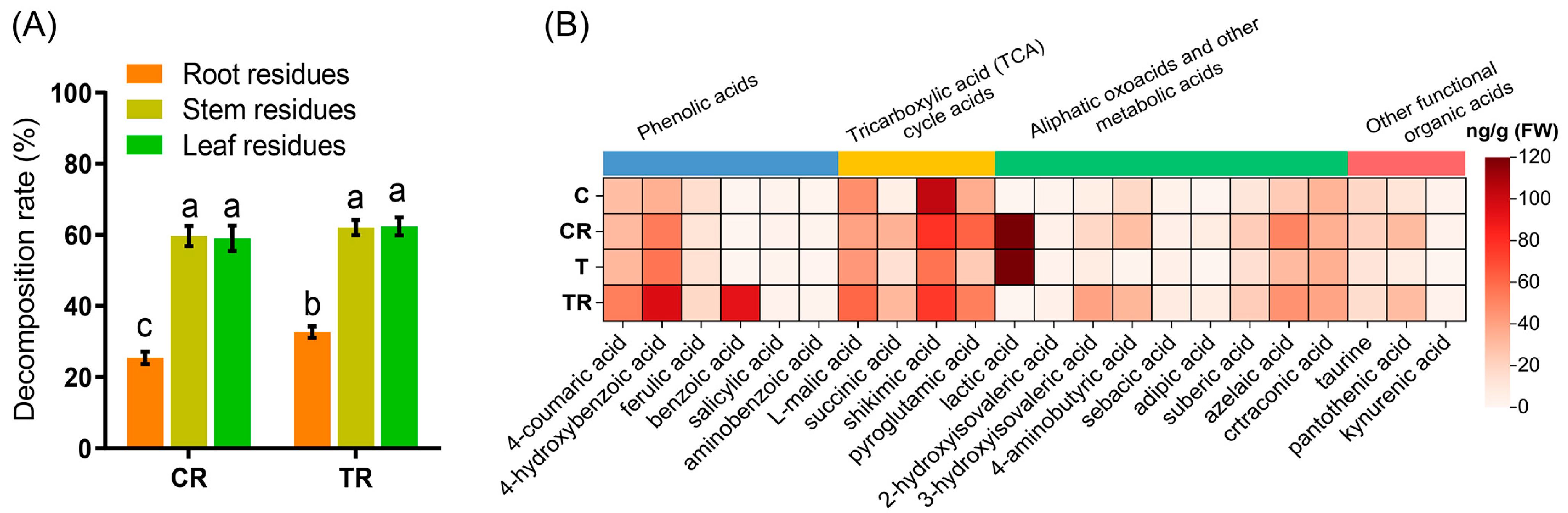
By the time of transplanting the subsequent crops, 40–70% of the tomato residues still remained in the soil (
Figure 1A), providing a continuous carbon pool for the subsequent soil microecosystem. The decomposition characteristics of residues from different organs exhibited significant differences and responded differently to the high-temperature treatment. For the aboveground tissues, the decomposition processes of stems and leaves were relatively rapid and synchronized. Under ambient temperature retention (CR) conditions, their decomposition rates had reached 59.7% and 59.1%, respectively. Notably, the solar high-temperature treatment (TR) did not further significantly increase the decomposition rates of these two organs. This indicates that stem and leaf tissues, which are rich in easily degradable components, already possess a high natural degradation potential in conventional soil environments, and high temperature is not the primary factor limiting their initial degradation. In contrast, the degradation of belowground root residues constituted a distinct rate-limiting step. Under the CR treatment, the root decomposition rate was only 25.4%, the lowest among all organs, which may be attributed to the higher degree of lignification and complex physical structural resistance of the roots. However, the TR treatment promoted the decomposition of recalcitrant tissues, increasing the root decomposition rate to 32.7%. This suggests that the solar high-temperature environment may help break through the structural barriers of root tissues and accelerate the breakdown and turnover of recalcitrant residues, thereby affecting the sheltering effect of root residues on crop pathogens and creating favorable physical and ecological conditions for the healthy establishment of subsequent crops.
3.2. Soil Nutrients and Humus Components as Affected by Different Tomato Residue Retention Treatments
Regarding the transformation of carbon fractions and humification characteristics, the CR treatment substantially decreased the fulvic acid content while simultaneously increasing the humic acid content to 4.4 times that of the control (C;
Table 1). The solar high-temperature treatment without retention (T) significantly reduced the soil organic matter content (decreased by 18.3% compared to C) and humin content (decreased by 28.6% compared to C), but increased the humic acid content. In contrast, the solar high-temperature residue retention (TR) treatment significantly increased the soil organic carbon and humin contents by 19.6% and 34.6%, respectively, compared to the T treatment; it also significantly increased the fulvic acid content (1.29 times that of the T treatment), whereas the humic acid content was only 14.4% of that in the T treatment. Two-way analysis of variance (ANOVA) revealed that retention (R), high temperature (T), and their interaction (R × T) had highly significant effects (
p < 0.01) on the humic substance fractions, indicating that the retention of tomato residues significantly affected the composition of soil humic substances, and different retention conditions altered the humification products of the tomato residues in the soil.
In terms of nutrient mineralization and supply dynamics, compared with the ambient temperature fallow treatment C, the CR treatment significantly increased the contents of TN and AK but decreased the content of AN. The T treatment significantly decreased the contents of TN, TP, TK, and AN; whereas the TR treatment effectively compensated for these nutrient losses, restoring TN and TK to the levels of the control (C), and increasing the AN and AK contents by 30.0% and 31.6%, respectively, compared to C.
3.3. Effects of Different Tomato Residue Retention Treatments on Soil Organic Acid Composition
The tomato residue retention strategy significantly reshaped the soil organic acid metabolic profile (
Figure 1B). Analysis of variance indicated that the two factors of residue retention (R) and solar high temperature (T) had a significant interactive driving effect on the contents of most organic acid components. This not only reflects the differences in the humification process of the residues under different treatments but also provides a key material basis for the subsequent evolution of the rhizosphere microecology.
Regarding phenolic acid metabolites, residue retention (CR), acting as an exogenous carbon source input, significantly increased the contents of 4-hydroxybenzoic acid, salicylic acid, and aminobenzoic acid; T increased the accumulation of 4-hydroxybenzoic acid in the soil. However, after the introduction of solar high temperature, the TR treatment further significantly increased the contents of 4-coumaric acid, 4-hydroxybenzoic acid, ferulic acid, salicylic acid, aminobenzoic acid, and benzoic acid compared to T and CR. This phenomenon indicates that high temperature coupled with residue retention may have accelerated the degradation of complex macromolecules such as lignin, forming phenolic humification precursors with specific compositions.
In terms of tricarboxylic acid (TCA) cycle-related acids, which reflect soil carbon turnover and microbial activity, high temperature and retention exhibited different regulatory mechanisms. Although the single high-temperature (T) environment increased the succinic acid content, it restricted some metabolic pathways, leading to a significant decrease in the contents of shikimic acid and pyroglutamic acid. However, the addition of residues (TR) effectively broke this restriction, not only restoring the levels of succinic acid, shikimic acid, and pyroglutamic acid to or even exceeding those of the CR treatment, but also promoting a significant and substantial accumulation of malic acid. This indicates that the soil under the TR treatment may have provided more abundant available carbon sources and energy substrates for heat-tolerant microbial communities.
Furthermore, regarding the synthesis of aliphatic oxygen-containing acids and other functional compounds, the TR treatment also demonstrated the potential to optimize the soil metabolic environment. Although the single high temperature reduced the content of 4-aminobutyric acid (GABA), which possesses stress-resistance signaling functions, the TR treatment not only significantly restored and promoted the accumulation of GABA and 3-hydroxyisovaleric acid but also substantially enriched bioactive substances such as adipic acid, azelaic acid, taurine, and pantothenic acid.
3.4. Changes in the Rhizosphere Bacterial Community of Subsequent Tomato/Cucumber in Response to Tomato Residue Retention
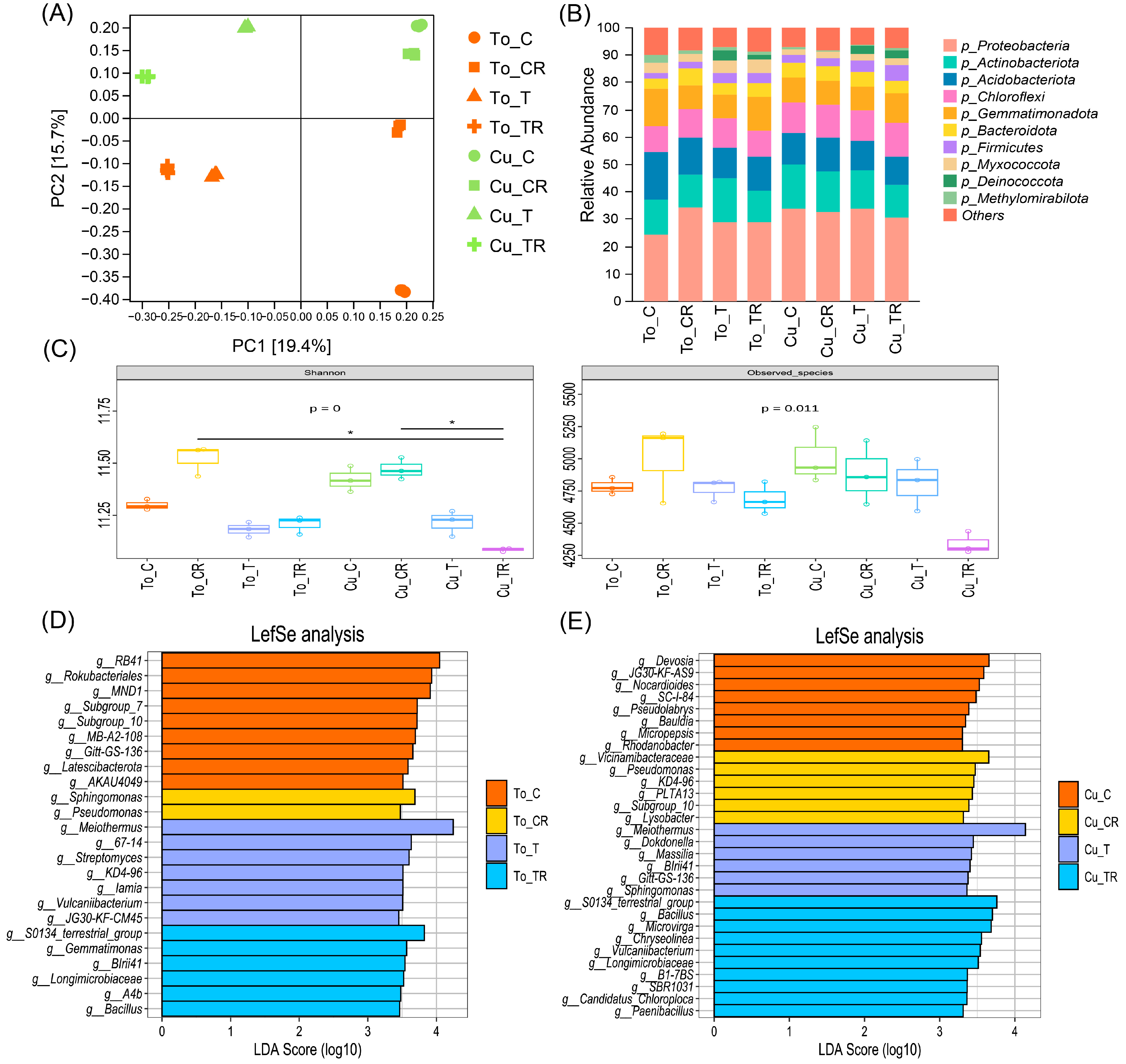
Compared to the non-retention treatment, tomato residue retention significantly altered the bacterial community structure in the rhizosphere soil of subsequent tomato and cucumber crops. Principal coordinate analysis (PCoA) revealed clear separation among different treatments and crop types (
Figure 2A). PERMANOVA results indicated that the fallow period temperature (T) had a highly significant effect on the bacterial community structure (F = 5.12,
p = 0.001), independently explaining 18.9% of the community variation (R
2 = 0.189). The type of subsequent crop also exerted a highly significant influence (R
2 = 0.134,
p = 0.001), whereas residue retention (R) contributed less to the variation (R
2 = 0.106,
p = 0.001). The three-factor interaction significantly affected the bacterial community as well (R
2 = 0.051,
p = 0.005). Analysis of the rhizosphere soil bacterial α-diversity indices showed that CR increased the Shannon index in the tomato rhizosphere (
Figure 2C), but had no significant effect on the cucumber rhizosphere. In contrast, T significantly reduced the Shannon index of both tomato and cucumber rhizosphere bacteria, while TR further decreased the Shannon index and the number of observed species in the cucumber rhizosphere.
Tomato residue retention exerted differential effects on the rhizosphere bacterial community composition at the phylum level for both the subsequent conspecific crop (continuous tomato) and heterospecific crop (rotational cucumber) (
Figure 2B). As an active response to the exogenous carbon input, residue retention (CR and TR) generally promoted the enrichment of the phyla
Bacteroidota and
Chloroflexi (syn.
Chloroflexota) in the tomato and cucumber rhizospheres, respectively. Furthermore, CR primarily promoted the proliferation of typical copiotrophic bacteria, such as
Proteobacteria (syn.
Pseudomonadota), whereas TR exhibited a preferential enrichment of specific stress-tolerant biocontrol taxa. Compared to T, TR not only promoted the recovery and enrichment of
Acidobacterota (syn.
Acidobacteriota) and
Gemmatimonadota in the tomato rhizosphere, but also significantly increased the relative abundance of
Firmicutes (syn.
Bacillota) in the cucumber rhizosphere.
Firmicutes (
Bacillota) is renowned for its robust stress tolerance and capacity to produce antibiotic metabolites, suggesting that the TR treatment may have induced the evolution of the rhizosphere community toward a stress-resistant and disease-suppressive state.
Linear discriminant analysis effect size (LEfSe) further confirmed that different tomato residue retention treatments led to alterations in the rhizosphere bacterial composition (
Figure 2D,E). Under CR conditions, the typical fast-growing plant-growth-promoting bacteria,
Pseudomonas, were significantly enriched in the rhizospheres of both crops; additionally,
Sphingomonas in the tomato rhizosphere and
Lysobacter in the cucumber rhizosphere also exhibited a preference for the CR treatment. In stark contrast, after undergoing high-temperature screening, the TR treatment consistently recruited and highly enriched
Bacillus, which possesses the capacity to form endospores, in the rhizospheres of both crops. Furthermore, the TR treatment specifically enriched potential beneficial bacteria such as
Gemmatimonas in the tomato rhizosphere and
Paenibacillus in the cucumber rhizosphere.
3.5. Changes in the Rhizosphere Fungal Community of Subsequent Tomato/Cucumber in Response to Tomato Residue Retention
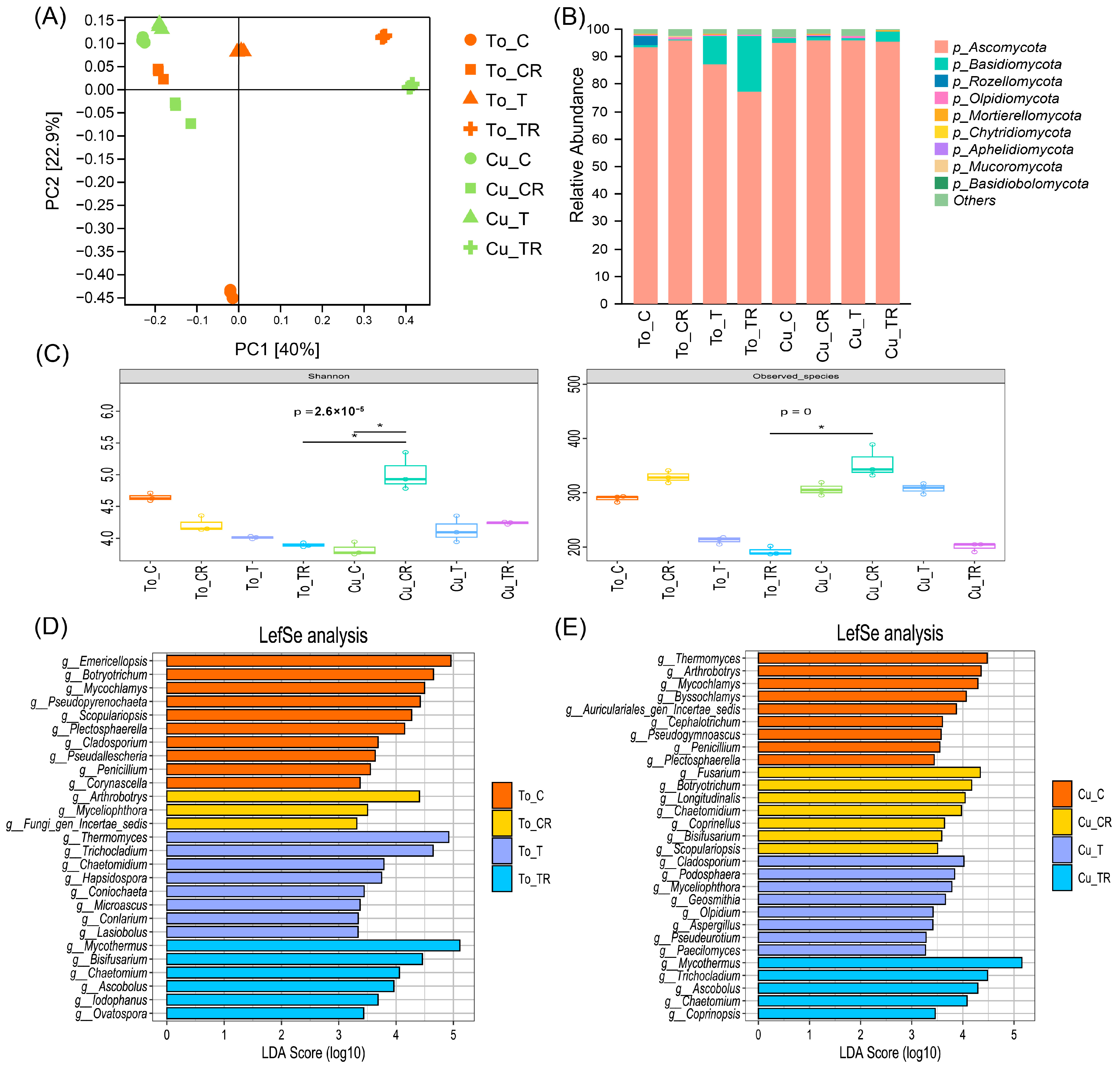
Principal coordinate analysis (PCoA) results showed (
Figure 3A) that the response patterns of the plant rhizosphere soil fungal communities to different tomato residue retention treatments differed significantly from those of the bacterial communities. PERMANOVA indicated that the effect of the retention treatment (R) on the fungal community structure (R
2 = 0.177,
p = 0.003) was greater than that on the bacterial community (R
2 = 0.106), which may be related to the ecological niche of fungi as the primary decomposers of complex plant residues. The fallow period temperature (T) remained the primary driving factor, independently explaining 23.4% of the community variation (R
2 = 0.234,
p = 0.001). The subsequent crop type (C) also significantly influenced the fungal community (R
2 = 0.12,
p = 0.022), and the three-factor interaction (R × T × C) had a significant effect on the bacterial community (R
2 = 0.056,
p = 0.001). The response of rhizosphere fungal diversity to tomato residue retention varied with crop species. In the tomato rhizosphere, both CR and TR treatments significantly reduced the fungal Shannon index compared to the non-retention treatment (
Figure 3C). In contrast, in the cucumber rhizosphere, the CR treatment significantly increased the fungal Shannon index. Furthermore, the CR treatment significantly increased the number of observed bacterial species in the rhizospheres of both tomato and cucumber, while the TR treatment significantly reduced the number of observed fungal species in the rhizospheres of both crops, implying that the dual selection pressure of intense high temperature and substrate eliminated a large number of redundant or heat-intolerant taxa (including pathogenic fungi), driving the evolution of the fungal community toward a specific functional direction.
Further analysis of the effects of different tomato residue retention treatments on the rhizosphere fungal community composition of subsequent crops revealed three dominant phyla with relative abundances greater than 1%. Ascomycota was absolutely dominant, exhibiting a relative abundance exceeding 94% across all treatments in the cucumber rhizosphere. In contrast, the relative abundance of Ascomycota in the tomato rhizosphere varied considerably: CR increased its abundance, whereas high-temperature treatments, including T and TR, reduced the relative abundance of Ascomycota to 89.1% and 77.1%, respectively. Furthermore, the TR treatment significantly increased the abundance of Basidiomycota—a phylum capable of lignin degradation and involved in soil carbon cycling—in the rhizospheres of both tomato and cucumber, with its relative abundance in the tomato rhizosphere reaching 20.6%.
LEfSe results at the genus level further revealed the decisive differences between different retention strategies in disease prevention and control (
Figure 3D,E). Under CR conditions, the direct incorporation of untreated residues into the soil posed a potential microecological risk, significantly inducing the enrichment of typical soil-borne pathogens such as
Fusarium in the cucumber rhizosphere. However, TR treatment did not lead to the enrichment of
Fusarium; instead, it enriched
Chaetomium and
Ascobolus in the rhizospheres of both crops.
Chaetomium is recognized as a highly efficient lignin-degrading fungus and a broad-spectrum antagonistic biocontrol fungus. Furthermore, the TR treatment specifically promoted the colonization of the thermophilic beneficial fungus
Mycothermus in the cucumber rhizosphere.
3.6. Effects of Tomato Residue Retention on Rhizosphere Soil Metabolites of Subsequent Tomato/Cucumber
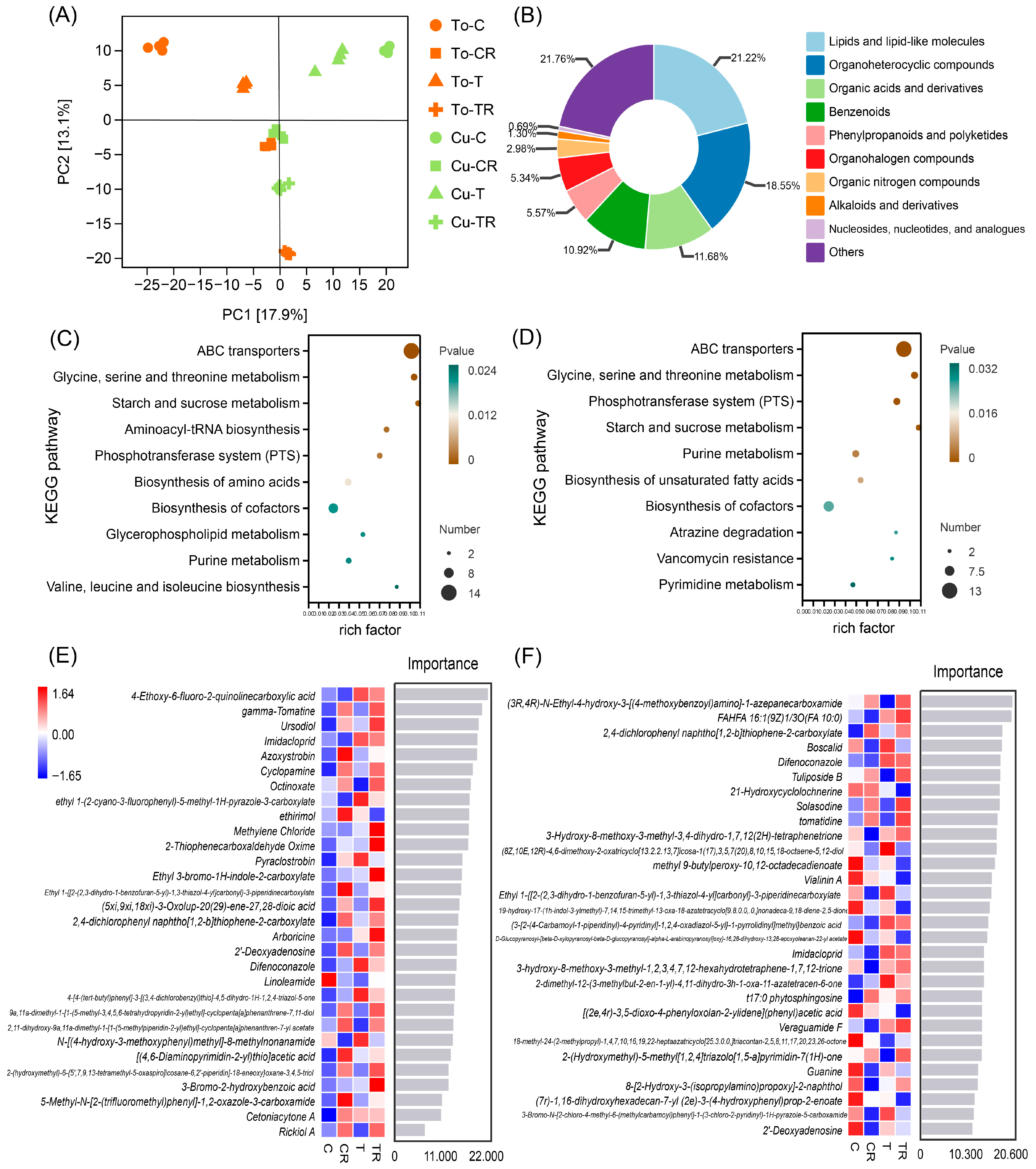
Based on liquid chromatography-mass spectrometry (LC-MS) and untargeted metabolomic analyses, the alterations in the metabolite profiles of the rhizosphere soils of the subsequent tomato and cucumber crops under different tomato residue retention treatments were determined. A total of 1310 metabolites were identified. The identified metabolites were classified into categories, among which the classes with relative abundances exceeding 10% included lipids and lipid-like molecules (21.22%), organoheterocyclic compounds (18.55%), organic acids and derivatives (11.68%), and benzenoids (10.92%) (
Figure 4B). The partial least squares discriminant analysis (PLS-DA) model yielded parameters of R
2X(cum) = 0.502, R
2Y(cum) = 0.635, Q
2 = 0.534 (
Figure 4A). PERMANOVA analysis revealed that the subsequent crop type (C) had the greatest influence on the rhizosphere soil metabolite composition (R
2 = 0.142,
p = 0.001). Both residue retention (R) and fallow period temperature (T) independently explained 11.2% of the metabolite variation (
p = 0.001). The three-factor interaction (R × T × C) also significantly affected the rhizosphere soil metabolite composition (R
2 = 0.074,
p = 0.001).
By applying a threshold of variable importance in projection (VIP) > 1 and a
p-value < 0.05, 444 and 452 differential metabolites were identified in the rhizosphere soil of tomato and cucumber, respectively. Subsequent KEGG pathway enrichment analysis revealed that the differential metabolites in tomato rhizosphere soil were primarily enriched in pathways such as ABC transporters, glycine, serine and threonine metabolism, starch and sucrose metabolism, and aminoacyl-tRNA biosynthesis. In contrast, the differential metabolites in cucumber rhizosphere soil were mainly enriched in ABC transporters, glycine, serine and threonine metabolism, phosphotransferase system (PTS), starch and sucrose metabolism, and purine metabolism (
Figure 4C,D).
Machine learning was employed to screen for biomarker metabolites responsible for the inter-group differences in the rhizosphere soils of the subsequent tomato and cucumber crops (
Figure 4E,F). It was found that in the tomato rhizosphere soil, the ambient temperature retention (CR) treatment significantly increased the contents of various metabolites compared to the non-retention control (C), including the tomato alkaloid γ-tomatine, 2′-deoxyadenosine, and other triterpenoids, organic acids, and lipids; the solar high-temperature residue retention (TR) treatment further increased the accumulation of γ-tomatine, 2′-deoxyadenosine, ursodiol, and additional organic acids and lipids. This result indicates that tomato residue retention not only introduced plant-derived defense substances, such as tomatine-related alkaloids, but also promoted the enhancement of microbial metabolic activity. In the cucumber rhizosphere soil, the effects of tomato residue retention on metabolites were more complex: the CR treatment increased the contents of two tomato-derived alkaloids (solasodine and tomatidine) and elevated the levels of t17:0 phytosphingosine and tuliposide B, but significantly decreased the relative abundances of various structurally complex organoheterocyclic compounds and nucleosides, such as guanine and 2′-deoxyadenosine. Similar to the CR treatment, the TR treatment further elevated the contents of solasodine and tomatidine; moreover, it increased the accumulation levels of guanine and 2′-deoxyadenosine compared to the CR treatment.
3.7. Effects of Tomato Residue Retention on the Growth and Yield of Subsequent Tomato/Cucumber
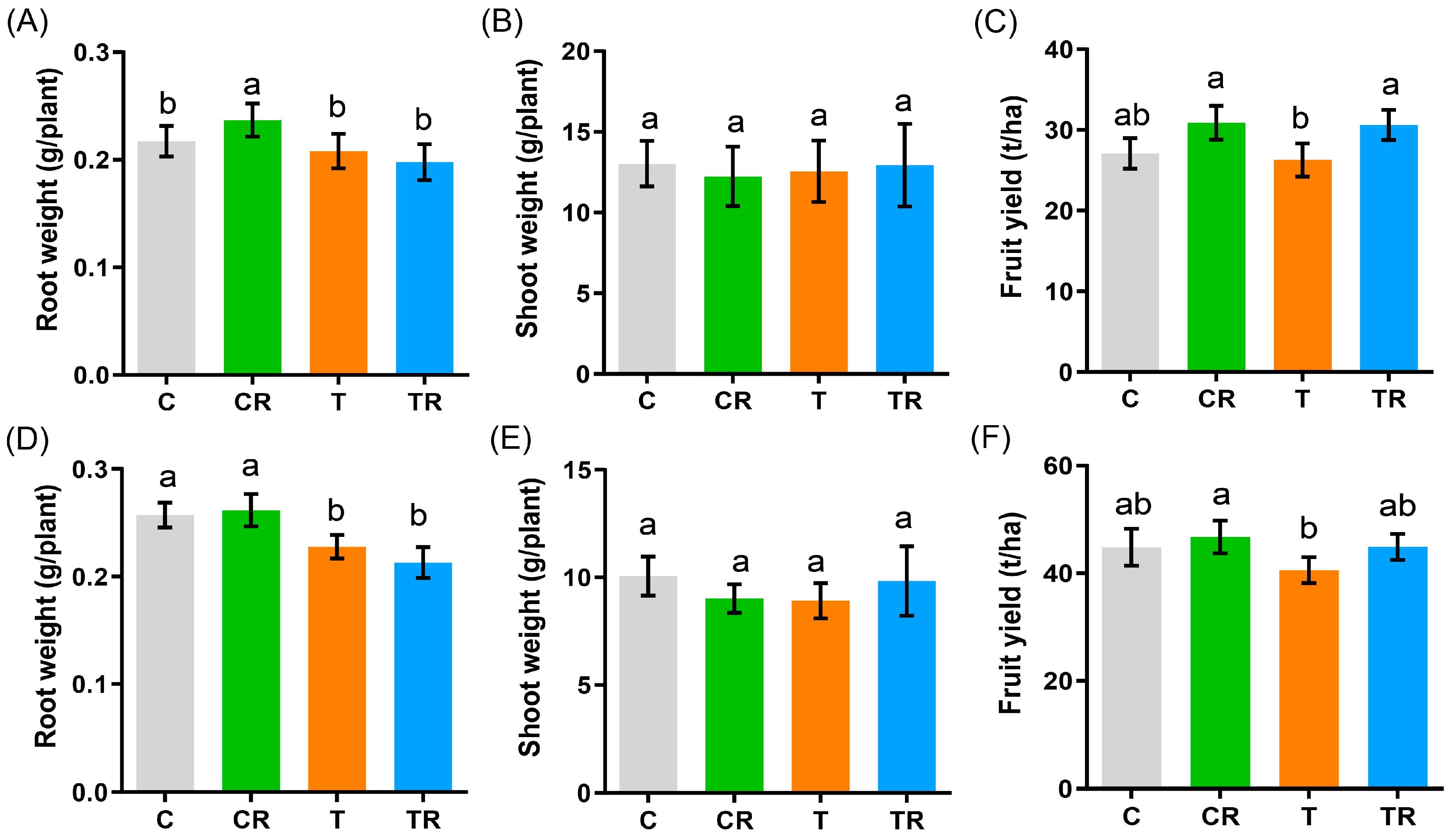
To evaluate the short-term and long-term effects of different tomato residue retention strategies on subsequent crops, plant growth parameters at 30 days after transplanting were used to assess short-term responses, while the total yield over the entire growing season was employed to evaluate long-term effects (
Figure 5). At 30 days after transplanting, CR promoted root growth in tomato, whereas both T and TR inhibited root development in cucumber. However, none of the treatments significantly affected the shoot dry weight of either crop, indicating that the root system were more sensitive to changes in soil conditions. Analysis of the total seasonal yield revealed that although CR did not significantly increase the yield of subsequent crops, it elevated the mean yield value. In contrast, TR significantly enhanced the yield of subsequent tomato and also exhibited a yield-increasing effect on cucumber. Overall, both retention treatments positively influenced the yield of subsequent crops compared to the non-retention control.
3.8. Analysis of Interactions Between Key Microorganisms and Soil Environmental Factors
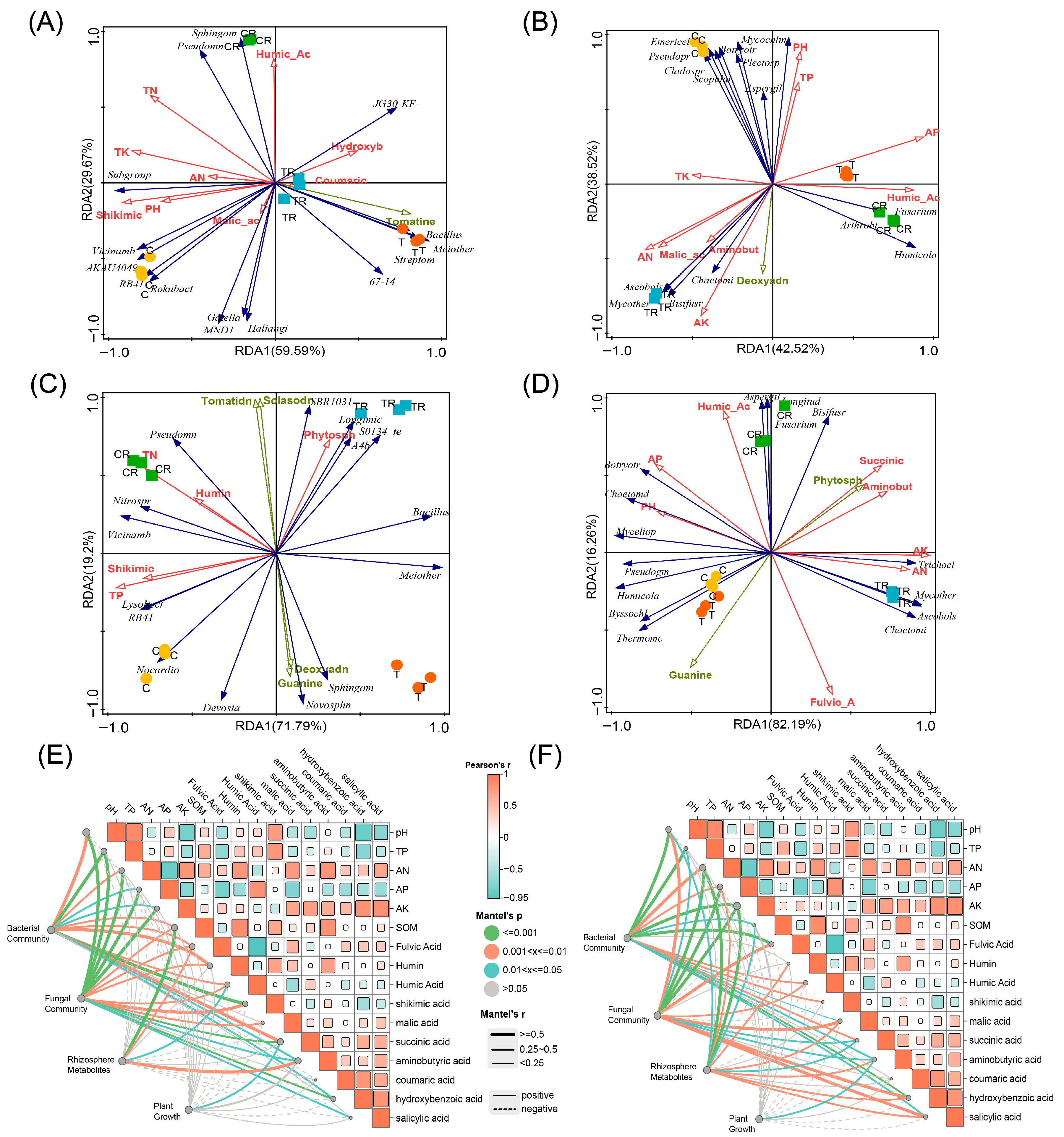
This study demonstrated that tomato residue retention significantly altered the structure of the rhizosphere microbial community. Redundancy analysis (RDA) revealed that soil inorganic nutrients, organic nutrients, organic acids, and functional metabolites served as core environmental factors driving this restructuring. Analysis of the relationships between tomato rhizosphere bacteria and environmental factors across treatments indicated that shikimic acid, TN, Humic Acid, and Tomatine were significant factors influencing the bacterial community (
p < 0.05) (
Figure 6A). Specifically, under the CR treatment, TN and Humic Acid showed significant positive correlations with
Sphingomonas and
Pseudomonas; whereas under the TR treatment, 4-coumaric acid, 4-hydroxybenzoic acid, and Tomatine were significantly positively correlated with
Bacillus,
Meiothermus, and
Streptomyces. For the fungal community, AP, AK, 2-Deoxyadenosine, and Humic Acid were identified as key drivers of variation (
p < 0.05) (
Figure 6B). Under the CR treatment, Humic Acid and AP were positively associated with the enrichment of
Fusarium,
Arthrobotrys, and
Humicola; under the TR treatment, AK, 2-Deoxyadenosine, 4-aminobenzoic acid, AN, and malic acid exhibited significant positive correlations with the enrichment of
Mycochlamys,
Bisifusarium, and
Aspergillus.
In the cucumber rhizosphere soil, TP, tomatidine, guanine, and shikimic acid were identified as significant factors influencing the bacterial community (
p < 0.05) (
Figure 6C). Under CR treatment, humin and TN were positively correlated with the enrichment of
Pseudomonas and
Nitrospira. In contrast, under TR treatment, taxa including
Longimicrobiaceae,
S0134_terrestrial_group,
SBR1031, and
A4b were enriched. Tomatidine and solasodine released from tomato residue retention (both CR and TR) showed positive correlations with the enrichment of these bacteria. For the fungal community, AK, fulvic acid, pH, humic acid, and phytosphingosine were significant drivers of fungal community variation in the cucumber rhizosphere soil (
p < 0.05) (
Figure 6D). In the CR treatment, humic acid was significantly positively correlated with
Fusarium,
Aspergillus, and
Bisifusarium, whereas fulvic acid was significantly negatively correlated with these fungi. Under the TR treatment, the enrichment of
Mycothermus,
Ascobolus,
Chaetomium, and
Trichocladium were significantly positively correlated with AN and AK.
Further Mantel tests were conducted to analyze the responses of tomato and cucumber rhizosphere bacterial communities, fungal communities, metabolite profiles, and plant growth indicators to soil inorganic nutrients, organic nutrients, and organic acids following tomato residue retention (
Figure 6E,F). The results revealed that variations in multiple soil environmental factors strongly drove the restructuring of differential microbial communities in the rhizosphere of both crops. Specifically, pH, TP, and shikimic acid significantly influenced the tomato rhizosphere bacterial and fungal communities (r > 0.5,
p < 0.05), while pH, AN, AK, and Fulvic Acid were significant drivers of the cucumber rhizosphere bacterial and fungal communities (r > 0.5,
p < 0.05). The rhizosphere metabolite composition of the subsequent crops was co-regulated by soil environmental factors and rhizosphere microbes, with fewer environmental factors showing direct significant correlations. Among them, SOM and aminobutyric acid exhibited significant positive correlations with changes in the tomato rhizosphere metabolome (r > 0.5,
p < 0.05), whereas AN and AK showed significant positive correlations with changes in the cucumber rhizosphere metabolome (r > 0.5,
p < 0.05). Owing to the complex short-term and long-term effects of tomato residue retention on plant growth, only succinic acid in the soil environment was detected to positively correlate with tomato growth (r = 0.28,
p < 0.05), and aminobutyric acid with cucumber growth (r = 0.34,
p < 0.05), suggesting that increased levels of these organic acids may exert positive effects throughout the entire growth period of the subsequent crops.