Article

Flowering Dynamics, Pollen Viability and Stigma Receptivity of Nai Plum (Prunus salicina Lindl. var. cordata) from Different Provenances


1
Central South University of Forestry and Technology, Changsha 410004, China
2
Yuelushan Laboratory, Changsha 410128, China
3
The Belt and Road International Union Research Center for Tropical Arid Non-Wood Forest, Changsha 410004, China
4
Henan Academy of Sciences, Zhengzhou 450002, China
*
Authors to whom correspondence should be addressed.
Horticulturae 2026, 12(4), 468; https://doi.org/10.3390/horticulturae12040468
Submission received: 22 February 2026 / Revised: 31 March 2026 / Accepted: 2 April 2026 / Published: 9 April 2026

Abstract

Nai plum (Prunus salicina Lindl. var. cordata) is a high-value fruit crop in southern China, yet its post-harvest quality is often compromised by fruit browning, a major constraint to storage and marketability. Addressing this challenge requires a deeper understanding of the species’ reproductive biology, which underpins both fruit set and cultivar improvement. In this study, we characterized the flowering biological characteristics of Nai plum accessions introduced from Yanling and Liuyang (Hunan Province) and Shaoguan and Lechang (Guangdong Province). Using field observations combined with microscopic and submicroscopic techniques, we documented flowering phenology, flowering dynamics, floral organ traits, pollen viability and stigma receptivity. The flowering period was in March, lasting 26–28 d, and the group blooming period was divided into three stages: Initial opening stage, Full blooming stage, and Final flowering stage. The single-flower opening process was divided into eight stages. Pollen viability followed a unimodal curve, peaking at the petal flattening stage (PF) across all accessions, though peak values varied by provenances. Stigmas were of the wet type, with receptivity following a weak–strong–weak pattern; peak receptivity occurred at early flowering (EF) and PF in most accessions. The EF of Nai plum from Yangling (S1) lasted for 7 h, and PF lasts for 28 h. The EF of Nai plum from Yangling (S2) lasted for 3 h, and the PF lasted for 11 h. Both the EF and the PF of Nai plum from Shaoguan (S3) lasted for 14 h. The bud white stage (BW) of Nai plum from Lechang (S4) lasted for 6 h and the EF lasted for 7 h. The EF of Nai plum from Liuyang (S5) lasts for 7 h, and the PF lasted for 28 h. These findings clarify the reproductive phenology and floral biology of Nai plum, providing foundational knowledge that can inform breeding strategies and cultivation practices aimed at improving fruit set and, ultimately, post-harvest quality.

1. Introduction

Nai plum (Prunus salicina Lindl. var. cordata) belongs to the genus Prunus within the Rosaceae family. Native to Gutian County in Fujian Province, China, it originated from a natural hybridization between peach and plum. Its appearance closely resembles that of a peach, while its flavor is akin to that of a plum, hence its name Nai plum [1]. Nai plum is extensively cultivated across most southern regions of China, representing a uniquely renowned and valuable economic tree species with significant commercial worth [2]. Their fruit boasts a crisp, sweet flavor, abundant flesh, thin easily detachable skin, and small pits. Rich in protein, vitamins, organic acids, and minerals, they possess exceptional nutritional value, earning the accolade of ‘King of Plums’ [3]. Currently, the cultivation area of Nai plum is expanding rapidly. However, fruit browning occurs frequently during production, causing substantial economic losses for growers. Therefore, breeding new varieties of Nai plum with low rates of brown heart is one approach to addressing the issue of high brown heart incidence in the future. Conducting research into flowering biological characteristics is a prerequisite for variety selection, pollinator tree configuration, and breeding work [4,5,6]. Flowering biology reflects a plant’s flowering phenology, flowering progression, and the developmental characteristics of both pistils and stamens, being intrinsically linked to plant reproduction [7,8]. Flowering time is governed by both the plant’s internal physiological regulation and external environmental factors, including light exposure, temperature, slope orientation, and precipitation [9,10,11]. Pollen viability and stigma receptivity form the foundation of sexual reproduction in plants, directly determining breeding efficiency [12,13]. Both pollen lifespan and the duration of stigma receptivity are closely linked to plant hybridization breeding [14,15]. Consequently, in-depth investigation into the flowering biology of different Nai plum sources constitutes a crucial prerequisite for cultivar selection.
To date, research on Nai plum has predominantly focused on cultivation practices [16,17] and fruit quality [18,19]. Jiang et al. investigated the effects of fruit bagging during the fruit enlargement stage on color development and quality in Golden Nai plum [18]; Wang et al. conducted a comprehensive analysis and evaluation of Nai plum fruit quality across different regions of Guizhou Province [20]; Li et al. examined the effects of fruit bagging on Nai plum appearance and quality [21]; Zhang et al. investigated the impact of spraying ‘micronutrient water-soluble fertilizers’ on Nai plum yield and quality [22]. Conversely, research into pollen viability and stigma receptivity remains relatively scarce. The absence of such fundamental research has created considerable uncertainty in improving Nai plum quality and developing new varieties, severely hindering the cultivation and innovation of superior Nai plum cultivars. This study utilizes Nai plums from different provenances to investigate its flowering biology. Observations were made on flowering phenology, pistil and stamen development, stigma receptivity, and pollen viability. The research aims to clarify the flowering biological characteristics of Nai plum, thereby establishing a theoretical foundation and providing technical support for the introduction of cultivars and the breeding of new varieties for production.

2. Materials and Methods

2.1. Overview of the Area of Study

The experimental base is located in the Tianping Agricultural Science and Technology Park (Yanling County, Zhuzhou, China), in the central sector of the Luoxiao Mountains, within the elevational belt of 200–400 m. With a forest coverage rate of 83.55%, the area features a subtropical monsoon humid climate. The annual average temperature is 15.9 °C, with an average annual rainfall of 1761.5 mm, 1500 h of annual sunshine, and an average frost-free period of 288 d. Summer precipitation is abundant with rainfall coinciding with heat, sheltered from the wind and sun-facing. The soil is predominantly sandy loam developed from granitic parent material, characterized by loose texture, deep soil layers, good permeability, rich organic matter content, and abundant mineral elements.

2.2. Test Materials

The experimental material comprised five open-field cultivated Nai plum specimens sourced from distinct provenances: Yanling County, Hunan Province; Shaoguan City, Guangdong Province; Lechang City, Guangdong Province; and Liuyang City, Hunan Province. These were sequentially designated as S1, S2, S3, S4, and S5, as detailed in Table 1. All test provenances exhibited moderate tree vigor, consistent cultivation management, sound growth and development, and were free from pest and disease damage.

2.3. Test Method

2.3.1. Flowering Phenology Observations

The experiment was conducted from early March to early April 2025. For each provenance, 10 to 15 healthy, uniformly growing, and well-formed Nai plum trees were selected. Their opening dynamics were monitored and documented photographically. The group phenology was divided into three phases based on the flowering status: Initial opening stage, defined as 5% of flowers open across the entire tree; Full-bloom stage, defined as 25–75% of flowers open across the entire tree; Final flowering stage, defined as 80% of flowers across the entire tree in a wilted state.

2.3.2. Observation of Single Flower Opening Dynamics and Floral Organ Characteristics

Healthy, uniformly growing Nai plum plants representing different provenances were selected for regular, fixed-point observation of flowering dynamics. From each provenance, 10–15 flower buds at the same developmental stage—specifically, buds at the visible stage that had not yet opened—were randomly selected, and each bud was marked with a tag for individual tracking. Observations were conducted daily at 9:00 AM, with photographic documentation, until flowering was complete. The following parameters were recorded: morphological changes in flower buds, the sequence of flower opening within inflorescences, the duration of inflorescence flowering, and the developmental progression of individual flowers (e.g., tepal expansion, changes in stamens and pistils).

2.3.3. Observations on Stamen Developmental Morphology and Pollen Viability Testing

Buds and flowers at different opening stages were randomly collected. The external morphology of the stamens and the dehiscence status of the anthers were observed under a Motic stereomicroscope. Specimens were photographed, and the dimensions of both filaments and anthers were measured.
Random stamens were collected from flowers at different opening stages. Following fixation with 2.5% glutaraldehyde for 48 h, the specimens were washed twice with phosphate-buffered saline (PBS) and twice with distilled water, respectively, according to the method of Shao et al. [23]. They were then dehydrated through a graded ethanol series (30%, 50%, 70%, 80%, 90%, 95%, and 100%) to tert-butanol, followed by freeze-drying. The dried specimens were gold-plated for 20 min in a GVC-1000 ion sputter coater (Shanghai Hezao Electronic Technology Co., Ltd., Shanghai, China) and subsequently examined under a JSM-6380LV scanning electron microscope (JEOL Ltd., Tokyo, Japan) [23]. Representative perspectives were selected to observe and photograph the morphology of anthers and pollen grains. Pollen morphology was described following Introduction to Palynology [24] and Handbook of Palynology [25], with morphological indices including polar axis length (P), equatorial axis length (E), and the polar–equatorial ratio (P/E). Using the electron microscope’s measurement tools, ten pollen grains were randomly selected for measurement of these morphological indices.
Fresh pollen was collected at different developmental stages, and pollen viability was assessed using an in vitro culture method. Initial experiments followed the in vitro pollen culture protocol described by Wei [26]. The optimal medium for Nai plum pollen germination was formulated as follows: 0.3% boric acid, 1% agar, 0.2% calcium chloride, and 10% sucrose. Stamens were collected at each developmental stage, and anthers were pierced using dissecting needles to release fresh pollen. The prepared culture medium was dispensed into Petri dishes and allowed to solidify. Pollen grains were evenly spread onto the medium surface using a clean, moistened brush, ensuring that no brush marks were left on the medium. The inoculated medium was maintained in a humidified chamber and incubated at 25 °C for 12 h. Pollen germination was observed under a microscope. For each sample, three microscopic fields were randomly selected, each containing at least 30 pollen grains. The criterion for valid germination was that the pollen tube length exceeded the pollen grain diameter. The pollen germination rate was calculated using the following formula: Pollen germination rate (%) = (Number of pollen grains with pollen tube length exceeding pollen diameter/Total number of pollen grains observed) × 100% [27,28].

2.3.4. Observations on Pistil Developmental Morphology and Determination of Stigma Receptivity

From bud formation stage (BF) to petal withering stage (PW), 10–15 flowers were randomly collected from each Nai plum provenance. Specimens were observed under a Motic stereomicroscope, and the external morphology of the pistil (including stigma and style dimensions), as well as changes in stigma color and mucilage secretion, were photographed and documented. Styles from the eight developmental stages were also collected. After fixation in 2.5% glutaraldehyde for 48 h, submicroscopic observations of both styles and stigmas were conducted following the method described by Shao et al. [29].
Stigma receptivity was determined using the benzidine–hydrogen peroxide method [30]. The experimental procedure was as follows: pistils were excised from flower buds or flowers collected at eight distinct developmental stages and fully immersed in a benzidine–hydrogen peroxide solution (1% benzidine/3% H2O2/distilled water = 4:11:22). After 10–15 min of incubation, the specimens were examined under a stereomicroscope and photographed. Changes in stigma color and the number of bubbles produced were recorded. Stigmas exhibiting no bubbles or color change were considered non-receptive. Those showing a few bubbles and a slight blue color were deemed receptive, while stigmas with more than two-thirds blue color and abundant bubbles were classified as highly receptive.

2.4. Data Processing and Analysis

Microsoft Excel 2019 and SPSS 27.0 were used for data organization, calculation of means, graph generation, and significance analysis of the experimental data.

3. Results and Analysis

3.1. Flowering Phenology

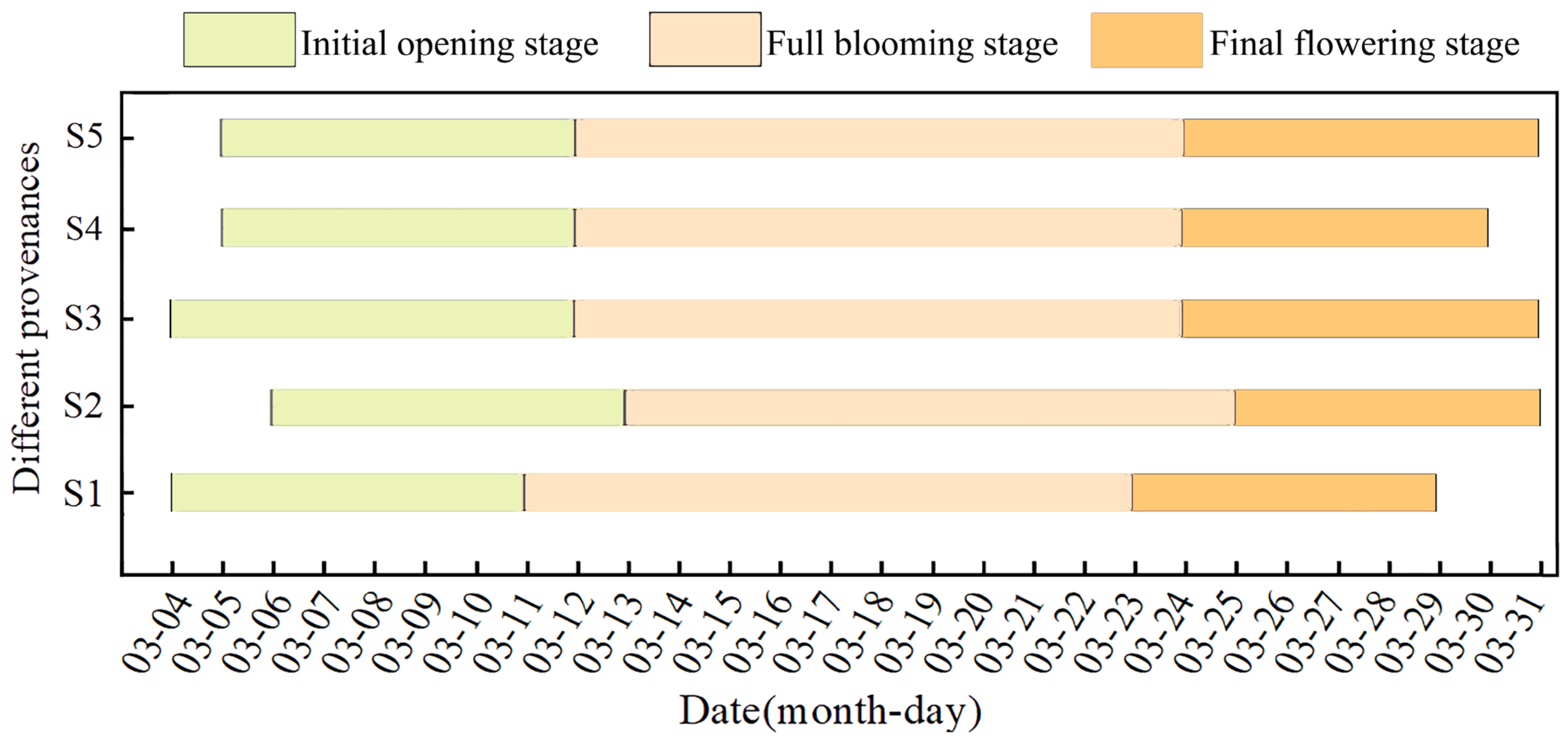
Observations of flowering dynamics revealed that both the total duration of the flowering phenological period and the timing of Initial opening stage onset varied among the Nai plums from different provenances (Figure 1). The Nai plums from S1 and S3 were the earliest to initiate flowering, on 4 March, followed by the Nai plums from S4 and S5; while the Nai plums from S2 started to flower latest, on 6 March. The Nai plums from S1 also reached the full flowering stage earliest, beginning on 11 March, whereas S2 was the latest to attain full bloom, on 13 March. Similarly, the Nai plums from S1 entered the final flowering stage earliest, starting on 23 March, while S2 was again the latest, commencing on 25 March.
The flowering period for all five Nai plum provenances was concentrated in March and was relatively prolonged. The group flowering period lasted approximately 27 d, with the optimal flowering period of approximately 8 d. The group flowering period of Nai plums from S1 and S2 were the shortest, about 26 d. The group flowering period of Nai plums from S3 was the longest, about 28 d. While the Nai plums from S4 and S5 began initial opening stage at the same time and showed minimal variation in overall flowering duration, differing by only one day. The chronological duration of flowering among the Nai plum provenances, from longest to shortest, was S3 > S5 > S1 = S2 = S4.

3.2. Dynamics of Single Flower Blooming

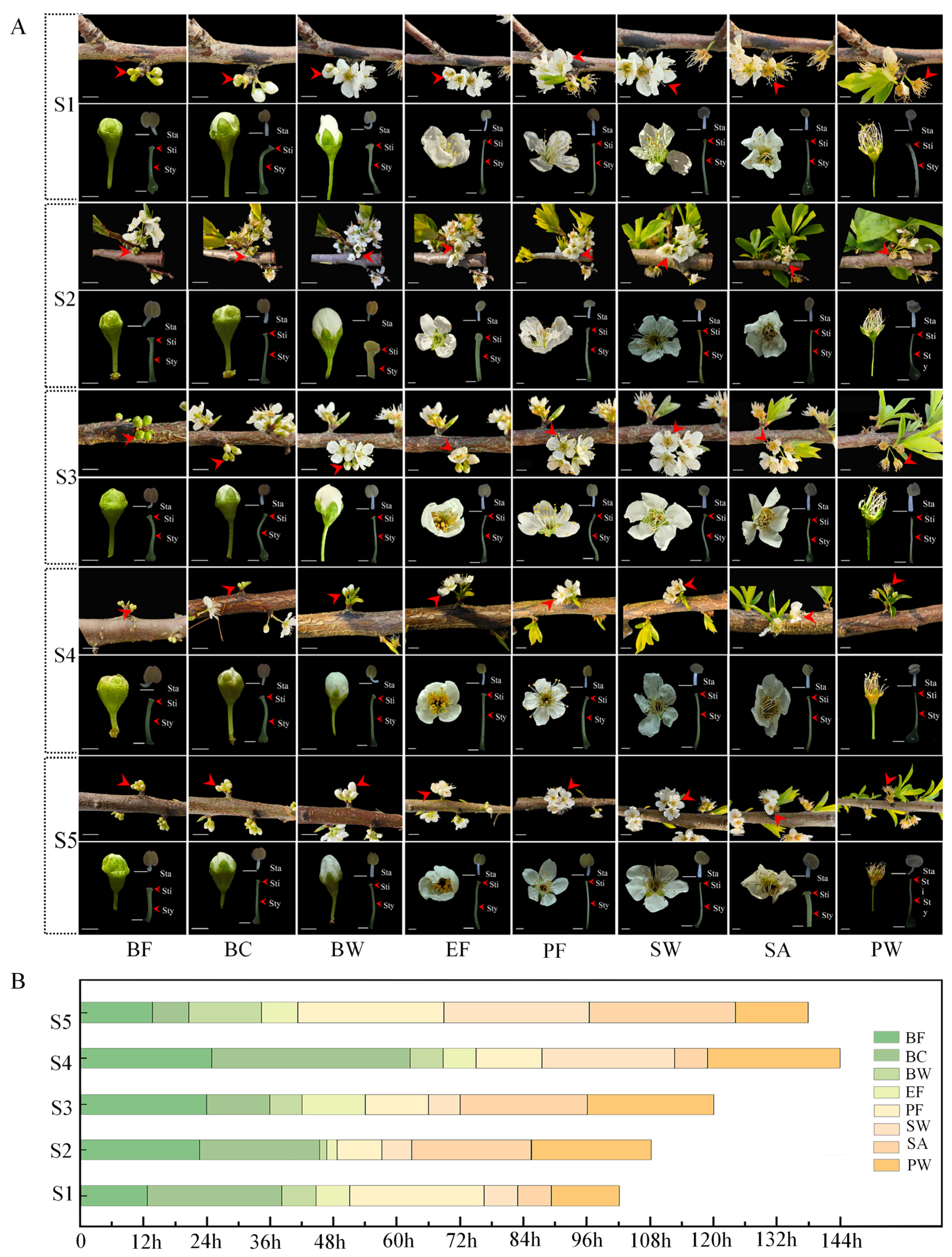
Based on observations of Nai plums from different provenances, it was observed that a single flower undergoes nine distinct developmental phases. Overall, the opening dynamics of single flower are relatively brief, potentially progressing through two stages within a single day. To facilitate observation, measurement, and statistical analysis, eight representative flowering phases were selected and categorized into eight periods (Figure 2A): bud formation stage (BF), bud cracking stage (BC), bud white stage (BW), early flowering stage (EF), petal flattening stage (PF), stamen withering stage (SW), stamen aggregation stage (SA), and petal withering stage (PW). The duration of each stage was statistically recorded (Figure 2B).
Referring to Figure 2, the flowering characteristics of Nai plum from different provenances were summarized as follows. At the BF, the flower buds were tightly enclosed by green sepals, exhibiting a characteristic bud-like morphology. The pedicel remained relatively short, and the five sepals were visibly green. Internally, the petals and stamens were in a clasped state, showing no differentiation or expansion. At the BC, the flower bud continued to enlarge, accompanied by the elongation of the inflorescence peduncle. The sepals became loosely arranged, revealing the white petals at the apex. Internally, the petals and reproductive organs (stamens/pistils) remained in an embracing state. At the BW, as the flower bud expanded further, approximately half of the white petals became visible. The inflorescence peduncle continued to elongate, while the petals and reproductive organs maintained their embracing configuration. At the EF, the flower started to open, and its five petals and sepals slightly separated. The peduncle elongated and thinned. Both pistil and stamen structures became clearly distinguishable and exhibited a plump morphology. At the PF, the flower reached full anthesis, with petals and sepals completely unfolded. The stamens were fully extended, featuring plump anthers borne on slender filaments. Simultaneously, the style elongated, typically attaining a length comparable to that of the stamens. At the SW, while the perianth (petals and sepals) remained open, clear signs of senescence had emerged. The peduncle grew noticeably slender and elongated. Stamens began to wither centripetally, starting from the innermost whorl and progressing outward, while the pistil also showed initial signs of shrinkage. A gradual darkening was observed in both the stamens and the pistil. At the SA, the petals and sepals began to curve inward, gradually converging. Most stamens had shriveled and clustered towards the center, with a pronounced darkening of color. While some filaments continued to elongate, the pistil showed increased atrophy. The PW was characterized by the complete withering of petals, indicating the terminal phase of anthesis. While the calyx persisted, the reproductive organs had completely dried and shriveled, signifying the loss of both male and female reproductive functionality. Concurrently, the peduncle and filaments became slender and elongated but exhibited no further growth, suggesting a cessation of metabolic activity in these supporting structures.

3.3. Morphological Development of Stamens and Pollen Viability

3.3.1. Morphological Development Patterns of Stamens at Different Flowering Stages

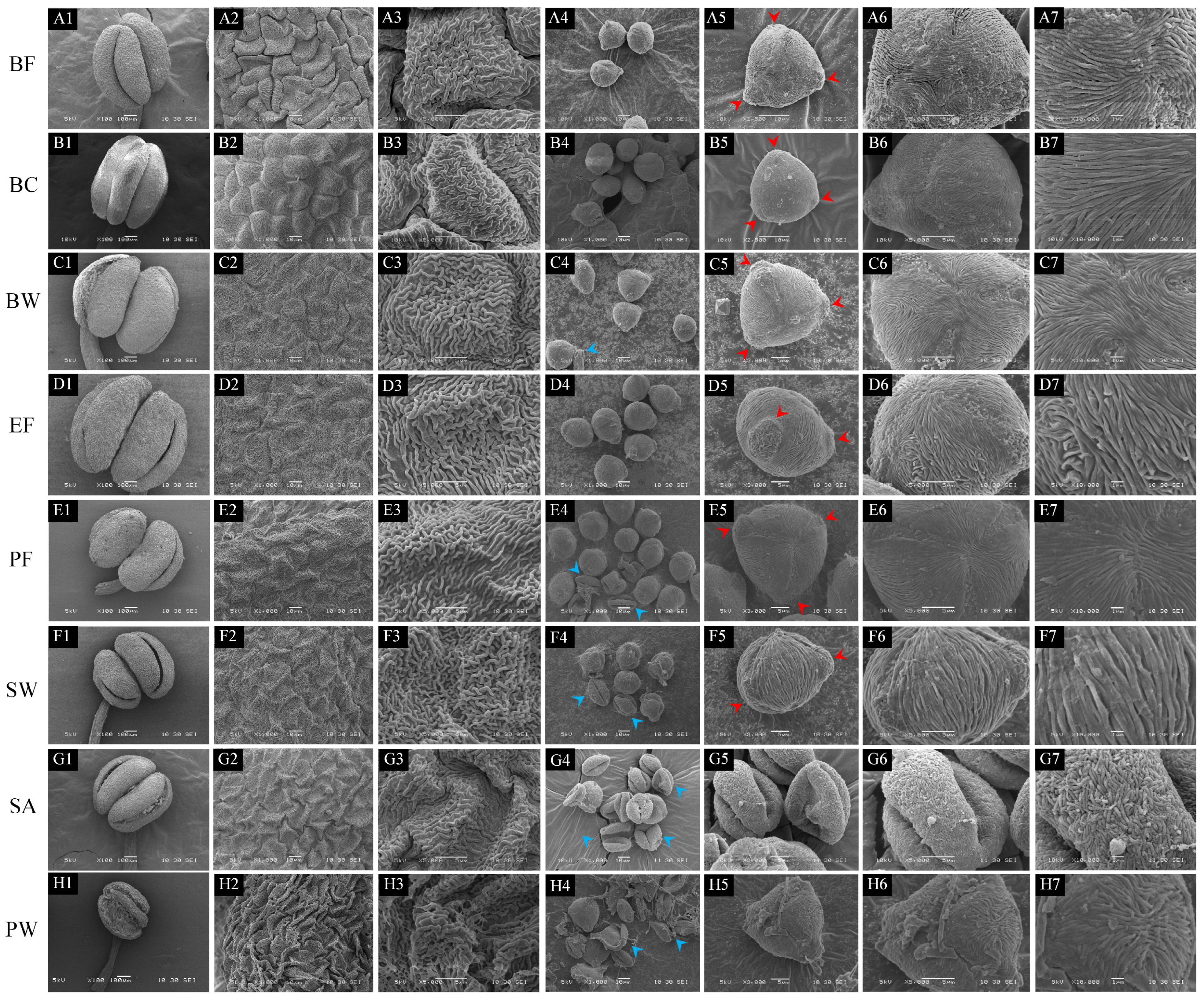
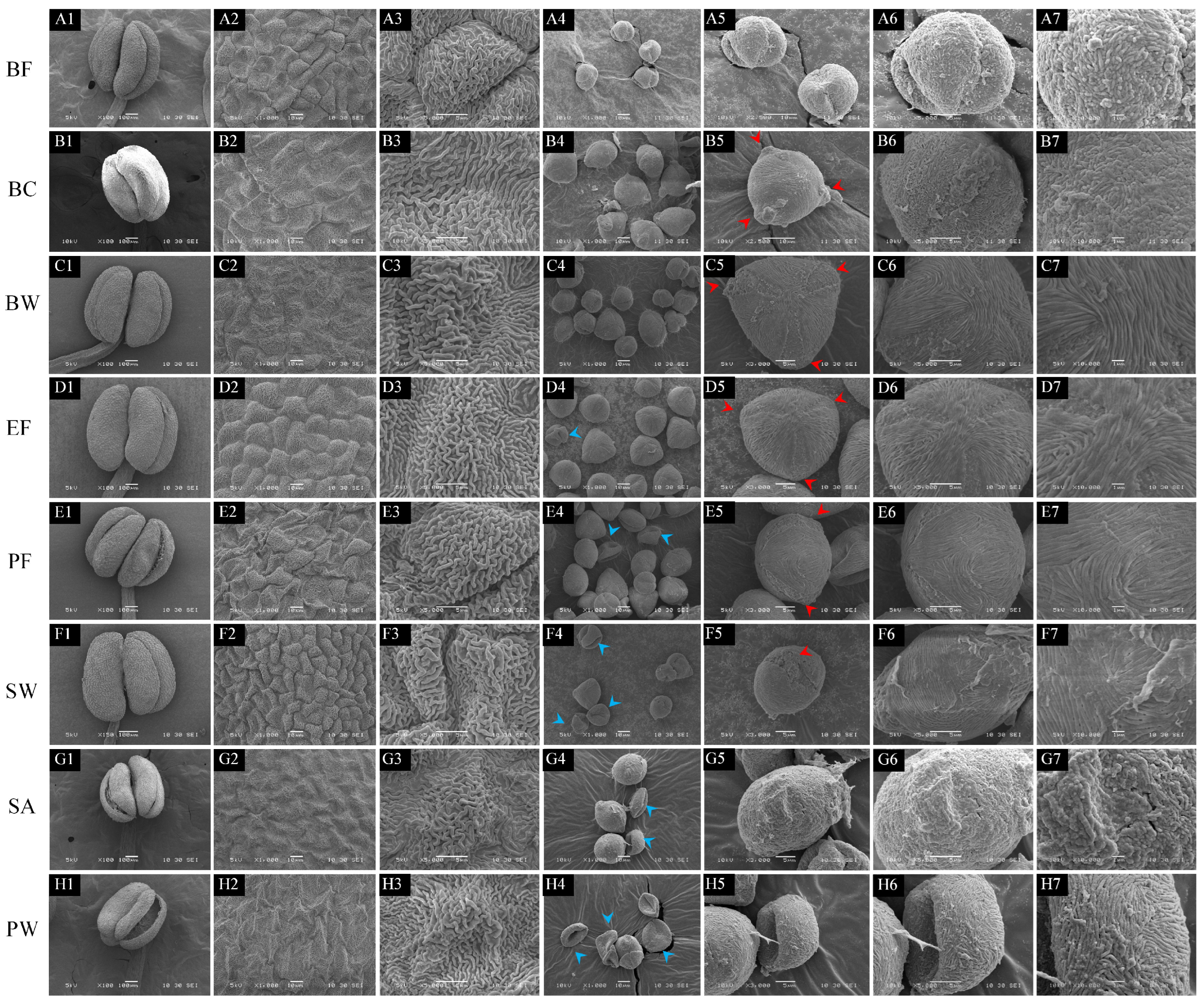
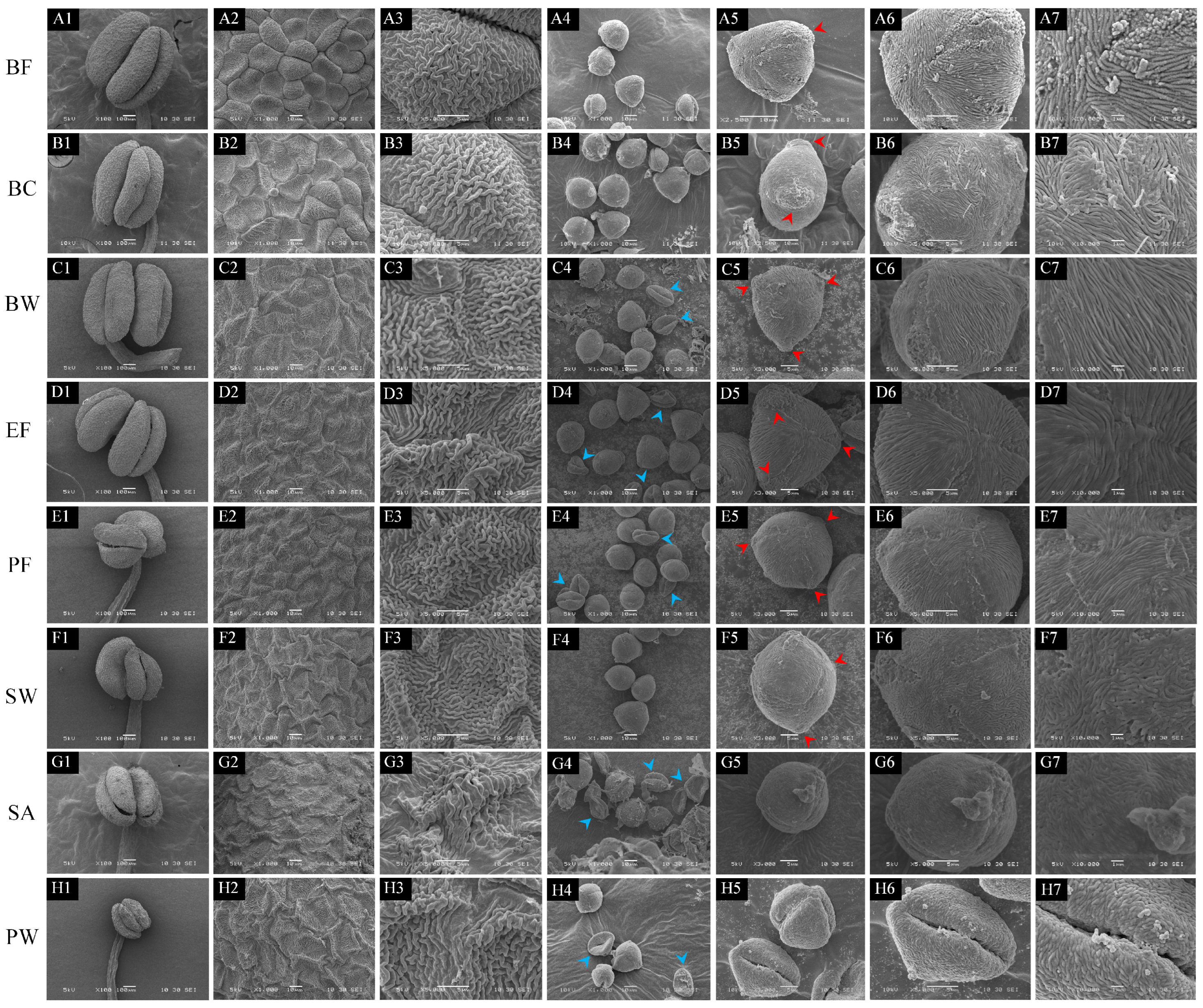
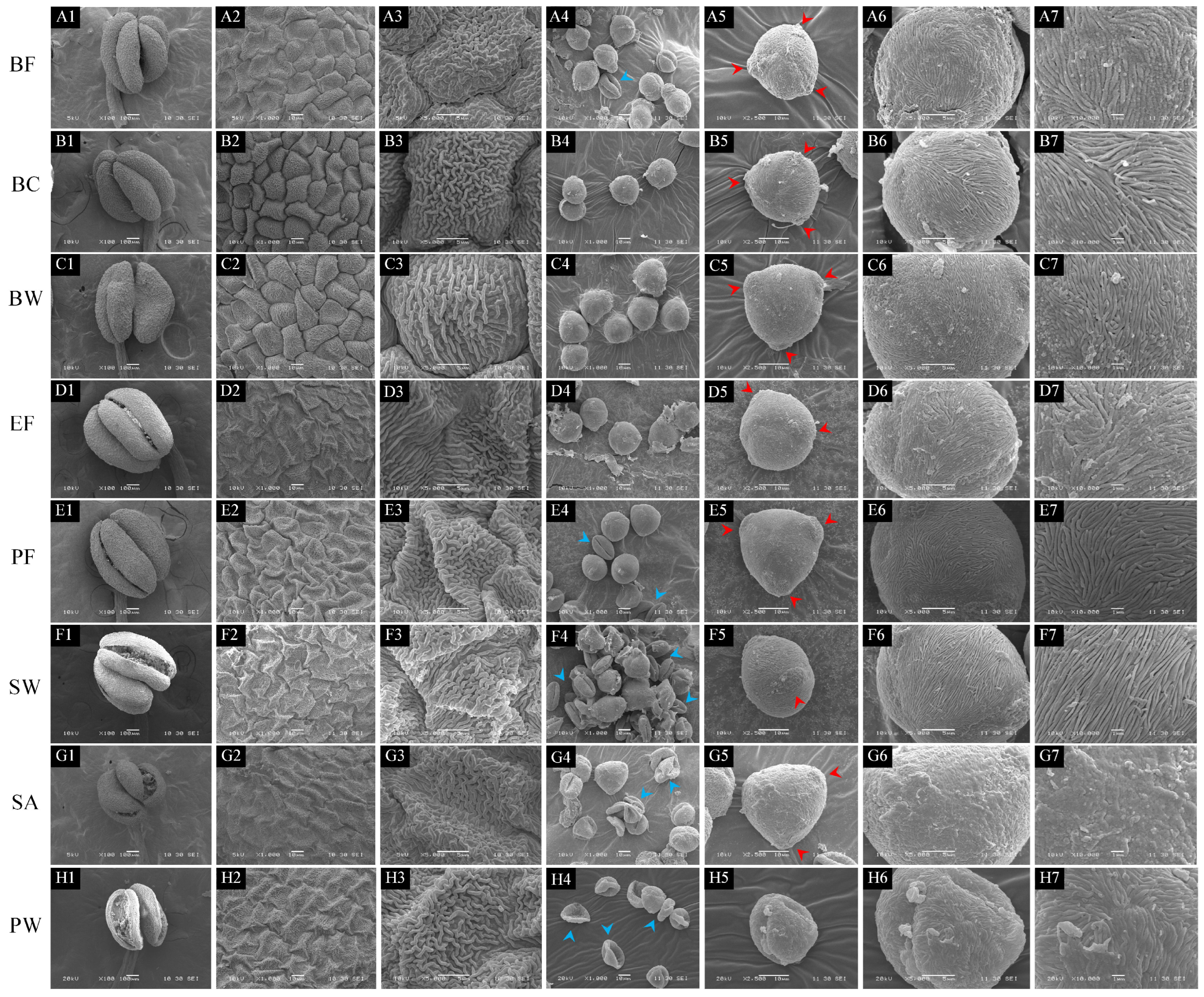
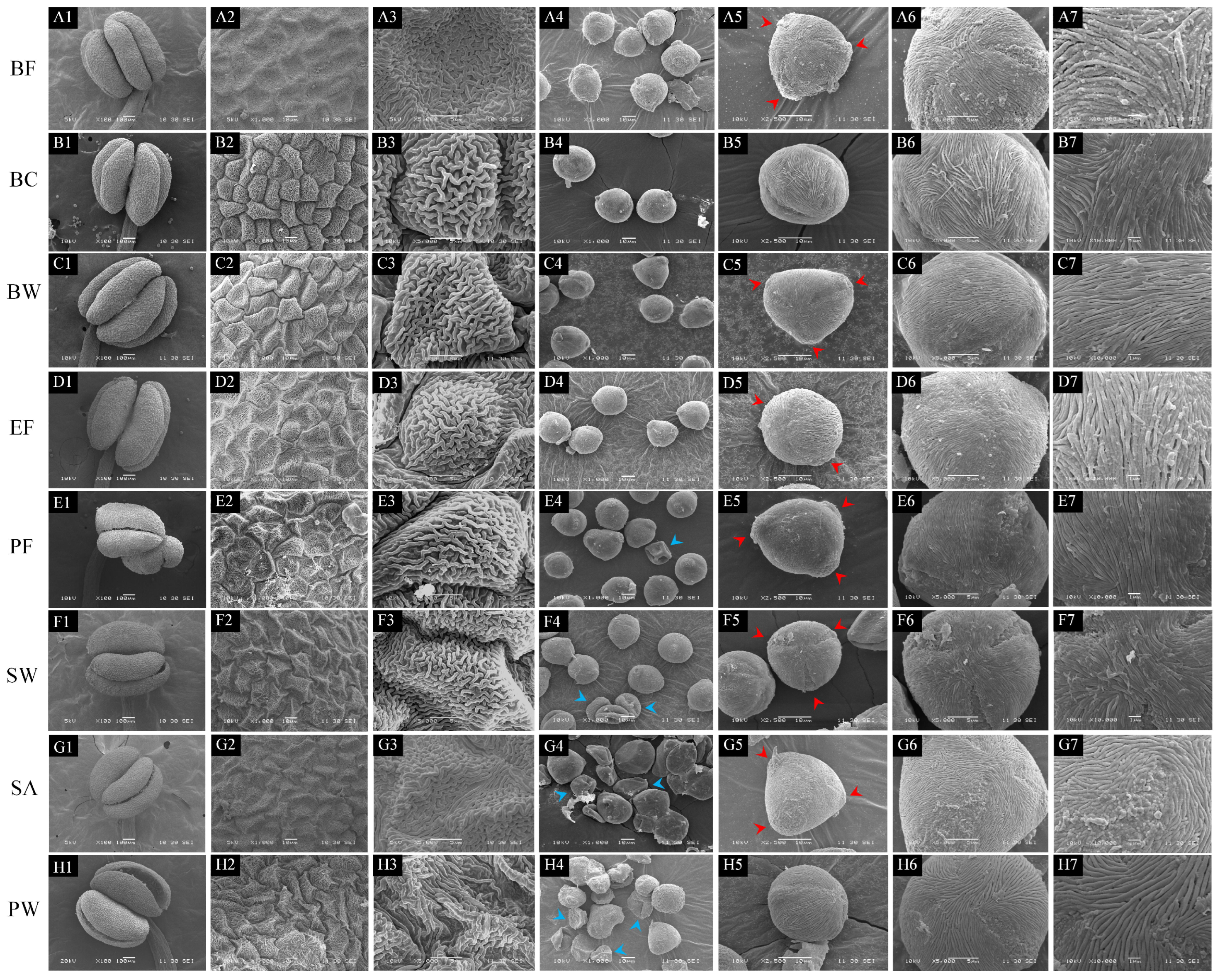
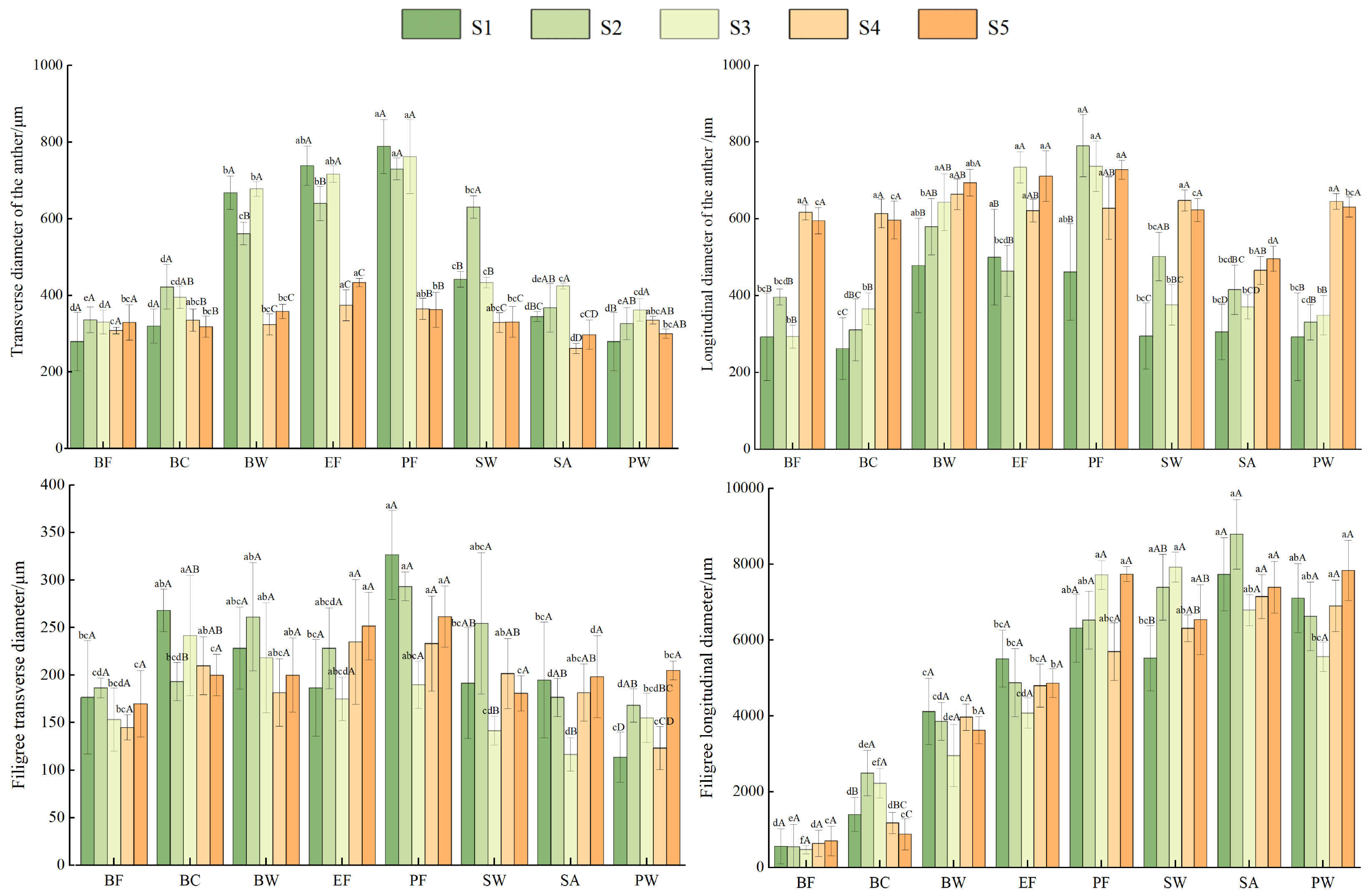
Microscopic observations of stamens in Nai plum flowers at different blooming stages are presented in Figure 3, Figure 4, Figure 5, Figure 6 and Figure 7. To investigate size variations in the stamens, measurements were conducted. The morphological trends of stamens across different bloom stages are illustrated in Figure 8.
Flowers of Nai plums from different provenances possessed multiple stamens, bearing dorsifixed anthers. The filaments were attached below the dorsal surface of the anthers at an angle, with each anther comprising two locules. Morphological development of the stamens exhibited distinct variations across different flowering stages, demonstrating regular changes throughout the flowering process.
Based on Supplementary Table S1 and Figure 8, the morphological characteristics of stamens from BF to PW can be summarized as follows.
(1) Anther shape and size
Key anther characteristics—plumpness, size (Figure 3, Figure 4, Figure 5, Figure 6 and Figure 7), and dehiscence status—exhibited stage-dependent variation in Nai plums from the same provenance. Similarly, at the same developmental stage, notable variations in these traits were observed among the five provenances (S1–S5). From the BF to BW stages, anthers in all five provenances remained indehiscent and relatively plump. At PF, anther dehiscence commenced, with the extent of dehiscence progressively increasing as flowering advanced. Concurrently, overall anther dimensions exhibited a decreasing trend across all provenances. Following pollen maturation, pollen grains were released from the dehisced anthers, after which the anthers gradually shriveled and desiccated.
(2) Anther color
The anthers of Nai plums from five provenances (S1–S5) underwent a progressive color transition throughout development, changing from lighter to darker tones as flowering advanced. Despite an overall similarity in the direction of color change, distinct inter-provenance variations were observed in the specific sequence of hues (for details, please refer to Table S1). In general, anther color evolved from pale yellow or pale red in the early stages (BF–BW), through intermediate shades of yellow, orange–red, or reddish-brown during PF, to yellowish-brown and finally brown at senescence (SW–SA). The anther color of Nai plums from S1 and S5 exhibited the most similar transition patterns, both progressing from pale yellow to reddish brown, then to yellow, and ultimately to brown. In contrast, the anther color of Nai plums from S2 and S4 were characterized by an initial pale red phase, with S4 additionally displaying a distinct yellowish-green intermediate stage before turning yellow. The anther color of Nai plums from S3 followed a unique sequence, transitioning from pale yellow through pale red and orange–red prior to reaching yellow and subsequent darker shades.
(3) Anther surface patterns
Throughout development, the anther surface of Nai plums from five provenances exhibited progressive changes in reticulate patterning (Figure 3, Figure 4, Figure 5, Figure 6 and Figure 7). During the early stages (BF–BW), a finely undulating reticulate network composed of curved, elongated ridges became increasingly pronounced, transitioning from shallow to more deeply etched impressions as development advanced. At dehiscence (PF–SW), the reticulate patterns intensified, reaching maximum definition. Subsequently, during the senescence stages (SW–SA), the once-ordered network became progressively denser before ultimately degrading into a disordered and indistinct configuration (for details, please refer to Table S1). These temporal changes in surface patterning likely reflect the underlying processes of anther wall expansion, dehydration, and eventual cellular degradation.
(4) Floral filament morphological changes
Throughout development, the filaments of Nai plums from five provenances exhibited a biphasic growth pattern, characterized by an initial increase in both diameter and length, followed by a subsequent decrease as senescence progressed (Figure 8). During the early stages (BF–BC), filament growth was primarily manifest as thickening, with elongation proceeding slowly. From BW to PF, as petal expansion occurred, filaments underwent marked elongation and a concomitant reduction in diameter, gradually transitioning from short and thick to slender and elongated. Growth cessation and the onset of withering were observed by the PW stage across all provenances. Inter-provenance variation was evident primarily in the timing of maximum filament length attainment. In the Nai plums from S1, S2, and S4, filaments reached their maximum length during the SA stage. In the Nai plums from S3, filament length peaked between PF and SW, followed by a period of markedly slowed elongation from SW to SA. By contrast, the filaments of Nai plums from S5 exhibited a more complex pattern: rapid elongation occurred from BF to PF, followed by a reduction from PF to SW, and a subsequent resurgence in elongation from SW to PW.

3.3.2. Pollen Morphological Development Across Different Flowering Periods

Using stereomicroscopy and scanning electron microscopy, the morphological development patterns pollen grains of Nai plum at different opening stages were observed. Detailed results are presented in Figure 3, Figure 4, Figure 5, Figure 6 and Figure 7 and Table 2. The pollen of Nai plum was monad pollen grains. The pollen polar view was a nearly equilateral triangles, the equatorial plane appears elliptical. Pollen grains of Nai plums from S1, S4, and S5 were nearly spherical, while those of S3 and S2 were nearly flattened spherical. All the pollen grains exhibited three germination pores, angular-holed and located at the apical corners. The germination groove has three fissures, with the groove scar appearing as a slender, elongated line extending to both poles but not connecting them. The outer wall ornamentation of pollen grains exhibited striate patterns, with minimal variation between different provenances. However, within the same provenance, the shape, thickness, and orientation of the striations varied across flowering stages. Across all the provenances, pollen release was predominantly observed during the PF stage.
Compare the morphology and size of Nai plum pollen grains at different developmental stages (for details, please refer to Table S2). Throughout development, pollen grains from all five provenances (S1–S5) exhibited progressive changes in both shape and size. According to Erdtman’s classification [25], Nai plum pollen was categorized as medium-sized, with polar axis lengths ranging from 14.84 to 26.05 μm and equatorial axis lengths from 22.21 to 27.55 μm at maturity. From BF to BC, pollen grains from all provenances were near-spherical, with P/E ratios ranging from 0.933 to 1.107, indicating relatively small volume and immature development. By the BW, a divergence in shape became evident: pollen grains of Nai plums from S1, S2, and S3 were nearly oblate, whereas those of S4 and S5 remained near-spherical. During this period, P/E values indicated preferential growth along the equatorial axis, resulting in lateral expansion. From EF to PF, pollen continued to enlarge. The P/E ratios of Nai plums from S1, S2, and S5 decreased, reflecting accelerated polar axis growth. The distinction in shapes was maintained: pollen grains of Nai plums from S1 and S2 retained a nearly oblate form, whereas pollen grains from S5 stayed nearly spherical. During SW–SA, P/E ratios decreased in S2 but increased in the other four provenances; however, pollen grains from all the provenances remained near-spherical. Although slight size increases were observed during this phase, the changes were minimal, likely because pollen had already matured and dispersed, leaving insufficient nutrients to support further expansion. By PW, pollen grains underwent rapid shrinkage, with reduction occurring primarily along the equatorial axis.

3.3.3. Pollen Germination Characteristics at Different Flowering Stages

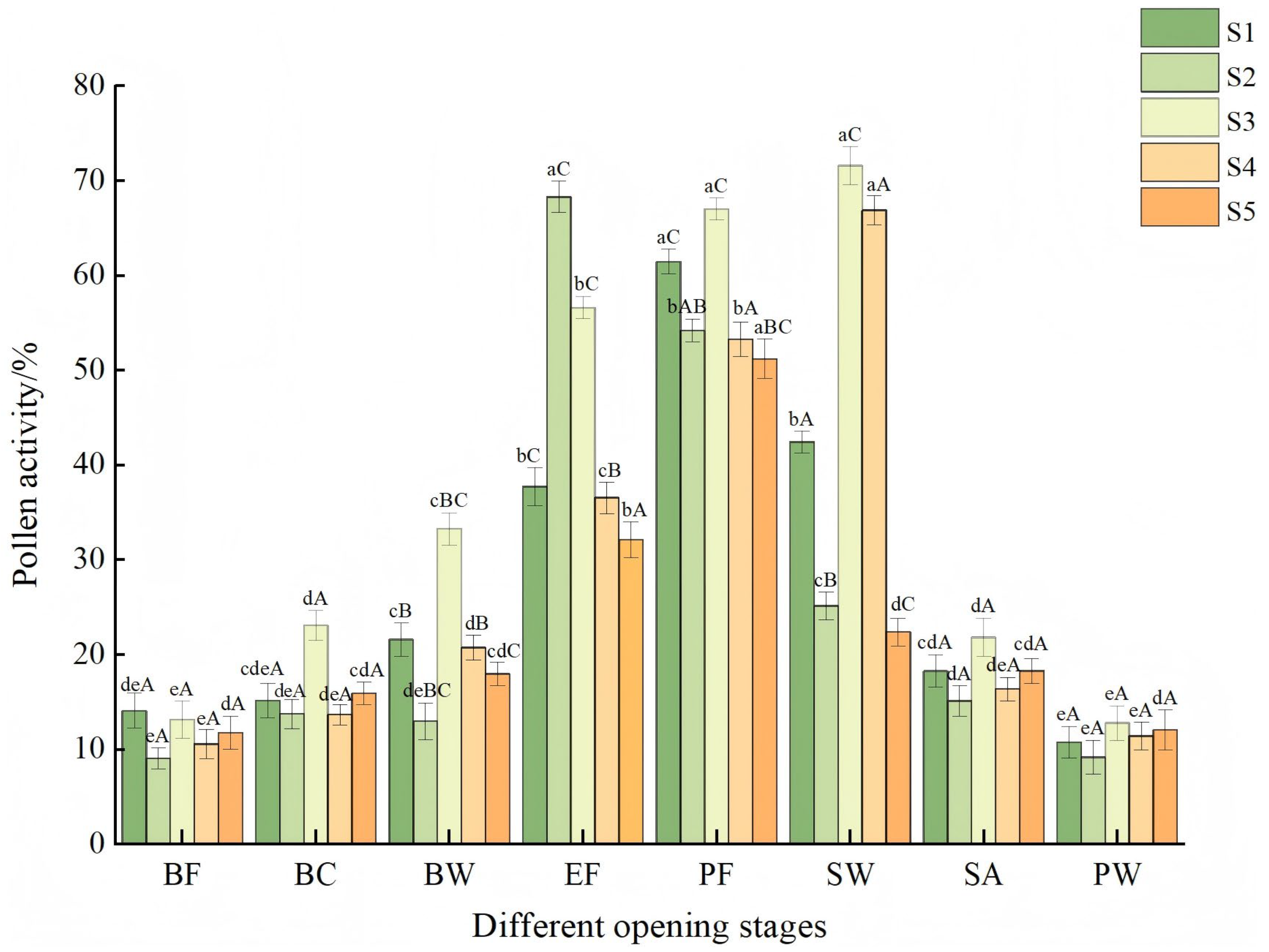
Pollen germination rates exhibited significant variations across different flowering stages within the same provenance. As illustrated in Figure 9, pollen germination rates for all the provenances showed an initial increase followed by a decline from the BF to PW. From BF to BW, pollen germination rates remained low, at 10–20%. As stamens gradually matured, pollen germination rates progressively increased during the EF, PF, and SW, with germination rates during these three periods exceeding those of other stages. As the stamens gradually withered and shriveled, the pollen count decreased, and the pollen germination rate gradually declined from SA to PW.
Pollen germination rates varied among different provenances in the same open period. In the BF, germination rates for all the provenances remained low, below 15% with no significant differences observed. From BC to BW, germination rates increased compared to the initial period, with pollen rates from S3 exhibiting the highest at 23.12% and 33.3%. At the EF, pollen grains from S2 showed the highest germination rate at 68.31%. During the PF, pollen grains from S1 and S3 exhibited the highest germination rates at 61.50% and 67.03% respectively. At the SW, pollen grains S3 showed the highest germination rate at 71.60%, followed by pollen germination rates from S4 at 66.90%. Significant differences in germination rates were observed among the five provenances during this stage. From SA to PW, germination rates for all five provenances declined, falling below 19% with no significant differences observed.

3.4. Morphological Development of the Pistil and Stigma Receptivity

3.4.1. Patterns of Pistil Morphogenesis During Different Flowering Stages

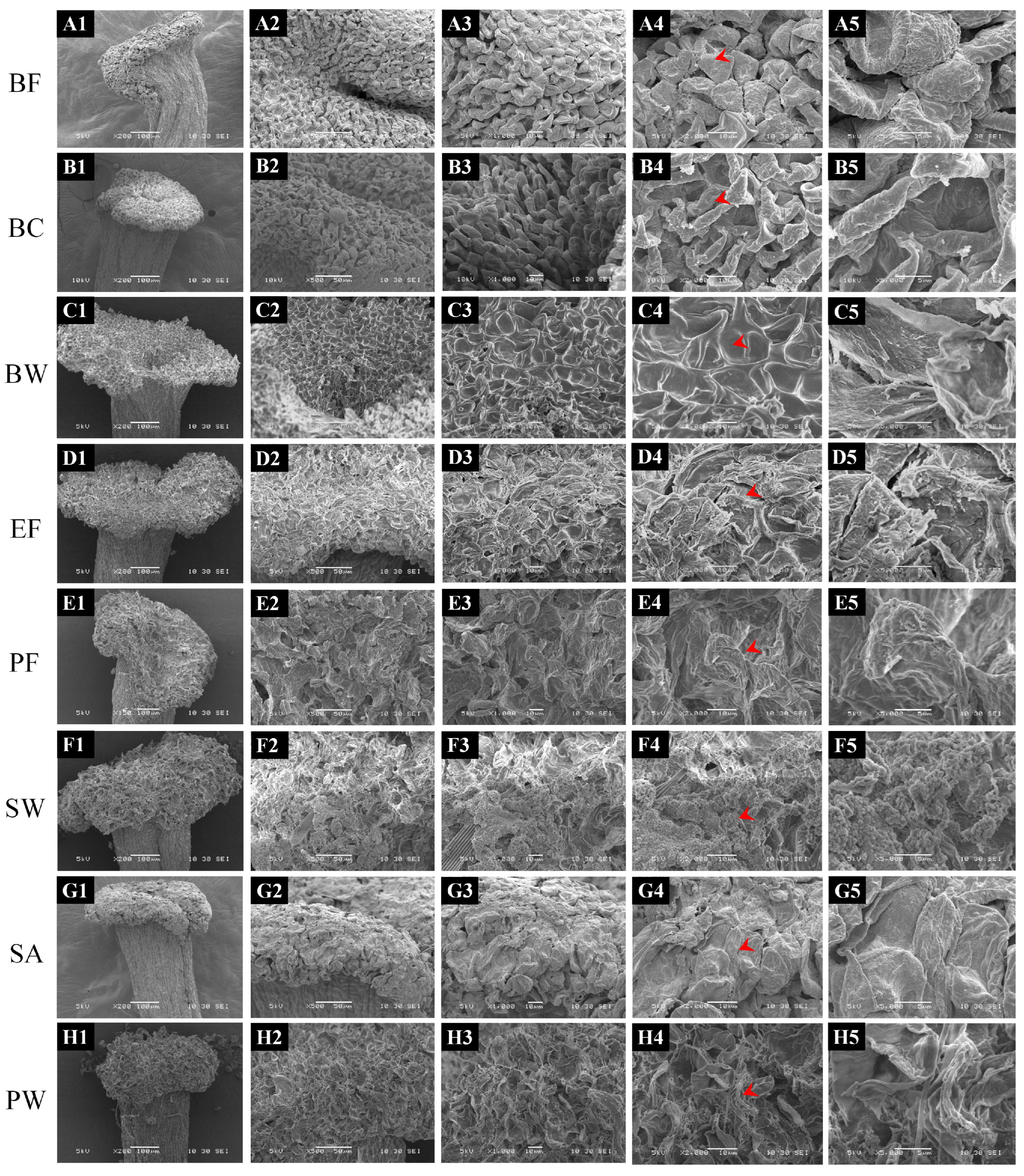
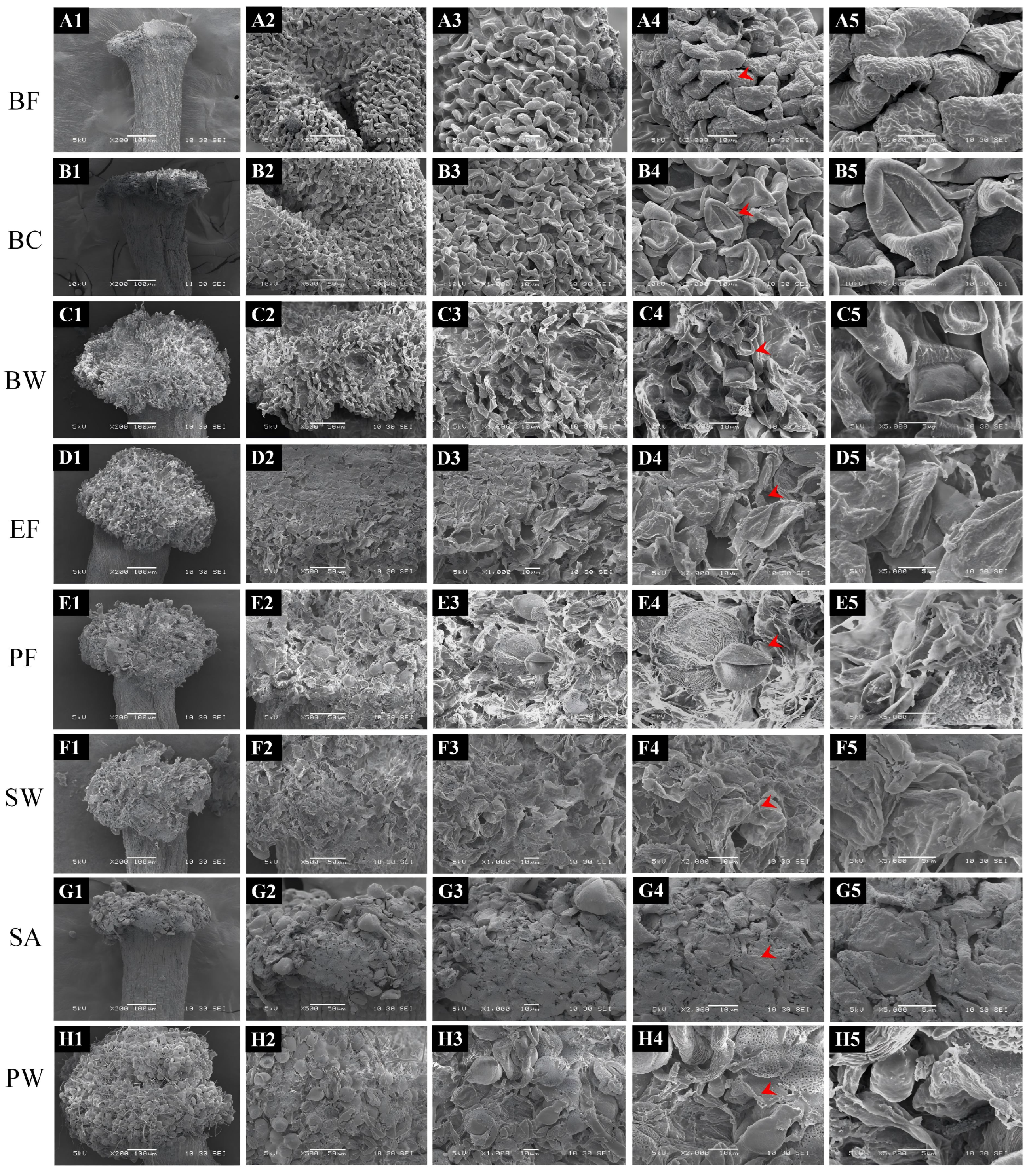
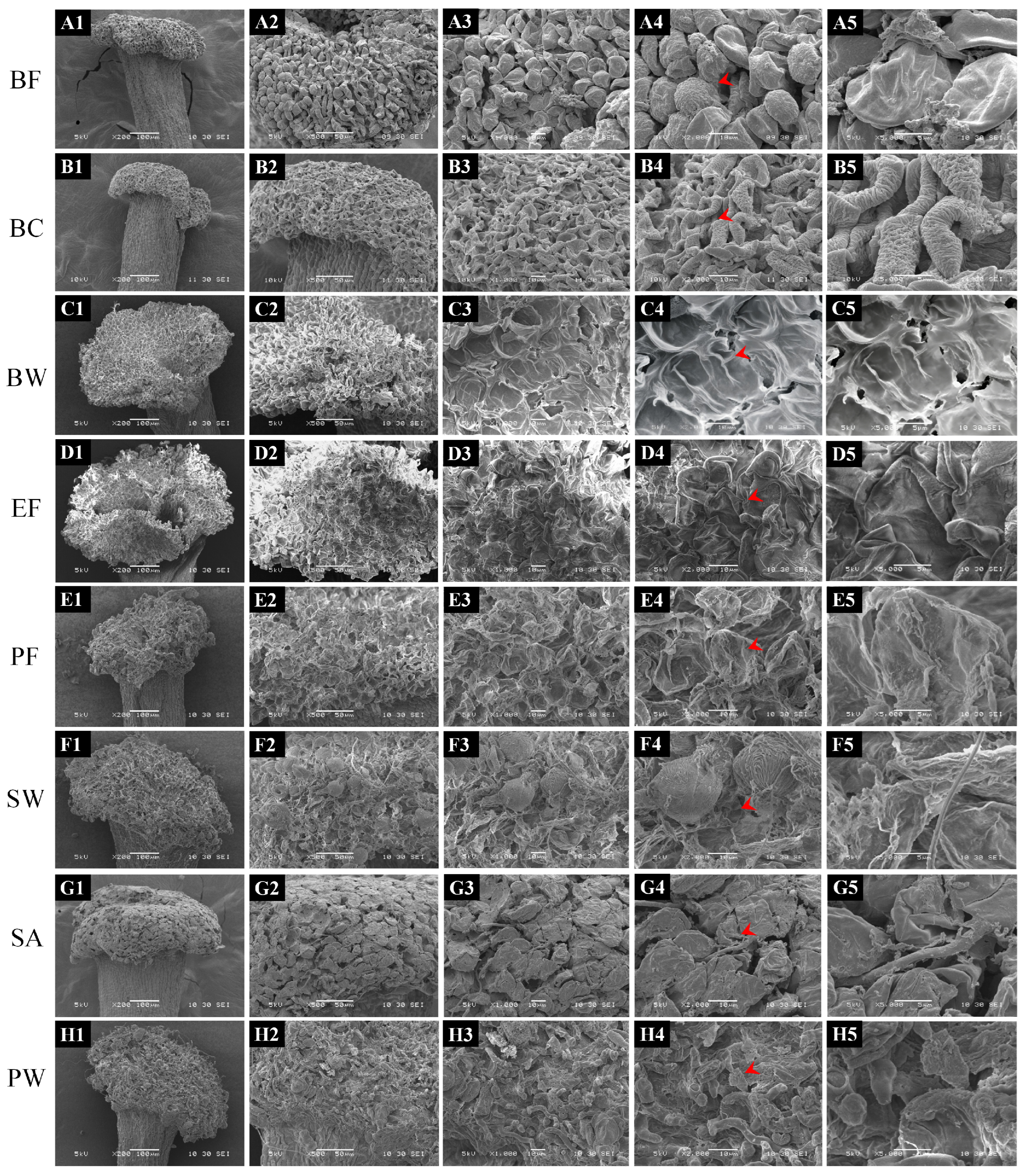
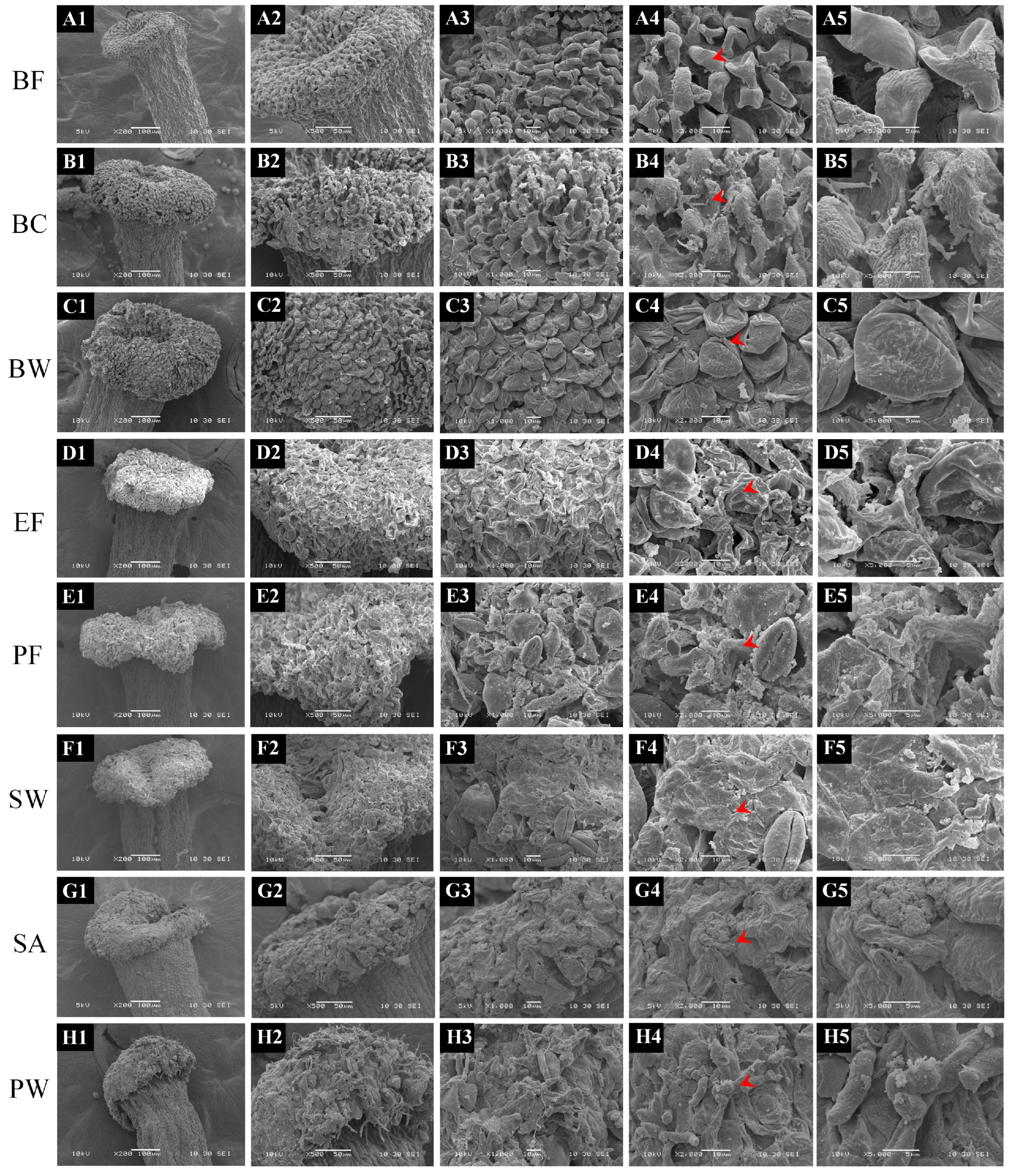
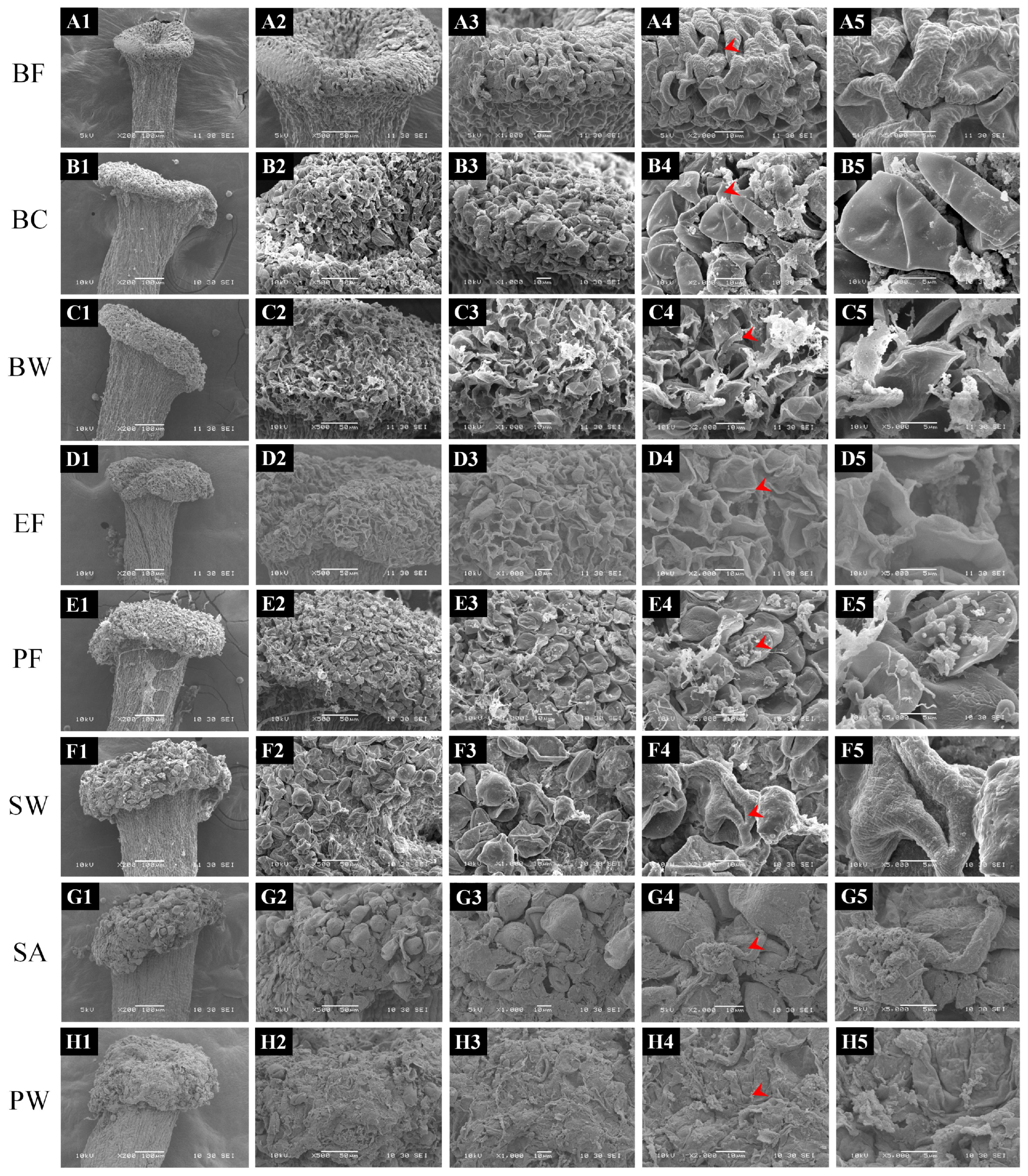
Microscopic observations of the pistils of Nai plum at different flowering stages are presented in Figure 10, Figure 11, Figure 12, Figure 13, Figure 14 and Figure 15. All the provenances exhibited distinct mucilage secretion on the stigma throughout their flowering periods, indicating a moist stigma. The morphology of the style underwent certain changes as flowering progressed.
Comparing Figure 10, Figure 11, Figure 12, Figure 13, Figure 14 and Figure 15, the morphological characteristics of the pistil from BF to PW were examined (for further details, please refer to Table S3).
(1) Stigma morphology
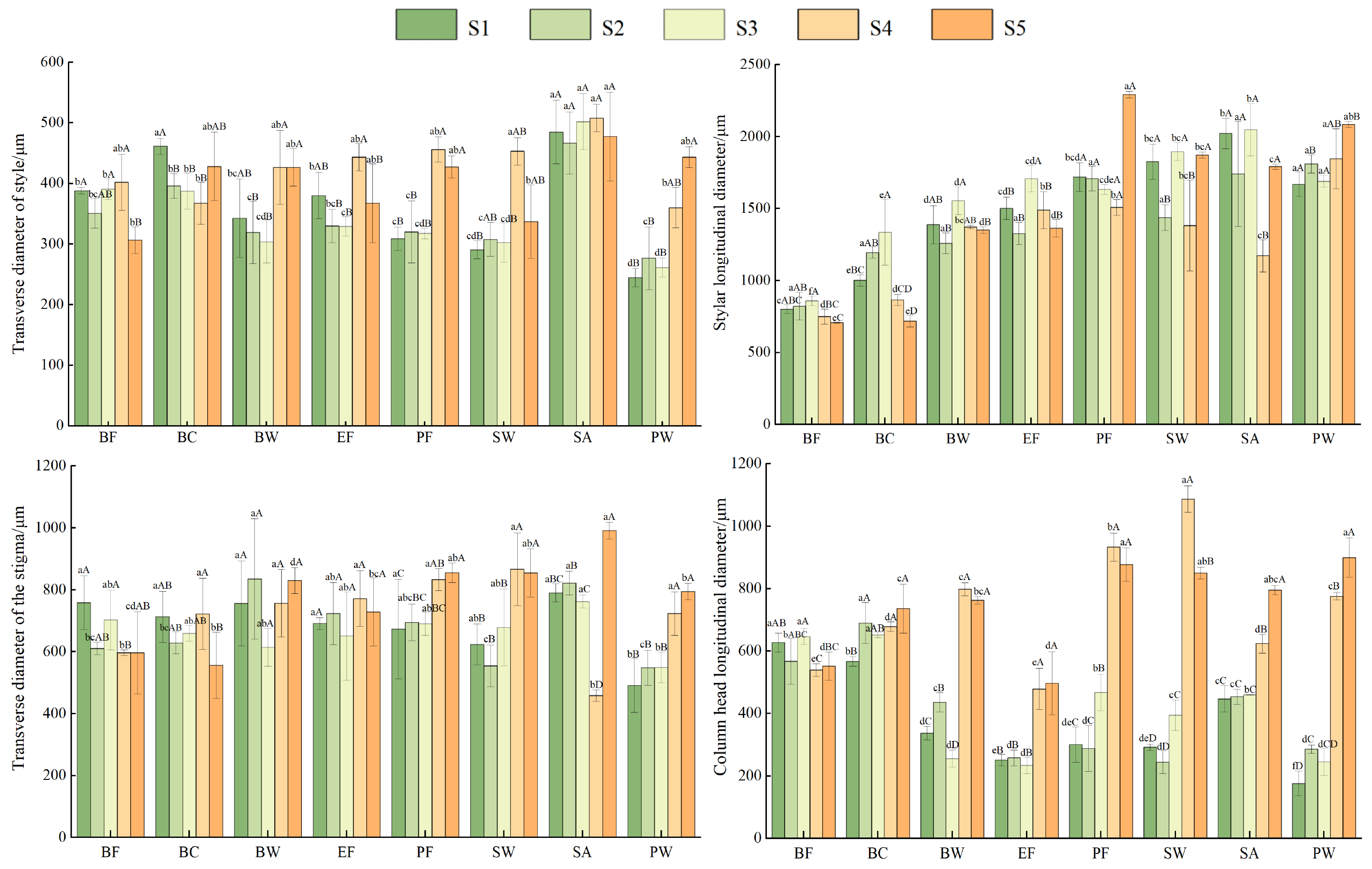
Throughout development, the stigmas of Nai plums from all provenances (S1–S5) exhibited progressive morphological changes, with inter-provenance variations observed primarily in symmetry, expansion patterns, and the timing of atrophy onset. At the BF, stigmas were incompletely developed across all provenances, characterized by a distinct central depression, although surface cells had already begun to assume rudimentary cellular organization. By the BC, stigmas of Nai plums from S1, S2, S4, and S5 displayed relatively regular overall shapes, each with a concave center, whereas the stigma of Nai plums from S3 was irregular and exhibited a unilateral depression. During BW, stigmas continued to enlarge; the most pronounced increases in both transverse and longitudinal dimensions were observed in Nai plums from S2 and S5. From EF to PF, as flowering advanced, stigmas progressively flattened. During this period, the stigmatic surface area reached its maximum across all provenances, a morphology conducive to enhanced pollen adhesion. At the SW, all stigmas began to exhibit signs of atrophy and irregularity. The stigmas of Nai plums from S1, S2, and S3 decreased in overall size, whereas the stigmas of Nai plums from S4 and S5 continued to expand laterally (increasing width) while diminishing vertically (decreasing length). By the SA, atrophy intensified in all stigmas, with a progressive reduction in their longitudinal dimensions—most notably in stigmas from S4. At the PW, following the completion of anthesis, all stigmas were completely withered and desiccated.
(2) Stigma color
Throughout development, the stigmas of all provenances (S1–S5) underwent a progressive color transition, evolving from lighter to darker tones as flowering advanced (for further details, please refer to see Supplementary Table S3). Although the overall sequence of color change was similar across different provenances, distinct inter-provenance variations were observed in the timing and specific hues at each developmental stage. During the early stages (BF–BC), stigmas of all the provenances were uniformly pale green. At BW, a divergence emerged: stigmas of Nai plums from S1, S2, and S3 transitioned to yellowish-green, whereas those of S4 and S5 remained green. Throughout peak flowering (EF–PF), inter-provenance color differences persisted. At EF, stigmas of Nai plums from S1, S2, S3, and S4 were yellowish-green, while S5 remained green. By PF, stigmas of Nai plums from S1 and S2 had reverted to green, whereas stigmas of Nai plums from S3, S4, and S5 were yellowish-green. During senescence (SW–PW), stigmas progressively darkened. At SW, all stigmas except stigmas from S3 remained yellowish-green, with stigmas from S3 exhibiting an incipient transition to yellowish-brown. By SA, stigmas of Nai plums from S1, S3, and S5 had turned yellowish-brown, with color deepening relative to earlier stages. At PW, following the completion of anthesis, stigmas of all five provenances had become uniformly brown.
(3) Papilla cell development
Throughout development, the stigmatic papilla cells of all provenances (S1–S5) exhibited progressive degenerative changes, with inter-provenance variations observed primarily in the timing and extent of cellular shrinkage, wrinkling, and cuticle accumulation. At the BF, papilla cells across all provenances were rudimentary and uniformly shriveled. By the BC, papilla cells of Nai plums from S1 exhibited pronounced cellular shrinkage and wrinkling, whereas the papilla cell of Nai plums from S2–S5 appeared relatively less shriveled. During the BW, papilla cell remained uniformly shriveled across all sources, with additional features emerging: papilla cells of Nai plums from S1 showed overlapping, papilla cells of Nai plums from S2 and S3 were wrinkled, and papilla cells of Nai plums from S5 exhibited cuticle accumulation. At the EF, papilla cell of Nai plums from S1, S2, and S3 had become flattened, while those of S4 and S5 showed further withering. By the PF, papilla cells of Nai plums from S1 began to collapse, and papilla cells of Nai plums from S2, S3, S4, and S5 exhibited increased withering, with papilla cells from S5 again displaying cuticle accumulation. During the SW, all papilla cells structures commenced atrophy. By the SA, as the stigmas underwent physiological aging, papilla cells exhibited severe atrophy and collapse across all provenances. At the PW, following the completion of anthesis, all papilla cells had completely disintegrated.
(4) Stigma mucilage secretion
Throughout anthesis, the stigmatic secretion of all provenances (S1–S5) exhibited a progressive increase, with no discernible inter-provenance variations in either the timing or quantity of secretion. From BF to BC, no secretion is observed on the stigma. During the BW, a small amount of secretion begins to appear. At the EF, secretion increases as the stigma matures and enlarges. From PF to SA, as flowering progresses and petals fully open, the stigma secretes copious mucilage. This facilitates the adhesion of substantial pollen quantities and provides optimal conditions for pollen germination. At the PW, following the completion of anthesis, mucilage continued to accumulate on the stigmatic surface. This abundant secretion facilitated the adhesion of substantial pollen quantities and provided optimal conditions for pollen germination.

3.4.2. Relationship Between Stigma Morphological Characteristics and Receptivity

Stigma morphology, color and the degree of papillae development on the stigma surface are closely correlated with receptivity (for further details, please refer to Supplementary Table S3). From BF to PF, the stigmas of Nai plums from all provenances exhibited a central depression and an overall flattened state. the stigmas of Nai plums from S1, S2, S3, and S5 showed progressively increasing receptivity, with especially high levels during the EF and PF. In contrast, the stigmas of Nai plums from S4 showed initially increasing receptivity followed by a decline, with peak receptivity occurring at the EF. From SW to PW, as the stigma undergoes physiological aging, it shrinks and becomes concave, with receptivity gradually diminishing.
Stigma receptivity in all provenances (S1–S5) followed a regular temporal pattern of “weak–strong–weak” throughout anthesis. This variation was closely associated with changes in both stigma color and papilla cell morphology, although no single morphological feature alone reliably predicted receptivity status. Relationship with stigma color. From BF to PF, when stigmas exhibited green, receptivity ranged from weak to strong. As stigmas lost their green color and transitioned to yellowish-brown or brown, receptivity became weak or was only partially present. Relationship with papilla cell morphology. Throughout development, stigma papilla cells remained consistently shriveled—appearing flattened or wrinkled—regardless of receptivity level. From BF to PF, papilla cells across all provenances exhibited this shriveled morphology, the stigma receptivity of Nai plums from S1, S2, S3 and S5 increased gradually, while the stigma receptivity of Nai plums from S4 increased first and then decreased. From SW to PW, as papilla cells underwent morphological aging, receptivity gradually decreased across all provenances. Notably, the persistent shriveled state of stigma papilla cells throughout all developmental stages indicated that receptivity could not be reliably inferred from papilla cell morphology alone.

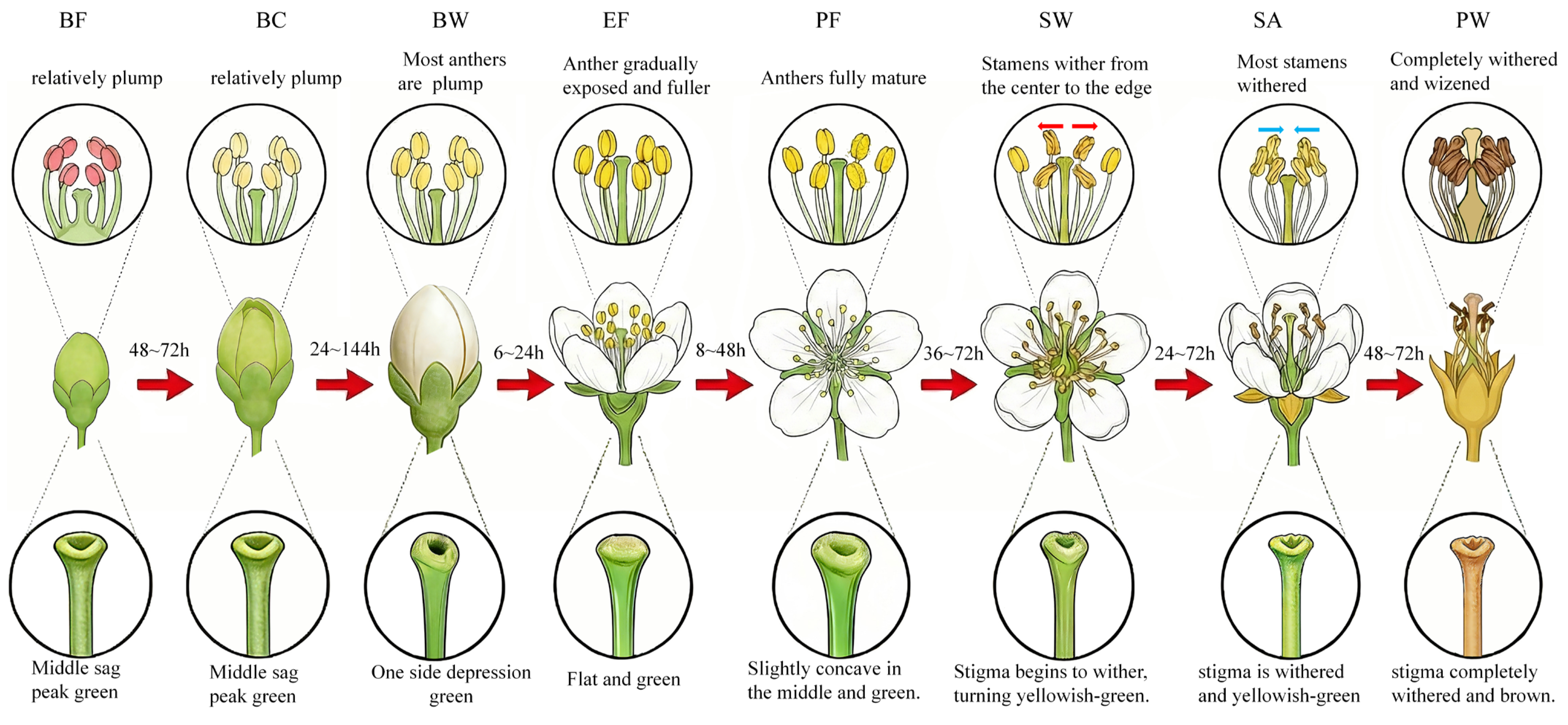
3.5. Summary of Flowering Characteristics of Nai Plum at Different Stages

The overall flowering patterns of Nai plum across different developmental stages (Figure 16) are summarized as follows: (1) Flower bud appearance: The process began from BF with compact green buds, progressed through the bud color change BC, BW, EF to the peak flowering stage (PF) when flowers were fully open. It then continued through the withering stages (SW and SA) until PW, during which the ovary developed. This represented a continuous process involving flower bud enlargement, petal emergence and withering, as well as changes in calyx color and morphology. (2) Stamens: At the BF, the anthers were immature and pale red. Through the BC and BW, they developed further, and by the EF, they had become fully developed and yellow. The anthers fully expanded during the PF. Subsequently, they gradually withered and died off during SW and SA. The entire process from initial withering to complete desiccation spanned approximately 2–3 d. The stamens ultimately withered and shriveled completely during the PW. (3) Pistil: From BF to BW, the color of pistil was light green, and the height of pistil was lower than stamen. By the time of SW and during SA, the stigma turned yellow. Ultimately, it became dry and shriveled at the PW, with its height exceeding that of the stamens.

4. Discussion

4.1. Flowering Period and Morphological Characteristics of Floral Organs of Nai Plum from Different Provenances

Flowering phenology encompasses the long-term observational study of cyclical patterns in plant life cycle events, including growth, flowering, and fruiting, in response to specific climatic conditions [31]. Flowering synchrony is crucial for enhancing hybrid breeding efficiency [28]. In this study, the flowering periods of the five provenances studied overlapped, with peak flowering concentrated in mid-to-late March. Among these, Nai plums from S1 exhibited the earliest initial opening stage on 4 March, with a flowering duration of 26 d, while S3 had the longest flowering periods, lasting 28 d. This differs from previously reported flowering period for Prunus, such as in Zhangjiajie where flowering commences in early to mid-March, peaks in late March, and concludes in early April, with a total flowering period of approximately 30 d [16]. In Changshun (Guizhou Province), the Nai plum typically comes into bloom in mid-to-late March, and its flowering period lasts for approximately 20 d [32]. These marked variations in flowering period may be attributed to differences in environmental conditions, site characteristics, growth vigor, varietal traits, and concurrent temperature fluctuations [33]. The annual mean temperature in the Nai plum cultivation area studied here is 15.9 °C, while Zhangjiajie has an annual mean temperature of 16.9 °C and Changshun ranges from 15.5 °C to 20.5 °C. This variation in temperature may be one factor contributing to the differing flowering periods observed. The flowering periods of Nai plums from all provenances studied here also differ from those of other Prunus plants previously reported. The flowering period of Wild European plum (Prunus domestica L.) in Xinjiang is relatively concentrated between early April and early May, lasting for 16 d [33]; The flowering period of Wild Cherry plum (Prunus divaricat Lbd.) is concentrated in April, lasting for 30 d [34]. The flowering period of ‘Fengtangli’ (Prunus salicina Lindl. cv. ‘Fengtangli’) occurs from February to early March, lasting 7–8 d [35]. Future hybridization experiments among Nai plums from different provenances must account for their asynchronous flowering periods.
Observation of floral organs is a prerequisite for conducting studies on flowering regulation and genetic breeding. Floral morphological characteristics also influence insect pollination and artificial breeding efficiency [36]. In the Nai plum from different provenances in this study, the petals are all five, oval and white in color, with a single pistil and 20–38 stamens, and the ovary is in a superior position. During peak flowering, they emit a faint, pleasant fragrance, and the nectary glands at the base of the disk secrete nectar. These characteristics collectively attract insect pollinators, demonstrating adaptation to entomophilous pollination. The anthers of Nai plum flowers are exserted and the pistil style is relatively long. However, whether it is adapted to wind pollination requires further confirmation in subsequent experiments. Liu et al. found that flowering period, number of flowers, and number of fruits set all showed significant positive correlations [37]. A higher number of flowers facilitates attracting more pollinators, while a longer flowering period enhances pollination efficiency, thereby increasing fruit set. In this study, Nai plums from S1 exhibited the shortest flowering period, while S3 possessed the longest. Compared to other provenances, Nai plums from S3 enables pollination and fertilization to be completed over an extended period, thereby enhancing fruit set rates and providing ample time for artificial breeding programs.

4.2. Morphological Development Characteristics of Stamen and Pollen Viability of Nai Plum from Different Provenances

In this study, the anthers of Nai plums from all provenances (S1–S5) were dorsifixed, yellow at maturity, elliptical in shape, and dehisced longitudinally upon pollen maturation. Among different provenances, no substantial morphological differences were observed in anther structure, surface reticulate patterns, or developmental progression. The difference among five provenance was limited to two aspects: (1) the starting time of anther cracking—S1 commenced dehiscence at BW, S2 and S5 at PF, and S3 and S4 at EF; (2) the anther color transitions correlated with dehiscence status: indehiscent anthers appeared pale yellow or pale red, whereas dehisced anthers turned yellow or yellowish-brown before gradually shriveling. Comparative analysis with other Prunus species reveals notable interspecific differences in anther color. He et al. [38] reported that anthers of Prunus domestica × armeniaca ‘Fengweimeigui’ were pale green before dehiscence and deep yellow thereafter, a color sequence distinct from the pale yellow/red to yellow/brown transition observed in this study. Similarly, recent studies on related Rosaceae species have documented diverse anther color dynamics: in Exochorda racemosa, anther development involves distinctive color changes associated with stamen fascicle formation [39], while investigations on Lumnitzera racemosa (Combretaceae) have highlighted the correlation between anther color and pollen viability during flowering progression [40]. These comparisons indicate that the color changes before and after anther dehiscence may have species specificity in Rosaceae plants, potentially reflecting adaptations to different pollination syndromes or environmental conditions. The correlation between anther color and dehiscence status observed in this study aligns with findings in other angiosperms, where color change often signals pollen presentation or reward status to pollinators [41]. However, the functional significance of interspecific variation in anther color—particularly the green vs. yellow/red phenotypes—merits further investigation through combined pollinator behavior and biochemical analyses.
Effective pollination and the formation of good seeds depend largely on pollen quality [42,43,44]. The pollen of Nai plums from all provenances exhibits similar morphological structures: it is depressed globose or nearly globose, viewed from the polar plane, it resembles an equilateral triangle; viewed from the equatorial plane, it appears elliptical. This constitutes medium-sized pollen, characteristic of most Prunus species. Sweet Cherry pollen [6] exhibits polar axis lengths ranging from 25 to 50 µm, while Prunus domestica × armeniaca. Pollen measures 30–40 µm for the polar axis and 20–30 µm for the equatorial axis [26]. Wild Cherry plum (Prunus divaricat Lbd.) pollen displays polar axis lengths of 20–30 µm, with equatorial axes under 25 µm [34]. This commonality reflects the conservative evolutionary characteristics of plum genus plants in pollen morphology. It provides palynological evidence for phylogenetic studies of Nai plum genus and offers important morphological basis for the identification and utilization of Nai plum provenances. Pollen morphology is genetically determined and can objectively reveal its genetic essence and the phylogenetic relationships between varieties [45]. Pollen from different Prunus species exhibits considerable morphological similarity, potentially reflecting their evolutionary relationships. All pollen grains possess three germination pores, with angular pores and a three-lobed germination groove. The groove scar is elongated and narrow, extending to both poles without connecting. The outer wall ornamentation consists of irregular, unevenly sized, and unevenly distributed striations. This contrasts significantly with the previously reported pollen morphology and structure of Nai plum. Liao Ruyu’s [46] study of pollen morphology across Nai plum species varieties revealed that ‘Wanshu younai’ exhibit super-elongated spherical pollen, while ‘Huanai’, ‘Qingnai’, ‘Younai’, ‘Zaoshu younai’, ‘Zaoyuan younai’, and ‘Wanshu younai’ all bear elongated spherical pollen. Pollen surfaces exhibited perforations of varying sizes and densities. ‘Wanshu younai’, ‘Wanhuang younai’, and ‘Younai’ pollen displayed complex cere-pitted perforation patterns, while others exhibited striated pitted perforations with regular striation orientation. This marked variation likely arises from genetic differentiation in reproductive organs (pollen) among different cultivars during prolonged cultivation and domestication. This differentiation may stem from differing artificial selection objectives, such as prioritizing fruit size, flavors, or disease resistance. Pollen surface ornamentation, as a genetically controlled conservative morphological trait, exhibits variations in characteristics such as carination patterns that fundamentally reflect differences in gene expression regulation among distinct cultivars. This aligns with findings from studies on genetic polymorphism in pollen morphology within Prunus species of the Rosaceae family [46,47,48,49]. In this study, pollen morphology of Nai plums from different provenances was similar. As a crucial component of plant reproduction, pollen characteristics are closely linked to plant adaptability. Similar pollen traits may indicate that Nai plum from different provenances share similarities in reproductive strategies, pollination methods, and attractiveness to pollinators.
Pollen viability is a critical factor influencing the success of fruit tree pollination, constituting an essential component of fertilization and fruit set. It is influenced by the tree’s own genetic characteristics, tree nutrition, climatic conditions, and management practices [50]. A higher pollen germination rate increases the likelihood of the stigma accepting viable pollen, thereby enhancing pollination efficiency. In this study, all the Nai plum pollen types exhibited high viability, with germination rates ranging from 61.50% to 71.60%, all meeting pollination requirements. Significant variations in pollen viability were observed across different developmental stages of Nai plums from five provenances. Pollen viability exhibited a general trend of increasing initially and then decreasing throughout the flowering process. Pollen germination rates were low during the BF, but increased substantially by the EF when anthers dehiscence occurred, compared to pre-dehiscence levels. Pollen germination rates of Nai plums from S1 and S5 reach their peak at the PF, while S2 at the EF, and S3 and S4 at the SW. During these phases, pollen grains are relatively plump and exhibit a high degree of development. During SA and PW, pollen quantities are minimal, and germination rates are notably low. At these stages, pollen grains become shriveled, wrinkled, and senescent. This indicates a correlation between pollen viability and developmental maturity: as pollen matures, germination rates increase progressively; conversely, as pollen ages, germination rates decline. Pollen germination rates vary among different Prunus species. For instance, ‘Fenghuangli’ (Prunus salicina Lindl. cv. ‘Fenghuangli’) pollen exhibited the highest viability, 51.22%, ‘Fengtangli’ (Prunus salicina Lindl. cv. ‘Fengtangli’) pollen viability reached a maximum of 34.47%, ‘Siyueli’ (Prunus salicina Lindl. cv. ‘Siyueli’) pollen viability achieved 46.68% and ‘Yinhongli’ (Prunus salicina Lindl. cv. ‘Yinhongli’) pollen viability reached a maximum of 41.27% [35]. Wild European plum (Prunus domestica L.) has no pollen vitality before the flowers open. The pollen vitality is the highest on the day when the anthers crack. Over time, the extension significantly weakens the vitality of pollen [51]. Factors such as nutrient supply and environmental conditions exert a certain influence on plant pollen viability [52]. During the later stages of pollen development, viability may decline due to nutrient depletion or environmental changes.

4.3. Morphological Developmental Characteristics of the Pistil and Stigma Receptivity

The stigma is the organ responsible for receiving pollen, with its phenotypic characteristics influencing pollination efficiency. Secretions on the surface of moist stigmas provide conditions conducive to pollen germination [53]. In this study, all the Nai plums from different provenances exhibited moist stigmas with mucilage production. Their pistil development during flowering showed common patterns: early stages featured pale green, depressed stigmas without secretion; mid-stage stigmas turned yellowish-green, flattened, with slight secretion; peak flowering saw elongated styles and green in color, irregular stigmas with abundant mucilage; late stages involved gradual drying, browning, and mucilage accumulation. Changes in pistil size exhibit a certain regularity throughout the flowering process of individual flowers. Both the longitudinal diameter of the style and the transverse diameter of the stigma exhibit an enlargement–shrinkage–enlargement trend, a pattern highly correlated with the functional differentiation of the pistil during the flowering process of Nai plum. During the initial opening stage, the rapid elongation and enlargement of both the style and stigma serve to extend the stigma beyond the corolla, facilitating full contact with pollinating agents (insects or wind) and creating spatial conditions conducive to pollination. Upon reaching the full blooming stage flowering stage, the stigma completes mucilage secretion and pollinator recognition. Cell elongation ceases, accompanied by partial water loss, resulting in a visible reduction in size.
As the morphological characteristics of the stigma undergo continuous changes throughout different developmental stages, its receptivity also undergoes corresponding alterations. Typically, stigma receptivity gradually increases as it matures. Timing pollination to coincide with the stigma’s optimal receptive period can enhance fruit set to a certain extent [54,55]. In this study, from BF to BC, the stigma remains immature, exhibiting a distinct central depression and low receptivity. From BW to PF, the stigma exhibited a slight central depression with an overall flattened appearance, and its receptivity progressively increased. At the SW, the stigma began to wither and age, resulting in a corresponding decrease in receptivity, which was significantly lower than that observed at the PF. At the PW, as the stigma undergoes physiological senescence, it shrinks and becomes concave, with partial stigmas retaining pollination capacity. Among these, Nai plums from S1, S2, S3, and S5 exhibited peak stigma receptivity during EF and PF, while Nai plums from S4 demonstrated the highest stigma receptivity at EF, the optimal pollination period. These findings diverge from previously reported peak pistil receptivity periods in Prunus species: ‘Fengtangli’ (Prunus salicina Lindl. cv. ‘Fengtangli’) exhibited peak receptivity on the day of flowering [35]. The apricot cultivars ‘Kumaiti’, ‘Wanshujianali’ and ‘Wuhouqi’ in southern Xinjiang exhibit peak receptivity at the stigma on the second and third day post-flowering, respectively [55]. The pistils of ‘Kongxinli’ (Prunus salicina Lindl. cv. ‘Kongxinli’) exhibit peak receptivity during the large bud stage, on the day of flowering, and one day post-flowering [56]. ‘Fengweimeigui’ (Prunus domestica × armeniaca ‘Fengweimeigui’) demonstrates highest receptivity on the day of flowering and the second day post-flowering, with pistils completely losing receptivity by seven days post-flowering [38]. Significant variations exist, potentially linked to cultivar characteristics, growing site conditions, annual temperatures, and flowering duration [57,58]. In practical cultivation, selecting optimal pollination timing based on the stigma receptivity traits of Nai plums from different provenances can enhance hybrid breeding efficiency. Therefore, understanding and mastering the relationship between stigma receptivity and different developmental stages is crucial for ensuring successful pollination and improving fruit set rates.
The stigma surface bears papilla cells, whose developmental stage is closely linked to the stigma receptivity. As the stigma matures further, its surface becomes covered by a densely packed layer of papilla cells. These papilla cells not only increase the stigma’s surface area but also provide additional sites for pollen adhesion [59]. In this study, the papilla cells on the stigma surface of Nai plums from different provenances exhibited a shriveled and flattened state throughout the development period from BF to PW, regardless of whether the stigma was in a state of high or low receptivity. Similar observations have been reported in other plant species. Related studies have shown that stigma papillae cells in certain pear cultivars remain shriveled throughout the entire floral development stage, confirming their association with genetic background and environmental stress during the flowering period [60]. When temperatures exceed 30 °C and relative humidity falls below 40% during flowering, even normally developed papilla cells become shriveled due to dehydration, and this stress-induced damage is irreversible. Relevant research has analyzed the cause of persistent desiccation in Camellia japonica stigma papilla cells from the perspectives of ecological adaptation and pollination strategy. The study indicates that Camellia japonica relies on insects (such as bees and Camellia bees) for pollination. The desiccated papillae exhibit a coarser surface texture, significantly enhancing pollen adhesion efficiency on the stigma surface and reducing pollen shedding during insect visits [61]. The persistent desiccation of stigma papilla cells observed in this study is hypothesized to be closely related to the high-temperature environment during sampling and physiological adaptation to the habitat. This aligns with the morphological response patterns of the stigma under high-temperature stress in both Camellia oleifera and pear trees.
The success of pollination depends on the encounter of pollen with high viability and stigma with high receptivity. In different habitats, pollen viability, stigma receptivity, and the period during which these two factors coincide all undergo corresponding variations [62]. The duration of sustained pollen viability and the stigma’s receptive phase jointly play a crucial role in plant pollination and fertilization, with particularly significant implications for cross-pollination and distant hybridization [63]. Thus, successful sexual reproduction hinges upon viable pollen reaching receptive stigmas at the appropriate time. For the Nai plums from S1, S4, and S5, pollen viability peaked during PF. The Nai plums from S3 exhibited higher pollen viability during both PF and SW, while S2 showed peak viability during EF. For the Nai plums from five provenances, stigma receptivity reaches its optimal state during EF or PF, constituting the optimal pollination period. For future artificial pollination experiments, pollination during the EF or PF stage is recommended to improve the success rate in Nai plum.

5. Conclusions

This study systematically revealed the reproductive biological characteristics of Nai plum from different provenances, including flowering phenology, floral traits, stamen and pistil development, pollen viability, and stigma receptivity. The results showed a high degree of synchronization in flowering periods among the provenances, which facilitates natural cross-pollination and artificial hybridization. While floral structure and the developmental processes of stamens and pistils exhibited certain common features, the dynamic changes in pollen viability and stigma receptivity reflected differences among provenances. These findings provide a scientific basis for selecting optimal parental materials and determining suitable pollination timing. The findings of this study are applicable to the cultivation management, variety improvement, and hybrid breeding of Nai plum.

Supplementary Materials

The following supporting information can be downloaded at: https://www.mdpi.com/article/10.3390/horticulturae12040468/s1, Supplementary Table S1. Characteristics of stamen morphology and development of Nai plum from different provenances at various flowering stages. Supplementary Table S2. Characteristics of pollen morphology and development of Nai plum from different provenances at various flowering stages. Supplementary Table S3. Characteristics of stigma morphology and development of Nai plum from different provenances at various flowering stages.

Author Contributions

Conceptualization, F.S. and S.W.; methodology, J.L., Y.L. (Yao Li) and F.S.; software, J.L.; validation, F.S.; investigation, J.L., Y.L. (Yao Li), T.X., X.L., X.Z. and Y.L. (Yutong Li); resources, S.W. and M.Z.; data curation, J.L. and K.Y.; writing—original draft, J.L.; writing—review and editing, J.L. and F.S.; visualization, J.L.; supervision, F.S., S.W. and Y.W.; project administration, M.Z. and S.Z.; funding acquisition, F.S., S.W., M.Z. and Y.W. All authors have read and agreed to the published version of the manuscript.

Funding

This research was supported by the Yuelushan Laboratory Breeding Project (YLS-2025-ZY02051); Hunan Province Degree and Graduate Education Reform Research Project (2025JGYB233); Hunan Provincial Education Department Research Key Project (25A0248); Hunan Provincial Graduate Research Innovation Project (CX20251263); Sub-project of the National Key R&D Program of China during the 14th Five-Year Plan Period (2022YFD2200404); Hunan Forestry Science and Technology Research and Innovation Fund Project (XLK202432); and High-Value Patent Cultivation Project of Central South University of Forestry and Technology ‘Germplasm Resources of Arid Economic Forests and the Formation and Regulation of Key Traits’.

Data Availability Statement

The original contributions presented in this study are included in the article. Further inquiries can be directed to the corresponding authors.

Conflicts of Interest

The authors declare no conflicts of interest.

References

  1. Jiang, C.; Sun, W.; Ye, X.; Fang, Z.; Zhou, D.; Pan, S. Current Status and Prospects of the Fujian Nai Plum Industry. Southeast Hortic. 2015, 3, 33–38. [Google Scholar] [CrossRef]
  2. Zhang, M. Fruit Handbook; Jiangxi Science and Technology Press: Nanchang, China, 2018; p. 113. [Google Scholar]
  3. Huang, Y. Cultivation Techniques for Yanling qingnai. Hunan Agric. 2019, 3, 14–15. [Google Scholar]
  4. Chen, Y.; Chen, X.; Liu, Y. Effects of Pollen Collection Period and Storage Conditions on the Viability of kiwifruit Pollen. J. Northwest A&F Univ. (Nat. Sci. Ed.) 2012, 40, 157–160. [Google Scholar] [CrossRef]
  5. Liu, Y.; Zhang, J.; Yang, S.; Tang, J.; Wang, Y. Biological characteristics of flowering of six Prunus domestica × armeniaca varieties. J. Northwest A&F Univ. (Nat. Sci. Ed.) 2022, 50, 84–90. [Google Scholar] [CrossRef]
  6. Li, X.; Liu, Z.; Zhu, Y.; Wang, M.; Zhang, J. Study on the Flowering Biology of Four Sweet Cherry. North. Hortic. 2024, 3, 25–32. [Google Scholar] [CrossRef]
  7. Fan, J.; Zhang, W.; Zhang, D.; Wang, G.; Cao, F. Flowering stage and daytime affect scent emission of Malus ioensis “prairie rose”. Molecules 2019, 24, 2356. [Google Scholar] [CrossRef]
  8. Wei, H.L.; Gao, C.; Qiu, J.; Long, L.; Wang, B.; Yang, H. Flowering biological characteristics of Camellia weiningensis Y.K. Li. HortScience 2021, 56, 1331–1339. [Google Scholar] [CrossRef]
  9. He, J.; Zhou, T.; Song, Y.; Cha, L.; Shi, N.; Shang, H.; Wu, Y.; Naudiyal, N.; Du, W.; Wang, J. Effects of slope aspect on the traits of Rhododendron longiflorum var. shu-chung on the southeastern margin of the Tibetan Plateau. Acta. Biotechnol. Sin. 2021, 27, 860–868. [Google Scholar] [CrossRef]
  10. Torres-Díaz, C.; Gómez-González, S.; Stotz, G.C.; Torres-Morales, P.; Paredes, B.; Pérez-Millaqueo, M.; Gianoli, E. Extremely long-lived stigmas allow extended cross-pollination opportunities in a high Andean plant. PLoS ONE 2011, 6, e19497. [Google Scholar] [CrossRef]
  11. Yang, J.; Liu, B.; Sun, Y.; Wang, X.; Fan, W.; Dong, S. Biological characteristics of pollen from different provenances of Siberian apricot clones. Res. Econ. For. 2024, 42, 1–12. [Google Scholar] [CrossRef]
  12. Zhang, B.; Qin, K.; Huang, T.; Duan, L.; Dai, G.; He, X. Study on the Viability of Ningxia Goji Berry Pollen and the Fertility of Stigmas. Hubei Agric. Sci. 2022, 61, 83–86. [Google Scholar] [CrossRef]
  13. Li, S.; Liu, J.; Gong, F.; Wang, N.; Du, W.; Zhang, L.; Kang, X.; Xing, G. Study on Flowering Characteristics and Breeding System of Daylily ‘Datong Huanghua’. Acta Hortic. Sin. 2021, 48, 1541–1551. [Google Scholar] [CrossRef]
  14. Huang, Z.H.; Zhu, J.M.; Mu, X.J.; Lin, J.X. Pollen dispersion, pollen viability and pistil receptivity in Leymus chinensis. Ann. Bot. 2004, 93, 295–301. [Google Scholar] [CrossRef] [PubMed]
  15. Douglas, A.C.; Freyre, R. Floral development, stigma receptivity and pollen viability in eight Nolana (Solanaceae) species. Euphytica 2010, 174, 105–117. [Google Scholar] [CrossRef]
  16. Wu, J.; Yuan, P.; Li, X.; Li, W.; Xue, L.; Yang, H.; Tan, X.; Kong, Y. Effects of Pruning on the Fruit-Setting Capacity of One-Year-Old Shoots in Young and Mature Chinese Quince Trees. Hunan Agric. Sci. 2019, 1, 59–61. [Google Scholar] [CrossRef]
  17. Peng, C.; Deng, L.; Tan, H.; Meng, W.; Luo, J.; Zhang, Z.; Chen, H.; Chang, X.; Qiu, J.; Lu, Y. Relationship between Fruit Quality of Golden Nai plum and Soil and Leaf Nutrients. J. Cent. South Univ. For. Technol. 2022, 42, 27–35+52. [Google Scholar] [CrossRef]
  18. Jiang, X.; Yang, L.; Huang, X.; Huang, Y.; Bin, F.; Tang, Y.; Liu, X.; Tang, A.; Xu, F. Effects of Fruit Bagging During the Fruit Enlargement Stage on Colouring and Quality of Golden Nai plum. South. Hortic. 2023, 34, 18–20. [Google Scholar]
  19. Peng, C.; Deng, L.; Meng, W.; Chang, X.; Zhang, Z.; Luo, J.; Qiu, J.; Lu, Y. Effects of Fruit Bagging on the Appearance and Aroma Compounds of Nai pium. Bull. Chin. Agric. Sci. 2022, 38, 45–51. [Google Scholar] [CrossRef]
  20. Wang, H.; Zhao, K.; Zhao, X.; Wang, H.; Ma, Y. Analysis and Comprehensive Evaluation of Nai plum Fruit Quality in Different Regions of Guizhou Province. Guizhou Agric. Sci. 2022, 50, 94–104. [Google Scholar] [CrossRef]
  21. Li, H.; Yang, A.; Fan, Q.; Huang, J.; Quan, J.; Jiang, Y.; Wan, B. Study on the Effects of Fruit Bagging on the Appearance and Quality of Nai plum. South. Hortic. 2022, 33, 7–9. [Google Scholar]
  22. Zhang, G.; Luo, X. Effects of Foliar Application of ‘Trace Element Water-Soluble Fertiliser’ on the Yield and Quality of Nai plum. Mod. Hortic. 2018, 21, 4–5. [Google Scholar] [CrossRef]
  23. Shao, F.; Wang, S.; Chen, J.; Hong, R.; Chen, J.; Wang, J.; He, L. Morphological Development Characteristics of Stamens and Pollen Viability in ‘Ziziphus jujuba Zhongqiusucui’. Acta Physiol. Plant. Sin. 2020, 56, 16–31. [Google Scholar] [CrossRef]
  24. Wang, K.; Wang, X. Introduction to Palynology; Peking University Press: Beijing, China, 1983; pp. 27–36. [Google Scholar]
  25. Erdtman, G. Manual of Palynology; Science Press: Beijing, China, 1978; pp. 10–60. [Google Scholar]
  26. Wei, Y. Research on Biological Characteristics of Flowering and Fruiting of Prunus domestica × armeniaca. Master’s Thesis, Xinjiang Agricultural University, Urumqi, China, 2017. [Google Scholar] [CrossRef]
  27. Chang, W.; Yao, X.; Long, W. Study on Ultra-Low Temperature Preservation of Anthers from Three Camellia Species. Chin. J. Oil Crop Sci. 2016, 38, 52–57. [Google Scholar]
  28. Zhou, H.; Shao, F.; Zhang, M.; Liao, J.; Wen, Y.; Liu, Y.; Zhang, Z.; Li, Y.; Lian, X.; Liu, K. Study on the Flowering Biology of Three Rhododendron Species. Acta Bot. Sin. 2024, 42, 703–716. [Google Scholar]
  29. Shao, F.; Wang, S.; Chen, J.; Chen, J.; Hong, R.; Tang, Y.; Wang, J. Morphological Development Process and Fertility of the Stigma in ‘Ziziphus jujuba Zhongqiusucui’. Acta Hortic. Sin. 2019, 46, 2309–2322. [Google Scholar] [CrossRef]
  30. Gao, W.; Zhou, Y.; He, M. Preliminary Study on Interspecific Hybridisation between Tetraploid Shennong Fragrant Chrysanthemum and Open-Field Chrysanthemum ‘New 9717’. J. Hunan Agric. Univ. (Nat. Sci. Ed.) 2016, 42, 374–379. [Google Scholar]
  31. Sun, Y. A Study on Biological Characteristics of Flowering of Michelia alba DC. in Guangxi. Master’s Thesis, Guangxi University, Nanning, China, 2023. [Google Scholar] [CrossRef]
  32. Ban, L.; Chen, H.; Ban, D. Performance of Nai Plum in Changshun, Guizhou Province. Fruit Grow. Friend 2021, 4, 6–7. [Google Scholar]
  33. Geng, W.; Liao, K.; Xu, Z.; Yang, L.; Zhao, L.; Pili, D.; Chen, Y. Preliminary Report on the Flowering Phenology and Floral Organ Characteristics of Wild European Plums. Xinjiang Agric. Sci. 2008, 2, 204–208. [Google Scholar]
  34. Li, H. Preliminary Study on the Reproductive Biology of Wild Cherry Plums. Master’s Thesis, Xinjiang Agricultural University, Urumqi, China, 2017. [Google Scholar]
  35. Deng, L.; Wang, T.; Hu, J.; Yao, Y.; Sun, G.; Xiong, B.; Liao, L.; Wang, Z. Biological characteristics of flowering and pollination Prunus salicina Lindl. cv. ‘Fengtangli’. J. Zhejiang Agric. 2024, 36, 1320–1328. Available online: https://link.cnki.net/urlid/33.1151.S.20240513.1213.002 (accessed on 1 April 2026).
  36. Huang, S. The Most Efficient Pollinator Principle in Floral Character Evolution: Evidence and Questions. Life Sci. 2014, 26, 118–124. [Google Scholar]
  37. Liu, F.; Wang, X.; Chen, M.; Zhang, Z.; Liao, S.; Li, K. Flowering phenology and breeding system of Terminalia franchetii (Combretaceae) in the dry-hot valley of the Jinsha River, China. Acta Ecol. Sin. 2015, 35, 7043–7051. [Google Scholar]
  38. He, X. Study on Pollination Characteristics of Hybrid Prunus domestica × armeniacaFengweimeigui’. Master’s Thesis, Chinese Academy of Forestry Sciences, Beijing, China, 2014. [Google Scholar]
  39. Zhou, L.J.; Wei, L. Flower development in Exochorda Lindl. reveals new evidence for stamen evolution in Rosaceae. Sci. China Life Sci. 2022, 52, 1301–1312. [Google Scholar]
  40. Cai, Y.; Chen, Y.; Li, M.; Deng, C.; Huang, L. Floral biology and breeding system of Lumnitzera racemosa. Bull. Bot. Res. 2024, 44, 152–160. [Google Scholar]
  41. Weiss, M.R. Floral colour changes as cues for pollinators. Nature 1991, 354, 227–229. [Google Scholar] [CrossRef]
  42. Kelen, M.; Demirtas, I. Pollen viability, germination capability and pollen production level of some grape varieties (Vitis vinifera L.). Acta Physiol. Plant. 2003, 25, 229–233. [Google Scholar] [CrossRef]
  43. Baby, T.; Gilliham, M.; Tyerman, S.D.; Walker, R.R.; Conde, C.; Soole, K.; Ford, C.M. Differential fruitset between grapevine cultivars is related to differences in pollen viability and amine concentration in flowers. Aust. J. Grape Wine Res. 2016, 22, 149–158. [Google Scholar] [CrossRef]
  44. Tello, J.; Montemayor, M.I.; Forneck, A.; Ibáñez, J.; Moreno, M.Á.; Martín, C. A new image-based tool for the high throughput phenotyping of pollen viability: Evaluation of inter- and intra-cultivar diversity in grapevine. Plant Methods 2018, 14, 3. [Google Scholar] [CrossRef]
  45. Sun, Y.; Wu, C.; Wang, D.; Wang, Z. Comparative Study on Floral Organ Structure, Pollen Morphology and Viability of Ziziphus jujuba. Bull. Chin. Agric. Sci. 2016, 32, 87–91. [Google Scholar]
  46. Liao, R.; Ren, L.; Zeng, Z.; Yin, L. Preliminary Study on the Spore Pollenology of Nai plum. J. Trop. Subtrop. Bot. 2016, 24, 429–436. [Google Scholar]
  47. Li, Q.; Zhang, W.; Xie, Y.; Wang, L.; Peng, F. Morphological Diversity of Pollen in the Genus Quercus and Its Taxonomic Value. J. Nanjing For. Univ. (Nat. Sci. Ed.) 2015, 39, 27–32. [Google Scholar]
  48. Shi, W.; Wen, J.; Lutz, S. Pollen morphology of the Maddenia clade of Prunus and its taxonomic and phylogenetic implications. J. Syst. Evol. 2013, 51, 164–183. [Google Scholar] [CrossRef]
  49. Liu, Y.; Liu, W.; Yu, X.; Sun, M.; Liu, N.; Zhang, Q.; Zhang, Y.; Xu, M.; Liu, S. Palynological studies on European plum (Prunus domestica) and its related species. Acta Arboric. Sin. 2010, 27, 526–532. [Google Scholar] [CrossRef]
  50. Li, X. A Study on the Biological Characteristics of Flowering and the Development Process of Flower Buds in Sweet Cherries in the Alar Region. Master’s Thesis, Tarim University, Alar, China, 2024. [Google Scholar]
  51. Liting, O.; Ganggang, J.; Jun, X.; Wenjuan, G. Study on Flower Characteristics and Propagation System of Wild European plum (Prunus domestica L.). J. Northeast Agric. Sci. 2022, 6, 125–129. [Google Scholar] [CrossRef]
  52. Sharaf, Y. Pollen viability and longevity in some selected 43 genotypes of peach, plum, prune and cherry. J. Med. Plants Res. 2011, 5, 275–279. [Google Scholar]
  53. Cai, Z.; Dong, L.; Wang, H.; Qiu, W.; Su, W.; Ren, H.; Wang, X.; Fang, W.; Huang, Z.; Deng, B.; et al. Pollen viability, stigma receptivity and their effects on fruit set at different developmental stages of passion fruit flowers. Acta Arboric. Sin. 2023, 40, 969–977. [Google Scholar] [CrossRef]
  54. Gao, C.; Yang, R.; Guo, Q.; Yuan, D. Microscopic and ultrastructural characteristics of the stigma and style in Camellia oleifera. Res. For. Sci. 2019, 32, 1–7. [Google Scholar] [CrossRef]
  55. Kang, J.; Dai, Y.; Yang, Z.; Tang, Z.; Wang, S.; Zhang, D.; Feng, J. Biological characteristics of flowering in five apricot cultivars in southern Xinjiang. Chin. Fruit Tree 2024, 3, 48–53. [Google Scholar] [CrossRef]
  56. Zhang, Y.; Zhang, H.; Wang, F.; Hu, H.; Cheng, L. Pollination Biology of ‘Kongxinli’ (Prunus salicina Lindl. cv. ‘Kongxinli’). North. Hortic. 2017, 24, 43–47. [Google Scholar] [CrossRef]
  57. Guo, Y.; Shao, Y.; Guo, B.; Zhang, X. Study on the Relationship between Pear Pollen and Stigma Development and Temperature. Chin. J. Ecol. Agric. 2014, 22, 1446–1452. [Google Scholar] [CrossRef]
  58. Wang, H.; Zhang, C.; Huang, Y.; Wang, H.; Fang, Y.; Yang, W.; Guan, C.; Yang, L.; Wang, L.; Yan, Z. Research progress on factors affecting plant pollen and preservation methods. Bull. Chin. Agric. Sci. 2023, 39, 49–54. [Google Scholar]
  59. Chen, R.; Li, K.; Zhang, Z.; Zhang, S.; He, X.; Liu, R.; Cao, W.; Zhang, J. Interactions between self- and cross-pollinated pollen and stigma in jujube. Acta Bot. Sin. 2025, 45, 919–927. [Google Scholar]
  60. Li, X.; Wang, Y.; Zhang, L.; Liu, F.; Zhang, S. Morphological and physiological changes in papilla cells during stigma development in Pyrus bretschneideri. Sci. Hortic. 2019, 256, 108672. [Google Scholar] [CrossRef]
  61. Chen, Y.; Peng, S.; Wang, X.; Yang, X.; He, J.; Wang, D. Morphological Development of Tea Plant Pistils and Fruit-Setting Capacity. For. Sci. 2010, 46, 48–53. [Google Scholar]
  62. Liu, L.; Zhang, H.; Zhu, N.; Shen, J. Study on pollen viability and stigma receptivity of Acanthopanax senticosus. Acta Bot. Sin. 2001, 3, 375–379+483. [Google Scholar]
  63. Luo, Q.; Zheng, G.; Gu, C.; Gu, F.; Chen, K.; Zheng, S. Pollen viability and stigma receptivity in yellow wisteria. J. Zhejiang A&F Univ. 2020, 37, 182–187. [Google Scholar] [CrossRef]
Figure 1. Flowering phenology of Nai plum groups from different provenances. S1–S5 represent different provenances, as detailed in Table 1.
Horticulturae 12 00468 g001
Figure 2. Observation and duration distribution of Nai plum flowering at different developmental stages. (A): the flowering observation and flower structure diagram of different species of Nai plum; Sta: stamen; Sti: stigma; Sty: style. The red arrow points to the observed object; (B): the distribution map of the time process and duration of different developmental stages. BF: bud formation stage, BC: bud cracking stage, BW: bud white stage, EF: early flowering stage, PF: petal flattening stage, SW: stamen withering stage, SA: stamen aggregation stage, PW: petal withering stage. S1–S5 represent different provenances, as detailed in Table 1. Scale bars correspond to 1 cm.
Horticulturae 12 00468 g002
Figure 3. Morphological characteristics of stamens and pollen at different development stages in S1. (A1H1): the anthers magnified 100 times; (A2H2): the surface cell morphology and ornamentation of the anthers magnified 1000 times; (A3H3): the surface cell morphology and ornamentation of the anthers magnified 5000 times; (A4H4): the pollen population status, (A5,B5): the pollen grains magnified 2500 times; (C5H5): the pollen grains magnified 3000 times; (A6H6): the pollen grains magnified 5000 times; (A7H7): the surface pattern of pollen grains magnified 10,000 times. The red arrow represents swelling at the tip of the horn, and the blue arrow represents shriveled pollen. BF: bud formation stage, BC: bud cracking stage, BW: bud white stage, EF: early flowering stage, PF: petal flattening stage, SW: stamen withering stage, SA: stamen aggregation stage, PW: petal withering stage.
Horticulturae 12 00468 g003
Figure 4. Morphological characteristics of stamens and pollen at different development stages in S2. (A1E1,G1,H1): the anthers magnified 100 times; (F1): the anthers magnified 150 times; (A2H2): the surface cell morphology and ornamentation of the anthers magnified 1000 times; (A3H3): the surface cell morphology and ornamentation of the anthers magnified 5000 times; (A4H4): the pollen population status, (A5,B5): the pollen grains magnified 2500 times; (C5H5): the pollen grains magnified 3000 times; (A6H6): the pollen grains magnified 5000 times; (A7H7): the surface pattern of pollen grains magnified 10,000 times. The red arrow represents swelling at the tip of the horn, and the blue arrow represents shriveled pollen. BF: bud formation stage, BC: bud cracking stage, BW: bud white stage, EF: early flowering stage, PF: petal flattening stage, SW: stamen withering stage, SA: stamen aggregation stage, PW: petal withering stage.
Horticulturae 12 00468 g004
Figure 5. Morphological characteristics of stamens and pollen at different development stages in S3. (A1H1): the anthers magnified 100 times; (A2H2): the surface cell morphology and ornamentation of the anthers magnified 1000 times; (A3H3): the surface cell morphology and ornamentation of the anthers magnified 5000 times; (A4H4): the pollen population status, (A5,B5): the pollen grains magnified 2500 times; (C5H5): the pollen grains magnified 3000 times; (A6H6): the pollen grains magnified 5000 times; (A7H7): the surface pattern of pollen grains magnified 10,000 times. The red arrow represents swelling at the tip of the horn, and the blue arrow represents shriveled pollen. BF: bud formation stage, BC: bud cracking stage, BW: bud white stage, EF: early flowering stage, PF: petal flattening stage, SW: stamen withering stage, SA: stamen aggregation stage, PW: petal withering stage.
Horticulturae 12 00468 g005
Figure 6. Morphological characteristics of stamens and pollen at different development stages in S4. (A1H1): the anthers magnified 100 times; (A2H2): the surface cell morphology and ornamentation of the anthers magnified 1000 times; (A3H3): the surface cell morphology and ornamentation of the anthers magnified 5000 times; (A4H4): the pollen population status, (A5H5): the pollen grains magnified 2500 times; (A6H6): the pollen grains magnified 5000 times; (A7H7): the surface pattern of pollen grains magnified 10,000 times. The red arrow represents swelling at the tip of the horn, and the blue arrow represents shriveled pollen. BF: bud formation stage, BC: bud cracking stage, BW: bud white stage, EF: early flowering stage, PF: petal flattening stage, SW: stamen withering stage, SA: stamen aggregation stage, PW: petal withering stage.
Horticulturae 12 00468 g006
Figure 7. Morphological characteristics of stamens and pollen at different development stages in S5. (A1H1): the anthers magnified 100 times; (A2H2): the surface cell morphology and ornamentation of the anthers magnified 1000 times; (A3H3): the surface cell morphology and ornamentation of the anthers magnified 5000 times; (A4H4): the pollen population status, (A5H5): the pollen grains magnified 2500 times; (A6H6): the pollen grains magnified 5000 times; (A7H7): the surface pattern of pollen grains magnified 10,000 times. The red arrow represents swelling at the tip of the horn, and the blue arrow represents shriveled pollen. BF: bud formation stage, BC: bud cracking stage, BW: bud white stage, EF: early flowering stage, PF: petal flattening stage, SW: stamen withering stage, SA: stamen aggregation stage, PW: petal withering stage.
Horticulturae 12 00468 g007
Figure 8. The change trend of the stamens of Nai plum different provenances of during the flowering process. BF: bud formation stage, BC: bud cracking stage, BW: bud white stage, EF: early flowering stage, PF: petal flattening stage, SW: stamen withering stage, SA: stamen aggregation stage, PW: petal withering stage. The data in the table are presented as mean ± standard deviation; different lowercase letters indicate significant differences at the 0.05 level (p < 0.05) for the same provenance at different times; different uppercase letters indicate significant differences at the 0.05 level (p < 0.05) for different provenances at the same time.
Horticulturae 12 00468 g008
Figure 9. Pollen activity in different stages. BF: bud formation stage, BC: bud cracking stage, BW: bud white stage, EF: early flowering stage, PF: petal flattening stage, SW: stamen withering stage, SA: stamen aggregation stage, PW: petal withering stage. The data in the table are presented as mean ± standard deviation; different lowercase letters indicate significant differences at the 0.05 level (p < 0.05) for the same source at different times; different uppercase letters indicate significant differences at the 0.05 level (p < 0.05) for different sources at the same time.
Horticulturae 12 00468 g009
Figure 10. Morphological characteristics of pistils at different developmental stages in S1. (A1D1,F1H1): the pistil magnified 200 times; (E1): the pistil magnified 150 times; (A2H2): the surface cell morphology and ornamentation of the stigma magnified 500 times; (A3H3): the surface cell morphology and ornamentation of the stigma magnified 1000 times; (A4H4): the surface cell morphology and ornamentation of the stigma magnified 2000 times; (A5H5): the surface ornamentation of the papilla cells magnified 5000 times; BF: bud formation stage, BC: bud cracking stage, BW: bud white stage, EF: early flowering stage, PF: petal flattening stage, SW: stamen withering stage, SA: stamen aggregation stage, PW: petal withering stage. The red arrow represents papilla cells.
Horticulturae 12 00468 g010
Figure 11. Morphological characteristics of pistils at different developmental stages in S2. (A1H1): the pistil magnified 200 times; (A2H2): the surface cell morphology and ornamentation of the stigma magnified 500 times; (A3H3): the surface cell morphology and ornamentation of the stigma magnified 1000 times; (A4H4): the surface cell morphology and ornamentation of the stigma magnified 2000 times; (A5H5): the surface ornamentation of the papilla cells magnified 5000 times; BF: bud formation stage, BC: bud cracking stage, BW: bud white stage, EF: early flowering stage, PF: petal flattening stage, SW: stamen withering stage, SA: stamen aggregation stage, PW: petal withering stage. The red arrow represents papilla cells.
Horticulturae 12 00468 g011
Figure 12. Morphological characteristics of pistils at different developmental stages in S3. (A1H1): the pistil magnified 200 times; (A2H2): the surface cell morphology and ornamentation of the stigma magnified 500 times; (A3H3): the surface cell morphology and ornamentation of the stigma magnified 1000 times; (A4H4): the surface cell morphology and ornamentation of the stigma magnified 2000 times; (A5H5): the surface ornamentation of the papilla cells magnified 5000 times; BF: bud formation stage, BC: bud cracking stage, BW: bud white stage, EF: early flowering stage, PF: petal flattening stage, SW: stamen withering stage, SA: stamen aggregation stage, PW: petal withering stage. The red arrow represents papilla cells.
Horticulturae 12 00468 g012
Figure 13. Morphological characteristics of pistils at different developmental stages in S4. (A1H1): the pistil magnified 200 times; (A2H2): the surface cell morphology and ornamentation of the stigma magnified 500 times; (A3H3): the surface cell morphology and ornamentation of the stigma magnified 1000 times; (A4H4): the surface cell morphology and ornamentation of the stigma magnified 2000 times; (A5H5): the surface ornamentation of the papilla cells magnified 5000 times; BF: bud formation stage, BC: bud cracking stage, BW: bud white stage, EF: early flowering stage, PF: petal flattening stage, SW: stamen withering stage, SA: stamen aggregation stage, PW: petal withering stage. The red arrow represents papilla cells.
Horticulturae 12 00468 g013
Figure 14. Morphological characteristics of pistils at different developmental stages in S5. (A1H1): the pistil magnified 200 times; (A2H2): the surface cell morphology and ornamentation of the stigma magnified 500 times; (A3H3): the surface cell morphology and ornamentation of the stigma magnified 1000 times; (A4H4): the surface cell morphology and ornamentation of the stigma magnified 2000 times; (A5H5): the surface ornamentation of the papilla cells magnified 5000 times; BF: bud formation stage, BC: bud cracking stage, BW: bud white stage, EF: early flowering stage, PF: petal flattening stage, SW: stamen withering stage, SA: stamen aggregation stage, PW: petal withering stage. The red arrow represents papilla cells.
Horticulturae 12 00468 g014
Figure 15. Variation trend of pistils of Nai plum from different provenances in flowering process. BF: bud formation stage, BC: bud cracking stage, BW: bud white stage, EF: early flowering stage, PF: petal flattening stage, SW: stamen withering stage, SA: stamen aggregation stage, PW: petal withering stage. The data in the table are presented as mean ± standard deviation; different lowercase letters indicate significant differences at the 0.05 level (p < 0.05) for the same provenance at different times; different uppercase letters indicate significant differences at the 0.05 level (p < 0.05) for different provenances at the same time.
Horticulturae 12 00468 g015
Figure 16. Flowering characteristics of Nai plum at different stages. BF: bud formation stage, BC: bud cracking stage, BW: bud white stage, EF: early flowering stage, PF: petal flattening stage, SW: stamen withering stage, SA: stamen aggregation stage, PW: petal withering stage. The red arrow represents the direction in which the stamens wither, while the blue arrow represents the direction in which the withered stamens converge.
Horticulturae 12 00468 g016
Table 1. Origin of the open-field cultivated Nai plum specimens used in this study.
Sample IDSource AreaLatitude and Longitude
S1Yanling County, Hunan Province26°29′31″ N, 113°46′13″ E
S2Yanling County, Hunan Province26°29′31″ N, 113°46′13″ E
S3Shaoguan City, Guangdong Province24°48′40” N, 113°35′49” E
S4Lechang City, Guangdong Province25°08′ N, 113°20′ E
S5Liuyang City, Hunan Province28°09′49″ N, 113°38′36″ E
Table 2. Size of Nai plum pollen grains at different developmental stages.
ProvenancesStagePole Axis
(μm)
Equatorial Axis
(μm)
Polar Axis/Equatorial Axis
S1BF20.08 ± 3.46 abB20.37 ± 4.74 cBC0.986
BC22.45 ± 1.17 aA23.65 ± 0.57 abcA0.949
BW20.52 ± 1.63 abBC25.85 ± 1.27 abA0.794
EF21.87 ± 1.32 abBC25.11 ± 1.34 abAB0.871
PF21.39 ± 0.76 abB25.34 ± 1.44 abAB0.844
SW19.29 ± 1.82 abB22.50 ± 2.98 bcA0.857
SA22.51 ± 1.19 aB23.11 ± 1.98 bcBC0.974
PW18.20 ± 3.88 bB27.55 ± 0.43 aA0.661
S2BF19.54 ± 0.33 bB17.65 ± 0.78 bC1.107
BC25.29 ± 4.89 aA24.77 ± 2.76 aA1.021
BW19.49 ± 1.79 bC26.47 ± 3.48 aA0.736
EF19.38 ± 0.89 bC26.22 ± 1.54 aAB0.739
PF19.25 ± 0.49 bC26.67 ± 2.66 aA0.721
SW18.33 ± 1.69 bB23.93 ± 1.24 aA0.766
SA25.65 ± 3.05 aB25.26 ± 1.25 aAB1.015
PW18.21 ± 1.15 bB22.21 ± 3.38 aB0.820
S3BF22.04 ± 2.88 bcB22.99 ± 1.81 cAB0.959
BC23.69 ± 1.96 bA24.53 ± 2.71 bcA0.966
BW18.72 ± 1.59 cC24.98 ± 2.74 abcA0.740
EF21.68 ± 1.04 bcBC27.94 ± 0.84 aA0.776
PF21.55 ± 0.62 cC25.63 ± 2.31 cB0.819
SW18.51 ± 3.03 bcAB22.59 ± 0.63 abcA0.841
SA29.37 ± 1.41 aA26.85 ± 0.81 abA1.094
PW14.84 ± 2.35 dB22.53 ± 1.79 cB0.659
S4BF22.69 ± 1.36 abB23.87 ± 0.69 abAB0.950
BC21.79 ± 0.54 bA23.35 ± 1.06 abA0.933
BW24.51 ± 2.56 abA24.13 ± 1.20 aA1.015
EF25.05 ± 2.51 abA26.66 ± 3.37 aAB0.939
PF23.40 ± 1.01 abA23.38 ± 1.98 abAB1.000
SW26.37 ± 4.14 aA25.61 ± 1.72 aA1.029
SA22.81 ± 0.34 abB20.54 ± 0.41 bC1.110
PW26.05 ± 1.61 aA25.13 ± 2.02 aAB1.036
S5BF28.91 ± 2.21 aA26.96 ± 2.72 aA1.072
BC25.23 ± 2.23 bA26.69 ± 2.45 aA0.945
BW23.35 ± 2.06 bAB24.68 ± 1.59 aA0.946
EF23.99 ± 0.39 bB23.87 ± 1.40 aA1.005
PF24.67 ± 0.64 abA25.04 ± 1.07 aAB0.985
SW25.85 ± 3.23 bA25.24 ± 3.37 aA1.024
SA23.62 ± 2.23 bAB24.75 ± 3.17 aAB0.954
PW25.11 ± 1.38 bA25.35 ± 0.82 aAB0.990
Note: S1–S5 represent different provenances, as detailed in Table 1. BF: bud formation stage, BC: bud cracking stage, BW: bud white stage, EF: early flowering stage, PF: petal flattening stage, SW: stamen withering stage, SA: stamen aggregation stage, PW: petal withering stage. The data in the table are presented as mean ± standard deviation; different lowercase letters indicate significant differences at the 0.05 level (p < 0.05) for the same provenance at different times; different uppercase letters indicate significant differences at the 0.05 level (p < 0.05) for different provenances at the same time.
Disclaimer/Publisher’s Note: The statements, opinions and data contained in all publications are solely those of the individual author(s) and contributor(s) and not of MDPI and/or the editor(s). MDPI and/or the editor(s) disclaim responsibility for any injury to people or property resulting from any ideas, methods, instructions or products referred to in the content.