Article

Comprehensive Characterization of the TCP Gene Family in Punica granatum: Insights into Their Roles in Developmental Dynamics and Stress Adaptation

1
Co-Innovation Center for Sustainable Forestry in Southern China, Nanjing Forestry University, Nanjing 210037, China
2
College of Forestry and Grassland, Nanjing Forestry University, Nanjing 210037, China
*
Author to whom correspondence should be addressed.
Horticulturae 2026, 12(4), 460; https://doi.org/10.3390/horticulturae12040460
Submission received: 23 February 2026 / Revised: 27 March 2026 / Accepted: 4 April 2026 / Published: 8 April 2026
(This article belongs to the Section Genetics, Genomics, Breeding, and Biotechnology (G2B2))

Abstract

The plant-specific TCP transcription factor family plays crucial roles in morphogenesis and stress adaptation. While characterized in many species, this family remains unstudied in Punica granatum. We performed the first genome-wide analysis of the TCP family in pomegranate, identifying 24 PgTCP genes classified into the PCF, CIN, and CYC/TB1 subclades, supported by conserved gene structures and motifs. Evolutionary analysis indicated segmental duplication and purifying selection shaped this family. Expression profiling revealed distinct spatiotemporal patterns: PgTCP2/9/14/21 were highly expressed in flowers, with PgTCP21 also notably abundant in fruit tissues (seed coats and pericarp), suggesting roles in reproductive development. PgTCP19, an ortholog of the branching suppressor BRC1, showed dominant expression in dormant buds, implicating it in shoot architecture regulation. Furthermore, PgTCP5 and the miR319-targeted PgTCP22 were leaf-predominant, indicating a function in leaf development. Under abiotic stress, PgTCPs displayed dynamic, treatment-specific responses. A subset of genes was rapidly induced by cold, while PgTCP14 and PgTCP23 showed sustained upregulation during drought. Several light-responsive PgTCPs were suppressed under shading. This study provides a foundational resource, functionally classifies the PgTCP family, and identifies key candidates regulating organ development and stress resilience for future functional validation and molecular breeding in pomegranate. This work provides the first comprehensive overview of the TCP gene family in pomegranate and offers candidate genes for future functional studies related to development and stress responses.

1. Introduction

Transcription factors (TFs) are pivotal regulators in plants, orchestrating growth, development, and adaptation to environmental conditions [1,2]. The TEOSINTE BRANCHED1 (TB1)/CYCLOIDEA (CYC)/PROLIFATING CELL NUCELAR ANTIGEN FACTORS (PCF) (TCP) family, a plant-specific TF, is characterized by a conserved non-canonical basic helix–loop–helix (bHLH) motif known as the TCP domain [3,4,5]. Phylogenetically classified into Class I (PCF) and Class II subfamilies. TCP members in Class I carry a four-acid deletion within the TCP domain, distinguished from Class II. Class II is further subdivided into the CIN and CYC/TB1 subclades. Members typically bind to specific DNA motifs (like GGNCCCAC for Class I) and often possess additional domains, such as the arginine-rich (R) domain in some Class II members, which facilitates protein complex formation [2,6,7]. The TCP family has been extensively identified and studied in numerous plant species, including model plants like Arabidopsis thaliana [8] and Oryza sativa [9], as well as horticulturally important crops such as Citrus sinensis [10], Malus domestica [11], and Chrysanthemum indicum [12]. These studies have established a general framework for understanding TCP family evolution, classification, and potential functional diversification across species. In woody fruit crops in particular, TCP family surveys have provided valuable clues regarding the regulation of plant architecture, leaf and flower development, and abiotic stress responses. However, comprehensive information on the TCP family in pomegranate remains unavailable, limiting comparative analyses of TCP evolution and expression divergence in perennial fruit species.
TCP genes function as pivotal molecular hubs that integrate endogenous hormonal signals and external environmental cues to orchestrate a vast array of plant developmental processes and stress adaptation [7,13,14,15,16,17]. In plant development, they are key architects of morphology. For instance, some CIN-subclade TCPs, including SlTCP29/24 in Solanum lycopersicum, regulate leaf size and shape by modulating cell proliferation and differentiation [18]. The CYC/TB1 subclade, which includes genes like BRC1 (AtTCP18) and BRC2 (AtTCP12) in A. thaliana [19] and SlBRC1B in S. lycopersicum [20] are central repressors of shoot branching, acting as integrators of hormonal and environmental signals to control bud outgrowth. Beyond shaping plant architecture, TCP genes are critical regulators of abiotic stress tolerance. Their functions can be either positive or negative, depending on the gene and context. For example, BpTCP20 in birch enhances salt tolerance by modulating stomatal closure and ROS homeostasis [15], while AmTCP8 in Avicennia marina negatively regulates salt tolerance [13]. Cold tolerance is directly regulated by TCPs, as demonstrated in wheat, where TaTCP21-A negatively regulates cold tolerance by repressing the expression of the cold-responsive gene TaDREB1C [21]. Furthermore, TCP genes like those in citrus (CsTCPs) and Chimonanthus praecox (CpTCPs) are highly responsive to shading and light signals, linking light perception to developmental adjustments [10,22]. Furthermore, TCP genes are involved in phytohormone crosstalk (like auxin, cytokinin, and jasmonate) and secondary metabolism, influencing the biosynthesis of economically important compounds like tanshinones in Salvia miltiorrhiza and hydrolyzable tannins in Quercus variabilis [23,24].
Pomegranate (Punica granatum L.) is an economically important fruit crop valued worldwide for its distinctive appearance, unique flavor, substantial nutritional composition, and demonstrated physiological benefits [25,26]. The cultivation of pomegranate is increasingly challenged by both developmental programs and abiotic stresses, which can severely compromise fruit yield, quality, and orchard profitability. Among these, low temperature, drought, and reduced light availability are particularly relevant in pomegranate cultivation, as they can affect vegetative growth, flowering, fruit development, and orchard productivity [27,28,29]. While the TCP gene family has been systematically characterized in many fruit trees, providing key insights for molecular breeding, a comprehensive genome-wide analysis of this crucial regulatory family in pomegranate is still lacking [5,18]. This knowledge gap hinders our understanding of the molecular mechanisms underlying pomegranate development and stress adaptation, limiting the potential for targeted genetic improvement. In this work, we performed the first genome-wide identification and characterization of the TCP gene family in P. granatum. A total of 24 non-redundant PgTCP genes were identified and subjected to systematic bioinformatic analyses, including phylogenetic classification, chromosomal localization, gene structure, conserved motif composition, and promoter cis-element analysis. Furthermore, to elucidate their potential biological functions, we investigated their expression profiles across nine critical tissues/organs, including root, stem, leaf, bud, bisexual flower, functional male flower, peel, inner seed coat, and outer seed coat, to uncover roles in growth and reproductive development; and their dynamic transcriptional responses to three major abiotic stresses: low temperature, drought, and shading. It should be noted that this study does not include direct functional assays such as transgenic validation, transient expression, or gene silencing/overexpression experiments. Therefore, the biological roles proposed for PgTCP genes are inferred primarily from sequence features, evolutionary relationships, and expression patterns. This study provides the first comprehensive overview of the TCP family in pomegranate, identifies candidate genes for future functional investigation, and offers a useful resource for further studies on organ development and abiotic stress responses in this woody fruit crop.

2. Materials and Methods

2.1. Identification of PgTCP Genes

The whole genome sequence and annotation file of P. granatum (version ASM765513v2) were downloaded from the National Center for Biotechnology Information (NCBI, https://www.ncbi.nlm.nih.gov/). For homology-based searches, protein sequences of AtTCPs were downloaded from The Arabidopsis Information Resource (TAIR) database, and TCP family member sequences of PCF1 and PCF2 (O. sativa), CYC (Antirrhinum majus), SlTCPs (S. lycopersicum), and CsTCPs (C. sinensis) were collected from relevant publications [10,20,30,31]. All the protein sequence were listed in Supplementary File S1 (TCP_protein.fa). The hidden Markov model (HMM) profile of the TCP domain (PF03634) was obtained from the InterPro database (accessed on 1 September 2025). The pomegranate protein dataset derived from ASM765513v2 was searched using HMMER 3.0 with the hmmsearch program and the TCP domain profile as query. Candidate sequences with an E-value ≤ 1 × 10⁻⁵ were retained for further analysis. To improved reliability, sequences with TCP-domain coverage incomplete TCP domains, or obviously truncated protein sequences were removed during post-filtering. In parallel, all AtTCP protein sequences were used as queries to perform a local BLASTP search against the pomegranate protein database using BLAST+ (v 2.13.0, E-value < 1 × 10⁻⁵). Redundant hits were removed after merging the HMMER- and BLAST-derived candidate lists. For genes with multiple annotated transcript isoforms, only the longest protein isoform/primary annotated isoform was retained for subsequent analyses. Candidates identified by either HMMER or BLASTP were kept as preliminary PgTCP candidates and were further validated by conserved-domain analysis. When the two search approaches yielded conflicting results, final inclusion was determined based on whether the protein contained a complete TCP domain after domain confirmation. The presence of the TCP domain in each candidate protein was further verified using InterProScan (v 5.75-106.0, accessed on 12 October 2025), the SMART database (https://smart.embl.de, accessed on 12 October 2025), and the NCBI CD-Search tool (http://www.ncbi.nlm.nih.gov/Structure/cdd/wrpsb.cgi, accessed on 12 September 2025). Only proteins containing a complete and recognizable TCP domain were accepted as bona fide PgTCP family members. The molecular weight (MW), theoretical isoelectric point (pI), and grand average of hydropathicity (GRAVY) of each PgTCP protein were calculated using the ProtParam program in ExPASy (https://web.expasy.org/protparam/; accessed on 12 September 2025). Subcellular localization was predicted using Cell-PLoc 2.0 (accessed on 12 September 2025) with default parameters unless otherwise specified [4,32,33].

2.2. Analysis of Phylogenetic Tree, Conserved Domain and miR319 Binding Site

The protein sequences of TCP transcription factors from A. thaliana (AtTCPs), S. lycopersicum (SlTCPs), C. sinensis (CsTCPs), O. sativa (PCF1 and PCF2), and A. majus (CYC) were obtained from their respective genome databases. Together with the identified PgTCP sequences, multiple sequence alignment was performed using ClustalW with default parameters. A phylogenetic tree was constructed using MEGA 11 (https://megasoftware.net) under the maximum likelihood method. The analysis was performed with the following parameters: pairwise deletion, Poisson correction model, uniform rates, and 1000 bootstrap replicates. The resulting tree was visualized and annotated using the iTOL v 6 online platform (https://itol.embl.de/). To examine sequence conservation, the PgTCP protein sequences were aligned using Muscle and visualized in Jalview (v 2.11.2.0, accessed on 15 September 2025) to identify conserved amino acid residues. Additionally, potential miR319 binding sites within the PgTCP gene sequences were predicted using the psRNATarget online program (https://www.zhaolab.org/psRNATarget/, accessed on 15 September 2025) [34].

2.3. Analysis of Conserved Motif, Gene Structure and Cis-Acting Element

The conserved motif composition of PgTCP protein sequences was analyzed using the online program MEME Suite (v 5.5.8, https://meme-suite.org/) with the following parameters: the maximum number of motifs was set to 10 and the site distribution mode was zoops. Motifs with statistical significance below the default MEME threshold were retained for further analysis. The Amazing Optional Gene Viewer program of Tbtools software (v 2.446) was used to analyze and draw the conserved motif and gene structure map [35].
To analyze cis-acting regulatory elements, the 2000 bp upstream genomic sequences of each PgTCP gene were extracted from the P. granatum genome assembly ASM765513v2 using TBtools (v 2.446) [35]. Promoter regions were defined as the 2000 bp sequences upstream of the annotated transcription start site (TSS) or, where a curated TSS was unavailable, upstream of the translation start site (ATG) based on the genome annotation. The resulting promoter sequences were submitted to the PlantCARE database (http://bioinformatics.psb.ugent.be/webtools/plantcare/html/; accessed on 15 September 2025) to identify putative cis-acting elements. Subsequently, Excel was used for statistical analysis, and the heatmap tool of Tbtools (v 2.446) was used for visualization [35].

2.4. Analysis of Gene Location, Collinearity Relationship, Duplication and Protein–Protein Interaction

MCScanX function in TBtools (v 2.446) was used to analyze the collinearity of PgTCPs in pomegranate and the collinearity of TCP genes between pomegranate and Arabidopsis. Based on the information, the duplication cases were further analyzed. The gene locations of PgTCPs were obtained by searching the gff file of the genome. Then the genomic distribution and collinearity of PgTCPs and AtTCPs on chromosomes were visualized by the Advanced Circus program of Tbtools. The Ka (non-synonymous replacement rate)/Ks (synonymous replacement rate) ratio was calculated using the Ka/Ks calculator (MA). Ka/Ks < 1 was seen as purification selection, Ka/Ks = 1 was seen as neutral selection, and Ka/Ks > 1 was seen as forward selection to accelerate evolution [36]. The gene differentiation trend after duplication was analyzed using the Ka/Ks ratio. Moreover, the protein–protein interaction network of PgTCPs is constructed by the STRING v12.0 (https://cn.string-db.org/). The function of the PgTCP proteins was then predicted based on the functions of the AtTCP proteins [37].

2.5. Transcriptome Data Analysis

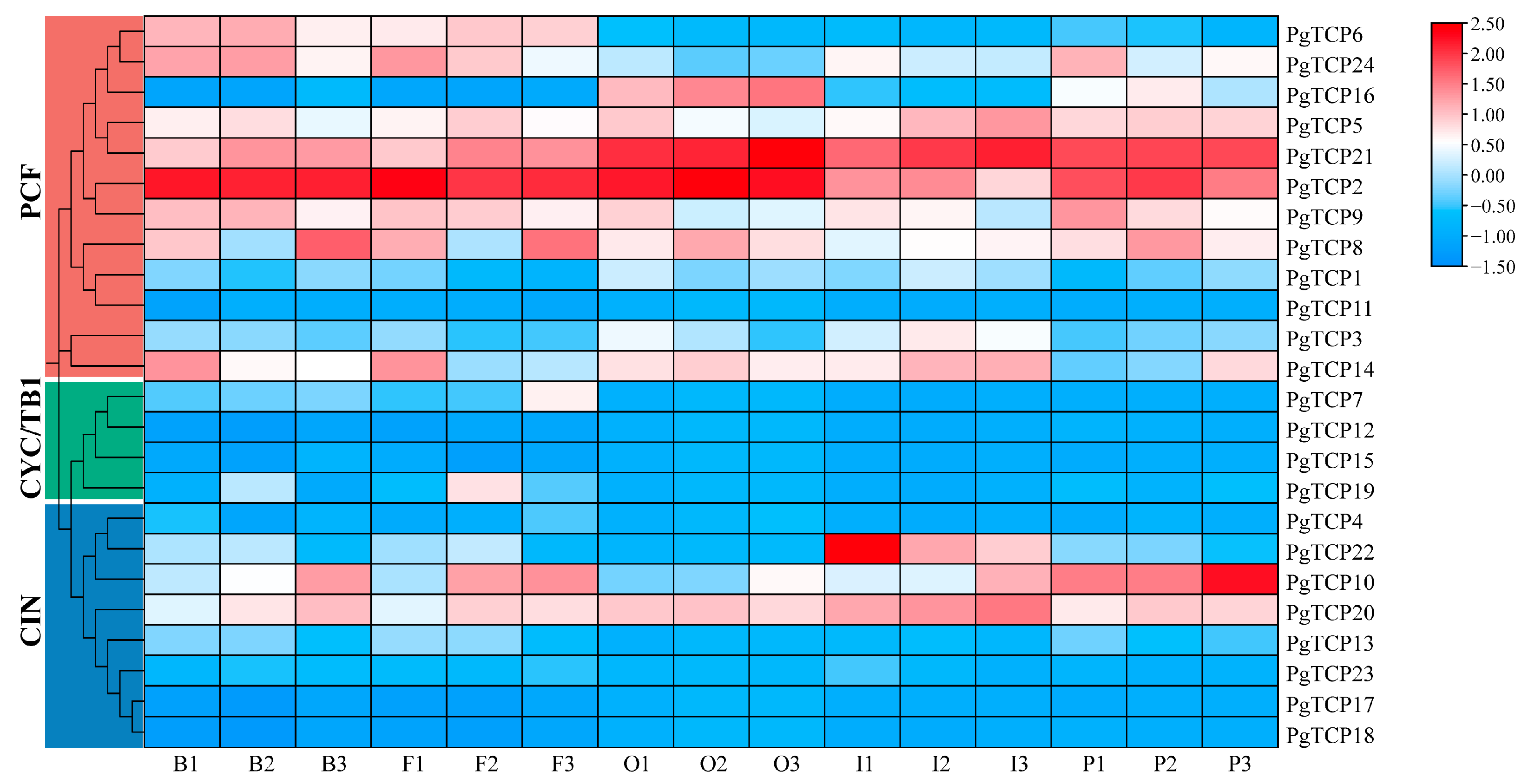
Publicly available RNA-Seq datasets for various pomegranate tissues, including bisexual flowers, functional male flowers, outer seed coat, inner seed coat, and pericarp at different developmental stages, were obtained from the NCBI Sequence Read Archive (SRA) (accession numbers listed in Supplementary Table S1). These samples represented different tissues and developmental stages and were therefore used as stage- and tissue-specific transcriptomic resources for expression profiling. The floral datasets included bisexual buds at three developmental stages (B1, 3.0–5.0 mm; B2, 5.1–13.0 mm; B3, 13.1–25.0 mm) and functional male buds at three developmental stages (F1, 3.0–5.0 mm; F2, 5.1–13.0 mm; F3, 13.1–25.0 mm) [38]. The fruit datasets included outer seed coat samples collected at 50, 95, and 140 days after blooming (O1, O2, and O3), inner seed coat samples collected at the same three stages (I1, I2, and I3), and pericarp samples collected at 50, 95, and 140 days after blooming (P1, P2, and P3) [39].
Transcript abundance of PgTCP genes was quantified using Kallisto with parameters set to −t 4 −b 50. Expression levels were normalized as TPM (transcripts per million). For visualization, TPM values were transformed using log2(TPM + 1) to stabilize variance. A heatmap depicting the expression patterns of PgTCP genes across tissues and developmental stages was generated using the heatmap module in Tbtools (v 2.446), the data were normalized by row scaling (z-score) using the heatmap module in TBtools (v 2.446) [35].

2.6. Plant Materials

Approximately two-year-old seedlings of the ‘Tunisia soft seed’ pomegranate (P. granatum) cultivar were cultivated in a controlled greenhouse at Nanjing Forestry University, Jiangsu Province, China (32°4′ N, 118°49′ E). The greenhouse conditions were maintained at 25 °C with 60% relative humidity, under a 12 h light/12 h dark photoperiod, with a light intensity of 4000 Lux. For expression analysis, tissues representing different developmental stages were collected from 45 healthy seedlings, which were randomly grouped into three biological replicates (15 plants per replicate). The sampled tissues included roots (I), unlignified stems (II), half lignified stems (III), lignified stems (IV), young leaves (V), mature leaves (VI), winter buds (VII), apical buds (VIII), and lateral buds (IX). All samples were immediately frozen in liquid nitrogen and stored at −80 °C for subsequent RNA extraction.

2.7. Abiotic Stress Treatments

For all stress treatments, eight-month-old pomegranate seedlings grown under the controlled conditions described above were used. In each treatment (shade, drought, and cold), 45 uniformly healthy seedlings were randomly selected and equally divided into three biological replicates (15 plants per replicate). For shade treatment, seedlings were covered with a black shading net, which transmits about 30% of incident light, thereby providing a defined low-light condition. After seven days of treatment, mature leaves from the third to sixth nodes of branches were collected for subsequent analysis. For drought stress, seedlings were removed from soil, their roots gently rinsed, and then immersed in a 20% PEG6000 solution to simulate water deficit. Leaf samples (from the third to sixth nodes) were collected at 12 h (D1) and 24 h (D2) after treatment onset [10].
For cold stress, seedlings were transferred to a growth chamber set at 4 °C and the 4 h/8 h sampling time points were selected with reference to commonly used short-term cold-stress conditions reported in other plant species, in order to capture early transcriptional responses to low-temperature stress. Mature leaves (same nodal positions) were harvested after 4 h (C1) and 8 h (C2) of exposure [40]. Seedlings maintained under normal growth conditions served as untreated controls for all stress experiments. All collected samples were immediately frozen in liquid nitrogen and stored at −80 °C until RNA extraction.

2.8. RNA Extraction and Quantitative Real-Time PCR (qRT-PCR)

Total RNA was extracted from each sample (100 mg) using the FastPure® Universal Plant Total RNA Isolation Kit (Vazyme, Nanjing, China). RNA quality was assessed by 1% agarose gel electrophoresis and spectrophotometric measurement of A260/A280 ratios. First strand cDNA was synthesized from 300 ng of total RNA using HiScript III All-in-one RT SuperMix Perfect for qPCR (Vazyme). The synthesized cDNA was diluted 10-fold with ddH2O prior to qPCR amplification. qRT-PCR was performed with three biological replicates on an Applied Biosystems™ 7500 Real-Time PCR System (Thermo Fisher Scientific, Waltham, MA, USA). Each 10 μL reaction contained 5 μL of ChamQ Universal SYBR qPCR Master Mix (Vazyme), 0.2 μL of each primer (10 μM), 2 μL of cDNA template, and 2.6 μL of ddH2O. The thermal cycling protocol was 95 °C for 30 s, followed by 40 cycles of 95 °C for 10 s and 60 °C for 30 s. Melting curve analysis was conducted from 60 °C to 95 °C to verify amplification specificity. The PgActin gene (LOC116200207) was used as an internal control. Gene-specific primers (designed on the NCBI website) are listed in Table S2. Relative expression levels were calculated using the 2−△△CT method [5].

2.9. Statistical Analysis

Statistical analyses were performed using IBM SPSS Statistics v.26. For the shading treatment, in which only two groups were compared (control vs. shade), differences were evaluated using an independent-samples t-test. For all other experiments involving more than two groups, including tissue-expression analysis and time-course stress treatments, differences were analyzed using one-way analysis of variance (ANOVA) followed by Duncan’s multiple range test for post hoc comparisons. Differences were considered statistically significant at p < 0.05. Data visualization and graph generation were carried out using Origin 2026 Pro (OriginLab, Northampton, MA, USA) and TBtools.

3. Results

3.1. Identification and Characterization of PgTCP Genes

Twenty-four non-redundant TCP genes were identified from the P. granatum genome and renamed as PgTCP1 to PgTCP24 according to their order on chromosomes (Table S3). The encoded proteins varied in length from 221 (PgTCP14) to 703 (PgTCP22) amino acids, with corresponding MW ranging from 23.23 kDa to 76.93 kDa. Their pI spanned from acidic (5.14 for PgTCP4) to basic (10.06 for PgTCP7). All PgTCP proteins exhibited negative GRAVY values, confirming their hydrophilic nature. Subcellular localization predictions indicated that all 24 proteins are likely nuclear-localized. Chromosomal mapping revealed an uneven distribution of the PgTCP genes across 8 chromosomes (Table S3). Chromosome 7 harbored the largest number (7 genes), followed by chromosome 4 (5 genes). Chromosomes 2 and 5 each contained 3 genes, chromosomes 3 and 8 contained 2 genes each, while chromosomes 1 and 6 carried only a single PgTCP gene.

3.2. Phylogenetic Analysis and Classification of PgTCP Genes

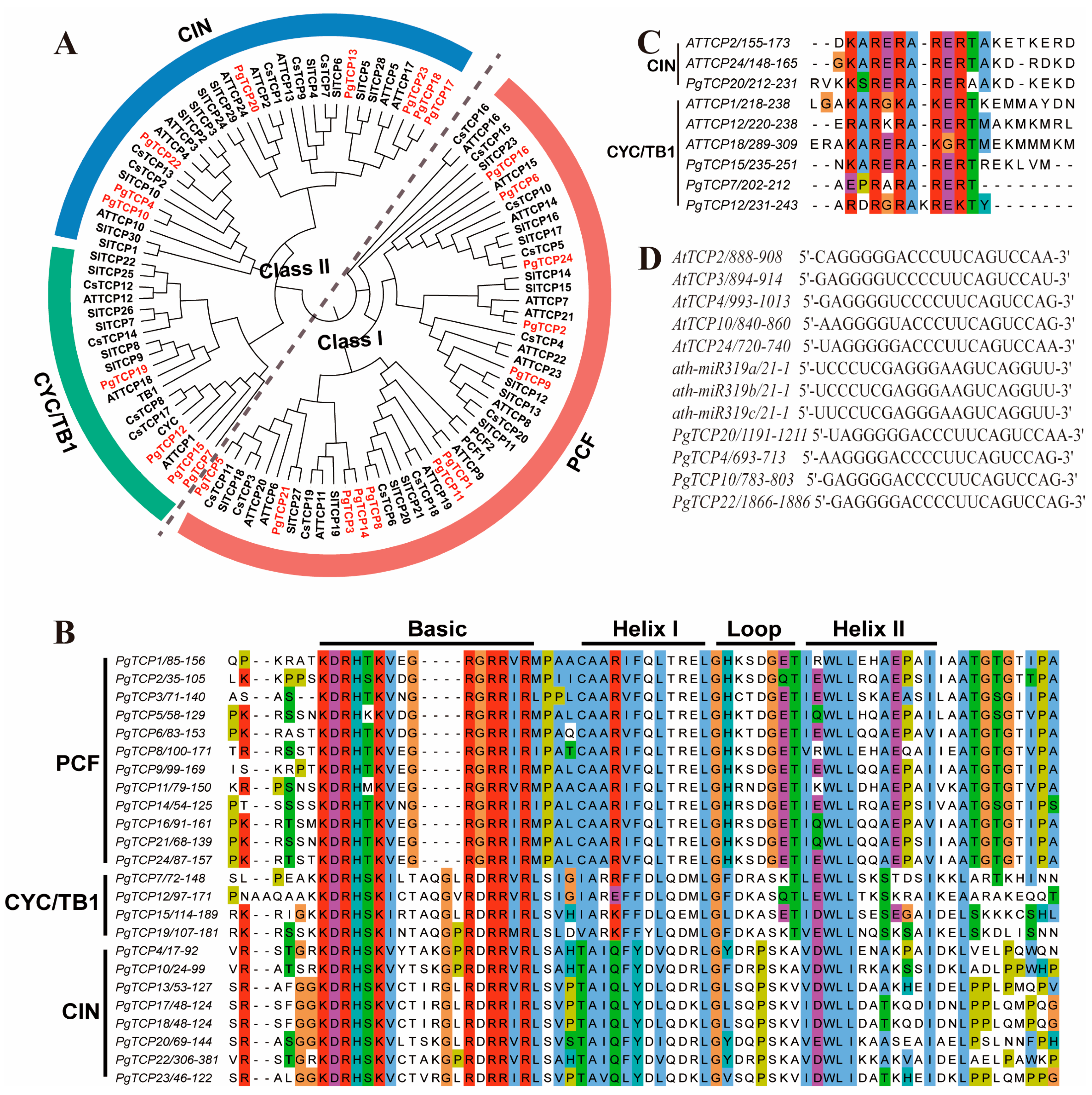
To elucidate the evolutionary relationships of the TCP family in pomegranate, a phylogenetic tree was constructed using the protein sequences of the 24 PgTCPs along with reference TCPs from A. thaliana (AtTCPs), S. lycopersicum (SlTCPs), C. sinensis (CsTCPs), O. sativa (PCF1 and PCF2), and A. majus (CYC). Based on topology and branch support, the PgTCP proteins were classified into three distinct subclades: PCF (12 genes), CIN (8 genes), and CYC/TB1 (4 genes) (Figure 1A). Genes within the same subclade likely share conserved structural features and a common evolutionary origin, consistent with the functional conservation observed in TCP families across plant species.
To further validate the identified PgTCPs and examine their sequence conservation, multiple sequence alignment was performed (Figure 1B). All 24 sequences contained the definitive TCP domain. In the BASIC region, the residues Asp (D), His (H), Lys (K), and Arg (R) were completely conserved. A characteristic four-amino-acid deletion, distinguishing Class I from Class II TCPs, was confirmed in all PCF subclade members. In the HELIX I and HELIX II regions, the hydrophobic residues Leu (L) and Trp (W) were invariant. The LOOP region featured a highly conserved hydrophilic Gly (G) residue. Additionally, the arginine-rich R domain, with conserved Ala (A) and Arg (R) residues, was identified in one CIN member (PgTCP20) and three CYC/TB1 members (PgTCP7, PgTCP12, and PgTCP15) (Figure 1C). Notably, potential miR319 binding sites were predicted exclusively in the sequences of four CIN subclade genes: PgTCP4/10/20/22 (Figure 1D).

3.3. Motif and Gene Structure of PgTCP Genes

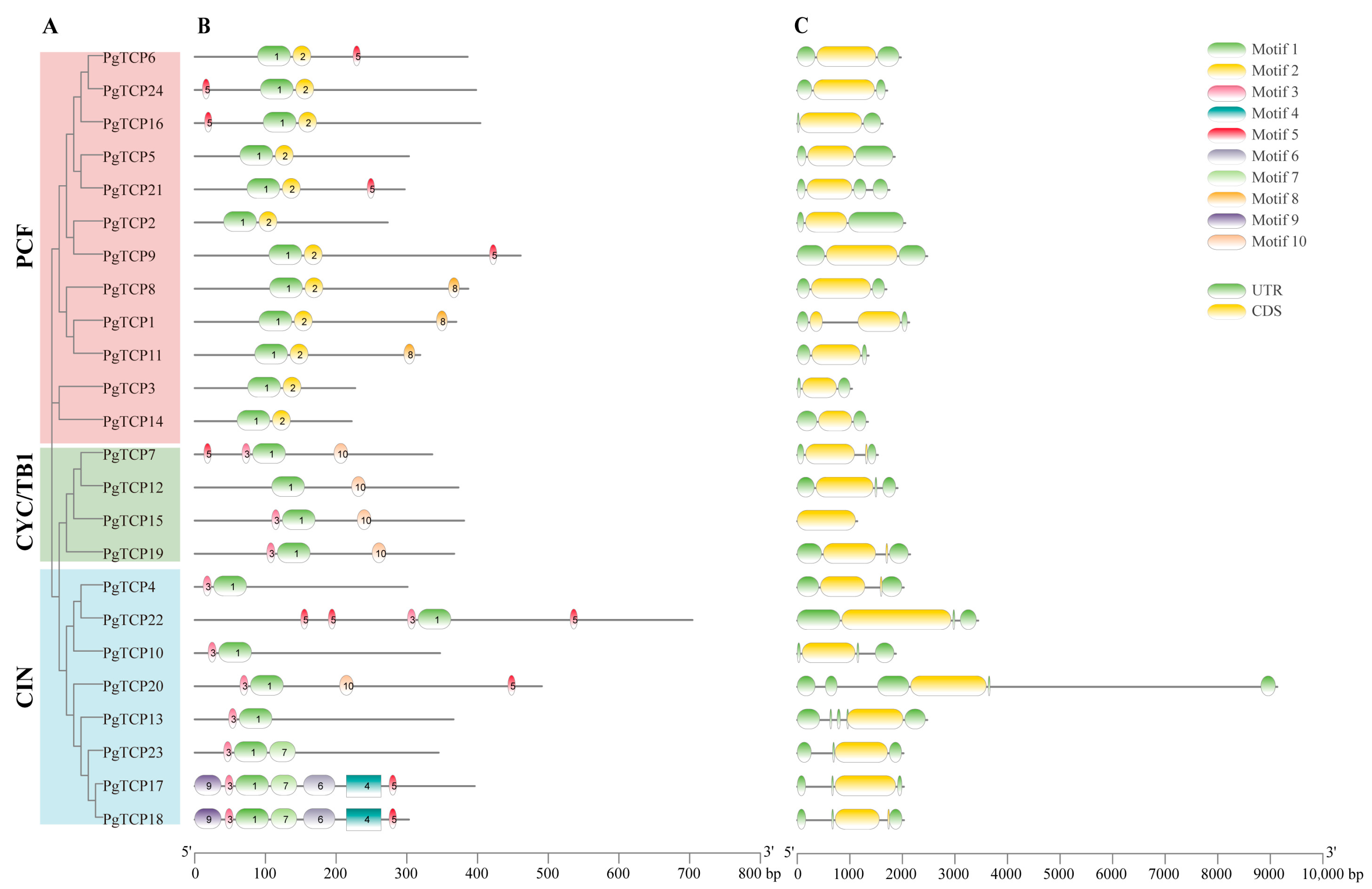
A total of 10 conserved motifs were identified among the 24 PgTCP proteins, named as Motif 1 to Motif 10 (Figure 2B). Proteins within the same phylogenetic subclade generally shared a similar repertoire and arrangement of motifs, a pattern consistent with their gene structures. All PgTCP proteins contained Motif 1, which may be a TCP domain (Figure 2A and Table S4). The Motif 10 (R domain), a feature of certain Class II TCPs, was specifically detected in 5 members (such as PgTCP7/12/15/20). Furthermore, Motif 2 was characteristic of all Class I (PCF) proteins, whereas Motif 3 was common to all Class II (CIN and CYC/TB1) proteins, highlighting distinct sequence features between the two major classes.
To further elucidate the evolutionary relationships and structural characteristics of the TCP family in pomegranate, exon–intron organization and conserved motif analyses were conducted. As shown in Figure 2C, the exon–intron structures of PgTCP genes were generally conserved. Eleven genes contained no introns, ten possessed a single intron, one gene (PgTCP22) had two introns, and two genes contained three introns. Notably, genes within the same phylogenetic subclade exhibited highly similar patterns in terms of exon length and intron number/phase. This structural conservation strongly supports the subclade classification inferred from the phylogenetic tree and reflects their shared evolutionary history.

3.4. Tandem Duplication and Collinearity Analysis Among PgTCP Genes

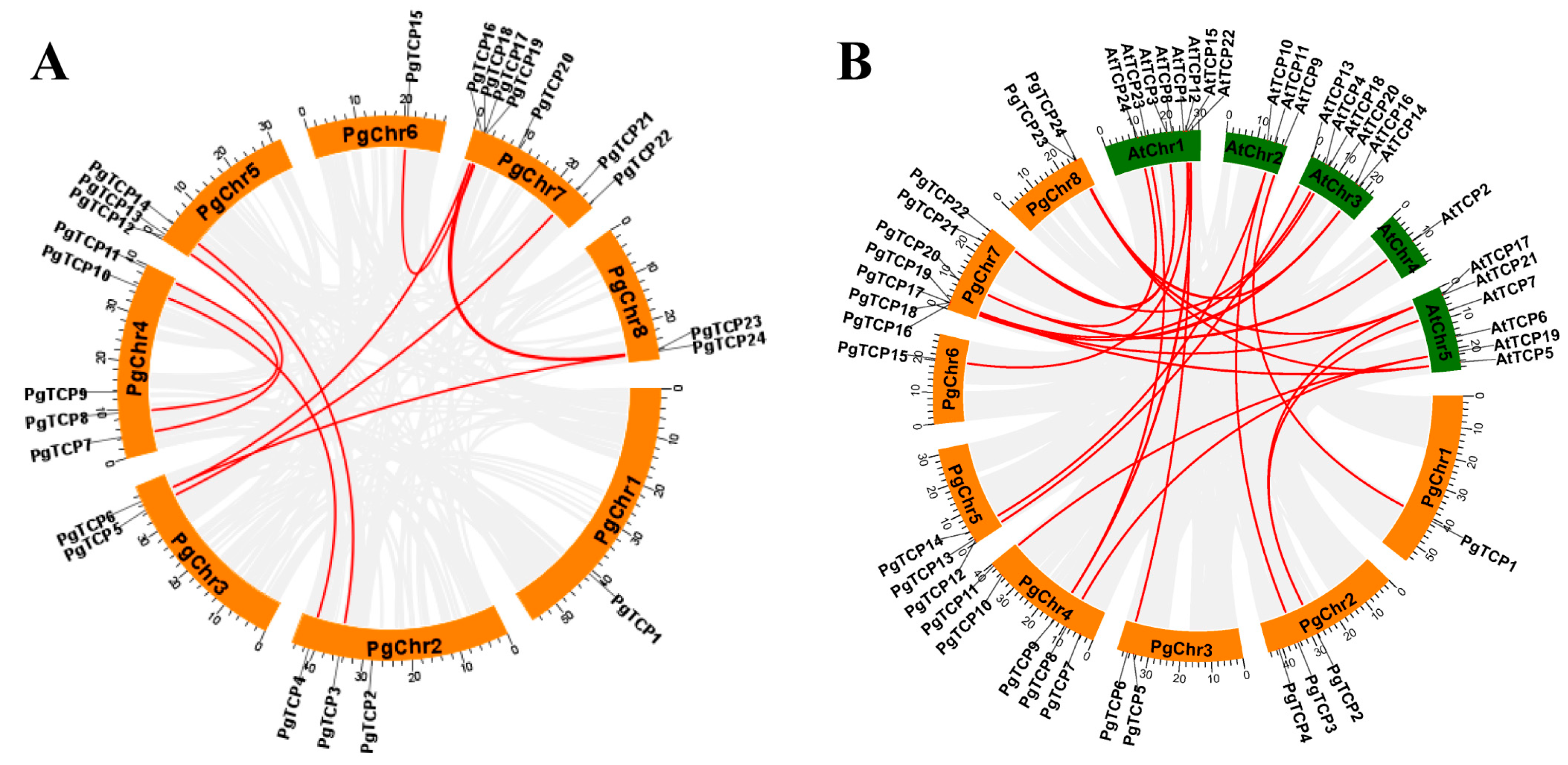
To elucidate the expansion and evolutionary history of the PgTCP gene family, we analyzed gene duplication events and collinearity relationships within the pomegranate genome (Figure 3). A total of 10 segmentally duplicated gene pairs were identified among the 24 PgTCP genes, distributed across chromosomes 2, 3, 4, 5, 6, and 7 (Figure 3A). No tandem duplication events were detected, indicating that segmental duplication served as the primary driving force for the expansion of the PgTCP family. Furthermore, the Ka/Ks for each duplicated pair was significantly less than 1 (Table S5), indicating that the PgTCP genes have undergone strong purifying selection during evolution, which has likely maintained their functional integrity.
To elucidate the evolutionary origins and potential functional conservation of TCP genes, we performed a genome-wide synteny analysis between pomegranate and A. thaliana (Figure 3B and Table S6). This analysis identified 23 syntenic gene pairs, involving 19 AtTCP and 18 PgTCP genes, indicating broad conservation of the TCP family between these species. Notably, five pairs exhibited one-to-one orthologous relationships: AtTCP9-PgTCP1, AtTCP12-PgTCP15, AtTCP13-PgTCP13, AtTCP15-PgTCP6, and AtTCP18-PgTCP19. These highly conserved linkages suggest that these genes may retain critical, ancestral functions in plant development and stress responses.

3.5. Cis-Acting Elements Analysis

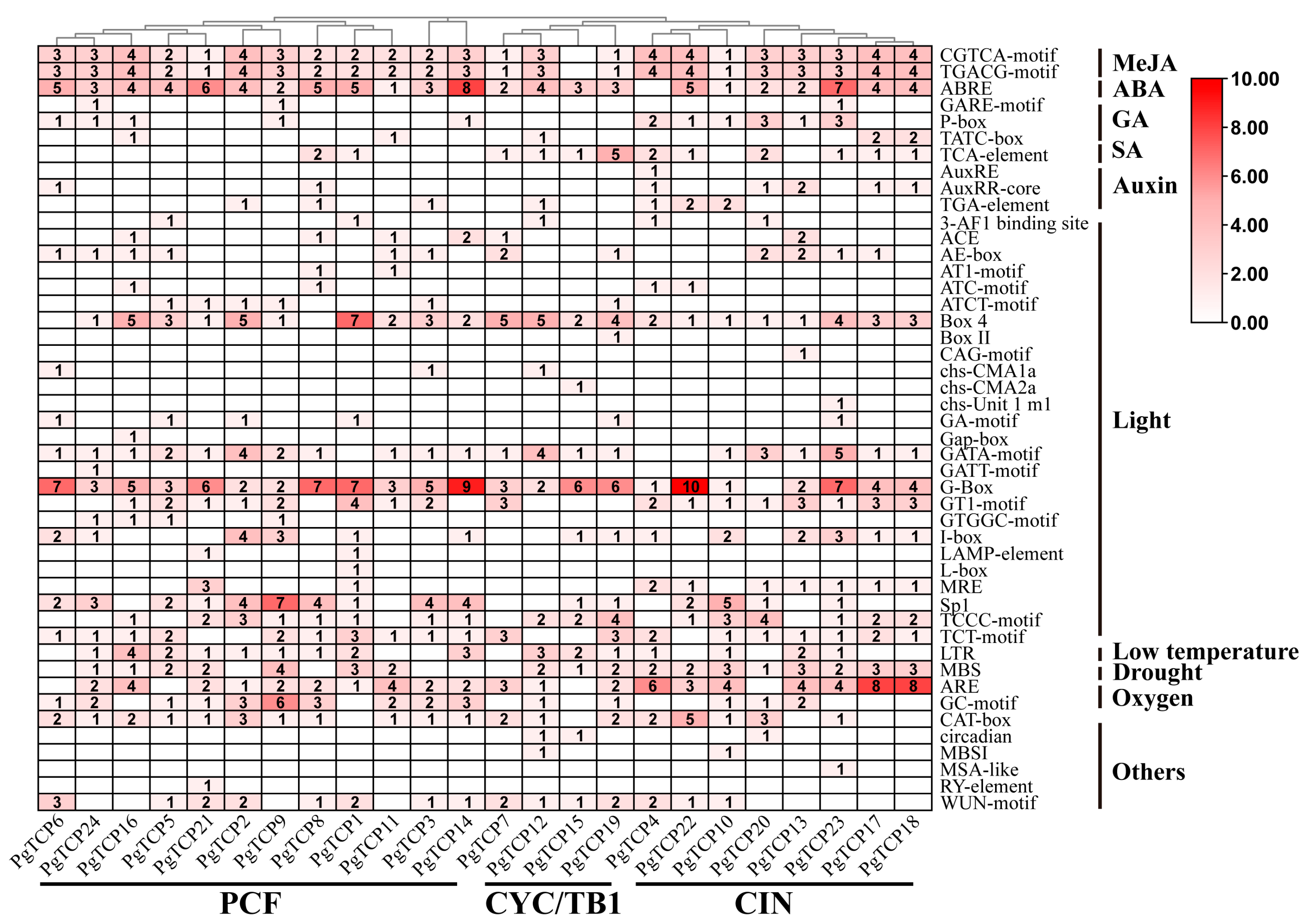
To explore the potential regulatory functions of PgTCP genes, we analyzed cis-acting elements within the 2 kb region upstream of their transcription start sites (Figure 4). Beyond core promoter elements (such as the TATA box and CAAT box), we identified a diverse repertoire of putative regulatory motifs associated with hormone signaling, stress responses, and development. Hormone-responsive elements were extensively represented. Abscisic acid (ABA)-responsive elements (ABRE) were the most abundant, present in 23 of 24 promoters. Elements associated with methyl jasmonate (MeJA) response (CGTCA motif and TGACG motif), gibberellin (GA) response (P box, GARE motif, TATC box), and salicylic acid (SA) response (TCA element) were also widely distributed, being detected in 16, 13, and 13 promoters, respectively. Promoters were also enriched for stress and environment-related motifs. All 24 PgTCP promoters contained anaerobic response elements (ARE), and most harbored low-temperature responsive (LTR) elements (19 genes) and drought-inducible (MBS) elements (17 genes). A high frequency of light-responsive elements (such as ACE, Box 4, and G box) was also observed. Furthermore, motifs linked to specific developmental processes were identified in subsets of genes, including those involved in meristem expression (CAT box), circadian control, seed-specific regulation (RY element), cell cycle regulation (MSA-like), and wound response (WUN motif). The composition and combination of these cis-elements varied considerably among individual PgTCP genes, suggesting divergent transcriptional regulation underlying their functional specialization.

3.6. PgTCP Protein Interactions

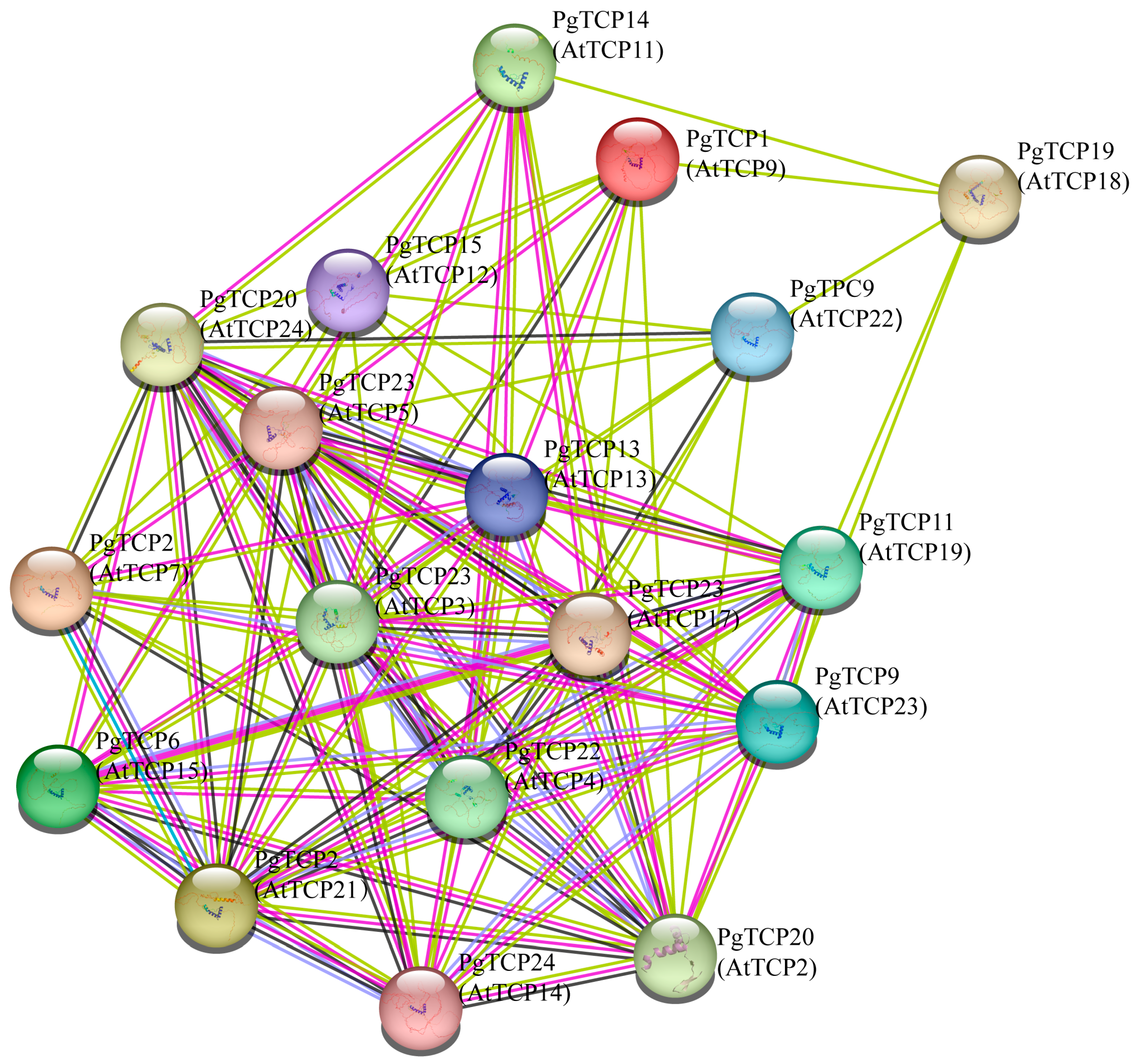
To predict potential functional associations among PgTCP proteins, a protein–protein interaction (PPI) network was constructed using the STRING database. The prediction was based on homology mapping, utilizing known interactions of their orthologs in A. thaliana (Figure 5). The resulting network comprised 18 PgTCP proteins, indicating extensive potential interplay within the family. Topological analysis identified several putative hub proteins with the highest connectivity degrees, including PgTCP13, PgTCP20, and PgTCP23, suggesting they may function as central nodes in regulatory complexes. Furthermore, the functional annotations of the homologous AtTCP genes (Table S7) provide preliminary insights into potential PgTCP roles. Notably, several orthologs are involved in shoot organ morphogenesis and hormone signaling pathways, consistent with the well-established functions of TCPs. These predicted interactions and functional linkages offer a valuable framework for hypothesizing regulatory modules among PgTCP genes, which can be tested in future experimental studies.

3.7. Expression Dynamics of PgTCP Genes During Fruit and Flower Develop

To investigate the roles of PgTCP genes in reproductive development, we analyzed publicly available RNA-seq data from key developmental stages of fruits (outer/inner seed coat and pericarps 50, 95, and 140 days after blooming) and flowers (different developmental stages of bisexual and functional male flowers) (Figure 6). PgTCP2 and PgTCP21 were notably highly expressed across all five tissue types examined, suggesting broad roles in reproductive development. In pericarp development, ten genes (PgTCP2/5/8/9/10/16/20/21/24) exhibited significant expression changes. For seed coat development, six genes were differentially expressed in the outer seed coat (PgTCP2/8/14/16/20/21) and five in the inner seed coat (PgTCP2/5/20/21/2). During floral development, eight genes (PgTCP2/6/8/9/10/20/21/24) showed stage-specific expression patterns. Notably, several genes displayed distinct temporal expression trends. For example, PgTCP20 expression was relatively high in later stages of pericarp development. In flowers, the transcript levels of PgTCP10, PgTCP20, and PgTCP21 increased gradually during development, while PgTCP24 expression progressively decreased. These stage-specific patterns suggest precise regulatory roles for individual PgTCP genes at particular phases of reproductive organ formation.

3.8. Tissue-Specific Expression Patterns of PgTCP Genes

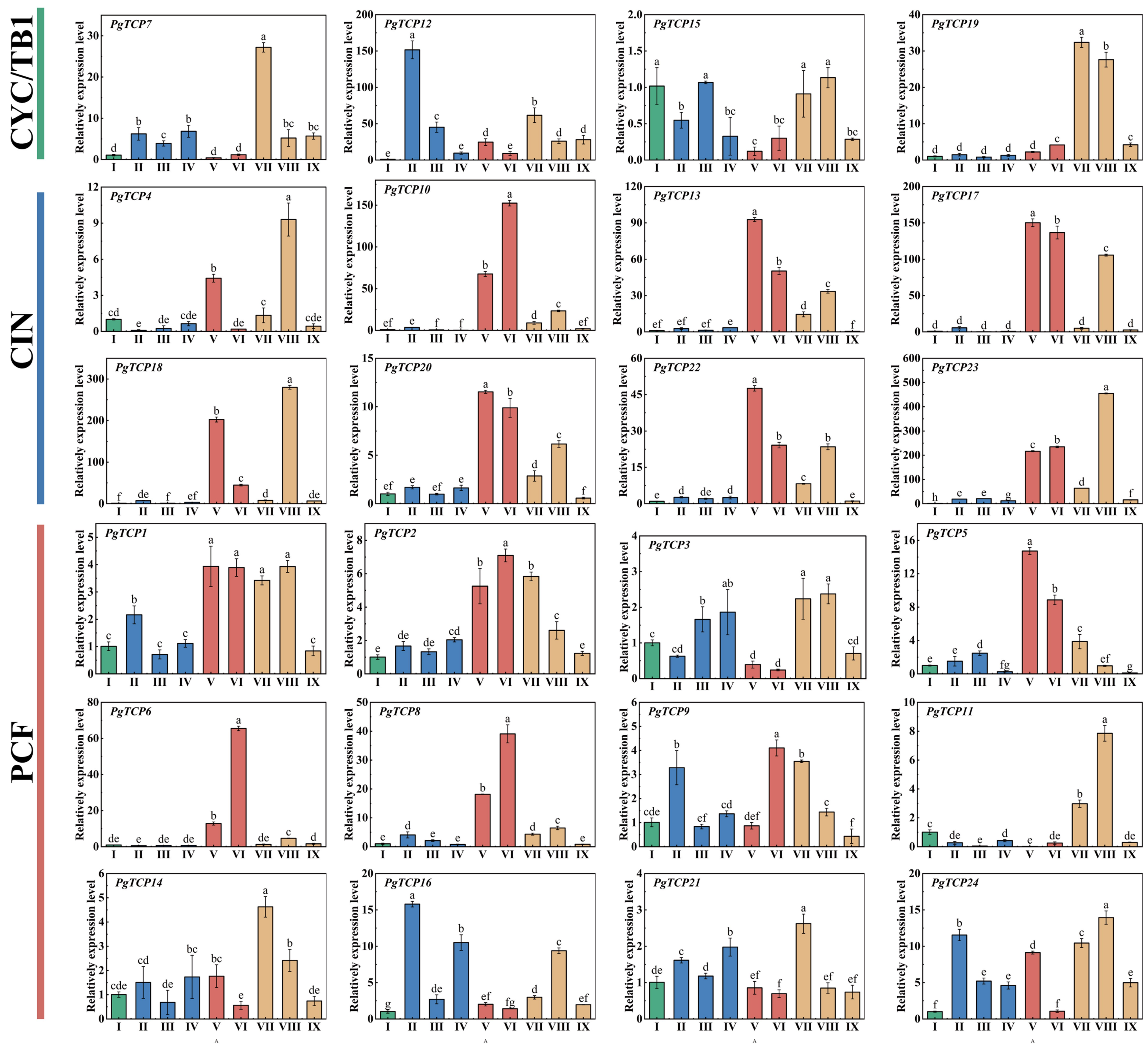
To realize the involvement of TCP genes in the growth and development of pomegranate, we used qRT-PCR data to study the function of PgTCP genes in the growth and development of roots (I), stems (II–IV), leaves (V and VI), and buds (VII–IX) in pomegranate, and 24 PgTCP genes showed different spatiotemporal expression profiles in those tissues (Figure 7). The expression of most PgTCP genes was high in leaves, buds, and stems, but low in roots. There were ten PgTCP genes (PgTCP1/2/5/6/8/10/13/17/20/22), ten PgTCP genes (PgTCP3/4/7/11/14/18/19/21/23/24), and 2 PgTCP genes (PgTCP12 and PgTCP16) that had the highest expression levels in leaves, buds, and stems, respectively. Additionally, the expression level of PgTCP genes in the root was generally low, such as PgTCP1/2/6/7/8/10/12/13.
Moreover, expression trends of PgTCP genes varied across different tissues and organs. Specifically, the expression levels of PgTCP3 and PgTCP4 were positively correlated with the degree of stem lignification (tissue II, III, and IV). In contrast, another five PgTCP genes (PgTCP8/10/12/17/24) showed an inverse expression pattern. Regarding stem lignification (stages II–IV), seven PgTCP genes (PgTCP1/2/7/9/14/16/21) showed a ‘V-shaped’ pattern, decreasing from stage II to stage III before rising at stage IV, while PgTCP5 and PgTCP15 displayed the inverse trend. In leaves, transcript levels of six genes (PgTCP2/6/8/10/19/23) increased from the young (V) to the mature stage (VI), in contrast to ten PgTCP genes (PgTCP4/5/12/13/14/17/18/20/22/24) whose expression decreased. Distinct expression patterns were also observed across different bud types. The transcript levels of eight PgTCP genes (PgTCP2/5/7/9/12/14/19/21) were higher in winter buds (VII) than in both apical (VIII) and lateral buds (IX). In contrast, nine genes (PgTCP4/8/11/17/18/20/23/24) showed their highest expression in apical buds. Notably, PgTCP19 exhibited bud-specific high expression, suggesting its potential role in bud development.

3.9. Expression Dynamics of PgTCP Genes Under Abiotic Stresses

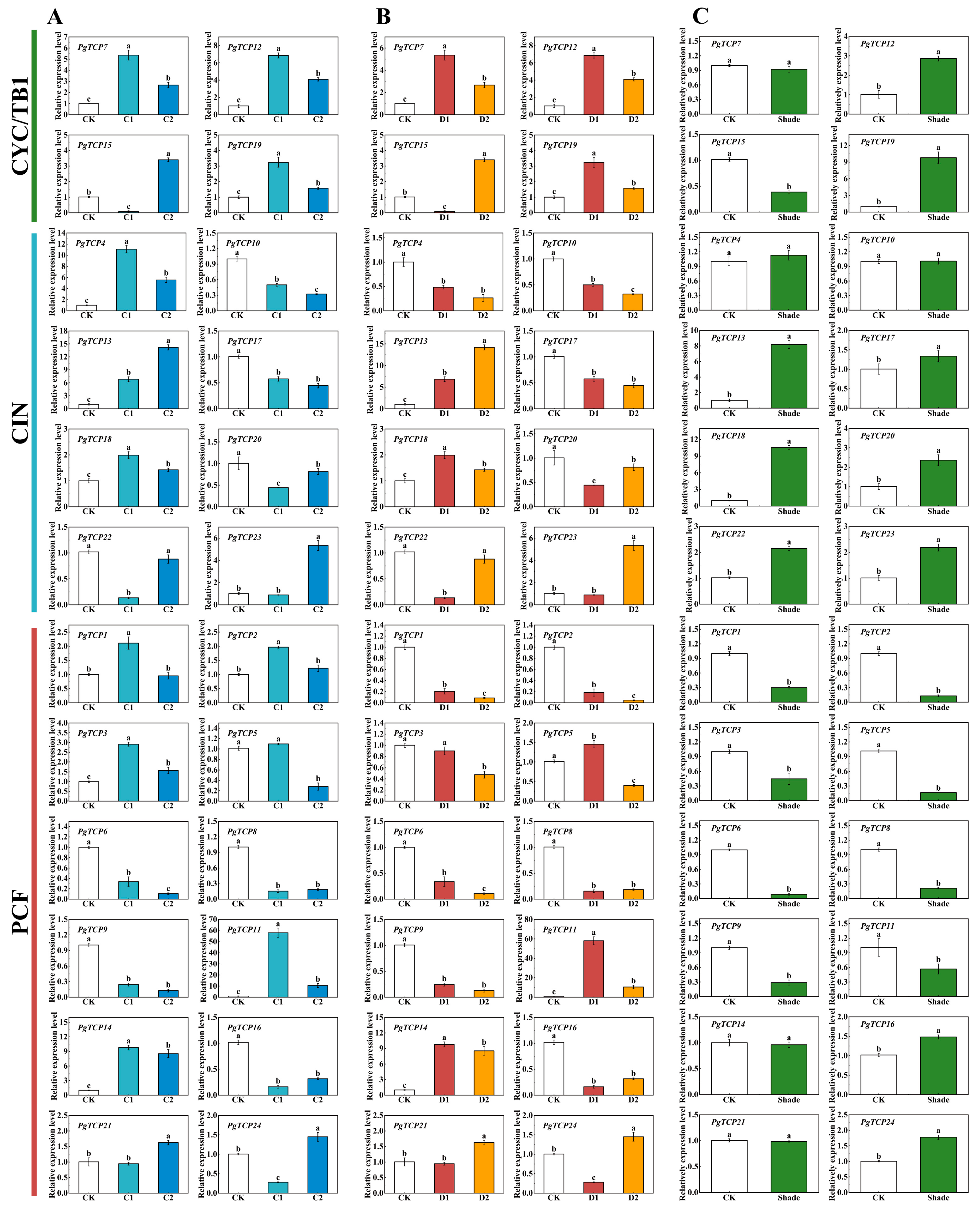
To explore the potential involvement of PgTCP genes in response to stress, the expression of PgTCP genes was analyzed at different time points following treatments with three abiotic stresses, including cold, drought, and shading (Figure 8).
Under low-temperature stress (4 °C), the expression of most PgTCP genes was significantly altered, displaying distinct temporal patterns, with exceptions being PgTCP11, PgTCP16, and PgTCP23 (Figure 8A). A key finding was the progressive up-regulation of PgTCP12 with prolonged exposure. Conversely, PgTCP6, PgTCP17, and PgTCP21 showed a sustained down-regulation. Notably, ten genes exhibited a transient response, being sharply upregulated at 4 h but returning to or below baseline levels by 8 h. Among these, PgTCP2, PgTCP3, and PgTCP4 remained elevated at 8 h, while PgTCP8 was significantly suppressed.
Under drought stress, the 24 PgTCP genes exhibited diverse temporal expression patterns (Figure 8B). Specifically, three genes (PgTCP12, PgTCP13, and PgTCP14) were progressively up-regulated, while another three (PgTCP3, PgTCP4, and PgTCP6) were progressively down-regulated throughout the treatment. Notably, six genes (PgTCP5/7/11/12/14/19) displayed an early up-regulation at 12 h followed by a significant down-regulation by 24 h, indicating a transient activation pattern. In contrast, PgTCP18 showed no significant change at any time point. After 24 h of drought treatment, nine genes (PgTCP7/11/12/13/14/15/21/23/TCP24) remained significantly upregulated, and ten (PgTCP1/2/3/4/6/8/9/10/17) were significantly downregulated compared to the control.
Under shading treatment (Figure 8C), 17 PgTCP genes showed significant expression changes. Among them, nine PgTCP genes (PgTCP12/13/17/18/19/20/22/23/24) were significantly upregulated relative to the control. In contrast, eight PgTCP genes (PgTCP1/2/3/5/6/8/9/15) were significantly down-regulated compared to the control, respectively. Meanwhile, the expression of seven genes (PgTCP4/7/10/11/14/16/21) remained unaffected by shading treatment.

4. Discussion

The TCP gene family is a plant-specific transcription factor family, participating in various physiological and biological processes of plant growth and development and resistance to abiotic stress [2]. Since TB1, CYC, and PCF1 and PCF2 were discovered in maize, snapdragon, and rice, respectively, TCP genes have been extensively identified and characterized in a wide range of plant species, including Juglans mandshurica, C. indicum, S. miltiorrhiza, and M. domestica [4,11,12,23]. Nevertheless, a systematic analysis and functional characterization of the TCP gene family in pomegranate are still lacking. In this study, TCP genes in pomegranate were identified, and their characteristics were analyzed, while their potential functions were inferred based on phylogenetic, structural, and expression analyses.
Twenty-four TCP non-redundant genes were identified in the pomegranate genome (Table S3 and Figure 1A), a number comparable to A. thaliana and Senna tora but different from C. indicum (35), C. sinensis (20), and J. mandshurica (35), reflecting species-specific expansion or contraction of this family during evolution [4,10,12]. Consistent with their predicted roles as transcription factors, all 24 PgTCP genes were predicted to localize to the nucleus (Table S3), aligning with the predominantly nuclear subcellular localization reported for TCP families in other plants [5].This predicted nuclear localization is consistent with their putative roles as a transcription factor, enabling direct regulation of target gene expression [41].
All PgTCP proteins exhibit a highly conserved TCP domain with a 59-amino-acid basic helix–loop–helix (bHLH) motif at the N-terminus essential for DNA binding and dimerization (Figure 1B). Phylogenetic analysis and sequence alignment classify PgTCP genes into PCF, CIN, and CYC/TB1 subbranches (Figure 1A), consistent with prior research [4,10,12]. Moreover, one CIN member (PgTCP20) and three CYC/TB1 members (PgTCP7, PgTCP12, and PgTCP15) contain an arginine-rich R domain (Figure 1C), which is known to mediate protein–protein interaction [42]. The presence of these conserved domains suggests that PgTCPs likely employ conserved molecular mechanisms for DNA recognition and complex formation, similar to their orthologs in other species. PgTCP genes within the same subclade share similar conserved motifs (Figure 2B), highlighting their close evolutionary relationships [2]. It’s worth noting that motif1 may be a TCP domain according to its motif logo, and it is present in all PgTCP genes. This indicates that Motif 1 corresponds to the conserved TCP domain essential for DNA binding and protein interactions (Figure 2B). Gene duplication is widely regarded as an important driver of gene family expansion and functional diversification [2]. In this study, 24 PgTCP genes were identified on 8 chromosomes of pomegranate (Table S3 and Figure 3). Moreover, 10 pairs of homologous genes were found by collinearity analysis (Figure 3A), indicating that the expansion of the TCP gene family in the pomegranate genome may be related to fragment replication. Interspecies collinearity analysis revealed 23 homologous gene pairs between pomegranate and A. thaliana (Figure 3B), which is broadly consistent with the phylogenetic analysis and supports the evolutionary conservation of PgTCP genes within dicot plants. Additionally, the Ka/Ks ratio of all pairs was less than 1, suggesting that duplicated PgTCP gene pairs had been subjected primarily to purifying selection during evolution, indicating functional conservation after duplication [36].
TCP proteins act as transcriptional regulators by binding to specific cis-elements, which in turn dictates their functional specificity and the spatiotemporal expression patterns of downstream genes. In our study, cis-acting element analysis exhibited that the 24 PgTCP promoters contain a wide distribution of elements related to hormone, light, and stress responses (Figure 4), with the light-responsive elements the most abundant. And all PgTCP genes possessed multiple such elements, suggesting that they may be responsive to light-related signals during pomegranate growth and development, which is in line with findings from Chen et al., Li et al., and Wang et al. [3,24,43]. Additionally, most PgTCP promoters contained cis-elements associated with anaerobic induction (ARE), low-temperature responsiveness (LTR), and drought induction (MBS). The prevalence of these stress–responsive elements suggests that PgTCP genes may participate in responses to various environmental stress. Furthermore, TCP transcription factors are known integrators of hormonal signals, including gibberellin (GA), auxin, abscisic acid (ABA), salicylic acid, brassinolide, and jasmonic acid (MeJA), thereby playing pivotal roles in regulating diverse physiological processes, such as cell proliferation, seed dormancy and germination, leaf development, and shoot branching [16,17,23,44]. We identified ten hormone response elements in PgTCP promoters. These regulatory elements are linked to signaling pathways involved in MeJA, ABA, GA, SA, and auxin, suggesting that PgTCP genes may respond to multiple hormone-related signals involved in environmental adaptation and developmental regulation. Furthermore, several cis-elements implicated in developmental regulation were identified in the PgTCP promoters, including the CAT-box (associated with meristem expression), circadian (involved in circadian control), MBSI (involved in flavonoid biosynthetic gene regulation), MSA-like (involved in cell cycle regulation), RY-element (involved in seed-specific regulation), and WUN-motif (involved in wounding). The presence of these diverse regulatory motifs suggests that PgTCP genes may be associated with developmental processes such as seed development, meristem activity, cell proliferation, and diurnal growth rhythms. These findings enhance our understanding of the potential functions of PgTCP genes and provide clues as to how their regulated expression may help plants coordinate development in response to varying environmental conditions [2].
Gene expression patterns can provide clues to biological function, and our analysis of public transcriptome data revealed dynamic expression of PgTCP genes during critical reproductive stages of flower and fruit development (Figure 6). For example, FvTCP9 regulates anthocyanin synthesis and promotes strawberry fruit maturation by regulating the expression of ABA signal transduction-related genes [44]. This study found 21, 19, 12, 17, and 16 PgTCP genes were expressed during the development of bisexual flowers, functional male flowers, outer seed coats, inner seed coats, and fruit pericarps, respectively. This widespread involvement underscores their potential importance in shaping pomegranate’s unique floral architecture and fruit traits. Consistent with patterns observed in species like M. domestica, C. sinensis, and C. indicum, we found distinct expression trends among TCP subclades [10,11,12]. Members in the CIN and CYC/TB1 subclades primarily showed specific, organ-restricted expression patterns. In contrast, members of the PCF subclade, such as PgTCP2/5/8/9/21, were broadly expressed across multiple floral and fruit tissues. Specifically, several PgTCP genes with high expression in flowers may be associated with key reproductive transitions. In A. thaliana, AtTCP7 can interact with Nuclear Factor-Ys to promote flowering by directly regulating SOC1 [45]. PgTCP2, a homolog of AtTCP7, was highly expressed in both flower types, making it a candidate gene potentially involved in floral initiation or development in pomegranate. In addition, PgTCP9, PgTCP14, and PgTCP21 showed peak expression during early floral developmental stages, suggesting their potential involvement in floral bud differentiation or the transition to flowering, potentially analogous to the role of VcTCP18 in regulating flower bud dormancy release in blueberry [46]. Furthermore, the pronounced expression of specific PgTCPs in fruit tissues suggests specialized roles in fruit development. PgTCP21 in this study was highly abundant in the outer seed coat, inner seed coat, and pericarp. This tissue-specific expression pattern suggests that PgTCP21 may be associated with fruit development and maturation in pomegranate.
To date, TCP transcription factors have been established as master regulators of plant architecture, with well-documented roles in leaf morphogenesis and shoot branching. Beyond these classic functions, TCPs are increasingly recognized for their versatile roles in diverse vegetative tissues by regulating cell proliferation, expansion, and hormone responses [17,47,48,49]. To investigate these multifaceted roles in pomegranate, we analyzed the expression profiles of PgTCPs across nine key vegetative tissues using qRT-PCR (Figure 7). Several PgTCPs showed expression patterns and homologies consistent with possible conserved roles in leaf development. Previous research has demonstrated that AtTCP20 plays a critical role in regulating early leaf development through the JA-mediated signaling pathway in A. thaliana [6]. PgTCP5, a PCF subfamily member and ortholog of Arabidopsis AtTCP20, exhibited its highest transcript levels in leaf tissues (Figure 7, V and VI). Similarly, PgTCP22 (a CIN subclade gene orthologous to AtTCP4) and PgTCP20 (the orthologous gene of AtTCP2) were most highly expressed in leaves and contain a conserved miR319-binding site (Figure 1D and Figure 7). This is a hallmark of CIN-TCPs, which are post-transcriptionally regulated by miR319 to fine-tune cell proliferation at leaf margins [50,51]. The analogous expression and structural features of PgTCP22 suggest that it may participate in a conserved miR319-TCP module associated with leaf size and shape in pomegranate, as seen in North American Lake Cress and Gossypium hirsutum [51,52]. Additionally, PgTCP5, PgTCP6, PgTCP8, PgTCP10, and PgTCP13 were also highly expressed in leaves, suggesting that they may contribute to leaf development in pomegranate. In A. thaliana, AtTCP11 can influence the development of leaf, stem, petiole, and pollen [53]. PgTCP3 and PgTCP14 (PCF subclade, orthologs of AtTCP11) showed elevated expression in stems and/or buds (Figure 1A and Figure 7). Expression levels of PgTCP3 in stem (III and IV) and bud (VII and VIII) were higher than those in other tissues or organs (Figure 7), while PgTCP14 showed relatively high expression in bud tissue (VII), suggesting that PgTCP3 and PgTCP14 may be involved in the development of stem or bud. In summary, our vegetative tissue expression analysis, combined with cross-species homology, suggests that some PgTCP genes may participate in distinct developmental processes, including leaf development (such as PgTCP5 and PgTCP22), stem growth (such as PgTCP3), and bud activity (such as PgTCP14). These patterns align with the conserved yet diversified functions of TCPs as coordinators of cell fate and organ growth, setting the stage for future functional validation of these key regulators in pomegranate.
Shoot branching determines plant architecture, which is a critical agronomic trait that directly influences light capture, resource allocation, and ultimately, yield. Members of the CYC/TB1 subclade are considered major regulators of shoot branching [11]. In A. thaliana, AtTCP18 (BRC1) and AtTCP12 (BRC2) are established central integrators that repress axillary bud outgrowth by consolidating signals from hormones, nutrients, and the environment [19]. Notably, the function of BRC1-like genes as master inhibitors of branching is highly conserved across diverse species, including S. lycopersicum (SlBRC1B), blueberry (VcTCP18), and switchgrass (PvTCP19 and PvTCP22) [20,46,48]. In this study, PgTCP19, belonging to the CYC/TB1 subclade, was closely related to BRC1, and collinearity analysis indicated that it was orthologous to BRC1 (Figure 1A and Figure 3B), making it a strong candidate gene associated with branching regulation in pomegranate. This inference was further supported by its expression profile. PgTCP19 transcript levels were exceptionally high in dormant winter buds (VII) and apical buds (VIII), exceeding its expression in lateral buds (IX) by dozens of times (Figure 7). This expression pattern is consistent with that reported for branching repressors, with higher expression in dormant or apical buds and lower expression in lateral bud. This is precisely the pattern observed for functional BRC1 orthologs, such as SlBRC1B in tomato, where promoter mutagenesis alters bud dormancy [20]. Therefore, our results suggest that PgTCP19 may have a BRC1-like role in the regulation of shoot branching in pomegranate. It may function in integrating developmental and environmental cues related to bud outgrowth, although this requires further experimental validation.
Plants frequently encounter major abiotic stresses, including low light, extreme temperatures, and drought, during their growth and development [27,28,29]. Extensive research has highlighted the pivotal yet diverse roles of TCP transcription factors in plant stress adaptation, with their functions often exhibiting species- and gene-specificity [4,11,32]. For instance, in C. morifolium, overexpression of DgTCP1 improved the cold tolerance of chrysanthemum, while the DgTCP1 editing line (dgtcp1) showed decreased tolerance to cold stress [54]. Conversely, in wheat, TaTCP21-A acts as a negative regulator of freezing tolerance by directly repressing the expression of the cold-responsive master gene TaDREB1C [21]. Additionally, PeTCP10 in Phyllostachys edulis and BpTCP20 in Betula platyphylla positively improved drought tolerance [15,55]. These examples collectively underscore that TCP genes serve as precise and versatile regulators within complex stress–response networks, capable of both positive and negative modulation. In this study, qRT-PCR analysis revealed that PgTCP genes are highly responsive to various abiotic stresses (Figure 8). Their distinct expression patterns under cold (Figure 8A), drought (Figure 8B), and shading (Figure 8C) treatments suggest that different PgTCP members may participate in distinct stress–response pathways. Cold stress triggered a rapid transcriptional response in a subset of PgTCP genes. Notably, PgTCP1/2/3/4/7/10/12/14/18/20 were significantly upregulated within 6 h of exposure, indicating that they may be involved in early transcriptional responses to cold stress. While some early-induced genes returned to near-baseline levels by 12 h, others, such as PgTCP12, showed sustained upregulation. This persistent induction pattern may be consistent with a role in cold acclimation. Interestingly, PgTCP12 exhibited its highest basal expression in stem tissue (Figure 7), suggesting a possible association with stem responses to cold stress. PgTCP12 may represent a candidate regulator associated with stem cold responses, but its precise role and downstream mechanisms remain to be experimentally determined.
Under drought stress, genes such as PgTCP14 and PgTCP23 exhibited significantly higher expression than the control from 12 to 24 h post-treatment, suggesting their potential involvement in a sustained response rather than an immediate shock reaction. Notably, the induction of these genes is consistent with the presence of drought-responsive (MBS) and ABA-responsive (ABRE) cis-elements in their promoters (Figure 4), suggesting a possible association with ABA-related signaling. This pattern mirrors the function of TCPs like BpTCP20 in birch, which enhances stress tolerance through regulated physiological responses [15,49]. Under shading stress, PgTCP1/2/5/6/8 contained at least 16 light-responsive elements (Figure 4), and their expression levels were significantly reduced in mature leaves by shading. Given that these same genes are also highly expressed in leaf tissues under normal conditions, their coordinated downregulation under shade suggests they may be associated both with leaf development under normal light conditions and with responses to reduced light availability. These observations suggest that different PgTCP members may respond at different timescales (rapid vs. sustained induction) under different stress conditions. Overall, these expression differences support the view that the TCP family may contribute to the transcriptional coordination of growth and stress responses in pomegranate under changing environmental conditions.

5. Conclusions

In this study, we performed a genome-wide identification and characterization of the TCP transcription factor family in pomegranate (P. granatum). A total of 24 non-redundant PgTCP genes were identified and phylogenetically classified into three subclades: 12 in PCF, 8 in CIN, and 4 in CYC/TB1. Analysis of gene duplication events suggested that segmental duplication was major driver of PgTCP family expansion, while purifying selection may have contributed to its subsequent evolution. The diversity observed in protein properties, gene structure, conserved motifs, and spatio-temporal as well as stress–responsive expression profiles, suggests that PgTCP genes may undergo functional diversification. PgTCP2/9/14/21 were highly expressed in floral organs, suggesting that they may be associated with flower development. Particularly, PgTCP21 shows sustained high expression in fruit tissues (outer/inner seed coat and pericarp), suggesting a potential role in fruit development and maturation. PgTCP5 and PgTCP22, both highly expressed in leaves, may be associated with leaf development. PgTCP20 and PgTCP22, containing an miR319-binding site, may be involved in the conserved miR319-TCP regulatory module. PgTCP3 and PgTCP14 show elevated expression in stems and buds, suggesting that they may be involved in stem growth and bud activity. Notably, PgTCP19, an ortholog of the branching repressor BRC1, was predominantly expressed in dormant and apical buds, suggesting that it may have a BRC1-like role in the regulation of shoot branching in P. granatum. In summary, this study provides the first comprehensive genomic and transcriptomic overview of the TCP family in pomegranate. The findings lay a solid foundation for future functional studies. The specific roles and molecular mechanisms of these candidate PgTCPs, including their interactions with hormone-related pathways and their downstream target genes, require further investigation through functional validation and multi-omics approaches. Such studies may help clarify their potential relevance to pomegranate architecture and stress responses.

Supplementary Materials

The following supporting information can be downloaded at: https://www.mdpi.com/article/10.3390/horticulturae12040460/s1, Table S1: Information of RNA-Seq data in pomegranate; Table S2: Primers of PgTCP genes for qRT-PCR; Table S3: Basic information of TCP family members identified in P. granatum; Table S4: The motif logo of PgTCP genes; Table S5: Pomegranate collinearity and Ka/Ks analysis; Table S6: The collinear relationship between A. thaliana and pomegranate; Table S7: Predictions of PgTCP gene functions; Supplementary File S1: TCP_protein.fa.

Author Contributions

Conceptualization, M.W. and Z.Y.; writing—original draft preparation, M.W.; writing—review and editing, J.X., Z.Y. and X.Z.; visualization, M.W. All authors have read and agreed to the published version of the manuscript.

Funding

This research was funded by the Jiangsu Provincial Education Department, Jiangsu Postgraduate Training Innovation Project, grant number KYCX23_1244, and the Priority Academic Program Development of Jiangsu High Education Institutions (PAPD).

Data Availability Statement

Data are contained in the article and Supplementary Materials.

Conflicts of Interest

The authors declare no conflicts of interest.

References

  1. Viola, I.L.; Alem, A.L.; Jure, R.M.; Gonzalez, D.H. Physiological Roles and Mechanisms of Action of Class I TCP Transcription Factors. Int. J. Mol. Sci. 2023, 24, 5437. [Google Scholar] [CrossRef] [Scilit]
  2. Zhou, H.; Hwarari, D.; Ma, H.; Xu, H.; Yang, L.; Luo, Y. Genomic Survey of TCP Transcription Factors in Plants: Phylogenomics, Evolution and Their Biology. Front. Genet. 2022, 13, 1060546. [Google Scholar] [CrossRef] [Scilit] [PubMed]
  3. Chen, S.; Chen, B.; Xu, X. Genome-Wide Identification and Expression Analysis of TCP Transcription Factors in Chrysanthemum indicum Reveals Their Critical Role in the Response to Various Abiotic Stresses. BMC Plant Biol. 2025, 25, 631. [Google Scholar] [CrossRef] [Scilit] [PubMed]
  4. Li, Y.; Wang, R.; Yu, L.; Yu, H.; Zhu, Y.; Zhao, Y.; Liu, Y.; Tang, Y.; Zhu, Y.; Han, R.; et al. Unraveling a Growth-Promoting Potential for Plants: Genome-Wide Identification and Expression State of the TCP Gene Family in Juglans mandshurica. Sci. Hortic. 2025, 339, 113852. [Google Scholar] [CrossRef] [Scilit]
  5. Wang, Y.; He, W.; Wang, L.; Lan, Y.; Wu, M. TCP Transcription Factor Identification in Pecan (Carya illinoensis) and Salt Tolerance Function Analysis of CiTCP8. Sci. Hortic. 2024, 330, 113051. [Google Scholar] [CrossRef] [Scilit]
  6. Danisman, S.; Van Der Wal, F.; Dhondt, S.; Waites, R.; De Folter, S.; Bimbo, A.; Van Dijk, A.D.; Muino, J.M.; Cutri, L.; Dornelas, M.C.; et al. Arabidopsis Class I and Class II TCP Transcription Factors Regulate Jasmonic Acid Metabolism and Leaf Development Antagonistically. Plant Physiol. 2012, 159, 1511–1523. [Google Scholar] [CrossRef] [Scilit]
  7. Gao, Y.; Regad, F.; Li, Z.; Pirrello, J.; Bouzayen, M.; Van Der Rest, B. Class I TCP in Fruit Development: Much More than Growth. Front. Plant Sci. 2024, 15, 1411341. [Google Scholar] [CrossRef] [Scilit]
  8. Aggarwal, P.; Das Gupta, M.; Joseph, A.P.; Chatterjee, N.; Srinivasan, N.; Nath, U. Identification of Specific DNA Binding Residues in the TCP Family of Transcription Factors in Arabidopsis. Plant Cell 2010, 22, 1174–1189. [Google Scholar] [CrossRef] [Scilit]
  9. Yan, Y.; Chen, Y.; Zhu, X.; Wang, Y.; Qi, H.; Gui, J.; Zhang, H.; He, J. The TCP Transcription Factor TAC8 Positively Regulates the Tiller Angle in Rice (Oryza sativa L.). Theor. Appl. Genet. 2025, 138, 39. [Google Scholar] [CrossRef] [Scilit]
  10. Liu, D.-H.; Luo, Y.; Han, H.; Liu, Y.-Z.; Alam, S.M.; Zhao, H.-X.; Li, Y.-T. Genome-Wide Analysis of Citrus TCP Transcription Factors and Their Responses to Abiotic Stresses. BMC Plant Biol. 2022, 22, 325. [Google Scholar] [CrossRef] [Scilit]
  11. Ye, F.; Sun, P.; Liu, Z.; Lu, M.; Li, Y.; Zhao, Y.; Shao, J.; Li, G.; Tan, M. Genome-Wide Identification and Characterization of TCP Family in Apple (Malus domestica Borkh.) and Functional Analysis of MdTCP21 in Shoot Branching. Plant Physiol. Biochem. 2025, 229, 110610. [Google Scholar] [CrossRef] [Scilit]
  12. Huang, L.; Bin, J.; Zhang, Y.; Hai, W.; Zeng, R.; Xie, L.; Zhang, Z.; Wei, Q. Genome-Wide Characterization of Chrysanthemum indicum TCP Genes Reveals a Positive Role for CiTCP23 in Salt Response Tolerance. Ind. Crops Prod. 2025, 225, 120567. [Google Scholar] [CrossRef] [Scilit]
  13. Li, Q.; Tang, H.; Zhuang, L.; Wang, L.; Wang, J.; Huang, H.; Li, J.; Song, L.; Xu, C.; Dai, M.; et al. AmTCP8 Is a Negative Regulatory Factor for Salt Tolerance in Mangrove Avicennia marina by Driving AmLOX3 Expression to Promote ROS Accumulation. Ind. Crops Prod. 2024, 220, 119170. [Google Scholar] [CrossRef] [Scilit]
  14. Liu, S.; Yin, X.; Feng, T.; Kang, Z.; Zhang, X.; Dong, J.; Liang, Z. Genome-Wide Identification and Expression Analysis of the TCP Genes in Senna tora Reveal the Regulatory Mechanism of Their Response to MeJA. Ind. Crops Prod. 2022, 187, 115511. [Google Scholar] [CrossRef] [Scilit]
  15. Liu, Z. Acetylation of Transcription Factor BpTCP20 by Acetyltransferase BpPDCE23 Modulates Salt Tolerance in Birch. Plant Physiol. 2024, 195, 2354–2371. [Google Scholar] [CrossRef] [Scilit]
  16. Spears, B.J.; McInturf, S.A.; Collins, C.; Chlebowski, M.; Cseke, L.J.; Su, J.; Mendoza-Cózatl, D.G.; Gassmann, W. Class I TCP Transcription Factor AtTCP8 Modulates Key Brassinosteroid-Responsive Genes. Plant Physiol. 2022, 190, 1457–1473. [Google Scholar] [CrossRef] [Scilit]
  17. Wang, B.; Kong, W.; Dong, W.; Su, L.; Luan, J.; Jiang, J.; Liu, G.; Li, H. BpTCP19 Targets BpWRKY53 to Negatively Regulate Jasmonic Acid- and Dark-Induced Leaf Senescence in Betula platyphylla. Plant Physiol. Biochem. 2024, 216, 109158. [Google Scholar] [CrossRef] [Scilit]
  18. Bi, M.; Wang, Z.; Cheng, K.; Meng, S.; Qi, M. SlTCP29 and SlTCP24 Participate in the Morphological Development of Tomato Compound Leaves by Integrating Multiple Pathways. Physiol. Plant. 2024, 176, e14641. [Google Scholar] [CrossRef] [Scilit] [PubMed]
  19. Gastaldi, V.; Nicolas, M.; Muñoz-Gasca, A.; Cubas, P.; Gonzalez, D.H.; Lucero, L. Class I TCP Transcription Factors TCP14 and TCP15 Promote Axillary Branching in Arabidopsis by Counteracting the Action of Class II TCP BRANCHED1. New Phytol. 2024, 243, 1810–1822. [Google Scholar] [CrossRef] [Scilit] [PubMed]
  20. Hatinoğlu, G.; Van Der Wal, F.; Angenent, G.C.; De Maagd, R.A.; Immink, R.G.H. Conserved Regions Upstream of BRC1B Regulate Bud Dormancy in Tomato. Front. Plant Sci. 2025, 16, 1702139. [Google Scholar] [CrossRef] [Scilit]
  21. Kankan, P.; Zhipeng, R.; Shengnan, W.; Yu, T.; Shuo, N.; Xuan, M.; Yuzhuo, B.; Jing, Y.; Jing, C. TaTCP21-A Negatively Regulates Wheat Cold Tolerance via Repressing Expression of TaDREB1C. Plant Physiol. Biochem. 2025, 219, 109353. [Google Scholar] [CrossRef] [Scilit]
  22. Cao, Y.; Guo, G.; Wu, H.; Wang, X.; Liu, B.; Yang, X.; Dai, Q.; Zhu, H.; Lu, M.; Zhu, H.; et al. Genome-Wide Identification of the TCP Gene Family in Chimonanthus praecox and Functional Analysis of CpTCP2 Regulating Leaf Development and Flowering in Transgenic Arabidopsis. Plants 2025, 14, 3039. [Google Scholar] [CrossRef] [Scilit]
  23. Liu, S.; Wang, C.; Yin, H.; Zhang, Y.; He, Z.; He, Z.; Wang, Y.; Chen, X.; Yin, Y.; Kai, G.; et al. Comprehensive Analysis and Identification of TCP Proteins Involved in Modulating ABA-Induced Biosynthesis of Tanshinones and Phenolic Acids in Salvia miltiorrhiza. Plant Physiol. Biochem. 2025, 227, 110100. [Google Scholar] [CrossRef] [Scilit] [PubMed]
  24. Wang, Y.; Li, J.; Chen, Y.; Yu, Z.; Liu, P.; Li, G.; Yang, Q. Genome-Wide Identification of TCP Transcription Factors and Their Potential Roles in Hydrolyzable Tannin Production in Quercus variabilis Cupule. Front. Plant Sci. 2024, 15, 1444081. [Google Scholar] [CrossRef] [Scilit]
  25. Yuan, Z.; Fang, Y.; Zhang, T.; Fei, Z.; Han, F.; Liu, C.; Liu, M.; Xiao, W.; Zhang, W.; Wu, S.; et al. The Pomegranate (Punica granatum L.) Genome Provides Insights into Fruit Quality and Ovule Developmental Biology. Plant Biotechnol. J. 2018, 16, 1363–1374. [Google Scholar] [CrossRef] [Scilit]
  26. Yang, X.; Niu, Z.; Wang, X.; Lu, X.; Sun, J.; Carpena, M.; Prieto, M.A.; Simal-Gandara, J.; Xiao, J.; Liu, C.; et al. The Nutritional and Bioactive Components, Potential Health Function and Comprehensive Utilization of Pomegranate: A Review. Food Rev. Int. 2022, 39, 6420–6446. [Google Scholar] [CrossRef] [Scilit]
  27. Adiba, A.; Hssaini, L.; Haddioui, A.; Hamdani, A.; Charafi, J.; El Iraqui, S.; Razouk, R. Pomegranate Plasticity to Water Stress: Attempt to Understand Interactions between Cultivar, Year and Stress Level. Heliyon 2021, 7, e07403. [Google Scholar] [CrossRef] [Scilit]
  28. Hooks, T.; Niu, G.; Masabni, J.; Sun, Y.; Ganjegunte, G. Performance and Phytochemical Content of 22 Pomegranate (Punica granatum) Varieties. HortScience 2021, 56, 217–225. [Google Scholar] [CrossRef] [Scilit]
  29. Drogoudi, P.; Pantelidis, G.E.; Vekiari, S.A. Physiological Disorders and Fruit Quality Attributes in Pomegranate: Effects of Meteorological Parameters, Canopy Position and Acetylsalicylic Acid Foliar Sprays. Front. Plant Sci. 2021, 12, 645547. [Google Scholar] [CrossRef] [Scilit] [PubMed]
  30. Kosugi, S. Yuko Ohashi PCFI and PCF2 Specifically Bind to Cis Elements in the Rice Proliferating Cell Nuclear Antigen Gene. Plant Cell 1997, 9, 1607–1619. [Google Scholar] [CrossRef] [Scilit] [PubMed]
  31. Citerne, H.L.; Luo, D.; Pennington, R.T.; Coen, E.; Cronk, Q.C.B. A Phylogenomic Investigation of CYCLOIDEA-Like TCP Genes in the Leguminosae. Plant Physiol. 2003, 131, 1042–1053. [Google Scholar] [CrossRef] [Scilit]
  32. Gao, T.; Zhou, X.; Han, M.; Shen, Y.; Zhang, Y.; Wu, Q.; Dan, H.; Wang, T.; Ye, H.; Liu, L.; et al. Identification and Expression Responses of TCP Gene Family in Opisthopappus taihangensis under Abiotic Stress. Front. Plant Sci. 2025, 16, 1499244. [Google Scholar] [CrossRef] [Scilit]
  33. Chou, K.-C.; Shen, H.-B. A New Method for Predicting the Subcellular Localization of Eukaryotic Proteins with Both Single and Multiple Sites: Euk-mPLoc 2.0. PLoS ONE 2010, 5, e9931. [Google Scholar] [CrossRef] [Scilit]
  34. Dai, X.; Zhuang, Z.; Zhao, P.X. psRNATarget: A Plant Small RNA Target Analysis Server (2017 Release). Nucleic Acids Res. 2018, 46, W49–W54. [Google Scholar] [CrossRef] [Scilit]
  35. Chen, C.; Chen, H.; Zhang, Y.; Thomas, H.R.; Frank, M.H.; He, Y.; Xia, R. TBtools: An Integrative Toolkit Developed for Interactive Analyses of Big Biological Data. Mol. Plant 2020, 13, 1194–1202. [Google Scholar] [CrossRef] [Scilit]
  36. Wang, D.; Zhang, Y.; Zhang, Z.; Zhu, J.; Yu, J. KaKs_Calculator 2.0: A Toolkit Incorporating Gamma-Series Methods and Sliding Window Strategies. Genom. Proteom. Bioinform. 2010, 8, 77–80. [Google Scholar] [CrossRef] [Scilit] [PubMed]
  37. Szklarczyk, D.; Kirsch, R.; Koutrouli, M.; Nastou, K.; Mehryary, F.; Hachilif, R.; Gable, A.L.; Fang, T.; Doncheva, N.T.; Pyysalo, S.; et al. The STRING Database in 2023: Protein–Protein Association Networks and Functional Enrichment Analyses for Any Sequenced Genome of Interest. Nucleic Acids Res. 2023, 51, D638–D646. [Google Scholar] [CrossRef] [Scilit] [PubMed]
  38. Chen, L.; Zhang, J.; Li, H.; Niu, J.; Xue, H.; Liu, B.; Wang, Q.; Luo, X.; Zhang, F.; Zhao, D.; et al. Transcriptomic Analysis Reveals Candidate Genes for Female Sterility in Pomegranate Flowers. Front. Plant Sci. 2017, 8, 1430. [Google Scholar] [CrossRef] [Scilit] [PubMed]
  39. Qin, G.; Xu, C.; Ming, R.; Tang, H.; Guyot, R.; Kramer, E.M.; Hu, Y.; Yi, X.; Qi, Y.; Xu, X.; et al. The Pomegranate (Punica granatum L.) Genome and the Genomics of Punicalagin Biosynthesis. Plant J. 2017, 91, 1108–1128. [Google Scholar] [CrossRef] [Scilit]
  40. Liu, X.; Zhang, C.; Lamlom, S.F.; Zhao, K.; Abdelghany, A.M.; Wang, X.; Zhang, F.; Yuan, R.; Han, D.; Zha, B.; et al. Genetic Adaptations of Soybean to Cold Stress Reveal Key Insights Through Transcriptomic Analysis. Biology 2024, 13, 856. [Google Scholar] [CrossRef] [Scilit]
  41. Wang, K.; Zhang, H.; Wei, H.; Li, S.; Zhang, N.; Si, H. Roles of TCP Transcription Factors in Plant Growth and Development. Physiol. Plant. 2025, 177, e70357. [Google Scholar] [CrossRef] [Scilit]
  42. Busch, S.J.; Sassone-Corsi, P. Dimers, Leucine Zippers and DNA-Binding Domains. Trends Genet. 1990, 6, 36–40. [Google Scholar] [CrossRef] [Scilit]
  43. Li, Z.; Ouyang, Y.; Pan, X.; Zhang, X.; Zhao, L.; Wang, C.; Xu, R.; Zhang, H.; Wei, Y. TCP Transcription Factors in Pineapple: Genome-Wide Characterization and Expression Profile Analysis during Flower and Fruit Development. Horticulturae 2023, 9, 799. [Google Scholar] [CrossRef] [Scilit]
  44. Xie, Y.-G.; Ma, Y.-Y.; Bi, P.-P.; Wei, W.; Liu, J.; Hu, Y.; Gou, Y.-J.; Zhu, D.; Wen, Y.-Q.; Feng, J.-Y. Transcription Factor FvTCP9 Promotes Strawberry Fruit Ripening by Regulating the Biosynthesis of Abscisic Acid and Anthocyanins. Plant Physiol. Biochem. 2020, 146, 374–383. [Google Scholar] [CrossRef] [Scilit] [PubMed]
  45. Li, X.; Zhang, G.; Liang, Y.; Hu, L.; Zhu, B.; Qi, D.; Cui, S.; Zhao, H. TCP7 Interacts with Nuclear Factor-Ys to Promote Flowering by Directly Regulating SOC1 in Arabidopsis. Plant J. 2021, 108, 1493–1506. [Google Scholar] [CrossRef] [Scilit] [PubMed]
  46. Li, Y.; An, S.; Cheng, Q.; Zong, Y.; Chen, W.; Guo, W.; Zhang, L. Analysis of Evolution, Expression and Genetic Transformation of TCP Transcription Factors in Blueberry Reveal That VcTCP18 Negatively Regulates the Release of Flower Bud Dormancy. Front. Plant Sci. 2021, 12, 697609. [Google Scholar] [CrossRef] [Scilit] [PubMed]
  47. Li, S.; Liu, J.; Wang, J.; Jia, D.; Sun, Y.; Ding, L.; Jiang, J.; Chen, S.; Chen, F. CmCYC2d Is a Regulator of Leaf Abaxial Curling in Chrysanthemum morifolium. Plant Cell Environ. 2025, 48, 4245–4265. [Google Scholar] [CrossRef] [Scilit]
  48. Sun, Y.; Yang, R.; Liu, M.; Liu, Y.; Yuan, X.; Chen, L.; Zhao, S.; Qin, X.; Zhou, C.; Fu, C.; et al. CRISPR/Cas9-Mediated Knockout of PvTCP19/22 Enhances Tiller Number and Biomass Yield in Switchgrass. Ind. Crops Prod. 2025, 226, 120689. [Google Scholar] [CrossRef] [Scilit]
  49. Li, Y.; Shi, Y.; Wang, B.; Li, F.; An, L.; Jiang, J.; Li, H. The Overexpression of the BpTCP20 Gene Enhances Cell Proliferation and Improves Tolerance to Drought and Salt Stress in Betula platyphylla. Ind. Crops Prod. 2024, 214, 118521. [Google Scholar] [CrossRef] [Scilit]
  50. Bresso, E.G.; Chorostecki, U.; Rodriguez, R.E.; Palatnik, J.F.; Schommer, C. Spatial Control of Gene Expression by miR319-Regulated TCP Transcription Factors in Leaf Development. Plant Physiol. 2018, 176, 1694–1708. [Google Scholar] [CrossRef] [Scilit]
  51. Li, G.; Hu, S.; Sakamoto, T.; Ikematsu, S.; Yang, J.; Zhao, X.; Schultz, E.A.; Kimura, S.; Hou, H. MicroRNA319-Targeted RaTCP1 Regulates Heterophylly in North American Lake Cress. Environ. Exp. Bot. 2025, 237, 106205. [Google Scholar] [CrossRef] [Scilit]
  52. Jiang, H.; Li, X.; Zhang, C.; Gao, M.; Wang, Y.; Wang, J.; Chai, Q.; Zheng, Y.; Wang, X.; Li, Q.; et al. Genetic Mapping and Transcriptome Profiling Revealed Leaf Lobe Formation and Leaf Size Are Regulated by GhRl4 in Gossypium hirsutum L. Theor. Appl. Genet. 2025, 138, 53. [Google Scholar] [CrossRef] [Scilit] [PubMed]
  53. Viola, I.L.; Uberti Manassero, N.G.; Ripoll, R.; Gonzalez, D.H. The Arabidopsis Class I TCP Transcription Factor AtTCP11 Is a Developmental Regulator with Distinct DNA-Binding Properties Due to the Presence of a Threonine Residue at Position 15 of the TCP Domain. Biochem. J. 2011, 435, 143–155. [Google Scholar] [CrossRef] [Scilit] [PubMed]
  54. Li, X.; Yang, Q.; Liao, X.; Tian, Y.; Zhang, F.; Zhang, L.; Liu, Q. A Natural Antisense RNA Improves Chrysanthemum Cold Tolerance by Regulating the Transcription Factor DgTCP1. Plant Physiol. 2022, 190, 605–620. [Google Scholar] [CrossRef] [Scilit]
  55. Liu, H.; Gao, Y.; Wu, M.; Shi, Y.; Wang, H.; Wu, L.; Xiang, Y. TCP10, a TCP Transcription Factor in Moso Bamboo (Phyllostachys edulis), Confers Drought Tolerance to Transgenic Plants. Environ. Exp. Bot. 2020, 172, 104002. [Google Scholar] [CrossRef] [Scilit]
Figure 1. Phylogenetic tree, conserved domain identification, R domain, and miR319-binding site recognition of PgTCPs. (A) Phylogenetic tree of TCP proteins from P. granatum (Pg), A. thaliana (At), C. sinensis (Cs), S. lycopersicum (Sl), O. sativa (PCF1 and PCF2), and A. majus (CYC). A total of 102 TCP protein sequences were analyzed by the Muscle method and the maximum-likelihood tree was constructed with MEGA 11 and iTOL. Red, blue, and green regions represent PCF, CIN, and CYC/TB1 subclades, respectively. The putative PgTCPs are shown in red. The bootstrap test was implemented with 1000 iterations. (B) Multiple sequence alignment of TCP domain in PgTCP members. The alignment was performed by the Muscle method with MEGA 11 and was visualized using Jalview. The conserved regions (BASIC, HELIX I, LOOP, and HELIX II) of TCP domain are indicated at the top. (C) Multiple sequence alignment of the R domain in PgTCP members. (D) Analysis of the putative target sites for miR319 in PgTCPs and AtTCPs. The alignment was conducted using psRNATarget.
Horticulturae 12 00460 g001
Figure 2. Schematic representation of the motifs and gene structures of PgTCP genes. (A) Phylogenetic tree of PgTCP genes. (B) Motif composition with PgTCP genes. (C) Conserved structural domain analysis among PgTCP genes.
Horticulturae 12 00460 g002
Figure 3. Collinearity analysis of PgTCP genes. (A) Paralogous relationships between PgTCP genes. The 24 TCP genes were mapped on the chromosomes. Paralogs are shown in red and connected with red lines. Orange bands represent P. granatum chromosomes. Tick labels represent chromosome length (Mb). (B) Orthologous relationships between PgTCPs and AtTCPs. The 48 TCP genes were mapped on the chromosomes. Orthologs between two species are shown in red and connected with red lines. Orange and green bands represent P. granatum and A. thaliana chromosomes, respectively. Tick labels represent chromosome length (Mb).
Horticulturae 12 00460 g003
Figure 4. The distribution of cis-acting elements in PgTCP gene promoters.
Horticulturae 12 00460 g004
Figure 5. PgTCP protein interaction network. AtTCPX represent the protein of A. thaliana, PgTCPX represent the protein of P. granatum.
Horticulturae 12 00460 g005
Figure 6. Expression levels of PgTCP genes across different developmental stages of the bisexual and functional male flowers, outer seed coats, inner seed coats, and pericarps based on RNA-seq data. The floral datasets included bisexual buds at three developmental stages (B1, 3.0–5.0 mm; B2, 5.1–13.0 mm; B3, 13.1–25.0 mm) and functional male buds at three developmental stages (F1, 3.0–5.0 mm; F2, 5.1–13.0 mm; F3, 13.1–25.0 mm). The fruit datasets included outer seed coat samples collected at 50, 95, and 140 days after blooming (O1, O2, and O3); inner seed coat samples collected at the same three stages (I1, I2, and I3); and pericarp samples collected at 50, 95, and 140 days after blooming (P1, P2, and P3).
Horticulturae 12 00460 g006
Figure 7. Expression profiles of PgTCP genes across different tissues. qRT-PCR was conducted to assess the expression levels of PgTCP genes, with PgActin (Gene ID: XP_031386853.1) as the reference gene. Expression levels in each tissue were compared to those in the roots. The sampled tissues in the figure included roots (I), unlignified stems (II), half lignified stems (III), lignified stems (IV), young leaves (V), mature leaves (VI), winter buds (VII), apical buds (VIII), and lateral buds (IX). Three independent experiments were performed, and error bars indicated the standard deviation. Different lowercase letters indicated the significant differences (p < 0.05) among the tissues.
Horticulturae 12 00460 g007
Figure 8. Expression profiles of PgTCP genes in response to various stress treatments. (A) The expression levels of PgTCP genes following cold treatment. (B) The expression levels of PgTCP genes following drought treatment. (C) The expression levels of PgTCP genes following shading treatment. CK indicates the control condition. D1 and D2 respectively represent the mature leaves (from the third to sixth nodes) of 20% PEG6000 simulated drought treatment for 12 h and 24 h. C1 and C2 respectively represent mature leaves (same nodal positions) exposed to a low temperature of 4 h and 8 h at 4 °C. “Shade” represents mature leaves that have been shaded for 7 days. Different lowercase letters indicated the significant differences (p < 0.05) among the treatments.
Horticulturae 12 00460 g008
Disclaimer/Publisher’s Note: The statements, opinions and data contained in all publications are solely those of the individual author(s) and contributor(s) and not of MDPI and/or the editor(s). MDPI and/or the editor(s) disclaim responsibility for any injury to people or property resulting from any ideas, methods, instructions or products referred to in the content.