Review

Recent Advances on the Function and Mechanism of Tomato WRKY Family Genes Under Salt Stress
Key Laboratory of Agricultural Biosecurity and Green Production of Upper Yangtze River (Ministry of Education), College of Horticulture and Landscape Architecture, Southwest University, Chongqing 400715, China
*
Authors to whom correspondence should be addressed.
Horticulturae 2026, 12(4), 458; https://doi.org/10.3390/horticulturae12040458
Submission received: 4 March 2026 / Revised: 2 April 2026 / Accepted: 3 April 2026 / Published: 8 April 2026

Abstract

Tomato (Solanum lycopersicum) is a widely consumed vegetable crop and an established model system for plant functional genomics and genetic research in dicotyledons. Salt stress is a major abiotic factor limiting tomato productivity worldwide. The WRKY transcription factor family, one of the largest and most conserved plant-specific transcription factor families, plays pivotal roles in stress responses. This review summarizes recent advances in understanding the functions of tomato WRKY genes under salt stress, focusing on the genomic basis and evolutionary characteristics of the WRKY family, the roles of core WRKY members under salt stress, and the multi-layered regulatory networks mediating WRKY-dependent salt and alkali tolerance. To date, approximately 10 core SlWRKY genes have been functionally validated to regulate tomato salt tolerance, mainly by maintaining ion homeostasis, regulating reactive oxygen species (ROS) balance, facilitating osmotic adjustment, and integrating hormone signaling pathways. Despite this progress, systemic regulatory hierarchies and epigenetic modulation remain poorly resolved. Furthermore, we discuss how specific WRKY members directly regulate downstream effector genes, such as SlSOS1 and SlNHX4. However, direct experimental evidence for the coordination between tomato WRKYs and mitogen-activated protein kinase (MAPK) cascades, as well as epigenetic modifiers under salt stress, is still scarce in current studies. This review provides a theoretical framework and outlines potential technical pathways for translating fundamental insights into tomato salt tolerance into practical applications for sustainable agriculture.

1. Introduction

Soil salinization is a critical abiotic stressor threatening global agricultural sustainability. Approximately 10.7% of the global land area is affected by salinity [1]. As one of the major tomato-producing countries, China faces substantial constraints from soil salinity. Globally, salt-affected lands are widely distributed in major tomato cultivation regions, and many of these areas overlap with territories experiencing intensive agricultural production [2,3,4]. In China, nearly 99 million hectares are salt-affected, including approximately 8 million hectares of cropland. Protected agricultural systems account for 1.2–1.6 million hectares of this affected land, and intensive greenhouse production has induced secondary salinization in approximately 95% of aging greenhouse soils, a process that severely undermines the productivity of protected agriculture [3,5].
Tomato (Solanum lycopersicum L.) is a major crop in protected cultivation systems; however, soil salt stress has become a primary constraint on its yield and fruit quality. Salt stress significantly reduces tomato photosynthetic efficiency, inhibits plant growth, impairs nitrogen mineralization and fixation, and ultimately compromises fruit quality and yield, preventing elite varieties from reaching their full potential [6]. Furthermore, in major production regions such as the Yellow River Delta and inland areas of Northwest China, soil salinization presents a complex stress combination characterized by high Na+, high pH, and nutrient imbalances—termed “saline–alkali stress” [7,8]. This combined stress can reduce tomato yields by 30–50% and severely impacts the growth and development of horticultural crops, posing a substantial barrier to productivity and quality improvement in the horticultural industry [6,9,10].
A deep understanding of the molecular and physiological mechanisms underlying tomato responses to salt stress is essential for breeding salt-tolerant varieties and ensuring the high-quality development of the protected tomato industry. In research on the mechanisms of tomato salt tolerance, transcription factors (TFs), as core regulatory nodes that control the expression of stress-responsive genes, play essential regulatory roles in the response to salt stress [11]. Recent studies have shown that various TF families perceive stress signals, integrate upstream pathways, such as abscisic acid (ABA), reactive oxygen species (ROS), and Ca2+ signaling, and directly bind to the promoters of downstream target genes to coordinately regulate key biological processes, including osmotic adjustment, ion homeostasis, oxidative stress relief, and cellular protection [11,12,13]. For instance, NAC family members, including SlNAC1 and SlNAC45, are involved in reprogramming root development and suppressing senescence to maintain source–sink balance under prolonged salt stress [14]. SlERF.D2 directly targets the promoter of SlPP2C1, which is a protein that inhibits ABA signaling, thereby blocking ABA-dependent stomatal closure and accelerating water loss [15]. Members of the WRKY [16], MYB [17], ERF [18], and HSF [19] families have also been identified as key regulators in salt stress responses.
Among these transcription factor families, the WRKY family has been widely documented as a key regulator in tomato salt stress responses. WRKY proteins possess a conserved DNA-binding domain that specifically recognizes W-box cis-elements, allowing them to orchestrate the expression of numerous downstream stress-responsive genes [20]. In tomato, many WRKY genes are predominantly expressed in roots, the primary site for sensing salt signals and regulating ion balance, supporting their critical roles in early stress adaptation. These structural and expression characteristics make WRKY transcription factors one of the most extensively studied families in elucidating the molecular basis of tomato salt tolerance. For instance, SlWRKY80 and SlWRKY81 positively regulate the expression of ion transport genes like SlSPDS2 and SlNHX4, enhancing the synthesis of spermidine and promoting Na+ extrusion and vacuolar sequestration in tomatoes [21,22]. Concurrently, SlWRKY39 mitigates oxidative damage by activating antioxidant enzyme genes such as SlAPX1 and SlCAT1 [23,24]. Notably, the WRKY family comprises 81 members in tomato, and their expression patterns exhibit strong tissue specificity, with many highly expressed in roots—the primary site of salt perception—highlighting their potential roles in early stress sensing [25].
WRKY TFs are central hubs in the plant stress resistance network, responding widely to salt stress and other stresses. By directly binding to the W-box promoter elements of downstream target genes, they orchestrate a cascade of physiological defense responses [26]. Recent advances have extended beyond individual gene characterization to multi-layered regulatory networks, including post-translational modifications (e.g., phosphorylation and ubiquitination) and crosstalk with hormone pathways such as jasmonic acid (JA), ABA, and salicylic acid (SA), which collectively fine-tune salt tolerance [27]. Moreover, comparative analyses across species reveal both conserved and divergent functions of WRKY homologs: for example, WRKYs involved in ABA-mediated stomatal regulation in Arabidopsis often play similar roles in tomato, whereas lineage-specific expansions in Solanaceae have led to unique functional modules [28,29]. This review systematically synthesizes current knowledge on the functional specificity, molecular regulatory hierarchies, and interaction networks of tomato WRKY family members under salt stress. In particular, we discuss representative functional differences and regulatory characteristics of key WRKY members, and identify major knowledge gaps such as the lack of systematic validation of WRKY phosphorylation events in tomato and the limited understanding of WRKY cooperativity in multi-gene networks. This synthesis provides a comprehensive framework for understanding the molecular mechanisms of tomato salt tolerance and also provides a solid theoretical foundation and identifies valuable gene resources for molecular breeding programs aimed at enhancing tomato salt tolerance and enabling the industry to cope with soil stress.

2. Genomic Basis and Systematic Evolutionary Characteristics of the Tomato WRKY Family

WRKY transcription factors constitute a large family of plant-specific regulators that recognize the W-box cis-element (TTGACT/C) and participate in diverse physiological processes, including growth, development, stress adaptation and immune defense [28,30]. WRKY proteins are defined by a conserved WRKY domain of approximately 60 amino acids, containing the core WRKYGQK heptapeptide and a C2H2 or C2HC-type zinc finger [31]. In tomato, minor variations in this core motif have been documented, which may alter DNA-binding affinity and contribute to functional specialization under stress. Beyond the WRKY domain, tomato WRKY proteins also contain additional functional motifs, such as nuclear localization signals (NLS), kinase domains (KD), glutamate-rich regions (GRR) and proline-rich regions (PRR), which underpin their multifunctionality [20,31].
In the tomato genome, 81 WRKY family members have been identified, a number comparable to other Solanaceae species such as potato (82) and pepper (62), suggesting moderate family expansion within the Solanaceae [32,33]. This number is similar to that in the model plant Arabidopsis thaliana (74) [34,35], and lower than that in rice (102–137) and far fewer than polyploid crops such as wheat (294) and sugarcane (172) [34,35,36,37]. This moderate expansion suggests that functional diversification of tomato WRKYs likely arises from regulatory complexity and protein interaction networks rather than from gene number alone.
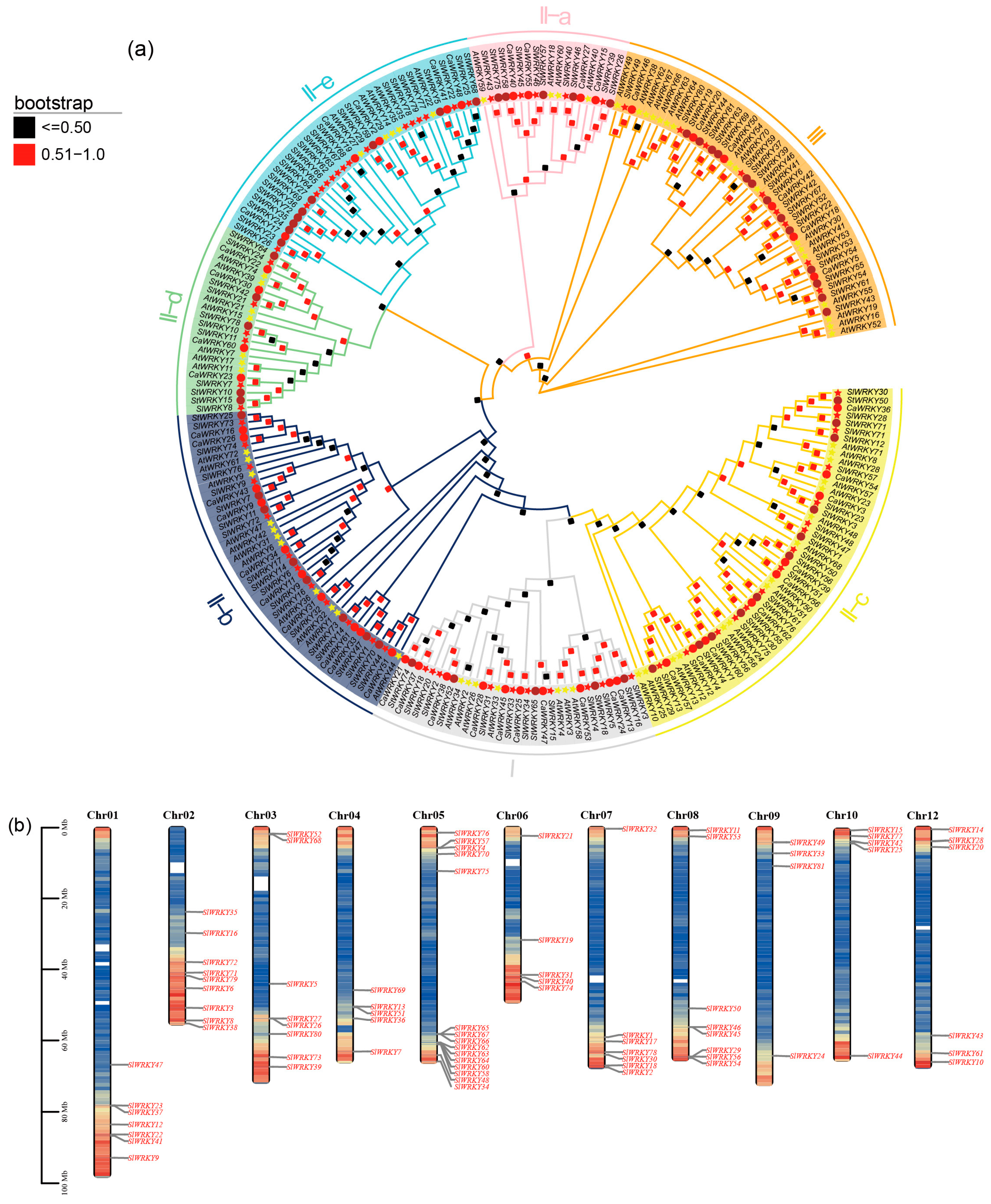
Based on domain composition and zinc finger type, WRKYs are divided into three main groups (Group I, II, III), further emphasizing their diverse roles in plant physiological functions (Figure 1a). Group I members (e.g., SlWRKY18, SlWRKY31 and SlWRKY33) contain two WRKY domains and are further subdivided into subclasses Ia (C2H2 type) and Ib (C2HC type) [38]. Group II and Group III WRKY each contain one WRKY domain; Group II carries a C2H2-type zinc finger, whereas Group III is characterized by a C2HC-type (e.g., SlWRKY41, SlWRKY53, SlWRKY80, and SlWRKY81) [28]. Notably, Group II is the most diverse clade in tomato. Based on variations in conserved domains, Group II can be traditionally subdivided into five subgroups (IIa through IIe). For example, SlWRKY39 belongs to IIa, SlWRKY13 belongs to IIc, and SlWRKY8 and SlWRKY11 belong to IId. Phylogenetically, however, these five subgroups cluster into three broader evolutionary lineages: IIa with IIb, IId with IIe, and a distinct IIc branch [28,29]. This hierarchical framework—from five structural subgroups to three phylogenetic clusters—clarifies relationships among Group II members, with subgroup IIc considered an early-diverging lineage from which the others subsequently diversified [29]. The same framework is conserved across angiosperms, facilitating functional comparisons between tomato WRKYs and orthologs in model species such as Arabidopsis [34].
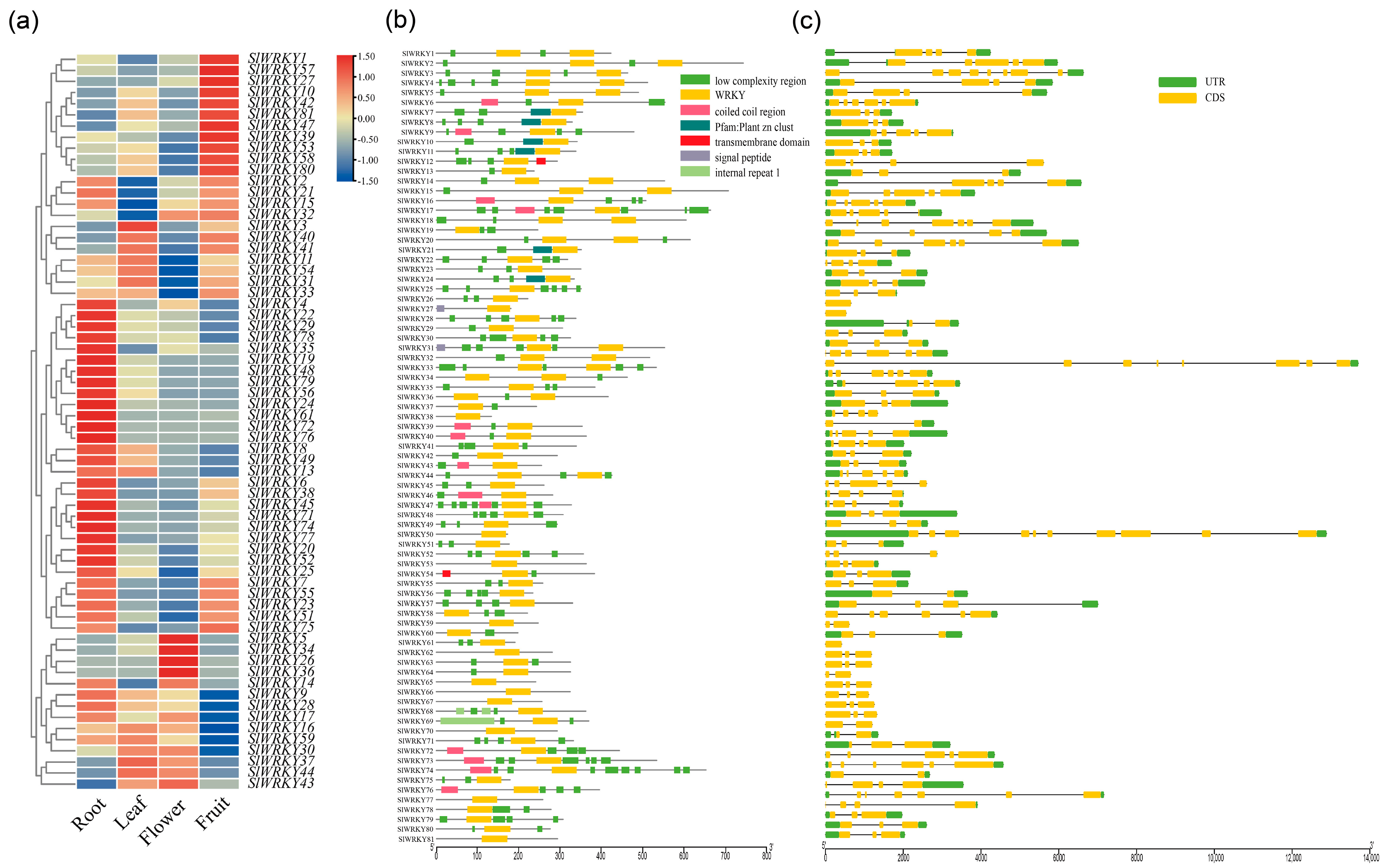
Tomato WRKY genes are unevenly distributed across 11 chromosomes (Figure 1b), and many show preferential expression in roots, consistent with the role of roots as primary sites of salt perception, ion uptake and osmotic regulation (Figure 2a) [25]. The expansion of the tomato WRKY family is mainly attributed to gene duplication events, including both segmental duplication and tandem duplication, with segmental duplication acting as the dominant driver [25].
Genome-wide analyses have revealed that the Solanum lineage shared a whole-genome triplication (WGT) event with the common eudicot ancestor, followed by a lineage-specific WGT that contributed to the expansion of many gene families, including WRKYs [25,39]. Focusing on WRKYs, evolutionary analysis has revealed that most WRKY genes in tomato and its wild relatives expanded after the Solanum-specific WGT event, approximately 70–100 million years ago [25]. Comparative synteny analysis between V. vinifera and tomato genomes indicates that approximately 48–56% of tomato WRKYs originated from this WGT event [25]. Notably, Ka/Ks analysis of tandemly duplicated WRKY pairs revealed that approximately one-third of these pairs have undergone positive selection, suggesting functional divergence following duplication, while the majority have experienced purifying selection, indicating functional conservation [25].
Comparative genomic analyses indicate that such duplication events have promoted WRKY family expansion across plant lineages, with duplicated genes frequently acquiring divergent expression patterns and stress-responsive functions. This evolutionary trajectory underpins the central roles of WRKYs in orchestrating osmotic balance, ROS scavenging and ABA-dependent signaling under environmental stresses, including salinity [26,27,30]. Consistent with their predicted roles as nuclear-localized transcription factors, most SlWRKY proteins exhibit negative GRAVY values indicative of hydrophilicity, while the wide range of instability indices suggests both stable and unstable members within the family (Table 1), reflecting potential functional diversification. However, several limitations of the current evolutionary analysis should be noted. The Ka/Ks analysis presented here is based on coding sequences and does not capture regulatory evolution in non-coding regions, which may also contribute substantially to functional divergence of duplicated WRKYs. Furthermore, whether the retained WGT-derived paralogs have undergone subfunctionalization or neofunctionalization remains largely unexplored and requires experimental validation. Additionally, the current evolutionary analysis is primarily based on tomato cultivar ‘Heinz 1706’; expansion patterns may differ in other tomato accessions or wild relatives, warranting broader sampling in future studies.

3. Functional Characterization of Core WRKY Members in Salt Stress Response

Recent functional studies in tomato have moved beyond expression profiling to provide causal evidence for the roles of specific WRKY transcription factors in salinity tolerance (Table 2). These functional analyses, mainly based on overexpression and gene silencing/knockout, demonstrate that WRKY members regulate salt tolerance through conserved physiological mechanisms, including improved growth, reduced membrane damage, enhanced antioxidant/ROS homeostasis, and increased osmotic adjustment. Similar mechanisms have been widely observed in model plants such as Arabidopsis and rice, and have been extensively summarized in recent reviews covering diverse crops including strawberry, maize, cotton, apple, peanut, soybean, and kiwifruit [40,41,42,43,44,45,46,47,48,49,50,51].
Throughout this review, “core WRKY members” refer to those with functional validation via gain-of-function (overexpression) or loss-of-function (knockout/silencing) assays showing reproducible salt-related phenotypes. Positive regulators include SlWRKY8 [52], SlWRKY36 [53], SlWRKY39 [23,24], SlWRKY42 [54,55], SlWRKY51 [53], SlWRKY79 [56], SlWRKY80 [22] and SlWRKY81 (initially named SlWRKY3 in earlier studies) [21,24,57]; while SlWRKY57 [58,59] acts as a negative regulator. Unless otherwise noted, all quantitative data cited in this section are derived from studies with at least three biological replicates and statistical significance determined at p < 0.05.
Positive regulators have been characterized mainly through overexpression approaches. For instance, under 125 mM NaCl treatment for 20 days, SlWRKY81-overexpressing plants showed 47% lower Na+, 47% higher K+ and 50% higher Ca2+ contents in leaves than wild type, together with a 40% reduction in malondialdehyde (MDA), indicating improved membrane integrity and attenuated oxidative damage [57]. Under saline–alkali conditions, SlWRKY81 also functions as a positive regulator. When exposed to 300 mM saline–alkali stress (pH 8.6 ± 0.1), SlWRKY81 overexpressing lines achieved a survival rate of 85% compared with 35% in wild-type plants, representing a 143% increase. Activities of SOD, POD and CAT increased by 40–60%, spermidine (Spd) content approximately doubled, and the Na+/K+ ratio decreased by approximately 50% [21,60]. Similarly, SlWRKY80 overexpressors showed comparable performance under saline–alkali stress [22,60]. Under salt stress, 35S::SlWRKY8 tomatoes showed alleviated wilting and chlorosis, with 2.2-fold increase in proline accumulation and a 55% decrease in MDA content relative to wild type [52]. Similarly, SlWRKY42 overexpressors displayed enhanced salt tolerance, with significantly higher proline content, elevated activities of superoxide dismutase (SOD), peroxidase (POD), and catalase (CAT), and reduced MDA levels under salt stress, whereas slwrky42 knockout mutants exhibited the opposite phenotypes [54,55]. Consistently, SlWRKY8 and SlWRKY39 have also been shown to improve salt and drought tolerance by promoting osmolyte accumulation and antioxidant defence in tomato [24,52].
Virus-induced gene silencing (VIGS) further supports the positive roles of several WRKYs. In SlWRKY36 and SlWRKY51-silenced plants exposed to 200 mM NaCl for 14 days, chlorophyll-a content decreased by 29–52%, chlorophyll-b content decreased by 39–45%, and proline content decreased by 33% compared with wild-type plants. By contrast, the Na+/K+ ratio increased by 358–642%, and transcript levels of key ion homeostasis genes (SlSOS1, SlNHX1) were reduced by 60–70% [53]. In SlWRKY79-silenced plants, ABA content was 230% higher than in control at 8 h after salt treatment, while the expression of salt tolerance-related genes SlNAM1, SlNAC1, SlWRKY23, and SlRD22 decreased by 50–80% [56]. Among these, SlWRKY36 and SlWRKY51 exhibited the most pronounced effects on ion homeostasis, with the Na+/K+ ratio increasing by 358–642% in silenced plants, whereas SlWRKY79 silencing had a stronger impact on ABA accumulation (230% increase) and the expression of downstream defense genes (50–80% reduction).
Table 2. Summary of Core Functional Information on Tomato WRKY Gene Responses to Salt Stress.
Core WRKY GeneStress Type & RegimeFunction for Resisting Salt DamageGene RegulationExperimental TechniquesLiterature Support
SlWRKY8Salt (300 mM NaCl, 7 d)Positive Binding and regulate W-Box, Upregulates SlAREB, SlRD29, SlDREB2AOE (35S), qRT-PCR, Y1H[52]
SlWRKY36
SlWRKY51
Salt (200 mM NaCl, 14 d)Positive Upregulate SlSOS1 and SlNHX1TRV-VIGS, qRT-PCR.[53]
SlWRKY39Salt (400 mM NaCl, 14 d)Positive Directly activates SlGSTU42 (with SlZF61); upregulates SlRD22.OE (35S), CRISPR/Cas9, RNA-seq, Y1H, EMSA, Dual-LUC, qRT-PCR, Y2H, BiFC, CoIP, TRV-VIGS.[23,24]
SlWRKY42Saline–alkali (300 mM, pH 8.6 ± 0.1, 8 d)Positive Directly activates SlSPDS2, SlNHX4 (with SlMYC2).OE (35S), CRISPR/Cas9, RNA-seq, Y1H, EMSA, Dual-LUC, qRT-PCR, Y2H, BiFC, CoIP, TRV-VIGS.[54,55]
SlWRKY57Salt (300 mM NaCl, 16 d)Negative SlVQ16 and SlVQ21 competitively bind to SlWRKY57 to antagonistically regulate SlRD29B, SlDREB2, and SlSOS1.OE (35S), RNAi, ChIP-qPCR, Y1H, EMSA, Dual-LUC, qRT-PCR, Y2H, BiFC, CoIP.[59]
SlWRKY79Salt (200 mM NaCl, 8 h)Positive Upregulates SlNAM1, SlNAC1, SlWRKY23, and SlRD22.VIGS, qRT-PCR.[56]
SlWRKY80
SlWRKY81
Saline–alkali (300 mM, pH 8.6 ± 0.1, 8 d)Positive Directly activate SlSPDS2, SlNHX4 and SlATG13b (with SlJZA1).OE (35S), CRISPR/Cas9, RNA-seq, Y1H, EMSA, Dual-LUC, qRT-PCR, Y2H, BiFC, CoIP, TRV-VIGS.[21,22,60]
In contrast to these positive regulators, SlWRKY57 functions as a negative regulator of salt tolerance. Overexpression of SlWRKY57 increases sensitivity to salt stress, while slwrky57 mutants exhibit enhanced tolerance, with lower Na+ accumulation and higher K+ levels than wild type under salt stress [59]. The antagonistic interplay between positive and negative WRKY regulators is essential for maintaining stress response homeostasis. While SlWRKY80 and SlWRKY81 activate polyamine biosynthesis and ion transport under salt stress, the repressor SlWRKY57 counteracts these processes by suppressing SlSOS1 and stress-responsive genes [21,22,59,60,61]. This balance is further modulated by VQ proteins: SlVQ16 enhances salt tolerance by antagonizing SlWRKY57 repression, whereas SlVQ21 promotes repression, revealing a tunable regulatory rheostat [59]. Similar activator–repressor modules have been described in other species, such as the AtWRKY18/40/60 repressor clade in Arabidopsis, which operates in parallel with activating WRKYs to fine-tune ABA and stress responses [62,63]. Negative roles of certain WRKYs in salt and drought responses have also been documented in other species. For example, overexpression of CaWRKY27 led to ABA accumulation and a decrease in salt and drought tolerance in tobacco and Arabidopsis, while some Arabidopsis WRKYs negatively regulated salt and osmotic tolerance via ABA-dependent pathways [64]. Similar repressor functions have been described for ZmWRKY114 in maize, which inhibits ABA signaling and reduces salt stress tolerance in transgenic rice [65].
Collectively, these core WRKYs coordinate multiple physiological processes, including ion homeostasis, osmolyte metabolism and redox maintenance, to confer salt tolerance. For instance, under long-term salinity, SlWRKY81 overexpressors accumulate less Na+, maintain a higher K+/Ca2+ ratio, and exhibit lower MDA levels and electrolyte leakage compared to wild-type plants, indicating enhanced membrane stability and controlled oxidative damage [57]. The field has now progressed to intensive genetic validation via overexpression and CRISPR/Cas9-mediated knockout. Under 300 mM saline–alkali conditions, SlWRKY80 and SlWRKY81 showed similarly enhanced performance, with survival rates of 85% compared with 35% in wild-type plants, linking WRKY control to broader signaling and metabolic modules, including the jasmonic acid (JA) pathway and polyamine metabolism [21,22,60].
Comparative analysis across plant species reveals both conserved and divergent functions of WRKY orthologs in salt stress responses. SlWRKY81 in tomato (initially named SlWRKY3 in earlier studies) and AtWRKY3 in Arabidopsis both function as positive regulators of salt tolerance by modulating antioxidant enzyme activities and ion homeostasis, suggesting functional conservation among WRKY3 orthologs [57,66]. By contrast, SlWRKY57 acts as a negative regulator of salt tolerance in tomato, whereas its Arabidopsis homolog AtWRKY57 positively regulates drought tolerance through ABA signaling, indicating functional divergence after speciation [59,61]. In monocot species, rice OsWRKY45 mediates salt tolerance through SA signaling, whereas tomato SlWRKY80 and SlWRKY81 function mainly through JA signaling, highlighting lineage-specific adaptations in WRKY-mediated hormone crosstalk [21,22,67].
These transgenic phenotypes establish several tomato WRKYs as “core members” with demonstrated direct action, reproducible stress phenotypes and defined downstream pathways that collectively enhance salt and saline–alkali tolerance.

4. Multilayered Regulatory Network of Tomato WRKY Family in Mediating Salt Stress Response

Tomato WRKY transcription factors orchestrate salt tolerance through a multi-tiered regulatory network. Their stress-induced expression patterns arise from direct transcriptional regulation at target promoters, integration at the protein-interaction level, and higher-order control involving chromatin modifications and post-translational regulation. Several SlWRKY genes exhibit salt-induced expression, including SlWRKY39 and a broader set comprising SlWRKY41, SlWRKY53, SlWRKY80, and SlWRKY81. Comparative evidence from other species supports a conserved role of WRKY factors in stomatal regulation and ROS homeostasis. Nevertheless, the tomato WRKY network displays pronounced interdependence among stress pathways. For instance, silencing SlWRKY23 reshapes the crosstalk between stress-response pathways, revealing a trade-off between powdery mildew resistance and salt tolerance, with disease resistance being attenuated under salt stress [68,69].

4.1. Direct Transcriptional Regulation Level

WRKY transcription factors directly activate or repress downstream target genes by binding to W-box element (core sequence (T/C)TGAC(T/C)) in promoter regions. Their targets include genes involved in osmotic adjustment, antioxidant defense, and ion homeostasis, thereby modulating the expression of salt-responsive genes and associated physiological adaptation. For example, SlWRKY42 functions as a positive regulator by directly binding to the promoters of SlNHX4 and SlSPDS2, promoting vacuolar ion compartmentalization and spermidine accumulation to enhance salt tolerance [54,55]. By contrast, some WRKYs function as transcriptional repressors. SlWRKY57 negatively regulates salt responses by suppressing the transcription of stress-responsive genes (SlRD29B and SlDREB2) and the ion homeostasis gene SlSOS1 [59].
Although transcriptional repression by WRKYs appears evolutionarily conserved, the extent of functional redundancy and target specificity differs among species. In Arabidopsis, AtWRKY18, AtWRKY40, and AtWRKY60 cooperatively repress ABI4 and ABI5 expression [63], whereas in tomato, SlWRKY57 appears to function largely independently as a repressor of SlSOS1 [59]. This suggests that while the transcriptional repressor function of specific WRKYs is conserved, their direct targets and degrees of redundancy can diverge across lineages. Moreover, direct target validation in tomato remains limited; most studies rely on yeast one-hybrid (Y1H) and electrophoretic mobility shift assay (EMSA), with relatively few employing chromatin immunoprecipitation sequencing (ChIP-seq) for genome-wide target identification. This methodological gap increases the risk of false positives and highlights the need for more comprehensive in vivo validation.
The opposing activities of activating and repressing WRKYs, together with the context-dependent behavior of factors such as SlWRKY57, underscore the sophisticated regulatory logic that fine-tunes downstream modules controlling osmotic adjustment, antioxidant capacity, and ion transport.

4.2. Protein–Protein Interactions and Signal Integration

WRKY function extends beyond direct DNA binding to encompass protein–protein interaction networks that integrate salt signals with hormone pathways and other stress response circuits. The competitive binding of VQ motif proteins provides a clear example in tomato: SlWRKY57 interacts with SlVQ16 and SlVQ21, which antagonistically regulate salt tolerance by differentially modulating the transcriptional repressor activity of SlWRKY57 [59]. These interactions have been validated by yeast two-hybrid (Y2H), luciferase complementation imaging (LCI) assays and Pull-down assays. The WRKY–VQ module appears to be evolutionarily conserved, with analogous pairs reported in Arabidopsis (AtWRKY8–AtVQ9) [70] and rice (OsWRKY10–OsVQ8) [71,72]. However, the functional output of these interactions can differ: in tomato, SlWRKY57 is a repressor whose activity is antagonistically modulated by SlVQ16 (enhancing salt tolerance) and SlVQ21 (reducing salt tolerance), whereas in Arabidopsis, the AtWRKY8–AtVQ9 complex attenuates WRKY8 DNA-binding activity [70]. These contrasts suggest that, although the physical interaction module is conserved, the associated regulatory logic has diversified during evolution. This module is further connected to JA signaling through interactions with jasmonate ZIM-domain (JAZ) repressors, forming a key intersection node at which salt-stress signals converge with hormone pathways [59,61].
A broader hormone-integration framework is built around SlWRKY80 and SlWRKY81, which are induced by both salt stress and JA. These factors interact with SlJAZ1 repressors; upon JA accumulation, SlJAZ1 is degraded, releasing SlWRKY80 and SlWRKY81 to directly activate downstream targets such as SlSPDS2, SlNHX4, and SlATG13b, thereby coordinating spermidine synthesis, ion homeostasis, and autophagy [21,22,60]. In parallel, SlWRKY42 forms a functional module with SlMYC2 to activate SlSPDS2, further integrating JA and polyamine pathways [55]. Additionally, SlWRKY33 links ethylene and Ca2+ signaling through W-box-dependent activation of downstream genes, enhancing antioxidant capacity and ion balance [73]. Consistent with findings in other species, the core JA-signaling architecture is conserved across multiple plant lineages [74]. In Arabidopsis, AtMYC2 regulates AtWRKY18, AtWRKY40, and AtWRKY60 to mediate JA responses [75]. In tomato, while SlMYC2 directly partners with SlWRKY42, the paralogous SlWRKY80/81 appear to be primarily regulated through direct JAZ interaction rather than through SlMYC2, suggesting functional diversification within the family.
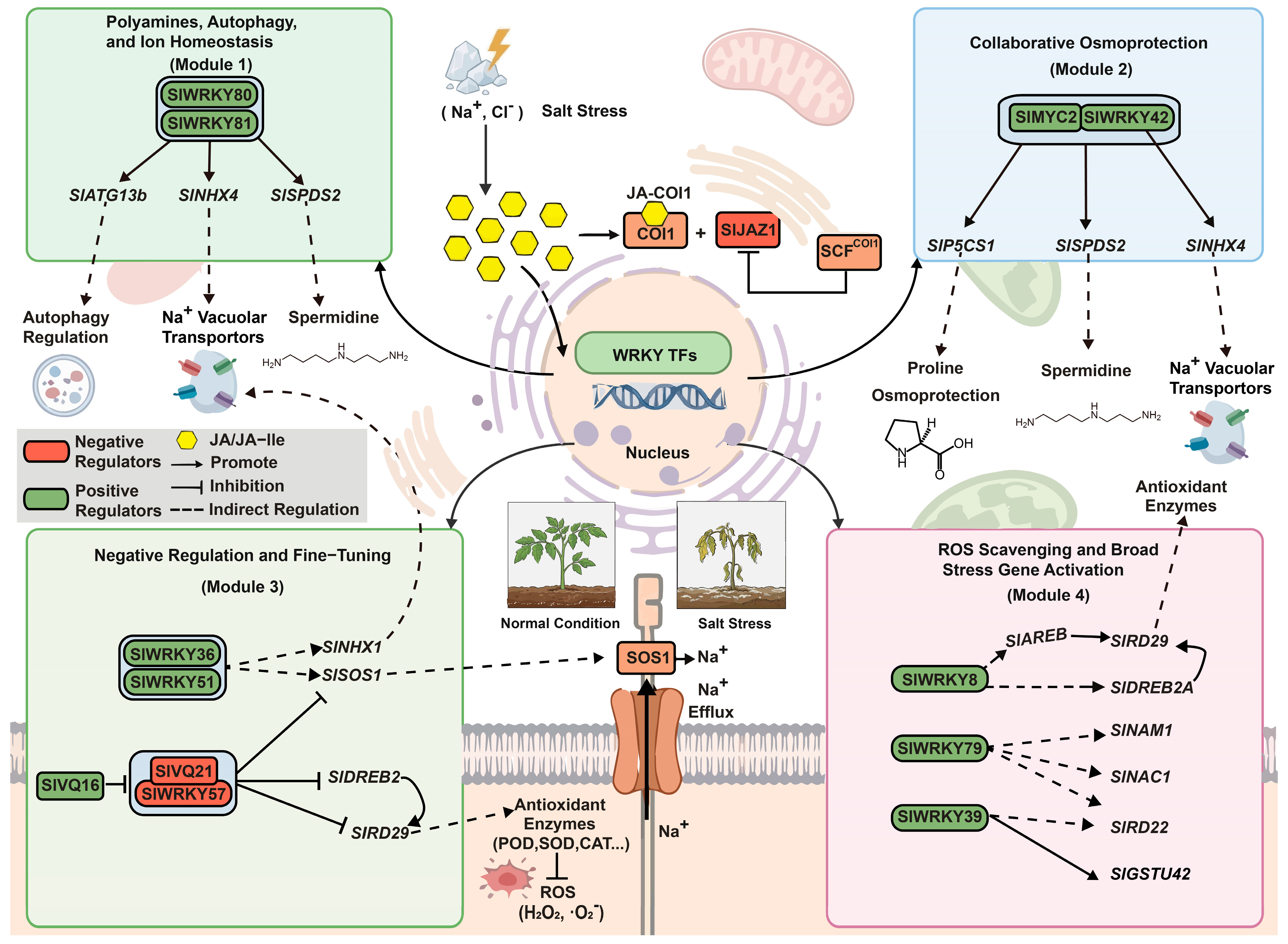
JA-mediated derepression of the WRKY network functions as a central molecular switch that activates a multi-branched regulatory program. As illustrated in Figure 3, this process can be resolved into several coordinated functional modules that collectively orchestrate physiological adaptation to salt stress. Under non-stress conditions, basal expression of stress-responsive genes is maintained by SlJAZ repressors, which physically interact with and inhibit multiple positive regulators (e.g., SlWRKY80, SlWRKY81, SlMYC2) while simultaneously sequestering negative regulators (e.g., SlWRKY57) [22,59,60]. Upon exposure to salt stress, endogenous JA and its active conjugate jasmonoyl-isoleucine (JA-Ile) accumulate, triggering SCFCOI1-dependent ubiquitination and subsequent degradation of SlJAZ proteins via the 26S proteasome [76]. This degradation event serves as a key switch, releasing multiple transcription factors that initiate distinct adaptive modules.
Module 1 (Polyamines, Autophagy, and Ion Homeostasis): Degradation of SlJAZ1 releases SlWRKY80 and SlWRKY81, which directly bind W-box elements in the promoters of SlSPDS2 and SlNHX4, thereby upregulating these genes to promote spermidine (Spd) biosynthesis and vacuolar Na+ sequestration, respectively. In addition, SlWRKY80 and SlWRKY81 cooperatively activate the autophagy-related gene SlATG13b, inducing autophagosome formation to remove damaged organelles and recycle nutrients, thus maintaining cellular homeostasis [21,22,60].
Module 2 (Collaborative Osmoprotection): Release of SlMYC2, together with salt-induced upregulation of SlWRKY42, forms a collaborative regulatory module. Both transcription factors bind to the SlSPDS2 promoter, further enhancing Spd accumulation. SlWRKY42 also directly targets SlP5CS1 to stimulate proline biosynthesis as an osmoprotectant, and SlNHX4 to optimize the Na+/K+ ratio [54,55].
Module 3 (Negative Regulation and Fine-Tuning): To prevent overactivation of stress responses, JA-mediated degradation of SlJAZs also liberates the transcriptional repressor SlWRKY57. SlWRKY57 dampens salt tolerance by repressing stress-responsive genes (SlRD29B, SlDREB2) and the plasma membrane Na+ efflux transporter gene SlSOS1. Its repressor activity is finely tuned by SlVQ16 and SlVQ21, which competitively interact with SlWRKY57 to modulate its inhibitory strength, ensuring an appropriately balanced response [59]. Furthermore, SlWRKY36 and SlWRKY51 act as key positive regulators that protect photosynthetic machinery, modulate proline levels, and activate SlSOS1 and SlNHX1 to maintain systemic ion homeostasis [53].
Module 4 (ROS Scavenging and Broad Stress Gene Activation): Additional WRKY factors are recruited to bolster broad-spectrum tolerance. SlWRKY8 promotes expression of SlAREB, SlDREB2A, and SlRD29, leading to upregulation of antioxidant enzymes, including peroxidase (POD), superoxide dismutase (SOD), and catalase (CAT), which collectively mitigate ROS damage. Similarly, SlWRKY39 and SlWRKY79 enhance expression of downstream protective genes such as SlRD22, SlNAM1, SlNAC1, and SlWRKY23, contributing to proline accumulation and reduced malondialdehyde (MDA) levels [24,52,56,69].
In summary, JA-mediated derepression of the WRKY network under salt stress orchestrates a highly coordinated physiological defense system. By precisely balancing the activities of positive activators and targeted repressors, WRKY-centered modules synergistically promote osmoprotection [77], maintain Na+/K+ homeostasis, and limit oxidative damage, thereby supporting whole-plant survival and performance under high-salinity conditions.

4.3. Epigenetic and Post-Translational Regulation

Higher-order regulatory mechanisms, including epigenetic modifications and post-translational modifications (PTMs), represent a critical third layer of control that determines the duration, spatial distribution, and intensity of WRKY modules under salt stress [10,78]. Comparative gene regulatory network (GRN) analyses across land plants have revealed that WRKY transcription factors, particularly those belonging to subgroups IIb and III, serve as evolutionarily conserved central nodes in salt-responsive transcriptional networks, with their hierarchical feedback loops being maintained from early-diverging plants such as Marchantia polymorpha to angiosperms like Arabidopsis thaliana [79]. Studies in diverse plant systems demonstrate that WRKY activity is dynamically regulated by phosphorylation, typically mediated by kinases such as mitogen-activated protein kinases (MAPKs) and SNF1-related protein kinase 2 (SnRK2), as well as by ubiquitination-mediated turnover [80,81,82]. These PTMs can modulate WRKY DNA-binding activity, cofactor recruitment, nuclear residence time, and protein stability, thereby providing spatial and temporal precision to downstream gene regulation under saline condition. In tomato, direct evidence for such PTM-based mechanisms is emerging but remains limited; most inferences are currently extrapolated from conserved functions described in other species.
Phosphorylation of WRKYs by MAPKs has been extensively characterized in several model plants: in Arabidopsis, MPK3/MPK6 phosphorylate AtWRKY33 to promote camalexin biosynthesis [82]; in rice, OsMPK6 phosphorylates OsWRKY67 to regulate phytoalexin accumulation [83]; and in tobacco, SIPK phosphorylates NtWRKY1 to enhance DNA-binding activity [84]. In tomato, several SlWRKY proteins harbor putative MAPK phosphorylation motifs, but direct biochemical validation of these modifications is still lacking. Similarly, ubiquitination-mediated WRKY degradation is well documented in Arabidopsis (e.g., CHYR1-AtWRKY70) [81] and rice (OsREIW1-OsWRKY31-OsMKK10-2) [85], whereas comparable evidence in tomato is scarce. Collectively, these findings suggest that PTM-based regulation is likely to play an important role in tuning tomato WRKY function, but systematic experimental confirmation remains a priority.
A key gap in current knowledge is whether DNA methylation at WRKY loci is dynamically and reversibly modulated by salinity, thereby acting as an upstream “gain control” on WRKY transcriptional responsiveness. We propose a testable hypothesis: salt stress might induce locus-specific methylation or demethylation at WRKY promoters or at promoters of key downstream targets (e.g., ion transporter genes or osmolyte pathway genes). Such epigenetic changes would alter local chromatin accessibility, shift W-box availability, and consequently reshape WRKY binding and transcriptional output. In support of the broader concept that promoter methylation at WRKY loci can tune stress-related phenotypes, a study in rice showed that DNA hypermethylation at the OsWRKY72 promoter suppresses its expression and increases susceptibility to bacterial blight [86]. Although this example involves biotic rather than salt stress, it illustrates how locus-specific methylation at WRKY promoters can reprogram defense outputs. Whether analogous methylation dynamics occur at tomato WRKY loci under salt stress remains unexplored and warrants investigation. Resolving this hypothesis will require experimental designs that capture spatiotemporal dynamics (cell- and tissue-specificity, and early versus late stress phases) and that directly connect methylation states to WRKY occupancy, target gene expression kinetics, and phenotypic outcomes. Targeted perturbation approaches, such as promoter-focused methylation editing, could determine whether methylation changes act merely as correlative stress marks or as causal switches that reprogram WRKY network behavior under saline–alkali conditions.
A second priority is the systematic dissection of PTMs that fine-tune the functional properties of WRKY proteins, particularly with respect to stability, nuclear localization, and promoter residence time during salt stress. Ubiquitination appears to be a major determinant of WRKY protein turnover, and crosstalk between acetylation and ubiquitination may function as a regulatory rheostat controlling WRKY half-life and nuclear accumulation [81,87]. The functional interplay between acetylation and WRKY activity is exemplified by the Arabidopsis HDA9-WRKY53 module, where HDA9 directly deacetylates WRKY53 to repress its transcriptional activity, while WRKY53 reciprocally inhibits HDA9 deacetylase function, forming a mutually antagonistic regulatory loop that fine-tunes stress responses [88]. Beyond acetylation and ubiquitination, emerging evidence from other plant species suggests that additional PTMs—such as SUMOylation and phosphorylation-dependent ubiquitination—may also contribute to WRKY functional regulation, although their roles in tomato remain to be determined [88,89]. Moving the field forward will require systematic mapping of stress-responsive modification sites in tomato WRKYs by mass spectrometry-based phosphoproteomics and ubiquitinomics, followed by identification of the responsible modifying enzymes. Emerging phosphoproteomic and ubiquitinomic approaches are now available to systematically map stress-responsive modification sites in tomato, offering a promising avenue to dissect PTM regulation of WRKY proteins. Functional validation using modification-deficient or stabilization variants could quantify how PTMs alter WRKY DNA-binding behavior, cofactor recruitment [89], and degradation kinetics in vivo, and thereby support predictive models that link WRKY proteostasis to specific salt-tolerance outputs, including ion homeostasis, ROS detoxification, and osmotic adjustment.
Future work may focus on network-based target prioritization and inducible or organ-specific control strategies to minimize pleiotropic effects. Despite these challenges, realistic validation of complex stress scenarios in horticultural settings can help translate mechanistic insights into robust molecular breeding strategies for improved salt tolerance.

5. Challenges and Prospects: Pathways Toward Precision Salt-Tolerant Breeding

Current research has firmly established that WRKY transcription factors play multidimensional and dynamic regulatory roles in salt stress responses. However, several critical challenges remain in translating this mechanistic knowledge into breeding-relevant outcomes. While individual WRKY genes have been functionally characterized, the cooperative, competitive, and cascade activation mechanisms operating within the multi-member WRKY family remain poorly understood [90]. Most existing studies are limited to functional validation of single genes, they have not deeply explored these intricate intra-family interactions, leading to a gap in understanding the dynamic regulatory logic of tomato WRKY-centered stress networks.
For instance, ABA-induced SnRK2-type kinase SAPK10 has been reported to phosphorylate WRKY72 at Thr129, weakening its DNA-binding capacity and potentially releasing repression of AOS1 and JA biosynthesis [86]. Nevertheless, studies on such post-translational regulatory mechanisms remains scarce. Moreover, salt stress under natural conditions is rarely a simple NaCl toxicity problem. In realistic soil environments, salt stress is often accompanied by complex stress factors such as high pH and sulfate ions. These co-occurring stressors may reshape WRKY regulatory networks and thereby modulate response efficiency. Despite these critical observations, most current studies still rely on pure NaCl treatments and lack simulations of the complex saline–alkali field conditions.
Both drought and high salinity impose severe osmotic stress on plants. Consequently, WRKY genes that function in osmotic stress responses may also contribute to salt tolerance. For example, SlWRKY23 expression is strongly induced by both mannitol and NaCl. Its overexpression in transgenic plants enhances tolerance to osmotic and salt stresses by integrating auxin and ethylene signaling; thereby maintaining membrane integrity, limiting electrolyte leakage, and promoting lateral root proliferation [69]. Similarly, SlWRKY8 acts as a pleiotropic positive regulator of drought and salinity tolerance. Plants overexpressing SlWRKY8 exhibit attenuated oxidative damage—as reflected by reduced hydrogen peroxide and MDA levels—coupled with the accumulation of osmoprotectants such as proline and targeted upregulation of key stress-responsive genes, including SlAREB and SlDREB2A [52]. Furthermore, osmotic homeostasis critically depends on efficient ROS scavenging and rapid hormone signaling. Examples include SlWRKY6, which drives ABA-dependent stomatal closure and reinforces antioxidant defenses [87,91]. Another example is the SlWRKY16-CIP2b-SlSYP121 regulatory module, which finely adjusts cellular ROS homeostasis [92].
To overcome current limitations and enable precision breeding for salt tolerance, future research should adopt integrated strategies that bridge molecular dissection with translational application.
First, systems biology approaches are needed to unravel the complexity of WRKY-centered regulatory networks. Traditional single-gene approaches have yielded valuable insights but cannot capture emergent properties arising from multi-gene interactions. Integrative multi-omics analyses—combining transcriptomics, proteomics, metabolomics, and chromatin accessibility profiling (e.g., assay for transposase-accessible chromatin using sequencing (ATAC-seq))—offer powerful means to construct gene regulatory networks (GRNs) that identify hub WRKYs and elucidate their hierarchical relationships with downstream targets [79]. Time-series transcriptomic analyses under salt stress can further clarify the temporal dynamics of WRKY cascade activation [89]. In parallel, emerging deep learning approaches—including convolutional neural networks and transformer-based models trained on multi-omics datasets—offer powerful tools to predict cis-regulatory element function and transcription factor binding dynamics, thereby accelerating the construction of predictive GRNs and reducing the need for exhaustive experimental screens [93,94,95]. For example, deep learning models such as Dbert2_LR have recently been developed to accurately classify promoters, enhancers, and non-regulatory sequences in plant genomes, and in silico saturation mutagenesis analysis confirmed that model predictions depend on known transcription factor binding motifs, revealing biological interpretability [93,94]. Such AI-guided strategies hold promises to prioritize high-confidence regulatory interactions for targeted manipulation in tomato.
Second, systematic characterization of WRKY family interactions must move beyond single-gene studies. The functional redundancy and cooperativity among WRKY members cannot be fully resolved through individual overexpression or knockout studies [90]. Synthetic biology approaches, such as constructing combinatorial overexpression libraries or multiplex CRISPR-Cas9 editing, offer a path forward. Generating double or triple knockout combinations of phylogenetically related WRKYs would help elucidate functional redundancy, while inducible overexpression systems could reveal temporal hierarchies in WRKY cascade activation. Encouragingly, recent studies have demonstrated the feasibility of multi-gene engineering in tomato: co-overexpression of SlWRKY80 and SlWRKY81 conferred additive enhancement of salt tolerance [21,22,60]. Beyond tomato, the rice WRKY gene OsWRKY36 provides a compelling example of a single WRKY knockout simultaneously enhancing broad-spectrum resistance to multiple pests and pathogens while also increasing grain yield through upregulation of IPA1 and MOC2, as demonstrated by multi-year field trials [77]. This example illustrates the potential of WRKY-centered multi-trait engineering, though systematic stacking of multiple WRKYs or combinatorial approaches with other transcription factors remains to be explored in tomato [90]. Taken together, these systematic approaches are essential for understanding how WRKY networks achieve both robustness and flexibility in stress responses.
Third, bridging the gap between controlled-environment findings and field applications is critical. The predominant reliance on single-factor NaCl treatments, while valuable for mechanistic dissection, does not fully reflect the complexity of natural saline–alkali soils, which often combine high pH, ion imbalance, and nutrient deficiency. Controlled-environment platforms capable of simulating such composite stresses, followed by multi-location field trials on naturally saline–alkali soils, are essential to evaluate the translational potential of WRKY-based strategies. Although field-validated salt-tolerant tomato cultivars derived specifically from WRKY engineering are not yet widely reported, the rice examples demonstrate that WRKY-mediated field performance is achievable, providing a template for tomato. The rice OsWRKY36 knockout line has been evaluated in multi-year field trials and shown to maintain or increase grain yield while conferring broad-spectrum disease and pest resistance, demonstrating that WRKY-mediated traits can translate to field performance [77]. Similarly, natural allelic variation in OsWRKY53 has been associated with heat tolerance and is being exploited in rice breeding programs [47]. The transition from controlled-environment validation to field testing remains a critical bottleneck in translating molecular insights into practical breeding outcomes. Future efforts should prioritize multi-location field trials under naturally saline–alkali conditions to assess agronomic performance, yield stability, and potential trade-offs, thereby establishing a robust pipeline for WRKY-based variety development. These trials should prioritize yield- and quality-related traits to determine whether promising phenotypes observed in growth chambers translate into stable performance under agronomic conditions.
Finally, the development of precision breeding tools must be grounded in rigorously validated molecular targets. Epigenetic marker-assisted selection (epi-MAS) could become a viable strategy if and when DNA methylation marks associated with stable, high-level expression of key SlWRKY genes under stress are identified by whole-genome bisulfite sequencing (WGBS) in relevant tomato germplasm [96]. Similarly, targeted genome editing via CRISPR-Cas9 provides a precise approach to engineer WRKY promoter regions or coding sequences to enhance stress-responsive expression or modulate protein function. In tomato, CRISPR/Cas9 has been successfully applied to edit SlWRKY42 [54,55], and SlWRKY80/81 [21,22,60], demonstrating the feasibility of WRKY-targeted genome editing. Extending these efforts to promoter editing for fine-tuning expression, as demonstrated in other crops [97,98,99], offers a technical roadmap for WRKY-centered precision breeding. By contrast, technologies such as nanocarrier-mediated dsRNA delivery and epigenome editing [99], while promising, remain at an early stage for crop improvement and will require rigorous safety evaluation and substantial technical development before deployment in breeding programs.
Looking forward, integrating multi-omics datasets including ChIP-seq, ATAC-seq, and N6-methyladenosine sequencing (m6A-seq) datasets, will be essential to construct a three-dimensional regulatory atlas that links WRKY target loci, chromatin accessibility, and RNA modifications. Such integration has the potential to reveal the spatiotemporal dynamics of WRKY networks under salt stress. By prioritizing these interconnected research directions and anchoring future work in validated methodologies, the field can accelerate the translation of WRKY-centered mechanistic insights into durable, field-verified salt tolerance and yield stability in tomato.

6. Conclusions

Soil salinization is a major abiotic constraint on global agricultural sustainability, severely limiting tomato yield and quality. As central regulatory hubs in plant stress-response networks, WRKY transcription factors play pivotal roles in tomato responses to salt stress. The WRKY family has undergone functional diversification through tandem and whole-genome duplication, providing the genetic basis for tomato adaptation to saline environments.
A growing body of evidence has established that tomato WRKYs govern salt stress responses through multiple regulatory routes: direct transcriptional activation of target genes involved in ion homeostasis (e.g., SlNHX4, SlSOS1) and polyamine metabolism (e.g., SlSPDS2), protein–protein interactions with JAZ and VQ partners, and integration with JA, ABA and SA signaling pathways. Functionally characterized WRKYs—including SlWRKY8, SlWRKY36, SlWRKY39, SlWRKY42, SlWRKY51, SlWRKY79, SlWRKY80 and SlWRKY81 as positive regulators, and SlWRKY57 as a negative regulator—collectively coordinate ion homeostasis, osmolyte accumulation and redox balance under salt stress.
Despite these advances, critical knowledge gaps remain. Most studies have focused on single genes under simplified NaCl treatments, leaving the cooperative and competitive interactions among WRKY family members largely unexplored. Post-translational regulations (e.g., phosphorylation, ubiquitination) and epigenetic control of tomato WRKYs are poorly understood, and the translation of laboratory findings to field performance under complex saline–alkali conditions has yet to be demonstrated.
To bridge these gaps, future research should pursue four interconnected priorities, organized from fundamental dissection to translational application:
(i) Systems-level network reconstruction and AI-guided prediction. Integrative multi-omics analyses (transcriptomics, proteomics, chromatin accessibility profiling) should be employed to construct hierarchical WRKY-centered gene regulatory networks and identify temporal cascades activated under salt stress. In parallel, machine learning approaches—including deep learning models trained on multi-omics datasets—can be leveraged to predict cis-regulatory element function, transcription factor binding dynamics, and even prioritize WRKY targets for genome editing [93,94,95]. Such AI-guided strategies hold promises to accelerate the discovery of high-confidence regulatory interactions and reduce the need for exhaustive experimental screens.
(ii) Systematic dissection of WRKY family interactions. Combinatorial overexpression libraries and multiplex CRISPR-Cas9 editing (e.g., double or triple knockouts of phylogenetically related WRKYs) are needed to resolve functional redundancy, cooperativity, and cascade logics. Encouragingly, co-overexpression of SlWRKY80 and SlWRKY81 has been shown to confer additive salt tolerance in tomato [21,22,60], demonstrating the feasibility of multi-gene engineering.
(iii) Field validation under realistic saline–alkali conditions. Multi-location trials on naturally saline–alkali soils are essential to assess agronomic performance, yield stability and potential trade-offs of WRKY-engineered lines. Although tomato WRKY-based salt-tolerant cultivars are not yet field-validated, rice examples (OsWRKY36, OsWRKY53) provide a roadmap, demonstrating that WRKY-mediated traits can translate to field performance [47,77].
(iv) Precision breeding tool development. Validated targets should be exploited for CRISPR-mediated promoter editing (e.g., of SlWRKY80/81) and, when applicable, epigenetic marker-assisted selection. Cross-species knowledge and standardized nomenclature will facilitate multi-gene pyramiding and cooperative improvement strategies.
By pursuing these priorities in an integrated manner—from AI-guided network prediction to systematic gene editing, field validation, and precision breeding—the field can accelerate the translation of WRKY-centered mechanistic insights into durable salt tolerance and yield stability in tomato, contributing to sustainable production on salt-affected soils.

Author Contributions

Conceptualization, X.H. and C.S.; methodology, R.M.; software, X.R.; investigation, X.R.; resources, Q.L.; writing—original draft preparation, X.R. and R.M.; writing—review and editing, X.R. and X.H.; visualization, X.R.; supervision, Y.P.; funding acquisition, Y.P. and X.H. All authors have read and agreed to the published version of the manuscript.

Funding

Thank for the funding from National Natural Science Foundation of China (No. 32172597), the Chongqing Science Foundation (CSTB2024NSCQ-MSX1283), Fundamental Research Funds for the Central Universities (No. SWU-KF25027) and National-level College Students’ Innovation and Entrepreneurship Training Program (S202510635133).

Data Availability Statement

The original contributions presented in this study are included in the article. Further inquiries can be directed to the corresponding authors.

Conflicts of Interest

The authors declare no conflict of interest.

References

  1. Food and Agriculture Organization of the United Nations (FAO). Global Status of Salt-Affected Soils—Main Report; FAO: Rome, Italy, 2024. [Google Scholar] [CrossRef] [Scilit]
  2. Tedeschi, A.; Xue, X. Crop Response to soil and water salinity. Soil Syst. 2025, 9, 27. [Google Scholar] [CrossRef] [Scilit]
  3. Ben-Asher, J.; Beltrao, J.; Bekmirzaev, G.; Panagopoulos, T. Crop response to combined availability of soil water and its salinity level: Theory, experiments and validation on golf courses. Agronomy 2021, 11, 2012. [Google Scholar] [CrossRef] [Scilit]
  4. Zhang, Y.; Hu, X.H.; Shi, Y.; Zou, Z.R.; Yan, F.; Zhao, Y.Y.; Zhang, H.; Zhao, J.Z. Beneficial role of exogenous spermidine on nitrogen metabolism in tomato seedlings exposed to saline-alkaline stress. J. Am. Soc. Hortic. Sci. 2013, 138, 38–49. [Google Scholar] [CrossRef] [Scilit]
  5. Wei, X.L.; Xu, C.T.; Pu, X.J.; Wang, J.; Wang, W. Analysis of saline-alkali land improvement based on big data mining. Pol. J. Environ. Stud. 2025. [Google Scholar] [CrossRef] [Scilit]
  6. Lentini, M.; Ciriello, M.; Rouphael, Y.; Carillo, P.; Fusco, G.M.; Pagliaro, L.; Vaccari, F.P.; De Pascale, S. Mitigating Salt stress with biochar: Effects on yield and quality of dwarf tomato irrigated with brackish water. Plants 2024, 13, 2801. [Google Scholar] [CrossRef] [Scilit] [PubMed]
  7. Mao, P.L.; Zhang, Y.; Cao, B.; Guo, L.; Shao, H.; Cao, Z.; Jiang, Q.; Wang, X. Effects of salt stress on eco-physiological characteristics in based on salt-soil rhizosphere. Sci. Total Environ. 2016, 568, 118–123. [Google Scholar] [CrossRef] [Scilit]
  8. Zhao, H.L.; Wang, Y.; Li, J.; Hu, X.; Zhao, Y.; Guo, X.; Gan, G.Y. Straw plus straw interlayer alter soil organic carbon and bacterial community in a saline-alkali soil from the Yellow River Delta. Soil Tillage Res. 2026, 259, 107088. [Google Scholar] [CrossRef] [Scilit]
  9. Wang, J.R.; Zhang, Y.; Wang, J.; Ma, F.; Wang, L.; Zhan, X.; Li, G.; Hu, S.; Khan, A.; Dang, H.; et al. Promoting γ-aminobutyric acid accumulation to enhances saline-alkali tolerance in tomato. Plant Physiol. 2024, 196, 2089–2104. [Google Scholar] [CrossRef] [Scilit]
  10. Zhou, Z.P.; Zhang, J.; Li, W.; Yin, F.; Wen, Y.; Javed, T.; Pei, D.; Wang, Z. Optimizing processing tomato yield and quality in arid saline-alkali fields through appropriate fulvic acid application combined with aerated irrigation: Regulate water, salt, and gas environment and enhance photosynthetic capacity. Irrig. Sci. 2025, 44, 10. [Google Scholar] [CrossRef] [Scilit]
  11. Zhang, Z.X.; Hao, L.; Li, W.; Wang, Y. New Advances in the molecular mechanisms of transcription factors and plant hormones involved in the regulation of salt stress responses. J. Agric. Food Chem. 2026, 74, 3267–3282. [Google Scholar] [CrossRef] [Scilit]
  12. Mahajan, M.; Poor, P.; Kaur, H.; Aher, R.R.; Palakolanu, S.R.; Khan, M.I.R. Salt stress tolerance and abscisic acid in plants: Associating role of plant growth regulators and transcription factors. Plant Physiol. Biochem. 2025, 228, 110303. [Google Scholar] [CrossRef] [Scilit]
  13. Ghosh, P.; Roychoudhury, A. Molecular basis of salicylic acid-phytohormone crosstalk in regulating stress tolerance in plants. Braz. J. Bot. 2024, 47, 735–750. [Google Scholar] [CrossRef] [Scilit]
  14. Xu, S.Z.; Zhang, Z.; Zhou, J.; Han, X.; Song, K.; Gu, H.; Zhu, S.; Sun, L. Comprehensive analysis of NAC genes reveals differential expression patterns in response to Pst DC3000 and their overlapping expression pattern during PTI and ETI in tomato. Genes 2022, 13, 2015. [Google Scholar] [CrossRef] [Scilit]
  15. Li, N.; Lu, F.; Kuai, B.K. SlERF.D2-mediated antagonism between ethylene and ABA signaling pathways modulates osmotic stress adaptation in tomato. Hortic. Res. 2026, 13, uhaf267. [Google Scholar] [CrossRef] [Scilit]
  16. Wagan, S.; Ali, M.; Khoso, M.A.; Alam, I.; Dinislam, K.; Hussain, A.; Brohi, N.A.; Manghwar, H.; Liu, F. Deciphering the role of WRKY transcription factors in plant resilience to alkaline salt stress. Plant Stress 2024, 13, 100526. [Google Scholar] [CrossRef] [Scilit]
  17. Wang, X.P.; Niu, Y.L.; Zheng, Y. Multiple functions of MYB transcription factors in abiotic stress responses. Int. J. Mol. Sci. 2021, 22, 6125. [Google Scholar] [CrossRef] [Scilit]
  18. Yang, R.C.; Liu, J.; Lin, Z.; Sun, W.; Wu, Z.; Hu, H.; Zhang, Y. ERF transcription factors involved in salt response in tomato. Plant Growth Regul. 2018, 84, 573–582. [Google Scholar] [CrossRef] [Scilit]
  19. Wang, Y.X.; Xu, J.H. The heat shock transcription factors regulate response mechanisms to abiotic stresses in plants. Crop Des. 2025, 4, 100109. [Google Scholar] [CrossRef] [Scilit]
  20. Eulgem, T.; Rushton, P.J.; Robatzek, S.; Somssich, I.E. The WRKY superfamily of plant transcription factors. Trends Plant Sci. 2000, 5, 199–206. [Google Scholar] [CrossRef] [Scilit]
  21. Shang, C.Y.; Liu, X.; Chen, G.; Zheng, H.; Khan, A.; Li, G.; Hu, X. SlWRKY80-mediated jasmonic acid pathway positively regulates tomato resistance to saline-alkali stress by enhancing spermidine content and stabilizing Na+/K+ homeostasis. Hortic. Res. 2024, 11, uhae028. [Google Scholar] [CrossRef] [Scilit] [PubMed]
  22. Shang, C.Y.; Liu, X.; Chen, G.; Li, G.; Hu, S.; Zheng, H.; Ge, L.; Long, Y.; Wang, Q.; Hu, X. SlWRKY81 regulates Spd synthesis and Na+/K+ homeostasis through interaction with SlJAZ1 mediated JA pathway to improve tomato saline-alkali resistance. Plant J. 2024, 118, 1774–1792. [Google Scholar] [CrossRef] [Scilit] [PubMed]
  23. Sun, X.C.; Gao, Y.F.; Li, H.R.; Yang, S.Z.; Liu, Y.S. Over-expression of SlWRKY leads to enhanced resistance to multiple stress factors in tomato. J. Plant Biol. 2015, 58, 52–60. [Google Scholar] [CrossRef] [Scilit]
  24. Kang, Z.; Meng, X.; Zhang, Y.; Li, Y.; Jiang, L.; Zheng, H.; Liu, X.; Wang, J.; Hu, X. The SlWRKY39-SlZF61 module synergistically regulates SlGSTU42 to enhance low-temperature tolerance in tomato. Plant J. 2025, 124, e70632. [Google Scholar] [CrossRef] [Scilit] [PubMed]
  25. Liu, G.; Zhang, D.Y.; Zhao, T.T.; Yang, H.H.; Jiang, J.B.; Li, J.F.; Zhang, H.; Xu, X.Y. Genome-wide analysis of the WRKY gene family unveiling evolutionary history and expression characteristics in tomato and its wild relatives. Front. Genet. 2022, 13, 962975. [Google Scholar] [CrossRef] [Scilit]
  26. Chen, X.J.; Zhang, T.; Wang, H.; Zhao, W.; Guo, Z. Transcription factor WRKY complexes in plant signaling pathways. Phytopathol. Res. 2025, 7, 54. [Google Scholar] [CrossRef] [Scilit]
  27. Wang, D.J.; Zhang, R.; Zou, W.; Zhang, Y.; Zhao, W.; Sun, T.; Wu, Q.; Fu, Z.Q.; Que, Y. WRKY transcription factors: Integral regulators of defence responses to biotic stress in crops. Plant Biotechnol. J. 2026. Epub ahead of printing. [Google Scholar] [CrossRef] [Scilit]
  28. Bai, Y.L.; Sunarti, S.; Kissoudis, C.; Visser, R.G.F.; van der Linden, C.G. The role of tomato WRKY genes in plant responses to combined abiotic and biotic stresses. Front. Plant Sci. 2018, 9, 801. [Google Scholar] [CrossRef] [Scilit]
  29. Song, A.P.; Li, P.; Jiang, J.; Chen, S.; Li, H.; Zeng, J.; Shao, Y.; Zhu, L.; Zhang, Z.; Chen, F. Phylogenetic and transcription analysis of chrysanthemum WRKY transcription factors. Int. J. Mol. Sci. 2014, 15, 14442–14455. [Google Scholar] [CrossRef] [Scilit]
  30. Wang, W.J.; Cao, H.; Wang, J.; Zhang, H. Recent advances in functional assays of WRKY transcription factors in plant immunity against pathogens. Front. Plant Sci. 2025, 15, 1517595. [Google Scholar] [CrossRef] [Scilit]
  31. Mahiwal, S.; Pahuja, S.; Pandey, G.K. Review: Structural-functional relationship of WRKY transcription factors: Unfolding the role of WRKY in plants. Int. J. Biol. Macromol. 2024, 257, 128769. [Google Scholar] [CrossRef] [Scilit]
  32. Liu, Q.N.; Liu, Y.; Xin, Z.Z.; Zhang, D.Z.; Ge, B.M.; Yang, R.P.; Wang, Z.F.; Yang, L.; Tang, B.P.; Zhou, C.L. Genome-wide identification and characterization of the WRKY gene family in potato. Biochem. Syst. Ecol. 2017, 71, 212–218. [Google Scholar] [CrossRef] [Scilit]
  33. Zheng, J.; Liu, F.; Zhu, C.; Li, X.; Dai, X.; Yang, B.; Zou, X.; Ma, Y. Identification, expression, alternative splicing and functional analysis of pepper WRKY gene family in response to biotic and abiotic stresses. PLoS ONE 2019, 14, e0219775. [Google Scholar] [CrossRef] [Scilit]
  34. Wu, K.L.; Guo, Z.J.; Wang, H.H.; Li, J. The WRKY family of transcription factors in rice and Arabidopsis and their origins. DNA Res. 2005, 12, 9–26. [Google Scholar] [CrossRef] [Scilit] [PubMed]
  35. Li, T.T.; Li, B.; Wang, Y.; Xu, J.; Li, W.; Chen, Z.H.; Mou, W.; Xue, D. WRKY transcription factors in rice: Key regulators orchestrating development and stress resilience. Plant Cell Environ. 2025, 48, 8388–8406. [Google Scholar] [CrossRef] [Scilit]
  36. Ye, H.; Qiao, L.; Guo, H.; Guo, L.; Ren, F.; Bai, J.; Wang, Y. Genome-wide identification of wheat WRKY gene family reveals that TaWRKY is referred to drought and salt resistances. Front. Plant Sci. 2021, 12, 663118. [Google Scholar] [CrossRef] [Scilit] [PubMed]
  37. Li, Z.; Hua, X.; Zhong, W.; Yuan, Y.; Wang, Y.; Wang, Z.; Ming, R.; Zhang, J. Genome-wide identification and expression profile analysis of WRKY family genes in the Autopolyploid. Plant Cell Physiol. 2020, 61, 616–630. [Google Scholar] [CrossRef] [Scilit] [PubMed]
  38. Goyal, P.; Devi, R.; Verma, B.; Hussain, A.; Arora, S.; Tabassum, N.; Gupta, S. WRKY transcription factors: Evolution, regulation, and functional diversity in plants. Protoplasma 2023, 260, 331–348. [Google Scholar] [CrossRef] [Scilit]
  39. Sato, S.; Tabata, S.; Hirakawa, H.; Asamizu, E.; Shirasawa, K.; Isobe, S.; Kaneko, T.; Nakamura, Y.; Shibata, D.; Aoki, K.; et al. The tomato genome sequence provides insights into fleshy fruit evolution. Nature 2012, 485, 635–641. [Google Scholar] [CrossRef] [Scilit]
  40. Zhu, H.; Zhou, Y.; Zhai, H.; He, S.; Zhao, N.; Liu, Q. A novel sweetpotato WRKY transcription factor, IbWRKY2, positively regulates drought and salt tolerance in transgenic plants. Biomolecules 2020, 10, 10040506. [Google Scholar] [CrossRef] [Scilit]
  41. Lv, B.B.; Wu, Q.; Wang, A.; Li, Q.; Dong, Q.; Yang, J.; Zhao, H.; Wang, X.; Chen, H.; Li, C. A WRKY transcription factor, FtWRKY, from Tartary buckwheat improves salt tolerance in transgenic plants. Plant Physiol. Biochem. 2020, 147, 43–53. [Google Scholar] [CrossRef] [Scilit]
  42. Dong, Q.L.; Zheng, W.; Duan, D.; Huang, D.; Wang, Q.; Liu, C.; Li, C.; Gong, X.; Li, C.; Mao, K.; et al. A group IIa WRKY gene from apple, confers tolerance to salinity and osmotic stresses in transgenic apple callus and seedlings. Plant Sci. 2020, 299, 110611. [Google Scholar] [CrossRef] [Scilit]
  43. Li, C.; Liu, X.; Ruan, H.; Zhang, J.; Xie, F.; Gai, J.; Yang, S. Enhances tolerance to phosphate starvation and salt stress, and changes fertility in transgenic plants. Front. Plant Sci. 2020, 10, 1714. [Google Scholar] [CrossRef] [Scilit]
  44. Zhu, H.; Jiang, Y.; Guo, Y.; Huang, J.; Zhou, M.; Tang, Y.; Sui, J.; Wang, J.; Qiao, L. A novel salt inducible WRKY transcription factor gene, AhWRKY, confers salt tolerance in transgenic peanut. Plant Physiol. Biochem. 2021, 160, 175–183. [Google Scholar] [CrossRef] [Scilit]
  45. Dong, T.Y.; Su, J.; Li, H.; Du, Y.; Wang, Y.; Chen, P.; Duan, H. Genome-wide identification of the WRKY gene family in four cotton varieties and the positive role of WRKY in response to salt and drought stress. Plants 2024, 13, 13131814. [Google Scholar] [CrossRef] [Scilit]
  46. Lu, L.H.; Gao, J.; Gu, X.; Fan, F.; Song, G.; Xie, M.; Zhang, H. Overexpression of kiwifruit AcWRKY94 enhanced salt and osmotic stress tolerance in tobacco. Plant Sci. 2026, 363, 112867. [Google Scholar] [CrossRef] [Scilit] [PubMed]
  47. Yu, J.; Zhu, C.; Xuan, W.; An, H.; Tian, Y.; Wang, B.; Chi, W.; Chen, G.; Ge, Y.; Li, J.; et al. Genome-wide association studies identify OsWRKY53 as a key regulator of salt tolerance in rice. Nat. Commun. 2023, 14, 3550. [Google Scholar] [CrossRef] [Scilit]
  48. Li, S.; Jiang, Y.; Xie, H.; Wang, K.; Yang, K.; Cao, Q.; Xue, H. FvWRKY75 positively regulates to enhance salt stress tolerance. Plants 2025, 14, 14121804. [Google Scholar] [CrossRef] [Scilit]
  49. Xiao, S.H.; Chen, M.; Zeng, L.; Chen, K.; Liao, M.; Ming, Y.; Luo, K.; Liu, S.; Yang, X.; Li, B. GhWRKY41 confers salt tolerance by enhancing photosynthetic capacity in cotton. Plant Cell Environ. 2026, 49, 554–571. [Google Scholar] [CrossRef] [Scilit] [PubMed]
  50. Zuo, X.Y.; Zhang, X.; Fan, L.; Wang, Y.; Foster, T.; Liu, X.; Tang, T.; Yang, Y.; Ma, J.; Xing, L.; et al. MdWRKY75 interacts with MdWOX11 to modulate root growth under salt stress in apple. Plant J. 2026, 125, e70696. [Google Scholar] [CrossRef] [Scilit]
  51. Bo, C.; Cai, R.; Fang, X.; Wu, H.; Ma, Z.; Yuan, H.; Cheng, B.; Fan, J.; Ma, Q. Transcription factor ZmWRKY20 interacts with ZmWRKY115 to repress expression for salt tolerance in maize. Plant J. 2022, 111, 1660–1675. [Google Scholar] [CrossRef] [Scilit] [PubMed]
  52. Gao, Y.F.; Liu, J.K.; Yang, F.M.; Zhang, G.Y.; Wang, D.; Zhang, L.; Ou, Y.B.; Yao, Y.A. The WRKY transcription factor WRKY8 promotes resistance to pathogen infection and mediates drought and salt stress tolerance in plants. Physiol. Plant. 2020, 168, 98–117. [Google Scholar] [CrossRef] [Scilit] [PubMed]
  53. Mehboob, I.; Baig, S.; Siddique, M.; Shan, X.; Baig, A.; Shah, M.M.; Shahzadi, I.; Zhao, H.; Nawazish, S.; Khalid, S. Deciphering the role of WRKY36 and WRKY51 in salt stress tolerance via modulating ion homeostasis and proline biosynthesis. Curr. Plant Biol. 2024, 39, 100380. [Google Scholar] [CrossRef] [Scilit]
  54. Liu, X.Y.; Duan, P.; Shang, C.; Li, Q.; Yang, J.; Yan, J.; Chen, G.; Li, G.; Hu, X.; Hu, S. SlWRKY42 positively promotes proline accumulation by regulating SlP5CS1 to enhance tomato salt stress tolerance. J. Integr. Agric. 2025, in press. [Google Scholar] [CrossRef] [Scilit]
  55. Liu, X.Y.; Shang, C.; Duan, P.; Yang, J.; Wang, J.; Sui, D.; Chen, G.; Li, X.; Li, G.; Hu, S.; et al. The SlWRKY42-SlMYC2 module synergistically enhances tomato saline-alkali tolerance by activating the jasmonic acid signaling and spermidine biosynthesis pathway. J. Integr. Plant Biol. 2025, 67, 1254–1273. [Google Scholar] [CrossRef] [Scilit]
  56. He, Y.Q.; Zhang, X.; Tan, Y.; Si, D.; Zhao, T.; Xu, X.; Jiang, J.; Yang, H.; Li, J. Virus-induced gene silencing of SlWRKY attenuates salt tolerance in tomato plants. Agronomy 2021, 11, 11081519. [Google Scholar] [CrossRef] [Scilit]
  57. Chinnapandi, B.; Bucki, P.; Fitoussi, N.; Kolomiets, M.; Borrego, E.; Braun Miyara, S. Tomato SlWRKY3 acts as a positive regulator for resistance against the root-knot nematode by activating lipids and hormone-mediated defense-signaling pathways. Plant Signal. Behav. 2019, 14, 1601951. [Google Scholar] [CrossRef] [Scilit]
  58. Hao, Y.C.; Wang, X.; Guo, L.; Xiang, L.; Luo, E.; Cao, P.; Liu, P.; Zhong, Y.; Li, C.; Lai, J.; et al. JA-mediated regulation of amino acid homeostasis adjusts metabolic flux and enhances spider mite tolerance via the SlJAZ8-SlWRKY57-SlAVT6s module in tomato. Adv. Sci. 2025, 12, 202416717. [Google Scholar] [CrossRef] [Scilit]
  59. Ma, J.L.; Li, C.; Sun, L.; Ma, X.; Qiao, H.; Zhao, W.; Yang, R.; Song, S.; Wang, S.; Huang, H. The SlWRKY57-SlVQ21/SlVQ16 module regulates salt stress in tomato. J. Integr. Plant Biol. 2023, 65, 2437–2455. [Google Scholar] [CrossRef] [Scilit]
  60. Shang, C.Y.; Chen, G.; Ruan, X.; Liu, X.; Du, D.; Hu, X.; Li, Z.; Li, Q.; Niu, X.; Gao, D.; et al. SlWRKY80 and SlWRKY81 synergistically regulate the autophagy gene SlATG13b to actively resist saline-alkali stress in tomato. Hortic. Plant J. 2026, in press. [Google Scholar] [CrossRef] [Scilit]
  61. Jiang, Y.J.; Liang, G.; Yu, D.Q. Activated expression of WRKY57 confers drought tolerance in Arabidopsis. Mol. Plant 2012, 5, 1375–1388. [Google Scholar] [CrossRef] [Scilit]
  62. Chen, H.; Lai, Z.; Shi, J.; Xiao, Y.; Chen, Z.; Xu, X. Roles of Arabidopsis WRKY18, WRKY40 and WRKY60 transcription factors in plant responses to abscisic acid and abiotic stress. BMC Plant Biol. 2010, 10, 281. [Google Scholar] [CrossRef] [Scilit]
  63. Liu, Z.Q.; Yan, L.; Wu, Z.; Mei, C.; Lu, K.; Yu, Y.T.; Liang, S.; Zhang, X.F.; Wang, X.F.; Zhang, D.P. Cooperation of three WRKY-domain transcription factors WRKY18, WRKY40, and WRKY60 in repressing two ABA-responsive genes in Arabidopsis. J. Exp. Bot. 2012, 63, 6371–6392. [Google Scholar] [CrossRef] [Scilit] [PubMed]
  64. Lin, J.H.; Dang, F.; Chen, Y.; Guan, D.; He, S. CaWRKY27 negatively regulates salt and osmotic stress responses in pepper. Plant Physiol. Biochem. 2019, 145, 43–51. [Google Scholar] [CrossRef] [Scilit]
  65. Chen, B.; Chen, H.; Luo, G.; Li, W.; Zhang, X.; Ma, Q.; Cheng, B.; Cai, R. Maize WRKY gene negatively regulates salt-stress tolerance in transgenic rice. Plant Cell Rep. 2020, 39, 135–148. [Google Scholar] [CrossRef] [Scilit]
  66. Li, P.; Li, X.W.; Jiang, M. CRISPR/Cas9-mediated mutagenesis of WRKY and WRKY function decreases salt and Me-JA stress tolerance in plants. Mol. Biol. Rep. 2021, 48, 5821–5832. [Google Scholar] [CrossRef] [Scilit]
  67. Tao, Z.; Kou, Y.; Liu, H.; Li, X.; Xiao, J.; Wang, S. Alleles play different roles in abscisic acid signaling and salt stress tolerance but similar roles in drought and cold tolerance in rice. J. Exp. Bot. 2011, 62, 4863–4874. [Google Scholar] [CrossRef] [Scilit] [PubMed]
  68. Singh, D.; Debnath, P.; Sane, A.P.; Sane, V.A. Expression of the tomato WRKY gene alters root sensitivity to ethylene, auxin and JA and affects aerial architecture in transgenic Arabidopsis. Physiol. Mol. Biol. Plants 2020, 26, 1187–1199. [Google Scholar] [CrossRef] [Scilit] [PubMed]
  69. Zhao, Y.F.; Zhai, M.; Meng, X.; Gu, J.; Chen, Q.; Li, C. SlWRKY23 is a positive regulator of phosphate starvation response in tomato. Plant Sci. 2026, 363, 112889. [Google Scholar] [CrossRef] [Scilit] [PubMed]
  70. Hu, Y.R.; Chen, L.; Wang, H.; Zhang, L.; Wang, F.; Yu, D. Arabidopsis transcription factor WRKY8 functions antagonistically with its interacting partner VQ9 to modulate salinity stress tolerance. Plant J. 2013, 74, 730–745. [Google Scholar] [CrossRef] [Scilit]
  71. Chen, S.Q.; Cao, H.; Huang, B.; Zheng, X.; Liang, K.; Wang, G.L.; Sun, X. The WRKY10-VQ8 module safely and effectively regulates rice thermotolerance. Plant Cell Environ. 2022, 45, 2126–2144. [Google Scholar] [CrossRef] [Scilit]
  72. Chen, S.Q.; Yang, X.; Cao, H.; Huang, B.; Zheng, X.; Xie, W.; Liang, K.; Sun, X. WRKY10 and ABF1/2 bind to VQ8 to form an accelerator-brake module for the regulation of dark- and ABA-induced leaf senescence in rice. Crop J. 2025, 13, 145–157. [Google Scholar] [CrossRef] [Scilit]
  73. Guo, M.Y.; Yang, F.; Liu, C.; Zou, J.; Qi, Z.; Fotopoulos, V.; Lu, G.; Yu, J.; Zhou, J. A single-nucleotide polymorphism in WRKY promoter is associated with the cold sensitivity in cultivated tomato. New Phytol. 2022, 236, 989–1005. [Google Scholar] [CrossRef] [Scilit]
  74. Kim, Y.H.; Park, C.W.; Lee, K.M.; Hong, C.O.; Son, H.J.; Kim, K.K.; Park, H.C.; Kim, Y.J. The roles of MYC2 transcription factor in JA-signaling pathway in plants. J. Plant Biol. 2025, 68, 113–131. [Google Scholar] [CrossRef] [Scilit]
  75. Dombrecht, B.; Xue, G.P.; Sprague, S.J.; Kirkegaard, J.A.; Ross, J.J.; Reid, J.B.; Fitt, G.P.; Sewelam, N.; Schenk, P.M.; Manners, J.M.; et al. MYC2 differentially modulates diverse jasmonate-dependent functions in Arabidopsis. Plant Cell 2007, 19, 2225–2245. [Google Scholar] [CrossRef] [Scilit]
  76. Thines, B.; Katsir, L.; Melotto, M.; Niu, Y.; Mandaokar, A.; Liu, G.; Nomura, K.; He, S.Y.; Howe, G.A.; Browse, J. JAZ repressor proteins are targets of the SCF complex during jasmonate signaling. Nature 2007, 448, 661–664. [Google Scholar] [CrossRef] [Scilit]
  77. Liu, D.; He, J.; Li, Q.; Zhang, X.; Wang, Y.; Sun, Q.; Wang, W.; Zhang, M.; Wang, Y.; Xu, H.; et al. A WRKY transcription factor confers broad-spectrum resistance to biotic stresses and yield stability in rice. Proc. Natl. Acad. Sci. USA 2025, 122, e2411164122. [Google Scholar] [CrossRef] [Scilit] [PubMed]
  78. Zhang, Z.X.; Dong, Y.; Wang, X.; Gao, Y.; Xian, X.; Li, J.; Wang, Y. Protein post-translational modifications (PTMS) unlocking resilience to abiotic stress in horticultural crops: A review. Int. J. Biol. Macromol. 2025, 306, 141772. [Google Scholar] [CrossRef] [Scilit] [PubMed]
  79. Wu, T.Y.; Goh, H.; Azodi, C.B.; Krishnamoorthi, S.; Liu, M.J.; Urano, D. Evolutionarily conserved hierarchical gene regulatory networks for plant salt stress response. Nat. Plants 2021, 7, 787–799. [Google Scholar] [CrossRef] [Scilit] [PubMed]
  80. Yu, H.M.; Zheng, W.; Xie, J.; Deng, X.; Wang, L.; Jiang, Y.; Yang, R.; Zhang, L. The dual-function protein complex SnRK2.6-WRKY70 synergistically enhances the tanshinones biosynthesis and drought stress adaptation in Salvia miltiorrhiza. Plant J. 2026, 125, 70790. [Google Scholar] [CrossRef] [Scilit]
  81. Liu, H.H.; Liu, B.; Lou, S.; Bi, H.; Tang, H.; Tong, S.; Song, Y.; Chen, N.; Zhang, H.; Jiang, Y.; et al. CHYR1 ubiquitinates the phosphorylated WRKY70 for degradation to balance immunity in Arabidopsis. New Phytol. 2021, 230, 1095–1109. [Google Scholar] [CrossRef] [Scilit]
  82. Zhou, J.G.; Wang, X.; He, Y.; Sang, T.; Wang, P.; Dai, S.; Zhang, S.; Meng, X. Differential phosphorylation of the transcription factor WRKY33 by the protein kinases CPK5/CPK6 and MPK3/MPK6 cooperatively regulates camalexin biosynthesis in Arabidopsis. Plant Cell 2020, 32, 2621–2638. [Google Scholar] [CrossRef] [Scilit]
  83. Ma, J.B.; Wei, L.; Huang, K.; Wang, D.; Gao, J.; Chen, X.; Guo, H.; Gao, S.; Zhang, M.; Li, S.; et al. Biosynthesis of sakuranetin regulated by OsMPK6-OsWRKY67-OsNOMT cascade enhances resistance to false smut disease. New Phytol. 2025, 245, 1216–1231. [Google Scholar] [CrossRef] [Scilit]
  84. Menke, F.L.H.; Kang, H.G.; Chen, Z.; Park, J.M.; Kumar, D.; Klessig, D.F. Tobacco transcription factor WRKY1 is phosphorylated by the MAP kinase SIPK and mediates HR-like cell death in tobacco. Mol. Plant Microbe Interact. 2005, 18, 1027–1034. [Google Scholar] [CrossRef] [Scilit]
  85. Wang, S.; Han, S.; Zhou, X.; Zhao, C.; Guo, L.; Zhang, J.; Liu, F.; Huo, Q.; Zhao, W.; Guo, Z.; et al. Phosphorylation and ubiquitination of OsWRKY31 are integral to OsMKK10-2-mediated defense responses in rice. Plant Cell 2023, 35, 2391–2412. [Google Scholar] [CrossRef] [Scilit] [PubMed]
  86. Hou, Y.X.; Wang, Y.; Tang, L.; Tong, X.; Wang, L.; Liu, L.; Huang, S.; Zhang, J. SAPK10-Mediated phosphorylation on WRKY72 releases its suppression on jasmonic acid biosynthesis and bacterial blight resistance. iScience 2019, 16, 499–513. [Google Scholar] [CrossRef] [Scilit] [PubMed]
  87. Zhang, M.; Hu, K.; Ma, L.; Geng, M.; Zhang, C.; Yao, G.; Zhang, H. Persulfidation and phosphorylation of transcription factor SlWRKY6 differentially regulate tomato fruit ripening. Plant Physiol. 2024, 196, 210–227. [Google Scholar] [CrossRef] [Scilit] [PubMed]
  88. Zheng, Y.; Ge, J.; Bao, C.; Chang, W.; Liu, J.; Shao, J.; Liu, X.; Su, L.; Pan, L.; Zhou, D.X. Histone deacetylase HDA9 and WRKY53 transcription factor are mutual antagonists in regulation of plant stress response. Mol. Plant 2020, 13, 598–611. [Google Scholar] [CrossRef] [Scilit]
  89. Javed, T.; Gao, S.J. WRKY transcription factors in plant defense. Trends Genet. 2023, 39, 787–801. [Google Scholar] [CrossRef] [Scilit]
  90. Song, H.; Cao, Y.; Zhao, L.; Zhang, J.; Li, S. Review: WRKY transcription factors: Understanding the functional divergence. Plant Sci. 2023, 334, 111770. [Google Scholar] [CrossRef] [Scilit]
  91. Chen, H.T.; Shi, Y.; An, L.; Yang, X.; Liu, J.; Dai, Z.; Zhang, Y.; Li, T.; Ahammed, G.J. Overexpression of SlWRKY6 enhances drought tolerance by strengthening antioxidant defense and stomatal closure via ABA signaling in Solanum lycopersicum L. Plant Physiol. Biochem. 2024, 213, 108855. [Google Scholar] [CrossRef] [Scilit]
  92. Ding, Y.; Chen, X.; Wu, K.; Hou, H.; Wang, Y.; Yan, B.; Khursheed, M.H.U.R.; Shang, C.; Zhang, X.; Pan, Y.; et al. A truncated WRKY protein enhances drought resistance in wild tomatoes through the SlWRKY16-CIP2b-SlSYP121 module. Plant Biotechnol. J. 2026. Epub ahead of printing. [Google Scholar] [CrossRef] [Scilit] [PubMed]
  93. Liu, H.; Guo, F.X.; Huang, L.Y.; Wang, J.; Zhou, G.M.; Zhang, J.H. Dbert2_LR: A deep learning-based model for predicting cis-regulatory elements in crops. Genomics 2026, 118, 111201. [Google Scholar] [CrossRef] [Scilit] [PubMed]
  94. Li, T.; Xu, H.; Suo, M.; Wang, Y.; Chen, L.; Zhang, Q. Deep learning-based semantic matching of cis-regulatory DNA sequences facilitates the prediction of gene function. Nat. Plants 2026, 12, 542–555. [Google Scholar] [CrossRef] [Scilit] [PubMed]
  95. Peleke, F.F.; Zumkeller, S.M.; Gültas, M.; Schmitt, A.; Szymański, J. Deep learning the cis-regulatory code for gene expression in selected model plants. Nat. Commun. 2024, 15, 3488. [Google Scholar] [CrossRef] [Scilit] [PubMed]
  96. Çelik, Ö.; Meriç, S.; Ayan, A.; Atak, Ç. Epigenetic analysis of WRKY transcription factor genes in salt stressed rice (Oryza sativa L.) plants. Environ. Exp. Bot. 2019, 159, 121–131. [Google Scholar] [CrossRef] [Scilit]
  97. Zhou, J.Q.; Yang, C.L.; Beckles, D.M. Fine-tuning WRKY expression by introducing allelic mutations in its promoter using CRISPR/Cas9 multiplex editing. Mol. Hortic. 2026, 6, 17. [Google Scholar] [CrossRef] [Scilit]
  98. Zhou, J.P.; Liu, G.; Zhao, Y.; Zhang, R.; Tang, X.; Li, L.; Jia, X.; Guo, Y.; Wu, Y.; Han, Y.; et al. An efficient CRISPR-Cas12a promoter editing system for crop improvement. Nat. Plants 2023, 9, 588–596. [Google Scholar] [CrossRef] [Scilit]
  99. Liu, L.; Gallagher, J.; Arevalo, E.D.; Chen, R.; Skopelitis, T.; Wu, Q.; Bartlett, M.; Jackson, D. Enhancing grain-yield-related traits by CRISPR-Cas9 promoter editing of maize ARGOS genes. Nat. Plants 2021, 7, 287–293. [Google Scholar] [CrossRef] [Scilit]
Figure 1. Analysis of the Tomato SlWRKY Gene Family. (a) Phylogenetic relationship of tomato SlWRKY genes with their homologs in Arabidopsis (AtWRKYs), potato (Solanum tuberosum; StWRKYs), and chili pepper (Capsicum annuum; CaWRKYs). The tree was constructed using the neighbor-joining (NJ) method with 1000 bootstrap replicates. Bootstrap values (>0.5 and ≤0.5) are marked with red and black squares, respectively. The species are indicated by different symbols: yellow stars for Arabidopsis thaliana, red stars for tomato (Solanum lycopersicum), red circles for pepper (Capsicum annuum), and brown circles for potato (Solanum tuberosum). Different colors represent distinct WRKY subgroups: Group I (gray), Group IIa (pink), Group IIb (purple), Group IIc (yellow), Group IId (green), Group IIe (blue), and Group III (orange). (b) Chromosomal localization of tomato SlWRKY genes. The 12 tomato chromosomes are represented as bars, with chromosome numbers indicated at the top. Chromosomes 0 and 11 omitted from the figure because no SlWRKY genes were identified on these chromosomes. The scale bar on the left indicates chromosome length in megabases (Mb). Gene density along each chromosome is visualized using a gradient color scale, where blue represents low density and red represents high density.
Horticulturae 12 00458 g001
Figure 2. Analysis of the Tomato SlWRKY Gene Family. (a) Heatmap of SlWRKY family genes in different organs. Expression values were log2-transformed and then row-scaled (Z-score normalized) across samples. Data represent three biological replicates per tissue type, with all replicates showing high consistency (Pearson correlation > 0.9). The color scale indicates relative expression levels (blue: low, red: high). The heatmap was generated using TBtools v2.441. (b) Domain analysis of the tomato SlWRKY family members. (c) Gene structure analysis of the tomato SlWRKY family members.
Horticulturae 12 00458 g002
Figure 3. A proposed model for the SlWRKY-mediated regulatory network in tomato under salt stress. Upon salt stress, activation of the jasmonic acid (JA) signaling pathway relieves JAZ-mediated repression, releasing multiple WRKY transcription factors and their co-regulators. These components collectively orchestrate four functional modules—Polyamines, Autophagy, and Ion Homeostasis (Module 1), Collaborative Osmoprotection (Module 2), Negative Regulation and Fine-Tuning (Module 3), and ROS Scavenging and Broad Stress Gene Activation (Module 4)—to coordinate physiological adaptation to salt stress. The detailed functions of each module are described in Section 4.2. Arrows indicate activation; T-bar lines indicate repression.
Horticulturae 12 00458 g003
Table 1. The Physicochemical Properties of SlWRKY Proteins.
Gene
Name
Number of Amino AcidMolecular WeightTheoretical pIInstability IndexAliphatic IndexGrand Average of Hydropathicity
SlWRKY142045,961.646.9369.0654.93−1.012
SlWRKY273979,854.636.0451.9754.25−0.824
SlWRKY346050,948.476.259.4555.07−0.785
SlWRKY450855,396.027.6565.6852.83−0.855
SlWRKY548653,900.276.8366.559.22−0.716
SlWRKY655059,663.77.2545.5462.35−0.594
SlWRKY735138,485.389.6354.2963.68−0.698
SlWRKY832636,205.049.6548.6670.55−0.611
SlWRKY947552,984.426.0950.5465.52−0.921
SlWRKY1033836,940.429.7534.5668.7−0.393
SlWRKY1133536,444.289.737.866.33−0.557
SlWRKY1228832,572.168.646.768.09−0.608
SlWRKY1323427,138.438.7457.5860.34−0.857
SlWRKY1454960,446.126.2449.5263.33−0.953
SlWRKY1570376,125.785.1847.4760.06−0.695
SlWRKY1650456,305.458.1749.8167.4−0.607
SlWRKY1766072,076.726.3250.558.3−0.731
SlWRKY1860165,553.676.5849.2260.33−0.731
SlWRKY1924326,854.166.1538.158.6−0.518
SlWRKY2061165,943.766.2351.6961.29−0.652
SlWRKY2134839,052.149.6453.765.55−0.784
SlWRKY2231534,947.486.563.9748.06−0.903
SlWRKY2334739,154.916.4540.9562.36−0.596
SlWRKY2433137,304.389.6657.2871−0.754
SlWRKY2534839,169.635.9750.9161.09−0.829
SlWRKY2621925,054.736.5543.4959.18−0.934
SlWRKY2717820,734.779.6438.5474.44−0.718
SlWRKY2833537,800.55.8763.1448.84−0.974
SlWRKY2930334,690.595.4956.1856.93−0.811
SlWRKY3032236,645661.7247.86−1.098
SlWRKY3154961,299.016.7260.6249−0.986
SlWRKY3251356,293.486.4156.2666.73−0.812
SlWRKY3352958,673.937.6656.3543.67−0.957
SlWRKY3445951,645.398.7745.3563.07−0.826
SlWRKY3538142,634.855.3747.4555.83−0.954
SlWRKY3641347,288.355.8357.5262.03−0.936
SlWRKY3724026,883.845.0349.8757.67−0.877
SlWRKY3813115,467.639.5135.8466.79−0.95
SlWRKY3935039,182.498.7348.2462.66−0.933
SlWRKY4036039,744.38.3743.7861.19−0.745
SlWRKY4133637,727.495.5558.6676.04−0.556
SlWRKY4229033,654.745.4550.9369.52−0.757
SlWRKY4325228,564.248.8238.2369.29−0.756
SlWRKY4442246,986.79.4950.7556.64−0.964
SlWRKY4525829,349.735.651.171.74−0.731
SlWRKY4627931,947.139.3150.5871.97−0.784
SlWRKY4732435,485.794.7472.9261.11−0.48
SlWRKY4830434,363.247.7556.460.23−0.745
SlWRKY4929032,373.935.2748.2658.17−0.724
SlWRKY5017119,674.65.7251.4856.9−0.961
SlWRKY5117419,955.077.0540.6257.07−0.913
SlWRKY5235340,062.776.0951.8659.66−0.975
SlWRKY5336040,708.55.514754.97−0.819
SlWRKY5438043,448.516.8245.7359.03−0.702
SlWRKY5525529,590.588.3237.3555.8−0.975
SlWRKY5623126,406.948.9756.8165.41−0.807
SlWRKY5732735,425.65.2657.8446.21−0.879
SlWRKY5821824,583.025.0546.260.37−0.885
SlWRKY5924427,538.316.0254.3671.15−0.576
SlWRKY6019522,572.916.0653.157.38−0.823
SlWRKY6118822,455.018.7824.3157.5−1.062
SlWRKY6227831,441.69.3757.0965.94−0.677
SlWRKY6332236,751.359.2658.1461.74−0.756
SlWRKY6432236,764.599.2356.6567.2−0.696
SlWRKY6523826,992.75963.6968.36−0.674
SlWRKY6632136,328.998.7450.5673.74−0.652
SlWRKY6725328,485.259.2958.7268.97−0.641
SlWRKY6835941,141.236.9864.8868.89−0.802
SlWRKY6936641,608.915.2551.4977.79−0.503
SlWRKY7029032,485.099.4159.3277.62−0.516
SlWRKY7132937,849.136.5555.7652.43−0.936
SlWRKY7244048,396.936.9960.8664.27−0.65
SlWRKY7353058,868.176.8343.0459.64−0.877
SlWRKY7464971,657.086.0752.3651.57−0.995
SlWRKY7517620,308.979.2240.1160.34−0.838
SlWRKY7639244,413.698.8948.1661.71−0.851
SlWRKY7725528,597.327.0747.0365.33−0.624
SlWRKY7827529,895.835.4855.1346.87−0.749
SlWRKY7930433,993.676.2970.7651.28−0.809
SlWRKY8027331,533.156.0255.0458.24−0.949
SlWRKY8129133,249.625.5160.8764.95−0.791
Note: The physicochemical properties of 81 SlWRKY proteins were calculated using the ExPASy ProtParam tool (https://web.expasy.org/protparam/ (accessed on 2 April 2026)). Number of Amino Acid indicates the protein length; Molecular Weight is the predicted protein mass (Da); Theoretical pI represents the isoelectric point; Instability Index predicts protein stability (values > 40 indicate unstable proteins, while <40 suggests stability); Aliphatic Index reflects thermostability (higher values indicate greater tolerance to high temperatures); Grand Average of Hydropathicity (GRAVY) predicts protein hydrophilicity/hydrophobicity (negative values indicate hydrophilic proteins, which are often associated with nuclear localization and DNA-binding activity). These data provide a foundational reference for understanding the structural and functional characteristics of the tomato WRKY family.
Disclaimer/Publisher’s Note: The statements, opinions and data contained in all publications are solely those of the individual author(s) and contributor(s) and not of MDPI and/or the editor(s). MDPI and/or the editor(s) disclaim responsibility for any injury to people or property resulting from any ideas, methods, instructions or products referred to in the content.