Article

SlFBX38, an F-Box Protein, Enhances Thermotolerance in Tomato
1
College of Biology and Food Engineering, Chongqing Three Gorges University, Chongqing 404100, China
2
Key Laboratory of Agricultural Biosecurity and Green Production of Upper Yangtze River, Ministry of Education, College of Horticulture and Landscape Architecture, Southwest University, Chongqing 400715, China
3
Agricultural Technology Service Center of Qianjiang District, Chongqing 409000, China
*
Authors to whom correspondence should be addressed.
These authors contribute equally to this work.
Horticulturae 2026, 12(3), 343; https://doi.org/10.3390/horticulturae12030343

Submission received: 23 January 2026 / Revised: 23 February 2026 / Accepted: 6 March 2026 / Published: 12 March 2026

Abstract

Heat stress, intensified by global warming, poses a great threat to plant growth and crop production. However, the molecular mechanisms underlying heat stress response (HSR) remain largely unclear. In this study, we identified and characterized SlFBX38, an F-box gene in tomato. SlFBX38 was predominantly expressed in leaves and fruits, and its expression levels were induced by heat stress and various phytohormones, including ABA, JA and SA. Subcellular location analysis revealed that SlFBX38 resides in both the nucleus and cytoplasm in N. benthamiana leaf cells, but it displays no transcriptional activity. Overexpression of SlFBX38 (OE) lines conferred enhanced heat stress tolerance, as evidenced by improved photosynthetic efficiency, elevated accumulation of ascorbic acid (AsA), stronger protective enzyme activities, and upregulation of HSR-related genes in SlFBX38-OE lines under heat stress condition. To identify potential interacting proteins, yeast two-hybrid (Y2H) library screening and further Y2H verification indicate that SlFBX38 may interact with SlbHLH058. Collectively, these findings establish SlFBX38 as a positive regulator of thermotolerance in tomato and provide a basis for further mechanistic studies of its role in HSR.

1. Introduction

Global warming-driven temperature rise poses a substantial threat to crop yields and global food security worldwide. It has been revealed that once the temperature exceeds the optimal temperature range of a plant by 5–10 °C, the plant suffers from heat stress (HS) [1]. Constitutive exposure to heat stress can cause irreversible damage to plant growth and development [2]. Studies have shown that high temperature adversely affects the efficiency of photosynthesis, for it causes a disruption of chloroplast membranes, manifests thylakoid disintegration, imbalances the chlorophyll a/b ratio, and even poses the risk of chlorophyll degradation, which finally causes leaf yellowing and dehydration-induced wilting [3,4]. Likewise, sustained high temperatures impair the structure and function of mitochondria, leading to the uncoupling of oxidative phosphorylation, decreased respiratory efficiency, reduced ATP synthesis, and enhanced generation of reactive oxygen species (ROS) [5]. Massive deposition of ROS that has not been scavenged efficiently can inflict damage to cellular macromolecules [6]. Therefore, HS can cause irreversible damage to various organelles and cell structures, and disrupt metabolic processes, which ultimately impairs plant development. However, the mechanisms underlying plant thermotolerance are becoming increasingly clear.
The cell membrane serves as the primary site for sensing the temperature fluctuations in the environment. Changes in the membrane fluidity, lipid composition and integrity can be detected by membrane-associated proteins, which in turn mediate a heat-induced influx of Ca2+ ions into the cell [7]. Similarly, the endoplasmic reticulum (ER) is particularly vulnerable to heat stress, which disrupts protein homeostasis and leads to the accumulation of unfolded protein, rapidly activating the cytoprotective unfolded protein response (UPR) [2]. Numerous transcription factors, including members from the NAC and bZIP families, have been implicated in UPR regulation. In response to HS-caused UPR, transcription factors NAC062 and NAC089 translocate from the plasma membrane and ER, respectively, to the nucleus, thereby activating downstream HSR-related pathways. It is noteworthy that both NAC062 and NAC089 are regulated by bZIP60, whereas NAC089 is additionally regulated by bZIP28 [8]. These two bZIP factors, bZIP60 and bZIP28, contribute to HS-related UPR through regulations on the mRNA splicing and protein modification levels, respectively [9,10]. Beyond those ER- and membrane-associated transcription factors, nuclear transcription factors such as HSFs (heat stress factors) are essential for the successful activation of HSR as most pathways are HsfA dependent.
HsfA1 plays a central role in inducing HSR in plants. In normal temperature conditions, its transcription activity is blocked by HSP proteins, while HS can release it from the protein complex to activate thermotolerance [10]. In addition, HsfA2 functions downstream of HsfA1, and in tomato it can interact with HsfA1 to form a super-activate heterodimer in HSR [11,12]. In addition, other Hsfs, such as HsfB and HsfC have been reported in thermotolerance as well [13]. DREB2A (Dehydration-Responsive Element Binding 2), another downstream gene of HsfA1, is a primary regulator of both heat and drought response. In addition, both JUB1 and MBF1c act to increase the transcription of DREB2A as well [12]. Although most regulations are dependent on HSFs, there are some that are independent of them. For example, REV4 and REV8 can initiate HS-related gene expression without HSFs [14]. Therefore, uncovering the function of genes and deciphering underlying mechanism are vital to fully understand HSR in plants.
The F-box domain-containing gene family is one of biggest gene families in plants. Though some research has reported its function in HSR in plants, none has been reported in tomato. Therefore, identifying and characterizing the function of F-box genes is vital to understand HSR in tomato. The F-box domain, consisting of around 40-amino acid domains, was first identified in the cyclin F protein [15]. Thus, it was named F-box domain, marking the origin of the F-box protein family. The F-box domain of cyclin F bound with the S-phase kinase-associated protein 1 (SKP1) is essential for the ubiquitin-mediated degradation of these protein complexes [16]. Later, it was found that F-box proteins recognize and bind substrates for the SKP1-cullin 1(CUL1)-F-box protein (SCF) ubiquitin ligase complexes to mediate the degradation of proteins [17]. Thus, the process is stringently regulated for F-box protein to recruit potential substrates to form specific SCF complexes in response to stimuli of development and stresses. Further mechanism analysis found that F-box protein can recognize a particular substrate through both phosphorylation and non-phosphorylation [18,19,20].
In plants, the F-box protein family is one of the biggest gene families. There are approximately 700 members in Arabidopsis and rice [21,22]. However, few studies have identified it in thermotolerance response [23,24]. In tomato, 139 F-box genes have been identified by a genome-wide bioinformatic study [25]. Among them, ten genes including SlFBX38 have been identified as having a possible function in stress response [25]. In this study, in-depth analysis of gene expression patterns, subcellular location, gene function and a possible molecular mechanism of SlFBX38 in thermotolerance response was conducted, which will be of great significance for crop breeding in the future.

2. Materials and Methods

2.1. Plant Materials and Treatment

Solanum lycopersicum Mill. cv. Ailsa Craig (AC) and SlFBX38 overexpression (OE) tomato plants used for seed collection were grown under natural conditions in the experimental fields of Southwest University in Chongqing, China. Eight-leaf plants used for heat stress (42 °C, 6000 Lx, 60%RH), cold treatment (4 °C, 6000 Lx, 60%RH) and drought treatment were grown in a greenhouse. As for drought stress, wilting plants were recovery watered for one day before sample collection. Leaf samples after treatments at different time points (0 h, 4 h, 8 h and 24 h) were collected for RNA extraction and RT-qPCR analysis. Phytohormones ethylene (Eth), abscisic acid (ABA), jasmonic acid (JA) gibberellin and (GA) and salicylic acid (SA) were sprayed on the leaves of the tomato plants, and mixed leaf samples were collected at different time points (1 h, 3 h, 6 h, 12 h and 24 h) for RNA extraction and RT-qPCR analysis (n = 3).

2.2. Vector Construction and Tomato Transformation

The 1110 bp CDS of SlFBX38 (Solyc03g026170) was amplified and cloned into a linearized (digested by BamHI and SacI) p2024 vector driven by the CaMV35S promoter. Primers used in this study are listed in Table S1. Constructs were introduced into the callus of tomato cotyledons using the Agrobacterium tumefaciens strain LB4404 [26]. T2 transgenic plants overexpressing SlFBX38 were obtained and used in this study.

2.3. RNA Extraction and RT-qPCR Analysis

Total RNA was extracted using a fast total RNA kit (L5045786T) from BIOGUANG company (Chongqing for China) following the instructions provided. First-strand cDNA was produced by a reverse transcriptase kit (BG0070) from BIOGUANG company and diluted 20 times before being used for a quantitative RT-PCR (qRT-PCR). The expression of the ACTIN gene was used as internal control between different samples or genes. Primers used are listed in Table S1.

2.4. Photosynthetic Characteristics and Chlorophyll Contents Determination

Three healthy plants of AC and three SlFBX38-OE lines before and after heat stress treatment were chosen randomly for the measurement of the net photosynthetic rate (Pn), intercellular CO2 concentration (Ci), stomatal conductance (Cs) and transpiration rate (Tr) with a photosynthetic apparatus (LI-6800, LI-COR, USA) in the greenhouse. For further analysis, the chlorophylls in the leaves of AC and SlFBX38-OE lines were measured by a Beckman 22S spectrophotometer. Briefly, approximately 0.1 g fresh leave samples (n = 3) were cut and immersed in 20 mL ethanol and put in darkness for one day before the measurement of absorbance at OD665 and OD649. The content of total chlorophyll a and chlorophyll b was calculated as described previously [27].

2.5. Plant Physiological Indices Analysis

The activity of peroxidase (POD), catalase (CAT), ascorbate peroxidase (APX) and superoxide dismutase (SOD) was determined using a POD assay kit (A084-3-1), CAT assay kit (A007-1-1), APX test kit (A123-1-1) and SOD assay kit (A001-3-2) from Nanjing Jiancheng Bioengineering Institute Company (Nanjing, China). The experiments were conducted following the instructions provided by the manufacturer. The malondialdehyde (MDA) and proline were measured with a thiobarbituric acid (TBA) reaction as described previously [26]. The ascorbic acid (AsA) in leaves was measured (n = 3) using a Vitamin C assay kit from Nanjing Jiancheng Bioengineering Institute Company (Nanjing, China).

2.6. Transient Expression Assays in Arabidopsis Protoplasts

The CDS of SlFBX38 was cloned into a linearized (digested by XbaI and EcoRI) GAL vector with a seamless cloning kit (H0526281) from YEASEN company (Shanghai for China). The empty vector and VP16 were used as negative and positive control, respectively. The Pro35S: Renilla-LUC activity (n = 3 × 3) was measured as a control to normalize LUC activity among samples through a luminometer (GloMax; Promega, USA). The Arabidopsis protoplasts were isolated following a method described previously [28].

2.7. Transient Expression Assays in Nicotiana benthamiana Leaves

The pCA1300 vector harboring GFP under the control of the CaMV35S promoter was used for analyses of SlFBX38 subcellular localization in the leaves of N. benthamiana. Briefly, the Agrobacterium tumefaciens strain GV3101 containing SlFBX38-GFP plasmid transformed by heat-shock was grown in YEB medium with the antibiotics kanamycin and rifampicin to OD600 values of 0.6–0.8. Cells were suspended in MES buffer (10 mM MgCl2, 10 mM MES; pH 5.6) to an OD600 of 0.4 and kept in darkness for about 3 h before inoculation. DAPI solution, the nucleus indicator, was inoculated in leaf cells two hours before observation. Leaves were analyzed at 2 days after transformation using a confocal microscope (SU3500, HITACHI, Japan).

2.8. Phylogenetic Analysis

Homologous protein sequences of SlFBX38 from five eudicots, three monocots and one ancient vascular species were obtained from NCBI by BLAST (2.14.0) search. The phylogenetic tree was constructed after multiple alignments using the maximum likelihood method using MEGA11 software (11.0.13) [29]. The numbers next to the branches are bootstrap support values.

2.9. Yeast Two-Hybrid Assay

A yeast two-hybrid assay was conducted in Y2H Gold yeast strain cells using the GAL4 two-hybrid system. Briefly, SlFBX38-pGADT7 and pGBKT7 vectors were transformed into Y2H Gold yeast strain using a PEG/LiAc-mediated transformation. The positive colony containing SlFBX38-pGADT7 was put to grow on a TDO (Trp, Leu and Ade) medium to test autoactivation of SlFBX38 before carrying out library screening. The library that was constructed using tomato leaves was already available in our laboratory. The single yeast colony containing SlFBX38-pGADT7 and 2 mL of the Y2H library yeasts were grown in 2 × YPDA to an OD600 of 0.6 before mixing. The mixed yeasts were growing under 30 °C and 80 rpm condition for around 12 h until most “micky-like” yeasts were in a normal round morphology. Thereafter, the yeasts were collected to grow on QDO plates lacking Trp, Leu, Ade and His but containing AbA (100 ng/mL). The PCR was used to amplify the gene in the colonies and was identified by sequencing and BLAST search in the Sol Genomics Network.

3. Results

3.1. SlFBX38 Is a Typical and Conserved F-Box Protein in Tomato

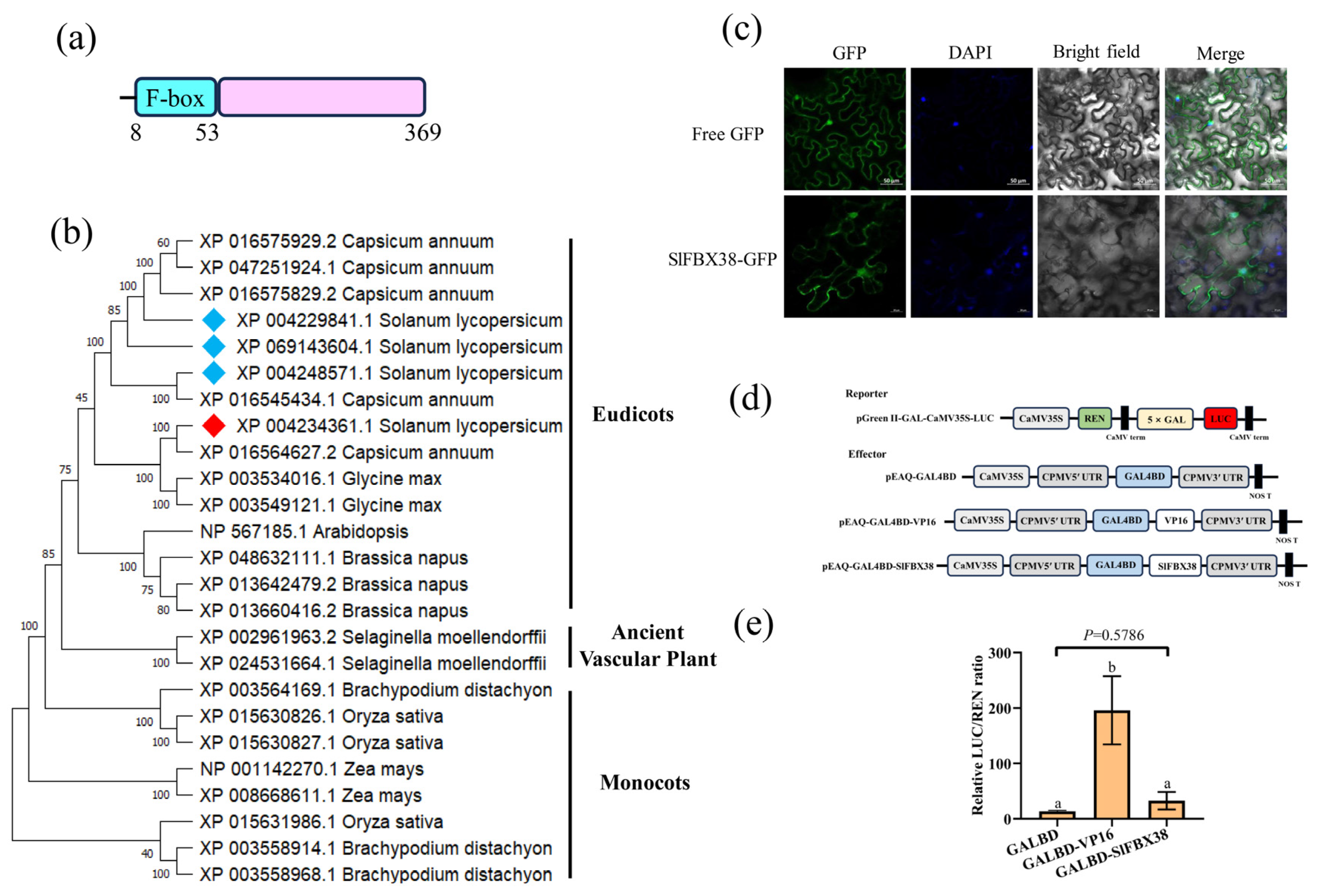
F-box genes related to stress response have rarely been reported in tomato. A previous study has conducted a genome-wide analysis of FBXs in tomato, and found that SlFBX38 may function in stress response [25]. In this study, we intend to focus on the function of SlFBX38 in tomato. It has been identified that SlFBX38 encodes a protein with 369 amino acid residues with the N-terminal conserved F-box domain (8-53 aa) (Figure 1a). Phylogenetic analysis determined twenty-five proteins, including SlFBX38 (XP 004234361.1), from tomato, pepper, soybean, Arabidopsis, rape, rice, corn and the ancient species Brachypodium distachyon and Selaginella moellendorffii (Figure S1). In general, FBXs from eudicots and monocots evolved separately into two branches, while those from the ancient fern Selaginella moellendorffii are clustered in one branch independently (Figure 1b). The three other FBXs in tomato were clustered closer with those from Solanaceae plants, while SlFBX38 was clustered in another branch with those from pepper and soybean (Figure 1b).
SlFBX38 was predicted to be located in the nucleus (https://www.genscript.com/tools/wolf-psort, accessed on 23 February 2026). To identify the subcellular location of SlFBX38, SlFBX38-GFP was expressed in N. benthamiana leaves. The fluorescence signal of SlFBX38-GFP can be observed in the nucleus as indicated by a blue DAPI signal, and in the cytoplasm and cell membrane as well (Figure 1c). However, the exact part within the cytoplasm remains to be further elucidated. A GAL4-BD-SlFBX38 fusion protein was generated to determine whether SlFBX38 has transcription activation ability. The results showed that no significant difference was observed in LUC activity between SlFBX38 and an empty vector, while LUC activity of VP16 was significantly higher (Figure 1d,e). Thus, the SlFBX38 protein is located in the nucleus and cytoplasm to mediate their function, but it may not function as a transcription factor in its current form.

3.2. The Expression Profile of SlFBX38 in Tomato

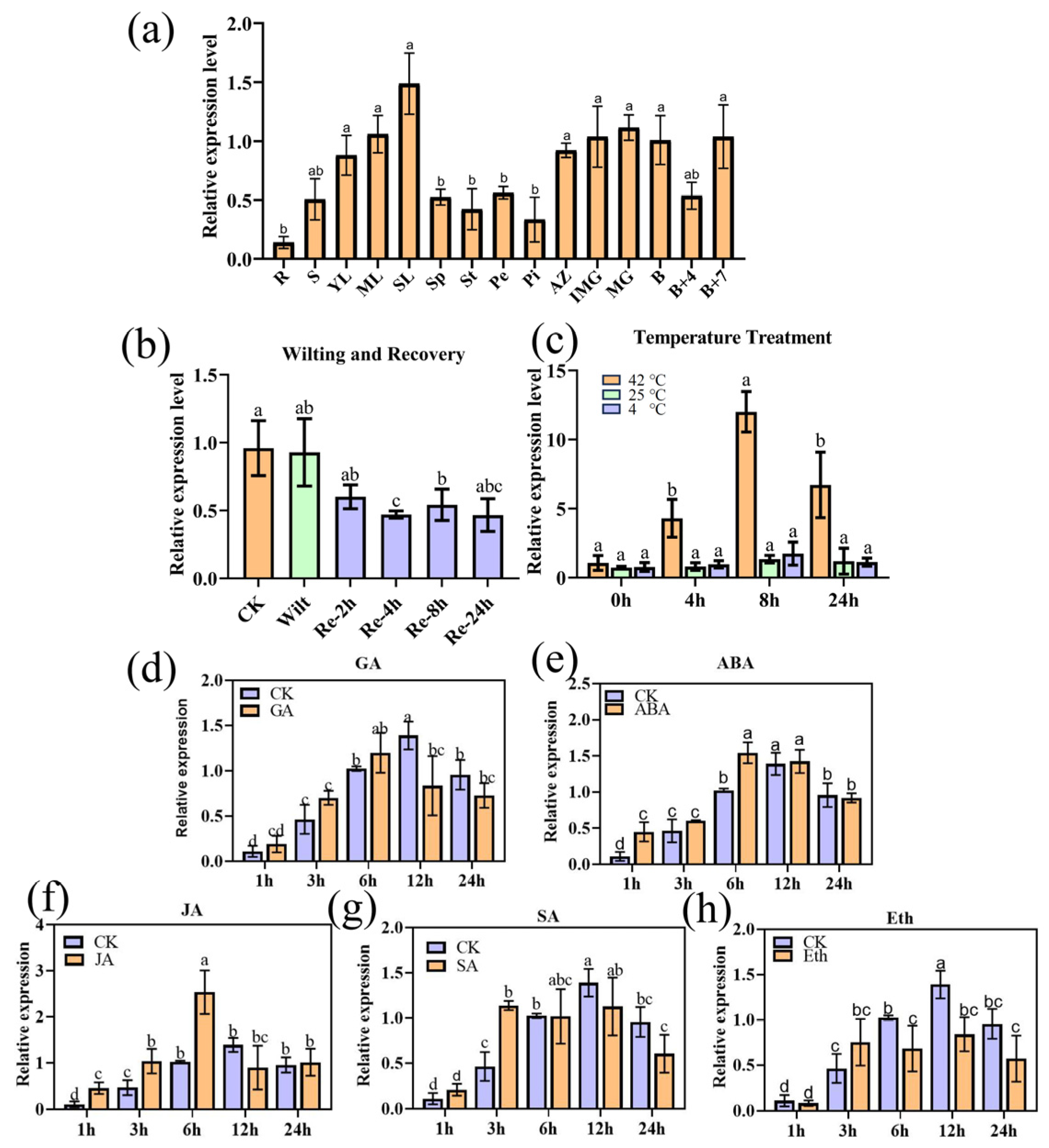
To uncover the tissues that locate SlFBX38, the spatiotemporal expression pattern of SlFBX38 was investigated. The results showed that SlFBX38 was expressed in almost all tissues, but was highly expressed in leaves in an age-dependent manner (Figure 2a). In addition, SlFBX38 showed relatively high expression levels in fruit at all development stages as well, but relatively low expression levels in the root, abscission zone and floral organs of the flowers (Figure 2a). Thus, SlFBX38 may function mainly in leaves and fruits.
To further elucidate whether SlFBX38 participates in drought and adverse temperature conditions, the expression levels of SlFBX38 were analyzed in these unfavorable growth conditions. The results showed that SlFBX38 cannot respond to drought stress (Figure 2b) for no significant difference was observed in the expression levels of SlFBX38 at wilting or recovering time points caused by drought stress (Figure 2b). As for adverse temperature treatments, no significant difference was observed after cold treatment (4 °C) at different time points (0 h, 4 h, 8 h and 24 h) (Figure 2b). However, the expression level of SlFBX38 was significantly induced at the 4 h, 8 h and 24 h time points after heat stress treatment (42 °C). Thus, it is speculated that SlFBX38 may function in thermotolerance response.
In addition, phytohormones play vital roles in multiple biological processes. To understand whether phytohormones could induce the expression of SlFBX38, ethylene (Eth), abscisic acid (ABA), jasmonic acid (JA) and gibberellic acid (GA) were sprayed on the leaves of the AC plants. Leaf samples were collected at different time points to see whether SlFBX38 could be induced by a certain phytohormone. The results demonstrated that SlFBX38 cannot respond to GA, but can be induced by ABA, JA or SA at several time points (Figure 2d). However, Eth can slightly repress the expression of SlFBX38 (Figure 2d).

3.3. Overexpression of SlFBX38 Exhibits Enhanced Tolerance to HS

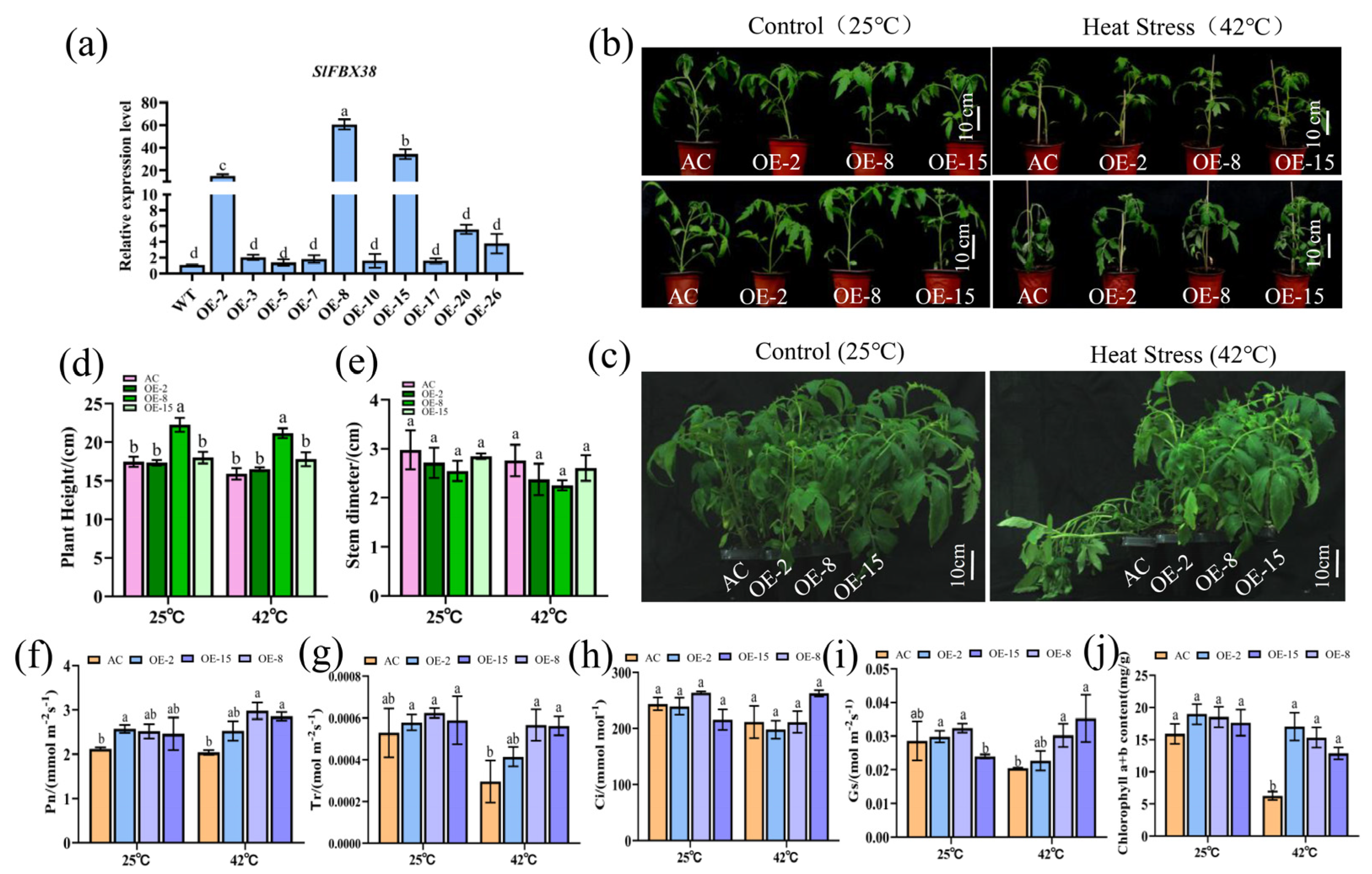
Considering that SlFBX38 was highly expressed in leaves and was heat-inducible, it is speculated that SlFBX38 in leaves may participate in heat stress responses. To verify our hypothesis, the overexpression lines of SlFBX38 were generated and those three (OE-2, OE-8 and OE-15) with the highest expression levels were used for heat stress treatment (Figure 3a). The results showed that the AC plants severely wilted, while the SlFBX38-OE lines were slightly influenced by heat stress and showed better growth performance (Figure 3b,c). At the same time, the abaxial surface of the leaves before and after heat stress treatment were observed by SEM. No significant differences in structure and stomatal number were observed between AC and the SlFBX38-OE lines (Figure S1). Furthermore, no significant differences in plant height and stem diameter were observed between AC and SlFBX38-OE lines at either normal or heat stress conditions (Figure 3d,e). Thus, overexpression of SlFBX38 may not influence plant growth though it may play a positive role in heat stress response.
To elucidate how overexpression of SlFBX38 could enhance heat stress tolerance, photosynthetic characteristics were measured. The results showed that almost no difference was observed between AC and SlFBX38 OE lines in photosynthetic characteristics (Figure 3f–i). However, the net photosynthetic rate (Figure 4f), transpiration rate (Tr) (Figure 3g) and stomatal conductance (Cs) (Figure 3h) were higher in SlFBX38-OE lines, while almost no significant difference was observed in intercellular CO2 concentration (Ci) after heat stress response (Figure 3i). Consistent with this, the content of chlorophylls was higher in SlFBX38-OE lines under heat stress, while there is no significant difference in normal growing conditions (Figure 3j).
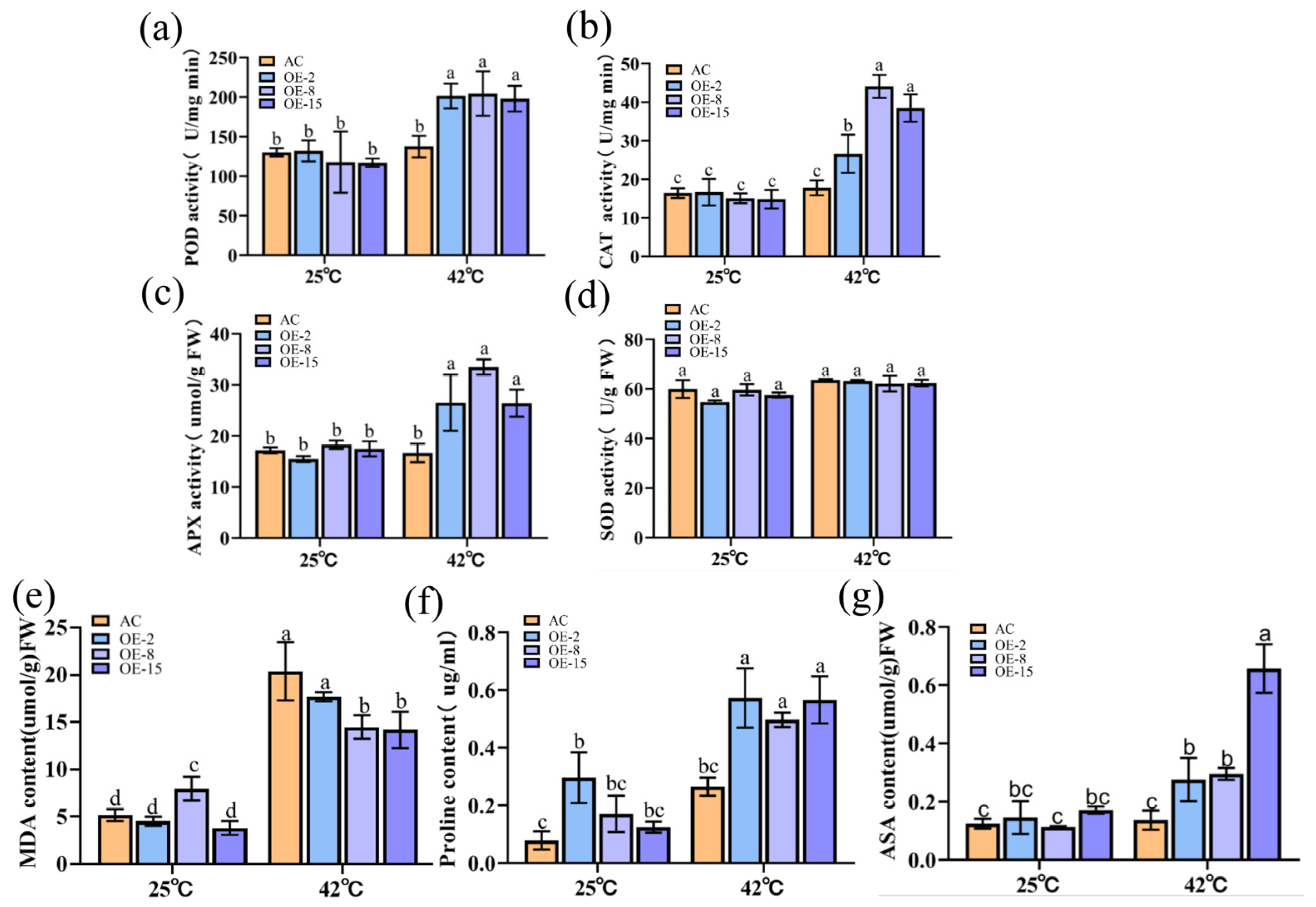
To ensure the better performance of plants of SlFBX38-OE lines under heat stress, the activities of antioxidant protective enzymes and metabolites were determined. The activities of POD, CAT and APX were all significantly higher in SlFBX38-OE lines under heat stress treatment, while no difference was observed in normal growing conditions (Figure 4a–c). However, SOD activities were of no significance in either normal or heat stress conditions (Figure 4d). Consistent with the results of enzyme activities, the content of MDA, proline and AsA were elevated in SlFBX38 OE lines under 42 °C, while there is no difference in normal growing conditions (Figure 4e–g). Thus, overexpression of SlFBX38-enhanced the tolerance of tomato plants to heat stress.

3.4. The Expression Dynamics of HS-Related Genes

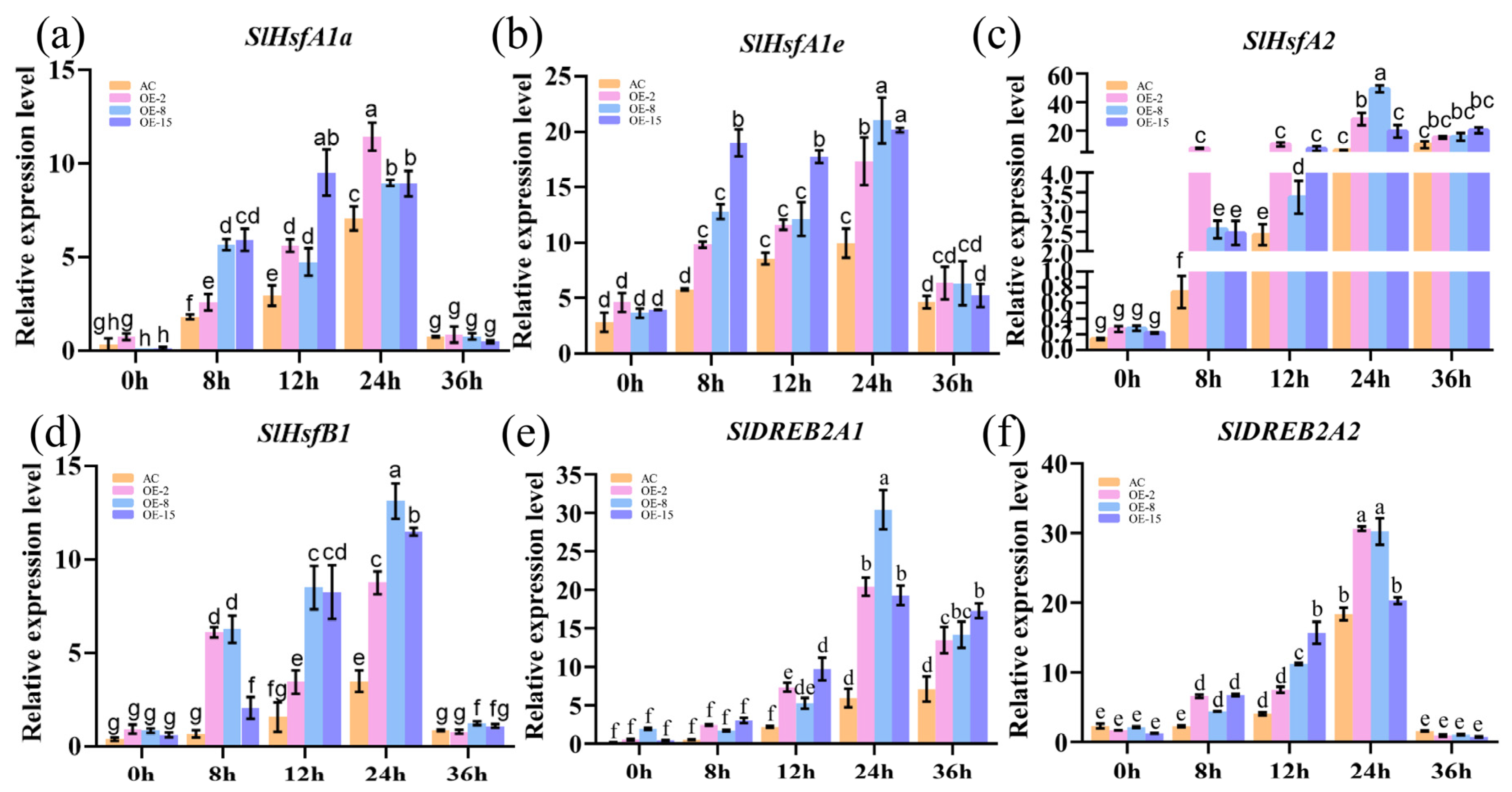
Transcription factors Hsfs, especially HsfA1s, play vital roles in thermotolerance signaling. To identify whether SlFBX38-mediated heat tolerance response was dependent on HsfA1s, the expression levels of Hsfs and heat tolerance-related genes were determined after heat stress treatment. The results showed that no significant differences were observed in the transcription levels of SlHsfA1a, SlHsfA1b, SlHsfA2 and SlHsfB1 in normal growing conditions (Figure 5a–d). However, under a 42 °C heat stress condition, enhanced expressions of SlHsfA1a, SlHsfA1b, SlHsfA2 and SlHsfB1 were all observed at the 8, 12, 24 h time points of the heat stress treatment (Figure 5a–d). At the 36 h time point, most signal transductions were over, hence no significance was observed in the expression of SlHsfA1a, SlHsfA1b, SlHsfA2 and SlHsfB1 genes (Figure 5a–d). This was consistent with the phenotype that AC plants were wilting, while those of OE lines stood still. At the same time, enhanced expression levels of SlDREB2A2 and SlDREB2A1 were observed in OE lines at the 8, 12, 24 h and 12, 24, 36 h time points, respectively (Figure 5e,f).

3.5. The Identification of Possible Interacting Proteins

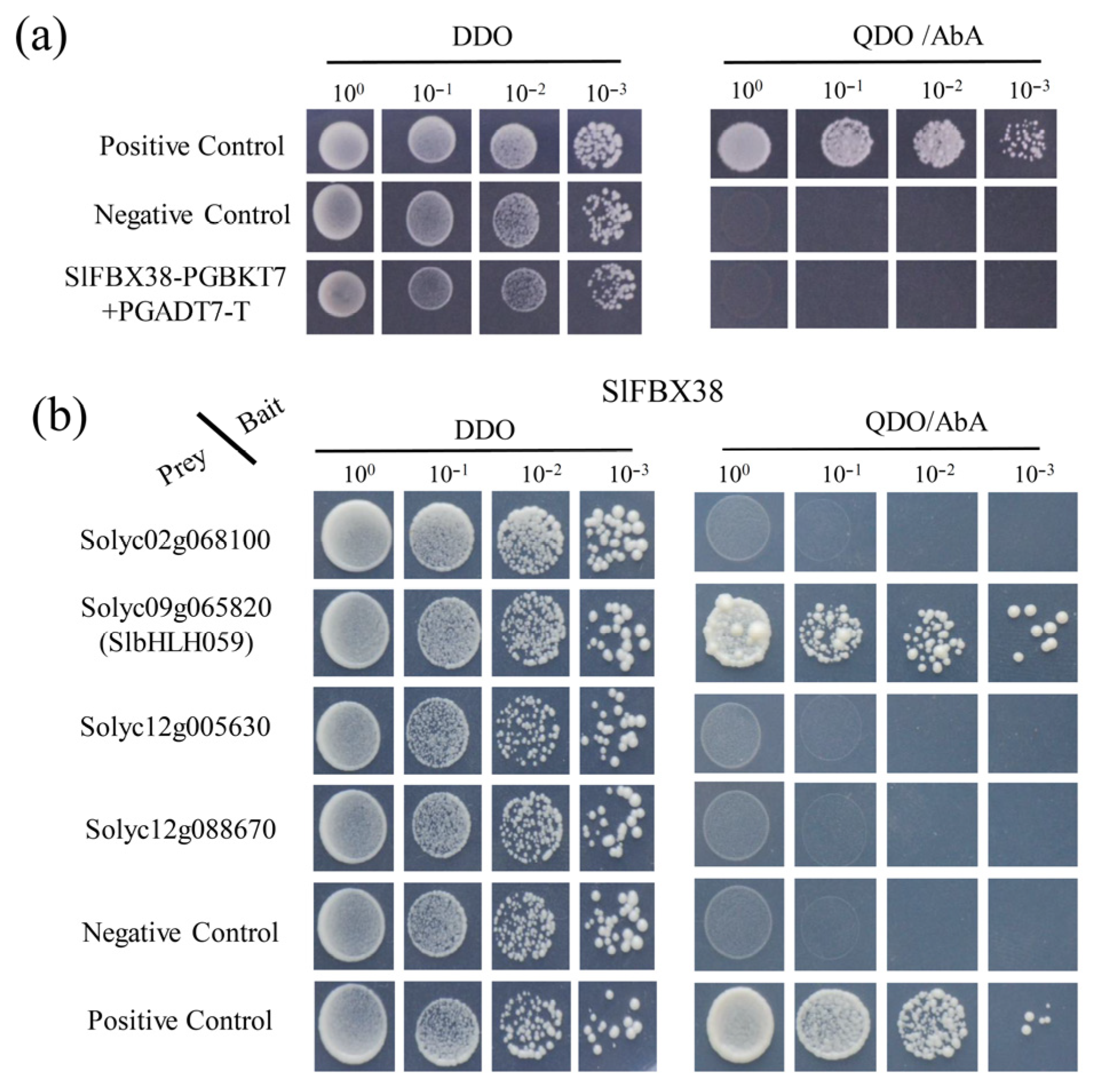
To elucidate the molecular mechanism of SlFBX38 in heat stress response, a Y2H library screen of the tomato leaf library was performed. No autoactivation of SlFBX38-pGADT7 was detected on a QDO/AbA medium (Figure 6a). Thus, yeasts harboring the SlFBX38-pGBKT7 vector can be used to screen the library. Colonies growing on the QDO medium were selected for sequencing to identify the corresponding prey genes. A total of 136 candidate interacting proteins were identified (Table S2). Among these, the most frequently recovered genes are Solyc07g041920.2, Solyc12g005630 and Solyc10g086580, each appearing in approximately ten independent colonies. Several other genes were found in around five colonies, including Solyc07g041910, Solyc10g055470, Solyc06g008910, Solyc12g088670, Solyc09g009260, Solyc07g043420, Solyc01g066420, and Solyc03g117600. Symbiotic nitrogen fixation (SNF)-related genes have long been reported to participate in stress response. And there are two SNF-related genes Solyc02g068100 and Solyc12g099970 which were identified. Only one transcription factor, Solyc09g065820, which encodes a bHLH protein (SlbHLH59), was identified.
To further validate these interactions, the coding sequences of four high-confidence candidates (Solyc02g068100, Solyc09g065820, Solyc12g005630, and Solyc12g088670) were cloned to pGADT7 as prey constructs and co-transformed with SlFBX38-pGBKT7 into yeast cells. The results showed that all the transformants can grow on a DDO medium, but only these co-expressing Solyc09g065820 and SlFBX38 were able to grow on a QDO/AbA medium (Figure 6b). These results indicate that SlFBX38 may interact with SlbHLH59 to mediate HSR in tomato.

4. Discussion

4.1. Heat Stress and Various Phytohormones Induced the Expression of SlFBX38 in Leaves

Tomato plants are highly sensitive to heat weaves; a slight temperature rise that exceeds the optimal temperature range is detrimental to plant growth and development, thereby posing a great threat to crop productivity [30]. Thus, breeding heat-tolerant varieties is of great significance to combat the extreme heat waves associated with global warming, and this requires in-depth molecular understanding of heat stress responses.
In this study, we first identified and characterized the F-box gene SlFBX38 in tomato. Phylogenetic analysis showed that instead of clustering with its homologous proteins in tomato, SlFBX38 is in another branch with FBX proteins from other species. This suggested that the function of SlFBX38 may be specialized. Phytohormones, especially ABA, play vital roles in heat stress perception and response. ABA-triggered Ca2+ influx was observed in guard cells, and cytosolic Ca2+ signaling can enhance the efficiency of ABA to close stomata in response to stimuli [31,32]. In addition, multiple cyclic nucleotide-gated channels (CNGCs) are required for ABA-triggered Ca2+ influx and ABA-induced stomatal closure in Arabidopsis [33]. Except for ABA, other phytohormones hold a potential to crosstalk with ABA in heat stress response [34,35]. In this study, ABA, JA and SA can significantly induce the expression of SlFBX38 at some time points, while ethylene shows a slight inhibitory role. Though SA and JA are traditionally associated with responses against pathogen invasion or mechanical injuries, they are implicated in response to variable abiotic stimuli as well [36]. In ryegrass, exogenous methyl jasmonate can maintain the content of chlorophyll (Chl) and malondialdehyde (MDA), as well as promote the activities of superoxide dismutase (SOD), peroxidase (POD), catalase (CAT), and ascorbate peroxidase (APX), thereby equipping plants with enhanced heat stress tolerance [37]. In cotton (Gossypium hirsutum), SA promotes heat tolerance by preserving the photosynthetic system [38]. In maize (Zea mays L.), exogenous application of SA can effectively mitigate heat stress-induced leaf senescence by cooperating with lignin and sucrose signal pathways [39]. Thus, it is suggested that SlFBX38 may be involved in ABA-, SA- and/or JA-mediated thermotolerance response in tomato. In addition, spatiotemporal expression analysis showed that SlFBX38 is mainly expressed in old leaves and fruits. In addition, drought stress cannot induce the expression of SlFBX38, while heat stress significantly elevated the expression of SlFBX38 to higher levels at different time points. This showed us that SlFBX38 may participate in heat stress response.

4.2. SlFBX38 May Positively Participate in Thermotolerance Response

Consistent with our hypothesis, overexpression of SlFBX38 equipped plants with a better growing and photosynthesis performance, yet no significant differences in plant growth, stomata opening or the morphology of guard cells were observed. Moreover, the enhanced activities of antioxidant enzymes—POD, CAT and APX—facilitate the timely scavenge of ROS in SlFBX38 OE lines, resulting in less ROS-induced damage. Notably, the concentration of ascorbic acid (AsA) was also significantly elevated in SlFBX38 OE lines. AsA is well documented as a protective compound against drought or oxidative stress in tomato [26,40]. Exogenous application of AsA on leaves has been shown to enhance heat stress tolerance and photosynthetic efficiency in apple leaves under heat stress [41]. Therefore, the increased AsA content in the leaves of SlFBX38 OE lines likely contributes to their enhanced oxidative stress tolerance under high-temperature conditions.
In line with the enhanced heat stress-tolerant phenotype in SlFBX38 OE lines, the expression of the transcription factor gene SlDREB2A was upregulated, which accounts for the reduced water loss in SlFBX38 OE lines. SlDREB2A genes are vital regulators in thermotolerance response; overexpression of one DREB2A can induce the expression of heat-related genes [42,43]. Additionally, upon heat stress exposure, heat stress transcription factors (HSFs) can be induced quickly. In tomato, HsfA1 and HsfA2 can a form hetero-oligomeric super-activation complex in response to heat stress response, and AHA motifs in both contribute to its activation potential [11,44]. In this study, elevated expression of SlHsfA1s, SlHsfA2 and SlHsfB in the OE lines also suggests the higher HSR ability in the OE lines. Phytohormones can work synergistically with Hsfs to regulate the thermotolerance in plants [45,46]. It makes sense that the expression of SlFBX38 can be induced by phytohormones, such as ABA, JA and SA. However, given that neither knock-out nor knock-down lines of SlFBX38 were successfully generated, we can only infer that SlFBX38 may positively regulate heat stress response in tomato.

4.3. The Possible Mechanism of SlFBX38-Mediated Thermotolerance

Although the function of SlFBX38 in thermotolerance has been analyzed, the underlying mechanism remains unclear. SlFBX38 is a typical F-box protein that is located in the nucleus and cytoplasm with no transcriptional ability in tomato. We therefore hypothesized that SlFBX38 may confer thermotolerance through interacting with other transcription factors or via post-translational regulation. Yeast two-hybrid library screening, followed by a targeted Y2H assay, confirm that SlFBX38 interacts with the transcription factor SlbHLH59 in yeast. SlbHLH59 promotes the elevated accumulation of AsA by directly binding to the promoter of genes involved in the D-mannose/L-galactose pathway [47]. Accordingly, we propose that SlFBX38 contributes, at least in part, to heat stress response by facilitating AsA biosynthesis through its interaction with SlbHLH59, although this interaction requires further validation.
However, we cannot exclude other possibilities such as that SlFBX38 may mediate the protein stability by directly participating in UPR in ER. The mRNA of bZIP60 can be spliced by the ER-located IRE1 (Inositol-requiring enzyme 1) to produce truncated protein that is translocated into the nucleus to activate the HSR-related genes [9]. Another ER-located TF, bZIP28, can move from the ER to the Golgi apparatus, and after subsequent proteolytic modification, bZIP28 can relocate to the nucleus to activate HSR [10]. Like bZIP proteins, NAC transcription factors have been identified in UPR and the translocation of its coding proteins as well [48]. Thus, though SlFBX38 may work with SlbHLH59 to regulate the accumulation of AsA, whether SlFBX38 functions in UPR in the ER remains to be identified further.

5. Conclusions

In this study, we identified SlFBX38, an F-box protein gene localized to both the nucleus and cytoplasm, which is predominantly expressed in tomato leaves and fruits. Overexpression of SlFBX38-enhanced thermotolerance associated with improved photosynthetic efficiency, stronger protective enzyme activities, and the upregulation of HSR-related genes. Although SlFBX38 lacks transcription activity, Y2H library screening followed by targeted validation revealed that it interacts with the AsA biosynthesis-related transcription factor SlbHLH059 in yeast. Our findings provide a foundation for studies on SlFBX38-mediated thermotolerance in tomato.

Supplementary Materials

The following supporting information can be downloaded at: https://www.mdpi.com/article/10.3390/horticulturae12030343/s1, Table S1: The sequences of primers used in this study. Figure S1: The alignment of homologous proteins. Figure S2: The abaxial leaves observation of SlFBX38 OE lines. Table S2: The list of proteins identified by Y2H library screening with SlFBX38.

Author Contributions

Methodology, M.C. and J.D.; Formal analysis, S.M.; Investigation, W.L., S.W., L.L. and H.C.; Writing—original draft, D.D.; Writing—review & editing, Y.L.; Supervision, J.H., Y.P. and D.D.; Funding acquisition, Y.P. All authors have read and agreed to the published version of the manuscript.

Funding

This research was funded by the National Natural Science Foundation of China (32172597) and China Agriculture Research System (CARS-23-B08).

Data Availability Statement

The original contributions presented in this study are included in the article/Supplementary Materials. Further inquiries can be directed to the corresponding authors.

Conflicts of Interest

The authors declare no conflicts of interest.

References

  1. Yeh, C.H.; Kaplinsky, N.J.; Hu, C.; Charng, Y.Y. Some like it hot, some like it warm: Phenotyping to explore thermotolerance diversity. Plant Sci. 2012, 195, 10–23. [Google Scholar] [CrossRef]
  2. Dündar, G.; Ramirez, V.E.; Poppenberger, B. The heat shock response in plants: New insights into modes of perception, signaling, and the contribution of hormones. J. Exp. Bot. 2025, 76, 1970–1977. [Google Scholar] [CrossRef] [PubMed]
  3. Rocco, M.; Arena, S.; Renzone, G.; Scippa, G.S.; Lomaglio, T.; Verrillo, F.; Scaloni, A.; Marra, M. Proteomic analysis of temperature stress-responsive proteins in Arabidopsis thaliana rosette leaves. Mol. Biosyst. 2013, 9, 1257–1267. [Google Scholar] [CrossRef] [PubMed]
  4. Zhang, Y.L.; Wu, L.M.; Yuan, K.; Yu, Y.C. Photoreceptor-dependent signaling in plant responses to thermomorphogenesis and heat stress. Plant Physiol. Biochem. 2025, 228, 110202. [Google Scholar] [CrossRef]
  5. Scafaro, A.P.; Fan, Y.Z.; Posch, B.C.; Garcia, A.; Coast, O.; Atkin, O.K. Responses of leaf respiration to heatwaves. Plant Cell Environ. 2021, 44, 2090–2101. [Google Scholar] [CrossRef] [PubMed]
  6. Sevilla, F.; Martí, M.C.; De Brasi-Velasco, S.; Jiménez, A. Redox regulation, thioredoxins, and glutaredoxins in retrograde signalling and gene transcription. J. Exp. Bot. 2023, 74, 5955–5969. [Google Scholar] [CrossRef] [PubMed]
  7. Peng, X.; Zhang, X.N.; Li, B.; Zhao, L.Q. Cyclic nucleotide-gated ion channel 6 mediates thermotolerance in Arabidopsis seedlings by regulating nitric oxide production via cytosolic calcium ions. Bmc Plant Biol. 2019, 19, 368. [Google Scholar] [CrossRef]
  8. Neill, E.M.; Byrd, M.C.R.; Billman, T.; Brandizzi, F.; Stapleton, A.E. Plant growth regulators interact with elevated temperature to alter heat stress signaling via the Unfolded Protein Response in maize. Sci Rep. 2019, 9, 10392. [Google Scholar] [CrossRef]
  9. Deng, Y.; Humbert, S.; Liu, J.X.; Srivastava, R.; Rothstein, S.J.; Howell, S.H. Heat induces the splicing by IRE1 of a mRNA encoding a transcription factor involved in the unfolded protein response in Arabidopsis. Proc. Natl. Acad. Sci. USA 2011, 108, 7247–7252. [Google Scholar] [CrossRef]
  10. Ding, Y.L.; Shi, Y.T.; Yang, S.H. Molecular Regulation of Plant Responses to Environmental Temperatures. Mol. Plant 2020, 13, 544–564. [Google Scholar] [CrossRef]
  11. Chan-Schaminet, K.Y.; Baniwal, S.K.; Bublak, D.; Nover, L.; Scharf, K.D. Specific Interaction between Tomato HsfA1 and HsfA2 Creates Hetero-oligomeric Superactivator Complexes for Synergistic Activation of Heat Stress Gene Expression. J. Biol. Chem. 2009, 284, 20848–20857. [Google Scholar] [CrossRef]
  12. Kan, Y.; Mu, X.R.; Gao, J.; Lin, H.X.; Lin, Y.S. The molecular basis of heat stress responses in plants. Mol. Plant 2023, 16, 1612–1634. [Google Scholar] [CrossRef]
  13. Li, H.G.; Yang, L.; Fang, Y.J.; Wang, G.; Lyu, S.; Deng, S.L. A genome-wide-level insight into the HSF gene family of Rhodomyrtus tomentosa and the functional divergence of RtHSFA2a and RtHSFA2b in thermal adaptation. Plant Physiol. Biochem. 2025, 220, 109460. [Google Scholar] [CrossRef]
  14. Li, B.J.; Gao, Z.H.; Liu, X.Y.; Sun, D.Y.; Tang, W.Q. Transcriptional Profiling Reveals a Time-of-Day-Specific Role of REVEILLE 4/8 in Regulating the First Wave of Heat Shock-Induced Gene Expression in Arabidopsis. Plant Cell 2019, 31, 2353–2369. [Google Scholar] [CrossRef] [PubMed]
  15. Bai, C.; Richman, R.; Elledge, S.J. Human Cyclin-F. Embo J. 1994, 13, 6087–6098. [Google Scholar] [CrossRef] [PubMed]
  16. Bai, C.; Sen, P.; Hofmann, K.; Ma, L.; Goebl, M.; Harper, J.W.; Elledge, S.J. SKP1 connects cell cycle regulators to the ubiquitin proteolysis machinery through a novel motif, the F-box. Cell 1996, 86, 263–274. [Google Scholar] [CrossRef] [PubMed]
  17. Feldman, R.M.R.; Correll, C.C.; Kaplan, K.B.; Deshaies, R.J. A complex of Cdc4p, Skp1p, and Cdc53p/cullin catalyzes ubiquitination of the phosphorylated CDK inhibitor Sic1p. Cell 1997, 91, 221–230. [Google Scholar] [CrossRef]
  18. Lau, A.W.; Fukushima, H.; Wei, W.Y. The Fbw7 and Beta-TRCP E3 ubiquitin ligases and their roles in tumorigenesis. Front. Biosci. 2012, 17, 2197–2212. [Google Scholar] [CrossRef]
  19. Lai, Y.D.; Li, J.; Li, X.Y.; Zou, C.B. Lipopolysaccharide modulates p300 and Sirt1 to promote PRMT1 stability via an SCF-recognized acetyldegron. J. Cell Sci. 2017, 130, 3578–3587. [Google Scholar] [CrossRef]
  20. Guo, T.T.; Zuo, Y.B.; Qian, L.P.; Liu, J.; Yuan, Y.K.; Xu, K.L.; Miao, Y.; Feng, Q.; Chen, X.J.; Jin, L.C.; et al. ADP-ribosyltransferase PARP11 modulates the interferon antiviral response by mono-ADP-ribosylating the ubiquitin E3 ligase β-TrCP. Nat. Microbiol. 2019, 4, 1872–1884. [Google Scholar] [CrossRef]
  21. Gagne, J.M.; Downes, B.P.; Shiu, S.H.; Durski, A.M.; Vierstra, R.D. The F-box subunit of the SCF E3 complex is encoded by a diverse superfamily of genes in. Proc. Natl. Acad. Sci. USA 2002, 99, 11519–11524. [Google Scholar] [CrossRef]
  22. Jain, M.; Nijhawan, A.; Arora, R.; Agarwal, P.; Ray, S.; Sharma, P.; Kapoor, S.; Tyagi, A.K.; Khurana, J.P. F-box proteins in rice. Genome-wide analysis, classification, temporal and spatial gene expression during panicle and seed development, and regulation by light and abiotic stress. Plant Physiol. 2007, 143, 1467–1483. [Google Scholar] [CrossRef] [PubMed]
  23. de Moya-Ruiz, C.; Gómez, P. Thermotolerance elicits specific genes in cucurbit plants as a response to the combined effect of viral infection and temperature stress. J. Exp. Bot. 2025, 76, 5305–5319. [Google Scholar] [CrossRef]
  24. Liu, J.P.; Wang, K.; Wang, G.N.; Peng, Z.; Wang, T.; Meng, Y.; Huang, J.L.; Huo, J.H.; Li, X.; Zhu, X.Q.; et al. The OsEBF1-OsEIL5-OsPP91 module regulates rice heat tolerance via ubiquitination and transcriptional activation. Cell Rep. 2025, 44, 115271. [Google Scholar] [CrossRef]
  25. Mo, F.L.; Zhang, N.A.; Qiu, Y.W.; Meng, L.J.; Cheng, M.Z.; Liu, J.Y.; Yao, L.N.; Lv, R.; Liu, Y.X.; Zhang, Y.; et al. Molecular Characterization, Gene Evolution and Expression Analysis of the F-Box Gene Family in Tomato (Solanum lycopersicum). Genes 2021, 12, 417. [Google Scholar] [CrossRef]
  26. Li, J.H.; Ai, G.; Wang, Y.L.; Ding, Y.; Hu, X.M.; Liang, Y.; Yan, Q.X.; Wu, K.; Huang, R.; Chen, C.R.; et al. A truncated B-box zinc finger transcription factor confers drought sensitivity in modern cultivated tomatoes. Nat. Commun. 2024, 15, 8013. [Google Scholar] [CrossRef]
  27. Wellburn, A.R. The Spectral Determination of Chlorophyll-a and Chlorophhyll-B, as Well as Total Carotenoids, Using Various Solvents with Spectrophotometers of Different Resolution. J. Plant Physiol. 1994, 144, 307–313. [Google Scholar] [CrossRef]
  28. Yoo, S.D.; Cho, Y.H.; Sheen, J. Arabidopsis mesophyll protoplasts:: A versatile cell system for transient gene expression analysis. Nat. Protoc. 2007, 2, 1565–1572. [Google Scholar] [CrossRef]
  29. Tamura, K.; Stecher, G.; Kumar, S. MEGA11 Molecular Evolutionary Genetics Analysis Version 11. Mol. Biol. Evol. 2021, 38, 3022–3027. [Google Scholar] [CrossRef] [PubMed]
  30. Distéfano, A.M.; Bauer, V.; Cascallares, M.; López, G.A.; Fiol, D.F.; Zabaleta, E.; Pagnussat, G.C. Heat stress in plants: Sensing, signalling, and ferroptosis. J. Exp. Bot. 2024, 76, 1357–1369. [Google Scholar] [CrossRef] [PubMed]
  31. Brandt, B.; Munemasa, S.; Wang, C.; Nguyen, D.; Yong, T.M.; Yang, P.G.; Poretsky, E.; Belknap, T.F.; Waadt, R.; Alemán, F.; et al. Calcium specificity signaling mechanisms in abscisic acid signal transduction in guard cells. Elife 2015, 4, e03599. [Google Scholar] [CrossRef] [PubMed]
  32. Huang, S.G.; Waadt, R.; Nuhkat, M.; Kollist, H.; Hedrich, R.; Roelfsema, M.R.G. Calcium signals in guard cells enhance the efficiency by which abscisic acid triggers stomatal closure. New Phytol. 2019, 224, 177–187. [Google Scholar] [CrossRef]
  33. Tan, Y.Q.; Yang, Y.; Shen, X.; Zhu, M.J.; Shen, J.L.; Zhang, W.; Hu, H.H.; Wang, Y.F. Multiple cyclic nucleotide-gated channels function as ABA-activated Ca2+ channels required for ABA-induced stomatal closure in Arabidopsis. Plant Cell 2023, 35, 239–259. [Google Scholar] [CrossRef]
  34. Wu, C.Y.; Hong, C.Y. An in vivo GA- and ABA-responsive dual-luciferase reporter system for simultaneous detection of GA and ABA responses, hormone crosstalk and heat stress response in rice. Plant Biotechnol. J. 2021, 19, 1486–1488. [Google Scholar] [CrossRef]
  35. Balfagón, D.; Sengupta, S.; Gómez-Cadenas, A.; Fritschi, F.B.; Azad, R.K.; Mittler, R.; Zandalinas, S.I. Jasmonic Acid Is Required for Plant Acclimation to a Combination of High Light and Heat Stress. Plant Physiol. 2019, 181, 1668–1682. [Google Scholar] [CrossRef] [PubMed]
  36. Hou, S.J.; Tsuda, K. Salicylic acid and jasmonic acid crosstalk in plant immunity. Essays Biochem. 2022, 66, 647–656. [Google Scholar] [CrossRef]
  37. Su, Y.N.; Huang, Y.Z.; Dong, X.T.; Wang, R.J.; Tang, M.Y.; Cai, J.B.; Chen, J.Y.; Zhang, X.Q.; Nie, G. Exogenous Methyl Jasmonate Improves Heat Tolerance of Perennial Ryegrass Through Alteration of Osmotic Adjustment, Antioxidant Defense, and Expression of Jasmonic Acid-Responsive Genes. Front. Plant Sci. 2021, 12, 664519. [Google Scholar] [CrossRef]
  38. Das, A.K.; Ghosh, P.K.; Nihad, S.A.I.; Sultana, S.; Keya, S.S.; Rahman, M.A.; Ghosh, T.K.; Akter, M.; Hasan, M.; Salma, U.; et al. Salicylic Acid Priming Improves Cotton Seedling Heat Tolerance through Photosynthetic Pigment Preservation, Enhanced Antioxidant Activity, and Osmoprotectant Levels. Plants 2024, 13, 1639. [Google Scholar] [CrossRef]
  39. Wang, Z.T.; Guo, J.; Luo, W.X.; Niu, S.D.; Qu, L.L.; Li, J.; Chen, Y.P.; Li, G.H.; Yang, H.; Lu, D.L. Salicylic Acid Cooperates with Lignin and Sucrose Signals to Alleviate Waxy Maize Leaf Senescence Under Heat Stress. Plant Cell Environ. 2025, 48, 4341–4355. [Google Scholar] [CrossRef]
  40. Hu, T.X.; Ye, J.; Tao, P.W.; Li, H.X.; Zhang, J.H.; Zhang, Y.Y.; Ye, Z.B. The tomato HD-Zip I transcription factor SIHZ24 modulates ascorbate accumulation through positive regulation of the D-mannose/L-galactose pathway. Plant J. 2016, 85, 16–29. [Google Scholar] [CrossRef] [PubMed]
  41. Mihaljevic, I.; Viljevac Vuletic, M.; Tomas, V.; Zdunic, Z.; Vukovic, D. Photosynthetic responses of heat-stressed apple leaves to foliar application of salicylic and ascorbic acid. Photosynthetica 2024, 62, 79–89. [Google Scholar] [CrossRef]
  42. Sakuma, Y.; Maruyama, K.; Qin, F.; Osakabe, Y.; Shinozaki, K.; Yamaguchi-Shinozaki, K. Dual function of an Arabidopsis transcription factor DREB2A in water-stress-responsive and heat-stress-responsive gene expression. Proc. Natl. Acad. Sci. USA 2006, 103, 18822–18827. [Google Scholar] [CrossRef] [PubMed]
  43. Sato, H.; Mizoi, J.; Tanaka, H.; Maruyama, K.; Qin, F.; Osakabe, Y.; Morimoto, K.; Ohori, T.; Kusakabe, K.; Nagata, M.; et al. DPB3-1, a DREB2A Interactor, Specifically Enhances Heat Stress-Induced Gene Expression by Forming a Heat Stress-Specific Transcriptional Complex with NF-Y Subunits. Plant Cell 2014, 26, 4954–4973. [Google Scholar] [CrossRef]
  44. Döring, P.; Treuter, E.; Kistner, C.; Lyck, R.; Chen, A.; Nover, L. The role of AHA motifs in the activator function of tomato heat stress transcription factors HsfA1 and HsfA2. Plant Cell 2000, 12, 265–278. [Google Scholar] [CrossRef]
  45. Guo, Z.J.; Zuo, Y.X.; Wang, S.Y.; Zhang, X.; Wang, Z.Y.; Liu, Y.H.; Shen, Y.B. Early signaling enhance heat tolerance in Arabidopsis through modulating jasmonic acid synthesis mediated by HSFA2. Int. J. Biol. Macromol. 2024, 267, 131256. [Google Scholar] [CrossRef]
  46. He, L.F.; Xu, J.Y.; Li, C.H.; Shen, C.C.; He, Q.Y.; Lei, X.T.; Zhang, H.J.; Guo, L.Q.; Lin, T.; Guo, Y.D.; et al. SlHSFB2b-mediated inhibition of jasmonic acid catabolism enhances tomato tolerance to combined high light and heat stress. Plant Physiol. 2025, 199, kiaf547. [Google Scholar] [CrossRef] [PubMed]
  47. Ye, J.; Li, W.F.; Ai, G.; Li, C.X.; Liu, G.Z.; Chen, W.F.; Wang, B.; Wang, W.Q.; Lu, Y.G.; Zhang, J.H.; et al. Genome-wide association analysis identifies a natural variation in basic helix-loop-helix transcription factor regulating ascorbate biosynthesis via D-mannose/L-galactose pathway in tomato. PLoS Genet. 2019, 15, e1008149. [Google Scholar] [CrossRef]
  48. Ruberti, C.; Kim, S.J.; Stefano, G.; Brandizzi, F. Unfolded protein response in plants: One master, many questions. Curr. Opin. Plant Biol. 2015, 27, 59–66. [Google Scholar] [CrossRef] [PubMed]
Figure 1. The protein characterization of SlFBX38 in tomato. (a) Schematic diagram of SlFBX38 protein structure. Blue box indicates F-box domain; pink box indicates non-conserved protein sequence. (b) Phylogenetic analysis of SlFBX38 and homologous proteins in plants. (c) Subcellular localization of SlFBX38-GFP and free GFP in N. benthamiana leaves. The blue DAPI signal was used as the indicator of the nucleus; the signal from free GFP was used as control. (d) The construction of the transcription factor activity assay. (e) The measurement of transcription factor activity. The LUC activity of empty vector Pro35S: GAL, the positive control Pro35S: GAL-VP16 and Pro35S:SlFBX38-GAL were measured 16 h after transformation. Values represent mean ± SD (n = 3). The different letters indicate significant differences (ANOVA with Duncan’s multiple comparisons; p < 0.05).
Horticulturae 12 00343 g001
Figure 2. The expression pattern of SlFBX38 in tomato. (a) The relative expression of SlFBX38 in different tissues. R: root; S: stem; YL, ML, SL: indicate young leaves, mature leaves and senescence leaves, respectively; Sp: sepal; St: stamen; Pe: petal; Pi: pistil; AZ: abscission zone; IMG-B+7: indicates fruit at immature green (IMG), mature green (MG), breaker (B), 4 days after breaker (B+4) and 7 days after breaker stage (B+7), respectively. (b) Relative expression of SlFBX38 under drought stress condition; CK: plants with regular watering; Re-4 h, Re-8 h, Re-24 h: indicate different time points after watering of wilting plants. (c) The relative expression of SlFBX38 under cold (4 °C) or heat stress conditions (42 °C). Plants growing at 25 °C were used as control. (dh) Phytohormone-induced expression of SlFBX38 at 1, 3, 6, 12 and 24 h after spraying solutions with GA (d), ABA (e), JA (f), SA (g), and Eth (h), respectively. All data represent mean ± SD (n = 3); different letters indicate significant differences (ANOVA with Duncan’s multiple comparisons; p < 0.05).
Horticulturae 12 00343 g002
Figure 3. Analysis of SlFBX38-OE lines in thermotolerance response. (a) The expression of SlFBX38 in different lines. Values represent mean ± SD (n = 3). (b) The AC plants and the OE lines with or without heat stress treatment. (c) A group of AC plants and OE lines with or without heat stress treatment. (d,e) The plant height (d) and stem dimeter (e) of plants in normal and heat stress condition. Values represent mean ± SD (n = 5). (fi) The measurement of net photosynthetic rate (f), transpiration rate (Tr) (g) and stomatal conductance (Cs) (h), and intercellular CO2 concentration (Ci) (i). (j) The content of chlorophyll a ± b. Values represent mean ± SD (n = 3). Different letters indicate significant differences (ANOVA with Duncan’s multiple comparisons; p < 0.05).
Horticulturae 12 00343 g003
Figure 4. Physiological indices analysis of SlFBX38-OE lines after heat stress. (ad) The POD (a), CAT (b), APX (c) and SOD (d) activity in AC and three SlFBX38-OE lines at normal or heat stress growing conditions. (eg) The content of MAD (e), proline (f) and AsA (g) in AC and SlFBX38-OE plants at normal or heat stress growing conditions. Values represent mean ± SD (n = 3); different letters indicate significant differences (ANOVA with Duncan’s multiple comparisons; p < 0.05).
Horticulturae 12 00343 g004
Figure 5. The expression of HSR-related genes. (af) The expression of SlHsfA1a (a), SlHsfA1e (b), SlHsfA2 (c), SlHsfB1 (d), SlDREB2A1 (e) and SlDREB2A2 (f) in AC and SlFBX38 OE lines at different time points (0, 8, 12, 24 and 36 h). Values represent mean ± SD, (n = 3); different letters indicate significant differences (ANOVA with Duncan’s multiple comparisons; p < 0.05).
Horticulturae 12 00343 g005
Figure 6. The identification of potential interacting proteins of SlFBX38. (a) Autoactivation analysis of SlFBX38 in yeast cells. (b) Yeast two-hybrid (Y2H) assay between SlFBX38 and several candidates that were identified by Y2H screening.
Horticulturae 12 00343 g006
Disclaimer/Publisher’s Note: The statements, opinions and data contained in all publications are solely those of the individual author(s) and contributor(s) and not of MDPI and/or the editor(s). MDPI and/or the editor(s) disclaim responsibility for any injury to people or property resulting from any ideas, methods, instructions or products referred to in the content.