Review

Recent Advances on the Function and Mechanism of Tomato WRKY Family Genes Under Salt Stress
Key Laboratory of Agricultural Biosecurity and Green Production of Upper Yangtze River (Ministry of Education), College of Horticulture and Landscape Architecture, Southwest University, Chongqing 400715, China
*
Authors to whom correspondence should be addressed.
Horticulturae 2026, 12(4), 458; https://doi.org/10.3390/horticulturae12040458

Submission received: 4 March 2026 / Revised: 2 April 2026 / Accepted: 3 April 2026 / Published: 8 April 2026

Abstract

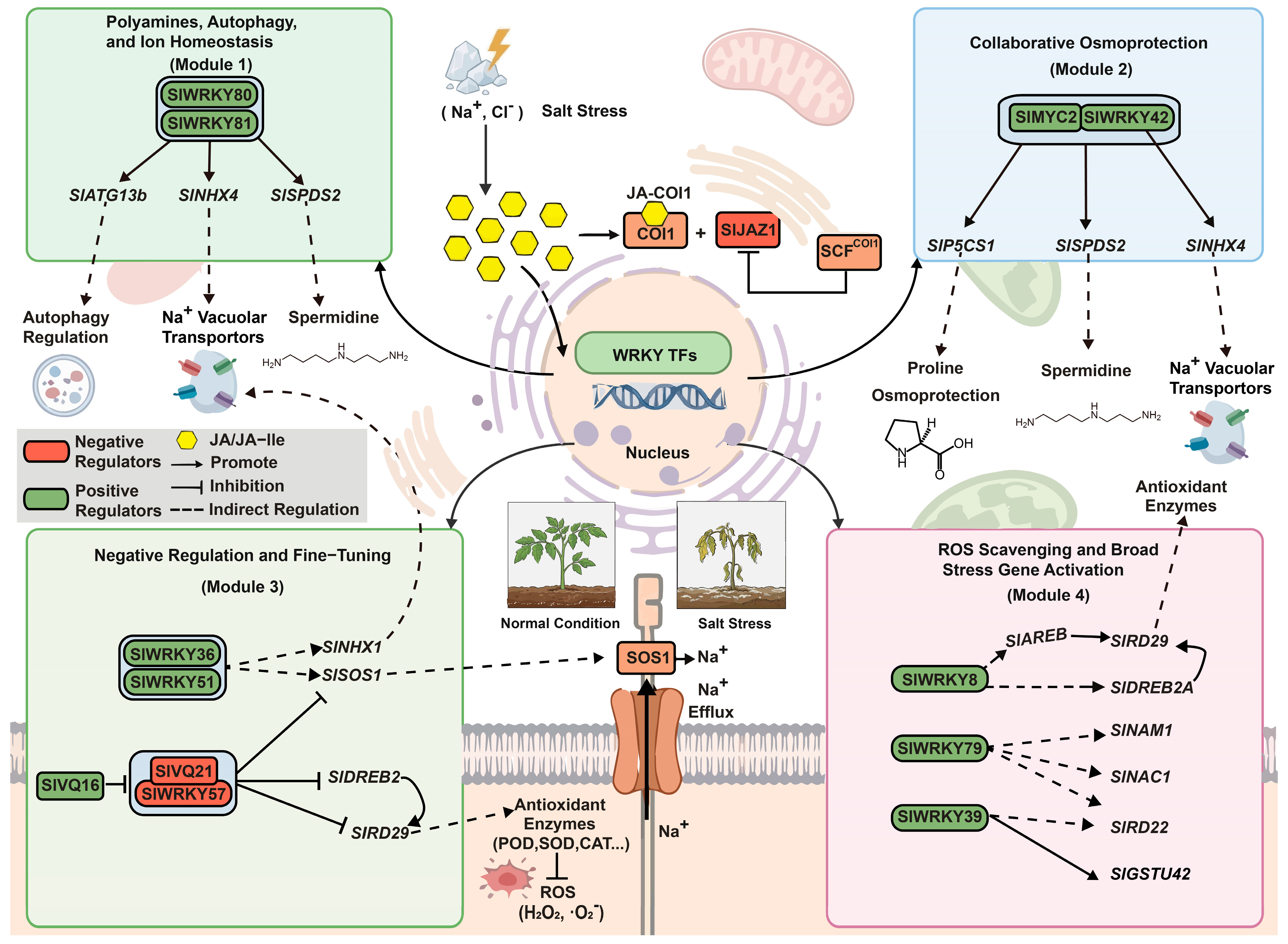
Tomato (Solanum lycopersicum) is a widely consumed vegetable crop and an established model system for plant functional genomics and genetic research in dicotyledons. Salt stress is a major abiotic factor limiting tomato productivity worldwide. The WRKY transcription factor family, one of the largest and most conserved plant-specific transcription factor families, plays pivotal roles in stress responses. This review summarizes recent advances in understanding the functions of tomato WRKY genes under salt stress, focusing on the genomic basis and evolutionary characteristics of the WRKY family, the roles of core WRKY members under salt stress, and the multi-layered regulatory networks mediating WRKY-dependent salt and alkali tolerance. To date, approximately 10 core SlWRKY genes have been functionally validated to regulate tomato salt tolerance, mainly by maintaining ion homeostasis, regulating reactive oxygen species (ROS) balance, facilitating osmotic adjustment, and integrating hormone signaling pathways. Despite this progress, systemic regulatory hierarchies and epigenetic modulation remain poorly resolved. Furthermore, we discuss how specific WRKY members directly regulate downstream effector genes, such as SlSOS1 and SlNHX4. However, direct experimental evidence for the coordination between tomato WRKYs and mitogen-activated protein kinase (MAPK) cascades, as well as epigenetic modifiers under salt stress, is still scarce in current studies. This review provides a theoretical framework and outlines potential technical pathways for translating fundamental insights into tomato salt tolerance into practical applications for sustainable agriculture.
Keywords: tomato; WRKY; salt stress; functional mechanism tomato; WRKY; salt stress; functional mechanism