Article

Quality Expectations and Willingness to Pay of German, Italian, and Turkish Strawberry Consumers


1
Faculty of Economics & Administrative Sciences, Çağ University, Yasar Baybogan Campus, 33800 Mersin, Turkey
2
Institute of BioEconomy (IBE), National Research Council (CNR), Via P. Gobetti 101, 40129 Bologna, Italy
3
Department of Agricultural, Food and Environmental Sciences, Università Politecnica delle Marche, Via Brecce Bianche 10, 60131 Ancona, Italy
4
Natural Resources Institute Finland (Luke), Latokartanonkaari 9, 00790 Helsinki, Finland
5
Department of Horticulture, Faculty of Agriculture, University of Çukurova, 01330 Adana, Turkey
6
Yaltır Agricultural Products, Sarıhuğlar Mah., 01355 Adana, Turkey
7
Hansabred GmbH & Co. KG, 01108 Dresden, Germany
*
Author to whom correspondence should be addressed.
Horticulturae 2026, 12(4), 451; https://doi.org/10.3390/horticulturae12040451
Submission received: 14 January 2026 / Revised: 26 March 2026 / Accepted: 3 April 2026 / Published: 5 April 2026
(This article belongs to the Special Issue Consumer Preferences for Horticultural Products)

Abstract

This study investigated consumer expectations and perceived quality of strawberries across different geographical contexts to identify the main drivers of purchasing behavior within a cross-country framework. An online survey was conducted among consumers in Italy, Germany, and Turkey to explore consumption habits, purchasing channels, sensory expectations, product perceptions, and willingness to pay (WTP) for specific product attributes. Results confirmed a high level of consumer appreciation for strawberries across all countries, primarily driven by their sensory characteristics. However, purchasing behavior and consumption patterns were strongly influenced by cultural and market-related factors. Visual attributes were confirmed to be key cues guiding product choice; however, label indications related to sensory traits and functional properties exerted a greater influence. Flavor, firmness, and overall taste balance represented critical determinants of consumer satisfaction. Differences across demographic groups were also observed, with younger and male consumers reporting lower levels of satisfaction with key sensory attributes, including juiciness, aroma, and freshness. Cross-country comparisons revealed heterogeneous WTP patterns, with Turkish consumers showing a greater propensity to pay premium prices for quality-related, local, organic, and environmentally friendly attributes compared with German and Italian consumers. Overall, the findings highlight the combined influence of sensory quality, cultural context, and sociodemographic characteristics in shaping strawberry perception and purchasing behavior. These insights may support breeders, producers, and retailers in developing targeted product strategies and market positioning across different geographical areas and consumer segments.

1. Introduction

In recent years, the importance of small fruit cultivation has been increasing [1] due to several factors, including advances in genetics and production systems, the rapid development of the industry driven by increased production [2,3,4], innovations in post-harvest management that enhance shelf-life quality [5,6,7] and growing consumer awareness of the beneficial health effects associated with berry consumption [8,9]. Strawberries (Fragaria × ananassa, Duch.) are among the most widely consumed fruits in both fresh and processed forms, valued for their peculiar and appealing appearance, flavor, and taste, enhanced by nutritional and health-related properties. The strawberry edible part, actually an enlarged receptacle, is rich in micronutrients such as vitamin C and folate, as well as a wide variety of health-promoting bioactive compounds, including ellagic acid, β-carotene, lutein, zeaxanthin, niacin, and particularly phenolics [10,11].
The connection between dietary habits, human health, and bioactive compounds from fruits like strawberries has been a key focus of nutritional research. Several studies have highlighted the health-promoting properties of strawberries, emphasizing their antioxidant, anti-inflammatory, and disease-preventive potential due to their rich phytochemical composition [10,12,13,14,15,16,17,18,19,20]. Therefore, effective strategies aimed at improving strawberry quality to increase consumption may have a positive impact on consumer health [21].
The issue of integrating genetic advances, innovative agronomic and post-harvest technologies to increase consumer inclination for strawberries was highlighted by Roudelliac [22]. Current strawberry breeding must consider the creation of cultivars that meet consumer satisfaction and loyalty to purchase. The consumer-driven approach can be advantageous for orienting strawberry breeding and marketing strategies. Strawberries are generally well-received and enjoyed by consumers [23], and are also recognized for their health-enhancing properties [20]. Health claims promoting the benefits of strawberries can help increase consumption. Also, environmental and sustainability issues play a role in consumer choices [17,24]. However, a deeper understanding of consumer expectations and motivation should be pursued to build a more appealing and prosperous global strawberry market [25]. One of the main challenges is achieving the desired quality level as expected by consumers and measurable through consumer surveys [26,27,28].
To provide a comprehensive overview of perceived strawberry quality, the present study was conducted through an online questionnaire, in three countries representative of different geographic areas: Germany (Central and Northern Europe), Italy (Southern Europe), and Turkey (South-East Mediterranean), each with peculiar market and production characteristics. In Germany, strawberry cultivation dates to the early twentieth century and was originally oriented toward local markets. The sector has increasingly focused on sustainability, climate resilience, and the development of high-quality varieties tailored to domestic consumer preferences [29,30]. In Italy, strawberry production has experienced significant development since the 1960s. Initially concentrated in southern regions with open-field cultivation, the sector has progressively evolved toward high-yield greenhouse production systems [31] and the development of varieties aimed at both domestic and export markets [32], with a particular care for sustainability issues [33]. Differences among national markets are also reflected in consumption patterns. A study conducted across several European and Mediterranean countries found significant cross-country variation in strawberry purchasing behavior [17] related to the population income and the degree of urbanization in each country. In Turkey, strawberry production is favored by the climatic conditions of the Mediterranean, Aegean, and Marmara regions, where harvesting can take place from mid-March to early June [21]. Commercial strawberry production began in the 1970s and rapidly expanded across the main producing areas. More recently, breeding programs have focused on developing resilient local varieties and cultivars suitable for export markets.
Despite the growing body of research on the nutritional properties and sensory characteristics of strawberries, relatively little attention—moreover confined to specific national contexts—has been devoted to examining how consumers form expectations about strawberry quality [34,35] and how these expectations relate to perceived product attributes and economic preferences. Within this context, the present research was conducted as part of the European BreedingValue project [36], which aims to support the development of fruit varieties that better meet consumer expectations and market needs. Cross-country studies can provide important data for planning strategies aimed at influencing consumer attitudes and purchasing behavior regarding fresh fruits [37]. This study explores consumers’ perceptions of expected quality traits and evaluates how strawberry-specific attributes shape interest and affective responses across different countries, while also fostering willingness to pay (WTP) [38]. Overall, the study provides insights for future variety development strategies, cultivation protocols, and market-oriented product development.

2. Materials and Methods

Data from three countries were collected through an online survey. The questionnaire was originally developed in English and subsequently translated, to ease communication with local consumers, into German, Italian, and Turkish by native speakers with experience in food consumer research. Each translated version was reviewed by additional native speakers within the research team to ensure clarity, linguistic accuracy, and conceptual consistency across languages. Particular attention was given to the wording of questions related to sensory expectations and WTP to maintain the intended meaning across cultural contexts. Although a formal back-translation procedure was not performed, the iterative review process aimed to ensure that the translated versions conveyed equivalent concepts in the three languages. The surveys were submitted between July 7 and 18, 2022. All participants provided informed consent prior to participation, according to the indication of the Italian National Research Council Ethical Commission, which assessed the Ethical Clearance (notification 0056247/2021, 21 September 2021).

2.1. Design of Survey

An online questionnaire was developed to investigate how consumers evaluate strawberry quality and what they expect from strawberry fruits. The initial approach was designed to assess strawberry appreciation relative to other major fruit crops (Q1). Participants were asked to indicate which fruit types they liked and to what extent, on a 7-point scale (1 = very low, 7 = very high). The following questions aimed to profile purchase habits (Q2, Q3), preference drivers (Q4), assess satisfaction with the sensory and nutritional quality of strawberries currently available on the market (Q5), explore potential improvements that could enhance consumption (Q6), examine consumers’ perceptions of strawberry attributes (Q7), examine consumers’ WTP for specific characteristics (Q8), and assess effect of label claims on consumer choices through Conjoint Analysis (Q9). Table 1 shows all questions and rating criteria adopted in the online survey.
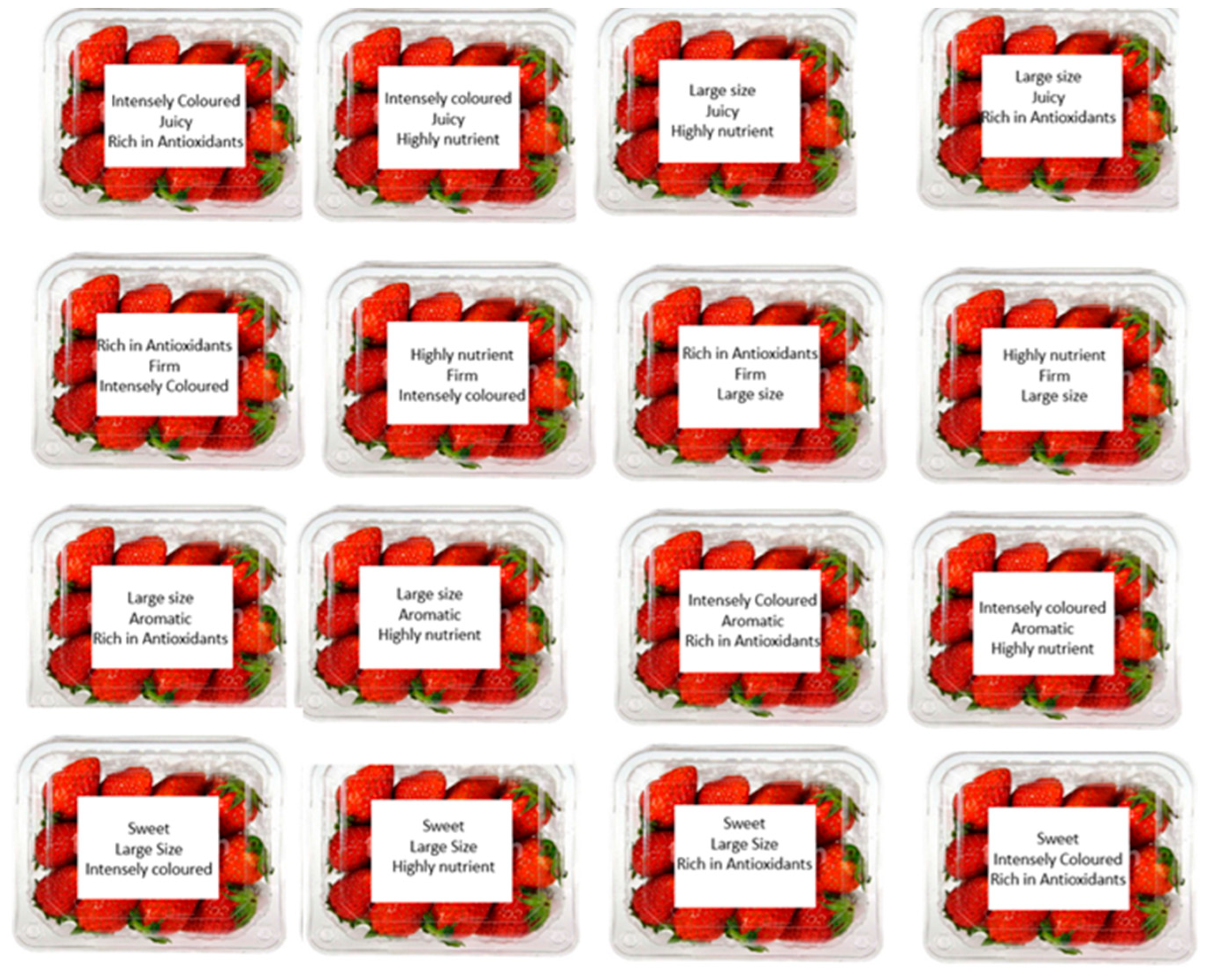
As for the conjoint analysis (Q9), the study employed a full-factorial design, presenting respondents with complete product profiles in a rating-based evaluation task that encompassed every possible combination of attribute levels. The experimental design included three factors: visual characteristics (intense color, large size), sensory qualities (juicy, sweet, aromatic, firm), and functional attributes (nutrient-dense, high in antioxidants). These factors generated a set of 16 cards (2 × 4 × 2), each depicting one level from each attribute category. The choice of factors and attributes was guided by an in-depth literature review [39].
In line with a holistic assessment approach, each card illustrated a strawberry package through a pictorial representation accompanied by the relevant attribute descriptors (Figure 1). The cards were presented using a monadic, sequential procedure, with order and carryover effects systematically balanced. Participants evaluated the perceived attractiveness of each product profile on a seven-point Likert scale (1 = very poor; 7 = excellent).

2.2. Data Collections and Profile of Participants

Data collection took place in Germany, Italy, and Turkey via the Lime Survey platform. Participants were recruited through targeted advertisements disseminated via social media platforms and completed the questionnaire on a voluntary basis. Preliminary screening ensured compliance with the inclusion criterion, whereby only individuals aged 18 years or older were eligible to participate.
A total of 869 consumers (283 living in Germany, 291 in Italy, and 295 in Turkey), comprising 59% females and 61% males, aged 18–60 years (with an average age of 39 years), completed the questionnaire. Table 2 provides a detailed overview of the participants’ sociodemographic characteristics: gender, age, area of residence (urban, suburban, rural), household data (monthly income, monthly expenses for food, household size). The samples were not intended to be fully representative of the national population; indeed, participants were recruited to obtain heterogeneous groups of strawberry consumers rather than statistically representative demographic distributions [40]. Gender distribution was relatively balanced across the three countries (58–61% female), and a wide range of age groups was represented, ensuring variability in consumer perspectives.

2.3. Data Analysis

Data were analyzed using the R programming language 4.3.1 (R Core Team 2023. _R: A Language and Environment for Statistical Computing. R Foundation for Statistical Computing, Vienna, Austria). One-way ANOVA analysis was performed on the consumer scores, and the Tukey post hoc test was conducted to assess the differences among the samples.
ANOVA was applied by considering the Likert-scale responses as interval-level data, assuming equal spacing between response categories. In addition, the key assumptions required for ANOVA—namely independence of observations, normal distribution of residuals, and homogeneity of variances—were satisfied. Under these conditions, ANOVA is considered an appropriate method for analyzing Likert-scale data and may be preferred over non-parametric alternatives such as the Kruskal–Wallis test [41].
The chi-square test of independence was used to determine the associations between variables in contingency tables. For the conjoint analysis, part-worth utilities were estimated using Ordinary Least Squares regression analysis. This is the most extensively used method, allowing for the establishment of the relative importance of the attributes and the part-worths of each of their levels. One-way ANOVA analysis was then performed on the relative importance, on factors, on part-worth utilities, and on levels. One-way ANOVA was performed separately for each group of respondents (Turkish, Italians, and Germans).
WTP was measured using categorical premium ranges relative to a basic strawberry product but belonging to different categories: premium, high-quality, organic, old cultivar strawberries, and low environmental impact.
WTP was categorized into six levels based on price increases [42]: 0%, 10% more, +11/25%, +26/50%, +51/100%, and +100%. A hierarchical log-linear analysis was conducted to examine whether the association between attributes (local product, guaranteed high quality, organic product, old cultivars, product with low environmental impact, new Cultivars) and Level (0, 1, 2, 3, 4, 5) differed across the three consumer groups (Germany, Italy, Turkey). A fully interactive model, including the Attributes x Level x Group three-way interaction, was used.

3. Results

The countries differ in terms of age class and area of residence (Table 2). The majority of respondents from Turkey (38%) were between the ages of 18 and 45 and lived in rural areas (96%), while the majority of respondents from Italy (46%) were between the ages of 46 and 60 and lived in urban areas (51%). The majority of German respondents were between the ages of 31 and 60 and were more equally distributed between urban, suburban, and rural. Household data indicate that German respondents have a monthly income significantly higher than those in Italy (+43%) and Turkey (+38%). However, when calculating food expenditure per individual, accounting for differences in food expenses and household size, Germany still ranks first, but the gap decreases to +12% compared to Italy and +6% compared to Turkey, indicating greater homogeneity for this variable.
Strawberries received the highest approval ratings in all three countries and were by far the most popular fruit among them (Table 3). In Germany, no other fruit type reached strawberry appreciation, while in Italy, the fruit recorded an appreciation comparable to that of the cherry. In Turkey, the leading position of strawberry in consumer preference was less evident, as several fruits, including watermelon, banana, cherry, pomegranate, blackberry, peach, and grape, showed comparable levels of appreciation.
Table 4, Table 5, Table 6, Table 7 and Table 8 are related to the questions Q2 to Q6 and give a general overview of the main factors influencing the consumers’ purchase behaviors.
The frequency of strawberry purchase (Q2) differed significantly across countries (χ2 = 31.60, df = 8, p = 0.0001), whereas no significant differences were observed according to gender (χ2 = 3.83, df = 4, p = 0.43) or age class (χ2 = 8.27, df = 8, p = 0.41).
Considering country differences, German consumers reported purchasing strawberries less frequently than expected on a weekly basis (17%) and more frequently than expected at a lower frequency (1–3 times per month; 30%), as indicated by the positive standardized residuals for this category. In contrast, Italian consumers showed a higher-than-expected proportion of daily strawberry purchases (12%), while purchasing 1–3 times per month occurred less frequently than expected (17%). Turkish consumers displayed a more balanced distribution across categories, with a slightly higher proportion of purchases occurring once or twice per week (38% and 29%, respectively).
Across the whole sample, the most common purchasing frequency was once per week (36–41% depending on the subgroup), followed by 2–4 times per week (23–30%). Daily purchase was relatively uncommon (6–12%), and buying strawberries in bulk for storage in the freezer represented a marginal behavior across all groups (1–5%).
The distribution of strawberry purchasing preferences by country, gender, and age group (Table 5—Q3) revealed that open markets (n = 276) are predominant in Turkey; supermarkets, which are modern retail chains, are more preferred in countries such as Germany (n = 220) and Italy (n = 231). While supermarkets rank first for both genders, women tend to prefer local markets (379) over supermarkets (252). Additionally, women show interest in alternative sales channels such as self-harvesting, small stores, and e-commerce. However, the 31–45 age group prefers local markets more than other age groups. The 18–30 and 31–45 age groups prefer alternative channels, such as e-commerce and small stores, more than the 45–69 age group. The direct import of strawberries from other countries resulted in negligible and non-significant impacts.
The frequency of visual characteristics considered important by consumers when selecting strawberries (Table 6—Q4) differed significantly among countries; in particular, brick red color and big dimension of fruit were selected more frequently than expected in Germany, whereas bright color was selected more frequently than expected in both Italy and Turkey. In addition, the uniform dimension of fruit showed a higher-than-expected frequency in Italy. Age class had a slight influence on visual preferences, mainly related to the uniform dimension of fruit, which was selected more frequently than expected in the 45–60 age group.
The analysis of the sensory attributes influencing consumers’ satisfaction with market-available strawberries (Table 7—Q5) indicated that age, country of residence, and gender exerted a statistically significant effect on overall satisfaction. Total flavor, juiciness, balanced taste, typical aroma, overall quality, sweetness, and freshness received high scores in all countries. Firmness, acidity, and astringency received lower scores in Turkey than in Germany and Italy. Women rated juiciness, firmness, and acidity slightly higher than men. Among age groups, the 45–60 age group showed the highest satisfaction for all the attributes considered. Younger consumers were less satisfied with the typical aroma, overall quality, firmness, freshness, and acidity.
The improvements suggested by consumers highlight the critical factors influencing the purchase of strawberries on the market (Table 8—Q6). The most cited critical factors across the three nations were price (462), taste (412), and organic production (334). The taste was improved for all the countries, while the price got higher citations than expected (146) in German consumers, and the organic production received higher citations than expected (180) in Turkish respondents. Other factors of improvement were: the fruit size, which got higher citations in consumers from Germany (54) together with the availability (66); the label information (53), provenance/authenticity (109), lack of defect (89) which were cited the most by Italian respondents; and appearance (104), fruit consistency (60) and flavor (187), which registered frequencies higher than expected in consumers from Turkey.
Significant differences between countries were highlighted in terms of perceptions and feelings about strawberries (Table 9—Q7). Turkish consumers were more in agreement with most of the statements regarding health and healthy properties, as well as happy feelings and the use of strawberries in different contexts (sweet ingredient, preserved, for children, family, and friends). Italian consumers were much in agreement with a few statements regarding health (“source of antioxidants” and “may cause allergic reactions”), while the German consumers agreed only on statements regarding the consumption habits (“I like it off season” and “I like to consume it at breakfast”). According to gender differences related to strawberry perception, women were more sensitive to most of the statements regarding health, healthy properties, positive feelings, the use in different contexts, and the consumption habits. Significant difference were also recorded in the age groups where the 31–45 age group were more in agreement with few statements mainly regarding positive feelings (“makes me happy”), health (“may cause acidity to the stomach”) the consumption habits (“quick to prepare”, “I like to consume a sweet ingredient”, “I like to preserve it”) and the use in different context (“It’s a local product”, “I like to consume it with friends”, “ I like to consume it at breakfast”).
The questionnaire explored consumers’ willingness to pay (WTP) for a generic strawberry product presented on the market, highlighting attributes related to origin, quality, production methods, and the type of strawberry variety (traditional or innovative) (Table 10—Q8), which were evaluated as WTP drivers (Table 10). WTP was categorized into six price levels, enabling a comparative analysis of consumers’ willingness to pay across product categories in Germany, Italy, and Turkey. The results are interpreted as descriptive indications of stated willingness to pay rather than as econometrically estimated monetary values.
The significant three-way interaction (p < 0.001) demonstrates that the relationship between attributes and level is not consistent across the three countries. Instead, the pattern of frequencies across the six response levels varies markedly depending on the country considered. Thus, the way participants distribute their responses across levels for each attribute differs significantly between Germany, Italy, and Turkey.
Responses regarding WTP for local products indicated relatively low interest in Germany and Italy, with about one quarter of consumers unwilling to pay a price premium. Among those willing to pay more, a 10% premium represented the largest share, accounting for over one third of respondents in Italy and a smaller proportion in Germany. In Turkey, few consumers refused to pay extra, and a higher proportion were willing to pay 26–50% or even 51–100% more.
For “guaranteed high quality,” roughly one quarter of German consumers and one fifth of Italian consumers were unwilling to pay a premium, whereas this group was almost negligible in Turkey. While 10% additional payment was common in Germany and Italy, Turkish consumers exhibited the highest willingness to pay larger premiums, particularly in the 26–50% range.
WTP for organic products varied markedly across countries. About 30% of German consumers were unwilling to pay a premium; the percentages decrease in Italy, and become negligible in Turkey, where 97% of consumers were willing to pay extra for organic strawberries, with half accepting a 26–100% increase, and one fifth willing to pay more than double the base price.
For products with low environmental impact, about one quarter of German and Italian consumers refused to pay extra, whereas this share was smaller in Turkey. While a 10% premium predominated in Germany and Italy, roughly three-quarters of Turkish respondents declared WTP between 26% and over 100% more.
WTP for new cultivars showed moderate interest in Germany and Italy, mostly at a 10% premium, whereas in Turkey, higher premiums of 11–25%, 26–50%, and above were more common. Results for old cultivars were similar: WTP was concentrated around 10% in Germany and Italy, while Turkish consumers were willing to pay substantially higher premiums.
Conjoint analysis revealed the label influence on consumers’ purchasing choices (Table 11—Q9). The results indicated that “sensory traits” was the attribute with the highest relative importance in driving choice, at 53%, followed by “functional properties” at 26% and “visual features” at 21% (Table 11). For sensory factors, the most critical positive levels were firmness (+0.084) and sweetness (+0.020); aroma was of less importance, while juiciness was the least appreciated attribute (−0.120). Firmness was a positive driver for all countries; in contrast, sweetness was positive in Germany (+0.062) and Turkey (+0.054), while in Italy, it was negative (−0.052).
Juicy was evaluated as a negative driver, especially in Turkey and Germany. In terms of functional properties, consumers preferred the presence of antioxidants over nutritional claims. For visual traits, large size prevailed over intense color. However, in Italy and Turkey, antioxidants (+0.123; +0.070) and fruit size (+0.063; +0.032) were positively valued, whereas in Germany, these attributes had negative values. German consumers preferred general nutritional value (+0.057) and intense color (+0.046), which were less appreciated in Italy and Turkey.

4. Discussion

This study aimed to explore consumer expectations and perceived quality of strawberries in different geographical areas, in order to assess the main drivers of consumer purchase behavior in a cross-country framework. The findings indicated a consistently high level of consumer appreciation for strawberries compared with other fruit categories across different countries, underscoring the relevance and prominence of this fruit, well appreciated for its sensory characteristics [43]. Consumer purchasing behavior in relation to strawberries was studied from different perspectives.

4.1. Strawberry Consumption Patterns

Strawberry consumption patterns appeared primarily shaped by country-related factors, which may influence consumption habits due to cultural and market differences. Indeed, fruit consumption patterns in Europe show a clear south–north gradient, with higher fruit intake reported in Mediterranean countries compared with Northern European regions [9,44]. Moreover, the fruit consumption composition differs across Europe, with Northern and Central European countries showing a more diversified distribution among commonly available fruits such as apples, bananas, and citrus. This broader distribution of fruit types across the year may reduce the relative frequency of purchases of strongly seasonal fruits, such as strawberries, outside their peak season [45]. The pattern observed in Turkey may reflect an intermediate consumption behavior, characterized by regular but not intensive purchasing and related to cultural habits [46].
The cultural context also influences the preferred strawberry purchasing channels, which are in turn affected by generational and gender factors. Indeed, open markets were predominant in Turkey, whereas supermarkets were the main purchasing location in Germany and Italy, likely reflecting differences in national retail structures and food distribution systems [4]. The gender and age influences on purchase channels are consistent with previous studies showing that alternative outlets, such as farmers’ markets and direct-to-consumer channels, attract specific consumer segments. In particular, it was demonstrated that women are more likely to use local and alternative food purchasing channels [47] and that participation in short food supply chains is often associated with middle-aged consumers [48].

4.2. Consumers’ Strawberry Purchase Drivers

Consumers’ choices are strongly shaped by the product’s visual attributes, which act as key cues directing their selection when buying strawberries on the market. Indeed, studies on consumer behavior have highlighted that sociodemographic factors and food habits strongly influence preferences for different strawberry attributes such as color, shape, and size [49]. In our study, consumer preferences regarding strawberry visual attributes indicated that dark red was the preferred color, supported by appreciated traits such as intensity and evenness, and, in Italy and Turkey, also by brightness. The results are in line with previous evidence reported for German consumers, who show a strong preference for ‘ripe’ and ‘red’-colored berries, which are perceived as sweeter, juicier, and more flavorful than other alternatives [34,49] On the other hand, despite efforts for broadening the range of strawberry colors, particularly with white varieties, this fruit typology have attracted notable interest in Asian markets [50,51,52], while showing limited consumer appeal in the countries examined in the present study. Understanding consumer inclination for visual appeal is particularly important for producers and retailers, as it can support the development of targeted marketing strategies and product presentation adapted to different consumer segments and markets.

4.3. Consumers’ Expectations and Perceptions

Consumers’ expectations were also studied and revealed critical sensory characteristics that can be improved to meet specific consumer segments’ requirements. Firmness and acidity were the attributes with the lowest satisfaction levels, particularly among participants from Turkey, male consumers, and younger respondents. In addition, younger respondents reported lower satisfaction with juiciness, while both younger and male consumers expressed lower satisfaction with typical aroma, overall quality, and perceived freshness. Indeed, as suggested by Kumar et al. (2017) [53], younger consumers are particularly attentive to product quality and product specifications. In addition, sensory results were in line with previous research indicating that consumer liking of strawberries is largely driven by key sensory attributes, including flavor intensity [54], and texture characteristics such as firmness [54]. Texture and taste balance were confirmed to be important determinants for the market success of strawberry cultivars [39,55]. As further highlighted by consumers’ suggested improvements, the taste emerged as a key point of attention across all countries [39], together with price, mainly improvable for German consumers and organic production, suggested by Turkish consumers. These findings are in line with the previous literature [56] on growing price attention in Germany and the positive attitude for organic production by Turkish consumers [57]. Italian consumers displayed a higher demand for label information and authenticity, as previously stated by Merlino et al. 2024 [58].
The analysis of consumers’ perceptions of strawberries indicated that sensory expectations, cultural background, demographic factors, and consumption contexts collectively contributed to shaping consumer responses across the three countries. Turkish consumers showed a more positive, multifunctional perception of the fruit, with strawberries associated with nutritional value, hedonic enjoyment, and social consumption. Indeed, previous studies have shown that consumers often perceive fresh fruits as natural and health-promoting foods and tend to associate them with disease prevention and overall well-being, which reinforces positive attitudes toward their consumption [59]. Italians showed a more selective perception of strawberries, mainly related to specific health attributes such as antioxidant content and the possibility of allergic reactions, indicating a more differentiated evaluation of health-related aspects of fruit consumption. In countries with strong fruit consumption traditions, such as Mediterranean regions, fruit may be perceived as a routine dietary component rather than a product with explicit functional-health connotations [39]. For German respondents, strawberries are mainly associated with statements related to consumption habits, such as eating strawberries at breakfast or outside the typical seasonal period. This suggests that the fruit may be primarily perceived within specific consumption occasions rather than as a food strongly associated with emotional or health meanings. Research on fruit consumption contexts indicates that consumers frequently associate fruits with particular eating situations (e.g., breakfast, snacks, or desserts), and these situational appropriateness perceptions can strongly influence attitudes and consumption behavior [60]. Gender differences observed are also consistent with previous research on consumer food behavior. Women showed higher agreement with statements related to health properties, positive emotions, and diverse consumption contexts, as they are generally more attentive to healthy eating patterns compared with men [61]. Age-related differences further suggest that life stage influences the way strawberries are perceived and used. The 31–45 age group showed higher agreement with statements related to emotional responses, convenience, and consumption contexts such as breakfast, social occasions, or product preservation. This pattern may reflect the lifestyle characteristics of this demographic group, which often values the convenience factor in foods that combine pleasure, practicality, and versatility in everyday consumption [62].

4.4. The Economic Response to Consumers’ Preferences

Willingness to pay (WTP) is a standard approach useful for translating consumers’ preferences into an economic response, representing the maximum price a consumer is willing to pay for a product or a specific attribute [63]. A WTP approach was applied to blueberries, focusing on sensory attributes [64]. In this study, the drivers of WTP were selected from current and prospective market product features to provide guidance for breeders and stakeholders across the food chain. According to the hierarchical log-linear analysis, the results revealed a clear gradient in attribute differentiation across countries; the extent to which consumers discriminate among attributes varies substantially across cultural groups. The Turkish respondents showed the most pronounced attribute-specific structuring of responses, followed by the Italian group, whereas the German consumers exhibited comparatively uniform response patterns. This cross-group variability aligns with the significant three-way interaction observed in the log-linear analysis, confirming that the relationship between attributes and level is strongly moderated by group membership. Compared to Germany and Italy, Turkey stands out in terms of WTP extra for local products, high-quality products, organic products, old varieties, environmentally friendly products, and new varieties. In Turkey, consumers are more willing to pay higher prices across both low and high additional payment ranges. Turkey has a clear advantage in the 51–100% and +100% price ranges. In Germany and Italy, support remains largely concentrated at lower additional payment levels, with consumer interest declining significantly at higher additional payment levels. The high WTP trend in Turkey suggests that consumers are placing greater importance on both quality and product value, and are more committed to innovation, environmental responsibility, and local values. Overall, Turkey exhibits a much stronger profile than Germany and Italy in terms of consumer loyalty and WTP. Between Germany and Italy, however, notable differences emerge in the additional amount consumers are willing to pay. In Germany, the overall rate of non-payment is higher than in Italy; particularly for older varieties and environmentally friendly products, the proportion of consumers who do not pay extra is significantly higher in Germany. In general, Germany exhibits a more cautious payment profile, while Italy shows a slightly more flexible profile, albeit to a limited extent. The results related to WTP for new cultivars indicate relatively low consumer interest. These findings may provide useful guidance for breeding objectives and communication strategies, suggesting that “novelty” alone is not an appealing attribute for strawberries and should be supported by specific indications of improvement, such as quality, sustainability, and healthiness.

4.5. The Label Influence on Consumers’ Choices

While consumers’ visual appeal at purchase is generally focused on fruit observation [34], the use of conjoint analysis allows assessing how much the label information influences consumers’ purchase decisions. In fact, the most important drivers of consumer choice were the sensory attributes, particularly texture [54], confirming their influence on purchase behavior [65]. Label claims related to functional properties were also found to be more influential than a simple visual approach, particularly among Turkish and Italian consumers. Indeed, in Mediterranean countries, unlike the dietary patterns observed in Northern European countries [66], food choices are strongly associated with health considerations. The Mediterranean diet, rich in antioxidants, is widely recognized for its role in maintaining health and preventing diseases [67], and nutritional knowledge represents a key determinant in healthy food choices [68]. These findings highlight that, in order to fully realize market potential, more attention should be paid not only to the fruit itself but also to packaging and label information.

4.6. Novelty, Limitations, and Future Improvements

This research aims to understand the economic and quality constraints underlying strawberry perception and consumption, and its main innovation is to provide a cross-country overview of the key drivers shaping consumers’ purchasing behavior towards strawberries. Therefore, this study presents some limitations that should be acknowledged. The use of a convenience sample restricts the generalizability of the results, as the participants may not be fully representative of the broader consumer population. Differences were observed in the distribution of residential areas: the Turkish sample consisted predominantly of rural participants (96%), whereas the Italian sample included a higher proportion of urban consumers (51%). These differences may reflect recruitment channels and local availability of consumers and could potentially influence consumer expectations and WTP. However, in terms of household expenditure per family member, the respondents interviewed showed a certain degree of homogeneity among the three countries. Therefore, the findings should be interpreted as indicative of the preferences and expectations of the sampled consumer groups rather than as directly generalizable to the entire populations of the three countries. Future studies could benefit from stratified sampling approaches to better reflect national demographic structures and to further explore the role of urban–rural differences in consumer perceptions of strawberry varieties. Another limitation is related to the absence of a back-translation procedure and the influence of cross-cultural differences on the survey results. Although a formal back-translation procedure was not conducted, the iterative review among native speakers allowed us to verify the conceptual equivalence of the items across languages. Future studies could also further strengthen cross-cultural comparability by including formal back-translation or additional cross-cultural validation procedures.

5. Conclusions

Overall, this study provides a cross-country perspective on consumer expectations and perceived quality of strawberries, highlighting the combined role of sensory attributes, cultural background, and sociodemographic factors in shaping purchasing behavior. Visual appearance, flavor-related attributes, and texture emerged as key determinants of consumer satisfaction and product choice, while country-specific consumption habits and retail structures influenced purchasing patterns. Differences in willingness to pay further revealed heterogeneous consumer attitudes toward product quality, origin, sustainability, and innovation, with Turkish consumers displaying a stronger propensity to pay premium prices for value-added attributes. These findings underline the importance of considering both sensory quality and market-specific consumer expectations when developing strawberry cultivars and marketing strategies, supporting more targeted approaches for producers, breeders, and stakeholders along the supply chain.

Author Contributions

Conceptualization, L.M., B.M., E.K., D.A.S., T.L., S.P., E.G., C.M., M.C., G.M.D., S.K., and E.Y.Ö.; methodology, L.M., B.M., E.K., S.P., E.G., C.M., E.Y.Ö., G.M.D., and M.C.; software, S.P., E.G., C.M., G.M.D., E.Y.Ö., and T.L.; investigation: S.P., E.G., S.K., and E.K.; validation, S.P., E.G., C.M., G.M.D., E.Y.Ö., T.L., K.O., and S.K.; data curation, S.P., E.G., C.M., G.M.D., E.Y.Ö., and T.L.; resources, S.P., E.K., S.K., and B.M.; writing—original draft preparation, S.P., E.G., C.M., S.K., G.M.D., E.Y.Ö., T.L., L.M., and B.M.; writing—review and editing, S.P., C.M., E.G., S.K., E.K., L.M., K.O., and B.M.; visualization, L.M., B.M., E.K., D.A.S., T.L., S.P., E.G., M.C., G.M.D., C.M., S.K., and E.Y.Ö.; supervision, S.P., E.G., C.M., G.M.D., E.Y.Ö., T.L., and S.K.; project administration, B.M., L.M., S.P., E.K., and E.G.; funding acquisition, B.M., L.M., S.P., E.K., and E.G. All authors have read and agreed to the published version of the manuscript.

Funding

This work was supported by the BreedingValue project (https://breedingvalue.eu/ (accessed on1 January 2021)) that has received funding from the European Union’s Horizon 2020 research and innovation program under grant agreement No. 101000747.

Data Availability Statement

The original contributions presented in this study are included in the article. Further inquiries can be directed to the corresponding author.

Acknowledgments

The authors have reviewed and edited the output and take full responsibility for the content of this publication.

Conflicts of Interest

Author Klaus Olbricht was employed by the company Hansabred GmbH & Co. KG, 01108 Dresden, Germany. The remaining authors declare that the research was conducted in the absence of any commercial or financial relationships that could be construed as a potential conflict of interest.

References

  1. Gonçalves, E.M.; Ganhão, R.; Pinheiro, J. Pre- and Postharvest Determinants, Technological Innovations and By-Product Valorization in Berry Crops: A Comprehensive and Critical Review. Horticulturae 2026, 12, 19. [Google Scholar] [CrossRef]
  2. Mbuyisa, S.; Bertling, I.; Ngcobo, B.L. Temperate Berries: Preharvest Factors Contributing to Berry Quality—A Review. Appl. Fruit Sci. 2026, 68, 77. [Google Scholar] [CrossRef]
  3. Hernández-Martínez, N.R.; Blanchard, C.; Wells, D.; Salazar-Gutiérrez, M.R. Current State and Future Perspectives of Commercial Strawberry Production: A Review. Sci. Hortic. 2023, 312, 111893. [Google Scholar] [CrossRef]
  4. Peña Rodríguez, F.J.; Yacamán Ochoa, C.; Matarán, A. Agri-Food Supply Chains in Southern and Eastern Europe; Burleigh Dodds Science Publishing: Cambridge, UK, 2024; pp. 91–110. [Google Scholar]
  5. Palumbo, M.; Attolico, G.; Capozzi, V.; Cozzolino, R.; Corvino, A.; de Chiara, M.L.V.; Pace, B.; Pelosi, S.; Ricci, I.; Romaniello, R.; et al. Emerging Postharvest Technologies to Enhance the Shelf-Life of Fruit and Vegetables: An Overview. Foods 2022, 11, 3925. [Google Scholar] [CrossRef]
  6. Cao, S.; Qiao, L.; Wang, X.; Huang, T.; Wu, C.; Zhang, Y.; Xue, Z.; Kou, X. Discussion on Postharvest Quality, Strategies of Storage and Transportation Techniques of Blueberries: A Comprehensive Review. Food Qual. Saf. 2025, 9, fyaf038. [Google Scholar] [CrossRef]
  7. Shrivastava, C.; Schudel, S.; Shoji, K.; Onwude, D.; Da Silva, F.P.; Turan, D.; Paillart, M.; Defraeye, T. Digital Twins for Selecting the Optimal Ventilated Strawberry Packaging Based on the Unique Hygrothermal Conditions of a Shipment from Farm to Retailer. Postharvest Biol. Technol. 2023, 199, 112283. [Google Scholar] [CrossRef]
  8. Zhang, L.; Muscat, J.E.; Kris-Etherton, P.M.; Chinchilli, V.M.; Al-Shaar, L.; Richie, J.P. The Epidemiology of Berry Consumption and Association of Berry Consumption with Diet Quality and Cardiometabolic Risk Factors in United States Adults: The National Health and Nutrition Examination Survey, 2003–2018. J. Nutr. 2024, 154, 1014–1026. [Google Scholar] [CrossRef]
  9. OECD. European Commission Health at a Glance: Europe 2024: State of Health in the EU Cycle; Health at a Glance: Europe; OECD Publishing: Paris, France, 2024. [Google Scholar]
  10. Tulipani, S.; Romandini, S.; Alvarez Suarez, J.M.; Busco, F.; Mezzetti, B.; Battino, M. Strawberry consumption and antioxidant status in healthy human subjects. Prog. Nutr. 2009, 11, 178–182. [Google Scholar]
  11. Nile, S.H.; Park, S.W. Edible Berries: Bioactive Components and Their Effect on Human Health. Nutrition 2014, 30, 134–144. [Google Scholar] [CrossRef]
  12. Tulipani, S.; Romandini, S.; Suarez, J.M.A.; Capocasa, F.; Mezzetti, B.; Battino, M.; Busco, F.; Bamonti, F.; Novembrino, C. Folate Content in Different Strawberry Genotypes and Folate Status in Healthy Subjects after Strawberry Consumption. BioFactors 2008, 34, 47–55. [Google Scholar] [CrossRef] [PubMed]
  13. Tulipani, S.; Alvarez-Suarez, J.M.; Busco, F.; Bompadre, S.; Quiles, J.L.; Mezzetti, B.; Battino, M. Strawberry Consumption Improves Plasma Antioxidant Status and Erythrocyte Resistance to Oxidative Haemolysis in Humans. Food Chem. 2011, 128, 180–186. [Google Scholar] [CrossRef]
  14. Tsao, R.; Li, H. Phytochemical Antioxidants and Health Benefits of Dried Strawberries. In Dried Fruits; John Wiley & Sons, Ltd.: Hoboken, NJ, USA, 2013; pp. 175–191. [Google Scholar]
  15. Giampieri, F.; Alvarez-Suarez, J.M.; Gasparrini, M.; Forbes-Hernandez, T.Y.; Afrin, S.; Bompadre, S.; Rubini, C.; Zizzi, A.; Astolfi, P.; Santos-Buelga, C.; et al. Strawberry Consumption Alleviates Doxorubicin-Induced Toxicity by Suppressing Oxidative Stress. Food Chem. Toxicol. 2016, 94, 128–137. [Google Scholar] [CrossRef]
  16. Olas, B. Berry Phenolic Antioxidants—Implications for Human Health? Front. Pharmacol. 2018, 9, 78. [Google Scholar] [CrossRef]
  17. Zeneli, F.; Ventura, V.; Frisio, D.G. Sustainable Fresh Strawberry Consumption: Environmental, Genetically Modified Food, and Climate Concerns in Europe and North Africa. Front. Sustain. Food Syst. 2024, 8, 1442074. [Google Scholar] [CrossRef]
  18. Battino, M.; Giampieri, F.; Cianciosi, D.; Ansary, J.; Chen, X.; Zhang, D.; Gil, E.; Forbes-Hernández, T. The Roles of Strawberry and Honey Phytochemicals on Human Health: A Possible Clue on the Molecular Mechanisms Involved in the Prevention of Oxidative Stress and Inflammation. Phytomedicine 2021, 86, 153170. [Google Scholar] [CrossRef]
  19. Shahraki Jazinaki, M.; Safarian, M.; Rashidmayvan, M.; Arabi, S.M.; Sahebkar, A. Impact of Strawberry Consumption on Blood Pressure in Adults: GRADE-Assessed Systematic Review and Dose-Response Meta-Analysis of Data from Randomized Controlled Trials. Avicenna J. Phytomed. 2025, 15, 1408–1423. [Google Scholar] [CrossRef]
  20. Giampieri, F.; Forbes-Hernandez, T.Y.; Gasparrini, M.; Alvarez-Suarez, J.M.; Afrin, S.; Bompadre, S.; Quiles, J.L.; Mezzetti, B.; Battino, M. Strawberry as a Health Promoter: An Evidence Based Review. Food Funct. 2015, 6, 1386–1398. [Google Scholar] [CrossRef]
  21. Çilek. Available online: https://apelasyon.com//icerikler/gida/cilek.html (accessed on 17 March 2026).
  22. Roudeillac, P. The strawberry of the future: A necessary alliance between the discoveries of the breeders and the know-how of the growers to address food safety and consumer satisfaction. Acta Hortic. 2003, 626, 75–83. [Google Scholar] [CrossRef]
  23. Kafkas, E.; Koşar, M.; Paydaş, S.; Kafkas, S.; Başer, K.H.C. Quality Characteristics of Strawberry Genotypes at Different Maturation Stages. Food Chem. 2007, 100, 1229–1236. [Google Scholar] [CrossRef]
  24. Parker, C. Strawberry Fields Forever: Can Consumers See Pesticides and Sustainability as an Issue? Sustain. Sci. 2015, 10, 285–303. [Google Scholar] [CrossRef]
  25. What Consumers Are Looking for in Strawberries: Implications from Market Segmentation Analysis. Agribusiness 2017, 33, 56–69. [CrossRef]
  26. Varela, P.; Ares, G. Sensory Profiling, the Blurred Line between Sensory and Consumer Science. A Review of Novel Methods for Product Characterization. Food Res. Int. 2012, 48, 893–908. [Google Scholar] [CrossRef]
  27. Ares, G.; Barrios, S.; Lareo, C.; Lema, P. Development of a Sensory Quality Index for Strawberries Based on Correlation between Sensory Data and Consumer Perception. Postharvest Biol. Technol. 2009, 52, 97–102. [Google Scholar] [CrossRef]
  28. Wendin, K.; Egan, P.A.; Olsson, V.; Forsberg, S.; Nilsson, A.; Stenberg, J.A. Is There a Best Woodland Strawberry? A Consumer Survey of Preferred Sensory Properties and Cultivation Characteristics. Int. J. Gastron. Food Sci. 2019, 16, 100151. [Google Scholar] [CrossRef]
  29. Ulrich, D.; Olbricht, K. A Search for the Ideal Flavor of Strawberry—Comparison of Consumer Acceptance and Metabolite Patterns in Fragaria × Ananassa Duch. J. Appl. Bot. Food Qual. 2016, 89, 223–234. [Google Scholar] [CrossRef]
  30. Olbricht, K.; Ulrich, D.; Waurich, V.; Wagner, H.; Bicking, D.; Gerischer, U.; Drewes-Alvarez, R.; Gong, X.; Parniske, M.; Gompel, N.; et al. Breeding Potential of underutilizedFragariaspecies. In Proceedings of the Acta Horticulturae; Mezzetti, B., Baruzzi, G., Eds.; Ludwig-Maximilians-Universität München: Rimini, Italy, 2021; pp. 139–146. [Google Scholar]
  31. Capocasa, F.; Balducci, F.; Mazzoni, L.; Marcellini, M.; Qaderi, R.; Mezzetti, B. Preliminary Results of Soilless Cultivated Strawberry Cultivars in the Autumn-Spring Cycle in the Mid-Adriatic Area. Acta Hortic. 2021, 1309, 591–596. [Google Scholar] [CrossRef]
  32. Faedi, W.; Baruzzi, G.; Ballini, L.; Baroni, G.; Capriolo, G.; Lucchi, P.; Maltoni, M.L.; Martelli, G.; Mennone, C.; Zenti, F. Progress in strawberry breeding in italy. Acta Hortic. 2006, 708, 449–454. [Google Scholar] [CrossRef]
  33. Pergola, M.; Maffia, A.; Carlucci, G.; Persiani, A.; Palese, A.M.; Zaccardelli, M.; Altieri, G.; Celano, G. An Environmental and Economic Analysis of Strawberry Production in Southern Italy. Agriculture 2023, 13, 1705. [Google Scholar] [CrossRef]
  34. Bhat, R.; Geppert, J.; Funken, E.; Stamminger, R. Consumers Perceptions and Preference for Strawberries—A Case Study from Germany. Int. J. Fruit Sci. 2015, 15, 405–424. [Google Scholar] [CrossRef]
  35. Gustavsen, G.W.; Strøm-Andersen, N. Why Strawberries? Unpacking the Drivers of Consumer Preferences. 2026. Available online: https://papers.ssrn.com/sol3/papers.cfm?abstract_id=6103769 (accessed on 14 March 2026).
  36. Senger, E.; Osorio, S.; Olbricht, K.; Shaw, P.; Denoyes, B.; Davik, J.; Predieri, S.; Karhu, S.; Raubach, S.; Lippi, N.; et al. Towards Smart and Sustainable Development of Modern Berry Cultivars in Europe. Plant J. 2022, 111, 1238–1251. [Google Scholar] [CrossRef]
  37. Asioli, D.; Aschemann-Witzel, J.; Caputo, V.; Vecchio, R.; Annunziata, A.; Næs, T.; Varela, P. Making Sense of the “Clean Label” Trends: A Review of Consumer Food Choice Behavior and Discussion of Industry Implications. Food Res. Int. 2017, 99, 58–71. [Google Scholar] [CrossRef] [PubMed]
  38. Lusk, J.L.; Hudson, D. Willingness-to-Pay Estimates and Their Relevance to Agribusiness Decision Making. Rev. Agric. Econ. 2004, 26, 152–169. [Google Scholar] [CrossRef]
  39. Predieri, S.; Lippi, N.; Daniele, G.M. What Can We Learn from Consumers’ Perception of Strawberry Quality? Acta Hortic. 2021, 1309, 987–994. [Google Scholar] [CrossRef]
  40. Rossi, E.S.; Cacchiarelli, L.; Severini, S.; Sorrentino, A. Consumers Preferences and Social Sustainability: A Discrete Choice Experiment on ‘Quality Agricultural Work’ Ethical Label in the Italian Fruit Sector. Agric. Econ. 2024, 12, 14. [Google Scholar] [CrossRef]
  41. Alnaim, N.; AlSanad, D.S.; Albelali, S.; Almulhem, M.; Almuhanna, A.F.; Attar, R.W.; Alsahli, M.; Albagmi, S.; Bakhshwain, A.M.; Almazrou, S.; et al. Effectiveness of ChatGPT in Remote Learning Environments: An Empirical Study with Medical Students in Saudi Arabia. Nutr. Health 2025, 31, 1035–1046. [Google Scholar] [CrossRef]
  42. Predieri, S.; Cianciabella, M.; Daniele, G.M.; Gatti, E.; Lippi, N.; Magli, M.; Medoro, C.; Rossi, F.; Chieco, C. Italian Consumers’ Awareness of Climate Change and Willingness to Pay for Climate-Smart Food Products. Sustainability 2023, 15, 4507. [Google Scholar] [CrossRef]
  43. Laaksonen, O.; Knaapila, A.; Niva, T.; Deegan, K.C.; Sandell, M. Sensory Properties and Consumer Characteristics Contributing to Liking of Berries. Food Qual. Prefer. 2016, 53, 117–126. [Google Scholar] [CrossRef]
  44. Tennant, D.R.; Davidson, J.; Day, A.J. Phytonutrient Intakes in Relation to European Fruit and Vegetable Consumption Patterns Observed in Different Food Surveys. Br. J. Nutr. 2014, 112, 1214–1225. [Google Scholar] [CrossRef]
  45. Agudo, A.; Slimani, N.; Ocké, M.C.; Naska, A.; Miller, A.B.; Kroke, A.; Bamia, C.; Karalis, D.; Vineis, P.; Palli, D.; et al. Consumption of Vegetables, Fruit and Other Plant Foods in the European Prospective Investigation into Cancer and Nutrition (EPIC) Cohorts from 10 European Countries. Public Health Nutr. 2002, 5, 1179–1196. [Google Scholar] [CrossRef] [PubMed]
  46. Küçük, N.; Urak, F.; Bilgic, A.; Florkowski, W.J.; Kiani, A.K.; Özdemir, F.N. Fruit and Vegetable Consumption across Population Segments: Evidence from a National Household Survey. J. Health Popul. Nutr. 2023, 42, 54. [Google Scholar] [CrossRef]
  47. Mortimer, G.; Clarke, P. Supermarket Consumers and Gender Differences Relating to Their Perceived Importance Levels of Store Characteristics. J. Retail. Consum. Serv. 2011, 18, 575–585. [Google Scholar] [CrossRef]
  48. Herzig, J.; Zander, K. Determinants of Consumer Behavior in Short Food Supply Chains: A Systematic Literature Review. Agric. Econ. 2025, 13, 21. [Google Scholar] [CrossRef]
  49. Sparacino, A.; Ollani, S.; Baima, L.; Oliviero, M.; Borra, D.; Rui, M.; Mastromonaco, G. Analyzing Strawberry Preferences: Best–Worst Scaling Methodology and Purchase Styles. Foods 2024, 13, 1474. [Google Scholar] [CrossRef]
  50. Seki, H.; Murakami, H.; Ma, T.; Tsuchikawa, S.; Inagaki, T. Evaluating Soluble Solids in White Strawberries: A Comparative Analysis of Vis-NIR and NIR Spectroscopy. Foods 2024, 13, 2274. [Google Scholar] [CrossRef]
  51. Guan, L.; Wilson, Z.A.; Zhao, M.; Qiao, Y.; Wu, E.; Wang, Q.; Yuan, H.; Xu, L.; Pang, F.; Cai, W.; et al. New Germplasm for Breeding: Pink-Flowered and White-Fruited Strawberry. HortScience 2023, 58, 1005–1009. [Google Scholar] [CrossRef]
  52. Chang, L.L.; Zhang, Y.T.; Dong, J.; Sun, R.; Sun, J.; Zhong, C.F.; Zhang, H.L.; Zheng, S.Q.; Wang, G.X. Volatile Components in Three Strawberry Cultivars with White Flesh. Acta Hortic. 2021, 1309, 1041–1046. [Google Scholar] [CrossRef]
  53. Kumar, N.; Kapoor, S. Do Labels Influence Purchase Decisions of Food Products? Study of Young Consumers of an Emerging Market. Br. Food J. 2017, 119, 218–229. [Google Scholar] [CrossRef]
  54. Fan, Z.; Hasing, T.; Johnson, T.S.; Garner, D.M.; Schwieterman, M.L.; Barbey, C.R.; Colquhoun, T.A.; Sims, C.A.; Resende, M.F.R.; Whitaker, V.M. Correction: Strawberry Sweetness and Consumer Preference Are Enhanced by Specific Volatile Compounds. Hortic. Res. 2021, 8, 224. [Google Scholar] [CrossRef]
  55. Testoni, A.; Nuzzi, M. Analytical and sensory evaluation of two strawberry cultivars to improve market acceptability. Acta Hortic. 2006, 708, 349–354. [Google Scholar] [CrossRef]
  56. Hempel, C.; Roosen, J. Growing Importance of Price: Investigating Food Values before and during High Inflation in Germany. Agric. Econ. 2024, 55, 1026–1039. [Google Scholar] [CrossRef]
  57. Almli, V.L.; Asioli, D.; Rocha, C. Organic Consumer Choices for Nutrient Labels on Dried Strawberries among Different Health Attitude Segments in Norway, Romania, and Turkey. Nutrients 2019, 11, 2951. [Google Scholar] [CrossRef]
  58. Merlino, V.M.; Blanc, S.; Fornara, F.; Borra, D.; Massaglia, S.; Mosca, O. A Cross-Countries Comparison of Women Opinions and Perceptions About Organic Products. In Proceedings of the Innovation and Knowledge in Agri-Food and Environmental Systems; Cavicchi, A., Caracciolo, F., Crescimanno, M., De Salvo, M., Galati, A., Seccia, A., Secco, L., Eds.; Springer: Cham, Switzerland, 2024; pp. 167–171. [Google Scholar]
  59. Wang, Y.; Liu, L.; Wei, Y. The Influence of Consumption Purpose on Consumer Preferences for Fruit Attributes: The Moderating Effect of Color Perception. Foods 2025, 14, 1902. [Google Scholar] [CrossRef]
  60. Tarancón, P.; Fernández-Serrano, P.; Besada, C. Consumer Perception of Situational Appropriateness for Fresh, Dehydrated and Fresh-Cut Fruits. Food Res. Int. 2021, 140, 110000. [Google Scholar] [CrossRef] [PubMed]
  61. Medoro, C.; Cianciabella, M.; Magli, M.; Daniele, G.M.; Lippi, N.; Gatti, E.; Volpe, R.; Longo, V.; Nazzaro, F.; Mattoni, S.; et al. Food Involvement, Food Choices, and Bioactive Compounds Consumption Correlation During COVID-19 Pandemic: How Food Engagement Influences Consumers’ Food Habits. Nutrients 2022, 14, 1490. [Google Scholar] [CrossRef] [PubMed]
  62. Ogundijo, D.A.; Tas, A.A.; Onarinde, B.A. Age, an Important Sociodemographic Determinant of Factors Influencing Consumers’ Food Choices and Purchasing Habits: An English University Setting. Front. Nutr. 2022, 9, 858593. [Google Scholar] [CrossRef]
  63. An Empirical Comparison of Methods for Measuring Consumers’ Willingness to Pay on JSTOR. Available online: https://www.jstor.org/stable/40216671?seq=1 (accessed on 17 March 2026).
  64. Canales, E.; Gallardo, R.K.; Iorizzo, M.; Munoz, P.; Ferrão, L.F.; Luby, C.; Bassil, N.; Pottorff, M.; Perkins-Veazie, P.; Sandefur, P.; et al. Willingness to Pay for Blueberries: Sensory Attributes, Fruit Quality Traits, and Consumers’ Characteristics. HortScience 2024, 59, 1207–1218. [Google Scholar] [CrossRef]
  65. Rai, S.; Wai, P.P.; Koirala, P.; Bromage, S.; Nirmal, N.P.; Pandiselvam, R.; Nor-Khaizura, M.A.R.; Mehta, N.K. Food Product Quality, Environmental and Personal Characteristics Affecting Consumer Perception toward Food. Front. Sustain. Food Syst. 2023, 7, 1222760. [Google Scholar] [CrossRef]
  66. Slimani, N.; Fahey, M.; Welch, A.; Wirfält, E.; Stripp, C.; Bergström, E.; Linseisen, J.; Schulze, M.B.; Bamia, C.; Chloptsios, Y.; et al. Diversity of Dietary Patterns Observed in the European Prospective Investigation into Cancer and Nutrition (EPIC) Project. Public Health Nutr. 2002, 5, 1311–1328. [Google Scholar] [CrossRef]
  67. Cianciabella, M.; Predieri, S.; Tamburino, R.; Medoro, C.; Volpe, R.; Maggi, S. Health-Promoting Potential of the Mediterranean Diet and Challenges for Its Application in Aging Populations. Nutrients 2025, 17, 3675. [Google Scholar] [CrossRef]
  68. Aureli, V.; Rossi, L. Nutrition Knowledge as a Driver of Adherence to the Mediterranean Diet in Italy. Front. Nutr. 2022, 9, 804865. [Google Scholar] [CrossRef]
Figure 1. Conjoint Analysis cards submitted to survey participants’ evaluation based on label claims. Cards were proposed in a randomized order.
Horticulturae 12 00451 g001
Table 1. Questions and topics proposed in the online survey.
TopicQuestion/StatementsOptions
(Q1) Preferred fruit typePlease indicate your appreciation for each of the listed fruits. Rating: 1—I don’t like it; 7—I like it a lotApricot
Banana
Blackberry
Blueberry
Cherry
Grape
Grapefruit
Kiwi
Orange
Peach
Pear
Pineapple
Plum
Pomegranate
Raspberry
Strawberry
Watermelon
(Q2) Purchase frequencyHow often do you buy strawberries during the selling season?1–3 times per month
once per week
2–4 times per week
Every day
I buy in bulk and store them in the freezer
(Q3) Purchase channelIndicate your usual purchase channels, one or more optionsSelf-harvesting
Local market or outdoor market sales
Small store
Supermarket
E-commerce
Berries directly imported from other countries
(Q4) Preference drivers: appearanceSelect the visual traits that drive your choice of strawberries. One or more options are allowedBrick red color
Intense color
Dark red color
White color
Color evenness
Large fruit size
Small fruit size
Uniform fruit size
Bright color
Low seed (achenes) presence
(Q5) Consumer satisfactionHow satisfied are you with the following sensory traits of strawberries currently available on the market? Rating: 1—not satisfied at all; 7—extremely satisfiedBalanced taste
Overall flavor
Freshness
Juiciness
Strawberry aroma
Acidity
Sweetness
Astringency
Overall quality
(Q6) Improvements fostering purchaseWhich of the following characteristics would be necessary for increasing strawberry purchases? One or more options are allowedPrice
Shelf-life
Fruit size
Packaging
Appearance
Taste
Health properties
Label information
Fruit consistency
Provenance/authenticity
Flavor
Availability
Range of choice
Lack of defects (ex., bruise, mould)
New cultivars
Organic production
(Q7) Strawberry-related qualities and feelingsHow much do you agree with the following sentences about strawberry consumption?
Rating: 1 strongly Disagree–7 strongly agree
It is a source of antioxidants
Reduces the risk of cancer
Reduces the risk of cardiovascular disease
May generate an allergic reaction
Makes me happy
May cause stomach acidity
Helps me to keep fit
Makes me feel healthier
Too expensive to consume every day
It is fast to prepare
It is a natural product
Reminds me of childhood
I like consuming it off-season (imported)
I like to use it as a dessert ingredient
Suitable for children
It is an environmentally friendly product
It is a local product
I like to consume it with friends
I like to consume it with family
I like to consume it at breakfast
I like to preserve it (frozen, marmalade…)
(Q8) WTPHow much more are you willing to pay for the following proposal as compared to a basic strawberry fruit? Possibilities (0%; +10%; +11% to 25%; +26% to 50%; +51% to 100%; more than 100%)Premium product
Organic product
Ancient cultivar
Environmentally friendly product
New cultivar
Table 2. Sociodemographic data.
DataCountries
GermanyItalyTurkey
Participants283291295
Gender
Female
Male
 
61%
39%
 
60%
40%
 
58%
42%
Age group
18–30
31–45
46–60
 
27%
35%
38%
 
21%
33%
46%
 
36%
38%
26%
Area of residence
Urban
Suburban
Rural
 
28%
32%
40%
 
51%
28%
21%
 
3%
1%
96%
Household data
Monthly income (EUR)
Monthly food expense (EUR)

Food expenses per person (EUR)

Income spent on food (%)

Household size
 
3825 (379.0)

483 (34.4)


195 (0.09)


12.6
2.5
 
2199 (76.3)

513 (18.1)


172 (0.07)


23.3
3.0
 
2388 (123.0)

700 (31.4)


184 (0.08)


23.3
3.8
Overview of the participants’ sociodemographic characteristics (gender, age, area of residence (urban, suburban, rural), average monthly income (in euros), average monthly expenses for food, average expenses per person, percentage of income spent on food, and average number of family members). Standard error for household data in brackets.
Table 3. Preferred fruit types by country.
Fruit TypesGermanyItalyTurkey
Apple5.50 bc5.19 fgh5.62 fgh
Apricot4.84 de5.79 cde5.88 cdefg
Banana5.48 bc5.45 efg6.32 ab
Blackberry4.88 de5.68 cde6.02 abcde
Blueberry5.23 bcd5.81 bcde5.29 h
Cherry5.54 bc6.25 ab6.32 ab
Grape5.47 bc5.60 def6.16 abcd
Grapefruit4.20 f3.98 i5.81 defg
Kiwifruit5.05 cd5.03 gh5.58 fgh
Orange5.21 cd5.55 def5.93 bcdef
Peach5.46 bc6.11 abc6.14 abcd
Pear4.90 de4.90 h5.74 efg
Pineapple5.11 cd5.62 def5.51 gh
Plum4.84 de4.92 h5.83 defg
Pomegranate4.41 ef4.77 h6.13 abcde
Raspberry5.48 bc5.76 cde5.89 cdefg
Strawberry6.31 a6.43 a6.35 a
Watermelon5.72 b5.92 bcd6.23 abc
Fruit appreciation rating in Germany, Italy, and Turkey. Scale 1 (I don’t like at all), 7 (I like extremely). Different letters correspond to significantly different means according to ANOVA analysis followed by the Tukey post hoc test (p < 0.05).
Table 4. Frequency of strawberry purchase options and percentage (in brackets), divided by country, gender, and age class.
CountryGenderAge Class
GermanyItalyTurkeyFemaleMale18–3031–4545–60
Frequency (%)N = 283N = 291N = 295N = 516N = 353N = 245N = 305N = 319
1–3 times per month 85 (30) +50 (17) −63 (21)112 (22)86 (24)62 (25)61 (20)75 (24)
Once per week 100 (35)118 (41)112 (38)188 (36)142 (40)80 (33)121 (40)129 (40)
2–4 times per week 66 (23)86 (30)87 (29)151 (29)88 (25)71 (29)89 (29)79 (25)
Everyday 18 (6)35 (12) +19 (6)45 (9)27 (8)22 (9)27 (9)23 (7)
I buy in bulk and store it in the freezer 14 (5)2 (1) −14 (5)20 (4)10 (3)10 (4)7 (2)13 (4)
X-squared = 31.599X-squared = 3.8267X-squared = 8.2688
df = 8df = 4df = 8
p-value =< 0.001p-value = 0.430p-value = 0.408
The symbols + and − indicate, respectively, positive and negative deviations from the expected frequencies. The number of symbols is proportional to the standardized residuals from the fitted model. +/− indicate significant deviations from the expected cell frequencies at α = 0.05. Chi-square test is reported for country, gender and age-class in the last rows of each category.
Table 5. Frequency of purchase channels and percentage (in brackets), divided by country, gender, and age class.
CountryGenderAge Class
GermanyItalyTurkeyFemaleMale18–3031–4545–60
Frequency (%)N = 283N = 291N = 295N = 516N = 353N = 245N = 305N = 319
Local market/outdoor market sales157 (55)198 (68)276 (94)379 (73)252 (71)178 (73)242 (79)211 (66)
Self-harvesting43 (15)36 (12)53 (18)87 (17)45 (13)42 (17)50 (16)40 (13)
Small store27 (10) − −104 (36) +115 (39)129 (25)117 (33) +86 (35)86 (28)74 (23)
Supermarket220 (78) +231 (79)182 (62) − −390 (76)243 (69)165 (67)221 (72)247 (77) +
E-commerce13 (5)4 (1) −35 (12) +39 (8)13 (4)20 (8)22 (7)10 (3)
Strawberries directly imported from other Countries19 (7)6 (2) −25 (8)37 (7)13 (4)17 (7)21 (7)12 (4)
X-squared = 105.07X-squared = 17.039X-squared = 20.649
df = 10df = 5df = 10
p-value < 2.2 × 10⁻¹⁶p-value = 0.004p-value = 0.024
The symbols + and − indicate, respectively, positive and negative deviations from the expected frequencies. The number of symbols is proportional to the standardized residuals from the fitted model. Single +/− or double − indicate significant deviations from the expected cell frequencies at α = 0.05 and α = 0.001, respectively. Chi-square test is reported for country, gender, and age class in the last rows of each category.
Table 6. Frequency of visual traits orienting purchase choice and percentage (in brackets), divided by country, gender, and age class.
CountryGenderAge Class
GermanyItalyTurkeyFemaleMale18–3031–4545–60
Frequency (%)N = 283N = 291N = 295N = 516N = 353N = 245N = 305N = 319
Orange color 14 (5)10 (3)10 (3)21 (4)13 (4)14 (6)11 (4)9 (3)
Brick red color 63 (22) +43 (15)32 (11) −88 (17)50 (14)45 (18)44 (14)49 (15)
Color intensity 102 (36)144 (49)151 (51)240 (47)157 (44)102 (42)146 (48)149 (47)
Dark red color 103 (36)94 (32)127 (43)197 (38)127 (36)92 (38)111 (36)121 (38)
White color 17 (6)9 (3)11 (4)18 (3)19 (5)16 (7)16 (5)5 (2) −
Color evenness 82 (29)110 (38)112 (38)181 (35)123 (35)82 (33)103 (34)119 (37)
Big dimension of fruit 83 (29) +45 (15) −84 (28)123 (24)89 (25)75 (31)68 (22)69 (22)
Small dimensions of fruit 37 (13)43 (15)49 (17)73 (14)56 (16)28 (11)45 (15)56 (18)
Uniform dimension of fruit 47 (17)73 (25) +48 (16)91 (18)77 (22)43 (18)46 (15)79 (25) +
Bright color 14 (5) − −99 (34) +108 (37) +134 (26)87 (25)71 (29)81 (27)69 (22)
Few achenes 14 (5)8 (3)19 (6)24 (5)17 (5)11 (4)20 (7)10 (3)
X-squared = 120.29X-squared = 6.039X-squared = 39.149
df = 20df = 10df = 20
p-value = 2.515 × 10⁻¹⁶p-value = 0.812p-value = 0.006
The symbols + and − indicate, respectively, positive and negative deviations from the expected frequencies. The number of symbols is proportional to standardized residuals from the fitted model. Single +/− or double − indicate significant deviations from the expected cell frequencies at α = 0.05 and α = 0.001, respectively. Chi-square test is reported for country, gender, and age-class in the last rows of each category.
Table 7. Variance analysis on consumer satisfaction with strawberry quality attributes by country, gender, and age group.
CountryGenderAge
AttributesGermanyItalyTurkeyFemaleMale18–3031–4545–60
Total flavor 5.40 a5.38 a5.25 a5.36 a5.32 a5.23 a5.43 a5.35 a
Juiciness 5.40 a5.41 a5.38 a5.48 a5.27 b5.20 b5.43 ab5.53 a
Balanced taste 5.28 a5.19 a5.16 a5.25 a5.15 a5.09 a5.29 a5.22 a
Typical aroma 5.26 a5.31 a5.27 a5.30 a5.26 a5.00 b5.36 a5.42 a
Overall quality 5.26 a5.36 a5.37 a5.34 a5.30 a5.11 b5.34 ab5.48 a
Firmness 5.25 a5.29 a4.86 b5.21 a5.01 b4.86 b5.26 a5.22 a
Sweetness 5.24 a5.27 a5.41 a5.36 a5.23 a5.20 a5.35 a5.35 a
Freshness 5.22 a5.47 a5.48 a5.43 a533 a5.20 b5.40 ab5.53 a
Acidity 5.12 a4.85 a4.51 b4.91 a4.69 b4.50 b4.94 a4.95 a
Astringency 4.84 a4.76 a435 b4.64 a4.66 a4.52 a4.74 a4.65 a
FactorsMean SQF valuep value
Attribute56.5328.967<2.00 × 10⁻¹⁶ ***
Country10.645.452 0.004 **
Gender22.211.3750.000 **
Age class60.2530.8714.37 × 10−14 ***
Statistical significance for the main factors reported in the lower part of the table. Likert scale: 1–7 (1: not satisfactory at all; 4: average satisfaction; 7: extremely satisfactory). Different letters (a, b) correspond to significantly different means according to the Tukey post hoc test ** p < 0.01; *** p < 0.001.
Table 8. Frequency of consumers suggesting improvements for strawberries on the market and percentage (in brackets), divided by country, gender, and age class.
CountryGenderAge Class
GermanyItalyTurkeyFemaleMale18–3031–4545–60
Frequency (%)N = 283N = 291N = 295N = 516N = 353N = 245N = 305N = 319
Price146 (52) +137 (47)179 (61) − 267 (52)195 (55)133 (54)165 (54)164 (51)
Shelf-life61 (22)59 (20)112 (38)146 (28)86 (24)60 (24)90 (30)82 (26)
Fruit size54 (19) +16 (5) −74 (25)84 (16)60 (17)50 (20)53 (17)41 (13)
Packaging38 (13)29 (10)74 (25)81 (16)60 (17)43 (18)51 (17)47 (15)
Appearance51 (18)15 (5) − −104 (35) +91 (18)79 (22)54 (22)65 (21)51 (16)
Taste108 (38)134 (46)170 (58)232 (45)180 (51)109 (44)149 (49)154 (48)
Health properties28 (10) −53 (18)101 (34)109 (21)73 (21)52 (21)69 (23)61 (19)
Label information29 (10)53 (18) +55 (19)87 (17)50 (14)34 (14)50 (16)53 (17)
Fruit consistency8 (3) −19 (7)60 (20) +55 (11)32 (9)33 (13)28 (9)26 (8)
Provenance/authenticity72 (25)109 (37) ++46 (16) − −132 (26)95 (27)58 (24)80 (26)89 (28)
Flavor65 (23)60 (21) −187 (63) +175 (34)137 (39)89 (36)111 (36)112 (35)
Availability66 (23) ++37 (13)44 (15) −84 (16)63 (18)40 (16)53 (17)54 (17)
Range of choice18 (6)15 (5)25 (8)37 (7)21 (6)16 (7)23 (8)19 (6)
Lack of defects58 (20)89 (31) +91 (31)150 (29)88 (25)72 (29)75 (25)91 (29)
New cultivars27 (10)20 (7)43 (15)52 (10)38 (11)27 (11)39 (13)24 (8)
Organic production52 (18) −102 (35)180 (61) +193 (37)141 (40)78 (32)136 (45)120 (38)
X-squared = 270.2X-squared = 10.573X-squared = 26.331149
df = 30df = 15df = 30
p-value =< 2.2 × 10⁻¹⁶p-value = 0.782p-value = 0.658
The symbols + and − indicate, respectively, positive and negative deviations from the expected frequencies. The number of symbols is proportional to standardized residuals from the fitted model. Single or double +/− indicate significant deviations from the expected cell frequencies at α = 0.05 and α = 0.001, respectively. Chi-square test is reported for country, gender, and age-class in the last rows of each category.
Table 9. Variance analysis on strawberry-related qualities, feelings, and consumption motivations by country, gender, and age group.
CountriesGenderAge Group
AttributesGermanyItalyTurkeyFemaleMale18–3031–4545–60
It is a source of vitamins5.60 b5.78 ab6.00 a5.92 a5.61 b5.68 5.86 5.82
It is a source of antioxidants4.90 b5.41 a5.50 a5.37 a5.14 b5.12 5.31 5.36
Reduces the risk of cancer4.51 b4.60 b5.28 a4.83 4.76 4.77 4.87 4.76
Reduces the risk of cardiovascular diseases4.82 b4.93 b5.33 a5.08 4.96 5.01 5.16 4.92
May generate an allergic reaction4.60 ab4.90 a4.36 b4.81 a4.34 b4.46 4.704.92
Makes me happy5.50 b5.39 b6.06 a5.79 a5.45 b5.63 ab5.81 a5.52 b
May cause acidity in the stomach4.10 b3.75 c4.48 a4.04 4.20 4.34 a4.21 a3.84 b
Helps me to keep fit5.06 b4.96 b5.40 a5.26 a4.97 b5.06 5.19 5.16
Makes me feel healthier5.23 b5.21 b5.77 a5.52 a5.23 b5.40 5.54 5.27
Too expensive to consume every day5.10 b4.73 c5.52 a5.16 5.05 5.12 5.23 5.00
Quick to prepare5.87 5.82 5.81 5.93 a5.69 b5.59 b5.90 a5.96 a
It is a natural product5.70 5.68 5.86 5.76 5.73 5.57 5.81 5.82
Reminds me of childhood5.70 5.68 5.86 5.76 5.73 5.57 5.81 5.82
I like it off-season (imported)4.61 a3.32 c3.80 b3.87 3.95 3.87 4.09 3.76
I like to use a sweet ingredient5.39 b5.12 b5.90 a5.66 a5.19 b5.49 ab5.63 a5.30 b
Suitable for children5.75 b5.65 b6.18 a5.95 a5.75 b5.80 5.95 5.83
It is an environmentally friendly product5.30 b4.98 c5.89 a5.43 5.34 5.33 5.44 5.40
It is a local product5.51 b5.13 c5.80 a5.53 5.41 5.20 b5.58 a5.59 a
I like to consume it with friends5.08 b5.00 b5.75 a5.46 a5.03 b5.36 ab5.42 a5.09 b
I like to consume it with family5.58 b5.81 b6.12 a5.98 a5.64 b5.69 5.945.87
I like to consume it at breakfast4.78 a4.15 b4.45 ab4.63 a4.20 b4.51 ab4.72 a4.16 b
I like to preserve it (frozen, marmalade…)4.54 b3.66 c5.16 a4.61 a4.22 b4.69 a4.63 a4.11 b
FactorsMean SQF valuep  value
Attribute287.1114.2<2 × 10⁻¹⁶ ***
Country413164.26<2 × 10⁻¹⁶ ***
Gender270.4107.56<2 × 10⁻¹⁶ ***
Age class64.525.667.44 × 10−12 ***
Statistical significance for the main factors reported in the lower part of the table. Likert scale: 1–7 (1= I don’t agree; 7 = I fully agree). Different letters (a, b, c) correspond to significantly different means according to the Tukey post hoc test *** p < 0.001.
Table 10. WTP for different strawberry attributes by countries.
Countries
Attributes GermanyItalyTurkeyTotal
Local product068 (24)68 (23)20 (7)156 (18)
178 (28)105 (36)48 (16)231 (27)
249 (17)63 (22)49 (17)161 (19)
336 (13)28 (10)69 (23)133 (15)
439 (14)16 (5)57 (19)112 (13)
513 (5)11 (4)52 (18)76 (9)
Total 283291295869
Guaranteed high quality075 (27)59 (20)6 (2)140 (16)
177 (27)114 (39)46 (16)237 (28)
250 (18)58 (20)52 (18)160 (18)
336 (13)35 (12)66 (22)137 (16)
435 (12)18 (6)69 (23)122 (14)
510 (4)7 (2)56 (19)73 (8)
Total 283291295869
Organic product084 (30)55 (19)9 (3)148 (17)
175 (27)118 (41)35 (12)228 (26)
246 (16)61 (21)53 (18)160 (18)
335 (12)33 (11)73 (25)141 (16)
426 (9)17 (6)67 (23)110 (13)
517 (6)7 (2)58 (20)82 (9)
Total 283291295869
Products with low environmental impact072 (25)69 (24)14 (5)155 (18)
185 (30)125 (43)59 (20)269 (31)
242 (15)47 (16)49 (17)138 (16)
335 (12)21 (7)49 (17)105 (12)
438 (13)21 (7)74 (25)133 (15)
511 (4)8 (3)50 (17)69 (8)
Total 283291295869
New cultivars094 (33)125 (43)29 (10)248 (29)
178 (28)96 (33)58 (20)232 (27)
238 (13)27 (9)65 (22)130 (15)
336 (13)25 (9)61 (21)122 (14)
423 (8)13 (4)45 (15)81 (9)
514 (5)5 (2)37 (13)56 (6)
Total 283291295869
Old cultivars0116 (41)103 (35)47 (16)266 (31)
158 (20)97 (33)59 (20)214 (25)
232 (11)43 (15)63 (21)138 (16)
332 (11)24 (8)56 (19)112 (13)
430 (11)20 (7)45 (15)95 (11)
515 (5)4 (1)25 (8)44 (5)
Total 283291295869
Number and (percentage) of people indicating WTP for the given attribute: 0 = 0% more, 1 = 10% more, 2= 11% to 25% more, 3 = 26% to 50% more, 4 = 51% to 100% more, 5 = 100% more.
Table 11. Ordinary Least Squares regression analysis on the relative importance given by consumers to selected strawberry quality attributes and their levels in Germany, Italy, and Turkey.
FactorsRelative Importance (%)LevelTotalGermanyItalyTurkey
Sensory traits53.1 aFirmness0.084 a0.072 0.0770.104
Sweetness0.020 ab0.062 a−0.052 b0.054 a
Aromaticity0.016 b−0.024 a0.037 a0.034 a
Juiciness−0.120 c−0.110 ab−0.061 a−0.191 b
Functional properties25.9 bRich in antioxidants0.047 a−0.057 b0.123 a0.070 a
Highly nutritious−0.047 b0.057 b−0.123 a−0.070 a
Visual features21.0 cLarge size0.017 a−0.046 b0.063 a0.032 a
Intense color−0.017 b0.046 a−0.063 b−0.032 b
Different letters (a, b, c) correspond to different means according to ANOVA analysis performed on part-worth utilities (total respondents, German respondents, Italian respondents, Turkish respondents).
Disclaimer/Publisher’s Note: The statements, opinions and data contained in all publications are solely those of the individual author(s) and contributor(s) and not of MDPI and/or the editor(s). MDPI and/or the editor(s) disclaim responsibility for any injury to people or property resulting from any ideas, methods, instructions or products referred to in the content.