Article

From Climate Control to Crop Reproducibility: An Intelligent IoT System for Vertical Horticulture


by
Fernando Fuentes-Peñailillo
1,*,
Pabla Rebolledo
2,
Abel Cruces
2 and
Gilda Carrasco
2,*
1
Vicerrectoría Académica, Universidad de Talca, Talca 3460000, Chile
2
Departamento de Horticultura, Facultad Ciencias Agrarias, Universidad de Talca, Talca 3460000, Chile
*
Authors to whom correspondence should be addressed.
Horticulturae 2026, 12(4), 429; https://doi.org/10.3390/horticulturae12040429
Submission received: 20 January 2026 / Revised: 23 March 2026 / Accepted: 26 March 2026 / Published: 1 April 2026
(This article belongs to the Special Issue Advancements in Controlled-Environment Horticulture)

Abstract

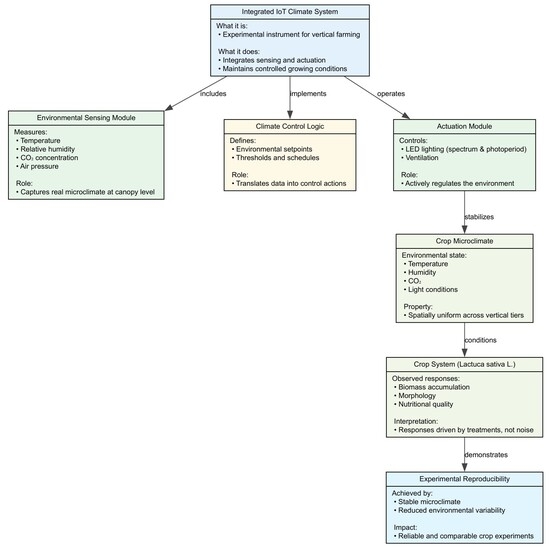
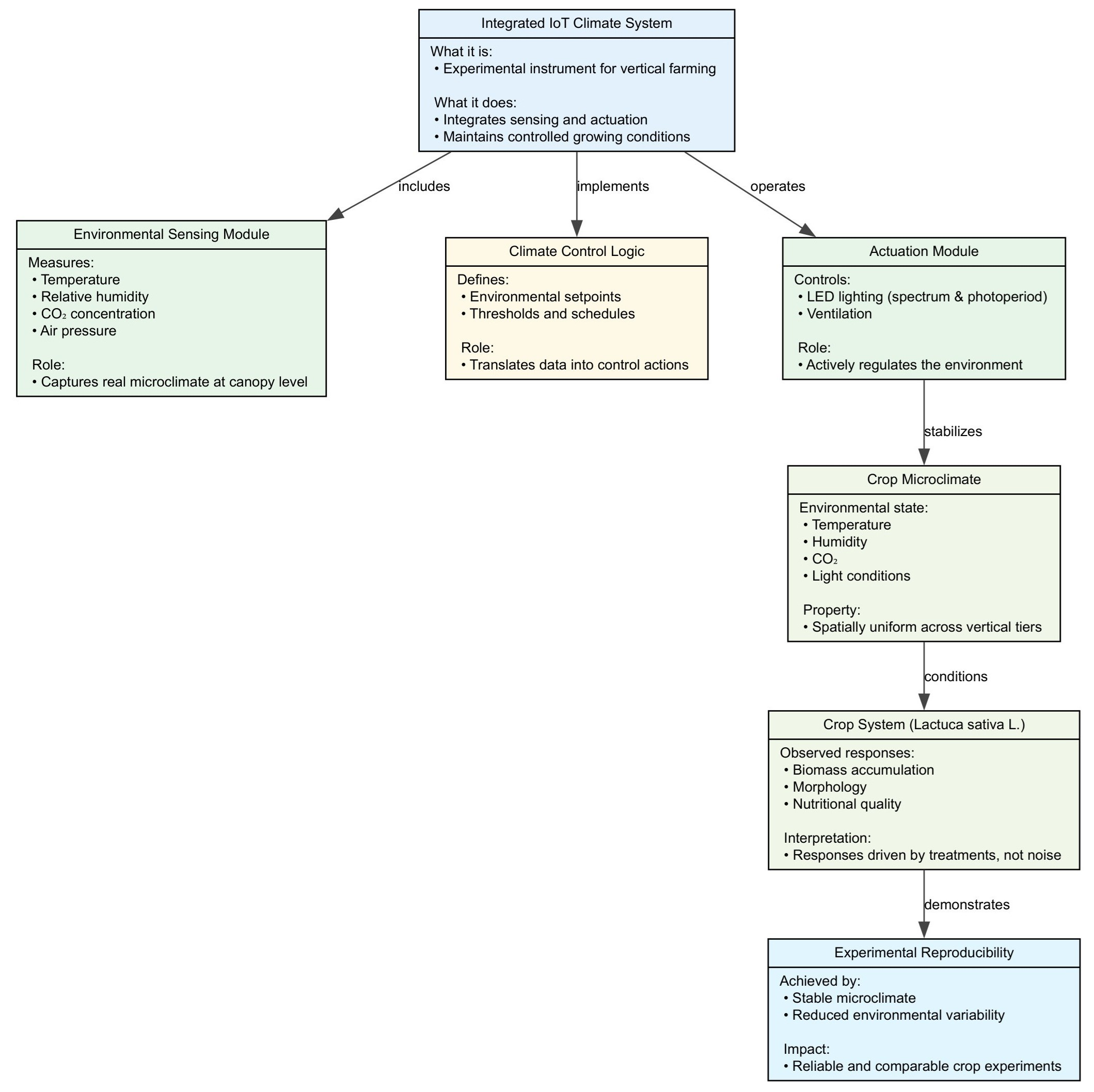
Ensuring experimental reproducibility and reliable isolation of crop responses remain critical challenges in vertical farming and controlled-environment horticulture, where minor microclimatic fluctuations can mask treatment effects and compromise comparability across experiments. This study presents an intelligent, low-cost IoT-based climate management system designed as a methodological framework to stabilize environmental conditions and support reproducible crop responses in vertical horticulture. The system integrates real-time multi-sensor monitoring of temperature, relative humidity, atmospheric pressure, and CO2 concentration with automated high-power actuation for lighting and ventilation within a unified control framework. The platform was validated using lettuce (Lactuca sativa L. cv. Ofelia) cultivated under controlled vertical farming conditions, where environmental stability enabled the reliable detection of plant responses to contrast light spectra. Crop performance was evaluated through biomass accumulation, morphological traits, and nutritional quality parameters. The intelligent control system maintained environmental setpoints within narrow ranges throughout the cultivation cycle, minimizing microclimatic variability across vertical tiers. As a result, observed differences in plant growth and biochemical composition were less likely to be confounded by environmental drift. By shifting the role of IoT technologies from simple automation tools to experimental enablers, this work illustrates how intelligent climate control can support reproducibility, scalability, and methodological robustness in vertical horticulture research. The proposed open, modular architecture provides a transferable framework for reproducible crop experimentation and production in controlled-environment systems.

Graphical Abstract

1. Introduction

Controlled-environment agriculture (CEA), which includes indoor vertical farming, hydroponics, and plant factories, commonly relies on soilless cultivation methods such as hydroponics and aeroponics, although soil-based systems may also operate under controlled environmental conditions [1,2,3]. It has become a paradigm shift in addressing global challenges, including food security, resource efficiency, and climate resilience [4,5]. Growing demand for high-value crops, limited arable land, and climate change have made CEA a key part of future food systems [6]. By separating production from external weather influences, CEA allows stable, year-round growth, especially in urban and peri-urban areas where traditional farming is unfeasible [7,8]. Vertical farming conducted in controlled environments has emerged as an efficient alternative for intensive horticultural production, ensuring stable yields and consistent quality year-round [9]. By maintaining precise control of temperature, humidity, light, and nutrition, plants can fully express their physiological potential [10,11]. These systems not only optimize spatial efficiency but also modulate phytochemical profiles, enhancing nutritional value and antioxidant capacity [12,13,14]. The main advantage of CEA is not only high productivity but also predictability, uniformity, and reproducibility. Controlling environmental factors like temperature, humidity, CO2 levels, and light spectrum directly affects plant physiology, canopy structure, and metabolic processes [15,16]. Therefore, maintaining environmental stability is essential for reliable experiments and comparable data [17,18]. However, current systems often operate in a fragmented way: environmental data is frequently gathered with handheld sensors [19,20,21], while irrigation, lighting, and ventilation are managed manually or with simple timers [22]. This disjointed setup increases labor, reduces scalability, and hampers reproducibility by allowing uncontrollable environmental variations to mask spectral effects [23,24]. The rise of the Internet of Things (IoT) presents an opportunity to integrate sensors and control systems into unified frameworks [25,26,27]. Yet many options remain proprietary, expensive, and limited to large-scale growers [28,29,30]. Open-source solutions typically focus on either sensing or actuation, but rarely both together. This division highlights a persistent gap: engineering progress in environmental monitoring and plant science research often proceeds in separate directions.
Despite the availability of numerous monitoring and automation solutions for controlled-environment horticulture, no well-established models clearly demonstrate how integrated climate control systems can effectively improve experimental reproducibility and scalability at the crop-response level in vertical farming. To test this, we developed and validated a modular, low-cost IoT system that links multiple environmental sensors (temperature, relative humidity, barometric pressure, and CO2) with a high-power controller for lighting and ventilation. Our goal was to determine whether this feedback system could maintain stable environmental conditions, enabling consistent detection of plant responses to different lighting spectra. The system was validated using lettuce (Lactuca sativa L. cv. Ofelia) as a model crop, due to its fast growth, high sensitivity to environmental factors, and relevance in controlled-environment horticulture. Lettuce is one of the most widely cultivated leafy vegetables in plant factories and vertical farms, making it a suitable reference species for studies focused on environmental control and reproducibility [4,31,32]. This study shows that combining real-time sensing with high-power actuation in a single IoT framework can help address a key challenge in CEA: ensuring the reproducibility of plant experiments under tightly controlled environmental conditions. The findings contribute to the ongoing transition from fragmented monitoring systems to unified, open, and scalable IoT architectures for plant science and vertical farming research.

2. Materials and Methods

2.1. Cultivation Setup and Plant Material

The experiment was conducted at the Laboratory of Soilless Cultivation and Vertical Farming at the University of Talca, Chile. Seeds of lettuce (Lactuca sativa L. cv. Ofelia) were germinated in trays filled with a 1:1 (v/v) mixture of peat and perlite. The seedlings were maintained in the nursery until they developed four true leaves, after which they were transplanted on 14 May 2024. Before transplanting, the photosynthetic photon flux density (PPFD) was measured to verify light uniformity across the growing area, and plants were randomly assigned to their respective positions within the system to minimize spatial bias. The vertical farming system consisted of two metallic racks (90 × 60 × 200 cm) with four tiers each. Each tier contained four NFT gutters (9 × 113 × 5 cm, 2% slope), providing a planting density of 22 plants per tier at a spacing of 15 cm. Each tier operated independently, with a 30 L reservoir (20 L active volume) and a WB-S102 pump. The nutrient solution was delivered through the gutters, collected, and recirculated back to the corresponding reservoir in a closed loop. Tap water used for nutrient preparation had an initial pH of 7.0 and an electrical conductivity (EC) of 0.24 dS m−1. A concentrated Cooper nutrient solution (Cooper formulation) was used as the nutrient source. Each reservoir was monitored daily for dissolved oxygen (DO), EC, and pH. The target EC was maintained at 1.3 ± 0.02 dS m−1 (range: 1.28–1.32 dS m−1), while the target pH was 6.0 ± 0.2 (range: 5.8–6.5), adjusted with 5% phosphoric acid as needed.

2.2. IoT Environmental Sensor Unit

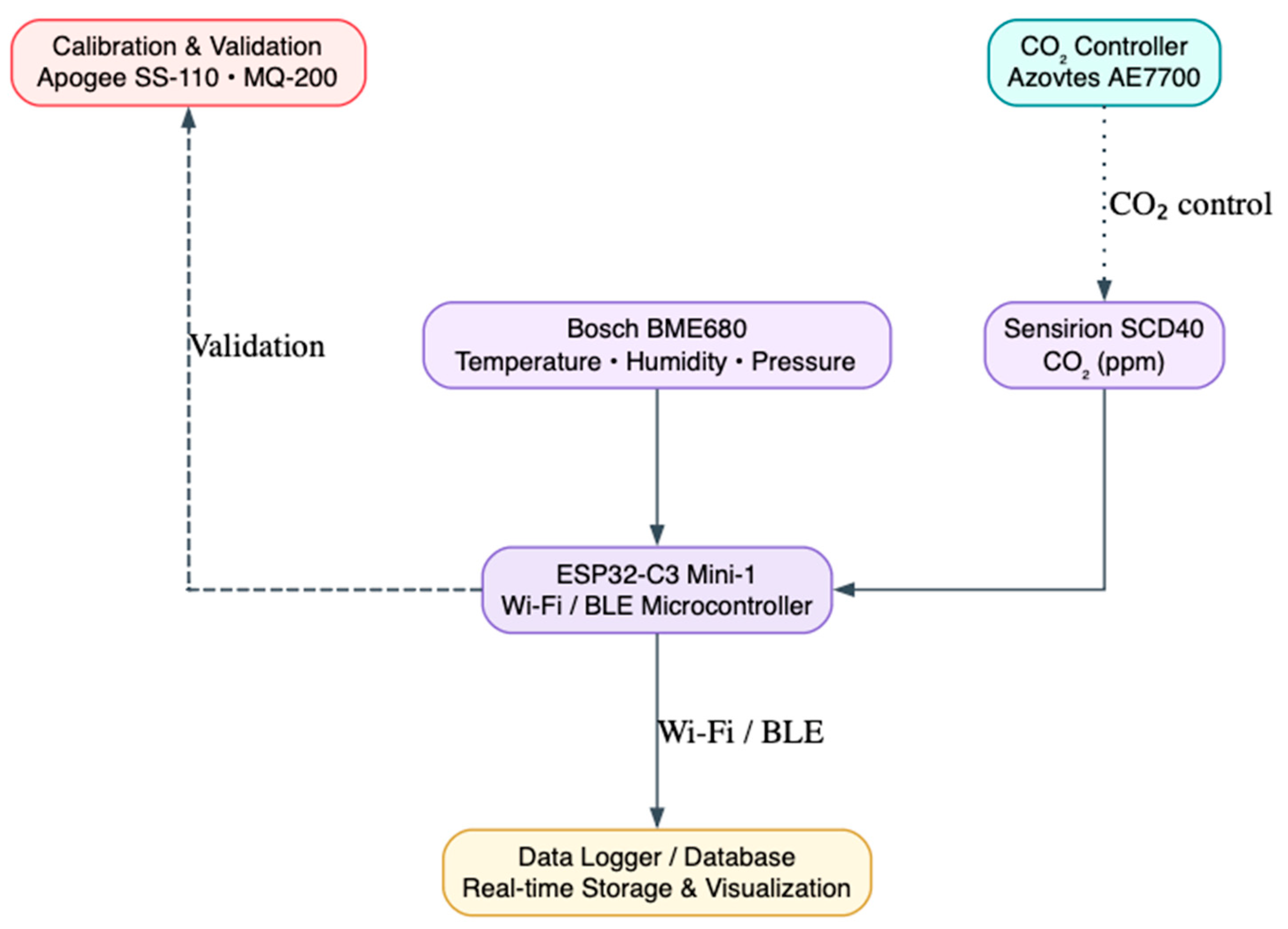
In this study, the IoT-based climate control system was treated as an experimental instrument designed to stabilize microclimatic conditions and support reproducible crop responses, rather than as the primary object of technological evaluation. An IoT-based environmental monitoring unit was developed to enable continuous, real-time measurement of the main atmospheric parameters within the vertical farming system. The device integrated a Bosch BME680 and a Sensirion SCD40 sensor to simultaneously monitor air temperature, relative humidity, barometric pressure, and CO2 concentration. Data acquisition and wireless transmission (Wi-Fi and BLE) were managed by an ESP32-C3 Mini-1 microcontroller, enabling low-power operation suitable for long-term experiments. The environmental sensor unit was designed as a compact, modular device enclosed in a 3D-printed housing for environmental protection and durability. The BME680 sensor was used to obtain accurate measurements such as temperature, barometric pressure, and relative humidity, spanning −40 to 85 °C, 300 to 1100 hPa, and 0 to 100% RH, respectively. The SCD40 extended the system’s capability by measuring CO2 concentration, which was monitored and maintained within an ambient range (≈420 ± 50 ppm) using an Azovtes AE7700 controller for supervisory regulation and stability verification. All sensors were controlled through the ESP32-C3, which managed data collection, timestamping, and wireless communication (Figure 1). The recorded data were logged and streamed to a central database, enabling the visualization of environmental dynamics throughout the cultivation period. Each rack tier contained one sensor unit at the mid-canopy level to ensure representative microclimate monitoring. Sensor calibration and validation were performed by cross-checking readings with reference instruments: an Apogee SS-110 for spectral validation and an MQ-200 for PPFD measurements. This ensured the IoT-based device’s accuracy relative to laboratory-grade sensors. The novelty of this sensing platform lies in integrating multiple environmental parameters into a single, low-cost, and reproducible device. Unlike most commercial systems that address individual variables separately, this design provides a consolidated solution that enhances environmental stability and reproducibility in vertical farming experiments.

2.3. IoT Relay Controller Device

The actuation system was implemented using a custom-designed relay-based controller developed to automate high-power devices needed in vertical farming systems, such as LED lighting panels and ventilation fans. The controller was specifically designed to handle devices with varying electrical loads, ensuring both safe operation and flexibility in experimental setups.
The unit integrated two types of OMRON mechanical relays:
  • OMRON G5NB-1A-E (DC 12 V coil, SPST): a high-reliability relay with a switching capacity of up to 10 A at 250 V AC (or 30 V DC), designed for robust and continuous operation in alternating-current load circuits. Its compact design allows secure switching of high-power devices while maintaining electrical safety.
  • OMRON G5Q-14 (DC 12 V coil, SPDT): a general-purpose relay with a nominal switching capacity of 10 A at 250 V AC, offering a flexible single-pole double-throw configuration for more complex on/off control schemes.
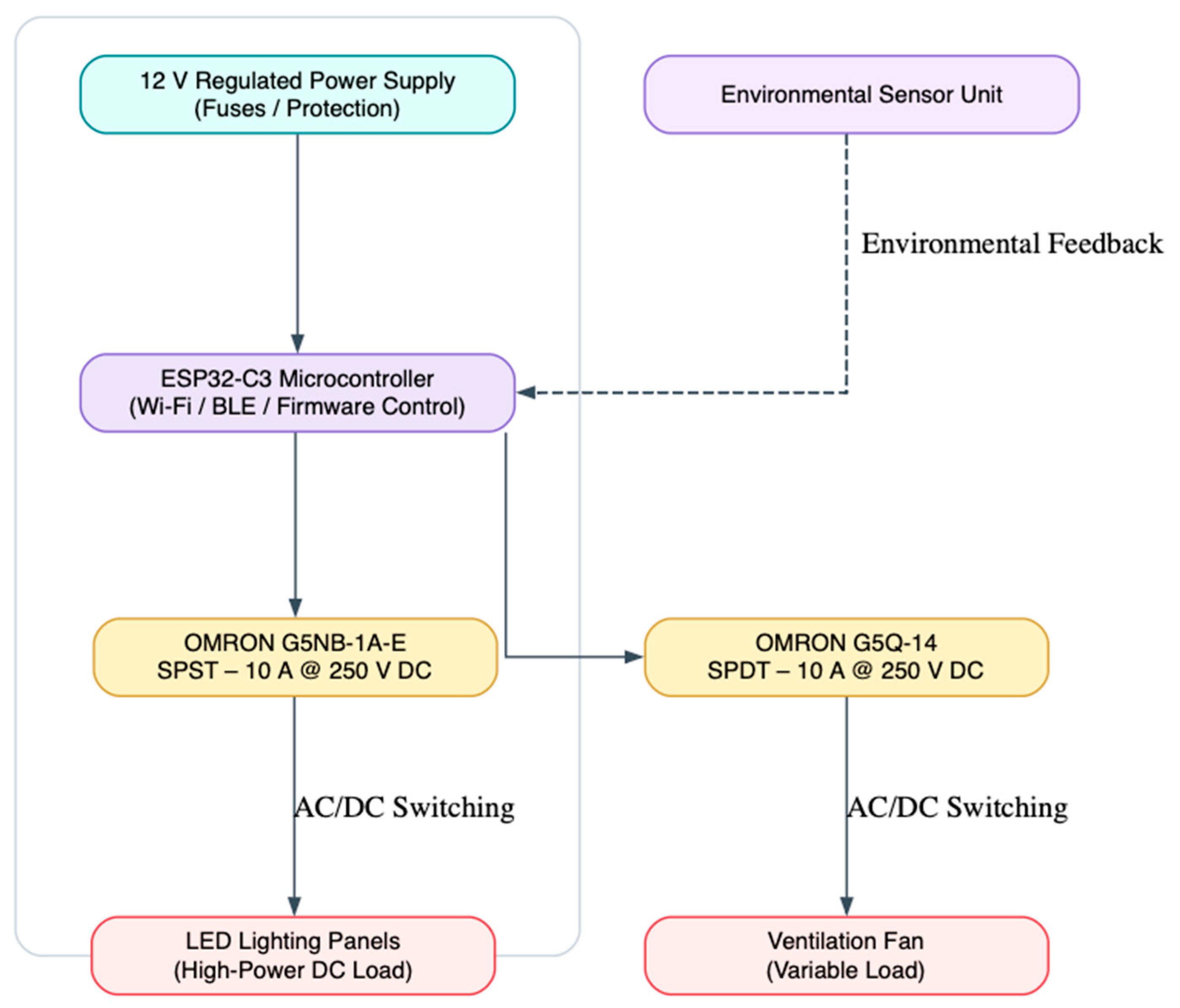
Both relays were mounted on a custom PCB board together with an ESP32-C3 microcontroller, which provided processing power, programmable operation, and wireless connectivity (Wi-Fi and Bluetooth) (Figure 2). The ESP32 allowed remote scheduling of photoperiods and real-time communication with the environmental sensor units (Section 2.2). This integration ensured that environmental monitoring data could trigger precise actuation commands, maintaining stable conditions for each lighting treatment. The controller was powered by a regulated 12 V input and protected by fuses to ensure electrical safety during operation. Its modular architecture included input/output interfaces and connectors that allowed direct integration with the LED panels used in the experiment. By programming the ESP32 firmware, the device activated and deactivated the lights according to predefined photoperiods, ensuring strict reproducibility of the experimental treatments. The innovation lies in providing an open-source, low-cost solution that ensures precise actuation of energy-intensive devices in controlled-environment systems, thereby guaranteeing experimental reproducibility and scalability.

2.4. Device Integration and Operation

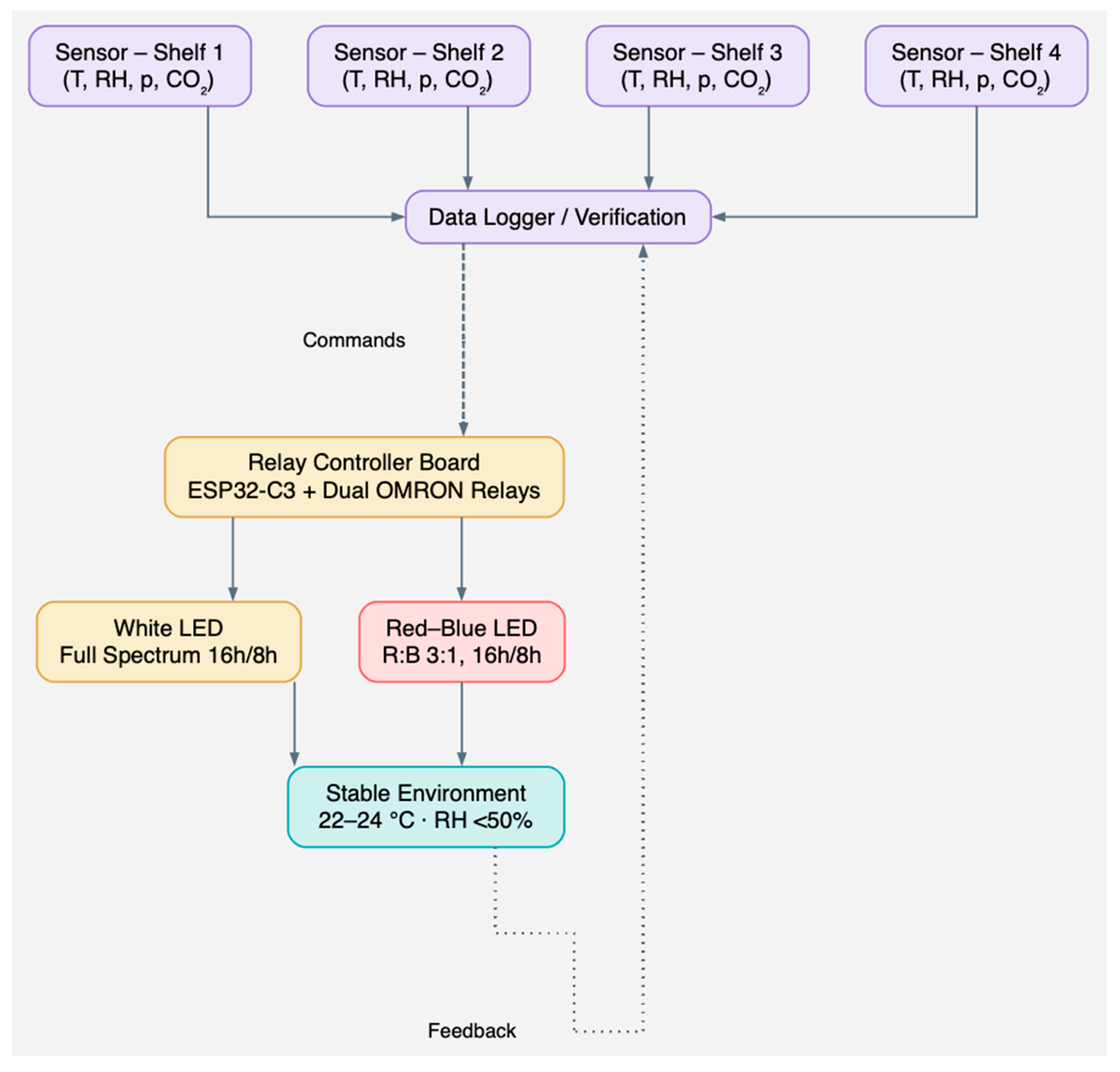
Both IoT devices—the environmental sensor unit and the relay controller—were fully integrated within the vertical farming container to ensure synchronized monitoring and actuation (Figure 3). The environmental sensor units were strategically placed at the mid-canopy level of each vertical shelf, ensuring that measurements of temperature, relative humidity, atmospheric pressure, and CO2 reflected the actual microclimatic conditions surrounding the lettuce plants. This positioning minimized bias from vertical gradients within the container, allowing the monitoring system to capture the environmental variability most relevant to plant physiology. The relay controller was directly connected to the LED lighting panels and programmed via the ESP32 firmware to enforce the lighting treatments. Two light spectra were used—white and red/blue—each following a predefined photoperiod of 16 h of light and eight h of dark. The relay board ensured precise on/off switching of the luminaires at the scheduled times.
In this study, “intelligence” refers to embedded decision logic and automated verification rather than machine-learning components. Specifically, the system implemented: (i) schedule-based automation for photoperiod and spectrum switching using deterministic time rules; (ii) supervisory monitoring and rule-based verification, where real-time sensor streams were used to confirm that programmed actions were executed as intended and that microclimatic conditions stayed within the predefined target ranges during treatment periods; (iii) firmware-level safety and consistency checks, including timestamping, missing-data detection, and communication watchdog routines to prevent silent failures; and (iv) event-driven logging that produced traceable records of both sensed conditions and actuation states, enabling post hoc auditing of treatment integrity and microclimate stability across tiers.
Control strategy, latency, and multi-parameter coupling were addressed as follows. The implemented control approach is intentionally supervisory and rule-based, aiming to enforce deterministic experimental treatments and ensure auditable execution, rather than continuous optimization. Actuation is applied through scheduled switching of lighting treatments, while the sensor layer continuously verifies environmental stability during and after actuation windows. Sensor data were logged at a fixed temporal resolution (as configured in the firmware) and evaluated against predefined tolerance bands for each variable to support consistent auditing of stability across tiers and over time. To characterize control latency, the system logs timestamps for (i) scheduled actuation time, (ii) relay state change, and (iii) the subsequent return of monitored variables to within predefined tolerance bands when transient responses occur. Because temperature, relative humidity, and CO2 can exhibit coupled responses (e.g., thermal load and air exchange affecting both T and RH), all variables are logged with synchronized timestamps to enable co-variability analysis and identification of coupled dynamics under operational fluctuations.
Synchronization between the environmental sensor unit and the relay controller enabled continuous verification of treatment execution, with environmental readings confirming that light intensity and photoperiod were consistently applied throughout the experiment. By combining real-time environmental monitoring with automated lighting control, the IoT framework validated treatment integrity while minimizing microclimatic variability across tiers. In addition, the system was deliberately developed to remain affordable and easy to replicate. In this manuscript, “low cost” refers to the IoT monitoring-and-actuation layer (sensor nodes and relay controller), excluding cultivation infrastructure and LED panels, as these costs depend on scale and crop requirements. Affordability at the IoT layer is achieved through widely available ESP32-based microcontrollers and COTS sensors, the integration of multiple measurements into a single node, and a modular PCB/3D-printed enclosure that reduces assembly and replacement complexity while avoiding proprietary dependencies. The indicative BOM and typical cost ranges are provided in Table 1.

2.5. Measurements and Analytical Procedures

To strengthen methodological reproducibility, the system incorporates mechanisms to detect interruptions and prevent silent failures during long-term operation. At the device level, communication watchdog routines and periodic heartbeat messages support automatic reconnection attempts when connectivity is lost. At the data level, timestamp-continuity checks flag missing records, quantify data gaps, and assess dataset integrity over time. Data transmission reliability is assessed as the proportion of expected records successfully received per interval, together with the frequency and duration of missing-data gaps. Collectively, these operational indicators define an auditable framework for assessing data integrity and long-term operational stability of the acquisition process (Table 2).
The study included a set of agronomic and biochemical variables to characterize plant growth and quality. Fresh biomass per plant (g plant−1) was measured using an analytical balance with a precision of ±0.01 g, and yield per unit area (g m−2) was obtained by multiplying the average biomass by the corresponding plant density. Morphological attributes, including plant height (cm), leaf number (leaves plant−1), and leaf length (cm), were periodically recorded according to standardized horticultural criteria using representative plants from each treatment.
Biochemical traits were analyzed according to widely accepted reference methods. Total phenolic content was quantified using the Folin–Ciocalteu procedure and expressed as milligrams of gallic acid equivalents per gram of fresh weight (mg GAE g−1 FW). The β-carotene content (mg 100 g−1 FW) was determined spectrophotometrically using the AOAC method 941.15 and a standard calibration curve. Crude fiber (% DW) was obtained gravimetrically according to AOAC 962.09, while mineral elements (Fe, Mg, Ca, and P) were measured by atomic absorption spectrometry after sample digestion. Results are expressed as mean ± standard deviation (SD).
Because the lettuce experiment was implemented as a demonstration case study to validate environmental stabilization and enforcement of treatment, the dataset was not structured to support robust inferential comparisons between lighting treatments (e.g., limited independent replication per spectrum). Therefore, results are presented descriptively (means and variability) to illustrate performance under stabilized conditions. Future work will incorporate multi-cycle replication and expanded scenarios to enable stronger statistical inference.

2.6. Evaluation of Environmental Stability and Treatment Enforcement

The performance of the IoT devices (environmental sensor and relay controller) was evaluated by assessing their ability to maintain stable temperature and relative humidity ranges and to precisely enforce photoperiod and spectral treatments throughout the experimental cycle. Stability in environmental conditions was confirmed by cross-validating logged IoT data with reference instruments used during calibration (Apogee SS-110 and MQ-200). This validation confirmed that the environmental parameters and lighting cycles were consistently maintained throughout the experiment.

3. Results

3.1. Performance of the IoT Devices

The integration of the environmental sensor unit and the relay controller resulted in robust performance for lettuce grown under controlled conditions. The sensor consistently monitored temperature and relative humidity at the canopy level, confirming that conditions remained within the optimal range for lettuce growth, with temperature between 20 and 26 °C and relative humidity below 50%. These values were stable across all vertical levels of the container, with minimal fluctuations during the photoperiod. The relay controller operated continuously, ensuring that the lighting units followed the programmed 16-h light/8-h dark cycle with precise on/off transitions. No deviations in photoperiod length were observed, and the relays switched reliably between white and red–blue lighting conditions in accordance with the experimental schedule. These outcomes reflect the system’s embedded supervisory logic, in which deterministic scheduling, continuous sensor-based verification, and fault-tolerant logging jointly ensured traceable enforcement of the prescribed treatments. This supported the interpretation that plant responses were less likely to be confounded by inconsistencies in light exposure. The combined operation of both IoT devices supports the feasibility of achieving environmental stability and improved experimental reproducibility in a low-cost vertical farming setup.
This claim is supported by the component-level BOM reported in Table 1, which shows that the full IoT monitoring-and-actuation layer can be replicated at a low material cost while preserving traceability and treatment integrity. Even without additional environmental control beyond ventilation and programmed lighting, the system maintained a sufficiently stable microclimate to isolate spectral effects.

3.2. Case Study: Plant Growth Responses of Lettuce

The crop performance data presented in this case study are intended to illustrate the proposed system’s capacity to maintain environmental stability and support consistent plant responses under controlled conditions, rather than to establish statistically significant differences among treatments. Accordingly, the emphasis is placed on verifying deterministic treatment enforcement (photoperiod and spectral switching) and maintaining a sufficiently stable microclimatic baseline to minimize confounding drift across tiers. Values are therefore reported descriptively as case study averages under stabilized conditions.
The performance of Lactuca sativa L. grown under the IoT-controlled vertical farming system demonstrated the integrated sensor and relay framework’s ability to support uniform growth and consistent crop development across the vertical tiers. Lettuce plants exhibited an average fresh biomass of 86.75 g·plant−1 (21 days from transplant to harvest), corresponding to a yield of 7634 g·m−2 at a planting density of 88 plants·m−2. This productivity reflects efficient use of space within the confined vertical rack. Plants reached an average height of 11.4 cm, with 21 leaves per plant and a mean leaf length of 11.4 cm, indicating compact and well-structured plants suitable for high-density vertical production. Under the system’s stabilized microclimatic baseline, crop development remained homogeneous across tiers, enabling interpretable plant responses in a controlled environment.
Regarding biochemical characteristics, crude fiber averaged 17.7%, total phenolics reached 2537 ppm (fresh-weight basis), and β-carotene concentration was 1.8 mg·100 g−1 fresh weight. These values are consistent with previous reports indicating that light spectrum and nutrient management can influence the accumulation of antioxidant compounds in lettuce [33,34]. The balance between structural carbohydrates (related to texture) and bioactive compounds (phenolics and carotenoids) supports both product quality and functional nutritional value, indicating that the environmental control achieved by the IoT system preserved the product’s biochemical integrity. The mineral profile showed concentrations of Fe: 41.4 ppm, Mg: 270 ppm, Ca: 657 ppm, and P: 5286 ppm. Iron showed comparatively higher dispersion across samples, which may reflect minor fluctuations in pH and electrical conductivity within the recirculating nutrient system. For clarity, the main performance indicators and compositional measurements reported for this case study are summarized in Table 3.

3.3. Integration of Device Performance and Plant Responses

The integration of the IoT environmental sensor unit with the relay controller was essential for maintaining stable growth conditions throughout the experiment. The relay controller accurately enforced photoperiods and lighting conditions, reliably turning the lighting units on and off according to preset schedules. Simultaneously, the environmental sensor unit continuously tracked canopy-level variables, helping confirm that temperature and relative humidity stayed within specified ranges and minimizing fluctuations that could have affected plant responses [35]. This integration provided a consistent environmental baseline, allowing more confident attribution of differences in morphological and physiological traits to lighting conditions rather than hidden microclimatic changes. Monitoring data confirmed this environmental stability: temperature remained within the target range throughout the experiment (typically 22–24 °C, with an overall observed range of 20–26 °C), relative humidity remained below 50%, and CO2 levels fluctuated around ambient levels (≈420 ppm). Incorporating a multi-sensor environmental monitoring unit and a high-power relay controller into a single IoT setup provided a practical approach for maintaining microclimatic stability in vertical farming. The ability to distinguish morphological and physiological responses from environmental noise supports improved experimental rigor and interpretability. By integrating sensing and actuation on a single platform, this study showed that phenotypic changes (such as uniform canopy expansion and balanced biomass allocation) were consistent with spectral responses rather than with environmental drift. This distinction highlights the methodological value of environmental stabilization, as it provides a reliable baseline for distinguishing sensitive from robust traits. In turn, this allows researchers to focus on parameters that genuinely reflect spectral effects while recognizing which traits remain resilient to environmental manipulation.
From an economic perspective, this system differs significantly from costly, proprietary commercial options, which are often closed, inflexible, and out of reach for small research groups or growers in developing regions. By using open-source microcontrollers, off-the-shelf (COTS) sensors, and entry-level relay devices, the platform achieved scientific performance comparable to that of laboratory-grade systems at a much lower cost. This democratization is not just about economics; it enables reproducibility across institutions, scalability to commercial sites, and the creation of a global research network in which comparable data can be produced under consistent, well-defined conditions. Overall, the results highlight that integrated IoT-based sensing and actuation are not only tools for automation but also essential for experimental reliability and for isolating treatment effects, thereby reducing environmental noise.

4. Discussion

Implications for Reproducible Lighting Experiments in Controlled-Environment Agriculture

The increased yield and biomass accumulation observed in lettuce (Lactuca sativa L. cv. Ofelia) were achieved under well-controlled vertical farming conditions in a highly efficient physiological manner. Unlike many existing open-source or commercial climate control platforms that primarily prioritize automation or remote monitoring, the present architecture is explicitly conceived to support experimental reproducibility by synchronizing real-time environmental sensing and actuation within a single framework [34,35]. This methodological orientation distinguishes the system from platforms primarily designed for operational management rather than controlled horticultural experimentation. In addition to space optimization, these findings suggest that a homogeneous distribution of photosynthetically active radiation (PAR), combined with stable microclimatic conditions, reduces physiological stress and supports continuous carbon assimilation. Reference [36] reported similar results, showing that optimized light spectra, together with precise environmental regulation, enable sustained photosynthesis, resulting in predictable, uniform growth across species. Taken together, these findings suggest that, under the conditions evaluated in this case study, vertical farming can support high productivity per unit area and a more uniform physiological response, both of which are relevant for the advancement of controlled-environment agriculture (CEA).
While the present case study demonstrates the system’s capacity to stabilize the microclimate and support interpretable crop responses, broader generalizability will be strengthened in future work by incorporating multi-cycle repetitions, additional crops, and a wider range of environmental scenarios, enabling formal statistical comparison across treatments and benchmarking against conventional monitoring/actuation setups.
The nutritional appraisal reflects the balance between structural components such as fiber and bioactive compounds such as phenolics and β-carotene under controlled environmental conditions. The low yet homogeneous production of phenolics under stable thermal and photonic conditions suggests that the plants experienced minimal oxidative stress and maintained strong metabolic homeostasis. This result agrees with previous studies reporting that controlled environments buffer nutritional variability and reduce fluctuations in antioxidant levels compared with open-field or conventional greenhouse crops [36]. The measured quantities of β-carotene are comparable to previously reported values for indoor-grown lettuce, supporting the potential of light-spectrum management to enhance the levels of functional compounds without compromising growth performance.
The mineral profile confirmed high nutrient availability under recirculating hydroponic conditions, where nutrient losses are minimal. The relatively high iron concentration may be attributed to the stability of Fe chelates and continuous aeration in the nutrient solution. References [36,37] emphasized the importance of maintaining stable pH and electrical conductivity (EC) to prevent micronutrient precipitation, thereby ensuring uniform mineral availability. Moreover, the consistent levels of Ca, Mg, and P demonstrate that the fertigation strategy successfully maintained a balanced nutrient supply throughout the growth cycle, further validating the accuracy and reliability of the IoT-assisted control system.
From an agronomic perspective, these results support the view that vertical farming is a viable and scalable tool for precision horticulture. By combining environmental regulation, IoT-based monitoring, and modular system design, crop managers can effectively steer plant metabolism toward specific production goals—a concept increasingly referred to as “crop tuning.” Although this study focuses on a single crop and experimental configuration, the modular design of the proposed architecture suggests its potential extension to other crops, larger production units, and multi-site deployments where environmental reproducibility is required [37].

5. Conclusions

The integration of a multi-sensor environmental unit and a high-power relay controller into a unified IoT-based platform represents both a technical innovation and a methodological advance for vertical farming research. This architecture provides a stable and reproducible framework that minimizes environmental variability and enables reliable association of plant responses with lighting spectra and other experimental factors.
Beyond technical efficiency, the system highlights the value of integrating automation and environmental regulation within a single platform. Such integration supports the use of IoT devices as scientific tools capable of facilitating rigorous experimentation and more reproducible cultivation practices. From a practical perspective, this approach demonstrates that complex environmental control can be achieved through open, accessible solutions, avoiding the limitations of proprietary systems that are often costly and hard to access. This open-source approach expands opportunities for research groups and commercial growers alike, particularly in reresource-limited regions.
The modular and scalable nature of the platform suggests that it can be adapted to diverse cultivation contexts, from small research facilities to commercial-scale operations. Future developments may incorporate additional modules for predictive climate control, machine-learning-based decision support, and autonomous fertigation, further enhancing its potential impact. In summary, integrating sensing and actuation within an IoT-based climate management system represents a practical and necessary step toward scientific reproducibility, scalability, and sustainability in controlled-environment horticulture.

Author Contributions

Conceptualization, F.F.-P. and G.C.; methodology, F.F.-P., G.C. and P.R.; software, F.F.-P.; validation, F.F.-P., G.C. and A.C.; formal analysis, F.F.-P. and P.R.; investigation, P.R. and A.C.; resources, G.C.; data curation, P.R.; writing—original draft preparation, F.F.-P.; writing—review and editing, F.F.-P. and G.C.; visualization, F.F.-P.; supervision, G.C.; project administration, F.F.-P.; funding acquisition, G.C. All authors have read and agreed to the published version of the manuscript.

Funding

This study was supported by the FIC project (No. BIP 40036334-0) of the Gobierno Regional del Maule, Chile, and the Ministry of Education project TAL 24991.

Data Availability Statement

The raw data supporting the conclusions of this article will be made available by the authors on request.

Conflicts of Interest

The authors declare no conflicts of interest.

References

  1. Serio, F.; Manuel, R.; Machado, A.; Fussy, A.; Papenbrock, J. An Overview of Soil and Soilless Cultivation Techniques—Chances, Challenges and the Neglected Question of Sustainability. Plants 2022, 11, 1153. [Google Scholar] [CrossRef]
  2. Mahrous, T.; Abd-Elkader, A.M. Soilless Techniques and Innovative Solutions for Water-Efficient and Sustainable Agriculture. In Agricultural Sciences; IntechOpen: London, UK, 2025. [Google Scholar] [CrossRef]
  3. Ojo, M.O.; Zahid, A. Deep Learning in Controlled Environment Agriculture: A Review of Recent Advancements, Challenges and Prospects. Sensors 2022, 22, 7965. [Google Scholar] [CrossRef]
  4. Pennisi, G.; Gianquinto, G.; Marcelis, L.F.M.; Martin, M.; Orsini, F. Vertical Farming: Productivity, Environmental Impact, and Resource Use. A Review. Agron. Sustain. Dev. 2025, 45, 57. [Google Scholar] [CrossRef]
  5. Oh, S.; Lu, C. Vertical Farming—Smart Urban Agriculture for Enhancing Resilience and Sustainability in Food Security. J. Hortic. Sci. Biotechnol. 2023, 98, 133–140. [Google Scholar] [CrossRef]
  6. Calvo-Baltanás, V.; Vilcinskas, A.; Brück, T.; Kloas, W.; Wilke, T.; Rufino, M.; Henkel, M.; Zorn, H.; Monje, O.; Asseng, S. The Future Potential of Controlled Environment Agriculture. PNAS Nexus 2025, 4, pgaf078. [Google Scholar] [CrossRef] [PubMed]
  7. Burritt, M.; Valle de Souza, S.; Peterson, H.C. When Will Controlled Environment Agriculture in Its Vertical Form Fulfill Its Potential? Sustainability 2025, 17, 2957. [Google Scholar] [CrossRef]
  8. Vatistas, C.; Avgoustaki, D.D.; Bartzanas, T. A Systematic Literature Review on Controlled-Environment Agriculture: How Vertical Farms and Greenhouses Can Influence the Sustainability and Footprint of Urban Microclimate with Local Food Production. Atmosphere 2022, 13, 1258. [Google Scholar] [CrossRef]
  9. Heuvelink, E.; Hemming, S.; Marcelis, L.F.M. Developments in Controlled-Environment Agriculture. J. Hortic. Sci. Biotechnol. 2025, 100, 604–614. [Google Scholar] [CrossRef]
  10. Bhattarai, K.; Ogden, A.B.; Pandey, S.; Sandoya, G.V.; Shi, A.; Nankar, A.N.; Jayakodi, M.; Huo, H.; Jiang, T.; Tripodi, P.; et al. Improvement of Crop Production in Controlled Environment Agriculture through Breeding. Front. Plant Sci. 2024, 15, 1524601. [Google Scholar] [CrossRef]
  11. Gill, A.R.; Miller, T.K.; Wijeweera, S.; Herrero, E.; Massa, G.D.; Mortimer, J.C.; Webb, A.A.R.; Millar, A.H.; Gilliham, M. Turbocharging Fundamental Science Translation through Controlled Environment Agriculture. Trends Plant Sci. 2025, 1–14. [Google Scholar] [CrossRef]
  12. Bucky, A.; Pičmanová, M.; Porley, V.; Pont, S.; Austin, C.; Khan, T.; McDougall, G.; Johnstone, A.; Stewart, D. Light Manipulation as a Route to Enhancement of Antioxidant Properties in Red Amaranth and Red Lettuce. Front. Nutr. 2024, 11, 1386988. [Google Scholar] [CrossRef] [PubMed]
  13. Clark, A.; Prashar, A.; Boonham, N.; Robinson, G.; Colwell, F.; Hill, T.R. Antioxidant Profiles of Vertically Farmed Leafy Herbs. Proc. Nutr. Soc. 2023, 82, E225. [Google Scholar] [CrossRef]
  14. Gruda, N.S.; Samuolienė, G.; Dong, J.; Li, X. Environmental Conditions and Nutritional Quality of Vegetables in Protected Cultivation. Compr. Rev. Food Sci. Food Saf. 2025, 24, e70139. [Google Scholar] [CrossRef] [PubMed]
  15. Kaiser, E.; Kusuma, P.; Vialet-Chabrand, S.; Folta, K.; Liu, Y.; Poorter, H.; Woning, N.; Shrestha, S.; Ciarreta, A.; van Brenk, J.; et al. Vertical Farming Goes Dynamic: Optimizing Resource Use Efficiency, Product Quality, and Energy Costs. Front. Sci. 2024, 2, 1411259. [Google Scholar] [CrossRef]
  16. Azizi, S.; Aliniaeifard, S.; Zarbakhsh, S.; Esmaeili, S.; Baghalian, K.; Gruda, N.S. Photobiology, Photosynthesis, and Plant Responses under Artificial Lighting in Controlled Environment Agriculture. Sci. Hortic. 2025, 349, 114248. [Google Scholar] [CrossRef]
  17. White, J.W.; Boote, K.J.; Kimball, B.A.; Porter, C.; Salmeron, M.; Shelia, V.; Thorp, K.R.; Hoogenboom, G. From Field to Analysis: Strengthening Reproducibility and Confirmation in Research for Sustainable Agriculture. npj Sustain. Agric. 2025, 3, 27. [Google Scholar] [CrossRef]
  18. Langstroff, A.; Heuermann, M.C.; Stahl, A.; Junker, A. Opportunities and Limits of Controlled-Environment Plant Phenotyping for Climate Response Traits. Theor. Appl. Genet. 2021, 135, 1–16. [Google Scholar] [CrossRef]
  19. Tornese, I.; Matera, A.; Rashvand, M.; Genovese, F. Use of Probes and Sensors in Agriculture—Current Trends and Future Prospects on Intelligent Monitoring of Soil Moisture and Nutrients. AgriEngineering 2024, 6, 4154–4181. [Google Scholar] [CrossRef]
  20. Soussi, A.; Zero, E.; Sacile, R.; Trinchero, D.; Fossa, M. Smart Sensors and Smart Data for Precision Agriculture: A Review. Sensors 2024, 24, 2647. [Google Scholar] [CrossRef]
  21. Chaudhari, S.K.; Patra, A.; Dey, P.; Kumar Bal, S.; Gorantiwar, S.; Parsad, R. Sensor Based Monitoring for Improving Agricultural Productivity and Sustainability—A Review. J. Indian Soc. Soil Sci. 2022, 70, 121–141. [Google Scholar] [CrossRef]
  22. Osorio-Luna, D.F.; Molina-Ruiz, P.A. Automation and Control of Greenhouse Implemented Technologies: A Review. Vis. Electron. 2019, 2, 381–394. [Google Scholar] [CrossRef]
  23. Wichitwechkarn, V.; Fox, C. MACARONS: A Modular and Open-Sourced Automation System for Vertical Farming. J. Open Hardw. 2022, 7, 1. [Google Scholar] [CrossRef]
  24. Petersen, F.; Demann, J.; von Salzen, J.; Olfs, H.W.; Westendarp, H.; Wolf, P.; Appenroth, K.J.; Ulbrich, A. Re-Circulating Indoor Vertical Farm: Technicalities of an Automated Duckweed Biomass Production System and Protein Feed Product Quality Evaluation. J. Clean. Prod. 2022, 380, 134894. [Google Scholar] [CrossRef]
  25. Cohen, A.R.; Chen, G.; Berger, E.M.; Warrier, S.; Lan, G.; Grubert, E.; Dellaert, F.; Chen, Y. Dynamically Controlled Environment Agriculture: Integrating Machine Learning and Mechanistic and Physiological Models for Sustainable Food Cultivation. ACS ES&T Eng. 2022, 2, 3–19. [Google Scholar] [CrossRef]
  26. Fuentes-Peñailillo, F.; Gutter, K.; Vega, R.; Silva, G.C. New Generation Sustainable Technologies for Soilless Vegetable Production. Horticulturae 2024, 10, 49. [Google Scholar] [CrossRef]
  27. Kharraz, N.; Revoly, A.; Szabó, I. IoT-Based Adaptive Lighting Framework for Optimizing Energy Efficiency and Crop Yield in Indoor Farming. J. Sens. Actuator Netw. 2025, 14, 59. [Google Scholar] [CrossRef]
  28. Gatkal, N.R.; Nalawade, S.M.; Sahni, R.K.; Bhanage, G.B.; Walunj, A.A.; Kadam, P.B.; Ali, M. Review of IoT and Electronics Enabled Smart Agriculture. Int. J. Agric. Biol. Eng. 2024, 17, 1–14. [Google Scholar] [CrossRef]
  29. Kabir, M.S.N.; Reza, M.N.; Chowdhury, M.; Ali, M.; Samsuzzaman; Ali, M.R.; Lee, K.Y.; Chung, S.O. Technological Trends and Engineering Issues on Vertical Farms: A Review. Horticulturae 2023, 9, 1229. [Google Scholar] [CrossRef]
  30. Miller, T.; Mikiciuk, G.; Durlik, I.; Mikiciuk, M.; Łobodzińska, A.; Śnieg, M. The IoT and AI in Agriculture: The Time Is Now—A Systematic Review of Smart Sensing Technologies. Sensors 2025, 25, 3583. [Google Scholar] [CrossRef] [PubMed]
  31. Wicharuck, S.; Khongdee, N.; Man, A.; Syahputra, W.N.H.; Yalangkan, P.; Chaiphak, P.; Chaichana, C. Vertical Farming for Lettuce Production in Limited Space: A Case Study in Northern Thailand. PeerJ 2024, 12, e17085. [Google Scholar] [CrossRef]
  32. Farhangi, H.; Mozafari, V.; Roosta, H.R.; Shirani, H.; Farhangi, M. Optimizing Growth Conditions in Vertical Farming: Enhancing Lettuce and Basil Cultivation through the Application of the Taguchi Method. Sci. Rep. 2023, 13, 6717. [Google Scholar] [CrossRef] [PubMed]
  33. Carrasco, G.; Fuentes-Peñailillo, F.; Manríquez, P.; Rebolledo, P.; Vega, R.; Gutter, K.; Urrestarazu, M. Enhancing Leafy Greens’ Production: Nutrient Film Technique Systems and Automation in Container-Based Vertical Farming. Agronomy 2024, 14, 1932. [Google Scholar] [CrossRef]
  34. Fuentes-Peñailillo, F.; Ortega-Farías, S.; Acevedo-Opazo, C.; Rivera, M.; Araya-Alman, M. A Smart Crop Water Stress Index-Based IoT Solution for Precision Irrigation of Wine Grape. Sensors 2023, 24, 25. [Google Scholar] [CrossRef] [PubMed]
  35. Rouphael, Y.; Kyriacou, M.C.; Petropoulos, S.A.; De Pascale, S.; Colla, G. Improving Vegetable Quality in Controlled Environments. Sci. Hortic. 2018, 234, 275–289. [Google Scholar] [CrossRef]
  36. Dyląg, A.; Smoleń, S.; Wisła-Świder, A.; Kowalska, I.; Sularz, O.; Krzemińska, J.; Pitala, J.; Koronowicz, A. Evaluation of the Chemical Composition and Nutritional Value of Lettuce (Lactuca sativa L.) Biofortified in Hydroponics with Iodine in the Form of Iodoquinolines. Front. Plant Sci. 2023, 14, 1288773. [Google Scholar] [CrossRef] [PubMed]
  37. Fuentes-Peñailillo, F.; del Campo-Hitschfeld, M.L.; Gutter, K.; Torres-Quezada, E. Data-Driven Integration of Remote Sensing, Agro-Meteorology, and Wireless Sensor Networks for Crop Water Demand Estimation: Tools Towards Sustainable Irrigation in High-Value Fruit Crops. Agronomy 2025, 15, 2122. [Google Scholar] [CrossRef]
Figure 1. Architecture of the IoT environmental sensor unit integrating BME680 and SCD40 sensors managed by an ESP32-C3 microcontroller for real-time monitoring and data logging of temperature, humidity, pressure, and CO2 inside the vertical farming system.
Horticulturae 12 00429 g001
Figure 2. Schematic of the IoT relay controller integrating an ESP32-C3 with dual OMRON relays for automated control of LED panels and ventilation fans in the vertical farming system.
Horticulturae 12 00429 g002
Figure 3. Integrated IoT system linking environmental sensing with relay-based lighting control in lettuce cultivation.
Horticulturae 12 00429 g003
Table 1. Indicative bill of materials (BOM) and cost range of the IoT layer (USD).
SubsystemComponent/ItemTypical Cost Range (USD)Notes
Environmental sensor node (per tier)ESP32-C3 microcontroller3–6Main controller and Wi-Fi connectivity
Environmental sensor node (per tier)BME680 (T/RH/pressure)8–15Environmental sensing (excluding CO2)
Environmental sensor node (per tier)SCD40 (CO2)35–55CO2 sensing module
Environmental sensor node (per tier)PCB + passives + connectors10–20Custom PCB, headers, terminals
Environmental sensor node (per tier)3D-printed enclosure (material)2–6Material cost only
Environmental sensor node (per tier)Wiring/headers/fasteners3–10Cables, screws, small parts
Environmental sensor node (per tier)Subtotal per sensor node61–112IoT node only
Relay controller (per system)ESP32-C3 microcontroller3–6Controller for relays and logging
Relay controller (per system)OMRON relays (G5NB + G5Q)6–15Switching of lighting circuits
Relay controller (per system)PCB + protection + connectors8–20Includes fuse holders, terminals
Relay controller (per system)12 V regulated input (supply + basic protection)8–15Power for controller/relays
Relay controller (per system)Subtotal relay controller25–56Controller only
Example configuration (4-tier rack)4 × sensor nodes + 1 × relay controller269–504IoT layer only (example used in this study)
Table 2. Operational metrics used to quantify long-term stability and data integrity of the IoT system.
MetricDefinitionUnitPurpose
Logging completenessReceived records/expected records per interval%Quantifies data transmission reliability
Data gap frequencyNumber of missing-data gaps per day/weekcountCaptures interruptions and connectivity issues
Data gap durationMedian and maximum gap lengthminMeasures severity of interruptions
Sensor anomaly rateOut-of-range or invalid records/total records%Identifies possible faults or drift indicators
Actuation latencyTime between scheduled command and relay state changesVerifies deterministic execution
Stabilization timeTime to return within tolerance band after actuationminQuantifies dynamic response under fluctuations
UptimeTime operational/total time%Long-term operational stability
Table 3. Summary of lettuce performance metrics under the IoT-controlled vertical farming system (case study descriptive averages).
CategoryVariableUnitValue (Mean)
ProductivityFresh biomassg·plant−186.75
ProductivityYieldg·m−27634
System configurationPlanting densityplants·m−288
MorphologyPlant heightcm11.4
MorphologyLeaf numberleaves·plant−121
MorphologyLeaf lengthcm11.4
Biochemical qualityCrude fiber%17.7
Biochemical qualityTotal phenolicsppm2537
Biochemical qualityβ-carotenemg·100 g−1 FW1.8
Mineral profileFeppm41.4
Mineral profileMgppm270
Mineral profileCappm657
Mineral profilePppm5286
Disclaimer/Publisher’s Note: The statements, opinions and data contained in all publications are solely those of the individual author(s) and contributor(s) and not of MDPI and/or the editor(s). MDPI and/or the editor(s) disclaim responsibility for any injury to people or property resulting from any ideas, methods, instructions or products referred to in the content.