
Article

A Molecular Marker System Based on Whole-Genome Sequencing for Mating Type Identification in Major Chinese Cultivars of Lentinula edodes

1
Beijing Engineering Research Center for Edible Mushroom, Institute of Plant Protection, Beijing Academy of Agriculture and Forestry Sciences, 9 Shuguang Garden Zhonglu, Haidian District, Beijing 100097, China
2
College of Life Sciences, Fujian Agriculture and Forestry University, Fuzhou 350002, China
3
Department of Agricultural Biology, Faculty of Agriculture, University of Ruhuna, Mapalana, Matara 81000, Sri Lanka
4
Shandong Agricultural Technology Extension Center, Jinan 250100, China
*
Author to whom correspondence should be addressed.
†
These authors contributed equally to this work.
Horticulturae 2026, 12(4), 424; https://doi.org/10.3390/horticulturae12040424
Submission received: 13 February 2026 / Revised: 24 March 2026 / Accepted: 27 March 2026 / Published: 31 March 2026
(This article belongs to the Section Medicinals, Herbs, and Specialty Crops)

Abstract

Lentinula edodes (shiitake) is a globally significant edible mushroom, with China being its largest producer. Efficient breeding is fundamental to sustaining its industry, yet it is often hindered by the labor-intensive and time-consuming nature of traditional mating type identification methods. To develop a rapid genotyping tool, we elucidated the polymorphism of key mating-type genes and established a practical molecular marker system. In this study, we focused on four major cultivated L. edodes varieties in China (0912, 9608, L808, and W1). Whole-genome sequencing, assembly, and annotation revealed the allelic diversity of HD1 of the A mating type and rcb1 and rcb5 of the B mating type in monokaryotic strains of these varieties. Sequence alignment indicated that HD1 could be classified into five types, rcb1 into four types, and rcb5 into four types. Based on SNPs and InDels, co-dominant primers capable of distinguishing all allelic types of HD1, rcb1, and rcb5 were designed, generating clear molecular fingerprints for the 0912, 9608, L808, and W1 varieties. Notably, this system also demonstrated robust discriminatory power when applied to different Chinese varieties and international L. edodes varieties from Japan, Korea, Thailand, and Canada, confirming its reliability across diverse genetic backgrounds. This highly accurate and efficient marker system offers robust theoretical and technical support for parental selection, germplasm identification, and new variety protection for L. edodes, presenting significant potential to improve horticultural mushroom production efficiency.

1. Introduction

Lentinula edodes (shiitake mushroom) is acclaimed for its rich nutritional profile and savory flavor, boasting high levels of proteins, vitamins, and minerals, while being low in calories and fat [1]. Active compounds such as lentinan, dietary fiber, and ergosterol contribute to its immunomodulatory, lipid-regulating, and antioxidant properties, distinguishing it as both an edible and medicinal fungus [2]. The species naturally occurs primarily in East Asia and Southeast Asia, with East Asia recognized as the oldest traditional cultivation region for L. edodes [3]. Due to global migration, L. edodes cultivation has now spread to all continents except Antarctica.
China is the earliest and largest producer and consumer of L. edodes all over the world, yielding 12.96 million tons in 2022, which constitutes 98.3% of global production [4]. However, nomenclature confusion remains prevalent among L. edodes cultivars. Reports indicate that over 200 cultivars with traceable origins exist in China, while there are still some cultivars in the market whose sources cannot be traced [5,6]. Therefore, parentage tracing and germplasm evolution studies are crucial for guiding future L. edodes breeding efforts.
Mating-type genes, pivotal for sexual reproduction, are essential in crossbreeding and the variety certification of edible fungi. L. edodes exemplifies tetrapolar heterothallism, governed by the unlinked A and B loci (often on a different chromosome). The A locus, primarily through the homeodomain transcription factors HD1 and HD2, regulates clamp cell formation, septation, and the pairing of haploid nuclei. These factors, oriented head-to-head, and exhibiting close linkage between HD1 and HD2 at the A locus, contain conserved dimerization domains, nuclear localization signals, and DNA-binding domains [7,8]. HD1 plays a pivotal role in A mating type determination: the functional heterodimer formation between HD1 and HD2 proteins from compatible mates is the essential molecular event that initiates the clamp cell formation pathway [9]. Consequently, polymorphisms in the HD1 gene directly determine A mating-type specificity and have been extensively documented in diverse L. edodes populations [7]. The B locus oversees nuclear migration and septum dissolution, involving pheromone receptors (rcbs) and pheromones (phbs). Specifically, rcb1 associates with one or two phbs in sublocus Bα, while rcb2 associates with two phbs in sublocus Bβ, both closely linked [10]. Additionally, non-mating-type receptors rcb3 and rcb4 exist without associated phbs [10]. Rcb1 encodes a pheromone receptor that is essential for B mating-type specificity: it recognizes specific pheromones secreted by compatible mates, triggering a signal transduction cascade that leads to nuclear migration and septal dissolution [11]. The specificity of this pheromone-receptor interaction is determined by sequence polymorphisms in rcb1, making it a critical determinant of B mating-type identity [10,11,12,13]. Advances in whole-genome sequencing have identified a new receptor, rcb5, alongside one or two phbs, and three other receptor-like genes on distinct scaffolds [12,13]. Unlike rcb1 and rcb2, which are linked within the canonical B locus, rcb5 is not physically linked to the rcb1-rcb2 cluster [11,13]. This novel receptor gene also participates in pheromone recognition and contributes to B mating-type specificity [11]. The independent segregation of rcb5 from the rcb1-rcb2 cluster means that it may harbor additional allelic diversity not captured by rcb1 genotyping alone. Therefore, we included rcb5 as an additional target to complement the rcb1-based identification and to explore its diversity across different cultivars. The A and B loci work together, with dikaryon formation and sexual development occurring only between monokaryons differing at both loci [14].
Traditional mating type identification through crossing, relying on multiple rounds of confrontation culture and microscopic examination of clamp connections, is labor-intensive and error-prone [15]. In contrast, DNA molecular markers offer reliable, rapid, and straightforward genetic analysis. With the advent of whole-genome sequencing, SNPs and InDel loci have emerged as third-generation molecular markers, enhancing high-throughput applications. SNPs, the most abundant markers, often form specific fingerprint regions, while InDels provide stable variations and high marking efficiency. Kompetitive Allele Specific PCR (KASP), a high-throughput genotyping technology based on fluorescence resonance energy transfer, and its markers facilitate detection in genetically similar and complex samples [16]. Wang et al. identified 89 SNPs and 11 InDels in 176 samples, validating 49 markers via KASP for chloroplast group identification [17]. Hill et al. developed 67 KASP markers based on SNP and InDel sequences from 895 barley varieties, aiding phenology-related trait selection [18]. While applications in edible fungi are emerging, they lag behind other crops. Liu et al. identified 84 cgMNP markers in Agaricus bisporus, transferable to other species like Flammulina filiformis and Saccharomyces cerevisiae [19]. Liu et al. also found 179 universal MNP markers in 232 strains, revealing 22 evolutionary lineages for mating type identification [20]. Choi et al. used PCR to differentiate homo- and heterokaryotic spores based on A locus length differences in A. bisporus [21]. Zhang et al. developed AS-PCR technology for accurate L. edodes mating type identification [22].
In this study, our objective was to develop a set of molecular markers for the rapid and accurate identification of mating types in major Chinese cultivars of L. edodes, providing a practical tool for parental selection and germplasm management in breeding programs. Four widely cultivated L. edodes varieties in China (0912, 9608, L808, and W1) were analyzed through whole-genome sequencing, assembly and annotation. The alleles of the HD1 gene at the A locus and the rcb1 and rcb5 genes at the B locus were obtained. Sequence alignment facilitated the classification of these genes, revealing genetic polymorphism. Highly polymorphic SNP and InDel loci within these genes were used to establish variety-specific molecular markers and fingerprint profiles, successfully distinguishing different L. edodes varieties and aiding in single-spore classification and mating type identification.

2. Materials and Methods

2.1. Cultivation of Strains

The four main cultivated strains of L. edodes, 0912, 9608, L808 and W1, are preserved by the Edible Mushroom Laboratory of the Institute of Plant Protection, Beijing Academy of Agriculture and Forestry Sciences (BIPP). These four strains exhibit significant differences in mycelial colony morphology, temperature type, and fruiting body formation days; detailed information is provided in Figure S1. To analyze the mating type of the above strains, we isolated pairs of haploid strains that can mate with each other from the dikaryotic strains. In a previous study, we isolated monokaryons by protoplasmic mononucleization from variety 0912, and obtained a pair of compatible monokaryons, SP3 and SP30 (Table 1), by mating examination [13]. Following this method, two monokaryotic strains, designated SP45 and SP29, were derived from the dikaryotic strain L808. One protoplasmic mononucleization strain, W1-P1, was obtained from the W1 variety. For 9608, we obtained a protoplast monokaryotic strain, P15, and 63 single-spore strains. Based on the mating examination, we screened a single-spore strain, S21, which can pair with P15. All homokaryotic and heterokaryotic strains were cultured on potato dextrose agar (PDA) at 25 °C. The mycelia of these strains were collected by centrifugation, washed with 0.1 M phosphate-buffered saline (PBS), and frozen in liquid nitrogen for continuous experiments.

2.2. Annotation of Mating-Type Genes

Genomic DNA of the monokaryotic strains 9608-P15, 9608-S21, L808-SP29, and L808-SP45 was extracted using the SDS method. DNA purity and integrity were assessed by agarose gel electrophoresis, and DNA concentration was quantified using a Qubit fluorometer (Thermo Fisher Scientific, Waltham, MA, USA). For each strain, approximately 1 μg of high-quality DNA (A260/A280 = 1.8–2.0) was used for library preparation. Sequencing libraries were constructed using the NEBNext® Ultra™ DNA Library Prep Kit for Illumina (New England Biolabs, Ipswich, MA, USA) following the manufacturer’s instructions. Briefly, DNA was fragmented to an average size of 350 bp using a Covaris ultrasonicator (Covaris, Woburn, MA, USA), followed by end repair, A-tailing, adapter ligation, purification, and PCR amplification. The qualified libraries were sequenced on the Illumina HiSeq platform at Frasergen (Wuhan, China), generating approximately 10 Gb of paired-end reads (150 bp) per sample.
The monokaryons of 9608 and L808 were sequenced on the Illumina HiSeq platform at the Frasergen enterprise (Wuhan, China). De novo genome assembly of the monokaryon was performed using MaSuRCA (v4.1.1) with the following key parameters specified in the configuration file: a paired-end library with an insert size of 500 bp and standard deviation of 50 bp; k-mer size set to auto; read correction and linking enabled (USE_LINKING_MATES = 1); and the Celera Assembler parameter “cgwErrorRate = 0.15”. Using the IDBA-UD software (v1.1.3), assembly quality was evaluated by calculating the number of contigs, N50/N80 values, and other indicators via its built-in raw_n50 function. Assembly statistics are provided in Table S1.
We constructed two haploid chromosome-scale genomes of SP3 and SP30 in a previous study [13], and improved the protein-coding genes annotation using IGV-GSAman (v0.9.53). To identify and characterize the mating-type genes in the assembled genomes of 9608 (P15 and S21) and L808 (SP29), we performed BLASTN (v2.12.0) searches using the mating-type gene sequences of SP3 and SP30 as queries (e-value ≤ 1 × 10⁻¹⁰, identity ≥ 70%). The resulting genomic intervals were manually curated with IGV-GSaman v0.9.53 to refine gene structures and obtain the complete coding sequences of the mating-type genes. Gene predictions from the Softberry-FGENESH website (http://www.softberry.com, accessed on 15 April 2025) were integrated to support the manual curation. Additionally, the genomic sequences of L808 (GCA_015476405.1) and W1-26 (GCA_001700625.1) were obtained from the National Center for Biotechnology Information (NCBI) database. The mating-type genes were selected based on the annotations of L808 and W1-26 [12,23].

2.3. Multiple Sequence Alignment and Molecular Marker Design

The annotated HD1, rcb1, and rcb5 genes were aligned using DNAMAN (version 6.0) and classified into different types based on their variation sites. Primers were designed for SNP and InDel sites using the Primer3Plus website (https://www.primer3plus.com/index.html, accessed on 20 May 2025). The classification criteria were as follows: alleles with >98.5% sequence identity and located in the same clade in the phylogenetic tree were considered the same type. For each gene, the classification was validated by constructing neighbor-joining phylogenetic trees with 1000 bootstrap replicates using MEGA11 (Figure S2).
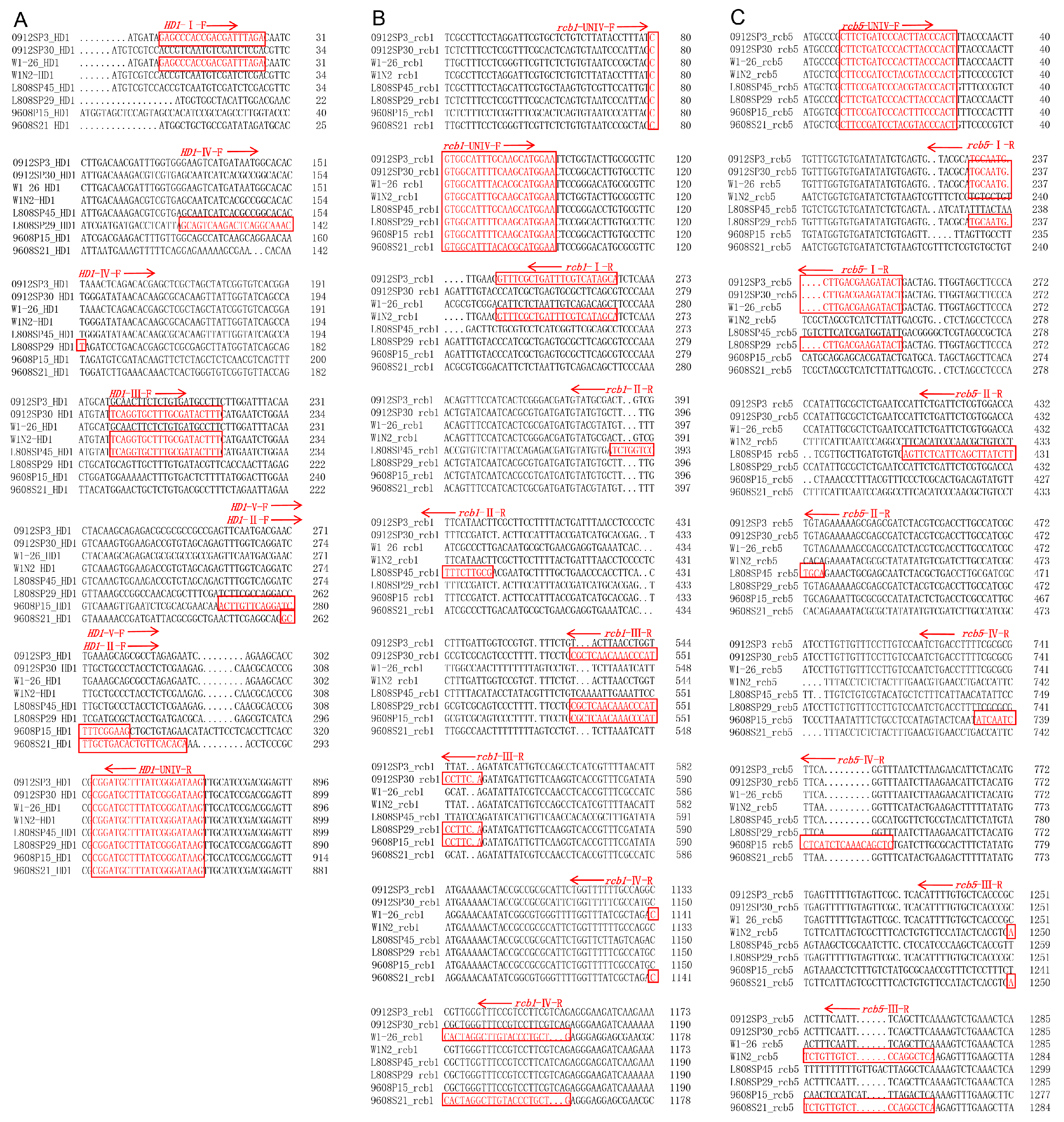
For the HD1 gene, we initially designed universal reverse primers in the conserved regions and five types of specific forward primers for the variant regions, resulting in a set of co-dominant markers for the HD1 gene with distinct PCR product lengths. The primer design for the rcb1 and rcb5 genes followed a similar strategy (Figure 1 and Table 2).

2.4. PCR Amplification and Electrophoresis

Genomic DNA was extracted from mycelia (~100 mg) using a CTAB-based method [13]. The powder was homogenized in 800 μL of extraction buffer (2× CTAB and 2× SDEB, 1:1). After adding 500 μL of phenol: chloroform: isoamyl alcohol (25:24:1) and vortexing for 5 min, the mixture was centrifuged at 13,000× g for 5 min at 4 °C. The aqueous phase was precipitated with 0.7 volumes of isopropanol and centrifuged again (13,000× g, 10 min, 4 °C). The pellet was washed with 70% ethanol, air-dried, and dissolved in 100–150 μL of RNase A-containing TE buffer (37 °C, 30 min). The DNA quality was assessed via NanoDrop 2000 (Thermo Fisher Scientific, Waltham, MA, USA). Samples with A260/A280 ratios of 1.8–2.0 and concentrations > 150 ng/μL were used for PCR.
PCR amplification was performed in a 20 μL reaction volume containing 10 μL of Premix Taq™ (Takara Bio, Kusatsu, Shiga, Japan), 1 μL each of forward and reverse primers (10 μM), 2 μL of DNA template (approximately 100–200 ng), and 6 μL of ddH2O. The thermal cycling conditions were as follows: initial denaturation at 95 °C for 5 min; 32 cycles of denaturation at 95 °C for 30 s, annealing at 58–63 °C (optimized for each primer pair) for 30 s, and extension at 72 °C for 1 min; and a final extension at 72 °C for 5 min. PCR products were analyzed using 2.0% agarose gel electrophoresis, and specific bands were visualized under a UV imaging system to verify mating type genotyping.
For the simultaneous detection of mating-type alleles at the HD1, rcb1, and rcb5 loci, multiplex PCR was performed. The optimized 20 μL reaction contained 10 μL of Premix Taq™ (Takara Bio, Kusatsu, Shiga, Japan), 1 μL of each of the four primers from two primer pairs, 2 μL of DNA template (approximately 100–200 ng), and ddH2O to adjust the final volume. The amplification conditions were as follows: initial denaturation at 95 °C for 5 min; followed by 32 cycles of denaturation at 95 °C for 30 s, annealing at temperatures ranging from 58 °C to 63 °C for 30 s depending on the specific primers, and extension at 72 °C for 1–2 min; and a final extension at 72 °C for 5 min. The PCR products were separated by 2.0% agarose gel electrophoresis and visualized under a UV imaging system (Bio-Rad Laboratories, Hercules, CA, USA).
For the PCR validation experiments, three independent biological replicates were performed for each monokaryotic and dikaryotic strain to ensure the reproducibility of the results.

2.5. Application of Molecular Markers in Identifying Mating Types in Different Varieties

To verify the application of molecular markers, we applied them to ten additional L. edodes strains preserved at the BIPP. Among these strains, L26, 939, BIPP462, and BIPP464 are from China, BIPP407 is from Korea, BIPP026 is from Japan, BIPP738 is from Thailand, and BIPP632 is from Canada (Table 1). The reference sequences for the A (HD1) and B (rcb1) mating-type loci of the L26 (P1, P2) and 939 (P26, P42) strains were retrieved from NCBI (accession numbers: HQ201373.1, HQ701710, HQ201377.1, HQ201365, HQ201369.1, KC887918, HQ201370.1, and KC887919). PCR amplification was then performed using type-specific molecular marker primers and their gene types were analyzed based on the electrophoresis bands.

2.6. Application of Molecular Markers in Genotyping Identification of Single-Spores

For the 64 monokaryotic strains of 9608, their mating types were identified by crossing combined with molecular markers. The compatible monokaryons P15 (mating type AyBy) and S21 (AxBx) were used. Single-spore strains that could mate with P15 were classified as AxBx, while those that could mate with S21 were classified as AyBy (Table S2). The strains that exhibited incompatibility with both P15 and S21 were defined as AxBy or AyBx (Table S3) according to the PCR performance using the designed mating type-specific molecular markers.

3. Results

3.1. Classification of Mating-Type Genes

We obtained the mating-type genes by annotating the published complete genomes of two monokaryotic strains (SP3 and SP30) of 0912, one monokaryotic strain of L808, and one single-spore strain (W1-26) of W1. Additionally, we assembled the genomes of the monokaryotic strains P15 and the single-spore strain S21 of 9608, as well as the monokaryotic strains SP45 and SP29 of L808, to acquire their mating-type genes. Preliminary comparisons revealed that the mating type of the monokaryotic strain SP45 is consistent with the mating type of the NCBI-published L808 monokaryotic strain. Consequently, the L808 genome from the NCBI was utilized in the subsequent analysis.
Among the seven mononuclear strains tested, the sequence identities of the HD1, rcb1, and rcb5 genes were 86.20%, 82.40%, and 82.40%, respectively. The phylogenetic analysis revealed that these three genes could be classified into distinct genotypes: the HD1 gene exhibited five genotypes, while the rcb1 and rcb5 genes each displayed four genotypes (Table 1). The specific distribution patterns of the genotypes are as follows:
For the HD1 gene, genotype HD1-I consists of the HD1 genes from strains SP3 and W1-26, which share 100% sequence similarity. The HD1 gene of strain 9608S-21 belongs to genotype HD1-II. Strains SP30 and L808-SP45, with 100% sequence similarity in their HD1 genes, are collectively assigned to genotype HD1-III. The HD1 genes of strain L808-SP29 and strain 9608-P15 are classified as genotypes HD1-IV and HD1-V, respectively.
Regarding the rcb1 gene, the rcb1 gene of strains SP3 and L808-SP45 are classified as genotypes rcb1-I and rcb1-II. Strains SP30, 9608-P15, and L808-SP29, with 100% sequence identity in their rcb1 genes, are grouped as genotype rcb1-III. Strains 9608-S21 and W1-26, also showing 100% sequence identity in their rcb1 genes, are assigned to genotype rcb1-IV.
For the rcb5 gene, strains SP3, SP30, L808-SP29, and W1-26 share 99.80% sequence identity and are classified as genotype rcb5-I. The rcb5 gene of strains L808-SP45, 9608-S21 and 9608-P15 belong to genotypes rcb5-II, rcb5-III, and rcb5-IV, respectively.

3.2. Development of Molecular Markers for Mating-Type Genes

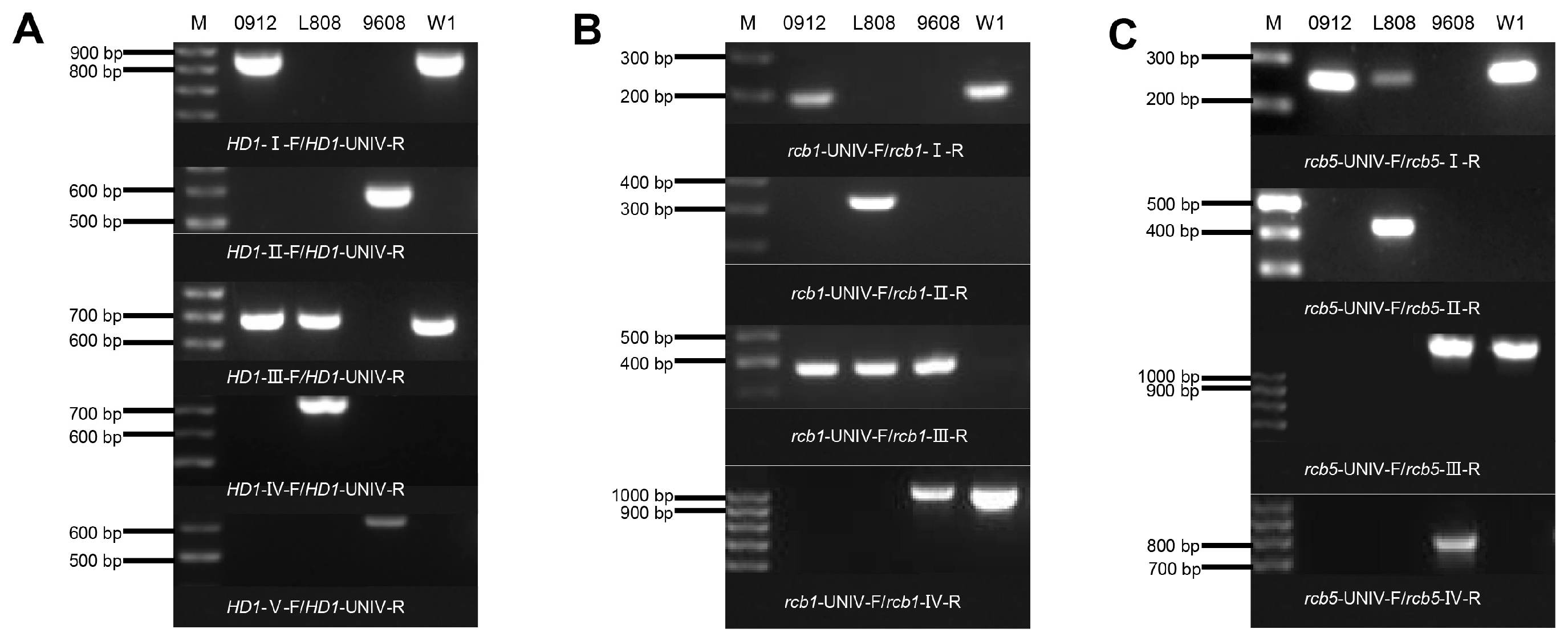
A universal reverse primer was initially designed within the conserved region between 900 and 1000 bp of the HD1 genes. Subsequently, five specific forward primers were crafted based on the variable regions of each HD1 type (Figure 1A). The primer pairs HD1-I-F/HD1-UNIV-R, HD1-II-F/HD1-UNIV-R, HD1-III-F/HD1-UNIV-R, HD1-IV-F/HD1-UNIV-R, and HD1-V-F/HD1-UNIV-R correspond to five distinct HD1 genotypes. Each pair specifically amplifies DNA fragments of the following sizes: 873 bp for type I, 604 bp for type II, 682 bp for type III, 752 bp for type IV, and 631 bp for type V (Table 2). Similarly, four specific reverse primers along with one universal forward primer were designed for rcb1, and four specific reverse primers along with a universal forward primer were designed for rcb5 (Figure 1B,C).
To verify the specificity of the molecular markers for mating-type genes, PCR amplification was performed on monokaryons and dikaryons from four L. edodes cultivars: 0912, 9608, L808, and W1. Results for the HD1 gene showed that monokaryons SP3 and SP30 of cultivar 0912 amplified HD1-I and HD1-III bands, respectively, while the corresponding dikaryon produced both bands (Figure S3 and Figure 2A). Similarly, cultivar 9608 amplified HD1-II and HD1-V bands, L808 amplified HD1-III and HD1-IV bands, and W1 amplified HD1-I and HD1-III bands (Figure S3 and Figure 2A). This result is consistent with genomic analysis results, confirming that the specific primers can amplify the corresponding mating-type gene bands. Since we only have genomic information for the W1-26 single-spore strain of the W1 variety, we are not certain about the mating type of the other unknown genome of the W1 variety. However, amplification analysis using the mating type-specific primers we designed indicates that the other HD1 gene type of the W1 strain is HD1-III (Figure 2A).
We also performed PCR validation for the specific primers of the mating-type genes rcb1 and rcb5 in monokaryons and dikaryons of four varieties. Similar to the HD1 gene results, the specific primers for the mating-type genes rcb1 and rcb5 only amplify the corresponding mating-type genes (Figure S3 and Figure 2B,C). Additionally, the PCR validation results are consistent with the genomic analysis results. We have also identified the gene information for the other half of rcb1 and rcb5 in the W1 variety, which are rcb1-I and rcb5-III, respectively (Figures S3 and Figure 2B,C). With the PCR amplification, the monokaryon W1-P1 is consistent with the mating type of the NCBI-published W1-26 monokaryotic strain (Figure S3).

3.3. Construction of Molecular Fingerprints for Four Varieties

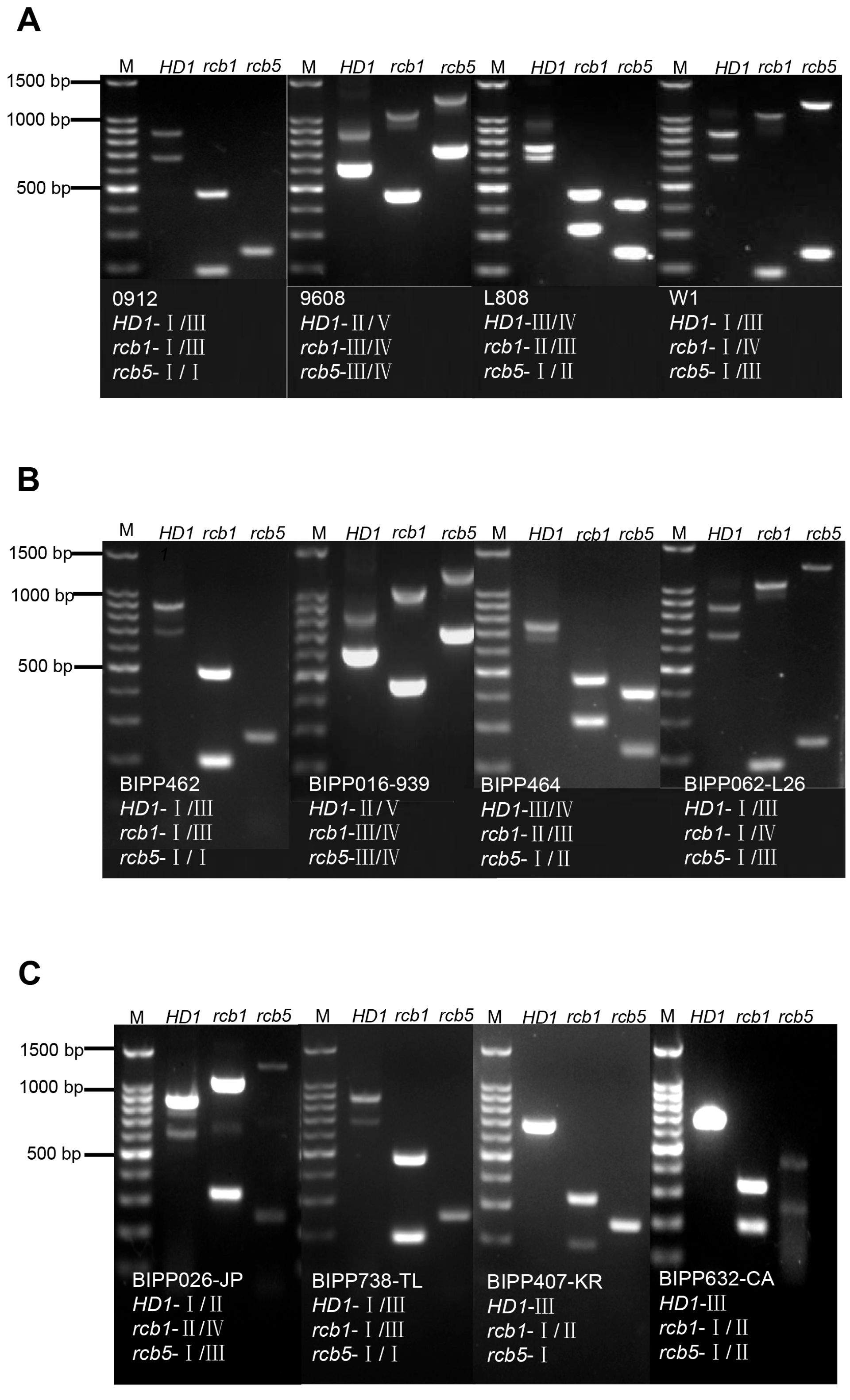
Using multiplex PCR technology, we constructed the molecular fingerprints of the HD1, rcb1, and rcb5 genes for four L. edodes varieties by simultaneously amplifying two alleles in a single reaction system, using the DNA of each variety as the template. For variety 0912, using the DNA of the 0912 dikaryon as the template, the simultaneous addition of HD1-I-F, HD1-III-F, and the universal HD1-UNIV-R primers resulted in the amplification of two bands: 873 bp (type I) and 682 bp (type III). Similarly, when the universal rcb1-UNIV-F primer was used in conjunction with specific rcb1-I-R and rcb1-III-R primers, two bands of rcb1 alleles were obtained: 187 bp (type I) and 478 bp (type III). Interestingly, the rcb5 gene in variety 0912 displayed unique characteristics, with a sequence identity of 99.60% between the two rcb5 alleles, both belonging to rcb5-I. Consequently, only a single target band of 240 bp was amplified in the 0912 dikaryon (Figure 3A).
In variety 9608, the HD1 genotypes are type II and type V. As shown in Figure 1, the product of HD1-II-F/HD1-UNIV-R was 604 bp, and the product of HD1-V-F/HD1-UNIV-R was 631 bp, both of similar size. Upon simultaneous amplification in the 9608 dikaryon, it was observed that the position of the HD1-V band shifted to around 850 bp (Figure 3A). To confirm this result, we performed gel extraction, TA cloning, and Sanger sequencing, which verified that the band size remained at 631 bp with accurate sequencing. We hypothesize that the shift in gel electrophoresis could be due to factors such as conformation or DNA modification. For rcb1 alleles, the bands of rcb1-IV and rcb1-III were amplified using rcb1-UNIV-F/rcb1-IV-R and rcb1-UNIV-F/rcb1-III-R primers simultaneously in the 9608 dikaryon, consistent with the mating type of 9608-S21 and 9608-P15 (Figure 3A). For rcb5 alleles, the sizes of the two bands were 1262 bp (rcb5-III) and 749 bp (rcb5-IV) in the multiplex PCR system of the 9608 dikaryon.
In L808 and W1, satisfactory multiplex PCR amplification results were also obtained. The positions of the two bands from multiplex PCR amplification in dikaryons matched those amplified by the corresponding primer pairs for each allele when amplified individually (Figure 3A).

3.4. Molecular Fingerprinting of Various Varieties of L. edodes

We classified L26-P1 as the HD1-I/rcb1-IV type, L26-P2 as the HD1-III/rcb1-I type, 939-P26 as the HD1-V/rcb1-III type, and 939-P42 as the HD1-II/rcb1-IV type (Table 1). The designed molecular markers successfully amplified the HD1-I and HD1-III alleles, as well as the rcb1-I and rcb1-IV alleles in the L26 variety (Figure 3B), consistent with the known mating types of L26-P1 and L26-P2. Similarly, the HD1-II and HD1-V alleles, along with the rcb1-III and rcb1-IV alleles, were amplified in the 939 variety (Figure 3B), matching the previously known mating types of 939-P26 and 939-P42. Additionally, we amplified rcb5-I and rcb5-III types of bands in the L26 variety and rcb5-III and rcb5-IV types of bands in the 939 variety (Figure 3B), clarifying the previously unknown rcb5 types in these two varieties.
To further validate the universality of the molecular fingerprints, we evaluated additional L. edodes varieties: BIPP462, BIPP464, BIPP738, BIPP407, BIPP632, and BIPP026 (Figure 3C). BIPP462 from China and BIPP738 from Thailand displayed the same molecular fingerprints as the 0912 variety, whereas BIPP464 from China showed the same molecular fingerprints as the L808 variety. BIPP026 from Japan carried the HD1-I and II/rcb1-II and IV/rcb5-I and III types; BIPP407 from Korea carried HD1-III/rcb1-I and II/rcb5-I; and BIPP632 from Canada carried HD1-III/rcb1-I and II/rcb5-I and II. Therefore, through the analysis of the mating types of these L. edodes varieties, we confirmed a high degree of consistency between the PCR results of molecular markers and the sequences of the known mating types. Moreover, we effectively identified the mating types of varieties that previously lacked mating type information.

3.5. Identification of Mating Types in Monokaryotic Strains Generated from Spores

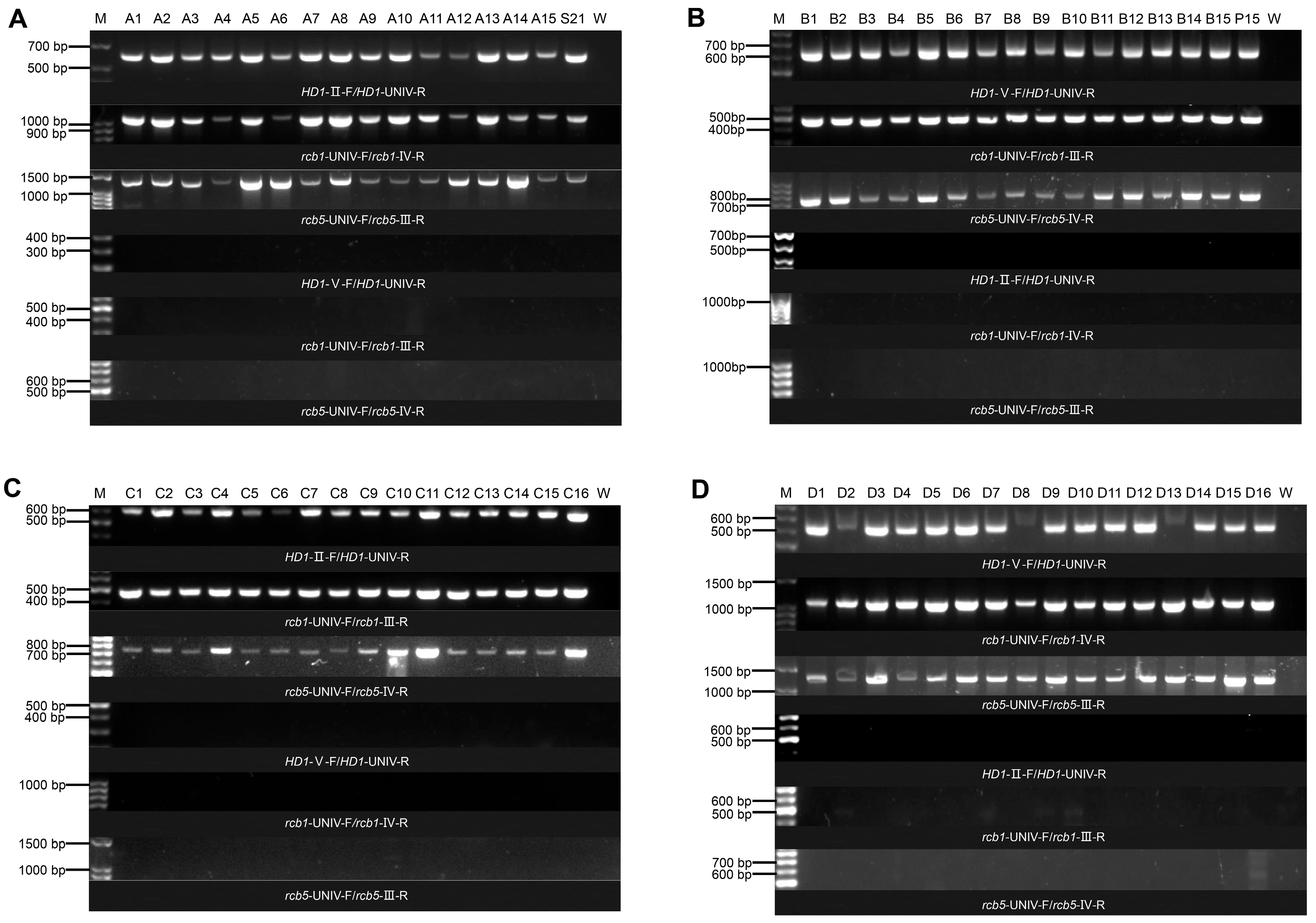
Sixty-four monokaryotic strains of variety 9608 were selected, and their mating types were verified by PCR using mating type-specific primers. Strain 9608-S21 was defined as AxBx, and strain 9608-P15 as AyBy. Single-spore isolates that failed to cross with either 9608-S21 or 9608-P15 were divided into two groups. However, crosses alone could not unambiguously assign them as AxBy or AyBx. To resolve this, we used six primer pairs, HD1-II-F/HD1-UNIV-R, HD1-V-F/HD1-UNIV-R, rcb1-UNIV-F/rcb1-IV-R, rcb1-UNIV-F/rcb1-III-R, rcb5-UNIV-F/rcb5-III-R, and rcb5-UNIV-F/rcb5-IV-R, to identify all four mating types among the 9608 single-spore strains. All four mating types were distinguished by the amplification of the target bands of the expected sizes (Figure S4). When conducting amplification with the three primer pairs, HD1-II-F/HD1-UNIV-R, rcb1-UNIV-F/rcb1-IV-R, and rcb5-UNIV-F/rcb5-III-R, sixteen single-spore strains which were microscopically confirmed to mate with 9608-P15 were identified to be AxBx (Figure 4A). Consistent with this assignment, these strains produced no amplicons with HD1-V-F/HD1-UNIV-R, rcb1-UNIV-F/rcb1-III-R, or rcb5-UNIV-F/rcb5-IV-R. For the 16 strains identified by crossing as AyBy, PCR with HD1-V-F/HD1-UNIV-R, rcb1-UNIV-F/rcb1-III-R, and rcb5-UNIV-F/rcb5-IV-R yielded the expected products (Figure 4B), whereas no bands were obtained with HD1-II-F/HD1-UNIV-R, rcb1-UNIV-F/rcb1-IV-R, or rcb5-UNIV-F/rcb5-III-R.
Among the single-spore strains, which cannot mate with 9608-S21 or 9608-P15, those strains from C1 to C16 that could stably amplify the expected size bands using the primer pairs HD1-II-F/HD1-UNIV-R, rcb1-UNIV-F/rcb1-III-R, and rcb5-UNIV-F/rcb5-IV-R were identified as the AxBy mating type (Figure 4C). As a control, when the primer pairs HD1-V-F/HD1-UNIV-R, rcb1-UNIV-F/rcb1-IV-R, and rcb5-UNIV-F/rcb5-III-R were used to amplify the 16 strains C1-C16, no bands were observed for these strains. For the group of single-spore strains D1-D16, when using the primer pairs HD1-V-F/HD1-UNIV-R, rcb1-UNIV-F/rcb1-IV-R, and rcb5-UNIV-F/rcb5-III-R, all strains were able to amplify target bands, thus identifying this mating type as AyBx. When HD1-II-F/HD1-UNIV-R, rcb1-UNIV-F/rcb1-III-R, and rcb5-UNIV-F/rcb5-IV-R were used for amplifying single-spore strains D1-D16, no amplification products were obtained (Figure 4D). Overall, the designed molecular markers address the shortcomings of traditional crossing methods, which can differentiate between AxBy and AyBx.

4. Discussion

In recent years, the expanding edible mushroom industry has faced significant challenges in germplasm resource management, particularly with naming confusion and variety homogenization. Traditional identification methods, reliant on mycelium morphology and fruiting body traits, have limitations due to long operational cycles and environmental susceptibility. Molecular marker technology, known for its objectivity and efficiency, is progressively becoming a crucial tool for identifying edible mushroom germplasm resources, constructing core germplasm, and protecting variety rights. The application of this technology is therefore pivotal for advancing germplasm research and breeding efforts in the edible mushroom sector globally [5,6].
This study focuses on four major cultivated L. edodes varieties (9608, 0912, L808 and W1), systematically investigating the polymorphism of mating-type genes HD1 (A locus), rcb1, and rcb5 (B locus). Among HD1 genes, types III and I are the most prevalent, followed by types II and V, with type IV being the least common. Previous studies estimated 121 specific A mating types in natural populations of L. edodes in China [24], whereas South Korean scientists identified 130 specific A mating types with 12 common types, including types III, I, and II from this study. High-frequency dikaryotic strains’ A mating type combinations, such as I and III, and II and V, align with common pairings in South Korean reports [25,26]. For the B mating-type locus, 151 specific B types were found in natural populations in China [24]. In South Korea, scientists identified B mating-type sequences for 111 dikaryotic strains (83 cultivated, 28 wild) [25]. Their analysis outlined five phb(s)-rcb1 units and three phb(s)-rcb2 units. Based on these units, up to 15 B mating combinations could potentially be generated among the strains. Rcb1 was divided into five types in the previous report, with rcb1-1 to rcb1-4 corresponding to types I, III, IV, and II in this study, while rcb1-5 was not identified, respectively. Among them, the frequencies of three types, rcb1-III, IV, and I, were all relatively high. We also identified four common B mating-type rcb1 combinations in dikaryotic strains, including I and III, II and III, III and IV, and I and IV. Rcb5 is a newly discovered B mating-type gene; we identified four types of rcb5, and they exhibited four combination patterns (I and I, I and II, I and III, III and IV). In a South Korean report, only rcb5-I was identified in 26 different L. edodes strains [27]. Thus, our study enhanced the understanding of rcb5 types. The higher diversity of rcb5 alleles observed in our study compared to previous reports may reflect the broader genetic diversity present in Chinese cultivars or the increased resolution provided by our whole-genome sequencing approach. The functional significance of rcb5 diversity remains to be elucidated, but our identification of four rcb5 types may contribute to the extensive B mating-type specificity (151 types) reported in the Chinese natural population [24].
Previous studies have demonstrated the utility of mating-type-gene-based makers in various edible mushrooms. Xiong et al. developed four primer pairs targeting four HD1/HD2 alleles in Volvariella volvacea, enabling the effective differentiation of mating types and the selection of superior hybrid strains [28]. Cao et al. designed 10 primer pairs for the A mating-type gene’s β-flanking and the B mating-type gene of Suillus bovinus, identifying eight mating type combinations through PCR amplification and SNP site sequencing, distinguishing 17 homokaryotic strains from two heterokaryotic parents [29]. However, these marker systems were limited to specific loci or required separate reactions for different alleles. For L. edodes, Zhang et al. developed AS-PCR markers targeting the A locus, but their approach did not include B locus genes and required separate reactions for different alleles [22].
In this study, we developed a comprehensive mating type marker system that ad-dresses these limitations. By incorporating the newly identified rcb5 gene alongside HD1 and rcb1, and utilizing SNP/InDel markers in a multiplex PCR, our system offers several key advantages. First, it simultaneously targets both A and B loci, providing more robust discrimination power than single-locus approaches [21,22]. Second, the multiplex PCR format allows the amplification of all alleles in a single reaction, significantly reducing time and cost compared to separate reactions [30]. Third, the co-dominant nature of our markers enables direct mating type determination from commercial dikaryotic cultivars without the need for monokaryon isolation—a feature not possible with dominant markers or traditional crossing methods [31]. Fourth, the successful application of our markers to international strains from Japan, Korea, Thailand, and Canada (Figure 3C) demonstrates their broad utility across diverse genetic backgrounds, suggesting that the targeted SNP/InDel sites are conserved in global L. edodes populations.
Utilizing the SNP and InDel variations of these genes, we constructed specific mating type fingerprint maps for multiple L. edodes varieties and conducted preliminary applications. The results demonstrated that this system could identify five HD1 alleles, four rcb1 alleles, and four rcb5 alleles. This molecular marker system can be used for faster and more accurate typing of single-nucleus strains. For example, we verified the mating-type genes of single-spore strains of variety 9608, confirming the accuracy of AxBx and AyBy mating types obtained from hybrid pairing. This system also compensates for the hybrid pairing experiments’ inability to quickly determine the specific mating types of AxBy and AyBx single-nucleus strains. Additionally, we successfully distinguished the L. edodes strains preserved at the BIPP (originating from China, Korea, Japan, Thailand, and Canada) by leveraging the length differences in amplification products generated by co-dominant primers. This validation confirmed the mating types of these internationally sourced strains. And it characterized the previously unreported rcb5 gene types of the extensively studied L26 and 939 varieties. Moreover, it supplemented the mating type information for strains with previously unknown genotypes (Figure 3B,C).
The reliability and accuracy of the developed marker system were rigorously validated from multiple perspectives. First, all PCR experiments were performed with three independent biological replicates, and the markers produced consistent banding patterns across all replicates. Second, using 64 single-spore strains of variety 9608, we compared the mating types determined by our markers with those identified by traditional crossing experiments (Figure 4). The markers correctly identified all 64 strains, achieving 100% accuracy. Third, the markers were successfully applied to strains with known genetic backgrounds, such as BIPP462 (derived from the 0912 lineage) and BIPP464 (derived from the L808 lineage), and their mating type fingerprint matched those of their respective progenitor varieties (Figure 3B). These results demonstrate that the molecular marker system is highly reproducible, accurate, and applicable to diverse L. edodes germplasm.
We also analyzed 14 strains and found HD1-I and HD1-III to be the most frequent alleles. We confirmed the HD1 gene sequences by full-length PCR followed by TA cloning [32], yielding sequence identities of 99.99% for HD1-I and 99.98% for HD1-III. For rcb1, the predominant variants were rcb1-I and rcb1-III, with sequence identities of 99.95% and 99.99%, respectively. In rcb5, rcb5-I was the most frequent variant, with 98.89% identity. These results indicate that these genes are highly conserved across strains and that the primers used in this study enable rapid, accurate identification. However, it was still challenging to accurately identify mating-type genes that were not explored in this study (e.g., HD1 of BIPP407 and BIPP632) or completely identical between two homokaryons (e.g., rcb5 of 0912). Further analysis and annotation through whole-genome assembly are still needed to refine and identify the mating-type genes in L. edodes.
Moreover, by determining the molecular fingerprints of HD1, rcb1, and rcb5 for each variety, crossing efforts of different L. edodes varieties can be facilitated. For basidiomycetes with a tetrapolar mating system, two cells are mating-compatible if they possess different alleles at both the A and the B loci [33]. For instance, the two monokaryons 0912-SP3 and L808-SP45 exhibit distinct genotypes at the HD1, rcb1, and rcb5 genes: 0912-SP3 carries genotypes I/I/I, while L808-SP45 carries III/II/II at the respective loci. Cross-breeding these monokaryons confirmed successful hybridization and normal fruiting body production. Conversely, the monokaryons 0912-SP30 and L808-SP45 shared the same HD1 genotype but differed in their rcb1 and rcb5 genotypes. Our findings indicated that crossing between these two strains was not feasible. Similarly, in South Korean reports, they found that the dikaryotic strain was constituted by the same rcb1 with two different rcb2s or by two different rcb1s with the same rcb2 [27]. Although our study did not identify the same rcb1 gene within a dikaryotic strain, we demonstrated that strain 0912 carried the same alleles of rcb5.
Despite the successful development and validation of our mating type marker system, several limitations should be acknowledged. For example, the number of strains used for marker development was limited to four major Chinese cultivars (0912, 9608, L808, and W1). Although we validated the markers on ten additional domestic and international strains, the full spectrum of allelic diversity in L. edodes germplasm, particularly in wild populations and less common cultivars, may not be fully represented [26,27]. Additional validation using a larger and more genetically diverse panel, including wild strains from different geographic regions, would strengthen the reliability and universality of the marker system. Furthermore, a notable example of such technical challenges was the observed band shift for the HD1-V allele in variety 9608 (Figure 3A), where the 631 bp fragment migrated to approximately 850 bp position. Although Sanger sequencing confirmed the correct amplicon size of 631 bp, we hypothesize that this migration anomaly may be attributed to secondary DNA structures or conformational differences under the specific multiplex PCR conditions [34]. Similar phenomena have been reported in other fungal genotyping studies where PCR products of identical size exhibited differential migration due to sequence-dependent conformational variations [35]. This observation highlights the importance of confirmatory sequencing when unexpected band patterns occur and suggests that future optimization using quantitative PCR platforms could improve resolution and accuracy [36].

5. Conclusions

In summary, through whole-genome sequencing, assembly, and annotation, we analyzed the allelic genes HD1, rcb1, and rcb5 to determine the mating types of four major cultivated Lentinula edodes varieties in China: 0912, 9608, L808, and W1. We categorized the HD1 gene into five types, rcb1 into four types, and rcb5 into four types. Utilizing SNPs and InDels among these different mating-type genes, we developed mating type-specific molecular fingerprint profiles for these four varieties. With the fingerprints, we successfully identified the mating types of international strains originating from Korea, Japan, Thailand, and Canada. These molecular markers not only validate the reliability of known mating types but also facilitate the identification of previously unknown mating type alleles in L. edodes varieties. The developed mating type-specific molecular marker system exhibits high accuracy and efficiency, providing robust technical support for parental selection and germplasm resource identification in L. edodes.

Supplementary Materials

The following supporting information can be downloaded at https://www.mdpi.com/article/10.3390/horticulturae12040424/s1, Figure S1: Morphological and growth characteristics of the four L. edodes strains (0912, L808, 9608, and W1) after 5 days of cultivation on potato dextrose agar (PDA) at 25 °C.; Figure S2: Phylogenetic relationships of HD1, rcb1, and rcb5 alleles identified in this study. Figure S3: Validation of mating type-specific primers via PCR in four monokaryotic strains. Figure S4: Mating compatibility assay via plate hybridization. Table S1: Assembly statistics for the monokaryotic strains of L. edodes used in this study. Table S2: Mating assay results of L. edodes monokaryotic strains (P15 and S21) in plate hybridization experiments. Table S3: Plate hybridization results between monokaryotic strains and single-spore isolates of L. edodes.

Author Contributions

X.W. and L.L. contributed equally to this work. X.W.: formal analysis, visualization, data curation, and writing—original manuscript draft. L.L.: investigation, validation, and data curation. Y.L. (Yuanyuan Liu): resources and methodology. Q.G.: supervision and writing—manuscript review and editing. Y.F.: conceptualization and methodology. G.Y.: validation and writing—manuscript review and editing. X.G.: resources. S.W.: project administration. Y.L. (Yu Liu): resources. D.Y.: conceptualization, supervision, methodology, project administration, and writing—manuscript review and editing. All authors have read and agreed to the published version of the manuscript.

Funding

This research was supported by the National Natural Science Foundation of China (32402646) and the Beijing Natural Science Foundation (6232008). This work was partially funded by the Key Research and Development Planning Project in Science and Technology of Hebei Province (21326315D). The APC (Article Processing Charge) was funded by the National Natural Science Foundation of China (32402646).

Data Availability Statement

The whole-genome sequence data reported in this paper have been deposited in the Genome Warehouse in the National Genomics Data Center, Beijing Institute of Genomics, Chinese Academy of Sciences/China National Center for Bioinformation under BioProject ID (PRJCA053643), and are publicly accessible at https://ngdc.cncb.ac.cn/gwh (accessed on 15 December 2025).

Acknowledgments

We are grateful to Jianping Xu from McMaster University, Canada and Sawithree from the Thailand Institute of Scientific and Technological Research for the L. edodes strains.

Conflicts of Interest

The authors declare no conflict of interest.

References

  1. Domingo, G.; Chiodaroli, L.; Parola, S.; Marsoni, M.; Bracale, M.; Vannini, C. Proteomic characterization of Shiitake (Lentinula edodes) post-harvest fruit bodies grown on hardwood logs and isolation of an antibacterial serine protease inhibitor. Fungal Biol. 2023, 127, 881–890. [Google Scholar] [CrossRef] [Scilit]
  2. Yan, D.; Liu, Y.; Rong, C.; Song, S.; Zhao, S.; Qin, L.; Wang, S.; Gao, Q. Characterization of brown film formed by Lentinula edodes. Fungal Biol. 2020, 124, 135–143. [Google Scholar] [CrossRef] [Scilit] [PubMed]
  3. Sharma, A.; Bhardwaj, G.; Nayik, G.A. (Eds.) Phytochemistry and Nutritional Composition of Significant Wild Medicinal and Edible Mushrooms: Traditional Uses and Pharmacology; Royal Society of Chemistry: London, UK, 2023. [Google Scholar]
  4. Cao, B.; Zhang, Y.; Gao, B. Development History, Current Situationand Trends of Global Lentinula edodes Industry. Acta Edulis Fungi 2024, 31, 1–20. [Google Scholar] [CrossRef]
  5. Bao, D. Technical Strategies in Cross Breeding of Edible Fungi (I). Acta Edulis Fungi 2024, 31, 1–16. [Google Scholar] [CrossRef]
  6. Bao, D. Technical Strategies in Cross Breeding of Edible Fungi (II). Acta Edulis Fungi 2025, 32, 123–135. [Google Scholar] [CrossRef]
  7. Ha, B.; Kim, S.; Kim, M.; Moon, Y.J.; Song, Y.; Ryu, J.S.; Ryu, H.; Ro, H.S. Diversity of A mating type in Lentinula edodes and mating type preference in the cultivated strains. J. Microbiol. 2018, 56, 416–425. [Google Scholar] [CrossRef] [Scilit] [PubMed]
  8. Kües, U. From two to many: Multiple mating types in Basidiomycetes. Fungal Biol. Rev. 2015, 29, 126–166. [Google Scholar] [CrossRef] [Scilit]
  9. Kües, U.; James, T.Y.; Heitman, J. 6 Mating Type in Basidiomycetes: Unipolar, Bipolar, and Tetrapolar Patterns of Sexuality. In Evolution of Fungi and Fungal-Like Organisms; Pöggeler, S., Wöstemeyer, J., Eds.; Springer: Berlin/Heidelberg, Germany, 2011; pp. 97–160. [Google Scholar]
  10. Wu, L.; van Peer, A.; Song, W.; Wang, H.; Chen, M.; Tan, Q.; Song, C.; Zhang, M.; Bao, D. Cloning of the Lentinula edodes B mating-type locus and identification of the genetic structure controlling B mating. Gene 2013, 531, 270–278. [Google Scholar] [CrossRef] [Scilit]
  11. Ha, B.; Moon, Y.J.; Song, Y.; Kim, S.; Kim, M.; Yoon, C.-W.; Ro, H.-S. Molecular analysis of B mating type diversity in Lentinula edodes. Sci. Hortic. 2019, 243, 55–63. [Google Scholar] [CrossRef] [Scilit]
  12. Chen, L.; Gong, Y.; Cai, Y.; Liu, W.; Zhou, Y.; Xiao, Y.; Xu, Z.; Liu, Y.; Lei, X.; Wang, G.; et al. Genome Sequence of the Edible Cultivated Mushroom Lentinula edodes (Shiitake) Reveals Insights into Lignocellulose Degradation. PLoS ONE 2016, 11, e0160336. [Google Scholar] [CrossRef] [Scilit]
  13. Gao, Q.; Yan, D.; Song, S.; Fan, Y.; Wang, S.; Liu, Y.; Huang, Y.; Rong, C.; Guo, Y.; Zhao, S.; et al. Haplotype-Resolved Genome Analyses Reveal Genetically Distinct Nuclei within a Commercial Cultivar of Lentinula edodes. J. Fungi 2022, 8, 167. [Google Scholar] [CrossRef] [Scilit]
  14. Yoshitake, K.; Shirasawa, K.; Kojima, K.K.; Asakawa, S.; Tanaka, N.; Kurokochi, H. Nearly telomere-to-telomere genome assembly of the L. edodes diploid genome. Fungal Genet. Biol. 2025, 179, 104005. [Google Scholar] [CrossRef] [Scilit]
  15. Jian, W.; Xing, X.; Wang, Q.; Quan, J.; Wang, L.; Ge, R. Study on the Monokaryons Mating Types Identification Based on the Primers Design According to the Resequencing Results of the Conserved Region in Lentinula edodes Mating Type Locus. Acta Agric. Boreali-Sin. 2024, 39, 87–93. [Google Scholar]
  16. Dipta, B.; Sood, S.; Mangal, V.; Bhardwaj, V.; Thakur, A.K.; Kumar, V.; Singh, B. KASP: A high-throughput genotyping system and its applications in major crop plants for biotic and abiotic stress tolerance. Mol. Biol. Rep. 2024, 51, 508. [Google Scholar] [CrossRef] [Scilit]
  17. Wang, R.; Yang, Y.; Tian, H.; Yi, H.; Xu, L.; Lv, Y.; Ge, J.; Zhao, Y.; Wang, L.; Zhou, S.; et al. A Scalable and Robust Chloroplast Genotyping Solution: Development and Application of SNP and InDel Markers in the Maize Chloroplast Genome. Genes 2024, 15, 293. [Google Scholar] [CrossRef] [Scilit]
  18. Hill, C.B.; Wong, D.; Tibbits, J.; Forrest, K.; Hayden, M.; Zhang, X.Q.; Westcott, S.; Angessa, T.T.; Li, C. Targeted enrichment by solution-based hybrid capture to identify genetic sequence variants in barley. Sci. Data 2019, 6, 12. [Google Scholar] [CrossRef] [Scilit]
  19. Liu, F.; Wang, S.-H.; Jia, D.-H.; Tan, H.; Wang, B.; Zhao, R.-L. Development of Multiple Nucleotide Polymorphism Molecular Markers for Enoki Mushroom (Flammulina filiformis) Cultivars Identification. J. Fung 2023, 9, 330. [Google Scholar] [CrossRef] [Scilit] [PubMed]
  20. Liu, F.; Cai, Z.X.; Kang, W.Y.; Chen, W.Z.; Lu, Y.P.; Chen, M.Y.; Zhao, R.L. A New Method for Constructing High-Resolution Phylogenomic Topologies Using Core Gene-Associated MNP Markers: A Case Study from Agaricus bisporus. Microb. Biotechnol. 2025, 18, e70070. [Google Scholar] [CrossRef] [Scilit] [PubMed]
  21. Choi, Y.J.; Jung, S.; Eom, H.; Hoang, T.; Han, H.G.; Kim, S.; Ro, H.S. Structural Analysis of the A Mating Type Locus and Development of the Mating Type Marker of Agaricus bisporus var. bisporus. J. Fungi 2023, 9, 284. [Google Scholar] [CrossRef] [Scilit] [PubMed]
  22. Zhang, F.; Chen, X.; Zhang, W.; Liu, Z.; Zhao, C.; Wu, S. Identification on mating types of monokaryons and their hybrids of Lentinula edodes by AS-PCR. Microbiol. China 2024, 51, 1741–1753. [Google Scholar] [CrossRef]
  23. Liu, K.; Jiang, J.; Song, X.; Lu, X.; Ying, G.; Zeng, F. Annotation of the nuclear and mitochondrial genome of Lentinula edodes stain L808. Edible Med. Mushrooms 2023, 31, 118–125. [Google Scholar] [CrossRef]
  24. Lin, F.; Wang, Z.; Sun, Y.; Cai, Y. Analysis of the mating type factors in natural population of Lentinula edodes in China. Mycosystema 2003, 22, 235–240. [Google Scholar] [CrossRef]
  25. Ha, B.; Kim, S.; Kim, M.; Ro, H.S. Activation of the Mating Pheromone Response Pathway of Lentinula edodes by Synthetic Pheromones. Mycobiology 2018, 46, 407–415. [Google Scholar] [CrossRef] [Scilit] [PubMed]
  26. Park, M.J.; Kim, E.; Jeong, Y.S.; Son, M.Y.; Jang, Y.; Ka, K.H. Determination and Analysis of Hyper-Variable A Mating Types in Wild Strains of Lentinula edodes in Korea. Mycobiology 2023, 51, 26–35. [Google Scholar] [CrossRef] [Scilit]
  27. Lee, Y.J.; Kim, E.; Eom, H.; Yang, S.H.; Choi, Y.J.; Ro, H.S. Discovery and Functional Study of a Novel Genomic Locus Homologous to Bα-Mating-Type Sublocus of Lentinula edodes. Mycobiology 2021, 49, 582–588. [Google Scholar] [CrossRef] [Scilit]
  28. Xiong, D.; Wang, H.; Chen, M.; Xue, C.; Li, Z.; Bian, Y.; Bao, D. Application of mating type genes in molecular marker-assisted breeding of the edible straw mushroom Volvariella volvacea. Sci. Hortic. 2014, 180, 59–62. [Google Scholar] [CrossRef] [Scilit]
  29. Yang, C.; Fang, Y.; Guo, F.; He, M.; Zhang, C.; Xu, X.; Wang, W.; Wu, Y. Study on Mating System on Phlebopus portentosus. North. Hortic. 2016, 24, 133–135. [Google Scholar] [CrossRef]
  30. Tahir, M.F.; Ishtiaq, S.; Anas, M.; Irfan, A.; Jaremko, M.; Fahad, S.; Ercişli, S.; Almahasheer, H.; Abdelsalam, N.R. Integrating biotechnology into diagnostic labs: Innovations in PCR and molecular procedures. Curr. Res. Biotechnol. 2025, 10, 100325. [Google Scholar] [CrossRef] [Scilit]
  31. Xu, J. Analysis of inbreeding depression in Agaricus bisporus. Genetics 1995, 141, 137–145. [Google Scholar] [CrossRef] [Scilit]
  32. Wang, X.; Du, J.; Li, L.; Fan, Y.; Chen, L.; Yan, D.; Wang, S. Development and Application of InDel/SNP MolecularMarkers for Mating-Type Gene Identification in Lentinula edodes ‘Liaofu No. 4’. Acta Edulis Fungi 2026, 33, 1–10. [Google Scholar] [CrossRef]
  33. Sun, S.; Coelho, M.A.; David-Palma, M.; Huang, J.; Bian, Z.; Heitman, J. Fungal sexual reproduction and mating-type loci. Curr. Biol. 2025, 35, R496–R503. [Google Scholar] [CrossRef] [Scilit] [PubMed]
  34. Henegariu, O.; Heerema, N.A.; Dlouhy, S.R.; Vance, G.H.; Vogt, P.H. Multiplex PCR: Critical parameters and step-by-step protocol. Biotechniques 1997, 23, 504–511. [Google Scholar] [CrossRef] [Scilit] [PubMed]
  35. Wittwer, C.T. High-resolution DNA melting analysis: Advancements and limitations. Hum. Mutat. 2009, 30, 857–859. [Google Scholar] [CrossRef] [Scilit] [PubMed]
  36. Markoulatos, P.; Siafakas, N.; Moncany, M. Multiplex polymerase chain reaction: A practical approach. J. Clin. Lab. Anal. 2002, 16, 47–51. [Google Scholar] [CrossRef] [Scilit]
Figure 1. Schematic diagram of specific primer design for the HD1, rcb1, and rcb5 genes in L. edodes. (A) Specific primers for the HD1 mating-type gene: forward primers HD1-I-F, HD1-II-F, HD1-III-F, HD1-IV-F, and HD1-V-F, and the universal reverse primer HD1-UNIV-R. (B) Specific primers for the rcb1 mating-type gene: the universal forward primer rcb1-UNIV-F and reverse primers rcb1-I-R, rcb1-II-R, rcb1-III-R, and rcb1-IV-R. (C) Specific primers for the rcb5 mating-type gene: the universal forward primer rcb5-UNIV-F and reverse primers rcb5-I-R, rcb5-II-R, rcb5-III-R, and rcb5-IV-R. Red boxes indicate primer sequences, and red arrows indicate the amplification direction.
Horticulturae 12 00424 g001
Figure 2. PCR amplification results of various mating type-specific primers in four strains (0912, L808, 9608, and W1) of L. edodes. (A) The PCR amplification results of HD1 genes. (B) The PCR amplification results of rcb1 genes. (C) The PCR amplification results of rcb5 genes. The PCR products were resolved on a 2.0% agarose gel. For each subfigure, lanes 1 to 4 correspond to the PCR products from strains 0912, L808, 9608, and W1, respectively, using the specific primers designed in Figure 1. Lane M: 100 bp Plus DNA Ladder (TransGen Biotech, Beijing, China); fragment sizes are indicated in base pairs (bp) on the left of each gel. The distinct bands observed in different lanes reflect the allelic variations in the mating-type genes among the four strains.
Horticulturae 12 00424 g002
Figure 3. Molecular fingerprints of HD1, rcb1 and rcb5 mating genes for different L. edodes varieties. (A) Variety of 0912, 9608, L808 and W1. (B) Variety of BIPP462, BIPP016-939, BIPP464 and BIPP062-L26 in China. (C) Variety of BIPP026 from Japan, BIPP738 from Thailand, BIPP407 from Korea, and BIPP632 from Canada. For each strain, the PCR products were resolved on a 2.0% agarose gel, with fragment sizes indicated by the DNA ladder (in base pairs) on the left. Above each gel lane, the corresponding mating-type alleles for HD1, rcb1, and rcb5 are listed. M: 100 bp Plus DNA Ladder (TransGen Biotech, Beijing, China).
Horticulturae 12 00424 g003
Figure 4. Identification of the mating types in 9608 single-spore strains. Gel electrophoresis showing PCR amplification patterns for 64 single-spore isolates of variety 9608 using six primer pairs targeting the HD1, rcb1, and rcb5 mating-type loci. Strains were grouped into four mating types based on their amplification profiles: (A) AxBx mating type (strains A1–A15 and S21); (B) AyBy mating type (strains B1–B15 and P15); (C) AxBy mating type (strains C1–C16); (D) AyBx mating type (strains D1–D16). M: 1 kb plus DNA ladder (TransGen Biotech, Beijing, China). W: Negative control (ddH2O).
Horticulturae 12 00424 g004
Table 1. Sources of monokaryotic genome or mating-type gene typing for different varieties.
VarietyMonokaryotic StrainGene ResourceHD1 Typercb1 TypeRcb5 Type
09120912-SP3Our previous studyHD1-Ircb1-Ircb5-I
0912-SP30Our previous studyHD1-IIIrcb1-IIIrcb5-I
L808L808-SP29New assembledHD1-IVrcb1-IIIrcb5-I
L808-SP45NCBIHD1-IIIrcb1-IIrcb5-II
96089608-S21New assembledHD1-IIrcb1-IVrcb5-III
9608-P15New assembledHD1-Vrcb1-IIIrcb5-IV
W1W1-26NCBI HD1-Ircb1-IVrcb5-I
NAPCR&TA cloningHD1-IIIrcb1-Ircb5-III
BIPP062-L26 L26-P1NCBI/PCR&TA cloning HD1-Ircb1-IVrcb5-I
L26-P2NCBI/PCR&TA cloning HD1-IIIrcb1-Ircb5-III
BIPP016-939 939-P42NCBI/PCR&TA cloning HD1-IIrcb1-IVrcb5-III
939-P26NCBI/PCR&TA cloningHD1-Vrcb1-IIIrcb5-IV
BIPP462NAPCR&TA cloningHD1-I
HD1-III
rcb1-I
rcb1-III
rcb5-I
BIPP464NAPCR&TA cloningHD1-IV
HD1-III
rcb1-II
rcb1-III
rcb5-I
rcb5-II
BIPP738NAPCR&TA cloningHD1-I
HD1-III
rcb1-I
rcb1-III
rcb5-I
BIPP407NAPCR&TA cloningHD1-IIIrcb1-I
rcb1-II
rcb5-I
BIPP026NAPCR&TA cloningHD1-I
HD1-II
rcb1-II
rcb1-IV
rcb5-I
rcb5-III
BIPP632NAPCR&TA cloningHD1-IIIrcb1-I
rcb1-II
rcb5-I
rcb5-II
Note: Bold text denotes newly identified mating types, as determined by PCR analysis.
Table 2. Specific primers for the mating-type genes of L. edodes.
GenePrimer NamePrimer Sequence (5′-3′)Amplified Fragment Length (bp)
HD1HD1-UNIV-RCTTATCCCGATAAAGCATCCG-
HD1-I-FGAGCCCACCGACGATTTAGA873
HD1-II-FGCTTGCTGACACTGTTCACACA604
HD1-III-FTCAGGTGCTTTGCGATACTTT682
HD1-IV-FGCAGTCAAGACTCAGGCAAACT752
HD1-V-FACTTGTTCAGGATCTTTCGGAAG631
rcb1rcb1-UNIV-FCGTGGCATTTDCAMGCATGGAA-
rcb1-I-RTGCTATGACGAAATCAGCGAAAC187
rcb1-II-RCGTCGCAAGAAAGGACCAGA326
rcb1-III-RTGAAGGATGGGTTTGTTGAGCG478
rcb1-IV-RCAGCAGGGTACAAGCCTAGTGG1083
rcb5rcb5-UNIV-FCTTCYGATCCYACKTWCCCACT-
rcb5-I-RAGTATCTTCGTCAAGCATTGCA240
rcb5-II-RTGCAAAGATAAGCTGAATGAGAAC428
rcb5-III-RTGAGCCTGGAGACAACAGAT1262
rcb5-IV-RGAGCTGTTTGAGATGAGGATTGAT749
Note: Degenerate base symbols: Y = C/T, D = A/G/T, K = G/T, M = A/C, W = A/T.
Disclaimer/Publisher’s Note: The statements, opinions and data contained in all publications are solely those of the individual author(s) and contributor(s) and not of MDPI and/or the editor(s). MDPI and/or the editor(s) disclaim responsibility for any injury to people or property resulting from any ideas, methods, instructions or products referred to in the content.