Commercial Helichrysum italicum Essential Oils and Hydrosols from Adriatic and Continental Croatia: Quality Assessment and Chemical Composition

 ,
,  ,
,  ,
, 

Abstract
1. Introduction
2. Materials and Methods
2.1. Reagents and Materials
2.2. Samples
2.3. Physicochemical Parameters
2.3.1. Relative Density
2.3.2. Refractive Index
2.3.3. Acid Value
2.3.4. pH Value
2.3.5. Turbidity
2.3.6. Essential Oil Content
2.4. Preparation Samples and Identification of Essential Oil and Hydrosol Components
2.5. Statistical Analysis
3. Results
3.1. Physicochemical Parameters of HiHYs and HiEOs
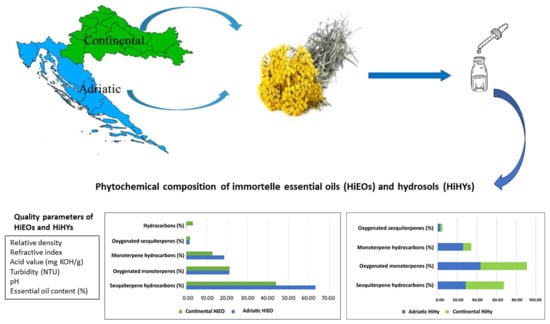
3.2. Identification of Volatile Components in Commercial Samples of Immortelle (H. italicum) Essential Oils and Hydrosols
4. Discussion
4.1. Quality Parameters
4.2. Phytochemical Analysis
5. Conclusions
Supplementary Materials
Author Contributions
Funding
Data Availability Statement
Acknowledgments
Conflicts of Interest
References
- Viegas, D.A.; Palmeira-de-Oliveira, A.; Salgueiro, L.; Martinez-de-Oliveira, J.; Palmeira-de-Oliveira, R. Helichrysum italicum: From Traditional Use to Scientific Data. J. Ethnopharmacol. 2014, 151, 54–65. [Google Scholar] [CrossRef]
- Perrini, R.; Morone-Fortunato, I.; Lorusso, E.; Avato, P. Glands, Essential Oils and in Vitro Establishment of Helichrysum italicum (Roth) G. Don ssp. microphyllum (Willd.) Nyman. Ind. Crop. Prod. 2009, 29, 395–403. [Google Scholar] [CrossRef]
- Galbany-Casals, M.; Blanco-Moreno, J.M.; Garcia-Jacas, N.; Breitwieser, I.; Smissen, R.D. Genetic Variation in Mediterranean Helichrysum italicum (Asteraceae; Gnaphalieae): Do Disjunct Populations of subsp. microphyllum Have a Common Origin? Plant Biol. 2011, 13, 678–687. [Google Scholar] [CrossRef]
- Gismondi, A.; Di Marco, G.; Canini, A. Helichrysum italicum (Roth) G. Don Essential Oil: Composition and Potential Antineoplastic Effect. S. Afr. J. Bot. 2020, 133, 222–226. [Google Scholar] [CrossRef]
- Rodrigues, A.M.; Silva, L.; Falé, P.L.; Serralheiro, M.L.; Ascensão, L. Glandular Trichomes and Biological Activities in Helichrysum italicum and H. stoechas, Two Asteraceae Species Growing Wild in Portugal. Microsc. Microanal. 2015, 21, 91–92. [Google Scholar] [CrossRef] [PubMed]
- Paolini, J.; Desjobert, J.; Costa, J.; Bernardini, A.; Castellini, C.B.; Cioni, P.; Flamini, G.; Morelli, I. Composition of Essential Oils of Helichrysum italicum (Roth) G. Don Fil subsp. italicum from Tuscan Archipelago Islands. Flavour Fragr. J. 2006, 21, 805–808. [Google Scholar] [CrossRef]
- Leonardi, M.; Ambryszewska, K.E.; Melai, B.; Flamini, G.; Cioni, P.L.; Parri, F.; Pistelli, L. Essential-Oil Composition of Helichrysum italicum (Roth) G. DON ssp. italicum from Elba Island (Tuscany, Italy). Chem. Biodivers. 2013, 10, 343–355. [Google Scholar] [CrossRef]
- Melito, S.; Petretto, G.L.; Podani, J.; Foddai, M.; Maldini, M.; Chessa, M.; Pintore, G. Altitude and Climate Influence Helichrysum italicum subsp. microphyllum Essential Oils Composition. Ind. Crop. Prod. 2016, 80, 242–250. [Google Scholar] [CrossRef]
- Ćavar Zeljković, S.; Šolić, M.E.; Maksimović, M. Volatiles of Helichrysum italicum (Roth) G. Don from Croatia. Nat. Prod. Res. 2015, 29, 1874–1877. [Google Scholar] [CrossRef] [PubMed]
- Blažeković, N.; Petričić, J.; Stanić, G.; Maleš, Ž. Variations in Yields and Composition of Immortelle (Helichrysum italicum, Roth Guss.) Essential Oil from Different Locations and Vegetation Periods Along Adriatic Coast. Acta Pharm. 1995, 45, 517–522. [Google Scholar]
- Matin, A.; Pavkov, I.; Grubor, M.; Jurišić, V.; Kontek, M.; Jukić, F.; Krička, T. Influence of Harvest Time, Method of Preparation and Method of Distillation on the Qualitative Properties of Organically Grown and Wild Helichrysum italicum Immortelle Essential Oil. Separations 2021, 8, 167. [Google Scholar] [CrossRef]
- Ninčević, T.; Grdiša, M.; Šatović, Z.; Jug-Dujaković, M. Helichrysum italicum (Roth) G. Don: Taxonomy, Biological Activity, Biochemical and Genetic Diversity. Ind. Crop. Prod. 2019, 138, 111487. [Google Scholar] [CrossRef]
- Maksimovic, S.; Tadic, V.; Skala, D.; Zizovic, I. Separation of Phytochemicals from Helichrysum italicum: An Analysis of Different Isolation Techniques and Biological Activity of Prepared Extracts. Phytochemistry 2017, 138, 9–28. [Google Scholar] [CrossRef]
- Bauer, J.; Koeberle, A.; Dehm, F.; Pollastro, F.; Appendino, G.; Northoff, H.; Rossi, A.; Sautebin, L.; Werz, O. Arzanol, a Prenylated Heterodimeric Phloroglucinyl Pyrone, Inhibits Eicosanoid Biosynthesis and Exhibits Anti-Inflammatory Efficacy in Vivo. Biochem. Pharmacol. 2011, 81, 259–268. [Google Scholar] [CrossRef]
- Appendino, G.; Ottino, M.; Marquez, N.; Bianchi, F.; Giana, A.; Ballero, M.; Sterner, O.; Fiebich, B.L.; Munoz, E. Arzanol, an Anti-Inflammatory and Anti-HIV-1 Phloroglucinol α-Pyrone from Helichrysum italicum ssp. microphyllum. J. Nat. Prod. 2007, 70, 608–612. [Google Scholar] [CrossRef]
- Węglarz, Z.; Kosakowska, O.; Pióro-Jabrucka, E.; Przybył, J.L.; Gniewosz, M.; Kraśniewska, K.; Szyndel, M.S.; Costa, R.; Bączek, K.B. Antioxidant and Antibacterial Activity of Helichrysum italicum (Roth) G. Don. from Central Europe. Pharmaceuticals 2022, 15, 735. [Google Scholar] [CrossRef]
- Piras, F.; Sogos, V.; Pollastro, F.; Appendino, G.; Rosa, A. Arzanol, a Natural Phloroglucinol A-pyrone, Protects HaCaT Keratinocytes against H2O2-induced Oxidative Stress, Counteracting Cytotoxicity, Reactive Oxygen Species Generation, Apoptosis, and Mitochondrial Depolarization. J. Appl. Toxicol. 2024, 44, 720–732. [Google Scholar] [CrossRef]
- Gevrenova, R.; Kostadinova, I.; Stefanova, A.; Balabanova, V.; Zengin, G.; Zheleva-Dimitrova, D.; Momekov, G. Phytochemical Profiling, Antioxidant and Cognitive-Enhancing Effect of Helichrysum italicum ssp. italicum (Roth) G. Don (Asteraceae). Plants 2023, 12, 2755. [Google Scholar] [CrossRef]
- Djihane, B.; Wafa, N.; Elkhamssa, S.; Pedro, D.H.J.; Maria, A.E.; Mohamed Mihoub, Z. Chemical Constituents of Helichrysum italicum (Roth) G. Don Essential Oil and Their Antimicrobial Activity Against Gram-Positive and Gram-Negative Bacteria, Filamentous Fungi and Candida albicans. Saudi Pharm. J. 2017, 25, 780–787. [Google Scholar] [CrossRef] [PubMed]
- Zheljazkov, V.D.; Semerdjieva, I.; Yankova-Tsvetkova, E.; Astatkie, T.; Stanev, S.; Dincheva, I.; Kačániová, M. Chemical Profile and Antimicrobial Activity of the Essential Oils of Helichrysum arenarium (L.) Moench. and Helichrysum italicum (Roth.) G. Don. Plants 2022, 11, 951. [Google Scholar] [CrossRef] [PubMed]
- Šovljanski, O.; Aćimović, M.; Tomić, A.; Lončar, B.; Miljković, A.; Čabarkapa, I.; Pezo, L. Antibacterial and Antifungal Potential of Helichrysum italicum (Roth) G. Don Essential Oil. Antibiotics 2024, 13, 722. [Google Scholar] [CrossRef] [PubMed]
- De La Garza, A.L.; Etxeberria, U.; Palacios-Ortega, S.; Haslberger, A.G.; Aumueller, E.; Milagro, F.I.; Martínez, J.A. Modulation of Hyperglycemia and TNFα-Mediated Inflammation by Helichrysum and Grapefruit Extracts in Diabetic Db/Db Mice. Food Funct. 2014, 5, 2120–2128. [Google Scholar] [CrossRef]
- Conti, B.; Canale, A.; Bertoli, A.; Gozzini, F.; Pistelli, L. Essential Oil Composition and Larvicidal Activity of Six Mediterranean Aromatic Plants against the Mosquito Aedes albopictus (Diptera: Culicidae). Parasitol. Res. 2010, 107, 1455–1461. [Google Scholar] [CrossRef]
- Malenica Staver, M.; Gobin, I.; Ratkaj, I.; Petrovic, M.; Vulinovic, A.; Dinarina-Sablic, M.; Broznic, D. In Vitro Antiproliferative and Antimicrobial Activity of the Essential Oil from the Flowers and Leaves of Helichrysum italicum (Roth) G. Don Growing in Central Dalmatia (Croatia). J. Essent. Oil Bear. Plants 2018, 21, 77–91. [Google Scholar] [CrossRef]
- Kramberger, K.; Kenig, S.; Jenko Pražnikar, Z.; Kočevar Glavač, N.; Barlič-Maganja, D. A Review and Evaluation of the Data Supporting Internal Use of Helichrysum italicum. Plants 2021, 10, 1738. [Google Scholar] [CrossRef]
- Addis, R.; Cruciani, S.; Santaniello, S.; Bellu, E.; Sarais, G.; Ventura, C.; Maioli, M.; Pintore, G. Fibroblast Proliferation and Migration in Wound Healing by Phytochemicals: Evidence for a Novel Synergic Outcome. Int. J. Med. Sci. 2020, 17, 1030–1042. [Google Scholar] [CrossRef]
- Andjić, M.; Draginić, N.; Kočović, A.; Jeremić, J.; Vučićević, K.; Jeremić, N.; Krstonošić, V.; Božin, B.; Kladar, N.; Čapo, I.; et al. Immortelle Essential Oil-Based Ointment Improves Wound Healing in a Diabetic Rat Model. Biomed. Pharmacother. 2022, 150, 112941. [Google Scholar] [CrossRef]
- Serra, D.; Bellu, E.; Garroni, G.; Cruciani, S.; Sarais, G.; Dessì, D.; Pashchenko, A.; Satta, R.; Montesu, M.; Amler, E.; et al. Hydrolat of Helichrysum italicum Promotes Tissue Regeneration During Wound Healing. Physiol. Res. 2023, 72, 809–818. [Google Scholar] [CrossRef]
- Serra, D.; Cruciani, S.; Garroni, G.; Sarais, G.; Kavak, F.F.; Satta, R.; Montesu, M.A.; Floris, M.; Ventura, C.; Maioli, M. Effect of Helichrysum italicum in Promoting Collagen Deposition and Skin Regeneration in a New Dynamic Model of Skin Wound Healing. Int. J. Mol. Sci. 2024, 25, 4736. [Google Scholar] [CrossRef] [PubMed]
- Fraternale, D.; Flamini, G.; Ascrizzi, R. In Vitro Anticollagenase and Antielastase Activities of Essential Oil of Helichrysum italicum subsp. italicum (Roth) G. Don. J. Med. Food 2019, 22, 1041–1046. [Google Scholar] [CrossRef] [PubMed]
- Furlan, V.; Bren, U. Helichrysum italicum: From Extraction, Distillation, and Encapsulation Techniques to Beneficial Health Effects. Foods 2023, 12, 802. [Google Scholar] [CrossRef] [PubMed]
- Jažo, Z.; Glumac, M.; Drventić, I.; Žilić, L.; Dujmović, T.; Bajić, D.; Vučemilo, M.; Ivić, E.; Bektić, S.; Anačkov, G.T.; et al. The Essential Oil Composition of Helichrysum italicum (Roth) G. Don: Influence of Steam, Hydro and Microwave-Assisted Distillation. Separations 2022, 9, 280. [Google Scholar] [CrossRef]
- Aćimović, M.; Tešević, V.; Smiljanić, K.; Cvetković, M.; Stanković, J.; Kiprovski, B.; Sikora, V. Hydrolates: By-Products of Essential Oil Distillation: Chemical Composition, Biological Activity and Potential Uses. Adv. Technol. 2020, 9, 54–70. [Google Scholar] [CrossRef]
- Andola, H.C.; Purohit, V.K.; Chauhan, R.S.; Arunachalam, K. Standardize Quality Standards for Aromatic Hydrosols. Med. Plants—Int. J. Phytomed. Relat. Ind. 2014, 6, 161. [Google Scholar] [CrossRef]
- Šilha, D.; Švarcová, K.; Bajer, T.; Královec, K.; Tesařová, E.; Moučková, K.; Pejchalová, M.; Bajerová, P. Chemical Composition of Natural Hydrolates and Their Antimicrobial Activity on Arcobacter-Like Cells in Comparison with Other Microorganisms. Molecules 2020, 25, 5654. [Google Scholar] [CrossRef]
- Kunc, N.; Frlan, A.; Baričevič, D.; Kočevar Glavač, N.; Kokalj Ladan, M. Essential Oil and Hydrosol Composition of Immortelle (Helichrysum italicum). Plants 2022, 11, 2573. [Google Scholar] [CrossRef]
- Politi, M.; Ferrante, C.; Menghini, L.; Angelini, P.; Flores, G.A.; Muscatello, B.; Braca, A.; De Leo, M. Hydrosols from Rosmarinus officinalis, Salvia officinalis, and Cupressus sempervirens: Phytochemical Analysis and Bioactivity Evaluation. Plants 2022, 11, 349. [Google Scholar] [CrossRef]
- Bezek, K.; Kramberger, K.; Barlič-Maganja, D. Antioxidant and Antimicrobial Properties of Helichrysum italicum (Roth) G. Don Hydrosol. Antibiotics 2022, 11, 1017. [Google Scholar] [CrossRef] [PubMed]
- Kokalj Ladan, M.; Kočevar Glavač, N. GC–MS Analysis of Helichrysum italicum Hydrosol: Sensitivity, Repeatability and Reliability of Solvent Extraction Versus Direct Hydrosol Analysis. Appl. Sci. 2022, 12, 10040. [Google Scholar] [CrossRef]
- Council of Europe. European Pharmacopoeia, 11th ed.; European Directorate for the Quality of Medicines & HealthCare: Strasbourg, France, 2023; Volume 1. [Google Scholar]
- Adams, R.P. Identification of Essential Oil Components by Gas Chromatography Mass Spectroscopy; Allured Publishing Corporation: Carol Stream, IL, USA, 2005; Volume 16. [Google Scholar]
- NIST Chemistry WebBook. Available online: https://webbook.nist.gov/ (accessed on 12 March 2025).
- Dunkic, V.; Nazlić, M.; Ruščić, M.; Vuko, E.; Akrap, K.; Topić, S.; Milović, M.; Vuletić, N.; Puizina, J.; Jurišić Grubešić, R.; et al. Hydrodistillation and Microwave Extraction of Volatile Compounds: Comparing Data for Twenty-One Veronica Species from Different Habitats. Plants 2022, 11, 902. [Google Scholar] [CrossRef]
- Nazlić, M.; Akrap, K.; Kremer, D.; Dunkić, V. Hydrosols of Veronica Species—Natural Source of Free Volatile Compounds with Potential Pharmacological Interest. Pharmaceuticals 2022, 15, 1378. [Google Scholar] [CrossRef]
- ISO/TC 54 Catalogue, ICS 71.100.60—Essential Oils. Available online: https://www.iso.org/ics/71.100.60/x/ (accessed on 12 March 2025).
- Do, T.K.T.; Hadji-Minaglou, F.; Antoniotti, S.; Fernandez, X. Authenticity of Essential Oils. TrAC Trends Anal. Chem. 2015, 66, 146–157. [Google Scholar] [CrossRef]
- Xhaxhiu, K.; Terziu, R.; Mele, A.; Troja, E.; Kota, T. Characterisation of Steam-Extraction Progress of Some Medicinal Plants Based on the Evolution of Physical-Chemical Parameters of Their Hydrolates. Fresenius Environ. Bull. 2012, 21, 3108–3113. [Google Scholar] [CrossRef]
- Kovac-Besovic, E. Metode u Farmakognoziji; Sarajevo Publishing: Sarajevo, Bosnia and Herzegovina, 2001. [Google Scholar]
- Juretić, L.; Dunkić, V.; Gobin, I.; Inić, S.; Kremer, D.; Nazlić, M.; Pollak, L.; Mežnarić, S.; Barbarić, A.; Jurišić Grubešić, R. Chemical Composition, Quality, and Bioactivity of Laurus nobilis L. Hydrosols from the Adriatic Regions of Croatia: Implications for Dermatological Applications. Antioxidants 2025, 14, 688. [Google Scholar] [CrossRef]
- Bilandžija, B.; Bilandžija, L.; Pollak, L.; Inić, S. Methods for Obtaining Essential Oil, Hydrolate, and Macerate, and Parameters for their Quality Assessment. Kem. Ind. 2023, 72, 45–54. [Google Scholar] [CrossRef]
- Rios, J.-L. Essential Oils: What They Are and How the Terms Are Used and Defined. In Essential Oils in Food Preservation, Flavor and Safety; Elsevier: Amsterdam, The Netherlands, 2016; pp. 3–10. [Google Scholar]
- Catty, S. Hydrosols: The Next Aromatherapy; Inner Traditions/Bear & Co.: Rochester, VT, USA, 2001. [Google Scholar]
- Bolf, N. Mjerenje Mutnoće—Turbidimetrija i Nefelometrija. Kem. Ind. 2020, 69, 711–714. [Google Scholar]
- WHO (World Health Organization). Water Quality and Health—Review of Turbidity: Information for Regulators and Water Suppliers; WHO: Geneva, Switzerland, 2017. [Google Scholar]
- Almeida, H.H.S.; Fernandes, I.P.; Amaral, J.S.; Rodrigues, A.E.; Barreiro, M.-F. Unlocking the Potential of Hydrosols: Transforming Essential Oil Byproducts into Valuable Resources. Molecules 2024, 29, 4660. [Google Scholar] [CrossRef]
- Tavares, C.S.; Gameiro, J.A.; Roseiro, L.B.; Figueiredo, A.C. Hydrolates: A Review on Their Volatiles Composition, Biological Properties and Potential Uses. Phytochem. Rev. 2022, 21, 1661–1737. [Google Scholar] [CrossRef]
- Ninčević Runjić, T.; Pljevljakušić, D.; Runjić, M.; Grdiša, M.; Šatović, Z. Phenotypic Plasticity vs. Local Genetic Adaptation: Essential Oil Diversity of Natural Immortelle (Helichrysum italicum (Roth.) G. Don) Populations along Eastern Adriatic Coast. Front. Plant Sci. 2025, 16, 1467421. [Google Scholar] [CrossRef]
- Petrović, M.; Petrović, V.; Mlinar, Z.; Babić, S.; Jukić, J.; Prebeg, T.; Kremer, D. Duration of Steam Distillation Affects Essential Oil Fractions in Immortelle (Helichrysum italicum). Horticulturae 2024, 10, 183. [Google Scholar] [CrossRef]
- Andjić, M.; Božin, B.; Draginić, N.; Kočović, A.; Jeremić, J.N.; Tomović, M.; Milojević Šamanović, A.; Kladar, N.; Čapo, I.; Jakovljević, V.; et al. Formulation and Evaluation of Helichrysum italicum Essential Oil-Based Topical Formulations for Wound Healing in Diabetic Rats. Pharmaceuticals 2021, 14, 813. [Google Scholar] [CrossRef] [PubMed]
- Erbaş, S.; Erdoğan, Ü.; Mutlucan, M. The Scent Compounds of Immortelle Ecotypes (Helichrysum italicum (Roth) G. Don.) Grown in Türkiye and Its New Products (Absolute and Concrete). S. Afr. J. Bot. 2023, 158, 301–311. [Google Scholar] [CrossRef]
- Bianchini, A.; Tomi, P.; Costa, J.; Bernardini, A.F. Composition of Helichrysum italicum (Roth) G. Don Fil. subsp. italicum Essential Oils from Corsica (France). Flavour Fragr. J. 2001, 16, 30–34. [Google Scholar] [CrossRef]
- Lemaire, G.; Olivero, M.; Rouquet, V.; Moga, A.; Pagnon, A.; Cenizo, V.; Portes, P. Neryl Acetate, the Major Component of Corsican Helichrysum italicum Essential Oil, Mediates its Biological Activities on Skin Barrier. PLoS ONE 2023, 18, e0268384. [Google Scholar] [CrossRef]
- Aćimović, M.; Zeremski, T.; Šovljanski, O.; Lončar, B.; Pezo, L.; Zheljazkov, V.D.; Pezo, M.; Šuput, D.; Kurunci, Z. Seasonal Variations in Essential Oil Composition of Immortelle Cultivated in Serbia. Horticulturae 2022, 8, 1183. [Google Scholar] [CrossRef]
- Mancini, E.; De Martino, L.; Marandino, A.; Scognamiglio, M.R.; De Feo, V. Chemical Composition and Possible in Vitro Phytotoxic Activity of Helichrysum Italicum (Roth) Don ssp. italicum. Molecules 2011, 16, 7725–7735. [Google Scholar] [CrossRef]



| Sample Type | Region | Sample Codes |
|---|---|---|
| Hydrosol | Adriatic | HiHY-01–HiHY-09 |
| Hydrosol | Continental | HiHY-10–HiHY-15 |
| Essential oil | Adriatic | HiEO-01–HiEO-05 |
| Essential oil | Continental | HiEO-06–HiEO-09 |
| Sample | Relative Density (d20/20) | Refractive Index (nᴰ20) | Acid Value (mg KOH/g) | pH (25 °C) | Turbidity (NTU) | EO Content in HY (%) |
|---|---|---|---|---|---|---|
| HiHY-01 | 0.999 ± 0.001 | 1.3330 ± 0.0002 | 0.0058 ± 0.0002 | 3.82 ± 0.03 | 1.65 ± 0.02 | 0.13 ± 0.02 |
| HiHY-02 | 0.985 ± 0.001 | 1.3329 ± 0.0003 | 0.0059 ± 0.0002 | 3.59 ± 0.01 | 2.88 ± 0.02 | 0.11 ± 0.02 |
| HiHY-03 | 1.049 ± 0.002 | 1.3329 ± 0.0002 | 0.0055 ± 0.0001 | 3.52 ± 0.02 | 1.49 ± 0.02 | 0.07 ± 0.01 |
| HiHY-04 | 1.010 ± 0.002 | 1.3336 ± 0.0002 | 0.0071 ± 0.0001 | 5.17 ± 0.02 | 1.56 ± 0.01 | 0.08 ± 0.01 |
| HiHY-05 | 1.019 ± 0.001 | 1.3329 ± 0.0002 | 0.0058 ± 0.0002 | 4.12 ± 0.02 | 2.93 ± 0.03 | 0.12 ± 0.03 |
| HiHY-06 | 0.957 ± 0.002 | 1.3329 ± 0.0001 | 0.0061 ± 0.0002 | 3.98 ± 0.01 | 3.77 ± 0.02 | 0.09 ± 0.02 |
| HiHY-07 | 0.970 ± 0.003 | 1.3333 ± 0.001 | 0.0060 ± 0.0002 | 3.54 ± 0.03 | 3.12 ± 0.01 | 0.08 ± 0.02 |
| HiHY-08 | 0.995 ± 0.001 | 1.3327 ± 0.002 | 0.0070 ± 0.0001 | 3.50 ± 0.02 | 1.35 ± 0.04 | 0.07 ± 0.03 |
| HiHY-09 | 1.005 ± 0.001 | 1.3338 ± 0.0002 | 0.0050 ± 0.0001 | 4.13 ± 0.01 | 2.58 ± 0.01 | 0.11 ± 0.01 |
| HiEO-01 | 0.900 ± 0.001 | 1.4810 ± 0.0001 | 0.0120 ± 0.0001 | – | – | – |
| HiEO-02 | 0.890 ± 0.001 | 1.4793 ± 0.0001 | 0.0161 ± 0.0002 | – | – | – |
| HiEO-03 | 0.875 ± 0.002 | 1.4649 ± 0.0002 | 0.0150 ± 0.0001 | – | – | – |
| HiEO-04 | 0.900 ± 0.001 | 1.4766 ± 0.0003 | 0.0234 ± 0.0002 | – | – | – |
| HiEO-05 | 0.880 ± 0.001 | 1.4732 ± 0.0001 | 0.0140 ± 0.0002 | – | – | – |
| Sample | Relative Density (d20/20) | Refractive Index (nᴰ20) | Acid Value (mg KOH/g) | pH (25 °C) | Turbidity (NTU) | EO Content in HY (%) |
|---|---|---|---|---|---|---|
| HiHY-10 | 0.983 ± 0.002 | 1.3329 ± 0.0001 | 0.0058 ± 0.0002 | 3.77 ± 0.03 | 5.20 ± 0.01 | 0.08 ± 0.01 |
| HiHY-11 | 0.983 ± 0.001 | 1.3330 ± 0.0003 | 0.0056 ± 0.0002 | 4.66 ± 0.02 | 1.18 ± 0.01 | 0.08 ± 0.01 |
| HiHY-12 | 1.075 ± 0.002 | 1.3328 ± 0.0002 | 0.0054 ± 0.0002 | 3.43 ± 0.03 | 1.69 ± 0.02 | 0.12 ± 0.02 |
| HiHY-13 | 1.008 ± 0.003 | 1.3330 ± 0.0001 | 0.0057 ± 0.0002 | 4.68 ± 0.02 | 1.23 ± 0.01 | 0.03 ± 0.02 |
| HiHY-14 | 0.982 ± 0.003 | 1.3329 ± 0.0001 | 0.0068 ± 0.0001 | 4.57 ± 0.01 | 1.86 ± 0.02 | 0.03 ± 0.01 |
| HiHY-15 | 1.045 ± 0.002 | 1.3338 ± 0.0002 | 0.0050 ± 0.0002 | 5.80 ± 0.02 | 3.12 ± 0.01 | 0.02 ± 0.01 |
| HiEO-06 | 0.904 ± 0.001 | 1.4771 ± 0.0002 | 0.0141 ± 0.0001 | – | – | – |
| HiEO-07 | 0.890 ± 0.002 | 1.4790 ± 0.0001 | 0.0190 ± 0.0001 | – | – | – |
| HiEO-08 | 0.890 ± 0.002 | 1.4802 ± 0.0001 | 0.0201 ± 0.0002 | – | – | – |
| HiEO-09 | 0.897 ± 0.001 | 1.4796 ± 0.0002 | 0.0180 ± 0.0001 | – | – | – |
| Component | RIa | RIb | EO Adriatic/HiEO-01 | EO Adriatic/HiEO-02 | EO Continental/HiEO-06 | EO Continental/HiEO-07 |
|---|---|---|---|---|---|---|
| Monoterpene hydrocarbons | 18.63 | 8.64 | 12.84 | 20.37 | ||
| α-Pinene * | 938 | 1032 | 12.98 ± 0.01 | 2.12 ± 0.01 | 7.12 ± 0.01 | 14.46 ± 0.01 |
| α-Fenchene | 945 | 1061 | 0.56 ± 0.01 | – | – | – |
| Camphene * | 962 | 1059 | 0.36 ± 0.01 | 0.81 ± 0.01 | 0.06 ± 0.01 | – |
| Sabinene | 971 | 1128 | – | 0.26 ± 0.01 | 0.16 ± 0.01 | – |
| β-Pinene | 982 | 1113 | 0.87 ± 0.01 | 0.43 ± 0.01 | 1.85 ± 0.01 | 0.96 ± 0.01 |
| Myrcene | 992 | 1174 | 0.18 ± 0.01 | 0.72 ± 0.01 | – | 0.77 ± 0.01 |
| α-Terpinene | 1016 | 1251 | 0.23 ± 0.01 | 0.41 ± 0.01 | 0.89 ± 0.01 | 0.59 ± 0.01 |
| p-Cymene | 1021 | 1268 | 0.11 ± 0.01 | 0.71 ± 0.03 | 0.34 ± 0.01 | 0.17 ± 0.01 |
| β-Phellandrene | 1025 | 1213 | 0.51 ± 0.01 | – | – | – |
| Limonene | 1032 | 1204 | 1.01 ± 0.01 | 0.97 ± 0.01 | 0.97 ± 0.01 | 0.43 ± 0.01 |
| γ-Terpinene | 1057 | 1255 | 1.82 ± 0.01 | 2.21 ± 0.01 | 1.45 ± 0.01 | 2.99 ± 0.01 |
| Oxygenated monoterpenes | 21.09 | 26.65 | 21.22 | 15.26 | ||
| 1,8-Cineole | 1026 | 1210 | 0.21 ± 0.01 | 1.81 ± 0.01 | 1.01 ± 0.01 | 0.34 ± 0.01 |
| cis-Sabinene hydrate | 1065 | 1561 | 0.52 ± 0.01 | 0.15 ± 0.01 | – | – |
| Linalool * | 1099 | 1548 | 1.67 ± 0.01 | 0.66 ± 0.01 | 3.86 ± 0.01 | 0.56 ± 0.01 |
| cis-p-Mentha-2,8-dien-1-ol | 1134 | 1666 | – | 1.14 ± 0.01 | 0.75 ± 0.01 | 1.02 ± 0.01 |
| Borneol * | 1176 | 1719 | 0.15 ± 0.01 | 1.69 ± 0.01 | 0.81 ± 0.01 | 0.87 ± 0.01 |
| Terpinen-4-ol | 1184 | 1611 | 0.63 ± 0.01 | 1.11 ± 0.01 | 1.04 ± 0.01 | 1.32 ± 0.01 |
| α-Terpineol | 1186 | 1646 | 0.32 ± 0.01 | 1.06 ± 0.01 | 1.65 ± 0.01 | 0.46 ± 0.01 |
| Myrtenol | 1197 | 1782 | 0.42 ± 0.01 | – | 0.11 ± 0.01 | – |
| endo-Fenchyl acetate | 1218 | 1480 | 0.12 ± 0.01 | – | – | – |
| Nerol | 1226 | 1786 | 0.51 ± 0.01 | 0.85 ± 0.01 | 0.51 ± 0.01 | 1.25 ± 0.01 |
| Bornyl acetate | 1285 | 1570 | 0.41 ± 0.01 | 0.33 ± 0.01 | 0.37 ± 0.01 | 0.22 ± 0.01 |
| Neryl acetate | 1358 | 1692 | 16.13 ± 0.01 | 17.85 ± 0.01 | 11.11 ± 0.01 | 9.22 ± 0.01 |
| Sesquiterpene hydrocarbons | 53.15 | 54.29 | 53.91 | 55.60 | ||
| α-Copaene | 1377 | 1484 | 1.22 ± 0.01 | 1.08 ± 0.01 | 7.82 ± 0.01 | 1.81 ± 0.01 |
| β-Patchoulene | 1380 | 1524 | 1.27 ± 0.01 | 1.22 ± 0.01 | 1.04 ± 0.01 | 0.45 ± 0.01 |
| β-Bourbonene | 1383 | 1508 | 0.69 ± 0.01 | – | 1.66 ± 0.01 | – |
| Italicene | 1400 | 1481 | 1.11 ± 0.12 | 0.81 ± 0.01 | 2.01 ± 0.01 | 8.31 ±0.01 |
| α-Gurjunene | 1407 | 1520 | 0.46 ± 0.01 | – | 0.46 ± 0.01 | – |
| cis-α-Bergamotene | 1411 | 1549 | – | 0.22 ± 0.01 | – | 2.33 ± 0.01 |
| Caryophyllene | 1424 | 1585 | 0.98 ± 0.01 | 0.82 ± 0.01 | 1.68 ± 0.01 | 0.84 ± 0.01 |
| β-Farnesene | 1454 | 1639 | – | – | 0.16 ± 0.01 | – |
| α-Humulene | 1456 | 1654 | 0.44 ± 0.01 | – | – | – |
| ar-Curcumene | 1472 | 1743 | 7.62 ± 0.01 | 4.33 ± 0.01 | 10.05 ± 0.01 | 1.08 ± 0.01 |
| γ-Curcumene | 1480 | 1692 | 27.28 ± 0.01 | 23.71 ± 0.01 | 1.21 ± 0.01 | 7.18 ± 0.01 |
| β-Selinene | 1488 | 1727 | 2.72 ± 0.01 | 11.31 ± 0.01 | 16.71 ± 0.01 | 23.71 ± 0.01 |
| δ-Selinene | 1491 | 1755 | 2.51 ± 0.01 | 2.11 ± 0.01 | 1.02 ± 0.01 | – |
| Viridiflorene | 1496 | 1697 | 0.08 ± 0.01 | 0.13 ± 0.01 | – | 0.55 ± 0.01 |
| β-Bisabolene | 1494 | 1729 | 0.22 ± 0.01 | 0.56 ± 0.01 | 0.76 ± 0.01 | – |
| α-Selinene | 1498 | 1740 | 3.42 ± 0.01 | 3.42 ± 0.01 | 1.78 ± 0.01 | 5.66 ± 0.01 |
| Bicyclogermacrene | 1500 | 1718 | 0.14 ± 0.01 | 0.26 ± 0.01 | – | 0.13 ± 0.01 |
| β-Curcumene | 1514 | 1737 | 2.34 ± 0.01 | 4.31 ± 0.01 | 6.41 ± 0.01 | 3.01 ± 0.01 |
| δ-Cadinene | 1517 | 1745 | 0.65 ± 0.01 | – | 1.14 ± 0.01 | 0.54 ± 0.01 |
| Oxygenated sesquiterpenes | 1.67 | 3.90 | 1.94 | 1.97 | ||
| Caryophyllene oxide * | 1581 | 1955 | 1.03 ± 0.01 | 1.56 ± 0.01 | 0.88 ± 0.01 | 0.23 ± 0.01 |
| γ-Eudesmol | 1632 | 2135 | 0.07 ± 0.01 | – | – | 0.35 ± 0.01 |
| α-Cadinol | 1655 | 2208 | 0.13 ± 0.01 | 1.43 ± 0.01 | 0.25 ± 0.01 | 0.27 ± 0.01 |
| Selin-11-en-4α-ol | 1658 | 2245 | – | 0.23 ± 0.01 | – | 0.45 ± 0.01 |
| α-Bisabolol | 1688 | 2116 | – | – | 0.81 ± 0.12 | 0.67 ± 0.01 |
| α-Bisabolol oxide | 1748 | 2511 | 0.44 ± 0.01 | 0.68 ± 0.01 | – | – |
| Hydrocarbons | 0.21 | 0.25 | 3.30 | – | ||
| Eicosane * | 2000 | 2000 | – | 0.25 ± 0.01 | 0.25 ± 0.01 | – |
| Heneicosane * | 2100 | 2100 | – | – | – | – |
| Docosane * | 2200 | 2200 | 0.13 ± 0.01 | – | – | – |
| Tricosane * | 2300 | 2300 | – | – | – | – |
| Tetracosane * | 2400 | 2400 | 0.08 ± 0.01 | – | 2.14 ± 0.01 | – |
| Pentacosane * | 2500 | 2500 | – | – | 0.91 ± 0.01 | – |
| Total identified (%) | 94.75 | 93.73 | 93.21 | 93.2 |
| Component | RIa | RIb | HY Adriatic/ HiHY-01 | HY Adriatic/ HiHY-02 | HY Continental/ HiHY-10 | HY Continental/ HiHY-11 |
|---|---|---|---|---|---|---|
| Monoterpene hydrocarbons | 20.6 | 5.1 | 8.33 | 7.26 | ||
| α-Pinene * | 938 | 1032 | 6.56 ± 0.01 | 0.86 ± 0.01 | 1.02 ± 0.01 | 0.72 ± 0.01 |
| α-Fenchene | 945 | 1061 | – | 0.32 ± 0.01 | 0.16 ± 0.01 | – |
| Camphene * | 962 | 1059 | 0.66 ± 0.01 | – | 0.06 ± 0.01 | – |
| Sabinene | 971 | 1128 | – | – | 0.16 ± 0.01 | 0.38 ± 0.01 |
| β-Pinene | 982 | 1113 | 4.53 ± 0.01 | 0.55 ± 0.01 | 1.85 ± 0.01 | 0.52 ± 0.01 |
| Myrcene | 992 | 1174 | 0.21 ± 0.01 | – | – | – |
| α-Terpinene | 1016 | 1251 | 0.24 ± 0.01 | 1.21 ± 0.01 | 1.21 ± 0.01 | 0.88 ± 0.01 |
| p-Cymene | 1021 | 1268 | 0.61 ± 0.01 | – | 0.34 ± 0.01 | 0.44 ± 0.01 |
| β-Phellandrene | 1025 | 1213 | 0.55 ± 0. 1 | 0.36 ± 0.01 | – | – |
| Limonene | 1032 | 1204 | 4.82 ± 0.01 | 0.92 ± 0.01 | 2.97 ± 0.01 | 3.89 ± 0.01 |
| γ-Terpinene | 1057 | 1255 | 2.42 ± 0.01 | 0.88 ± 0.01 | 0.56 ± 0.01 | 0.43 ± 0.01 |
| Oxygenated monoterpenes | 43.54 | 54.79 | 47.35 | 69.86 | ||
| cis-Sabinene hydrate | 1065 | 1561 | 0.32 ± 0.01 | – | – | – |
| Linalool * | 1099 | 1548 | 13.77 ± 0.01 | 11.21 ± 0.01 | 1.71 ± 0.01 | 4.02 ± 0.01 |
| cis-p-Mentha-2,8-dien-1-ol | 1134 | 1666 | – | 0.64 ± 0.01 | 1.32 ± 0.01 | 0.64 ± 0.01 |
| Borneol * | 1176 | 1719 | 0.92 ± 0.01 | – | 0.81 ± 0.01 | – |
| Terpinen-4-ol | 1184 | 1611 | 7.24 ± 0.01 | 1.34 ± 0.01 | 1.04 ± 0.01 | 1.76 ± 0.01 |
| α-Terpineol | 1186 | 1646 | 1.43 ± 0.01 | 3.13 ± 0.01 | 1.65 ± 0.01 | 8.97 ± 0.01 |
| Myrtenol | 1197 | 1782 | 0.21 ± 0.01 | – | 0.11 ± 0.01 | – |
| endo-Fenchyl acetate | 1218 | 1480 | 0.17 ± 0.01 | – | – | – |
| Nerol | 1226 | 1786 | 0.37 ± 0.01 | 0.67 ± 0.01 | 1.23 ± 0.01 | 0.27 ± 0.01 |
| Bornyl acetate | 1285 | 1570 | 1.45 ± 0.01 | 4.97 ± 0.01 | 0.37 ± 0.01 | 2.32 ± 0.01 |
| Neryl acetate | 1358 | 1692 | 17.66 ± 0.01 | 32.83 ± 0.01 | 39.11 ± 0.01 | 51.88 ± 0.01 |
| Sesquiterpene hydrocarbons | 28.58 | 34.55 | 38.68 | 15.47 | ||
| α-Copaene | 1377 | 1484 | 0.24 ± 0.01 | – | – | 0.33 ± 0.01 |
| β-Patchoulene | 1380 | 1524 | 5.84 ± 0.01 | 0.64 ± 0.01 | 6.66 ± 0.01 | 2.92 ± 0.01 |
| β-Bourbonene | 1383 | 1508 | 0.53 ± 0.1 | – | – | – |
| Italicene | 1400 | 1481 | 2.31 ± 0.01 | 4.68 ± 0.01 | 4.21 ± 0.01 | 1.12 ± 0.01 |
| α-Gurjunene | 1407 | 1520 | 0.04 ± 0.01 | – | 0.89 ± 0.01 | – |
| Caryophyllene | 1424 | 1585 | 1.01 ± 0.01 | 0.68 ± 0.01 | 1.68 ± 0.01 | 0.39 ± 0.01 |
| β-Farnesene | 1454 | 1639 | – | – | 0.16 ± 0.01 | – |
| α-Humulene | 1456 | 1654 | 0.46 ± 0.01 | – | – | – |
| ar-Curcumene | 1472 | 1743 | 5.62 ± 0.01 | 4.97 ± 0.01 | 0.31 ± 0.01 | – |
| γ-Curcumene | 1480 | 1692 | 6.91 ± 0.01 | 11.66 ± 0.01 | 12.23 ± 0.01 | 5.04 ± 0.01 |
| β-Selinene | 1488 | 1727 | 2.68 ± 0.01 | 4.32 ± 0.01 | 6.69 ± 0.01 | 2.35 ± 0.01 |
| δ-Selinene | 1491 | 1755 | 0.65 ± 0.01 | 5.67 ± 0.01 | 1.02 ± 0.01 | 1.89 ± 0.01 |
| β-Bisabolene | 1494 | 1729 | 0.22 ± 0.01 | – | – | 0.34 ± 0.01 |
| Viridiflorene | 1496 | 1697 | – | – | – | 0.14 ± 0.01 |
| α-Selinene | 1498 | 1740 | 1.44 ± 0.01 | – | 1.78 ± 0.01 | – |
| Bicyclogermacrene | 1500 | 1718 | 0.14 ± 0.01 | 0.44 ± 0.01 | – | 0.61 ± 0.01 |
| β-Curcumene | 1514 | 1737 | 0.45 ± 0.01 | 0.62 ± 0.01 | 1.91 ± 0.01 | 0.34 ± 0.01 |
| δ-Cadinene | 1517 | 1745 | 0.04 ± 0.01 | 0.87 ± 0.01 | 1.14 ± 0.01 | – |
| Oxygenated sesquiterpenes | 2.87 | 2.36 | 1.94 | 2.12 | ||
| Caryophyllene oxide * | 1581 | 1955 | 1.42 ± 0.01 | 1.37 ± 0.01 | 0.88 ± 0.01 | 0.38 ± 0.01 |
| γ-Eudesmol | 1632 | 2135 | 0.67 ± 0.01 | 0.31 ± 0.01 | – | 0.54 ± 0.01 |
| α-Cadinol | 1655 | 2208 | 0.15 ± 0.01 | – | 0.25 ± 0.01 | 0.43 ± 0.01 |
| Selin-11-en-4α-ol | 1658 | 2245 | – | – | – | 0.77 ± 0.01 |
| α-Bisabolol | 1688 | 2116 | – | 0.68 ± 0.01 | 0.81 ± 0.01 | – |
| α-Bisabolol oxide | 1748 | 2511 | 0.63 ± 0.01 | – | – | – |
| Total identified (%) | 95.59 | 96.8 | 96.3 | 94.71 |
Disclaimer/Publisher’s Note: The statements, opinions and data contained in all publications are solely those of the individual author(s) and contributor(s) and not of MDPI and/or the editor(s). MDPI and/or the editor(s) disclaim responsibility for any injury to people or property resulting from any ideas, methods, instructions or products referred to in the content. |
© 2026 by the authors. Licensee MDPI, Basel, Switzerland. This article is an open access article distributed under the terms and conditions of the Creative Commons Attribution (CC BY) license.
Share and Cite
Inić, S.; Dunkić, V.; Nazlić, M.; Bilandžija, B.; Bilandžija, L.; Pollak, L.; Kremer, D. Commercial Helichrysum italicum Essential Oils and Hydrosols from Adriatic and Continental Croatia: Quality Assessment and Chemical Composition. Horticulturae 2026, 12, 373. https://doi.org/10.3390/horticulturae12030373
Inić S, Dunkić V, Nazlić M, Bilandžija B, Bilandžija L, Pollak L, Kremer D. Commercial Helichrysum italicum Essential Oils and Hydrosols from Adriatic and Continental Croatia: Quality Assessment and Chemical Composition. Horticulturae. 2026; 12(3):373. https://doi.org/10.3390/horticulturae12030373
Chicago/Turabian StyleInić, Suzana, Valerija Dunkić, Marija Nazlić, Barbara Bilandžija, Lucija Bilandžija, Lea Pollak, and Dario Kremer. 2026. "Commercial Helichrysum italicum Essential Oils and Hydrosols from Adriatic and Continental Croatia: Quality Assessment and Chemical Composition" Horticulturae 12, no. 3: 373. https://doi.org/10.3390/horticulturae12030373
APA StyleInić, S., Dunkić, V., Nazlić, M., Bilandžija, B., Bilandžija, L., Pollak, L., & Kremer, D. (2026). Commercial Helichrysum italicum Essential Oils and Hydrosols from Adriatic and Continental Croatia: Quality Assessment and Chemical Composition. Horticulturae, 12(3), 373. https://doi.org/10.3390/horticulturae12030373