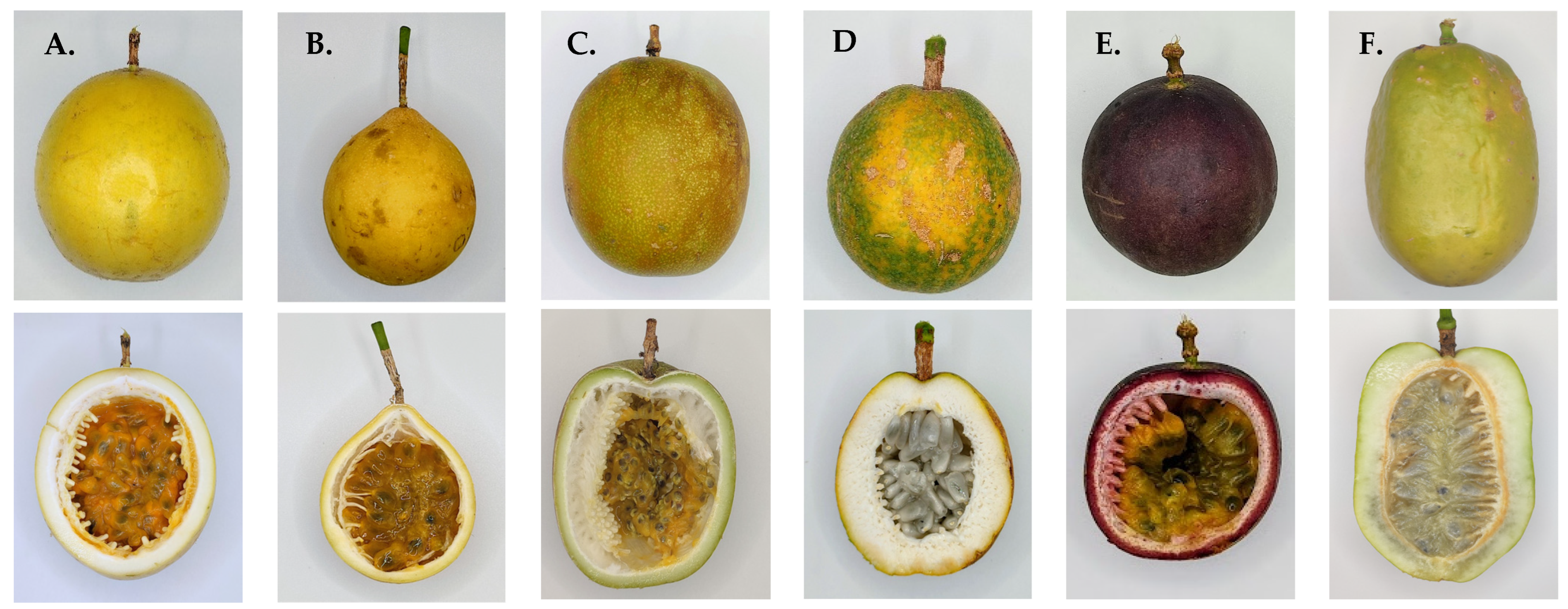



Passifloraceae Rootstock Performance Against Soil Pathogens in Yellow Passion Fruit Crops (Passiflora edulis f. flavicarpa Degener)

 ,
,
Abstract
1. Introduction
2. Materials and Methods
2.1. Experimental Site
2.2. Methodological Procedure
2.2.1. Plant Material
Seed Germination
2.2.2. Experimental Design and Treatments
2.2.3. Inoculum Extraction Process
Extraction Process of F. oxysporum f. sp. passiflorae
Extraction of Meloidogyne incognita in the Root
Extraction of Meloidogyne incognita in Soil
2.2.4. Inoculation of Seedlings
2.2.5. Experiment Handling Conditions
2.2.6. Response Variables and Measurements
Fusarium-Associated Variables
Variables Associated with Meloidogyne incognita
Growth Variables and Aboveground Biomass of Seedlings
Compatibility Variables
2.3. Statistical Analysis
3. Results
3.1. Response of Passiflora Rootstocks to Different Inoculation Conditions
3.2. Compatibility
3.3. Selecting the Best Rootstock
4. Discussion
5. Conclusions
Supplementary Materials
Author Contributions
Funding
Data Availability Statement
Acknowledgments
Conflicts of Interest
References
- Viera, W.; Shinohara, T.; Samaniego, I.; Terada, N.; Sanada, A.; Ron, L.; Koshio, K. Pulp mineral content of passion fruit germplasm grown in Ecuador and its relationship with fruit quality traits. Plants 2022, 11, 697. [Google Scholar] [CrossRef]
- Viera, W.; Shinohara, T.; Samaniego, I.; Sanada, A.; Terada, N.; Ron, L.; Suárez-Tapia, A.; Koshio, K. Phytochemical composition and antioxidant activity of Passiflora spp. germplasm grown in Ecuador. Plants 2022, 11, 328. [Google Scholar] [CrossRef] [PubMed]
- Viera, W.; Shinohara, T.; Iyooka, C.; Terada, N.; Sanada, A.; Koshio, K. Physical and chemical characterization of passion fruit, focusing on the differences in juice carotenoids and sugars. Hortic. J. 2025, 94, 1–10. [Google Scholar] [CrossRef]
- Qin, Y. Nutritional values and current research on passion fruit (Passiflora edulis). Nov. Tech. Nutr. Food Sci. 2025, 8, 810–812. [Google Scholar] [CrossRef]
- Instituto Nacional de Estadística y Censos (INEC). Estadísticas Agropecuarias. Available online: https://www.ecuadorencifras.gob.ec/estadisticas-agropecuarias-2 (accessed on 24 February 2026).
- Ministerio de Agricultura y Ganadería. Boletín de Precios al Productor Nacional, Febrero 2024; Ministerio de Agricultura y Ganadería: Quito, Ecuador, 2024. [Google Scholar]
- Pires, R.A.; Jesus, O.N.; Lima, L.K.S.; Silva, L.N.; Laranjeira, F.F. Fusarium oxysporum f. sp. passiflorae isolates display variable virulence in Passiflora edulis Sims seedlings. Eur. J. Plant Pathol. 2022, 162, 465–476. [Google Scholar] [CrossRef]
- Salazar-Gonzalez, C.; Yela-Caicedo, O.; Gomez-Espinoza, B. Molecular characterization of Fusarium spp. associated vascular wilt in passion fruit (Passiflora ligularis Juss.). Rev. Cienc. Agríc. 2022, 39, 33–46. [Google Scholar] [CrossRef]
- Henao-Henao, E.D.; Hernández-Medina, C.A.; Salazar-González, C.; Velasco-Belalcazar, M.L.; Gómez-López, E.D. Identificación molecular de aislamientos de Fusarium asociados a maracuyá en el Valle del Cauca, Colombia. Agron. Mesoam. 2018, 29, 56–65. [Google Scholar] [CrossRef]
- Silva, A.M.G.B.; Inomoto, M.M.; Marques, J.P.R.; Paes, B.S.J.; Bessi, R. Meloidogyne incognita reduces the Passiflora nitida growth. Pesqui. Agropecuária Trop. 2024, 54, 1–8. [Google Scholar] [CrossRef]
- Paes, B.S.J.; Inomoto, M.M.; Silva, A.M.G.B. The southern root-knot nematode (Meloidogyne incognita) is an important constraint for stinking passion flower (Passiflora foetida L.). Rev. Bras. Frutic. 2024, 46, 1–6. [Google Scholar] [CrossRef]
- Neupane, S.; Avin, F.A.; Liyanapathiranage, P.; Simmons, T.; Baysal-Gurel, F. Identification and chemical and biological management of Fusarium root and crown rot disease of oakleaf hydrangea. Plant Dis. 2023, 107, 3188–3197. [Google Scholar] [CrossRef] [PubMed]
- Adam, M.; Sobhy, H.; Abouzid, M.; Elhafny, D.; Ibrahim, E.-D. Evaluation of bionematicides and chemical nematicides in controlling Meloidogyne incognita on grape, with estimating ethoprophos and fenamiphos residues and chlorophyll degree. Pak. J. Nematol. 2023, 41, 45–55. [Google Scholar] [CrossRef]
- Alam, M.S.; Khanal, C.; Rutter, W.; Roberts, J. Non-fumigant nematicides are promising alternatives to fumigants for the management of Meloidogyne enterolobii in tobacco. J. Nematol. 2022, 54, 20220045. [Google Scholar] [CrossRef] [PubMed]
- Sasanelli, N.; Konrat, A.; Migunova, V.; Toderas, I.; Iurcu-Straistaru, E.; Rusu, S.; Bivol, A.; Andoni, C.; Veronico, P. Review on control methods against plant parasitic nematodes applied in southern member states (C zone) of the European Union. Agriculture 2021, 11, 602. [Google Scholar] [CrossRef]
- Aktar, M.W.; Sengupta, D.; Chowdhury, A. Impact of pesticide use in agriculture: Their benefits and hazards. Interdiscip. Toxicol. 2009, 2, 1–12. [Google Scholar] [CrossRef]
- Alcivar, S.; Murillo, A. Intoxicación por inhibidores de colinesterasa y su efecto en la salud de agricultores. Rev. Científica FIPCAEC 2022, 7, 1487–1515. [Google Scholar] [CrossRef]
- Ocampo Pérez, J.A.; Morillo Coronado, Y.; Espinal Aguilar, F.J.; Moreno Cabrera, I. Tecnología Para el Cultivo del Maracuyá en Colombia (Passiflora edulis f. flavicarpa Degener); Universidad Nacional de Colombia: Bogotá, Colombia, 2022. [Google Scholar]
- Silva, A.D.S.; Oliveira, E.J.D.; Haddad, F.; Laranjeira, F.F.; Jesus, O.N.D.; Oliveira, S.A.S.D.; Costa, M.A.P.D.C.; Freitas, J.P.X.D. Identification of passion fruit genotypes resistant to Fusarium oxysporum f. sp. passiflorae. Trop. Plant Pathol. 2013, 38, 236–242. [Google Scholar] [CrossRef]
- Aguilar, F.E.; Pérez, J.O.; Coronado, Y.M.; Salazar, A.H. Desarrollo de plántulas de maracuyá injertadas en cuatro portainjertos de Passiflora. Acta Agron. 2024, 72, 301–309. [Google Scholar] [CrossRef]
- Viteri, P.; Gaona, P.; Noboa, M.; Merino, J.; Mejía, P.; Hinojosa, M.; Viera, W. Rootstocks as a strategy to prevent wilting in granadilla (Passiflora ligularis Juss.) cultivation. Manglar 2025, 22, 371–377. [Google Scholar] [CrossRef]
- Rocha, L.D.S.; Xavier, A.A.; Ribeiro, R.C.F. Reaction of passion fruit genotypes to the complex Meloidogyne incognita and Fusarium solani. Rev. Caatinga 2021, 34, 605–613. [Google Scholar] [CrossRef]
- Miguel-Wruck, D.S.; Roncatto, G.; Behling, M.; Faleiro, V.d.O.; Bonaldo, S.M.; Tardin, F.D. Identification of sources of resistance of Passiflora rootstocks to fusariosis in areas with disease outbreaks in Mato Grosso State, Brazil. Rev. Bras. Frutic. 2021, 43, 1–9. [Google Scholar] [CrossRef]
- Yadav, H.; Roberts, P.A.; Lopez-Arredondo, D. Combating root-knot nematodes (Meloidogyne spp.): From molecular mechanisms to resistant crops. Plants 2025, 14, 1321. [Google Scholar] [CrossRef]
- Keinath, A.P.; Wechter, W.P.; Rutter, W.B.; Agudelo, P.A. Cucurbit rootstocks resistant to Fusarium oxysporum f. sp. niveum remain resistant when coinfected by Meloidogyne incognita in the field. Plant Dis. 2019, 103, 1383–1390. [Google Scholar] [CrossRef] [PubMed]
- NIAP. Evaluación de Portainjertos de Pasifloras en Maracuyá amarilla (P. edulis f. flavicarpa Deg.) Como Estrategia Para el Manejo de Fusarium oxysporum y Meloidogyne incognita; Technical Report; INIAP: Quito, Ecuador, 2024. [Google Scholar]
- Nelson, P.E.; Toussoun, T.A.; Marasas, W.F.O. Fusarium Species: An Illustrated Manual for Identification; Pennsylvania State University Press: University Park, PA, USA, 1983. [Google Scholar]
- Leslie, J.F.; Summerell, B.A.; Bullock, S. The Fusarium Laboratory Manual; Blackwell Publishing: Ames, IA, USA, 2006. [Google Scholar]
- Moreno, L.; Luna, L.; Escobar, L. Aislamiento e identificación del agente causal de la pudrición basal en frutos de pitahaya (Selenicereus megalanthus) cultivada en el departamento del Huila. Rev. Agropecu. Agroindustrial Angostura 2021, 7, 22–27. [Google Scholar] [CrossRef]
- García, Á.; Ordóñez, Y.F.; Vargas-Tierras, Y.; Sanmiguel, J.; Vásquez-Castillo, W.; Viera-Arroyo, W. The use of botanical extracts for the control of Meloidogyne incognita (Kofoid and White) in yellow pitahaya. Horticulturae 2025, 11, 268. [Google Scholar] [CrossRef]
- Hunt, D.J.; Handoo, Z.A. Taxonomy, identification and principal species. In Root-Knot Nematodes; Perry, R.N., Moens, M., Starr, J.L., Eds.; CABI: Wallingford, UK, 2009; pp. 55–97. [Google Scholar] [CrossRef]
- Ángel-García, C.; Robledo-Buriticá, J.; Castaño-Zapata, J. Comparación de métodos de inoculación de Fusarium solani f. sp. passiflorae en plántulas de maracuyá (Passiflora edulis f. flavicarpa). Rev. UDCA Actual. Divulg. Científica 2018, 21, 23–31. [Google Scholar] [CrossRef]
- Jepson, S.B. Identification of Meloidogyne: A general assessment and a comparison of male morphology using light microscopy with a key to 24 species. Rev. Nematol. 1983, 6, 291–309. [Google Scholar]
- Miamoto, A.; Machado, A.C.Z.; Dorigo, O.F.; Mioranza, T.M.; Puerari, H.H.; Silva, B.A.E.; Schwan, V.V.; Arieira, C.R.D. Antagonistic potential and histopathology of Meloidogyne javanica on Macrotyloma axillare cv. JAVA Aust. J. Crop Sci. 2020, 14, 940–946. [Google Scholar] [CrossRef]
- Zhang, J.; Abdelraheem, A.; Zhu, Y.; Elkins-Arce, H.; Dever, J.; Whitelock, D.; Hake, K.; Wedegaertner, T.; Wheeler, T.A. Studies of evaluation methods for resistance to Fusarium wilt race 4 (Fusarium oxysporum f. sp. vasinfectum) in cotton: Effects of cultivar, planting date, and inoculum density on disease progression. Front. Plant Sci. 2022, 13, 900131. [Google Scholar] [CrossRef] [PubMed]
- Chaves, C.G.; Marcillo, E.M.; González, C.S.; Garcia, C.B. Susceptibilidad de genotipos de Solanum spp. al nematodo causante del nudo radical Meloidogyne spp. (Chitwood). Acta Agron. 2011, 60, 50–67. [Google Scholar]
- Ballén-Taborda, C.; Chu, Y.; Ozias-Akins, P.; Timper, P.; Jackson, S.A.; Bertioli, D.J.; Leal-Bertioli, S.C.M. Validation of resistance to root-knot nematode incorporated in peanut from the wild relative Arachis stenosperma. Agron. J. 2021, 113, 2293–2302. [Google Scholar] [CrossRef]
- Padilla, B.; Morillo, Y.; Tarapues, S.; Burbano, S.; Soto, M.; Urrea, R.; Ceballos-Aguirre, N. Evaluation of root-knot nematodes (Meloidogyne spp.) population density for disease resistance screening of tomato germplasm carrying the gene Mi-1. Chil. J. Agric. Res. 2022, 82, 157–166. [Google Scholar] [CrossRef]
- Xiong, M.; Liu, C.; Guo, L.; Wang, J.; Wu, X.; Li, L.; Bie, Z.; Huang, Y. Compatibility Evaluation and Anatomical Observation of Melon Grafted Onto Eight Cucurbitaceae Species. Front. Plant Sci. 2021, 12, 762889. [Google Scholar] [CrossRef]
- Rego, M.M.; Brito, S.G.; Rego, E.R.; Costa, F.R.; Fortunato, F.L.G. Hypocotyledonary grafting in passion fruit (Passiflora edulis Sims). Acta Hortic. 2012, 928, 139–144. [Google Scholar] [CrossRef]
- Sikandar, A.; Mo, Y.; Chen, B.; Nishat, Y.; Wu, H. Influence of Meloidogyne incognita and Fusarium oxysporum on growth, physiological, biochemical, and root morphology in tomato hybrid cultivars. Agronomy 2025, 15, 890. [Google Scholar] [CrossRef]
- Fan, Q.; Yu, J.; Feng, J.; Wu, H.; Jiu, Y.; Wu, X.; Zhang, Q.; Xu, Z.; Xu, Z. Enhancing passion fruit (Passiflora edulis f. flavicarpa Degener) agriculture with application of alkaline humic acid fertilizer and chemical fertilizer: An effective approach to soil and fruit quality optimization. Environ. Technol. Innov. 2025, 39, 104214. [Google Scholar] [CrossRef]
- Yaseen, I.; Mukhtar, T.; Kim, H.-T.; Arshad, B. Interactive Effects of Meloidogyne incognita and Fusarium oxysporum f. Sp. Vasinfectum on Okra Cultivars. Bragantia 2024, 83, 1–12. [Google Scholar] [CrossRef]
- Ploeg, A.T.; Edwards, S. Host status of melon, carrot, and Meloidogyne incognita-susceptible and -resistant cotton, cowpea, pepper, and tomato for M. floridensis from California. J. Nematol. 2024, 56, 384–391. [Google Scholar] [CrossRef]
- Akinsanya, A.K.; Afolami, S.O.; Kulakow, P.; Coyne, D. The root-knot nematode, Meloidogyne incognita, profoundly affects the production of popular biofortified cassava cultivars. Nematology 2020, 22, 667–676. [Google Scholar] [CrossRef]
- Parrado, L.M.; Quintanilla, M. Plant-parasitic nematode disease complexes as overlooked challenges to crop production. Front. Plant Sci. 2024, 15, 1439951. [Google Scholar] [CrossRef]
- Habibi, F.; Liu, T.; Folta, K.; Sarkhosh, A. Physiological, biochemical, and molecular aspects of grafting in fruit trees. Hortic. Res. 2022, 9, uhac032. [Google Scholar] [CrossRef]
- Mangeiro, M.Z.; Nunes, R.A.; Vieira, J.O.L.; Mussi-Dias, V.; Viana, A.P.; Souza, R.M. Characterizing the interaction between root-knot nematodes and soil-borne fungi which are pathogenic to passion fruit (Passiflora edulis). J. Nematol. 2022, 54, 20220023. [Google Scholar] [CrossRef] [PubMed]
- Galvis-Tarazona, D.; Bohórquez-Quintero, M.; Arias-Moreno, D.; Ojeda-Pérez, Z. Deciphering the resistance mechanism to Fusarium wilt and stem rot of Passiflora maliformis var. pubescens using histopathology aspects. Front. Plant Sci. 2025, 16, 1635702. [Google Scholar] [CrossRef] [PubMed]
- Lopez, C.; Salazar, A.H.; Ocampo, J.; Silva, D.F.P.D.; Ceballos, N.A. Economic and quality study of purple passion fruit grafted on a Fusarium wilt tolerant rootstock. Bragantia 2022, 81, 1–9. [Google Scholar] [CrossRef]


| Class | Intensity * |
|---|---|
| 0 | No symptoms (0%) |
| 1 | Mild wilting (1–15%) |
| 2 | Moderate wilting (16–25%) |
| 3 | Severe wilting (26–35%) |
| 4 | Very severe wilting (36–45%) |
| 5 | Severe wilting and stunting of the plant (>50%) |
| 6 | Death of the plant |
| Clase | Intensity |
|---|---|
| 0 | 0 galls |
| 1 | 1–2 galls |
| 2 | 3–10 galls |
| 3 | 11–30 galls |
| 4 | 31–100 galls |
| 5 | >100 galls |
| Nematode Reproduction Index | Host Performance Compared to the Control | |
|---|---|---|
| Minor | Equal or Greater | |
| FP/IP < 1 | 2. Resistant–Not tolerant | 1. Resistant–Tolerant |
| FP/IP > 1 | 4. Susceptible–Not tolerant | 3. Susceptible–Tolerant |
| Inoculation Condition | Time (Days) | ΔCTI of P. maliformis | ΔCTI of P. platyloba | ΔCTI of P. quadrangularis | ΔCTI of P. nitida | ΔCTI of P. edulis f. edulis |
|---|---|---|---|---|---|---|
| M | 15 | +0.33 * ± 0.08 | +0.30 ± 0.10 * | +0.19 ± 0.11 * | +0.10 ± 0.10 | +0.03 ± 0.17 |
| M | 30 | +0.20 ± 0.09 | +0.25 ± 0.05 * | +0.11 ± 0.12 * | +0.04 ± 0.06 | −0.06 ± 0.11 * |
| F | 15 | +0.32 ± 0.05 * | +0.32 ± 0.01 | +0.05 ± 0.22 | −0.08 ± 0.09 | +0.05 ± 0.12 |
| F | 30 | −0.16 ± 0.25 | −0.18 ± 0.03 | −0.12 ± 0.21 | −0.33 ± 0.19 * | −0.26 ± 0.13 * |
| N→F | 15 | −0.10 ± 0.18 | −0.13 ± 0.22 | −0.26 ± 0.11 * | −0.23 ± 0.18 * | −0.17 ± 0.12 * |
| N→F | 30 | −0.21 ± 0.03 * | −0.18 ± 0.19 | −0.16 ± 0.06 * | −0.18 ± 0.06 * | −0.01 ± 0.08 |
| F→N | 15 | +0.22 ± 0.61 | +0.32 ± 0.27 * | −0.10 ± 0.22 | −0.10 ± 0.16 | 0.00 ± 0.03 |
| F→N | 30 | +0.11 ± 0.23 | 0.00 ± 0.19 | +0.13 ± 0.26 | +0.14 ± 0.17 | −0.02 ± 0.01 |
| N/F | 15 | −0.23 ± 0.10 * | +0.07 ± 0.32 | −0.06 ± 0.12 | 0.00 ± 0.05 | −0.05 ± 0.08 |
| N/F | 30 | +0.09 ± 0.19 | +0.17 ± 0.23 * | +0.26 ± 0.13 * | +0.36 ± 0.02 * | +0.21 ± 0.29 * |
| Species | GCI | Compatibility ‖1 − GCI‖ 30 dpi (↓) | Quality |
|---|---|---|---|
| P. platyloba | 0.96 ± 0.09 bc | 0.04 ± 0.09 bc | Excellent |
| P. quadrangularis | 0.94 ± 0.08 abc | 0.06 ± 0.08 abc | Very good |
| P. edulis f. edulis | 0.91 ± 0.06 c | 0.09 ± 0.06 c | Very good |
| P. maliformis | 1.39 ± 0.07 a | 0.39 ± 0.07 a | Low |
| P. nitida | 1.28 ± 0.07 ab | 0.28 ± 0.07 ab | Medium |
Disclaimer/Publisher’s Note: The statements, opinions and data contained in all publications are solely those of the individual author(s) and contributor(s) and not of MDPI and/or the editor(s). MDPI and/or the editor(s) disclaim responsibility for any injury to people or property resulting from any ideas, methods, instructions or products referred to in the content. |
© 2026 by the authors. Licensee MDPI, Basel, Switzerland. This article is an open access article distributed under the terms and conditions of the Creative Commons Attribution (CC BY) license.
Share and Cite
Calderón-González, J.; Granja-Guerra, E.; Viera-Arroyo, W.; Vásquez-Castillo, W.; Sanmiguel, J.; Pico, J.; Vargas-Tierras, Y. Passifloraceae Rootstock Performance Against Soil Pathogens in Yellow Passion Fruit Crops (Passiflora edulis f. flavicarpa Degener). Horticulturae 2026, 12, 360. https://doi.org/10.3390/horticulturae12030360
Calderón-González J, Granja-Guerra E, Viera-Arroyo W, Vásquez-Castillo W, Sanmiguel J, Pico J, Vargas-Tierras Y. Passifloraceae Rootstock Performance Against Soil Pathogens in Yellow Passion Fruit Crops (Passiflora edulis f. flavicarpa Degener). Horticulturae. 2026; 12(3):360. https://doi.org/10.3390/horticulturae12030360
Chicago/Turabian StyleCalderón-González, Jenny, Eliana Granja-Guerra, William Viera-Arroyo, Wilson Vásquez-Castillo, Jessica Sanmiguel, Jimmy Pico, and Yadira Vargas-Tierras. 2026. "Passifloraceae Rootstock Performance Against Soil Pathogens in Yellow Passion Fruit Crops (Passiflora edulis f. flavicarpa Degener)" Horticulturae 12, no. 3: 360. https://doi.org/10.3390/horticulturae12030360
APA StyleCalderón-González, J., Granja-Guerra, E., Viera-Arroyo, W., Vásquez-Castillo, W., Sanmiguel, J., Pico, J., & Vargas-Tierras, Y. (2026). Passifloraceae Rootstock Performance Against Soil Pathogens in Yellow Passion Fruit Crops (Passiflora edulis f. flavicarpa Degener). Horticulturae, 12(3), 360. https://doi.org/10.3390/horticulturae12030360