Article

Field-Based Evaluation of Heat Tolerance in Sweet Cherry Rootstocks Reveals Integrated Morphological and Physiological Adaptation Mechanisms

1
Institute of Horticulture, Hangzhou Academy of Agricultural Sciences, Hangzhou 310024, China
2
Key Laboratory for Quality Regulation of Tropical Horticultural Crops of Hainan Province, School of Tropical Agriculture and Forestry, Hainan University, Haikou 570228, China
*
Authors to whom correspondence should be addressed.
Horticulturae 2026, 12(2), 240; https://doi.org/10.3390/horticulturae12020240

Submission received: 19 January 2026 / Revised: 12 February 2026 / Accepted: 15 February 2026 / Published: 17 February 2026
(This article belongs to the Special Issue Effect of Rootstock on Fruit Production and Quality)

Abstract

High summer temperatures increasingly constrain sweet cherry production, yet field-validated assessments of rootstock resilience remain scarce. To fill this gap, this study presents a pioneering multidimensional evaluation of five widely used sweet cherry rootstocks (Gisela 6, Gisela 12, Krymsk 5, Colt, and Lanting) under prolonged natural heat stress. Morphological traits, leaf anatomical characteristics, antioxidant enzyme activities (SOD, CAT, POD), lipid peroxidation (MDA), phytohormones (ABA and JA), and osmotic regulators were assessed. Traits with high coefficients of variation, including POD activity, ABA, JA, and soluble protein content, were identified as sensitive indicators of heat stress. Lanting exhibited the strongest heat tolerance, characterized by thicker leaves, fewer heat-induced lesions, and enhanced antioxidant capacity, whereas Gisela 6 showed severe leaf abscission, elevated MDA and ABA accumulation, and the weakest defense capacity. Correlation analysis indicated that root sucker number was positively associated with SOD activity and soluble sugar content, suggesting a potential role of whole-plant carbon allocation in mitigating oxidative stress. Using the Entropy Weight–TOPSIS model, we provided a robust ranking that identifies Lanting and Colt as superior heat-resilient genotypes. The results provide a field-validated framework that bridges the gap between controlled-environment theory and practical orchard management, offering critical guidance for expanding sweet cherry cultivation into high-temperature regions.

1. Introduction

Sweet cherry (Prunus avium L.) is widely recognized as one of the most valuable temperate fruit crops because of its desirable sensory attributes, superior nutritional quality, and consistent consumer demand. In recent years, sweet cherry cultivation has expanded rapidly into low-latitude and subtropical regions of China, driven by advances in controlled-environment production and the introduction of innovative dwarfing and semi-dwarfing rootstocks [1]. However, these warmer cultivation zones frequently experience prolonged periods of high temperature and high humidity during the summer, leading to significant abiotic stress on the trees [2]. Heat stress adversely affects leaf photosynthesis, accelerates transpiration, enhances oxidative damage, disturbs hormonal balance, restricts vegetative growth, and ultimately undermines fruit set, yield, and orchard longevity [3,4]. As the frequency and intensity of extremely hot days (>35–40 °C) continue to rise in southeastern and southwestern China, heat stress increasingly induces physiological disorders such as leaf scorch, premature defoliation, and reduced orchard productivity [5,6,7]. Therefore, selecting and deploying heat-tolerant rootstocks has become an urgent requirement for stabilizing cherry production under subtropical field conditions.
Rootstocks play a critical role in determining scion vigor, nutrient allocation, fruiting behavior, stress tolerance, and overall orchard performance. By regulating water transport, hormonal balance, and antioxidative metabolism, different rootstocks markedly influence the physiological and biochemical status of grafted plants [8]. In southern regions, dwarfing and semi-dwarfing rootstocks are generally preferred for sweet cherry production because they reduce canopy volume, improve orchard management efficiency, enhance productivity, and are well suited to recreational and sightseeing orchards [9]. The Gisela series, one of the most widely used rootstock groups for sweet cherry worldwide, is predominantly derived from interspecific crosses between Prunus cerasus L. and Prunus canescens Pall., with the exception of Gisela 4 [10,11]. These rootstocks are characterized by strong dwarfing ability, a clear genetic background, good graft compatibility, and early bearing. Krymsk 5 is a semi-dwarf rootstock that, compared with Gisela 6, exhibits slightly weaker early fruiting and yield performance but possesses broader soil adaptability and superior cold hardiness, while also performing well under high-temperature conditions [12]. Colt, a hybrid of Prunus avium L. × Prunus pseudocerasus Lindl., is a vigorous rootstock with a well-developed root system and certain tolerance to replanted soils. Previous studies have shown that the sweet cherry Kordia grafted onto the Colt exhibits higher phenolic content, highlighting its potential influence on fruit quality [13]. Although Colt is widely used in California, USA, its application in China remains limited. Lanting, derived from distant hybridization between Prunus cerasus and Prunus pseudocerasus Lindl., exhibits excellent graft compatibility with major cultivars, a robust root system, and strong resistance to waterlogging [14]. Despite the increasing use of these rootstocks in warm regions, the integrative physiological and biochemical mechanisms underlying their heat tolerance under long-term field conditions remain poorly understood, particularly in grafted perennial systems. Most previous assessments have been conducted under controlled environments or focused on single physiological traits, limiting their translational relevance for orchard management.
High and extreme temperatures profoundly disrupt plant cellular integrity, physiological processes, and biochemical metabolism. In response, plants activate a coordinated array of physiological and molecular adaptations to enhance heat tolerance [15,16,17]. One of the primary responses to heat stress is the activation of antioxidant enzyme systems, which scavenge excessive reactive oxygen species (ROS) generated under high-temperature conditions. Concurrently, plants increase transpiration rates to facilitate thermoregulation through evaporative cooling and accumulate compatible solutes—including soluble sugars, soluble proteins, and proline—to maintain cellular osmotic balance and membrane homeostasis [18,19]. Extensive evidence from cereal crops indicates that antioxidant enzymes such as superoxide dismutase (SOD) and catalase (CAT) play critical roles in detoxifying ROS and preserving physiological stability under heat stress. For example, wheat plants effectively degrade excess ROS via coordinated antioxidant enzyme activities, thereby maintaining cellular homeostasis through integrated physiological and molecular regulation [20]. In addition to redox regulation, phytohormones are key modulators of heat-stress responses. Under combined water deficit and high-temperature conditions, abscisic acid (ABA) promotes stress adaptation primarily by inducing stomatal closure and enhancing the accumulation of stress-responsive proteins, while jasmonic acid (JA) often acts synergistically to reinforce stress signaling pathways [21]. Osmotic adjustment is another essential component of heat-stress tolerance. Compatible solutes such as proline, soluble sugars, and soluble proteins contribute to maintaining cellular hydration, stabilizing proteins and membranes, and mitigating heat-induced oxidative damage [22,23,24]. Thus, the resilience of a cultivar under high-temperature stress largely hinges on how effectively it orchestrates antioxidant defense, hormone signaling, transpirational cooling, and osmotic adjustment.
Previous studies on abiotic stress tolerance have largely relied on plant screening under controlled environmental conditions, whereas long-term, field-based integrated evaluations in perennial fruit crops have received comparatively limited attention. This imbalance represents a major bottleneck in breeding programs, as controlled experiments often fail to capture the complexity, duration, and compound nature of heat stress encountered in natural subtropical production systems [25]. Moreover, many studies have focused primarily on individual traits— such as single physiological indicators (e.g., SOD activity) or basic growth parameters—without integrating multidimensional datasets (morphological, anatomical, physiological, and biochemical) through systematic statistical analyses [26,27]. Critically, the interactive roles of root-mediated traits (e.g., root suckering), carbon allocation, and osmotic adjustment in heat tolerance remain underexplored in grafted perennial systems. In recent years, multivariate statistical approaches, including principal component analysis (PCA) and the Entropy Weight–Technique for Order Preference by Similarity to Ideal Solution (TOPSIS) method, have been increasingly applied to quantify, integrate, and rank complex traits associated with abiotic stress tolerance [28,29]. These approaches are enabled by simultaneously incorporating physiological, biochemical, and morphological indicators, thereby improving the accuracy and reliability of genotypes for breeding and cultivation.
To address these knowledge gaps, this study employs a multidimensional, field-based approach to evaluate five widely used sweet cherry rootstocks under natural subtropical heat stress. Unlike most previous studies, which rely on short-term controlled-environment experiments or focus primarily on scion cultivars, this work investigates rootstock-mediated heat tolerance under realistic orchard conditions, thereby enhancing practical relevance. We systematically integrate assessments of morphological traits, leaf anatomical structure, antioxidant enzyme activities, lipid peroxidation, phytohormone profiles, and osmotic adjustment capacity. By combining correlation analysis, PCA, and Entropy Weight–TOPSIS, we aim not only to rank rootstock performance but also to identify key integrative traits and potential mechanisms—such as root–shoot coordination and trait networks—that could inform breeding and selection programs for heat-resilient cherry production. This study provides a field-validated, mechanism-informed framework for rootstock selection, contributing to the sustainable expansion of sweet cherry cultivation in high-temperature regions.

2. Materials and Methods

2.1. Experimental Site and Plant Materials

The field experiment was conducted at the Zhuantang Sweet Cherry Experimental Base of the Hangzhou Academy of Agricultural Sciences, Zhejiang Province, China (30°16′ N, 120°08′ E). The study area experiences a humid subtropical monsoon climate characterized by hot summers and abundant precipitation. Five sweet cherry (Prunus avium) rootstock genotypes were evaluated: Gisela 6 (G6), Gisela 12 (G12), Krymsk 5 (K5), Colt (KT), and Lanting (LD). All experimental trees were five years old and grown under open-field conditions following standard orchard management practices. In January 2024, all trees were pruned to a uniform height to minimize variation in shoot growth prior to the onset of summer heat stress.

2.2. Experimental Design and Sampling

This experiment was carried out during the 2024 growing season, from May to October. For each rootstock type, ten trees with uniform growth vigor were randomly selected as biological replicates. Leaf samples were collected in September when all five rootstocks had reached the BBCH 91 phenological stage (characterized by the cessation of shoot growth and completed lignification of the shoot base) from fully expanded [30], sun-exposed leaves located in the middle portion of current-year shoots. The collected samples were immediately frozen in liquid nitrogen for subsequent analysis.

2.3. Environmental Monitoring

Air temperature and relative humidity were continuously monitored throughout the experimental period using temperature–humidity data loggers (WS-TH23PRO). The sensors were installed at a height of 1.5 m above ground level within the orchard canopy and programmed to record data at 20 min intervals, ensuring accurate characterization of ambient environmental conditions.

2.4. Paraffin Section Preparation

Leaf anatomy was analyzed using paraffin sections. Fresh leaf samples were fixed in FAA, dehydrated in an ethanol series, cleared with xylene, and embedded in paraffin. Sections (8–10 μm thick) were stained with safranin and fast green to distinguish lignified (red) and cellulose-rich (green) tissues, then observed under a light microscope to compare anatomical features across rootstocks. Leaf thickness (LT), upper epidermis thickness (UET), palisade tissue thickness (PTT), spongy tissue thickness (STT) and lower epidermis thickness (LET) were measured using an optical microscope and image analysis system after sectioning.

2.5. Measurement of Field Growth Traits

Field growth traits were assessed in September following the summer high-temperature period. The diameter of current-year shoots, leaf length (LL), width (LW) and shoot diameter (SD) were measured using vernier calipers. The total length of current-year shoots (SL) and new shoot length (NSL) was measured with a meter ruler. Leaf area (LA) was determined using a leaf area meter (YMJ-B). In addition, the number of current-year branches (SN) longer than 0.5 m, the number of root suckers (SUN), total leaf number (RLN) on a representative main branch, root nodule (RN), and the number of visible disease spots (LLN) on mature leaves were recorded.

2.6. Determination of Malondialdehyde Content

Malondialdehyde (MDA) content was determined using the thiobarbituric acid (TBA) colorimetric method. Briefly, leaf samples were homogenized and reacted with TBA reagent in a boiling water bath. After cooling and centrifugation, the absorbance of the supernatant was measured at 532 nm using a spectrophotometer, and MDA content was calculated accordingly [30].

2.7. Assay of Antioxidant Enzyme Activities

The activities of key antioxidant enzymes were determined according to established protocols. Superoxide dismutase (SOD) activity was assayed using the nitroblue tetrazolium (NBT) photoreduction method based on inhibition of NBT reduction. Catalase (CAT) activity was measured by monitoring the decomposition rate of hydrogen peroxide at 240 nm. Peroxidase (POD) activity was determined using the guaiacol oxidation method, with absorbance recorded at 470 nm [31,32].

2.8. Determination of Endogenous Hormones

Endogenous hormone contents, including abscisic acid (ABA) and jasmonic acid (JA), were quantified using liquid chromatography–mass spectrometry (LC–MS). Crude extracts were centrifuged and filtered through a 0.22 μm organic membrane prior to analysis. Separation was performed on a C18 column using a methanol–0.1% formic acid aqueous solution as the mobile phase. Detection was conducted in negative electrospray ionization (ESI) mode using multiple reaction monitoring (MRM). Hormone concentrations were calculated based on calibration curves generated from serial dilutions of authentic standards [33]. Internal standards were used for quantification, and hormone concentrations were expressed on a fresh weight basis.

2.9. Measurement of Osmoregulatory Compounds

Osmoregulatory substances were measured using established colorimetric methods. Soluble protein (SP) content was determined using the Coomassie brilliant blue dye-binding assay. Total soluble sugars (TSS) were quantified using the anthrone–sulfuric acid method, while proline (PRO) content was measured using acid ninhydrin colorimetry. All assays were selected for their reliability and reproducibility [34,35,36].

2.10. Determination of Total Chlorophyll Content

Total chlorophyll content (TCC) was determined spectrophotometrically. Approximately 0.5 g of fresh plant tissues was homogenized and extracted using 80% acetone. The absorbance of the extract was then measured at 662 nm and 644 nm for the calculation of chlorophyll a and chlorophyll b contents, respectively, and the total chlorophyll content was expressed as the sum of chlorophyll a and b [37].

2.11. Data Processing and Statistical Analysis

Statistical analyses were performed to comprehensively evaluate field performance and heat tolerance among the five rootstocks. Analysis of variance (ANOVA), correlation analysis, principal component analysis (PCA), and Entropy Weight–TOPSIS comprehensive evaluation were conducted [31]. Prior to multivariate analysis, all data were standardized to eliminate dimensional effects among variables. PCA was used to reduce data dimensionality and identify major contributing variables, while the Entropy Weight–TOPSIS method was applied to rank the overall heat tolerance performance of each rootstock. All statistical analyses were conducted using SPSS 24.0 (IBM, USA). Data visualization was performed using Origin 2021 and Microsoft Excel 2019. Multiple comparisons were carried out using the least significant difference (LSD) test at p < 0.05. All measurements were based on at least three replicates, and results are presented as mean ± standard error (SE).

3. Results

3.1. Climate Conditions During the Study Period

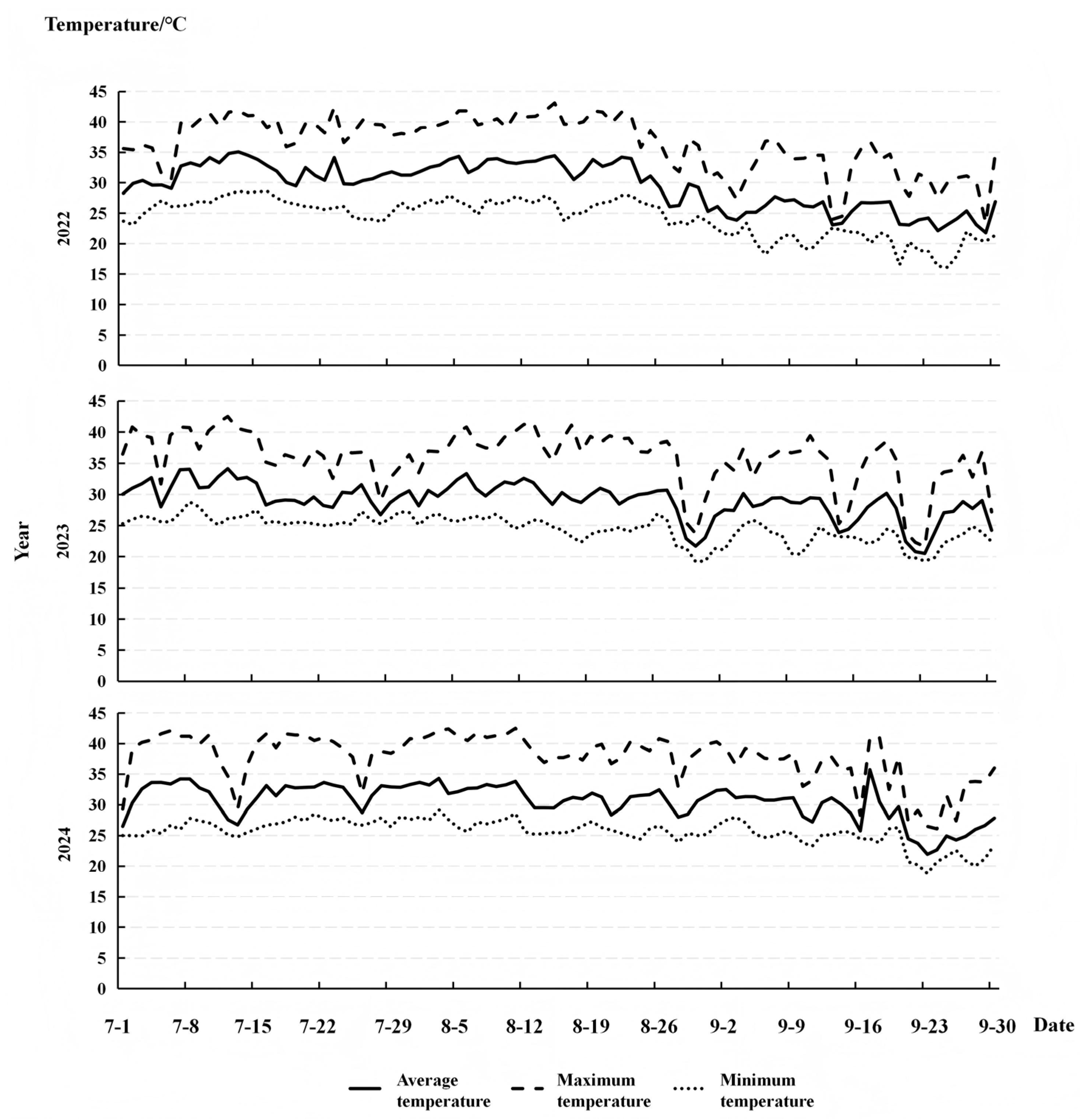
To characterize the environmental context in which the rootstocks were evaluated, we analyzed the climatic data for the experimental region from 2022 to 2024, focusing on seasonal temperature patterns and the frequency of extreme heat events (Figure 1). Although interannual variation was observed, all three years consistently exhibited prolonged periods of high temperature, with daily maximum temperatures frequently exceeding 35 °C. Notably, 2024 displayed the highest average summer temperature (30.6 °C), representing a substantial increase relative to 2022 and 2023. Additionally, the cumulative number of extremely hot days (Tmax ≥ 35 °C) and scorching days (Tmax ≥ 40 °C) increased sharply in 2024, creating an extended heat-stress environment for the cherry rootstocks. These climatic data indicate that the 2024 growing season exposed the rootstocks to long-term, field-based high-temperature stress. Such conditions faithfully reflect the real challenges faced by cherry cultivation in subtropical regions and provide a robust foundation for evaluating genotypic differences in heat tolerance under natural environmental stress.

3.2. Variation and Distribution Characteristics of Phenotypic and Physiological Traits Across Rootstocks

To examine the overall variability in the measured traits, we calculated descriptive statistics and coefficients of variation (CVs) across all rootstocks (Table 1). The traits exhibited substantial diversity, with CV values ranging from 23.5% to over 120%, highlighting the complexity of heat-response mechanisms. Traits with extremely high CV (≥70%) included POD activity, ABA and JA concentrations, and SP. POD activity, in particular, showed a CV exceeding 100%, reflecting significant enzyme activity differences among rootstocks in response to oxidative pressure. The large variations in ABA and JA levels are consistent with their roles as stress-responsive hormones that are rapidly induced under adverse conditions. Traits with moderate CV (40–70%) included SOD and CAT activities, PRO, and NSL. These traits exhibited intermediate plasticity and are strongly influenced by both genotype and environmental stress. Conversely, leaf (LL, LW, LA, and LT) and shoot (SN, SD, and SL) exhibited relatively low CVs (<35%), indicating that these morphological attributes were largely genetically determined and less sensitive to environmental fluctuations. The observed distribution of CVs highlights pronounced differences in variability between morphological and physiological traits, reflecting their contrasting sensitivities to heat stress.

3.3. Plant Performance and Foliar Characteristics Under Field Heat Stress

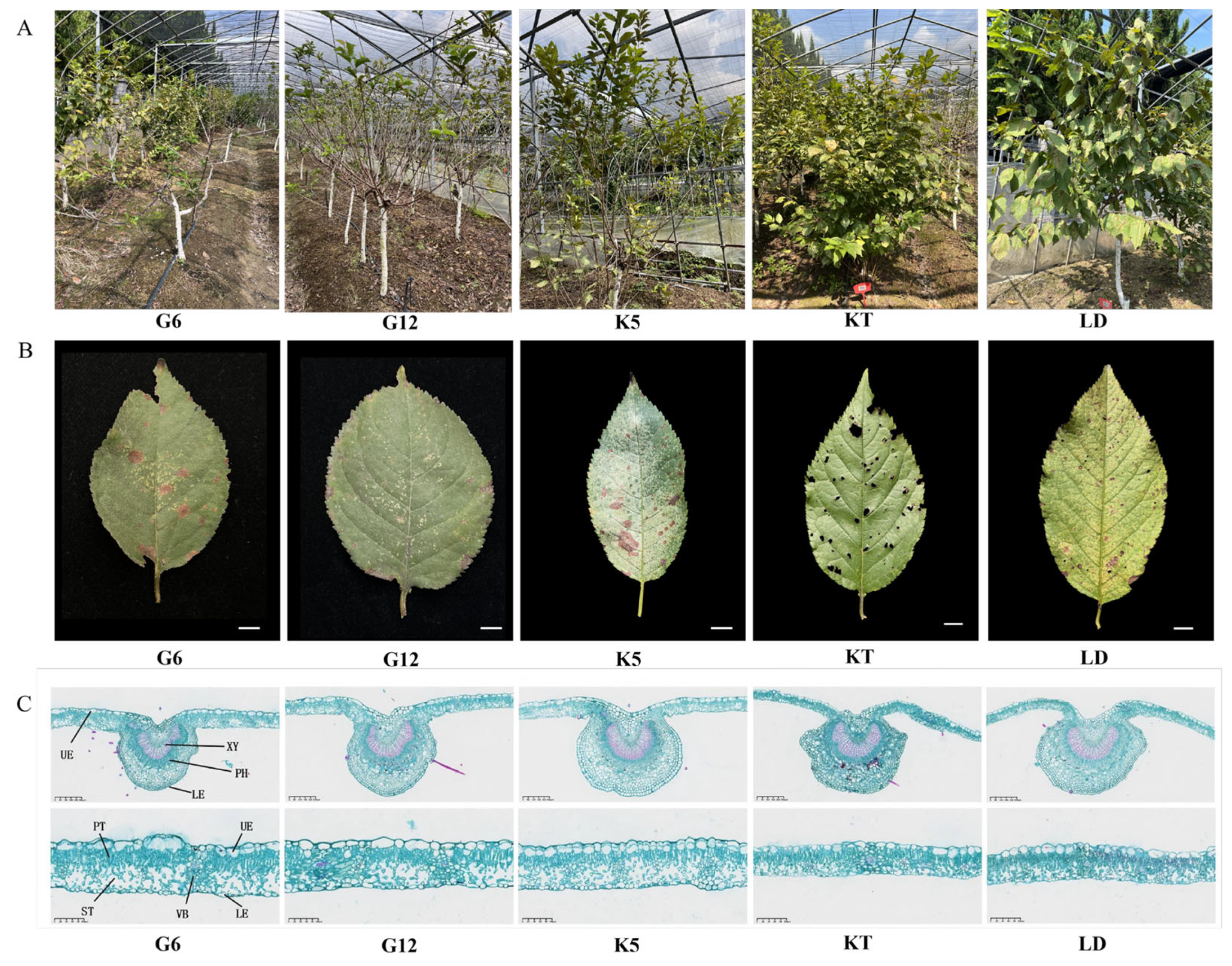
Under field heat-stress conditions, clear differences in growth vigor and foliar performance were observed among the five sweet cherry rootstocks. LD and KT maintained relatively strong growth and canopy integrity, whereas K5 showed moderate vigor with reduced branch density. G6 exhibited weak growth, sparse branching, partial shoot dieback, and early defoliation. G12 displayed intermediate growth performance (Figure 2A,B). Regarding foliar symptoms, pear lace bug and brown spot disease were observed across genotypes with varying severity. LD and K5 showed severe pear lace bug damage on older leaves, while G6 and G12 exhibited more pronounced brown spot infection and earlier leaf abscission. KT showed comparatively milder disease symptoms. Differences in new leaf coloration and chlorosis were also observed among genotypes, reflecting variable stress sensitivity.
Significant differences in leaf anatomical traits were detected among the five rootstocks (Figure 2C, Table 2). LD developed the largest leaf area and relatively thick, compact epidermal tissues. K5 exhibited the greatest overall leaf thickness, including a well-developed mesophyll structure. In contrast, KT had thinner leaves with a looser epidermal arrangement. G6 displayed thinner leaf tissues accompanied by a higher density of leaf lesions, indicating greater structural injury. Paraffin section analysis confirmed clear variation in tissue organization among rootstocks, with LD and K5 showing more robust anatomical structures compared to G6.

3.4. Morphological Responses and Vegetative Growth Performance

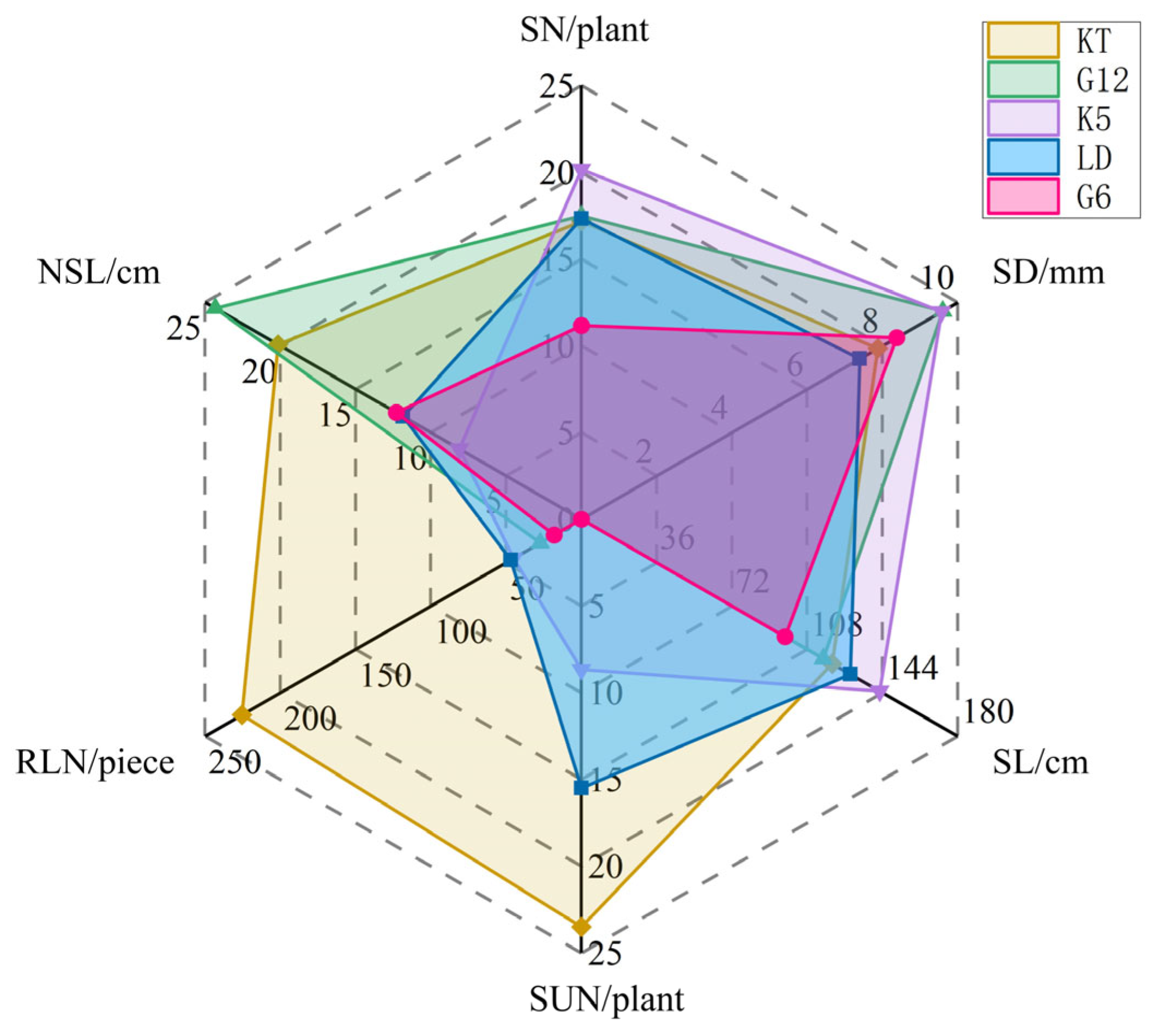
Significant variation was observed in shoot elongation, branch number, shoot diameter, root sucker formation, and leaf retention (Figure 3). K5 produced the highest number of shoots, demonstrating strong vegetative vigor; however, shoot elongation (new shoot length) was slower compared with other rootstocks. G6 exhibited the weakest growth, producing the shortest and thinnest shoots. KT produced the largest number of root suckers among the five rootstocks. KT also maintained relatively stable leaf retention despite prolonged heat. Conversely, both G6 and G12 exhibited severe leaf abscission and produced the fewest retained leaves, accompanied by a marked reduction in leaf retention. Leaf lesion analysis showed that LD maintained the lowest number of lesions and the highest proportion of intact, green leaves. This phenotype aligns with LD’s strong anatomical structure and biochemical resilience. Overall, morphological indicators suggest that heat-tolerant rootstocks maintain robust vegetative growth, stable leaf retention, and structural integrity under stress, while sensitive rootstocks suffer canopy degradation and reduced growth.

3.5. Antioxidant Enzyme Activities and Lipid Peroxidation

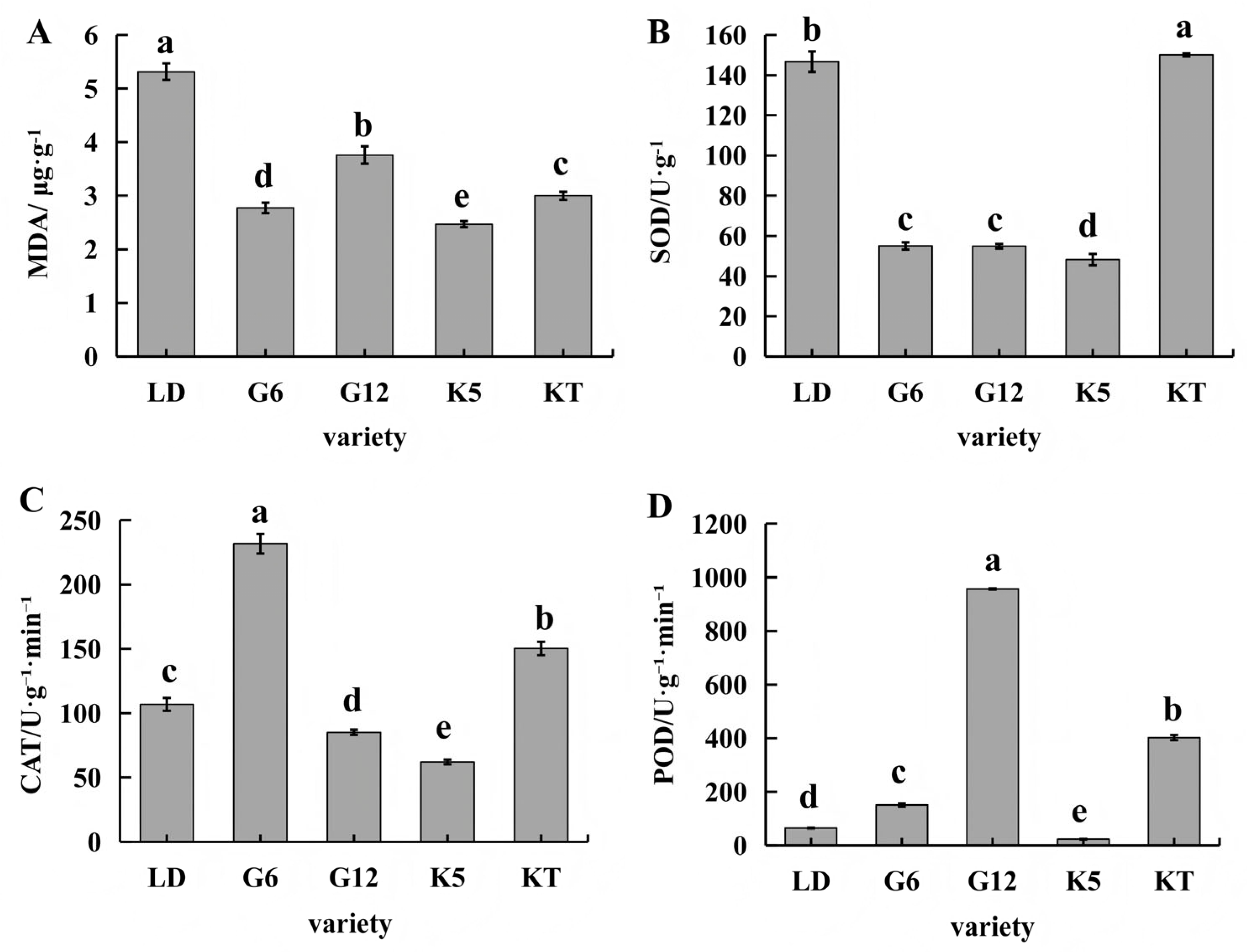
Significant differences were detected among the five rootstock varieties across all four oxidative stress–related indicators, including MDA content, SOD activity, CAT activity, and POD activity (Figure 4). LD exhibited a relatively high MDA content (5.32 μg·g−1), whereas K5 showed the lowest level (2.47 μg·g−1), indicating a lower level of lipid peroxidation in K5. SOD activity was substantially higher in KT (150.11 U·g−1) and LD (146.72 U·g−1) than in the remaining varieties, while the lowest activity was observed in K5. No significant difference was detected between G6 and G12 in SOD activity. CAT activity varied significantly among the varieties, with G6 displaying the highest activity (231.79 U·g−1·min−1); in contrast, K5 again exhibited the lowest value (62.08 U·g−1·min−1). POD activity was greatest in G12, which showed a significantly higher level than all other varieties, whereas K5 consistently presented the lowest activity across indicators. Overall, these findings demonstrate substantial rootstock-dependent variation in oxidative stress responses under prolonged field heat stress. K5 showed the weakest antioxidant capacity based on its consistently low enzymatic activities. In contrast, G12, G6, KT, and LD each exhibited strengths in specific indicators, reflecting their differential adaptive capacities to high-temperature and high-humidity conditions.

3.6. Analysis of Leaf Hormones and Osmotic Adjustment Substances in Different Varieties

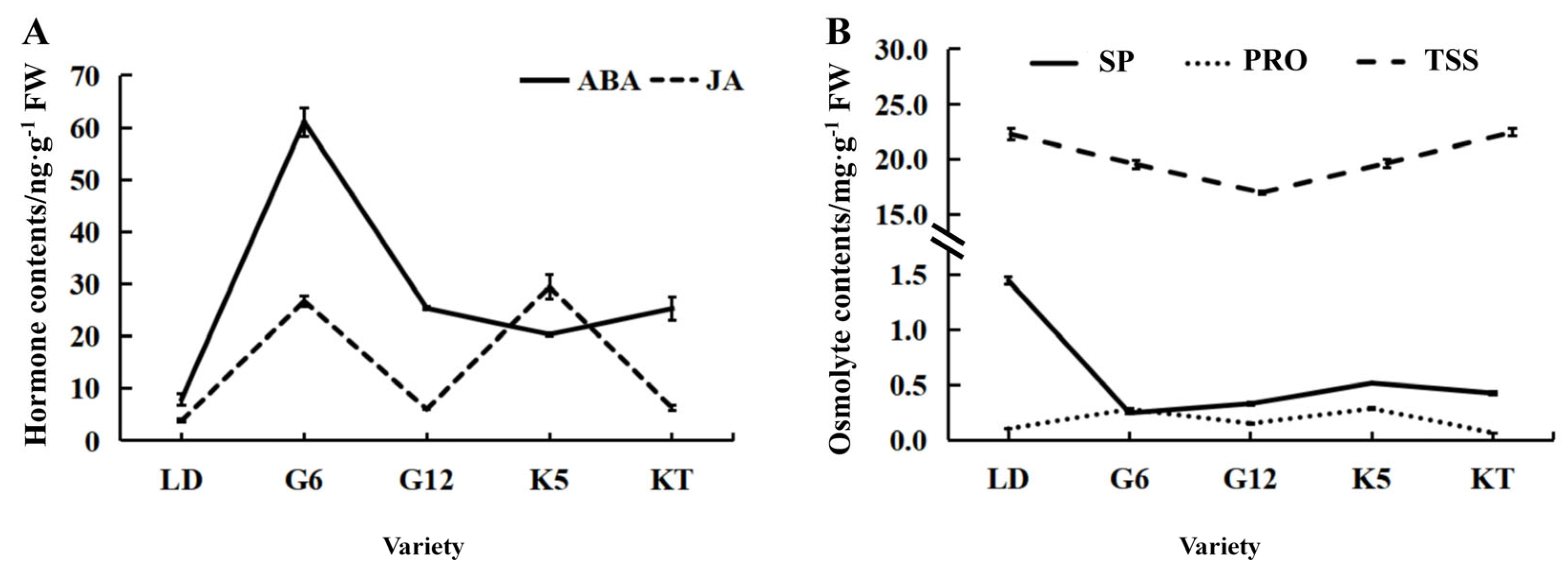
The accumulation of hormones, specifically ABA and JA, as well as osmoregulatory substances (soluble protein, total soluble sugars, and proline), exhibited significant variation among the different plant varieties analyzed (Figure 5). ABA content ranged from 7.93 ng·g−1 in LD to 61.07 ng·g−1 in G6, with G12 and KT presenting similar intermediate levels. Notably, K5 and G6 had significantly higher JA contents, measured at 29.43 ng·g−1 and 26.73 ng·g−1, respectively, while LD exhibited the lowest JA levels.
In terms of osmoregulatory substances, LD displayed the highest soluble protein content (0.24 mg·g−1), approximately sixfold greater than that of G6. K5 and KT followed, with soluble protein levels of 0.51 mg·g−1 and 0.42 mg·g−1, respectively. The total soluble sugar content was relatively consistent across the varieties, ranging from 16.97 mg·g−1 to 22.47 mg·g−1. However, significant differences were observed in proline accumulation, with G6 and K5 exhibiting the highest levels, while KT had the lowest.

3.7. Correlation Analysis Among the Traits

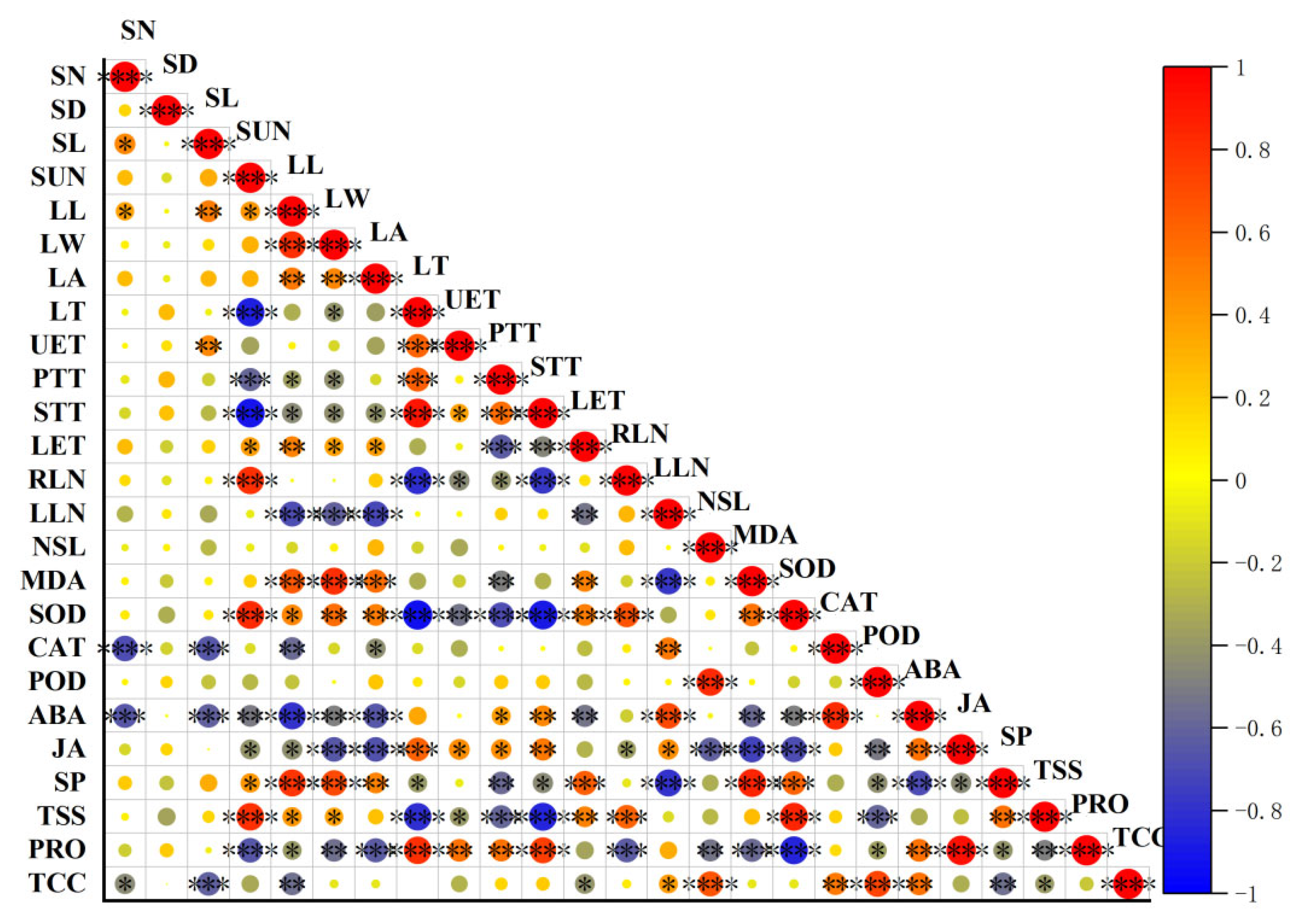
Pearson correlation analysis revealed significant interrelationships among the morphological and physiological traits studied (Figure 6). The results demonstrated that the SUN was positively correlated with the number of remaining leaves (r = 0.813), SOD activity (r = 0.836), and TSS (r = 0.818). SUN showed significant positive correlations with SOD activity and TSS. LT exhibited a strong positive correlation with STT (r = 0.918) and PRO (r = 0.811) but a significant negative correlation with SOD activity (r = –0.933). This indicates that leaf thickness is predominantly influenced by spongy mesophyll development and is intricately linked to antioxidant activity and osmotic adjustment processes.
Among the stress tolerance indicators, JA content was positively correlated with PRO (r = 0.940) and negatively correlated with MDA content (r = –0.726), suggesting that JA signaling may mitigate oxidative damage by enhancing osmotic adjustment. CAT activity was significantly positively correlated with ABA content (r = 0.827). POD activity showed significant positive correlations with NSL (r = 0.833) and TCC (r = 0.726), highlighting the functional specificity of different antioxidant enzymes.
In relation to carbon and nitrogen metabolism, SP was significantly positively correlated with LL (r = 0.793), LW (r = 0.717), and MDA content (r = 0.849). These results suggest a close association between protein accumulation, leaf morphogenesis, and the extent of membrane lipid peroxidation. TSS was significantly positively correlated with SUN (r = 0.818) and SOD activity (r = 0.856). Collectively, these results highlight the integrated roles of hormonal signaling and redox networks in rootstock response to thermal stress.

3.8. Principal Component Analysis and Comprehensive Evaluation

Principal component analysis (PCA) was conducted on 20 key traits across different varieties (Table 3). The cumulative contribution rate of the first four principal components (PCs), designated as F1, F2, F3, and F4, reached 87.91%, indicating that these components effectively captured the majority of the trait variation. Among them, the first principal component (F1) was the most significant contributor, with high-loading indicators suggesting a balance between growth potential and stress response. Traits with strong positive loadings (>0.7) included SOD activity, SUN, SP content, total TSS, and LA, which showed high positive loadings on the first principal component. Conversely, traits with strong negative loadings (<–0.7) included RN, PRO, LT, ABA content, and JA content, which are primarily related to stress response mechanisms.
The second principal component (F2) primarily represented photosynthetic and growth-related traits. High variance contributions were observed for attributes such as TCC, with the positive direction reflecting enhanced photosynthetic capacity and rapid elongation growth. The third principal component (F3) was dominated by POD activity, reflecting the balance of oxidative metabolism. The fourth principal component (F4) was more complex, illustrating an antagonistic relationship between injury severity and recovery capacity. Specifically, MDA content and the RLN demonstrated opposing trends within this component (Table 3).
To comprehensively evaluate the adaptability and performance of different rootstock varieties in the southern regions, a principal component-based comprehensive evaluation system was established. A composite score (D-value) was calculated using the weight coefficients of each principal component, with higher D-values indicating superior overall performance. As shown in Table 4, KT exhibited the highest D-value (0.719), indicating superior comprehensive adaptability and performance, followed by LD (0.589) and G12 (0.554). G6 ranked the lowest, with a D-value of 0.236, suggesting the poorest overall performance.

3.9. Comprehensive Evaluation Based on the Entropy Weight Method and TOPSIS

A comprehensive evaluation based on the Entropy Weight Method-TOPSIS model was applied to assess the field performance of the five varieties. The objective Entropy Weight Method was used to assign weights to the rootstock-related indicators. First, the original data matrix was normalized to eliminate dimensional differences; on this basis, the entropy weight of each evaluation indicator was calculated, and the weight coefficient of each rootstock indicator was ultimately determined. The TOPSIS combined evaluation of each cultivar was performed according to the entropy weight of each indicator. As shown in Table 5, the closeness coefficient ranked in descending order as KT > LD > K5 > G12 > G6. This confirms that KT has the best overall adaptability, while G6 has the poorest, a result that is consistent with the principal component analysis.

4. Discussion

Heat stress severely constrains plant growth and productivity by disrupting cellular homeostasis, inducing excessive reactive oxygen species (ROS) accumulation, and impairing membrane integrity [18,32,33]. Under subtropical field conditions, these adverse effects are further intensified by prolonged exposure to high temperature and humidity [3]. In this study, we observed pronounced genotypic variation in physiological responses to natural heat stress among the five evaluated sweet cherry rootstocks, consistent with previous findings in woody fruit crops indicating that heat tolerance is highly genotype-dependent [34,35].
Among the evaluated rootstocks, KT and LD exhibited superior physiological performance under prolonged field heat stress. Importantly, in this study, we distinguish between stress-induced physiological responses and effective heat adaptation. While many biochemical parameters are activated under heat stress, true adaptation should be reflected in the capacity to limit cellular injury and maintain structural and functional stability. Similar patterns have been reported in grapevine and other perennial fruit trees, where enhanced antioxidant enzyme activities were closely associated with improved heat tolerance [29,36]. The coordinated upregulation of SOD, CAT, and POD in KT and LD highlights the importance of an integrated antioxidant defense system in mitigating heat-induced oxidative stress. SOD catalyzes the dismutation of superoxide radicals into hydrogen peroxide, which is subsequently decomposed by CAT and POD into water and oxygen, thereby preventing excessive ROS accumulation and cellular damage [16].
Interestingly, although LD was identified as a highly heat-tolerant rootstock, it exhibited the highest MDA content (5.32 μg·g−1) among the tested genotypes. Typically, MDA is regarded as a hallmark of lipid peroxidation and cellular damage. In principle, increased MDA reflects the extent of oxidative membrane injury rather than adaptive capacity. In the case of LD, although MDA levels were relatively high, this did not translate into severe morphological damage. This suggests that LD may tolerate a certain degree of oxidative pressure without experiencing irreversible structural impairment, rather than implying that high MDA itself represents adaptation. Specifically, LD maintained the highest SOD activity (146.72 U·g−1) and a soluble protein content six times greater than that of the sensitive G6. This potent antioxidant and osmoregulatory capacity likely enables LD to neutralize the toxic effects of lipid peroxidation before they manifest as physical damage. This is further supported by the morphological data, where LD maintained the lowest leaf lesion number (LLN = 0.37) and superior structural integrity. This coordinated enzymatic synergy represents a central determinant of heat tolerance by maintaining redox homeostasis under sustained thermal stress [17,36]. In contrast, the heat-sensitive rootstock G6 exhibited elevated MDA content and reduced leaf retention, indicating insufficient ROS scavenging capacity and compromised membrane stability—hallmarks of heat-sensitive genotypes [19,32].
Phytohormonal regulation plays a central role in coordinating plant responses to heat stress by integrating stress perception, metabolic regulation, and growth adjustment [37]. In this study, heat-tolerant rootstocks (KT and LD) maintained moderate abscisic acid (ABA) levels, whereas heat-sensitive genotypes (G6 and K5) accumulated excessive ABA under field heat stress. ABA is widely recognized as a stress-responsive hormone that is rapidly induced under adverse conditions. Therefore, elevated ABA levels primarily reflect intensified stress perception and signaling rather than intrinsic adaptive superiority. Excessive ABA accumulation likely reflects intensified stress signaling and prolonged stomatal closure, which may restrict CO2 assimilation and exacerbate carbon limitation during sustained heat exposure [18,37]. Similar trends have been reported in wheat and other crops, where moderate ABA accumulation was associated with improved stress adaptation, while excessive ABA accumulation resulted in growth inhibition [20]. Accordingly, in this study, lower or moderate ABA levels in KT and LD likely indicate reduced physiological stress intensity rather than weaker stress responsiveness.
JA also plays an important role in heat and oxidative stress regulation. In this study, JA content correlated positively with proline accumulation and negatively with MDA content, indicating that JA-mediated signaling may alleviate heat-induced oxidative damage by enhancing osmotic adjustment and cellular protection. Consistent with previous findings, JA has been shown to enhance antioxidant capacity and osmotic regulation under heat stress, thereby reducing membrane damage [21,24]. Compatible solutes such as proline, soluble sugars, and soluble proteins function as molecular chaperones that stabilize proteins and membranes, maintain cellular hydration, and scavenge ROS under stress conditions [22,24]. The enhanced accumulation of these osmolytes in KT and LD highlights their contribution to maintaining cellular homeostasis during extended heat exposure in the field.
Leaf anatomical traits provide a structural foundation supporting physiological and biochemical heat-stress responses, particularly under long-term field conditions. Leaf anatomical structure plays an important role in plant heat tolerance by influencing transpiration efficiency, heat dissipation, and photosynthetic stability under high-temperature conditions [3]. In this study, significant differences in leaf anatomical traits were observed among cherry rootstocks. Heat-tolerant rootstocks, especially LD, exhibited a larger leaf area, thicker leaf blades, and more developed epidermal and mesophyll tissues, which likely enhance thermal buffering capacity and photosynthetic stability under heat stress [29,38]. Conversely, the heat-sensitive rootstock G6 displayed thinner leaves and a higher incidence of necrotic lesions, consistent with its elevated MDA levels and reduced leaf retention, indicating increased structural vulnerability to heat-induced damage [19,32].
Importantly, leaf anatomical traits were closely integrated with physiological and biochemical responses. Leaf thickness showed significant positive correlations with antioxidant enzyme activities and osmotic adjustment indicators, suggesting coordinated regulation among structural stability, redox homeostasis, and stress adaptation. Similar structure–function relationships have been reported in grapevine and other perennial fruit trees, emphasizing the role of robust leaf anatomy in supporting heat tolerance under field conditions [29,36].
Heat tolerance represents a complex quantitative trait modulated by interactions among morphological, physiological, and biochemical processes. Accordingly, multivariate statistical approaches have been widely applied to dissect stress tolerance mechanisms and rank genotypes [28,29]. In this study, PCA revealed that the first four principal components explained 87.91% of the total variance, effectively capturing the balance between growth maintenance and stress defense. Traits related to antioxidant defense and osmotic regulation showed strong positive loadings, whereas stress injury indicators such as MDA, ABA, and JA exhibited negative loadings, consistent with previous multidimensional analyses of abiotic stress tolerance [26,27].
The Entropy Wight–TOPSIS model further validated the PCA-based results, consistently ranking KT and LD as the most heat-tolerant rootstocks. By integrating trait weighting with multi-criteria decision analysis, this framework allows for a more objective evaluation of heat tolerance under realistic field conditions. Notably, the identification of trait modules such as the sucker number–SOD–soluble sugar axis suggests potential physiological proxies for heat adaptability in perennial fruit crops, where stress responses are cumulative and shaped by long-term environmental exposure [28].
Based on these findings, we propose that heat tolerance in sweet cherry rootstocks emerges from the coordinated interplay of four key trait modules: (1) structural resilience (thicker leaves and intact epidermis); (2) antioxidant synergy (coordinated SOD, CAT, and POD activities); (3) hormonal moderation (balanced ABA and JA signaling); and (4) metabolic flexibility (osmoprotectant accumulation and carbon reallocation). Importantly, this framework emphasizes the capacity to limit oxidative injury and maintain functional stability, rather than simply exhibiting elevated stress-induced biochemical responses. This integrated framework shifts the focus from single traits to trait networks and provides a physiological blueprint for selecting and breeding climate-resilient rootstocks. Overall, KT and LD clearly showed better adaptation under prolonged field heat stress, which makes them strong candidates for subtropical cultivation. That offer practical guidance for rootstock selection and orchard management in high-temperature regions.

5. Conclusions

Our study identifies Lanting and Colt as heat-resilient cherry rootstocks based on an integrated evaluation of morphological, anatomical, and physiological traits. However, we acknowledge that the physiological data, collected during a single sampling period in September, represent a cumulative snapshot of heat adaptation rather than a dynamic progression. Since enzymatic activities and osmolyte concentrations can fluctuate rapidly in response to transient environmental changes or concurrent stressors (e.g., water fluctuations), these findings should be interpreted within the context of seasonal cumulative stress. Future research involving multi-temporal sampling across the entire high-temperature season is warranted to further elucidate the kinetic responses of these markers and confirm their stability as diagnostic tools for heat tolerance. These findings provide a physiological foundation and a practical, trait-based framework for rootstock selection and breeding, supporting the sustainable expansion of sweet cherry production in high-temperature regions.

Author Contributions

Conceptualization, H.L. (Huifeng Luo), K.H. and Y.L.; methodology, H.L. (Huifeng Luo) and Y.L.; software, H.L. (Hui Liu) and J.P.; validation, H.L. (Huifeng Luo), R.R. and H.L. (Hui Liu); formal analysis, H.L. (Huifeng Luo); investigation, R.R. and C.Z.; resources, H.L. (Hui Liu); data curation, H.L. (Huifeng Luo), D.X. and K.H.; writing—original draft preparation, H.L. (Huifeng Luo) and H.L. (Hui Liu); writing—review and editing, K.H., H.L. (Huifeng Luo) and Y.L.; supervision, K.H. and Y.L.; project administration, K.H. and Y.L.; funding acquisition, H.L. (Hui Liu), and K.H.; All authors have read and agreed to the published version of the manuscript.

Funding

This research was funded by the Science and Technology Innovation and Demonstration Promotion Fund of Hangzhou Academy of Agricultural Sciences (2025HNCT-06), the Zhejiang Provincial Natural Science Foundation (LQN25C150006), and the Horizontal Project Funding (XM202507020003).

Institutional Review Board Statement

Not applicable.

Informed Consent Statement

Not applicable.

Data Availability Statement

The original contributions presented in this study are included in the article. Further inquiries can be directed to the corresponding authors.

Conflicts of Interest

The authors declare no conflicts of interest.

References

  1. Balducci, F.; Capriotti, L.; Mazzoni, L.; Medori, I.; Albanesi, A.; Giovanni, B.; Giampieri, F.; Mezzetti, B.; Capocasa, F. The rootstock effects on vigor, production and fruit quality in sweet cherry (Prunus avium L.). J. Berry Res. 2019, 9, 249–265. [Google Scholar] [CrossRef]
  2. Wang, J.; Sun, W.; Wang, L.; Liu, X.; Xu, Y.; Sabir, I.A.; Jiu, S.; Wang, S.; Zhang, C. FRUITFULL is involved in double fruit formation at high temperature in sweet cherry. Environ. Exp. Bot. 2022, 201, 104986. [Google Scholar] [CrossRef]
  3. Haider, S.; Iqbal, J.; Naseer, S.; Yaseen, T.; Shaukat, M.; Bibi, H.; Ahmad, Y.; Daud, H.; Abbasi, N.L.; Mahmood, T. Molecular mechanisms of plant tolerance to heat stress: Current landscape and future perspectives. Plant Cell Rep. 2021, 40, 2247–2271. [Google Scholar] [CrossRef]
  4. Janni, M.; Maestri, E.; Gullì, M.; Marmiroli, M.; Marmiroli, N. Plant responses to climate change, how global warming may impact on food security: A critical review. Front. Plant Sci. 2023, 14, 13. [Google Scholar] [CrossRef]
  5. Tharaga, P.C.; Tesfuhuney, W.; Coetzer, G.M.; Savage, M.J. Transpiration rates of rain-fed sweet cherry (Prunus avium L.) using sap flow under warm temperate conditions. Acta Hortic. 2020, 1300, 1–6. [Google Scholar] [CrossRef]
  6. Wu, X.; Xu, Y.; Chen, H. Study on the spatial pattern of an extreme heat event by remote sensing: A case study of the 2013 extreme heat event in the Yangtze River Delta, China. Sustainability 2020, 12, 4415. [Google Scholar] [CrossRef]
  7. Huang, M.; Zhai, P.; Wang, C. The Predominant Compound Extreme Events Inhibiting Vegetation Growth in China During the Past Two Decades. Int. J. Climatol. 2025, 45, e70028. [Google Scholar] [CrossRef]
  8. Hayat, F.; Iqbal, S.; Coulibaly, D.; Razzaq, M.K.; Nawaz, M.A.; Jiang, W.; Shi, T.; Gao, Z. An insight into dwarfing mechanism: Contribution of scion-rootstock interactions toward fruit crop improvement. Fruit Res. 2021, 1, 3. [Google Scholar] [CrossRef]
  9. Morandi, B.; Manfrini, L.; Lugli, S.; Tugnoli, A.; Boini, A.; Perulli, G.D.; Bresilla, K.; Venturi, M.; Corelli Grappadelli, L. Sweet cherry water relations and fruit production efficiency are affected by rootstock vigor. J. Plant Physiol. 2019, 237, 43–50. [Google Scholar] [CrossRef] [PubMed]
  10. Pérez-Jiménez, M.; Hernández-Munuera, M.; Piñero, M.C.; López-Ortega, G.; Del Amor, F.M. CO2 effects on the waterlogging response of ‘Gisela 5’ and ‘Gisela 6’ (Prunus cerasus x Prunus canescens) sweet cherry (Prunus avium) rootstocks. J. Plant Physiol. 2017, 213, 178–187. [Google Scholar] [CrossRef]
  11. Bujdosó, G.; Hrotkó, K. Cultivars and rootstocks in the cherry producing countries. Acta Hortic. 2019, 1235, 207–212. [Google Scholar] [CrossRef]
  12. Tsafouros, A.; Roussos, P.A. In Vitro Propagation of Commercially Used Krymsk 5® (Prunus fruticosa × Prunus lannesiana) Cherry Rootstock: Impact of Sugar Types and pH Levels. Agriculture 2024, 14, 120. [Google Scholar] [CrossRef]
  13. Boskov, D.; Milatovic, D.; Rakonjac, V.; Zec, G.; Hudina, M.; Veberic, R.; Mikulic-Petkovsek, M. The phenolic profile of sweet cherry fruits influenced by cultivar/rootstock combination. Plants 2022, 12, 103. [Google Scholar] [CrossRef]
  14. Zhang, X.; Zhang, K.; Yan, G.; Wang, J.; Zhou, Y. Sweet cherry rootstock breeding program at Beijing Institute of Forestry and Pomology. Acta Hortic. 2017, 1161, 87–90. [Google Scholar] [CrossRef]
  15. Song, Y.; Chen, Q.; Ci, D.; Shao, X.; Zhang, D. Effects of high temperature on photosynthesis and related gene expression in poplar. BMC Plant Biol. 2014, 14, 111. [Google Scholar] [CrossRef]
  16. Bashir, S.S.; Hussain, A.; Hussain, S.J.; Wani, O.A.; Nabi, S.Z.; Dar, N.A.; Baloch, F.; Mansoor, S. Plant drought stress tolerance: Understanding its physiological, biochemical and molecular mechanisms. Biotechnol. Biotechnol. Equip. 2021, 35, 1912–1925. [Google Scholar] [CrossRef]
  17. Distéfano, A.M.; Bauer, V.; Cascallares, M.; López, G.A.; Fiol, D.F.; Zabaleta, E.; Pagnussat, G.C.; Foyer, C. Heat stress in plants: Sensing, signalling, and ferroptosis. J. Exp. Bot. 2025, 76, 1357–1369. [Google Scholar] [CrossRef]
  18. Bita, C.E.; Gerats, T. Plant tolerance to high temperature in a changing environment: Scientific fundamentals and production of heat stress-tolerant crops. Front. Plant Sci. 2013, 4, 273. [Google Scholar] [CrossRef]
  19. Yu, J.; Li, P.; Tu, S.; Feng, N.; Chang, L.; Niu, Q. Integrated Analysis of the Transcriptome and Metabolome of Brassica rapa Revealed Regulatory Mechanism under Heat Stress. Int. J. Mol. Sci. 2023, 24, 13993. [Google Scholar] [CrossRef]
  20. Zheng, Y.; Cai, Z.; Wang, Z.; Maruza, T.M.; Zhang, G. The genetics and breeding of heat stress tolerance in wheat: Advances and prospects. Plants 2025, 14, 148. [Google Scholar] [CrossRef]
  21. Zandalinas, S.I.; Damián, B.; Vicent, A.; Aurelio, G.-C.; Inupakutika, M.A.; Ron, M. ABA is required for the accumulation of APX1 and MBF1c during a combination of water deficit and heat stress. J. Exp. Bot. 2016, 67, 5381–5390. [Google Scholar] [CrossRef]
  22. Handa, S.; Handa, A.K.; Bressan, H.R.A. Proline Accumulation and the Adaptation of Cultured Plant Cells to Water Stress. Plant Physiol. 1986, 80, 938–945. [Google Scholar] [CrossRef]
  23. Tarkowski, Ł.P.; Wim, V.D.E. Cold tolerance triggered by soluble sugars: A multifaceted countermeasure. Front. Plant Sci. 2015, 6, 203. [Google Scholar] [CrossRef]
  24. Ghosh, U.K.; Islam, M.N.; Siddiqui, M.N.; Cao, X.; Khan, M.A.R.; Wicke, S. Proline, a multifaceted signalling molecule in plant responses to abiotic stress: Understanding the physiological mechanisms. Plant Biol. 2021, 24, 227–239. [Google Scholar] [CrossRef]
  25. Hendawy, S.E.; Ruan, Y.; Hu, Y.; Schmidhalter, U. A Comparison of Screening Criteria for Salt Tolerance in Wheat under Field and Controlled Environmental Conditions. J. Agron. Crop Sci. 2009, 195, 356–367. [Google Scholar] [CrossRef]
  26. Kumar, S.; Li, G.; Yang, J.; Huang, X.; Ji, Q.; Liu, Z.; Ke, W.; Hou, H. Effect of salt stress on growth, physiological parameters, and ionic concentration of water dropwort (Oenanthe javanica) cultivars. Front. Plant Sci. 2021, 12, 660409. [Google Scholar] [CrossRef] [PubMed]
  27. Hao, J.; Yan, Y.; Zhang, Y.; Zhang, Y.; Cao, Y.; Wu, L. A cross-scale transfer learning framework: Prediction of SOD activity from leaf microstructure to macroscopic hyperspectral imaging. Plant Biotechnol. J. 2025, 23, 1091–1100. [Google Scholar] [CrossRef] [PubMed]
  28. Quamruzzaman, M.; Manik, S.M.N.; Livermore, M.; Johnson, P.; Zhou, M.; Shabala, S. Multidimensional screening and evaluation of morpho-physiological indices for salinity stress tolerance in wheat. J. Agron. Crop Sci. 2022, 208, 454–471. [Google Scholar] [CrossRef]
  29. Shi, W.; Zhang, D.; Zhu, C.; Liu, Z.; Zhang, Z.; Zhao, B.; Sun, J.; Yang, B. Photoprotection strategies of ‘Cabernet Sauvignon’ with different rootstocks under combined high temperature and strong light stress. Plant Physiol. Biochem. 2025, 221, 109651. [Google Scholar] [CrossRef] [PubMed]
  30. Ramírez, F.; Davenport, T.L. The phenology of the capuli cherry [Prunus serotina subsp. capuli (Cav.) McVaugh] characterized by the BBCH scale, landmark stages and implications for urban forestry in Bogotá, Colombia. Urban For. Urban Green. 2016, 19, 202–211. [Google Scholar] [CrossRef]
  31. Huang, J. Combining entropy weight and TOPSIS method for information system selection. In Proceedings of the IEEE International Conference on Automation & Logistics, Qingdao, China, 1–3 September 2008. [Google Scholar]
  32. Sgobba, A.; Paradiso, A.; Dipierro, S.; De Gara, L.; de Pinto, M.C. Changes in antioxidants are critical in determining cell responses to short- and long-term heat stress. Physiol. Plant. 2014, 153, 68–78. [Google Scholar] [CrossRef] [PubMed]
  33. Hu, S.; Ding, Y.; Zhu, C. Sensitivity and Responses of Chloroplasts to Heat Stress in Plants. Front. Plant Sci. 2020, 11, 375. [Google Scholar] [CrossRef] [PubMed]
  34. Zhou, R.; Yu, X.; Huang, S.; Song, X.; Rosenqvist, E.; Ottosen, C.-O. Genotype-dependent responses of chickpea to high temperature and moderately increased light. Plant Physiol. Biochem. 2020, 154, 353–359. [Google Scholar] [CrossRef]
  35. Fahadi Hoveizeh, N.; Gholami, R.; Zahedi, S.M.; Kadkhodaei, S.; Carillo, P. Genotype-Dependent Modulation of Physiological and Biochemical Processes in Olive (Olea europaea L.) Tree Under Heat Stress. J. Soil Sci. Plant Nutr. 2025, 25, 10095–10111. [Google Scholar] [CrossRef]
  36. Hou, P.; Wang, F.; Luo, B.; Li, A.; Chen, L. Antioxidant Enzymatic Activity and Osmotic Adjustment as Components of the Drought Tolerance Mechanism in Carex duriuscula. Plants 2021, 10, 436. [Google Scholar] [CrossRef]
  37. Jha, U.C.; Nayyar, H.; Siddique, K.H.M. Role of Phytohormones in Regulating Heat Stress Acclimation in Agricultural Crops. J. Plant Growth Regul. 2021, 41, 1041–1064. [Google Scholar] [CrossRef]
  38. Niinemets, Ü. Uncovering the hidden facets of drought stress: Secondary metabolites make the difference. Tree Physiol. 2016, 36, 129–132. [Google Scholar] [CrossRef] [PubMed]
Figure 1. Summer temperatures from 2022 to 2024.
Horticulturae 12 00240 g001
Figure 2. Phenotypic leaf damage, and anatomical characteristics of sweet cherry rootstocks under field heat-stress conditions: (A) Representative canopy growth and overall plant architecture of five sweet cherry rootstocks grown under subtropical field conditions during the summer heat-stress period. G6: Gisela 6, G12: Gisela 12, K5: Krymsk 5, KT: Colt, LD: Lanting; (B) Representative mature leaves showing visible heat-induced damage symptoms among different rootstocks, including chlorosis, necrotic lesions, and leaf integrity. Scale bars = 1 cm; (C) Cross-sectional views of leaves from different varieties. PT, palisade tissue; ST, spongy tissue; UE, upper epidermis; LE, lower epidermis; VB, vascular bundle; XY, xylem; PH, phloem. Scale bars = 300 μm (upper) and 100 μm (lower).
Horticulturae 12 00240 g002
Figure 3. Radar chart comparing growth performance across varieties. Shoot number: SN, shoot diameter: SD, Shoot length: SL, Sucker number: SUN, Remaining leaf number: RLN, New shoot length: NSL.
Horticulturae 12 00240 g003
Figure 4. Oxidative stress responses of leaves among different varieties: (A) MDA content; (B) SOD content; (C) CAT content; (D) POD content. Error bars indicate ± S.E. from three biological replicates. G6: Gisela 6, G12: Gisela 12, K5: Krymsk 5, KT: Colt, LD: Lanting.
Horticulturae 12 00240 g004
Figure 5. Differences in hormones and osmotic adjustment substances in leaves among different varieties: (A) Hormone contents; (B) Osmolyte contents. Error bars indicate ± S.E. from three biological replicates. G6: Gisela 6, G12: Gisela 12, K5: Krymsk 5, KT: Colt, LD: Lanting.
Horticulturae 12 00240 g005
Figure 6. Correlations among traits of tested varieties. Shoot number: SN, Shoot diameter: SD, Shoot length: SL, Sucker number: SUN, Leaf length: LL, Leaf width: LW, Leaf area: LA, Leaf thickness: LT, Upper epidermis thickness: UET, Palisade tissue thickness: PTT, Spongy tissue thickness: STT, Lower epidermis thickness: LET, Remaining leaf number: RLN, Leaf lesion number: LLN, New shoot length: NSL, Malondialdehyde: MDA, Superoxide dismutase: SOD, Catalase: CAT, Peroxidase: POD, Abscisic acid: ABA, Jasmonic acid: JA, Soluble protein: SP, Total soluble sugar: TSS, Proline: PRO, Total chlorophyll content: TCC. Significance level (* p ≤ 0.05, ** p ≤ 0.01, *** p ≤ 0.001, **** p ≤ 0.0001).
Horticulturae 12 00240 g006
Table 1. Growth, physiological and biochemical trait performances of tested varieties in the field.
IndexMin.Max.MeanS.D.CV (%)
SN11.1720.1716.673.3119.87
SD7.49.68.570.9911.57
SL97.43142.68120.916.6813.8
SUN023.59.5310.16106.61
LL9.6516.4212.732.4619.3
LW6.099.277.211.2417.24
LA55.3590.275.5713.6518.06
LT103.87153.55136.1122.2516.35
UET2236.0128.95.0517.49
PTT31.243.8439.35.915
STT34.468.855.7715.4127.64
LET7.9718.3412.143.9832.77
RLN18.17225.572.686.32118.9
LLN0.370.910.70.2130.82
NSL8.1224.3215.356.6643.38
MDA2.475.323.461.1432.9
SOD48.21150.119152.557.7
CAT62.08231.79127.2566.8852.56
POD23.42956.99319.5385.59120.68
ABA7.9361.0827.9919.8170.78
JA3.7829.4314.4412.5286.71
SP0.241.450.590.4982.57
TSS16.9722.4720.182.2711.25
PRO0.060.280.170.158.31
TCC1.172.21.770.4425.03
Shoot number: SN, Shoot diameter: SD, Shoot length: SL, Sucker number: SUN, Leaf length: LL, Leaf width: LW, Leaf area: LA, Leaf thickness: LT, Upper epidermis thickness: UET, Palisade tissue thickness: PTT, Spongy tissue thickness: STT, Lower epidermis thickness: LET, Remaining leaf number: RLN, Leaf lesion number: LLN, New shoot length: NSL, Malondialdehyde: MDA, Superoxide dismutase: SOD, Catalase: CAT, Peroxidase: POD, Abscisic acid: ABA, Jasmonic acid: JA, Soluble protein: SP, Total soluble sugar: TSS, Proline: PRO, Total chlorophyll content: TCC.
Table 2. Analysis of variance (ANOVA) for leaf shape among different varieties.
IndexVarietis (Mean ± Standard Deviation, SD)Fp
G12G6K5KTLD
LL/cm12.14 ± 0.599.64 ± 0.6013.29 ± 2.6712.13 ± 0.8616.42 ± 1.2118.0690.000 **
LW/cm7.25 ± 0.676.39 ± 0.706.09 ± 1.407.07 ± 0.809.27 ± 0.5212.1430.000 **
LA/mm282.76 ± 8.2055.35 ± 2.6368.88 ± 11.7280.67 ± 12.1490.20 ± 18.358.0390.000 **
LT/μm152.09 ± 5.88149.31 ± 6.11153.55 ± 2.86103.87 ± 3.84121.74 ± 5.61117.5930.000 **
UET/μm29.99 ± 5.0529.24 ± 6.2836.01 ± 4.6922.00 ± 5.1727.27 ± 6.185.0480.004 **
PTT/μm43.84 ± 2.3943.40 ± 2.7643.28 ± 5.0034.80 ± 7.4531.20 ± 8.256.4420.001 **
STT/μm68.80 ± 3.6168.70 ± 3.2062.01 ± 8.4634.40 ± 4.1644.93 ± 4.3854.2950.000 **
LET/μm9.47 ± 2.657.97 ± 1.7812.25 ± 4.6212.67 ± 3.7018.34 ± 7.444.7250.006 **
LLN/mm20.64 ± 0.090.91 ± 0.110.71 ± 0.080.85 ± 0.140.37 ± 0.0925.4260.000 **
TCC/mg·g−12.20 ± 0.082.08 ± 0.061.17 ± 0.031.94 ± 0.061.45 ± 0.04354.3210.000 **
G6: Gisela 6, G12: Gisela 12, K5: Krymsk 5, KT: Colt, LD: Lanting, Leaf length: LL, Leaf width: LW, Leaf area: LA, Leaf thickness: LT, Upper epidermis thickness: UET, Palisade tissue thickness: PTT, Spongy tissue thickness: STT, Lower epidermis thickness: LET, Leaf lesion number: LLN, Total chlorophyll content: TCC. Significance level (** p < 0.01).
Table 3. Principal component loading coefficients and contribution rates of each trait index.
IndexPrincipal Component
F1F2F3F4
RN−0.936−0.2210.2510.071
SOD0.9250.271−0.234−0.081
PRO−0.855−0.435−0.25−0.061
LT−0.817−0.4220.326−0.114
SUN0.8040.099−0.4090.353
ABA−0.770.472−0.331−0.204
JA−0.76−0.379−0.4920.108
SP0.742−0.454−0.026−0.456
TSS0.7370.054−0.641−0.054
LA0.685−0.0650.463−0.056
MDA−0.6650.126−0.3560.59
LLN0.549−0.4980.443−0.406
TCC−0.2820.8580.344−0.125
NSL0.1080.6470.6380.153
CAT−0.3060.641−0.517−0.404
SL0.341−0.6280.0140.373
POD−0.0960.5020.8170.21
RLN0.5460.502−0.3180.555
SN0.333−0.4660.2420.548
SD−0.265−0.1250.2350.375
F1–F4: Principal component1–4. Root nodule: RN, Superoxide dismutase: SOD, Proline: PRO, Leaf thickness: LT, Sucker number: SUN, Abscisic acid: ABA, Jasmonic acid: JA, Soluble protein: SP, Total soluble sugar: TSS, Leaf area: LA, Malondialdehyde: MDA, Leaf lesion number: LLN, Total chlorophyll content: TCC, New shoot length: NSL, Catalase: CAT, Shoot length: SL, Peroxidase: POD, Remaining leaf number: RLN, Shoot number: SN, Shoot diameter: SD.
Table 4. Principal component comprehensive scores and rankings of tested varieties.
VarietiesMembership Function ValueD-ValueRank
μ(Xi,1)μ(Xi,2)μ(Xi,3)μ(Xi,4)
LD0.9410.3130.3830.1030.5892
G6−1.3070.615−0.846−0.9340.2365
G12−0.4280.3661.8410.1440.5543
K5−0.521−1.513−0.3920.960.294
KT0.9181.211−0.6011.0270.7191
G6: Gisela 6, G12: Gisela 12, K5: Krymsk 5, KT: Colt, LD: Lanting, μ(Xi,1)–μ(Xi,5): Membership function analysis values of the 1st to 5th principal components for the i-th variety.
Table 5. Comprehensive indicators and rankings of rootstocks determined by the Entropy Weight–TOPSIS Method.
VarietiesP+PCRank
LD0.17180.13720.4442
G60.18590.13010.41195
G120.17840.13090.42314
K50.17680.13080.42523
KT0.14650.15770.51851
G6: Gisela 6, G12: Gisela 12, K5: Krymsk 5, KT: Colt, LD: Lanting, P+: the positive ideal solution, P: the negative ideal solution, C: the relative closeness.
Disclaimer/Publisher’s Note: The statements, opinions and data contained in all publications are solely those of the individual author(s) and contributor(s) and not of MDPI and/or the editor(s). MDPI and/or the editor(s) disclaim responsibility for any injury to people or property resulting from any ideas, methods, instructions or products referred to in the content.