Article

Ericoid Mycorrhizal Fungus RM2 Enhances Drought Avoidance in Apple Rootstocks via Oxidative Priming and Hormonal Remodeling


1
College of Horticulture, Ludong University, Yantai 264025, China
2
Shandong Institute of Sericulture, Shandong Academy of Agricultural Sciences, Yantai 265503, China
3
Weihai Fengdeng Agricultural Development Co., Ltd., Weihai 264400, China
*
Authors to whom correspondence should be addressed.
Horticulturae 2026, 12(3), 354; https://doi.org/10.3390/horticulturae12030354
Submission received: 23 January 2026 / Revised: 15 February 2026 / Accepted: 6 March 2026 / Published: 13 March 2026

Abstract

This study demonstrates that the ericoid mycorrhizal (ERM) fungus RM2 can colonize the non-ericaceous host Malus robusta as a functional endophyte, enhancing drought resilience through an active avoidance strategy. Under drought, inoculation was associated with qualitative changes in root growth patterns, and inoculated seedlings showed a more extensive and branched root appearance compared with non-inoculated controls. This morphological tendency was accompanied by a distinctive physiological state of oxidative priming, characterized by elevated H2O2 as a signaling molecule, reduced antioxidant enzyme activity, and a marked shift toward proline-mediated osmotic adjustment. Transcriptomic analysis suggested a molecular basis for these responses: endophytic colonization reprogrammed auxin and brassinosteroid signaling, including the repression of auxin inactivation (GH3) and activation of genes involved in auxin transport (AUX1) and cell wall loosening (TCH4), which is consistent with sustained root growth under drought. Our findings indicate that ERM fungi can transcend traditional host barriers and improve drought performance via integrated oxidative signaling and hormonal regulation, highlighting their potential as cultivable biostimulants for sustainable horticulture.

1. Introduction

Drought has become a leading global constraint on forestry and agricultural productivity. Under climate change, the frequency and intensity of extreme drought events are increasing significantly [1,2]. In apple (Malus domestica Borkh.) cultivation, water deficit disrupts plant water status, curtails photosynthetic capacity, and triggers excessive accumulation of reactive oxygen species (ROS), leading to oxidative damage, cellular dysfunction, and ultimately severe losses in yield and fruit quality [3]. The selection of resilient rootstocks is a critical strategy for orchard sustainability, as rootstock physiology and root system architecture fundamentally determine a tree’s drought tolerance [4,5]. However, conventional breeding in perennial trees is slow and constrained by genetic complexity, underscoring the need for innovative approaches to rapidly enhance stress resilience [6].
Rhizosphere microbes represent a promising, sustainable tool for bolstering plant adaptation. Arbuscular mycorrhizal fungi (AMF) are key symbiotic partners for many crops, including apples, enhancing drought tolerance through improved water and nutrient uptake, regulation of aquaporins, and modulation of stress-signaling pathways [7,8]. Nevertheless, the obligatory biotrophy of AMF limits their large-scale agricultural application, due to challenges in axenic mass production and inoculum standardization [9,10]. Moreover, AMF symbiotic efficiency can decline under severe drought, highlighting the need to identify resilient microbial partners that maintain functionality under stress [11,12].
In contrast, certain ectomycorrhizal (ECM) and ericoid mycorrhizal (ERM) fungi exhibit robust morphological and biochemical adaptations to dry conditions. For example, the ECM fungus Cenococcum geophilum forms hydrophobic mantles that reduce root desiccation [13]. In addition, inoculation with ECM fungi has been shown to improve the drought tolerance of woody plants by modifying the root system architecture (RSA), such as increasing lateral root number and total root surface area [14,15,16]. Moreover, ERM fungi like Rhizoscyphus ericae and Oidiodendron maius enhance host drought tolerance through antioxidative protection and cell-wall reinforcement via melanin synthesis [17,18,19]. Notably, some fungi within the order Sebacinales (Basidiomycota), traditionally classified as ERM symbionts, exhibit remarkable ecological versatility and broad host compatibility beyond the Ericaceae family [20,21]. The model root endophyte Serendipita indica (formerly Piriformospora indica), for instance, colonizes diverse hosts and enhances drought resilience by modulating phytohormone signaling, antioxidant systems, and stress-responsive gene expression [22,23,24,25,26]. This suggests that cultivable, broad-host ERM fungi could serve as effective biostimulants, combining the stress tolerance of classic ERM fungi with wider symbiotic applicability.
Apple (Malus spp.) is typically considered an AMF host, and it remains unknown whether ERM fungi can colonize apple roots and confer drought tolerance through mechanisms analogous to those observed in S. indica. Using Malus robusta seedlings and the ERMF RM2 (isolated from Rhododendron), this study aimed to (1) verify and characterize root colonization by an ERMF in a non-ericaceous host, (2) evaluate its role in modulating oxidative stress and osmotic adjustment under drought, and (3) elucidate the transcriptomic reprogramming associated with ERM-mediated drought tolerance, with emphasis on phytohormone and stress-signaling pathways. Our findings provide a foundation for developing novel fungal-based strategies to enhance drought resilience in perennial fruit trees.

2. Materials and Methods

2.1. Plant Material and Fungal Inoculum

The ericoid mycorrhizal fungus (ERMF) Pezicula ericae strain RM2, originally isolated from Rhododendron hair roots, was used for inoculation. Isolation of RM2 followed the surface-sterilization and culture-based protocol described by Tian et al. [27]. Briefly, root segments were surface-sterilized with 0.1% mercuric chloride for 3–5 min, rinsed 7–8 times with sterile distilled water, dried with sterile gauze, and a surface-sterilized root tip was placed on PDA medium supplemented with streptomycin (30 mg L−1). Plates were incubated in the dark at 22–25 °C. The isolate was cultured on Potato Dextrose Agar (PDA) at 25 °C for 14 days. Fungal mycelia from plate margins were transferred to sterile Potato Dextrose Broth and incubated on a rotary shaker (120 rpm) at 25 °C for 10 days to prepare a homogeneous liquid inoculum. RM2 was identified as Pezicula ericae based on ITS rDNA sequence analysis. The strain has been deposited in China General Microbiological Culture Collection Center (CGMCC) under accession number CGMCC 41431.
Seeds of Malus robusta (collected from Huailai County, Zhangjiakou, China) were stratified in moist sterile sand at 4 °C for 30 days. Germinated seeds were transplanted into individual pots (10 cm × 10 cm × 25 cm) containing a sterile peat-based substrate (autoclaved at 121 °C for 30 min, twice). Each pot contained one seedling. A total of 150 seedlings were maintained in a greenhouse under natural photoperiod with temperatures of 25–30 °C (day) and 15–20 °C (night).
At two months of age, seedlings were inoculated via root drenching with 10 mL of the RM2 fungal suspension (RM group, n = 30). Each pot received 10 mL of RM2 fungal suspension (approximately 0.1 mg dry mycelial biomass per mL, equivalent to ~1 mg dry biomass per pot, determined gravimetrically after drying). The dry biomass concentration of the suspension was determined by drying a known volume of suspension to constant weight. Control seedlings (CK group, n = 30) received an equivalent volume of sterile PDA medium. Pots were arranged in a completely randomized design to minimize positional effects. For destructive measurements at the final harvest, sampling followed a pooled-replicate strategy: for physiological assays and RNA-seq, three independent biological replicate pools were used per treatment, and each pool consisted of root tissues collected from five randomly selected seedlings (i.e., 5 seedlings per pool; n = 3 pools per treatment).

2.2. Experimental Design and Drought Stress Application

Water treatments commenced for 30 days post-inoculation, allowing for symbiotic establishment. Soil moisture was maintained gravimetrically at two levels: well-watered (WW, 75% ± 5% field capacity) and drought stress (DS, 55% ± 5% field capacity). This resulted in four treatment combinations (CK-WW, CK-DS, RM-WW, and RM-DS). To examine the role of RM2 symbiosis in drought responses, the primary comparisons in this study focused on drought-stressed non-inoculated plants (−ERMF; CK-DS) and drought-stressed RM2-inoculated plants (+ERMF; RM-DS). Drought conditions were sustained for 45 days prior to a single final harvest, and no intermediate destructive harvests were conducted.

2.3. Assessment of Plant Growth and Fungal Colonization

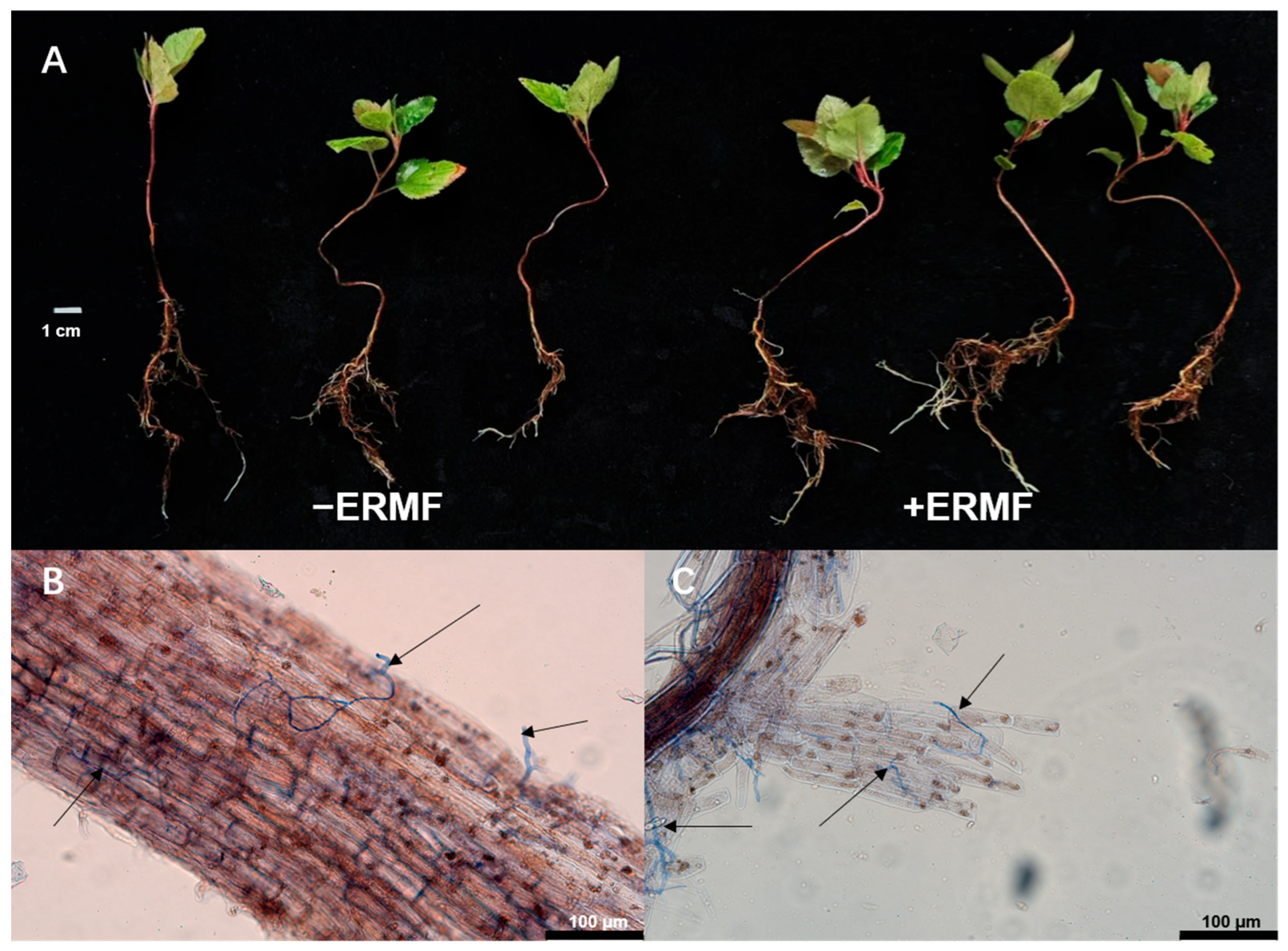
At harvest, plant height, stem diameter, and fresh biomass were recorded. Dry biomass was determined after oven-drying at 105 °C for 30 min, followed by drying at 80 °C to constant weight. Photographs of seedlings (Figure 1A) were taken using a Sony (Tokyo, Japan) EOS 5D3.
Fungal colonization was assessed microscopically following Trypan Blue staining. Root segments were cleared in 10% KOH (90 °C, 1 h), acidified in 5% lactic acid, and stained (0.05% Trypan Blue, 90 °C, 30 min). Colonization was quantified using the grid-line intersection method under a light microscope (Leica, Wetzlar, Germany) at ×200 magnification. The colonization rate was calculated as the percentage of intersections where fungal structures (hyphae, coils) were observed relative to total root intersections examined. Staining and colonization quantification followed established protocols for ERM-type colonization assessment [17]. Micrographs (Figure 1B,C) were captured using a Leica DM2500 upright light microscope equipped with a Leica K5C color CMOS camera and acquired via computer (Leica Microsystems, Wetzlar, Germany).

2.4. Physiological and Biochemical Analyses

Approximately 0.1 g of fresh root tissue was used for biochemical assays with commercial kits (Beijing Qingke Biotechnology Co., Ltd., Beijing, China). All assays were performed according to the manufacturer’s instructions unless otherwise stated. Oxidative stress markers were quantified as follows: superoxide anion (O2) by hydroxylamine hydrochloride oxidation; hydrogen peroxide (H2O2) by the titanium sulfate method; and malondialdehyde (MDA) by thiobarbituric acid (TBA) reaction.
Antioxidant enzyme activities were determined as follows: superoxide dismutase (SOD) via the WST-8 method; peroxidase (POD) via guaiacol oxidation; and catalase (CAT) by monitoring H2O2 decomposition at 240 nm. For osmotic adjustment, free proline was measured using the acid ninhydrin method, and soluble sugars were quantified by the anthrone-sulfuric acid assay. Enzyme activities were normalized to total soluble protein concentration determined with a BCA Protein Assay Kit (Thermo Fisher, Wlatham, MA, USA).

2.5. RNA Extraction, Library Construction, and Sequencing

Total RNA was extracted from roots of −ERMF and +ERMF plants (three independent biological replicate pools per group; each pool consisted of root tissues collected from five randomly selected seedlings at the final harvest) using the YALEPIC® Plant Total Fast RNA Isolation Kit (PLUS) (YALI BIOTECH, San Francisco, CA, USA). RNA quality was verified by NanoDrop 2000 spectrophotometry and Agilent (Santa Clara, CA, USA) 2100 Bioanalyzer analysis (RIN ≥ 6.5).
Libraries were prepared from high-quality mRNA enriched by Oligo(dT) beads. Following fragmentation, cDNA synthesis was performed using random hexamer primers. The resulting double-stranded cDNA was end-repaired, A-tailed, and ligated to MGI sequencing adapters. After PCR amplification, single-stranded circular DNA was generated and subjected to rolling circle amplification to produce DNA nanoballs (DNBs). Sequencing was performed on the DNBSEQ-T7 platform (BGI Genomics, Shenzhen, China) in paired-end mode.

2.6. Transcriptomic Data Processing and Analysis

Raw reads were processed with fastp (v0.20.1) to remove adapters, low-quality bases (Q < 20), and reads with >10% unknown nucleotides. Clean reads were aligned to the Malus domestica reference genome using HISAT2 (v2.0.4). Transcript assembly and expression quantification (FPKM) were conducted with StringTie (v1.3.4d) and ballgown.
Differential expression analysis was performed with DESeq2 (v1.26.0). Genes with a |log2 fold change| ≥ 1 and adjusted p-value (Padj) < 0.05 were considered differentially expressed (DEGs). Functional enrichment analysis of DEGs was performed for Gene Ontology (GO) terms and Kyoto Encyclopedia of Genes and Genomes (KEGG) pathways using clusterProfiler (v3.14.0).

2.7. Quantitative Real-Time PCR Validation

cDNA was synthesized from DNase-treated RNA using the YALEPIC® Script Z 1st Strand cDNA Synthesis Kit. Quantitative real-time PCR (qRT-PCR) was performed on an Applied Biosystems 7500 System with gene-specific primers (Table S1). Relative expression levels were calculated via the 2−ΔΔCt method, using Actin and EF1α as internal reference genes.

2.8. Statistical Analysis

All physiological, growth, and gene expression data are presented as the means ± standard deviation (SD) of three independent biological replicate pools (each pool consisted of tissues collected from five randomly selected seedlings at the final harvest). Differences between the −ERMF and +ERMF groups under drought stress were evaluated using an independent two-sample Student’s t-test in IBM SPSS Statistics 26.0. Statistical significance was set at p < 0.05. Figures were prepared using GraphPad Prism 9.0, and the schematic model figure was created using Adobe Illustrator (version 29.3).

3. Results

3.1. Impact of ERM Inoculation on Plant Growth and Biomass Under Drought

Drought stress significantly reduced total biomass accumulation in both non-inoculated (−ERMF) and RM2-inoculated (+ERMF) seedlings (Table 1). However, the growth responses between the two groups diverged. While no significant difference in total plant dry weight was observed between −ERMF and +ERMF seedlings (p = 0.10), ERM inoculation markedly altered biomass partitioning.
The +ERMF group displayed a pronounced shift in resource allocation favoring vertical growth. Under identical drought conditions, +ERMF seedlings achieved a significantly greater plant height (7.00 ± 0.46 cm) compared to −ERMF seedlings (5.37 ± 0.59 cm; p < 0.05; Table 1), indicating that RM2 colonization prioritized the maintenance of shoot elongation despite overall carbon limitation imposed by water deficit.

3.2. ERM Colonization Alters Root System Architecture Under Drought

Root colonization by the ERMF RM2 was confirmed microscopically 30 days after inoculation. Using the grid-line intersection method, a root colonization rate of 52% was quantified. Fungal hyphae were detected within the root cortex, and occasional coil-like intracellular hyphal aggregations were observed (Figure 1B,C), indicating early-stage endophytic colonization.
Under drought stress, RM2 inoculation induced visible changes in root growth. Visually, the +ERMF group exhibited a more extensive and branched root system compared to the −ERMF group (Figure 1C). Although total root dry biomass was not significantly different between treatments (Table 1), the overall root appearance suggested an enhanced exploratory growth tendency under water-limiting conditions.

3.3. Physiological Responses: ROS Regulation and Osmotic Adjustment

3.3.1. Modulation of Oxidation Stress: Contrasting Patterns of H2O2 and MDA

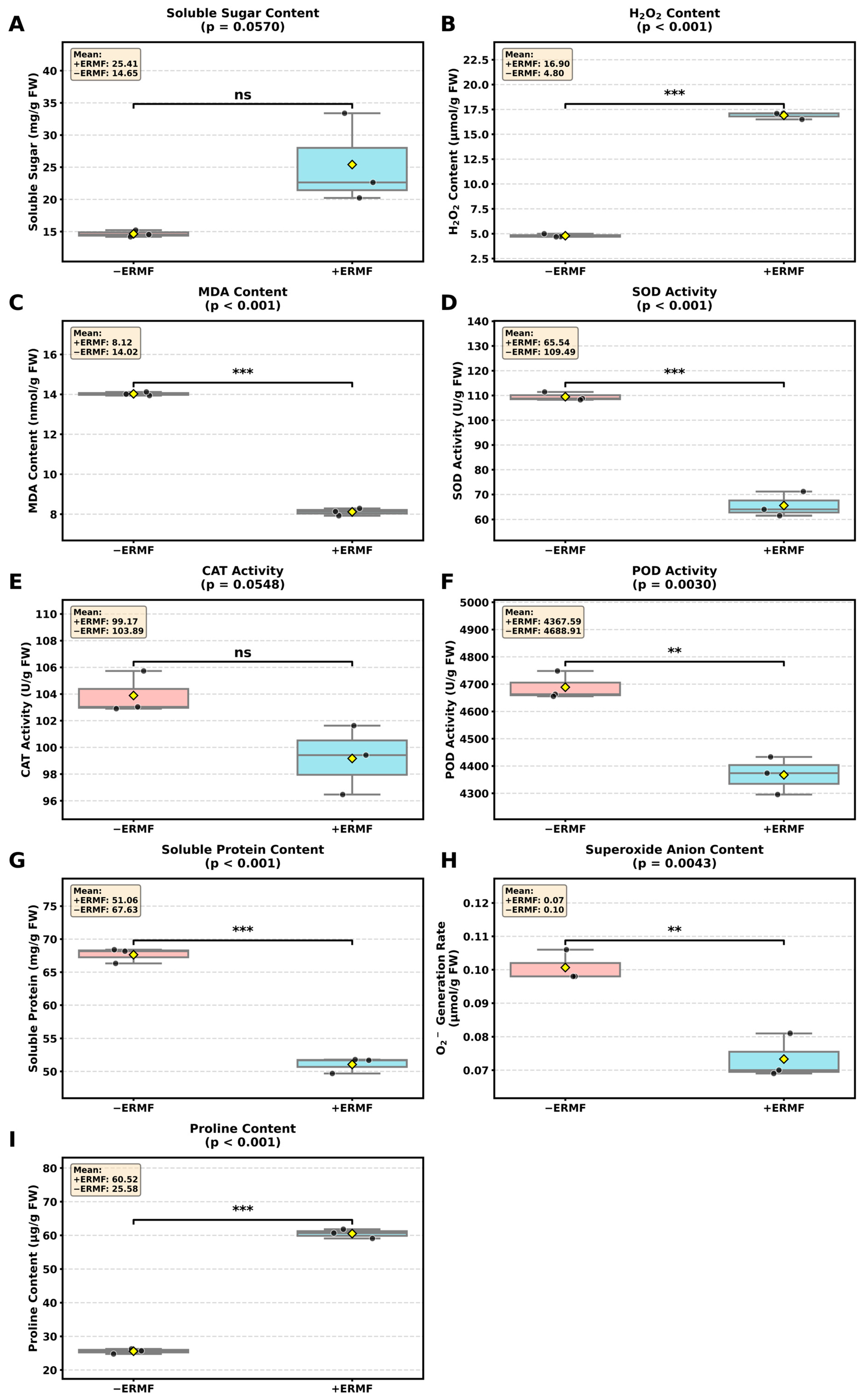
To assess drought-induced oxidative stress, we quantified the levels of hydrogen peroxide (H2O2) and malondialdehyde (MDA), a marker of lipid peroxidation. Inoculation with RM2 elicited a contrasting response in these two oxidative markers. While H2O2 content was significantly higher in the roots of inoculated (+ERMF) seedlings compared to non-inoculated (−ERMF) controls (16.90 vs. 4.80 μmol/g Fresh Weight, p < 0.001; Figure 2B), the degree of lipid peroxidation was markedly lower, as indicated by a 42% reduction in MDA content in the +ERMF group (p < 0.001; Figure 2C). In addition, the superoxide anion (O2) generation rate differed between treatments (Figure 2H), supporting a remodeling of ROS dynamics in RM2-colonized roots under drought. This dissociation suggests that ERM-like endophytic colonization did not merely suppress ROS production but modulated its dynamics. The elevated H2O2 in +ERMF plants, concomitant with reduced oxidative damage, implies a controlled, non-toxic accumulation likely serving a signaling role to prime the plant’s antioxidant defenses, rather than inflicting cellular harm.

3.3.2. Antioxidant Enzyme Activities and Osmolyte Accumulation

Fungal inoculation significantly altered the host’s biochemical response to drought, revealing a distinct strategy that prioritized osmolyte accumulation over elevated antioxidant enzyme activity. The activities of key antioxidant enzymes, superoxide dismutase (SOD) and peroxidase (POD), were significantly lower in inoculated (+ERMF) plants compared to non-inoculated (−ERMF) controls (p < 0.001 and p = 0.003, respectively; Figure 2D,F). SOD activity, for instance, was reduced by approximately 40% in the +ERMF group (65.54 vs. 109.49 U/g in −ERMF). Soluble protein content followed a similar declining trend (Figure 2G). Catalase (CAT) activity was also slightly reduced in +ERMF plants, though not significantly (Figure 2E). In contrast, ERM symbiosis strongly promoted the accumulation of compatible solutes. Proline content in +ERMF seedlings increased dramatically, reaching approximately 2.3 times that of −ERMF seedlings (p < 0.001; Figure 2I). A concurrent, though non-significant (p = 0.057), increasing trend was observed for soluble sugars, which were approximately 1.7-fold higher in the +ERMF group (Figure 2A).

3.4. Modulation of Transcriptomic Profiling

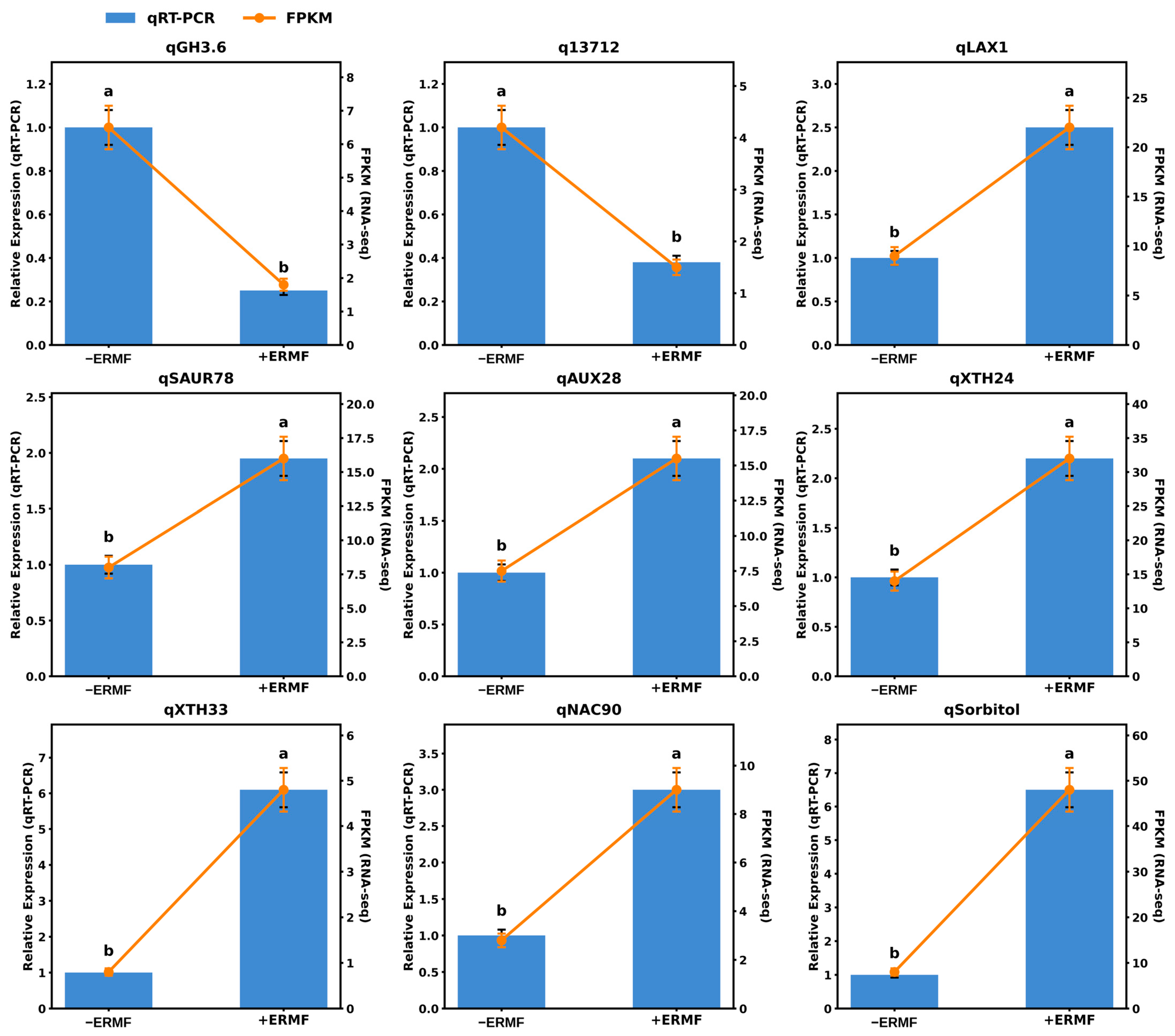
Principal component analysis (PCA) revealed clear separation between the experimental groups, indicating distinct transcriptomic profiles driven by ERM inoculation under drought (Figure S1A). A focused transcriptional response was observed, with 448 differentially expressed genes (DEGs) identified between the inoculated (+ERMF) and non-inoculated (−ERMF) groups (p < 0.05), comprising 269 upregulated and 179 downregulated genes in +ERMF (Figure S1B). This specific number of DEGs suggests that ERM symbiosis fine-tunes a targeted set of host genes rather than inducing a broad transcriptional shift. Hierarchical clustering confirmed consistent expression patterns within biological replicates (Figure S2). To validate the RNA-seq data, nine DEGs implicated in auxin signaling (MdGH3.6, MdLAX1), cell wall remodeling (MdXTH24, MdXTH33), and stress response were selected for qRT-PCR analysis. The expression trends from qRT-PCR strongly correlated with the RNA-seq FPKM values (Figure 3), confirming the technical reliability and reproducibility of the transcriptomic dataset.

3.5. Pathway Enrichment and Signaling Network Analysis

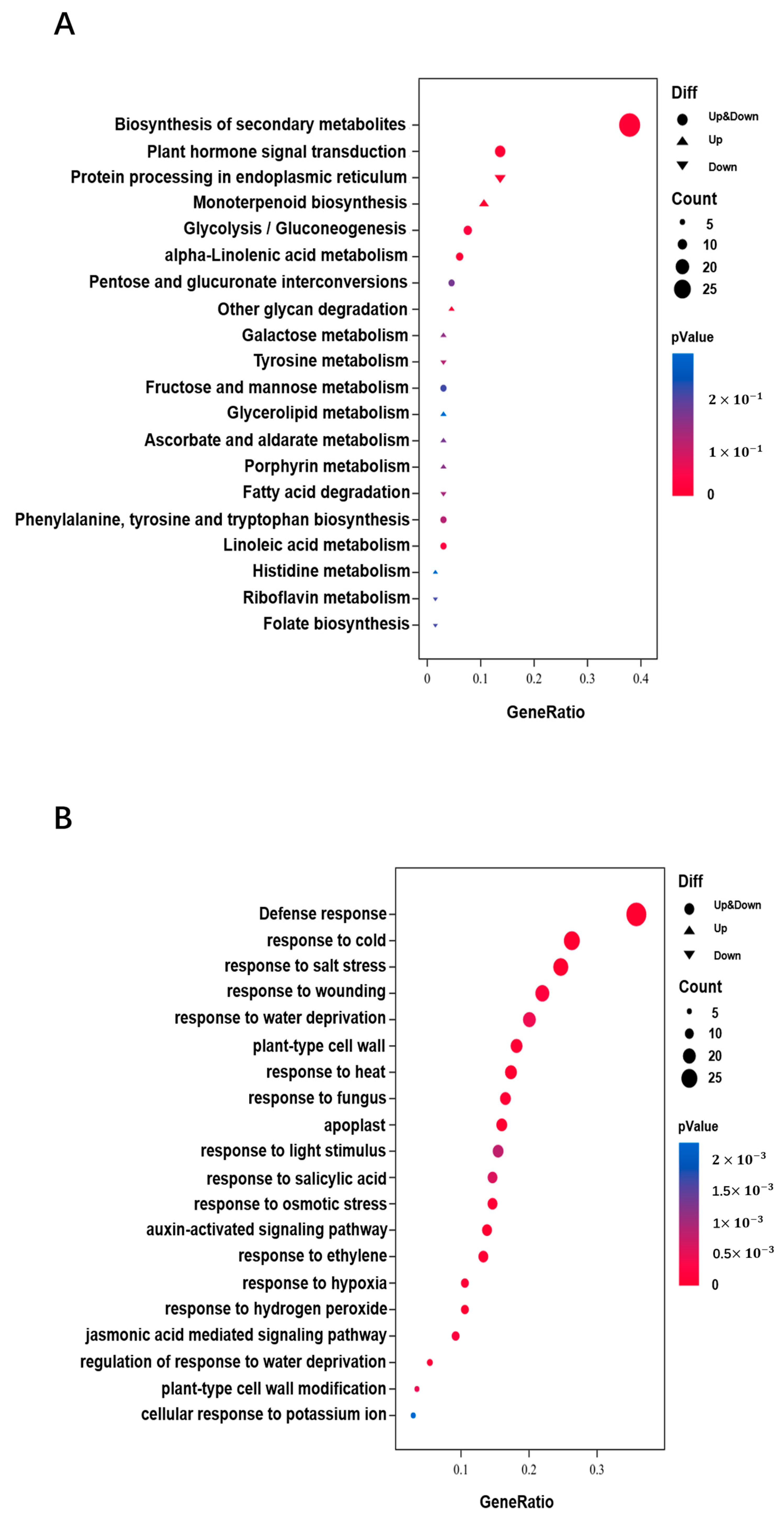
KEGG enrichment analysis of differentially expressed genes (DEGs) revealed significant enrichment in pathways related to the biosynthesis of secondary metabolites and plant hormone signal transduction (Figure 4A). The upregulation of genes in secondary metabolism corroborates the physiological accumulation of proline and soluble sugars, indicating a systemic metabolic reprogramming towards osmotic adjustment under drought stress.

3.5.1. Modulation of Hormone Signaling Pathways

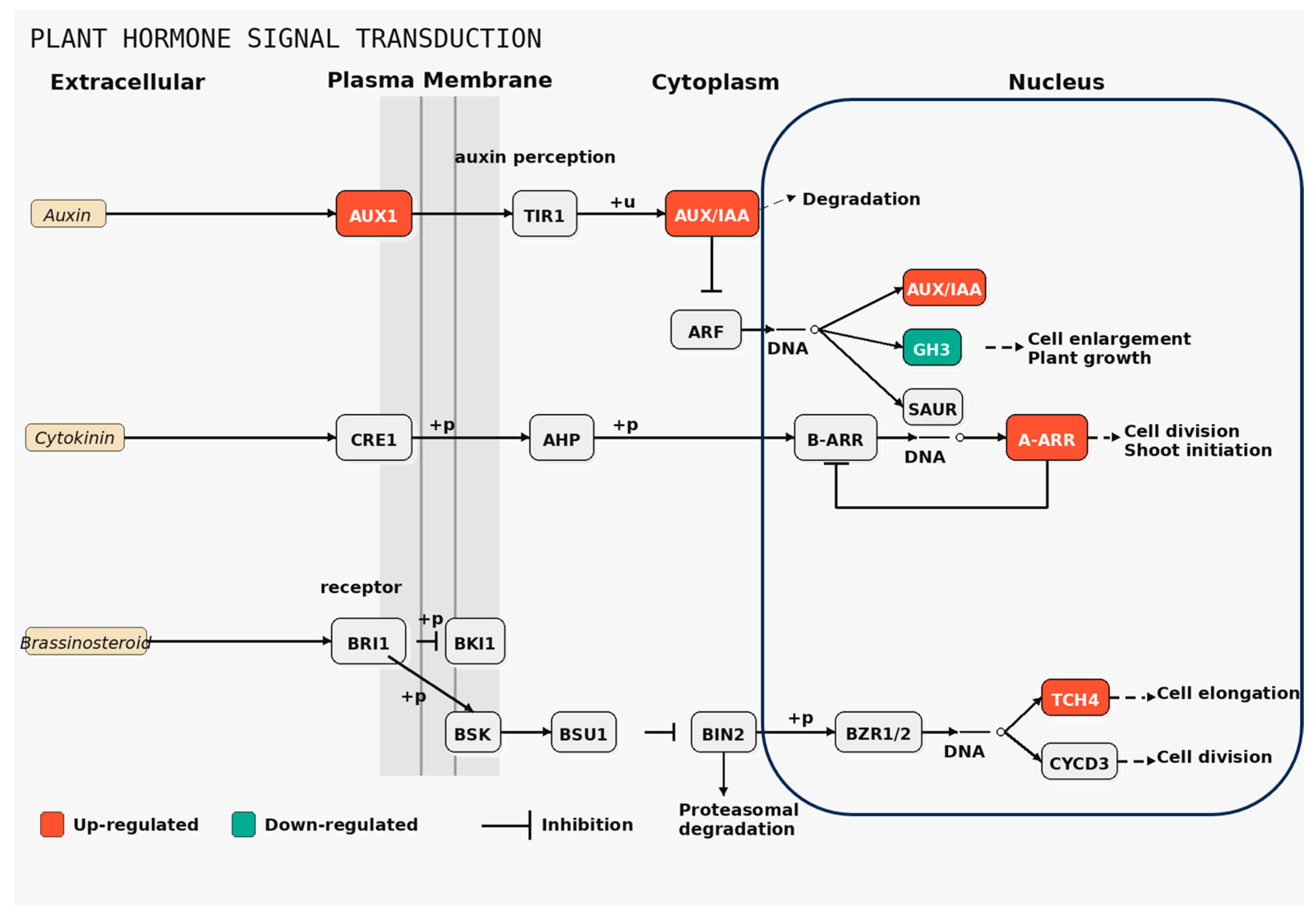
Analysis of enriched pathways confirmed specific alterations in auxin and brassinosteroid (BR) signaling in +ERMF seedlings (Figure 5). A coordinated transcriptional shift was observed, characterized by the upregulation of AUX1 (an auxin influx carrier) and the downregulation of GH3 (involved in auxin conjugation/inactivation). This expression profile suggests an enhanced accumulation of active, free auxin in inoculated roots, a condition conducive to promoting cell expansion and vegetative growth. Concurrently, within the BR pathway, the gene TCH4, encoding a xyloglucan endotransglucosylase/hydrolase, was upregulated. As a key enzyme mediating cell wall loosening and remodeling, TCH4 activation likely facilitates sustained root elongation under drought conditions.

3.5.2. Integration of H2O2 Signaling and Structural Adaptation

Gene Ontology (GO) analysis further identified significant enrichment in the biological process “Response to hydrogen peroxide” (Figure 4B). This finding, integrated with the physiological data showing elevated H2O2 levels coupled with reduced lipid peroxidation (MDA), provides strong transcriptional support for the role of H2O2 as a symbiotic stress-signaling molecule, rather than a cytotoxic agent, in ERM-colonized plants. Additionally, the upregulation of genes associated with “Plant-type cell wall” and “Apoplast” components underscores active cell wall modification. This pattern is consistent with the observed induction of TCH4, collectively indicating a concerted effort in cell wall remodeling, which may contribute to maintaining root plasticity and structural integrity under water deficit.

4. Discussion

4.1. Establishment of an Atypical Symbiosis: ERM Fungi as Functional Endophytes in Rosaceae

Colonization is a prerequisite for microbe-mediated stress tolerance. This study provides direct evidence that the ericoid mycorrhizal (ERM) fungus RM2 establishes intracellular colonization within the root cortex of Malus robusta (Figure 1B). This finding is noteworthy as Malus spp. are predominantly arbuscular mycorrhizal (AM) hosts. It aligns with the ecological niche expansion theory, wherein certain ERM clades possess a broad endophytic capacity beyond their typical Ericaceae hosts [17,21]. The intracellular lifestyle of RM2, distinct from the structured nutrient exchange of AM symbiosis, likely functions as an integrated biological signaler. This supports the growing paradigm that non-traditional fungal symbionts can form compatible, functional partnerships with woody perennial rootstocks, a phenomenon recently observed with Serendipita indica in Phoebe sheareri and other citrus rootstocks under drought [23].

4.2. Strategic Resource Allocation: Prioritizing Morphological Exploration over Biomass Accumulation

Under drought, RM2 inoculation significantly enhanced plant height without a concomitant increase in total biomass (Table 1). This suggests a strategic reallocation of limited resources. Faced with water deficit, plants face a trade-off between resource conservation (biomass accumulation) and soil exploration (elongation). Our transcriptomic data indicate RM2 promotes the latter; the downregulation of GH3 (auxin inactivation) and upregulation of TCH4 (a cell wall-loosening enzyme) imply elevated active auxin and enhanced cell wall extensibility [28,29]. This hormonal reprogramming likely drives a drought-avoidance strategy, investing carbon into vertical growth and enhanced root exploration to improve water foraging, rather than into immediate biomass production. Such plasticity in root system architecture (RSA) is a critical adaptive trait for water acquisition in changing climates [30,31], and endophytic fungi appear to modulate this process, enabling sustained exploratory growth at a reduced metabolic cost [32]. We note that biomass comparisons were based on three pooled biological replicate pools per treatment (each pool comprising five seedlings), which may limit statistical power to detect moderate differences; future studies with larger replicate numbers and time-course harvests are warranted.

4.3. An Early Drought Avoidance Strategy: Oxidative Priming and Non-Enzymatic Defense

Inoculated plants displayed a distinct oxidative profile: elevated H2O2 levels alongside reduced SOD/POD activities, yet significantly less membrane damage (lower MDA) (Figure 2). This decoupling challenges the conventional emphasis on enzymatic ROS scavenging for drought resistance [33]. We propose that RM2 inoculation induces a state of oxidative priming, where H2O2 accumulates as a persistent signaling molecule rather than a cytotoxic agent [26,34]. Notably, moderate H2O2 in the root apex is essential for maintaining cell division and elongation [35]. Thus, the elevated H2O2 in +ERMF plants may be the signal driving root growth rather than indicating damage, a notion supported by the enrichment of “Response to hydrogen peroxide” GO terms (Figure 4B). Concurrently, the sharp accumulation of proline and upregulation of secondary metabolic pathways (Figure 4A) indicate a shift toward non-enzymatic defense mechanisms. This strategy of high osmolyte/metabolite investment with lower enzymatic activity may maintain redox homeostasis more energy-efficiently, allowing adaptation without oxidative injury [36]. This aligns with the genomic architecture of classic ERM fungi like Rhizoscyphus ericae and Oidiodendron maius, which possess expanded gene families for stress resistance and secondary metabolism, core traits for thriving in harsh habitats [19]. The oxidative priming observed here may therefore represent a conserved ERM strategy to enhance host tolerance via precise metabolic regulation.

4.4. Hormone-Mediated Root Remodeling Network

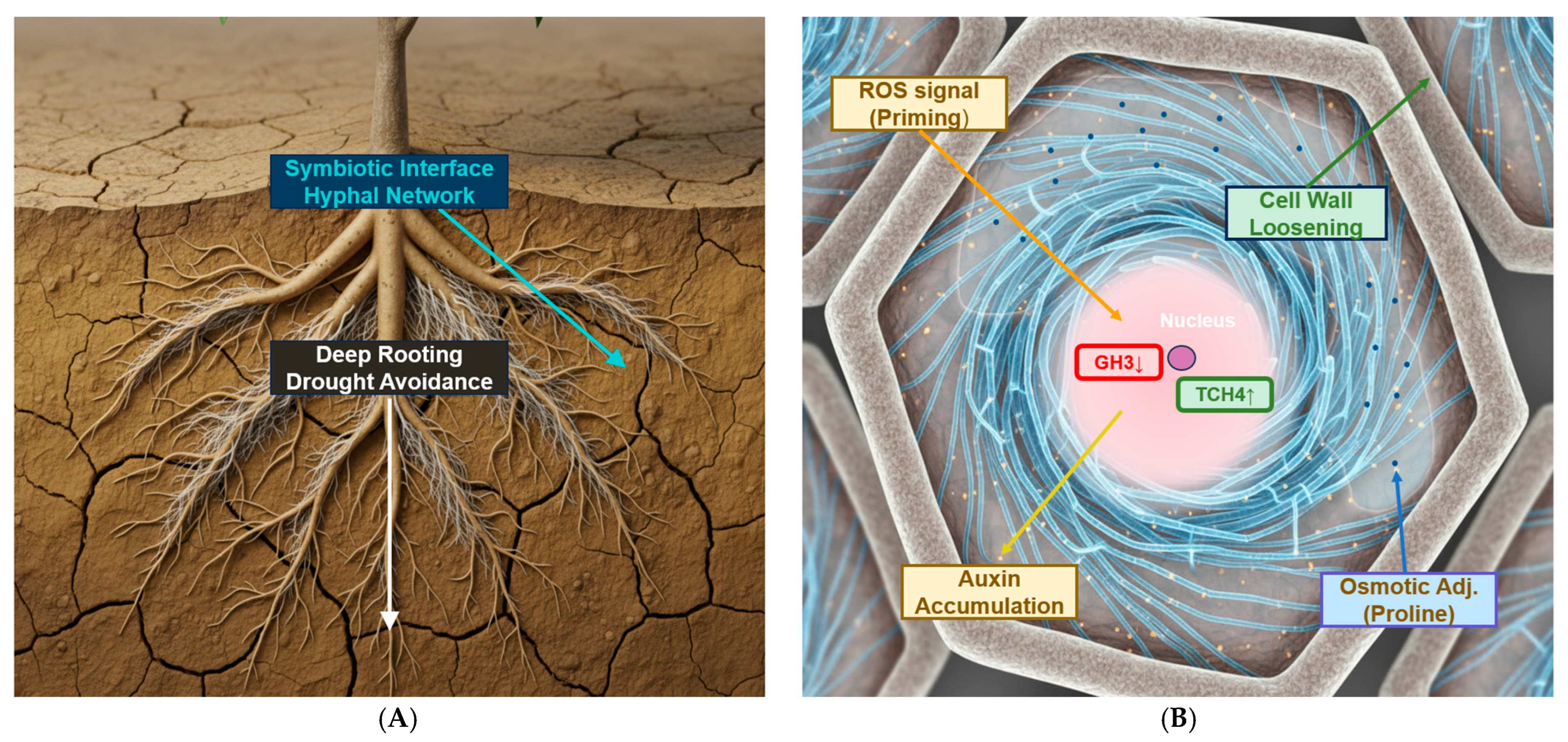
Integrating transcriptomic and phenotypic data, we propose a model wherein symbiosis reprograms the auxin-brassinosteroid (BR) module to sustain root growth under drought (Figure 6). Suppression of GH3 genes likely stabilizes the active auxin pool, crucial for maintaining root tip dominance under stress [28], a mechanism corroborated by improved drought tolerance in GH3-silenced apple [37]. Concurrent upregulation of TCH4 links this hormonal signal to physical cell wall remodeling, preserving cell extensibility despite turgor loss [29]. BR signaling is known to regulate cell wall properties via proteins like XTHs/TCH4, a key adaptation for root elongation under water deficit [38,39]. Although direct hormone quantification remains for future metabolomic studies, the congruence between gene expression and the sustained elongation phenotype strongly supports this regulatory axis. This hormonal remodeling effectively shifts the plant from a state of passive endurance to active environmental foraging.

4.5. A Synergistic Model for ERM-Mediated Drought Avoidance

Our results provide evidence that the ERMF RM2 can colonize M. robusta roots and establish a functional endophytic association, which is associated with improved drought performance. We propose a synergistic model in which RM2 colonization is accompanied by oxidative priming: a controlled increase in H2O2 may act as a stress signal, while lipid peroxidation remains low (reduced MDA), consistent with limited oxidative damage. This physiological profile is further accompanied by a shift toward proline-mediated osmotic adjustment, potentially compensating for reduced activities of enzymatic antioxidants and contributing to membrane protection [40,41,42]. At the molecular level, transcriptomic patterns indicate reprogramming of hormone-related pathways, particularly auxin and brassinosteroid signaling; the GH3–TCH4 module and other cell-wall remodeling genes may support sustained root growth under drought [28]. Together, these lines of evidence support an integrated oxidative–hormonal framework for RM2-associated drought avoidance. From an applied perspective, cultivable ERM-associated endophytes such as RM2 may represent a promising biostimulant resource to enhance the resilience of Rosaceae rootstocks in water-limited environments.

5. Conclusions

This study demonstrates that the ERMF RM2 can colonize Malus robusta roots and establish ERM-like endophytic structures, including intracellular hyphal coils. Under drought stress, RM2 inoculation was associated with qualitative changes in root growth patterns and a distinct physiological profile characterized by elevated H2O2 coupled with reduced lipid peroxidation and enhanced proline accumulation. Transcriptomic analysis further indicated the reprogramming of hormone-related pathways (auxin and brassinosteroid signaling) and cell-wall remodeling genes, which is consistent with sustained root growth under drought. Collectively, these results suggest that RM2 contributes to improved drought performance through integrated oxidative signaling and hormonal regulation in a non-ericaceous host.

Supplementary Materials

The following supporting information can be downloaded at https://www.mdpi.com/article/10.3390/horticulturae12030354/s1 and https://www.ncbi.nlm.nih.gov/bioproject/PRJNA1398503 (accessed on 15 February 2026). Figure S1: Transcriptomic Reprogramming in Malus robusta Roots under Drought Stress.; Figure S2: Expression Profiling of Drought-Related Genes in Malus robusta Roots; Table S1: List of primers used for quantitative real-time PCR (qRT-PCR) analysis.

Author Contributions

Conceptualization, W.T., Y.Y. and L.M.; methodology, S.L.; software, G.Z.; validation, Y.Y., Q.M. and L.M.; formal analysis, Q.M.; investigation, F.L.; resources, F.L.; data curation, G.Z.; writing—original draft preparation, S.L.; writing—review and editing, W.T. and P.Q.; visualization, Y.Y.; supervision, W.T. and F.W.; project administration, W.T.; funding acquisition, P.Q. All authors have read and agreed to the published version of the manuscript.

Funding

This research was funded by the Shandong Provincial Natural Science Foundation (ZR2020MC001) and the National Natural Science Foundation of China (31200248 and 31500016). The APC was funded by the Shandong Provincial Department of Science and Technology and the National Natural Science Foundation of China.

Data Availability Statement

The datasets generated for this study are available at the NCBI under the BioProject accession number PRJNA1398503.

Conflicts of Interest

Author Fangjie Li was employed by the company Weihai Fengdeng Agricultural Development Co., Ltd. The remaining authors declare that the research was conducted in the absence of any commercial or financial relationships that could be construed as a potential conflict of interest.

References

  1. Gupta, A.; Rico-Medina, A.; Caño-Delgado, A.I. The physiology of plant responses to drought. Science 2020, 368, 266–269. [Google Scholar] [CrossRef] [PubMed]
  2. Yadav, S.; Korat, J.R.; Yadav, S.; Mondal, K.; Kumar, A.; Homeshvari; Kumar, S. Impacts of climate change on fruit crops: A comprehensive review of physiological, phenological, and pest-related responses. Int. J. Environ. Clim. Change 2023, 13, 363–371. [Google Scholar] [CrossRef]
  3. Hasanuzzaman, M.; Bhuyan, M.H.M.B.; Zulfiqar, F.; Raza, A.; Mohsin, S.M.; Mahmud, J.A.; Fujita, M.; Fotopoulos, V. Reactive oxygen species and antioxidant defense in plants under abiotic stress: Revisiting the crucial role of a universal defense regulator. Antioxidants 2020, 9, 681. [Google Scholar] [CrossRef] [PubMed]
  4. Brunner, I.; Herzog, C.; Dawes, M.A.; Arend, M.; Sperisen, C. How tree roots respond to drought. Front. Plant Sci. 2015, 6, 547. [Google Scholar] [CrossRef]
  5. Warschefsky, E.J.; Klein, L.L.; Frank, M.H.; Chitwood, D.H.; Londo, J.P.; von Wettberg, E.J.B.; Miller, A.J. Rootstocks: Diversity, domestication, and impacts on shoot phenotypes. Trends Plant Sci. 2016, 21, 418–437. [Google Scholar] [CrossRef] [PubMed]
  6. Compant, S.; Samad, A.; Faist, H.; Sessitsch, A. A review on the plant microbiome: Ecology, functions, and emerging trends in microbial application. J. Adv. Res. 2019, 19, 29–37. [Google Scholar] [CrossRef]
  7. Huang, G.-M.; Zou, Y.-N.; Wu, Q.-S.; Xu, Y.-J.; Kuča, K. Mycorrhizal roles in plant growth, gas exchange, root morphology, and nutrient uptake of walnuts. Plant Soil Environ. 2020, 66, 295–302. [Google Scholar] [CrossRef]
  8. Zou, Y.-N.; Huang, Y.-M.; Wu, Q.-S.; He, X.-H. Mycorrhiza-induced lower oxidative burst is related with higher antioxidant enzyme activities, net H2O2 effluxes, and Ca2+ influxes in trifoliate orange roots under drought stress. Mycorrhiza 2015, 25, 143–152. [Google Scholar] [CrossRef]
  9. Rouphael, Y.; Franken, P.; Schneider, C.; Schwarz, D.; Giovannetti, M.; Agnolucci, M.; De Pascale, S.; Bonini, P.; Colla, G. Arbuscular mycorrhizal fungi act as biostimulants in horticultural crops. Sci. Hortic. 2015, 196, 91–108. [Google Scholar] [CrossRef]
  10. Berruti, A.; Lumini, E.; Balestrini, R.; Bianciotto, V. Arbuscular mycorrhizal fungi as natural biofertilizers: Let’s benefit from past successes. Front. Microbiol. 2016, 6, 1559. [Google Scholar] [CrossRef]
  11. Li, J.; Meng, B.; Chai, H.; Yang, X.; Song, W.; Li, S.; Lu, A.; Zhang, T.; Sun, W. Arbuscular mycorrhizal fungi alleviate drought stress in C3 (Leymus chinensis) and C4 (Hemarthria altissima) grasses via altering antioxidant enzyme activities and photosynthesis. Front. Plant Sci. 2019, 10, 499. [Google Scholar] [CrossRef] [PubMed]
  12. Zhang, W.; Yin, X.; Feng, Z.; Liu, X.; Zhu, F.; Zhu, H.; Yao, Q. Drought stress reduces arbuscular mycorrhizal colonization of Poncirus trifoliata (L.) roots and plant growth promotion via lipid metabolism. Front. Plant Sci. 2024, 15, 1452202. [Google Scholar] [CrossRef] [PubMed]
  13. Lehto, T.; Zwiazek, J.J. Ectomycorrhizas and water relations of trees: A review. Mycorrhiza 2011, 21, 71–90. [Google Scholar] [CrossRef]
  14. Felten, J.; Kohler, A.; Morin, E.; Bhalerao, R.P.; Palme, K.; Martin, F.; Ditengou, F.A.; Legué, V. The ectomycorrhizal fungus Laccaria bicolor stimulates lateral root formation in poplar and Arabidopsis through auxin transport and signaling. Plant Physiol. 2009, 151, 1991–2005. [Google Scholar] [CrossRef] [PubMed]
  15. Usman, M.; Ho-Plágaro, T.; Frank, H.E.R.; Calvo-Polanco, M.; Gaillard, I.; Garcia, K.; Zimmermann, S.D. Mycorrhizal symbiosis for better adaptation of trees to abiotic stress caused by climate change in temperate and boreal forests. Front. For. Glob. Change 2021, 4, 742392. [Google Scholar] [CrossRef]
  16. De Quesada, G.; Xu, J.; Salmon, Y.; Lintunen, A.; Poque, S.; Himanen, K.; Heinonsalo, J. The effect of ectomycorrhizal fungal exposure on nursery-raised Pinus sylvestris seedlings: Plant transpiration under short-term drought, root morphology and plant biomass. Tree Physiol. 2024, 44, tpae029. [Google Scholar] [CrossRef]
  17. Vohník, M. Ericoid mycorrhizal symbiosis: Theoretical background and methods for its comprehensive investigation. Mycorrhiza 2020, 30, 671–695. [Google Scholar] [CrossRef]
  18. Mu, D.; Du, N.; Zwiazek, J.J. Inoculation with ericoid mycorrhizal associations alleviates drought stress in lowland and upland velvetleaf blueberry (Vaccinium myrtilloides) seedlings. Plants 2021, 10, 2786. [Google Scholar] [CrossRef]
  19. Martino, E.; Morin, E.; Grelet, G.-A.; Kuo, A.; Kohler, A.; Daghino, S.; Barry, K.W.; Cichocki, N.; Clum, A.; Dockter, R.B.; et al. Comparative genomics and transcriptomics depict ericoid mycorrhizal fungi as versatile saprotrophs and plant mutualists. New Phytol. 2018, 217, 1213–1229. [Google Scholar] [CrossRef]
  20. Oberwinkler, F.; Riess, K.; Bauer, R.; Selosse, M.-A.; Weiß, M.; Garnica, S.; Zuccaro, A. Enigmatic Sebacinales. Mycol. Prog. 2013, 12, 1–27. [Google Scholar] [CrossRef]
  21. Selosse, M.-A.; Setaro, S.; Glatard, F.; Richard, F.; Urcelay, C.; Weiß, M. Sebacinales are common mycorrhizal associates of Ericaceae. New Phytol. 2007, 174, 864–878. [Google Scholar] [CrossRef] [PubMed]
  22. Varma, A.; Verma, S.; Sudha; Sahay, N.; Bütehorn, B.; Franken, P. Piriformospora indica, a cultivable plant-growth-promoting root endophyte. Appl. Environ. Microbiol. 1999, 65, 2741–2744. [Google Scholar] [CrossRef] [PubMed]
  23. Chen, X.; Sun, R.; Hu, D.; Yang, Y.; Cheng, Z.; Hu, P.; Fei, Y. Serendipita indica enhances drought tolerance in Phoebe sheareri seedlings by improving photosynthetic efficiency, stimulating the antioxidant defense system, and modulating hormone synthesis. J. Fungi 2025, 11, 717. [Google Scholar] [CrossRef]
  24. Sirrenberg, A.; Göbel, C.; Grond, S.; Czempinski, N.; Ratzinger, A.; Karlovsky, P.; Santos, P.; Feussner, I.; Pawlowski, K. Piriformospora indica affects plant growth by auxin production. Physiol. Plant. 2007, 131, 581–589. [Google Scholar] [CrossRef]
  25. Sherameti, I.; Tripathi, S.; Varma, A.; Oelmüller, R. The root-colonizing endophyte Piriformospora indica confers drought tolerance in Arabidopsis by stimulating the expression of drought stress–related genes in leaves. Mol. Plant-Microbe Interact. 2008, 21, 799–807. [Google Scholar] [CrossRef]
  26. Mittler, R. ROS are good. Trends Plant Sci. 2017, 22, 11–19. [Google Scholar] [CrossRef]
  27. Tian, W.; Zhang, C.Q.; Qiao, P.; Milne, R. Diversity of culturable ericoid mycorrhizal fungi of Rhododendron decorum in Yunnan, China. Mycologia 2011, 103, 703–709. [Google Scholar] [CrossRef]
  28. Park, J.-E.; Park, J.-Y.; Kim, Y.-S.; Staswick, P.E.; Jeon, J.; Yun, J.; Kim, S.Y.; Kim, J.; Lee, Y.-H.; Park, C.-M. GH3-mediated auxin homeostasis links growth regulation with stress adaptation response in Arabidopsis. J. Biol. Chem. 2007, 282, 10036–10046. [Google Scholar] [CrossRef]
  29. Xu, W.; Purugganan, M.M.; Polisensky, D.H.; Antosiewicz, D.M.; Fry, S.C.; Braam, J. Arabidopsis TCH4, regulated by hormones and the environment, encodes a xyloglucan endotransglycosylase. Plant Cell 1995, 7, 1555–1567. [Google Scholar] [CrossRef]
  30. Khan, M.A.; Gemenet, D.C.; Villordon, A. Root system architecture and abiotic stress tolerance: Current knowledge in root and tuber crops. Front. Plant Sci. 2016, 7, 1584. [Google Scholar] [CrossRef] [PubMed]
  31. Lynch, J.P. Steep, cheap and deep: An ideotype to optimize water and N acquisition by maize root systems. Ann. Bot. 2013, 112, 347–357. [Google Scholar] [CrossRef] [PubMed]
  32. Nombamba, A.; Fadiji, A.E.; Babalola, O.O. Exploring the role of endophytic fungi in the amelioration of drought stress in plants. Plant Prot. Sci. 2024, 60, 213–228. [Google Scholar] [CrossRef]
  33. Wu, Q.S.; Zou, Y.N.; Xia, R.X. Effects of water stress and arbuscular mycorrhizal fungi on reactive oxygen metabolism and antioxidant production by citrus (Citrus tangerine) roots. Eur. J. Soil Biol. 2006, 42, 166–172. [Google Scholar] [CrossRef]
  34. Neill, S.; Desikan, R.; Hancock, J. Hydrogen peroxide signalling. Curr. Opin. Plant Biol. 2002, 5, 388–395. [Google Scholar] [CrossRef]
  35. Liu, H.; Mu, Y.; Xuan, Y.; Wu, X.; Wang, W.; Zhang, H. Hydrogen peroxide signaling in the maintenance of plant root apical meristem activity. Antioxidants 2024, 13, 554. [Google Scholar] [CrossRef] [PubMed]
  36. Foyer, C.H.; Noctor, G. Redox homeostasis and antioxidant signaling: A metabolic interface between stress perception and physiological responses. Plant Cell 2005, 17, 1866–1875. [Google Scholar] [CrossRef]
  37. Jiang, L.; Shen, W.; Liu, C.; Tahir, M.M.; Li, X.; Zhou, S.; Ma, F.; Guan, Q. Engineering drought-tolerant apple by knocking down six GH3 genes and potential application of transgenic apple as a rootstock. Hortic. Res. 2022, 9, uhac122. [Google Scholar] [CrossRef]
  38. Tenhaken, R. Cell wall remodeling under abiotic stress. Front. Plant Sci. 2015, 5, 771. [Google Scholar] [CrossRef]
  39. Silva, A.P.S.D.; Alencar, A.A.D.S.; Sudré, C.P.; Araújo, M.D.S.B.D.; Lobato, A.K.D.S. Brassinosteroids: Relevant evidence related to mitigation of abiotic and biotic stresses in plants. Agronomy 2024, 14, 840. [Google Scholar] [CrossRef]
  40. Hossain, M.A.; Bhattacharjee, S.; Armin, S.-M.; Qian, P.; Xin, W.; Li, H.-Y.; Burritt, D.J.; Fujita, M.; Tran, L.-S.P. Hydrogen peroxide priming modulates abiotic oxidative stress tolerance: Insights from ROS detoxification and scavenging. Front. Plant Sci. 2015, 6, 420. [Google Scholar] [CrossRef] [PubMed]
  41. Szabados, L.; Savouré, A. Proline: A multifunctional amino acid. Trends Plant Sci. 2010, 15, 89–97. [Google Scholar] [CrossRef] [PubMed]
  42. Liang, X.; Zhang, L.; Natarajan, S.K.; Becker, D.F. Proline mechanisms of stress survival. Antioxid. Redox Signal. 2013, 19, 998–1011. [Google Scholar] [CrossRef] [PubMed]
Figure 1. Growth and ERM colonization of Malus robusta seedlings under drought stress. (A) Morphological characteristics of drought-stressed seedlings without or with ERMF inoculation (−ERMF or +ERMF). Scale bar = 1 cm. (B) Light micrograph showing ERM fungal hyphae colonizing cortical cells in roots (arrows). (C) Enlarged view showing occasional coil-like intracellular hyphal aggregations of ERMF RM2 within root cortical cells (arrows). Scale bars = 100 μm in (B,C). At 30 days post-inoculation, ERM-like intracellular structures were occasionally observed, while hyphae within the root cortex were consistently detected.
Horticulturae 12 00354 g001
Figure 2. Root physiological and biochemical responses of Malus robusta to ERM inoculation under drought stress: (A) Soluble sugar content; (B) Hydrogen peroxide (H2O2) content; (C) Malondialdehyde (MDA) content; (D) Superoxide dismutase (SOD) activity; (E) Catalase (CAT) activity; (F) Peroxidase (POD) activity; (G) Soluble protein content; (H) Superoxide anion (O2) generation rate; (I) Free proline content. Data are means ± SD (n = 3). In the box plots, the center line indicates the median, the yellow diamond represents the mean, black dots represent individual data points, and whiskers show the minimum and maximum values. Asterisks denote statistically significant differences determined by Student’s t-test (** p < 0.01; *** p < 0.001; ns, not significant).
Horticulturae 12 00354 g002
Figure 3. Validation of RNA-seq results by quantitative real-time PCR (qRT-PCR). The relative expression levels of nine selected DEGs were determined by qRT-PCR (blue bars, left y-axis) and compared with RNA-seq transcript abundance (FPKM, orange line, right y-axis). Expression levels were normalized using Actin and EF1α as internal controls. Data are means ± SD (n = 3). Different lowercase letters indicate statistically significant differences at p < 0.05 (Student’s t-test).
Horticulturae 12 00354 g003
Figure 4. Functional enrichment and hormone-related pathway analyses of ERM-responsive genes under drought stress. (A) Kyoto Encyclopedia of Genes and Genomes (KEGG) pathway enrichment analysis of DEGs between +ERMF and −ERMF groups. (B) Gene Ontology (GO) enrichment analysis of DEGs, including Biological Process (BP) and Cellular Component (CC) categories. Bubble size represents the number of genes, and the color gradient indicates statistical significance (p-value).
Horticulturae 12 00354 g004
Figure 5. Proposed model of hormone signal transduction in response to ERMF inoculation under drought stress. Differentially expressed genes were mainly enriched in auxin, cytokinin, and brassinosteroid signaling pathways. Red boxes indicate up-regulated genes, green boxes indicate down-regulated genes, and T-shaped lines indicate inhibitory relationships.
Horticulturae 12 00354 g005
Figure 6. Proposed model of ERM-mediated drought tolerance in Malus robusta. The schematic model illustrates the dual-strategy framework—Oxidative Priming and hormone-driven Drought Avoidance—activated by ERM colonization to enhance drought resilience. (A) Morphological adaptation, showing the formation of a hyphal network and the promotion of root growth and exploratory rooting to avoid water deficit. (B) Cellular and molecular mechanism, highlighting three key processes: (1) Maintenance of moderate H2O2 levels as signaling molecules (Oxidative Priming) to trigger osmotic adjustment (e.g., proline accumulation); (2) Enhanced auxin accumulation due to the downregulation of GH3 (down arrows, auxin inactivation); and (3) Remodeling of Brassinosteroid (BR) signaling via the upregulation of TCH4 (up arrows) to promote cell wall loosening and root plasticity.
Horticulturae 12 00354 g006
Table 1. Effects of ERM inoculation on biomass and height of 4-month-old Malus robusta seedlings under drought conditions.
−ERMF (n = 3)+ERMF (n = 3)tp
Plant (g)0.71 ± 0.141.23 ± 0.40−2.1150.102
Plant height (cm)5.37 ± 0.597.00 ± 0.46−3.8030.019 *
Shoot (g)0.33 ± 0.110.52 ± 0.14−1.8630.136
Root (g)0.38 ± 0.040.71 ± 0.27−2.1180.102
Data are means ± SD. * p < 0.05 (Student’s t-test). n = 3 indicates three independent biological replicate pools per treatment; each pool consisted of tissues collected from five randomly selected seedlings at the final harvest. t, t-statistic; p, p-value.
Disclaimer/Publisher’s Note: The statements, opinions and data contained in all publications are solely those of the individual author(s) and contributor(s) and not of MDPI and/or the editor(s). MDPI and/or the editor(s) disclaim responsibility for any injury to people or property resulting from any ideas, methods, instructions or products referred to in the content.