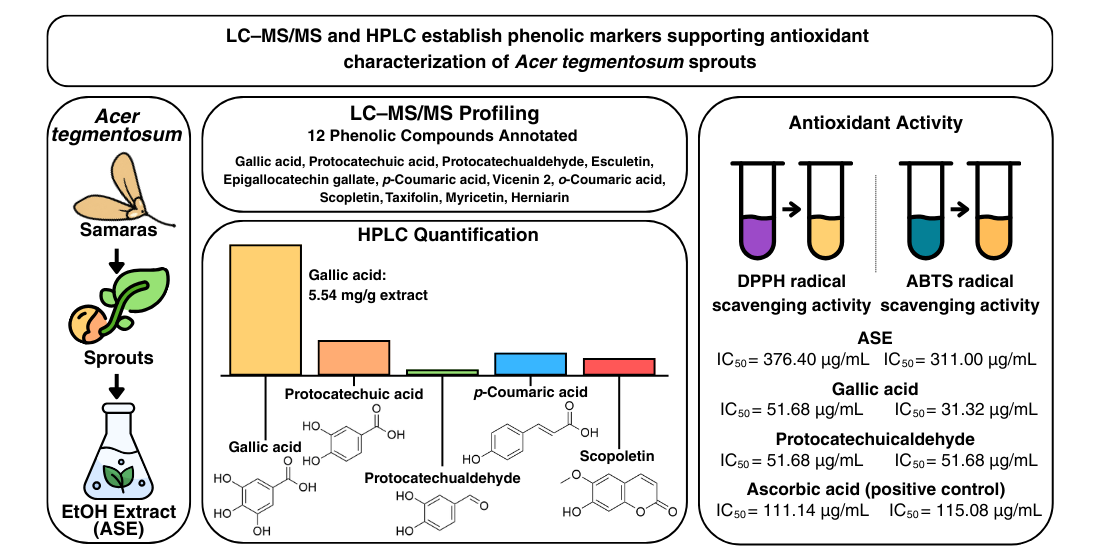
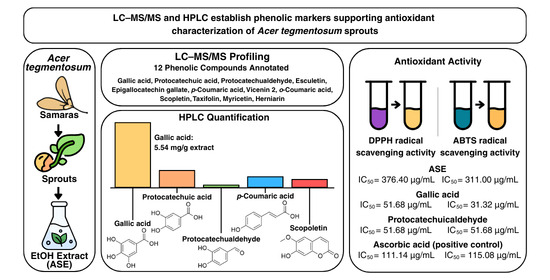
Phenolic Profile of Acer tegmentosum Sprouts and Its Potential Relevance to In Vitro Antioxidant Activity


Abstract
1. Introduction
2. Materials and Methods
2.1. Plant Materials and Extraction
2.2. Apparatus and Chemicals
2.3. LC–MS/MS Acquisition Conditions
2.4. LC–MS/MS Data Processing and Compound Annotation
2.5. HPLC Sample Preparation and Conditions
2.6. Limit of Detection (LOD) and Limit of Quantification (LOQ)
2.7. Calibration Curve
2.8. DPPH and ABTS Radical Scavenging Assays
2.9. Statistical Analysis
3. Results and Discussions
3.1. LC–MS/MS Profiling Analysis
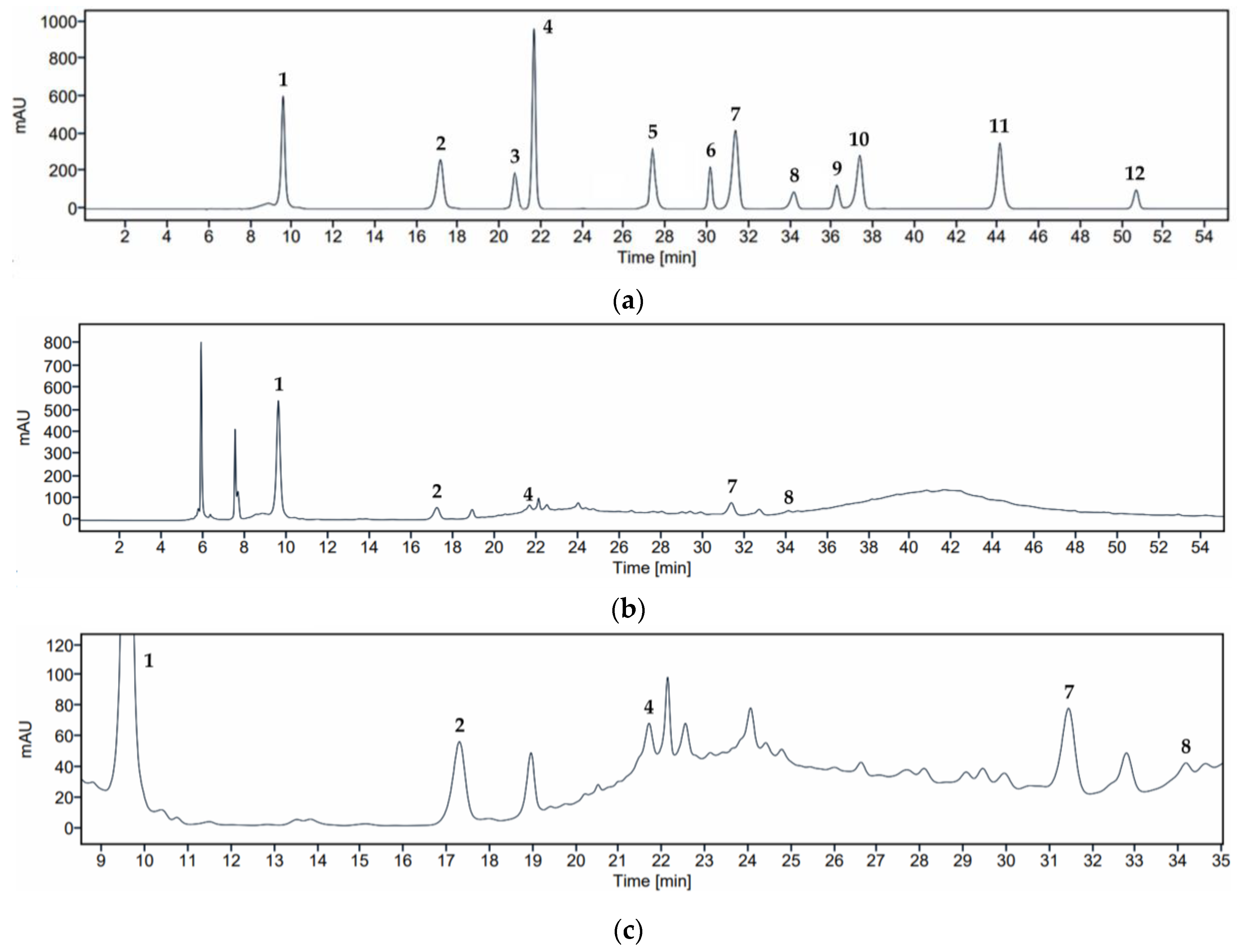
3.2. HPLC Quantification
3.3. Antioxidant Activity
4. Conclusions
Author Contributions
Funding
Data Availability Statement
Acknowledgments
Conflicts of Interest
References
- Manful, C.F.; Fordjour, E.; Subramaniam, D.; Sey, A.A.; Abbey, L.; Thomas, R. Antioxidants and reactive oxygen species: Shaping human health and disease outcomes. Int. J. Mol. Sci. 2025, 26, 7520. [Google Scholar] [CrossRef]
- Sies, H. Oxidative stress: Concept and some practical aspects. Antioxidants 2020, 9, 852. [Google Scholar] [CrossRef]
- Ye, Z.W.; Zhang, J.; Townsend, D.M.; Tew, K.D. Oxidative stress, redox regulation and diseases of cellular differentiation. Biochim. Biophys. Acta 2014, 1850, 1607. [Google Scholar] [CrossRef] [PubMed]
- Mendonça, J.d.S.; Guimarães, R.d.C.A.; Zorgetto-Pinheiro, V.A.; Fernandes, C.D.P.; Marcelino, G.; Bogo, D.; Freitas, K.d.C.; Hiane, P.A.; Melo, E.S.d.P.; Vilela, M.L.B.; et al. Natural antioxidant evaluation: A review of detection methods. Molecules 2022, 27, 3563. [Google Scholar] [CrossRef]
- Platzer, M.; Kiese, S.; Tybussek, T.; Herfellner, T.; Schneider, F.; Schweiggert-Weisz, U.; Eisner, P. Radical scavenging mechanisms of phenolic compounds: A quantitative structure-property relationship (QSPR) study. Front. Nutr. 2022, 1, 882458. [Google Scholar] [CrossRef]
- Chen, J.; Yang, J.; Ma, L.; Li, J.; Shahzad, N.; Kim, C.K. Structure-antioxidant activity relationship of methoxy, phenolic hydroxyl, and carboxylic acid groups of phenolic acids. Sci. Rep. 2020, 10, 2611. [Google Scholar] [CrossRef] [PubMed]
- Todorov, L.; Saso, L.; Kostova, I. Antioxidant activity of coumarins and their metal complexes. Pharmaceuticals 2023, 16, 651. [Google Scholar] [CrossRef] [PubMed]
- Cai, Y.; Luo, Q.; Sun, M.; Corke, H. Antioxidant activity and phenolic compounds of 112 traditional chinese medicinal plants associated with anticancer. Life Sci. 2004, 74, 2157. [Google Scholar] [CrossRef]
- Doan, T.T.M.; Tran, G.H.; Nguyen, T.K.; Lim, J.H.; Lee, S. Antioxidant activity of different cultivars of Chrysanthemum morifolium and quantitative analysis of phenolic compounds by HPLC/UV. Appl. Biol. Chem. 2024, 67, 17. [Google Scholar] [CrossRef]
- Park, Y.J.; Choi, Y.B.; Oh, S.B.; Moon, J.; Truong, T.Q.; Huynh, P.K.; Kim, S.M. Development and application of a high-performance liquid chromatography diode-array detection (HPLC–DAD) method for the simultaneous quantification of phenolic compounds in the aerial part of Glehnia littoralis. Appl. Biol. Chem. 2024, 67, 34. [Google Scholar] [CrossRef]
- Kim, J.A.; Min, B.S.; Ha, M.T.; Le, T.T.; Tran, T.T.; Tran, T.H. In vitro and in silico analysis of PTP1B and α-glucosidase inhibitory activities of isoflavonoids isolated from Belamcanda chinensis roots. Nat. Prod. Sci. 2025, 31, 129–137. [Google Scholar]
- Tarzi, B.G.; Gharachorloo, M.; Baharinia, M.; Mortazavi, A. The effect of germination on phenolic content and antioxidant activity of chickpea. Iran. J. Pharm. Res. 2012, 11, 1137. [Google Scholar]
- Paja̧k, P.; Socha, R.; Gałkowska, D.; Rożnowski, J.; Fortuna, T. Phenolic profile and antioxidant activity in selected seeds and sprouts. Food Chem. 2014, 143, 300–306. [Google Scholar] [CrossRef]
- Liu, H.Y.; Liu, Y.; Li, M.Y.; Ge, Y.Y.; Geng, F.; He, X.Q.; Xia, Y.; Guo, B.L.; Gan, R.Y. Antioxidant capacity, phytochemical profiles, and phenolic metabolomics of selected edible seeds and their sprouts. Front. Nutr. 2022, 9, 1067597. [Google Scholar] [CrossRef]
- Melegova, D.; Babelova, A.; Selc, M. Therapeutic potential of medicinal plant sprouts: Emerging opportunities and challenges in phytochemistry. Planta 2025, 262, 146. [Google Scholar] [CrossRef]
- Lee, C.-D.; Lee, H.-D.; Lee, A.Y.; Jeong, M.-J.; Choi, K.; Kang, J.; Park, Y.-W.; Choi, D.; Lee, S. Tissue-specific accumulation of anti-inflammatory flavonoids in Rhododendron micranthum leaves. J. Food Compos. Anal. 2026, 149, 108714. [Google Scholar] [CrossRef]
- Nugroho, A.; Song, B.M.; Park, H.J. HPLC and GC-MS analysis of phenolic substances in Acer tegmentosum. Nat. Prod. Sci. 2015, 21, 87–92. [Google Scholar]
- Kim, S.; Ko, C.H.; Kwon, H.C.; Rhie, Y.H.; Lee, S.Y. Effect of temperature and covering structures in seed dormancy and germination traits of manchurian striped maple (Acer tegmentosum Maxim.) native to Northeast Asia. Plants 2025, 14, 767. [Google Scholar] [CrossRef] [PubMed]
- Park, H.S.; Jo, E.; Han, J.H.; Jung, S.H.; Lee, D.H.; Park, I.W.; Heo, K.S.; Na, M.K.; Myung, C.S. Hepatoprotective effects of an Acer tegmentosum Maxim. extract through antioxidant activity and the regulation of autophagy. J. Ethnopharmacol. 2019, 239, 111912. [Google Scholar] [CrossRef] [PubMed]
- Park, J.S.; Kwon, E.; Kim, Y.S.; Kim, S.M.; Kim, D.S.; Jang, J.J.; Yun, J.W.; Kang, B.C. Safety assessment of Acer tegmentosum Maxim. water extract: General toxicity studies in Sprague–Dawley rats and Beagle dogs with re-evaluation of genotoxic potentials. Front. Pharmacol. 2021, 12, 687261. [Google Scholar] [CrossRef] [PubMed]
- Nguyen, P.A.; Won, J.S.; Cho, M.K. Acer tegmentosum Maxim and Bacillus Subtilis-Fermented products inhibit TNF-α-induced endothelial inflammation and vascular dysfunction of the retina: The role of tyrosol moiety in active compounds targeting Glu230 in SIRT1. Front. Pharmacol. 2024, 15, 1392179. [Google Scholar] [CrossRef]
- Lee, D.H.; Park, Y.; Hong, S.S.; Park, G.H.; Kim, H.-J. Study on the of the correlation between soil chemical properties and bioactive compounds of Acer tegmentosum Maxim. Korean J. Plant Resour. 2021, 34, 566–574. [Google Scholar]
- Jin, J.; Yin, X.; Wu, N.; Sun, C.; Zhao, M.; Wang, S.; Jiang, Q.; Jin, L.; Zhang, C. Chemical constituents of Acer tegmentosum Maxim and their chemotaxonomic significance. Biochem. Syst. Ecol. 2024, 116, 104882. [Google Scholar] [CrossRef]
- Ki, M.P.; Min, C.Y.; Kyu, H.L.; Kyung, R.K.; Sang, U.C.; Kang, R.L. Cytotoxic phenolic constituents of Acer tegmentosum Maxim. Arch. Pharmacal Res. 2006, 29, 1086–1090. [Google Scholar] [CrossRef] [PubMed]
- Plitta-Michalak, B.P.; Ramos, A.A.; Trusiak, M.; Ratajczak, E.; Michalak, M. Impact of cryopreservation on DNA damage in Acer platanoides L. seeds evaluated by the comet assay. Sci. Rep. 2025, 15, 24081. [Google Scholar] [CrossRef]
- Sultana, B.; Anwar, F.; Ashraf, M. Effect of extraction solvent/technique on the antioxidant activity of selected medicinal plant extracts. Molecules 2009, 14, 2167–2180. [Google Scholar] [CrossRef]
- Keunchkarian, S.; Reta, M.; Romero, L.; Castells, C. Effect of sample solvent on the chromatographic peak shape of analytes eluted under reversed-phase liquid chromatogaphic conditions. J. Chromatogr. A 2006, 1119, 20–28. [Google Scholar] [CrossRef] [PubMed]
- Apostol, I.; Miller, K.J.; Ratto, J.; Kelner, D.N. Comparison of different approaches for evaluation of the detection and quantitation limits of a purity method: A case study using a capillary isoelectrofocusing method for a monoclonal antibody. Anal. Biochem. 2009, 385, 101–106. [Google Scholar] [CrossRef]
- Phong, N.V.; Lee, Y.M.; Min, B.S.; Kim, J.A. Development and validation of an HPLC-DAD method for simultaneous quantitation of steppogenin and flavonoids from the stems of Morus Alba. Nat. Prod. Sci. 2024, 30, 65–71. [Google Scholar] [CrossRef]
- Kedare, S.B.; Singh, R.P. Genesis and development of DPPH method of antioxidant assay. J. Food Sci. Technol. 2011, 48, 412. [Google Scholar] [CrossRef]
- Re, R.; Pellegrini, N.; Proteggente, A.; Pannala, A.; Yang, M.; Rice-Evans, C. Antioxidant activity applying an improved ABTS radical cation decolorization assay. Free Radic. Biol. Med. 1999, 26, 1231–1237. [Google Scholar] [CrossRef]
- Hoffmann, M.A.; Nothias, L.-F.; Ludwig, M.; Fleischauer, M.; Gentry, E.C.; Witting, M.; Dorrestein, P.C.; Dührkop, K.; Böcker, S. Assigning confidence to structural annotations from mass spectra with COSMIC. bioRxiv 2021. [Google Scholar] [CrossRef]
- Broeckling, C.D.; Ganna, A.; Layer, M.; Brown, K.; Sutton, B.; Ingelsson, E.; Peers, G.; Prenni, J.E. Enabling efficient and confident annotation of LC−MS metabolomics data through MS1 spectrum and time prediction. Anal. Chem. 2016, 88, 9226–9234. [Google Scholar] [CrossRef] [PubMed]
- Houriet, J.; Manwill, P.K.; Magaña, A.A.; Anderson, V.M.; Beniddir, M.A.; Bertrand, S.; Choi, J.; Clark, T.N.; Foster, L.J.; Halabalaki, M.; et al. Multilaboratory untargeted mass spectrometry metabolomics collaboration to identify bottlenecks and comprehensively annotate a single dataset. Anal. Chem. 2025, 97, 16110–16122. [Google Scholar] [CrossRef]
- Torres-Ortiz, D.; García-Alcocer, G.; Berumen-Segura, L.C.; Estévez, M. Green extraction of secondary metabolites from plants: Obstacles, current status, and trends. Sustain. Chem. Environ. 2024, 8, 100157. [Google Scholar] [CrossRef]
- Atwi-Ghaddar, S.; Zerwette, L.; Destandau, E.; Lesellier, E. Supercritical fluid extraction (SFE) of polar compounds from Camellia sinensis leaves: Use of ethanol/water as a green polarity modifier. Molecules 2023, 28, 5485. [Google Scholar] [CrossRef] [PubMed]
- Sinosaki, N.B.M.; Tonin, A.P.P.; Ribeiro, M.A.S.; Poliseli, C.B.; Roberto, S.B.; Da Silveira, R.; Visentainer, J.V.; Santos, O.O.; Meurer, E.C. Structural study of phenolic acids by triple quadrupole mass spectrometry with electrospray ionization in negative mode and H/D isotopic exchange. Artic. J. Braz. Chem. Soc. 2020, 31, 402–408. [Google Scholar] [CrossRef]
- Rojas-Chertó, M.; Kasper, P.T.; Willighagen, E.L.; Vreeken, R.J.; Hankemeier, T.; Reijmers, T.H. Elemental composition determination based on MSn. Bioinformatics 2011, 27, 2376–2383. [Google Scholar] [CrossRef]
- van Tetering, L.; Spies, S.; Wildeman, Q.D.K.; Houthuijs, K.J.; van Outersterp, R.E.; Martens, J.; Wevers, R.A.; Wishart, D.S.; Berden, G.; Oomens, J. A spectroscopic test suggests that fragment ion structure annotations in MS/MS libraries are frequently incorrect. Commun. Chem. 2024, 7, 30. [Google Scholar] [CrossRef]
- Phillips, A.L.; Williams, A.J.; Sobus, J.R.; Ulrich, E.M.; Gundersen, J.; Langlois-Miller, C.; Newton, S.R. A framework for utilizing high resolution mass spectrometry and non-targeted analysis (NTA) in rapid response and emergency situations. Environ. Toxicol. Chem. 2022, 41, 1117–1130. [Google Scholar] [CrossRef]
- Li, C.; Attanayake, K.; Valentine, S.J.; Li, P. Facile improvement of negative ion mode electrospray ionization using capillary vibrating sharp-edge spray ionization. Anal. Chem. 2020, 92, 2492. [Google Scholar] [CrossRef]
- McClory, P.J.; Håkansson, K. Corona discharge suppression in negative ion mode nanoelectrospray ionization via trifluoroethanol addition. Anal. Chem. 2017, 89, 10188. [Google Scholar] [CrossRef]
- Inglese, P.; Huang, H.X.; Wu, V.; Lewis, M.R.; Takats, Z. Mass recalibration for desorption electrospray ionization mass spectrometry imaging using endogenous reference ions. BMC Bioinform. 2022, 23, 133. [Google Scholar] [CrossRef] [PubMed]
- Kind, T.; Fiehn, O. Metabolomic database annotations via query of elemental compositions: Mass accuracy is insufficient even at less than 1 ppm. BMC Bioinform. 2006, 7, 234. [Google Scholar] [CrossRef] [PubMed]
- Koch, B.P.; Dittmar, T.; Hertkorn, N.; Benner, R.; Frommberger, M.; Schmitt-Kopplin, P.; Witt, M.; Kaiser, K.; Kettrup, A.; Hedges, J.I.; et al. Fundamentals of molecular formula assignment to ultrahigh resolution mass data of natural organic matter. Anal. Chem. 2007, 79, 1758–1763. [Google Scholar] [CrossRef]
- Neeraj, J.V.; Rajendra, U.K. Novel HPLC method for determination of polyphenols in AGRO-industrial waste od date fruits. Int. J. Adv. Res. 2020, 8, 626–634. [Google Scholar] [CrossRef]
- Liu, Y.; Ma, H.; Seeram, N.P. Development and UFLC-MS/MS characterization of a product-specific standard for phenolic quantification of maple-derived foods. J. Agric. Food Chem. 2016, 64, 3311–3317. [Google Scholar] [CrossRef]
- Park, S.Y.; Han, Y.K.; Vinh, L.B.; Lee, K.Y. Analysis of α-glucosidase inhibitory constituents from Acer tegmentosum using LC-QTOF MS/MS and molecular networking. Nat. Prod. Sci. 2023, 29, 242–250. [Google Scholar] [CrossRef]
- Ren, H.; Feng, Z. Comparison and correlation analysis of flavonoids and chlorogenic acid contents in different strains of Acer truncatum. Food Sci. Technol. 2018, 38, 319–326. [Google Scholar] [CrossRef]
- Zhang, Y.; Xia, Y. Quercetin enhances tomato seed germination via phenylpropanoid-dependent regulation of ros, hormone signaling, and starch hydrolysis. Plant Physiol. Biochem. 2026, 230, 110590. [Google Scholar] [CrossRef] [PubMed]
- Gao, H.; Li, Q. The prediction of antioxidant Q-markers for Angelica dahurica based on the dynamics change in chemical compositions and network pharmacology. Molecules 2023, 28, 5248. [Google Scholar] [CrossRef]
- González, M.C.; Roitsch, T.; Pandey, C. Antioxidant responses and redox regulation within plant-beneficial microbe interaction. Antioxidants 2024, 13, 1553. [Google Scholar] [CrossRef]
- Parvin, K.; Hasanuzzaman, M.; Mohsin, S.M.; Nahar, K.; Fujita, M. Coumarin improves tomato plant tolerance to salinity by enhancing antioxidant defence, glyoxalase system and ion homeostasis. Plant Biol. 2021, 23, 181–192. [Google Scholar] [CrossRef] [PubMed]
- Wang, Y.; Guan, T.; Yue, X.; Yang, J.; Zhao, X.; Chang, A.; Yang, C.; Fan, Z.; Liu, K.; Li, Y. The biosynthetic pathway of coumarin and its genetic regulation in response to biotic and abiotic stresses. Front. Plant Sci. 2025, 16, 1599591. [Google Scholar] [CrossRef]
- Wołosiak, R.; Drużyńska, B.; Derewiaka, D.; Piecyk, M.; Majewska, E.; Ciecierska, M.; Worobiej, E.; Pakosz, P. Verification of the conditions for determination of antioxidant activity by ABTS and DPPH assays—A practical approach. Molecules 2021, 27, 50. [Google Scholar] [CrossRef]
- Kalemba, M.R.K.; Makhuvele, R.; Njobeh, P.B. Phytochemical screening, antioxidant activity of selected methanolic plant extracts and their detoxification capabilities against AFB1 toxicity. Heliyon 2024, 10, e24435. [Google Scholar] [CrossRef]
- Menezes, B.d.B.; Frescura, L.M.; Duarte, R.; Villetti, M.A.; da Rosa, M.B. A critical examination of the DPPH method: Mistakes and inconsistencies in stoichiometry and IC50 determination by UV–Vis spectroscopy. Anal. Chim. Acta 2021, 1157, 338398. [Google Scholar] [CrossRef]
- Platzer, M.; Kiese, S.; Herfellner, T.; Schweiggert-Weisz, U.; Miesbauer, O.; Eisner, P. Common trends and differences in antioxidant activity analysis of phenolic substances using single electron transfer based assays. Molecules 2021, 26, 1244. [Google Scholar] [CrossRef] [PubMed]
- Apak, R.; Özyürek, M.; Güçlü, K.; Çapanoʇlu, E. Antioxidant Activity/Capacity Measurement. 1. Classification, Physicochemical Principles, Mechanisms, and Electron Transfer (ET)-Based Assays. J. Agric. Food Chem. 2016, 64, 997–1027. [Google Scholar] [CrossRef] [PubMed]
- Brand-Williams, W.; Cuvelier, M.E.; Berset, C. Use of a free radical method to evaluate antioxidant activity. Food Sci. Technol. 1995, 28, 25–30. [Google Scholar] [CrossRef]
- Floegel, A.; Kim, D.O.; Chung, S.J.; Koo, S.I.; Chun, O.K. Comparison of ABTS/DPPH assays to measure antioxidant capacity in popular antioxidant-rich US foods. J. Food Compos. Anal. 2011, 24, 1043–1048. [Google Scholar] [CrossRef]
- Thaipong, K.; Boonprakob, U.; Crosby, K.; Cisneros-Zevallos, L.; Hawkins Byrne, D. Comparison of ABTS, DPPH, FRAP, and ORAC assays for estimating antioxidant activity from guava fruit extracts. J. Food Compos. Anal. 2006, 19, 669–675. [Google Scholar] [CrossRef]
- Jiang, X.; Liu, Y.; Li, W.; Zhao, L.; Meng, F.; Wang, Y.; Tan, H.; Yang, H.; Wei, C.; Wan, X.; et al. Tissue-specific, development-dependent phenolic compounds accumulation profile and gene expression pattern in tea plant [Camellia sinensis]. PLoS ONE 2013, 8, e62315. [Google Scholar] [CrossRef] [PubMed]
- Drozdowska, M.; Leszczyńska, T.; Koronowicz, A.; Piasna-Słupecka, E.; Dziadek, K. Comparative study of young shoots and the mature red headed cabbage as antioxidant food resources with antiproliferative effect on prostate cancer cells. RSC Adv. 2020, 10, 43021–43034. [Google Scholar] [CrossRef]
- Olszowy-Tomczyk, M.; Wianowska, D. Antioxidant properties of selected flavonoids in binary mixtures—Considerations on myricetin, kaempferol and quercetin. Int. J. Mol. Sci. 2023, 24, 10070. [Google Scholar] [CrossRef]
- Fakhri, S.; Abbaszadeh, F.; Moradi, S.Z.; Cao, H.; Khan, H.; Xiao, J. Effects of polyphenols on oxidative stress, inflammation, and interconnected pathways during spinal cord injury. Oxid. Med. Cell. Longev. 2022, 2022, 8100195. [Google Scholar] [CrossRef] [PubMed]
- Ojeaburu, S.I.; Oriakhi, K. Hepatoprotective, antioxidant and, anti-inflammatory potentials of gallic acid in carbon tetrachloride-induced hepatic damage in Wistar rats. Toxicol. Rep. 2021, 8, 177. [Google Scholar] [CrossRef] [PubMed]
- Chang, Z.Q.; Gebru, E.; Lee, S.P.; Rhee, M.H.; Kim, J.C.; Cheng, H.; Park, S.C. In vitro antioxidant and anti-inflammatory activities of protocatechualdehyde isolated from Phellinus gilvus. J. Nutr. Sci. Vitaminol. 2011, 57, 118–122. [Google Scholar] [CrossRef]
- Zhang, S.; Gai, Z.; Gui, T.; Chen, J.; Chen, Q.; Li, Y. Antioxidant effects of protocatechuic acid and protocatechuic aldehyde: Old wine in a new bottle. Evid.-Based Complement. Altern. Med. 2021, 2021, 6139308. [Google Scholar] [CrossRef]
- Chook, C.Y.B.; Cheung, Y.M.; Ma, K.Y.; Leung, F.P.; Zhu, H.; Niu, Q.J.; Wong, W.T.; Chen, Z.Y. Physiological concentration of protocatechuic acid directly protects vascular endothelial function against inflammation in diabetes through Akt/ENOS pathway. Front. Nutr. 2023, 10, 1060226. [Google Scholar] [CrossRef]
- Boo, Y.C. p-Coumaric acid as an active ingredient in cosmetics: A review focusing on its antimelanogenic effects. Antioxidants 2019, 8, 275. [Google Scholar] [CrossRef] [PubMed]
- Gao, X.Y.; Li, X.Y.; Zhang, C.Y.; Bai, C.Y. Scopoletin: A review of its pharmacology, pharmacokinetics, and toxicity. Front. Pharmacol. 2024, 15, 1268464. [Google Scholar] [CrossRef] [PubMed]
- Mohsen Ali, S.S.; Robin, P. Comprehensive phytochemical profiling of bioactive compounds from Barleria prattensis for their antioxidant and cytotoxic capacity and its characterization using GC-MS. Biochem. Biophys. Rep. 2025, 43, 102083. [Google Scholar] [CrossRef] [PubMed]
- Cao, X.; Yang, L.; Xue, Q.; Yao, F.; Sun, J.; Yang, F.; Liu, Y. Antioxidant evaluation-guided chemical profiling and structure-activity analysis of leaf extracts from five trees in Broussonetia and Morus (Moraceae). Sci. Rep. 2020, 10, 4808. [Google Scholar] [CrossRef]



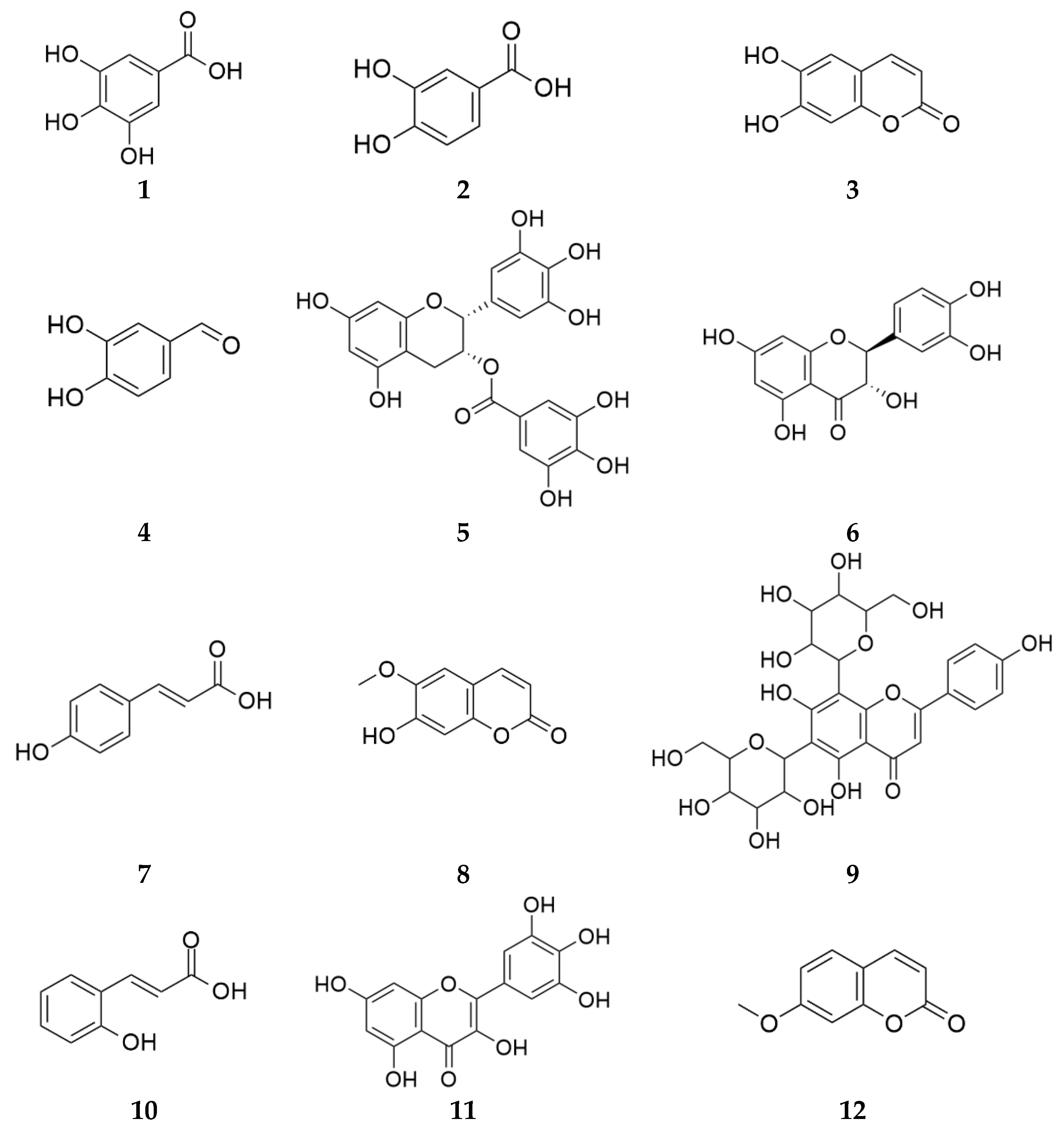
| tR | Adducts | Observed m/z | Calculated m/z | Δm/z ppm * | Accurate Mass | Molecular Formula | Tentative Identification |
|---|---|---|---|---|---|---|---|
| 2.53 | [2M − H]− | 339.0346 | 339.0357 | ±3.3031 | 170.022 | C7H6O5 | gallic acid |
| 4.81 | [M − H]− | 153.0177 | 153.0193 | ±10.5327 | 154.027 | C7H6O4 | protocatechuic acid |
| 7.07 | [M − H]− | 137.0228 | 137.0244 | ±11.6261 | 138.032 | C7H6O3 | protocatechualdehyde |
| 10.43 | [M − H]− | 177.0179 | 177.0193 | ±7.8783 | 178.027 | C9H6O4 | esculetin |
| 13.92 | [M − H]− | 457.0768 | 457.0776 | ±1.6503 | 457.077 | C22H18O11 | epigallocatechin gallate |
| 14.56 | [M − H]− | 163.0385 | 163.0400 | ±9.2456 | 164.047 | C9H8O3 | p-coumaric acid |
| 15.33 | [M − H]− | 593.1498 | 593.1511 | ±2.2636 | 594.158 | C27H30O15 | vicenin 2 |
| 16.60 | [M − H]− | 163.0385 | 163.0400 | ±9.2066 | 164.047 | C9H8O3 | o-coumaric acid |
| 16.81 | [M − H]− | 191.0337 | 191.0349 | ±6.3272 | 192.042 | C10H8O4 | scopoletin |
| 18.31 | [M − H]− | 303.0504 | 303.0510 | ±1.8056 | 304.058 | C15H12O7 | taxifolin |
| 21.55 | [M − H]− | 317.0295 | 317.0302 | ±2.2838 | 318.038 | C15H12O8 | myricetin |
| 23.43 | [M + HCOO]− | 221.0444 | 221.0455 | ±4.8354 | 176.047 | C10H8O3 | herniarin |
| tR | Adducts | Observed m/z | Calculated m/z | Δm/z ppm * | Accurate Mass | Molecular Formula | Tentative Identification |
|---|---|---|---|---|---|---|---|
| 15.33 | [M + H]+ | 595.1629 | 595.1657 | ±4.6924 | 594.158 | C27H30O15 | vicenin 2 |
| 16.81 | [M + H]+ | 193.0486 | 193.0495 | ±4.5101 | 192.042 | C10H8O4 | scopoletin |
| Compound | tR | Calibration Equation | R2 | LOD (mg/mL) | LOQ (mg/mL) | RSD (%) | ASE (mg/g Extract) |
|---|---|---|---|---|---|---|---|
| 1 | 9.548 | y = 69,622.87 x + 77.23 | 0.9989 | 0.006 | 0.017 | 0.490 | 5.54 ± 0.08 |
| 2 | 17.128 | y = 49,691.24 x + 42.16 | 0.9992 | 0.005 | 0.015 | 0.408 | 1.13 ± 0.01 |
| 3 | 20.823 | y = 15,065.80 x − 4.10 | 0.9995 | 0.003 | 0.011 | 0.403 | ND |
| 4 | 21.639 | y = 93,199.42 x + 89.35 | 0.9991 | 0.005 | 0.016 | 0.285 | 0.20 ± 0.01 |
| 5 | 28.237 | y = 88,749.20 x − 166.90 | 0.9982 | 0.007 | 0.022 | 0.491 | ND |
| 6 | 30.351 | y = 262,731.50 x + 54.53 | 0.9992 | 0.004 | 0.014 | 0.635 | ND |
| 7 | 31.349 | y = 74,041.95 x + 65.73 | 0.9992 | 0.005 | 0.015 | 0.381 | 0.76 ± 0.02 |
| 8 | 34.018 | y = 15,646.14 x + 12.77 | 0.9992 | 0.005 | 0.015 | 0.351 | 0.63 ± 0.04 |
| 9 | 36.542 | y = 121,611.00 x − 205.60 | 0.9983 | 0.006 | 0.021 | 0.482 | ND |
| 10 | 37.125 | y = 306,885.20 x − 77.90 | 0.9995 | 0.003 | 0.011 | 0.652 | ND |
| 11 | 44.118 | y = 135,721.10 x − 255.20 | 0.9980 | 0.007 | 0.023 | 0.516 | ND |
| 12 | 50.653 | y = 36,295.60 x − 21.60 | 0.9997 | 0.002 | 0.008 | 0.552 | ND |
| Sample | DPPH (IC50, µg/mL) | ABTS (IC50, µg/mL) |
|---|---|---|
| ASE | 376.40 ± 14.34 a | 311.00 ± 7.70 a |
| 1 | 51.68 ± 0.97 d | 31.32 ± 1.28 b |
| 2 | 84.81 ± 1.55 c | 113.32 ± 1.33 d |
| 4 | 47.17 ± 2.55 d | 33.65 ± 0.91 b |
| 7 | >1000 | 52.45 ± 2.52 c |
| 8 | >1000 | 189.09 ± 5.73 e |
| AA * | 111.14 ± 1.00 b | 115.08 ± 1.42 d |
Disclaimer/Publisher’s Note: The statements, opinions and data contained in all publications are solely those of the individual author(s) and contributor(s) and not of MDPI and/or the editor(s). MDPI and/or the editor(s) disclaim responsibility for any injury to people or property resulting from any ideas, methods, instructions or products referred to in the content. |
© 2026 by the authors. Licensee MDPI, Basel, Switzerland. This article is an open access article distributed under the terms and conditions of the Creative Commons Attribution (CC BY) license.
Share and Cite
Kang, S.-H.; Lee, D.-H.; Ku, J.; Lee, S. Phenolic Profile of Acer tegmentosum Sprouts and Its Potential Relevance to In Vitro Antioxidant Activity. Horticulturae 2026, 12, 328. https://doi.org/10.3390/horticulturae12030328
Kang S-H, Lee D-H, Ku J, Lee S. Phenolic Profile of Acer tegmentosum Sprouts and Its Potential Relevance to In Vitro Antioxidant Activity. Horticulturae. 2026; 12(3):328. https://doi.org/10.3390/horticulturae12030328
Chicago/Turabian StyleKang, Shi-Heon, Doo-Hee Lee, Jajung Ku, and Sanghyun Lee. 2026. "Phenolic Profile of Acer tegmentosum Sprouts and Its Potential Relevance to In Vitro Antioxidant Activity" Horticulturae 12, no. 3: 328. https://doi.org/10.3390/horticulturae12030328
APA StyleKang, S.-H., Lee, D.-H., Ku, J., & Lee, S. (2026). Phenolic Profile of Acer tegmentosum Sprouts and Its Potential Relevance to In Vitro Antioxidant Activity. Horticulturae, 12(3), 328. https://doi.org/10.3390/horticulturae12030328