1. Introduction
Pepino (
Solanum muricatum Aiton) is a perennial herbaceous plant belonging to the Solanaceae family, native to the high-altitude regions (1000–3000 m) of the Andes Mountains in South America [
1,
2]. In recent years, it has attracted growing interest due to its rich nutritional profile—particularly its high selenium and vitamin C content—and the presence of flavonoids in leaf extracts, which confer antihypertensive medicinal properties [
3,
4]. Commercial cultivation has expanded rapidly in China, with Shilin County (Yunnan) now serving as the world’s largest production hub. Notably, in 2023, pepino occupied only 17.9% of the county’s arable land but generated 47.9% of its agricultural output value [
5]. These attributes underscore its significant health-promoting potential and promising market value.
Leaf spot diseases caused by
Alternaria species severely constrain solanaceous crop production globally. Early blight, primarily attributed to
Alternaria solani—a Deuteromycete within the phylum Ascomycota [
6]—is well documented in tomato and potato, with historical reports from the USA (1882) and India (1905), and yield losses reaching up to 79% under severe epidemics [
7]. The pathogen survives in soil and debris, with disease exacerbated by high humidity and rainfall [
8]. The disease manifests throughout the growing season as necrotic lesions that expand into characteristic concentric rings, leading to defoliation, fruit drop, and postharvest decay [
9]. Although recent taxonomic studies reveal that field infections on pepino in China may involve a complex of
Alternaria species, such as
Alternaria linariae and
Alternaria alternata [
10,
11], the isolate used in the present study was
A. solani provided by our laboratory. This isolate was confirmed to be pathogenic in our preliminary experiments and was used for experimental convenience. Despite being recognized as a major threat to pepino production in China [
12], early blight remains poorly understood in this crop. Given its severe agronomic impact and the limited knowledge of
A. solani–pepino interactions, this study focuses on
A. solani-induced leaf disease to elucidate antioxidant enzymes and develop sustainable management strategies critical for the future of pepino cultivation.
Excessive lateral branching is a common constraint in pepino production, particularly in intensive cropping systems widely used in China. It is mainly associated with disrupted hormonal regulation, which disperses plant nutrient supply and aggravates disease development [
13]. Lateral bud development critically shapes plant architecture, and an optimized canopy structure is essential for maximizing both productivity and economic returns [
14,
15]. Intense competition for assimilates between the main stem and lateral branches often compromises main-stem growth, prompting growers to adopt low-branching cultivars or manually remove side shoots to enhance yield [
16]. Over-proliferation of lateral branches increases planting density, restricts air circulation and light penetration within the canopy, and creates a microenvironment conducive to disease development. Under such high-density conditions, plants exhibit “shade avoidance syndrome” (SAS)—enhancing apical dominance to compete for light and nutrients—which further exacerbates canopy closure and humidity retention, thereby promoting the establishment and spread of foliar pathogens [
17]. Timely removal of lateral buds mitigates SAS, improves airflow and light distribution, and reduces the risk of disease epidemics. For example, in high-density tomato fields, incidences of
Verticillium wilt and pepino mosaic virus are markedly higher than in low-density plots [
18]. Accordingly, timely excision of lateral branches not only decreases canopy density but also creates an unfavorable environment for pathogen colonization and may regulate endogenous defense signaling pathways.
While manual pruning remains the primary method to control branching, it is labor-intensive and economically unsustainable at scale [
19]. Plant growth regulators (PGRs)—widely used in tomato and other Solanaceae crops for canopy management—offer a promising alternative by selectively suppressing lateral bud development [
20,
21]. Although PGR-based sucker control is well established in tobacco [
22,
23], its application in pepino, and more broadly its role in mediating the interplay between plant architecture and disease resistance within the Solanaceae, remains underexplored.
Flumetralin (N-ethyl-N-2′,6′-dinitro-4-trifluoromethylaniline), butralin (N-sec-butyl-4-chloro-2,6-dinitroaniline), and pendimethalin (N-(1-ethylpropyl)-3,4-dimethyl-2,6-dinitroaniline) are dinitroaniline-type PGRs with locally systemic activity, commonly used to redirect photosynthate allocation in crops such as tobacco and cotton [
24]. Flumetralin inhibits both cell division and elongation [
25], thereby enhancing canopy leaf area—as demonstrated by a 25% increase in upper-canopy leaf area index (LAI) in cotton [
26]. Butralin suppresses meristematic activity to delay axillary bud growth in tobacco [
27], while pendimethalin, though herbicidal at high doses, effectively inhibits lateral buds at low concentrations [
28,
29]. Despite their agronomic potential, the application of these PGRs for lateral bud suppression in pepino remains limited, and the underlying physiological and molecular mechanisms are poorly understood.
We hypothesize that exogenous PGR-induced bud suppression enhances early blight resistance in pepino by reallocating resources to elevate SA and IAA, which subsequently activate superoxide dismutase (SOD), peroxidase (POD), and malondialdehyde (MDA) to counteract pathogen-induced oxidative stress.
The objectives of this study are: (1) to assess the effects of PGR treatments on lateral bud development; (2) to quantify disease severity under different PGR regimes; (3) to elucidate the relationships among architectural traits, antioxidant enzyme activities (e.g., SOD, POD), defense hormone levels, and disease incidence. Our findings are expected to provide a scientific basis for developing sustainable, labor-saving, and disease-resilient pepino production systems.
2. Materials and Methods
2.1. Field Experiment
To evaluate the effect of manual lateral bud removal on the incidence and severity of early blight under natural field conditions, a field experiment was conducted from June to September 2024 in Shilin County, Yunnan Province, China (24°21′ N, 103°29′ E). The experiment followed a single-factor completely randomized block design with two treatments: W1 (control): Plants were allowed to grow naturally without bud removal; W2 (manual bud removal): Lateral buds were removed with sterilized blades once they reached 2–3 cm in length, with no further intervention thereafter.
The total experimental area spanned 1050 m2 (30 m × 35 m), with a row spacing of 1.5 m and plant spacing of 0.8 m. Each treatment was replicated in five independent blocks (n = 5), spatially separated to minimize cross-contamination. Within each plot, an assessment subplot of 16.08 m2 (6.90 m × 2.33 m) was designated for disease assessment. Disease assessments were carried out at 30 and 60 days after treatment using the five-point sampling method: within each sample plot, 20 plants were selected from each of the four corners and the center, resulting in 100 plants per block per time point. For each plant, disease incidence and disease index (DI) were recorded according to the scale described in the section.
Given the repeated measurements over time on the same blocks, data were analyzed using a linear mixed-effects model (LMM), with treatment and time as fixed effects and block as a random effect.
2.2. Pot Experiment
2.2.1. Agricultural Management
The potting substrate was filled to 3–5 cm below the pot rim. A water-soluble N:P:K (2:1:2) fertilizer was diluted 1:100 (v/v) and uniformly incorporated into the substrate. The experiment used the pepino cultivar ‘Yuanguo No. 2’—a tissue-cultured clone from the Southwest Biodiversity Laboratory, Yunnan Agricultural University—widely cultivated in Yunnan’s major pepino-growing areas. Plantlets, after two months of in vitro culture, were acclimatized in 72-cell plug trays and transplanted into individual pots upon reaching the five-true-leaf stage.
2.2.2. Experimental Growth Conditions
A pot experiment was conducted from March to June 2025 at the Integrated Experimental Base of Yunnan Agricultural University (25.13° N, 102.75° E) to evaluate the efficacy of three PGRs—flumetralin, pendimethalin, and butralin—in suppressing lateral bud development and enhancing resistance to A. solani-induced early blight under controlled greenhouse conditions. The greenhouse (5.6 m × 15 m) was covered with polyvinyl chloride (PVC) film for a total of 84 m2, with a diurnal temperature regime of 25 ± 1 °C (day) and 17 ± 1 °C (night), relative humidity of 65%, and a photoperiod of approximately 14 h per day. The photosynthetic photon flux density (PPFD) was maintained at 180 ± 20 μmol·m−2·s−1, measured at the canopy level using a quantum sensor (Model DL333204, Ningbo Deli Group Co., Ltd., Ningbo, China). Natural ventilation was applied throughout the experiment. Plants were grown in plastic pots (17 cm diameter × 16 cm height; ~3.6 L volume) filled with sandy loam soil. The soil had a pH of 8.1, organic matter content of 14.3 g·kg−1, and baseline available nutrient levels of 50.3 mg·kg−1 nitrogen, 18.5 mg·kg−1 phosphorus, and 186.2 mg·kg−1 potassium.
2.2.3. PGRs Treatments
This study adopted a completely randomized block design using the pepino plant as the experimental material, setting up one control group (CK) and three PGR treatment groups (TA, TB, TC). A preliminary experiment was conducted to identify the hormetic windows under which the main experiment was subsequently carried out; in the main experiment, the CK group was sprayed with distilled water, the TA group with 1.25 g·L
−1 flumetralin, the TB group with 1.2 g·L
−1 pendimethalin, and the TC group with 3.6 g·L
−1 butralin; details of the preliminary study are provided in the
Supplementary Materials. All agents were uniformly sprayed on the lateral bud areas during the seedling stage until moist but without droplets falling off, with applications spaced five days apart, for a total of six applications. To prevent the agents from seeping into the rhizosphere soil, waterproof plastic film was laid over the surface of the pot soil.
2.2.4. Pathogen Inoculation
The pathogen A. solani was obtained from the Yunnan Laboratory of Biodiversity, China. Prior to the main experiment, an initial detached leaf assay confirmed the pathogenicity of the isolated strain on pepino leaves under high humidity conditions, resulting in circular lesions within 5 to 7 days post-inoculation.
For inoculum preparation, A. solani was cultured on Potato Dextrose Agar (PDA) plates at 25 °C for 7 to 14 days. Colonies were subsequently stored in 15% glycerol solution at −4 °C until further use. For activation, A. solani was grown on PDA plates in the dark at 25 °C for 3 to 5 days. Mycelial plugs with a diameter of 5 mm were extracted from the actively growing margin of the colony using sterile cork borers to ensure uniform biological activity across replicates. In each treatment group, the lower three leaves of pepino plants were selected for inoculation. Two small wounds were created parallel to the midrib on either side of the main vein using a sterile needle, with each wound consisting of three superficial scratches approximately 5 mm in length. A mycelial plug was gently placed at the center of each wound, secured with a small piece of sterile filter paper to maintain contact and moisture. Immediately following inoculation, the inoculated leaves were enclosed in transparent plastic bags with small ventilation holes and incubated in a growth chamber at 25 °C for 12 h to facilitate infection establishment. Subsequently, the bags were removed, and the plants were transferred to a greenhouse under consistent light and temperature conditions.
Disease progression was monitored seven days post-inoculation by assessing lesion area using ImageJ software (v1.54; National Institutes of Health, USA;
https://imagej.net). This method allowed for precise quantification of disease severity, facilitating the evaluation of the impact of different plant growth regulator treatments on early blight resistance in pepino.
2.3. Data Collection
2.3.1. Disease Assessment
The disease index assessment was conducted according to the nine-class severity scale established for early blight in potato, with disease grades defined as follows: Grade 0: no symptoms (0%); Grade 1: 1–5% lesion area; Grade 3: 6–10%; Grade 5: 11–20%; Grade 7: 21–50%; Grade 9: >50% lesion area [
30].
Disease assessment metrics were calculated as:
where
is the number of plants at disease grade
,
is the representative value for grade
,
is the total number of independently surveyed plants per experimental replicate, and
is the maximum representative grade value.
2.3.2. Plant Height, Stem Diameter, and Leaf Area
Thirty days after application of PGRs during the seedling stage, four representative pepino plants with uniform growth status were selected from each treatment and the control group, serving as four biological replicates. Plant height (from the stem base to the apical meristem) and stem diameter (measured 2 cm above the soil surface in two perpendicular directions) were recorded using a ruler and a digital caliper, respectively. Leaf length and width were measured with a tape measure, and leaf area (LA) was estimated using the formula: LA = length × width × 0.6393. For each treatment, 3–4 leaves were randomly selected, with four biological replicates per leaf.
2.3.3. Lateral Bud Measurements
The node bearing the first true leaf was designated as the starting point for lateral bud counting. Buds on nodes 1 through 6 (counting upward from the first true leaf) were measured for length. Lateral buds shorter than 2 mm were considered absent, while those ≥2 mm were recorded as effective lateral buds. Four biological replicates were used per treatment. The total number of effective lateral buds was summed across all counted nodes.
Thirty days after application of the PGRs, the fresh weight of lateral buds was immediately determined using an analytical balance (precision: 0.0001 g). The bud suppression rate (BSR) and bud suppression efficacy (BSE) were calculated as follows:
where
is the number of lateral buds in the non-pruned control group, and
is the number in the treated group.
where
and
represent the total fresh weight of lateral buds in the non-pruned control and treated groups, respectively.
2.3.4. Determination of Antioxidant Enzyme Activities and Lipid Peroxidation
Five days after exogenous application of PGRs, four healthy leaves were collected from the top to the bottom of each pepino plant between 16:00 and 17:00. Four biological replicates were prepared per treatment. Leaves were rinsed with deionized water to remove surface contaminants, gently blotted dry, wrapped in aluminum foil, flash-frozen in liquid nitrogen, and stored at −80 °C until biochemical analysis. Using Solarbio assay kits (Solarbio, Beijing, China), 0.1 g of leaf tissue per sample from the TA, TB, and TC treatments was used to quantify the activities of SOD, POD, and MDA content.
2.3.5. Extraction and Quantification of Phytohormones
Endogenous phytohormone concentrations were determined by enzyme-linked immunosorbent assay (ELISA), referring to the method of Zhao et al. [
31]. Fully expanded leaves from the third node below the apical meristem were harvested from pepino plants subjected to each treatment or control condition. For each treatment, 0.1 g of fresh leaf tissue was immediately frozen in liquid nitrogen and stored at −80 °C until analysis. Hormones were extracted using 0.1 mol·L
−1 phosphate-buffered saline (PBS, pH 7.4), following the extraction protocol recommended by the ELISA kit manufacturer (JingMei, Suzhou, China). Four independent biological replicates were performed for each treatment.
Standard Curve Preparation: Standard solutions were prepared with 5 concentration gradients according to the kit instructions, and 50 μL of each gradient was taken for duplicate well loading.
Sample Loading: The plate layout included blank control, standard, and sample test wells. For standard wells, 50 μL of each standard solution was added directly. For sample test wells, 40 μL of sample diluent was first added, followed by 10 μL of the test sample (the final dilution of the sample is 5 times). Samples were gently pipetted vertically to the bottom of the wells to avoid contact with the well walls, then mixed thoroughly by gentle shaking.
Immunoassay incubation and washing: The plate was sealed with an adhesive film and incubated at 37 °C for 30 min. After incubation, the sealing film was removed, and the liquid in each well was discarded. A total of 300 μL of wash buffer (prepared by diluting the concentrate 1:30 with distilled water) was added to each well, allowed to stand for 30 s, and then aspirated. This washing step was repeated for a total of five cycles. After the final wash, the plate was inverted and tapped firmly on absorbent paper to remove residual liquid. Subsequently, 50 μL of enzyme-conjugated reagent was added to each well except the blank control wells.
Color development and reaction termination: 50 μL of Chromogen A and 50 μL of Chromogen B were added to each well in sequence. The samples were incubated at 37 °C in the dark for 10 min and gently shaken to mix evenly during this period. Reaction termination: 50 μL of stop solution was added to each well.
Absorbance measurement: Within 15 min after reaction termination, the optical density at 450 nm (OD450) of each well was measured using a microplate reader, with the blank control wells used for zero calibration.
All assays were validated for linearity (R2 > 0.95) and intra-assay coefficient of variation (<10%), ensuring accurate and reproducible quantification within the dynamic range of the standard curves.
2.3.6. Validation via IAA and SA Treatments
Based on preliminary dose–response trials, hormetic windows for salicylic acid (SA) and indole-3-acetic acid (IAA) in regulating lateral branching of pepino were determined. Uniform pepino plants were sprayed with one of three solutions: distilled water (control), 0.5 mM SA, or 2 mM IAA. Twelve hours post-treatment, the first fully expanded leaf from the apex of each plant was excised and placed in sterile Petri dishes. Petioles were wrapped in sterile paper towels moistened with deionized water and incubated at 25 °C in the dark. Digital photographs were taken at 24, 48, 72, 96, 120, 144 and 168 h post-incubation. Lesion areas were quantified using ImageJ software (v1.54; National Institutes of Health, USA;
https://imagej.net), with three images analyzed per leaf.
Additionally, the second fully expanded leaf from the apex was harvested at 0, 24, 72, and 120 h post-treatment, immediately wrapped in aluminum foil, flash-frozen in liquid nitrogen, and stored at −80 °C until analysis. For each time point and treatment, 0.1 g of leaf tissue from each of four biological replicates was used to assay SOD and POD activities using Solarbio assay kits (Solarbio Life Sciences, Beijing, China), with each sample measured in four technical replicates.
2.4. Data Analysis
Data were collected and organized using Microsoft Excel 2023 (Microsoft Corporation, USA). Graphical representations were generated using GraphPad Prism version 9.5 (GraphPad Software, Inc., La Jolla, CA, USA).
The LMM using R version 4.3.2 is used to analyze field experiments (2.1), including lme4, lmerTest, and emmeans. Post hoc comparisons were performed using Tukey’s HSD test within each time point. The LMM and one-way analysis of variance (ANOVA) analyses were performed using IBM SPSS Statistics 26.0 (IBM Corp., USA). Prior to one-way analysis of variance (ANOVA) and LMM, data were assessed for normality and homogeneity of variances. To meet the assumptions of parametric tests, disease severity indices were subjected to arcsine square root transformation, and bud count data were square-root transformed (). Normality of the transformed residuals was confirmed using the Shapiro–Wilk test (p < 0.05). Results are presented as back-transformed means ± SE.
3. Results
3.1. Field Evaluation of Early Blight Control Efficacy Under Lateral Bud Removal
As shown in
Table 1, W2 significantly reduced disease incidence and DI compared to W1, indicating that lateral bud suppression effectively mitigates early blight severity under field conditions.
Field surveys conducted at two time points revealed that, over time, both disease incidence and DI increased in both the control and treated groups. However, disease severity was consistently and markedly higher in the naturally grown (non-pruned) plants compared to those subjected to manual bud removal. At 30 d post-treatment, the disease incidence in the CK (64.00%) was significantly higher than that in the manual bud removal treatment (51.00%), with a corresponding DI of 75.00 versus 62.00, respectively. Similarly, at 60 d post-treatment, both disease incidence (75.00% vs. 62.00%) and DI (30.49 vs. 16.24) remained significantly greater in the untreated control compared to the manual bud removal treatment, consistent with the trend observed at 30 d.
3.2. Assessment of Bud Suppression
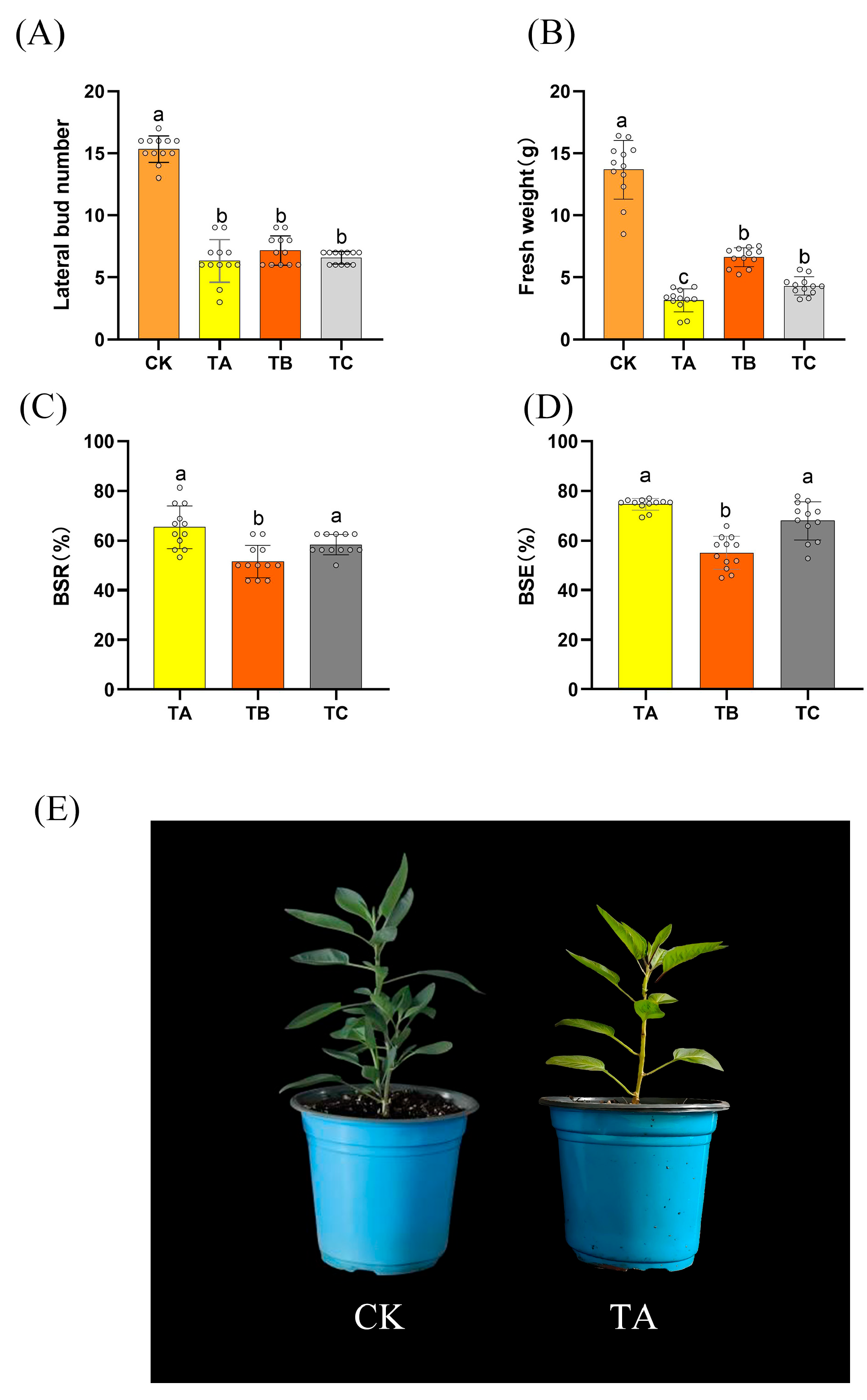
As shown in
Figure 1, under identical experimental conditions, the TA treatment exhibited the lowest lateral bud number (6.50 buds) and fresh weight (3.33 g), representing average reductions of 61.07% and 75.36%, respectively, compared to the control. Conversely, the CK treatment recorded the highest lateral bud number (16.7 buds) and fresh weight (13.52 g). Significant differences in both BSR and BSE were observed among the TA, TB, and TC treatments, with all treatments achieving suppression rates exceeding 50.00%. The TA treatment demonstrated the highest suppression efficacy (75.25%) and the highest suppression rate (61.00%), whereas the TB treatment showed the lowest suppression efficacy (47.75%) and the lowest suppression rate (52.00%).
These results indicate that all three plant growth regulator treatments effectively reduced lateral bud formation in pepino and enhanced both suppression efficacy and suppression rate, with TA delivering the most pronounced inhibitory effect.
3.3. Growth Parameters Analysis
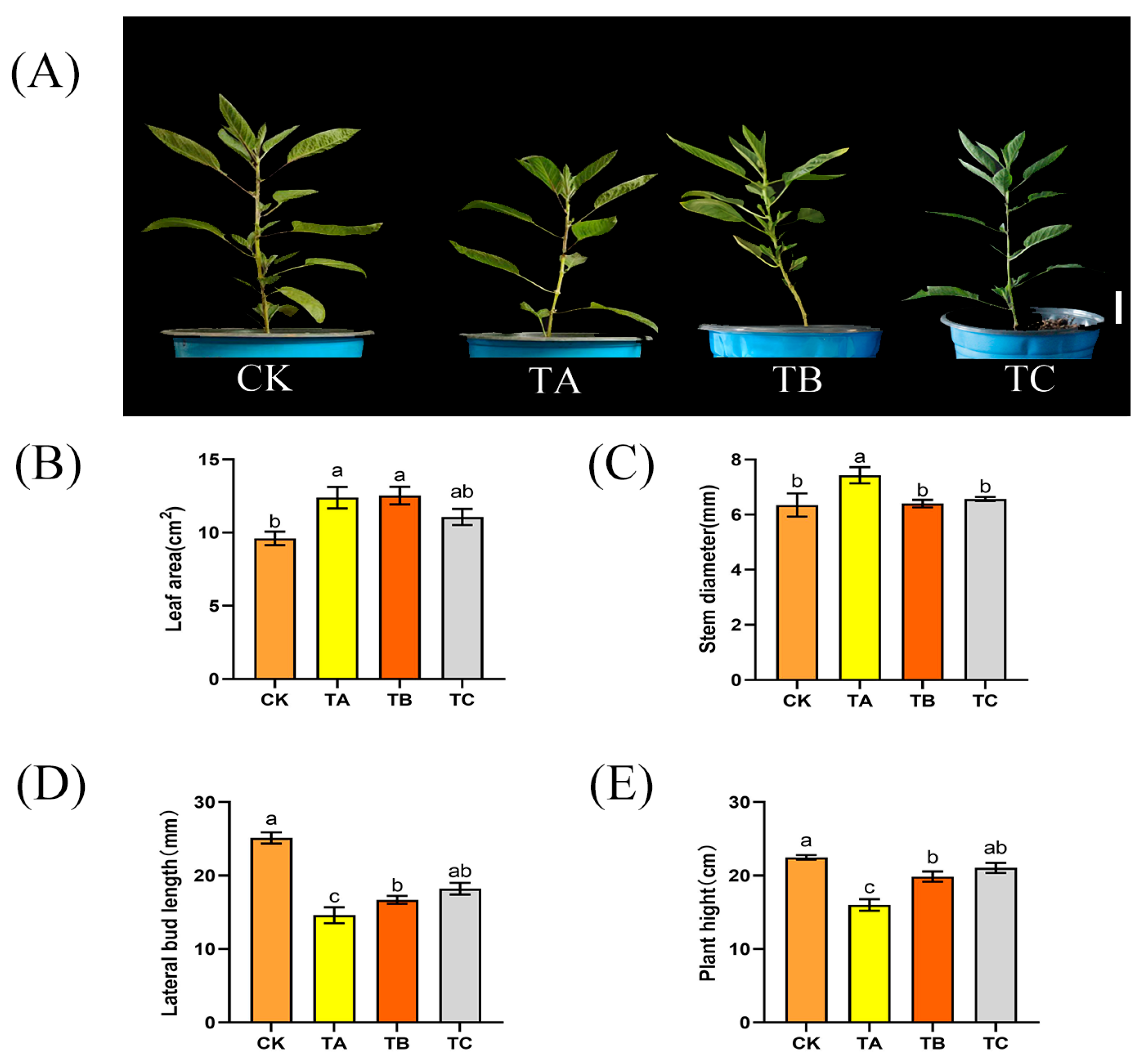
As shown in
Figure 2, treatments TA, TB, and TC exerted distinct and statistically significant effects on plant height, lateral bud length, stem diameter, and leaf area. Compared with the control (CK), all treated groups exhibited reduced plant height to varying degrees. The CK group displayed the greatest plant height (22.48 cm), whereas the TA treatment resulted in the shortest plants (16.00 cm). Relative to CK, plant height under TB and TC decreased by an average of 11.70% and 6.36%, respectively. Lateral bud length also differed significantly among treatments. Under identical conditions, TA produced the shortest lateral buds (14.60 mm), representing an average reduction of 41.90% compared to CK, which again showed the longest buds (25.13 mm).
In contrast, stem diameter responded positively to growth regulator application. The TA treatment yielded the thickest stems (7.43 mm), which was 14.5% greater on average than those of the other treatments and significantly higher than CK. Among the leaf areas of different treatments, the leaf areas of TA (12.39 cm2), TB (12.53 cm2), and TC (11.07 cm2) were significantly higher than that of CK (9.61 cm2), but there was no significant difference among the three treatment groups. The above research indicates that plant height, leaf area, stem diameter, and lateral bud length under the TA treatment were significantly higher than under the CK treatment. However, no significant differences were observed among the three treatment groups themselves.
Collectively, these findings indicate that TA treatment conferred superior performance across multiple physiological traits—resulting in significantly shorter plant height and lateral buds (desirable for apical dominance and disease mitigation), thicker stems, and larger leaf area—outperforming both TB and TC treatments.
3.4. Antioxidant Enzyme Activities and Lipid Peroxidation
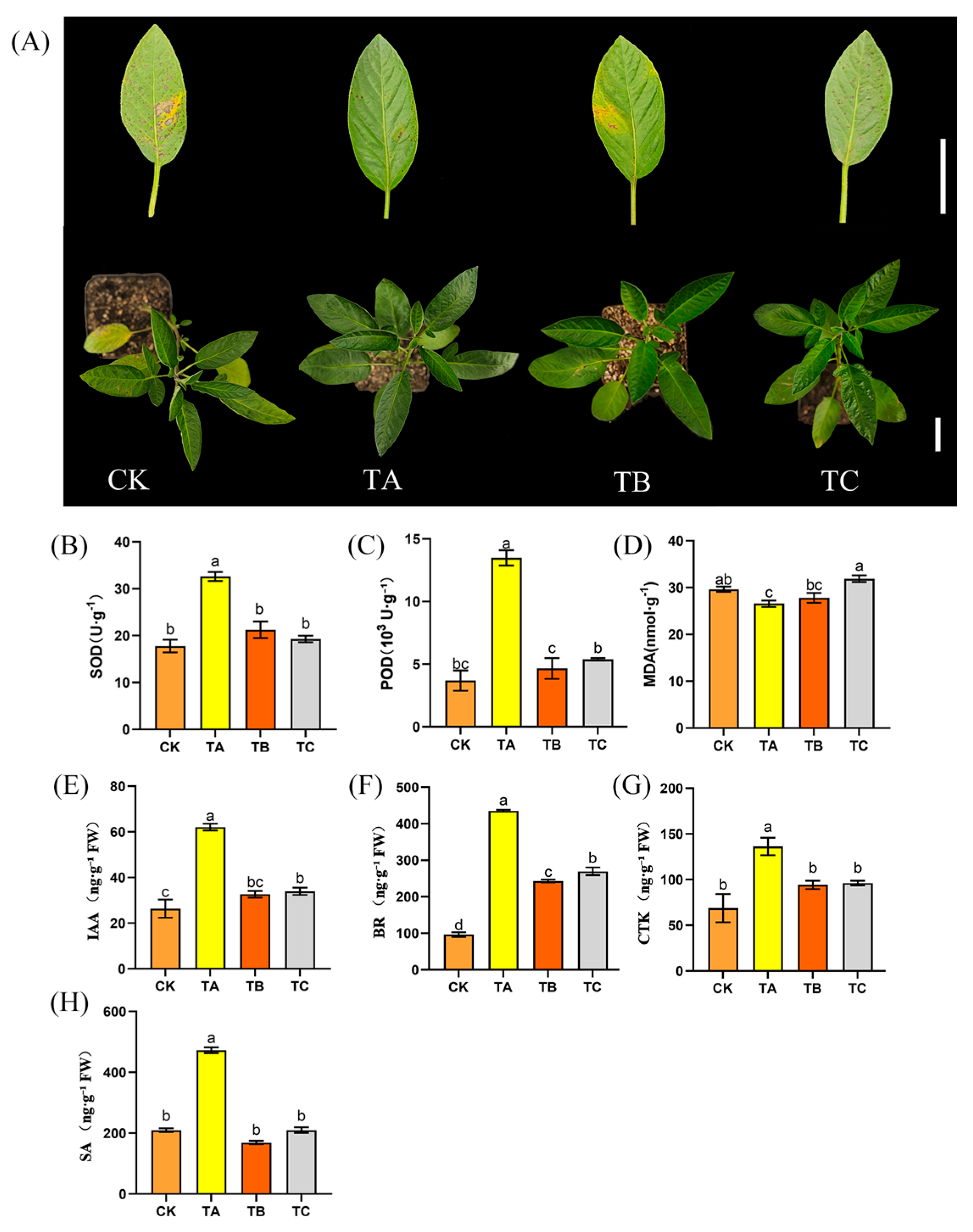
The lesion area of the leaf was measured using ImageJ software. As shown in
Figure 3, significant differences were observed among the different treatments (CK, TA, TB, TC) regarding lesion area on pepino leaves and the activity levels of disease resistance-related enzymes. The control group (CK) exhibited the largest lesion area (5.37 mm
2), whereas the lesion areas under the TA, TB, and TC treatments were all below 2.50 mm
2 with no significant differences among them, but significantly smaller than that of CK. This indicates that these treatments effectively inhibited lesion expansion.
Moreover, the activity levels of SOD and POD in the treatment groups were significantly higher compared to CK. Specifically, the SOD activity in the TA, TB, and TC treatments was higher than in CK, with TA showing the highest SOD activity at 32.63 U·g−1, significantly exceeding that of TB (21.25 U·g−1) and TC (19.27 U·g−1). The SOD activity in CK was the lowest at 17.77 U·g−1, representing an average decrease of 45.54% relative to TA. The POD activity level was notably higher in the TA treatment compared to other treatments, reaching 13.48 × 10³ U·g−1, while CK had the lowest POD activity at 3.69 × 10³ U·g−1. Interestingly, the MDA content was significantly higher in TC at 31.90 nmol·g−1, indicating a 7.61% increase over the baseline. In contrast, MDA contents in TA and TB were 26.57 nmol·g−1 and 27.81 nmol·g−1, respectively, which represented reductions of 10.36% and 6.17% compared to CK.
These results indicate that treatments TA, TB, and TC can effectively regulate physiological processes related to plant disease resistance, thereby reducing lesion area and demonstrating promising disease control effects. Additionally, TA treatment resulted in significantly higher levels of antioxidant enzyme activities compared to the other treatments, suggesting its superior performance in enhancing disease resistance through biochemical regulation.
3.5. Endogenous Hormone Levels Measurement
To investigate the impact of PGRs on the levels of endogenous hormones related to disease resistance in pepino, we measured the contents of IAA, brassinosteroids (BR), cytokinins (CTK), and SA in plant leaves under CK, TA, TB, and TC treatments. Most PGR treatments resulted in elevated hormone levels; however, the accumulation was not universal across all hormones and treatments. As shown in
Figure 3C, while significant differences were observed among many groups, no significant difference was detected between the CK and TB treatments for IAA, SA, and CTK. The TA treatment exhibited the most pronounced effect.
Specifically, following TA application, the concentrations of IAA, BR, CTK, and SA reached 62.09 ng·g−1 FW, 435.31 ng·g−1 FW, 136.29 ng·g−1 FW, and 472.57 ng·g−1 FW, respectively—values that were significantly higher than those in the CK, which measured 26.38 ng·g−1 FW, 96.50 ng·g−1 FW, 68.74 ng·g−1 FW, and 209.60 ng·g−1 FW. Consequently, the hormone levels in TA-treated leaves were 2.35×, 4.51×, 1.98×, and 2.25× those of the control, respectively. In contrast, while TB and TC treatments also increased levels of IAA, BR, and CTK contents relative to the control, their magnitudes of induction were consistently lower than those observed under TA treatment. Notably, the SA concentrations in the TB (168.85 ng·g−1 FW) and TC (209.94 ng·g−1 FW) treatment groups were markedly lower than in the control, indicating that these two PGR formulations failed to effectively induce SA accumulation and may even suppress its biosynthesis or stability under the experimental conditions.
The TA treatment led to significantly higher levels of SA and IAA compared to CK. Given their known involvement in plant defense, these hormonal changes may be associated with the enhanced disease resistance observed. However, as whole-leaf hormone concentrations do not necessarily reflect bioactive pools or signaling activity, the exact mechanistic contribution of SA and IAA remains to be determined.
In summary, the TA treatment not only effectively elevates key endogenous hormone levels but also suggests a promising approach to improving disease resistance in pepino by possibly leveraging the enhanced production of IAA and SA.
3.6. Validation of Disease Resistance Mediated by SA and IAA Under Detached Inoculation Conditions
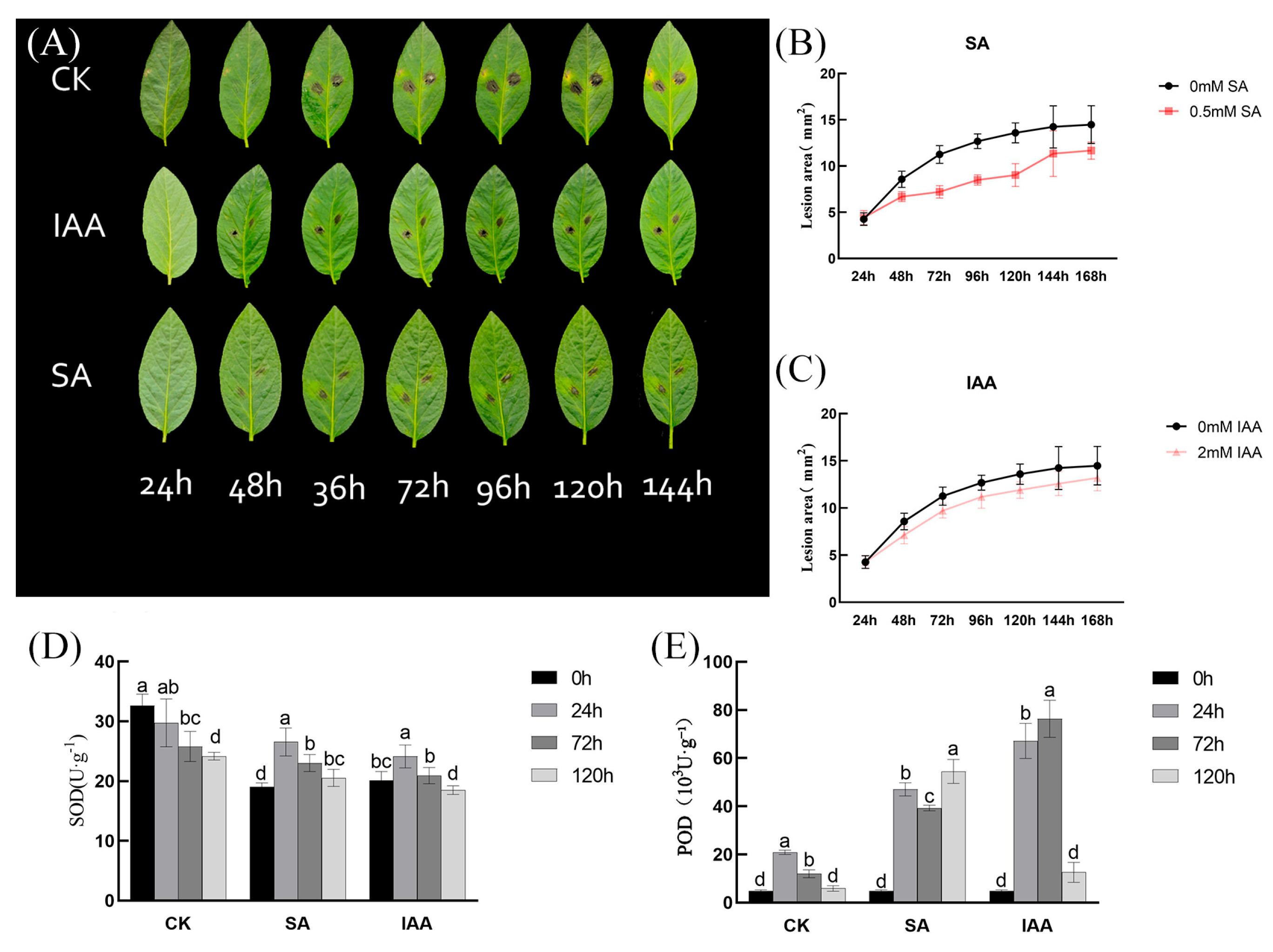
As shown in
Figure 4, the lesion area on detached pepino leaves treated with 0.5 mM SA and 2 mM IAA exhibited a generally increasing trend over 7 days, though the rate and extent of expansion were modulated by hormone treatment. In the control group (0 mM SA), the lesion area progressively expanded and reached approximately 15 mm
2 at 168 h. By contrast, treatment with 0.5 mM SA significantly suppressed lesion development, with the lesion area stabilizing at around 12 mm
2 at 168 h—a clear attenuation compared to the control. Similarly, in the IAA assay, the lesion area in the 0 mM IAA control also reached 15 mm
2 by 168 h, whereas application of 2 mM IAA reduced lesion expansion to approximately 13 mm
2 at the same time point. These results demonstrate that exogenous application of appropriate concentrations of SA or IAA can effectively and persistently suppress pathogen-induced lesion expansion through modulation of plant defense physiology.
Furthermore, the activities of key antioxidant and stress-related enzymes—SOD, POD were differentially regulated across treatments (CK, SA, IAA) and time points (0 h, 24 h, 72 h, 120 h). Specifically, SOD activity declined over time in the CK group, peaked at 24 h in the SA-treated group, and remained relatively stable across all measured time points under IAA treatment. POD activity was markedly elevated in the SA group at 24 h, 72 h, and 120 h, while in the IAA group, POD activity peaked at 72 h; overall, CK exhibited consistently low POD activity.
Collectively, these findings confirm that both SA and IAA enhance disease resistance in pepino not only by directly limiting lesion expansion but also by dynamically modulating the plant’s antioxidant and phenylpropanoid defense pathways. The sustained suppression of disease symptoms, coupled with the hormone-specific induction patterns of SOD and POD, underscores the critical roles of SA and IAA in orchestrating temporal and biochemical defenses against pathogen attack.
4. Discussion
Alternaria spp. primarily suppress host immune responses or facilitate infection by secreting a diverse array of effector proteins. Recent studies have identified AsCEP50 as a critical virulence factor; upon secretion into host cells, this protein localizes to the plasma membrane, where it induces leaf chlorosis by modulating host senescence-associated genes, while simultaneously influencing melanin biosynthesis and penetration capability in the pathogen itself [
32]. In tomato, exogenous application of azelaic acid (Aza) significantly enhances resistance to early blight caused by
A. solani. During the early stages of infection, Aza treatment induces a marked increase in POD activity and MDA content, accompanied by substantial accumulation of SA. These findings suggest that Aza-induced resistance relies on a complex antioxidant response system and the synergistic regulation of SA and jasmonic acid (JA) signaling pathways [
33].
Compared to major Solanaceae crops like tomato (
Solanum lycopersicum) and potato (
Solanum tuberosum), research on the Alternaria disease of pepino remains limited. Existing evidence shows that a complex pathogen causes early blight of tomato and potato made up of both macrospore and microspore species, with some strains capable of infecting multiple hosts [
34].
Strigolactones (SLs) are key hormones regulating axillary bud germination, maintaining plant apical dominance by inhibiting lateral bud growth. Research indicates that the SL signaling pathway interacts with the cytokinin pathway in the regulation of lateral bud development, with both pathways targeting TCP transcription factors; in addition, SLs are involved in regulating the polar transport of auxins [
35]. Besides regulating plant architecture, SLs are widely involved in plant responses to biotic and abiotic stresses. For example, in Arabidopsis thaliana, SLs can enhance plant disease resistance by positively regulating SA accumulation [
36].
Lateral bud growth can influence plant stress resilience by altering the allocation of biomass between the main stem and lateral branches [
37]. Consistent with this, our field survey revealed that the disease incidence and DI in the naturally grown (non-pruned) group increased significantly over time compared to the manually de-budded group, indicating that reducing lateral buds effectively enhances disease resistance (
Table 1).
Subsequent pot experiments further compared the control (CK) with TA, TB, and TC treatments (
Figure 1). Results showed that PGRs application significantly increased stem diameter and leaf area relative to CK. This response may be attributed to the expansion of leaf area, which enhances light interception and photosynthetic efficiency [
38,
39], thereby promoting greater biomass allocation to the main stem and resulting in increased stem thickening—a pattern consistent with findings reported by Das et al. [
40]. The use of PGRs also increased the leaf area index and optimized canopy architecture, leading to a pronounced positive effect on overall plant growth—findings that align with Liang’s research [
26]. Despite the limitations of our study in whole-leaf hormone measurement and the possibility of secondary effects, the accumulation of endogenous SA and IAA, as well as the enhancement of disease resistance after exogenous application of these hormones, suggest that they may be key mediators in PGR-mediated early disease resistance enhancement in Pepino. Further verification of their causal mechanisms is needed in the future.
Notably, while plant height was significantly reduced in all PGR-treated groups compared to CK, stem diameter was markedly increased. This morphological shift likely results from the more compact plant architecture induced by PGRs, driven by expanded leaf area and altered resource allocation [
26]. Moreover, both lateral bud length and bud number were significantly lower in all treatment groups than in CK, confirming that all three PGRs effectively suppress lateral bud development—a result consistent with Zhu et al. [
41].
In our study, the fresh weight of lateral buds was significantly lower in all PGR-treated groups compared to CK, accompanied by high BSR and BSE. This implies that PGRs may reallocate assimilates away from lateral buds toward the main stem or other sink tissues, thereby reducing lateral bud growth while enhancing systemic stress resilience. Collectively, these findings indicate that PGR-mediated modulation of source–sink dynamics not only suppresses unwanted vegetative growth but also strengthens the plant’s overall defense capacity against biotic and abiotic stresses.
Plant hormone systems play a pivotal role in mediating plant responses to abiotic and biotic stresses by coordinately regulating growth, development, and environmental adaptability—a process that typically relies on the synergistic action of multiple phytohormones [
42,
43]. Under stress conditions, plants mitigate oxidative damage caused by ROS accumulation through the integrated action of antioxidant defense systems and osmotic regulation mechanisms [
44]. The antioxidant system comprises both enzymatic components—such as SOD, POD, and GR—and non-enzymatic antioxidants [
45]. Consistent with Hartikainen and Hussain, who reported that exogenous chemicals enhance SOD and POD activities to alleviate abiotic stress via improved ROS scavenging, our study also observed elevated activities of these antioxidant enzymes following PGR treatment [
46]. Excessive ROS accumulation disrupts cellular membrane integrity, leading to increased relative electrolyte leakage, which correlates positively with ROS levels. Beyond this physical damage, such membrane compromise and the associated redox imbalance likely disturb cell-to-cell communication by interfering with key signaling hubs (e.g., MAPK and phytohormone crosstalk) and altering the balance between cell types through the induction of programmed cell death or hypersensitive responses [
47]. Hu and Chen reported that endogenous hormone dynamics in
Setaria viridis (L.) Beauv leaves are critically involved in stress tolerance, as revealed by correlation analyses [
48].
In the present study, under early blight inoculation, PGR-treated plants exhibited significantly reduced lesion areas, markedly elevated SOD and POD activities, and substantially lower MDA content compared to the control. Notably, the TA treatment—which achieved the highest BSR and BSE—also displayed the strongest induction of SOD and POD activity, consistent with findings by Kaya et al. [
37]. Furthermore, PGR application upregulated endogenous hormone levels in pepino leaves relative to CK, with TA inducing the most significant increases in IAA, BR, CTK, and SA, which were significantly higher than those observed under TB or TC treatments.
To identify the key hormones responsible for the observed resistance, we selected IAA and SA—two hormones showing the most pronounced differential responses—for functional validation. Detached-leaf assays confirmed that treatment with 2 mM IAA or 0.5 mM SA significantly suppressed lesion expansion compared to the water control (
Figure 4). Indicating a dynamic, hormone-mediated activation of defense responses. These results strongly support the central roles of SA and IAA in disease resistance and ROS modulation, aligning with the work of Shukla and Kaushik [
49,
50]. Collectively, this suggests that plants may alleviate pathogen-induced oxidative stress by activating both enzymatic and non-enzymatic antioxidant systems. Under PGR-mediated lateral bud suppression, this antioxidant enhancement likely contributes significantly to improved disease resistance.
Although the direct interaction mechanism between the dinitroaniline PGRs used in this study and the SLs pathway has not been clearly reported, considering the crucial role of SLs in regulating lateral bud growth and the effects of dinitroaniline PGRs on cell division and plant morphology, it is speculated that there may be an indirect or synergistic interaction between the two. Future research could delve into the effects of dinitroaniline PGRs on SLs biosynthetic gene expression, signal component activity, and their balance with other hormones such as auxins.



 ,
,