Article

Endophytic and Diazotrophic Bacterial Diversity in Pisum sativum Root Nodules Across Southwest China’s Rocky Desertification Gradients


1
College of Biological Science and Food Engineering, Southwest Forestry University, Kunming 650224, China
2
Forestry College, Southwest Forestry University, Kunming 650224, China
3
College of Dai Medical, West Yunnan University of Applied Sciences, Jinghong 666100, China
*
Author to whom correspondence should be addressed.
These authors contributed equally to this work.
Horticulturae 2026, 12(3), 323; https://doi.org/10.3390/horticulturae12030323
Submission received: 16 January 2026 / Revised: 25 February 2026 / Accepted: 27 February 2026 / Published: 9 March 2026
(This article belongs to the Section Biotic and Abiotic Stress)

Abstract

Background: The adaptability of leguminous plant–rhizobia symbionts enables enhanced plant stress tolerance in environmentally stressed areas. However, how rock desertification (RD) severity affects the endophytic and nitrogen-fixing bacterial communities in Pisum sativum root nodules remains unclear. Methods: We systematically surveyed the microbial communities of P. sativum nodules across a gradient of four RD areas. We sequenced 16S rRNA and nifH amplicons, determined soil physicochemical properties, and performed bioinformatic analyses to relate nodule microbiome diversity to soil variables. Results: The dominant endophytic genera across all sites were AllorhizobiumNeorhizobiumPararhizobiumRhizobium and Pseudomonas, with Rhizobium identified as the primary nitrogen-fixing taxon. Soil pH and total phosphorus (TP) showed significant correlations with the overall endophytic bacterial community, whereas total nitrogen (TN), TP, and soil water content (SWC) were associated with nitrogen-fixing taxa. Notably, P. sativum nodules from areas of slight rocky desertification (SRD) harbored higher endophytic bacterial diversity and enhanced carbohydrate metabolism compared to those from moderately rocky desertified (MRD) sites. Conclusions: This study sheds light on how bacterial communities within legume root nodules respond to RD stress, deepening our understanding of plant–microbe co-adaptation and informing microbial-assisted restoration strategies in karst desertification areas.

1. Introduction

The symbiotic association between leguminous plants and nitrogen-fixing rhizobia ranks among the most efficient biological nitrogen fixation (BNF) systems in nature [1]. It plays a critical role in sustaining the global nitrogen cycle and promoting sustainable agriculture [2]. This symbiosis is characterized by root nodule formation, within which rhizobia convert atmospheric nitrogen into plant-available ammonia, thereby directly promoting host plant growth [3,4]. Beyond reducing dependence on chemical fertilizers and mitigating associated environmental impacts such as eutrophication and soil degradation [5,6], nitrogen-fixing bacteria further enhance plant fitness through multiple indirect mechanisms [7,8]. These include improving stress tolerance, producing phytohormones, and facilitating nutrient acquisition [9,10].
Rocky desertification (RD) represents a severe form of land degradation characterized by vegetation loss, intense soil erosion, and extensive bedrock exposure [11,12]. This phenomenon stems from the interplay between unsustainable human activities and inherent vulnerabilities of karst ecosystems, including carbonate rock dissolution, limited soil formation, and regional climate extremes such as seasonal heavy rainfall and temperature fluctuations [13,14]. As a global environmental challenge, RD is most pronounced in the karst regions of southwestern China. In areas such as Honghe Prefecture, Yunnan Province, RD has led to a severe decline in land productivity, intensified soil erosion, and substantial threats to both ecological security and local livelihoods [15].
Traditional crops often struggle to survive in such poor soils and under drought conditions, highlighting the urgent need for alternative agricultural models that can balance ecological restoration with economic benefits [16]. Given their multifaceted benefits, introducing legumes into RD areas holds considerable promise for sustainable agroecology. Among these, Pisum sativum emerges as a suitable candidate: its symbiotic nitrogen fixation functions as an in situ biofertilizer, essential for karst soils, and further enriches the nitrogen pool through residue return [17,18]. Additionally, P. sativum exhibits drought tolerance and extensive root systems that contribute to soil and water conservation [19]. If successfully introduced into karst areas, P. sativum’s tolerance to marginal soils may provide food and economic benefits for local communities while improving ecosystem services [20,21,22].
Realizing this potential requires understanding how the symbiotic nitrogen-fixing system responds to RD stress. Studies indicate that stresses such as soil degradation and drought alter nitrogen-fixing microbial community structure in legumes and reduce rhizobial diversity [23]. In karst areas, RD intensity is a key driver of soil and rhizosphere microbial composition [24,25]. However, understanding of symbiotic nitrogen fixation in degraded habitats has been limited to the soil or rhizosphere scale [26], whereas response mechanisms of root nodules—the critical microenvironment for this process—and their internal host-specific endophytic microecosystems under RD stress remain poorly understood. Specifically, two key issues regarding P. sativum root nodules in karst RD environments remain to be elucidated: (i) What is the composition and stability of the core bacterial community within nodules beyond primary symbionts? (ii) How does the entire endophytic community (symbiotic and non-symbiotic) undergo successional reorganization along RD gradients? Therefore, this study investigates the diversity and succession of these communities within P. sativum root nodules across RD gradients in the karst regions of southwest China. We hypothesize that (i) increasing RD severity drives directional shifts in the P. sativum nodule microbiome, characterized by declining nitrogen-fixing symbionts and rising abundance of stress-tolerant taxa, and (ii) this succession is mediated by soil environmental factors along the RD gradient, with stage-specific drivers (e.g., nutrient limitation vs. water stress).

2. Materials and Methods

2.1. Study Site

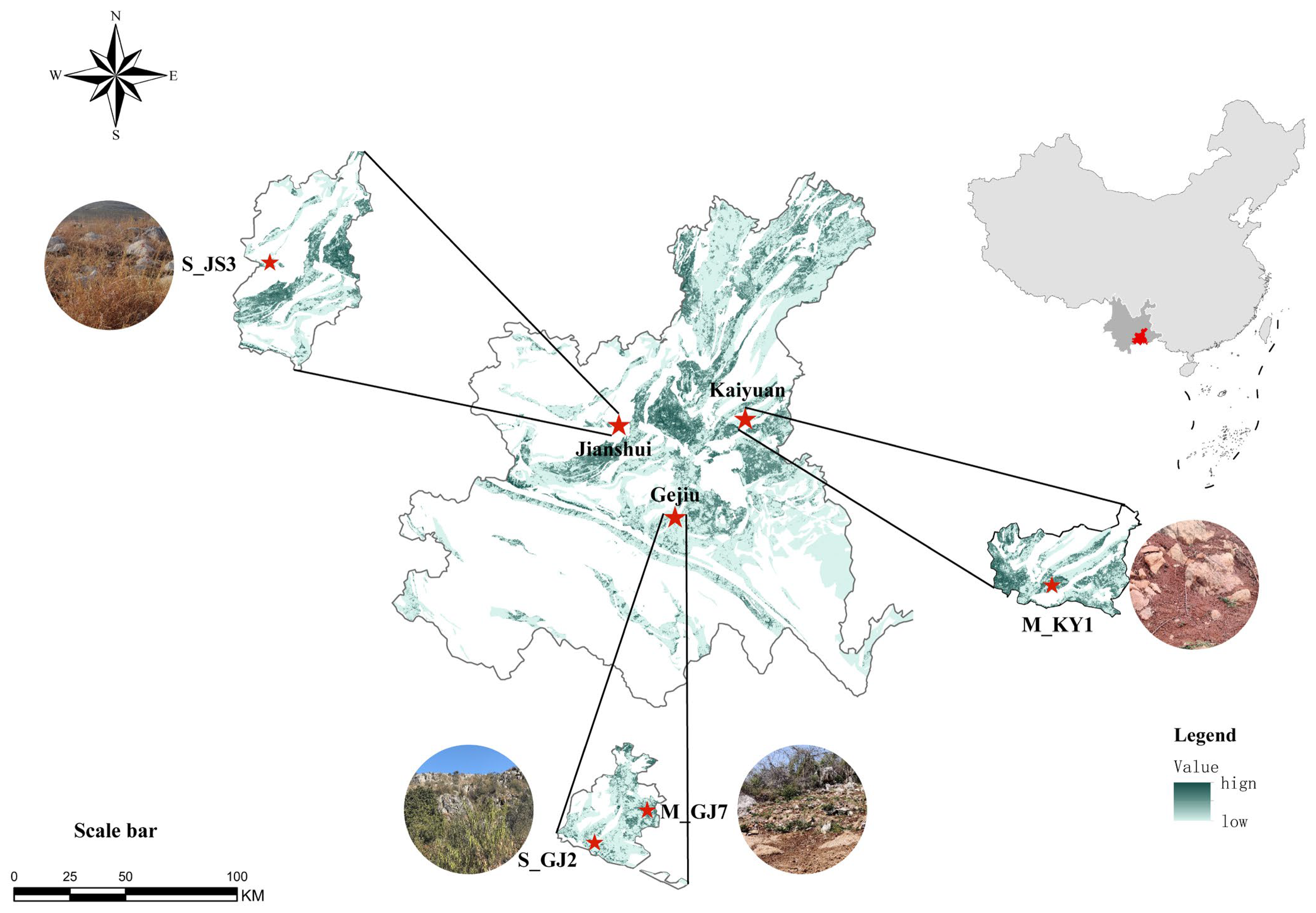
The experimental materials were gathered from P. sativum in distinct RD areas within Honghe Prefecture, specifically from the Gejiu, Jianshui, and Kaiyuan regions. As per the research conducted by Dai Quanhou and other scholars, when the bedrock exposure rate ranges from 30% to 50%, it is categorized as SRD; when it is between 50% and 70%, it is classified as MRD; and when it falls within the range of 70% to 100%, it is regarded as severe RD [27,28]. Among these areas, S_GJ2 and S_JS3 were identified as being slightly affected by RD, whereas M_GJ7 and M_KY1 were considered to be moderately affected. For each group of samples, three biological replicates were set up, yielding a total of 12 samples. Geographic coordinates of all sampling sites are given in Figure 1. The map was generated with ArcGIS 10.8 (Esri, Redlands, CA, USA; https://www.esri.com, and RD distribution data were obtained from the Data Center for Resources and Environmental Sciences, Chinese Academy of Sciences (RESDC, CAS, Beijing, China; https://www.resdc.cn). Detailed site metadata are listed in Table 1.

2.2. Sample Collection

Whole P. sativum plants were meticulously excavated with a sterile shovel. Plants featuring well-developed root nodules, intact morphologies, and relatively larger overall sizes were chosen. The root systems of the selected plants were detached and placed into sterile cryogenic vials, which were then stored in liquid nitrogen for transportation to the laboratory. The root nodules underwent surface sterilization in accordance with the methods established by Qi et al. and were subsequently packed into sterile cryogenic vials for the extraction of total DNA from endophytic bacteria [29].
Rhizosphere soil sampling: Large soil clumps were carefully removed from the P. sativum root system. Soil adhering closely to the roots, specifically within the 0–2 mm range, was collected as rhizosphere soil. The detached soil was transferred into sterile bags for subsequent analysis of soil physicochemical properties.

2.3. Measurement of Soil Environmental Factors

Soil physicochemical variables, including soil pH, SWC, TN, AN, TP, and AP, were determined in accordance with the protocols outlined in Bao Shidan’s Soil Agrochemical Analysis [30]. Soil pH was measured using a pH meter (Leici PHS-3C, Shanghai INESA Scientific Instrument Co., Ltd., Shanghai, China) at a water-to-soil ratio of 2.5:1. TN was analyzed via the Kjeldahl method, while AN was analyzed using the diffusion–absorption method. TP was determined through colorimetry with the molybdenum–antimony method, subsequent to ultraviolet (UV) digestion. AP was extracted using 0.5 M NaHCO3 and measured colorimetrically. SWC was obtained gravimetrically after oven-drying the samples at 105 °C for 24 h. Each sample was subjected to three biological replicates.

2.4. Samples: DNA Extraction and Sequencing

The total genomic DNA of endophytic bacteria within the root nodules of P. sativum was extracted with the HiPure Soil DNA Extraction Kit (Magen, Guangzhou, China), which has been optimized for the isolation of high-quality genomic DNA from soil specimens. Subsequently, the extracted DNA was subjected to 2% agarose gel electrophoresis analysis to validate its integrity and quantify its amount.
Genomic DNA served as the template for the amplification of the V5–V7 region of the 16S rRNA gene using primers 799F (AACMGGATTAGATACCCKG) and 1193R (ACGTCATCCCCACCTTCC). Polymerase chain reaction (PCR) was conducted in 30 μL reaction volumes under the following thermal cycling profile: an initial denaturation step at 95 °C for 5 min; 30 cycles consisting of 95 °C for 1 min, 60 °C for 1 min, and 72 °C for 1 min; followed by a final extension at 72 °C for 10 min. Each sample underwent amplification in triplicate. The PCR products were visualized on 2% (w/v) agarose gels, purified using the AxyPrep DNA Gel Extraction Kit (Axygen Biosciences, Union City, CA, USA), and quantified with the ABI StepOnePlus Real-Time PCR System (Life Technologies, Foster City, CA, USA). The purified amplicons were subjected to paired-end sequencing (2 × 250 bp) on the Illumina MiSeq platform (Illumina MiSeq platform, Illumina, Inc., San Diego, CA, USA; sequencing service provided by GENE DENOVO, Guangzhou, China) in accordance with the manufacturer’s standard protocols.

2.5. High-Throughput Sequencing of the Nitrogen-Fixase (nifH) Gene

2.5.1. PCR Amplification

nifH amplicon sequencing characterized the potential of diazotrophs in P. sativum nodules. Note that this identifies organisms with nifH but does not quantify nitrogen fixation rates. The nifH gene region was amplified from the extracted genomic DNA using the specific primers nifH-F (5′-AAAGGYGGWATCGGYAARTCCACCAC-3′) and nifH-R (5′-TTGTTSGCSGCRTACATSGCCATCAT-3′). The PCR mixture had a total volume of 30 μL, containing the following components: 1× PCR buffer, 0.2 mM of each dNTP, 1.5 mM MgCl2, 0.2 μM of each primer, approximately 50 ng of template DNA, and 1.25 U of a high-fidelity DNA polymerase.
The amplification was performed in a thermal cycler under the following program: initial denaturation at 95 °C for 3 min to ensure complete DNA strand separation, followed by 30 cycles of denaturation at 95 °C for 30 s, primer annealing at 60 °C for 30 s, and extension at 72 °C for 42 s, with a final extension at 72 °C for 10 min to ensure complete amplification of all fragments and the addition of adenine overhangs. Each sample was amplified in triplicate to ensure technical reproducibility and minimize pipetting errors.

2.5.2. Amplicon Verification and Library Preparation

Following amplification, the PCR products (amplicons) were first verified for successful amplification and specificity by electrophoresis on a 2% (w/v) agarose gel. After qualitative analysis, the amplicons were purified to remove primers, primer dimers, and other enzymatic reaction components. The purified amplicons were then quantified using the QuantiFluor™-ST Blue Fluorescence System (Promega Corporation, Madison, WI, USA) to ensure accurate and uniform loading for library construction.
Subsequently, Illumina sequencing libraries were constructed according to the standard protocol. This process included end repair, addition of an ‘A’ base at the 3′ end, adapter ligation (using Illumina-compatible adapters), and index PCR amplification with unique index primers to distinguish different samples. Finally, the quality-assessed libraries were subjected to paired-end sequencing (2 × 250 bp) on the Illumina MiSeq platform (Illumina MiSeq platform, Illumina, Inc., San Diego, CA, USA; sequencing service provided by GENE DENOVO, Guangzhou, China).

2.6. Bioinformatic and Statistical Analyses

2.6.1. Sequence Data Processing

Raw sequencing reads were quality-controlled using FASTP v0.23.2 with the following parameters: Phred quality score ≥ 20, minimum read length 150 bp, and maximum ambiguous bases (N) ≤ 2. Paired-end reads were then merged using FLASH v1.2.11 with parameters set to ≥10 bp overlap and <0.2 mismatch rate to generate raw tags. The merged sequences were retained for downstream analysis if they met the following criteria: length between 250 and 500 bp, mean quality score ≥ 20, and no ambiguous bases (N).

2.6.2. OTU Clustering and Taxonomic Annotation

The UPARSE algorithm (v7.0.1090) was employed to cluster high-quality sequences into operational taxonomic units (OTUs) at 97% sequence identity threshold. During the clustering process, singleton OTUs (OTUs represented by only one sequence) and chimeric sequences were removed using the built-in chimera detection method. The most abundant sequence within each OTU was selected as the representative sequence for subsequent analyses. Taxonomic classification of OTU representative sequences was performed using the Ribosomal Database Project (RDP) classifier v2.11 with a bootstrap confidence threshold of 0.8. The classification was based on the FunGene v7.3 functional gene database, which provides comprehensive coverage of nitrogen-fixing microorganisms.

2.6.3. Diversity Analysis

Alpha diversity indices, including Chao1, Shannon, Simpson, ACE, and Sobs, were calculated to assess the richness and diversity of microbial communities within each sample. Beta diversity analysis was conducted based on Bray–Curtis dissimilarity matrices, and the results were visualized using principal coordinates analysis (PCoA) and non-metric multidimensional scaling (NMDS) to examine the differences in microbial community structure among samples.

2.6.4. Functional Prediction

Functional potential was inferred using PICRUSt2 (v2.5.3) [31], mapping 16S rRNA-derived amplicon sequence variants (ASVs) against the Integrated Microbial Genomes (IMG) database reference phylogeny to infer KEGG pathway abundances. Prediction reliability was assessed via the Nearest Sequenced Taxon Index (NSTI; mean ± SD: 0.010 ± 0.006; range: 0.003–0.025, N = 12), where N denotes the total number of samples. All values were well below the 0.15 high-confidence threshold [32], indicating close phylogenetic proximity to reference genomes. Complementary functional annotations were performed with BugBase (v1.0) [33] for bacterial phenotype classification and FAPROTAX (v1.2.10) [34] for ecological function profiling. Note: PICRUSt2 predictions represent computationally inferred metabolic potentials subject to reference genome availability; BugBase and FAPROTAX annotations provide phenotypic and ecological context, respectively.

2.6.5. Statistical Analysis of Environmental and Microbial Data

All statistical analyses were performed in R (v. 4.4.2) and SPSS (v. 25.0). Normality and homogeneity of variance were tested. One-way ANOVA with Tukey’s HSD post hoc test assessed differences in soil physicochemical properties and microbial indices among sites. For community–environment analyses, we Hellinger-transformed OTU tables and log(x + 1)-transformed environmental variables. Detrended correspondence analysis (DCA) indicated gradient lengths < 4 SD, supporting linear methods (RDA) over unimodal methods (CCA). Environmental predictors were screened by variance inflation factor (VIF < 10) and forward selection (AIC); pH, TP, SWC, and RD were retained for the 16S rRNA dataset, and TN, TP, and SWC for the nifH dataset. RDA and db-RDA were performed with 999 permutations. Environmental factor fits were assessed by envfit (R2, 999 permutations). Ordination biplots were generated in ggplot2. Mantel tests evaluated correlations between community dissimilarity (Bray–Curtis) and environmental distance (Euclidean). Spearman correlation examined associations between α-diversity indices and individual soil properties. Given the small sample size (N = 12) and exploratory nature, p-values are reported without multiple-testing correction and interpreted descriptively rather than as confirmatory evidence. All tests were two-tailed with α = 0.05.

3. Results

3.1. Soils at Different Levels of RD Severity Exhibit Distinct Physicochemical Properties

The physical and chemical properties of soil taken from four sites (Figure 1) in Honghe Prefecture showed that there were significant differences in soil physical and chemical properties on the RD gradient. Four sampling sites showed different soil profiles (Table 2). Soil physicochemical analysis revealed significant spatial heterogeneity among the four sampling sites. Among them, site M_GJ7 exhibited superior nitrogen status, with TN and AN contents (1.67 g kg−1 and 267.63 mg kg−1, respectively) significantly higher than those at other sites (p < 0.05; one-way ANOVA with Tukey’s HSD test). Specifically, the TN content at M_GJ7 was 4.4 to 11.1 times that of the other sites, while the AN content was 1.2 to 5.9 times greater. Site S_JS3 had high pH (7.98), available phosphorus (AP) (42.81 mg kg−1), and soil water content (SWC, 21.59%); Site S_GJ2 showed low TN and AP but sufficient AN. M_KY1 exhibits low levels of most nutrients except for AP, which is abundant. Pearson correlation analysis across all samples revealed significant negative correlations between AP and TP (r = −0.654, p = 0.021), as well as between AP and AN (r = −0.686, p = 0.014) (Table A1). This pattern suggests that phosphorus availability in these karst soils may be constrained under conditions of higher total P and N, possibly reflecting enhanced P fixation. The spatial heterogeneity in these soil properties (e.g., the decoupling between AP and TP/AN pools) likely serves as a key driver of microbial community variation across the RD gradient.

3.2. Responses of P. sativum Root-Nodule Endophyte Community Structure and Diversity to Karst RD Severity

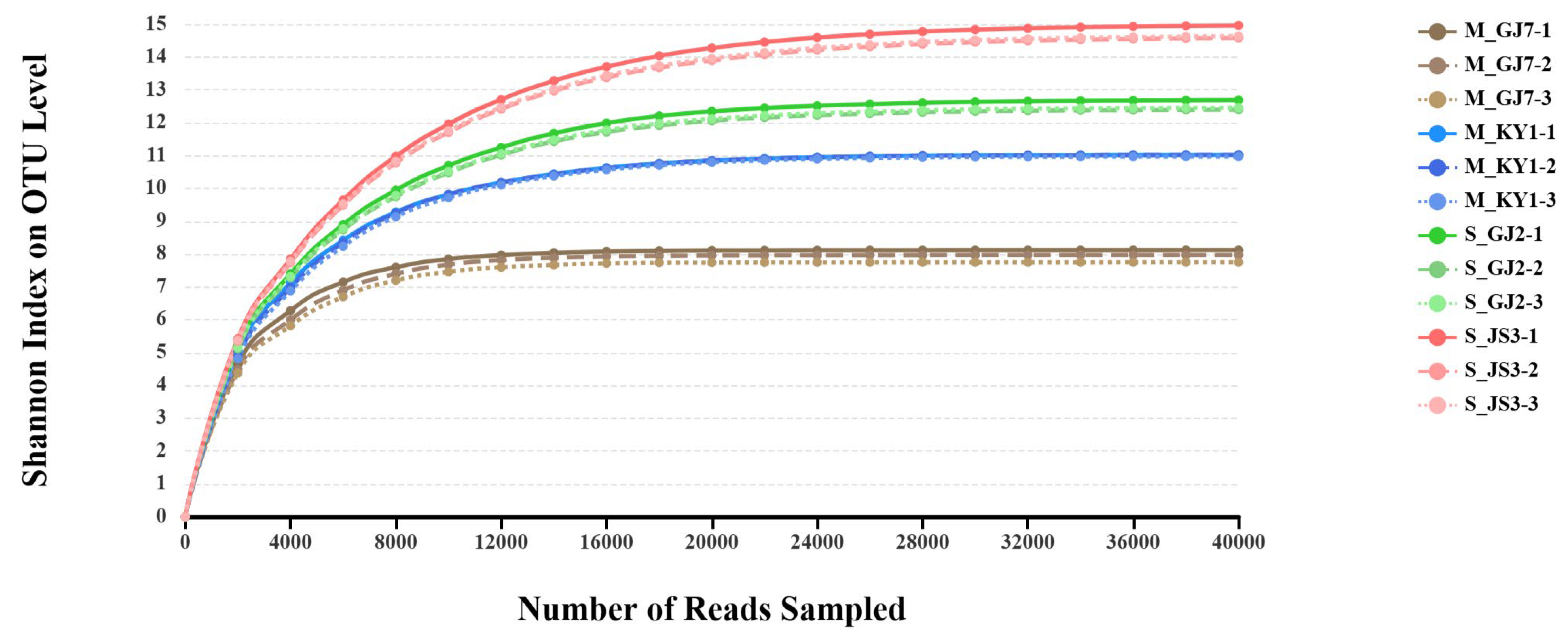
To characterize P. sativum nodule endophytes, we used Illumina MiSeq to sequence the 16S rRNA gene. After rigorous quality filtering and chimera removal, 1,227,508 high-quality valid reads were retained across all 12 samples (an average of ~102,292 reads per sample) for downstream analysis. The raw data have been deposited in NCBI (NCBI: PRJNA1387156). At 97% similarity, these reads were clustered into 300 OTUs. The rarefaction curve confirmed sufficient sequencing depth (Figure A1).
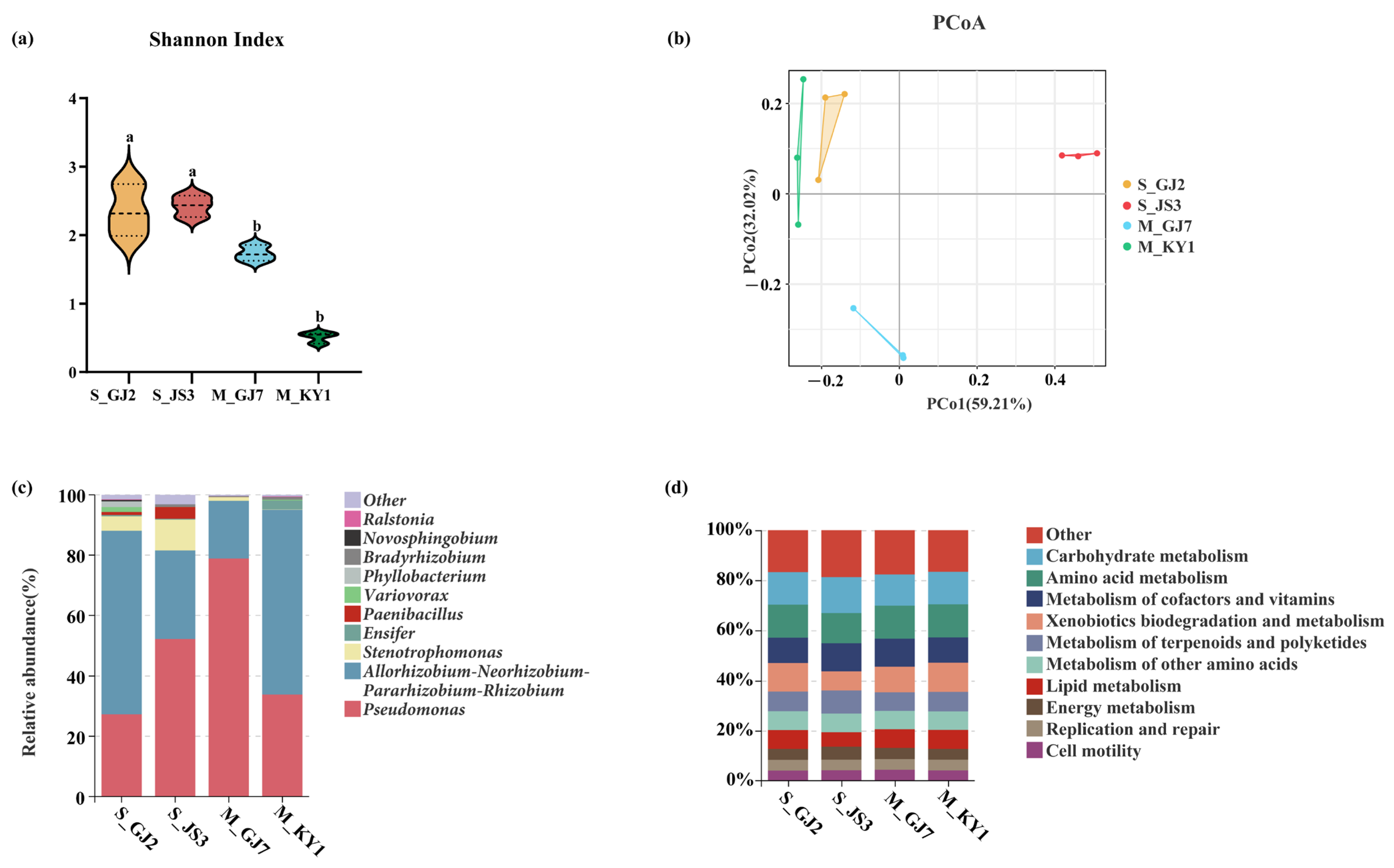
Comparison of α-diversity revealed significant differences among sites. The Shannon indices were significantly higher in SRD sites (S_GJ2 and S_JS3) than in MRD sites (M_GJ7 and M_KY1), with a difference of 1.36–1.68 units (p < 0.05, Figure 2a).
To identify environmental factors associated with this diversity pattern, we performed correlation analysis. Both the Shannon and Simpson indices showed significant positive correlations with SWC and significant negative correlations with RD severity (Table 3). These results suggest that root-nodule endophytic bacterial diversity is positively linked to soil moisture availability but declines as RD intensifies.
β-diversity analysis revealed distinct community structures among samples. PCoA based on Bray–Curtis distance (Figure 2b) showed that PCo1 and PCo2 explained 59.2% and 32.0% of the variation, respectively, cumulatively accounting for 91.2% at the OTU level. Replicates from S_GJ2 and M_KY1 clustered most closely, indicating highly similar endophytic communities, and both were clearly separated from M_GJ7 and S_JS3 (ANOSIM: R = 0.73, p = 0.001), confirming substantial between-group differences. Thus, community composition varied markedly among regions.
At the genus level (Figure 2c), the endophytic bacterial community within root nodules was predominantly composed of AllorhizobiumNeorhizobiumPararhizobiumRhizobium and Pseudomonas. Specifically, the AllorhizobiumNeorhizobiumPararhizobiumRhizobium group dominated in sites S_GJ2 (52.3%) and M_KY1 (59.8%), whereas Pseudomonas exhibited the highest relative abundance in M_GJ7 (67.3%) and S_JS3 (16.7%). Notably, the relative abundance of Pseudomonas demonstrated a clear response to the environmental gradient: it was lower in SRD sites S_GJ2 (25.2%) and S_JS3 (16.7%), but significantly higher in MRD sites M_GJ7 (67.3%) and M_KY1 (33.0%). Correlation analysis further supported this pattern, revealing a significant positive correlation between the abundance of Pseudomonas and the degree of RD (r > 0, p < 0.01), indicating its strong tolerance to environmental stress. In contrast, AllorhizobiumNeorhizobiumPararhizobiumRhizobium, known for its nitrogen-fixing capacity, forms symbiotic relationships with leguminous plants, promoting their growth in nutrient-poor and degraded soils.
The functional potential of P. sativum nodule endophytic bacterial communities was predicted using PICRUSt2. Thirty-two KEGG functional subcategories were identified in the four sample groups after excluding unclassifiable pathways (Figure 2d). The most abundant metabolic categories were carbohydrate metabolism (12.5–14.4%), amino acid metabolism (13.2–14.3%), and cofactor and vitamin metabolism (10.1–11.2%). Carbohydrate metabolism gene abundance was higher in SRD than in MRD samples, paralleling higher SRD microbial diversity. This pattern may suggest a potential shift in the carbohydrate metabolism capacity of endophytic rhizobia along the RD gradient, although direct measurements of metabolic activity are needed to confirm this inference.

3.3. Soil Factors Shape the Core Endophytic Microbiota of P. sativum Root Nodules in RD Habitats

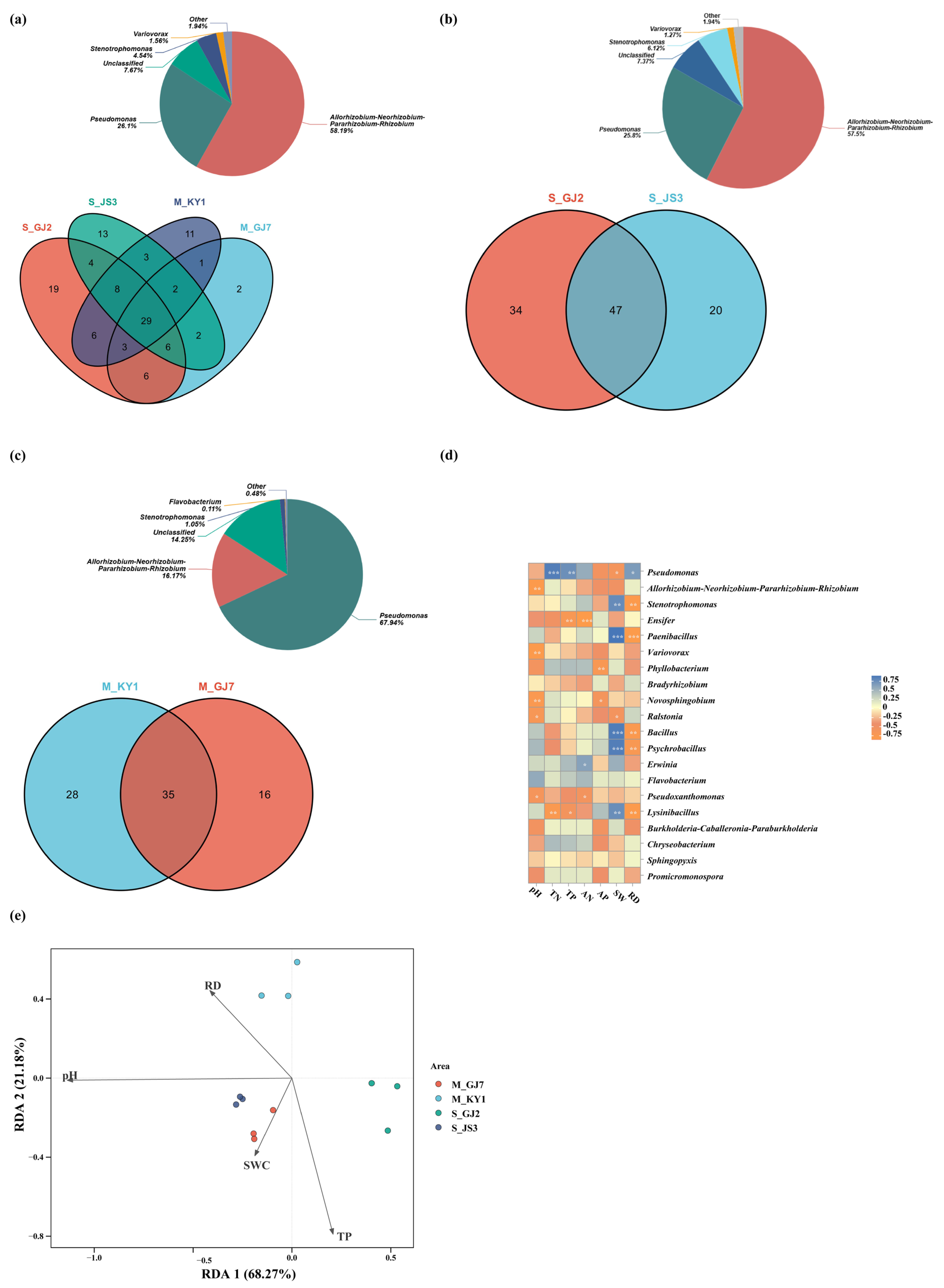
To clarify the composition patterns of the core endophytic microbiota in P. sativum root nodules and their driving mechanisms across the RD gradient, we analyzed the distribution of core bacterial genera and their correlations with soil environmental factors. Venn diagram analysis showed that core bacterial genera declined from 47 to 35 from SRD sites (S_GJ2, S_JS3) to MRD sites (M_GJ7, M_KY1) (Figure 3b,c), consistent with environmental filtering by the RD gradient. The 29 core genera shared by all four samples accounted for 98.71% of the total high-quality reads (375,553 of 380,457), pointing to a stable core microbiota essential for symbiotic function across the RD gradient. These genera comprised mainly the AllorhizobiumNeorhizobiumPararhizobiumRhizobium clade (35.80%) and Pseudomonas (36.91%) (Figure 3a). Specifically, SRD sites (S_GJ2, S_JS3) harbored 47 shared genera (188,812 reads, 49.63% of total), with the AllorhizobiumNeorhizobiumPararhizobiumRhizobium clade accounting for 57.50% of sequences (Figure 3b). In contrast, MRD sites (M_GJ7, M_KY1) harbored 35 shared genera (189,333 reads, 49.76% of total), with Pseudomonas accounting for 67.94% of sequences (Figure 3c).
Correlation analysis showed that changes in core microbiota correlated with environmental variables (Figure 3d). The relative abundance of Pseudomonas was negatively correlated with SWC and positively correlated with RD severity, TN, and TP (p < 0.05). In contrast, the relative abundance of the Allorhizobium–Neorhizobium–Pararhizobium–Rhizobium complex was negatively correlated with soil pH (p < 0.05).
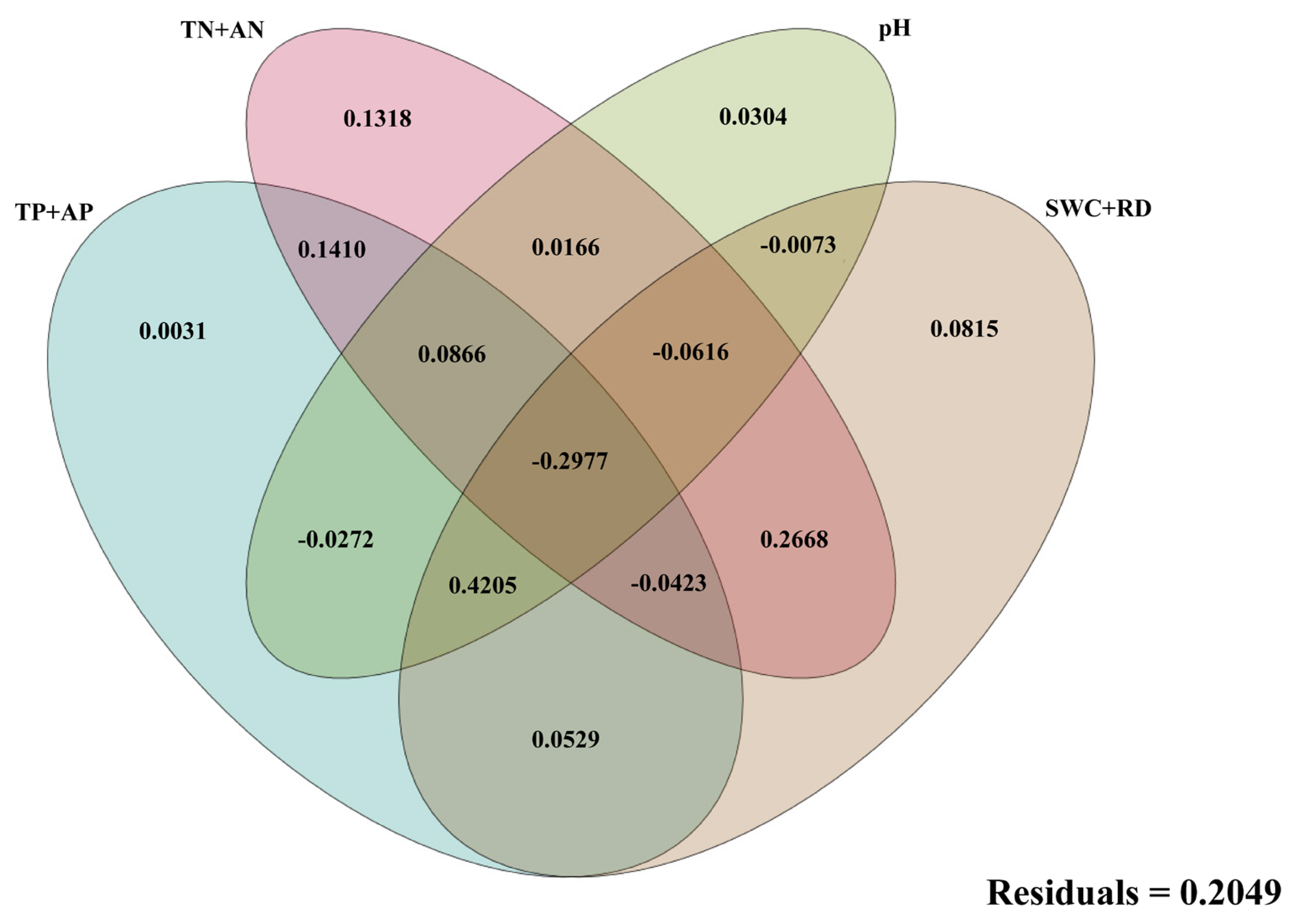
Using R, we first standardized the OTU table, conducted collinearity analysis of soil physicochemical properties, and then explored their relationship with P. sativum nodule endophytic bacterial diversity via redundancy analysis (RDA) (Figure 3e). pH (r2 = 0.8773, p = 0.001) and TP (r2 = 0.6777, p = 0.006) significantly influenced endophytic bacterial diversity across RD gradients. Variance partitioning analysis (VPA) further showed that soil physicochemical factors jointly explained 79.51% of community variation (Figure A2).
Analysis indicated that soil pH and TP are key environmental factors shaping core endophyte community distribution, suggesting that soil acidification and phosphorus availability are stress factors associated with P. sativum nodule endophyte community succession in RD ecosystems.

3.4. Soil Factors Drive the Diversity Patterns and Assembly of Nodule-Associated Nitrogen-Fixing Microorganisms in P. sativum

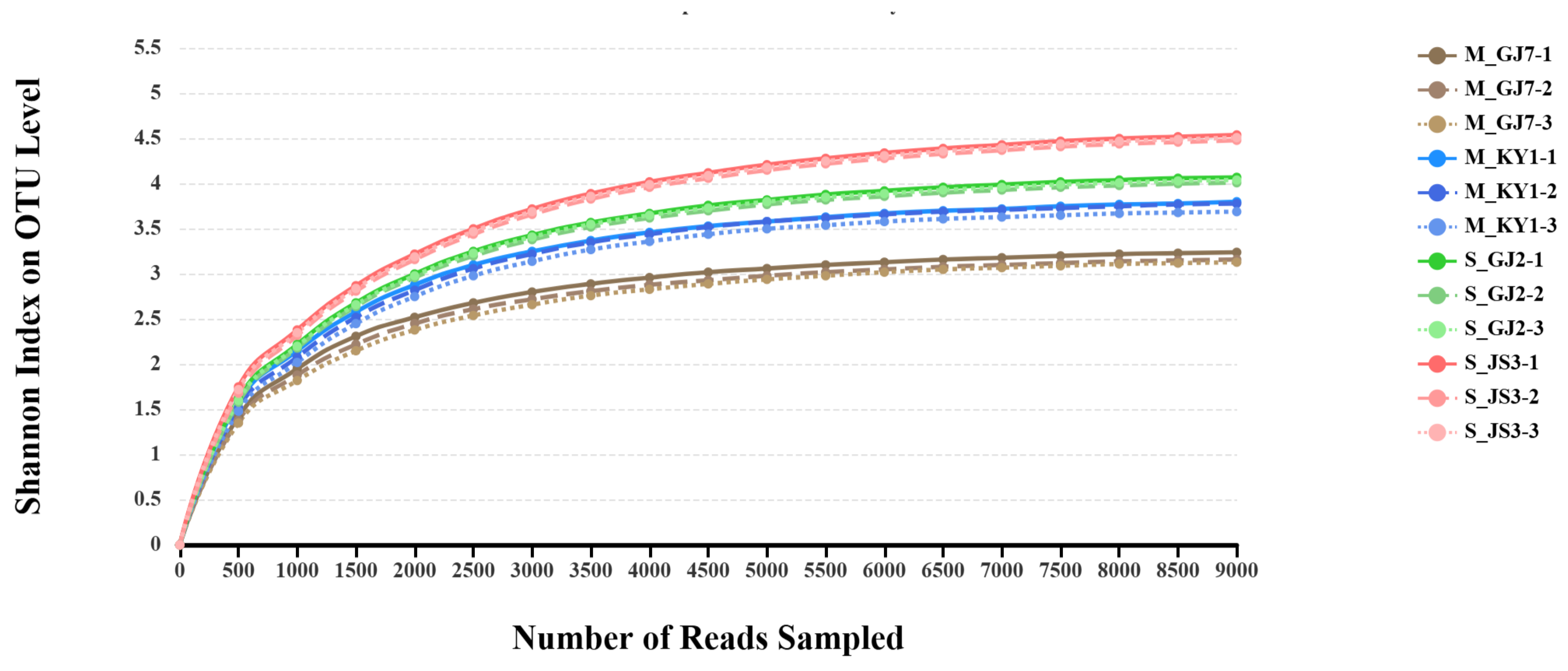
The nitrogenase nifH gene of endophytic bacteria in P. sativum nodules was sequenced by Illumina MiSeq, and a total of 112,284 valid sequences were obtained (NCBI: PRJNA1387156). The rarefaction curve plateaued (Figure A3), indicating sufficient sequencing depth to capture the majority of bacterial species for downstream analyses.
Coverage indices exceeded 0.999 for all samples, confirming near-complete sampling of the nifH gene pool. The richness and diversity of nifH-harboring endophytes varied across samples (p < 0.05; Table A2). The SRD sample from S_JS3 exhibited the highest values, with its Chao1 index (65.56) and Shannon index (1.92) being significantly greater than those of all other sites, indicating both the highest predicted species richness and community evenness. As shown in Table A3, species richness indices (Sobs, Chao1, and ACE) were positively correlated with soil pH (p < 0.05), while the Shannon index also increased with AP (p < 0.05).
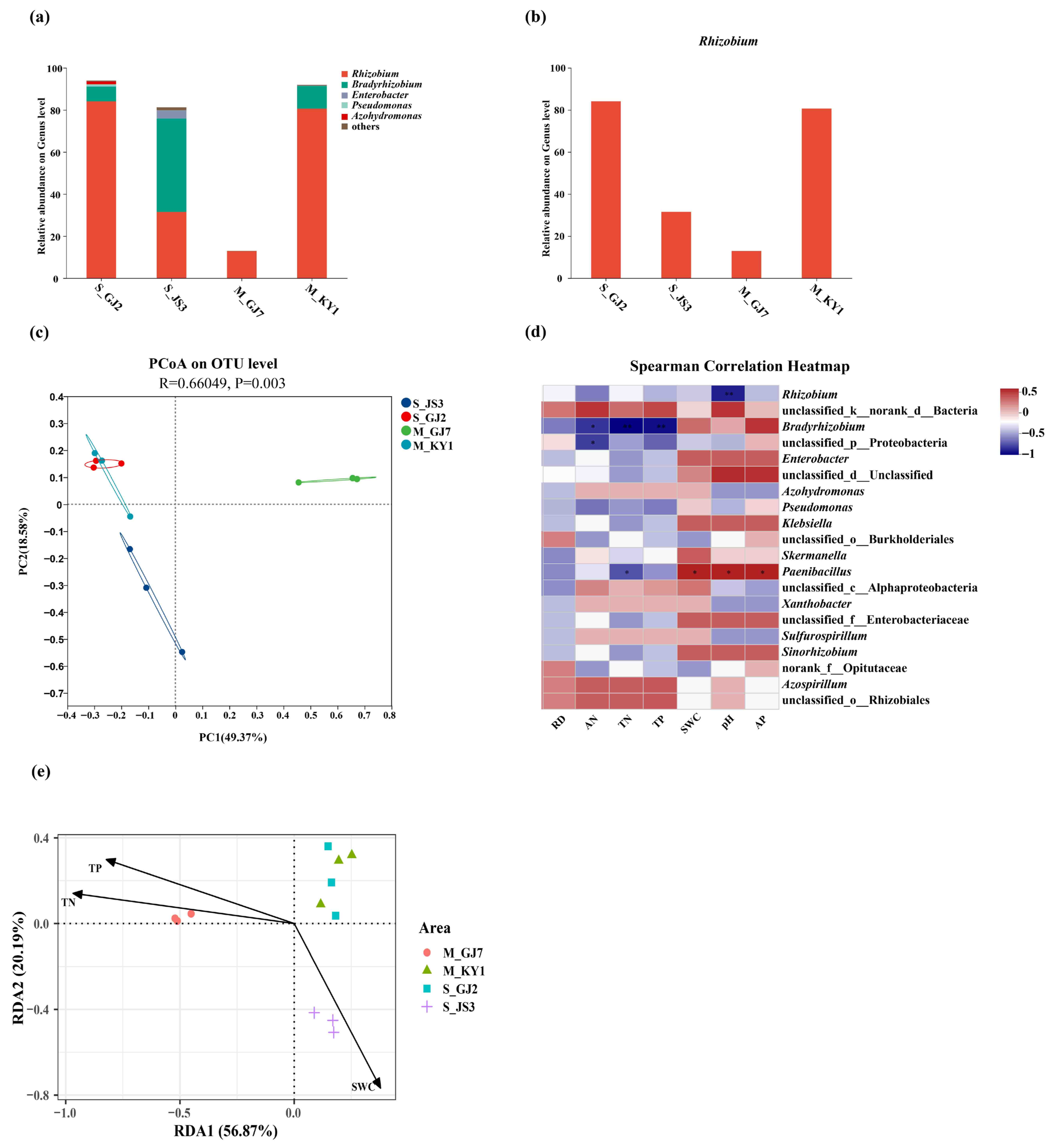
Clustering of high-quality sequences yielded 287 nitrogen-fixing OTUs from 12 samples. Phylogenetic annotation based on nifH gene sequences assigned these OTUs to 5 phyla, 9 classes, 9 orders, 12 families, and 16 genera. Due to the limited phylogenetic resolution of the nifH gene for accurate species discrimination, all subsequent analyses were performed at the genus level. At the genus level (Figure 4a), Rhizobium, Bradyrhizobium, Enterobacter, Azohydromonas, and several unclassified taxa were detected. Rhizobium dominated the communities, accounting for 83.8%, 34.5%, 13.6%, and 81.2% of sequences in S_GJ2, S_JS3, M_GJ7, and M_KY1, respectively (Figure 4b). Principal coordinate analysis (PCoA) based on Bray–Curtis distances revealed distinct patterns of nitrogen-fixing endophytic bacterial community structure among the different sample groups (Figure 4c). The first two principal coordinate axes (PC1 and PC2) collectively explained 68.0% of the total variation. PC1, which accounted for 49.4% of the variation, clearly separated M_GJ7 from the other three sample groups (S_GJ2, S_JS3, and M_KY1). In contrast, the sample points of S_GJ2 and M_KY1 clustered closely together with partial overlap. PC2, explaining 18.6% of the variation, further distinguished S_JS3 from the remaining groups. Non-parametric similarity analysis (ANOSIM) confirmed statistically significant differences among the four communities (r = 0.66, p = 0.003). Spearman correlation analysis was used to assess genus-level relationships between the 20 most abundant nitrogen-fixing genera and soil variables (Figure 4d). Rhizobium abundance correlated negatively with soil pH. Bradyrhizobium showed negative correlations with TN, TP, and AN. Paenibacillus correlated negatively with TN but positively with SWC, pH, and AP.
To clarify the relationships between environmental factors and endophytic nitrogen-fixing bacterial diversity in P. sativum nodules, OTU abundance data were standardized using R (v. 4.4.2), and collinearity among soil physicochemical properties was assessed. Redundancy analysis (RDA) was then employed to explore correlations between soil factors and bacterial diversity. Results showed that soil TN (r2 = 0.9437, p = 0.002), TP (r2 = 0.7642, p = 0.005), and SWC (r2 = 0.7000, p = 0.006) significantly influenced endophytic bacterial diversity across different rocky desertification (RD) gradients.

4. Discussion

4.1. Different RD Levels Exhibit Differences in Physicochemical Properties

Some studies report that RD hardens soil, reduces porosity and water infiltration, and accelerates nutrient loss, making soil increasingly barren [13,35]. Karst processes markedly decrease soil organic matter (SOM), TN, AP, available potassium (AK), and overall fertility. Moreover, karstification destroys soil structure, causes water and nutrient loss, and further aggravates soil impoverishment [24]. However, soil nutrient concentrations (e.g., TN, TP, AN) at the MRD site (M_GJ7) exceeded those at other sampling locations, indicating that RD degree alone does not determine soil properties. Soil nutrient levels reflect multiple factors, including texture, slope, plant community composition, and anthropogenic disturbance. Notably, site elevations varied considerably: M_GJ7 (2340.59 m), S_GJ2 (1792.99 m), S_JS3 (1395.20 m), and M_KY1 (1298.32 m)—with M_GJ7 elevated ~547.6 m above S_GJ2 and ~1042 m above M_KY1. This marked elevation disparity likely generates microclimatic and vegetation differences that influence nutrient cycling [36]. Additionally, previous studies have indicated that the contents of nitrogen, phosphorus, potassium, and some trace elements are generally higher in high-altitude areas, further confirming the influence of altitude on the spatial differentiation of soil nutrients [37].
Therefore, the dynamics of soil nutrients are the result of the combined effects of multiple factors, such as the degree of RD, altitude, topography, vegetation, and human activities. The traditional view that solely attributes soil degradation to the intensity of RD has limitations. The unexpected finding of relatively high soil-nutrient levels in the MRD site (M_GJ7) serves as clear evidence. This result suggests that when evaluating the ecological effects of RD, altitude should be incorporated as a key covariate in the analytical framework.

4.2. Effects of Different Levels of RD on Endophytic Bacterial Diversity of Plants

Regions experiencing RD, distinguished by sparse vegetation and low plant coverage, represent crucial areas for ecological restoration [13,38]. Plant endophytes in these regions play significant roles in physiological processes that enable plants to adapt to the karst environment. They contribute to plant restoration in RD-affected areas by promoting growth and enhancing stress tolerance [39,40]. Our study showed that RD intensity was associated with endophytic bacterial diversity in P. sativum nodules. Lower diversity in severe RD areas suggests a correlation with environmental filtering, potentially reflecting selection for stress-adapted taxa [41]. Given the role of endophytic bacteria in plant growth promotion and stress tolerance [42], this diversity shift may reflect the adaptive response of the microbiome to environmental stresses across the RD gradient. Further community analysis revealed variation in key groups. Allorhizobium–Neorhizobium–Pararhizobium–Rhizobium and Pseudomonas were dominant across all samples, with Pseudomonas abundance higher in MRD than SRD regions.
To explain this pattern, we hypothesize that as RD intensifies, associated soil stresses (e.g., pH and phosphorus limitation) may inhibit core symbiotic nitrogen-fixing bacteria (e.g., rhizobia) while favoring stress-tolerant groups (e.g., Pseudomonas). This may shift plant–microbe interactions from nitrogen-fixation dominance to stress-tolerance dominance. Such community restructuring implies reduced biological nitrogen fixation efficiency and a shift in host strategies from nutritional mutualism to diverse stress mitigation. This view that microbial functional group succession is driven by environmental stress is supported by other stressed ecosystems. For example, rhizobia and Pseudomonas abundance in alfalfa roots declines under saline–alkali stress, whereas colonization by salt-tolerant Pseudomonas strains enhances host stress tolerance [43]. Under heavy metal stress, endophyte diversity declines, and communities shift toward stress-tolerant taxa that assist plant resistance [44,45]. These cases support our inference that severe environments filter microbial communities and that functional shifts are critical for understanding plant adaptability. Allorhizobium–Neorhizobium–Pararhizobium–Rhizobium and Pseudomonas became the dominant functional genera in this study, indicating their role in mediating the adaptation of P. sativum plants to RD. Therefore, we further discuss the potential reasons for their dominance and their functional contributions.
Plant endophytes exhibit a close association with plant growth, development, adaptation, and stress tolerance. Their functions are influenced by host-plant types and environmental factors [46]. Allorhizobium–Neorhizobium–Pararhizobium–Rhizobium are typical nitrogen-fixing bacteria widely distributed in soil [47]. Their symbiotic members colonize plant roots and enhance nitrogen uptake via biological nitrogen fixation. Beyond nitrogen fixation, the genus exhibits diverse plant growth-promoting bacteria (PGPB) functions: for example, increasing sugarcane biomass and sucrose content [48]. Moreover, they contribute to soil bioremediation [49]. These bacteria also modulate arbuscular mycorrhizal fungal gene expression, thereby improving host physiological metabolism and tolerance to abiotic stresses such as drought and extreme temperature [50].
Ran et al. [51] reported that Pseudomonas was the dominant genus in their analysis of culturable carbon- and nitrogen-fixing bacterial diversity in karst cave sediments, a finding consistent with the results of the present study. The genus Pseudomonas is metabolically versatile and capable of biosynthesizing surfactants that emulsify hydrocarbons and other non-aqueous liquids into the aqueous phase [52]. This characteristic enables them to maintain hydration in arid environments and facilitates nutrient foraging in the surroundings. Additionally, Pseudomonas species possess metabolic flexibility [53] and adapt well to diverse environmental conditions, thriving within a wide temperature and pH range, with minimal nutrient requirements and the ability to utilize multiple carbon sources [54]. They also exhibit robust stress responses [55], quorum sensing, and the production of virulence factors [56]. These traits confer stress tolerance and proliferative capacity under harsh conditions, which may explain the high abundance of Pseudomonas at MRD sites. From the host perspective, increased Pseudomonas dominance may reflect reduced host selectivity under moderate RD stress or competitive release of other symbiotic bacteria (e.g., the Allorhizobium–Neorhizobium–Pararhizobium–Rhizobium clade) following their decline [57,58]. In addition, because Pseudomonas includes both beneficial and pathogenic strains, its enrichment does not necessarily indicate host benefit [59]. Although our data show a shift in Pseudomonas dominance in MRD nodules, whether this represents a host adaptive strategy, environmental filtering, or both remains unresolved. Functional studies are needed to assess fitness costs and benefits of Pseudomonas colonization across RD gradients.
Carbohydrates function as the principal energy source for bacterial growth. The availability of carbohydrates, which is crucial for plant growth, is contingent upon microbial uptake and conversion. In this research, an analysis of the correlation between the α-diversity index and soil physicochemical properties demonstrated that the Shannon index and Simpson index exhibited a significant positive correlation with SWC and a highly significant negative correlation with the degree of RD. This suggests that in SRD areas, both the SWC and the diversity of P. sativum nodule endophytes are higher than those in MRD areas. Consequently, the genetic potential for carbohydrate metabolism is predicted to be higher in SRD areas. Studies report that microbial carbon-source utilization capacity is positively correlated with diversity, a finding consistent with our results [60,61].
In summary, this study showed that increasing RD intensity was associated with endophytic bacterial diversity and function in nodules. In SRD areas, endophytic bacterial diversity was higher, and carbohydrate metabolism was elevated, providing energy for the energy-intensive process of nitrogen fixation [62]. In contrast, diversity and metabolic activity declined in MRD areas. This decrease in carbohydrate metabolism may reflect a metabolic shift in microbes under stress: as stress intensifies, hosts allocate resources from growth to defense, reducing nitrogen fixation and energy demand, thereby lowering carbon metabolic activity [63].

4.3. Effects of RD on the Structure of the Endophytic Nitrogen-Fixing Bacterial Flora in Plants

In regions undergoing RD, ecosystem degradation and nitrogen loss are pronounced, emerging as one of the primary limiting factors for vegetation recuperation [64]. The symbiotic nitrogen fixation between leguminous plants and rhizobia can enhance soil structure and nutrient conditions, thereby facilitating vegetation succession and restoration in degraded ecosystems [65,66]. As a prominent representative of leguminous crops, P. sativum is mainly cultivated in RD areas via the legume–rhizobium symbiotic nitrogen-fixation mechanism. This process enriches soil nitrogen and organic matter, consequently modifying the soil structure. As a result, it impacts the growth and development of other plants, thus promoting agricultural productivity.
In this study, the abundance of nitrogen-fixing bacteria was primarily influenced by TP, TN, and SWC, with TN exerting the strongest effect. The Shannon index showed a significant positive correlation with AP, suggesting that available phosphorus notably enhances species diversity among nitrogen-fixing endophytes. Additionally, the genus Rhizobium was identified as the dominant nitrogen-fixing endophyte in P. sativum nodules.
Soil nitrogen, phosphorus, and potassium directly or indirectly influence plant growth, which in turn affects the distribution and activity of endophytes [67]. Different endophytes exhibit varying adaptabilities to soil pH, and soil acidity or alkalinity can impact their growth and metabolic activity, thereby altering their symbiotic relationship with the host plant [68]. For example, under different ecological backgrounds such as alpine meadows and artificial forests, it is consistently shown that the availability of nutrients such as nitrogen (N) and phosphorus (P) is the core factor that determines the structure and function of nitrogen-fixing bacteria. Similar to the results of this study [69,70,71].
Rhizobium has long held a significant position in biological nitrogen fixation [72]. In recent years, it has been extensively utilized in agriculture, particularly for legume crops, which are frequently inoculated to augment their nitrogen-fixing ability, thus enhancing crop quality and yield [73]. Rhizobium has been applied in environmental remediation to rehabilitate polluted or degraded soils. In the barren calcareous soils of RD areas, the phoD gene carried by rhizobia plays a key ecological role [74]. The alkaline phosphatase encoded by phoD mobilizes organic phosphorus, and the released phosphate (PO43−) reacts with abundant Ca2+ ions to precipitate as insoluble calcium phosphate. This precipitation consumes Ca2+ and indirectly promotes carbonate rock dissolution. This process not only alleviates phosphorus deficiency but also enhances rock weathering and soil development, offering a potential microbial mechanism for restoring these fragile ecosystems. Additionally, He et al. observed that inoculating plants with rhizobia under drought conditions could notably promote plant growth and enhance their drought resistance [75]. In summary, this study found that the RD process itself did not lead to systematic changes in soil nutrients, and the abundance of nitrogen-fixing bacteria did not directly correspond to the degree of RD. However, analysis of the response of the endophytic nitrogen-fixing bacterial community to environmental factors revealed that its abundance was mainly affected by SWC, TP, and TN, with TP exerting a significant effect. The potential reason for this is that nitrogen fixation is an ATP-consuming biological process, requiring precise regulation of the micro-environmental oxygen concentration around nitrogen-fixing enzymes and the construction of specific cellular structures to house these enzymes. Both the regulatory and constructive processes demand the participation of phosphorus [70]. Therefore, soil phosphorus and nitrogen availability, rather than RD severity, are the key chemical drivers of endophytic nitrogen-fixing bacterial community assembly in P. sativum nodules.

4.4. Limitations and Generalizability

There are some limitations in this study that need to be treated with caution. Constrained by P. sativum distribution in the RD area, our sampling design spans SRD and MRD at four sites, with three replicates per site. This design supports exploratory characterization of microbial community changes, and the selected sites represent RD gradients in the study area. The limited number means extending these findings to continuous RD gradients requires validation in future studies. The sampling points are different in altitude and other site environmental conditions. As potential confounding variables, these factors are spatially collinear with the degree of RD in the study area. In the discussion section, we have carried out a detailed analysis of altitude differences and their possible associations with soil nutrients and microbial communities (see Section 3.1) and pointed out that altitude should be included as a key covariate in future research. Under the current research design based on observational data, the nearly perfect collinearity between RD degree and altitude makes it impossible to effectively separate the independent contributions of the two by conventional multivariate ranking methods. The core findings of this study—such as the decline in the relative abundance of Allorhizobium–Neorhizobium–Pararhizobium–Rhizobium clades and the enrichment of Pseudomonas—should be carefully interpreted as associations observed along complex environmental gradients, rather than as direct causal effects of the RD process itself. Cautious causal inference does not diminish research value. Based on available samples, this study characterizes P. sativum nodule endophyte community responses across the karst RD gradient and identifies core taxa sensitive to environmental change and their key drivers. This exploratory work provides ecological hypotheses and targets microbial resources for rigorous causal mechanism studies (e.g., stratified nested sampling across elevation gradients, common garden experiments, and synthetic community inoculation assays).
This study does not offer definitive conclusions regarding RD–microbe relationships but provides foundational characterization and hypothesis generation for this scientific problem in karst RD ecosystems. Delineating knowledge boundaries establishes a foundation for future research.

5. Conclusions

This study showed that the RD gradient was associated with shifts in endophytic and nitrogen-fixing bacterial communities within P. sativum nodules through alterations in soil physicochemical properties. AllorhizobiumNeorhizobiumPararhizobiumRhizobium and Pseudomonas dominated, with Rhizobium as the putative nitrogen fixer. Soil pH, water content, nitrogen, and phosphorus were environmental factors associated with community composition. Nodules from SRD sites showed higher diversity and predicted carbohydrate-metabolism potential compared to those from MRD sites. The differential distribution of Pseudomonas and Rhizobium along the stress gradient indicates potential for microbial inoculants to improve legume adaptation in degraded karst areas. However, given spatial collinearity between RD intensity and altitude, observed patterns represent associations along a complex gradient rather than causal effects. Therefore, growth-promoting functions of these taxa and their specific roles in RD adaptation warrant validation via targeted isolation, controlled inoculation, and stratified sampling in future studies.

Author Contributions

Q.Y.: Conceptualization, Data curation, Formal analysis, Investigation, Methodology, Visualization, Writing—original draft, Writing—review and editing. C.W.: Formal analysis, Investigation, Methodology, Writing—review and editing. Y.H.: Conceptualization, Data curation, Formal analysis. J.W.: Funding acquisition, Methodology, Project administration, Resources, Supervision, Validation, Writing—review and editing. W.Z.: Methodology, Software, Writing—review and editing. All authors have read and agreed to the published version of the manuscript.

Funding

This work was financially supported by National Natural Science Foundation of China (grant NO. 42567072), Research Start-up Fund of Southwest Forestry University (grant NO. 111922), the Science and Technology Planning Project of Yunnan Provincial Science and Technology Department of China (grant NO. 202101BD070001-019), Basic Research Special Projects of Yunnan Provincial Science and Technology Department (grant NO. 202401AT070293), and Yunnan Fundamental Research Projects (grant NO. 202301AS070030).

Data Availability Statement

The raw sequence data presented in this study have been deposited in the National Center for Biotechnology Information (NCBI) BioProject database and are publicly accessible under accession number PRJNA1387156. The data can be accessed directly via the following link: https://www.ncbi.nlm.nih.gov/bioproject/PRJNA1387156 (accessed on 26 February 2026).

Acknowledgments

We thank Yating He for experimental materials and Chengyi Wu, Wuxian Zhang, and Jinhua Wang for statistical support and suggestions. The author declares that no GenAI was used in the creation of this manuscript.

Conflicts of Interest

The authors declare that the research was conducted in the absence of any commercial or financial relationships that could be construed as a potential conflict of interest.

Abbreviations

The following abbreviations are used in this manuscript:
RDRock desertification
SRDSlightly rocky desertified
MRDModerately rocky desertified
TNTotal nitrogen
ANAlkali-hydrolyzable nitrogen
TPTotal phosphorus
APAvailable phosphorus
SWCSoil water content

Appendix A

Table A1. Pearson correlation coefficients among soil physicochemical properties and root density.
pHTN (g·kg−1)TP (g·kg−1)AN (mg·kg−1)AP (mg·kg−1)SWC (%)RD
pH1
TN (g·kg−1)0.095 **1
TP (g·kg−1)0.755 **0.892 **1
AN (mg·kg−1)0.173−0.163−0.3801
AP (mg·kg−1)−0.419−0.376−0.2530.1711
SWC (%)−0.503−0.654 *−0.686 *0.5510.4261
RD0.5120.2930.0980.326−0.774 **−0.0741
Notes: N = 12. ** Significant at the 0.01 level (2-tailed). * Significant at the 0.05 level (2-tailed). TN: total nitrogen; TP: total phosphorus; AN: available nitrogen; pH: soil pH; SWC: soil water content; AP: available phosphorus; RD: Rocky Desertification.
Table A2. α-Diversity index of endophytic nitrogen-fixing bacteria in Pisum sativum nodules.
GroupSobsShannonSimpsonAceChaoCoverage
S_GJ226.00 ± 6.93 b1.02 ± 0.06 ab0.52 ± 0.08 a28.09 ± 6.06 b28.33 ± 7.57 b0.999726 a
S_JS364.00 ± 22.52 a1.92 ± 0.72 a0.28 ± 0.19 a66.50 ± 22.35 a65.56 ± 22.86 a0.999609 a
M_GJ744.00 ± 5.57 ab0.76 ± 0.22 b0.67 ± 0.16 a51.91 ± 4.32 ab48.62 ± 2.89 ab0.999647 a
M_KY133.33 ± 6.03 b1.07 ± 0.71 ab0.56 ± 0.33 a37.64 ± 6.60 b37.00 ± 4.77 b0.999501 a
Note: Different lowercase letters for data in the same column indicate significant differences (p < 0.05).
Table A3. Correlation between the α-diversity index of nitrogen-fixing bacteria and soil physicochemical properties.
pHTN (g·kg−1)TP (g·kg−1)AN (mg·kg−1)AP (mg·kg−1)SWC (%)RD
Sobs0.659 *−0.013−0.186−0.2980.5010.515−0.180
Shannon0.394−0.424−0.485−0.4960.593 *0.558−0.460
Simpson−0.2890.4110.4320.413−0.488−0.5060.478
Chao0.675 *0.043−0.133−0.2750.4920.479−0.120
Note: * p < 0.05.

Appendix B

Figure A1. Dilution curve of endophytic bacteria in Pisum sativum nodules.
Horticulturae 12 00323 g0a1
Figure A2. Diversity of endophytic bacteria in Pisum sativum nodules and VPA analysis of soil physical and chemical factors.
Horticulturae 12 00323 g0a2
Figure A3. Dilution curve of endophytic nitrogen-fixing bacteria in Pisum sativum nodules.
Horticulturae 12 00323 g0a3

References

  1. Soumare, A.; Diedhiou, A.G.; Thuita, M.; Hafidi, M.; Ouhdouch, Y.; Gopalakrishnan, S.; Kouisni, L. Exploiting biological nitrogen fixation: A route towards a sustainable agriculture. Plants 2020, 9, 1011. [Google Scholar] [CrossRef]
  2. Hnini, M.; Aurag, J. Prevalence, diversity and applications potential of nodules endophytic bacteria: A systematic review. Front. Microbiol. 2024, 15, 1386742. [Google Scholar] [CrossRef] [PubMed]
  3. Hlaváčková, K.; Šamaj, J.; Ovečka, M. Cytoskeleton as a roadmap navigating rhizobia to establish symbiotic root nodulation in legumes. Biotechnol. Adv. 2023, 69, 108263. [Google Scholar] [CrossRef] [PubMed]
  4. Yang, J.; Lan, L.; Jin, Y.; Yu, N.; Wang, D.; Wang, E. Mechanisms underlying legume–Rhizobium symbioses. J. Integr. Plant Biol. 2022, 64, 244–267. [Google Scholar] [CrossRef] [PubMed]
  5. Wang, Y.; Wu, Y.; Cao, C.; Han, S.; Zhao, W.; Li, Q.; Liu, X.; Kong, L. Effects of fertilizer reduction coupled with straw returning on soil fertility, wheat root endophytic bacteria, and the occurrence of wheat crown rot. Front. Microbiol. 2023, 14, 1143480. [Google Scholar] [CrossRef]
  6. Maciel-Rodríguez, M.; Moreno-Valencia, F.D.; Plascencia-Espinosa, M. The Role of Plant Growth-Promoting Bacteria in Soil Restoration: A strategy to promote agricultural sustainability. Microorganisms 2025, 13, 1799. [Google Scholar] [CrossRef]
  7. Pang, Z.; Xu, P. Probiotic model for studying rhizosphere interactions of root exudates and the functional microbiome. ISME J. 2024, 18, 223. [Google Scholar] [CrossRef]
  8. Pang, Z.; Mao, X.; Zhou, S.; Yu, S.; Guizhou, L.; Lu, C.; Wan, J.; Hu, L.; Xu, P. Microbiota-mediated nitrogen fixation and microhabitat homeostasis in aerial root-mucilage. Microbiome 2023, 11, 85. [Google Scholar] [CrossRef]
  9. Thiebaut, F.; Urquiaga, M.C.O.; Rosman, A.C.; da Silva, M.L.; Hemerly, A.S. The impact of non-nodulating diazotrophic bacteria in agriculture: Understanding the molecular mechanisms that benefit crops. Int. J. Mol. Sci. 2022, 23, 11301. [Google Scholar] [CrossRef]
  10. Li, C.; Huang, Q.; Sun, S.; Cheng, C.; Chen, Y.; Yu, B. Preinoculation with Bradyrhizobium japonicum enhances the salt tolerance of Glycine max seedlings by regulating polyamine metabolism in roots. Plant Physiol. Biochem. 2024, 216, 109196. [Google Scholar] [CrossRef]
  11. Zhang, Z.; Huang, X.; Zhou, Y. Factors influencing the evolution of human-driven rocky desertification in karst areas. Land Degrad. Dev. 2020, 32, 817–829. [Google Scholar] [CrossRef]
  12. Chong, G.; Hai, Y.; Zheng, H.; Xu, W.; Ouyang, Z. Characteristics of changes in karst rocky desertification in Southtern and Western China and driving mechanisms. Chin. Geogr. Sci. 2021, 31, 1082–1096. [Google Scholar] [CrossRef]
  13. Zhou, L.; Wang, X.; Wang, Z.; Zhang, X.; Chen, C.; Liu, H. The Challenge of Soil Loss Control and Vegetation Restoration in the Karst Area of Southwestern China. Int. Soil Water Conserv. Res. 2020, 8, 26–34. [Google Scholar] [CrossRef]
  14. Green, S.-M.; Dungait, J.; Tu, C.; Buss, H.; Sanderson, N.; Hawkes, S.; Xing, K.; Yue, F.-J.; Hussey, V.; Peng, J.; et al. Soil functions and ecosystem services research in the Chinese karst Critical Zone. Chem. Geol. 2019, 527, 119107. [Google Scholar] [CrossRef]
  15. Wang, S.J.; Liu, Q.M.; Zhang, D.F. Karst rocky desertification in southwestern China: Geomorphology, landuse, impact and rehabilitation. Land Degrad. Dev. 2004, 15, 115–121. [Google Scholar] [CrossRef]
  16. Oduniyi, O.S.; Chagwiza, C.; Wade, T. Welfare impacts of conservation agriculture adoption on smallholder maize farmers in South Africa. Renew. Agric. Food Syst. 2022, 37, 672–682. [Google Scholar] [CrossRef]
  17. Dhillon, L.K.; Lindsay, D.; Yang, T.; Zakeri, H.; Tar’an, B.; Knight, J.D.; Warkentin, T.D. Biological nitrogen fixation potential of pea lines derived from crosses with nodulation mutants. Field Crops Res. 2022, 289, 108731. [Google Scholar] [CrossRef]
  18. Raza, A.; Zahra, N.; Hafeez, M.B.; Ahmad, M.; Iqbal, S.; Shaukat, K.; Ahmad, G. Nitrogen fixation of legumes: Biology and physiology. In The Plant Family Fabaceae; Springer: Singapore, 2020; pp. 43–74. [Google Scholar] [CrossRef]
  19. Sainju, U.M.; Lenssen, A.W.; Allen, B.L.; Jabro, J.D.; Stevens, W.B. Pea growth, yield, and quality in different crop rotations and cultural practices. Agrosyst. Geosci. Environ. 2019, 2, 1–9. [Google Scholar] [CrossRef]
  20. Simon-Miquel, G.; Reckling, M.; Plaza-Bonilla, D. Faba bean introduction makes protein production less dependent on nitrogen fertilization in Mediterranean no-till systems. Field Crops Res. 2024, 308, 109307. [Google Scholar] [CrossRef]
  21. Szablińska-Piernik, J.; Lahuta, L.B. Metabolite profiling of semi-leafless pea (Pisum sativum L.) under progressive soil drought and subsequent re-watering. J. Plant Physiol. 2021, 256, 153314. [Google Scholar] [CrossRef]
  22. Pathania, S.; Pathania, A.; Sharma, S.; Nikita; Thakur, S.; Bhanwal, U. Economic analysis of pea farming in high hills of himachal pradesh, India. Asian J. Agric. Ext. Econ. Sociol. 2024, 42, 5–10. [Google Scholar] [CrossRef]
  23. Bandopadhyay, S.; Li, X.; Bowsher, A.; Last, R.; Shade, A. Disentangling plant- and environment-mediated drivers of active rhizosphere bacterial community dynamics during short-term drought. Nat. Commun. 2024, 15, 6347. [Google Scholar] [CrossRef] [PubMed]
  24. Li, W.; He, B.; Feng, T.; Bai, X.; Zou, S.; Chen, Y.; Yang, Y.; Wu, X. Soil microbial communities in pseudotsuga sinensis forests with different degrees of rocky desertification in the karst region, southwest China. Forests 2024, 15, 47. [Google Scholar] [CrossRef]
  25. Zhu, D.; Sheng, M.-Y.; Liu, Y.; Wang, L. Responses of soil microbial community to rocky desertification succession and their relationships with plant functional diversity in southwest China karst ecosystem. Ecol. Evol. 2026, 16, e73013. [Google Scholar] [CrossRef]
  26. Li, C.; Li, X.; Yang, Y.; Shi, Y.; Li, H. Degradation reduces the diversity of nitrogen-fixing bacteria in the alpine wetland on the Qinghai-Tibet Plateau. Front. Plant Sci. 2022, 13, 939762. [Google Scholar] [CrossRef] [PubMed]
  27. Dai, Q.; Yan, Y. Research progress of karst rocky desertification and soil erosion in southwest China. J. Soil Water Conserv. 2018, 32, 1–10. [Google Scholar] [CrossRef]
  28. Yanjun, C.; Xiaoqing, Z.; Junwei, P.U.; Xiaoqian, S.H.I.; Yan, F.; Shijie, Z. Correlation mechanism between rocky desertification degrees and slope position factors in karst mountainous area of southeast Yunnan. Carsologica Sin. 2024, 43, 379–391. [Google Scholar] [CrossRef]
  29. Qi, Y.; Cheng, J.; Zhang, X.; Yao, L.; He, Y.; Yan, Q.; Wang, J. Community distribution of endophytic bacteria in nodules of Vicia villosa in rocky desertification area of Southwest China. Curr. Microbiol. 2025, 82, 455. [Google Scholar] [CrossRef]
  30. Bao, S.D. Soil Agrochemical Analysis, 3rd ed.; China Agriculture Press: Beijing, China, 2000. [Google Scholar]
  31. Langille, M.; Zaneveld, J.; Caporaso, J.; McDonald, D.; Knights, D.; Reyes, J.; Clemente, J.; Burkepile, D.; Vega Thurber, R.; Knight, R.; et al. Predictive functional profiling of microbial communities using 16S rRNA marker gene sequences. Nat. Biotechnol. 2013, 31, 814–821. [Google Scholar] [CrossRef]
  32. Ward, T.; Larson, J.; Meulemans, J.; Hillmann, B.; Lynch, J.; Sidiropoulos, D.; Spear, J.; Caporaso, G.; Blekhman, R.; Knight, R.; et al. BugBase predicts organism-level microbiome phenotypes. bioRxiv 2017, 133462. [Google Scholar] [CrossRef]
  33. Louca, S.; Parfrey, L.W.; Doebeli, M. Decoupling function and taxonomy in the global ocean microbiome. Science 2016, 353, 1272–1277. [Google Scholar] [CrossRef] [PubMed]
  34. Nguyen, N.; Song, Z.; Bates, S.; Branco, S.; Tedersoo, L.; Menke, J.; Schilling, J.; Kennedy, P. FUNGuild: An open annotation tool for parsing fungal community datasets by ecological guild. Fungal Ecol. 2015, 20, 241–248. [Google Scholar] [CrossRef]
  35. Di, X.; Xiao, B.; Dong, H.; Wang, S. Implication of different humic acid fractions in soils under karst rocky desertification. Catena 2019, 174, 308–315. [Google Scholar] [CrossRef]
  36. Ju, F.; Chen, L.; Zheng, J.; Chen, Z.; Wang, X.; Xia, X. Elevation-dependent fluctuations of the soil properties in a subtropical forest of central China. Sustainability 2022, 14, 15855. [Google Scholar] [CrossRef]
  37. Imran; Amanullah; Naveed, S.; Khan, I.; Sajid, M.; Mahmood, T.; Hussain, I.; Ilyas, M.; Ali, I.; Ullah, S.; et al. Relationship of soil physico chemical properties with elevation and geographical directions. IOP Conf. Ser. Earth Environ. Sci. 2021, 788, 12172. [Google Scholar] [CrossRef]
  38. Wu, Q.; Rao, C.; Yan, W.; Peng, Y.; Wang, E.; Chen, X. Microclimatic influences on soil nitrogen dynamics and plant diversity across rocky desertification gradients in Southwest China. Plants 2025, 14, 1251. [Google Scholar] [CrossRef]
  39. Maïwenn, L.H.; Robin, D. Combining the seed endophytic bacteria and the back to the future approaches for plant holonbiont breeding. Front. Agron. 2021, 3, 724450. [Google Scholar] [CrossRef]
  40. Li, F.; He, X.; Sun, Y.; Zhang, X.; Tang, X.; Li, Y.; Yi, Y. Distinct endophytes are used by diverse plants for adaptation to karst regions. Sci. Rep. 2019, 9, 5246. [Google Scholar] [CrossRef]
  41. Wang, Y.-L.; Zhang, H.-B. Assembly and function of seed endophytes in response to environmental stress. J. Microbiol. Biotechnol. 2023, 33, 1119–1129. [Google Scholar] [CrossRef]
  42. Desai, V.; Sharma, A.; Chauhan, P. Endophytes and plants interaction: A hidden microbial world inside the plant. J. Basic Microbiol. 2025, 65, e70112. [Google Scholar] [CrossRef]
  43. Yang, D.; Tang, L.; Chen, J.; Shi, Y.; Zhou, H.; Gao, H.; Jin, J.; Guo, C. Strategy of endophytic bacterial communities in alfalfa roots for enhancing plant resilience to saline–alkali stress and its application. Biol. Fertil. Soils 2024, 60, 493–507. [Google Scholar] [CrossRef]
  44. Ma, J.; Chen, D.; Xu, Y.; Liu, Y.; Liu, L.; Huang, J.; Gao, R.; Bai, J.; Hou, Q. Effects of different heavy metal stressors on the endophytic community composition and diversity of symphytum officinale. Microorganisms 2024, 12, 477. [Google Scholar] [CrossRef] [PubMed]
  45. Gong, W.; Li, Q.; Tu, Y.; Yang, D.; Lai, Y.; Tang, W.; Mao, W.; Feng, Y.; Liu, L.; Li, H.-Y. Diversity and functional traits of seed endophytes of dysphania ambrosioides from heavy metal contaminated and non-contaminated areas. World J. Microbiol. Biotechnol. 2024, 40, 191. [Google Scholar] [CrossRef] [PubMed]
  46. Chaudhary, P.; Agri, U.; Chaudhary, A.; Kumar, A.; Kumar, G. Endophytes and their potential in biotic stress management and crop production. Front. Microbiol. 2022, 13, 933017. [Google Scholar] [CrossRef]
  47. You, Y.; Aho, K.; Lohse, K.A.; Schwabedissen, S.G.; Ledbetter, R.N.; Magnuson, T.S. Biological soil crust bacterial communities vary along climatic and shrub cover gradients within a sagebrush steppe ecosystem. Front. Microbiol. 2021, 12, 569791. [Google Scholar] [CrossRef]
  48. Pang, Z.; Fallah, N.; Weng, P.; Zhou, Y.; Tang, X.; Tayyab, M.; Liu, Y.; Liu, Q.; Xiao, Y.; Hu, C.; et al. Sugarcane–peanut intercropping system enhances bacteria abundance, diversity, and sugarcane parameters in rhizospheric and bulk soils. Front. Microbiol. 2022, 12, 815129. [Google Scholar] [CrossRef]
  49. Bai, N.; Li, S.; Zhang, J.; Zhang, H.; Zhang, H.; Zheng, X.; Lv, W. Efficient biodegradation of DEHP by CM9 consortium and shifts in the bacterial community structure during bioremediation of contaminated soil. Environ. Pollut. 2020, 266, 115112. [Google Scholar] [CrossRef]
  50. Zhang, K.; Chen, X.; Shi, X.; Yang, Z.; Yang, L.; Liu, D.; Yu, F. Endophytic bacterial community, core taxa, and functional variations within the fruiting bodies of Laccaria. Microorganisms 2024, 12, 2296. [Google Scholar] [CrossRef]
  51. Ran, G.; Wu, Q.; Fang, Z.; An, N.; Chen, X.; Li, S.; Ren, L.; Weng, Q. Diversity of culturable carbon-fixing and nitrogen-fixing bacteria in karst cave sediments. J. Yunnan Univ. Nat. Sci. Ed. 2024, 46, 379–391. [Google Scholar] [CrossRef]
  52. Ma, Z.; Zuo, P.; Sheng, J.; Liu, Q.; Qin, X.; Ke, C. Characterization and production of a biosurfactant viscosin from Pseudomonas sp. HN11 and its application on enhanced oil recovery during oily sludge cleaning. Appl. Biochem. Biotechnol. 2023, 195, 7668–7684. [Google Scholar] [CrossRef]
  53. Schwanemann, T.; Otto, M.; Wierckx, N.; Wynands, B. Pseudomonas as versatile aromatics cell factory. Biotechnol. J. 2020, 15, 1900569. [Google Scholar] [CrossRef] [PubMed]
  54. Urgancı, N.N.; Yılmaz, N.; Koçer Alaşalvar, G.; Yıldırım, Z. Pseudomonas aeruginosa and its pathogenicity. Turk. J. Agric.—Food Sci. Technol. 2022, 10, 726–738. [Google Scholar] [CrossRef]
  55. Sha, Y. Effects of soaking seeds with Pseudomonas alcaliphila Ej2 on endophytic community of rice roots under salt stress. Acta Microbiol. Sin. 2022, 62, 1919–1935. [Google Scholar] [CrossRef]
  56. Mudaliar, S.B.; Bharath Prasad, A.S. A biomedical perspective of pyocyanin from Pseudomonas aeruginosa: Its applications and challenges. World J. Microbiol. Biotechnol. 2024, 40, 90. [Google Scholar] [CrossRef]
  57. Chen, P.; Yu, Q.-Y.; Wang, C.; Montoya, L.; West, P.; Xu, L.; Varoquaux, N.; Cole, B.; Hixson, K.; Kim, Y.-M.; et al. Holo-omics disentangle drought response and biotic interactions among plant, endophyte and pathogen. New Phytol. 2025, 246, 2702–2717. [Google Scholar] [CrossRef]
  58. Saati Santamaría, Z.; Baroncelli, R.; Rivas, R.; Garcia-Fraile, P. Comparative genomics of the genus pseudomonas reveals host- and environment-specific evolution. Microbiol. Spectr. 2022, 10, e02370-22. [Google Scholar] [CrossRef]
  59. Waqar, S.; Bhat, A.; Khan, A. Endophytic fungi: Unravelling plant-endophyte interaction and the multifaceted role of fungal endophytes in stress amelioration. Plant Physiol. Biochem. 2023, 206, 108174. [Google Scholar] [CrossRef]
  60. Pei, J.; Li, J.; Luo, Y.; Rillig, M.C.; Smith, P.; Gao, W.; Li, B.; Fang, C.; Nie, M. Patterns and drivers of soil microbial carbon use efficiency across soil depths in forest ecosystems. Nat. Commun. 2025, 16, 5218. [Google Scholar] [CrossRef]
  61. Ren, G.; Shi, W.; Li, W.; Wang, J.; Wang, C.; Zhao, G. Pyrolysis temperature shapes biochar-mediated soil microbial communities and carbon-nitrogen metabolism. Front. Microbiol. 2025, 16, 1657149. [Google Scholar] [CrossRef]
  62. Wu, S.; Wang, X.; Qin, J.; Tian, W.; Wang, M.; Yue, A.; Wang, L.; Du, W.; Zhao, J. Soybean CEP6 signaling peptides positively Regulate Nodulation. Agronomy 2024, 14, 988. [Google Scholar] [CrossRef]
  63. Ben-Laouane, R.; Ait-El-Mokhtar, M.; Abdelilah, M.; Baslam, M. Nodule–microbiome dynamics: Deciphering the complexities of nodule symbiosis and the root microbiome. Int. J. Mol. Sci. 2026, 27, 1487. [Google Scholar] [CrossRef] [PubMed]
  64. Zhang, L.; Xiong, K.; Wang, X.; Wan, P. Study of soil nitrogen in karst rocky desertification areas: A literature review. Polish J. Environ. Stud. 2022, 31, 5533–5547. [Google Scholar] [CrossRef]
  65. Zedníková, P.; Kukla, J.; Frouz, J. The growth, competition, and facilitation of grass and legumes in post-mining soils. J. Soil Sci. Plant Nutr. 2023, 23, 3695–3704. [Google Scholar] [CrossRef]
  66. Coba de la Peña, T.; Pueyo, J.J. Legumes in the reclamation of marginal soils, from cultivar and inoculant selection to transgenic approaches. Agron. Sustain. Dev. 2011, 32, 65–91. [Google Scholar] [CrossRef]
  67. Zhang, X.; Huang, Z.; Zhong, Z.; Li, Q.; Bian, F.; Gao, G.; Yang, C.; Wen, X. Evaluating the rhizosphere and endophytic microbiomes of a bamboo plant in response to the long-term application of heavy organic amendment. Plants 2022, 11, 2129. [Google Scholar] [CrossRef]
  68. Qi, D.; Wieneke, X.; Tao, J.; Zhou, X.; Desilva, U. Soil pH is the primary factor correlating with soil microbiome in karst rocky desertification regions in the Wushan County, Chongqing, China. Front. Microbiol. 2018, 9, 01027. [Google Scholar] [CrossRef]
  69. Feng, X.; Li, C.; Peng, C.; Zhang, J.; Lin, Y.; Liu, H. Effects of corn-soybean rotation system on soil nitrogen-fixing bacteria community structure and quality in black soil. J. Nat. Resour. 2022, 37, 2319–2333. [Google Scholar] [CrossRef]
  70. Wang, Q.; Wang, C.; Lei, L.; Jing, Y.; Lan, N.; Li, X.; Li, J. Key factors driving soil diazotrophic community assembly and nitrogenase activity in Qinghai-Tibet alpine meadows. Catena 2025, 248, 108600. [Google Scholar] [CrossRef]
  71. Yao, X.; Hui, D.; Xing, S.; Zhang, Q.; Chen, J.; Li, Z.; Xu, Y.; Deng, Q. Mixed plantations with N-fixing tree species maintain ecosystem C:N:P stoichiometry: Implication for sustainable production. Soil Biol. Biochem. 2024, 191, 109356. [Google Scholar] [CrossRef]
  72. Kaziūnienė, J.; Pini, F.; Shamshitov, A.; Razbadauskienė, K.; Frercks, B.; Gegeckas, A.; Mažylytė, R.; Lapinskienė, L.; Supronienė, S. Genetic characterization of Rhizobium spp. strains in an organic field pea (Pisum sativum L.) field in Lithuania. Plants 2024, 13, 1888. [Google Scholar] [CrossRef]
  73. Gamalero, E.; Glick, B.R. Rhizobia and non-rhizobial nodule bacteria with ACC deaminase increase both nodulation and stress resistance. Front. Microbiol. 2025, 16, 1662592. [Google Scholar] [CrossRef]
  74. Pan, F.; Yu, X.; Chen, M.; Liang, Y. Vegetation recovery reshapes the composition and enhances the network connectivity of phoD-harboring microorganisms to promote P availability in a karst ecosystem. Sci. Total Environ. 2024, 918, 170561. [Google Scholar] [CrossRef]
  75. He, Y.; Yao, L.; Liu, Z.; Yang, Z.; Wang, J. Isolation and identification of rhizobia from rocky desertification area and the drought resistance effect in pot experiments. Chin. J. Ecol. 2023, 42, 1099–1106. [Google Scholar] [CrossRef]
Figure 1. Geographical location of the experimental plot. The experimental plot locations are: S_GJ2 Xicheng Town, Gejiu City; S_JS3 Qinglong Town, Jianshui County; M_GJ7 Laochang Town, Gejiu City; and M_KY1 Dazhuang Town, Kaiyuan City. The red pentagram symbol (★) in the figure represents the sampling points at these respective locations.
Horticulturae 12 00323 g001
Figure 2. Endophytic bacterial communities in Pisum sativum nodules from the Honghe rocky desertified (RD) region. (a) Shannon diversity indices across RD gradients. The colors of the violin plots correspond to the group names on the x-axis (S_GJ2, S_JS3, M_GJ7, M_KY1). Different lowercase letters (a,b) indicate statistically significant differences (p < 0.05) between groups. (b) Principal coordinates analysis (PCoA) of community composition. (c) Genus-level relative abundance. (d) Predicted functional profiles (PICRUSt2).
Horticulturae 12 00323 g002
Figure 3. Microbial community turnover and endemic/core fungal composition in Pisum sativum nodules along a rocky desertification (RD) gradient. (a) Overall RD gradient. (b) Slight RD subregion. (c) Moderate RD subregion. (d) Correlation heatmap of soil properties and nodule endophytic bacteria. Asterisks indicate statistical significance: * p < 0.05, ** p < 0.01, *** p < 0.001. (e) Redundancy analysis (RDA) of bacterial communities with soil physicochemical factors.
Horticulturae 12 00323 g003
Figure 4. nifH gene diversity of endophytic bacteria in Pisum sativum root nodules. (a) genus-level taxonomic composition. (b) Relative abundance of Rhizobium across samples. (c) Principal coordinates analysis (PCoA) of nifH-containing bacterial communities. (d) Correlation heatmap of dominant nitrogen-fixing genera with soil physicochemical properties. Asterisks indicate statistical significance: * p < 0.05, ** p < 0.01. (e) Redundancy analysis (RDA) of nitrogen-fixing bacterial communities and soil properties.
Horticulturae 12 00323 g004
Table 1. Information on Experimental Sample Collection Sites.
Sampling NumberPlot NameSampling SiteRocky DesertificationLongitude and LatitudeElevation (m)
1S_GJ2Xicheng Town,
Gejiu City
slightN 23°21′11″
E 103°9′1″
1792.99
2S_JS3Qinglong Town,
Jianshui County
slightN 23°33′0″
E 102°44′44″
1395.20
3M_GJ7Laochang Town,
Gejiu City
ModerateN23°18′17″
E 103°12′31″
2340.29
4M_KY1Dazhuang Town,
Kaiyuan City
ModerateN 23°37′31″
E 103°18′22″
1298.32
Table 2. Physicochemical Properties of Pisum sativum Soil.
pHTN (g·kg−1)TP (g·kg−1)AN (mg·kg−1)AP (mg·kg−1)SWC (%)
S_GJ26.44 ± 0.04 c0.38 ± 0.05 b0.31 ± 0.09 b219.17 ± 9.47 b2.34 ± 0.31 c17.27 ± 1.95 b
S_JS37.98 ± 0.09 a0.15 ± 0.05 c0.09 ± 0.00 c55.77 ± 0.38 c42.81 ± 4.36 a21.59 ± 1.06 a
M_GJ77.71 ± 0.05 ab1.67 ± 0.05 a0.53 ± 0.07 a267.63 ± 3.56 a7.10 ± 2.91 c14.73 ± 1.90 b
M_KY17.48 ± 0.26 b0.16 ± 0.07 c0.09 ± 0.02 c45.27 ± 3.83 c31.93 ± 1.82 b14.23 ± 1.38 b
Notes: Lowercase letters within the same column indicate differences (p < 0.05). TN, TP, AN, AP, and SWC represent total nitrogen, total phosphorus, alkali-hydrolyzable nitrogen, available phosphorus, and soil water content. Abbreviations are defined similarly hereafter.
Table 3. Correlation Between Bacterial Alpha Diversity Index and Soil Physicochemical Properties.
pHTN (g·kg−1)TP (g·kg−1)AN (mg·kg−1)AP (mg·kg−1)SWC (%)RD
Sobsr−0.452−0.348−0.2740.015−0.2750.101−0.447
df10101010101010
p0.1400.2680.3900.9620.3870.7550.145
Shannonr−0.221−0.260−0.1390.007−0.0220.702 *−0.884 **
df10101010101010
p0.4900.4150.6670.9830.9450.011<0.001
Simpsonr−0.133−0.330−0.240−0.2000.1240.669 *−0.723 **
df10101010101010
p0.6810.2950.4530.5340.7010.0170.008
Chaor−0.180−0.492−0.484−0.197−0.0330.358−0.452
df10101010101010
p0.7730.1390.1250.5390.9260.5790.387
Notes: N = 12, df = 10 (df = N − 2 for Pearson correlation). * p < 0.05, significant correlation; ** p < 0.01, very significant correlation.
Disclaimer/Publisher’s Note: The statements, opinions and data contained in all publications are solely those of the individual author(s) and contributor(s) and not of MDPI and/or the editor(s). MDPI and/or the editor(s) disclaim responsibility for any injury to people or property resulting from any ideas, methods, instructions or products referred to in the content.